EP1689752B1 - Pyrazolopyrimidine - Google Patents
Pyrazolopyrimidine Download PDFInfo
- Publication number
- EP1689752B1 EP1689752B1 EP04798915A EP04798915A EP1689752B1 EP 1689752 B1 EP1689752 B1 EP 1689752B1 EP 04798915 A EP04798915 A EP 04798915A EP 04798915 A EP04798915 A EP 04798915A EP 1689752 B1 EP1689752 B1 EP 1689752B1
- Authority
- EP
- European Patent Office
- Prior art keywords
- ring
- nitrogen
- alkyl
- optionally substituted
- oxygen
- Prior art date
- Legal status (The legal status is an assumption and is not a legal conclusion. Google has not performed a legal analysis and makes no representation as to the accuracy of the status listed.)
- Expired - Lifetime
Links
- 0 CCCC(C)(*)NC1C(N(*)*)=NC(Cl)=NC1C(*)N Chemical compound CCCC(C)(*)NC1C(N(*)*)=NC(Cl)=NC1C(*)N 0.000 description 14
- URRPQUWYTCOSFG-UHFFFAOYSA-N CCNC(c1n[n](CCOCC)c2c(Nc3ncccc3)nc(NCC)nc12)=O Chemical compound CCNC(c1n[n](CCOCC)c2c(Nc3ncccc3)nc(NCC)nc12)=O URRPQUWYTCOSFG-UHFFFAOYSA-N 0.000 description 1
- FQGGELLGODGYNL-UHFFFAOYSA-N CCOCC[n]1nc(C(NCCO)=O)c2c1c(Nc1cc(C)ccn1)nc(Cl)n2 Chemical compound CCOCC[n]1nc(C(NCCO)=O)c2c1c(Nc1cc(C)ccn1)nc(Cl)n2 FQGGELLGODGYNL-UHFFFAOYSA-N 0.000 description 1
- OFBWJMQYKLZJTG-UHFFFAOYSA-N CCOCC[n]1nc(CO[Si](C)(C)C(C)(C)C)c2nc(Cl)nc(Cl)c12 Chemical compound CCOCC[n]1nc(CO[Si](C)(C)C(C)(C)C)c2nc(Cl)nc(Cl)c12 OFBWJMQYKLZJTG-UHFFFAOYSA-N 0.000 description 1
- LVILGAOSPDLNRM-UHFFFAOYSA-N Cc1ncncc1 Chemical compound Cc1ncncc1 LVILGAOSPDLNRM-UHFFFAOYSA-N 0.000 description 1
Classifications
-
- C—CHEMISTRY; METALLURGY
- C07—ORGANIC CHEMISTRY
- C07D—HETEROCYCLIC COMPOUNDS
- C07D487/00—Heterocyclic compounds containing nitrogen atoms as the only ring hetero atoms in the condensed system, not provided for by groups C07D451/00 - C07D477/00
- C07D487/02—Heterocyclic compounds containing nitrogen atoms as the only ring hetero atoms in the condensed system, not provided for by groups C07D451/00 - C07D477/00 in which the condensed system contains two hetero rings
- C07D487/04—Ortho-condensed systems
-
- A—HUMAN NECESSITIES
- A61—MEDICAL OR VETERINARY SCIENCE; HYGIENE
- A61P—SPECIFIC THERAPEUTIC ACTIVITY OF CHEMICAL COMPOUNDS OR MEDICINAL PREPARATIONS
- A61P1/00—Drugs for disorders of the alimentary tract or the digestive system
-
- A—HUMAN NECESSITIES
- A61—MEDICAL OR VETERINARY SCIENCE; HYGIENE
- A61P—SPECIFIC THERAPEUTIC ACTIVITY OF CHEMICAL COMPOUNDS OR MEDICINAL PREPARATIONS
- A61P11/00—Drugs for disorders of the respiratory system
-
- A—HUMAN NECESSITIES
- A61—MEDICAL OR VETERINARY SCIENCE; HYGIENE
- A61P—SPECIFIC THERAPEUTIC ACTIVITY OF CHEMICAL COMPOUNDS OR MEDICINAL PREPARATIONS
- A61P11/00—Drugs for disorders of the respiratory system
- A61P11/06—Antiasthmatics
-
- A—HUMAN NECESSITIES
- A61—MEDICAL OR VETERINARY SCIENCE; HYGIENE
- A61P—SPECIFIC THERAPEUTIC ACTIVITY OF CHEMICAL COMPOUNDS OR MEDICINAL PREPARATIONS
- A61P13/00—Drugs for disorders of the urinary system
- A61P13/08—Drugs for disorders of the urinary system of the prostate
-
- A—HUMAN NECESSITIES
- A61—MEDICAL OR VETERINARY SCIENCE; HYGIENE
- A61P—SPECIFIC THERAPEUTIC ACTIVITY OF CHEMICAL COMPOUNDS OR MEDICINAL PREPARATIONS
- A61P13/00—Drugs for disorders of the urinary system
- A61P13/10—Drugs for disorders of the urinary system of the bladder
-
- A—HUMAN NECESSITIES
- A61—MEDICAL OR VETERINARY SCIENCE; HYGIENE
- A61P—SPECIFIC THERAPEUTIC ACTIVITY OF CHEMICAL COMPOUNDS OR MEDICINAL PREPARATIONS
- A61P15/00—Drugs for genital or sexual disorders; Contraceptives
-
- A—HUMAN NECESSITIES
- A61—MEDICAL OR VETERINARY SCIENCE; HYGIENE
- A61P—SPECIFIC THERAPEUTIC ACTIVITY OF CHEMICAL COMPOUNDS OR MEDICINAL PREPARATIONS
- A61P15/00—Drugs for genital or sexual disorders; Contraceptives
- A61P15/10—Drugs for genital or sexual disorders; Contraceptives for impotence
-
- A—HUMAN NECESSITIES
- A61—MEDICAL OR VETERINARY SCIENCE; HYGIENE
- A61P—SPECIFIC THERAPEUTIC ACTIVITY OF CHEMICAL COMPOUNDS OR MEDICINAL PREPARATIONS
- A61P17/00—Drugs for dermatological disorders
-
- A—HUMAN NECESSITIES
- A61—MEDICAL OR VETERINARY SCIENCE; HYGIENE
- A61P—SPECIFIC THERAPEUTIC ACTIVITY OF CHEMICAL COMPOUNDS OR MEDICINAL PREPARATIONS
- A61P17/00—Drugs for dermatological disorders
- A61P17/06—Antipsoriatics
-
- A—HUMAN NECESSITIES
- A61—MEDICAL OR VETERINARY SCIENCE; HYGIENE
- A61P—SPECIFIC THERAPEUTIC ACTIVITY OF CHEMICAL COMPOUNDS OR MEDICINAL PREPARATIONS
- A61P17/00—Drugs for dermatological disorders
- A61P17/14—Drugs for dermatological disorders for baldness or alopecia
-
- A—HUMAN NECESSITIES
- A61—MEDICAL OR VETERINARY SCIENCE; HYGIENE
- A61P—SPECIFIC THERAPEUTIC ACTIVITY OF CHEMICAL COMPOUNDS OR MEDICINAL PREPARATIONS
- A61P19/00—Drugs for skeletal disorders
-
- A—HUMAN NECESSITIES
- A61—MEDICAL OR VETERINARY SCIENCE; HYGIENE
- A61P—SPECIFIC THERAPEUTIC ACTIVITY OF CHEMICAL COMPOUNDS OR MEDICINAL PREPARATIONS
- A61P19/00—Drugs for skeletal disorders
- A61P19/04—Drugs for skeletal disorders for non-specific disorders of the connective tissue
-
- A—HUMAN NECESSITIES
- A61—MEDICAL OR VETERINARY SCIENCE; HYGIENE
- A61P—SPECIFIC THERAPEUTIC ACTIVITY OF CHEMICAL COMPOUNDS OR MEDICINAL PREPARATIONS
- A61P25/00—Drugs for disorders of the nervous system
-
- A—HUMAN NECESSITIES
- A61—MEDICAL OR VETERINARY SCIENCE; HYGIENE
- A61P—SPECIFIC THERAPEUTIC ACTIVITY OF CHEMICAL COMPOUNDS OR MEDICINAL PREPARATIONS
- A61P25/00—Drugs for disorders of the nervous system
- A61P25/04—Centrally acting analgesics, e.g. opioids
-
- A—HUMAN NECESSITIES
- A61—MEDICAL OR VETERINARY SCIENCE; HYGIENE
- A61P—SPECIFIC THERAPEUTIC ACTIVITY OF CHEMICAL COMPOUNDS OR MEDICINAL PREPARATIONS
- A61P25/00—Drugs for disorders of the nervous system
- A61P25/28—Drugs for disorders of the nervous system for treating neurodegenerative disorders of the central nervous system, e.g. nootropic agents, cognition enhancers, drugs for treating Alzheimer's disease or other forms of dementia
-
- A—HUMAN NECESSITIES
- A61—MEDICAL OR VETERINARY SCIENCE; HYGIENE
- A61P—SPECIFIC THERAPEUTIC ACTIVITY OF CHEMICAL COMPOUNDS OR MEDICINAL PREPARATIONS
- A61P27/00—Drugs for disorders of the senses
- A61P27/16—Otologicals
-
- A—HUMAN NECESSITIES
- A61—MEDICAL OR VETERINARY SCIENCE; HYGIENE
- A61P—SPECIFIC THERAPEUTIC ACTIVITY OF CHEMICAL COMPOUNDS OR MEDICINAL PREPARATIONS
- A61P3/00—Drugs for disorders of the metabolism
- A61P3/04—Anorexiants; Antiobesity agents
-
- A—HUMAN NECESSITIES
- A61—MEDICAL OR VETERINARY SCIENCE; HYGIENE
- A61P—SPECIFIC THERAPEUTIC ACTIVITY OF CHEMICAL COMPOUNDS OR MEDICINAL PREPARATIONS
- A61P3/00—Drugs for disorders of the metabolism
- A61P3/08—Drugs for disorders of the metabolism for glucose homeostasis
- A61P3/10—Drugs for disorders of the metabolism for glucose homeostasis for hyperglycaemia, e.g. antidiabetics
-
- A—HUMAN NECESSITIES
- A61—MEDICAL OR VETERINARY SCIENCE; HYGIENE
- A61P—SPECIFIC THERAPEUTIC ACTIVITY OF CHEMICAL COMPOUNDS OR MEDICINAL PREPARATIONS
- A61P35/00—Antineoplastic agents
-
- A—HUMAN NECESSITIES
- A61—MEDICAL OR VETERINARY SCIENCE; HYGIENE
- A61P—SPECIFIC THERAPEUTIC ACTIVITY OF CHEMICAL COMPOUNDS OR MEDICINAL PREPARATIONS
- A61P35/00—Antineoplastic agents
- A61P35/04—Antineoplastic agents specific for metastasis
-
- A—HUMAN NECESSITIES
- A61—MEDICAL OR VETERINARY SCIENCE; HYGIENE
- A61P—SPECIFIC THERAPEUTIC ACTIVITY OF CHEMICAL COMPOUNDS OR MEDICINAL PREPARATIONS
- A61P37/00—Drugs for immunological or allergic disorders
- A61P37/08—Antiallergic agents
-
- A—HUMAN NECESSITIES
- A61—MEDICAL OR VETERINARY SCIENCE; HYGIENE
- A61P—SPECIFIC THERAPEUTIC ACTIVITY OF CHEMICAL COMPOUNDS OR MEDICINAL PREPARATIONS
- A61P43/00—Drugs for specific purposes, not provided for in groups A61P1/00-A61P41/00
-
- A—HUMAN NECESSITIES
- A61—MEDICAL OR VETERINARY SCIENCE; HYGIENE
- A61P—SPECIFIC THERAPEUTIC ACTIVITY OF CHEMICAL COMPOUNDS OR MEDICINAL PREPARATIONS
- A61P9/00—Drugs for disorders of the cardiovascular system
-
- A—HUMAN NECESSITIES
- A61—MEDICAL OR VETERINARY SCIENCE; HYGIENE
- A61P—SPECIFIC THERAPEUTIC ACTIVITY OF CHEMICAL COMPOUNDS OR MEDICINAL PREPARATIONS
- A61P9/00—Drugs for disorders of the cardiovascular system
- A61P9/04—Inotropic agents, i.e. stimulants of cardiac contraction; Drugs for heart failure
-
- A—HUMAN NECESSITIES
- A61—MEDICAL OR VETERINARY SCIENCE; HYGIENE
- A61P—SPECIFIC THERAPEUTIC ACTIVITY OF CHEMICAL COMPOUNDS OR MEDICINAL PREPARATIONS
- A61P9/00—Drugs for disorders of the cardiovascular system
- A61P9/10—Drugs for disorders of the cardiovascular system for treating ischaemic or atherosclerotic diseases, e.g. antianginal drugs, coronary vasodilators, drugs for myocardial infarction, retinopathy, cerebrovascula insufficiency, renal arteriosclerosis
-
- A—HUMAN NECESSITIES
- A61—MEDICAL OR VETERINARY SCIENCE; HYGIENE
- A61P—SPECIFIC THERAPEUTIC ACTIVITY OF CHEMICAL COMPOUNDS OR MEDICINAL PREPARATIONS
- A61P9/00—Drugs for disorders of the cardiovascular system
- A61P9/12—Antihypertensives
Definitions
- the present invention relates to a series of novel 5,7-diaminopyrazolo[4,3- d ] pyrimidines, which are cyclic guanylate monophosphate (cGMP)-specific phosphodiesterase type 5 inhibitors (hereinafter referred to as PDE-5 inhibitors) that are useful in the treatment of hypertension and other disorders, to processes for their preparation, intermediates used in their preparation, to compositions containing them and the uses of said compounds and compositions.
- cGMP cyclic guanylate monophosphate
- PDE-5 inhibitors cyclic guanylate monophosphate
- Blood pressure is defined by a number of haemodynamic parameters taken either in isolation or in combination.
- SBP stolic blood pressure
- PP pulse pressure
- Hypertension or elevated BP
- SBP SBP of at least 140mmHg and/or a DBP of at least 90mmHg.
- DBP blood pressure
- ISH systolic hypertension
- Hypertension is associated with an increased risk of stroke, myocardial infarction, atrial fibrillation, heart failure, peripheral vascular disease and renal impairment ( Fagard, RH; Am. J. Geriatric Cardiology 11(1), 23-28, 2002 ; Brown, MJ and Haycock, S; Drugs 59(Suppl 2), 1-12, 2000 ).
- hypertension is the result of an imbalance between cardiac output and peripheral vascular resistance, and that most hypertensive subjects have abnormal cardiac output and increased peripheral resistance there is uncertainty which parameter changes first ( Beevers, G et al.; BMJ 322, 912-916, 2001 ).
- nitric oxide This acts on vascular smooth muscle cells and leads to the activation of guanylate cyclase and the accumulation of cyclic guanosine monophosphate (cGMP).
- cGMP cyclic guanosine monophosphate
- the accumulation of cGMP causes the muscles to relax and the blood vessels to dilate. This dilation reduces vascular resistance and so leads to a reduction in blood pressure.
- the cGMP is inactivated by hydrolysis to guanosine 5'-monophosphate (GMP) by a cGMP-specific phosphodiesterase.
- GMP guanosine 5'-monophosphate
- PDE5 Phosphodiesterase type 5
- Inhibitors of PDE5 decrease the rate of hydrolysis of cGMP and so potentiate the actions of nitric oxide.
- Inhibitors of PDE5 have been reported in several chemical classes, including: pyrazolo[4,3-d]pyrimidin-7-ones (e.g. published international patent applications WO 93/06104 , WO 98/49166 , WO 99/54333 , WO 00/24745 , WO 01/27112 and WO 01/27113 ); pyrazolo[3,4-d]pyrimidin-4-ones (e.g. published international patent application WO 93/07149 ); pyrazolo[4,3-d]pyrimidines (e.g. published international patent application WO 01/18004 ); quinazolin-4-ones (e.g.
- PDE5 inhibitors have not yet been adopted as agents for the treatment of hypertension.
- PDE5 inhibitors are known for the treatment of male erectile dysfunction, e.g. sildenafil, tadalafil and vardenafil.
- the compounds provided herein are potent inhibitors of PDE5 that have improved selectivity in vitro and/or an extended half-life in vivo.
- WO 02/00660 and WO 01/18004 disclose pyrazolo[4,3-d]pyrimidines with a PDE-5 inhibiting effect, which can be used for treating disorders of the cardiovascular system.
- the present invention provides compounds of formula (I) wherein
- alkylenyl indicates an alkyl- m , n -diyl unit where m and n are the same or different, such as methylene (-CH 2 -), ethylene (-CH 2 CH 2 -) and propane-1,2-diyl (-CH(CH 3 )CH 2 -).
- cycloalkylenyl indicates a cycloalkyl- m,n -diyl unit where m and n are the same or different, such as cyclopropane-1,1-diyl and cyclohexane-1,4-diyl.
- an alkyl or alkoxy group may be straight or branched and contain 1 to 8 carbon atoms, preferably 1 to 6 and particularly 1 to 4 carbon atoms.
- alkyl include methyl, ethyl, n-propyl, isopropyl, n-butyl, isobutyl, sec-butyl, pentyl and hexyl.
- alkoxy include methoxy, ethoxy, isopropoxy and n-butoxy.
- an alkenyl or alkynyl group may be straight or branched and contain 2 to 8 carbon atoms, preferably 2 to 6 and particularly 2 to 4 carbon atoms and may contain up to 3 double or triple bonds which may be conjugated.
- alkenyl and alkynyl include vinyl, allyl, butadienyl and propargyl.
- a cycloalkyl or cycloalkoxy group may contain 3 to 10 ring-atoms, may be either monocyclic or, when there are an appropriate number of ring atoms, polycyclic.
- Examples of cycloalkyl groups are cyclopropyl, cyclopentyl, cyclohexyl and adamantyl.
- a cycloalkenyl group may contain 3 to 10 ring-atoms, may be either monocyclic or, when there are an appropriate number of ring atoms, polycyclic and may contain up to 3 double bonds.
- Examples of cycloalkenyl groups are cyclopentenyl and cyclohexenyl.
- Aryl includes phenyl, naphthyl, anthracenyl and phenanthrenyl.
- a heteroalicyclyl group contains 3 to 10 ring-atoms up to 4 of which may be hetero-atoms such as nitrogen, oxygen and sulfur, and may be saturated or partially unsaturated.
- heteroalicyclyl groups are oxiranyl, azetidinyl, tetrahydrofuranyl, thiolanyl, pyrrolidinyl, pyrrolinyl, imidazolidinyl, imidazolinyl, sulfolanyl, dioxolanyl, dihydropyranyl, tetrahydropyranyl, piperidinyl, pyrazolinyl, pyrazolidinyl, dioxanyl, morpholinyl, dithianyl, thiomorpholinyl, piperazinyl, azepinyl, oxazepinyl, thiazepinyl, thiazolinyl and diazapanyl.
- a heteroaryl group contains 3 to 10 ring-atoms up to 4 of which may be hetero-atoms such as nitrogen, oxygen and sulfur.
- heteroaryl groups are furyl, thienyl, pyrrolyl, oxazolyl, thiazolyl, imidazolyl, pyrazolyl, isoxazolyl, isothiazolyl, oxadiazolyl, triazolyl, thiadiazolyl, pyridyl, pyrimidinyl, pyrazinyl, pyridazinyl, tetrazolyl, triazinyl.
- heteroaryl includes fused heteroaryl groups, for example benzimidazolyl, benzoxazolyl, imidazopyridinyl, benzoxazinyl, benzothiazinyl, oxazolopyridinyl, benzofuranyl, quinolinyl, quinazolinyl, quinoxalinyl, benzothiazolyl, phthalimido, benzofuranyl, benzodiazepinyl, indolyl and isoindolyl.
- Halo means fluoro, chloro, bromo or iodo.
- Haloalkyl includes monohaloalkyl, polyhaloalkyl and perhaloalkyl, such as 2-bromoethyl, 2,2,2-trifluoroethyl, chlorodifluoromethyl and trichloromethyl.
- Haloalkoxy includes monohaloalkoxy, polyhaloalkoxy and perhaloalkoxy, such as 2-bromoethoxy, 2,2,2-trifluoroethoxy, chlorodifluoromethoxy and trichloromethoxy.
- Halocycloalkyl includes monohalocycloalkyl, polyhalocycloalkyl and perhalocycloalkyl.
- substituted means substituted by one or more defined groups.
- groups may be selected from a number of alternative groups, the selected groups may be the same or different.
- R 1 is R A which is optionally substituted with one or more R 7 groups; and R A is a C 3 -C 10 cycloalkyl group, which may be either monocyclic or, when there are an appropriate number of ring atoms, polycyclic, which may be fused to either
- R A is a monocyclic C 3 -C 8 cycloalkyl group.
- R A is a monocyclic C 5 -C 7 cycloalkyl group.
- R A is cyclopentyl or cyclohexyl.
- R 1 is R B , which is optionally substituted with one or more R 7 groups.
- R B is phenyl
- R 1 is R C , which is optionally substituted with one or more R 7 groups.
- R C is a monocyclic saturated or partly unsaturated ring system containing between 3 and 8 ring atoms, of which at least one is a heteroatom selected from nitrogen, oxygen and sulphur.
- R C is a monocyclic saturated or partly unsaturated ring system containing between 5 and 7 ring atoms, of which at least one is a heteroatom selected from nitrogen, oxygen and sulphur.
- R C is a monocyclic saturated ring system containing between 5 and 7 ring atoms, of which at least one is a heteroatom selected from nitrogen, oxygen and sulphur.
- R 1 is R D , which is optionally substituted with one or more R 7 groups.
- R D is a 5- or 6-membered heteroaromatic ring containing up to three heteroatoms independently selected from nitrogen, oxygen and sulphur.
- R D is a 5-membered heteroaromatic ring containing a heteroatom selected from nitrogen, oxygen and sulphur and optionally up to two further nitrogen atoms in the ring, or a 6-membered heteroaromatic ring including 1, 2 or 3 nitrogen atoms.
- R D is furanyl, thienyl, pyrrolyl, pyrazolyl, imidazolyl, isoxazolyl, oxazolyl, isothiazolyl, thiazolyl, oxadiazolyl, pyridyl, pyridazinyl, pyrimidyl or pyrazinyl.
- R D is pyrazolyl, imidazolyl, isoxazolyl, oxazolyl, oxadiazolyl, pyridyl, pyridazinyl, pyrimidyl or pyrazinyl.
- R 7 is halo,C 1 -C 6 alkyl, C 1 -C 6 haloalkyl, OR 12 or CONR 12 R 13 .
- R 7 is halo, C 1 -C 3 alkyl, C 1 -C 3 alkoxy, hydroxy or CONH(C 1 -C 3 alkyl).
- R 7 is fluoro, methyl, ethyl, hydroxy, methoxy, propoxy or CONHMe.
- R 2 is hydrogen or methyl.
- R 2 is hydrogen
- R 3 is hydrogen, C 1 -C 6 alkyl, which is optionally substituted with one or more R 8 groups, or R E , which is optionally substituted with one or more R 9 groups; and wherein R E is a monocyclic or, when there are an appropriate number of ring atoms, polycyclic saturated ring system containing between 3 and 7 ring atoms, of which at least one is a heteroatom selected from nitrogen, oxygen and sulphur.
- R 3 is hydrogen, C 1 -C 4 alkyl, which is optionally substituted with one or more R 8 groups, or R E which is optionally substituted with one or more R 9 groups; and wherein R E is a monocyclic saturated ring system containing between 3 and 7 ring atoms, of which at least one is a heteroatom selected from nitrogen, oxygen and sulphur.
- R 3 is R E , which is optionally substituted with one or more R 9 groups and wherein R E is a monocyclic saturated ring system containing between 3 and 7 ring atoms containing one nitrogen atom.
- R E is azetidinyl, pyrrolidinyl or piperidinyl.
- R 3 is C 1 -C 4 alkyl, which is optionally substituted with one or more R 8 groups and wherein R 8 is halo, phenyl, C 1 -C 6 alkoxyphenyl, OR 12 , NR 12 R 13 , NR 12 CO 2 R 14 , CO 2 R 12 , CONR 12 R 13 , R G or R H , the last two of which are optionally substituted with one or more R 9 groups.
- R 8 is hydroxy, methoxy, methoxyphenyl, NH 2 , NHMe, NMe 2 , NHCO 2 t Bu, NMeCO 2 t Bu, CO 2 H, CONHMe, R G or R H , the last two of which are optionally substituted with one or more R 9 groups.
- R 8 is R G , which is optionally substituted with one or more R 9 groups and wherein R G is a monocyclic saturated ring system containing between 3 and 7 ring atoms, of which at least one is a heteroatom selected from nitrogen, oxygen and sulphur.
- R G is a monocyclic saturated ring system containing between 3 and 7 ring atoms containing one nitrogen atom and optionally one oxygen atom.
- R G is pyrrolidinyl, piperidinyl or morpholinyl.
- R 8 is R H , which is optionally substituted with one or more R 9 groups and wherein R H is a 5- or 6-membered heteroaromatic ring containing up to two nitrogen atoms.
- R H is pyrazolyl
- R 9 is methyl or CO 2 t Bu.
- R 3 is hydrogen or C 1 -C 4 alkyl, which is optionally substituted with one or more R 8 groups, or R 3 is azetidinyl, pyrrolidinyl or piperidinyl, each of which is optionally substituted with one or more R 9 groups, wherein R 8 is hydroxy, methoxy, methoxyphenyl, NH 2 , NHMe, NMe 2 , NHCO 2 t Bu, NMeCO 2 t Bu, CO 2 H, CONHMe, pyrrolidinyl, piperidinyl, morpholinyl or pyrazolyl, the last four of which are optionally substituted with one or more R 9 groups and wherein R 9 is methyl or CO 2 t Bu.
- R 4 is hydrogen, C 1 -C 6 alkyl, C 1 -C 6 haloalkyl, C 2 -C 6 alkenyl or C 2 -C 6 alkynyl.
- R 4 is hydrogen, C 1 -C 6 alkyl or C 1 -C 6 haloalkyl.
- R 4 is hydrogen, methyl or ethyl.
- -NR 3 R 4 forms R F , which is optionally substituted with one or more R 10 groups and wherein R F is a monocyclic or, when there are an appropriate number of ring atoms, polycyclic saturated ring system containing between 3 and 10 ring atoms containing at least one nitrogen atom and optionally one other atom selected from oxygen and sulphur.
- R F is a monocyclic or, when there are an appropriate number of ring atoms, polycyclic saturated ring system containing between 3 and 10 ring atoms containing one or two nitrogen atoms and optionally one other atom selected from oxygen and sulphur.
- R F is selected from azetidinyl, pyrrolidinyl, piperidinyl, piperazinyl, morpholinyl, 3-azabicyclo[3.1.0]hex-3-yl, homopiperazinyl, 2,5-diazabicyclo[4.3.0]non-2-yl, 3,8-diazabicyclo[3.2.1]oct-3-yl, 3,8-diazabicyclo[3.2.1]oct-8-yl, 1,4-diazabicyclo[4.3.0]non-4-yl and 1,4-diazabicyclo[3.2.2]non-4-yl.
- R 10 is halo, OR 12 , NR 12 R 13 NR 12 CO 2 R 14 , CO 2 R 13 , oxo, C 1 -C 6 alkyl or C 1 -C 6 haloalkyl, the last two of which are optionally substituted by R 11 .
- R 10 is halo, methyl, ethyl, isopropyl, hydroxy, methoxy, NH 2 , NHMe, NMe 2 , NHCO 2 t Bu, CO 2 H CO 2 t Bu, oxo, benzyl, -CH 2 NH 2 , -CH 2 NHMe, CH 2 NMe 2 or -CH 2 NMeCO 2 'Bu.
- R 5 is -CONR 15 R 16 , i.e. a group -Y-CONR 15 R 16 wherein Y is a covalent bond.
- R 15 and R 16 are each independently selected from hydrogen, C 1 -C 6 alkyl optionally substituted with R 17 , -NR 18 R 19 , -CO 2 R 20 , -CONR 21 R 22 , R 23 or phenyl optionally substituted by halo, C 1 -C 6 alkyl or R 17 , C 3 -C 7 cycloalkyl and R 23 , or NR 15 R 16 constitutes a 5- to 7-membered ring which may optionally include one or more further heteroatoms selected from nitrogen and oxygen, and which may optionally be further substituted with R 17 , -CO 2 R 20 , -CONR 21 R 22 or C 1 -C 6 alkyl optionally substituted by R 17 . More preferably R 15 and R 16 are each independently selected from hydrogen and C 1 -C 6 alkyl optional
- R 17 is hydroxy, C 1 -C 6 alkoxy or C 3 -C 7 cycloalkyloxy;
- R 21 and R 22 are each independently selected from hydrogen, C 1 -C 6 alkyl, and C 3 -C 7 cycloalkyl, or -NR 21 R 22 constitutes a 5- to 8-membered ring which may optionally include one or more further heteroatoms selected from nitrogen and oxygen.
- R 23 is a saturated 5- to 7-membered ring which includes at least one heteroatom selected from nitrogen and oxygen, which ring may optionally be substituted by one or more C 1 -C 6 alkyl groups.
- R 6 is positioned on N 1 to give the compound of formula (I A ):
- R 6 may be positioned on N 2 to give the compound of formula (I B ):
- R 6 is C 1 -C 6 alkyl or C 1 -C 6 haloalkyl, each of which is optionally substituted by C 1 -C 6 alkoxy, C 1 -C 6 haloalkoxy or a cyclic group selected from R J , R L and R M , or R 6 is R N or hydrogen;
- R J is a C 3 -C 7 monocyclic cycloalkyl group;
- R L and R N are each independently a monocyclic, saturated or partly unsaturated ring system containing between 4 and 7 ring atoms, of which at least one is a heteroatom selected from nitrogen, oxygen and sulphur; and
- R M is a 5- or 6-membered heteroaromatic ring containing up to three heteroatoms independently selected from nitrogen, oxygen and sulphur.
- R 6 is C 1 -C 4 alkyl or C 1 -C 4 haloalkyl, each of which is optionally substituted by C 1 -C 4 alkoxy, C 1 -C 4 haloalkoxy or a cyclic group selected from R J , R L and R M , or R 6 is R N or hydrogen;
- R J is cyclopropyl or cyclobutyl;
- R L and R N are each independently a monocyclic saturated ring system containing either 5 or 6 ring atoms, of which at least one is a heteroatom selected from nitrogen, oxygen and sulphur; and
- R M is a 5- or 6-membered heteroaromatic ring containing a heteroatom selected from nitrogen, oxygen and sulphur.
- R 6 is C 1 -C 4 alkyl or C 1 -C 4 haloalkyl, each of which is optionally substituted by C 1 -C 4 alkoxy or a cyclic group selected from R J , R L and R M , or R 6 is R N or hydrogen;
- R J is cyclopropyl or cyclobutyl;
- R L and R N are each independently a monocyclic saturated ring system containing either 5 or 6 ring atoms containing one heteroatom selected from nitrogen, oxygen and sulphur; and
- R M is a 5- or 6-membered heteroaromatic ring containing one nitrogen atom.
- R 6 is C 1 -C 4 alkyl or C 1 -C 4 haloalkyl, each of which is optionally substituted by C 1 -C 4 alkoxy, cyclopropyl, cyclobutyl, tetrahydrofuranyl, tetrahydropyranyl or pyridinyl, or R 6 is hydrogen or tetrahydropyranyl.
- R 6 is hydrogen, methyl, ethyl, isopropyl, isobutyl, methoxyethyl, methoxypropyl, ethoxyethyl, ethoxypropyl, propoxyethyl, 2,2,2-trifluoroethyl, tetrahydrofuranylmethyl, tetrahydropyranylmethyl, tetrahydropyranyl or pyridinylmethyl.
- Preferred embodiments of compounds of formula (I) are those that incorporate two or more of the foregoing preferences.
- R 1 is a cyclic group selected from R A , R B , R C and R D , each of which is optionally substituted with one or more R 7 groups;
- R 2 is hydrogen or C 1 -C 2 alkyl;
- R 3 is hydrogen, C 1 -C 4 alkyl, which is optionally substituted with one or more R 8 groups, or R E , which is optionally substituted with one or more R 9 groups;
- R 4 is hydrogen, C 1 -C 6 alkyl or C 1 -C 6 haloalkyl; or -NR 3 R 4 forms R F , which is optionally substituted with one or more R 10 groups;
- R 6 is C 1 -C 4 alkyl or C 1 -C 4 haloalkyl, each of which is optionally substituted by C 1 -C 4 alkoxy, C 1 -C 4 haloalkoxy or a cyclic group selected from R J , R L and R M , or R 6 is R N or hydrogen;
- R 1 is a cyclic group selected from R A , R B , R C and R D , each of which is optionally substituted with one or more R 7 groups;
- R 2 is hydrogen or C 1 -C 2 alkyl;
- R 3 is hydrogen, C 1 -C 4 alkyl, which is optionally substituted with one or more R 8 groups, or R E , which is optionally substituted with one or more R 9 groups;
- R 4 is hydrogen, C 1 -C 6 alkyl or C 1 -C 6 haloalkyl; or -NR 3 R 4 forms R F , which is optionally substituted with one or more R 10 groups;
- R 6 is C 1 -C 4 alkyl or C 1 -C 4 haloalkyl, each of which is optionally substituted by C 1 -C 4 alkoxy, C 1 -C 4 haloalkoxy or a cyclic group selected from R J , R L and R M , or R 6 is R N or hydrogen;
- Pharmaceutically acceptable salts of the compounds of formula (I) include the add addition and base salts thereof.
- Suitable acid addition salts are formed from acids which form non-toxic salts. Examples include the acetate, aspartate, benzoate, besylate, bicarbonate/carbonate, bisulphate/sulphate, borate, camsylate, citrate, edisylate, esylate, formate, fumarate, gluceptate, gluconate, glucuronate, hexafluorophosphate, hibenzate, hydrochloride/chloride, hydrobromide/bromide, hydroiodide/iodide, isethionate, lactate, malate, maleate, malonate, mesylate, methylsulphate, naphthylate, 2-napsylate, nicotinate, nitrate, orotate, oxalate, palmitate, pamoate, phosphate/hydrogen phosphate/dihydrogen phosphate, saccharate, stearate, succinate, tartrate, tosylate and trifluor
- Suitable base salts are formed from bases which form non-toxic salts. Examples include the aluminium, arginine, benzathine, calcium, choline, diethylamine, diolamine, glycine, lysine, magnesium, meglumine, olamine, potassium, sodium, tromethamine and zinc salts.
- a pharmaceutically acceptable salt of a compound of formula (I) may be readily prepared by mixing together solutions of the compound of formula (I) and the desired acid or base, as appropriate.
- the salt may precipitate from solution and be collected by filtration or may be recovered by evaporation of the solvent.
- the degree of ionisation in the salt may vary from completely ionised to almost non-ionised.
- the compounds of the invention may exist in both unsolvated and solvated forms.
- 'solvate' is used herein to describe a molecular complex comprising the compound of the invention and one or more pharmaceutically acceptable solvent molecules, for example, ethanol.
- solvent molecules for example, ethanol.
- 'hydrate' is employed when said solvent is water.
- complexes such as clathrates, drug-host inclusion complexes wherein, in contrast to the aforementioned solvates, the drug and host are present in stoichiometric or non-stoichiometric amounts.
- complexes of the drug containing two or more organic and/or inorganic components which may be in stoichiometric or non-stoichiometric amounts.
- the resulting complexes may be ionised, partially ionised, or non-ionised.
- references to compounds of formula (I) include references to salts, solvates and complexes thereof and to solvates and complexes of salts thereof.
- the compounds of the invention include compounds of formula (I) as hereinbefore defined, and isomers thereof (including optical, geometric and tautomeric isomers) as hereinafter defined and isotopically-labeled compounds of formula (1).
- Compounds of formula (I) containing one or more asymmetric carbon atoms can exist as two or more stereoisomers. Where a compound of formula (I) contains an alkenyl or alkenylene group, geometric cis/trans (or Z/E) isomers are possible. Where the compound contains, for example, a keto or oxime group or an aromatic moiety, tautomeric isomerism ('lautomerism') can occur. It follows that a single compound may exhibit more than one type of isomerism.
- Cis / trans isomers may be separated by conventional techniques well known to those skilled in the art, for example, chromatography and fractional crystallisation.
- racemate (or a racemic precursor) may be reacted with a suitable optically active compound, for example, an alcohol, or, in the case where the compound of formula (I) contains an acidic or basic moiety, an acid or base such as tartaric acid or 1-phenylethylamine.
- a suitable optically active compound for example, an alcohol, or, in the case where the compound of formula (I) contains an acidic or basic moiety, an acid or base such as tartaric acid or 1-phenylethylamine.
- the resulting diastereomeric mixture may be separated by chromatography and/or fractional crystallization and one or both of the diastereoisomers converted to the corresponding pure enantiomer(s) by means well known to a skilled person.
- Chiral compounds of the invention may be obtained in enantiomerically-enriched form using chromatography, typically HPLC, on an asymmetric resin with a mobile phase consisting of a hydrocarbon, typically heptane or hexane, containing from 0 to 50% isopropanol, typically from 2 to 20%, and from 0 to 5% of an alkylamine, typically 0.1 % diethylamine. Concentration of the eluate affords the enriched mixture.
- chromatography typically HPLC
- a mobile phase consisting of a hydrocarbon, typically heptane or hexane, containing from 0 to 50% isopropanol, typically from 2 to 20%, and from 0 to 5% of an alkylamine, typically 0.1 % diethylamine.
- Stereoisomeric conglomerates may be separated by conventional techniques known to those skilled in the art - see, for example, " Stereochemistry of Organic Compounds” by E L Eliel (Wiley, New York, 1994 ).
- the present invention includes all pharmaceutically acceptable isotopically-labelled compounds of formula (I) wherein one or more atoms are replaced by atoms having the same atomic number, but an atomic mass or mass number different from the atomic mass or mass number usually found in nature.
- isotopes suitable for inclusion in the compounds of the invention include isotopes of hydrogen, such as 2 H and 3 H, carbon, such as 11 C, 13 C and 14 C, chlorine, such as 36 Cl, fluorine, such as 18 F, iodine, such as 123 I and 125 I, nitrogen, such as 13 N and 15 N, oxygen, such as 15 O, 17 O and 18 O, phosphorus, such as 32 P, and sulphur, such as 35 S.
- isotopically-labelled compounds of formula (I), for example, those incorporating a radioactive isotope, are useful in drug and/or substrate tissue distribution studies.
- the radioactive isotopes tritium, i.e. 3 H, and carbon-14, i.e. 14 C are particularly useful for this purpose in view of their ease of incorporation and ready means of detection.
- substitution with heavier isotopes such as deuterium, i.e. 2 H, may afford certain therapeutic advantages resulting from greater metabolic stability, for example, increased in vivo half-life or reduced dosage requirements, and hence may be preferred in some circumstances.
- Isotopically-labeled compounds of formula (I) can generally be prepared by conventional techniques known to those skilled in the art or by processes analogous to those described in the accompanying Examples and Preparations using an appropriate isotopically-labeled reagents in place of the non-labeled reagent previously employed.
- solvates in accordance with the invention include those wherein the solvent of crystallization may be isotopically substituted, e.g. D 2 O, d 6 -acetone, d 6 -DMSO.
- Compounds of the invention intended for pharmaceutical use may be administered as crystalline or amorphous products. They may be obtained, for example, as solid plugs, powders, or films by methods such as precipitation, crystallization, freeze drying, spray drying, or evaporative drying. Microwave or radio frequency drying may be used for this purpose.
- the compounds of formula (I) are inhibitors of PDE5. Accordingly, in a further aspect the present invention provides for the use of a compound of formula (I), or a tautomer, salt or solvate thereof, as a pharmaceutical agent, and particularly as a therapeutic agent for the treatment of a condition where inhibition of PDE5 is known, or can be shown, to produce a beneficial effect.
- treatment includes palliative, curative and prophylactic treatment.
- Conditions suitable for treatment with the compounds of the invention include hypertension (including essential hypertension, pulmonary hypertension, secondary hypertension, isolated systolic hypertension, hypertension associated with diabetes, hypertension associated with atherosclerosis, and renovascular hypertension), congestive heart failure, angina (including stable, unstable and variant (Prinzmetal) angina), stroke, coronary artery disease, congestive heart failure, conditions of reduced blood vessel patency (such as post-percutaneous coronary angioplasty), peripheral vascular disease, atherosclerosis, nitrate-induced tolerance, nitrate tolerance, diabetes, impaired glucose tolerance, metabolic syndrome, obesity, sexual dysfunction (including male erectile disorder, impotence, female sexual arousal disorder, clitoral dysfunction, female hypoactive sexual desire disorder, female sexual pain disorder, female sexual orgasmic dysfunction and sexual dysfunction due to spinal cord injury), premature labour, pre-eclampsia, dysmenorrhea, polycystic ovary syndrome, benign prostatic hyperplasia, bladder outlet obstruction, in
- the present invention provides for the use of a compound of formula (I), or a tautomer, salt or solvate thereof, for the manufacture of a medicament for the treatment of such a condition.
- the compounds of the present invention may be used alone or in combination with other therapeutic agents.
- the administration of the two agents may be simultaneous or sequential.
- Simultaneous administration includes the administration of a single dosage form that comprises both agents and the administration of the two agents in separate dosage forms at substantially the same time.
- Sequential administration includes the administration of the two agents according to different schedules provided that there is an overlap in the periods during which the treatment is provided.
- Suitable agents with which the compounds of formula (I) can be co-administered include aspirin, angiotensin II receptor antagonists (such as losartan, candesartan, telmisartan, valsartan, irbesartan and eprosartan), calcium channel blockers (such as amlodipine), beta-blockers (i.e.
- beta-adrenergic receptor antagonists such as sotalol, proporanolol, timolol, antenolol, carvedilol and metoprolol), Cl1027, CCR5 receptor antagonists, imidazolines, sGCa's (soluble guanylate cyclase activators) antihypertensive agents, diuretics (such as hydrochlorothiazide, torsemide, chlorothiazide, chlorthalidone and amiloride), alpha adrenergic antagonists (such as doxazosin), ACE (angiotensin converting enzyme) inhibitors (such as quinapril, enalapril, ramipril and lisinopril), aldosterone receptor antagonists (such as eplerenone and spironolactone), neutral endopeptidase inhibitors, antidiabetic agents (such as insulin, sulfonylureas (such
- the compounds of formula (I) may be administered alone or in combination with one or more other compounds of the invention or in combination with one or more other drugs (or as any combination thereof). Generally, they will be administered as a formulation in association with one or more pharmaceutically acceptable excipients.
- excipient is used herein to describe any ingredient other than the compound(s) of the invention. The choice of excipient will to a large extent depend on factors such as the particular mode of administration, the effect of the excipient on solubility and stability, and the nature of the dosage form.
- compositions suitable for the delivery of compounds of the present invention and methods for their preparation will be readily apparent to those skilled in the art. Such compositions and methods for their preparation may be found, for example, in 'Remington's Pharmaceutical Sciences', 19th Edition (Mack Publishing Company, 1995 ).
- the compounds of the invention may be administered orally.
- Oral administration may involve swallowing, so that the compound enters the gastrointestinal tract, or buccal or sublingual administration may be employed by which the compound enters the blood stream directly from the mouth.
- Formulations suitable for oral administration include solid formulations such as tablets, capsules containing particulates, liquids, or powders, lozenges (including liquid-filled), chews, multi- and nano-particulates, gels, solid solution, liposome, films (including muco-adhesive), ovules, sprays and liquid formulations.
- Liquid formulations include suspensions, solutions, syrups and elixirs. Such formulations may be employed as fillers in soft or hard capsules and typically comprise a carrier, for example, water, ethanol, polyethylene glycol, propylene glycol, methylcellulose, or a suitable oil, and one or more emulsifying agents and/or suspending agents. Liquid formulations may also be prepared by the reconstitution of a solid, for example, from a sachet.
- the compounds of the invention may also be used in fast-dissolving, fast-disintegrating dosage forms such as those described in Expert Opinion in Therapeutic Patents, 11 (6), 981-986 by Liang and Chen (2001 ).
- the drug may make up from 1 wt% to 80 wt% of the dosage form, more typically from 5 wt% to 60 wt% of the dosage form.
- tablets generally contain a disintegrant.
- disintegrants include sodium starch glycolate, sodium carboxymethyl cellulose, calcium carboxymethyl cellulose, croscarmellose sodium, crospovidone, polyvinylpyrrolidone, methyl cellulose, microcrystalline cellulose, lower alkyl-substituted hydroxypropyl cellulose, starch, pregelatinised starch and sodium alginate.
- the disintegrant will comprise from 1 wt% to 25 wt%, preferably from 5 wt% to 20 wt% of the dosage form.
- Binders are generally used to impart cohesive qualities to a tablet formulation. Suitable binders include microcrystalline cellulose, gelatin, sugars, polyethylene glycol, natural and synthetic gums, polyvinylpyrrolidone, pregelatinised starch, hydroxypropyl cellulose and hydroxypropyl methylcellulose. Tablets may also contain diluents, such as lactose (monohydrate, spray-dried monohydrate, anhydrous and the like), mannitol, xylitol, dextrose, sucrose, sorbitol, microcrystalline cellulose, starch and dibasic calcium phosphate dihydrate.
- lactose monohydrate, spray-dried monohydrate, anhydrous and the like
- mannitol xylitol
- dextrose sucrose
- sorbitol microcrystalline cellulose
- starch dibasic calcium phosphate dihydrate
- Tablets may also optionally comprise surface active agents, such as sodium lauryl sulfate and polysorbate 80, and glidants such as silicon dioxide and talc.
- surface active agents such as sodium lauryl sulfate and polysorbate 80
- glidants such as silicon dioxide and talc.
- surface active agents may comprise from 0.2 wt% to 5 wt% of the tablet, and glidants may comprise from 0.2 wt% to 1 wt% of the tablet.
- Tablets also generally contain lubricants such as magnesium stearate, calcium stearate, zinc stearate, sodium stearyl fumarate, and mixtures of magnesium stearate with sodium lauryl sulphate.
- Lubricants generally comprise from 0.25 wt% to 10 wt%, preferably from 0.5 wt% to 3 wt% of the tablet.
- ingredients include anti-oxidants, colourants, flavouring agents, preservatives and taste-masking agents.
- Exemplary tablets contain up to about 80% drug, from about 10 wt% to about 90 wt% binder, from about 0 wt% to about 85 wt% diluent, from about 2 wt% to about 10 wt% disintegrant, and from about 0.25 wt% to about 10 wt% lubricant.
- Tablet blends may be compressed directly or by roller to form tablets. Tablet blends or portions of blends may alternatively be wet-, dry-, or melt-granulated, melt congealed, or extruded before tabletting.
- the final formulation may comprise one or more layers and may be coated or uncoated; it may even be encapsulated.
- Solid formulations for oral administration may be formulated to be immediate and/or modified release.
- Modified release formulations include delayed-, sustained-, pulsed-, controlled-, targeted and programmed release.
- Suitable modified release formulations for the purposes of the invention are described in US Patent No. 6,106,864 . Details of other suitable release technologies such as high energy dispersions and osmotic and coated particles are to be found in Verma et al, Pharmaceutical Technology On-line, 25(2), 1-14 (2001) . The use of chewing gum to achieve controlled release is described in WO 00/35298 .
- the compounds of the invention may also be administered directly into the blood stream, into muscle, or into an internal organ.
- Suitable means for parenteral administration include intravenous, intraarterial, intraperitoneal, intrathecal, intraventricular, intraurethral, intrasternal, intracranial, intramuscular and subcutaneous.
- Suitable devices for parenteral administration include needle (including microneedle) injectors, needle-free injectors and infusion techniques.
- Parenteral formulations are typically aqueous solutions which may contain excipients such as salts, carbohydrates and buffering agents (preferably to a pH of from 3 to 9), but, for some applications, they may be more suitably formulated as a sterile nonaqueous solution or as a dried form to be used in conjunction with a suitable vehicle such as sterile, pyrogen-free water.
- excipients such as salts, carbohydrates and buffering agents (preferably to a pH of from 3 to 9)
- a suitable vehicle such as sterile, pyrogen-free water.
- parenteral formulations under sterile conditions may readily be accomplished using standard pharmaceutical techniques well known to those skilled in the art.
- solubility of compounds of formula (I) used in the preparation of parenteral solutions may be increased by the use of appropriate formulation techniques, such as the incorporation of solubility-enhancing agents.
- Formulations for parenteral administration may be formulated to be immediate and/or modified release.
- Modified release formulations include delayed-, sustained-, pulsed-, controlled-, targeted and programmed release.
- compounds of the invention may be formulated as a solid, semi-solid, or thixotropic liquid for administration as an implanted depot providing modified release of the active compound. Examples of such formulations include drug-coated stents and PGLA microspheres.
- the compounds of the invention may also be administered topically to the skin or mucosa, that is, dermally or transdermally.
- Typical formulations for this purpose include gels, hydrogels, lotions, solutions, creams, ointments, dusting powders, dressings, foams, films, skin patches, wafers, implants, sponges, fibres, bandages and microemulsions. Liposomes may also be used.
- Typical carriers include alcohol, water, mineral oil, liquid petrolatum, white petrolatum, glycerin, polyethylene glycol and propylene glycol.
- Penetration enhancers may be incorporated - see, for example, J Pharm Sci, 88 (10), 955-958 by Finnin and Morgan (October 1999 ).
- Topical administration include delivery by electroporation, iontophoresis, phonophoresis, sonophoresis and microneedle or needle-free (e.g. Powderject TM , Bioject TM , etc.) injection.
- Formulations for topical administration may be formulated to be immediate and/or modified release.
- Modified release formulations include delayed-, sustained-, pulsed-, controlled-, targeted and programmed release.
- the compounds of the invention can also be administered intranasally or by inhalation, typically in the form of a dry powder (either alone, as a mixture, for example, in a dry blend with lactose, or as a mixed component particle, for example, mixed with phospholipids, such as phosphatidylcholine) from a dry powder inhaler or as an aerosol spray from a pressurised container, pump, spray, atomiser (preferably an atomiser using electrohydrodynamics to produce a fine mist), or nebuliser, with or without the use of a suitable propellant, such as 1,1,1,2-tetrafluoroethane or 1,1,1,2,3,3,3-heptafluoropropane.
- the powder may comprise a bioadhesive agent, for example, chitosan or cyclodextrin.
- the pressurised container, pump, spray, atomizer, or nebuliser contains a solution or suspension of the compound(s) of the invention comprising, for example, ethanol, aqueous ethanol, or a suitable alternative agent for dispersing, solubilising, or extending release of the active, a propellant(s) as solvent and an optional surfactant, such as sorbitan trioleate, oleic acid, or an oligolactic acid.
- a solution or suspension of the compound(s) of the invention comprising, for example, ethanol, aqueous ethanol, or a suitable alternative agent for dispersing, solubilising, or extending release of the active, a propellant(s) as solvent and an optional surfactant, such as sorbitan trioleate, oleic acid, or an oligolactic acid.
- the drug product Prior to use in a dry powder or suspension formulation, the drug product is micronised to a size suitable for delivery by inhalation (typically less than 5 microns). This may be achieved by any appropriate comminuting method, such as spiral jet milling, fluid bed jet milling, supercritical fluid processing to form nanoparticles, high pressure homogenisation, or spray drying.
- comminuting method such as spiral jet milling, fluid bed jet milling, supercritical fluid processing to form nanoparticles, high pressure homogenisation, or spray drying.
- Capsules made, for example, from gelatin or HPMC
- blisters and cartridges for use in an inhaler or insufflator may be formulated to contain a powder mix of the compound of the invention, a suitable powder base such as lactose or starch and a performance modifier such as I -leucine, mannitol, or magnesium stearate.
- the lactose may be anhydrous or in the form of the monohydrate, preferably the latter.
- Other suitable excipients include dextran, glucose, maltose, sorbitol, xylitol, fructose, sucrose and trehalose.
- a suitable solution formulation for use in an atomiser using electrohydrodynamics to produce a fine mist may contain from 1 ⁇ g to 10mg of the compound of the invention per actuation and the actuation volume may vary from 1 ⁇ l to 100 ⁇ l.
- a typical formulation may comprise a compound of formula (I), propylene glycol, sterile water, ethanol and sodium chloride.
- Alternative solvents which may be used instead of propylene glycol include glycerol and polyethylene glycol.
- Suitable flavours such as menthol and levomenthol, or sweeteners, such as saccharin or saccharin sodium, may be added to those formulations of the invention intended for inhaled/intranasal administration.
- Formulations for inhaled/intranasal administration may be formulated to be immediate and/or modified release using, for example, poly(DL-lactic-coglycolic acid (PGLA).
- Modified release formulations include delayed-, sustained-, pulsed-, controlled-, targeted and programmed release.
- the dosage unit is determined by means of a valve which delivers a metered amount.
- Units in accordance with the invention are typically arranged to administer a metered dose or "puff" containing from 1 ⁇ g to 20mg of the compound of formula (I).
- the overall daily dose will typically be in the range 1 ⁇ g to 80mg which may be administered in a single dose or, more usually, as divided doses throughout the day.
- the compounds of the invention may be administered rectally or vaginally, for example, in the form of a suppository, pessary, or enema.
- Cocoa butter is a traditional suppository base, but various alternatives may be used as appropriate.
- Formulations for rectal/vaginal administration may be formulated to be immediate and/or modified release.
- Modified release formulations include delayed-, sustained-, pulsed-, controlled-, targeted and programmed release.
- the compounds of the invention may also be administered directly to the eye or ear, typically in the form of drops of a micronised suspension or solution in isotonic, pH-adjusted, sterile saline.
- Other formulations suitable for ocular and aural administration include ointments, biodegradable (e.g. absorbable gel sponges, collagen) and non-biodegradable (e.g. silicone) implants, wafers, lenses and particulate or vesicular systems, such as niosomes or liposomes.
- a polymer such as crossed-linked polyacrylic acid, polyvinylalcohol, hyaluronic acid, a cellulosic polymer, for example, hydroxypropylmethylcellulose, hydroxyethylcellulose, or methyl cellulose, or a heteropolysaccharide polymer, for example, gelan gum, may be incorporated together with a preservative, such as benzalkonium chloride.
- a preservative such as benzalkonium chloride.
- Such formulations may also be delivered by iontophoresis.
- Formulations for ocular/aural administration may be formulated to be immediate and/or modified release.
- Modified release formulations include delayed-, sustained-, pulsed-, controlled-, targeted, or programmed release.
- the compounds of the invention may be combined with soluble macromolecular entities, such as cyclodextrin and suitable derivatives thereof or polyethylene glycol-containing polymers, in order to improve their solubility, dissolution rate, taste-masking, bioavailability and/or stability for use in any of the aforementioned modes of administration.
- soluble macromolecular entities such as cyclodextrin and suitable derivatives thereof or polyethylene glycol-containing polymers
- Drug-cyclodextrin complexes are found to be generally useful for most dosage forms and administration routes. Both inclusion and non-inclusion complexes may be used.
- the cyclodextrin may be used as an auxiliary additive, i.e . as a carrier, diluent, or solubiliser. Most commonly used for these purposes are alpha-, beta- and gamma-cyclodextrins, examples of which may be found in International Patent Applications Nos. WO 91/11172 , WO 94/02518 and WO 98/55148 .
- compositions may conveniently be combined in the form of a kit suitable for coadministration of the compositions.
- the kit of the invention comprises two or more separate pharmaceutical compositions, at least one of which contains a compound of formula ... in accordance with the invention, and means for separately retaining said compositions, such as a container, divided bottle, or divided foil packet.
- a container, divided bottle, or divided foil packet An example of such a kit is the familiar blister pack used for the packaging of tablets, capsules and the like.
- the kit of the invention is particularly suitable for administering different dosage forms, for example, oral and parenteral, for administering the separate compositions at different dosage intervals, or for titrating the separate compositions against one another.
- the kit typically comprises directions for administration and may be provided with a so-called memory aid.
- the total daily dose of the compounds of the invention is typically in the range 0.1 mg to 500mg depending, of course, on the mode of administration.
- oral administration may require a total daily dose of from 0.1 mg to 500mg, while an intravenous dose may only require from 0.01 mg to 50mg.
- the total daily dose may be administered in single or divided doses.
- These dosages are based on an average human subject having a weight of about 65kg to 70kg. The physician will readily be able to determine doses for subjects whose weight falls outside this range, such as infants and the elderly.
- Proton NMR spectra were measured on a Varian Inova 300, Varian Inova 400, or Varian Mercury 400 spectrometer in the solvents specified. In the NMR spectra, only non-exchangeable protons which appeared distinct from the solvent peaks are reported. Low resolution mass spectra were recorded on either a Fisons Trio 1000, using thermospray positive ionisation, or a Finnigan Navigator, using electrospray positive or negative ionisation. High resolution mass spectra were recorded on a Bruker Apex II FT-MS using electrospray positive ionisation. Combustion analyses were conducted by Schwarz Analytical UK. Ltd., Uxbridge, Middlesex.
- Optical rotations were determined at 25°C using a Perkin Elmer 341 polarimeter using the solvents and concentrations specified.
- Example compounds designated as (+) or (-) optical isomers are assigned based on the sign of optical rotation when determined in a suitable solvent.
- the di-ester of preparation 1 (1.63g, 5.4mmol) was added to a solution of potassium hydroxide (300mg, 5.9mmol) in methanol (20mL) and the reaction mixture stirred at room temperature for 18 hours.
- the reaction mixture was concentrated in vacuo and the residue dissolved in water (100mL) and washed with ether.
- the aqueous phase was acidified with 2M hydrochloric acid and extracted with dichloromethane (3x100mL). The organic phases were combined, dried over magnesium sulphate and concentrated in vacuo to yield the title product, 1.34g.
- Oxalyl chloride (15.7mL, 190mmol) was added steadily to a solution of the carboxylic acid of preparation 5 (17.1 g, 59.5mmol) in dichloromethane (300mL). N,N-dimethylformamide (46 ⁇ L, 6mmol) was then added and the reaction mixture stirred for 2 hours. The reaction mixture was concentrated in vacuo and the residue azeotroped from dichloromethane (3x200mL). The product was dissolved in tetrahydrofuran (300mL), cooled in ice, treated with 0.88 ammonia (200mL) and stirred for 18 hours at room temperature.
- N,N'-Carbonyldiimidazole (5.54g, 34.2mmol) was added to a solution of the amide of preparation 13 (7.3g, 28.5mol) in N,N-dimethylformamide (250mL) and the reaction mixture stirred at room temperature for 1 hour and then at 90°C for 18 hours. The reaction mixture was allowed to cool to room temperature and concentrated in vacuo. The residue was sonicated in acetone (200mL) and concentrated in vacuo to yield the title product, 5.3g.
- 1 H-NMR (DMSO-D 6 , 400MHz) ⁇ : 0.99 (t, 3H), 3.37 (m, 2H), 3.77 (t, 2H), 3.82 (s, 3H), 4.64 (t, 2H).
- Phosphorous oxychloride (6.5mL, 70mmol) and tetraethylammonium chloride (3.47g, 21 mmol) were added to a solution of the dione of preparation 17 (1.97g, 7mmol) in propionitrile (28mL) and the reaction mixture refluxed for 4 hours. Additional phosphorous oxychloride (2.5mL) was added and the reaction mixture was then stirred at reflux for 18 hours. The reaction mixture was concentrated in vacuo and the residue re-dissolved in propionitrile (50mL) and phosphorous oxychloride (6.5mL) and stirred at reflux for a further 18 hours.
- the dichloro compound of preparation 21 (2.50g, 7.84mmol) was dissolved in tetrahydrofuran (10mL) and the solution treated dropwise with a solution of cyclohexylamine (4.48mL, 39.20mmol) in tetrahydrofuran (10mL) whilst being cooled in an ice bath.
- the reaction mixture was stirred for 15 minutes at room temperature.
- the reaction mixture was diluted with water (50mL) and ethyl acetate (50mL) and stirred for 1 hour.
- the ethyl acetate layer was separated, washed with water, dried over magnesium sulphate and concentrated in vacuo.
- the residue was triturated with ether to yield 2.25g of the desired product.
- the ester of preparation 26 (1.00g, 2.67mmol) and 1 M aqueous sodium hydroxide solution (5.34mL, 5.34mmol) were dissolved in dioxane (25mL) and the reaction mixture stirred under nitrogen for 4 hours at room temperature. The reaction mixture was concentrated in vacuo and the residue dissolved in water (10mL) and acidified with 1 M citric acid solution. The precipitate formed was filtered off and dried in an oven at 55°C for 18 hours to yield the title product.
- the carboxylic acid of preparation 34 (753mg, 2.0mmol) was added to a solution of 1-hydroxybenzotriazole hydrate (297mg, 2.20mmol), 1-(3-dimethylaminopropyl)-3-ethylcarbodiimide hydrochloride (421 mg, 2.2mmol) and N-ethyldiisopropylamine (383 ⁇ L, 2.2mmol) in N,N-dimethylformamide (10mL) and the mixture stirred for 10 minutes at room temperature. An 8M solution of methylamine in ethanol (380 ⁇ L, 3.0mmol) was added and the reaction mixture stirred at room temperature for 18 hours.
- the reaction mixture was concentrated in vacuo and the residue taken up in dichloromethane (100mL), washed with water (100mL), sodium hydrogencarbonate solution (50mL) and 1 M citric acid solution (50mL), dried over magnesium sulphate and concentrated in vacuo.
- the residue was purified by column chromatography on silica gel eluting with dichloromethane:methanol 100:0 to 97:3 to yield the title product, 450mg.
- reaction mixture was concentrated in vacuo, partitioned between ethyl acetate (50mL) and water (50mL) and the organics separated and washed with water (2x50mL).
- the organic layer was dried over magnesium sulphate and concentrated in vacuo and the residue was purified by column chromatography on silica gel eluting with dichloromethane:methanol 100:0 to 98:2 to yield the title product as a yellow solid, 360mg.
- the acid of preparation 38 (353.8mg, 0.80mmol) was suspended in N,N-dimethylformamide (6mL) and the solution treated with N,N'-carbonyldiimidazole (208mg, 1.28mmol) and stirred at room temperature for 1 hour.
- the solution was treated with (2-amino-ethyl)-carbamic acid tert -butyl ester (160.2mg, 1.28mmol) and the reaction mixture stirred at room temperature for 5 hours.
- the reaction mixture was concentrated in vacuo and the residue dissolved in dichloromethane and washed with water (x2) and brine. The solution was dried over magnesium sulphate and concentrated in vacuo.
- the dichloro compound of preparation 21 (2.4g, 7.52mmol) was dissolved in tetrahydrofuran (60mL) and the reaction mixture cooled to -78°C.
- DIBAL 37.6mL, 37.6mmol
- tetrahydrofuran 20mL
- ammonium chloride solution 25mL
- the alcohol of preparation 50 (1.32g, 4.53mmol) was dissolved in dichloromethane (25mL) and the solution treated with imidazole (339mg, 4.98mmol) and then tert- butyldimethylsilyl chloride (750mg, 4.98mmol). The reaction mixture was then stirred at room temperature for 18 hours. The reaction mixture was diluted with dichloromethane (200mL) and washed with 10% potassium carbonate solution (100mL). The organic phase was dried over sodium sulphate and concentrated in vacuo. The crude product was purified by column chromatography on silica gel eluting with dichloromethane:methanol 99:1 to yield the title product, 1.56g.
- the protected alcohol of preparation 52 (2.0g, 1.76mmol) was dissolved in tetrahydrofuran (40mL) and the solution treated with a 1M solution of tetrabutylammonium fluoride in tetrahydrofuran (8.63mL). The reaction mixture was stirred for 90 minutes at room temperature and was then treated with additional tetrabutylammonium fluoride solution (4.32mL) and stirred for another hour. The reaction mixture was diluted with water (50mL) and the aqueous extracted with ethyl acetate (3x50mL). The combined organics were dried over magnesium sulphate and concentrated in vacuo.
- the alcohol of preparation 55 (251 mg, 0.72mmol) was dissolved in dichloromethane (12mL) and the solution cooled to 0°C in an ice bath. Dess Martin periodinane (456mg, 1.08mmol) was added and the reaction mixture stirred at room temperature for 2 hours. The reaction mixture was treated with a saturated solution of sodium thiosulphate in water (7.8mL) and then with saturated sodium hydrogencarbonate solution (7.8mL) and ether (7.8mL). The reaction mixture was stirred at room temperature for 15 minutes, the organic phase separated and the aqueous extracted with dichloromethane (x3). The organics were combined, dried over sodium sulphate and concentrated in vacuo.
- the aldehyde of preparation 57 (220mg, 0.63mmol) was dissolved in tert -butanol (40mL) and the solution treated with a 2M solution of 2-methyl-2-butene in tetrahydrofuran (44mL). The solution was stirred at room temperature and then treated dropwise with a solution of sodium chlorite (683mg, 7.59mmol) and sodium dihydrogen orthophosphate (699mg, 5.82mmol) in water (8mL) over 5 minutes. The reaction mixture was stirred at room temperature for 30 minutes. Water (40mL) and dichloromethane (40mL) were added to the reaction mixture and the phases separated.
- the aqueous layer was extracted with dichloromethane (2x40mL) and the aqueous was then acidified to pH 3 and extracted once more with dichloromethane (2x40mL). These organics were combined, dried over magnesium sulphate and concentrated in vacuo.
- the crude product was purified by column chromatography on silica gel eluting with first dichloromethane:methanol 97:3 and then dichloromethane:methanol:acetic acid 85:15:1 to yield the title product, 194mg.
- the product of preparation 64 (2.13g, 10.65mmol) was dissolved in a mixture of 30% trifluoroacetic acid (by volume) in dichloromethane (100mL) and the reaction mixture stirred at room temperature for 1 hour.
- the reaction mixture was concentrated in vacuo and the residue taken up in methanol (50mL) and treated with 2M hydrogen chloride in ether (10mL).
- the solution was concentrated in vacuo, redissolved in methanol (50mL) and treated with additional 2M hydrogen chloride in ether (10mL).
- the ester of preparation 30 (80mg, 0.21 mmol) was dissolved in dimethyl sulphoxide (1 mL) and the solution treated with ethylamine (530 ⁇ L, 1.05mmol) and N-ethyldiisopropylamine (180 ⁇ L, 0.98mmol). The reaction mixture was heated to 120°C for 18 hours and then treated with additional ethylamine (29 ⁇ L, 0.53mmol) before being heated for a further 2 hours at 120°C. The reaction mixture was taken up in dichloromethane (100mL) and washed with water (3x150mL). The organics were combined, dried over magnesium sulphate and concentrated in vacuo.
- the ester of preparation 25 (100mg, 0.25mmol) was dissolved in a mixture of N-ethyldiisopropylamine (220 ⁇ L, 1.25mmol), pyrrolidine (60 ⁇ L, 0.75mmol) and dimethyl sulphoxide (1 mL) and the reaction mixture heated to 120°C for 18 hours.
- the reaction mixture was concentrated in vacuo, the residue was taken up in dichloromethane (100mL) and washed with water (3x100mL). The organics were dried over magnesium sulphate and concentrated in vacuo.
- the residue was purified by column chromatography on silica gel eluting with dichloromethane:methanol 100:0 to 90:10 to yield the title product.
- reaction mixture was concentrated in vacuo and the residue purified by HPLC on a Phenomenex Luna ® C 18 5 ⁇ m column, eluting with 0.1 % diethylamine in water:acetonitrile 95:5 to 5:95, or, in the case of examples 14, 20, 21, 22, 23, 27, 28, 33, 36, 37, 42, 44, 46 and 48, by column chromatography on silica gel using an elution gradient of dichloromethane:methanol (100:0 to 95:5) to yield the title product.
- Examples 549 Examples 5, 6, 7, 14, 26, 27, 28, 29, 30, 33, 36, 42 and 43 used an 8M solution of methylamine in ethanol to provide the HNR 15 R 16 and / or HNR 3 R 4 amine. • Examples 27 and 29 used tert -butyl piperazine-1-carboxylate as the HNR 3 R 4 amine. • Examples 18 and 43 used tert -butyl piperazine-1-carboxylate as the HNR 15 R 16 amine. • Examples 7, 12, 34, 35, 39 and 41 used tert -butyl 4-aminopiperidine-1-carboxylate as the HNR 15 R 16 amine.
- Examples 9, 13, 15, 24, 25, 40 and 49 used tert -butyl (2-aminoethyl)-carbamate as the HNR 15 R 16 amine. • Examples 5, 10 and 16 used tert -butyl N -(2-aminoethyl)- N -methylcarbamate as the HNR 15 R 16 amine. • Example 20 used glycine tert -butyl ester as the HNR 15 R 16 amine. • Example 21 used L-alanine tert -butyl ester ( Chem. Pharm. Bull., 1978, 26 (3), 803-808 ) as the HNR 15 R 16 amine. • Example 22 used D-alanine tert- butyl ester ( Chem. Pharm.
- Example 23 used ⁇ -alanine tert -butyl ester ( ChemBioChem, 2001,2, 171-179 , compound 9) as the HNR 15 R 16 amine. *Prior to column chromatography, these examples were treated with a solution of trifluoroacetic acid in dichloromethane (0.5mL), stirred at room temperature for 6 hours and concentrated in vacuo. The residue was then purified by column chromatography on silica gel as described above.
- the carboxylic acid of preparation 34 (50mg, 0.13mmol) was dissolved in 1-methyl-2-pyrrolidinone (1 mL) and the solution treated with N,N'-carbonyldiimidazole (24mg, 0.15mmol) and N-ethyldiisopropylamine (25 ⁇ L, 0.15mmol). The solution was then stirred at room temperature for 45 minutes before being treated with an 8M solution of methylamine in ethanol (19 ⁇ L) and stirred at room temperature for 1 hour. Ethylamine (20.25mg, 0.45mmol) and additional N-ethyldiisopropylamine (25 ⁇ L, 0.15mmol) was added and the reaction mixture heated to 120°C for 18 hours.
- the reaction mixture was dissolved in dichloromethane (30mL) and washed with water (2 x 20mL) then saturated brine (20mL). The organic layer was dried over magnesium sulphate and evapourated to give a colourless oil. The resulting oil was dissolved in dimethyl sulphoxide (2mL) and treated with N-ethyldiisopropylamine (104 ⁇ L, 0.6mmol) and dimethylamine solution 5.6 M in ethanol (107.2 ⁇ L, 0.6mmol) before being sealed in a ReactiVialTM and heated to 120°C for 16hours. The reaction mixture was again diluted with dichloromethane (30mL) and washed with water (2 x 20mL) and brine (20mL).
- the carboxylic acid of preparation 34 (440mg, 1.17mmol) and isopropylmethylamine (1.21 mL, 11.67mmol) were dissolved in dimethyl sulphoxide (50mL) and the reaction mixture heated to 120°C for 12 hours.
- the reaction mixture was concentrated in vacuo and the residue taken up in sodium carbonate solution (1mL) and concentrated in vacuo.
- the residue was treated with ammonium chloride solution (2mL) and concentrated in vacuo.
- the residue was triturated with acetone (5x30mL) and concentrated in vacuo.
- the residue was purified by column chromatography on silica gel eluting with water:methanol 90:10 to 0:100.
- Example 56 an 8M solution of methylamine in ethanol was used to provide the HNR 3 R 4 amine
- Examples 68 and 71 also added N-ethyldiisopropylamine (0.39mmol) to the dimethyl sulphoxide solution
- the amide of preparation 49 (100mg, 0.26mmol), the amine of preparation 62 (246mg, 1.30mmol), N-ethyldiisopropylamine (450 ⁇ L, 2.58mmol) and tetraethylammonium fluoride (39mg, 0.26mmol) were dissolved in 1-methyl-2-pyrrolidinone (1.5mL) and the reaction mixture stirred at 180°C for 1 hour. The reaction mixture was concentrated in vacuo and the residue partitioned between water and dichloromethane. The organic layer was dried over magnesium sulphate and concentrated in vacuo.
- the compound of example 64 (20mg, 0.04mmol) was dissolved in a mixture of trifluoroacetic acid (500 ⁇ L) and dichloromethane (5mL) and the reaction mixture stirred at room temperature for 18 hours.
- the reaction mixture was concentrated in vacuo and the residue partitioned between ethyl acetate (10mL) and 2M sodium carbonate solution (10mL).
- the aqueous was extracted with ethyl acetate (10mL), the organics were combined, dried over magnesium sulphate and concentrated in vacuo.
- the residue was purified by column chromatography on silica gel eluting with dichloromethane:methanol:ammonia 95:5:0 to 95:5:0.5 to yield the title product, 10mg.
- the compounds of the invention are inhibitors of cyclic guanylate monophosphate (cGMP)-specific phosphodiesterase type 5 (PDE-5 inhibitors).
- Preferred compounds suitable for use in accordance with the present invention are potent and selective PDE5 inhibitors.
- In vitro PDE inhibitory activities against cyclic guanosine 3',5'-monophosphate (cGMP) and cyclic adenosine 3',5'-monophosphate (cAMP) phosphodiesterases can be determined by measurement of their IC 50 values (the concentration of compound required for 50% inhibition of enzyme activity).
- the required PDE enzymes can be isolated from a variety of sources, including human corpus cavernosum, human and rabbit platelets, human cardiac ventricle, human skeletal muscle and bovine retina, essentially by a modification of the method of Thompson, WJ et al.; Biochemistry 18(23), 5228-5237, 1979 , as described by Ballard SA et al.; J. Urology 159(6), 2164-2171, 1998 .
- cGMP-specific PDE5 and cGMP-inhibited cAMP PDE3 can be obtained from human corpus cavernosum tissue, human platelets or rabbit platelets; cGMP-stimulated PDE2 was obtained from human corpus cavernosum; calcium/calmodulin (Ca/CAM)-dependent PDE1 from human cardiac ventricle; cAMP-specific PDE4 from human skeletal muscle; and photoreceptor PDE6 from bovine retina.
- Phosphodiesterases 7-11 can be generated from full length human recombinant clones transfected into SF9 cells.
- Assays can be performed either using a modification of the "batch" method of Thompson WJ and Appleman MM; Biochemistry 10(2),311-316, 1971 , essentially as described by Ballard SA et al.; J. Urology 159(6), 2164-2171, 1998 , or using a scintillation proximity assay for the direct detection of [ 3 H]-labelled AMP/GMP using a modification of the protocol described by Amersham plc under product code TRKQ7090/7100.
- the effect of PDE inhibitors was investigated by assaying a fixed amount of enzyme in the presence of varying inhibitor concentrations and low substrate, (cGMP or cAMP in a 3:1 ratio unlabelled to [ 3 H]-labeled at a concentration of -1/3 K m or less) such that IC 50 ⁇ K i .
- the final assay volume was made up to 100 ⁇ l with assay buffer [20mM Tris-HCl pH 7.4, 5mM MgCl 2 , 1mg/ml bovine serum albumin].
- Reactions were initiated with enzyme, incubated for 30-60min at 30°C to give ⁇ 30% substrate turnover and terminated with 50 ⁇ l yttrium silicate SPA beads (containing 3mM of the respective unlabelled cyclic nucleotide for PDEs 9 and 11). Plates were re-sealed and shaken for 20min, after which the beads were allowed to settle for 30min in the dark and then counted on a TopCount plate reader (Packard, Meriden, CT) Radioactivity units were converted to % activity of an uninhibited control (100%), plotted against inhibitor concentration and inhibitor IC 50 values obtained using the 'Fit Curve' Microsoft Excel extension.
- TopCount plate reader Packard, Meriden, CT
- IC 50 values for representative preferred compounds are listed in the table below.
- Example IC 50 (nM) Example IC 50 (nM) 8 0.33 32 0.73 14 0.26 50 1.31 16 0.40 56 1.63 17 0.24 58 0.13 18 0.06 60 0.57 19 0.09 61 0.12 22 0.02 62 1.88 23 0.04 71 2.95 29 0.50 73 0.42 30 1.65
Landscapes
- Health & Medical Sciences (AREA)
- Chemical & Material Sciences (AREA)
- Organic Chemistry (AREA)
- Engineering & Computer Science (AREA)
- Bioinformatics & Cheminformatics (AREA)
- Public Health (AREA)
- General Health & Medical Sciences (AREA)
- Chemical Kinetics & Catalysis (AREA)
- General Chemical & Material Sciences (AREA)
- Medicinal Chemistry (AREA)
- Nuclear Medicine, Radiotherapy & Molecular Imaging (AREA)
- Veterinary Medicine (AREA)
- Pharmacology & Pharmacy (AREA)
- Life Sciences & Earth Sciences (AREA)
- Animal Behavior & Ethology (AREA)
- Biomedical Technology (AREA)
- Cardiology (AREA)
- Heart & Thoracic Surgery (AREA)
- Diabetes (AREA)
- Pulmonology (AREA)
- Neurosurgery (AREA)
- Neurology (AREA)
- Dermatology (AREA)
- Endocrinology (AREA)
- Urology & Nephrology (AREA)
- Reproductive Health (AREA)
- Hematology (AREA)
- Obesity (AREA)
- Hospice & Palliative Care (AREA)
- Physical Education & Sports Medicine (AREA)
- Oncology (AREA)
- Pain & Pain Management (AREA)
- Vascular Medicine (AREA)
- Psychiatry (AREA)
- Immunology (AREA)
- Emergency Medicine (AREA)
- Gynecology & Obstetrics (AREA)
- Child & Adolescent Psychology (AREA)
- Pharmaceuticals Containing Other Organic And Inorganic Compounds (AREA)
- Nitrogen Condensed Heterocyclic Rings (AREA)
Claims (15)
- Verbindung der Formel (I)
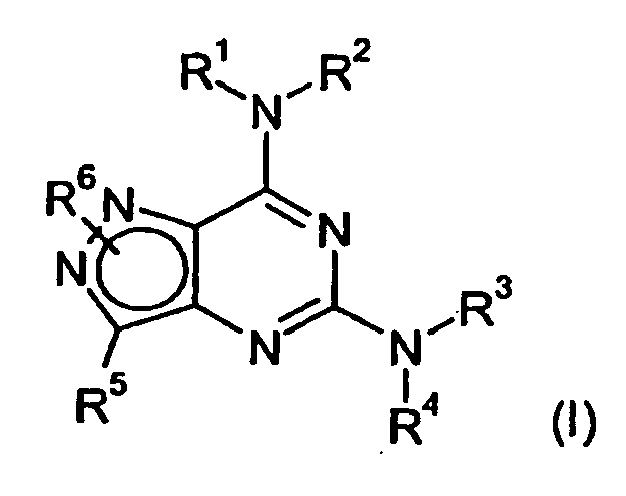
R2 Wasserstoff oder C1-C2-Alkyl ist;
R3 und R4 jeweils unabhängig C1-C8-Alkyl, C2-C8-Alkenyl, C2-C8-Alkinyl oder C3-C10-Cycloalkyl, von denen jedes gegebenenfalls substituiert ist mit einer oder mehreren R8-Gruppe(n), oder RE, das gegebenenfalls substituiert ist mit einer oder mehreren R9-Gruppe(n), oder Wasserstoff sind;
oder -NR3R4 RF bildet, das gegebenenfalls substituiert ist mit einer oder mehreren R10-Gruppe(n);
R5 -Y-CONR15R16 ist;
R6, das an N1 oder N2 gebunden sein kann, C1-C6-Alkyl, C1-C6-Halogenalkyl, C2-C6-Alkenyl oder C2-C6-Alkinyl ist, von denen jedes gegebenenfalls substituiert ist mit C1-C6-Alkoxy, C1-C6-Halogenalkoxy oder einer cyclischen Gruppe, ausgewählt aus RJ, RK, RL und RM, oder R6 RN, C3-C7-Cycloalkyl oder C3-C7-Halogencycloalkyl ist, von denen jedes gegebenenfalls mit C1-C6-Alkoxy oder C1-C6-Halogenalkoxy substituiert ist, oder R6 Wasserstoff ist;
R7 Halogen, C1-C6-Alkyl, C1-C6-Halogenalkyl, C2-C6-Alkenyl, C2-C6-Alkinyl, C3-C10-Cycloalkyl, C3-C10-Halogencycloalkyl, Phenyl, OR12, OC(O)R12, NO2, NR12R13, NR12C(O)R13, NR12CO2R14, C(O)R12, CO2R12, CONR12R13 oder CN ist;
R8 Halogen, Phenyl, C1-C6-Alkoxyphenyl, OR12, OC(O)R12, NO2 NR12R13, NR12C(O)R13, NR12CO2R14, C(O)R12, CO2R12, CONR12R13, CN, RG oder RH ist, wobei die letzten zwei von diesen gegebenenfalls mit einer oder mehreren R9-Gruppe(n) substituiert sind;
R9 C1-C6-Alkyl, C1-C6-Halogenalkyl oder CO2R12 ist;
R10 Halogen, C3-C10-Cycloalkyl, C3-C10-Halogencycloalkyl, Phenyl, OR12, OC(O)R12, NO2, NR12R13, NR12C(O)R13, NR12CO2R14, C(O)R12, CO2R13, CONR12R13, CN, Oxo, C1-C6-Alkyl oder C1-C6-Halogenalkyl ist, wobei die letzten zwei von diesen gegebenenfalls mit R11 substituiert sind;
R11 Phenyl, NR12R13 oder NR12CO2R14 ist;
R12 und R13 jeweils unabhängig Wasserstoff, C1-C6-Alkyl oder C1-C6-Halogenalkyl sind;
R14 C1-C6-Alkyl oder C1-C6-Halogenalkyl ist;
R15 und R16 jeweils unabhängig ausgewählt sind ausWasserstoff,C1-C6-Halogenalkyl,C1-C6-Alkyl, gegebenenfalls substituiert mitR17,-NR18R19,-CO2R20,-CONR21R22,R23 oderPhenyl, gegebenenfalls substituiert mitHalogen,C1-C6-Alkyl oderR17,C3-C7-Cycloalkyl, gegebenenfalls substituiert mitC1-C6-Alkyl,R17 oder-NR18R19, undR23;oder NR15R16 einen 3- bis 8-gliedrigen Ring bildet, der gegebenenfalls ein oder mehrere weitere Heteroatom(e), ausgewählt aus Stickstoff, Sauerstoff und Schwefel, umfassen kann und der gegebenenfalls außerdem substituiert sein kann mit R17, C1-C6-Halogenalkyl, -CO2R20, -CONR21R22, Oxo oder C1-C6-Alkyl, gegebenenfalls substituiert mit R17;
R17 Hydroxy, C1-C6-Alkoxy, C1-C6(Halogenalkyl)oxy oder C3-C7-Cycloalkyloxy ist;
R18 und R19 jeweils unabhängig ausgewählt sind aus Wasserstoff und C1-C6-Alkyl;
oder -NR18R19 einen Azetidin-, Pyrrolidin-, Piperidin- oder Morpholinring bildet;
R20 Wasserstoff oder C1-C6-Alkyl ist;
R21 und R22 jeweils unabhängig ausgewählt sind aus Wasserstoff, C1-C6-Alkyl, C1-C6-Halogenalkyl und C3-C7-Cycloalkyl;
oder -NR21R22 einen 3- bis 8-gliedrigen Ring bildet, der gegebenenfalls ein oder mehrere weitere Heteroatom(e), ausgewählt aus Stickstoff, Sauerstoff und Schwefel, umfassen kann;
R23 ein gesättigter 3- bis 8-gliedriger Ring ist, der wenigstens ein Heteroatom, ausgewählt aus Stickstoff, Sauerstoff und Schwefel, umfasst, wobei der Ring gegebenenfalls mit einer oder mehreren C1-C6-Alkylgruppe(n) substituiert sein kann, mit der Maßgabe, dass die Gruppe R23 durch eine kovalente Bindung an ein Kohlenstoffatom des Rings an das Stammmolekül gebunden ist;
RA und RJ jeweils unabhängig eine C3-C10-Cycloalkyl- oder C3-C10-Cycloalkenylgruppe sind, von denen jede monocyclisch oder, wenn es eine geeignete Anzahl von Ringatomen gibt, polycyclisch sein kann und die kondensiert sein kann an entweder(a) einen monocyclischen aromatischen Ring, ausgewählt aus einem Benzolring und einem 5- oder 6-gliedrigen heteroaromatischen Ring, der bis zu drei Heteroatome, ausgewählt aus Stickstoff, Sauerstoff und Schwefel, enthält, oder(b) einen 5-, 6- oder 7-gliedrigen heteroalicyclischen Ring, der bis zu drei Heteroatome, ausgewählt aus Stickstoff, Sauerstoff und Schwefel, enthält;RB und RK jeweils unabhängig eine Phenyl- oder Naphthylgruppe sind, von denen jede kondensiert sein kann an(a) einen C5-C7-Cycloalkyl- oder C5-C7-Cycloalkenyl-ring,(b) einen 5-, 6- oder 7-gliedrigen heteroalicyclischen Ring, der bis zu drei Heteroatome, ausgewählt aus Stickstoff, Sauerstoff und Schwefel, enthält, oder(c) einen 5- oder 6-gliedrigen heteroaromatischen Ring, der bis zu drei Heteroatome, ausgewählt aus Stickstoff, Sauerstoff und Schwefel, enthält;RC, RL und RN sind jeweils unabhängig ein monocyclisches oder, wenn es eine geeignete Anzahl von Ringatomen gibt, polycyclisches gesättigtes oder teilweise ungesättigtes Ringsystem, das zwischen 3 und 10 Ringatome enthält, von denen wenigstens eines ein Heteroatom, ausgewählt aus Stickstoff, Sauerstoff und Schwefel, ist, wobei der Ring an eine C5-C7-Cycloalkyl- oder C5-C7-Cycloalkenylgruppe oder einen monocyclischen aromatischen Ring, ausgewählt aus einem Benzolring und einem 5- oder 6-gliedrigen heteroaromatischen Ring, der bis zu drei Heteroatome, ausgewählt aus Stickstoff, Sauerstoff und Schwefel, enthält, kondensiert sein kann;
RD und RM jeweils unabhängig ein 5- oder 6-gliedriger heteroaromatischer Ring, der bis zu drei Heteroatome, unabhängig ausgewählt aus Stickstoff, Sauerstoff und Schwefel, enthält, sind, wobei der Ring außerdem kondensiert sein kann an(a) einen zweiten 5- oder 6-gliedrigen heteroaromatischen Ring, der bis zu drei Heteroatome, ausgewählt aus Stickstoff, Sauerstoff und Schwefel, enthält;(b) einen C5-C7-Cycloalkyl- oder C5-C7-Cycloalkenyl-ring;(c) einen 5-, 6- oder 7-gliedrigen heteroalicyclischen Ring, der bis zu drei Heteroatome, ausgewählt aus Stickstoff, Sauerstoff und Schwefel, enthält; oder(d) einen Benzolring;RE, RF und RG jeweils unabhängig ein monocyclisches oder, wenn es eine geeignete Anzahl von Ringatomen gibt, polycyclisches gesättigtes Ringsystem, das zwischen 3 und 10 Ringatome enthält, von denen wenigstens eines ein Heteroatom, ausgewählt aus Stickstoff, Sauerstoff und Schwefel, ist, sind;
RH ein 5- oder 6-gliedriger heteroaromatischer Ring ist, der bis zu drei Heteroatome, unabhängig ausgewählt aus Stickstoff, Sauerstoff und Schwefel, enthält; und
Y eine kovalente Bindung, C1-C8-Alkylenyl oder C3-C7-Cycloalkylenyl ist;
ein Tautomer davon oder ein pharmazeutisch verträgliches Salz oder Solvat der Verbindung oder des Tautomers. - Verbindung nach Anspruch 1, worin R1 RA ist, das gegebenenfalls substituiert ist mit einer oder mehreren R7-Gruppe(n); und
RA eine C3-C10-Cycloalkylgruppe ist, die entweder monocyclisch oder, wenn es eine geeignete Anzahl von Ringatomen gibt, polycyclisch sein kann, die kondensiert sein kann entweder an(a) einen monocyclischen aromatischen Ring, ausgewählt aus einem Benzolring und einem 5- oder 6-gliedrigen heteroaromatischen Ring, der bis zu drei Heteroatome, ausgewählt aus Stickstoff, Sauerstoff und Schwefel, enthält, oder(b) einen 5-, 6- oder 7-gliedrigen heteroalicyclischen Ring, der bis zu drei Heteroatome, ausgewählt aus Stickstoff, Sauerstoff und Schwefel, enthält. - Verbindung nach Anspruch 1, worin R1 RB, RC oder RD ist, von denen jedes gegebenenfalls mit einer oder mehreren R7-Gruppe(n) substituiert ist, worin
RB Phenyl ist,
RC ein monocyclisches gesättigtes oder teilweise ungesättigtes Ringsystem ist, das zwischen 5 und 7 Ringatome enthält, von denen wenigstens eines ein Heteroatom, ausgewählt aus Stickstoff, Sauerstoff und Schwefel, ist,
RD Furanyl, Thienyl, Pyrrolyl, Pyrazolyl, Imidazolyl, Isoxazolyl, Oxazolyl, Isothiazolyl, Thiazolyl, Oxadiazolyl, Pyridyl, Pyridazinyl, Pyrimidyl oder Pyrazinyl ist und
R7 Fluor, Methyl, Ethyl, Hydroxy, Methoxy, Propoxy oder CONHMe ist. - Verbindung nach einem der Ansprüche 1 bis 3, worin R2 Wasserstoff oder Methyl ist.
- Verbindung nach einem der Ansprüche 1 bis 4, worin R3 Wasserstoff oder C1-C4-Alkyl, das gegebenenfalls mit einer oder mehreren R8-Gruppe(n) substituiert ist, ist oder R3 Azetidinyl, Pyrrolidinyl oder Piperidinyl ist, von denen jedes gegebenenfalls mit einer oder mehreren R9-Gruppe(n) substituiert ist,
R8 Hydroxy, Methoxy, Methoxyphenyl, NH2, NHMe, NMe2, NHCO2 tBu, NMeCO2 tBu, CO2H, CONHMe, Pyrrolidinyl, Piperidinyl, Morpholinyl oder Pyrazolyl ist, von denen die letzten vier gegebenenfalls mit einer oder mehreren R9-Gruppe(n) substituiert sind, und
R9 Methyl oder CO2 tBu ist. - Verbindung nach einem der Ansprüche 1 bis 5, worin R4 Wasserstoff, Methyl oder Ethyl ist.
- Verbindung nach einem der Ansprüche 1 bis 6, worin -NR3R4RF bildet, das gegebenenfalls mit einer oder mehreren R10-Gruppe(n) substituiert ist, worin
RF ausgewählt ist aus Azetidinyl, Pyrrolidinyl, Piperidinyl, Piperazinyl, Morpholinyl, 3-Azabicyclo[3.1.0]hex-3-yl, Homopiperazinyl, 2,5-Diazabicyclo[4.3.0]non-2-yl, 3,8-Diazabicyclo[3.2.1]oct-3-yl, 3,8-Diazabicylo[3.2.1]oct-8-yl, 1,4-Diazabicyclo[4.3.0]non-4-yl und 1,4-Diazabicyclo-[3.2.2]non-4-yl und
R10 Halogen, Methyl, Ethyl, Isopropyl, Hydroxy, Methoxy, NH2, NHMe, NMe2, NHCO2 tBu, CO2H, CO2 tBu, Oxo, Benzyl, -CH2NH2, -CH2HNMe, CH2NMe2 oder -CH2NMeCO2 tBu ist. - Verbindung nach einem der Ansprüche 1 bis 7, worin
R15 und R16 jeweils unabhängig ausgewählt sind aus Wasserstoff, C1-C6-Alkyl, gegebenenfalls substituiert mit R17, -NR18R19, -CO2R20, -CONR21R22, R23 oder Phenyl, gegebenenfalls substituiert mit Halogen, C1-C6-Alkyl oder R17, C3-C7-Cycloalkyl und R23, oder NR15R16 einen 5- bis 7-gliedrigen Ring bildet, der gegebenenfalls ein oder mehrere weitere Heteroatom(e), ausgewählt aus Stickstoff und Sauerstoff, enthalten kann und der gegebenenfalls außerdem substituiert sein kann mit R17, -CO2R20, -CONR21R22 oder C1-C6-Alkyl, das gegebenenfalls mit R17 substituiert ist;
R17 Hydroxy, C1-C6-Alkoxy oder C3-C7-Cycloalkyloxy ist;
R21 und R22 jeweils unabhängig ausgewählt sind aus Wasserstoff, C1-C6-Alkyl und C3-C7-Cycloalkyl oder -NR21R22 einen 5- bis 8-gliedrigen Ring bildet, der gegebenenfalls ein oder mehrere weitere Heteroatom(e), ausgewählt aus Stickstoff und Sauerstoff, enthalten kann; und
R23 ein gesättigter 5- bis 7-gliedriger Ring ist, der wenigstens ein Heteroatom, ausgewählt aus Stickstoff und Sauerstoff, beinhaltet, wobei dieser Ring gegebenenfalls mit einer oder mehreren C1-C6-Alkylgruppe(n) substituiert sein kann. - Verbindung nach einem der Ansprüche 1 bis 8, worin R6 an N1 positioniert ist.
- Verbindung nach Anspruch 9, worin R6 Wasserstoff, Methyl, Ethyl, Isopropyl, Isobutyl, Methoxyethyl, Methoxypropyl, Ethoxyethyl, Ethoxypropyl, Propoxyethyl, 2,2,2-Trifluorethyl, Tetrahydrofuranylmethyl, Tetrahydropyranylmethyl, Tetrahydropyranyl oder Pyridinylmethyl ist.
- Verbindung nach Anspruch 1, worin
R1 eine cyclische Gruppe, ausgewählt aus RA, RB, RC und RD, ist, von denen jede gegebenenfalls mit einer oder mehreren R7-Gruppe(n) substituiert ist;
R7 Halogen, C1-C6-Alkyl, C1-C6-Halogenalkyl, OR12 oder CONR 12R13 ist;
R8 Halogen, Phenyl, C1-C6-Alkoxyphenyl, OR12, NR12R13, NR12CO2R14, CO2R12, CONR12R13, RG oder RH ist, wobei die letzten zwei davon gegebenenfalls mit einer oder mehreren R9-Gruppe(n) substituiert sind;
RA eine monocyclische C5-C7-Cycloalkylgruppe ist;
RB Phenyl ist;
RC ein monocyclisches gesättigtes Ringsystem ist, das zwischen 5 und 7 Ringatome enthält, von denen wenigstens eines ein Heteroatom, ausgewählt aus Stickstoff, Sauerstoff und Schwefel, ist;
RD ein 5-gliedriger heteroaromatischer Ring, der ein Heteroatom, ausgewählt aus Stickstoff, Sauerstoff und Schwefel, und gegebenenfalls bis zu zwei weitere Stickstoffatome im Ring enthält, oder ein 6-gliedriger heteroaromatischer Ring, der 1, 2 oder 3 Stickstoffatome umfasst, ist;
RE ein monocyclisches gesättigtes Ringsystem, das zwischen 3 und 7 Ringatome, die ein Stickstoffatom enthalten, enthält, ist;
RF ein monocyclisches oder, wenn es eine geeignete Anzahl von Ringatomen gibt, polycyclisches gesättigtes Ringsystem, das zwischen 3 und 10 Ringatome, die wenigstens ein Stickstoffatom und gegebenenfalls ein anderes Atom, ausgewählt aus Sauerstoff und Schwefel, enthalten, enthält, ist;
RG ein monocyclisches gesättigtes Ringsystem ist, das zwischen 3 und 7 Ringatome enthält, von denen wenigstens eines ein Heteroatom, ausgewählt aus Stickstoff, Sauerstoff und Schwefel, ist; und
RH ein 5- oder 6-gliedriger heteroaromatischer Ring ist, der bis zu zwei Stickstoffatome enthält;
R3 Wasserstoff, C1-C4-Alkyl, das gegebenenfalls mit einer oder mehreren R8-Gruppe(n) substituiert ist, oder RE, das gegebenenfalls mit einer oder mehreren R9-Gruppe(n) substituiert ist, ist;
R4 Wasserstoff, C1-C6-Alkyl oder C1-C6-Halogenalkyl ist;
oder -NR3R4 RF bildet, das gegebenenfalls mit einer oder mehreren R10-Gruppe(n) substituiert ist;
R6 C1-C4-Alkyl oder C1-C4-Halogenalkyl ist, von denen jedes gegebenenfalls mit C1-C4-Alkoxy, C1-C4-Halogenalkoxy oder einer cyclischen Gruppe, ausgewählt aus RJ, RL und RM, substituiert ist, oder R6 RN oder Wasserstoff ist;
RJ Cyclopropyl oder Cyclobutyl ist;
RL und RM jeweils unabhängig ein monocyclisches gesättigtes Ringsystem sind, das entweder 5 oder 6 Ringatome enthält, von denen wenigstens eines ein Heteroatom, ausgewählt aus Stickstoff, Sauerstoff und Schwefel, ist;
RM ein 5- oder 6-gliedriger heteroaromatischer Ring ist, der ein Heteroatom, ausgewählt aus Stickstoff, Sauerstoff und Schwefel, enthält; und
Y eine kovalente Bindung ist. - Verbindung nach Anspruch 1, ausgewählt aus:1-(2-Ethoxyethyl)-N-ethyl-5-(ethylamino)-7-(4-methylpyridin-2-ylamino)-1H-pyrazolo[4,3-d]pyrimidin-3-carboxamid,5-(Dimethylamino)-1-(2-ethoxyethyl)-N-methyl-7-(4-methylpyridin-2-ylamino)-1H-pyrazolo[4,3-d]pyrimidin-3-carboxamid,5-(Dimethylamino)-1-(2-ethoxyethyl)-N-(2-(methylamino)-ethyl)-7-(4-methylpyridin-2-ylamino)-1H-pyrazolo[4,3-d]pyrimidin-3-carboxamid,5-(Dimethylamino)-N-(2-(dimethylamino)ethyl)-1-(2-ethoxyethyl)-7-(4-methylpyridin-2-ylamino)-1H-pyrazolo[4,3-d]-pyrimidin-3-carboxamid,5-(Dimethylamino)-1-(2-ethoxyethyl)-7-(4-methylpyridin-2-ylamino)-N-(piperidin-4-yl)-1H-pyrazolo[4,3-d]pyrimidin-3-carboxamid,5-(Dimethylamino)-1-(2-ethoxyethyl)-N-(2-methoxyethyl)-7-(4-methylpyridin-2-ylamino)-1H-pyrazolo[4,3-d]pyrimidin-3-carboxamid,(2R)-2-{[5-(Dimethylamino)-1-(2-ethoxyethyl)-7-(4-methylpyridin-2-ylamino)-1H-pyrazolo[4,3-d]pyrimidin-3-carbonyl]amino}propionsäure;3-{[5-(Dimethylamino)-1-(2-ethoxyethyl)-7-(4-methylpyridin-2-ylamino)-1H-pyrazolo[4,3-d]pyrimidin-3-carbonyl]-amino}propionsäure,1-(2-Ethoxyethyl)-N-methyl-7-(4-methylpyridin-2-ylamino)-5-(piperazin-1-yl)-1H-pyrazolo[4,3-d]pyrimidin-3-carboxamid,1-(2-Ethoxyethyl)-N-methyl-5-((3R)-3-methylpiperazin-1-yl)-7-(4-methylpyridin-2-ylamino)-1H-pyrazolo[4,3-d]pyrimidin-3-carboxamid,1-(2-Ethoxyethyl)-N-ethyl-5-((3R)-3-methylpiperazin-1-yl)-7-(4-methylpyridin-2-ylamino)-1H-pyrazolo[4,3-d]pyrimidin-3-carboxamid,1-(2-Ethoxyethyl)-5-(ethylamino)-N-methyl-7-(4-methylpyridin-2-ylamino)-1H-pyrazolo[4,3-d]pyrimidin-3-carboxamid,1-(2-Ethoxyethyl)-N-(2-methoxyethyl)-5-(methylamino)-7-(4-methylpyridin-2-ylamino)-1H-pyrazolo[4,3-d]pyrimidin-3-carboxamid,5-(Dimethylamino)-1-(2-ethoxyethyl)-N-(2-hydroxyethyl)-7-(4-methylpyridin-2-ylamino)-1H-pyrazolo[4,3-d]pyrimidin-3-carboxamid,1-(2-Ethoxyethyl)-5-(ethylamino)-N-(2-methoxyethyl)-7-(4-methylpyridin-2-ylamino)-1H-pyrazolo[4,3-d]pyrimidin-3-carboxamid,1-(2-Ethoxyethyl)-5-(N-(2-hydroxyethyl)-N-methylamino)-N-methyl-7-(4-methylpyridin-2-ylamino)-1H-pyrazolo[4,3-d]-pyrimidin-3-carboxamid,1-(2-Ethoxyethyl)-5-((2-methoxyethyl)amino)-N-methyl-7-(4-methylpyridin-2-ylamino)-1H-pyrazolo[4,3-d]pyrimidin-3-carboxamid,7-(Cyclohexylamino)-1-(2-ethoxyethyl)-N-methyl-5-((3R)-3-methylpiperazin-1-yl)-1H-pyrazolo[4,3-d]pyrimidin-3-carboxamid und1-(2-Ethoxyethyl)-N-methyl-5-[N-methyl-N-((3S)-1-methylpyrrolidin-3-yl)amino]-7-(4-methylpyridin-2-ylamino)-1H-pyrazolo[4,3-d]pyrimidin-3-carboxamidund Tautomeren davon und pharmazeutisch verträglichen Salzen und Solvaten der Verbindung oder des Tautomers.
- Pharmazeutische Zusammensetzung, umfassend eine Verbindung der Formel (I), wie sie in einem der Ansprüche 1 bis 12 beansprucht ist, oder ein pharmazeutisch verträgliches Salz oder Solvat davon und ein pharmazeutisch verträgliches Verdünnungsmittel oder einen pharmazeutisch verträglichen Träger.
- Verbindung der Formel (I), wie sie in einem der Ansprüche 1 bis 12 beansprucht wird, oder ein pharmazeutisch verträgliches Salz oder Solvat davon zur Verwendung als Medikament für die Behandlung einer Erkrankung oder eines Zustandes, ausgewählt aus Hypertonie (einschließlich essentieller Hypertonie, pulmonaler Hypertonie, Sekundärhypertonie, isoliertem systolischem Hochdruck, Hypertonie, assoziiert mit Diabetes, Hypertonie, assoziiert mit Atherosklerose, und renovaskulärer Hypertonie), kongestiver Herzinsuffizienz, Angina (einschließlich stabiler, instabiler und varianter (Prinzmetal-)Angina), Schlaganfall, Koronararterienerkrankung, kongestiver Herzinsuffizienz, Zuständen reduzierter Blutgefäßdurchgängigkeit (z.B. nach perkutaner Koronarangioplastie), Erkrankung der peripheren Gefäße, Atherosklerose, Nitrat-induzierter Toleranz, Nitrattoleranz, Diabetes, verschlechterter Glucosetoleranz, Stoffwechselsyndrom, Adipositas, Sexualdysfunktion (einschließlich männlicher Erektionsstörung, Impotenz, Störung der weiblichen sexuellen Erregbarkeit, Klitorisdysfunktion, weibliche hypoaktive Störung des Verlangens nach Sex, weiblicher Sexschmerzstörung, weiblicher sexueller Orgasmus-Dysfunktion und sexueller Dysfunktion, bedingt durch Rückenmarksverletzung), Frühgeburt, Pre-Eklampsie, Dysmenorrhöe, polycystischem Ovarialsyndrom, benigner Prostatahyperplasie, Blasenobstruktion, Inkontinenz, chronischer obstruktiver Lungenerkrankung, respiratorischem Versagen, Bronchitis, chronischem Asthma, allergischem Asthma, allergischer Rhinitis, Motilitätsstörungen des Darms (einschließlich Reizdarmsyndrom), Kawasaki-Syndrom, multipler Sklerose, Alzheimer-Erkrankung, Psoriasis, Hautnekrose, Narbenbildung, Fibrose, Schmerzen (insbesondere neuropathischer Schmerz), Krebs, Metastasen, Kahlköpfigkeit, Nussknacker-Ösophagus, Analfissur und Hämorrhoiden.
- Verwendung nach Anspruch 14, wobei die Erkrankung oder der Zustand ausgewählt aus ist essentieller Hypertonie, pulmonaler Hypertonie, Sekundärhypertonie, isoliertem systolischem Hochdruck, Hypertonie, assoziiert mit Diabetes, Hypertonie, assoziiert mit Atherosklerose, und renovaskulärer Hypertonie.
Applications Claiming Priority (2)
| Application Number | Priority Date | Filing Date | Title |
|---|---|---|---|
| GBGB0327323.2A GB0327323D0 (en) | 2003-11-24 | 2003-11-24 | Novel pharmaceuticals |
| PCT/IB2004/003791 WO2005049617A1 (en) | 2003-11-24 | 2004-11-19 | Pyrazolopyrimidines |
Publications (2)
| Publication Number | Publication Date |
|---|---|
| EP1689752A1 EP1689752A1 (de) | 2006-08-16 |
| EP1689752B1 true EP1689752B1 (de) | 2008-02-27 |
Family
ID=29797726
Family Applications (1)
| Application Number | Title | Priority Date | Filing Date |
|---|---|---|---|
| EP04798915A Expired - Lifetime EP1689752B1 (de) | 2003-11-24 | 2004-11-19 | Pyrazolopyrimidine |
Country Status (11)
| Country | Link |
|---|---|
| US (1) | US20070105877A1 (de) |
| EP (1) | EP1689752B1 (de) |
| JP (1) | JP2007512317A (de) |
| AT (1) | ATE387449T1 (de) |
| BR (1) | BRPI0416678A (de) |
| CA (1) | CA2545196A1 (de) |
| DE (1) | DE602004012146T2 (de) |
| ES (1) | ES2300849T3 (de) |
| GB (1) | GB0327323D0 (de) |
| MX (1) | MXPA06005824A (de) |
| WO (1) | WO2005049617A1 (de) |
Families Citing this family (12)
| Publication number | Priority date | Publication date | Assignee | Title |
|---|---|---|---|---|
| MX2007003327A (es) | 2004-09-20 | 2007-06-05 | Xenon Pharmaceuticals Inc | Derivados heterociclicos, y su uso como mediadores de estearoil-coa desaturasa. |
| EP2289510A1 (de) | 2004-09-20 | 2011-03-02 | Xenon Pharmaceuticals Inc. | Heterozyklische Derivate zur Behandlung von durch Stearoyl-Coa-Desaturase-Enzyme verursachten Krankheiten |
| MX2007003332A (es) | 2004-09-20 | 2007-06-05 | Xenon Pharmaceuticals Inc | Derivados heterociclicos y su uso como inhibidores de estearoil-coa-desaturasa. |
| JP4958786B2 (ja) | 2004-09-20 | 2012-06-20 | ゼノン・ファーマシューティカルズ・インコーポレイテッド | 複素環誘導体および治療薬としてのそれらの使用 |
| EP2269610A3 (de) | 2004-09-20 | 2011-03-09 | Xenon Pharmaceuticals Inc. | Heterozyklische Derivate und ihre Verwendung als Stearoyl-Coa-Desaturase-Inhibitoren |
| EP1799667B1 (de) | 2004-09-20 | 2013-03-20 | Xenon Pharmaceuticals Inc. | Heterozyklische derivate und ihre verwendung als therapeutische wirkstoffe |
| MX2007003319A (es) | 2004-09-20 | 2007-06-05 | Xenon Pharmaceuticals Inc | Derivados heterociclicos y su uso como agentes terapeuticos. |
| CA2608018C (en) | 2005-05-12 | 2010-07-13 | Pfizer Inc. | Anhydrous crystalline forms of n-[1-(2-ethoxyethyl)-5-(n-ethyl-n-methylamino)-7-(4-methylpyridin-2-yl-amino)-1h-pyrazolo[4,3-d]pyrimidine-3-carbonyl]methanesulfonamide |
| BRPI0611187A2 (pt) | 2005-06-03 | 2010-08-24 | Xenon Pharmaceuticals Inc | derivados aminotiazàis como inibidores da estearoil-coa desaturase humana |
| NL2000291C2 (nl) * | 2005-11-10 | 2009-02-17 | Pfizer Prod Inc | 1-(1-(2-ethoxyethyl)-3-ethyl-7-(4-methylpyridin-2-ylamino)-1H- pyrazool(4,3-d)pyrimidine-5-yl)piperidine-4-carbonzuur en zouten daarvan. |
| CN104755472A (zh) * | 2012-09-04 | 2015-07-01 | 细胞基因公司 | 3-(5-氨基-2-甲基-4-氧代喹唑啉-3(4h)-基)哌啶-2,6-二酮的同位素体及其制备方法 |
| US10174039B2 (en) * | 2016-09-30 | 2019-01-08 | Asana Biosciences, Llc | P2X3 and/or P2X2/3 compounds and methods |
Family Cites Families (23)
| Publication number | Priority date | Publication date | Assignee | Title |
|---|---|---|---|---|
| US3951980A (en) * | 1974-05-09 | 1976-04-20 | Stanford Research Institute | 3-Substituted-8-methyl-3,8-diazabicyclo[3.2.1]octanes |
| US4282361A (en) * | 1978-03-16 | 1981-08-04 | Massachusetts Institute Of Technology | Synthesis for 7-alkylamino-3-methylpyrazolo [4,3-d]pyrimidines |
| US5091431A (en) * | 1988-02-08 | 1992-02-25 | Schering Corporation | Phosphodiesterase inhibitors |
| US5442044A (en) * | 1991-01-04 | 1995-08-15 | Pfizer Inc. | Orally active renin inhibitors |
| US5869486A (en) * | 1995-02-24 | 1999-02-09 | Ono Pharmaceutical Co., Ltd. | Fused pyrimidines and pyriazines as pharmaceutical compounds |
| GB9518953D0 (en) * | 1995-09-15 | 1995-11-15 | Pfizer Ltd | Pharmaceutical formulations |
| DE19644228A1 (de) * | 1996-10-24 | 1998-04-30 | Merck Patent Gmbh | Thienopyrimidine |
| US6184338B1 (en) * | 1997-08-27 | 2001-02-06 | Fmc Corporation | Anionic polymerization initiators containing tertiary amine functionality, their chain extended analogues, and processes for using the same |
| TR200001338T2 (tr) * | 1997-11-12 | 2000-08-21 | Bayer Aktiengesellschaft | 2-Fenil-ikameli imidazotriazinonlar |
| AU3514200A (en) * | 1999-03-10 | 2000-09-28 | Merck & Co., Inc. | 6-azaindole compounds as antagonists of gonadotropin releasing hormone |
| US6465486B1 (en) * | 1999-03-12 | 2002-10-15 | Ortho-Mcneil Pharmaceutical, Inc. | Pyridyl/quinolinyl imidazoles |
| DE19942474A1 (de) * | 1999-09-06 | 2001-03-15 | Merck Patent Gmbh | Pyrazolo[4,3-d]pyrimidine |
| US6548509B2 (en) * | 1999-10-22 | 2003-04-15 | Neurogen Corporation | 3-aryl substituted pyrazolo[4,3-D]pyrimidine derivatives; corticotropin-releasing factor receptor (CRF1) specific ligands |
| DE60118521T2 (de) * | 2000-01-07 | 2006-10-12 | Universitaire Instelling Antwerpen | Purin derivate, ihre herstellung und verwendung |
| US20010047013A1 (en) * | 2000-03-10 | 2001-11-29 | Fengrui Lang | Process for the preparation of arylamines |
| DE10031584A1 (de) * | 2000-06-29 | 2002-01-10 | Merck Patent Gmbh | 5-Aminoalkyl-pyrazolo[4,3-d]pyrimidine |
| DE10058662A1 (de) * | 2000-11-25 | 2002-05-29 | Merck Patent Gmbh | Verwendung von Pyrazolo[4,3-d]pyrimidinen |
| CA2431077A1 (en) * | 2000-12-19 | 2002-06-27 | Merck Patent Gesellschaft Mit Beschraenkter Haftung | Pharmaceutical formulation comprising pyrazolo[4,3-d]pyrimidines and antithrombotics, calcium antagonists, prostaglandins or prostaglandin derivatives |
| US20020127593A1 (en) * | 2001-03-12 | 2002-09-12 | Regents Of The University Of California | Fluorescence assay for DNA modifying enzymes |
| PE20030008A1 (es) * | 2001-06-19 | 2003-01-22 | Bristol Myers Squibb Co | Inhibidores duales de pde 7 y pde 4 |
| US6432957B1 (en) * | 2001-06-29 | 2002-08-13 | Kowa Co., Ltd. | Piperazine derivative |
| ATE478872T1 (de) * | 2002-03-28 | 2010-09-15 | Ustav Ex Botan Av Cr V V I I O | Pyrazoloä4,3-düpyrimidine, verfahren zu ihrer herstellung und therapeutische anwendung |
| EA008596B1 (ru) * | 2003-04-29 | 2007-06-29 | Пфайзер Инк. | 5,7-ДИАМИНОПИРАЗОЛО[4,3-d]ПИРИМИДИНЫ, ПОЛЕЗНЫЕ ПРИ ЛЕЧЕНИИ ГИПЕРТЕНЗИИ |
-
2003
- 2003-11-24 GB GBGB0327323.2A patent/GB0327323D0/en not_active Ceased
-
2004
- 2004-11-19 DE DE602004012146T patent/DE602004012146T2/de not_active Expired - Fee Related
- 2004-11-19 BR BRPI0416678-7A patent/BRPI0416678A/pt not_active IP Right Cessation
- 2004-11-19 JP JP2006540655A patent/JP2007512317A/ja not_active Withdrawn
- 2004-11-19 EP EP04798915A patent/EP1689752B1/de not_active Expired - Lifetime
- 2004-11-19 WO PCT/IB2004/003791 patent/WO2005049617A1/en not_active Ceased
- 2004-11-19 US US10/580,306 patent/US20070105877A1/en not_active Abandoned
- 2004-11-19 CA CA002545196A patent/CA2545196A1/en not_active Abandoned
- 2004-11-19 ES ES04798915T patent/ES2300849T3/es not_active Expired - Lifetime
- 2004-11-19 MX MXPA06005824A patent/MXPA06005824A/es active IP Right Grant
- 2004-11-19 AT AT04798915T patent/ATE387449T1/de not_active IP Right Cessation
Also Published As
| Publication number | Publication date |
|---|---|
| DE602004012146T2 (de) | 2009-03-19 |
| ES2300849T3 (es) | 2008-06-16 |
| MXPA06005824A (es) | 2006-08-11 |
| WO2005049617A1 (en) | 2005-06-02 |
| US20070105877A1 (en) | 2007-05-10 |
| ATE387449T1 (de) | 2008-03-15 |
| EP1689752A1 (de) | 2006-08-16 |
| GB0327323D0 (en) | 2003-12-31 |
| BRPI0416678A (pt) | 2007-02-13 |
| JP2007512317A (ja) | 2007-05-17 |
| CA2545196A1 (en) | 2005-06-02 |
| DE602004012146D1 (en) | 2008-04-10 |
Similar Documents
| Publication | Publication Date | Title |
|---|---|---|
| EP1689751B1 (de) | 5,7-diaminopyrazolo[4,3-d]pyrimidine mit pde-5-hemmender wirkung | |
| JP4015176B2 (ja) | 高血圧症の治療に有用な5,7−ジアミノピラゾロ4,3−ジピリミジン類 | |
| US8097621B2 (en) | Pyrazolo[4,3-d]pyrimidines as phosphodiesterase inhibitors | |
| US20070105877A1 (en) | Pyrazolopyrimidines | |
| EP1742950B1 (de) | Pyrazolo[4,3-d]pyrimidine | |
| HK1142522A (en) | 5, 7-diaminopyrazolo [4,3-d] pyrimidines with pde -5 inhibiting activity and composition thereof | |
| HK1128917B (en) | 5,7-diaminopyrazolo [4,3-d] pyrimidines with pde-5 inhibiting activity | |
| HK1099286B (en) | 5,7-diaminopyrazolo [4,3-d] pyrimidines with pde-5 inhibiting activity |
Legal Events
| Date | Code | Title | Description |
|---|---|---|---|
| PUAI | Public reference made under article 153(3) epc to a published international application that has entered the european phase |
Free format text: ORIGINAL CODE: 0009012 |
|
| 17P | Request for examination filed |
Effective date: 20060626 |
|
| AK | Designated contracting states |
Kind code of ref document: A1 Designated state(s): AT BE BG CH CY CZ DE DK EE ES FI FR GB GR HU IE IS IT LI LU MC NL PL PT RO SE SI SK TR |
|
| 17Q | First examination report despatched |
Effective date: 20060915 |
|
| DAX | Request for extension of the european patent (deleted) | ||
| GRAP | Despatch of communication of intention to grant a patent |
Free format text: ORIGINAL CODE: EPIDOSNIGR1 |
|
| RIC1 | Information provided on ipc code assigned before grant |
Ipc: C07D 487/04 20060101AFI20070918BHEP Ipc: A61P 9/12 20060101ALI20070918BHEP Ipc: A61K 31/395 20060101ALI20070918BHEP Ipc: A61K 31/505 20060101ALI20070918BHEP |
|
| GRAS | Grant fee paid |
Free format text: ORIGINAL CODE: EPIDOSNIGR3 |
|
| GRAA | (expected) grant |
Free format text: ORIGINAL CODE: 0009210 |
|
| AK | Designated contracting states |
Kind code of ref document: B1 Designated state(s): AT BE BG CH CY CZ DE DK EE ES FI FR GB GR HU IE IS IT LI LU MC NL PL PT RO SE SI SK TR |
|
| REG | Reference to a national code |
Ref country code: GB Ref legal event code: FG4D |
|
| REG | Reference to a national code |
Ref country code: CH Ref legal event code: EP |
|
| REG | Reference to a national code |
Ref country code: IE Ref legal event code: FG4D |
|
| REF | Corresponds to: |
Ref document number: 602004012146 Country of ref document: DE Date of ref document: 20080410 Kind code of ref document: P |
|
| REG | Reference to a national code |
Ref country code: ES Ref legal event code: FG2A Ref document number: 2300849 Country of ref document: ES Kind code of ref document: T3 |
|
| PG25 | Lapsed in a contracting state [announced via postgrant information from national office to epo] |
Ref country code: IS Free format text: LAPSE BECAUSE OF FAILURE TO SUBMIT A TRANSLATION OF THE DESCRIPTION OR TO PAY THE FEE WITHIN THE PRESCRIBED TIME-LIMIT Effective date: 20080627 Ref country code: FI Free format text: LAPSE BECAUSE OF FAILURE TO SUBMIT A TRANSLATION OF THE DESCRIPTION OR TO PAY THE FEE WITHIN THE PRESCRIBED TIME-LIMIT Effective date: 20080227 |
|
| NLV1 | Nl: lapsed or annulled due to failure to fulfill the requirements of art. 29p and 29m of the patents act | ||
| PG25 | Lapsed in a contracting state [announced via postgrant information from national office to epo] |
Ref country code: AT Free format text: LAPSE BECAUSE OF FAILURE TO SUBMIT A TRANSLATION OF THE DESCRIPTION OR TO PAY THE FEE WITHIN THE PRESCRIBED TIME-LIMIT Effective date: 20080227 |
|
| ET | Fr: translation filed | ||
| PG25 | Lapsed in a contracting state [announced via postgrant information from national office to epo] |
Ref country code: BE Free format text: LAPSE BECAUSE OF FAILURE TO SUBMIT A TRANSLATION OF THE DESCRIPTION OR TO PAY THE FEE WITHIN THE PRESCRIBED TIME-LIMIT Effective date: 20080227 Ref country code: SI Free format text: LAPSE BECAUSE OF FAILURE TO SUBMIT A TRANSLATION OF THE DESCRIPTION OR TO PAY THE FEE WITHIN THE PRESCRIBED TIME-LIMIT Effective date: 20080227 Ref country code: PL Free format text: LAPSE BECAUSE OF FAILURE TO SUBMIT A TRANSLATION OF THE DESCRIPTION OR TO PAY THE FEE WITHIN THE PRESCRIBED TIME-LIMIT Effective date: 20080227 |
|
| PG25 | Lapsed in a contracting state [announced via postgrant information from national office to epo] |
Ref country code: PT Free format text: LAPSE BECAUSE OF FAILURE TO SUBMIT A TRANSLATION OF THE DESCRIPTION OR TO PAY THE FEE WITHIN THE PRESCRIBED TIME-LIMIT Effective date: 20080721 Ref country code: CZ Free format text: LAPSE BECAUSE OF FAILURE TO SUBMIT A TRANSLATION OF THE DESCRIPTION OR TO PAY THE FEE WITHIN THE PRESCRIBED TIME-LIMIT Effective date: 20080227 Ref country code: SE Free format text: LAPSE BECAUSE OF FAILURE TO SUBMIT A TRANSLATION OF THE DESCRIPTION OR TO PAY THE FEE WITHIN THE PRESCRIBED TIME-LIMIT Effective date: 20080527 Ref country code: NL Free format text: LAPSE BECAUSE OF FAILURE TO SUBMIT A TRANSLATION OF THE DESCRIPTION OR TO PAY THE FEE WITHIN THE PRESCRIBED TIME-LIMIT Effective date: 20080227 Ref country code: SK Free format text: LAPSE BECAUSE OF FAILURE TO SUBMIT A TRANSLATION OF THE DESCRIPTION OR TO PAY THE FEE WITHIN THE PRESCRIBED TIME-LIMIT Effective date: 20080227 Ref country code: DK Free format text: LAPSE BECAUSE OF FAILURE TO SUBMIT A TRANSLATION OF THE DESCRIPTION OR TO PAY THE FEE WITHIN THE PRESCRIBED TIME-LIMIT Effective date: 20080227 |
|
| PG25 | Lapsed in a contracting state [announced via postgrant information from national office to epo] |
Ref country code: RO Free format text: LAPSE BECAUSE OF FAILURE TO SUBMIT A TRANSLATION OF THE DESCRIPTION OR TO PAY THE FEE WITHIN THE PRESCRIBED TIME-LIMIT Effective date: 20080227 |
|
| PGFP | Annual fee paid to national office [announced via postgrant information from national office to epo] |
Ref country code: FR Payment date: 20080417 Year of fee payment: 5 Ref country code: IE Payment date: 20080721 Year of fee payment: 5 |
|
| PLBE | No opposition filed within time limit |
Free format text: ORIGINAL CODE: 0009261 |
|
| STAA | Information on the status of an ep patent application or granted ep patent |
Free format text: STATUS: NO OPPOSITION FILED WITHIN TIME LIMIT |
|
| PGFP | Annual fee paid to national office [announced via postgrant information from national office to epo] |
Ref country code: DE Payment date: 20080410 Year of fee payment: 5 |
|
| 26N | No opposition filed |
Effective date: 20081128 |
|
| PGFP | Annual fee paid to national office [announced via postgrant information from national office to epo] |
Ref country code: ES Payment date: 20081105 Year of fee payment: 5 |
|
| PG25 | Lapsed in a contracting state [announced via postgrant information from national office to epo] |
Ref country code: EE Free format text: LAPSE BECAUSE OF FAILURE TO SUBMIT A TRANSLATION OF THE DESCRIPTION OR TO PAY THE FEE WITHIN THE PRESCRIBED TIME-LIMIT Effective date: 20080227 Ref country code: BG Free format text: LAPSE BECAUSE OF FAILURE TO SUBMIT A TRANSLATION OF THE DESCRIPTION OR TO PAY THE FEE WITHIN THE PRESCRIBED TIME-LIMIT Effective date: 20080527 |
|
| PG25 | Lapsed in a contracting state [announced via postgrant information from national office to epo] |
Ref country code: MC Free format text: LAPSE BECAUSE OF NON-PAYMENT OF DUE FEES Effective date: 20081130 |
|
| PGFP | Annual fee paid to national office [announced via postgrant information from national office to epo] |
Ref country code: GB Payment date: 20081105 Year of fee payment: 5 |
|
| REG | Reference to a national code |
Ref country code: CH Ref legal event code: PL |
|
| PG25 | Lapsed in a contracting state [announced via postgrant information from national office to epo] |
Ref country code: CY Free format text: LAPSE BECAUSE OF FAILURE TO SUBMIT A TRANSLATION OF THE DESCRIPTION OR TO PAY THE FEE WITHIN THE PRESCRIBED TIME-LIMIT Effective date: 20080227 |
|
| PG25 | Lapsed in a contracting state [announced via postgrant information from national office to epo] |
Ref country code: IT Free format text: LAPSE BECAUSE OF NON-PAYMENT OF DUE FEES Effective date: 20081119 |
|
| PG25 | Lapsed in a contracting state [announced via postgrant information from national office to epo] |
Ref country code: CH Free format text: LAPSE BECAUSE OF NON-PAYMENT OF DUE FEES Effective date: 20081130 Ref country code: LI Free format text: LAPSE BECAUSE OF NON-PAYMENT OF DUE FEES Effective date: 20081130 |
|
| GBPC | Gb: european patent ceased through non-payment of renewal fee |
Effective date: 20091119 |
|
| PG25 | Lapsed in a contracting state [announced via postgrant information from national office to epo] |
Ref country code: HU Free format text: LAPSE BECAUSE OF FAILURE TO SUBMIT A TRANSLATION OF THE DESCRIPTION OR TO PAY THE FEE WITHIN THE PRESCRIBED TIME-LIMIT Effective date: 20080828 Ref country code: LU Free format text: LAPSE BECAUSE OF NON-PAYMENT OF DUE FEES Effective date: 20081119 |
|
| REG | Reference to a national code |
Ref country code: FR Ref legal event code: ST Effective date: 20100730 |
|
| PG25 | Lapsed in a contracting state [announced via postgrant information from national office to epo] |
Ref country code: TR Free format text: LAPSE BECAUSE OF FAILURE TO SUBMIT A TRANSLATION OF THE DESCRIPTION OR TO PAY THE FEE WITHIN THE PRESCRIBED TIME-LIMIT Effective date: 20080227 |
|
| PG25 | Lapsed in a contracting state [announced via postgrant information from national office to epo] |
Ref country code: FR Free format text: LAPSE BECAUSE OF NON-PAYMENT OF DUE FEES Effective date: 20091130 Ref country code: GR Free format text: LAPSE BECAUSE OF FAILURE TO SUBMIT A TRANSLATION OF THE DESCRIPTION OR TO PAY THE FEE WITHIN THE PRESCRIBED TIME-LIMIT Effective date: 20080528 Ref country code: IE Free format text: LAPSE BECAUSE OF NON-PAYMENT OF DUE FEES Effective date: 20091119 |
|
| PG25 | Lapsed in a contracting state [announced via postgrant information from national office to epo] |
Ref country code: DE Free format text: LAPSE BECAUSE OF NON-PAYMENT OF DUE FEES Effective date: 20100601 |
|
| PG25 | Lapsed in a contracting state [announced via postgrant information from national office to epo] |
Ref country code: GB Free format text: LAPSE BECAUSE OF NON-PAYMENT OF DUE FEES Effective date: 20091119 |
|
| REG | Reference to a national code |
Ref country code: ES Ref legal event code: FD2A Effective date: 20110329 |
|
| PG25 | Lapsed in a contracting state [announced via postgrant information from national office to epo] |
Ref country code: ES Free format text: LAPSE BECAUSE OF NON-PAYMENT OF DUE FEES Effective date: 20110316 |
|
| PGFP | Annual fee paid to national office [announced via postgrant information from national office to epo] |
Ref country code: IT Payment date: 20081106 Year of fee payment: 5 |
|
| PGRI | Patent reinstated in contracting state [announced from national office to epo] |
Ref country code: IT Effective date: 20110616 |
|
| PG25 | Lapsed in a contracting state [announced via postgrant information from national office to epo] |
Ref country code: ES Free format text: LAPSE BECAUSE OF NON-PAYMENT OF DUE FEES Effective date: 20091120 |
|
| PGRI | Patent reinstated in contracting state [announced from national office to epo] |
Ref country code: IT Effective date: 20110616 |