EP1687083B1 - Anorganisches oxid, abgasreinigungskatalysatorträger und abgasreinigungskatalysator - Google Patents
Anorganisches oxid, abgasreinigungskatalysatorträger und abgasreinigungskatalysator Download PDFInfo
- Publication number
- EP1687083B1 EP1687083B1 EP05767278A EP05767278A EP1687083B1 EP 1687083 B1 EP1687083 B1 EP 1687083B1 EP 05767278 A EP05767278 A EP 05767278A EP 05767278 A EP05767278 A EP 05767278A EP 1687083 B1 EP1687083 B1 EP 1687083B1
- Authority
- EP
- European Patent Office
- Prior art keywords
- oxide
- additional element
- inorganic oxide
- aluminum
- mol
- Prior art date
- Legal status (The legal status is an assumption and is not a legal conclusion. Google has not performed a legal analysis and makes no representation as to the accuracy of the status listed.)
- Ceased
Links
Images
Classifications
-
- B—PERFORMING OPERATIONS; TRANSPORTING
- B01—PHYSICAL OR CHEMICAL PROCESSES OR APPARATUS IN GENERAL
- B01J—CHEMICAL OR PHYSICAL PROCESSES, e.g. CATALYSIS OR COLLOID CHEMISTRY; THEIR RELEVANT APPARATUS
- B01J23/00—Catalysts comprising metals or metal oxides or hydroxides, not provided for in group B01J21/00
- B01J23/002—Mixed oxides other than spinels, e.g. perovskite
-
- B—PERFORMING OPERATIONS; TRANSPORTING
- B01—PHYSICAL OR CHEMICAL PROCESSES OR APPARATUS IN GENERAL
- B01J—CHEMICAL OR PHYSICAL PROCESSES, e.g. CATALYSIS OR COLLOID CHEMISTRY; THEIR RELEVANT APPARATUS
- B01J23/00—Catalysts comprising metals or metal oxides or hydroxides, not provided for in group B01J21/00
-
- B—PERFORMING OPERATIONS; TRANSPORTING
- B01—PHYSICAL OR CHEMICAL PROCESSES OR APPARATUS IN GENERAL
- B01D—SEPARATION
- B01D53/00—Separation of gases or vapours; Recovering vapours of volatile solvents from gases; Chemical or biological purification of waste gases, e.g. engine exhaust gases, smoke, fumes, flue gases, aerosols
- B01D53/34—Chemical or biological purification of waste gases
- B01D53/74—General processes for purification of waste gases; Apparatus or devices specially adapted therefor
- B01D53/86—Catalytic processes
-
- B—PERFORMING OPERATIONS; TRANSPORTING
- B01—PHYSICAL OR CHEMICAL PROCESSES OR APPARATUS IN GENERAL
- B01D—SEPARATION
- B01D53/00—Separation of gases or vapours; Recovering vapours of volatile solvents from gases; Chemical or biological purification of waste gases, e.g. engine exhaust gases, smoke, fumes, flue gases, aerosols
- B01D53/34—Chemical or biological purification of waste gases
- B01D53/92—Chemical or biological purification of waste gases of engine exhaust gases
- B01D53/94—Chemical or biological purification of waste gases of engine exhaust gases by catalytic processes
- B01D53/9445—Simultaneously removing carbon monoxide, hydrocarbons or nitrogen oxides making use of three-way catalysts [TWC] or four-way-catalysts [FWC]
- B01D53/945—Simultaneously removing carbon monoxide, hydrocarbons or nitrogen oxides making use of three-way catalysts [TWC] or four-way-catalysts [FWC] characterised by a specific catalyst
-
- B—PERFORMING OPERATIONS; TRANSPORTING
- B01—PHYSICAL OR CHEMICAL PROCESSES OR APPARATUS IN GENERAL
- B01J—CHEMICAL OR PHYSICAL PROCESSES, e.g. CATALYSIS OR COLLOID CHEMISTRY; THEIR RELEVANT APPARATUS
- B01J21/00—Catalysts comprising the elements, oxides, or hydroxides of magnesium, boron, aluminium, carbon, silicon, titanium, zirconium, or hafnium
- B01J21/02—Boron or aluminium; Oxides or hydroxides thereof
-
- B—PERFORMING OPERATIONS; TRANSPORTING
- B01—PHYSICAL OR CHEMICAL PROCESSES OR APPARATUS IN GENERAL
- B01J—CHEMICAL OR PHYSICAL PROCESSES, e.g. CATALYSIS OR COLLOID CHEMISTRY; THEIR RELEVANT APPARATUS
- B01J23/00—Catalysts comprising metals or metal oxides or hydroxides, not provided for in group B01J21/00
- B01J23/02—Catalysts comprising metals or metal oxides or hydroxides, not provided for in group B01J21/00 of the alkali- or alkaline earth metals or beryllium
-
- B—PERFORMING OPERATIONS; TRANSPORTING
- B01—PHYSICAL OR CHEMICAL PROCESSES OR APPARATUS IN GENERAL
- B01J—CHEMICAL OR PHYSICAL PROCESSES, e.g. CATALYSIS OR COLLOID CHEMISTRY; THEIR RELEVANT APPARATUS
- B01J23/00—Catalysts comprising metals or metal oxides or hydroxides, not provided for in group B01J21/00
- B01J23/10—Catalysts comprising metals or metal oxides or hydroxides, not provided for in group B01J21/00 of rare earths
-
- B—PERFORMING OPERATIONS; TRANSPORTING
- B01—PHYSICAL OR CHEMICAL PROCESSES OR APPARATUS IN GENERAL
- B01J—CHEMICAL OR PHYSICAL PROCESSES, e.g. CATALYSIS OR COLLOID CHEMISTRY; THEIR RELEVANT APPARATUS
- B01J37/00—Processes, in general, for preparing catalysts; Processes, in general, for activation of catalysts
- B01J37/02—Impregnation, coating or precipitation
- B01J37/03—Precipitation; Co-precipitation
-
- B—PERFORMING OPERATIONS; TRANSPORTING
- B82—NANOTECHNOLOGY
- B82Y—SPECIFIC USES OR APPLICATIONS OF NANOSTRUCTURES; MEASUREMENT OR ANALYSIS OF NANOSTRUCTURES; MANUFACTURE OR TREATMENT OF NANOSTRUCTURES
- B82Y30/00—Nanotechnology for materials or surface science, e.g. nanocomposites
-
- C—CHEMISTRY; METALLURGY
- C01—INORGANIC CHEMISTRY
- C01F—COMPOUNDS OF THE METALS BERYLLIUM, MAGNESIUM, ALUMINIUM, CALCIUM, STRONTIUM, BARIUM, RADIUM, THORIUM, OR OF THE RARE-EARTH METALS
- C01F7/00—Compounds of aluminium
- C01F7/78—Compounds containing aluminium, with or without oxygen or hydrogen, and containing two or more other elements
-
- C—CHEMISTRY; METALLURGY
- C01—INORGANIC CHEMISTRY
- C01G—COMPOUNDS CONTAINING METALS NOT COVERED BY SUBCLASSES C01D OR C01F
- C01G25/00—Compounds of zirconium
- C01G25/006—Compounds containing zirconium, with or without oxygen or hydrogen, and containing two or more other elements
-
- B—PERFORMING OPERATIONS; TRANSPORTING
- B01—PHYSICAL OR CHEMICAL PROCESSES OR APPARATUS IN GENERAL
- B01D—SEPARATION
- B01D2255/00—Catalysts
- B01D2255/10—Noble metals or compounds thereof
- B01D2255/102—Platinum group metals
- B01D2255/1025—Rhodium
-
- B—PERFORMING OPERATIONS; TRANSPORTING
- B01—PHYSICAL OR CHEMICAL PROCESSES OR APPARATUS IN GENERAL
- B01D—SEPARATION
- B01D2255/00—Catalysts
- B01D2255/20—Metals or compounds thereof
- B01D2255/204—Alkaline earth metals
-
- B—PERFORMING OPERATIONS; TRANSPORTING
- B01—PHYSICAL OR CHEMICAL PROCESSES OR APPARATUS IN GENERAL
- B01D—SEPARATION
- B01D2255/00—Catalysts
- B01D2255/20—Metals or compounds thereof
- B01D2255/206—Rare earth metals
-
- B—PERFORMING OPERATIONS; TRANSPORTING
- B01—PHYSICAL OR CHEMICAL PROCESSES OR APPARATUS IN GENERAL
- B01D—SEPARATION
- B01D2255/00—Catalysts
- B01D2255/20—Metals or compounds thereof
- B01D2255/209—Other metals
- B01D2255/2092—Aluminium
-
- B—PERFORMING OPERATIONS; TRANSPORTING
- B01—PHYSICAL OR CHEMICAL PROCESSES OR APPARATUS IN GENERAL
- B01J—CHEMICAL OR PHYSICAL PROCESSES, e.g. CATALYSIS OR COLLOID CHEMISTRY; THEIR RELEVANT APPARATUS
- B01J2523/00—Constitutive chemical elements of heterogeneous catalysts
-
- B—PERFORMING OPERATIONS; TRANSPORTING
- B01—PHYSICAL OR CHEMICAL PROCESSES OR APPARATUS IN GENERAL
- B01J—CHEMICAL OR PHYSICAL PROCESSES, e.g. CATALYSIS OR COLLOID CHEMISTRY; THEIR RELEVANT APPARATUS
- B01J35/00—Catalysts, in general, characterised by their form or physical properties
- B01J35/40—Catalysts, in general, characterised by their form or physical properties characterised by dimensions, e.g. grain size
-
- B—PERFORMING OPERATIONS; TRANSPORTING
- B01—PHYSICAL OR CHEMICAL PROCESSES OR APPARATUS IN GENERAL
- B01J—CHEMICAL OR PHYSICAL PROCESSES, e.g. CATALYSIS OR COLLOID CHEMISTRY; THEIR RELEVANT APPARATUS
- B01J35/00—Catalysts, in general, characterised by their form or physical properties
- B01J35/40—Catalysts, in general, characterised by their form or physical properties characterised by dimensions, e.g. grain size
- B01J35/45—Nanoparticles
-
- C—CHEMISTRY; METALLURGY
- C01—INORGANIC CHEMISTRY
- C01P—INDEXING SCHEME RELATING TO STRUCTURAL AND PHYSICAL ASPECTS OF SOLID INORGANIC COMPOUNDS
- C01P2002/00—Crystal-structural characteristics
- C01P2002/50—Solid solutions
- C01P2002/52—Solid solutions containing elements as dopants
-
- C—CHEMISTRY; METALLURGY
- C01—INORGANIC CHEMISTRY
- C01P—INDEXING SCHEME RELATING TO STRUCTURAL AND PHYSICAL ASPECTS OF SOLID INORGANIC COMPOUNDS
- C01P2004/00—Particle morphology
- C01P2004/50—Agglomerated particles
-
- C—CHEMISTRY; METALLURGY
- C01—INORGANIC CHEMISTRY
- C01P—INDEXING SCHEME RELATING TO STRUCTURAL AND PHYSICAL ASPECTS OF SOLID INORGANIC COMPOUNDS
- C01P2004/00—Particle morphology
- C01P2004/60—Particles characterised by their size
- C01P2004/64—Nanometer sized, i.e. from 1-100 nanometer
-
- Y—GENERAL TAGGING OF NEW TECHNOLOGICAL DEVELOPMENTS; GENERAL TAGGING OF CROSS-SECTIONAL TECHNOLOGIES SPANNING OVER SEVERAL SECTIONS OF THE IPC; TECHNICAL SUBJECTS COVERED BY FORMER USPC CROSS-REFERENCE ART COLLECTIONS [XRACs] AND DIGESTS
- Y02—TECHNOLOGIES OR APPLICATIONS FOR MITIGATION OR ADAPTATION AGAINST CLIMATE CHANGE
- Y02T—CLIMATE CHANGE MITIGATION TECHNOLOGIES RELATED TO TRANSPORTATION
- Y02T10/00—Road transport of goods or passengers
- Y02T10/10—Internal combustion engine [ICE] based vehicles
- Y02T10/12—Improving ICE efficiencies
-
- Y—GENERAL TAGGING OF NEW TECHNOLOGICAL DEVELOPMENTS; GENERAL TAGGING OF CROSS-SECTIONAL TECHNOLOGIES SPANNING OVER SEVERAL SECTIONS OF THE IPC; TECHNICAL SUBJECTS COVERED BY FORMER USPC CROSS-REFERENCE ART COLLECTIONS [XRACs] AND DIGESTS
- Y10—TECHNICAL SUBJECTS COVERED BY FORMER USPC
- Y10T—TECHNICAL SUBJECTS COVERED BY FORMER US CLASSIFICATION
- Y10T428/00—Stock material or miscellaneous articles
- Y10T428/29—Coated or structually defined flake, particle, cell, strand, strand portion, rod, filament, macroscopic fiber or mass thereof
- Y10T428/2982—Particulate matter [e.g., sphere, flake, etc.]
-
- Y—GENERAL TAGGING OF NEW TECHNOLOGICAL DEVELOPMENTS; GENERAL TAGGING OF CROSS-SECTIONAL TECHNOLOGIES SPANNING OVER SEVERAL SECTIONS OF THE IPC; TECHNICAL SUBJECTS COVERED BY FORMER USPC CROSS-REFERENCE ART COLLECTIONS [XRACs] AND DIGESTS
- Y10—TECHNICAL SUBJECTS COVERED BY FORMER USPC
- Y10T—TECHNICAL SUBJECTS COVERED BY FORMER US CLASSIFICATION
- Y10T428/00—Stock material or miscellaneous articles
- Y10T428/29—Coated or structually defined flake, particle, cell, strand, strand portion, rod, filament, macroscopic fiber or mass thereof
- Y10T428/2982—Particulate matter [e.g., sphere, flake, etc.]
- Y10T428/2991—Coated
Definitions
- the present invention relates to an inorganic oxide, an exhaust gas purifying catalyst carrier, and an exhaust gas purifying catalyst.
- Exhaust gas purifying catalysts used for cleaning the exhaust of internal combustion engines and the like are required to have a very high heat resistance in order to keep a high catalytic activity even when used at a high temperature for a long period.
- exhaust gas purifying catalysts are one in which a metal having a catalytic activity is supported on a carrier made of a particulate metal oxide.
- a carrier in which an oxide of a rare-earth element is uniformly dissolved as a solid in zirconium oxide particles Japanese Patent Publication No. 3498453
- Japanese Patent Publication No. 3275356 Japanese Patent Publication No. 3275356
- a carrier in which aluminum oxide and an oxide of a rare-earth element together form a composite oxide has been also proposed (European Patent Application EP-A 1 175 935 ).
- the heat resistance of conventional catalysts such as those mentioned above is not always sufficient, although it is higher that in the cases using no rare-earth elements.
- the inventors conducted diligent studies in order to further improve the heat resistance as a result have found that the heat resistance of carriers for supporting a metal having a catalytic activity (hereinafter referred to as "catalytic metal" as the case may be) in the conventional catalysts is still insufficient.
- the exhaust gas of cars usually reaches a high temperature on the order of 600 to 1000°C.
- the carrier seems to advance its sintering in such a high temperature environment, thereby promoting grain growth in its supported metal.
- the grain growth of the metal is promoted, its specific surface area decreases, thereby lowering the catalytic activity.
- an object of the present invention to provide an inorganic oxide which can sufficiently suppress the grain growth of metals supported thereby, an exhaust gas purifying catalyst comprising the same, and an exhaust gas purifying catalyst using the same.
- the present invention provides a particulate inorganic oxide comprising aluminum oxide, a metal oxide forming no composite oxide with aluminum oxide, and an additional element including at least one of a rare-earth element and an alkali earth element, the inorganic oxide containing a secondary particle formed by aggregating primary particles; wherein at least a part of the secondary particle includes a plurality of first primary particles, each having a particle size of 100 nm or less, containing aluminum oxide and the additional element, and a plurality of second primary particles, each having a particle size of 100 nm or less, containing the metal oxide and the additional element; wherein at least a part of the first and second primary particles has a surface concentrated region where the additional element has a locally increased content in a surface layer part thereof; and wherein the content of the additional element in terms of the amount of an oxide thereof is 5.6 mol % or less with respect to the total amount of the additional element, aluminum in aluminum oxide, and the metal element in the
- the above-mentioned inorganic oxide of the present invention is mainly constituted by a plurality of species of primary particles which combine aluminum oxide and another specific metal oxide with each other and differ from each other in terms of compositions on the order of nanometer scale, and contains an additional element such as a rare-earth element by a locally high concentration in a surface layer part of the primary particles, whereby the grain growth of catalyst metals supported thereby can sufficiently be suppressed even in a high temperature environment.
- inorganic oxide constituted by the combination mentioned above aluminum oxide and the metal oxide do not form a composite oxide with each other, whereby the above-mentioned first and second primary particles exist separately from each other.
- These different kinds of primary particles seem to aggregate while being interposed with each other, so as to form secondary particles, thereby becoming barriers for diffusions of their counterparts, thus suppressing the sintering due to the fusion of primary particles.
- a surface concentrated region where the additional element has a locally increased content is formed.
- a region with an increased content of the additional element is formed so as to cover the surface of primary particles.
- the above-mentioned additional element has alkalinity when forming an oxide, and thus produces a bond represented by Rh-O-M (where M is the additional element in the carrier) when rhodium (Rh) is supported.
- the primary particles in the inorganic oxide contain the additional element not only in the surface layer part, but also in a part (inner layer part) inside of the surface concentrated region.
- the content of the additional element in terms of the amount of an oxide thereof is 1.5 to 5.6 mol % with respect to the total amount of the additional element, aluminum in aluminum oxide, and the metal element in the metal oxide.
- at least 80% of the primary particles in the inorganic oxide have a particle size of 100 nm or less here.
- the content of aluminum oxide is 15 to 40 mol % with respect to the total amount of aluminum in aluminum oxide, the metal element in the metal oxide, and the additional element.
- at least 80% of the primary particles in the inorganic oxide have a particle size of 100 nm or less here.
- the additional element exists by 1 to 5 mass % in terms of an oxide thereof with respect to the total amount of the inorganic oxide.
- the inorganic oxide is used as a carrier for a catalyst, a catalyst having an excellent heat resistance and a higher catalyst activity can be obtained.
- the present invention provides a particulate inorganic oxide comprising aluminum oxide, zirconium oxide, and an additional element including at least one of a rare-earth element and an alkali earth element, the inorganic oxide containing a secondary particle formed by aggregating primary particles; wherein at least a part of the secondary particle includes a plurality of first primary particles, each having a particle size of 100 nm or less, containing aluminum oxide and the additional element, and a plurality of second primary particles, each having a particle size of 100 nm or less, containing zirconium oxide and the additional element; wherein at least a part of the first and second primary particles has a surface concentrated region where the additional element has a locally increased content in a surface layer part thereof; and wherein the content of the additional element in terms of the amount of an oxide thereof is 5.6 mol % or less with respect to the total amount of the additional element, aluminum in aluminum oxide, and zirconium in zirconium oxide.
- Zirconium oxide does not substantially form a composite oxide with aluminum oxide, whereby the above-mentioned first and second primary particles are formed separately in the inorganic oxide combining these oxides. Therefore, this inorganic oxide yields effects similar to those of the inorganic oxide mentioned above.
- the content of the additional element in terms of the amount of an oxide thereof is preferably 1.5 to 5.6 mol % with respect to the total amount of the additional element, aluminum in aluminum oxide, and zirconium in zirconium oxide, whereas the content of aluminum oxide is preferably 15 to 40 mol % with respect to the total amount of the additional element, aluminum in aluminum oxide, and zirconium in zirconium oxide in this case as well.
- at least 80% of the primary particles in the inorganic oxide have a particle size of 100 nm or less here.
- the present invention provides a particulate inorganic oxide obtainable by a manufacturing method comprising a coprecipitation step of producing a coprecipitate containing aluminum, a metal element forming no composite oxide with aluminum oxide when in an oxide, and an additional element including at least one of a rare-earth element and an alkali earth element from a solution containing aluminum, the metal element, and the additional element dissolved therein; a first baking step of yielding an oxide mixture by baking the coprecipitate; and a second baking step of attaching the additional element including at least one of a rare-earth element and an alkali earth element to the mixture and further baking the mixture; wherein, in the manufacturing method, the content of the additional element in terms of the amount of an oxide thereof is 4.0 mol % or less with respect to the total amount of the additional element, aluminum, and the metal element.
- the present invention provides a particulate inorganic oxide obtainable by a manufacturing method comprising a coprecipitation step of producing a coprecipitate containing aluminum, zirconium, and an additional element including at least one of a rare-earth element and an alkali earth element from a solution containing aluminum, zirconium, and the additional element dissolved therein; a first baking step of yielding an oxide mixture by baking the coprecipitate; and a second baking step of attaching the additional element including at least one of a rare-earth element and an alkali earth element to the mixture and further baking the mixture; wherein, in the manufacturing method, the content of the additional element in terms of the amount of an oxide thereof is 4.0 mol % or less with respect to the total amount of the additional element, aluminum, and zirconium.
- Primary particles of the inorganic oxide obtainable by the manufacturing methods combining the specific materials and steps mentioned above mainly contain the part derived from the coprecipitate as the additional element in an inner layer part near the center thereof, and mainly contain the part attached to the mixture after the first baking as the additional element in a surface layer part thereof.
- the primary particles have a surface concentrated region where the additional element has a locally increased content in the surface layer part. Therefore, the inorganic oxides obtainable by the above-mentioned manufacturing methods have substantially the same configuration as with those mentioned above, and thus can sufficiently suppress the grain growth of catalyst metals supported thereby when used as a carrier for a metal even in a high temperature environment.
- the coprecipitate is produced from a solution having aluminum, the metal element (or zirconium), and the additional element dissolved therein, whereas the content of the additional element in terms of the amount of an oxide thereof in the solution is 0.20 to 4.0 mol % with respect to the total amount of the additional element, aluminum, and the metal element (or zirconium).
- the coprecipitate is produced from a solution containing aluminum, the metal element (or zirconium), and the additional element dissolved therein, whereas the content of aluminum in terms of the amount of an oxide thereof in the solution is 15 to 40 mol % with respect to the total amount of aluminum, the metal element (or zirconium), and the additional element.
- the inorganic oxide contains aluminum oxide by a specific ratio reflecting the composition of the solution yielding the coprecipitate.
- the additional element is attached by such an amount as to become 1 to 5 mass % in terms of the amount of an oxide thereof with respect to the total amount of the inorganic oxide obtained.
- the inorganic oxide is used as a carrier for a catalyst, a catalyst having an excellent heat resistance and a higher catalytic activity is obtained.
- the coprecipitate is baked by heating to 600 to 1200°C in an oxidizing atmosphere in the first baking step, and the mixture having the additional element attached thereto is baked by heating to 500 to 900°C in the second baking step.
- the rare-earth element is at least one species of element selected from the group consisting of yttrium, lanthanum, praseodymium, neodymium, samarium, europium, gadolinium, terbium, dysprosium, holmium, erbium, thulium, ytterbium, and lutetium, whereas the alkali earth element is at least one species of element selected from the group consisting of magnesium, calcium, strontium, and barium.
- the additional element from the viewpoint of heat resistance is at least one species of element selected from yttrium, lanthanum, praseodymium, neodymium, ytterbium, magnesium, calcium, and barium, lanthanum or neodymium in particular.
- the exhaust gas purifying catalyst carrier in accordance with the present invention is one containing any of the above-mentioned inorganic oxides in accordance with the present invention, whereas the exhaust gas purifying catalyst in accordance with the present invention is one comprising this exhaust gas purifying catalyst carrier and rhodium supported thereby.
- the exhaust gas purifying catalyst in accordance with the present invention is one comprising this exhaust gas purifying catalyst carrier and rhodium supported thereby.
- at least a part of rhodium in the catalyst is supported so as to come into contact with a region where the additional element has a locally increased content in the surface layer part of primary particles in the inorganic oxide. Since the inorganic oxide in accordance with the present invention is used as a carrier, the exhaust gas purifying catalyst of the present invention sufficiently suppresses the grain growth of supported rhodium even in a high temperature environment.
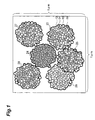
- Fig. 1 is a schematic view showing an FE-STEM image of the inorganic oxide in accordance with an embodiment of the present invention.
- the inorganic oxide of the present invention is constituted by a particulate mixture containing aluminum oxide, a metal oxide forming no composite oxide with aluminum oxide, and an additional element including at least one of a rare-earth element and an alkali earth element.
- This inorganic oxide contains a secondary particle formed by aggregating primary particles.
- Aluminum oxide (Al 2 O 3 ) in the inorganic oxide may be amorphous (e.g., activated alumina) or crystalline.
- the metal oxide forking no composite oxide with aluminum oxide is an oxide which does not form a primary particle constituted by a composite oxide in combination with aluminum oxide in a state substantially uniformly dissolved as solids or dispersed into each other.
- this metal oxide forms a primary particle separately from a primary particle mainly constituted by aluminum oxide when a coprecipitate in which a hydroxide of the metal oxide as its precursor and aluminum hydroxide are coprecipitated is baked.
- the inorganic oxide of the present invention contains a primary particle mainly constituted by aluminum oxide (a first primary particle containing aluminum oxide as a main ingredient) and a second primary particle containing a metal oxide other than aluminum oxide as a main ingredient. This suppresses the sintering of carriers in a high temperature environment further remarkably. The fact that the respective primary particles are formed separately from each other as such can be verified by an analyzing method which will be explained later and the like.
- the "primary particle mainly constituted by aluminum oxide” refers to a primary particle formed from aluminum oxide as a main ingredient. Specifically, it will be preferred if the particle mainly constituted by aluminum oxide is such that at least one half thereof in terms of molar ratio or weight ratio is constituted by aluminum oxide. Similar expressions such as “primary particle mainly constituted by a metal oxide” and “primary particle mainly constituted by zirconium oxide” refer to details similar to those mentioned above.
- each of the first and second primary particles further contains an additional element.
- the first primary particle may contain a small amount of the above-mentioned metal oxide or the like in its surface layer part, whereas the second primary particle may contain a small amount of aluminum oxide or the like in its surface layer part.
- At least a part of the secondary particle in the inorganic oxide is formed by aggregating a plurality of first primary particles each having a particle size of 100 nm or less and a plurality of second primary particles each having a particle size of 100 nm or less.
- the inorganic oxide contains a secondary particle constituted by a plurality of first primary particles each having a particle size of 100 nm or less and a plurality of second primary particles each having a particle size of 100 nm or less.
- At least 80% of the primary particles in terms of the number of particles in the inorganic oxide have a particle size of 100 nm or less in order to increase the specific surface area and enhance the catalytic activity.
- the ratio of primary particles having a particle size of 100 nm or less is at least 90%, more preferably at least 95%.
- the particle size is the largest among diameters definable in one particle.
- the average particle size of primary particles in the whole particulate inorganic oxide is preferably 1 to 50 nm, more preferably 3 to 40 nm.
- Particle sizes of primary particles, their respective compositions, and the state of aggregation of secondary particles can be verified by observing and analyzing the inorganic oxide while appropriately combining TEM (transmission electron microscope) , SEM (scanning electron microscope), FE-STEM (field emission scanning transmission electron microscope), EDX (energy dispersive x-ray detector), XPS (x-ray photoelectron spectroscope), and the like.
- TEM transmission electron microscope
- SEM scanning electron microscope
- FE-STEM field emission scanning transmission electron microscope
- EDX energy dispersive x-ray detector
- XPS x-ray photoelectron spectroscope
- zirconium oxide As the metal oxide forming no composite oxide with aluminum oxide, at least one species selected from the group consisting of zirconium oxide (ZrO 2 ), silicon oxide (Si0 2 ), and titanium oxide (TiO 2 ) is used. Among them, zirconium oxide is preferred in particular. Zirconium oxide yields a catalyst having particularly excellent heat resistance and catalytic activity, for example, in combination with rhodium as a catalytic metal.
- the inorganic oxide usually contains the rare-earth element and alkali earth element in the form of their oxides.
- the rare-earth element is preferably at least one species of element selected from the group consisting of yttrium (Y), lanthanum (La), praseodymium (Pr), neodymium (Nd), samarium (Sm), europium (Eu), gadolinium (Gd), terbium (Tb), dysprosium (Dy), holmium (Ho), erbium (Er), thulium (Tm), ytterbium (Yb), and lutetium (Lu), more preferably at least one species of element selected from the group consisting of yttrium, lanthanum, praseodymium, neodymium, and ytterbium.
- the alkali earth element is at least one species of element selected from the group consisting of magnesium (Mg), calcium (Ca), strontium (Sr), and barium (Ba), more preferably at least one species of element selected from the group consisting of magnesium, calcium, and barium.
- Mg magnesium
- Ca calcium
- strontium Sr
- Ba barium
- lanthanum or neodymium which is a rare-earth element
- lanthanum and neodymium may be used together. Additional elements different from each other may be contained in the inorganic oxide in a surface concentrated region which will be explained later and another region, respectively.
- the additional element in the inorganic oxide exists mainly as its oxide in a state dissolved as a solid, diffused, or the like with respect to aluminum oxide or the above-mentioned metal oxide.
- the content of the additional element in terms of the amount of an oxide thereof in the inorganic oxide is 5.6 mol % or less with respect to the total amount of the additional element, aluminum in aluminum oxide, and the metal element in the metal oxide.
- the content of the additional element is preferably 1.5 to 5.6 mol %, more preferably 2.0 to 4.0 mol %, further preferably 2.5 to 3.8 mol %.
- the content of the oxide of the additional element is less than 1.5 mol % or more than 5.6 mol %, the grain growth of catalytic metals is less likely to be suppressed in a high temperature environment.
- the additional element exceeds 5.6 mol %, its interaction with catalytic metals tends to become too strong, thereby lowering the catalytic activity.
- Fig. 1 is a schematic view showing an image of the inorganic oxide in accordance with an embodiment of the present invention when observed with an FE-STEM.
- the inorganic oxide in the image of Fig. 1 contains zirconium oxide as a metal oxide forming no composite oxide with aluminum oxide, and lanthanum as an additional element.
- secondary particles 22, 24, 25, 26, 27, and 28 are formed by aggregating a plurality of species of primary particles having respective compositions different from each other.
- Primary particles 12 mainly constituted by aluminum oxide
- primary particles 14 mainly constituted by zirconium oxide
- primary particles 16 mainly constituted by aluminum oxide and lanthanum oxide
- primary particles 18 mainly constituted by zirconium oxide and lanthanum oxide exist as primary particles.
- No primary particles are formed by a composite oxide in which aluminum oxide and zirconium oxide are substantially uniformly dissolved as solids or dispersed into each other. Compositions and distribution states of oxides in the primary particles can be analyzed by an EDX and the like.
- Each of the secondary particles 22, 25, 27, and 28 is formed by aggregating the primary particles 12, 14, 16, and 18.
- Secondary particles such as the secondary particle 24 constituted by the primary particles 14 and 18 and the secondary particle 26 constituted by the primary particles 12 and 16 may partly exist as well.
- metal elements contained in these secondary particles are preferably 30 mol % or less, more preferably 15 mol % or less, further preferably 10 mol % or less with respect to all the metal elements present in the inorganic oxide.
- At least a part of the primary particles constituting the above-mentioned inorganic oxide has a surface concentrated region where the additional element has a locally increased content in a surface layer part thereof.
- substantially all of those containing lanthanum oxide preferably have the surface concentrated region, though primary particles having no surface concentrated region may be mixed therewith to such an extent that the effects of the present invention are not remarkably lost thereby.
- the additional element may also exist in the surface layer part of primary particles not containing lanthanum oxide as a major constituent.
- the content of the additional element in the surface concentrated region is higher than the content thereof in a region on the inner side of the particles.
- the surface concentrated region is formed so as to cover the surface of a primary particle while having a certain extent of depth, but is not required to cover the whole surface of the primary particle completely.
- the content of the additional element in the primary particle gradually increases from the inner layer side to the surface layer side. Therefore, the surface concentrated region and the particle center part on the inner layer side thereof do not always form a clear boundary.
- the additional element in the surface concentrated region exists in the surface layer part of the primary particle.
- the amount of the additional element existing in the surface concentrated region is preferably 1 to 5 mass % with respect to the total amount of the inorganic oxide. When the amount is less than 1 mass % or more than 5 mass %, the effect of the additional element improving the heat resistance of the catalyst tends to decrease.
- the additional element existing in the surface concentrated region elutes out when coming into contact with an acidic solution such as aqueous nitric acid solution. Therefore, the amount of the additional element existing in the surface concentrated region can be verified by quantitatively determining the amount of the additional element eluting into an aqueous nitric acid solution when the inorganic oxide is brought into contact therewith.
- 0.1 g of the inorganic oxide is added to 10 ml of a 1-N aqueous nitric acid solution, the resulting mixture is stirred for 2 hours so as to elute out the additional element existing in the surface concentrated region, and the amount of thus eluted additional element is quantitatively determined by a chemical analysis, whereby the amount of the existing additional element can be seen.
- the inorganic oxide containing a primary particle having such a surface concentrated region can be obtained, for example, by attaching an additional element to a particle of a mixture constituted by a plurality of species of oxides containing an oxide of the additional element, and further baking the resulting product.
- a major part of the attached additional element becomes an oxide upon baking, and exists in the surface layer part of the primary particle, thereby forming a surface concentrated region.
- the amount of the additional element attached to the mixture of oxides is 1 to 5 mass % in terms of the mass of an oxide thereof with respect to the total amount of the inorganic oxide obtained. This allows the resulting inorganic oxide to have about 1 to 5 mass % of the additional element existing in the surface layer part of its primary particle with respect to the total amount of the inorganic oxide.
- the surface concentrated region such as the one mentioned above is formed in the primary particle of the inorganic oxide can be seen not only by the method of eluting the additional element as mentioned above, but also by analyzing the composition by using such a method as EDX (energy dispersive x-ray detector) or SIMS (secondary ion mass spectrometer), and comparing the content of the additional element between the surface layer part and center part of the inorganic oxide, for example.
- EDX energy dispersive x-ray detector
- SIMS secondary ion mass spectrometer
- the composition of the inorganic oxide may be analyzed by such a method as ICP (inductively coupled plasma emission spectrophotometer), so as to quantitatively determine the content of the additional element as an average value in the whole inorganic oxide and verify that the content of the additional element in the surface layer part is higher than the average value.
- ICP inductively coupled plasma emission spectrophotometer
- the inorganic oxide such as the one explained in the foregoing can favorably be obtained, for example, by a manufacturing method comprising a coprecipitation step of producing a coprecipitate containing aluminum, a metal element forming no composite oxide with aluminum oxide when in an oxide, and an additional element including at least one of a rare-earth element and an alkali earth element; a first baking step of yielding an oxide mixture by baking the coprecipitate; and a second baking step of attaching the additional element including at least one of a rare-earth element and an alkali earth element to the mixture and further baking the mixture.
- the above-mentioned coprecipitate is produced from a solution in which aluminum, the above-mentioned metal element, and the additional element are dissolved.
- the content of the additional element in terms of the amount of an oxide thereof in the solution is preferably 0.20 to 4.0 mol %, more preferably 0.5 to 3.8 mol % with respect to the total amount of the additional element, alumina, and the above-mentioned metal element.
- the additional element in the solution is less than 0.20 mol % or more than 4.0 mol %, the effect of suppressing the grain growth of catalytic metals tends to decrease when the resulting inorganic oxide is used as a carrier.
- the content of aluminum in terms of the amount of an oxide (Al 2 O 3 ) thereof in the above-mentioned solution in which aluminum, the above-mentioned metal element, and the additional element are dissolved is preferably 15 to 40 mol % with respect to the total amount of aluminum, the above-mentioned metal element, and the additional element. This allows the resulting inorganic oxide to have an aluminum oxide content of about 15 to 40 mol %.
- the content is more preferably 16 to 35 mol %, more preferably 20 to 30 mol %.
- salts or the like of respective metal elements constituting the inorganic oxide are dissolved in water, alcohol, or the like.
- the salts include sulfates, nitrates, hydrochlorides, and acetates.
- This solution is mixed with an alkali solution, and so forth, so as to adjust the pH of the solution such that it falls within a range (e.g., a pH of 9 or higher) where respective hydroxides of the metal elements are deposited, whereby a coprecipitate containing aluminum or the like is produced.
- a range e.g., a pH of 9 or higher
- ammonia or ammonium carbonate solution is preferred from the viewpoint of its easiness in removal upon evaporation at the time of baking and the like.
- coprecipitate is baked by heating preferably after being centrifuged and washed, so as to yield a mixture of oxides.
- the coprecipitate is baked by heating at 600 to 1200°C in an oxidizing atmosphere such as air preferably for 0.5 to 10 hours.
- the additional element is attached to the mixture of oxides, and the resulting product is further baked, whereby a particulate inorganic oxide is obtained.
- the attachment can be effected by a method of suspending the mixture of oxides in a solution in which a salt of the additional element (nitrate or the like) is dissolved and stirring them.
- the mixture having the additional element attached thereto is baked by heating at 500 to 1200°C preferably in an oxidizing atmosphere for 0.5 to 10 hours.
- the exhaust gas purifying catalyst carrier of the present invention is a carrier containing at least the inorganic oxide explained in the foregoing.
- This carrier can favorably carry at least one species of rare metal selected from the group consisting of rhodium, platinum, and palladium, for example.
- the exhaust gas purifying catalyst of the present invention comprises the above-mentioned exhaust gas purifying catalyst carrier of the present invention and rhodium supported thereby. Since the above-mentioned inorganic oxide of the present invention is used as a carrier, the grain growth of rhodium supported thereby can sufficiently be suppressed in this catalyst even in a high temperature environment. Rhodium can be supported by the carrier by employing a conventionally known method such as dipping.
- At least a part of rhodium in the exhaust gas purifying catalyst of the present invention is supported so as to come into contact with a region (surface concentrated region) where the additional element has a locally increased content in a surface layer part of a primary particle of the inorganic oxide.
- This exhibits the effect of the additional element suppressing the grain growth of rhodium more remarkably.
- the amount by which rhodium is supported is preferably 0.01 to 3 mass %, more preferably 0.05 to 2 mass %, further preferably 0.1 to 1 mass % with respect to the mass of the carrier.
- a layer made of the exhaust gas purifying catalyst can be formed on a surface of a base such as a monolith base in a honeycomb form, a pellet base, or a foam base, and disposed in an exhaust flow path in an internal combustion engine or the like for use.
- the coprecipitate was temporarily baked by heating in the air at 400°C for 5 hours. Subsequently, the solid obtained after the temporal baking was baked by heating in the air at 700°C for 5 hours and then at 900°C for 5 hours (first baking), whereby a mixture of oxides containing aluminum oxide, zirconium oxide, and lanthanum oxide was obtained.
- a suspension in which 47.5 g of thus obtained mixture were suspended in an aqueous lanthanum nitrate solution in which 6.5 g of lanthanum nitrate hexahydrate (by an amount to become 5 mass % in terms of the amount of lanthanum oxide with respect to the total amount of the resulting inorganic oxide) were dissolved was stirred for 2 hours. Thereafter, the solid left after evaporating water from the suspension was baked by heating in the air at 110°C for 12 hours and then at 800°C for 5 hours (second baking), whereby a particulate inorganic oxide was obtained.
- inorganic oxide as a carrier was added to an aqueous Rh(NO 3 ) 3 solution, the resulting mixture was stirred, and water was evaporated therefrom. The remaining solid was baked by heating in the air at 500°C for 3 hours. The baked product was formed into a pellet having a length of 0.5 to 1 mm, whereby a catalyst in which rhodium was supported by the carrier was obtained. The amount of supported rhodium was about 0.5 g with respect to 100 g of the carrier.
- pellet-shaped catalyst was left in a durability tester, so as to form a catalyst layer, and a durability test was performed for 25 hours, in which rich and lean gases having respective compositions shown in Table 1 were alternately caused to circulate through the catalyst layer at intervals of 5 minutes while setting the catalyst layer inlet gas temperature to 1000°C and the space velocity to 10000/hr.
- the rhodium dispersibility (the ratio of rhodium atoms existing in the particle surface in all the rhodium atoms) was measured by CO absorption. A greater value of rhodium dispersibility corresponds to keeping a larger specific surface area, and means that the grain growth of rhodium particles is suppressed.
- Example 2 The preparation of an inorganic oxide and a catalyst, and a catalyst durability test were carried out as in Example 1 except that the second baking temperature was 500°C.
- Example 2 The preparation of an inorganic oxide and a catalyst, and a catalyst durability test were carried out as in Example 1 except that the second baking temperature was 900°C.
- Example 2 The preparation of an inorganic oxide and a catalyst, and a catalyst durability test were carried out as in Example 1 except that the mixture after the first baking was suspended in an aqueous neodymium nitrate solution in which 6.6 g of neodymium nitrate hexahydrate were dissolved instead of lanthanum nitrate hexahydrate.
- Example 2 The preparation of an inorganic oxide and a catalyst, and a catalyst durability test were carried out as in Example 2 except that the mixture after the first baking was suspended in an aqueous neodymium nitrate solution in which 6.6 g of neodymium nitrate hexahydrate were dissolved instead of lanthanum nitrate hexahydrate.
- Example 3 The preparation of an inorganic oxide and a catalyst, and a catalyst durability test were carried out as in Example 3 except that the mixture after the first baking was suspended in an aqueous neodymium nitrate solution in which 6.6 g of neodymium nitrate hexahydrate were dissolved instead of lanthanum nitrate hexahydrate.
- a precipitate of aluminum hydroxide was obtained from an aqueous aluminum nitrate solution as in a procedure by which the coprecipitate was obtained in Example 1, and was baked under the same condition as that of the first baking in Example 1, whereby aluminum oxide particles were obtained.
- Example 1 A mixture after the first baking obtained as in Example 1 was used as it was as a carrier, and was caused to support rhodium as in Example 1, whereby the preparation of an inorganic oxide and a catalyst, and a catalyst durability test were carried out.
- the catalysts of Examples 1 to 7 obtained by further attaching lanthanum or neodymium to a mixture containing lanthanum or neodymium yielded a sufficiently large value of rhodium dispersibility after the durability test in a high temperature environment.
- the rhodium dispersibility after the durability test was low in Comparative Example 1 containing no aluminum oxide, Comparative Example 2 in which aluminum oxide and zirconium oxide construct respective secondary particles, and Comparative Example 3 having no posterior additional element attached thereto.
- the present invention was seen to yield an inorganic oxide which sufficiently suppressed the grain growth of catalytic metals supported thereby, and an exhaust gas purifying catalyst using the same.
- the coprecipitate was temporarily baked by heating in the air at 400°C for 5 hours. Subsequently, the solid obtained after the temporal baking was baked by heating in the air at 700°C for 5 hours and then at 900°C for 5 hours (first baking), whereby a mixture of oxides containing aluminum oxide, zirconium oxide, and lanthanum oxide was obtained.
- a suspension in which 47.5 g of thus obtained mixture were suspended in an aqueous lanthanum nitrate solution in which 6.5 g of lanthanum nitrate hexahydrate (by an amount to become 5 mass % in terms of the amount of lanthanum oxide with respect to the total amount of the resulting inorganic oxide) containing lanthanum as a posterior additional element were dissolved was stirred for 2 hours. Thereafter, the solid left after evaporating water from the suspension was baked by heating in the air at 110°C for 12 hours and then at 800°C for 5 hours (second baking), whereby a particulate inorganic oxide was obtained.
- the content of lanthanum oxide in thus obtained inorganic oxide with respect to the total amount of lanthanum oxide, aluminum oxide, and zirconium oxide was 1.56 mol %.
- inorganic oxide was observed by a TEM, it was seen that at least 80% of its primary particles had a particle size of 100 nm or less.
- inorganic oxide as a carrier was added to an aqueous Rh(NO 3 ) 3 solution, the resulting mixture was stirred, and water was evaporated therefrom. The remaining solid was baked by heating in the air at 500°C for 3 hours. The baked product was formed into a pellet having a length of 0.5 to 1 mm, whereby a catalyst in which rhodium was supported by the carrier was obtained. The amount of supported rhodium was about 0.5 g with respect to 100 g of the carrier.
- pellet-shaped catalyst was left in a durability tester, so as to form a catalyst layer, and a durability test was performed for 5 hours, in which rich and lean gases having respective compositions shown in Table 1 were alternately caused to circulate through the catalyst layer at intervals of 5 minutes while setting the catalyst layer inlet gas temperature to 1000°C and the space velocity to 10000/hr.
- the rhodium dispersibility (the ratio of rhodium atoms existing on the particle surface in all the rhodium atoms) was measured by CO absorption. A greater value of rhodium dispersibility corresponds to keeping a larger specific surface area, and means that the grain growth of rhodium particles is suppressed in a high temperature environment.
- the content of lanthanum oxide was 2.6 mol % with respect to the total amount of lanthanum oxide, aluminum oxide, and zirconium oxide, whereas at least 80% of primary particles had a particle size of 100 nm or less.
- the content of lanthanum oxide was 3.32 mol % with respect to the total amount of lanthanum oxide, aluminum oxide, and zirconium oxide, whereas at least 80% of primary particles had a particle size of 100 nm or less.
- the content of lanthanum oxide was 4.24 mol % with respect to the total amount of lanthanum oxide, aluminum oxide, and zirconium oxide, whereas at least 80% of primary particles had a particle size of 100 nm or less.
- the content of lanthanum oxide was 5.34 mol % with respect to the total amount of lanthanum oxide, aluminum oxide, and zirconium oxide, whereas at least 80% of primary particles had a particle size of 100 nm or less.
- Example 8 The preparation of an inorganic oxide and a catalyst, and a catalyst durability test were carried out as in Example 8 except that 47.5 g of a mixture after the first baking obtained as in Example 9 were suspended in a solution in which 6.6 g of neodymium nitrate hexahydrate (by an amount to become 5 mass % in terms of the amount of neodymium oxide with respect to the total amount of the resulting inorganic oxide) were dissolved, so as to add neodymium as the posterior additional element.
- the content of lanthanum oxide and neodymium oxide in total was 2.6 mol % with respect to the total amount of lanthanum oxide, neodymium oxide, aluminum oxide, and zirconium oxide, whereas at least 80% of primary particles had a particle size of 100 nm or less.
- Example 9 The preparation of an inorganic oxide and a catalyst, and a catalyst durability test were carried out as in Example 9 except that a coprecipitate was produced by employing neodymium nitrate hexahydrate instead of lanthanum nitrate hexahydrate.
- the content of lanthanum oxide and neodymium oxide in total was 2.6 mol % with respect to the total amount of lanthanum oxide, neodymium oxide, aluminum oxide, and zirconium oxide, whereas at least 80% of primary particles had a particle size of 100 nm or less.
- Example 8 While a mixture after the first baking obtained as in Example 9 except that no lanthanum nitrate hexahydrate was employed was used as it was as a carrier, the preparation of a catalyst and its durability test were carried out as in Example 8.
- the content of lanthanum oxide was 5.98 mol % with respect to the total amount of lanthanum oxide, aluminum oxide, and zirconium oxide, whereas at least 80% of primary particles had a particle size of 100 nm or less.
- the catalysts of Examples 8 to 14 obtained by further attaching lanthanum oxide or neodymium oxide to a mixture containing lanthanum oxide or neodymium oxide by an amount falling within the range of 0.20 to 4.0 mol % yielded sufficiently large values of rhodium dispersibility after the durability test in a high temperature environment.
- Comparative Example 4 in which only the surface layer part contained lanthanum oxide and Comparative Example 5 in which the content of lanthanum oxide is more than 5.6 mol % in the inorganic oxide exhibited a small value of rhodium dispersibility after the durability test.
- the coprecipitate was temporarily baked by heating in the air at 400°C for 5 hours. Subsequently, the solid obtained after the temporal baking was baked by heating in the air at 700°C for 5 hours and then at 900°C for 5 hours (first baking), whereby a mixture of oxides containing aluminum oxide, zirconium oxide, and lanthanum oxide was obtained.
- a suspension in which 47.5 g of thus obtained mixture were suspended in an aqueous lanthanum nitrate solution in which 6.5 g of lanthanum nitrate hexahydrate (by an amount to become 5 mass % in terms of the amount of lanthanum oxide with respect to the total amount of the resulting inorganic oxide) containing lanthanum as a posterior additional element were dissolved was stirred for 2 hours. Thereafter, the solid left after evaporating water from the suspension was baked by heating in the air at 110°C for 12 hours and then at 800°C for 5 hours (second baking), whereby a particulate inorganic oxide was obtained.
- lanthanum was further added as a posterior additional element after forming a composite oxide, the content of lanthanum as the additional element was locally increased in the surface layer part in primary particles in the inorganic oxide.
- inorganic oxide was observed by a TEM, it was seen that at least 80% of its primary particles had a particle size of 100 nm or less.
- inorganic oxide as a carrier was added to an aqueous Rh(NO 3 ) 3 solution, the resulting mixture was stirred, and water was evaporated therefrom. The remaining solid was baked by heating in the air at 500°C for 3 hours. The baked product was formed into a pellet having a length of 0.5 to 1 mm, whereby a catalyst in which rhodium was supported by the carrier was obtained. The amount of supported rhodium was about 0.5 g with respect to 100 g of the carrier.
- pellet-shaped catalyst was left in a durability tester, so as to form a catalyst layer, and a durability test was performed for 5 hours, in which rich and lean gases having respective compositions shown in Table 1 were alternately caused to circulate through the catalyst layer at intervals of 5 minutes while setting the catalyst layer inlet gas temperature to 1000°C and the space velocity to 10000/hr.
- the rhodium dispersibility (the ratio of rhodium atoms existing on the particle surface in all the rhodium atoms) was measured by CO absorption. A greater value of rhodium dispersibility corresponds to keeping a larger specific surface area, and means that the grain growth of rhodium particles is suppressed.
- Example 16 The preparation of an inorganic oxide and a catalyst, and a catalyst durability test were carried out as in Example 16 except that the mixture after the first baking was suspended in an aqueous neodymium nitrate solution in which 6.6 g of neodymium nitrate hexahydrate were dissolved instead of the aqueous lanthanum nitrate solution.
- the catalysts of Examples 15 to 23 obtained by further attaching lanthanum oxide or neodymium oxide to a mixture containing aluminum oxide yielded sufficiently large values of rhodium dispersibility after the durability test in a high temperature environment.
- Examples 15 to 21 whose aluminum oxide contents fell within the range of 15 to 40 mol % exhibited higher values of rhodium dispersibility after the durability test than those of Examples 22 and 23 whose aluminum oxide contents were out of the above-mentioned range.
- the present invention provides an inorganic oxide which sufficiently suppresses the grain growth of metals supported thereby, an exhaust gas purifying catalyst carrier constituted thereby, and an exhaust gas purifying catalyst using the same.
Landscapes
- Chemical & Material Sciences (AREA)
- Engineering & Computer Science (AREA)
- Organic Chemistry (AREA)
- Materials Engineering (AREA)
- Chemical Kinetics & Catalysis (AREA)
- Environmental & Geological Engineering (AREA)
- Nanotechnology (AREA)
- Inorganic Chemistry (AREA)
- Biomedical Technology (AREA)
- Oil, Petroleum & Natural Gas (AREA)
- Health & Medical Sciences (AREA)
- Analytical Chemistry (AREA)
- General Chemical & Material Sciences (AREA)
- Physics & Mathematics (AREA)
- Combustion & Propulsion (AREA)
- Life Sciences & Earth Sciences (AREA)
- Composite Materials (AREA)
- Condensed Matter Physics & Semiconductors (AREA)
- General Physics & Mathematics (AREA)
- Crystallography & Structural Chemistry (AREA)
- Geology (AREA)
- Catalysts (AREA)
- Exhaust Gas Treatment By Means Of Catalyst (AREA)
Claims (22)
- Partikuläres anorganisches Oxid, umfassend: Aluminiumoxid;
ein Metalloxid, das mit Aluminiumoxid kein Kompositoxid bildet, ausgewählt aus der Gruppe, bestehend aus Zirkonoxid (ZrO2), Siliciumoxid (SiO2) und Titanoxid (TiO2); und
ein wenigstens ein Seltenerdelement und ein Erdalkalielement einschließendes zusätzliches Element,
wobei das anorganische Oxid ein durch Aggregieren von primären Partikeln gebildetes sekundäres Partikel enthält,
wobei wenigstens ein Teil des sekundären Partikels folgendes einschließt:eine Vielzahl von ersten primären Partikeln, von denen jedes eine Partikelgröße von 100 nm oder weniger aufweist, die Aluminiumoxid und das zusätzliche Element enthalten; undeine Vielzahl von zweiten primären Partikeln, von denen jedes eine Partikelgröße von 100 nm oder weniger aufweist, die ein Metalloxid und das zusätzliche Element enthalten;wobei wenigstens ein Teil der ersten und zweiten primären Partikel einen verdichteten Bereich der Oberfläche aufweisen, an dem das zusätzliche Element einen örtlich erhöhten Gehalt in einem Teil der Oberflächenschicht derselben aufweist; und
wobei der Gehalt des zusätzlichen Elements hinsichtlich der Menge eines Oxids desselben 5,6 Mol-% oder weniger bezogen auf die Gesamtmenge des zusätzlichen Elements, des Aluminiums in dem Aluminiumoxid, und des Metallelements in dem Metalloxid, beträgt. - Anorganisches Oxid nach Anspruch 1, wobei der Gehalt des zusätzlichen Elements hinsichtlich der Menge eines Oxids desselben 1,5 bis 5,6 Mol-% oder weniger bezogen auf die Gesamtmenge des zusätzlichen Elements, des Aluminiums in dem Aluminiumoxid, und des Metallelements in dem Metalloxid beträgt.
- Anorganisches Oxid nach Anspruch 2, wobei wenigstens 80 % der primären Partikel in dem anorganischen Oxid eine Partikelgröße von 100 nm oder weniger aufweisen.
- Anorganisches Oxid nach Anspruch 1, wobei der Gehalt an Aluminiumoxid 15 bis 40 Mol-% bezogen auf die Gesamtmenge des Aluminiums in dem Aluminiumoxid, des Metallelements in dem Metalloxid und auf das zusätzliche Element beträgt.
- Anorganisches Oxid nach Anspruch 4, wobei wenigstens 80 % der primären Partikel in dem anorganischen Oxid eine Partikelgröße von 100 nm oder weniger aufweisen.
- Anorganisches Oxid nach Anspruch 1, wobei das zusätzliche Element in dem verdichteten Bereich der Oberfläche mit 1 bis 5 Masse-% hinsichtlich eines Oxids desselben, bezogen auf die Gesamtmenge des anorganischen Oxids, vorliegt.
- Anorganisches Oxid nach Anspruch 1, wobei das Seltenerdelement wenigstens eine Spezies eines Elements ist, ausgewählt aus der Gruppe, bestehend aus Yttrium, Lanthan, Praseodym, Neodym, Samarium, Europium, Gadolinium, Terbium, Dysprosium, Holmium, Erbium, Thulium, Ytterbium und Lutetium; und
wobei das Erdalkalielement wenigstens eine Spezies eines Elements ist, ausgewählt aus der Gruppe, bestehend aus Magnesium, Calcium, Strontium und Barium. - Anorganisches Oxid nach Anspruch 1, wobei das zusätzliche Element wenigstens eine Spezies eines Elements ist, ausgewählt aus der Gruppe, bestehend aus Yttrium, Lanthan, Praseodym, Neodym, Ytterbium, Magnesium, Calcium und Barium.
- Anorganisches Oxid nach Anspruch 1, wobei das zusätzliche Element Lanthan oder Neodym ist.
- Anorganisches Oxid nach einem der Ansprüche 1 bis 9, wobei das Metalloxid, das mit Aluminiumoxid kein Kompositoxid bildet, Zirkonoxid ist.
- Anorganisches Oxid nach Anspruch 1, erhältlich durch ein Herstellungsverfahren umfassend:einen Kopräzipitationsschritt zum Herstellen eines Kopräzipitats, das Aluminium, ein Metallelement, das mit dem Aluminiumoxid kein Kompositoxid bildet wenn es in einem Oxid vorliegt, ausgewählt aus Zirkon, Silicium und Titan, undein zusätzliches Element enthält, das wenigstens ein Seltenerdelement und ein Erdalkalielement aus einer Lösung einschließt, die Aluminium, das Metallelement und das zusätzliche Element darin gelöst enthält;einen ersten Backschritt zum Erhalt einer Oxidmischung durch Backen des Kopräzipitats; undeinen zweiten Backschritt zum Anlagern des zusätzlichen Elements, das wenigstens ein Seltenerdelement und ein Erdalkalielement enthält, an die Mischung und ferner Backen der Mischung,wobei in dem Herstellungsverfahren der Gehalt des zusätzlichen Elements hinsichtlich der Menge eines Oxids desselben 4, 0 Mol-% oder weniger, bezogen auf die Gesamtmenge des zusätzlichen Elements, des Aluminiums und des Metallelements, beträgt.
- Anorganisches Oxid nach Anspruch 11, wobei der Gehalt des zusätzlichen Elements hinsichtlich der Menge eines Oxids desselben in der Lösung 0,20 bis 0,40 Mol-%, bezogen auf die Gesamtmenge des zusätzlichen Elements, des Aluminiums und des Metallelements, beträgt.
- Anorganisches Oxid nach Anspruch 11, wobei der Gehalt des Aluminiums hinsichtlich der Menge eines Oxids desselben in der Lösung 15 bis 40 Mol-%, bezogen auf die Gesamtmenge des Aluminiums, des Metallelements und des zusätzlichen Elements, beträgt.
- Anorganisches Oxid nach Anspruch 11, wobei in dem zweiten Backschritt das zusätzliche Element in einer solchen Menge angelagert wird, dass es mit 1 bis 5 Masse-% hinsichtlich der Menge eines Oxids desselben, bezogen auf die Gesamtmenge des erhaltenen anorganischen Oxids, vorliegt.
- Anorganisches Oxid nach Anspruch 11, wobei das Kopräzipitat durch Erwärmen auf 600 bis 1200 °C in einer oxidierenden Atmosphäre in dem ersten Backschritt gebacken wird; und
wobei die Mischung, an die das zusätzliche Element angelagert ist, durch Erwärmen auf 500 bis 900°C in dem zweiten Backschritt gebacken wird. - Anorganisches Oxid nach Anspruch 11, wobei das Seltenerdelement wenigstens eine Spezies eines Elements ist, ausgewählt aus der Gruppe, bestehend aus Yttrium, Lanthan, Praseodym, Neodym, Samarium, Europium, Gadolinium, Terbium, Dysprosium, Holmium, Erbium, Thulium, Ytterbium und Lutetium; und
wobei das Erdalkalielement wenigstens eine Spezies eines Elements ist, ausgewählt aus der Gruppe, bestehend aus Magnesium, Calcium, Strontium und Barium. - Anorganisches Oxid nach Anspruch 11, wobei das zusätzliche Element wenigstens eine Spezies eines Elements ist, ausgewählt aus der Gruppe, bestehend aus Yttrium, Lanthan, Praseodym, Neodym, Ytterbium, Magnesium, Calcium und Barium.
- Anorganisches Oxid nach Anspruch 11, wobei das zusätzliche Element Lanthan oder Neodym ist.
- Anorganisches Oxid nach einem der Ansprüche 11 bis 18, wobei in dem Herstellungsverfahren das Metallelement, das mit Aluminiumoxid kein Kompositoxid bildet wenn es in einem Oxid vorliegt, Zirkonoxid ist.
- Abgasreinigungskatalysator-Träger, enthaltend das anorganische Oxid nach einem der Ansprüche 1 bis 19.
- Abgasreinigungskatalysator, umfassend den Abgasreinigungskatalysator-Träger nach Anspruch 20 und dabei ein Rhodium-Trägermaterial.
- Abgasreinigungskatalysator nach Anspruch 21, wobei wenigstens ein Teil des Rhodiums in dem Katalysator so getragen wird, dass es in Kontakt zu der verdichteten Region der Oberfläche in einem Teil der Oberflächenschicht der primären Partikel in dem anorganischen Oxid kommt.
Applications Claiming Priority (4)
| Application Number | Priority Date | Filing Date | Title |
|---|---|---|---|
| JP2004214939A JP4602022B2 (ja) | 2004-07-22 | 2004-07-22 | 無機酸化物、排気浄化用触媒担体及び排気浄化用触媒 |
| JP2004214940 | 2004-07-22 | ||
| JP2004214932A JP4602021B2 (ja) | 2004-07-22 | 2004-07-22 | 無機酸化物、排気浄化用触媒担体及び排気浄化用触媒 |
| PCT/JP2005/013905 WO2006009327A1 (en) | 2004-07-22 | 2005-07-22 | Inorganic oxide, exhaust gas purifying catalyst carrier, and exhaust gas purifying catalyst |
Publications (2)
| Publication Number | Publication Date |
|---|---|
| EP1687083A1 EP1687083A1 (de) | 2006-08-09 |
| EP1687083B1 true EP1687083B1 (de) | 2009-09-09 |
Family
ID=34972962
Family Applications (1)
| Application Number | Title | Priority Date | Filing Date |
|---|---|---|---|
| EP05767278A Ceased EP1687083B1 (de) | 2004-07-22 | 2005-07-22 | Anorganisches oxid, abgasreinigungskatalysatorträger und abgasreinigungskatalysator |
Country Status (6)
| Country | Link |
|---|---|
| US (1) | US8242046B2 (de) |
| EP (1) | EP1687083B1 (de) |
| KR (1) | KR100785750B1 (de) |
| CN (1) | CN100542669C (de) |
| DE (1) | DE602005016520D1 (de) |
| WO (1) | WO2006009327A1 (de) |
Families Citing this family (16)
| Publication number | Priority date | Publication date | Assignee | Title |
|---|---|---|---|---|
| CN100542669C (zh) | 2004-07-22 | 2009-09-23 | 丰田自动车株式会社 | 无机氧化物、废气净化催化剂载体及废气净化催化剂 |
| CN101415490A (zh) * | 2006-03-28 | 2009-04-22 | 株式会社丰田中央研究所 | 废气净化用催化剂、该催化剂的再生方法、以及使用该催化剂的废气净化用设备和方法 |
| JP2007268460A (ja) | 2006-03-31 | 2007-10-18 | Toyota Motor Corp | 金属酸化物触媒担体粒子、及び排ガス浄化触媒 |
| JP2007301526A (ja) * | 2006-05-15 | 2007-11-22 | Toyota Central Res & Dev Lab Inc | 排ガス浄化用触媒及びその製造方法 |
| JP4726714B2 (ja) * | 2006-06-16 | 2011-07-20 | 株式会社豊田中央研究所 | 無機酸化物、及びそれを用いた排ガス浄化用触媒 |
| JP4726713B2 (ja) * | 2006-06-16 | 2011-07-20 | 株式会社豊田中央研究所 | 無機酸化物、及びそれを用いた排ガス浄化用触媒 |
| JP5099828B2 (ja) * | 2007-10-31 | 2012-12-19 | 株式会社豊田中央研究所 | 無機混合酸化物及びそれを用いた排ガス浄化用触媒 |
| FR2928364B1 (fr) | 2008-03-05 | 2011-10-14 | Rhodia Operations | Composition a base d'un oxyde de zirconium,d'un oxyde de titane ou d'un oxyde mixte de zirconium et de titane sur un support en alumine,procedes de preparation et utilisation comme catalyseur |
| US20120295184A1 (en) * | 2009-11-27 | 2012-11-22 | Masahiro Watanabe | High-potential stable oxide support for polymer electrolyte fuel cell |
| JP5861475B2 (ja) * | 2012-01-31 | 2016-02-16 | マツダ株式会社 | 排ガス成分浄化触媒材及びそれを備えた触媒材付きパティキュレートフィルタ |
| JP5576420B2 (ja) * | 2012-03-21 | 2014-08-20 | トヨタ自動車株式会社 | 排ガス浄化触媒 |
| JP5982987B2 (ja) | 2012-04-23 | 2016-08-31 | マツダ株式会社 | 排気ガス浄化用触媒材を含有する排気ガス浄化用触媒 |
| EP3250321A4 (de) * | 2015-01-29 | 2018-07-25 | BASF Corporation | Rhodiumhaltige katalysatoren für autoabgasbehandlung |
| KR102344231B1 (ko) | 2016-07-29 | 2021-12-28 | 스미또모 가가꾸 가부시끼가이샤 | 알루미나 및 그것을 사용한 자동차 촉매의 제조 방법 |
| FR3076832B1 (fr) * | 2018-01-15 | 2019-12-06 | Arkema France | Poudre de polymere fluore a fenetre de frittage elargie par traitement thermique et son utilisation dans le frittage laser |
| US12251682B2 (en) * | 2018-12-21 | 2025-03-18 | Jgc Catalysts And Chemicals Ltd. | Metal trapping, method for manufacturing metal trapping, and fluid catalytic cracking catalyst |
Family Cites Families (24)
| Publication number | Priority date | Publication date | Assignee | Title |
|---|---|---|---|---|
| SE435978B (sv) * | 1983-02-24 | 1984-10-29 | Philips Svenska Ab | Sett att fjerrstyra elektroniska utrustningar |
| JP2938510B2 (ja) | 1990-03-27 | 1999-08-23 | 凸版印刷株式会社 | オフセット印刷用給水装置及びそれを装備したオフセット印刷機 |
| JP3275356B2 (ja) | 1992-04-09 | 2002-04-15 | 日産自動車株式会社 | 排ガス浄化触媒の製造方法 |
| JP3498453B2 (ja) | 1995-11-27 | 2004-02-16 | 日産自動車株式会社 | 排気ガス浄化用触媒及びその製造方法 |
| JPH09262439A (ja) | 1996-01-24 | 1997-10-07 | Riken Corp | 窒素酸化物除去材及び窒素酸化物除去方法 |
| US5948723A (en) | 1996-09-04 | 1999-09-07 | Engelhard Corporation | Layered catalyst composite |
| EP0834348B1 (de) * | 1996-10-07 | 2004-03-31 | Kabushiki Kaisha Toyota Chuo Kenkyusho | Verbundoxid, Verbundoxidträger und Katalysator |
| JP3379369B2 (ja) * | 1997-01-17 | 2003-02-24 | トヨタ自動車株式会社 | 排ガス浄化用触媒 |
| AU6876400A (en) | 1999-09-08 | 2001-04-10 | Showa Denko Kabushiki Kaisha | Particulate titanium dioxide photocatalyst, process for producing the same, and applications thereof |
| US6528029B1 (en) | 1999-10-13 | 2003-03-04 | Engelhard Corporation | Catalyst compositions employing sol gel particles and methods of using the same |
| JP3858625B2 (ja) * | 2000-07-27 | 2006-12-20 | 株式会社豊田中央研究所 | 複合酸化物とその製造方法及び排ガス浄化用触媒とその製造方法 |
| JP3855255B2 (ja) * | 2001-03-26 | 2006-12-06 | トヨタ自動車株式会社 | 排ガス浄化用触媒 |
| JP4655436B2 (ja) | 2001-08-31 | 2011-03-23 | 株式会社豊田中央研究所 | 排ガス浄化用触媒の処理方法 |
| JP3722060B2 (ja) | 2001-12-13 | 2005-11-30 | 日産自動車株式会社 | 触媒体及び触媒体の製造方法並びにその触媒体を用いた排気ガス浄化用触媒 |
| EP1464622A1 (de) * | 2003-03-17 | 2004-10-06 | Umicore AG & Co. KG | Sauerstoffspeichermaterial enthaltend Cerium Oxide und mindestens ein anderes Metalloxid , Verfahren zu dessen Herstellung , und Verwendung desselben als Katalysator |
| JP4352897B2 (ja) | 2004-01-08 | 2009-10-28 | 株式会社豊田中央研究所 | 無機酸化物粉末、触媒担体及び触媒 |
| CN100542669C (zh) | 2004-07-22 | 2009-09-23 | 丰田自动车株式会社 | 无机氧化物、废气净化催化剂载体及废气净化催化剂 |
| JP4602021B2 (ja) | 2004-07-22 | 2010-12-22 | 株式会社豊田中央研究所 | 無機酸化物、排気浄化用触媒担体及び排気浄化用触媒 |
| JP4794834B2 (ja) | 2004-07-22 | 2011-10-19 | 株式会社豊田中央研究所 | 排ガス浄化用触媒 |
| JP4602022B2 (ja) | 2004-07-22 | 2010-12-22 | 株式会社豊田中央研究所 | 無機酸化物、排気浄化用触媒担体及び排気浄化用触媒 |
| JP4545651B2 (ja) | 2004-07-22 | 2010-09-15 | 株式会社豊田中央研究所 | 無機酸化物、排気浄化用触媒担体及び排気浄化用触媒 |
| JP2006043654A (ja) | 2004-08-09 | 2006-02-16 | Toyota Motor Corp | 排ガス浄化触媒及びその製造方法 |
| US7713908B2 (en) | 2004-08-30 | 2010-05-11 | Kabushiki Kaisha Toyota Chuo Kenkyusho | Porous composite metal oxide and method of producing the same |
| JP4726713B2 (ja) | 2006-06-16 | 2011-07-20 | 株式会社豊田中央研究所 | 無機酸化物、及びそれを用いた排ガス浄化用触媒 |
-
2005
- 2005-07-22 CN CNB2005800018998A patent/CN100542669C/zh not_active Expired - Fee Related
- 2005-07-22 DE DE602005016520T patent/DE602005016520D1/de not_active Expired - Lifetime
- 2005-07-22 KR KR1020067019441A patent/KR100785750B1/ko not_active Expired - Fee Related
- 2005-07-22 WO PCT/JP2005/013905 patent/WO2006009327A1/en not_active Ceased
- 2005-07-22 EP EP05767278A patent/EP1687083B1/de not_active Ceased
- 2005-07-22 US US10/572,040 patent/US8242046B2/en not_active Expired - Fee Related
Also Published As
| Publication number | Publication date |
|---|---|
| CN100542669C (zh) | 2009-09-23 |
| KR100785750B1 (ko) | 2007-12-18 |
| EP1687083A1 (de) | 2006-08-09 |
| CN1905936A (zh) | 2007-01-31 |
| DE602005016520D1 (de) | 2009-10-22 |
| WO2006009327A1 (en) | 2006-01-26 |
| KR20070004749A (ko) | 2007-01-09 |
| US20070104950A1 (en) | 2007-05-10 |
| US8242046B2 (en) | 2012-08-14 |
Similar Documents
| Publication | Publication Date | Title |
|---|---|---|
| US8242046B2 (en) | Inorganic oxide, exhaust gas purifying catalyst carrier, and exhaust gas purifying catalyst | |
| EP2213622B1 (de) | Anorganisches mischoxid und damit hergestellte abgasreinigungskatalysatoren | |
| EP1052008B1 (de) | Katalysator zur Abgasreinigung | |
| EP3072588B1 (de) | Katalysator zur reinigung von abgasen, nox-speicherreduktionskatalysator und verfahren zur abgasreinigung | |
| JP4602021B2 (ja) | 無機酸化物、排気浄化用触媒担体及び排気浄化用触媒 | |
| US20090069174A1 (en) | Catalyst for purification of exhaust gas and method of manufacturing the same | |
| US20090149321A1 (en) | Inorganic oxide and catalyst for purification of exhaust gas obtained by using the same | |
| EP2036607B1 (de) | Anorganisches oxid und dieses enthaltender katalysator zur abgasreinigung | |
| EP2029261B1 (de) | Katalysator zur reinigung von abgas | |
| JP4545651B2 (ja) | 無機酸化物、排気浄化用触媒担体及び排気浄化用触媒 | |
| JP4602022B2 (ja) | 無機酸化物、排気浄化用触媒担体及び排気浄化用触媒 | |
| EP3260199B1 (de) | Katalysator zur abgasreinigung und verfahren zur herstellung des katalysators | |
| EP3378557A1 (de) | Pulver für katalysatoren und katalysator für abgasreinigung | |
| JP2012116719A (ja) | 複合酸化物前駆体、複合酸化物、並びに排ガス浄化触媒 |
Legal Events
| Date | Code | Title | Description |
|---|---|---|---|
| PUAI | Public reference made under article 153(3) epc to a published international application that has entered the european phase |
Free format text: ORIGINAL CODE: 0009012 |
|
| 17P | Request for examination filed |
Effective date: 20060407 |
|
| AK | Designated contracting states |
Kind code of ref document: A1 Designated state(s): AT BE BG CH CY CZ DE DK EE ES FI FR GB GR HU IE IS IT LI LT LU LV MC NL PL PT RO SE SI SK TR |
|
| AX | Request for extension of the european patent |
Extension state: AL BA HR MK YU |
|
| 17Q | First examination report despatched |
Effective date: 20070509 |
|
| DAX | Request for extension of the european patent (deleted) | ||
| RBV | Designated contracting states (corrected) |
Designated state(s): DE FR GB IT |
|
| RIC1 | Information provided on ipc code assigned before grant |
Ipc: B01J 23/10 20060101ALI20080923BHEP Ipc: B01J 37/03 20060101ALI20080923BHEP Ipc: B01J 23/02 20060101ALI20080923BHEP Ipc: B01J 23/00 20060101AFI20080923BHEP Ipc: B01D 53/94 20060101ALI20080923BHEP |
|
| GRAP | Despatch of communication of intention to grant a patent |
Free format text: ORIGINAL CODE: EPIDOSNIGR1 |
|
| GRAS | Grant fee paid |
Free format text: ORIGINAL CODE: EPIDOSNIGR3 |
|
| GRAA | (expected) grant |
Free format text: ORIGINAL CODE: 0009210 |
|
| AK | Designated contracting states |
Kind code of ref document: B1 Designated state(s): DE FR GB IT |
|
| REG | Reference to a national code |
Ref country code: GB Ref legal event code: FG4D |
|
| REF | Corresponds to: |
Ref document number: 602005016520 Country of ref document: DE Date of ref document: 20091022 Kind code of ref document: P |
|
| PLBE | No opposition filed within time limit |
Free format text: ORIGINAL CODE: 0009261 |
|
| STAA | Information on the status of an ep patent application or granted ep patent |
Free format text: STATUS: NO OPPOSITION FILED WITHIN TIME LIMIT |
|
| 26N | No opposition filed |
Effective date: 20100610 |
|
| REG | Reference to a national code |
Ref country code: GB Ref legal event code: 746 Effective date: 20130412 |
|
| REG | Reference to a national code |
Ref country code: DE Ref legal event code: R084 Ref document number: 602005016520 Country of ref document: DE Effective date: 20130410 |
|
| REG | Reference to a national code |
Ref country code: FR Ref legal event code: PLFP Year of fee payment: 12 |
|
| REG | Reference to a national code |
Ref country code: FR Ref legal event code: PLFP Year of fee payment: 13 |
|
| PGFP | Annual fee paid to national office [announced via postgrant information from national office to epo] |
Ref country code: FR Payment date: 20170613 Year of fee payment: 13 |
|
| PGFP | Annual fee paid to national office [announced via postgrant information from national office to epo] |
Ref country code: IT Payment date: 20170720 Year of fee payment: 13 Ref country code: DE Payment date: 20170719 Year of fee payment: 13 Ref country code: GB Payment date: 20170719 Year of fee payment: 13 |
|
| REG | Reference to a national code |
Ref country code: DE Ref legal event code: R119 Ref document number: 602005016520 Country of ref document: DE |
|
| GBPC | Gb: european patent ceased through non-payment of renewal fee |
Effective date: 20180722 |
|
| PG25 | Lapsed in a contracting state [announced via postgrant information from national office to epo] |
Ref country code: GB Free format text: LAPSE BECAUSE OF NON-PAYMENT OF DUE FEES Effective date: 20180722 Ref country code: DE Free format text: LAPSE BECAUSE OF NON-PAYMENT OF DUE FEES Effective date: 20190201 Ref country code: FR Free format text: LAPSE BECAUSE OF NON-PAYMENT OF DUE FEES Effective date: 20180731 |
|
| PG25 | Lapsed in a contracting state [announced via postgrant information from national office to epo] |
Ref country code: IT Free format text: LAPSE BECAUSE OF NON-PAYMENT OF DUE FEES Effective date: 20180722 |