EP1679969B1 - Product and method for controlling flying insects - Google Patents
Product and method for controlling flying insects Download PDFInfo
- Publication number
- EP1679969B1 EP1679969B1 EP04798416A EP04798416A EP1679969B1 EP 1679969 B1 EP1679969 B1 EP 1679969B1 EP 04798416 A EP04798416 A EP 04798416A EP 04798416 A EP04798416 A EP 04798416A EP 1679969 B1 EP1679969 B1 EP 1679969B1
- Authority
- EP
- European Patent Office
- Prior art keywords
- matrix
- based substrate
- cellulosic based
- vapour active
- active pyrethroid
- Prior art date
- Legal status (The legal status is an assumption and is not a legal conclusion. Google has not performed a legal analysis and makes no representation as to the accuracy of the status listed.)
- Revoked
Links
- 241000238631 Hexapoda Species 0.000 title claims abstract description 71
- 238000000034 method Methods 0.000 title claims abstract description 16
- 239000000758 substrate Substances 0.000 claims abstract description 198
- 239000011159 matrix material Substances 0.000 claims abstract description 158
- 239000002728 pyrethroid Substances 0.000 claims abstract description 121
- 239000002904 solvent Substances 0.000 claims abstract description 110
- KVIZNNVXXNFLMU-AIIUZBJTSA-N [2,3,5,6-tetrafluoro-4-(methoxymethyl)phenyl]methyl (1r,3r)-2,2-dimethyl-3-[(e)-prop-1-enyl]cyclopropane-1-carboxylate Chemical compound FC1=C(F)C(COC)=C(F)C(F)=C1COC(=O)[C@H]1C(C)(C)[C@@H]1\C=C\C KVIZNNVXXNFLMU-AIIUZBJTSA-N 0.000 claims description 63
- 238000009835 boiling Methods 0.000 claims description 62
- 239000000463 material Substances 0.000 claims description 37
- 241000255925 Diptera Species 0.000 claims description 29
- 230000001681 protective effect Effects 0.000 claims description 29
- 239000012298 atmosphere Substances 0.000 claims description 24
- 239000005022 packaging material Substances 0.000 claims description 24
- 238000001704 evaporation Methods 0.000 claims description 17
- 239000000203 mixture Substances 0.000 claims description 17
- 230000008020 evaporation Effects 0.000 claims description 16
- 150000001338 aliphatic hydrocarbons Chemical class 0.000 claims description 13
- 238000004806 packaging method and process Methods 0.000 claims description 13
- 239000011888 foil Substances 0.000 claims description 10
- 239000011521 glass Substances 0.000 claims description 10
- 229920001577 copolymer Polymers 0.000 claims description 9
- 229920000728 polyester Polymers 0.000 claims description 9
- 229920006267 polyester film Polymers 0.000 claims description 9
- 239000002184 metal Substances 0.000 claims description 8
- 229910052751 metal Inorganic materials 0.000 claims description 8
- 230000003190 augmentative effect Effects 0.000 claims description 7
- -1 glycol ethers Chemical class 0.000 claims description 6
- 239000011140 metalized polyester Substances 0.000 claims description 6
- DDVNRFNDOPPVQJ-HQJQHLMTSA-N transfluthrin Chemical compound CC1(C)[C@H](C=C(Cl)Cl)[C@H]1C(=O)OCC1=C(F)C(F)=CC(F)=C1F DDVNRFNDOPPVQJ-HQJQHLMTSA-N 0.000 claims description 5
- YATDSXRLIUJOQN-SVRRBLITSA-N (2,3,4,5,6-pentafluorophenyl)methyl (1r,3s)-3-(2,2-dichloroethenyl)-2,2-dimethylcyclopropane-1-carboxylate Chemical compound CC1(C)[C@H](C=C(Cl)Cl)[C@H]1C(=O)OCC1=C(F)C(F)=C(F)C(F)=C1F YATDSXRLIUJOQN-SVRRBLITSA-N 0.000 claims description 4
- ZFHGXWPMULPQSE-SZGBIDFHSA-N (Z)-(1S)-cis-tefluthrin Chemical compound FC1=C(F)C(C)=C(F)C(F)=C1COC(=O)[C@@H]1C(C)(C)[C@@H]1\C=C(/Cl)C(F)(F)F ZFHGXWPMULPQSE-SZGBIDFHSA-N 0.000 claims description 4
- YUGWDVYLFSETPE-JLHYYAGUSA-N Empenthrin Chemical compound CC\C=C(/C)C(C#C)OC(=O)C1C(C=C(C)C)C1(C)C YUGWDVYLFSETPE-JLHYYAGUSA-N 0.000 claims description 4
- 239000005939 Tefluthrin Substances 0.000 claims description 4
- GQNBIMLHUAWKHJ-UHFFFAOYSA-N [4-(methoxymethyl)phenyl]methyl 2,2-dimethyl-3-(2-methylprop-1-enyl)cyclopropane-1-carboxylate Chemical compound C1=CC(COC)=CC=C1COC(=O)C1C(C)(C)C1C=C(C)C GQNBIMLHUAWKHJ-UHFFFAOYSA-N 0.000 claims description 4
- LYCAIKOWRPUZTN-UHFFFAOYSA-N ethylene glycol Natural products OCCO LYCAIKOWRPUZTN-UHFFFAOYSA-N 0.000 claims description 4
- 229950006668 fenfluthrin Drugs 0.000 claims description 4
- WGCNASOHLSPBMP-UHFFFAOYSA-N hydroxyacetaldehyde Natural products OCC=O WGCNASOHLSPBMP-UHFFFAOYSA-N 0.000 claims description 4
- 238000007789 sealing Methods 0.000 claims description 4
- 238000013508 migration Methods 0.000 claims description 3
- 230000005012 migration Effects 0.000 claims description 3
- 238000010521 absorption reaction Methods 0.000 claims description 2
- 238000004643 material aging Methods 0.000 claims description 2
- 239000000123 paper Substances 0.000 description 60
- 229940008309 acetone / ethanol Drugs 0.000 description 14
- CSCPPACGZOOCGX-UHFFFAOYSA-N Acetone Chemical compound CC(C)=O CSCPPACGZOOCGX-UHFFFAOYSA-N 0.000 description 13
- 239000002917 insecticide Substances 0.000 description 13
- 239000000126 substance Substances 0.000 description 11
- VLKZOEOYAKHREP-UHFFFAOYSA-N n-Hexane Chemical compound CCCCCC VLKZOEOYAKHREP-UHFFFAOYSA-N 0.000 description 10
- LFQSCWFLJHTTHZ-UHFFFAOYSA-N Ethanol Chemical compound CCO LFQSCWFLJHTTHZ-UHFFFAOYSA-N 0.000 description 9
- 238000012360 testing method Methods 0.000 description 9
- OFBQJSOFQDEBGM-UHFFFAOYSA-N Pentane Chemical compound CCCCC OFBQJSOFQDEBGM-UHFFFAOYSA-N 0.000 description 8
- 241000256118 Aedes aegypti Species 0.000 description 7
- 239000001913 cellulose Substances 0.000 description 7
- 229920002678 cellulose Polymers 0.000 description 7
- 238000002485 combustion reaction Methods 0.000 description 6
- CNPVJWYWYZMPDS-UHFFFAOYSA-N 2-methyldecane Chemical compound CCCCCCCCC(C)C CNPVJWYWYZMPDS-UHFFFAOYSA-N 0.000 description 5
- 239000005030 aluminium foil Substances 0.000 description 5
- VEMKTZHHVJILDY-UXHICEINSA-N bioresmethrin Chemical compound CC1(C)[C@H](C=C(C)C)[C@H]1C(=O)OCC1=COC(CC=2C=CC=CC=2)=C1 VEMKTZHHVJILDY-UXHICEINSA-N 0.000 description 5
- 239000000341 volatile oil Substances 0.000 description 5
- IMNFDUFMRHMDMM-UHFFFAOYSA-N N-Heptane Chemical compound CCCCCCC IMNFDUFMRHMDMM-UHFFFAOYSA-N 0.000 description 4
- 239000004480 active ingredient Substances 0.000 description 4
- DKPFZGUDAPQIHT-UHFFFAOYSA-N butyl acetate Chemical compound CCCCOC(C)=O DKPFZGUDAPQIHT-UHFFFAOYSA-N 0.000 description 4
- DIOQZVSQGTUSAI-UHFFFAOYSA-N decane Chemical compound CCCCCCCCCC DIOQZVSQGTUSAI-UHFFFAOYSA-N 0.000 description 4
- 230000005611 electricity Effects 0.000 description 4
- 230000000749 insecticidal effect Effects 0.000 description 4
- 150000002576 ketones Chemical class 0.000 description 4
- CDOSHBSSFJOMGT-UHFFFAOYSA-N linalool Chemical compound CC(C)=CCCC(C)(O)C=C CDOSHBSSFJOMGT-UHFFFAOYSA-N 0.000 description 4
- UWKAYLJWKGQEPM-LBPRGKRZSA-N linalyl acetate Chemical compound CC(C)=CCC[C@](C)(C=C)OC(C)=O UWKAYLJWKGQEPM-LBPRGKRZSA-N 0.000 description 4
- 241000196324 Embryophyta Species 0.000 description 3
- OKKJLVBELUTLKV-UHFFFAOYSA-N Methanol Chemical compound OC OKKJLVBELUTLKV-UHFFFAOYSA-N 0.000 description 3
- 239000011111 cardboard Substances 0.000 description 3
- 239000003153 chemical reaction reagent Substances 0.000 description 3
- WTEVQBCEXWBHNA-JXMROGBWSA-N geranial Chemical compound CC(C)=CCC\C(C)=C\C=O WTEVQBCEXWBHNA-JXMROGBWSA-N 0.000 description 3
- 239000003292 glue Substances 0.000 description 3
- 239000007788 liquid Substances 0.000 description 3
- 229930003658 monoterpene Natural products 0.000 description 3
- 150000002773 monoterpene derivatives Chemical class 0.000 description 3
- 235000002577 monoterpenes Nutrition 0.000 description 3
- SMKRKQBMYOFFMU-UHFFFAOYSA-N prallethrin Chemical compound CC1(C)C(C=C(C)C)C1C(=O)OC1C(C)=C(CC#C)C(=O)C1 SMKRKQBMYOFFMU-UHFFFAOYSA-N 0.000 description 3
- 239000013643 reference control Substances 0.000 description 3
- 229930004725 sesquiterpene Natural products 0.000 description 3
- 239000001490 (3R)-3,7-dimethylocta-1,6-dien-3-ol Substances 0.000 description 2
- CDOSHBSSFJOMGT-JTQLQIEISA-N (R)-linalool Natural products CC(C)=CCC[C@@](C)(O)C=C CDOSHBSSFJOMGT-JTQLQIEISA-N 0.000 description 2
- WGYZMNBUZFHYRX-UHFFFAOYSA-N 1-(1-methoxypropan-2-yloxy)propan-2-ol Chemical compound COCC(C)OCC(C)O WGYZMNBUZFHYRX-UHFFFAOYSA-N 0.000 description 2
- 241000134426 Ceratopogonidae Species 0.000 description 2
- 241000255930 Chironomidae Species 0.000 description 2
- WTEVQBCEXWBHNA-UHFFFAOYSA-N Citral Natural products CC(C)=CCCC(C)=CC=O WTEVQBCEXWBHNA-UHFFFAOYSA-N 0.000 description 2
- 229920000742 Cotton Polymers 0.000 description 2
- WEEGYLXZBRQIMU-UHFFFAOYSA-N Eucalyptol Chemical compound C1CC2CCC1(C)OC2(C)C WEEGYLXZBRQIMU-UHFFFAOYSA-N 0.000 description 2
- GLZPCOQZEFWAFX-UHFFFAOYSA-N Geraniol Chemical compound CC(C)=CCCC(C)=CCO GLZPCOQZEFWAFX-UHFFFAOYSA-N 0.000 description 2
- NHTMVDHEPJAVLT-UHFFFAOYSA-N Isooctane Chemical compound CC(C)CC(C)(C)C NHTMVDHEPJAVLT-UHFFFAOYSA-N 0.000 description 2
- 241000257226 Muscidae Species 0.000 description 2
- 241000255131 Psychodidae Species 0.000 description 2
- 229920001131 Pulp (paper) Polymers 0.000 description 2
- 241000607479 Yersinia pestis Species 0.000 description 2
- KGEKLUUHTZCSIP-HOSYDEDBSA-N [(1s,4s,6r)-1,7,7-trimethyl-6-bicyclo[2.2.1]heptanyl] acetate Chemical compound C1C[C@]2(C)[C@H](OC(=O)C)C[C@H]1C2(C)C KGEKLUUHTZCSIP-HOSYDEDBSA-N 0.000 description 2
- 239000013543 active substance Substances 0.000 description 2
- 150000001299 aldehydes Chemical class 0.000 description 2
- 239000010632 citronella oil Substances 0.000 description 2
- NEHNMFOYXAPHSD-UHFFFAOYSA-N citronellal Chemical compound O=CCC(C)CCC=C(C)C NEHNMFOYXAPHSD-UHFFFAOYSA-N 0.000 description 2
- 150000001875 compounds Chemical class 0.000 description 2
- 239000000470 constituent Substances 0.000 description 2
- 238000004821 distillation Methods 0.000 description 2
- 150000002148 esters Chemical class 0.000 description 2
- 238000010438 heat treatment Methods 0.000 description 2
- 229930195733 hydrocarbon Natural products 0.000 description 2
- 150000002430 hydrocarbons Chemical class 0.000 description 2
- 239000000171 lavandula angustifolia l. flower oil Substances 0.000 description 2
- XMGQYMWWDOXHJM-UHFFFAOYSA-N limonene Chemical compound CC(=C)C1CCC(C)=CC1 XMGQYMWWDOXHJM-UHFFFAOYSA-N 0.000 description 2
- 229930007744 linalool Natural products 0.000 description 2
- UWKAYLJWKGQEPM-UHFFFAOYSA-N linalool acetate Natural products CC(C)=CCCC(C)(C=C)OC(C)=O UWKAYLJWKGQEPM-UHFFFAOYSA-N 0.000 description 2
- 238000005259 measurement Methods 0.000 description 2
- 230000008569 process Effects 0.000 description 2
- 239000005871 repellent Substances 0.000 description 2
- 230000002940 repellent Effects 0.000 description 2
- 230000001846 repelling effect Effects 0.000 description 2
- 239000010666 rose oil Substances 0.000 description 2
- 150000004354 sesquiterpene derivatives Chemical class 0.000 description 2
- 239000010902 straw Substances 0.000 description 2
- XLYOFNOQVPJJNP-UHFFFAOYSA-N water Substances O XLYOFNOQVPJJNP-UHFFFAOYSA-N 0.000 description 2
- NFLGAXVYCFJBMK-RKDXNWHRSA-N (+)-isomenthone Natural products CC(C)[C@H]1CC[C@@H](C)CC1=O NFLGAXVYCFJBMK-RKDXNWHRSA-N 0.000 description 1
- ZCVAOQKBXKSDMS-PVAVHDDUSA-N (+)-trans-(S)-allethrin Chemical compound CC1(C)[C@H](C=C(C)C)[C@H]1C(=O)O[C@@H]1C(C)=C(CC=C)C(=O)C1 ZCVAOQKBXKSDMS-PVAVHDDUSA-N 0.000 description 1
- HPFDGTFXAVIVTH-UHFFFAOYSA-N 1-((1-((1-Methoxypropan-2-yl)oxy)propan-2-yl)oxy)propan-2-ol Chemical compound COCC(C)OCC(C)OCC(C)O HPFDGTFXAVIVTH-UHFFFAOYSA-N 0.000 description 1
- GVZNXUAPPLHUOM-UHFFFAOYSA-N 2-[1-(1-methoxypropan-2-yloxy)propan-2-yloxy]propan-1-ol Chemical compound COCC(C)OCC(C)OC(C)CO GVZNXUAPPLHUOM-UHFFFAOYSA-N 0.000 description 1
- 241000609240 Ambelania acida Species 0.000 description 1
- 235000017166 Bambusa arundinacea Nutrition 0.000 description 1
- 235000017491 Bambusa tulda Nutrition 0.000 description 1
- 241000257161 Calliphoridae Species 0.000 description 1
- 244000025254 Cannabis sativa Species 0.000 description 1
- 235000012766 Cannabis sativa ssp. sativa var. sativa Nutrition 0.000 description 1
- 235000012765 Cannabis sativa ssp. sativa var. spontanea Nutrition 0.000 description 1
- 240000000491 Corchorus aestuans Species 0.000 description 1
- 235000011777 Corchorus aestuans Nutrition 0.000 description 1
- 235000010862 Corchorus capsularis Nutrition 0.000 description 1
- 241000255582 Drosophilidae Species 0.000 description 1
- 241000134874 Geraniales Species 0.000 description 1
- 239000005792 Geraniol Substances 0.000 description 1
- GLZPCOQZEFWAFX-YFHOEESVSA-N Geraniol Natural products CC(C)=CCC\C(C)=C/CO GLZPCOQZEFWAFX-YFHOEESVSA-N 0.000 description 1
- 239000004831 Hot glue Substances 0.000 description 1
- 241000255777 Lepidoptera Species 0.000 description 1
- 235000004431 Linum usitatissimum Nutrition 0.000 description 1
- 240000006240 Linum usitatissimum Species 0.000 description 1
- 241001148717 Lygeum spartum Species 0.000 description 1
- NFLGAXVYCFJBMK-UHFFFAOYSA-N Menthone Chemical compound CC(C)C1CCC(C)CC1=O NFLGAXVYCFJBMK-UHFFFAOYSA-N 0.000 description 1
- 241000255129 Phlebotominae Species 0.000 description 1
- 244000082204 Phyllostachys viridis Species 0.000 description 1
- 235000015334 Phyllostachys viridis Nutrition 0.000 description 1
- 239000002202 Polyethylene glycol Substances 0.000 description 1
- 241000220317 Rosa Species 0.000 description 1
- 240000000111 Saccharum officinarum Species 0.000 description 1
- 235000007201 Saccharum officinarum Nutrition 0.000 description 1
- 241000256103 Simuliidae Species 0.000 description 1
- 241000255628 Tabanidae Species 0.000 description 1
- 235000021307 Triticum Nutrition 0.000 description 1
- 244000098338 Triticum aestivum Species 0.000 description 1
- 230000009471 action Effects 0.000 description 1
- 239000002390 adhesive tape Substances 0.000 description 1
- 239000000443 aerosol Substances 0.000 description 1
- 230000032683 aging Effects 0.000 description 1
- 150000001298 alcohols Chemical class 0.000 description 1
- 125000003118 aryl group Chemical group 0.000 description 1
- 239000010905 bagasse Substances 0.000 description 1
- 239000011425 bamboo Substances 0.000 description 1
- 229960001901 bioallethrin Drugs 0.000 description 1
- 230000015572 biosynthetic process Effects 0.000 description 1
- 229940115397 bornyl acetate Drugs 0.000 description 1
- 235000009120 camo Nutrition 0.000 description 1
- 235000005607 chanvre indien Nutrition 0.000 description 1
- 150000008280 chlorinated hydrocarbons Chemical class 0.000 description 1
- 229940043350 citral Drugs 0.000 description 1
- 229930003633 citronellal Natural products 0.000 description 1
- 235000000983 citronellal Nutrition 0.000 description 1
- YMGUBTXCNDTFJI-UHFFFAOYSA-M cyclopropanecarboxylate Chemical compound [O-]C(=O)C1CC1 YMGUBTXCNDTFJI-UHFFFAOYSA-M 0.000 description 1
- 230000001419 dependent effect Effects 0.000 description 1
- 238000011161 development Methods 0.000 description 1
- 230000018109 developmental process Effects 0.000 description 1
- MTHSVFCYNBDYFN-UHFFFAOYSA-N diethylene glycol Chemical compound OCCOCCO MTHSVFCYNBDYFN-UHFFFAOYSA-N 0.000 description 1
- 230000000694 effects Effects 0.000 description 1
- 238000002474 experimental method Methods 0.000 description 1
- 238000000605 extraction Methods 0.000 description 1
- 238000013213 extrapolation Methods 0.000 description 1
- 239000003925 fat Substances 0.000 description 1
- 238000009472 formulation Methods 0.000 description 1
- 229940113087 geraniol Drugs 0.000 description 1
- 150000002334 glycols Chemical class 0.000 description 1
- 239000011487 hemp Substances 0.000 description 1
- 230000007062 hydrolysis Effects 0.000 description 1
- 238000006460 hydrolysis reaction Methods 0.000 description 1
- 238000011835 investigation Methods 0.000 description 1
- 235000001510 limonene Nutrition 0.000 description 1
- 229940087305 limonene Drugs 0.000 description 1
- 230000005923 long-lasting effect Effects 0.000 description 1
- 230000007246 mechanism Effects 0.000 description 1
- 229930007503 menthone Natural products 0.000 description 1
- 239000003921 oil Substances 0.000 description 1
- 235000019198 oils Nutrition 0.000 description 1
- 239000003960 organic solvent Substances 0.000 description 1
- 238000012856 packing Methods 0.000 description 1
- 239000010893 paper waste Substances 0.000 description 1
- 239000011087 paperboard Substances 0.000 description 1
- DATIMHCCPUZBTD-UHFFFAOYSA-N pentane Chemical compound CCCCC.CCCCC DATIMHCCPUZBTD-UHFFFAOYSA-N 0.000 description 1
- 239000000575 pesticide Substances 0.000 description 1
- 230000000704 physical effect Effects 0.000 description 1
- 229920001223 polyethylene glycol Polymers 0.000 description 1
- 239000011148 porous material Substances 0.000 description 1
- 230000009467 reduction Effects 0.000 description 1
- 235000019719 rose oil Nutrition 0.000 description 1
- 150000003839 salts Chemical class 0.000 description 1
- 239000000779 smoke Substances 0.000 description 1
- 239000007787 solid Substances 0.000 description 1
- 241000894007 species Species 0.000 description 1
- 238000005507 spraying Methods 0.000 description 1
- 238000001256 steam distillation Methods 0.000 description 1
- 230000035899 viability Effects 0.000 description 1
Images



Classifications
-
- A—HUMAN NECESSITIES
- A01—AGRICULTURE; FORESTRY; ANIMAL HUSBANDRY; HUNTING; TRAPPING; FISHING
- A01N—PRESERVATION OF BODIES OF HUMANS OR ANIMALS OR PLANTS OR PARTS THEREOF; BIOCIDES, e.g. AS DISINFECTANTS, AS PESTICIDES OR AS HERBICIDES; PEST REPELLANTS OR ATTRACTANTS; PLANT GROWTH REGULATORS
- A01N53/00—Biocides, pest repellants or attractants, or plant growth regulators containing cyclopropane carboxylic acids or derivatives thereof
-
- A—HUMAN NECESSITIES
- A01—AGRICULTURE; FORESTRY; ANIMAL HUSBANDRY; HUNTING; TRAPPING; FISHING
- A01N—PRESERVATION OF BODIES OF HUMANS OR ANIMALS OR PLANTS OR PARTS THEREOF; BIOCIDES, e.g. AS DISINFECTANTS, AS PESTICIDES OR AS HERBICIDES; PEST REPELLANTS OR ATTRACTANTS; PLANT GROWTH REGULATORS
- A01N25/00—Biocides, pest repellants or attractants, or plant growth regulators, characterised by their forms, or by their non-active ingredients or by their methods of application, e.g. seed treatment or sequential application; Substances for reducing the noxious effect of the active ingredients to organisms other than pests
- A01N25/34—Shaped forms, e.g. sheets, not provided for in any other sub-group of this main group
Definitions
- the present invention relates generally to flying insect control and more particularly to a cellulosic based substrate or matrix containing a vapour active pyrethroid that is effective in controlling flying insects, particularly mosquitoes.
- the control of flying insects in an indoor or an outdoor area has traditionally been achieved using articles or devices that dispense insecticide vapours into the atmosphere.
- Such articles or devices generally burn or heat a liquid or solid substrate to vaporise the active ingredient.
- coils impregnated with an active ingredient are burnt so that heat from combustion causes the release of the active ingredient into the atmosphere
- citronella oil candles are burnt so as to heat the citronella oil and allow it to evaporate into the atmosphere
- electric devices electrically heat the active ingredient so that it vaporises and is dispersed into the atmosphere.
- Battery operated, fan driven products are also used to control mosquitoes.
- the above mentioned products require an energy source in the form of combustion, heat or electricity.
- the release rates of active insecticides from continuous action products such as mosquito coils, candles, liquid vaporisers and electrically heated mats are essentially independent of the surrounding environment, the driving force for discharge of the active being supplied from within the system.
- ambient temperature moth repellent products that rely on passive evaporation of the insecticide from a substrate into the environment. These products, which have commonly been used to control moths, do not require an external source of energy, such as combustion, heat or electricity to release the insecticide into the atmosphere. Instead, an insecticide that vapourises at ambient temperature is required for these products.
- the concept of an ambient temperature moth repellent has many benefits: they provide long lasting and continuous protection; they are efficient in that there is no need for a means of heating; and they are portable, modern and practical.
- EP 0792581 describes an insect controller that does not require heating. It exemplifies controllers comprising insecticides dissolved in acetone.
- FR 2639187 discloses the method for controlling insects using a solution of a pyrethroid.
- Example 5 discloses a solution including polyethylene glycol dissolved in a sufficient quantity of acetone.
- FR 2767028 discloses a device for controlling insects comprising the solution of a volatile pyrethroid wherein the cell can be ethanol or acetone.
- FR 2785147 discloses paper or cellulose-containing substrates for insect control impregnated with solutions of volatile pyrethroids. It exemplifies solutions containing transfluthrin.
- EP 1216615 discloses insect control articles containing pyrethroids. It describes spraying substrates with an aerosol formulation of Esbiol.
- EP 0962139 discloses a pest control article comprising a wind generating mechanism for evaporating an active agent. It exemplifies an article wherein the active agent is dissolved in acetone.
- the present inventors have found an effective way of controlling flying insects, in particular mosquitoes, using a combination of substrate, vapour active pyrethroid and carrier solvent that allows emanation of the pyrethroid from the substrate at dose levels that achieve an effective emanation rate and are cost effective.
- a cellulosic based substrate or matrix for controlling flying insects the cellulosic based substrate or matrix impregnated and/or dosed with an insecticidally effective amount of a vapour active pyrethroid in a carrier solvent or combination of carrier solvents, wherein the carrier solvent(s) has an evaporation rate according to ASTM D3539-87 of less than 1.0; wherein the carrier solvent(s) is/are selected from carrier solvents having a boiling point in the range 50°C to 265°C, normal paraffins with a boiling point range of 155°C to 276°C, dearomatised aliphatic hydrocarbons and their blends in the boiling point range of 33°C to 265°C, and/or isoparaffins in the boiling point range of 150°C to 300°C; and the carrier solvent(s) has a Snyder polarity index in the range of 0.0-4.0, such that the vapour active pyrethroid is emanate
- the vapour active pyrethroid is selected from the group consisting of metofluthrin, transfluthrin, empenthrin, methothrin, tefluthrin, and fenfluthrin or mixtures thereof, most preferably the pyrethroid is metofluthrin.
- the cellulosic based substrate or matrix has a surface area in the range of 50-5000 cm 2 and the vapour active pyrethroid is present in an amount of 2.0-3000 mg/m 2 .
- the solvent is selected from the group consisting of normal paraffins with a boiling point range of 155-276°C, dearomatised aliphatic hydrocarbons and their blends in the boiling point range of 150-265°C isoparaffins in the boiling point range of 150-300°C and glycol ethers in the boiling point range of 120-243°C.
- the carrier solvent has a boiling point in the range of 150-265°C.
- the vapour active pyrethroid is metofluthrin.
- the cellulosic based substrate or matrix is impregnated and/or dosed with a vapour active pyrethroid in an amount of 16-320 mg/m 2 , preferably 130-320 mg/m 2 , of the substrate or matrix surface area.
- the cellulosic based substrate or matrix is impregnated and/or dosed with a vapour active pyrethroid in an amount of 48-960 mg/m 2 , preferably 390-960 mg/m 2 , of the substrate or matrix surface area.
- the cellulosic based substrate or matrix is impregnated and/or dosed with a vapour active pyrethroid in an amount of 144-2880 mg/m 2 , preferably 1770-2880 mg/m 2 , of the substrate or matrix surface area.
- the vapour active pyrethroid is emanated into the environment with non-augmented air movement at a rate of at least 0.040 mg/h at a temperature in the range of 18-40°C.
- the vapour active pyrethroid is emanated into the environment at a temperature in the range of 21-40°C.
- the vapour active pyrethroid is emanated into the environment at a rate of at least 0.075 mg/h, preferably at a temperature in the range of 21-35°C.
- the cellulosic based substrate or matrix has a grammage in the range of 12 gsm to less than 260 gsm, 18 gsm to 40 gsm, or 18 gsm.
- the cellulosic based substrate or matrix is in the form of a honeycomb arrangement.
- the honeycomb arrangement has two ends that are attached to a protective material into which the vapour active pyrethroid cannot migrate and/or be absorbed.
- the honeycomb arrangement has an open form that allows emanation of the vapour active pyrethroid into the atmosphere and a closed form which inhibits migration and/or absorption of the vapour active pyrethroid into the atmosphere.
- the flying insects are controlled by knockdown.
- the flying insects are mosquitoes.
- the carrier solvent has a Snyder polarity index of less than 4.0 and preferably less than 0.5.
- a cellulosic based substrate or matrix impregnated and/or dosed with a vapour active pyrethroid in a carrier solvent wherein the cellulosic based substrate or matrix has a surface area in the range of 50-5000 cm 2 , the vapour active pyrethroid is selected from the group consisting of metofluthrin, transfluthrin, empenthrin, methothrin, tefluthrin, and fenfluthrin or mixtures thereof and is present in an amount of 2.0-3000 mg/m 2 ; and wherein the carrier solvent has an evaporation rate according to ASTM D3539-87 of less than 1.0; wherein the carrier solvent is selected from carrier solvents having a boiling point in the range 50°C to 265°C, normal paraffins with a boiling point range of 155°C to 276°C, dearomatised aliphatic hydrocarbons and their blends in the boiling point range of 33
- a flying insect control article comprising a cellulosic based substrate or matrix of the present invention.
- a flying insect control article comprising a cellulosic based substrate or matrix for controlling flying insects, the cellulosic based substrate or matrix impregnated and/or dosed with an insecticidally effective amount of a vapour active pyrethroid in a carrier solvent or combination of carrier solvents, wherein the carrier solvent(s) has an evaporation rate according to ASTM D3539-87 of less than 1.0; wherein the carrier solvent(s) is/are selected from carrier solvents having a boiling point in the range 50°C to 265°C, normal paraffins with a boiling point range of 155°C to 276°C, dearomatised aliphatic hydrocarbons and their blends in the boiling point range of 33°C to 265°C, and/or isoparaffins in the boiling point range of 150°C to 300°C; and the carrier solvent(s) has a Snyder polarity index in the range of 0.0-4.0, such that the vapour active pyrethroid is emanate
- the flying insect control article further comprising:
- the flying insect control article is packaged and comprises:
- the flying insect control article is a stable flying insect control article and is enclosed by a packaging material; wherein the cellulosic based substrate or matrix is wet with a solution of the insecticidally effective amount of the vapour active pyrethroid and the vapour active pyrethroid emanates from the cellulosic substrate or matrix into the environment at a rate of at least 0.040 mg/h but does not migrate and/or is not absorbed into the packaging material.
- the cellulosic based substrate or matrix is a paper substrate with a grammage of 18 gsm.
- the protective material and packaging material is selected from the group including metalised polyester, heat sealed polyester films, polyester based film and formed sheet, acrylonitrile-methyl acrylate copolymers and laminates thereof, metal foil and laminates thereof, or is glass.
- a method of packaging a cellulosic based substrate or matrix for controlling flying insects the cellulosic based substrate or matrix impregnated and/or dosed with an insecticidally effective amount of a vapour active pyrethroid in a carrier solvent or combination of carrier solvents, wherein the carrier solvent(s) has an evaporation rate according to ASTM D3539-87 of less than 1.0; wherein the carrier solvent(s) is/are selected from carrier solvents having a boiling point in the range 50°C to 265°C, normal paraffins with a boiling point range of 155°C to 276°C, dearomatised aliphatic hydrocarbons and their blends in the boiling point range of 33°C to 265°C, and/or isoparaffins in the boiling point range of 150°C to 300°C; and the carrier solvent(s) has a Snyder polarity index in the range of 0.0-4.0, such that the vapour active pyrethroid is emanated into the
- the packaging material is selected from the group consisting of metalised polyester, heat sealed polyester films, polyester based film and formed sheet and acrylonitrile-methyl acrylate copolymers and laminates thereof, metal foil and laminates thereof and glass.
- the cellulosic based substrate or matrix may be any substrate matrix that contains cellulosic fibres and includes but is not limited to ground wood pulp, chemical wood pulp, straw preferably wheat straw, bagasse (residue from crushed sugarcane), esparto grass, bamboo, flax, hemp, jute and kenafrag fibres (cotton), cotton linters and recycled wastepaper in the form of, for instance, tissue, paper and cardboard.
- the cellulosic based substrate or matrix may be of varying grade and includes but is not limited to bleached, recycled and virgin cellulosic based substrates or matrices.
- the cellulosic based substrate or matrix is paper, more preferably, bleached paper.
- a “substrate” is something which underlies or serves as a basis or foundation and a “matrix” is something which gives origin or form to a thing or which serves to enclose it. Accordingly, it will be appreciated that the term “substrate” is more applicable to flat cellulose based articles while the term “matrix” is more applicable to three-dimensional cellulose based articles.
- the cellulosic based substrate or matrix according to the invention has a grammage in the range of 12 gsm to less than 260 gsm, more preferably in the range of 12 gsm to 150 gsm, even more preferably in the range of 12 gsm to 40 gsm. Most preferably, the cellulosic based substrate or matrix has a grammage of 18 gsm.
- the cellulosic based substrate or matrix is impregnated and/or dosed with a vapour active pyrethroid.
- the substrate or matrix is deemed “impregnated” with the vapour active pyrethroid when the pyrethroid is either partially or completely distributed within the material of the substrate or matrix in such a manner that the pyrethroid fills all or some of the interstices of the material of the substrate or matrix and is directly held within the substrate or matrix and supported thereby.
- the substrate is deemed to be "dosed" with the vapour active pyrethroid when a specific quantity of the pyrethroid is applied to the substrate or matrix and absorbed either partially or completely into the pores of the substrate or matrix.
- the cellulosic based substrate or matrix according to the invention is impregnated and/or dosed with a vapour active pyrethroid, preferably in an amount of 2.0-3000 mg/m 2 , more preferably, 2.0-1000 mg/m 2 .
- the vapour active pyrethroid is present in an amount that is insecticidally effective upon emanation into the environment. It will be appreciated that the amount of vapour active pyrethroid required per square meter will depend on the period of time the vapour active pyrethroid is required to emanate from the cellulose based substrate or matrix.
- the cellulosic substrate or matrix be impregnated and/or dosed with vapour active pyrethroid in an amount of 16-320 mg/m 2 , more preferably 130-320 mg/m 2 .
- the cellulosic substrate or matrix be impregnated and/or dosed with vapour active pyrethroid in an amount of 48-960 mg/m 2 , more preferably 390-960 mg/m 2 .
- the cellulosic substrate or matrix be impregnated and/or dosed with vapour active pyrethroid in an amount of 144-2880 mg/m 2 , more preferably, 1170-2880 mg/m 2 .
- the cellulosic based substrate or matrix according to the various aspects of the invention has a surface area of about 50-5000 cm 2 , more preferably, 180-2400 cm 2 .
- a surface area of cellulosic based substrate or matrix in the range of 1250-2400 cm 2 is impregnated with 20-40 mg of vapour active pyrethroid to achieve 100 hours of use, or 60-120 mg of vapour active pyrethroid to achieve 300 hours of use, or 180-360 mg of vapour active pyrethroid to achieve 900 hours of use.
- surface area is intended to mean the total geometric or two dimensional surface area of the cellulosic based substrate or matrix that is exposed to the atmosphere or environment into which the vapour active pyrethroid is to emanate. It will be understood that where the cellulosic based substrate or matrix is a flat piece of paper, the surface area is the sum of the area of both sides of the paper. It will further be understood that the surface area of any other configuration will be the sum of the area of the surfaces exposed to the atmosphere/environment. Generally, the inventors have found that an increase in the surface area increases the emanation rate of the vapour active pyrethroid from the cellulosic based substrate or matrix into the atmosphere.
- vapour active pyrethroids are those that are volatile at ambient temperature without heat or combustion.
- the vapour active pyrethroids are preferably selected from the group consisting of metofluthrin (1.4x10⁻⁵mmHg/ 25°C), transfluthrin (2.6x10⁻⁵mmHg/25°C, 4.0x10⁻¹mPa/20°C), empenthrin (14mPa/23.6°C), methothrin, tefluthrin (8.4mPa/20°C, 50mPa/40°C), and fenfluthrin (1mPa/20°C). It will be appreciated that one or more vapour active pyrethroids may be employed in the present invention.
- the vapour active pyrethroid is metofluthrin.
- Metofluthrin has high potency against mosquitoes, flies, and moths.
- the chemical name of metofluthrin is 2,3,5,6-tetrafluro-4-(methoxymethyl)benzyl-(EZ)-(1RS,3RS;1RS,3SR)-2,2-dimethyl-3-(prop-1-enyl)cyclopropanecarboxylate.
- Metofluthrin is available from Sumitomo Chemical Company.
- the emanation or release of the vapour active pyrethroid from the cellulosic based substrate or matrix into the atmosphere/environment may be referred to as the emanation rate or release rate and will be understood to mean the depletion of an amount of vapour active pyrethroid from the cellulosic based substrate or matrix over a certain period of time and has a unit of measurement of mg/hour.
- the emanation rate is a measure of efficacy in controlling flying insects. The inventors have found that the emanation rate is affected by the surface area of the cellulose based substrate or matrix and the amount of the vapour active pyrethroid impregnated and/or dosed onto the substrate or matrix.
- the present inventors have found that emanation of a vapour active pyrethroid, preferably metofluthrin, from a cellulosic based substrate or matrix into the atmosphere at a rate of at least 0.040 mg/h, more preferably at least 0.075 mg/h, is required to effectively control flying insects, particularly mosquitoes and moths.
- the present inventors believe that a lower emanation rate of at least 0.040 mg/h may be more effective in controlling flying insects such as moths, while a higher emanation rate of at least 0.075 mg/h may be more effective in controlling insects such as mosquitoes.
- the emanation rate of 0.040 mg/h may be referred to as the minimum effective emanation rate (MEER).
- MEER minimum effective emanation rate
- This MEER may be achieved by controlling a variety of parameters including but not limited to the quantity of vapour active insecticide impregnated and/or dosed onto the cellulosic based substrate or matrix; the size, mass and folding of the cellulosic based substrate or matrix; temperature; and air flow.
- the present inventors expect the emanation rate of vapour active pyrethroid from the cellulosic substrate or matrix of at least 0.040 mg/h, preferably 0.075 mg/h, to be effective in controlling flying insects, particularly mosquitoes, at a temperature in the range of 18-40°C.
- the possibility of achieving emanation of the vapour active pyrethroid from the cellulosic substrate or matrix according to the present invention at low temperatures in the range of 18-21°C contributes to the commercially viability of the various aspects of the invention.
- the vapour active pyrethroid is emanated from the cellulosic matrix or substrate at a rate of at least 0.04 mg/h, preferably at least 0.075 mg/h, at a temperature in the range of 18-40°C, more preferably 21-35°C.
- an environment with non-augmented air movement refers to natural air movement that passes over and/or through the cellulosic based substrate or matrix, thereby allowing the vapour active insecticide to passively emanate into the atmosphere. It excludes the use of fans, heat and other mechanical means of increasing air movement. Suitable environments include but are not limited to enclosed rooms and open volumes of space, such as patios and the like, with air movement provided by natural air movement.
- the cellulosic based substrate/matrix and the insect control devices of the present invention are used to control flying insects.
- the flying insects may be selected from but not limited to biting Dipterous pests (Order Diptera) such as mosquitoes (Family Culicidea), biting midges (Family Ceratopogonidae), black flies (F. Simulidae), sandflies (certain Psychodidae) and biting flies (various families eg Muscidae and Tabanidae) and non-biting Dipterous insects (e.g.
- biting Dipterous pests Order Diptera
- biting Dipterous pests such as mosquitoes (Family Culicidea), biting midges (Family Ceratopogonidae), black flies (F. Simulidae), sandflies (certain Psychodidae) and biting flies (various families eg Muscidae and Tabanid
- the cellulosic based substrate/matrix and the insect control devices of the present invention are used to control mosquitoes.
- control of the flying insect population includes but is not limited to any one of or a combination of killing, repelling or knocking down a flying insect. It will be appreciated that a typical way of measuring the performance of an insecticide is in the form of "knockdown”.
- bypassive emanation is used to describe the process by which the vapour active pyrethroid emanates from the cellulosic based substrate or matrix into the atmosphere without the application of external energy.
- the cellulosic based substrate or matrix is impregnated and/or dosed with the vapour active pyrethroid, preferably metofluthrin, in a carrier solvent.
- the carrier solvent may be any solvent or combination of solvents in which the vapour active pyrethroid is soluble.
- the inventors have identified three important physical properties of solvents that may be used to characterise and classify preferred carrier solvents.
- the first is the boiling point
- the second is the evaporation rate according to the ASTM D3539-87
- the third is the polarity of the solvent as determined by the Snyder polarity index. ( L.R.Snyder, J Chromatographic Science, 1978, 16, 223 ).
- the carrier solvent has a boiling point in the range between 50-265°C.
- the carrier solvent may be selected from, normal paraffins with a boiling point range of 155-276°C (e.g. Norpar 12); dearomatised aliphatic hydrocarbons and their blends in the boiling point range of 33-265°C (e.g. pentane, heptane, hexane, Exxsol D40, Exxsol D80 and Exxsol D100); isoparaffins in the boiling point range of 150-300°C (e.g. Isopar G, and Isopar M); glycol ethers in the boiling point range of 120-243°C; natural or synthetically derived aroma chemicals, preferably in the boiling point range of 120-250°C (e.g.
- monoterpenes and sesquiterpenes including monoterpene and sesquiterpene alcohols, aldehydes, ketones, esters, oxides and hydrocarbons such as linalool, geraniol, citronellal, citral, geranial, menthone, linalyl acetate, bornyl acetate, 1,8-cineole and limonene); and essential oils.
- the inventors have found that the use of low boiling point solvents with high evaporation rates, as defined below by dry dosing, will be effective as carrier solvents.
- the inventors have also found that the use of higher boiling point solvents with lower evaporation rates, as defined below by wet dosing, leads to a preferred embodiment of the invention.
- the inventors of the present invention have surprisingly found that when wet dosing is employed and a solvent with a Snyder polarity index of less than approximately 4.0, preferably less than approximately 0.5, is chosen the release rates for the vapour active pyrethroid from the cellulosic based substrate are increased.
- the cellulosic based substrate or matrix is impregnated and/or dosed with the vapour active pyrethroid, preferably metofluthrin, by way of dry or wet dosing.
- wet dosing it is meant that the vapour active pyrethroid is applied to and carried within the cellulosic based substrate or matrix in the presence of a carrier solvent.
- the vapour active pyrethroid preferably metofluthrin, is dissolved in the carrier solvent and the resulting solution is applied to the cellulosic based substrate or matrix such that the vapour active pyrethroid is distributed, preferably evenly, throughout the cellulosic based substrate or matrix.
- the carrier solvent used in wet dosing is preferably a solvent that doesn't evaporate within approximately 10 minutes application onto the cellulosic based substrate or matrix and more preferably is characterised by having a high boiling point and a low evaporation rate.
- the carrier solvent for wet dosing has a boiling point in the range of 150-265°C, and may be selected from known solvents including but not limited to normal paraffins with a boiling point range of 155-276°C, such as Norpar 12; dearomatised aliphatic hydrocarbons and their blends in the boiling point range of 150 - 265°C such as Exxsol D40, Exxsol D80 and Exxsol D100; isoparaffins in the boiling point range of 150-300°C such as Isopar G and Isopar M and glycol ethers in the boiling point range of 120-243°C.
- normal paraffins with a boiling point range of 155-276°C, such as Norpar 12
- dearomatised aliphatic hydrocarbons and their blends in the boiling point range of 150 - 265°C such as Exxsol D40, Exxsol D80 and Exxsol D100
- isoparaffins in the boiling point range of 150-300°C such as Isopar
- the carrier solvent used in wet dosing has an evaporation rate according to ASTM D3539-87 of less than 1.0, a boiling point in the range of 150-265°C and a Snyder polarity index in the range of 0.0-4.0, preferably 0.0- 0.5.
- the release rate of the vapour active pyrethroid, preferably metofluthrin, from the cellulosic based substrate or matrix is reduced if the carrier solvent has an extremely high boiling point.
- a carrier solvent having a boiling point within the range of about 285-317°C eg Exxsol D140
- carrier solvents having a boiling point within the range of about 150-265°C eg Exxsol D40, Exxsol D80, Exxsol D100, Isopar G , Isopar M and Norpar 12).
- vapour active pyrethroid is applied to and present on the cellulosic based substrate or matrix in the presence of a volatile carrier solvent.
- the vapour active pyrethroid preferably metofluthrin
- the volatile solvent evenly distributes the vapour active pyrethroid onto the cellulosic substrate or matrix and will effectively evaporate within 10 minutes of application onto the cellulosic based substrate or matrix.
- the carrier solvent is characterised by having a relatively low boiling point and a high evaporation rate.
- the volatile solvent has an evaporation rate according to ASTM D3539-87 of greater than 1.0.
- the volatile solvent is selected from known solvents having a boiling point in the range 50°C to 265°C including but not limited to chlorinated hydrocarbons, methanol, ethanol, pentane, hexane, heptane, acetone and mixtures of these solvents such as ethanol/acetone (1:1 by volume).
- the vapour active pyrethroid preferably metofluthrin
- the volatile solvent is dissolved in the volatile solvent and applied to the substrate, preferably a paper substrate, that will allow the solvent to evaporate at ambient temperature.
- solvents used in both wet and dry application of the vapour active pyrethroid to the cellulosic based substrate or matrix may be employed as carrier solvents in all aspects of the present invention that require a carrier solvent.
- essential oils will be understood to mean a volatile and aromatic liquid which is isolated by a physical process from an odoriferous plant of a single botanical species.
- the oil bears the name of the plant from which it is derived; for example rose oil or lavender oil.
- These essential oils obtained from plants may be extracted by distillation, steam distillation, expression or by extraction with fats or organic solvents.
- aroma chemicals are natural isolates or synthetics which have an aroma.
- the natural isolates are removed mechanically (eg by distillation) or chemically (eg hydrolysis or salt formation) from a natural essential oil.
- the isolates are further modified. For example rose and lavender oils may be distilled to produce linalool, which may then be acetylated to make linalyl acetate.
- Aroma chemicals are the main constituents of essential oils. These constituents are generally monoterpenes and sesquiterpenes, including but not limited to alcohols, aldehydes, ketones, esters, oxides and hydrocarbons.
- the natural or synthetically derived aroma chemicals have a boiling point in the range of 120-250°C.
- stable insect control article By “stable” insect control article according to the seventh and eighth aspects of the invention, it is meant that the active is stable in the cellulosic based substrate or matrix. More specifically, it will be understood that the insecticidal product will continue to be satisfactory in use after storage for at least 2 years according to the Manual on Development and Use of FAO and WHO Specification for Pesticides (first Edition, 2002 ). Preferably, the packaged insect control article according to aspects of the invention are stable articles.
- the cellulosic based substrate or matrix is attached to a protective material.
- the cellulosic based substrate or matrix may be attached to a protective material.
- the meaning of the word "attached” includes but is not limited to joined, fastened, connected, annexed or affixed. Accordingly, it will be understood that the cellulosic based substrate or matrix may be attached to the protective material directly or indirectly.
- the cellulosic matrix or substrate has one or two ends that are attached to a backing board that has a protective material on one side.
- the cellulosic matrix or substrate may be attached directly to the side of the backing board with the protective material, or attached to the side of the backing board that does not have the protective material, thereby being indirectly attached to the protective material.
- the protective material may be "attached to" the cellulosic substrate or matrix by way of water and solvent based glues, hot-melt adhesives, staples, adhesive tapes and Velcro fasteners.
- the cellulosic based substrate or matrix of the invention may be in a closed or open form.
- the protective material preferably covers the cellulosic substrate or matrix to minimise emanation of the vapour active pyrethroid into the environment.
- the cellulosic based substrate or matrix is enclosed in a packaging material as defined in aspects of the invention, the cellulosic based substrate or matrix is preferably in a closed form.
- the packaging material or protective material is effective in minimising the release/emanation rate of vapour active pyrethroid from the cellulosic based substrate or matrix into the atmosphere. This is most successfully achieved when the packaging material or protective material is a material through which the vapour active pyrethroid will not migrate and/or be absorbed.
- the packaging/protective material used in the present invention is selected from but not limited to glass; metal foil, preferably aluminium foil, and laminates thereof; polyester, metalised polyester, heat sealable polyester film, polyester based film and formed sheet, such as amorphous PET and crystalline PET, and laminates thereof; and acrylonitrile-methyl acrylate copolymers and laminates thereof.
- vapour active pyrethroid into some material, such as glass; metal foil and laminates thereof; polyester, metalised polyester, heat sealable polyester film, polyester based film and formed sheet, such as amorphous PET and crystalline PET, and laminates thereof; and acrylonitrile-methyl acrylate copolymers and laminates thereof; is reduced if wet dosing rather than dry dosing is employed.
- vapour active pyrethroid in wet dosing, the vapour active pyrethroid has an affinity for the solvent and is less likely to migrate from the cellulose based substrate or matrix. In contrast, it is thought that when dry dosing is employed, the vapour active pyrethroid is absorbed by the substrate or matrix and results in migration of the vapour active pyrethroid into the and through some materials.
- the packaging/protective material used in the present invention when dry dosing is employed is selected from but not limited to metal foil, glass and crystalline PET.
- the packaging/protective material used in the present invention when wet dosing is employed is selected from but not limited to glass; metal foil and laminates thereof; metalised polyester, heat sealable polyester film, polyester, polyester based film and formed sheet, such as amorphous PET and crystalline PET, and laminates thereof; and acrylonitrile-methyl acrylate copolymers, and laminates thereof.
- the packaging/protective material used is laminated metal foil.
- the emanation rate of the vapour active pyrethroid from the cellulosic based substrate or matrix is affected by a number of parameters including surface area, paper mass and size, the number of folds etc. This in turn means that products effective in killing and/or repelling insects over different time periods, such as for 12 h and 300 h, could be different.
- Air movement is required in order for the pyrethroid to emanate from the substrate into the atmosphere.
- the rate of emanation increases with increased air flow.
- a minimal air flow such as the movement of bodies, a small fan in a closed room or open windows and/or doors, is sufficient to allow a minimum emanation rate of 0.040 mg/h, and the preferred emanation rate of 0.075 mg/h.
- the cellulosic based substrate or matrix of the invention containing the vapour active pyrethroid may be folded between an open form and a closed form such that they are expandable and re-closable arrangements. This means that when insect control is not required, the cellulosic based substrate or matrix may be closed and stored in a form which minimises the surface area containing the vapour active pyrethroid that is exposed to the atmosphere. Conversely, when insect control is required, the cellulosic based substrate or matrix may be expanded into an open form thereby increasing the surface area of cellulosic based substrate or matrix containing the pyrethroid that is exposed to the atmosphere allowing the pyrethroid to emanate into the atmosphere.
- a honeycomb type arrangement may be hung to give a linear configuration, opened on a table to provide a bridge configuration or closed into a circle to give a hanging lantern configuration. It will be appreciated that in forming the circular hanging lantern other configurations prior to the circular form may be adopted.
- the honeycomb arrangement may be positioned in an arc of up to 360°.
- the cellulosic based substrate or matrix is a honeycomb arrangement made of paper.
- the cellulosic substrate or matrix is in the form of a paper honeycomb arrangement with two ends.
- the two ends of the honeycomb arrangement are attached to protective material through which the vapour active pyrethroid cannot migrate and/or be absorbed.
- the two ends of the honeycomb arrangement are attached to cardboard laminated with foil, even more preferably, the cellulosic based substrate or matrix forming the honeycomb arrangement and impregnated and/or dosed with the vapour active pyrethroid is attached to the foil side of the cardboard using water based glue.
- the cellulosic based substrate or matrix is a refill unit for a holding unit that is able to support the cellulosic based substrate or matrix.
- the holding unit containing the cellulosic based substrate or matrix may be hung or laid on a table.
- An aspect of the invention is directed to a method of packaging cellulosic based substrate or matrix or insect control article according to the invention. It will be appreciated that the forming filling and sealing steps can be carried out according to a number of known procedures.
- A-series paper sizes Surface Area (m 2 ) A1 - 5000 cm 2 - 0.5 m 2 1 m 2 A2 - 2500 cm 2 - 0.25 m 2 0.5 m 2 A3 - 1250 cm 2 - 0.125 m 2 0.25m 2 A4 - 625 cm 2 - 0.0625 m 2 0.125m 2 A5 - 312 cm 2 - 0.03125 m 2 0.0625m 2 A6 - 156 cm 2 - 0.01563 m 2 0.03126m 2 A7 - 78.1 cm 2 - 0.00781 m 2 0.01562m 2 A8 - 39.1 cm 2 - 0.00391 m 2 0.00782m 2
- cellulosic based substrate or matrix is a sheet of flat A4 paper:
- cellulosic based substrate or matrix is a honeycomb configuration according to Figure 5
- Figure 5 shows one cell of a honeycomb configuration.
- the surface area of the cell shown in Figure 5 is the sum of the area of the surfaces exposed to air.
- the portions of paper forming surfaces 3, 4, 7 and 8 all have two sides exposed to air.
- the inventors have carried out a number of knockdown studies for the control of mosquitoes using paper surfaces impregnated and/or dosed with the vapour active insecticide metofluthrin.
- the active was applied to each paper surface as a solution in acetone/ethanol (1:1).
- Tests were carried out in a 40m 3 test chamber. The temperature was approximately 28°C. Mixed sex Aedes aegypti mosquitoes were used, aged for 7-10 days after emergence. Up to 200 mosquitoes were introduced into the chamber for each test. Three replicates were done for each treatment. Knocked down mosquitoes were collected at the end of each assessment period and counted.
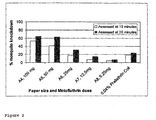
- Knockdown studies were carried out in the above test chamber against the Dengue mosquito Aedes aegypti using five surface areas of 18 gsm paper with five varying doses of metofluthrin a) A4, 100 mg, b) A5, 50 mg, c) A6, 25 mg, d) A7, 12.5 mg, and e) A8, 6.25 mg.
- a knockdown study against the Dengue mosquito Aedes aegypti using aged paper was conducted.
- the test involved treating 18 gsm paper of A4 surface area with 2 mg of metofluthrin at 28°C for up to 12 hours.
- the treated paper was hung in the centre of the above chamber.
- a mosquito coil containing 0.04% prallethrin was included in the trial as a reference control.
- the inventors have concluded that by varying the initial amount of metofluthrin dosed on to the paper (A4) substrate in the range of 25 mg to approximately 5 mg, the emanation rate is constant.
- the results demonstrate that linear release kinetics is observed for metofluthrin emanating from paper substrates.
- the combined plot enables an average release rate to be determined by fitting a line of best fit to the data so that the average rate of emanation to be determined.
- the metofluthrin was dissolved in Norpar 12 and dosed on to the substrate using the wet dosing technique.
- the papers were hung and aged in a chamber at 28°C with low airflow for up to a maximum of 80 hours.
- the amount of metofluthrin remaining on the paper substrate was measured from time 0 hours to 80 hours.
- the plot obtained for the amount of metofluthrin remaining on samples as a function of time was used to calculate the release rate from this format. A plot of the data is shown in Figure 5 .
- White (A4) paper (30 gsm) having a surface area of 1250 cm3 was dosed with metofluthrin (14 mg) prepared in a range of solvents, as listed below.
- the papers were aged in a chamber at 28°C with low air flow for up to a maximum of 168 hours. The amount of metofluthrin remaining on the paper substrate was measured from time 0 hours to 168 hours.
- Table 1 summarises the observed emanation rates for each solvent. The inventors have concluded that linear release kinetics are observed for metofluthrin emanating from paper substrates and accordingly, the line of best fit was fitted to obtain the linear equation to enable the rate of emanation to be determined.
- solvents with boiling ranges from 155 - 245°C and relatively low polarity indexes show an increased release rate compared to the sample dosed with acetone/ethanol (1:1) which has a comparatively high polarity index.
- Tissue paper (18 gsm) having an effective surface area of 1250 cm 2 (A4) was dosed with metofluthrin (14 mg) prepared in a range of solvents. The papers were then aged in a chamber at 28°C with low airflow for up to a maximum of 168 hours. The amount of metofluthrin remaining on the paper substrate was measured from time 0 hours to 168 hours.
- Table 2 illustrates the observed emanation rates for each solvent. The inventors have concluded that linear release kinetics are observed for metofluthrin emanating from paper substrates and accordingly, the line of best fit was fitted to obtain the linear equation to enable the rate of emanation to be determined.
- Table 2 Solvent Specifications Solvents used for dosing dry/wet dosing Boiling Range (°C) Evaporation Rate * Polarity Index ** Release Rate Index *** acetone/ ethanol dry 56 - 78 2.3-5.7 4.3-5.1 1.00 n-pentane dry 36 >33 0.0 1.50 Sasol C12-13 wet 188 - 219 0.04 ⁇ 0.1 - 0.4 1.63 Isopar L wet 190 - 207 ????
- metofluthrin 14 mg was applied to A4 sized 30 gsm paper substrates via wet and dry application at ambient temperature.
- the samples were placed in pouches prepared from the packaging materials under investigation, sealed tightly and stored at 55oC. After periods of one and two weeks, samples were removed from storage and the dosed paper substrates were measured for metofluthrin content.
- the packaging materials studied were glass, PVC, amorphous PET (APET), crystalline PET (CPET), aluminium foil, heat sealable polyester films, acrylonitrile methyl acrylate copolymer and PEPET.
- metofluthrin For the wet dosing of metofluthrin on the paper substrate, the metofluthrin was dissolved in Exxsol D80 or Norpar 12 and the resulting solution applied to the substrate. For dry application, the metofluthrin was dissolved in acetone/ethanol (1:1 by volume) and applied to the substrate. The solvent was then allowed to evaporate over a period of 5-10 minutes.
Landscapes
- Life Sciences & Earth Sciences (AREA)
- Health & Medical Sciences (AREA)
- General Health & Medical Sciences (AREA)
- Dentistry (AREA)
- Plant Pathology (AREA)
- Engineering & Computer Science (AREA)
- Pest Control & Pesticides (AREA)
- Agronomy & Crop Science (AREA)
- Wood Science & Technology (AREA)
- Zoology (AREA)
- Environmental Sciences (AREA)
- Toxicology (AREA)
- Agricultural Chemicals And Associated Chemicals (AREA)
Abstract
Description
- The present invention relates generally to flying insect control and more particularly to a cellulosic based substrate or matrix containing a vapour active pyrethroid that is effective in controlling flying insects, particularly mosquitoes.
- The control of flying insects in an indoor or an outdoor area has traditionally been achieved using articles or devices that dispense insecticide vapours into the atmosphere. Such articles or devices generally burn or heat a liquid or solid substrate to vaporise the active ingredient. For instance, in controlling mosquitoes, coils impregnated with an active ingredient are burnt so that heat from combustion causes the release of the active ingredient into the atmosphere, citronella oil candles are burnt so as to heat the citronella oil and allow it to evaporate into the atmosphere, while electric devices electrically heat the active ingredient so that it vaporises and is dispersed into the atmosphere. Battery operated, fan driven products are also used to control mosquitoes. The above mentioned products require an energy source in the form of combustion, heat or electricity. The release rates of active insecticides from continuous action products such as mosquito coils, candles, liquid vaporisers and electrically heated mats are essentially independent of the surrounding environment, the driving force for discharge of the active being supplied from within the system.
- The abovementioned articles and devices used to control mosquitoes have disadvantages. The combustion of mosquito coils requires a safe burning site and results in ash and smoke. The burning of a candle exposes a naked flame and therefore also requires a safe burning site. The use of electricity to heat an insecticidal device is costly in some developing countries and is not portable.
- There also exists ambient temperature moth repellent products that rely on passive evaporation of the insecticide from a substrate into the environment. These products, which have commonly been used to control moths, do not require an external source of energy, such as combustion, heat or electricity to release the insecticide into the atmosphere. Instead, an insecticide that vapourises at ambient temperature is required for these products. The concept of an ambient temperature moth repellent has many benefits: they provide long lasting and continuous protection; they are efficient in that there is no need for a means of heating; and they are portable, modern and practical.
- The above known ambient temperature products, however, also have disadvantages. Firstly, many of the prior art products are only effective in small, enclosed spaces and/or require significant air movement for the insecticide to be effective in a larger area of space. Secondly, the inventors are not aware of any cost-effective ambient emanation products that are able to work efficiently using low doses of insecticide for the control of insects other than moths, such as mosquitoes.
- There is clearly a need for insecticidal products, particularly cost effective products, that do not require an external input of energy for them to be effective in controlling flying insects, particularly mosquitoes.
- Whilst recognising the short comings of prior art articles for controlling mosquitoes and moths, the present inventors have sought to provide an improved vapour active insecticide product with high insecticidal potency in the continuous control of flying insects without the need for electricity, heat or combustion.
-
EP 0792581 describes an insect controller that does not require heating. It exemplifies controllers comprising insecticides dissolved in acetone. -
FR 2639187 -
FR 2767028 -
FR 2785147 -
EP 1216615 discloses insect control articles containing pyrethroids. It describes spraying substrates with an aerosol formulation of Esbiol. -
EP 0962139 discloses a pest control article comprising a wind generating mechanism for evaporating an active agent. It exemplifies an article wherein the active agent is dissolved in acetone. - The present inventors have found an effective way of controlling flying insects, in particular mosquitoes, using a combination of substrate, vapour active pyrethroid and carrier solvent that allows emanation of the pyrethroid from the substrate at dose levels that achieve an effective emanation rate and are cost effective.
- According to an aspect of the present invention, there is provided a cellulosic based substrate or matrix for controlling flying insects, the cellulosic based substrate or matrix impregnated and/or dosed with an insecticidally effective amount of a vapour active pyrethroid in a carrier solvent or combination of carrier solvents, wherein the carrier solvent(s) has an evaporation rate according to ASTM D3539-87 of less than 1.0;
wherein the carrier solvent(s) is/are selected from carrier solvents having a boiling point in therange 50°C to 265°C, normal paraffins with a boiling point range of 155°C to 276°C, dearomatised aliphatic hydrocarbons and their blends in the boiling point range of 33°C to 265°C, and/or isoparaffins in the boiling point range of 150°C to 300°C;
and the carrier solvent(s) has a Snyder polarity index in the range of 0.0-4.0, such that the vapour active pyrethroid is emanated into the environment at a rate of at least 0.040 mg/h. - Preferably, the vapour active pyrethroid is selected from the group consisting of metofluthrin, transfluthrin, empenthrin, methothrin, tefluthrin, and fenfluthrin or mixtures thereof, most preferably the pyrethroid is metofluthrin.
- Preferably, the cellulosic based substrate or matrix has a surface area in the range of 50-5000 cm2 and the vapour active pyrethroid is present in an amount of 2.0-3000 mg/m2.
- Preferably, the solvent is selected from the group consisting of normal paraffins with a boiling point range of 155-276°C, dearomatised aliphatic hydrocarbons and their blends in the boiling point range of 150-265°C isoparaffins in the boiling point range of 150-300°C and glycol ethers in the boiling point range of 120-243°C.
- Preferably, the carrier solvent has a boiling point in the range of 150-265°C.
- Preferably, the vapour active pyrethroid is metofluthrin.
- Preferably, the cellulosic based substrate or matrix is impregnated and/or dosed with a vapour active pyrethroid in an amount of 16-320 mg/m2, preferably 130-320 mg/m2, of the substrate or matrix surface area.
- Preferably, the cellulosic based substrate or matrix is impregnated and/or dosed with a vapour active pyrethroid in an amount of 48-960 mg/m2, preferably 390-960 mg/m2, of the substrate or matrix surface area.
- Preferably, the cellulosic based substrate or matrix is impregnated and/or dosed with a vapour active pyrethroid in an amount of 144-2880 mg/m2, preferably 1770-2880 mg/m2, of the substrate or matrix surface area.
- Preferably, the vapour active pyrethroid is emanated into the environment with non-augmented air movement at a rate of at least 0.040 mg/h at a temperature in the range of 18-40°C.
- Preferably, the vapour active pyrethroid is emanated into the environment at a temperature in the range of 21-40°C.
- Preferably, the vapour active pyrethroid is emanated into the environment at a rate of at least 0.075 mg/h, preferably at a temperature in the range of 21-35°C.
- Preferably, the cellulosic based substrate or matrix has a grammage in the range of 12 gsm to less than 260 gsm, 18 gsm to 40 gsm, or 18 gsm.
- Preferably, the cellulosic based substrate or matrix is in the form of a honeycomb arrangement.
- Preferably, the honeycomb arrangement has two ends that are attached to a protective material into which the vapour active pyrethroid cannot migrate and/or be absorbed.
- Preferably, the honeycomb arrangement has an open form that allows emanation of the vapour active pyrethroid into the atmosphere and a closed form which inhibits migration and/or absorption of the vapour active pyrethroid into the atmosphere.
- Preferably, the flying insects are controlled by knockdown.
- Preferably, the flying insects are mosquitoes.
- Preferably the carrier solvent has a Snyder polarity index of less than 4.0 and preferably less than 0.5.
- According to a preferred embodiment, there is provided a cellulosic based substrate or matrix impregnated and/or dosed with a vapour active pyrethroid in a carrier solvent;
wherein the cellulosic based substrate or matrix has a surface area in the range of 50-5000 cm2, the vapour active pyrethroid is selected from the group consisting of metofluthrin, transfluthrin, empenthrin, methothrin, tefluthrin, and fenfluthrin or mixtures thereof and is present in an amount of 2.0-3000 mg/m2; and
wherein the carrier solvent has an evaporation rate according to ASTM D3539-87 of less than 1.0;
wherein the carrier solvent is selected from carrier solvents having a boiling point in therange 50°C to 265°C, normal paraffins with a boiling point range of 155°C to 276°C, dearomatised aliphatic hydrocarbons and their blends in the boiling point range of 33°C to 265°C, and/or isoparaffins in the boiling point range of 150°C to 300°C;
and
the carrier solvent(s) has a Snyder polarity index in the range of 0.0-4.0;
such that the vapour active pyrethroid is emanated into the environment with non-augmented air movement at a rate of at least 0.040 mg/h at a temperature in the range of 18-40°C. - In a further aspect there is provided a flying insect control article comprising a cellulosic based substrate or matrix of the present invention.
- There is therefore provided a flying insect control article comprising a cellulosic based substrate or matrix for controlling flying insects, the cellulosic based substrate or matrix impregnated and/or dosed with an insecticidally effective amount of a vapour active pyrethroid in a carrier solvent or combination of carrier solvents, wherein the carrier solvent(s) has an evaporation rate according to ASTM D3539-87 of less than 1.0;
wherein the carrier solvent(s) is/are selected from carrier solvents having a boiling point in therange 50°C to 265°C, normal paraffins with a boiling point range of 155°C to 276°C, dearomatised aliphatic hydrocarbons and their blends in the boiling point range of 33°C to 265°C, and/or isoparaffins in the boiling point range of 150°C to 300°C;
and the carrier solvent(s) has a Snyder polarity index in the range of 0.0-4.0, such that the vapour active pyrethroid is emanated into the environment at a rate of at least 0.040 mg/h. - In yet a further aspect, the flying insect control article further comprising:
- a protective material that is attached to the cellulosic based substrate or matrix into which protective material the vapour active pyrethroid does not migrate and/or is not absorbed;
- wherein the cellulosic based substrate and/or matrix exists in a closed and open form such that when in the open form the pyrethroid is able to emanate from the substrate into the environment and when in the closed form the protective material covers the substrate or matrix to minimise emanation of the pyrethroid into the environment.
- In a yet further aspect, the flying insect control article is packaged and comprises:
- a packaging material enclosing the cellulosic based substrate or matrix into which material the vapour active pyrethroid does not migrate and/or is not absorbed;
- wherein when the packaging material enclosing the cellulosic based substrate or matrix is removed from around the cellulosic based substrate or matrix, the vapour active pyrethroid is free to emanate from the cellulosic based substrate or matrix exposed to the environment to control flying insects.
- In a yet further aspect, the flying insect control article is a stable flying insect control article and is enclosed by a packaging material;
wherein the cellulosic based substrate or matrix is wet with a solution of the insecticidally effective amount of the vapour active pyrethroid and the vapour active pyrethroid emanates from the cellulosic substrate or matrix into the environment at a rate of at least 0.040 mg/h but does not migrate and/or is not absorbed into the packaging material. - Preferably, the cellulosic based substrate or matrix is a paper substrate with a grammage of 18 gsm.
- Preferably, the protective material and packaging material is selected from the group including metalised polyester, heat sealed polyester films, polyester based film and formed sheet, acrylonitrile-methyl acrylate copolymers and laminates thereof, metal foil and laminates thereof, or is glass.
- In a yet further aspect there is provided a method for controlling flying insects comprising the steps of:
- a) providing the cellulosic based substrate or matrix according to the present invention or the flying insect control article according to the present invention;
- b) exposing the cellulosic based substrate or matrix in an environment with non-augmented air movement; and
- c) allowing the vapour active pyrethroid impregnated within and/or dosed on the cellulosic based substrate or matrix to passively emanate into the air.
- There is therefore provided a method for controlling flying insects comprising the steps of:
- a) providing a cellulosic based substrate or matrix for controlling flying insects, the cellulosic based substrate or matrix impregnated and/or dosed with an insecticidally effective amount of a vapour active pyrethroid in a carrier solvent or combination of carrier solvents, wherein the carrier solvent(s) has an evaporation rate according to ASTM D3539-87 of less than 1.0;
wherein the carrier solvent(s) is/are selected from carrier solvents having a boiling point in therange 50°C to 265°C, normal paraffins with a boiling point range of 155°C to 276°C, dearomatised aliphatic hydrocarbons and their blends in the boiling point range of 33°C to 265°C, and/or isoparaffins in the boiling point range of 150°C to 300°C;
and the carrier solvent(s) has a Snyder polarity index in the range of 0.0-4.0, such that the vapour active pyrethroid is emanated into the environment at a rate of at least 0.040 mg/h; or a flying insect control article, comprising the cellulosic based substrate or matrix; - b) exposing the cellulosic based substrate or matrix in an environment with non-augmented air movement; and
- c) allowing the vapour active pyrethroid impregnated within and/or dosed on the cellulosic based substrate or matrix to passively emanate into the air.
- In yet a further aspect there is provided a method of packaging a cellulosic based substrate or matrix according to the present invention or the flying insect control article according to the present invention comprising the steps of:
- a) providing a packaging material through which the vapour active pyrethroid does not migrate and/or is not absorbed;
- b) forming a pouch with the packaging material;
- c) filling the pouch with the cellulosic based substrate or matrix or insect control article; and
- d) sealing the pouch.
- There is therefore provided a method of packaging a cellulosic based substrate or matrix for controlling flying insects, the cellulosic based substrate or matrix impregnated and/or dosed with an insecticidally effective amount of a vapour active pyrethroid in a carrier solvent or combination of carrier solvents, wherein the carrier solvent(s) has an evaporation rate according to ASTM D3539-87 of less than 1.0;
wherein the carrier solvent(s) is/are selected from carrier solvents having a boiling point in therange 50°C to 265°C, normal paraffins with a boiling point range of 155°C to 276°C, dearomatised aliphatic hydrocarbons and their blends in the boiling point range of 33°C to 265°C, and/or isoparaffins in the boiling point range of 150°C to 300°C;
and the carrier solvent(s) has a Snyder polarity index in the range of 0.0-4.0, such that the vapour active pyrethroid is emanated into the environment at a rate of at least 0.040 mg/h, or a flying insect control article comprising the cellulosic based substrate or matrix, comprising the steps of: - a) providing a packaging material through which the vapour active pyrethroid does not migrate and/or is not absorbed forming a pouch with the packaging material;
- b) filling the pouch with the cellulosic based substrate or matrix or insect control article; and
- c) sealing the pouch.
- Preferably, the packaging material is selected from the group consisting of metalised polyester, heat sealed polyester films, polyester based film and formed sheet and acrylonitrile-methyl acrylate copolymers and laminates thereof, metal foil and laminates thereof and glass.
- The cellulosic based substrate or matrix may be any substrate matrix that contains cellulosic fibres and includes but is not limited to ground wood pulp, chemical wood pulp, straw preferably wheat straw, bagasse (residue from crushed sugarcane), esparto grass, bamboo, flax, hemp, jute and kenafrag fibres (cotton), cotton linters and recycled wastepaper in the form of, for instance, tissue, paper and cardboard. The cellulosic based substrate or matrix may be of varying grade and includes but is not limited to bleached, recycled and virgin cellulosic based substrates or matrices. It will be appreciated that different types of cellulosic based substrates or matrices will affect the emanation rate of the vapour active pyrethroid from the substrate or matrix into the atmosphere. Preferably, the cellulosic based substrate or matrix is paper, more preferably, bleached paper.
- It will be understood that a "substrate" is something which underlies or serves as a basis or foundation and a "matrix" is something which gives origin or form to a thing or which serves to enclose it. Accordingly, it will be appreciated that the term "substrate" is more applicable to flat cellulose based articles while the term "matrix" is more applicable to three-dimensional cellulose based articles.
- Preferably, the cellulosic based substrate or matrix according to the invention has a grammage in the range of 12 gsm to less than 260 gsm, more preferably in the range of 12 gsm to 150 gsm, even more preferably in the range of 12 gsm to 40 gsm. Most preferably, the cellulosic based substrate or matrix has a grammage of 18 gsm.
- According to the present invention, the cellulosic based substrate or matrix is impregnated and/or dosed with a vapour active pyrethroid. The substrate or matrix is deemed "impregnated" with the vapour active pyrethroid when the pyrethroid is either partially or completely distributed within the material of the substrate or matrix in such a manner that the pyrethroid fills all or some of the interstices of the material of the substrate or matrix and is directly held within the substrate or matrix and supported thereby. The substrate is deemed to be "dosed" with the vapour active pyrethroid when a specific quantity of the pyrethroid is applied to the substrate or matrix and absorbed either partially or completely into the pores of the substrate or matrix.
- The cellulosic based substrate or matrix according to the invention is impregnated and/or dosed with a vapour active pyrethroid, preferably in an amount of 2.0-3000 mg/m2, more preferably, 2.0-1000 mg/m2. The vapour active pyrethroid is present in an amount that is insecticidally effective upon emanation into the environment. It will be appreciated that the amount of vapour active pyrethroid required per square meter will depend on the period of time the vapour active pyrethroid is required to emanate from the cellulose based substrate or matrix. For instance, for a cellulosic based substrate required to be effective in controlling insects, such as mosquitoes, over a 100 hour period, it is preferred that the cellulosic substrate or matrix be impregnated and/or dosed with vapour active pyrethroid in an amount of 16-320 mg/m2, more preferably 130-320 mg/m2. Over a 300 hour period; it is preferred that the cellulosic substrate or matrix be impregnated and/or dosed with vapour active pyrethroid in an amount of 48-960 mg/m2, more preferably 390-960 mg/m2. Over a 900 hour period, it is preferred that the cellulosic substrate or matrix be impregnated and/or dosed with vapour active pyrethroid in an amount of 144-2880 mg/m2, more preferably, 1170-2880 mg/m2.
- Preferably, the cellulosic based substrate or matrix according to the various aspects of the invention has a surface area of about 50-5000 cm2, more preferably, 180-2400 cm2.
- In a preferred embodiment, a surface area of cellulosic based substrate or matrix in the range of 1250-2400 cm2 is impregnated with 20-40 mg of vapour active pyrethroid to achieve 100 hours of use, or 60-120 mg of vapour active pyrethroid to achieve 300 hours of use, or 180-360 mg of vapour active pyrethroid to achieve 900 hours of use.
- The phrase surface area" is intended to mean the total geometric or two dimensional surface area of the cellulosic based substrate or matrix that is exposed to the atmosphere or environment into which the vapour active pyrethroid is to emanate. It will be understood that where the cellulosic based substrate or matrix is a flat piece of paper, the surface area is the sum of the area of both sides of the paper. It will further be understood that the surface area of any other configuration will be the sum of the area of the surfaces exposed to the atmosphere/environment. Generally, the inventors have found that an increase in the surface area increases the emanation rate of the vapour active pyrethroid from the cellulosic based substrate or matrix into the atmosphere.
- It will be understood that vapour active pyrethroids are those that are volatile at ambient temperature without heat or combustion. The vapour active pyrethroids are preferably selected from the group consisting of metofluthrin (1.4x10⁻⁵mmHg/ 25°C), transfluthrin (2.6x10⁻⁵mmHg/25°C, 4.0x10⁻¹mPa/20°C), empenthrin (14mPa/23.6°C), methothrin, tefluthrin (8.4mPa/20°C, 50mPa/40°C), and fenfluthrin (1mPa/20°C). It will be appreciated that one or more vapour active pyrethroids may be employed in the present invention. Preferably, the vapour active pyrethroid is metofluthrin. Metofluthrin has high potency against mosquitoes, flies, and moths. The chemical name of metofluthrin is 2,3,5,6-tetrafluro-4-(methoxymethyl)benzyl-(EZ)-(1RS,3RS;1RS,3SR)-2,2-dimethyl-3-(prop-1-enyl)cyclopropanecarboxylate. Metofluthrin is available from Sumitomo Chemical Company.
- The emanation or release of the vapour active pyrethroid from the cellulosic based substrate or matrix into the atmosphere/environment may be referred to as the emanation rate or release rate and will be understood to mean the depletion of an amount of vapour active pyrethroid from the cellulosic based substrate or matrix over a certain period of time and has a unit of measurement of mg/hour. The emanation rate is a measure of efficacy in controlling flying insects. The inventors have found that the emanation rate is affected by the surface area of the cellulose based substrate or matrix and the amount of the vapour active pyrethroid impregnated and/or dosed onto the substrate or matrix.
- The present inventors have found that emanation of a vapour active pyrethroid, preferably metofluthrin, from a cellulosic based substrate or matrix into the atmosphere at a rate of at least 0.040 mg/h, more preferably at least 0.075 mg/h, is required to effectively control flying insects, particularly mosquitoes and moths. The present inventors believe that a lower emanation rate of at least 0.040 mg/h may be more effective in controlling flying insects such as moths, while a higher emanation rate of at least 0.075 mg/h may be more effective in controlling insects such as mosquitoes. Throughout the specification, the emanation rate of 0.040 mg/h may be referred to as the minimum effective emanation rate (MEER). This MEER may be achieved by controlling a variety of parameters including but not limited to the quantity of vapour active insecticide impregnated and/or dosed onto the cellulosic based substrate or matrix; the size, mass and folding of the cellulosic based substrate or matrix; temperature; and air flow.
- By virtue of extrapolation, the present inventors expect the emanation rate of vapour active pyrethroid from the cellulosic substrate or matrix of at least 0.040 mg/h, preferably 0.075 mg/h, to be effective in controlling flying insects, particularly mosquitoes, at a temperature in the range of 18-40°C. The possibility of achieving emanation of the vapour active pyrethroid from the cellulosic substrate or matrix according to the present invention at low temperatures in the range of 18-21°C contributes to the commercially viability of the various aspects of the invention.
- Preferably, the vapour active pyrethroid is emanated from the cellulosic matrix or substrate at a rate of at least 0.04 mg/h, preferably at least 0.075 mg/h, at a temperature in the range of 18-40°C, more preferably 21-35°C.
- It will be understood that an environment with non-augmented air movement refers to natural air movement that passes over and/or through the cellulosic based substrate or matrix, thereby allowing the vapour active insecticide to passively emanate into the atmosphere. It excludes the use of fans, heat and other mechanical means of increasing air movement. Suitable environments include but are not limited to enclosed rooms and open volumes of space, such as patios and the like, with air movement provided by natural air movement.
- The cellulosic based substrate/matrix and the insect control devices of the present invention are used to control flying insects. The flying insects may be selected from but not limited to biting Dipterous pests (Order Diptera) such as mosquitoes (Family Culicidea), biting midges (Family Ceratopogonidae), black flies (F. Simulidae), sandflies (certain Psychodidae) and biting flies (various families eg Muscidae and Tabanidae) and non-biting Dipterous insects (e.g. flies and midges of various families including, but not limited to Muscidae, Calliphoridae, Drosophilidae, Chironomidae and Psychodidae) and certain moths (Order Lepidoptera). Preferably, the cellulosic based substrate/matrix and the insect control devices of the present invention are used to control mosquitoes.
- It will be understood that "control" of the flying insect population includes but is not limited to any one of or a combination of killing, repelling or knocking down a flying insect. It will be appreciated that a typical way of measuring the performance of an insecticide is in the form of "knockdown".
- Throughout the specification, the term "passive emanation" is used to describe the process by which the vapour active pyrethroid emanates from the cellulosic based substrate or matrix into the atmosphere without the application of external energy.
- According to the invention, the cellulosic based substrate or matrix is impregnated and/or dosed with the vapour active pyrethroid, preferably metofluthrin, in a carrier solvent. The carrier solvent may be any solvent or combination of solvents in which the vapour active pyrethroid is soluble.
- The inventors have identified three important physical properties of solvents that may be used to characterise and classify preferred carrier solvents. The first is the boiling point, the second is the evaporation rate according to the ASTM D3539-87 and the third is the polarity of the solvent as determined by the Snyder polarity index. (L.R.Snyder, J Chromatographic Science, 1978, 16, 223).
- Preferably, the carrier solvent has a boiling point in the range between 50-265°C.
- The carrier solvent may be selected from, normal paraffins with a boiling point range of 155-276°C (e.g. Norpar 12); dearomatised aliphatic hydrocarbons and their blends in the boiling point range of 33-265°C (e.g. pentane, heptane, hexane, Exxsol D40, Exxsol D80 and Exxsol D100); isoparaffins in the boiling point range of 150-300°C (e.g. Isopar G, and Isopar M); glycol ethers in the boiling point range of 120-243°C; natural or synthetically derived aroma chemicals, preferably in the boiling point range of 120-250°C (e.g. monoterpenes and sesquiterpenes, including monoterpene and sesquiterpene alcohols, aldehydes, ketones, esters, oxides and hydrocarbons such as linalool, geraniol, citronellal, citral, geranial, menthone, linalyl acetate, bornyl acetate, 1,8-cineole and limonene); and essential oils.
- The inventors have found that the use of low boiling point solvents with high evaporation rates, as defined below by dry dosing, will be effective as carrier solvents. The inventors have also found that the use of higher boiling point solvents with lower evaporation rates, as defined below by wet dosing, leads to a preferred embodiment of the invention. In addition, the inventors of the present invention have surprisingly found that when wet dosing is employed and a solvent with a Snyder polarity index of less than approximately 4.0, preferably less than approximately 0.5, is chosen the release rates for the vapour active pyrethroid from the cellulosic based substrate are increased.
- The cellulosic based substrate or matrix is impregnated and/or dosed with the vapour active pyrethroid, preferably metofluthrin, by way of dry or wet dosing.
- By wet dosing, it is meant that the vapour active pyrethroid is applied to and carried within the cellulosic based substrate or matrix in the presence of a carrier solvent. The vapour active pyrethroid, preferably metofluthrin, is dissolved in the carrier solvent and the resulting solution is applied to the cellulosic based substrate or matrix such that the vapour active pyrethroid is distributed, preferably evenly, throughout the cellulosic based substrate or matrix. The carrier solvent used in wet dosing is preferably a solvent that doesn't evaporate within approximately 10 minutes application onto the cellulosic based substrate or matrix and more preferably is characterised by having a high boiling point and a low evaporation rate.
- Preferably, the carrier solvent for wet dosing has a boiling point in the range of 150-265°C, and may be selected from known solvents including but not limited to normal paraffins with a boiling point range of 155-276°C, such as
Norpar 12; dearomatised aliphatic hydrocarbons and their blends in the boiling point range of 150 - 265°C such as Exxsol D40, Exxsol D80 and Exxsol D100; isoparaffins in the boiling point range of 150-300°C such as Isopar G and Isopar M and glycol ethers in the boiling point range of 120-243°C. - In a preferred embodiment, the carrier solvent used in wet dosing has an evaporation rate according to ASTM D3539-87 of less than 1.0, a boiling point in the range of 150-265°C and a Snyder polarity index in the range of 0.0-4.0, preferably 0.0- 0.5.
- It has been found that the release rate of the vapour active pyrethroid, preferably metofluthrin, from the cellulosic based substrate or matrix is reduced if the carrier solvent has an extremely high boiling point. For instance, a carrier solvent having a boiling point within the range of about 285-317°C (eg Exxsol D140) has a lower release rate of vapour active pyrethroid into the atmosphere than carrier solvents having a boiling point within the range of about 150-265°C (eg Exxsol D40, Exxsol D80, Exxsol D100, Isopar G , Isopar M and Norpar 12).
- By dry dosing, it is meant that the vapour active pyrethroid is applied to and present on the cellulosic based substrate or matrix in the presence of a volatile carrier solvent. Preferably, the vapour active pyrethroid, preferably metofluthrin, is dissolved in a volatile solvent which distributes the vapour active pyrethroid throughout the cellulose based substrate and then rapidly evaporates into the atmosphere. Preferably, the volatile solvent evenly distributes the vapour active pyrethroid onto the cellulosic substrate or matrix and will effectively evaporate within 10 minutes of application onto the cellulosic based substrate or matrix. More preferably, the carrier solvent is characterised by having a relatively low boiling point and a high evaporation rate. Even more preferably, the volatile solvent has an evaporation rate according to ASTM D3539-87 of greater than 1.0. Preferably, the volatile solvent is selected from known solvents having a boiling point in the
range 50°C to 265°C including but not limited to chlorinated hydrocarbons, methanol, ethanol, pentane, hexane, heptane, acetone and mixtures of these solvents such as ethanol/acetone (1:1 by volume). - In a preferred embodiment of the invention in which dry dosing is employed, the vapour active pyrethroid, preferably metofluthrin, is dissolved in the volatile solvent and applied to the substrate, preferably a paper substrate, that will allow the solvent to evaporate at ambient temperature.
- It will be understood that solvents used in both wet and dry application of the vapour active pyrethroid to the cellulosic based substrate or matrix may be employed as carrier solvents in all aspects of the present invention that require a carrier solvent.
- The term "essential oils" will be understood to mean a volatile and aromatic liquid which is isolated by a physical process from an odoriferous plant of a single botanical species. The oil bears the name of the plant from which it is derived; for example rose oil or lavender oil. These essential oils obtained from plants may be extracted by distillation, steam distillation, expression or by extraction with fats or organic solvents.
- It will be understood that "aroma chemicals" are natural isolates or synthetics which have an aroma. The natural isolates are removed mechanically (eg by distillation) or chemically (eg hydrolysis or salt formation) from a natural essential oil. The isolates are further modified. For example rose and lavender oils may be distilled to produce linalool, which may then be acetylated to make linalyl acetate. Aroma chemicals are the main constituents of essential oils. These constituents are generally monoterpenes and sesquiterpenes, including but not limited to alcohols, aldehydes, ketones, esters, oxides and hydrocarbons. Preferably, the natural or synthetically derived aroma chemicals have a boiling point in the range of 120-250°C.
- By "stable" insect control article according to the seventh and eighth aspects of the invention, it is meant that the active is stable in the cellulosic based substrate or matrix. More specifically, it will be understood that the insecticidal product will continue to be satisfactory in use after storage for at least 2 years according to the Manual on Development and Use of FAO and WHO Specification for Pesticides (first Edition, 2002). Preferably, the packaged insect control article according to aspects of the invention are stable articles.
- In the aspects of the invention, directed to an flying insect control article, the cellulosic based substrate or matrix is attached to a protective material. In preferred embodiments of the invention, the cellulosic based substrate or matrix may be attached to a protective material. It will be understood that the meaning of the word "attached" includes but is not limited to joined, fastened, connected, annexed or affixed. Accordingly, it will be understood that the cellulosic based substrate or matrix may be attached to the protective material directly or indirectly. In a preferred embodiment of the invention, the cellulosic matrix or substrate has one or two ends that are attached to a backing board that has a protective material on one side. It will be understood that the cellulosic matrix or substrate may be attached directly to the side of the backing board with the protective material, or attached to the side of the backing board that does not have the protective material, thereby being indirectly attached to the protective material. By way of non-limiting example, it will be appreciated that the protective material may be "attached to" the cellulosic substrate or matrix by way of water and solvent based glues, hot-melt adhesives, staples, adhesive tapes and Velcro fasteners.
- As discussed below, the cellulosic based substrate or matrix of the invention may be in a closed or open form. When the cellulosic based substrate or matrix is attached to a protective material and is in a closed form, the protective material preferably covers the cellulosic substrate or matrix to minimise emanation of the vapour active pyrethroid into the environment. When the cellulosic based substrate or matrix is enclosed in a packaging material as defined in aspects of the invention, the cellulosic based substrate or matrix is preferably in a closed form.
- It will be appreciated that once the cellulosic based substrate or matrix is impregnated/dosed with the vapour active pyrethroid it may need to be stored for significant periods of time. It is therefore important that the packaging material or protective material is effective in minimising the release/emanation rate of vapour active pyrethroid from the cellulosic based substrate or matrix into the atmosphere. This is most successfully achieved when the packaging material or protective material is a material through which the vapour active pyrethroid will not migrate and/or be absorbed.
- Preferably, the packaging/protective material used in the present invention is selected from but not limited to glass; metal foil, preferably aluminium foil, and laminates thereof; polyester, metalised polyester, heat sealable polyester film, polyester based film and formed sheet, such as amorphous PET and crystalline PET, and laminates thereof; and acrylonitrile-methyl acrylate copolymers and laminates thereof.
- It has been found that when the cellulosic based substrate or matrix is wet dosed, a greater range of packaging material and protective material can be used than if the cellulosic based substrate or matrix was dry dosed. The present inventors have surprisingly found that wet dosing the cellulosic based substrate or matrix effects the movement of vapour active pyrethroid into the packaging and protective material. In particular, the inventors have found that the movement of vapour active pyrethroid into some material, such as glass; metal foil and laminates thereof; polyester, metalised polyester, heat sealable polyester film, polyester based film and formed sheet, such as amorphous PET and crystalline PET, and laminates thereof; and acrylonitrile-methyl acrylate copolymers and laminates thereof; is reduced if wet dosing rather than dry dosing is employed.
- Without being bound by theory, it is thought that in wet dosing, the vapour active pyrethroid has an affinity for the solvent and is less likely to migrate from the cellulose based substrate or matrix. In contrast, it is thought that when dry dosing is employed, the vapour active pyrethroid is absorbed by the substrate or matrix and results in migration of the vapour active pyrethroid into the and through some materials.
- Preferably, the packaging/protective material used in the present invention when dry dosing is employed is selected from but not limited to metal foil, glass and crystalline PET. Preferably, the packaging/protective material used in the present invention when wet dosing is employed is selected from but not limited to glass; metal foil and laminates thereof; metalised polyester, heat sealable polyester film, polyester, polyester based film and formed sheet, such as amorphous PET and crystalline PET, and laminates thereof; and acrylonitrile-methyl acrylate copolymers, and laminates thereof. Even more preferably, the packaging/protective material used is laminated metal foil.
- As noted above, the emanation rate of the vapour active pyrethroid from the cellulosic based substrate or matrix is affected by a number of parameters including surface area, paper mass and size, the number of folds etc. This in turn means that products effective in killing and/or repelling insects over different time periods, such as for 12 h and 300 h, could be different.
- Air movement is required in order for the pyrethroid to emanate from the substrate into the atmosphere. The rate of emanation increases with increased air flow. A minimal air flow, such as the movement of bodies, a small fan in a closed room or open windows and/or doors, is sufficient to allow a minimum emanation rate of 0.040 mg/h, and the preferred emanation rate of 0.075 mg/h.
- The cellulosic based substrate or matrix of the invention containing the vapour active pyrethroid may be folded between an open form and a closed form such that they are expandable and re-closable arrangements. This means that when insect control is not required, the cellulosic based substrate or matrix may be closed and stored in a form which minimises the surface area containing the vapour active pyrethroid that is exposed to the atmosphere. Conversely, when insect control is required, the cellulosic based substrate or matrix may be expanded into an open form thereby increasing the surface area of cellulosic based substrate or matrix containing the pyrethroid that is exposed to the atmosphere allowing the pyrethroid to emanate into the atmosphere.
- It will be appreciated that various configurations of the cellulosic based substrate or matrix may be adopted. These configurations include but are not limited to Japanese fans, concertina type arrangements and three dimensional structures having a plurality of cells such as honeycomb like arrangements that open and close in a concertina like fashion.
- A honeycomb type arrangement may be hung to give a linear configuration, opened on a table to provide a bridge configuration or closed into a circle to give a hanging lantern configuration. It will be appreciated that in forming the circular hanging lantern other configurations prior to the circular form may be adopted. For instance, the honeycomb arrangement may be positioned in an arc of up to 360°. Preferably the cellulosic based substrate or matrix is a honeycomb arrangement made of paper.
- In a preferred embodiment of the invention, the cellulosic substrate or matrix is in the form of a paper honeycomb arrangement with two ends. Preferably, the two ends of the honeycomb arrangement are attached to protective material through which the vapour active pyrethroid cannot migrate and/or be absorbed. More preferably, the two ends of the honeycomb arrangement are attached to cardboard laminated with foil, even more preferably, the cellulosic based substrate or matrix forming the honeycomb arrangement and impregnated and/or dosed with the vapour active pyrethroid is attached to the foil side of the cardboard using water based glue.
- In a preferred embodiment of the invention, the cellulosic based substrate or matrix is a refill unit for a holding unit that is able to support the cellulosic based substrate or matrix. For instance, the holding unit containing the cellulosic based substrate or matrix may be hung or laid on a table.
- An aspect of the invention is directed to a method of packaging cellulosic based substrate or matrix or insect control article according to the invention. It will be appreciated that the forming filling and sealing steps can be carried out according to a number of known procedures.
-
-
Figure 1 is a bar graph showing % knockdown of Aedes aegypti mosquitoes in a 40 m3 test chamber when exposed to various sizes of 18 gsm paper dosed with 150 mg of metofluthrin. -
Figure 2 is a bar graph showing % knockdown of Aedes aegypti mosquitoes knockdown in a 40 m3 test chamber when exposed to various sizes of 18 gsm paper dosed with the same concentration of metofluthrin per square metre (100 mg on A4, 50 mg on A5, 25 mg on A6, 12.5 mg on A7 and 6.25 mg on A8). -
Figure 3 is a bar graph showing the affect of aging at 28°C of A4 paper dosed with 2 mg of metofluthrin on the % knockdown of Aedes aegypti mosquitoes in a 40 m3 test chamber. -
Figure 4 is a graph showing the combined emanation profile of 14, 20 and 25 mg of metofluthrin from bleached paper (A4, 50 gsm). -
Figure 5 is a graph showing the emanation rate of metofluthrin from a honeycomb configuration at 28°C. -
Figure 6 is a one cell honeycomb configuration with a surface area of 2bc+2bd+4ab - In order to understand better the nature of the invention, a number of examples will now be described.
-
A-series paper sizes: Surface Area (m2) A1 - 5000 cm2 - 0.5 m2 1 m2 A2 - 2500 cm2 - 0.25 m2 0.5 m2 A3 - 1250 cm2 - 0.125 m2 0.25m2 A4 - 625 cm2 - 0.0625 m2 0.125m2 A5 - 312 cm2 - 0.03125 m2 0.0625m2 A6 - 156 cm2 - 0.01563 m2 0.03126m2 A7 - 78.1 cm2 - 0.00781 m2 0.01562m2 A8 - 39.1 cm2 - 0.00391 m2 0.00782m2 - Where the cellulosic based substrate or matrix is a sheet of flat A4 paper:
- The surface area of the flat A4 paper is the sum of the area of both sides of the paper and is calculated as follows:


- Where the cellulosic based substrate or matrix is a honeycomb configuration according to
Figure 5 -
Figure 5 shows one cell of a honeycomb configuration. The surface area of the cell shown inFigure 5 is the sum of the area of the surfaces exposed to air. There are glue lines betweensurface 1 and 2 and betweensurface 5 and 6 which means that each portion of paper forming these surfaces only has one side exposed to air. The portions ofpaper forming surfaces Figure 5 is calculated as follows:


- The inventors have carried out a number of knockdown studies for the control of mosquitoes using paper surfaces impregnated and/or dosed with the vapour active insecticide metofluthrin. The active was applied to each paper surface as a solution in acetone/ethanol (1:1).
- Tests were carried out in a 40m3 test chamber. The temperature was approximately 28°C. Mixed sex Aedes aegypti mosquitoes were used, aged for 7-10 days after emergence. Up to 200 mosquitoes were introduced into the chamber for each test. Three replicates were done for each treatment. Knocked down mosquitoes were collected at the end of each assessment period and counted.
- Knockdown studies against the Dengue mosquito Aedes aegypti using three surface areas a) A2, b) A3 and c) A4 of 18 gsm paper in the above test chamber were carried out. Each paper was treated with 150 mg of metofluthrin. A mosquito coil containing 0.04% Prallethrin was included as a reference control. The results are shown in
Figure 1 . - The results show that after 10 minutes, an increase in surface area increases product performance. After 20 minutes, all surface areas were equally effective. Further, it shows that all three paper sizes when treated with metofluthrin are more effective than the control.
- Knockdown studies were carried out in the above test chamber against the Dengue mosquito Aedes aegypti using five surface areas of 18 gsm paper with five varying doses of metofluthrin a) A4, 100 mg, b) A5, 50 mg, c) A6, 25 mg, d) A7, 12.5 mg, and e) A8, 6.25 mg.
- There was a common concentration of 800 mg/m2 for all paper samples. A mosquito coil containing 0.04% prallethrin was included as a reference control. The treated paper was hung in the centre of the above chamber. The results are shown in
Figure 2 . - The results show that an increase in surface area generally increases product performance. The inventors have concluded that the performance is dependent upon the surface area.
- A knockdown study against the Dengue mosquito Aedes aegypti using aged paper was conducted. The test involved treating 18 gsm paper of A4 surface area with 2 mg of metofluthrin at 28°C for up to 12 hours. The treated paper was hung in the centre of the above chamber. A mosquito coil containing 0.04% prallethrin was included in the trial as a reference control.
- The results are shown in
Figure 3 . - The results show that 2 mg of metofluthrin is required on the treated substrate to achieve greater than 40% knockdown for up to 4 hours. At 4 hours, the substrate of the present invention is twice as effective as the control.
- A
study involving dosing 50 gsm paper with different amounts of metofluthrin was made to investigate the affect on the emanation rate from this substrate. - Three samples of white (A4) paper (50 gsm) each having a surface area of 1250 cm2 were dosed with metofluthrin (25, 20 and 14 mg) dissolved in acetone/ethanol (1:1) using the dry dosing technique. The papers were aged in a chamber at 28°C with low air flow for up to a maximum of 214 hours. The amount of metofluthrin remaining on the paper substrate was measured from
time 0 hours to 214 hours. The plot obtained for the emanation rate of metofluthrin from the 25 mg dosed samples was used to estimate the time it would take for 20 and 14 mg of metofluthrin to remain on the samples. A combined plot of the data is shown inFigure 4 . - The inventors have concluded that by varying the initial amount of metofluthrin dosed on to the paper (A4) substrate in the range of 25 mg to approximately 5 mg, the emanation rate is constant. The results also demonstrate that linear release kinetics is observed for metofluthrin emanating from paper substrates. The combined plot enables an average release rate to be determined by fitting a line of best fit to the data so that the average rate of emanation to be determined.
- A study involving dosing 18 gsm paper configured into a honeycomb format with an estimated surface area of 2199 cm2 with metofluthrin (30 mg) was made to determine the emanation rate from this substrate.
- The metofluthrin was dissolved in
Norpar 12 and dosed on to the substrate using the wet dosing technique. The papers were hung and aged in a chamber at 28°C with low airflow for up to a maximum of 80 hours. The amount of metofluthrin remaining on the paper substrate was measured fromtime 0 hours to 80 hours. The plot obtained for the amount of metofluthrin remaining on samples as a function of time was used to calculate the release rate from this format. A plot of the data is shown inFigure 5 . - The inventors have concluded that an emanation rate of 0.22 mg/hr (at 28°C) can be achieved from an 18 gsm honeycomb configuration of estimated surface area of 2199 cm2. The results also demonstrate that linear release kinetics is observed for metofluthrin emanating from this format.
- A study of the metofluthrin emanation rate from 30 gsm paper dosed with different solvents was made.
- White (A4) paper (30 gsm) having a surface area of 1250 cm3 was dosed with metofluthrin (14 mg) prepared in a range of solvents, as listed below. The papers were aged in a chamber at 28°C with low air flow for up to a maximum of 168 hours. The amount of metofluthrin remaining on the paper substrate was measured from
time 0 hours to 168 hours. The following solvents were used:Solvent Chemical Description Supplier/Source Exxsol D80 Dearomatised aliphatic hydrocarbon Exxon Mobil (Australia) Exxsol D40 Dearomatised aliphatic hydrocarbon Exxon Mobil (Australia) Isopar G Isoparaffins Exxon Mobil (Australia) HoTung C11-14 Normal paraffins Ho Tung (China) Acetone/ethanol (1:1) Ketone/alcohol mixture Laboratory reagent Exxsol D140 Dearomatised aliphatic hydrocarbon Exxon Mobil (Singapore) - Table 1 summarises the observed emanation rates for each solvent. The inventors have concluded that linear release kinetics are observed for metofluthrin emanating from paper substrates and accordingly, the line of best fit was fitted to obtain the linear equation to enable the rate of emanation to be determined.
Table 1: Solvents used for dosing Solvent Specifications wet/dry dosing Boiling Range (°C) Evaporation Rate* Polarity Index** Release Rate Index*** Acetone/ ethanol dry 56-78 2.3-5.7 4.3-5.1 1.0 0 Exxsol D80 wet 201-245 0.02 ∼0.1-0.4 1.4 1 Exxsol D40 wet 155-196 0.15 ∼0.1-0.4 1.4 0 Isopar G wet 155-175 0.16-0.28 ∼0.1-0.4 1.5 8 HoTung C11-14 wet 185-221 0.04 ∼0.1-0.4 1.3 7 Exxsol D140 wet 285-317 <0.01 ∼0.1-0.4 0.2 5 *Relative to n-butyl acetate = 1 (ASTM D3539-87)
** According to the Snyder polarity index for solvents (L.R.Snyder, J Chromatographic Science, 1978, 16, 223) (Reference compounds; i-octane = 0.1, n-decane = 0.4, n-hexane = 0.1)
*** The release rate index is determined from the observed release rate of metofluthrin from substrates dosed in a solvent relative to the release rate for the samples dosed with metofluthrin in acetone/ethanol (1:1 by volume). - The results indicate that papers dosed with metofluthrin in solvents with boiling ranges from 155 - 245°C show an increase in release rate compared to the acetone/ethanol control. Further, extremely high boiling point solvents such as Exxsol D140 cause a drastic reduction in the release rate. In these samples the solvent did not completely evaporate during the study.
- In addition, it is observed that solvents with boiling ranges from 155 - 245°C and relatively low polarity indexes show an increased release rate compared to the sample dosed with acetone/ethanol (1:1) which has a comparatively high polarity index.
- A study of the metofluthrin emanation rate from 18 gsm paper dosed with different solvents was made.
- Tissue paper (18 gsm) having an effective surface area of 1250 cm2 (A4) was dosed with metofluthrin (14 mg) prepared in a range of solvents. The papers were then aged in a chamber at 28°C with low airflow for up to a maximum of 168 hours. The amount of metofluthrin remaining on the paper substrate was measured from
time 0 hours to 168 hours. The following solvents were used:Solvent Chemical Description Supplier/Source Acetone/ ethanol (1:1 by volume) Ketone/alcohol mixture Laboratory reagent n-pentane n-pentane Laboratory reagent Sasol C12-13 Normal paraffins Schumann Sasol Isopar L Isoparaffins Exxon Mobil (Australia) Dowanol DPM Glycol ether Dow Chemicals (Australia) Dowanol TPM Glycol ether Dow Chemicals (Australia) - Table 2 illustrates the observed emanation rates for each solvent. The inventors have concluded that linear release kinetics are observed for metofluthrin emanating from paper substrates and accordingly, the line of best fit was fitted to obtain the linear equation to enable the rate of emanation to be determined. :
Table 2: Solvent Specifications Solvents used for dosing dry/wet dosing Boiling Range (°C) Evaporation Rate * Polarity Index ** Release Rate Index *** acetone/ ethanol dry 56 - 78 2.3-5.7 4.3-5.1 1.00 n-pentane dry 36 >33 0.0 1.50 Sasol C12-13 wet 188 - 219 0.04 ∼0.1 - 0.4 1.63 Isopar L wet 190 - 207 ???? -0.1 - 0.4 1.75 Dowanol DPM wet 190 0.035 >-2 1.20 Dowanol TPM wet 243 0.0026 >-2 1.24 *Relative to n-butyl acetate = 1 (ASTM D3539-87)
** According to the Snyder polarity index for solvents
(Reference compounds; i-octane = 0.1, n-decane = 0.4, n-hexane = 0.1, glycols >∼2)
*** The release rate index is determined from the observed release rate of metofluthrin from substrates dosed in a solvent relative to the release rate for the samples dosed with metofluthrin in (acetone/ethanol (1:1)). - The results indicate that papers dosed with metofluthrin in solvents with boiling ranges from 188 - 243°C show an increase in release rate compared to the acetone/ethanol control. In addition, it is observed that samples dosed with solvents that have low polarity indexes show significantly increased release rates compared to the sample dosed with acetone/ethanol (1:1) which has a comparatively high polarity index.
- The results show that increases in release rate may be a result of a combination of the two parameters, volatility and polarity. The results for n-pentane and the Dowanols indicate that the polarity of the solvent has a stronger influence on release rate than volatility.
- The stability and packaging suitability of various materials was studied. In these studies, metofluthrin (14 mg) was applied to A4 sized 30 gsm paper substrates via wet and dry application at ambient temperature. The samples were placed in pouches prepared from the packaging materials under investigation, sealed tightly and stored at 55oC. After periods of one and two weeks, samples were removed from storage and the dosed paper substrates were measured for metofluthrin content. The packaging materials studied were glass, PVC, amorphous PET (APET), crystalline PET (CPET), aluminium foil, heat sealable polyester films, acrylonitrile methyl acrylate copolymer and PEPET. For the wet dosing of metofluthrin on the paper substrate, the metofluthrin was dissolved in Exxsol D80 or Norpar 12 and the resulting solution applied to the substrate. For dry application, the metofluthrin was dissolved in acetone/ethanol (1:1 by volume) and applied to the substrate. The solvent was then allowed to evaporate over a period of 5-10 minutes.
- The following table summarises the results obtained:
Packaging Material WET DOSING
Solvent;
a = Exxsol D80
b =Norpar 12DRY DOSING
Solvent; c = acetone/ethanol (1:1)metofluthrin recovered from paper substrate (%) metofluthrin recovered from paper substrate (%) 1 week at 55° C 2 weeks at 55°C 1 week at 55° C 2 weeks at 55°C Glass (bottle) a, c 100 98 90 81 PVC a, c 73 44 64 46 APET a, c 95 100 87 82 CPET a, c 96 100 98 99 Aluminium foil a, c 99 100 99 98 heat sealable polyester films a, c - 100 - 92 Acrylonitrile methyl acrylate copolymer b, c 98 99 - - PEPET b, c 78 77 - - Note 1: The glass bottle included a PET lid. The lid has been attributed to the loss of metofluthrin observed from the stability experiment when using the dry dosing method.
Note 2: It should be recognised that an acceptable level of uncertainty for these measurements would be ± 5 % - The results indicate that packing the product wet limits the movement of the active into the packaging. Further, APET, CPET, glass, heat sealable polyester film, acrylonitrile methyl acrylate copolymer and aluminium foil all appear suitable packaging for wet packaged product. If the product is to be packed dry then CPET and aluminium foil appear to be better packaging options.
Claims (20)
- A cellulosic based substrate or matrix for controlling flying insects, the cellulosic based substrate or matrix impregnated and/or dosed with an insecticidally effective amount of a vapour active pyrethroid in a carrier solvent or combination of carrier solvents, wherein the carrier solvent(s) has an evaporation rate according to ASTM D3539-87 of less than 1.0;
wherein the carrier solvent(s) is/are selected from carrier solvents having a boiling point in the range 50°C to 265°C, normal paraffins with a boiling point range of 155°C to 276°C, dearomatised aliphatic hydrocarbons and their blends in the boiling point range of 33°C to 265°C, and/or isoparaffins in the boiling point range of 150°C to 300°C;
and the carrier solvent(s) has a Snyder polarity index in the range of 0.0-4.0, such that the vapour active pyrethroid is emanated into the environment at a rate of at least 0.040 mg/h. - The cellulosic based substrate or matrix according to claim 1 wherein the vapour active pyrethroid is selected from the group consisting of metofluthrin, transfluthrin, empenthrin, methothrin, tefluthrin, and fenfluthrin or mixtures thereof.
- The cellulosic based substrate or matrix according to claim 2 wherein the cellulosic based substrate or matrix has a surface area in the range of 50-5000 cm2 and the vapour active pyrethroid is present in an amount of 2.0-3000 mg/m2.
- The cellulosic based substrate or matrix according to any one of claims 1 to 3, wherein the solvent is selected from the group consisting of normal paraffins with a boiling point range of 155-276°C, dearomatised aliphatic hydrocarbons and their blends in the boiling point range of 150-265°C, isoparaffins in the boiling point range of 150-300°C and glycol ethers in the boiling point range of 120-243°C.
- The cellulosic based substrate or matrix according to any one of claims 1 to 4 wherein the carrier solvent has a boiling point in the range of 150-265°C.
- The cellulosic based substrate or matrix according to any one of claims 1 to 5, wherein the vapour active pyrethroid is metofluthrin.
- The cellulosic based substrate or matrix according to any one of claims 1 to 6, wherein the vapour active pyrethroid is emanated into the environment with non-augmented air movement at a rate of at least 0.040 mg/h at a temperature in the range of 18-40°C.
- The cellulosic based substrate or matrix according to any one of claims 1 to 7, wherein the vapour active pyrethroid is emanated into the environment at a rate of at least 0.075 mg/h, at a temperature in the range of 21-35°C.
- The cellulosic based substrate or matrix according to any one of claims 1 to 8, wherein the cellulosic based substrate or matrix is in the form of a honeycomb arrangement.
- The cellulosic based substrate or matrix according to claim 9, wherein the honeycomb arrangement has two ends that are attached to a protective material into which the vapour active pyrethroid cannot migrate and/or be absorbed, and wherein the honeycomb arrangement has an open form that allows emanation of the vapour active pyrethroid into the atmosphere and a closed form which inhibits migration and/or absorption of the vapour active pyrethroid into the atmosphere.
- The cellulosic based substrate or matrix according to any one of claims 1 to 10 wherein the flying insects are mosquitoes.
- The cellulosic based substrate or matrix according to any one of claims 1 to 11 wherein the carrier solvent has a Snyder polarity index of less than 4.0.
- The cellulosic based substrate or matrix according to claim 12 wherein the carrier solvent has a Snyder polarity index of less than 0.5.
- A flying insect control article comprising a cellulosic based substrate or matrix as claimed in any of claims 1 to 13.
- The flying insect control article of claim 14 further comprising:a protective material that is attached to the cellulosic based substrate or matrix intro which protective material the vapour active pyrethroid does not migrate and/or is not absorbed;wherein the cellulosic based substrate and/or matrix exists in a closed and open form such that when in the open form the pyrethroid is able to emanate from the substrate into the environment and when in the closed form the protective material covers the substrate or matrix to minimise emanation of the pyrethroid into the environment.
- The flying insect control article of claim 14, wherein the flying insect control article is packaged and comprises:a packaging material enclosing the cellulosic based substrate or matrix into which material the vapour active pyrethroid does not migrate and/or is not absorbed;wherein when the packaging material enclosing the cellulosic based substrate or matrix is removed from around the cellulosic based substrate or matrix, the vapour active pyrethroid is free to emanate from the cellulosic based substrate or matrix exposed to the environment to control flying insects.
- The flying insect control article of claim 14,
wherein the flying insect control article is a stable flying insect control article and is enclosed by a packaging material;
wherein the cellulosic based substrate or matrix is wet with a solution of the insecticidally effective amount of the vapour active pyrethroid and the vapour active pyrethroid emanates from the cellulosic substrate or matrix into the environment at a rate of at least 0.040 mg/h but does not migrate and/or is not absorbed into the packaging material. - The flying insect control article according to any one of claims 15 to 17, wherein the protective material and packaging material is selected from the group including metalised polyester, heat sealed polyester films, polyester based film and formed sheet, acrylonitrile-methyl acrylate copolymers and laminates thereof, metal foil and laminates thereof, or is glass.
- A method for controlling flying insects comprising the steps of:a) providing the cellulosic based substrate or matrix according to any one of claims 1 to 13 or the flying insect control article according to any one of claims 14 to 18;b) exposing the cellulosic based substrate or matrix in an environment with non-augmented air movement; andc) allowing the vapour active pyrethroid impregnated within and/or dosed on the cellulosic based substrate or matrix to passively emanate into the air.
- A method of packaging a cellulosic based substrate or matrix according to any one of claims 1 to 13 or a flying insect control article according to any one of claims 14 to 18 comprising the steps of:a) providing a packaging material through which the vapour active pyrethroid does not migrate and/or is not absorbed;b) forming a pouch with the packaging material;c) filling the pouch with the cellulosic based substrate or matrix or insect control article; andd) sealing the pouch.
Applications Claiming Priority (2)
| Application Number | Priority Date | Filing Date | Title |
|---|---|---|---|
| GB0326053A GB2407770A (en) | 2003-11-07 | 2003-11-07 | Product and method for controlling flying insects |
| PCT/GB2004/004692 WO2005046332A1 (en) | 2003-11-07 | 2004-11-05 | Product and method for controlling flying insects |
Publications (2)
| Publication Number | Publication Date |
|---|---|
| EP1679969A1 EP1679969A1 (en) | 2006-07-19 |
| EP1679969B1 true EP1679969B1 (en) | 2009-03-18 |
Family
ID=29726161
Family Applications (1)
| Application Number | Title | Priority Date | Filing Date |
|---|---|---|---|
| EP04798416A Revoked EP1679969B1 (en) | 2003-11-07 | 2004-11-05 | Product and method for controlling flying insects |
Country Status (13)
| Country | Link |
|---|---|
| US (1) | US20080226685A1 (en) |
| EP (1) | EP1679969B1 (en) |
| KR (1) | KR20060125768A (en) |
| AR (1) | AR046577A1 (en) |
| AT (1) | ATE425667T1 (en) |
| AU (1) | AU2004289102B2 (en) |
| BR (1) | BRPI0416254A (en) |
| DE (1) | DE602004020091D1 (en) |
| ES (1) | ES2321303T3 (en) |
| GB (1) | GB2407770A (en) |
| MY (1) | MY140110A (en) |
| WO (1) | WO2005046332A1 (en) |
| ZA (1) | ZA200603510B (en) |
Families Citing this family (17)
| Publication number | Priority date | Publication date | Assignee | Title |
|---|---|---|---|---|
| GB2407771A (en) * | 2003-11-07 | 2005-05-11 | Reckitt Benckiser | Packaging means for emanating pyrethroid effective in controlling flying insects |
| GB0512233D0 (en) * | 2005-06-16 | 2005-07-27 | Reckitt Benckiser Au Pty Ltd | Product and method for emanating vapour active substances |
| US20080027143A1 (en) * | 2006-07-14 | 2008-01-31 | Munagavalasa Murthy S | Chemical formulation for an insecticide |
| US7455245B2 (en) | 2006-07-14 | 2008-11-25 | S.C. Johnson & Son, Inc. | Diffusion device |
| GB0915703D0 (en) * | 2009-09-09 | 2009-10-07 | Reckitt & Colman Overseas | Insect repellent |
| CN201712857U (en) | 2010-05-10 | 2011-01-19 | S.C.约翰逊父子公司 | Diffusing device used for volatile material and casing and diffusing piece thereof |
| EP2394512A1 (en) * | 2010-06-08 | 2011-12-14 | Sara Lee/DE B.V. | Method for the sustained release of an insecticidally active compound |
| US9498554B2 (en) | 2012-07-24 | 2016-11-22 | S.C. Johnson & Son, Inc. | Dispensing device |
| USD682408S1 (en) | 2012-09-28 | 2013-05-14 | S.C. Johnson & Son, Inc. | Substrate |
| US10694747B2 (en) * | 2012-11-21 | 2020-06-30 | S. C. Johnson & Son, Inc. | Dispenser comprising only one single hinge |
| USD717394S1 (en) | 2012-11-21 | 2014-11-11 | S.C. Johnson & Son, Inc. | Dispenser |
| US9278151B2 (en) | 2012-11-27 | 2016-03-08 | S.C. Johnson & Son, Inc. | Volatile material dispenser |
| US9205163B2 (en) | 2012-11-27 | 2015-12-08 | S.C. Johnson & Son, Inc. | Volatile material dispenser |
| US9522209B2 (en) | 2013-06-28 | 2016-12-20 | S. C. Johnson & Son, Inc. | Emanation system and method for use |
| US9603352B2 (en) | 2014-03-31 | 2017-03-28 | S. C. Johnson & Son, Inc. | Dispenser |
| WO2018134079A1 (en) | 2017-01-23 | 2018-07-26 | Unilever N.V. | Passive emanator for controlling flying insects |
| JP7219000B2 (en) * | 2017-04-28 | 2023-02-07 | アース製薬株式会社 | Method for promoting volatilization of pyrethroid compound and volatilization accelerator for pyrethroid compound |
Family Cites Families (20)
| Publication number | Priority date | Publication date | Assignee | Title |
|---|---|---|---|---|
| JP3355736B2 (en) * | 1993-12-20 | 2002-12-09 | 住友化学工業株式会社 | Insecticide, acaricide composition |
| GR82163B (en) * | 1984-01-31 | 1984-12-13 | Earth Chemical Co | |
| FR2639187A1 (en) * | 1988-11-22 | 1990-05-25 | Sumitomo Chemical Co | METHOD FOR CONTROLLING INSECTS AND / OR ACARIANS USING 1-ETHYNYL-2-METHYL-2-PENTENYL-3- (2,2-DICHLORO-ETHENYL) -2,2-DIMETHYLCYCLOPROPANECARBOXYLATE |
| IT1231085B (en) * | 1989-09-29 | 1991-11-12 | Zobele Ind Chim | APPARATUS TO KEEP VOLATILE INSECTS AWAY FROM PEOPLE, IN PARTICULAR MOSQUITOES AND MANUFACTURING PROCEDURE. |
| DE9012996U1 (en) * | 1990-09-12 | 1991-10-10 | Perycut-Chemie AG, Zürich | Insecticidal product |
| BR9508867A (en) * | 1994-08-08 | 1998-01-06 | Earth Chemical Co | Insect pest control process |
| US6582714B1 (en) * | 1995-04-10 | 2003-06-24 | S. C. Johnson & Son, Inc. | Article for insert control by passive evaporation of an active ingredient |
| AU720683B2 (en) * | 1996-02-29 | 2000-06-08 | Sumitomo Chemical Company, Limited | Insect controller |
| AU5679598A (en) * | 1997-07-10 | 1999-02-08 | Earth Chemical Co. Ltd. | Pesticide applicator |
| JP4135214B2 (en) * | 1997-08-06 | 2008-08-20 | 住友化学株式会社 | Insect repellent |
| JP4135215B2 (en) * | 1997-12-03 | 2008-08-20 | 住友化学株式会社 | Pyrethroid compound and pest control agent comprising the same as an active ingredient |
| ID22612A (en) * | 1998-05-28 | 1999-12-02 | Sumitomo Chemical Co | METHODS AND TOOLS TO CONTROL PEST |
| DE19947146A1 (en) * | 1998-10-31 | 2000-05-04 | Bayer Ag | Use of substrates impregnated with selected insecticides, e.g. transfluthrin, to control flying insects indoors at room temperature |
| US6337080B1 (en) * | 1999-12-21 | 2002-01-08 | S. C. Johnson & Son, Inc. | Insect control mat |
| JP2001316211A (en) * | 2000-05-08 | 2001-11-13 | Sumitomo Chem Co Ltd | Method for preventing damage to textile products by pests and agent therefor |
| US6551560B1 (en) * | 2000-08-31 | 2003-04-22 | S. C. Johnson & Son, Inc. | Two-stage dispensing mat |
| ITMI20012030A1 (en) * | 2000-10-04 | 2003-03-28 | Sumitomo Chemical Co | DEVICE FOR THE CONTROL OF HARMFUL ANIMALS AND SUPPORT FOR VOLATILE SUBSTANCES TO BE USED IN THE SAME |
| EP1216615A1 (en) * | 2000-12-23 | 2002-06-26 | Aventis CropScience GmbH | Substrate for insect control |
| JP2003081708A (en) * | 2001-07-02 | 2003-03-19 | Dainippon Jochugiku Co Ltd | Insecticidal mat for long time and method for thermal volatilizing insecticidal method using the same |
| US20030198659A1 (en) * | 2001-10-25 | 2003-10-23 | Hoffmann Michael P. | Fibrous pest control |
-
2003
- 2003-11-07 GB GB0326053A patent/GB2407770A/en not_active Withdrawn
-
2004
- 2004-10-30 MY MYPI20044499A patent/MY140110A/en unknown
- 2004-11-05 ES ES04798416T patent/ES2321303T3/en not_active Expired - Lifetime
- 2004-11-05 EP EP04798416A patent/EP1679969B1/en not_active Revoked
- 2004-11-05 AR ARP040104102A patent/AR046577A1/en unknown
- 2004-11-05 WO PCT/GB2004/004692 patent/WO2005046332A1/en not_active Ceased
- 2004-11-05 AU AU2004289102A patent/AU2004289102B2/en not_active Ceased
- 2004-11-05 DE DE602004020091T patent/DE602004020091D1/en not_active Expired - Fee Related
- 2004-11-05 US US10/578,282 patent/US20080226685A1/en not_active Abandoned
- 2004-11-05 AT AT04798416T patent/ATE425667T1/en not_active IP Right Cessation
- 2004-11-05 BR BRPI0416254-4A patent/BRPI0416254A/en not_active Application Discontinuation
- 2004-11-05 KR KR1020067010147A patent/KR20060125768A/en not_active Withdrawn
-
2006
- 2006-05-03 ZA ZA2006/03510A patent/ZA200603510B/en unknown
Also Published As
| Publication number | Publication date |
|---|---|
| WO2005046332A1 (en) | 2005-05-26 |
| GB2407770A (en) | 2005-05-11 |
| AR046577A1 (en) | 2005-12-14 |
| EP1679969A1 (en) | 2006-07-19 |
| GB0326053D0 (en) | 2003-12-10 |
| US20080226685A1 (en) | 2008-09-18 |
| ZA200603510B (en) | 2008-04-30 |
| KR20060125768A (en) | 2006-12-06 |
| BRPI0416254A (en) | 2007-01-09 |
| AU2004289102B2 (en) | 2011-06-23 |
| MY140110A (en) | 2009-11-30 |
| ATE425667T1 (en) | 2009-04-15 |
| DE602004020091D1 (en) | 2009-04-30 |
| ES2321303T3 (en) | 2009-06-04 |
| AU2004289102A1 (en) | 2005-05-26 |
Similar Documents
| Publication | Publication Date | Title |
|---|---|---|
| AU2004289102B2 (en) | Product and method for controlling flying insects | |
| EP3114929B1 (en) | Mosquito control aerosol and mosquito control method | |
| JP7765532B2 (en) | Metered-dose aerosol, method for spraying metered-dose aerosol, and method for improving the durability of drug effect | |
| JP5296510B2 (en) | Flying insect control agent and flying insect control method using the same | |
| RU2585849C2 (en) | Paper saturated with insecticidal substances | |
| JP2002173407A (en) | Flying insect repellent | |
| CN102845416B (en) | Armaticity insecting driving insect agent | |
| KR20080026171A (en) | Products and methods for the release of steam active substances | |
| GB2407771A (en) | Packaging means for emanating pyrethroid effective in controlling flying insects | |
| CN102308797A (en) | Liquid fly-killing incense | |
| JP2021038212A (en) | Pest control methods and aerosol products | |
| JP5596532B2 (en) | Flying insect repellent, flying insect repellent, and flying insect repellent method | |
| WO2022079438A1 (en) | Insect control product | |
| JP6041720B2 (en) | Invasion inhibitor and feeding inhibitor of clothing pests | |
| WO2025016887A1 (en) | Pest control composition | |
| JP5204399B2 (en) | Food pest repellent | |
| AU2016227020B2 (en) | Water-based insecticidal composition to be vaporized and diffused by being heated, and method for vaporizing and diffusing said composition by heating | |
| MXPA06005170A (en) | Product and method for controlling flying insects | |
| AU781753B2 (en) | Method of debugging and volitizable chemical therefor | |
| WO2018134079A1 (en) | Passive emanator for controlling flying insects | |
| JP2018188379A (en) | Method for promoting volatilization of pyrethroid compounds and volatilization accelerator for pyrethroid compounds | |
| CN101508647A (en) | Fluorine benzyl ethyl cyclopropane dicarboxylate compound, synthesis and uses thereof | |
| Hennessy | Microparticle dispensers for the controlled release of insect pheromones | |
| CN1309896A (en) | Lighting heating & fumigating insecticide for killing flies | |
| HK1175368B (en) | Aromatic insect-preventing repellent |
Legal Events
| Date | Code | Title | Description |
|---|---|---|---|
| PUAI | Public reference made under article 153(3) epc to a published international application that has entered the european phase |
Free format text: ORIGINAL CODE: 0009012 |
|
| 17P | Request for examination filed |
Effective date: 20060526 |
|
| AK | Designated contracting states |
Kind code of ref document: A1 Designated state(s): AT BE BG CH CY CZ DE DK EE ES FI FR GB GR HU IE IS IT LI LU MC NL PL PT RO SE SI SK TR |
|
| 17Q | First examination report despatched |
Effective date: 20060810 |
|
| RIN1 | Information on inventor provided before grant (corrected) |
Inventor name: BOWMAN, GARY Inventor name: BALAKRISHNAN, KRISHANTHI Inventor name: JUNUS, ROSITA Inventor name: THOMPSON, IAN Inventor name: KEMMIS, BRUCE, GRAHAM Inventor name: RIDLEY, PHILIP, STEPHEN |
|
| DAX | Request for extension of the european patent (deleted) | ||
| 17Q | First examination report despatched |
Effective date: 20060810 |
|
| GRAP | Despatch of communication of intention to grant a patent |
Free format text: ORIGINAL CODE: EPIDOSNIGR1 |
|
| RIC1 | Information provided on ipc code assigned before grant |
Ipc: A01N 53/00 20060101AFI20080714BHEP |
|
| GRAS | Grant fee paid |
Free format text: ORIGINAL CODE: EPIDOSNIGR3 |
|
| GRAA | (expected) grant |
Free format text: ORIGINAL CODE: 0009210 |
|
| AK | Designated contracting states |
Kind code of ref document: B1 Designated state(s): AT BE BG CH CY CZ DE DK EE ES FI FR GB GR HU IE IS IT LI LU MC NL PL PT RO SE SI SK TR |
|
| REG | Reference to a national code |
Ref country code: GB Ref legal event code: FG4D |
|
| REG | Reference to a national code |
Ref country code: CH Ref legal event code: EP |
|
| REG | Reference to a national code |
Ref country code: IE Ref legal event code: FG4D |
|
| REF | Corresponds to: |
Ref document number: 602004020091 Country of ref document: DE Date of ref document: 20090430 Kind code of ref document: P |
|
| REG | Reference to a national code |
Ref country code: ES Ref legal event code: FG2A Ref document number: 2321303 Country of ref document: ES Kind code of ref document: T3 |
|
| PG25 | Lapsed in a contracting state [announced via postgrant information from national office to epo] |
Ref country code: SI Free format text: LAPSE BECAUSE OF FAILURE TO SUBMIT A TRANSLATION OF THE DESCRIPTION OR TO PAY THE FEE WITHIN THE PRESCRIBED TIME-LIMIT Effective date: 20090318 Ref country code: FI Free format text: LAPSE BECAUSE OF FAILURE TO SUBMIT A TRANSLATION OF THE DESCRIPTION OR TO PAY THE FEE WITHIN THE PRESCRIBED TIME-LIMIT Effective date: 20090318 Ref country code: NL Free format text: LAPSE BECAUSE OF FAILURE TO SUBMIT A TRANSLATION OF THE DESCRIPTION OR TO PAY THE FEE WITHIN THE PRESCRIBED TIME-LIMIT Effective date: 20090318 |
|
| PG25 | Lapsed in a contracting state [announced via postgrant information from national office to epo] |
Ref country code: SE Free format text: LAPSE BECAUSE OF FAILURE TO SUBMIT A TRANSLATION OF THE DESCRIPTION OR TO PAY THE FEE WITHIN THE PRESCRIBED TIME-LIMIT Effective date: 20090618 Ref country code: PL Free format text: LAPSE BECAUSE OF FAILURE TO SUBMIT A TRANSLATION OF THE DESCRIPTION OR TO PAY THE FEE WITHIN THE PRESCRIBED TIME-LIMIT Effective date: 20090318 Ref country code: AT Free format text: LAPSE BECAUSE OF FAILURE TO SUBMIT A TRANSLATION OF THE DESCRIPTION OR TO PAY THE FEE WITHIN THE PRESCRIBED TIME-LIMIT Effective date: 20090318 |
|
| NLV1 | Nl: lapsed or annulled due to failure to fulfill the requirements of art. 29p and 29m of the patents act | ||
| PG25 | Lapsed in a contracting state [announced via postgrant information from national office to epo] |
Ref country code: BE Free format text: LAPSE BECAUSE OF FAILURE TO SUBMIT A TRANSLATION OF THE DESCRIPTION OR TO PAY THE FEE WITHIN THE PRESCRIBED TIME-LIMIT Effective date: 20090318 |
|
| PG25 | Lapsed in a contracting state [announced via postgrant information from national office to epo] |
Ref country code: CZ Free format text: LAPSE BECAUSE OF FAILURE TO SUBMIT A TRANSLATION OF THE DESCRIPTION OR TO PAY THE FEE WITHIN THE PRESCRIBED TIME-LIMIT Effective date: 20090318 Ref country code: EE Free format text: LAPSE BECAUSE OF FAILURE TO SUBMIT A TRANSLATION OF THE DESCRIPTION OR TO PAY THE FEE WITHIN THE PRESCRIBED TIME-LIMIT Effective date: 20090318 Ref country code: PT Free format text: LAPSE BECAUSE OF FAILURE TO SUBMIT A TRANSLATION OF THE DESCRIPTION OR TO PAY THE FEE WITHIN THE PRESCRIBED TIME-LIMIT Effective date: 20090826 |
|
| PG25 | Lapsed in a contracting state [announced via postgrant information from national office to epo] |
Ref country code: RO Free format text: LAPSE BECAUSE OF FAILURE TO SUBMIT A TRANSLATION OF THE DESCRIPTION OR TO PAY THE FEE WITHIN THE PRESCRIBED TIME-LIMIT Effective date: 20090318 Ref country code: SK Free format text: LAPSE BECAUSE OF FAILURE TO SUBMIT A TRANSLATION OF THE DESCRIPTION OR TO PAY THE FEE WITHIN THE PRESCRIBED TIME-LIMIT Effective date: 20090318 Ref country code: IS Free format text: LAPSE BECAUSE OF FAILURE TO SUBMIT A TRANSLATION OF THE DESCRIPTION OR TO PAY THE FEE WITHIN THE PRESCRIBED TIME-LIMIT Effective date: 20090718 |
|
| PLBI | Opposition filed |
Free format text: ORIGINAL CODE: 0009260 |
|
| PLAX | Notice of opposition and request to file observation + time limit sent |
Free format text: ORIGINAL CODE: EPIDOSNOBS2 |
|
| 26 | Opposition filed |
Opponent name: S.C. JOHNSON & SON, INC. Effective date: 20091217 |
|
| PG25 | Lapsed in a contracting state [announced via postgrant information from national office to epo] |
Ref country code: BG Free format text: LAPSE BECAUSE OF FAILURE TO SUBMIT A TRANSLATION OF THE DESCRIPTION OR TO PAY THE FEE WITHIN THE PRESCRIBED TIME-LIMIT Effective date: 20090618 Ref country code: DK Free format text: LAPSE BECAUSE OF FAILURE TO SUBMIT A TRANSLATION OF THE DESCRIPTION OR TO PAY THE FEE WITHIN THE PRESCRIBED TIME-LIMIT Effective date: 20090318 |
|
| PG25 | Lapsed in a contracting state [announced via postgrant information from national office to epo] |
Ref country code: MC Free format text: LAPSE BECAUSE OF NON-PAYMENT OF DUE FEES Effective date: 20091130 |
|
| REG | Reference to a national code |
Ref country code: CH Ref legal event code: PL |
|
| GBPC | Gb: european patent ceased through non-payment of renewal fee |
Effective date: 20091105 |
|
| REG | Reference to a national code |
Ref country code: FR Ref legal event code: ST Effective date: 20100730 |
|
| PG25 | Lapsed in a contracting state [announced via postgrant information from national office to epo] |
Ref country code: GR Free format text: LAPSE BECAUSE OF FAILURE TO SUBMIT A TRANSLATION OF THE DESCRIPTION OR TO PAY THE FEE WITHIN THE PRESCRIBED TIME-LIMIT Effective date: 20090619 Ref country code: FR Free format text: LAPSE BECAUSE OF NON-PAYMENT OF DUE FEES Effective date: 20091130 Ref country code: IE Free format text: LAPSE BECAUSE OF NON-PAYMENT OF DUE FEES Effective date: 20091105 Ref country code: CH Free format text: LAPSE BECAUSE OF NON-PAYMENT OF DUE FEES Effective date: 20091130 Ref country code: LI Free format text: LAPSE BECAUSE OF NON-PAYMENT OF DUE FEES Effective date: 20091130 |
|
| PG25 | Lapsed in a contracting state [announced via postgrant information from national office to epo] |
Ref country code: DE Free format text: LAPSE BECAUSE OF NON-PAYMENT OF DUE FEES Effective date: 20100601 |
|
| PG25 | Lapsed in a contracting state [announced via postgrant information from national office to epo] |
Ref country code: GB Free format text: LAPSE BECAUSE OF NON-PAYMENT OF DUE FEES Effective date: 20091105 |
|
| RDAF | Communication despatched that patent is revoked |
Free format text: ORIGINAL CODE: EPIDOSNREV1 |
|
| REG | Reference to a national code |
Ref country code: DE Ref legal event code: R064 Ref document number: 602004020091 Country of ref document: DE Ref country code: DE Ref legal event code: R103 Ref document number: 602004020091 Country of ref document: DE |
|
| REG | Reference to a national code |
Ref country code: ES Ref legal event code: FD2A Effective date: 20110328 |
|
| PG25 | Lapsed in a contracting state [announced via postgrant information from national office to epo] |
Ref country code: IT Free format text: LAPSE BECAUSE OF NON-PAYMENT OF DUE FEES Effective date: 20091105 |
|
| PG25 | Lapsed in a contracting state [announced via postgrant information from national office to epo] |
Ref country code: LU Free format text: LAPSE BECAUSE OF NON-PAYMENT OF DUE FEES Effective date: 20091105 |
|
| RDAG | Patent revoked |
Free format text: ORIGINAL CODE: 0009271 |
|
| STAA | Information on the status of an ep patent application or granted ep patent |
Free format text: STATUS: PATENT REVOKED |
|
| PG25 | Lapsed in a contracting state [announced via postgrant information from national office to epo] |
Ref country code: HU Free format text: LAPSE BECAUSE OF FAILURE TO SUBMIT A TRANSLATION OF THE DESCRIPTION OR TO PAY THE FEE WITHIN THE PRESCRIBED TIME-LIMIT Effective date: 20090919 |
|
| 27W | Patent revoked |
Effective date: 20110228 |
|
| PG25 | Lapsed in a contracting state [announced via postgrant information from national office to epo] |
Ref country code: TR Free format text: LAPSE BECAUSE OF FAILURE TO SUBMIT A TRANSLATION OF THE DESCRIPTION OR TO PAY THE FEE WITHIN THE PRESCRIBED TIME-LIMIT Effective date: 20090318 |
|
| REG | Reference to a national code |
Ref country code: DE Ref legal event code: R107 Ref document number: 602004020091 Country of ref document: DE Effective date: 20110908 |
|
| PG25 | Lapsed in a contracting state [announced via postgrant information from national office to epo] |
Ref country code: CY Free format text: LAPSE BECAUSE OF FAILURE TO SUBMIT A TRANSLATION OF THE DESCRIPTION OR TO PAY THE FEE WITHIN THE PRESCRIBED TIME-LIMIT Effective date: 20090318 |
|
| PG25 | Lapsed in a contracting state [announced via postgrant information from national office to epo] |
Ref country code: ES Free format text: LAPSE BECAUSE OF NON-PAYMENT OF DUE FEES Effective date: 20091106 |