EP0792581A1 - Insect controller - Google Patents
Insect controller Download PDFInfo
- Publication number
- EP0792581A1 EP0792581A1 EP97103240A EP97103240A EP0792581A1 EP 0792581 A1 EP0792581 A1 EP 0792581A1 EP 97103240 A EP97103240 A EP 97103240A EP 97103240 A EP97103240 A EP 97103240A EP 0792581 A1 EP0792581 A1 EP 0792581A1
- Authority
- EP
- European Patent Office
- Prior art keywords
- insect
- support
- insect controller
- controller
- controller according
- Prior art date
- Legal status (The legal status is an assumption and is not a legal conclusion. Google has not performed a legal analysis and makes no representation as to the accuracy of the status listed.)
- Granted
Links
Images

Classifications
-
- A—HUMAN NECESSITIES
- A01—AGRICULTURE; FORESTRY; ANIMAL HUSBANDRY; HUNTING; TRAPPING; FISHING
- A01M—CATCHING, TRAPPING OR SCARING OF ANIMALS; APPARATUS FOR THE DESTRUCTION OF NOXIOUS ANIMALS OR NOXIOUS PLANTS
- A01M1/00—Stationary means for catching or killing insects
- A01M1/20—Poisoning, narcotising, or burning insects
- A01M1/2022—Poisoning or narcotising insects by vaporising an insecticide
- A01M1/2027—Poisoning or narcotising insects by vaporising an insecticide without heating
- A01M1/2055—Holders or dispensers for solid, gelified or impregnated insecticide, e.g. volatile blocks or impregnated pads
-
- A—HUMAN NECESSITIES
- A01—AGRICULTURE; FORESTRY; ANIMAL HUSBANDRY; HUNTING; TRAPPING; FISHING
- A01M—CATCHING, TRAPPING OR SCARING OF ANIMALS; APPARATUS FOR THE DESTRUCTION OF NOXIOUS ANIMALS OR NOXIOUS PLANTS
- A01M29/00—Scaring or repelling devices, e.g. bird-scaring apparatus
- A01M29/12—Scaring or repelling devices, e.g. bird-scaring apparatus using odoriferous substances, e.g. aromas, pheromones or chemical agents
-
- A—HUMAN NECESSITIES
- A01—AGRICULTURE; FORESTRY; ANIMAL HUSBANDRY; HUNTING; TRAPPING; FISHING
- A01N—PRESERVATION OF BODIES OF HUMANS OR ANIMALS OR PLANTS OR PARTS THEREOF; BIOCIDES, e.g. AS DISINFECTANTS, AS PESTICIDES OR AS HERBICIDES; PEST REPELLANTS OR ATTRACTANTS; PLANT GROWTH REGULATORS
- A01N25/00—Biocides, pest repellants or attractants, or plant growth regulators, characterised by their forms, or by their non-active ingredients or by their methods of application, e.g. seed treatment or sequential application; Substances for reducing the noxious effect of the active ingredients to organisms other than pests
- A01N25/18—Vapour or smoke emitting compositions with delayed or sustained release
Definitions
- the present invention relates to an insect controller and more particularly to a controller for killing or repelling harmful insects.
- the present invention provides a simple means of controlling harmful insects without heating, unlike the conventional mosquito coils, electric mosquito mats and devices having an insecticidal liquid and a wick wherein the lower part of the wick is immersed in the insecticidal liquid and the upper part of the wick is heated with an electric heater.
- the insect controllers of the present invention are those which can be used as interior ornaments.
- the present invention provides an insect controller comprising a volatile insecticidal or insect repellent compound used without heating, which is carried on a support with at least one through hole.
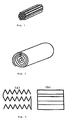
- Figure 1 is a perspective view of an insect controller of the present invention.
- Figure 2 is a perspective view of another insect controller of the present invention.
- Figures 3a and 3b are a sectional view and a side view, respectively, of still another insect controller of the present invention.
- Figures 4a and 4b are perspective views of still another insect controller of the present invention.
- the support folded as shown in Figure 4a can be unfolded by rotation of plane members in opposite directions around a fixed axis on a side edge of the plane members, for example, at an angle of 180° as shown in Figure 4b, which represents a form of the insect controller during use.
- FIGs 5a and 5b are perspective views of still another insect controller of the present invention.
- the support folded as shown in Figure 5a can be unfolded by parallel separation of plane members in opposite directions as shown in Figure 5b.
- the insect controller of the present invention comprises a volatile insecticidal or insect repellent compound used without heating, which is carried on a support with at least one through hole.
- the vapor pressure at 20°C is preferably 1.0 x 10 -4 mmHg or higher.
- the volatile insecticidal or insect repellent compound include volatile pyrethroid compounds used without heating, such as empenthrin, transfluthrin and 1-ethynyl-2-fluoro-2-pentenyl 3-(2,2-dichlorovinyl)-2,2-dimethylcyclopropanecarboxylate, as well as other volatile insect repellent compounds used without heating, such as carane-3,4-diol, N,N-diethyl-m-toluamide and 1-methyl-n-propyl 2-(2-hydroxyethyl)-1-piperidinecarboxylate, which have a vapor pressure at 20°C ranging from 1.0 x 10 -4 mmHg to 5.0 x 10 -2 mmHg.
- the support used in the present invention may have any shape, so long as it is provided with at least one through hole to ensure effective ventilation. It is preferred that the support has plural through holes.
- the preferred shape of the support has a ratio of surface area to volume ranging from 1 to 20 cm -1 .
- surface area refers to the total area of outside and inside surfaces of a support, which are exposed to the air.
- volume refers to the volume determined by the external contour of a support.
- Typical examples of the support shape include a bundle of cylindrical tubes as shown in Figure 1; a roll shape with a spacing as shown in Figure 2; and a folded paper shape as shown in Figure 3.
- the preferred shape of the support used in the present invention may have a folding structure with plural through holes.
- Typical examples of such a preferred shape of the support include a shape as shown in Figures 4a and 4b, which is well known as a paper toy (commonly called "Denguri” among the wholesale toy stores in the Osaka city).
- a paper support having a honeycomb structure with tubular through holes is sandwiched between plane members, which can be unfolded or folded by rotation of the plane members in opposite directions around a fixed axis on a plane or a side edge of the plane members at an angle of from 0° to 360°.
- FIG. 5a and 5b Another example of the insect controller of the present invention is shown in Figures 5a and 5b.
- a paper support having a honeycomb structure with tubular through holes is sandwiched between plane members, which can be folded or unfolded by parallel movement of the plane members in opposite directions (i.e., by approach or separation of the plane members).
- the plane members are usually made of thick paper, resins or other materials.
- the support used in the present invention may be made of resin films such as polyethylene and polyvinyl chloride, paper, cloths or other materials.
- resin films such as polyethylene and polyvinyl chloride
- paper cloths or other materials.
- relatively soft paper is preferred in view of easy fabrication and impregnation of an insecticidal or insect repellent compound.
- the insect controller of the present invention may usually have a volume of from about 200 to about 10000 cm 3 . It can be adapted for use as an interior ornament by application of appropriate patterns, colors and other features.
- the support with plural through holes may preferably have about ten to about thousand through holes each having a vertical cross-sectional area of from about 0.5 to about 10 cm 2 .
- an insect controller having a support with plural through holes there is no need to ensure that these through holes are of the same size. It can be adapted for use as an interior ornament by combination of through holes of different sizes, or by application of appropriate patterns, colors or other features.
- the amount of volatile insecticidal or insect repellent compound used without heating, which is carried on the support may vary with the kind of compound employed, the circumstances of use and the number of insect controllers applied. However, in general, satisfactory results are obtained when the volatile insecticidal or insect repellent compound is carried in an amount of from about 0.1 to about 100 g on the support in each insect controller.
- the insect controller of the present invention can be used for the control of mosquitoes, flies and other harmful insects by disposing one to several controllers at an appropriate place or places in the inside of a building such as dwelling houses, offices or warehouses, or by disposing a still greater number of controllers in wider space.
- an insect controller of the folding type according to the present invention it is usually put into an unfolded state and then disposed at a desired place.
- the evaporation of the volatile insecticidal or insect repellent compound can be adjusted by changing the angle or degree of support unfolding.
- wasteful evaporation of an insecticidal or insect repellent compound can be reduced by folding the support of the insect controller, which makes it possible to keep the insect-controlling effects for prolonged time.
- An insect controller of the present invention was obtained in the same manner as described in Example 1, except that a 20% (w/v) solution of 1S,3S,4S,6R-carane-3,4-diol in acetone was used in place of the 5% (w/v) solution of 1-ethynyl-2-fluoro-2-pentenyl 1R-trans-3-(2,2-dichlorovinyl)-2,2-dimethylcyclopropanecarboxylate in acetone.
- Example 3 The preparation of an insect controller used for comparison in the following Test Example (Example 3) is described as Reference Example 1.
- Example 1 or Reference Example 1 was hung so that the bottom thereof was located at a height of 1.2 m from the floor.
- two nylon cages (cylindrical shape having a diameter of 30 cm and a height of 20 cm) for each distance, i.e., four nylon cages in total, each containing 20 female adults of common mosquito ( Culex pipiens pallens ) were hung so that the bottoms thereof were located at a height of 60 cm from the floor.
- an electric fan was placed directly below the insect controller to stir the air in the room, and a board was provided at the upper part of the electric fan so that the wind from the electric fan did not blow directly against the insect controller.
- Example 3 The same test as described in Example 3 was carried out by replacing female adults of Culex pipiens pallens by those of Aedes aegypti. , and the knockdown rate (%) was determined after 30 minutes.
- the insect controller has twenty pleats provided between the plane members so that it can be unfolded around a fixed axis on a side edge having a length of 6.5 cm at an angle of from 0° to 360°. The following test was carried out using the insect controller.
- the insect controller obtained above was hung so that it was unfolded around a fixed axis on a side edge having a length of 6.5 cm at an angle of 360° and the bottom thereof was located at a height of 1.2 m from the floor.
- nylon cages (cylindrical shape having a diameter of 30 cm and a height of 20 cm) for each distance, i.e., four nylon cages in total, each containing 20 female adults of common mosquito ( Culex pipiens pallens ) were hung so that the bottoms thereof were located at a height of 60 cm from the floor.
- Example 5 The same test as described in Example 5 was carried out by replacing female adults of Culex pipiens pallens by those of Aedes aegypti. .
- the knockdown rate (%) after 60 minutes was determined to be 100%.
- An insect controller having a shape as shown in Figures 4a and 4b was prepared in the same manner as described in Example 5, except that the concentration of 1-ethynyl-2-fluoro-2-pentenyl 1R-trans-3-(2,2-dichlorovinyl)-2,2-dimethylcyclopropanecarboxylate in acetone was changed from 10% to 20%. The following test was carried out using the insect controller thus obtained.
- the insect controller obtained above was stored in the maximum unfolded state for 3 weeks (i.e., 504 hours). After the storage, the insect controller was used for the same tests as described in Examples 5 and 6.
- the knockdown rate (%) after 60 minutes was 99% for Culex pipiens pallens and 100% for Aedes aegypti.
Landscapes
- Life Sciences & Earth Sciences (AREA)
- Pest Control & Pesticides (AREA)
- Health & Medical Sciences (AREA)
- General Health & Medical Sciences (AREA)
- Zoology (AREA)
- Engineering & Computer Science (AREA)
- Wood Science & Technology (AREA)
- Toxicology (AREA)
- Environmental Sciences (AREA)
- Insects & Arthropods (AREA)
- Agronomy & Crop Science (AREA)
- Plant Pathology (AREA)
- Dentistry (AREA)
- Birds (AREA)
- Agricultural Chemicals And Associated Chemicals (AREA)
- Catching Or Destruction (AREA)
Abstract
Description
- The present invention relates to an insect controller and more particularly to a controller for killing or repelling harmful insects. The present invention provides a simple means of controlling harmful insects without heating, unlike the conventional mosquito coils, electric mosquito mats and devices having an insecticidal liquid and a wick wherein the lower part of the wick is immersed in the insecticidal liquid and the upper part of the wick is heated with an electric heater. Among the insect controllers of the present invention are those which can be used as interior ornaments.
- The present invention provides an insect controller comprising a volatile insecticidal or insect repellent compound used without heating, which is carried on a support with at least one through hole.
- Figure 1 is a perspective view of an insect controller of the present invention.
- Figure 2 is a perspective view of another insect controller of the present invention.
- Figures 3a and 3b are a sectional view and a side view, respectively, of still another insect controller of the present invention.
- Figures 4a and 4b are perspective views of still another insect controller of the present invention. In the insect controller, the support folded as shown in Figure 4a can be unfolded by rotation of plane members in opposite directions around a fixed axis on a side edge of the plane members, for example, at an angle of 180° as shown in Figure 4b, which represents a form of the insect controller during use.
- Figures 5a and 5b are perspective views of still another insect controller of the present invention. In the insect controller, the support folded as shown in Figure 5a can be unfolded by parallel separation of plane members in opposite directions as shown in Figure 5b.
- The insect controller of the present invention comprises a volatile insecticidal or insect repellent compound used without heating, which is carried on a support with at least one through hole.
- For the volatile insecticidal or insect repellent compound which is used in the present invention without heating, the vapor pressure at 20°C is preferably 1.0 x 10⁻⁴ mmHg or higher. Typical examples of the volatile insecticidal or insect repellent compound include volatile pyrethroid compounds used without heating, such as empenthrin, transfluthrin and 1-ethynyl-2-fluoro-2-pentenyl 3-(2,2-dichlorovinyl)-2,2-dimethylcyclopropanecarboxylate, as well as other volatile insect repellent compounds used without heating, such as carane-3,4-diol, N,N-diethyl-m-toluamide and 1-methyl-n-propyl 2-(2-hydroxyethyl)-1-piperidinecarboxylate, which have a vapor pressure at 20°C ranging from 1.0 x 10⁻⁴ mmHg to 5.0 x 10⁻² mmHg.
- The support used in the present invention may have any shape, so long as it is provided with at least one through hole to ensure effective ventilation. It is preferred that the support has plural through holes. The preferred shape of the support has a ratio of surface area to volume ranging from 1 to 20 cm-1.
- The term "surface area" as used herein refers to the total area of outside and inside surfaces of a support, which are exposed to the air. The term "volume" as used herein refers to the volume determined by the external contour of a support.
- Typical examples of the support shape include a bundle of cylindrical tubes as shown in Figure 1; a roll shape with a spacing as shown in Figure 2; and a folded paper shape as shown in Figure 3.
- The preferred shape of the support used in the present invention may have a folding structure with plural through holes.
- Typical examples of such a preferred shape of the support include a shape as shown in Figures 4a and 4b, which is well known as a paper toy (commonly called "Denguri" among the wholesale toy stores in the Osaka city). In this shape, a paper support having a honeycomb structure with tubular through holes is sandwiched between plane members, which can be unfolded or folded by rotation of the plane members in opposite directions around a fixed axis on a plane or a side edge of the plane members at an angle of from 0° to 360°.
- Another example of the insect controller of the present invention is shown in Figures 5a and 5b. In the insect controller, a paper support having a honeycomb structure with tubular through holes is sandwiched between plane members, which can be folded or unfolded by parallel movement of the plane members in opposite directions (i.e., by approach or separation of the plane members).
- In the insect controller having a pair of plane members as shown in Figures 4a, 4b, 5a and 5b according to the present invention, the plane members are usually made of thick paper, resins or other materials.
- The support used in the present invention may be made of resin films such as polyethylene and polyvinyl chloride, paper, cloths or other materials. In the case of a paper support, the use of relatively soft paper is preferred in view of easy fabrication and impregnation of an insecticidal or insect repellent compound.
- The insect controller of the present invention may usually have a volume of from about 200 to about 10000 cm3. It can be adapted for use as an interior ornament by application of appropriate patterns, colors and other features.
- The support with plural through holes may preferably have about ten to about thousand through holes each having a vertical cross-sectional area of from about 0.5 to about 10 cm2.
- In an insect controller having a support with plural through holes according to the present invention, there is no need to ensure that these through holes are of the same size. It can be adapted for use as an interior ornament by combination of through holes of different sizes, or by application of appropriate patterns, colors or other features.
- The amount of volatile insecticidal or insect repellent compound used without heating, which is carried on the support, may vary with the kind of compound employed, the circumstances of use and the number of insect controllers applied. However, in general, satisfactory results are obtained when the volatile insecticidal or insect repellent compound is carried in an amount of from about 0.1 to about 100 g on the support in each insect controller.
- The insect controller of the present invention can be used for the control of mosquitoes, flies and other harmful insects by disposing one to several controllers at an appropriate place or places in the inside of a building such as dwelling houses, offices or warehouses, or by disposing a still greater number of controllers in wider space.
- In the case of an insect controller of the folding type according to the present invention, it is usually put into an unfolded state and then disposed at a desired place. When an insect controller of the folding type according to the present invention is used, the evaporation of the volatile insecticidal or insect repellent compound can be adjusted by changing the angle or degree of support unfolding.
- During non-use of the insect controller of the present invention, wasteful evaporation of an insecticidal or insect repellent compound can be reduced by folding the support of the insect controller, which makes it possible to keep the insect-controlling effects for prolonged time.
- The present invention will be further illustrated by the following examples; however, the present invention is not limited to these examples.
- First. 20 ml of 5% (w/v) solution of 1-ethynyl-2-fluoro-2-pentenyl 1R-trans-3-(2,2-dichlorovinyl)-2,2-dimethylcyclopropanecarboxylate in acetone was uniformly applied to thirty-two cylindrical tubes made of filter paper each having a diameter of 2 cm and a length of 6.5 cm, followed by drying. These cylindrical tubes were bundled with a string so that the vertical cross-sectional contour became a rough circle as shown in Figure 1, which afforded an insect controller of the present invention. The ratio of surface area to volume of the insect controller was about 3.0 cm-1.
- An insect controller of the present invention was obtained in the same manner as described in Example 1, except that a 20% (w/v) solution of 1S,3S,4S,6R-carane-3,4-diol in acetone was used in place of the 5% (w/v) solution of 1-ethynyl-2-fluoro-2-pentenyl 1R-trans-3-(2,2-dichlorovinyl)-2,2-dimethylcyclopropanecarboxylate in acetone.
- The preparation of an insect controller used for comparison in the following Test Example (Example 3) is described as Reference Example 1.
- First, 20 ml of 5% (w/v) solution of 1-ethynyl-2-fluoro-2-pentenyl 1R-trans-3-(2,2-dichlorovinyl)-2,2-dimethylcyclopropanecarboxylate in acetone was uniformly applied to one cylindrical tube made of filter paper having a diameter of 13 cm and a height of 6.5 cm, followed by drying, which afforded an insect controller for comparison. The ratio of surface area to volume of the insect controller was about 0.62 cm-1.
- At the center of a test room of 28 m3 in size (4.3 m x 2.65 m x 2.45 m in height), the insect controller obtained Example 1 or Reference Example 1 was hung so that the bottom thereof was located at a height of 1.2 m from the floor. At the position horizontally 60 cm or 180 cm far from the insect controller, two nylon cages (cylindrical shape having a diameter of 30 cm and a height of 20 cm) for each distance, i.e., four nylon cages in total, each containing 20 female adults of common mosquito (Culex pipiens pallens) were hung so that the bottoms thereof were located at a height of 60 cm from the floor.
- After 60 minutes, the number of mosquitoes knocked down was counted, and the knockdown rate (%) was determined.
- During the test, an electric fan was placed directly below the insect controller to stir the air in the room, and a board was provided at the upper part of the electric fan so that the wind from the electric fan did not blow directly against the insect controller.
- The results are shown in Table 1.
TABLE 1 Knockdown rate (%) Insect controller of Example 1 100 Insect controller of Reference Example 1 0 - The same test as described in Example 3 was carried out by replacing female adults of Culex pipiens pallens by those of Aedes aegypti., and the knockdown rate (%) was determined after 30 minutes.
- The results are shown in Table 2.
TABLE 2 Knockdown rate (%) Insect controller of Example 1 97.1 Insect controller of Reference Example 1 16.4 - First, 10 ml of 10% (w/v) solution of 1-ethynyl-2-fluoro-2-pentenyl 1R-trans-3-(2,2-dichlorovinyl)-2,2-dimethylcyclopropanecarboxylate in acetone was applied to paper for impregnation, followed by air drying. The impregnated paper was used, together with a pair of plane members each having a rectangular shape of 7.3 cm x 6.5 cm in size, to prepare an insect controller having a shape as shown in Figures 4a and 4b, in which a paper support having a honeycomb structure with tubular through holes is sandwiched between the place members. The insect controller has twenty pleats provided between the plane members so that it can be unfolded around a fixed axis on a side edge having a length of 6.5 cm at an angle of from 0° to 360°. The following test was carried out using the insect controller.
- At the center of a test room of 28 m3 (4.3 m x 2.65 m x 2.45 m in height), the insect controller obtained above was hung so that it was unfolded around a fixed axis on a side edge having a length of 6.5 cm at an angle of 360° and the bottom thereof was located at a height of 1.2 m from the floor. At the position horizontally 60 cm or 180 cm far from the insect controller, two nylon cages (cylindrical shape having a diameter of 30 cm and a height of 20 cm) for each distance, i.e., four nylon cages in total, each containing 20 female adults of common mosquito (Culex pipiens pallens) were hung so that the bottoms thereof were located at a height of 60 cm from the floor.
- After 60 minutes, the number of mosquitoes knocked down was counted, and the knockdown rate (%) was determined to be 100%.
- The same test as described in Example 5 was carried out by replacing female adults of Culex pipiens pallens by those of Aedes aegypti..
- As a result, the knockdown rate (%) after 60 minutes was determined to be 100%.
- An insect controller having a shape as shown in Figures 4a and 4b was prepared in the same manner as described in Example 5, except that the concentration of 1-ethynyl-2-fluoro-2-pentenyl 1R-trans-3-(2,2-dichlorovinyl)-2,2-dimethylcyclopropanecarboxylate in acetone was changed from 10% to 20%. The following test was carried out using the insect controller thus obtained.
- Within a draft chamber in the laboratory having a room temperature of about 25°C and a humidity of from 50% to 60%, the insect controller obtained above was stored in the maximum unfolded state for 3 weeks (i.e., 504 hours). After the storage, the insect controller was used for the same tests as described in Examples 5 and 6.
- As a result, the knockdown rate (%) after 60 minutes was 99% for Culex pipiens pallens and 100% for Aedes aegypti.
- First, 10 ml of 20% (w/v) solution of 1S,3S,4S,6R-carane-3,4-diol in acetone was applied to paper for impregnation, followed by air drying. The impregnated paper was used, together with a pair of plane members, to prepare an insect controller having a shape as shown in Figures 4a and 4b.
Claims (9)
- An insect controller comprising a volatile insecticidal or insect repellent compound used without heating, which is carried on a support with at least one through hole.
- An insect controller according to claim 1, wherein the support has a ratio of surface area to volume ranging from 1 to 20 cm-1.
- An insect controller according to claim 1 or 2, wherein the support is made of paper, cloths or resin films.
- An insect controller according to any one of claims 1 to 3, wherein the support has a folding structure with plural through holes.
- An insect controller according to claim 4, further comprising a pair of plane members between which the support is sandwiched, wherein the support can be folded or unfolded by rotation of the plane members in opposite directions around a fixed axis on a plane or a side edge of the plane members.
- An insect controller according to any one of claims 1 to 5, wherein the vapor pressure of the volatile insecticidal or insect repellent compound at 20°C is 1.0 x 10⁻⁴ mmHg or higher.
- An insect controller according to any one of claims 1 to 6, wherein the volatile insecticidal or insect repellent compound used without heating is at least one selected from the group consisting of empenthrin, transfluthrin, 1-ethynyl-2-fluoro-2-pentenyl 3-(2,2-dichlorovinyl),-2,2-dimethylcyclopropanecarboxylate, carane-3,4-diol, N,N-diethyl-m-toluamide and 1-methyl-n-propyl 2-(2-hydroxyethyl)-1-piperidinecarboxylate.
- A method for controlling harmful insects, comprising putting an insect controller as set forth in any one of claims 1 to 7 into such a state that the volatile insecticidal or insect repellent compound used without heating carried thereon can be evaporated, and then disposing the insect controller at a place where insect controlling effects are required.
- Use of the insect controller according to any one of claims 1 to 7 for controlling harmful insects.
Applications Claiming Priority (8)
| Application Number | Priority Date | Filing Date | Title |
|---|---|---|---|
| JP43720/96 | 1996-02-29 | ||
| JP4372096 | 1996-02-29 | ||
| JP4372096 | 1996-02-29 | ||
| JP6261296 | 1996-03-19 | ||
| JP6261296 | 1996-03-19 | ||
| JP62612/96 | 1996-03-19 | ||
| ZA9707081A ZA977081B (en) | 1996-02-29 | 1997-08-08 | Insect controller. |
| US08/917,960 US6327813B1 (en) | 1996-02-29 | 1997-08-27 | Insect controller |
Publications (2)
| Publication Number | Publication Date |
|---|---|
| EP0792581A1 true EP0792581A1 (en) | 1997-09-03 |
| EP0792581B1 EP0792581B1 (en) | 2004-12-01 |
Family
ID=27461414
Family Applications (1)
| Application Number | Title | Priority Date | Filing Date |
|---|---|---|---|
| EP97103240A Expired - Lifetime EP0792581B1 (en) | 1996-02-29 | 1997-02-27 | Insect controller |
Country Status (11)
| Country | Link |
|---|---|
| US (1) | US6327813B1 (en) |
| EP (1) | EP0792581B1 (en) |
| CN (1) | CN1131666C (en) |
| AU (1) | AU720683B2 (en) |
| BR (1) | BR9701091A (en) |
| DE (1) | DE69731783T2 (en) |
| EG (1) | EG20654A (en) |
| ES (1) | ES2233984T3 (en) |
| ID (1) | ID15991A (en) |
| TW (1) | TW393299B (en) |
| ZA (1) | ZA977081B (en) |
Cited By (12)
| Publication number | Priority date | Publication date | Assignee | Title |
|---|---|---|---|---|
| EP0860541A3 (en) * | 1997-02-25 | 1999-03-17 | Sumitomo Chemical Company, Limited | Fabric protectant and use thereof |
| US5925371A (en) * | 1996-12-18 | 1999-07-20 | Sumitomo Chemical Co., Ltd. | Arthropod repellent and method for repelling arthropods |
| EP0962139A1 (en) * | 1998-05-28 | 1999-12-08 | Sumitomo Chemical Company, Limited | Method and apparatus for pest control |
| US6169081B1 (en) * | 1997-08-06 | 2001-01-02 | Sumitomo Chemical Company, Limited | Pesticidal device |
| EP1216615A1 (en) * | 2000-12-23 | 2002-06-26 | Aventis CropScience GmbH | Substrate for insect control |
| US6605292B1 (en) | 1997-11-11 | 2003-08-12 | Sumitomo Chemical Company, Limited | Sheets with a volatile compound |
| GB2407770A (en) * | 2003-11-07 | 2005-05-11 | Reckitt Benckiser | Product and method for controlling flying insects |
| GB2407771A (en) * | 2003-11-07 | 2005-05-11 | Reckitt Benckiser | Packaging means for emanating pyrethroid effective in controlling flying insects |
| ES2246672A1 (en) * | 2002-12-25 | 2006-02-16 | Sumitomo Chemical Company Limited | Volatilizing apparatus |
| WO2006000754A3 (en) * | 2004-06-28 | 2006-03-23 | Reckitt Benckiser Au Pty Ltd | An indicator |
| WO2008012507A1 (en) * | 2006-07-24 | 2008-01-31 | Reckitt Benckiser (Australia) Pty Limited | New insect control article for emanating pyrethroids |
| WO2018134079A1 (en) | 2017-01-23 | 2018-07-26 | Unilever N.V. | Passive emanator for controlling flying insects |
Families Citing this family (26)
| Publication number | Priority date | Publication date | Assignee | Title |
|---|---|---|---|---|
| TW568746B (en) * | 2001-08-22 | 2004-01-01 | Bayer Cropscience Sa | Device for controlling insects |
| JP4048320B2 (en) * | 2002-04-17 | 2008-02-20 | 株式会社コト | 3D creation assembly block set and 3D creation assembly block manufacturing apparatus |
| US6755453B2 (en) * | 2002-08-29 | 2004-06-29 | Veridian Systems Division, Inc. | Deployable rigid system for crash energy management |
| JP2004329160A (en) * | 2003-05-12 | 2004-11-25 | Sumitomo Chem Co Ltd | Insecticide |
| JP2005210987A (en) * | 2004-01-30 | 2005-08-11 | Sumitomo Chemical Co Ltd | Volatile component retention carrier and volatile component retention material |
| US7374231B2 (en) * | 2004-04-02 | 2008-05-20 | Gm Global Technology Operations, Inc. | Force and deceleration delimiting devices and methods for operating the same |
| US7637559B2 (en) | 2004-04-02 | 2009-12-29 | Gm Global Technology Operations, Inc. | Volume-filling mechanical assemblies and methods of operating the same |
| US20050218696A1 (en) * | 2004-04-02 | 2005-10-06 | Aase Jan H | Methods for modifying a crash deceleration pulse |
| US7401846B2 (en) * | 2004-04-02 | 2008-07-22 | Gm Global Technology Operations, Inc. | Volume-filling mechanical assemblies and methods of operating the same |
| US20050246943A1 (en) * | 2004-05-10 | 2005-11-10 | Hermann Neumann | Multi-season pest control system and method |
| JP5166671B2 (en) * | 2004-06-30 | 2013-03-21 | 住友化学株式会社 | Volatile component retention carrier and volatile component retention material |
| WO2006091670A2 (en) * | 2005-02-24 | 2006-08-31 | S. C. Johnson & Son, Inc. | Wearable insect repelling patch |
| US8734821B2 (en) * | 2006-05-15 | 2014-05-27 | Oms Investments, Inc. | Silicone surfactant-based agricultural formulations and methods for the use thereof |
| US8790673B2 (en) | 2006-05-15 | 2014-07-29 | Oms Investments, Inc. | Methods for treating arthropods |
| US20070266749A1 (en) * | 2006-05-15 | 2007-11-22 | Jason Rader | Pesticidal compositions for treating anthropods and methods for the use thereof |
| JP4919409B2 (en) * | 2007-01-24 | 2012-04-18 | ルネサスエレクトロニクス株式会社 | Semiconductor device manufacturing method |
| DE202010010823U1 (en) * | 2010-07-29 | 2010-10-21 | Winkler, Constanze | Device for near-natural control of insects |
| USD733275S1 (en) | 2012-07-24 | 2015-06-30 | S.C. Johnson & Son, Inc. | Dispensing device |
| US9498554B2 (en) | 2012-07-24 | 2016-11-22 | S.C. Johnson & Son, Inc. | Dispensing device |
| USD682408S1 (en) | 2012-09-28 | 2013-05-14 | S.C. Johnson & Son, Inc. | Substrate |
| USD717394S1 (en) | 2012-11-21 | 2014-11-11 | S.C. Johnson & Son, Inc. | Dispenser |
| US10694747B2 (en) | 2012-11-21 | 2020-06-30 | S. C. Johnson & Son, Inc. | Dispenser comprising only one single hinge |
| US9591842B2 (en) | 2013-08-30 | 2017-03-14 | S. C. Johnson & Son, Inc. | Passive volatile dispensing device |
| US9603352B2 (en) | 2014-03-31 | 2017-03-28 | S. C. Johnson & Son, Inc. | Dispenser |
| USD722376S1 (en) | 2014-03-31 | 2015-02-10 | S.C. Johnson & Son, Inc. | Dispenser |
| US11944096B2 (en) | 2019-12-06 | 2024-04-02 | S.C. Johnson & Son, Inc. | Dispenser and method of use thereof |
Citations (6)
| Publication number | Priority date | Publication date | Assignee | Title |
|---|---|---|---|---|
| FR1488441A (en) * | 1966-05-24 | 1967-11-02 | Aguettant Lab | Diffuser of volatile products |
| GB2010091A (en) * | 1977-12-06 | 1979-06-27 | Robins Co Inc A H | Insect combatting device |
| GB1604148A (en) * | 1978-05-31 | 1981-12-02 | Secto Co Ltd | Apparatus for controlled release of volatile chemicals |
| GB2161383A (en) * | 1984-07-06 | 1986-01-15 | Montedison Spa | Dispenser for slow release of volatile products |
| US4802626A (en) * | 1986-12-22 | 1989-02-07 | Hunter's Specialties, Inc. | Molded scent impregnated devices |
| JPH07223905A (en) * | 1994-02-15 | 1995-08-22 | Nitto Boseki Co Ltd | Sustained release repellent |
Family Cites Families (6)
| Publication number | Priority date | Publication date | Assignee | Title |
|---|---|---|---|---|
| US274425A (en) * | 1883-03-20 | Insect-excluding device | ||
| US2120204A (en) * | 1936-04-27 | 1938-06-07 | American Cyanamid & Chem Corp | Fumigant carrier combination |
| US2674018A (en) * | 1950-09-29 | 1954-04-06 | John K Crippen | Disposable moth control vaporizer |
| BE570603A (en) * | 1957-08-23 | |||
| US3823873A (en) * | 1973-01-15 | 1974-07-16 | Shell Oil Co | Vapor releasing device |
| DE3325826A1 (en) * | 1983-07-18 | 1985-01-31 | Dr. Werner Freyberg Chemische Fabrik Delitia Nachf., 6941 Laudenbach | BAG FOR INCLUDING OUTGASSING PEST CONTROL |
-
1997
- 1997-02-25 AU AU14883/97A patent/AU720683B2/en not_active Ceased
- 1997-02-26 EG EG14397A patent/EG20654A/en active
- 1997-02-26 TW TW086102336A patent/TW393299B/en not_active IP Right Cessation
- 1997-02-27 BR BR9701091A patent/BR9701091A/en not_active IP Right Cessation
- 1997-02-27 EP EP97103240A patent/EP0792581B1/en not_active Expired - Lifetime
- 1997-02-27 DE DE69731783T patent/DE69731783T2/en not_active Expired - Lifetime
- 1997-02-27 ES ES97103240T patent/ES2233984T3/en not_active Expired - Lifetime
- 1997-02-28 CN CN97110069A patent/CN1131666C/en not_active Expired - Lifetime
- 1997-02-28 ID IDP970612A patent/ID15991A/en unknown
- 1997-08-08 ZA ZA9707081A patent/ZA977081B/en unknown
- 1997-08-27 US US08/917,960 patent/US6327813B1/en not_active Expired - Lifetime
Patent Citations (6)
| Publication number | Priority date | Publication date | Assignee | Title |
|---|---|---|---|---|
| FR1488441A (en) * | 1966-05-24 | 1967-11-02 | Aguettant Lab | Diffuser of volatile products |
| GB2010091A (en) * | 1977-12-06 | 1979-06-27 | Robins Co Inc A H | Insect combatting device |
| GB1604148A (en) * | 1978-05-31 | 1981-12-02 | Secto Co Ltd | Apparatus for controlled release of volatile chemicals |
| GB2161383A (en) * | 1984-07-06 | 1986-01-15 | Montedison Spa | Dispenser for slow release of volatile products |
| US4802626A (en) * | 1986-12-22 | 1989-02-07 | Hunter's Specialties, Inc. | Molded scent impregnated devices |
| JPH07223905A (en) * | 1994-02-15 | 1995-08-22 | Nitto Boseki Co Ltd | Sustained release repellent |
Non-Patent Citations (1)
| Title |
|---|
| DATABASE WPI Derwent World Patents Index; AN 95-325442, XP002032873, IKARI SHODOKU: "Controlled release repellent for underfloor of office building -has olfactory repelllent immersed in organic foamed body of open-cell type having through holes from surface to bottom" * |
Cited By (19)
| Publication number | Priority date | Publication date | Assignee | Title |
|---|---|---|---|---|
| US5925371A (en) * | 1996-12-18 | 1999-07-20 | Sumitomo Chemical Co., Ltd. | Arthropod repellent and method for repelling arthropods |
| EP0860541A3 (en) * | 1997-02-25 | 1999-03-17 | Sumitomo Chemical Company, Limited | Fabric protectant and use thereof |
| US6024973A (en) * | 1997-02-25 | 2000-02-15 | Sumitomo Chemical Company, Limited | Fabric protectant |
| US6169081B1 (en) * | 1997-08-06 | 2001-01-02 | Sumitomo Chemical Company, Limited | Pesticidal device |
| US6605292B1 (en) | 1997-11-11 | 2003-08-12 | Sumitomo Chemical Company, Limited | Sheets with a volatile compound |
| EP0962139A1 (en) * | 1998-05-28 | 1999-12-08 | Sumitomo Chemical Company, Limited | Method and apparatus for pest control |
| TR199901163A3 (en) * | 1998-05-28 | 1999-12-21 | Sumitomo Chemical Company Ltd. | Method and device for damage control. |
| EP1216615A1 (en) * | 2000-12-23 | 2002-06-26 | Aventis CropScience GmbH | Substrate for insect control |
| ES2246672A1 (en) * | 2002-12-25 | 2006-02-16 | Sumitomo Chemical Company Limited | Volatilizing apparatus |
| US7051949B2 (en) | 2002-12-25 | 2006-05-30 | Sumitomo Chemical Company, Limited | Volatilizing apparatus |
| ES2246672B1 (en) * | 2002-12-25 | 2007-04-01 | Sumitomo Chemical Company Limited | SPRAYING DEVICE. |
| GB2407771A (en) * | 2003-11-07 | 2005-05-11 | Reckitt Benckiser | Packaging means for emanating pyrethroid effective in controlling flying insects |
| WO2005046332A1 (en) * | 2003-11-07 | 2005-05-26 | Reckitt Benckiser (Australia) Pty Limited | Product and method for controlling flying insects |
| WO2005053390A1 (en) * | 2003-11-07 | 2005-06-16 | Reckitt Benckiser (Australia) Pty Limited | Packaging means for emanating pyrethroid effective in controlling flying insects |
| GB2407770A (en) * | 2003-11-07 | 2005-05-11 | Reckitt Benckiser | Product and method for controlling flying insects |
| AU2004289102B2 (en) * | 2003-11-07 | 2011-06-23 | RB (Hygiene Home) Australia Pty Ltd | Product and method for controlling flying insects |
| WO2006000754A3 (en) * | 2004-06-28 | 2006-03-23 | Reckitt Benckiser Au Pty Ltd | An indicator |
| WO2008012507A1 (en) * | 2006-07-24 | 2008-01-31 | Reckitt Benckiser (Australia) Pty Limited | New insect control article for emanating pyrethroids |
| WO2018134079A1 (en) | 2017-01-23 | 2018-07-26 | Unilever N.V. | Passive emanator for controlling flying insects |
Also Published As
| Publication number | Publication date |
|---|---|
| DE69731783T2 (en) | 2005-12-01 |
| EP0792581B1 (en) | 2004-12-01 |
| ID15991A (en) | 1997-08-21 |
| EG20654A (en) | 1999-10-31 |
| CN1166272A (en) | 1997-12-03 |
| US6327813B1 (en) | 2001-12-11 |
| AU1488397A (en) | 1997-09-04 |
| MX9701506A (en) | 1998-06-30 |
| AU720683B2 (en) | 2000-06-08 |
| TW393299B (en) | 2000-06-11 |
| ZA977081B (en) | 1998-04-29 |
| CN1131666C (en) | 2003-12-24 |
| DE69731783D1 (en) | 2005-01-05 |
| ES2233984T3 (en) | 2005-06-16 |
| BR9701091A (en) | 1998-12-15 |
Similar Documents
| Publication | Publication Date | Title |
|---|---|---|
| EP0792581B1 (en) | Insect controller | |
| US6534079B1 (en) | Passive space insect repellant strip | |
| AU716986B2 (en) | Insecticide impregnated article for the control of flying insects | |
| RU2167523C2 (en) | Method of control of harmful insects | |
| KR100482909B1 (en) | Pesticide applicator | |
| CN1040611C (en) | Fabric protectants | |
| WO2008012507A1 (en) | New insect control article for emanating pyrethroids | |
| JP3802196B2 (en) | Pest control equipment | |
| JPH09308421A (en) | Insect repellent | |
| JPS59104303A (en) | Electrothermally fumigating mat of high chemical content | |
| JPH1192303A (en) | Drug holding carrier, drug holding material and drug volatilization method | |
| KR100502227B1 (en) | Insect repellent and insect repellent method using the same | |
| JPH0372833A (en) | Liquid-absorbing wick and method for evaporating chemical | |
| EP0636314A1 (en) | Tape for heat vaporization of active agents and method for vaporizing active agents by heating | |
| MXPA97001506A (en) | Insec controller | |
| JP3907813B2 (en) | Drug holding body and drug transpiration method | |
| JP4679831B2 (en) | Chemical volatilization device | |
| JP2006070037A (en) | Insect repellent | |
| JP2003160778A (en) | Carrier for holding volatile components | |
| JP2001292679A (en) | Drug volatilization device | |
| JP2002017230A (en) | Drug volatilization device | |
| AU2003255061A1 (en) | Passive Space Insect Repellant Strip | |
| JP2001335407A (en) | Electric mosquito repellent mat | |
| HK1009729A (en) | Insecticide impregnated article for the control of flying insects | |
| JP2007023052A (en) | Volatile component retention carrier |
Legal Events
| Date | Code | Title | Description |
|---|---|---|---|
| PUAI | Public reference made under article 153(3) epc to a published international application that has entered the european phase |
Free format text: ORIGINAL CODE: 0009012 |
|
| AK | Designated contracting states |
Kind code of ref document: A1 Designated state(s): DE ES FR GB IT |
|
| 17P | Request for examination filed |
Effective date: 19980213 |
|
| 17Q | First examination report despatched |
Effective date: 19980318 |
|
| GRAP | Despatch of communication of intention to grant a patent |
Free format text: ORIGINAL CODE: EPIDOSNIGR1 |
|
| GRAS | Grant fee paid |
Free format text: ORIGINAL CODE: EPIDOSNIGR3 |
|
| GRAA | (expected) grant |
Free format text: ORIGINAL CODE: 0009210 |
|
| AK | Designated contracting states |
Kind code of ref document: B1 Designated state(s): DE ES FR GB IT |
|
| REG | Reference to a national code |
Ref country code: GB Ref legal event code: FG4D |
|
| RAP2 | Party data changed (patent owner data changed or rights of a patent transferred) |
Owner name: SUMITOMO CHEMICAL COMPANY, LIMITED |
|
| REF | Corresponds to: |
Ref document number: 69731783 Country of ref document: DE Date of ref document: 20050105 Kind code of ref document: P |
|
| REG | Reference to a national code |
Ref country code: ES Ref legal event code: FG2A Ref document number: 2233984 Country of ref document: ES Kind code of ref document: T3 |
|
| PLBE | No opposition filed within time limit |
Free format text: ORIGINAL CODE: 0009261 |
|
| STAA | Information on the status of an ep patent application or granted ep patent |
Free format text: STATUS: NO OPPOSITION FILED WITHIN TIME LIMIT |
|
| ET | Fr: translation filed | ||
| 26N | No opposition filed |
Effective date: 20050902 |
|
| PGFP | Annual fee paid to national office [announced via postgrant information from national office to epo] |
Ref country code: DE Payment date: 20150224 Year of fee payment: 19 |
|
| PGFP | Annual fee paid to national office [announced via postgrant information from national office to epo] |
Ref country code: GB Payment date: 20150225 Year of fee payment: 19 |
|
| REG | Reference to a national code |
Ref country code: FR Ref legal event code: PLFP Year of fee payment: 20 |
|
| PGFP | Annual fee paid to national office [announced via postgrant information from national office to epo] |
Ref country code: IT Payment date: 20160222 Year of fee payment: 20 Ref country code: ES Payment date: 20160113 Year of fee payment: 20 |
|
| PGFP | Annual fee paid to national office [announced via postgrant information from national office to epo] |
Ref country code: FR Payment date: 20160108 Year of fee payment: 20 |
|
| REG | Reference to a national code |
Ref country code: DE Ref legal event code: R119 Ref document number: 69731783 Country of ref document: DE |
|
| GBPC | Gb: european patent ceased through non-payment of renewal fee |
Effective date: 20160227 |
|
| PG25 | Lapsed in a contracting state [announced via postgrant information from national office to epo] |
Ref country code: GB Free format text: LAPSE BECAUSE OF NON-PAYMENT OF DUE FEES Effective date: 20160227 Ref country code: DE Free format text: LAPSE BECAUSE OF NON-PAYMENT OF DUE FEES Effective date: 20160901 |
|
| REG | Reference to a national code |
Ref country code: ES Ref legal event code: FD2A Effective date: 20170602 |
|
| PG25 | Lapsed in a contracting state [announced via postgrant information from national office to epo] |
Ref country code: ES Free format text: LAPSE BECAUSE OF EXPIRATION OF PROTECTION Effective date: 20170228 |