EP1675404A2 - Effiziente Auswahl der Modi zur Intraprädiktion - Google Patents
Effiziente Auswahl der Modi zur Intraprädiktion Download PDFInfo
- Publication number
- EP1675404A2 EP1675404A2 EP20050090354 EP05090354A EP1675404A2 EP 1675404 A2 EP1675404 A2 EP 1675404A2 EP 20050090354 EP20050090354 EP 20050090354 EP 05090354 A EP05090354 A EP 05090354A EP 1675404 A2 EP1675404 A2 EP 1675404A2
- Authority
- EP
- European Patent Office
- Prior art keywords
- prediction
- signal
- evaluation values
- selecting
- intra
- Prior art date
- Legal status (The legal status is an assumption and is not a legal conclusion. Google has not performed a legal analysis and makes no representation as to the accuracy of the status listed.)
- Ceased
Links
- 238000011156 evaluation Methods 0.000 claims abstract description 111
- 238000000034 method Methods 0.000 claims abstract description 46
- 230000006835 compression Effects 0.000 claims abstract description 44
- 238000007906 compression Methods 0.000 claims abstract description 44
- 230000015654 memory Effects 0.000 claims description 39
- 238000004590 computer program Methods 0.000 claims 7
- 230000001131 transforming effect Effects 0.000 claims 2
- 238000006243 chemical reaction Methods 0.000 abstract description 10
- 238000010586 diagram Methods 0.000 description 10
- 230000000694 effects Effects 0.000 description 5
- 230000005540 biological transmission Effects 0.000 description 1
- 238000012986 modification Methods 0.000 description 1
- 230000004048 modification Effects 0.000 description 1
Images







Classifications
-
- H—ELECTRICITY
- H04—ELECTRIC COMMUNICATION TECHNIQUE
- H04N—PICTORIAL COMMUNICATION, e.g. TELEVISION
- H04N19/00—Methods or arrangements for coding, decoding, compressing or decompressing digital video signals
- H04N19/42—Methods or arrangements for coding, decoding, compressing or decompressing digital video signals characterised by implementation details or hardware specially adapted for video compression or decompression, e.g. dedicated software implementation
-
- H—ELECTRICITY
- H04—ELECTRIC COMMUNICATION TECHNIQUE
- H04N—PICTORIAL COMMUNICATION, e.g. TELEVISION
- H04N19/00—Methods or arrangements for coding, decoding, compressing or decompressing digital video signals
- H04N19/10—Methods or arrangements for coding, decoding, compressing or decompressing digital video signals using adaptive coding
- H04N19/102—Methods or arrangements for coding, decoding, compressing or decompressing digital video signals using adaptive coding characterised by the element, parameter or selection affected or controlled by the adaptive coding
- H04N19/103—Selection of coding mode or of prediction mode
- H04N19/105—Selection of the reference unit for prediction within a chosen coding or prediction mode, e.g. adaptive choice of position and number of pixels used for prediction
-
- H—ELECTRICITY
- H04—ELECTRIC COMMUNICATION TECHNIQUE
- H04N—PICTORIAL COMMUNICATION, e.g. TELEVISION
- H04N19/00—Methods or arrangements for coding, decoding, compressing or decompressing digital video signals
- H04N19/10—Methods or arrangements for coding, decoding, compressing or decompressing digital video signals using adaptive coding
- H04N19/102—Methods or arrangements for coding, decoding, compressing or decompressing digital video signals using adaptive coding characterised by the element, parameter or selection affected or controlled by the adaptive coding
- H04N19/103—Selection of coding mode or of prediction mode
-
- H—ELECTRICITY
- H04—ELECTRIC COMMUNICATION TECHNIQUE
- H04N—PICTORIAL COMMUNICATION, e.g. TELEVISION
- H04N19/00—Methods or arrangements for coding, decoding, compressing or decompressing digital video signals
- H04N19/10—Methods or arrangements for coding, decoding, compressing or decompressing digital video signals using adaptive coding
- H04N19/102—Methods or arrangements for coding, decoding, compressing or decompressing digital video signals using adaptive coding characterised by the element, parameter or selection affected or controlled by the adaptive coding
- H04N19/103—Selection of coding mode or of prediction mode
- H04N19/107—Selection of coding mode or of prediction mode between spatial and temporal predictive coding, e.g. picture refresh
-
- H—ELECTRICITY
- H04—ELECTRIC COMMUNICATION TECHNIQUE
- H04N—PICTORIAL COMMUNICATION, e.g. TELEVISION
- H04N19/00—Methods or arrangements for coding, decoding, compressing or decompressing digital video signals
- H04N19/10—Methods or arrangements for coding, decoding, compressing or decompressing digital video signals using adaptive coding
- H04N19/134—Methods or arrangements for coding, decoding, compressing or decompressing digital video signals using adaptive coding characterised by the element, parameter or criterion affecting or controlling the adaptive coding
- H04N19/136—Incoming video signal characteristics or properties
- H04N19/137—Motion inside a coding unit, e.g. average field, frame or block difference
-
- H—ELECTRICITY
- H04—ELECTRIC COMMUNICATION TECHNIQUE
- H04N—PICTORIAL COMMUNICATION, e.g. TELEVISION
- H04N19/00—Methods or arrangements for coding, decoding, compressing or decompressing digital video signals
- H04N19/10—Methods or arrangements for coding, decoding, compressing or decompressing digital video signals using adaptive coding
- H04N19/169—Methods or arrangements for coding, decoding, compressing or decompressing digital video signals using adaptive coding characterised by the coding unit, i.e. the structural portion or semantic portion of the video signal being the object or the subject of the adaptive coding
- H04N19/17—Methods or arrangements for coding, decoding, compressing or decompressing digital video signals using adaptive coding characterised by the coding unit, i.e. the structural portion or semantic portion of the video signal being the object or the subject of the adaptive coding the unit being an image region, e.g. an object
- H04N19/176—Methods or arrangements for coding, decoding, compressing or decompressing digital video signals using adaptive coding characterised by the coding unit, i.e. the structural portion or semantic portion of the video signal being the object or the subject of the adaptive coding the unit being an image region, e.g. an object the region being a block, e.g. a macroblock
-
- H—ELECTRICITY
- H04—ELECTRIC COMMUNICATION TECHNIQUE
- H04N—PICTORIAL COMMUNICATION, e.g. TELEVISION
- H04N19/00—Methods or arrangements for coding, decoding, compressing or decompressing digital video signals
- H04N19/50—Methods or arrangements for coding, decoding, compressing or decompressing digital video signals using predictive coding
- H04N19/593—Methods or arrangements for coding, decoding, compressing or decompressing digital video signals using predictive coding involving spatial prediction techniques
-
- H—ELECTRICITY
- H04—ELECTRIC COMMUNICATION TECHNIQUE
- H04N—PICTORIAL COMMUNICATION, e.g. TELEVISION
- H04N19/00—Methods or arrangements for coding, decoding, compressing or decompressing digital video signals
- H04N19/60—Methods or arrangements for coding, decoding, compressing or decompressing digital video signals using transform coding
- H04N19/61—Methods or arrangements for coding, decoding, compressing or decompressing digital video signals using transform coding in combination with predictive coding
Definitions
- This invention relates to a technique for the compression encoding of a moving picture and, more particularly, to a moving picture compression encoding method, apparatus and program for performing encoding upon selecting a mode of intra prediction (intraframe prediction) based upon evaluation values of a plurality of types.
- H.264/MPEG-4 Part 10 ISO/IEC 14496-10) (referred to as "H.264” below) (see Non-Patent Document 1)
- intra prediction involves 4x4 and 16x16 blocks with regard to the luminance component, and there are prediction modes of nine types and four types, respectively. Further, there are four types of prediction modes with regard to an 8x8 block for the color-difference component.
- JM Joint Model
- Patent Document 1 discloses a moving picture predictive encoding scheme in which prediction errors based upon a plurality of prediction methods that differ for respective ones of blocks of various block sizes are obtained, a prediction method that is suited to the block concerned and a prediction error are selected adaptively by evaluating each prediction error by first evaluating means, and a block size that is optimum for encoding is selected adaptively by second evaluating means for every part of a moving picture by evaluating the prediction error regarding each block size which has been obtained by the first evaluation means.
- Patent Document 2 discloses a moving picture predictive encoding scheme adapted to transmit block-size information and prediction-scheme type to a receiving side, detect changeless portions and portions of sudden change based upon results of DCT processing, and increase or decrease block size in accordance with each portion detected to thereby enable the selection of block sizes optimum for changeless portions and for suddenly changing portions of a picture.
- Patent Document 3 discloses a moving picture predictive encoding scheme in which the prediction method is changed over adaptively in conformity with the local quality of a picture, as a result of which the overall transmission efficiency is improved.
- Patent Document 4 discloses an arrangement having first encoding means for obtaining an approximate plane for every image data block and encoding information that specifies the approximate plane as well as a difference value between the approximate plane and a block; second encoding means for selecting a prediction scheme from a plurality of prediction schemes block by block, and performing encoding by the scheme selected; and means for selecting either the first encoding means or the second encoding means block by block.
- the first problem is that encoding efficiency is poor when a mode is selected based solely upon difference information (SAD) between an input signal and prediction signal with regard to an intra prediction scheme.
- SAD difference information
- the second problem is that in a case where a frequency conversion is performed with regard to difference information and cost calculated in order to improve encoding efficiency, a very large amount of computation is performed to select the optimum mode.
- Another object of the present invention is to provide a moving picture compression encoding apparatus, method and program having an intra predicting unit that is capable of high-speed processing.
- a moving picture compression encoding apparatus in which an intra predicting unit performs a multiple-stage search for a prediction mode
- the device comprising means for calculating first evaluation values based upon difference information indicative of differences between a moving picture signal that is input to the moving picture compression encoding apparatus and prediction signals that have been generated by the intra predicting unit; means for preliminarily selecting a plurality of prediction modes based upon the first evaluation values; means for calculating second evaluation values based upon difference information of the plurality of prediction modes preliminarily selected; and means for selecting one prediction mode from the plurality of preliminarily selected prediction modes based upon the second evaluation values.
- a moving picture compression encoding apparatus for a case where a plurality of block sizes exist, comprising: means for calculating first evaluation values based upon difference information indicative of differences between a moving picture signal that is input to the moving picture compression encoding apparatus and prediction signals that have been generated by an intra predicting unit; means for preliminarily selecting a plurality of prediction modes based upon the first evaluation values; means for calculating second evaluation values based upon difference information of the prediction modes preliminarily selected; means for selecting one prediction mode from the preliminarily selected prediction modes based upon the second evaluation values; and means for selecting an optimum block size from the second evaluation values.
- the foregoing object is attained by providing a moving picture compression encoding method, comprising the steps of: calculating first evaluation values based upon differences information indicative of differences between an input moving picture signal and prediction signals that have been generated by an intra predicting unit; preliminarily selecting a plurality of prediction modes based upon the first evaluation values; calculating second evaluation values based upon difference information of the prediction modes preliminarily selected; and selecting one prediction mode from the preliminarily selected prediction modes based upon the second evaluation values.
- the foregoing object is attained by providing a program for causing a computer constituting a moving picture compression encoding apparatus to execute the following processing: processing for calculating first evaluation values based upon difference information indicative of differences between an input moving picture signal and prediction signals that have been generated by an intra predicting unit; processing for preliminarily selecting a plurality of prediction modes based upon the first evaluation value; processing for calculating second evaluation values based upon difference information of the prediction modes preliminarily selected; and processing for selecting one prediction mode from the preliminarily selected prediction modes based upon the second evaluation values.
- the present invention is such that when a mode is selected, encoding efficiency can be improved greatly and processing speeded up in comparison with a method of selecting a mode based solely upon difference information (SAD).
- SAD difference information
- An intra prediction apparatus includes a prediction signal generator (103) for generating prediction signals, the generator receiving a reconstructed signal (13) that is part of an image signal of an adjacent block for which encoding ended before the encoding of a block to undergo intra prediction; a prediction mode decision unit (108) having a cost calculator (104) for generating cost values based upon difference information indicative of differences between the prediction signals generated by the prediction signal generator (103) and a moving picture signal that is input to the moving picture compression encoding apparatus, a preliminary selector (105) for selecting and outputting to a cost calculator (106) at least two prediction modes (e.g., two or more high-order modes of small cost values), based upon the cost values of the difference information, from among all modes of an intra predicting unit, the cost calculator (106) for frequency-converting difference information and generating new cost values with regard to the prediction modes that have been output from the preliminary selector (105), and a prediction mode selector (107) for selecting the optimum prediction mode based upon the cost values obtained after the frequency conversion;
- a plurality of intra predicting units are provided and a plurality of block sizes exist, then means are provided for changing a prediction mode discriminating method and selecting a prediction mode by the intra predicting units for every block size, and selecting the block size.
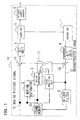
- Fig. 1 is a block diagram illustrating the structure of an embodiment of the present invention.
- a moving picture signal 12 is input to an intra predicting unit 1 and to a motion estimator 2.
- a motion compensator 3 performs motion compensation based upon a motion vector detected by the motion estimator 2 and information in a frame memory 10.
- a switch 11 switches between the output of the intra predicting unit 1 and the output of the motion compensator 3.
- the result of subtracting the output of the switch 11 from the moving picture signal 12 in a subtractor 15 is subjected to a DIT (Discrete Integer Transform) in a DIT unit 4, the signal from the DIT unit 4 is quantized by a quantizer 5 and the quantized signal is variable-length encoded by a variable-length encoder 6.
- the output of the quantizer 5 is dequantized by a dequantizer 7 and subjected to an inverse DIT in an inverse DIT unit 8.
- the output of the inverse DIT unit 8 and the output of the switch 11 are added by an adder 16, the sum is supplied to the intra predicting unit 1 and to an in-loop filter 9 as a reconstructed signal 13, and the output of the in-loop filter 9 is supplied to the frame memory 10.
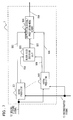
- Fig. 2 is a block diagram illustrating the details of the intra predicting unit 1 shown in Fig. 1.
- the intra predicting unit 1 includes a prediction signal generator 103, a prediction mode decision unit 108 and a prediction signal call unit 109.
- the prediction signal generator 103 includes a plurality of filters 101 that receive the reconstructed signal, and a plurality of prediction signal memories 102 that receive prediction signals 110 from respective ones of the filters 101.
- the prediction mode decision unit 108 includes a cost calculator 104, the preliminary selector 105, a cost calculator 106 and a prediction mode selector 107.
- the filters 101 subject the reconstructed signal 13 to filter processing that is based upon respective ones of prediction modes of a plurality of types that exist in the intra predicting unit and store the generated prediction signals 110 in the prediction signal memories 102, respectively.
- this is performed, as set forth in Non-Patent Document 1, using 4 or 16 pixels situated at the right end in a block to the left of the particular block, 4 or 16 pixels situated at the lower end in a block above or to the upper right of the particular block, and 1 pixel at the lower-right end of a block to the upper left of the particular block.
- the prediction signal memories 102 are devices for storing the prediction signals 110 that are output from the filters 101.
- the prediction signals 110 are output to the cost calculator 104 of the prediction mode decision unit 108 and to the prediction signal call unit 109.
- the reconstructed signal 13 is part of an image signal of an adjacent block for which encoding ended before the encoding of the particular block to undergo intra prediction.
- the prediction signals 110 are signals generated using the filters 101 that differ depending upon the prediction mode, or are signals having the same value as the reconstructed signal 13.
- the cost calculator 104 calculates difference information 112 between the prediction signals 110 and moving picture signal 12 and outputs cost values 111 to the preliminary selector 105.
- the cost calculator 104 outputs SAD (Sum of Absolute Differences) [see Equation (2) below)], which is the sum of absolute values of the difference data Diff(i,j), as the cost value.
- the preliminary selector 105 selects at least two prediction modes from among prediction modes for which the difference information of the cost values 111 is small and outputs the selected modes 113 to the cost calculator 106.
- the cost calculator 106 calculates cost values 114 obtained by applying a frequency conversion to the difference information 112 corresponding to the selected modes 113 that have been output from the preliminary selector 105 and outputs the cost values 114 to the cost calculator 106.
- the cost calculator 106 calculates SATD (Sum of Absolute Transformed Differences) [see Equation (3) below] as the cost value 114 of the particular block, where SATD is the sum of absolute values of DiffT(i,j) obtained by subjecting the difference data Diff(i,j) to a frequency conversion by, e.g., a Hadamard transform.
- the prediction mode selector 107 selects the optimum prediction mode 115 based upon the cost values 114 that have been output by the cost calculator 106 and outputs the prediction mode 115 and this cost value 114 as the results of intra prediction.
- the moving picture signal 12 is the input image signal of the moving picture compression encoding apparatus, which is indicated at reference number 14.
- the prediction signal call unit 109 reads in the prediction signal, which corresponds to the prediction mode 15 output from the prediction mode decision unit 108, from the prediction signal memory 102 and outputs this signal as the result of intra prediction.
- the prediction signal call unit 109 reads in the prediction signal, which corresponds to the prediction mode 15 output from the prediction mode decision unit 108, from the prediction signal memory 102 and outputs this signal as the result of intra prediction.
- Fig. 3 illustrates the structure of a section of the intra predicting unit 1 that selects block size in a case where there are N-number of block sizes.
- the block-size selecting section includes intra predictors (intraframe predictors) 201 1 to 201 N corresponding to the N block sizes, a block-size decision unit 202 and a prediction-signal / prediction-mode memory 203.
- the block-size decision unit 202 selects a block size 207 having the smallest cost value 206 that is output from the intra predictors 201 1 to 201 N and outputs the block size 207 and cost value 206 to the prediction-signal / prediction-mode memory 203.
- the prediction-signal / prediction-mode memory 203 stores prediction signals 204 and prediction modes 205 that are output from the intra predictors 201 1 to 201 N and outputs the prediction signal 204 and prediction mode 205, which correspond to the block size 207 that is output from the block-size decision unit 202, together with the cost value 206 and block size 207 as the results of intra prediction.
- the intra predictors 201 1 to 201 N has the structure (the prediction signal generator 103, prediction mode decision unit 108 and prediction signal call unit 109) shown in Fig. 2 and operates in the same manner, these need not be described again.
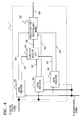
- FIG. 4 illustrates the structure of a section of the intra predicting unit 1 that selects block size in a case where a plurality of block sizes exist. This embodiment will be described for a case where there are three types of block sizes and three types of prediction mode discriminating methods.
- the block-size selecting section includes intra predictors 301, 302, and 303 for which the prediction mode discriminating methods differ for each of the block sizes, a block-size decision unit 304 and a prediction-signal / prediction-mode memory 305.
- the structure and operation of the intra predictors 301, 302, and 303 will be described.
- the intra predictors 301, 302, and 303 employ intra predicting units (see Figs. 2, 5 and 6) in which the prediction mode decision units differ for each of the block sizes.
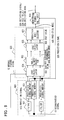
- a prediction mode decision unit 407 includes a cost calculator 404, a prediction mode selector 405 and a cost calculator 406.
- a prediction signal generator 403 is identical with the prediction signal generator 103 of Fig. 2.
- the cost calculator 404 calculates cost values 410 [e.g., the SAD in Equation (2) cited above] from difference information 411 indicative of differences between the moving picture signal 12, which is input to the moving picture compression encoding apparatus 14, and prediction signals generated by the prediction signal generator 403, and outputs the cost values to the prediction mode selector 405.
- cost values 410 e.g., the SAD in Equation (2) cited above
- the prediction mode selector 405 selects the optimum prediction mode 412 from the cost values 410 and inputs this prediction mode and the difference information thereof to the cost calculator 406.
- the cost calculator 406 applies a frequency conversion to the difference information 411 of the prediction mode 412, calculates a cost value 413 and outputs the prediction mode 412 and cost value 413 [e.g., SATD in Equation (3) cited above] as the results of intra prediction.
- a prediction mode decision unit 427 includes a difference calculator 424, a cost calculator 425 and a prediction mode selector 426.
- the difference calculator 424 calculates difference information 430 [e.g., see Equation (1) cited above] indicative of differences between the moving picture signal 12, which is input to the moving picture compression encoding apparatus 14, and the outputs (prediction signals) from the prediction signal generator 423, and outputs the information to the cost calculator 425.
- difference information 430 e.g., see Equation (1) cited above
- the cost calculator 425 applies a frequency conversion [e.g., DiffT (i,j) obtained by a Hadamard transform] to the difference information 430 [Diff(i,j)] of all prediction modes, calculates cost values 431 [e.g., SATD in Equation (3) cited above] and outputs these to the prediction mode selector 426.
- a frequency conversion e.g., DiffT (i,j) obtained by a Hadamard transform
- the prediction mode selector 426 selects the optimum prediction mode 432 based upon the cost values 431 that have been output from the cost calculator 425 and outputs the optimum prediction mode 432 and cost value 431 as the results of intra prediction. Structural components and operations other than those set forth above are identical with those of the second embodiment and need not be described again.
- the section for selecting block size includes intra predictors 501, 502, a block-size decision unit 503 and a prediction-signal /prediction-mode memory 504.
- the structure of the intra predictors 501, 502 will be described.
- the intra predictors 501, 502 can employ any of the structures shown in Figs. 2, 5 and 6. Structural components and operations other than those set forth above are identical with those of the third embodiment and need not be described again.
- FIG. 8 illustrates the structure of a section for selecting block size in a case where the intra prediction scheme involves a plurality of block sizes. This embodiment will be described with regard to a case where there are two types of numbers of prediction modes selected.
- the block-size selecting section includes intra predictors 601 and 602 for which preliminarily selected numbers of prediction modes differ for each of the block sizes, a block-size decision unit 603 and a prediction-signal / prediction-mode memory 604.
- intra predictors 601 and 602 employ the intra predicting unit 1 of Fig. 2 or Fig. 9.
- Figs. 2 and 9 differ in that the number of preliminarily selected prediction modes selected by the preliminary selector 105 differs from the number selected by a preliminary selector 625. Structural components and operations other than those set forth above are identical with those of the second embodiment and need not be described again.
- Fig. 10 illustrates the structure of a section of the intra predicting unit that selects block size in a case where a plurality of block sizes exist.
- This embodiment is such that in a case where there are four types of block sizes, three types of prediction mode discriminating methods exist and there are two types of preliminarily selected numbers of prediction modes in a prediction mode discriminating method that selects modes preliminarily.
- the block-size selecting section includes intra predictors 701, 702, 703, and 704 for which the preliminarily selected numbers of prediction modes or prediction mode discriminating methods differ for each of the block sizes, a block-size decision unit 705 and a prediction-signal /prediction-mode memory 706.
- the structure of the intra predictors 701, 702, 703, and 704 will be described.
- Two of the intra predictors 701, 702, 703, and 704, for which the block sizes differ from one another, are constructed from Figs. 2 and 9.
- Figs. 2 and 9 differ in that the numbers of prediction modes selected preliminarily are different from each other.
- the intra predictors of the other block sizes are constructed from Figs. 5 and 6.
- the intra predictors of the other block sizes are constructed from Figs. 5, 6 or 8. Structural components and operations other than those set forth above are identical with those of the third or fourth embodiment and need not be described again.
- the present invention is such that when mode selection is performed, encoding efficiency can be improved greatly in comparison with a method of selecting a mode based solely upon difference information (SAD).
- SAD difference information
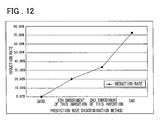
- Figs. 11 and 12 show data illustrating the actions and effects of the present invention in a case where, with regard to the luminance component, two types of block sizes of intra prediction units, namely 4x4 and 16 ⁇ 16, exist, nine types of prediction modes exist for 4x4, and four types of prediction modes exist for 16x16.
- Fig. 11 illustrates data relating to encoding efficiency [where the horizontal axis is a plot of the quantity of bits and the vertical axis a plot of SNR (signal-to-noise ratio)].
- Fig. 12 illustrates the rate of reduction (vertical axis) in amount of computation according to each method (SADT, fifth embodiment, second embodiment and SAD) along the horizontal axis versus amount of computation (SATD) in mode selection by applying a frequency conversion to difference information with regard to all modes.
- the first embodiment makes two preliminary selections for both 4x4 and 16x16 blocks
- the fifth embodiment makes four preliminary selections for a 4x4 block and two selections for a 16x16 block.
- the second and fifth embodiments of the invention provide an SNR higher in comparison with SAD and afford a higher encoding efficiency.
- the fifth embodiment provides an encoding efficiency equivalent to that obtained with SATD.
- the second embodiment provides an encoding efficiency substantially equivalent to that obtained with SATD.
Landscapes
- Engineering & Computer Science (AREA)
- Multimedia (AREA)
- Signal Processing (AREA)
- Compression Or Coding Systems Of Tv Signals (AREA)
Applications Claiming Priority (1)
| Application Number | Priority Date | Filing Date | Title |
|---|---|---|---|
| JP2004371112A JP4501675B2 (ja) | 2004-12-22 | 2004-12-22 | 動画像圧縮符号化方法と動画像圧縮符号化装置並びにプログラム |
Publications (2)
| Publication Number | Publication Date |
|---|---|
| EP1675404A2 true EP1675404A2 (de) | 2006-06-28 |
| EP1675404A3 EP1675404A3 (de) | 2006-07-12 |
Family
ID=36113847
Family Applications (1)
| Application Number | Title | Priority Date | Filing Date |
|---|---|---|---|
| EP20050090354 Ceased EP1675404A3 (de) | 2004-12-22 | 2005-12-21 | Effiziente Auswahl der Modi zur Intraprädiktion |
Country Status (5)
| Country | Link |
|---|---|
| US (1) | US20060133489A1 (de) |
| EP (1) | EP1675404A3 (de) |
| JP (1) | JP4501675B2 (de) |
| KR (1) | KR100701478B1 (de) |
| CN (1) | CN1794816B (de) |
Families Citing this family (11)
| Publication number | Priority date | Publication date | Assignee | Title |
|---|---|---|---|---|
| JP2008124580A (ja) * | 2006-11-08 | 2008-05-29 | Matsushita Electric Ind Co Ltd | 動きベクトル検出方法、動きベクトル検出装置、及び撮像システム |
| US8218636B2 (en) * | 2006-11-21 | 2012-07-10 | Vixs Systems, Inc. | Motion refinement engine with a plurality of cost calculation methods for use in video encoding and methods for use therewith |
| CN101222641B (zh) * | 2007-01-11 | 2011-08-24 | 华为技术有限公司 | 帧内预测编解码方法及其装置 |
| KR100924640B1 (ko) * | 2007-11-21 | 2009-11-02 | 한양대학교 산학협력단 | 영상 부호화에서 매크로블록의 인트라 모드 결정 방법 |
| US20090154567A1 (en) * | 2007-12-13 | 2009-06-18 | Shaw-Min Lei | In-loop fidelity enhancement for video compression |
| JP5064305B2 (ja) * | 2008-06-05 | 2012-10-31 | 株式会社日立製作所 | ビットレート変換装置及び変換方法 |
| JP5326828B2 (ja) * | 2009-06-03 | 2013-10-30 | 富士通株式会社 | 動画像符号化装置及び動画像符号化方法 |
| JP5544996B2 (ja) * | 2010-04-09 | 2014-07-09 | ソニー株式会社 | 画像処理装置および方法 |
| JP5552078B2 (ja) * | 2011-02-28 | 2014-07-16 | 株式会社メガチップス | 符号化装置 |
| JP2013179572A (ja) * | 2012-02-08 | 2013-09-09 | Canon Inc | 画像符号化装置および画像符号化方法 |
| CN102984545B (zh) * | 2012-12-12 | 2016-01-20 | 北京视博云科技有限公司 | 一种视频类资源的编码方法及装置 |
Family Cites Families (24)
| Publication number | Priority date | Publication date | Assignee | Title |
|---|---|---|---|---|
| JP2608909B2 (ja) * | 1988-01-28 | 1997-05-14 | 富士通株式会社 | 動画像の予測符号化方式 |
| EP0533195A2 (de) * | 1991-09-20 | 1993-03-24 | Sony Corporation | Vorrichtung zum Kodieren und/oder Dekodieren von Bildsignalen |
| JPH05252511A (ja) * | 1992-03-06 | 1993-09-28 | Nippon Telegr & Teleph Corp <Ntt> | 画像分配装置 |
| JPH07288814A (ja) * | 1994-04-20 | 1995-10-31 | Oki Electric Ind Co Ltd | 動きベクトル検出方法 |
| JP3655651B2 (ja) * | 1994-09-02 | 2005-06-02 | テキサス インスツルメンツ インコーポレイテツド | データ処理装置 |
| KR0139164B1 (ko) * | 1994-12-19 | 1998-06-01 | 김광호 | 적응적 직교변환부호화 장치 |
| JPH08186823A (ja) * | 1994-12-28 | 1996-07-16 | Canon Inc | 符号化装置及び方法 |
| JP3689454B2 (ja) * | 1995-06-22 | 2005-08-31 | キヤノン株式会社 | 画像符号化装置及び方法 |
| EP0750428B1 (de) * | 1995-06-22 | 2004-03-31 | Canon Kabushiki Kaisha | Bildverarbeitungsgerät und Verfahren |
| US6728775B1 (en) * | 1997-03-17 | 2004-04-27 | Microsoft Corporation | Multiple multicasting of multimedia streams |
| EP1429564A4 (de) * | 2001-08-28 | 2012-07-25 | Ntt Docomo Inc | Codierungs- und übertragungssystem für bewegliche bilder, codierungs- und übertragungsverfahren für bewegliche bilder und codierungsvorrichtung, decodierungsvorrichtung, codierungsverfahren, decodierungsverfahren und dafür benutzbares programm |
| EP1351510A4 (de) * | 2001-09-14 | 2008-12-10 | Ntt Docomo Inc | Codierungsverfahren, decodierungsverfahren, codierungsvorrichtung, decodierungsvorrichtung, bildverarbeitungssystem, codierungsprogramm und decodierungsprogramm |
| EP1347649A1 (de) * | 2002-03-18 | 2003-09-24 | Lg Electronics Inc. | Verfahren und Anordnung zur Festellung des B-Bild Modus in einem System zur Kodierung von Video |
| JP4120301B2 (ja) * | 2002-04-25 | 2008-07-16 | ソニー株式会社 | 画像処理装置およびその方法 |
| JP2003319394A (ja) * | 2002-04-26 | 2003-11-07 | Sony Corp | 符号化装置および方法、復号装置および方法、記録媒体、並びにプログラム |
| WO2004064398A1 (en) * | 2003-01-10 | 2004-07-29 | Thomson Licensing S.A. | Fast mode decision making for interframe encoding |
| CN100411442C (zh) * | 2003-03-24 | 2008-08-13 | 华为技术有限公司 | 一种视频图象编码方法 |
| CN100372382C (zh) * | 2003-03-24 | 2008-02-27 | 华为技术有限公司 | 一种视频图象编码方法 |
| KR100750110B1 (ko) * | 2003-04-22 | 2007-08-17 | 삼성전자주식회사 | 4×4인트라 휘도 예측 모드 결정방법 및 장치 |
| KR100510137B1 (ko) * | 2003-04-30 | 2005-08-26 | 삼성전자주식회사 | 고속 움직임 추정을 위한 참조 픽쳐 및 블록 모드 결정방법, 그 장치, 블록 모드 결정 방법 및 그 장치 |
| US7369707B2 (en) * | 2003-10-28 | 2008-05-06 | Matsushita Electric Industrial Co., Ltd. | Intra-picture prediction coding method |
| EP1605706A2 (de) * | 2004-06-09 | 2005-12-14 | Broadcom Corporation | AVC Intraprädiktionsschema |
| KR100677118B1 (ko) * | 2004-06-11 | 2007-02-02 | 삼성전자주식회사 | 움직임 추정 방법 및 그 장치 |
| US8311113B2 (en) * | 2004-11-12 | 2012-11-13 | Broadcom Corporation | Method and system for using motion prediction to equalize video quality across intra-coded frames |
-
2004
- 2004-12-22 JP JP2004371112A patent/JP4501675B2/ja not_active Expired - Fee Related
-
2005
- 2005-12-21 US US11/312,608 patent/US20060133489A1/en not_active Abandoned
- 2005-12-21 EP EP20050090354 patent/EP1675404A3/de not_active Ceased
- 2005-12-21 KR KR20050126709A patent/KR100701478B1/ko not_active Expired - Fee Related
- 2005-12-22 CN CN2005101322588A patent/CN1794816B/zh not_active Expired - Fee Related
Non-Patent Citations (4)
| Title |
|---|
| CHANGSUNG KIM ET AL: "Feature-based intra-prediction mode decision for H.264" IMAGE PROCESSING, 2004. ICIP '04. 2004 INTERNATIONAL CONFERENCE ON SINGAPORE 24-27 OCT. 2004, PISCATAWAY, NJ, USA,IEEE, 24 October 2004 (2004-10-24), pages 769-772, XP010785116 ISBN: 0-7803-8554-3 * |
| JAGMOHAN A ET AL: "Time-efficient learning theoretic algorithms for H.264 mode selection" IMAGE PROCESSING, 2004. ICIP '04. 2004 INTERNATIONAL CONFERENCE ON SINGAPORE 24-27 OCT. 2004, PISCATAWAY, NJ, USA,IEEE, 24 October 2004 (2004-10-24), pages 749-752, XP010785111 ISBN: 0-7803-8554-3 * |
| PAN F ET AL: "Fast intra mode decision algorithm for H.264/AVC video coding" IMAGE PROCESSING, 2004. ICIP '04. 2004 INTERNATIONAL CONFERENCE ON SINGAPORE 24-27 OCT. 2004, PISCATAWAY, NJ, USA,IEEE, 24 October 2004 (2004-10-24), pages 781-784, XP010785119 ISBN: 0-7803-8554-3 * |
| ZHANG J ET AL: "A fast intra prediction method for H.264 video coding" PROCEEDINGS OF THE SPIE, SPIE, BELLINGHAM, VA, US, vol. 5203, 2003, pages 753-761, XP002285980 ISSN: 0277-786X * |
Also Published As
| Publication number | Publication date |
|---|---|
| JP4501675B2 (ja) | 2010-07-14 |
| EP1675404A3 (de) | 2006-07-12 |
| KR100701478B1 (ko) | 2007-03-29 |
| US20060133489A1 (en) | 2006-06-22 |
| CN1794816B (zh) | 2010-12-22 |
| JP2006180195A (ja) | 2006-07-06 |
| KR20060071894A (ko) | 2006-06-27 |
| CN1794816A (zh) | 2006-06-28 |
Similar Documents
| Publication | Publication Date | Title |
|---|---|---|
| US7936820B2 (en) | Moving-picture compression encoding method, apparatus and program | |
| RU2715017C1 (ru) | Устройство кодирования с предсказанием видео, способ кодирования с предсказанием видео, устройство декодирования с предсказанием видео и способ декодирования с предсказанием видео | |
| US8625916B2 (en) | Method and apparatus for image encoding and image decoding | |
| KR100750136B1 (ko) | 영상의 부호화, 복호화 방법 및 장치 | |
| CN101390401B (zh) | 借助伪影评价的提高的图像/视频质量 | |
| CN101682777B (zh) | 图像预测编码装置及方法、图像预测解码装置及方法 | |
| US8170355B2 (en) | Image encoding/decoding method and apparatus | |
| KR20000069864A (ko) | 디지탈 신호 변환 방법 및 디지탈 신호 변환 장치 | |
| US8189667B2 (en) | Moving picture encoding apparatus | |
| KR20090123772A (ko) | 부호화 장치/복호화 장치, 부호화 방법/복호화 방법 및 기록 매체 | |
| US9106917B2 (en) | Video encoding apparatus and video encoding method | |
| US20120218432A1 (en) | Recursive adaptive intra smoothing for video coding | |
| JP4494803B2 (ja) | 動き補償に基づいた改善されたノイズ予測方法及びその装置とそれを使用した動画符号化方法及びその装置 | |
| EP1675404A2 (de) | Effiziente Auswahl der Modi zur Intraprädiktion | |
| KR101700410B1 (ko) | 인트라 모드를 이용한 쿼터 픽셀 해상도를 갖는 영상 보간 방법 및 장치 | |
| KR100431013B1 (ko) | 화상 부호화 시스템 | |
| US20230199196A1 (en) | Methods and Apparatuses of Frequency Domain Mode Decision in Video Encoding Systems | |
| JP4971817B2 (ja) | 画像符号化装置 | |
| HK1087873A (en) | Efficient selection of intra coding modes | |
| HK1089318A (en) | Moving-picture compression encoding method, apparatus and program | |
| KR102050423B1 (ko) | 영상 재생 방법 | |
| JP2008227602A (ja) | 直交変換・量子化装置 | |
| JP2008258769A (ja) | 画像符号化装置及びその制御方法、並びに、コンピュータプログラム | |
| Kim et al. | Reduced 4x4 Block Intra Prediction Modes using Directional Similarity in H. 264/AVC | |
| US20140119448A1 (en) | Moving image encoding apparatus, image capturing apparatus, and method of controlling moving image encoding apparatus |
Legal Events
| Date | Code | Title | Description |
|---|---|---|---|
| PUAI | Public reference made under article 153(3) epc to a published international application that has entered the european phase |
Free format text: ORIGINAL CODE: 0009012 |
|
| PUAL | Search report despatched |
Free format text: ORIGINAL CODE: 0009013 |
|
| AK | Designated contracting states |
Kind code of ref document: A2 Designated state(s): AT BE BG CH CY CZ DE DK EE ES FI FR GB GR HU IE IS IT LI LT LU LV MC NL PL PT RO SE SI SK TR |
|
| AX | Request for extension of the european patent |
Extension state: AL BA HR MK YU |
|
| AK | Designated contracting states |
Kind code of ref document: A3 Designated state(s): AT BE BG CH CY CZ DE DK EE ES FI FR GB GR HU IE IS IT LI LT LU LV MC NL PL PT RO SE SI SK TR |
|
| AX | Request for extension of the european patent |
Extension state: AL BA HR MK YU |
|
| REG | Reference to a national code |
Ref country code: HK Ref legal event code: DE Ref document number: 1087873 Country of ref document: HK |
|
| 17P | Request for examination filed |
Effective date: 20061228 |
|
| 17Q | First examination report despatched |
Effective date: 20070205 |
|
| AKX | Designation fees paid |
Designated state(s): DE FR GB IT |
|
| STAA | Information on the status of an ep patent application or granted ep patent |
Free format text: STATUS: THE APPLICATION HAS BEEN REFUSED |
|
| 18R | Application refused |
Effective date: 20090924 |
|
| REG | Reference to a national code |
Ref country code: HK Ref legal event code: WD Ref document number: 1087873 Country of ref document: HK |