EP1674427A1 - Strukturmodifizierte Titandioxide - Google Patents
Strukturmodifizierte Titandioxide Download PDFInfo
- Publication number
- EP1674427A1 EP1674427A1 EP04030585A EP04030585A EP1674427A1 EP 1674427 A1 EP1674427 A1 EP 1674427A1 EP 04030585 A EP04030585 A EP 04030585A EP 04030585 A EP04030585 A EP 04030585A EP 1674427 A1 EP1674427 A1 EP 1674427A1
- Authority
- EP
- European Patent Office
- Prior art keywords
- peg
- advantageous
- oil
- acid
- titanium dioxide
- Prior art date
- Legal status (The legal status is an assumption and is not a legal conclusion. Google has not performed a legal analysis and makes no representation as to the accuracy of the status listed.)
- Ceased
Links
Classifications
-
- B—PERFORMING OPERATIONS; TRANSPORTING
- B82—NANOTECHNOLOGY
- B82Y—SPECIFIC USES OR APPLICATIONS OF NANOSTRUCTURES; MEASUREMENT OR ANALYSIS OF NANOSTRUCTURES; MANUFACTURE OR TREATMENT OF NANOSTRUCTURES
- B82Y5/00—Nanobiotechnology or nanomedicine, e.g. protein engineering or drug delivery
-
- C—CHEMISTRY; METALLURGY
- C01—INORGANIC CHEMISTRY
- C01G—COMPOUNDS CONTAINING METALS NOT COVERED BY SUBCLASSES C01D OR C01F
- C01G23/00—Compounds of titanium
- C01G23/04—Oxides; Hydroxides
- C01G23/047—Titanium dioxide
- C01G23/08—Drying; Calcining ; After treatment of titanium oxide
-
- A—HUMAN NECESSITIES
- A61—MEDICAL OR VETERINARY SCIENCE; HYGIENE
- A61K—PREPARATIONS FOR MEDICAL, DENTAL OR TOILETRY PURPOSES
- A61K8/00—Cosmetics or similar toiletry preparations
- A61K8/02—Cosmetics or similar toiletry preparations characterised by special physical form
- A61K8/0241—Containing particulates characterized by their shape and/or structure
-
- A—HUMAN NECESSITIES
- A61—MEDICAL OR VETERINARY SCIENCE; HYGIENE
- A61K—PREPARATIONS FOR MEDICAL, DENTAL OR TOILETRY PURPOSES
- A61K8/00—Cosmetics or similar toiletry preparations
- A61K8/18—Cosmetics or similar toiletry preparations characterised by the composition
- A61K8/19—Cosmetics or similar toiletry preparations characterised by the composition containing inorganic ingredients
- A61K8/29—Titanium; Compounds thereof
-
- A—HUMAN NECESSITIES
- A61—MEDICAL OR VETERINARY SCIENCE; HYGIENE
- A61P—SPECIFIC THERAPEUTIC ACTIVITY OF CHEMICAL COMPOUNDS OR MEDICINAL PREPARATIONS
- A61P17/00—Drugs for dermatological disorders
- A61P17/16—Emollients or protectives, e.g. against radiation
-
- A—HUMAN NECESSITIES
- A61—MEDICAL OR VETERINARY SCIENCE; HYGIENE
- A61Q—SPECIFIC USE OF COSMETICS OR SIMILAR TOILETRY PREPARATIONS
- A61Q17/00—Barrier preparations; Preparations brought into direct contact with the skin for affording protection against external influences, e.g. sunlight, X-rays or other harmful rays, corrosive materials, bacteria or insect stings
- A61Q17/04—Topical preparations for affording protection against sunlight or other radiation; Topical sun tanning preparations
-
- B—PERFORMING OPERATIONS; TRANSPORTING
- B82—NANOTECHNOLOGY
- B82Y—SPECIFIC USES OR APPLICATIONS OF NANOSTRUCTURES; MEASUREMENT OR ANALYSIS OF NANOSTRUCTURES; MANUFACTURE OR TREATMENT OF NANOSTRUCTURES
- B82Y30/00—Nanotechnology for materials or surface science, e.g. nanocomposites
-
- C—CHEMISTRY; METALLURGY
- C01—INORGANIC CHEMISTRY
- C01G—COMPOUNDS CONTAINING METALS NOT COVERED BY SUBCLASSES C01D OR C01F
- C01G23/00—Compounds of titanium
- C01G23/04—Oxides; Hydroxides
- C01G23/047—Titanium dioxide
-
- C—CHEMISTRY; METALLURGY
- C09—DYES; PAINTS; POLISHES; NATURAL RESINS; ADHESIVES; COMPOSITIONS NOT OTHERWISE PROVIDED FOR; APPLICATIONS OF MATERIALS NOT OTHERWISE PROVIDED FOR
- C09C—TREATMENT OF INORGANIC MATERIALS, OTHER THAN FIBROUS FILLERS, TO ENHANCE THEIR PIGMENTING OR FILLING PROPERTIES ; PREPARATION OF CARBON BLACK ; PREPARATION OF INORGANIC MATERIALS WHICH ARE NO SINGLE CHEMICAL COMPOUNDS AND WHICH ARE MAINLY USED AS PIGMENTS OR FILLERS
- C09C1/00—Treatment of specific inorganic materials other than fibrous fillers; Preparation of carbon black
- C09C1/36—Compounds of titanium
- C09C1/3607—Titanium dioxide
- C09C1/3615—Physical treatment, e.g. grinding, treatment with ultrasonic vibrations
- C09C1/3623—Grinding
-
- A—HUMAN NECESSITIES
- A61—MEDICAL OR VETERINARY SCIENCE; HYGIENE
- A61K—PREPARATIONS FOR MEDICAL, DENTAL OR TOILETRY PURPOSES
- A61K2800/00—Properties of cosmetic compositions or active ingredients thereof or formulation aids used therein and process related aspects
- A61K2800/40—Chemical, physico-chemical or functional or structural properties of particular ingredients
- A61K2800/41—Particular ingredients further characterized by their size
- A61K2800/413—Nanosized, i.e. having sizes below 100 nm
-
- A—HUMAN NECESSITIES
- A61—MEDICAL OR VETERINARY SCIENCE; HYGIENE
- A61K—PREPARATIONS FOR MEDICAL, DENTAL OR TOILETRY PURPOSES
- A61K2800/00—Properties of cosmetic compositions or active ingredients thereof or formulation aids used therein and process related aspects
- A61K2800/40—Chemical, physico-chemical or functional or structural properties of particular ingredients
- A61K2800/60—Particulates further characterized by their structure or composition
- A61K2800/65—Characterized by the composition of the particulate/core
- A61K2800/651—The particulate/core comprising inorganic material
-
- C—CHEMISTRY; METALLURGY
- C01—INORGANIC CHEMISTRY
- C01P—INDEXING SCHEME RELATING TO STRUCTURAL AND PHYSICAL ASPECTS OF SOLID INORGANIC COMPOUNDS
- C01P2004/00—Particle morphology
- C01P2004/60—Particles characterised by their size
- C01P2004/64—Nanometer sized, i.e. from 1-100 nanometer
-
- C—CHEMISTRY; METALLURGY
- C01—INORGANIC CHEMISTRY
- C01P—INDEXING SCHEME RELATING TO STRUCTURAL AND PHYSICAL ASPECTS OF SOLID INORGANIC COMPOUNDS
- C01P2006/00—Physical properties of inorganic compounds
- C01P2006/10—Solid density
-
- C—CHEMISTRY; METALLURGY
- C01—INORGANIC CHEMISTRY
- C01P—INDEXING SCHEME RELATING TO STRUCTURAL AND PHYSICAL ASPECTS OF SOLID INORGANIC COMPOUNDS
- C01P2006/00—Physical properties of inorganic compounds
- C01P2006/11—Powder tap density
-
- C—CHEMISTRY; METALLURGY
- C01—INORGANIC CHEMISTRY
- C01P—INDEXING SCHEME RELATING TO STRUCTURAL AND PHYSICAL ASPECTS OF SOLID INORGANIC COMPOUNDS
- C01P2006/00—Physical properties of inorganic compounds
- C01P2006/12—Surface area
Definitions
- the invention relates to pyrogenically prepared, structure-modified titanium dioxides, or pyrogenically prepared, structure-modified titanium dioxide mixed oxides, a process for their preparation and their use in sunscreen formulations.
- the known pyrogenic titanium dioxides have the disadvantage that they and the sunscreen formulations prepared therewith do not have sufficient transparency when applied to the skin.
- a strong thickening effect in the dispersion for example in cosmetic oils or water, makes it difficult to prepare dispersions or sunscreens having a high titanium dioxide content.
- the sunscreens prepared with the known titanium dioxides produce a dull skin feeling on application.
- the object of the invention is to produce pyrogenic titanium dioxides which have better transparency and a better skin feel in sunscreens.
- the invention relates to pyrogenically prepared, structure-modified titanium dioxides and to pyrogenically prepared, structure-modified titanium dioxide mixed oxides.
- Another object of the invention is a process for the preparation of pyrogenic produced, structure-modified titanium dioxides and pyrogenically prepared, structurally modified titanium dioxide mixed oxides, which is characterized in that the pyrogenically prepared titanium dioxide or pyrogenically produced titanium dioxide mixed oxide is treated by means of a ball mill and optionally remilled.
- the pyrogenic titanium dioxides which are listed in Table 1, are used.
- Table 1 ⁇ / u> Aeroxide® TiO 2 P25 Aeroxide® TiO 2 P25 S Aeroxide® TiO 2 PF2 Appearance White dust White dust White dust spec.
- the iron oxide-containing titanium dioxide powder may consist of a pyrogenically produced iron oxide-titanium dioxide mixed oxide having a BET surface area of 10 to 150 m 2 / g, which contains 0.5 to 50 wt .-% iron oxide, based on the total amount, as a constituent of the mixed oxide ,
- It can be prepared by evaporating anhydrous iron (III) chloride, together with an inert gas, for example nitrogen, into the mixing chamber of a known burner, where it reacts with hydrogen, air and gaseous titanium tetrachloride in a ratio equal to that of the composition Iron oxide-titanium dioxide mixed oxide corresponds, mixed, the 4-component mixture burns in a reaction chamber, then the solid iron oxide-titanium dioxide mixed oxide separates from the gaseous reaction products and optionally freed from adhering hydrogen chloride in humid air.
- anhydrous iron (III) chloride together with an inert gas, for example nitrogen
- the titanium dioxide P 25 is prepared by flame hydrolysis of titanium tetrachloride according to the equation TiCl 4 + 2 H 2 + O 2 ⁇ TiO 2 + 4 HCl produced.
- the titanium dioxide PF 2 which is a 2% iron oxide-doped titanium dioxide, is also according to this method according to the equation TiCl 4 + 2 H 2 + O 2 ⁇ TiO 2 + 4 HCl and 2 FeCl 3 + 3 H 2 + 1.5O 2 ⁇ Fe 2 O 3 + 6 HCl produced.
- Both products titanium dioxide PF 2 and P 25 are crystallographically composed of about 80% anatase and 20% rutile. They have an average primary particle size of about 20 nm.
- the titanium dioxide P 25 S has the physicochemical properties listed in Table 1.
- the structure modification can be done for example with a ball mill or a continuous ball mill.
- the remilling can be done for example by means of an air jet mill, toothed disc mill or pin mill.
- Another object of the invention is the use of pyrogenically prepared, structure-modified titanium dioxides according to the invention for the preparation of sunscreens or sunscreen formulations or sunscreen preparations.
- sunscreen formulations which are characterized in that they contain pyrogenically prepared structure-modified titanium dioxides or pyrogenically prepared structure-modified titanium dioxide mixed oxides.
- the sunscreen formulations of the present invention may preferably additionally comprise one or more water phases in addition to one or more oil phases and be present for example in the form of W / O, O / W, W / O / W or O / W / O emulsions.
- Such formulations may also preferably be microemulsions, sticks, so-called mousses, solid emulsions (i.e., emulsions which are stabilized by solids, eg Pickering emulsions), sprayable emulsions or hydrodispersions.
- the preparations may also be advantageous oil-free and / or aqueous / alcoholic solutions.
- two-phase or multi-phase systems are advantageous according to the invention.
- "Two or more phases” in the sense of the present invention means that two or more phases are present separately stacked. It is particularly advantageous for the purposes of the present invention if at least one of the macroscopically visible phases represents a (W / O, O / W, micro) emulsion.
- the emulsion is perceived as a phase in this (macroscopic) consideration, although it is well known to those skilled in the art that emulsions per se are formed from two or more phases homogenized with each other.
- the "emulsion phase” is long-term stable, so that there is no segregation or phase separation within the emulsion even over a longer period (months, years).
- the macroscopically visible phases or layers can be advantageously - for example, by shaking - emulsify in the short term to a homogeneous emulsion, but which is not long-term stability, but rather on a period of minutes, hours or days again segregated to two or more superimposed phases.
- At least one of the macroscopically visible phases represents a microemulsion and at least one other of the macroscopically visible phases represents an oil phase.
- Particularly advantageous for the purposes of the present invention are sprayable O / W emulsions, in particular O / W microemulsions.
- the droplet diameter of the ordinary "simple", ie non-multiple emulsions are in the range of about 1 micron to about 50 microns.
- Such "macroemulsions” are, without further coloring additives, milky white colored and opaque.
- Finer “macroemulsions” whose droplet diameters range from about 0.5 ⁇ m to about 1 ⁇ m are bluish white and opaque, again without coloring additives.
- Such "macroemulsions” usually have a high viscosity.
- microemulsions according to the present invention is in the range of about 50 to about 500 nm.
- Such microemulsions are bluish white colored to translucent and usually low viscosity.
- the viscosity of many O / W type microemulsions is comparable to that of water.
- microemulsions in the disperse phase, active ingredients can be much finer dispersed than in the disperse phase of "macroemulsions". Another advantage is that they are sprayable due to their low viscosity. If microemulsions are used as cosmetics, corresponding products are characterized by high cosmetic elegance.
- Advantageous emulsifiers A are z. Polyethoxylated fatty acids (PEG-100 stearate, PEG-20 stearate, PEG-150 Laurath, PEG-8 distearate and the like) and / or polyethoxylated fatty alcohols (Cetearath-12, Cetearath-20, Isoceteth-20, Beheneth-20, Laurath -9 etc.) and / or alkyl polyglycosides (cetearyl glycosides, stearyl glycosides, palmity) glycosides etc.).
- PEG-100 stearate, PEG-20 stearate, PEG-150 Laurath, PEG-8 distearate and the like and / or polyethoxylated fatty alcohols (Cetearath-12, Cetearath-20, Isoceteth-20, Beheneth-20, Laurath -9 etc.) and / or alkyl polyglycosides (cetearyl glycosides
- 0 / W emulsions in particular 0 / W microemulsions are available, wherein the size of the oil droplets is determined essentially by the concentration of the emulsifier or emulsifiers used, such that a higher Emulsifier concentration causes smaller droplets and lower Emulgatorkonzentration leads to larger droplets.
- the droplet sizes are usually between 20 and 500 nm.
- alkylmethicone copolyols and / or alkyl dimethicone copolyols (especially cetyl dimethicone copolyol, lauryl methicone copolyol), w / o emulsifiers (such as sorbitan stearate, glyceryl stearate, glycerol stearate, sorbitan oleate, lecithin, glyceryl isostearate, polyglyceryl-3-oleate, polyglyceryl -3 diisostearate, PEG-7 hydrogenated castor oil, polyglyceryl-4-distearate, acrylate C10-3o-alkyl acrylate cress polymer, sorbitan isostearate, poloxamer 101, polyglyceryl-2-dipolyhydroxystearate, polyglyceryl-3-diisostearate, polyglyceryl-4-dipolyhydroxy
- Further advantageous sprayable O / W emulsions for the purposes of the present invention are low-viscosity cosmetic or dermatological hydrodispersions which contain at least one oil phase and at least one water phase, the preparation being stabilized by at least one gelling agent and not necessarily containing emulsifiers, but one or more May contain emulsifiers.
- Advantageous gelling agents for such preparations are, for example, copolymers of Clo 3o-alkyl acrylates and one or more monomers of acrylic acid, methacrylic acid or their esters.
- the INCI name for such compounds is "Acrylates / C1o-30Alkyl Acrylate Crosspolymer".
- Particularly advantageous are the Pemulen® types TR1, TR2 and TRZ from Goodrich (Noveon).
- Carbopols are also advantageous gelling agents for such preparations.
- Carbopols are polymers of acrylic acid, especially acrylate-alkyl acrylate copolymers.
- advantageous carbopols are the types 907, 910, 934, 940, 941, 951, 954, 980, 981, 1342, 1382, 2984 and 5984, as well as the ETD types 2020, 2050 and Carbopol Ultrez 10.
- Further advantageous gelling agents for such Preparations are xanthan gum, cellulose derivatives and locust bean gum.
- Such preparations also contain at least 20 wt .-% lipids, wherein the lipid phase may advantageously contain silicone oils or even consist entirely of such.
- the silicone emulsifier (s) can advantageously be selected from the group of alkyl methicone copolyols and / or alkyl dimethicone copolyols (for example dimethicone copolyols, which are available from Goldschmidt AG under the trade names ABIL® B 8842, ABIL® B 8843, ABIL® B 8847, ABIL® B 8851 , ABIL® B 8852, ABIL® B 8863, ABIL® B 8873 and ABIL® B 88183, cetyl dimethicone copolyol [Goldschmidt AG / ABIL® EM 90], cyclomethicone dimethicone copolyol [Goldschmidt AG / ABIL® EM 97], la
- aqueous-alcoholic solutions may contain from 0% to 90% by weight of ethanol.
- aqueous-alcoholic solutions may advantageously also contain solubilizers, such as, for example, PEG-40 or PEG-60 hydrogenated castor oil.
- the preparations according to the present invention can advantageously also be used as cosmetic or dermatological impregnation solutions with which, in particular, water-insoluble substrates, such as, for example, woven or nonwoven wipes - are moistened, used.
- Such impregnation solutions are preferably highly liquid, in particular sprayable (such as PIT emulsions, hydrodispersions, W / O emulsions, oils, aqueous solutions, etc.) and preferably have a viscosity of less than 2000 mPa s, in particular less than 1500 mPa s (measuring instrument: Haake Viskotester VT 02 at 25 ° C).
- sprayable such as PIT emulsions, hydrodispersions, W / O emulsions, oils, aqueous solutions, etc.
- a viscosity of less than 2000 mPa s, in particular less than 1500 mPa s (measuring instrument: Haake Viskotester
- the preparations according to the present invention may advantageously also be present as anhydrous oils or oil gels or pastes.
- advantageous oils are synthetic, semisynthetic or natural oils, such as, for example, rapeseed oil, rice oil, avocado oil, olive oil, mineral oil, cocoglycerides, butylene glycol dicaprylate dicaprate, C 12 -C 15 Alkyl benzoate, dicaprylyl carbonate, octyldodecanol and the like.
- oil gel formers a wide variety of waxes with a melting point> 25 c can be used.
- Also particularly advantageous in the context of the present invention are self-foaming, foam-like, post-foaming or foamable cosmetic and dermatological preparations.
- foams are to be understood as preparations from which foams - either during the manufacturing process, either in the consumer's application or otherwise - by the entry of or several gases can be produced in principle.
- the gas bubbles are (randomly) distributed in one (or more) liquid phase (s), wherein the (foamed) preparations macroscopically need not necessarily have the appearance of a foam.
- foams cosmetic or dermatological preparations according to the invention (hereinafter also referred to as foams for the sake of simplicity) may e.g. macroscopically visibly dispersed systems of dispersed gases in liquids.
- the foam character can also be visible only under a (light) microscope, for example.
- foams according to the invention in particular when the gas bubbles are too small to be detected under a light microscope - can also be recognized by the large volume increase of the system.
- the invention therefore furthermore relates to the use of one or more alpha-olefin / maleic anhydride copolymers for foam reinforcement of self-foaming, foam-like, post-foaming or foamable cosmetic and dermatological preparations.
- Foam reinforcement in the context of the present invention is to be understood as meaning that the introduction of gases into the foams according to the invention is extraordinarily increased compared to the entry into otherwise identical preparations which do not contain alpha-olefin / maleic anhydride copolymers according to the invention. Accordingly, the foams according to the invention can absorb a significantly higher gas volume than formulations which contain no alpha-olefin / maleic anhydride copolymers according to the invention.
- foam reinforcement is also meant that the stability of the foamed preparations (the “foam stability”) compared to otherwise identical preparations, which are not alpha invention Contain olefin / maleic anhydride copolymers, is significantly improved, ie, the use of the invention, a breakage of the foams is delayed in time.
- the emulsifier or emulsifiers A are preferably selected from the group of fatty acids which are completely or partially neutralized with customary alkalis (for example sodium and / or potassium hydroxide, sodium and / or potassium carbonate and also mono- and / or triethanolamine).
- customary alkalis for example sodium and / or potassium hydroxide, sodium and / or potassium carbonate and also mono- and / or triethanolamine.
- stearic acid and stearates, isostearic acid and isostearates, palmitic acid and palmitates as well as myristic acid and myristates are particularly advantageous.
- the emulsifier (s) B are preferably selected from the following group: PEG-9 stearate, PEG-8 distearate, PEG-20 stearate, PEG-8 stearate, PEG-8 oleate, PEG-25 glyceryl trioleate, PEG- 40 sorbitan lanolate, PEG-15 glyceryl ricinoleate, PEG-20 glyceralstearate, PEG-20 glyceryl isostearate, PEG-20 glcceryl oleate, PEG-20 stearate, PEG-20 methyl glucose sesquistearate, PEG-30 glyceryl isostearate, PEG-20 Glyceryl laurate, PEG-30 stearate, PEG-30 glyceryl stearate, PEG-40 stearate, PEG-30 glyceryl laurate, PEG-50 stearate, PEG-100 stearate, PEG-150 laurate.
- weight ratios of emulsifier A to emulsifier B to coemulsifier C such as a: b: c, where a, b and c independently of one another are rational numbers from 1 to 5, preferably from 1 to 3 can represent. Particularly preferred is a weight ratio of about 1: 1: 1.
- the total amount of the emulsifiers A and B and the Coemulgators C from the range of 2 to 20 wt .-%, preferably from 5 to 15 wt .-%, in particular from 7 to 13 wt. -%, in each case based on the total weight of the formulation to choose.
- emulsifier-free emulsions are also referred to as Pickering emulsions.
- the solid substance In Pickering emulsions, the solid substance accumulates at the phase boundary oil / water in the form of a layer, which prevents the disperse phases from flowing together.
- the surface properties of the Solid particles which should show both hydrophilic and lipophilic properties.
- the stabilizing solid particles may also be surface-treated ("coated") to repel water, with an amphiphilic character of these solid particles being formed or being retained.
- the surface treatment may consist in providing the solid particles with a thin hydrophobic or hydrophilic layer according to methods known per se.
- the mean particle diameter of the microfine solid particles used as stabilizer is preferably chosen to be smaller than 100 ⁇ m, particularly advantageously smaller than 50 ⁇ m. It is essentially irrelevant in which form (platelets, rods, beads, etc.) or modification, the solid particles used are present.
- the solids-stabilized emulsions contain significantly less than 0.5% by weight of one or more emulsifiers or are even completely emulsifier-free.
- stick formulations are anhydrous fat blends of solid or semi-solid waxes and liquid oils, with highly purified paraffin oils and waxes representing the stick base.
- Typical base materials for stick-shaped preparations are, for example, liquid oils (such as paraffin oils, castor oil, isopropyl myristate, C 12-15 alkyl benzoate), semi-solid constituents (eg petrolatum, lanolin), solid constituents (eg beeswax, ceresin and microcrystalline waxes or ozokerite) and / or high-melting waxes (eg carnauba wax, candelilla wax).
- liquid oils such as paraffin oils, castor oil, isopropyl myristate, C 12-15 alkyl benzoate
- semi-solid constituents eg petrolatum, lanolin
- solid constituents eg beeswax, ceresin and microcrystalline waxes or ozokerite
- high-melting waxes eg carnauba wax, candelilla wax.
- hydrous stick-shaped preparations are known per se, which may also be in the form of W / O emulsions.
- the cosmetic or dermatological sunscreen formulations according to the invention may be composed as usual and serve for cosmetic or dermatological light protection, furthermore for the treatment, care and cleansing of the skin and / or the hair and as a make-up product in decorative cosmetics.
- cosmetic or topical dermatological compositions in the context of the present invention, for example, be used as skin protection cream, cleansing milk, day or night cream, etc. It may be possible and advantageous to use the inventive compositions as a basis for pharmaceutical formulations.
- the cosmetic and dermatological preparations are applied in the usual manner for cosmetics on the skin and / or hair in sufficient quantity.
- the cosmetic and dermatological preparations according to the invention may contain cosmetic adjuvants such as are commonly used in such preparations, e.g. Preservatives, preservatives, complexing agents, bactericides, perfumes, substances to prevent or increase the foaming, dyes, pigments that have a coloring effect, thickeners, moisturizing and / or moisturizing substances, fillers that improve the feel of the skin, fats, oils, waxes or other common ingredients of a cosmetic or dermatological formulation, such as alcohols, polyols, polymers, foam stabilizers, electrolytes, organic solvents or silicone derivatives.
- cosmetic adjuvants such as are commonly used in such preparations, e.g. Preservatives, preservatives, complexing agents, bactericides, perfumes, substances to prevent or increase the foaming, dyes, pigments that have a coloring effect, thickeners, moisturizing and / or moisturizing substances, fillers that improve the feel of the skin, fats, oils, waxes or other
- Advantageous preservatives for the purposes of the present invention are, for example, formaldehyde releasers (such as DMDM hydantoin, which is available, for example, under the trade name Glydant.TM. From Lonza), iodopropyl butylcarbamates (for example those sold under the trade names Glycacil-L, Glycacil-S from the company. Lonza available and / or Dekaben LMB from Jan Dekker), parabens (ie p-Hydroxybenzoeklarealkylester, such as methyl, ethyl, propyl and / or Butylparaben), phenoxyethanol, ethanol, benzoic acid and the like.
- the preservation system according to the invention also advantageously also preserving aids, such as octoxyglycerol, glycine soy etc.
- EDTA [S, S] -Ethylendiamindisuccinat
- EDDS EDTA
- [S, S] -Ethylendiamindisuccinat EDDS
- Octaquest from the company Octel
- pentasodium ethylenediamine tetramethylene phosphonate which, for example, under the trade name Dequest 2046 from the Fa Monsanto and / or iminodisuccinic acid, which is firmly available inter alia from Bayer AG under the trade names Iminodisuccinat VP OC 370 (about 30% solution) and Baypure CX 100.
- antioxidants are used as additives or active ingredients.
- the preparations advantageously contain one or more antioxidants.
- antioxidants all suitable or customary for cosmetic and / or dermatological applications or conventional antioxidants can be used.
- water-soluble antioxidants may be used, such as vitamins, e.g. Ascorbic acid and its derivatives.
- antioxidants are vitamin E and its derivatives as well as vitamin A and its derivatives.
- the amount of the antioxidants (one or more compounds) in the preparations is preferably 0.001 to 30 wt .-%, particularly preferably 0.05 to 20 wt .-%, in particular 0.1 to 10 wt .-%, based on the total weight the preparation.
- vitamin E and / or its derivatives represent the antioxidant (s)
- vitamin A or vitamin A derivatives, or carotenes or their derivatives represent the antioxidant (s)
- the cosmetic preparations according to the present invention contain cosmetic or dermatological active ingredients, where preferred active ingredients are antioxidants which can protect the skin against oxidative stress.
- active substances in the context of the present invention are natural active substances and / or their derivatives, such as, for example, alpha-lipoic acid, phytoene, D-biotin, coenzyme Q10, alpha-glucosylrutin, carnitine, carnosine, natural and / or synthetic isoflavonoids, creatine, taurine and / or beta -alanine and 8-hexadecene-1,16-dicarboxylic acid (dioic acid , CAS number 20701-68-2, provisional INCI name octadecenedioic acid).
- natural active substances and / or their derivatives such as, for example, alpha-lipoic acid, phytoene, D-biotin, coenzyme Q10, alpha-glucosylrutin, carnitine, carnosine, natural and / or synthetic isoflavonoids, creatine, taurine and / or beta -alanine and 8-hexadecene-1,16-
- Formulations according to the invention which e.g. known anti-wrinkle active ingredients such as flavone glycosides (especially alpha-glycosylrutin), coenzyme Q10, vitamin E and / or derivatives and the like, are particularly advantageous for the prophylaxis and treatment of cosmetic or dermatological lesions, as z.
- skin aging such as dryness, roughness and formation of dryness wrinkles, itching, reduced refatting (eg after washing), visible vasodilation (telangiectasia, cuperosis), slackness and formation of wrinkles and wrinkles, local hyperemia , Hypo and false pigmentation (eg, age spots), increased susceptibility to mechanical stress (eg, cracking), and the like).
- they are advantageous against the appearance of dry or rough skin.
- the aqueous phase of the preparations according to the present invention may advantageously comprise customary cosmetic auxiliaries, for example alcohols, in particular those of low C number, preferably ethanol and / or isopropanol, diols or polyols of low C number and their ethers, preferably propylene glycol, glycerol, Butylene glycol, ethylene glycol, ethylene glycol monoethyl or monobutyl ether, propylene glycol monomethyl, monoethyl or monobutyl ether, diethylene glycol monomethyl or monoethyl ether and analogous products, polymers, foam stabilizers, electrolytes, and in particular one or more thickening agents which may be advantageously selected from the group Silica, aluminum silicates, polysaccharides or their derivatives, for.
- customary cosmetic auxiliaries for example alcohols, in particular those of low C number, preferably ethanol and / or isopropanol, diols or polyols of low C
- Carbopole from the company. Bf. Goodrich
- the preparations according to the present invention can also advantageously contain self-tanning substances, for example dihydroxyactone and / or melanin derivatives in concentrations of from 1% by weight to 8% by weight, based on the total weight of the preparation.
- self-tanning substances for example dihydroxyactone and / or melanin derivatives in concentrations of from 1% by weight to 8% by weight, based on the total weight of the preparation.
- compositions according to the present invention may also contain repellents for protection against mosquitoes, ticks and spiders and the like.
- repellents for protection against mosquitoes, ticks and spiders and the like.
- N, N-diethyl-3-methylbenzamide (trade name: Metadelphene, "DEET")
- dimethyl phthalate (trade name: Palatinol M, DMP)
- 3- (Nn-butyl-N-acetyl-amino) -propionic acid ethyl ester under the trade name insect Repellent TM 3535 available from Merck.
- the repellents can be used both individually and in combination.
- Moisturizers are substances or mixtures of substances which give cosmetic or dermatological preparations the property, after application or distribution on the skin surface, the moisture release of the horny layer (also transepidermal water loss (TEWL)) and / or to positively influence the hydration of the horny layer.
- TEWL transepidermal water loss
- moisturizers for the purposes of the present invention are, for example, glycerol, lactic acid and / or lactates, in particular sodium lactate, butylene glycol, propylene glycol, biosaccharide gum-1, glycine soya, ethylhexyloxyglycerol, pyrrolidonecarboxylic acid and urea.
- polymeric moisturizers from the group of water-soluble and / or water-swellable and / or water-gellable polysaccharides.
- the cosmetic or dermatological preparations according to the invention may also advantageously, though not necessarily, contain fillers which are e.g. further improve the sensory and cosmetic properties of the formulations and, for example, cause or enhance a velvety or silky feel on the skin.
- Advantageous fillers for the purposes of the present invention are starch and starch derivatives (such as tapioca starch, distarch phosphate, aluminum or sodium octenyl succinate and the like), pigments that have neither mainly UV filter nor coloring effect (such as boron nitride, etc.) and / or Aerosil® ,
- the oil phase of the novel formulations is advantageously selected from the group of polar oils, for example from the group of lecithins and the Fatty acid triglycerides, namely the triglycerol esters of saturated and / or unsaturated, branched and / or unbranched alkanecarboxylic acids having a chain length of 8 to 24, in particular 12 to 18, carbon atoms.
- group of polar oils for example from the group of lecithins and the Fatty acid triglycerides, namely the triglycerol esters of saturated and / or unsaturated, branched and / or unbranched alkanecarboxylic acids having a chain length of 8 to 24, in particular 12 to 18, carbon atoms.
- the fatty acid triglycerides can be selected, for example, advantageously from the group of synthetic, semisynthetic and natural oils, such as cocoglyceride, olive oil, sunflower oil, soybean oil, peanut oil, rapeseed oil, almond oil, palm oil, coconut oil, castor oil, wheat germ oil, grapeseed oil, thistle oil, evening primrose oil, macadamia nut oil and such more.
- synthetic, semisynthetic and natural oils such as cocoglyceride, olive oil, sunflower oil, soybean oil, peanut oil, rapeseed oil, almond oil, palm oil, coconut oil, castor oil, wheat germ oil, grapeseed oil, thistle oil, evening primrose oil, macadamia nut oil and such more.
- Also advantageous according to the invention are e.g. natural waxes of animal and vegetable origin, such as beeswax and other insect waxes and berry wax, shea butter and / or lanolin (wool wax).
- natural waxes of animal and vegetable origin such as beeswax and other insect waxes and berry wax, shea butter and / or lanolin (wool wax).
- further advantageous polar oil components can furthermore be selected from the group of esters of saturated and / or unsaturated, branched and / or unbranched alkanecarboxylic acids having a chain length of 3 to 30 carbon atoms and saturated and / or unsaturated, branched and / or or unbranched alcohols having a chain length of 3 to 30 carbon atoms and from the group of esters of aromatic carboxylic acids and saturated and / or unsaturated, branched and / or unbranched alcohols having a chain length of 3 to 30 carbon atoms.
- ester oils can then advantageously be selected from the group octyl palmitate, octyl cocoate, octyl isostearate, octyldodeceyl myristate, octyldodecanol, cetearyl isononanoate, isopropyl myristate, isopropyl palmitate, isopropyl stearate, isopropyl oleate, n-butyl stearate, n-hexyl laurate, n-decyl oleate, isooctyl stearate, isononyl stearate, isononyl isononanoate, Ethylhexyl palmitate, 2-ethylhexyl laurate, 2-hexyldecyl stearate, 2-octyldodecyl palmitate, stearylheptanoate, oley
- the oil phase may advantageously be selected from the group of dialkyl ethers and dialkyl carbonates, it is advantageous, for example, for example.
- Advantageous oil components are further e.g. Butyloctyl salicylate (for example, that available under the trade name Hallbrite BHB from the company CP Hall), hexadecyl benzoate and Butyloctylbenzoat and mixtures thereof (Hallstar AB) and / or diethylhexylnaphthalate (Hallbrite TQ or Corapan TQ from H & R).
- Butyloctyl salicylate for example, that available under the trade name Hallbrite BHB from the company CP Hall
- hexadecyl benzoate and Butyloctylbenzoat and mixtures thereof Hallstar AB
- Hallbrite TQ or Corapan TQ from H & R diethylhexylnaphthalate
- the oil phase may also advantageously contain non-polar oils, for example those which are selected from the group of branched and unbranched hydrocarbons and waxes, in particular mineral oil, Vaseline (petrolatum), paraffin oil, squalane and squalene, polyolefins, hydrogenated polyisobutenes and isohexadecane.
- non-polar oils for example those which are selected from the group of branched and unbranched hydrocarbons and waxes, in particular mineral oil, Vaseline (petrolatum), paraffin oil, squalane and squalene, polyolefins, hydrogenated polyisobutenes and isohexadecane.
- polydecenes are the preferred substances.
- the oil phase may further comprise a content of cyclic or linear silicone oils or consist entirely of such oils, although it is preferred to use an additional content of other oil phase components in addition to the silicone oil or silicone oils.
- Silicone oils are high molecular weight synthetic polymeric compounds in which silicon atoms are linked in a chain and / or net shape via oxygen atoms and the remaining valencies of the silicon are saturated by hydrocarbon radicals (usually methyl, more rarely ethyl, propyl, phenyl groups, etc.). Systematically, the silicone oils are called polyorganosiloxanes.
- the methyl-substituted polyorganosiloxanes which represent the quantitatively most important compounds of this group and are characterized by the following structural formula are also referred to as polydimethylsiloxane or dimethicone (INCI). Dimethicones are available in different chain lengths or with different molecular weights.
- Particularly advantageous polyorganosiloxanes in the context of the present invention are, for example, dimethylpolysiloxanes [poly (dimethylsiloxane)], which are available, for example, under the trade names Abil 10 to 10,000 are available from Th. Goldschmidt.
- phenylmethylpolysiloxanes (INCI: phenyl dimethicone, phenyl trimethicone), cyclic silicones (octamethylcyclotetrasiloxane or decamethylcyclopentasiloxane), which are also referred to as cyclomethicones according to INCI, amino-modified silicones (INCI: amodimethicones) and silicone waxes, eg polysiloxane-polyalkylene copolymers (INCI: Stearyl dimethicones and cetyl dimethicones) and dialkoxydimethylpolysiloxanes (stearoxy dimethicones and behenoxy stearyl dimethicones), which are available as various Abil-Wax types from Th.
- cyclic silicones octamethylcyclotetrasiloxane or decamethylcyclopentasiloxane
- silicone waxes eg polysiloxan
- silicone oils are also advantageous for the purposes of the present invention, for example cetyl dimethicone, hexamethylcyclotrisiloxane, polydimethylsiloxane, poly (methylphenylsiloxane).
- the siloxane elastomer (s) are in the form of spherical powders or in the form of gels.
- advantageous in the form of spherical powder siloxane elastomers are those with the INCI name dimethicone / vinyl dimethicone crosspolymer, for example, that available from DOW CORNING under the trade names DOW CORNING 9506 Powder available.
- siloxane elastomer is used in combination with oils of hydrocarbons of animal and / or vegetable origin, synthetic oils, synthetic esters, synthetic ethers or mixtures thereof.
- siloxane elastomer is used in combination with unbranched silicone oils or cyclic silicone oils or mixtures thereof which are liquid or pasty at room temperature.
- organopolysiloxane elastomers with the INCI name dimethicone / polysilicone-11, in particular the Gransil types available from Grant Industries Inc. GCM, GCM-5, DMG-6, CSE gel, PM gel, LTX, ININ gel, AM-18 Gel and / or DMCM-5.
- siloxane elastomer is used in the form of a gel of siloxane elastomer and a lipid phase, wherein the content of the siloxane elastomer in the gel is 1 to 80% by weight, preferably 0.1 to 60 wt .-%, each based on the total weight of the gel.
- the total amount of siloxane elastomers from the range of 0.01 to 10 wt .-%, advantageously from 0.1 to 5 wt .-%, each based on the total weight of the formulation, to choose.
- the cosmetic and dermatological preparations according to the invention may contain dyes and / or color pigments, in particular if they are in the form of decorative cosmetics.
- the dyes and pigments can be selected from the corresponding positive list of the Cosmetics Regulation or EC List of cosmetic colorants. In most cases, they are identical to the food-approved dyes.
- advantageous color pigments are titanium dioxide, mica, iron oxides (eg Fe 2 O 3, Fe 3 O 4, FeO (OH)) and / or tin oxide.
- Advantageous dyes are, for example, carmine, Berlin blue, chrome oxide green, ultramarine blue and / or manganese violet. It is particularly advantageous to select the dyes and / or color pigments from the Rowe Color Index, 3rd edition, Society of Dyers and Colourists, Bradford, England, 1971.
- the formulations according to the invention are present in the form of products which are applied to the face, it is favorable to use as the dye one or more substances from the following group: 2,4-dihydroxyazobenzene, 1- (2'-chloro-4'- nitro-1'-phenylazo) -2-hydroxynaphthalene, Ceresrot, 2- (sulfo-1-naphthylazo) -1-naphthol-4-sulfonic acid, calcium salt of 2-hydroxy-1,2'-azonaphthalene-1'-sulfonic acid, Calcium and barium salts of 1- (2-sulfo-4-methyl-1-phenylazo) -2-naphthylcarboxylic acid, calcium salt of 1- (2-sulfo-1-naphthylazo) -2-hydroxynaphthalene-3-carboxylic acid, aluminum salt of the 1st - (4-sulfo-1-phenylazo) -2-naphthol-6-
- oil-soluble natural dyes e.g. Paprika extracts, beta -carotene or cochineal.
- pearlescent pigments are, for example, pulverulent pigments or castor oil dispersions of bismuth oxychloride and / or titanium dioxide and also bismuth oxychloride and / or titanium dioxide on mica.
- vorteihaft z For example, listed under the CIN 77163 luster pigment.
- pearlescent pigment types based on mica / metal oxide group Coating / colour Silver-white pearlescent pigments TiO 2 : 40-60 nm silver interference pigments TiO 2 : 60-80 nm yellow TiO 2 : 80-100 nm red TiO 2 : 120-160 nm green Color Luster Pigments Fe 2 O 3 bronze Fe 2 O 3 copper Fe 2 O 3 red Fe 2 O 3 rotviolett Fe 2 O 3 Red Green Fe 2 O 3 black combination pigments TiO 2 / Fe 2 O 3 golds TiO 2 / Cr 2 O 3 green TiO 2 / Berlin Blue deep blue TiO 2 / Carmine red
- pearlescent pigments available from Merck under the trade names Timiron, Colorona or Dichrona.
- pearlescent pigments which are advantageous in the context of the present invention are obtainable in numerous ways known per se.
- other substrates besides mica can be coated with other metal oxides, such as silica and the like.
- SiO 2 particles coated with TiO 2 and Fe 2 O 3 (“Ronaspheres") are advantageous are sold by Merck and are particularly suitable for the optical reduction of fine wrinkles.
- iron pearlescent pigments which are prepared without the use of mica.
- Such pigments are e.g. available under the trade name Sicopearl copper 1000 from BASF.
- effect pigments which are available under the trade name Metasomes Standard / Glitter in various colors (yello, red, green, blue) from Flora Tech.
- the glitter particles are present in mixtures with various auxiliaries and dyes (such as the dyes with the Color Index (CI) numbers 19140, 77007, 77289, 77491).
- the dyes and pigments can be present both individually and in a mixture and can be mutually coated with one another, wherein different coating thicknesses generally cause different color effects.
- the total amount of the dyes and coloring pigments is advantageously selected from the range of e.g. 0.1 wt .-% to 30 wt .-%, preferably from 0.5 to 15 wt .-%, in particular selected from 1.0 to 10 wt .-%, each based on the total weight of the preparations.
- the preparations according to the present invention preferably contain at least one further UV-A, UV-B and / or broad-spectrum filter substance.
- the formulations may, although not necessary, optionally also contain one or more organic and / or inorganic pigments as UV filter substances, which may be present in the water and / or the oil phase.
- the preparations according to the present invention may also advantageously be in the form of so-called oil-free cosmetic or dermatological emulsions which contain a water phase and at least one UV filter substance which is liquid at room temperature as further phase and which, in particular, can also be free of further oil components.
- Preferred inorganic pigments are metal oxides and / or other sparingly soluble or insoluble in water Metal compounds, in particular oxides of titanium (TiO 2 ), zinc (ZnO), iron (eg Fe 2 O 3 ), zirconium (ZrO 2 ), silicon (SiO 2 ), manganese (eg MnO), aluminum (Al 2 O 3 ) , Cers (eg Ce 2 O 3 ), mixed oxides of the corresponding metals as well as mixtures of such oxides and the barium sulfate (BaSO 4 ).
- the pigments can also be used advantageously in the form of commercially available oily or aqueous predispersions.
- dispersants and / or solubilizers can be added to these predispersions.
- the pigments can advantageously be surface-treated ("coated"), in which case, for example, a hydrophilic, amphiphilic or hydrophobic character is to be formed or retained.
- This surface treatment may consist in providing the pigments with a thin hydrophilic and / or hydrophobic inorganic and / or organic layer by processes known per se.
- the various surface coatings may also contain water for the purposes of the present invention.
- Inorganic surface coatings for the purposes of the present invention may consist of aluminum oxide (Al 2 O 3 ), aluminum hydroxide Al (OH) 3 or aluminum oxide hydrate (also: Alumina, CAS No .: 1333-84-2), sodium hexametaphosphate (NaPO 3 ) 6, sodium metaphosphate (NaPO 3 ) n, silicon dioxide (SiO 2 ) (also: silica, CAS No .: 7631-86-9), or iron oxide (Fe 2 O 3 ).
- Al 2 O 3 aluminum oxide
- Al (OH) 3 or aluminum oxide hydrate also: Alumina, CAS No .: 1333-84-2
- sodium hexametaphosphate (NaPO 3 ) 6 sodium metaphosphate
- SiO 2 silicon dioxide
- silica also: silica, CAS No .: 7631-86-9
- iron oxide Fe 2 O 3
- Organic surface coatings for the purposes of the present invention may consist of vegetable or animal aluminum stearate, vegetable or animal stearic acid, lauric acid, dimethylpolysiloxane (also: dimethicone), methylpolysiloxane (methicone), simethicone (a mixture of dimethylpolysiloxane with an average chain length of 200 to 350 dimethylsiloxane units and silica gel) or alginic acid. These organic surface coatings may be present alone, in combination and / or in combination with inorganic coating materials.
- Zinc oxide particles and predispersions of zinc oxide particles which are suitable according to the invention are obtainable from the following companies under the following commercial names: trade name coating Manufacturer Z-Cote HP 1 2% Dimethicone BASF Z-Cote / BASF ZnO NDM 5% Dimethicone MR MZ-303S 3% methicone Tayca Corporation MZ-505S 5% methicone Tayca Corporation
- Suitable titanium dioxide particles and predispersions of titanium dioxide particles are available from the following companies under the following trade names: trade name coating Manufacturer MT-100TV Aluminum hydroxide stearic acid / Tayca Corporation MT-100Z Aluminum hydroxide / stearic acid Tayca Corporation Eusolex T-2000 Alumina / simethicone Merck KgaA Titanium Dioxide T805 (Uvinul TiO 2 ) octyltrimethoxysilane Degussa Tioveil AQ 10PG Alumina / silica Solaveil / Uniquema Eurolex T-aqua Water / alumina / sodium metaphosphate Merck
- Latex particles which are advantageous according to the invention are those described in the following publications: US Pat. No. 5,663,213 or EP 0 761 201. Particularly advantageous latex particles are those which are formed from water and styrene / acrylate copolymers and, for. B. under the trade name "Alliance SunSphere" at the company. Rohm & Haas are available.
- UV-A filter substances for the purposes of the present invention are dibenzoylmethane derivatives, in particular 4- (tert-butyl) -4'-methoxydibenzoylmethane (CAS No. 70356-09-1), which was sold by Givaudan under the trademark Parsol TM 1789 and sold by Merck under the tradename Eusolex TM 9020.
- dibenzoylmethane derivatives in particular 4- (tert-butyl) -4'-methoxydibenzoylmethane (CAS No. 70356-09-1), which was sold by Givaudan under the trademark Parsol TM 1789 and sold by Merck under the tradename Eusolex TM 9020.
- Advantageous UV filter substances for the purposes of the present invention are furthermore benzoxazole derivatives which are distinguished by the following structural formula wherein R 1 , R 2 and R 3 are independently selected from the group of branched or unbranched, saturated or unsaturated alkyl radicals having 1 to 10 carbon atoms. It is particularly advantageous according to the invention to choose the radicals R 1 and R 2 the same, in particular from the group of branched alkyl radicals having 3 to 5 carbon atoms. It is also particularly advantageous for the purposes of the present invention, when R 3 is an unbranched or branched alkyl radical having 8 carbon atoms, in particular the 2-ethylhexyl radical.
- benzoxazole derivative according to the invention is 2,4-bis- [5-1 (dimethylpropyl) benzoxazol-2-yl- (4-phenyl) -imino] -6- (2-ethylhexyl) -imino-1,3, 5-triazine with CAS No. 288254-16-0, which is characterized by the structural formula and available from 3V Sigma under the trade name Uvasorb TM K2A.
- the benzoxazole derivative or derivatives are advantageously present in dissolved form in the cosmetic preparations according to the invention. However, it may also be advantageous if the benzoxazole derivative (s) are in a pigmentary, i. undissolved form - for example, in particle sizes from 10 nm to 300 nm - are present.
- An advantageous broadband filter in the context of the present invention is also the 2,2-methylene-bis- (6- (2H-benzotriazol-2-yl) -4- (1,1,3,3-tetramethylbutyl) phenol) (INCI : Methylene bis-benztriazolyl tetramethylbutylphenol), which eg available under the trade name Tinosorb TM M from CIBA-Chemikalien GmbH.
- Advantageous broadband filter according to the present invention is further the 2- (2H-benzotriazol-2-yl) -4-methyl-6- [2-methyl-3- [1,3,3,3-tetramethyl-1 - [( trimethylsilyl) oxy] disiloxanyl] propyl] phenol (CAS No .: 155633-54-8) with the INCI name Drometrizole Trisiloxane.
- Advantageous water-soluble filter substances are, for example: sulfonic acid derivatives of the 3-benzylidene camphor, e.g. 4- (2-Qxo-3-bomylidenemethyl) benzenesulfonic acid, 2-methyl-5- (2-oxo-3-bomylidenemethyl) sulfonic acid and its salts.
- sulfonic acid derivatives of the 3-benzylidene camphor e.g. 4- (2-Qxo-3-bomylidenemethyl) benzenesulfonic acid, 2-methyl-5- (2-oxo-3-bomylidenemethyl) sulfonic acid and its salts.
- Another light stabilizer filter substance to be used advantageously according to the invention is ethylhexyl 2-cyano-3,3-diphenylacrylate (octocrylene), which is available from BASF under the name Uvinul® N 539 T.
- Particularly advantageous preparations in the sense of the present invention which are distinguished by a high or very high UV-A protection, preferably contain, in addition to the filter substance (s) according to the invention, further UV-A and / or broadband filters, in particular dibenzoylmethane derivatives [for example 4- (tert-butyl) -4'-methoxydibenzoylmethane] and / or 2,4-bis [4- (2-ethylhexyloxy) -2-hydroxy] -phenyl-6- (4-methoxyphenyl) -1 , 3,5-triazine and / or phenylene-1,4-bis (2-benzimidazyl) -3,3'-5,5'-tetrasulfonic acid bis-sodium salt in each case individually or in any desired combinations with one another.
- dibenzoylmethane derivatives for example 4- (tert-butyl) -4'-methoxydibenzoylmethane
- UV filters which can be used in the context of the present invention is of course not intended to be limiting.
- the preparations according to the present invention contain the substances that absorb UV radiation in the UV-A and / or UV-B range, in a total amount of z. 0.1 wt.% To 30 wt.%, Preferably 0.5 to 20 wt.%, Especially 1.0 to 15.0 % By weight, in each case based on the total weight of the preparations, in order to provide cosmetic preparations which protect the hair or the skin from the entire range of ultraviolet radiation.
- the preparations according to the present invention may also advantageously contain further substances which increase the water resistance of the products.
- Water-soluble or water-dispersible polyoxyethylene-polyoxypropylene block polymers having the following structure are advantageous, for example: where x, y and z represent integers in the range of 2 to 130, especially 15 to 100, and x and z are equal but are selected independently of y.
- wax components such as acetylated glycol stearate with tristearin (eg Unitwix of ISP with the INCI: Acetylated Glycol Stearate and Tristearin), C18-36 fatty acid triglyceride (eg Syncrowax HGLC from Crode GmbH with INCI: C18-36 Acid triglycerides) and also under the trade names "Perfroma V 825" (synethetic wax) from New Phase Technologies and PEG-45 Dodecyl Glycol Copolymer (PEG-45 Dodecyl Glycol Copolymer), PEG-22 Dodecyl Glycol Copolymer (INCI: PEG-22 Dodecyl Glycol Copolymer), Methoxy PEG-22 Dodecyl Glycol Copolymer (INCI: Methoxy PEG-22 Dodecyl Glycol Copolymer (INCI: Methoxy PEG-22 Dodecyl Glycol Copolymer (
- the structure modification is carried out by means of a ball mill or a continuous ball mill.
- the post-grinding is carried out by means of an air jet mill, a toothed disk mill or a pin mill.
- Oxide 1 Aeroxide® TiO 2 P 25
- TEGOSOFT® TN 278.25 g of TEGOSOFT® TN are placed in a 500 ml PE beaker and 21.75 g of the titanium dioxide powder to be examined are heated at 470 rpm using a dissolver (Pendraulik type LM34 No. 290490, disk diameter 6 cm) stirred in and then dispersed for five minutes at 3000 U / min.
- a dissolver Pendraulik type LM34 No. 290490, disk diameter 6 cm
- the dispersion is dispersed with an Ultra-Turrax stirrer (Polytron PT3100, dispersing tool PT-DA 3020/2 EC) for two minutes at 15,000 rpm.
- Ultra-Turrax stirrer Polytron PT3100, dispersing tool PT-DA 3020/2 EC
- dispersion is dispersed for a further five minutes in a water-cooled container with the Ultra-Turrax stirrer at 15,000 rpm, using now the dispersing tool PT-DA 3030-6060 / 3 EC.
- UV-Vis spectra (transmission at 380nm)
- the UV-Vis spectra of 3 wt .-% dispersions are measured in a decomposable 10 micron quartz glass cuvette with a UV-Vis spectrophotometer Specord 200 with photometer sphere (Analytik Jena AG).
- the oily dispersions described above are diluted with Tego-soft TN.
- AEROSIL® 200 While stirring with the dissolver (Pendraulik type LM34 No. 29090, disc diameter 5 cm, 1000-4000 revolutions / min), AEROSIL® 200 is then added in portions to produce a gelatinous mass and to stabilize the oxide.
- the viscosity is determined using a Brookfield rheometer RVDV-III + cP. The measurement is carried out in a PE mixing cup (350 ml) and the RV spindle set, at 10 rpm. After 1 minute, the value is read in mPas.
- Phase A is heated to 80 ° C, Phase B is added and homogenized for 3 minutes.
- the phase C is heated to 80 ° C and stirred into the mixture of the phases A and B with homogenization.
- Sunscreen formulation 2 ⁇ / u> A. % component 6:00 am Cremophor® WO 7 PEG-7 Hydrogenated Castor Oil 2:00 Elfacos® ST 9 PEG-45 / dodecyl glycol copolymer 3:00 Isopropyl myristate Isopropyl myristate 8:00 Jojoba Oil Jojoba (Buxus chinensis) Oil 4:00 Uvinul® MC 80 Octyl Methoxycinnamate 2:00 Uvinul® MBC 95 4-methylbenzylidene camphor 3:00 1.
- Phase A and B are heated separately to 85 ° C. Subsequently, phase B is stirred into phase A and homogenized. The mixture is cooled to 40 ° C, added the phase C and then homogenized again.
- ⁇ U> results ⁇ / u> Formulation 1 Formulation 2 Transparency on the skin Transparency on the skin Comparative Example AEROXIDE TiO2 T805 not satisfying not satisfying Example 2 satisfying satisfying
Landscapes
- Chemical & Material Sciences (AREA)
- Health & Medical Sciences (AREA)
- Life Sciences & Earth Sciences (AREA)
- Engineering & Computer Science (AREA)
- General Health & Medical Sciences (AREA)
- Nanotechnology (AREA)
- Animal Behavior & Ethology (AREA)
- Public Health (AREA)
- Veterinary Medicine (AREA)
- Organic Chemistry (AREA)
- Epidemiology (AREA)
- Birds (AREA)
- Inorganic Chemistry (AREA)
- Crystallography & Structural Chemistry (AREA)
- Pharmacology & Pharmacy (AREA)
- Dermatology (AREA)
- Bioinformatics & Cheminformatics (AREA)
- Medicinal Chemistry (AREA)
- Physics & Mathematics (AREA)
- Materials Engineering (AREA)
- Biophysics (AREA)
- Biotechnology (AREA)
- General Engineering & Computer Science (AREA)
- Medical Informatics (AREA)
- Molecular Biology (AREA)
- Geology (AREA)
- General Life Sciences & Earth Sciences (AREA)
- Environmental & Geological Engineering (AREA)
- Composite Materials (AREA)
- Condensed Matter Physics & Semiconductors (AREA)
- General Physics & Mathematics (AREA)
- Nuclear Medicine, Radiotherapy & Molecular Imaging (AREA)
- Toxicology (AREA)
- Chemical Kinetics & Catalysis (AREA)
- General Chemical & Material Sciences (AREA)
- Cosmetics (AREA)
- Inorganic Compounds Of Heavy Metals (AREA)
- Catalysts (AREA)
Abstract
Description
- Die Erfindung betrifft pyrogen hergestellte, strukturmodifizierte Titandioxide, beziehungsweise pyrogen hergestellte, strukturmodifizierte Titandioxid-Mischoxide, ein Verfahren zu ihrer Herstellung sowie ihre Verwendung in Sonnenschutzformulierungen.
- Es ist bekannt, pyrogen hergestellte Titandioxide und pyrogen hergestellte Titandioxid-Eisenoxid Mischoxide in Sonnenschutzformulierungen einzusetzen (EP 0609533).
- Die bekannten pyrogen hergestellten Titandioxide haben den Nachteil, daß sie und die damit hergestellten Sonnenschutzformulierungen bei dem Auftragen auf die Haut keine ausreichende Transparenz aufweisen.
- Weiterhin ist bei der Vorbereitung eine aufwendige Dispergierung notwendig.
- Eine starke Verdickungswirkung bei dem Dispergieren, in beispielsweise kosmetischen Ölen oder Wasser, erschwert die Herstellung von Dispersionen beziehungsweise Sonnenschutzmitteln mit einem hohen Titandioxidgehalt. Die mit den bekannten Titandioxiden hergestellten Sonnenschutzmittel erzeugen bei der Anwendung ein stumpfes Hautgefühl.
- Die Aufgabe der Erfindung ist es, pyrogen hergestellte Titandioxide herzustellen, die in Sonnenschutzmitteln eine bessere Transparenz sowie ein besseres Hautgefühl aufweisen.
- Gegenstand der Erfindung sind pyrogen hergestellte, strukturmodifizierte Titandioxide sowie pyrogen hergestellte, strukturmodifizierte Titandioxid-Mischoxide.
- Ein weiterer Gegenstand der Erfindung ist ein Verfahren zur Herstellung der erfindungsgemäßen pyrogen hergestellten, strukturmodifizierten Titandioxide sowie pyrogen hergestellte, strukturmodifizierte Titandioxid-Mischoxide, welches dadurch gekennzeichnet ist, daß man das pyrogen hergestellte Titandioxid beziehungsweise pyrogen hergestelltes Titandioxid-Mischoxid mittels einer Kugelmühle behandelt und gegebenenfalls nachvermahlt.
- Als Edukte beziehungsweise Ausgangsmaterial können beispielsweise die pyrogen hergestellten Titandioxide, die in der Tabelle 1 aufgeführt sind, eingesetzt werden.
Tabelle 1 Aeroxide® TiO2 P25 Aeroxide® TiO2 P25 S Aeroxide® TiO2 PF2 Aussehen weißes Pulver weißes Pulver weißes Pulver spez. Oberfläche (BET)1) m2/g 50 ± 15 50 ± 15 57,5 ± 12,5 mittl. Größe d. Primärteilchen nm 21 - - Stampfdichte (ca. Wert)2) g/l 130 - 80 Schüttdichte (ca. Wert) g/l - 60 - 150 - Trockmmgsverlust3) (2 Std.105 °C) % ≤ 1,5 - ≤ 2,0 Glühverlust4) 7) (2 Std. 1000 °C) % ≤ 2,0 - ≤ 3,0 pH-Wert5) 3,5 - 4,5 - 3,5 - 4,5 As-Gehalt ppm - ≤ 1,0 - Hg-Gehalt ppm - ≤ 1,0 - Sb-Gehalt ppm - ≤ 2,0 - Pb-Gehalt ppm - ≤ 10 - SiO2-Gehalt8) Gew.-% ≤ 0,200 - - Al2O3-Gehalt8) Gew.-% ≤ 0,300 - - Fe2O3-Gehalt8) Gew.-% ≤ 0,010 - 2,0 ± 1 TiO2-Gehalt8) Gew.-% ≥ 99,5 ≥ 99,0; ≤ 100,5 ≥ 94,00 HCl-Gehalt10) Gew.-% ≤ 0,300 ≤ 0,3 ≤ 0,800 Siebrückstand6) Gew.-% (nach Mocker, 45µm) ≤ 0,050 - - 1) Nach DIN 66131 2) Nach DIN EN ISO 787-11, JIS K 5101/20 (ungesiebt) 3) Nach DIN EN ISO 787-2, ASIM D280, JIS K 5101/23 4) Nach DIN EN ISO 3262-20, ASIM D 1208, JIS K 5101/24 5) Nach DIN EN ISO 787-9, ASIM D 1208, JIS K 5101/26 6) Nach DIN EN ISO 787-18, JIS K 5101/22 7) Basierend auf getrocknete Substanz (2 Std. bei 105 °C) 8) Geglühte Substanz (2 Std. bei 1000 °C) 9)Spezielle feuchtigkeitsschützende Verpackung 10) HCl-Gehalt ist Teil des Glühverlustes - Insbesondere kann als Edukt ein eisenoxidhaltiges Titandioxidpulver eingesetzt werden, welches aus dem Dokument EP 0 609 533 A1 bekannt ist.
- Das eisenoxidhaltige Titandioxidpulver kann aus einem pyrogen hergestellten Eisenoxid-Titandioxid-Mischoxid mit einer BET-Oberfläche von 10 bis 150 m2/g, welches 0,5 bis 50 Gew.-% Eisenoxid enthält, bezogen auf die Gesamtmenge, als Bestandteil des Mischoxides bestehen.
- Es kann hergestellt werden, indem man wasserfreies Eisen-(III)-chlorid verdampft, zusammen mit einem Inertgas, zum Beispiel Stickstoff, in die Mischkammer eines bekannten Brenners überführt, dort mit Wasserstoff, Luft und gasförmigen Titantetrachlorid in einem Verhältnis, das der Zusammensetzung des Eisenoxid-Titandioxid-Mischoxids entspricht, vermischt, das 4-Komponentengemisch in einer Reaktionskammer verbrennt, danach das feste Eisenoxid-Titandioxid-Mischoxid von den gasförmigen Reaktionsprodukten abtrennt und gegebenenfalls in feuchter Luft von anhaftendem Chlorwasserstoff befreit.
- Die pyrogene Herstellung von Titandioxid P 25 ist bekannt aus Ullmann's Enzyklopädie der technischen Chemie Band 21, 4. Auflage (1982) Seite 464.
- Das Titandioxid P 25 wird durch Flammenhydrolyse von Titantetrachlorid entsprechend der Gleichung
TiCl4 + 2 H2 + O2 → TiO2 + 4 HCl
hergestellt. - Das Titandioxid PF 2, welches ein mit 2% Eisenoxid dotiertes Titandioxid ist, wird ebenfalls nach diesem Verfahren entsprechend der Gleichung
TiCl4 + 2 H2 + O2 → TiO2 + 4 HCl
und
2 FeCl3 + 3 H2 + 1,5O2 → Fe2O3 + 6 HCl
hergestellt. - Beide Produkte Titandioxid PF 2 und P 25 bestehen kristallographisch aus etwa 80 % Anatas und 20 % Rutil. Sie weisen eine mittlere Primärteilchengröße von ca. 20 nm auf.
- Die physikalisch-chemischen Eigenschaften von Titandioxid PF 2 und P 25 sind in der Tabelle 1 zusammengefasst.
- Das Titandioxid P 25 S weist die in der Tabelle 1 aufgeführten physikalisch-chemischen Eigenschaften auf.
- Weiterhin kann als Edukt ein pyrogen hergestelltes Titandioxid (gemäß DE 103 57 508.1 eingesetzt werden, welches in Aggregaten von Primärpartikeln vorliegt, und dadurch gekennzeichnet ist, daß
- es eine BET-Oberfläche von 20 bis 200 m2/g und
- die Halbwertsbreite HB, in Nanometer, der Primärpartikelverteilung Werte zwischen
- HB [nm] = a x BETf mit a = 670x109 m3/g und
-1,3 ≤ f ≤ -1,0 aufweist, und - der Anteil von Partikeln mit einem Durchmesser von mehr als 45 µm in einem Bereich von 0,0001 bis 0,05 Gew.-% liegt.
- Es kann hergestellt werden, indem man
- ein Titanhalogenid, bevorzugt Titantetrachlorid, bei Temperaturen von kleiner 200°C verdampft, die Dämpfe mittels eines Traggases mit einem Anteil an Wasserdampf in einem Bereich von 1 bis 25 g/m3 Traggas in eine Mischkammer überführt,
- separat Wasserstoff, Primärluft, die gegebenenfalls mit Sauerstoff angereichert und/oder vorerhitzt sein kann, und Wasserdampf in die Mischkammer überführt,
- wobei der Anteil an Wasserdampf in einem Bereich von 1 bis 25 g/m3 Primärluft liegt,
- der Lambda-Wert im Bereich von 1 bis 9 und der Gamma-Wert im Bereich von 1 bis 9 liegt,
anschließend - das Gemisch, bestehend aus dem Dampf des Titanhalogenides, Wasserstoff, Luft und Wasserdampf, in einem Brenner zündet und die Flamme in eine von der Umgebungsluft abgeschlossene Reaktionskammer hinein verbrennt, wobei
- in der Reaktionskammer ein Vakuum von 1 bis 200 mbar vorliegt, und die Austrittsgeschwindigkeit des Reaktionsgemisches aus der Mischkammer in den Reaktionsraum in einem Bereich von 10 bis 80 m/s liegen kann,
- in die Reaktionskammer zusätzlich Sekundärluft einbringt, wobei
- das Verhältnis Primärluft/Sekundärluft zwischen 10 und 0,5 liegen kann,
- anschließend den Feststoff von gasförmigen Stoffen abtrennt und
- nachfolgend den Feststoff mit Wasserdampf behandelt.
- Die Strukturmodifizierung kann beispielsweise mit einer Kugelmühle oder einer kontinuierlich arbeitenden Kugelmühle erfolgen.
- Die Nachvermahlung kann beispielsweise mittels einer Luftstrahlmühle, Zahnscheibenmühle oder Stiftmühle erfolgen.
- Ein weiterer Gegenstand der Erfindung ist die Verwendung der erfindungsgemäßen pyrogen hergestellten, strukturmodifizierten Titandioxide zur Herstellung von Sonnenschutzmitteln beziehungsweise Lichtschutzformulierungen beziehungsweise Lichtschutzzubereitungen.
- Ein weiterer Gegenstand der Erfindung sind Sonnenschutzformulierungen, welche dadurch gekennzeichnet sind, daß sie pyrogen hergestellte strukturmodifizierte Titandioxide beziehungsweise pyrogen hergestellte strukturmodifizierte Titandioxid-Mischoxide enthalten.
- Die erfindungsgemäßen Sonnenschutzformulierungen der vorliegenden Erfindung können bevorzugt neben einer oder mehrerer Ölphasen zusätzlich eine oder mehrere Wasserphasen enthalten und beispielsweise in Form von W/O-, O/W-, W/O/W-oder O/W/O-Emulsionen vorliegen. Solche Formulierungen können vorzugsweise auch Mikroemulsionen, Stifte, Schäume (sog. Mousse), Feststoff-Emulsionen (d. h. Emulsionen, welche durch Feststoffe stabilisiert sind, z. B. Pickering-Emulsionen), sprühbare Emulsionen oder Hydrodispersionen sein. Des weiteren können die Zubereitungen vorteilhaft auch ölfreie und/oder wäßrige/alkoholische Lösungen sein.
- Auch (makroskopisch) zwei- oder mehrphasige Systeme sind erfindungsgemäß vorteilhaft. "Zwei- oder mehrphasig" im Sinne der vorliegenden Erfindung bedeutet, daß zwei oder mehr Phasen separat übereinander geschichtet vorliegen. Es ist besonders vorteilhaft im Sinne der vorliegenden Erfindung, wenn mindestens eine der makroskopisch sichtbaren Phasen eine (W/O-, O/W-, Mikro-) Emulsion darstellt. Die Emulsion wird bei dieser (makroskopischen) Betrachtung als eine Phase wahrgenommen, obwohl es dem Fachmann natürlich bekannt ist, daß Emulsionen an sich aus zwei oder mehr miteinander homogenisierten Phasen gebildet werden. Die "Emulsionsphase" ist langzeitstabil, so daß es auch über einen längeren Zeitraum (Monate, Jahre) nicht zu einer Entmischung beziehungsweise Phasenauftrennung innerhalb der Emulsion kommt.
- Die makroskopisch sichtbaren Phasen bzw. Schichten lassen sich vorteilhaft -zum Beispiel durch Schütteln - kurzfristig zu einer homogenen Emulsion emulgieren, welche aber nicht langzeitstabil ist, sondem sich vielmehr über einen Zeitraum von Minuten, Stunden oder Tagen wieder zu zwei oder mehr übereinander geschichteten Phasen entmischt.
- Es ist besonders vorteilhaft im Sinne der vorliegenden Erfindung, wenn mindestens eine der makroskopisch sichtbaren Phasen eine Mikroemulsion und mindestens eine andere der makroskopisch sichtbaren Phasen eine Ölphase darstellt.
- Besonders vorteilhaft im Sinne der vorliegenden Erfindung sind sprühbare O/W Emulsionen, insbesondere O/W-Mikroemulsionen.
- Die Tröpfchendurchmesser der gewöhnlichen "einfachen", also nichtmultiplen Emulsionen liegen im Bereich von ca. 1 µm bis ca. 50 µm. Solche "Makroemulsionen" sind, ohne weitere färbende Zusätze, milchigweißgefärbt und opak. Feinere "Makroemulsionen", deren Tröpfchendurchmesser im Bereich von ca. 0,5 µm bis ca. 1 µm liegen, sind, wiederum ohne färbende Zusätze, bläulichweißgefärbt und opak. Solche "Makroemulsionen" haben für gewöhnlich ein hohe Viskosität.
- Der Tröpfchendurchmesser von Mikroemulsionen im Sinne der vorliegenden Erfindung dagegen liegt im Bereich von etwa 50 bis etwa 500 nm. Derartige Mikroemulsionen sind bläulichweiß gefärbt bis transluzent und meist niedrigviskos. Die Viskosität vieler Mikroemulsionen vom O/W-Typ ist vergleichbar mit der des Wassers.
- Vorteil von Mikroemulsionen ist, daß in der dispersen Phase Wirkstoffe wesentlich feiner dispers vorliegen können als in der dispersen Phase von "Makroemulsionen". Ein weiterer Vorteil ist, daß sie aufgrund ihrer niedrigen Viskosität versprühbar sind. Werden Mikroemulsionen als Kosmetika verwendet, zeichnen sich entsprechende Produkte durch hohe kosmetische Eleganz aus.
- Erfindungsgemäß vorteilhaft sind insbesondere O/W-Mikroemulsionen, welche mit Hilfe der sogenannten Phaseninversionstemperatur-Technologie erhältlich sind und mindestens einen Emulgator (Emulgator A) enthalten, welcher gewählt wird aus der Gruppe der Emulgatoren mit folgenden Eigenschaften:
- ihre Lipophilie ist abhängig von der Temperatur, dergestalt daß durch Erhöhung der Temperatur die Lipophilie
- Vorteilhafte Emulgatoren A sind z. B. polyethoxilierte Fettsäuren (PEG-100 Stearat,PEG-20 Stearat, PEG-150 Laurath, PEG-8 Distearat und dergleichen) und/oder polyethoxilierte Fettalkohole (Cetearath-12, Cetearath-20, lsoceteth-20, Beheneth-20, Laurath-9 etc.) und/oder Alkylpolyglycoside (Cetearyl Glycoside, Stearyl Glycoside, Palmity) Glycoside etc.).
- Sofern die Phaseninversion im wesentlichen durch Variation der Temperatur eingeleitet wird, sind 0/W-Emulsionen, insbesondere 0/W-Mikroemulsionen erhältlich, wobei die Größe der Öltröpfchen im wesentlichen durch die Konzentration des oder der eingesetzten Emulgatoren bestimmt wird, dergestalt, daß eine höhere Emulgatorkonzentration kleinere Tröpfchen bewirkt und geringere Emulgatorkonzentration zu größeren Tröpfchen führt. Die Tröpfchengrößen liegen in der Regel zwischen 20 und 500 nm.
- Es ist im Sinn der vorliegenden Erfindung gegebenenfalls vorteilhaft, weitere, nicht unter die Definition des Emulgators A fallende, W/O und/oder O/W-Emulgatoren zu verwenden, beispielsweise um die Wasserfestigkeit der Zubereitungen gemäß der vorliegenden Erfindung zu erhöhen.
- Hier können z. B. Alkylmethiconcopolyole und/oder Alkyl-Dimethiconcopolyole (insbesondere Cetyl Dimethicone Copolyol, Lauryl Methicone Copolyol), W/O-Emulgatoren (wie z. B. Sorbitanstearat, Glycerylstearat, Glycerolstearat, Sorbitanoleat, Lecithin, Glycerylisostearat, Polyglyceryl-3-Oleat, Polyglyceryl-3 Diisostearat, PEG-7-hydriertes Ricinusöl, Polyglyceryl-4-Distearat, Acrylatl C10-3o-Alkylacrylat-Cresspolymer, Sorbitanisostearat, Poloxamer 101, Polyglyceryl-2-dipolyhydroxystearat, Polyglyceryl-3-Diisostearat, Polyglyceryl-4-dipolyhydroxystearat, PEG-30dipolyhydroxystearat, Diisostearoylpolyglyceryl-3-diisostearat, Glycol Distearat, Polyglyceryl-3dipolyhydroxystearat) und/oder Fettsäureester der Schwefeloder Phosphorsäure (Cetylphosphat, Trilaureth-4 Phosphat, Trioleth-8-Phosphat, Stearylphosphat, Cetearylsulfat etc.) verwendet werden.
- Weitere vorteilhafte sprühbare 0/W-Emulsionen im Sinne der vorliegenden Erfindung sind dünnflüssige kosmetische oder dermatologische Hydrodispersionen, welche mindestens eine Ölphase und mindestens eine Wasserphase enthalten, wobei die Zubereitung durch mindestens einen Gelbildner stabilisiert wird und nicht notwendigerweise Emulgatoren enthalten muß, aber einen oder mehrere Emulgatoren enthalten kann.
- Vorteilhafte Gelbildner für derartige Zubereitungen sind beispielsweise Copolymere aus Clo 3o-Alkylacrylaten und einem oder mehreren Monomeren der Acrylsäure, der Methacrylsäure oder deren Ester. Die INCI-Bezeichnung für solche Verbindungen ist "Acrylates/C1o-30Alkyl Acrylate Crosspolymer". Insbesondere vorteilhaft sind die Pemulen® Typen TR1, TR2 und TRZ von der Fa. Goodrich (Noveon). Auch Carbopole sind vorteilhafte Gelbildner für derartige Zubereitungen. Carbopole sind Polymere der Acrylsäure, insbesondere auch Acrylat-Alkylacrylat-Copolymere.
- Vorteilhafte Carbopole sind beispielsweise die Typen 907, 910, 934, 940, 941, 951, 954, 980, 981, 1342, 1382, 2984 und 5984, ebenso die ETD-Typen 2020, 2050 und Carbopol Ultrez 10. Weitere vorteilhafte Gelbildner für derartige Zubereitungen sind Xanthan Gummi, Cellulose Derivate und Johannisbrotkernmehl.
- Als mögliche (fakultative) Emulgatoren können ethoxilierte Fettalkohole oder ethoxilierte Fettsäuren (insbesondere PEG-100 Stearat, Ceteareth-20) und/oder andere nichtionische oberflächenaktive Substanzen verwendet werden.
Ferner vorteilhaft können die sehr dünnflüssigen bis sprühbaren Emulsionen auch W/O- bzw. Wasser-in-Silikonöl-(W/S-) Emulsionen sein. Insbesondere vorteilhaft sind W/O- bzw. W/S-Emulsionen, die - mindestens einen Silikonemulgator (W/S) mit einem HLB-Wert ≤ 8 und/oder mindestens einen W/O-Emulgator mit einem HLB-Wert < 7 und
- Derartige Zubereitungen enthalten ferner mindestens 20 Gew.-% Lipide, wobei die Lipidphase vorteilhaft auch Silikonöle enthalten bzw. sogar ganz aus solchen bestehen kann. Der oder die Silikonemulgatoren kann vorteilhaft aus der Gruppe der Alkylmethiconcopolyole und/oder Alkyl-Dimethiconcopolyole gewählt werden (z.B. Dimethiconcopoiyole, welche von der Goldschmidt AG unter den Warenbezeichnungen ABIL® B 8842, ABIL® B 8843, ABIL® B 8847, ABIL® B 8851, ABIL® B 8852, ABIL® B 8863, ABIL® B 8873 und ABIL® B 88183 verkauft werden, Cetyl Dimethiconcopolyol [Goldschmidt AG/ABIL® EM 90], Cyclomethicon Dimethiconcopolyol [Goldschmidt AG/ABIL® EM 97], Laurylmethiconcopolvol [Dow Corning Ltd. I Dow Corninge 5200 Formulation Aid], Octyl Dimethicon Ethoxy Glucosid [Firma Wacker].
- Der oder die W/O-Emulgatoren mit einem HLB-Wert < 7 kann vorteilhaft aus folgender Gruppe gewählt werden:
- Sorbitanstearat, Sorbitanoleat, Lecithin, Glyceryllanolat, Lanolin, hydriertem Ricinusöl, Glycerylisostearat, Polyglyceryl-3-Oleat, Pentaerythrithylisostearat, Methylglucosedioleat, Methylglucosedioleat im Gemisch mit Hydroxystearat und Bienenwachs, PEG-7-hydriertes Ricinusöl, Polyglyceryl-4-isostearat, Hexyllaurat, Acrylat/ C1o-3o-Alkylacrylat-Crosspolymer, Sorbitanisostearat, Polyglyceryl-2-dipolyhydroxystearat, Polyglyceryl-3-Diisostearat, PEG-30-dipolyhydroxystearat, Diisostearoylpolyglyceryl-3-diisostearat, Polyglyceryl-3dipolyhydroxystearat, Polyglyceryl-4-dipolyhydroxystearat, Polyglyceryl-3-dioleat.
- Der oder die O/W-Emulgatoren mit einem HLB-Wert > 10 kann vorteilhaft aus folgender Gruppe gewählt werden:
- Glycerylstearat im Gemisch mit Ceteareth-20, Ceteareth-25, Ceteareth-6 im Gemisch mit Stearylalkohol, Cetylstearylalkohol im Gemisch mit PEG-40-Ricinusöl und Natriumcetylstearylsulfat, Triceteareth-4 Phosphat, Glycerylstearat, Natriumcetylstearylsulfat, Lecithin Trilaureth-4 Phosphat, Laureth-4 Phosphat, Stearinsäure, Propylenglycolstearat SE, PEG-9-Stearat, PEG-20 Stearat, PEG-30-Stearat, PEG-40-Stearat, PEG-100-Stearat, Ceteth-2, Ceteth-20, Polysorbate-20, Polysorbate-60, Polysorbate-65, Polysorbate-100, Glycerylstearat im Gemisch mit PEG-100 Stearat, Ceteareth-3, lsostearylglycerylether, Cetylstearylalkohol im Gemisch mit Natrium Cetylstearylsulfat, PEG-40-Stearat, Glycol Distearat, Polyglyceryl-2-PEG-4-Stearat, Ceteareth-12, Ceteareth-20, Ceteareth-30, Methylglucosesesquistearat, Steareth-10, PEG-20-Stearat, Steareth-21, Steareth-20, Isosteareth-20, PEG-45/Dodecylglycol-Copolymer, Glycerylstearat SE, Ceteth-20, PEG-20-Methylglucosesesquistearat, Glycerylstearatcitrat, Cetylphosphat, Cetearyl Sulfat, Sorbitansesquioleat, Triceteareth-4-Phosphat, Trilaureth-4-Phosphat, Polyglyceryl-methylglucosedistearat, Kaliumcetylphosphat, Isosteareth-10, Polyglyceryl-2-sesquiisostearat, Ceteth-10, Isoceteth-20, Glycerylstearat im Gemisch mit Ceteareth-20, Ceteareth-12, Cetylstearylalkohol und Cetylpalmitat, PEG-30-Stearat, PEG-40-Stearat, PEG-100-Stearat.
- Ferner vorteilhaft sind wäßrig-alkoholische Lösungen. Sie können von 0 Gew.-% bis 90 Gew.-% Ethanol enthalten. Wäßrig-alkoholische Lösungen können im Sinne der vorliegenden Erfindung vorteilhaft auch Lösungsvermittler enthalten, wie z.B. PEG-40 oder PEG-60 hydrogeniertes Ricinusöl.
- Die Zubereitungen gemäß der vorliegenden Erfindung können vorteilhaft auch als kosmetische oder dermatologische Tränkungslösungen, mit welchen insbesondere wasserunlösliche Substrate - wie z.B. gewebte oder nichtgewebte Tücher - befeuchtet sind, verwendet werden. Derartige Tränkungslösungen sind vorzugsweise dünnflüssig, insbesondere sprühbar (wie z.B. PIT Emulsionen, Hydrodispersionen, W/O-Emulsionen, Öle, wäßrige Lösungen etc.) und haben vorzugsweise eine Viskosität von weniger als 2000 mPa s, insbesondere weniger als 1.500 mPa s (Meßgerät: Haake Viskotester VT 02 bei 25°C). Mit ihrer Hilfe sind beispielsweise kosmetische Sonnenschutztücher, Pflegetücher und dergleichen erhältlich, welche die Kombination eines weichen, wasserunlöslichen Materials mit der dünnflüssigen kosmetischen und dermatologischen Tränkungslösung darstellen.
- Die Zubereitungen gemäß der vorliegenden Erfindung können vorteilhaft auch als wasserfreie Öle oder Ölgele oder Pasten vorliegen. Vorteilhafte Öle sind z.B. synthetische, halbsynthetische oder natürliche Öle wie beispielsweise Rapsöl, Reisöl, Avocadoöl, Olivenöl, Mineralöl, Cocoglyceride, Butylene Gylcol Dicaprylat1Dicaprat, C12-C15 Alkylbenzoat, Dicaprylyl Carbonat, Octyldodekanol und dergleichen mehr. Als Ölgelbildner können verschiedenste Wachse mit einem Schmelzpunkt > 25 c verwendet werden. Ferner vorteilhaft sind Gelbildner aus der Gruppe der Aerosile, der Alkylgalaktomannane (z.B. N-Hance AG 200 und N-Hance AG 50 von der Fa. Hercules) und Polyethylene-Derivate.
- Besonders vorteilhaft im Sinne der vorliegenden Erfindung sind ferner selbstschäumende, schaumförmige, nachschäumende oder schäumbare kosmetische und dermatologische Zubereitungen.
- Unter "selbstschäumend", "schaumförmig", "nachschäumend" bzw. "schäumbar" sind Zubereitungen zu verstehen, aus welchen Schäume - sei es bereits während des Herstellprozesses, sei es bei der Anwendung durch den Verbraucher oder auf andere Weise - durch Eintrag eines oder mehrerer Gase im Prinzip herstellbar sind. In derartigen Schäumen liegen die Gasbläschen (beliebig) verteilt in einer (oder mehreren) flüssigen Phase(n) vor, wobei die (aufgeschäumten) Zubereitungen makroskopisch nicht notwendigerweise das Aussehen eines Schaumes haben müssen. Erfindungsgemäße (aufgeschäumte) kosmetische oder dermatologische Zubereitungen (im folgenden der Einfachheit halber auch als Schäume bezeichnet) können z.B. makroskopisch sichtbar dispergierte Systeme aus in Flüssigkeiten dispergierten Gasen darstellen. Der Schaumcharakter kann aber beispielsweise auch erst unter einem (Licht-) Mikroskop sichtbar werden.
- Darüber hinaus sind erfindungsgemäße Schäume - insbesondere dann, wenn die Gasbläschen zu klein sind, um unter einem Lichtmikroskop erkannt zu werden - auch an der starken Volumenzunahme des Systems erkennbar.
- Es war insbesondere überraschend und beruht ebenfalls auf erfinderischer Tätigkeit, daß durch die Verwendung der erfindungsgemäßen Alpha Olefin/Maleinsäureanhydrid-Copolymere der Eintrag von Gasen unterstützt sowie über eine längere Lagerdauer auch bei höheren Temperaturen (z.B. 40 °C ) ein stabilisierender sowie deutlich schaumsteigernder Effekt erzielt werden kann. Es war dabei insbesondere erstaunlich, daß auf die Verwendung besonderer Tenside verzichtet werden kann. Der Eintrag von Gasen ist gegenüber dem Stand der Technik überraschenderweise außerordentlich erhöht. So kann beispielsweise eine Schaumverstärkung mit bis zu 100%ig erhöhtem Gasvolumen erzielt werden, ohne nach dem Stand der Technik übliche Schäummittel wie Tenside zu verwenden.
- Hierdurch ist es möglich, Rezepturen mit hohem Gasvolumen (Luft und/oder andere Gase wie Sauerstoff, Kohlendioxid, Stickstoff, Helium, Argon u.a.) über lange Lagerdauer bei hohen Temperaturen stabil zu generieren.
- Gegenstand der Erfindung ist daher ferner die Verwendung eines oder mehrerer Alpha Olefin/Maleinsäureanhydrid-Copolymere zur Schaumverstärkung selbstschäumender, schaumförmiger, nachschäumender oder schäumbarer kosmetischer und dermatologischer Zubereitungen.
- Unter "Schaumverstärkung" ist im Sinne der vorliegenden Erfindung zu verstehen, daß der Eintrag von Gasen in die erfindungsgemäßen Schäume gegenüber dem Eintrag in ansonsten gleiche Zubereitungen, welche keine erfindungsgemäßen Alpha Olefin/Maleinsäureanhydrid-Copolymere enthalten, außerordentlich erhöht ist. Die erfindungsgemäßen Schäume können dementsprechend ein deutlich höheres Gasvolumen aufnehmen als Zubereitungen, welche keine erfindungsgemäßen Alpha Olefin/Maleinsäureanhydrid-Copolymere enthalten.
- Mit "Schaumverstärkung" ist darüberhinaus gemeint, daß die Stabilität der aufgeschäumten Zubereitungen (die "Schaumstabilität") gegenüber ansonsten gleichen Zubereitungen, welche keine erfindungsgemäßen Alpha Olefin/Maleinsäureanhydrid-Copolymere enthalten, deutlich verbessert wird, d.h. durch die erfindungsgemäße Verwendung wird ein Brechen der Schäume zeitlich verzögert.
- Derartige Zubereitungen enthalten im Sinne der vorliegenden Erfindung vorteilhaft ein Emulgatorsystem, welches aus
- A) mindestens einem Emulgator A, gewählt aus der Gruppe der ganz-, teil- oder nicht neutralisierten, verzweigten und/oder unverzweigten, gesättigten und/oder ungesättigten Fettsäuren mit einer Kettenlänge von 10 bis 40 Kohlenstoffatomen,
- B) mindestens einem Emulgator B, gewählt aus der Gruppe der polyethoxylierten Fettsäurester mit einer Kettenlänge von 10 bis 40 Kohlenstoffatomen und mit einem Ethoxylierungsgrad von 5 bis 100 und
- C) mindestens einem Coemulgator C, gewählt aus der Gruppe der gesättigten und/oder ungesättigten, verzweigten und/oder unverzweigten Fettalkohole mit einer Kettenlänge von 10 bis 40 Kohlenstoffatomen besteht.
- Der oder die Emulgatoren A werden vorzugsweise gewählt aus der Gruppe der Fettsäuren, welche ganz oder teilweise mit üblichen Alkalien (wie z.B. Natrium- und/oder Kaliumhydroxid, Natrium- und/oder Kaliumcarbonat sowie Mono- und/oder Triethanolainin) neutralisiert sind. Besonders vorteilhaft sind beispielsweise Stearinsäure und Stearate, Isostearinsäure und Isostearate, Palmitinsäure und Palmitate sowie Myristinsäure und Myristate.
- Der oder die Emulgatoren B werden vorzugsweise gewählt aus der folgenden Gruppe: PEG-9-Stearat, PEG-8 Distearat, PEG-20-Stearat, PEG-8-Stearat, PEG-8-Oleat, PEG-25-Glyceryltrioleat, PEG-40-Sorbitanlanolat, PEG-15-Glycerylricinoleat, PEG-20-Glycervlstearat, PEG-20-Glycerylisostearat, PEG-20-Glvceryloleat, PEG-20-Stearat, PEG-20-Methylglucosesesquistearat, PEG-30-Glycerylisostearat, PEG-20-Glyceryllaurat, PEG-30-Stearat, PEG-30-Glycerylstearat, PEG-40-Stearat, PEG-30-Glyceryllaurat, PEG-50-Stearat, PEG-100-Stearat, PEG-150-Laurat. Besonders vorteilhaft sind beispielsweise polvethoxylierte Stearinsäurcester.
- Der oder die Coemulgatoren C werden erfindungsgemäß vorzugsweise aus der folgenden Gruppe gewählt:
- Behenylalkohol (C22H450H) , Cetearylalkohol [eine Mischung aus Cetylalkohol (C16H330H) und Stearylalkohol (C18H370H)], Lanolinalkohole (Wollwachsalkohole, die die unverseifbare Alkoholfraktion des Wollwachses darstellen, die nach der Verseifung von Wollwachs erhalten wird). Besonders bevorzugt sind Cetyl- und Cetylstearylalkohol.
- Es ist erfindungsgemäß vorteilhaft, die Gewichtsverhältnisse von Emulgator A zu Emulgator B zu Coemulgator C (A: B : C) wie a : b : c zu wählen, wobei a, b und c unabhängig voneinander rationale Zahlen von 1 bis 5, bevorzugt von 1 bis 3 darstellen können. Insbesondere bevorzugt ist ein Gewichtsverhältnis von etwa 1 : 1 : 1.
- Es ist vorteilhaft im, Sinne der vorliegenden Erfindung, die Gesamtmenge der Emulgatoren A und B und des Coemulgators C aus dem Bereich von 2 bis 20 Gew.-%, vorteilhaft von 5 bis 15 Gew.-%, insbesondere von 7 bis 13 Gew.-%, jeweils bezogen auf das Gesamtgewicht der Formulierung, zu wählen.
- Besonders vorteilhaft im Sinne der vorliegenden Erfindung sind ferner kosmetische oder dermatologische Zubereitungen, welche nur durch feinstverteilte Feststoffteilchen stabilisiert sind. Solche "emulgatorfreien" Emulsionen werden auch als Pickering-Emulsionen bezeichnet.
- In Pickering-Emulsionen kommt es zu einer Anreicherung des festen Stoffes an der Phasengrenze ÖI/Wasser in Form einer Schicht, wodurch ein Zusammenfließen der dispersen Phasen verhindert wird. Von wesentlicher Bedeutung sind dabei insbesondere die Oberflächeneigenschaften der Feststoffpartikel, welche sowohl hydrophile als auch lipophile Eigenschaften zeigen sollten.
- Vorteilhaft können die stabilisierenden Feststoffteilchen auch oberflächlich wasserabweisend behandelt ("gecoatet") sein, wobei ein amphiphiler Charakter dieser Feststoffteilchen gebildet werden beziehungsweise erhalten bleiben soll. Die Oberflächenbehandlung kann darin bestehen, daß die Feststoffteilchen nach an sich bekannten Verfahren mit einer dünnen hydrophoben bzw. hydrophilen Schicht versehen werden.
- Der mittlere Partikeldurchmesser der als Stabilisator verwendeten mikrofeinen Feststoffteilchen wird vorzugsweise kleiner als 100 µm, besonders vorteilhaft kleiner als 50 µm gewählt. Dabei ist es im wesentlichen unerheblich, in welcher Form (Plättchen, Stäbchen, Kügelchen etc.) beziehungsweise Modifikation die verwendeten Feststoffteilchen vorliegen.
- Vorzugsweise werden die mikrofeinen Feststoffteilchen aus der Gruppe der amphiphilen Metalloxidpigmente gewählt. Vorteilhaft sind insbesondere:
- Titandioxide (gecoatet und ungecoatet): z.B. Eusolex T-2000 von der Fa. Merck, Titandioxid MT 100 Z von der Tayca Corporation
- Zinkoxide z.B. Z-Cote und Z-Cote HP1 von der BASF AG, MZ-300, MZ-500 und MZ-505M von der Fa. Tayca Corporation
- Eisenoxide
- Des weiteren ist es vorteilhaft, wenn die mikrofeinen Feststoffteilchen aus der folgenden Gruppe gewählt werden:
- Bornitride, Stärkederivate (Tapioca Starch, Sodium Corn Starch Octynylsuccinat etc.), Talkum, Latexpartikel.
- Es ist erfindungsgemäss vorteilhaft, wenn die feststoffstabilisierten Emulsionen deutlich weniger als 0,5 Gew.-% eines oder mehrerer Emulgatoren enthalten beziehungsweise sogar gänzlich emulgatorfrei sind.
- Weiterhin vorteilhaft im Sinne der Erfindung sind Zubereitungen in Form von Stiften. Technisch betrachtet sind die meisten Stiftformulierungen wasserfreie Fettmischungen aus festen oder halbfesten Wachsen und flüssigen Ölen, wobei hochgereinigte Paraffinöle und - wachse die Stiftgrundmasse darstellen.
- Übliche Grundstoffe für stiftförmige Zubereitungen sind beispielsweise flüssige Öle (wie z.B. Paraffinöle, Ricinusöl, Isopropylmyristat, C12-15 Alkylbenzoat), halbfeste Bestandteile (z.B. Vaseline, Lanolin), feste Bestandteile (z.B. Bienenwachs, Ceresin und mikrokristalline Wachse beziehungsweise Ozokerit) und/oder hochschmelzende Wachse (z.B. Carnaubawachs, Candelillawachs). Auch wasserhaltige stiftförmige Zubereitungen sind an sich bekannt, wobei diese auch in Form von W/O-Emulsionen vorliegen können.
- Die erfindungsgemässen kosmetischen oder dermatologischen Lichtschutzformulierungen können wie üblich zusammengesetzt sein und dem kosmetischen oder dermatologischen Lichtschutz, ferner zur Behandlung, Pflege und Reinigung der Haut und/oder der Haare und als Schminkprodukt in der dekorativen Kosmetik dienen.
- Entsprechend ihrem Aufbau können kosmetische oder topische dermatologische Zusammensetzungen im Sinne der vorliegenden Erfindung, beispielsweise verwendet werden als Hautschutzcrème, Reinigungsmilch, Tages- oder Nachtcreme usw. Es ist gegebenenfalls möglich und vorteilhaft, die erfindungsgemässen Zusammensetzungen als Grundlage für pharmazeutische Formulierungen zu verwenden.
- Zur Anwendung werden die kosmetischen und dermatologischen Zubereitungen in der für Kosmetika üblichen Weise auf die Haut und/oder die Haare in ausreichender Menge aufgebracht.
- Die kosmetischen und dermatologischen Zubereitungen gemäß der Erfindung können kosmetische Hilfsstoffe enthalten, wie sie üblicherweise in solchen Zubereitungen verwendet werden, z.B. Konservierungsmittel, Konservierungshelfer, Komplexbildner, Bakterizide, Parfüme, Substanzen zum Verhindern oder Steigern des Schäumens, Farbstoffe, Pigmente, die eine färbende Wirkung haben, Verdickungsmittel, anfeuchtende und/oder feuchhaltende Substanzen, Füllstoffe, die das Hautgefühl verbessern, Fette, Öle, Wachse oder andere übliche Bestandteile einer kosmetischen oder dermatologischen Formulierung wie Alkohole, Polyole, Polymere, Schaumstabilisatoren, Elektrolyte, organische Lösungsmittel oder Silikonderivate.
- Vorteilhafte Konservierungsmittel im Sinne der vorliegenden Erfindung sind beispielsweise Formaldehydabspalter (wie z.B. DMDM Hydantoin, welches beispielsweise unter der Handelsbezeichnung Glydant TM von der Fa. Lonza erhältlich ist), Iodopropylbutylcarbamate (z.B. die unter den Handelsbezeichnungen Glycacil-L, Glycacil-S von der Fa. Lonza erhältlichen und/oder Dekaben LMB von Jan Dekker), Parabene (d.h. p-Hydroxybenzoesäurealkylester, wie Methyl-, Ethyl-, Propyl- und/oder Butylparaben), Phenoxyethanol, Ethanol, Benzoesäure und dergleichen mehr. Üblicherweise umfaßt das Konservierungssystem erfindungsgemäss ferner vorteilhaft auch Konservierungshelfer, wie beispielsweise Octoxyglycerin, Glycine Soja etc.
- Vorteilhafte Komplexbildner im Sinne der vorliegenden Erfindung sind beispielsweise EDTA, [S,S]-Ethylendiamindisuccinat (EDDS), welches beispielsweise unter der Handelsbezeichnung Octaquest von der Fa. Octel erhältlich ist, Pentanatrium-Ethylendiamintetramethylenphosphonat, welches z.B. unter dem Handelsnamen Dequest 2046 von der Fa. Monsanto erhältlich ist und/oder Iminodibersteinsäure, welche u.a. von der Fa. Bayer AG unter den Handelsnamen Iminodisuccinat VP OC 370 (ca. 30%ige Lösung) und Baypure CX 100 fest erhältlich ist.
- Besonders vorteilhafte Zubereitungen werden ferner erhalten, wenn als Zusatz- oder Wirkstoffe Antioxidantien eingesetzt werden. Erfindungsgemäss enthalten die Zubereitungen vorteilhaft eines oder mehrere Antioxidantien. Als günstige, aber dennoch fakultativ zu verwendende Antioxidantien können alle für kosmetische und/oder dermatologische Anwendungen geeigneten oder gebräuchlichen Antioxidantien verwendet werden.
- Besonders vorteilhaft im Sinne der vorliegenden Erfindung können wasserlösliche Antioxidantien eingesetzt werden, wie beispielsweise Vitamine, z.B. Ascorbinsäure und deren Derivate.
- Bevorzugte Antioxidantien sind ferner Vitamin E und dessen Derivate sowie Vitamin A und dessen Derivate.
- Die Menge der Antioxidantien (eine oder mehrere Verbindungen) in den Zubereitungen beträgt vorzugsweise 0,001 bis 30 Gew.-%, besonders bevorzugt 0,05 bis 20 Gew.-%, insbesondere 0,1 bis 10 Gew.-%, bezogen auf das Gesamtgewicht der Zubereitung.
- Sofern Vitamin E und/oder dessen Derivate das oder die Antioxidantien darstellen, ist vorteilhaft, deren jeweilige Konzentrationen aus dem Bereich von 0,001 bis 10 Gew.-%, bezogen auf das Gesamtgewicht der Formulierung, zu wählen.
- Sofern Vitamin A beziehungsweise Vitamin-A-Derivate, beziehungsweise Carotine beziehungsweise deren Derivate das oder die Antioxidantien darstellen, ist vorteilhaft, deren jeweilige Konzentrationen aus dem Bereich von 0,001 bis 10 Gew.-%, bezogen auf das Gesamtgewicht der Formulierung, zu wählen.
- Es ist insbesondere vorteilhaft, wenn die kosmetischen Zubereitungen gemäss der vorliegenden Erfindung kosmetische oder dermatologische Wirkstoffe enthalten, wobei bevorzugte Wirkstoffe Antioxidantien sind, welche die Haut vor oxidativer Beanspruchung schützen können.
- Weitere vorteilhafte Wirkstoffe im Sinne der vorliegenden Erfindung sind natürliche Wirkstoffe und/oder deren Derivate, wie z.B. alpha-Liponsäure, Phytoen, D-Biotin, Coenzym Q10, alpha-Glucosylrutin, Carnitin, Carnosin, natürliche und/oder synthetische Isoflavonoide, Kreatin, Taurin und/oder beta -Alanin sowie 8-Hexadecen-1,16-dicarbonsäure (Dioic acid, CAS-Nummer 20701-68-2; vorläufige INCI-Bezeichnung Octadecendioic acid).
- Erfindungsgemässe Rezepturen, welche z.B. bekannte Antifaltenwirkstoffe wie Flavonglycoside (insbesondere alpha -Glycosylrutin), Coenzym Q10, Vitamin E und/oder Derivate und dergleichen enthalten, eignen sich insbesondere vorteilhaft zur Prophylaxe und Behandlung kosmetischer oder dermatologischer Hautveränderungen, wie sie z. B. bei der Hautalterung auftreten (wie beispielsweise Trockenheit, Rauhigkeit und Ausbildung von Trockenheitsfältchen, Juckreiz, verminderte Rückfettung (z. B. nach dem Waschen), sichtbare Gefässerweiterungen (Teleangiektasien, Cuperosis), Schlaffheit und Ausbildung von Falten und Fältchen, lokale Hyper-, Hypo- und Fehlpigmentierungen (z.B. Altersflecken), vergrösserte Anfälligkeit gegenüber mechanischem Stress (z.B. Rissigkeit) und dergleichen). Weiterhin vorteilhaft eignen sie sich gegen das Erscheinungsbild der trockenen beziehungsweise rauhen Haut.
- Die Wasserphase der Zubereitungen gemäß der vorliegenden Erfindung kann vorteilhaft übliche kosmetische Hilfsstoffe enthalten, wie beispielsweise Alkohole, insbesondere solche niedriger C-Zahl, vorzugsweise Ethanol und/oder Isopropanol, Diole oder Polyole niedriger C-Zahl sowie deren Ether, vorzugsweise Propylenglykol, Glycerin, Butylenglykol, Ethylenglykol, Ethylenglykolmonoethyl- oder -monobutylether, Propylenglykolmonomethyl, -monoethyl- oder -monobutylether, Diethylenglykolmonomethyl- oder - monoethylether und analoge Produkte, Polymere, Schaumstabilisatoren, Elektrolyte sowie insbesondere ein oder mehrere Verdickungsmittel, welches oder welche vorteilhaft gewählt werden können aus der Gruppe Siliciumdioxid, Aluminiumsilikate, Polysaccharide beziehungsweise deren Derivate, z. B. Hyaluronsäure, Xanthangummi, Hydroxypropylmethylcellulose, besonders vorteilhaft aus der Gruppe der Polyacrylate, bevorzugt ein Polyacrylat aus der Gruppe der sogenannten Carbopole [von der Fa. Bf. Goodrich], beispielsweise Carbopole der Typen 980, 981, 1382, 2984, 5984, ETD 2020, ETD 2050, Ultrez 10, jeweils einzeln oder in Kombination.
- Die Zubereitungen gemäss der vorliegenden Erfindung können ferner vorteilhaft auch Selbstbräunungssubstanzen enthalten, wie beispielsweise Dihydroxyacteon und/oder Melaninderivate in Konzentrationen von 1 Gew.-% bis zu 8 Gew.-%, bezogen auf das Gesamtgewicht der Zubereitung.
- Ferner vorteilhaft können die Zubereitungen gemäß der vorliegenden Erfindung auch Repellentien zum Schutz vor Mücken, Zecken und Spinnen und dergleichen enthalten. Vorteilhaft sind z.B. N,N-Diethyl-3-methylbenzamid (Handelsbezeichnung: Metadelphene, "DEET"), Dimethylphtalat (Handelsbezeichnung: Palatinol M, DMP) sowie insbesondere 3-(N-n-Butyl-N-acetyl-amino)-propionsäureethylester (unter dem Handelsnamen Insekt Repellent TM 3535 bei der Fa. Merck erhältlich). Die Repellentien können sowohl einzeln als auch in Kombination eingesetzt werden.
- Als Moisturizer werden Stoffe oder Stoffgemische bezeichnet, welche kosmetischen oder dermatologischen Zubereitungen die Eigenschaft verleihen, nach dem Auftragen beziehungsweise Verteilen auf der Hautoberfläche die Feuchtigkeitsabgabe der Hornschicht (auch transepidermal water loss (TEWL) genannt) zu reduzieren und/oder die Hydratation der Hornschicht positiv zu beeinflussen.
- Vorteilhafte Moisturizer im Sinne der vorliegenden Erfindung sind beispielsweise Glycerin, Milchsäure und/oder Lactate, insbesondere Natriumlactat, Butylenglykol, Propylenglykol, Biosaccaride Gum-1, Glycine Soja, Ethylhexyloxyglycerin, Pyrrolidoncarbonsäure und Harnstoff. Ferner ist es insbesondere von Vorteil, polymere Moisturizer aus der Gruppe der wasserlöslichen und/oder in Wasser quellbaren und/oder mit Hilfe von Wasser gelierbaren Polysaccharide zu verwenden. Insbesondere vorteilhaft sind beispielsweise Hyaluronsäure, Chitosan und/oder ein fucosereiches Polysaccharid, welches in den Chemical Abstracts unter der Registraturnummer 178463-23-5 abgelegt und z. B. unter der Bezeichnung Fucogel TM 1000 von der Gesellschaft SOLABIA S. A. erhältlich ist. Moisturizer können vorteilhaft auch als Antifaltenwirkstoffe zur Prophylaxe und Behandlung kosmetischer oder dermatologischer Hautveränderungen, wie sie z. B. bei der Hautalterung auftreten, verwendet werden.
- Die erfindungsgemässen kosmetischen oder dermatologischen Zubereitungen können ferner vorteilhaft, wenngleich nicht zwingend, Füllstoffe enthalten, welche z.B. die sensorischen und kosmetischen Eigenschaften der Formulierungen weiter verbessern und beispielsweise ein samtiges oder seidiges Hautgefühl hervorrufen oder verstärken. Vorteilhafte Füllstoffe im Sinne der vorliegenden Erfindung sind Stärke und Stärkederivate (wie z.B. Tapiocastärke, Distärkephosphat, Aluminiumbeziehungsweise Natrium-Stärke Octenylsuccinat und dergleichen), Pigmente, die weder hauptsächlich UV-Filternoch färbende Wirkung haben (wie z.B. Bornitrid etc.) und/oder Aerosil® .
- Die Ölphase der erfindungsgemässen Formulierungen wird vorteilhaft gewählt aus der Gruppe der polaren Öle, beispielsweise aus der Gruppe der Lecithine und der Fettsäuretriglyceride, namentlich der Triglycerinester gesättigter und/oder ungesättigter, verzweigter und/oder unverzweigter Alkancarbonsäuren einer Kettenlänge von 8 bis 24, insbesondere 12 bis 18 C-Atomen. Die Fettsäuretriglyceride können beispielsweise vorteilhaft gewählt werden aus der Gruppe der synthetischen, halbsynthetischen und natürlichen Öle, wie z.B. Cocoglycerid, Olivenöl, Sonnenblumenöl, Sojaöl, Erdnussöl, Rapsöl, Mandelöl, Palmöl, Kokosöl, Rizinusöl, Weizenkeimöl, Traubenkernöl, Distelöl, Nachtkerzenöl, Macadamianussöl und dergleichen mehr.
- Erfindungsgemäss vorteilhaft sind ferner z.B. natürliche Wachse tierischen und pflanzlichen Ursprungs, wie beispielsweise Bienenwachs und andere Insektenwachse sowie Beerenwachs, Sheabutter und/oder Lanolin (Wollwachs).
- Weitere vorteilhafte polare Ölkomponenten können im Sinne der vorliegenden Erfindung ferner gewählt werden aus der Gruppe der Ester aus gesättigten und/oder ungesättigten, verzweigten und/oder unverzweigten Alkancarbonsäuren einer Kettenlänge von 3 bis 30 C-Atomen und gesättigten und/oder ungesättigten, verzweigten und/oder unverzweigten Alkoholen einer Kettenlänge von 3 bis 30 C-Atomen sowie aus der Gruppe der Ester aus aromatischen Carbonsäuren und gesättigten und/oder ungesättigten, verzweigten und/oder unverzweigten Alkoholen einer Kettenlänge von 3 bis 30 C-Atomen. Solche Esteröle können dann vorteilhaft gewählt werden aus der Gruppe Octylpalmitat, Octylcocoat, Octylisostearat, Octyldodeceylmyristat, Octyldodekanol, Cetearylisononanoat, Isopropylmyristat, Isopropylpalmitat, Isopropylstearat, Isopropyloleat, n-Butylstearat, n-Hexyllaurat, n-Decyloleat, Isooctylstearat, Isononylstearat, Isononylisononanoat, 2-Ethylhexylpalmitat, 2-Ethylhexyllaurat, 2-Hexyldecylstearat, 2-Octyldodecylpalmitat, Stearylheptanoat, Oleyloleat, Oleylerucat, Erucyloleat, Erucylerucat, Tridecylstearat, Tridecyltrimellitat, sowie synthetische, halbsynthetische und natürliche Gemische solcher Ester, wie z.B. Jojobaöl.
- Ferner kann die Ölphase vorteilhaft gewählt werden aus der Gruppe der Dialkylether und Dialkylcarbonate, vorteilhaft sind z.B. Dicaprylylether (Cetiol OE) und/oder Dicaprylylcarbonat, beispielsweise das unter der Handelsbezeichnung Cetiol CC bei der Fa. Cognis erhältliche.
- Es ist ferner bevorzugt, das oder die Ölkomponenten aus der Gruppe Isoeikosan, Neopentylglykoldiheptanoat, Propylenglykoldicaprylat/dicaprat, Caprylic/Capric/Diglycerylsuccinat, Butylenglykol Dicaprylat/Dicaprat, C12-13-Alkyllactat, Di-C12-13-Alkyltartrat, Triisostearin, Dipentaerythrityl Hexacaprylat/Hexacaprat, Propylenglykolmonoisostearat, Tricaprylin, Dimethylisosorbid. Es ist insbesondere vorteilhaft, wenn die Ölphase der erfindungsgemässen Formulierungen einen Gehalt an C12-15-Alkylbenzoat aufweist oder vollständig aus diesem besteht.
- Vorteilhafte Ölkomponenten sind ferner z.B. Butyloctylsalicylat (beispielsweise das unter der Handelsbezeichnung Hallbrite BHB bei der Fa. CP Hall erhältliche), Hexadecylbenzoat und Butyloctylbenzoat und Gemische davon (Hallstar AB) und/oder Diethylhexylnaphthalat (Hallbrite TQ oder Corapan TQ von H&R).
- Auch beliebige Abmischungen solcher Öl- und Wachskomponenten sind vorteilhaft im Sinne der vorliegenden Erfindung einzusetzen.
- Ferner kann die Ölphase ebenfalls vorteilhaft auch unpolare Öle enthalten, beispielsweise solche, welche gewählt werden aus der Gruppe der verzweigten und unverzweigten Kohlenwasserstoffe und -wachse, insbesondere Mineralöl, Vaseline (Petrolatum), Paraffinöl, Squalan und Squalen, Polyolefine, hydrogenierte Polyisobutene und Isohexadecan.
- Unter den Polyolefinen sind Polydecene die bevorzugten Substanzen.
- Vorteilhaft kann die Ölphase ferner einen Gehalt an cyclischen oder linearen Silikonölen aufweisen oder vollständig aus solchen Ölen bestehen, wobei allerdings bevorzugt wird, ausser dem Silikonöl oder den Silikonölen einen zusätzlichen Gehalt an anderen Ölphasenkomponenten zu verwenden.
- Silikonöle sind hochmolekulare synthetische polymere Verbindungen, in denen Silicium- Atome über SauerstoffAtome ketten- und/oder netzartig verknüpft und die restlichen Valenzen des Siliciums durch KohlenwasserstoffReste (meist Methyl-, seltener Ethyl-, Propyl-, PhenylGruppen u.a.) abgesättigt sind. Systematisch werden die Silikonöle als Polyorganosiloxane bezeichnet. Die methylsubstituierten Polyorganosiloxane, welche die mengenmässig bedeutendsten Verbindungen dieser Gruppe darstellen und sich durch die folgende Strukturformel auszeichnen

- Besonders vorteilhafte Polyorganosiloxane im Sinne der vorliegenden Erfindung sind beispielsweise Dimethylpolysiloxane [Poly(dimethylsiloxan)], welche beispielsweise unter den Handelsbezeichnungen Abil 10 bis 10 000 bei Th. Goldschmidt erhältlich sind. Ferner vorteilhaft sind Phenylmethylpolysiloxane (INCI: Phenyl Dimethicone, Phenyl Trimethicone), cyclische Silikone (Octamethylcyclotetrasiloxan beziehungsweise Decamethylcyclopentasiloxan), welche nach INCI auch als Cyclomethicone bezeichnet werden, aminomodifizierte Silikone (INCI: Amodimethicone) und Silikonwachse, z.B. Polysiloxan-Polyalkylen- Copolymere (INCI: Stearyl Dimethicone und Cetyl Dimethicone) und Dialkoxydimethylpolysiloxane (Stearoxy Dimethicone und Behenoxy Stearyl Dimethicone), welche als verschiedene Abil-Wax-Typen bei Th. Goldschmidt erhältlich sind. Aber auch andere Silikonöle sind vorteilhaft im Sinne der vorliegenden Erfindung zu verwenden, beispielsweise Cetyldimethicon, Hexamethylcyclotrisiloxan, Polydimethylsiloxan, Poly(methylphenylsiloxan).
- Die Zubereitungen gemäss der vorliegenden Erfindung können ferner vorteilhaft eine oder mehrere Substanzen aus der folgenden Gruppe der Siloxanelastomere enthalten, beispielsweise um die Wasserfestigkeit und/oder den Lichtschutzfaktor der Produkte zu steigern:
- a) Siloxanelastomere, welche die Einheiten R2SiO und RSiO1,5 und/oder R3SiO0,5 und/oder SiO2 enthalten, wobei die einzelnen Reste R jeweils unabhängig voneinander Wasserstoff, C1-24-Alkyl (wie beispielsweise Methyl, Ethyl, Propyl) oder Aryl (wie beispielsweise Phenyl oder Tolyl), Alkenyl (wie beispielsweise Vinyl) bedeuten und das Gewichtsverhältnis der Einheiten R2SiO zu RSiO1,5 aus dem Bereich von 1 : 1 bis 30 : 1 gewählt wird;
- b) Siloxanelastomere, welche in Silikonöl unlöslich und quellfähig sind, die durch die Additionsreaktion eines Organopolysiloxans (1), das siliciumbebundenen Wasserstoff enthält, mit einem Organopolysiloxan (2), das ungesättigte aliphatische Gruppen enthält, erhältlich sind, wobei die verwendeten Mengenanteile so gewählt werden, daß die Menge des Wasserstoffes des Organopolysiloxans (1) oder der ungesättigten aliphatischen Gruppen des Organopolysiloxans (2)
- im Bereich von 1 bis 20 mol-% liegt, wenn das Organopolysiloxan nicht cyclisch ist und
- im Bereich von 1 bis 50 mol-% liegt, wenn das Organopolysiloxan cyclisch ist.
- Vorteilhaft im Sinne der vorliegenden Erfindung liegen das oder die Siloxanelastomere in Form sphärischer Puder oder in Form von Gelen vor. Erfindungsgemäss vorteilhafte in Form sphärischer Puder vorliegende Siloxanelastomere sind die mit der INCI-Bezeichnung Dimethicone/Vinyl Dimethicone Crosspolymer, beispielsweise das von DOW CORNING unter der Handelsbezeichnungen DOW CORNING 9506 Powder erhältliche.
- Besonders bevorzugt ist es, wenn das Siloxanelastomer in Kombination mit Ölen aus Kohlenwasserstoffen tierischer und/oder pflanzlicher Herkunft, synthetischen Ölen, synthetischen Estern, synthetischen Ethern oder deren Gemischen verwendet wird.
- Ganz besonders bevorzugt ist es, wenn das Siloxanelastomer in Kombination mit unverzweigten bei Raumtemperatur flüssigen oder pastösen Silikonölen oder cyclischen Silikonölen oder deren Gemischen verwendet wird. Insbesondere vorteilhaft sind Organopolysiloxanelastomere mit der INCI-Bezeichnung Dimethicone/Polysilicone-11, ganz besonders die von der Grant Industries Inc. erhältlichen Gransil-Typen GCM, GCM-5, DMG-6, CSE Gel, PM-Gel, LTX, ININ Gel, AM-18 Gel und/oder DMCM-5.
- Ganz aussergewöhnlich bevorzugt ist es, wenn das Siloxanelastomer in Form eines Gels aus Siloxanelastomer und einer Lipidphase verwendet wird, wobei der Gehalt des Siloxanelastomers in dem Gel 1 bis 80 Gew.-%, bevorzugt 0,1 bis 60 Gew.-% beträgt, jeweils bezogen auf das Gesamtgewicht des Gels.
- Es ist vorteilhaft im Sinne der vorliegenden Erfindung, die Gesamtmenge der Siloxanelastomere (Aktivgehalt) aus dem Bereich von 0,01 bis 10 Gew.-%, vorteilhaft von 0,1 bis 5 Gew.-%, jeweils bezogen auf das Gesamtgewicht der Formulierung, zu wählen. Die erfindungsgemässen kosmetischen und dermatologischen Zubereitungen können Farbstoffe und/oder Farbpigmente enthalten, insbesondere wenn sie in Form von dekorativen Kosmetika vorliegen. Die Farbstoffe und -pigmente können aus der entsprechenden Positivliste der Kosmetikverordnung bzw. der EG-Liste kosmetischer Färbemittel ausgewählt werden. In den meisten Fällen sind sie mit den für Lebensmittel zugelassenen Farbstoffen identisch. Vorteilhafte Farbpigmente sind beispielsweise Titandioxid, Glimmer, Eisenoxide (z. B. Fe2O3, Fe3O4, FeO(OH)) und/oder Zinnoxid. Vorteilhafte Farbstoffe sind beispielsweise Carmin, Berliner Blau, Chromoxidgrün, Ultramarinblau und/oder Manganviolett. Es ist insbesondere vorteilhaft, die Farbstoffe und/oder Farbpigmente aus dem Rowe Colour Index, 3. Auflage, Society of Dyers and Colourists, Bradford, England, 1971 zu wählen.
- Sofern die erfindungsgemässen Formulierungen in Form von Produkten vorliegen, welche im Gesicht angewendet werden, ist es günstig, als Farbstoff eine oder mehrere Substanzen aus der folgenden Gruppe zu wählen: 2,4-Dihydroxyazobenzol, 1-(2'-Chlor-4'-nitro-1'- phenylazo)-2-hydroxynaphthalin, Ceresrot, 2-(Sulfo-1-naphthylazo)-1-naphthol-4-sulfosäure, Calciumsalz der 2-Hydroxy-1,2'-azonaphthalin-1'-sulfosäure, Calcium- und Bariumsalze der 1-(2-Sulfo-4-methyl-1-phenylazo)-2-naphthylcarbonsäure, Calciumsalz der 1-(2-Sulfo-1-naphthylazo)-2-hydroxynaphthalin-3-carbonsäure, Aluminiumsalz der 1-(4- Sulfo-1-phenylazo)-2-naphthol-6-sulfosäure, Aluminiumsalz der 1-(4-Sulfo-1-naphthylazo)-2-naphthol-3,6-disulfosäure, 1-(4-Sulfo-1-naphthylazo)-2-naphthol-6,8-disulfosäure, Aluminiumsalz der 4-(4-Sulfo-1-phenylazo)-1-(4-sulfophenyl)-5-hydroxy-pyrazolon-3-carbonsäure, Aluminium- und Zirkoniumsalze von 4,5-Dibromfluorescein, Aluminium- und Zirkoniumsalze von 2,4,5,7-Tetrabromfluorescein, 3',4',5',6'-Tetrachlor-2,4,5,7-tetrabromfluorescein und sein Aluminiumsalz, Aluminiumsalz von 2,4,5,7-Tetraiodfluorescein, Aluminiumsalz der Chinophthalon-disulfosäure, Aluminiumsalz der Indigo-disulfosäure, rotes und schwarzes Eisenoxid (CIN: 77 491 (rot) und 77 499 (schwarz)), Eisenoxidhydrat (CIN: 77 492), Manganammoniumdiphosphat und Titandioxid.
- Ferner vorteilhaft sind öllösliche Naturfarbstoffe, wie z.B. Paprikaextrakte, beta -Carotin oder Cochenille.
- Vorteilhaft im Sinne der vorliegenden Erfindung sind ferner Formulierungen mit einem Gehalt an Perlglanzpigmenten. Bevorzugt sind insbesondere die im folgenden aufgelisteten Arten von Perlglanzpigmenten:
- 1. Natürliche Perlglanzpigmente, wie z.B.
- "Fischsilber" (Guanin/Hypoxanthin-Mischkristalle aus Fischschuppen) und
- "Perlmutt" (vermahlene Muschelschalen)
- 2. Monokristalline Perlglanzpigmente wie z. B. Bismuthoxychlorid (BiOCl)
- 3. Schicht-Substrat Pigmente: z.B. Glimmer/Metalloxid
- Basis für Perlglanzpigmente sind beispielsweise pulverförmige Pigmente oder Ricinusöldispersionen von Bismutoxychlorid und/oder Titandioxid sowie Bismutoxychlorid und/oder Titandioxid auf Glimmer. Insbesondere vorteihaft ist z. B. das unter der CIN 77163 aufgelistete Glanzpigment.
- Vorteilhaft sind ferner beispielsweise die folgenden Perlglanzpigmentarten auf Basis von Glimmer/Metalloxid:
Gruppe Belegung/Schichtdicke Farbe Silberweiße Perlglanzpigmente TiO2: 40-60 nm silber Interferenzpigmente TiO2: 60-80 nm gelb TiO2: 80-100 nm rot TiO2: 120-160 nm grün Farbglanzpigmente Fe2O3 bronze Fe2O3 kupfer Fe2O3 rot Fe2O3 rotviolett Fe2O3 rotgrün Fe2O3 schwarz Kombinationspigmente TiO2/Fe2O3 Goldtöne TiO2/Cr2O3 grün TiO2/Berliner Blau tiefblau TiO2/Carmin rot - Besonders bevorzugt sind z.B. die von der Firma Merck unter den Handelsnamen Timiron, Colorona oder Dichrona erhältlichen Perlglanzpigmente.
- Die Liste der genannten Perlglanzpigmente soll selbstverständlich nicht limitierend sein. Im Sinne der vorliegenden Erfindung vorteilhafte Perlglanzpigmente sind auf zahlreichen, an sich bekannten Wegen erhältlich. Beispielsweise lassen sich auch andere Substrate ausser Glimmer mit weiteren Metalloxiden beschichten, wie z.B. Silica und dergleichen mehr. Vorteilhaft sind z.B. mit TiO2 und Fe2O3 beschichtete SiO2-Partikel ("Ronaspheren"), die von der Firma Merck vertrieben werden und sich besonders für die optische Reduktion feiner Fältchen eignen.
- Es kann darüber hinaus von Vorteil sein, gänzlich auf ein Substrat wie Glimmer zu verzichten. Besonders bevorzugt sind Eisenperlglanzpigmente, welche ohne die Verwendung von Glimmer hergestellt werden. Solche Pigmente sind z.B. unter dem Handelsnamen Sicopearl Kupfer 1000 bei der Firma BASF erhältlich.
- Besonders vorteilhaft sind ferner auch Effektpigmente, welche unter der Handelsbezeichnung Metasomes Standard/Glitter in verschiedenen Farben (yello, red, green, blue) von der Firma Flora Tech erhältlich sind. Die Glitterpartikel liegen hierbei in Gemischen mit verschiedenen Hilfs- und Farbstoffen (wie beispielsweise den Farbstoffen mit den Colour Index (CI) Nummern 19140, 77007, 77289, 77491) vor.
- Die Farbstoffe und Pigmente können sowohl einzeln als auch im Gemisch vorliegen sowie gegenseitig miteinander beschichtet sein, wobei durch unterschiedliche Beschichtungsdicken im allgemeinen verschiedene Farbeffekte hervorgerufen werden. Die Gesamtmenge der Farbstoffe und farbgebenden Pigmente wird vorteilhaft aus dem Bereich von z.B. 0,1 Gew.-% bis 30 Gew.-%, vorzugsweise von 0,5 bis 15 Gew.-%, insbesondere von 1,0 bis 10 Gew.-% gewählt, jeweils bezogen auf das Gesamtgewicht der Zubereitungen.
- Es ist auch vorteilhaft im Sinne der vorliegenden Erfindung, kosmetische und dermatologische Zubereitungen zu erstellen, deren hauptsächlicher Zweck nicht der Schutz vor Sonnenlicht ist, die aber dennoch einen Gehalt an weiteren UV-Schutzsubstanzen enthalten. So werden z. B. in Tagescremes oder Makeup-Produkten gewöhnlich UV-A- bzw. UV-B-Filtersubstanzen eingearbeitet. Auch stellen UV-Schutzsubstanzen, ebenso wie Antioxidantien und, gewünschtenfalls, Konservierungsstoffe, einen wirksamen Schutz der Zubereitungen selbst gegen Verderb dar. Günstig sind ferner kosmetische und dermatologische Zubereitungen, die in der Form eines Sonnenschutzmittels vorliegen.
- Dementsprechend enthalten die Zubereitungen im Sinne der vorliegenden Erfindung vorzugsweise mindestens eine weitere UV-A-, UV-B- und/oder Breitbandfiltersubstanz. Die Formulierungen können, obgleich nicht notwendig, gegebenenfalls auch ein oder mehrere organische und/oder anorganische Pigmente als UV-Filtersubstanzen enthalten, welche in der Wasser- und/oder der Ölphase vorliegen können.
- Die Zubereitungen gemäss der vorliegenden Erfindung können ferner vorteilhaft auch in Form von sogenannten ölfreien kosmetischen oder dermatologischen Emulsionen vorliegen, welche eine Wasserphase und mindestens eine bei Raumtemperatur flüssige UV- Filtersubstanz als weitere Phase enthalten und welche insbesondere vorteilhaft auch frei von weiteren Ölkomponenten sein können.
- Besonders vorteilhafte bei Raumtemperatur flüssige UV-Filtersubstanzen im Sinne der vorliegenden Erfindung sind Homomenthylsalicylat (INCI: Homosalate), 2-Ethylhexyl-2-cyano-3,3-diphenylacryiat (INCI: Octocrylene), 2-Ethylhexyl-2-hydroxybenzoat (2-Ethylhexylsalicylat, Octylsalicylat, INCI: Ethylhexyl Salicylate) und Ester der Zimtsäure, vorzugsweise 4-Methoxyzimtsäure(2-ethylhexyl)ester (2-Ethylhexyl-4-methoxycinnamat, INCI: Ethylhexyl Methoxycinnamate) und 4-Methoxyzimtsäureisopentylester (Isopentyl-4-methoxycinnamat, INCI: Isoamyl p-Methoxycinnamate), 3-(4-(2,2-bis Ethoxycarbonylvinyl)-phenoxy)propenyl)-methoxysiloxan/Dimethylsiloxan - Copolymer welches beispielsweise unter der Handelsbezeichnung Parsol® SLX bei Hoffmann La Roche erhältlich ist.
- Bevorzugte anorganische Pigmente sind Metalloxide und/oder andere in Wasser schwerlösliche oder unlösliche Metallverbindungen, insbesondere Oxide des Titans (TiO2), Zinks (ZnO), Eisens (z.B. Fe2O3), Zirkoniums (ZrO2), Siliciums (SiO2), Mangans (z.B. MnO), Aluminiums (Al2O3), Cers (z:B. Ce2O3), Mischoxide der entsprechenden Metalle sowie Abmischungen aus solchen Oxiden sowie das Sulfat des Bariums (BaSO4).
- Die Pigmente können vorteilhaft im Sinne der vorliegenden Erfindung auch in Form kommerziell erhältlicher öliger oder wässriger Vordispersionen zur Anwendung kommen. Diesen Vordispersionen können vorteilhaft Dispergierhilfsmittel und/oder Solubilisationsvermittler zugesetzt sein.
- Die Pigmente können erfindungsgemäss vorteilhaft oberflächlich behandelt ("gecoatet") sein, wobei beispielsweise ein hydrophiler, amphiphiler oder hydrophober Charakter gebildet werden beziehungsweise erhalten bleiben soll. Diese Oberflächenbehandlung kann darin bestehen, dass die Pigmente nach an sich bekannten Verfahren mit einer dünnen hydrophilen und/oder hydrophoben anorganischen und/oder organischen Schicht versehen werden. Die verschiedenen Oberflächenbeschichtungen können im Sinne der vorliegenden Erfindung auch Wasser enthalten.
- Anorganische Oberflächenbeschichtungen im Sinne der vorliegenden Erfindung können bestehen aus Aluminiumoxid (Al2O3), Aluminiumhydroxid Al(OH)3, bzw. Aluminiumoxidhydrat (auch: Alumina, CAS-Nr.: 1333-84-2), Natriumhexametaphosphat (NaPO3)6, Natriummetaphosphat (NaPO3)n, Siliciumdioxid (SiO2) (auch: Silica, CAS-Nr.: 7631-86-9), oder Eisenoxid (Fe2O3). Diese anorganischen Oberflächenbeschichtungen können allein, in Kombination und/oder in Kombination mit organischen Beschichtungsmaterialien vorkommen.
- Organische Oberflächenbeschichtungen im Sinne der vorliegenden Erfindung können bestehen aus pflanzlichem oder tierischem Aluminiumstearat, pflanzlicher oder tierischer Stearinsäure, Laurinsäure, Dimethylpolysiloxan (auch: Dimethicone), Methylpolysiloxan (Methicone), Simethicone (einem Gemisch aus Dimethylpolysiloxan mit einer durchschnittlichen Kettenlänge von 200 bis 350 Dimethylsiloxan-Einheiten und Silicagel) oder Alginsäure. Diese organischen Oberflächenbeschichtungen können allein, in Kombination und/oder in Kombination mit anorganischen Beschichtungsmaterialien vorkommen. Erfindungsgemäss geeignete Zinkoxidpartikel und Vordispersionen von Zinkoxidpartikeln sind unter folgenden Handelsbezeichnungen bei den aufgeführten Firmen erhältlich:
Handelsname Coating Hersteller Z-Cote HP 1 2 % Dimethicone BASF Z-Cote / BASF ZnO NDM 5 % Dimethicone H & R MZ-303S 3 % Methicone Tayca Corporation MZ-505S 5 % Methicone Tayca Corporation - Geeignete Titandioxidpartikel und Vordispersionen von Titandioxidpartikeln sind unter folgenden Handelsbezeichnungen bei den aufgeführten Firmen erhältlich:
Handelsname Coating Hersteller MT-100TV Aluminiumhydroxid Stearinsäure / Tayca Corporation MT-100Z Aluminiumhydroxid / Stearinsäure Tayca Corporation Eusolex T-2000 Alumina / Simethicone Merck KgaA Titandioxid T805 (Uvinul TiO2) Octyltrimethoxysilan Degussa Tioveil AQ 10PG Alumina / Silica Solaveil / Uniquema Eurolex T-aqua Wasser / Alumina / Natriummetaphosphat Merck - Weitere vorteilhafte Pigmente sind Latexpartikel. Erfindungsgemäss vorteilhafte Latexpartikel sind die in den folgenden Schriften beschriebenen: US 5,663,213 bzw. EP 0 761 201. Besonders vorteilhafte Latexpartikel sind solche, welche aus Wasser und Styrol/Acrylat-Copolymeren gebildet werden und z. B. unter der Handelsbezeichnung "Alliance SunSphere" bei der Fa. Rohm & Haas erhältlich sind.
- Vorteilhafte UV-A-Filtersubstanzen im Sinne der vorliegenden Erfindung sind Dibenzoylmethanderivate, insbesondere das 4-(tert.-Butyl)-4'-methoxydibenzoylmethan (CAS-Nr. 70356-09-1), welches von Givaudan unter der Marke Parsol TM 1789 und von Merck unter der Handelsbezeichnung Eusolex TM 9020 verkauft wird.
- Vorteilhafte weitere UV-Filtersubstanzen im Sinne der vorliegenden Erfindung sind sulfonierte, wasserlösliche UV-Filter, wie z.B.:
- Phenylen-1,4-bis-(2-benzimidazyl)-3,3'-5,5'-tetrasulfonsäure und ihre Salze, besonders die entsprechenden Natrium-, Kalium- oder Triethanolammonium-Salze, insbesondere das Phenylen-1,4bis-(2-benzimidazyl)-3,3'-5,5'-tetrasulfonsäure-bisnatriumsalz mit der INCI-Bezeichnung Disodium Phenyl Dibenzimidazol Tetrasulfonat (CAS-Nr.: 180898-37-7), welches beispielsweise unter der Handelsbezeichnung Neo Heliopan AP bei Haarmann & Reimer erhältlich ist;
- Salze der 2-Phenylbenzimidazol-5-sulfonsäure, wie ihr Natrium-, Kalium- oder ihr Triethanolammonium-Salz sowie die Sulfonsäure selbst mit der INCI Bezeichnung Phenylbenzimidazole Sulfonsäure (CAS.-Nr. 27503-81-7), welches beispielsweise unter der Handelsbezeichnung Eusolex 232 bei Merck oder unter Neo Heliopan Hydro bei Haarmann & Reimer erhältlich ist;
- 1,4-di(2-oxo-10-Sulfo-3-bornylidenmethyl)-Benzol (auch: 3,3'-(1,4-Phenylendimethylene)-bis-(7,7-dimethyl-2-oxobicyclo-[2.2.1]hept-1-ylmethan Sulfonsäure) und dessen Salze (besonders die entprechenden 10-Sulfatoverbindungen, insbesondere das entsprechende Natrium-, Kalium- oder Triethanolammonium-Salz), das auch als Benzol-1,4-di(2-oxo-3-bornylidenmethyl-10-sulfonsäure) bezeichnet wird. Benzol-1,4- di(2-oxo-3bornylidenmethyl-10-sulfonsäure) hat die INCI-Bezeichnung Terephtalidene Dicampher Sulfonsäure (CAS.-Nr.: 90457-82-2) und ist beispielsweise unter dem Handelsnamen Mexoryl SX von der Fa. Chimex erhältlich;
- Sulfonsäure-Derivate des 3-Benzylidencamphers, wie z. B. 4-(2-Oxo-3-bornylidenmethyl)benzolsulfonsäure, 2-Methyl-5-(2-oxo-3-bornylidenmethyl)sulfonsäure und deren Salze.
- Vorteilhafte UV-Filtersubstanzen im Sinne der vorliegenden Erfindung sind ferner Benzoxazol-Derivate, welche sich durch die folgende Strukturformel auszeichnen,

- Erfindungsgemäss besonders bevorzugtes Benzoxazol-Derivat ist das 2,4-bis-[5-1(dimethylpropyl)benzoxazol-2-yl-(4-phenyl)-imino]-6-(2-ethylhexyl)-imino-1,3,5-triazin mit der CAS Nr. 288254-16-0, welches sich durch die Strukturformel
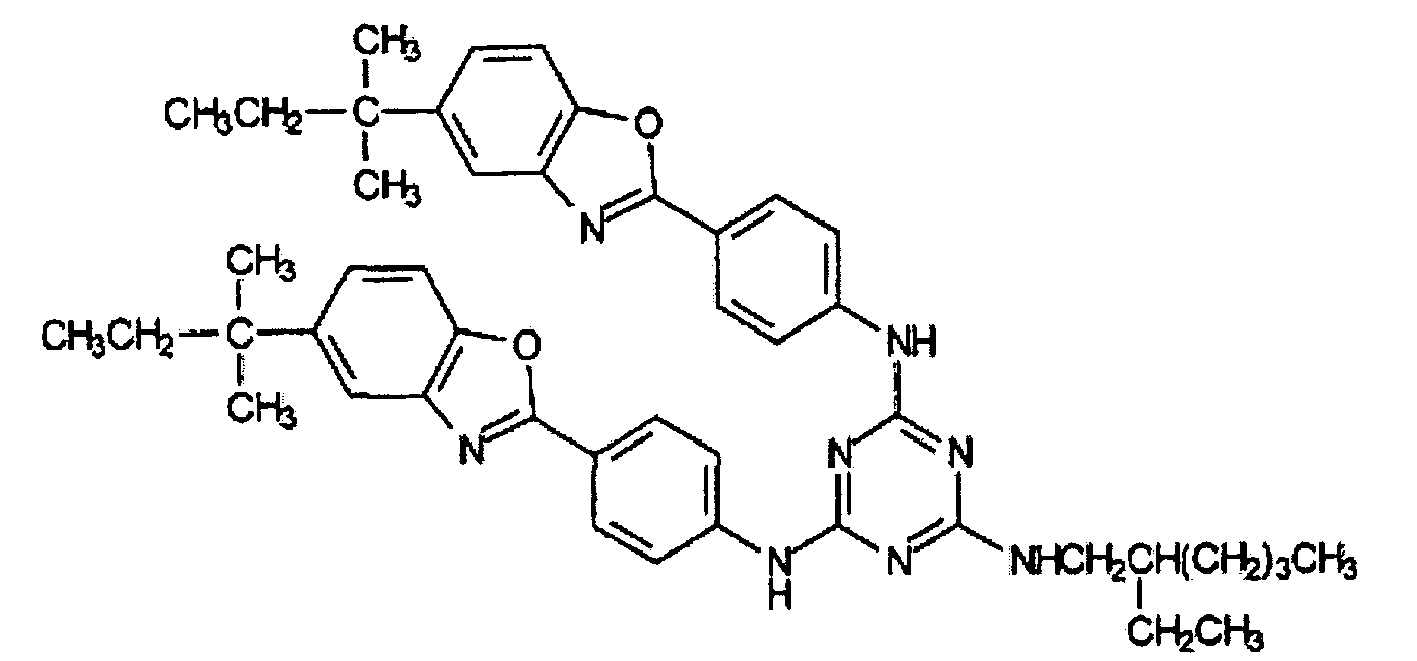
- Das oder die Benzoxazol-Derivate liegen vorteilhaft in gelöster Form in den erfindungsgemässen kosmetischen Zubereitungen vor. Es kann gegebenenfalls aber auch von Vorteil sein, wenn das oder die Benzoxazol-Derivate in pigmentärer, d.h. ungelöster Form - beispielsweise in Partikelgrössen von 10 nm bis zu 300 nm - vorliegen.
- Vorteilhafte UV-Filtersubstanzen im Sinne der vorliegenden Erfindung sind ferner sogenannte Hydroxybenzophenone. Hydroxybenzophenone zeichnen sich durch die folgende Strukturformel aus:

- R1 und R2 unabhängig voneinander Wasserstoff, C1-C20-Alkyl, C3-C10-Cycloalkyl oder C3-C10-Cycloalkenyl bedeuten, wobei die Substituenten R1 und R2 gemeinsam mit dem Stickstoffatom, an das sie gebunden sind, einen 5- oder 6-Ring bilden können und
- R3 einen C1-C20-Aikyl Rest bedeutet.
Ein besonders vorteilhaftes Hydroxybenzophenon im Sinne der vorliegenden Erfindung ist der 2-(4'-Diethylamino-2'-hydoxybenzoyl)-benzoesäurehexylester (auch: Aminobenzophenon), welcher sich durch folgende Struktur auszeichnet:
Vorteilhafte UV-Filtersubstanzen im Sinne der vorliegenden Erfindung sind ferner sogenannte Breitbandfilter, d.h. Filtersubstanzen, die sowohl UV-A- als auch UV-B-Strahlung absorbieren.
Vorteilhafte Breitbandfilter oder UV-B-Filtersubstanzen sind beispielsweise Triazinderivate, wie z.B. - 2,4-Bis- [4-(2-Ethyl-hexyloxy)-2-hydroxy]-phenyl-6-(4-methoxypheny()-1,3,5-triazin (INCI: Bis-Ethylhexyloxylphenol Methoxyphenyl Triazin), welches unter der Handelsbezeichnung Tinosorb TM S bei der CIBA-Chemikalien GmbH erhältlich ist;
- Dioctylbutylamidotriazon (INCI: Diethylhexyl Butamido Triazone), welches unter der Handelsbezeichnung UVASORB HEB bei Sigma 3 V erhältlich ist;
- 4,4',4"-(1,3,5-Triazin-2,4,6-triyltrümino)-tris-benzoesäure-tris(2-ethylhexylester), auch: 2,4,6-Tris-[anilino-(p-carbo-2'-ethyl-1'-hexyloxy)]-1,3,5-triazin (INCI: Ethylhexyl Triazone), welches von der BASF Aktiengesellschaft unter der Warenbezeichnung UVINUL TM T 150 vertrieben wird;
- 2-[4,6-Bis(2,4-dimethylphenyl)-1,3,5-triazin-2-yl]-5-(octyloxy)phenol (CAS Nr.: 2725- 22-6).
- Ein vorteilhafter Breitbandfilter im Sinne der vorliegenden Erfindung ist auch das 2,2-Methylen-bis-(6-(2H-benzotriazol-2-yl)-4-(1,1,3,3-tetramethylbutyl)-phenol) (INCI: Methylene Bis-Benztriazolyl Tetramethylbutylphenol), welches z.B. unter der Handelsbezeichnung Tinosorb TM M bei der CIBA-Chemikalien GmbH erhältlich ist. Vorteilhafter Breitbandfilter im Sinne der vorliegenden Erfindung ist ferner das 2-(2H-benzotriazol-2-yl)-4-methyl-6-[2-methyl-3-[1,3,3,3-tetramethyl-1-[(trimethylsilyl)oxy]disiloxanyl]propyl]-phenol (CAS-Nr.: 155633-54-8) mit der INCI-Bezeichnung Drometrizole Trisiloxane.
- Die weiteren UV-Filtersubstanzen können öllöslich oder wasserlöslich sein. Vorteilhafte öllösliche Filtersubstanzen sind z.B.:
- 3-Benzylidencampher-Derivate, vorzugsweise 3-(4-Methylbenzyliden)campher, 3- Benzylidencampher;
- 4-Aminobenzoesäure-Derivate, vorzugsweise 4-(Dimethylamino)-benzoesäure(2- ethylhexyl)ester, 4-(Dimethylamino)benzoesäureamylester;
- 2,4,6-Trianilino-(p-carbo-2'-ethyl-1'-hexyloxy)-1,3,5-triazin;
- Ester der Benzalmalonsäure, vorzugsweise 4-Methoxybenzalmalonsäuredi(2-ethylhexyl)ester;
- Ester der Zimtsäure, vorzugsweise 4-Methoxyzimtsäure(2-ethylhexyl)ester, 4-Methoxyzimtsäureisopentylester;
- Derivate des Benzophenons, vorzugsweise 2-Hydroxy-4-methoxybenzophenon, 2- Hydroxy-4-methoxy-4'-methylbenzophenon, 2,2'-Dihydroxy-4-methoxybenzophenon sowie
- an Polymere gebundene UV-Filter.
- Vorteilhafte wasserlösliche Filtersubstanzen sind z.B.: Sulfonsäure-Derivate des 3-Benzylidencamphers, wie z.B. 4-(2-Qxo-3-bornylidenmethyl)benzolsulfonsäure, 2-Methyl-5-(2-oxo-3-bornylidenmethyl)sulfonsäure und deren Salze.
- Eine weitere erfindungsgemäss vorteilhaft zu verwendende Lichtschutzfiltersubstanz ist das Ethylhexyl-2-cyano-3,3-diphenylacrylat (Octocrylen), welches von BASF unter der Bezeichnung Uvinul® N 539 T erhältlich ist.
- Besonders vorteilhafte Zubereitungen im Sinne der vorliegenden Erfindung, die sich durch einen hohen beziehungsweise sehr hohen UV-A-Schutz auszeichnen, enthalten neben der oder den erfindungsgemässen Filtersubstanz(en) bevorzugt ferner weitere UV-A- und/oder Breitbandfilter, insbesondere Dibenzoylmethanderivate [beispielsweise das 4-(tert.-Butyl)-4'-methoxydibenzoylmethan] und/oder das 2,4-Bis- [4-(2-Ethylhexyloxy)-2-hydroxy]- phenyl-6-(4-methoxyphenyl)-1,3,5-triazin und/oder Phenylen-1,4-bis-(2-benzimidazyl)- 3,3'-5,5'-tetrasulfonsäure-bis-natriumsalz jeweils einzeln oder in beliebigen Kombinationen miteinander.
- Die Liste der genannten UV-Filter, die im Sinne der vorliegenden Erfindung eingesetzt werden können, soll selbstverständlich nicht limitierend sein.
- Vorteilhaft enthalten die Zubereitungen gemäss der vorliegenden Erfindung die Substanzen, die UV-Strahlung im UV-A- und/oder UV-B-Bereich absorbieren, in einer Gesamtmenge von z. B. 0,1 Gew.-% bis 30 Gew.-%, vorzugsweise 0,5 bis 20 Gew.-%, insbesondere 1,0 bis 15,0 Gew.-%, jeweils bezogen auf das Gesamtgewicht der Zubereitungen, um kosmetische Zubereitungen zur Verfügung zu stellen, die das Haar beziehungsweise die Haut vor dem gesamten Bereich der ultravioletten Strahlung schützen.
- Die Zubereitungen im Sinne der vorliegenden Erfindung können ferner vorteilhaft weitere Substanzen enthalten, die die Wasserfestigkeit der Produkte erhöhen.
- Vorteilhaft sind beispielsweise wasserlösliche oder in Wasser dispergierbare Polyoxyethylen-Polyoxypropylen-Blockpolymere (CTFA-Bezeichnung: Polaxamere, CAS-Nr. 9003-11-6) mit folgender Struktur:

- Unter diesen sind insbesondere Polaxamer 188 [mit x = 75, y = 30 und z = 75], welches unter der Handelsbezeichnung Lutrol F 68 (alt: Pluronic F 68) von der Firma BASF zu beziehen ist, das Polyxamer 185 [mit x = 19, y = 30 und z = 19] (Lubrajel WA von ISP), das Polyxamer 235 [mit x = 27, y = 39 und z = 27] (Pluronic F 85 von BASF) und/oder das Polyxamer 238 [mit x = 97, y = 39 und z = 97] (Pluronic F 88 von BASF) vorteilhaft zu verwenden.
- Weitere vorteilhafte Substanzen, welche zur Steigerung der Wasserfestigkeit beitragen können, aber in die Ölphase der Zubereitungen gemäss der vorliegenden Erfindung eingearbeitet werden, sind bestimmte Wachskomponenten, wie acetyliertes Glykolstearat mit Tristearin (z.B. Unitwix von ISP mit der INCI: Acetylated Glycol Stearat and Tristearin), C18-36 Fettsäuretriglycerid (z.B. Syncrowax HGLC von der Fa. Crode GmbH mit der INCI: C18-36 Acid Triglyceride) und ferner die unter der Handelsbezeichnungen "Perfroma V 825" (synethisches Wachs) von New Phase Technologies erhältlichen Substanz sowie PEG-45 Dodecylglykolcopolymer (INCI: PEG-45 Dodecyl Glycol Copolymer), PEG-22 Dodecylglykolcopolymer (INCI: PEG-22 Dodecyl Glycol Copolymer), Methoxy PEG-22 Dodecylglykolcopolymer (INCI: Methoxy PEG-22 Dodecyl Glycol Copolymer) zu verwenden, welche von der Firma AKZO Nobel erhältlich sind.
- Es ist besonders vorteilhaft im Sinne der vorliegenden Erfindung die erfindungsgemäss verwendeten Polymere mit einer oder mehreren der genannten Substanzen zu kombinieren, um die Wasserfestigkeit der Zubereitungen noch weiter zu verbessern.
- Die nachfolgenden Beispiele sollen die vorliegende Erfindung verdeutlichen, ohne sie einzuschränken. Die Zahlenwerte in den Beispielen bedeuten Gewichtsprozente, bezogen auf das Gesamtgewicht der jeweiligen Zubereitungen.
- Die Strukturmodifizierung wird mittels einer Kugelmühle oder einer kontinuierlich arbeitenden Kugelmühle durchgeführt.
Die Nachvermahlung wird mittels einer Luftstrahlmühle, einer Zahnscheibenmühle oder einer Stiftmühle durchgeführt.Tabelle 2: Herstellung der strukturmodifizierten Titandioxide Oxid* Strukturmodifizierung Nachvermahlung** Beispiel 1 1 Ja Nein Beispiel 2 1 Ja ZM Beispiel 3 1 Ja LS Beispiel 4 1 Ja LS Beispiel 5 2 Ja Nein Beispiel 6 2 Ja ZM Beispiel 7 2 Ja LS Beispiel 8 2 Ja LS *Oxid 1 = Aeroxide® TiO2 P 25 Oxid 2 = Aeroxide® TiO2 PF 2 **ZM = Zahnscheibenmühle LS = Luftstrahlmühle Tabelle 3: Physikalisch-chemische Daten der strukturmodifizierten Titandioxide Stampfdichte [g/l] pH-Wert Trocknungsverlust [%] Glühverlust [%] spez. Oberfläche n. BET [m2/g] Beispiel 1 805 3,6 1,2 1,1 53 Beispiel 2 735 3,6 1,0 0,7 52 Beispiel 3 324 3,8 0,7 1,1 52 Beispiel 4 446 3,8 0,6 1,2 50 Beispiel 5 860 3,7 1,4 1,8 58 Beispiel 6 764 3,6 1,4 1,3 58 Beispiel 7 351 3,8 1,2 1,2 56 Beispiel 8 299 3,8 1,1 1,3 59 - 278,25 g TEGOSOFT® TN werden in einem 500-ml-PE-Becher vorgelegt und 21,75 g des zu untersuchenden Titandioxid-Pulvers mit Hilfe eines Dissolvers (Pendraulik Typ LM34 Nr.29490, Scheibendurchmesser 6 cm) bei 470 U/min eingerührt und dann fünf Minuten bei 3000 U/min dispergiert.
- Im Anschluß wird die Dispersion mit einem Ultra-Turrax-Rührer (Polytron PT3100, Dispergierwerkzeug PT-DA 3020/2 EC) zwei Minuten bei 15.000 U/min dispergiert.
- Schließlich wird die Dispersion weitere fünf Minuten in einem wassergekühlten Behälter mit dem Ultra-Turrax-Rührer bei 15.000 U/min dispergiert, wobei nun das Dispergierwerkzeug PT-DA 3030-6060/3 EC verwendet wird.
- Die UV-Vis Spektren von 3 Gew.-%igen Dispersionen werden in einer zerlegbaren 10 µm-Quartzglas-Küvette mit einem UV-Vis-Spektralphotometer Specord 200 mit Photometerkugel (Firma Analytik Jena AG) gemessen. Dazu werden die oben beschriebenen öligen Dispersionen mit Tego-soft TN verdünnt.
- Unter Rühren mit dem Dissolver (Pendraulik Typ LM34 Nr.29490, Scheiben-durchmesser 5 cm; 1000 - 4000 Umdrehungen / min) wird dann portionsweise AEROSIL® 200 zugegeben, um eine gelartige Masse herzustellen und das Oxid zu stabilisieren.
- Nach der letzten AEROSIL-Zugabe muß mindestens 2 Minuten nachdispergiert werden um eine homogene Verteilung des AEROSIL zu gewährleisten. Als Ergebnis erhält man die Transmission (%) im Bereich von 290-500nm.
- Die Viskosität wird mit einem Brookfield Rheometer RVDV-III+cP ermittelt. Die Messung erfolgt in einem PE-Mischbecher (350ml) und dem RV-Spindelsatz, bei 10 U/min. Nach 1 Minute wird der Wert in mPas abgelesen.
Tabelle 4: Charakterisierung von strukturmodifizierten AEROXIDE® TiO2 P 25-Mustern Bezeichnung Nachvermahlung Stampfdichte (g/l) Transmission bei 380 nm (%) Viskosität (mPas) (Spindel-Typ) Beispiel 1 - 805 34 80 (1) Beispiel 2 ZM 735 45 63 (1) Vergleichsbeispiel AEROXIDE TiO2 P25 - 282 22 520 (2) - Vorteile der erfindungsgemäßen Produkte aus Beispiel 1 und 2 gegenüber dem Vergleichsbeispiel mit AEROXIDE TiO2 P 25 (nicht strukturmodifiziert) sind
- eine wesentlich erhöhte Stampfdichte. Dies bedeutet eine vereinfachte Handhabung und Verarbeitung, geringeren Transport- und Lageraufwand sowie eine reduzierte Staubentwicklung.
- Eine deutliche erhöhte Transmission bei 380 nm. Dies bedeutet eine erhöhte Transparenz beziehungsweise reduziertes Weißeln damit hergestellter Sonnenschutzformulierungen.
- Eine erhebliche reduzierte Viskosität beziehungsweise Verdickungswirkung. Dies ermöglicht die Herstellung von Dispersionen beziehungsweise Sonnenschutzformulierungen mit höherem Titandioxidgehalt und damit einem höheren Lichtschutzfaktor.
- Die Phase A wird auf 80 °C erhitzt, die Phase B wird hinzugefügt und für 3 Minuten homogenisiert.
- Die Phase C wird auf 80 °C erhitzt und in die Mischung aus den Phasen A und B unter Homogenisieren eingerührt.
Sonnenschutzformulierung 2 A. % Bestandteil 6.00 Cremophor® WO 7 PEG-7 Hydrogenated Castor Oil 2.00 Elfacos® ST 9 PEG-45/Dodecyl GlycolCopolymer 3.00 Isopropyl Myristate Isopropyl Myristate 8.00 Jojoba Oil Jojoba (Buxus Chinensis) Oil 4.00 Uvinul® MC 80 Octyl Methoxycinnamate 2.00 Uvinul® MBC 95 4-Methylbenzylidene Camphor 3.00 1. Feinteiliges Titandioxid Titanium Dioxide 1.00 Abil® 350 Dimethicone 5.00 Z-Cote® HP 1 Zinc Oxide, Dimethicone B 0.20 Edeta® BD Disodium EDTA 5.00 Glycerin 87 % Glycerin q.s. Preservative 60.8 0 Water dem. Aqua dem. C q.s. Perfume - Die Phase A und B werden separat auf 85 °C erhitzt. Anschließend wird die Phase B in die Phase A eingerührt und homogenisiert. Die Mischung wird auf 40 °C abgekühlt, die Phase C hinzugegeben und anschließend erneut homogenisiert.
Ergebnisse Formulierung 1 Formulierung 2 Transparenz auf der Haut Transparenz auf der Haut Vergleichsbeispiel AEROXIDE TiO2 T805 nicht befriedigend nicht befriedigend Beispiel 2 befriedigend befriedigend
| A. | % | Bestandteil | |
| 3.00 | Isopropyl Myristate | Isopropyl Myristate | |
| 8.00 | Jojoba Oil | Simmondsia Chinensis (Jojoba) seed oil | |
| 4.00 | Uvinul® MC 80 | Octyl Methoxycinnamate | |
| 1.00 | Abil® 350 | Dimethicone | |
| 6.00 | Cremophor® WO 7 | PEG-7 Hydrogenated Castor Oil | |
| 2.00 | Ganex® V 216 | PVP/Hexadecene Copolymer | |
| 2.00 | Elfacos® ST 9 | PEG-45/Ddecyl Glycol Copolymer | |
| 2.00 | Uvinul® MBC 95 | 4-Methylbenzylidene Camphor | |
| B | 3.00 | Feinteiliges Titandioxid | Titanium Dioxide |
| 5.00 | Z-Cote® HP 1 | Zinc Oxide (und) Dimethicone | |
| C | 1.00 | Magnesium sulfate-7-hydrate | Magnesium Sulfate |
| 5.00 | Glycerin 87 % | Glycerin | |
| 0.20 | Edeta® BD | Disodium EDTA | |
| 0.30 | Germoll® 115 | Imidazolidinyl Urea | |
| 57.0 0 | Water dem. | Wasser | |
| q.s. | Perfume | ||
| 0.50 | Euxyl® K3000 | Phenoxyethanol, Methylparaben, Butylparaben, Ethylparaben, Propylparaben, Isobutyl paraben |
Claims (4)
- Pyrogen hergestellte, strukturmodifizierte Titandioxide beziehungsweise pyrogen hergestellte, strukturmodifizierte Titandioxid-Mischoxide.
- Verfahren zur Herstellung der pyrogen hergestellten, strukturmodifizierten Titandioxide beziehungsweise der pyrogen hergestellten, strukturmodifizierten Titandioxid-Mischoxide gemäß Anspruch 1, dadurch gekennzeichnet, daß man das pyrogen hergestellte Titandioxid beziehungsweise das pyrogen hergestellte, strukturmodifizierte Titandioxid-Mischoxid mit einer Kugelmühle behandelt und gegebenenfalls nachvermahlt.
- Verwendung der pyrogen hergestellten, strukturmodifizierten Titandioxide beziehungsweise derpyrogen hergestellten, strukturmodifizierten Titandioxid-Mischoxide gemäß Anspruch 1 zur Herstellung von Sonnenschutzformulierungen.
- Sonnenschutzformulierungen, dadurch gekennzeichnet, daß sie pyrogen hergestellte, strukturmodifizierte Titandioxide beziehungsweise pyrogen hergestellte, strukturmodifizierte Titandioxid-Mischungen gemäß Anspruch 1 enthalten.
Priority Applications (9)
| Application Number | Priority Date | Filing Date | Title |
|---|---|---|---|
| EP04030585A EP1674427A1 (de) | 2004-12-23 | 2004-12-23 | Strukturmodifizierte Titandioxide |
| TW094144851A TWI349649B (en) | 2004-12-23 | 2005-12-16 | Structurally modified titanium dioxides |
| AU2005246992A AU2005246992B2 (en) | 2004-12-23 | 2005-12-21 | Structurally modified titanium dioxides |
| US11/314,083 US20060159636A1 (en) | 2004-12-23 | 2005-12-22 | Structurally modified titanium dioxides |
| CA2531466A CA2531466C (en) | 2004-12-23 | 2005-12-22 | Structurally modified titanium dioxides |
| CNA2005100229789A CN1793243A (zh) | 2004-12-23 | 2005-12-22 | 结构改性的二氧化钛 |
| KR1020050128669A KR20060073512A (ko) | 2004-12-23 | 2005-12-23 | 구조적으로 개질된 이산화티탄 |
| JP2005372606A JP2006193420A (ja) | 2004-12-23 | 2005-12-26 | 構造的に変性された二酸化チタン |
| JP2009241344A JP2010013484A (ja) | 2004-12-23 | 2009-10-20 | 構造的に変性された二酸化チタン |
Applications Claiming Priority (1)
| Application Number | Priority Date | Filing Date | Title |
|---|---|---|---|
| EP04030585A EP1674427A1 (de) | 2004-12-23 | 2004-12-23 | Strukturmodifizierte Titandioxide |
Publications (1)
| Publication Number | Publication Date |
|---|---|
| EP1674427A1 true EP1674427A1 (de) | 2006-06-28 |
Family
ID=34927949
Family Applications (1)
| Application Number | Title | Priority Date | Filing Date |
|---|---|---|---|
| EP04030585A Ceased EP1674427A1 (de) | 2004-12-23 | 2004-12-23 | Strukturmodifizierte Titandioxide |
Country Status (8)
| Country | Link |
|---|---|
| US (1) | US20060159636A1 (de) |
| EP (1) | EP1674427A1 (de) |
| JP (2) | JP2006193420A (de) |
| KR (1) | KR20060073512A (de) |
| CN (1) | CN1793243A (de) |
| AU (1) | AU2005246992B2 (de) |
| CA (1) | CA2531466C (de) |
| TW (1) | TWI349649B (de) |
Families Citing this family (32)
| Publication number | Priority date | Publication date | Assignee | Title |
|---|---|---|---|---|
| WO2005054136A1 (en) * | 2003-12-03 | 2005-06-16 | Degussa Ag | Flame-hydrolytically produced titanium dioxide powder |
| DE102004031785A1 (de) * | 2004-07-01 | 2006-01-26 | Degussa Ag | Polyol enthaltende Siliciumdioxid-Dispersion |
| DE102004037045A1 (de) | 2004-07-29 | 2006-04-27 | Degussa Ag | Wässrige Silan-Nanokomposite |
| DE102004037044A1 (de) | 2004-07-29 | 2006-03-23 | Degussa Ag | Mittel zur Ausstattung von auf Cellulose und/oder Stärke basierenden Substraten mit Wasser abweisenden und gleichzeitig pilz-, bakterien-, insekten- sowie algenwidrigen Eigenschaften |
| DE102004049427A1 (de) | 2004-10-08 | 2006-04-13 | Degussa Ag | Polyetherfunktionelle Siloxane, polyethersiloxanhaltige Zusammensetzungen, Verfahren zu deren Herstellung und deren Verwendung |
| DE102005004872A1 (de) * | 2005-02-03 | 2006-08-10 | Degussa Ag | Wässrige Emulsionen von funktionellen Alkoxysilanen und deren kondensierten Oligomeren, deren Herstellung und Verwendung zur Oberflächenbehandlung |
| DE102005032427A1 (de) * | 2005-07-12 | 2007-01-18 | Degussa Ag | Aluminiumoxid-Dispersion |
| DE102006006656A1 (de) * | 2005-08-26 | 2007-03-01 | Degussa Ag | Silan enthaltendes Bindemittel für Verbundwerkstoffe |
| DE102006006655A1 (de) * | 2005-08-26 | 2007-03-01 | Degussa Ag | Cellulose- bzw. lignocellulosehaltige Verbundwerkstoffe auf der Basis eines auf Silan basierenden Komposits als Bindemittel |
| DE102005053071A1 (de) * | 2005-11-04 | 2007-05-16 | Degussa | Verfahren zur Herstellung von ultrafeinen Pulvern auf Basis Polymaiden, ultrafeinen Polyamidpulver sowie deren Verwendung |
| DE102006003956A1 (de) * | 2006-01-26 | 2007-08-02 | Degussa Gmbh | Korrossionsschutzschicht auf Metalloberflächen |
| DE102006013090A1 (de) * | 2006-03-20 | 2007-09-27 | Georg-August-Universität Göttingen | Kompositwerkstoff aus Holz und thermoplastischem Kunststoff |
| DE102006017701A1 (de) * | 2006-04-15 | 2007-10-25 | Degussa Gmbh | Silicium-Titan-Mischoxidpulver, Dispersion hiervon und daraus hergestellter titanhaltiger Zeolith |
| US8155674B2 (en) * | 2006-08-22 | 2012-04-10 | Research In Motion Limited | Apparatus, and associated method, for dynamically configuring a page message used to page an access terminal in a radio communication system |
| DE102006039269A1 (de) * | 2006-08-22 | 2008-02-28 | Evonik Degussa Gmbh | Dispersion von Aluminiumoxid, Beschichtungszusammensetzung und tintenaufnehmendes Medium |
| DE102006040591A1 (de) * | 2006-08-30 | 2008-03-20 | Evonik Degussa Gmbh | Zu Schülpen kompaktiertes pyrogen hergestelltes Titandioxid |
| KR100795233B1 (ko) | 2006-11-30 | 2008-01-17 | (주)아모레퍼시픽 | 발수 및 발유와 도포 균일성이 향상된 복합화 안료를함유하는 메이크업 화장료 조성물 및 그의 제조방법 |
| ES2725499T3 (es) * | 2007-04-20 | 2019-09-24 | Evonik Degussa Gmbh | Mezcla que contiene un compuesto de organosilicio y su uso |
| DE102007038314A1 (de) | 2007-08-14 | 2009-04-16 | Evonik Degussa Gmbh | Verfahren zur kontrollierten Hydrolyse und Kondensation von Epoxy-funktionellen Organosilanen sowie deren Condensation mit weiteren organofunktionellen Alkoxysilanen |
| DE102007040246A1 (de) * | 2007-08-25 | 2009-02-26 | Evonik Degussa Gmbh | Strahlenhärtbare Formulierungen |
| DE102008007261A1 (de) | 2007-08-28 | 2009-03-05 | Evonik Degussa Gmbh | Wässrige Silansysteme basierend auf Bis(trialkoxysilyalkyl)aminen |
| DE102007045186A1 (de) * | 2007-09-21 | 2009-04-09 | Continental Teves Ag & Co. Ohg | Rückstandsfreies, schichtbildendes, wässriges Versiegelungssystem für metallische Oberflächen auf Silan-Basis |
| DE102007049743A1 (de) * | 2007-10-16 | 2009-04-23 | Evonik Degussa Gmbh | Silicium-Titan-Mischoxidpulver, Dispersion hiervon und daraus hergestellter titanhaltiger Zeolith |
| EP2108620A1 (de) * | 2008-04-04 | 2009-10-14 | Evonik Degussa GmbH | Verfahren zum Herstellen von Bariumtitanatpulver für pyrogenes Titanoxid |
| DE102009002477A1 (de) | 2009-04-20 | 2010-10-21 | Evonik Degussa Gmbh | Quartäre-aminofunktionelle, siliciumorganische Verbindungen enthaltende Zusammensetzung sowie deren Herstellung und Verwendung |
| DE102009002499A1 (de) | 2009-04-20 | 2010-10-21 | Evonik Degussa Gmbh | Dispersion enthaltend mit quartären, aminofunktionellen siliciumorganischen Verbindungen oberflächenmodifizierte Siliciumdioxidpartikel |
| EP3533838B1 (de) | 2016-10-28 | 2024-02-21 | Shin-Etsu Chemical Co., Ltd. | Hitzebeständige fräsbare silikonkautschukzusammensetzung |
| CN107814412A (zh) * | 2017-12-11 | 2018-03-20 | 南京工业大学 | 一种粒子形貌为棒状的金红石型纳米二氧化钛的合成方法 |
| US20240228708A9 (en) | 2021-02-18 | 2024-07-11 | Shin-Etsu Chemical Co., Ltd. | Millable fluorosilicone rubber composition having heat resistance |
| CN113317997B (zh) * | 2021-07-02 | 2023-04-11 | 广州集妍化妆品科技有限公司 | 一种抗黯沉组合物、抗黯沉化妆品及其制备方法 |
| CN114956787B (zh) * | 2022-06-22 | 2023-03-14 | 景德镇玉玺陶瓷有限公司 | 一种低温瓷的配方及工艺 |
| CN115969714B (zh) * | 2022-11-03 | 2025-03-11 | 华熙生物科技股份有限公司 | 具有光谱选择性的防晒组合物及其应用 |
Citations (4)
| Publication number | Priority date | Publication date | Assignee | Title |
|---|---|---|---|---|
| US3770470A (en) * | 1972-12-13 | 1973-11-06 | Cabot Corp | Pigmented resin compositions |
| EP0637616A1 (de) * | 1993-08-02 | 1995-02-08 | Degussa Aktiengesellschaft | Pyrogenische hydrophile & hydrophobe Metalloxyde mit schwacher Struktur, ihre Herstellung und Anwendung |
| DE10225125A1 (de) * | 2002-06-06 | 2003-12-18 | Goldschmidt Ag Th | Wässerige Dispersion enthaltend pyrogen hergestellte Metalloxidpartikel und Dispergierhilfsmittel |
| WO2004005408A1 (en) * | 2002-07-03 | 2004-01-15 | Degussa Ag | Aqueous dispersion containing pyrogenically produced metal oxide particles and phosphates |
Family Cites Families (9)
| Publication number | Priority date | Publication date | Assignee | Title |
|---|---|---|---|---|
| DE3528256A1 (de) * | 1985-08-07 | 1987-02-19 | Merck Patent Gmbh | Eisenoxidbeschichtete perlglanzpigmente |
| DE4302896A1 (de) * | 1993-02-02 | 1994-08-04 | Degussa | Eisenoxidhaltiges Titandioxidpulver |
| US6406532B1 (en) * | 1993-02-02 | 2002-06-18 | Degussa Aktiengesellschaft | Titanium dioxide powder which contains iron oxide |
| US5663213A (en) * | 1994-02-28 | 1997-09-02 | Rohm And Haas Company | Method of improving ultraviolet radiation absorption of a composition |
| DE19848480A1 (de) * | 1998-10-21 | 2000-05-04 | Degussa | Verfahren zur Verbesserung der Stabilität von Polymeren |
| JP2003043998A (ja) * | 2001-07-30 | 2003-02-14 | Pioneer Electronic Corp | ディスプレイ装置 |
| EP1284277B1 (de) * | 2001-08-08 | 2004-10-20 | Degussa Aktiengesellschaft | Mit Siliziumdioxid umhüllte Metalloxidpartikel |
| GB0213027D0 (en) * | 2002-06-07 | 2002-07-17 | Jsr Farming Group | Compound |
| EP1700825A1 (de) * | 2004-12-23 | 2006-09-13 | Degussa AG | Oberflächenmodifizierte, strukturmodifizierte Titandioxide |
-
2004
- 2004-12-23 EP EP04030585A patent/EP1674427A1/de not_active Ceased
-
2005
- 2005-12-16 TW TW094144851A patent/TWI349649B/zh not_active IP Right Cessation
- 2005-12-21 AU AU2005246992A patent/AU2005246992B2/en not_active Ceased
- 2005-12-22 CN CNA2005100229789A patent/CN1793243A/zh active Pending
- 2005-12-22 US US11/314,083 patent/US20060159636A1/en not_active Abandoned
- 2005-12-22 CA CA2531466A patent/CA2531466C/en not_active Expired - Fee Related
- 2005-12-23 KR KR1020050128669A patent/KR20060073512A/ko not_active Ceased
- 2005-12-26 JP JP2005372606A patent/JP2006193420A/ja active Pending
-
2009
- 2009-10-20 JP JP2009241344A patent/JP2010013484A/ja active Pending
Patent Citations (4)
| Publication number | Priority date | Publication date | Assignee | Title |
|---|---|---|---|---|
| US3770470A (en) * | 1972-12-13 | 1973-11-06 | Cabot Corp | Pigmented resin compositions |
| EP0637616A1 (de) * | 1993-08-02 | 1995-02-08 | Degussa Aktiengesellschaft | Pyrogenische hydrophile & hydrophobe Metalloxyde mit schwacher Struktur, ihre Herstellung und Anwendung |
| DE10225125A1 (de) * | 2002-06-06 | 2003-12-18 | Goldschmidt Ag Th | Wässerige Dispersion enthaltend pyrogen hergestellte Metalloxidpartikel und Dispergierhilfsmittel |
| WO2004005408A1 (en) * | 2002-07-03 | 2004-01-15 | Degussa Ag | Aqueous dispersion containing pyrogenically produced metal oxide particles and phosphates |
Also Published As
| Publication number | Publication date |
|---|---|
| AU2005246992A1 (en) | 2006-07-13 |
| KR20060073512A (ko) | 2006-06-28 |
| TWI349649B (en) | 2011-10-01 |
| CN1793243A (zh) | 2006-06-28 |
| AU2005246992B2 (en) | 2011-07-28 |
| CA2531466A1 (en) | 2006-06-23 |
| TW200700322A (en) | 2007-01-01 |
| CA2531466C (en) | 2011-06-21 |
| JP2006193420A (ja) | 2006-07-27 |
| JP2010013484A (ja) | 2010-01-21 |
| US20060159636A1 (en) | 2006-07-20 |
Similar Documents
| Publication | Publication Date | Title |
|---|---|---|
| EP1674534B1 (de) | Oberflächenmodifizierte Siliciumdioxid-Titandioxid-Mischoxide | |
| EP1674517B1 (de) | Oberflächenmodifizierte pyrogen hergestellte Titandioxide | |
| EP1700825A1 (de) | Oberflächenmodifizierte, strukturmodifizierte Titandioxide | |
| EP1674427A1 (de) | Strukturmodifizierte Titandioxide | |
| EP1458340A1 (de) | Kosmetische und dermatologische lichtschutzformulierungen mit einem gehalt an bis-resorcinyltriazinderivaten und benzoxazol-derivaten | |
| EP1458341A1 (de) | Kosmetische und dermatologische lichtschutzformulierungen mit einem gehalt an benzotriazolen und benzoxazol-derivaten | |
| EP1352639A1 (de) | Kosmetische und dermatologische Formulierungen mit einem Gehalt an Hydroxybenzophenonen und einem oder mehreren vorgelatinisierten, quervernetzten Stärkederivaten | |
| EP1458342A1 (de) | Komestiche und dermatologische lichtschutzformulierungen mit einem gehalt an hydroxybenzophenonen und benzoxazol-derivaten | |
| EP1454619B1 (de) | Kosmetische und dermatologische Emulsionen | |
| EP1492489B1 (de) | Wasserfeste kosmetische und dermatologische lichtschutzformulierungen mit einem gehalt an polyoxyethylen-polydodecylglykol-blockpolymeren | |
| EP1449516A1 (de) | Kosmetische und dermatologische Emulsionen Phosphorsäureester enthaltend | |
| WO2005067883A1 (de) | Visualisierung von sonnenschutzmitteln auf der haut | |
| DE102004002602A1 (de) | Visualisierung von Sonnenschutzmitteln auf der Haut | |
| DE102004002606A1 (de) | Visualisierung von Sonnenschutzmitteln auf der Haut | |
| WO2005067882A1 (de) | Visualisierung von sonnenschutzmitteln auf der haut | |
| WO2005067880A1 (de) | Visualisierung von sonnenschutzmitteln auf der haut | |
| DE102004002609A1 (de) | Visualisierung von Sonnenschutzmitteln auf der Haut | |
| WO2005067879A1 (de) | Visualisierung von sonnenschutzmitteln auf der haut |
Legal Events
| Date | Code | Title | Description |
|---|---|---|---|
| PUAI | Public reference made under article 153(3) epc to a published international application that has entered the european phase |
Free format text: ORIGINAL CODE: 0009012 |
|
| 17P | Request for examination filed |
Effective date: 20041223 |
|
| AK | Designated contracting states |
Kind code of ref document: A1 Designated state(s): AT BE BG CH CY CZ DE DK EE ES FI FR GB GR HU IE IS IT LI LT LU MC NL PL PT RO SE SI SK TR |
|
| AX | Request for extension of the european patent |
Extension state: AL BA HR LV MK YU |
|
| 17Q | First examination report despatched |
Effective date: 20061201 |
|
| RAP1 | Party data changed (applicant data changed or rights of an application transferred) |
Owner name: DEGUSSA GMBH |
|
| AKX | Designation fees paid |
Designated state(s): AT BE BG CH CY CZ DE DK EE ES FI FR GB GR HU IE IS IT LI LT LU MC NL PL PT RO SE SI SK TR |
|
| RAP1 | Party data changed (applicant data changed or rights of an application transferred) |
Owner name: EVONIK DEGUSSA GMBH |
|
| RAP1 | Party data changed (applicant data changed or rights of an application transferred) |
Owner name: EVONIK DEGUSSA GMBH |
|
| APBK | Appeal reference recorded |
Free format text: ORIGINAL CODE: EPIDOSNREFNE |
|
| APBN | Date of receipt of notice of appeal recorded |
Free format text: ORIGINAL CODE: EPIDOSNNOA2E |
|
| APBR | Date of receipt of statement of grounds of appeal recorded |
Free format text: ORIGINAL CODE: EPIDOSNNOA3E |
|
| APBV | Interlocutory revision of appeal recorded |
Free format text: ORIGINAL CODE: EPIDOSNIRAPE |
|
| APBD | Information on interlocutory revision deleted |
Free format text: ORIGINAL CODE: EPIDOSDIRAPE |
|
| APBV | Interlocutory revision of appeal recorded |
Free format text: ORIGINAL CODE: EPIDOSNIRAPE |
|
| APBK | Appeal reference recorded |
Free format text: ORIGINAL CODE: EPIDOSNREFNE |
|
| APBN | Date of receipt of notice of appeal recorded |
Free format text: ORIGINAL CODE: EPIDOSNNOA2E |
|
| APBR | Date of receipt of statement of grounds of appeal recorded |
Free format text: ORIGINAL CODE: EPIDOSNNOA3E |
|
| APAF | Appeal reference modified |
Free format text: ORIGINAL CODE: EPIDOSCREFNE |
|
| APAX | Date of receipt of notice of appeal deleted |
Free format text: ORIGINAL CODE: EPIDOSDNOA2E |
|
| APAZ | Date of receipt of statement of grounds of appeal deleted |
Free format text: ORIGINAL CODE: EPIDOSDNOA3E |
|
| APBD | Information on interlocutory revision deleted |
Free format text: ORIGINAL CODE: EPIDOSDIRAPE |
|
| APAF | Appeal reference modified |
Free format text: ORIGINAL CODE: EPIDOSCREFNE |
|
| APBT | Appeal procedure closed |
Free format text: ORIGINAL CODE: EPIDOSNNOA9E |
|
| STAA | Information on the status of an ep patent application or granted ep patent |
Free format text: STATUS: THE APPLICATION HAS BEEN REFUSED |
|
| 18R | Application refused |
Effective date: 20120803 |