EP1674309A2 - Vorrichtung und Verfahren zum Abführen der Wärme eines Innenteils für Fahrzeuge - Google Patents
Vorrichtung und Verfahren zum Abführen der Wärme eines Innenteils für Fahrzeuge Download PDFInfo
- Publication number
- EP1674309A2 EP1674309A2 EP05027781A EP05027781A EP1674309A2 EP 1674309 A2 EP1674309 A2 EP 1674309A2 EP 05027781 A EP05027781 A EP 05027781A EP 05027781 A EP05027781 A EP 05027781A EP 1674309 A2 EP1674309 A2 EP 1674309A2
- Authority
- EP
- European Patent Office
- Prior art keywords
- heat
- heat conducting
- baseboard
- conducting plate
- skin material
- Prior art date
- Legal status (The legal status is an assumption and is not a legal conclusion. Google has not performed a legal analysis and makes no representation as to the accuracy of the status listed.)
- Granted
Links
Images






Classifications
-
- B—PERFORMING OPERATIONS; TRANSPORTING
- B60—VEHICLES IN GENERAL
- B60H—ARRANGEMENTS OF HEATING, COOLING, VENTILATING OR OTHER AIR-TREATING DEVICES SPECIALLY ADAPTED FOR PASSENGER OR GOODS SPACES OF VEHICLES
- B60H1/00—Heating, cooling or ventilating devices
- B60H1/00271—HVAC devices specially adapted for particular vehicle parts or components and being connected to the vehicle HVAC unit
-
- B—PERFORMING OPERATIONS; TRANSPORTING
- B60—VEHICLES IN GENERAL
- B60H—ARRANGEMENTS OF HEATING, COOLING, VENTILATING OR OTHER AIR-TREATING DEVICES SPECIALLY ADAPTED FOR PASSENGER OR GOODS SPACES OF VEHICLES
- B60H1/00—Heating, cooling or ventilating devices
- B60H1/00271—HVAC devices specially adapted for particular vehicle parts or components and being connected to the vehicle HVAC unit
- B60H1/00295—HVAC devices specially adapted for particular vehicle parts or components and being connected to the vehicle HVAC unit for trim components, e.g. panels, dashboards, liners
-
- B—PERFORMING OPERATIONS; TRANSPORTING
- B60—VEHICLES IN GENERAL
- B60H—ARRANGEMENTS OF HEATING, COOLING, VENTILATING OR OTHER AIR-TREATING DEVICES SPECIALLY ADAPTED FOR PASSENGER OR GOODS SPACES OF VEHICLES
- B60H1/00—Heating, cooling or ventilating devices
- B60H1/00507—Details, e.g. mounting arrangements, desaeration devices
- B60H1/00514—Details of air conditioning housings
- B60H1/0055—Details of air conditioning housings the housing or parts thereof being integrated in other devices, e.g. dashboard
-
- B—PERFORMING OPERATIONS; TRANSPORTING
- B60—VEHICLES IN GENERAL
- B60H—ARRANGEMENTS OF HEATING, COOLING, VENTILATING OR OTHER AIR-TREATING DEVICES SPECIALLY ADAPTED FOR PASSENGER OR GOODS SPACES OF VEHICLES
- B60H1/00—Heating, cooling or ventilating devices
- B60H1/00271—HVAC devices specially adapted for particular vehicle parts or components and being connected to the vehicle HVAC unit
- B60H2001/00307—Component temperature regulation using a liquid flow
Definitions
- the present invention relates to a heat-removing device and a heat-removing method to remove heat from a vehicle interior part to the outside.
- Japanese Patent Application Laid-Open Publication No. 2004-58943 discloses a device for removing heat accumulated on an instrument panel using a heat pipe connected to a vehicle body and a chassis.
- the heat pipe is embedded in the instrument panel with a part thereof fit in a groove formed on an inner side of the instrument panel.
- the instrument panel is usually formed of a synthetic resin material, which exhibits a large thermal capacity with less thermal conductance.
- the heat pipe is merely embedded in the inner side of the instrument panel, the heat of the entire instrument panel cannot be collected and conducted to the heat pipe efficiently, thus deteriorating the heat removing efficiency of the instrument panel.
- An object of the present invention is to provide a heat-removing device and a heat-removing method for a vehicle interior part exposed to the direct sunlight, capable of efficiently transferring the heat accumulated on the vehicle interior part to a heat pipe, thus improving the heat-removing efficiency of the vehicle interior part.
- Another object of the present invention is to provide a heat-removing device and a heat-removing method for a vehicle interior part exposed to the direct sunlight, capable of improving moldability of the vehicle interior part.
- An aspect of the present invention is a heat-removing device for a vehicle comprising: an interior part having a plate portion exposed to direct sunlight, the plate portion comprising a baseboard formed of a resin or a composite material containing a resin, and a skin material which covers an outer surface of the baseboard; a heat conducting plate provided on an inner side of the skin material of the plate portion and inside of an inner surface of the baseboard in a direction of a thickness of the baseboard, which collects heat from the skin material; and a heat pipe provided on an inner side of the inner surface of the baseboard and connected in heat-conductive relationship to the heat conducting plate, which transfers heat collected by the heat conducting plate to a heat releasing device.
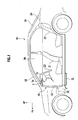
- an instrument panel 1 is an interior part located just below a windshield Gf of a vehicle M and exposed to direct sunlight.
- a vehicle heat-removing device 10 according to the embodiment is installed to the instrument panel 1, so as to restrain excessive increase in the temperature thereof when the vehicle M is left parked in a place subject to direct sunlight for a certain period.
- front seats 21 including a driver's seat and a passenger seat behind the instrument panel 1, and a rear seat 22 therebehind.
- a steering wheel 23 At the driver's seat side of the front seats 21, there is a steering wheel 23 at a lower portion of the instrument panel 1.
- a rear parcel shelf 24 as another vehicle interior part is provided directly below a rear windshield Gr in the rear of the vehicle passenger compartment 20.
- the incident direct sunlight through the windshield Gf is irradiated onto the surface of a top board (or a dashboard) 1a of the instrument panel 1.
- the top board 1a of the instrument panel has a plate-like structure including a baseboard 2 formed of a resin material or a composite material containing the resin, and a skin material 3 that covers the outer/upper surface of the baseboard 2.
- the upper portion of the top board 1a of the instrument panel corresponds to the outer portion of the instrument panel 1
- the lower portion of the top board 1a corresponds to the inner portion of the instrument panel 1.
- the vehicle heat-removing device 10 is provided with a heat conducting plate 11 and a heat pipe 13 as shown in Figs. 2 and 3.
- the heat conducting plate 11 is disposed on the inner side of the skin material 3 (lower side in Fig. 3), and inside in the direction of the thickness of the baseboard 2 (the upper side in Fig. 3, hereinafter, referred to as "the baseboard thickness direction") of an inner surface 2a of the baseboard 2, that is, inside of the baseboard 2, so as to collect the accumulated heat on the skin material 3 upon receipt of the direct sunlight.
- the heat pipe 13 is provided on an inner side of the inner surface 2a of the baseboard 2 and connected in heat-conductive relationship to the heat conducting plate so as to transfer the accumulated heat of the skin material 3 collected by the heat conducting plate 11 to a heat sink 12 (see Fig. 1) as a heat-releasing device.
- a heat-removal of the instrument panel 1 according to the embodiment is accomplished in the following manner.
- the heat of the direct sunlight that has been accumulated on the skin material 3 is collected by the heat conducting plate 11 provided on the inner side of the skin material 3 of the top board 1a of the instrument panel, and inside in the baseboard thickness direction of the inner surface 2a thereof, that is, inside of the baseboard 2, and then the heat of the skin material 3 collected by the heat conducting plate 11 is transferred to the heat sink 12 through the heat pipe 13.
- the heat pipe 13 is a well-known device to transfer heat of a specific portion to the other portion using latent heat resultant from evaporation and condensation of liquid.
- Typical heat pipe has a hollow tubular structure in which a liquid such as water and alcohol is sealed in. The sealed liquid is evaporated at an end of the heat pipe, receiving heat transferred to the end of the heat pipe, and is condensed and liquefied at the other end of the heat pipe while releasing heat to the heat sink. The resultant liquid is re-circulated to the opposite end again.
- the aforementioned cycle constitutes the basic structure of the heat pipe 13.
- various types of heat pipe using the aforementioned basic structure may be employed in this embodiment.
- the heat pipe 13 is formed as a linear/straight heat pipe having its portion disposed on the heat conducting plate 11 linearly formed.
- the heat sink 12 is located on a position to be exposed to the air outside of the passenger compartment 20, for example, on a body panel, a chassis, or a lower surface of a floor panel.
- the heat conducting plate 11 is insert-molded into the baseboard 2 of the instrument panel 1 upon injection molding thereof.
- the heat conducting plate 11 is insert-molded into the baseboard 2 so as to be embedded therewith.
- the heat conducting plate 11 When insert-molding the heat conducting plate 11 into the baseboard 2, the heat conducting plate 11 is provided with a plurality of brackets 14 each protruding inward from the inner surface 2a of the baseboard 2.
- the heat pipe 13 is connected in heat-conductive relationship to the heat conducting plate 11 by those brackets 14.
- the brackets 14 are integrally formed with the heat conducting plate 11 to protrude therefrom, using the same material as that of the heat conducting plate 11 or the material having similar heat conductivity thereto.
- the heat conducting plate 11 is insert-molded with those brackets 14 left protruded from the forming die of the baseboard 2.
- the bracket 14 is formed to have on its lower end a semi-circular recess portion 14a which accommodates the cylindrical heat pipe 13 as shown in Fig. 4.
- the heat pipe 13 is fit in the recess portion 14a, and the outer side thereof is covered with a holder 14b so as to be detachably fixed to the bracket 14.
- the brackets 14 are arranged along the length of an edge portion 11a of the heat conducting plate 11. Being fit with the respective brackets 14, the heat pipe 13 is disposed along the edge portion 11a of the heat conducting plate 11. In this state, the heat pipe 13 is connected to the heat conducting plate 11 through the respective brackets 14 at a plurality of connecting points.
- the heat conducting plate 11 may be formed of a material that exhibits good thermal conductance, for example, copper, aluminum, iron, carbon fiber, or a composite material thereof.
- the thickness t of the heat conducting plate 11 is set to 0.1 mm or larger, and the ratio of the thickness t to the whole thickness T including those of the baseboard 2, the skin material 3, and the heat conducting plate 11 is set to be 70% or lower.
- the heat conducting plate 11 of the vehicle heat-removing device 10 is press-formed into a shape of the instrument panel 1.
- Each of the brackets 14 is separately made and fixed to the heat conducting plate 11 to support the heat pipe 13 thereon.
- the heat conducting plate 11 is set in the forming die, together with the brackets 14, for injection molding so as to be insert-molded.
- the frame of the instrument panel 1 having a combination of the heat conducting plate 11 and the baseboard 2 is thus produced.
- the frame of the instrument panel 1 is set in a forming die of an injection molding for forming the skin material 3 adhered on the frame, to thereby form the instrument panel 1 according to the embodiment.
- one end of the heat pipe 13 is joined to the brackets 14 of the heat conducting plate 11. Then the other end of the heat pipe 13 is joined to the heat sink 12 provided outside of the vehicle passenger compartment 20 so as to form the desired vehicle heat-removing device 10.
- the top board 1a of the instrument panel is provided with the heat conducting plate 11 which serves to collect the heat accumulated on the skin material 3.
- the heat pipe 13 is connected in heat-conductive relationship to the heat conducting plate 11 such that the heat accumulated on the skin material 3 is transferred to the heat pump 12 via the heat conducting plate 11.
- the heat conducting plate 11 is disposed on the inner side of the skin material 3 and inside in the baseboard thickness direction of the inner surface 2a thereof, that is, inside of the baseboard 2. Accordingly, it is possible to efficiently transfer the heat accumulated on the skin material 3 to the heat conducting plate 11, and further to the heat pipe 13 through the brackets 14.
- the vehicle heat-removing device 10 of the embodiment thus, allows the heat accumulated on the skin material 3 to be efficiently transferred to the heat conducting plate 11. Then the heat collected by the heat conducting plate 11 is transferred to the heat pipe 13 to be released to the outside from the heat sink 12.
- the cooling efficiency of the high-thermal-capacity instrument panel 1 is thus enhanced, effectively restraining an increase in temperature of the passenger compartment 20 of the vehicle M that has been left parked in a place subject to direct sunlight for a certain period of time.
- the heat conducting plate 11 upon injection molding of the baseboard 2 of the instrument panel 1, the heat conducting plate 11 is insert-molded into the baseboard 2. This makes it possible to simplify the assembling operation of the heat conducting plate 11. As the heat conducting plate 11 is embedded in the baseboard 2, that is, covered with the resin as the material of the baseboard 2, the heat collected by the heat conducting plate 11 may be efficiently transferred to the heat pipe 13 without leaking to the vehicle passenger compartment 20.
- the heat conducting plate 11 is provided with a plurality of brackets 14 each protruding inward from the inner surface 2a of the baseboard 2.
- the heat pipe 13 is connected in heat-conductive relationship to the heat conducting plate 11 by these brackets 14. Accordingly, it is possible to connect the heat pipe 13 to the brackets 14 in a post process.
- the heat pipe 13 and the baseboard 2 including the heat conducting plate 11 may be separately made and installed to the vehicle M in the vehicle assembly process, thus simplifying the installation of the vehicle heat-removing device 10.
- the heat pipe 13 is provided along the edge portion 11a of the heat conducting plate 11 so as to be connected thereto through the plurality of brackets 14 at the plurality of connecting points.
- the temperature gradient is generated in the heat conducting plate 11 between its edge at which the heat pipe 13 is provided and the other edge at which the heat pipe 13 is not provided. Transfer of the heat from the heat conducting plate 11 to the heat pipe 13, thus, is promoted. This makes it possible to enhance the efficiency in the heat transfer to the heat pipe 13.
- the heat conducting plate 11 of the embodiment is formed of a material with good thermal conductance, for example, copper, aluminum, iron, carbon fiber, or a composite material thereof.
- the heat accumulated on a part of the skin material 3 can be substantially uniformly conducted to all over the heat conducting plate 11. This makes it possible to increase the amount of heat transferred from the skin material 3 to the heat pipe 13 via the heat conducting plate 11.
- the thickness t of the heat conducting plate 11 is set to 0.1 mm or larger, whereby moldability is kept good while maintaining its thickness above the minimum requirement, and the heat from the skin material 3 may be efficiently obtained and transferred to the heat pipe 13.
- the ratio of the thickness t to the total thickness T including those of the baseboard 2, skin material 3 and the heat conducting plate 11 is set to be 70 % or lower. This makes it possible to easily perform the insert-molding of the heat conducting plate 11 into the instrument panel 1 having complicated curved face, bent face and the like. The cost for the technique or facility to cope with such molding operation, thus, can be kept low.
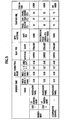
- Fig. 5 is a table which shows the heat-removing effect obtained from the vehicle heat-removing device 10 of the embodiment with respect to the data of the air temperature outside of and close to the instrument panel 1, the surface temperature, and the inner air temperature inside of the instrument panel 1 in comparison with those of the comparative example shown in Fig. 16.
- the heat conducting plate P for collecting heat is attached to the inner surface Ka of the instrument panel K, and the heat pipe H is attached directly to the inner surface of the heat conducting plate P.
- the comparative example employs a linear/straight heat pipe.
- the skin material has a surface formed of a thermoplastic resin material.
- the vehicle is left parked under the direct sunlight in summer at an amount of solar radiation of 850 W/m 2 at the maximum and average outside air temperature of 32 °C.
- the measurement was performed from 9:00 A.M. to 3:00 P.M. to record the temperature of the respective parts continuously and to make a comparison in the time zone at which the temperature becomes the highest.
- the air temperature outside of and close to the instrument panel measured 70°C, the surface temperature measured 75°C, and the inner air temperature measured 75°C.
- each of the air temperatures outside of and close to the instrument panel measured 54°C and 58°C, the surface temperatures measured 57°C and 63°C, and the inner air temperature measured 54 °C and 52 °C, respectively. This indicates the considerable temperature decrease derived from the vehicle heat-removing device 10 of the embodiment.
- Fig. 6 represents a second embodiment of the invention in which the same components as those of the first embodiment are designated as the same reference numerals. The description of those components, thus, will be omitted.
- a vehicle heat-removing device 10A has substantially the same structure as that of the first embodiment, and is provided with a heat conducting plate 11 for collecting the heat accumulated on a skin material 3, and a heat pipe 13 provided on an inner side of an inner surface 2a of a baseboard 2 and connected in heat-conductive relationship to the heat conducting plate 11 so as to transfer the heat of the skin material 3 collected by the heat conducting plate 11 to a heat sink 12 (see Fig. 1).
- the baseboard 2 is formed of an upper portion and a lower portion, that is, an outer baseboard 2b and an inner baseboard 2c, respectively.
- the heat conducting plate 11 is insert-molded into the inner surface of the outer baseboard 2b so as to be interposed between the outer baseboard 2b and the inner baseboard 2c.
- a plurality of brackets 14 each protruding downward from the inner baseboard 2c are attached to the heat conducting plate 11 so as to be connected to the linear/straight heat pipe 13.
- the heat conducting plate 11 in this embodiment has its thickness t equal to or larger than 0.1 mm, and preferably the ratio of the thickness t to the total thickness T including those of the baseboard 2, the skin material 3, and the heat conducting plate 11 is set to be 70% or lower.
- the second embodiment provides the same effects as those of the first embodiment.
- the heat conducting plate 11 is interposed between the outer baseboard 2b and the inner baseboard 2c so as to transfer the heat collected by the heat conducting plate 11 efficiently to the heat pipe 13 without causing leakage of the heat to the vehicle passenger compartment 20.
- Fig. 7 represents a third embodiment of the present invention in which the same components as those of the first and the second embodiments are designated as the same reference numerals. The description of those components, thus, will be omitted.
- a vehicle heat-removing device 10B has substantially the same structure as that of the first embodiment, and is provided with a heat conducting plate 11 for collecting the heat accumulated on a skin material 3, and a heat pipe 13 provided on an inner side of an inner surface 2a of a baseboard 2 and connected in heat-conductive relationship to the heat conducting plate 11 so as to transfer the heat of the skin material 3 collected by the heat conducting plate 11 to a heat sink 12 (see Fig. 1).
- the skin material 3 is formed of a skin surface material 3a and a soft pad 3b on the inner side thereof.
- the soft pad 3b is formed of open-cell foam of polyethylene foam, polyurethane foam and the like.
- the thickness of the baseboard 2 is reduced by the amount substantially equal to the thickness of the soft pad 3b.
- the heat conducting plate 11 is insert-molded into the upper surface of the baseboard 2 having the reduced thickness, and is brought into direct surface contact with the soft pad 3b.
- the heat conducting plate 11 is provided with a plurality of brackets 14 each protruding downward from the inner surface 2a of the baseboard 2 so as to be connected to the linear/straight heat pipe 13.
- the heat conducting plate 11 has its thickness t equal to or larger than 0.1 mm, and preferably the ratio of the thickness t to the total thickness T including those of the baseboard 2, the skin material 3, and the heat conducting plate 11 is set to be 70% or lower.
- the second embodiment provides the same effects as those of the first embodiment.
- the heat conducting plate 11 is interposed between the baseboard 2 and the soft pad 3b of the skin material 3. This makes it possible to efficiently transfer the heat collected by the heat conducting plate 11 to the heat pipe 13 without causing leakage of the heat to the vehicle passenger compartment 20.
- the skin material 3 is formed of the skin surface material 3a and the soft pad 3b that is interposed between the skin surface material 3a and the heat conducting plate 11.
- the soft pad 3b is formed of the open-cell foam allowing air circulating therein. The resultant natural convection within the foam makes it possible to reduce the insulation property of the heat conducting path from the skin surface material 3a to the heat conducting plate 11, thus efficiently allowing the heat conducting plate 11 to collect the heat accumulated on the skin material 3.
- Figs. 8 and 9 represent a fourth embodiment of the invention in which the same components as those of the first embodiment are designated as the same reference numerals. The description of those components, thus, will be omitted.
- a vehicle heat-removing device 10C has substantially the same structure as that of the first embodiment, and is provided with a heat conducting plate 11 disposed on the inner side (lower side in the drawing) of the skin material 3 and inside in the baseboard thickness direction (upper side in the drawing) of the inner surface 2a of the baseboard 2 for collecting the heat accumulated on a skin material 3, and a heat pipe 13 provided on an inner side of the inner surface 2a of the baseboard 2 and connected in heat-conductive relationship to the heat conducting plate 11 so as to transfer the heat of the skin material 3 collected by the heat conducting plate 11 to a heat sink.
- the vehicle heat-removing device 10C of the embodiment has two units of heat pipes 13, 13 as indicated by the solid line each extending along the respective edge portions 11a, 11b of the heat conducting plate 11.
- Each of the heat pipes 13 in this embodiment is connected to a plurality of brackets 14 each protruding downward from the baseboard 2.
- the respective brackets 14 connected to the linear/straight heat pipes 13 are arranged along both edge portions 11a, 11b of the heat conducting plate 11.
- the heat conducting plate 11 is insert-molded into the baseboard 2 of the instrument panel 1 upon injection molding thereof.
- the process for forming the heat conducting plate 11 is not limited to the one as described above.
- the baseboard 2 may be formed of the outer baseboard 2b and the inner baseboard 2c so as to interpose the heat conducting plate 11 therebetween.
- the skin material 3 may be formed of the skin surface material 3a and the soft pad 3b of the open-cell foam such that the heat conducting plate 11 is interposed between the baseboard 2 and the soft pad 3b.
- the vehicle heat-removing device 10C of the embodiment provides the same effects as those of the first embodiment.
- two heat pipes 13, 13 are extended along both edge portions 11a, 11b of the heat conducting plate 11.
- the temperature gradient generated therein between the edge portions 11a, 11b and the intermediate portion 11C of the heat conducting plate 11 becomes large whereby the heat transfer from the heat conducting plate 11 to the heat pipe 13 is promoted.
- heat flows toward an end portion with sufficient heat transfer capacity. This allows the temperature of the entire surface of the top board 1a of the instrument panel 1 to be uniformly reduced.
- the vehicle heat-removing device 10C is provided with two parallel heat pipes 13, 13 as indicated by the solid line of Fig. 8. It may be structured such that each end portion 13e of the heat pipes 13, 13 may be joined together so as to be communicated for forming a loop heat pipe.
- Figs. 3 and 10 represent a fifth embodiment of the invention.
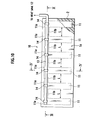
- a vehicle heat-removing device 10 is provided with a plurality of heat conducting plates 11 for collecting heat accumulated on the skin material 3 receiving direct sunlight, and a heat pipe 13.
- the heat conducting plates 11 are provided at predetermined intervals L in the longitudinal direction (the vehicle width direction) of the instrument panel 1 on the inner side of the skin material 3 (lower side in Fig. 3) and inside in the baseboard thickness direction (upper side in Fig. 3) of the inner surface 2a of the baseboard 2, that is, inside of the baseboard 2.
- the heat pipe 13 is provided on the inner side of the inner surface 2a of the baseboard 2 so as to be connected in heat-conductive relationship to the plurality of heat conducting plates 11 for transferring the heat of the skin material 3 that has been collected by the respective heat conducting plates 11 to a heat sink 12 (see Fig. 1) serving as a heat-releasing device.
- the plurality of heat conducting plates 11 are provided at predetermined intervals L in the longitudinal direction of the instrument panel 1 on the inner side of the skin material 3 and inside in the baseboard thickness direction of the inner surface 2a of the baseboard 2 such that the heat conducting plates 11 collect the heat of the direct sunlight accumulated on the skin material 3, and the heat of the skin material 3 collected by the heat conducting plates 11 is transferred through the heat pipe 13 to a heat sink 12 for releasing heat of the instrument panel 1.
- the heat pipe 13 is a well-known device to transfer heat of a specific portion to the other portion using latent heat resultant from evaporation and condensation of liquid.
- Typical heat pipe has a hollow tubular structure in which a liquid such as water and alcohol is sealed in. The sealed liquid is evaporated at an end of the heat pipe, receiving heat transferred to the end of the heat pipe, and is condensed and liquefied at the other end of the heat pipe while releasing heat to the heat sink. The resultant liquid is re-circulated to the opposite end again.
- the aforementioned cycle constitutes the basic structure of the heat pipe 13.
- various types of heat pipe using the aforementioned basic structure may be employed in this embodiment.
- the heat pipe 13 is formed as a linear/straight heat pipe having its portion disposed on the heat conducting plates 11 linearly formed.
- the heat sink 12 is located on a position to be exposed to the air outside of the passenger compartment 20, for example, on a body panel, a chassis, or a lower surface of a floor panel.
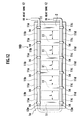
- the plurality of heat conducting plates 11 has edge portions 11a connected one another by connecting portions 11b so as to collectively form a comb-like shape as shown in Fig. 10.
- the heat conducting plates 11 are insert-molded into the baseboard 2 of the instrument panel 1 upon injection molding thereof as shown in Fig. 4.
- the heat conducting plates 11 are insert-molded into the baseboard 2 so as to be embedded therewith.
- a plurality of brackets 14 each protruding inward from the inner surface 2a of the baseboard 2 are provided, through which the heat pipe 13 is connected in heat-conductive relationship to the heat conducting plates 11.
- the brackets 14 are integrally formed with the heat conducting plates 11 to protrude therefrom, using the same material as that of the heat conducting plates 11 or the material having similar heat conductivity thereto.
- the heat conducting plates 11 are insert-molded with those brackets 14 left protruded from the forming die of the baseboard 2.
- the bracket 14 is formed to have on its lower end a semi-circular recess portion 14a which accommodates the cylindrical heat pipe 13 as shown in Fig. 4.
- the heat pipe 13 is fit in the recess portion 14a, and the outer side thereof is covered with a holder 14b so as to be detachably fixed to the bracket 14.
- the brackets 14 are arranged along the edge portions 11a of the respective heat conducting plates 11.
- the brackets 14 are arranged along the edge portions 11a of the heat conducting plates 11 to be fit with the heat pipe 13. In this state, the heat pipe 13 is connected to the heat conducting plates 11 by the brackets 14 at a plurality of connecting points.
- the heat conducting plates 11 may be formed of a material that exhibits good thermal conductance, for example, copper, aluminum, iron, carbon fiber, or a composite material thereof.
- the thickness t of the heat conducting plates 11 is set to 0.1 mm or larger, and the ratio of the thickness t to the whole thickness T including those of the baseboard 2, the skin material 3, and the heat conducting plate 11 is set to be 70% or lower.
- the total area of the plurality of heat conducting plates 11 are set to be in the range between 20 % and 80 % of the area of the top board 1a of the instrument panel 1, which is exposed to the direct sunlight.
- the respective heat conducting plates 11 are press molded in a shape of the instrument panel 1.
- Each of the brackets 14 on which the heat pipe 13 is supported is separately made and fixed to the heat conducting plates 11.
- the resultant heat conducting plates 11 with the brackets 14 are set in the forming die for injection molding of the baseboard 2 so as to be insert-molded therein.
- the frame of the instrument panel 1 having the baseboard 2 combined with the heat conducting plates 11 is thus produced.
- the frame of the instrument panel 1 is set in the forming die for the injection molding for forming the skin material 3 adhered on the frame, to thereby form the instrument panel 1 according to the embodiment.
- one end of the heat pipe 13 is joined to the brackets 14 of the heat conducting plate 11. Then the other end of the heat pipe 13 is joined to the heat sink 12 provided outside of the vehicle passenger compartment 20 so as to form the desired vehicle heat-removing device 10.
- the top board 1a of the instrument panel is provided with the heat conducting plates 11 which serve to collect the heat accumulated on the skin material 3.
- the heat pipe 13 is connected in heat-conductive relationship to the heat conducting plates 11 such that the heat accumulated on the skin material 3 is transferred to the heat pump 12 via the heat conducting plates 11.
- the heat conducting plates 11 are disposed on the inner side of the skin material 3 and inside in the baseboard thickness direction of the inner surface 2a thereof, that is, inside of the baseboard 2. Accordingly, it is possible to efficiently transfer the heat accumulated on the skin material 3 to the heat conducting plates 11, and further to the heat pipe 13 through the brackets 14.
- the vehicle heat-removing device 10 of the embodiment thus, allows the heat accumulated on the skin material 3 to be efficiently transferred to the heat conducting plates 11. Then the heat collected by the heat conducting plates 11 are transferred to the heat pipe 13 to be released to the outside from the heat sink 12.
- the cooling efficiency of the high-thermal-capacity instrument panel 1 is thus enhanced, effectively restraining an increase in temperature of the passenger compartment 20 of the vehicle M that has been left parked in a place subject to direct sunlight for a certain period of time.
- the plurality of heat conducting plates 11 are provided at predetermined intervals in the longitudinal direction of the instrument panel 1. Even if the instrument panel 1 has a complicated configuration including a curved portion, a bent portion and the like, the heat conducting plates 11 can be formed into the heat conducting plates 11. Accordingly the instrument panel 1 can be formed into a desired shape without sacrificing the moldability of the baseboard 2.
- the heat conducting plates 11 are insert-molded into the baseboard 2. This makes it possible to simplify the assembling operation of the heat conducting plates 11. As the heat conducting plates 11 are embedded in the baseboard 2, that is, covered with the resin as the material of the baseboard 2, the heat collected by the heat conducting plates 11 may be efficiently transferred to the heat pipe 13 without leaking to the vehicle passenger compartment 20.
- the heat conducting plates 11 are provided with a plurality of brackets 14 each protruding inward from the inner surface 2a of the baseboard 2.
- the heat pipe 13 is connected in heat-conductive relationship to the heat conducting plates 11 by these brackets 14. Accordingly, it is possible to connect the heat pipe 13 to the brackets 14 in a post process.
- the heat pipe 13 and the baseboard 2 including the heat conducting plates 11 may be separately made and installed to the vehicle M in the vehicle assembly process, thus simplifying the installation of the vehicle heat-removing device 10.
- the heat pipe 13 is disposed along the edge portions 11a of the respective heat conducting plates 11 so as to be connected thereto through the brackets 14.
- the temperature gradient in the heat conducting plates 11 may be generated between the edge side at which the heat pipe 13 is connected and the opposite edge side at which no heat pipe 13 is connected. Then flow of the heat from the heat conducting plates 11 toward the heat pipe 13 is promoted, thus further enhancing the efficiency of the heat transfer to the heat pipe 13.
- the heat conducting plates 11 of the embodiment are formed of a material with good thermal conductance, for example, copper, aluminum, iron, carbon fiber, or a composite material thereof.
- the heat accumulated on a part of the skin material 3 can be substantially uniformly conducted to all over the heat conducting plates 11. This makes it possible to increase the amount of heat transferred from the skin material 3 to the heat pipe 13 via the heat conducting plates 11.
- the thickness t of the heat conducting plates 11 is set to 0.1 mm or larger, whereby moldability is kept good while maintaining its thickness above the minimum requirement, and the heat from the skin material 3 may be efficiently obtained and transferred to the heat pipe 13.
- the ratio of the thickness t to the total thickness T including those of the baseboard 2, skin material 3 and the heat conducting plate 11 is set to be 70 % or lower. This makes it possible to easily perform the insert-molding of the heat conducting plates 11 into the instrument panel 1 having complicated curved face, bent face and the like. The cost for the technique or facility to cope with such molding operation, thus, can be kept low.
- the heat conducting plates 11 do not have to be provided to cover all the portions that require the heat transfer, as long as the ratio of the area of the heat conducting plates 11 to the area of the top board 1a of the instrument panel exposed to direct sunlight satisfies the required level.
- the total area of the plurality of heat conducting plates 11 is set to be within the rage between 20 % and 80 % of the area of the top board 1a of the instrument panel 1 exposed to the direct sunlight, which provide the required heat-removing function.
- Fig. 6 represents a sixth embodiment of the invention in which the same components as those of the fifth embodiment are designated as the same reference numerals. The description of those components, thus, will be omitted.
- a vehicle heat-removing device 10A has substantially the same structure as that of the fifth embodiment, and is provided with heat conducting plates 11 for collecting the heat accumulated on a skin material 3, and a heat pipe 13 provided on an inner side of an inner surface 2a of a baseboard 2 and connected in heat-conductive relationship to the heat conducting plates 11 so as to transfer the heat of the skin material 3 collected by the heat conducting plates 11 to a heat sink 12 (see Fig. 1).
- the baseboard 2 is formed of an upper portion and a lower portion, that is, an outer baseboard 2b and an inner baseboard 2c, respectively.
- the heat conducting plates 11 are insert-molded into the inner surface of the outer baseboard 2b so as to be interposed between the outer baseboard 2b and the inner baseboard 2c.
- a plurality of brackets 14 each protruding downward from the inner baseboard 2c are attached to the heat conducting plates 11 so as to be connected to the linear/straight heat pipe 13.
- each of the heat conducting plates 11 in this embodiment has its thickness t equal to or larger than 0.1 mm, and preferably the ratio of the thickness t to the total thickness T including those of the baseboard 2, the skin material 3, and the heat conducting plate 11 is set to be 70% or lower.
- the sixth embodiment provides the same effects as those of the fifth embodiment.
- the heat conducting plates 11 are interposed between the outer baseboard 2b and the inner baseboard 2c so as to transfer the heat collected by the heat conducting plates 11 efficiently to the heat pipe 13 without causing leakage of the heat to the vehicle passenger compartment 20.
- Fig. 7 represents a seventh embodiment of the present invention in which the same components as those of the fifth and the sixth embodiments are designated as the same reference numerals. The description of those components, thus, will be omitted.
- a vehicle heat-removing device 10B has substantially the same structure as that of the fifth embodiment, and is provided with heat conducting plates 11 for collecting the heat accumulated on a skin material 3 as shown in Fig. 7, and a heat pipe 13 provided on an inner side of an inner surface 2a of a baseboard 2 and connected in heat-conductive relationship to the heat conducting plates 11 so as to transfer the heat of the skin material 3 collected by the heat conducting plates 11 to a heat sink 12 (see Fig. 1).
- the skin material 3 is formed of a skin surface material 3a and a soft pad 3b on the inner side thereof.
- the soft pad 3b is formed of open-cell foam of polyethylene foam, polyurethane foam and the like.
- the thickness of the baseboard 2 is reduced by the amount substantially equal to the thickness of the soft pad 3b.
- the heat conducting plates 11 are insert-molded into the upper surface of the baseboard 2 having the reduced thickness, and is brought into direct surface contact with the soft pad 3b.
- the heat conducting plates 11 are provided with a plurality of brackets 14 each protruding downward from the inner surface 2a of the baseboard 2 so as to be connected to the linear/straight heat pipe 13.
- each of the heat conducting plates 11 has its thickness t equal to or larger than 0.1 mm, and preferably the ratio of the thickness t to the total thickness T including those of the baseboard 2, the skin material 3, and the heat conducting plate 11 is set to be 70% or lower.
- the seventh embodiment provides the same effects as those of the fifth embodiment.
- the heat conducting plates 11 are interposed between the baseboard 2 and the soft pad 3b of the skin material 3. This makes it possible to efficiently transfer the heat collected by the heat conducting plates 11 to the heat pipe 13 without causing leakage of the heat to the vehicle passenger compartment 20.
- the skin material 3 is formed of the skin surface material 3a and the soft pad 3b that is interposed between the skin surface material 3a and the heat conducting plates 11.
- the soft pad 3b is formed of the open-cell foam allowing air circulating therein. The resultant natural convection within the foam makes it possible to reduce the insulation property of the heat conducting path from the skin surface material 3a to the heat conducting plates 11, thus efficiently allowing the heat conducting plates 11 to collect the heat accumulated on the skin material 3.
- Fig. 11 represents an eighth embodiment of the invention, in which the same components as those of the fifth embodiment are designated as the same reference numerals. The description of those components, thus, will be omitted.
- a vehicle heat-removing device 10C of the embodiment has substantially the same structure as that of the fifth embodiment, and is provided with a plurality of heat conducting plates 11 on the inner side of the skin material 3 and inside in the baseboard thickness direction of the inner surface 2a of the baseboard 2.
- the vehicle heat-removing device 10C is different from the vehicle heat-removing device 10 of the fifth embodiment in that each of the plurality of sheet-like heat conducting plates 11 is separately provided without being connected at the edge portions 11a thereof.
- brackets 14 are disposed along the edge portions 11a of the heat conducting plates 11 such that the heat pipe 13 is connected in heat-conductive relationship to the heat conducting plates 11 by the brackets 14.
- the heat conducting plates 11 may be insert-molded into the baseboard 2 of the instrument panel 1 upon injection molding thereof.
- the baseboard 2 may be formed of the outer baseboard 2b and the inner baseboard 2c interposing the heat conducting plates 11 therebetween.
- the skin material 3 may be formed of a skin surface material 3a and a soft pad 3b of the open-cell foam such that the heat conducting plates 11 are interposed between the baseboard 2 and the soft pad 3b.
- the total area of the plurality of heat conducting plates 11 is set to be in the range between 20 % and 80 % of the area of the top board 1a of the instrument panel 1 receiving the direct sunlight.
- the embodiment thus, can provide the similar effects to those of the fifth embodiment.
- the heat accumulated on the skin material 3 is increasingly collected by the heat conducting plates 11 which in turn transfer the collected heat to the heat pipe 13 such that the heat is released outside from the heat sink 12.
- the heat conducting plates 11 are separately provided so as to prevent deterioration in the moldability of the instrument panel 1.
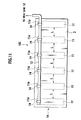
- Fig. 12 represents a ninth embodiment of the invention in which the same components as those of the fifth embodiment are designated as the same reference numerals. The description of those components, thus, will be omitted.
- a vehicle heat-removing device 10D of the embodiment has basically the same structure as that of the fifth embodiment, in which a plurality of heat conducting plates 11 are provided at predetermined intervals L in the longitudinal direction (the vehicle width direction) of the instrument panel 1.
- the vehicle heat-removing device 10D of the embodiment is different from the vehicle heat-removing device 10 of the fifth embodiment in that two parallel heat pipes 13 are provided as indicated by the solid line shown in Fig. 12 each provided along both edge portions 11a, 11c of the heat conducting plates 11, respectively.
- the heat pipes 13, 13 are connected to the plurality of brackets 14 each protruding downward from the baseboard 2, and being arranged along both edge portions 11a, 11c of the heat conducting plates 11.
- the linear/straight heat pipes 13, 13 are employed.
- the plurality of heat conducting plates 11 in this embodiment are connected at the respective edge portions 11a by the connecting portions 11b, and at the other edge portions 11c by the connecting portions 11d such that the heat conducting plates 11 collectively have a ladder-like shape.
- the heat conducting plates 11 may be insert-molded into the baseboard 2 of the instrument panel 1 upon injection molding thereof.
- the baseboard 2 may be formed of the outer baseboard 2b and the inner baseboard 2c so as to interpose the heat conducting plates 11 therebetween.
- the skin material 3 may be formed of a skin surface material 3a and a soft pad 3b formed of the open-cell foam such that the heat conducting plates 11 are interposed between the baseboard 2 and the soft pad 3b.
- the total area of the heat conducting plates 11 is set to be in the range between 20 % and 80 % of the area of the top board 1a of the instrument panel 1 receiving the direct sunlight.
- the vehicle heat-removing device 10D of the embodiment may provide the similar effects to those of the fifth embodiment.
- two heat pipes 13, 13 are provided at both edge portions 11a, 11c of the heat conducting plates 11, and the center portions thereof are separated from one another.
- the temperature gradient is generated toward each of the edge portions 11a, 11c, whereby the heat transfer from the heat conducting plates 11 to the heat pipe 13 is promoted.
- the heat flow is generated toward the end portion with sufficient heat transfer capacity. This makes the temperature of the entire surface of the top board 1a of the instrument panel uniformly decreased.
- the vehicle heat-removing device 10D of the embodiment is provided with two heat pipes 13, 13 as indicated by the solid line of Fig. 13. However, each end portion 13e of those two heat pipes 13, 13 may be joined together so as to be communicated for forming the loop heat pipe as indicated by the chain double-dashed line of Fig. 13.
- Figs. 13, 14 represent a tenth embodiment of the invention in which the same components as those of the fifth and the ninth embodiments are designated as the same reference numerals. The description of those components, thus, will be omitted.
- a vehicle heat-removing device 10E of the embodiment has basically the same structure as that of the fifth embodiment.
- a plurality of heat conducting plates 11 are provided at predetermined intervals L in the longitudinal direction of the instrument panel 1.
- two heat pipes 13, 13 are disposed at both edge portions 11a, 11c of the heat conducting plates 11.
- the vehicle heat-removing device 10E of the embodiment is different from the vehicle heat-removing device 10D of the fifth embodiment in that the heat conducting plates 11 are separately provided in the same way as in the eighth embodiment (see Fig. 11) leaving each interval ⁇ in a center portion 11f between edge portions 11a and 11c of the respective heat conducting plates 11.
- the heat conducting plates 11, thus, are formed to collectively have a lattice-like shape.
- the heat conducting plates 11 may be insert-molded into the baseboard 2 of the instrument panel 1 upon injection molding thereof.
- the baseboard 2 may be formed of the outer baseboard 2b and the inner baseboard 2c so as to interpose the heat conducting plates 11 therebetween.
- the skin material 3 may be formed of the skin surface material 3a and the soft pad 3b formed of the open-cell foam such that the heat conducting plates 11 are interposed between the baseboard 2 and the soft pad 3b.
- the vehicle heat-removing device 10E of the embodiment may provide the similar effects to those of the fifth embodiment.
- two heat pipes 13, 13 are provided at both edge portions 11a, 11c of the heat conducting plates 11. As each temperature of the edge portions 11a and 11c of the heat conducting plates 11 is decreased, the temperature gradient of the heat conducting plate 11 between the edge portions 11a, 11c and the center portion 11f becomes large. This may promote the heat transfer from the heat conducting plates 11 to the heat pipe 13. In the case where the part of the top board 1a of the instrument panel 1 is exposed to the direct sunlight, the heat flows to the end portion with sufficient heat transfer capacity whereby the temperature on the entire surface of the top board 1a of the instrument panel is uniformly decreased.
- the heat conducting plates 11 are separately provided so as to prevent deterioration in the moldability of the instrument panel 1.
- each end portion 13e of the heat pipes 13, 13 is joined together so as to be communicated for forming the loop heat pipe.
- the “interior part” in Table of Fig. 15 represents the instrument panel 1 described in the respective embodiments.
- the embodiment case 1 represents the case where the heat conducting plates 11 have a comb-like shape (fifth embodiment)
- Case 2 represents the case where the heat conducting plates 11 have a ladder-like shape (ninth embodiment)
- Case 3 represents the case where the heat conducting plates 11 have a strip-like shape (eighth embodiment)
- Case 4 represents the case where the heat conducting plate 11 have a lattice-like shape (tenth embodiment), respectively.
- the comparative example shown in Fig. 16 has the structure in which the heat conducting plate P is attached to an inner surface Ka of an instrument panel K for collecting heat, and a heat pipe H is directly attached to the inner surface of the heat conducting plate P.
- the comparative example Case 1 represents the case where the heat conducting plate P has a strip-like shape
- Case 2 represents the case where the heat conducting plate P is formed of a single plate.
- Each of those comparative examples employs the linear/straight heat pipe in the same way as in the embodiments.
- the skin material has a surface formed of a thermoplastic resin material.
- the vehicle is left parked under the direct sunlight in summer at an amount of solar radiation of 850 W/m 2 at the maximum and average outside air temperature of 32 °C.
- the measurement was performed from 9:00 A.M. to 3:00 P.M. to record the temperature of the respective parts continuously and to make a comparison in the time zone at which the temperature becomes the highest.
- the air temperatures outside of and close to the instrument panel measured 68°C, 70°C, the surface temperatures measured 72°C, 75°C, and the inner air temperatures inside of the instrument panel measured 72°C, 75°C, respectively.
- the air temperatures outside of and close to the instrument panel measured 55°C, 54°C, 55°C, 54°C, the surface temperatures measured 58°C, 57°C, 59°C, 57°C, and the inner air temperatures measured 56°C, 55°C, 56°C, 56°C, respectively.
- the vehicle heat-removing device greatly contributes to the temperature decrease.
- the vehicle heat-removing devices 10, and 10A to 10E are applied to the instrument panel 1.
- the invention is applicable to other interior part in the vehicle passenger compartment, for example, the rear parcel shelf 24.
- the scope of the invention being indicated by the claims, and all variations which come within the meaning of claims are intended to be embraced herein.
Landscapes
- Physics & Mathematics (AREA)
- Thermal Sciences (AREA)
- Engineering & Computer Science (AREA)
- Mechanical Engineering (AREA)
- Body Structure For Vehicles (AREA)
- Vehicle Interior And Exterior Ornaments, Soundproofing, And Insulation (AREA)
Applications Claiming Priority (2)
| Application Number | Priority Date | Filing Date | Title |
|---|---|---|---|
| JP2004374900A JP2006182066A (ja) | 2004-12-24 | 2004-12-24 | 車両用放熱装置および車両用内装部品の放熱方法 |
| JP2004374906A JP2006182068A (ja) | 2004-12-24 | 2004-12-24 | 車両用放熱装置および車両用内装部品の放熱方法 |
Publications (3)
| Publication Number | Publication Date |
|---|---|
| EP1674309A2 true EP1674309A2 (de) | 2006-06-28 |
| EP1674309A3 EP1674309A3 (de) | 2007-06-20 |
| EP1674309B1 EP1674309B1 (de) | 2010-02-17 |
Family
ID=36128424
Family Applications (1)
| Application Number | Title | Priority Date | Filing Date |
|---|---|---|---|
| EP05027781A Expired - Fee Related EP1674309B1 (de) | 2004-12-24 | 2005-12-19 | Vorrichtung und Verfahren zum Abführen der Wärme eines Innenteils für Fahrzeuge |
Country Status (3)
| Country | Link |
|---|---|
| US (1) | US7530386B2 (de) |
| EP (1) | EP1674309B1 (de) |
| DE (1) | DE602005019370D1 (de) |
Cited By (1)
| Publication number | Priority date | Publication date | Assignee | Title |
|---|---|---|---|---|
| DE102010064343A1 (de) * | 2010-12-29 | 2012-07-05 | Volkswagen Ag | Verfahren zur Kühlung eines Moduls für ein Fahrzeug sowie entsprechende Kühlvorrichtung und Fahrzeug |
Families Citing this family (7)
| Publication number | Priority date | Publication date | Assignee | Title |
|---|---|---|---|---|
| US20070245755A1 (en) * | 2006-04-24 | 2007-10-25 | Galvez-Ramos Antonio M | Air cooling system for parked automobiles |
| US8312950B2 (en) * | 2008-03-03 | 2012-11-20 | Nissan North America, Inc. | Modular vehicle front end with resin overmold bracket and vehicle comprising same |
| US9555688B2 (en) * | 2011-08-04 | 2017-01-31 | Ford Global Technologies, Llc | Therma-zone vehicle system |
| US9682608B2 (en) * | 2013-01-30 | 2017-06-20 | Hanon Systems | Supplemental heating and cooling sources for a heating, ventilation and air conditioning system |
| US11890923B2 (en) * | 2020-06-24 | 2024-02-06 | Honda Motor Co., Ltd. | Upper body heat exchanger for vehicles |
| JP7571659B2 (ja) * | 2021-05-17 | 2024-10-23 | 株式会社オートネットワーク技術研究所 | 機器モジュール及び機器モジュールの配置構造 |
| JP2022189149A (ja) * | 2021-06-10 | 2022-12-22 | 日産自動車株式会社 | 空調装置 |
Citations (1)
| Publication number | Priority date | Publication date | Assignee | Title |
|---|---|---|---|---|
| JP2004058943A (ja) | 2002-07-31 | 2004-02-26 | Furukawa Electric Co Ltd:The | 自動車用計器パネル冷却装置および冷却方法 |
Family Cites Families (11)
| Publication number | Priority date | Publication date | Assignee | Title |
|---|---|---|---|---|
| US3618854A (en) * | 1968-12-23 | 1971-11-09 | Isotopes Inc | Vehicle-heating system employing a critical point heat pipe |
| DE3519044A1 (de) * | 1984-05-28 | 1985-11-28 | Mitsubishi Denki K.K., Tokio/Tokyo | Kuehler fuer kraftfahrttechnische verwendung und kraftfahrzeug-klimaanlage |
| US5036905A (en) * | 1989-10-26 | 1991-08-06 | The United States Of America As Represented By The Secretary Of The Air Force | High efficiency heat exchanger |
| DE4219938A1 (de) * | 1991-06-21 | 1992-12-24 | Showa Aluminum Corp | Verkleidungsplatte zur verwendung in automobilen oder anderen fahrzeugen |
| JP2574402Y2 (ja) | 1992-12-04 | 1998-06-11 | 矢崎総業株式会社 | メータケースの放熱構造 |
| US5950710A (en) * | 1997-11-21 | 1999-09-14 | Continocean Tech Inc. | Overheat regulating system for vehicle passenger compartment |
| WO2002092369A1 (en) * | 2001-05-14 | 2002-11-21 | Midwest Research Institute | Passive cooling system for a vehicle |
| FR2839473B1 (fr) * | 2002-05-10 | 2006-01-20 | Valeo Climatisation | Dispositif de chauffage et/ou de refroidissement d'un habitacle de vehicule, et planche de bord equipee d'un tel dispositif |
| JP4208519B2 (ja) | 2002-08-22 | 2009-01-14 | 株式会社フジクラ | 車両におけるダッシュパネルの冷却装置 |
| JP4380138B2 (ja) | 2002-10-21 | 2009-12-09 | 日産自動車株式会社 | 車両用放熱装置 |
| US6964294B2 (en) * | 2003-09-24 | 2005-11-15 | Midwest Research Institute | Passive cooling system for a vehicle |
-
2005
- 2005-12-19 EP EP05027781A patent/EP1674309B1/de not_active Expired - Fee Related
- 2005-12-19 DE DE602005019370T patent/DE602005019370D1/de not_active Expired - Lifetime
- 2005-12-22 US US11/313,638 patent/US7530386B2/en not_active Expired - Fee Related
Patent Citations (1)
| Publication number | Priority date | Publication date | Assignee | Title |
|---|---|---|---|---|
| JP2004058943A (ja) | 2002-07-31 | 2004-02-26 | Furukawa Electric Co Ltd:The | 自動車用計器パネル冷却装置および冷却方法 |
Cited By (1)
| Publication number | Priority date | Publication date | Assignee | Title |
|---|---|---|---|---|
| DE102010064343A1 (de) * | 2010-12-29 | 2012-07-05 | Volkswagen Ag | Verfahren zur Kühlung eines Moduls für ein Fahrzeug sowie entsprechende Kühlvorrichtung und Fahrzeug |
Also Published As
| Publication number | Publication date |
|---|---|
| EP1674309B1 (de) | 2010-02-17 |
| DE602005019370D1 (de) | 2010-04-01 |
| US20060140594A1 (en) | 2006-06-29 |
| US7530386B2 (en) | 2009-05-12 |
| EP1674309A3 (de) | 2007-06-20 |
Similar Documents
| Publication | Publication Date | Title |
|---|---|---|
| EP1674309B1 (de) | Vorrichtung und Verfahren zum Abführen der Wärme eines Innenteils für Fahrzeuge | |
| CN218368008U (zh) | 用于车辆内部的前部的车辆驾驶室模块 | |
| US20100274396A1 (en) | Thermoelectric climate control | |
| US20150219367A1 (en) | Thermoelectric heat exchanger capable of providing two different discharge temperatures | |
| ATE358033T1 (de) | Dachmodul für ein fahrzeug | |
| US6964294B2 (en) | Passive cooling system for a vehicle | |
| WO2000070374A1 (en) | Exterior mirror sub-assembly with combined electronic circuitry and mirror element | |
| CN114286765A (zh) | 用于形成车辆顶部的包括支撑模块的顶部模块 | |
| US10449877B1 (en) | Vehicle seat with serpentine air flow channel | |
| CN108736094B (zh) | 用于机动车的蓄电池系统 | |
| CN112793539A (zh) | 用于车辆的驾驶员辅助系统 | |
| US6501907B1 (en) | Heating facility for a motor vehicle component to be heated | |
| JP2005212556A (ja) | 車両用輻射暖房装置 | |
| US20210138872A1 (en) | Module for accommodating and cooling electronic circuitry in a vehicle | |
| US12420651B2 (en) | Charge port cooling system for an electric vehicle | |
| EP2518424A2 (de) | Thermoelektrischer Wärmetauscher mit Fähigkeit zur Bereitstellung zwei verschiedener Entladungstemperaturen | |
| CN110160576B (zh) | 用于将传感器组件安装在运输工具上的传感器系统 | |
| CN108569222B (zh) | 通过车辆风挡的、驾驶员辅助摄像机的温度管理装置 | |
| US20160368458A1 (en) | Thermoelectric dehumidifying apparatus | |
| JP2022166643A (ja) | ウインドシールド装置 | |
| JP5109645B2 (ja) | ナビゲーション装置用冷却装置および温度制御システム | |
| JP2006182066A (ja) | 車両用放熱装置および車両用内装部品の放熱方法 | |
| US20020196646A1 (en) | Method and arrangement for providing a heat sink to a DC to DC converter and beneficial utilization of heat energy rejected by a DC to DC converter | |
| US7405669B2 (en) | Sensor arrangement | |
| WO2002092369A1 (en) | Passive cooling system for a vehicle |
Legal Events
| Date | Code | Title | Description |
|---|---|---|---|
| PUAI | Public reference made under article 153(3) epc to a published international application that has entered the european phase |
Free format text: ORIGINAL CODE: 0009012 |
|
| 17P | Request for examination filed |
Effective date: 20051219 |
|
| AK | Designated contracting states |
Kind code of ref document: A2 Designated state(s): AT BE BG CH CY CZ DE DK EE ES FI FR GB GR HU IE IS IT LI LT LU LV MC NL PL PT RO SE SI SK TR |
|
| AX | Request for extension of the european patent |
Extension state: AL BA HR MK YU |
|
| PUAL | Search report despatched |
Free format text: ORIGINAL CODE: 0009013 |
|
| AK | Designated contracting states |
Kind code of ref document: A3 Designated state(s): AT BE BG CH CY CZ DE DK EE ES FI FR GB GR HU IE IS IT LI LT LU LV MC NL PL PT RO SE SI SK TR |
|
| AX | Request for extension of the european patent |
Extension state: AL BA HR MK YU |
|
| AKX | Designation fees paid |
Designated state(s): DE FR GB |
|
| GRAP | Despatch of communication of intention to grant a patent |
Free format text: ORIGINAL CODE: EPIDOSNIGR1 |
|
| GRAS | Grant fee paid |
Free format text: ORIGINAL CODE: EPIDOSNIGR3 |
|
| GRAA | (expected) grant |
Free format text: ORIGINAL CODE: 0009210 |
|
| AK | Designated contracting states |
Kind code of ref document: B1 Designated state(s): DE FR GB |
|
| REG | Reference to a national code |
Ref country code: GB Ref legal event code: FG4D |
|
| REF | Corresponds to: |
Ref document number: 602005019370 Country of ref document: DE Date of ref document: 20100401 Kind code of ref document: P |
|
| PLBE | No opposition filed within time limit |
Free format text: ORIGINAL CODE: 0009261 |
|
| STAA | Information on the status of an ep patent application or granted ep patent |
Free format text: STATUS: NO OPPOSITION FILED WITHIN TIME LIMIT |
|
| 26N | No opposition filed |
Effective date: 20101118 |
|
| GBPC | Gb: european patent ceased through non-payment of renewal fee |
Effective date: 20101219 |
|
| REG | Reference to a national code |
Ref country code: FR Ref legal event code: ST Effective date: 20110831 |
|
| PG25 | Lapsed in a contracting state [announced via postgrant information from national office to epo] |
Ref country code: FR Free format text: LAPSE BECAUSE OF NON-PAYMENT OF DUE FEES Effective date: 20110103 |
|
| REG | Reference to a national code |
Ref country code: DE Ref legal event code: R119 Ref document number: 602005019370 Country of ref document: DE Effective date: 20110701 |
|
| PG25 | Lapsed in a contracting state [announced via postgrant information from national office to epo] |
Ref country code: DE Free format text: LAPSE BECAUSE OF NON-PAYMENT OF DUE FEES Effective date: 20110701 Ref country code: GB Free format text: LAPSE BECAUSE OF NON-PAYMENT OF DUE FEES Effective date: 20101219 |