EP1671956A1 - Oxazolinmischung und ihre Verwendung als Verarbeitungshilfsmittel für Kunststoffe und Pigmente - Google Patents
Oxazolinmischung und ihre Verwendung als Verarbeitungshilfsmittel für Kunststoffe und Pigmente Download PDFInfo
- Publication number
- EP1671956A1 EP1671956A1 EP05026431A EP05026431A EP1671956A1 EP 1671956 A1 EP1671956 A1 EP 1671956A1 EP 05026431 A EP05026431 A EP 05026431A EP 05026431 A EP05026431 A EP 05026431A EP 1671956 A1 EP1671956 A1 EP 1671956A1
- Authority
- EP
- European Patent Office
- Prior art keywords
- mol
- acid
- fatty acid
- oxazoline
- montan wax
- Prior art date
- Legal status (The legal status is an assumption and is not a legal conclusion. Google has not performed a legal analysis and makes no representation as to the accuracy of the status listed.)
- Withdrawn
Links
- 239000000203 mixture Substances 0.000 title claims abstract description 39
- 150000002918 oxazolines Chemical class 0.000 title claims abstract description 17
- 239000000049 pigment Substances 0.000 title claims description 11
- 239000006057 Non-nutritive feed additive Substances 0.000 title claims description 3
- 229920000642 polymer Polymers 0.000 title description 2
- 235000014113 dietary fatty acids Nutrition 0.000 claims abstract description 71
- 239000000194 fatty acid Substances 0.000 claims abstract description 71
- 229930195729 fatty acid Natural products 0.000 claims abstract description 71
- 150000004665 fatty acids Chemical class 0.000 claims abstract description 48
- 239000002253 acid Substances 0.000 claims abstract description 41
- -1 hydroxy fatty acid Chemical class 0.000 claims abstract description 31
- 239000012170 montan wax Substances 0.000 claims abstract description 30
- IMSODMZESSGVBE-UHFFFAOYSA-N 2-Oxazoline Chemical compound C1CN=CO1 IMSODMZESSGVBE-UHFFFAOYSA-N 0.000 claims abstract description 29
- 239000010954 inorganic particle Substances 0.000 claims abstract description 13
- 239000011146 organic particle Substances 0.000 claims abstract description 11
- 238000002360 preparation method Methods 0.000 claims abstract description 4
- 238000000034 method Methods 0.000 claims description 25
- LENZDBCJOHFCAS-UHFFFAOYSA-N tris Chemical compound OCC(N)(CO)CO LENZDBCJOHFCAS-UHFFFAOYSA-N 0.000 claims description 18
- 230000008569 process Effects 0.000 claims description 13
- 229920003023 plastic Polymers 0.000 claims description 12
- 239000004033 plastic Substances 0.000 claims description 12
- GWEVSGVZZGPLCZ-UHFFFAOYSA-N Titan oxide Chemical compound O=[Ti]=O GWEVSGVZZGPLCZ-UHFFFAOYSA-N 0.000 claims description 11
- 230000032050 esterification Effects 0.000 claims description 11
- 238000005886 esterification reaction Methods 0.000 claims description 11
- 229920006324 polyoxymethylene Polymers 0.000 claims description 11
- ULQISTXYYBZJSJ-UHFFFAOYSA-N 12-hydroxyoctadecanoic acid Chemical compound CCCCCCC(O)CCCCCCCCCCC(O)=O ULQISTXYYBZJSJ-UHFFFAOYSA-N 0.000 claims description 10
- 229930040373 Paraformaldehyde Natural products 0.000 claims description 9
- 125000000217 alkyl group Chemical group 0.000 claims description 8
- XECAHXYUAAWDEL-UHFFFAOYSA-N acrylonitrile butadiene styrene Chemical compound C=CC=C.C=CC#N.C=CC1=CC=CC=C1 XECAHXYUAAWDEL-UHFFFAOYSA-N 0.000 claims description 7
- 229920000122 acrylonitrile butadiene styrene Polymers 0.000 claims description 7
- 239000004676 acrylonitrile butadiene styrene Substances 0.000 claims description 7
- 239000003054 catalyst Substances 0.000 claims description 7
- 150000007513 acids Chemical class 0.000 claims description 6
- 239000000835 fiber Substances 0.000 claims description 6
- 239000004417 polycarbonate Substances 0.000 claims description 6
- 229920001955 polyphenylene ether Polymers 0.000 claims description 6
- 229940114072 12-hydroxystearic acid Drugs 0.000 claims description 5
- QDGWLDZPJHGIKB-UHFFFAOYSA-N 4,5-dihydro-1,3-oxazol-2-ylmethanediol Chemical class OC(O)C1=NCCO1 QDGWLDZPJHGIKB-UHFFFAOYSA-N 0.000 claims description 5
- 125000004432 carbon atom Chemical group C* 0.000 claims description 5
- 239000003795 chemical substances by application Substances 0.000 claims description 5
- 125000002887 hydroxy group Chemical group [H]O* 0.000 claims description 5
- 238000004519 manufacturing process Methods 0.000 claims description 5
- 239000002245 particle Substances 0.000 claims description 5
- 239000000126 substance Substances 0.000 claims description 5
- 239000004408 titanium dioxide Substances 0.000 claims description 5
- 239000001023 inorganic pigment Substances 0.000 claims description 4
- 239000004611 light stabiliser Substances 0.000 claims description 4
- 239000012860 organic pigment Substances 0.000 claims description 4
- 239000003973 paint Substances 0.000 claims description 4
- 229920000515 polycarbonate Polymers 0.000 claims description 4
- 239000004904 UV filter Substances 0.000 claims description 3
- 239000003963 antioxidant agent Substances 0.000 claims description 3
- 239000002216 antistatic agent Substances 0.000 claims description 3
- 239000000945 filler Substances 0.000 claims description 3
- 239000003063 flame retardant Substances 0.000 claims description 3
- 239000012796 inorganic flame retardant Substances 0.000 claims description 3
- 238000000465 moulding Methods 0.000 claims description 3
- 239000004814 polyurethane Substances 0.000 claims description 3
- 229920002635 polyurethane Polymers 0.000 claims description 3
- 229920006395 saturated elastomer Polymers 0.000 claims description 3
- 239000003381 stabilizer Substances 0.000 claims description 3
- 239000004952 Polyamide Substances 0.000 claims description 2
- 239000004793 Polystyrene Substances 0.000 claims description 2
- HCHKCACWOHOZIP-UHFFFAOYSA-N Zinc Chemical compound [Zn] HCHKCACWOHOZIP-UHFFFAOYSA-N 0.000 claims description 2
- 125000000524 functional group Chemical group 0.000 claims description 2
- 229920005669 high impact polystyrene Polymers 0.000 claims description 2
- 239000004797 high-impact polystyrene Substances 0.000 claims description 2
- 239000004597 plastic additive Substances 0.000 claims description 2
- 229920002647 polyamide Polymers 0.000 claims description 2
- 229920000728 polyester Polymers 0.000 claims description 2
- 229920002959 polymer blend Polymers 0.000 claims description 2
- 229920013636 polyphenyl ether polymer Polymers 0.000 claims description 2
- 229920002223 polystyrene Polymers 0.000 claims description 2
- 239000000344 soap Substances 0.000 claims description 2
- 150000003606 tin compounds Chemical class 0.000 claims description 2
- LLZRNZOLAXHGLL-UHFFFAOYSA-J titanic acid Chemical class O[Ti](O)(O)O LLZRNZOLAXHGLL-UHFFFAOYSA-J 0.000 claims description 2
- 239000002966 varnish Substances 0.000 claims description 2
- 229910052725 zinc Inorganic materials 0.000 claims description 2
- 239000011701 zinc Substances 0.000 claims description 2
- 235000014692 zinc oxide Nutrition 0.000 claims description 2
- RNWHGQJWIACOKP-UHFFFAOYSA-N zinc;oxygen(2-) Chemical class [O-2].[Zn+2] RNWHGQJWIACOKP-UHFFFAOYSA-N 0.000 claims description 2
- NLHHRLWOUZZQLW-UHFFFAOYSA-N Acrylonitrile Chemical compound C=CC#N NLHHRLWOUZZQLW-UHFFFAOYSA-N 0.000 claims 1
- MTAZNLWOLGHBHU-UHFFFAOYSA-N butadiene-styrene rubber Chemical compound C=CC=C.C=CC1=CC=CC=C1 MTAZNLWOLGHBHU-UHFFFAOYSA-N 0.000 claims 1
- 239000000047 product Substances 0.000 description 24
- WSFSSNUMVMOOMR-UHFFFAOYSA-N Formaldehyde Chemical compound O=C WSFSSNUMVMOOMR-UHFFFAOYSA-N 0.000 description 21
- IJGRMHOSHXDMSA-UHFFFAOYSA-N Atomic nitrogen Chemical compound N#N IJGRMHOSHXDMSA-UHFFFAOYSA-N 0.000 description 10
- 238000006243 chemical reaction Methods 0.000 description 10
- 238000012360 testing method Methods 0.000 description 10
- 230000000694 effects Effects 0.000 description 6
- 238000012545 processing Methods 0.000 description 6
- 239000002994 raw material Substances 0.000 description 6
- 125000003178 carboxy group Chemical group [H]OC(*)=O 0.000 description 5
- 150000001875 compounds Chemical class 0.000 description 5
- 239000000314 lubricant Substances 0.000 description 5
- 229910052757 nitrogen Inorganic materials 0.000 description 5
- 229920001577 copolymer Polymers 0.000 description 4
- 150000005690 diesters Chemical class 0.000 description 4
- 239000011159 matrix material Substances 0.000 description 4
- 235000010215 titanium dioxide Nutrition 0.000 description 4
- 0 CC1(*)N=C(*)OC1 Chemical compound CC1(*)N=C(*)OC1 0.000 description 3
- UQSXHKLRYXJYBZ-UHFFFAOYSA-N Iron oxide Chemical compound [Fe]=O UQSXHKLRYXJYBZ-UHFFFAOYSA-N 0.000 description 3
- 235000021355 Stearic acid Nutrition 0.000 description 3
- 230000009471 action Effects 0.000 description 3
- 150000001732 carboxylic acid derivatives Chemical class 0.000 description 3
- 150000001735 carboxylic acids Chemical class 0.000 description 3
- 239000000975 dye Substances 0.000 description 3
- 239000000155 melt Substances 0.000 description 3
- 230000005012 migration Effects 0.000 description 3
- 238000013508 migration Methods 0.000 description 3
- QIQXTHQIDYTFRH-UHFFFAOYSA-N octadecanoic acid Chemical compound CCCCCCCCCCCCCCCCCC(O)=O QIQXTHQIDYTFRH-UHFFFAOYSA-N 0.000 description 3
- OQCDKBAXFALNLD-UHFFFAOYSA-N octadecanoic acid Natural products CCCCCCCC(C)CCCCCCCCC(O)=O OQCDKBAXFALNLD-UHFFFAOYSA-N 0.000 description 3
- 239000008117 stearic acid Substances 0.000 description 3
- XLYOFNOQVPJJNP-UHFFFAOYSA-N water Substances O XLYOFNOQVPJJNP-UHFFFAOYSA-N 0.000 description 3
- JWAZRIHNYRIHIV-UHFFFAOYSA-N 2-naphthol Chemical compound C1=CC=CC2=CC(O)=CC=C21 JWAZRIHNYRIHIV-UHFFFAOYSA-N 0.000 description 2
- MTJGVAJYTOXFJH-UHFFFAOYSA-N 3-aminonaphthalene-1,5-disulfonic acid Chemical compound C1=CC=C(S(O)(=O)=O)C2=CC(N)=CC(S(O)(=O)=O)=C21 MTJGVAJYTOXFJH-UHFFFAOYSA-N 0.000 description 2
- PXHVJJICTQNCMI-UHFFFAOYSA-N Nickel Chemical compound [Ni] PXHVJJICTQNCMI-UHFFFAOYSA-N 0.000 description 2
- 238000010521 absorption reaction Methods 0.000 description 2
- YRKCREAYFQTBPV-UHFFFAOYSA-N acetylacetone Chemical compound CC(=O)CC(C)=O YRKCREAYFQTBPV-UHFFFAOYSA-N 0.000 description 2
- 239000013065 commercial product Substances 0.000 description 2
- 125000000664 diazo group Chemical group [N-]=[N+]=[*] 0.000 description 2
- XBDQKXXYIPTUBI-UHFFFAOYSA-N dimethylselenoniopropionate Natural products CCC(O)=O XBDQKXXYIPTUBI-UHFFFAOYSA-N 0.000 description 2
- 238000009826 distribution Methods 0.000 description 2
- POULHZVOKOAJMA-UHFFFAOYSA-N dodecanoic acid Chemical compound CCCCCCCCCCCC(O)=O POULHZVOKOAJMA-UHFFFAOYSA-N 0.000 description 2
- 150000002148 esters Chemical class 0.000 description 2
- IPCSVZSSVZVIGE-UHFFFAOYSA-N hexadecanoic acid Chemical compound CCCCCCCCCCCCCCCC(O)=O IPCSVZSSVZVIGE-UHFFFAOYSA-N 0.000 description 2
- FUZZWVXGSFPDMH-UHFFFAOYSA-N hexanoic acid Chemical compound CCCCCC(O)=O FUZZWVXGSFPDMH-UHFFFAOYSA-N 0.000 description 2
- 238000001746 injection moulding Methods 0.000 description 2
- 235000013980 iron oxide Nutrition 0.000 description 2
- 239000007788 liquid Substances 0.000 description 2
- FBUKVWPVBMHYJY-UHFFFAOYSA-N nonanoic acid Chemical compound CCCCCCCCC(O)=O FBUKVWPVBMHYJY-UHFFFAOYSA-N 0.000 description 2
- UTOPWMOLSKOLTQ-UHFFFAOYSA-N octacosanoic acid Chemical compound CCCCCCCCCCCCCCCCCCCCCCCCCCCC(O)=O UTOPWMOLSKOLTQ-UHFFFAOYSA-N 0.000 description 2
- WWZKQHOCKIZLMA-UHFFFAOYSA-N octanoic acid Chemical compound CCCCCCCC(O)=O WWZKQHOCKIZLMA-UHFFFAOYSA-N 0.000 description 2
- 239000000985 reactive dye Substances 0.000 description 2
- 239000012488 sample solution Substances 0.000 description 2
- 238000002411 thermogravimetry Methods 0.000 description 2
- WRIDQFICGBMAFQ-UHFFFAOYSA-N (E)-8-Octadecenoic acid Natural products CCCCCCCCCC=CCCCCCCC(O)=O WRIDQFICGBMAFQ-UHFFFAOYSA-N 0.000 description 1
- ZHTJVFJXNTXXOV-UHFFFAOYSA-N 1-(5-acetyl-2,6-dimethyl-1,2-dihydropyridin-3-yl)ethanone Chemical compound CC1NC(C)=C(C(C)=O)C=C1C(C)=O ZHTJVFJXNTXXOV-UHFFFAOYSA-N 0.000 description 1
- LQJBNNIYVWPHFW-UHFFFAOYSA-N 20:1omega9c fatty acid Natural products CCCCCCCCCCC=CCCCCCCCC(O)=O LQJBNNIYVWPHFW-UHFFFAOYSA-N 0.000 description 1
- JFGQHAHJWJBOPD-UHFFFAOYSA-N 3-hydroxy-n-phenylnaphthalene-2-carboxamide Chemical compound OC1=CC2=CC=CC=C2C=C1C(=O)NC1=CC=CC=C1 JFGQHAHJWJBOPD-UHFFFAOYSA-N 0.000 description 1
- QSBYPNXLFMSGKH-UHFFFAOYSA-N 9-Heptadecensaeure Natural products CCCCCCCC=CCCCCCCCC(O)=O QSBYPNXLFMSGKH-UHFFFAOYSA-N 0.000 description 1
- USFZMSVCRYTOJT-UHFFFAOYSA-N Ammonium acetate Chemical compound N.CC(O)=O USFZMSVCRYTOJT-UHFFFAOYSA-N 0.000 description 1
- 239000005695 Ammonium acetate Substances 0.000 description 1
- 239000005635 Caprylic acid (CAS 124-07-2) Substances 0.000 description 1
- 235000008733 Citrus aurantifolia Nutrition 0.000 description 1
- PIICEJLVQHRZGT-UHFFFAOYSA-N Ethylenediamine Chemical compound NCCN PIICEJLVQHRZGT-UHFFFAOYSA-N 0.000 description 1
- 239000004605 External Lubricant Substances 0.000 description 1
- 229920005176 Hostaform® Polymers 0.000 description 1
- 239000005639 Lauric acid Substances 0.000 description 1
- 239000005642 Oleic acid Substances 0.000 description 1
- ZQPPMHVWECSIRJ-UHFFFAOYSA-N Oleic acid Natural products CCCCCCCCC=CCCCCCCCC(O)=O ZQPPMHVWECSIRJ-UHFFFAOYSA-N 0.000 description 1
- 235000021314 Palmitic acid Nutrition 0.000 description 1
- SJEYSFABYSGQBG-UHFFFAOYSA-M Patent blue Chemical compound [Na+].C1=CC(N(CC)CC)=CC=C1C(C=1C(=CC(=CC=1)S([O-])(=O)=O)S([O-])(=O)=O)=C1C=CC(=[N+](CC)CC)C=C1 SJEYSFABYSGQBG-UHFFFAOYSA-M 0.000 description 1
- 239000005643 Pelargonic acid Substances 0.000 description 1
- 229930182556 Polyacetal Natural products 0.000 description 1
- NRCMAYZCPIVABH-UHFFFAOYSA-N Quinacridone Chemical compound N1C2=CC=CC=C2C(=O)C2=C1C=C1C(=O)C3=CC=CC=C3NC1=C2 NRCMAYZCPIVABH-UHFFFAOYSA-N 0.000 description 1
- 235000011941 Tilia x europaea Nutrition 0.000 description 1
- 239000000980 acid dye Substances 0.000 description 1
- 239000000654 additive Substances 0.000 description 1
- 239000003513 alkali Substances 0.000 description 1
- PNEYBMLMFCGWSK-UHFFFAOYSA-N aluminium oxide Inorganic materials [O-2].[O-2].[O-2].[Al+3].[Al+3] PNEYBMLMFCGWSK-UHFFFAOYSA-N 0.000 description 1
- 150000001412 amines Chemical class 0.000 description 1
- 235000019257 ammonium acetate Nutrition 0.000 description 1
- 229940043376 ammonium acetate Drugs 0.000 description 1
- 235000019826 ammonium polyphosphate Nutrition 0.000 description 1
- 229920001276 ammonium polyphosphate Polymers 0.000 description 1
- PGEHNUUBUQTUJB-UHFFFAOYSA-N anthanthrone Chemical compound C1=CC=C2C(=O)C3=CC=C4C=CC=C5C(=O)C6=CC=C1C2=C6C3=C54 PGEHNUUBUQTUJB-UHFFFAOYSA-N 0.000 description 1
- PYKYMHQGRFAEBM-UHFFFAOYSA-N anthraquinone Natural products CCC(=O)c1c(O)c2C(=O)C3C(C=CC=C3O)C(=O)c2cc1CC(=O)OC PYKYMHQGRFAEBM-UHFFFAOYSA-N 0.000 description 1
- 150000004056 anthraquinones Chemical class 0.000 description 1
- XCZXLLSPCNNZMM-UHFFFAOYSA-N antimony(3+) chromium(3+) oxygen(2-) titanium(4+) Chemical class [O--].[O--].[O--].[O--].[O--].[Ti+4].[Cr+3].[Sb+3] XCZXLLSPCNNZMM-UHFFFAOYSA-N 0.000 description 1
- 239000012298 atmosphere Substances 0.000 description 1
- 125000000751 azo group Chemical group [*]N=N[*] 0.000 description 1
- IRERQBUNZFJFGC-UHFFFAOYSA-L azure blue Chemical compound [Na+].[Na+].[Na+].[Na+].[Na+].[Na+].[Na+].[Na+].[Al+3].[Al+3].[Al+3].[Al+3].[Al+3].[Al+3].[S-]S[S-].[O-][Si]([O-])([O-])[O-].[O-][Si]([O-])([O-])[O-].[O-][Si]([O-])([O-])[O-].[O-][Si]([O-])([O-])[O-].[O-][Si]([O-])([O-])[O-].[O-][Si]([O-])([O-])[O-] IRERQBUNZFJFGC-UHFFFAOYSA-L 0.000 description 1
- MYONAGGJKCJOBT-UHFFFAOYSA-N benzimidazol-2-one Chemical compound C1=CC=CC2=NC(=O)N=C21 MYONAGGJKCJOBT-UHFFFAOYSA-N 0.000 description 1
- 150000001565 benzotriazoles Chemical class 0.000 description 1
- 229910052797 bismuth Inorganic materials 0.000 description 1
- 239000006229 carbon black Substances 0.000 description 1
- 235000019241 carbon black Nutrition 0.000 description 1
- 239000007795 chemical reaction product Substances 0.000 description 1
- 239000003153 chemical reaction reagent Substances 0.000 description 1
- UOUJSJZBMCDAEU-UHFFFAOYSA-N chromium(3+);oxygen(2-) Chemical class [O-2].[O-2].[O-2].[Cr+3].[Cr+3] UOUJSJZBMCDAEU-UHFFFAOYSA-N 0.000 description 1
- IVMYJDGYRUAWML-UHFFFAOYSA-N cobalt(ii) oxide Chemical class [Co]=O IVMYJDGYRUAWML-UHFFFAOYSA-N 0.000 description 1
- 238000009833 condensation Methods 0.000 description 1
- 230000005494 condensation Effects 0.000 description 1
- 238000001816 cooling Methods 0.000 description 1
- 239000002537 cosmetic Substances 0.000 description 1
- 239000000539 dimer Substances 0.000 description 1
- PPSZHCXTGRHULJ-UHFFFAOYSA-N dioxazine Chemical compound O1ON=CC=C1 PPSZHCXTGRHULJ-UHFFFAOYSA-N 0.000 description 1
- 239000000982 direct dye Substances 0.000 description 1
- 239000002270 dispersing agent Substances 0.000 description 1
- 235000021323 fish oil Nutrition 0.000 description 1
- 238000005187 foaming Methods 0.000 description 1
- 238000009472 formulation Methods 0.000 description 1
- 239000011521 glass Substances 0.000 description 1
- 239000003365 glass fiber Substances 0.000 description 1
- 239000008187 granular material Substances 0.000 description 1
- 239000004519 grease Substances 0.000 description 1
- 238000005338 heat storage Methods 0.000 description 1
- 238000010438 heat treatment Methods 0.000 description 1
- 235000019239 indanthrene blue RS Nutrition 0.000 description 1
- UHOKSCJSTAHBSO-UHFFFAOYSA-N indanthrone blue Chemical compound C1=CC=C2C(=O)C3=CC=C4NC5=C6C(=O)C7=CC=CC=C7C(=O)C6=CC=C5NC4=C3C(=O)C2=C1 UHOKSCJSTAHBSO-UHFFFAOYSA-N 0.000 description 1
- 239000004615 ingredient Substances 0.000 description 1
- 238000002347 injection Methods 0.000 description 1
- 239000007924 injection Substances 0.000 description 1
- 230000003993 interaction Effects 0.000 description 1
- VBMVTYDPPZVILR-UHFFFAOYSA-N iron(2+);oxygen(2-) Chemical class [O-2].[Fe+2] VBMVTYDPPZVILR-UHFFFAOYSA-N 0.000 description 1
- PXZQEOJJUGGUIB-UHFFFAOYSA-N isoindolin-1-one Chemical compound C1=CC=C2C(=O)NCC2=C1 PXZQEOJJUGGUIB-UHFFFAOYSA-N 0.000 description 1
- GWVMLCQWXVFZCN-UHFFFAOYSA-N isoindoline Chemical compound C1=CC=C2CNCC2=C1 GWVMLCQWXVFZCN-UHFFFAOYSA-N 0.000 description 1
- QXJSBBXBKPUZAA-UHFFFAOYSA-N isooleic acid Natural products CCCCCCCC=CCCCCCCCCC(O)=O QXJSBBXBKPUZAA-UHFFFAOYSA-N 0.000 description 1
- BSIHWSXXPBAGTC-UHFFFAOYSA-N isoviolanthrone Chemical compound C12=CC=CC=C2C(=O)C2=CC=C3C(C4=C56)=CC=C5C5=CC=CC=C5C(=O)C6=CC=C4C4=C3C2=C1C=C4 BSIHWSXXPBAGTC-UHFFFAOYSA-N 0.000 description 1
- QTWZICCBKBYHDM-UHFFFAOYSA-N leucomethylene blue Chemical compound C1=C(N(C)C)C=C2SC3=CC(N(C)C)=CC=C3NC2=C1 QTWZICCBKBYHDM-UHFFFAOYSA-N 0.000 description 1
- 239000004571 lime Substances 0.000 description 1
- 230000001050 lubricating effect Effects 0.000 description 1
- 238000000691 measurement method Methods 0.000 description 1
- 238000002844 melting Methods 0.000 description 1
- 230000008018 melting Effects 0.000 description 1
- 229910052751 metal Inorganic materials 0.000 description 1
- 239000002184 metal Substances 0.000 description 1
- 239000000434 metal complex dye Substances 0.000 description 1
- NYGZLYXAPMMJTE-UHFFFAOYSA-M metanil yellow Chemical group [Na+].[O-]S(=O)(=O)C1=CC=CC(N=NC=2C=CC(NC=3C=CC=CC=3)=CC=2)=C1 NYGZLYXAPMMJTE-UHFFFAOYSA-M 0.000 description 1
- 230000001617 migratory effect Effects 0.000 description 1
- 238000002156 mixing Methods 0.000 description 1
- WQEPLUUGTLDZJY-UHFFFAOYSA-N n-Pentadecanoic acid Natural products CCCCCCCCCCCCCCC(O)=O WQEPLUUGTLDZJY-UHFFFAOYSA-N 0.000 description 1
- RKISUIUJZGSLEV-UHFFFAOYSA-N n-[2-(octadecanoylamino)ethyl]octadecanamide Chemical compound CCCCCCCCCCCCCCCCCC(=O)NCCNC(=O)CCCCCCCCCCCCCCCCC RKISUIUJZGSLEV-UHFFFAOYSA-N 0.000 description 1
- 229910052759 nickel Inorganic materials 0.000 description 1
- 239000012038 nucleophile Substances 0.000 description 1
- 229960002446 octanoic acid Drugs 0.000 description 1
- ZQPPMHVWECSIRJ-KTKRTIGZSA-N oleic acid Chemical compound CCCCCCCC\C=C/CCCCCCCC(O)=O ZQPPMHVWECSIRJ-KTKRTIGZSA-N 0.000 description 1
- 235000021313 oleic acid Nutrition 0.000 description 1
- 239000003960 organic solvent Substances 0.000 description 1
- SOQBVABWOPYFQZ-UHFFFAOYSA-N oxygen(2-);titanium(4+) Chemical class [O-2].[O-2].[Ti+4] SOQBVABWOPYFQZ-UHFFFAOYSA-N 0.000 description 1
- DGBWPZSGHAXYGK-UHFFFAOYSA-N perinone Chemical compound C12=NC3=CC=CC=C3N2C(=O)C2=CC=C3C4=C2C1=CC=C4C(=O)N1C2=CC=CC=C2N=C13 DGBWPZSGHAXYGK-UHFFFAOYSA-N 0.000 description 1
- 125000002080 perylenyl group Chemical group C1(=CC=C2C=CC=C3C4=CC=CC5=CC=CC(C1=C23)=C45)* 0.000 description 1
- CSHWQDPOILHKBI-UHFFFAOYSA-N peryrene Natural products C1=CC(C2=CC=CC=3C2=C2C=CC=3)=C3C2=CC=CC3=C1 CSHWQDPOILHKBI-UHFFFAOYSA-N 0.000 description 1
- 150000002989 phenols Chemical class 0.000 description 1
- AQSJGOWTSHOLKH-UHFFFAOYSA-N phosphite(3-) Chemical class [O-]P([O-])[O-] AQSJGOWTSHOLKH-UHFFFAOYSA-N 0.000 description 1
- IEQIEDJGQAUEQZ-UHFFFAOYSA-N phthalocyanine Chemical compound N1C(N=C2C3=CC=CC=C3C(N=C3C4=CC=CC=C4C(=N4)N3)=N2)=C(C=CC=C2)C2=C1N=C1C2=CC=CC=C2C4=N1 IEQIEDJGQAUEQZ-UHFFFAOYSA-N 0.000 description 1
- 125000003367 polycyclic group Chemical group 0.000 description 1
- 125000002924 primary amino group Chemical group [H]N([H])* 0.000 description 1
- 235000019260 propionic acid Nutrition 0.000 description 1
- 238000010926 purge Methods 0.000 description 1
- LLBIOIRWAYBCKK-UHFFFAOYSA-N pyranthrene-8,16-dione Chemical compound C12=CC=CC=C2C(=O)C2=CC=C3C=C4C5=CC=CC=C5C(=O)C5=C4C4=C3C2=C1C=C4C=C5 LLBIOIRWAYBCKK-UHFFFAOYSA-N 0.000 description 1
- FYNROBRQIVCIQF-UHFFFAOYSA-N pyrrolo[3,2-b]pyrrole-5,6-dione Chemical compound C1=CN=C2C(=O)C(=O)N=C21 FYNROBRQIVCIQF-UHFFFAOYSA-N 0.000 description 1
- IUVKMZGDUIUOCP-BTNSXGMBSA-N quinbolone Chemical compound O([C@H]1CC[C@H]2[C@H]3[C@@H]([C@]4(C=CC(=O)C=C4CC3)C)CC[C@@]21C)C1=CCCC1 IUVKMZGDUIUOCP-BTNSXGMBSA-N 0.000 description 1
- IZMJMCDDWKSTTK-UHFFFAOYSA-N quinoline yellow Chemical compound C1=CC=CC2=NC(C3C(C4=CC=CC=C4C3=O)=O)=CC=C21 IZMJMCDDWKSTTK-UHFFFAOYSA-N 0.000 description 1
- 230000009257 reactivity Effects 0.000 description 1
- 229920005989 resin Polymers 0.000 description 1
- 239000011347 resin Substances 0.000 description 1
- 239000000523 sample Substances 0.000 description 1
- 239000007787 solid Substances 0.000 description 1
- 239000000243 solution Substances 0.000 description 1
- 229910001220 stainless steel Inorganic materials 0.000 description 1
- 239000010935 stainless steel Substances 0.000 description 1
- 238000003860 storage Methods 0.000 description 1
- 239000000988 sulfur dye Substances 0.000 description 1
- 239000000454 talc Substances 0.000 description 1
- 229910052623 talc Inorganic materials 0.000 description 1
- 239000003784 tall oil Substances 0.000 description 1
- 239000003760 tallow Substances 0.000 description 1
- TUNFSRHWOTWDNC-HKGQFRNVSA-N tetradecanoic acid Chemical compound CCCCCCCCCCCCC[14C](O)=O TUNFSRHWOTWDNC-HKGQFRNVSA-N 0.000 description 1
- 239000004753 textile Substances 0.000 description 1
- JOUDBUYBGJYFFP-FOCLMDBBSA-N thioindigo Chemical compound S\1C2=CC=CC=C2C(=O)C/1=C1/C(=O)C2=CC=CC=C2S1 JOUDBUYBGJYFFP-FOCLMDBBSA-N 0.000 description 1
- 230000007704 transition Effects 0.000 description 1
- DRDVZXDWVBGGMH-UHFFFAOYSA-N zinc;sulfide Chemical class [S-2].[Zn+2] DRDVZXDWVBGGMH-UHFFFAOYSA-N 0.000 description 1
Classifications
-
- C—CHEMISTRY; METALLURGY
- C07—ORGANIC CHEMISTRY
- C07D—HETEROCYCLIC COMPOUNDS
- C07D263/00—Heterocyclic compounds containing 1,3-oxazole or hydrogenated 1,3-oxazole rings
- C07D263/02—Heterocyclic compounds containing 1,3-oxazole or hydrogenated 1,3-oxazole rings not condensed with other rings
- C07D263/08—Heterocyclic compounds containing 1,3-oxazole or hydrogenated 1,3-oxazole rings not condensed with other rings having one double bond between ring members or between a ring member and a non-ring member
- C07D263/10—Heterocyclic compounds containing 1,3-oxazole or hydrogenated 1,3-oxazole rings not condensed with other rings having one double bond between ring members or between a ring member and a non-ring member with only hydrogen atoms, hydrocarbon or substituted hydrocarbon radicals, directly attached to ring carbon atoms
- C07D263/14—Heterocyclic compounds containing 1,3-oxazole or hydrogenated 1,3-oxazole rings not condensed with other rings having one double bond between ring members or between a ring member and a non-ring member with only hydrogen atoms, hydrocarbon or substituted hydrocarbon radicals, directly attached to ring carbon atoms with radicals substituted by oxygen atoms
Definitions
- the invention relates to a Oxazolinmischung, a process for their preparation and their use.
- R 4 , R 5 and R 6 are the same and represent an alkyl radical derived from propionic acid, caprylic acid, caproic acid, pelargonic acid, lauric acid, myristic acid, palmitic acid, oleic acid, stearic acid, hydrogenated fish oil acid or dimer fatty acid.
- Such products are described for use in pastes, floor care products, as additives in formulations of metal processing, cosmetics, paper processing and textile processing (Rompps Chemie Lexikon, 8th edition 1985, volume M-Pk, p. 2944 and Anguschemie, TDS 10F Technical Datasheet ( http: //www.dow.com.angus)).
- the proportion of fatty acid, R 4 -COOH can be chosen so that not the entire number of free hydroxyl groups is reacted.
- the products are characterized by interesting properties, they are e.g. well-tolerated in many organic solvents, show basic character and are reactive both on the nitrogen and in the Oxazolinalkylkette.
- phase boundary means the transition from the melt / solid matrix to air or to the surface of the processing tool.
- the alkyl radicals R 1 and R 2 of the fatty acids or of the hydroxy fatty acids preferably have 12 to 22 C atoms.
- the alkyl radicals R 1 and R 2 of the fatty acids or hydroxyfatty acids preferably have linear or branched alkyl chains.
- the alkyl radicals R 1 and R 2 of the fatty acids or hydroxyfatty acids are saturated or unsaturated.
- the alkyl radical of the hydroxy fatty acid is preferably the alkyl radical of 12-hydroxystearic acid.
- the invention also relates to a process for the preparation of an oxazoline mixture of the formulas I to VI, wherein R 1 is the alkyl radical of a fatty acid or a hydroxy fatty acid, R 2 is the alkyl radical of a fatty acid, a hydroxy fatty acid and / or montan wax acid and R 3 represents the alkyl radical of montan wax acid, which comprises reacting trishydroxymethylaminomethane with a fatty acid and / or a hydroxy fatty acid to give dihydroxymethyloxazolines and then adding the remaining free radicals OH groups of Dihydroxymethyloxazoline be esterified in the presence of an esterification catalyst with montan wax acid.
- a product mixture of oxazoline, monoester and diester is formed.
- the mixing ratio of the two esters in the product can be 1 to 0 (pure monoester) to 0 to 1 (pure diester) and is preferably about 0.3 to about 0.7 (30% pure monoester and 70% pure diester).
- the esterification catalyst is preferably selected from the group of tin compounds of the group of titanic acid esters, zinc oxides and / or zinc soaps.
- the fatty acids or hydroxy fatty acids have 12 to 22 carbon atoms.
- the fatty acids or hydroxyfatty acids preferably have linear or branched alkyl chains.
- the fatty acids or hydroxy fatty acids are unsaturated.
- the invention also relates to the use of the oxazoline mixture according to claims 1 to 6 as a processing aid for plastics.
- the invention also relates to the use of the oxazoline mixture according to claims 1 to 6 as a dispersing aid for pigments and plastic additives.
- the plastics are preferably polystyrene HI (high-impact), polyphenylene ethers, polyamides, polyesters, polycarbonates, polyoxymethylene (POM), polyurethanes and blends or polymer blends of the ABS (acrylonitrile-butadiene-styrene) or PC / ABS ( Polycarbonate / acrylonitrile-butadiene-styrene) or PPE / HIPS (polyphenylene ether / polystyrene-HI) resins.
- ABS acrylonitrile-butadiene-styrene
- PC / ABS Polycarbonate / acrylonitrile-butadiene-styrene
- PPE / HIPS polyphenylene ether / polystyrene-HI
- the invention also relates to the use of the oxazoline mixture according to claims 1 to 6 for the production of coated organic or inorganic particles.
- the invention also relates to the use of the oxazoline mixture according to claims 1 to 6 for the production of coated organic or inorganic particles, as used in plastics, paints and varnishes.
- the invention also relates to organic or inorganic particles coated with the oxazoline mixture according to claims 1 to 6.
- the organic particles are insoluble agents such as light stabilizers, UV filters, process stabilizers, organic pigments and dyes, fibers, antioxidants, antistatic agents and organic flame retardants.
- Suitable organic particles also include HALS (hindered amino light stabilizer), phenols, phosphites, benzotriazoles and aluminum phospholanes.
- HALS hindered amino light stabilizer
- phenols hindered amino light stabilizer
- phosphites hindered phenols
- benzotriazoles aluminum phospholanes.
- Suitable organic pigments to be coated are monoazo, disazo, laked azo, ⁇ -naphthol, naphthol AS, benzimidazolone, disazo condensation, azo metal complex pigments and polycyclic pigments, such as, for example, phthalocyanine, quinacridone, perylene , Perinone, thioindigo, anthanthrone, anthraquinone, flavanthrone, indanthrone, isoviolanthrone, pyranthrone, dioxazine, quinophthalone, isoindolinone, isoindoline and diketopyrrolopyrrole pigments or carbon blacks.
- phthalocyanine quinacridone, perylene , Perinone, thioindigo, anthanthrone, anthraquinone, flavanthrone, indanthrone, isoviolanthrone, pyranthrone, dioxazine, quino
- Suitable organic dyes to be coated are acid dyes, direct dyes, sulfur dyes and their leuco form, metal complex dyes or reactive dyes, it also being possible to use dyes reacted with nucleophiles in the case of the reactive dyes.
- the inorganic particles are preferably insoluble agents such as fillers, fibers, inorganic pigments and inorganic flame retardants.
- Suitable inorganic particles also include lime, talc, glass fiber, iron oxide and ammonium polyphosphates.
- inorganic pigments to be coated are titanium dioxides, zinc sulfides, iron oxides, chromium oxides, ultramarine, nickel or chromium antimony titanium oxides, cobalt oxides and bismuth vanadates.
- the inorganic particles are titanium dioxide.
- the invention also relates to the use of titanium dioxide-containing particles coated with an oxazoline mixture according to claims 1 to 6 for reducing the formaldehyde content of polyoxymethylene molding compositions.
- Trishydroxymethylaminomethan with 1 to 2, mol, in particular 1.1 to 1.5 mol of a fatty acid and then the resulting product with 1.0 to 1.9 mol, in particular 1.5 to 1.9 mol of montan wax acid implemented.
- the products according to the invention are to be produced when, after a particularly modified process, in one Two-stage procedure with fatty acids, the stage of Dihydroxymethyloxazoline is prepared and without working up this intermediate, the free OH groups are esterified in the presence of a catalyst with montan wax acid.
- Such products still have a light color, are chemically reactive on nitrogen and in the oxazoline alkyl chain, exhibit a basic reaction, are well-tolerated with polar and non-polar plastics, but significantly less volatile than prior art pure fatty acid products and non-migratory.
- the substances are prepared according to formula VII by reacting Trishydroxymethylaminomethan with the selected carboxylic acids at 220 to 250 ° C without catalyst.
- the reaction When using low molecular weight carboxylic acids, the reaction must be carried out in a pressure reactor. The high temperatures are required to achieve adequate conversion.
- the long-chain carboxylic acids having 14 to 22 carbon atoms are operated at reduced pressure. Despite the use of an inert atmosphere, color deepening occurs
- the respective fatty acid or tris hydroxymethylaminomethane are added to the reactor, vacuum is applied and vented with nitrogen, then heated and the fatty acid melted. Small amounts of dispersing agent are metered into the melt and heated to 40 to 80 ° C above the melting point of the fatty acid. At this temperature is maintained until 2 moles of water per mole of amine used have formed.
- the liquid montan wax acid is then metered into the melt, and esterification catalyst is added and stirred until the acid number has fallen to ⁇ 15.
- the batch is then cooled and granulated.
- ®Licowax C is a commercial product of Clariant GmbH based on ethylenediamine and tallow fatty acid.
- TPU Technical Polyurethane
- Titanium dioxide type R 104 (DuPont) was coated in a hot mixer at 90 ° C with the product of Example 4 according to the invention. The proportion of the product was 2 and 4 wt .-%. The modified pigments were incorporated into POM and tested for release of formaldehyde. Compared with standard product and a commercial grease-based lubricant.
- test Two test specimens were suspended in a 1 l glass bottle over 50 ml of e-water on a stainless steel chop and stored for 3 h in a convection oven at 60 ° C. The test specimens were removed from the test bottle. 5 ml sample solution was pipetted into a test tube, the test tube was annealed for 10 minutes at 95 ° C. Now, 3 ml of acetylacetone and 3 ml of a 20% ammonium acetate solution were added to the test tube. The formaldehyde formed with the reagents the diacetyldihydrolutidine complex, its absorption was determined photometrically at 412 nm. From the absorption, the formaldehyde concentration in the sample solution was calculated.
- pigment modified with the product according to the invention shows markedly lower formaldehyde emissions in comparison to the use of unmodified pigment in combination with standard lubricant based on fat (®Licowax C).
Landscapes
- Chemical & Material Sciences (AREA)
- Organic Chemistry (AREA)
- Paints Or Removers (AREA)
- Compositions Of Macromolecular Compounds (AREA)
- Low-Molecular Organic Synthesis Reactions Using Catalysts (AREA)
- Pigments, Carbon Blacks, Or Wood Stains (AREA)
- Inks, Pencil-Leads, Or Crayons (AREA)
- Heterocyclic Carbon Compounds Containing A Hetero Ring Having Nitrogen And Oxygen As The Only Ring Hetero Atoms (AREA)
- Catalysts (AREA)
- Fireproofing Substances (AREA)
Abstract


Description
- Die Erfindung betrifft eine Oxazolinmischung, ein Verfahren zu ihrer Herstellung und ihre Verwendung.
- Bekannt sind Verbindungen der Formel VII

- Diese Verbindungen werden nach dem Stand der Technik in einem einfachen katalysatorfreien Verfahren durch Umsetzung von Trishydroxymethylaminomethan mit Fettsäuren, wie es in Schema I dargestellt ist, hergestellt (Anguschemie, TDS 10F Technical Datasheet (http://www.dow.com.angus)).

- Der Anteil an Fettsäure, R4-COOH, kann so gewählt werden, dass nicht die gesamte Anzahl an freien Hydroxylgruppen umgesetzt wird.
- Die Produkte zeichnen sich durch interessante Eigenschaften aus, so sind sie z.B. in vielen organischen Lösemitteln gut verträglich, zeigen basischen Charakter und sind sowohl am Stickstoff als auch in der Oxazolinalkylkette reaktiv.
- Für die Anwendung in Kunststoffen zeigt es sich jedoch, dass solche Verbindungen auf Grund der hohen Dichte an funktionellen Gruppen einen zu polaren Charakter haben. In unpolaren Kunstoffen und Lacksystemen wirken sie zu äußerlich, d.h. sie sind zu unverträglich und reichern sich an der Phasengrenze an und sind dort zu wirksam. In polaren Kunststoffen oder Lacken wirken sie zu innerlich, d.h. sie sind sehr gut verträglich und ihre Wirkung an der Phasengrenze ist zu gering. Dabei bedeutet "äußerlich" eine Anreicherung an der Phasengrenze/Oberfläche und "innerliche Wirkung" eine Wirkung in der Matrix oder eine Wechselwirkung zwischen den Polymermolekülen in der Matrix. Die vorgenannte Phasengrenze bedeutet hier den Übergang von der Schmelze/Feststoffmatrix zu Luft oder zu der Oberfläche des Verarbeitungswerkzeugs.
- Durch ihre niedrigen Molgewichte neigen diese Verbindungen außerdem dazu, bei Temperaturbelastung zu migrieren. Das schränkt die Anwendbarkeit dieser Substanzen doch erheblich ein.
- Es war daher die Aufgabe gestellt, Produkte mit den charakteristischen Eigenschaften der bekannten Oxazolinderivate der obigen Formel herzustellen, nämlich gute Verträglichkeit mit der organischer Matrix, ausreichende chemische Reaktivität und Basizität, ohne dass deren oben beschriebene Nachteile wie zu hohe Flüchtigkeit und zu starke Migration auftreten.
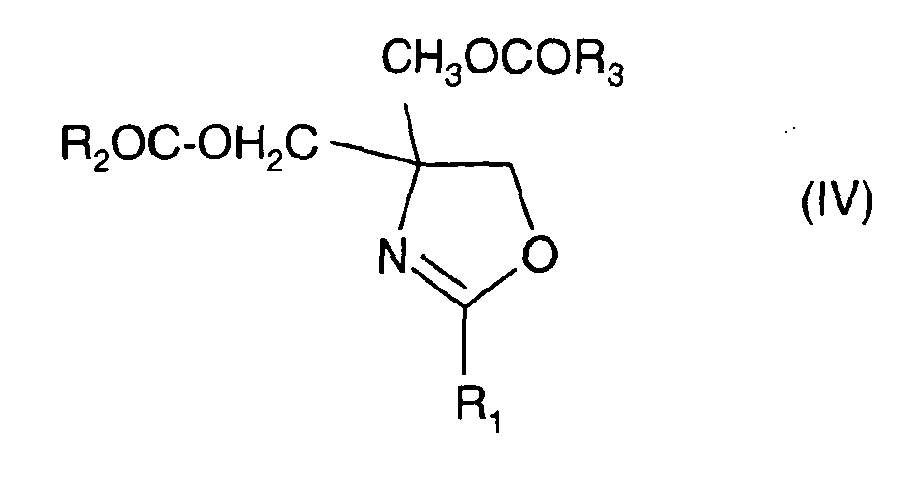
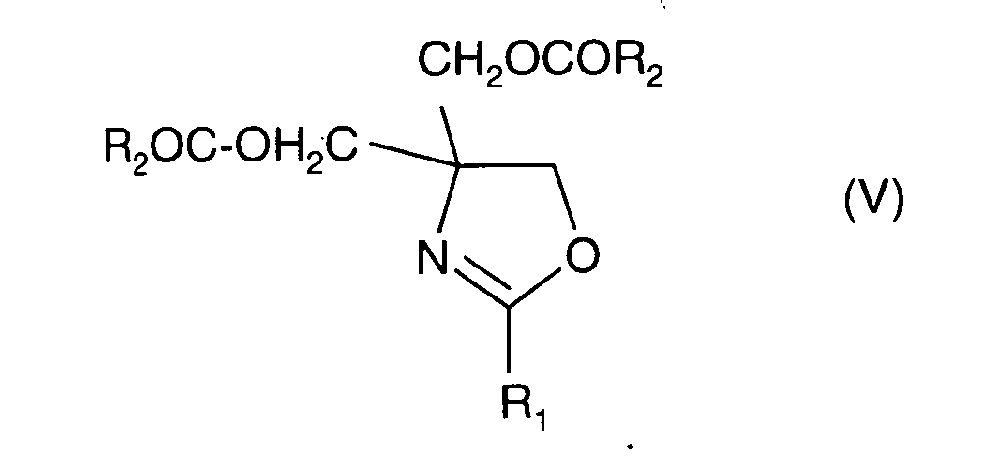
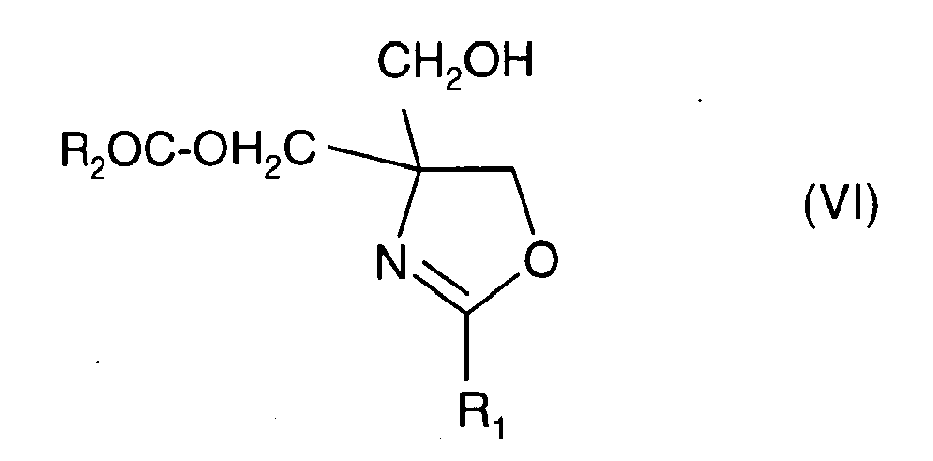
- Gegenstand der Erfindung ist daher eine Oxazolinmischung, dadurch gekennzeichnet, dass sie Oxazoline der Formeln


I = 0 bis 10 Mol-%
II = 1 bis 90 Mol-%
III = 1 bis 98 Mol-%
IV = 1 bis 98 Mol-%
V = 0 bis 50 Mol-%
VI = 0 bis 50 Mol-%
enthält und wobei
R1 für den Alkylrest einer Fettsäure oder einer Hydroxyfettsäure,
R2 für den Alkylrest einer Fettsäure, einer Hydroxyfettsäure und/oder der Montanwachssäure und
R3 für den Alkylrest der Montanwachssäure steht. - Bevorzugt sind in der erfindungsgemäßen Oxazolinmischung die Oxazoline in Mengen von
I = 0 bis 1 Mol-%
II = 2 bis50 Mol-%
III = 10 bis 98 Mol-%
IV = 10 bis 98 Mol-%
V = 0 bis 20 Mol-%
VI = 0 bis 10 Mol-%
enthalten. - Bevorzugt weisen die Alkylreste R1 und R2 der Fettsäuren oder der Hydroxyfettsäuren 12 bis 22 C-Atome auf.
- Bevorzugt weisen die Alkylreste R1 und R2 der Fettsäuren oder der Hydroxyfettsäuren lineare oder verzweigte Alkylketten auf.
- Bevorzugt sind die Alkylreste R1 und R2 der Fettsäuren oder der Hydroxyfettsäuren gesättigt oder ungesättigt.
- Bevorzugt handelt es sich bei dem Alkylrest der Hydroxyfettsäure um den Alkylrest von 12-Hydroxystearinsäure.
- Die Erfindung betrifft auch ein Verfahren zur Herstellung einer Oxazolinmischung der Formeln I bis VI,


R3 für den Alkylrest der Montanwachssäure steht, dadurch gekennzeichnet, dass man Trishydroxymethylaminomethan mit einer Fettsäure und/oder einer Hydroxyfettsäure zu Dihydroxymethyloxazolinen umsetzt und danach die noch freien OH-Gruppen der Dihydroxymethyloxazoline in Gegenwart eines Veresterungskatalysators mit Montanwachssäure verestert werden. - Die Umsetzung läuft dabei nach dem folgenden Verfahrensmuster in drei Schritten ab:


- Umsetzung von Trishydroxymethylaminomethan mit einer Fettsäure und/oder einer Hydroxyfettsäure zu Dihydroxymethyloxazolinen (bei dieser Reaktion kann schon ein Teil der freien OH Gruppen auch umgesetzt werden).
- Veresterung mit Montanwachssäure R3-COOH zum Monoester (welcher üblicherweise mindestens 1 mol Montansäure enthält).
- Veresterung mit einer Carbonsäuremischung, R2-COOH (wenn R2 der Alkylrest einer Fettsäure und/oder einer Hydroxyfettsäure ist, beträgt die Umsetzmenge 0 bis 1 mol; wenn R2 der Alkylrest der Montanwachssäure ist, beträgt die Umsetzmenge 1 bis 2 mol).
- Wird bei Schritt 3 die freie OH-Funktion nicht oder nicht vollständig umgesetzt, so entsteht eine Produktmischung aus Oxazolin, Monoester und Diester. Das Mischungsverhältnis der beiden Ester im Produkt kann 1 zu 0 (reiner Monoester) bis 0 zu 1 (reiner Diester) betragen und liegt bevorzugt bei etwa 0,3 zu etwa 0,7 (30 % reiner Monoester und 70 % reiner Diester).
- Arbeitet man nicht in drei Schritten, sondern nur in zwei Schritten mit einer Carbonsäuremischung aus R3-COOH (Montanwachssäure) und R2-COOH (Fettsäure), so entstehen sowohl die Monoester aus Fettsäure als auch aus Montanwachssäure, und die Diester aus Fettsäure, Fettsäure/Montanwachssäure und Montanwachssäure. Die Verteilung dieser Ester im Produkt richtet sich dann nach der Zusammensetzung der Carbonsäuremischung. Der Anteil an einzusetzender Montanwachssäure sollte deshalb bevorzugt bei 1 bis 2 mol liegen und der Anteil an einzusetzender Fettsäure bei 0 bis 1. Sollen noch Monoester im Produktmix enthalten sein, wird der Anteil der Fettsäure entsprechend reduziert. Die möglichen Produkte sind nachfolgend gezeichnet:


- Bevorzugt enthält beim erfindungsgemäßen Verfahren die Oxazolinmischung Oxazoline der Formeln I bis VI in Mengen von
I = 0 bis 10 Mol-%
II = 1 bis 90 Mol-%
III = 1 bis 98 Mol-%
IV = 1 bis 98 Mol-%
V = 0 bis 50 Mol-%
VI = 0 bis 50 Mol-%. - Besonders bevorzugt enthält beim erfindungsgemäßen Verfahren die
Oxazolinmischung Oxazoline der Formeln I bis VI in Mengen von
I = 0 bis 1 Mol-%
II = 2 bis 50 Mol-%
III = 10 bis 98 Mol-%
IV = 10 bis 98 Mol-%
V = 0 bis 20 Mol-%
VI = 0 bis 10 Mol-%. - Bevorzugt ist der Veresterungskatalysator aus der Gruppe der Zinnverbindungen der Gruppe der Titansäureester, Zinkoxide und/oder Zinkseifen ausgewählt.
- Bevorzugt weisen die Fettsäuren oder Hydroxyfettsäuren 12 bis 22 C-Atome auf. Bevorzugt weisen die Fettsäuren oder Hydroxyfettsäuren lineare oder verzweigte Alkylketten auf.
- Bevorzugt sind die Fettsäuren oder Hydroxyfettsäuren ungesättigt.
- Bevorzugt setzt man beim erfindungsgemäßen Verfahren zunächst 1 mol Trishydroxymethylaminomethan mit 1 bis 2,0 mol einer Fettsäure und/oder Hydroxyfettsäure um und dann das entstandene Produkt mit 1,0 bis 1,9 mol Montanwachssäure.
- Besonders bevorzugt setzt man dabei zunächst 1 mol Trishydroxymethylaminomethan mit 1,1 bis 1,5 mol einer Fettsäure und/oder Hydroxyfettsäure um und dann das entstandene Produkt mit 1,0 bis 1,9 mol Montanwachssäure.
- Die Erfindung betrifft auch die Verwendung der Oxazolinmischung gemäß den Ansprüchen 1 bis 6 als Verabeitungshilfsmittel für Kunststoffe.
- Die Erfindung betrifft ebenfalls die Verwendung der Oxazolinmischung gemäß den Ansprüchen 1 bis 6 als Dispergierhilfsmittel für Pigmente und Kunststoffadditive.
- Bevorzugt handelt es sich bei den Kunststoffen um Polystyrol-HI (High-Impact), Polyphenylenether, Polyamide, Polyester, Polycarbonate, Polyoxymethylen (POM), Polyurethane und Blends oder Polymerblends vom Typ ABS (Acrylnitril-Butadien-Styrol) oder PC/ABS (Polycarbonat/Acrylnitril-Butadien-Styrol) oder PPE/HIPS (Polyphenylenether/Polystyrol-HI)-Kunststoffe.
- Die Erfindung betrifft auch die Verwendung der Oxazolinmischung gemäß den Ansprüchen 1 bis 6 zur Herstellung von beschichteten organischen oder anorganischen Partikeln.
- Die Erfindung betrifft ebenso die Verwendung der Oxazolinmischung gemäß den Ansprüchen 1 bis 6 zur Herstellung von beschichteten organischen oder anorganischen Partikeln, wie sie in Kunststoffen, Farben und Lacken eingesetzt werden.
- Die Erfindung betrifft auch organische oder anorganische Partikel, gecoated mit der Oxazolinmischung gemäß den Ansprüchen 1 bis 6.
- Bevorzugt handelt es sich bei den organischen Partikeln um unlösliche Mittel wie Lichtschutzmittel, UV-Filter, Prozessstabilisatoren, organische Pigmente und Farbstoffe, Fasern, Antioxidantien, Antistatika und organische Flammschutzmittel.
- Zu den geeigneten organischen Partikeln gehören auch HALS (hindered-amino-lightstabilisator), Phenole, Phosphite, Benztriazole und Aluminiumphospholane.
- Als zu beschichtende organische Pigmente kommen Monoazo-, Disazo-, verlackte Azo-, β-Naphthol-, Naphthol AS-, Benzimidazolon-, Disazokondensations-, Azo-Metallkomplex-Pigmente und polycyclische Pigmente wie zum Beispiel Phthalocyanin-, Chinacridon-, Perylen-, Perinon-, Thioindigo-, Anthanthron-, Anthrachinon-, Flavanthron-, Indanthron-, Isoviolanthron-, Pyranthron-, Dioxazin-, Chinophthalon-, Isoindolinon-, Isoindolin- und Diketopyrrolopyrrol-Pigmente oder Ruße in Betracht.
- Als zu beschichtende organische Farbstoffe kommen Säurefarbstoffe, Direktfarbstoffe, Schwefelfarbstoffe und deren Leukoform, Metallkomplexfarbstoffe oder Reaktivfarbstoffe in Betracht, wobei im Falle der Reaktivfarbstoffe auch mit Nukleophilen abreagierte Farbstoffe eingesetzt werden können.
- Bevorzugt handelt es sich bei den anorganischen Partikeln um unlösliche Mittel wie Füllstoffe, Fasern, anorganische Pigmente und anorganische Flammschutzmittel.
- Zu den geeigneten anorganischen Partikeln gehören auch Kalk, Talkum, Glasfaser, Eisenoxid und Ammoniumpolyphosphate.
- Zu beschichtende anorganische Pigmente sind beispielsweise Titandioxide, Zinksulfide, Eisenoxide, Chromoxide, Ultramarin, Nickel- oder Chromantimontitanoxide, Cobaltoxide sowie Bismutvanadate.
- Besonders bevorzugt handelt es sich bei den anorganischen Partikeln um Titandioxid.
- Die Erfindung betrifft schließlich auch die Verwendung der mit einer Oxazolinmischung gemäß den Ansprüchen 1 bis 6 gecoateten titandioxidhaltigen Partikeln zur Reduzierung der Formaldehydemmsion von Polyoxymethylen-Formmassen.
- Grundsätzlich kommen für die Durchführung des beanspruchten Verfahrens auch Alkanolamine der allgemeinen Formel

in Frage. - Bevorzugt werden dabei dann 1 mol Trishydroxymethylaminomethan mit 1 bis 2, mol, insbesondere 1,1 bis 1,5 mol einer Fettsäure und dann das entstandene Produkt mit 1,0 bis 1,9 mol, insbesondere 1,5 bis 1,9 mol Montanwachssäure umgesetzt.
- Es wurde überraschend gefunden, dass die erfindungsgemäßen Produkte herzustellen sind, wenn nach einem besonders modifizierten Verfahren in einer zweistufigen Verfahrensweise mit Fettsäuren die Stufe der Dihydroxymethyloxazoline hergestellt wird und ohne Aufarbeitung dieser Zwischenstufe die freien OH-Gruppen in Gegenwart eines Katalysators mit Montanwachssäure verestert werden. Solche Produkte haben immer noch eine helle Farbe, sind chemisch reaktiv am Stickstoff und in der Oxazolin-Alkylkette, zeigen eine basische Reaktion, sind gut mit polaren und unpolaren Kunststoffen verträglich aber wesentlich weniger flüchtig als reine Fettsäureprodukte nach dem Stand der Technik und nicht migrierend.
- Nach dem Stand der Technik werden die Substanzen gemäß Formel VII durch Umsetzung von Trishydroxymethylaminomethan mit den gewählten Carbonsäuren bei 220 bis 250°C ohne Katalysator hergestellt. Beim Einsatz niedermolekularer Carbonsäuren muss die Reaktion in einem Druckreaktor durchgeführt werden. Die hohen Temperaturen sind erforderlich, um eine ausreichende Umsetzung zu erreichen. Bei den langkettigen Carbonsäuren mit 14 bis 22 C-Atomen wird mit reduziertem Druck gearbeitet. Trotz Verwendung einer Inertatmosphäre kommt es dabei zur Farbvertiefung
-
Rohstoffe Menge (g) mol techn. Stearinsäure 810 3 Trishydroxymethylaminomethan 121 1 -
Rohstoffe Menge (g) mol Tallölfettsäure 840 3 Trishydroxymethylaminomethan 121 1 -
Kenndaten Tropfpunkt °C Säurezahl mg KOH Alkalizahl mg KOH Farbe Flüchtigkeit bei 300°C Beispiel 1 (Vergleich) 65 12 1 gelblich 18,0 % Beispiel 2 (Vergleich) flüssig 12 1 bräunlich 23,0 % - Alle Bestandteile werden in den Reaktor gegeben, dann wird aufgeheizt. Bis zum Erreichen von 165°C wird Stickstoff aufgeleitet. Im Bereich 140 - 165°C muss Schäumen aus Sicherheitsgründen verhindert werden. Bis zum Erreichen der Reaktionstemperatur von 230°C wird mit positivem Druck gearbeitet. Dann wird das Reaktionswasser ausgeschleust, bis die gewünschte Säurezahl erreicht ist.
- Die jeweilige Fettsäure bzw. Hydroxyfettsäure und das Trishydroxymethylaminomethan werden in den Reaktor gegeben, es wird Vakuum angelegt und mit Stickstoff belüftet, dann wird erhitzt und die Fettsäure geschmolzen. In die Schmelze dosiert man geringe Mengen Dispergierhilfsmittel und heizt 40 bis 80°C oberhalb des Schmelzpunktes der Fettsäure auf. Bei dieser Temperatur wird gehalten, bis 2 mol Wasser pro mol eingesetztem Amin entstanden sind.
- In die Schmelze wird dann die flüssige Montanwachssäure eindosiert, es wird noch Veresterungskatalysator zugesetzt und gerührt, bis die Säurezahl auf <15 abgesunken ist. Der Ansatz wird dann gekühlt und granuliert.
-
Rohstoffe Menge (g) mol Trishydroxymethylaminomethan 121 1 techn. Stearinsäure 300 1,1 techn. Montanwachssäure 750 1,6 Veresterungskatalysator 1,2 -
Rohstoffe Menge (g) mol Trishydroxymethylaminomethan 121 1 techn. 12-Hydroxystearinsäure 330 1,1 techn. Montanwachssäure 750 1,6 Veresterungskatalysator 1,2 Dispergierhilfsmittel 1,2 -
Rohstoffe Menge (g) mol Trishydroxymethylaminomethan 121 1 techn. 12-Hydroxystearinsäure 600 2 techn. Montanwachssäure 375 0,8 Veresterungskatalysator 1,2 -
Rohstoffe Menge (g) mol Trishydroxymethylaminomethan 121 1 techn. 12-Hydroxystearinsäure 900 3 Veresterungskatalysator 1,2 -
Kenndaten Tropfpunkt °C Säurezahl mg KOH Alkalizahl mg KOH Farbe Flüchtigkeit bei 300°C Beispiel 3 74 15 0 gelblich 6,0 % Beispiel 4 72 13 0 gelblich 5,5 % Beispiel 5 70 12 0 hellgelb 9,0 % Beispiel 6 65 12 0 weiß 15,0 % -
- Tropfpunkt: nach DIN 51801/2
- Säurezahl: nach DIN 53402
- Alkalizahl: nach DGF - M IV-4 (63)
- Flüchtigkeit: nach interner Methode über thermogravimetrische Analyse (TGA):
- ®Licowachs C ist ein Handelsprodukt der Clariant GmbH auf Basis von Ethylendiamin und Talgfettsäure.
- Technisches Polyurethan (TPU) wird mit 0,2 % Gleitmittel ausgerüstet und standardmäßig verarbeitet. Geprüft wurden die Gleitmittelwirkung und die Migrationsneigung bei Wärmelagerung. Bewertet werden die Eigenschaften nach Schulnoten, d.h. je niedriger die Note, desto besser die Gleitwirkung.
- Verarbeitung von TPU mit ®Licowachs C und Produkt nach Beispiel 5
®Licowachs C Oxazolin nach Beispiel 5 Gleitmittelwirkung 2 2 Migrationsstabilität bei 40°C 4 2 Migrationsstabilität bei 60°C 4-5 2 - Erfindungsgemäße Umsetzungsprodukte aus Trishydroxymethylaminomethan, einer Fettsäure und Montanwachssäure zeigen gute Verträglichkeit mit Kunststoffen, geringe Migrationsneigung und geringe Flüchtigkeit. Dies bewirkt eine verbesserte Performance gegenüber Produkten des Standes der Technik. Das zeigt sich u.a. darin, dass eine ausgewogene Verteilung von innerer und äußerer Wirkung zu beobachten ist, d.h. Gleitmittelwirkung nach außen und dispergierende Wirkung und chemische Wirkung im Inneren.
- Titandioxid der Type R 104 (DuPont) wurde in einem Heißmischer bei 90°C mit dem erfindungsgemäßen Produkt aus Beispiel 4 gecoated. Der Anteil des Produktes lag bei 2 und 4 Gew.-%. Die so modifizierten Pigmente wurden in POM eingearbeitet und auf Freisetzung von Formaldehyd geprüft. Verglichen wird mit Standardprodukt und einem kommerziellen Gleitmittel auf Fettbasis.
- Aus den POM-Formmassen werden Platten der Wandstärke 1 mm gefertigt.
Nach einer Lagerdauer von 24 h wurde die Formaldehydemission aus den Platten nach VDA 275 ermittelt (VDA Empfehlung Nr. 275, Dokumentation Kraftfahrwesen e.V. Juli 1994). - Prüfkörperherstellung: Das Polyacetalgranulat wurde durch Spritzguss zu Plättchen mit den Dimensionen 80*50*1 mm geformt. Eine Spritzgießmaschine Kraus Maffei KM 120/340B wurde mit folgenden Spritzgießparametern verwendet:
- Massetemperatur 195°C, Fließfrontgeschwindigkeit 200 mm/s, Werkzeugwandtemperatur 85°C, Nachdruck 900 bar, Nachdruckzeit 30 s, Kühlzeit 10 s, Staudruck 0 bis 10 bar.
- Die Prüfkörper wurden vor der Prüfung für 24 h im Norm-Klimaschrank bei 23°C und 50 relativer Luftfeuchte gelagert.
Prüfung: Zwei Prüfkörper wurden in einer 1 I Glasflasche über 50 ml E-Wasser an einem Edelstahlhacken aufgehängt und für 3 h im Umlufttrockenschrank bei 60°C gelagert. Die Prüfkörper wurden aus der Prüfflasche entfernt. 5 ml Probenlösung wurden in ein Reagenzglas pipettiert, das Reagenzglas wurde für 10 Minuten bei 95°C getempert. Nun wurden 3 ml Acetylaceton und 3 ml einer 20 %igen Ammoniumacetatlösung in das Reagenzglas hinzugegeben. Der Formaldehyd bildete mit den Reagenzien den Diacetyldihydrolutidin-Komplex, dessen Absorption bei 412 nm photometrisch bestimmt wurde. Aus der Absorption wurde die Formaldehydkonzentration in der Probenlösung berechnet. - Verarbeitung von pigmentiertem POM (Polyoxymethylen)
Polymer Gleitmittel Menge mol-% VDA 275 ppm/h Copolymer 2 ®Licowachs C 0,20 118 Copolymer 2 Pigment + 4 % Produkt aus Beispiel 4 0,5 32 Copolymer 2 Pigment + 2 % Produkt aus Beispiel 4 0,2 37 Copolymer 2: ®Hostaform 27021 der Ticona GmbH ®Licowachs C: Ethylenbisstearamid, Handelsprodukt der Clariant GmbH. - Der Einsatz von mit dem erfindungsgemäßen Produkt modifiziertem Pigment zeigt deutlich geringere Formaldehydemissionen im Vergleich zum Einsatz von unmodifiziertem Pigment in Kombination mit Standardgleitmittel auf Fettbasis (®Licowachs C).
| Temperaturbereich: | 30 - 300°C |
| Aufheizrate: | 2 K/min |
| Isotherm: | 120 min bei 300°C |
| Stickstoffspülung | 50 ml/min |
| Einwaage: | 50 mg +/-0,3 mg |
| Aluminiumoxidtiegel: | 150 µl |
Claims (28)
- Oxazolinmischung, dadurch gekennzeichnet, dass sie Oxazoline der Formeln


I=0 bis 10 Mol-%
II = 1 bis 90 Mol-%
III = 1 bis 98 Mol-%
IV = 1 bis 98 Mol-%
V = 0 bis 50 Mol-%
VI = 0 bis 50 Mol-%
enthält, wobei
R1 für den Alkylrest einer Fettsäure oder einer Hydroxyfettsäure,
R2 für den Alkylrest einer Fettsäure, einer Hydroxyfettsäure und/oder der Montanwachssäure und
R3 für den Alkylrest der Montanwachssäure steht. - Oxazolinmischung nach Anspruch 1, dadurch gekennzeichnet, dass die Oxazoline in Mengen von
I = 0 bis 1 Mol-%
II = 2 bis 50 Mol-%
III = 10 bis 98 Mol-%
IV = 10 bis 98 Mol-%
V = 0 bis 20 Mol-%
VI = 0 bis 10 Mol-%
enthalten sind. - Oxazolinmischung nach Anspruch 1 oder 2, dadurch gekennzeichnet, dass die die Alkylreste R1 und R2 der Fettsäuren oder der Hydroxyfettsäuren 12 bis 22 C-Atome aufweisen.
- Oxazolinmischung nach einem oder mehreren der Ansprüche 1 bis 3, dadurch gekennzeichnet, dass die die Alkylreste R1 und R2 der Fettsäuren oder der Hydroxyfettsäuren lineare oder verzweigte Alkylketten aufweisen.
- Oxazolinmischung nach einem oder mehreren der Ansprüche 1 bis 4, dadurch gekennzeichnet, dass die die Alkylreste R1 und R2 der Fettsäuren oder der Hydroxyfettsäuren gesättigt oder ungesättigt sind.
- Oxazolinmischung nach einem oder mehreren der Ansprüche 1 bis 5, dadurch gekennzeichnet, dass es sich bei der Hydroxyfettsäure um 12 Hydroxystearinsäure handelt.
- Verfahren zur Herstellung einer Oxazolinmischung der Formeln I bis VI,


R3 für den Alkylrest der Montanwachssäure steht, dadurch gekennzeichnet, dass man Trishydroxymethylaminomethan mit einer Fettsäure und/oder einer Hydroxyfettsäure zu Dihydroxymethyloxazolinen umsetzt und danach die noch freien OH-Gruppen der Dihydroxymethyloxazoline in Gegenwart eines Veresterungskatalysators mit Montanwachssäure verestert werden. - Verfahren nach Anspruch 7, dadurch gekennzeichnet, dass die Oxazolinmischung Oxazoline der Formeln I bis VI in Mengen von
I = 0 bis 10 Mol-%
II = 1 bis 90 Mol-%
III = 1 bis 98 Mol-%
IV = 1 bis 98 Mol-%
V = 0 bis 50 Mol-%
VI = 0 bis 50 Mol-%
enthält. - Verfahren nach Anspruch 7 oder 8, dadurch gekennzeichnet, dass die Oxazolinmischung Oxazoline der Formeln 1 bis VI in Mengen von
I = 0 bis 1 Mol-%
II = 2 bis 50 Mol-%
III = 10 bis 98 Mol-%
IV = 10 bis 98 Mol-%
V = 0 bis 20 Mol-%
VI = 0 bis 10 Mol-%
enthält. - Verfahren nach Anspruch 9 , dadurch gekennzeichnet, dass der Veresterungskatalysator aus der Gruppe der Zinnverbindungen, der Gruppe der Titansäureester, Zinkoxide und/oder Zinkseifen ausgewählt ist.
- Verfahren nach Anspruch 9 oder 10, dadurch gekennzeichnet, dass die Fettsäuren oder Hydroxyfettsäuren 12 bis 22 C-Atome aufweisen.
- Verfahren nach einem oder mehreren der Ansprüche 9 bis 11, dadurch gekennzeichnet, dass die Fettsäuren oder Hydroxyfettsäuren lineare oder verzweigte Alkylketten aufweisen.
- Verfahren nach einem oder mehreren der Ansprüche 9 bis 12, dadurch gekennzeichnet, dass die Fettsäuren oder Hydroxyfettsäuren gesättigt oder ungesättigt sind.
- Verfahren nach einem oder mehreren der Ansprüche 9 bis 13, dadurch gekennzeichnet, dass die Alkylketten funktionelle Gruppen aufweisen.
- Verfahren nach einem oder mehreren der Ansprüche 9 bis 14, dadurch gekennzeichnet, dass man zunächst 1 mol Trishydroxymethylaminomethan mit 1 bis 2,0 mol einer Fettsäure und dann das entstandene Produkt mit 1,0 bis 1,9 mol Montanwachssäure umsetzt.
- Verfahren nach einem oder mehreren der Ansprüche 9 bis 15, dadurch gekennzeichnet, dass man zunächst 1 mol Trishydroxymethylaminomethan mit 1,1 bis 1,5 mol einer Fettsäure und dann das entstandene Produkt mit 1,0 bis 1,9 mol Montanwachssäure umsetzt.
- Verwendung einer Oxazolinmischung nach mindestens einem der Ansprüche 1 bis 6 als Verarbeitungshilfsmittel für Kunststoffe.
- Verwendung einer Oxazolinmischung nach mindestens einem der Ansprüche 1 bis 6 als Dispergierhilfsmittel für Pigmente und Kunststoffadditive.
- Verwendung nach Anspruch 17 oder 18, dadurch gekennzeichnet, dass es sich bei den Kunststoffen um Polystyrol-HI (High-Impact), Polyphenylenether, Polyamide, Polyester, Polycarbonate, Polyoxymethylen (POM), Polyurethane und Blends oder Polymerblends vom Typ ABS (Acrylnitril-Butadien-Styrol) oder PC/ABS (Polycarbonat/ Acrylnitril-Butadien-Styrol) oder PPE/HIPS (Polyphenylenether/Polystyrol-HI)-Kunststoffe handelt.
- Verwendung einer Oxazolinmischung nach mindestens einem der Ansprüche 1 bis 6 zur Herstellung von beschichteten organischen oder anorganischen Partikeln.
- Verwendung einer Oxazolinmischung nach mindestens einem der Ansprüche 1 bis 6 zur Herstellung von beschichteten organischen oder anorganischen Partikeln, wie sie in Kunststoffen, Farben und Lacken eingesetzt werden.
- Verwendung nach Anspruch 20 oder 21, dadurch gekennzeichnet, dass es sich bei den organischen Partikeln um unlösliche Mittel handelt wie Lichtschutzmittel, UV-Filter, Prozessstabilisatoren, organische Pigmente, Fasern, Antioxidantien, Antistatika und organische Flammschutzmittel.
- Verwendung nach Anspruch 20 oder 21, dadurch gekennzeichnet, dass es sich bei den anorganischen Partikeln um unlösliche Mittel handelt wie Füllstoffe, Fasern, anorganische Pigmente und anorganische Flammschutzmittel.
- Organische oder anorganische Partikel, gecoated mit einer Oxazolinmischung nach mindestens einem der Ansprüche 1 bis 6.
- Partikel nach Anspruch 24, dadurch gekennzeichnet, dass es sich bei den organischen Partikeln um unlösliche Mittel wie Lichtschutzmittel, UV-Filter, Prozessstabilisatoren, organische Pigmente, Fasern, Antioxidantien, Antistatika und organische Flammschutzmittel handelt.
- Partikel nach Anspruch 24, dadurch gekennzeichnet, dass es sich bei den anorganischen Partikeln um unlösliche Mittel wie Füllstoffe, Fasern, anorganische Pigmente und anorganische Flammschutzmittel handelt.
- Partikel nach Anspruch 26, dadurch gekennzeichnet, dass es sich bei den anorganischen Partikeln um Titandioxid handelt.
- Verwendung der mit einer Oxazolinmischung gecoateten anorganischen titandioxidhaltigen Partikel nach Anspruch 27 zur Reduzierung der Formaldehydemmsion von Polyoxymethylen-Formmassen.
Applications Claiming Priority (1)
| Application Number | Priority Date | Filing Date | Title |
|---|---|---|---|
| DE102004061037A DE102004061037B4 (de) | 2004-12-18 | 2004-12-18 | Oxazolinmischung |
Publications (1)
| Publication Number | Publication Date |
|---|---|
| EP1671956A1 true EP1671956A1 (de) | 2006-06-21 |
Family
ID=36090887
Family Applications (1)
| Application Number | Title | Priority Date | Filing Date |
|---|---|---|---|
| EP05026431A Withdrawn EP1671956A1 (de) | 2004-12-18 | 2005-12-03 | Oxazolinmischung und ihre Verwendung als Verarbeitungshilfsmittel für Kunststoffe und Pigmente |
Country Status (4)
| Country | Link |
|---|---|
| US (1) | US20060159634A1 (de) |
| EP (1) | EP1671956A1 (de) |
| JP (1) | JP2006199684A (de) |
| DE (1) | DE102004061037B4 (de) |
Cited By (5)
| Publication number | Priority date | Publication date | Assignee | Title |
|---|---|---|---|---|
| US20100227181A1 (en) * | 2007-10-18 | 2010-09-09 | Nippon Sheet Glass Company, Limited | Bright pigment |
| EP2058374A4 (de) * | 2006-08-29 | 2011-11-16 | Nippon Sheet Glass Co Ltd | Perlglanzpigment |
| US8440014B2 (en) | 2007-04-27 | 2013-05-14 | Nippon Sheet Glass Company, Limited | Bright pigment, and bright coating composition and automotive body coating each containing the same |
| US9045643B2 (en) | 2006-04-21 | 2015-06-02 | Nippon Sheet Glass Company Limited | Bright pigment, method for producing the pigment, and waterborne resin composition containing the pigment |
| US9107834B2 (en) | 2007-04-18 | 2015-08-18 | Nippon Sheet Glass Company, Limited | Bright pigment and cosmetic composition using the same |
Families Citing this family (1)
| Publication number | Priority date | Publication date | Assignee | Title |
|---|---|---|---|---|
| JP6303688B2 (ja) | 2014-03-25 | 2018-04-04 | セイコーエプソン株式会社 | 情報処理装置およびプログラム |
Citations (5)
| Publication number | Priority date | Publication date | Assignee | Title |
|---|---|---|---|---|
| US3248397A (en) * | 1964-12-04 | 1966-04-26 | Commercial Solvents Corp | Process for bodying oxazoline drying oils and product thereof |
| US3348958A (en) * | 1965-11-17 | 1967-10-24 | Commercial Solvents Corp | Ethyl cellulose compositions |
| FR2076431A5 (en) * | 1970-01-14 | 1971-10-15 | Inst Francais Du Petrole | Thermostable diesters - of 2-amino-2-hydroxymethyl 1,3-propanediol derivs as lubricants |
| DE3022263A1 (de) * | 1979-08-10 | 1981-02-12 | Agip Petroli | Dispergier-additive fuer schmiermittel |
| EP1130067A1 (de) * | 2000-03-01 | 2001-09-05 | Clariant GmbH | Verfahren zur Erzeugung von pigmentierten Pulverlacken |
-
2004
- 2004-12-18 DE DE102004061037A patent/DE102004061037B4/de not_active Expired - Fee Related
-
2005
- 2005-12-03 EP EP05026431A patent/EP1671956A1/de not_active Withdrawn
- 2005-12-16 JP JP2005362693A patent/JP2006199684A/ja not_active Withdrawn
- 2005-12-16 US US11/303,627 patent/US20060159634A1/en not_active Abandoned
Patent Citations (5)
| Publication number | Priority date | Publication date | Assignee | Title |
|---|---|---|---|---|
| US3248397A (en) * | 1964-12-04 | 1966-04-26 | Commercial Solvents Corp | Process for bodying oxazoline drying oils and product thereof |
| US3348958A (en) * | 1965-11-17 | 1967-10-24 | Commercial Solvents Corp | Ethyl cellulose compositions |
| FR2076431A5 (en) * | 1970-01-14 | 1971-10-15 | Inst Francais Du Petrole | Thermostable diesters - of 2-amino-2-hydroxymethyl 1,3-propanediol derivs as lubricants |
| DE3022263A1 (de) * | 1979-08-10 | 1981-02-12 | Agip Petroli | Dispergier-additive fuer schmiermittel |
| EP1130067A1 (de) * | 2000-03-01 | 2001-09-05 | Clariant GmbH | Verfahren zur Erzeugung von pigmentierten Pulverlacken |
Non-Patent Citations (1)
| Title |
|---|
| ANGUS CHEMICAL COMPANY: "Technical Data Sheet TDS 10F", INTERNET ARTICLE, XP002375684, Retrieved from the Internet <URL:www.dow.com.angus> * |
Cited By (7)
| Publication number | Priority date | Publication date | Assignee | Title |
|---|---|---|---|---|
| US9045643B2 (en) | 2006-04-21 | 2015-06-02 | Nippon Sheet Glass Company Limited | Bright pigment, method for producing the pigment, and waterborne resin composition containing the pigment |
| EP2058374A4 (de) * | 2006-08-29 | 2011-11-16 | Nippon Sheet Glass Co Ltd | Perlglanzpigment |
| US8273171B2 (en) * | 2006-08-29 | 2012-09-25 | Nippon Sheet Glass Company, Limited | Pearlescent pigment |
| US9107834B2 (en) | 2007-04-18 | 2015-08-18 | Nippon Sheet Glass Company, Limited | Bright pigment and cosmetic composition using the same |
| US8440014B2 (en) | 2007-04-27 | 2013-05-14 | Nippon Sheet Glass Company, Limited | Bright pigment, and bright coating composition and automotive body coating each containing the same |
| US20100227181A1 (en) * | 2007-10-18 | 2010-09-09 | Nippon Sheet Glass Company, Limited | Bright pigment |
| US8409708B2 (en) | 2007-10-18 | 2013-04-02 | Nippon Sheet Glass Company, Limited | Bright pigment |
Also Published As
| Publication number | Publication date |
|---|---|
| DE102004061037A1 (de) | 2006-07-06 |
| JP2006199684A (ja) | 2006-08-03 |
| DE102004061037B4 (de) | 2006-12-21 |
| US20060159634A1 (en) | 2006-07-20 |
Similar Documents
| Publication | Publication Date | Title |
|---|---|---|
| EP0036597B1 (de) | Schaumdämpfungsmittel und dessen Verwendung in Kunstharz-, Lack- und Farbdispersionen | |
| DE2703829C3 (de) | Flüssige hitzehärtbare Harzmasse | |
| EP2066752B1 (de) | Farbige wässrige polymerdispersion, deren herstellung und verwendung | |
| EP2046898B1 (de) | Mit polymerisierbarem coating modifizierte pigmente, deren herstellung und anwendung | |
| EP1570006B1 (de) | Feste pigmentzubereitungen, enthaltend pigmentderivate und oberflächenaktive additive | |
| EP1913095B1 (de) | Feste pigmentzubereitungen, enthaltend wasserlösliche oberflächenaktive additive und oxidationsschutzmittel | |
| DE3304266A1 (de) | Piperidin derivate und ihre anwendung als stabilisatoren fuer polymere | |
| EP0017038A1 (de) | Füllstoff enthaltende Kunststoff-Formmasse und Verfahren zu ihrer Herstellung | |
| DE102004061037B4 (de) | Oxazolinmischung | |
| EP4324887B1 (de) | Dispersionsfarbe | |
| DE19748575A1 (de) | Verwendung von Dimerdiolalkoxylaten als Additive zur Herstellung von Pigmentkonzentraten | |
| EP2186863A1 (de) | Verwendung von Anlagerungsprodukten von Ethylen- und/oder Propylenoxid an Fettalkohole als Koaleszenzmittel | |
| DE3531915A1 (de) | Verdickungssysteme fuer hoch wasserhaltige funktionelle fluessigkeiten und die diese verdickungssysteme enthaltenden hoch wasserhaltigen funktionellen fluessigkeiten | |
| DE102006009097A1 (de) | Wachszusammensetzung und deren Verwendung | |
| EP2682519A1 (de) | Verfahren und Zusammensetzungen für die Ausrüstung oder Färbung von Fasermaterialien | |
| EP0006122A1 (de) | Verfahren zum Pigmentieren von Hart-PVC und Polyolefinen in der Masse | |
| EP2318454B1 (de) | Stabilisatoren für unbelebte organische materialien | |
| DE60304568T2 (de) | Verbindungen zur reduzierung des acetaldehydgehalts von polyethylenterephthalat , ihre verwendung und daraus erhaltene produkte | |
| DE1300951B (de) | Bis-(2, 3-dibrompropoxy)-octachlordiphenyl | |
| EP3810709A1 (de) | Konservierungsmittelfreie pigmentpaste | |
| EP1029008A1 (de) | Verwendung von diolalkoxylaten als additive zur herstellung von pigmentkonzentraten | |
| DE2225793A1 (de) | Verfahren zur kontinuierlichen Her stellung einer Mischung von primären und sekundären Phosphatestern von organischen Hydroxyverbindungen | |
| DE60208390T2 (de) | Flüssige farbzusammensetzungen mit acylglycerinen als dispergiermittel | |
| WO2019243408A1 (de) | Konservierungsmittelfreie pigmentpaste | |
| DE1917455A1 (de) | Stabilisierte Formaldehyd-Polymerisat-Formmassen |
Legal Events
| Date | Code | Title | Description |
|---|---|---|---|
| PUAI | Public reference made under article 153(3) epc to a published international application that has entered the european phase |
Free format text: ORIGINAL CODE: 0009012 |
|
| AK | Designated contracting states |
Kind code of ref document: A1 Designated state(s): AT BE BG CH CY CZ DE DK EE ES FI FR GB GR HU IE IS IT LI LT LU LV MC NL PL PT RO SE SI SK TR |
|
| AX | Request for extension of the european patent |
Extension state: AL BA HR MK YU |
|
| 17P | Request for examination filed |
Effective date: 20061221 |
|
| 17Q | First examination report despatched |
Effective date: 20070125 |
|
| AKX | Designation fees paid |
Designated state(s): DE ES FR GB IT NL |
|
| STAA | Information on the status of an ep patent application or granted ep patent |
Free format text: STATUS: THE APPLICATION HAS BEEN WITHDRAWN |
|
| 18W | Application withdrawn |
Effective date: 20081119 |