EP1669331B1 - Procédé de fabrication d'élément antibué - Google Patents
Procédé de fabrication d'élément antibué Download PDFInfo
- Publication number
- EP1669331B1 EP1669331B1 EP05026887A EP05026887A EP1669331B1 EP 1669331 B1 EP1669331 B1 EP 1669331B1 EP 05026887 A EP05026887 A EP 05026887A EP 05026887 A EP05026887 A EP 05026887A EP 1669331 B1 EP1669331 B1 EP 1669331B1
- Authority
- EP
- European Patent Office
- Prior art keywords
- substrate
- gas
- process according
- flame
- activation
- Prior art date
- Legal status (The legal status is an assumption and is not a legal conclusion. Google has not performed a legal analysis and makes no representation as to the accuracy of the status listed.)
- Expired - Lifetime
Links
Images

Classifications
-
- C—CHEMISTRY; METALLURGY
- C03—GLASS; MINERAL OR SLAG WOOL
- C03C—CHEMICAL COMPOSITION OF GLASSES, GLAZES OR VITREOUS ENAMELS; SURFACE TREATMENT OF GLASS; SURFACE TREATMENT OF FIBRES OR FILAMENTS MADE FROM GLASS, MINERALS OR SLAGS; JOINING GLASS TO GLASS OR OTHER MATERIALS
- C03C23/00—Other surface treatment of glass not in the form of fibres or filaments
- C03C23/0005—Other surface treatment of glass not in the form of fibres or filaments by irradiation
- C03C23/006—Other surface treatment of glass not in the form of fibres or filaments by irradiation by plasma or corona discharge
-
- B—PERFORMING OPERATIONS; TRANSPORTING
- B01—PHYSICAL OR CHEMICAL PROCESSES OR APPARATUS IN GENERAL
- B01J—CHEMICAL OR PHYSICAL PROCESSES, e.g. CATALYSIS OR COLLOID CHEMISTRY; THEIR RELEVANT APPARATUS
- B01J35/00—Catalysts, in general, characterised by their form or physical properties
- B01J35/30—Catalysts, in general, characterised by their form or physical properties characterised by their physical properties
- B01J35/39—Photocatalytic properties
-
- B—PERFORMING OPERATIONS; TRANSPORTING
- B01—PHYSICAL OR CHEMICAL PROCESSES OR APPARATUS IN GENERAL
- B01J—CHEMICAL OR PHYSICAL PROCESSES, e.g. CATALYSIS OR COLLOID CHEMISTRY; THEIR RELEVANT APPARATUS
- B01J37/00—Processes, in general, for preparing catalysts; Processes, in general, for activation of catalysts
- B01J37/02—Impregnation, coating or precipitation
- B01J37/0238—Impregnation, coating or precipitation via the gaseous phase-sublimation
-
- B—PERFORMING OPERATIONS; TRANSPORTING
- B01—PHYSICAL OR CHEMICAL PROCESSES OR APPARATUS IN GENERAL
- B01J—CHEMICAL OR PHYSICAL PROCESSES, e.g. CATALYSIS OR COLLOID CHEMISTRY; THEIR RELEVANT APPARATUS
- B01J37/00—Processes, in general, for preparing catalysts; Processes, in general, for activation of catalysts
- B01J37/34—Irradiation by, or application of, electric, magnetic or wave energy, e.g. ultrasonic waves ; Ionic sputtering; Flame or plasma spraying; Particle radiation
- B01J37/349—Irradiation by, or application of, electric, magnetic or wave energy, e.g. ultrasonic waves ; Ionic sputtering; Flame or plasma spraying; Particle radiation making use of flames, plasmas or lasers
-
- B—PERFORMING OPERATIONS; TRANSPORTING
- B60—VEHICLES IN GENERAL
- B60R—VEHICLES, VEHICLE FITTINGS, OR VEHICLE PARTS, NOT OTHERWISE PROVIDED FOR
- B60R1/00—Optical viewing arrangements; Real-time viewing arrangements for drivers or passengers using optical image capturing systems, e.g. cameras or video systems specially adapted for use in or on vehicles
- B60R1/02—Rear-view mirror arrangements
- B60R1/06—Rear-view mirror arrangements mounted on vehicle exterior
- B60R1/0602—Rear-view mirror arrangements mounted on vehicle exterior comprising means for cleaning or deicing
-
- C—CHEMISTRY; METALLURGY
- C03—GLASS; MINERAL OR SLAG WOOL
- C03B—MANUFACTURE, SHAPING, OR SUPPLEMENTARY PROCESSES
- C03B29/00—Reheating glass products for softening or fusing their surfaces; Fire-polishing; Fusing of margins
- C03B29/04—Reheating glass products for softening or fusing their surfaces; Fire-polishing; Fusing of margins in a continuous way
- C03B29/06—Reheating glass products for softening or fusing their surfaces; Fire-polishing; Fusing of margins in a continuous way with horizontal displacement of the products
- C03B29/08—Glass sheets
-
- C—CHEMISTRY; METALLURGY
- C03—GLASS; MINERAL OR SLAG WOOL
- C03C—CHEMICAL COMPOSITION OF GLASSES, GLAZES OR VITREOUS ENAMELS; SURFACE TREATMENT OF GLASS; SURFACE TREATMENT OF FIBRES OR FILAMENTS MADE FROM GLASS, MINERALS OR SLAGS; JOINING GLASS TO GLASS OR OTHER MATERIALS
- C03C17/00—Surface treatment of glass, not in the form of fibres or filaments, by coating
- C03C17/22—Surface treatment of glass, not in the form of fibres or filaments, by coating with other inorganic material
- C03C17/23—Oxides
-
- C—CHEMISTRY; METALLURGY
- C03—GLASS; MINERAL OR SLAG WOOL
- C03C—CHEMICAL COMPOSITION OF GLASSES, GLAZES OR VITREOUS ENAMELS; SURFACE TREATMENT OF GLASS; SURFACE TREATMENT OF FIBRES OR FILAMENTS MADE FROM GLASS, MINERALS OR SLAGS; JOINING GLASS TO GLASS OR OTHER MATERIALS
- C03C17/00—Surface treatment of glass, not in the form of fibres or filaments, by coating
- C03C17/22—Surface treatment of glass, not in the form of fibres or filaments, by coating with other inorganic material
- C03C17/23—Oxides
- C03C17/245—Oxides by deposition from the vapour phase
-
- C—CHEMISTRY; METALLURGY
- C03—GLASS; MINERAL OR SLAG WOOL
- C03C—CHEMICAL COMPOSITION OF GLASSES, GLAZES OR VITREOUS ENAMELS; SURFACE TREATMENT OF GLASS; SURFACE TREATMENT OF FIBRES OR FILAMENTS MADE FROM GLASS, MINERALS OR SLAGS; JOINING GLASS TO GLASS OR OTHER MATERIALS
- C03C17/00—Surface treatment of glass, not in the form of fibres or filaments, by coating
- C03C17/22—Surface treatment of glass, not in the form of fibres or filaments, by coating with other inorganic material
- C03C17/23—Oxides
- C03C17/245—Oxides by deposition from the vapour phase
- C03C17/2456—Coating containing TiO2
-
- B—PERFORMING OPERATIONS; TRANSPORTING
- B01—PHYSICAL OR CHEMICAL PROCESSES OR APPARATUS IN GENERAL
- B01J—CHEMICAL OR PHYSICAL PROCESSES, e.g. CATALYSIS OR COLLOID CHEMISTRY; THEIR RELEVANT APPARATUS
- B01J21/00—Catalysts comprising the elements, oxides, or hydroxides of magnesium, boron, aluminium, carbon, silicon, titanium, zirconium, or hafnium
- B01J21/06—Silicon, titanium, zirconium or hafnium; Oxides or hydroxides thereof
- B01J21/063—Titanium; Oxides or hydroxides thereof
-
- C—CHEMISTRY; METALLURGY
- C03—GLASS; MINERAL OR SLAG WOOL
- C03C—CHEMICAL COMPOSITION OF GLASSES, GLAZES OR VITREOUS ENAMELS; SURFACE TREATMENT OF GLASS; SURFACE TREATMENT OF FIBRES OR FILAMENTS MADE FROM GLASS, MINERALS OR SLAGS; JOINING GLASS TO GLASS OR OTHER MATERIALS
- C03C2217/00—Coatings on glass
- C03C2217/70—Properties of coatings
- C03C2217/71—Photocatalytic coatings
-
- C—CHEMISTRY; METALLURGY
- C03—GLASS; MINERAL OR SLAG WOOL
- C03C—CHEMICAL COMPOSITION OF GLASSES, GLAZES OR VITREOUS ENAMELS; SURFACE TREATMENT OF GLASS; SURFACE TREATMENT OF FIBRES OR FILAMENTS MADE FROM GLASS, MINERALS OR SLAGS; JOINING GLASS TO GLASS OR OTHER MATERIALS
- C03C2217/00—Coatings on glass
- C03C2217/70—Properties of coatings
- C03C2217/75—Hydrophilic and oleophilic coatings
-
- C—CHEMISTRY; METALLURGY
- C03—GLASS; MINERAL OR SLAG WOOL
- C03C—CHEMICAL COMPOSITION OF GLASSES, GLAZES OR VITREOUS ENAMELS; SURFACE TREATMENT OF GLASS; SURFACE TREATMENT OF FIBRES OR FILAMENTS MADE FROM GLASS, MINERALS OR SLAGS; JOINING GLASS TO GLASS OR OTHER MATERIALS
- C03C2218/00—Methods for coating glass
- C03C2218/10—Deposition methods
- C03C2218/15—Deposition methods from the vapour phase
- C03C2218/152—Deposition methods from the vapour phase by cvd
-
- C—CHEMISTRY; METALLURGY
- C03—GLASS; MINERAL OR SLAG WOOL
- C03C—CHEMICAL COMPOSITION OF GLASSES, GLAZES OR VITREOUS ENAMELS; SURFACE TREATMENT OF GLASS; SURFACE TREATMENT OF FIBRES OR FILAMENTS MADE FROM GLASS, MINERALS OR SLAGS; JOINING GLASS TO GLASS OR OTHER MATERIALS
- C03C2218/00—Methods for coating glass
- C03C2218/30—Aspects of methods for coating glass not covered above
- C03C2218/32—After-treatment
Definitions
- the invention relates to a method for producing an element in which a surface layer of a photocatalytic material is subjected to an activation step.
- the hydrophilicity can be determined, for example, based on the so-called contact angle, which forms the edge of a water droplet located on the element surface with the element surface. In the case of uncoated glasses, this contact angle is usually between about 40 ° and 60 °. By contrast, a hydrophilic surface is then spoken of when the contact angle is less than approximately 20 °. At large contact angles of, for example, more than 100 °, however, one speaks of hydrophobic surfaces. The so-called super-hydrophilicity, however, exists when the edge or contact angle is less than about 10 °, preferably less than about 5 °.
- a hydrophilic or super-hydrophilic surface of a glass in this sense means that, when wetted with water, for example as a result of condensation, a relatively homogeneous water film is formed directly from the water droplets that occur.
- a homogeneous water film influences the passage of light through the glass only insignificantly, so that the user no significant clouding or impairment occurs.
- a non-fogging element by applying a hydrophilic surface coating on a glass substrate
- a hydrophilic surface coating on a glass substrate
- it is for example from DE 296 23 901 U1 or from the EP 1 254 870 A2
- TiO 2 titanium dioxide
- the photocatalytic material acts in such a way that it makes the surface of the coating hydrophilic in the above-mentioned sense.
- a substantially transparent coating of a substrate is formed on the substrate photocatalytic material is applied, which makes the surface of the element hydrophilic after photoexcitation.
- a so-called activation of the coating is required.
- the irradiation of the coating is provided with a suitable light source, wherein the wavelength of the light used should have an energy which is higher than the bandgap energy of the photocatalyst.
- a concept for activating a surface layer by UV light is also from EP 1 254 870 A2 known.
- the invention is therefore based on the object of specifying a method for producing a non-fogging element of the type mentioned above, which is particularly suitable in view of the time required for the activation of the surface coating treatment time and the associated effort for a large-scale production.
- This object is achieved in that the surface layer is flamed in the implementation of the activation step with a gas flame.
- the invention is based on the consideration that a production method which is also suitable for mass production should be particularly consistently oriented towards comparatively short treatment times of individual elements and particularly low energy consumption.
- the previously considered unavoidable Photo excitation of the surface layer to provide the hydroxyl groups is basically replaceable by pretreatment of the surface layer on chemical Basis, which can be adjusted by suitable choice of reactants and conditions particularly short treatment times. Therefore, the implementation of the chemical-based activation step is provided wherein the surface layer is reactively treated by treating the coating with a gas flame.
- the element could be substantially completely formed from the photocatalytic material.
- the surface layer is formed by a coating of the photocatalytic material applied to a substrate, so that, in particular, use as a vehicle mirror or the like comes into consideration.
- the substrate provided with the coating can also be subjected to a subsequent activation step, in particular in the manner of an intermediate product.
- the method is used for producing a non-fogging element, in which a substantially transparent coating of the photocatalytic material is applied to the substrate, which makes the surface of the element hydrophilic after a photoexcitation.
- the substrate coated with the photocatalytic material is advantageously conducted past the gas flame, the gas flame being positioned in this way is that the flame tip is slightly, preferably about 10 mm to 20 mm, above the substrate surface. Due to the oxidizing properties of a gas flame, the presence of free radicals (eg hydroxyl radicals HO - , hydroperoxyl radical HOO - and hydroperoxyl radical anions HOO - ) and the water vapor liberated during combustion, the best results are achieved by directly contacting the flame tip with the substrate surface expected. The application of the gas flame to the substrate preferably takes place on the coated side.
- free radicals eg hydroxyl radicals HO - , hydroperoxyl radical HOO - and hydroperoxyl radical anions HOO -
- a particularly high level of effectiveness in the treatment of the coated substrates can be achieved by advantageously passing the substrate past the gas flame at a speed between 0.1 and 10 cm / s, preferably at about 2.5 cm / s.
- the flaming of the surface takes place by means of a number of slot burners.
- the one or more gas burners are advantageously exaggerated with excess air, so that the burner flame is guided blue.
- the gas flame is advantageously supplied to a fuel gas stream and an oxidant stream, wherein the quantitative ratio is set appropriately.
- the ratio of oxidant stream in particular air
- fuel gas stream is set to a value of more than 10, so that a comparatively clearly pronounced excess air is maintained.
- the activation step is carried out in an ambient atmosphere or under a protective gas atmosphere.
- Titanium dioxide (TiO 2 ) has proven to be particularly favorable for the intended use as a photocatalytic material or as a hydrophilic surface coating with regard to the choice of material. As a photocatalytic material is therefore advantageously applied to the substrate, a titanium dioxide coating.
- the non-fogging element may be provided for any purpose, such as a windshield in a motor vehicle, as a window in the outer facade of a building, as a traffic mirror, as a lens or the like.
- a non-fogging element is a mirror, preferably for use in a motor vehicle.
- a conveying device for the element may be provided, to which a device for the reactive treatment of the surface layer is assigned.
- a number of gas burners are provided.
- the or each gas burner is preferably positioned relative to the conveyor such that the visible flame tip of the gas flame is slightly preferably about 10 mm to 20 mm above the surface of a passing substrate. This ensures that particularly reliable and stable, reproducible treatment results can be achieved by the oxidizing properties of the gas flame, the presence of free radicals and the water vapor released during combustion.
- the device can be designed by a suitable choice of the conveyor for the sequential treatment of a plurality of individual elements.
- it may also be provided to treat comparatively large-area, curved or curved elements.
- These may be, in particular, what are known as calottes, from which, for example, exterior mirrors for passenger cars, for lorries or buses are manufactured.
- a plurality of gas burners is preferably provided, which in terms of Positioning and orientation of their outlet openings are arranged adapted to a contour provided for the substrate contouring.
- an activation of calottes may be provided, wherein a plurality of individual burners are arranged according to the contour of the dome.
- an additional equalization of the activation can be achieved by rotating the calotte during the flame treatment. If there is a different circumferential speed of the calotte (outside / inside), it is preferable to compensate for the resulting inhomogeneities by different burner intensities or auxiliary burners.
- a device for the reactive treatment of a substrate in particular a gas burner, is used for activating a substantially transparent coating of a photocatalytic material applied to a substrate.
- the advantages achieved by the invention are, in particular, that by activating the surface layer by reactive means, the disadvantages associated with the otherwise required photo-activation, in particular with regard to the associated energy requirement and the required duration of treatment, can be avoided.
- the reactive treatment of the surface layer for example, a typical transit time of the coated substrate by the activation of about 3 h (in a photo-activation by UV irradiation) to a treatment time of about 6 s (reactive treatment by gas flame) can be reduced.
- the specific energy requirement for activation can be reduced from about 200 watt-hours per mirror (photoactivation by UV irradiation) to about 2 watt-hours per mirror (reactive treatment by gas flame) in the manufacture of coated mirrors for the automotive industry Treatment, characteristic of the degree of hydrophilicity contact angle as well as its temporal evolution after completion of activation for both cases are comparable.
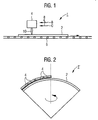
- the device 1 after Fig. 1 is provided for the so-called activation of a substrate 2 coated with a photocatalytic material.
- the substrate 2 which is provided in the exemplary embodiment for the production of rear-view mirrors for motor vehicles and accordingly consists essentially of glass in its base body, is provided on its surface with a coating which has hydrophilic or super-hydrophilic properties and thus wetting with Water forms a comparatively homogeneous water film, which affects the passage of light through the glass only insignificantly.
- the substrate 2 is coated prior to its supply to the device 1 in a conventional manner with a photocatalytic semiconductor material, titanium dioxide in the embodiment.
- CVD Chemical Vapor Reduction
- sol-gel coating etc.
- the application of the coating can in particular according to the in the DE 296 23 901 U1 or in the EP 1 254 870 A2 described concepts on the substrate 2, wherein the relevant disclosure of said documents is expressly included.
- Such a substrate 2 provided with a titanium dioxide coating basically has super-hydrophilic properties on the coated surface. This is maintained for a certain period even when the substrate 2 is stored in the dark. However, the hydrophilicity is gradually lost over time, but can be restored in a relatively simple manner by subjecting the surface to photoexcitation, for example, by daylight.
- the formation of the super-hydrophilicity in the surface of the coated substrate 2 and thus the production of a non-fogging element formed by the coated substrate 2 presupposes that the coated substrate 2 is subjected to a so-called activation step after the application of the titanium dioxide coating .
- the super-hydrophilicity of the surface coating in a treatment step before the first use of the substrate 2, the super-hydrophilicity of the surface coating must be adjusted by a suitable treatment, wherein it is assumed that in this step, a sufficient number of hydroxyl groups in the surface coating is provided, which can produce the desired superhydrophilicity ,
- the device 1 is designed specifically.
- the device 1 is provided in particular for use in a large-scale production and accordingly designed for particularly short treatment times for the coated substrates 2 and comparatively high throughput rates with only limited energy consumption.
- the device 1 is designed to activate the coated substrates 2 by a reactive treatment.
- Such reactive treatment is carried out according to the design in particular in that the device 1 by passing the coated substrate 2 by appropriate adjustment of environmental conditions and parameters reactive radicals or substances are supplied to the (consecutive chemical reactions on oxidation by means of hot oxygen, HOO -, OH Radicals) the surface of the coating of adhering impurities and ultimately produce a sufficient number of hydroxyl groups on the coated surface.
- the device 1 is designed to treat the surface coating applied to the substrate 2 with a gas flame to carry out the activation step.
- the device 1 comprises a gas burner 4 as a device for the reactive treatment of the coated substrate 2.
- This is assigned a conveying device 6 for the coated substrate 2, via which the coated substrate 2 can be suitably guided past the gas burner 4.
- the gas burner 4 both a fuel gas B and an oxidant O can be supplied.
- fuel gas B can be provided, for example, methane, ethane, ethylene, acetylene, propane, butane, natural gas, hydrogen, mixtures or the like.
- the operating parameters of the gas burner 4 are adjusted in particular such that a particularly good treatment success is achieved on the coated substrate 2.
- the knowledge is taken into account that the best results of the treatment are expected from the oxidizing properties of the burner flame 10, the presence of free radicals and the water vapor released during combustion in direct contact of the flame tip with the substrate surface.
- the gas burner 4 is positioned relative to the conveyor 6 such that the flame tip of the burner flame 10 is about 15 mm above the surface of the passing substrate 2.
- the cleaning of slightly soiled surfaces which were subjected, for example, a pre-cleaning by a suitable washing device, succeeds in just a few seconds.
- a contoured present substrate 2 in the alternative embodiment according to Fig. 2 is the device 1 'for a treatment of a contoured present substrate 2, so for example a dome designed.
- a plurality of gas burners 4 are provided in the device 1 ', which are arranged with respect to the positioning of their outlet openings adapted to the contouring provided for the substrate 2.
- a rotation of the calottes is provided during the flame treatment so that a particularly uniform activation is achieved over the entire surface.
- a possibly present different peripheral speed of the dome is thereby optionally by appropriately set different burner intensities or in Fig. 2 not shown additional burners compensated.
- the gas flows of the fuel gas B and the oxidant O are each separately adjustable, so that operating point dependent a particularly favorable ratio of the two gas streams can be adjusted. For particularly good treatment results, this ratio is adjusted so that the burner flame out blue, ie with excess air, operated.
- the substrate 2 is guided past the burner flame 10 at a speed between 0.1 and 10 cm / s, preferably at about 2.5 cm / s.
- FIG. 3 in the form of a diagram depicting the dependence of the so-called contact angle ⁇ on the ratio V between oxidant flow (or air flow) and fuel gas flow.
- the contact angle ⁇ which is drawn here as a measure of the hydrophilicity of the coated substrate 2, is the angle formed by the edge of a water droplet located on the element surface with the element surface. In the case of uncoated glasses, this contact angle is usually between about 40 ° and 60 °.
- a hydrophilic surface becomes then spoken, if the contact angle is less than about 20 °.
- the so-called super-hydrophilicity exists when the edge or contact angle is less than about 10 °, preferably less than about 5 °.
- This contact angle ⁇ is shown in the diagram Fig. 3 applied as a function of the ratio V for a coating system in which as a gas burner 4, a belt burner with the type designation SK 02-380 - 003
- the company Webber is used with a cast iron body, flame strips made of stainless steel fins and a width of 200 mm, which can be operated with natural gas under a pre-pressure of 70 mbar and air under a pressure of 6 bar.
- the contact angle ⁇ decreases from a ratio value V of about 10, ie a clear excess of air, to values below about 10 °, so that so-called super-hydrophilicity of the coated substrates 2 can be achieved.
Landscapes
- Chemical & Material Sciences (AREA)
- Engineering & Computer Science (AREA)
- Organic Chemistry (AREA)
- Materials Engineering (AREA)
- Chemical Kinetics & Catalysis (AREA)
- Life Sciences & Earth Sciences (AREA)
- General Chemical & Material Sciences (AREA)
- Geochemistry & Mineralogy (AREA)
- Physics & Mathematics (AREA)
- Toxicology (AREA)
- Health & Medical Sciences (AREA)
- Plasma & Fusion (AREA)
- Optics & Photonics (AREA)
- Multimedia (AREA)
- Mechanical Engineering (AREA)
- Catalysts (AREA)
- Surface Treatment Of Glass (AREA)
- Acyclic And Carbocyclic Compounds In Medicinal Compositions (AREA)
- Weting (AREA)
- Formation Of Insulating Films (AREA)
Claims (11)
- Procédé de fabrication d'un élément, dans lequel une couche superficielle faite d'un matériau photocatalytique est soumise à un pas d'activation,
caractérisé en ce
que la couche superficielle, pendant la réalisation du pas d'activation, est traitée à la flamme avec une flamme de gaz. - Procédé selon la revendication 1, dans lequel la couche superficielle est formée du matériau photocatalytique moyennant un revêtement appliqué sur un substrat (2).
- Procédé selon la revendication 2, dans lequel l'activation est effectuée durant un temps de traitement d'environ 6 s.
- Procédé selon la revendication 2 ou 3, dans lequel le substrat (2) revêtu du matériau photocatalytique est passé devant la flamme de gaz, la flamme de gaz étant positionnée de façon que la partie visible de la pointe de la flamme se trouve environ 10 mm à 20 mm au-dessus de la surface du substrat.
- Procédé selon l'une quelconque des revendications 2 à 4, dans lequel le substrat est passé devant la flamme de gaz à une vitesse entre 0,1 et 10 cm/s, de préférence d'environ 2,5 cm/s.
- Procédé selon l'une quelconque des revendications 1 à 5, dans lequel un courant de gaz combustible et un courant d'agent d'oxydation sont alimentés à la flamme de gaz.
- Procédé selon l'une quelconque des revendications 1 à 6, dans lequel le pas d'activation est réalisé dans l'atmosphère ambiente ou dans une atmosphère de gaz inerte.
- Procédé selon l'une quelconque des revendications 1 à 7, dans lequel dioxyde de titane est prévu comme matériau photocatalytique.
- Procédé selon l'une quelconque des revendications 1 à 8, dans lequel l'élément antibué fabriqué est un miroir, de préférence, un miroir de trafic.
- Procédé selon la revendication 9, dans lequel un miroir est fabriqué pour utilisation dans un véhicule à moteur.
- Utilisation (1, 1') d'un bec de gaz (4) pour traitement réactif d'un substrat (2), pour l'activation d'un revêtement essentiellement transparent fait d'un matériau photocatalytique appliqué sur le substrat (2).
Applications Claiming Priority (1)
| Application Number | Priority Date | Filing Date | Title |
|---|---|---|---|
| US63447504P | 2004-12-09 | 2004-12-09 |
Publications (2)
| Publication Number | Publication Date |
|---|---|
| EP1669331A1 EP1669331A1 (fr) | 2006-06-14 |
| EP1669331B1 true EP1669331B1 (fr) | 2010-02-17 |
Family
ID=36072025
Family Applications (1)
| Application Number | Title | Priority Date | Filing Date |
|---|---|---|---|
| EP05026887A Expired - Lifetime EP1669331B1 (fr) | 2004-12-09 | 2005-12-08 | Procédé de fabrication d'élément antibué |
Country Status (4)
| Country | Link |
|---|---|
| US (1) | US20060128563A1 (fr) |
| EP (1) | EP1669331B1 (fr) |
| AT (1) | ATE457963T1 (fr) |
| DE (1) | DE502005009026D1 (fr) |
Families Citing this family (4)
| Publication number | Priority date | Publication date | Assignee | Title |
|---|---|---|---|---|
| FR2911130B1 (fr) | 2007-01-05 | 2009-11-27 | Saint Gobain | Procede de depot de couche mince et produit obtenu |
| DE102007043653A1 (de) * | 2007-09-13 | 2009-04-02 | Siemens Ag | Transparente poröse SiO2-Beschichtung für ein transparentes Substratmaterial mit verbesserten optischen Eigenschaften |
| DE102007043650A1 (de) | 2007-09-13 | 2009-04-02 | Siemens Ag | Verfahren zur Verbesserung der Eigenschaften von Beschichtungen |
| CA2753853C (fr) * | 2009-03-06 | 2017-04-25 | Daniel S. Levi | Endoprothese vasculaire en couche mince et traitement de surface biocompatible |
Citations (1)
| Publication number | Priority date | Publication date | Assignee | Title |
|---|---|---|---|---|
| GB1209209A (en) * | 1968-08-19 | 1970-10-21 | Edward Woodrow Bowman | Industrial heating furnaces with independently controllable heating and cooling zones |
Family Cites Families (16)
| Publication number | Priority date | Publication date | Assignee | Title |
|---|---|---|---|---|
| GB1030809A (en) * | 1963-11-20 | 1966-05-25 | John Harold Flynn | Polyolefin-coated material and method of making it |
| JPS5875151A (ja) * | 1981-10-29 | 1983-05-06 | Fuji Photo Film Co Ltd | 写真印画紙用樹脂コ−テイング紙の製造方法 |
| DE69734921T2 (de) * | 1996-12-09 | 2006-09-28 | Nippon Sheet Glass Co., Ltd. | Antibeschlag-gegenstand und dessen herstellungsverfahren |
| JPH11169645A (ja) * | 1997-12-11 | 1999-06-29 | Sekisui Chem Co Ltd | ガス分解処理方法 |
| US6376057B1 (en) * | 1998-11-19 | 2002-04-23 | Fuji Photo Film, Co., Ltd. | Packaging material for photographic photosensitive material |
| GB9913315D0 (en) * | 1999-06-08 | 1999-08-11 | Pilkington Plc | Improved process for coating glass |
| US6777374B2 (en) * | 2000-07-18 | 2004-08-17 | The United States Of America As Represented By The Environmental Protection Agency | Process for photo-induced selective oxidation of organic chemicals to alcohols, ketones and aldehydes using flame deposited nano-structured photocatalyst |
| JP2002159829A (ja) * | 2000-11-28 | 2002-06-04 | Toshiba Home Technology Corp | 光触媒反応装置 |
| US7378371B2 (en) * | 2001-12-21 | 2008-05-27 | Show A Denko K.K. | Highly active photocatalyst particles, method of production therefor, and use thereof |
| JPWO2004011244A1 (ja) * | 2002-07-31 | 2005-11-24 | 宇部日東化成株式会社 | 高耐久性光触媒フィルムおよびそれを用いた表面に光触媒機能を有する構造物 |
| DE10351467B4 (de) * | 2003-11-04 | 2011-07-07 | Schott Ag, 55122 | Gegenstand mit leicht reinigbarer Oberfläche und Verfahren zu seiner Herstellung |
| ATE459733T1 (de) * | 2003-12-09 | 2010-03-15 | Central Res Inst Elect | Verfahren zur herstellung eines substrats mit einer schicht aus kohlenstoffdotiertem titanoxid |
| US7354650B2 (en) * | 2004-05-28 | 2008-04-08 | Ppg Industries Ohio, Inc. | Multi-layer coatings with an inorganic oxide network containing layer and methods for their application |
| US7354624B2 (en) * | 2004-05-28 | 2008-04-08 | Ppg Industries Ohio, Inc. | Multi-layer coatings and related methods |
| JP4298603B2 (ja) * | 2004-07-20 | 2009-07-22 | 小松電子株式会社 | Toc成分除去装置およびtoc成分の除去方法 |
| JP3980050B2 (ja) * | 2005-02-24 | 2007-09-19 | 財団法人電力中央研究所 | 多機能材の製造方法 |
-
2005
- 2005-12-07 US US11/296,631 patent/US20060128563A1/en not_active Abandoned
- 2005-12-08 DE DE502005009026T patent/DE502005009026D1/de not_active Expired - Lifetime
- 2005-12-08 AT AT05026887T patent/ATE457963T1/de not_active IP Right Cessation
- 2005-12-08 EP EP05026887A patent/EP1669331B1/fr not_active Expired - Lifetime
Patent Citations (1)
| Publication number | Priority date | Publication date | Assignee | Title |
|---|---|---|---|---|
| GB1209209A (en) * | 1968-08-19 | 1970-10-21 | Edward Woodrow Bowman | Industrial heating furnaces with independently controllable heating and cooling zones |
Also Published As
| Publication number | Publication date |
|---|---|
| ATE457963T1 (de) | 2010-03-15 |
| EP1669331A1 (fr) | 2006-06-14 |
| DE502005009026D1 (de) | 2010-04-01 |
| US20060128563A1 (en) | 2006-06-15 |
Similar Documents
| Publication | Publication Date | Title |
|---|---|---|
| DE19655363B4 (de) | Verwendung eines Verbundstoffes um ein Beschlagen der Oberflächen zu verhindern | |
| DE69730918T2 (de) | Antibeschlag-Element | |
| DE69307208T2 (de) | Verfahren zur Herstellung von Überzugfilmen aus Titanoxyd | |
| DE69735268T2 (de) | Photocatalytische und hydrophile beschichtungszusammnensetzung | |
| DE69802072T2 (de) | Substrat mit einer zu behandelnden oberfläche | |
| US5780380A (en) | Photocatalyst composition and process for its production, and photocatalyst composition-attached substrate | |
| EP1430001A2 (fr) | Verre a revetement superficiel poreux antireflechissant, et procede de fabrication d'un tel verre | |
| DD149058A5 (de) | Verfahren zum kontinuierlichen ablagern einer schicht eines feststoffs | |
| DE29624395U1 (de) | Substrat mit photokalytischer Beschichtung | |
| EP0718418A1 (fr) | Procédé de production d'une couche à gradient | |
| DD204907A5 (de) | Einrichtung zur kontinuierlichen ablagerung einer trockensubstanzschicht auf der oberflaeche eines auf hohe temperatur gebrachten substrats | |
| DE102011083461A1 (de) | Verfahren zum Erzeugen einer Deckschicht aus Siliziumoxid an einem EUV-Spiegel | |
| EP1669331B1 (fr) | Procédé de fabrication d'élément antibué | |
| DE60205032T2 (de) | Photokatalysator und abgasreinigungsverfahren | |
| EP0984877A1 (fr) | Raclette d'essuie-glace a couche protectrice | |
| DE112005000991T5 (de) | Aktivierung einer Glasoberfläche | |
| DE102007043651A1 (de) | Silizium/Titandioxid-Schicht mit verbesserten Oberflächeneigenschaften | |
| DE102011083462A1 (de) | EUV-Spiegel mit einer Oxynitrid-Deckschicht mit stabiler Zusammensetzung | |
| EP3959181A1 (fr) | Procédé de production d'une vitre dotée d'un revêtement structuré | |
| WO2002083589A1 (fr) | Procede de production de structures colorees sur verre | |
| EP1458654B1 (fr) | Procede de production de zones localement fonctionnelles et articles produits a partir de celui-ci | |
| DE102016104128A1 (de) | Verfahren zum Beschichten einer Bauteiloberfläche, beschichtetes Bauteil und Verwendung eines Precursormaterials | |
| DE102011079451A1 (de) | Optische Anordnung und Verfahren zur Verringerung von oxidischen Verunreinigungen | |
| DE4237390C1 (de) | Verfahren zur Fixierung von Metalloxidkatalysatorteilchen auf einem Träger | |
| DE3826281A1 (de) | Uebergangsmetallchalkogenid der zusammensetzung mx(pfeil abwaerts)2(pfeil abwaerts), verfahren zur herstellung von mx(pfeil abwaerts)2(pfeil abwaerts)-material und dessen verwendung |
Legal Events
| Date | Code | Title | Description |
|---|---|---|---|
| PUAI | Public reference made under article 153(3) epc to a published international application that has entered the european phase |
Free format text: ORIGINAL CODE: 0009012 |
|
| AK | Designated contracting states |
Kind code of ref document: A1 Designated state(s): AT BE BG CH CY CZ DE DK EE ES FI FR GB GR HU IE IS IT LI LT LU LV MC NL PL PT RO SE SI SK TR |
|
| AX | Request for extension of the european patent |
Extension state: AL BA HR MK YU |
|
| 17P | Request for examination filed |
Effective date: 20061205 |
|
| 17Q | First examination report despatched |
Effective date: 20070110 |
|
| AKX | Designation fees paid |
Designated state(s): AT BE BG CH CY CZ DE DK EE ES FI FR GB GR HU IE IS IT LI LT LU LV MC NL PL PT RO SE SI SK TR |
|
| RTI1 | Title (correction) |
Free format text: PROCESS FOR PRODUCTION OF AN ANTI-FOGGING ELEMENT |
|
| GRAP | Despatch of communication of intention to grant a patent |
Free format text: ORIGINAL CODE: EPIDOSNIGR1 |
|
| GRAS | Grant fee paid |
Free format text: ORIGINAL CODE: EPIDOSNIGR3 |
|
| GRAA | (expected) grant |
Free format text: ORIGINAL CODE: 0009210 |
|
| AK | Designated contracting states |
Kind code of ref document: B1 Designated state(s): AT BE BG CH CY CZ DE DK EE ES FI FR GB GR HU IE IS IT LI LT LU LV MC NL PL PT RO SE SI SK TR |
|
| REG | Reference to a national code |
Ref country code: GB Ref legal event code: FG4D Free format text: NOT ENGLISH |
|
| REG | Reference to a national code |
Ref country code: CH Ref legal event code: EP |
|
| REG | Reference to a national code |
Ref country code: IE Ref legal event code: FG4D Free format text: LANGUAGE OF EP DOCUMENT: GERMAN |
|
| REF | Corresponds to: |
Ref document number: 502005009026 Country of ref document: DE Date of ref document: 20100401 Kind code of ref document: P |
|
| REG | Reference to a national code |
Ref country code: NL Ref legal event code: VDEP Effective date: 20100217 |
|
| LTIE | Lt: invalidation of european patent or patent extension |
Effective date: 20100217 |
|
| PG25 | Lapsed in a contracting state [announced via postgrant information from national office to epo] |
Ref country code: IS Free format text: LAPSE BECAUSE OF FAILURE TO SUBMIT A TRANSLATION OF THE DESCRIPTION OR TO PAY THE FEE WITHIN THE PRESCRIBED TIME-LIMIT Effective date: 20100617 Ref country code: LT Free format text: LAPSE BECAUSE OF FAILURE TO SUBMIT A TRANSLATION OF THE DESCRIPTION OR TO PAY THE FEE WITHIN THE PRESCRIBED TIME-LIMIT Effective date: 20100217 Ref country code: ES Free format text: LAPSE BECAUSE OF FAILURE TO SUBMIT A TRANSLATION OF THE DESCRIPTION OR TO PAY THE FEE WITHIN THE PRESCRIBED TIME-LIMIT Effective date: 20100528 |
|
| PG25 | Lapsed in a contracting state [announced via postgrant information from national office to epo] |
Ref country code: SI Free format text: LAPSE BECAUSE OF FAILURE TO SUBMIT A TRANSLATION OF THE DESCRIPTION OR TO PAY THE FEE WITHIN THE PRESCRIBED TIME-LIMIT Effective date: 20100217 Ref country code: PL Free format text: LAPSE BECAUSE OF FAILURE TO SUBMIT A TRANSLATION OF THE DESCRIPTION OR TO PAY THE FEE WITHIN THE PRESCRIBED TIME-LIMIT Effective date: 20100217 Ref country code: FI Free format text: LAPSE BECAUSE OF FAILURE TO SUBMIT A TRANSLATION OF THE DESCRIPTION OR TO PAY THE FEE WITHIN THE PRESCRIBED TIME-LIMIT Effective date: 20100217 Ref country code: LV Free format text: LAPSE BECAUSE OF FAILURE TO SUBMIT A TRANSLATION OF THE DESCRIPTION OR TO PAY THE FEE WITHIN THE PRESCRIBED TIME-LIMIT Effective date: 20100217 |
|
| REG | Reference to a national code |
Ref country code: IE Ref legal event code: FD4D |
|
| PG25 | Lapsed in a contracting state [announced via postgrant information from national office to epo] |
Ref country code: GR Free format text: LAPSE BECAUSE OF FAILURE TO SUBMIT A TRANSLATION OF THE DESCRIPTION OR TO PAY THE FEE WITHIN THE PRESCRIBED TIME-LIMIT Effective date: 20100518 Ref country code: CY Free format text: LAPSE BECAUSE OF FAILURE TO SUBMIT A TRANSLATION OF THE DESCRIPTION OR TO PAY THE FEE WITHIN THE PRESCRIBED TIME-LIMIT Effective date: 20100217 Ref country code: EE Free format text: LAPSE BECAUSE OF FAILURE TO SUBMIT A TRANSLATION OF THE DESCRIPTION OR TO PAY THE FEE WITHIN THE PRESCRIBED TIME-LIMIT Effective date: 20100217 Ref country code: IE Free format text: LAPSE BECAUSE OF FAILURE TO SUBMIT A TRANSLATION OF THE DESCRIPTION OR TO PAY THE FEE WITHIN THE PRESCRIBED TIME-LIMIT Effective date: 20100217 Ref country code: NL Free format text: LAPSE BECAUSE OF FAILURE TO SUBMIT A TRANSLATION OF THE DESCRIPTION OR TO PAY THE FEE WITHIN THE PRESCRIBED TIME-LIMIT Effective date: 20100217 Ref country code: RO Free format text: LAPSE BECAUSE OF FAILURE TO SUBMIT A TRANSLATION OF THE DESCRIPTION OR TO PAY THE FEE WITHIN THE PRESCRIBED TIME-LIMIT Effective date: 20100217 Ref country code: SE Free format text: LAPSE BECAUSE OF FAILURE TO SUBMIT A TRANSLATION OF THE DESCRIPTION OR TO PAY THE FEE WITHIN THE PRESCRIBED TIME-LIMIT Effective date: 20100217 |
|
| PG25 | Lapsed in a contracting state [announced via postgrant information from national office to epo] |
Ref country code: SK Free format text: LAPSE BECAUSE OF FAILURE TO SUBMIT A TRANSLATION OF THE DESCRIPTION OR TO PAY THE FEE WITHIN THE PRESCRIBED TIME-LIMIT Effective date: 20100217 Ref country code: BG Free format text: LAPSE BECAUSE OF FAILURE TO SUBMIT A TRANSLATION OF THE DESCRIPTION OR TO PAY THE FEE WITHIN THE PRESCRIBED TIME-LIMIT Effective date: 20100517 Ref country code: CZ Free format text: LAPSE BECAUSE OF FAILURE TO SUBMIT A TRANSLATION OF THE DESCRIPTION OR TO PAY THE FEE WITHIN THE PRESCRIBED TIME-LIMIT Effective date: 20100217 |
|
| PLBE | No opposition filed within time limit |
Free format text: ORIGINAL CODE: 0009261 |
|
| STAA | Information on the status of an ep patent application or granted ep patent |
Free format text: STATUS: NO OPPOSITION FILED WITHIN TIME LIMIT |
|
| 26N | No opposition filed |
Effective date: 20101118 |
|
| PG25 | Lapsed in a contracting state [announced via postgrant information from national office to epo] |
Ref country code: DK Free format text: LAPSE BECAUSE OF FAILURE TO SUBMIT A TRANSLATION OF THE DESCRIPTION OR TO PAY THE FEE WITHIN THE PRESCRIBED TIME-LIMIT Effective date: 20100217 |
|
| PG25 | Lapsed in a contracting state [announced via postgrant information from national office to epo] |
Ref country code: IT Free format text: LAPSE BECAUSE OF FAILURE TO SUBMIT A TRANSLATION OF THE DESCRIPTION OR TO PAY THE FEE WITHIN THE PRESCRIBED TIME-LIMIT Effective date: 20100217 |
|
| BERE | Be: lapsed |
Owner name: FLABEG G.M.B.H. & CO. KG Effective date: 20101231 |
|
| PG25 | Lapsed in a contracting state [announced via postgrant information from national office to epo] |
Ref country code: MC Free format text: LAPSE BECAUSE OF NON-PAYMENT OF DUE FEES Effective date: 20101231 |
|
| REG | Reference to a national code |
Ref country code: CH Ref legal event code: PL |
|
| PG25 | Lapsed in a contracting state [announced via postgrant information from national office to epo] |
Ref country code: BE Free format text: LAPSE BECAUSE OF NON-PAYMENT OF DUE FEES Effective date: 20101231 |
|
| PG25 | Lapsed in a contracting state [announced via postgrant information from national office to epo] |
Ref country code: LI Free format text: LAPSE BECAUSE OF NON-PAYMENT OF DUE FEES Effective date: 20101231 Ref country code: CH Free format text: LAPSE BECAUSE OF NON-PAYMENT OF DUE FEES Effective date: 20101231 |
|
| PG25 | Lapsed in a contracting state [announced via postgrant information from national office to epo] |
Ref country code: AT Free format text: LAPSE BECAUSE OF NON-PAYMENT OF DUE FEES Effective date: 20101208 |
|
| REG | Reference to a national code |
Ref country code: AT Ref legal event code: MM01 Ref document number: 457963 Country of ref document: AT Kind code of ref document: T Effective date: 20101208 |
|
| PG25 | Lapsed in a contracting state [announced via postgrant information from national office to epo] |
Ref country code: HU Free format text: LAPSE BECAUSE OF FAILURE TO SUBMIT A TRANSLATION OF THE DESCRIPTION OR TO PAY THE FEE WITHIN THE PRESCRIBED TIME-LIMIT Effective date: 20100818 Ref country code: LU Free format text: LAPSE BECAUSE OF NON-PAYMENT OF DUE FEES Effective date: 20101208 |
|
| PG25 | Lapsed in a contracting state [announced via postgrant information from national office to epo] |
Ref country code: TR Free format text: LAPSE BECAUSE OF FAILURE TO SUBMIT A TRANSLATION OF THE DESCRIPTION OR TO PAY THE FEE WITHIN THE PRESCRIBED TIME-LIMIT Effective date: 20100217 |
|
| PG25 | Lapsed in a contracting state [announced via postgrant information from national office to epo] |
Ref country code: PT Free format text: LAPSE BECAUSE OF NON-PAYMENT OF DUE FEES Effective date: 20100217 |
|
| REG | Reference to a national code |
Ref country code: DE Ref legal event code: R082 Ref document number: 502005009026 Country of ref document: DE Representative=s name: TERGAU & WALKENHORST PATENTANWAELTE - RECHTSAN, DE |
|
| REG | Reference to a national code |
Ref country code: DE Ref legal event code: R081 Ref document number: 502005009026 Country of ref document: DE Owner name: FLABEG DEUTSCHLAND GMBH, DE Free format text: FORMER OWNER: FLABEG GMBH & CO. KG, 93437 FURTH IM WALD, DE Effective date: 20150119 Ref country code: DE Ref legal event code: R082 Ref document number: 502005009026 Country of ref document: DE Representative=s name: TERGAU & WALKENHORST PATENTANWAELTE - RECHTSAN, DE Effective date: 20150119 Ref country code: DE Ref legal event code: R082 Ref document number: 502005009026 Country of ref document: DE Representative=s name: TERGAU & WALKENHORST PATENTANWAELTE PARTGMBB, DE Effective date: 20150119 |
|
| REG | Reference to a national code |
Ref country code: FR Ref legal event code: PLFP Year of fee payment: 11 |
|
| REG | Reference to a national code |
Ref country code: FR Ref legal event code: PLFP Year of fee payment: 12 |
|
| REG | Reference to a national code |
Ref country code: FR Ref legal event code: PLFP Year of fee payment: 13 |
|
| PGFP | Annual fee paid to national office [announced via postgrant information from national office to epo] |
Ref country code: GB Payment date: 20231220 Year of fee payment: 19 |
|
| PGFP | Annual fee paid to national office [announced via postgrant information from national office to epo] |
Ref country code: FR Payment date: 20231220 Year of fee payment: 19 Ref country code: DE Payment date: 20231214 Year of fee payment: 19 |
|
| REG | Reference to a national code |
Ref country code: DE Ref legal event code: R082 Ref document number: 502005009026 Country of ref document: DE Representative=s name: TERGAU & WALKENHORST INTELLECTUAL PROPERTY GMB, DE Ref country code: DE Ref legal event code: R082 Ref document number: 502005009026 Country of ref document: DE Representative=s name: TAYLOR WESSING PARTNERSCHAFTSGESELLSCHAFT MBB, DE Ref country code: DE Ref legal event code: R081 Ref document number: 502005009026 Country of ref document: DE Owner name: FLABEG AUTOMOTIVE GERMANY GMBH, DE Free format text: FORMER OWNER: FLABEG DEUTSCHLAND GMBH, 93437 FURTH IM WALD, DE |
|
| REG | Reference to a national code |
Ref country code: DE Ref legal event code: R082 Ref document number: 502005009026 Country of ref document: DE Representative=s name: TERGAU & WALKENHORST INTELLECTUAL PROPERTY GMB, DE |
|
| REG | Reference to a national code |
Ref country code: DE Ref legal event code: R119 Ref document number: 502005009026 Country of ref document: DE |
|
| GBPC | Gb: european patent ceased through non-payment of renewal fee |
Effective date: 20241208 |
|
| PG25 | Lapsed in a contracting state [announced via postgrant information from national office to epo] |
Ref country code: DE Free format text: LAPSE BECAUSE OF NON-PAYMENT OF DUE FEES Effective date: 20250701 |
|
| PG25 | Lapsed in a contracting state [announced via postgrant information from national office to epo] |
Ref country code: GB Free format text: LAPSE BECAUSE OF NON-PAYMENT OF DUE FEES Effective date: 20241208 |
|
| PG25 | Lapsed in a contracting state [announced via postgrant information from national office to epo] |
Ref country code: FR Free format text: LAPSE BECAUSE OF NON-PAYMENT OF DUE FEES Effective date: 20241231 |