EP1653333B1 - Multiprozessor-Rechner zur Verteilung von Aufgaben basierend auf Hitzeemission und Prozessortemperatur - Google Patents
Multiprozessor-Rechner zur Verteilung von Aufgaben basierend auf Hitzeemission und Prozessortemperatur Download PDFInfo
- Publication number
- EP1653333B1 EP1653333B1 EP05255475A EP05255475A EP1653333B1 EP 1653333 B1 EP1653333 B1 EP 1653333B1 EP 05255475 A EP05255475 A EP 05255475A EP 05255475 A EP05255475 A EP 05255475A EP 1653333 B1 EP1653333 B1 EP 1653333B1
- Authority
- EP
- European Patent Office
- Prior art keywords
- processors
- tasks
- task
- processor
- extracted
- Prior art date
- Legal status (The legal status is an assumption and is not a legal conclusion. Google has not performed a legal analysis and makes no representation as to the accuracy of the status listed.)
- Expired - Lifetime
Links
Images


Classifications
-
- G—PHYSICS
- G06—COMPUTING OR CALCULATING; COUNTING
- G06F—ELECTRIC DIGITAL DATA PROCESSING
- G06F9/00—Arrangements for program control, e.g. control units
- G06F9/06—Arrangements for program control, e.g. control units using stored programs, i.e. using an internal store of processing equipment to receive or retain programs
- G06F9/46—Multiprogramming arrangements
- G06F9/48—Program initiating; Program switching, e.g. by interrupt
- G06F9/4806—Task transfer initiation or dispatching
- G06F9/4843—Task transfer initiation or dispatching by program, e.g. task dispatcher, supervisor, operating system
- G06F9/4881—Scheduling strategies for dispatcher, e.g. round robin, multi-level priority queues
- G06F9/4893—Scheduling strategies for dispatcher, e.g. round robin, multi-level priority queues taking into account power or heat criteria
-
- G—PHYSICS
- G06—COMPUTING OR CALCULATING; COUNTING
- G06F—ELECTRIC DIGITAL DATA PROCESSING
- G06F1/00—Details not covered by groups G06F3/00 - G06F13/00 and G06F21/00
- G06F1/16—Constructional details or arrangements
- G06F1/20—Cooling means
- G06F1/206—Cooling means comprising thermal management
-
- Y—GENERAL TAGGING OF NEW TECHNOLOGICAL DEVELOPMENTS; GENERAL TAGGING OF CROSS-SECTIONAL TECHNOLOGIES SPANNING OVER SEVERAL SECTIONS OF THE IPC; TECHNICAL SUBJECTS COVERED BY FORMER USPC CROSS-REFERENCE ART COLLECTIONS [XRACs] AND DIGESTS
- Y02—TECHNOLOGIES OR APPLICATIONS FOR MITIGATION OR ADAPTATION AGAINST CLIMATE CHANGE
- Y02D—CLIMATE CHANGE MITIGATION TECHNOLOGIES IN INFORMATION AND COMMUNICATION TECHNOLOGIES [ICT], I.E. INFORMATION AND COMMUNICATION TECHNOLOGIES AIMING AT THE REDUCTION OF THEIR OWN ENERGY USE
- Y02D10/00—Energy efficient computing, e.g. low power processors, power management or thermal management
Definitions
- This invention relates to a multiprocessor computer and a program which can assign tasks to a plurality of processors, in particular, a multiprocessor computer and a program which can level the processor temperatures among processors and suppress occurrence of stop of processing due to overheating.
- computers performing control in synchronization with real time with which the object to be controlled operates.
- Such computers are equipped with hardware and software designed to achieve real-time processing.
- Real-time processing is used for not only control processes in factories but also business information management processes and electronic commerce processes, and video process in a multimedia processes.
- a multiprocessor computer which simultaneously uses a plurality of processors, if a required processing power is higher than a processing power of a single processor.
- a multiprocessor computer When performing a process, a multiprocessor computer divides the process into processing units, i.e., tasks, assigns processors of numbers necessary for executing respective tasks, and executes the task. If a task requires a plurality of processors, an execution unit to be processed on each processor may be called a thread. Further, if a task and threads forming the task are executed over a plurality of periods on a processor, each period may be called a job. For example, a task which requires two processors is periodically executed, the task is formed of two threads, the number of which is the same as the number of processors to be used, and each thread is periodically executed as a job.
- Algorithms for performing dynamic scheduling include a priority scheduling algorithm that does scheduling on the basis of the priority given to each task.
- An algorithm that does not change the priority once given is called a fixed priority scheduling algorithm.
- An algorithm that dynamically changes priority is called a dynamic priority scheduling algorithm.
- the priority scheduling algorithm includes a method of determining the priority of a task or a job on the basis of the parameter of the task.
- An EDF (Earliest Deadline First) scheduling algorithm is a dynamic scheduling algorithm that decides priority on the basis of the deadline of the task or job.
- the EDF scheduling algorithm is a real-time scheduling algorithm that makes a feasibility check of scheduling and can assure that all tasks can keep real-time constraints (for example, refer to J. W. S. Liu, Real-Time Systems, Prentice Hall, 2000 ).
- a multiprocessor computer having the above structure has no particular problem under normal conditions.
- such a multiprocessor computer performs scheduling and dispatching in consideration of only priority, processing performance, and real-time processing. Therefore, the heat emission becomes unlevel among the processors, and noise (the sound of a fan, etc) caused by cooling of the heated processors increases. In the end, stop of processing may occur due to overheating.
- the object of the present invention is to provide a multiprocessor computer and a program which can level the processor temperature among processors and suppress occurrence of stop of processing due to overheating.
- US 2005/0278520A discloses a multiprocessor computer which selects an idle processor whose temperature is the lowest, and selects from a task queue a task for that processor which it determines wiLL generate the highest heat emission.
- US2003/0110012A discloses a computer where the failsafe temperature of a processor core is monitored. If it is above a threshold, a previously idle processor is restarted, the actual state is transferred from the overheating to the idle processor, and the overheating processor is shut down. This allows the overheated computer to cool down.
- the invention provides a multiprocessor computer and program as defined in claims 1 and 2.
- the processor whose temperature is the lowest is assigned to a task whose heat emission is the highest. This structure enables the levelling of processor temperatures among the processors, and suppresses occurrence of stop of process due to overheating.
- processors may be any number being at least 2.
- processors are formed on respective separate chips in the following embodiments, an on-chip multiprocessor may be used in which a plurality of processors are formed by one chip may.
- the multiprocessor is formed of one or more system controlling processor (a control IC 13 in FIG. 2 ) and a plurality of task processors (P1 to P4 in FIG. 2 ), the present invention is not limited to this structure, but a system controlling processor may also serve as a task processor.
- the system controlling processor and the task processors may be of different instruction set architectures. Processors to which threads are assigned are always task processors. Therefore, in the case of assigning threads, a task processing processor is simply referred to as "processor" hereinafter.
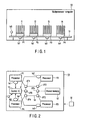
- FIG. 1 is a schematic diagram illustrating a structure of a multiprocessor computer according to a first embodiment of the present invention.
- a multiprocessor computer 10 In a multiprocessor computer 10, four processors P1 to P4 are mounted on a board 11.
- Cooling fins f1 to f4 for cooling are attached to the processors P1 to P4, respectively.
- a cooling fan may be attached to each of the cooling fins f1 to f4.
- a water cooling system may be adopted.
- temperature sensors ts1 to ts4 for measuring the temperatures of the respective processors are provided direct under the processors P1 to P4, respectively.
- the temperature sensors ts1 to ts4 may be provided on upper surfaces of the processors P1 to P4, or may be included in the chips of the processors P1 to P4. In the case of using an on-chip multiprocessor, it is desirable that the temperature sensors ts1 to ts4 are included in a chip such that the sensors can measure the temperatures of the processors P1 to P4, respectively.
- a temperature sensor ts5 is stood on the board 11 to measure the temperature in the casing.
- the temperature sensor ts5 is preferably provided in a position in which the sensor ts5 is not influenced by heat radiating members such as the processors P1 to P4.
- a thermocouple for example, may be used as the temperature sensor ts5. Values measured by the temperature sensors ts1 to ts5 are subjected to analog-digital (A/D) conversion and the like so as to be received by a computer program.
- the temperature sensor ts5 is a constituent element which is provided if temperature measurement in the casing is required, and may be omitted if temperature measurement in the casing is unnecessary.
- the multiprocessor computer 10 has a structure in which the processors P1 to P4, a shared memory 12 and a control IC 13 are connected to a ringshaped interconnect 14, via interfaces I/F1 to I/F6, respectively.
- the processors P1 to P4 correspond to the task processors described above, and are controlled by the control IC 13.
- the shared memory 12 is a memory which is readable and writable by the processors P1 to P4 and the control IC 13.
- the shared memory 12 stores a processing 20 and a task 21 as shown in FIGS. 3 and 4 explained below, ..., a table T20 as shown in FIG. 5 , scheduling programs as shown in FIGS. 6 and 7 , and temperature measurement results by the temperature sensors ts1 to ts5, etc.
- Each of the processors P1 to P4 may have a memory instead of the shared memory 12, or each of the processors P1 to P4 may have a memory in addition to the shared memory 12.
- the scheduling programs are installed in advance in the multiprocessor computer 10 from a network or a storage medium M.
- the control IC 13 corresponds to the system controlling processor described above, and performs dynamic scheduling to assign tasks to the processors P1 to P4, on the basis of the scheduling programs stored in the shared memory 12 and the measurement results by the temperature sensors ts1 to ts5.
- the control IC 13 has a function of causing each of the processors P1 to P4 to execute a task on the basis of the scheduling result.
- the scheduling process includes an extraction process of, when at least one of the processors P1 to P4 is executing a plurality of tasks, extracting one or more processors that do none of the plurality of tasks, a first selection process of selecting one processor whose temperature sensed by the temperature sensors ts1 to ts4 is the lowest from one or more processors extracted in the extraction process, a second selection process of, when assigning a task to be newly executed to any ones of the processors extracted in the extraction process, referring to the heat emissions included in the tasks to be newly executed and selecting the task whose heat emission is the highest, an assignment process of assigning the task selected in the second selection process to the processor selected in the first selection process, a decision process of, after the assignment process has assigned the task, deciding whether all of the tasks to be newly executed have been assigned to the processors, and a control process of, when the decision process has decided that all of the tasks have not been assigned to the processors, controlling the first selection process, second selection process, and assignment process so as to assign unassigned tasks
- the interfaces I/F1 to I/F6 are connected to the interconnect 14 which is formed in a ring shape, and enable data transmission along the interconnect 14. As long as mutual data transmission is possible, the interconnect does not necessarily have such a ring shape.
- the processors P1 to P4 and the shared memory 12 may be connected by using one or more buses. As another structure, processor may be directly connected to all of the other processors.
- the multiprocessor computer 10 can adopt various connecting methods as a method of connecting processors, such as bus type, array type, and ring type.
- a process 20 comprises a plurality of tasks 21 to 24, for example.
- Each of the tasks 21 to 24 is formed of threads of a number equal to the number of processors to be used.
- a task 21 which requires 2 processors comprises two threads 21a and 21b.
- the other tasks are formed as follows.
- a task 22 is formed of a thread 22a.
- a task 23 is formed of threads 23a and 23b.
- a task 24 is formed of a thread 24a.
- Thread(s) included in each task is(are) assigned to the respective processors, and each thread is executed as a job. For example, if the task 21 is periodically executed, processors are periodically assigned to the threads 21a and 21b, and each thread is periodically executed as a job.
- the processes may include controlling progress of the process by precedence constraints which designate the execution order of tasks.
- a precedence constraint 25 designates the task 21 to be executed prior to the task 22
- a precedence constraint 26 designates the task 21 to be executed prior to the task 23.
- Task 22 and 23 are executed after end of the task 21, on the basis of the designations by the precedence constraints 25 and 26.
- a precedence constraint 27 designates the task 22 to be executed prior to the task 24
- precedence constraint 28 designates the task 23 to be executed prior to the task 24.
- the task 24 is executed after ends of the tasks 22 and 23, on the basis of the designations by the precedence constraints 27 and 28. If it is unnecessary to designate the processing order, the execution order of tasks may not be designated by precedence constraints.
- FIG. 4 shows an example of parameters assigned to real-time tasks which are executed in real time.
- parameters 21c are assigned to the task 21 in advance.
- the parameters include the number of processors to be used, execution term (the length of processing time), release time (time when processing can be started), deadline (processing completion time), period, and heat emission. If the parameters include the period, the execution term, release time, and deadline mean the execution term, release time, and deadline, respectively, in a cycle of a job which is periodically executed.
- the heat emission is data indicating a heat emission generated if a processor executes the task 21 for the execution term. If a task includes a plurality of threads, the heat emission can be designated for each thread.
- a temperature management table T20 for managing the temperature of each processor will be explained.
- the temperature management table T20 is a table in which the present processor temperatures sensed by the temperature sensors ts1 to ts4 are stored according to the IDs of the processors P1, P2, ..., P4.
- the control IC 13 senses the temperatures of the processors P1 to P4 with the temperature sensors ts1 to ts4. In addition, as shown in FIG. 6 , the control IC 13 waits for any one of the processors P1 to P4 to become idle (ST10).
- "idle” means that the processor executes none of the threads.
- processors P1 to P4 becomes idle (Yes in ST10), one or more processors which have become idle are extracted and a task is selected (or extracted) from a task execution waiting queue (ST20).
- a task execution waiting queue ST20.
- the control IC 13 checks whether there are as many idle processors as the number of processors to be used by the selected tasks (ST30).
- control IC 13 selects another task from the execution waiting queue. Alternatively, the control IC 13 may wait for more idle processors than the number of processors to be used by the selected tasks to appear.
- the control IC 13 assigns processors to the threads constituting the tasks in such a manner that the temperatures of the individual processors are almost level (ST40). Specifically, dynamic scheduling is done, taking into account the temperatures of the processors and the heat emissions of the relevant tasks or threads. The details of dynamic scheduling will be given later.
- control IC 13 dispatches threads (ST50). After the dispatch, the control IC 13 returns to step ST10.
- the control IC 13 checks whether it has assigned processors to all of the threads constituting the tasks (ST41). If having assigned processors to all of the threads, the control IC 13 completes assigning processors.
- step ST41 If the result of step ST41 has shown that there are threads to which processors have not been assigned, the control IC 13 performs the following processes. First, of the threads to which processors have not been assigned, the control IC 13 selects the thread whose heat emission is the highest (ST42). In addition, the control IC 13 refers to the temperature management table T20 which lists the processor temperatures sensed by the temperature sensors ts1 to ts4 and selects the processor whose temperature is the lowest from the idle processors (ST43). Then, the control IC 13 assigns the selected processor to the selected thread (ST44). After the assignment, the control IC 13 returns to step ST41.
- processor temperatures have been sensed by the temperature sensors, the present invention is not limited to this.
- the accumulated heat emissions of the relevant processors may be calculated on the basis of the parameters for heat emissions given to the individual tasks or threads and the resulting values may be used as the processor temperatures.
- the heat emission of each task or thread may be found, referring to the parameters for the heat emission added.
- the temperature measured when the processor was actually run before the preceding execution may be used.
- the processor temperature after the thread execution may be estimated more accurately by doing transient heat conduction simulation using a temperature model on the basis of the present processor temperature and thread heat emission.
- the processor whose temperature is the lowest is assigned to the task whose heat emission is the highest. Therefore, the processors are level in the processor temperatures among the processors, and it is suppress occurrence of stop of processes due to overheating.
- the second embodiment is a modification of the first embodiment.
- the second embodiment executes a dynamic scheduling method, taking into account the possibility that there will be an overheated processor.
- control IC 13 performs operations shown in FIG. 8 , instead of the operations shown in FIG. 6 .
- the operations of FIG. 7 are carried out as described above.
- Step ST40 includes step ST41 to ST44 as described above.
- control IC 13 checks whether there is a processor which can overheat (ST45). If there is no processor which can overheat, the control IC 13 dispatches threads according to the assignation of processors as described above (ST50).
- the control IC 13 waits for a new idle processor to appear in addition to the present idle processors (ST49). At this time, while waiting for a new idle processor, the control IC 13 may turn off the power supply of the unused idle processors, thereby suppressing the heat emission of the processors. In addition, while a new idle processor is being waited for, the temperature of an existing unused idle processor drops and therefore there is no possibility that the processor will overheat, the control IC 13 may dispatch a thread to the existing unused idle processor.
- control IC 13 When there is a new idle processor, the control IC 13 returns to step ST40 and assigns the processor to a thread again.
- the control IC 13 waits for a new idle processor to appear, and suppresses occurrence of stop of processing due to overheating reliably in addition to the effect of the first embodiment.
- FIGS. 1 to 5 a multiprocessor computer according to a third embodiment of the present invention is explained with reference to FIGS. 1 to 5 .
- This embodiment is a modification of the second embodiment.
- the control IC 13 decides the possibility that scheduling is feasible, taking dispatch delay time into account.
- the dispatch of threads is delayed.
- the dispatch delay time to avoid overheating is not taken into account when the feasibility of scheduling is checked in advance.
- the decision of the feasibility of scheduling becomes invalid. Therefore, the feasibility of scheduling has to be checked again, taking dispatch delay time into account.
- the feasibility of scheduling is decided, taking dispatch delay time into account in advance, so as to avoid the re-check of the feasibility of scheduling.
- control IC 13 performs operation of FIG. 9 , instead of the operation of FIG. 8 .
- the operation of FIG. 7 is performed as described above.
- control IC 13 executes the processes in step ST10 to ST45 as described above, and checks whether there is a processor which can overheat (ST45). If there is no processor which can overheat, the control IC 13 dispatches threads as described above (ST50).
- control IC 13 creates a dummy task which has as long an execution term as the term in which a new idle processor is waited for to appear in addition to the present idle processors, and adds the dummy task to a set of tasks currently being executed (ST46).
- the heat emission of the dummy task is almost zero.
- the dummy task is a task for causing a processor to stand by.
- suitable parameters have to be set according to the dynamic scheduling algorithm. For example, when scheduling is done in increasing order of period, the shortest one of the periods of all the tasks has to be set as the period of the dummy task. When scheduling is done in increasing order of deadline, the sum of the present time and the execution term of the dummy task have to be set as the deadline of the dummy task.
- the control IC 13 decides whether scheduling can be done (ST48). If the result of the decision has shown that scheduling isn't feasible, the dispatch of the tasks cannot be delayed. Therefore, the control IC 13 dispatches the tasks without waiting for a new idle processor (ST50). At this time, when a processor has evidently overheated and therefore it is obvious that a system failure will occur, the control IC 13 may stop the execution of the tasks or execute an abnormal stop of the system.
- the control IC 13 waits for a new idle processor to appear in addition to the present idle processors (ST49). At this time, while the control IC 13 is waiting for a new idle processor to appear, it may stop the power supply of the unused idle processors, thereby suppressing the heat emission of the processors. In addition, while the control IC 13 is waiting for a new idle processor to appear, when the temperature of an existing unused idle processor has dropped and therefore the processor may not overheat, the control IC 13 may dispatch a thread to the existing unused idle processor.
- control IC 13 When there is a new idle processor, the control IC 13 returns to step ST40 and assigns processors to threads again.
- the third embodiment in the dynamic scheduling method that assures real-time processing, when the occurrence of an overheated processor is avoided, a dummy task whose execution period is as long as the period during which a new idle processor is waited for is created and the feasibility of scheduling is checked, taking the dispatch delay time (the execution term of the dummy task) into account. Therefore, this not only produces the effect of the second embodiment but also makes it possible to avoid the re-check of the feasibility of scheduling.
- storage media which can store programs therein and out which computers can read may have any form of the storing system.
- middle ware or the like such as operating system (OS), database management software, network software, or the like, which is working on a computer on the basis of an instruction of the program installed in the computer from the storage medium may execute some of the respective processes for realizing the present embodiment.
- OS operating system
- database management software database management software
- network software or the like
- the storage media in the present invention are not limited to media independent of the computer, and storage media in which a program transmitted via LAN, Internet, or the like is downloaded, and stored or temporarily stored are included therein.
- the storage medium is not limited to one, and a case where the processes in the present embodiment are executed from a plurality of media is included in the storage medium in the present invention, and the medium configuration may be any configuration.
- the computer in the present invention is to execute the respective processes in the present embodiment on the basis of the program stored in the storage medium, and may be any configuration of an apparatus formed from one such as a personal computer, a system in which a plurality of apparatuses are connected through a network, and the like.
- the computer in the present invention is not limited to a personal computer, and includes an arithmetic processing device, a microcomputer, and the like included information processing equipment, and is general term for equipment/apparatus which can realize the functions of the present invention by the program.
- the present invention is not limited to the above-described embodiments as are, and structural requirements can be modified and materialized within a range which does not deviate from the gist of the present invention at the practical phase. Further, various inventions can be formed due to the plurality of structural requirements which have been disclosed in the above-described embodiments being appropriately combined. For example, several structural requirements may be eliminated from all of the structural requirements shown in the embodiments. Moreover, structural requirements over different embodiments may be appropriately combined.
Landscapes
- Engineering & Computer Science (AREA)
- Theoretical Computer Science (AREA)
- Physics & Mathematics (AREA)
- General Engineering & Computer Science (AREA)
- General Physics & Mathematics (AREA)
- Software Systems (AREA)
- Human Computer Interaction (AREA)
- Power Sources (AREA)
- Microcomputers (AREA)
- Control Of Temperature (AREA)
Claims (2)
- Multiprozessor-Computer (10), der konfiguriert ist, eine Vielzahl von Aufgaben mit einer Vielzahl von miteinander verbundener Prozessoren (P1 bis P4) durchzuführen, der eine Vielzahl von Temperatur-Sensorvorrichtungen (ts1 bis ts4) umfasst, die konfiguriert sind, die Temperaturen der Vielzahl von Prozessoren zu erfassen, wobei der Multiprozessor-Computer umfasst:einen Steuer-IC (13), der mit den Prozessoren und den Temperatur-Sensorvorrichtungen verbunden ist,wobei der Steuer-IC umfasst:eine Extrahierungseinrichtung zum Extrahieren eines oder mehrerer Prozessoren aus der Vielzahl von Prozessoren, wenn zumindest einer der Vielzahl von Prozessoren die Vielzahl von Aufgaben ausführt und einer oder mehrere Prozessoren aus der Vielzahl von Prozessoren ungenutzt ist;eine erste Auswahleinrichtung zum Auswählen des Prozessors aus dem einen oder den mehreren, durch die Extrahierungseinrichtung extrahierten Prozessoren, der die geringste, durch die Temperatur-Sensorvorrichtungen erfasste Temperatur aufweist;eine zweite Auswahleinrichtung mit Bezug auf Wärmeemissionsdaten, die in einer Vielzahl von, neu auszuführenden Aufgaben enthalten sind, und zum Auswählen einer Aufgabe, deren Wärmeemissionsdaten die Höchsten sind, wobei die Wärmeemissionsdaten eine Wärmeemission anzeigen, die generiert wird, wenn ein Prozessor aus der Vielzahl von Prozessoren eine Aufgabe für einen Ausführungszeitraum ausführen würde, wenn die Vielzahl von neu auszuführenden Aufgaben irgendeinem aus dem einen oder den mehreren Prozessoren zugewiesen werden, die durch die Extrahierungseinrichtung extrahiert wurden;eine Zuweisungseinrichtung zum Zuweisen der durch die zweite Auswahleinrichtung ausgewählten Aufgabe an den einen, durch die erste Auswahleinrichtung ausgewählten Prozessor;eine Entscheidungseinrichtung zum Entscheiden, ob alle der Vielzahl von neu auszuführenden Aufgaben dem einen oder den mehreren, durch die Extrahierungseinrichtung extrahierten Prozessoren zugewiesen wurden, nachdem die Zuweisungseinrichtung die Aufgaben zugewiesen hat; undeine Steuereinrichtung zum Steuern der ersten Auswahleinrichtung, der zweiten Auswahleinrichtung und der Zuweisungseinrichtung, um nichtzugewiesene Aufgaben an den einen oder die mehreren, durch die Extrahierungseinrichtung extrahierten Prozessoren zuzuweisen, wenn die Entscheidungseinrichtung entschieden hat, dass alle der Vielzahl von Aufgaben nicht an den einen oder die mehreren, durch die Extrahierungseinrichtung extrahierten Prozessoren zugewiesen wurden; undwobei die Zuweisungseinrichtung beinhaltet:eine Überhitzungs-Vorhersageeinrichtung zum Vorhersagen auf Grundlage der durch die Temperatur-Sensoreinrichtungen abgetasteten Temperaturen, ob es einen Prozessor gibt, der überhitzen könnte, bevor Aufgaben an die Prozessoren zugewiesen werden, undeine Standby-Einrichtung, die eine Energieversorgung des Prozessors abschaltet, der, durch die Überhitzungs-Vorhersageeinrichtung vorhergesagt, überhitzen könnte, ohne die Aufgaben zuzuweisen bis die Extrahierungseinrichtung einen anderen Prozessor extrahiert hat, wenn das Resultat der Vorhersage gezeigt hat, dass ein Prozessor vorhanden ist, der überhitzen könnte, wenn eine Aufgabe an den Prozessor erteilt wird; undwobei die Standby-Einrichtung beinhaltet:eine Dummy-Aufgaben-Erzeugungseinrichtung zum Erzeugen einer Dummy-Aufgabe, die einen Ausführungszeitraum so lang wie eine Wartezeit einer zu erteilenden Aufgabe aufweist bis die Extrahierungseinrichtung einen anderen Prozessor extrahiert hat und deren Wärmeemissionsdaten Null sind und der eine Priorität bei der Ausführung über andere Aufgaben gegeben ist,eine Dummy-Aufgaben-Hinzufügungseinrichtung zum Hinzufügen der Dummy-Aufgabe zu einem Satz von Aufgaben, die gegenwärtig ausgeführt werden,eine Zeitplanungsentscheidungseinrichtung zum Entscheiden, ob ein Zeitplan für ein Satz von Aufgaben, die durchgeführt werden, durchführbar ist, wobei die Wartezeit der zu erteilenden Aufgabe nach der Hinzufügung berücksichtigt wird, undeine Zeitplanungseinrichtung zum Ausführen der Zeitplanung auf eine solche Art, dass der Dummy-Aufgabe eine Priorität bei der Ausführung über andere Aufgaben gegeben wird, wenn das Resultat der Entscheidung gezeigt hat, dass die Zeitplanung durchgeführt werden kann.
- Programm, das in einem Computer-lesbaren Speichermedium (M) gespeichert wird, das in einem Multiprozessor-Computer (10) verwendet wird, um eine Vielzahl von Aufgaben mit einer Vielzahl von miteinander verbundenen Prozessorten (P1 bis P4) auszuführen, umfassend:einen ersten Programmcode, der den Computer veranlasst, Temperatursensorprozesse (ts1 bis ts4) zum Erfassen der Temperaturen der Vielzahl von Prozessoren auszuführen, wobei das Programm umfasst:einen zweiten Programmcode, der den Computer veranlasst, einen Extrahierungsprozess zum Extrahieren eines oder mehrerer Prozessoren aus einer Vielzahl von Prozessoren auszuführen, wenn zumindest einer aus der Vielzahl von Prozessoren die Vielzahl von Aufgaben ausführt und einer oder mehrere Prozessoren aus der Vielzahl von Prozessoren ungenutzt ist;einen dritten Programmcode, der den Computer veranlasst, einen ersten Auswahlprozess (ST43) zur Auswahl des Prozessors, aus dem einen oder den mehreren, in dem Extrahierungsprozess extrahierten Prozessoren, auszuführen, der die geringste, in dem Temperatursensorprozess abgetastete Temperatur aufweist;einen vierten Programmcode, der den Computer veranlasst, einen zweiten Auswahlprozess (ST42) mit Bezug auf die Wärmeemissionsdaten auszuführen, die in den neu auszuführenden Aufgaben enthalten sind, und zum Auswählen einer Aufgabe, deren Wärmeemissionsdaten die Höchsten sind, wobei die Wärmeemissionsdaten eine Wärmeemission anzeigen, die generiert wird, wenn ein Prozessor aus der Vielzahl von Prozessoren eine Aufgabe während eines Ausführungszeitraums ausführen würde, wenn die neu auszuführenden Aufgaben irgendeinem aus dem einen oder den mehreren, in dem Extrahierungsprozess extrahierten Prozessoren zugewiesen werden;einen fünften Programmcode, der den Computer veranlasst, einen Zuweisungsprozess (ST44) zum Zuweisen der in dem zweiten Auswahlprozess ausgewählten Aufgabe an den einen Prozessor auszuführen, der in dem ersten Auswahlprozess ausgewählt wurde;einen sechsten Programmcode, der den Computer veranlasst, einen Entscheidungsprozess (ST41) zum Entscheiden auszuführen, ob alle der neu auszuführenden Aufgaben dem einen oder den mehreren, in dem Extrahierungsprozess extrahierten Prozessoren nach der Zuweisung in dem Zuweisungsprozess zugewiesen wurden; undeinen siebenten Programmcode, der den Computer veranlasst, den ersten Auswahlprozess, den zweiten Auswahlprozess und den Zuweisungsprozess sequentiell zu steuern, um nichtzugewiesene Aufgaben dem einen oder den mehreren, in dem Extrahierungsprozess extrahierten Prozessoren zuzuweisen, wenn der Entscheidungsprozess entschieden hat, dass alle der neu auszuführenden Aufgaben nicht dem einen oder den mehreren, in dem Extrahierungsprozess extrahierten Prozessoren zuzuweisen wurden; undwobei der Zuweisungsprozess beinhaltet:einen Überhitzungsvorhersageprozess (ST45), der auf Grundlage der durch die Temperatur-Sensoreinrichtungen erfassten Temperaturen vorhersagt, ob ein Prozessor vorhanden ist, der überhitzt wird, bevor Aufgaben den Prozessoren zugewiesen werden, undeinen Standby-Prozess (ST49), der eine Energieversorgung des Prozessors ausschaltet, der in dem Überhitzungsvorhersageprozess vorhergesagt überhitzt wird, ohne die Aufgaben zuzuweisen bis der Extrahierungsprozess einen anderen Prozessor extrahiert hat, wenn das Resultat des Überhitzungsvorhersageprozesses gezeigt hat, dass ein Prozessor vorhanden ist, der in dem Überhitzungsvorhersageprozess vorhergesagt überhitzt wird, wenn eine Aufgabe an den Prozessor erteilt wird; undwobei der Standby-Prozess beinhaltet:einen Prozess (ST46) zum Erzeugen einer Dummy-Aufgabe, die einen Ausführungszeitraum so lang wie eine Wartezeit einer zu erteilenden Aufgabe aufweist bis der Extrahierungsprozess einen anderen Prozessor extrahiert hat und deren Wärmeemissionsdaten Null sind und der eine Priorität bei der Ausführung über andere Aufgaben gegeben wird,einen Prozess (ST46) zum Hinzufügen der Dummy-Aufgabe zu einem Satz von Aufgaben, die gegenwärtig ausgeführt werden,einen Prozess (ST47) zum Entscheiden, ob eine Zeitplanung für einen Satz von Aufgaben, die ausgeführt werden, durchführbar ist, wobei die Wartezeit der zu erteilenden Aufgabe nach der Hinzufügung berücksichtigt wird, undeinen Prozess zum Ausführen der Zeitplanung auf eine solche Art, dass die Dummy-Aufgabe eine Priorität bei der Ausführung über andere Aufgaben gegeben wird, wenn das Resultat der Entscheidung gezeigt hat, dass die Zeitplanung durchführbar ist.
Applications Claiming Priority (1)
| Application Number | Priority Date | Filing Date | Title |
|---|---|---|---|
| JP2004287309A JP4197672B2 (ja) | 2004-09-30 | 2004-09-30 | マルチプロセッサ計算機及びプログラム |
Publications (3)
| Publication Number | Publication Date |
|---|---|
| EP1653333A2 EP1653333A2 (de) | 2006-05-03 |
| EP1653333A3 EP1653333A3 (de) | 2006-07-26 |
| EP1653333B1 true EP1653333B1 (de) | 2008-12-24 |
Family
ID=35823655
Family Applications (1)
| Application Number | Title | Priority Date | Filing Date |
|---|---|---|---|
| EP05255475A Expired - Lifetime EP1653333B1 (de) | 2004-09-30 | 2005-09-07 | Multiprozessor-Rechner zur Verteilung von Aufgaben basierend auf Hitzeemission und Prozessortemperatur |
Country Status (5)
| Country | Link |
|---|---|
| US (1) | US7770176B2 (de) |
| EP (1) | EP1653333B1 (de) |
| JP (1) | JP4197672B2 (de) |
| CN (1) | CN1755658B (de) |
| DE (1) | DE602005011915D1 (de) |
Families Citing this family (41)
| Publication number | Priority date | Publication date | Assignee | Title |
|---|---|---|---|---|
| JP3889726B2 (ja) * | 2003-06-27 | 2007-03-07 | 株式会社東芝 | スケジューリング方法および情報処理システム |
| JP4025260B2 (ja) | 2003-08-14 | 2007-12-19 | 株式会社東芝 | スケジューリング方法および情報処理システム |
| US20070124618A1 (en) * | 2005-11-29 | 2007-05-31 | Aguilar Maximino Jr | Optimizing power and performance using software and hardware thermal profiles |
| US7848901B2 (en) | 2005-11-29 | 2010-12-07 | International Business Machines Corporation | Tracing thermal data via performance monitoring |
| US8051276B2 (en) * | 2006-07-07 | 2011-11-01 | International Business Machines Corporation | Operating system thread scheduling for optimal heat dissipation |
| JP2008026948A (ja) * | 2006-07-18 | 2008-02-07 | Renesas Technology Corp | 半導体集積回路 |
| US7971035B2 (en) * | 2007-02-06 | 2011-06-28 | International Business Machines Corporation | Using temperature data for instruction thread direction |
| JP4370336B2 (ja) * | 2007-03-09 | 2009-11-25 | 株式会社日立製作所 | 低消費電力ジョブ管理方法及び計算機システム |
| GB2461313A (en) * | 2008-06-27 | 2009-12-30 | Symbian Software Ltd | Managing services in a computer system to limit overall system cost |
| US8589931B2 (en) * | 2009-03-18 | 2013-11-19 | International Business Machines Corporation | Environment based node selection for work scheduling in a parallel computing system |
| US8311683B2 (en) * | 2009-04-29 | 2012-11-13 | International Business Machines Corporation | Processor cooling management |
| US8924975B2 (en) * | 2009-07-23 | 2014-12-30 | Empire Technology Development Llc | Core selection for applications running on multiprocessor systems based on core and application characteristics |
| US8819686B2 (en) * | 2009-07-23 | 2014-08-26 | Empire Technology Development Llc | Scheduling threads on different processor cores based on memory temperature |
| US8776066B2 (en) * | 2009-11-30 | 2014-07-08 | International Business Machines Corporation | Managing task execution on accelerators |
| US8423799B2 (en) * | 2009-11-30 | 2013-04-16 | International Business Machines Corporation | Managing accelerators of a computing environment |
| US20110138395A1 (en) * | 2009-12-08 | 2011-06-09 | Empire Technology Development Llc | Thermal management in multi-core processor |
| JP5051672B2 (ja) * | 2010-03-30 | 2012-10-17 | Necアクセステクニカ株式会社 | 携帯端末 |
| US8705090B2 (en) * | 2010-04-15 | 2014-04-22 | Xerox Corporation | System and method for burstiness-aware scheduling and capacity assessment on a network of electronic devices |
| US9268611B2 (en) | 2010-09-25 | 2016-02-23 | Intel Corporation | Application scheduling in heterogeneous multiprocessor computing platform based on a ratio of predicted performance of processor cores |
| KR20120083801A (ko) * | 2011-01-18 | 2012-07-26 | 삼성전자주식회사 | 가상머신을 위한 멀티미디어 데이터 선행처리장치 및 방법 |
| JP2013047892A (ja) * | 2011-08-29 | 2013-03-07 | Fujitsu Ltd | 情報処理装置、スケジューリング方法およびプログラム |
| US9442773B2 (en) | 2011-11-21 | 2016-09-13 | Qualcomm Incorporated | Thermally driven workload scheduling in a heterogeneous multi-processor system on a chip |
| EP2650750A1 (de) | 2012-04-12 | 2013-10-16 | Telefonaktiebolaget L M Ericsson AB (Publ) | Vorrichtung und Verfahren zur Aufgabenzuweisung in einem Knoten eines Telekommunikationsnetzwerks |
| US20140344827A1 (en) * | 2013-05-16 | 2014-11-20 | Nvidia Corporation | System, method, and computer program product for scheduling a task to be performed by at least one processor core |
| KR20150050135A (ko) | 2013-10-31 | 2015-05-08 | 삼성전자주식회사 | 복수의 이종 코어들을 포함하는 전자 시스템 및 이의 동작 방법 |
| US9411642B2 (en) * | 2014-01-17 | 2016-08-09 | Nvidia Corporation | Using high priority thread to boost CPU clock rate |
| US9557797B2 (en) | 2014-05-20 | 2017-01-31 | Qualcomm Incorporated | Algorithm for preferred core sequencing to maximize performance and reduce chip temperature and power |
| JP6349982B2 (ja) * | 2014-06-06 | 2018-07-04 | 富士通株式会社 | 情報処理装置、情報処理装置の制御方法および情報処理装置の制御プログラム |
| US10642325B2 (en) | 2015-01-30 | 2020-05-05 | Microsoft Technology Licensing, Llc | Implementing thermal remediations in reaction to execution of software |
| WO2018018493A1 (zh) * | 2016-07-28 | 2018-02-01 | 张升泽 | 多区间温度值在多核芯片的应用方法及系统 |
| CN106293909B (zh) * | 2016-07-29 | 2019-06-14 | 华东师范大学 | 一种对异构多核处理器温度-调度长度感知的实时任务调度方法 |
| US10496936B2 (en) | 2018-03-05 | 2019-12-03 | Capital One Services, Llc | Systems and methods for preventing machine learning models from negatively affecting mobile devices through intermittent throttling |
| CN108897611A (zh) * | 2018-07-03 | 2018-11-27 | 中国人民解放军国防科技大学 | 一种堆叠式多处理器中热量优化的任务分配方法及装置 |
| CN111190467B (zh) * | 2018-11-15 | 2022-05-17 | Oppo(重庆)智能科技有限公司 | 电子设备、数据处理方法及存储介质 |
| JP7172625B2 (ja) | 2019-01-16 | 2022-11-16 | トヨタ自動車株式会社 | 情報処理装置 |
| CN111158916B (zh) * | 2019-12-31 | 2023-04-11 | 中国人民解放军国防科技大学 | 一种堆叠式多处理器中热量优化的任务调度方法及装置 |
| CN112416586A (zh) * | 2020-11-20 | 2021-02-26 | 北京灵汐科技有限公司 | 任务分配方法、处理核、电子设备和计算机可读介质 |
| US12417119B2 (en) * | 2021-03-19 | 2025-09-16 | Mediatek, Inc. | Thermal-aware task scheduling |
| CN113849284B (zh) * | 2021-08-19 | 2025-06-17 | Oppo广东移动通信有限公司 | 任务运行方法、装置、存储介质以及终端 |
| KR20230059366A (ko) | 2021-10-26 | 2023-05-03 | 에스케이하이닉스 주식회사 | 메모리 시스템의 컨트롤러 및 그것의 동작 방법 |
| US20230161623A1 (en) * | 2021-11-19 | 2023-05-25 | Volvo Car Corporation | Vehicle as a distributed computing resource |
Family Cites Families (14)
| Publication number | Priority date | Publication date | Assignee | Title |
|---|---|---|---|---|
| JPH086681A (ja) | 1994-04-18 | 1996-01-12 | Hitachi Ltd | 省電力制御システム |
| CN1153563A (zh) * | 1994-04-28 | 1997-07-02 | 文鲁奈克斯技术公司 | 集成电路的温度管理 |
| JP3573631B2 (ja) * | 1998-10-30 | 2004-10-06 | オリンパス株式会社 | 顕微鏡用測光装置 |
| US6804632B2 (en) * | 2001-12-06 | 2004-10-12 | Intel Corporation | Distribution of processing activity across processing hardware based on power consumption considerations |
| JPWO2003083693A1 (ja) * | 2002-04-03 | 2005-08-04 | 富士通株式会社 | 分散処理システムにおけるタスクスケジューリング装置 |
| US7076781B2 (en) * | 2002-05-31 | 2006-07-11 | International Business Machines Corporation | Resource reservation for large-scale job scheduling |
| JP2004171234A (ja) * | 2002-11-19 | 2004-06-17 | Toshiba Corp | マルチプロセッサシステムにおけるタスク割り付け方法、タスク割り付けプログラム及びマルチプロセッサシステム |
| JP3889726B2 (ja) * | 2003-06-27 | 2007-03-07 | 株式会社東芝 | スケジューリング方法および情報処理システム |
| JP3892829B2 (ja) * | 2003-06-27 | 2007-03-14 | 株式会社東芝 | 情報処理システムおよびメモリ管理方法 |
| JP4028444B2 (ja) * | 2003-06-27 | 2007-12-26 | 株式会社東芝 | スケジューリング方法およびリアルタイム処理システム |
| JP3920818B2 (ja) * | 2003-07-22 | 2007-05-30 | 株式会社東芝 | スケジューリング方法および情報処理システム |
| JP4025260B2 (ja) * | 2003-08-14 | 2007-12-19 | 株式会社東芝 | スケジューリング方法および情報処理システム |
| JP4057989B2 (ja) * | 2003-09-26 | 2008-03-05 | 株式会社東芝 | スケジューリング方法および情報処理システム |
| US7360102B2 (en) * | 2004-03-29 | 2008-04-15 | Sony Computer Entertainment Inc. | Methods and apparatus for achieving thermal management using processor manipulation |
-
2004
- 2004-09-30 JP JP2004287309A patent/JP4197672B2/ja not_active Expired - Fee Related
-
2005
- 2005-09-07 EP EP05255475A patent/EP1653333B1/de not_active Expired - Lifetime
- 2005-09-07 DE DE602005011915T patent/DE602005011915D1/de not_active Expired - Lifetime
- 2005-09-07 CN CN2005100981304A patent/CN1755658B/zh not_active Expired - Fee Related
- 2005-09-23 US US11/233,026 patent/US7770176B2/en not_active Expired - Fee Related
Also Published As
| Publication number | Publication date |
|---|---|
| US7770176B2 (en) | 2010-08-03 |
| EP1653333A2 (de) | 2006-05-03 |
| JP4197672B2 (ja) | 2008-12-17 |
| CN1755658A (zh) | 2006-04-05 |
| JP2006099624A (ja) | 2006-04-13 |
| US20060070074A1 (en) | 2006-03-30 |
| CN1755658B (zh) | 2010-05-26 |
| DE602005011915D1 (de) | 2009-02-05 |
| EP1653333A3 (de) | 2006-07-26 |
Similar Documents
| Publication | Publication Date | Title |
|---|---|---|
| EP1653333B1 (de) | Multiprozessor-Rechner zur Verteilung von Aufgaben basierend auf Hitzeemission und Prozessortemperatur | |
| EP1653332B1 (de) | Multiprozessor-Rechner zur Aufgabenverteilung mit Egalisierung der Hitzeemission | |
| Bash et al. | Cool Job Allocation: Measuring the Power Savings of Placing Jobs at Cooling-Efficient Locations in the Data Center. | |
| US9015726B2 (en) | Scheduling jobs of a multi-node computer system based on environmental impact | |
| JP4751962B2 (ja) | 情報処理システムの運用管理方法 | |
| Xie et al. | Temperature-aware task allocation and scheduling for embedded multiprocessor systems-on-chip (MPSoC) design | |
| Pakbaznia et al. | Temperature-aware dynamic resource provisioning in a power-optimized datacenter | |
| Rodero et al. | Energy-efficient thermal-aware autonomic management of virtualized HPC cloud infrastructure | |
| Lee et al. | Vmap: Proactive thermal-aware virtual machine allocation in hpc cloud datacenters | |
| Nesmachnow et al. | Energy-aware scheduling on multicore heterogeneous grid computing systems | |
| Chaudhry et al. | Thermal-aware scheduling in green data centers | |
| CN109375994A (zh) | 基于rbf神经网络的数据中心任务温度预测及调度方法 | |
| Lee et al. | Proactive thermal-aware resource management in virtualized HPC cloud datacenters | |
| CN101556493A (zh) | 信息处理系统的运用管理方法及运用管理装置 | |
| Khdr et al. | mDTM: Multi-objective dynamic thermal management for on-chip systems | |
| Yeo et al. | ATAC: Ambient temperature-aware capping for power efficient datacenters | |
| Ayoub et al. | Predict and act: dynamic thermal management for multi-core processors | |
| US20160085219A1 (en) | Scheduling applications in processing devices based on predicted thermal impact | |
| US7784050B2 (en) | Temperature management system for a multiple core chip | |
| Zhou et al. | Performance-aware thermal management via task scheduling | |
| Stavrou et al. | Thermal-aware scheduling for future chip multiprocessors | |
| Wang et al. | Efficient task partitioning and scheduling for thermal management in multicore processors | |
| CN111124605A (zh) | 利用气流组织分布方式进行数据中心虚拟机放置与调度的方法 | |
| Liu et al. | On-line predictive thermal management under peak temperature constraints for practical multi-core platforms | |
| Bash et al. | Data center workload placement for energy efficiency |
Legal Events
| Date | Code | Title | Description |
|---|---|---|---|
| PUAI | Public reference made under article 153(3) epc to a published international application that has entered the european phase |
Free format text: ORIGINAL CODE: 0009012 |
|
| 17P | Request for examination filed |
Effective date: 20050923 |
|
| AK | Designated contracting states |
Kind code of ref document: A2 Designated state(s): AT BE BG CH CY CZ DE DK EE ES FI FR GB GR HU IE IS IT LI LT LU LV MC NL PL PT RO SE SI SK TR |
|
| AX | Request for extension of the european patent |
Extension state: AL BA HR MK YU |
|
| PUAL | Search report despatched |
Free format text: ORIGINAL CODE: 0009013 |
|
| AK | Designated contracting states |
Kind code of ref document: A3 Designated state(s): AT BE BG CH CY CZ DE DK EE ES FI FR GB GR HU IE IS IT LI LT LU LV MC NL PL PT RO SE SI SK TR |
|
| AX | Request for extension of the european patent |
Extension state: AL BA HR MK YU |
|
| AKX | Designation fees paid |
Designated state(s): DE FR GB |
|
| 17Q | First examination report despatched |
Effective date: 20080116 |
|
| GRAP | Despatch of communication of intention to grant a patent |
Free format text: ORIGINAL CODE: EPIDOSNIGR1 |
|
| GRAS | Grant fee paid |
Free format text: ORIGINAL CODE: EPIDOSNIGR3 |
|
| GRAS | Grant fee paid |
Free format text: ORIGINAL CODE: EPIDOSNIGR3 |
|
| GRAA | (expected) grant |
Free format text: ORIGINAL CODE: 0009210 |
|
| AK | Designated contracting states |
Kind code of ref document: B1 Designated state(s): DE FR GB |
|
| REG | Reference to a national code |
Ref country code: GB Ref legal event code: FG4D |
|
| REF | Corresponds to: |
Ref document number: 602005011915 Country of ref document: DE Date of ref document: 20090205 Kind code of ref document: P |
|
| PLBE | No opposition filed within time limit |
Free format text: ORIGINAL CODE: 0009261 |
|
| STAA | Information on the status of an ep patent application or granted ep patent |
Free format text: STATUS: NO OPPOSITION FILED WITHIN TIME LIMIT |
|
| 26N | No opposition filed |
Effective date: 20090925 |
|
| PGFP | Annual fee paid to national office [announced via postgrant information from national office to epo] |
Ref country code: GB Payment date: 20120905 Year of fee payment: 8 |
|
| PGFP | Annual fee paid to national office [announced via postgrant information from national office to epo] |
Ref country code: DE Payment date: 20120905 Year of fee payment: 8 Ref country code: FR Payment date: 20120926 Year of fee payment: 8 |
|
| GBPC | Gb: european patent ceased through non-payment of renewal fee |
Effective date: 20130907 |
|
| REG | Reference to a national code |
Ref country code: DE Ref legal event code: R119 Ref document number: 602005011915 Country of ref document: DE Effective date: 20140401 |
|
| REG | Reference to a national code |
Ref country code: FR Ref legal event code: ST Effective date: 20140530 |
|
| PG25 | Lapsed in a contracting state [announced via postgrant information from national office to epo] |
Ref country code: GB Free format text: LAPSE BECAUSE OF NON-PAYMENT OF DUE FEES Effective date: 20130907 |
|
| PG25 | Lapsed in a contracting state [announced via postgrant information from national office to epo] |
Ref country code: FR Free format text: LAPSE BECAUSE OF NON-PAYMENT OF DUE FEES Effective date: 20130930 Ref country code: DE Free format text: LAPSE BECAUSE OF NON-PAYMENT OF DUE FEES Effective date: 20140401 |