EP1651410B1 - Process and apparatus for underwater pelletization of polymers - Google Patents
Process and apparatus for underwater pelletization of polymers Download PDFInfo
- Publication number
- EP1651410B1 EP1651410B1 EP04779507A EP04779507A EP1651410B1 EP 1651410 B1 EP1651410 B1 EP 1651410B1 EP 04779507 A EP04779507 A EP 04779507A EP 04779507 A EP04779507 A EP 04779507A EP 1651410 B1 EP1651410 B1 EP 1651410B1
- Authority
- EP
- European Patent Office
- Prior art keywords
- die
- polymer
- holes
- hole
- taper
- Prior art date
- Legal status (The legal status is an assumption and is not a legal conclusion. Google has not performed a legal analysis and makes no representation as to the accuracy of the status listed.)
- Expired - Lifetime
Links
- 229920000642 polymer Polymers 0.000 title claims abstract description 176
- 238000000034 method Methods 0.000 title claims abstract description 38
- 230000008569 process Effects 0.000 title claims abstract description 21
- 238000005453 pelletization Methods 0.000 title abstract description 12
- XLYOFNOQVPJJNP-UHFFFAOYSA-N water Substances O XLYOFNOQVPJJNP-UHFFFAOYSA-N 0.000 claims description 40
- 238000002844 melting Methods 0.000 claims description 27
- 230000008018 melting Effects 0.000 claims description 27
- 230000009477 glass transition Effects 0.000 claims description 12
- 238000005520 cutting process Methods 0.000 claims description 10
- 239000000203 mixture Substances 0.000 claims description 10
- 229920000106 Liquid crystal polymer Polymers 0.000 claims description 9
- 229920000728 polyester Polymers 0.000 claims description 4
- 239000004952 Polyamide Substances 0.000 claims description 2
- XECAHXYUAAWDEL-UHFFFAOYSA-N acrylonitrile butadiene styrene Chemical compound C=CC=C.C=CC#N.C=CC1=CC=CC=C1 XECAHXYUAAWDEL-UHFFFAOYSA-N 0.000 claims description 2
- 229920000122 acrylonitrile butadiene styrene Polymers 0.000 claims description 2
- 239000004676 acrylonitrile butadiene styrene Substances 0.000 claims description 2
- 229920002313 fluoropolymer Polymers 0.000 claims description 2
- 229920001643 poly(ether ketone) Polymers 0.000 claims description 2
- 229920002492 poly(sulfone) Polymers 0.000 claims description 2
- 229920002647 polyamide Polymers 0.000 claims description 2
- 229920002530 polyetherether ketone Polymers 0.000 claims description 2
- 229920000098 polyolefin Polymers 0.000 claims description 2
- 229920001021 polysulfide Polymers 0.000 claims description 2
- 239000005077 polysulfide Substances 0.000 claims description 2
- 150000008117 polysulfides Polymers 0.000 claims description 2
- 229920000915 polyvinyl chloride Polymers 0.000 claims description 2
- 239000004800 polyvinyl chloride Substances 0.000 claims description 2
- RTZKZFJDLAIYFH-UHFFFAOYSA-N Diethyl ether Chemical compound CCOCC RTZKZFJDLAIYFH-UHFFFAOYSA-N 0.000 claims 2
- 150000003949 imides Chemical class 0.000 claims 1
- -1 poly(alkylene terephthalates Chemical class 0.000 description 29
- 239000000463 material Substances 0.000 description 13
- 239000000498 cooling water Substances 0.000 description 12
- 239000008188 pellet Substances 0.000 description 11
- 229920001169 thermoplastic Polymers 0.000 description 10
- 239000004416 thermosoftening plastic Substances 0.000 description 10
- 239000007787 solid Substances 0.000 description 8
- 229920001577 copolymer Polymers 0.000 description 7
- 239000003365 glass fiber Substances 0.000 description 7
- KKEYFWRCBNTPAC-UHFFFAOYSA-N Terephthalic acid Chemical compound OC(=O)C1=CC=C(C(O)=O)C=C1 KKEYFWRCBNTPAC-UHFFFAOYSA-N 0.000 description 6
- 230000008859 change Effects 0.000 description 6
- 239000000835 fiber Substances 0.000 description 6
- 229920000139 polyethylene terephthalate Polymers 0.000 description 6
- 239000005020 polyethylene terephthalate Substances 0.000 description 6
- 238000005299 abrasion Methods 0.000 description 5
- 238000009413 insulation Methods 0.000 description 5
- FJKROLUGYXJWQN-UHFFFAOYSA-N 4-hydroxybenzoic acid Chemical compound OC(=O)C1=CC=C(O)C=C1 FJKROLUGYXJWQN-UHFFFAOYSA-N 0.000 description 4
- 229910000975 Carbon steel Inorganic materials 0.000 description 4
- VGGSQFUCUMXWEO-UHFFFAOYSA-N Ethene Chemical compound C=C VGGSQFUCUMXWEO-UHFFFAOYSA-N 0.000 description 4
- 239000005977 Ethylene Substances 0.000 description 4
- QIGBRXMKCJKVMJ-UHFFFAOYSA-N Hydroquinone Chemical compound OC1=CC=C(O)C=C1 QIGBRXMKCJKVMJ-UHFFFAOYSA-N 0.000 description 4
- 229920006102 Zytel® Polymers 0.000 description 4
- 239000010962 carbon steel Substances 0.000 description 4
- 239000011521 glass Substances 0.000 description 4
- 238000010438 heat treatment Methods 0.000 description 4
- 239000012212 insulator Substances 0.000 description 4
- 239000000155 melt Substances 0.000 description 4
- MTPVUVINMAGMJL-UHFFFAOYSA-N trimethyl(1,1,2,2,2-pentafluoroethyl)silane Chemical compound C[Si](C)(C)C(F)(F)C(F)(F)F MTPVUVINMAGMJL-UHFFFAOYSA-N 0.000 description 4
- 229920002302 Nylon 6,6 Polymers 0.000 description 3
- 239000004957 Zytel Substances 0.000 description 3
- 238000001816 cooling Methods 0.000 description 3
- 239000007788 liquid Substances 0.000 description 3
- 239000010445 mica Substances 0.000 description 3
- 229910052618 mica group Inorganic materials 0.000 description 3
- 238000010926 purge Methods 0.000 description 3
- UONOETXJSWQNOL-UHFFFAOYSA-N tungsten carbide Chemical compound [W+]#[C-] UONOETXJSWQNOL-UHFFFAOYSA-N 0.000 description 3
- 229940090248 4-hydroxybenzoic acid Drugs 0.000 description 2
- 229920004943 Delrin® Polymers 0.000 description 2
- 206010013642 Drooling Diseases 0.000 description 2
- 208000008630 Sialorrhea Diseases 0.000 description 2
- 229910000831 Steel Inorganic materials 0.000 description 2
- GWEVSGVZZGPLCZ-UHFFFAOYSA-N Titan oxide Chemical compound O=[Ti]=O GWEVSGVZZGPLCZ-UHFFFAOYSA-N 0.000 description 2
- 239000000654 additive Substances 0.000 description 2
- 239000003963 antioxidant agent Substances 0.000 description 2
- 230000008901 benefit Effects 0.000 description 2
- VCCBEIPGXKNHFW-UHFFFAOYSA-N biphenyl-4,4'-diol Chemical compound C1=CC(O)=CC=C1C1=CC=C(O)C=C1 VCCBEIPGXKNHFW-UHFFFAOYSA-N 0.000 description 2
- 230000007423 decrease Effects 0.000 description 2
- 230000000694 effects Effects 0.000 description 2
- 229920001971 elastomer Polymers 0.000 description 2
- 239000000945 filler Substances 0.000 description 2
- 239000012530 fluid Substances 0.000 description 2
- 238000009472 formulation Methods 0.000 description 2
- 239000003517 fume Substances 0.000 description 2
- 239000007789 gas Substances 0.000 description 2
- 239000008187 granular material Substances 0.000 description 2
- 238000004519 manufacturing process Methods 0.000 description 2
- 239000002184 metal Substances 0.000 description 2
- 229910052751 metal Inorganic materials 0.000 description 2
- RXOHFPCZGPKIRD-UHFFFAOYSA-N naphthalene-2,6-dicarboxylic acid Chemical compound C1=C(C(O)=O)C=CC2=CC(C(=O)O)=CC=C21 RXOHFPCZGPKIRD-UHFFFAOYSA-N 0.000 description 2
- 239000010959 steel Substances 0.000 description 2
- 239000012745 toughening agent Substances 0.000 description 2
- 239000004711 α-olefin Substances 0.000 description 2
- MHCVCKDNQYMGEX-UHFFFAOYSA-N 1,1'-biphenyl;phenoxybenzene Chemical compound C1=CC=CC=C1C1=CC=CC=C1.C=1C=CC=CC=1OC1=CC=CC=C1 MHCVCKDNQYMGEX-UHFFFAOYSA-N 0.000 description 1
- BQCIDUSAKPWEOX-UHFFFAOYSA-N 1,1-Difluoroethene Chemical compound FC(F)=C BQCIDUSAKPWEOX-UHFFFAOYSA-N 0.000 description 1
- 208000031872 Body Remains Diseases 0.000 description 1
- 229910001369 Brass Inorganic materials 0.000 description 1
- OKTJSMMVPCPJKN-UHFFFAOYSA-N Carbon Chemical compound [C] OKTJSMMVPCPJKN-UHFFFAOYSA-N 0.000 description 1
- 229920001634 Copolyester Polymers 0.000 description 1
- 229920002292 Nylon 6 Polymers 0.000 description 1
- 239000004698 Polyethylene Substances 0.000 description 1
- 239000004743 Polypropylene Substances 0.000 description 1
- 239000004793 Polystyrene Substances 0.000 description 1
- YIMQCDZDWXUDCA-UHFFFAOYSA-N [4-(hydroxymethyl)cyclohexyl]methanol Chemical compound OCC1CCC(CO)CC1 YIMQCDZDWXUDCA-UHFFFAOYSA-N 0.000 description 1
- DHKHKXVYLBGOIT-UHFFFAOYSA-N acetaldehyde Diethyl Acetal Natural products CCOC(C)OCC DHKHKXVYLBGOIT-UHFFFAOYSA-N 0.000 description 1
- 150000001241 acetals Chemical class 0.000 description 1
- 150000001252 acrylic acid derivatives Chemical class 0.000 description 1
- 150000001253 acrylic acids Chemical class 0.000 description 1
- 150000001336 alkenes Chemical class 0.000 description 1
- 125000002947 alkylene group Chemical group 0.000 description 1
- 229920006125 amorphous polymer Polymers 0.000 description 1
- 229920003235 aromatic polyamide Polymers 0.000 description 1
- 238000010923 batch production Methods 0.000 description 1
- 239000010951 brass Substances 0.000 description 1
- 238000005219 brazing Methods 0.000 description 1
- 238000005282 brightening Methods 0.000 description 1
- 229910052799 carbon Inorganic materials 0.000 description 1
- 230000015556 catabolic process Effects 0.000 description 1
- 239000000919 ceramic Substances 0.000 description 1
- 239000003795 chemical substances by application Substances 0.000 description 1
- 239000004927 clay Substances 0.000 description 1
- 238000004140 cleaning Methods 0.000 description 1
- 238000010924 continuous production Methods 0.000 description 1
- 238000005336 cracking Methods 0.000 description 1
- 238000006731 degradation reaction Methods 0.000 description 1
- 239000000975 dye Substances 0.000 description 1
- 239000003063 flame retardant Substances 0.000 description 1
- 238000007710 freezing Methods 0.000 description 1
- 230000008014 freezing Effects 0.000 description 1
- 230000005484 gravity Effects 0.000 description 1
- 239000012760 heat stabilizer Substances 0.000 description 1
- 230000000977 initiatory effect Effects 0.000 description 1
- 229910052500 inorganic mineral Inorganic materials 0.000 description 1
- 238000012423 maintenance Methods 0.000 description 1
- 125000005395 methacrylic acid group Chemical group 0.000 description 1
- 239000004005 microsphere Substances 0.000 description 1
- 239000011707 mineral Substances 0.000 description 1
- 239000003921 oil Substances 0.000 description 1
- 239000011368 organic material Substances 0.000 description 1
- 239000000049 pigment Substances 0.000 description 1
- 239000004014 plasticizer Substances 0.000 description 1
- 229920001279 poly(ester amides) Polymers 0.000 description 1
- 229920000573 polyethylene Polymers 0.000 description 1
- 229920006324 polyoxymethylene Polymers 0.000 description 1
- 229920000069 polyphenylene sulfide Polymers 0.000 description 1
- 229920012287 polyphenylene sulfone Polymers 0.000 description 1
- 229920001155 polypropylene Polymers 0.000 description 1
- 229920002223 polystyrene Polymers 0.000 description 1
- 229920001343 polytetrafluoroethylene Polymers 0.000 description 1
- 239000004810 polytetrafluoroethylene Substances 0.000 description 1
- 229920002620 polyvinyl fluoride Polymers 0.000 description 1
- 229920002981 polyvinylidene fluoride Polymers 0.000 description 1
- 239000000843 powder Substances 0.000 description 1
- 239000012255 powdered metal Substances 0.000 description 1
- 239000012744 reinforcing agent Substances 0.000 description 1
- 150000003839 salts Chemical class 0.000 description 1
- 229920006395 saturated elastomer Polymers 0.000 description 1
- 239000000454 talc Substances 0.000 description 1
- 229910052623 talc Inorganic materials 0.000 description 1
- 229920001187 thermosetting polymer Polymers 0.000 description 1
- 239000004634 thermosetting polymer Substances 0.000 description 1
- 239000004408 titanium dioxide Substances 0.000 description 1
- 230000007704 transition Effects 0.000 description 1
- 238000011144 upstream manufacturing Methods 0.000 description 1
- 238000003466 welding Methods 0.000 description 1
Images

Classifications
-
- B—PERFORMING OPERATIONS; TRANSPORTING
- B29—WORKING OF PLASTICS; WORKING OF SUBSTANCES IN A PLASTIC STATE IN GENERAL
- B29B—PREPARATION OR PRETREATMENT OF THE MATERIAL TO BE SHAPED; MAKING GRANULES OR PREFORMS; RECOVERY OF PLASTICS OR OTHER CONSTITUENTS OF WASTE MATERIAL CONTAINING PLASTICS
- B29B9/00—Making granules
- B29B9/02—Making granules by dividing preformed material
- B29B9/06—Making granules by dividing preformed material in the form of filamentary material, e.g. combined with extrusion
-
- B—PERFORMING OPERATIONS; TRANSPORTING
- B29—WORKING OF PLASTICS; WORKING OF SUBSTANCES IN A PLASTIC STATE IN GENERAL
- B29B—PREPARATION OR PRETREATMENT OF THE MATERIAL TO BE SHAPED; MAKING GRANULES OR PREFORMS; RECOVERY OF PLASTICS OR OTHER CONSTITUENTS OF WASTE MATERIAL CONTAINING PLASTICS
- B29B9/00—Making granules
- B29B9/02—Making granules by dividing preformed material
- B29B9/06—Making granules by dividing preformed material in the form of filamentary material, e.g. combined with extrusion
- B29B9/065—Making granules by dividing preformed material in the form of filamentary material, e.g. combined with extrusion under-water, e.g. underwater pelletizers
-
- B—PERFORMING OPERATIONS; TRANSPORTING
- B01—PHYSICAL OR CHEMICAL PROCESSES OR APPARATUS IN GENERAL
- B01J—CHEMICAL OR PHYSICAL PROCESSES, e.g. CATALYSIS OR COLLOID CHEMISTRY; THEIR RELEVANT APPARATUS
- B01J2/00—Processes or devices for granulating materials, e.g. fertilisers in general; Rendering particulate materials free flowing in general, e.g. making them hydrophobic
- B01J2/20—Processes or devices for granulating materials, e.g. fertilisers in general; Rendering particulate materials free flowing in general, e.g. making them hydrophobic by expressing the material, e.g. through sieves and fragmenting the extruded length
-
- B—PERFORMING OPERATIONS; TRANSPORTING
- B29—WORKING OF PLASTICS; WORKING OF SUBSTANCES IN A PLASTIC STATE IN GENERAL
- B29B—PREPARATION OR PRETREATMENT OF THE MATERIAL TO BE SHAPED; MAKING GRANULES OR PREFORMS; RECOVERY OF PLASTICS OR OTHER CONSTITUENTS OF WASTE MATERIAL CONTAINING PLASTICS
- B29B7/00—Mixing; Kneading
- B29B7/30—Mixing; Kneading continuous, with mechanical mixing or kneading devices
- B29B7/58—Component parts, details or accessories; Auxiliary operations
- B29B7/582—Component parts, details or accessories; Auxiliary operations for discharging, e.g. doors
-
- B—PERFORMING OPERATIONS; TRANSPORTING
- B29—WORKING OF PLASTICS; WORKING OF SUBSTANCES IN A PLASTIC STATE IN GENERAL
- B29B—PREPARATION OR PRETREATMENT OF THE MATERIAL TO BE SHAPED; MAKING GRANULES OR PREFORMS; RECOVERY OF PLASTICS OR OTHER CONSTITUENTS OF WASTE MATERIAL CONTAINING PLASTICS
- B29B7/00—Mixing; Kneading
- B29B7/80—Component parts, details or accessories; Auxiliary operations
- B29B7/82—Heating or cooling
- B29B7/823—Temperature control
-
- B—PERFORMING OPERATIONS; TRANSPORTING
- B29—WORKING OF PLASTICS; WORKING OF SUBSTANCES IN A PLASTIC STATE IN GENERAL
- B29B—PREPARATION OR PRETREATMENT OF THE MATERIAL TO BE SHAPED; MAKING GRANULES OR PREFORMS; RECOVERY OF PLASTICS OR OTHER CONSTITUENTS OF WASTE MATERIAL CONTAINING PLASTICS
- B29B7/00—Mixing; Kneading
- B29B7/80—Component parts, details or accessories; Auxiliary operations
- B29B7/82—Heating or cooling
- B29B7/826—Apparatus therefor
-
- B—PERFORMING OPERATIONS; TRANSPORTING
- B29—WORKING OF PLASTICS; WORKING OF SUBSTANCES IN A PLASTIC STATE IN GENERAL
- B29B—PREPARATION OR PRETREATMENT OF THE MATERIAL TO BE SHAPED; MAKING GRANULES OR PREFORMS; RECOVERY OF PLASTICS OR OTHER CONSTITUENTS OF WASTE MATERIAL CONTAINING PLASTICS
- B29B9/00—Making granules
- B29B9/02—Making granules by dividing preformed material
-
- B—PERFORMING OPERATIONS; TRANSPORTING
- B29—WORKING OF PLASTICS; WORKING OF SUBSTANCES IN A PLASTIC STATE IN GENERAL
- B29C—SHAPING OR JOINING OF PLASTICS; SHAPING OF MATERIAL IN A PLASTIC STATE, NOT OTHERWISE PROVIDED FOR; AFTER-TREATMENT OF THE SHAPED PRODUCTS, e.g. REPAIRING
- B29C48/00—Extrusion moulding, i.e. expressing the moulding material through a die or nozzle which imparts the desired form; Apparatus therefor
- B29C48/03—Extrusion moulding, i.e. expressing the moulding material through a die or nozzle which imparts the desired form; Apparatus therefor characterised by the shape of the extruded material at extrusion
- B29C48/05—Filamentary, e.g. strands
-
- B—PERFORMING OPERATIONS; TRANSPORTING
- B29—WORKING OF PLASTICS; WORKING OF SUBSTANCES IN A PLASTIC STATE IN GENERAL
- B29C—SHAPING OR JOINING OF PLASTICS; SHAPING OF MATERIAL IN A PLASTIC STATE, NOT OTHERWISE PROVIDED FOR; AFTER-TREATMENT OF THE SHAPED PRODUCTS, e.g. REPAIRING
- B29C48/00—Extrusion moulding, i.e. expressing the moulding material through a die or nozzle which imparts the desired form; Apparatus therefor
- B29C48/03—Extrusion moulding, i.e. expressing the moulding material through a die or nozzle which imparts the desired form; Apparatus therefor characterised by the shape of the extruded material at extrusion
- B29C48/07—Flat, e.g. panels
-
- B—PERFORMING OPERATIONS; TRANSPORTING
- B29—WORKING OF PLASTICS; WORKING OF SUBSTANCES IN A PLASTIC STATE IN GENERAL
- B29C—SHAPING OR JOINING OF PLASTICS; SHAPING OF MATERIAL IN A PLASTIC STATE, NOT OTHERWISE PROVIDED FOR; AFTER-TREATMENT OF THE SHAPED PRODUCTS, e.g. REPAIRING
- B29C48/00—Extrusion moulding, i.e. expressing the moulding material through a die or nozzle which imparts the desired form; Apparatus therefor
- B29C48/25—Component parts, details or accessories; Auxiliary operations
- B29C48/30—Extrusion nozzles or dies
- B29C48/345—Extrusion nozzles comprising two or more adjacently arranged ports, for simultaneously extruding multiple strands, e.g. for pelletising
-
- B—PERFORMING OPERATIONS; TRANSPORTING
- B29—WORKING OF PLASTICS; WORKING OF SUBSTANCES IN A PLASTIC STATE IN GENERAL
- B29C—SHAPING OR JOINING OF PLASTICS; SHAPING OF MATERIAL IN A PLASTIC STATE, NOT OTHERWISE PROVIDED FOR; AFTER-TREATMENT OF THE SHAPED PRODUCTS, e.g. REPAIRING
- B29C2793/00—Shaping techniques involving a cutting or machining operation
- B29C2793/0027—Cutting off
-
- B—PERFORMING OPERATIONS; TRANSPORTING
- B29—WORKING OF PLASTICS; WORKING OF SUBSTANCES IN A PLASTIC STATE IN GENERAL
- B29C—SHAPING OR JOINING OF PLASTICS; SHAPING OF MATERIAL IN A PLASTIC STATE, NOT OTHERWISE PROVIDED FOR; AFTER-TREATMENT OF THE SHAPED PRODUCTS, e.g. REPAIRING
- B29C31/00—Handling, e.g. feeding of the material to be shaped, storage of plastics material before moulding; Automation, i.e. automated handling lines in plastics processing plants, e.g. using manipulators or robots
-
- B—PERFORMING OPERATIONS; TRANSPORTING
- B29—WORKING OF PLASTICS; WORKING OF SUBSTANCES IN A PLASTIC STATE IN GENERAL
- B29C—SHAPING OR JOINING OF PLASTICS; SHAPING OF MATERIAL IN A PLASTIC STATE, NOT OTHERWISE PROVIDED FOR; AFTER-TREATMENT OF THE SHAPED PRODUCTS, e.g. REPAIRING
- B29C48/00—Extrusion moulding, i.e. expressing the moulding material through a die or nozzle which imparts the desired form; Apparatus therefor
-
- B—PERFORMING OPERATIONS; TRANSPORTING
- B29—WORKING OF PLASTICS; WORKING OF SUBSTANCES IN A PLASTIC STATE IN GENERAL
- B29C—SHAPING OR JOINING OF PLASTICS; SHAPING OF MATERIAL IN A PLASTIC STATE, NOT OTHERWISE PROVIDED FOR; AFTER-TREATMENT OF THE SHAPED PRODUCTS, e.g. REPAIRING
- B29C48/00—Extrusion moulding, i.e. expressing the moulding material through a die or nozzle which imparts the desired form; Apparatus therefor
- B29C48/001—Combinations of extrusion moulding with other shaping operations
- B29C48/0022—Combinations of extrusion moulding with other shaping operations combined with cutting
-
- B—PERFORMING OPERATIONS; TRANSPORTING
- B29—WORKING OF PLASTICS; WORKING OF SUBSTANCES IN A PLASTIC STATE IN GENERAL
- B29C—SHAPING OR JOINING OF PLASTICS; SHAPING OF MATERIAL IN A PLASTIC STATE, NOT OTHERWISE PROVIDED FOR; AFTER-TREATMENT OF THE SHAPED PRODUCTS, e.g. REPAIRING
- B29C48/00—Extrusion moulding, i.e. expressing the moulding material through a die or nozzle which imparts the desired form; Apparatus therefor
- B29C48/03—Extrusion moulding, i.e. expressing the moulding material through a die or nozzle which imparts the desired form; Apparatus therefor characterised by the shape of the extruded material at extrusion
- B29C48/04—Particle-shaped
-
- B—PERFORMING OPERATIONS; TRANSPORTING
- B29—WORKING OF PLASTICS; WORKING OF SUBSTANCES IN A PLASTIC STATE IN GENERAL
- B29C—SHAPING OR JOINING OF PLASTICS; SHAPING OF MATERIAL IN A PLASTIC STATE, NOT OTHERWISE PROVIDED FOR; AFTER-TREATMENT OF THE SHAPED PRODUCTS, e.g. REPAIRING
- B29C48/00—Extrusion moulding, i.e. expressing the moulding material through a die or nozzle which imparts the desired form; Apparatus therefor
- B29C48/25—Component parts, details or accessories; Auxiliary operations
- B29C48/269—Extrusion in non-steady condition, e.g. start-up or shut-down
-
- B—PERFORMING OPERATIONS; TRANSPORTING
- B29—WORKING OF PLASTICS; WORKING OF SUBSTANCES IN A PLASTIC STATE IN GENERAL
- B29C—SHAPING OR JOINING OF PLASTICS; SHAPING OF MATERIAL IN A PLASTIC STATE, NOT OTHERWISE PROVIDED FOR; AFTER-TREATMENT OF THE SHAPED PRODUCTS, e.g. REPAIRING
- B29C48/00—Extrusion moulding, i.e. expressing the moulding material through a die or nozzle which imparts the desired form; Apparatus therefor
- B29C48/25—Component parts, details or accessories; Auxiliary operations
- B29C48/78—Thermal treatment of the extrusion moulding material or of preformed parts or layers, e.g. by heating or cooling
- B29C48/86—Thermal treatment of the extrusion moulding material or of preformed parts or layers, e.g. by heating or cooling at the nozzle zone
- B29C48/87—Cooling
Definitions
- the present invention relates to the startup of underwater melt pelletizers or cutters. More particularly, the present invention relates to a process for a simpler and faster startup of such pelletizers and cutters by using a die whose die holes have a reverse taper at the exit side of the die. It further relates to a use of said process for cutting method polymer.
- Thermoplastics are very important items of commerce. Typically they are formed into various parts and shapes by melt forming, that is melting of the TP, forming it while molten into a shape and then cooling the TP to a solid to "fix" it in that shape. In most melt forming machines, the TP is fed in the form of a pellet or granule, typically in the size range of 0.1 to about 0.7 cm (longest dimension). In order for most melt forming machines to work efficiently, it is preferred that the pellets or granules be free flowing and have a reasonably uniform size.
- UMC underwater melt cutter
- U.S. Patent 4,728,276 describes an "Underwater Pelletizer" with die holes having what appear to be a reverse taper. No mention is made of the effect of such die holes on a startup.
- Japanese Patent Application 5-253997 describes a die whose holes have a reverse taper. The purpose of these holes appears to be minimization of die drips and their degradation in cutters which are not UMCs.
- Japanese Patent Application JP 59 152808 discloses a die of an underwater cutting granulator and its use, providing a die with a nozzle having a land, wherein the forward end section of the land is provided with a diametrically enlarged buffer section.
- the device further comprises a heating jacket and knives for cutting the material into pellets.
- UMCs are useful pieces of equipment for pelletizing polymers, especially TPs.
- One problem with them is that their startups tend to be difficult, time consuming, and often wasteful of the polymer being cut.
- startup herein is meant starting up the UMC after a long and/or scheduled shutdown, or restarting the machine after a relatively short process outage, for example a brief stoppage in the flow of polymer to the die. Startups from such brief outages will also be termed “restarts” herein. Therefore UMCs are usually used in continuous or nearly continuous operations, and not batch operations where there may be shutdowns between relatively short operating periods.
- reverse taper die holes is meant that the die hole at the (polymer) exit side of the die plate is wider in diameter than along the rest of the die hole and tapers to a smaller size hole as one goes from the exit face of the die plate towards the (polymer) entrance face of the die plate.
- These die holes need not taper throughout the length of the die hole, but must taper on the die plate exit side. Typically the depth of the taper will be at least about 0.5 cm to about 5 cm.
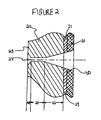
- depth of taper is meant the length along the axis of the hole (e.g., length of section 6 in Fig. 1 or length of sections 26, 29, and 31 in Fig. 2 ). It is noted that many UMC dies shown in the literature have die holes whose cross section decreases in going from the entrance face to the exit face, hence the term “reverse taper” in this instance describes dies wherein the die hole cross section increases in the same direction.
- the die plate 1 has an exit face 2, where the polymer (not shown) exits the die (hole), and an entrance face 3 where the (molten) polymer enters the die hole 4.
- 4 is straight over part of its length, zone 5, and has a reverse taper over part of its length, zone 6.
- the tapered portion has a "taper angle" 8. While not critical it is preferred that the taper angle is at least 0.1°, more preferably at least about 0.2°, especially preferably at least about 0.5°, and very preferably at least about 1.0°. It is also preferred that the taper angle is about 10° or less, more preferably 5° or less, and especially preferably about 3.0° or less. It is to be understood that any minimum and maximum taper angles given above may be combined to give a preferred taper angle range.
- the taper angle may change but the change should preferably not be a large discontinuous change, and in proceeding from 3 to 2 through 4, the taper angle should remain the same or increase. If the taper angle is constant it is the angle formed by opposite sides of the die hole in zone 6, and the taper angle is included in a plane which also includes the axis of the die hole. If the taper angle changes and has different values in different segments, then each segment shall be similarly measured.
- the taper angle may also change constantly, in which case the taper angle at any point is measured in a similar way using a lines perpendicular to the tapered surface of 4 at that point.
- a die hole or orifice such as 4 will have a circular cross-section although the cross-section may be other shapes.
- These noncircular cross-sections may take any of a variety of shapes and are limited only by the ability to machine or otherwise manufacture them into the die plate, and so long as the die hole with the selected shape can be formed with a reverse taper therealong.
- a reverse taper section will be congruent with the shape of the rest of the die hole.
- the reverse tapered section will typically have a cross-section which is congruent with the cross-section of the rest of the hole, although that is not necessary.
- Circular cross-sections are preferred. Typical diameters for circular cross-sections are about 0.05 to about 0.7 cm.
- the die hole or orifice may not be a monolithic structure, that is it may not be formed from a single piece of material.
- the die hole may be formed partially by the die body and an insert into the body, the insert being made from an abrasion resistant material such as tungsten carbide.
- the insert may form the whole length of the hole or be part of it.
- the taper angle and reverse taper configuration of the die hole overall, including that section formed by the insert must meet the necessary limitations described herein, and also preferably has the preferred features described herein.
- Figure 2 shows a similar die hole as Figure 1 , including a die plate 20 with an exit face 21 , where the polymer (not shown) exits the die (hole), and an entrance face 23 where the (molten) polymer enters the die hole 24.
- 24 is straight over part of its length 25, and has a reverse taper over part of its length 26.
- 24 also has a "regularly" tapered section 27 at and near 23, which may in some cases may facilitate polymer flow.
- On and in contact with the surface of 21 and having a hole colinear with 24 is an layer of insulation 29 which insulates the die from the water of the water bath.
- 29 has an outer surface 30 which is in contact with a layer of material 31 having excellent abrasion resistance and a hole colinear with 24. 31 acts as a wear resistant surface which is contacted by the knives (not shown) of the UMC. The knives cut the polymer at or near this surface of 31. If 29 and/or 31 are present, then the holes through these components should also preferably be reverse tapered. If 29 and/or 31 are very thin, not having a reverse taper will not significantly affect the performance of the die. In other words the reverse taper should extend from somewhere within 20 to the surface at which the polymer emerges from 24 and/or is cut.
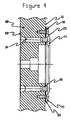
- Figure 4 is a cross section similar to that of Figure 2 , but showing only the central part of the die plate.
- This variation may be used with a die (assembly) having reverse taper holes or with a die (assembly) have straight or "regularly" tapered holes also, in a process to pelletize TPs using a UMC.
- Figure 4 shows a die plate 60 with an exit face 61, where the polymer (not shown) exits the die (hole), and an entrance face 63 where the (molten) polymer enters the die hole 64.
- 64 is straight over its length, and has an insert 65 in part of its length near 61.
- 65 has a reverse tapered section over most of its length.
- an layer of preferably nonmetallic insulation 69 which insulates the die from the water of the water bath, and has a hole colinear with 64.
- 69 has an outer surface 70 which is in contact with a layer of a relatively structurally strong material 72.
- 72 has an outer surface 73 which is in contact with 71 which has excellent abrasion resistance (sometimes called a hard face) and a hole colinear with 64.
- 71 acts as a wear resistant surface which is contacted by the knives (not shown) of the UMC. The knives cut the polymer at or near this surface of 71.
- the holes through 69, 71 and 72 should also preferably be reverse tapered. If 69 and/or 71 and/or 72 are very thin, not having a reverse taper will not significantly affect the performance of the die. In other words the reverse taper should extend from somewhere within 60 to the surface at which the polymer emerges from 64 and/or is cut.
- 69 may be a material which is brittle and/or of low strength, since it preferably is a nonmetallic material such as mica, a glass or ceramic, a thermoplastic or a thermoset resin (all of these should have a relatively high melting point so they don't melt or soften at the die operating temperature).
- 71 is attached to a structurally strong (and relatively nonbrittle) material ( 72 ) such as steel or other metal, for example by brazing, welding or bolting.
- 72 may be attached to the die body by bolting through 69 (not shown) or by a collar bolted to the die plate 60 (not shown).
- 72 may be thought of as a backing plate for 71, to be mounted between the relatively weak and/or brittle nonmetallic heat insulator 69 and 71.
- This type of configuration has the added advantage of allowing easy change of 69 and/or 71, if for example it is desired to change the die hole size (diameter) to produce different sized pellets.
- Preferably 69 has a heat conduction (through the thickness of 69 ) of about 3 W/m°K or less, more preferably about 1.0 W/m°K or less.
- 69 should be thick enough so that "excess" cooling of the die body by the water of the cooling bath does not take place. If reverse taper die holes are being used this means the die assembly is able to provide enough heat so that the die may be started by the simplified procedure described above. If reverse taper die holes are not present, it simply means the die may operate in the normal fashion for UMC dies. This thickness will depend on the polymer being cut (in particular is melt temperature), the configuration of the die, the power of the die heater(s), and other factors, and is easily determined by simple experimentation. 72 should be thick enough to provide the needed structural strength so that 71 has a low tendency to break, and can be determined by typical mechanical design principles.
- the underwater melt cutter die assembly of the type shown in Figure 4 may be used for cutting thermoplastics in a normal manner as typically used for underwater melt cutters.
- the improved thermal insulation of the die body when water is in contact with the exit face allows smoother operation (for example less chance of the polymer freezing off), and/or the cutting of higher melting polymers, etc.
- water in contact with the exit face water in direct contact with the exit face or water in contact with an item which itself or through contact with one or more other items is in contact with the exit face.
- the water may be in contact with exit face 2.
- the water may be in contact with a die exit face if 29 and 31 were not present, if 29 was present but not 31 then the water would be in contact with 29, and if just 31 and not 29 were present or if both were present then the water would be in contact with 31. In all of these instances the water would be considered in contact with the exit face.
- the hole at the exit end may be straight. If the polymer flow stops, the water contacting the polymer in the hole at or near at the exit end and causes the polymer to freeze (solidify). Even if the polymer in the interior of the die body remains molten, the solid polymer at the exit end of the hole prevents any more polymer flow unless it is melted. While enough (very high) pressure may possibly be applied to force the solid plug out, the equipment would have to be built to withstand such pressures and would be prohibitively expensive. Hence the need for a relatively complicated and difficult starting procedure described above.
- the polymer preferably need only be melted to somewhere (referring to Figure 1 ) within zone 6, the solid polymer may be "popped out" from the hole easily, much as a tapered stopper may be removed from a wine flask.
- a tapered stopper may be removed from a wine flask.
- Some off-sized pellets may be produced, and they may be separated by size classification. If the polymer being pelletized is not too thermally stable and the outage is more than brief, one may want to divert molten polymer and/or solid pellets from first quality product until any possibly degraded polymer is removed from the system, or the heaters may be turned off temporarily. This procedure is simple, time saving and results in a minimal loss of polymer.
- the procedure can be slightly different. If the same polymer is being cut before and after the shutdown, and particularly if the polymer is thermally stable, it may not even be necessary to clean out the UMC.
- the UMC especially the die plate and polymer handling lines, may simply be reheated, and the water and rotating knives be turned on before the polymer can drool from the die plate holes.
- the die plate reaches operating temperature (this presumes at least some of the polymer in the reverse taper section of the die holes is melted) and the rest of the system is ready, the polymer flow may be turned on.
- This procedure can also be used if it is necessary to cool the die even on a short shutdown if it is necessary because the polymer being not is not particularly thermally stable. If the die holes have been cleaned and are empty some molten polymer should be placed into the holes (for example by filling the die with melted polymer, which can solidify) before exposing the exit face of the die to the water. It is preferred that water not get into the die holes, and especially the molten polymer lines behind the holes, as (superheated) steam may be forcefully expelled through the die holes. After there is polymer in the die holes, the UMC and pelletizing system may be started up as described above.
- a preferred conditions for easy startup is to have molten polymer in at least part of (referring to Figure 1 ) zone 6, the reverse taper zone of the die hole(s). Achieving this, even with no polymer flow, means balancing heat loss from the polymer in the die, and the die itself, with heat gain of the polymer from the means for heating the die, particularly in zone 6.
- the major heat loss from the die, and the polymer in the die hole is with the water near or in contact with 2 and the surface of the polymer exposed at or near the exit end of the die hole.
- An item that decreases the ability to supply enough heat to the polymer include larger temperature difference between the melting point or glass transition temperature of the polymer and the temperature of the water (in effect this often means the higher the melting point or glass transition temperature of the polymer the more difficult it is to maintain molten polymer in zone 6 ), and vice versa.
- the die in the vicinity of the die holes (orifices) at startup the die should be at or above the melting point of the polymer, particularly in at least a portion of zone 6 , the reverse tapered zone. If the polymer has no melting point (is amorphous) then the vicinity of the die holes should be at or above the glass transition temperature of the polymer. If the polymer has more than one melting point or glass transition temperature, the highest melting point or highest glass transition temperature is used. Melting points and glass transition temperatures are measured by method ASTM Method D3418. Melting points are taken as the maximum of the melting endotherm, and glass transition temperatures are taken as the midpoint of the transition. Melting points and glass transition temperatures are measured on a second heat.
- the die in the vicinity of the die holes is at least about 5°C above, more preferably at least about 10°C above, and especially preferably at least about 20°C above, the highest melting point of the polymer.
- an amorphous polymer no melting point
- the die in the vicinity of the die holes is at least about 25°C above, more preferably at least about 50°C above, and especially preferably at least about 100°C above, the highest glass transition point of the polymer.
- molten polymers By a “melted”, “molten” or “liquid” polymer herein is meant a polymer having a temperature at or above its highest melting point, or if the polymer has no melting point (is amorphous) is at or above its highest glass transition temperature.
- Molten polymers may be "forced" through the die and die holes by any number of methods well known in the art, for instance using a pump such as a gear pump or a screw pump, pressurizing the molten polymer above ambient pressure (as with gas pressure above a partially filled tank of molten polymer), extruder, or gravity induced flow.
- the die may be heated by any method known in the art.
- a hot fluid(s) gas and/or liquid
- a hot fluid(s) gas and/or liquid
- saturated or superheated steam hot oils of various kinds, and Dowtherm® and similar materials
- electrical heaters either within the die body or on the outside, for instance external band heaters and/or internal cartridge heaters.
- melt viscosity of the polymer is preferably in a range where the molten polymer may be reasonably easily forced through the die holes.
- polyesters such as poly(alkylene terephthalates) such as poly(ethylene terephthalate), poly(1,3-propylene terephthalate), poly(1,4-butyleneterephthalate), poly(alkylene isophthalates/terephthalates), poly(alkylene 2,6-naphthalates) such as poly(ethylene 2,6-napthtalate), copolymer of terephthalic acid, 1,4-cyclohexanedimethanol and copolyesters thereof; polyamides such as nylon-6, nylon-6,6, ; polyolefins such as polyethylene, polypropylene, polystyrene, copolymers of ethylene and ⁇ -olefins, especially linear ⁇ -olefins, copolymers of ethylene with (meth)acrylate esters and/or methacrylic and/or acrylic acids and salts thereof, and copolymers of the above named olefin
- the polymers which are used in the present process may contain any additives which are normally added to thermoplastics polymers, such as fillers, reinforcing agents, pigments, antioxidants, plasticizers, brightening agents, antiozonants, dyes, and heat stabilizers.
- Useful specific materials include glass in the form of fiber, microspheres, milled glass, and ground fibers, clay(s), mica, talc, and other minerals, carbon (graphitic and nongraphitic) in the form of powder, fibers and fibrils, organic fibers, fibrils and fibrids such as aramids and liquid crystalline polymer fibers, titanium dioxide, powdered metals, short lengths of metal wires and fibers, and powdered organic materials such as thermoset polymers. These materials may be present in conventional amounts in these compositions.
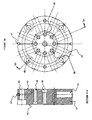
- Figure 3a shows a front view of a die, together with a cross section ( XX ) of this die.
- the die has a die body 41, having entrance face (surface) 42, exit face (surface) 43, eight cavities (for electric heaters) 44, bolt holes (for mounting 41 ) namely 45 and 46, 2 cavities (for mounting thermocouples) 47, and eight die holes 48.
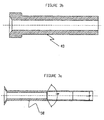
- Shown in Figure 3b is a die hole insert holder 49, which fits into 48.
- Shown in Figures 3b and 3c is a die insert 50 which fits into 49. By having separate pieces for 49 and 50 the effective diameter of the die hole may be readily changed.
- molten polymer enters 50 in the vicinity of 42 and flows through 50 to the vicinity of 43, and exits 50 near 43.
- a thermal insulator on or near 43 in the vicinity of the exit end of 50, or an abrasion resistant surface for the knives to rotate against.
- the materials for all of 41, 49, and 50 should have a relatively high thermal conductivity, >50 W/m°K. In some instances it may be preferable that 50 not only have a relatively high thermal conductivity, but also be relatively abrasion resistant, and (high thermal conductivity) tungsten carbide (60-170 W/m°K) is suitable for this use.
- Figure 3c shows a die insert having a reverse taper (see below), with a taper angle of 2.00°.
- Die A was used in some of the Examples. This die was made from GlidCop® Grade AL-15. This die was similar to the die shown in Figure (except for some minor physical variations of an inconsequential nature; otherwise the character and performance of the die is the same as that in Figure 3 ) and has an overall diameter of 22.86 cm and was 6.35 cm thick. The die was bolted to the extruder end. The eight equally spaced die holes were fitted with die inserts such as 50, or be plugged so that less than 8 dies holes were in operation. The die inserts were made of tungsten carbide. The die was also equipped with a layer of thermal insulation over the exit end of the die holes which was made from titanium carbide with a carbon steel backplate.
- Total thickness of the titanium carbide and the backplate was 4.75 mm.
- the taper angle, 8 (see Figure 1 ), was 2°, a zone similar to 5 was 6.13 cm long with a taper (not reverse taper) angle of 1.724°, and a zone similar to 6 was 6.99 mm long, including the thickness of the titanium carbide and steel backplate layers (the die holes through the thickness of these layers also had the reverse taper).
- the diameter was 5.54 mm, and at the exit end (at the outside face of the titanium carbide) it was 3.94 mm in diameter.
- Die B was used in some of the Examples. This die was made from carbon steel. This die was similar to the die shown in Figure 3 except for some minor physical variations of an inconsequential nature, but the exit face, thermal insulator, backer plate, hard face and inserts are as shown in Figure 4 . It had an overall diameter of 22.86 cm and was 4.20 cm thick. The die was bolted to the extruder end. The eight equally spaced die holes were fitted with die inserts such as 66, or could be plugged so that less than 8 dies holes were in operation. The die inserts were made of 360 brass. The die inserts had a reverse taper of 3° over a length 1.1 cm. and at the outer surface of the hard face, the hole diameter was 0.549 cm. The die hole (in the die body) was 0.775 cm in diameter. The TiC hard face was 0.424 cm thick, the carbon steel backer plate was 0.305 cm thick overall, and the mica thermal insulation was about 1.3 mm thick when compressed.
- Die A was used to underwater pelletize various polymer formulations, with 8 die holes. In all cases the die holes had a reverse taper of 2°.
- the polymer was fed to the die by an extruder which melted the polymer composition.
- the polymer melt temperature was maintained at that recommended by the polymer manufacturer (or above the melting point) in the extruder. At some point the polymer flow was interrupted and the polymer allowed to freeze at the exit end of the die holes.
- the melt cutter was then restarted (assuming it already had polymer in it) by attaching the cutter cart (which contains the knives and cooling water) and starting the knives and cooling water circulation), raising the die temperature to about the polymer melting point.
- the polymer feed extruder was started and polymer feed to the extruder was initiated.
- a diverter valve on the exit end polymer feed extruder which had been set to divert molten polymer from the pelletizer, was now set so that molten polymer was fed to the pelletizer (die) and at this point pelletization started. In some instances when polymer feed was started it was started at a reduced rate and then ramped up to the final desired rate. In all the Examples listed in Table 2, startup, even though the die was in the circulating water, was smooth. The pressure needed to start the flow of polymer through the die using this simplified startup procedure is given in Table 2, as is the steady state pressure during pelletization, the die and cooling water temperatures, and the polymer used. Table 2 Ex.
- a commercial 50 hole underwater melt cutter die was adapted for use with reverse taper die holes.
- the die body was made from carbon steel and the body was heated by electrical resistance heaters.
- Each die hole was adapted so that two piece die hole liners were fitted into each die hole.
- At the entrance face (similar to 42 in Figure 3a ) was a straight hole liner that was 3.58 cm (1.41") long and which had a circular hole 3.00 mm (0.118") in diameter, called the entrance section.
- Immediately downstream (polymer flow) of this entrance section was an exit section 2.53 (0.995”) long, having a circular hole 4.06 mm (0.160”) in diameter.
- the exit end of the exit section was flush with the exit face (similar to 43 in Figure 3a ), and was exposed to the cooling water of the pelletizer.
- the exit section could be changed, and hole was either straight or had a reverse taper. If it had a reverse taper it was formed by reaming the straight hole to the desired taper angle so that the taper angle extended 6.35 mm (0.25") deep in from the exit face.
- Molten polymer was fed to the pelletizer die using a gear pump.
- the polymer was a liquid crystalline polymer (LCP) and was a copolymer made from hydroquinone/4,4'-biphenol/terephthalic acid/2,6-napthalene dicarboxylic acid/4-hydroxybenzoic acid, 50/50/70/30/320 molar parts, which had a melting point of about 335°C.
- the die which was filled with.polymer, was heated above the melting point of the LCP, and polymer upstream of the die was (already) melted.
- the "cutting cart” containing the rotating knives and water bath, with the water bath full and circulating, was put into place. After the die was sufficiently heated the gear pump was turned on. The pressure required to open the die (i.e. start polymer) flow was measured, but the reported pressures may be somewhat low, since pressure spikes may have occurred.
- Die B was used to underwater pelletize various polymer formulations, with 2 die holes. In all cases the die holes had a reverse taper of 3°, and the melt cutter cooling water temperature was 53°C.
- the polymer was fed to the die by an extruder which melted the polymer composition. At some point the polymer flow was interrupted and the polymer allowed to freeze at the exit end of the die holes.
- the melt cutter was then restarted (assuming it already had polymer in it) by attaching the cutter cart (which contains the knives and cooling water) and starting the knives and cooling water circulation), raising the die temperature to the set point.
- the polymer feed extruder was started and polymer feed to the extruder was initiated.
Landscapes
- Engineering & Computer Science (AREA)
- Mechanical Engineering (AREA)
- Chemical & Material Sciences (AREA)
- Organic Chemistry (AREA)
- Chemical Kinetics & Catalysis (AREA)
- Manufacturing & Machinery (AREA)
- Robotics (AREA)
- Processing And Handling Of Plastics And Other Materials For Molding In General (AREA)
Priority Applications (1)
| Application Number | Priority Date | Filing Date | Title |
|---|---|---|---|
| EP10164697A EP2228188A3 (en) | 2003-07-30 | 2004-07-28 | Process and apparatus for underwater pelletization of polymers |
Applications Claiming Priority (3)
| Application Number | Priority Date | Filing Date | Title |
|---|---|---|---|
| US49100303P | 2003-07-30 | 2003-07-30 | |
| US56394104P | 2004-04-21 | 2004-04-21 | |
| PCT/US2004/024465 WO2005011944A2 (en) | 2003-07-30 | 2004-07-28 | Process and apparatus for underwater pelletization of polymers |
Related Child Applications (1)
| Application Number | Title | Priority Date | Filing Date |
|---|---|---|---|
| EP10164697.4 Division-Into | 2010-06-02 |
Publications (2)
| Publication Number | Publication Date |
|---|---|
| EP1651410A2 EP1651410A2 (en) | 2006-05-03 |
| EP1651410B1 true EP1651410B1 (en) | 2011-08-31 |
Family
ID=34118849
Family Applications (2)
| Application Number | Title | Priority Date | Filing Date |
|---|---|---|---|
| EP10164697A Withdrawn EP2228188A3 (en) | 2003-07-30 | 2004-07-28 | Process and apparatus for underwater pelletization of polymers |
| EP04779507A Expired - Lifetime EP1651410B1 (en) | 2003-07-30 | 2004-07-28 | Process and apparatus for underwater pelletization of polymers |
Family Applications Before (1)
| Application Number | Title | Priority Date | Filing Date |
|---|---|---|---|
| EP10164697A Withdrawn EP2228188A3 (en) | 2003-07-30 | 2004-07-28 | Process and apparatus for underwater pelletization of polymers |
Country Status (6)
| Country | Link |
|---|---|
| US (1) | US7658874B2 (enExample) |
| EP (2) | EP2228188A3 (enExample) |
| JP (2) | JP5253735B2 (enExample) |
| KR (1) | KR20060054356A (enExample) |
| CA (2) | CA2766230A1 (enExample) |
| WO (1) | WO2005011944A2 (enExample) |
Families Citing this family (20)
| Publication number | Priority date | Publication date | Assignee | Title |
|---|---|---|---|---|
| JPH0366682A (ja) * | 1989-08-04 | 1991-03-22 | Tsumura & Co | 新規イリドイド誘導体 |
| US20070170611A1 (en) * | 2006-01-26 | 2007-07-26 | Andrew Steven Hudson | Start-up procedure for underwater pelletizer |
| ES2556251T3 (es) | 2006-03-22 | 2016-01-14 | Basf Se | Proceso para granular polímeros fundidos que contienen sustancias con puntos bajos de ebullición |
| US8510859B2 (en) * | 2006-09-26 | 2013-08-13 | Intel Corporation | Methods and arrangements to launch trusted, co-existing environments |
| US9139728B2 (en) * | 2008-06-30 | 2015-09-22 | Fina Technology, Inc. | Single pellet polymeric compositions |
| US20100102467A1 (en) * | 2008-10-28 | 2010-04-29 | E. I. Du Pont De Nemours And Company | Polymer underwater melt cutter and processes associated therewith |
| DE102008053799A1 (de) * | 2008-10-29 | 2010-05-06 | Bayer Materialscience Ag | Extrusionsdüse für Polymere |
| WO2010097466A1 (en) * | 2009-02-27 | 2010-09-02 | Dsm Ip Assets B.V. | Polymer granulation process and polymer granulates |
| EP2353832A1 (en) * | 2010-01-28 | 2011-08-10 | Total Petrochemicals Research Feluy | Method to start-up a process to make expandable vinyl aromatic polymers |
| JP5149318B2 (ja) | 2010-02-24 | 2013-02-20 | ペパーレット株式会社 | 粒状排泄物処理材の押し出し式圧縮造粒装置 |
| DE102013200661B4 (de) * | 2013-01-17 | 2016-04-07 | Reduction Engineering Gmbh | Düse und lochplatte für einen unterwassergranulator |
| JP6245686B2 (ja) * | 2013-09-03 | 2017-12-13 | 新興工機株式会社 | ペレタイザー |
| US9845703B2 (en) * | 2014-12-12 | 2017-12-19 | General Electric Company | Turbine component surface treatment processes and systems |
| EP3511139B1 (de) * | 2018-01-12 | 2022-08-31 | Nordson Corporation | Düsenanordnung für eine granuliervorrichtung, granuliervorrichtung sowie darauf bezogenes verfahren |
| US10987645B2 (en) | 2018-10-10 | 2021-04-27 | The Boeing Company | Extruding nozzle, system, and method therefor |
| DE102019127666A1 (de) * | 2019-10-15 | 2021-04-15 | Maag Automatik Gmbh | Lochplatte zum Granulieren von Schmelzen sowie Verfahren zu deren Herstellung |
| WO2021224043A1 (en) | 2020-05-04 | 2021-11-11 | Basf Se | A process and apparatus for producing aqueous compositions of water-soluble polymers |
| EP4200111B1 (de) * | 2020-08-18 | 2024-09-04 | Evonik Operations GmbH | Herstellung von granulaten auf basis von hochtemperatur-polymeren mittels unterwassergranulierung bei erhöhter wassertemperatur |
| CN112536930A (zh) * | 2020-11-11 | 2021-03-23 | 谢福娣 | 一种可调节颗粒大小的塑料造粒设备 |
| US20240367363A1 (en) * | 2021-07-27 | 2024-11-07 | Exxonmobil Chemical Patents Inc. | Systems and Methods of Cleaning Extruders |
Family Cites Families (17)
| Publication number | Priority date | Publication date | Assignee | Title |
|---|---|---|---|---|
| US2918701A (en) | 1956-02-23 | 1959-12-29 | Eastman Kodak Co | Method for pelleting organic thermoplastic materials |
| DE1604344B2 (de) * | 1966-12-14 | 1972-12-14 | Barmag Barmer Maschinenfabrik Ag, 5600 Wuppertal | Spritzwerkzeug in unterwassergranulatoren |
| DE1964884A1 (de) * | 1969-12-24 | 1971-07-01 | Werner & Pfleiderer | Duesenplatte fuer Unterwassergranulierung |
| US3749539A (en) | 1972-04-26 | 1973-07-31 | Eastman Kodak Co | Underwater pelletizer die plate |
| JPS5315822Y2 (enExample) * | 1973-11-30 | 1978-04-25 | ||
| US4138208A (en) * | 1977-02-07 | 1979-02-06 | The Dow Chemical Company | Die face cutter |
| US4378964A (en) * | 1980-01-08 | 1983-04-05 | Trw Inc. | Internally insulated extrusion die |
| JPS59152808A (ja) * | 1983-02-22 | 1984-08-31 | Kobe Steel Ltd | 水中カツト造粒装置のダイス |
| IT1174480B (it) * | 1984-02-02 | 1987-07-01 | Montedison Spa | Filiera per il taglio a caldo di polimeri termoplastici |
| US4728276A (en) | 1986-01-31 | 1988-03-01 | Gala Industries, Inc. | Underwater pelletizer |
| US4752196A (en) * | 1986-05-22 | 1988-06-21 | Rogers Tool Works, Inc. | Internally insulated extrusion die |
| US4822546A (en) * | 1987-08-06 | 1989-04-18 | Exxon Chemical Patents Inc. | Die design for underwater pelletization of high flow rate polymers |
| JPH0716949B2 (ja) * | 1992-03-06 | 1995-03-01 | 株式会社日本製鋼所 | ダイス表面処理方法及びダイス |
| JPH05253997A (ja) * | 1992-03-11 | 1993-10-05 | Mitsubishi Kasei Corp | 押出機用ダイ |
| DE19515473A1 (de) * | 1995-04-27 | 1996-10-31 | Werner & Pfleiderer | Unterwasser-Granulierlochplatte mit Verschleißschutzschicht |
| JP3619307B2 (ja) * | 1995-11-27 | 2005-02-09 | 花王株式会社 | 掃除具 |
| JPH11179724A (ja) * | 1997-12-24 | 1999-07-06 | Kobe Steel Ltd | 水中カット造粒装置及び水中カット造粒装置の起動方法 |
-
2004
- 2004-07-20 US US10/894,807 patent/US7658874B2/en not_active Expired - Fee Related
- 2004-07-28 CA CA2766230A patent/CA2766230A1/en not_active Abandoned
- 2004-07-28 KR KR1020067001827A patent/KR20060054356A/ko not_active Withdrawn
- 2004-07-28 CA CA2530945A patent/CA2530945C/en not_active Expired - Fee Related
- 2004-07-28 JP JP2006522059A patent/JP5253735B2/ja not_active Expired - Fee Related
- 2004-07-28 EP EP10164697A patent/EP2228188A3/en not_active Withdrawn
- 2004-07-28 EP EP04779507A patent/EP1651410B1/en not_active Expired - Lifetime
- 2004-07-28 WO PCT/US2004/024465 patent/WO2005011944A2/en not_active Ceased
-
2011
- 2011-09-14 JP JP2011201115A patent/JP5176036B2/ja not_active Expired - Fee Related
Also Published As
| Publication number | Publication date |
|---|---|
| CA2530945C (en) | 2012-04-03 |
| CA2530945A1 (en) | 2005-02-10 |
| WO2005011944A3 (en) | 2005-06-02 |
| US20050140044A1 (en) | 2005-06-30 |
| JP5253735B2 (ja) | 2013-07-31 |
| JP2007500624A (ja) | 2007-01-18 |
| EP1651410A2 (en) | 2006-05-03 |
| US7658874B2 (en) | 2010-02-09 |
| JP5176036B2 (ja) | 2013-04-03 |
| CA2766230A1 (en) | 2005-02-10 |
| EP2228188A3 (en) | 2012-08-29 |
| KR20060054356A (ko) | 2006-05-22 |
| EP2228188A2 (en) | 2010-09-15 |
| WO2005011944A2 (en) | 2005-02-10 |
| JP2011245876A (ja) | 2011-12-08 |
Similar Documents
| Publication | Publication Date | Title |
|---|---|---|
| EP1651410B1 (en) | Process and apparatus for underwater pelletization of polymers | |
| EP1654103B1 (en) | Apparatus and process for the underwater pelletization of polymers | |
| US3436449A (en) | Granulation of theromplastic materials | |
| US4710113A (en) | Apparatus for granulating plastics materials | |
| EP0748272B1 (en) | Polymer extrusion die | |
| JPS6235885B2 (enExample) | ||
| CN102202852A (zh) | 用于聚合物的挤出喷嘴 | |
| CN100434251C (zh) | 聚合物的造粒方法和设备 | |
| US20100102467A1 (en) | Polymer underwater melt cutter and processes associated therewith | |
| US4059206A (en) | Extrusion machine having collar for seal | |
| US4138208A (en) | Die face cutter | |
| JP2012232432A (ja) | 樹脂押出用ダイ | |
| US4120625A (en) | Die face cutter | |
| TW201139098A (en) | Apparatus for making thermoplastic resin pellets, and method therefor | |
| US3986816A (en) | In-line die fastened to breaker plate for support | |
| CN214419266U (zh) | 用于绝缘料改性母粒的切粒装置 | |
| KR20080089439A (ko) | 수중 펠렛화기 가동 방법 | |
| EP1103361B1 (fr) | Ligne de fabrication de câble électrique avec récupération de rebuts de matière thermoplastique, et procédé de récupération associé | |
| CN101336152A (zh) | 水下造粒机的启动程序 | |
| KR810000010B1 (ko) | 연속 용융 압출 방법 |
Legal Events
| Date | Code | Title | Description |
|---|---|---|---|
| PUAI | Public reference made under article 153(3) epc to a published international application that has entered the european phase |
Free format text: ORIGINAL CODE: 0009012 |
|
| 17P | Request for examination filed |
Effective date: 20060210 |
|
| AK | Designated contracting states |
Kind code of ref document: A2 Designated state(s): DE FR GB IT |
|
| DAX | Request for extension of the european patent (deleted) | ||
| RBV | Designated contracting states (corrected) |
Designated state(s): DE FR GB IT |
|
| 17Q | First examination report despatched |
Effective date: 20100301 |
|
| GRAP | Despatch of communication of intention to grant a patent |
Free format text: ORIGINAL CODE: EPIDOSNIGR1 |
|
| GRAS | Grant fee paid |
Free format text: ORIGINAL CODE: EPIDOSNIGR3 |
|
| GRAA | (expected) grant |
Free format text: ORIGINAL CODE: 0009210 |
|
| AK | Designated contracting states |
Kind code of ref document: B1 Designated state(s): DE FR GB IT |
|
| REG | Reference to a national code |
Ref country code: GB Ref legal event code: FG4D |
|
| REG | Reference to a national code |
Ref country code: DE Ref legal event code: R096 Ref document number: 602004034244 Country of ref document: DE Effective date: 20111110 |
|
| REG | Reference to a national code |
Ref country code: DE Ref legal event code: R082 Ref document number: 602004034244 Country of ref document: DE Representative=s name: ABITZ & PARTNER, DE |
|
| REG | Reference to a national code |
Ref country code: DE Ref legal event code: R082 Ref document number: 602004034244 Country of ref document: DE Representative=s name: ABITZ & PARTNER, DE Effective date: 20120423 Ref country code: DE Ref legal event code: R081 Ref document number: 602004034244 Country of ref document: DE Owner name: TICONA LLC, US Free format text: FORMER OWNER: E.I. DU PONT DE NEMOURS AND COMPANY, WILMINGTON, US Effective date: 20120423 Ref country code: DE Ref legal event code: R081 Ref document number: 602004034244 Country of ref document: DE Owner name: TICONA LLC, US Free format text: FORMER OWNER: E.I. DUPONT DE NEMOURS AND CO., WILMINGTON, US Effective date: 20110916 Ref country code: DE Ref legal event code: R081 Ref document number: 602004034244 Country of ref document: DE Owner name: TICONA LLC, FLORENCE, US Free format text: FORMER OWNER: E.I. DU PONT DE NEMOURS AND COMPANY, WILMINGTON, DEL., US Effective date: 20120423 Ref country code: DE Ref legal event code: R081 Ref document number: 602004034244 Country of ref document: DE Owner name: TICONA LLC, FLORENCE, US Free format text: FORMER OWNER: E.I. DUPONT DE NEMOURS AND CO., WILMINGTON, DEL., US Effective date: 20110916 Ref country code: DE Ref legal event code: R082 Ref document number: 602004034244 Country of ref document: DE Representative=s name: ABITZ & PARTNER PATENTANWAELTE MBB, DE Effective date: 20120423 |
|
| REG | Reference to a national code |
Ref country code: GB Ref legal event code: 732E Free format text: REGISTERED BETWEEN 20120531 AND 20120606 |
|
| PLBE | No opposition filed within time limit |
Free format text: ORIGINAL CODE: 0009261 |
|
| STAA | Information on the status of an ep patent application or granted ep patent |
Free format text: STATUS: NO OPPOSITION FILED WITHIN TIME LIMIT |
|
| 26N | No opposition filed |
Effective date: 20120601 |
|
| REG | Reference to a national code |
Ref country code: DE Ref legal event code: R097 Ref document number: 602004034244 Country of ref document: DE Effective date: 20120601 |
|
| PGFP | Annual fee paid to national office [announced via postgrant information from national office to epo] |
Ref country code: GB Payment date: 20120725 Year of fee payment: 9 |
|
| PGFP | Annual fee paid to national office [announced via postgrant information from national office to epo] |
Ref country code: IT Payment date: 20120720 Year of fee payment: 9 Ref country code: DE Payment date: 20120725 Year of fee payment: 9 Ref country code: FR Payment date: 20120719 Year of fee payment: 9 |
|
| GBPC | Gb: european patent ceased through non-payment of renewal fee |
Effective date: 20130728 |
|
| REG | Reference to a national code |
Ref country code: FR Ref legal event code: ST Effective date: 20140331 |
|
| PG25 | Lapsed in a contracting state [announced via postgrant information from national office to epo] |
Ref country code: DE Free format text: LAPSE BECAUSE OF NON-PAYMENT OF DUE FEES Effective date: 20140201 Ref country code: GB Free format text: LAPSE BECAUSE OF NON-PAYMENT OF DUE FEES Effective date: 20130728 |
|
| REG | Reference to a national code |
Ref country code: DE Ref legal event code: R119 Ref document number: 602004034244 Country of ref document: DE Effective date: 20140201 |
|
| PG25 | Lapsed in a contracting state [announced via postgrant information from national office to epo] |
Ref country code: IT Free format text: LAPSE BECAUSE OF NON-PAYMENT OF DUE FEES Effective date: 20130728 Ref country code: FR Free format text: LAPSE BECAUSE OF NON-PAYMENT OF DUE FEES Effective date: 20130731 |