EP1651279B1 - Gelartige masse in flächiger form zur behandlung von umgebungsluft - Google Patents
Gelartige masse in flächiger form zur behandlung von umgebungsluft Download PDFInfo
- Publication number
- EP1651279B1 EP1651279B1 EP04763591A EP04763591A EP1651279B1 EP 1651279 B1 EP1651279 B1 EP 1651279B1 EP 04763591 A EP04763591 A EP 04763591A EP 04763591 A EP04763591 A EP 04763591A EP 1651279 B1 EP1651279 B1 EP 1651279B1
- Authority
- EP
- European Patent Office
- Prior art keywords
- gel
- polymers
- polymer
- material according
- active agents
- Prior art date
- Legal status (The legal status is an assumption and is not a legal conclusion. Google has not performed a legal analysis and makes no representation as to the accuracy of the status listed.)
- Expired - Lifetime
Links
- 239000000463 material Substances 0.000 title claims abstract description 21
- 239000012080 ambient air Substances 0.000 title claims abstract description 8
- 229920000642 polymer Polymers 0.000 claims abstract description 94
- 239000013543 active substance Substances 0.000 claims abstract description 41
- 239000011159 matrix material Substances 0.000 claims abstract description 33
- 239000003570 air Substances 0.000 claims abstract description 25
- 239000000126 substance Substances 0.000 claims abstract description 17
- 229920006037 cross link polymer Polymers 0.000 claims abstract description 12
- 238000004132 cross linking Methods 0.000 claims description 15
- XLOMVQKBTHCTTD-UHFFFAOYSA-N Zinc monoxide Chemical compound [Zn]=O XLOMVQKBTHCTTD-UHFFFAOYSA-N 0.000 claims description 10
- 239000004971 Cross linker Substances 0.000 claims description 9
- 239000005062 Polybutadiene Substances 0.000 claims description 8
- 239000000178 monomer Substances 0.000 claims description 8
- 229920002857 polybutadiene Polymers 0.000 claims description 8
- 229920000768 polyamine Polymers 0.000 claims description 6
- 239000007795 chemical reaction product Substances 0.000 claims description 5
- 239000011787 zinc oxide Substances 0.000 claims description 5
- VLDPXPPHXDGHEW-UHFFFAOYSA-N 1-chloro-2-dichlorophosphoryloxybenzene Chemical compound ClC1=CC=CC=C1OP(Cl)(Cl)=O VLDPXPPHXDGHEW-UHFFFAOYSA-N 0.000 claims description 4
- NIXOWILDQLNWCW-UHFFFAOYSA-M Acrylate Chemical compound [O-]C(=O)C=C NIXOWILDQLNWCW-UHFFFAOYSA-M 0.000 claims description 4
- 229920001577 copolymer Polymers 0.000 claims description 3
- 244000005700 microbiome Species 0.000 claims description 3
- BRLQWZUYTZBJKN-UHFFFAOYSA-N Epichlorohydrin Chemical compound ClCC1CO1 BRLQWZUYTZBJKN-UHFFFAOYSA-N 0.000 claims description 2
- 229920002873 Polyethylenimine Polymers 0.000 claims description 2
- XSQUKJJJFZCRTK-UHFFFAOYSA-N Urea Chemical compound NC(N)=O XSQUKJJJFZCRTK-UHFFFAOYSA-N 0.000 claims description 2
- ZOIORXHNWRGPMV-UHFFFAOYSA-N acetic acid;zinc Chemical compound [Zn].CC(O)=O.CC(O)=O ZOIORXHNWRGPMV-UHFFFAOYSA-N 0.000 claims description 2
- 125000003277 amino group Chemical group 0.000 claims description 2
- AXCZMVOFGPJBDE-UHFFFAOYSA-L calcium dihydroxide Chemical compound [OH-].[OH-].[Ca+2] AXCZMVOFGPJBDE-UHFFFAOYSA-L 0.000 claims description 2
- 239000000920 calcium hydroxide Substances 0.000 claims description 2
- 229910001861 calcium hydroxide Inorganic materials 0.000 claims description 2
- 239000004202 carbamide Substances 0.000 claims description 2
- 150000001720 carbohydrates Chemical class 0.000 claims description 2
- 235000014633 carbohydrates Nutrition 0.000 claims description 2
- 230000000873 masking effect Effects 0.000 claims description 2
- ZIBGPFATKBEMQZ-UHFFFAOYSA-N triethylene glycol Chemical compound OCCOCCOCCO ZIBGPFATKBEMQZ-UHFFFAOYSA-N 0.000 claims description 2
- 239000004246 zinc acetate Substances 0.000 claims description 2
- 241000607479 Yersinia pestis Species 0.000 claims 1
- XLYOFNOQVPJJNP-UHFFFAOYSA-N water Substances O XLYOFNOQVPJJNP-UHFFFAOYSA-N 0.000 description 21
- 239000007788 liquid Substances 0.000 description 12
- 239000007858 starting material Substances 0.000 description 12
- 239000002304 perfume Substances 0.000 description 11
- -1 soybean oil Chemical class 0.000 description 10
- 239000012876 carrier material Substances 0.000 description 8
- 238000006243 chemical reaction Methods 0.000 description 7
- 230000004580 weight loss Effects 0.000 description 7
- MHAJPDPJQMAIIY-UHFFFAOYSA-N Hydrogen peroxide Chemical compound OO MHAJPDPJQMAIIY-UHFFFAOYSA-N 0.000 description 6
- FPYJFEHAWHCUMM-UHFFFAOYSA-N maleic anhydride Chemical compound O=C1OC(=O)C=C1 FPYJFEHAWHCUMM-UHFFFAOYSA-N 0.000 description 6
- 239000000203 mixture Substances 0.000 description 6
- 241000196324 Embryophyta Species 0.000 description 5
- 239000004744 fabric Substances 0.000 description 5
- 239000002781 deodorant agent Substances 0.000 description 4
- 230000001877 deodorizing effect Effects 0.000 description 4
- SZXQTJUDPRGNJN-UHFFFAOYSA-N dipropylene glycol Chemical compound OCCCOCCCO SZXQTJUDPRGNJN-UHFFFAOYSA-N 0.000 description 4
- 239000000499 gel Substances 0.000 description 4
- 239000004745 nonwoven fabric Substances 0.000 description 4
- 229920000058 polyacrylate Polymers 0.000 description 4
- 239000011148 porous material Substances 0.000 description 4
- 238000002360 preparation method Methods 0.000 description 4
- HRPVXLWXLXDGHG-UHFFFAOYSA-N Acrylamide Chemical compound NC(=O)C=C HRPVXLWXLXDGHG-UHFFFAOYSA-N 0.000 description 3
- 239000002202 Polyethylene glycol Substances 0.000 description 3
- 150000001298 alcohols Chemical class 0.000 description 3
- 150000001299 aldehydes Chemical class 0.000 description 3
- MTHSVFCYNBDYFN-UHFFFAOYSA-N diethylene glycol Chemical compound OCCOCCO MTHSVFCYNBDYFN-UHFFFAOYSA-N 0.000 description 3
- 239000003925 fat Substances 0.000 description 3
- 239000000835 fiber Substances 0.000 description 3
- 239000003205 fragrance Substances 0.000 description 3
- 239000008187 granular material Substances 0.000 description 3
- 239000003921 oil Substances 0.000 description 3
- 235000019198 oils Nutrition 0.000 description 3
- 229920003023 plastic Polymers 0.000 description 3
- 239000004033 plastic Substances 0.000 description 3
- 229920001223 polyethylene glycol Polymers 0.000 description 3
- 238000006116 polymerization reaction Methods 0.000 description 3
- 239000007787 solid Substances 0.000 description 3
- 235000012424 soybean oil Nutrition 0.000 description 3
- 239000003549 soybean oil Substances 0.000 description 3
- XFCMNSHQOZQILR-UHFFFAOYSA-N 2-[2-(2-methylprop-2-enoyloxy)ethoxy]ethyl 2-methylprop-2-enoate Chemical compound CC(=C)C(=O)OCCOCCOC(=O)C(C)=C XFCMNSHQOZQILR-UHFFFAOYSA-N 0.000 description 2
- QGZKDVFQNNGYKY-UHFFFAOYSA-N Ammonia Chemical compound N QGZKDVFQNNGYKY-UHFFFAOYSA-N 0.000 description 2
- OKTJSMMVPCPJKN-UHFFFAOYSA-N Carbon Chemical compound [C] OKTJSMMVPCPJKN-UHFFFAOYSA-N 0.000 description 2
- 229920000742 Cotton Polymers 0.000 description 2
- RFSUNEUAIZKAJO-ARQDHWQXSA-N Fructose Chemical compound OC[C@H]1O[C@](O)(CO)[C@@H](O)[C@@H]1O RFSUNEUAIZKAJO-ARQDHWQXSA-N 0.000 description 2
- 229930091371 Fructose Natural products 0.000 description 2
- 239000005715 Fructose Substances 0.000 description 2
- 229920003171 Poly (ethylene oxide) Polymers 0.000 description 2
- HCHKCACWOHOZIP-UHFFFAOYSA-N Zinc Chemical compound [Zn] HCHKCACWOHOZIP-UHFFFAOYSA-N 0.000 description 2
- 239000000084 colloidal system Substances 0.000 description 2
- 238000009833 condensation Methods 0.000 description 2
- 230000005494 condensation Effects 0.000 description 2
- 238000007334 copolymerization reaction Methods 0.000 description 2
- 239000003431 cross linking reagent Substances 0.000 description 2
- 230000000694 effects Effects 0.000 description 2
- 150000002148 esters Chemical class 0.000 description 2
- 238000001704 evaporation Methods 0.000 description 2
- 230000008020 evaporation Effects 0.000 description 2
- 239000003063 flame retardant Substances 0.000 description 2
- UPBDXRPQPOWRKR-UHFFFAOYSA-N furan-2,5-dione;methoxyethene Chemical compound COC=C.O=C1OC(=O)C=C1 UPBDXRPQPOWRKR-UHFFFAOYSA-N 0.000 description 2
- 239000007789 gas Substances 0.000 description 2
- 150000002366 halogen compounds Chemical class 0.000 description 2
- 239000002917 insecticide Substances 0.000 description 2
- 150000002576 ketones Chemical class 0.000 description 2
- 238000000034 method Methods 0.000 description 2
- 238000002156 mixing Methods 0.000 description 2
- ZIUHHBKFKCYYJD-UHFFFAOYSA-N n,n'-methylenebisacrylamide Chemical compound C=CC(=O)NCNC(=O)C=C ZIUHHBKFKCYYJD-UHFFFAOYSA-N 0.000 description 2
- 235000019645 odor Nutrition 0.000 description 2
- 239000002245 particle Substances 0.000 description 2
- 229920001451 polypropylene glycol Polymers 0.000 description 2
- 239000011814 protection agent Substances 0.000 description 2
- 239000004065 semiconductor Substances 0.000 description 2
- 239000000758 substrate Substances 0.000 description 2
- 230000008961 swelling Effects 0.000 description 2
- 150000003505 terpenes Chemical class 0.000 description 2
- 235000007586 terpenes Nutrition 0.000 description 2
- MWOOGOJBHIARFG-UHFFFAOYSA-N vanillin Chemical compound COC1=CC(C=O)=CC=C1O MWOOGOJBHIARFG-UHFFFAOYSA-N 0.000 description 2
- FGQOOHJZONJGDT-UHFFFAOYSA-N vanillin Natural products COC1=CC(O)=CC(C=O)=C1 FGQOOHJZONJGDT-UHFFFAOYSA-N 0.000 description 2
- 235000012141 vanillin Nutrition 0.000 description 2
- 238000009423 ventilation Methods 0.000 description 2
- 229910052725 zinc Inorganic materials 0.000 description 2
- 239000011701 zinc Substances 0.000 description 2
- AZUYLZMQTIKGSC-UHFFFAOYSA-N 1-[6-[4-(5-chloro-6-methyl-1H-indazol-4-yl)-5-methyl-3-(1-methylindazol-5-yl)pyrazol-1-yl]-2-azaspiro[3.3]heptan-2-yl]prop-2-en-1-one Chemical compound ClC=1C(=C2C=NNC2=CC=1C)C=1C(=NN(C=1C)C1CC2(CN(C2)C(C=C)=O)C1)C=1C=C2C=NN(C2=CC=1)C AZUYLZMQTIKGSC-UHFFFAOYSA-N 0.000 description 1
- QRIMLDXJAPZHJE-UHFFFAOYSA-N 2,3-dihydroxypropyl 2-methylprop-2-enoate Chemical compound CC(=C)C(=O)OCC(O)CO QRIMLDXJAPZHJE-UHFFFAOYSA-N 0.000 description 1
- OMIGHNLMNHATMP-UHFFFAOYSA-N 2-hydroxyethyl prop-2-enoate Chemical compound OCCOC(=O)C=C OMIGHNLMNHATMP-UHFFFAOYSA-N 0.000 description 1
- FZSHSWCZYDDOCK-UHFFFAOYSA-N 2-methylprop-2-enoic acid;oxolane Chemical compound C1CCOC1.CC(=C)C(O)=O FZSHSWCZYDDOCK-UHFFFAOYSA-N 0.000 description 1
- DBCAQXHNJOFNGC-UHFFFAOYSA-N 4-bromo-1,1,1-trifluorobutane Chemical compound FC(F)(F)CCCBr DBCAQXHNJOFNGC-UHFFFAOYSA-N 0.000 description 1
- 239000004156 Azodicarbonamide Substances 0.000 description 1
- WKBOTKDWSSQWDR-UHFFFAOYSA-N Bromine atom Chemical class [Br] WKBOTKDWSSQWDR-UHFFFAOYSA-N 0.000 description 1
- 229920003043 Cellulose fiber Polymers 0.000 description 1
- 239000009261 D 400 Substances 0.000 description 1
- RWSOTUBLDIXVET-UHFFFAOYSA-N Dihydrogen sulfide Chemical compound S RWSOTUBLDIXVET-UHFFFAOYSA-N 0.000 description 1
- 239000001692 EU approved anti-caking agent Substances 0.000 description 1
- VGGSQFUCUMXWEO-UHFFFAOYSA-N Ethene Chemical compound C=C VGGSQFUCUMXWEO-UHFFFAOYSA-N 0.000 description 1
- 239000005977 Ethylene Substances 0.000 description 1
- IAYPIBMASNFSPL-UHFFFAOYSA-N Ethylene oxide Chemical compound C1CO1 IAYPIBMASNFSPL-UHFFFAOYSA-N 0.000 description 1
- BAPJBEWLBFYGME-UHFFFAOYSA-N Methyl acrylate Chemical compound COC(=O)C=C BAPJBEWLBFYGME-UHFFFAOYSA-N 0.000 description 1
- 239000005662 Paraffin oil Substances 0.000 description 1
- 239000004952 Polyamide Substances 0.000 description 1
- 239000004698 Polyethylene Substances 0.000 description 1
- VYPSYNLAJGMNEJ-UHFFFAOYSA-N Silicium dioxide Chemical compound O=[Si]=O VYPSYNLAJGMNEJ-UHFFFAOYSA-N 0.000 description 1
- 229920002472 Starch Polymers 0.000 description 1
- UCKMPCXJQFINFW-UHFFFAOYSA-N Sulphide Chemical compound [S-2] UCKMPCXJQFINFW-UHFFFAOYSA-N 0.000 description 1
- YZCKVEUIGOORGS-NJFSPNSNSA-N Tritium Chemical compound [3H] YZCKVEUIGOORGS-NJFSPNSNSA-N 0.000 description 1
- 238000005411 Van der Waals force Methods 0.000 description 1
- QYKIQEUNHZKYBP-UHFFFAOYSA-N Vinyl ether Chemical compound C=COC=C QYKIQEUNHZKYBP-UHFFFAOYSA-N 0.000 description 1
- 239000002250 absorbent Substances 0.000 description 1
- 230000002745 absorbent Effects 0.000 description 1
- 230000000895 acaricidal effect Effects 0.000 description 1
- 239000000642 acaricide Substances 0.000 description 1
- 239000002253 acid Substances 0.000 description 1
- 239000000654 additive Substances 0.000 description 1
- 230000001476 alcoholic effect Effects 0.000 description 1
- 150000001336 alkenes Chemical class 0.000 description 1
- 229910021529 ammonia Inorganic materials 0.000 description 1
- 239000007900 aqueous suspension Substances 0.000 description 1
- FTNJWQUOZFUQQJ-IRYYUVNJSA-N azadirachtin A Natural products C([C@@H]([C@]1(C=CO[C@H]1O1)O)[C@]2(C)O3)[C@H]1[C@]23[C@]1(C)[C@H](O)[C@H](OC[C@@]2([C@@H](C[C@@H]3OC(=O)C(\C)=C/C)OC(C)=O)C(=O)OC)[C@@H]2[C@]32CO[C@@](C(=O)OC)(O)[C@@H]12 FTNJWQUOZFUQQJ-IRYYUVNJSA-N 0.000 description 1
- FTNJWQUOZFUQQJ-NDAWSKJSSA-N azadirachtin A Chemical compound C([C@@H]([C@]1(C=CO[C@H]1O1)O)[C@]2(C)O3)[C@H]1[C@]23[C@]1(C)[C@H](O)[C@H](OC[C@@]2([C@@H](C[C@@H]3OC(=O)C(\C)=C\C)OC(C)=O)C(=O)OC)[C@@H]2[C@]32CO[C@@](C(=O)OC)(O)[C@@H]12 FTNJWQUOZFUQQJ-NDAWSKJSSA-N 0.000 description 1
- XOZUGNYVDXMRKW-AATRIKPKSA-N azodicarbonamide Chemical compound NC(=O)\N=N\C(N)=O XOZUGNYVDXMRKW-AATRIKPKSA-N 0.000 description 1
- 235000019399 azodicarbonamide Nutrition 0.000 description 1
- 230000003115 biocidal effect Effects 0.000 description 1
- 239000003139 biocide Substances 0.000 description 1
- 230000015572 biosynthetic process Effects 0.000 description 1
- 238000007664 blowing Methods 0.000 description 1
- 229910052793 cadmium Inorganic materials 0.000 description 1
- BDOSMKKIYDKNTQ-UHFFFAOYSA-N cadmium atom Chemical compound [Cd] BDOSMKKIYDKNTQ-UHFFFAOYSA-N 0.000 description 1
- 229940043430 calcium compound Drugs 0.000 description 1
- 150000001674 calcium compounds Chemical class 0.000 description 1
- 125000003178 carboxy group Chemical group [H]OC(*)=O 0.000 description 1
- 239000001913 cellulose Substances 0.000 description 1
- 229920002678 cellulose Polymers 0.000 description 1
- 239000003795 chemical substances by application Substances 0.000 description 1
- 239000004927 clay Substances 0.000 description 1
- 238000009264 composting Methods 0.000 description 1
- 150000001875 compounds Chemical class 0.000 description 1
- 238000010276 construction Methods 0.000 description 1
- 238000009792 diffusion process Methods 0.000 description 1
- 239000000686 essence Substances 0.000 description 1
- 125000001495 ethyl group Chemical group [H]C([H])([H])C([H])([H])* 0.000 description 1
- ABZGOGJRHFYQBL-UHFFFAOYSA-N ethyl prop-2-enoate;propane-1,2,3-triol Chemical compound OCC(O)CO.CCOC(=O)C=C ABZGOGJRHFYQBL-UHFFFAOYSA-N 0.000 description 1
- STVZJERGLQHEKB-UHFFFAOYSA-N ethylene glycol dimethacrylate Substances CC(=C)C(=O)OCCOC(=O)C(C)=C STVZJERGLQHEKB-UHFFFAOYSA-N 0.000 description 1
- 239000000796 flavoring agent Substances 0.000 description 1
- 235000019634 flavors Nutrition 0.000 description 1
- 125000000524 functional group Chemical group 0.000 description 1
- 239000000417 fungicide Substances 0.000 description 1
- 150000002334 glycols Chemical class 0.000 description 1
- 238000010438 heat treatment Methods 0.000 description 1
- 239000004009 herbicide Substances 0.000 description 1
- 230000002209 hydrophobic effect Effects 0.000 description 1
- 239000012535 impurity Substances 0.000 description 1
- 239000003999 initiator Substances 0.000 description 1
- 229910052500 inorganic mineral Inorganic materials 0.000 description 1
- 239000000077 insect repellent Substances 0.000 description 1
- 230000000749 insecticidal effect Effects 0.000 description 1
- BJHIKXHVCXFQLS-UYFOZJQFSA-N keto-D-fructose Chemical compound OC[C@@H](O)[C@@H](O)[C@H](O)C(=O)CO BJHIKXHVCXFQLS-UYFOZJQFSA-N 0.000 description 1
- 244000144972 livestock Species 0.000 description 1
- 229910052751 metal Inorganic materials 0.000 description 1
- 239000002184 metal Substances 0.000 description 1
- XJRBAMWJDBPFIM-UHFFFAOYSA-N methyl vinyl ether Chemical compound COC=C XJRBAMWJDBPFIM-UHFFFAOYSA-N 0.000 description 1
- 239000011707 mineral Substances 0.000 description 1
- 230000001069 nematicidal effect Effects 0.000 description 1
- 239000005645 nematicide Substances 0.000 description 1
- 150000002924 oxiranes Chemical group 0.000 description 1
- 230000008447 perception Effects 0.000 description 1
- 150000002989 phenols Chemical class 0.000 description 1
- 239000006223 plastic coating Substances 0.000 description 1
- 229920002939 poly(N,N-dimethylacrylamides) Polymers 0.000 description 1
- 229920000233 poly(alkylene oxides) Polymers 0.000 description 1
- 229920002432 poly(vinyl methyl ether) polymer Polymers 0.000 description 1
- 229920002647 polyamide Polymers 0.000 description 1
- 229920000728 polyester Polymers 0.000 description 1
- 229920000573 polyethylene Polymers 0.000 description 1
- 229940068918 polyethylene glycol 400 Drugs 0.000 description 1
- 229920002959 polymer blend Polymers 0.000 description 1
- 229920006254 polymer film Polymers 0.000 description 1
- 230000000379 polymerizing effect Effects 0.000 description 1
- 239000000843 powder Substances 0.000 description 1
- 150000003856 quaternary ammonium compounds Chemical class 0.000 description 1
- 239000005871 repellent Substances 0.000 description 1
- 230000002940 repellent Effects 0.000 description 1
- 238000005201 scrubbing Methods 0.000 description 1
- 150000003346 selenoethers Chemical class 0.000 description 1
- 238000000926 separation method Methods 0.000 description 1
- 239000010865 sewage Substances 0.000 description 1
- 239000000741 silica gel Substances 0.000 description 1
- 229910002027 silica gel Inorganic materials 0.000 description 1
- 150000004760 silicates Chemical class 0.000 description 1
- 239000002002 slurry Substances 0.000 description 1
- 239000002904 solvent Substances 0.000 description 1
- 238000001179 sorption measurement Methods 0.000 description 1
- 238000005507 spraying Methods 0.000 description 1
- 230000000087 stabilizing effect Effects 0.000 description 1
- 235000019698 starch Nutrition 0.000 description 1
- 239000008107 starch Substances 0.000 description 1
- 238000000859 sublimation Methods 0.000 description 1
- 230000008022 sublimation Effects 0.000 description 1
- 235000000346 sugar Nutrition 0.000 description 1
- 150000008163 sugars Chemical class 0.000 description 1
- 150000003464 sulfur compounds Chemical class 0.000 description 1
- 239000012209 synthetic fiber Substances 0.000 description 1
- 229920002994 synthetic fiber Polymers 0.000 description 1
- 239000004753 textile Substances 0.000 description 1
- 230000001960 triggered effect Effects 0.000 description 1
- 239000011882 ultra-fine particle Substances 0.000 description 1
- 235000021122 unsaturated fatty acids Nutrition 0.000 description 1
- 150000004670 unsaturated fatty acids Chemical class 0.000 description 1
- 239000003981 vehicle Substances 0.000 description 1
- 238000004073 vulcanization Methods 0.000 description 1
- 239000013585 weight reducing agent Substances 0.000 description 1
- 229910052727 yttrium Inorganic materials 0.000 description 1
- 235000019352 zinc silicate Nutrition 0.000 description 1
Images
Classifications
-
- A—HUMAN NECESSITIES
- A01—AGRICULTURE; FORESTRY; ANIMAL HUSBANDRY; HUNTING; TRAPPING; FISHING
- A01M—CATCHING, TRAPPING OR SCARING OF ANIMALS; APPARATUS FOR THE DESTRUCTION OF NOXIOUS ANIMALS OR NOXIOUS PLANTS
- A01M1/00—Stationary means for catching or killing insects
- A01M1/20—Poisoning, narcotising, or burning insects
- A01M1/2022—Poisoning or narcotising insects by vaporising an insecticide
- A01M1/2027—Poisoning or narcotising insects by vaporising an insecticide without heating
- A01M1/2055—Holders or dispensers for solid, gelified or impregnated insecticide, e.g. volatile blocks or impregnated pads
-
- A—HUMAN NECESSITIES
- A61—MEDICAL OR VETERINARY SCIENCE; HYGIENE
- A61L—METHODS OR APPARATUS FOR STERILISING MATERIALS OR OBJECTS IN GENERAL; DISINFECTION, STERILISATION OR DEODORISATION OF AIR; CHEMICAL ASPECTS OF BANDAGES, DRESSINGS, ABSORBENT PADS OR SURGICAL ARTICLES; MATERIALS FOR BANDAGES, DRESSINGS, ABSORBENT PADS OR SURGICAL ARTICLES
- A61L9/00—Disinfection, sterilisation or deodorisation of air
- A61L9/01—Deodorant compositions
- A61L9/012—Deodorant compositions characterised by being in a special form, e.g. gels, emulsions
-
- A—HUMAN NECESSITIES
- A61—MEDICAL OR VETERINARY SCIENCE; HYGIENE
- A61L—METHODS OR APPARATUS FOR STERILISING MATERIALS OR OBJECTS IN GENERAL; DISINFECTION, STERILISATION OR DEODORISATION OF AIR; CHEMICAL ASPECTS OF BANDAGES, DRESSINGS, ABSORBENT PADS OR SURGICAL ARTICLES; MATERIALS FOR BANDAGES, DRESSINGS, ABSORBENT PADS OR SURGICAL ARTICLES
- A61L9/00—Disinfection, sterilisation or deodorisation of air
- A61L9/015—Disinfection, sterilisation or deodorisation of air using gaseous or vaporous substances, e.g. ozone
- A61L9/04—Disinfection, sterilisation or deodorisation of air using gaseous or vaporous substances, e.g. ozone using substances evaporated in the air without heating
- A61L9/048—Disinfection, sterilisation or deodorisation of air using gaseous or vaporous substances, e.g. ozone using substances evaporated in the air without heating air treating gels
-
- B—PERFORMING OPERATIONS; TRANSPORTING
- B01—PHYSICAL OR CHEMICAL PROCESSES OR APPARATUS IN GENERAL
- B01D—SEPARATION
- B01D53/00—Separation of gases or vapours; Recovering vapours of volatile solvents from gases; Chemical or biological purification of waste gases, e.g. engine exhaust gases, smoke, fumes, flue gases, aerosols
- B01D53/02—Separation of gases or vapours; Recovering vapours of volatile solvents from gases; Chemical or biological purification of waste gases, e.g. engine exhaust gases, smoke, fumes, flue gases, aerosols by adsorption, e.g. preparative gas chromatography
-
- B—PERFORMING OPERATIONS; TRANSPORTING
- B01—PHYSICAL OR CHEMICAL PROCESSES OR APPARATUS IN GENERAL
- B01D—SEPARATION
- B01D2253/00—Adsorbents used in seperation treatment of gases and vapours
- B01D2253/20—Organic adsorbents
- B01D2253/202—Polymeric adsorbents
Definitions
- the invention relates to a gel-like mass for the treatment of ambient air, comprising a polymer matrix to which volatile active agents are adsorbed, which can be released and evaporate and then react with and destroy harmful substances in the air.
- Another principle is to impregnate powders, absorbent papers, receptive polymers, or highly porous clay granules with active agents that can react with or mask malodorous substances. They release these active agents slowly and can thus have their effect when they are passed through or overflowed by contaminated air.
- anhydrous gel for scenting or deodorizing air which is prepared by crosslinking a liquid functional group-bearing polymer, preferably a maleated polybutadiene, with a crosslinking agent in the presence of a fragrance or deodorant which can be released from the gel.
- EP-A-0835666 discloses a device for releasing flavor or deodorizing agents which consists of a gel.
- the invention was based on the object of providing an easily prepared, gelatinous mass which contains adsorbed active agents, which is able to release them slowly and evenly over a longer period of time.
- a gel-like mass according to claim 1, which contains a matrix of crosslinked, hydrophilic group-carrying polymers, to which 10 to 90 wt.%, Based on the mass, volatile active agents are adsorbed, which together with the matrix Form sponge structure, from which the active agents can be released into the ambient air and evaporate, wherein the polymer matrix at least two different types of polymers A, B, ... contains.
- Suitable crosslinked polymers are two classes of polymers, once crosslinked (meth) acrylate polymers Y and in particular crosslinked maleinated or epoxidized polymers X.
- Preferred crosslinked (meth) acrylate polymers Y are prepared by copolymerization of monofunctional (meth) acrylate monomers having a molecular weight of 50 to 900 and polyfunctional (meth) acrylate monomers having 2 to 6, preferably 2 or 3 polymerizable double bonds as a crosslinker, wherein the molar ratio of mono- to polyfunctional monomers is preferably 20: 1 to 1: 1, in particular 8: 1 to 1: 1. It is essential that the crosslinked polymer contain hydrophilic groups, for example HO-, -CH 2 -CH 2 -O-, H 2 N-, -COO- or CONH- groups.
- Such crosslinked polymers are, for example, in the cited US-A 5,569,683 described.
- Suitable monofunctional monomers are e.g. Hydroxyethyl acrylate, acrylamide, glycerol monoethyl acrylate, poly (propylene oxide) (ethylene oxide) monomethylacrylate (50 POEP 800 B Blemmer), polyethylene oxide tetrahydrofuran monomethacrylate (700 PEP 350 B Blemmer), both from Nippon Oil and Fats.
- Suitable polyfunctional monomers are polyethylene glycol 400 dimethacrylate from Röhm GmbH, ethylene glycol dimethacrylate, diethylene glycol dimethacrylate and N, N'-methylenebisacrylamide from Biorad.
- the preparation of the crosslinked (meth) acrylate polymers is carried out by copolymerization of the monomers, wherein the polymerization by addition of a radical initiator, e.g. Hydrogen peroxide, and energy input, e.g. can be triggered by irradiation with UV light or by heating.
- a radical initiator e.g. Hydrogen peroxide
- energy input e.g. can be triggered by irradiation with UV light or by heating.
- the polymerization may be carried out in the presence of solid adsorption aids, e.g. of silica gel, zinc oxide or silicates, and in particular in the presence of at least 0.01% by weight of water and / or of other swelling liquids, such as alcohols, glycols, paraffin oil and polyalkylene oxides, and in the presence of the liquid active agents, wherein preferably porous open sponge structure arises.
- solid adsorption aids e.g. of silica gel, zinc oxide or silicates
- other swelling liquids such as alcohols, glycols, paraffin oil and polyalkylene oxides
- Another preferred polymer class X are crosslinked reaction products of a hydrophilic group-bearing polymers with a crosslinker.
- Suitable hydrophilic group-carrying polymers are maleated or epoxidized polymers, for example reaction products of polydienes having a molecular weight between 400 and 10,000, for example polybutadiene, polydecadiene and unsaturated fatty acids, such as soybean oil, with maleic anhydride, copolymers of olefins, such as ethylene, with maleic anhydride, and epoxidized polybutadiene and maleated polymethyl vinyl ether.
- Carbohydrates, such as fructose and starch, can also be used as polymer.
- Particularly preferred polymers are reaction products of liquid polybutadiene with maleic anhydride.
- Preferred crosslinkers are polyamines having 2 or 3 amino groups, in particular polyoxyalkylenepolyamines, such as polyoxypropylenediamine and polyoxypropylenetriamine.
- polyamines it is also possible to use urea, polyethyleneimine, epichlorohydrin, triethylene glycol and pyromellitic dianhydride.
- crosslinkers zinc oxide, zinc acetate and calcium hydroxide can act as crosslinkers, the latter probably forming a stable complex with two maleic anhydride groups.
- the preparation of these crosslinked, hydrophilic group-bearing polymers is carried out by condensation of the maleinated or epoxidized polymer with the polyamine, preferably in alcoholic solution, in particular in dipropylene glycol, at elevated temperature, preferably between 40 ° and 60 ° C.
- the preferred molar ratio of polymer to crosslinker is 20: 1 to 1: 1, more preferably 8: 1 to 1: 1. At a low molar ratio close to 1: 1, strong crosslinking results, giving relatively tough and compact gel-like masses.
- the condensation is carried out in the presence of additives, such as swelling and surface-active liquids, preferably again at least 0.01% by weight of water, and in the presence of the active agents.
- additives such as swelling and surface-active liquids, preferably again at least 0.01% by weight of water, and in the presence of the active agents.
- the hydrophilic groups are, in particular, the -CRH-O groups derived from the polyoxyalkylene polyamines, besides the maleic anhydride and carboxyl groups or the -NR-CO groups of the crosslinked maleinated polymer, as well as the epoxide groups or -COH-CNR groups of the crosslinked epoxidized polymer ren.
- the crosslinked polymers together with the active agents form a preferably open-cell sponge structure.
- the crosslinked polymers have a spatial network with pores in which volatile foreign substances can be absorbed and adsorbed so that the polymers swell like a sponge.
- the three-dimensional network consists of unit cells, which have a pore size of 0.1 to 100 .mu.m, in particular from 0.5 to 50 microns.
- the polymer matrix contains at least two different types of polymers A, B,...
- Each of the polymers A, B,... Should contain at least 10% by weight, preferably more than 20% by weight, in the polymer matrix.
- the polymer mixture contains only two different types of polymers A and B, one of which is more and the other less water-compatible or water-soluble.
- the polymers A, B, ... form an interpenetrating network after crosslinking in the polymer matrix.
- the starting materials for the polymers A, B, ... which belong to the same polymer class X or Y and are compatible with one another, are mixed together and crosslinked together, or if the starting material for the polymer B is sufficient long in contact with the already crosslinked polymer A and allowed to diffuse into this, and only then performs the crosslinking reaction for the polymer B.
- An only partially interpenetrating network is obtained by mixing either the starting materials for different polymer classes X and Y together and performing the crosslinking reactions for the respective class of polymers in succession, or if the same polymer class, the starting materials for the polymer B only briefly in contact with the already cross-linked polymer A brings, so that they can diffuse only partially, and then cross-linked.
- a third embodiment of the invention consists in bringing the starting material for the polymer B into contact with the already crosslinked polymer A and immediately crosslinking it without any waiting time.
- a polymer matrix is then obtained in which the polymers A and B are present in discrete layers next to one another.
- the active agents can either be incorporated into the gelatinous mass by mixing them with the starting materials for the polymers and carrying out the crosslinking reaction in their presence, or by allowing them to subsequently diffuse into the polymer matrix.
- the active agents can be both hydrophilic and hydrophobic.
- the gel-like mass contains 0.01 to 90, preferably 0.05 to 60 and in particular 0.1 to 10 wt.% Water. This promotes the formation of pores in the preparation of the cross-linked polymers and ensures that the active agents can penetrate into these pores, become trapped therein and diffuse out slowly and evenly. The amount of water can control the diffusion rate. Of importance is also that the gel-like mass has an optimal surface tension. This is preferably between 5 and 80 dynes / cm, in particular between 20 and 50 dynes / cm.
- the surface tension can be measured with a goniometer to determine the angle at which a drop rests on the surface, as an article by YC Ko in Journal of Colloid and Interface Science 1981, 82, pages 25-37 , is described.
- the optimum surface tension can be adjusted by the appropriate combination of polymers, active agents and the amount of added water; she can be determined by simple preliminary tests. The lower the surface tension, the better and more uniform the water can be absorbed in the polymer matrix.
- the gelatinous mass may contain flame retardants, such as bromine compounds, sugars or azodicarbonamide, as well as solvents, such as alcohols, in particular dipropylene glycol, anti-caking agents, e.g. Sawdust, as well as sublimation aids which accelerate the release of the active agent.
- flame retardants such as bromine compounds, sugars or azodicarbonamide
- solvents such as alcohols, in particular dipropylene glycol
- anti-caking agents e.g. Sawdust
- sublimation aids which accelerate the release of the active agent.
- a typical composition of the starting materials in the preparation of the preferred gelatinous mass is as follows: Maleinated or epoxidized polymers: 10 to 30% by weight crosslinkers: 0.2 to 5% by weight Water: 0.1 to 60% by weight Flame retardants: 1 to 20% by weight Active agent: rest
- the gel-like mass can be used as crumbs, shavings, granules or spheres, but preferably in a flat form as strips or plates with a thickness of 2 to 50 mm. These strips or plates can be laid on nets or grids.
- the gel-like mass is applied in a very thin layer on a carrier material or coated on both sides by a carrier material, so that together with this forms a flat sheet.
- the carrier material may be a non-woven fabric or a fiber fabric, which may also be plastic-coated.
- Nonwovens and fabrics based on natural fibers such as cellulose, cotton or linen, but also synthetic fibers are suitable Fibers, such as polyamides or polyesters.
- Suitable support materials are, for example, the cellulose fiber fleece PGI from Nordlys WDS; the cotton fabric 4110 of the FA.
- Subrenat a nonwoven from the company Danisco, which is coated with a 20 micron thick polyoxypropylene film and a 50 micron thick polyethylene film; and the textile fabrics K 286, S 434 and S 434 from the company Alstrom.
- the gelatinous mass is absorbed by the web, ie the web is impregnated with the gelatinous mass.
- the gel-like mass rests on the substrate, with the active agents being able to diffuse through the plastic coating.
- the carrier material By the carrier material, the gel-like mass can be mechanically stabilized in a very thin form, which favors the release of the active agents.
- the carrier material with the gelatinous mass is then present in the form of a thin sheet, preferably with a thickness of 0.01 to 5 mm, in particular from 0.1 to 2 mm.
- a thickness of 0.01 to 5 mm in particular from 0.1 to 2 mm.
- several sheets, for example up to a thickness of 50 mm can be stacked on top of each other.
- the sheets or stacks can be rolled up, wherein the individual layers of the roll are separated from one another, for example by flexible nets or grids, and have a spacing of 1 to 100 mm, in particular 2 to 20 mm from each other.
- rollers may be inserted into tubular sleeves or columns through which an air flow is directed parallel to the longitudinal direction of the sleeve along the surface of the rolled sheets so that it can come in as close as possible contact with the gelatinous mass and release the active agents ,
- the sleeves or columns may also have at their periphery a plurality of holes through which an air flow can be performed perpendicular to the longitudinal direction of the sleeve or parallel to the longitudinal direction of the column.
- Such sleeves can be used transversely in the exhaust duct or a fireplace.
- Preferably vertical columns can be placed at particularly odorous areas of closed rooms.
- the carrier layer which is performed as a conveyor belt over two rollers, only the starting material for the polymer A, cross-links this and calibrated to the desired thickness, for example with a flexible scraper. Then you apply the starting materials for the polymer B and cross-links this. Depending on the waiting time between application and crosslinking, a completely interpenetrating network, a partially interpenetrating network or discrete layers of crosslinked polymers A and B are obtained side by side.
- the active agents can be added together with the starting materials for the polymers, but it is also possible to apply them in or on the support materials, from where they then diffuse into the forming polymer matrix.
- the surface of the thin sheets is coated with ultrafine particles of a semiconductor compound, for example an oxide, sulfide or selenide of zinc or cadmium, preferably of zinc oxide.
- a semiconductor compound for example an oxide, sulfide or selenide of zinc or cadmium, preferably of zinc oxide.
- This can be done by spraying an aqueous suspension on the surface of the sheet-like gel-like mass following the crosslinking reaction, for example in amounts of from 0.01 to 1 g per cm 2 .
- a particle size of 1 to 100 nm, preferably 5 to 60 nm is preferred.
- the active agents are slowly and evenly released and evaporate. It is advantageous that the gel-like mass maintains its effect for at least three days, preferably at least one week, and especially one to six months.
- the gel-like mass is used for removing or masking malodorous substances from the air, wherein said deodorants or fragrances are released and evaporate.
- the released active agent can react with the malodorous substances in the gas phase and thereby remove or reduce the malodorous substances from the air.
- bonds may also be formed by electrostatic or van der Waals forces, whereby the odor perception is at least reduced.
- the active agents can also mask the malodors and / or mask the malodour as a special perfume composition and achieve scenting.
- the gel-like mass can be placed again in the form of strips, sheets or sheets on grids or nets and introduced into a frame or inserted in the form of rolls in sleeves. These can be in a climate pit or be placed in a ventilation box. Furthermore, the gel-like mass can be introduced into columns in which a fan generates an air flow which releases the active agents. Such columns can be placed on particularly odorous areas of the building rooms.
- the gel-like mass can be placed on nets or grids and these are arranged one above the other in a frame or inserted in the form of rollers in sleeves, which are introduced into the air shaft of the transport.
- the active agent can be blown into the room or sucked from a side-mounted insert by vacuum where it is with Mix the exhaust air and react with the malodorous substances.
- the gel-like mass is here inserted as strips, plates or stacks of thin sheets in grids which are introduced between parallel plates. These can be mounted on posts that are placed in suitable places in the open area. The space between the plates is traversed by an air flow which releases the active agents, which is preferably done by natural wind, which is optionally amplified by a fan.
- Another application of the gel-like composition according to the invention is that it is loaded with the crop protection agents described above.
- Plates or strips can be placed in grids or nets and placed on racks, and thin sheets can be placed in pods.
- the frame or sleeves can be placed in the field or hung in the vineyard on wires.
- gelatinous mass can also be loaded with the biocidal agents described above, which can react with harmful microorganisms in the air and destroy them.
- Another object of the invention is a gel-like mass in the form of an extremely thin sheet containing a matrix of crosslinked, hydrophilic group-carrying polymers, to which 10 to 90 wt.%, Based on the mass, volatile active agents are adsorbed, with the Matrix together form a sponge structure from which the active agents can be released to the ambient air and evaporate.
- This mass is characterized in that it is applied to a carrier material or coated on both sides of this and with the carrier material together has a thickness of 0.01 to 2 mm, preferably from 0.1 to 1.8 mm.
- WO-A-98/07454 a thin polymer film based on an acrylate copolymer is described which acts deodorizing.
- the deodorant is copolymerized as a comonomer in the polymer and can not be released from it.
- the subject of the invention described above is new.
- the above-described gelatinous mass preferably contains 0.01 to 90% by weight, in particular 0.05 to 60% by weight of water.
- the thin leaves can again be stacked in several layers and rolled up.
- Solution A 2 g of acrylamide were mixed with 0.5 g of N, N'-methylenebisacrylamide in 7.5 g of water, 0.1 ml of 30% hydrogen peroxide and 5 g of a liquid perfume (vanillin). The solution was degassed in an ultrasonic bath under a slight vacuum and stirred for 5 minutes at 5 ° C in a colloid mill at 300 rpm.
- Solution B 2 g of acrylamide, 0.5 g of polyethylene glycol (400) dimethacrylate in 7.5 g of water, 0.1 ml of 30% hydrogen peroxide and 3 g of the perfume were mixed, degassed and stirred as described above.
- Step 1 On a cellulosic non-woven fabric transfer belt (PGI of Nordlys, WDS) passed over two rolls at a speed of 0.1 cm / sec, the solution A was applied slowly and evenly, followed by a UV lamp (40 mW / cm 2 at a distance of 5 cm from the substrate) and then calibrated to a thickness of 1 mm by means of a flexible scraper.
- Stage 2 Solution B was applied to the assembly line. After a waiting time of 30 minutes, during which the solution B can diffuse into the already formed polymer A, polymerization was carried out as described above. Total went through the conveyor belt with the polymerizing solutions five times the UV lamp.
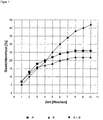
- the polymer B formed was slightly less water compatible than the polymer A; the polymer matrix contained the polymers A and B in the form of an interpenetrating network. Separation of the polymer matrix into two layers was not possible. On the resulting, slightly more than 1 mm thick sheet with the dimensions 22 x 30 cm, a surface tension of 45 dynes / cm was measured. Two layers of the sheet were superimposed and rolled up into a four-layered roll with a layer spacing of 5 mm. The roll was stored in a humidity chamber at 25 ° C and a humidity of 50%. Weight loss by release and evaporation of the perfume and water was measured. The weight loss was even and was only 42% after 10 weeks, ie the effectiveness of the gel-like mass persists for quite a long time.
- Example 1 a was repeated, but the waiting time after application of the solution B to the polymer A was only 10 min.
- the polymer matrix was in the form of a partially interpenetrating network.
- two layers could be separated with the polymers A and B under great force.
- Example 1 a was repeated, but without waiting time, immediately after the application of the solution B was crosslinked.
- the two polymers A and B were juxtaposed as discrete layers which could be easily separated.
- Example 1 was repeated except that 4 g of polyethylene oxide monomethacrylate (from Nippon Oil and Fat) and 0.5 g of polyethylene glycol (400) dimethacrylate were used in solution A, and in solution B 5 g of glycerol monomethacrylate (ex Nippon Oil and Fat ) and 0.5 g of polyethylene glycol (400) dimethacrylate.
- the resulting polymer A is less water compatible than the polymer B.
- the surface tension of the sheet was 42 dynes / cm, the weight loss after 10 weeks 28%, the effectiveness is still fully preserved.
- Solution A 15 g of epoxidized polybutadiene (Polybd from Atofina), 3 g of polyoxypropylenediamine (Jeffamine D 400 from Huntsman) and 8 g of water were mixed with 70 g of a liquid perfume, degassed and stirred as in Example 1.
- Solution B 20 g of fructose (arabino-2-hexulose from Cerestar) and 1 g of pyromellitic dianhydride (ALLCO PDMA from Allco) were mixed with 10 g of a liquid insecticide (Azadirachtin A from Andermatt) and 0.3 g of water, degassed and touched.
- a liquid insecticide Azadirachtin A from Andermatt
- Steps 1 and 2 of the crosslinking reaction were carried out as in Example 1 but with an air stream at 80 ° C instead of the UV lamp.
- the resulting polymer A is not water-soluble, but the polymer B is the surface tension was 35 dynes / cm, the weight loss after 10 weeks 25%.
- Solution A 16 g of maleinated polyvinyl methyl ether (Gantrez SP 215 from ISP), 0.5 g of polyoxypropylenediamine, 0.5 g of triethylene glycol diamine 70 g of a liquid perfume, 1 g of maleated soybean oil and 0.3 g of water were mixed. The mixture was degassed and stirred.
- Solution B 0.5 g of polyoxypropylenediamine, 0.5 g of triethylene glycol diamine, 30 g of perfume, 40 g of maleinized soybean oil and 1 g of pyromellitic dianhydride were mixed, degassed and stirred.
- the solutions were crosslinked as in Example 3. Polymer A is water-soluble, polymer B insoluble in water. The weight loss after 10 weeks was 20%. This low value is probably due to the low content of the gel-like mass of water.
- Example 1 was repeated, but the liquid perfume was not added to the starting materials for the polymers A and B, but was applied to the nonwoven fabric and absorbed by it. During the application of the starting materials for the polymers and in the course of the crosslinking reaction, the perfume diffused into the gelatinous mass.
- Example 1 was repeated except that the solution A 0.05 wt.% Zinc oxide was added. This acts as an additional cross-linking agent, in addition, zinc and calcium compounds are able to bind disturbing odors from the air, such as sulfur compounds.
- Solution A 10 g of maleinated polybutadiene (reaction product of liquid polybutadiene with maleic anhydride - LITHENE from Revertex) were mixed at 50 ° C. with 40 g of dipropylene glycol; and 3 g of polyoxypropylenediamine (MW 400) were mixed at room temperature with 45 g of dipropylene glycol. The two mixtures were stirred together in a shallow vessel at 20 ° C.
- Solution B 16 g of ethyl malester of maleated vinyl methyl ether polycarboxylic acid (Gantrez SP 215 from ISP), 0.5 g of polyoxypropylenediamine, 0.5 g of polyoxypropylenetriamine (1: 1 molar ratio) and 3 g of water were mixed with 70 g of a 50% solution of an active agent (vanillin) in diethylene glycol at 20 ° C.
- Crosslinking Solutions A and B were mixed together and stirred at 80 ° C for 40 minutes. The resulting gel-like mass contains as polymer matrix a partially interpenetrating network of the polymers A and B.
- the gel-like mass was cut into plates of 2 cm thickness, 20 cm width and 20 cm length and placed on a metal net. This net was placed between two parallel 50 x 50 cm plastic plates spaced 10 cm apart. 16 such plates were placed on the sloping enclosure of a 100 m 2 large clarifier, where they unfolded their deodorizing effect over several weeks.
Landscapes
- Life Sciences & Earth Sciences (AREA)
- Health & Medical Sciences (AREA)
- Pest Control & Pesticides (AREA)
- Chemical & Material Sciences (AREA)
- General Health & Medical Sciences (AREA)
- Engineering & Computer Science (AREA)
- Veterinary Medicine (AREA)
- Public Health (AREA)
- Dispersion Chemistry (AREA)
- Epidemiology (AREA)
- Animal Behavior & Ethology (AREA)
- Chemical Kinetics & Catalysis (AREA)
- Oil, Petroleum & Natural Gas (AREA)
- General Chemical & Material Sciences (AREA)
- Analytical Chemistry (AREA)
- Toxicology (AREA)
- Insects & Arthropods (AREA)
- Wood Science & Technology (AREA)
- Zoology (AREA)
- Environmental Sciences (AREA)
- Disinfection, Sterilisation Or Deodorisation Of Air (AREA)
- Treating Waste Gases (AREA)
Description
- Die Erfindung betrifft eine gelartige Masse zur Behandlung der Umgebungsluft, enthaltend eine Polymermatrix, an die flüchtige aktive Agentien adsorbiert sind, welche freigesetzt werden können und verdunsten und dann mit übelriechenden bzw. schädlichen Substanzen in der Luft reagieren und diese vernichten können.
- Zum Entfernen bzw. Reduzieren von übelriechenden Substanzen in der Luft durch Gaswäsche werden in der Praxis verschiedenartige Methoden angewandt. Einige davon nutzen die Fähigkeit von Festsubstanzen mit großer Oberfläche, gasförmige Substanzen zu adsorbieren und damit über einen längeren Zeitraum hinweg zu binden. So werden z.B. mineralische Trägermaterialien, Papiervliese und Aktivkohle als Filtereinsätze zum Entfernen von flüchtigen Verunreinigungen aus Luftund Abluftströmen verwendet.
- Ein anderes Prinzip besteht darin, dass man Pulver, saugfähige Papiere, aufnahmefähige Polymere oder hochporöse Tongranulate mit aktiven Agentien, die mit übelriechenden Substanzen reagieren oder diese maskieren können, imprägniert. Sie geben diese aktiven Agentien langsam wieder ab und können dadurch ihre Wirkung entfalten, wenn sie von verunreinigter Luft durch- oder überströmt werden.
- In
WO-A 01/78794 - In
US- A 5,569,683 ist ein Gel beschrieben, das eine Polymermatrix aus einem vernetzten Acrylatpolymeren und Duftstoffe enthält, die aus der Matrix wieder freigesetzt werden können. -
EP-A-0835666 offenbart eine Vorrichtung zur Freisetzung von Aromen oder desodorierenden Agentien, welche aus einem Gel besteht. - Es hat sich jedoch gezeigt, dass die beschriebenen gelartigen Massen nicht in der Lage sind, die adsorbierten aktiven Agentien über einen längeren Zeitraum hinweg langsam und gleichmäßig wieder freizusetzen.
- Der Erfindung lag nun die Aufgabe zugrunde, eine einfach herstellbare, gelartige Masse, die aktive Agentien adsorbiert enthält, bereitzustellen, welche in der Lage ist, diese über einen längeren Zeitraum hinweg langsam und gleichmäßig freizusetzen.
- Diese Aufgabe wird durch eine gelartige Masse gemäβ Anspruch 1 gelöst, die eine Matrix aus vernetzten, hydrophile Gruppen tragenden Polymeren enthält, an die 10 bis 90 Gew.%, bezogen auf die Masse, flüchtige aktive Agentien adsorbiert sind, welche mit der Matrix zusammen eine Schwammstruktur bilden, aus der die aktiven Agentien an die Umgebungsluft freigesetzt werden können und verdunsten, wobei die Polymermatrix mindestens zwei verschiedenartigen Polymeren A, B, ... enthält.
- Geeignet als vernetzte Polymere sind zwei Polymerklassen, einmal vernetzte (Meth-)Acrylat- Polymere Y und insbesondere vernetzte maleinisierte bzw. epoxidierte Polymere X.
- Bevorzugte vernetzte (Meth-)Acrylat- Polymere Y werden hergestellt durch Copolymerisation von monofunktionellen (Meth-)Acrylat- Monomeren mit einem Molekulargewicht von 50 bis 900 und polyfunktionellen (Meth-)Acrylat- Monomeren mit 2 bis 6, vorzugsweise 2 oder 3 polymerisierbaren Doppelbindungen als Vernetzer, wobei das Molverhältnis mono- zu polyfunktionellen Monomeren vorzugsweise 20 : 1 bis 1 : 1, insbesondere 8 :1 bis 1 : 1 beträgt. Es ist wesentlich, dass das vernetzte Polymere hydrophile Gruppen, enthält, beispielsweise HO-, -CH2-CH2-O-, H2N-, -COO- oder CONH- Gruppen. Derartige vernetzte Polymere sind z.B. in der genannten
US-A 5,569,683 beschrieben. - Geeignete monofunktionelle Monomere sind z.B. Hydroxyethylacrylat, Acrylamid, Glycerinmonoethylacrylat, Poly(propylenoxid)(ethylenoxid)monomethylacrylat (50 POEP 800 B Blemmer), Polyethylenoxidtetrahydrofuran- monomethacrylat (700 PEP 350 B Blemmer), beide von Nippon Oil and Fats. Geeignete polyfunktionelle Monomere sind Polyethylenglykol- 400- dimethacrylat von Röhm GmbH, Ethylenglykoldimethacrylat, Diethylenglykoldimethacrylat und N,N'-Methylenbisacrylamid von Biorad. Die Herstellung der vernetzten (Meth-) Acrylat- Polymeren erfolgt durch Copolymerisation der Monomeren, wobei die Polymerisation durch Zugabe eines radikalischen Initiators, z.B. Wasserstoffperoxid, und Energiezufuhr, z.B. durch Bestrahlen mit UV- Licht oder durch Erhitzen ausgelöst werden kann.
- Die Polymerisation kann in Gegenwart von festen Adsorptionshilfsmitteln, z.B. von Silicagel, Zinkoxid oder Silikaten durchgeführt werden, und insbesondere in Gegenwart von mindestens 0,01 Gew.% Wasser und/oder von anderen quellend wirkenden Flüssigkeiten, wie Alkoholen, Glykolen, Paraffinöl und Polyalkylenoxiden, sowie in Gegenwart der flüssigen aktiven Agentien, wobei eine vorzugsweise offenporige Schwammstruktur entsteht.
- Eine andere bevorzugte Polymerklasse X sind vernetzte Umsetzungsprodukte eines hydrophile Gruppen tragenden Polymeren mit einem Vernetzer. Geeignete hydrophile Gruppen tragende Polymere sind maleinisierte oder epoxidierte Polymere, z.B. Umsetzungsprodukte von Polydienen mit einem Molekulargewicht zwischen 400 und 10 000, beispielsweise Polybutadien, Polydecadien und ungesättigte Fettsäuren, wie Soyabohnenöl, mit Maleinsäureanhydrid, ferner Copolymere von Olefinen, wie Ethylen, mit Maleinsäureanhydrid, sowie epoxidiertes Polybutadien und maleinisierter Polymethylvinylether. Auch Kohlehydrate, wie Fructose und Stärke, können als Polymer eingesetzt werden. Besonders bevorzugte Polymere sind Umsetzungsprodukte von flüssigem Polybutadien mit Maleinsäureanhydrid. Bevorzugte Vernetzer sind Polyamine mit 2 oder 3 Aminogruppen, insbesondere Polyoxyalkylenpolyamine, wie Polyoxypropylendiamin und Polyoxypropylentriamin. Neben Polyaminen können auch Harnstoff, Polyethylenimin, Epichlorhydrin, Triethylenglykol und Pyromellithsäuredianhydrid eingesetzt werden.
- Auch Zinkoxid, Zinkacetat und Calciumhydroxid können als Vernetzer wirken, wobei letztere wahrscheinlich mit zwei Maleinsäureanhydrid- Gruppen einen stabilen Komplex bilden.
Die Herstellung dieser vernetzten, hydrophile Gruppen tragenden Polymeren erfolgt durch Kondensation des maleinisierten bzw. epoxidierten Polymeren mit dem Polyamin, vorzugsweise in alkoholischer Lösung, insbesondere in Dipropylenglykol, bei erhöhter Temperatur, vorzugsweise zwischen 40° und 60°C. Auch hier ist das bevorzugte Molverhältnis Polymer zu Vernetzer 20 :1 bis 1 :1, insbesondere 8 : 1 bis 1 : 1. Bei einem niedrigen Molverhältnis nahe 1 : 1 erhält man eine starke Vernetzung, was relativ zähe und kompakte gelartige Massen ergibt. Die Kondensation wird in Gegenwart von Zusatzstoffen, wie quellend wirkenden und oberflächenaktiven Flüssigkeiten, vorzugsweise wieder von mindestens 0,01 Gew.% Wasser, und in Gegenwart der aktiven Agentien durchgeführt. Als hydrophile Gruppen wirken insbesondere die von den Polyoxyalkylenpolyaminen stammenden -CRH-O- Gruppen, daneben die Maleinsäureanhydrid- und Carboxyl-Gruppen bzw. die -NR-CO- Gruppen des vernetzten maleinisierten Polymeren, sowie die Epoxidgruppen bzw. -COH-CNR- Gruppen des vernetzten epoxidierten Polymer ren. - In beiden Fällen bilden die vernetzten Polymeren zusammen mit den aktiven Agentien eine vorzugsweise offenzellige Schwammstruktur. Die vernetzten Polymeren weisen ein räumliches Netzwerk mit Poren auf, in dem flüchtige Fremdsubstanzen aufgesaugt und adsorbiert werden können, so dass die Polymeren wie ein Schwamm anquellen. Im angequollenen Zustand besteht das dreidimensionale Netzwerk aus Elementarzellen, die eine Porengröße von 0,1 bis 100 µm, insbesondere von 0,5 bis 50 µm aufweisen.
- Erfindungsgemäß enthält die Polymermatrix mindestens zwei verschiedenartige Polymeren A, B, ... .Jedes der Polymeren A, B, ... sollte in der Polymermatrix zu mindestens 10 Gew.%, vorzugsweise von mehr als 20 Gew.%, enthalten sein. Bevorzugt enthält die Polymermischung nur zwei verschiedenartige Polymeren A und B, von denen das eine mehr und das andere weniger wasserverträglich bzw. wasserlöslich ist.
- Bei einer bevorzugten Ausführungsform der Erfindung bilden die Polymeren A, B, ... nach der Vernetzung in der Polymermatrix ein interpenetrierendes Netzwerk. Ein solches erhält man, wenn man die Ausgangsmaterialien für die Polymeren A, B, ..., welche der gleichen Polymerklasse X bzw. Y angehören und miteinander verträglich sind, miteinander vermischt und gemeinsam vernetzt, oder wenn man das Ausgangsmaterial für das Polymere B ausreichend lang in Kontakt mit dem bereits vernetzten Polymeren A hält und in dieses eindiffundieren lässt, und erst dann die Vernetzungsreaktion für das Polymere B durchführt.
Ein nur teilweise interpenetrierendes Netzwerk erhält man, wenn man entweder die Ausgangsmaterialien für verschiedenartige Polymerklassen X bzw. Y miteinander vermischt und die Vernetzungsreaktionen für die jeweilige Polymerklasse nacheinander durchführt, oder wenn man bei gleicher Polymerklasse die Ausgangsmaterialien für das Polymer B nur kurz in Kontakt mit dem bereits vernetzten Polymer A bringt, so dass sie nur teilweise eindiffundieren können, und dann vernetzt.
Eine dritte Ausführungsform der Erfindung besteht darin, dass man das Ausgangsmaterial für das Polymer B mit dem bereits vernetzten Polymer A in Kontakt bringt und ohne Wartezeit sofort vernetzt. Man erhält dann eine Polymermatrix, in der die Polymeren A und B in diskreten Schichten nebeneinander vorliegen. - Je nach Anwendungszweck kann die gelartige Masse verschiedenartige aktive Agentien in Mengen von 10 bis 90 Gew.%, vorzugsweise von 20 bis 80 Gew.% enthalten:
- Desodorantien und Duftstoffe, wie Aldehyde, Ketone, Alkohole, Ester, Terpene oder natürliche ölige Essenzen sowie Parfüme;
- Pflanzenschutzmittel, wie Herbizide, Insektizide, Insekten- Repellents, Fungizide, Nematozide oder Akarizide;
- biozid wirkende Substanzen, wie Phenolverbindungen, Halogenverbindungen oder quarternäre Ammoniumverbindungen.
- Die aktiven Agentien können entweder dadurch in die gelartige Masse eingebracht werden, dass man sie mit den Ausgangsmaterialien für die Polymeren mischt und in ihrer Gegenwart die Vernetzungsreaktion durchführt, oder indem man sie nachträglich in die Polymermatrix eindiffundieren lässt. Die aktiven Agentien können sowohl hydrophil als auch hydrophob sein.
- In einer besonders bevorzugten Ausführungsform enthält die gelartige Masse 0,01 bis 90, vorzugsweise 0,05 bis 60 und insbesondere 0,1 bis 10 Gew.% Wasser. Dieses unterstützt die Bildung der Poren bei der Herstellung der vernetzten Polymeren und sorgt dafür, dass die aktiven Agentien in diese Poren eindringen können, darin festgehalten werden und langsam und gleichmäßig wieder herausdiffundieren. Durch die Menge an Wasser kann die Diffusionsrate kontrolliert werden. Von Bedeutung ist auch, dass die gelartige Masse eine optimale Oberflächenspannung aufweist. Diese liegt bevorzugt zwischen 5 und 80 dynes/cm, insbesondere zwischen 20 und 50 dynes/cm. Die Oberflächenspannung kann mit einem Goniometer zur Bestimmung des Winkels, mit dem ein Tropfen auf der Oberfläche aufliegt, gemessen werden, wie es einem Artikel von Y.C. Ko in Journal of Colloid and Interface Science 1981, 82, Seiten 25- 37, beschrieben ist. Die optimale Oberflächenspannung kann durch die geeignete Kombination von Polymeren, aktiven Agentien und der Menge an zugesetztem Wasser eingestellt werden; sie kann durch einfache Vorversuche ermittelt werden. Je niedriger die Oberflächenspannung ist, desto besser und gleichmäßiger kann das Wasser in der Polymermatrix aufgenommen werden.
- Neben den aktiven Agentien und Wasser kann die gelartige Masse noch Flammschutzmittel, wie Bromverbindungen, Zucker oder Azodicarbonamid, ferner Lösungsmittel, wie Alkohole, insbesondere Dipropylenglykol, Mittel zur Verhinderung des Verbackens, wie z.B. Sägemehl, sowie Sublimationshilfsmittel, welche die Freisetzung des aktiven Agens beschleunigen, enthalten.
- Eine typische Zusammensetzung der Ausgangsmaterialien bei der Herstellung der bevorzugten gelartigen Masse sieht folgendermaßen aus:
Maleinisierte bzw. epoxidierte Polymere: 10 bis 30 Gew. % Vernetzer: 0,2 bis 5 Gew. % Wasser: 0,1 bis 60 Gew.% Flammschutzmittel: 1 bis 20 Gew.% Aktives Agens: Rest - Die gelartige Masse kann als Krümel, Späne, Granulat oder Kugeln zur Anwendung kommen, bevorzugt aber in flächiger Form als Streifen oder Platten mit einer Dicke von 2 bis 50 mm. Diese Streifen oder Platten können auf Netze oder Gitter aufgelegt sein.
- Bei einer besonders bevorzugten Ausführungsform ist die gelartige Masse in sehr dünner Schicht auf ein Trägermaterial aufgetragen oder beidseitig von einem Trägermaterial umhüllt, so dass sie mit diesem zusammen ein flächiges Blatt bildet. Das Trägermaterial kann ein Faservlies oder ein Fasergewebe sein, die auch kunststoffbeschichtet sein können. Geeignet sind Vliese und Gewebe auf Basis von Naturfasern, wie Cellulose, Baumwolle oder Leinen, aber auch von synthetischen Fasern, wie Polyamiden oder Polyester. Geeignete Trägermaterialien sind z.B. das Cellulosefaservlies PGI der Fa. Nordlys WDS; das Baumwollgewebe 4110 der FA. Subrenat; ein Faservlies der Fa. Danisco, das mit einem 20 µm dicken Polyoxypropylenfilm und einem 50 µm dicken Polyethylenfilm beschichtet ist; sowie die Textilgewebe K 286, S 434 und S 434 der Fa. Alstrom.
Bei porösen Faservliesen wird die gelartige Masse von dem Vlies aufgenommen, d.h. das Vlies ist mit der gelartigen Masse imprägniert. Bei kunststoffbeschichteten Geweben liegt die gelartige Masse auf dem Trägermaterial auf, wobei die aktiven Agentien durch die Kunststoffbeschichtung hindurch diffundieren können. Durch das Trägermaterial kann die gelartige Masse in sehr dünner Form mechanisch stabilisiert werden, was die Freisetzung der aktiven Agentien begünstigt.
Das Trägermaterial mit der gelartigen Masse liegt dann in Form eines dünnen Blattes, vorzugsweise mit einer Dicke von 0,01 bis 5 mm, insbesondere von 0,1 bis 2 mm vor. Natürlich können mehrere Blätter, z.B. bis zu einer Dicke von 50 mm übereinander gestapelt werden. Die Blätter bzw. Stapel können zusammengerollt werden, wobei die einzelnen Schichten der Rolle zum Beispiel durch flexible Netze oder Gitter voneinander getrennt sind und einen Abstand von 1 bis 100 mm, insbesondere von 2 bis 20 mm voneinander haben. Die Rollen können in rohrförmige Hülsen oder Säulen eingelegt werden, durch die ein Luftstrom parallel zur Längsrichtung der Hülse bzw. Säule entlang der Oberfläche der zusammengerollten Blätter geführt wird, so dass er in möglichst intensiven Kontakt mit der gelartigen Masse treten und die aktiven Agentien freisetzen kann. - Die Hülsen bzw. Säulen können auch an ihrem Umfang eine Vielzahl von Löchern aufweisen, durch die ein Luftstrom senkrecht zur Längsrichtung der Hülse bzw. parallel zur Längsrichtung der Säule geführt werden kann. Derartige Hülsen können quer in den Abluftkanal oder einen Kamin eingesetzt werden. Vorzugsweise senkrecht stehende Säulen können an besonders geruchsbelasteten Stellen von geschlossenen Räumen aufgestellt werden.
- Zur Herstellung der dünnen Blätter trägt man auf die Trägerschicht, welche z.B. als Fließband über zwei Rollen geführt wird, erst das Ausgangsmaterial für das Polymere A auf, vernetzt dieses und kalibriert auf die gewünschte Dicke, z.B. mit einem flexiblen Abstreifer. Dann trägt man die Ausgangsmaterialien für das Polymere B auf und vernetzt dieses. Je nach Wartezeit zwischen Auftrag und Vernetzung erhält man ein vollständig interpenetrierendes Netzwerk, ein teilweise interpenetrierendes Netzwerk oder diskrete Schichten der vernetzten Polymeren A und B nebeneinander.
Die aktiven Agentien kann man zusammen mit den Ausgangsmaterialien für die Polymeren zugeben, es ist aber auch möglich, sie in oder auf die Trägermaterialien aufzubringen, von wo sie dann in die sich bildende Polymermatrix eindiffundieren. - Bei einer speziellen Ausführungsform der Erfindung wird die Oberfläche der dünnen Blätter mit ultrafeinen Partikeln einer Halbleiterverbindung belegt, z.B. einem Oxid, Sulfid oder Selenid von Zink oder Cadmium, vorzugsweise von Zinkoxid. Dies kann durch Aufsprühen einer wässrigen Suspension auf die Oberfläche der blattförmigen gelartigen Masse im Anschluss an die Vernetzungsreaktion geschehen, z.B. in Mengen von 0,01 bis 1 g pro cm2. Eine Partikelgröße von 1 bis 100 nm, vorzugsweise von 5 bis 60 nm ist bevorzugt. Diese ultrafeinen Halbleiter-Partikel unterstützen die Freisetzung der aktiven Agentien, vor allem aber sind sie in der Lage, mit übelriechenden Substanzen zu reagieren und diese aus der Umgebungsluft zu entfernen.
- Aus der erfindungsgemäßen gelartigen Masse werden die aktiven Agentien langsam und gleichmäßig freigesetzt und verdunsten. Es ist von Vorteil, dass die gelartige Masse ihre Wirkung mindestens drei Tage, vorzugsweise mindestens eine Woche und insbesondere einen bis sechs Monate lang beibehält.
- Bevorzugt wird die gelartige Masse zum Entfernen bzw. Maskieren von übelriechenden Substanzen aus der Luft eingesetzt, wobei die genannten Desodorantien oder Duftstoffe freigesetzt werden und verdunsten.
Das freigesetzte aktive Agens kann mit den übelriechenden Substanzen in der Gasphase reagieren und dabei die übelriechenden Substanzen aus der Luft entfernen bzw. reduzieren. Neben eigentlichen chemischen Reaktionen, z.B. zwischen Schwefelwasserstoff oder Ammoniak und Aldehyden kann es dabei auch zu Bindungen durch elektrostatische oder van der Waals'sche Kräfte kommen, wodurch die Geruchswahrnehmbarkeit zumindest herabgesetzt wird. Weiterhin können die aktiven Agentien auch die üblen Gerüche maskieren und/oder als spezielle Parfümkomposition den üblen Geruch überdecken und eine Beduftung erzielen. - Folgende praktische Anwendungen sind beispielsweise möglich:
- In Tierzuchtanlagen, Ställen, Güllebehältern insbesondere in Schweinemastaniagen, wobei die gelartige Masse in Form von Platten, Streifen oder Blättern auf Gitter oder Netze aufgelegt wird. Diese können direkt an der Decke aufgehängt werden, vorzugsweise werden aber mehrere Gitter übereinander oder nebeneinander auf einem Gestell angeordnet. Man kann auch die oben beschriebenen Rollen aus dünnen Blättern in Hülsen einlegen, durch die die verunreinigte Luft strömen kann. Die Gestelle bzw. Hülsen können in einem Ventilationskasten eingebaut werden, der im Raum oder in Eingangsluftschächten angebracht wird. In letzterem bewirkt die angesaugte Frischluft die Verdunstung der aktiven Agentien.
- In Gebäuderäumen, z.B. in Zimmern, Aufenthaltsräumen, Hallen, Küchen und Toiletten von Krankenhäusern, Altersheimen und insbesondere von Hotels und Restaurants. Dabei kann die gelartige Masse wieder in Form von Streifen, Platten oder Blätter auf Gitter oder Netze aufgelegt und in ein Gestell eingebracht oder in Form von Rollen in Hülsen eingelegt werden. Diese können in einen Klimaschacht oder in einen Ventilationskasten eingebracht werden. Ferner kann die gelartige Masse in Säulen eingebracht werden, in denen durch ein Gebläse ein Luftstrom erzeugt wird, welcher die aktiven Agentien freisetzt. Derartige Säulen können an besonders geruchsbelasteten Stellen der Gebäuderäume aufgestellt werden.
- In öffentlichen Verkehrsmitteln, wie Eisenbahn-, Straßenbahn-, Untergrundbahnwaggons, Bussen, sowie See- und Luftfahrzeugen. Auch hier kann die gelartige Masse auf Netze oder Gitter aufgelegt und diese übereinander in einem Gestell angeordnet werden oder in Form von Rollen in Hülsen eingelegt werden, die in den Luftschacht des Verkehrsmittels eingebracht werden.
- In Industrieanlagen, wobei die gelartige Masse in Abluftkaminen bzw. in Lufteingangsöffnungen oder in die Einblasvorrichtung für Prozessluft angebracht sind. Wo mit starker Verschmutzung zu rechnen ist (z.B. bei Vulkanisationsanlagen) oder wo Abluft mit hoher Temperatur eintritt, welche die Polymermatrix schädigen könnte, kann das aktive Agens in den Raum hinein eingeblasen oder aus einem seitlich angebrachten Einsatz durch Unterdruck eingesaugt werden, wo es sich mit der Abluft vermischen und mit den übelriechenden Substanzen reagieren kann.
- In großflächigen Anlagen, z. B. in Klärbecken, Kläranlagen, Kompostieranlagen, Deponien, Müllsortieranlagen, aber auch in ganzen Industriekomplexen, in denen übelriechende feste oder flüssige Stoffe offen gelagert sind. Bevorzugt wird hier die gelartige Masse als.Streifen, Platten oder Stapel von dünnen Blättern in Gitter eingelegt, die zwischen parallele Platten eingebracht werden. Diese können auf Pfosten befestigt werden, die an geeigneten Stellen in der offenen Anlage aufgestellt werden. Der Zwischenraum zwischen den Platten wird von einem Luftstrom durchströmt, der die aktiven Agentien freisetzt, was vorzugsweise durch natürlichen Wind geschieht, der gegebenenfalls durch ein Gebläse verstärkt wird. Eine andere Anwendung der erfindungsgemäßen gelartigen Masse besteht darin, dass sie mit den oben beschriebenen Pflanzenschutzmitteln beladen wird. Sie kann in Form von Krümeln, Spänen oder Granulat direkt auf den Boden oder auf die Pflanzen aufgestreut werden. Platten oder Streifen können in Gitter oder Netze eingelegt und auf Gestelle aufgelegt werden, und dünne Blätter können in Hülsen eingebracht werden.
Die Gestell bzw. Hülsen können im Feld aufgestellt oder im Weinberg an Drähte aufgehängt werden. - Schließlich kann die gelartige Masse auch mit den oben beschriebenen bioziden Agentien beladen werden, die mit schädliche Mikroorganismen in der Luft reagieren und diese vernichten können.
- Ein weiterer Gegenstand der Erfindung ist eine gelartige Masse in Form eines extrem dünnen Blattes, enthaltend eine Matrix aus vernetzten, hydrophile Gruppen tragenden Polymeren, an die 10 bis 90 Gew.%, bezogen auf die Masse, flüchtige aktive Agentien adsorbiert sind, die mit der Matrix zusammen eine Schwammstruktur bilden, aus der die aktiven Agentien an die Umgebungsluft freigesetzt werden können und verdunsten. Diese Masse ist dadurch gekennzeichnet, dass sie auf ein Trägermaterial aufgetragen bzw. beidseitig von diesem umhüllt ist und mit dem Trägermaterial zusammen eine Dicke von 0,01 bis 2 mm, vorzugsweise von 0,1 bis 1,8 mm aufweist.
- In
WO A- 98/07454 - Die eben beschriebene gelartige Masse enthält vorzugsweise 0,01 bis 90 Gew.%, insbesondere 0,05 bis 60 Gew.% Wasser. Die dünnen Blätter können wieder in mehreren Lagen übereinander gestapelt werden und zusammengerollt werden.
- Derartige extrem dünne Blätter, vor allem wenn die gelartige Masse Wasser enthält, sind auch dann hochwirksam, wenn die Polymermatrix nur ein einziges vernetztes, hydrophile Gruppen tragendes Polymer enthält. Offenbar spielt dabei die relativ große Oberfläche der dünnen Blätter eine Rolle, insbesondere wenn sie mit Abständen zusammengerollt sind.
- Lösung A: 2 g Acrylamid wurden mit 0,5 g N,N'- Methylen- bis- acrylamid in 7,5 g Wasser, 0,1 ml 30%igem Wasserstoffperoxid und 5 g eines flüssigen Parfüms (Vanillin) vermischt. Die Lösung wurde in einem Ultraschallbad unter schwachem Vakuum entgast und 5 min lang bei 5°C in einer Kolloidmühle mit 300 rpm gerührt. Lösung B: 2 g Acrylamid, 0,5 g Polyethylenglykol-(400)- dimethacrylat in 7,5 g Wasser, 0,1 ml 30%iges Wasserstoffperoxid und 3 g des Parfüms wurden wie oben beschrieben, vermischt, entgast und gerührt.
Stufe 1: Auf ein über zwei Rollen mit einer Geschwindigkeit von 0,1 cm/sec geführtes Fließband aus einem Cellulose- Faservlies (PGI der Fa. Nordlys, WDS) wurde die Lösung A langsam und gleichmäßig aufgetragen, dann wurde mittels einer UV- Lampe (40 mW/cm2 bei einem Abstand von 5 cm von dem Trägermaterial) polymerisiert und dann mittels eines flexiblen Abstreifers auf eine Dicke von 1 mm kalibriert.
Stufe 2: Auf das Fließband wurde die Lösung B aufgetragen. Nach einer Wartezeit von 30 min, während der die Lösung B in das bereits gebildete Polymer A eindiffundieren kann, wurde wie oben beschrieben polymerisiert. Insgesamt durchlief das Fließband mit den polymerisierenden Lösungen fünfmal die UV- Lampe. Das gebildete Polymere B war etwas weniger wasserverträglich als das Polymere A; die Polymermatrix enthielt die Polymeren A und B in Form eines interpenetrienden Netzwerkes. Eine Auftrennung der Polymermatrix in zwei Schichten war nicht möglich.
An dem entstandenen, etwas mehr als 1 mm dicken Blatt mit den Abmessungen 22 x 30 cm wurde eine Oberflächenspannung von 45 dynes/cm gemessen. Zwei Lagen des Blattes wurden übereinander gelegt und zu einer vierschichtigen Rolle mit einem Schichtabstand von 5 mm aufgerollt. Die Rolle wurde in einer Feuchtigkeitskammer bei 25 °C und einer Luftfeuchtigkeit von 50 % gelagert. Der Gewichtsverlust durch Freisetzen und Verdunsten des Parfüms und von Wasser wurde gemessen. Die Gewichtsabnahme war gleichmäßig und betrug nach 10 Wochen nur 42 % d.h. dass die Wirksamkeit der gelartigen Masse recht lange anhält. - Zum Vergleich wurden die Lösungen A und B allein polymerisiert und die Gewichts-abnahme gemessen. Der Verlauf der Kurven über die Zeit war ungleichmäßig, nach sechs Wochen betrug der Gewichtsverlust beim Polymer A 23% und beim Polymer B 20%. Danach trat praktisch kein weiterer Gewichtsverlust mehr auf, d.h. die gelartige Masse hatte ihre Wirksamkeit schon nach sechs Wochen verloren. Kurven siehe Abb.
- Beispiel 1 a wurde wiederholt, die Wartezeit nach Auftragen der Lösung B auf das Polymer A betrug aber nur 10 min. In der entstandenen gelartigen Masse lag die Polymermatrix in Form eines nur teilweise interpenetrierenden Netzwerkes vor. Hier konnten unter hohem Kraftaufwand zwei Schichten mit den Polymeren A bzw. B getrennt werden.
- Beispiel 1 a wurde wiederholt, wobei aber ohne Wartezeit, unmittelbar im Anschluss an den Auftrag der Lösung B diese vernetzt wurde. In der Polymermatrix lagen die zwei Polymeren A und B als diskrete Schichten nebeneinander vor, die leicht voneinander getrennt werden konnten.
- Beispiel 1 wurde wiederholt, wobei aber in Lösung A 4 g Polyethylenoxidmonometh-acrylat (von Nippon Oil and Fat) und 0,5 g Polyethylenglykol-(400)-dimethacrylat eingesetzt wurden, und in Lösung B 5 g Glycerinmonomethacrylat (von Nippon Oil and Fat) und 0,5 g Polyethlenglykol-(400)- dimethacrylat. Das entstandene Polymer A ist weniger wasserverträglich als das Polymer B. Die Oberflächenspannung des Blattes betrug 42 dynes/cm, die Gewichtsabnahme nach 10 Wochen 28 %, die Wirksamkeit ist auch dann noch voll erhalten.
- Lösung A: 15 g epoxidiertes Polybutadien (Poly bd von Atofina), 3 g Polyoxypropylen-diamin (Jeffamine D 400 von Huntsman) und 8 g Wasser wurden mit 70 g eines flüssigen Parfüms vermischt, wie in Beispiel 1 entgast und gerührt.
Lösung B: 20 g Fructose (Arabino-2-hexulose von Cerestar) und 1 g Pyromellithsäure-dianhydrid (ALLCO PDMA von Allco) wurden mit 10 g eines flüssigen Insektizids (Azadirachtin A von Andermatt) und 0,3 g Wasser vermischt, entgast und gerührt.
Die Stufen 1 und 2 der Vernetzungsreaktion wurden wie in Beispiel 1 durchgeführt, jedoch mit einem 80°C heißen Luftstrom statt der UV- Lampe. Das entstandene Polymer A ist nicht wasserlöslich, wohl aber das Polymer B. Die Oberflächenspannung betrug 35 dynes/cm, die Gewichtsabnahme nach 10 Wochen 25 %.
Anwendung: Zehn Lagen des erhaltenen, etwas mehr als 1 mm dicken Blattes wurden übereinandergelegt und in ein Netz eingebracht. Mehrere solcher Netze wurden an die Drahtkonstruktion eines Weinbergs angehängt, wo sie über drei Monate hinweg ihre insektizide Wirkung entfalteten. - Lösung A: 16 g maleinisierter Polyvinylmethylether (Gantrez SP 215 der Fa. ISP), 0,5 g Polyoxypropylendiamin, 0,5 g Triethylenglykoldiamin 70 g eines flüssigen Parfüms, 1 g maleinisiertes Soyabohnenöl und 0,3 g Wasser wurden gemischt. Die Mischung wurde entgast und gerührt.
Lösung B: 0,5 g Polyoxypropylendiamin, 0,5 g Triethylenglykoldiamin, 30 g Parfüm, 40 g maleinisiertes Soyabohnenöl und 1 g Pyromellithsäuredianhydrid wurden vermischt, entgast und gerührt. Die Lösungen wurden wie in Beispiel 3 vernetzt.
Polymer A ist wasserlöslich, Polymer B wasserunlöslich. Die Gewichtsabnahme nach 10 Wochen betrug 20 %. Dieser niedrige Wert ist vermutlich auf den geringen Gehalt der gelförmigen Masse an Wasser zurückzuführen. - Beispiel 1 wurde wiederholt, wobei aber das flüssige Parfüm nicht den Ausgangsmaterialien für die Polymeren A und B zugesetzt wurde, sondern auf das Faservlies aufgetragen und von diesem aufgesaugt wurde. Während des Auftrags der Ausgangsmaterialien für die Polymeren und im Verlauf der Vernetzungsreaktion diffundierte das Parfüm in die gelartige Masse ein.
- Beispiel 1 wurde wiederholt, wobei aber der Lösung A 0,05 Gew.% Zinkoxid zugesetzt wurde. Dieses wirkt als zusätzliches Vernetzungsmittel, außerdem sind Zinkund Calciumverbindungen in der Lage, störende Geruchsstoffe aus der Luft, z.B. Schwefelverbindungen, zu binden.
- Lösung A: 10 g maleinisiertes Polybutadien (Umsetzungsprodukt aus flüssigem Polybutadien mit Maleinsäureanhydrid - LITHENE der Fa. Revertex) wurden bei 50°C mit 40 g Dipropylenglykol vermischt; und 3 g Polyoxypropylendiamin (MG 400) wurden bei Raumtemperatur mit 45 g Dipropylenglykol vermischt. Die beiden Mischungen wurden in einem flachen Gefäß bei 20°C zusammengerührt. Lösung B: 16 g des Ethylhalbesters der Polycarbonsäure aus maleinisiertem Vinylmethylether (Gantrez SP 215 von ISP), 0,5 g Polyoxypropylendiamin, 0,5 g Polyoxypropylentriamin (Molverhältnis 1 : 1) und 3 g Wasser wurden mit 70 g einer 50%igen Lösung eines aktiven Agens (Vanillin) in Diethylenglykol bei 20 °C vermischt.
Vernetzung: Die Lösungen A und B wurden miteinander vermischt und 40 min lang bei 80 °C gerührt. Die entstandene gelartige Masse enthält als Polymermatrix ein teilweise interpenetrierendes Netzwerk aus den Polymeren A und B. - Anwendung: Die gelartige Masse wurde in Platten von 2 cm Dicke, 20 cm Breite und 20 cm Länge geschnitten und auf ein Metallnetz aufgelegt. Dieses Netz wurde zwischen zwei parallele, 50 x 50 cm große Kunststoffplatten mit einem Abstand von 10 cm eingebracht. 16 derartiger Platten wurden an der schrägen Einfassung eines 100 m2 großen Klärbeckens aufgelegt, wo sie über mehrere Wochen hinweg ihre desodorierende Wirkung entfalteten.
Claims (12)
- Gelartige Masse zur Behandlung der Umgebungsluft, enthaltend eine Matrix aus vernetzten, hydrophile Gruppen tragenden Polymeren, nämlichX) Umsetzungsprodukten eines hydrophile Gruppen tragenden Polymeren mit einem Molekulargewicht von mehr als 400, ausgewählt aus maleinisierten oder epoxidierten Polymeren oder Kohlehydraten, mit einem Vernetzer, ausgewählt aus Polyaminen mit 2 oder 3 Aminogruppen, Harnstoff, Polyethylenimin, Epichlorhydrin, Triethylenglykol, Pyromellithsäuredianhydrid, Zinkoxid, Zinkacetat oder Calciumhydroxid,
oderY) Copolymerisaten aus einem monofunktionellen (Meth-) AcrylatMonomeren mit einem Molekulargewicht von 50 bis 1000 und einem polyfunktionellen (Meth-) Acrylat- Monomeren als Vernetzer,
an die 10 bis 90 Gew.%, bezogen auf die Masse, flüchtige aktive Agentien adsorbiert sind, die mit der Matrix zusammen eine Schwammstruktur bilden, aus der die aktiven Agentien an die Umgebungsluft freigesetzt werden können und verdunsten,
dadurch gekennzeichnet, dass die Polymermatrix mindestens zwei verschiedenartige Polymere A, B, ... enthält. - Gelartige Masse nach Anspruch 1, dadurch gekennzeichnet, dass die Polymeren A, B, ... nach der Vernetzung in der Polymermatrix ein interpenetrierendes Netzwerk bilden.
- Gelartige Masse nach Anspruch 1, dadurch gekennzeichnet, dass die Polymeren A, B, ... nach der Vernetzung in der Polymermatrix ein teilweise interpenetrierendes Netzwerk bilden.
- Gelartige Masse nach Anspruch 1, dadurch gekennzeichnet, dass die Polymeren A, B, ... nach der Vernetzung in der Polymermatrix in diskreten Schichten nebeneinander vorliegen.
- Gelartige Masse nach Anspruch 1, dadurch gekennzeichnet, dass die Polymermatrix aus zwei verschiedenartigen Polymeren A und B besteht, von denen das eine mehr und das andere weniger wasserverträglich ist.
- Gelartige Masse nach Anspruch 1, dadurch gekennzeichnet, dass jedes Polymere A, B ... in der Polymermatrix zu mindestens 10 Gew.% enthalten ist.
- Gelartige Masse nach Anspruch 1, dadurch gekennzeichnet, dass der Vernetzer der Polymerklasse X ein Polyamin, vorzugsweise Polyoxypropylendiamin oder Polyoxypropylentriamin, ist und das hydrophile Gruppen tragende Polymer ein maleinisiertes oder epoxidiertes Polydiolefin, vorzugsweise Polybutadien oder Polydecadien, ist.
- Gelartige Masse nach Anspruch 1, dadurch gekennzeichnet, dass sie auf einem Trägermaterial aufgetragen oder beidseitig von einem solchen umhüllt ist, so dass sie mit dem Trägermaterial zusammen in Form eines flächigen Blattes vorliegt.
- Gelartige Masse nach Anspruch 1, dadurch gekennzeichnet, dass sie in Form von Streifen oder Platten mit einer Dicke von 2 bis 50 mm zur Anwendung kommt, die auf Gitter oder Netze aufgelegt sind.
- Verwendung der gelartigen Masse nach Anspruch 1 zum Entfernen bzw.
Maskieren von übelriechenden Substanzen aus der Luft, dadurch gekennzeichnet, dass die adsorbierten aktiven Agentien langsam und gleichmäßig freigesetzt werden und verdunsten und dann mit den übelriechenden Substanzen reagieren oder diese maskieren. - Verwendung der gelartigen Masse nach Anspruch 1 zum Pflanzenschutz, dadurch gekennzeichnet, dass die adsorbierten aktiven Agentien langsam und gleichmäßig freigesetzt werden und ihre Wirksamkeit gegen die Schädlinge bzw. Schadstoffe entfalten.
- Verwendung der gelartigen Masse nach Anspruch 1 zum Vernichten von schädlichen Mikroorganismen, dadurch gekennzeichnet, dass die adsorbierten aktiven Agentien langsam und gleichmäßig freigesetzt werden und mit den Mikroorganismen reagieren und diese vernichten.
Applications Claiming Priority (2)
| Application Number | Priority Date | Filing Date | Title |
|---|---|---|---|
| DE10335938A DE10335938A1 (de) | 2003-08-04 | 2003-08-04 | Gelartige Masse in flächiger Form zur Behandlung von Umgebungsluft |
| PCT/EP2004/008485 WO2005016392A1 (de) | 2003-08-04 | 2004-07-29 | Gelartige masse in flächiger form zur behandlung von umgebungsluft |
Publications (2)
| Publication Number | Publication Date |
|---|---|
| EP1651279A1 EP1651279A1 (de) | 2006-05-03 |
| EP1651279B1 true EP1651279B1 (de) | 2012-05-09 |
Family
ID=34177319
Family Applications (1)
| Application Number | Title | Priority Date | Filing Date |
|---|---|---|---|
| EP04763591A Expired - Lifetime EP1651279B1 (de) | 2003-08-04 | 2004-07-29 | Gelartige masse in flächiger form zur behandlung von umgebungsluft |
Country Status (5)
| Country | Link |
|---|---|
| US (1) | US20060252848A1 (de) |
| EP (1) | EP1651279B1 (de) |
| AT (1) | ATE556724T1 (de) |
| DE (1) | DE10335938A1 (de) |
| WO (1) | WO2005016392A1 (de) |
Families Citing this family (12)
| Publication number | Priority date | Publication date | Assignee | Title |
|---|---|---|---|---|
| US20110117156A1 (en) * | 2004-05-27 | 2011-05-19 | Arizona Chemical Company | Compositions and articles containing an active liquid in a polymeric matrix and methods of making and using the same |
| US8664292B2 (en) * | 2004-05-27 | 2014-03-04 | Croda International Plc | Compositions and articles containing a cross-linked polymer matrix and an immobilized active liquid, as well as methods of making and using the same |
| GB0810796D0 (en) * | 2008-06-12 | 2008-07-23 | Reckitt Benckiser Uk Ltd | Fragrance emanator composition |
| US20130336914A1 (en) * | 2012-06-15 | 2013-12-19 | Steven Anthony Horenziak | Malodor control compositions having activated alkenes and methods thereof |
| US20160220952A1 (en) * | 2015-02-02 | 2016-08-04 | Clemson University | Biodegradable waste remediation method and system |
| FR3037257B1 (fr) * | 2015-06-15 | 2020-09-25 | Eurotab | Tablette absorbante d'humidite liberant une substance active volatile |
| KR102559987B1 (ko) | 2016-08-16 | 2023-07-26 | 도날드슨 컴파니, 인코포레이티드 | 탄화수소 유체-물 분리 |
| US10969341B2 (en) * | 2017-11-28 | 2021-04-06 | International Business Machines Corporation | Colorimetric detection of airborne sulfur |
| JP7339266B2 (ja) | 2018-02-15 | 2023-09-05 | ドナルドソン カンパニー,インコーポレイティド | フィルター要素構造 |
| US12017161B2 (en) | 2018-02-15 | 2024-06-25 | Donaldson Company, Inc. | Filter media configurations |
| AU2019222771B2 (en) * | 2018-02-15 | 2024-06-13 | Donaldson Company, Inc. | Substrate treatments |
| CN110548386A (zh) * | 2019-09-20 | 2019-12-10 | 江苏舜天新盈轻工业有限公司 | 废气处理用植物性喷剂及其使用方法 |
Family Cites Families (7)
| Publication number | Priority date | Publication date | Assignee | Title |
|---|---|---|---|---|
| ES445695A1 (es) * | 1975-03-03 | 1977-06-16 | Airwick Ag | Un metodo para producir un sistema difusor solido liberador de vapores mejoradores del olor del aire provisto de una ma-triz polimerica. |
| US4340057A (en) * | 1980-12-24 | 1982-07-20 | S. C. Johnson & Son, Inc. | Radiation induced graft polymerization |
| US5569683A (en) * | 1995-05-22 | 1996-10-29 | Thermedics, Inc. | Gel compositions |
| JPH1080470A (ja) * | 1996-08-23 | 1998-03-31 | Minnesota Mining & Mfg Co <3M> | 消臭性ポリマーフィルム及びシート状消臭材 |
| JPH10113382A (ja) * | 1996-10-11 | 1998-05-06 | Sanyo Chem Ind Ltd | 袋入芳香又は消臭材 |
| GB0009577D0 (en) * | 2000-04-19 | 2000-06-07 | Reckitt & Colmann Prod Ltd | Improvements in or relating to organic compositions |
| US6872787B2 (en) * | 2000-09-15 | 2005-03-29 | Isp Investments Inc. | Post-treatment of a polymeric composition |
-
2003
- 2003-08-04 DE DE10335938A patent/DE10335938A1/de not_active Withdrawn
-
2004
- 2004-07-29 WO PCT/EP2004/008485 patent/WO2005016392A1/de not_active Ceased
- 2004-07-29 AT AT04763591T patent/ATE556724T1/de active
- 2004-07-29 EP EP04763591A patent/EP1651279B1/de not_active Expired - Lifetime
- 2004-07-29 US US10/567,063 patent/US20060252848A1/en not_active Abandoned
Also Published As
| Publication number | Publication date |
|---|---|
| WO2005016392A9 (de) | 2005-04-21 |
| DE10335938A1 (de) | 2005-03-24 |
| ATE556724T1 (de) | 2012-05-15 |
| EP1651279A1 (de) | 2006-05-03 |
| US20060252848A1 (en) | 2006-11-09 |
| WO2005016392A1 (de) | 2005-02-24 |
Similar Documents
| Publication | Publication Date | Title |
|---|---|---|
| DE69613226T2 (de) | Mit insektizid imprägnierter gegenstand zur bekämpfung fliegender insekten | |
| DE69917309T2 (de) | Gelförmige dampfeinrichtung | |
| EP1651279A1 (de) | Gelartige masse in fächiger form zur behandlung von umgebungsluft | |
| DE69628791T2 (de) | Absorbierende Zusammensetzung, absorbierendes Material, und ein, das absorbierende Material enthaltende, absorbierendes Produkt. | |
| DE3886489T2 (de) | Verfahren zur Herstellung eines Sorptionsmittels, das für die Verwendung in einem Gerät zum Ablassen von Gas in die Atmosphäre geeignet ist. | |
| DE3617881A1 (de) | Absorbierender artikel und verfahren zu seiner herstellung | |
| EP1441831A1 (de) | Antipathogene luftfiltermedien und luftleitungsvorrichtung mit schutzfähigkeiten gegen infektöse in der luft schwebende mikroorganismen | |
| EP1427452A1 (de) | Super-absorbierende hydrogele bestimmter teilchengroessenverteilung | |
| EP1425320A1 (de) | Saure hochquellfähige hydrogele | |
| WO2003063920A1 (de) | Entfernen bzw. reduzieren von übelriechenden substanzen in der luft | |
| DE69513774T2 (de) | Schädliche Substanzen reinigendes photoreaktives Mittel und schädliche Substanzen reinigendes photoreaktives Material unter Verwendung dieses Mittels | |
| EP1560605B1 (de) | Verfahren zum desodorieren von grossflächigen anlagen | |
| WO2006106096A1 (de) | Feuchtigkeitsregulierende verbundstoffe | |
| US12172112B1 (en) | Method for making an adsorptive air filter | |
| JP2943135B2 (ja) | 徐効性動物忌避剤組成物及び動物忌避方法 | |
| WO2009106501A1 (de) | Mehrschichtiges verbundmaterial, seine herstellung und verwendung | |
| JP2006501040A5 (de) | ||
| DE102023113228A1 (de) | Biozide und viruzide Luftfiltermaterialien, ihre Verwendung sowie Verfahren zu ihrer Herstellung und ihrer umweltfreundlichen Entsorgung | |
| DE2031989A1 (de) | Pestizide-Präparate und Verfahren zu ihrer Herstellung | |
| DE19548070B4 (de) | Pheromonhaltiges Mittel mit anhaltender Freisetzung | |
| KR100550657B1 (ko) | 은나노 및 피톤치드를 포함하는 도배풀을 이용한 주택 유해물질 차단 방법 | |
| DE102005027934A1 (de) | Hydrophile antimikrobielle Zusammensetzung für einen Klimaanlagenverdampfer eines Fahrzeugs | |
| DE102022100285A1 (de) | Biologisch aktive Adsorberschutzschichten | |
| WO2006106108A1 (de) | Quellverzögerter superabsorbierender schaum, verfahren zu seiner herstellung und seine verwendung | |
| DE69204255T2 (de) | Filtermaterial und Verfahren zu seiner Herstellung. |
Legal Events
| Date | Code | Title | Description |
|---|---|---|---|
| PUAI | Public reference made under article 153(3) epc to a published international application that has entered the european phase |
Free format text: ORIGINAL CODE: 0009012 |
|
| 17P | Request for examination filed |
Effective date: 20051224 |
|
| AK | Designated contracting states |
Kind code of ref document: A1 Designated state(s): AT BE BG CH CY CZ DE DK EE ES FI FR GB GR HU IE IT LI LU MC NL PL PT RO SE SI SK TR |
|
| DAX | Request for extension of the european patent (deleted) | ||
| GRAP | Despatch of communication of intention to grant a patent |
Free format text: ORIGINAL CODE: EPIDOSNIGR1 |
|
| GRAS | Grant fee paid |
Free format text: ORIGINAL CODE: EPIDOSNIGR3 |
|
| GRAA | (expected) grant |
Free format text: ORIGINAL CODE: 0009210 |
|
| AK | Designated contracting states |
Kind code of ref document: B1 Designated state(s): AT BE BG CH CY CZ DE DK EE ES FI FR GB GR HU IE IT LI LU MC NL PL PT RO SE SI SK TR |
|
| REG | Reference to a national code |
Ref country code: GB Ref legal event code: FG4D Free format text: NOT ENGLISH |
|
| RIN1 | Information on inventor provided before grant (corrected) |
Inventor name: GUILLAUME, BRUNO |
|
| REG | Reference to a national code |
Ref country code: CH Ref legal event code: EP Ref country code: AT Ref legal event code: REF Ref document number: 556724 Country of ref document: AT Kind code of ref document: T Effective date: 20120515 |
|
| REG | Reference to a national code |
Ref country code: IE Ref legal event code: FG4D Free format text: LANGUAGE OF EP DOCUMENT: GERMAN |
|
| REG | Reference to a national code |
Ref country code: DE Ref legal event code: R096 Ref document number: 502004013507 Country of ref document: DE Effective date: 20120712 |
|
| REG | Reference to a national code |
Ref country code: NL Ref legal event code: T3 |
|
| PG25 | Lapsed in a contracting state [announced via postgrant information from national office to epo] |
Ref country code: CY Free format text: LAPSE BECAUSE OF FAILURE TO SUBMIT A TRANSLATION OF THE DESCRIPTION OR TO PAY THE FEE WITHIN THE PRESCRIBED TIME-LIMIT Effective date: 20120509 Ref country code: SE Free format text: LAPSE BECAUSE OF FAILURE TO SUBMIT A TRANSLATION OF THE DESCRIPTION OR TO PAY THE FEE WITHIN THE PRESCRIBED TIME-LIMIT Effective date: 20120509 Ref country code: PL Free format text: LAPSE BECAUSE OF FAILURE TO SUBMIT A TRANSLATION OF THE DESCRIPTION OR TO PAY THE FEE WITHIN THE PRESCRIBED TIME-LIMIT Effective date: 20120509 Ref country code: FI Free format text: LAPSE BECAUSE OF FAILURE TO SUBMIT A TRANSLATION OF THE DESCRIPTION OR TO PAY THE FEE WITHIN THE PRESCRIBED TIME-LIMIT Effective date: 20120509 |
|
| PG25 | Lapsed in a contracting state [announced via postgrant information from national office to epo] |
Ref country code: GR Free format text: LAPSE BECAUSE OF FAILURE TO SUBMIT A TRANSLATION OF THE DESCRIPTION OR TO PAY THE FEE WITHIN THE PRESCRIBED TIME-LIMIT Effective date: 20120810 Ref country code: PT Free format text: LAPSE BECAUSE OF FAILURE TO SUBMIT A TRANSLATION OF THE DESCRIPTION OR TO PAY THE FEE WITHIN THE PRESCRIBED TIME-LIMIT Effective date: 20120910 Ref country code: SI Free format text: LAPSE BECAUSE OF FAILURE TO SUBMIT A TRANSLATION OF THE DESCRIPTION OR TO PAY THE FEE WITHIN THE PRESCRIBED TIME-LIMIT Effective date: 20120509 |
|
| BERE | Be: lapsed |
Owner name: GUILLAUME, BRUNO Effective date: 20120731 |
|
| PG25 | Lapsed in a contracting state [announced via postgrant information from national office to epo] |
Ref country code: DK Free format text: LAPSE BECAUSE OF FAILURE TO SUBMIT A TRANSLATION OF THE DESCRIPTION OR TO PAY THE FEE WITHIN THE PRESCRIBED TIME-LIMIT Effective date: 20120509 Ref country code: CZ Free format text: LAPSE BECAUSE OF FAILURE TO SUBMIT A TRANSLATION OF THE DESCRIPTION OR TO PAY THE FEE WITHIN THE PRESCRIBED TIME-LIMIT Effective date: 20120509 Ref country code: EE Free format text: LAPSE BECAUSE OF FAILURE TO SUBMIT A TRANSLATION OF THE DESCRIPTION OR TO PAY THE FEE WITHIN THE PRESCRIBED TIME-LIMIT Effective date: 20120509 Ref country code: RO Free format text: LAPSE BECAUSE OF FAILURE TO SUBMIT A TRANSLATION OF THE DESCRIPTION OR TO PAY THE FEE WITHIN THE PRESCRIBED TIME-LIMIT Effective date: 20120509 Ref country code: SK Free format text: LAPSE BECAUSE OF FAILURE TO SUBMIT A TRANSLATION OF THE DESCRIPTION OR TO PAY THE FEE WITHIN THE PRESCRIBED TIME-LIMIT Effective date: 20120509 |
|
| PG25 | Lapsed in a contracting state [announced via postgrant information from national office to epo] |
Ref country code: IT Free format text: LAPSE BECAUSE OF FAILURE TO SUBMIT A TRANSLATION OF THE DESCRIPTION OR TO PAY THE FEE WITHIN THE PRESCRIBED TIME-LIMIT Effective date: 20120509 Ref country code: MC Free format text: LAPSE BECAUSE OF NON-PAYMENT OF DUE FEES Effective date: 20120731 |
|
| REG | Reference to a national code |
Ref country code: CH Ref legal event code: PL |
|
| PLBE | No opposition filed within time limit |
Free format text: ORIGINAL CODE: 0009261 |
|
| STAA | Information on the status of an ep patent application or granted ep patent |
Free format text: STATUS: NO OPPOSITION FILED WITHIN TIME LIMIT |
|
| 26N | No opposition filed |
Effective date: 20130212 |
|
| PG25 | Lapsed in a contracting state [announced via postgrant information from national office to epo] |
Ref country code: LI Free format text: LAPSE BECAUSE OF NON-PAYMENT OF DUE FEES Effective date: 20120731 Ref country code: ES Free format text: LAPSE BECAUSE OF FAILURE TO SUBMIT A TRANSLATION OF THE DESCRIPTION OR TO PAY THE FEE WITHIN THE PRESCRIBED TIME-LIMIT Effective date: 20120820 Ref country code: CH Free format text: LAPSE BECAUSE OF NON-PAYMENT OF DUE FEES Effective date: 20120731 |
|
| REG | Reference to a national code |
Ref country code: IE Ref legal event code: MM4A |
|
| PG25 | Lapsed in a contracting state [announced via postgrant information from national office to epo] |
Ref country code: BE Free format text: LAPSE BECAUSE OF NON-PAYMENT OF DUE FEES Effective date: 20120731 |
|
| REG | Reference to a national code |
Ref country code: DE Ref legal event code: R097 Ref document number: 502004013507 Country of ref document: DE Effective date: 20130212 |
|
| PG25 | Lapsed in a contracting state [announced via postgrant information from national office to epo] |
Ref country code: IE Free format text: LAPSE BECAUSE OF NON-PAYMENT OF DUE FEES Effective date: 20120729 Ref country code: BG Free format text: LAPSE BECAUSE OF FAILURE TO SUBMIT A TRANSLATION OF THE DESCRIPTION OR TO PAY THE FEE WITHIN THE PRESCRIBED TIME-LIMIT Effective date: 20120809 |
|
| REG | Reference to a national code |
Ref country code: AT Ref legal event code: MM01 Ref document number: 556724 Country of ref document: AT Kind code of ref document: T Effective date: 20120731 |
|
| PG25 | Lapsed in a contracting state [announced via postgrant information from national office to epo] |
Ref country code: AT Free format text: LAPSE BECAUSE OF NON-PAYMENT OF DUE FEES Effective date: 20120731 |
|
| PG25 | Lapsed in a contracting state [announced via postgrant information from national office to epo] |
Ref country code: TR Free format text: LAPSE BECAUSE OF FAILURE TO SUBMIT A TRANSLATION OF THE DESCRIPTION OR TO PAY THE FEE WITHIN THE PRESCRIBED TIME-LIMIT Effective date: 20120509 |
|
| PG25 | Lapsed in a contracting state [announced via postgrant information from national office to epo] |
Ref country code: LU Free format text: LAPSE BECAUSE OF NON-PAYMENT OF DUE FEES Effective date: 20120729 |
|
| PG25 | Lapsed in a contracting state [announced via postgrant information from national office to epo] |
Ref country code: HU Free format text: LAPSE BECAUSE OF FAILURE TO SUBMIT A TRANSLATION OF THE DESCRIPTION OR TO PAY THE FEE WITHIN THE PRESCRIBED TIME-LIMIT Effective date: 20040729 |
|
| PGFP | Annual fee paid to national office [announced via postgrant information from national office to epo] |
Ref country code: NL Payment date: 20150731 Year of fee payment: 12 |
|
| PGFP | Annual fee paid to national office [announced via postgrant information from national office to epo] |
Ref country code: GB Payment date: 20150731 Year of fee payment: 12 Ref country code: DE Payment date: 20150731 Year of fee payment: 12 |
|
| REG | Reference to a national code |
Ref country code: FR Ref legal event code: PLFP Year of fee payment: 13 |
|
| REG | Reference to a national code |
Ref country code: DE Ref legal event code: R119 Ref document number: 502004013507 Country of ref document: DE |
|
| REG | Reference to a national code |
Ref country code: NL Ref legal event code: MM Effective date: 20160801 |
|
| GBPC | Gb: european patent ceased through non-payment of renewal fee |
Effective date: 20160729 |
|
| PG25 | Lapsed in a contracting state [announced via postgrant information from national office to epo] |
Ref country code: DE Free format text: LAPSE BECAUSE OF NON-PAYMENT OF DUE FEES Effective date: 20170201 Ref country code: NL Free format text: LAPSE BECAUSE OF NON-PAYMENT OF DUE FEES Effective date: 20160801 |
|
| PG25 | Lapsed in a contracting state [announced via postgrant information from national office to epo] |
Ref country code: GB Free format text: LAPSE BECAUSE OF NON-PAYMENT OF DUE FEES Effective date: 20160729 |
|
| REG | Reference to a national code |
Ref country code: FR Ref legal event code: PLFP Year of fee payment: 14 |
|
| REG | Reference to a national code |
Ref country code: FR Ref legal event code: PLFP Year of fee payment: 15 |
|
| PGFP | Annual fee paid to national office [announced via postgrant information from national office to epo] |
Ref country code: FR Payment date: 20230725 Year of fee payment: 20 |