EP1638423B1 - Method of making a textured surface coating for gloves - Google Patents
Method of making a textured surface coating for gloves Download PDFInfo
- Publication number
- EP1638423B1 EP1638423B1 EP04756576A EP04756576A EP1638423B1 EP 1638423 B1 EP1638423 B1 EP 1638423B1 EP 04756576 A EP04756576 A EP 04756576A EP 04756576 A EP04756576 A EP 04756576A EP 1638423 B1 EP1638423 B1 EP 1638423B1
- Authority
- EP
- European Patent Office
- Prior art keywords
- latex
- layer
- glove
- salt
- former
- Prior art date
- Legal status (The legal status is an assumption and is not a legal conclusion. Google has not performed a legal analysis and makes no representation as to the accuracy of the status listed.)
- Expired - Lifetime
Links
Images


Classifications
-
- A—HUMAN NECESSITIES
- A41—WEARING APPAREL
- A41D—OUTERWEAR; PROTECTIVE GARMENTS; ACCESSORIES
- A41D19/00—Gloves
- A41D19/0055—Plastic or rubber gloves
- A41D19/0058—Three-dimensional gloves
- A41D19/0065—Three-dimensional gloves with a textile layer underneath
-
- A—HUMAN NECESSITIES
- A41—WEARING APPAREL
- A41D—OUTERWEAR; PROTECTIVE GARMENTS; ACCESSORIES
- A41D19/00—Gloves
-
- A—HUMAN NECESSITIES
- A41—WEARING APPAREL
- A41D—OUTERWEAR; PROTECTIVE GARMENTS; ACCESSORIES
- A41D19/00—Gloves
- A41D19/0006—Gloves made of several layers of material
-
- A—HUMAN NECESSITIES
- A41—WEARING APPAREL
- A41D—OUTERWEAR; PROTECTIVE GARMENTS; ACCESSORIES
- A41D19/00—Gloves
- A41D19/001—Linings
-
- A—HUMAN NECESSITIES
- A41—WEARING APPAREL
- A41D—OUTERWEAR; PROTECTIVE GARMENTS; ACCESSORIES
- A41D19/00—Gloves
- A41D19/0055—Plastic or rubber gloves
- A41D19/0082—Details
-
- A—HUMAN NECESSITIES
- A41—WEARING APPAREL
- A41D—OUTERWEAR; PROTECTIVE GARMENTS; ACCESSORIES
- A41D19/00—Gloves
- A41D19/015—Protective gloves
-
- A—HUMAN NECESSITIES
- A41—WEARING APPAREL
- A41D—OUTERWEAR; PROTECTIVE GARMENTS; ACCESSORIES
- A41D19/00—Gloves
- A41D19/04—Appliances for making gloves; Measuring devices for glove-making
-
- A—HUMAN NECESSITIES
- A41—WEARING APPAREL
- A41D—OUTERWEAR; PROTECTIVE GARMENTS; ACCESSORIES
- A41D31/00—Materials specially adapted for outerwear
- A41D31/04—Materials specially adapted for outerwear characterised by special function or use
- A41D31/12—Hygroscopic; Water retaining
-
- A—HUMAN NECESSITIES
- A41—WEARING APPAREL
- A41D—OUTERWEAR; PROTECTIVE GARMENTS; ACCESSORIES
- A41D31/00—Materials specially adapted for outerwear
- A41D31/04—Materials specially adapted for outerwear characterised by special function or use
- A41D31/12—Hygroscopic; Water retaining
- A41D31/125—Moisture handling or wicking function through layered materials
-
- B—PERFORMING OPERATIONS; TRANSPORTING
- B29—WORKING OF PLASTICS; WORKING OF SUBSTANCES IN A PLASTIC STATE IN GENERAL
- B29C—SHAPING OR JOINING OF PLASTICS; SHAPING OF MATERIAL IN A PLASTIC STATE, NOT OTHERWISE PROVIDED FOR; AFTER-TREATMENT OF THE SHAPED PRODUCTS, e.g. REPAIRING
- B29C41/00—Shaping by coating a mould, core or other substrate, i.e. by depositing material and stripping-off the shaped article; Apparatus therefor
- B29C41/02—Shaping by coating a mould, core or other substrate, i.e. by depositing material and stripping-off the shaped article; Apparatus therefor for making articles of definite length, i.e. discrete articles
- B29C41/14—Dipping a core
-
- B—PERFORMING OPERATIONS; TRANSPORTING
- B29—WORKING OF PLASTICS; WORKING OF SUBSTANCES IN A PLASTIC STATE IN GENERAL
- B29C—SHAPING OR JOINING OF PLASTICS; SHAPING OF MATERIAL IN A PLASTIC STATE, NOT OTHERWISE PROVIDED FOR; AFTER-TREATMENT OF THE SHAPED PRODUCTS, e.g. REPAIRING
- B29C41/00—Shaping by coating a mould, core or other substrate, i.e. by depositing material and stripping-off the shaped article; Apparatus therefor
- B29C41/02—Shaping by coating a mould, core or other substrate, i.e. by depositing material and stripping-off the shaped article; Apparatus therefor for making articles of definite length, i.e. discrete articles
- B29C41/20—Shaping by coating a mould, core or other substrate, i.e. by depositing material and stripping-off the shaped article; Apparatus therefor for making articles of definite length, i.e. discrete articles incorporating preformed parts or layers, e.g. moulding inserts or for coating articles
-
- B—PERFORMING OPERATIONS; TRANSPORTING
- B29—WORKING OF PLASTICS; WORKING OF SUBSTANCES IN A PLASTIC STATE IN GENERAL
- B29C—SHAPING OR JOINING OF PLASTICS; SHAPING OF MATERIAL IN A PLASTIC STATE, NOT OTHERWISE PROVIDED FOR; AFTER-TREATMENT OF THE SHAPED PRODUCTS, e.g. REPAIRING
- B29C41/00—Shaping by coating a mould, core or other substrate, i.e. by depositing material and stripping-off the shaped article; Apparatus therefor
- B29C41/02—Shaping by coating a mould, core or other substrate, i.e. by depositing material and stripping-off the shaped article; Apparatus therefor for making articles of definite length, i.e. discrete articles
- B29C41/22—Making multilayered or multicoloured articles
-
- B—PERFORMING OPERATIONS; TRANSPORTING
- B29—WORKING OF PLASTICS; WORKING OF SUBSTANCES IN A PLASTIC STATE IN GENERAL
- B29C—SHAPING OR JOINING OF PLASTICS; SHAPING OF MATERIAL IN A PLASTIC STATE, NOT OTHERWISE PROVIDED FOR; AFTER-TREATMENT OF THE SHAPED PRODUCTS, e.g. REPAIRING
- B29C41/00—Shaping by coating a mould, core or other substrate, i.e. by depositing material and stripping-off the shaped article; Apparatus therefor
- B29C41/34—Component parts, details or accessories; Auxiliary operations
-
- B—PERFORMING OPERATIONS; TRANSPORTING
- B29—WORKING OF PLASTICS; WORKING OF SUBSTANCES IN A PLASTIC STATE IN GENERAL
- B29C—SHAPING OR JOINING OF PLASTICS; SHAPING OF MATERIAL IN A PLASTIC STATE, NOT OTHERWISE PROVIDED FOR; AFTER-TREATMENT OF THE SHAPED PRODUCTS, e.g. REPAIRING
- B29C59/00—Surface shaping of articles, e.g. embossing; Apparatus therefor
- B29C59/02—Surface shaping of articles, e.g. embossing; Apparatus therefor by mechanical means, e.g. pressing
-
- B—PERFORMING OPERATIONS; TRANSPORTING
- B29—WORKING OF PLASTICS; WORKING OF SUBSTANCES IN A PLASTIC STATE IN GENERAL
- B29C—SHAPING OR JOINING OF PLASTICS; SHAPING OF MATERIAL IN A PLASTIC STATE, NOT OTHERWISE PROVIDED FOR; AFTER-TREATMENT OF THE SHAPED PRODUCTS, e.g. REPAIRING
- B29C71/00—After-treatment of articles without altering their shape; Apparatus therefor
- B29C71/0009—After-treatment of articles without altering their shape; Apparatus therefor using liquids, e.g. solvents, swelling agents
-
- A—HUMAN NECESSITIES
- A41—WEARING APPAREL
- A41D—OUTERWEAR; PROTECTIVE GARMENTS; ACCESSORIES
- A41D19/00—Gloves
- A41D19/0055—Plastic or rubber gloves
- A41D19/0058—Three-dimensional gloves
-
- A—HUMAN NECESSITIES
- A41—WEARING APPAREL
- A41D—OUTERWEAR; PROTECTIVE GARMENTS; ACCESSORIES
- A41D19/00—Gloves
- A41D19/0055—Plastic or rubber gloves
- A41D19/0058—Three-dimensional gloves
- A41D19/0062—Three-dimensional gloves made of one layer of material
-
- A—HUMAN NECESSITIES
- A41—WEARING APPAREL
- A41D—OUTERWEAR; PROTECTIVE GARMENTS; ACCESSORIES
- A41D2400/00—Functions or special features of garments
- A41D2400/80—Friction or grip reinforcement
-
- A—HUMAN NECESSITIES
- A41—WEARING APPAREL
- A41D—OUTERWEAR; PROTECTIVE GARMENTS; ACCESSORIES
- A41D2500/00—Materials for garments
- A41D2500/10—Knitted
-
- A—HUMAN NECESSITIES
- A41—WEARING APPAREL
- A41D—OUTERWEAR; PROTECTIVE GARMENTS; ACCESSORIES
- A41D2500/00—Materials for garments
- A41D2500/50—Synthetic resins or rubbers
- A41D2500/54—Synthetic resins or rubbers in coated form
-
- B—PERFORMING OPERATIONS; TRANSPORTING
- B29—WORKING OF PLASTICS; WORKING OF SUBSTANCES IN A PLASTIC STATE IN GENERAL
- B29C—SHAPING OR JOINING OF PLASTICS; SHAPING OF MATERIAL IN A PLASTIC STATE, NOT OTHERWISE PROVIDED FOR; AFTER-TREATMENT OF THE SHAPED PRODUCTS, e.g. REPAIRING
- B29C59/00—Surface shaping of articles, e.g. embossing; Apparatus therefor
- B29C59/02—Surface shaping of articles, e.g. embossing; Apparatus therefor by mechanical means, e.g. pressing
- B29C2059/028—Incorporating particles by impact in the surface, e.g. using fluid jets or explosive forces to implant particles
-
- B—PERFORMING OPERATIONS; TRANSPORTING
- B29—WORKING OF PLASTICS; WORKING OF SUBSTANCES IN A PLASTIC STATE IN GENERAL
- B29C—SHAPING OR JOINING OF PLASTICS; SHAPING OF MATERIAL IN A PLASTIC STATE, NOT OTHERWISE PROVIDED FOR; AFTER-TREATMENT OF THE SHAPED PRODUCTS, e.g. REPAIRING
- B29C37/00—Component parts, details, accessories or auxiliary operations, not covered by group B29C33/00 or B29C35/00
- B29C37/0053—Moulding articles characterised by the shape of the surface, e.g. ribs, high polish
-
- B—PERFORMING OPERATIONS; TRANSPORTING
- B29—WORKING OF PLASTICS; WORKING OF SUBSTANCES IN A PLASTIC STATE IN GENERAL
- B29K—INDEXING SCHEME ASSOCIATED WITH SUBCLASSES B29B, B29C OR B29D, RELATING TO MOULDING MATERIALS OR TO MATERIALS FOR MOULDS, REINFORCEMENTS, FILLERS OR PREFORMED PARTS, e.g. INSERTS
- B29K2033/00—Use of polymers of unsaturated acids or derivatives thereof as moulding material
- B29K2033/18—Polymers of nitriles
-
- B—PERFORMING OPERATIONS; TRANSPORTING
- B29—WORKING OF PLASTICS; WORKING OF SUBSTANCES IN A PLASTIC STATE IN GENERAL
- B29K—INDEXING SCHEME ASSOCIATED WITH SUBCLASSES B29B, B29C OR B29D, RELATING TO MOULDING MATERIALS OR TO MATERIALS FOR MOULDS, REINFORCEMENTS, FILLERS OR PREFORMED PARTS, e.g. INSERTS
- B29K2105/00—Condition, form or state of moulded material or of the material to be shaped
- B29K2105/0058—Liquid or visquous
- B29K2105/0064—Latex, emulsion or dispersion
-
- B—PERFORMING OPERATIONS; TRANSPORTING
- B29—WORKING OF PLASTICS; WORKING OF SUBSTANCES IN A PLASTIC STATE IN GENERAL
- B29K—INDEXING SCHEME ASSOCIATED WITH SUBCLASSES B29B, B29C OR B29D, RELATING TO MOULDING MATERIALS OR TO MATERIALS FOR MOULDS, REINFORCEMENTS, FILLERS OR PREFORMED PARTS, e.g. INSERTS
- B29K2995/00—Properties of moulding materials, reinforcements, fillers, preformed parts or moulds
- B29K2995/0037—Other properties
- B29K2995/0072—Roughness, e.g. anti-slip
-
- B—PERFORMING OPERATIONS; TRANSPORTING
- B29—WORKING OF PLASTICS; WORKING OF SUBSTANCES IN A PLASTIC STATE IN GENERAL
- B29L—INDEXING SCHEME ASSOCIATED WITH SUBCLASS B29C, RELATING TO PARTICULAR ARTICLES
- B29L2031/00—Other particular articles
- B29L2031/48—Wearing apparel
- B29L2031/4842—Outerwear
- B29L2031/4864—Gloves
Definitions
- the present invention relates to methods for making a glove with a textured surface.
- Unsupported gloves are manufactured by dipping glove formers shaped like hands into tanks of liquid latex and admixed chemicals.
- the latex may contain vulcanization agents that are used to cure the rubber, and a dry rubber film is produced.
- the formers are first precoated with a coagulant to gel the latex and to facilitate the subsequent removal of the glove from the former.
- the precoated formers are then dipped in the tanks of chemicals necessary to make the gloves. While still on the formers, the latex gloves also go through one or more rinses to leach out proteins and residual chemicals.
- the wet gel is dried and cured in a heated oven and the latex glove cures on the former before they are reversed stripped off the former, packaged, and/or sterilized.
- the inside surface of the stripped glove is smooth whilst the outside surface of the glove takes the impression of the texture from the glove former.
- Supported gloves are manufactured by dip coating a supporting liner dressed on a glove former.
- the inside of the glove can be made of a knit material, a non woven fabric or other suitable material. After drying and curing in a heated oven the glove is removed from the former but not reversed hence a smooth outside surface of the glove results from the latex dip coating process.
- supported gloves can be made by dip coating the supporting liner with a layer of foamed latex material.
- Prior art gloves include dip coating with a foamed latex material that is unevenly applied to provide texture, but this surface levels out in the heating and curing process, leaving a closed cellular surface structure with a smooth surface layer.
- the prior art includes unsupported gloves made using formers having embossed patterns designed to improve the wearer's grip. These patterns create designs on the finished glove product, however, they contribute little to improving grip and are primarily aesthetic. Additionally, the prior art shows that post-processing of the gloves to remove excess surfactants from the latex by washing may marginally improve the wet grip.
- surface treatment by a halogen, such as chlorine will not only remove the surfactant but also chemically modifies the latex surface. The surface treatment provides a more chemically resistant surface that retards the rate of chemical absorption and perhaps material degradation, resulting in a marginal improvement in wet grip.
- all overcoat of polymeric latex optionally containing rubber or mineral fillers may slightly improve grip. These processes also add to the cost of glove production and may require additional machinery.
- Foam material with a closed cellular surface layer does little to aid circulation of air inside the glove but can absorb sweat. Also, a foam material on the outside of either unsupported or supported gloves has a closed cellular surface layer that does little to enhance the ability to grip wet or slippery objects.
- JP-A-2002/020913 discloses a glove comprising a glove main body and a non-slip layer provided on the surface of said glove main body, and having multiple micro-recessed parts formed on the surface of the non-slip layer.
- the method disclosed in this document includes all features of the method according to the present invention, except that the salt particles are dissolved after the curing step.
- a glove having a textured surface coating produced by embedding a layer of discrete particles, such as a common salt, into a liquid surface of a dipped latex film, gelling the dipped latex layer, dissolving away the discrete particles to leave a textured surface, thereafter leaching, drying and curing and finally removing the glove from the former.
- the methods of the present invention may provide a textured surface coating on the outside of the glove to improve wet gripping, on the inside of the glove to improve comfort, or both.
- the methods of the present invention may also provide a textured surface produced by applying a foam material to a woven, knit or other substrate layer, embedding a layer of discrete particles into the liquid foam material layer, processing the foam layer and dissolving the embedded discrete particles.
- FIG. 1 is a photograph of a plan view of a textured surface coating in a glove made according to one embodiment of the present invention.
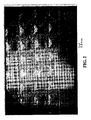
- FIG. 2 is a photograph of a plan view of a surface in a SOLVEX 37-676 nitrile glove.
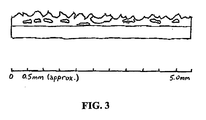
- FIG. 3 illustrates a cross-sectional view of a two-layer glove made according to an embodiment of the present invention having a textured surface layer as a second layer.
- FIG. 4 illustrates a cross-sectional view of a single layer SOLVEX 37-676 nitrile glove.
- the present invention is directed to methods for making a glove with a textured surface coating made from either non foamed latex or foamed latex produced by embedding discrete particles in a layer of ungelled latex.
- the latex layer is gelled on contact with the discrete particles.
- the process is completed by drying and curing the glove.
- the discrete particles are removed from the layer after gelling by dissolving the particles in a suitable solvent.
- This process leaves impressions where the discrete particles were embedded, resulting in a textured surface coating that can improve grip, air circulation within the glove with less direct skin contact and a degree of sweat absorption.
- wet/oil grip is improved in the textured gloves of the present invention.
- Foam material may be used in place of non-foamed latex to produce the textured surface layer, providing better grip, higher sweat absorption and a flexible layer of insulation.
- the discrete particles used include various salts, including sodium chloride, potassium chloride, calcium chloride, magnesium chloride, zinc chloride, calcium nitrate, zinc nitrate.
- a preferred salt is sodium chloride.
- Sodium chloride has several advantages in that it is inexpensive, readily available, easily disposed of and recycled, or reused. One useful commercial preparation of sodium chloride, 99% purity, is available from BSS International Ltd., Peterborough, England.
- Useful mean particle sizes can range from 50 to 6000 ⁇ m (50 microns to 6000 microns).
- a preferred mean particle size range is from 50 to 2000 ⁇ m (50 microns to 2000 microns). While all of these salts can be used to provide a similar physical textured appearance, chloride salts provide a distinct improvement in wet/oil grip and chemical resistance of the textured surface of the present invention.
- a salt such as, for example, sodium chloride
- a liquid latex used in the present invention upon contact with a liquid latex used in the present invention, immediately destabilises the latex to form a wet gel, and hence "freezes" that shape of the salt particle in the surface of the rubber.
- the salt is removed a surface texture is created. This surface texture is the reverse image of the salt particle.
- the desired texture will be controlled by the choice of discrete particle.
- a dendritic salt will produce a multi-faceted impression because it is a many-pointed crystal. Different impression sizes will result from the particles chosen as well. Crushed salt will produce various sizes of impression, while the very fine particles of table salt will produce a dense, more even distribution of small impressions. Mixtures or combinations of particle size can be used.
- the solvent used to dissolve away the discrete particles will depend on the solubility of the particles, and may be water, an acid or an alkaline compound.
- gloves may be manufactured using a variety of different techniques.
- the gloves are produced in a mass production line where a great plurality of gloves is sequentially, rapidly and consistently produced.
- Such a technique conveys and manipulates multiple glove formers through a series of chemical solutions and process steps to make the glove.
- the formers are made of porcelain, steel or plastic.
- gloves may be produced directly on the formers that are conveyed from one station to the next. The formers are dipped into a coagulant to obtain a layer of the desired characteristics.
- the technique allows for altering the composition, the order of application, and the method of application of ingredients that make up the layer of the glove.
- the glove may be built up from multiple dips into various substances.
- the formers may be initially dipped into a composition of a powder free release agent and a coagulant. That release agent and coagulant dip supplies a release material for the subsequent removal of the finished glove from the formers.
- the coagulant material will destabilize subsequent liquid layers such as latex type elastomers.
- the laminate layer may be comprised of a latex elastomeric dip, such as natural or synthetic rubber latex such as polyurethane, nitrile or polychloroprene.
- a latex elastomeric dip such as natural or synthetic rubber latex such as polyurethane, nitrile or polychloroprene.
- various combinations and blends of latices can be used.
- the latices of the present invention optionally can be foamed.
- One useful nitrile latex is REVENEX 99G43 (Synthomer Ltd., United Kingdom).
- the laminate layer may be varied to provide different degrees of strength, comfort, flexibility and chemical resistance. In any event, the content of the latex applied to the former will preferably be adjusted to provide protection from cuts and abrasion, liquid repellency and chemical resistance.
- a second coagulant dip may be applied if another laminate layer is to be applied. Additional coagulant dip and laminate layers may be added to reach the desired degree of thickness and flexibility.
- the formers are preferably passed through ovens at elevated temperatures to dry and cure and provide the final product The gloves are then removed either manually or by an automated technique.
- the former is dipped to form a first layer of latex.
- This first layer of latex is then gelled and the former is dipped again to form a second layer of ungelled latex.
- the viscosity of the foamed or non foamed latex latices of the second layer can range from 100 cps to 2000 cps (Brookfield).
- Discrete particles are then applied to the ungelled second layer of latex by dipping the former into a fluidized bed of discrete particles or other mechanical means of embedding the discrete particles, for example, spraying.
- the fluidized bed process utilises the suspension of salt particles (NaCl) in an air stream such that the particles behave in a manner similar to a liquid.
- the discrete particles are removed by dissolving with an appropriate solvent after the discrete particles have been applied and after gelling to leave behind a textured surface coating substantially over the surface of the glove.
- salt particles can be removed from the gelled surface by washing or spraying with water.
- Viscosity of the latex is one parameter that can be varied to achieve the desired textured effect. Textured non foamed layers provide the optimum durability and wet/oil grip combination.
- the former is dipped into more than one layer of latex and gelled after each layer until the desired number of layers is achieved.
- the former is then dipped once more in latex and discrete particles are applied to this outermost ungelled layer of latex by dipping the former into a fluidized bed of discrete particles or other mechanical means of embedding the discrete particles, for example, spraying.
- the discrete particles are dissolved with an appropriate solvent after gelling to leave behind a textured surface coating. Textured non foamed layers provide the optimum durability and wet/oil grip combination.
- Another embodiment of the invention includes a piece of non-latex material with a textured surface coating produced by embedding discrete particles in the outer layer of the latex overdip.
- the former would have a layer of woven non-latex material applied as a support, and be dipped in a layer of foamed or non foamed latex.
- An example of a usefull woven material is a knitted liner.
- Discrete particles are then applied to the layer of foam material by dipping the former into a fluidized bed of discrete particles or other mechanical means of embedding the discrete particles, for example, spraying.
- the piece of material is then gelled and the discrete particles are dissolved with an appropriate solvent to leave behind a textured surface coating. This material may then be cut apart and the pieces sewn to various glove parts to provide an improved grip or absorb sweat.
- the first or subsequent latex layers can be subjected to texturing.
- Additives such as thickeners, accelerators, curatives or curing agents are used in the various embodiments of the textured surface coatings of the present invention.
- Useful thickeners include, but are not limited to, ammonium polyacrylate, methylcellulose, and polyvinyl alcohol.
- Useful accelerators include, but are not limited to, zinc diethyldithiocarbamate (“ZDEC”), zinc dibutyldithiocarbamate (“ZDBC”), zinc dimethyldithiocarbamate (“ZDMC”), zinc butyl ethyl dithiocarbamate (“ZBED”), zinc mercaptobenzthiazole (“ZMBT”), mercaptobenzthiazole (“MBT”), and diphenylguanidine (“DPG”).
- Other useful curatives and additives include, for example, sulphur and zinc oxide. Foaming and frothing agents are useful in the various embodiments of the textured surface coatings of the present invention. Traditional processing aids to aid gel formation and control webbing may be used.
- aqueous ammonia aqueous ammonia
- wetting agents TRITON X-100, available from Union Carbide Ltd., U.S.A.
- antiwebbing agent is DEFOAMER 1512M, available from Hercules Ltd., Wilinington, Delaware.
- accelerators can be used in the range of between 0.5 phr to 1.5 phr individually, or in combination where the sum of the parts preferably should not exceed that range.
- Example : Step 1 The following coagulant solution is prepared: Calcium nitrate, aq. concentration 35% by volume TRITON X 100 about 0.1 % by volume DEFOAMER 1512M about 0.5 % by volume
- the coagulant solution is heated to 30 to 40°C.
- a clean porcelain glove former is evenly coated over its surface by immersion in the coagulant solution. The speed of immersion is approx. 1.5 cm/sec, the dwell time is 5 to 10 sec, and the extraction speed is approx. 0.75 cm/sec.
- Step 2 The coagulant coated former is inverted to fingers up position and dried in a warm gentle air flow (30 to 40 °C) for 2 to 2.5 minutes.
- Step 3 The dried coagulant coated former is reinverted to fingers down position and dipped into a nitrile latex compound: REVENEX 99G43 100 phr Sulphur 0.5 phr Zinc Oxide 3.0 phr ZMBT 0.7 phr
- the pH is adjusted to 9.0 (with ammonia or potassium hydroxide).
- the viscosity of the latex is typically 20 to 40 cps (Brookfield viscometer model DV1+, spindle # 2 @ 30 rpm).
- the latex is held at 20 to 25 °C.
- the speed of immersion is approx. 1.5 cm/sec
- the dwell time in the latex is 30 to 90 sec, depending on desired wall thickness
- the extraction speed is approx. 1.2 cm/sec.
- Step 4 The gelled nitrile latex coated former is inverted to fingers up position to aid dispersal of finger tip drips, dwell time minimum 30 sec at ambient air temperature.
- Step 5 The gelled nitrile latex coated former (now a nitrile glove shell) is reinverted to fingers down position and dipped into water heated to 40 to 60 °C to remove residual surface syneresis products, dwell time 60 to 80 sec.
- Step 6 The nitrile glove shell is inverted to the fingers up position to aid dispersal of the finger drips and then partially dried to remove excess water on the gel surface and finger tips.
- Step 7 The nitrile glove shell is inverted to fingers down position and overdipped to the wrist (or alternatively completely to the cuff) with a second layer of a nitrile latex as follows: REVENEX 99G43 100 phr Sulphur 0.5 phr Zinc Oxide 3.0 phr ZMBT 0.7 phr
- the pH of this latex has been adjusted to 9.0 (with ammonia or potassium hydroxide), and the viscosity of the latex has been adjusted to 500 cps (Brookfield viscometer model DV1+, spindle # 2 @ 30 rpm) using ammonium polyacrylate.
- the latex is held at 20 to 25 °C.
- the speed of immersion is approx. 1 to 3 cm/sec
- the dwell time in the latex is approx. 10 to 30 sec
- the extraction speed is approx. 2 cm/sec.
- Step 8 The nitrile glove shell, now having a liquid second layer of nitrile latex overdip is inverted to fingers up position to disperse finger drips and then quickly reinverted back to fingers down position.
- Particles of sodium chloride (99% purity, mean particle size 400 microns) are applied to the second layer of latex in a fluidized bed apparatus, available from Campbell Coutts Ltd., Victoria, England.
- the glove shell is held at ambient temperature.
- the speed of immersion into the fluidized bed is approx. 2 cm/sec
- the dwell time in the fluidized bed is 5 to 10 sec
- the extraction speed is approx. 2 cm/sec.
- the fluidized bed may be turned off so as to achieve a sharper/deeper impression into the latex layer.
- the fluidized bed is turned back on.
- Step 9 The salt coated shell is washed with water at ambient temperature to remove sodium chloride remaining at the now gelled surface.
- Step 10 The gelled glove product is then leached in warm water at approx. 40 °C for approx. 15 minutes.
- Step 11 The gelled glove product is dried and vulcanised in a conventional recirculating hot air oven at 130 °C for approx. 60 minutes.
- Step 12 The cured glove is allowed to cool and is then reversed stripped off the former.
- an internal lining e.g. cotton flocking
- an internal lining e.g. cotton flocking
- Step 13 The finished, cured glove is then turned inside out so that the textured surface is on the outside of the glove.
- a pinch force test was developed to measure the grip force required to lift a steel weight having a polished surface and covered with a mixture of hydraulic oil and grease.
- Several gloves were tested, including a glove prepared according to the Example ("Textured Glove"), and known nitrile gloves of similar formulation, yet not having a textured surface coating, namely Ansell SOLVEX 37-676 and Ansell SOLKNIT 39-122.
- the test apparatus employed a model PPS-6 Kg mass balance available from Applied Instruments Ltd., United Kingdom, modified with a stainless steel strip attached to its underside, directly opposite the flat stainless steel load pan of the balance. The entire apparatus is turned on its side for the test, in such a manner that it can be gripped by a gloved hand against the force of gravity while pointed toward the floor.
- the stainless steel surfaces were coated with mixture of hydraulic oil and grease for the following testing.
- the pinch force test was carried out as follows.
- the textured glove made according to the Example exhibits improved grip control and confidence when slip occurs.
- the textured glove requires the lowest grip force to lift the three weights defined by the apparatus.
- the textured glove required 29% and 31 % less immediate grip force to lift the first weight and second weight, respectively, compared to the SOLVEX 37-676 glove; and required 20% less steady grip force to hold the second weight compared to the SOLVEX 37-676 glove.
- the textured glove required 24% and 44% less immediate grip force to lift the first weight and second weight, respectively, compared to the SOLKNIT 39-122 glove; and required 19% and 49% less steady grip force to hold the first weight and second weight, respectively, compared to the SOLKNIT 39-122 glove. It is notable that sudden, violent slip can occur using conventional gloves. In contrast, the textured glove provides control of slip even when slip occurred.
Landscapes
- Engineering & Computer Science (AREA)
- Textile Engineering (AREA)
- Mechanical Engineering (AREA)
- Gloves (AREA)
- Treatments For Attaching Organic Compounds To Fibrous Goods (AREA)
- Manufacture Of Porous Articles, And Recovery And Treatment Of Waste Products (AREA)
Abstract
Description
- The present invention relates to methods for making a glove with a textured surface.
- Unsupported gloves are manufactured by dipping glove formers shaped like hands into tanks of liquid latex and admixed chemicals. The latex may contain vulcanization agents that are used to cure the rubber, and a dry rubber film is produced. The formers are first precoated with a coagulant to gel the latex and to facilitate the subsequent removal of the glove from the former. The precoated formers are then dipped in the tanks of chemicals necessary to make the gloves. While still on the formers, the latex gloves also go through one or more rinses to leach out proteins and residual chemicals. The wet gel is dried and cured in a heated oven and the latex glove cures on the former before they are reversed stripped off the former, packaged, and/or sterilized. The inside surface of the stripped glove is smooth whilst the outside surface of the glove takes the impression of the texture from the glove former.
- Supported gloves are manufactured by dip coating a supporting liner dressed on a glove former. The inside of the glove can be made of a knit material, a non woven fabric or other suitable material. After drying and curing in a heated oven the glove is removed from the former but not reversed hence a smooth outside surface of the glove results from the latex dip coating process. Alternatively, supported gloves can be made by dip coating the supporting liner with a layer of foamed latex material. Prior art gloves include dip coating with a foamed latex material that is unevenly applied to provide texture, but this surface levels out in the heating and curing process, leaving a closed cellular surface structure with a smooth surface layer.
- Smooth layers of latex create problems with the wearer's ability to grip objects, especially when wet. The prior art includes unsupported gloves made using formers having embossed patterns designed to improve the wearer's grip. These patterns create designs on the finished glove product, however, they contribute little to improving grip and are primarily aesthetic. Additionally, the prior art shows that post-processing of the gloves to remove excess surfactants from the latex by washing may marginally improve the wet grip. Alternatively, surface treatment by a halogen, such as chlorine, will not only remove the surfactant but also chemically modifies the latex surface. The surface treatment provides a more chemically resistant surface that retards the rate of chemical absorption and perhaps material degradation, resulting in a marginal improvement in wet grip. In supported gloves, all overcoat of polymeric latex optionally containing rubber or mineral fillers may slightly improve grip. These processes also add to the cost of glove production and may require additional machinery.
- In prior art gloves where the smooth latex is on the inside of the glove, the smooth surface is in close contact with the skin and it does not absorb sweat. This creates a clammy feeling on the wearer's hands. The prior art has included cotton flock on the inside of unsupported gloves to aid in sweat absorption, yet flock only absorbs small amounts of sweat.
- Foam material with a closed cellular surface layer does little to aid circulation of air inside the glove but can absorb sweat. Also, a foam material on the outside of either unsupported or supported gloves has a closed cellular surface layer that does little to enhance the ability to grip wet or slippery objects.
- It is therefore desirable to have a glove with a textured surface coating that is easily produced in the normal course of glove manufacture. A glove of this type would improve grip, such as wet/oil grip, when introduced to the outside of the glove. When included on the inside of the glove a textured surface would increase sweat absorption and reduce the degree of direct skin contact hence reducing the clammy feeling against the skin. It is therefore desirable to have a foam material layer with an open cellular structure with a textured surface.
JP-A-2002/020913 - There are provided, in accordance with the principles of the present invention, methods for making a glove having a textured surface coating produced by embedding a layer of discrete particles, such as a common salt, into a liquid surface of a dipped latex film, gelling the dipped latex layer, dissolving away the discrete particles to leave a textured surface, thereafter leaching, drying and curing and finally removing the glove from the former. In one embodiment, the methods of the present invention may provide a textured surface coating on the outside of the glove to improve wet gripping, on the inside of the glove to improve comfort, or both. In another embodiment, the methods of the present invention may also provide a textured surface produced by applying a foam material to a woven, knit or other substrate layer, embedding a layer of discrete particles into the liquid foam material layer, processing the foam layer and dissolving the embedded discrete particles.
-
FIG. 1 is a photograph of a plan view of a textured surface coating in a glove made according to one embodiment of the present invention. -
FIG. 2 is a photograph of a plan view of a surface in a SOLVEX 37-676 nitrile glove. -
FIG. 3 illustrates a cross-sectional view of a two-layer glove made according to an embodiment of the present invention having a textured surface layer as a second layer. -
FIG. 4 illustrates a cross-sectional view of a single layer SOLVEX 37-676 nitrile glove. - The present invention is directed to methods for making a glove with a textured surface coating made from either non foamed latex or foamed latex produced by embedding discrete particles in a layer of ungelled latex. The latex layer is gelled on contact with the discrete particles. The process is completed by drying and curing the glove. The discrete particles are removed from the layer after gelling by dissolving the particles in a suitable solvent. This process leaves impressions where the discrete particles were embedded, resulting in a textured surface coating that can improve grip, air circulation within the glove with less direct skin contact and a degree of sweat absorption. For example, wet/oil grip is improved in the textured gloves of the present invention. Foam material may be used in place of non-foamed latex to produce the textured surface layer, providing better grip, higher sweat absorption and a flexible layer of insulation.
- The discrete particles used include various salts, including sodium chloride, potassium chloride, calcium chloride, magnesium chloride, zinc chloride, calcium nitrate, zinc nitrate. A salt that is substantially soluble in a solvent, such as water, is preferred. A preferred salt is sodium chloride. Sodium chloride has several advantages in that it is inexpensive, readily available, easily disposed of and recycled, or reused. One useful commercial preparation of sodium chloride, 99% purity, is available from BSS International Ltd., Peterborough, England. Useful mean particle sizes can range from 50 to 6000 µm (50 microns to 6000 microns). A preferred mean particle size range is from 50 to 2000 µm (50 microns to 2000 microns). While all of these salts can be used to provide a similar physical textured appearance, chloride salts provide a distinct improvement in wet/oil grip and chemical resistance of the textured surface of the present invention.
- A salt, such as, for example, sodium chloride, upon contact with a liquid latex used in the present invention, immediately destabilises the latex to form a wet gel, and hence "freezes" that shape of the salt particle in the surface of the rubber. When the salt is removed a surface texture is created. This surface texture is the reverse image of the salt particle.
- The desired texture will be controlled by the choice of discrete particle. For example, a dendritic salt will produce a multi-faceted impression because it is a many-pointed crystal. Different impression sizes will result from the particles chosen as well. Crushed salt will produce various sizes of impression, while the very fine particles of table salt will produce a dense, more even distribution of small impressions. Mixtures or combinations of particle size can be used. The solvent used to dissolve away the discrete particles will depend on the solubility of the particles, and may be water, an acid or an alkaline compound.
- According to embodiments of the present invention, gloves may be manufactured using a variety of different techniques. According to a preferred embodiment, the gloves are produced in a mass production line where a great plurality of gloves is sequentially, rapidly and consistently produced. Such a technique conveys and manipulates multiple glove formers through a series of chemical solutions and process steps to make the glove. The formers are made of porcelain, steel or plastic. According to the standard manufacturing process, gloves may be produced directly on the formers that are conveyed from one station to the next. The formers are dipped into a coagulant to obtain a layer of the desired characteristics. The technique allows for altering the composition, the order of application, and the method of application of ingredients that make up the layer of the glove.
- The glove may be built up from multiple dips into various substances. For example, the formers may be initially dipped into a composition of a powder free release agent and a coagulant. That release agent and coagulant dip supplies a release material for the subsequent removal of the finished glove from the formers. In addition, the coagulant material will destabilize subsequent liquid layers such as latex type elastomers.
- After the release agent/coagulant dip is applied, the formers are preferably conveyed to the next station in the production line where the laminate layer is applied to the formers. The laminate layer may be comprised of a latex elastomeric dip, such as natural or synthetic rubber latex such as polyurethane, nitrile or polychloroprene. For example, various combinations and blends of latices can be used. The latices of the present invention optionally can be foamed. One useful nitrile latex is REVENEX 99G43 (Synthomer Ltd., United Kingdom). By varying the selection and composition of the latex material, the laminate layer may be varied to provide different degrees of strength, comfort, flexibility and chemical resistance. In any event, the content of the latex applied to the former will preferably be adjusted to provide protection from cuts and abrasion, liquid repellency and chemical resistance.
- After the application of the laminate layer, a second coagulant dip may be applied if another laminate layer is to be applied. Additional coagulant dip and laminate layers may be added to reach the desired degree of thickness and flexibility. After application of one or more laminate layers, the formers are preferably passed through ovens at elevated temperatures to dry and cure and provide the final product The gloves are then removed either manually or by an automated technique.
- According to the substantially automated mass production technique described above, a great number of variations may be introduced to provide additional or different desired characteristics of the laminate in accordance with the present invention.
- In one embodiment of the invention, the former is dipped to form a first layer of latex. This first layer of latex is then gelled and the former is dipped again to form a second layer of ungelled latex. The viscosity of the foamed or non foamed latex latices of the second layer can range from 100 cps to 2000 cps (Brookfield). Discrete particles are then applied to the ungelled second layer of latex by dipping the former into a fluidized bed of discrete particles or other mechanical means of embedding the discrete particles, for example, spraying. The fluidized bed process utilises the suspension of salt particles (NaCl) in an air stream such that the particles behave in a manner similar to a liquid. The discrete particles are removed by dissolving with an appropriate solvent after the discrete particles have been applied and after gelling to leave behind a textured surface coating substantially over the surface of the glove. For example, salt particles can be removed from the gelled surface by washing or spraying with water. Viscosity of the latex is one parameter that can be varied to achieve the desired textured effect. Textured non foamed layers provide the optimum durability and wet/oil grip combination.
- In another embodiment of the invention, the former is dipped into more than one layer of latex and gelled after each layer until the desired number of layers is achieved. The former is then dipped once more in latex and discrete particles are applied to this outermost ungelled layer of latex by dipping the former into a fluidized bed of discrete particles or other mechanical means of embedding the discrete particles, for example, spraying. The discrete particles are dissolved with an appropriate solvent after gelling to leave behind a textured surface coating. Textured non foamed layers provide the optimum durability and wet/oil grip combination.
- Another embodiment of the invention includes a piece of non-latex material with a textured surface coating produced by embedding discrete particles in the outer layer of the latex overdip. For this embodiment, the former would have a layer of woven non-latex material applied as a support, and be dipped in a layer of foamed or non foamed latex. An example of a usefull woven material is a knitted liner. Discrete particles are then applied to the layer of foam material by dipping the former into a fluidized bed of discrete particles or other mechanical means of embedding the discrete particles, for example, spraying. The piece of material is then gelled and the discrete particles are dissolved with an appropriate solvent to leave behind a textured surface coating. This material may then be cut apart and the pieces sewn to various glove parts to provide an improved grip or absorb sweat. In embodiments of supported gloves, where latex coatings are made onto knitted liners, the first or subsequent latex layers can be subjected to texturing.
- Additives, such as thickeners, accelerators, curatives or curing agents are used in the various embodiments of the textured surface coatings of the present invention. Useful thickeners include, but are not limited to, ammonium polyacrylate,
methylcellulose, and polyvinyl alcohol. Useful accelerators include, but are not limited to, zinc diethyldithiocarbamate ("ZDEC"), zinc dibutyldithiocarbamate ("ZDBC"), zinc dimethyldithiocarbamate ("ZDMC"), zinc butyl ethyl dithiocarbamate ("ZBED"), zinc mercaptobenzthiazole ("ZMBT"), mercaptobenzthiazole ("MBT"), and diphenylguanidine ("DPG"). Other useful curatives and additives include, for example, sulphur and zinc oxide. Foaming and frothing agents are useful in the various embodiments of the textured surface coatings of the present invention. Traditional processing aids to aid gel formation and control webbing may be used. Other useful commercial additives include aqueous ammonia, wetting agents, surfactants, and antiwebbing agents. One useful wetting agent is TRITON X-100, available from Union Carbide Ltd., U.S.A. One useful antiwebbing agent is DEFOAMER 1512M, available from Hercules Ltd., Wilinington, Delaware. - In the latex art, quantities of components are expressed in terms of parts by weight per hundred parts by weight rubber ("phr"). In the embodiments of the present invention, accelerators can be used in the range of between 0.5 phr to 1.5 phr individually, or in combination where the sum of the parts preferably should not exceed that range. A preferred embodiment will now be further described in the following example.
- Example : Step 1. The following coagulant solution is prepared:
Calcium nitrate, aq. concentration 35% by volume TRITON X 100 about 0.1 % by volume DEFOAMER 1512M about 0.5 % by volume - Step 2. The coagulant coated former is inverted to fingers up position and dried in a warm gentle air flow (30 to 40 °C) for 2 to 2.5 minutes.
- Step 3. The dried coagulant coated former is reinverted to fingers down position and dipped into a nitrile latex compound:
REVENEX 99G43 100 phr Sulphur 0.5 phr Zinc Oxide 3.0 phr ZMBT 0.7 phr - Step 4. The gelled nitrile latex coated former is inverted to fingers up position to aid dispersal of finger tip drips, dwell time minimum 30 sec at ambient air temperature.
- Step 5. The gelled nitrile latex coated former (now a nitrile glove shell) is reinverted to fingers down position and dipped into water heated to 40 to 60 °C to remove residual surface syneresis products, dwell time 60 to 80 sec.
- Step 6. The nitrile glove shell is inverted to the fingers up position to aid dispersal of the finger drips and then partially dried to remove excess water on the gel surface and finger tips.
- Step 7. The nitrile glove shell is inverted to fingers down position and overdipped to the wrist (or alternatively completely to the cuff) with a second layer of a nitrile latex as follows:
REVENEX 99G43 100 phr Sulphur 0.5 phr Zinc Oxide 3.0 phr ZMBT 0.7 phr - Step 8. The nitrile glove shell, now having a liquid second layer of nitrile latex overdip is inverted to fingers up position to disperse finger drips and then quickly reinverted back to fingers down position. Particles of sodium chloride (99% purity, mean particle size 400 microns) are applied to the second layer of latex in a fluidized bed apparatus, available from Campbell Coutts Ltd., Southampton, England. The glove shell is held at ambient temperature. The speed of immersion into the fluidized bed is approx. 2 cm/sec, the dwell time in the fluidized bed is 5 to 10 sec, and the extraction speed is approx. 2 cm/sec. In a variant of step 8, during the dwell time the fluidized bed may be turned off so as to achieve a sharper/deeper impression into the latex layer. During the extraction of the fouler the fluidized bed is turned back on.
- Step 9. The salt coated shell is washed with water at ambient temperature to remove sodium chloride remaining at the now gelled surface.
- Step 10. The gelled glove product is then leached in warm water at approx. 40 °C for approx. 15 minutes.
- Step 11. The gelled glove product is dried and vulcanised in a conventional recirculating hot air oven at 130 °C for approx. 60 minutes.
- Step 12. The cured glove is allowed to cool and is then reversed stripped off the former. In a variant of step 12, an internal lining (e.g. cotton flocking) may be attached.
- Step 13. The finished, cured glove is then turned inside out so that the textured surface is on the outside of the glove.
- A pinch force test was developed to measure the grip force required to lift a steel weight having a polished surface and covered with a mixture of hydraulic oil and grease. Several gloves were tested, including a glove prepared according to the Example ("Textured Glove"), and known nitrile gloves of similar formulation, yet not having a textured surface coating, namely Ansell SOLVEX 37-676 and Ansell SOLKNIT 39-122.
- The test apparatus employed a model PPS-6 Kg mass balance available from Applied Instruments Ltd., United Kingdom, modified with a stainless steel strip attached to its underside, directly opposite the flat stainless steel load pan of the balance. The entire apparatus is turned on its side for the test, in such a manner that it can be gripped by a gloved hand against the force of gravity while pointed toward the floor. The stainless steel surfaces were coated with mixture of hydraulic oil and grease for the following testing. The pinch force test was carried out as follows.
- 1. The test glove is donned by a volunteer tester.
- 2. The tester grips the apparatus at right angles to the surfaces using the thumb and the first finger (or second finger) only, one digit on each opposing surface at aprrox. 4 cm along the surface toward the floor, using only the last digit pads on finger and thumb as contact points.
- 3. The tester squeezes and attempts to lift the apparatus, then holds the apparatus with enough force to hold it motionless without slip.
- 4. The immediate grip force is recorded in mass units read off of the mass balance.
- 5. After the initial gripping and lifting, a steady grip force is recorded after approx. 5 to 10 seconds.
- 6. The grip is steadily loosened in order to allow the apparatus to slip from the grip.
- 7. The minimal grip force is recorded at the point of slip.
- 8. Additional weights are subsequently added to the apparatus and steps 1-7 repeated.
- Our test data, shown in Table 1, demonstrates that the textured surface, when used as the surface of a nitrile glove (or any latex glove) as prepared in the Example, and then used to handle wet or oily objects, provides exceptional user grip and control results.
TABLE 1 Test Glove Immediate Grip Force (kg) Steady Grip Force (kg) Minimal Grip Force (kg) Observations Weight to lift: First wt. = 1.9 kg* Textured glove 3.2 2.6 2.3 Gentle slipping felt before final slip Solvex 37-676 4.5 2.6 2.2 No warning -violent final slip Solknit 39-122 4.2 3.2 2.5 Little or no warning before sudden slip Weight to lift Second wt. = 2.7 kg** Textured glove 4.5 4.0 3.0 Gentle slipping felt before final slip Solvex 37-676 6.5 5.0 3.0 No warning - violent final slip Solknit 39-122 8.0 7.8 No grip No warning- violent final slip Weight to lift Third wt. = 3.5 kg** Textured glove 6.8 6.8 6.8 Able to lift, but gently slipping Solvex 37-676 No grip, could not lift No grip No grip Could not lift Solknit 39-122 No grip, could not lift No grip No grip Could not lift * Represents the approximate weight of the apparatus.
** Cumulative weight. - As shown in Table 1, the textured glove made according to the Example exhibits improved grip control and confidence when slip occurs. When compared to conventional nitrile gloves, the textured glove requires the lowest grip force to lift the three weights defined by the apparatus. The textured glove required 29% and 31 % less immediate grip force to lift the first weight and second weight, respectively, compared to the SOLVEX 37-676 glove; and required 20% less steady grip force to hold the second weight compared to the SOLVEX 37-676 glove. The textured glove required 24% and 44% less immediate grip force to lift the first weight and second weight, respectively, compared to the SOLKNIT 39-122 glove; and required 19% and 49% less steady grip force to hold the first weight and second weight, respectively, compared to the SOLKNIT 39-122 glove. It is notable that sudden, violent slip can occur using conventional gloves. In contrast, the textured glove provides control of slip even when slip occurred.
Claims (8)
- A process for making a textured surface coated glove, comprising the steps of:(i) treating a former with a coagulant;(ii) forming a first layer of latex by dip-coating the former in an aqueous latex emulsion comprising thickeners, accelerators, curatives or curing agents;(iii) gelling the first layer of latex by the destabilization of said latex emulsion by said coagulant;(iv) forming a second layer of latex over the first layer of latex by dip-coating the former in an aqueous latex emulsion comprising thickeners, accelerators, curatives or curing agents;(v) applying discrete coagulant particles of a salt to the second layer of latex;(vi) gelling the second layer of latex by the destabilization of said latex emulsion by said discrete coagulant particles of a salt while replicating the shape of the discrete coagulant particles;(vii) dissolving the discrete coagulant particles of a salt;(viii) heat curing the formed layers after dissolving the discrete coagulant particles of a salt; and(ix) stripping the cured textured glove from the former.
- The process of claim 1, wherein the second latex layer is foamed.
- The process of claim 1, wherein the salt is sodium chloride.
- A process for making a textured surface coated glove, comprising the steps of:(i) applying a woven first layer of non-latex material to a former;(ii) forming a latex second layer over the woven first layer by dip-coating the former in an aqueous latex emulsion comprising thickeners, accelerators, curatives or curing agents;(iii) applying discrete coagulant particles of a salt to the latex second layer;(iv) gelling the latex second layer by the destabilization of said latex emulsion by said discrete coagulant particles of a salt while replicating the shape of the discrete coagulant particles;(v) dissolving the discrete coagulant particles of a salt;(vi) heat curing the latex second layer after dissolving the discrete coagulant particles of a salt; and(vii) stripping the cured textured glove from the former.
- The process of claim 4, wherein the second latex layer is foamed.
- The process of claim 4, wherein the salt is sodium chloride.
- The process of claim 1, wherein the second layer comprises nitrile.
- the process of claim 4, wherein the second layer comprises nitrile.
Priority Applications (1)
| Application Number | Priority Date | Filing Date | Title |
|---|---|---|---|
| EP11176171A EP2404730A3 (en) | 2003-07-02 | 2004-06-30 | Glove having a textured surface |
Applications Claiming Priority (3)
| Application Number | Priority Date | Filing Date | Title |
|---|---|---|---|
| US48460203P | 2003-07-02 | 2003-07-02 | |
| US10/882,016 US7771644B2 (en) | 2003-07-02 | 2004-06-30 | Textured surface coating for gloves and method of making |
| PCT/US2004/021295 WO2005002375A1 (en) | 2003-07-02 | 2004-06-30 | Textured surface coating for gloves and method of making |
Related Child Applications (1)
| Application Number | Title | Priority Date | Filing Date |
|---|---|---|---|
| EP11176171.4 Division-Into | 2011-08-01 |
Publications (3)
| Publication Number | Publication Date |
|---|---|
| EP1638423A1 EP1638423A1 (en) | 2006-03-29 |
| EP1638423A4 EP1638423A4 (en) | 2009-03-11 |
| EP1638423B1 true EP1638423B1 (en) | 2011-09-21 |
Family
ID=33567731
Family Applications (2)
| Application Number | Title | Priority Date | Filing Date |
|---|---|---|---|
| EP11176171A Withdrawn EP2404730A3 (en) | 2003-07-02 | 2004-06-30 | Glove having a textured surface |
| EP04756576A Expired - Lifetime EP1638423B1 (en) | 2003-07-02 | 2004-06-30 | Method of making a textured surface coating for gloves |
Family Applications Before (1)
| Application Number | Title | Priority Date | Filing Date |
|---|---|---|---|
| EP11176171A Withdrawn EP2404730A3 (en) | 2003-07-02 | 2004-06-30 | Glove having a textured surface |
Country Status (16)
| Country | Link |
|---|---|
| US (5) | US7771644B2 (en) |
| EP (2) | EP2404730A3 (en) |
| JP (2) | JP4762896B2 (en) |
| KR (1) | KR101194223B1 (en) |
| CN (1) | CN1812730B (en) |
| AT (1) | ATE524989T1 (en) |
| AU (1) | AU2004253557B2 (en) |
| BR (1) | BRPI0412277A (en) |
| CA (1) | CA2529392C (en) |
| IL (1) | IL172468A0 (en) |
| MX (1) | MXPA05014042A (en) |
| NO (1) | NO20056012L (en) |
| NZ (1) | NZ544130A (en) |
| RU (1) | RU2343807C2 (en) |
| TW (1) | TW200505370A (en) |
| WO (1) | WO2005002375A1 (en) |
Cited By (2)
| Publication number | Priority date | Publication date | Assignee | Title |
|---|---|---|---|---|
| US9730477B2 (en) | 2013-12-13 | 2017-08-15 | Covco Ltd. | Ambidextrous fish scale-textured glove |
| US11241051B2 (en) | 2014-07-08 | 2022-02-08 | Covco (H.K.) Limited | Ambidextrous fish scale-textured glove |
Families Citing this family (89)
| Publication number | Priority date | Publication date | Assignee | Title |
|---|---|---|---|---|
| WO2005102087A2 (en) * | 2004-04-16 | 2005-11-03 | Magla Worldwide, Ltd. | Gloves with reinforcing elements and methods for making same |
| US7356852B2 (en) * | 2004-08-25 | 2008-04-15 | Supermax, Inc. | Latex glove with textured outer surface |
| US7378043B2 (en) | 2005-01-12 | 2008-05-27 | Ansell Healthcare Products Llc | Latex gloves and articles with geometrically defined surface texture providing enhanced grip and method for in-line processing thereof |
| BRPI0609512A2 (en) * | 2005-03-22 | 2010-05-18 | Regent Medical Ltd | glove and method for making a glove |
| MY147739A (en) | 2005-07-20 | 2013-01-15 | Diptech Pte Ltd | Elastomeric films and gloves |
| MY142766A (en) * | 2005-08-26 | 2010-12-31 | Duramitt Sdn Bhd | Method and article of manufacturing a waterborne polyurethane coated glove liner |
| US9492953B2 (en) * | 2005-12-06 | 2016-11-15 | North Safety Products, Inc. | Method for making elongate glove, such as nitrile glove for glove box, on porcelain mold |
| US7814571B2 (en) * | 2006-02-23 | 2010-10-19 | Ansell Healthcare Products Llc | Lightweight thin flexible polymer coated glove and a method therefor |
| JP4796443B2 (en) | 2006-06-08 | 2011-10-19 | シスメックス株式会社 | Reagent for sample analysis, reagent kit for sample analysis, and sample analysis method |
| JP4914656B2 (en) | 2006-06-26 | 2012-04-11 | シスメックス株式会社 | Reagent for sample analysis, reagent kit for sample analysis, and sample analysis method |
| US8499363B2 (en) | 2006-07-28 | 2013-08-06 | Shen Wei (Usa) Inc. | Elastomeric flexible article with absorbent polymer and manufacturing method |
| JP4331782B2 (en) * | 2007-03-30 | 2009-09-16 | 株式会社東和コーポレーション | Method for forming resin surface, method for manufacturing article having concave portions of different sizes on the surface, article, method for manufacturing glove, and glove |
| TWI367147B (en) * | 2007-04-03 | 2012-07-01 | Tara Technologies | An apparatus, method and computer program product for modifying a surface of a component |
| US8001809B2 (en) | 2007-09-04 | 2011-08-23 | Ansell Healthcare Products Llc | Lightweight robust thin flexible polymer coated glove |
| US8656518B2 (en) * | 2007-09-24 | 2014-02-25 | Ansell Healthcare Products Llc | Chemical resistant glove having cut resistant properties |
| US9533479B2 (en) | 2008-09-18 | 2017-01-03 | Medline Industries, Inc. | Absorbent articles having antimicrobial properties and methods of manufacturing the same |
| US20100104762A1 (en) * | 2008-10-28 | 2010-04-29 | Midas Safety Inc. | Method for manufacturing a flexible and breathable matt finish glove |
| US8119200B2 (en) * | 2008-10-28 | 2012-02-21 | Midas Safety Inc. | Method for manufacturing a flexible and breathable matt finish glove |
| US9085100B2 (en) | 2009-02-05 | 2015-07-21 | Diptech Pte Limited | Production of elastomeric films |
| US20100229282A1 (en) * | 2009-03-11 | 2010-09-16 | Ansell Limited | Powder-Free Anti-Blocking Coated Glove |
| US9149567B2 (en) * | 2009-03-11 | 2015-10-06 | Ansell Limited | Powder-free antimicrobial coated glove |
| GB0906727D0 (en) | 2009-04-20 | 2009-06-03 | Midas Safety Inc | Foamed polymer |
| US20100275341A1 (en) * | 2009-04-29 | 2010-11-04 | Ansell Healthcare Products Llc | Knitted Glove Having A Single Layer With A Plurality Of Yarns |
| US20110145967A1 (en) * | 2009-12-22 | 2011-06-23 | Summit Glove Inc. | Protective glove and method of manufacturing the same |
| US9138308B2 (en) | 2010-02-03 | 2015-09-22 | Apollo Endosurgery, Inc. | Mucosal tissue adhesion via textured surface |
| US9205577B2 (en) * | 2010-02-05 | 2015-12-08 | Allergan, Inc. | Porogen compositions, methods of making and uses |
| CN102189630A (en) * | 2010-03-08 | 2011-09-21 | 波立科技控股公司 | Manufacture method of seamless sleeve-shaped article with thermoplastic material |
| CN102188062A (en) * | 2010-03-08 | 2011-09-21 | 波立科技控股公司 | Elastic sleeve-shaped object structure with single opening and connecting seams |
| WO2011127259A2 (en) * | 2010-04-07 | 2011-10-13 | University Of Delaware | Puncture and/or cut resistant glove having maximized dexterity, tactility, and comfort |
| JP4795477B1 (en) * | 2010-04-28 | 2011-10-19 | ショーワグローブ株式会社 | Non-slip gloves and manufacturing method thereof |
| CN102971018B (en) * | 2010-05-11 | 2016-02-03 | 阿勒根公司 | Porogen composition, Preparation method and use |
| JP5065448B2 (en) * | 2010-06-15 | 2012-10-31 | 株式会社東和コーポレーション | Work gloves used for electrical work |
| JP5964556B2 (en) * | 2010-07-02 | 2016-08-03 | ショーワグローブ株式会社 | Gloves and manufacturing method thereof |
| US8992959B2 (en) | 2010-12-10 | 2015-03-31 | Medline Industries, Inc. | Articles having antimicrobial properties and methods of manufacturing the same |
| US20120240308A1 (en) * | 2011-03-21 | 2012-09-27 | Ansell Limited | Dyed, coated glove and method of making same |
| US9456645B2 (en) | 2011-04-29 | 2016-10-04 | Ansell Healthcare Products Llc | Abrasion resistant glove |
| GB201109003D0 (en) | 2011-05-27 | 2011-07-13 | Midas Safety Inc | Method for making gloves |
| GB201111830D0 (en) | 2011-07-11 | 2011-08-24 | Midas Safety Inc | Coated fabric |
| WO2013049009A1 (en) * | 2011-09-26 | 2013-04-04 | Ansell Limited | Glove having crush-resistant fingertips |
| WO2013078835A1 (en) * | 2011-12-01 | 2013-06-06 | Zhang Hui | Production process for aqueous pu glove |
| US8883657B2 (en) | 2011-12-16 | 2014-11-11 | Ansell Healthcare Products Llc | Latex coated high performance polyethylene fabrics |
| US20130213094A1 (en) * | 2012-02-20 | 2013-08-22 | Ansell Limited | Zonal cut resistant glove |
| EP2819535B1 (en) * | 2012-02-22 | 2024-05-01 | Anstey, Paul | Medical/dental/utility glove with anti-fatigue and ergonometric improvements |
| JP5951281B2 (en) * | 2012-02-28 | 2016-07-13 | ショーワグローブ株式会社 | Gloves and manufacturing method thereof |
| CN104271233B (en) | 2012-05-02 | 2018-06-08 | 安塞尔保健产品有限责任公司 | Highly absorbent foam inner liner |
| KR101349820B1 (en) * | 2012-05-24 | 2014-01-09 | 현대글러브 주식회사 | Manufacturing method of coating gloves |
| US11925222B2 (en) | 2015-06-19 | 2024-03-12 | Summit Glove Inc. | Safety glove with fingertip protective member |
| US12156552B2 (en) | 2013-07-22 | 2024-12-03 | Summit Glove Inc. | Protective device for use with a glove |
| CN103519438B (en) * | 2013-09-02 | 2015-09-30 | 浙江康隆达特种防护科技股份有限公司 | A kind of neoprene biochemical glove processing technology |
| WO2015077819A1 (en) | 2013-11-26 | 2015-06-04 | Ansell Limited | Effervescent texturing |
| US9585426B2 (en) * | 2013-11-26 | 2017-03-07 | Ansell Limited | Glove having foam lining for sweat management |
| HRP20200082T4 (en) | 2013-12-13 | 2026-03-27 | Covco (H.K.) Limited | AMBIDEXTRAL GLOVE WITH FISH-SCALE TEXTURE |
| WO2015112819A1 (en) | 2014-01-24 | 2015-07-30 | Bakner Manufacturing, Llc | Glove with polymer encapsulation of components |
| USD765317S1 (en) | 2014-08-28 | 2016-08-30 | Ansell Limited | Textured glove |
| US10058137B2 (en) | 2014-10-14 | 2018-08-28 | Ansell Limited | Textured gloves |
| KR101527462B1 (en) * | 2014-12-30 | 2015-06-11 | (주)신성메이저글러브 | Gloves for work and manufacturing method thereof |
| CN107529837B (en) * | 2015-03-10 | 2019-11-01 | 安塞尔有限公司 | Belt material gloves with wear-resisting nitrile coating |
| EP3268532B1 (en) * | 2015-03-11 | 2022-05-04 | Ansell Limited | Textured polymeric materials, and methods of forming |
| US20160367108A1 (en) * | 2015-06-18 | 2016-12-22 | Butler Home Products, Llc | Coated glove for removal of pet hair or debris |
| CN104957810B (en) * | 2015-06-29 | 2017-01-11 | 山东星宇手套有限公司 | Environment-friendly latex slip-proof glove and preparation technology thereof |
| US10154699B2 (en) * | 2015-09-10 | 2018-12-18 | Ansell Limited | Highly chemical resistant glove |
| KR20250044791A (en) | 2015-10-18 | 2025-04-01 | 얼리젼스 코포레이션 | waterbased hydrogel blend coating and method of application to elastomeric articles |
| CH711895B1 (en) * | 2015-12-10 | 2020-05-29 | G Zag Ag C/O Jmp Treuhand & Inkasso Ag | Process for the manufacture of electrical insulation products from synthetic polyisoprene (IR) and electrical insulation products of this type. |
| TWI804467B (en) * | 2016-06-07 | 2023-06-11 | 瑞士商Bvw控股公司 | Cassie-wenzel glove |
| CN106072923B (en) * | 2016-06-07 | 2018-12-18 | 世目特种防护用品科技(江苏)有限公司 | A kind of Skidproof ventilated Working gloves and preparation method thereof |
| HUE070980T2 (en) * | 2016-12-29 | 2025-07-28 | Vladimir Grigorievich Zavodiuk | Knitted glove and method for manufacturing same |
| RU2731869C2 (en) * | 2016-12-29 | 2020-09-08 | Владимир Григорьевич ЗАВОДЮК | Knitted glove and method of its production |
| CN106800665A (en) * | 2017-01-13 | 2017-06-06 | 山东星宇手套有限公司 | A kind of disposable butyronitrile diamond texture gloves and its preparation technology |
| EP3716805B1 (en) * | 2017-11-30 | 2024-04-17 | Honeywell International Inc. | Biological method for forming grip surface during glove manufacture |
| TWM567573U (en) * | 2017-12-12 | 2018-10-01 | 陳元森 | Protective gloves for athletes |
| CN111479691A (en) | 2017-12-13 | 2020-07-31 | 安塞尔有限公司 | Thin organic solvent resistant gloves |
| DE102018210117A1 (en) * | 2018-06-21 | 2019-12-24 | Bayerische Motoren Werke Aktiengesellschaft | Method for producing a component having a surface provided with a grain |
| US12102147B2 (en) * | 2018-10-19 | 2024-10-01 | Ringers Technologies Llc | Liquid proof gloves having impact protection |
| CN109719878B (en) * | 2018-12-07 | 2024-03-01 | 归中智能装备(南通)有限公司 | Automatic change gum dipping gloves curing time adjustment structure |
| WO2020201862A1 (en) * | 2019-04-04 | 2020-10-08 | Dipped Products Plc | Latex dipped article with a modified polyvinyl alcohol layer which resist to water, solvents and diluted solvents |
| WO2020247401A1 (en) | 2019-06-03 | 2020-12-10 | Anstey Paul | Medical/dental/utility glove with anti-fatigue and air channel improvements |
| US11399583B2 (en) * | 2019-07-03 | 2022-08-02 | Niphan Tangpirounthum | Glove and a method for producing the same |
| KR102863160B1 (en) | 2019-07-30 | 2025-09-25 | 안셀 리미티드 | Thin high-cut seamless gloves |
| WO2021070010A1 (en) * | 2019-10-10 | 2021-04-15 | Dipped Products Plc | Latex dipped article with a wave-like textured porous structure and method of making thereof |
| CN111421729B (en) * | 2020-04-01 | 2021-11-26 | 山东星宇手套有限公司 | Preparation method of butyronitrile microporous breathable foamed gloves |
| CN111910440B (en) * | 2020-08-06 | 2021-07-09 | 安丹达工业技术(上海)有限公司 | Formula for cracking foam coating and fabric with cracking foam coating |
| CN111962306B (en) * | 2020-08-06 | 2021-06-15 | 安丹达工业技术(上海)有限公司 | Method for preparing fabric with cracked foam coating |
| US12378725B2 (en) | 2020-09-24 | 2025-08-05 | Dipped Products Plc | Percolative surface textured polymeric latex coating for a fabric supported glove and method of making |
| WO2022085180A1 (en) * | 2020-10-23 | 2022-04-28 | 株式会社アシックス | Anti-slip member for wearable article or sports article, wearable article, and sports article |
| CN113001848B (en) * | 2021-02-24 | 2022-09-09 | 桂林恒保健康防护有限公司 | Preparation method of medical gloves with uniform thickness |
| CN113492480A (en) * | 2021-07-01 | 2021-10-12 | 东台市华亿手套有限公司 | Process for synthesizing butyronitrile glove coagulant |
| US12178268B2 (en) * | 2022-07-27 | 2024-12-31 | Summit Glove Inc. | Protective device for use with a glove |
| CN117547077B (en) * | 2023-11-09 | 2026-07-07 | 汇鸿(南通)安全用品有限公司 | Finger wear-resistant gum dipping glove and preparation method thereof |
| EP4574384B1 (en) * | 2023-12-18 | 2025-10-22 | HuiHong (Nantong) Safety Products Co., Ltd. | Method for making anti-slip gloves |
Family Cites Families (97)
| Publication number | Priority date | Publication date | Assignee | Title |
|---|---|---|---|---|
| US1719633A (en) * | 1926-04-12 | 1929-07-02 | Naugatuck Chem Co | Process for producing rubber articles |
| GB418240A (en) * | 1933-06-10 | 1934-10-22 | Lucian Landau | Improvements in or relating to the moulding of rubber articles by dipping or like processes |
| US1993233A (en) * | 1933-08-24 | 1935-03-05 | Heveatex Corp | Method for the production of rubber goods directly from latex |
| US2434035A (en) * | 1938-04-15 | 1948-01-06 | Seamless Rubber Co | Process of making rubber gloves and like articles |
| US2393298A (en) * | 1938-04-15 | 1946-01-22 | Seamless Rubber Co | Rubber glove and like article |
| US2293928A (en) * | 1938-08-12 | 1942-08-25 | American Anode Inc | Article comprising porous rubber |
| US2324735A (en) * | 1941-01-16 | 1943-07-20 | Abraham N Spanel | Composite rubber article and method of producing same |
| US2353877A (en) * | 1942-01-19 | 1944-07-18 | Ncr Co | Process for making resilient porous products |
| US2503139A (en) * | 1946-01-25 | 1950-04-04 | Soler Juan An Fabregues-Boixar | Process for the manufacture of articles of cellular structure |
| US2526431A (en) * | 1948-04-07 | 1950-10-17 | Us Rubber Co | Method of making rubber coated fabric articles |
| US2642335A (en) * | 1949-02-23 | 1953-06-16 | Ici Ltd | Production of three-dimensional dendritic sodium chloride crystals |
| US2867849A (en) * | 1954-12-15 | 1959-01-13 | Us Rubber Co | Method of making slip-finish flock coated rubber article |
| US2997746A (en) * | 1955-08-01 | 1961-08-29 | Seamless Rubber Co | Method of making roughened rubber product |
| US2873450A (en) * | 1956-10-08 | 1959-02-17 | Us Rubber Co | Work glove |
| US4329312A (en) * | 1969-11-14 | 1982-05-11 | Affiliated Hospital Products, Inc. | Method of making gloves |
| GB1443417A (en) * | 1972-07-19 | 1976-07-21 | Siebe Gorman & Co Ltd | Manufacture of protective clothing |
| US3934062A (en) * | 1972-12-06 | 1976-01-20 | Tillotson Corporation | Method for coating fabrics formed into hand gloves |
| JPS5250902Y2 (en) * | 1974-04-16 | 1977-11-18 | ||
| FR2312714A1 (en) * | 1975-05-30 | 1976-12-24 | Doris Dev Richesse Sous Marine | METHOD AND DEVICE FOR FITTING A DUCT IN A WATER BODY |
| CA1049345A (en) | 1975-06-24 | 1979-02-27 | Pascal E. Esemplare | Rubber articles having improved slip coating |
| JPS5227899A (en) | 1975-08-23 | 1977-03-02 | Susumu Suzuki | Cloth article with air permiable slip preventive property and process |
| JPS5250902A (en) | 1975-10-21 | 1977-04-23 | Komatsu Mfg Co Ltd | Drifter feeder for rock drill |
| SU711051A1 (en) | 1976-05-10 | 1980-01-25 | Ленинградский ордена Трудового Красного Знамени институт текстильной и легкой промышленности им. С.М.Кирова | Method of manufacturing rubber-knitted gloves and finger-stalls |
| US4143109A (en) * | 1976-07-15 | 1979-03-06 | Arbrook, Inc. | Method of making medical glove |
| US4134109A (en) * | 1977-05-16 | 1979-01-09 | Omni Spectra, Inc. | Alarm system responsive to the breaking of glass |
| CA1097154A (en) * | 1977-12-08 | 1981-03-10 | John A. Hart | Chemical warfare glove and method of manufacture |
| JPS5490362A (en) | 1977-12-28 | 1979-07-18 | Sumitomo Chem Co Ltd | Production of resin-coated cloth gloves |
| FR2448307A1 (en) | 1979-02-12 | 1980-09-05 | Hutchinson Mapa | Protective glove for electrical workers - e.g. with triple-layer composite to offer high resistance to electrical and chemical attack |
| JPS55148919U (en) * | 1979-04-10 | 1980-10-27 | ||
| JPS55163202A (en) | 1979-05-31 | 1980-12-19 | Dainichiseika Color Chem | Production of working hand glove with excellent drapability |
| US4283244A (en) * | 1979-10-01 | 1981-08-11 | Sherwood Medical Industries Inc. | Method of making fabric-lined articles |
| US4284275A (en) * | 1979-10-11 | 1981-08-18 | Fletcher Herbert E | Polyurethane gripping material |
| US4463158A (en) * | 1980-11-03 | 1984-07-31 | Olin Corporation | Modified polyurethane liquid polymer compositions |
| JPS58184512A (en) | 1982-04-22 | 1983-10-28 | Fuji Electric Co Ltd | Karman's vortex street flowmeter |
| JPS5891801A (en) * | 1981-11-24 | 1983-05-31 | 東和グロ−ブ株式会社 | Glove and production thereof |
| US4463156A (en) * | 1982-03-15 | 1984-07-31 | Warner-Lambert Co., Inc. | Polyurethane elastomer and an improved hypoallergenic polyurethane flexible glove prepared therefrom |
| US4515851A (en) * | 1982-10-25 | 1985-05-07 | Becton, Dickinson And Company | Slip resistant surfaces |
| US5070540A (en) * | 1983-03-11 | 1991-12-10 | Bettcher Industries, Inc. | Protective garment |
| US4519098A (en) * | 1983-06-08 | 1985-05-28 | Becton, Dickinson And Company | Wearing apparel and methods for manufacturing of wearing apparel |
| US4555813A (en) * | 1983-07-11 | 1985-12-03 | Becton, Dickinson And Company | Slip resistant gloves |
| US4589940A (en) * | 1983-07-11 | 1986-05-20 | Becton, Dickinson And Company | Method of making foamed slip resistant surfaces |
| US4536890A (en) * | 1984-02-21 | 1985-08-27 | Pioneer Industrial Products Company | Glove for low particulate environment |
| JP2530809B2 (en) | 1985-07-09 | 1996-09-04 | 株式会社イシダ | Combination weighing device with cooling device |
| US4731520A (en) | 1986-06-24 | 1988-03-15 | Charles Of The Ritz Group Ltd. | Aroma diffuser apparatus |
| US4779290A (en) * | 1987-03-09 | 1988-10-25 | Wayne State University | Cut resistant surgical gloves |
| US4809365A (en) * | 1987-04-08 | 1989-03-07 | Becton, Dickinson And Company | Glove configuration and method |
| JP2639415B2 (en) * | 1988-04-09 | 1997-08-13 | レイテツク株式会社 | Concavo-convex forming method for resin skin |
| US5098755A (en) * | 1990-11-21 | 1992-03-24 | Tanquary Albert C | Textured thermoplastic elastomeric film, articles comprising same, and method of making such textured thermoplastic elastomeric film and articles |
| US5284607A (en) * | 1991-11-22 | 1994-02-08 | Johnson & Johnson Medical, Inc. | Process for forming powder-free medical gloves |
| US5438709A (en) * | 1992-03-20 | 1995-08-08 | Johnson & Johnson Orthopaedics, Inc. | Lubricous gloves and method for making lubricous gloves |
| JPH0621365A (en) | 1992-06-29 | 1994-01-28 | Toshiba Corp | Semiconductor integrated circuit device and manufacture thereof |
| JPH0621364A (en) | 1992-07-02 | 1994-01-28 | Sharp Corp | Semiconductor device |
| JPH06238683A (en) * | 1993-02-17 | 1994-08-30 | Funabori Rubber Kk | Method for manufacturing finger cot, etc. having fine irregularities on the surface |
| US6075081A (en) * | 1997-04-23 | 2000-06-13 | Ansell Healthcare Products Inc. | Manufacture of rubber articles |
| US5500469A (en) * | 1994-09-22 | 1996-03-19 | The Dow Chemical Company | Preparation of a novel article from a thermally gellable artificial latex |
| US5649326A (en) | 1994-11-18 | 1997-07-22 | Johnson & Johnson Professional, Inc. | Flexible hydrophilic coating for orthopaedic casting gloves and method for making such gloves |
| US5712346A (en) * | 1995-02-14 | 1998-01-27 | Avery Dennison Corporation | Acrylic emulsion coatings |
| US5822791A (en) * | 1996-06-24 | 1998-10-20 | Whizard Protective Wear Corp | Protective material and method |
| AT408513B (en) | 1996-08-16 | 2001-12-27 | Semperit Ag Holding | DIVE ITEMS FROM AN ELASTOMER |
| AT409819B (en) * | 1996-09-12 | 2002-11-25 | Semperit Ag Holding | OBJECT OF A FLEXIBLE RUBBER AND / OR PLASTIC |
| US6306514B1 (en) * | 1996-12-31 | 2001-10-23 | Ansell Healthcare Products Inc. | Slip-coated elastomeric flexible articles and their method of manufacture |
| EP0906731B1 (en) * | 1997-10-01 | 2003-08-06 | Ansell Shah Alam Sdn. Bhd. | Powder-free medical glove and manufacture thereof |
| US6427248B1 (en) * | 1997-10-09 | 2002-08-06 | David M. Albert | Grip-enhancing glove |
| US5977223A (en) | 1997-12-12 | 1999-11-02 | Ansell Healthcare Products, Inc. | Elastomeric articles |
| JPH11192663A (en) * | 1997-12-27 | 1999-07-21 | Reitec Kk | Recess and projection forming method and manufacture of rubber glove |
| US5948707A (en) | 1998-03-09 | 1999-09-07 | Gore Enterprise Holdings, Inc. | Non-slip, waterproof, water vapor permeable fabric |
| US6081928A (en) * | 1998-10-06 | 2000-07-04 | Allegiance Corporation | Elastomeric glove with enhanced grip strength |
| US6304337B1 (en) * | 1998-12-21 | 2001-10-16 | Lexmark International, Inc. | Stochastic method of enlarging a visual image |
| US6391409B1 (en) * | 1999-02-12 | 2002-05-21 | Allegiance Corporation | Powder-free nitrile-coated gloves with an intermediate rubber-nitrile layer between the glove and the coating and method of making same |
| US20050015888A1 (en) * | 1999-10-27 | 2005-01-27 | The Procter & Gamble Company | Wrinkle resistant composition |
| JP2001207314A (en) * | 2000-01-31 | 2001-08-03 | Honny Chem Ind Co Ltd | Rubber glove and method of manufacturing the same |
| JP2001232653A (en) * | 2000-02-24 | 2001-08-28 | Reitec Kk | Concavo-convex forming method for resin film |
| JP4269478B2 (en) * | 2000-04-13 | 2009-05-27 | 中部物産貿易株式会社 | Manufacturing method of non-slip gloves |
| US6526593B2 (en) * | 2000-05-26 | 2003-03-04 | Robert J. Sajovic | Glove with improved grip |
| AU2001274058A1 (en) * | 2000-06-02 | 2001-12-11 | Bayer Aktiengesellschaft | Thermoplastic molding compounds with improved surface properties and improved structural homogeneity |
| JP2002020913A (en) * | 2000-07-04 | 2002-01-23 | Sumitomo Rubber Ind Ltd | Gloves and manufacturing method thereof |
| US6941580B2 (en) | 2000-09-22 | 2005-09-13 | Nestor Kolcio | Method for accessing electrical components with gloved hands |
| FR2819153B1 (en) | 2001-01-08 | 2003-04-04 | Hutchinson | HIGH MECHANICAL PERFORMANCE GLOVES, AND HIGH RESISTANCE TO CHEMICALS AND / OR RADIOLYSIS, AND PROCESS FOR PRODUCING THE SAME |
| JP2002249909A (en) | 2001-02-26 | 2002-09-06 | Showa Co | Glove with recessed surface structure and method for producing the same |
| RU2178257C1 (en) * | 2001-04-23 | 2002-01-20 | Курятов Вячеслав Вячеславович | Protective glove manufacture method |
| JP2003119396A (en) * | 2001-10-12 | 2003-04-23 | Kanegafuchi Chem Ind Co Ltd | Thermoplastic resin composition with excellent impact resistance |
| US6875391B2 (en) * | 2002-06-03 | 2005-04-05 | Kimberly-Clark Worldwide, Inc. | Method of making a glove having improved donning characteristics |
| US20060008631A1 (en) * | 2002-08-22 | 2006-01-12 | Naohiko Takeyama | Leather-like sheet and process for production thereof |
| US20040122382A1 (en) * | 2002-12-23 | 2004-06-24 | Kimberly-Clark Worldwide, Inc. | Elastomeric articles with beneficial coating on a surface |
| US7566502B1 (en) * | 2003-09-17 | 2009-07-28 | Allegiance Corporation | Surface modification of elastomeric articles |
| US7037579B2 (en) | 2003-12-19 | 2006-05-02 | Ansell Healthcare Products Llc | Polymer composite fibrous coating on dipped rubber articles and method |
| US8034141B2 (en) * | 2004-01-23 | 2011-10-11 | Polsky Robert H | Dynamic barrier isolation chamber |
| US7803438B2 (en) * | 2004-09-30 | 2010-09-28 | Ansell Healthcare Products Llc | Polymeric shell adherently supported by a liner and a method of manufacture |
| US20060143767A1 (en) | 2004-12-14 | 2006-07-06 | Kaiyuan Yang | Breathable protective articles |
| WO2006123743A1 (en) * | 2005-05-20 | 2006-11-23 | Zeon Corporation | Latex composition for dip forming and products of dip forming |
| WO2007051141A2 (en) * | 2005-10-26 | 2007-05-03 | Germgard Lighting, Llc | Hand sanitizer |
| WO2007100986A2 (en) * | 2006-02-24 | 2007-09-07 | Rosetta Inpharmatics Llc | Extraction and diagnostic fluid devices, systems and methods of use |
| US20090053312A1 (en) * | 2007-08-20 | 2009-02-26 | High Desert Pharmaceuticals, Inc. | Methodology and Composition for a Skin Lubricant |
| US8656518B2 (en) * | 2007-09-24 | 2014-02-25 | Ansell Healthcare Products Llc | Chemical resistant glove having cut resistant properties |
| IT1392656B1 (en) * | 2007-12-07 | 2012-03-16 | Bangkok Synthetics Co Ltd | ALTERNATIVE RETICULATION TECHNOLOGY |
| US20090158498A1 (en) * | 2007-12-21 | 2009-06-25 | Jonathan Singer | Medical glove with stethoscope protection |
| EP2222348B1 (en) * | 2007-12-21 | 2013-07-03 | RTI Biologics, Inc. | Osteoinductive putties and methods of making and using such putties |
-
2004
- 2004-06-30 EP EP11176171A patent/EP2404730A3/en not_active Withdrawn
- 2004-06-30 RU RU2006102961/12A patent/RU2343807C2/en active
- 2004-06-30 CA CA2529392A patent/CA2529392C/en not_active Expired - Lifetime
- 2004-06-30 KR KR1020057025337A patent/KR101194223B1/en not_active Expired - Lifetime
- 2004-06-30 NZ NZ544130A patent/NZ544130A/en not_active IP Right Cessation
- 2004-06-30 US US10/882,016 patent/US7771644B2/en not_active Expired - Lifetime
- 2004-06-30 CN CN2004800184796A patent/CN1812730B/en not_active Expired - Lifetime
- 2004-06-30 MX MXPA05014042A patent/MXPA05014042A/en active IP Right Grant
- 2004-06-30 BR BRPI0412277-1A patent/BRPI0412277A/en not_active IP Right Cessation
- 2004-06-30 AT AT04756576T patent/ATE524989T1/en not_active IP Right Cessation
- 2004-06-30 JP JP2006517837A patent/JP4762896B2/en not_active Expired - Fee Related
- 2004-06-30 WO PCT/US2004/021295 patent/WO2005002375A1/en not_active Ceased
- 2004-06-30 AU AU2004253557A patent/AU2004253557B2/en not_active Expired
- 2004-06-30 EP EP04756576A patent/EP1638423B1/en not_active Expired - Lifetime
- 2004-07-02 TW TW093119982A patent/TW200505370A/en unknown
-
2005
- 2005-12-08 IL IL172468A patent/IL172468A0/en active IP Right Grant
- 2005-12-16 NO NO20056012A patent/NO20056012L/en not_active Application Discontinuation
-
2006
- 2006-12-14 US US11/639,017 patent/US20070118967A1/en not_active Abandoned
-
2007
- 2007-02-15 US US11/706,536 patent/US20070192929A1/en not_active Abandoned
-
2011
- 2011-03-01 JP JP2011043970A patent/JP5161988B2/en not_active Expired - Lifetime
-
2016
- 2016-06-16 US US15/184,117 patent/US20160360808A1/en not_active Abandoned
- 2016-09-15 US US15/266,269 patent/US20170000201A1/en not_active Abandoned
Cited By (4)
| Publication number | Priority date | Publication date | Assignee | Title |
|---|---|---|---|---|
| US9730477B2 (en) | 2013-12-13 | 2017-08-15 | Covco Ltd. | Ambidextrous fish scale-textured glove |
| US11700894B2 (en) | 2013-12-13 | 2023-07-18 | Covco (H.K.) Limited | Ambidextrous fish scale-textured glove |
| US12495848B2 (en) | 2013-12-13 | 2025-12-16 | Covco (H.K.) Limited | Ambidextrous fish scale-textured glove |
| US11241051B2 (en) | 2014-07-08 | 2022-02-08 | Covco (H.K.) Limited | Ambidextrous fish scale-textured glove |
Also Published As
Similar Documents
| Publication | Publication Date | Title |
|---|---|---|
| AU2004253557B2 (en) | Textured surface coating for gloves and method of making | |
| CA2550330C (en) | Polymer composite fibrous coating on dipped rubber articles and method | |
| CA2677482C (en) | Glove coating and manufacturing process | |
| EP1511793B1 (en) | Method of making a glove having improved donning characteristics | |
| US1983963A (en) | Rubber product having roughened or crinkled surfaces and method for producing the same | |
| JP2008527196A (en) | Surface textured latex gloves and articles having geometric properties that provide enhanced grip and methods for processing them inline | |
| EP1742786B1 (en) | On-line making of powder-free rubber gloves | |
| EP1509257B1 (en) | Glove having improved donning characteristics | |
| CN109805475B (en) | A kind of preparation method of wrinkled gloves | |
| CA2055250C (en) | Method of manufacturing working glove | |
| JP2003138413A (en) | Glove manufacturing method | |
| CN109123849A (en) | A kind of manufacture craft of true foam gloves of the glue surface with lines | |
| JPS5943225B2 (en) | Method for forming a vinyl chloride resin film with a wrinkle pattern on the surface | |
| AU2013209339A1 (en) | Glove coating and manufacturing process |
Legal Events
| Date | Code | Title | Description |
|---|---|---|---|
| PUAI | Public reference made under article 153(3) epc to a published international application that has entered the european phase |
Free format text: ORIGINAL CODE: 0009012 |
|
| 17P | Request for examination filed |
Effective date: 20051213 |
|
| AK | Designated contracting states |
Kind code of ref document: A1 Designated state(s): AT BE BG CH CY CZ DE DK EE ES FI FR GB GR HU IE IT LI LU MC NL PL PT RO SE SI SK TR |
|
| AX | Request for extension of the european patent |
Extension state: AL HR LT LV MK |
|
| TPAC | Observations filed by third parties |
Free format text: ORIGINAL CODE: EPIDOSNTIPA |
|
| A4 | Supplementary search report drawn up and despatched |
Effective date: 20090205 |
|
| 17Q | First examination report despatched |
Effective date: 20090803 |
|
| TPAC | Observations filed by third parties |
Free format text: ORIGINAL CODE: EPIDOSNTIPA |
|
| GRAP | Despatch of communication of intention to grant a patent |
Free format text: ORIGINAL CODE: EPIDOSNIGR1 |
|
| RTI1 | Title (correction) |
Free format text: METHOD OF MAKING A TEXTURED SURFACE COATING FOR GLOVES |
|
| GRAS | Grant fee paid |
Free format text: ORIGINAL CODE: EPIDOSNIGR3 |
|
| GRAA | (expected) grant |
Free format text: ORIGINAL CODE: 0009210 |
|
| AK | Designated contracting states |
Kind code of ref document: B1 Designated state(s): AT BE BG CH CY CZ DE DK EE ES FI FR GB GR HU IE IT LI LU MC NL PL PT RO SE SI SK TR |
|
| AX | Request for extension of the european patent |
Extension state: AL HR LT LV MK |
|
| REG | Reference to a national code |
Ref country code: GB Ref legal event code: FG4D |
|
| REG | Reference to a national code |
Ref country code: CH Ref legal event code: EP |
|
| REG | Reference to a national code |
Ref country code: IE Ref legal event code: FG4D |
|
| REG | Reference to a national code |
Ref country code: DE Ref legal event code: R096 Ref document number: 602004034457 Country of ref document: DE Effective date: 20111117 |
|
| REG | Reference to a national code |
Ref country code: NL Ref legal event code: VDEP Effective date: 20110921 |
|
| PG25 | Lapsed in a contracting state [announced via postgrant information from national office to epo] |
Ref country code: SE Free format text: LAPSE BECAUSE OF FAILURE TO SUBMIT A TRANSLATION OF THE DESCRIPTION OR TO PAY THE FEE WITHIN THE PRESCRIBED TIME-LIMIT Effective date: 20110921 Ref country code: FI Free format text: LAPSE BECAUSE OF FAILURE TO SUBMIT A TRANSLATION OF THE DESCRIPTION OR TO PAY THE FEE WITHIN THE PRESCRIBED TIME-LIMIT Effective date: 20110921 |
|
| LTIE | Lt: invalidation of european patent or patent extension |
Effective date: 20110921 |
|
| PG25 | Lapsed in a contracting state [announced via postgrant information from national office to epo] |
Ref country code: SI Free format text: LAPSE BECAUSE OF FAILURE TO SUBMIT A TRANSLATION OF THE DESCRIPTION OR TO PAY THE FEE WITHIN THE PRESCRIBED TIME-LIMIT Effective date: 20110921 Ref country code: CY Free format text: LAPSE BECAUSE OF FAILURE TO SUBMIT A TRANSLATION OF THE DESCRIPTION OR TO PAY THE FEE WITHIN THE PRESCRIBED TIME-LIMIT Effective date: 20110921 Ref country code: GR Free format text: LAPSE BECAUSE OF FAILURE TO SUBMIT A TRANSLATION OF THE DESCRIPTION OR TO PAY THE FEE WITHIN THE PRESCRIBED TIME-LIMIT Effective date: 20111222 Ref country code: AT Free format text: LAPSE BECAUSE OF FAILURE TO SUBMIT A TRANSLATION OF THE DESCRIPTION OR TO PAY THE FEE WITHIN THE PRESCRIBED TIME-LIMIT Effective date: 20110921 |
|
| REG | Reference to a national code |
Ref country code: AT Ref legal event code: MK05 Ref document number: 524989 Country of ref document: AT Kind code of ref document: T Effective date: 20110921 |
|
| PG25 | Lapsed in a contracting state [announced via postgrant information from national office to epo] |
Ref country code: BE Free format text: LAPSE BECAUSE OF FAILURE TO SUBMIT A TRANSLATION OF THE DESCRIPTION OR TO PAY THE FEE WITHIN THE PRESCRIBED TIME-LIMIT Effective date: 20110921 |
|
| PG25 | Lapsed in a contracting state [announced via postgrant information from national office to epo] |
Ref country code: CZ Free format text: LAPSE BECAUSE OF FAILURE TO SUBMIT A TRANSLATION OF THE DESCRIPTION OR TO PAY THE FEE WITHIN THE PRESCRIBED TIME-LIMIT Effective date: 20110921 Ref country code: SK Free format text: LAPSE BECAUSE OF FAILURE TO SUBMIT A TRANSLATION OF THE DESCRIPTION OR TO PAY THE FEE WITHIN THE PRESCRIBED TIME-LIMIT Effective date: 20110921 |
|
| PG25 | Lapsed in a contracting state [announced via postgrant information from national office to epo] |
Ref country code: PT Free format text: LAPSE BECAUSE OF FAILURE TO SUBMIT A TRANSLATION OF THE DESCRIPTION OR TO PAY THE FEE WITHIN THE PRESCRIBED TIME-LIMIT Effective date: 20120123 Ref country code: RO Free format text: LAPSE BECAUSE OF FAILURE TO SUBMIT A TRANSLATION OF THE DESCRIPTION OR TO PAY THE FEE WITHIN THE PRESCRIBED TIME-LIMIT Effective date: 20110921 Ref country code: PL Free format text: LAPSE BECAUSE OF FAILURE TO SUBMIT A TRANSLATION OF THE DESCRIPTION OR TO PAY THE FEE WITHIN THE PRESCRIBED TIME-LIMIT Effective date: 20110921 Ref country code: IT Free format text: LAPSE BECAUSE OF FAILURE TO SUBMIT A TRANSLATION OF THE DESCRIPTION OR TO PAY THE FEE WITHIN THE PRESCRIBED TIME-LIMIT Effective date: 20110921 Ref country code: EE Free format text: LAPSE BECAUSE OF FAILURE TO SUBMIT A TRANSLATION OF THE DESCRIPTION OR TO PAY THE FEE WITHIN THE PRESCRIBED TIME-LIMIT Effective date: 20110921 Ref country code: NL Free format text: LAPSE BECAUSE OF FAILURE TO SUBMIT A TRANSLATION OF THE DESCRIPTION OR TO PAY THE FEE WITHIN THE PRESCRIBED TIME-LIMIT Effective date: 20110921 |
|
| PLBE | No opposition filed within time limit |
Free format text: ORIGINAL CODE: 0009261 |
|
| STAA | Information on the status of an ep patent application or granted ep patent |
Free format text: STATUS: NO OPPOSITION FILED WITHIN TIME LIMIT |
|
| PG25 | Lapsed in a contracting state [announced via postgrant information from national office to epo] |
Ref country code: DK Free format text: LAPSE BECAUSE OF FAILURE TO SUBMIT A TRANSLATION OF THE DESCRIPTION OR TO PAY THE FEE WITHIN THE PRESCRIBED TIME-LIMIT Effective date: 20110921 |
|
| 26N | No opposition filed |
Effective date: 20120622 |
|
| REG | Reference to a national code |
Ref country code: DE Ref legal event code: R097 Ref document number: 602004034457 Country of ref document: DE Effective date: 20120622 |
|
| PG25 | Lapsed in a contracting state [announced via postgrant information from national office to epo] |
Ref country code: MC Free format text: LAPSE BECAUSE OF NON-PAYMENT OF DUE FEES Effective date: 20120630 |
|
| REG | Reference to a national code |
Ref country code: CH Ref legal event code: PL |
|
| REG | Reference to a national code |
Ref country code: CH Ref legal event code: PL |
|
| REG | Reference to a national code |
Ref country code: IE Ref legal event code: MM4A |
|
| PG25 | Lapsed in a contracting state [announced via postgrant information from national office to epo] |
Ref country code: IE Free format text: LAPSE BECAUSE OF NON-PAYMENT OF DUE FEES Effective date: 20120630 Ref country code: LI Free format text: LAPSE BECAUSE OF NON-PAYMENT OF DUE FEES Effective date: 20120630 Ref country code: ES Free format text: LAPSE BECAUSE OF FAILURE TO SUBMIT A TRANSLATION OF THE DESCRIPTION OR TO PAY THE FEE WITHIN THE PRESCRIBED TIME-LIMIT Effective date: 20120101 Ref country code: CH Free format text: LAPSE BECAUSE OF NON-PAYMENT OF DUE FEES Effective date: 20120630 |
|
| PG25 | Lapsed in a contracting state [announced via postgrant information from national office to epo] |
Ref country code: BG Free format text: LAPSE BECAUSE OF FAILURE TO SUBMIT A TRANSLATION OF THE DESCRIPTION OR TO PAY THE FEE WITHIN THE PRESCRIBED TIME-LIMIT Effective date: 20111221 |
|
| PG25 | Lapsed in a contracting state [announced via postgrant information from national office to epo] |
Ref country code: TR Free format text: LAPSE BECAUSE OF FAILURE TO SUBMIT A TRANSLATION OF THE DESCRIPTION OR TO PAY THE FEE WITHIN THE PRESCRIBED TIME-LIMIT Effective date: 20110921 |
|
| PG25 | Lapsed in a contracting state [announced via postgrant information from national office to epo] |
Ref country code: LU Free format text: LAPSE BECAUSE OF NON-PAYMENT OF DUE FEES Effective date: 20120630 |
|
| PG25 | Lapsed in a contracting state [announced via postgrant information from national office to epo] |
Ref country code: HU Free format text: LAPSE BECAUSE OF FAILURE TO SUBMIT A TRANSLATION OF THE DESCRIPTION OR TO PAY THE FEE WITHIN THE PRESCRIBED TIME-LIMIT Effective date: 20040630 |
|
| REG | Reference to a national code |
Ref country code: FR Ref legal event code: PLFP Year of fee payment: 13 |
|
| REG | Reference to a national code |
Ref country code: FR Ref legal event code: PLFP Year of fee payment: 14 |
|
| REG | Reference to a national code |
Ref country code: FR Ref legal event code: PLFP Year of fee payment: 15 |
|
| REG | Reference to a national code |
Ref country code: DE Ref legal event code: R082 Ref document number: 602004034457 Country of ref document: DE Representative=s name: KILBURN & STRODE LLP, NL |
|
| PGFP | Annual fee paid to national office [announced via postgrant information from national office to epo] |
Ref country code: FR Payment date: 20230620 Year of fee payment: 20 Ref country code: DE Payment date: 20230607 Year of fee payment: 20 |
|
| PGFP | Annual fee paid to national office [announced via postgrant information from national office to epo] |
Ref country code: GB Payment date: 20230608 Year of fee payment: 20 |
|
| REG | Reference to a national code |
Ref country code: DE Ref legal event code: R071 Ref document number: 602004034457 Country of ref document: DE |
|
| PG25 | Lapsed in a contracting state [announced via postgrant information from national office to epo] |
Ref country code: GB Free format text: LAPSE BECAUSE OF EXPIRATION OF PROTECTION Effective date: 20240629 |
|
| REG | Reference to a national code |
Ref country code: GB Ref legal event code: PE20 Expiry date: 20240629 |
|
| PG25 | Lapsed in a contracting state [announced via postgrant information from national office to epo] |
Ref country code: GB Free format text: LAPSE BECAUSE OF EXPIRATION OF PROTECTION Effective date: 20240629 |