EP1637314A1 - Sheet for thermal pressing - Google Patents
Sheet for thermal pressing Download PDFInfo
- Publication number
- EP1637314A1 EP1637314A1 EP04732752A EP04732752A EP1637314A1 EP 1637314 A1 EP1637314 A1 EP 1637314A1 EP 04732752 A EP04732752 A EP 04732752A EP 04732752 A EP04732752 A EP 04732752A EP 1637314 A1 EP1637314 A1 EP 1637314A1
- Authority
- EP
- European Patent Office
- Prior art keywords
- hot
- coating film
- weight
- base material
- powder
- Prior art date
- Legal status (The legal status is an assumption and is not a legal conclusion. Google has not performed a legal analysis and makes no representation as to the accuracy of the status listed.)
- Granted
Links
Images


Classifications
-
- B—PERFORMING OPERATIONS; TRANSPORTING
- B32—LAYERED PRODUCTS
- B32B—LAYERED PRODUCTS, i.e. PRODUCTS BUILT-UP OF STRATA OF FLAT OR NON-FLAT, e.g. CELLULAR OR HONEYCOMB, FORM
- B32B27/00—Layered products comprising a layer of synthetic resin
- B32B27/12—Layered products comprising a layer of synthetic resin next to a fibrous or filamentary layer
-
- C—CHEMISTRY; METALLURGY
- C09—DYES; PAINTS; POLISHES; NATURAL RESINS; ADHESIVES; COMPOSITIONS NOT OTHERWISE PROVIDED FOR; APPLICATIONS OF MATERIALS NOT OTHERWISE PROVIDED FOR
- C09D—COATING COMPOSITIONS, e.g. PAINTS, VARNISHES OR LACQUERS; FILLING PASTES; CHEMICAL PAINT OR INK REMOVERS; INKS; CORRECTING FLUIDS; WOODSTAINS; PASTES OR SOLIDS FOR COLOURING OR PRINTING; USE OF MATERIALS THEREFOR
- C09D179/00—Coating compositions based on macromolecular compounds obtained by reactions forming in the main chain of the macromolecule a linkage containing nitrogen, with or without oxygen, or carbon only, not provided for in groups C09D161/00 - C09D177/00
- C09D179/04—Polycondensates having nitrogen-containing heterocyclic rings in the main chain; Polyhydrazides; Polyamide acids or similar polyimide precursors
- C09D179/08—Polyimides; Polyester-imides; Polyamide-imides; Polyamide acids or similar polyimide precursors
-
- B—PERFORMING OPERATIONS; TRANSPORTING
- B30—PRESSES
- B30B—PRESSES IN GENERAL
- B30B15/00—Details of, or accessories for, presses; Auxiliary measures in connection with pressing
- B30B15/06—Platens or press rams
- B30B15/061—Cushion plates
-
- B—PERFORMING OPERATIONS; TRANSPORTING
- B32—LAYERED PRODUCTS
- B32B—LAYERED PRODUCTS, i.e. PRODUCTS BUILT-UP OF STRATA OF FLAT OR NON-FLAT, e.g. CELLULAR OR HONEYCOMB, FORM
- B32B37/00—Methods or apparatus for laminating, e.g. by curing or by ultrasonic bonding
- B32B37/14—Methods or apparatus for laminating, e.g. by curing or by ultrasonic bonding characterised by the properties of the layers
- B32B37/26—Methods or apparatus for laminating, e.g. by curing or by ultrasonic bonding characterised by the properties of the layers with at least one layer which influences the bonding during the lamination process, e.g. release layers or pressure equalising layers
-
- B—PERFORMING OPERATIONS; TRANSPORTING
- B32—LAYERED PRODUCTS
- B32B—LAYERED PRODUCTS, i.e. PRODUCTS BUILT-UP OF STRATA OF FLAT OR NON-FLAT, e.g. CELLULAR OR HONEYCOMB, FORM
- B32B37/00—Methods or apparatus for laminating, e.g. by curing or by ultrasonic bonding
- B32B37/14—Methods or apparatus for laminating, e.g. by curing or by ultrasonic bonding characterised by the properties of the layers
- B32B37/26—Methods or apparatus for laminating, e.g. by curing or by ultrasonic bonding characterised by the properties of the layers with at least one layer which influences the bonding during the lamination process, e.g. release layers or pressure equalising layers
- B32B2037/266—Cushioning layers
-
- B—PERFORMING OPERATIONS; TRANSPORTING
- B32—LAYERED PRODUCTS
- B32B—LAYERED PRODUCTS, i.e. PRODUCTS BUILT-UP OF STRATA OF FLAT OR NON-FLAT, e.g. CELLULAR OR HONEYCOMB, FORM
- B32B37/00—Methods or apparatus for laminating, e.g. by curing or by ultrasonic bonding
- B32B37/14—Methods or apparatus for laminating, e.g. by curing or by ultrasonic bonding characterised by the properties of the layers
- B32B37/26—Methods or apparatus for laminating, e.g. by curing or by ultrasonic bonding characterised by the properties of the layers with at least one layer which influences the bonding during the lamination process, e.g. release layers or pressure equalising layers
- B32B2037/268—Release layers
-
- H—ELECTRICITY
- H05—ELECTRIC TECHNIQUES NOT OTHERWISE PROVIDED FOR
- H05K—PRINTED CIRCUITS; CASINGS OR CONSTRUCTIONAL DETAILS OF ELECTRIC APPARATUS; MANUFACTURE OF ASSEMBLAGES OF ELECTRICAL COMPONENTS
- H05K3/00—Apparatus or processes for manufacturing printed circuits
- H05K3/02—Apparatus or processes for manufacturing printed circuits in which the conductive material is applied to the surface of the insulating support and is thereafter removed from such areas of the surface which are not intended for current conducting or shielding
- H05K3/022—Processes for manufacturing precursors of printed circuits, i.e. copper-clad substrates
-
- Y—GENERAL TAGGING OF NEW TECHNOLOGICAL DEVELOPMENTS; GENERAL TAGGING OF CROSS-SECTIONAL TECHNOLOGIES SPANNING OVER SEVERAL SECTIONS OF THE IPC; TECHNICAL SUBJECTS COVERED BY FORMER USPC CROSS-REFERENCE ART COLLECTIONS [XRACs] AND DIGESTS
- Y10—TECHNICAL SUBJECTS COVERED BY FORMER USPC
- Y10T—TECHNICAL SUBJECTS COVERED BY FORMER US CLASSIFICATION
- Y10T428/00—Stock material or miscellaneous articles
- Y10T428/24—Structurally defined web or sheet [e.g., overall dimension, etc.]
- Y10T428/24355—Continuous and nonuniform or irregular surface on layer or component [e.g., roofing, etc.]
-
- Y—GENERAL TAGGING OF NEW TECHNOLOGICAL DEVELOPMENTS; GENERAL TAGGING OF CROSS-SECTIONAL TECHNOLOGIES SPANNING OVER SEVERAL SECTIONS OF THE IPC; TECHNICAL SUBJECTS COVERED BY FORMER USPC CROSS-REFERENCE ART COLLECTIONS [XRACs] AND DIGESTS
- Y10—TECHNICAL SUBJECTS COVERED BY FORMER USPC
- Y10T—TECHNICAL SUBJECTS COVERED BY FORMER US CLASSIFICATION
- Y10T428/00—Stock material or miscellaneous articles
- Y10T428/24—Structurally defined web or sheet [e.g., overall dimension, etc.]
- Y10T428/24355—Continuous and nonuniform or irregular surface on layer or component [e.g., roofing, etc.]
- Y10T428/24372—Particulate matter
-
- Y—GENERAL TAGGING OF NEW TECHNOLOGICAL DEVELOPMENTS; GENERAL TAGGING OF CROSS-SECTIONAL TECHNOLOGIES SPANNING OVER SEVERAL SECTIONS OF THE IPC; TECHNICAL SUBJECTS COVERED BY FORMER USPC CROSS-REFERENCE ART COLLECTIONS [XRACs] AND DIGESTS
- Y10—TECHNICAL SUBJECTS COVERED BY FORMER USPC
- Y10T—TECHNICAL SUBJECTS COVERED BY FORMER US CLASSIFICATION
- Y10T428/00—Stock material or miscellaneous articles
- Y10T428/24—Structurally defined web or sheet [e.g., overall dimension, etc.]
- Y10T428/24355—Continuous and nonuniform or irregular surface on layer or component [e.g., roofing, etc.]
- Y10T428/24446—Wrinkled, creased, crinkled or creped
- Y10T428/24455—Paper
Definitions
- the present invention relates to a hot-press sheet used as a release sheet or a cushion material when an object product is hot pressed or thermally compression bonded, in a process of manufacturing a precision equipment component having a laminated structure (referred to as the laminated board hereinafter) such as a printed circuit board such as a copper-clad laminated board, a flexible printed circuit board (FPC) and a multi-layer laminated board, an IC card, a ceramics laminated board, a liquid crystal display panel and the like.
- the laminated board such as a printed circuit board such as a copper-clad laminated board, a flexible printed circuit board (FPC) and a multi-layer laminated board, an IC card, a ceramics laminated board, a liquid crystal display panel and the like.
- the present invention relates to an improvement of a surface material of a hot-press sheet.
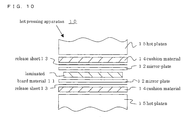
- a mirror-plate 12 is put on upper and lower surfaces of a laminated board 11 which is an object, and a release sheet 13 and a cushion material 14 are interposed on upper and lower surfaces of the mirror-plate 12 so as to be sandwiched by hot platens 15, and pressure and heat are applied thereto.
- a release sheet 13 and a cushion material 14 are interposed on upper and lower surfaces of the mirror-plate 12 so as to be sandwiched by hot platens 15, and pressure and heat are applied thereto.
- the cushion material 14 carries out a function of reducing unevenness of heat and pressure of the hot platen 15 so that the pressure and heat can be applied uniformly over the entire surface.
- various kinds of materials such as kraft paper, organic fibers or inorganic fibers combined by a binder, a rubber, non-woven fabric, a laminated material of rubber and non-woven fabric and the like are used.
- the cushion material 14 is made of a fibrous material, bits of fibers are separated from the cushion material 14 in some cases. When the bits of fibers are attached on the laminated board material 11 or the mirror-plate 12, which causes dents or scars on the laminated board material 11.
- the cushion material 14 When the cushion material 14 is made of a material having a low release property, the cushion material 14 sticks to the mirror-plate 12 in some cases.
- the release sheet 13 carries out a function of preventing the bits of the fibers from being separated from the cushion material 14 and floating, and a function of preventing the cushion material 14 from sticking to the mirror-plate 12. Meanwhile, when the surface of the cushion material 14 itself has a release property, the release sheet may not be used.
- a term of the hot-press sheet means it includes both release sheet 13 and cushion material 14.
- Japanese Unexamined Patent Publication No. 9-182998 (patent document 1) is a well-known document about a release sheet comprising a composite material.
- the release sheet comprises a base material layer and a release layer formed on a surface of the base material layer, and the release layer is formed of a heat-resistant release coating or a heat-resistant release film.
- Patent document 2 Japanese Unexamined Patent Publication No. 6-322326 (patent document 2) is a well-known document about improvement of a release surface material of a cushion material.
- the patent document 2 discloses a cushion material in which a heat-sensitive adhesive sheet is provided by applying an unvulcanized fluoro rubber to one surface (back surface) of a sheet-shaped base material and by applying heat-resistant coating to the other surface (front surface) thereof and laminated in such a manner that the unvulcanized fluoro rubber surface may be in contact with an object, and they are bonded so as to be integrated.
- Each of the release sheet described in the patent document 1 and the cushion material described in the patent document 2 comprises the sheet-shaped base material and the release coating film comprising the heat-resistant coating formed on the base material.
- the hot-press sheet when the heat-resistant coating was applied onto the surface of the base material and dried, thin parts called sinks or dents were likely to be generated in the coating film. These sinks or dents mean a phenomenon in which a few thin parts having a diameter about 1mm are generated in the hot-press sheet per 1m 2 and it was difficult to eliminate these sinks or dents.
- the hot-press sheet needs to have durability in which it can be used in pressing processes several hundred of times. If the hot-press sheet has the sinks or dents, while it is repeatedly used, a crack caused by the sink or dent is generated or the base material at the sink or the dent is exposed because of abrasion of the surface, which lowers the durability. In addition, when the hot-press sheet having the sinks or dents on the surface is bent at the time of handling such as transporting, a crack is likely to be generated because of the sink or dent.
- the inventors of the present invention confirmed in the experiments that when a powder filler was mixed in the heat-resistant coating, the sink or dent could be effectively prevented. However, it was found also that when the powder filler was mixed in a normal way, general requirement characteristics for the hot-press sheet such as abrasion resistance, release property, flexibility, coating workability of the coating film were likely to deteriorate, so that it is a new issue to prevent the sink or dent without lowering the above requirement characteristics.
- a hot-press sheet of the present invention comprises a sheet-shaped base material and a release coating film formed on the base material, in which the coating film comprises a resin composition in which 5 to 55% by weight of organic powder and 5 to 55% by weight of inorganic powder are mixed in 100% by weight of the resin composition so that the mixture of the organic powder and the inorganic powder becomes 30 to 60% by weight in total.
- the sinks or the dents are prevented from being generated.
- the total mixture ratio of the organic powder and the inorganic powder is less than 30% by weight, the sinks or dents are likely to be generated.
- the total mixture ratio of the organic powder and inorganic powder is more than 60% by weight, flexibility of the coating film is lowered so that a crack is likely to be generated and viscosity of the coating fluid is increased so that its coating workability becomes worse.
- the total mixture ratio of the organic powder and the inorganic powder is preferably 35 to 50% by weight.
- the mixture ratio of the organic powder in 100% by weight of the resin composition is preferably not less than 10% by weight, and further preferably not less than 15% by weight.
- the mixture ratio of the inorganic powder in 100% by weight of the resin composition is preferably not less than 10% by weight, and further preferably not less than 15% by weight.
- the mixture ratio of either one of organic powder or inorganic powder is more than 55% by weight, it exceeds an upper limit of the condition that the mixture ratio of the organic powder and inorganic powder is 30 to 60% by weight in total.
- the mixture ratio of the organic powder to the inorganic powder is 2:5 to 5:2.
- the mixture ratio of the organic powder to the inorganic powder is less than 2:5, the abrasion resistance and the flexibility of the coating film could deteriorate, and when the mixture ratio of the organic powder to the inorganic powder is more than 5:2, the release property of the coating film could deteriorate.
- an average particle diameter of the organic powder and the inorganic powder is 0.1 to 10.0 ⁇ m.
- the base material preferably has irregularities over an entire surface and the irregularities appear on a surface of the coating film.
- the irregularities of the base material appear on the surface of the coating film, the release property of the hot-press sheet is improved.
- the base material may have a single-layer structure or a laminated-layer structure.
- Fig. 1 shows a hot-press sheet 20 according to the present invention.
- the hot-press sheet 20 comprises a sheet-shaped base material 1 and a release coating film 2 applied on a surface of the base material 1.
- the coating film 2 covers the entire surface of the base material 1 completely so that air-tightness is provided in the hot-press sheet 20. Since the hot-press sheet 20 is airtight, when the hot-press sheet 20 is handled in the vicinity of a hot press apparatus, it can be transported by suction.
- the coating film 2 comprises a resin composition as a host material and organic powder and inorganic powder need to be mixed in the resin composition.
- a resin composition as a host material and organic powder and inorganic powder need to be mixed in the resin composition.
- 5 % or more by weight of the organic powder and 5% or more by weight of the inorganic powder are mixed in 100% by weight of the resin composition which constitutes the coating film and the total mixed amount of the organic powder and the inorganic powder needs to be 30 to 60% by weight.
- a mixture ratio of the organic powder and the inorganic powder is 2:5 to 5:2. If the mixture ratio of the organic powder to the inorganic powder is less than 2:5, abrasion resistance and flexibility of the coating film could deteriorate. Meanwhile, the mixture ratio of the organic powder to the inorganic powder is more than 5:2, the release property of the coating film could deteriorate. More preferably, the mixture ratio of the organic powder to the inorganic powder is 3:5 to 5:3.
- a heat-resistant resin such as a fluoro resin, a phenol resin, a melamine resin, an epoxy resin, an unsaturated polyester resin, a silicone resin, a polyimide resin, a thermosetting acrylic resin, a furan resin, a urea resin, a diallyl phthalate resin, a polyurethane resin and the like is used as a single, a blend or a copolymer.
- a heat-resistant resin such as a fluoro resin, a phenol resin, a melamine resin, an epoxy resin, an unsaturated polyester resin, a silicone resin, a polyimide resin, a thermosetting acrylic resin, a furan resin, a urea resin, a diallyl phthalate resin, a polyurethane resin and the like is used as a single, a blend or a copolymer.
- the polyimide resin and the fluoro resin are preferable.
- the fluoro resin powder is preferably used.
- the organic powder has preferably has an average particle diameter 0,1 ⁇ m to 10.0 ⁇ m.
- the kind of the inorganic powder mixed in the resin composition which constitutes the coating film 2 is not limited especially, there are carbon, aluminum, titanium oxide, zinc oxide, iron oxide and the like.
- An average particle diameter of the inorganic powder is preferably 0.1 ⁇ m to 10.0 ⁇ m.
- the coating film is applied to the base material 1 by a well-known method such as blade coating, knife coating, cast coating and the like.
- the base material 1 preferably has irregularities.
- the base material 1 is preferably provided with a material selected from woven fabric, non-woven fabric, and paper comprising heat-resistant organic fibers or inorganic fibers on its surface. Since the base material 1 which comprises the material selected from the woven fabric, the non-woven fabric and the paper has irregularities provided by texture of the woven fabric or fibers of the non-woven fabric or the paper on its entire surface, the adhesive property of the coating film 2 is satisfactorily provided.
- the irregularities of the base material 1 preferably appear on the surface.
- the release property of the hot-press sheet 20 is improved.
- surface roughness of the coating film 2 (Ra: arithmetic average roughness defined by JIS-B0601) is preferably 1 to 100 ⁇ m. More preferably, the surface roughness (Ra) of the coating film 2 is 3 to 30 ⁇ m.
- An application amount of the coating film 2 is preferably 10g/m 2 to 40g/m 2 when it is dry so that the irregularities of the base material 1 can appear on the surface of the coating film 2. If the amount is too small, it is difficult to cover the entire surface of the base material 1 completely. Meanwhile, if it is too large, the irregularities of the base material 1 do not appear on the surface of the coating film 2.
- the surface of the base material 1 is formed of the woven fabric.
- the surface of the base material 1 is formed of the woven fabric comprising inorganic fibers such as glass fibers.
- the base material 1 may be a single-layer structure or a laminated-layer structure.
- layers of the woven fabric, the non-woven fabric, a rubber and the like are appropriately combined, depending on a condition of hot pressing or required characteristics such as a cushion property, heat conductance and the like of the hot-press sheet 20.
- a material of heat-resistant fibers such as polyamide, polyester, aromatic polyamide, polyimide and the like is preferable, and as the rubber, a heat-resistant rubber such as a hydrogenated NBR, a fluoro rubber, an EPM, an EPDM and the like is preferably used.
- Fig. 2 is a sectional view showing a hot-press sheet 30 in which a base material 1 is a single-layer structure according to one embodiment of the present invention.
- a release coating film 2 is formed with an application amount of 25g/m 2 on both upper and lower surfaces of a glass cloth 3 having an area weight 200g/m 2 .
- Fig. 3 is a perspective view of the hot-press sheet 30 shown in Fig. 2, which shows that irregularities generated by texture of the glass cloth 3 appear over the entire surface of the coating film 2.
- surface roughness (Ra) of the glass cloth 3 is 8.7 ⁇ m
- surface roughness (Ra) of the coating film 2 is 6.9 ⁇ m.
- Figs. 4 to 8 are sectional views showing hot-press sheets in which base materials 1 have laminated-layer structures according to other embodiments of the present invention.
- a hot-press sheet 40 shown in Fig. 4 three layers of glass cloth 3 having an area weight 200g/m 2 are laminated through bonding layers 4 comprising fluoro rubber, and a release coating film 2 is formed on both upper and lower surfaces of the glass cloth 3.
- a hot-press sheet 50 shown in Fig. 5 two layers of non-woven fabric 5 comprising aromatic polyamide and having an area weight 500g/m 2 are laminated through a bonding and reinforcing layer 6 comprising a fluoro rubber in which a glass cloth is buried, and glass cloth 3 having an area weight 200g/m 2 is laminated on both upper and lower layers of the non-woven fabric layer 5 through bonding layers 4 each comprising a fluoro rubber, and a release coating film 2 is formed on both upper and lower surfaces of the glass cloth 3.
- a hot-press sheet 60 shown in Fig. 6 two layers of fluoro rubber 7 having a thickness 0.5mm are laminated through a reinforcing glass cloth 8, a non-woven fabric layer 5 comprising aromatic polyamide and having an area weight 500g/m 2 is formed on both upper and lower surfaces of the fluoro rubber layer 7, and a glass cloth 3 having an area weight 200g/m 2 is formed on both upper and lower surfaces of the non-woven fabric layer 5 through bonding layers 4 each comprising a fluoro rubber, and a release coating film 2 is formed on both upper and lower surfaces of the glass cloth 3.
- a hot-press sheet 70 shown in Fig. 7 two layers of non-woven fabric 5 comprising aromatic polyamide and having an area weight 500g/m 2 are laminated through a bonding and reinforcing layer 6 comprising a fluoro rubber in which a glass cloth is buried, and a fluoro rubber layer 7 having a thickness 0.5mm is laminated on both upper and lower surfaces of the non-woven fabric layer 5, and a glass cloth 3 having an area weight 200g/m 2 is laminated on both upper and lower surfaces of the fluoro rubber layer 7, and a release coating film 2 is formed on both upper and lower surfaces of the glass cloth 3.
- a hot-press sheet 80 shown in Fig. 8 two layers of fluoro rubber 7 having a thickness 0.5mm are laminated through a reinforcing glass cloth 8, and a glass cloth 3 having an area weight 200g/m 2 is laminated on both upper and lower surfaces of the fluoro rubber layer 7, and a release coating film 2 is formed on both upper and lower surfaces of the glass cloth 3.
- the hot-press sheets 30, 40, 50, 60, 70 and 80 shown in Figs. 2 to 8 can be used as the release sheet 13 or the cushion material 14 in hot pressing shown in Fig. 10 typically.
- the hot-press sheet 30 shown in Fig. 2 is suitable for being used as the release sheet 13.
- the hot-press sheet 40 shown in Fig. 4 is suitable for being used as both release sheet 13 and cushion material 14.
- the hot-press sheets 50, 60, 70 and 80 shown in Figs. 5 to 8 are suitable for being used as the cushion material 14.
- Samples 1 to 17 of the hot-press sheet were made as will be described below. Each sample was constituted as shown in Fig. 9.
- a base material a plain-woven glass cloth having size 200mm x 200mm and an area weight 200g/m 2 was used.
- a coating film 2 as a host material, polyimide resin varnish having solid quantity 25 to 35% (RIKACOAT SN-20 produced by New Japan Chemical Co., Ltd.) was used, and as an organic powder, fluoro resin powder having an average particle diameter 5 ⁇ m (LUBLON L-5 produced by DAIKIN INDUSTRIES, LTD.) was used, and as an inorganic powder, titanium oxide powder having an average particle diameter 0.3 to 0.5 ⁇ m (JA-3 produced by TAYCA CORPOLATION) and zinc oxide powder having an average particle diameter 0.3 to 0.7 ⁇ m (produced by SEIDO CHEMICAL INDUSTRIES CO., LTD.) were used.
- the materials of the coating film 2 were mixed according to a compounding ratio shown in a table 1, applied onto the surface of the base material 1 by knife coating, heated at 160°C for 3 minutes, and further heated at 220°C for 3 minutes to form the coating film 2.
- the application amount of the coating film 2 was decided so that its mass might become 35g/m 2 after dried.
- the compounding ratio shown in the table 1 is designated by % by weight after the materials are dried.
- the sample surface was visually observed to examine whether sinks or dents are generated on the surface or not.
- Mass reduced by abrasion was measured under the condition that sand paper of #800 having a width and a length of ground plane were 40mm and 50mm, respectively was used, pressure was 0.004MPa, a travel distance was 100mm and the number of to-and-fro rubbings was 20.
- Each sample was put on a stainless mirror-plate having a thickness 1.2mm, heated at 250°C for 60 minutes under pressure 6MPa and then cooled down for 15 minutes under the same pressure. Then, an adhesive state between the sample and the mirror-plate was examined.
- a flexibility test was performed under the condition that de Mattia bending testing machine was used, a sample size was 20mm x 150mm, the number of bending tests is 80,000, and an amplitude distance was 40mm, and it was examined whether a bend or a break was generated. In regard to samples 1 ⁇ 5, the test was performed at portions in which sinks or dents were not generated.
- the hot-press sheet of the present invention since 30% by weight or more of the organic powder and the inorganic powder are mixed in total in the resin composition which forms the coating film, the sinks and the dents are prevented from being generated and the durability is improved. Furthermore, since the mixture ratio of the organic powder is not less than 5% by weight, the mixture ratio of the inorganic powder is not less than 5% by weight and the mixture ratio of the mixture of the organic powder and the inorganic powder is not more than 60% by weight in total, the abrasion resistance, the release property, the flexibility and coating workability of the coating film can be satisfactorily provided.
- the present invention can be effectively applied to a hot-press sheet used as a release sheet or a cushion material when an object product is hot pressed or thermally compressed.
Landscapes
- Chemical & Material Sciences (AREA)
- Engineering & Computer Science (AREA)
- Chemical Kinetics & Catalysis (AREA)
- Life Sciences & Earth Sciences (AREA)
- Materials Engineering (AREA)
- Wood Science & Technology (AREA)
- Organic Chemistry (AREA)
- Mechanical Engineering (AREA)
- Laminated Bodies (AREA)
- Casting Or Compression Moulding Of Plastics Or The Like (AREA)
- Presses And Accessory Devices Thereof (AREA)
- Press Drives And Press Lines (AREA)
Abstract
Description
- The present invention relates to a hot-press sheet used as a release sheet or a cushion material when an object product is hot pressed or thermally compression bonded, in a process of manufacturing a precision equipment component having a laminated structure (referred to as the laminated board hereinafter) such as a printed circuit board such as a copper-clad laminated board, a flexible printed circuit board (FPC) and a multi-layer laminated board, an IC card, a ceramics laminated board, a liquid crystal display panel and the like. Particularly, the present invention relates to an improvement of a surface material of a hot-press sheet.
- In general, in the process of hot pressing or thermal compression bonding in manufacturing the laminated board, as shown in Fig. 10, the following method is used, that is, a mirror-plate 12 is put on upper and lower surfaces of a laminated
board 11 which is an object, and a release sheet 13 and a cushion material 14 are interposed on upper and lower surfaces of the mirror-plate 12 so as to be sandwiched by hot platens 15, and pressure and heat are applied thereto. In order to provide the laminated board with high precision, it is necessary to uniformly apply the pressure and heat over an entire surface of the laminatedboard material 11. - Thus, the cushion material 14 carries out a function of reducing unevenness of heat and pressure of the hot platen 15 so that the pressure and heat can be applied uniformly over the entire surface. As the cushion material 14, various kinds of materials such as kraft paper, organic fibers or inorganic fibers combined by a binder, a rubber, non-woven fabric, a laminated material of rubber and non-woven fabric and the like are used. When the cushion material 14 is made of a fibrous material, bits of fibers are separated from the cushion material 14 in some cases. When the bits of fibers are attached on the laminated
board material 11 or the mirror-plate 12, which causes dents or scars on the laminatedboard material 11. - When the cushion material 14 is made of a material having a low release property, the cushion material 14 sticks to the mirror-plate 12 in some cases. Thus, the release sheet 13 carries out a function of preventing the bits of the fibers from being separated from the cushion material 14 and floating, and a function of preventing the cushion material 14 from sticking to the mirror-plate 12. Meanwhile, when the surface of the cushion material 14 itself has a release property, the release sheet may not be used. According to the present invention, a term of the hot-press sheet means it includes both release sheet 13 and cushion material 14.
- As a conventional hot-press release sheet, a sheet formed of a single synthetic resin film or a sheet formed of a composite material comprising a sheet-shaped base material and a release coating film formed on the base material are known. Japanese Unexamined Patent Publication No. 9-182998 (patent document 1) is a well-known document about a release sheet comprising a composite material. According to the
patent document 1, the release sheet comprises a base material layer and a release layer formed on a surface of the base material layer, and the release layer is formed of a heat-resistant release coating or a heat-resistant release film. - Japanese Unexamined Patent Publication No. 6-322326 (patent document 2) is a well-known document about improvement of a release surface material of a cushion material. The
patent document 2 discloses a cushion material in which a heat-sensitive adhesive sheet is provided by applying an unvulcanized fluoro rubber to one surface (back surface) of a sheet-shaped base material and by applying heat-resistant coating to the other surface (front surface) thereof and laminated in such a manner that the unvulcanized fluoro rubber surface may be in contact with an object, and they are bonded so as to be integrated. - Each of the release sheet described in the
patent document 1 and the cushion material described in thepatent document 2 comprises the sheet-shaped base material and the release coating film comprising the heat-resistant coating formed on the base material. - According to the conventional hot-press sheet, when the heat-resistant coating was applied onto the surface of the base material and dried, thin parts called sinks or dents were likely to be generated in the coating film. These sinks or dents mean a phenomenon in which a few thin parts having a diameter about 1mm are generated in the hot-press sheet per 1m2 and it was difficult to eliminate these sinks or dents. The hot-press sheet needs to have durability in which it can be used in pressing processes several hundred of times. If the hot-press sheet has the sinks or dents, while it is repeatedly used, a crack caused by the sink or dent is generated or the base material at the sink or the dent is exposed because of abrasion of the surface, which lowers the durability. In addition, when the hot-press sheet having the sinks or dents on the surface is bent at the time of handling such as transporting, a crack is likely to be generated because of the sink or dent.
- The inventors of the present invention confirmed in the experiments that when a powder filler was mixed in the heat-resistant coating, the sink or dent could be effectively prevented. However, it was found also that when the powder filler was mixed in a normal way, general requirement characteristics for the hot-press sheet such as abrasion resistance, release property, flexibility, coating workability of the coating film were likely to deteriorate, so that it is a new issue to prevent the sink or dent without lowering the above requirement characteristics.
- Thus, it is an object of the present invention to provide a hot-press sheet in which sinks or dents are prevented from being generated in a surface of a release coating film, and abrasion resistance, release property, flexibility, and coating workability of the coating film are satisfactorily provided.
- According to a hot-press sheet of the present invention comprises a sheet-shaped base material and a release coating film formed on the base material, in which the coating film comprises a resin composition in which 5 to 55% by weight of organic powder and 5 to 55% by weight of inorganic powder are mixed in 100% by weight of the resin composition so that the mixture of the organic powder and the inorganic powder becomes 30 to 60% by weight in total.
- When 30 to 60% by weight of the mixture of the organic powder and the inorganic powder is mixed in the resin composition which forms the coating film, the sinks or the dents are prevented from being generated. When the total mixture ratio of the organic powder and the inorganic powder is less than 30% by weight, the sinks or dents are likely to be generated. Meanwhile, the total mixture ratio of the organic powder and inorganic powder is more than 60% by weight, flexibility of the coating film is lowered so that a crack is likely to be generated and viscosity of the coating fluid is increased so that its coating workability becomes worse. The total mixture ratio of the organic powder and the inorganic powder is preferably 35 to 50% by weight.
- Even when the mixture ratio of the organic powder and the inorganic powder is 30 to 60% by weight in total, if the mixture ratio of the organic powder is less than 5% by weight, the abrasion resistance and the flexibility of the coating film deteriorate. The mixture ratio of the organic powder in 100% by weight of the resin composition is preferably not less than 10% by weight, and further preferably not less than 15% by weight.
- Furthermore, even when the mixture ratio of the organic powder and inorganic powder is 30 to 60% by weight in total, if the mixture ratio of the inorganic powder is less than 5% by weight, the release property of the coating film deteriorates. The mixture ratio of the inorganic powder in 100% by weight of the resin composition is preferably not less than 10% by weight, and further preferably not less than 15% by weight.
- When the mixture ratio of either one of organic powder or inorganic powder is more than 55% by weight, it exceeds an upper limit of the condition that the mixture ratio of the organic powder and inorganic powder is 30 to 60% by weight in total.
- Preferably, the mixture ratio of the organic powder to the inorganic powder is 2:5 to 5:2. When the mixture ratio of the organic powder to the inorganic powder is less than 2:5, the abrasion resistance and the flexibility of the coating film could deteriorate, and when the mixture ratio of the organic powder to the inorganic powder is more than 5:2, the release property of the coating film could deteriorate.
- Preferably, an average particle diameter of the organic powder and the inorganic powder is 0.1 to 10.0 µm.
- The base material preferably has irregularities over an entire surface and the irregularities appear on a surface of the coating film. When the irregularities of the base material appear on the surface of the coating film, the release property of the hot-press sheet is improved.
- In addition, the base material may have a single-layer structure or a laminated-layer structure.
-
- Fig. 1 is a sectional view showing a general constitution of a hot-press sheet according to the present invention.
- Fig. 2 is a sectional view showing one example of a hot-press sheet according to the present invention.
- Fig. 3 is a perspective view showing a surface state of the hot-press sheet shown in Fig. 2.
- Fig. 4 is a sectional view showing another example of a hot-press sheet according to the present invention.
- Fig. 5 is a sectional view showing still another example of a hot-press sheet according to the present invention.
- Fig. 6 is a sectional view showing still another example of a hot-press sheet according to the present invention.
- Fig. 7 is a sectional view showing still another example of a hot-press sheet according to the present invention.
- Fig. 8 is a sectional view showing still another example of a hot-press sheet according to the present invention.
- Fig. 9 is a sectional view showing a constitution of a sample used in a comparison experiment.
- Fig. 10 is a view for explaining a hot pressing apparatus.
- Hereinafter, embodiments of the present invention will be described.
- Fig. 1 shows a hot-press sheet 20 according to the present invention. The hot-press sheet 20 comprises a sheet-
shaped base material 1 and arelease coating film 2 applied on a surface of thebase material 1. Thecoating film 2 covers the entire surface of thebase material 1 completely so that air-tightness is provided in the hot-press sheet 20. Since the hot-press sheet 20 is airtight, when the hot-press sheet 20 is handled in the vicinity of a hot press apparatus, it can be transported by suction. - The
coating film 2 comprises a resin composition as a host material and organic powder and inorganic powder need to be mixed in the resin composition. In addition, as described above, 5 % or more by weight of the organic powder and 5% or more by weight of the inorganic powder are mixed in 100% by weight of the resin composition which constitutes the coating film and the total mixed amount of the organic powder and the inorganic powder needs to be 30 to 60% by weight. - Preferably, a mixture ratio of the organic powder and the inorganic powder is 2:5 to 5:2. If the mixture ratio of the organic powder to the inorganic powder is less than 2:5, abrasion resistance and flexibility of the coating film could deteriorate. Meanwhile, the mixture ratio of the organic powder to the inorganic powder is more than 5:2, the release property of the coating film could deteriorate. More preferably, the mixture ratio of the organic powder to the inorganic powder is 3:5 to 5:3.
- As the host material in the resin composition constituting the
coating film 2, a heat-resistant resin such as a fluoro resin, a phenol resin, a melamine resin, an epoxy resin, an unsaturated polyester resin, a silicone resin, a polyimide resin, a thermosetting acrylic resin, a furan resin, a urea resin, a diallyl phthalate resin, a polyurethane resin and the like is used as a single, a blend or a copolymer. Especially, the polyimide resin and the fluoro resin are preferable. - As the organic powder mixed in the resin composition which constitutes the
coating film 2, although the powder comprising the same heat-resistant resin as shown above as the host material can be used, the fluoro resin powder is preferably used. In addition, the organic powder has preferably has anaverage particle diameter - Although the kind of the inorganic powder mixed in the resin composition which constitutes the
coating film 2 is not limited especially, there are carbon, aluminum, titanium oxide, zinc oxide, iron oxide and the like. An average particle diameter of the inorganic powder is preferably 0.1 µm to 10.0 µm. - The coating film is applied to the
base material 1 by a well-known method such as blade coating, knife coating, cast coating and the like. - In order to improve an adhesive property of the
coating film 2, thebase material 1 preferably has irregularities. In this sense, thebase material 1 is preferably provided with a material selected from woven fabric, non-woven fabric, and paper comprising heat-resistant organic fibers or inorganic fibers on its surface. Since thebase material 1 which comprises the material selected from the woven fabric, the non-woven fabric and the paper has irregularities provided by texture of the woven fabric or fibers of the non-woven fabric or the paper on its entire surface, the adhesive property of thecoating film 2 is satisfactorily provided. - In addition, the irregularities of the
base material 1 preferably appear on the surface. When the irregularities of thebase material 1 appear on the surface of thecoating film 2, the release property of the hot-press sheet 20 is improved. In order to improve the release property of the hot-press sheet 20, surface roughness of the coating film 2 (Ra: arithmetic average roughness defined by JIS-B0601) is preferably 1 to 100 µm. More preferably, the surface roughness (Ra) of thecoating film 2 is 3 to 30 µm. An application amount of thecoating film 2 is preferably 10g/m2 to 40g/m2 when it is dry so that the irregularities of thebase material 1 can appear on the surface of thecoating film 2. If the amount is too small, it is difficult to cover the entire surface of thebase material 1 completely. Meanwhile, if it is too large, the irregularities of thebase material 1 do not appear on the surface of thecoating film 2. - Since dimension stability is required in the hot-press sheet 20, in this sense, it is preferable that the surface of the
base material 1 is formed of the woven fabric. In view of the dimension stability, strength, and heat resistance especially, it is most preferable that the surface of thebase material 1 is formed of the woven fabric comprising inorganic fibers such as glass fibers. - The
base material 1 may be a single-layer structure or a laminated-layer structure. When thebase material 1 is the laminated-layer structure, layers of the woven fabric, the non-woven fabric, a rubber and the like are appropriately combined, depending on a condition of hot pressing or required characteristics such as a cushion property, heat conductance and the like of the hot-press sheet 20. As the woven fabric or non-woven fabric, a material of heat-resistant fibers such as polyamide, polyester, aromatic polyamide, polyimide and the like is preferable, and as the rubber, a heat-resistant rubber such as a hydrogenated NBR, a fluoro rubber, an EPM, an EPDM and the like is preferably used. - Fig. 2 is a sectional view showing a hot-press sheet 30 in which a
base material 1 is a single-layer structure according to one embodiment of the present invention. According to the hot-press sheet 30, arelease coating film 2 is formed with an application amount of 25g/m2 on both upper and lower surfaces of aglass cloth 3 having an area weight 200g/m2. Fig. 3 is a perspective view of the hot-press sheet 30 shown in Fig. 2, which shows that irregularities generated by texture of theglass cloth 3 appear over the entire surface of thecoating film 2. In this example, surface roughness (Ra) of theglass cloth 3 is 8.7 µm, and surface roughness (Ra) of thecoating film 2 is 6.9 µm. - Figs. 4 to 8 are sectional views showing hot-press sheets in which
base materials 1 have laminated-layer structures according to other embodiments of the present invention. - According to a hot-press sheet 40 shown in Fig. 4, three layers of
glass cloth 3 having an area weight 200g/m2 are laminated throughbonding layers 4 comprising fluoro rubber, and arelease coating film 2 is formed on both upper and lower surfaces of theglass cloth 3. - According to a hot-press sheet 50 shown in Fig. 5, two layers of
non-woven fabric 5 comprising aromatic polyamide and having an area weight 500g/m2 are laminated through a bonding and reinforcinglayer 6 comprising a fluoro rubber in which a glass cloth is buried, andglass cloth 3 having an area weight 200g/m2 is laminated on both upper and lower layers of thenon-woven fabric layer 5 throughbonding layers 4 each comprising a fluoro rubber, and arelease coating film 2 is formed on both upper and lower surfaces of theglass cloth 3. - According to a hot-press sheet 60 shown in Fig. 6, two layers of
fluoro rubber 7 having a thickness 0.5mm are laminated through a reinforcingglass cloth 8, anon-woven fabric layer 5 comprising aromatic polyamide and having an area weight 500g/m2 is formed on both upper and lower surfaces of thefluoro rubber layer 7, and aglass cloth 3 having an area weight 200g/m2 is formed on both upper and lower surfaces of thenon-woven fabric layer 5 throughbonding layers 4 each comprising a fluoro rubber, and arelease coating film 2 is formed on both upper and lower surfaces of theglass cloth 3. - According to a hot-press sheet 70 shown in Fig. 7, two layers of
non-woven fabric 5 comprising aromatic polyamide and having an area weight 500g/m2 are laminated through a bonding and reinforcinglayer 6 comprising a fluoro rubber in which a glass cloth is buried, and afluoro rubber layer 7 having a thickness 0.5mm is laminated on both upper and lower surfaces of thenon-woven fabric layer 5, and aglass cloth 3 having an area weight 200g/m2 is laminated on both upper and lower surfaces of thefluoro rubber layer 7, and arelease coating film 2 is formed on both upper and lower surfaces of theglass cloth 3. - According to a hot-press sheet 80 shown in Fig. 8, two layers of
fluoro rubber 7 having a thickness 0.5mm are laminated through a reinforcingglass cloth 8, and aglass cloth 3 having an area weight 200g/m2 is laminated on both upper and lower surfaces of thefluoro rubber layer 7, and arelease coating film 2 is formed on both upper and lower surfaces of theglass cloth 3. - The hot-press sheets 30, 40, 50, 60, 70 and 80 shown in Figs. 2 to 8 can be used as the release sheet 13 or the cushion material 14 in hot pressing shown in Fig. 10 typically. The hot-press sheet 30 shown in Fig. 2 is suitable for being used as the release sheet 13. The hot-press sheet 40 shown in Fig. 4 is suitable for being used as both release sheet 13 and cushion material 14. The hot-press sheets 50, 60, 70 and 80 shown in Figs. 5 to 8 are suitable for being used as the cushion material 14.
- In order to confirm the effect of the present invention, the following comparative experiment was performed.
-
Samples 1 to 17 of the hot-press sheet were made as will be described below. Each sample was constituted as shown in Fig. 9. As abase material 1, a plain-woven glass cloth having size 200mm x 200mm and an area weight 200g/m2 was used. According to acoating film 2, as a host material, polyimide resin varnish having solid quantity 25 to 35% (RIKACOAT SN-20 produced by New Japan Chemical Co., Ltd.) was used, and as an organic powder, fluoro resin powder having anaverage particle diameter 5 µm (LUBLON L-5 produced by DAIKIN INDUSTRIES, LTD.) was used, and as an inorganic powder, titanium oxide powder having an average particle diameter 0.3 to 0.5 µm (JA-3 produced by TAYCA CORPOLATION) and zinc oxide powder having an average particle diameter 0.3 to 0.7 µm (produced by SEIDO CHEMICAL INDUSTRIES CO., LTD.) were used. The materials of thecoating film 2 were mixed according to a compounding ratio shown in a table 1, applied onto the surface of thebase material 1 by knife coating, heated at 160°C for 3 minutes, and further heated at 220°C for 3 minutes to form thecoating film 2. The application amount of thecoating film 2 was decided so that its mass might become 35g/m2 after dried. In addition, the compounding ratio shown in the table 1 is designated by % by weight after the materials are dried.
- The sample surface was visually observed to examine whether sinks or dents are generated on the surface or not.
-
- Excellent : The coating workability was excellent.
- Possible : The coating workability was possible.
- No good : The coating workability was difficult.
- Mass reduced by abrasion was measured under the condition that sand paper of #800 having a width and a length of ground plane were 40mm and 50mm, respectively was used, pressure was 0.004MPa, a travel distance was 100mm and the number of to-and-fro rubbings was 20.
- Excellent : Reduced mass was less than 0.002g.
- Possible : Reduced mass was not less than 0.002g and less than 0.003g.
- No good : Reduced mass was not less than 0.003g.
- Each sample was put on a stainless mirror-plate having a thickness 1.2mm, heated at 250°C for 60 minutes under pressure 6MPa and then cooled down for 15 minutes under the same pressure. Then, an adhesive state between the sample and the mirror-plate was examined.
- Excellent : There was no adhesion.
- Possible : There were some adhesion.
- No good : There were considerable adhesion and a resin of the coating film peeled off.
- A flexibility test was performed under the condition that de Mattia bending testing machine was used, a sample size was 20mm x 150mm, the number of bending tests is 80,000, and an amplitude distance was 40mm, and it was examined whether a bend or a break was generated. In regard to
samples 1~5, the test was performed at portions in which sinks or dents were not generated. - Excellent: There is no bend.
- Possible : The bend was generated but there is no break.
- No good : The break was generated.
- According to the
samples 1 to 5 in which the total of mixture ratio of the fluoro resin powder and the titanium oxide powder was less than 30% by weight, since sinks or dents were generated, the problem of the present invention could not be solved. According to the sample 15 in which the total of mixture ratio of the fluoro resin powder and the titanium oxide powder was 65% by weight, there was a problem in the coating workability and the flexibility. According to the sample 16 in which only the fluoro resin was mixed, there was a problem in the release property. According to the sample 17 in which only the titanium oxide powder was mixed, there was a problem in the abrasion resistance and the flexibility. - Meanwhile, according to the
samples 6 to 14 in which the total of the mixture of 5 to 55% by weight of the organic powder and 5 to 55% by weight of the inorganic powder was 30 to 60% by weight, since there was no sink or dent, and there was no particular defect in other properties, satisfactory results were provided. Especially, according to the samples 9 to 13 in which 15% or more by weight of the organic powder and 15% or more by weight of the inorganic powder were mixed and the total of the mixture of the organic powder and the inorganic powder was 35 to 50% by weight, and a mixture ratio of the organic powder to the inorganic powder was 3:5 to 5:3, extremely satisfactory results were provided. - Although one embodiment of the present invention was described with reference to the drawings, the present invention is not limited to the above illustrated embodiment. Various modifications may be made within the same or equivalent scope of the present invention.
- According to the hot-press sheet of the present invention, since 30% by weight or more of the organic powder and the inorganic powder are mixed in total in the resin composition which forms the coating film, the sinks and the dents are prevented from being generated and the durability is improved. Furthermore, since the mixture ratio of the organic powder is not less than 5% by weight, the mixture ratio of the inorganic powder is not less than 5% by weight and the mixture ratio of the mixture of the organic powder and the inorganic powder is not more than 60% by weight in total, the abrasion resistance, the release property, the flexibility and coating workability of the coating film can be satisfactorily provided.
- The present invention can be effectively applied to a hot-press sheet used as a release sheet or a cushion material when an object product is hot pressed or thermally compressed.
Claims (6)
- A hot-press sheet comprising a sheet-shaped base material and a release coating film formed on said base material, wherein said coating film comprises a resin composition in which 5 to 55% by weight of organic powder and 5 to 55% by weight of inorganic powder are mixed in 100% by weight of the resin composition so that the mixture of the organic powder and the inorganic powder becomes 30 to 60% by weight in total.
- The hot-press sheet according to claim 1, wherein a mixture ratio of said organic powder to said inorganic powder is 2:5 to 5:2.
- The hot-press sheet according to claim 1, wherein an average particle diameter of said organic powder and said inorganic powder is 0.1 to 10.0 µm.
- The hot-press sheet according to claim 1, wherein said base material has irregularities over an entire surface and the irregularities appear on a surface of said coating film.
- The hot-press sheet according to claim 1, wherein surface roughness of said coating film is 1 to 100 µm and an application amount of said coating film is about 10 to 40g/m2 in a dried state.
- The hot-press sheet according to claim 1, wherein said base material has a laminated-layer structure.
Applications Claiming Priority (2)
| Application Number | Priority Date | Filing Date | Title |
|---|---|---|---|
| JP2003147667A JP4183558B2 (en) | 2003-05-26 | 2003-05-26 | Heat press sheet |
| PCT/JP2004/006443 WO2004103691A1 (en) | 2003-05-26 | 2004-05-13 | Sheet for thermal pressing |
Publications (3)
| Publication Number | Publication Date |
|---|---|
| EP1637314A1 true EP1637314A1 (en) | 2006-03-22 |
| EP1637314A4 EP1637314A4 (en) | 2012-03-21 |
| EP1637314B1 EP1637314B1 (en) | 2020-03-25 |
Family
ID=33475371
Family Applications (1)
| Application Number | Title | Priority Date | Filing Date |
|---|---|---|---|
| EP04732752.3A Expired - Lifetime EP1637314B1 (en) | 2003-05-26 | 2004-05-13 | Sheet for thermal pressing |
Country Status (7)
| Country | Link |
|---|---|
| US (1) | US8445095B2 (en) |
| EP (1) | EP1637314B1 (en) |
| JP (1) | JP4183558B2 (en) |
| KR (1) | KR100652313B1 (en) |
| CN (1) | CN100384620C (en) |
| TW (1) | TWI241955B (en) |
| WO (1) | WO2004103691A1 (en) |
Cited By (2)
| Publication number | Priority date | Publication date | Assignee | Title |
|---|---|---|---|---|
| EP3040202A1 (en) * | 2014-12-18 | 2016-07-06 | Robert Bürkle GmbH | Press for laminating photovoltaic modules and membrane for same |
| WO2021074135A1 (en) * | 2019-10-15 | 2021-04-22 | Hueck Rheinische Gmbh | Press tool |
Families Citing this family (22)
| Publication number | Priority date | Publication date | Assignee | Title |
|---|---|---|---|---|
| JP4183558B2 (en) | 2003-05-26 | 2008-11-19 | ヤマウチ株式会社 | Heat press sheet |
| JP5422954B2 (en) * | 2007-09-28 | 2014-02-19 | 東レ株式会社 | Manufacturing method and manufacturing apparatus of fine shape transfer sheet |
| JP2010067493A (en) * | 2008-09-11 | 2010-03-25 | Toppan Printing Co Ltd | Manufacturing method for membrane-electrode assembly, membrane-electrode assembly, and solid polymer fuel cell |
| JP5341733B2 (en) * | 2009-12-03 | 2013-11-13 | ヤマウチ株式会社 | Cushion material surface layer and heat press cushion material |
| JP2011219606A (en) * | 2010-04-08 | 2011-11-04 | Stt Kk | Coating for preventing fixation of rubber product, and coating film for preventing fixation of the rubber product |
| US9410284B2 (en) | 2011-06-07 | 2016-08-09 | Yamauchi Corporation | Cushioning-material surface layer and hot-press cushioning material |
| JP2013001110A (en) * | 2011-06-17 | 2013-01-07 | Ichikawa Co Ltd | Cushioning material for mold pressing |
| JP6066581B2 (en) * | 2012-04-27 | 2017-01-25 | 三井・デュポンフロロケミカル株式会社 | Polymer particles, aqueous dispersion containing the same, and fluororesin coating composition using the same |
| CN104002509A (en) * | 2013-02-22 | 2014-08-27 | 电气化学工业株式会社 | Multilayer resin sheet for deep drawing and molded container |
| CN103255725B (en) * | 2013-06-05 | 2015-03-25 | 中建七局(上海)有限公司 | Construction method for smooth formwork of concrete supporting column |
| JP6498422B2 (en) * | 2013-11-29 | 2019-04-10 | 三ツ星ベルト株式会社 | Cushion material for heat press |
| KR101486830B1 (en) * | 2013-12-26 | 2015-01-28 | (주)에이앤티 | Cushioning for heat press and method for preparing the same |
| JP5820024B1 (en) | 2014-06-30 | 2015-11-24 | ヤマウチ株式会社 | Cushion material for heat press and method for manufacturing the same |
| JP6590740B2 (en) * | 2015-03-13 | 2019-10-16 | 三ツ星ベルト株式会社 | Cushion material for heat press and method for manufacturing the same |
| JP6615650B2 (en) * | 2015-03-13 | 2019-12-04 | 三ツ星ベルト株式会社 | Cushion material for heat press |
| JP6647964B2 (en) * | 2015-05-27 | 2020-02-14 | 三ツ星ベルト株式会社 | Cushion material for hot press and method for producing the same |
| JP6299933B2 (en) * | 2016-03-30 | 2018-03-28 | 住友ベークライト株式会社 | Release film for printed circuit board production and method for producing molded product |
| CN109153155B (en) * | 2016-05-20 | 2020-11-10 | 昭和电工材料株式会社 | release film |
| CN112789148B (en) * | 2018-10-04 | 2023-07-07 | 日东电工株式会社 | Heat-resistant release sheet and thermocompression bonding method |
| JP7140381B2 (en) | 2018-10-09 | 2022-09-21 | ヤマウチ株式会社 | Hot-press cushioning material and method for producing hot-pressing cushioning material |
| JP6790297B1 (en) * | 2020-06-03 | 2020-11-25 | ヤマウチ株式会社 | Cushion material for heat press |
| CN113140781B (en) * | 2021-05-26 | 2022-11-11 | 珠海冠宇电池股份有限公司 | Laminated cell protection sheet, laminated battery assembly and method for manufacturing laminated battery |
Family Cites Families (13)
| Publication number | Priority date | Publication date | Assignee | Title |
|---|---|---|---|---|
| US4092279A (en) * | 1976-04-12 | 1978-05-30 | Sws Silicones Corporation | Coating for rubber articles |
| US4690845A (en) * | 1984-02-22 | 1987-09-01 | Gila River Products, Inc. | Method and apparatus for laminating flexible printed circuits |
| JPH0522400Y2 (en) * | 1988-11-30 | 1993-06-08 | ||
| JP3221978B2 (en) | 1993-05-11 | 2001-10-22 | ヤマウチ株式会社 | Cushion material for hot press molding, method for producing the same, heat-resistant heat-sensitive adhesive sheet for cushion material for hot press molding, and method for producing the same |
| JP2649899B2 (en) * | 1994-09-21 | 1997-09-03 | ヤマウチ株式会社 | Cushion material for forming press |
| US20020079053A1 (en) * | 1994-09-21 | 2002-06-27 | Yamauchi Corporation | Cushioning material for forming press |
| JP2759620B2 (en) | 1995-01-31 | 1998-05-28 | 株式会社神戸製鋼所 | Resin-coated metal plate and method of manufacturing the same |
| JPH09182998A (en) | 1995-12-27 | 1997-07-15 | Yamauchi Corp | Release sheet for press molding and manufacturing method thereof |
| JPH10296767A (en) * | 1997-02-28 | 1998-11-10 | Chuko Kasei Kogyo Kk | Press cushion material |
| JP3062091U (en) * | 1999-03-11 | 1999-09-28 | 集啓企業有限公司 | Cushion sheet used for manufacturing multi-layer board thermocompression bonding |
| ATE338640T1 (en) * | 2001-06-11 | 2006-09-15 | Fuji Photo Film Co Ltd | FLAT PLATE PRECURSOR, SUBSTRATE THEREOF AND HYDROPHILE SURFACE MATERIAL |
| JP3920611B2 (en) * | 2001-09-28 | 2007-05-30 | ヤマウチ株式会社 | Cushion material for heat press and method for producing the same |
| JP4183558B2 (en) | 2003-05-26 | 2008-11-19 | ヤマウチ株式会社 | Heat press sheet |
-
2003
- 2003-05-26 JP JP2003147667A patent/JP4183558B2/en not_active Expired - Lifetime
-
2004
- 2004-05-13 EP EP04732752.3A patent/EP1637314B1/en not_active Expired - Lifetime
- 2004-05-13 KR KR1020047017697A patent/KR100652313B1/en not_active Expired - Lifetime
- 2004-05-13 CN CNB2004800140016A patent/CN100384620C/en not_active Expired - Lifetime
- 2004-05-13 WO PCT/JP2004/006443 patent/WO2004103691A1/en not_active Ceased
- 2004-05-13 US US10/558,038 patent/US8445095B2/en not_active Expired - Fee Related
- 2004-05-18 TW TW093113914A patent/TWI241955B/en not_active IP Right Cessation
Cited By (2)
| Publication number | Priority date | Publication date | Assignee | Title |
|---|---|---|---|---|
| EP3040202A1 (en) * | 2014-12-18 | 2016-07-06 | Robert Bürkle GmbH | Press for laminating photovoltaic modules and membrane for same |
| WO2021074135A1 (en) * | 2019-10-15 | 2021-04-22 | Hueck Rheinische Gmbh | Press tool |
Also Published As
| Publication number | Publication date |
|---|---|
| EP1637314A4 (en) | 2012-03-21 |
| JP2004344962A (en) | 2004-12-09 |
| CN100384620C (en) | 2008-04-30 |
| CN1791506A (en) | 2006-06-21 |
| KR100652313B1 (en) | 2006-11-30 |
| KR20050023253A (en) | 2005-03-09 |
| EP1637314B1 (en) | 2020-03-25 |
| WO2004103691A1 (en) | 2004-12-02 |
| TW200427581A (en) | 2004-12-16 |
| TWI241955B (en) | 2005-10-21 |
| JP4183558B2 (en) | 2008-11-19 |
| US8445095B2 (en) | 2013-05-21 |
| US20060292346A1 (en) | 2006-12-28 |
Similar Documents
| Publication | Publication Date | Title |
|---|---|---|
| US8445095B2 (en) | Hot-press sheet | |
| CN103443226B (en) | High-duty easy-peel adhesive for extended use | |
| US6514888B1 (en) | Cushioning material for forming press | |
| US8444798B2 (en) | Hot press cushioning member and method for manufacturing laminated plate | |
| CN103501976B (en) | Surface layer material for cushioning material and cushioning material for hot-pressing | |
| CN1697727A (en) | Cushioning material for hot pressing and process for producing layered board | |
| EP1433583A1 (en) | Cushioning material for hot pressing and process for producing the same | |
| JP6590740B2 (en) | Cushion material for heat press and method for manufacturing the same | |
| US9260633B2 (en) | Electrically conductive adhesives comprising bucky paper and an adhesive resin | |
| KR101577988B1 (en) | Chemical-mechanical planarization pad | |
| CN102825710A (en) | Cushioning material for moulding with pressing | |
| JP5341733B2 (en) | Cushion material surface layer and heat press cushion material | |
| TWI838408B (en) | Hot pressing cushioning material and manufacturing method of hot pressing cushioning material | |
| JP2003191267A (en) | Manufacturing method of cushioning material for molding and laminate | |
| Mosallaei et al. | Improvements in the electromechanical properties of stretchable interconnects by locally tuning the stiffness | |
| US20080090043A1 (en) | Pressure Distribution Pad for Laminating Applications | |
| JP2009012195A (en) | Heat-resistant cushioning sheet material for hot press and hot press molding method | |
| US20020079053A1 (en) | Cushioning material for forming press | |
| JP2995623B1 (en) | Surface treated steel sheet with excellent heat release properties | |
| CA2031488A1 (en) | Apparatus and method for fabricating printed circuit boards | |
| KR102263244B1 (en) | Sheet for Heat Press Bonding of Anisotropic Conductive Film | |
| JP2003170300A (en) | Buffer sheet for press | |
| CN116141762A (en) | A kind of honeycomb composite material and its preparation method and application |
Legal Events
| Date | Code | Title | Description |
|---|---|---|---|
| PUAI | Public reference made under article 153(3) epc to a published international application that has entered the european phase |
Free format text: ORIGINAL CODE: 0009012 |
|
| 17P | Request for examination filed |
Effective date: 20051125 |
|
| AK | Designated contracting states |
Kind code of ref document: A1 Designated state(s): AT BE BG CH CY CZ DE DK EE ES FI FR GB GR HU IE IT LI LU MC NL PL PT RO SE SI SK TR |
|
| RIN1 | Information on inventor provided before grant (corrected) |
Inventor name: HOSHINO, SHIGEO,C/O YAMAUCHI CORPORATION, |
|
| DAX | Request for extension of the european patent (deleted) | ||
| A4 | Supplementary search report drawn up and despatched |
Effective date: 20120220 |
|
| RIC1 | Information provided on ipc code assigned before grant |
Ipc: B30B 15/34 20060101ALI20120214BHEP Ipc: B05D 5/08 20060101ALI20120214BHEP Ipc: B30B 15/02 20060101AFI20120214BHEP Ipc: C08G 73/10 20060101ALI20120214BHEP |
|
| STAA | Information on the status of an ep patent application or granted ep patent |
Free format text: STATUS: EXAMINATION IS IN PROGRESS |
|
| 17Q | First examination report despatched |
Effective date: 20171010 |
|
| GRAP | Despatch of communication of intention to grant a patent |
Free format text: ORIGINAL CODE: EPIDOSNIGR1 |
|
| STAA | Information on the status of an ep patent application or granted ep patent |
Free format text: STATUS: GRANT OF PATENT IS INTENDED |
|
| INTG | Intention to grant announced |
Effective date: 20191008 |
|
| RIN1 | Information on inventor provided before grant (corrected) |
Inventor name: HOSHINO, SHIGEO |
|
| GRAS | Grant fee paid |
Free format text: ORIGINAL CODE: EPIDOSNIGR3 |
|
| GRAA | (expected) grant |
Free format text: ORIGINAL CODE: 0009210 |
|
| STAA | Information on the status of an ep patent application or granted ep patent |
Free format text: STATUS: THE PATENT HAS BEEN GRANTED |
|
| REG | Reference to a national code |
Ref country code: DE Ref legal event code: R081 Ref document number: 602004054572 Country of ref document: DE Owner name: YAMAUCHI CORPORATION, HIRAKATA-SHI, JP Free format text: FORMER OWNER: YAMAUCHI CORP., HIRAKATA, OSAKA, JP |
|
| AK | Designated contracting states |
Kind code of ref document: B1 Designated state(s): AT BE BG CH CY CZ DE DK EE ES FI FR GB GR HU IE IT LI LU MC NL PL PT RO SE SI SK TR |
|
| REG | Reference to a national code |
Ref country code: GB Ref legal event code: FG4D |
|
| REG | Reference to a national code |
Ref country code: AT Ref legal event code: REF Ref document number: 1248094 Country of ref document: AT Kind code of ref document: T Effective date: 20200415 Ref country code: IE Ref legal event code: FG4D |
|
| REG | Reference to a national code |
Ref country code: DE Ref legal event code: R096 Ref document number: 602004054572 Country of ref document: DE |
|
| REG | Reference to a national code |
Ref country code: CH Ref legal event code: NV Representative=s name: NOVAGRAAF INTERNATIONAL SA, CH |
|
| PG25 | Lapsed in a contracting state [announced via postgrant information from national office to epo] |
Ref country code: FI Free format text: LAPSE BECAUSE OF FAILURE TO SUBMIT A TRANSLATION OF THE DESCRIPTION OR TO PAY THE FEE WITHIN THE PRESCRIBED TIME-LIMIT Effective date: 20200325 |
|
| PG25 | Lapsed in a contracting state [announced via postgrant information from national office to epo] |
Ref country code: BG Free format text: LAPSE BECAUSE OF FAILURE TO SUBMIT A TRANSLATION OF THE DESCRIPTION OR TO PAY THE FEE WITHIN THE PRESCRIBED TIME-LIMIT Effective date: 20200625 Ref country code: GR Free format text: LAPSE BECAUSE OF FAILURE TO SUBMIT A TRANSLATION OF THE DESCRIPTION OR TO PAY THE FEE WITHIN THE PRESCRIBED TIME-LIMIT Effective date: 20200626 Ref country code: SE Free format text: LAPSE BECAUSE OF FAILURE TO SUBMIT A TRANSLATION OF THE DESCRIPTION OR TO PAY THE FEE WITHIN THE PRESCRIBED TIME-LIMIT Effective date: 20200325 |
|
| REG | Reference to a national code |
Ref country code: NL Ref legal event code: MP Effective date: 20200325 |
|
| PG25 | Lapsed in a contracting state [announced via postgrant information from national office to epo] |
Ref country code: NL Free format text: LAPSE BECAUSE OF FAILURE TO SUBMIT A TRANSLATION OF THE DESCRIPTION OR TO PAY THE FEE WITHIN THE PRESCRIBED TIME-LIMIT Effective date: 20200325 |
|
| PG25 | Lapsed in a contracting state [announced via postgrant information from national office to epo] |
Ref country code: PT Free format text: LAPSE BECAUSE OF FAILURE TO SUBMIT A TRANSLATION OF THE DESCRIPTION OR TO PAY THE FEE WITHIN THE PRESCRIBED TIME-LIMIT Effective date: 20200818 Ref country code: CZ Free format text: LAPSE BECAUSE OF FAILURE TO SUBMIT A TRANSLATION OF THE DESCRIPTION OR TO PAY THE FEE WITHIN THE PRESCRIBED TIME-LIMIT Effective date: 20200325 Ref country code: EE Free format text: LAPSE BECAUSE OF FAILURE TO SUBMIT A TRANSLATION OF THE DESCRIPTION OR TO PAY THE FEE WITHIN THE PRESCRIBED TIME-LIMIT Effective date: 20200325 Ref country code: RO Free format text: LAPSE BECAUSE OF FAILURE TO SUBMIT A TRANSLATION OF THE DESCRIPTION OR TO PAY THE FEE WITHIN THE PRESCRIBED TIME-LIMIT Effective date: 20200325 Ref country code: SK Free format text: LAPSE BECAUSE OF FAILURE TO SUBMIT A TRANSLATION OF THE DESCRIPTION OR TO PAY THE FEE WITHIN THE PRESCRIBED TIME-LIMIT Effective date: 20200325 |
|
| REG | Reference to a national code |
Ref country code: DE Ref legal event code: R097 Ref document number: 602004054572 Country of ref document: DE |
|
| REG | Reference to a national code |
Ref country code: AT Ref legal event code: UEP Ref document number: 1248094 Country of ref document: AT Kind code of ref document: T Effective date: 20200325 |
|
| PG25 | Lapsed in a contracting state [announced via postgrant information from national office to epo] |
Ref country code: ES Free format text: LAPSE BECAUSE OF FAILURE TO SUBMIT A TRANSLATION OF THE DESCRIPTION OR TO PAY THE FEE WITHIN THE PRESCRIBED TIME-LIMIT Effective date: 20200325 Ref country code: MC Free format text: LAPSE BECAUSE OF FAILURE TO SUBMIT A TRANSLATION OF THE DESCRIPTION OR TO PAY THE FEE WITHIN THE PRESCRIBED TIME-LIMIT Effective date: 20200325 Ref country code: DK Free format text: LAPSE BECAUSE OF FAILURE TO SUBMIT A TRANSLATION OF THE DESCRIPTION OR TO PAY THE FEE WITHIN THE PRESCRIBED TIME-LIMIT Effective date: 20200325 |
|
| PLBE | No opposition filed within time limit |
Free format text: ORIGINAL CODE: 0009261 |
|
| STAA | Information on the status of an ep patent application or granted ep patent |
Free format text: STATUS: NO OPPOSITION FILED WITHIN TIME LIMIT |
|
| PG25 | Lapsed in a contracting state [announced via postgrant information from national office to epo] |
Ref country code: PL Free format text: LAPSE BECAUSE OF FAILURE TO SUBMIT A TRANSLATION OF THE DESCRIPTION OR TO PAY THE FEE WITHIN THE PRESCRIBED TIME-LIMIT Effective date: 20200325 |
|
| 26N | No opposition filed |
Effective date: 20210112 |
|
| REG | Reference to a national code |
Ref country code: BE Ref legal event code: MM Effective date: 20200531 |
|
| PG25 | Lapsed in a contracting state [announced via postgrant information from national office to epo] |
Ref country code: LU Free format text: LAPSE BECAUSE OF NON-PAYMENT OF DUE FEES Effective date: 20200513 |
|
| PG25 | Lapsed in a contracting state [announced via postgrant information from national office to epo] |
Ref country code: FR Free format text: LAPSE BECAUSE OF NON-PAYMENT OF DUE FEES Effective date: 20200525 Ref country code: IE Free format text: LAPSE BECAUSE OF NON-PAYMENT OF DUE FEES Effective date: 20200513 |
|
| PG25 | Lapsed in a contracting state [announced via postgrant information from national office to epo] |
Ref country code: SI Free format text: LAPSE BECAUSE OF FAILURE TO SUBMIT A TRANSLATION OF THE DESCRIPTION OR TO PAY THE FEE WITHIN THE PRESCRIBED TIME-LIMIT Effective date: 20200325 Ref country code: BE Free format text: LAPSE BECAUSE OF NON-PAYMENT OF DUE FEES Effective date: 20200531 |
|
| PG25 | Lapsed in a contracting state [announced via postgrant information from national office to epo] |
Ref country code: TR Free format text: LAPSE BECAUSE OF FAILURE TO SUBMIT A TRANSLATION OF THE DESCRIPTION OR TO PAY THE FEE WITHIN THE PRESCRIBED TIME-LIMIT Effective date: 20200325 Ref country code: CY Free format text: LAPSE BECAUSE OF FAILURE TO SUBMIT A TRANSLATION OF THE DESCRIPTION OR TO PAY THE FEE WITHIN THE PRESCRIBED TIME-LIMIT Effective date: 20200325 |
|
| PGFP | Annual fee paid to national office [announced via postgrant information from national office to epo] |
Ref country code: IT Payment date: 20220412 Year of fee payment: 19 Ref country code: GB Payment date: 20220401 Year of fee payment: 19 |
|
| PGFP | Annual fee paid to national office [announced via postgrant information from national office to epo] |
Ref country code: CH Payment date: 20220421 Year of fee payment: 19 Ref country code: AT Payment date: 20220425 Year of fee payment: 19 |
|
| PGFP | Annual fee paid to national office [announced via postgrant information from national office to epo] |
Ref country code: DE Payment date: 20230331 Year of fee payment: 20 |
|
| REG | Reference to a national code |
Ref country code: CH Ref legal event code: PL |
|
| REG | Reference to a national code |
Ref country code: AT Ref legal event code: MM01 Ref document number: 1248094 Country of ref document: AT Kind code of ref document: T Effective date: 20230513 |
|
| GBPC | Gb: european patent ceased through non-payment of renewal fee |
Effective date: 20230513 |
|
| PG25 | Lapsed in a contracting state [announced via postgrant information from national office to epo] |
Ref country code: LI Free format text: LAPSE BECAUSE OF NON-PAYMENT OF DUE FEES Effective date: 20230531 Ref country code: CH Free format text: LAPSE BECAUSE OF NON-PAYMENT OF DUE FEES Effective date: 20230531 Ref country code: AT Free format text: LAPSE BECAUSE OF NON-PAYMENT OF DUE FEES Effective date: 20230513 |
|
| PG25 | Lapsed in a contracting state [announced via postgrant information from national office to epo] |
Ref country code: IT Free format text: LAPSE BECAUSE OF NON-PAYMENT OF DUE FEES Effective date: 20230513 Ref country code: GB Free format text: LAPSE BECAUSE OF NON-PAYMENT OF DUE FEES Effective date: 20230513 |
|
| REG | Reference to a national code |
Ref country code: DE Ref legal event code: R071 Ref document number: 602004054572 Country of ref document: DE |