EP1634751B1 - Véhicule convertible - Google Patents
Véhicule convertible Download PDFInfo
- Publication number
- EP1634751B1 EP1634751B1 EP05019654A EP05019654A EP1634751B1 EP 1634751 B1 EP1634751 B1 EP 1634751B1 EP 05019654 A EP05019654 A EP 05019654A EP 05019654 A EP05019654 A EP 05019654A EP 1634751 B1 EP1634751 B1 EP 1634751B1
- Authority
- EP
- European Patent Office
- Prior art keywords
- roof
- car according
- convertible
- convertible car
- rear window
- Prior art date
- Legal status (The legal status is an assumption and is not a legal conclusion. Google has not performed a legal analysis and makes no representation as to the accuracy of the status listed.)
- Expired - Lifetime
Links
Images







Classifications
-
- B—PERFORMING OPERATIONS; TRANSPORTING
- B60—VEHICLES IN GENERAL
- B60J—WINDOWS, WINDSCREENS, NON-FIXED ROOFS, DOORS, OR SIMILAR DEVICES FOR VEHICLES; REMOVABLE EXTERNAL PROTECTIVE COVERINGS SPECIALLY ADAPTED FOR VEHICLES
- B60J7/00—Non-fixed roofs; Roofs with movable panels, e.g. rotary sunroofs
- B60J7/08—Non-fixed roofs; Roofs with movable panels, e.g. rotary sunroofs of non-sliding type, i.e. movable or removable roofs or panels, e.g. let-down tops or roofs capable of being easily detached or of assuming a collapsed or inoperative position
- B60J7/12—Non-fixed roofs; Roofs with movable panels, e.g. rotary sunroofs of non-sliding type, i.e. movable or removable roofs or panels, e.g. let-down tops or roofs capable of being easily detached or of assuming a collapsed or inoperative position foldable; Tensioning mechanisms therefor, e.g. struts
- B60J7/1226—Soft tops for convertible vehicles
- B60J7/1265—Soft tops for convertible vehicles characterised by kinematic movements, e.g. using parallelogram linkages
Definitions
- the invention relates to a convertible vehicle with a in its closed position a passenger compartment spanning and from the closed position into a storage area located in a rear vehicle compartment convertible roof to a hood frame part and at least one drive element for moving the roof from its closed position to the storage position and back comprehensive roof frame is fixed, wherein the drive element comprises a convertible vehicle transverse traversing, in each case with lateral hood linkage parts connectable central drive unit.
- a generic cabriolet vehicle is known with a hood, which has at least one rigid front area.
- the front region comprises a cross member which is adapted to the course of a horizontal transverse frame part of the windshield frame and lateral frame members extending rearwardly therefrom. So that this cross member does not hit the windshield frame part, a damping unit is provided.
- Lateral frame parts are connected via a dead center linkage, which in turn is to move over zugseile. How to open and close the convertible vehicle is not described in detail in this document. In particular, it is not described how left and right linkage parts are to be driven.
- the convertible vehicle is characterized by the features specified in claim 1. Essential further advantageous embodiments of the invention will become apparent from the claims 2 to 55.
- the roof can be given the required closing or opening movement by the central drive unit.
- Separate independent drives for example, in side areas of vehicles, as they are conventional, are not required. This leads to a significant trouble-free operation, since uneven drive movements are to be avoided on different sides of the vehicle. In addition, it can be dispensed with numerous expensive components.
- the central drive unit is a transverse to the vehicle passing torsion shaft, which is connected to the lateral linkage parts or linkage levers.
- a known drive for moving the roof can electrically, hydraulically or in any other known way directly or indirectly - for example, via a countershaft - transmit the required driving force to the torsion shaft.
- a countershaft is required for large required angles of rotation of the torsion shaft advantage.
- a drive element which is designed as a arranged in the passenger compartment, movable by muscle actuator operating movement, its movement via a motion converter in opening and / or closing movements of top link parts of the top frame is convertible. This can for example be between two front seats of the vehicle and attack directly or via transmission parts to the central drive unit.
- the motion converter can be designed so that a transmission ratio of 1: 1 is present, so the way the movement of the control actuator corresponds to the path of the roof or its top frame.
- the operating actuator is a control lever, which in its rest position e.g. in the passenger compartment between the seats in an upright position and thus in a vertical position projects upwards. He is expediently located in the headrest of one of the seats so that it does not obstruct or endanger the shoulder or the head of the vehicle occupants.
- control actuator is preferably designed so that it can be decoupled from a main lever and coupled, so that it can first be pivoted into an operating position in the passenger compartment from the rest position, then with a Lever of the motion converter is coupled and then by, for example, pivoting from a horizontal position to the vertical position on the motion converter, the roof or the roof frame transferred from a closed position to a storage position or vice versa.
- the motion converter expediently has transmission linkage parts which engage in the otherwise conventional hood linkage kinematics, specifically at those points where actuation forces have traditionally already been introduced.
- the decoupling can be accomplished via a hinge on the operating member member, including a spring tension can be provided to pull the control rod in the form of an operating lever against spring force forward to deduct it from a transmission lever of the motion converter. Thereafter, the operating actuator can be pivoted upwards into its rest position and locked, for example, via a locking clip or a clamping element.
- a drive element which provides a lifting device arranged in the passenger compartment with a lifting actuating means which can be acted upon by muscle power for moving the roof from a closed position into the storage position and back.
- a convertible vehicle in which by means of the lifting device within the passenger compartment on the operation of the Hubstellgliedes by muscle power, be it by foot or leg muscle force or by hand and Armususkelkraft on the Hubstellglied open or close the roof is.
- the Hubstellstoff is moved, for example, moved up and down or moved in a direction with a gearstelleerhubweg, being converted via suitable transmission means the applied strokes in the opening and closing movement of the top frame or the roof of the convertible vehicle.
- the lifting means is used as e.g. U-shaped actuating lever formed, for example, located centrally between two front seats in the passenger compartment, for example, directly behind a gear selector lever.
- This operating lever can be raised and lowered again and is therefore pivotable. It is to be connected with a transmission element, for example, with a toothed segment via a pawl segment such that the pivotally supported toothed segment is to be converted into different pivoting positions.
- This can be designed such that e.g.
- the actuating lever on the pawl segment only during the lifting movement frictionally transmits the drive movement to the toothed segment in the sense of pivoting, during a subsequent movement back to the approximately horizontal starting position, is decoupled by the pawl segment of the toothed segment.
- This can be done by a simple design of the teeth of the toothed segment in connection with a pivotable support of the latching segment on the actuating lever.
- the toothed segment may be connected via a transmission linkage, such as a transmission lever, with linkage parts of the top frame, so that by the different pivot position positions the hood linkage parts be mechanically transferred to the corresponding Sch Schweizerhuss- or storage positions, so that a complete closing movement of the roof or a complete storage movement of the roof is to be carried out by a repeated actuation of the actuating lever, from the interior of the vehicle.
- the operator of the vehicle can thus perform the opening and closing movement without the need of disembarking, without the need for additional additional motor components.
- a toothed segment and the like acts on the lifting actuator is provided in a particularly preferred manner that in the region of the connection with the top link parts a link piece is provided which has a backdrop that is tuned to the Endsch beneficialweg of the top frame out and in a connected to the transmission lever driver over eg a bolt element expires or is guided in this.
- top linkage parts can be moved relative to, for example, the transmission lever, the toothed segment and the actuating lever or lever so that the end closing movement of the roof is to be performed. Conversely, this applies in the same way to the rejection.
- a central torsion drive unit in e.g. Shape of a torsion wave is provided, which extends transversely through the vehicle to the respective mutually laterally provided hood linkage parts and which also central transmission parts of the Hubstellstoffs, for example, the transmission lever with its driver, attacks there by e.g. the gate piece is rotationally connected to the torsion shaft.
- the rear window on Heckefficiencyngestfitewel and Eckspriegel Eckpriegelgestfitemaschine be connected to the drive element, wherein both the rear window with the Heckidegestnaturee hope and the Eckspriegel about the Eckspriegelgestfitemaschine relative to the drive element located in a rest position pivotable and with the headband in a combingeschwenkte assembly or maintenance position can be transferred.
- the rear window is first connected via rear window link parts to the drive element, so that this rear window is not only fixed within the roof, but can also participate in controlled opening movements of the roof and also is securely held in the closed position of the roof via the rear window linkage parts. This is desirable especially for vehicles with a relatively high speed potential.
- the Eckspriegelgestfitemaschine and the rear window linkage parts are pivotable relative to the drive element, so that they can be transferred in the closed position of the roof during the opening movement of the retaining bracket in a relatively pivoted position to a sufficiently large mounting or maintenance opening for eg work on a mid-engine or but also to allow work on hood frame parts.
- the drive element is designed as a central drive shaft to which a central manual or motor drive for pivoting and closing of the roof can attack, with a transversely passing through the vehicle Torsionswelle side hood frame parts such as handlebars and the like immovably interconnects. This ensures a safe and tilt-free opening of the roof. To this drive or torsion are in the rest position, so if this is not rotating or pivoted, the rear window linkage parts and the Eckspriegelgestfitemaschine relative to pivot.
- the headband of the roof and the roof frame in separate bearings are stored, the headband can be pivoted relative to the top frame parts, after which the EckspriegelgestShemaschine and the rear window linkage parts can follow such pivotal movement of the retaining bracket due to their relative pivotability.
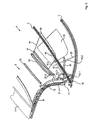
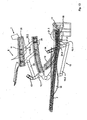
- 1 is a convertible vehicle numbered with a vehicle body 2, a rear portion 3, indicated wheels 4 and a generally numbered 5 roof, which has a top frame 6 and a headband 7.
- the convertible vehicle should be equipped in the illustrated embodiment with a center motor. About a cover 8, the headband 7 is covered.
- the designed as a soft top roof is equipped with a rigid rear window 10.
- the top frame has a front top attachment bracket 11, side handlebars 12, crossbar 13 and a corner bow 14.
- the top attachment bracket 11 is a fixed rooftop, which is either overlapped by the top fabric or at the rear end of the top material connects.
- the rear window 10 is connected via a hood frame part 15 with a central, the convertible vehicle transversely passing torsion shaft 16.
- This torsion shaft 16 is mounted at 17 in a top frame main bearing.
- the bracket 7 is mounted separately in the body at 18 pivotally.
- the rear window 10 is integrated in the sketched with 19 roofing membrane of the roof.
- the roof can be brought into its open position via a manual or motor drive. Because of this central drive are not arranged on both sides of the top frame separate drives necessary. In addition, the driving force is safely transferred to both sides of the hood, which ensures a trouble-free opening and closing operation.
- On the torsion shaft 16 may be in the engine drive case known per se - in the Drawing figures not shown - attack drive to move the roof. Such a drive can electrically, hydraulically or in another known manner directly or indirectly - for example via a countershaft - the required driving force transmitted to the torsion shaft 16.
- the inventive torsion shaft 16 is flexible in the choice of the force introduction point in the torsion shaft 16: It may preferably be a central force application, but it is also a decentralized and in one case one-sided force application possible.
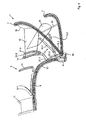
- the headband 7 in the embodiment of the Fig. 1 to 4 be swung in the sketched from these figures respectively superscript maintenance and mounting position, in which the headband 7 by a rod 20 which is pivotally fixed to the body, be held.
- the rear window 10 is to pivot with their rear window link parts 15 with.
- the rear window linkage parts are initially each formed in two parts and consist of a first rear window linkage 15.1, which forms a rotationally fixed to the torsion formed extension of the torsion shaft 16, and a second rear window linkage lever 15.2, with the first rear window linkage lever 15.1 and the rear window 10 is pivotally connected.
- the Eckspriegel 14 is connected in each case on both sides via a Eckspriegelgestfiteteil 21 with the torsion shaft 16.
- This respective Eckspriegelgestfiteteil 21 is also formed in two parts and consists of a Eckspriegel facing upper EckspriegelgestIfehebel 21.2 and a lower Eckspriegelgestfitehebel 21.1. These are in turn pivotally fixed to each other, so that the Eckspriegel 14 can be brought by pivoting the EckspriegelgestCodeehebels 21.2 relative to the Eckspriegelgestfitehebel 21.1 in a relative pivoting position, ie in the drawing after Fig. 1 in a left in the drawing crazy front position, with otherwise unchanged closed roof. Due to this design of the top linkage parts ensures that this maintenance and mounting position can be taken in this convertible vehicle, and that unimpeded by the provided rear window linkage parts 15th
- FIG. 2 illustrates even closer to the formation of the roof linkage parts and shows that a corner lever 21.3 of Eckspriegelhebel 21.1 is connected to the torsion shaft 16. Indicated by the arrow 22, the two positions of the Eckspriegels 14 once in the closed position of the retaining clip and once in the in Fig. 2 apparent mounting position of the retaining clip. 7
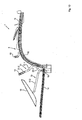
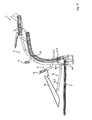
- Fig. 3 the headband 7 are shown once in the raised position and once in the clamping position.
- the positions of the rear window linkage parts 15 and the rear window 10 are also shown for both positions. The same applies to the different positions of the Eckspriegel 14 and the associated Eckspriegelgestfitehebels 21.2.
- FIGS. 10 to 14 illustrate again clearly the opening process of the top frame and thus the roof over the central torsion 16th
- the roofing (roofing) 19 is tensioned by fixing the roof top 11 to a windshield frame.
- the headband 7 remains during the actual top movement process (opening, closing) in its unchanged on the body 3 adjacent position.
- connection of the roof fabric 19 to the headband 7 is therefore in particular in order to be able to transfer with the headband 7 the rear roof area in the desired maintenance or installation position with.
- the entire roof package sets - viewed in a plan view within the retaining bracket from.
- the stored position corresponds to the illustration Fig. 14 where the entire roof is Z-shaped together.
- the cover of the roof pack is stored not with a top compartment lid, but by the stored in the same orientation rooftop eleventh
- the front roof frame element 35 which carries the roof top 11, is connected to the middle roof frame element 34 via the two parallelogram links 32.1 and 32.2.
- the control of the parallelogram 32.1 and 32.2 is effected by a control handlebar 33 which articulates at one end with the uppermost end 12.1 of the side arm 12 and at the other end articulated on the parallelogram 32.1.
- a control handlebar 33 which articulates at one end with the uppermost end 12.1 of the side arm 12 and at the other end articulated on the parallelogram 32.1.
- This control of the front roof frame element 35 it is forcibly displaced in parallel over the middle roof frame element 34 during an opening process of the roof 5.
- This aspect of the invention parallel displacement of the front roof frame member 35 during an opening operation of the roof 5 is also independent of a convertible vehicle 1 with a central drive unit 16 applicable.
- a receiving space 25 is provided within the retaining clip 7, in which by means of a sewn-on welt 26 of the roofing material 19 is set.
- the roof fabric 19 is guided over a run-off edge 27, which is formed on the headband 7, that different angular positions of the top fabric 19 can be taken, namely angular positions relative to the headband 7.
- the run-off edge 27 has in the contact area with the top cloth 19 preferred a rounded contour in order not to damage the top cloth 19 by repeated Verdeckschulszyklen. Since the top deposits in the open position (in plan view) within the retaining bracket 7, this must have correspondingly large dimensions.
- the inventive combination of internal connection of the top fabric 19 and drainage edge 27 has the great advantage that no contact of the body takes place through the top fabric 19. This is through the gap 31 in FIG FIG. 16 indicated.
- the cover 8 can be structurally designed so that it does not have to absorb any (sometimes very high) forces of the tensioned top material (19).
- Fig. 16 illustrates in addition, as the headband in its normal position (outside the maintenance and assembly position) rests against the body 3.
- the body has a Anformung 3.1, on which a sealing element 28 is placed, on which the headband 7 is based.
- the headband 7 is therefore from below, ie sealed from the body and to lock in this position by a locking device not shown in detail.
- an additional flexible sealing element 29 may be provided, which is firmly connected at one end 29.1 with the top material 19 (for example, by an adhesive bond) and at the other end 29.2 fixed to the outside of the retaining clip 7. This determination can also be made by a bond or by a clip connection.
- the sealing element 29 is preferably made of top material.
- the connection of the sealing element 29 with the top material 19 takes place in the region 29.1 in a region which is not visible from the outside, since the region 29.1 is overlapped by the cover 8.
- a drip edge 30 may be provided in the form of a bracket profile.
- In the bodywork 3.2 can then be the so-called wet area with a water channel, from where the water is led out of the vehicle.
- FIGS. 15 and 16 aspects of the invention Verdeckstoffanitati described on the bracket 7 and the seal according to the invention of the retaining clip 7 relative to the body 3 are also independent of a convertible vehicle 1 with a central drive unit 16 applicable.
- the torsion shaft 16 is directly and therefore rigidly connected to both sides with a main guide rod 12.1, which in turn is rigidly connected to the rear window linkage lever 15.1.
- a rear window linkage lever 15.2 is articulated via the rear window linkage lever 15.1, which ultimately activates the rear window 10 in an articulated manner.
- the torsion shaft 16 is also directly and therefore rigidly connected at both outer edge regions with a EckspriegelgestCodeehebel 21.4, via which in each case a EckspriegelgestCodehebel (control lever) 21.3 is hinged.
- the respective Eckspriegelgestfiteteil 21 is formed in two parts (upper EckspriegegestShehebel 21.2 and lower EckspriegelgestIfehebel 21.1), which in turn are pivotally fixed to each other, so that the Eckspriegel 14 can be transferred by pivoting the EckspriegelgestCodeehebels 21.2 relative to EckspriegelgestIfehebel 21.1 in a position with otherwise unchanged closed roof ,
- the EckspriegelgestCodeehebel 21.1 is pivotally connected to a main bearing.
Landscapes
- Engineering & Computer Science (AREA)
- Mechanical Engineering (AREA)
- Body Structure For Vehicles (AREA)
- Lock And Its Accessories (AREA)
- Air Bags (AREA)
- Transition And Organic Metals Composition Catalysts For Addition Polymerization (AREA)
Claims (55)
- Véhicule cabriolet avec un toit (5) couvrant un habitacle dans sa position de fermeture et déplaçable de la position de fermeture dans une position de rangement située à l'arrière du véhicule, qui peut être fixé sur un châssis de capote (6) comprenant des tringleries de capote ainsi que au moins un élément d'entraînement pour le déplacement du toit à partir de sa position de fermeture dans la position de rangement et inversement, l'élément d'entraînement comportant une unité d'entraînement centrale (16) qui traverse perpendiculairement le véhicule cabriolet (1) et peut respectivement être fixée avec une tringlerie latérale de capote,
caractérisé en ce
que l'unité d'entraînement central est conçue comme un axe de torsion (16) sur lequel entre en prise un entraînement connu en soi pour le déplacement du toit et qui est fixée directement et rigidement de part et d'autre d'une tige de guidage principale (12.1) à laquelle est fixé rigidement un levier de tringlerie de lunette arrière (15.1), un levier de tringlerie de la lunette arrière (15.2) qui commande de manière articulée une lunette arrière (10) étant commandé de manière articulée par l'intermédiaire du levier de tringlerie de la lunette arrière (15.1). - Véhicule cabriolet selon la revendication 1,
caractérisé en ce que l'entraînement est un actionneur d'entraînement central. - Véhicule cabriolet selon la revendication 2,
caractérisé en ce que l'actionneur d'entraînement central comprend un entraînement à moteur. - Véhicule cabriolet selon la revendication 2,
caractérisé en ce que l'actionneur d'entraînement central comprend un actionneur de commande ou un organe d'actionnement à commande manuelle. - Véhicule cabriolet selon la revendication 4,
caractérisé en ce que l'actionneur de commande est conçu comme un levier oscillant pivotant dans l'habitacle. - Véhicule cabriolet selon l'une des revendications 4 ou 5,
caractérisé en ce que l'actionneur de commande peut pivoter d'une position verticale essentiellement relevée dans une position horizontale débordant essentiellement dans l'habitacle du véhicule, le toit (5) pouvant être déplacé avec son châssis de capote (6) de la position de fermeture du toit (5) dans sa position de rangement et inversement au cours du mouvement pivotant. - Véhicule cabriolet selon l'une des revendications 4 à 6,
caractérisé en ce que l'actionneur de commande peut pivoter d'une position verticale essentiellement relevée dans une position horizontale débordant essentiellement dans l'habitacle du véhicule, le toit pouvant être déplacé avec son châssis de capote de la position de rangement du toit (5) dans sa position de fermeture et inversement au cours du mouvement pivotant. - Véhicule cabriolet selon l'une des revendications 4 à 7,
caractérisé en ce que l'actionneur de commande peut être désaccouplé par un convertisseur de mouvement et, indépendamment du mouvement du châssis de la capote, peut être amené dans une position de repos. - Véhicule cabriolet selon l'une des revendications 4 à 8,
caractérisé en ce que l'actionneur de commande est situé dans sa position de repos à l'arrière de l'habitacle du véhicule dans une position essentiellement verticale. - Véhicule cabriolet selon l'une des revendications 8 à 9,
caractérisé en ce que le convertisseur de mouvement présente un levier principal qui peut être mobile à pivotement avec des tringleries de capote et fixé de manière à pouvoir être désaccouplé avec le levier de commande. - Véhicule cabriolet selon la revendication 10,
caractérisé en ce que le levier de commande peut être désaccouplé contre la force d'un ressort du levier principal. - Véhicule cabriolet selon l'une des revendications 4 à 11,
caractérisé en ce que l'actionneur de commandes est disposé entre deux sièges dans l'habitacle du véhicule. - Véhicule cabriolet selon l'une des revendications 4 à 12
caractérisé en ce que l'actionneur de commande est disposé à côté d'un siège à l'intérieur de l'habitacle du véhicule. - Véhicule cabriolet selon l'une des revendications 4 à 13,
caractérisé en ce que l'actionneur de commande entre en prise par l'intermédiaire d'un levier de transmission sur un levier de la tringlerie qui peut être couplé mécaniquement à pivotement avec une partie de la tringlerie de la capote. - Véhicule cabriolet selon l'une des revendications 4 à 14,
caractérisé en ce que l'actionneur de commande peut être bloqué dans sa position de repos. - Véhicule cabriolet selon la revendication 4,
caractérisé en ce qu'un dispositif de levage est prévu sous la forme d'un levier d'actionnement déplaçable d'avant en arrière à la main dont au moins un mouvement de levage peut être converti dans une direction comme mouvement d'entraînement pour la fermeture et/ou l'ouverture du toit (5). - Véhicule cabriolet selon la revendication 16,
caractérisé en ce que le levier d'actionnement est conçu essentiellement en forme de U, en forme de T, en forme de I et/ou en forme de bouton. - Véhicule cabriolet selon l'une des revendications 16 à 17,
caractérisé en ce que le toit peut être amené par l'intermédiaire de courses multiples de l'organe de levage dans sa position de fermeture et inversement dans sa position de rangement. - Véhicule cabriolet selon l'une des revendications 16 à 18,
caractérisé en ce que l'organe de levage présente un segment à cliquet qui coopère avec un segment denté. - Véhicule cabriolet selon la revendication 19,
caractérisé en ce que le segment denté peut être amené dans différentes positions de pivotement par l'intermédiaire de l'organe de levage, le segment denté, par l'intermédiaire d'un organe de transmission, déplace des pièces de la tringlerie de la capote dans différentes positions de fermeture et/ou d'ouverture. - Véhicule cabriolet selon la revendication 20,
caractérisé en ce que le segment denté peut être fixé par l'intermédiaire d'un levier de transmission avec le châssis de la capote. - Véhicule cabriolet selon l'une des revendications 20 à 21
caractérisé en ce qu'une pièce à coulisse est fixée sur le châssis de la capote (6) et, dans ses coulisses de guidage, l'organe de transmission est guidé à déplacement avec des butées de fin de course. - Véhicule cabriolet selon l'une des revendications 16 à 22,
caractérisé en ce que l'organe de réglage de la course n'exerce sur le toit un mouvement d'entraînement de fermeture ou d'entraînement de rangement que pendant son soulèvement. - Véhicule cabriolet selon la revendication 23,
caractérisé en ce que l'organe de réglage de la course peut-être désaccouplé du toit pendant une course à vide à la manière d'un mouvement d'entraînement et, pendant le désaccouplement, le toit (5) est bloqué dans une position de recul. - Véhicule cabriolet selon l'une des revendications 22 à 24, caractérisé en ce que la coulisse est conçue dans la pièce de coulisse dans le sens de la longueur sur une course résiduelle du toit lors du processus de fermeture.
- Véhicule cabriolet selon l'une des revendications 16 à 25,
caractérisé en ce que les bras oscillants latéraux du châssis de la capote (6) peuvent être fixés par l'intermédiaire de l'axe de torsion (16) traversant transversalement le véhicule cabriolet (1) sur lequel l'organe de réglage de la course agit centralement par rapport à son mouvement d'entraînement. - Véhicule cabriolet selon la revendication 26,
caractérisé en ce que l'axe de torsion (16) peut être fixé sur la pièce à coulisse pour bloquer le mouvement rotatif. - Véhicule cabriolet selon l'une des revendications 16 à 27,
caractérisé en ce que l'organe de levage est conçu comme une pédale mobile au pied. - Véhicule cabriolet selon la revendication 28,
caractérisé en ce que la pédale au pied peut-être fixée par l'intermédiaire d'un câble Bowden avec le châssis de la capote (6). - Véhicule cabriolet selon l'une des revendications 28 ou 29, caractérisé en ce que le toit (5) peut être amené de sa position de rangement dans sa position de fermeture et inversement par une course de la pédale au pied.
- Véhicule cabriolet selon l'une des revendications 16 à 30, caractérisé en ce que l'organe de levage peut-être fixé par l'intermédiaire d'un milieu de pression avec un réservoir de pression et qu'une pression peut-être établie à l'aide de l'organe de levage dans le réservoir de pression, le réservoir de pression pouvant être fixé avec un organe de réglage pneumatique et/ou hydraulique en vue la détermination du mouvement d'entraînement du toit (5).
- Véhicule cabriolet selon l'une des revendications 1 à 31 avec au moins un arceau angulaire (14) et un arceau transversal (13),
caractérisé en ce
que la lunette arrière (10) peut être fixée par l'intermédiaire d'une tringlerie de lunette arrière (15) et les arceaux angulaires (14) par l'intermédiaire d'une tringlerie des arceaux angulaires (21) avec l'axe de torsion (16), tant la lunette arrière (10) avec les pièces de tringlerie de la lunette arrière (15) et l'arceau angulaire (14) par l'intermédiaire de la tringlerie de l'arceau angulaire (21) pouvant pivoter par rapport à l'axe de torsion (16) se trouvant dans une position de repos et avec un étrier de retenue (7) dans une position de montage et de maintenance relevée par pivotement. - Véhicule cabriolet selon la revendication 32,
caractérisé en ce que les tringleries de l'arceau angulaire (21) peuvent pivoter par rapport à l'axe de torsion (16). - Véhicule cabriolet selon l'une de revendications 32 ou 33,
caractérisé en ce que l'étrier de retenue (7) du toit (5) et le châssis de la capote (6) sont logés dans des paliers séparés (17,18). - Véhicule cabriolet selon l'une des revendications 32 à 34,
caractérisé en ce que la lunette arrière (10) et l'arceau angulaire (14) peuvent être amenés dans leur position de montage ou de maintenance par l'intermédiaire de leurs fixations respectives au toit par l'étrier de retenue (7). - Véhicule cabriolet selon l'une de revendication 32 à 35,
caractérisé en ce que l'étrier de retenue (7) peut-être bloqué dans sa position de montage ou de maintenance par l'intermédiaire d'un rail de retenue (20) s'appuyant sur la carrosserie (3). - Véhicule cabriolet selon la revendication 36,
caractérisé en ce que la tige de retenue (20) est fixée à pivotement à la carrosserie (3). - Véhicule cabriolet selon l'une des revendications 32 à 37,
caractérisé en ce que la tringlerie des arceaux angulaires (21) est conçue respectivement comme des leviers de tringlerie d'arceau angulaire (21.1, 21.2), le levier partiel de la tringlerie des arceaux angulaires (21.2) tourné vers le toit pouvant pivoter dans la position de fermeture du toit (5) par rapport à l'autre dans la direction de fermeture du toit (5). - Véhicule cabriolet selon l'une des revendications 32 à 38,
caractérisé en ce que la tringlerie de lunette arrière (15) est conçue respectivement comme des leviers de tringlerie de lunette arrière en deux parties (15.1, 15.2), le levier de tringlerie de la lunette arrière (15.2) tourné vers la lunette arrière (10) pouvant pivoter dans la position de fermeture du toit (5) par rapport à l'autre levier de tringlerie de lunette arrière (15.1) dans la direction de fermeture du toit (5). - Véhicule cabriolet selon la revendication 39,
caractérisé en ce
que le levier de la tringlerie de la lunette arrière (15.1) opposée à la lunette arrière (10) peut être fixé à rotation bloquée avec l'axe de torsion (16). - Véhicule cabriolet selon l'une de revendication 32 à 40,
caractérisé en ce que les leviers de la tringlerie de l'arceau angulaire (21.1) sont articulés sur un palier côté carrosserie et peuvent être fixés à pivotement par l'intermédiaire d'un levier de commande (21.3) avec l'axe de torsion (16). - Véhicule cabriolet selon l'une des revendications 32 à 41,
caractérisé en ce que les pièces de tringlerie de la lunette arrière (15) sont conçues pour se déplacer longitudinalement. - Véhicule cabriolet selon l'une des revendications 32 à 42,
caractérisé en ce que les pièces de tringlerie de la lunette arrière (15) sont conçues comme des pièces fixées l'une à l'autre de manière amovible. - Véhicule cabriolet selon l'une des revendications 32 à 42, caractérisé en ce que les pièces de tringlerie de la lunette arrière (15) sont de conception télescopique du moins par zone.
- Véhicule cabriolet selon l'une des revendications 32 à 44, caractérisé en ce que l'étrier de retenue (7) peut être amené dans une position de montage ou de maintenance quasi-verticale dans laquelle la lunette arrière (10) est située dans une position renversée essentiellement verticale.
- Véhicule cabriolet selon l'une des revendications 32 à 45, caractérisé en ce que l'étanchéité de l'étrier de retenue (7) par rapport à la carrosserie (3) du véhicule est assurée sur l'étrier de retenue (7) par l'intermédiaire d'un élément d'étanchéité (28) qui peut être fixé à la carrosserie (3).
- Véhicule cabriolet selon la revendication 46,
caractérisé en ce que la carrosserie possède dans la région de l'appui de l'étrier de retenue (7) une saillie (3.1) sur laquelle l'élément d'étanchéité (28) peut être enfiché lorsque le toit (5) se trouve à l'état fermé. - Véhicule cabriolet selon l'une des revendications 32 à 47,
caractérisé en ce qu'une capote flexible (19) peut être fixée sur un étrier de retenue (7). - Véhicule cabriolet selon la revendication 48,
caractérisé en ce que la capote de toit (19) peut être fixée à l'aide d'un bourrelet (26) cousu dans un évidement (25) à l'intérieur de l'étrier de retenue (7). - Véhicule cabriolet selon l'une des revendications 48 ou 49,
caractérisé en ce que la capote de toit (19) est guidée sur un bord de guidage d'écoulement (27) tourné vers le toit (5). - Véhicule cabriolet selon la revendication 50,
caractérisé en ce que la capote de toit (19) est guidée directement vers le toit (5) par le bord de guidage d'écoulement (27) et, à cette occasion, ne touche aucune autre pièce de la carrosserie. - Véhicule cabriolet selon l'une de revendication 48 à 51,
caractérisé en ce que la capote de toit (19) peut être fixée sur une face interne de l'étrier de retenue (7). - Véhicule cabriolet selon l'une de revendications précédentes 32 à 52,
caractérisé en ce que l'étrier de retenue (7) est situé sous une couverture (8) de carrosserie en forme de couvercle à ouvrir lorsque le toit (5) se trouve à l'état fermé. - Véhicule cabriolet selon la revendication 53,
caractérisé en ce que l'étrier de retenue (7) peut être fixé dans cette position par un arrêt amovible. - Véhicule cabriolet selon l'une des revendications précédentes,
caractérisé en ce
qu'un élément antérieur du châssis de toit (35) peut être déplacé parallèlement par rapport à un élément central du châssis de toit (34) par des bras en parallélogramme (32.1, 32.2), les bras en parallélogramme (32.1, 32.2) étant fixés de manière articulés à une extrémité avec un élément antérieur du châssis de toit (35) et à l'autre extrémité par l'élément central du châssis de toit (34), une commande des bras en parallélogramme (32.1, 32.2) étant effectuée par un bras de commande (33) qui entre en prise de manière articulée avec une extrémité supérieure (12.1) du bras latéral (12) de manière articulée et au bras de parallélogramme (32.1) à l'autre extrémité de manière articulée, l'extrémité supérieure (12.1) du bras latéral (12) se trouvant dans une position intermédiaire du toit (5) au-dessus du châssis central du toit (34).
Applications Claiming Priority (1)
| Application Number | Priority Date | Filing Date | Title |
|---|---|---|---|
| DE102004044032A DE102004044032A1 (de) | 2004-09-09 | 2004-09-09 | Cabriolet-Fahrzeug |
Publications (3)
| Publication Number | Publication Date |
|---|---|
| EP1634751A2 EP1634751A2 (fr) | 2006-03-15 |
| EP1634751A3 EP1634751A3 (fr) | 2008-01-09 |
| EP1634751B1 true EP1634751B1 (fr) | 2009-06-03 |
Family
ID=35456977
Family Applications (1)
| Application Number | Title | Priority Date | Filing Date |
|---|---|---|---|
| EP05019654A Expired - Lifetime EP1634751B1 (fr) | 2004-09-09 | 2005-09-09 | Véhicule convertible |
Country Status (3)
| Country | Link |
|---|---|
| EP (1) | EP1634751B1 (fr) |
| AT (1) | ATE432841T1 (fr) |
| DE (2) | DE102004044032A1 (fr) |
Families Citing this family (4)
| Publication number | Priority date | Publication date | Assignee | Title |
|---|---|---|---|---|
| DE102007043019A1 (de) * | 2007-09-11 | 2009-03-12 | Dr. Ing. H.C. F. Porsche Aktiengesellschaft | Faltverdeck für ein Cabriolet |
| DE102007054946A1 (de) * | 2007-11-17 | 2009-05-20 | Wilhelm Karmann Gmbh | Verdeck eines Cabriolet-Fahrzeugs |
| CN112428801B (zh) * | 2020-11-30 | 2023-03-17 | 重庆长安汽车股份有限公司 | 汽车双顶篷切换装置 |
| DE102022106884B3 (de) | 2022-03-23 | 2023-08-10 | Webasto SE | Verdeck für ein Cabriolet-Fahrzeug, umfassend einen heckseitigen Spannbügel |
Family Cites Families (9)
| Publication number | Priority date | Publication date | Assignee | Title |
|---|---|---|---|---|
| US2376949A (en) * | 1940-04-09 | 1945-05-29 | Jacobs Co F L | Folding top operating mechanism |
| US2768857A (en) * | 1953-01-16 | 1956-10-30 | Gen Motors Corp | Convertible top with inwardly folding side rails |
| US4695089A (en) * | 1985-02-18 | 1987-09-22 | Mazda Motor Corporation | Upper body structure of an open-top vehicle |
| IT1208844B (it) * | 1986-03-18 | 1989-07-10 | Pininfarina Spa | Copertura flessibile per autoveicoli a tetto apribile |
| US5033789A (en) * | 1989-03-31 | 1991-07-23 | Aisin Seiki Kabushiki Kaisha | Convertible car body structure |
| US5100195A (en) * | 1991-02-07 | 1992-03-31 | Wickes Manufacturing Company | Installation of a convertible top cover on a vehicle |
| US5903119A (en) * | 1997-08-22 | 1999-05-11 | Asc Incorporated | Convertible roof actuation mechanism |
| DE19936099B4 (de) * | 1999-07-30 | 2005-10-13 | Edscha Cabrio-Dachsysteme Gmbh | Verriegelungsmechanismus für ein Klappverdeck |
| DE20210763U1 (de) * | 2002-07-17 | 2003-11-27 | Wilhelm Karmann Gmbh | Cabriolet-Fahrzeug |
-
2004
- 2004-09-09 DE DE102004044032A patent/DE102004044032A1/de not_active Withdrawn
-
2005
- 2005-09-09 AT AT05019654T patent/ATE432841T1/de not_active IP Right Cessation
- 2005-09-09 EP EP05019654A patent/EP1634751B1/fr not_active Expired - Lifetime
- 2005-09-09 DE DE502005007394T patent/DE502005007394D1/de not_active Expired - Lifetime
Also Published As
| Publication number | Publication date |
|---|---|
| DE502005007394D1 (de) | 2009-07-16 |
| EP1634751A2 (fr) | 2006-03-15 |
| EP1634751A3 (fr) | 2008-01-09 |
| ATE432841T1 (de) | 2009-06-15 |
| DE102004044032A1 (de) | 2006-03-16 |
Similar Documents
| Publication | Publication Date | Title |
|---|---|---|
| EP0922597B1 (fr) | Véhicule avec structure de toit rétractable | |
| DE10059342C5 (de) | Umwandelbares Fahrzeugdach | |
| DE10140234A1 (de) | Cabriolet-Fahrzeug mit einem zumindest bereichsweise flexiblen Dach | |
| EP1314601B1 (fr) | Toit ouvrant de véhicule avec une capote pliante | |
| EP1971501B1 (fr) | Toit décapotable pour automobile | |
| DE10258052C5 (de) | Verstellbares Fahrzeugdach für Cabriolet-Fahrzeuge | |
| EP1554150B1 (fr) | Couvercle de caisson de capote de vehicule cabriolet comportant une capote escamotable | |
| DE10105771B4 (de) | Verschlußvorrichtung für ein Cabriolet-Verdeck | |
| EP1990223B1 (fr) | Capote d'un véhicule cabriolet | |
| DE102004023056A1 (de) | Klappverdeck für ein Kraftfahrzeug | |
| EP1554143A1 (fr) | Vehicule cabriolet | |
| DE102007004180B4 (de) | Verstellbares Fahrzeugdach | |
| EP1897727B1 (fr) | Capote dotée d'un arceau de tension pour un cabriolet | |
| DE102007041296B4 (de) | Faltverdeck für ein Cabriolet-Fahrzeug | |
| EP1634751A2 (fr) | Véhicule convertible | |
| DE19646035C2 (de) | Faltverdeck für ein Kraftfahrzeug, insbesondere Geländewagen | |
| EP1915268A1 (fr) | Capote pliable d'un vehicule decapotable | |
| DE202005014328U1 (de) | Cabriolet-Fahrzeug | |
| DE102007054469B4 (de) | Fahrzeugverdeck | |
| DE102009048959B4 (de) | Heckscheibenanordnung | |
| EP1634749B1 (fr) | Véhicule convertible | |
| DE102007002646B4 (de) | Verdeck für ein Cabriolet-Fahrzeug | |
| DE102008047131B4 (de) | Verdeck für ein Cabriolet-Fahrzeug | |
| EP1634750B1 (fr) | Véhicule convertible | |
| DE102006051149B3 (de) | Cabriolet-Fahrzeug |
Legal Events
| Date | Code | Title | Description |
|---|---|---|---|
| PUAI | Public reference made under article 153(3) epc to a published international application that has entered the european phase |
Free format text: ORIGINAL CODE: 0009012 |
|
| AK | Designated contracting states |
Kind code of ref document: A2 Designated state(s): AT BE BG CH CY CZ DE DK EE ES FI FR GB GR HU IE IS IT LI LT LU LV MC NL PL PT RO SE SI SK TR |
|
| AX | Request for extension of the european patent |
Extension state: AL BA HR MK YU |
|
| PUAL | Search report despatched |
Free format text: ORIGINAL CODE: 0009013 |
|
| AK | Designated contracting states |
Kind code of ref document: A3 Designated state(s): AT BE BG CH CY CZ DE DK EE ES FI FR GB GR HU IE IS IT LI LT LU LV MC NL PL PT RO SE SI SK TR |
|
| AX | Request for extension of the european patent |
Extension state: AL BA HR MK YU |
|
| 17P | Request for examination filed |
Effective date: 20080213 |
|
| 17Q | First examination report despatched |
Effective date: 20080319 |
|
| AKX | Designation fees paid |
Designated state(s): AT BE BG CH CY CZ DE DK EE ES FI FR GB GR HU IE IS IT LI LT LU LV MC NL PL PT RO SE SI SK TR |
|
| GRAP | Despatch of communication of intention to grant a patent |
Free format text: ORIGINAL CODE: EPIDOSNIGR1 |
|
| GRAP | Despatch of communication of intention to grant a patent |
Free format text: ORIGINAL CODE: EPIDOSNIGR1 |
|
| GRAS | Grant fee paid |
Free format text: ORIGINAL CODE: EPIDOSNIGR3 |
|
| GRAA | (expected) grant |
Free format text: ORIGINAL CODE: 0009210 |
|
| AK | Designated contracting states |
Kind code of ref document: B1 Designated state(s): AT BE BG CH CY CZ DE DK EE ES FI FR GB GR HU IE IS IT LI LT LU LV MC NL PL PT RO SE SI SK TR |
|
| REG | Reference to a national code |
Ref country code: GB Ref legal event code: FG4D Free format text: NOT ENGLISH |
|
| REG | Reference to a national code |
Ref country code: CH Ref legal event code: EP |
|
| REG | Reference to a national code |
Ref country code: IE Ref legal event code: FG4D Free format text: LANGUAGE OF EP DOCUMENT: GERMAN |
|
| REF | Corresponds to: |
Ref document number: 502005007394 Country of ref document: DE Date of ref document: 20090716 Kind code of ref document: P |
|
| PG25 | Lapsed in a contracting state [announced via postgrant information from national office to epo] |
Ref country code: FI Free format text: LAPSE BECAUSE OF FAILURE TO SUBMIT A TRANSLATION OF THE DESCRIPTION OR TO PAY THE FEE WITHIN THE PRESCRIBED TIME-LIMIT Effective date: 20090603 Ref country code: LT Free format text: LAPSE BECAUSE OF FAILURE TO SUBMIT A TRANSLATION OF THE DESCRIPTION OR TO PAY THE FEE WITHIN THE PRESCRIBED TIME-LIMIT Effective date: 20090603 |
|
| NLV1 | Nl: lapsed or annulled due to failure to fulfill the requirements of art. 29p and 29m of the patents act | ||
| PG25 | Lapsed in a contracting state [announced via postgrant information from national office to epo] |
Ref country code: SE Free format text: LAPSE BECAUSE OF FAILURE TO SUBMIT A TRANSLATION OF THE DESCRIPTION OR TO PAY THE FEE WITHIN THE PRESCRIBED TIME-LIMIT Effective date: 20090903 Ref country code: SI Free format text: LAPSE BECAUSE OF FAILURE TO SUBMIT A TRANSLATION OF THE DESCRIPTION OR TO PAY THE FEE WITHIN THE PRESCRIBED TIME-LIMIT Effective date: 20090603 Ref country code: NL Free format text: LAPSE BECAUSE OF FAILURE TO SUBMIT A TRANSLATION OF THE DESCRIPTION OR TO PAY THE FEE WITHIN THE PRESCRIBED TIME-LIMIT Effective date: 20090603 Ref country code: PL Free format text: LAPSE BECAUSE OF FAILURE TO SUBMIT A TRANSLATION OF THE DESCRIPTION OR TO PAY THE FEE WITHIN THE PRESCRIBED TIME-LIMIT Effective date: 20090603 Ref country code: LV Free format text: LAPSE BECAUSE OF FAILURE TO SUBMIT A TRANSLATION OF THE DESCRIPTION OR TO PAY THE FEE WITHIN THE PRESCRIBED TIME-LIMIT Effective date: 20090603 |
|
| REG | Reference to a national code |
Ref country code: IE Ref legal event code: FD4D |
|
| PG25 | Lapsed in a contracting state [announced via postgrant information from national office to epo] |
Ref country code: CZ Free format text: LAPSE BECAUSE OF FAILURE TO SUBMIT A TRANSLATION OF THE DESCRIPTION OR TO PAY THE FEE WITHIN THE PRESCRIBED TIME-LIMIT Effective date: 20090603 Ref country code: ES Free format text: LAPSE BECAUSE OF FAILURE TO SUBMIT A TRANSLATION OF THE DESCRIPTION OR TO PAY THE FEE WITHIN THE PRESCRIBED TIME-LIMIT Effective date: 20090914 Ref country code: EE Free format text: LAPSE BECAUSE OF FAILURE TO SUBMIT A TRANSLATION OF THE DESCRIPTION OR TO PAY THE FEE WITHIN THE PRESCRIBED TIME-LIMIT Effective date: 20090603 Ref country code: IS Free format text: LAPSE BECAUSE OF FAILURE TO SUBMIT A TRANSLATION OF THE DESCRIPTION OR TO PAY THE FEE WITHIN THE PRESCRIBED TIME-LIMIT Effective date: 20091003 Ref country code: IE Free format text: LAPSE BECAUSE OF FAILURE TO SUBMIT A TRANSLATION OF THE DESCRIPTION OR TO PAY THE FEE WITHIN THE PRESCRIBED TIME-LIMIT Effective date: 20090603 Ref country code: RO Free format text: LAPSE BECAUSE OF FAILURE TO SUBMIT A TRANSLATION OF THE DESCRIPTION OR TO PAY THE FEE WITHIN THE PRESCRIBED TIME-LIMIT Effective date: 20090603 |
|
| PG25 | Lapsed in a contracting state [announced via postgrant information from national office to epo] |
Ref country code: SK Free format text: LAPSE BECAUSE OF FAILURE TO SUBMIT A TRANSLATION OF THE DESCRIPTION OR TO PAY THE FEE WITHIN THE PRESCRIBED TIME-LIMIT Effective date: 20090603 |
|
| BERE | Be: lapsed |
Owner name: WILHELM KARMANN G.M.B.H. Effective date: 20090930 |
|
| PG25 | Lapsed in a contracting state [announced via postgrant information from national office to epo] |
Ref country code: BG Free format text: LAPSE BECAUSE OF FAILURE TO SUBMIT A TRANSLATION OF THE DESCRIPTION OR TO PAY THE FEE WITHIN THE PRESCRIBED TIME-LIMIT Effective date: 20090903 Ref country code: PT Free format text: LAPSE BECAUSE OF FAILURE TO SUBMIT A TRANSLATION OF THE DESCRIPTION OR TO PAY THE FEE WITHIN THE PRESCRIBED TIME-LIMIT Effective date: 20091003 |
|
| PLBE | No opposition filed within time limit |
Free format text: ORIGINAL CODE: 0009261 |
|
| STAA | Information on the status of an ep patent application or granted ep patent |
Free format text: STATUS: NO OPPOSITION FILED WITHIN TIME LIMIT |
|
| PG25 | Lapsed in a contracting state [announced via postgrant information from national office to epo] |
Ref country code: DK Free format text: LAPSE BECAUSE OF FAILURE TO SUBMIT A TRANSLATION OF THE DESCRIPTION OR TO PAY THE FEE WITHIN THE PRESCRIBED TIME-LIMIT Effective date: 20090603 Ref country code: MC Free format text: LAPSE BECAUSE OF NON-PAYMENT OF DUE FEES Effective date: 20090930 |
|
| REG | Reference to a national code |
Ref country code: CH Ref legal event code: PL |
|
| 26N | No opposition filed |
Effective date: 20100304 |
|
| GBPC | Gb: european patent ceased through non-payment of renewal fee |
Effective date: 20090909 |
|
| REG | Reference to a national code |
Ref country code: FR Ref legal event code: ST Effective date: 20100531 |
|
| PG25 | Lapsed in a contracting state [announced via postgrant information from national office to epo] |
Ref country code: FR Free format text: LAPSE BECAUSE OF NON-PAYMENT OF DUE FEES Effective date: 20090930 |
|
| PG25 | Lapsed in a contracting state [announced via postgrant information from national office to epo] |
Ref country code: BE Free format text: LAPSE BECAUSE OF NON-PAYMENT OF DUE FEES Effective date: 20090930 |
|
| PG25 | Lapsed in a contracting state [announced via postgrant information from national office to epo] |
Ref country code: LI Free format text: LAPSE BECAUSE OF NON-PAYMENT OF DUE FEES Effective date: 20090930 Ref country code: GR Free format text: LAPSE BECAUSE OF FAILURE TO SUBMIT A TRANSLATION OF THE DESCRIPTION OR TO PAY THE FEE WITHIN THE PRESCRIBED TIME-LIMIT Effective date: 20090904 Ref country code: CH Free format text: LAPSE BECAUSE OF NON-PAYMENT OF DUE FEES Effective date: 20090930 |
|
| PG25 | Lapsed in a contracting state [announced via postgrant information from national office to epo] |
Ref country code: GB Free format text: LAPSE BECAUSE OF NON-PAYMENT OF DUE FEES Effective date: 20090909 Ref country code: AT Free format text: LAPSE BECAUSE OF NON-PAYMENT OF DUE FEES Effective date: 20090909 |
|
| PG25 | Lapsed in a contracting state [announced via postgrant information from national office to epo] |
Ref country code: IT Free format text: LAPSE BECAUSE OF FAILURE TO SUBMIT A TRANSLATION OF THE DESCRIPTION OR TO PAY THE FEE WITHIN THE PRESCRIBED TIME-LIMIT Effective date: 20090603 |
|
| PG25 | Lapsed in a contracting state [announced via postgrant information from national office to epo] |
Ref country code: LU Free format text: LAPSE BECAUSE OF NON-PAYMENT OF DUE FEES Effective date: 20090909 |
|
| PG25 | Lapsed in a contracting state [announced via postgrant information from national office to epo] |
Ref country code: HU Free format text: LAPSE BECAUSE OF FAILURE TO SUBMIT A TRANSLATION OF THE DESCRIPTION OR TO PAY THE FEE WITHIN THE PRESCRIBED TIME-LIMIT Effective date: 20091204 |
|
| PG25 | Lapsed in a contracting state [announced via postgrant information from national office to epo] |
Ref country code: TR Free format text: LAPSE BECAUSE OF FAILURE TO SUBMIT A TRANSLATION OF THE DESCRIPTION OR TO PAY THE FEE WITHIN THE PRESCRIBED TIME-LIMIT Effective date: 20090603 |
|
| PG25 | Lapsed in a contracting state [announced via postgrant information from national office to epo] |
Ref country code: CY Free format text: LAPSE BECAUSE OF FAILURE TO SUBMIT A TRANSLATION OF THE DESCRIPTION OR TO PAY THE FEE WITHIN THE PRESCRIBED TIME-LIMIT Effective date: 20090603 |
|
| REG | Reference to a national code |
Ref country code: DE Ref legal event code: R082 Ref document number: 502005007394 Country of ref document: DE Representative=s name: KRONTHALER, SCHMIDT & COLL. PATENTANWALTSKANZL, DE |
|
| REG | Reference to a national code |
Ref country code: DE Ref legal event code: R081 Ref document number: 502005007394 Country of ref document: DE Owner name: VALMET AUTOMOTIVE OY, FI Free format text: FORMER OWNER: WILHELM KARMANN GMBH, 49084 OSNABRUECK, DE Effective date: 20131202 Ref country code: DE Ref legal event code: R082 Ref document number: 502005007394 Country of ref document: DE Representative=s name: KRONTHALER, SCHMIDT & COLL. PATENTANWALTSKANZL, DE Effective date: 20131202 |
|
| PGFP | Annual fee paid to national office [announced via postgrant information from national office to epo] |
Ref country code: DE Payment date: 20201022 Year of fee payment: 16 |
|
| REG | Reference to a national code |
Ref country code: DE Ref legal event code: R119 Ref document number: 502005007394 Country of ref document: DE |
|
| PG25 | Lapsed in a contracting state [announced via postgrant information from national office to epo] |
Ref country code: DE Free format text: LAPSE BECAUSE OF NON-PAYMENT OF DUE FEES Effective date: 20220401 |