EP1632617A2 - Kugelgelenk für ein Rohr sowie Schacht mit einem derartigen Gelenk - Google Patents
Kugelgelenk für ein Rohr sowie Schacht mit einem derartigen Gelenk Download PDFInfo
- Publication number
- EP1632617A2 EP1632617A2 EP05107664A EP05107664A EP1632617A2 EP 1632617 A2 EP1632617 A2 EP 1632617A2 EP 05107664 A EP05107664 A EP 05107664A EP 05107664 A EP05107664 A EP 05107664A EP 1632617 A2 EP1632617 A2 EP 1632617A2
- Authority
- EP
- European Patent Office
- Prior art keywords
- sealing surface
- joint
- curved
- fitting
- connecting element
- Prior art date
- Legal status (The legal status is an assumption and is not a legal conclusion. Google has not performed a legal analysis and makes no representation as to the accuracy of the status listed.)
- Withdrawn
Links
Images
Classifications
-
- E—FIXED CONSTRUCTIONS
- E03—WATER SUPPLY; SEWERAGE
- E03F—SEWERS; CESSPOOLS
- E03F5/00—Sewerage structures
- E03F5/02—Manhole shafts or other inspection chambers; Snow-filling openings; accessories
- E03F5/021—Connection of sewer pipes to manhole shaft
-
- E—FIXED CONSTRUCTIONS
- E03—WATER SUPPLY; SEWERAGE
- E03F—SEWERS; CESSPOOLS
- E03F5/00—Sewerage structures
- E03F5/02—Manhole shafts or other inspection chambers; Snow-filling openings; accessories
-
- F—MECHANICAL ENGINEERING; LIGHTING; HEATING; WEAPONS; BLASTING
- F16—ENGINEERING ELEMENTS AND UNITS; GENERAL MEASURES FOR PRODUCING AND MAINTAINING EFFECTIVE FUNCTIONING OF MACHINES OR INSTALLATIONS; THERMAL INSULATION IN GENERAL
- F16L—PIPES; JOINTS OR FITTINGS FOR PIPES; SUPPORTS FOR PIPES, CABLES OR PROTECTIVE TUBING; MEANS FOR THERMAL INSULATION IN GENERAL
- F16L27/00—Adjustable joints; Joints allowing movement
- F16L27/02—Universal joints, i.e. with mechanical connection allowing angular movement or adjustment of the axes of the parts in any direction
- F16L27/04—Universal joints, i.e. with mechanical connection allowing angular movement or adjustment of the axes of the parts in any direction with partly-spherical engaging surfaces
- F16L27/06—Universal joints, i.e. with mechanical connection allowing angular movement or adjustment of the axes of the parts in any direction with partly-spherical engaging surfaces with special sealing means between the engaging surfaces
Definitions
- the invention relates to a well, in a bottom part of which there is at least one inlet fitting and/or at least one outlet fitting such that in connection with said fitting there is a joint such that the well comprises a connecting element that is able to turn in relation to a connecting fitting of the joint and the joint comprises a first curved interior sealing surface and a second curved interior sealing surface.
- the invention also relates to a joint comprising a joint fitting and a connecting element, the connecting element being arranged to turn in relation to the joint fitting, whereby in connection with the joint there is a first curved interior sealing surface and a second curved interior sealing surface.
- EP 1,141,495 describes a bottom of a ground-installed well.
- Pipes can be joined to the well bottom by means of connecting elements.
- the direction of the connecting elements can be turned in relation to the connecting fitting of the well bottom by means of a hinged/swivel joint.
- the joint comprises a first inside bearing surface and a second inside bearing surface in a well wall.
- the shape of each bearing surface is a portion of a spherical surface.
- the radius of a spherical surface constituting an outer bearing surface is longer than that of the spherical surface constituting the inner bearing surface, and the diameter of the outer bearing surface decreases in the outwardly direction while the diameter of the inner bearing surface increases in the outwardly direction.
- the connecting element comprises parts on the outside that fit against the above-mentioned bearing surfaces on the inside of the well wall. This structure is relatively complicated to manufacture and it is a very demanding task to make sure that the joint is tight.
- the object of the present invention is to provide a well and a joint of a novel type.
- a well is characterized in that a first curved interior sealing surface is arranged in connection with a joint fitting and a second curved interior sealing surface is arranged in connection with a connecting element that is able to turn in relation to the joint fitting.
- a well in accordance with a second embodiment is characterized in that the curved sealing surfaces are flatter than a spherical surface such that the radius of curvature of the curved sealing surfaces is longer than the distance of each sealing surface point from its centre axis.
- a joint is also characterized in that a first curved interior sealing surface is arranged in connection with a joint fitting and a second curved interior sealing surface is arranged in connection with a connecting element that is able to turn in relation to the joint fitting.
- Yet another joint is characterized in that the curved sealing surfaces are flatter than a sphere such that the radius of curvature of the curved sealing surfaces is longer than the distance of each sealing surface point from its centre axis.
- a joint in a well may be such that the joint comprises a connecting element that is able to turn in relation to a joint fitting, which joint fitting may be an inlet fitting or an outlet fitting of the well, for instance.
- a joint fitting may be an inlet fitting or an outlet fitting of the well, for instance.
- In connection with the joint there is a first curved interior sealing surface and a second curved interior sealing surface such that the first curved interior sealing surface is arranged in the fitting and the second curved interior sealing surface is arranged in connection with the connecting element that is able to turn in relation to the fitting, i.e. the curved interior sealing surfaces are arranged in separate elements in the joint.
- a well may comprise a joint that includes a connecting element that is able to turn in relation to a well fitting, for instance.
- the joint may further comprise a first curved interior sealing surface and a second curved interior sealing surface such that the curved sealing surfaces are flatter than a sphere such that the radius of curvature of the curved sealing surfaces is longer than the distance of each surface point from the centre axis.
- the feature that the curved interior sealing surfaces are arranged in separate elements contributes to achieve an advantage that one element, for instance a well manufacturing mould, need not be very complicated, because in connection with one fitting there will only be one curved interior sealing surface and a second curved interior sealing surface will be arranged in a connecting element. Further, it is possible to use various moulds for manufacturing connecting elements to be used in connection with different pipes, but for different pipe diameters, however, it is possible to use one and the same mould in connection with the well.
- the feature that the curved interior sealing surfaces are flatter than a sphere contributes to achieve an advantage that when the connecting element is turned in relation to the fitting the joint surfaces are not subjected to heavy torsional stresses but the tightness of the joint can be ensured relatively easily. Moreover, the flow section will be even and a protrusion or step produced on turning the connecting element will remain relatively low.
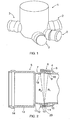
- Figure 1 shows a bottom part 1 of a well.
- the bottom part 1 of the well includes three inlet fittings 2 and one outlet fitting 3.
- On top of the bottom part 1 of the well it is possible to arrange a required number of rising pipes and other well frame parts.
- the well is to be installed in the ground.
- the well can be used e.g. as a drainage well, a sewage well or a rainwater gully.
- connection with the inlet and/or outlet fittings there may be a joint in accordance with Figure 2.
- the fitting comprises a connecting element that can be turned in relation to the fixedly standing well frame.
- the inlet and outlet angles of pipes to be connected to the well need not be adjusted accurately in the horizontal and/or vertical direction, but the connecting elements of the well fittings can be adjusted in the direction required by the pipes, whereby connection of the pipes to the well can be implemented without leaks occurring in subsequent use.
- the present solution can be implemented such, for instance, that the inlet and/or outlet angle may vary ⁇ 10°.
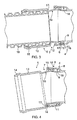
- Figure 2 thus shows a joint that can be used in connection with well fittings of Figure 1, for instance.
- the joint comprises a connecting fitting 4 which may have an integral structure with the well frame.
- the connecting fitting 4 can be produced, for instance, by simultaneous injection moulding to form an integral structure with the bottom part 1 of the well.
- the connecting fitting 4 can be welded to the bottom part 1 of the well in a fixed manner, for instance, or the connecting fitting 4 may comprise a socket for attaching the connecting fitting 4 to a simple tubular fitting provided in the bottom part 1 of the well by means of socket joint, for instance.
- the connecting fitting 4 may be part of a pipe or connectable by a welded joint or socket joint to a pipe.
- the joint further comprises a connecting element 5.
- the joint is formed such that the connecting element 5 is able to turn in relation to the connecting fitting 4.
- the connecting fitting 4 includes a slot element 6.
- the tip of the connecting element 5 is arranged between an outer branch 8 and an inner branch 9 of the slot element 6.
- the inner surface of the outer branch 8 is provided to constitute a curved sealing surface 18.
- the tip 7 of the connecting element 5 comprises ribs 10 and between them there is arranged a sealing ring 11.
- the ribs 10 and the sealing ring 11 are set against the curved interior sealing surface 18 of the outer branch 8, whereby the joint becomes tight.
- the inner surface of the tip 7 of the connecting element 5 constitutes a second curved interior sealing surface 19.
- the tip of the inner branch 9 of the slot 6 is set tightly against the curved interior sealing surface of the tip 7 of the connecting element 5, whereby sand, waste and other impurities are prevented from getting in a gap between the outer 8 and inner 9 branches of the slot 6.
- the tip of the inner branch 9 of the slot 6 is arranged slightly curved such that flow resistance through the joint will remain rather low, because the flow will not encounter large steps or protrusions.
- the radius of curvature of the curved interior sealing surface 18 of the outer branch 8 of the slot 6 is rather gentle.
- Said radius of curvature R 1 is longer than the distance of each point in said sealing surface 18 from the centre axis of said sealing surface.
- said sealing surface 18 is flatter than a portion of a sphere.
- Advantageously said radius of curvature is in the same order with the inner diameter of the sealing surface.
- the starting point of the radius of curvature R 1 is arranged at a point indicated by reference numeral 20 in the figure. So, when the connecting element 5 is turned in relation to the connecting fitting 4 the other edge of the connecting element 5 remains in its place at said point and the connecting element 5 turns in relation to said point. Thus, there is not so easily produced a force between the connecting fitting 4 and the connecting element 5 that would tend to open the joint.
- the radius of curvature R 2 of the curved interior sealing surface 19 of the tip 7 of the connecting element 5 is correspondingly flatter than the radius of curvature of a sphere, i.e. said radius of curvature R 2 is longer than the distance of each point of the sealing surface 19 from its centre axis.
- the radius of curvature R 2 of the curved interior sealing surface 19 of the tip 7 is of the same order as the inner diameter of said sealing surface 19, whereby the tip of the inner branch 9 of the slot element 6 slides along the sealing surface 19 as the connecting element 5 is turned in relation to the connecting element 4 as shown in Figure 3 and further in Figure 4. At the same time the ribs 10 and the sealing ring 11 slide along the sealing surface 18.
- the curved sealing surfaces 18 and 19 are at least at one edge one upon the other, i.e. within each other, such that they are at least partly at the same point in the axial direction. This makes it possible that the turning point is at a distance from the centre axis, advantageously on the same level with the curved sealing surface.
- the diameter of the curved interior sealing surface 19 of the tip 7 reduces in the outward direction, i.e. in Figure 2 to the left. Because the connecting element 5 is a separate piece from the connecting fitting 4, it can be produced with a specific injection mould, which makes the manufacturing relatively simple. Further, providing the curved interior sealing surface 19 in the turnable connecting element 5 makes the whole joint relatively simple.
- the connecting element 5 also comprises a socket part 13 that is provided with a sealing groove 14.
- a sealing 15 is arranged in the sealing groove 14 as shown in Figure 3 to seal the gap between the socket part 13 and the pipe 16.
- the connecting fitting 4 and the connecting element 5 are provided symmetrical for the sealing surfaces 18 and 19 and for the structures in the vicinity thereof, whereby in view of tightness and flow resistance at said point the connecting element 5 would allow rotation about its centre axis in relation to the connecting fitting 4.
- the socket part 13 can be provided asymmetrical in relation to the tip of the connecting element 7 such that a step 17 is different in size on different sides of the connecting element 5.
- Figure 3 shows a relatively thick-walled pipe 16 arranged inside the connecting element 5.
- the connecting element 5 is arranged such that the step 17 is at its largest in the lower part of the joint, and thus water, waste or the like flowing in the lower part of the joint will not run into a large protrusion.
- the connecting element will be turned such that the lowest portion of the step 17 is down in the joint, whereby the thickness of the wall of the pipe 16 and the size of the step 17 in the lower part of the connecting element are approximately equal and there will be no step to impede the flow. Because the sealing surfaces 18 and 19 and the relating structures are co-axial and symmetrical, the sealing and flowing properties remain good in this respect.
Landscapes
- Engineering & Computer Science (AREA)
- General Engineering & Computer Science (AREA)
- Health & Medical Sciences (AREA)
- Life Sciences & Earth Sciences (AREA)
- Hydrology & Water Resources (AREA)
- Public Health (AREA)
- Water Supply & Treatment (AREA)
- Mechanical Engineering (AREA)
- Joints Allowing Movement (AREA)
- Centrifugal Separators (AREA)
- Flanged Joints, Insulating Joints, And Other Joints (AREA)
Applications Claiming Priority (1)
| Application Number | Priority Date | Filing Date | Title |
|---|---|---|---|
| FI20041145A FI117060B (fi) | 2004-09-02 | 2004-09-02 | Kaivo ja liitos |
Publications (2)
| Publication Number | Publication Date |
|---|---|
| EP1632617A2 true EP1632617A2 (de) | 2006-03-08 |
| EP1632617A3 EP1632617A3 (de) | 2012-06-20 |
Family
ID=33041486
Family Applications (1)
| Application Number | Title | Priority Date | Filing Date |
|---|---|---|---|
| EP05107664A Withdrawn EP1632617A3 (de) | 2004-09-02 | 2005-08-22 | Kugelgelenk für ein Rohr sowie Schacht mit einem derartigen Gelenk |
Country Status (4)
| Country | Link |
|---|---|
| EP (1) | EP1632617A3 (de) |
| FI (1) | FI117060B (de) |
| NO (1) | NO20053856L (de) |
| RU (1) | RU2377369C2 (de) |
Cited By (4)
| Publication number | Priority date | Publication date | Assignee | Title |
|---|---|---|---|---|
| EP1925756A1 (de) * | 2006-11-23 | 2008-05-28 | Wavin B.V. | Untersuchungsbrunnen für Kanalisationsnetz, der mindestens einen Anschlussstutzen mit einem schwenkbaren Verbindungselement umfasst |
| WO2011073791A1 (en) | 2009-12-18 | 2011-06-23 | Eaton Corporation | Compliant conduit conductor |
| US20120017996A1 (en) * | 2009-08-28 | 2012-01-26 | Rainsaucers, Inc. | Device for portably harvesting rainwater |
| EP4442916A1 (de) * | 2023-03-15 | 2024-10-09 | REHAU Industries SE & Co. KG | Schachtanordnung |
Families Citing this family (1)
| Publication number | Priority date | Publication date | Assignee | Title |
|---|---|---|---|---|
| CN104196108B (zh) * | 2014-09-15 | 2015-12-30 | 嘉兴汇昌塑业有限公司 | 一种管道与检查井井座连接的辅助装置 |
Family Cites Families (4)
| Publication number | Priority date | Publication date | Assignee | Title |
|---|---|---|---|---|
| NL7217080A (de) * | 1972-12-15 | 1974-06-18 | ||
| US4071269A (en) * | 1976-05-28 | 1978-01-31 | Pressure Science Incorporated | Flexible piping joint |
| NL1010902C2 (nl) * | 1998-12-24 | 2000-06-27 | Wavin Bv | Putbodemelement. |
| GB9924075D0 (en) * | 1999-10-12 | 1999-12-15 | Floplast Ltd | An inspection chamber base |
-
2004
- 2004-09-02 FI FI20041145A patent/FI117060B/fi not_active IP Right Cessation
-
2005
- 2005-08-18 NO NO20053856A patent/NO20053856L/no not_active Application Discontinuation
- 2005-08-22 EP EP05107664A patent/EP1632617A3/de not_active Withdrawn
- 2005-09-01 RU RU2005127539/03A patent/RU2377369C2/ru not_active IP Right Cessation
Cited By (8)
| Publication number | Priority date | Publication date | Assignee | Title |
|---|---|---|---|---|
| EP1925756A1 (de) * | 2006-11-23 | 2008-05-28 | Wavin B.V. | Untersuchungsbrunnen für Kanalisationsnetz, der mindestens einen Anschlussstutzen mit einem schwenkbaren Verbindungselement umfasst |
| FR2909112A1 (fr) * | 2006-11-23 | 2008-05-30 | Wavin Bv Soc De Droit Neerland | Regard d'inspection pour reseau de canalisations, comprenant au moins un manchon de raccordement renfermant un element de liaison pivotant. |
| US20120017996A1 (en) * | 2009-08-28 | 2012-01-26 | Rainsaucers, Inc. | Device for portably harvesting rainwater |
| WO2011073791A1 (en) | 2009-12-18 | 2011-06-23 | Eaton Corporation | Compliant conduit conductor |
| CN102762908A (zh) * | 2009-12-18 | 2012-10-31 | 伊顿公司 | 顺应式管道连接器 |
| US8360477B2 (en) | 2009-12-18 | 2013-01-29 | Eaton Corporation | Compliant conduit connector |
| CN102762908B (zh) * | 2009-12-18 | 2014-04-30 | 伊顿公司 | 顺应式管道连接器 |
| EP4442916A1 (de) * | 2023-03-15 | 2024-10-09 | REHAU Industries SE & Co. KG | Schachtanordnung |
Also Published As
| Publication number | Publication date |
|---|---|
| FI117060B (fi) | 2006-05-31 |
| NO20053856L (no) | 2006-03-03 |
| NO20053856D0 (no) | 2005-08-18 |
| FI20041145A0 (fi) | 2004-09-02 |
| RU2377369C2 (ru) | 2009-12-27 |
| EP1632617A3 (de) | 2012-06-20 |
| FI20041145L (fi) | 2006-03-03 |
| RU2005127539A (ru) | 2007-03-10 |
Similar Documents
| Publication | Publication Date | Title |
|---|---|---|
| EP1632617A2 (de) | Kugelgelenk für ein Rohr sowie Schacht mit einem derartigen Gelenk | |
| CZ136396A3 (en) | Drainage system | |
| WO2015076680A1 (en) | Method and device for providing pipe joint in concrete wall | |
| EP1141495B1 (de) | Sohle eines ablaufs | |
| JP4130902B2 (ja) | 自在管継手 | |
| CN100453877C (zh) | 合成树脂制球形万向管接头 | |
| JP3580349B2 (ja) | 躯体と管材との接続構造 | |
| CN210395685U (zh) | 一种外墙拼缝排水装置 | |
| AU2010100161A4 (en) | Toilet Pan Connector | |
| JP6228396B2 (ja) | 継手及びそれを備えた排水マス | |
| JPH041436Y2 (de) | ||
| CN107084584A (zh) | 冰箱的排水结构和冰箱 | |
| JP3328543B2 (ja) | マンホ−ル用外副管部材 | |
| JP4464617B2 (ja) | 給排水管の接続構造及びその接続構造を使用した管トラップ及びsトラップ | |
| CN111365537B (zh) | 一种高层建筑施工排水管道连接结构及操作方法 | |
| FI109718B (fi) | Kaivo | |
| JP2004251111A (ja) | 躯体と管材との接続構造 | |
| CN223344972U (zh) | 一种同层旋流三通 | |
| JP2002039486A (ja) | リブ付管用樹脂製マンホール | |
| FI125002B (fi) | Kaivo | |
| CN114319610B (zh) | 一种装配式框架及施工方法 | |
| CN101016752B (zh) | 多流入排水箱斗 | |
| JP3109695B2 (ja) | 合成樹脂製小型マンホール口装置 | |
| JP2007070890A (ja) | 合成樹脂製排水ます | |
| JP3406193B2 (ja) | 排水桝 |
Legal Events
| Date | Code | Title | Description |
|---|---|---|---|
| PUAI | Public reference made under article 153(3) epc to a published international application that has entered the european phase |
Free format text: ORIGINAL CODE: 0009012 |
|
| AK | Designated contracting states |
Kind code of ref document: A2 Designated state(s): AT BE BG CH CY CZ DE DK EE ES FI FR GB GR HU IE IS IT LI LT LU LV MC NL PL PT RO SE SI SK TR |
|
| AX | Request for extension of the european patent |
Extension state: AL BA HR MK YU |
|
| RIC1 | Information provided on ipc code assigned before grant |
Ipc: F16L 27/06 20060101ALI20120126BHEP Ipc: E03F 5/02 20060101AFI20120126BHEP |
|
| PUAL | Search report despatched |
Free format text: ORIGINAL CODE: 0009013 |
|
| AK | Designated contracting states |
Kind code of ref document: A3 Designated state(s): AT BE BG CH CY CZ DE DK EE ES FI FR GB GR HU IE IS IT LI LT LU LV MC NL PL PT RO SE SI SK TR |
|
| AX | Request for extension of the european patent |
Extension state: AL BA HR MK YU |
|
| RIC1 | Information provided on ipc code assigned before grant |
Ipc: E03F 5/02 20060101AFI20120515BHEP Ipc: F16L 27/06 20060101ALI20120515BHEP |
|
| RAP1 | Party data changed (applicant data changed or rights of an application transferred) |
Owner name: UPONOR INNOVATION AB |
|
| 17P | Request for examination filed |
Effective date: 20121219 |
|
| AKX | Designation fees paid |
Designated state(s): AT BE BG CH CY CZ DE DK EE ES FI FR GB GR HU IE IS IT LI LT LU LV MC NL PL PT RO SE SI SK TR |
|
| 17Q | First examination report despatched |
Effective date: 20130826 |
|
| STAA | Information on the status of an ep patent application or granted ep patent |
Free format text: STATUS: THE APPLICATION IS DEEMED TO BE WITHDRAWN |
|
| 18D | Application deemed to be withdrawn |
Effective date: 20141111 |