EP1628014A1 - Exhaust manifold arrangement - Google Patents
Exhaust manifold arrangement Download PDFInfo
- Publication number
- EP1628014A1 EP1628014A1 EP04254978A EP04254978A EP1628014A1 EP 1628014 A1 EP1628014 A1 EP 1628014A1 EP 04254978 A EP04254978 A EP 04254978A EP 04254978 A EP04254978 A EP 04254978A EP 1628014 A1 EP1628014 A1 EP 1628014A1
- Authority
- EP
- European Patent Office
- Prior art keywords
- cylinders
- exhaust
- internal combustion
- combustion engine
- branch
- Prior art date
- Legal status (The legal status is an assumption and is not a legal conclusion. Google has not performed a legal analysis and makes no representation as to the accuracy of the status listed.)
- Granted
Links
Images



Classifications
-
- F—MECHANICAL ENGINEERING; LIGHTING; HEATING; WEAPONS; BLASTING
- F02—COMBUSTION ENGINES; HOT-GAS OR COMBUSTION-PRODUCT ENGINE PLANTS
- F02B—INTERNAL-COMBUSTION PISTON ENGINES; COMBUSTION ENGINES IN GENERAL
- F02B37/00—Engines characterised by provision of pumps driven at least for part of the time by exhaust
- F02B37/02—Gas passages between engine outlet and pump drive, e.g. reservoirs
- F02B37/025—Multiple scrolls or multiple gas passages guiding the gas to the pump drive
-
- F—MECHANICAL ENGINEERING; LIGHTING; HEATING; WEAPONS; BLASTING
- F01—MACHINES OR ENGINES IN GENERAL; ENGINE PLANTS IN GENERAL; STEAM ENGINES
- F01N—GAS-FLOW SILENCERS OR EXHAUST APPARATUS FOR MACHINES OR ENGINES IN GENERAL; GAS-FLOW SILENCERS OR EXHAUST APPARATUS FOR INTERNAL-COMBUSTION ENGINES
- F01N13/00—Exhaust or silencing apparatus characterised by constructional features
- F01N13/007—Apparatus used as intake or exhaust silencer
-
- F—MECHANICAL ENGINEERING; LIGHTING; HEATING; WEAPONS; BLASTING
- F01—MACHINES OR ENGINES IN GENERAL; ENGINE PLANTS IN GENERAL; STEAM ENGINES
- F01N—GAS-FLOW SILENCERS OR EXHAUST APPARATUS FOR MACHINES OR ENGINES IN GENERAL; GAS-FLOW SILENCERS OR EXHAUST APPARATUS FOR INTERNAL-COMBUSTION ENGINES
- F01N13/00—Exhaust or silencing apparatus characterised by constructional features
- F01N13/08—Other arrangements or adaptations of exhaust conduits
- F01N13/10—Other arrangements or adaptations of exhaust conduits of exhaust manifolds
-
- F—MECHANICAL ENGINEERING; LIGHTING; HEATING; WEAPONS; BLASTING
- F02—COMBUSTION ENGINES; HOT-GAS OR COMBUSTION-PRODUCT ENGINE PLANTS
- F02B—INTERNAL-COMBUSTION PISTON ENGINES; COMBUSTION ENGINES IN GENERAL
- F02B37/00—Engines characterised by provision of pumps driven at least for part of the time by exhaust
- F02B37/02—Gas passages between engine outlet and pump drive, e.g. reservoirs
-
- F—MECHANICAL ENGINEERING; LIGHTING; HEATING; WEAPONS; BLASTING
- F02—COMBUSTION ENGINES; HOT-GAS OR COMBUSTION-PRODUCT ENGINE PLANTS
- F02M—SUPPLYING COMBUSTION ENGINES IN GENERAL WITH COMBUSTIBLE MIXTURES OR CONSTITUENTS THEREOF
- F02M26/00—Engine-pertinent apparatus for adding exhaust gases to combustion-air, main fuel or fuel-air mixture, e.g. by exhaust gas recirculation [EGR] systems
- F02M26/01—Internal exhaust gas recirculation, i.e. wherein the residual exhaust gases are trapped in the cylinder or pushed back from the intake or the exhaust manifold into the combustion chamber without the use of additional passages
-
- F—MECHANICAL ENGINEERING; LIGHTING; HEATING; WEAPONS; BLASTING
- F02—COMBUSTION ENGINES; HOT-GAS OR COMBUSTION-PRODUCT ENGINE PLANTS
- F02M—SUPPLYING COMBUSTION ENGINES IN GENERAL WITH COMBUSTIBLE MIXTURES OR CONSTITUENTS THEREOF
- F02M26/00—Engine-pertinent apparatus for adding exhaust gases to combustion-air, main fuel or fuel-air mixture, e.g. by exhaust gas recirculation [EGR] systems
- F02M26/13—Arrangement or layout of EGR passages, e.g. in relation to specific engine parts or for incorporation of accessories
- F02M26/40—Arrangement or layout of EGR passages, e.g. in relation to specific engine parts or for incorporation of accessories with timing means in the recirculation passage, e.g. cyclically operating valves or regenerators; with arrangements involving pressure pulsations
-
- F—MECHANICAL ENGINEERING; LIGHTING; HEATING; WEAPONS; BLASTING
- F02—COMBUSTION ENGINES; HOT-GAS OR COMBUSTION-PRODUCT ENGINE PLANTS
- F02B—INTERNAL-COMBUSTION PISTON ENGINES; COMBUSTION ENGINES IN GENERAL
- F02B37/00—Engines characterised by provision of pumps driven at least for part of the time by exhaust
- F02B37/004—Engines characterised by provision of pumps driven at least for part of the time by exhaust with exhaust drives arranged in series
-
- Y—GENERAL TAGGING OF NEW TECHNOLOGICAL DEVELOPMENTS; GENERAL TAGGING OF CROSS-SECTIONAL TECHNOLOGIES SPANNING OVER SEVERAL SECTIONS OF THE IPC; TECHNICAL SUBJECTS COVERED BY FORMER USPC CROSS-REFERENCE ART COLLECTIONS [XRACs] AND DIGESTS
- Y02—TECHNOLOGIES OR APPLICATIONS FOR MITIGATION OR ADAPTATION AGAINST CLIMATE CHANGE
- Y02T—CLIMATE CHANGE MITIGATION TECHNOLOGIES RELATED TO TRANSPORTATION
- Y02T10/00—Road transport of goods or passengers
- Y02T10/10—Internal combustion engine [ICE] based vehicles
- Y02T10/12—Improving ICE efficiencies
Definitions
- the disclosure relates to the field of internal combustion engines and more specifically to internal exhaust gas recirculation within such engines.
- iEGR internal exhaust gas recirculation
- DE2125368 teaches the principle of an internal exhaust gas recirculation arrangement in which exhaust gas is fed back to the combustion chamber during the intake stroke.
- problems due to exhaust gas pressure pulsations within the exhaust manifold have led to unsatisfactory results in emission control strategies.
- the present disclosure is aimed at overcoming one or more of the problems as described.
- an internal combustion engine with a plurality of cylinders, each of the cylinders having a corresponding exhaust valve and the cylinders are divided into at least a first set and a second set. It furthermore includes an exhaust manifold, the exhaust manifold further having at least a first branch in direct fluid communication with the cylinders in the first cylinder set and a second branch being in direct fluid communication with the cylinders in the second cylinder set when the corresponding exhaust valves are in an open position.
- an internal exhaust gas recirculation arrangement allowing at least part of the exhaust gas to flow from the exhaust manifold into the cylinders during at least part of an intake stroke of said cylinders, and a passage located in or proximal to the exhaust manifold for fluidly connecting the first branch and the second branch adapted to reduce the flow of exhaust gas from the exhaust manifold into the cylinders.
- a turbocharger for a multi-cylinder internal combustion engine has a plurality of cylinders, each of the cylinders having a corresponding exhaust valve, and the cylinders are divided into sets. It further includes an exhaust manifold having at least two branches, each of the branches is in direct fluid connection with the cylinders in one of the cylinder sets when the corresponding exhaust valves are in a open position. There is also an internal exhaust gas recirculation arrangement, allowing at least part of the exhaust gasses to flow back from the exhaust manifold into the cylinders during an intake stroke of the cylinders.
- the turbocharger has an exhaust gas inlet, at least part of the exhaust gas inlet is adapted to maintain the gas flow separation from the cylinder sets, and a passage adapted to fluidly connect at least the at least two branches to reduce the back flow of exhaust gasses from the exhaust manifold into the cylinders.
- the passage is located in the exhaust gas inlet of the turbo charger.
- Figs. 1 and 2 show an internal combustion engine 10.
- the engine 10 is shown as a six cylinder in-line, turbo-charged, compression ignition engine, but this is for illustrative purposes only.
- the principle of the disclosure applies to engines with more or less cylinders, to engines configured differently such as V-style engines, to naturally aspirated engines and to spark ignited engines.
- the engine 10 has a plurality of cylinders 11, a cylinder block 12 and a cylinder head 14, assembled together with a sealing arrangement in between (not shown).
- an induction arrangement 15 in this example shown as and induction manifold 16 with an induction pipe 18 for supplying the engine with air for the combustion process.
- an exhaust manifold 30 Also connected to the cylinder head, but in this example at the opposite side of the induction arrangement, is an exhaust manifold 30 and connected thereto a turbocharger 22.
- a turbocharger 22 For clarity purposes not all connections to and from the turbocharger are shown, but they are mostly conventional.
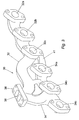
- the exhaust manifold 30 as shown in detail in Fig. 3 is a possible variant of the one shown in Figs. 1 and 2, but the principle is the same and identical indices are used where appropriate.
- the exhaust manifold is a multi-branch manifold, in this case two branches are present, a first branch 32 and a second branch 34.
- Each branch has three ports 32a-c, 34a-c, each port 32a-c, 34a-c corresponding to a single cylinder of the engine 10.
- Each branch is therefore connected to thee cylinders thereby artificially dividing the engine in two sections of three cylinders.
- the three cylinders in a group are likely to be adjacent to each other, but that may be varied if deemed appropriate.
- the two branches may have supporting bridge pieces 39, 41 in between them that do not provide fluid communication between the two branches.
- a flange 36 to allow a connection to the turbocharger 22.
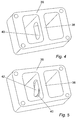
- the branches may share a common wall 38, they do not allow any mixing of the gas flows except via a passage 40 which in this example is located in the common wall as shown in Fig. 4.
- the passage may also be a connection between the two branches upstream of the common wall 38, for example by an external pipe (not shown).
- the inlet of the turbocharger is substantially a mirror image of the corresponding counterparts of the exhaust manifold, namely the flange and the common wall.
- the inlet section of the turbocharger therefore appears to be an extension of the exhaust manifold.
- the passage may be located in that part of the turbocharger that appears to extend the common wall of the exhaust manifold.
- turbocharger 22 operates via a pulse wave method. This method relies on a compact flow of gas to ensure a quick responsive behaviour of the turbocharger, the quick response relying on a separation of the various gas flows from the cylinder groups until proximal to the turbine of the turbocharger.
- the passage 40 may be controllable by a valve 42 as shown in Fig. 5.
- the valve is a simplistic representation of a butterfly valve, but any other suitable valve such as a sliding valve or an iris type valve may be used.
- the valve may be operated and/or controlled mechanically, electronically, hydraulically or pneumatically. Examples may be a pressure sensor in combination with an electronic control unit and electric motor, or an exhaust gas pressure actuated membrane directly connected with the valve via mechanical means.
- Fig. 6 One of the cylinders 11 of the engine 10 is partially shown in Fig. 6.
- the piston 52, the combustion chamber 53, the intake valve 56 and the exhaust valve 54 are conventional, and there may be more than just one intake valve and/or exhaust valve per cylinder.
- the opening and closing of the exhaust valve and the intake valve follow a fixed timing pattern relative to the angle of the crankshaft (not shown) but may also be controlled by a variable valve timing arrangement.
- the valves can be actuated by any suitable means such as a camshaft 58 and rocker arm 60, or via hydraulic or electronic arrangements (not shown).
- the internal combustion engine 10 uses the principle of iEGR via an iEGR arrangement 50 to improve emissions performance over a standard combustion process.
- iEGR can be achieved by either opening the intake valve 56 during the exhaust stroke of the piston 52 or by opening the exhaust valve 54 during the induction stroke of the piston.
- the principle used for this disclosure is the latter whereby during the induction stroke of the piston 52 part of the previously expelled exhaust gas is sucked back from the exhaust manifold 30 into the combustion chamber 53.
- the exhaust valve 54 is opened mainly during the period wherein the piston 52 is performing its exhaust stroke.
- the period that the exhaust valve 54 is opened may not be identical to the period in which the piston is in the exhaust stroke, the valve opening period may be either shorter or longer, but is usually not much longer than the period of the exhaust stroke. Hence no, or an insignificant amount of, exhaust gas is sucked back into the combustion chamber 53.
- the exhaust valve 54 is open during at least part of the piston's 52 downward inlet stroke, so there is a substantial overlap in the periods that both the inlet 56 and exhaust valves are at least partially open.
- valve lifts must be reduced.
- One of the reasons for reducing valve lift is that if the exhaust valve is not recessed deeply into the cylinder head 14, the clearance between the piston at TDC and the exhaust valve may not be sufficient to avoid interference. The exhaust valve may even have to be closed completely to avoid clashing with the piston. In that case, the exhaust valve is reopened after the piston has passed its TDC position to allow at least some of the previously expulsed exhaust gas to flow back into the combustion chamber 53 when the piston continues its downward induction stroke.
- Another variant uses a design that allows enough clearance between a partially opened exhaust valve 54 and the piston 52 at TDC, for example where the exhaust valve is recessed deeply into the cylinder head 14.
- the exhaust valve therefore does not have to be closed completely and so rather than reopening the exhaust valve, the exhaust valve follows a delayed closure pattern.
- the non-closure of the exhaust valve during the TDC position of the piston has the added benefit of gaining a better advantage of the pumping effect of the piston.
- injection events are also crucial. Whereas traditionally one injection took place per cycle, nowadays it is common to have multiple injection events per cycle, e.g. split injections or pilot, pre- or post injections in addition to a main injection. All these events influence the amount of exhaust gasses released at certain periods during a combustion cycle. Exhaust manifolds such as manifold 30 are designed to accommodate these exhaust gas pulses in a controllable manner so that the pulses do not interfere negatively with each other. However, interference problems may occur at several points in the speed range of an engine 10 as the manifold shape is a compromise to give an overall acceptable result across the operating range of the engine. A manifold with multiple branches that do not allow any fluid communication improves the pulsating action upon the turbine of the turbocharger and therefore the functioning of the turbocharger, but has the disadvantage that exhaust gas pressure pulses may cause the iEGR levels to be too high.
- emissions legislation may regulate the maximum level of emissions over certain engine speeds, e.g. 1400 rpm.
- iEGR is required above 1400 rpm to meet the emissions regulation.
- control systems such as wastegates are available to improve turbocharger efficiency throughout the speed range, the efficiency is still likely to vary.
- the turbocharger is less likely to easily supply a sufficient quantity of combustible air for an optimized combustion process. If exhaust gasses would flow back into the combustion chamber, the combustion process would be even less optimal and problems such as powerloss and visible smoke may occur. Therefore at would in this example be very beneficial to be able to reduce the amount iEGR at low engine speeds.
- a passage such as passage 40 allows a control of the amount of iEGR by reducing exhaust gas pressure pulses via a pressure relief. Due to the nature of combustion cycles and the firing orders employed, the branches 32, 34 of the manifold 30 are out of synchronisation with regards to pressure and pressure pulses.This translates into a flux situation wherein the branches alternate in low and high pressures without being equal except at cross-over points where the pressure simultaneously rises in one branch whilst falling in the other branch. The different pressures allow some gas to flow from the branch with the higher gas pressure to the branch with the lower gas pressure. Therefore the pressure peaks are absorbed which then obviously leads to less iEGR if the exhaust valve is open during the intake stroke.
- the passage is not variable or controllable, the passage is sized such that at all engine speeds the pressure relief from the first branch into the second branch and vice versa is performing to an overall acceptable level. However, more emphasis may be given to overcome a problem in a particular speed range such as the problem associated with low speed situations. If the passage is controllable it is likely that, to overcome the problems as indicated, the passage will be at a high degree of, or even maximum, opening at low engine speeds whilst it may be at a lower degree of, or minimum, opening at high engine speeds.
Landscapes
- Engineering & Computer Science (AREA)
- Chemical & Material Sciences (AREA)
- Combustion & Propulsion (AREA)
- Mechanical Engineering (AREA)
- General Engineering & Computer Science (AREA)
- Output Control And Ontrol Of Special Type Engine (AREA)
- Exhaust-Gas Circulating Devices (AREA)
Abstract
Description
- The disclosure relates to the field of internal combustion engines and more specifically to internal exhaust gas recirculation within such engines.
- The use of internal exhaust gas recirculation (iEGR) is a known method for reducing the amount of pollutants in the exhaust gasses of internal combustion engines. iEGR can be achieved by either introducing exhaust gas into the induction manifold or by allowing exhaust gas to flow back from the exhaust manifold into the combustion chamber during the induction stroke. DE2125368 teaches the principle of an internal exhaust gas recirculation arrangement in which exhaust gas is fed back to the combustion chamber during the intake stroke. However, problems due to exhaust gas pressure pulsations within the exhaust manifold have led to unsatisfactory results in emission control strategies. The present disclosure is aimed at overcoming one or more of the problems as described.
- In a first embodiment there is provided an internal combustion engine with a plurality of cylinders, each of the cylinders having a corresponding exhaust valve and the cylinders are divided into at least a first set and a second set. It furthermore includes an exhaust manifold, the exhaust manifold further having at least a first branch in direct fluid communication with the cylinders in the first cylinder set and a second branch being in direct fluid communication with the cylinders in the second cylinder set when the corresponding exhaust valves are in an open position.
- There is also an internal exhaust gas recirculation arrangement, allowing at least part of the exhaust gas to flow from the exhaust manifold into the cylinders during at least part of an intake stroke of said cylinders, and a passage located in or proximal to the exhaust manifold for fluidly connecting the first branch and the second branch adapted to reduce the flow of exhaust gas from the exhaust manifold into the cylinders.
- In a second embodiment there is provided a turbocharger for a multi-cylinder internal combustion engine. The internal combustion engine has a plurality of cylinders, each of the cylinders having a corresponding exhaust valve, and the cylinders are divided into sets. It further includes an exhaust manifold having at least two branches, each of the branches is in direct fluid connection with the cylinders in one of the cylinder sets when the corresponding exhaust valves are in a open position. There is also an internal exhaust gas recirculation arrangement, allowing at least part of the exhaust gasses to flow back from the exhaust manifold into the cylinders during an intake stroke of the cylinders. The turbocharger has an exhaust gas inlet, at least part of the exhaust gas inlet is adapted to maintain the gas flow separation from the cylinder sets, and a passage adapted to fluidly connect at least the at least two branches to reduce the back flow of exhaust gasses from the exhaust manifold into the cylinders. The passage is located in the exhaust gas inlet of the turbo charger.
-
- Fig. 1 is a partial schematic isometric view of an internal combustion engine according to the present disclosure.
- Fig. 2 is a partial schematic RHS view of the same engine as shown in Fig. 1.
- Fig. 3 is a schematic isometric view of an exhaust manifold according to the present disclosure.
- Fig. 4 is a representation of a passage within an exhaust manifold such as that shown in Fig. 3.
- Fig 5. is a schematic representation of a passage similar to that shown in Fig. 4, but with an additional valve.
- Fig. 6 is a schematic cross-sectional view of a combustion chamber and the porting arrangement of an internal combustion engines such as shown in Figs. 1 and 2.
- Figs. 1 and 2 show an
internal combustion engine 10. Theengine 10 is shown as a six cylinder in-line, turbo-charged, compression ignition engine, but this is for illustrative purposes only. The principle of the disclosure applies to engines with more or less cylinders, to engines configured differently such as V-style engines, to naturally aspirated engines and to spark ignited engines. - The
engine 10 has a plurality ofcylinders 11, acylinder block 12 and acylinder head 14, assembled together with a sealing arrangement in between (not shown). Connected to the cylinder head is aninduction arrangement 15, in this example shown as andinduction manifold 16 with aninduction pipe 18 for supplying the engine with air for the combustion process. Also connected to the cylinder head, but in this example at the opposite side of the induction arrangement, is anexhaust manifold 30 and connected thereto aturbocharger 22. For clarity purposes not all connections to and from the turbocharger are shown, but they are mostly conventional. - The
exhaust manifold 30 as shown in detail in Fig. 3 is a possible variant of the one shown in Figs. 1 and 2, but the principle is the same and identical indices are used where appropriate. The exhaust manifold is a multi-branch manifold, in this case two branches are present, afirst branch 32 and asecond branch 34. Each branch has threeports 32a-c, 34a-c, eachport 32a-c, 34a-c corresponding to a single cylinder of theengine 10. Each branch is therefore connected to thee cylinders thereby artificially dividing the engine in two sections of three cylinders. The three cylinders in a group are likely to be adjacent to each other, but that may be varied if deemed appropriate. The two branches may have supportingbridge pieces 39, 41 in between them that do not provide fluid communication between the two branches. At the downstream end of theexhaust manifold 30 there is aflange 36 to allow a connection to theturbocharger 22. Even though the branches may share acommon wall 38, they do not allow any mixing of the gas flows except via apassage 40 which in this example is located in the common wall as shown in Fig. 4. Alternatively the passage may also be a connection between the two branches upstream of thecommon wall 38, for example by an external pipe (not shown). Yet another alternative is where the inlet of the turbocharger is substantially a mirror image of the corresponding counterparts of the exhaust manifold, namely the flange and the common wall. The inlet section of the turbocharger therefore appears to be an extension of the exhaust manifold. In that case the passage may be located in that part of the turbocharger that appears to extend the common wall of the exhaust manifold. - Systems that maintain separate gas flows as described are common where the
turbocharger 22 operates via a pulse wave method. This method relies on a compact flow of gas to ensure a quick responsive behaviour of the turbocharger, the quick response relying on a separation of the various gas flows from the cylinder groups until proximal to the turbine of the turbocharger. - The
passage 40 may be controllable by avalve 42 as shown in Fig. 5. The valve is a simplistic representation of a butterfly valve, but any other suitable valve such as a sliding valve or an iris type valve may be used. The valve may be operated and/or controlled mechanically, electronically, hydraulically or pneumatically. Examples may be a pressure sensor in combination with an electronic control unit and electric motor, or an exhaust gas pressure actuated membrane directly connected with the valve via mechanical means. - One of the
cylinders 11 of theengine 10 is partially shown in Fig. 6. Thepiston 52, thecombustion chamber 53, theintake valve 56 and theexhaust valve 54 are conventional, and there may be more than just one intake valve and/or exhaust valve per cylinder. The opening and closing of the exhaust valve and the intake valve follow a fixed timing pattern relative to the angle of the crankshaft (not shown) but may also be controlled by a variable valve timing arrangement. The valves can be actuated by any suitable means such as acamshaft 58 androcker arm 60, or via hydraulic or electronic arrangements (not shown). - The
internal combustion engine 10 uses the principle of iEGR via aniEGR arrangement 50 to improve emissions performance over a standard combustion process. iEGR can be achieved by either opening theintake valve 56 during the exhaust stroke of thepiston 52 or by opening theexhaust valve 54 during the induction stroke of the piston. The principle used for this disclosure is the latter whereby during the induction stroke of thepiston 52 part of the previously expelled exhaust gas is sucked back from theexhaust manifold 30 into thecombustion chamber 53. - In conventional combustion cycles the
exhaust valve 54 is opened mainly during the period wherein thepiston 52 is performing its exhaust stroke. The period that theexhaust valve 54 is opened may not be identical to the period in which the piston is in the exhaust stroke, the valve opening period may be either shorter or longer, but is usually not much longer than the period of the exhaust stroke. Hence no, or an insignificant amount of, exhaust gas is sucked back into thecombustion chamber 53. - In this particular iEGR system the
exhaust valve 54 is open during at least part of the piston's 52 downward inlet stroke, so there is a substantial overlap in the periods that both theinlet 56 and exhaust valves are at least partially open. However, when the piston is approaching its top dead center (TDC) position, i.e. the end of the upward exhaust stroke, valve lifts must be reduced. One of the reasons for reducing valve lift is that if the exhaust valve is not recessed deeply into thecylinder head 14, the clearance between the piston at TDC and the exhaust valve may not be sufficient to avoid interference. The exhaust valve may even have to be closed completely to avoid clashing with the piston. In that case, the exhaust valve is reopened after the piston has passed its TDC position to allow at least some of the previously expulsed exhaust gas to flow back into thecombustion chamber 53 when the piston continues its downward induction stroke. - Another variant uses a design that allows enough clearance between a partially opened
exhaust valve 54 and thepiston 52 at TDC, for example where the exhaust valve is recessed deeply into thecylinder head 14. The exhaust valve therefore does not have to be closed completely and so rather than reopening the exhaust valve, the exhaust valve follows a delayed closure pattern. The non-closure of the exhaust valve during the TDC position of the piston has the added benefit of gaining a better advantage of the pumping effect of the piston. - In addition to the various valve events and iEGR for controlling combustion, injection events are also crucial. Whereas traditionally one injection took place per cycle, nowadays it is common to have multiple injection events per cycle, e.g. split injections or pilot, pre- or post injections in addition to a main injection. All these events influence the amount of exhaust gasses released at certain periods during a combustion cycle. Exhaust manifolds such as
manifold 30 are designed to accommodate these exhaust gas pulses in a controllable manner so that the pulses do not interfere negatively with each other. However, interference problems may occur at several points in the speed range of anengine 10 as the manifold shape is a compromise to give an overall acceptable result across the operating range of the engine. A manifold with multiple branches that do not allow any fluid communication improves the pulsating action upon the turbine of the turbocharger and therefore the functioning of the turbocharger, but has the disadvantage that exhaust gas pressure pulses may cause the iEGR levels to be too high. - For example, emissions legislation may regulate the maximum level of emissions over certain engine speeds, e.g. 1400 rpm. With two manifold branches that do not allow any fluid communication until proximal to the turbocharger, iEGR is required above 1400 rpm to meet the emissions regulation. Even though control systems such as wastegates are available to improve turbocharger efficiency throughout the speed range, the efficiency is still likely to vary. Especially at low speeds the turbocharger is less likely to easily supply a sufficient quantity of combustible air for an optimized combustion process. If exhaust gasses would flow back into the combustion chamber, the combustion process would be even less optimal and problems such as powerloss and visible smoke may occur. Therefore at would in this example be very beneficial to be able to reduce the amount iEGR at low engine speeds.
- A passage such as
passage 40 allows a control of the amount of iEGR by reducing exhaust gas pressure pulses via a pressure relief. Due to the nature of combustion cycles and the firing orders employed, thebranches - Of course it is to be understood that engines, subsystems, and especially manifolds with different characteristics combined with different operational demands may dictate different passage control regime.
- Although the preferred embodiments of this invention have been described herein, improvements and modifications may be incorporated without departing from the scope of the following claims.
Claims (19)
- An internal combustion engine (10) comprising;a plurality of cylinders (11), each of said cylinders having a corresponding exhaust valve (54), said cylinders being divided into at least a first set and a second set,an exhaust manifold (30), said exhaust manifold further having at least a first branch (32) and a second branch (34), said first branch being in direct fluid communication with said cylinders in said first cylinder set and said second branch being in direct fluid communication with said cylinders in said second cylinder set when said corresponding exhaust valves are in a open position,an internal exhaust gas recirculation arrangement (50), allowing at least part of the exhaust gas to flow from said exhaust manifold into said cylinders during at least part of an intake stroke of said cylinders, anda passage (40) located in or proximal to said exhaust manifold for fluidly connecting said first branch and said second branch adapted to reduce the flow of exhaust gas from said exhaust manifold into said cylinders.
- An internal combustion engine according to claim 1, wherein the sectional area of said passage is controllable.
- An internal combustion engine according to any of the preceding claims, wherein said exhaust valve is cam actuated.
- An internal combustion engine according to any of the preceding claims, wherein said exhaust valve is actuated by hydraulic, pneumatic or electric actuators.
- An internal combustion engine according to any of the preceding claims, wherein said multi-cylinder engine is a six cylinder in-line engine.
- An internal combustion engine according to any of the preceding claims, wherein said manifold has two branches and each of said two branches has a direct fluid connection to three of said cylinders when said corresponding exhaust valves are in a open position.
- An internal combustion engine according any of the preceding claims, wherein said first branch and said second branch share a common wall (38) and said passage is located in said common wall.
- An internal combustion engine according to any of the preceding claims, wherein said internal combustion engine further comprises a turbo charger (22).
- An internal combustion engine according to claim 8 wherein said passage is located in the exhaust manifold and proximal to an exhaust gas inlet side of said turbocharger.
- An internal combustion engine according to claim 8 wherein at least part of said exhaust gas inlet of said turbo charger maintains a gas flow separation from said cylinder sets and said passage is located in said exhaust gas inlet of said turbo charger.
- An internal combustion engine according to any of the preceding claims, wherein said internal combustion engine is a compression ignition engine.
- An internal combustion engine according to any of the preceding claims, wherein each of said cylinders further has a corresponding inlet valve (56), and there is a significant overlap of the periods in which said exhaust valve and said inlet valve are at least partially open.
- An internal combustion engine according to any of the preceding claims, wherein a cylinder receives multiple fuel injections per cycle.
- A method of operating an internal combustion engine (10), said internal combustion engine (10) comprising:a plurality of cylinders (11), each of said cylinders having a corresponding exhaust valve (54), said cylinders being divided into at least a first set and a second set,an exhaust manifold (30), said exhaust manifold further having at least a first branch (32) and a second branch (34), said first branch being in direct fluid communication with said cylinders in said first cylinder set and said second branch being in direct fluid communication with said cylinders in said second cylinder set when said corresponding exhaust valves are in a open position, the method comprising the steps of:allowing at least part of the exhaust gas to flow from said exhaust manifold into said cylinders during at least part of an intake stroke of said cylinders, andreducing the flow of exhaust gas from said exhaust manifold into said cylinders by fluidly connecting said first branch and said second branch by means of a passage (40) located in or proximal to said exhaust manifold.
- A method according to claim 14, comprising the step of controlling the sectional area of said passage.
- A method according to claims 14 or 15, wherein the sectional area of said passage is controlled during operation of the engine such that the sectional area of said passage is less than maximal during lower engine speeds.
- A method according to any of claims 14 to 16 wherein the closing of said exhaust valve is delayed.
- A method of operating an internal combustion engine according to any of the preceding claims wherein said exhaust valve travels towards a lower end of said internal combustion engine more than once per combustion cycle.
- A turbocharger (22) for a multi-cylinder internal combustion engine (10), said internal combustion engine comprising;a plurality of cylinders (11), each of said cylinders having a corresponding exhaust valve (54), said cylinders being divided into sets,an exhaust manifold (30) having at least two branches (32, 34), each of said branches being in direct fluid connection with said cylinders in one of said cylinder sets when said corresponding exhaust valves are in a open position, andan internal exhaust gas recirculation arrangement (50), allowing at least part of the exhaust gasses to flow back from said exhaust manifold into said cylinders during an intake stroke of said cylinders,an exhaust gas inlet, at least part of said exhaust gas inlet being adapted to maintain the gas flow separation from said cylinder sets, anda passage (40) adapted to fluidly connect at least said at least two branches to reduce the back flow of exhaust gasses from said exhaust manifold into said cylinders, said passage being located in said exhaust gas inlet of said turbo charger.
Priority Applications (2)
| Application Number | Priority Date | Filing Date | Title |
|---|---|---|---|
| EP04254978.2A EP1628014B1 (en) | 2004-08-19 | 2004-08-19 | Exhaust manifold arrangement |
| US11/206,910 US7150273B2 (en) | 2004-08-19 | 2005-08-19 | Exhaust manifold arrangement |
Applications Claiming Priority (1)
| Application Number | Priority Date | Filing Date | Title |
|---|---|---|---|
| EP04254978.2A EP1628014B1 (en) | 2004-08-19 | 2004-08-19 | Exhaust manifold arrangement |
Publications (2)
| Publication Number | Publication Date |
|---|---|
| EP1628014A1 true EP1628014A1 (en) | 2006-02-22 |
| EP1628014B1 EP1628014B1 (en) | 2014-12-03 |
Family
ID=34930579
Family Applications (1)
| Application Number | Title | Priority Date | Filing Date |
|---|---|---|---|
| EP04254978.2A Expired - Lifetime EP1628014B1 (en) | 2004-08-19 | 2004-08-19 | Exhaust manifold arrangement |
Country Status (2)
| Country | Link |
|---|---|
| US (1) | US7150273B2 (en) |
| EP (1) | EP1628014B1 (en) |
Cited By (4)
| Publication number | Priority date | Publication date | Assignee | Title |
|---|---|---|---|---|
| CN104100345A (en) * | 2013-04-07 | 2014-10-15 | 上海通用汽车有限公司 | Exhaust system as well as engine and automobile comprising exhaust system |
| CN105697134A (en) * | 2016-02-29 | 2016-06-22 | 昆明云内动力股份有限公司 | Pulse type exhaust turbocharging system for gas diesel engine |
| GB2546821A (en) * | 2016-02-01 | 2017-08-02 | Bamford Excavators Ltd | An exhaust manifold |
| CN111927656A (en) * | 2020-09-25 | 2020-11-13 | 山东信德玛珂增压器股份有限公司 | Exhaust gas recirculation system with asymmetric flow |
Families Citing this family (6)
| Publication number | Priority date | Publication date | Assignee | Title |
|---|---|---|---|---|
| US20060032219A1 (en) * | 2004-08-12 | 2006-02-16 | Perkins Engines Company | Power system exhaust manifold |
| US20090026009A1 (en) * | 2005-03-24 | 2009-01-29 | Kenji Itoh | Exhaust member |
| US8079214B2 (en) * | 2007-12-14 | 2011-12-20 | Hyundai Motor Company | Integrally formed engine exhaust manifold and cylinder head |
| US20090223494A1 (en) * | 2008-03-10 | 2009-09-10 | Watts Fredrick Williamson | Internal combustion oxygen injection process |
| US9145837B2 (en) * | 2011-11-29 | 2015-09-29 | General Electric Company | Engine utilizing a plurality of fuels, and a related method thereof |
| US8935917B2 (en) * | 2013-01-28 | 2015-01-20 | GM Global Technology Operations LLC | Partially integrated exhaust manifold |
Citations (5)
| Publication number | Priority date | Publication date | Assignee | Title |
|---|---|---|---|---|
| US3941113A (en) * | 1973-11-28 | 1976-03-02 | Societe Anonyme De Vehicules Industriels Et D'equipement Mecaniques Saviem | Multicylinder heat engines |
| US4732118A (en) * | 1986-07-04 | 1988-03-22 | Toyota Jidosha Kabushiki Kaisha | Two-cycle internal combustion engine |
| US5517976A (en) * | 1993-07-20 | 1996-05-21 | Mtu Motoren- Und Turbinen-Union Friedrichshafen Gmbh | Diesel engine equipped for reducing harmful substances in its operation |
| JPH10169513A (en) * | 1996-12-11 | 1998-06-23 | Ishikawajima Harima Heavy Ind Co Ltd | Exhaust gas purification system for multi-cylinder internal combustion engine |
| EP1406002A1 (en) * | 2002-10-04 | 2004-04-07 | Mazda Motor Corporation | Spark-ignition engine controller |
Family Cites Families (46)
| Publication number | Priority date | Publication date | Assignee | Title |
|---|---|---|---|---|
| US2941113A (en) * | 1957-04-01 | 1960-06-14 | Hughes Aircraft Co | Traveling-wave tube |
| CH360704A (en) | 1960-03-15 | 1962-03-15 | Mayor Henry | Safety device for an air carrier cable |
| AT279275B (en) * | 1968-08-07 | 1970-02-25 | Maschf Augsburg Nuernberg Ag | Exhaust throttle for exhaust brakes on supercharged combustion engines |
| BE759780A (en) * | 1969-12-04 | 1971-05-17 | Bbc Brown Boveri & Cie | METHOD AND DEVICE FOR PULSE SUPPLY FROM AN INTERNAL ACOMBUSTION MOTOR |
| GB1294821A (en) | 1970-05-25 | 1972-11-01 | ||
| CA969827A (en) | 1971-11-09 | 1975-06-24 | Texaco Development Corporation | Exhaust gas recirculation system for smog prevention |
| US3768248A (en) * | 1971-12-27 | 1973-10-30 | Caterpillar Tractor Co | Exhaust manifolding |
| JPS5031216A (en) * | 1973-07-18 | 1975-03-27 | ||
| JPS5113024A (en) | 1974-07-24 | 1976-02-02 | Automobile Antipollution | KAHENSUTEEJISHIKIKIKAKI |
| CH638869A5 (en) * | 1979-03-14 | 1983-10-14 | Bbc Brown Boveri & Cie | METHOD FOR PROMOTING AND CONTROLLING THE BYPASS AIR FLOW IN CHARGED COMBUSTION ENGINES AND COMBUSTION ENGINE FOR CARRYING OUT THE METHOD. |
| US4395884A (en) * | 1981-02-26 | 1983-08-02 | The Jacobs Manufacturing Company | Method and apparatus for improved engine braking and operation |
| DE3150001C2 (en) * | 1981-12-17 | 1986-08-14 | Mtu Motoren- Und Turbinen-Union Friedrichshafen Gmbh, 7990 Friedrichshafen | Piston internal combustion engine with supercharging |
| JPS58210320A (en) | 1982-05-29 | 1983-12-07 | Hino Motors Ltd | Inertial supercharging device for multicylinder engine with turbocharger |
| US4714056A (en) * | 1984-08-03 | 1987-12-22 | Honda Giken Kogyo Kabushiki Kaisha | Two-cycle engine |
| JPS61205331A (en) | 1985-03-08 | 1986-09-11 | Isamu Nemoto | Air pressure control mechanism of variable turbocharger |
| JPS6247721U (en) * | 1985-09-10 | 1987-03-24 | ||
| US4813232A (en) * | 1986-05-30 | 1989-03-21 | Mazda Motor Corporation | Exhaust device for internal combustion engine |
| US4732117A (en) * | 1986-07-02 | 1988-03-22 | Toyota Jidosha Kabushiki Kaisha | Two-cycle internal combustion engine |
| JPH06102981B2 (en) * | 1986-07-02 | 1994-12-14 | トヨタ自動車株式会社 | 2-cycle internal combustion engine |
| JPS6424118A (en) | 1987-07-15 | 1989-01-26 | Yanmar Diesel Engine Co | Internal-combustion engine with exhaust turbo charger |
| GB2253881A (en) | 1989-11-22 | 1992-09-23 | Geoffrey Kershaw | Multiple turbocharging |
| GB8926346D0 (en) | 1989-11-22 | 1990-01-10 | Kershaw Geoffrey | Multiple turbocharging |
| JP2586164B2 (en) * | 1990-02-03 | 1997-02-26 | トヨタ自動車株式会社 | Exhaust system of internal combustion engine |
| JPH0674038A (en) | 1992-08-26 | 1994-03-15 | Yanmar Diesel Engine Co Ltd | Exhaust manifold |
| SE501437C2 (en) * | 1993-06-22 | 1995-02-13 | Volvo Ab | Valve mechanism in an internal combustion engine |
| US5406918A (en) * | 1993-08-04 | 1995-04-18 | Hino Jidosha Kogyo Kabushiki Kaisha | Internal combustion engine |
| US5406795A (en) * | 1994-01-21 | 1995-04-18 | Cummins Engine Company, Inc. | Exhaust manifold to turbine casing flanges |
| DE19521573C2 (en) * | 1995-06-14 | 1998-05-28 | Man Nutzfahrzeuge Ag | Exhaust gas recirculation on a supercharged internal combustion engine |
| DE19539572A1 (en) * | 1995-10-25 | 1997-04-30 | Asea Brown Boveri | Exhaust pipe system for a turbocharged four-stroke internal combustion engine |
| DE19621530C1 (en) * | 1996-05-29 | 1997-06-05 | Daimler Benz Ag | Method of reducing harmful emissions from multicylinder combustion engines |
| JPH1089033A (en) | 1996-09-19 | 1998-04-07 | Hino Motors Ltd | Valve system of engine |
| KR100566648B1 (en) * | 1997-01-29 | 2006-03-31 | 히노지도샤코교 가부시기가이샤 | Exhaust gas recirculation unit |
| US6003315A (en) * | 1997-03-31 | 1999-12-21 | Caterpillar Inc. | Exhaust gas recirculation system for an internal combustion engine |
| US5740671A (en) * | 1997-04-01 | 1998-04-21 | Jones; Mack L. | Balance box exhaust accelerator |
| FR2768178B1 (en) * | 1997-09-11 | 1999-11-19 | Daniel Drecq | INTERNAL COMBUSTION ENGINE COMPRISING MEANS FOR RECIRCULATION OF EXHAUST AND SUPPLY GASES |
| JPH1193715A (en) | 1997-09-25 | 1999-04-06 | Hino Motors Ltd | Internal combustion engine |
| US6089019A (en) * | 1999-01-15 | 2000-07-18 | Borgwarner Inc. | Turbocharger and EGR system |
| JP4344455B2 (en) * | 1999-09-03 | 2009-10-14 | 本田技研工業株式会社 | Engine intake and exhaust control system |
| JP4004193B2 (en) * | 1999-10-06 | 2007-11-07 | 日野自動車株式会社 | Exhaust gas recirculation device for turbocharged engines |
| DE19952093C1 (en) * | 1999-10-29 | 2000-08-10 | Daimler Chrysler Ag | Compression ignition 4-stroke engine has control and regulation device controlliing timed opening and closing of inlet and outlet valves for each engine cylinder |
| US6675572B2 (en) * | 2000-09-14 | 2004-01-13 | Siemens Automotive Inc. | Valve including a recirculation chamber |
| US6662554B2 (en) * | 2002-01-23 | 2003-12-16 | Deere & Company | Adjustable restriction muffler system for a combine |
| JP3956783B2 (en) * | 2002-07-02 | 2007-08-08 | マツダ株式会社 | Control device for spark ignition engine |
| JP3846393B2 (en) * | 2002-09-30 | 2006-11-15 | マツダ株式会社 | Control device for spark ignition engine |
| US6932062B2 (en) * | 2003-11-07 | 2005-08-23 | Kabushiki Kaisha Toyota Jidoshokki | Compression ignition type internal combustion engine |
| US6932063B1 (en) * | 2004-08-12 | 2005-08-23 | Eaton Corporation | Internal EGR cooler |
-
2004
- 2004-08-19 EP EP04254978.2A patent/EP1628014B1/en not_active Expired - Lifetime
-
2005
- 2005-08-19 US US11/206,910 patent/US7150273B2/en not_active Expired - Lifetime
Patent Citations (5)
| Publication number | Priority date | Publication date | Assignee | Title |
|---|---|---|---|---|
| US3941113A (en) * | 1973-11-28 | 1976-03-02 | Societe Anonyme De Vehicules Industriels Et D'equipement Mecaniques Saviem | Multicylinder heat engines |
| US4732118A (en) * | 1986-07-04 | 1988-03-22 | Toyota Jidosha Kabushiki Kaisha | Two-cycle internal combustion engine |
| US5517976A (en) * | 1993-07-20 | 1996-05-21 | Mtu Motoren- Und Turbinen-Union Friedrichshafen Gmbh | Diesel engine equipped for reducing harmful substances in its operation |
| JPH10169513A (en) * | 1996-12-11 | 1998-06-23 | Ishikawajima Harima Heavy Ind Co Ltd | Exhaust gas purification system for multi-cylinder internal combustion engine |
| EP1406002A1 (en) * | 2002-10-04 | 2004-04-07 | Mazda Motor Corporation | Spark-ignition engine controller |
Non-Patent Citations (1)
| Title |
|---|
| PATENT ABSTRACTS OF JAPAN vol. 1998, no. 11 30 September 1998 (1998-09-30) * |
Cited By (5)
| Publication number | Priority date | Publication date | Assignee | Title |
|---|---|---|---|---|
| CN104100345A (en) * | 2013-04-07 | 2014-10-15 | 上海通用汽车有限公司 | Exhaust system as well as engine and automobile comprising exhaust system |
| GB2546821A (en) * | 2016-02-01 | 2017-08-02 | Bamford Excavators Ltd | An exhaust manifold |
| CN105697134A (en) * | 2016-02-29 | 2016-06-22 | 昆明云内动力股份有限公司 | Pulse type exhaust turbocharging system for gas diesel engine |
| CN105697134B (en) * | 2016-02-29 | 2018-05-22 | 昆明云内动力股份有限公司 | Combustion gas use for diesel engine pulse type gas exhausting turbo charge system |
| CN111927656A (en) * | 2020-09-25 | 2020-11-13 | 山东信德玛珂增压器股份有限公司 | Exhaust gas recirculation system with asymmetric flow |
Also Published As
| Publication number | Publication date |
|---|---|
| US7150273B2 (en) | 2006-12-19 |
| US20060037592A1 (en) | 2006-02-23 |
| EP1628014B1 (en) | 2014-12-03 |
Similar Documents
| Publication | Publication Date | Title |
|---|---|---|
| US7644586B2 (en) | Control of supercharged engine | |
| US7201121B2 (en) | Combustion engine including fluidically-driven engine valve actuator | |
| US8235013B2 (en) | Internal combustion engine | |
| US6615776B1 (en) | Method of operating a multi-cylinder internal combustion engine | |
| EP2119888A2 (en) | Parallel sequential turbocharger architecture using engine cylinder variable valve lift system | |
| US8479509B2 (en) | Internal combustion engine | |
| US7500475B2 (en) | Engine and method for operating an engine | |
| US7150273B2 (en) | Exhaust manifold arrangement | |
| US7028652B2 (en) | Device for controlling an internal combustion engine with a variable valve timing system | |
| GB2513619A (en) | Internal combustion engine with exhaust turbomachines | |
| JP3783765B2 (en) | EGR device for turbocharged engine | |
| JP5803326B2 (en) | Lean burn engine with turbocharger | |
| US20190093571A1 (en) | Engine control device | |
| US8100099B2 (en) | Method for operating an internal combustion engine, and internal combustion engine for carrying out said method | |
| EP2063092A1 (en) | An internal combustion engine system, and a method in such an engine system | |
| JP2017166456A (en) | Engine control device | |
| JP2009293537A (en) | Control device for internal combustion engine | |
| JP2014214638A (en) | Engine device with turbo supercharger | |
| EP4144968B1 (en) | Control device for a supercharged engine provided with two exhaust valves per cylinder | |
| JP2009052505A (en) | Internal combustion engine | |
| JP2012097667A (en) | Control device of internal combustion engine | |
| US20190120126A1 (en) | Method for Using Combustion Engine and Combustion Engine Assembly | |
| JP2008303745A (en) | Control device for internal combustion engine | |
| US7917280B2 (en) | Method and device for operating an internal combustion engine | |
| EP1034363B1 (en) | Internal combustion engine comprising at least one cylinder and individual intake passages |
Legal Events
| Date | Code | Title | Description |
|---|---|---|---|
| PUAI | Public reference made under article 153(3) epc to a published international application that has entered the european phase |
Free format text: ORIGINAL CODE: 0009012 |
|
| AK | Designated contracting states |
Kind code of ref document: A1 Designated state(s): AT BE BG CH CY CZ DE DK EE ES FI FR GB GR HU IE IT LI LU MC NL PL PT RO SE SI SK TR |
|
| AX | Request for extension of the european patent |
Extension state: AL HR LT LV MK |
|
| 17P | Request for examination filed |
Effective date: 20060609 |
|
| AKX | Designation fees paid |
Designated state(s): AT BE BG CH CY CZ DE DK EE ES FI FR GB GR HU IE IT LI LU MC NL PL PT RO SE SI SK TR |
|
| 17Q | First examination report despatched |
Effective date: 20080306 |
|
| GRAP | Despatch of communication of intention to grant a patent |
Free format text: ORIGINAL CODE: EPIDOSNIGR1 |
|
| INTG | Intention to grant announced |
Effective date: 20140703 |
|
| GRAS | Grant fee paid |
Free format text: ORIGINAL CODE: EPIDOSNIGR3 |
|
| GRAA | (expected) grant |
Free format text: ORIGINAL CODE: 0009210 |
|
| AK | Designated contracting states |
Kind code of ref document: B1 Designated state(s): AT BE BG CH CY CZ DE DK EE ES FI FR GB GR HU IE IT LI LU MC NL PL PT RO SE SI SK TR |
|
| REG | Reference to a national code |
Ref country code: GB Ref legal event code: FG4D |
|
| REG | Reference to a national code |
Ref country code: AT Ref legal event code: REF Ref document number: 699524 Country of ref document: AT Kind code of ref document: T Effective date: 20141215 Ref country code: CH Ref legal event code: EP |
|
| REG | Reference to a national code |
Ref country code: IE Ref legal event code: FG4D |
|
| REG | Reference to a national code |
Ref country code: DE Ref legal event code: R096 Ref document number: 602004046248 Country of ref document: DE Effective date: 20150108 |
|
| REG | Reference to a national code |
Ref country code: NL Ref legal event code: VDEP Effective date: 20141203 |
|
| REG | Reference to a national code |
Ref country code: AT Ref legal event code: MK05 Ref document number: 699524 Country of ref document: AT Kind code of ref document: T Effective date: 20141203 |
|
| PG25 | Lapsed in a contracting state [announced via postgrant information from national office to epo] |
Ref country code: ES Free format text: LAPSE BECAUSE OF FAILURE TO SUBMIT A TRANSLATION OF THE DESCRIPTION OR TO PAY THE FEE WITHIN THE PRESCRIBED TIME-LIMIT Effective date: 20141203 Ref country code: FI Free format text: LAPSE BECAUSE OF FAILURE TO SUBMIT A TRANSLATION OF THE DESCRIPTION OR TO PAY THE FEE WITHIN THE PRESCRIBED TIME-LIMIT Effective date: 20141203 Ref country code: NL Free format text: LAPSE BECAUSE OF FAILURE TO SUBMIT A TRANSLATION OF THE DESCRIPTION OR TO PAY THE FEE WITHIN THE PRESCRIBED TIME-LIMIT Effective date: 20141203 |
|
| PG25 | Lapsed in a contracting state [announced via postgrant information from national office to epo] |
Ref country code: CY Free format text: LAPSE BECAUSE OF FAILURE TO SUBMIT A TRANSLATION OF THE DESCRIPTION OR TO PAY THE FEE WITHIN THE PRESCRIBED TIME-LIMIT Effective date: 20141203 Ref country code: GR Free format text: LAPSE BECAUSE OF FAILURE TO SUBMIT A TRANSLATION OF THE DESCRIPTION OR TO PAY THE FEE WITHIN THE PRESCRIBED TIME-LIMIT Effective date: 20150304 Ref country code: AT Free format text: LAPSE BECAUSE OF FAILURE TO SUBMIT A TRANSLATION OF THE DESCRIPTION OR TO PAY THE FEE WITHIN THE PRESCRIBED TIME-LIMIT Effective date: 20141203 Ref country code: SE Free format text: LAPSE BECAUSE OF FAILURE TO SUBMIT A TRANSLATION OF THE DESCRIPTION OR TO PAY THE FEE WITHIN THE PRESCRIBED TIME-LIMIT Effective date: 20141203 |
|
| PG25 | Lapsed in a contracting state [announced via postgrant information from national office to epo] |
Ref country code: RO Free format text: LAPSE BECAUSE OF FAILURE TO SUBMIT A TRANSLATION OF THE DESCRIPTION OR TO PAY THE FEE WITHIN THE PRESCRIBED TIME-LIMIT Effective date: 20141203 Ref country code: PT Free format text: LAPSE BECAUSE OF FAILURE TO SUBMIT A TRANSLATION OF THE DESCRIPTION OR TO PAY THE FEE WITHIN THE PRESCRIBED TIME-LIMIT Effective date: 20150403 Ref country code: EE Free format text: LAPSE BECAUSE OF FAILURE TO SUBMIT A TRANSLATION OF THE DESCRIPTION OR TO PAY THE FEE WITHIN THE PRESCRIBED TIME-LIMIT Effective date: 20141203 Ref country code: CZ Free format text: LAPSE BECAUSE OF FAILURE TO SUBMIT A TRANSLATION OF THE DESCRIPTION OR TO PAY THE FEE WITHIN THE PRESCRIBED TIME-LIMIT Effective date: 20141203 Ref country code: SK Free format text: LAPSE BECAUSE OF FAILURE TO SUBMIT A TRANSLATION OF THE DESCRIPTION OR TO PAY THE FEE WITHIN THE PRESCRIBED TIME-LIMIT Effective date: 20141203 |
|
| PG25 | Lapsed in a contracting state [announced via postgrant information from national office to epo] |
Ref country code: PL Free format text: LAPSE BECAUSE OF FAILURE TO SUBMIT A TRANSLATION OF THE DESCRIPTION OR TO PAY THE FEE WITHIN THE PRESCRIBED TIME-LIMIT Effective date: 20141203 |
|
| REG | Reference to a national code |
Ref country code: DE Ref legal event code: R097 Ref document number: 602004046248 Country of ref document: DE |
|
| PLBE | No opposition filed within time limit |
Free format text: ORIGINAL CODE: 0009261 |
|
| STAA | Information on the status of an ep patent application or granted ep patent |
Free format text: STATUS: NO OPPOSITION FILED WITHIN TIME LIMIT |
|
| PG25 | Lapsed in a contracting state [announced via postgrant information from national office to epo] |
Ref country code: DK Free format text: LAPSE BECAUSE OF FAILURE TO SUBMIT A TRANSLATION OF THE DESCRIPTION OR TO PAY THE FEE WITHIN THE PRESCRIBED TIME-LIMIT Effective date: 20141203 |
|
| PGFP | Annual fee paid to national office [announced via postgrant information from national office to epo] |
Ref country code: GB Payment date: 20150728 Year of fee payment: 12 Ref country code: DE Payment date: 20150831 Year of fee payment: 12 |
|
| 26N | No opposition filed |
Effective date: 20150904 |
|
| PG25 | Lapsed in a contracting state [announced via postgrant information from national office to epo] |
Ref country code: IT Free format text: LAPSE BECAUSE OF FAILURE TO SUBMIT A TRANSLATION OF THE DESCRIPTION OR TO PAY THE FEE WITHIN THE PRESCRIBED TIME-LIMIT Effective date: 20141203 |
|
| PG25 | Lapsed in a contracting state [announced via postgrant information from national office to epo] |
Ref country code: SI Free format text: LAPSE BECAUSE OF FAILURE TO SUBMIT A TRANSLATION OF THE DESCRIPTION OR TO PAY THE FEE WITHIN THE PRESCRIBED TIME-LIMIT Effective date: 20141203 |
|
| PG25 | Lapsed in a contracting state [announced via postgrant information from national office to epo] |
Ref country code: MC Free format text: LAPSE BECAUSE OF FAILURE TO SUBMIT A TRANSLATION OF THE DESCRIPTION OR TO PAY THE FEE WITHIN THE PRESCRIBED TIME-LIMIT Effective date: 20141203 Ref country code: LU Free format text: LAPSE BECAUSE OF FAILURE TO SUBMIT A TRANSLATION OF THE DESCRIPTION OR TO PAY THE FEE WITHIN THE PRESCRIBED TIME-LIMIT Effective date: 20150819 |
|
| REG | Reference to a national code |
Ref country code: CH Ref legal event code: PL |
|
| PG25 | Lapsed in a contracting state [announced via postgrant information from national office to epo] |
Ref country code: LI Free format text: LAPSE BECAUSE OF NON-PAYMENT OF DUE FEES Effective date: 20150831 Ref country code: CH Free format text: LAPSE BECAUSE OF NON-PAYMENT OF DUE FEES Effective date: 20150831 |
|
| PG25 | Lapsed in a contracting state [announced via postgrant information from national office to epo] |
Ref country code: BE Free format text: LAPSE BECAUSE OF FAILURE TO SUBMIT A TRANSLATION OF THE DESCRIPTION OR TO PAY THE FEE WITHIN THE PRESCRIBED TIME-LIMIT Effective date: 20141203 |
|
| REG | Reference to a national code |
Ref country code: IE Ref legal event code: MM4A |
|
| REG | Reference to a national code |
Ref country code: FR Ref legal event code: ST Effective date: 20160429 |
|
| PG25 | Lapsed in a contracting state [announced via postgrant information from national office to epo] |
Ref country code: IE Free format text: LAPSE BECAUSE OF NON-PAYMENT OF DUE FEES Effective date: 20150819 |
|
| PG25 | Lapsed in a contracting state [announced via postgrant information from national office to epo] |
Ref country code: FR Free format text: LAPSE BECAUSE OF NON-PAYMENT OF DUE FEES Effective date: 20150831 |
|
| REG | Reference to a national code |
Ref country code: DE Ref legal event code: R119 Ref document number: 602004046248 Country of ref document: DE |
|
| GBPC | Gb: european patent ceased through non-payment of renewal fee |
Effective date: 20160819 |
|
| PG25 | Lapsed in a contracting state [announced via postgrant information from national office to epo] |
Ref country code: BG Free format text: LAPSE BECAUSE OF FAILURE TO SUBMIT A TRANSLATION OF THE DESCRIPTION OR TO PAY THE FEE WITHIN THE PRESCRIBED TIME-LIMIT Effective date: 20141203 Ref country code: HU Free format text: LAPSE BECAUSE OF FAILURE TO SUBMIT A TRANSLATION OF THE DESCRIPTION OR TO PAY THE FEE WITHIN THE PRESCRIBED TIME-LIMIT; INVALID AB INITIO Effective date: 20040819 |
|
| PG25 | Lapsed in a contracting state [announced via postgrant information from national office to epo] |
Ref country code: DE Free format text: LAPSE BECAUSE OF NON-PAYMENT OF DUE FEES Effective date: 20170301 Ref country code: GB Free format text: LAPSE BECAUSE OF NON-PAYMENT OF DUE FEES Effective date: 20160819 |
|
| PG25 | Lapsed in a contracting state [announced via postgrant information from national office to epo] |
Ref country code: TR Free format text: LAPSE BECAUSE OF FAILURE TO SUBMIT A TRANSLATION OF THE DESCRIPTION OR TO PAY THE FEE WITHIN THE PRESCRIBED TIME-LIMIT Effective date: 20141203 |