EP1626332A2 - Verfahren zur Einstellung eines Kommunikationsparameters zwischen Hauptcomputer und Peripheriegerät - Google Patents
Verfahren zur Einstellung eines Kommunikationsparameters zwischen Hauptcomputer und Peripheriegerät Download PDFInfo
- Publication number
- EP1626332A2 EP1626332A2 EP05011154A EP05011154A EP1626332A2 EP 1626332 A2 EP1626332 A2 EP 1626332A2 EP 05011154 A EP05011154 A EP 05011154A EP 05011154 A EP05011154 A EP 05011154A EP 1626332 A2 EP1626332 A2 EP 1626332A2
- Authority
- EP
- European Patent Office
- Prior art keywords
- communication parameter
- mode
- drive
- host system
- disc drive
- Prior art date
- Legal status (The legal status is an assumption and is not a legal conclusion. Google has not performed a legal analysis and makes no representation as to the accuracy of the status listed.)
- Ceased
Links
Images




Classifications
-
- G—PHYSICS
- G06—COMPUTING OR CALCULATING; COUNTING
- G06F—ELECTRIC DIGITAL DATA PROCESSING
- G06F13/00—Interconnection of, or transfer of information or other signals between, memories, input/output devices or central processing units
- G06F13/38—Information transfer, e.g. on bus
- G06F13/382—Information transfer, e.g. on bus using universal interface adapter
- G06F13/385—Information transfer, e.g. on bus using universal interface adapter for adaptation of a particular data processing system to different peripheral devices
-
- G—PHYSICS
- G06—COMPUTING OR CALCULATING; COUNTING
- G06F—ELECTRIC DIGITAL DATA PROCESSING
- G06F13/00—Interconnection of, or transfer of information or other signals between, memories, input/output devices or central processing units
- G06F13/10—Program control for peripheral devices
-
- G—PHYSICS
- G06—COMPUTING OR CALCULATING; COUNTING
- G06F—ELECTRIC DIGITAL DATA PROCESSING
- G06F3/00—Input arrangements for transferring data to be processed into a form capable of being handled by the computer; Output arrangements for transferring data from processing unit to output unit, e.g. interface arrangements
- G06F3/06—Digital input from, or digital output to, record carriers, e.g. RAID, emulated record carriers or networked record carriers
- G06F3/0601—Interfaces specially adapted for storage systems
- G06F3/0602—Interfaces specially adapted for storage systems specifically adapted to achieve a particular effect
- G06F3/061—Improving I/O performance
-
- G—PHYSICS
- G06—COMPUTING OR CALCULATING; COUNTING
- G06F—ELECTRIC DIGITAL DATA PROCESSING
- G06F3/00—Input arrangements for transferring data to be processed into a form capable of being handled by the computer; Output arrangements for transferring data from processing unit to output unit, e.g. interface arrangements
- G06F3/06—Digital input from, or digital output to, record carriers, e.g. RAID, emulated record carriers or networked record carriers
- G06F3/0601—Interfaces specially adapted for storage systems
- G06F3/0628—Interfaces specially adapted for storage systems making use of a particular technique
- G06F3/0655—Vertical data movement, i.e. input-output transfer; data movement between one or more hosts and one or more storage devices
- G06F3/0658—Controller construction arrangements
-
- G—PHYSICS
- G06—COMPUTING OR CALCULATING; COUNTING
- G06F—ELECTRIC DIGITAL DATA PROCESSING
- G06F3/00—Input arrangements for transferring data to be processed into a form capable of being handled by the computer; Output arrangements for transferring data from processing unit to output unit, e.g. interface arrangements
- G06F3/06—Digital input from, or digital output to, record carriers, e.g. RAID, emulated record carriers or networked record carriers
- G06F3/0601—Interfaces specially adapted for storage systems
- G06F3/0628—Interfaces specially adapted for storage systems making use of a particular technique
- G06F3/0655—Vertical data movement, i.e. input-output transfer; data movement between one or more hosts and one or more storage devices
- G06F3/0661—Format or protocol conversion arrangements
-
- G—PHYSICS
- G06—COMPUTING OR CALCULATING; COUNTING
- G06F—ELECTRIC DIGITAL DATA PROCESSING
- G06F3/00—Input arrangements for transferring data to be processed into a form capable of being handled by the computer; Output arrangements for transferring data from processing unit to output unit, e.g. interface arrangements
- G06F3/06—Digital input from, or digital output to, record carriers, e.g. RAID, emulated record carriers or networked record carriers
- G06F3/0601—Interfaces specially adapted for storage systems
- G06F3/0668—Interfaces specially adapted for storage systems adopting a particular infrastructure
- G06F3/0671—In-line storage system
- G06F3/0673—Single storage device
- G06F3/0674—Disk device
-
- G—PHYSICS
- G06—COMPUTING OR CALCULATING; COUNTING
- G06F—ELECTRIC DIGITAL DATA PROCESSING
- G06F3/00—Input arrangements for transferring data to be processed into a form capable of being handled by the computer; Output arrangements for transferring data from processing unit to output unit, e.g. interface arrangements
- G06F3/06—Digital input from, or digital output to, record carriers, e.g. RAID, emulated record carriers or networked record carriers
- G06F3/0601—Interfaces specially adapted for storage systems
- G06F3/0628—Interfaces specially adapted for storage systems making use of a particular technique
- G06F3/0653—Monitoring storage devices or systems
Definitions
- the present invention relates to a method of setting a communication parameter between a host system and a peripheral device, and more particularly, to a method of setting a communication parameter between a host system and a peripheral device, in which an optimal communication parameter can be employed depending on a physical connection state of the host system and the peripheral device to ensure a signal integrity.
- Disc drive for a Personal Computer is a recording/reproducing device used for information storage. Recently, together with a high capacity of the disc drive, a standard of a PC interface has been remarkably developed. Above 90% of the PC used today employs an ATA (AT Attachment) interface as a standard of interface for transferring data to a disc drive buffer and a memory.
- ATA AT Attachment
- the ATA is called AT-BUS or IDE (Integrated Drive Electronics), and is generally called AT.
- An exact denomination is the ATA on the basis of a standard of ANSI (American National Standards Institute).
- the IDE is a name of the company that invented the ATA.
- ST-506 interface had a drawback in that it was at a high price due to a disc controller separately installed outside of the drive, and a noise was generated when a signal was propagated.
- the ATA interface is reasonable in price since the ATA interface has a simple structure due to the disc controller installed inside the drive, and it has increased data reliability by solving the drawback of a noise generation.
- the ATA interface become most-widely used in the latter half of the 1980's.
- Improved standards of the ATA were developed in the sequence of ATA-2, ATAPI, and Ultra ATA.
- the ATA Peripheral Interface solves a disadvantage that the ATA is just only for the hard disc drive.
- the ATAPI still supports an optical disc drive beside the hard disc drive.
- the interface of the ATA-2 standard has a propagation rate of 16.7MB/s.
- data can be propagated only at the rising time of a strobe signal since a processor needs a time to send a command to the disc controller for processing.
- Hard disc drive should wait until the host that is an interface controller sends a strobe signal.
- the Ultra ATA on confirming whether or not a bus is in an idle state at a response requesting side, data propagation is initiated before an allowance of the processor. That is, a time (Propagation delay) taken to wait the strobe signal propagated from the host and a time (Return delay) taken to send data on the bus are all removed to increase a bus propagation speed. Further, a timing interval is improved and a new error correction way such as a Cyclical Redundancy Check (CRC) is used to enhance the preservation of data. That is, the Ultra ATA is an extended propagation standard of the ATA, and has a bandwidth of 33MB/s that is almost twice as much as a Direct Memory Access (DMA) mode.
- DMA Direct Memory Access
- Ultra DMA66 has been developed.
- An object of the Ultra DMA66 is to increase a propagation rate of a disc reading channel causing a bottleneck in a system performance.
- the object of the Ultra DMA66 is to enhance the data reliability using the CRC (error inspection and correction).
- the Ultra DMA66 is designed to change only the cable for a minimal equipment replacement, thereby allowing the protocol to have a lower-side compatibility.
- the cable also uses forty pins in its entirety, but uses eighty lines in total, twice as much as before.
- the added forty lines act as a ground.
- the added lines do not propagate signals there through.
- the propagation speed is increased twice as much as that of the Ultra DMA33.
- the increased propagation speed is applied only in a burst mode, and has a limitation in that the cable should have necessarily eighty pins, a total length must not be more than eighteen inches, and an interval between drives must not be more than six inches.
- the longer the cable is the higher a possibility of causing an error at the time of reading data is.
- a data propagation mode of the hard disc drive is also advanced.
- propagation modes in which the hard disc drive trans/receives data with a Central Processing Unit (CPU) of a main board there are two main modes of a Programmed Input Output (PIO) mode and a DMA mode.
- PIO Programmd Input Output
- DMA DMA mode
- PIO data propagation between the hard disc drive and the main memory of the PC is performed using the CPU as a medium.
- DMA mode a separate DMA controller chip directly propagates data to the memory without the intervention of the CPU.
- ATA/IDE standards regulate three PIO data propagation speeds, which are a mode 0 being a speed of 3.3 Mbytes/s, a mode 1 being a speed of 5.2Mbytes/s, and a mode 2 being a speed of 8.3Mbytes/s.
- a newer ATA-2 standard adds two high-speed modes, which are a mode 3 being 11.1 Mbytes/s and a mode 4 being 16.7Mbytes/s.
- the DMA is data propagation standard between the peripheral device and the system memory.
- the DMA can be classified into a single word DMA, a multi word DMA, and the Ultra DMA. Each of them defines mode depending on a propagation speed as in the PIO.
- FIG. 1 illustrates a relation between a data propagation mode depending on a standard of the ATA (AT Attachment) interface, and a propagation speed.
- FIG. 1 illustrates the PIO, the multi-word DMA, and the Ultra DMA.
- Each of the data propagation modes is classified into a variety of detail modes.
- Device using the ATA interface has drawbacks in that, as a frequency of a clock signal for an interface is increased, a timing margin is deficient and a noise level is increased, and as a rising time of a clock signal is less, an influence of an EMI emitting from a cable propagating the signal is increased. In order to solve the above drawback, it is required to optimize values of related communication parameters according to each of the data propagation modes.
- FIGS. 2A and 2B are timing diagrams illustrating data propagations in the Ultra DMA.
- FIG. 2A illustrates a timing of a strobe signal
- FIG. 2B is a timing of a data signal.
- data is received at a rising edge of and a falling edge of the strobe signal.
- a time from a start of the data signal up to the rising edge or the falling edge of the strobe signal is called a set up time (Tsu)
- Th a time from the rising edge or the falling edge of the strobe signal to an end of the data signal.
- a time between the rising edge of the data signal and the rising edge of the strobe signal is called a delay time.
- the delay time is set depending on a propagation delay degree of the signal.
- the strobe signal and the data signal have a deficient timing margin and a high noise level.
- FIGS. 3A and 3B are graphs illustrating a relation of rising time (Tr) and harmonic frequency of the clock signal.
- Tr rising time
- FIGS. 3A and 3B are graphs illustrating a relation of rising time (Tr) and harmonic frequency of the clock signal.
- the rising time is faster and accordingly, a harmonic frequency noise is increased.
- FIG. 3B is the graph illustrating the relation of the rising time and the harmonic frequency.
- a Y-axis denotes a magnitude of the harmonic frequency
- an X-axis denotes the frequency of the harmonic frequency (or a degree of the harmonic frequency).
- "f1" is expressed as a reciprocal number of a width of a pulse signal.
- "f2" denotes a knee point, that is, the magnitude of the harmonic frequency beginning to fall at 40dB/decade, and is expressed as a reciprocal number of the rising time (Tr) of the pulse signal.
- Tr rising time
- the communication parameter is set in the host system. Since the device transmits the signal to the host system at the time of playing data, the communication parameter is set in the device.
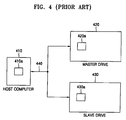
- FIG. 4 is a view illustrating a conventional method of setting the communication parameter in a host computer and the hard disc drive.
- FIG. 4 illustrates the host computer 410 and two hard disc drives 420 and 430 connected through an ATA cable.
- the IDE controller can control the two hard disc drives at one time.
- Extended IDE (E-IDE) can install four drives.
- each of the drives should be set as a master drive or a slave drive.
- the slave drive has its own inactive controller, and is controlled by a controller of the master drive.
- a dip switch installed at the drive is used to set master/slave to the drive, but the host computer can also set as disclosed in Korean Utility Model Publication No. 1998-0009505 (April 30, 1998) filed by this applicant.
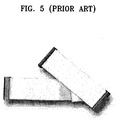
- FIG. 5 is a view illustrating an exterior of the ATA cable.
- IDE cable ribbon cable
- ATA-33 having forty strands
- ATA-66 or ATA-100
- the ATA cable is comprised of all three connectors. An independently separated one of three connectors is connected to the main board.
- the ATA-66 (or ATA-100) cable has connectors positioned closely to one another. Among of the connectors, a master connector is positioned distantly from a main board connector and a slave connector is positioned at a center of the main board connector. On the contrary, the ATA-33 cable has a master connector at the center of a main board connector.
- each of the drives and the host computer sets each of the communication parameters, that is, a slew-rate of the strobe signal, a slew-rate of the data signal, a delay and the like in such a manner that the host computer is connected with the drive in a slave mode.
- the slew-rate is a parameter of controlling the rising time. That is because in case where the host computer is connected and communicated with the drive in the slave mode, the propagated signal is most inferior in quality, and the communication parameters are set adaptively to the most inferior environment to secure a data reliability in a system configuration.
- the master drive 420 has a good condition due to its direct communication with the host computer 410
- the slave drive 430 has a bad condition due to its communication with the host computer 410 through the master drive 420. This is the same in case where the host computer 410 transmits data to the master and slave drives 420 and 430.
- the slave mode in which the drive is connected with the host computer 410 is the most inferior environment.
- the communication parameters are set adaptively to the most inferior environment.
- the best condition is a case where the drive is singularly connected with the host computer 430, that is, a case where the drive is connected with the host computer 430 in a single mode.
- Each of the host computer 410, the master drive 420, and the slave drive 430 includes tables 410a, 420a and 430a in which the communication parameter is recorded.
- FIG. 6 is a view illustrating an example of a parameter table depending on the data communication mode.
- the parameter table records the slew-rate of the data signal, the slew-rate of the strobe signal, the delay time and the like in each data communication mode.
- An optimal value of the communication parameter is different from each other depending on a physical connection state of the host computer 410 and the drives 420 and 430, that is, depending on the master mode or the slave mode.
- the conventional communication method has a drawback in that the optimal communication parameter cannot be set depending on the physical connection state since the communication parameter is uniformly set adaptively to the slave mode without referring to this difference.
- U.S. Patent No. 6,249,708 discloses a technology of varying a slew-rate depending on a data propagation state.
- a host system communicates with a peripheral device, it is determined whether or not error is generated. If the error is generated, the slew-rate is variably controlled using a switch to promote signal integrity.
- the above patent discloses just only varying a given communication parameter adaptively to a propagation state of a signal, and does not disclose setting a proper communication parameter depending on a physical connection state.
- a method of setting a communication parameter between a host system and a peripheral device including: preparing a plurality of tables having the communication parameter suitable to each of possible physical connection states between the host system and the peripheral device; and when the host system communicates with the peripheral device, selecting one of the plurality of tables depending on the physical connection state of the host system and the peripheral device to set the communication parameter.
- the tables may at least include: a master mode table corresponding to a mode in which the peripheral device is connected as a master drive to a host computer, and a slave mode table corresponding to a mode in which the peripheral device is connected as a slave drive to the host computer.
- FIGS. 7A and 7B are a wave diagram and an EMI (Electromagnetic Interference) graph in case where a communication parameter suitable to a slave mode is applied to a single mode.
- EMI Electromagnetic Interference
- FIGS. 8A and 8B are a wave diagram and an EMI graph in case where a communication parameter suitable to the single mode is applied to the single mode.
- the wave diagrams of FIGS. 7A and 8A illustrate a strobe signal 702, a first data signal 704 and a second data signal 706.
- the first data signal 704 and the second data signal 706 have a relation of inversion.
- any one of 16 bits of ATA data is the first data signal 704 and the other bits are the second data signal 706.
- 15 bits of data including first data, and second data are toggled oppositely to each other so that the second data is under the least poor condition to prepare the least poor condition for testing signal integrity.
- a Y-axis denotes a magnitude of a harmonic frequency
- an X-axis denotes the harmonic frequency.
- a limited value of EMI is 40 dBuV/m at a low frequency of 30MHz to 230MHz on the basis of 3 meters of distance of an antenna, and is 47 dBuV/m at a high frequency of 230MHz to 1GHz.
- Lines 802 of FIGS. 7B and 8B represent the limited values of EMI at each of the frequencies.
- a setup time and a hold time are respectively 8.44 and 8.6, and 8.1 and 9.54 among the communication parameters suitable to the slave mode and the single mode.
- FIGS. 7B and 8B Comparing FIGS. 7B and 8B, the magnitude of the harmonic frequency is greatly improved at an elliptical area, that is, at a high frequency of more than about 370MHz in FIG. 8B rather than FIG. 7A.
- FIGS. 7B and 8B show linear frequency divisions between 30MHz to 1GHz. EMI test is performed under the least poor condition under which the 16 bits of data signal are toggled together.
- the communication parameters suitable to a physical mode of the host system are applied to more effectively ensure the signal integrity.
- FIG. 9 is a view illustrating a method of setting the communication parameter between the host system and the peripheral device according to the present invention.
- FIG. 9 illustrates two hard disc drives 920 and 930 and the host computer 910 connected through an ATA cable.
- the host computer 910, the master drive 920 and the slave drive 930 respectively include tables suitable to a plurality of physical modes.
- the host computer 910 includes the table 910a suitable to the master mode and the table 910b suitable to the slave mode.
- the master drive 920 includes the table 920a suitable to the master mode and the table 920b suitable to the slave mode.
- the slave drive 930 includes the table 930a suitable to the master mode and the table 930b suitable to the slave mode.
- the master drive 920 In case where the master drive 920 propagates data to the host computer 910, the master drive 920 sets the communication parameter by using the table 920a suitable to the master mode. Comparing to this, in case where the slave drive 930 propagates data to the host computer 910, the slave drive 930 sets the communication parameter by using the table 930b suitable to the slave mode. Since each of the drives can be also used in both the master mode and the slave mode, each of the drives can have the plurality of tables.
- the host computer 910 when the host computer 910 propagates data to the master drive 920, it sets the communication parameter by using the table 910a suitable to the master mode.
- the host computer 910 when the host computer 910 propagates data to the slave drive 930, it sets the communication parameter by using the table 910b suitable to the slave mode.
- the tables stored in the drive can be provided when the drive is manufactured. Comparing to this, in case where there is not the table having the set optimal communication parameters for each of the drives, the host computer 910 can use the table, which is set as a default.
- FIG. 10 is a flowchart illustrating a method of setting the communication parameter in the disc drive according a preferred embodiment of the present invention.
- the hard disc drive includes the tables suitable to the single mode, the master mode and the slave mode.
- the hard disc drive When the hard disc drive communicates with the host computer, the hard disc drive confirms the physical connection state with the host computer (S1002).
- the physical connection state between the host computer and the hard disc drive is inspected when the host computer is booted.
- the hard disc drive can be confirmed regarding a connection state by inspecting its own dip switch state. In case where a cable select state is set by a dip switch, the master mode and the slave mode are established by the communication between the hard disc drives.
- the single mode table is used to set the communication parameter (S1006).
- the drive is not in the single mode as a result of the S1004. If it is determined that the drive is not in the single mode as a result of the S1004, it is determined whether or not the drive is in the master mode (S1008). If it is determined that the drive is in the master mode as a result of the S1008, the master mode table is used to set the communication parameter (S1010).
- the slave mode table is used to set the communication parameter (S1212).
- the drive communicates with the host system by the set communication parameter (S1014).
- FIG. 11 is a flowchart illustrating a method of setting the communication parameter in the host computer according to a preferred embodiment of the present invention.
- the host computer includes the tables suitable to the single mode, the master mode and the slave mode.
- the host computer When the host computer communicates with the hard disc drive, the host computer confirms the physical connection state with the hard disc drive (S1102).
- the single mode table is used to set the communication parameter (S1106).
- the master mode table is used to set the communication parameter (S1110).
- the slave mode table is used to set the communication parameter (S1112).
- the host computer communicates with the drive by the set communication parameter (S1114).
- the method of setting the communication parameter according to the present invention has an effect in that when the host computer is communicated with the peripheral device, the optimal communication parameters are set depending on the physical connection state to more effectively ensure the signal integrity, thereby reducing a logic error and reducing the EMI of the harmonic frequency generated at the cable.
Landscapes
- Engineering & Computer Science (AREA)
- Theoretical Computer Science (AREA)
- Physics & Mathematics (AREA)
- General Engineering & Computer Science (AREA)
- General Physics & Mathematics (AREA)
- Human Computer Interaction (AREA)
- Information Transfer Systems (AREA)
- Communication Control (AREA)
- Small-Scale Networks (AREA)
- Signal Processing For Digital Recording And Reproducing (AREA)
Applications Claiming Priority (1)
| Application Number | Priority Date | Filing Date | Title |
|---|---|---|---|
| KR1020040064129A KR100604893B1 (ko) | 2004-08-14 | 2004-08-14 | 호스트 시스템과 주변 장치 사이의 통신 파라메터 설정 방법 |
Publications (2)
| Publication Number | Publication Date |
|---|---|
| EP1626332A2 true EP1626332A2 (de) | 2006-02-15 |
| EP1626332A3 EP1626332A3 (de) | 2006-07-05 |
Family
ID=35159869
Family Applications (1)
| Application Number | Title | Priority Date | Filing Date |
|---|---|---|---|
| EP05011154A Ceased EP1626332A3 (de) | 2004-08-14 | 2005-05-23 | Verfahren zur Einstellung eines Kommunikationsparameters zwischen Hauptcomputer und Peripheriegerät |
Country Status (4)
| Country | Link |
|---|---|
| US (1) | US20060036778A1 (de) |
| EP (1) | EP1626332A3 (de) |
| JP (1) | JP2006053928A (de) |
| KR (1) | KR100604893B1 (de) |
Families Citing this family (2)
| Publication number | Priority date | Publication date | Assignee | Title |
|---|---|---|---|---|
| KR100927092B1 (ko) | 2007-12-28 | 2009-11-13 | 엘에스산전 주식회사 | 피엘시 네트워크에서 파라미터 설정 방법 |
| KR101643774B1 (ko) * | 2009-12-04 | 2016-07-29 | 두산공작기계 주식회사 | 통신방식에 맞는 파라메타 자동 변경 방법 |
Citations (2)
| Publication number | Priority date | Publication date | Assignee | Title |
|---|---|---|---|---|
| US6249708B1 (en) | 1997-08-26 | 2001-06-19 | Angeion Corporation | Fluted channel construction for a multi-conductor catheter lead |
| US20020067645A1 (en) | 2000-12-05 | 2002-06-06 | International Business Machines Corp. | Method and system for increasing timing margins without deteriorating a data transfer rate |
Family Cites Families (19)
| Publication number | Priority date | Publication date | Assignee | Title |
|---|---|---|---|---|
| EP0464551A3 (en) * | 1990-06-25 | 1992-11-19 | Kabushiki Kaisha Toshiba | Method and apparatus for controlling drives coupled to a computer system |
| JP2501746B2 (ja) * | 1993-03-04 | 1996-05-29 | インターナショナル・ビジネス・マシーンズ・コーポレイション | ディスク駆動装置 |
| US7387253B1 (en) * | 1996-09-03 | 2008-06-17 | Hand Held Products, Inc. | Optical reader system comprising local host processor and optical reader |
| US5671439A (en) * | 1995-01-10 | 1997-09-23 | Micron Electronics, Inc. | Multi-drive virtual mass storage device and method of operating same |
| US5729060A (en) * | 1996-01-23 | 1998-03-17 | Shih; Steven | Hard diskdrive address adjusting device of an array hard diskdrive system |
| US5694600A (en) * | 1996-02-09 | 1997-12-02 | Iomega Corporation | Methods and apparatus for booting a computer having a removable media disk drive |
| US5761460A (en) * | 1996-07-19 | 1998-06-02 | Compaq Computer Corporation | Reconfigurable dual master IDE interface |
| US6038624A (en) * | 1998-02-24 | 2000-03-14 | Compaq Computer Corp | Real-time hardware master/slave re-initialization |
| US6282593B1 (en) * | 1998-05-08 | 2001-08-28 | Tony Goodfellow | Extension of electronic buses and their bus protocols using signal-propagation timing compensation |
| US6675243B1 (en) * | 1999-03-17 | 2004-01-06 | Adaptec, Inc. | Methods and apparatus for implementing a device side advanced serial protocol |
| US6321282B1 (en) * | 1999-10-19 | 2001-11-20 | Rambus Inc. | Apparatus and method for topography dependent signaling |
| JP3490368B2 (ja) * | 2000-02-07 | 2004-01-26 | インターナショナル・ビジネス・マシーンズ・コーポレーション | 信号出力装置、ドライバ回路、信号伝送システム、および信号伝送方法 |
| US7065769B1 (en) * | 2000-06-30 | 2006-06-20 | Intel Corporation | Method for automatically installing and updating drivers |
| US7159063B2 (en) * | 2001-08-31 | 2007-01-02 | American Megatrends, Inc. | Method and apparatus for hot-swapping a hard disk drive |
| JP3770153B2 (ja) * | 2001-11-30 | 2006-04-26 | ヤマハ株式会社 | 通信設定装置及び通信設定プログラム |
| JP2004280558A (ja) * | 2003-03-17 | 2004-10-07 | Ricoh Co Ltd | インタフェース回路及びインタフェース回路を有する光ディスク装置 |
| KR100518570B1 (ko) * | 2003-05-06 | 2005-10-04 | 삼성전자주식회사 | 디스크 드라이브 인식 회로 및 방법 |
| JP2005309934A (ja) * | 2004-04-23 | 2005-11-04 | Fujitsu Ltd | 周辺装置のファームウェアダウンロード方法及び周辺装置 |
| US7822937B2 (en) * | 2004-05-03 | 2010-10-26 | Gateway, Inc. | Method and apparatus for modifying reserve area of disk drive or memory |
-
2004
- 2004-08-14 KR KR1020040064129A patent/KR100604893B1/ko not_active Expired - Fee Related
-
2005
- 2005-05-23 EP EP05011154A patent/EP1626332A3/de not_active Ceased
- 2005-06-20 US US11/155,520 patent/US20060036778A1/en not_active Abandoned
- 2005-08-12 JP JP2005235000A patent/JP2006053928A/ja active Pending
Patent Citations (2)
| Publication number | Priority date | Publication date | Assignee | Title |
|---|---|---|---|---|
| US6249708B1 (en) | 1997-08-26 | 2001-06-19 | Angeion Corporation | Fluted channel construction for a multi-conductor catheter lead |
| US20020067645A1 (en) | 2000-12-05 | 2002-06-06 | International Business Machines Corp. | Method and system for increasing timing margins without deteriorating a data transfer rate |
Also Published As
| Publication number | Publication date |
|---|---|
| JP2006053928A (ja) | 2006-02-23 |
| EP1626332A3 (de) | 2006-07-05 |
| US20060036778A1 (en) | 2006-02-16 |
| KR20060015400A (ko) | 2006-02-17 |
| KR100604893B1 (ko) | 2006-07-28 |
Similar Documents
| Publication | Publication Date | Title |
|---|---|---|
| EP1141847B1 (de) | Echoverminderung für einen bitserielen mehrfachrabzweigbus | |
| CN109613491B (zh) | 一种基于fpga的高速信号采集存储及回放系统 | |
| US7191268B2 (en) | Combined host interface controller for conducting communication between a host system and multiple devices in multiple protocols | |
| CN110377553A (zh) | 一种检测硬盘背板与主板port对应关系的方法及装置 | |
| US6463499B1 (en) | Data bus cable having SCSI and IIC bus functionality and process for using the same | |
| US5255383A (en) | Method and apparatus for skewing a memory read clock signal in a magnetic disk drive system | |
| US7484027B1 (en) | Apparatus and method for configurable device pins | |
| US20070250652A1 (en) | High speed dual-wire communications device requiring no passive pullup components | |
| EP1626332A2 (de) | Verfahren zur Einstellung eines Kommunikationsparameters zwischen Hauptcomputer und Peripheriegerät | |
| US6522165B2 (en) | Bus termination scheme for flexible uni-processor and dual processor platforms | |
| US6289402B1 (en) | Bidirectional data transfer protocol primarily controlled by a peripheral device | |
| CN1347611A (zh) | 数据传输设备 | |
| US8581920B2 (en) | Utilizing masked data bits during accesses to a memory | |
| US20020067645A1 (en) | Method and system for increasing timing margins without deteriorating a data transfer rate | |
| Abbott | PCI bus demystified | |
| CN111654970A (zh) | 一种降低电路板链路损耗的设计方法、系统及电路板 | |
| CN112445430B (zh) | 一种支持多闪存型固态硬盘的设备及运行方法 | |
| KR100843199B1 (ko) | 고속 아이.디.이. 인터페이스 장치 및 그 방법 | |
| KR20040082308A (ko) | Crc 오류를 이용하여 udma 전송 신호를 최적화하는방법 | |
| CN111143145B (zh) | 一种sata错误处理调试中制造错误的方法及电子设备 | |
| US20070002938A1 (en) | Low speed access to DRAM | |
| CN107506319A (zh) | 一种集成存储系统 | |
| CN1955942A (zh) | Ieee1394接口功能测试装置及方法 | |
| CN112860020A (zh) | 硬盘存储装置及电子装置 | |
| CN209560532U (zh) | 一种PCIE Redriver板卡 |
Legal Events
| Date | Code | Title | Description |
|---|---|---|---|
| PUAI | Public reference made under article 153(3) epc to a published international application that has entered the european phase |
Free format text: ORIGINAL CODE: 0009012 |
|
| 17P | Request for examination filed |
Effective date: 20050523 |
|
| AK | Designated contracting states |
Kind code of ref document: A2 Designated state(s): AT BE BG CH CY CZ DE DK EE ES FI FR GB GR HU IE IS IT LI LT LU MC NL PL PT RO SE SI SK TR |
|
| AX | Request for extension of the european patent |
Extension state: AL BA HR LV MK YU |
|
| PUAL | Search report despatched |
Free format text: ORIGINAL CODE: 0009013 |
|
| AK | Designated contracting states |
Kind code of ref document: A3 Designated state(s): AT BE BG CH CY CZ DE DK EE ES FI FR GB GR HU IE IS IT LI LT LU MC NL PL PT RO SE SI SK TR |
|
| AX | Request for extension of the european patent |
Extension state: AL BA HR LV MK YU |
|
| RIC1 | Information provided on ipc code assigned before grant |
Ipc: G06F 13/38 20060101ALI20060529BHEP Ipc: G06F 13/10 20060101ALI20060529BHEP Ipc: G06F 3/06 20060101AFI20051104BHEP |
|
| AKX | Designation fees paid |
Designated state(s): DE |
|
| 17Q | First examination report despatched |
Effective date: 20070222 |
|
| STAA | Information on the status of an ep patent application or granted ep patent |
Free format text: STATUS: THE APPLICATION HAS BEEN REFUSED |
|
| 18R | Application refused |
Effective date: 20091001 |