EP1610496B1 - Rapid fault detection and recovery for internet protocol telephony - Google Patents
Rapid fault detection and recovery for internet protocol telephony Download PDFInfo
- Publication number
- EP1610496B1 EP1610496B1 EP05253643A EP05253643A EP1610496B1 EP 1610496 B1 EP1610496 B1 EP 1610496B1 EP 05253643 A EP05253643 A EP 05253643A EP 05253643 A EP05253643 A EP 05253643A EP 1610496 B1 EP1610496 B1 EP 1610496B1
- Authority
- EP
- European Patent Office
- Prior art keywords
- paths
- keep
- packets
- communication network
- alive
- Prior art date
- Legal status (The legal status is an assumption and is not a legal conclusion. Google has not performed a legal analysis and makes no representation as to the accuracy of the status listed.)
- Expired - Lifetime
Links
Images
Classifications
-
- H—ELECTRICITY
- H04—ELECTRIC COMMUNICATION TECHNIQUE
- H04L—TRANSMISSION OF DIGITAL INFORMATION, e.g. TELEGRAPHIC COMMUNICATION
- H04L43/00—Arrangements for monitoring or testing data switching networks
- H04L43/50—Testing arrangements
-
- H—ELECTRICITY
- H04—ELECTRIC COMMUNICATION TECHNIQUE
- H04L—TRANSMISSION OF DIGITAL INFORMATION, e.g. TELEGRAPHIC COMMUNICATION
- H04L65/00—Network arrangements, protocols or services for supporting real-time applications in data packet communication
- H04L65/80—Responding to QoS
-
- H—ELECTRICITY
- H04—ELECTRIC COMMUNICATION TECHNIQUE
- H04L—TRANSMISSION OF DIGITAL INFORMATION, e.g. TELEGRAPHIC COMMUNICATION
- H04L69/00—Network arrangements, protocols or services independent of the application payload and not provided for in the other groups of this subclass
- H04L69/40—Network arrangements, protocols or services independent of the application payload and not provided for in the other groups of this subclass for recovering from a failure of a protocol instance or entity, e.g. service redundancy protocols, protocol state redundancy or protocol service redirection
-
- H—ELECTRICITY
- H04—ELECTRIC COMMUNICATION TECHNIQUE
- H04L—TRANSMISSION OF DIGITAL INFORMATION, e.g. TELEGRAPHIC COMMUNICATION
- H04L43/00—Arrangements for monitoring or testing data switching networks
- H04L43/10—Active monitoring, e.g. heartbeat, ping or trace-route
Definitions
- the present invention generally relates to communication networks such as Internet Protocol (IP) telephony-based networks and, more particularly, to techniques for performing rapid fault detection and recovery in such networks.
- IP Internet Protocol
- VoIP Voice over IP
- VoIP Voice over IP
- VoIP Voice over IP
- IP networks are largely self-healing for network faults, and many enterprise networks are engineered to have redundant links or paths between sites, today's IP networks are not engineered to react to performance degradations at the timescales needed for voice. For example, recent studies show that while there is acceptable performance within some service provider networks, many backbone paths still have poor VoIP performance and network faults cause problems.
- VoIP calls are not transmitted by a source (e.g., when a participant in a call is listening rather than speaking). Consequently, while monitoring a VoIP call (e.g., on the receiving side) it is necessary to distinguish between gaps that occur due to natural speech silences and perhaps speech compression, and the gaps that occur due to packet loss, delay, and jitter in the IP network. Furthermore, although detecting problems can certainly help to alert a network manager, it would be particularly useful if the network could react to a detected problem and route around it.
- US 2002/0150041 discloses a technique for providing quality of service for data transportation are the Internet. Packet transportation parameters in the segments of preselected paths are periodically tested.
- the present invention provides techniques for performing rapid fault detection and recovery in communication networks. While not limited thereto, the invention is particularly well-suited to IP telephony networks, particularly those that provide VoIP applications.
- the invention provides a method according to claim 1. In another aspect the invention provides apparatus according to claim 12. In a still further aspect the invention provides apparatus according to claim 16.
- a technique for detecting one or more conditions in a communication network comprises the following steps/operations.
- One or more keep-alive packets are transmitted from a source node in the communication network to a destination node in the communication network over two or more paths between the source node and the destination node, wherein the two or more paths are at least partially disjoint.
- at least one quality measure is computed at the destination node for each of the two or more paths, the at least one quality measure being indicative of one or more conditions in the communication network.
- the quality measures may be compared for each of the two or more paths.
- Results of the comparisons may be transmitted from the destination node to the source node.
- One or more communication packets may be transmitted from the source node based on at least a portion of the received results.
- short, low-bandwidth keep-alive packets can be injected into VoIP packet streams to rapidly detect faults and deteriorating network conditions (e.g., increasing delay, jitter, or loss).
- the keep-alive packets can be duplicated and also used to continuously monitor and compare the delay and loss characteristics of primary and alternate network paths, and thereby help control the rapid switchover of calls (in-progress and future) to alternate routing paths (or the circuit-switched PSTN) when faults or deteriorating QoS conditions are detected.
- the techniques avoid many common synchronization and timing errors.
- the present invention will be described below in the context of an IP telephony-based network having VoIP capability, the invention is not so limited. That is, the present invention is more generally applicable to any communication network in which it would be desirable to provide detection of one or more conditions in the communication network.
- a network of communication nodes This may be an IP telephony-based network with VoIP capabilities. However, this may also include the special case of a signalling network. Further assume that there is an underlying routing algorithm that routes communication packets from source communication nodes to destination communication nodes (any particular communication node might both be a source and a destination for different communication sessions). For example, the communication packets might be VoIP packets. Still further, the communication packets might be signalling packets. Examples of signalling packets may include error messages, call requests and interrupt requests.
- some of the communication nodes also are equipped to serve as pacemaker/measurement/routing (PMR) nodes, as will be explained in detail below.
- PMR pacemaker/measurement/routing
- Such PMR functions could be implemented in a gateway.
- a source PMR node injects or transmits keep-alive PMR packets to a destination PMR node along two or more paths that differ in at least one node or link (i.e., the two or more paths are at least partially disjoint).
- Keep-alive packets are additional, short packets transmitted on a regular basis in order to "keep alive" (i.e., eliminate long idle gaps in) the communications between the source node and the destination node.
- the keep-alive PMR packets receive the same type of quality-of-service (QoS) within the network as the communication packets that are delivered in the network.
- QoS quality-of-service
- the keep-alive PMR packets might be simultaneously injected along the two or more paths.
- the keep-alive PMR packets may be transmitted on a regular basis (regular intervals) - all the time (i.e., with or without calls between a source PMR node and a destination PMR node), continuously with calls, only during silence periods within calls, or only during idle periods between calls.
- the rate at which keep-alive PMR packets are transmitted can be different for different pairs of source PMR nodes and destination PMR nodes.
- the transmission along two or more paths may be via tunnelling through one or more intermediate PMR nodes (i.e., PMR nodes between the source PMR node and the destination PMR node).
- the transmission along two or more paths may be by appropriately setting header address bits (which influence the routing of packets).
- the transmission along two or more paths may be via a sequence of overlay PMR nodes.
- QoS measures e.g., delay, jitter, loss
- the QoS comparison may be via relative receive times, thereby avoiding the need to synchronize clocks at the source PMR node and destination PMR node.
- the QoS comparison takes into account various delay, jitter, and loss measures appropriate for the associated types of communication packets (e.g., delay and jitter might be more important for VoIP packets, whereas loss might be more important for signalling packets).
- information from the QoS comparison at the destination PMR node may be communicated back to the source PMR node and may be used to influence the paths of future communication packets from the source communication node to the destination communication node.
- the paths of communication packets could be changed for future calls set up or, if desired, even for ongoing, existing sessions of communication packets.
- the paths could be changed via tunnelling through one or more intermediate PMR nodes, via overlay PMR networks, or via changing routing tables in the underlying routing algorithm.
- the QoS comparison information could be communicated from the destination PMR node back to the source PMR node over multiple paths.
- Principles of the present invention provide techniques for using short, low-bandwidth keep-alive packets that can be injected into VoIP packet streams to rapidly detect conditions such as faults and deteriorating network conditions such increasing delay, jitter, or loss. While the terms “short” and “low-bandwidth” will depend on the particular network application, and the invention is not limited to any particular packet length or bandwidth value, one example of short, low-bandwidth keep-alive packets may include 32 bit SDES RTCP (Source Description Real-time Transmission Control Protocol) packets with an overhead of less than 0.2 percent.
- SDES RTCP Source Description Real-time Transmission Control Protocol
- the inventive techniques can help: (i) improve the QoS of in-progress calls; (ii) failover route in-progress calls around a detected fault; and (iii) failover route future calls around faults. Based on the detected conditions in the IP network, the techniques can even be used to switch calls over to the traditional circuit-switched PSTN when desired or necessary.
- an initial network assessment can help determine if a network is properly configured.
- the inventive techniques are then used to monitor and control the ongoing connections using low-bandwidth keep-alive packets that are sent over primary network paths and, for comparison, alternate network paths. Essentially, the packets monitor and detect deviations from the norm caused by faults and unanticipated (even if temporary) traffic conditions.
- the inventive techniques not only detect network problems, they also help determine appropriate control responses (e.g., to route around congestion and faults).
- Section II we illustratively describe the inventive detection, monitoring, and control techniques.
- Section III we illustratively present some generalizations and architectural and implementation issues.
- Section IV we provide greater mathematical detail and present some analytical results to validate the inventive concepts.
- Section V we provide an illustrative hardware implementation.
- Section VI we present an illustrative summary and discuss some extensions.
- the invention provides for transmitting by the sender a low-bandwidth keep-alive signal along with VoIP streams.
- VoIP e.g., RTP or Real-time Transmission Protocol
- short keep-alive packets can be sent at regular, "fixed" intervals (e.g., every 500 milliseconds).
- the sender increases the number of keep-alive packets when the number of RTP packet decreases (during silent periods), making sure that at least one RTP or keep-alive packet is sent every T seconds.
- the receiver then notifies the users who are involved in the sessions, plus, perhaps, other users that might be affected if they were to attempt to set up a new call. Since the RTP and keep-alive packets experience network jitter and loss, there is a chance that a failure will be wrongly declared (i.e., a "false alarm"). However, as soon as either an RTP or a keep-alive packet is once again received, the receiver cancels its "failure announcement.” This serves to either: (i) correct a false alarm; or (ii) announce restoration after an actual failure. In other words, (i) states that false alarms automatically self-correct as soon as the next successful RTP or keep-alive packet is received.
- keep-alive packets identical to the VoIP (e.g., RTP) packets - using the same routing paths, priorities, etc. - so that the loss and delay experienced by the keep-alive packets will accurately reflect the loss and delay experienced by the VoIP calls.
- RTP or RTCP packets can be used as keep-alive packets.
- R 1/ T
- the receiver is designed to exploit the fact that the sender injects some packets nominally at fixed intervals during both RTP silent periods and RTP talkspurts.
- the voice QoS (e.g., MOS score/R-value) depends on the packet loss, jitter, and one-way delay.
- MOS stands for "Mean Opinion Score.” It is one conventional measure used to rate the quality of VoIP. It is a scale that rates the relative quality of voice conversations as subjectively perceived by human users.
- the R-value is a second commonly used metric.
- the packet loss probability is measured by simply counting the number of missing, dropped keep-alive and RTP packets.
- One-way delay and jitter are more challenging to measure. If the keep-alive (and RTP) packets are transmitted at regularly spaced intervals (and with high priority) on each path, then the spacing between successive packets at the receiver gives an approximate measure of the jitter on each path.
- To monitor the delay one can add global "time stamps" to packets when they are transmitted and compare them with a clock when received. This, though, requires accurate timing and synchronization of the sending and receiving nodes. Alternatively, the delay measurement is a lot simpler if we exploit the existence of multiple paths between the sending and receiving nodes; we do this below in Section C.
- a focus of the inventive techniques is on the rapid switchover to alternate network paths (or the PSTN) and related performance issues.
- a sending site may also be a "receiving site” for communications in the reverse direction, and a “receiving site” may also be a "sending site” for other traffic.
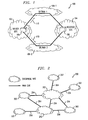
- the enterprise site connects to multiple Service Providers (SPs) or has multiple wide area network (WAN) links (i.e., a multi-homed architecture) and the enterprise does not have any control of, or information about, the routes/performance in the SPs/WANs, other than perhaps some limited information from service level agreements (SLAs).
- SPs Service Providers
- WAN wide area network
- PMR devices there is a special (hardware/software) device 106 each at the sending and receiving sides that can monitor the quality of a VoIP stream as received by it, and that can exchange information between them.
- PMR devices since they perform three activities: (1) send keep-alive messages (much like a Pacemaker), (ii) Monitor / Measure QoS based on these messages, and (iii) Relay/Route VoIP packets between each other.
- the PMR devices 106 could be alongside or in the media gateways, in the routers of the network, or alternatively, a signalling server may direct all traffic to and from remote PMR devices.
- keep-alive packet (e.g., RTCP) is duplicated at the PMR device 106 on the sending side and simultaneously transmitted over multiple SP/WAN paths (e.g., two paths in a dual-homed architecture, i.e., SP/WAN 1 108-1 and SP/WAN 2 108-2).
- the duplicates are tagged with an identifier indicating the SP/WAN path along which they have been sent.
- the duplicate keep-alive packets 110 reach, for example, an edge router/PMR device at the remote end.
- various delay, jitter, and loss comparisons are made from reception of the multiple copies. This information can be used to help identify "best" entry/exit points to/from the SPs/WANs and switch VoIP packets to the current "best" path.
- the order in which the keep-alive copies arrive indicates the relative magnitude of the delays.
- the spacing between successive packets at the receiver gives an approximate measure of the jitter on each path, which can be used to determine jitter differences between the two paths. These measurements, averaged over, for example, several seconds, can be used to compare the current QoS characteristics of the various paths.
- the receiving device sends feedback messages (perhaps copies along multiple paths - for protection) to tell the sender which path to use. Then, for example, calls can be switched over to a (better) IP route (or circuit-switched PSTN) if the jitter, delay, and loss cause the voice quality to drop below acceptable levels.
- IP route or circuit-switched PSTN
- the inventive approach provides for control/measurement packets to be duplicated for QoS comparison to decide and rapidly switch the path taken by VoIP packets.
- the source jitter component is automatically eliminated in our differential delay measurements because the multiple copies of keep-alive packets are simultaneously transmitted.
- timing errors e.g., due to drifting clocks
- timing errors can also be filtered out using knowledge that the keep-alive packets were nominally injected at fixed intervals simultaneously over the multiple paths.
- the inventive techniques can be supplemented with occasional measurements of the absolute one-way delays (as done, for example, during an initial network assessment). Starting with knowledge of this initial acceptable state, the inventive techniques can be used to measure the deviations. This information can then be, for example, communicated to a signalling server. If certain delay/jitter/loss thresholds are exceeded and there is only one path between the sender and receiver, then the call could be switched to the PSTN, for example, and/or the set of terminals impacted can be notified that a problem exists. Note that there is no need to make the precise performance measurements all the time; it is sufficient to simply monitor the deviations.
- Typical enterprise networks have multiple geographically distributed sites connected via leased WAN lines or tunnels. Each site can be thought of as a node of a graph G with the WAN links connecting two nodes being the edges of G.
- the graph G can be a multi-graph, having multiple edges between two nodes.
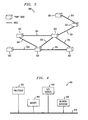
- between nodes 202 there are multiple paths, comprised of one or more links 204, accounting for path redundancy, which is exploited to provide protection.
- the graph described above forms an overlay network for VoIP.
- one or more PMR devices are functionally embedded.
- FIG. 3 Such a graph/network 300 is shown in FIG. 3 , wherein PMR devices are denoted by reference numeral 302 and edges by reference numeral 304.
- the PMRs know the overlay VoIP PMR network and send keep-alive signals along multiple paths. Natural restrictions placed by VoIP (e.g., bounded delay, jitter, etc.) would dictate and limit possible paths that need to be considered for probing; such paths would usually be found, for example, in the assessment phase of VoIP deployment.
- the PMRs can use techniques from overlay networks and/or tunnelling/address rewriting techniques to divert packets along the "best" VoIP path.
- d n denote the probability that a silent period has a duration between nT and ( n +1) T (i.e., such that n keep-alive packets are transmitted during the silent period).
- X min ⁇ X 1 , X 2 ⁇ .
- Table 3 - 99% of the packets have a delay less than or equal to the value in table (normalized to average packet length); 10% packet loss on Path 1 and 0% packet loss on Path 2.
- Total Load on Path 1 ⁇ 1
- Total Load on Path 2 ⁇ 2 10% 20% 40% 60% 80% 90% 10% 0.6 1.2 2.5 4.6 10.4 22.0 20% 0.9 1.5 2.7 4.6 10.4 22.0 40% 1.2 1.9 3.1 5.0 10.6 22.0 60% 1.6 2.4 3.7 5.7 10.8 22.0 80% 2.0 2.9 4.6 7.1 12.7 22.8 90% 2.3 3.3 5.4 8.3 15.5 26.5 Without Switchover 2.6 3.8 6.2 10.3 22.0 45.0
- Table 3 lists the 99 percentile of the delay X (i.e., 99% of the packets experience a delay less than the value indicated in Table 3) for various loads ( ⁇ 1 and ⁇ 2 ).
- the last row of Table 3 lists the 99 percentile of the Path 2 delay (X 2 ) without any switchover to Path 1. This comparison shows the delay reduction possible with rapid QoS detection and switchover to alternate paths.
- the 99-percentile of the delay is 6.2 (packet lengths) without rapid switchover, whereas it can be reduced to values ranging (in Table 3) from 2.5 to 5.4 with rapid switchover.
- the amount of delay reduction is obviously dependent on the total load (and corresponding delay) of the alternate Path 1: the higher the load (delay) of Path 1, the smaller the amount of improvement possible with rapidly switching packets from Path 2 over to Path 1.
- Path 2 is better than Path 1 in terms of packet loss, it still is advantageous to switch some packets over to Path 1 (when its delay is lower).
- FIG. 4 a block diagram illustrates a generalized hardware architecture of a computer system suitable for implementing techniques described herein, according to an embodiment of the present invention.
- computer system 400 may represent a server, a router, an edge device, and/or a gateway at a sender site (102 of FIG. 1 ) or a receiver site (104 of FIG. 1 ), a PMR device (106 in FIG. 1 , 302 in FIG. 3 ) embedded in one or more of such site components or standalone at a remote location, or any system or device suitable for implementing principles of the invention.
- sender site 102 of FIG. 1
- receiver site 104 of FIG. 1
- PMR device 106 in FIG. 1 , 302 in FIG. 3
- the invention is not limited to any particular computing system implementation.
- a processor 402 for implementing at least a portion of the methodologies of the invention is operatively coupled to a memory 404, input/output (I/O) devices 406 and a network interface 408 via a bus 410, or an alternative connection arrangement.
- processor as used herein is intended to include any processing device, such as, for example, one that includes a central processing unit (CPU) and/or other processing circuitry (e.g., digital signal processor (DSP), microprocessor, etc.). Additionally, it is to be understood that the term "processor” may refer to more than one processing device, and that various elements associated with a processing device may be shared by other processing devices.
- memory as used herein is intended to include memory and other computer-readable media associated with a processor or CPU, such as, for example, random access memory (RAM), read only memory (ROM), fixed storage media (e.g., hard drive), removable storage media (e.g., diskette), flash memory, etc.
- RAM random access memory
- ROM read only memory
- fixed storage media e.g., hard drive
- removable storage media e.g., diskette
- flash memory etc.
- I/O devices as used herein is intended to include one or more input devices (e.g., keyboard, mouse, etc.) for inputting data to the processing unit, as well as one or more output devices (e.g., CRT display, etc.) for providing results associated with the processing unit.
- input devices e.g., keyboard, mouse, etc.
- output devices e.g., CRT display, etc.
- network interface is intended to include, for example, one or more devices capable of allowing the computing system 400 to communicate with other computing systems.
- the network interface may comprise a transceiver configured to communicate with a transceiver of another computer system via a suitable communications protocol. It is to be understood that the invention is not limited to any particular communications protocol.
- computer readable media as used herein is intended to include recordable-type media, such as, for example, a floppy disk, a hard disk drive, RAM, compact disk (CD) ROM, etc., and transmission-type media, such as digital or analog communication links, wired or wireless communication links using transmission forms, such as, for example, radio frequency and optical transmissions, etc.
- the computer readable media may take the form of coded formats that are decoded for use in a particular data processing system.
- one or more computer programs, or software components thereof, including instructions or code for performing the methodologies of the invention, as described herein, may be stored in one or more of the associated storage media (e.g., ROM, fixed or removable storage) and, when ready to be utilized, loaded in whole or in part (e.g., into RAM) and executed by the processor 402.
- the associated storage media e.g., ROM, fixed or removable storage
- RAM random access memory
- the present invention provides techniques for improving resiliency and QoS of VoIP networks by using inherent redundancy in the network.
- a new monitoring technique that uses short, low-bandwidth keep-alive packets injected into VoIP streams to rapidly detect faults and network QoS conditions.
- Our proposed solution can be encapsulated into a device (we have called PMR) that can be co-located or built into media gateways, enterprise routers or edge devices.
Landscapes
- Engineering & Computer Science (AREA)
- Computer Networks & Wireless Communication (AREA)
- Signal Processing (AREA)
- Computer Security & Cryptography (AREA)
- Multimedia (AREA)
- Data Exchanges In Wide-Area Networks (AREA)
- Telephonic Communication Services (AREA)
Applications Claiming Priority (4)
| Application Number | Priority Date | Filing Date | Title |
|---|---|---|---|
| US58132904P | 2004-06-18 | 2004-06-18 | |
| US581329P | 2004-06-18 | ||
| US10/953,024 US7782787B2 (en) | 2004-06-18 | 2004-09-29 | Rapid fault detection and recovery for internet protocol telephony |
| US953024 | 2004-09-29 |
Publications (2)
| Publication Number | Publication Date |
|---|---|
| EP1610496A1 EP1610496A1 (en) | 2005-12-28 |
| EP1610496B1 true EP1610496B1 (en) | 2008-11-12 |
Family
ID=35071112
Family Applications (1)
| Application Number | Title | Priority Date | Filing Date |
|---|---|---|---|
| EP05253643A Expired - Lifetime EP1610496B1 (en) | 2004-06-18 | 2005-06-13 | Rapid fault detection and recovery for internet protocol telephony |
Country Status (5)
| Country | Link |
|---|---|
| US (1) | US7782787B2 (enExample) |
| EP (1) | EP1610496B1 (enExample) |
| JP (1) | JP4625377B2 (enExample) |
| CA (1) | CA2508545C (enExample) |
| DE (1) | DE602005010940D1 (enExample) |
Families Citing this family (70)
| Publication number | Priority date | Publication date | Assignee | Title |
|---|---|---|---|---|
| US7664043B1 (en) | 2004-07-01 | 2010-02-16 | At&T Corp. | Method and apparatus for performing reachability testing within the context of customer virtual private networks |
| US7768997B2 (en) * | 2004-08-20 | 2010-08-03 | At&T Intellectual Property I, L.P. | Systems and methods for automatic public switched telephone network backup of voice over internet protocol services |
| US7466656B2 (en) * | 2004-10-26 | 2008-12-16 | International Business Machines Corporation | Method, apparatus and program storage device for efficient construction of network overlays through interconnection topology embedding |
| US7440393B2 (en) * | 2004-12-09 | 2008-10-21 | Scalent Systems, Inc. | Method and system for managing communication in a data network |
| US8462637B1 (en) * | 2005-01-04 | 2013-06-11 | Sheridan Ross P.C. | Dial plan routing for fragmented networks |
| US7978682B2 (en) * | 2005-05-09 | 2011-07-12 | At&T Intellectual Property I, Lp | Methods, systems, and computer-readable media for optimizing the communication of data packets in a data network |
| US7590756B2 (en) * | 2005-05-13 | 2009-09-15 | Itt Manufacturing Enterprises, Inc. | Method and system for transferring data in a communications network using redundant communication paths |
| US20060268848A1 (en) * | 2005-05-25 | 2006-11-30 | Telefonaktiebolaget Lm Ericsson (Publ) | Connection type handover of voice over internet protocol call based low-quality detection |
| US8107385B2 (en) | 2005-09-29 | 2012-01-31 | Avaya Inc. | Evaluating quality of service in an IP network with cooperating relays |
| CN100403734C (zh) * | 2005-11-02 | 2008-07-16 | 华为技术有限公司 | 一种业务流保护方法 |
| US7596092B2 (en) * | 2006-02-02 | 2009-09-29 | Cisco Technology, Inc. | VoIP verifier |
| US8072879B2 (en) * | 2006-02-03 | 2011-12-06 | Cisco Technology, Inc. | Technique for determining whether to reestablish fast rerouted primary tunnels based on backup tunnel path quality feedback |
| US8693308B2 (en) * | 2006-02-10 | 2014-04-08 | Aviat U.S., Inc. | System and method for resilient wireless packet communications |
| JP4545109B2 (ja) * | 2006-03-28 | 2010-09-15 | 京セラ株式会社 | 通信経路制御装置 |
| JP4356705B2 (ja) * | 2006-03-31 | 2009-11-04 | 日本電気株式会社 | コンピュータシステム、および地震発生対応システム |
| US7813736B2 (en) * | 2006-06-28 | 2010-10-12 | At&T Intellectual Property I, L.P. | Method and apparatus for improving network performance in a communication system |
| US8630190B2 (en) * | 2006-08-22 | 2014-01-14 | Cisco Technology, Inc. | Method and system to identify a network device associated with poor QoS |
| US8055759B2 (en) * | 2006-09-18 | 2011-11-08 | Tropos Networks, Inc. | Determination of link qualities between an access point and a plurality of clients |
| US7697460B2 (en) * | 2006-09-28 | 2010-04-13 | Avaya Inc. | Evaluating feasible transmission paths in a packet network |
| US8391154B2 (en) | 2006-09-28 | 2013-03-05 | Avaya Inc. | Probationary admission control in relay networks |
| US9374263B2 (en) | 2006-09-29 | 2016-06-21 | Avaya Ecs Ltd. | Latency differential mitigation for real time data streams |
| JP4675305B2 (ja) * | 2006-09-29 | 2011-04-20 | 富士通株式会社 | ネットワーク最適経路選択方法及び装置 |
| US7787450B1 (en) * | 2006-10-11 | 2010-08-31 | Itt Manufacturing Enterprises, Inc | Method and system for efficient network formation and maintenance of node routing databases in a mobile ad-hoc network |
| US8576833B2 (en) * | 2006-12-15 | 2013-11-05 | At&T Intellectual Property I, L.P. | Fault tolerant voice over Internet protocol (VoIP) systems and methods to operate the same |
| KR101290275B1 (ko) * | 2007-01-16 | 2013-08-07 | 삼성전자주식회사 | 그래픽 데이터 송수신 장치 및 방법 |
| JP2008211682A (ja) * | 2007-02-27 | 2008-09-11 | Fujitsu Ltd | 受信プログラム、送信プログラム、送受信システム、および送受信方法 |
| CN100512154C (zh) * | 2007-03-29 | 2009-07-08 | 华为技术有限公司 | 一种提高多层网络业务恢复性能的方法及装置 |
| US7756029B2 (en) | 2007-05-24 | 2010-07-13 | Harris Stratex Networks Operating Corporation | Dynamic load balancing for layer-2 link aggregation |
| US9455896B2 (en) | 2007-07-23 | 2016-09-27 | Verint Americas Inc. | Dedicated network interface |
| US8264953B2 (en) * | 2007-09-06 | 2012-09-11 | Harris Stratex Networks, Inc. | Resilient data communications with physical layer link aggregation, extended failure detection and load balancing |
| US8233402B2 (en) * | 2007-09-20 | 2012-07-31 | At&T Intellectual Property Ii, L.P. | Multicast-based inference of temporal loss characteristics in packet data networks |
| US20090086642A1 (en) * | 2007-09-28 | 2009-04-02 | Cisco Technology, Inc. | High availability path audit |
| US8099637B2 (en) * | 2007-10-30 | 2012-01-17 | Hewlett-Packard Development Company, L.P. | Software fault detection using progress tracker |
| US7768947B2 (en) * | 2007-12-31 | 2010-08-03 | International Business Machines Corporation | Maintaining communication continuity |
| US7886014B2 (en) * | 2007-12-31 | 2011-02-08 | International Business Machines Corporation | Maintaining communication continuity |
| US7821923B2 (en) | 2008-02-06 | 2010-10-26 | Cellco Partnership | Optimized SIP routing architecture using an integrated network and systems approach |
| US20090296703A1 (en) * | 2008-05-30 | 2009-12-03 | Ruby Tech Corp. | Method and system for dynamic roaming across wireless networks |
| US8125907B2 (en) * | 2008-06-12 | 2012-02-28 | Talari Networks Incorporated | Flow-based adaptive private network with multiple WAN-paths |
| US8130752B2 (en) * | 2008-06-13 | 2012-03-06 | Telco Acquisition I, Inc. | Real-time network measurement |
| US7903579B2 (en) * | 2008-08-26 | 2011-03-08 | International Business Machines Corporation | Self-optimization and self-healing of voice quality problems utilizing service oriented architecture |
| US20100124211A1 (en) * | 2008-11-17 | 2010-05-20 | Qualcomm Incorporated | Reducing an occurrence of a voip call on hold from being dropped in ev-do systems |
| JP4937235B2 (ja) * | 2008-11-21 | 2012-05-23 | 株式会社東芝 | 遠隔監視システム及び故障分離方法 |
| US10333808B2 (en) | 2009-06-11 | 2019-06-25 | Talari Networks Incorporated | Methods and apparatus for providing adaptive private network centralized management system data visualization processes |
| EP2302845B1 (en) | 2009-09-23 | 2012-06-20 | Google, Inc. | Method and device for determining a jitter buffer level |
| JP5352502B2 (ja) * | 2010-03-05 | 2013-11-27 | 株式会社日立製作所 | パケット通信システム及びパケット通信装置制御方法 |
| US8339970B2 (en) * | 2010-04-02 | 2012-12-25 | Clearwire IP Holdings | System and method for network optimization |
| CA2796431C (en) * | 2010-04-15 | 2018-04-10 | Vonage Network, Llc | Systems and methods of improving the quality of voip communications |
| US8630412B2 (en) | 2010-08-25 | 2014-01-14 | Motorola Mobility Llc | Transport of partially encrypted media |
| US8477050B1 (en) | 2010-09-16 | 2013-07-02 | Google Inc. | Apparatus and method for encoding using signal fragments for redundant transmission of data |
| FR2966674A1 (fr) * | 2010-10-22 | 2012-04-27 | France Telecom | Procede de transmission d'un flux de donnees dans un reseau d'acces radio |
| US8751565B1 (en) | 2011-02-08 | 2014-06-10 | Google Inc. | Components for web-based configurable pipeline media processing |
| CN102177681B (zh) | 2011-04-21 | 2013-04-24 | 华为技术有限公司 | 检测故障的方法和系统 |
| GB2494385B (en) | 2011-08-31 | 2018-06-06 | Metaswitch Networks Ltd | Transmitting and forwarding data |
| US9806835B2 (en) | 2012-02-09 | 2017-10-31 | Marvell International Ltd. | Clock synchronization using multiple network paths |
| US8854954B2 (en) * | 2012-04-24 | 2014-10-07 | International Businesss Machines Corporation | Quality of service prediction and call failover |
| US20150046558A1 (en) * | 2013-03-15 | 2015-02-12 | Google Inc. | System and method for choosing lowest latency path |
| US9769058B2 (en) * | 2013-05-17 | 2017-09-19 | Ciena Corporation | Resilient dual-homed data network hand-off |
| US9203936B2 (en) * | 2013-10-07 | 2015-12-01 | At&T Intellectual Property I, Lp | Method and apparatus for initiating communication sessions |
| KR102109610B1 (ko) * | 2013-10-29 | 2020-05-12 | 에스케이플래닛 주식회사 | 인터넷 프로토콜 기반 통화 서비스 시스템 및 그의 단말 장치 |
| WO2015075763A1 (ja) * | 2013-11-21 | 2015-05-28 | 富士通株式会社 | 情報処理システム、情報処理装置、及びデータ通信方法 |
| GB2532072B (en) * | 2014-11-07 | 2017-04-19 | Canon Kk | Feedback management in a multipath communication network |
| US10439908B2 (en) | 2014-12-23 | 2019-10-08 | Talari Networks Incorporated | Methods and apparatus for providing adaptive private network centralized management system time correlated playback of network traffic |
| JP6443173B2 (ja) | 2015-03-27 | 2018-12-26 | 富士通株式会社 | 映像データ処理装置、映像データ処理システム、映像データ処理方法、及び、映像データ処理プログラム |
| US10200435B2 (en) * | 2015-09-22 | 2019-02-05 | Pathsolutions, Inc. | Network communications service quality monitor |
| US10812601B2 (en) * | 2017-03-07 | 2020-10-20 | Flash Networks Ltd. | Method and system for signaling and radio connection optimization over a cellular network |
| US11736406B2 (en) * | 2017-11-30 | 2023-08-22 | Comcast Cable Communications, Llc | Assured related packet transmission, delivery and processing |
| US11245742B2 (en) * | 2019-07-19 | 2022-02-08 | Juniper Networks, Inc | Apparatus, system, and method for flow-level switchover of video streams |
| US12328619B2 (en) * | 2019-10-15 | 2025-06-10 | Qualcomm Incorporated | Considerations on quality of service (QOS) hints for an uplink streaming service |
| JP7121845B1 (ja) | 2021-09-29 | 2022-08-18 | Kddi株式会社 | 端末装置及び表示方法 |
| WO2025106914A1 (en) * | 2023-11-15 | 2025-05-22 | Pga Tour Enterprises, Llc | General purpose command system and interface |
Family Cites Families (18)
| Publication number | Priority date | Publication date | Assignee | Title |
|---|---|---|---|---|
| JP2723097B2 (ja) * | 1995-12-04 | 1998-03-09 | 日本電気株式会社 | Qosルーティング装置 |
| US20030133417A1 (en) * | 1997-03-12 | 2003-07-17 | Sig H. Badt | Method and message therefor of monitoring the spare capacity of a dra network |
| US6507561B1 (en) * | 1997-03-12 | 2003-01-14 | Worldcom, Inc. | Telecommunications network distributed restoration method and system |
| US20020004843A1 (en) * | 2000-07-05 | 2002-01-10 | Loa Andersson | System, device, and method for bypassing network changes in a routed communication network |
| JP2002044125A (ja) | 2000-07-19 | 2002-02-08 | Nippon Telegr & Teleph Corp <Ntt> | パケットネットワーク |
| JP2002176441A (ja) * | 2000-12-08 | 2002-06-21 | Fujitsu Ltd | 通信装置 |
| US6853641B2 (en) | 2000-12-20 | 2005-02-08 | Nortel Networks Limited | Method of protecting traffic in a mesh network |
| US20020093948A1 (en) * | 2001-01-16 | 2002-07-18 | Motorola, Inc. | Packet-based multimedia communications system having one or more wireless links |
| IL141855A0 (en) * | 2001-03-07 | 2002-03-10 | Onetiercommunications Inc | A method and apparatus for providing an improved quality of service for data transfer over the internet |
| US6895441B1 (en) * | 2001-07-30 | 2005-05-17 | Atrica Ireland Ltd. | Path rerouting mechanism utilizing multiple link bandwidth allocations |
| US20030061340A1 (en) | 2001-09-25 | 2003-03-27 | Mingqiu Sun | Network health monitoring through real-time analysis of heartbeat patterns from distributed agents |
| JP2004007361A (ja) | 2001-10-11 | 2004-01-08 | Nippon Telegr & Teleph Corp <Ntt> | データ送信制御方法及びこの方法のプログラム並びにこれを用いるデータ送信装置 |
| JP3853233B2 (ja) | 2002-02-28 | 2006-12-06 | 株式会社日立コミュニケーションテクノロジー | Ip網における回線状態検出方法およびip通信装置 |
| US7032131B2 (en) * | 2002-03-26 | 2006-04-18 | Hewlett-Packard Development Company, L.P. | System and method for ensuring merge completion in a storage area network |
| JP2004159146A (ja) | 2002-11-07 | 2004-06-03 | Nippon Telegr & Teleph Corp <Ntt> | 通信ネットワーク及びパケット転送装置 |
| US7532588B2 (en) * | 2003-02-19 | 2009-05-12 | Nec Corporation | Network system, spanning tree configuration method and configuration program, and spanning tree configuration node |
| US7043250B1 (en) * | 2003-04-16 | 2006-05-09 | Verizon Corporate Services Group Inc. | Systems and methods for forming and operating a communications network |
| KR100645428B1 (ko) * | 2003-05-05 | 2006-11-15 | 삼성전자주식회사 | 개인 통신무선 네트워크에서 라우팅 경로 설정 장치 및 방법 |
-
2004
- 2004-09-29 US US10/953,024 patent/US7782787B2/en active Active
-
2005
- 2005-05-27 CA CA2508545A patent/CA2508545C/en not_active Expired - Fee Related
- 2005-06-13 EP EP05253643A patent/EP1610496B1/en not_active Expired - Lifetime
- 2005-06-13 DE DE602005010940T patent/DE602005010940D1/de not_active Expired - Lifetime
- 2005-06-17 JP JP2005177179A patent/JP4625377B2/ja not_active Expired - Fee Related
Also Published As
| Publication number | Publication date |
|---|---|
| US20050281204A1 (en) | 2005-12-22 |
| JP2006005942A (ja) | 2006-01-05 |
| DE602005010940D1 (de) | 2008-12-24 |
| CA2508545C (en) | 2011-03-29 |
| EP1610496A1 (en) | 2005-12-28 |
| CA2508545A1 (en) | 2005-12-18 |
| JP4625377B2 (ja) | 2011-02-02 |
| US7782787B2 (en) | 2010-08-24 |
Similar Documents
| Publication | Publication Date | Title |
|---|---|---|
| EP1610496B1 (en) | Rapid fault detection and recovery for internet protocol telephony | |
| Paxson | End-to-end Internet packet dynamics | |
| Paxson | End-to-end Internet packet dynamics | |
| US8929382B2 (en) | Method, device, and computer program product for detecting and encoding states for accurate measurement | |
| EP1689121B1 (en) | Methods and apparatus for identifying chronic performance problems on data networks | |
| US7463652B2 (en) | System and method for notification of internet users about faults detected on an IP network | |
| US8254557B2 (en) | Supervisor intercept for teleagent voice over internet protocol communications | |
| US8165109B2 (en) | Method for managing the quality of encrypted voice over IP to teleagents | |
| Borella et al. | Internet packet loss: Measurement and implications for end-to-end QoS | |
| US20070286351A1 (en) | Method and System for Adaptive Media Quality Monitoring | |
| US8593975B2 (en) | Non-intrusive monitoring of quality levels for voice communications over a packet-based network | |
| Ciavattone et al. | Standardized active measurements on a tier 1 IP backbone | |
| WO2007121206A2 (en) | Method and system for alert throttling in media quality monitoring | |
| US20090028054A1 (en) | Detecting and Isolating Domain Specific Faults | |
| Brady | Performance evaluation of multireject, selective reject, and other protocol enhancements | |
| EP1770929B1 (en) | Evaluating quality of service in an IP network with cooperating relays | |
| ES2364475T3 (es) | Procedimiento para el análisis de las perturbaciones de un flujo de datos en tiempo real en una red de datos, sistema de comunicación y ordenador de control. | |
| Marsh et al. | Wide area measurements of voice over IP quality | |
| Birke et al. | Experiences of VoIP traffic monitoring in a commercial ISP | |
| US9306822B2 (en) | Method and system for silent trunk failure detection | |
| Karol et al. | Rapid fault detection and recovery for IP telephony | |
| EP1687935B1 (en) | Methods and system for measuring the round trip time in packet switching telecommunication networks | |
| Karol et al. | VoIP network failure detection and user notification | |
| US8055755B2 (en) | Method for determining VoIP gateway performance and SLAs based upon path measurements | |
| He | Analysing the characteristics of VoIP traffic |
Legal Events
| Date | Code | Title | Description |
|---|---|---|---|
| PUAI | Public reference made under article 153(3) epc to a published international application that has entered the european phase |
Free format text: ORIGINAL CODE: 0009012 |
|
| AK | Designated contracting states |
Kind code of ref document: A1 Designated state(s): AT BE BG CH CY CZ DE DK EE ES FI FR GB GR HU IE IS IT LI LT LU MC NL PL PT RO SE SI SK TR |
|
| AX | Request for extension of the european patent |
Extension state: AL BA HR LV MK YU |
|
| 17P | Request for examination filed |
Effective date: 20060213 |
|
| AKX | Designation fees paid |
Designated state(s): DE FR GB |
|
| GRAP | Despatch of communication of intention to grant a patent |
Free format text: ORIGINAL CODE: EPIDOSNIGR1 |
|
| GRAC | Information related to communication of intention to grant a patent modified |
Free format text: ORIGINAL CODE: EPIDOSCIGR1 |
|
| GRAS | Grant fee paid |
Free format text: ORIGINAL CODE: EPIDOSNIGR3 |
|
| GRAA | (expected) grant |
Free format text: ORIGINAL CODE: 0009210 |
|
| AK | Designated contracting states |
Kind code of ref document: B1 Designated state(s): DE FR GB |
|
| REG | Reference to a national code |
Ref country code: GB Ref legal event code: FG4D |
|
| REF | Corresponds to: |
Ref document number: 602005010940 Country of ref document: DE Date of ref document: 20081224 Kind code of ref document: P |
|
| REG | Reference to a national code |
Ref country code: GB Ref legal event code: 732E Free format text: REGISTERED BETWEEN 20090430 AND 20090506 |
|
| PLBE | No opposition filed within time limit |
Free format text: ORIGINAL CODE: 0009261 |
|
| STAA | Information on the status of an ep patent application or granted ep patent |
Free format text: STATUS: NO OPPOSITION FILED WITHIN TIME LIMIT |
|
| 26N | No opposition filed |
Effective date: 20090813 |
|
| PGFP | Annual fee paid to national office [announced via postgrant information from national office to epo] |
Ref country code: DE Payment date: 20130605 Year of fee payment: 9 Ref country code: GB Payment date: 20130612 Year of fee payment: 9 |
|
| PGFP | Annual fee paid to national office [announced via postgrant information from national office to epo] |
Ref country code: FR Payment date: 20130910 Year of fee payment: 9 |
|
| REG | Reference to a national code |
Ref country code: DE Ref legal event code: R119 Ref document number: 602005010940 Country of ref document: DE |
|
| GBPC | Gb: european patent ceased through non-payment of renewal fee |
Effective date: 20140613 |
|
| REG | Reference to a national code |
Ref country code: DE Ref legal event code: R119 Ref document number: 602005010940 Country of ref document: DE Effective date: 20150101 |
|
| REG | Reference to a national code |
Ref country code: FR Ref legal event code: ST Effective date: 20150227 |
|
| PG25 | Lapsed in a contracting state [announced via postgrant information from national office to epo] |
Ref country code: DE Free format text: LAPSE BECAUSE OF NON-PAYMENT OF DUE FEES Effective date: 20150101 |
|
| PG25 | Lapsed in a contracting state [announced via postgrant information from national office to epo] |
Ref country code: FR Free format text: LAPSE BECAUSE OF NON-PAYMENT OF DUE FEES Effective date: 20140630 Ref country code: GB Free format text: LAPSE BECAUSE OF NON-PAYMENT OF DUE FEES Effective date: 20140613 |