EP1603969B1 - Prepregs für faserverbunde hoher festigkeit und elastizität - Google Patents
Prepregs für faserverbunde hoher festigkeit und elastizität Download PDFInfo
- Publication number
- EP1603969B1 EP1603969B1 EP04721898A EP04721898A EP1603969B1 EP 1603969 B1 EP1603969 B1 EP 1603969B1 EP 04721898 A EP04721898 A EP 04721898A EP 04721898 A EP04721898 A EP 04721898A EP 1603969 B1 EP1603969 B1 EP 1603969B1
- Authority
- EP
- European Patent Office
- Prior art keywords
- alkylene
- ethers
- mass
- arylene
- sequences
- Prior art date
- Legal status (The legal status is an assumption and is not a legal conclusion. Google has not performed a legal analysis and makes no representation as to the accuracy of the status listed.)
- Expired - Lifetime
Links
- 239000002131 composite material Substances 0.000 title claims abstract description 21
- RTZKZFJDLAIYFH-UHFFFAOYSA-N Diethyl ether Chemical compound CCOCC RTZKZFJDLAIYFH-UHFFFAOYSA-N 0.000 claims abstract description 38
- 239000004753 textile Substances 0.000 claims abstract description 20
- 238000000034 method Methods 0.000 claims abstract description 16
- 239000003795 chemical substances by application Substances 0.000 claims abstract description 7
- 239000002253 acid Substances 0.000 claims abstract description 6
- 125000004185 ester group Chemical group 0.000 claims abstract 8
- 238000010276 construction Methods 0.000 claims abstract 2
- -1 aminotriazine ethers Chemical class 0.000 claims description 52
- 150000002170 ethers Chemical class 0.000 claims description 35
- 239000000835 fiber Substances 0.000 claims description 35
- 239000000203 mixture Substances 0.000 claims description 31
- 229920000728 polyester Polymers 0.000 claims description 27
- 229920000570 polyether Polymers 0.000 claims description 21
- 229920000877 Melamine resin Polymers 0.000 claims description 20
- JDSHMPZPIAZGSV-UHFFFAOYSA-N melamine Chemical compound NC1=NC(N)=NC(N)=N1 JDSHMPZPIAZGSV-UHFFFAOYSA-N 0.000 claims description 20
- QQOWHRYOXYEMTL-UHFFFAOYSA-N triazin-4-amine Chemical compound N=C1C=CN=NN1 QQOWHRYOXYEMTL-UHFFFAOYSA-N 0.000 claims description 20
- OKKJLVBELUTLKV-UHFFFAOYSA-N Methanol Chemical compound OC OKKJLVBELUTLKV-UHFFFAOYSA-N 0.000 claims description 18
- NBIIXXVUZAFLBC-UHFFFAOYSA-N Phosphoric acid Chemical class OP(O)(O)=O NBIIXXVUZAFLBC-UHFFFAOYSA-N 0.000 claims description 14
- 238000004519 manufacturing process Methods 0.000 claims description 14
- 239000004721 Polyphenylene oxide Substances 0.000 claims description 13
- JYEUMXHLPRZUAT-UHFFFAOYSA-N 1,2,3-triazine Chemical compound C1=CN=NN=C1 JYEUMXHLPRZUAT-UHFFFAOYSA-N 0.000 claims description 11
- 125000005442 diisocyanate group Chemical group 0.000 claims description 11
- 239000012948 isocyanate Substances 0.000 claims description 10
- 150000002513 isocyanates Chemical class 0.000 claims description 10
- 239000000463 material Substances 0.000 claims description 10
- 239000000155 melt Substances 0.000 claims description 10
- 239000000243 solution Substances 0.000 claims description 10
- 125000002947 alkylene group Chemical group 0.000 claims description 9
- 239000003365 glass fiber Substances 0.000 claims description 9
- 125000005544 phthalimido group Chemical group 0.000 claims description 9
- 239000007788 liquid Substances 0.000 claims description 8
- VEXZGXHMUGYJMC-UHFFFAOYSA-N Hydrochloric acid Chemical compound Cl VEXZGXHMUGYJMC-UHFFFAOYSA-N 0.000 claims description 7
- QAOWNCQODCNURD-UHFFFAOYSA-N Sulfuric acid Chemical compound OS(O)(=O)=O QAOWNCQODCNURD-UHFFFAOYSA-N 0.000 claims description 7
- IQPQWNKOIGAROB-UHFFFAOYSA-N isocyanate group Chemical group [N-]=C=O IQPQWNKOIGAROB-UHFFFAOYSA-N 0.000 claims description 7
- 150000002989 phenols Chemical class 0.000 claims description 7
- IAZDPXIOMUYVGZ-UHFFFAOYSA-N Dimethylsulphoxide Chemical compound CS(C)=O IAZDPXIOMUYVGZ-UHFFFAOYSA-N 0.000 claims description 6
- ZMXDDKWLCZADIW-UHFFFAOYSA-N N,N-Dimethylformamide Chemical compound CN(C)C=O ZMXDDKWLCZADIW-UHFFFAOYSA-N 0.000 claims description 6
- 229910000147 aluminium phosphate Inorganic materials 0.000 claims description 6
- 150000008064 anhydrides Chemical class 0.000 claims description 6
- 150000007522 mineralic acids Chemical class 0.000 claims description 6
- 239000007787 solid Substances 0.000 claims description 6
- 150000001299 aldehydes Chemical class 0.000 claims description 5
- WSFSSNUMVMOOMR-NJFSPNSNSA-N methanone Chemical compound O=[14CH2] WSFSSNUMVMOOMR-NJFSPNSNSA-N 0.000 claims description 5
- 239000004745 nonwoven fabric Substances 0.000 claims description 5
- 239000000758 substrate Substances 0.000 claims description 5
- 125000004178 (C1-C4) alkyl group Chemical group 0.000 claims description 4
- CZFJRMBYCKMYHU-UHFFFAOYSA-N 2-n,4-n,6-n-tris(methoxymethyl)-1,3,5-triazine-2,4,6-triamine Chemical compound COCNC1=NC(NCOC)=NC(NCOC)=N1 CZFJRMBYCKMYHU-UHFFFAOYSA-N 0.000 claims description 4
- 239000004952 Polyamide Substances 0.000 claims description 4
- 150000007513 acids Chemical class 0.000 claims description 4
- 125000001931 aliphatic group Chemical group 0.000 claims description 4
- 125000003277 amino group Chemical group 0.000 claims description 4
- 229920001577 copolymer Polymers 0.000 claims description 4
- 239000006185 dispersion Substances 0.000 claims description 4
- 125000001841 imino group Chemical group [H]N=* 0.000 claims description 4
- 239000000178 monomer Substances 0.000 claims description 4
- 229920002647 polyamide Polymers 0.000 claims description 4
- 239000002759 woven fabric Substances 0.000 claims description 4
- 150000003863 ammonium salts Chemical class 0.000 claims description 3
- 125000003118 aryl group Chemical group 0.000 claims description 3
- 150000001735 carboxylic acids Chemical class 0.000 claims description 3
- 150000003460 sulfonic acids Chemical class 0.000 claims description 3
- 229920000049 Carbon (fiber) Polymers 0.000 claims description 2
- FXHOOIRPVKKKFG-UHFFFAOYSA-N N,N-Dimethylacetamide Chemical compound CN(C)C(C)=O FXHOOIRPVKKKFG-UHFFFAOYSA-N 0.000 claims description 2
- 239000004743 Polypropylene Substances 0.000 claims description 2
- 229910052783 alkali metal Inorganic materials 0.000 claims description 2
- 239000004917 carbon fiber Substances 0.000 claims description 2
- 238000010292 electrical insulation Methods 0.000 claims description 2
- 229920001155 polypropylene Polymers 0.000 claims description 2
- 229920001187 thermosetting polymer Polymers 0.000 claims description 2
- 125000005373 siloxane group Chemical group [SiH2](O*)* 0.000 claims 6
- XSQUKJJJFZCRTK-UHFFFAOYSA-N Urea Chemical compound NC(N)=O XSQUKJJJFZCRTK-UHFFFAOYSA-N 0.000 abstract description 3
- 239000004202 carbamide Substances 0.000 abstract description 2
- 235000013877 carbamide Nutrition 0.000 abstract 1
- 150000002009 diols Chemical class 0.000 description 19
- 238000006266 etherification reaction Methods 0.000 description 16
- 239000004744 fabric Substances 0.000 description 15
- LRHPLDYGYMQRHN-UHFFFAOYSA-N N-Butanol Chemical compound CCCCO LRHPLDYGYMQRHN-UHFFFAOYSA-N 0.000 description 14
- LYCAIKOWRPUZTN-UHFFFAOYSA-N Ethylene glycol Chemical compound OCCO LYCAIKOWRPUZTN-UHFFFAOYSA-N 0.000 description 13
- JOYRKODLDBILNP-UHFFFAOYSA-N urethane group Chemical group NC(=O)OCC JOYRKODLDBILNP-UHFFFAOYSA-N 0.000 description 13
- 238000002360 preparation method Methods 0.000 description 12
- 239000004849 latent hardener Substances 0.000 description 10
- 229920005989 resin Polymers 0.000 description 10
- 239000011347 resin Substances 0.000 description 10
- HEMHJVSKTPXQMS-UHFFFAOYSA-M Sodium hydroxide Chemical compound [OH-].[Na+] HEMHJVSKTPXQMS-UHFFFAOYSA-M 0.000 description 6
- 238000009833 condensation Methods 0.000 description 6
- KPUWHANPEXNPJT-UHFFFAOYSA-N disiloxane Chemical class [SiH3]O[SiH3] KPUWHANPEXNPJT-UHFFFAOYSA-N 0.000 description 6
- 150000002148 esters Chemical class 0.000 description 6
- 238000009849 vacuum degassing Methods 0.000 description 6
- WNLRTRBMVRJNCN-UHFFFAOYSA-N adipic acid Chemical compound OC(=O)CCCCC(O)=O WNLRTRBMVRJNCN-UHFFFAOYSA-N 0.000 description 5
- 238000005452 bending Methods 0.000 description 5
- PPBRXRYQALVLMV-UHFFFAOYSA-N Styrene Chemical compound C=CC1=CC=CC=C1 PPBRXRYQALVLMV-UHFFFAOYSA-N 0.000 description 4
- KKEYFWRCBNTPAC-UHFFFAOYSA-N Terephthalic acid Chemical compound OC(=O)C1=CC=C(C(O)=O)C=C1 KKEYFWRCBNTPAC-UHFFFAOYSA-N 0.000 description 4
- 150000001298 alcohols Chemical class 0.000 description 4
- 229920003180 amino resin Polymers 0.000 description 4
- CDQSJQSWAWPGKG-UHFFFAOYSA-N butane-1,1-diol Chemical compound CCCC(O)O CDQSJQSWAWPGKG-UHFFFAOYSA-N 0.000 description 4
- 238000001816 cooling Methods 0.000 description 4
- DOIRQSBPFJWKBE-UHFFFAOYSA-N dibutyl phthalate Chemical compound CCCCOC(=O)C1=CC=CC=C1C(=O)OCCCC DOIRQSBPFJWKBE-UHFFFAOYSA-N 0.000 description 4
- ACCCMOQWYVYDOT-UHFFFAOYSA-N hexane-1,1-diol Chemical compound CCCCCC(O)O ACCCMOQWYVYDOT-UHFFFAOYSA-N 0.000 description 4
- SLCVBVWXLSEKPL-UHFFFAOYSA-N neopentyl glycol Chemical compound OCC(C)(C)CO SLCVBVWXLSEKPL-UHFFFAOYSA-N 0.000 description 4
- 229940117969 neopentyl glycol Drugs 0.000 description 4
- 150000003839 salts Chemical class 0.000 description 4
- VZCYOOQTPOCHFL-UHFFFAOYSA-N trans-butenedioic acid Natural products OC(=O)C=CC(O)=O VZCYOOQTPOCHFL-UHFFFAOYSA-N 0.000 description 4
- ZWEHNKRNPOVVGH-UHFFFAOYSA-N 2-Butanone Chemical compound CCC(C)=O ZWEHNKRNPOVVGH-UHFFFAOYSA-N 0.000 description 3
- HCXJFMDOHDNDCC-UHFFFAOYSA-N 5-$l^{1}-oxidanyl-3,4-dihydropyrrol-2-one Chemical group O=C1CCC(=O)[N]1 HCXJFMDOHDNDCC-UHFFFAOYSA-N 0.000 description 3
- FERIUCNNQQJTOY-UHFFFAOYSA-N Butyric acid Chemical compound CCCC(O)=O FERIUCNNQQJTOY-UHFFFAOYSA-N 0.000 description 3
- IAYPIBMASNFSPL-UHFFFAOYSA-N Ethylene oxide Chemical compound C1CO1 IAYPIBMASNFSPL-UHFFFAOYSA-N 0.000 description 3
- PEDCQBHIVMGVHV-UHFFFAOYSA-N Glycerine Chemical compound OCC(O)CO PEDCQBHIVMGVHV-UHFFFAOYSA-N 0.000 description 3
- ISWSIDIOOBJBQZ-UHFFFAOYSA-N Phenol Chemical compound OC1=CC=CC=C1 ISWSIDIOOBJBQZ-UHFFFAOYSA-N 0.000 description 3
- OFOBLEOULBTSOW-UHFFFAOYSA-N Propanedioic acid Natural products OC(=O)CC(O)=O OFOBLEOULBTSOW-UHFFFAOYSA-N 0.000 description 3
- GOOHAUXETOMSMM-UHFFFAOYSA-N Propylene oxide Chemical compound CC1CO1 GOOHAUXETOMSMM-UHFFFAOYSA-N 0.000 description 3
- QPKOBORKPHRBPS-UHFFFAOYSA-N bis(2-hydroxyethyl) terephthalate Chemical compound OCCOC(=O)C1=CC=C(C(=O)OCCO)C=C1 QPKOBORKPHRBPS-UHFFFAOYSA-N 0.000 description 3
- IISBACLAFKSPIT-UHFFFAOYSA-N bisphenol A Chemical compound C=1C=C(O)C=CC=1C(C)(C)C1=CC=C(O)C=C1 IISBACLAFKSPIT-UHFFFAOYSA-N 0.000 description 3
- 239000012876 carrier material Substances 0.000 description 3
- 239000001913 cellulose Substances 0.000 description 3
- 229920002678 cellulose Polymers 0.000 description 3
- 238000000576 coating method Methods 0.000 description 3
- 150000001991 dicarboxylic acids Chemical class 0.000 description 3
- LRMHFDNWKCSEQU-UHFFFAOYSA-N ethoxyethane;phenol Chemical group CCOCC.OC1=CC=CC=C1 LRMHFDNWKCSEQU-UHFFFAOYSA-N 0.000 description 3
- UQEAIHBTYFGYIE-UHFFFAOYSA-N hexamethyldisiloxane Chemical compound C[Si](C)(C)O[Si](C)(C)C UQEAIHBTYFGYIE-UHFFFAOYSA-N 0.000 description 3
- 238000011835 investigation Methods 0.000 description 3
- VZCYOOQTPOCHFL-UPHRSURJSA-N maleic acid Chemical compound OC(=O)\C=C/C(O)=O VZCYOOQTPOCHFL-UPHRSURJSA-N 0.000 description 3
- 239000011976 maleic acid Substances 0.000 description 3
- FPYJFEHAWHCUMM-UHFFFAOYSA-N maleic anhydride Chemical compound O=C1OC(=O)C=C1 FPYJFEHAWHCUMM-UHFFFAOYSA-N 0.000 description 3
- 239000000123 paper Substances 0.000 description 3
- 229920001568 phenolic resin Polymers 0.000 description 3
- 230000035484 reaction time Effects 0.000 description 3
- 238000005690 transetherification reaction Methods 0.000 description 3
- OVBFMUAFNIIQAL-UHFFFAOYSA-N 1,4-diisocyanatobutane Chemical group O=C=NCCCCN=C=O OVBFMUAFNIIQAL-UHFFFAOYSA-N 0.000 description 2
- WSSSPWUEQFSQQG-UHFFFAOYSA-N 4-methyl-1-pentene Chemical compound CC(C)CC=C WSSSPWUEQFSQQG-UHFFFAOYSA-N 0.000 description 2
- GZVHEAJQGPRDLQ-UHFFFAOYSA-N 6-phenyl-1,3,5-triazine-2,4-diamine Chemical compound NC1=NC(N)=NC(C=2C=CC=CC=2)=N1 GZVHEAJQGPRDLQ-UHFFFAOYSA-N 0.000 description 2
- IKHGUXGNUITLKF-UHFFFAOYSA-N Acetaldehyde Chemical compound CC=O IKHGUXGNUITLKF-UHFFFAOYSA-N 0.000 description 2
- LFQSCWFLJHTTHZ-UHFFFAOYSA-N Ethanol Chemical compound CCO LFQSCWFLJHTTHZ-UHFFFAOYSA-N 0.000 description 2
- VZCYOOQTPOCHFL-OWOJBTEDSA-N Fumaric acid Chemical compound OC(=O)\C=C\C(O)=O VZCYOOQTPOCHFL-OWOJBTEDSA-N 0.000 description 2
- 239000005057 Hexamethylene diisocyanate Substances 0.000 description 2
- VQTUBCCKSQIDNK-UHFFFAOYSA-N Isobutene Chemical compound CC(C)=C VQTUBCCKSQIDNK-UHFFFAOYSA-N 0.000 description 2
- KFZMGEQAYNKOFK-UHFFFAOYSA-N Isopropanol Chemical compound CC(C)O KFZMGEQAYNKOFK-UHFFFAOYSA-N 0.000 description 2
- WMTLVUCMBWBYSO-UHFFFAOYSA-N N=C=O.N=C=O.C=1C=CC=CC=1OC1=CC=CC=C1 Chemical compound N=C=O.N=C=O.C=1C=CC=CC=1OC1=CC=CC=C1 WMTLVUCMBWBYSO-UHFFFAOYSA-N 0.000 description 2
- IYTXKIXETAELAV-UHFFFAOYSA-N Nonan-3-one Chemical compound CCCCCCC(=O)CC IYTXKIXETAELAV-UHFFFAOYSA-N 0.000 description 2
- OFBQJSOFQDEBGM-UHFFFAOYSA-N Pentane Chemical compound CCCCC OFBQJSOFQDEBGM-UHFFFAOYSA-N 0.000 description 2
- NJYZCEFQAIUHSD-UHFFFAOYSA-N acetoguanamine Chemical compound CC1=NC(N)=NC(N)=N1 NJYZCEFQAIUHSD-UHFFFAOYSA-N 0.000 description 2
- 239000001361 adipic acid Substances 0.000 description 2
- 235000011037 adipic acid Nutrition 0.000 description 2
- 238000006243 chemical reaction Methods 0.000 description 2
- 230000006835 compression Effects 0.000 description 2
- 238000007906 compression Methods 0.000 description 2
- 239000002270 dispersing agent Substances 0.000 description 2
- LQZZUXJYWNFBMV-UHFFFAOYSA-N dodecan-1-ol Chemical compound CCCCCCCCCCCCO LQZZUXJYWNFBMV-UHFFFAOYSA-N 0.000 description 2
- SNRUBQQJIBEYMU-UHFFFAOYSA-N dodecane Chemical compound CCCCCCCCCCCC SNRUBQQJIBEYMU-UHFFFAOYSA-N 0.000 description 2
- LEQAOMBKQFMDFZ-UHFFFAOYSA-N glyoxal Chemical compound O=CC=O LEQAOMBKQFMDFZ-UHFFFAOYSA-N 0.000 description 2
- 238000010438 heat treatment Methods 0.000 description 2
- IPCSVZSSVZVIGE-UHFFFAOYSA-N hexadecanoic acid Chemical compound CCCCCCCCCCCCCCCC(O)=O IPCSVZSSVZVIGE-UHFFFAOYSA-N 0.000 description 2
- RRAMGCGOFNQTLD-UHFFFAOYSA-N hexamethylene diisocyanate Chemical compound O=C=NCCCCCCN=C=O RRAMGCGOFNQTLD-UHFFFAOYSA-N 0.000 description 2
- FUZZWVXGSFPDMH-UHFFFAOYSA-N hexanoic acid Chemical compound CCCCCC(O)=O FUZZWVXGSFPDMH-UHFFFAOYSA-N 0.000 description 2
- 229930195733 hydrocarbon Natural products 0.000 description 2
- 150000002430 hydrocarbons Chemical class 0.000 description 2
- 238000005470 impregnation Methods 0.000 description 2
- QQVIHTHCMHWDBS-UHFFFAOYSA-N isophthalic acid Chemical compound OC(=O)C1=CC=CC(C(O)=O)=C1 QQVIHTHCMHWDBS-UHFFFAOYSA-N 0.000 description 2
- 150000002576 ketones Chemical class 0.000 description 2
- 238000010030 laminating Methods 0.000 description 2
- 238000003475 lamination Methods 0.000 description 2
- 239000002184 metal Substances 0.000 description 2
- 229910052751 metal Inorganic materials 0.000 description 2
- GBMDVOWEEQVZKZ-UHFFFAOYSA-N methanol;hydrate Chemical compound O.OC GBMDVOWEEQVZKZ-UHFFFAOYSA-N 0.000 description 2
- 238000000465 moulding Methods 0.000 description 2
- KYTZHLUVELPASH-UHFFFAOYSA-N naphthalene-1,2-dicarboxylic acid Chemical compound C1=CC=CC2=C(C(O)=O)C(C(=O)O)=CC=C21 KYTZHLUVELPASH-UHFFFAOYSA-N 0.000 description 2
- GLDOVTGHNKAZLK-UHFFFAOYSA-N octadecan-1-ol Chemical compound CCCCCCCCCCCCCCCCCCO GLDOVTGHNKAZLK-UHFFFAOYSA-N 0.000 description 2
- 239000005011 phenolic resin Substances 0.000 description 2
- WLJVNTCWHIRURA-UHFFFAOYSA-N pimelic acid Chemical compound OC(=O)CCCCCC(O)=O WLJVNTCWHIRURA-UHFFFAOYSA-N 0.000 description 2
- 239000011541 reaction mixture Substances 0.000 description 2
- 229920006395 saturated elastomer Polymers 0.000 description 2
- 125000001424 substituent group Chemical group 0.000 description 2
- XLYOFNOQVPJJNP-UHFFFAOYSA-N water Substances O XLYOFNOQVPJJNP-UHFFFAOYSA-N 0.000 description 2
- YSWBUABBMRVQAC-UHFFFAOYSA-N (2-nitrophenyl)methanesulfonic acid Chemical compound OS(=O)(=O)CC1=CC=CC=C1[N+]([O-])=O YSWBUABBMRVQAC-UHFFFAOYSA-N 0.000 description 1
- WRIDQFICGBMAFQ-UHFFFAOYSA-N (E)-8-Octadecenoic acid Natural products CCCCCCCCCC=CCCCCCCC(O)=O WRIDQFICGBMAFQ-UHFFFAOYSA-N 0.000 description 1
- HBQGCOWNLUOCBU-ARJAWSKDSA-N (z)-4-(ethylamino)-4-oxobut-2-enoic acid Chemical compound CCNC(=O)\C=C/C(O)=O HBQGCOWNLUOCBU-ARJAWSKDSA-N 0.000 description 1
- NWODYZCQADERLP-HNENSFHCSA-N (z)-4-(octadecylamino)-4-oxobut-2-enoic acid Chemical compound CCCCCCCCCCCCCCCCCCNC(=O)\C=C/C(O)=O NWODYZCQADERLP-HNENSFHCSA-N 0.000 description 1
- PTDZPBBGCHHKCY-HJWRWDBZSA-N (z)-4-(octylamino)-4-oxobut-2-enoic acid Chemical compound CCCCCCCCNC(=O)\C=C/C(O)=O PTDZPBBGCHHKCY-HJWRWDBZSA-N 0.000 description 1
- XXURNZLYJUXXCF-HJWRWDBZSA-N (z)-4-octan-3-yloxy-4-oxobut-2-enoic acid Chemical compound CCCCCC(CC)OC(=O)\C=C/C(O)=O XXURNZLYJUXXCF-HJWRWDBZSA-N 0.000 description 1
- BGBNXIKULUCCOO-BTJKTKAUSA-N (z)-but-2-enedioic acid;n,n-diethylethanamine Chemical compound CCN(CC)CC.OC(=O)\C=C/C(O)=O BGBNXIKULUCCOO-BTJKTKAUSA-N 0.000 description 1
- VNMOIBZLSJDQEO-UHFFFAOYSA-N 1,10-diisocyanatodecane Chemical compound O=C=NCCCCCCCCCCN=C=O VNMOIBZLSJDQEO-UHFFFAOYSA-N 0.000 description 1
- DFAZRVFSSZSFKH-UHFFFAOYSA-N 1-(4,6-diamino-1,3,5-triazin-2-yl)pyrrolidine-2,5-dione Chemical compound NC1=NC(N)=NC(N2C(CCC2=O)=O)=N1 DFAZRVFSSZSFKH-UHFFFAOYSA-N 0.000 description 1
- FXNDIJDIPNCZQJ-UHFFFAOYSA-N 2,4,4-trimethylpent-1-ene Chemical compound CC(=C)CC(C)(C)C FXNDIJDIPNCZQJ-UHFFFAOYSA-N 0.000 description 1
- JAHNSTQSQJOJLO-UHFFFAOYSA-N 2-(3-fluorophenyl)-1h-imidazole Chemical compound FC1=CC=CC(C=2NC=CN=2)=C1 JAHNSTQSQJOJLO-UHFFFAOYSA-N 0.000 description 1
- UCOYXJDWCIQDOC-UHFFFAOYSA-N 2-(4,6-diamino-1,3,5-triazin-2-yl)isoindole-1,3-dione Chemical compound NC1=NC(N)=NC(N2C(C3=CC=CC=C3C2=O)=O)=N1 UCOYXJDWCIQDOC-UHFFFAOYSA-N 0.000 description 1
- PTTPXKJBFFKCEK-UHFFFAOYSA-N 2-Methyl-4-heptanone Chemical compound CC(C)CC(=O)CC(C)C PTTPXKJBFFKCEK-UHFFFAOYSA-N 0.000 description 1
- SSVOIWJKJYHFGT-UHFFFAOYSA-N 2-hydroxypropane-1,2,3-tricarboxylic acid;1,3,5-triazine-2,4,6-triamine Chemical compound NC1=NC(N)=NC(N)=N1.OC(=O)CC(O)(C(O)=O)CC(O)=O SSVOIWJKJYHFGT-UHFFFAOYSA-N 0.000 description 1
- KXGFMDJXCMQABM-UHFFFAOYSA-N 2-methoxy-6-methylphenol Chemical compound [CH]OC1=CC=CC([CH])=C1O KXGFMDJXCMQABM-UHFFFAOYSA-N 0.000 description 1
- LQJBNNIYVWPHFW-UHFFFAOYSA-N 20:1omega9c fatty acid Natural products CCCCCCCCCCC=CCCCCCCCC(O)=O LQJBNNIYVWPHFW-UHFFFAOYSA-N 0.000 description 1
- YCGKJPVUGMBDDS-UHFFFAOYSA-N 3-(6-azabicyclo[3.1.1]hepta-1(7),2,4-triene-6-carbonyl)benzamide Chemical compound NC(=O)C1=CC=CC(C(=O)N2C=3C=C2C=CC=3)=C1 YCGKJPVUGMBDDS-UHFFFAOYSA-N 0.000 description 1
- JCQKQWAONVEFJC-UHFFFAOYSA-N 3-hydroxy-2,2-bis(hydroxymethyl)propanal Chemical compound OCC(CO)(CO)C=O JCQKQWAONVEFJC-UHFFFAOYSA-N 0.000 description 1
- UPMLOUAZCHDJJD-UHFFFAOYSA-N 4,4'-Diphenylmethane Diisocyanate Chemical compound C1=CC(N=C=O)=CC=C1CC1=CC=C(N=C=O)C=C1 UPMLOUAZCHDJJD-UHFFFAOYSA-N 0.000 description 1
- OWJKJLOCIDNNGJ-UHFFFAOYSA-N 4-[[4-hydroxybutyl(dimethyl)silyl]oxy-dimethylsilyl]butan-1-ol Chemical compound OCCCC[Si](C)(C)O[Si](C)(C)CCCCO OWJKJLOCIDNNGJ-UHFFFAOYSA-N 0.000 description 1
- XSSJEMNCKQGPTM-UHFFFAOYSA-N 4-benzoylbenzenesulfonic acid;n-propan-2-ylidenehydroxylamine Chemical compound CC(C)=NO.C1=CC(S(=O)(=O)O)=CC=C1C(=O)C1=CC=CC=C1 XSSJEMNCKQGPTM-UHFFFAOYSA-N 0.000 description 1
- CGQNVKGUSGZQJA-UHFFFAOYSA-N 4-methylbenzenesulfonic acid;propan-2-amine Chemical compound CC(C)N.CC1=CC=C(S(O)(=O)=O)C=C1 CGQNVKGUSGZQJA-UHFFFAOYSA-N 0.000 description 1
- NGYGUYRBWLUDRP-UHFFFAOYSA-N 6-propyl-1,3,5-triazine-2,4-diamine Chemical compound CCCC1=NC(N)=NC(N)=N1 NGYGUYRBWLUDRP-UHFFFAOYSA-N 0.000 description 1
- ZNADQONUWPVVCH-UHFFFAOYSA-N 8-[[diethyl(8-hydroxyoctyl)silyl]oxy-diethylsilyl]octan-1-ol Chemical compound OCCCCCCCC[Si](CC)(CC)O[Si](CC)(CC)CCCCCCCCO ZNADQONUWPVVCH-UHFFFAOYSA-N 0.000 description 1
- QSBYPNXLFMSGKH-UHFFFAOYSA-N 9-Heptadecensaeure Natural products CCCCCCCC=CCCCCCCCC(O)=O QSBYPNXLFMSGKH-UHFFFAOYSA-N 0.000 description 1
- FERIUCNNQQJTOY-UHFFFAOYSA-M Butyrate Chemical compound CCCC([O-])=O FERIUCNNQQJTOY-UHFFFAOYSA-M 0.000 description 1
- VEXZGXHMUGYJMC-UHFFFAOYSA-M Chloride anion Chemical compound [Cl-] VEXZGXHMUGYJMC-UHFFFAOYSA-M 0.000 description 1
- RYGMFSIKBFXOCR-UHFFFAOYSA-N Copper Chemical compound [Cu] RYGMFSIKBFXOCR-UHFFFAOYSA-N 0.000 description 1
- 235000011777 Corchorus aestuans Nutrition 0.000 description 1
- 240000004792 Corchorus capsularis Species 0.000 description 1
- 235000010862 Corchorus capsularis Nutrition 0.000 description 1
- 239000004386 Erythritol Substances 0.000 description 1
- UNXHWFMMPAWVPI-UHFFFAOYSA-N Erythritol Natural products OCC(O)C(O)CO UNXHWFMMPAWVPI-UHFFFAOYSA-N 0.000 description 1
- NHTMVDHEPJAVLT-UHFFFAOYSA-N Isooctane Chemical compound CC(C)CC(C)(C)C NHTMVDHEPJAVLT-UHFFFAOYSA-N 0.000 description 1
- 240000006240 Linum usitatissimum Species 0.000 description 1
- 235000004431 Linum usitatissimum Nutrition 0.000 description 1
- 229920000571 Nylon 11 Polymers 0.000 description 1
- 229920000299 Nylon 12 Polymers 0.000 description 1
- 229920002292 Nylon 6 Polymers 0.000 description 1
- 229920002302 Nylon 6,6 Polymers 0.000 description 1
- MHQJUHSHQGQVTM-HNENSFHCSA-N Octadecyl fumarate Chemical compound CCCCCCCCCCCCCCCCCCOC(=O)\C=C/C(O)=O MHQJUHSHQGQVTM-HNENSFHCSA-N 0.000 description 1
- 239000005642 Oleic acid Substances 0.000 description 1
- ZQPPMHVWECSIRJ-UHFFFAOYSA-N Oleic acid Natural products CCCCCCCCC=CCCCCCCCC(O)=O ZQPPMHVWECSIRJ-UHFFFAOYSA-N 0.000 description 1
- 229910019142 PO4 Inorganic materials 0.000 description 1
- 235000021314 Palmitic acid Nutrition 0.000 description 1
- 235000021355 Stearic acid Nutrition 0.000 description 1
- KDYFGRWQOYBRFD-UHFFFAOYSA-N Succinic acid Natural products OC(=O)CCC(O)=O KDYFGRWQOYBRFD-UHFFFAOYSA-N 0.000 description 1
- YXFVVABEGXRONW-UHFFFAOYSA-N Toluene Chemical compound CC1=CC=CC=C1 YXFVVABEGXRONW-UHFFFAOYSA-N 0.000 description 1
- 229920001807 Urea-formaldehyde Polymers 0.000 description 1
- NLWUZJNVUCXWAE-UHFFFAOYSA-N [(1-cyano-3-phenylprop-2-enylidene)amino] methanesulfonate Chemical compound CS(=O)(=O)ON=C(C#N)C=CC1=CC=CC=C1 NLWUZJNVUCXWAE-UHFFFAOYSA-N 0.000 description 1
- BEYLCDIPKBCBGC-UHFFFAOYSA-N [[cyano(phenyl)methylidene]amino] 4-nitrobenzenesulfonate Chemical compound C1=CC([N+](=O)[O-])=CC=C1S(=O)(=O)ON=C(C#N)C1=CC=CC=C1 BEYLCDIPKBCBGC-UHFFFAOYSA-N 0.000 description 1
- 150000007933 aliphatic carboxylic acids Chemical class 0.000 description 1
- 150000001447 alkali salts Chemical class 0.000 description 1
- 125000000732 arylene group Chemical group 0.000 description 1
- 239000010425 asbestos Substances 0.000 description 1
- 238000009435 building construction Methods 0.000 description 1
- KDYFGRWQOYBRFD-NUQCWPJISA-N butanedioic acid Chemical compound O[14C](=O)CC[14C](O)=O KDYFGRWQOYBRFD-NUQCWPJISA-N 0.000 description 1
- UTOVMEACOLCUCK-PLNGDYQASA-N butyl maleate Chemical compound CCCCOC(=O)\C=C/C(O)=O UTOVMEACOLCUCK-PLNGDYQASA-N 0.000 description 1
- 239000011111 cardboard Substances 0.000 description 1
- 239000000969 carrier Substances 0.000 description 1
- 229920002301 cellulose acetate Polymers 0.000 description 1
- 239000000919 ceramic Substances 0.000 description 1
- 239000011889 copper foil Substances 0.000 description 1
- MNNHAPBLZZVQHP-UHFFFAOYSA-N diammonium hydrogen phosphate Chemical compound [NH4+].[NH4+].OP([O-])([O-])=O MNNHAPBLZZVQHP-UHFFFAOYSA-N 0.000 description 1
- JVSWJIKNEAIKJW-UHFFFAOYSA-N dimethyl-hexane Natural products CCCCCC(C)C JVSWJIKNEAIKJW-UHFFFAOYSA-N 0.000 description 1
- ZPWVASYFFYYZEW-UHFFFAOYSA-L dipotassium hydrogen phosphate Chemical compound [K+].[K+].OP([O-])([O-])=O ZPWVASYFFYYZEW-UHFFFAOYSA-L 0.000 description 1
- 229910000396 dipotassium phosphate Inorganic materials 0.000 description 1
- 235000019797 dipotassium phosphate Nutrition 0.000 description 1
- 238000007598 dipping method Methods 0.000 description 1
- GTZOYNFRVVHLDZ-UHFFFAOYSA-N dodecane-1,1-diol Chemical compound CCCCCCCCCCCC(O)O GTZOYNFRVVHLDZ-UHFFFAOYSA-N 0.000 description 1
- 210000004177 elastic tissue Anatomy 0.000 description 1
- 239000003822 epoxy resin Substances 0.000 description 1
- 239000005007 epoxy-phenolic resin Substances 0.000 description 1
- UNXHWFMMPAWVPI-ZXZARUISSA-N erythritol Chemical compound OC[C@H](O)[C@H](O)CO UNXHWFMMPAWVPI-ZXZARUISSA-N 0.000 description 1
- 229940009714 erythritol Drugs 0.000 description 1
- 235000019414 erythritol Nutrition 0.000 description 1
- GHMGFGISWHVXCR-UHFFFAOYSA-N ethyl 2-cyclohexylsulfonyloxyimino-2-phenylacetate Chemical compound C=1C=CC=CC=1C(C(=O)OCC)=NOS(=O)(=O)C1CCCCC1 GHMGFGISWHVXCR-UHFFFAOYSA-N 0.000 description 1
- 238000007765 extrusion coating Methods 0.000 description 1
- 239000006260 foam Substances 0.000 description 1
- DPQOLGSOIHKEPP-UHFFFAOYSA-N formic acid;1,3,5-triazine-2,4,6-triamine Chemical compound OC=O.NC1=NC(N)=NC(N)=N1 DPQOLGSOIHKEPP-UHFFFAOYSA-N 0.000 description 1
- 239000001530 fumaric acid Substances 0.000 description 1
- 229940015043 glyoxal Drugs 0.000 description 1
- LNEPOXFFQSENCJ-UHFFFAOYSA-N haloperidol Chemical compound C1CC(O)(C=2C=CC(Cl)=CC=2)CCN1CCCC(=O)C1=CC=C(F)C=C1 LNEPOXFFQSENCJ-UHFFFAOYSA-N 0.000 description 1
- QXJSBBXBKPUZAA-UHFFFAOYSA-N isooleic acid Natural products CCCCCCCC=CCCCCCCCCC(O)=O QXJSBBXBKPUZAA-UHFFFAOYSA-N 0.000 description 1
- 238000004898 kneading Methods 0.000 description 1
- 239000002655 kraft paper Substances 0.000 description 1
- 229940056960 melamin Drugs 0.000 description 1
- 238000002844 melting Methods 0.000 description 1
- 230000008018 melting Effects 0.000 description 1
- LVHBHZANLOWSRM-UHFFFAOYSA-N methylenebutanedioic acid Natural products OC(=O)CC(=C)C(O)=O LVHBHZANLOWSRM-UHFFFAOYSA-N 0.000 description 1
- 238000002156 mixing Methods 0.000 description 1
- WQEPLUUGTLDZJY-UHFFFAOYSA-N n-Pentadecanoic acid Natural products CCCCCCCCCCCCCCC(O)=O WQEPLUUGTLDZJY-UHFFFAOYSA-N 0.000 description 1
- GOQYKNQRPGWPLP-UHFFFAOYSA-N n-heptadecyl alcohol Natural products CCCCCCCCCCCCCCCCCO GOQYKNQRPGWPLP-UHFFFAOYSA-N 0.000 description 1
- XNGIFLGASWRNHJ-UHFFFAOYSA-N o-dicarboxybenzene Natural products OC(=O)C1=CC=CC=C1C(O)=O XNGIFLGASWRNHJ-UHFFFAOYSA-N 0.000 description 1
- VJQGGZWPOMJLTP-UHFFFAOYSA-N octadecane-1,1-diol Chemical compound CCCCCCCCCCCCCCCCCC(O)O VJQGGZWPOMJLTP-UHFFFAOYSA-N 0.000 description 1
- QIQXTHQIDYTFRH-UHFFFAOYSA-N octadecanoic acid Chemical compound CCCCCCCCCCCCCCCCCC(O)=O QIQXTHQIDYTFRH-UHFFFAOYSA-N 0.000 description 1
- OQCDKBAXFALNLD-UHFFFAOYSA-N octadecanoic acid Natural products CCCCCCCC(C)CCCCCCCCC(O)=O OQCDKBAXFALNLD-UHFFFAOYSA-N 0.000 description 1
- OEIJHBUUFURJLI-UHFFFAOYSA-N octane-1,8-diol Chemical compound OCCCCCCCCO OEIJHBUUFURJLI-UHFFFAOYSA-N 0.000 description 1
- ZQPPMHVWECSIRJ-KTKRTIGZSA-N oleic acid Chemical compound CCCCCCCC\C=C/CCCCCCCC(O)=O ZQPPMHVWECSIRJ-KTKRTIGZSA-N 0.000 description 1
- 235000021313 oleic acid Nutrition 0.000 description 1
- 239000010452 phosphate Substances 0.000 description 1
- NBIIXXVUZAFLBC-UHFFFAOYSA-K phosphate Chemical compound [O-]P([O-])([O-])=O NBIIXXVUZAFLBC-UHFFFAOYSA-K 0.000 description 1
- 239000004033 plastic Substances 0.000 description 1
- 229920003023 plastic Polymers 0.000 description 1
- 229920001707 polybutylene terephthalate Polymers 0.000 description 1
- 229920000647 polyepoxide Polymers 0.000 description 1
- 229920001223 polyethylene glycol Polymers 0.000 description 1
- 229920000139 polyethylene terephthalate Polymers 0.000 description 1
- 239000005020 polyethylene terephthalate Substances 0.000 description 1
- 229920000098 polyolefin Polymers 0.000 description 1
- 229920001451 polypropylene glycol Polymers 0.000 description 1
- 229920006327 polystyrene foam Polymers 0.000 description 1
- 229920000909 polytetrahydrofuran Polymers 0.000 description 1
- 238000003825 pressing Methods 0.000 description 1
- 229910052895 riebeckite Inorganic materials 0.000 description 1
- 235000019830 sodium polyphosphate Nutrition 0.000 description 1
- 238000005507 spraying Methods 0.000 description 1
- 239000008117 stearic acid Substances 0.000 description 1
- 150000005846 sugar alcohols Polymers 0.000 description 1
- 239000001117 sulphuric acid Substances 0.000 description 1
- 238000010345 tape casting Methods 0.000 description 1
- 229920006337 unsaturated polyester resin Polymers 0.000 description 1
- 239000003039 volatile agent Substances 0.000 description 1
- 239000002023 wood Substances 0.000 description 1
- 230000037303 wrinkles Effects 0.000 description 1
- 239000004711 α-olefin Substances 0.000 description 1
Classifications
-
- C—CHEMISTRY; METALLURGY
- C08—ORGANIC MACROMOLECULAR COMPOUNDS; THEIR PREPARATION OR CHEMICAL WORKING-UP; COMPOSITIONS BASED THEREON
- C08G—MACROMOLECULAR COMPOUNDS OBTAINED OTHERWISE THAN BY REACTIONS ONLY INVOLVING UNSATURATED CARBON-TO-CARBON BONDS
- C08G73/00—Macromolecular compounds obtained by reactions forming a linkage containing nitrogen with or without oxygen or carbon in the main chain of the macromolecule, not provided for in groups C08G12/00 - C08G71/00
- C08G73/06—Polycondensates having nitrogen-containing heterocyclic rings in the main chain of the macromolecule
- C08G73/0622—Polycondensates containing six-membered rings, not condensed with other rings, with nitrogen atoms as the only ring hetero atoms
- C08G73/0638—Polycondensates containing six-membered rings, not condensed with other rings, with nitrogen atoms as the only ring hetero atoms with at least three nitrogen atoms in the ring
- C08G73/0644—Poly(1,3,5)triazines
-
- C—CHEMISTRY; METALLURGY
- C08—ORGANIC MACROMOLECULAR COMPOUNDS; THEIR PREPARATION OR CHEMICAL WORKING-UP; COMPOSITIONS BASED THEREON
- C08G—MACROMOLECULAR COMPOUNDS OBTAINED OTHERWISE THAN BY REACTIONS ONLY INVOLVING UNSATURATED CARBON-TO-CARBON BONDS
- C08G73/00—Macromolecular compounds obtained by reactions forming a linkage containing nitrogen with or without oxygen or carbon in the main chain of the macromolecule, not provided for in groups C08G12/00 - C08G71/00
- C08G73/06—Polycondensates having nitrogen-containing heterocyclic rings in the main chain of the macromolecule
- C08G73/0622—Polycondensates containing six-membered rings, not condensed with other rings, with nitrogen atoms as the only ring hetero atoms
- C08G73/0638—Polycondensates containing six-membered rings, not condensed with other rings, with nitrogen atoms as the only ring hetero atoms with at least three nitrogen atoms in the ring
- C08G73/065—Preparatory processes
- C08G73/0655—Preparatory processes from polycyanurates
-
- C—CHEMISTRY; METALLURGY
- C08—ORGANIC MACROMOLECULAR COMPOUNDS; THEIR PREPARATION OR CHEMICAL WORKING-UP; COMPOSITIONS BASED THEREON
- C08J—WORKING-UP; GENERAL PROCESSES OF COMPOUNDING; AFTER-TREATMENT NOT COVERED BY SUBCLASSES C08B, C08C, C08F, C08G or C08H
- C08J5/00—Manufacture of articles or shaped materials containing macromolecular substances
- C08J5/24—Impregnating materials with prepolymers which can be polymerised in situ, e.g. manufacture of prepregs
- C08J5/241—Impregnating materials with prepolymers which can be polymerised in situ, e.g. manufacture of prepregs using inorganic fibres
- C08J5/244—Impregnating materials with prepolymers which can be polymerised in situ, e.g. manufacture of prepregs using inorganic fibres using glass fibres
-
- C—CHEMISTRY; METALLURGY
- C08—ORGANIC MACROMOLECULAR COMPOUNDS; THEIR PREPARATION OR CHEMICAL WORKING-UP; COMPOSITIONS BASED THEREON
- C08J—WORKING-UP; GENERAL PROCESSES OF COMPOUNDING; AFTER-TREATMENT NOT COVERED BY SUBCLASSES C08B, C08C, C08F, C08G or C08H
- C08J5/00—Manufacture of articles or shaped materials containing macromolecular substances
- C08J5/24—Impregnating materials with prepolymers which can be polymerised in situ, e.g. manufacture of prepregs
- C08J5/245—Impregnating materials with prepolymers which can be polymerised in situ, e.g. manufacture of prepregs using natural fibres
-
- C—CHEMISTRY; METALLURGY
- C08—ORGANIC MACROMOLECULAR COMPOUNDS; THEIR PREPARATION OR CHEMICAL WORKING-UP; COMPOSITIONS BASED THEREON
- C08L—COMPOSITIONS OF MACROMOLECULAR COMPOUNDS
- C08L61/00—Compositions of condensation polymers of aldehydes or ketones; Compositions of derivatives of such polymers
- C08L61/20—Condensation polymers of aldehydes or ketones with only compounds containing hydrogen attached to nitrogen
- C08L61/26—Condensation polymers of aldehydes or ketones with only compounds containing hydrogen attached to nitrogen of aldehydes with heterocyclic compounds
- C08L61/28—Condensation polymers of aldehydes or ketones with only compounds containing hydrogen attached to nitrogen of aldehydes with heterocyclic compounds with melamine
-
- C—CHEMISTRY; METALLURGY
- C08—ORGANIC MACROMOLECULAR COMPOUNDS; THEIR PREPARATION OR CHEMICAL WORKING-UP; COMPOSITIONS BASED THEREON
- C08J—WORKING-UP; GENERAL PROCESSES OF COMPOUNDING; AFTER-TREATMENT NOT COVERED BY SUBCLASSES C08B, C08C, C08F, C08G or C08H
- C08J2361/00—Characterised by the use of condensation polymers of aldehydes or ketones; Derivatives of such polymers
- C08J2361/20—Condensation polymers of aldehydes or ketones with only compounds containing hydrogen attached to nitrogen
- C08J2361/26—Condensation polymers of aldehydes or ketones with only compounds containing hydrogen attached to nitrogen of aldehydes with heterocyclic compounds
-
- Y—GENERAL TAGGING OF NEW TECHNOLOGICAL DEVELOPMENTS; GENERAL TAGGING OF CROSS-SECTIONAL TECHNOLOGIES SPANNING OVER SEVERAL SECTIONS OF THE IPC; TECHNICAL SUBJECTS COVERED BY FORMER USPC CROSS-REFERENCE ART COLLECTIONS [XRACs] AND DIGESTS
- Y10—TECHNICAL SUBJECTS COVERED BY FORMER USPC
- Y10T—TECHNICAL SUBJECTS COVERED BY FORMER US CLASSIFICATION
- Y10T428/00—Stock material or miscellaneous articles
- Y10T428/29—Coated or structually defined flake, particle, cell, strand, strand portion, rod, filament, macroscopic fiber or mass thereof
- Y10T428/2913—Rod, strand, filament or fiber
- Y10T428/2933—Coated or with bond, impregnation or core
Definitions
- the invention relates to prepregs containing aminoplasts for fiber composites of high strength and elasticity and to a process for their preparation.
- aminoplasts such as melamine resins
- melamine resins for improving the wrinkle resistance, flame resistance and resistance to rotting of cellulose acetate textile fabrics
- US Pat. GB 1 164 424 A1 Polyamide ( JP 53 028 707 A2 ) or polyesters ( GB 2 028 352 B2 ) is known.
- a disadvantage of using conventional aminoplast laminating resins in the production of fiber composites is the unsatisfactory combination of properties of strength and elasticity of the composites.
- the aim of the invention are aminoplastic-containing prepregs for fiber composite, which have improved strength and elasticity.
- the textile carrier materials are preferably woven or nonwoven fabrics, in particular woven or nonwoven fabrics of glass fibers, carbon fibers, polyamide fibers, polyester fibers, polypropylene fibers and / or duroplastic fibers.
- polyamide fibers from which the textile support materials in the prepregs may consist are fibers of polyamide-6, polyamide-6,6, polyamide-11 polyamide-12 and poly-m-phenylene isophthalamide.
- polyester fibers from which the textile carrier materials in the prepregs may consist are fibers of polyethylene terephthalate, polybutylene terephthalate or poly-p-oxybenzoic acid.
- thermoset fibers from which the textile substrates in the prepregs may consist are fibers of melamine resins or phenolic resins.
- the ratio aldehyde component / triazine component is preferably 1: 1 to 3: 1.
- aminotriazine moieties in the aminotriazine ethers defined by the substituent R 1 in the structural formula are melamine, acetoguanamine, benzoguanamine, butyroguanamine, N- (4,6-diamino-1,3,5-triazin-2-yl) phthalimide and 2,4-diamino-6-succinimido-1,3,5-triazine.
- Examples of suitable C 1 -C 8 aldehyde components in the aminotriazine ethers defined by the substituent R 2 in the structural formula are formaldehyde, acetaldehyde and trimethylolacetaldehyde.
- the aminotriazine ethers as the basis for the Carbamidklareester phenomenon-containing polyaminotriazine in the prepregs can be prepared by reacting aminotriazines with C 1 -C 8 aldehydes to aminotriazine precondensates, etherification of aminotriazine precondensates with C 1 -C 4 alcohols, and optionally subsequent transetherification with C 5 -C 18 alcohols and / or diols of the HO-R 4 -OH type.
- R 3 is defined in the structural formula, the etherification component, which is a C 1 -C 18 alcohol and / or a diol of the HO-R 4 -OH type.
- C 1 -C 4 -alcohols which may be present as etherification component R 3 in the aminotriazine ethers are methanol, isopropanol and butanol.
- C 5 -C 18 -alcohols which may be present as etherification component R 3 in the aminotriazine ethers are ethylhextyl alcohol, dodecyl alcohol and stearyl alcohol.
- esters and polyesters are based on saturated dicarboxylic acids such as terephthalic acid, isophthalic acid or naphthalenedicarboxylic acid and diols such as ethylene glycol, butanediol, neopentyl glycol and / or hexanediol.
- saturated dicarboxylic acids such as terephthalic acid, isophthalic acid or naphthalenedicarboxylic acid
- diols such as ethylene glycol, butanediol, neopentyl glycol and / or hexanediol.
- ester bis (hydroxyethyl) terephthalate is preferred.
- diols based on alkylene oxide adducts of melamine of the type 2-amino-4,6-bis (hydroxy-C 2 -C 4 -alkyleneamino) -1,3,5-triazine which may be contained as etherification component R 3 in the Aminotriazinethern are diols based on melamine and ethylene oxide or propylene oxide.
- phenol-ether diols based on dihydric phenols and C 2 -C 8 -diotene of the type bis (hydroxy-C 2 -C 8 -alkylene-O-) C 6 -C 18 -arylene, which are used as etherification component R 3 in the Aminotriazinethern may be included are ethylene oxide adducts or propylene oxide adducts of diphenylolpropane.
- trimeric alcohols such as glycerol or tetrahydric alcohols such as erythritol or mixtures thereof with dihydric alcohols may also be present as etherification component R 3 in the aminotriazine ethers.
- a preferred process for preparing polyaminotriazine ethers having molecular weights of from 300 to 5,000 as the basis for the carbamic acid ester group-containing polyaminotriazine ethers in the prepregs is thermal self-condensation of aminotriazine ethers in continuous kneaders at 120 to 220 ° C.
- Mixtures which consist predominantly of aminotriazine ethers and diisocyanates, can be applied to the moving surface web during the melt application process by knife coating or spraying on the low-viscosity melt.
- Extrusion coating equipment is suitable in the melt application process for melting and applying higher viscous mixtures consisting predominantly of polyaminotriazine ethers and diisocyanates.
- C 5 -C 12 hydrocarbons which can be used as dispersants in the liquid coating process are pentane, isooctane and dodecane.
- C 3 -C 12 ketones which can be used as dispersants in the liquid coating process are methyl ethyl ketone, diisobutyl ketone and ethyl hexyl ketone.
- 2,4,6-tris (methoxymethylamino) -1,3,5-triazine is preferably used as the aminotriazine ether.
- blocked sulfonic acids which can be used as latent hardeners in the preparation of the prepregs are benzilmonoxymtosylate, ⁇ -cyclohexylsulfonyloxyiminophenylacetic acid ethyl ester, acetone oxime p- benzoylbenzenesulfonate, ⁇ - (4-nitrobenzenesulfonyloxyimino) benzyl cyanide, 2-nitrobenzylsulfonate and 2-methylsulfonyl oxyimino-4-phenyl-but-3-enenitrile.
- Examples of aliphatic C 4 -C 18 -carboxylic acids which can be used as latent hardeners in the preparation of the prepregs are butyric acid, caproic acid, palmitic acid, stearic acid and oleic acid.
- alkali metal salts or ammonium salts of phosphoric acid which can be used as latent hardeners in the preparation of the prepregs are ammonium hydrogenphosphate, sodium polyphosphate and potassium hydrogenphosphate.
- C 1 -C 12 -alkyl esters or C 2 -C 8 -hydroxyalkyl esters of C 6 -C 14 -aromatic carboxylic acids or inorganic acids which can be used as latent hardeners in the preparation of the prepregs are dibutyl phthalate, phthalic acid diglycol ester and / or TrimellithTexreglycolester.
- salts of melamine or guanamines with C 1 -C 18 -aliphatic carboxylic acids which can be used as latent hardeners in the preparation of the prepregs are melamine formate, melamine citrate and / or acetoguanamine butyrate.
- Examples of anhydrides, monoesters or hemiamides of C 4 -C 20 -dicarboxylic acids which can be used as latent hardeners in the preparation of the prepregs are maleic anhydride, mono-C 1 -C 18 -alkyl maleates, such as monobutyl maleate, monoethylhexyl maleate or monostearyl maleate or maleic acid mono- C 1 -C 18 -alkylamides, such as maleic acid monoethylamide, maleic acid monooctylamide or maleic monostearylamide.
- half esters or hemiamides of copolymers of ethylenically unsaturated C 4 -C 20 -dicarboxylic anhydrides and ethylenically unsaturated monomers of the type C 2 -C 20 -olefins and / or C 8 -C 20 -vinylaromatics which act as latent hardeners in the preparation of the prepregs can be used are half esters or hemiamides of copolymers of maleic anhydride and C 3 -C 8 ⁇ -olefins of the isobutene, diisobutene and / or 4-methylpentene type and / or styrene with a molar ratio of maleic anhydride / C 3 -C 8 -a-olefin or styrene or corresponding monomer mixtures of 1: 1 to 1: 5.
- Examples of salts of C 1 -C 12 -alkylamines or alkanolamines with C 1 -C 18 -aliphatic, C 6 -C 14 -aromatic or alkylaromatic carboxylic acids and inorganic acids of the hydrochloric, sulfuric or phosphoric acid type, which act as latent hardeners in the Production of prepregs can be used are ethanolammonium chloride, triethylammonium maleate, diethanolammonium phosphate and / or isopropylammonium p- toluenesulfonate.
- fiber composites are produced using the prepregs described above.
- the prepregs which consist of 50 to 85% by mass of textile fabrics and 15 to 50% by weight carbamic acid ester group containing Polyaminotriazinethern, at temperatures of 135 ° C to 190 ° C and residence times of 4 to 90 minutes in one layer, or multilayer preferably in presses at 40 to 120 bar, cured.
- the curing of the prepregs at temperatures of 135 ° C to 190 ° C and residence times of 4 to 90 minutes can also after lamination of the prepregs, which consist of 50 to 85 mass% fabrics and 15 to 50 mass% Carbamidklareester phenomenon containing Polyaminotriazinethern with flat Carrier materials of wood, metal, plastics, paper, cardboard, textile fabrics or prepregs based on support materials such as textile fabrics or paper, which are impregnated with laminating resins such as epoxy resins, phenolic resins or unsaturated polyester resins, preferably in molding under molding at 40 to 120 bar, respectively.
- laminating resins such as epoxy resins, phenolic resins or unsaturated polyester resins
- sheet carriers useful in the manufacture of fiber composites by lamination with prepregs of 50 to 85 weight% fabrics and 15 to 50 weight% carbamic acid ester group-containing polyaminotriazine ethers include copper foils, kraft prepregs, polystyrene foam, polyolefin foam, metal nets and phenolic resin -Glasfaser prepregs.
- the fiber composites according to the invention are preferably suitable for use as heat protection clothing, fire protection blankets, electrical insulation papers, flameproof components in electronics, building construction components and vehicle equipment.
- a 30 l stirred autoclave melamine dispersion is prepared by introducing 1.0 kg of melamine in 13.7 kg of methanol at 95 ° C, and after adjusting a pH of 6 in the stirred autoclave as aldehyde a mixture of 3 kg of formaldehyde, 1 , 29 kg of methanol and 4.31 kg of water, which is preheated to 90 ° C, metered under pressure, and the reaction mixture reacted at a reaction temperature of 95 ° C and a reaction time of 5 min.
- a pH of 9 is set by addition of n / 10 sodium hydroxide solution, and the etherified Aminotriazinharzkondensat dissolved in the water-methanol mixture is transferred after addition of 2.23 kg of butanol in a first vacuum evaporator, in the the solution of the etherified Aminotriazinharzkondensats at 80 ° C to a highly concentrated Aminotriazinharains having a solids content of 75% by weight and a butanol content of 10% by mass, is concentrated.
- the highly concentrated solution of the etherified aminotriazine resin is transferred to a second vacuum evaporator and concentrated at 90 ° C to a syrupy melt, which has a solids content of 95% by weight and a butanol content of 5% by weight.
- the syrupy melt is fed at 2.6 kg / h into the feed funnel of a laboratory extruder GL 27 D44 (Leistritz) with vacuum degassing zones downstream of the feed zone and before product discharge, side stream dosing for liquid media and slot die 100 x 2 mm, temperature profile 180 ° C / 220 ° C / 220 ° C / 220 ° C / 200 ° C / 170 ° C / 140 ° C / 110 ° C / 90 ° C / 90 ° C / 90 ° C, ° C, Extruder speed 200 min- 1 , metered, the aminotriazine ether thermally condensed and the volatile components degassed at 100 mbar.
- the sample of aminotriazine ether / polyaminotriazine ether mixture taken from the vacuum degassing nozzle has a molecular weight of 650.
- the melt of Polyaminotriazinether / Aminotriazinether mixture is metered via a side stream metering with 2.25 kg / h of hexamethylene diisocyanate and homogenized with the mixture.
- the melt is discharged through the slot die onto a glass fiber fabric (mass per unit area 200 g / m 2 ) moved at 5 m / min, which after impregnation forms a heating tunnel. (120 ° C, average residence time 8 min) passes.
- the impregnated glass fiber fabric has a resin content of 44% by mass.
- ATR studies indicate a triazine segment / carbamic acid ester group ratio of 1: 2.6.
- the impregnated glass fiber fabric is pressed in a press at 160 ° C / 30 bar for 20 minutes with curing.
- the laminate has the following material properties: Bending strength: 320 N / mm 2 Impact strength: 78 kJ / m 2 Tensile strenght: 180 N / mm 2 Strain: 3%.
- an aminotriazine dispersion is prepared in a 30 l stirred autoclave and, after adjusting the pH to 6.2, in the stirred autoclave as aldehyde component from 2.7 kg of formaldehyde, 0.3 kg of glyoxal and 3 kg of water, which is at 90 ° C Pre-tempered, metered under pressure, and the reaction mixture reacted at a reaction temperature of 90 ° C and a reaction time of 10 min.
- a pH of 9.2 is set by addition of n / 10 sodium hydroxide solution, and the etherified aminotriazine resin condensate dissolved in the water-methanol mixture is transferred to a first vacuum evaporator after addition of 0.6 kg of butanol.
- the syrupy melt is fed at 2.8 kg / h into the feed funnel of a laboratory extruder GL 27 D44 (Leistritz) with vacuum degassing zones downstream of the feed zone and before product discharge, side flow metering for liquid media and slot die 100 x 2 mm, temperature profile 180 ° C / 220 ° C / 220 ° C / 220 ° C / 200 ° C / 170 ° C / 140 ° C / 110 ° C / 90 ° C / 90 ° C / 90 ° C, extruder speed 200 min -1 , dosed, the aminotriazine ether thermally condensed and the volatiles degassed at 100 mbar.
- the sample of aminotriazine ether / polyaminotriazine ether mixture taken from the vacuum degassing nozzle has a molecular weight of 3800.
- Tetramethylene diisocyanate is metered into the melt of the aminotriazine ether / polyaminotriazine ether mixture by metering in a sidestream with 1.9 kg / h and homogenized with the mixture. After a second vacuum degassing at 150 mbar, the melt is discharged through the slot die onto a glass fiber fabric (mass per unit area 200 g / m 2 ) moving at 3.5 m / min, which after impregnation carries a heating tunnel (120 ° C., average residence time 8 min). passes.
- the impregnated glass fiber fabric has a resin content of 50% by weight.
- ATR investigations of the prepreg indicate a ratio of triazine sequence / carbamic acid ester groups of 1: 3.7.
- the impregnated glass fiber fabric is pressed in a press at 160 ° C / 30 bar for 20 minutes with curing.
- the laminate has the following material properties: Bending strength: 330 N / mm 2 Impact strength: 74 kJ / m 2 Tensile strenght: 188 N / mm 2 Strain: 2.8%.
- 2,4,6-tris (methoxymethylamino) -1,3,5-triazine is used as the aminotriazine ether, bis (hydroxyethyl) terephthalate as the diol component for the transetherification, and diphenyloxide diisocyanate as the diisocyanate.
- the transetherification and thermal self-condensation of the aminotriazine ether is carried out in a measuring mixer (Haake Polylabsystem 540p). After preheating to 170 ° C, 32.5 g of bis (hydroxyethyl) terephthalate and 39.5 g of 2,4,6-tris (methoxymethylamino) -1,3,5-triazine are metered into the kneading chamber and at a speed of 50 kneaded min -1 until after a reaction time of 6 min, a torque of 3 Nm is reached.
- a measuring mixer Haake Polylabsystem 540p
- the viscous solution is applied with a doctor blade to a cellulose nonwoven web (120 g / m 2 , Lenzing AG, Austria), and the impregnated cellulose fleece fixed in a needle bar frame and dried in a vacuum oven for 5 hrs. At 115 ° C / 0.1 bar.
- the prepreg produced in this way have a resin coverage of about 50%.
- ATR investigations of the prepreg yield a ratio of triazine sequence / carbamic acid ester groups of 1: 3.
- the prepregs are cut to a size of 30x20 cm.
- the temperature is increased to 180 ° C and pressed for 20 min.
- the finished workpiece is removed, cooled slowly, and ground off the burr caused by escaping resin on the dipping edge of the pressing tool.
- Test specimens milled out of the workpiece have a modulus of elasticity of 6.5 GPa in the bending test, an elongation at maximum force of 3.2% and an impact strength of 13 kJ / m 2 .
Landscapes
- Chemical & Material Sciences (AREA)
- Chemical Kinetics & Catalysis (AREA)
- Medicinal Chemistry (AREA)
- Polymers & Plastics (AREA)
- Organic Chemistry (AREA)
- Health & Medical Sciences (AREA)
- Materials Engineering (AREA)
- Engineering & Computer Science (AREA)
- Manufacturing & Machinery (AREA)
- Inorganic Chemistry (AREA)
- Reinforced Plastic Materials (AREA)
- Treatments For Attaching Organic Compounds To Fibrous Goods (AREA)
- Polyurethanes Or Polyureas (AREA)
- Paper (AREA)
Description
- Die Erfindung betrifft Aminoplaste enthaltende Prepregs für Faserververbunde hoher Festigkeit und Elastizität sowie ein Verfahren zu deren Herstellung.
- Der Einsatz von Aminoplasten wie Melaminharzen zur Verbesserung der Faltenbeständigkeit, Flammfestigkeit und Verrottungsresistenz von textilen Flächengebilden aus Celluloseacetat (
GB 1 164 424 A1 JP 53 028 707 A2 GB 2 028 352 B2 - Weiterhin bekannt ist die Herstellung von Faserverbunden aus Prepregs auf Basis von Matten oder Vliesen aus Glasfasern (
US 3 574 027 A ), Jutefasern (JP 10 016 123 A2 JP 04 316 836 A2 DE 19 10 097 A1 ) oder Flachsfasern [Hagstrand, P., Polym. Compos.(2001), 22(4), 568-578], die mit Aminoplasten wie Harnstoff oder Melaminharzen imprägniert sind. - Von Nachteil bei der Verwendung üblicher Aminoplast-Laminierharze bei der Herstellung von Faserverbunden ist die unbefriedigende Eigenschaftskombination von Festigkeit und Elastizität der Verbunde.
- Ziel der Erfindung sind Aminoplaste enthaltende Prepregs für Faserververbunde, die eine verbesserte Festigkeit und Elastizität besitzen.
- Die Aufgabe der Erfindung wurde durch Prepregs für Faserverbunde gelöst, die erfindungsgemäss aus 50 bis 85 Masse% textilen Flächengebilden und 15 bis 50 Masse% Carbamidsäureestergruppen enthaltenden Polyaminotriazinethern auf Basis von
- A) Aminotriazinethern der Struktur

- R1 =
- -NH2, -NH-CHR2-OH, -NH-CHR2-O-R3, -NH-CHR2-O-R4-OH, -CH3, -C3H7, -C6H5, -OH, Phthalimido-, Succinimido-, -NH-CO-C5-C18-Alkyl, -NH-C5-C18-Alkylen-OH, -NH-CHR2-O-C5-C18-Alkylen-NH2, -NH-C5-C18-Alkylen-NH2,
- R2 =
- -H, -C1-C7 - Alkyl;
- R3
- = -C1-C18 - Alkyl, -R4-OH,
- R4 =
- -CH(CH3)-CH2-O-C2-C12-Alkylen-O-CH2-CH(CH3)-,
-CH(CH3)-CH2-O-C2-C12-Arylen-O-CH2-CH(CH3)-,
-[CH2-CH2-O-CH2-CH2]n-, -[CH2-CH(CH3)-O-CH2-CH(CH3)]n-, -[O-CH2-CH2-CH2-CH2]n-,
-[(CH2)2-8-O-CO-C6-C14-Arylen-CO-O-(CH2)2-8]n-,
-[(CH2)2-8-O-CO-C2-C12-Alkylen-CO-O-(CH2)2-8]n-,
wobei n = 1 bis 200;
- Siloxangruppen enthaltende Polyestersequenzen des Typs -[(X)r-O-CO-(Y)s-CO-O-(X)r]-, bei denen - X =
- -{(CH2)2-8-O-CO-C6-C14-Arylen-CO-O-(CH2)2-8}- oder
-{(CH2)2-8-O-CO-C2-C12-Alkylen-CO-O-(CH2)2-8}-;


- Siloxangruppen enthaltende Polyethersequenzen des Typs

- Sequenzen auf Basis von Alkylenoxidaddukten des Melamins vom Typ 2-Amino-4,6-di-C2-C4-alkylenamino-1,3,5-triazin - Sequenzen:
- Phenolethersequenzen auf Basis zweiwertiger Phenole und C2-C8-Diolen vom Typ -C2-C8-Alkylen-O-C6-C18-Arylen-O-C2-C8-Alkylen- Sequenzen;
und/oder
- B) Mischungen aus 10 bis 90 Masse% Aminotriazinethern A) und 90 bis 10 Masse% Polyaminotriazinethern mit Molmassen von 300 bis 5000, wobei die Polyaminotriazinether durch thermische Selbstkondensation von Aminotriazinethem A) gebildet werden, und
- C) Isocyanaten der Formel R6 (N = C = O)2,
wobei R6 = C6-C14-Arylen, C4 - C18-Alkylen, und/oderC5-C8 - Cycloalkylen, und/oder oligomere Polyester bzw. Polyether mit Isocyanat- Endgruppen und Molmassen von 200 bis 5000, - In den Prepregs sind die textilen Trägermaterialien bevorzugt Gewebe oder Vliese, insbesondere Gewebe oder Vliese aus Glasfasern, Kohlenstofffasern, Polyamidfasern, Polyesterfasern, Polypropylenfasern und/oder Duroplastfasern.
- Beispiele für Polyamidfasern, aus denen die textilen Trägermaterialien in den Prepregs bestehen können, sind Fasern aus Polyamid-6, Polyamid-6,6, Polyamid-11 Polyamid-12 und Poly-m-phenylenisophthalamid.
- Beispiele für Polyesterfasern, aus denen die textilen Trägermaterialien in den Prepregs bestehen können, sind Fasern aus Polyethylenterephthalat, Polybutylenterephthalat oder Poly-p-oxybenzoesäure.
- Beispiele für Duroplastfasern, aus denen die textilen Trägermaterialien in den Prepregs bestehen können, sind Fasern aus Melaminharzen oder Phenolharzen.
- In den Carbamidsäureestergruppen enthaltenden Polyaminotriazinethern der Prepregs ist das Verhältnis Aldehydkomponente/Triazinkomponente bevorzugt 1 : 1 bis 3 : 1.
- Beispiele für geeignete Aminotriazinkomponenten in den Aminotriazinethern, die durch den Substituent R1 in der Strukturformel definiert sind, sind Melamin, Acetoguanamin, Benzoguanamin, Butyroguanamin, N-(4,6-Diamino-1,3,5-triazin-2-yl)phthalimid und 2,4-Diamino-6-succinimido-1,3,5-triazin.
- Beispiele für geeignete C1-C8-Aldehyd-Komponenten in den Aminotriazinethern, die durch den Substituent R2 in der Strukturformel definiert sind, sind Formaldehyd, Acetaldehyd und Trimethylolacetaldehyd.
- Die Aminotriazinether als Basis für die Carbamidsäureestergruppen enthaltenden Polyaminotriazinether in den Prepregs lassen sich durch Umsetzung von Aminotriazinen mit C1-C8-Aldehyden zu Aminotriazin-Vorkondensaten, Veretherung der Aminotriazin-Vorkondensate mit C1-C4-Alkoholen, und gegebenenfalls nachfolgende Umetherung mit C5-C18-Alkoholen und/oder Diolen vom Typ HO-R4-OH herstellen. Durch R3 wird in der Strukturformel die Veretherungskomponente definiert, die ein C1-C18-Alkohol und/oder ein Diol vom Typ HO-R4-OH ist.
- Beispiele für C1-C4-Alkohole, die als Veretherungskomponente R3 in den Aminotriazinethem enthalten sein können, sind Methanol, Isopropanol und Butanol.
- Beispiele für C5-C18-Alkohole, die als Veretherungskomponente R3 in den Aminotriazinethern enthalten sein können, sind Ethylhextylalkohol, Dodecylalkohol und Stearylalkohol.
- Beispiele für Diole vom Typ HO-R4-OH, R4 = C2-C18-Alkylen, die als Veretherungskomponente R3 in den Aminotriazinethern enthalten sein können, sind Ethylenglycol, Butandiol, Octandiol, Dodecandiol und Octadecandiol.
- Beispiele für Diole vom Typ HO-R4-OH, R4 = -[CH2-CH2-O-CH2-CH2]n - und n = 1-200 , die als Veretherungskomponente R3 in den Aminotriazinethern enthalten sein können, sind Polyethylenglycole mit Molmassen von 500 bis 5000.
- Beispiele für Diole vom Typ HO-R4-OH, R4 = -[CH2-CH(CH3)-O-CH2-CH(CH3)]n - und n = 1-200, die als Veretherungskomponente R3 in den Aminotriazinethern enthalten sein können, sind Polypropylenglycole mit Molmassen von 500 bis 5000.
- Beispiele für Diole vom Typ HO-R4-OH, R4 = -[O-CH2-CH2-CH2-CH2]n - und n = 1-200, die als Veretherungskomponente R3 in den Aminotriazinethern enthalten sein können, sind Polytetrahydrofurane mit Molmassen von 500 bis 5000.
- Beispiele für Diole vom Typ HO-R4-OH,
R4 = -[(CH2)2-8-O-CO-C6-C14Arylen-CO-O-(CH2)2-8]n-, die als Veretherungskomponente R3 in den Aminotriazinethern enthalten sein können, sind Ester und Polyester auf Basis gesättigter Dicarbonsäuren wie Terephthalsäure, Isophthalsäure oder Naphthalindicarbonsäure und Diolen wie Ethylenglycol, Butandiol, Neopentylglycol und/oder Hexandiol. Als Ester wird Bis(hydroxyethyl)terephthalat bevorzugt. - Beispiele für Diole vom Typ HO-R4-OH,
R4 = -[(CH2)2-8-O-CO-C2-C12-Alkylen-CO-O-(CH2)2-8]n-, die als Veretherungskomponente R3 in den Aminotriazinethern enthalten sein können, sind Polyester auf Basis gesättigter Dicarbonsäuren wie Adipinsäure und/oder Bernsteinsäure, ungesättigter Dicarbonsäuren wie Maleinsäure, Fumarsäure und/oder Itakonsäure und Diolen wie Ethylenglycol, Butandiol, Neopentylglycol und/oder Hexandiol. - Beispiele für Diole vom Typ HO-R4-OH, R4 = Siloxangruppen enthaltende Sequenzen des Typs

- Beispiele für Polyestersequenzen mit Siloxangruppen enthaltenden Diolen vom Typ HO-R4-OH, R4 = -[(X)rO-CO-(Y)s-CO-O-(X)r]-, die als Veretherungskomponente R3 in den Aminotriazinethern enthalten sein können,
bei denen - X = -{(CH2)2-8-O-CO-C6-C14-Arylen-CO-O-(CH2)2-8}- oder -{(CH2)2-8-O-CO-C2-C12-Alkylen-CO-O-(CH2)2-8}-;


- sind Hydroxylendgruppen enthaltende Polyester auf Basis aromatischer C6-C14-Arylendicarbonsäuren wie Terephthalsäure oder Naphthalindicarbonsäure, aliphatischer C2-C12-Alkylendicarbonsäuren wie Adipinsäure, Maleinsäure oder Pimelinsäure, Diolen wie Ethylenglycol, Butandiol, Neopentylglycol oder Hexandiol und Siloxanen wie Hexamethyldisiloxan oder α,ω-Dihydroxypolydimethylsiloxan.
- Beispiele für Siloxangruppen enthaltende Polyetherdiole HO-R4-OH, R4 = Polyethersequenzen des Typs

die als Veretherungskomponente R3 in den Aminotriazinethern enthalten sein können, sind Polyetherdiole auf Basis von Siloxanen wie Hexamethyldisiloxan oder α,ω-Dihydroxypolydimethylsiloxan und Alkylenoxiden wie Ethylenoxid oder Propylenoxid. - Beispiele für Diole auf Basis von Alkylenoxidaddukten des Melamins vom Typ 2-Amino-4,6-bis(hydroxy-C2-C4-alkylenamino)-1,3,5-triazin, die als Veretherungskomponente R3 in den Aminotriazinethern enthalten sein können, sind Diole auf Basis von Melamin und Ethylenoxid oder Propylenoxid.
- Beispiele für Phenoletherdiole auf Basis zweiwertiger Phenole und C2-C8-Dioten vom Typ Bis(hydroxy-C2-C8-Alkylen-O-)C6-C18-Arylen, die als Veretherungskomponente R3 in den Aminotriazinethern enthalten sein können, sind Ethylenoxidaddukte oder Propylenoxidaddukte an Diphenylolpropan.
- Neben Diolen als mehrwertige Alkohole können als Veretherungskomponente R3 in den Aminotriazinethern ebenfalls dreiwertige Alkohole wie Glycerin oder vierwertige Alkohole wie Erythrit oder deren Mischungen mit zweiwertigen Alkoholen enthalten sein.
- Ein bevorzugtes Verfahren zur Herstellung von Polyaminotriazinethern mit Molmassen von 300 bis 5000 als Basis für die Carbamidsäureestergruppen enthaltenden Polyaminotriazinether in den Prepregs besteht in der thermischen Selbstkondensation der Aminotriazinether in kontinuierlichen Knetern bei 120 bis 220°C.
- In den Prepregs sind die Carbamidsäureestergruppen enthaltenden Polyaminotriazinether bevorzugt Polyaminotriazinether auf Basis von Melamin, Formaldehyd, Methanol und Diisocyanaten des Typs R6(N = C = O)2.
- Beispiele für Isocyanate der Formel R6(N = C = O)2 als Isocyanatkomponente in den Carbamidsäureestergruppen enthaltenden Polytriazinethern sind Tetramethylendiisocyanat, Hexamethylendiisocyanat, Decamethylendüsocyanat, Diphenylmethandiisocyanat, p-Toluylendüsocyanat oder Diphenyloxiddiisocyanat.
- Als Carbamidsäureestergruppen enthaltende Polyaminotriazinether werden insbesondere Polyaminotriazinether auf Basis von
- B) Mischungen aus 5 bis 30 Masse% Aminotriazinethern A) und 95 bis 70 Masse% Polyaminotriazinethern mit Molmassen von 300 bis 5000, wobei die Polyaminotriazinether durch thermische Selbstkondensation von Aminotriazinethem A) gebildet werden, und
- C) Isocyanaten der Formel R6 (N = C = O)2, wobei R4 = C4- C18-Alkylen, und/oder C5-C8-Cycloalkylen, und/oder oligomere Polyester bzw. Polyether mit Isocyanat-Endgruppen und Molmassen von 200 bis 5000, bevorzugt.
- Die Prepregs für Faserverbunde hoher Festigkeit und Elastizität werden nach einem Verfahren hergestellt, bei dem erfindungsgemäss Prepregs, die aus 50 bis 85 Masse% textilen Flächengebilden und 15 bis 50 Masse% Carbamidsäureestergruppen enthaltenden Polyaminotriazinethern bestehen, nach einem Schmelzeauftragsverfahren hergestellt werden, bei dem Gemische aus
- A) Aminotriazinethern der Struktur

- R1 =
- -NH2, ,-NH-CHR2-OH, -NH-CHR2-O-R3, -NH-CHR2-O-R4-OH, -CH3, -C3H7, -C6H5, -OH, Phthalimido-, Succinimido-, -NH-CO-C5-C18-Alkyl, -NH-C5-C18-Alkylen-OH, -NH-CHR2-O-C5-C18-Alkylen-NH2, -NH-C5-C18-Alkylen-NH2,
- R2 =
- -H, -C1-C7 - Alkyl;
- R3 =
- -C1-C18 - Alkyl, -R4-OH,
- R4 =
- -CH(CH3)-CH2-O-C2-C12-Alkylen-O-CH2-CH(CH3)-,
-CH(CH3)-CH2-O-C2-C12-Arylen-O-CH2-CH(CH3)-,
-[CH2-CH2-O-CH2-CH2]n-, -[CH2-CH(CH3)-O-CH2-CH(CH3)]n-, -[O-CH2-CH2-CH2-CH2]n-,
-[(CH2)2-8-O-CO-C6-C14-Arylen-CO-O-(CH2)2-8]n-,
-[(CH2)2-8-O-CO-C2-C12-Alkylen-CO-O-(CH2)2-8]n-,
wobei n =1 1 bis 200;
- Siloxangruppen enthaltende Polyestersequenzen des Typs -[(X)r-O-CO-(Y)s-CO-O-(X)r]-, bei denen - X =
- -{(CH2)2-8-O-CO-C6-C14-Arylen-CO-O-(CH2)2-8}- oder -{(CH2)2-8-O-CO-C2-C12-Alkylen-CO-O-(CH2)2-8}-;


- Siloxangruppen enthaltende Polyethersequenzen des Typs

- Sequenzen auf Basis von Alkylenoxidaddukten des Melamins vom Typ 2-Amino-4,6-di-C2-C4-alkylenamino-1,3,5-triazin - Sequenzen:
- Phenolethersequenzen auf Basis zweiwertiger Phenole und C2-C8-Diolen vom Typ -C2-C8-Alkylen-O-C6-C18-Arylen-O-C2-C8-Alkylen- Sequenzen;
und/oder
- B) Mischungen aus 10 bis 90 Masse% Aminotriazinethem A) und 90 bis 10 Masse% Polyaminotriazinethern mit Molmassen von 300 bis 5000, wobei die Polyaminotriazinether durch thermische Selbstkondensation von Aminotriazinethem A) gebildet werden, und
- C) Isocyanaten der Formel R6 (N = C = O)2,
- Mischungen, die überwiegend aus Aminotriazinethern und Diisocyanaten bestehen, lassen sich beim Schmelzeauftragsverfahren durch Rakeln oder Aufsprühen der niederviscosen Schmelze auf die bewegte Flächenbahn aufbringen.
- Extrusionsbeschichtungsanlagen sind beim Schmeizeauftragsverfahren zum Aufschmelzen und Aufbringen von höherviscosen Mischungen, die überwiegend aus Polyaminotriazinethern und Diisocyanaten bestehen, geeignet.
- Ein zweites Verfahren zur Herstellung von Prepregs für Faserverbunde hoher Festigkeit und Elastizität besteht darin, dass erfindungsgemäss Prepregs, die aus 50 bis 85 Masse% textilen Flächengebilden und 15 bis 50 Masse% Carbamidsäureestergruppen enthaltenden Polyaminotriazinethern bestehen, nach einem Flüssigauftragsverfahren hergestellt werden, bei dem Dispersionen in C5-C12-Kohlenwasserstoffen und/oder C3-C12-Ketonen oder Lösungen in Dimethylsulfoxid, Dimethylformamid und/oder Dimethylacetamid mit einem Feststoffgehalt von 25 bis 70 Masse% aus
- A) Aminotriazinethem der Struktur

- R1 =
- -NH2, -NH-CHR2-OH, -NH-CHR2-R3, -NH-CHR2-O-R4-OH, -CH3, -C3H7, -C6H5, -OH, Phthalimido-, Succinimido-, -NH-CO-C5-C18-Alkyl, -NH-C5-C18-Alkylen-OH, -NH-CHR2-O-C5-C18-Alkylen-NH2, -NH-C5-C18-Alkylen-NH2,
- R2 =
- -H, -C1-C7 - Alkyl;
- R3 =
- -C1-C18 - Alkyl, -R4-OH,
- R4 =
- -CH(CH3)-CH2-O-C2-C12-Alkylen-O-CH2-CH(CH3)-,
-CH(CH3)CH2-O-C2-C12-Arylen-O-CH2-CH(CH3)-,
-[CH2-CH2-O-CH2CH2]n -, -[CH2-CH(CH3)-O-CH2-CH(CH3)]n-, -[O-CH2-CH2-CH2-CH2]n-,
-[(CH2)2-8-O-CO-C6-C14-Arylen-CO-O-(CH2)2-8] -,
-[(CH2)2-8-O-CO-C2-C12-Alkylen-CO-O-(CH2)2-8]n-,
wobei n = 1 bis 200;
- Siloxangruppen enthaltende Polyestersequenzen des Typs -[(X)r-O-CO-(Y)s-CO-O-(X)r]- ,
bei denen - X =
- -{(CH2)2-8-O-CO-C6-C14-Arylen-CO-O-(CH2)2-8}- oder
-{(CH2)2-8-O-CO-C2-C12-Alkylen-CO-O-(CH2)2-8}-;

- Siloxangruppen enthaltende Polyethersequenzen des Typs

- Sequenzen auf Basis von Alkylenoxidaddukten des Melamins vom Typ 2-Amino-4,6-di-C2-C4-alkylenamino-1,3,5-triazin - Sequenzen:
- Phenolethersequenzen auf Basis zweiwertiger Phenole und C2-C8-Diolen vom Typ -C2-C8-Alkylen-O-C6-C18-Arylen-O-C2-C8-Alkylen- Sequenzen;
und/oder
- Siloxangruppen enthaltende Polyethersequenzen des Typs
- B) Mischungen aus 10 bis 90 Masse% Aminotriazinethern A) und 90 bis 10 Masse% Polyaminotriazinethern mit Molmassen von 300 bis 5000, wobei die Polyaminotriazinether durch Selbstkondensation von Triazinethern A) gebildet werden, und
- C) Isocyanaten der Formel R6 (N = C = O)2,
- Beispiele für C5-C12-Kohlenwasserstoffe, die als Dispersionsmittel beim Flüssigauftragsverfahren eingesetzt werden können, sind Pentan, Isooctan und Dodecan.
- Beispiele für C3-C12-Ketone, die als Dispersionsmittel beim Flüssigauftragsverfahren eingesetzt werden können, sind Methylethylketon, Diisobutylketon und Ethylhexylketon.
- Beim Schmelzeauftragsverfahren und beim Flüssigauftragsverfahren zur Herstellung von Prepregs wird als Aminotriazinether bevorzugt 2,4,6-Tris(methoxymethylamino)-1,3,5-triazin eingesetzt.
- Beim Schmelzeauftragsverfahren und beim Flüssigauftragsverfahren zur Herstellung von Prepregs werden als latente Härter bevorzugt schwache Säuren, insbesondere
- blockierte Sulfonsäuren,
- Alkalisalze oder Ammoniumsalze der Phosphorsäure,
- C1-C12-Alkylester oder C2-C8-Hydroxyalkylester von C6-C14-aromatischen Carbonsäuren oder anorganischen Säuren,
- Salze von Melamin oder Guanaminen mit C1-C18-aliphatischen Carbonsäuren,
- Anhydride, Halbester oder Halbamide von C4-C20-Dicarbonsäuren,
- Halbester oder Halbamide von Copolymeren aus ethylenisch ungesättigten C4-C20-Dicarbonsäureanhydriden und ethylenisch ungesättigten Monomeren vom Typ C2-C20-Olefine und/oder C8-C20-Vinylaromaten, und/oder
- Salze von C1-C12-Alkylaminen bzw. Alkanolaminen mit C1-C18-aliphatischen, C6-C14-aromatischen oder alkylaromatischen Carbonsäuren sowie anorganischen Säuren vom Typ Salzsäure, Schwefelsäure oder Phosphorsäure,
- Beispiele für blockierte Sulfonsäuren, die als latente Härter bei der Herstellung der Prepregs eingesetzt werden können, sind Benzilmonoximtosylat, α-Cyclohexylsulfonyloxyiminophenylessigsäureethylester, Acetonoxim-p-benzoylbenzolsulfonat, α-(4-Nitrobenzol-sulfonyloxyimino)benzylcyanid, 2-Nitrobenzylsulfonat und 2-Methylsulfonyl-oxyimino-4-phenyl-but-3-ennitril.
- Beispiele für aliphatische C4-C18-Carbonsäuren, die als latente Härter bei der Herstellung der Prepregs eingesetzt werden können, sind Buttersäure, Capronsäure, Palmitinsäure, Stearinsäure und Ölsäure.
- Beispiele für Alkalisalze oder Ammoniumsalze der Phosphorsäure, die als latente Härter bei der Herstellung der Prepregs eingesetzt werden können, sind Ammoniumhydrogenphosphat, Natriumpolyphosphat und Kaliumhydrogenphosphat.
- Beispiele für C1-C12-Alkylester oder C2-C8-Hydroxyalkylester von C6-C14-aromatischen Carbonsäuren oder anorganischen Säuren, die als latente Härter bei der Herstellung der Prepregs eingesetzt werden können, sind Dibutylphthalat, Phthalsäurediglycolester und/oder Trimellithsäureglycolester.
- Beispiele für Salze von Melamin oder Guanaminen mit C1-C18-aliphatischen Carbonsäuren, die als latente Härter bei der Herstellung der Prepregs eingesetzt werden können, sind Melaminformiat, Melamincitrat und/oder Acetoguanaminbutyrat.
- Beispiele für Anhydride, Halbester oder Halbamide von C4-C20-Dicarbonsäuren, die als latente Härter bei der Herstellung der Prepregs eingesetzt werden können, sind Maleinsäureanhydrid, Mono-C1-C18-alkylmaleate wie Maleinsäuremonobutylester, Maleinsäuremonoethylhexylester oder Monostearylmaleat oder Maleinsäuremono-C1-C18-alkylamide wie Maleinsäuremonoethylamid, Maleinsäuremonooctylamid oder Maleinsäuremonostearylamid.
- Beispiele für Halbester oder Halbamide von Copolymeren aus ethylenisch ungesättigten C4-C20-Dicarbonsäureanhydriden und ethylenisch ungesättigten Monomeren vom Typ C2-C20-Olefine und/oder C8-C20-Vinylaromaten, die als latente Härter bei der Herstellung der Prepregs eingesetzt werden können, sind Halbester oder Halbamide von Copolymeren aus Maleinsäureanhydrid und C3-C8-α-Olefinen vom Typ Isobuten, Diisobuten und/oder 4-Methylpenten und/oder Styren mit einem Molverhältnis Maleinsäureanhydrid/C3-C8-a-Olefin bzw. Styren bzw. entsprechender Monomermischungen von 1 : 1 bis 1 : 5.
- Beispiele für Salze von C1-C12-Alkylaminen bzw. Alkanolaminen mit C1-C18-aliphatischen, C6-C14-aromatischen oder alkylaromatischen Carbonsäuren sowie anorganischen Säuren vom Typ Salzsäure, Schwefelsäure oder Phosphorsäure, die als latente Härter bei der Herstellung der Prepregs eingesetzt werden können, sind Ethanolammmoniumchlorid, Triethylammoniummaleat, Diethanolammoniumphosphat und/oder Isopropylammonium-p-toluolsulfonat.
- Erfindungsgemäss sind weiterhin Faserverbunde, die unter Verwendung der vorbeschriebenen Prepregs hergestellt werden.
- Für die Herstellung der Faserverbunde können die Prepregs, die aus 50 bis 85 Masse% textilen Flächengebilden und 15 bis 50 Masse% Carbamidsäureestergruppen enthaltenden Polyaminotriazinethern bestehen, bei Temperaturen von 135°C bis 190°C und Verweilzeiten von 4 bis 90 min einlagig, oder mehrlagig bevorzugt in Pressen bei 40 bis 120 bar, ausgehärtet werden.
- Die Aushärtung der Prepregs bei Temperaturen von 135°C bis 190°C und Verweilzeiten von 4 bis 90 min kann ebenfalls nach Laminierung der Prepregs, die aus 50 bis 85 Masse% textilen Flächengebilden und 15 bis 50 Masse% Carbamidsäureestergruppen enthaltenden Polyaminotriazinethern bestehen, mit flächigen Trägermaterialien aus Holz, Metall, Kunststoffen, Papier, Pappe, textilen Flächengebilden oder Prepregs auf Basis von Trägermaterialien wie textilen Flächengebilden oder Papier, die mit Laminierharzen wie Epoxidharzen, Phenolharzen oder ungesättigten Polyesterharzen imprägniert sind, bevorzugt in Pressen unter Formgebung bei 40 bis 120 bar, erfolgen.
- Beispiele für flächige Trägermaterialien, die bei der Herstellung von Faserverbunden durch Laminierung mit Prepregs aus 50 bis 85 Masse% textilen Flächengebilden und 15 bis 50 Masse% Carbamidsäureestergruppen enthaltenden Polyaminotriazinethern eingesetzt werden können, sind Kupferfolien, Kraftpapier-Prepregs, Polystyrenschaum, Polyolefinschaum, Metallnetze und Phenolharz-Glasfaser-Prepregs.
- Die erfindungsgemässen Faserverbunde sind bevorzugt für den Einsatz als Hitzeschutzkleidung, Brandschutzdecken, Elektroisolationspapiere, flammfeste Bauelemente in der Elektronik, Baukonstruktionsteile und Fahrzeugausrüstungen geeignet.
- Die Erfindung wird durch nachfolgende Beispiele erläutert:
- In einem 30 l Rührautoklav wird durch Eintragen von 1,0 kg Melamin in 13,7 kg Methanol bei 95°C eine Melamindispersion hergestellt, und nach Einstellung eines pH-Wertes von 6 in den Rührautoklav als Aldehydkomponente eine Mischung aus 3 kg Formaldehyd, 1,29 kg Methanol und 4,31 kg Wasser, die auf 90°C vortemperiert ist, unter Druck dosiert, und das Reaktionsgemisch bei einer Reaktionstemperatur von 95°C und einer Reaktionszeit von 5 min umgesetzt.
- Nach Abkühlung auf 65°C wird durch Zugabe von n/10 Natronlauge ein pH-Wert von 9 eingestellt, und das im Wasser-Methanol-Gemisch gelöste veretherte Aminotriazinharzkondensat wird nach Zugabe von 2,23 kg Butanol in einen ersten Vacuumverdampfer überführt, in dem die Lösung des veretherten Aminotriazinharzkondensats bei 80°C zu einer hochkonzentrierten Aminotriazinharlösung, die einen Feststoffanteil von 75 Masse% und einen Gehalt an Butanol von 10 Masse% besitzt, eingeengt wird.
- Nachfolgend wird die hochkonzentrierte Lösung des veretherten Aminotriazinharzes in einen zweiten Vacuumverdampfer überführt und bei 90°C zu einer sirupösen Schmelze eingeengt, die einen Feststoffanteil von 95 Masse% und einen Gehalt an Butanol von 5 Masse% besitzt.
- Die sirupöse Schmelze wird mit 2,6 kg/h in den Einzugstrichter eines Laborextruders GL 27 D44 (Leistritz) mit Vacuumentgasungszonen nach der Einzugszone sowie vor dem Produktaustrag, Seitenstromdosierung für flüssige Medien und Breitschlitzdüse 100 x 2 mm, Temperaturprofil 180°C/220°C/220°C/220°C/200°C/170°C/140°C/110°C/90°C/90°C/90°C, Extruderdrehzahl 200 min-1, dosiert, der Aminotriazinether thermisch kondensiert und die flüchtigen Anteile bei 100 mbar entgast.
Die dem Vacuumentgasungsstutzen entnommene Analysenprobe an Aminotriazinether/Polyaminotriazinether - Gemisch besitzt eine Molmasse von 650.
In die Schmelze des Polyaminotriazinether/Aminotriazinether-Gemischs wird über eine Seitenstromdosierung mit 2,25 kg/h Hexamethylendiisocyanat dosiert und mit dem Gemisch homogenisiert. Nach einer zweiten Vacuumentgasung mit 150 mbar wird die Schmelze durch die Breitschlitzdüse auf ein mit 5 m/min bewegtes Glasfasergewebe (Flächenmasse 200 g/m2) ausgetragen, das nach der Imprägnierung einen Heiztunnel. (120°C, mittlere Verweilzeit 8 min) durchläuft. - Das imprägnierte Glasfasergewebe besitzt einen Harzanteil von 44 Masse%. ATR-Untersuchungen ergeben ein Verhältnis Triazinsegment/Carbamidsäureestergruppen von 1 : 2,6.
- Das imprägnierte Glasfasergewebe wird in einer Presse bei 160°C/30 bar 20 min unter Aushärtung verpresst.
- Das Laminat besitzt folgende Werkstoffkennwerte :
Biegefestigkeit: 320 N/mm2 Schlagzähigkeit: 78 kJ/m2 Zugfestigkeit: 180 N/mm2 Dehnung: 3%. - Wird ein Laminat gleichen Harzanteils unter analogen Bedingungen, aber ohne Zusatz des Diisocyanats, hergestellt, so ergeben sich folgende Werkstoffkennwerte :
Biegefestigkeit: 290 N/mm2 Schlagzähigkeit: 52 kJ/m2 Zugfestigkeit: 168 N/mm2 Dehnung: 2,2%. - In einem 30 l Rührautoklav wird durch Eintragen von 0,9 kg Melamin und 0,1 kg Benzoguanamin in 15 kg Methanol bei 95°C eine Aminotriazindispersion hergestellt, und nach Einstellung eines pH-Wertes von 6,2 in den Rührautoklav als Aldehydkomponente eine Mischung aus 2,7 kg Formaldehyd, 0,3 kg Glyoxal und 3 kg Wasser, die auf 90°C vortemperiert ist, unter Druck dosiert, und das Reaktionsgemisch bei einer Reaktionstemperatur von 90°C und einer Reaktionszeit von 10 min umgesetzt.
- Nach Abkühlung auf 65°C wird durch Zugabe von n/10 Natronlauge ein pH-Wert von 9,2 eingestellt, und das im Wasser-Methanol-Gemisch gelöste veretherte Aminotriazinharzkondensat wird nach Zugabe von 0,6 kg Butanol in einen ersten Vacuumverdampfer überführt, in dem die Lösung des veretherten Aminotriazinharzkondensats bei 80°C zu einer hochkonzentrierten Aminotriazinharzlösung, die einen Feststoffanteil von 76 Masse% und einen Gehalt an Butanol von 3,1 Masse% besitzt, eingeengt wird.
- Nachfolgend wird die hochkonzentrierten Lösung des veretherten Aminotriazinharzes in einer Mischstrecke mit 0,8 kg Simulsol BPLE (Oligoethylenglycolether von Bisphenol A) gemischt, in einen zweiten Vacuumverdampfer überführt und bei 90°C zu einer sirupösen Schmelze eingeengt, die einen Feststoffanteil von 98 Masse% und einen Gehalt an Butanol von 2,2 Masse% besitzt.
- Die sirupöse Schmelze wird mit 2,8 kg/h in den Einzugstrichter eines Laborextruders GL 27 D44 (Leistritz) mit Vacuumentgasungszonen nach der Einzugszone sowie vor dem Produktaustrag, Seitenstromdosierung für flüssige Medien und Breitschlitzdüse 100 x 2 mm, Temperaturprofil 180°C/220°C/220°C/220°C/200°C/170°C/140°C/110°C/90°C/90°C/90°C, Extruderdrehzahl 200 min-1, dosiert, der Aminotriazinether thermisch kondensiert und die flüchtigen Anteile bei 100 mbar entgast. Die aus dem Vacuumentgasungsstutzen entnommene Analysenprobe an Aminotriazinether/Polyaminotriazinether - Gemisch besitzt eine Molmasse von 3800.
- In die Schmelze des Aminotriazinether/Polyaminotriazinether-Gemischs wird über eine Seitenstromdosierung mit 1,9 kg/h Tetramethylendiisocyanat dosiert und mit dem Gemisch homogenisiert. Nach einer zweiten Vacuumentgasung mit 150 mbar wird die Schmelze durch die Breitschlitzdüse auf ein mit 3,5 m/min bewegtes Glasfasergewebe (Flächenmasse 200 g/m2) ausgetragen, das nach der Imprägnierung einen Heiztunnel (120°C, mittlere Verweilzeit 8 min) durchläuft.
- Das imprägnierte Glasfasergewebe besitzt einen Harzanteil von 50 Masse%. ATR-Untersuchungen des Prepregs ergeben ein Verhältnis Triazinsequenz/Carbamidsäureestergruppen von 1 : 3,7.
- Das imprägnierte Glasfasergewebe wird in einer Presse bei 160°C/30 bar 20 min unter Aushärtung verpresst.
- Das Laminat besitzt folgende Werkstoffkennwerte :
Biegefestigkeit: 330 N/mm2 Schlagzähigkeit: 74 kJ/m2 Zugfestigkeit: 188 N/mm2 Dehnung: 2,8%. - Wird ein Laminat gleichen Harzanteils unter analogen Bedingungen, aber ohne Zusatz des Diisocyanats, hergestellt, so ergeben sich folgende Werkstoffkennwerte :
Biegefestigkeit: 295 N/mm2 Schlagzähigkeit: 50 kJ/m2 Zugfestigkeit: 175 N/mm2 Dehnung: 2,0%. - Für die Herstellung des Prepregs wird als Aminotriazinether 2,4,6-Tris(methoxymethylamino)-1,3,5-triazin, als Diolkomponente für die Umetherung Bis(hydroxyethyl)-terephthalat und als Diisocyanat Diphenyloxiddiisocyanat eingesetzt.
- Die Umetherung und thermische Selbstkondensation des Aminotriazinethers wird im Messkneter (Fa. Haake Polylabsystem 540p) durchgeführt. Nach Vorheizen auf 170°C werden in die Knetkammer 32,5 g Bis(hydroxyethyl)terephthalat und 39,5 g 2,4,6-Tris-(methoxymethylamino)-1,3,5-triazin dosiert und bei einer Drehzahl von 50 min-1 geknetet, bis nach einer Reaktionszeit von 6 min ein Drehmoment von 3 Nm erreicht ist. Nach Abkühlen wird das Gemisch aus Aminotriazinether und Polyaminotriazinether in einer Universal-Mühle 100 UPZ/II (Alpine Hosokawa) mit Schlagscheibe und 2 mm Sieb gemahlen. GPC-Untersuchungen ergeben eine Molmasse von 1650.
- 50 g des Gemischs aus Aminotriazinether und Polyaminotriazinether werden in 200 ml Dimethylsulfoxid bei 110°C gelöst und der Lösung nach Abkühlung auf 50°C 68 g Diphenyloxiddüsocyanat und 2 g Dibutylphthalat zugesetzt und die Mischung homogenisiert.
- Die viscose Lösung wird mit einer Rakel auf eine Cellulosevliesbahn (120g/m2, Lenzing AG, Österreich) aufgetragen, und das imprägnierte Cellulosevlies in einem Nadelleistenrahmen fixiert und in einem Vacuumtrockenschrank 5 Std. bei 115°C/0,1 bar getrocknet. Das so hergestellten Prepreg besitzen einen Harzauftrag von ca. 50%. ATR-Untersuchungen des Prepregs ergeben ein Verhältnis Triazinsequenz/Carbamidsäureestergruppen von 1 : 3.
- Die Prepregs werden auf eine Größe von 30x20 cm zugeschnitten. Zur Herstellung eines Formteils mit gebogenen Kanten im Sinne eines U-Profils werden 3 Prepregs plus ein unbehandeltes Cellulosevlies als Oberseite übereinander in eine auf 160°C vorgeheizte Pressform (30x20cm) gelegt und die Presse langsam zugefahren, wobei sich die nicht ausgehärteten Prepregs leicht verformen lassen. Unter einem Druck von 160 bar wird die Temperatur auf 180°C erhöht und 20 min gepresst. Das fertige Werkstück wird entnommen, langsam abgekühlt, und der durch austretendes Harz an der Tauchkante des Presswerkzeuges entstandene Grat abgeschliffen.
- Aus dem Werkstück herausgefräste Probekörper besitzen im Biegeversuch ein E-Modul von 6,5 GPa, eine Dehnung bei Maximalkraft von 3,2% und eine Schlagzähigkeit von 13 kJ/m2.
wobei das Molverhältnis Diisocyanat / Summe Iminogruppen und Aminogruppen in der Triazinsequenz 0,15 : 1 bis 0,65 : 1 beträgt, und
wobei die Mischungen 0,05 bis 2 Masse%, bezogen auf die Aminotriazinether, latente Härter enthalten können,
bei Temperaturen von 85 bis 130°C aufgeschmolzen, umgesetzt und auf die textilen Trägermaterialien aufgebracht werden.
wobei das Molverhältnis Diisocyanat / Summe Iminogruppen und Aminogruppen in der Triazinsequenz 0,15 : 1 bis 0,65 : 1 beträgt, und
wobei die Mischungen 0,05 bis 2 Masse%, bezogen auf die Aminotriazinether, latente Härter enthalten können,
bei Temperaturen von 5 bis 80°C in Kontakt mit den textilen Trägermaterialien gebracht und bei 80 bis 120°C/ 0,1 bis 1 bar umgesetzt und getrocknet werden.
Claims (11)
- Prepregs für Faserverbunde hoher Festigkeit und Elastizität, dadurch gekennzeichnet, dass die Prepregs aus 50 bis 85 Masse% textilen Flächengebilden und 15 bis 50 Masse% Carbamidsäureestergruppen enthaltenden Polyaminotriazinethern auf Basis vonA) Aminotriazinethern der Struktur
 R1= -NH2, ,-NH-CHR2-OH, -NH-CHR2-O-R3, -NH-CHR2-O-R4-OH, -CH3, -C3H7, -C6H5, -OH, Phthalimido-, Succinimido-, -NH-CO-C5-C18-Alkyl, -NH-C5-C18-Alkylen-OH, -NH-CHR2-O-C5-C18-Alkylen-NH2, -NH-C5-C18-Alkylen-NH2,R2 = -H, -C1-C7 - Alkyl;R3 = -C1-C18 - Alkyl. -R4-OH,R4 = -CH(CH3)-CH2-O-C2-C12-Alkylen-O-CH2-CH(CH3)-,
-CH(CH3)-CH2-O-C2-C12-Arylen-O-CH2-CH(CH3)-,
-[CH2-CH2-O-CH2-CH2]n -, -[CH2-CH(CH3)-O-CH2-CH(CH3)]n -, -[O-CH2-CH2-CH2-CH2]n-,
-[(CH2)2-8-O-CO-C6-C14-Arylen-CO-O-(CH2)2-8]n -,
-[(CH2)2-8-O-CO-C2-C12-Alkylen-CO-O-(CH2)2-8]n-,
wobei n = 1 bis 200;
- Siloxangruppen enthaltende Polyestersequenzen des Typs -[(X)r-O-CO-(Y)s-CO-O-(X)r]-, bei denenX = -{(CH2)2-8-O-CO-C6-C14-Arylen-CO-O-(CH2)2-8}- oder -{(CH2)2-8-O-CO-C2-C12-Alkylen-CO-O-(CH2)2-8}-;
 - Siloxangruppen enthaltende Polyethersequenzen des Typs
 - Sequenzen auf Basis von Alkylenoxidaddukten des Melamins vom Typ 2-Amino-4,6-di-C2-C4-alkylenamino-1,3,5-triazin - Sequenzen:- Phenolethersequenzen auf Basis zweiwertiger Phenole und C2-C8-Diolen vom Typ -C2-C8-Akylen-O-C6-C18-Arylen-O-C2-C8-Alkylen- Sequenzen;
und/oderB) Mischungen aus 10 bis 90 Masse% Aminotriazinethern A) und 90 bis 10 Masse% Polyaminotriazinethern mit Molmassen von 300 bis 5000, wobei die Polyaminotriazinether durch thermische Selbstkondensation von Aminotriazinethern A) gebildet werden, undC) Isocyanaten der Formel R6 (N = C = O)2,sind, wobei das Molverhältnis Triazinsegment / Carbamidsäureestergruppen 1 : 1 bis 1 : 4 beträgt.
wobei R6 = C6-C,4-Arylen, C4 - C18-Alkylen, und/oder C5 - C8 - Cycloalkylen, und/oder oligomere Polyester bzw. Polyether mit Isocyanat- Endgruppen und Molmassen von 200 bis 5000, - Prepregs nach Anspruch 1, dadurch gekennzeichnet, dass die textilen Trägermaterialien Gewebe oder Vliesse, bevorzugt Gewebe oder Vliesse aus Glasfasern, Kohlenstofffasern, Polyamidfasern, Polyesterfasern, Polypropylenfasern und/oder Duroplastfasern sind.
- Prepregs nach Anspruch 1 oder 2, dadurch gekennzeichnet, dass in den Carbamidsäureestergruppen enthaltenden Polyaminotriazinethern das Verhältnis Aldehydkomponente / Triazinkomponente 1 : 1 bis 3 : 1 ist.
- Prepregs nach mindestens einem der vorhergehenden Ansprüche, dadurch gekennzeichnet, dass die Carbamidsäureestergruppen enthaltenden Polyaminotriazinether, Polyaminotriazinether auf Basis von Melamin, Formaldehyd, Methanol und Diisocyanaten des Typs R6 (N = C = O)2 sind.
- Prepregs nach mindestens einem der vorhergehenden Ansprüche, dadurch gekennzeichnet, dass die Carbamidsäureestergruppen enthaltenden Polyaminotriazinethern, Polyaminotriazinether auf Basis vonB) Mischungen aus 5 bis 30 Masse% Aminotriazinethem A) und 95 bis 70 Masse% Polyaminotriazinethern mit Molmassen von 300 bis 5000, wobei die Polyaminotriazinether durch thermische Selbstkondensation von Aminotriazinethern A) gebildet werden, undC) Isocyanaten der Formel R6 (N = C = O)2, wobei R4 = C4- C18-Alkylen, und/oder C5-C8 - Cycloalkylen, und/oder oligomere Polyester bzw. Polyether mit Isocyanatendgruppen und Molmassen von 200 bis 5000, sind.
- Verfahren zur Herstellung von Prepregs für Faserverbunde hoher Festigkeit und Elastizität, dadurch gekennzeichnet, dass Prepregs, die aus 50 bis 85 Masse% textilen Flächengebilden und 15 bis 50 Masse% Carbamidsäureestergruppen enthaltenden Polyaminotriazinethem bestehen, nach einem Schmelzeauftragsverfahren hergestellt werden, bei dem Gemische ausA) Aminotriazinethern der Struktur
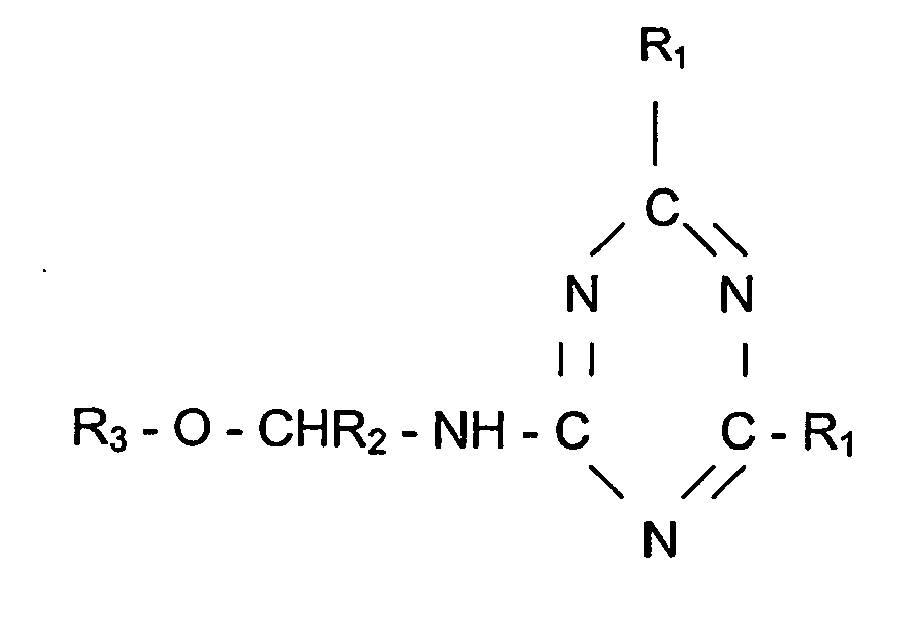 R1 = -NH2, -NH-CHR2-OH, -NH-CHR2-O-R3, -NH-CHR2-O-R4-OH, -CH3, -C3H7, -C6H5, -OH, Phthalimido-, Succinimido-, -NH-CO-C5-C18-Alkyl, -NH-C5-C18-Alkylen-OH, -NH-CHR2-O-C5-C18-Alkylen-NH2, -N H-C5-C18-Alkylen-NH2,R2 = -H, -C1-C7 - Alkyl;R3 = C1-C18 - Alkyl, -R4-OH,R4 = -CH(CH3)-CH2-O-C2-C12-Alkylen-O-CH2-CH(CH3)-,
-CH(CH3)-CH2-O-C2-C12-Arylen-O-CH2-CH(CH3)-,
-[CH2-CH2-O-CH2-CH2]n -, -[CH2-CH(CH3)-O-CH2-CH(CH3)]n -, -[O-CH2-CH2-CH2-CH2]n-,
-[(CH2)2-8-O-CO-C6-C14-Arylen-CO-O-(CH2)2-8]n-,
-[(CH2)2-8-O-CO-C2-C12-Alkylen-CO-O-(CH2)2-8]n-,
wobei n = 1 bis 200;
- Siloxangruppen enthaltende Polyestersequenzen des Typs -[(X)r-O-CO-(Y)s-CO-O-(X)r]-, bei denenX = -{(CH2)2-8-O-CO-C6-C14-Arylen-CO-O-(CH2)2-8}- oder -{(CH2)2-8-O-CO-C2-C12-Alkylen-CO-O-(CH2)2-8}-;
 - Siloxangruppen enthaltende Polyethersequenzen des Typs
 - Sequenzen auf Basis von Alkylenoxidaddukten des Melamins vom Typ 2-Amino-4,6-di-C2-C4-alkylenamino-1,3,5-triazin - Sequenzen:- Phenolethersequenzen auf Basis zweiwertiger Phenole und C2-C8-Diolen vom Typ -C2-C8-Alkylen-O-C6-C18-Arylen-O-C2-C8-Alkylen- Sequenzen;
und/oderB) Mischungen aus 10 bis 90 Masse% Aminotriazinethern A) und 90 bis 10 Masse% Polyaminotriazinethern mit Molmassen von 300 bis 5000, wobei die Polyaminotriazinether durch thermische Selbstkondensation von Aminotriazinethern A) gebildet werden, undC) Isocyanaten der Formel R6 (N = C = O)2,wobei das Molverhältnis Diisocyanat / Summe Iminogruppen und Aminogruppen in der Triazinsequenz 0,15 : 1 bis 0,65 : 1 beträgt, und
wobei R6 = C6-C14-Arylen, C4 - C18-Alkylen, und/oder C5 - C8 - Cycloalkylen, und/oder oligomere Polyester bzw. Polyether mit Isocyanatendgruppen und Molmassen von 200 bis 5000,
wobei die Mischungen 0,05 bis 2 Masse%, bezogen auf die Aminotriazinether, latente Härter enthalten können,
bei Temperaturen von 85 bis 130°C aufgeschmolzen, umgesetzt und auf textile Trägermaterialien aufgebracht werden. - Verfahren zur Herstellung von Prepregs für Faserverbunde hoher Festigkeit und Elastizität, dadurch gekennzeichnet, dass Prepregs, die aus 50 bis 85 Masse% textilen Flächengebilden und 15 bis 50 Masse% Carbamidsäureestergruppen enthaltenden Polyaminotriazinethern bestehen, nach einem Flüssigauftragsverfahren hergestellt werden, bei dem Dispersionen in C5-C12-Kohlenwasserstoffen und/oder C3-C12-Ketonen oder Lösungen in Dimethylsulfoxid, Dimethylformamid und/oder Dimethylacetamid mit einem Feststoffgehalt von 25 bis 70 Masse% ausA) Aminotriazinethern der Struktur
 R1 = -NH2, ,-NH-CHR2-OH, -NH-CHR2-O-R3, NH-CHR2-O-R4-OH, -CH3, -C3H7, -C6H5, -OH, Phthalimido-, Succinimido-, -NH-CO-C5-C18-Alkyl, -NH-C5-C18-Alkylen-OH, -NH-CHR2-O-C5-C18-Alkylen-NH2, -NH-C5-C18-Alkylen-NH2,R2 = -H, -C1-C7 -Alkyl;R3 = -C1-C18 - Alkyl, -R4-OH,R4 = -CH(CH3)-CH2-O-C2-C12-Alkylen-O-CH2-CH(CH3)-,
-CH(CH3)-CH2-O-C2-C12-Arylen-O-CH2CH(CH3)-,
-[CH2-CH2-O-CH2CH2]n -, -[CH2-CH(CH3)-O-CH2-CH(CH3)]n-, -[O-CH2-CH2CH2CH2]n-,
-[(CH2)2-8-O-CO-C6-C14-Arylen-CO-O-(CH2)2-8]n -,
-[(CH2)2-8-O-CO-C2-C12-Alkylen-CO-O-(CH2)2-8]n-,
wobei n = 1 bis 200;
- Siloxangruppen enthaltende Polyestersequenzen des Typs -[(X)r-O-CO-(Y)s-CO-O-(X)r]-, bei denenX = -{(CH2)2-8-O-CO-C6-C14-Arylen-CO-O-(CH2)2-8}- oder -{(CH2)2-8-O-CO-C2-C12-Alkylen-CO-O-(CH2)2-8}-;
 - Siloxangruppen enthaltende Polyethersequenzen des Typswobei R5 = H; C1-C4-Alkyl und y = 3 bis 50 bedeuten;
 - Sequenzen auf Basis von Alkylenoxidaddukten des Melamins vom Typ 2-Amino-4,6-di-C2-C4-alkylenamino-1,3,5-triazin - Sequenzen:- Phenolethersequenzen auf Basis zweiwertiger Phenole und C2-C8-Diolen vom Typ -C2-C8-Alkylen-O-C6-C18-Arylen-O-C2-C8-Alkylen- Sequenzen;
und/oderB) Mischungen aus 10 bis 90 Masse% Aminotriazinethem A) und 90 bis 10 Masse% Polyaminotriazinethern mit Molmassen von 300 bis 5000, wobei die Polyaminotriazinether durch Selbstkondensation von Triazinethern A) gebildet werden, undC) Isocyanaten der Formel R6 (N = C = O)2,wobei das Molverhältnis Diisocyanat / Summe Iminogruppen und Aminogruppen in der Triazinsequenz 0,15 : 1 bis 0,65 : 1 beträgt, und
wobei R6 = C6-C14-Arylen, C4- C18-Alkylen, und/oder C5 - C8 - Cycloalkylen, und/oder oligomere Polyester bzw. Polyether mit Isocyanat- Endgruppen und Molmassen von 200 bis 5000,
wobei die Mischungen 0,05 bis 2 Masse%, bezogen auf die Aminotriazinether, latente Härter enthalten können,
bei Temperaturen von 5 bis 80°C auf textile Trägermaterialien aufgebracht und bei 80 bis 120°C/ 0,1 bis 1 bar umgesetzt und getrocknet werden. - Verfahren zur Herstellung von Prepregs nach Anspruch 6 oder 7, dadurch gekennzeichnet, dass als Aminotriazinether 2,4,6-Tris(methoxymethylamino)-1,3,5-triazin eingesetzt wird.
- Verfahren zur Herstellung von Prepregs nach mindestens einem der Ansprüche 6 bis 8, dadurch gekennzeichnet, dass als latente Härter schwache Säuren, bevorzugt- blockierte Sulfonsäuren,- Alkalisalze oder Ammoniumsalze der Phosphorsäure,- C1-C12-Alkylester oder C2-C8-Hydroxyalkylester von C6-C14-aromatischen Carbonsäuren oder anorganischen Säuren,- Salze von Melamin oder Guanaminen mit C1-C18-aliphatischen Carbonsäuren,- Anhydride, Halbester oder Halbamide von C4-C20-Dicarbonsäuren,- Halbester oder Halbamide von Copolymeren aus ethylenisch ungesättigten C4-C20-Dicarbonsäureanhydriden und ethylenisch ungesättigten Monomeren vom Typ C2-C20-Olefine und/oder C8-C20-Vinylaromaten, und/oder- Salze von C1-C12-Alkylaminen bzw. Alkanolaminen mit C1-C18-aliphatischen, C6-C14-aromatischen oder alkylaromatischen Carbonsäuren sowie anorganischen Säuren vom Typ Salzsäure, Schwefelsäure oder Phosphorsäure,eingesetzt werden.
- Faserverbunde, hergestellt unter Verwendung von Prepregs nach einem oder mehreren der Ansprüche 1 bis 5.
- Verwendung von Faserverbunden nach Anspruch 10 für Hitzeschutzkleidung, Brandschutzdecken, Elektroisolationspapiere, Baukonstruktionsteile und Fahrzeugausrüstungen.
Priority Applications (2)
| Application Number | Priority Date | Filing Date | Title |
|---|---|---|---|
| SI200430544T SI1603969T1 (sl) | 2003-03-19 | 2004-03-19 | Prepregi za vlaknene kompozite z visoko trdnostjoin elasticnostjo |
| PL04721898T PL1603969T3 (pl) | 2003-03-19 | 2004-03-19 | Preimpregnaty do kompozytów włóknistych o wyższej wytrzymałości i sprężystości |
Applications Claiming Priority (3)
| Application Number | Priority Date | Filing Date | Title |
|---|---|---|---|
| DE10313200 | 2003-03-19 | ||
| DE10313200A DE10313200A1 (de) | 2003-03-19 | 2003-03-19 | Prepregs für Faserverbunde hoher Festigkeit und Elastizität |
| PCT/EP2004/002906 WO2004083288A1 (de) | 2003-03-19 | 2004-03-19 | Prepregs für faserverbunde hoher festigkeit und elastizität |
Publications (2)
| Publication Number | Publication Date |
|---|---|
| EP1603969A1 EP1603969A1 (de) | 2005-12-14 |
| EP1603969B1 true EP1603969B1 (de) | 2007-10-03 |
Family
ID=32946125
Family Applications (1)
| Application Number | Title | Priority Date | Filing Date |
|---|---|---|---|
| EP04721898A Expired - Lifetime EP1603969B1 (de) | 2003-03-19 | 2004-03-19 | Prepregs für faserverbunde hoher festigkeit und elastizität |
Country Status (12)
| Country | Link |
|---|---|
| US (1) | US20070048522A1 (de) |
| EP (1) | EP1603969B1 (de) |
| JP (1) | JP2006520416A (de) |
| KR (1) | KR20050110008A (de) |
| CN (1) | CN100345887C (de) |
| AT (1) | ATE374792T1 (de) |
| CA (1) | CA2516932A1 (de) |
| DE (2) | DE10313200A1 (de) |
| ES (1) | ES2294482T3 (de) |
| NO (1) | NO20054509L (de) |
| PL (1) | PL1603969T3 (de) |
| WO (1) | WO2004083288A1 (de) |
Families Citing this family (14)
| Publication number | Priority date | Publication date | Assignee | Title |
|---|---|---|---|---|
| DE102005029683A1 (de) * | 2005-06-20 | 2007-01-04 | Ami-Agrolinz Melamine International Gmbh | Melaminharz |
| DE102006034608A1 (de) * | 2006-07-21 | 2008-02-14 | Ami-Agrolinz Melamine International Gmbh | Thermoplastisch verarbeitbare Duroplastformmassen mit verbessertem Eigenschaftsspektrum |
| EP2197927B1 (de) * | 2007-10-12 | 2017-09-06 | Borealis Agrolinz Melamine GmbH | Thermoplastisch vereinbartes aminoplastharz, duroplastische feinstfaservliese sowie verfahren und anlage zu ihrer herstellung |
| US20130143025A1 (en) * | 2011-12-06 | 2013-06-06 | Makoto Kibayashi | Thermoplastic resin impregnated tape |
| EP2905294A1 (de) * | 2013-12-09 | 2015-08-12 | Basf Se | Wässrige lösungen schwefligsaurer salze von primären, sekundären oder tertiären aliphatischen c3- bis c8-alkanolaminen oder deren gemische |
| AU2015356587B2 (en) * | 2014-12-04 | 2020-04-09 | Professional Dietetics S.P.A. | Aminoacid-based composition for fibroelastin recovery in dermal connective tissues |
| DE102016119776B4 (de) * | 2016-10-18 | 2021-10-14 | Sächsisches Textilforschungsinstitut e.V. | Funktionslage und Faserverbundwerkstoff |
| US10435503B2 (en) | 2017-09-22 | 2019-10-08 | Hexion Inc. | Compositions for polyurethane applications |
| EP3684760A4 (de) * | 2017-09-22 | 2021-11-10 | Hexion Research Belgium SA | Neuartige zusammensetzungen und verfahren zur herstellung von alkoxylierten triazin-arylhydroxy-aldehyd-kondensaten |
| US10604614B2 (en) | 2017-09-22 | 2020-03-31 | Hexion Inc. | Compositions and methods to produce alkoxylated triazine-arylhydroxy-aldehyde condensates |
| US10640475B2 (en) | 2017-09-22 | 2020-05-05 | Hexion Inc. | Compositions and methods to produce alkoxylated triazine-arlhydroxy-aldehyde condensates |
| EP3833699A4 (de) * | 2018-07-24 | 2022-08-03 | Bakelite UK Holding Ltd. | Neuartige zusammensetzungen und verfahren zur herstellung von alkoxylierten triazin-arylhydroxy-aldehyd-kondensaten |
| KR102581917B1 (ko) * | 2018-07-24 | 2023-09-22 | 베이크라이트 유케이 홀딩 리미티드 | 알콕시화된 트리아진-아릴하이드록시-알데하이드 축합물을 제조하는 신규 조성물 및 방법 |
| CN109722006B (zh) * | 2019-01-03 | 2021-07-27 | 菲洛姆(福建)新材料科技有限责任公司 | 一种适用于传动部件的聚氨酯弹性材料及其制备方法 |
Family Cites Families (6)
| Publication number | Priority date | Publication date | Assignee | Title |
|---|---|---|---|---|
| FR1497527A (fr) * | 1966-06-03 | 1967-10-13 | Saint Gobain | Produits isolants, tels que coquilles, utilisables pour le calorifugeage à haute température et procédé ainsi qu'installation pour leur fabrication |
| AT398768B (de) * | 1991-08-05 | 1995-01-25 | Chemie Linz Gmbh | Modifizierte melaminharze sowie prepregs und laminate auf basis dieser melaminharze |
| DE10136321C1 (de) * | 2001-07-26 | 2002-12-12 | Agrolinz Melamin Gmbh Linz | Polymere aus Triazinderivaten |
| RU2321602C2 (ru) * | 2001-11-19 | 2008-04-10 | АМИ-Агролинц Меламин Интернейшнл ГмбХ | Продукты, особенно формующиеся материалы из полимеров, содержащих сегменты триазина, способ их производства и их использование |
| KR101309567B1 (ko) * | 2003-07-31 | 2013-09-25 | 미쓰비시 가가꾸 가부시키가이샤 | 섬유 강화 복합 재료, 그 제조 방법 및 그 이용 |
| DE102004006068A1 (de) * | 2004-01-30 | 2005-08-18 | Ami-Agrolinz Melamine International Gmbh | Flammfest ausgerüstetes Aminoplastharzsystem |
-
2003
- 2003-03-19 DE DE10313200A patent/DE10313200A1/de not_active Withdrawn
-
2004
- 2004-03-19 DE DE502004005135T patent/DE502004005135D1/de not_active Expired - Fee Related
- 2004-03-19 PL PL04721898T patent/PL1603969T3/pl unknown
- 2004-03-19 WO PCT/EP2004/002906 patent/WO2004083288A1/de not_active Ceased
- 2004-03-19 CA CA002516932A patent/CA2516932A1/en not_active Abandoned
- 2004-03-19 ES ES04721898T patent/ES2294482T3/es not_active Expired - Lifetime
- 2004-03-19 EP EP04721898A patent/EP1603969B1/de not_active Expired - Lifetime
- 2004-03-19 JP JP2006504753A patent/JP2006520416A/ja active Pending
- 2004-03-19 US US10/549,487 patent/US20070048522A1/en not_active Abandoned
- 2004-03-19 AT AT04721898T patent/ATE374792T1/de not_active IP Right Cessation
- 2004-03-19 CN CNB2004800072502A patent/CN100345887C/zh not_active Expired - Fee Related
- 2004-03-19 KR KR1020057017333A patent/KR20050110008A/ko not_active Withdrawn
-
2005
- 2005-09-29 NO NO20054509A patent/NO20054509L/no not_active Application Discontinuation
Non-Patent Citations (1)
| Title |
|---|
| None * |
Also Published As
| Publication number | Publication date |
|---|---|
| CN1761705A (zh) | 2006-04-19 |
| ATE374792T1 (de) | 2007-10-15 |
| JP2006520416A (ja) | 2006-09-07 |
| DE502004005135D1 (de) | 2007-11-15 |
| PL1603969T3 (pl) | 2008-03-31 |
| NO20054509L (no) | 2005-09-29 |
| DE10313200A1 (de) | 2004-10-07 |
| EP1603969A1 (de) | 2005-12-14 |
| KR20050110008A (ko) | 2005-11-22 |
| CA2516932A1 (en) | 2004-09-30 |
| US20070048522A1 (en) | 2007-03-01 |
| CN100345887C (zh) | 2007-10-31 |
| WO2004083288A1 (de) | 2004-09-30 |
| ES2294482T3 (es) | 2008-04-01 |
Similar Documents
| Publication | Publication Date | Title |
|---|---|---|
| EP0526804B1 (de) | Melaminharz-Prepregs und Melaminharz-Laminate auf Basis modifizierter Melaminharze | |
| DE69813887T2 (de) | Cyclisches harnstoff-formaldehyd prepolymer zur verwendung in bindemitteln basierend auf phenol-formaldehyd- und melamin-formaldehyd-harzen | |
| EP1603969A1 (de) | Prepregs für faserverbunde hoher festigkeit und elastizität | |
| EP1521805B1 (de) | Aminoplast-formmassen für erzeugnisse verbesserter flexibilität und aminoplasterzeugnisse verbesserter flexibilität | |
| EP1279686B1 (de) | Polymere aus Triazinderivaten | |
| WO2010019666A1 (en) | Rapid curing aldehyde resin-polyisocyanate composition and method for producing hybrid polymer | |
| DE10261804B4 (de) | Direktsyntheseverfahren zur Herstellung von veretherten Melaminharzkondensaten, Melaminharzkondensate und deren Verwendung | |
| EP1519972B1 (de) | Zusammensetzungen zur herstellung von aminoplasterzeugnissen | |
| EP1720922B1 (de) | Flammfest ausgerüstetes aminoplastharzsystem | |
| EP0910595B1 (de) | Modifizierte melaminharze und deren verwendung zur herstellung von postforming-fähigen laminaten | |
| DE4129326A1 (de) | Melaminharz-prepregs und melaminharz-laminate auf basis modifizierter melaminharze | |
| JP2999013B2 (ja) | 高強度高耐水性リグノセルロース成形板 | |
| KR100567687B1 (ko) | 멜라민 수지 섬유의 용도 및 멜라민 수지 섬유와폴리(알킬렌 테레프탈레이트) 섬유를 기재로 하는 절연재 | |
| EP0815151B1 (de) | Modifizierte melaminharze und deren verwendung zur herstellung von post-forming-laminaten | |
| WO2004083275A1 (de) | Duroplastformmassen verbesserter verarbeitbarkeit | |
| US6793772B2 (en) | Use of melamine resin fibers and insulating materials based on melamine resin fibers and polyalkylene terephthalate fibers | |
| US4906505A (en) | Skin-shaped product of aminoplast resin mixture and fibrous material | |
| DE3813753A1 (de) | Wasserloesliche impraegnierharze |
Legal Events
| Date | Code | Title | Description |
|---|---|---|---|
| PUAI | Public reference made under article 153(3) epc to a published international application that has entered the european phase |
Free format text: ORIGINAL CODE: 0009012 |
|
| 17P | Request for examination filed |
Effective date: 20050929 |
|
| AK | Designated contracting states |
Kind code of ref document: A1 Designated state(s): AT BE BG CH CY CZ DE DK EE ES FI FR GB GR HU IE IT LI LU MC NL PL PT RO SE SI SK TR |
|
| AX | Request for extension of the european patent |
Extension state: AL LT LV MK |
|
| RIN1 | Information on inventor provided before grant (corrected) |
Inventor name: REUSSMANN, THOMAS Inventor name: KNOBELSDORF, CARMEN Inventor name: DICKE, RENE Inventor name: BURGER, MARTIN Inventor name: MACHHERNDL, MARKUS Inventor name: RAETZSCH, MANFRED |
|
| DAX | Request for extension of the european patent (deleted) | ||
| GRAP | Despatch of communication of intention to grant a patent |
Free format text: ORIGINAL CODE: EPIDOSNIGR1 |
|
| GRAS | Grant fee paid |
Free format text: ORIGINAL CODE: EPIDOSNIGR3 |
|
| GRAA | (expected) grant |
Free format text: ORIGINAL CODE: 0009210 |
|
| AK | Designated contracting states |
Kind code of ref document: B1 Designated state(s): AT BE BG CH CY CZ DE DK EE ES FI FR GB GR HU IE IT LI LU MC NL PL PT RO SE SI SK TR |
|
| REG | Reference to a national code |
Ref country code: GB Ref legal event code: FG4D Free format text: NOT ENGLISH |
|
| REG | Reference to a national code |
Ref country code: CH Ref legal event code: EP |
|
| REG | Reference to a national code |
Ref country code: IE Ref legal event code: FG4D Free format text: LANGUAGE OF EP DOCUMENT: GERMAN |
|
| REF | Corresponds to: |
Ref document number: 502004005135 Country of ref document: DE Date of ref document: 20071115 Kind code of ref document: P |
|
| REG | Reference to a national code |
Ref country code: SE Ref legal event code: TRGR |
|
| REG | Reference to a national code |
Ref country code: CH Ref legal event code: NV Representative=s name: SCHMAUDER & PARTNER AG PATENTANWALTSBUERO |
|
| GBT | Gb: translation of ep patent filed (gb section 77(6)(a)/1977) |
Effective date: 20080113 |
|
| REG | Reference to a national code |
Ref country code: PL Ref legal event code: T3 |
|
| REG | Reference to a national code |
Ref country code: ES Ref legal event code: FG2A Ref document number: 2294482 Country of ref document: ES Kind code of ref document: T3 |
|
| PG25 | Lapsed in a contracting state [announced via postgrant information from national office to epo] |
Ref country code: BG Free format text: LAPSE BECAUSE OF FAILURE TO SUBMIT A TRANSLATION OF THE DESCRIPTION OR TO PAY THE FEE WITHIN THE PRESCRIBED TIME-LIMIT Effective date: 20080103 Ref country code: PT Free format text: LAPSE BECAUSE OF FAILURE TO SUBMIT A TRANSLATION OF THE DESCRIPTION OR TO PAY THE FEE WITHIN THE PRESCRIBED TIME-LIMIT Effective date: 20080303 |
|
| ET | Fr: translation filed | ||
| REG | Reference to a national code |
Ref country code: IE Ref legal event code: FD4D |
|
| REG | Reference to a national code |
Ref country code: HU Ref legal event code: AG4A Ref document number: E002825 Country of ref document: HU |
|
| PG25 | Lapsed in a contracting state [announced via postgrant information from national office to epo] |
Ref country code: DK Free format text: LAPSE BECAUSE OF FAILURE TO SUBMIT A TRANSLATION OF THE DESCRIPTION OR TO PAY THE FEE WITHIN THE PRESCRIBED TIME-LIMIT Effective date: 20071003 |
|
| PGFP | Annual fee paid to national office [announced via postgrant information from national office to epo] |
Ref country code: DE Payment date: 20080304 Year of fee payment: 5 |
|
| PLBE | No opposition filed within time limit |
Free format text: ORIGINAL CODE: 0009261 |
|
| STAA | Information on the status of an ep patent application or granted ep patent |
Free format text: STATUS: NO OPPOSITION FILED WITHIN TIME LIMIT |
|
| PG25 | Lapsed in a contracting state [announced via postgrant information from national office to epo] |
Ref country code: RO Free format text: LAPSE BECAUSE OF FAILURE TO SUBMIT A TRANSLATION OF THE DESCRIPTION OR TO PAY THE FEE WITHIN THE PRESCRIBED TIME-LIMIT Effective date: 20071003 |
|
| 26N | No opposition filed |
Effective date: 20080704 |
|
| BERE | Be: lapsed |
Owner name: AMI AGROLINZ MELAMINE INTERNATIONAL GMBH Effective date: 20080331 |
|
| PG25 | Lapsed in a contracting state [announced via postgrant information from national office to epo] |
Ref country code: MC Free format text: LAPSE BECAUSE OF NON-PAYMENT OF DUE FEES Effective date: 20080331 Ref country code: IE Free format text: LAPSE BECAUSE OF FAILURE TO SUBMIT A TRANSLATION OF THE DESCRIPTION OR TO PAY THE FEE WITHIN THE PRESCRIBED TIME-LIMIT Effective date: 20071003 |
|
| PG25 | Lapsed in a contracting state [announced via postgrant information from national office to epo] |
Ref country code: GR Free format text: LAPSE BECAUSE OF FAILURE TO SUBMIT A TRANSLATION OF THE DESCRIPTION OR TO PAY THE FEE WITHIN THE PRESCRIBED TIME-LIMIT Effective date: 20080104 Ref country code: EE Free format text: LAPSE BECAUSE OF FAILURE TO SUBMIT A TRANSLATION OF THE DESCRIPTION OR TO PAY THE FEE WITHIN THE PRESCRIBED TIME-LIMIT Effective date: 20071003 |
|
| PG25 | Lapsed in a contracting state [announced via postgrant information from national office to epo] |
Ref country code: BE Free format text: LAPSE BECAUSE OF NON-PAYMENT OF DUE FEES Effective date: 20080331 |
|
| PGFP | Annual fee paid to national office [announced via postgrant information from national office to epo] |
Ref country code: AT Payment date: 20090317 Year of fee payment: 6 Ref country code: ES Payment date: 20090324 Year of fee payment: 6 Ref country code: HU Payment date: 20090313 Year of fee payment: 6 |
|
| PGFP | Annual fee paid to national office [announced via postgrant information from national office to epo] |
Ref country code: CZ Payment date: 20090316 Year of fee payment: 6 Ref country code: NL Payment date: 20090317 Year of fee payment: 6 Ref country code: PL Payment date: 20090311 Year of fee payment: 6 Ref country code: SI Payment date: 20090313 Year of fee payment: 6 Ref country code: SK Payment date: 20090318 Year of fee payment: 6 |
|
| PGFP | Annual fee paid to national office [announced via postgrant information from national office to epo] |
Ref country code: CH Payment date: 20090316 Year of fee payment: 6 Ref country code: GB Payment date: 20090325 Year of fee payment: 6 |
|
| PG25 | Lapsed in a contracting state [announced via postgrant information from national office to epo] |
Ref country code: CY Free format text: LAPSE BECAUSE OF FAILURE TO SUBMIT A TRANSLATION OF THE DESCRIPTION OR TO PAY THE FEE WITHIN THE PRESCRIBED TIME-LIMIT Effective date: 20071003 |
|
| REG | Reference to a national code |
Ref country code: CH Ref legal event code: PCAR Free format text: SCHMAUDER & PARTNER AG PATENT- UND MARKENANWAELTE VSP;ZWAENGIWEG 7;8038 ZUERICH (CH) |
|
| PGFP | Annual fee paid to national office [announced via postgrant information from national office to epo] |
Ref country code: IT Payment date: 20090321 Year of fee payment: 6 Ref country code: SE Payment date: 20090312 Year of fee payment: 6 Ref country code: TR Payment date: 20090317 Year of fee payment: 6 |
|
| PGFP | Annual fee paid to national office [announced via postgrant information from national office to epo] |
Ref country code: FR Payment date: 20090312 Year of fee payment: 6 |
|
| PG25 | Lapsed in a contracting state [announced via postgrant information from national office to epo] |
Ref country code: DE Free format text: LAPSE BECAUSE OF NON-PAYMENT OF DUE FEES Effective date: 20091001 |
|
| PG25 | Lapsed in a contracting state [announced via postgrant information from national office to epo] |
Ref country code: FI Free format text: LAPSE BECAUSE OF FAILURE TO SUBMIT A TRANSLATION OF THE DESCRIPTION OR TO PAY THE FEE WITHIN THE PRESCRIBED TIME-LIMIT Effective date: 20071003 |
|
| PG25 | Lapsed in a contracting state [announced via postgrant information from national office to epo] |
Ref country code: LU Free format text: LAPSE BECAUSE OF NON-PAYMENT OF DUE FEES Effective date: 20080319 |
|
| REG | Reference to a national code |
Ref country code: NL Ref legal event code: V1 Effective date: 20101001 |
|
| REG | Reference to a national code |
Ref country code: CH Ref legal event code: PL |
|
| EUG | Se: european patent has lapsed | ||
| GBPC | Gb: european patent ceased through non-payment of renewal fee |
Effective date: 20100319 |
|
| PG25 | Lapsed in a contracting state [announced via postgrant information from national office to epo] |
Ref country code: CZ Free format text: LAPSE BECAUSE OF NON-PAYMENT OF DUE FEES Effective date: 20100319 Ref country code: AT Free format text: LAPSE BECAUSE OF NON-PAYMENT OF DUE FEES Effective date: 20100319 |
|
| REG | Reference to a national code |
Ref country code: SI Ref legal event code: KO00 Effective date: 20101022 |
|
| REG | Reference to a national code |
Ref country code: SK Ref legal event code: MM4A Ref document number: E 2953 Country of ref document: SK Effective date: 20100319 |
|
| REG | Reference to a national code |
Ref country code: FR Ref legal event code: ST Effective date: 20101130 |
|
| PG25 | Lapsed in a contracting state [announced via postgrant information from national office to epo] |
Ref country code: NL Free format text: LAPSE BECAUSE OF NON-PAYMENT OF DUE FEES Effective date: 20101001 Ref country code: FR Free format text: LAPSE BECAUSE OF NON-PAYMENT OF DUE FEES Effective date: 20100331 |
|
| PG25 | Lapsed in a contracting state [announced via postgrant information from national office to epo] |
Ref country code: SK Free format text: LAPSE BECAUSE OF NON-PAYMENT OF DUE FEES Effective date: 20100319 Ref country code: HU Free format text: LAPSE BECAUSE OF NON-PAYMENT OF DUE FEES Effective date: 20100320 Ref country code: LI Free format text: LAPSE BECAUSE OF NON-PAYMENT OF DUE FEES Effective date: 20100331 Ref country code: SI Free format text: LAPSE BECAUSE OF NON-PAYMENT OF DUE FEES Effective date: 20100320 Ref country code: CH Free format text: LAPSE BECAUSE OF NON-PAYMENT OF DUE FEES Effective date: 20100331 |
|
| PG25 | Lapsed in a contracting state [announced via postgrant information from national office to epo] |
Ref country code: IT Free format text: LAPSE BECAUSE OF NON-PAYMENT OF DUE FEES Effective date: 20100319 Ref country code: GB Free format text: LAPSE BECAUSE OF NON-PAYMENT OF DUE FEES Effective date: 20100319 |
|
| REG | Reference to a national code |
Ref country code: ES Ref legal event code: FD2A Effective date: 20110415 |
|
| PG25 | Lapsed in a contracting state [announced via postgrant information from national office to epo] |
Ref country code: ES Free format text: LAPSE BECAUSE OF NON-PAYMENT OF DUE FEES Effective date: 20110404 |
|
| PG25 | Lapsed in a contracting state [announced via postgrant information from national office to epo] |
Ref country code: ES Free format text: LAPSE BECAUSE OF NON-PAYMENT OF DUE FEES Effective date: 20100320 |
|
| REG | Reference to a national code |
Ref country code: PL Ref legal event code: LAPE |
|
| PG25 | Lapsed in a contracting state [announced via postgrant information from national office to epo] |
Ref country code: PL Free format text: LAPSE BECAUSE OF NON-PAYMENT OF DUE FEES Effective date: 20100319 |
|
| PG25 | Lapsed in a contracting state [announced via postgrant information from national office to epo] |
Ref country code: SE Free format text: LAPSE BECAUSE OF NON-PAYMENT OF DUE FEES Effective date: 20100320 |
|
| PG25 | Lapsed in a contracting state [announced via postgrant information from national office to epo] |
Ref country code: TR Free format text: LAPSE BECAUSE OF NON-PAYMENT OF DUE FEES Effective date: 20100319 |