EP1602648A1 - Nitrogen-containing heterocycle derivative and organic electroluminescent element using the same - Google Patents
Nitrogen-containing heterocycle derivative and organic electroluminescent element using the same Download PDFInfo
- Publication number
- EP1602648A1 EP1602648A1 EP04705503A EP04705503A EP1602648A1 EP 1602648 A1 EP1602648 A1 EP 1602648A1 EP 04705503 A EP04705503 A EP 04705503A EP 04705503 A EP04705503 A EP 04705503A EP 1602648 A1 EP1602648 A1 EP 1602648A1
- Authority
- EP
- European Patent Office
- Prior art keywords
- substituent
- group
- carbon atoms
- organic
- derivative
- Prior art date
- Legal status (The legal status is an assumption and is not a legal conclusion. Google has not performed a legal analysis and makes no representation as to the accuracy of the status listed.)
- Granted
Links
- GEQBRULPNIVQPP-UHFFFAOYSA-N c(cc1)ccc1-[n]1c(-c2cc(-c3nc(cccc4)c4[n]3-c3ccccc3)cc(-c3nc4ccccc4[n]3-c3ccccc3)c2)nc2c1cccc2 Chemical compound c(cc1)ccc1-[n]1c(-c2cc(-c3nc(cccc4)c4[n]3-c3ccccc3)cc(-c3nc4ccccc4[n]3-c3ccccc3)c2)nc2c1cccc2 GEQBRULPNIVQPP-UHFFFAOYSA-N 0.000 description 1
Classifications
-
- C—CHEMISTRY; METALLURGY
- C09—DYES; PAINTS; POLISHES; NATURAL RESINS; ADHESIVES; COMPOSITIONS NOT OTHERWISE PROVIDED FOR; APPLICATIONS OF MATERIALS NOT OTHERWISE PROVIDED FOR
- C09K—MATERIALS FOR MISCELLANEOUS APPLICATIONS, NOT PROVIDED FOR ELSEWHERE
- C09K11/00—Luminescent materials, e.g. electroluminescent or chemiluminescent
- C09K11/06—Luminescent materials, e.g. electroluminescent or chemiluminescent containing organic luminescent materials
-
- H—ELECTRICITY
- H10—SEMICONDUCTOR DEVICES; ELECTRIC SOLID-STATE DEVICES NOT OTHERWISE PROVIDED FOR
- H10K—ORGANIC ELECTRIC SOLID-STATE DEVICES
- H10K85/00—Organic materials used in the body or electrodes of devices covered by this subclass
- H10K85/60—Organic compounds having low molecular weight
- H10K85/615—Polycyclic condensed aromatic hydrocarbons, e.g. anthracene
-
- C—CHEMISTRY; METALLURGY
- C07—ORGANIC CHEMISTRY
- C07D—HETEROCYCLIC COMPOUNDS
- C07D235/00—Heterocyclic compounds containing 1,3-diazole or hydrogenated 1,3-diazole rings, condensed with other rings
- C07D235/02—Heterocyclic compounds containing 1,3-diazole or hydrogenated 1,3-diazole rings, condensed with other rings condensed with carbocyclic rings or ring systems
- C07D235/04—Benzimidazoles; Hydrogenated benzimidazoles
- C07D235/06—Benzimidazoles; Hydrogenated benzimidazoles with only hydrogen atoms, hydrocarbon or substituted hydrocarbon radicals, directly attached in position 2
- C07D235/08—Radicals containing only hydrogen and carbon atoms
-
- C—CHEMISTRY; METALLURGY
- C07—ORGANIC CHEMISTRY
- C07D—HETEROCYCLIC COMPOUNDS
- C07D235/00—Heterocyclic compounds containing 1,3-diazole or hydrogenated 1,3-diazole rings, condensed with other rings
- C07D235/02—Heterocyclic compounds containing 1,3-diazole or hydrogenated 1,3-diazole rings, condensed with other rings condensed with carbocyclic rings or ring systems
- C07D235/04—Benzimidazoles; Hydrogenated benzimidazoles
- C07D235/18—Benzimidazoles; Hydrogenated benzimidazoles with aryl radicals directly attached in position 2
-
- C—CHEMISTRY; METALLURGY
- C07—ORGANIC CHEMISTRY
- C07D—HETEROCYCLIC COMPOUNDS
- C07D235/00—Heterocyclic compounds containing 1,3-diazole or hydrogenated 1,3-diazole rings, condensed with other rings
- C07D235/02—Heterocyclic compounds containing 1,3-diazole or hydrogenated 1,3-diazole rings, condensed with other rings condensed with carbocyclic rings or ring systems
- C07D235/04—Benzimidazoles; Hydrogenated benzimidazoles
- C07D235/20—Two benzimidazolyl-2 radicals linked together directly or via a hydrocarbon or substituted hydrocarbon radical
-
- C—CHEMISTRY; METALLURGY
- C07—ORGANIC CHEMISTRY
- C07D—HETEROCYCLIC COMPOUNDS
- C07D401/00—Heterocyclic compounds containing two or more hetero rings, having nitrogen atoms as the only ring hetero atoms, at least one ring being a six-membered ring with only one nitrogen atom
- C07D401/02—Heterocyclic compounds containing two or more hetero rings, having nitrogen atoms as the only ring hetero atoms, at least one ring being a six-membered ring with only one nitrogen atom containing two hetero rings
- C07D401/04—Heterocyclic compounds containing two or more hetero rings, having nitrogen atoms as the only ring hetero atoms, at least one ring being a six-membered ring with only one nitrogen atom containing two hetero rings directly linked by a ring-member-to-ring-member bond
-
- C—CHEMISTRY; METALLURGY
- C07—ORGANIC CHEMISTRY
- C07D—HETEROCYCLIC COMPOUNDS
- C07D401/00—Heterocyclic compounds containing two or more hetero rings, having nitrogen atoms as the only ring hetero atoms, at least one ring being a six-membered ring with only one nitrogen atom
- C07D401/02—Heterocyclic compounds containing two or more hetero rings, having nitrogen atoms as the only ring hetero atoms, at least one ring being a six-membered ring with only one nitrogen atom containing two hetero rings
- C07D401/10—Heterocyclic compounds containing two or more hetero rings, having nitrogen atoms as the only ring hetero atoms, at least one ring being a six-membered ring with only one nitrogen atom containing two hetero rings linked by a carbon chain containing aromatic rings
-
- H—ELECTRICITY
- H10—SEMICONDUCTOR DEVICES; ELECTRIC SOLID-STATE DEVICES NOT OTHERWISE PROVIDED FOR
- H10K—ORGANIC ELECTRIC SOLID-STATE DEVICES
- H10K50/00—Organic light-emitting devices
-
- H—ELECTRICITY
- H10—SEMICONDUCTOR DEVICES; ELECTRIC SOLID-STATE DEVICES NOT OTHERWISE PROVIDED FOR
- H10K—ORGANIC ELECTRIC SOLID-STATE DEVICES
- H10K85/00—Organic materials used in the body or electrodes of devices covered by this subclass
- H10K85/60—Organic compounds having low molecular weight
- H10K85/649—Aromatic compounds comprising a hetero atom
- H10K85/657—Polycyclic condensed heteroaromatic hydrocarbons
- H10K85/6572—Polycyclic condensed heteroaromatic hydrocarbons comprising only nitrogen in the heteroaromatic polycondensed ring system, e.g. phenanthroline or carbazole
-
- C—CHEMISTRY; METALLURGY
- C09—DYES; PAINTS; POLISHES; NATURAL RESINS; ADHESIVES; COMPOSITIONS NOT OTHERWISE PROVIDED FOR; APPLICATIONS OF MATERIALS NOT OTHERWISE PROVIDED FOR
- C09K—MATERIALS FOR MISCELLANEOUS APPLICATIONS, NOT PROVIDED FOR ELSEWHERE
- C09K2211/00—Chemical nature of organic luminescent or tenebrescent compounds
- C09K2211/10—Non-macromolecular compounds
- C09K2211/1018—Heterocyclic compounds
- C09K2211/1025—Heterocyclic compounds characterised by ligands
- C09K2211/1044—Heterocyclic compounds characterised by ligands containing two nitrogen atoms as heteroatoms
-
- H—ELECTRICITY
- H10—SEMICONDUCTOR DEVICES; ELECTRIC SOLID-STATE DEVICES NOT OTHERWISE PROVIDED FOR
- H10K—ORGANIC ELECTRIC SOLID-STATE DEVICES
- H10K2102/00—Constructional details relating to the organic devices covered by this subclass
- H10K2102/10—Transparent electrodes, e.g. using graphene
- H10K2102/101—Transparent electrodes, e.g. using graphene comprising transparent conductive oxides [TCO]
- H10K2102/103—Transparent electrodes, e.g. using graphene comprising transparent conductive oxides [TCO] comprising indium oxides, e.g. ITO
-
- H—ELECTRICITY
- H10—SEMICONDUCTOR DEVICES; ELECTRIC SOLID-STATE DEVICES NOT OTHERWISE PROVIDED FOR
- H10K—ORGANIC ELECTRIC SOLID-STATE DEVICES
- H10K85/00—Organic materials used in the body or electrodes of devices covered by this subclass
- H10K85/60—Organic compounds having low molecular weight
- H10K85/615—Polycyclic condensed aromatic hydrocarbons, e.g. anthracene
- H10K85/622—Polycyclic condensed aromatic hydrocarbons, e.g. anthracene containing four rings, e.g. pyrene
-
- H—ELECTRICITY
- H10—SEMICONDUCTOR DEVICES; ELECTRIC SOLID-STATE DEVICES NOT OTHERWISE PROVIDED FOR
- H10K—ORGANIC ELECTRIC SOLID-STATE DEVICES
- H10K85/00—Organic materials used in the body or electrodes of devices covered by this subclass
- H10K85/60—Organic compounds having low molecular weight
- H10K85/631—Amine compounds having at least two aryl rest on at least one amine-nitrogen atom, e.g. triphenylamine
- H10K85/633—Amine compounds having at least two aryl rest on at least one amine-nitrogen atom, e.g. triphenylamine comprising polycyclic condensed aromatic hydrocarbons as substituents on the nitrogen atom
-
- H—ELECTRICITY
- H10—SEMICONDUCTOR DEVICES; ELECTRIC SOLID-STATE DEVICES NOT OTHERWISE PROVIDED FOR
- H10K—ORGANIC ELECTRIC SOLID-STATE DEVICES
- H10K85/00—Organic materials used in the body or electrodes of devices covered by this subclass
- H10K85/60—Organic compounds having low molecular weight
- H10K85/649—Aromatic compounds comprising a hetero atom
- H10K85/654—Aromatic compounds comprising a hetero atom comprising only nitrogen as heteroatom
-
- Y—GENERAL TAGGING OF NEW TECHNOLOGICAL DEVELOPMENTS; GENERAL TAGGING OF CROSS-SECTIONAL TECHNOLOGIES SPANNING OVER SEVERAL SECTIONS OF THE IPC; TECHNICAL SUBJECTS COVERED BY FORMER USPC CROSS-REFERENCE ART COLLECTIONS [XRACs] AND DIGESTS
- Y10—TECHNICAL SUBJECTS COVERED BY FORMER USPC
- Y10S—TECHNICAL SUBJECTS COVERED BY FORMER USPC CROSS-REFERENCE ART COLLECTIONS [XRACs] AND DIGESTS
- Y10S428/00—Stock material or miscellaneous articles
- Y10S428/917—Electroluminescent
Definitions
- the present invention relates to a novel nitrogen-containing heterocycle derivative, i.e., a novel derivative of heterocyclic compound having nitrogen atom and to an organic electroluminescent element (an electroluminescent element will be referred to as an electroluminescence device, hereinafter) which utilizes the novel compound.
- a novel nitrogen-containing heterocycle derivative i.e., a novel derivative of heterocyclic compound having nitrogen atom and to an organic electroluminescent element (an electroluminescent element will be referred to as an electroluminescence device, hereinafter) which utilizes the novel compound.
- the present invention relates to a derivative of heterocyclic compound having nitrogen atom useful as constituting component of an organic electroluminescence ("electroluminescence" will be occasionally referred to as "EL", hereinafter) device, i.e., an organic EL device achieving elevation of luminance and of efficiency in light emission even under low driving voltage in accordance with an employment of the derivative of heterocyclic compound having nitrogen atom for at least one layer composing organic compound layers of the EL device.
- an organic electroluminescence will be occasionally referred to as "EL”, hereinafter
- Organic EL devices which utilize organic substances are expected to be useful for application as an inexpensive full color display device of the solid light emission type having a great size and various developments on the organic EL devices are being conducted.
- an organic EL device has a construction comprising a light emitting layer and a pair of electrodes sandwiching the light emitting layer.
- the light emission of the organic EL device is a phenomenon in which, when an electric field is applied between the two electrodes, electrons are injected from the cathode side and holes are injected from the anode side, the electrons are recombined with the holes in the light emitting layer to form an excited state, and energy generated when the excited state returns to the ground state is emitted as light.
- United States Patent No. 5,645,948 discloses an organic EL device with the use of a compound having benzimidazole structure as an light emitting material describing that the organic EL device emits light with a luminance of 200 nit at a voltage of 9 V.
- Japanese Unexamined Patent Application Laid-Open No. 2002-38141 discloses a compound having benzimidazole ring and anthracene skeleton.
- an organic EL device with further enhanced luminance and with further improved efficiency of light emission than the organic EL device with the use of the above compounds is required.
- the object of the present invention is to provide a novel derivative of heterocyclic compound having nitrogen atom useful as a constitutional component of an organic EL device.
- Another object of the present invention is to provide an organic EL device achieving elevation of luminance and of efficiency in light emission in accordance with an employment of the derivative of heterocyclic compound having nitrogen atom for at least one layer composing organic compound layers of the EL device.
- a derivative of heterocyclic compound having nitrogen atom was found to be a novel compound with specific structure useful as a material for an organic El device.
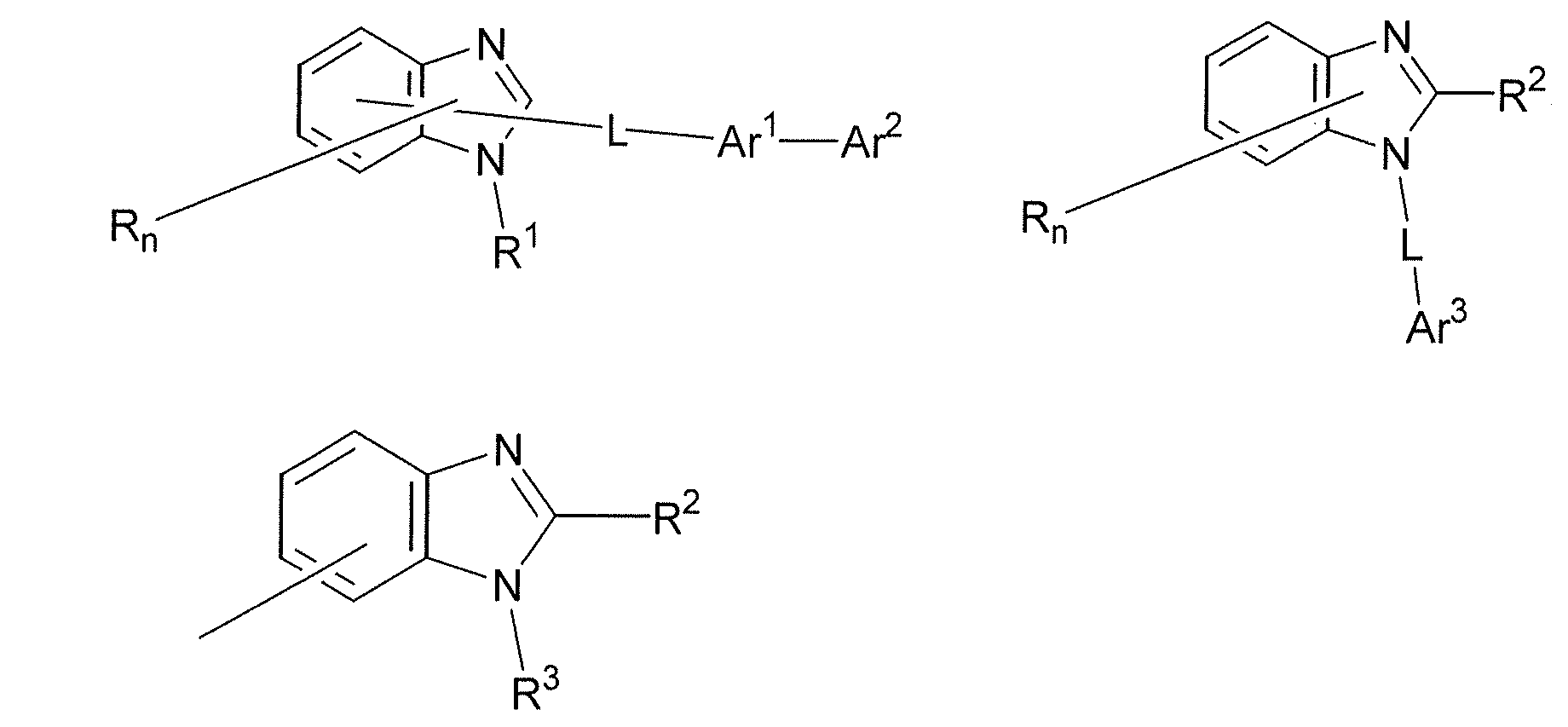
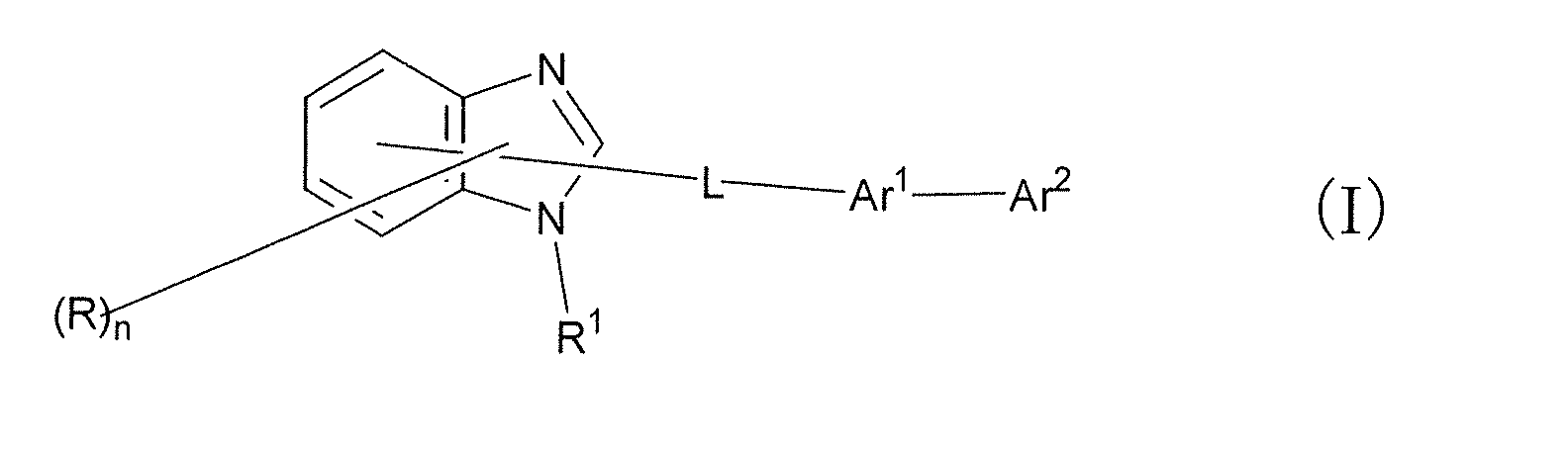
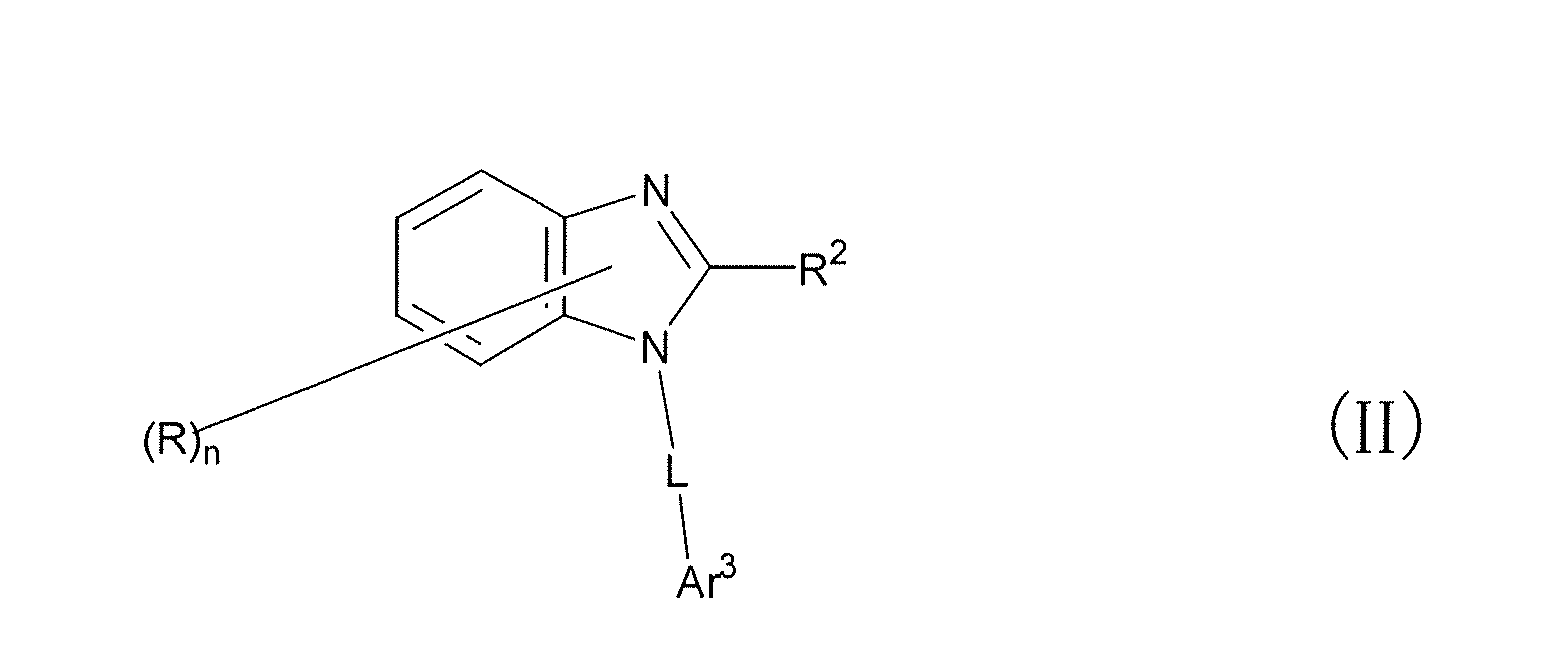
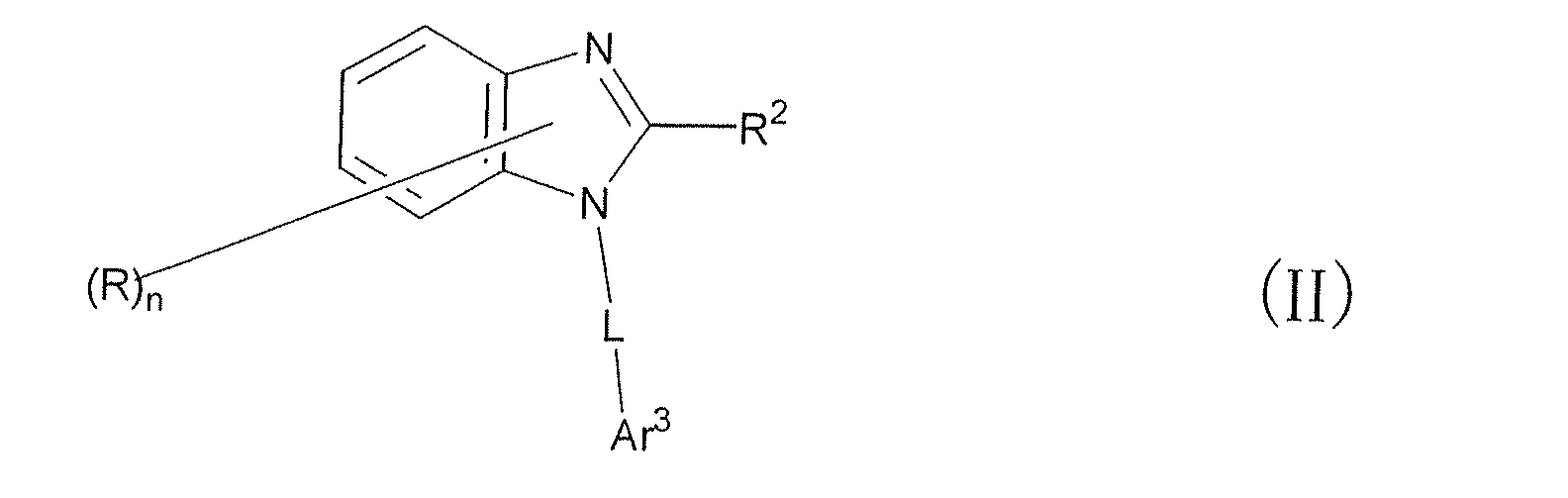
- the present invention provides a derivative of heterocyclic compound having nitrogen atom represented by any one of general formulae (I), (II) or (III) below.
- R represents a hydrogen atom, an aryl group having 6 to 60 carbon atoms and may have a substituent, a pyridyl group which may have a substituent, or a quinolyl group which may have a substituent; an alkyl group having 1 to 20 carbon atoms and may have a substituent or an alkoxy group having 1 to 20 carbon atoms and may have a substituent;
- n represents an integer of 0 to 4;
- R 1 represents an aryl group having 6 to 60 carbon atoms and may have a substituent, a pyridyl group which may have a substituent, or a quinolyl group which may have a substituent; an alkyl group having 1 to 20 carbon atoms and may have a substituent or an alkoxy group having 1 to 20 carbon atoms and may have a
- the present invention provides a material for the organic EL device comprising the above derivative of heterocyclic compound having nitrogen atom.
- the present invention provides an organic EL device comprising at least one of organic compound layers including a light emitting layer sandwiched between a pair of electrode, wherein the organic EL device comprises the foregoing derivative of heterocyclic compound having nitrogen atom of the invention in at least one of the organic compound layers.
- R represents a hydrogen atom, an aryl group having 6 to 60 carbon atoms and may have a substituent, a pyridyl group which may have a substituent, or a quinolyl group which may have a substituent; an alkyl group having 1 to 20 carbon atoms and may have a substituent or an alkoxy group having 1 to 20 carbon atoms and may have a substituent.
- the aryl group having 6 to 60 carbon atoms is preferably an aryl group having 6 to 40 carbon atoms, more preferably an aryl group having 6 to 20 carbon atoms.
- Specific examples of the aryl group having 6 to 20 carbon atoms include phenyl group, naphthyl group, anthryl group, phenanthryl group, naphthacenyl group, chrysenyl group, pyrenyl group, biphenyl group, terphenyl group, tolyl group, t-butylphenyl group, (2-phenylpropyl) phenyl group, fluoranthenyl group, fluorenyl group, monovalent group consisting of spirobifluorene, perfluorophenyl group, perfluoronaphthyl group, perfluoro anthryl group, perfluorinated biphenyl group, monovalent group consisting of 9-phenylanthracene, monovalent group consisting of 9
- the alkyl group having 1 to 20 carbon atoms is preferably an alkyl group having 1 to 6 carbon atoms. Specific examples of the alkyl group having 1 to 6 carbon atoms include methyl group, ethyl group, propyl group, butyl group, pentyl group, hexyl group, etc.
- the alkyl group having 3 or more carbon atoms may be linear, cyclic or branched.
- the alkoxy group having 1 to 20 carbon atoms is preferably an alkoxy group having 1 to 6 carbon atoms. Specific examples of the alkoxy group having 1 to 6 carbon atoms include methoxy group, ethoxy group, propoxy group, butoxy group, pentyloxy group, hexyloxy group, etc.
- the alkoxy group having 3 or more carbon atoms may be linear, cyclic or branched.
- Examples of the substituent represented by R include a halogen atom, an alkyl group having 1 to 20 carbon atoms and may have a substituent, an alkoxy group having 1 to 20 carbon atoms and may have a substituent, an aryloxy group having 6 to 40 carbon atoms and may have a substituent, a diarylamino group having 12 to 80 carbon atoms and may have a substituent, an aryl group having 6 to 40 carbon atoms and may have a substituent, a heteroaryl group having 3 to 40 carbon atoms and may have a substituent, etc.
- halogen atom examples include fluorine atom, chlorine atom, bromine atom and iodine atom.
- aryloxy group having 6 to 40 carbon atoms examples include phenoxy group, biphenyl oxy group, etc.
- heteroaryl group having 3 to 40 carbon atoms include pyrrolyl group, furyl group, thienyl group, silolyl group, pyridyl group, quinolyl group, isoquinolyl group, benzofuryl group, imidazolyl group, pyrimidyl group, carbazolyl group, selenophenyl group, oxadiazolyl group, triazolyl group, etc.
- n represents an integer of 0 to 4 and is preferably 0 to 2.
- R 1 represents an aryl group having 6 to 60 carbon atoms and may have a substituent, a pyridyl group which may have a substituent, or a quinolyl group which may have a substituent; an alkyl group having 1 to 20 carbon atoms and may have a substituent or an alkoxy group having 1 to 20 carbon atoms and may have a substituent.
- preferable numbers of carbon atoms and substituents of the each above groups are the same as those described about the above R.
- R 2 and R 3 each independently represents a hydrogen atom, an aryl group having 6 to 60 carbon atoms and may have a substituent, a pyridyl group which may have a substituent, or a quinolyl group which may have a substituent; an alkyl group having 1 to 20 carbon atoms and may have a substituent or an alkoxy group having 1 to 20 carbon atoms and may have a substituent.
- preferable numbers of carbon atoms and substituents of the each above groups are the same as those described about the above R.
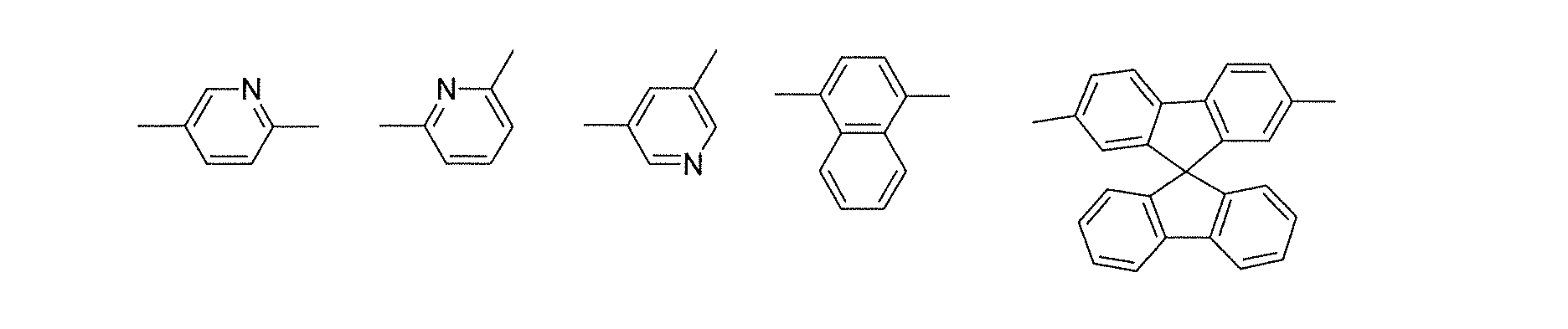
- L represents an arylene group having 6 to 60 carbon atoms and may have a substituent, a pyridinylene group which may have a substituent, a quinolinylene group which may have a substituent or a fluorenylene group which may have a substituent
- Arylene group having 6 to 40 carbon atoms is preferable as those having 6 to 60 carbon atoms, and arylene group having 6 to 20 carbon atoms is more preferable, and further, concrete examples include divalent groups formed by removing hydrogen atom from the aryl groups described about the above R. Substituents for each group represented by L are the same as described about the above R.
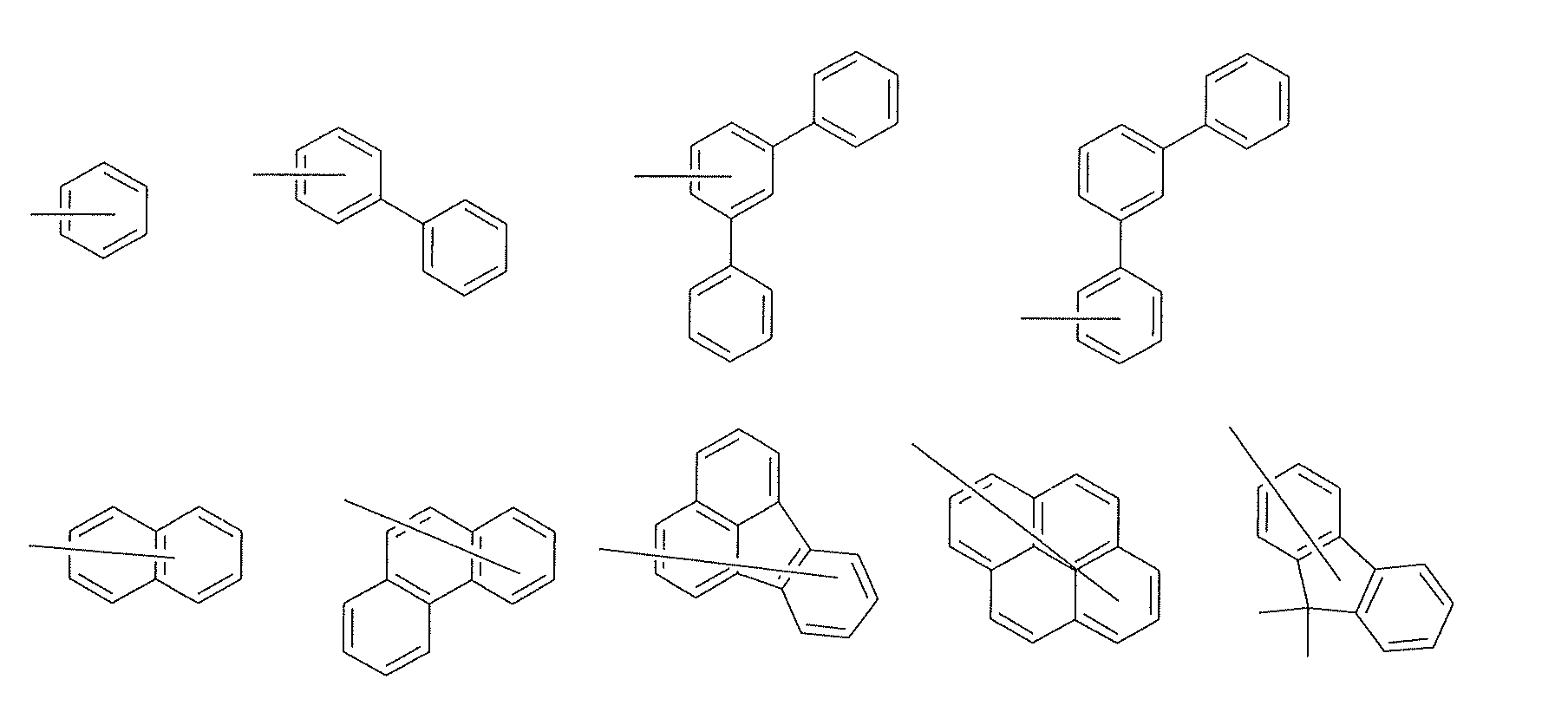
- L preferably represents a group selected from the following groups:
- Ar 1 represents an arylene group having 6 to 60 carbon atoms and may have a substituent, a pyridinylene group which may have a substituent, or a quinolinylene group which may have a substituent.
- Substituents for each groups represented by Ar 1 or Ar 3 are the same as those described about the above R respectively.
- Ar 1 is preferably any one group selected from the condensed ring groups represented by the following general formulae (1) to (10):
- each condensed ring groups may be bonded with a bonding group of a halogen atom, an alkyl group having 1 to 20 carbon atoms and may have a substituent, an alkoxy group having 1 to 20 carbon atoms and may have a substituent, an aryloxy group having 6 to 40 carbon atoms and may have a substituent, an aryl group having 6 to 40 carbon atoms and may have a substituent, or a heteroaryl group having 3 to 40 carbon atoms and may have a substituent.
- the bonding group may be the same or different with each other. Specific examples of these groups are the same as the above description.
- L' represents a single bond or a group selected from the following groups:
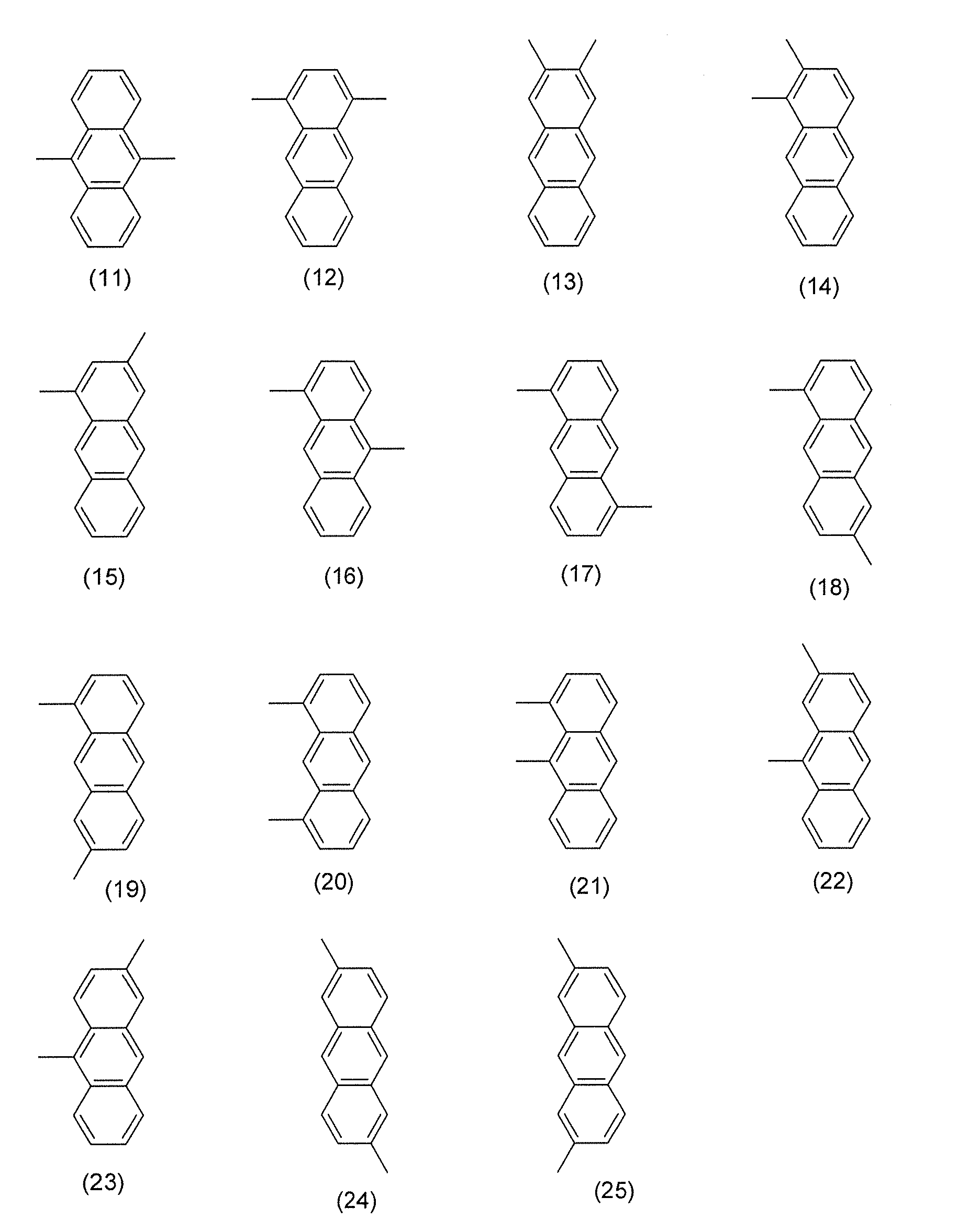
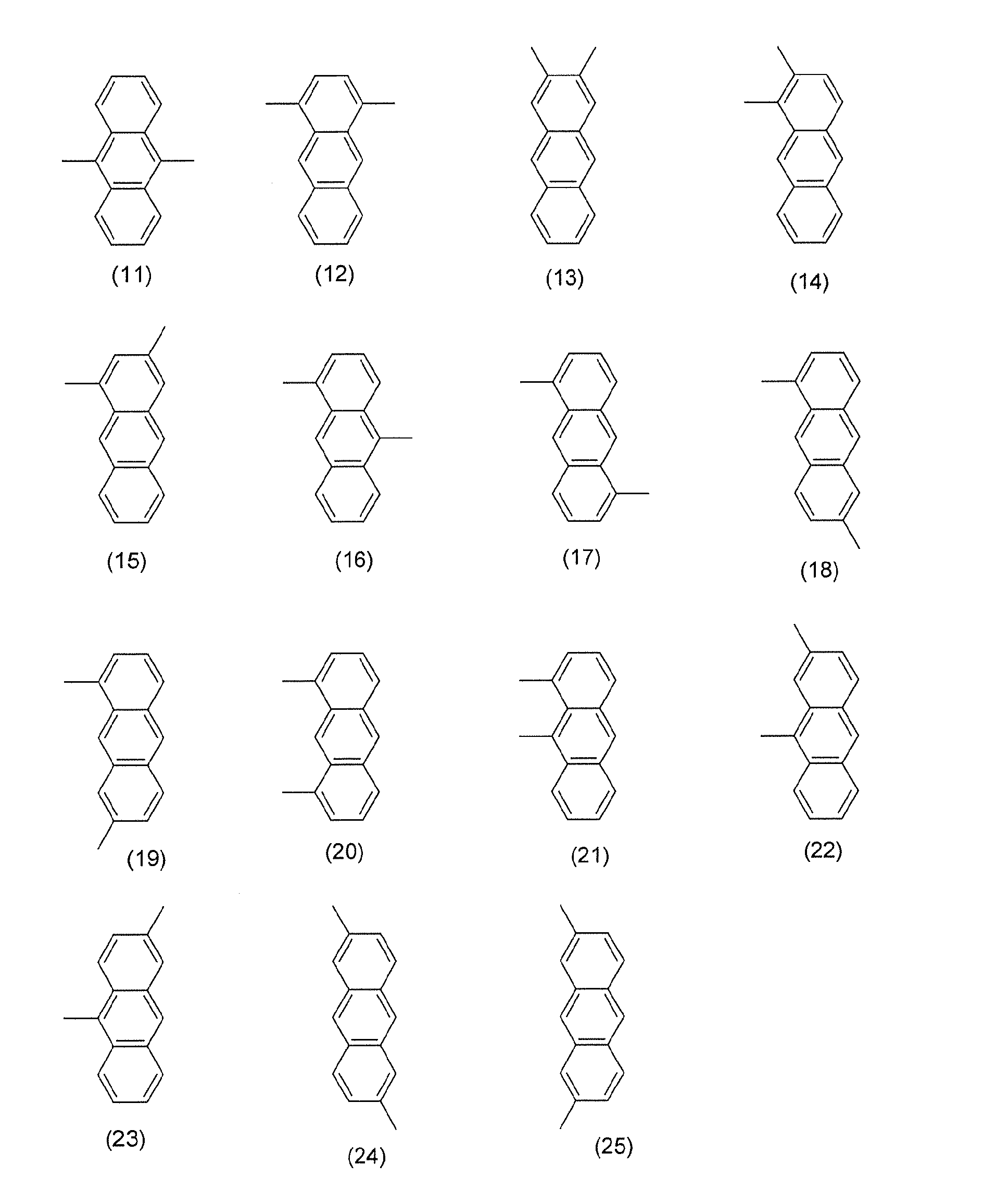
- general formula (3) represented by Ar 1 is a condensed ring group represented by the following general formulae (11) to (25).
- each condensed ring groups may be bonded with a bonding group of a halogen atom, an alkyl group having 1 to 20 carbon atoms and may have a substituent, an alkoxy group having 1 to 20 carbon atoms and may have a substituent, an aryloxy group having 6 to 40 carbon atoms and may have a substituent, an aryl group having 6 to 40 carbon atoms and may have a substituent, or a heteroaryl group having 3 to 40 carbon atoms and may have a substituent.
- the bonding group may be the same or different with each other. Specific examples of these groups are the same as the above description.
- Ar 2 represents an aryl group having 6 to 60 carbon atoms and may have a substituent, a pyridyl group which may have a substituent, or a quinolyl group which may have a substituent; an alkyl group having 1 to 20 carbon atoms and may have a substituent or an alkoxy group having 1 to 20 carbon atoms and may have a substituent.
- preferable numbers of carbon atoms and substituents of the each above groups are the same as those described about the above R.
- Ar 3 represents an aryl group having 6 to 60 carbon atoms and may have a substituent, a pyridyl group which may have a substituent, or a quinolyl group which may have a substituent; an alkyl group having 1 to 20 carbon atoms and may have a substituent, an alkoxy group having 1 to 20 carbon atoms and may have a substituent; or a group represented by ⁇ Ar 1 ⁇ Ar 2 , in which both Ar 1 and Ar 2 are the same as the above description.
- preferable numbers of carbon atoms and substituents of the each above groups are the same as those described about the above R.
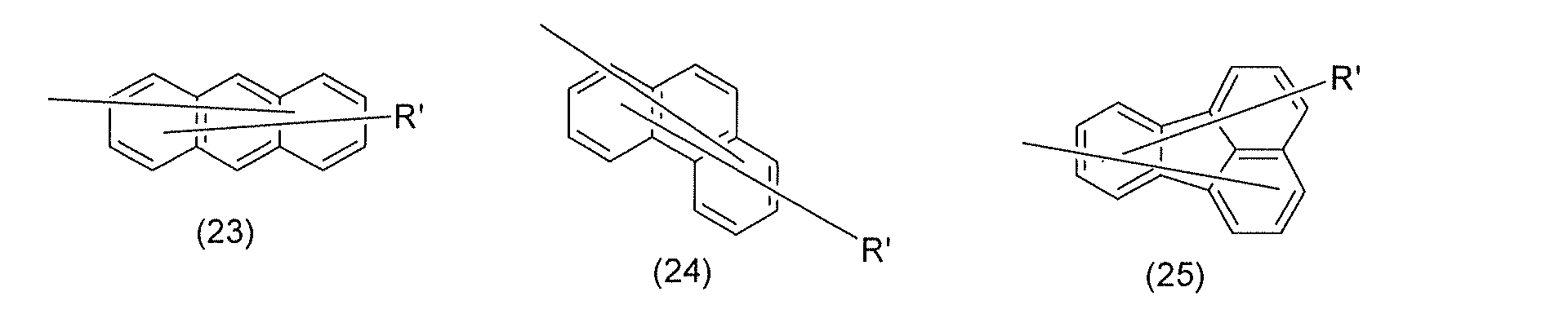
- Ar 3 is preferably any one group selected from the condensed ring groups represented by the following general formulae (21) to (30):
- each condensed ring groups may be bonded with a bonding group of a halogen atom, an alkyl group having 1 to 20 carbon atoms and may have a substituent, an alkoxy group having 1 to 20 carbon atoms and may have a substituent, an aryloxy group having 6 to 40 carbon atoms and may have a substituent, an aryl group having 6 to 40 carbon atoms and may have a substituent, or a heteroaryl group having 3 to 40 carbon atoms and may have a substituent.
- the bonding group may be the same or different with each other. Specific examples of these groups are the same as the above description.
- L' is the same as the above description.
- R' represents a hydrogen atom, an alkyl group having 1 to 20 carbon atoms and may have a substituent, an aryl group having 6 to 40 carbon atoms and may have a substituent or a heteroaryl group having 3 to 40 carbon atoms and may have a substituent. Specific examples of these groups are the same as the above description.
- general formula (23) represented by Ar 3 is a condensed ring group represented by the following general formulae (41) to (63).
- each condensed ring groups may be bonded with a bonding group of a halogen atom, an alkyl group having 1 to 20 carbon atoms and may have a substituent, an alkoxy group having 1 to 20 carbon atoms and may have a substituent, an aryloxy group having 6 to 40 carbon atoms and may have a substituent, an aryl group having 6 to 40 carbon atoms and may have a substituent, or a heteroaryl group having 3 to 40 carbon atoms and may have a substituent.
- the bonding group may be the same or different with each other. Specific examples of these groups are the same as the above description.
- R' is the same as in the case of the foregoing description.
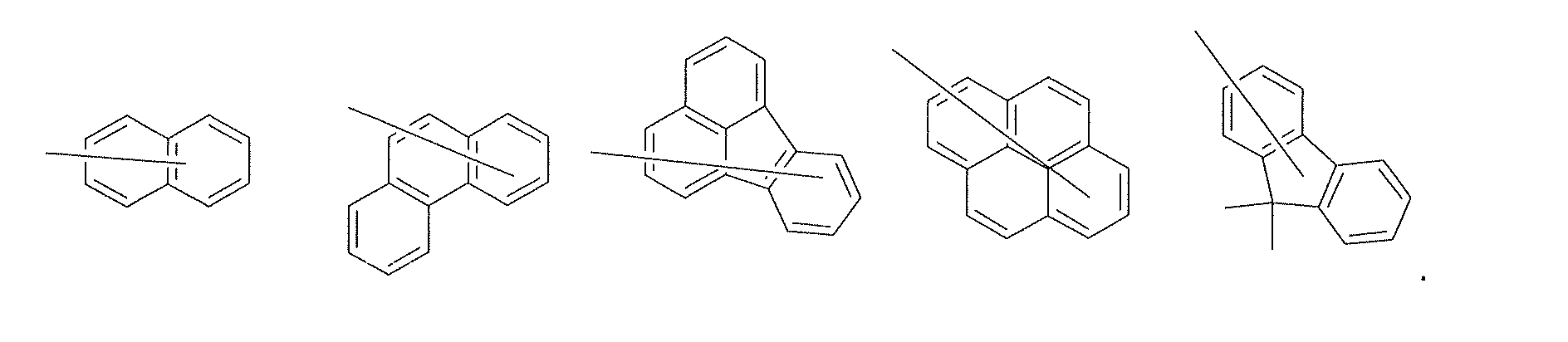
- Ar 2 and Ar 3 each independently is a group selected from the following groups:
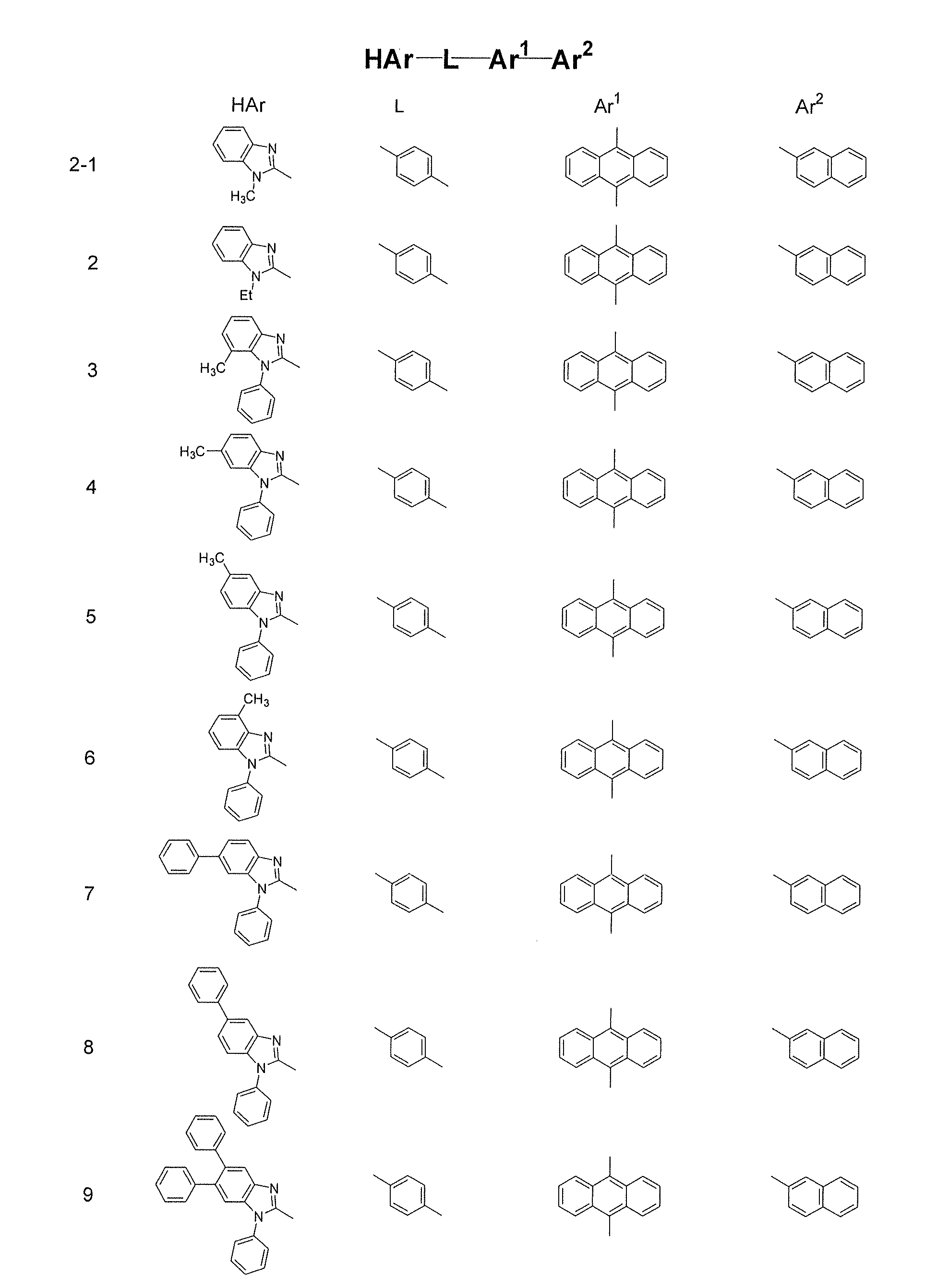
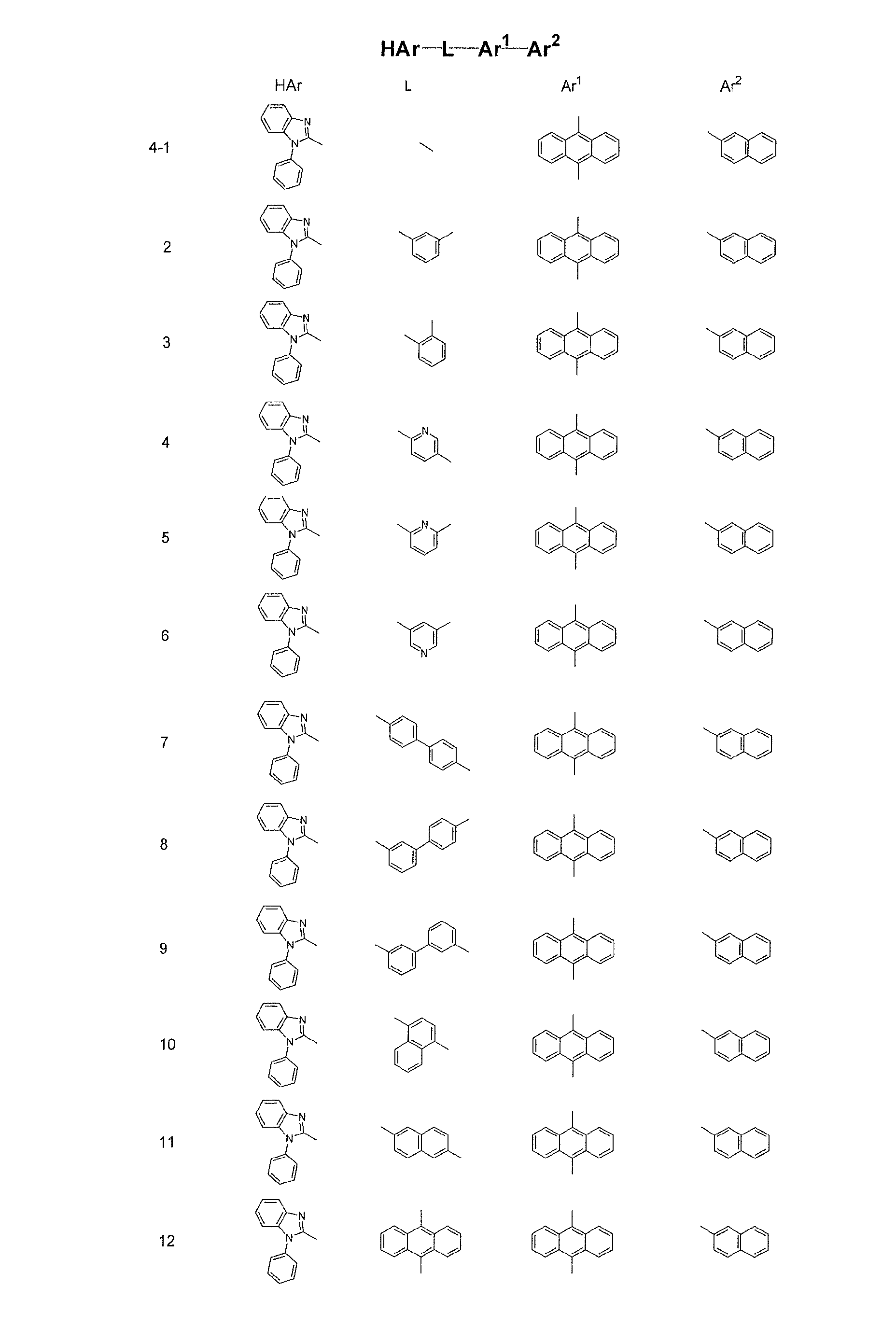
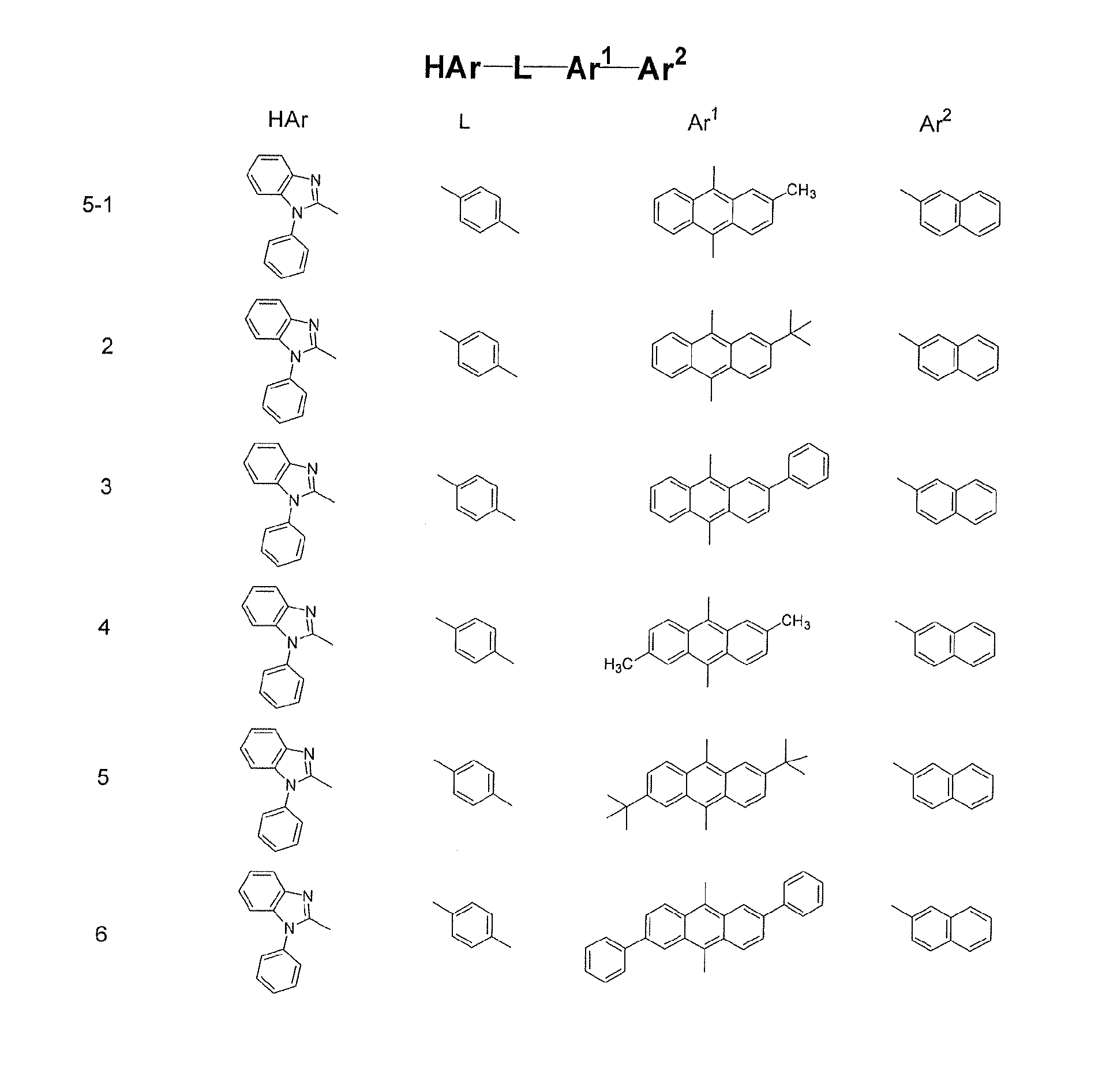
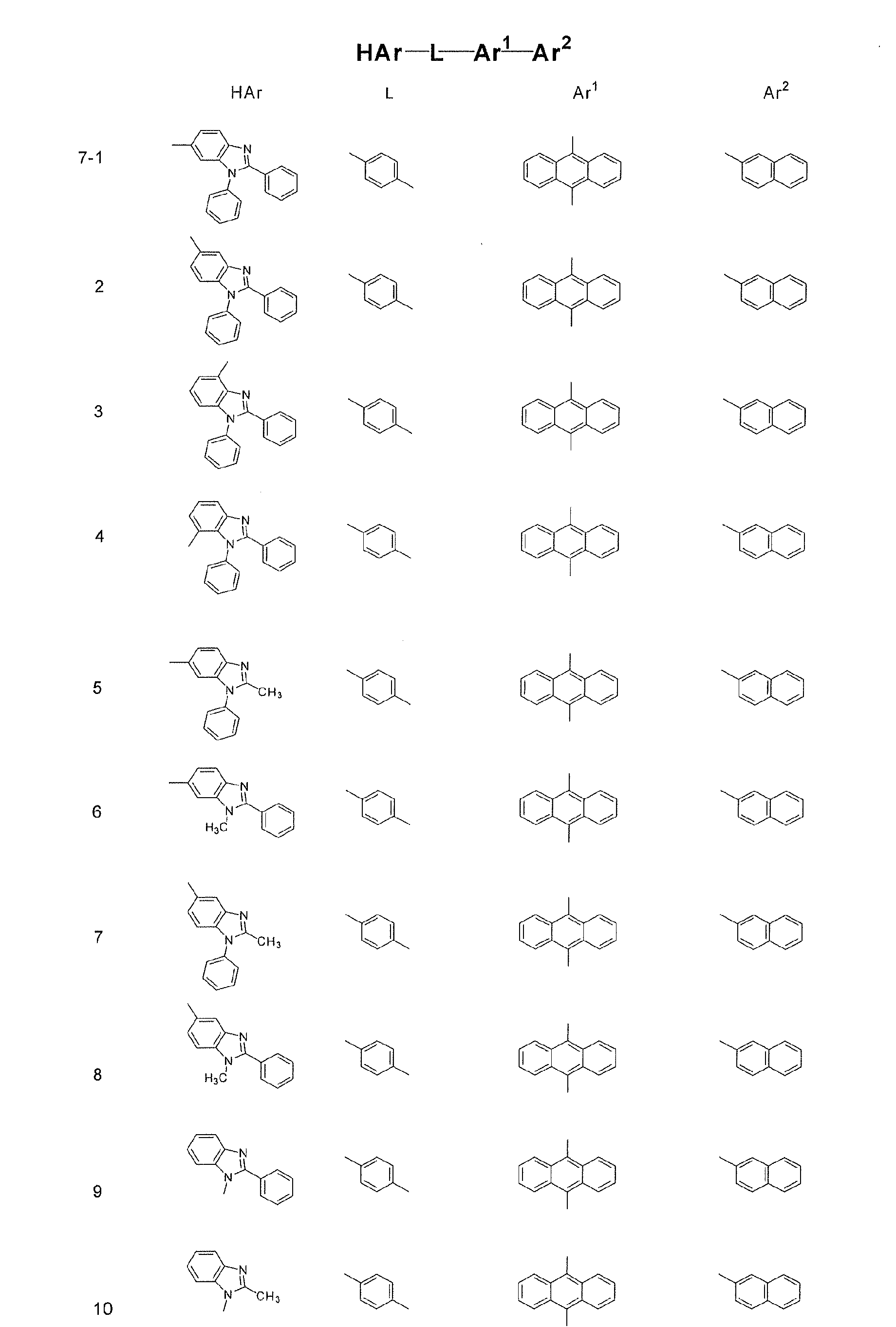
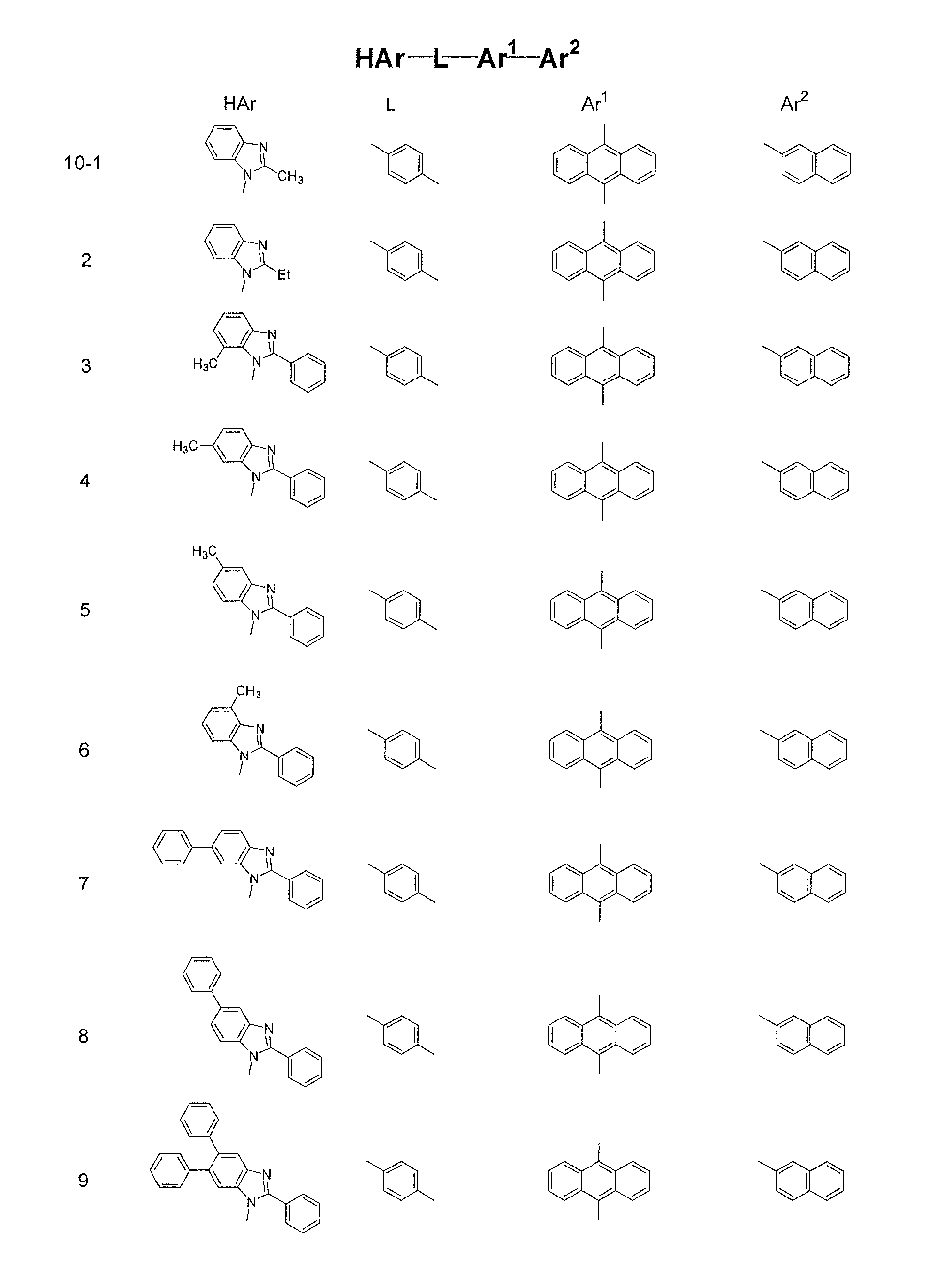
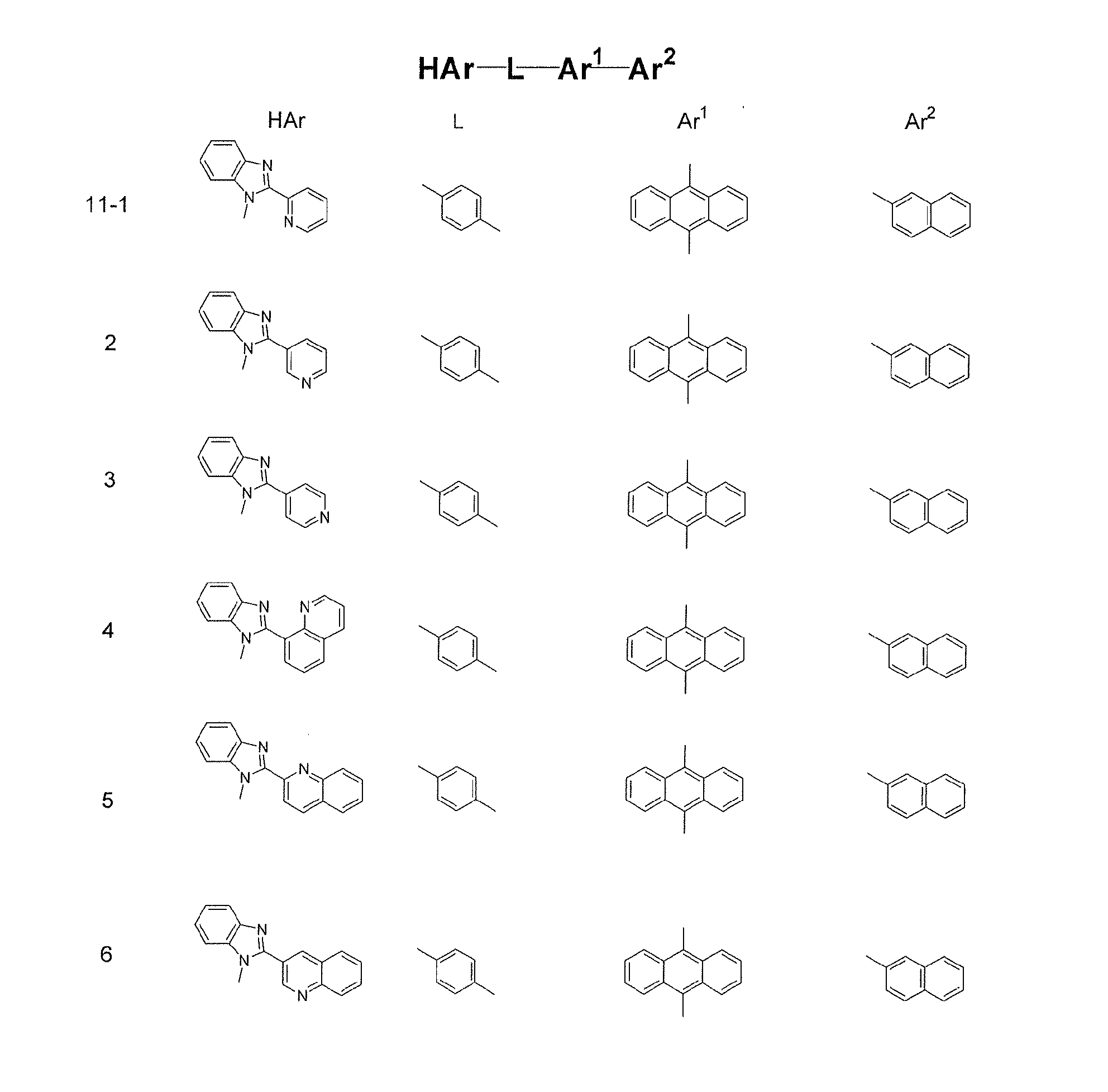
- HAr represents compounds: in general formulae (I) to (III).
- novel derivative of heterocyclic compound having nitrogen atom represented by general formulae (I), (II) or (III) of the present invention is preferably employed as a material for the organic EL devices.
- Employing the compound of the present invention as at least one layer among the organic compound layers of the organic EL devices enables to achieve elevation of luminance and current efficiency.
- the compound of the present invention is employed to a light emitting zone, a light emitting layer and/or an electron transporting layer of the organic EL device.
- the compound of the present invention is employed as an electron injecting material and/or an electron transporting material.
- a layer containing the electron injecting material and/or the electron transporting material comprises reductive dopant.
- the light emitting zone means the whole area containing a luminescent material which emits light when an electric field is applied to the organic EL device.
- the organic EL device has, in general, a laminated structure of each thin film comprising materials having different function and role, and in many cases, only an organic thin film layer named as a light emitting layer comprises the luminescent material. In this case, the light emitting layer corresponds to the light emitting zone. Further, explanations about the light emitting layer, the electron transporting layer and the electron injecting material will be described below.
- the organic EL device of the present invention comprises at least one of organic compound layers containing a light emitting layer sandwiched between a pair of electrodes, wherein the organic compound layers comprises at least one layer containing a derivative of heterocyclic compound having nitrogen atom represented by any one of general formulae (I), (II) and (III) of the present invention.
- Typical examples of the construction of the organic EL device of the present invention include:
- the organic EL device of the present invention it is preferable for the organic EL device of the present invention to employ the compound of the present invention as a constituting material for the light emitting layer and/or the electron injecting layer.
- the hole injecting layer or the electron injecting layer is not always necessary for the device structure, an organic EL device having these layers has an advantage of improving light emitting property.
- the hole injecting layer, the light emitting layer and the electron injecting layer may be mixedly sandwiched between a pair of electrodes.
- a mixed layer may be made with the use of a binder such as a high molecular compound in order that each constituting component exists stably.
- the organic EL device is produced on a substrate which transmits light.
- the substrate which transmits light is the substrate which supports the organic EL device.
- the substrate which transmits light for example, glass sheet, synthetic resin sheet and quartzes are advantageously employed.
- an electrode made of a material such as a metal, an alloy, a conductive compound and a mixture of these materials which has a great work function (4 eV or more) is preferable.
- the material for the anode include metals such as Au and conductive materials such as CuI, ITO (indium tin oxide), SnO 2 , ZnO and In-Zn-O.
- the anode can be prepared by forming a thin film of the electrode material described above in accordance with a process such as the vapor deposition process and the sputtering process.
- the anode When the light emitted from the light emitting layer is obtained through the anode, it is preferable that the anode has a transmittance of the emitted light greater than 10 %. It is also preferable that the sheet resistivity of the anode is several hundred ⁇ / ⁇ or smaller.
- the thickness of the anode is, in general, selected in the range of from 10 nm to 1 m and preferably in the range of from 10 to 200 nm although the preferable range may be different depending on the adopted material.
- an electrode made of a material such as a metal, an alloy, a conductive compound and a mixture of these materials which has a small work function (4 eV or smaller) is employed.
- the material for the cathode include sodium, sodium-potassium alloys, magnesium, magnesium-silver alloys, lithium, magnesium/copper mixture, magnesium-indium alloys, Al/Al 2 O 3 , indium, aluminum-lithium alloys, etc.
- the cathode can be prepared by forming a thin film of the electrode material described above in accordance with a process such as the vapor deposition process and the sputtering process.
- the sheet resistivity of the cathode is several hundred ⁇ / ⁇ or smaller.
- the thickness of the cathode is, in general, selected in the range of from 10 nm to 500 nm and preferably in the range of from 50 to 200 nm. Additionally, it is convenient that either the anode or the cathode of the organic EL device is transparent or translucent in order to transmit light because an efficiency of light emission improves.
- the foregoing compound of the present invention as the light emitting material composing the light emitting layer in the organic EL device of the present invention.
- the compound may be used alone or in combination with any of publicly known light emitting materials.
- the light emitting material in the light emitting layer is not particularly restricted but may be selectively employed in option from among the conventional well known light emitting materials.
- polycyclic condensed aromatics for example, polycyclic condensed aromatics, fluorescent whitening agents such as benzoxazole base, benzthiazole base, benzimidazole base or so, and compounds having favorable thin film formation property such as metal chelated oxanoid compound, distyrylbenzene-based compound and so on are employed as the light emitting material.
- the polycyclic condensed aromatics include condensed ring light emitting substances containing anthracene, naphthalene, phenanthrene, pyrene, chrysene and perylene backbone structure, other condensed ring light emitting substances containing about 8 condensed rings, etc.
- the light emitting layer may be composed of single layer comprising one or more kind of these light emitting materials or may be laminated with a light emitting layer comprising another kind of compound.
- a hole injecting layer in the organic EL device of the present invention consists of a hole transfer compound, and is capable of transferring hole which is injected from the anode to the light emitting layer.
- By intervening the hole injecting layer between the anode and the light emitting layer large numbers of holes are injected into the light emitting layer even though a relatively lower electric field is applied.
- electrons injected into the light emitting layer from the cathode or the electron injecting layer are, with the influence of an electronic barrier existing on interfacial area between the light emitting layer and the hole injecting layer, a superior organic EL device with favorable light emitting property such as improving an efficiency of light emission can be obtained.
- the hole transfer compound used for such a hole injecting layer which is deployed between the two electrodes is capable of transferring holes adequately into the light emitting layer when the holes are injected from the anode.
- a compound which exhibits, for example, a mobility of holes of at least 10 -6 cm 2 /V ⁇ second under application of an electric field of from 10 4 to 10 6 V/cm is preferable as the hole transfer compound.
- the hole transfer compound it is not particularly specified as long as it has the above favorable light emitting property. Namely, any compound may be selectively employed as the hole transfer compound from among compounds such as used in custom as charge injection and charge transport material of holes among a light conducting material or publicly known as the hole injecting layer of the organic EL device.
- Examples of the above hole transfer compound include copper phthalocyanine, N,N,N',N'-tetraphenyl-4,4'-diaminophenyl, N,N'-diphenyl-N,N'-di(3-methylphenyl)-4,4'-diaminobiphenyl (TPDA), 2,2-bis(4-di-p-tolylaminophenyl)propane, 1,1-bis(4-di-p-tolylaminophenyl) cyclohexane, N,N,N',N'-tetra-p-tolyl-4,4'-diaminobiphenyl, etc.
- TPDA 2,2-bis(4-di-p-tolylaminophenyl)propane
- 1,1-bis(4-di-p-tolylaminophenyl) cyclohexane N,N,N',N'-tetra-p-tolyl-4,
- crystals of inorganic semiconductor such as Si, SiC or CdS and amorphous material may be also employed as the hole transfer compound.
- the hole injecting layer may be composed of single layer comprising one or more kind of these hole injecting materials or may be laminated with a hole injecting layer comprising another kind of compound.
- An electron injecting layer in the organic EL device of the present invention consists of an electron transfer material, and is capable of transferring electron which is injected from the cathode to the light emitting layer.
- the organic EL device of the present invention it is preferable to employ the foregoing compound of the present invention as the electron injecting material.
- the electron injecting material is not particularly restricted but may be selectively employed in option from among the conventional well known electron injecting material compounds.
- the organic EL device in the present invention there is a device containing a reductive dopant in an electron transport zone or an interfacial zone between a cathode and an organic compound layer.
- a reductive dopant used in the present invention is defined as a compound which is added to the interfacial region between the electron injecting layer and the cathode and enhances the effect of electron injection.
- Examples of the reductive dopant include at least one compound selected from alkali metals, alkali metal complexes, alkali metal compounds, alkaline earth metals, alkaline earth metal complexes, alkaline earth metal compounds, rare earth metals, rare earth metal complexes and rare earth metal compounds.
- Preferable reductive dopant has a work function of 2.9 eV or smaller.
- Specific examples of preferable reductive dopant include at least one kind or more of the alkaline metal selected from a group consisting of Na (the work function: 2.36 eV), K (the work function: 2.28 eV), Rb (the work function: 2.16 eV) and Cs (the work function: 1.95 eV).
- the examples include at least one kind or more of the alkaline earth metal selected from a group consisting of Ca (the work function: 2.9 eV), Sr (the work function: 2.0 - 2.5 eV) and Ba (the work function: 2.52 eV).
- more preferable reductive dopants include at least one kind or more selected from the group consisting of K, Rb and Cs, the latter Rb or Cs being farther more preferable and the last Cs being the most preferable.
- These alkaline metals have particularly high reducing capability, and only an addition of relatively small amount of them into an electron injection zone enables to achieve both improvement of luminance and lifetime extension of the organic EL device.
- a combination including Cs for example, combinations of Cs and Na, Cs and K, Cs and Rb or Cs, Na and K are preferable. Containing Cs in combination enables to reveal reducing capability effectively, and the addition into the electron injection zone achieves both improvement of luminance and lifetime extension of the organic EL device.
- alkali metals aside from the alkali metals, even an employment of at least one or more kinds of metal compound selected from the group consisting of alkali metal chalcogenide, alkaline earth metal chalcogenide, halide of alkali metal and halide of alkaline earth metal also achieves similar effects. Still further, an employment of alkali metal organic complexes or alkaline earth metal organic complexes also achieves similar effects.
- an electron injecting layer comprising electric insulating material, semiconductor and inorganic compound may be disposed between the cathode and the organic layer.
- the disposition of the electron injecting layer enables to effectively prevent a leak of electric current and to improve the electron injection property.
- at least one metal compound selected from the group consisting of alkali metal chalcogenides, alkaline earth metal chalcogenides, alkali metal halides and alkaline earth metal halides is used as the insulating material.
- the electron injecting layer is constituted with the above alkali metal chalcogenide since the electron injecting property can be improved.
- Preferable examples of the alkali metal chalcogenide include Li 2 O, LiO, Na 2 S, Na 2 Se and NaO.
- Preferable examples of the alkaline earth metal chalcogenide include CaO, BaO, SrO, BeO, BaS and CaSe.
- Preferable examples of the alkali metal halide include LiF, NaF, KF, LiCl, KCl and NaCl.
- Preferable examples of the alkaline earth metal halide include fluorides such as CaF 2 , BaF 2 , SrF 2 , MgF 2 and BeF 2 and halides other than the fluorides.
- the semiconductor constituting the electron transporting layer examples include oxides, nitrides and oxide nitrides containing at least one element selected from Ba, Ca, Sr, Yb, Al, Ga, In, Li, Na, Cd, Mg, Si, Ta, Sb and Zn, which are used singly or in combination of two or more. It is preferable that the inorganic compound constituting the electron injection layer is in the form of a fine crystalline or amorphous insulating thin film. When the electron injection layer is constituted with the above inorganic compound, a more uniform thin film can be formed and defective pixels such as dark spots can be decreased.
- the inorganic compound include the alkali metal chalcogenides, the alkaline earth metal chalcogenides, the alkali metal halides and the alkaline earth metal halides which are described above.
- the electron injecting layer in the organic EL device of the present invention can be formed in accordance with the publicly known thin-film formation method such as the vacuum vapor deposition process, the spin coating process, the casting process or the LB process employing the compound of the present invention or other electron injection material.
- the thickness of the electron injecting layer is not particularly limited, the thickness is usually from 5 nm to 5 ⁇ m.
- the electron injecting layer may be composed of single layer comprising one or more kind of these electron injecting materials or may be laminated with an electron injecting layer comprising another kind of compound.
- inorganic hole injection materials such as p type-Si and p type-SiC
- inorganic electron injection materials such as n type ⁇ -Si and n type ⁇ -SiC are employed as the electron injection material for composing electron injecting layer.
- Specific examples of the above electron injection material correspond to inorganic semiconductors disclosed in International Patent Publication No. WO 90/05998, etc.
- a thin film consisting of a desired electrode substance for example, a substance for the anode is formed over a suitable substrate so as to finally achieve a film thickness of 1 ⁇ m or thinner, preferably within a range from 10 nm to 200 nm in accordance with a vapor deposition method, a sputtering method, etc.
- the hole injecting layer, the light emitting layer and the electron injecting layer which are all EL device composing elements are made by successively forming thin films consisting of each composing material into multi layers.
- a thin film formation process to be used there are the spin coating process, the casting process or the vapor deposition process as the foregoing description.
- a vacuum vapor deposition process is preferable because a uniform film can be easily obtained and the possibility of formation of pin holes is small.
- the vacuum vapor deposition process is adopted as the thin film formation process, the vapor deposition condition is different according to the kind of the compound employed, a crystal structure or an association structure each as an object of molecular pile membrane.
- a thin film consisting of a cathode substance is formed thereupon into a film thickness of 1 ⁇ m or thinner, preferably within a range from 50 to 200 nm, in accordance with, for example, the vapor deposition process or the sputtering process, thereby making cathode and resultantly obtaining a desired organic EL device.
- reversing the formation order a formation in order of the cathode, the electron injecting layer, the light emitting layer, the hole injecting (transporting) layer and the anode may be applicable.
- a preparation of an organic EL device of the anode / the light emitting layer / the cathode type wherein a hole injecting layer, a light emitting layer and an electron injecting layer as coexisting sandwiched between a pair of electrode is as the following: For example, forming a thin film consisting of anode substance over a suitable substrate, making a light emitting layer (or, a light emission area) by applying or dip coating a solution comprising a hole injection material, a light emitting material, electron injection material and a binder such as polyvinylcarbazole, polycarbonate, polyacrylate, polyester and polyether or so and, thereupon, forming a film consisting of cathode substance. After further vacuum vapor deposition of device materials which correspond to the light emitting layer or the electron injecting layer over the formed light emitting layer, the film consisting of cathode substance may be formed thereupon.
- the organic EL device which can be produced as described above emits light when a direct voltage of 3 to 50 V is applied in the condition that the anode is connected to a positive electrode (+) and the cathode is connected to a negative electrode ( ⁇ ). When the connection is reversed, no electric current is observed and no light is emitted at all.
- an alternating voltage is applied to the organic EL device, the uniform light emission is observed only in the condition that the polarity of the anode is positive and the polarity of the cathode is negative.
- any type of wave shape can be employed.
- the organic EL device of the present invention prepared as the foregoing description achieves elevated luminance and excellent efficiency of light emission.
- the benzamide was stirred with heating under reduced pressure (about 20 mmHg) and at the temperature of about 300 °C for 30 minutes. After completion of the reaction, the resultant solution was further dissolved in dichloro-methane, and by refining with the use of silicagel column chromatography, 3.5 g of 2-(4-bromophenyl-1-phenyl-1H) -benzimidazole was obtained (yield: 80 %).
- step (2) in Synthesis Example 1 Almost the same procedure as step (2) in Synthesis Example 1 was carried out except that 2-(3-bromophenyl)-1-phenyl-1H-benzimidazole obtained in the above step (1) was used instead of -(4-bromo-phenyl)-1-phenyl-1H-benzimidazole, resultantly obtaining 3.7 g of yellowish white solids (yield: 74 %).
- the resultant solution was stirred for 30 minutes, followed by extracting with ethyl acetate. After removing a water layer, an organic layer was washed with water and with a saturated solution of sodium chloride and dried with magnesium sulfate. The solution was filtered and adding 2.4 g (31 mmol) of pyridine and further adding 2.0 g (19 mmol) of acetic anhydride, the resultant solution was stirred at room temperature for 5 hours. The solution was extracted with ethyl acetate, washed with 10 % potassium carbonate aqueous solution and with saturated solution of sodium chloride successively, followed by drying with magnesium sulfuric anhydride. Removing the solvent by distillation under reduced pressure, 3.6 g of 5'-bromo-2'- (N-phenylamino)-acetanilide was obtained (yield: 77%).
- the resultant solution was stirred for 30 minutes, followed by extracting with ethyl acetate. After removing a water layer, an organic layer was washed with water and with a saturated solution of sodium chloride and dried with magnesium sulfate. Adding 2.7 g (40 mmol) of pyridine, further dropping a solution provided by mixing picolyl chloride and 25 milliliter of ethyl acetate, the resultant solution was stirred at room temperature for 5 hours. The solution was extracted with ethyl acetate, washed with 10 % potassium carbonate aqueous solution and with saturated solution of sodium chloride successively, followed by drying with the use of magnesium sulfuric anhydride. Removing the solvent by distillation under reduced pressure, 3.1 g of 5'-bromo-2'-(N-phenylamino)-picoline anilide was obtained (yield: 49 %).
- Example 1 (Preparation of the organic EL device employing the compound of the present invention in an electron injecting layer)
- a glass substrate manufactured by GEOMATEC Company with a dimension of 25 mm ⁇ 75 mm and 1.1 mm in thickness having an ITO transparent electrode was cleaned by application of ultrasonic wave in isopropyl alcohol for 5 minutes and then by exposure to ozone generated by ultraviolet light for 30 minutes.
- the glass substrate having the transparent electrode line which had been cleaned was adhered to a substrate holder of a vacuum vapor deposition apparatus.
- a film of N,N'-bis(N,N'-diphenyl-4-aminophenyl)-N,N-diphenyl-4,4'-diamino-1,1'-biphenyl (referred to as a "film of TPD232", hereinafter) having a thickness of 60 nm was formed in accordance with the resistance heating deposition method in a manner such that the formed film covered the transparent electrode.
- the formed film of TPD232 worked as the hole injecting layer.
- a film of 4,4'-bis [N-(1-naphthyl)-N-phenylamino] biphenyl (referred to as a "film of NPD", hereinunder) having a thickness of 20 nm was formed over the film of TPD232 in accordance with the resistance heating deposition method.
- the formed film of NPD worked as a hole transporting layer.
- 4',4"-bis(2,2-diphenylvinyl)-9,10-biphenylanthracene referred to as "DPVDPAN”, hereinafter
- DPVDPAN 4',4"-bis(2,2-diphenylvinyl)-9,10-biphenylanthracene
- the formed film of DPVDPAN worked as the light emitting layer.
- a film of Compound (1-7) of the present invention having a thickness of 10 nm was formed over the film of DPVDPAN in accordance with the vapor deposition method.
- the formed film of the compound (1-7) worked as the electron injecting layer.
- Li the source of lithium: produced by SAES GETTERS Company
- Compound (1-7) Li film having a thickness of 10 nm was formed as the electron injecting layer (or, the cathode) with the film-forming rate of 1.6 ⁇ /second: 1 ⁇ /minute.
- metallic aluminum having the film thickness of 130 nm was vapor deposited to form a metal cathode and an organic EL device was prepared.
- a glass substrate manufactured by GEOMATEC Company with a dimension of 25 mm ⁇ 75 mm and 1.1 mm in thickness having an ITO transparent electrode was cleaned by application of ultrasonic wave in isopropyl alcohol for 5 minutes and then by exposure to ozone generated by ultraviolet light for 30 minutes.
- the glass substrate having the transparent electrode line which had been cleaned was adhered to a substrate holder of a vacuum vapor deposition apparatus.
- a film of TPD232 having a thickness of 60 nm was formed in accordance with the resistance heating deposition method in a manner such that the formed film covered the transparent electrode.
- the formed film of TPD232 worked as the hole injecting layer.
- a film of NPD having a thickness of 20 nm was formed over the film of TPD232 in accordance with the resistance heating deposition method.
- the formed film of NPD worked as a hole transporting layer.
- each film of the compound described in Table 1 was formed as an electron transporting layer having a film thickness of 20 nm.
- a film of LiF (the source of lithium: available from SAES GETTERS Company) having a thickness of 1 nm was further formed.
- metallic aluminum was vapor deposited to form a metal cathode having a thickness of 150 nm and an organic EL device was prepared.
- An organic EL device was prepared in a similar manner as Example 1 except that Alq (aluminum complex of 8-hydroxyquinoline) was employed instead of Compound (1-7).
- An organic EL device was prepared in a similar manner as Example 1 except that Compound A below that is described in United States Patent No. 5,645,948 was employed instead of Compound (1-7).
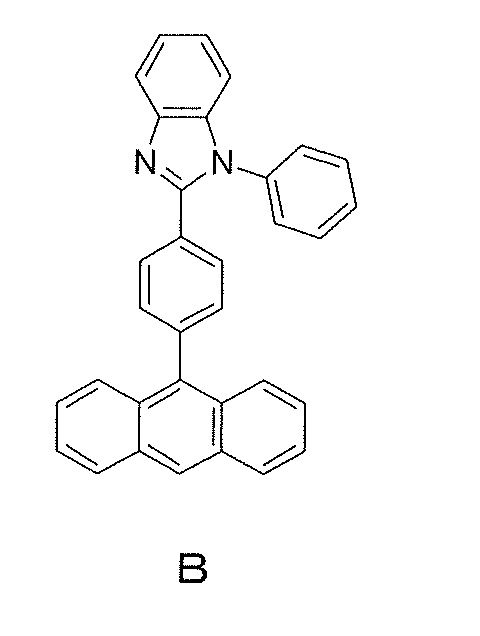
- An organic EL device was prepared in a similar manner as Example 1 except that Compound B below that is described in Japanese Unexamined Patent Application Laid Open No. 2002-38141 was employed instead of Compound (1-7).
- the organic EL devices prepared in Examples 1 to 8 and in Comparative Examples 1 to 2 were subjected to measurements of luminance, current efficiency and chromaticity while applying DC voltages described in Table 1 below and further, colors of emitted light were observed. Further, the organic EL devices prepared in Examples 1 to 8 and in Comparative Examples 1 to 2 were subjected to measurements of half lifetime in the condition that luminence at primary stage was 500 nit. The results are shown in Table 1. Compound in Electron Injecting Layer Voltage (V) Current Density (mA/cm 2 ) Luminance (nit) Ex. 1 1 -7 7.0 20.0 795 Ex. 2 4 - 2 7.0 25.0 1,000 Ex. 3 1 -7 6.5 18.6 1,050 Ex.
- V Current Density
- an organic EL device achieving elevation of luminance and of efficiency in light emission even under low driving voltage is obtainable by an employment of the derivative of heterocyclic compound having nitrogen atom for at least one layer composing organic compound layers of the organic EL device.
Landscapes
- Chemical & Material Sciences (AREA)
- Organic Chemistry (AREA)
- Engineering & Computer Science (AREA)
- Materials Engineering (AREA)
- Physics & Mathematics (AREA)
- Spectroscopy & Molecular Physics (AREA)
- Optics & Photonics (AREA)
- Electroluminescent Light Sources (AREA)
- Plural Heterocyclic Compounds (AREA)
Abstract
Description

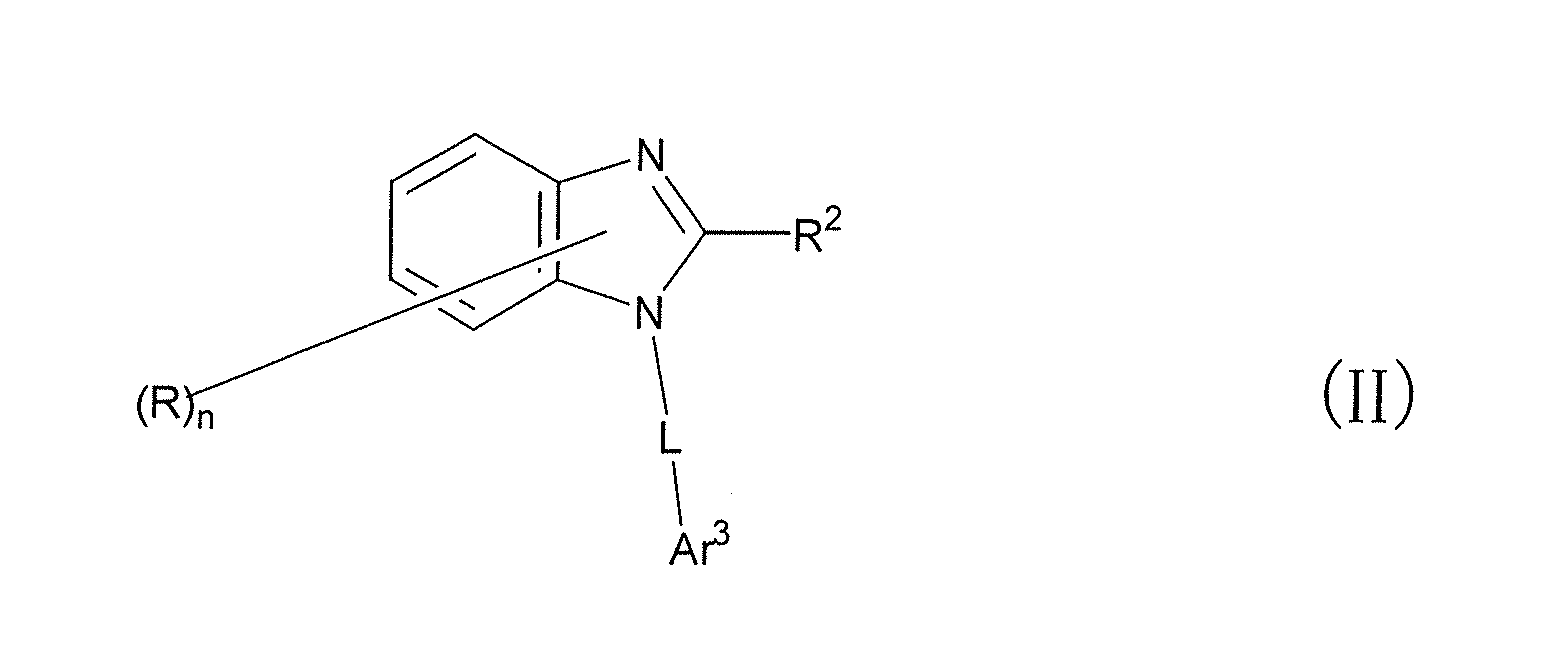

R1 represents an aryl group having 6 to 60 carbon atoms and may have a substituent, a pyridyl group which may have a substituent, or a quinolyl group which may have a substituent; an alkyl group having 1 to 20 carbon atoms and may have a substituent or an alkoxy group having 1 to 20 carbon atoms and may have a substituent;
R2 and R3 each independently represents a hydrogen atom, an aryl group having 6 to 60 carbon atoms and may have a substituent, a pyridyl group which may have a substituent, or a quinolyl group which may have a substituent; an alkyl group having 1 to 20 carbon atoms and may have a substituent or an alkoxy group having 1 to 20 carbon atoms and may have a substituent;
L represents an arylene group having 6 to 60 carbon atoms and may have a substituent, a pyridinylene group which may have a substituent, a quinolinylene group which may have a substituent or a fluorenylene group which may have a substituent;
Ar1 represents an arylene group having 6 to 60 carbon atoms and may have a substituent, a pyridinylene group which may have a substituent, or a quinolinylene group which may have a substituent;
Ar2 represents an aryl group having 6 to 60 carbon atoms and may have a substituent, a pyridyl group which may have a substituent, or a quinolyl group which may have a substituent; an alkyl group having 1 to 20 carbon atoms and may have a substituent or an alkoxy group having 1 to 20 carbon atoms and may have a substituent;
Ar3 represents an aryl group having 6 to 60 carbon atoms and may have a substituent, a pyridyl group which may have a substituent, or a quinolyl group which may have a substituent; an alkyl group having 1 to 20 carbon atoms and may have a substituent, an alkoxy group having 1 to 20 carbon atoms and may have a substituent; or a group represented by ―Ar1―Ar2, in which both Ar1 and Ar2 are the same as the above description.












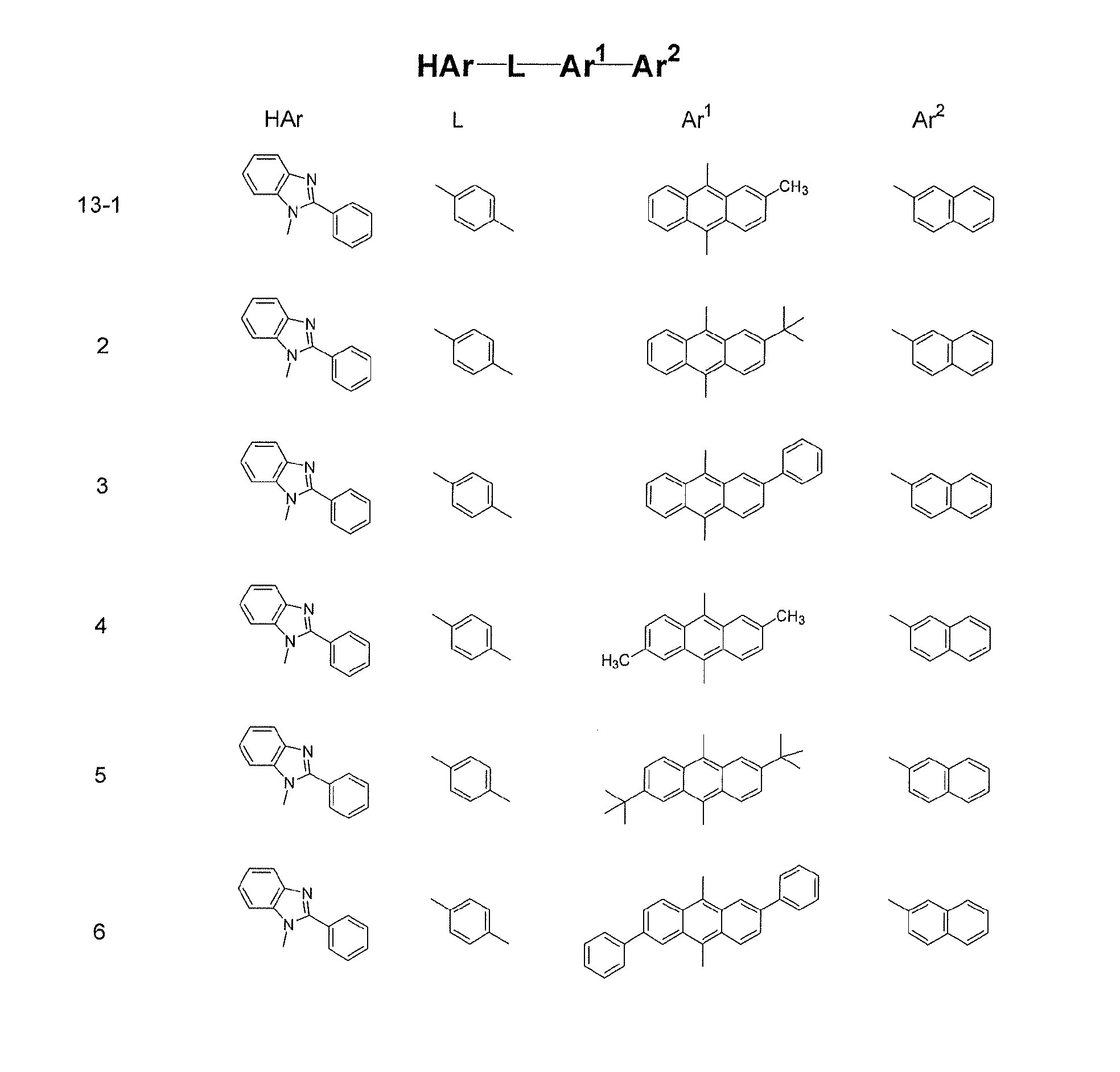

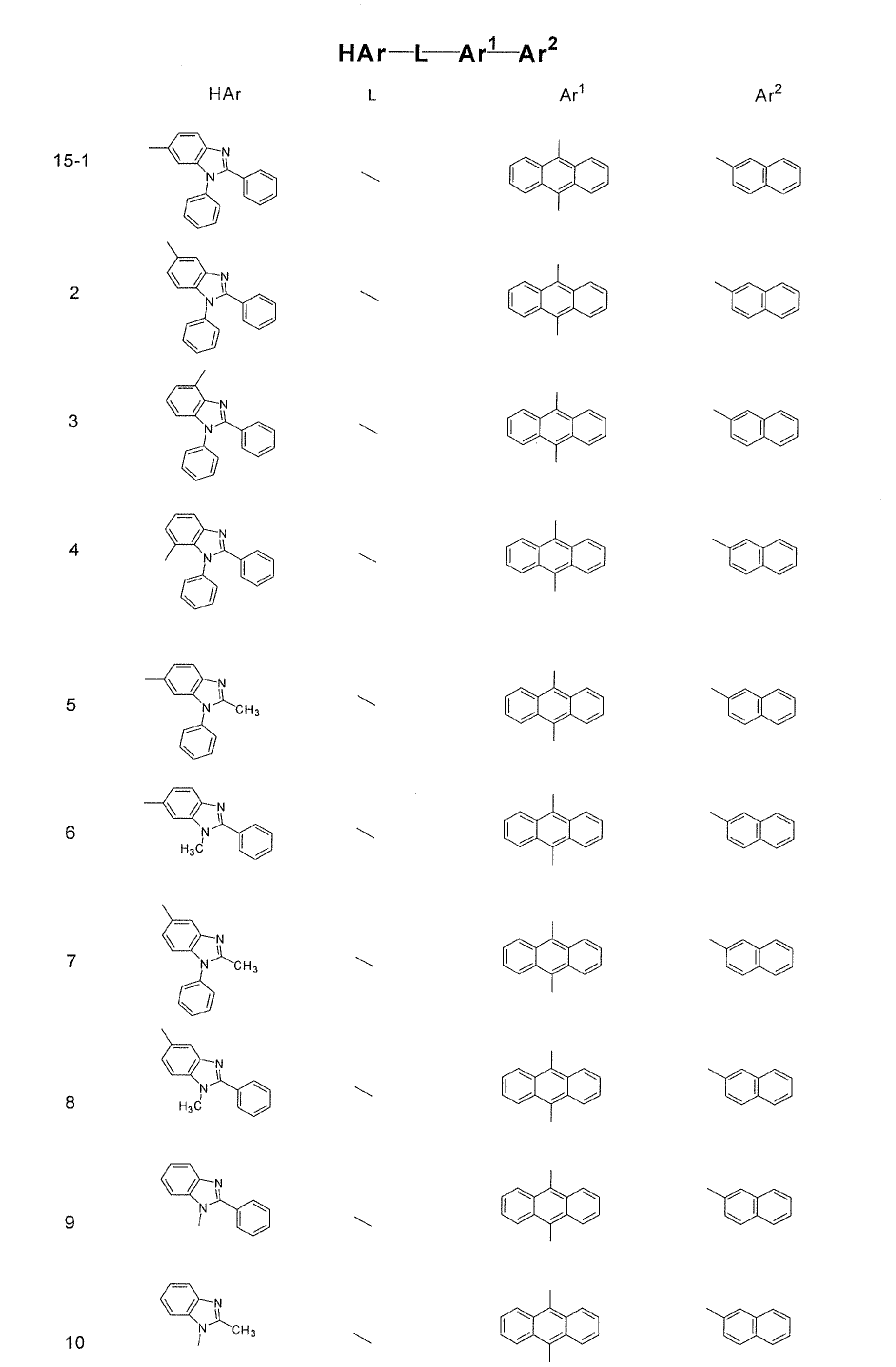
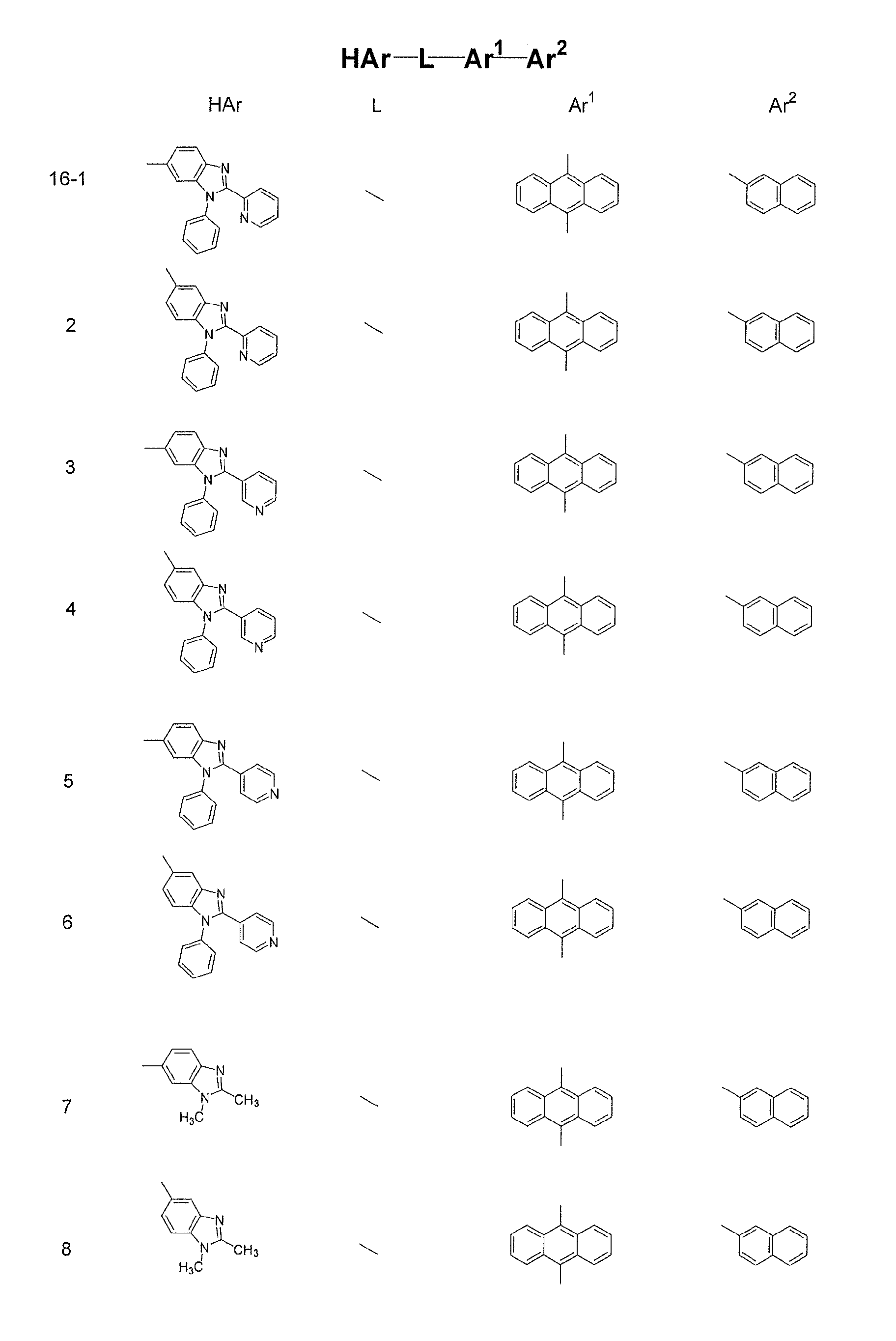

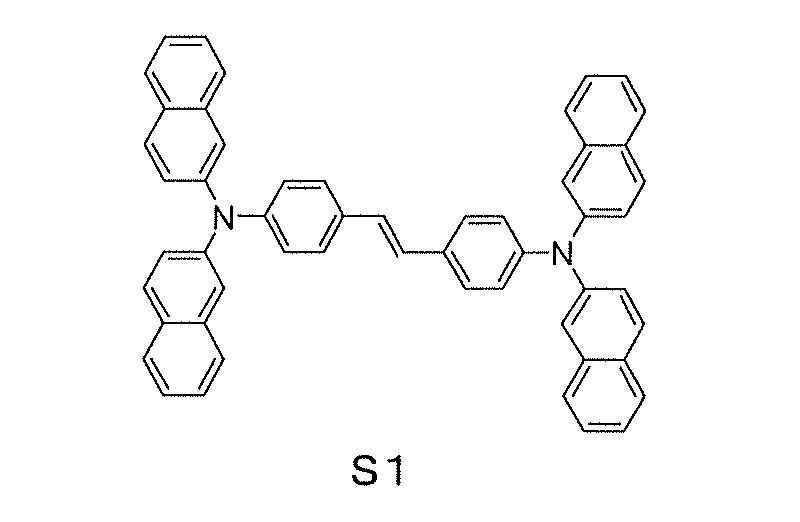

| Compound in Electron Injecting Layer | Voltage (V) | Current Density (mA/cm2) | Luminance (nit) | |
| Ex. 1 | 1 -7 | 7.0 | 20.0 | 795 |
| Ex. 2 | 4 - 2 | 7.0 | 25.0 | 1,000 |
| Ex. 3 | 1 -7 | 6.5 | 18.6 | 1,050 |
| Ex. 4 | 15 - 2 | 5.5 | 13.6 | 1,020 |
| Ex. 5 | 7 - 8 | 5.0 | 29.5 | 1,090 |
| Ex. 6 | 7 -7 | 5.5 | 13.4 | 950 |
| Ex. 7 | 7-9 | 5.75 | 15.8 | 1,150 |
| Ex. 8 | 3 -1 | 5.75 | 16.5 | 1,055 |
| Co. Ex. 1 | Alq | 7.0 | 13.0 | 500 |
| Co. Ex. 2 | Compound A | 7.0 | 7.4 | 185 |
| Co. Ex. 3 | Compound B | 7.0 | 15.0 | 600 |
| Current Efficiency (cd/A) | Chromaticity (x, y) | Color of Light Emission | Half Lifetime (hours) | |
| Ex. 1 | 4.0 | (0.144,0.148) | Blue | 850 |
| Ex. 2 | 4.0 | (0.147,0.156) | Blue | 1000 |
| Ex.3 | 5.65 | (0,142,0.145) | Blue | - |
| Ex.4 | 7.50 | (0.142,0.149) | Blue | - |
| Ex. 5 | 3.69 | (0.141,0.147) | Blue | - |
| Ex. 6 | 7.09 | (0.143,0.152) | Blue | - |
| Ex. 7 | 7.28 | (0.142,0.148) | Blue | - |
| Ex.8 | 6.40 | (0.143,0.149) | Blue | - |
| Co. Ex. 1 | 3.8 | (0.149,0.164) | Blue | 1000 |
| Co. Ex. 2 | 2.5 | (0.144,0.148) | Blue | 30 |
| Co. Ex. 3 | 4.0 | (0.145,0.153) | Blue | 20 |
Claims (15)
- A derivative of heterocyclic compound having nitrogen atom represented by following general formulae (I), (II) or (III):
 wherein R represents a hydrogen atom, an aryl group having 6 to 60 carbon atoms and may have a substituent, a pyridyl group which may have a substituent, or a quinolyl group which may have a substituent; an alkyl group having 1 to 20 carbon atoms and may have a substituent or an alkoxy group having 1 to 20 carbon atoms and may have a substituent; n represents an integer of 0 to 4;
R1 represents an aryl group having 6 to 60 carbon atoms and may have a substituent, a pyridyl group which may have a substituent, or a quinolyl group which may have a substituent; an alkyl group having 1 to 20 carbon atoms and may have a substituent or an alkoxy group having 1 to 20 carbon atoms and may have a substituent;
R2 and R3 each independently represents a hydrogen atom, an arylene group having 6 to 60 carbon atoms and may have a substituent, a pyridyl group which may have a substituent, or a quinolyl group which may have a substituent; an alkyl group having 1 to 20 carbon atoms and may have a substituent or an alkoxy group having 1 to 20 carbon atoms and may have a substituent;
L represents an arylene group having 6 to 60 carbon atoms and may have a substituent, a pyridinylene group which may have a substituent, a quinolinylene group which may have a substituent or a fluorenylene group which may have a substituent;
Ar1 represents an arylene group having 6 to 60 carbon atoms and may have a substituent, a pyridinylene group which may have a substituent, or a quinolinylene group which may have a substituent;
Ar2 represents an aryl group having 6 to 60 carbon atoms and may have a substituent, a pyridyl group which may have a substituent, or a quinolyl group which may have a substituent; an alkyl group having 1 to 20 carbon atoms and may have a substituent or an alkoxy group having 1 to 20 carbon atoms and may have a substituent;
Ar3 represents an aryl group having 6 to 60 carbon atoms and may have a substituent, a pyridyl group which may have a substituent, or a quinolyl group which may have a substituent; an alkyl group having 1 to 20 carbon atoms and may have a substituent, an alkoxy group having 1 to 20 carbon atoms and may have a substituent; or a group represented by ―Ar1―Ar2, in which both Ar1 and Ar2 are the same as the above description. - A derivative of heterocyclic compound having nitrogen atom represented by following general formulae (II) or (III):
 wherein R represents a hydrogen atom, an aryl group having 6 to 60 carbon atoms and may have a substituent, a pyridyl group which may have a substituent, or a quinolyl group which may have a substituent; an alkyl group having 1 to 20 carbon atoms and may have a substituent or an alkoxy group having 1 to 20 carbon atoms and may have a substituent; n represents an integer of 0 to 4;
R2 and R3 each independently represents a hydrogen atom, an aryl group having 6 to 60 carbon atoms and may have a substituent, a pyridyl group which may have a substituent, or a quinolyl group which may have a substituent; an alkyl group having 1 to 20 carbon atoms and may have a substituent or an alkoxy group having 1 to 20 carbon atoms and may have a substituent;
L represents an arylene group having 6 to 60 carbon atoms and may have a substituent, a pyridinylene group which may have a substituent, a quinolinylene group which may have a substituent or a fluorenylene group which may have a substituent;
Ar3 represents an aryl group having 6 to 60 carbon atoms and may have a substituent, a pyridyl group which may have a substituent, a quinolyl group which may have a substituent, an alkyl group having 1 to 20 carbon atoms and may have a substituent or an alkoxy group having 1 to 20 carbon atoms and may have a substituent; or a group represented by ― Ar1-Ar2, in which Ar1 represents an arylene group having 6 to 60 carbon atoms and may have a substituent, a pyridinylene group which may have a substituent, or a quinolinylene group which may have a substituent; and Ar2 represents an aryl group having 6 to 60 carbon atoms and may have a substituent, a pyridyl group which may have a substituent, or a quinolyl group which may have a substituent; an alkyl group having 1 to 20 carbon atoms and may have a substituent or an alkoxy group having 1 to 20 carbon atoms and may have a substituent. - The derivative of heterocyclic compound having nitrogen atom according to Claim 1, wherein L is at least one group selected from the following groups:

- The derivative of heterocyclic compound having nitrogen atom according to Claim 1, wherein Ar1 is a condensed ring group represented by following general formulae (1) to (10):

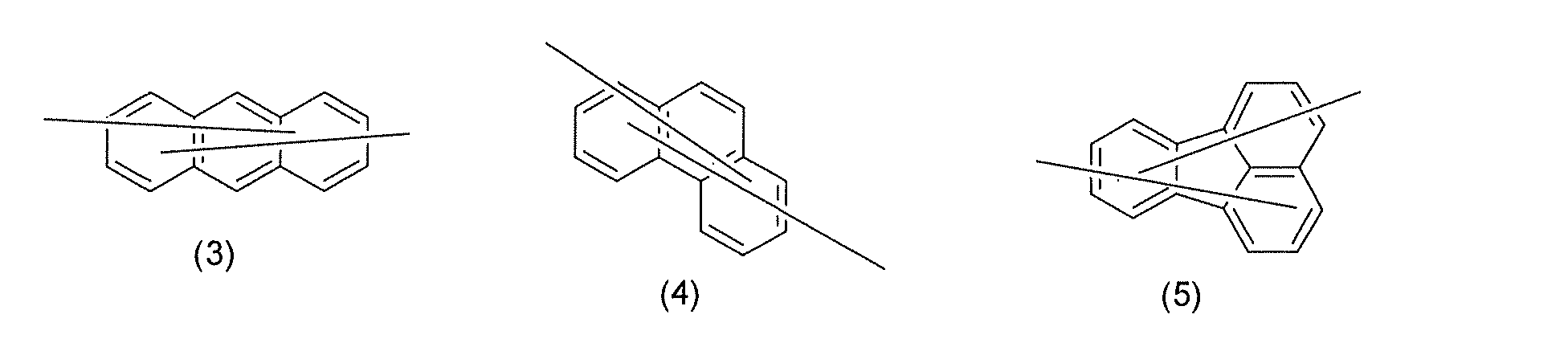 wherein each condensed ring groups may be bonded with a bonding group of a halogen atom, an alkyl group having 1 to 20 carbon atoms and may have a substituent, an alkoxy group having 1 to 20 carbon atoms and may have a substituent, an aryloxy group having 6 to 40 carbon atoms and may have a substituent, an aryl group having 6 to 40 carbon atoms and may have a substituent, or a heteroaryl group having 3 to 40 carbon atoms and may have a substituent. When there are plural of bonding groups, the bonding group may be the same or different with each other; and L' represents a single bond or a group selected from the following groups:

- The derivative of heterocyclic compound having nitrogen atom according to Claim 3, wherein general formula (3) represented by Ar1 is a condensed ring group represented by following general formulae (11) to (25):wherein each condensed ring groups may be bonded with a bonding group of a halogen atom, an alkyl group having 1 to 20 carbon atoms and may have a substituent, an alkoxy group having 1 to 20 carbon atoms and may have a substituent, an aryloxy group having 6 to 40 carbon atoms and may have a substituent, an aryl group having 6 to 40 carbon atoms and may have a substituent, or a heteroaryl group having 3 to 40 carbon atoms and may have a substituent. When there are plural of bonding groups, the bonding group may be the same or different with each other.
- The derivative of heterocyclic compound having nitrogen atom according to Claim 1, wherein Ar2 and Ar3 each independently is a condensed ring group selected from the following groups:

- The derivative of heterocyclic compound having nitrogen atom according to Claim 1, wherein Ar3 is a condensed ring group represented by following general formulae (21) to (30):

 wherein each condensed ring groups may be bonded with a bonding group of a halogen atom, an alkyl group having 1 to 20 carbon atoms and may have a substituent, an alkoxy group having 1 to 20 carbon atoms and may have a substituent, an aryloxy group having 6 to 40 carbon atoms and may have a substituent, an aryl group having 6 to 40 carbon atoms and may have a substituent, or a heteroaryl group having 3 to 40 carbon atoms and may have a substituent. When there are plural of bonding groups, the bonding group may be the same or different with each other;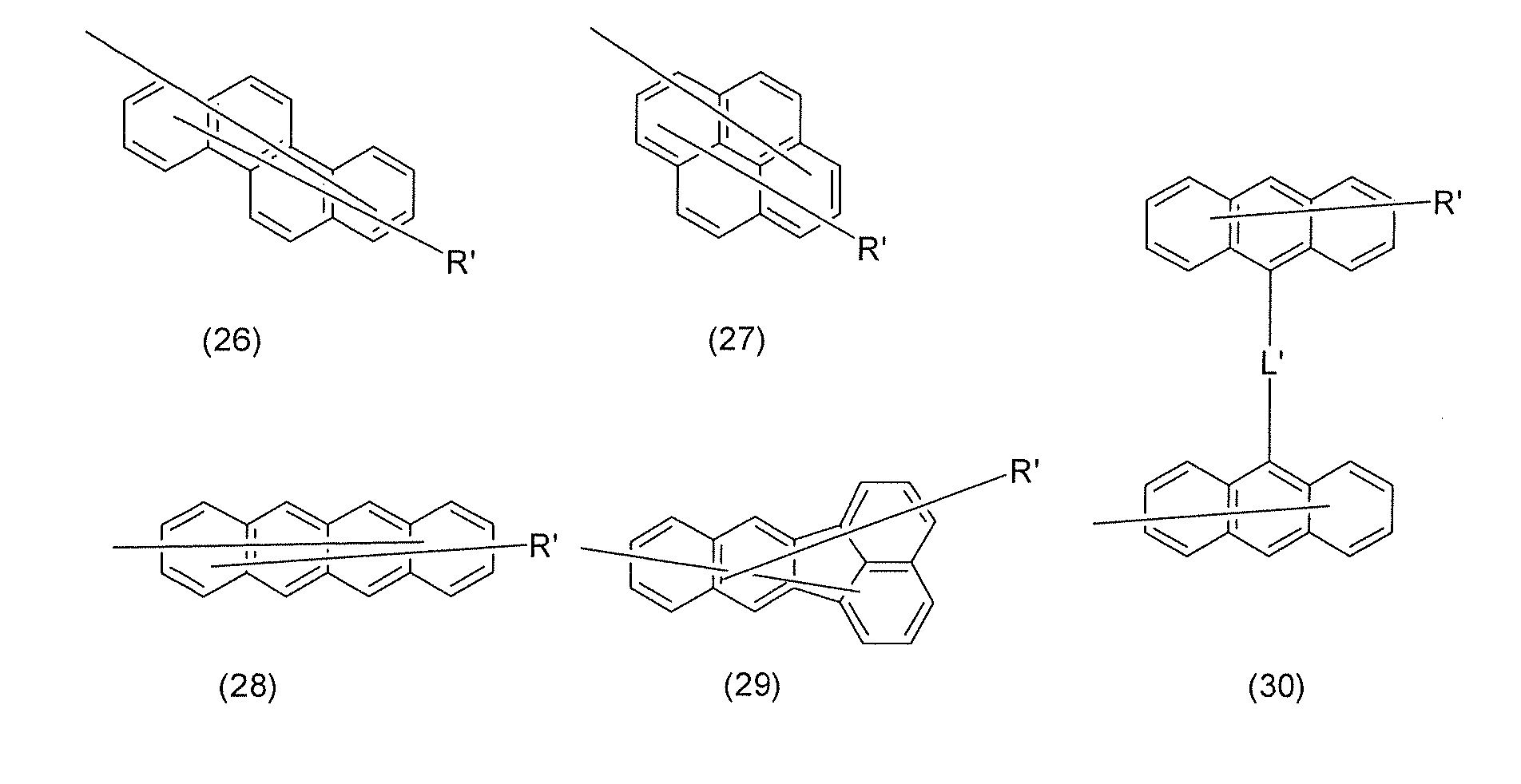
L' represents a single bond or a group selected from the following groups:wherein R' represents a hydrogen atom, an alkyl group having 1 to 20 carbon atoms and may have a substituent, an aryl group having 6 to 40 carbon atoms and may have a substituent or a heteroaryl group having 3 to 40 carbon atoms and may have a substituent.
- The derivative of heterocyclic compound having nitrogen atom according to Claim 7, wherein general formula (23) represented by Ar3 is a condensed ring group represented by following general formulae (41) to (63):

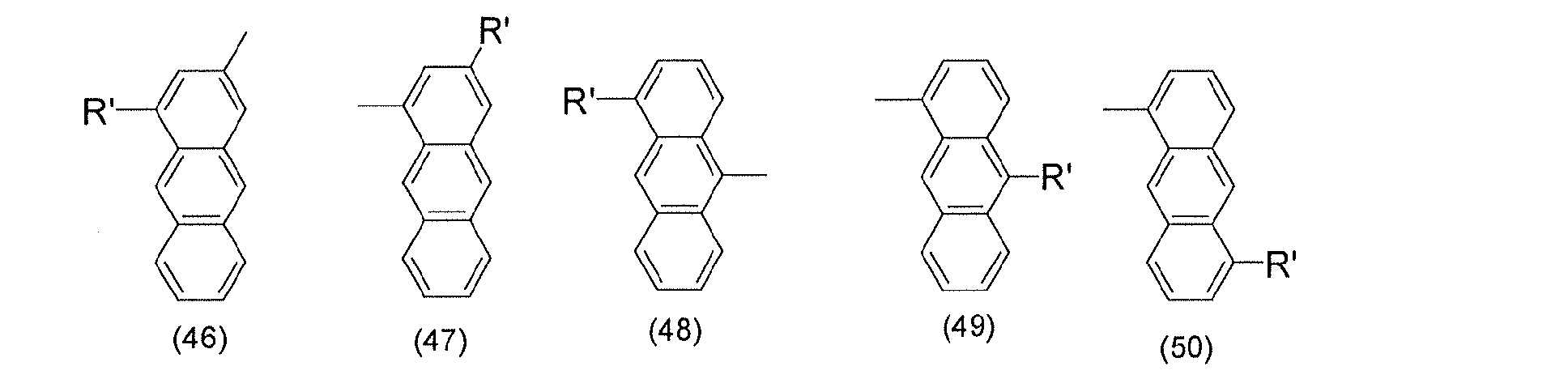
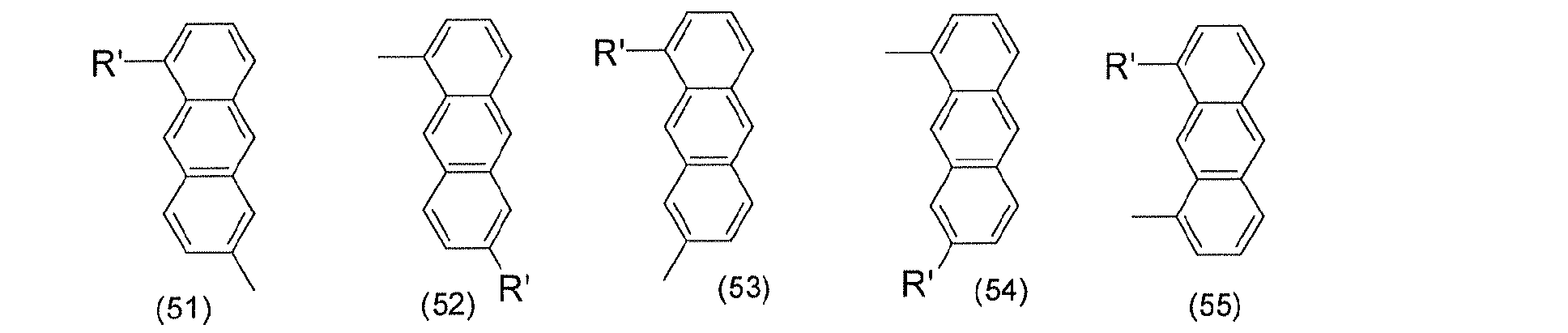
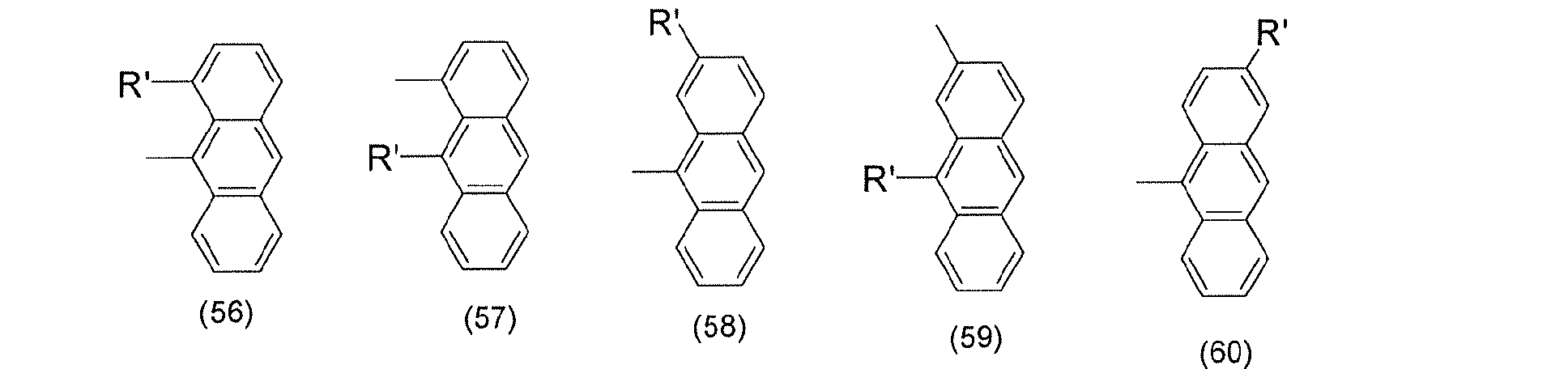 wherein each condensed ring groups may be bonded with a bonding group of a halogen atom, an alkyl group having 1 to 20 carbon atoms and may have a substituent, an alkoxy group having 1 to 20 carbon atoms and may have a substituent, an aryloxy group having 6 to 40 carbon atoms and may have a substituent, an aryl group having 6 to 40 carbon atoms and may have a substituent, or a heteroaryl group having 3 to 40 carbon atoms and may have a substituent. When there are plural of bonding groups, the bonding group may be the same or different with each other; and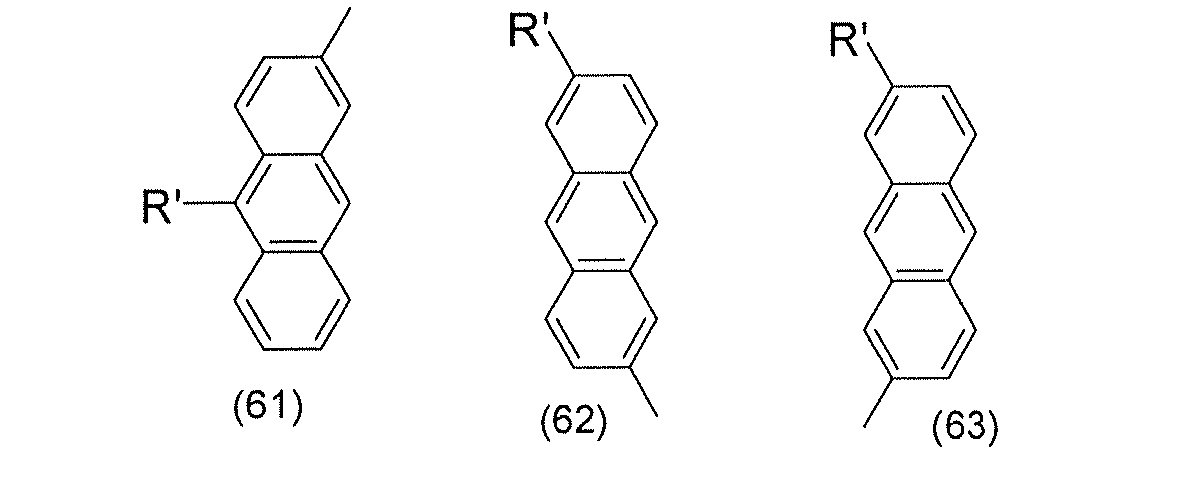
R' represents a hydrogen atom, an alkyl group having 1 to 20 carbon atoms and may have a substituent, an aryl group having 6 to 40 carbon atoms and may have a substituent or a heteroaryl group having 3 to 40 carbon atoms and may have a substituent. - A material for an organic electroluminescence device comprising the derivative of heterocyclic compound having nitrogen atom according to Claim 1.
- An organic electroluminescence device comprising at least one organic compound layer containing a light emitting layer sandwiched between a pair of electrodes, wherein the device contains the derivative of heterocyclic compound having nitrogen atom according to Claim 1 among the compound layer.
- The organic electroluminescence device according to Claim 10, wherein said derivative of heterocyclic compound having nitrogen atom is contained in a light emission area.
- The organic electroluminescence device according to Claim 10, wherein said derivative of heterocyclic compound having nitrogen atom is contained in the light emitting layer.
- The organic electroluminescence device according to Claim 10, wherein said derivative of heterocyclic compound having nitrogen atom is employed for at least one of an electron injection material and an electron transport material.
- The organic electroluminescence device according to Claim 13, wherein a layer comprising said at least one of the electron injection material and the electron transport material further comprises a reductive dopant.
- The organic electroluminescence device according to Claim 14, wherein said reductive dopant is at least one selected from the group consisting of alkali metal, alkaline earth metal, rare earth metal, oxide of alkali metal, halide of alkali metal, oxide of alkaline earth metal, halide of alkaline earth metal, oxide of rare earth metal, halide of rare earth metal, organic complexes of alkali metal, organic complexes of alkaline earth metal and organic complexes of rare earth metal.
Priority Applications (2)
| Application Number | Priority Date | Filing Date | Title |
|---|---|---|---|
| EP10152087.2A EP2174932B1 (en) | 2003-03-13 | 2004-01-27 | Nitrogen-containing heterocycle derivative and organic electroluminescent element using the same |
| EP10152089.8A EP2174933B1 (en) | 2003-03-13 | 2004-01-27 | Benzimidazole derivatives for use in organic electroluminescent devices |
Applications Claiming Priority (3)
| Application Number | Priority Date | Filing Date | Title |
|---|---|---|---|
| JP2003067847 | 2003-03-13 | ||
| JP2003067847 | 2003-03-13 | ||
| PCT/JP2004/000682 WO2004080975A1 (en) | 2003-03-13 | 2004-01-27 | Nitrogen-containing heterocycle derivative and organic electroluminescent element using the same |
Related Child Applications (6)
| Application Number | Title | Priority Date | Filing Date |
|---|---|---|---|
| EP10152089.8A Division-Into EP2174933B1 (en) | 2003-03-13 | 2004-01-27 | Benzimidazole derivatives for use in organic electroluminescent devices |
| EP10152089.8A Division EP2174933B1 (en) | 2003-03-13 | 2004-01-27 | Benzimidazole derivatives for use in organic electroluminescent devices |
| EP10152087.2A Division-Into EP2174932B1 (en) | 2003-03-13 | 2004-01-27 | Nitrogen-containing heterocycle derivative and organic electroluminescent element using the same |
| EP10152087.2A Division EP2174932B1 (en) | 2003-03-13 | 2004-01-27 | Nitrogen-containing heterocycle derivative and organic electroluminescent element using the same |
| EP10152089.8 Division-Into | 2010-01-29 | ||
| EP10152087.2 Division-Into | 2010-01-29 |
Publications (4)
| Publication Number | Publication Date |
|---|---|
| EP1602648A1 true EP1602648A1 (en) | 2005-12-07 |
| EP1602648A4 EP1602648A4 (en) | 2008-06-11 |
| EP1602648B1 EP1602648B1 (en) | 2013-04-17 |
| EP1602648B2 EP1602648B2 (en) | 2025-03-26 |
Family
ID=32984572
Family Applications (3)
| Application Number | Title | Priority Date | Filing Date |
|---|---|---|---|
| EP04705503.3A Expired - Lifetime EP1602648B2 (en) | 2003-03-13 | 2004-01-27 | Nitrogen-containing heterocycle derivative and organic electroluminescent element using the same |
| EP10152089.8A Expired - Lifetime EP2174933B1 (en) | 2003-03-13 | 2004-01-27 | Benzimidazole derivatives for use in organic electroluminescent devices |
| EP10152087.2A Expired - Lifetime EP2174932B1 (en) | 2003-03-13 | 2004-01-27 | Nitrogen-containing heterocycle derivative and organic electroluminescent element using the same |
Family Applications After (2)
| Application Number | Title | Priority Date | Filing Date |
|---|---|---|---|
| EP10152089.8A Expired - Lifetime EP2174933B1 (en) | 2003-03-13 | 2004-01-27 | Benzimidazole derivatives for use in organic electroluminescent devices |
| EP10152087.2A Expired - Lifetime EP2174932B1 (en) | 2003-03-13 | 2004-01-27 | Nitrogen-containing heterocycle derivative and organic electroluminescent element using the same |
Country Status (7)
| Country | Link |
|---|---|
| US (2) | US7851071B2 (en) |
| EP (3) | EP1602648B2 (en) |
| JP (3) | JP4185097B2 (en) |
| KR (3) | KR100998838B1 (en) |
| CN (3) | CN101503393B (en) |
| TW (3) | TWI499653B (en) |
| WO (1) | WO2004080975A1 (en) |
Cited By (37)
| Publication number | Priority date | Publication date | Assignee | Title |
|---|---|---|---|---|
| EP2018090A4 (en) * | 2006-05-11 | 2010-12-01 | Idemitsu Kosan Co | ORGANIC ELECTROLUMINESCENCE DEVICE |
| EP2535331A1 (en) * | 2011-06-16 | 2012-12-19 | Samsung Display Co., Ltd. | Condensed-Cyclic Compound and Organic Light-Emitting Diode Comprising the Same |
| EP3056504A1 (en) | 2015-02-16 | 2016-08-17 | Universal Display Corporation | Organic electroluminescent materials and devices |
| EP3061763A1 (en) | 2015-02-27 | 2016-08-31 | Universal Display Corporation | Organic electroluminescent materials and devices |
| EP3098229A1 (en) | 2015-05-15 | 2016-11-30 | Universal Display Corporation | Organic electroluminescent materials and devices |
| EP3101021A1 (en) | 2015-06-01 | 2016-12-07 | Universal Display Corporation | Organic electroluminescent materials and devices |
| EP3124488A1 (en) | 2015-07-29 | 2017-02-01 | Universal Display Corporation | Organic electroluminescent materials and devices |
| EP3159350A1 (en) | 2015-09-03 | 2017-04-26 | Universal Display Corporation | Organic electroluminescent materials and devices |
| EP3205658A1 (en) | 2016-02-09 | 2017-08-16 | Universal Display Corporation | Organic electroluminescent materials and devices |
| EP3231809A2 (en) | 2016-04-11 | 2017-10-18 | Universal Display Corporation | Organic electroluminescent materials and devices |
| EP3261146A2 (en) | 2016-06-20 | 2017-12-27 | Universal Display Corporation | Organic electroluminescent materials and devices |
| EP3261147A1 (en) | 2016-06-20 | 2017-12-27 | Universal Display Corporation | Organic electroluminescent materials and devices |
| EP3270435A2 (en) | 2016-06-20 | 2018-01-17 | Universal Display Corporation | Organic electroluminescent materials and devices |
| EP3297051A1 (en) | 2016-09-14 | 2018-03-21 | Universal Display Corporation | Organic electroluminescent materials and devices |
| EP3301088A1 (en) | 2016-10-03 | 2018-04-04 | Universal Display Corporation | Condensed pyridines as organic electroluminescent materials and devices |
| EP3305796A1 (en) | 2016-10-07 | 2018-04-11 | Universal Display Corporation | Organic electroluminescent materials and devices |
| EP3321258A1 (en) | 2016-11-09 | 2018-05-16 | Universal Display Corporation | 4-phenylbenzo[g]quinazoline or 4-(3,5-dimethylphenylbenzo[g]quinazoline iridium complexes for use as near-infrared or infrared emitting materials in oleds |
| EP3323822A1 (en) | 2016-09-23 | 2018-05-23 | Universal Display Corporation | Organic electroluminescent materials and devices |
| EP3345914A1 (en) | 2017-01-09 | 2018-07-11 | Universal Display Corporation | Organic electroluminescent materials and devices |
| EP3354654A2 (en) | 2016-11-11 | 2018-08-01 | Universal Display Corporation | Organic electroluminescent materials and devices |
| EP3444258A2 (en) | 2017-08-10 | 2019-02-20 | Universal Display Corporation | Organic electroluminescent materials and devices |
| EP3489243A1 (en) | 2017-11-28 | 2019-05-29 | University of Southern California | Carbene compounds and organic electroluminescent devices |
| EP3492480A2 (en) | 2017-11-29 | 2019-06-05 | Universal Display Corporation | Organic electroluminescent materials and devices |
| EP3492528A1 (en) | 2017-11-30 | 2019-06-05 | Universal Display Corporation | Organic electroluminescent materials and devices |
| EP3613751A1 (en) | 2018-08-22 | 2020-02-26 | Universal Display Corporation | Organic electroluminescent materials and devices |
| EP3689889A1 (en) | 2019-02-01 | 2020-08-05 | Universal Display Corporation | Organic electroluminescent materials and devices |
| EP3730506A1 (en) | 2017-03-29 | 2020-10-28 | Universal Display Corporation | Organic electroluminescent materials and devices |
| WO2023203162A1 (en) * | 2022-04-22 | 2023-10-26 | Universite Paris Cite | Compounds inducing production of proteins by immune cells |
| US12187748B2 (en) | 2020-11-02 | 2025-01-07 | Universal Display Corporation | Organic electroluminescent materials and devices |
| US12428599B2 (en) | 2021-03-09 | 2025-09-30 | Universal Display Corporation | Organic electroluminescent materials and devices |
| US12473318B2 (en) | 2021-10-08 | 2025-11-18 | Universal Display Corporation | Organic electroluminescent materials and devices |
| US12480042B2 (en) | 2021-04-09 | 2025-11-25 | Universal Display Corporation | Organic electroluminescent materials and devices |
| US12550611B2 (en) | 2021-08-03 | 2026-02-10 | Universal Display Corporation | Organic electroluminescent materials and devices |
| US12624055B2 (en) | 2021-03-01 | 2026-05-12 | Universal Display Corporation | Organic electroluminescent materials and devices |
| US12673962B2 (en) | 2021-03-01 | 2026-07-07 | Universal Display Corporation | Organic electroluminescent materials and devices |
| US12686815B2 (en) | 2021-06-04 | 2026-07-21 | Universal Display Corporation | Organic electroluminescent materials and devices |
| US12707889B2 (en) | 2020-11-02 | 2026-08-11 | Universal Display Corporation | Organic electroluminescent materials and devices |
Families Citing this family (279)
| Publication number | Priority date | Publication date | Assignee | Title |
|---|---|---|---|---|
| KR101064077B1 (en) * | 2003-01-10 | 2011-09-08 | 이데미쓰 고산 가부시키가이샤 | Nitrogen-containing heterocyclic derivatives and organic electroluminescent devices using the same |
| WO2004080975A1 (en) * | 2003-03-13 | 2004-09-23 | Idemitsu Kosan Co., Ltd. | Nitrogen-containing heterocycle derivative and organic electroluminescent element using the same |
| JP4528013B2 (en) * | 2004-04-01 | 2010-08-18 | 三井化学株式会社 | Anthracene compound and organic electroluminescent device containing the anthracene compound |
| ATE447558T1 (en) * | 2004-04-07 | 2009-11-15 | Idemitsu Kosan Co | NITROGEN-CONTAINING HETEROCYCLE DERIVATIVE AND ORGANIC ELECTROLUMINescent ELEMENT IN WHICH IT IS USED |
| US20060269782A1 (en) * | 2005-05-25 | 2006-11-30 | Eastman Kodak Company | OLED electron-transporting layer |
| JP4986451B2 (en) * | 2005-06-30 | 2012-07-25 | 信一郎 礒部 | Marking agent |
| KR20080028425A (en) * | 2005-07-11 | 2008-03-31 | 이데미쓰 고산 가부시키가이샤 | Nitrogen-containing heterocyclic derivatives having electron-withdrawing substituents and organic electroluminescent devices using them |
| KR20080028424A (en) * | 2005-07-11 | 2008-03-31 | 이데미쓰 고산 가부시키가이샤 | Nitrogen-containing heterocyclic derivatives and organic electroluminescent devices using the same |
| JP2007039406A (en) * | 2005-08-05 | 2007-02-15 | Idemitsu Kosan Co Ltd | Nitrogen-containing heterocyclic derivative and organic electroluminescence device using the same |
| CN101291897B (en) * | 2005-10-21 | 2012-09-05 | Lg化学株式会社 | New binaphthalene derivatives, preparation method thereof and organic electronic device using the same |
| US20070104977A1 (en) * | 2005-11-07 | 2007-05-10 | Idemitsu Kosan Co., Ltd. | Organic electroluminescent device |
| JP2007149941A (en) * | 2005-11-28 | 2007-06-14 | Idemitsu Kosan Co Ltd | Organic electroluminescence device |
| JP2007153778A (en) * | 2005-12-02 | 2007-06-21 | Idemitsu Kosan Co Ltd | Nitrogen-containing heterocyclic derivative and organic electroluminescence device using the same |
| JP5122482B2 (en) * | 2006-01-27 | 2013-01-16 | エルジー・ケム・リミテッド | NOVEL ANTHRACENE DERIVATIVE, PROCESS FOR PRODUCING THE SAME AND ORGANIC ELECTRIC ELEMENT USING THE SAME |
| KR20080098376A (en) * | 2006-02-23 | 2008-11-07 | 이데미쓰 고산 가부시키가이샤 | Red organic electroluminescent device |
| WO2007099872A1 (en) * | 2006-02-23 | 2007-09-07 | Idemitsu Kosan Co., Ltd. | Organic electroluminescent device |
| TW200740290A (en) * | 2006-02-28 | 2007-10-16 | Idemitsu Kosan Co | Organic electroluminescent device using fluoranthene derivative and indenoperylene derivative |
| EP2000464A4 (en) | 2006-03-27 | 2010-06-30 | Idemitsu Kosan Co | HETEROCYCLIC NITROGEN DERIVATIVE AND ORGANIC ELECTROLUMINESCENT DEVICE USING THE SAME |
| WO2007111263A1 (en) | 2006-03-27 | 2007-10-04 | Idemitsu Kosan Co., Ltd. | Nitrogen-containing heterocyclic derivative and organic electroluminescent device using same |
| JP5097700B2 (en) * | 2006-05-11 | 2012-12-12 | 出光興産株式会社 | Organic electroluminescence device |
| KR20090051163A (en) * | 2006-08-04 | 2009-05-21 | 이데미쓰 고산 가부시키가이샤 | Organic electroluminescent element |
| JP4942448B2 (en) * | 2006-10-13 | 2012-05-30 | 三井化学株式会社 | Anthracene compound and organic electroluminescence device containing the compound |
| JP5294872B2 (en) * | 2006-11-20 | 2013-09-18 | 出光興産株式会社 | Organic electroluminescence device |
| KR100989467B1 (en) * | 2006-12-06 | 2010-10-22 | 주식회사 엘지화학 | Novel fluorene derivative and organic electronic device using same |
| TWI502049B (en) * | 2006-12-28 | 2015-10-01 | Semiconductor Energy Lab | Organic compound and method for synthesizing organic compound and anthracene derivative |
| WO2008102740A1 (en) | 2007-02-19 | 2008-08-28 | Idemitsu Kosan Co., Ltd. | Organic electroluminescent device |
| WO2008105294A1 (en) | 2007-02-28 | 2008-09-04 | Idemitsu Kosan Co., Ltd. | Organic el device |
| TWI373987B (en) * | 2007-03-07 | 2012-10-01 | Sony Corp | Organic electroluminescent device and display device |
| US8278819B2 (en) * | 2007-03-09 | 2012-10-02 | Idemitsu Kosan Co., Ltd. | Organic electroluminescence device and display |
| US20080241588A1 (en) * | 2007-03-09 | 2008-10-02 | Idemitsu Kosan Co., Ltd. | Organic electroluminescence device and display |
| KR101482772B1 (en) | 2007-04-12 | 2015-01-15 | 토소가부시키가이샤 | Phenyl-substituted 1,3,5-triazine compound, process for producing the same, and organic electroluminescent device containing the same as component |
| US8541111B2 (en) * | 2007-05-21 | 2013-09-24 | Sony Corporation | Organic electroluminescent device and display apparatus |
| CN101414661B (en) * | 2007-10-17 | 2011-11-16 | 中国科学院理化技术研究所 | Organic electron transport and/or hole blocking material and its synthesis method and use |
| KR101528241B1 (en) * | 2007-12-07 | 2015-06-15 | 삼성디스플레이 주식회사 | An aromatic cyclic compound, an organic light emitting device having an organic film containing the same, and a method for manufacturing the organic light emitting device |
| JP5355421B2 (en) * | 2007-12-21 | 2013-11-27 | 出光興産株式会社 | Organic electroluminescence device |
| WO2009084543A1 (en) | 2007-12-27 | 2009-07-09 | Idemitsu Kosan Co., Ltd. | Nitrogen-containing heterocyclic derivative and organic electroluminescent device using the same |
| WO2009084544A1 (en) * | 2007-12-27 | 2009-07-09 | Idemitsu Kosan Co., Ltd. | Nitrogen-containing heterocyclic derivative and organic electroluminescent device using the same |
| CN101250405B (en) * | 2008-02-26 | 2011-01-19 | 南京大学 | Novel mercapto fluorescence probe and uses thereof |
| KR101443424B1 (en) * | 2008-03-19 | 2014-09-24 | 이데미쓰 고산 가부시키가이샤 | Anthracene derivatives, luminescent materials and organic electroluminescent devices |
| JP5748948B2 (en) | 2008-10-03 | 2015-07-15 | 東ソー株式会社 | 1,3,5-triazine derivative, method for producing the same, and organic electroluminescent device comprising the same |
| JP2010092960A (en) * | 2008-10-06 | 2010-04-22 | Sony Corp | Organic electroluminescent device and display apparatus |
| JP5629970B2 (en) * | 2008-11-14 | 2014-11-26 | コニカミノルタ株式会社 | Organic electroluminescence element, display device and lighting device |
| KR101257695B1 (en) * | 2008-12-24 | 2013-04-24 | 제일모직주식회사 | Novel compound for organic photoelectric device and organic photoelectric device including the same |
| DE102009005746A1 (en) | 2009-01-23 | 2010-07-29 | Merck Patent Gmbh | Materials for organic electroluminescent devices |
| DE102009009277B4 (en) | 2009-02-17 | 2023-12-07 | Merck Patent Gmbh | Organic electronic device, process for its production and use of compounds |
| DE102009012346B4 (en) | 2009-03-09 | 2024-02-15 | Merck Patent Gmbh | Organic electroluminescent device and method for producing the same |
| DE102009014513A1 (en) | 2009-03-23 | 2010-09-30 | Merck Patent Gmbh | Organic electroluminescent device |
| DE102009017064A1 (en) | 2009-04-09 | 2010-10-14 | Merck Patent Gmbh | Organic electroluminescent device |
| CN102421858A (en) | 2009-06-22 | 2012-04-18 | 默克专利有限公司 | Conducting formulation |
| EP2462203B1 (en) | 2009-08-04 | 2016-03-02 | Merck Patent GmbH | Electronic devices comprising multi cyclic hydrocarbons |
| DE102009042680A1 (en) | 2009-09-23 | 2011-03-24 | Merck Patent Gmbh | Organic electroluminescent device |
| KR101446401B1 (en) * | 2009-10-02 | 2014-10-01 | 이데미쓰 고산 가부시키가이샤 | Aromatic amine derivative, and organic electroluminescent element |
| WO2011076326A1 (en) | 2009-12-22 | 2011-06-30 | Merck Patent Gmbh | Electroluminescent functional surfactants |
| JP5968786B2 (en) | 2009-12-22 | 2016-08-10 | メルク パテント ゲーエムベーハー | Electroluminescence formulation |
| WO2011076323A1 (en) | 2009-12-22 | 2011-06-30 | Merck Patent Gmbh | Formulations comprising phase-separated functional materials |
| CN107573484A (en) | 2009-12-23 | 2018-01-12 | 默克专利有限公司 | Composition including polymer-binder |
| KR20120123361A (en) | 2009-12-23 | 2012-11-08 | 메르크 파텐트 게엠베하 | Compositions comprising organic semiconducting compounds |
| WO2011086941A1 (en) | 2010-01-15 | 2011-07-21 | 出光興産株式会社 | Organic electroluminescent element |
| KR101153910B1 (en) * | 2010-02-19 | 2012-06-07 | 덕산하이메탈(주) | Chemical Comprising Indole Derivatives and Organic Electronic Element using the same, Terminal thereof |
| DE102010010481A1 (en) | 2010-03-06 | 2011-09-08 | Merck Patent Gmbh | Organic electroluminescent device |
| WO2011110277A1 (en) | 2010-03-11 | 2011-09-15 | Merck Patent Gmbh | Fibers in therapy and cosmetics |
| KR101757016B1 (en) | 2010-03-11 | 2017-07-11 | 메르크 파텐트 게엠베하 | Radiative fibers |
| JP2013527980A (en) | 2010-04-12 | 2013-07-04 | メルク パテント ゲーエムベーハー | Composition with improved performance |
| JP6073216B2 (en) | 2010-04-12 | 2017-02-01 | メルク パテント ゲーエムベーハー | Compositions and methods for making organic electronic devices |
| JP2011222831A (en) | 2010-04-12 | 2011-11-04 | Idemitsu Kosan Co Ltd | Organic electroluminescent element |
| DE102010020044A1 (en) | 2010-05-11 | 2011-11-17 | Merck Patent Gmbh | Organic electroluminescent device |
| JP5944380B2 (en) | 2010-05-27 | 2016-07-05 | メルク パテント ゲーエムベーハー | Composition comprising quantum dots |
| RU2012156386A (en) | 2010-05-27 | 2014-07-10 | Мерк Патент Гмбх | COMPOSITION AND METHOD FOR PRODUCING ORGANIC ELECTRONIC DEVICES |
| US9105847B2 (en) * | 2010-06-24 | 2015-08-11 | Joled Inc. | Organic EL display and method of manufacturing the same |
| CN106887522B (en) | 2010-07-26 | 2018-09-18 | 默克专利有限公司 | Include the device of nanocrystal |
| EP2599141B1 (en) | 2010-07-26 | 2019-12-11 | Merck Patent GmbH | Quantum dots and hosts |
| KR101466150B1 (en) * | 2010-12-31 | 2014-11-27 | 제일모직 주식회사 | Compound for organic photoelectric device and organic photoelectric device including the same |
| WO2012110178A1 (en) | 2011-02-14 | 2012-08-23 | Merck Patent Gmbh | Device and method for treatment of cells and cell tissue |
| JP2012195054A (en) | 2011-03-14 | 2012-10-11 | Idemitsu Kosan Co Ltd | Organic electroluminescent element |
| WO2012126566A1 (en) | 2011-03-24 | 2012-09-27 | Merck Patent Gmbh | Organic ionic functional materials |
| JP6223961B2 (en) | 2011-05-12 | 2017-11-01 | メルク パテント ゲーエムベーハー | Organic ionic functional material, composition and electronic device |
| US9190622B2 (en) | 2011-06-01 | 2015-11-17 | Merck Patent Gmbh | Hybrid ambipolar TFTs |
| JP6174024B2 (en) | 2011-07-25 | 2017-08-02 | メルク パテント ゲーエムベーハー | Copolymers with functional side chains |
| KR101474797B1 (en) | 2011-08-08 | 2014-12-19 | 제일모직 주식회사 | Compound for organic optoelectronic device and organic light emitting diode including the same |
| KR102138351B1 (en) * | 2011-08-18 | 2020-07-28 | 이데미쓰 고산 가부시키가이샤 | Biscarbazole derivative and organic electroluminescence element using same |
| DE102012016192A1 (en) | 2011-08-19 | 2013-02-21 | Merck Patent Gmbh | New compounds capable of forming hydrogen bonds are useful in electronic device, e.g. organic electroluminescent device, organic light-emitting transistor and organic light-emitting electrochemical cell |
| WO2013051234A1 (en) * | 2011-10-04 | 2013-04-11 | ソニー株式会社 | Organic electroluminescent element |
| US9356242B2 (en) | 2011-10-06 | 2016-05-31 | Merck Patent Gmbh | Organic electroluminescent device |
| JP2013093541A (en) | 2011-10-06 | 2013-05-16 | Udc Ireland Ltd | Organic electroluminescent element and compound and material for organic electroluminescent element usable therefor, and luminescent device, display device and lighting device using the element |
| JP2013084732A (en) | 2011-10-07 | 2013-05-09 | Udc Ireland Ltd | Organic field light-emitting element and light-emitting material for the same, and light-emitting device, display device and illuminating device |
| JP2013118349A (en) | 2011-11-02 | 2013-06-13 | Udc Ireland Ltd | Organic electroluminescent element, material for organic electroluminescent element, and light emitting device, display device and illumination device which employ said organic electroluminescent element |
| JP2013103918A (en) | 2011-11-15 | 2013-05-30 | Udc Ireland Ltd | Charge-transporting material, organic electroluminescent element, and light-emitting device, display device and illumination device characterized by using the element |
| DE102012022880B4 (en) | 2011-12-22 | 2024-12-24 | Merck Patent Gmbh | Electronic devices containing organic layers |
| JP5978843B2 (en) | 2012-02-02 | 2016-08-24 | コニカミノルタ株式会社 | Iridium complex compound, organic electroluminescence device material, organic electroluminescence device, lighting device and display device |
| JP6118034B2 (en) | 2012-02-06 | 2017-04-19 | ユー・ディー・シー アイルランド リミテッド | ORGANIC ELECTROLUMINESCENT ELEMENT, COMPOUND USABLE FOR THE SAME, ORGANIC ELECTROLUMINESCENT ELEMENT MATERIAL, AND LIGHT EMITTING DEVICE, DISPLAY DEVICE AND LIGHTING DEVICE USING THE ELEMENT |
| WO2013135352A1 (en) | 2012-03-15 | 2013-09-19 | Merck Patent Gmbh | Electronic devices |
| JP6006008B2 (en) * | 2012-06-14 | 2016-10-12 | ユー・ディー・シー アイルランド リミテッド | COMPOUND, ORGANIC ELECTROLUMINESCENT ELEMENT, AND LIGHT EMITTING DEVICE, DISPLAY DEVICE AND LIGHTING DEVICE USING THE ORGANIC ELECTROLUMINESCENT ELEMENT |
| WO2014030666A1 (en) | 2012-08-24 | 2014-02-27 | コニカミノルタ株式会社 | Transparent electrode, electronic device, and method for manufacturing transparent electrode |
| EP3806176B1 (en) | 2012-10-31 | 2025-06-25 | Merck Patent GmbH | Electronic device |
| JP6306033B2 (en) | 2012-11-12 | 2018-04-04 | メルク パテント ゲーエムベーハー | Materials for electronic devices |
| KR102173856B1 (en) | 2012-11-30 | 2020-11-04 | 메르크 파텐트 게엠베하 | Electronic device |
| EP2941472B1 (en) | 2013-01-03 | 2018-07-25 | Merck Patent GmbH | Materials for electronic devices |
| WO2014106523A1 (en) | 2013-01-03 | 2014-07-10 | Merck Patent Gmbh | Electronic device |
| WO2014106524A2 (en) | 2013-01-03 | 2014-07-10 | Merck Patent Gmbh | Materials for electronic devices |
| KR102051952B1 (en) * | 2013-01-08 | 2019-12-04 | 에스에프씨주식회사 | Antracene derivatives having heteroaryl substituted naphthyl group and organic light-emitting diode including the same |
| KR102030388B1 (en) * | 2013-01-08 | 2019-10-10 | 에스에프씨주식회사 | Asymmetric antracene derivatives having two naphthyl groups and organic light-emitting diode including the same |
| KR102030584B1 (en) * | 2013-01-08 | 2019-10-10 | 에스에프씨주식회사 | Antracene derivatives having heteroaryl substituted phenyl group and organic light-emitting diode including the same |
| KR102030587B1 (en) * | 2013-01-09 | 2019-10-10 | 에스에프씨주식회사 | Asymmetric antracene derivatives having two naphthyl groups and organic light-emitting diode including the same |
| KR102090707B1 (en) | 2013-02-25 | 2020-03-19 | 삼성디스플레이 주식회사 | Pyrene-based compound and organic light emitting diode comprising the same |
| JP6314599B2 (en) | 2013-03-29 | 2018-04-25 | コニカミノルタ株式会社 | COMPOUND FOR ORGANIC ELECTROLUMINESCENCE, ORGANIC ELECTROLUMINESCENCE ELEMENT, LIGHTING DEVICE AND DISPLAY DEVICE HAVING THE SAME |
| WO2014157610A1 (en) | 2013-03-29 | 2014-10-02 | コニカミノルタ株式会社 | Organic electroluminescent element, lighting device, display device, light-emitting thin film and composition for organic electroluminescent element, and light-emitting method |
| US20160043334A1 (en) | 2013-03-29 | 2016-02-11 | Konica Minolta, Inc. | Material for organic electroluminescent elements, organic electroluminescent element, display device and lighting device |
| US20160163987A1 (en) | 2013-07-29 | 2016-06-09 | Merck Patent Gmbh | Electro-optical device and the use thereof |
| JP6567519B2 (en) | 2013-07-29 | 2019-08-28 | メルク、パテント、ゲゼルシャフト、ミット、ベシュレンクテル、ハフツングMerck Patent GmbH | Electroluminescence element |
| WO2015014435A1 (en) | 2013-07-30 | 2015-02-05 | Merck Patent Gmbh | Materials for electronic devices |
| EP3027707B1 (en) | 2013-07-30 | 2019-12-11 | Merck Patent GmbH | Materials for electronic devices |
| WO2015082037A1 (en) | 2013-12-06 | 2015-06-11 | Merck Patent Gmbh | Compositions containing a polymeric binder which comprises acrylic and/or methacrylic acid ester units |
| KR102380808B1 (en) | 2013-12-06 | 2022-03-30 | 메르크 파텐트 게엠베하 | Substituted oxepines |
| JP6789825B2 (en) | 2014-04-30 | 2020-11-25 | メルク パテント ゲーエムベーハー | Materials for electronic devices |
| DE102014008722B4 (en) | 2014-06-18 | 2024-08-22 | Merck Patent Gmbh | Compositions for electronic devices, formulation containing them, use of the composition, use of the formulation and organic electronic device containing the composition |
| US10615343B2 (en) | 2014-09-05 | 2020-04-07 | Merck Patent Gmbh | Formulations and electronic devices |
| TWI577070B (en) * | 2014-10-27 | 2017-04-01 | Lg 化學股份有限公司 | Organic electroluminescent element |
| WO2016107663A1 (en) | 2014-12-30 | 2016-07-07 | Merck Patent Gmbh | Formulations and electronic devices |
| CN107532013A (en) | 2015-01-30 | 2018-01-02 | 默克专利有限公司 | Formulations with low particle content |
| EP3250658B1 (en) | 2015-01-30 | 2019-06-19 | Merck Patent GmbH | Materials for electronic devices |
| JP5831654B1 (en) | 2015-02-13 | 2015-12-09 | コニカミノルタ株式会社 | Aromatic heterocycle derivative, organic electroluminescence device using the same, illumination device and display device |
| EP3093288A1 (en) * | 2015-05-12 | 2016-11-16 | Novaled GmbH | Organic light-emitting diode comprising different matrix compounds in the first and second electron transport layer |
| EP3278377B1 (en) | 2015-03-30 | 2020-08-05 | Merck Patent GmbH | Formulation of an organic functional material comprising a siloxane solvent |
| CN107690720B (en) | 2015-06-12 | 2020-04-03 | 默克专利有限公司 | Esters containing non-aromatic rings as solvents for OLED formulations |
| KR102643183B1 (en) | 2015-07-15 | 2024-03-04 | 메르크 파텐트 게엠베하 | Compositions Comprising Organic Semiconducting Compounds |
| TWI697485B (en) | 2015-07-21 | 2020-07-01 | 日商捷恩智股份有限公司 | Compound containing oxazoline ring, material for electron transport/injection layer containing the same, organic electroluminescent element using the same, display device and lighting device |
| GB201513037D0 (en) | 2015-07-23 | 2015-09-09 | Merck Patent Gmbh | Phenyl-derived compound for use in organic electronic devices |
| US10696664B2 (en) | 2015-08-14 | 2020-06-30 | Merck Patent Gmbh | Phenoxazine derivatives for organic electroluminescent devices |
| WO2017036572A1 (en) | 2015-08-28 | 2017-03-09 | Merck Patent Gmbh | Formulation of an organic functional material comprising an epoxy group containing solvent |
| CA3002752A1 (en) | 2015-10-26 | 2017-05-04 | Oti Lumionics Inc. | Method for patterning a coating on a surface and device including a patterned coating |
| KR102721890B1 (en) | 2015-12-10 | 2024-10-24 | 메르크 파텐트 게엠베하 | Formulations comprising a ketone containing a non-aromatic cycle |
| JP7051684B2 (en) | 2015-12-15 | 2022-04-11 | メルク パテント ゲーエムベーハー | Esters containing aromatic groups as solvents for organic electronic formulations |
| JP7438661B2 (en) | 2015-12-16 | 2024-02-27 | メルク パテント ゲーエムベーハー | Formulations containing solid solvents |
| KR20180095028A (en) | 2015-12-16 | 2018-08-24 | 메르크 파텐트 게엠베하 | A formulation containing a mixture of two or more different solvents |
| JP6788314B2 (en) | 2016-01-06 | 2020-11-25 | コニカミノルタ株式会社 | Organic electroluminescence element, manufacturing method of organic electroluminescence element, display device and lighting device |
| JP7051691B2 (en) | 2016-02-05 | 2022-04-11 | メルク パテント ゲーエムベーハー | Materials for electronic devices |
| KR102776731B1 (en) | 2016-02-17 | 2025-03-05 | 메르크 파텐트 게엠베하 | Formulation of organic functional materials |
| JP6659067B2 (en) * | 2016-02-18 | 2020-03-04 | 出光興産株式会社 | Organic electroluminescence device and electronic equipment |
| DE102016003104A1 (en) | 2016-03-15 | 2017-09-21 | Merck Patent Gmbh | Container comprising a formulation containing at least one organic semiconductor |
| KR102065817B1 (en) * | 2016-06-02 | 2020-01-13 | 주식회사 엘지화학 | Organic light emitting device |
| JP2019523997A (en) | 2016-06-16 | 2019-08-29 | メルク パテント ゲーエムベーハー | Formulation of organic functional materials |
| WO2017216128A1 (en) | 2016-06-17 | 2017-12-21 | Merck Patent Gmbh | Formulation of an organic functional material |
| TW201815998A (en) | 2016-06-28 | 2018-05-01 | 德商麥克專利有限公司 | Organic functional material formulation |
| WO2018024719A1 (en) | 2016-08-04 | 2018-02-08 | Merck Patent Gmbh | Formulation of an organic functional material |
| TWI764942B (en) | 2016-10-10 | 2022-05-21 | 德商麥克專利有限公司 | Electronic device |
| DE102017008794A1 (en) | 2016-10-17 | 2018-04-19 | Merck Patent Gmbh | Materials for use in electronic devices |
| EP3532566B1 (en) | 2016-10-31 | 2021-04-21 | Merck Patent GmbH | Formulation of an organic functional material |
| KR102451842B1 (en) | 2016-10-31 | 2022-10-07 | 메르크 파텐트 게엠베하 | Formulation of organic functional materials |
| JP2020512273A (en) | 2016-11-02 | 2020-04-23 | メルク パテント ゲーエムベーハー | Materials for electronic devices |
| US11440925B2 (en) | 2016-11-08 | 2022-09-13 | Merck Patent Gmbh | Compounds for electronic devices |
| TW201833118A (en) | 2016-11-22 | 2018-09-16 | 德商麥克專利有限公司 | Materials for electronic devices |
| US10892414B2 (en) | 2016-12-06 | 2021-01-12 | Merck Patent Gmbh | Process for making electronic device |
| KR102486614B1 (en) | 2016-12-13 | 2023-01-09 | 메르크 파텐트 게엠베하 | Formulation of organic functional materials |
| EP3560003A1 (en) | 2016-12-22 | 2019-10-30 | Merck Patent GmbH | Mixtures comprising at least two organofunctional compounds |
| EP3559078B1 (en) | 2016-12-22 | 2023-10-25 | Merck Patent GmbH | Materials for electronic devices |
| CN108264487A (en) * | 2016-12-30 | 2018-07-10 | 吉林奥来德光电材料股份有限公司 | A kind of novel glyoxaline compound and its application |
| CN108264504A (en) * | 2016-12-30 | 2018-07-10 | 吉林奥来德光电材料股份有限公司 | A kind of novel organic luminescent compounds and include its organic luminescent device |
| CN108264486B (en) * | 2016-12-30 | 2020-11-13 | 吉林奥来德光电材料股份有限公司 | Novel imidazole compound, preparation thereof and electroluminescent device |
| TWI763772B (en) | 2017-01-30 | 2022-05-11 | 德商麥克專利有限公司 | Method for forming an organic element of an electronic device |
| JP7069184B2 (en) | 2017-02-02 | 2022-05-17 | メルク パテント ゲーエムベーハー | Materials for electronic devices |
| EP3579890B1 (en) | 2017-02-09 | 2025-06-18 | Femasys Inc. | Methods and compositions comprising biodegradable cyanoacrylates |
| CN110268544A (en) | 2017-03-01 | 2019-09-20 | 默克专利有限公司 | Organic electroluminescent device |
| KR102557516B1 (en) | 2017-03-02 | 2023-07-20 | 메르크 파텐트 게엠베하 | Materials for Organic Electronic Devices |
| WO2018178136A1 (en) | 2017-03-31 | 2018-10-04 | Merck Patent Gmbh | Printing method for an organic light emitting diode (oled) |
| WO2018189050A1 (en) | 2017-04-10 | 2018-10-18 | Merck Patent Gmbh | Formulation of an organic functional material |
| EP3609977B1 (en) | 2017-04-13 | 2024-05-29 | Merck Patent GmbH | Composition for organic electronic devices |
| WO2018197447A1 (en) | 2017-04-25 | 2018-11-01 | Merck Patent Gmbh | Compounds for electronic devices |
| KR20250036969A (en) | 2017-04-26 | 2025-03-14 | 오티아이 루미오닉스 인크. | Method for patterning a coating on a surface and device including a patterned coating |
| JP7330898B2 (en) | 2017-05-03 | 2023-08-22 | メルク パテント ゲーエムベーハー | Formulation of organic functional material |
| TW201920343A (en) | 2017-06-21 | 2019-06-01 | 德商麥克專利有限公司 | Materials for electronic devices |
| US11767299B2 (en) | 2017-06-23 | 2023-09-26 | Merck Patent Gmbh | Materials for organic electroluminescent devices |
| EP3645766A1 (en) | 2017-06-26 | 2020-05-06 | Merck Patent GmbH | Homogeneous mixtures |
| WO2019002190A1 (en) | 2017-06-28 | 2019-01-03 | Merck Patent Gmbh | Materials for electronic devices |
| TWI786143B (en) | 2017-07-03 | 2022-12-11 | 德商麥克專利有限公司 | Organic electroluminescent device and method for producing the same |
| TWI813576B (en) | 2017-07-03 | 2023-09-01 | 德商麥克專利有限公司 | Formulations with a low content of phenol type impurities |
| US11993572B2 (en) | 2017-07-05 | 2024-05-28 | Merck Patent Gmbh | Composition for organic electronic devices |
| JP7135012B2 (en) | 2017-07-05 | 2022-09-12 | メルク パテント ゲーエムベーハー | Compositions for organic electronic devices |
| CN110892543B (en) | 2017-07-18 | 2023-07-28 | 默克专利有限公司 | Preparation of organic functional material |
| EP4603562A3 (en) | 2017-07-28 | 2025-11-26 | Merck Patent GmbH | Spirobifluorene derivatives for use in electronic devices |
| EP3679024B1 (en) | 2017-09-08 | 2022-11-02 | Merck Patent GmbH | Materials for electronic devices |
| CN108675975A (en) | 2017-10-17 | 2018-10-19 | 默克专利有限公司 | Material for organic electroluminescence device |
| TWI785142B (en) | 2017-11-14 | 2022-12-01 | 德商麥克專利有限公司 | Composition for organic electronic devices |
| JP7847943B2 (en) | 2017-11-23 | 2026-04-20 | メルク パテント ゲーエムベーハー | Materials for electronic devices |
| TWI838352B (en) | 2017-11-24 | 2024-04-11 | 德商麥克專利有限公司 | Materials for organic electroluminescent devices |
| TWI820057B (en) | 2017-11-24 | 2023-11-01 | 德商麥克專利有限公司 | Materials for organic electroluminescent devices |
| JP7293229B2 (en) | 2017-12-15 | 2023-06-19 | メルク パテント ゲーエムベーハー | Formulation of organic functional material |
| CN111465599A (en) | 2017-12-15 | 2020-07-28 | 默克专利有限公司 | Substituted aromatic amines for use in organic electroluminescent devices |
| US20210036245A1 (en) | 2017-12-20 | 2021-02-04 | Merck Patent Gmbh | Heteroaromatic compounds |
| CN109962166B (en) * | 2017-12-25 | 2022-06-07 | 固安鼎材科技有限公司 | Organic electroluminescent device and preparation method thereof |
| KR102478677B1 (en) | 2017-12-29 | 2022-12-16 | 엘지디스플레이 주식회사 | Organic Light Emitting Device and Organic Light Emitting Display Device |
| US11751415B2 (en) | 2018-02-02 | 2023-09-05 | Oti Lumionics Inc. | Materials for forming a nucleation-inhibiting coating and devices incorporating same |
| KR102710151B1 (en) | 2018-02-26 | 2024-09-25 | 메르크 파텐트 게엠베하 | Formulation of organic functional materials |
| TWI802656B (en) | 2018-03-06 | 2023-05-21 | 德商麥克專利有限公司 | Materials for organic electroluminescent devices |
| TW201938761A (en) | 2018-03-06 | 2019-10-01 | 德商麥克專利有限公司 | Materials for organic electroluminescent devices |
| WO2019175149A1 (en) | 2018-03-16 | 2019-09-19 | Merck Patent Gmbh | Materials for organic electroluminescent devices |
| WO2019229011A1 (en) | 2018-05-30 | 2019-12-05 | Merck Patent Gmbh | Composition for organic electronic devices |
| WO2019238782A1 (en) | 2018-06-15 | 2019-12-19 | Merck Patent Gmbh | Formulation of an organic functional material |
| TWI823993B (en) | 2018-08-28 | 2023-12-01 | 德商麥克專利有限公司 | Materials for organic electroluminescent devices |
| TWI837167B (en) | 2018-08-28 | 2024-04-01 | 德商麥克專利有限公司 | Materials for organic electroluminescent devices |
| WO2020043646A1 (en) | 2018-08-28 | 2020-03-05 | Merck Patent Gmbh | Materials for organic electroluminescent devices |
| US20220048836A1 (en) | 2018-09-12 | 2022-02-17 | Merck Patent Gmbh | Materials for organic electroluminescent devices |
| EP3857621B1 (en) | 2018-09-24 | 2025-10-29 | Merck Patent GmbH | Method for the production of a granular material |
| EP3873887A1 (en) | 2018-10-31 | 2021-09-08 | Merck Patent GmbH | Materials for organic electroluminescent devices |
| JP2022506510A (en) | 2018-11-06 | 2022-01-17 | メルク パテント ゲーエムベーハー | How to Form Organic Devices for Electronic Devices |
| KR20250057149A (en) | 2019-02-18 | 2025-04-28 | 메르크 파텐트 게엠베하 | Composition for organic electronic devices |
| EP3935129B1 (en) | 2019-03-04 | 2023-11-29 | Merck Patent GmbH | Ligands for nano-sized materials |
| CN116456753A (en) | 2019-03-07 | 2023-07-18 | Oti照明公司 | Optoelectronic device |
| JP7598873B2 (en) | 2019-04-11 | 2024-12-12 | メルク パテント ゲゼルシャフト ミット ベシュレンクテル ハフツング | Materials for organic electroluminescent devices |
| KR20250110358A (en) | 2019-04-18 | 2025-07-18 | 오티아이 루미오닉스 인크. | Materials for forming a nucleation-inhibiting coating and devices incorporating the same |
| WO2020225778A1 (en) | 2019-05-08 | 2020-11-12 | Oti Lumionics Inc. | Materials for forming a nucleation-inhibiting coating and devices incorporating same |
| KR102899895B1 (en) | 2019-09-19 | 2025-12-15 | 메르크 파텐트 게엠베하 | A mixture of two host materials, and an organic electroluminescent device comprising the same |
| KR102937291B1 (en) | 2019-11-04 | 2026-03-11 | 유디씨 아일랜드 리미티드 | Materials for organic electroluminescent devices |
| TW202130783A (en) | 2019-11-04 | 2021-08-16 | 德商麥克專利有限公司 | Organic electroluminescent device |
| TW202134252A (en) | 2019-11-12 | 2021-09-16 | 德商麥克專利有限公司 | Materials for organic electroluminescent devices |
| TW202136181A (en) | 2019-12-04 | 2021-10-01 | 德商麥克專利有限公司 | Materials for organic electroluminescent devices |
| CN111170993B (en) * | 2020-01-08 | 2020-12-22 | 上海传勤新材料有限公司 | Organic electronic material containing nitrogen atom heterocycle and preparation method and application thereof |
| TW202146625A (en) | 2020-03-11 | 2021-12-16 | 德商麥克專利有限公司 | Organic electroluminescent device |
| EP4118695B1 (en) | 2020-03-11 | 2024-05-01 | Merck Patent GmbH | Organic electroluminescent apparatus |
| TW202200529A (en) | 2020-03-13 | 2022-01-01 | 德商麥克專利有限公司 | Materials for organic electroluminescent devices |
| US20230337537A1 (en) | 2020-03-23 | 2023-10-19 | Merck Patent Gmbh | Materials for organic electroluminescent devices |
| EP4139971A1 (en) | 2020-04-21 | 2023-03-01 | Merck Patent GmbH | Emulsions comprising organic functional materials |
| CN115669281A (en) | 2020-05-29 | 2023-01-31 | 默克专利有限公司 | Organic electroluminescent device |
| CN115867426A (en) | 2020-06-23 | 2023-03-28 | 默克专利有限公司 | method of producing the mixture |
| CN115776981A (en) | 2020-07-22 | 2023-03-10 | 默克专利有限公司 | Material for organic electroluminescent device |
| TW202216953A (en) | 2020-07-22 | 2022-05-01 | 德商麥克專利有限公司 | Materials for organic electroluminescent devices |
| US12113279B2 (en) | 2020-09-22 | 2024-10-08 | Oti Lumionics Inc. | Device incorporating an IR signal transmissive region |
| US12672476B2 (en) | 2020-10-29 | 2026-06-30 | Oti Lumionics Inc. | Opto-electronic device with nanoparticle deposited layers |
| CN112552270B (en) * | 2020-11-16 | 2022-10-25 | 南京高光半导体材料有限公司 | Organic electroluminescent compound and organic electroluminescent device |
| TW202237797A (en) | 2020-11-30 | 2022-10-01 | 德商麥克專利有限公司 | Materials for organic electroluminescent devices |
| KR20250139404A (en) | 2020-12-07 | 2025-09-23 | 오티아이 루미오닉스 인크. | Patterning a conductive deposited layer using a nucleation inhibiting coating and an underlying metallic coating |
| KR20230114756A (en) | 2020-12-08 | 2023-08-01 | 메르크 파텐트 게엠베하 | Ink Systems and Methods for Inkjet Printing |
| TW202309243A (en) | 2021-04-09 | 2023-03-01 | 德商麥克專利有限公司 | Materials for organic electroluminescent devices |
| CN117084000A (en) | 2021-04-09 | 2023-11-17 | 默克专利有限公司 | Material for organic electroluminescent device |
| EP4320649A1 (en) | 2021-04-09 | 2024-02-14 | Merck Patent GmbH | Materials for organic electroluminescent devices |
| WO2022243403A1 (en) | 2021-05-21 | 2022-11-24 | Merck Patent Gmbh | Method for the continuous purification of at least one functional material and device for the continuous purification of at least one functional material |
| JP2024528219A (en) | 2021-08-02 | 2024-07-26 | メルク パテント ゲーエムベーハー | Printing method by combining inks |
| EP4402141A1 (en) | 2021-09-13 | 2024-07-24 | Merck Patent GmbH | Materials for organic electroluminescent devices |
| DE112022004658A5 (en) | 2021-09-28 | 2024-07-25 | Merck Patent Gmbh | MATERIALS FOR ELECTRONIC DEVICES |
| WO2023052313A1 (en) | 2021-09-28 | 2023-04-06 | Merck Patent Gmbh | Materials for electronic devices |
| EP4409620A1 (en) | 2021-09-28 | 2024-08-07 | Merck Patent GmbH | Materials for electronic devices |
| WO2023052275A1 (en) | 2021-09-28 | 2023-04-06 | Merck Patent Gmbh | Materials for electronic devices |
| TW202349760A (en) | 2021-10-05 | 2023-12-16 | 德商麥克專利有限公司 | Method for forming an organic element of an electronic device |
| EP4437814A1 (en) | 2021-11-25 | 2024-10-02 | Merck Patent GmbH | Materials for electronic devices |
| CN118354991A (en) | 2021-12-21 | 2024-07-16 | 默克专利有限公司 | Method for preparing deuterated organic compounds |
| WO2023152346A1 (en) | 2022-02-14 | 2023-08-17 | Merck Patent Gmbh | Materials for electronic devices |
| US20250275349A1 (en) | 2022-04-28 | 2025-08-28 | Merck Patent Gmbh | Materials for organic electroluminescent devices |
| KR20250011205A (en) | 2022-05-18 | 2025-01-21 | 메르크 파텐트 게엠베하 | Method for the preparation of deuterated organic compounds |
| TW202411366A (en) | 2022-06-07 | 2024-03-16 | 德商麥克專利有限公司 | Method of printing a functional layer of an electronic device by combining inks |
| KR20250027272A (en) | 2022-06-24 | 2025-02-25 | 메르크 파텐트 게엠베하 | Composition for organic electronic devices |
| KR20250027268A (en) | 2022-06-24 | 2025-02-25 | 메르크 파텐트 게엠베하 | Composition for organic electronic devices |
| WO2024013004A1 (en) | 2022-07-11 | 2024-01-18 | Merck Patent Gmbh | Materials for electronic devices |
| EP4568964A1 (en) | 2022-08-09 | 2025-06-18 | Merck Patent GmbH | Materials for organic electroluminescent devices |
| KR20240034107A (en) | 2022-09-05 | 2024-03-13 | 롬엔드하스전자재료코리아유한회사 | Organic Electroluminescent Device |
| EP4619484A1 (en) | 2022-11-17 | 2025-09-24 | Merck Patent GmbH | Materials for organic electroluminescent devices |
| TW202440819A (en) | 2022-12-16 | 2024-10-16 | 德商麥克專利有限公司 | Formulation of an organic functional material |
| KR20250124370A (en) | 2022-12-19 | 2025-08-19 | 메르크 파텐트 게엠베하 | Materials for electronic devices |
| TW202438505A (en) | 2022-12-19 | 2024-10-01 | 德商麥克專利有限公司 | Materials for organic electroluminescent devices |
| WO2024133048A1 (en) | 2022-12-20 | 2024-06-27 | Merck Patent Gmbh | Method for preparing deuterated aromatic compounds |
| EP4665715A1 (en) | 2023-02-17 | 2025-12-24 | Merck Patent GmbH | Materials for organic electroluminescent devices |
| WO2024218109A1 (en) | 2023-04-20 | 2024-10-24 | Merck Patent Gmbh | Materials for electronic devices |
| WO2024240725A1 (en) | 2023-05-25 | 2024-11-28 | Merck Patent Gmbh | Tris[1,2,4]triazolo[1,5-a:1',5'-c:1'',5''-e][1,3,5]triazine derivatives for use in organic electroluminescent devices |
| CN121487940A (en) | 2023-07-12 | 2026-02-06 | 默克专利有限公司 | Materials for electronic devices |
| EP4750782A1 (en) | 2023-07-27 | 2026-06-03 | Merck Patent GmbH | Materials for organic light-emitting devices and organic sensors |
| WO2025032039A1 (en) | 2023-08-07 | 2025-02-13 | Merck Patent Gmbh | Process for the preparation of an electronic device |
| EP4772014A1 (en) | 2023-08-30 | 2026-07-08 | Merck Patent GmbH | Materials for organic light-emitting devices |
| KR20260058884A (en) | 2023-08-30 | 2026-04-29 | 메르크 파텐트 게엠베하 | Materials for organic light-emitting devices |
| KR20260058224A (en) | 2023-08-30 | 2026-04-28 | 메르크 파텐트 게엠베하 | Materials for organic light-emitting devices |
| CN122342295A (en) | 2023-12-05 | 2026-07-03 | 默克专利有限公司 | Material Composition for Organic Electroluminescent Devices |
| CN122422281A (en) | 2023-12-21 | 2026-07-17 | 默克专利有限公司 | Mechanochemical process for deuterated organic compounds |
| WO2025132551A1 (en) | 2023-12-22 | 2025-06-26 | Merck Patent Gmbh | Materials for electronic devices |
| WO2025195961A1 (en) | 2024-03-19 | 2025-09-25 | Merck Patent Gmbh | Organic light-emitting devices |
| WO2025196145A1 (en) | 2024-03-22 | 2025-09-25 | Merck Patent Gmbh | Materials for organic light emitting devices |
| WO2025210013A1 (en) | 2024-04-04 | 2025-10-09 | Merck Patent Gmbh | Compounds for electronic devices, in particular compounds for oleds |
| WO2026008710A1 (en) | 2024-07-05 | 2026-01-08 | Merck Patent Gmbh | Cyclic silicon compounds for organic electroluminescent devices |
| WO2026041632A1 (en) | 2024-08-21 | 2026-02-26 | Merck Patent Gmbh | Heterocyclic materials for organic light-emitting devices |
| WO2026073855A1 (en) | 2024-10-01 | 2026-04-09 | Merck Patent Gmbh | Silicon compounds for organic electroluminescent devices |
| WO2026104430A1 (en) | 2024-11-14 | 2026-05-21 | Merck Patent Gmbh | Use of silicon compounds in an electronic device |
| WO2026131611A1 (en) | 2024-12-17 | 2026-06-25 | Merck Patent Gmbh | Silicon compounds for organic electroluminescent devices |
| WO2026153982A1 (en) | 2025-01-17 | 2026-07-23 | Merck Patent Gmbh | Materials for organic electroluminescent devices |
Family Cites Families (43)
| Publication number | Priority date | Publication date | Assignee | Title |
|---|---|---|---|---|
| GB1174493A (en) * | 1967-05-10 | 1969-12-17 | Manufactures J R Bottu | New Benzimidazoles and process for their preparation |
| US4331671A (en) * | 1981-01-09 | 1982-05-25 | Sterling Drug Inc. | 5-(Pyridinyl)-1H-benzimidazoles and 1-hydroxy-6-(pyridinyl)-1H-benzimidazoles and their cardiotonic use |
| EP0138750B1 (en) * | 1983-08-12 | 1987-09-09 | Ciba-Geigy Ag | Process for the production of substituted benzimidazoles |
| JPS6474A (en) * | 1987-01-29 | 1989-01-05 | Otsuka Pharmaceut Factory Inc | Benzimidazole derivative |
| GB8709448D0 (en) * | 1987-04-21 | 1987-05-28 | Pfizer Ltd | Heterobicyclic quinoline derivatives |
| US5200668A (en) | 1988-11-21 | 1993-04-06 | Mitsui Toatsu Chemicals, Inc. | Luminescence element |
| JPH0772181B2 (en) * | 1989-06-26 | 1995-08-02 | 株式会社大塚製薬工場 | Benzimidazole derivative |
| JPH04273849A (en) * | 1991-02-27 | 1992-09-30 | Nissan Chem Ind Ltd | Fluorine-containing compound |
| DK40192D0 (en) * | 1992-03-26 | 1992-03-26 | Neurosearch As | IMIDAZOLE COMPOUNDS, THEIR PREPARATION AND USE |
| DE4430861A1 (en) * | 1994-08-31 | 1996-03-07 | Merck Patent Gmbh | Heterocyclyl-benzoylguanidines |
| US6022978A (en) * | 1996-06-11 | 2000-02-08 | Pfizer Inc. | Benzimidazole derivatives |
| US5645948A (en) * | 1996-08-20 | 1997-07-08 | Eastman Kodak Company | Blue organic electroluminescent devices |
| GB9702524D0 (en) * | 1997-02-07 | 1997-03-26 | Merck Sharp & Dohme | Therapeutic agents |
| JP4105429B2 (en) | 1998-04-08 | 2008-06-25 | 出光興産株式会社 | Organic electroluminescence device |
| JP3266573B2 (en) * | 1998-04-08 | 2002-03-18 | 出光興産株式会社 | Organic electroluminescence device |
| US6124463A (en) * | 1998-07-02 | 2000-09-26 | Dupont Pharmaceuticals | Benzimidazoles as corticotropin release factor antagonists |
| JP4120059B2 (en) * | 1998-09-24 | 2008-07-16 | コニカミノルタホールディングス株式会社 | Novel benzimidazole compounds, their production and use |
| US6479524B1 (en) * | 1998-12-16 | 2002-11-12 | Boehringer Ingelheim Pharma Kg | Substituted aryl and heteroaryl derivatives, their production and their use as medicines |
| CA2369553A1 (en) * | 1999-04-02 | 2000-10-12 | Raymond F. Horvath | N-benzimidazolylmethyl and n-indolylmethyl-benzamides and their use as crf modulators |
| DE19950898A1 (en) * | 1999-10-22 | 2001-04-26 | Aventis Pharma Gmbh | New heteroaryl substituted fluoroalkyl-benzoylguanidine derivatives useful for treatment of e.g. ischemias, cardiac infarction, angina, shock, atherosclerosis, cancer and metabolic disorders |
| JP4105358B2 (en) * | 2000-03-07 | 2008-06-25 | 富士フイルム株式会社 | Benzimidazole derivative, light emitting device material, and light emitting device |
| SE9904045D0 (en) * | 1999-11-09 | 1999-11-09 | Astra Ab | Compounds |
| JP2001288172A (en) * | 2000-03-31 | 2001-10-16 | Fuji Photo Film Co Ltd | Material for organic light emission element, new heterocyclic compound and organic light emission element by using the same |
| US20020037427A1 (en) * | 2000-03-31 | 2002-03-28 | Toshiki Taguchi | Organic light emitting device material, amine compound, heterocyclic compound and organic light emitting devices using the same |
| PT1300398E (en) * | 2000-07-05 | 2006-07-31 | Astellas Pharma Inc | PROCESSES AND COMPOSITIONS FOR CANCER THERAPIES, USING GENES THAT CODE THE BETA INTERFERENCE |
| DE60143106D1 (en) * | 2000-07-17 | 2010-11-04 | Fujifilm Corp | Light-emitting element and azole compound |
| JP4712232B2 (en) * | 2000-07-17 | 2011-06-29 | 富士フイルム株式会社 | Light emitting device and azole compound |
| MXPA03000436A (en) * | 2000-07-18 | 2003-06-24 | Yamanouchi Pharma Co Ltd | Medicine comprising dicyanopyridine derivative. |
| JP2002038141A (en) | 2000-07-28 | 2002-02-06 | Fuji Photo Film Co Ltd | Novel fused heterocyclic compound, light emitting device material and light emitting device using the same |
| JP4590072B2 (en) | 2000-08-02 | 2010-12-01 | パナソニック株式会社 | Benzimidazole derivatives |
| JP4344494B2 (en) * | 2000-08-24 | 2009-10-14 | 富士フイルム株式会社 | Light emitting device and novel polymer element |
| HN2001000224A (en) * | 2000-10-19 | 2002-06-13 | Pfizer | IMIDAZOL COMPOUNDS CONDENSED WITH ARILO OR HETEROARILO AS ANTI - INFLAMMATORY AND ANALGESIC AGENTS. |
| JP2002124385A (en) * | 2000-10-19 | 2002-04-26 | Idemitsu Kosan Co Ltd | Organic electroluminescence device |
| JP2002231452A (en) * | 2000-11-28 | 2002-08-16 | Idemitsu Kosan Co Ltd | Organic EL display device and manufacturing method thereof |
| US6747405B2 (en) * | 2000-11-28 | 2004-06-08 | Demitsu Kosan Co., Ltd. | Organic EL display device having conductive color changing layers |
| DE10111842A1 (en) * | 2001-03-13 | 2002-09-19 | Boehringer Ingelheim Pharma | Antithrombotic carboxylic acid amides, their preparation and their use as pharmaceuticals |
| KR20030092107A (en) * | 2001-04-24 | 2003-12-03 | 메사추세츠 인스티튜트 오브 테크놀로지 | Copper-catalyzed formation of carbon-heteroatom and carbon-carbon bonds |
| US6998487B2 (en) * | 2001-04-27 | 2006-02-14 | Lg Chem, Ltd. | Double-spiro organic compounds and organic electroluminescent devices using the same |
| KR100691543B1 (en) * | 2002-01-18 | 2007-03-09 | 주식회사 엘지화학 | New material for electron transport and organic light emitting device using the same |
| JP4239463B2 (en) * | 2002-04-09 | 2009-03-18 | 大正製薬株式会社 | 3-trifluoromethylanilide derivatives |
| BR0309200A (en) * | 2002-04-12 | 2005-02-22 | Pfizer | Use of ep4 receptor ligands to treat diseases involved with il-6 |
| US6908935B2 (en) * | 2002-05-23 | 2005-06-21 | Amgen Inc. | Calcium receptor modulating agents |
| WO2004080975A1 (en) * | 2003-03-13 | 2004-09-23 | Idemitsu Kosan Co., Ltd. | Nitrogen-containing heterocycle derivative and organic electroluminescent element using the same |
-
2004
- 2004-01-27 WO PCT/JP2004/000682 patent/WO2004080975A1/en not_active Ceased
- 2004-01-27 JP JP2005503458A patent/JP4185097B2/en not_active Expired - Lifetime
- 2004-01-27 US US10/547,312 patent/US7851071B2/en not_active Expired - Lifetime
- 2004-01-27 EP EP04705503.3A patent/EP1602648B2/en not_active Expired - Lifetime
- 2004-01-27 CN CN200910128518.2A patent/CN101503393B/en not_active Expired - Lifetime
- 2004-01-27 CN CN201010120090.XA patent/CN101812021B/en not_active Expired - Lifetime
- 2004-01-27 KR KR1020057017034A patent/KR100998838B1/en not_active Expired - Lifetime
- 2004-01-27 CN CN200480012355.7A patent/CN1784388B/en not_active Expired - Lifetime
- 2004-01-27 KR KR1020097026201A patent/KR101020350B1/en not_active Expired - Lifetime
- 2004-01-27 EP EP10152089.8A patent/EP2174933B1/en not_active Expired - Lifetime
- 2004-01-27 EP EP10152087.2A patent/EP2174932B1/en not_active Expired - Lifetime
- 2004-01-27 KR KR1020107010263A patent/KR101036391B1/en not_active Expired - Lifetime
- 2004-02-02 TW TW100130092A patent/TWI499653B/en not_active IP Right Cessation
- 2004-02-02 TW TW093102315A patent/TWI363054B/en not_active IP Right Cessation
- 2004-02-02 TW TW100130093A patent/TWI485137B/en not_active IP Right Cessation
-
2008
- 2008-05-02 JP JP2008120361A patent/JP5166961B2/en not_active Expired - Lifetime
-
2010
- 2010-04-07 US US12/662,251 patent/US8097349B2/en not_active Expired - Lifetime
-
2011
- 2011-08-08 JP JP2011173309A patent/JP5572134B2/en not_active Expired - Lifetime
Cited By (40)
| Publication number | Priority date | Publication date | Assignee | Title |
|---|---|---|---|---|
| EP2018090A4 (en) * | 2006-05-11 | 2010-12-01 | Idemitsu Kosan Co | ORGANIC ELECTROLUMINESCENCE DEVICE |
| US8076839B2 (en) | 2006-05-11 | 2011-12-13 | Idemitsu Kosan Co., Ltd. | Organic electroluminescence device |
| EP2535331A1 (en) * | 2011-06-16 | 2012-12-19 | Samsung Display Co., Ltd. | Condensed-Cyclic Compound and Organic Light-Emitting Diode Comprising the Same |
| US8974921B2 (en) | 2011-06-16 | 2015-03-10 | Samsung Display Co., Ltd. | Condensed-cyclic compound and organic light-emitting diode comprising the same |
| EP3056504A1 (en) | 2015-02-16 | 2016-08-17 | Universal Display Corporation | Organic electroluminescent materials and devices |
| EP3061763A1 (en) | 2015-02-27 | 2016-08-31 | Universal Display Corporation | Organic electroluminescent materials and devices |
| EP3098229A1 (en) | 2015-05-15 | 2016-11-30 | Universal Display Corporation | Organic electroluminescent materials and devices |
| EP3101021A1 (en) | 2015-06-01 | 2016-12-07 | Universal Display Corporation | Organic electroluminescent materials and devices |
| EP3124488A1 (en) | 2015-07-29 | 2017-02-01 | Universal Display Corporation | Organic electroluminescent materials and devices |
| EP3159350A1 (en) | 2015-09-03 | 2017-04-26 | Universal Display Corporation | Organic electroluminescent materials and devices |
| EP3205658A1 (en) | 2016-02-09 | 2017-08-16 | Universal Display Corporation | Organic electroluminescent materials and devices |
| EP3231809A2 (en) | 2016-04-11 | 2017-10-18 | Universal Display Corporation | Organic electroluminescent materials and devices |
| EP3261146A2 (en) | 2016-06-20 | 2017-12-27 | Universal Display Corporation | Organic electroluminescent materials and devices |
| EP3261147A1 (en) | 2016-06-20 | 2017-12-27 | Universal Display Corporation | Organic electroluminescent materials and devices |
| EP3270435A2 (en) | 2016-06-20 | 2018-01-17 | Universal Display Corporation | Organic electroluminescent materials and devices |
| EP3297051A1 (en) | 2016-09-14 | 2018-03-21 | Universal Display Corporation | Organic electroluminescent materials and devices |
| EP3323822A1 (en) | 2016-09-23 | 2018-05-23 | Universal Display Corporation | Organic electroluminescent materials and devices |
| EP3301088A1 (en) | 2016-10-03 | 2018-04-04 | Universal Display Corporation | Condensed pyridines as organic electroluminescent materials and devices |
| EP3305796A1 (en) | 2016-10-07 | 2018-04-11 | Universal Display Corporation | Organic electroluminescent materials and devices |
| EP3858844A1 (en) | 2016-10-07 | 2021-08-04 | Universal Display Corporation | Organic electroluminescent materials and devices |
| EP3321258A1 (en) | 2016-11-09 | 2018-05-16 | Universal Display Corporation | 4-phenylbenzo[g]quinazoline or 4-(3,5-dimethylphenylbenzo[g]quinazoline iridium complexes for use as near-infrared or infrared emitting materials in oleds |
| EP3354654A2 (en) | 2016-11-11 | 2018-08-01 | Universal Display Corporation | Organic electroluminescent materials and devices |
| EP3345914A1 (en) | 2017-01-09 | 2018-07-11 | Universal Display Corporation | Organic electroluminescent materials and devices |
| EP3730506A1 (en) | 2017-03-29 | 2020-10-28 | Universal Display Corporation | Organic electroluminescent materials and devices |
| EP3444258A2 (en) | 2017-08-10 | 2019-02-20 | Universal Display Corporation | Organic electroluminescent materials and devices |
| EP3489243A1 (en) | 2017-11-28 | 2019-05-29 | University of Southern California | Carbene compounds and organic electroluminescent devices |
| EP3492480A2 (en) | 2017-11-29 | 2019-06-05 | Universal Display Corporation | Organic electroluminescent materials and devices |
| EP3492528A1 (en) | 2017-11-30 | 2019-06-05 | Universal Display Corporation | Organic electroluminescent materials and devices |
| EP3613751A1 (en) | 2018-08-22 | 2020-02-26 | Universal Display Corporation | Organic electroluminescent materials and devices |
| EP3689889A1 (en) | 2019-02-01 | 2020-08-05 | Universal Display Corporation | Organic electroluminescent materials and devices |
| US12187748B2 (en) | 2020-11-02 | 2025-01-07 | Universal Display Corporation | Organic electroluminescent materials and devices |
| US12707889B2 (en) | 2020-11-02 | 2026-08-11 | Universal Display Corporation | Organic electroluminescent materials and devices |
| US12624055B2 (en) | 2021-03-01 | 2026-05-12 | Universal Display Corporation | Organic electroluminescent materials and devices |
| US12673962B2 (en) | 2021-03-01 | 2026-07-07 | Universal Display Corporation | Organic electroluminescent materials and devices |
| US12428599B2 (en) | 2021-03-09 | 2025-09-30 | Universal Display Corporation | Organic electroluminescent materials and devices |
| US12480042B2 (en) | 2021-04-09 | 2025-11-25 | Universal Display Corporation | Organic electroluminescent materials and devices |
| US12686815B2 (en) | 2021-06-04 | 2026-07-21 | Universal Display Corporation | Organic electroluminescent materials and devices |
| US12550611B2 (en) | 2021-08-03 | 2026-02-10 | Universal Display Corporation | Organic electroluminescent materials and devices |
| US12473318B2 (en) | 2021-10-08 | 2025-11-18 | Universal Display Corporation | Organic electroluminescent materials and devices |
| WO2023203162A1 (en) * | 2022-04-22 | 2023-10-26 | Universite Paris Cite | Compounds inducing production of proteins by immune cells |
Also Published As
Similar Documents
| Publication | Publication Date | Title |
|---|---|---|
| US7851071B2 (en) | Nitrogen-containing heterocycle derivative and organic electroluminescent element using the same | |
| EP1582516B1 (en) | Nitrogenous heterocyclic derivative and organic electroluminescent element employing the same | |
| JP5583349B2 (en) | Novel anthracene derivative and organic electronic device using the same | |
| JP5154569B2 (en) | Novel fluorene derivative and organic electronic device using the same | |
| EP1734038B1 (en) | Nitrogenous heterocycle derivative and organic electroluminescent element employing the same | |
| JP5253378B2 (en) | NOVEL ANTHRACENE DERIVATIVE, PROCESS FOR PRODUCING THE SAME, AND ORGANIC ELECTRONIC DEVICE USING THE SAME | |
| JP2004002297A (en) | Novel nitrogen-containing heterocyclic derivative and organic electroluminescent device using the same | |
| KR101883772B1 (en) | Benzimidazole derivatives and organic electroluminescent device comprising same | |
| KR20160077737A (en) | An electroluminescent compound and an electroluminescent device comprising the same | |
| KR20080012015A (en) | Novel fluorene derivative and organic electronic device using same | |
| KR20100065138A (en) | New fluorene derivatives and organic electronic devices using the same |
Legal Events
| Date | Code | Title | Description |
|---|---|---|---|
| PUAI | Public reference made under article 153(3) epc to a published international application that has entered the european phase |
Free format text: ORIGINAL CODE: 0009012 |
|
| 17P | Request for examination filed |
Effective date: 20050823 |
|
| AK | Designated contracting states |
Kind code of ref document: A1 Designated state(s): AT BE BG CH CY CZ DE DK EE ES FI FR GB GR HU IE IT LI LU MC NL PT RO SE SI SK TR |
|
| AX | Request for extension of the european patent |
Extension state: AL LT LV MK |
|
| DAX | Request for extension of the european patent (deleted) | ||
| A4 | Supplementary search report drawn up and despatched |
Effective date: 20080514 |
|
| RIC1 | Information provided on ipc code assigned before grant |
Ipc: H05B 33/22 20060101ALI20080507BHEP Ipc: C07D 401/10 20060101ALI20080507BHEP Ipc: C07D 235/18 20060101AFI20040924BHEP Ipc: H05B 33/14 20060101ALI20080507BHEP Ipc: C07D 401/04 20060101ALI20080507BHEP Ipc: C09K 11/06 20060101ALI20080507BHEP |
|
| 17Q | First examination report despatched |
Effective date: 20091002 |
|
| GRAP | Despatch of communication of intention to grant a patent |
Free format text: ORIGINAL CODE: EPIDOSNIGR1 |
|
| RIC1 | Information provided on ipc code assigned before grant |
Ipc: C07D 235/20 20060101ALI20120906BHEP Ipc: C07D 235/18 20060101AFI20120906BHEP Ipc: H01L 51/00 20060101ALI20120906BHEP Ipc: C07D 401/10 20060101ALI20120906BHEP Ipc: C09K 11/06 20060101ALI20120906BHEP |
|
| GRAS | Grant fee paid |
Free format text: ORIGINAL CODE: EPIDOSNIGR3 |
|
| GRAP | Despatch of communication of intention to grant a patent |
Free format text: ORIGINAL CODE: EPIDOSNIGR1 |
|
| GRAA | (expected) grant |
Free format text: ORIGINAL CODE: 0009210 |
|
| STAA | Information on the status of an ep patent application or granted ep patent |
Free format text: STATUS: THE PATENT HAS BEEN GRANTED |
|
| AK | Designated contracting states |
Kind code of ref document: B1 Designated state(s): AT BE BG CH CY CZ DE DK EE ES FI FR GB GR HU IE IT LI LU MC NL PT RO SE SI SK TR |
|
| REG | Reference to a national code |
Ref country code: GB Ref legal event code: FG4D |
|
| REG | Reference to a national code |
Ref country code: CH Ref legal event code: EP |
|
| REG | Reference to a national code |
Ref country code: IE Ref legal event code: FG4D |
|
| REG | Reference to a national code |
Ref country code: AT Ref legal event code: REF Ref document number: 607223 Country of ref document: AT Kind code of ref document: T Effective date: 20130515 |
|
| REG | Reference to a national code |
Ref country code: DE Ref legal event code: R096 Ref document number: 602004041771 Country of ref document: DE Effective date: 20130613 |
|
| REG | Reference to a national code |
Ref country code: AT Ref legal event code: MK05 Ref document number: 607223 Country of ref document: AT Kind code of ref document: T Effective date: 20130417 |
|
| REG | Reference to a national code |
Ref country code: NL Ref legal event code: VDEP Effective date: 20130417 |
|
| PG25 | Lapsed in a contracting state [announced via postgrant information from national office to epo] |
Ref country code: PT Free format text: LAPSE BECAUSE OF FAILURE TO SUBMIT A TRANSLATION OF THE DESCRIPTION OR TO PAY THE FEE WITHIN THE PRESCRIBED TIME-LIMIT Effective date: 20130819 Ref country code: ES Free format text: LAPSE BECAUSE OF FAILURE TO SUBMIT A TRANSLATION OF THE DESCRIPTION OR TO PAY THE FEE WITHIN THE PRESCRIBED TIME-LIMIT Effective date: 20130728 Ref country code: SI Free format text: LAPSE BECAUSE OF FAILURE TO SUBMIT A TRANSLATION OF THE DESCRIPTION OR TO PAY THE FEE WITHIN THE PRESCRIBED TIME-LIMIT Effective date: 20130417 Ref country code: GR Free format text: LAPSE BECAUSE OF FAILURE TO SUBMIT A TRANSLATION OF THE DESCRIPTION OR TO PAY THE FEE WITHIN THE PRESCRIBED TIME-LIMIT Effective date: 20130718 Ref country code: FI Free format text: LAPSE BECAUSE OF FAILURE TO SUBMIT A TRANSLATION OF THE DESCRIPTION OR TO PAY THE FEE WITHIN THE PRESCRIBED TIME-LIMIT Effective date: 20130417 Ref country code: SE Free format text: LAPSE BECAUSE OF FAILURE TO SUBMIT A TRANSLATION OF THE DESCRIPTION OR TO PAY THE FEE WITHIN THE PRESCRIBED TIME-LIMIT Effective date: 20130417 Ref country code: BE Free format text: LAPSE BECAUSE OF FAILURE TO SUBMIT A TRANSLATION OF THE DESCRIPTION OR TO PAY THE FEE WITHIN THE PRESCRIBED TIME-LIMIT Effective date: 20130417 Ref country code: AT Free format text: LAPSE BECAUSE OF FAILURE TO SUBMIT A TRANSLATION OF THE DESCRIPTION OR TO PAY THE FEE WITHIN THE PRESCRIBED TIME-LIMIT Effective date: 20130417 |
|
| PG25 | Lapsed in a contracting state [announced via postgrant information from national office to epo] |
Ref country code: CY Free format text: LAPSE BECAUSE OF FAILURE TO SUBMIT A TRANSLATION OF THE DESCRIPTION OR TO PAY THE FEE WITHIN THE PRESCRIBED TIME-LIMIT Effective date: 20130417 Ref country code: BG Free format text: LAPSE BECAUSE OF FAILURE TO SUBMIT A TRANSLATION OF THE DESCRIPTION OR TO PAY THE FEE WITHIN THE PRESCRIBED TIME-LIMIT Effective date: 20130717 |
|
| PLBI | Opposition filed |
Free format text: ORIGINAL CODE: 0009260 |
|
| PG25 | Lapsed in a contracting state [announced via postgrant information from national office to epo] |
Ref country code: EE Free format text: LAPSE BECAUSE OF FAILURE TO SUBMIT A TRANSLATION OF THE DESCRIPTION OR TO PAY THE FEE WITHIN THE PRESCRIBED TIME-LIMIT Effective date: 20130417 Ref country code: DK Free format text: LAPSE BECAUSE OF FAILURE TO SUBMIT A TRANSLATION OF THE DESCRIPTION OR TO PAY THE FEE WITHIN THE PRESCRIBED TIME-LIMIT Effective date: 20130417 Ref country code: CZ Free format text: LAPSE BECAUSE OF FAILURE TO SUBMIT A TRANSLATION OF THE DESCRIPTION OR TO PAY THE FEE WITHIN THE PRESCRIBED TIME-LIMIT Effective date: 20130417 Ref country code: SK Free format text: LAPSE BECAUSE OF FAILURE TO SUBMIT A TRANSLATION OF THE DESCRIPTION OR TO PAY THE FEE WITHIN THE PRESCRIBED TIME-LIMIT Effective date: 20130417 |
|
| 26 | Opposition filed |
Opponent name: MERCK PATENT GMBH Effective date: 20140114 |
|
| PG25 | Lapsed in a contracting state [announced via postgrant information from national office to epo] |
Ref country code: RO Free format text: LAPSE BECAUSE OF FAILURE TO SUBMIT A TRANSLATION OF THE DESCRIPTION OR TO PAY THE FEE WITHIN THE PRESCRIBED TIME-LIMIT Effective date: 20130417 Ref country code: IT Free format text: LAPSE BECAUSE OF FAILURE TO SUBMIT A TRANSLATION OF THE DESCRIPTION OR TO PAY THE FEE WITHIN THE PRESCRIBED TIME-LIMIT Effective date: 20130417 Ref country code: NL Free format text: LAPSE BECAUSE OF FAILURE TO SUBMIT A TRANSLATION OF THE DESCRIPTION OR TO PAY THE FEE WITHIN THE PRESCRIBED TIME-LIMIT Effective date: 20130417 |
|
| PLAX | Notice of opposition and request to file observation + time limit sent |
Free format text: ORIGINAL CODE: EPIDOSNOBS2 |
|
| REG | Reference to a national code |
Ref country code: DE Ref legal event code: R026 Ref document number: 602004041771 Country of ref document: DE Effective date: 20140114 |
|
| PLAF | Information modified related to communication of a notice of opposition and request to file observations + time limit |
Free format text: ORIGINAL CODE: EPIDOSCOBS2 |
|
| PG25 | Lapsed in a contracting state [announced via postgrant information from national office to epo] |
Ref country code: MC Free format text: LAPSE BECAUSE OF FAILURE TO SUBMIT A TRANSLATION OF THE DESCRIPTION OR TO PAY THE FEE WITHIN THE PRESCRIBED TIME-LIMIT Effective date: 20130417 Ref country code: LU Free format text: LAPSE BECAUSE OF FAILURE TO SUBMIT A TRANSLATION OF THE DESCRIPTION OR TO PAY THE FEE WITHIN THE PRESCRIBED TIME-LIMIT Effective date: 20140127 |
|
| REG | Reference to a national code |
Ref country code: CH Ref legal event code: PL |
|
| PLBB | Reply of patent proprietor to notice(s) of opposition received |
Free format text: ORIGINAL CODE: EPIDOSNOBS3 |
|
| PG25 | Lapsed in a contracting state [announced via postgrant information from national office to epo] |
Ref country code: LI Free format text: LAPSE BECAUSE OF NON-PAYMENT OF DUE FEES Effective date: 20140131 Ref country code: CH Free format text: LAPSE BECAUSE OF NON-PAYMENT OF DUE FEES Effective date: 20140131 |
|
| REG | Reference to a national code |
Ref country code: IE Ref legal event code: MM4A |
|
| PG25 | Lapsed in a contracting state [announced via postgrant information from national office to epo] |
Ref country code: IE Free format text: LAPSE BECAUSE OF NON-PAYMENT OF DUE FEES Effective date: 20140127 |
|
| REG | Reference to a national code |
Ref country code: FR Ref legal event code: PLFP Year of fee payment: 13 |
|
| APBM | Appeal reference recorded |
Free format text: ORIGINAL CODE: EPIDOSNREFNO |
|
| APBP | Date of receipt of notice of appeal recorded |
Free format text: ORIGINAL CODE: EPIDOSNNOA2O |
|
| APAH | Appeal reference modified |
Free format text: ORIGINAL CODE: EPIDOSCREFNO |
|
| APBQ | Date of receipt of statement of grounds of appeal recorded |
Free format text: ORIGINAL CODE: EPIDOSNNOA3O |
|
| PG25 | Lapsed in a contracting state [announced via postgrant information from national office to epo] |
Ref country code: HU Free format text: LAPSE BECAUSE OF FAILURE TO SUBMIT A TRANSLATION OF THE DESCRIPTION OR TO PAY THE FEE WITHIN THE PRESCRIBED TIME-LIMIT; INVALID AB INITIO Effective date: 20040127 Ref country code: TR Free format text: LAPSE BECAUSE OF FAILURE TO SUBMIT A TRANSLATION OF THE DESCRIPTION OR TO PAY THE FEE WITHIN THE PRESCRIBED TIME-LIMIT Effective date: 20130417 |
|
| REG | Reference to a national code |
Ref country code: FR Ref legal event code: PLFP Year of fee payment: 14 |
|
| REG | Reference to a national code |
Ref country code: FR Ref legal event code: PLFP Year of fee payment: 15 |
|
| APAH | Appeal reference modified |
Free format text: ORIGINAL CODE: EPIDOSCREFNO |
|
| APBU | Appeal procedure closed |
Free format text: ORIGINAL CODE: EPIDOSNNOA9O |
|
| PLAY | Examination report in opposition despatched + time limit |
Free format text: ORIGINAL CODE: EPIDOSNORE2 |
|
| PLBC | Reply to examination report in opposition received |
Free format text: ORIGINAL CODE: EPIDOSNORE3 |
|
| PLAY | Examination report in opposition despatched + time limit |
Free format text: ORIGINAL CODE: EPIDOSNORE2 |
|
| PLBC | Reply to examination report in opposition received |
Free format text: ORIGINAL CODE: EPIDOSNORE3 |
|
| PLAY | Examination report in opposition despatched + time limit |
Free format text: ORIGINAL CODE: EPIDOSNORE2 |
|
| PGFP | Annual fee paid to national office [announced via postgrant information from national office to epo] |
Ref country code: GB Payment date: 20221208 Year of fee payment: 20 Ref country code: FR Payment date: 20221208 Year of fee payment: 20 |
|
| PGFP | Annual fee paid to national office [announced via postgrant information from national office to epo] |
Ref country code: DE Payment date: 20221130 Year of fee payment: 20 |
|
| P01 | Opt-out of the competence of the unified patent court (upc) registered |
Effective date: 20230522 |
|
| REG | Reference to a national code |
Ref country code: DE Ref legal event code: R071 Ref document number: 602004041771 Country of ref document: DE |
|
| REG | Reference to a national code |
Ref country code: GB Ref legal event code: PE20 Expiry date: 20240126 |
|
| PG25 | Lapsed in a contracting state [announced via postgrant information from national office to epo] |
Ref country code: GB Free format text: LAPSE BECAUSE OF EXPIRATION OF PROTECTION Effective date: 20240126 |
|
| PUAH | Patent maintained in amended form |
Free format text: ORIGINAL CODE: 0009272 |
|
| STAA | Information on the status of an ep patent application or granted ep patent |
Free format text: STATUS: PATENT MAINTAINED AS AMENDED |
|
| 27A | Patent maintained in amended form |
Effective date: 20250326 |
|
| AK | Designated contracting states |
Kind code of ref document: B2 Designated state(s): AT BE BG CH CY CZ DE DK EE ES FI FR GB GR HU IE IT LI LU MC NL PT RO SE SI SK TR |
|
| REG | Reference to a national code |
Ref country code: DE Ref legal event code: R102 Ref document number: 602004041771 Country of ref document: DE |