EP1599033A1 - Bildkorrekturverfahren und bildkorrekturvorrichtung - Google Patents
Bildkorrekturverfahren und bildkorrekturvorrichtung Download PDFInfo
- Publication number
- EP1599033A1 EP1599033A1 EP05710595A EP05710595A EP1599033A1 EP 1599033 A1 EP1599033 A1 EP 1599033A1 EP 05710595 A EP05710595 A EP 05710595A EP 05710595 A EP05710595 A EP 05710595A EP 1599033 A1 EP1599033 A1 EP 1599033A1
- Authority
- EP
- European Patent Office
- Prior art keywords
- image
- movement
- area
- signal
- boundary
- Prior art date
- Legal status (The legal status is an assumption and is not a legal conclusion. Google has not performed a legal analysis and makes no representation as to the accuracy of the status listed.)
- Withdrawn
Links
Images





Classifications
-
- H—ELECTRICITY
- H04—ELECTRIC COMMUNICATION TECHNIQUE
- H04N—PICTORIAL COMMUNICATION, e.g. TELEVISION
- H04N21/00—Selective content distribution, e.g. interactive television or video on demand [VOD]
- H04N21/40—Client devices specifically adapted for the reception of or interaction with content, e.g. set-top-box [STB]; Operations thereof
- H04N21/43—Processing of content or additional data, e.g. demultiplexing additional data from a digital video stream; Elementary client operations, e.g. monitoring of home network or synchronising decoder's clock; Client middleware
- H04N21/44—Processing of video elementary streams, e.g. splicing a video clip retrieved from local storage with an incoming video stream or rendering scenes according to encoded video stream scene graphs
-
- H—ELECTRICITY
- H04—ELECTRIC COMMUNICATION TECHNIQUE
- H04N—PICTORIAL COMMUNICATION, e.g. TELEVISION
- H04N5/00—Details of television systems
- H04N5/14—Picture signal circuitry for video frequency region
- H04N5/144—Movement detection
-
- G—PHYSICS
- G06—COMPUTING OR CALCULATING; COUNTING
- G06T—IMAGE DATA PROCESSING OR GENERATION, IN GENERAL
- G06T5/00—Image enhancement or restoration
-
- G—PHYSICS
- G06—COMPUTING OR CALCULATING; COUNTING
- G06T—IMAGE DATA PROCESSING OR GENERATION, IN GENERAL
- G06T5/00—Image enhancement or restoration
- G06T5/73—Deblurring; Sharpening
-
- G—PHYSICS
- G06—COMPUTING OR CALCULATING; COUNTING
- G06T—IMAGE DATA PROCESSING OR GENERATION, IN GENERAL
- G06T7/00—Image analysis
- G06T7/20—Analysis of motion
-
- G—PHYSICS
- G06—COMPUTING OR CALCULATING; COUNTING
- G06T—IMAGE DATA PROCESSING OR GENERATION, IN GENERAL
- G06T7/00—Image analysis
- G06T7/20—Analysis of motion
- G06T7/246—Analysis of motion using feature-based methods, e.g. the tracking of corners or segments
-
- G—PHYSICS
- G09—EDUCATION; CRYPTOGRAPHY; DISPLAY; ADVERTISING; SEALS
- G09G—ARRANGEMENTS OR CIRCUITS FOR CONTROL OF INDICATING DEVICES USING STATIC MEANS TO PRESENT VARIABLE INFORMATION
- G09G3/00—Control arrangements or circuits, of interest only in connection with visual indicators other than cathode-ray tubes
- G09G3/20—Control arrangements or circuits, of interest only in connection with visual indicators other than cathode-ray tubes for presentation of an assembly of a number of characters, e.g. a page, by composing the assembly by combination of individual elements arranged in a matrix no fixed position being assigned to or needed to be assigned to the individual characters or partial characters
-
- H—ELECTRICITY
- H04—ELECTRIC COMMUNICATION TECHNIQUE
- H04N—PICTORIAL COMMUNICATION, e.g. TELEVISION
- H04N5/00—Details of television systems
- H04N5/14—Picture signal circuitry for video frequency region
- H04N5/20—Circuitry for controlling amplitude response
-
- H—ELECTRICITY
- H04—ELECTRIC COMMUNICATION TECHNIQUE
- H04N—PICTORIAL COMMUNICATION, e.g. TELEVISION
- H04N5/00—Details of television systems
- H04N5/14—Picture signal circuitry for video frequency region
- H04N5/20—Circuitry for controlling amplitude response
- H04N5/205—Circuitry for controlling amplitude response for correcting amplitude versus frequency characteristic
- H04N5/208—Circuitry for controlling amplitude response for correcting amplitude versus frequency characteristic for compensating for attenuation of high frequency components, e.g. crispening, aperture distortion correction
-
- H—ELECTRICITY
- H04—ELECTRIC COMMUNICATION TECHNIQUE
- H04N—PICTORIAL COMMUNICATION, e.g. TELEVISION
- H04N5/00—Details of television systems
- H04N5/14—Picture signal circuitry for video frequency region
- H04N5/21—Circuitry for suppressing or minimising disturbance, e.g. moiré or halo
-
- G—PHYSICS
- G06—COMPUTING OR CALCULATING; COUNTING
- G06T—IMAGE DATA PROCESSING OR GENERATION, IN GENERAL
- G06T2207/00—Indexing scheme for image analysis or image enhancement
- G06T2207/10—Image acquisition modality
- G06T2207/10016—Video; Image sequence
-
- G—PHYSICS
- G06—COMPUTING OR CALCULATING; COUNTING
- G06T—IMAGE DATA PROCESSING OR GENERATION, IN GENERAL
- G06T2207/00—Indexing scheme for image analysis or image enhancement
- G06T2207/20—Special algorithmic details
- G06T2207/20004—Adaptive image processing
- G06T2207/20012—Locally adaptive
-
- G—PHYSICS
- G09—EDUCATION; CRYPTOGRAPHY; DISPLAY; ADVERTISING; SEALS
- G09G—ARRANGEMENTS OR CIRCUITS FOR CONTROL OF INDICATING DEVICES USING STATIC MEANS TO PRESENT VARIABLE INFORMATION
- G09G2320/00—Control of display operating conditions
- G09G2320/02—Improving the quality of display appearance
- G09G2320/0261—Improving the quality of display appearance in the context of movement of objects on the screen or movement of the observer relative to the screen
-
- G—PHYSICS
- G09—EDUCATION; CRYPTOGRAPHY; DISPLAY; ADVERTISING; SEALS
- G09G—ARRANGEMENTS OR CIRCUITS FOR CONTROL OF INDICATING DEVICES USING STATIC MEANS TO PRESENT VARIABLE INFORMATION
- G09G2320/00—Control of display operating conditions
- G09G2320/10—Special adaptations of display systems for operation with variable images
- G09G2320/103—Detection of image changes, e.g. determination of an index representative of the image change
-
- G—PHYSICS
- G09—EDUCATION; CRYPTOGRAPHY; DISPLAY; ADVERTISING; SEALS
- G09G—ARRANGEMENTS OR CIRCUITS FOR CONTROL OF INDICATING DEVICES USING STATIC MEANS TO PRESENT VARIABLE INFORMATION
- G09G2360/00—Aspects of the architecture of display systems
- G09G2360/16—Calculation or use of calculated indices related to luminance levels in display data
Definitions
- the present invention relates to an image correction method and device that process image signals according to movement of images.
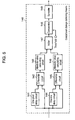
- FIG. 8 is a block diagram of image correction device 20 for correcting dynamic false contour, which is introduced in the aforementioned disclosure.
- image correcting means 170 contains adder 3; still-picture coding circuit 4; motion-picture coding circuit 5; selector 7; differential circuit 11; coefficient circuit group 12; and delay circuit group 13. With the structure, image correcting means 170 provides an image signal with error diffusion.
- Image correcting means 170 is controlled by the output of movement detecting means 120 such that an error diffusion using the output from still-picture coding circuit 4 takes place in a still-picture area, while, in a motion-picture area, an error diffusion using the output from motion-picture coding circuit 5 takes place.
- the present invention addresses the problems above. It is therefore the object of the invention to provide a method and device for image correction capable of not only performing image signal process according to the movement of images, but also suppressing the switch shock.
- the image correction method of the present invention provides image signals with image correction selected from a plurality of correction methods according to the image signal.
- the method provides the image correction by following procedures: detecting a motion picture area according to an image signal; comparing gradation of image signals corresponding to adjoining pixels; and providing the boundary area of the motion-picture area with diffusion in an area having gradational change smaller than a predetermined threshold. In this way, the image correction device switches the correction process between the boundary-diffused motion-picture area and other areas.
- Fig. 1 is a circuit block diagram illustrating the structure of image correction device 100 of the exemplary embodiment of the present invention.
- movement detecting means 120 compares the signal to one-frame-before image signal and detects an area with big temporal gradational change (hereinafter referred to as a movement area).
- Movement boundary detecting means 130 detects the boundary area of the movement area.
- gradational change detecting means 140 compares the gradation of adjoining pixels and detects an image area with big spatial gradational change.
- Combination determining means 150 determines the area excluding the image area with big gradational change by the following procedure: NOT-circuit 151 calculates logical NOT of the output from gradational change detecting means 140; AND-circuit 152 receives the result from NOT-circuit 151 and calculates logical conjunction of the result and the boundary area of the movement area.
- the logical NOT of the output from gradational change detecting means 140 shows the image area with small spatial gradational change (hereinafter, flat area); therefore, the output of combination determining means 150 shows the boundary area of the movement area that belongs to the flat area.
- Movement signal modulating means 160 modulates the output of movement detecting means 120 (as will be described later), whereas, for other areas, movement signal modulating means 160 sends the output of movement detecting means 120 to image correcting means 170.
- Image correcting means 170 of the embodiment changes a correction method according to the output of movement signal modulating means 160 so as to properly correct the dynamic pseudo contour.
- Fig. 2 is a circuit block diagram of movement detecting means 120 of the image correction device of the embodiment.
- One-frame delay circuit 121 delays an incoming image signal by one frame.
- Differential circuit 122 calculates the difference between the image signal and the one-frame-delayed image signal.
- Absolute value calculating circuit 123 calculates the absolute value of the difference.
- Comparator 124 compares the output from absolute value calculating circuit 123 to a threshold used for determining movement areas. If the output from absolute value calculating circuit 123 is greater than the threshold, comparator 124 outputs 1; otherwise, outputs 0.
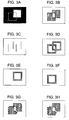
- Fig. 3 illustrates the workings of the image correction device of the present invention.
- Fig. 3A where, the rectangular shown by dot lines indicates the one-frame-before position of the pattern
- comparator 124 outputs movement area signals, as shown in Fig. 3B, according to the image signal: 1 for the movement area, 0 for other areas.
- Fig. 4 is a circuit block diagram of movement boundary detecting means 130 of the image correction device of the embodiment.
- One-pixel delay circuit 131 delays an incoming movement area signal by one pixel.
- Differential circuit 132 calculates the difference between the original movement area signal and the one-pixel-delayed movement area signal.
- Absolute value calculating circuit 133 calculates the absolute value of the difference. That is, absolute value calculating circuit 133 outputs a signal representing the horizontal boundaries of the movement area, as shown in Fig. 3C.
- one-line delay circuit 134 delays the movement area signal by one line.
- Differential circuit 135 calculates the difference between the original movement area signal and the one-line-delayed movement area signal.
- Absolute value calculating circuit 136 calculates the absolute value of the difference.
- absolute value calculating circuit 136 outputs a signal representing the vertical boundaries of the movement area.
- Adder 137 adds the outputs from absolute value calculating circuits 133 and 136.
- Comparator 138 compares the outputs from adder 137 to a threshold used for determining boundaries. If the output from adder 137 is greater than the threshold, comparator 138 outputs 1; otherwise, outputs 0.
- spreader 139 gives 1 to adjacent pixels, thereby increasing the area having 1.
- the area having 1 is extended horizontally by five pixels, and vertically by three pixels.
- Comparator 138 outputs 1 with respect to the horizontal 5 pixels and vertical 3 pixels around the boundary of the movement area, and outputs 0 with respect to other areas, so that the boundary area is extended, as shown in Fig. 3D.
- Fig. 5 is a circuit block diagram of gradational change detecting means 140 of the embodiment.
- Gradational change detecting means 140 contains one-pixel delay circuit 141; differential circuit 142; absolute value calculating circuit 143; one-line delay circuit 144; differential circuit 145; absolute value calculating circuit 146; adder 147; comparator 148; and spreader 149.
- the structure above is exactly alike to that of movement boundary detecting means 130, except that gradational change detecting means 140 receives an image signal as input signal.
- Comparator 148 outputs a gradational change signal showing the area with big gradational change, i.e., the boundary of the rectangular pattern of Fig. 3A. Therefore, as shown in Fig.
- comparator 148 outputs 1 with respect to the boundary of the rectangular pattern, and outputs 0 with respect to other areas.
- spreader 149 gives 1 to horizontal 5 pixels and vertical 3 pixels, thereby increasing the area having 1.
- Combination determining means 150 contains, as shown in Fig. 1, NOT-circuit 151 and AND-circuit 152.
- NOT-circuit 151 calculates logical NOT of a boundary change signal.
- Receiving the result from NOT-circuit 151, AND-circuit 152 calculates logical conjunction of the result and a movement boundary signal.
- the modulation control signal fed from combination determining means 150 gives 1 with respect to the boundary area of the movement area belongs to the flat area, and gives 0 with respect to other areas.
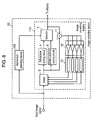
- Fig. 6 is a circuit block diagram of movement signal modulating means 160 of the image correction device.
- Movement signal modulating means 160 modulates a movement area signal so as to provide a movement area with parallel movement in the horizontal and vertical directions.
- Movement signal modulating means 160 contains four one-pixel delay circuits 161 1 - 161 4 , which sequentially delay a movement area signal by one pixel.
- selector 162 selects one signal from the original movement area signal and four delayed movement area signals.
- Random-number generator 163 generates a random number for each pixel; and accordingly, selector 162 outputs at latest 4-pixel-delayed movement area signal.
- selector 162 is now fed into selector 165 and one line-delayed circuits 164 1 , 164 2 .
- Selector 165 selects, according to the output from random number-generator 166, one signal, which provides the boundary of the movement area with a random diffusion in a vertical direction.
- selector 167 selects the horizontally and vertically modulated movement area signal; on the other hand, when the modulation control signal takes 0, selector 167 selects a movement area signal with no modulation.
- the selected signal is fed into image correcting means 170.
- the output from movement signal modulating means 160 provides the boundary of a movement area with a selective diffusion.
- the output signal is fed into image correcting means 170 as a correction control signal.
- the movement signal modulating means can be formed of a relatively simple structure.
- using the randomly selected amount of a delay of the delay circuits enables to provide the movement area with a diffusion having no periodical component, thereby further suppressing the switch shock.
- the amount of a delay may be periodically changed by pixel, line, or field, as long as the switch shock is not recognized as an eyesore.
- Fig. 7 is a circuit block diagram embodying image correcting means 170 of the image correction device of Fig. 1.
- Image correcting means 170 functions as a means for correcting dynamic pseudo contour and the structure thereof is the same as that of image correcting means 170 of the conventional device shown in Fig. 8. Therefore, the circuit blocks identical to those of image correcting means 170 bear similar reference numbers and detailed explanation thereof will be omitted.
- selector 7 selects the output from still-picture coding circuit 4
- the correction device provides image correction capable of showing a smooth gradation although dynamic pseudo contour easily appears; on the other hand, when selector 7 selects the output from motion-picture coding circuit 5, the correction device provides image correction for suppressing the dynamic pseudo contour although the number of the gradation levels decreases.
- Fig. 3D shows the boundary at which correction control is switched.
- the area shown in Fig. 3F of the entire boundary of Fig. 3D is the boundary between the rectangular pattern and the background in the one-frame-before image, but in the current frame, it belongs to a flat area with small gradational change. That is, as described earlier, the boundary area is supposed to suffer the switch shock.
- the correction control signal shown in Fig. 3H is used for operating selector 7, and correction control suitable for each area is selected.
- the correction control is switched at the boundary, whereas in the flat area susceptible to the switch shock, the boundary of correction undergoes selective diffusion.
- the switch shock is preferably suppressed and sufficient correction of dynamic pseudo contour is performed.
- the image correction method of the embodiment differs from the method that simply switches the image correction at the boundary of the movement area, and also differs from the method that provides the boundary area with a uniform diffusion.
- the method of the present invention provides the boundary area in a flat area-where the switch shock is likely to occur-with selective diffusion. In this way, the correction method of the embodiment not only can properly perform the image signal process according to the movement of images, but also suppresses the switch shock.
- movement signal modulating means 160 of the embodiment employs, as shown in Fig. 6, four one-pixel-delay circuits and two one-line-delay circuits, it is not limited thereto; the number of each delay circuit can be arbitrarily defined.
- spreaders 139 and 149 are disposed in the output-side of comparators 138 and 148, respectively. Receiving the output signal from comparator 138, spreader 139 extends the width of the boundary area corresponding to the signal in a horizontal direction; similarly, spreader 149 extends the width of the boundary area corresponding to the signal from comparator 148 in a vertical direction. However, it is not limited to the structure above as long as the width of the boundary area can be extended. For example, disposing a low pass filter in the input-side of a comparator can provide the same effect.
- image correcting means 170 of the embodiment is used for correcting dynamic pseudo contour in the description, it is not limited thereto.
- IP interlace-progressive
- the image correction device of the embodiment is applicable to other image corrections as long as the device contains an image correcting means capable of changing the correction process according to a control signal that corresponds to movement of images.
- the present invention can thus provide a method and device for image correction in which image signal processes are performed according to the movement of images, with occurrence of the switch shock preferably suppressed.
- the image signal process is performed according to the movement of images, with occurrence of the switch shock preferably suppressed.
- the device of the invention is therefore useful as the method and device for image correction that perform the image signal process according to movement of images.
Landscapes
- Engineering & Computer Science (AREA)
- Multimedia (AREA)
- Theoretical Computer Science (AREA)
- Signal Processing (AREA)
- Physics & Mathematics (AREA)
- General Physics & Mathematics (AREA)
- Computer Vision & Pattern Recognition (AREA)
- Computer Hardware Design (AREA)
- Picture Signal Circuits (AREA)
- Compression Or Coding Systems Of Tv Signals (AREA)
- Controls And Circuits For Display Device (AREA)
- Image Processing (AREA)
- Control Of Gas Discharge Display Tubes (AREA)
Applications Claiming Priority (3)
| Application Number | Priority Date | Filing Date | Title |
|---|---|---|---|
| JP2004041108 | 2004-02-18 | ||
| JP2004041108 | 2004-02-18 | ||
| PCT/JP2005/002943 WO2005079059A1 (ja) | 2004-02-18 | 2005-02-17 | 画像補正方法および画像補正装置 |
Publications (2)
| Publication Number | Publication Date |
|---|---|
| EP1599033A1 true EP1599033A1 (de) | 2005-11-23 |
| EP1599033A4 EP1599033A4 (de) | 2008-02-13 |
Family
ID=34857914
Family Applications (1)
| Application Number | Title | Priority Date | Filing Date |
|---|---|---|---|
| EP05710595A Withdrawn EP1599033A4 (de) | 2004-02-18 | 2005-02-17 | Bildkorrekturverfahren und bildkorrekturvorrichtung |
Country Status (5)
| Country | Link |
|---|---|
| US (1) | US7418152B2 (de) |
| EP (1) | EP1599033A4 (de) |
| KR (1) | KR100726142B1 (de) |
| CN (1) | CN100450147C (de) |
| WO (1) | WO2005079059A1 (de) |
Cited By (2)
| Publication number | Priority date | Publication date | Assignee | Title |
|---|---|---|---|---|
| EP1956830A4 (de) * | 2005-11-29 | 2010-09-29 | Panasonic Corp | Wiedergabeeinrichtung |
| CN102157135A (zh) * | 2010-01-25 | 2011-08-17 | 精工爱普生株式会社 | 图像处理电路、其处理方法、液晶显示装置以及电子设备 |
Families Citing this family (29)
| Publication number | Priority date | Publication date | Assignee | Title |
|---|---|---|---|---|
| US7869662B2 (en) * | 2005-04-22 | 2011-01-11 | Agilent Technologies, Inc. | System architecture for sensing an absolute position using a target pattern |
| EP1936589A1 (de) * | 2006-12-20 | 2008-06-25 | Deutsche Thomson-Brandt Gmbh | Verfahren und Vorrichtung zur Verarbeitung von Videobildern |
| EP1936590B1 (de) * | 2006-12-20 | 2016-07-20 | Thomson Licensing | Verfahren und Vorrichtung zur Verarbeitung von Videobildern |
| JP4245045B2 (ja) * | 2006-12-26 | 2009-03-25 | ソニー株式会社 | 撮像装置、撮像信号処理方法及びプログラム |
| US12260023B2 (en) | 2012-01-17 | 2025-03-25 | Ultrahaptics IP Two Limited | Systems and methods for machine control |
| US8638989B2 (en) | 2012-01-17 | 2014-01-28 | Leap Motion, Inc. | Systems and methods for capturing motion in three-dimensional space |
| US9501152B2 (en) | 2013-01-15 | 2016-11-22 | Leap Motion, Inc. | Free-space user interface and control using virtual constructs |
| US10691219B2 (en) | 2012-01-17 | 2020-06-23 | Ultrahaptics IP Two Limited | Systems and methods for machine control |
| US11493998B2 (en) | 2012-01-17 | 2022-11-08 | Ultrahaptics IP Two Limited | Systems and methods for machine control |
| US8693731B2 (en) * | 2012-01-17 | 2014-04-08 | Leap Motion, Inc. | Enhanced contrast for object detection and characterization by optical imaging |
| US9679215B2 (en) | 2012-01-17 | 2017-06-13 | Leap Motion, Inc. | Systems and methods for machine control |
| US9070019B2 (en) | 2012-01-17 | 2015-06-30 | Leap Motion, Inc. | Systems and methods for capturing motion in three-dimensional space |
| US9459697B2 (en) | 2013-01-15 | 2016-10-04 | Leap Motion, Inc. | Dynamic, free-space user interactions for machine control |
| WO2014200589A2 (en) | 2013-03-15 | 2014-12-18 | Leap Motion, Inc. | Determining positional information for an object in space |
| US9916009B2 (en) | 2013-04-26 | 2018-03-13 | Leap Motion, Inc. | Non-tactile interface systems and methods |
| US10281987B1 (en) | 2013-08-09 | 2019-05-07 | Leap Motion, Inc. | Systems and methods of free-space gestural interaction |
| US10846942B1 (en) | 2013-08-29 | 2020-11-24 | Ultrahaptics IP Two Limited | Predictive information for free space gesture control and communication |
| US9632572B2 (en) | 2013-10-03 | 2017-04-25 | Leap Motion, Inc. | Enhanced field of view to augment three-dimensional (3D) sensory space for free-space gesture interpretation |
| US9996638B1 (en) | 2013-10-31 | 2018-06-12 | Leap Motion, Inc. | Predictive information for free space gesture control and communication |
| US9679197B1 (en) | 2014-03-13 | 2017-06-13 | Leap Motion, Inc. | Biometric aware object detection and tracking |
| US9785247B1 (en) | 2014-05-14 | 2017-10-10 | Leap Motion, Inc. | Systems and methods of tracking moving hands and recognizing gestural interactions |
| US9741169B1 (en) | 2014-05-20 | 2017-08-22 | Leap Motion, Inc. | Wearable augmented reality devices with object detection and tracking |
| CN204480228U (zh) | 2014-08-08 | 2015-07-15 | 厉动公司 | 运动感测和成像设备 |
| US10656720B1 (en) | 2015-01-16 | 2020-05-19 | Ultrahaptics IP Two Limited | Mode switching for integrated gestural interaction and multi-user collaboration in immersive virtual reality environments |
| EP3396413A4 (de) | 2015-12-21 | 2019-08-21 | Koito Manufacturing Co., Ltd. | Bilderfassungsvorrichtung für fahrzeuge, steuerungsvorrichtung, mit der bilderfassungsvorrichtung für fahrzeuge und der steuerungsvorrichtung ausgestattetes fahrzeug bilderfassungsverfahren für fahrzeuge |
| EP3396410A4 (de) | 2015-12-21 | 2019-08-21 | Koito Manufacturing Co., Ltd. | Bilderfassungsvorrichtung für fahrzeuge, steuerungsvorrichtung, mit der bilderfassungsvorrichtung für fahrzeuge und der steuerungsvorrichtung ausgestattetes fahrzeug bilderfassungsverfahren für fahrzeuge |
| JP6766071B2 (ja) | 2015-12-21 | 2020-10-07 | 株式会社小糸製作所 | 車両用画像取得装置およびそれを備えた車両 |
| EP3396414A4 (de) | 2015-12-21 | 2019-08-21 | Koito Manufacturing Co., Ltd. | Bilderfassungsvorrichtung zur verwendung durch ein fahrzeug, steuerungsvorrichtung, fahrzeug mit der steuerungsvorrichtung oder bilderfassungsvorrichtung zur verwendung durch ein fahrzeug und bilderfassungsverfahren zur verwendung durch ein fahrzeug |
| CN117434008B (zh) * | 2023-12-21 | 2024-07-02 | 海南中南标质量科学研究院有限公司 | 基于人工智能的光谱监测系统及方法 |
Family Cites Families (21)
| Publication number | Priority date | Publication date | Assignee | Title |
|---|---|---|---|---|
| JP3322809B2 (ja) * | 1995-10-24 | 2002-09-09 | 富士通株式会社 | ディスプレイ駆動方法及び装置 |
| WO1998044479A1 (en) * | 1997-03-31 | 1998-10-08 | Matsushita Electric Industrial Co., Ltd. | Dynamic image display method and device therefor |
| JP3758294B2 (ja) * | 1997-04-10 | 2006-03-22 | 株式会社富士通ゼネラル | ディスプレイ装置の動画補正方法及び動画補正回路 |
| JP2994631B2 (ja) * | 1997-12-10 | 1999-12-27 | 松下電器産業株式会社 | Pdp表示の駆動パルス制御装置 |
| JP2994633B2 (ja) * | 1997-12-10 | 1999-12-27 | 松下電器産業株式会社 | 疑似輪郭ノイズ検出装置およびそれを用いた表示装置 |
| KR100370704B1 (ko) * | 1998-04-17 | 2003-02-05 | 마쯔시다덴기산교 가부시키가이샤 | 의사윤곽 보정 장치 및 방법 |
| US6496194B1 (en) * | 1998-07-30 | 2002-12-17 | Fujitsu Limited | Halftone display method and display apparatus for reducing halftone disturbances occurring in moving image portions |
| KR100488839B1 (ko) * | 1999-01-22 | 2005-05-11 | 마츠시타 덴끼 산교 가부시키가이샤 | 서브프레임을 이용하여 그레이 스케일 디스플레이를실행하는 장치 및 방법 |
| JP3457251B2 (ja) | 1999-04-12 | 2003-10-14 | 松下電器産業株式会社 | 画像表示装置 |
| KR100734455B1 (ko) * | 1999-04-12 | 2007-07-03 | 마츠시타 덴끼 산교 가부시키가이샤 | 영상 표시장치 |
| JP4519251B2 (ja) * | 1999-10-13 | 2010-08-04 | シャープ株式会社 | 液晶表示装置およびその制御方法 |
| US7068852B2 (en) * | 2001-01-23 | 2006-06-27 | Zoran Corporation | Edge detection and sharpening process for an image |
| JP3747317B2 (ja) * | 2001-09-07 | 2006-02-22 | パイオニア株式会社 | 動画偽輪郭発生箇所の特定方法、画像信号の処理方法及び画像信号の処理装置 |
| US7433089B2 (en) * | 2001-09-27 | 2008-10-07 | Fujifilm Corporation | Image processor |
| KR100467447B1 (ko) * | 2001-11-12 | 2005-01-24 | 삼성에스디아이 주식회사 | 플라즈마 디스플레이 패널의 화상 표시 방법 및 그 장치 |
| JP3879694B2 (ja) | 2002-04-24 | 2007-02-14 | 松下電器産業株式会社 | 画像表示装置 |
| KR100486715B1 (ko) * | 2002-10-09 | 2005-05-03 | 삼성전자주식회사 | 펄스수 변조방식 디지털 디스플레이 패널에서 의사 윤곽감소를 위한 방법 및 장치 |
| EP1434425A3 (de) * | 2002-12-25 | 2006-04-26 | Hitachi Ltd. | Videosignalverarbeitungsgerät |
| JP4649108B2 (ja) * | 2003-01-16 | 2011-03-09 | パナソニック株式会社 | 画像表示装置および画像表示方法 |
| KR100496296B1 (ko) * | 2003-02-08 | 2005-06-17 | 삼성에스디아이 주식회사 | 플라즈마 디스플레이 패널의 계조 표시 방법 및 장치 |
| US7710358B2 (en) * | 2003-12-26 | 2010-05-04 | Panasonic Corporation | Image display apparatus for correcting dynamic false contours |
-
2005
- 2005-02-17 WO PCT/JP2005/002943 patent/WO2005079059A1/ja not_active Ceased
- 2005-02-17 EP EP05710595A patent/EP1599033A4/de not_active Withdrawn
- 2005-02-17 US US10/542,026 patent/US7418152B2/en not_active Expired - Fee Related
- 2005-02-17 CN CNB2005800000509A patent/CN100450147C/zh not_active Expired - Fee Related
- 2005-02-17 KR KR1020057020710A patent/KR100726142B1/ko not_active Expired - Fee Related
Cited By (4)
| Publication number | Priority date | Publication date | Assignee | Title |
|---|---|---|---|---|
| EP1956830A4 (de) * | 2005-11-29 | 2010-09-29 | Panasonic Corp | Wiedergabeeinrichtung |
| US8351756B2 (en) | 2005-11-29 | 2013-01-08 | Panasonic Corporation | Reproduction device |
| CN102157135A (zh) * | 2010-01-25 | 2011-08-17 | 精工爱普生株式会社 | 图像处理电路、其处理方法、液晶显示装置以及电子设备 |
| CN102157135B (zh) * | 2010-01-25 | 2013-01-23 | 精工爱普生株式会社 | 图像处理电路、其处理方法、液晶显示装置以及电子设备 |
Also Published As
| Publication number | Publication date |
|---|---|
| US7418152B2 (en) | 2008-08-26 |
| EP1599033A4 (de) | 2008-02-13 |
| CN1765120A (zh) | 2006-04-26 |
| KR100726142B1 (ko) | 2007-06-13 |
| CN100450147C (zh) | 2009-01-07 |
| WO2005079059A1 (ja) | 2005-08-25 |
| US20060050979A1 (en) | 2006-03-09 |
| KR20060007414A (ko) | 2006-01-24 |
Similar Documents
| Publication | Publication Date | Title |
|---|---|---|
| US7418152B2 (en) | Method and device of image correction | |
| KR100505663B1 (ko) | 적응형 윤곽 상관 보간에 의한 디스플레이 장치의 순차주사 방법 | |
| US7769089B1 (en) | Method and system for reducing noise level in a video signal | |
| KR100272582B1 (ko) | 스캔컨버터회로 | |
| WO2004002135A1 (ja) | 動き検出装置及びそれを用いたノイズリダクション装置 | |
| JPH10126649A (ja) | フリッカ軽減回路 | |
| JPH0937214A (ja) | 順次走査変換方法及び順次走査変換装置 | |
| EP1104970A1 (de) | Verfahren und vorrichtung zur umwandlung der zahl von videorahmen von bildsignalen | |
| KR100914619B1 (ko) | 디인터레이싱 방법, 장치 및 시스템 | |
| JP2004265382A (ja) | 動き検出装置および方法 | |
| JP4355577B2 (ja) | ノイズ抑制対角線方向補正によるアップコンバージョン | |
| JP2008158732A (ja) | 画像処理装置 | |
| KR20060047635A (ko) | 필름 모드 표시 결정 방법, 움직임 보상의 화상 처리 수행방법, 필름 모드 검출기 및 움직임 보상기 | |
| KR101123975B1 (ko) | 화상 신호 처리 장치 | |
| KR20070098540A (ko) | 서서히 변화하는 부분에 대한 재귀적 3d 초정밀화 방법 | |
| CN101630488B (zh) | 用于数字显示系统的自适应视频图像抖动方法和装置 | |
| KR101140442B1 (ko) | 이미지 상태 정보의 정정 방법, 움직임 보상 이미지 처리방법, 및 이미지 상태 정보 정정기 | |
| JP2005267622A (ja) | 画像補正方法および画像補正装置 | |
| JP2016142783A (ja) | 表示装置 | |
| US20070171301A1 (en) | Image static area determination apparatus and interlace progressive image transform apparatus | |
| KR101577703B1 (ko) | 흐림과 이중 윤곽의 효과를 줄이는 비디오 화상 디스플레이방법과 이러한 방법을 구현하는 디바이스 | |
| JP2005311575A (ja) | フレーム巡回型ノイズ低減方法 | |
| JP4791275B2 (ja) | 動画像ノイズ除去装置 | |
| KR100606740B1 (ko) | 다이나믹 콘트라스트 조정 방법 | |
| JP5154208B2 (ja) | 画像信号処理装置 |
Legal Events
| Date | Code | Title | Description |
|---|---|---|---|
| PUAI | Public reference made under article 153(3) epc to a published international application that has entered the european phase |
Free format text: ORIGINAL CODE: 0009012 |
|
| 17P | Request for examination filed |
Effective date: 20050627 |
|
| AK | Designated contracting states |
Kind code of ref document: A1 Designated state(s): AT BE BG CH CY CZ DE DK EE ES FI FR GB GR HU IE IS IT LI LT LU MC NL PL PT RO SE SI SK TR |
|
| AX | Request for extension of the european patent |
Extension state: AL BA HR LV MK YU |
|
| DAX | Request for extension of the european patent (deleted) | ||
| RBV | Designated contracting states (corrected) |
Designated state(s): DE FR GB NL |
|
| A4 | Supplementary search report drawn up and despatched |
Effective date: 20080116 |
|
| RIC1 | Information provided on ipc code assigned before grant |
Ipc: H04N 5/21 20060101ALI20080110BHEP Ipc: H04N 5/20 20060101AFI20050831BHEP |
|
| RAP1 | Party data changed (applicant data changed or rights of an application transferred) |
Owner name: PANASONIC CORPORATION |
|
| 17Q | First examination report despatched |
Effective date: 20120206 |
|
| STAA | Information on the status of an ep patent application or granted ep patent |
Free format text: STATUS: THE APPLICATION IS DEEMED TO BE WITHDRAWN |
|
| 18D | Application deemed to be withdrawn |
Effective date: 20120417 |