EP1598421B1 - Oligoribonukleotide zur Beeinflussung des Haarwachstums - Google Patents
Oligoribonukleotide zur Beeinflussung des Haarwachstums Download PDFInfo
- Publication number
- EP1598421B1 EP1598421B1 EP05103692A EP05103692A EP1598421B1 EP 1598421 B1 EP1598421 B1 EP 1598421B1 EP 05103692 A EP05103692 A EP 05103692A EP 05103692 A EP05103692 A EP 05103692A EP 1598421 B1 EP1598421 B1 EP 1598421B1
- Authority
- EP
- European Patent Office
- Prior art keywords
- oligoribonucleotides
- hair
- polyethylene glycol
- alkyl
- residues
- Prior art date
- Legal status (The legal status is an assumption and is not a legal conclusion. Google has not performed a legal analysis and makes no representation as to the accuracy of the status listed.)
- Expired - Lifetime
Links
- 0 CC*(*(C)*(*)(CC)*C(C)(C)*)OC(C)(*)N Chemical compound CC*(*(C)*(*)(CC)*C(C)(C)*)OC(C)(*)N 0.000 description 2
Images



Classifications
-
- C—CHEMISTRY; METALLURGY
- C12—BIOCHEMISTRY; BEER; SPIRITS; WINE; VINEGAR; MICROBIOLOGY; ENZYMOLOGY; MUTATION OR GENETIC ENGINEERING
- C12N—MICROORGANISMS OR ENZYMES; COMPOSITIONS THEREOF; PROPAGATING, PRESERVING, OR MAINTAINING MICROORGANISMS; MUTATION OR GENETIC ENGINEERING; CULTURE MEDIA
- C12N15/00—Mutation or genetic engineering; DNA or RNA concerning genetic engineering, vectors, e.g. plasmids, or their isolation, preparation or purification; Use of hosts therefor
- C12N15/09—Recombinant DNA-technology
- C12N15/11—DNA or RNA fragments; Modified forms thereof; Non-coding nucleic acids having a biological activity
- C12N15/113—Non-coding nucleic acids modulating the expression of genes, e.g. antisense oligonucleotides; Antisense DNA or RNA; Triplex- forming oligonucleotides; Catalytic nucleic acids, e.g. ribozymes; Nucleic acids used in co-suppression or gene silencing
-
- A—HUMAN NECESSITIES
- A61—MEDICAL OR VETERINARY SCIENCE; HYGIENE
- A61K—PREPARATIONS FOR MEDICAL, DENTAL OR TOILETRY PURPOSES
- A61K8/00—Cosmetics or similar toiletry preparations
- A61K8/18—Cosmetics or similar toiletry preparations characterised by the composition
- A61K8/30—Cosmetics or similar toiletry preparations characterised by the composition containing organic compounds
- A61K8/60—Sugars; Derivatives thereof
- A61K8/606—Nucleosides; Nucleotides; Nucleic acids
-
- A—HUMAN NECESSITIES
- A61—MEDICAL OR VETERINARY SCIENCE; HYGIENE
- A61Q—SPECIFIC USE OF COSMETICS OR SIMILAR TOILETRY PREPARATIONS
- A61Q7/00—Preparations for affecting hair growth
-
- C—CHEMISTRY; METALLURGY
- C12—BIOCHEMISTRY; BEER; SPIRITS; WINE; VINEGAR; MICROBIOLOGY; ENZYMOLOGY; MUTATION OR GENETIC ENGINEERING
- C12N—MICROORGANISMS OR ENZYMES; COMPOSITIONS THEREOF; PROPAGATING, PRESERVING, OR MAINTAINING MICROORGANISMS; MUTATION OR GENETIC ENGINEERING; CULTURE MEDIA
- C12N15/00—Mutation or genetic engineering; DNA or RNA concerning genetic engineering, vectors, e.g. plasmids, or their isolation, preparation or purification; Use of hosts therefor
- C12N15/09—Recombinant DNA-technology
- C12N15/11—DNA or RNA fragments; Modified forms thereof; Non-coding nucleic acids having a biological activity
- C12N15/113—Non-coding nucleic acids modulating the expression of genes, e.g. antisense oligonucleotides; Antisense DNA or RNA; Triplex- forming oligonucleotides; Catalytic nucleic acids, e.g. ribozymes; Nucleic acids used in co-suppression or gene silencing
- C12N15/1136—Non-coding nucleic acids modulating the expression of genes, e.g. antisense oligonucleotides; Antisense DNA or RNA; Triplex- forming oligonucleotides; Catalytic nucleic acids, e.g. ribozymes; Nucleic acids used in co-suppression or gene silencing against growth factors, growth regulators, cytokines, lymphokines or hormones
-
- C—CHEMISTRY; METALLURGY
- C12—BIOCHEMISTRY; BEER; SPIRITS; WINE; VINEGAR; MICROBIOLOGY; ENZYMOLOGY; MUTATION OR GENETIC ENGINEERING
- C12N—MICROORGANISMS OR ENZYMES; COMPOSITIONS THEREOF; PROPAGATING, PRESERVING, OR MAINTAINING MICROORGANISMS; MUTATION OR GENETIC ENGINEERING; CULTURE MEDIA
- C12N15/00—Mutation or genetic engineering; DNA or RNA concerning genetic engineering, vectors, e.g. plasmids, or their isolation, preparation or purification; Use of hosts therefor
- C12N15/09—Recombinant DNA-technology
- C12N15/11—DNA or RNA fragments; Modified forms thereof; Non-coding nucleic acids having a biological activity
- C12N15/113—Non-coding nucleic acids modulating the expression of genes, e.g. antisense oligonucleotides; Antisense DNA or RNA; Triplex- forming oligonucleotides; Catalytic nucleic acids, e.g. ribozymes; Nucleic acids used in co-suppression or gene silencing
- C12N15/1138—Non-coding nucleic acids modulating the expression of genes, e.g. antisense oligonucleotides; Antisense DNA or RNA; Triplex- forming oligonucleotides; Catalytic nucleic acids, e.g. ribozymes; Nucleic acids used in co-suppression or gene silencing against receptors or cell surface proteins
-
- C—CHEMISTRY; METALLURGY
- C12—BIOCHEMISTRY; BEER; SPIRITS; WINE; VINEGAR; MICROBIOLOGY; ENZYMOLOGY; MUTATION OR GENETIC ENGINEERING
- C12N—MICROORGANISMS OR ENZYMES; COMPOSITIONS THEREOF; PROPAGATING, PRESERVING, OR MAINTAINING MICROORGANISMS; MUTATION OR GENETIC ENGINEERING; CULTURE MEDIA
- C12N2310/00—Structure or type of the nucleic acid
- C12N2310/10—Type of nucleic acid
- C12N2310/14—Type of nucleic acid interfering nucleic acids [NA]
Definitions
- the present invention relates to the use of oligoribonucleotides which induce the degradation of the mRNA of proteins and enzymes which have a stimulating effect on the hair cycle for the preparation of cosmetic or dermatological preparations for the treatment and prophylaxis of reduced (hair loss, hair miniaturization) growth hairs of the scalp or body, such as those associated with age-related changes in hair growth.
- hair cycle regulating proteins or enzymes are primarily hair growth inhibiting proteins such as growth factors, in particular the members of the Tumor Growth Factor beta superfamily (TGFbeta) and their receptors (TGFbeta-R), and steroid receptors and steroid catalyzing enzymes, in particular the androgenic Receptor, and hair growth-promoting cellular signaling molecules, in particular the Sonic hedgehog protein and insulin-like growth factor 1 (IGF-1), understood.
- growth factors in particular the members of the Tumor Growth Factor beta superfamily (TGFbeta) and their receptors (TGFbeta-R)
- TGFbeta-R Tumor Growth Factor beta superfamily
- steroid receptors and steroid catalyzing enzymes in particular the androgenic Receptor
- hair growth-promoting cellular signaling molecules in particular the Sonic hedgehog protein and insulin-like growth factor 1 (IGF-1), understood.
- IGF-1 insulin-like growth factor 1
- Papilla hair is called the hair, which is in the growing season, also called the anagen or anagen phase.
- the hair with its papilla is anchored in the skin.
- About 80% of the scalp hair is in the anagen phase for about 2 to 5 years.
- a subsequent transitional phase (catagen phase) the hair migrates to the skin surface for about 2 weeks and then remains in a resting state (telogen phase) for about 3 to 4 months until it finally fails.
- a hair loss that goes beyond the normal level or excessive hair growth on unwanted parts of the body is usually considered a serious cosmetic disorder, as well as other hair growth disorders. Therefore, many agents have been proposed for example for the treatment of hair loss and baldness and hair restorer, which are intended to maintain or promote the growth of the hair.
- Hair growth is determined by many endogenous and exogenous factors that can inhibit or promote it.
- TGFbeta-1 tumor growth factor beta 1
- the hair growth-promoting effect can also be achieved by inhibiting the androgen receptor.
- This protein is expressed in the hair follicle and is responsible for the sensitivity of follicular cells to androgenic hormones.
- RNA interference double-stranded RNA fragments (dsRNA) homologous to the sequence of the mRNA of the gene under study, and this process is referred to as RNA interference (RNAi).
- dsRNA double-stranded RNA fragments
- RNAi RNA interference
- the WO01 / 29058 discloses the identification of genes involved in RNAi and their use for modulating RNAi activity.
- the dsRNA contains a nucleotide sequence which, under the physiological conditions of the cell, hybridizes with the nucleotide sequence of at least part of the gene to be inhibited.
- the dsRNA preferably has a length of 400 to 800 nucleotides.
- WO01 / 75164 discloses the use of dsRNA of 21 to 23 nucleotides in length for the specific inactivation of gene functions in mammalian cells by RNAi.
- Brummelkamp et al., Science 296 (2002) 550-553 describe a vector system designed to induce the synthesis of siRNAs in mammalian cells to inhibit gene expression of a target gene.
- the EP 1 214 945 A2 discloses the use of dsRNA of 15 to 49 base pairs in length for inhibiting the expression of a given target gene in mammalian cells.
- the dsRNA can be modified to increase its stability and should allow the treatment of cancer, viral diseases and Alzheimer's disease.
- the WO02 / 053773 relates to an in vitro method for the determination of skin stress and skin aging in humans and animals, test kits and biochips suitable for carrying out the method, and a test method for demonstrating the effectiveness of cosmetic or pharmaceutical agents against skin stress and skin aging.
- the WO03074654A2 discloses the use of dsRNA as a method or reagent for modulation of gene expression, inter alia, for therapeutic and diagnostic applications.
- US5877160 discloses a method for reducing androgen-mediated hair loss by reducing the level of protein-bound 5-alpha-dihydrotestosterone in scalp tissue without significantly affecting testosterone metabolism in other tissues, exposing the cells of the scalp to an effective amount of an oligomer that interacts with a gene that has a androgen receptor, 5-alphareductase or its transcription product, or a target sequence that directly "upstream" connects to the transcriptional start sequence of the corresponding gene and thus reduces or prevents the expression of the androgen receptor or 5-alpha reductase.
- WO9418835 discloses a method for reducing androgen-mediated hair loss by reducing the level of protein-bound 5-alpha-dihydrotestosterone in scalp tissue without significantly affecting testosterone metabolism in other tissues where the cells of the scalp are exposed to an effective amount of an oligomer or oligomers that interact with a gene containing an androgenic receptor, 5-alpha-reductase or its transcription product, or a target sequence that directly "upstream" connects to the transcriptional initiation sequence of the corresponding gene and thus reduces or prevents expression of the androgenic receptor or 5-alpha reductase.
- US5994319 further discloses certain oligonucleotides having a nucleotide sequence complementary to at least a portion of the pre-mRNA transcript or the transcript of matured mRNA of human 5-alpha reductase type I or II, wherein the oligonucleotide can hybridize with the mRNA transcript.
- the font US20030211065A1 discloses a therapeutic agent for the diagnosis and / or therapy of hair loss (alopecia) and other hair growth associated indications containing a therapeutic agent which modulates the activity of Comeodesmosin at the protein and / or gene level, including through the use of oligoribonucleotides.
- the font WO03101376A2 discloses the topical application of at least one double-stranded RNA oligonucleotide for cosmetic or therapeutic treatment; for example psoriasis.
- the font WO03070197A2 discloses the production and use of short interfering nucleic acid molecules, for example, for the treatment and diagnosis of diabetes related nephropathy, which down regulate the expression of the transforming growth factor receptor.
- the font WO03074654A2 discloses methods and reagents for modulating gene expression for, among others, therapeutic and diagnostic applications containing small interfering nucleic acid molecules (siRNA) for the treatment of any disease or indication that can be treated by the modulation of gene expression in cells, tissues or in the organism.
- siRNA small interfering nucleic acid molecules
- Subject of the lift US20030167030A1 are methods and respiratory compositions to promote expression of target genes in vivo using small-interfering RNAs; in particular for altering the growth, survival or differentiation of cells for therapeutic and cosmetic applications using pulmonary or nasal forms of administration.
- the font DE 10148393 discloses a cosmic detergent which is a combination of pack and application agents and a liquid cleanser formulation and is converted into a stable foam by means of the applicator.
- An object of the present invention was to provide compositions which enable effective treatment and prophylaxis of the reduced (hair loss, hair miniaturization) growth of hair, and in particular the strengthening of the hair without the disadvantages of the prior art.
- Another object of the invention was to provide better means for influencing hair growth.
- TGFbeta transforming growth Factor beta superfamily
- oligoribonucleotides capable of inhibiting the expression of hair cycle regulating protein or enzyme genes.
- the invention relates to the use of oligoribonucleotides which induce the degradation of the mRNA of proteins and enzymes which have a stimulating effect on the hair cycle for the preparation of cosmetic or dermatological preparations for the treatment and prophylaxis of reduced (hair loss, hair miniaturization) growth hairs of the scalp or body, such as those associated with age-related changes in hair growth.
- RNAI double-stranded RNA molecules
- TGFbeta factors are from the group TGFbeta-1 NM000660 P03958 (EC 3.4_24.7) TGFbete-2 NM003238 TGFbeta-3 BT007287 TGFbeta-R I XM005591 TGFbeta-R II BC040499 can be selected.
- TGFbeta superfamily contains a group of secreted signaling molecules that play cell growth and differentiation and play an important role in the regulation of the hair cycle. TGFbeta proteins become Hair cycle expressively expressed (Seiberg et al, 1995). The activity of these proteins is responsible for the transfer of the anagen hair follicle into the catagen / telogen (Foitzik et al., 2000). Studies in mice that expressably express TGFbeta1 showed that an unequivocal constant induction of TGFbeta1 expression causes hair loss. This alopecia can be attributed to a Telogen arrest (Liu et al., 2001) and is clearly characterized by a greatly increased apoptosis rate of follicular cells.
- oligoribonucleotides their target sequence or target sequences represent the coding regions (cDNA) of the respective genes, more preferably those regions of the coding regions which are 60 to 100 nucleotides downstream of the start codon.
- dsRNAs double-stranded RNA molecules
- the dsRNA is not completely identical to the target sequence, preferably in such a way that, based on a length of 20 base pairs, preferably not more than 0 to 2, particularly preferably 0 to 1 and very particularly preferably no deviations from the target sequence occur , That a maximum of 0 to 2 and in particular a maximum of 0 to 1 base pairs are exchanged for other base pairs.
- the oligoribonucleotides have a length of 15 to 49 nucleotides, preferably 17 to 30, particularly preferably 19 to 25 and very particularly preferably 20 to 23 nucleotides.
- oligoribonucleotides having at the 3 '• end of each strand an overhang of 1 to 6, preferably 1 or 2 nucleotides.
- the oligoribonucleotides according to the invention are homologous to such a portion of the target gene and in particular the corresponding double-stranded cDNA whose sense strand is 5'-sided is bounded by two adenosine residues (A) and 3 'by two thymidine residues (T), a guanosine (G) and a cytosine residue (C) or a thymidine and a cytidine residue (C).
- oligoribonucleotides are chemically modified at the level of the sugar residues, the nucleobases, the phosphate groups and / or the skeleton located therebetween.
- one or more phosphate groups are replaced by phosphorothioate, methylphosphonate and / or phosphoramidate groups.
- oligoribonucleotides according to the invention are characterized by the exchange of one or more ribose residues of the oligoribonucleotide by morpholine rings (morpholine oligoribonucleotides) or by amino acids (peptide oligoribonucleotides).
- ribose residues are modified by amitro such as NH 2, fluorine, alkyl or O-alkyl radicals, such as OCH 3.
- encapsulated form for example, encapsulated in liposomes or stabilized by the addition of cyclodextrins.
- oligoribonucleotides according to the invention and their salts are used as an effective constituent of pharmaceutical and cosmetic compositions, in particular those for topical application.
- preparations according to the invention contain 1 to 5 and in particular 1 to 3 different oligoribonucleotides.
- the invention also encompasses the use of oligoribonucleotides according to the invention in preparations for the treatment and prophylaxis of age- and environment-related degenerative and deficient manifestations of the hair follicles, of the skin and of skin appendages, such as glands, in particular the symptoms described in more detail in the description.
- the invention further includes the use of preparations according to the invention for the protection against hair loss, hair follicle miniaturization, thinning hair, depigmentation curls of the hair, dystrophic changes of the hair root, in particular the hair on the head
- oligoribonucleotide is used for both the oligoribonucleotides themselves and their salts, unless otherwise specified.
- oligoribonucleotides also includes modified oligoribonucleotides.
- dsRNAs that correspond in length to the respective target mRNAs or cDNAs.
- dsRNAs that correspond in length to the respective target mRNAs or cDNAs.
- These can be transferred eg by soluble Drosophila embryo extract into fragments of a length of 21 to 23 nucleotides (cf. WO01 / 75164 ), Long-chain dsRNA is also degraded intracellularly to short pieces.
- the direct use of lanketted dsRNA is generally not preferred since it can cause non-specific inhibition of translation in mammalian cells.
- RNA duplexes according to the invention may have blunt ends or sticky ends.
- Double-stranded oligoribonucleotides which have an overhang of 1 to 6, preferably 1 or 2, nucleotides at the 3 'end of each strand have proven to be particularly effective.
- the supernatant nucleotides are preferably 2'-deoxynucleotides, more preferably 2'-deoxythymidine radicals. The use of 2'-deoxynucleotides can reduce the cost of RNA synthesis and increase the resistance of RNA to nuclease degradation.
- the protruding nucleotides do not necessarily have to be the nucleotides homologous to the target sequence and, therefore, are disregarded in the above-defined deviations from the target sequence.
- Oligoribonucleotides which have proved to be particularly effective are those which are homologous to such a section of the target gene and in particular of the corresponding double-stranded cDNA whose sense strand is 5'-sided by two adenosine residues (A) and 3'-sided by two thymidine residues (T), a guanosine (G) and a cytosine residue (C) or a thymidine and a cytidine residue (C) is limited.
- the portion bounded by AA and TT, AA and GC or AA and TC preferably has a length of 19 to 21, in particular 19 nucleotides and thus has the general form AA (N19-21) TT, AA (N19-21) GC or AA (N19-21) TC, where N is a nucleotide. More preferred are oligoribonucleotides which are complementary to a portion of the target gene (s) having the general form AA (N19) to AA (N21). Here, oligoribonucleotides homologous to the N19-21 fragment of said regions are particularly preferred.
- the particularly preferred oligoribonucleotides thus have a length of 19 to 21 base pairs, the single strands forming these oligoribonucleotides preferably having two additional 2'-deoxynucleotides, in particular two 2'-deoxythymidine residues, on the 3'-side, such that the dsRNA has 19 to 21 base pairs and per strand comprises two supernatant 2'-deoxynucleotides.
- the target gene does not contain a region of the form AA (N19-21), it searches for regions of the form NA (N19-21) or any fragment of the form N19-21.
- N19-21 fragments e.g. Although limited by AA and TT, although preferred, in principle according to the invention, however, all dsRNA fragments which are homologous to the target sequence are suitable.
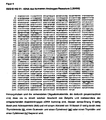
- FIG. 1 shows the single-stranded cDNA of the growth factor TGFbeta-1 (SEQ ID NO 1) in which all fragments of the form AA-N19-TC and AA-N19-GC are optically highlighted.
- FIG. 2 these fragments (targeted region) are shown together with the corresponding homologous (senseRNA) and complementary (antisenseRNA) RNA single strands. Shown are single-stranded RNAs which are 3'-modified by two deoxythymidine residues (dt). Hybridization of two complementary single-stranded RNAs yields dsRNA with protruding 3 'ends, each formed by two 2'-deoxythymidine residues.
- the gene of the growth factor TGFbeta-1 belongs to the preferred target genes for the oligoribonucleotides according to the invention.
- FIG 3 is the single-stranded cDNA of the Sonic hedgehog gene (SEQ ID NO 20) to see.
- FIG. 4 shows the single-stranded cDNA of the androgen receptor (SEQ ID NO 21)
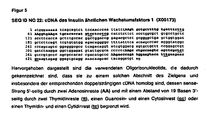
- FIG. 5 shows the single-stranded cDNA of insulin-like growth factor 1 (SEQ ID NO 22).
- oligoribonucleotides according to the invention could advantageously also be integrated into expression vectors, in particular those which bring about expression of the oligoribonucleotides in mammalian cells. In this way, even in the case of intracellular degradation of the oligoribonucleotides, stable inhibition of the expression of the target gene can be achieved since oligoribonucleotides are constantly replenished by vector-assisted synthesis.
- One or more copies of a dsRNA can be integrated into a vector, but also one or more copies of two or more different dsRNAs. Suitable vector systems are e.g. von Brummelkamp et al., supra. O. described.
- mammalian expression vectors in particular those which are a polymerase III H1 RNA promoter and 5 to 9 so-called loops, which are formed from a dsRNA according to the invention and a sequence of the same length which is reverse-complementary to the dsRNA according to the invention and serves as a spacer , and contain a termination signal of 5 consecutive thymidine residues.
- the vectors thus contain 5 to 9 copies of the respective dsRNA molecule.
- These may be dsRNAs specific for 1 target gene or dsRNAs specific for several different target genes.
- the oligoribonucleotides according to the invention can be present in the form of the unmodified oligoribonucleotides. However, they are preferably oligoribonucleotides which are chemically modified at the level of the sugar residues, the nucleobases, the phosphate groups and / or the skeleton therebetween in order, for example, to increase the stability of the oligoribonucleotides in cosmetic or dermatological preparations and / or in the skin For example, against nucleolytic degradation, to improve the penetration of the oligoribonucleotides into the skin and the cell, to favorably influence the activity of the oligoribonucleotides and / or to improve the affinity for the sequence to be hybridized.
- oligoribonucleotides in which one or more phosphate groups are represented by phosphorothioate, methylphosphonate and / or phosphoramidate groups, e.g. N3 ' ⁇ P5'-phosphoramidate groups are exchanged. Particularly preferred are oligoribonucleotides in which phosphate groups are replaced by Phosphothioat phenomenon.
- One or more of the phosphate groups of the oligoribonucleotide may be modified. In a partial modification preferably terminal groups are modified, oligoribonucleotides in which all phosphate groups are modified, but are particularly preferred. This applies mutatis mutandis to the modifications described below.
- Preferred sugar modifications include the replacement of one or more ribose residues of the oligoribonucleotide by morpholine rings (morpholine oligoribonucleotides) or by amino acids (peptide oligoribonucleotides).
- morpholine oligoribonucleotides morpholine oligoribonucleotides
- amino acids peptide oligoribonucleotides
- all ribose residues of the oligoribonucleotide are exchanged for amino acid residues and in particular morpholine residues.
- Formulas 1 and 2 each represent only a section of an oligoribonucleotide chain.
- morpholine oligoribonucleotides in which the morpholine radicals are linked to one another via phosphoryl groups, as shown in formula 2, in which X is O, Y is O and Z is N (CH 3) 2.
- the ribose residues may be modified by amino, such as NH 2, fluorine, alkyl or O-alkyl groups, such as OCH 3, with 2'-modified oligoribonucleotides being particularly preferred.
- exemplary modifications are 2'-fluoro, 2'-alkyl, 2'-O-alkyl, 2'-O-methoxyethyl modifications, 5'-palmitate derivatives and 2'-O-methylribonucleotides.
- the modification of the nucleotides of dsRNA counteracts activation of the protein kinase PKR in the cell, which is dependent on double-stranded RNA. This avoids non-specific inhibition of translation.
- Particularly suitable for this purpose is the substitution of at least one 2'-hydroxyl group of the nucleotides of the dsRNA by a 2'-amino or a 2'-methyl group.
- at least one nucleotide in at least one strand of the dsRNA can be replaced by a so-called "locked nucleotide” which contains a chemically modified sugar ring.
- a preferred modification of the sugar ring is a 2'-O, 4'-C-methylene bridge. dsRNA containing multiple "locked nucleotides" is preferred.
- alkyl herein preferably represents linear, branched or cyclic alkyl groups having 1 to 30, preferably 1 to 20, more preferably 1 to 10 and most preferably 1 to 6 carbon atoms.
- Branched and cyclic radicals naturally have at least 3 carbon atoms, with cyclic radicals having at least 5 and in particular at least 6 carbon atoms being preferred.
- oligoribonucleotides containing ⁇ -nucleosides can be used.
- Suitable base modifications are, for example, in the US 6,187,578 and the WO 99/53101 described, which is hereby incorporated by reference.
- a modification of one or more pyrimidines in position 5 with I, Br, Cl, NH 3 and N 3 has proved to be advantageous.
- modified and unmodified oligoribonucleotides are described in the literature.
- production of modified and unmodified oligoribonucleotides is now also offered by numerous companies as a service, for example by the companies Dharmacon, 1376 Miners Drive # 101, Lafayette, CO 80026, USA, Xeragon Inc., Genset Oligos and Ambion.
- the production of oligoribonucleotides is also described in the US 5,986,084 described.
- the oligoribonucleotides can also be used in encapsulated form, for example encapsulated in liposomes.
- they can be stabilized by the addition of cyclodextrins.
- Cyclodextrins are also referred to as cycloamyloses and cycloglucans.
- the cyclodextrins are cyclic oligosaccharides consisting of ⁇ -1,4 linked glucose units. As a rule, six to eight glucose units ( ⁇ -, ⁇ , or ⁇ -cyclodextrin) are linked together.
- Cyclodextrins are obtained on starch when exposed to Bacillus macerans. They have a hydrophobic interior and a hydrophilic exterior. According to the invention, both the cyclodextrins themselves, in particular ⁇ -cyclodextrin, ⁇ -cyclodextrin and ⁇ -cyclodextrin, as well as derivatives thereof are suitable.
- the cyclodextrin (s) are employed in cosmetic and dermatological compositions, preferably in a concentration of 0.0005 to 20.0% by weight, in particular 0.01 to 10% by weight and more preferably in a concentration of 0.1 to 5.0% by weight.
- cyclodextrins preferably but not exclusively include methyl, in particular random methyl-.beta.-cyclodextrin, ethyl and hydroxypropyl cyclodextrins, for example hydroxypropyl-.beta.-cyclodextrin and hydroxypropyl-.beta.-cyclodextrin.
- the cyclodextrin species particularly preferred according to the invention are ⁇ -cyclodextrin and hydroxypropyl- ⁇ -cyclocodextrin.
- Liposomes can be prepared in a known manner using natural phospholipids, such as phosphatidylcholine from eggs, soybeans, etc., or synthetic phospholipids (see. G. Betageri (Editor), “Liposome Drug Delivery Systems", Lancaster Techonomic Publishing Company 1993 ; Gregoriadis (Editor), “Liposome Technology", CRC Press ). Preferred methods and materials for the preparation of liposomes are described in U.S. Pat WO 99/24018 described.
- Double-stranded oligoribonucleotides can also be modified to counteract dissociation into the single strands, for example by one or more covalent, coordinative or ionic bonds. However, oligoribonucleotides without such modifications are preferred.
- nucleotides in the RNA molecules can also be used as "non-standard" nucleotides, e.g. non-naturally occurring nucleotides or deoxyribonucleotides.
- those oligoribonucleotides are preferred which inhibit the expression of the respective target gene in comparison to untreated cells by at least 40%, preferably by at least 60%, more preferably by at least 80% and most preferably by at least 85%. If necessary, the expression of the target gene in the cells is first appropriately induced to measure the inhibition. To determine the activity of the oligoribonucleotides according to the invention, tumoral cells of the HeLaS3 line are preferably used. The oligoribonucleotides are introduced into the cells and then, if appropriate after induction of the expression of the target gene, the expression rate of the target gene in these cells is measured and compared with that which is found in cells that were not transfected with the respective oligoribonucleotide. The exact conditions for measuring the inhibition can be found in Example 1.
- oligoribonucleotides and their salts according to the invention are particularly suitable as an active ingredient of pharmaceutical and cosmetic compositions, in particular those for topical application.
- the oligoribonucleotides after application of the compositions inhibit on the scalp or skin the expression of the genes responsible for inhibiting the growth phase of the hair follicle, and thus increase or decrease the hair growth without side effects and in this way an effective treatment and prophylaxis of the reduced (hair loss, hair miniaturization) growth of hair of the hair Scalp or the body, without showing the disadvantages of the prior art. It is believed that this effect is due to the fact that the oligoribonucleotides according to the invention are taken up by the cells of the hair follicle and induce intracellularly the degradation of mRNAs of said genes by RNAi, although details of the mechanism of this reaction cascade are not yet known.
- the oligoribonucleotides are therefore particularly suitable for initiating the degradation of mRNA of hair growth inhibiting proteins or enzymes and for inhibiting the expression of the hair growth inhibiting proteins or enzymes in the scalp or skin and especially in hair follicle cells.
- compositions according to the invention may additionally contain one or more oligoribonucleotides which inhibit the expression of the protein kinase PKR and thus counteract non-specific inhibition of translation.
- the pharmaceutical or cosmetic compositions according to the invention preferably contain 0.00001 to 10 wt .-%, more preferably 0.0003 to 3 wt .-% and most preferably 0.01 to 1.0 of the oligoribonucleotides or inventive, based on the total weight the composition.
- the above quantity refers to the mass of the oligoribonucleotides integrated in the vector, the mass of the vector itself is not taken into account.
- compositions which contain exclusively those oligoribonucleotides which inhibit the expression of one or more of the abovementioned genes, i. from the hair cycle inhibiting genes and optionally the proteinase PKR, and in particular the said preferred genes inhibit.
- the compositions of the invention may contain one or preferably more oligoribonucleotides. These may be oligoribonucleotides that inhibit the expression of several different hair cycle inhibiting proteins or enzymes, but it is also possible to use mixtures of oligoribonucleotides that target different sequence regions of the same gene or the same mRNA of a hair cycle inhibiting protein or enzyme.
- compositions which contain 1 to 5 and in particular 1 to 3 different oligoribonucleotides.
- Mixtures of oligoribonucleotides which, in addition to the hair cycle-inhibiting proteins or enzymes and possibly the proteinase PKR, non-specifically inhibit the activity of a large number of other skin or hair proteins are undesirable because virtually no control of side effects is possible.
- Skin or hair proteins are understood as meaning those proteins which are expressed in the skin or in the hair follicle.
- compositions containing one or more oligoribonucleotides that inhibit the expression of one or more TGFbeta factors are preferred.
- the oligoribonucleotides and compositions are useful in the treatment and prophylaxis of age and environmental degenerative and deficits of hair follicles, skin and integuments, such as glands, especially the symptoms described above. They are suitable for the cosmetic and therapeutic treatment of degenerative conditions of the hair follicle, which are caused by endogenous and exogenous factors, such as circulatory disorders, reduced energy supply to the hair root and in particular hormonal influences.
- the compositions of the present invention can prevent damage to the hair follicle and permanently repair existing damage without the risk of side effects.
- To determine the effectiveness of the oligoribonucleotides according to the invention for example, in the WO02 / 053773 described method can be used.
- oligoribonucleotides and compositions are useful in the prophylaxis and treatment of hair loss, hair follicle miniaturization, thinning hair, depigmentation of the hair, dystrophic changes of the hair root
- oligoribonucleotides and compositions according to the invention are also outstandingly suitable for hair, scalp and skin care.
- compositions according to the invention are suitable for the treatment of diminished Nutrient and / or oxygen supply, eg due to age-related reduction of the perifollicular capillaries and the capillary loop in the follicular papilla, caused deficits of the hair follicle.
- compositions according to the invention are suitable for cosmetic and therapeutic, i. in particular dermatological application.
- Cosmetic skincare primarily means that the natural function of the skin or scalp is a barrier against environmental influences (eg dirt, chemicals, microorganisms) and against the loss of endogenous substances (eg water, natural fats , Electrolytes) is strengthened or restored. If this function is disturbed, it may lead to increased absorption of toxic or allergenic substances or the infestation of microorganisms and as a result to toxic or allergic skin reactions.
- the aim of skin care is also to compensate for the daily loss of fat and water loss of the skin. This is especially important when the natural regeneration capacity is insufficient.
- skin care products to protect against environmental influences, especially from the sun and wind.
- compositions of the invention preferably contain such components which are suitable for the purposes mentioned.
- Such substances are known per se to the person skilled in the art.
- one or more oligoribonucleotides can be incorporated into conventional cosmetic and dermatological preparations, which may be in various forms.
- the preparations according to the invention are preferably applied directly to the scalp or body skin, in the manner known for such agents, for example twice a day.
- Suitable are e.g. Solutions, gels, ointments, suspensions or emulsions such as creams or lotions containing the active compounds according to the invention.
- the compositions according to the invention are for cosmetic use as hair treatment compositions, in particular as those which remain in the hair or are used with a longer exposure time.
- the active ingredients get into or onto the scalp or in the area of the hair roots.
- Hair treatment compositions which only come into contact with the skin or hair for a short time e.g. Shampoos, for example, may have higher levels of active ingredients.
- Hair treatment compositions are, for example, shampoos, hair care products such as hair lotions, hairdressing aids, hair conditioners, hair treatments, spa packs, hair fixatives such as mousse, hair spray, hair lacquer, hair styling agents and hair colorants.
- compositions according to the invention are present for cosmetic use as an emulsion, e.g. in the form of a cream, a lotion, a cosmetic milk.
- emulsion e.g. in the form of a cream, a lotion, a cosmetic milk.
- oligoribonucleotides other components such. Fats, oils, waxes and / or other fatty substances, as well as water and one or more emulsifiers, as they are commonly used for such a type of formulation.
- Emulsions usually contain a lipid or oil phase an aqueous phase and preferably also one or more emulsifiers. Particularly preferred are compositions which also contain one or more hydrocolloids.
- compositions according to the invention preferably contain from 0.001 to 35% by weight, more preferably from 2 to 15% by weight of emulsifier, from 0.001 to 45% by weight, particularly preferably from 10 to 25% by weight of lipid and from 10 to 95% by weight , more preferably 60 to 90 wt .-% water.
- the cosmetic preparations according to the invention may contain cosmetic adjuvants such as are commonly used in such preparations, e.g. Preservatives, bactericides, deodorants, antiperspirants, insect repellents, vitamins, antifoaming agents, dyes.
- Dyeing pigments, thickening agents, softening substances, moisturizing and / or moisturizing substances, fats, oils, waxes or other usual constituents of a cosmetic formulation such as alcohols, polyols, polymers, foam stabilizers, electrolytes, organic solvents or silicone derivatives, antioxidants and in particular UV -Absorber.
- preparations according to the invention may also contain substances which absorb UV radiation in the UVB range, the total amount of filter substances being e.g. 0.1 wt .-% to 30 wt .-%, preferably 0.5 to 10 wt .-%, in particular 1.0 to 6.0 wt .-%, based on the total weight of the preparations to cosmetic preparations for To provide the hair or the skin against the entire range of ultraviolet radiation. They can also serve as a sunscreen for hair.
- the total amount of filter substances being e.g. 0.1 wt .-% to 30 wt .-%, preferably 0.5 to 10 wt .-%, in particular 1.0 to 6.0 wt .-%, based on the total weight of the preparations to cosmetic preparations for To provide the hair or the skin against the entire range of ultraviolet radiation. They can also serve as a sunscreen for hair.
- UV-A filter substances for the purposes of the present invention are dibenzoylmethane derivatives, in particular 4- (tert-butyl) -4'-methoxydibenzoylmethane (CAS No. 70356-09-1), which is sold by Givaudan under the trademark Parsol® 1789 and sold by Merck under the tradename Eusolex® 9020.
- dibenzoylmethane derivatives in particular 4- (tert-butyl) -4'-methoxydibenzoylmethane (CAS No. 70356-09-1), which is sold by Givaudan under the trademark Parsol® 1789 and sold by Merck under the tradename Eusolex® 9020.
- the preparations according to the invention advantageously contain substances that absorb UV radiation in the UV-A and / or UV-B range, wherein the total amount of the filter substances z. B. 0.1 wt .-% to 30 wt .-%, preferably 0.5 to 20 wt .-%, in particular 1.0 to 15.0 wt .-%, based on the total weight of the preparations to cosmetic
- 0.1 wt .-% to 30 wt .-% preferably 0.5 to 20 wt .-%, in particular 1.0 to 15.0 wt .-%, based on the total weight of the preparations to cosmetic
- UV-A filter substances are the phenylene-1,4-bis (2-benzimidazyl) -3,3'-5,5'-tetrasulfonic acid and their salts, especially the corresponding sodium, potassium or trielhanolammonium salts, especially the phenylene-1,4-bis (2-benzimidazyl) -3,3'-5,5'-tetrasulfonic acid bis-sodium salt with the INCI name bisimidazylate, which is available, for example, under the trade name Neo Heliopan AP from Haarmann & Reimer.
- 1,4-di (2-oxo-10-sulfo-3-bomylidenmelhyl) benzene and its salts especially the corresponding 10-sulfato compounds, in particular the corresponding sodium, potassium or triethanolammonium salt
- benzene-1,4-di (2-oxo-3-bomylidenemethyl-10-sulfonic acid) is also referred to as benzene-1,4-di (2-oxo-3-bomylidenemethyl-10-sulfonic acid) and is characterized by the following structure:
- Advantageous UV filter substances for the purposes of the present invention are also so-called broadband filters, i. Filter substances that absorb both UV-A and UV-B radiation.
- Advantageous broadband filters or UV-B filter substances are, for example, bis-resorcinyl triazine derivatives having the following structure: wherein R 1 , R 2 and R 3 are independently selected from the group of branched and unbranched alkyl groups having 1 to 10 carbon atoms or represent a single hydrogen atom.
- 2,4-bis - ⁇ [4- (2-ethyl-hexyloxy) -2-hydroxy] -phenyl ⁇ -6- (4-methoxyphenyl) -1,3,5-triazine (INCI: aniso triazine ), which is available under the trade name Tinosorb® S from CIBA-Chemikalien GmbH, and which contains 4,4 ', 4 "- (1,3,5-triazine-2,4,6-triyltriimino) -tris-benzoic acid- tris (2-ethylhexyl ester), synonym: 2,4,6-tris [anilino (p-carbo-2'-ethyl-1'-hexyloxy)] - 1,3,5-triazine (INCI: Octyl Triazone) , which is marketed by BASF Aktiengesellschaft under the trade name UVINUL® T 150.
- a particularly advantageous UV filter substance in the context of the present invention is also an unsymmetrically substituted s-triazine whose chemical structure is represented by the formula which is also referred to below as Dioctylbutylamidotriazon (INCI: Dioctylbutamidotriazone) and is available under the trade name UVASORB HEB in Sigma 3V.
- Also advantageous for the purposes of the present invention are 2,4-bis - ⁇ [4- (3-sulfonato) -2-hydroxy-propyloxy) -2-hydroxy] -phenyl ⁇ -6- (4-methoxyphenyl) -1, 3,5-triazine sodium salt containing 2,4-bis - ⁇ [4- (3- (2-propytoxy) -2-hydroxy-propyloxy) -2-hydroxy] -pheny ⁇ -6- (4-methoxyphenyl) - 1,3,5-triazine, the 2,4-bis - ⁇ [4- (2-ethyl-hexyloxy) -2-hydroxy] -phenyl ⁇ -6- [4- (2-methoxyethylcarboxyl) -phenylamino] 1,3,5-triazine, which is 2,4-bis - ⁇ [4- (3- (2-propyloxy) -2-hydroxy-propyloxy) -2-hydroxy] -phenyl
- An advantageous broadband filter in the context of the present invention is the 2,2'-methylene-bis (6- (2H-benzotriazol-2-yl) -4- (1,1,3,3-tetramethylbutyl) phenol) [INCI : Bisoctyltriazole], which is represented by the chemical structural formula and available under the trade name Tinosorb® M from CIBA-Chemikalien GmbH.
- Advantageous broadband filter for the purposes of the present invention is furthermore the 2- (2H-benzotriazo-2-yl) -4-methyl-6- [2-methyl-3- [1,3,3,3-tetramethyl-1 - [( trimethylsilyl) oxy] disiloxanyl] propyl] phenol (CAS No .: 155633-54-8) with the INCI name Drometrizole Trisiloxane, which is represented by the chemical structural formula is marked.
- the UV-B filters may be oil-soluble or water-soluble.
- Advantageous oil-soluble UV-B filter substances are z. B.: 3-benzylidene camphor derivatives, preferably 3- (4-methylbenzylidene) camphor, 3-benzylidene camphor; 4-aminobenzoic acid derivatives, preferably 2-ethylhexyl 4- (dimethylamino) benzoate, 4- (dimethylamino) benzoic acid amyl ester; 2,4,6-trianilino- (p-carbo-2 '' - ethyl-1'-hexyloxy) -1,3,5-triazine; Esters of benzalmalonic acid, preferably di (2-ethylhexyl) 4-methoxybenzalmalonate; Esters of cinnamic acid, preferably 4-methoxycinnamic acid (2-ethylhexyl) ester, 4-methoxycinnamic acid isopent
- Advantageous water-soluble UV-B filter substances are z.
- a further light stabilizer filter substance to be used advantageously according to the invention is ethythexyl-2-cyano-3,3-diphenylacrylate (octocrylene), which is available from BASF under the name Uvinul® N 539 and characterized by the following structure:
- UV filters which can be used in the context of the present invention is of course not intended to be limiting.
- compositions according to the invention may contain antioxidants for protecting the cosmetic preparation itself or for protecting the constituents of the cosmetic preparations from harmful oxidation processes.
- the antioxidants are selected from the group consisting of amino acids (eg glycine, histidine, tyrosine, tryptophan) and their derivatives, imidazoles (eg urocanic acid) and their derivatives, peptides such as D, L-camosine, D-camosine, L-camosine and their derivatives (eg anserine), carotenoids, carotenes (eg .alpha.-carotene, .beta.-carotene, lycopene) and their derivatives, aurothioglucose, propylthiouracil and other thiols (eg thioredoxin, glutathione, cysteine, cystine, cystamine and their glycosyl, Acetyl, methyl, ethyl, propyl, amyl, butyl and lauryl, palmitoyl, oleyl, ⁇ -linoleyl, cholesteryl and
- ⁇ -hydroxy fatty acids palmitic acid, phytic acid, lactoferrin
- ⁇ -hydroxy acids eg citric acid, lactic acid, malic acid
- humic acid bile acid, bile extracts, bilirubin, biliverdin, EDTA, EGTA and their derivatives, unsaturated fatty acids and their derivatives (eg ⁇ Linolenic acid, linoleic acid, oleic acid), folic acid and its derivatives, alaninediacetic acid, flavonoids, polyphenols, catechins, vitamin C and derivatives (eg ascorbyl palmitate, Mg ascorbyl phosphate, ascorbyl acetate), tocopherols and derivatives (eg vitamin E acetate), and coniferyl benzoate Benzo ⁇ harzes, rutinic acid and its derivatives, ferulic acid and its derivatives, butylhydroxytoluene, Butylhydroxyanisol, Nordi
- the amount of antioxidants (one or more compounds) in the preparations is preferably from 0.001 to 30% by weight, particularly preferably from 0.05 to 20% by weight, in particular from 1 to 10% by weight, based on the total weight of the preparation ,
- vitamin A or vitamin A derivatives, or carotenes or derivatives thereof are the antioxidant (s), it is advantageous if their respective concentrations are in the range from 0.001 to 10% by weight, based on the total weight of the formulation choose.
- vitamin E and / or its derivatives represent the antioxidant (s)
- cosmetic and dermatological preparations advantageously also contain inorganic pigments based on metal oxides and / or other sparingly soluble or insoluble metal compounds, in particular the oxides of titanium (TiO 2 ) zinc (ZnO), iron (eg Fe 2 O 3 ). Zirconium (ZrO 2 ), silicon (SiO 2 ), manganese (eg MnO), aluminum (Al 2 O 3 ), cerium (eg Ce 2 C 3 ), mixed oxides of the corresponding metals and mixtures of such oxides. Particular preference is given to pigments based on TiO 2 .
- the inorganic pigments are in hydrophobic form, that is to say that they are superficially treated to repel water.
- This surface treatment may consist in providing the pigments with a thin hydrophobic layer according to methods known per se.
- n and m are stoichiometric parameters to be used as desired, R and R 'are the desired organic radicals.
- R and R ' are the desired organic radicals.
- Advantageous TiO 2 pigments are available, for example, under the trade names MT 100 T from TAYCA, furthermore M 160 from Kemira and T 805 from Degussa.
- active ingredients in the context of the present invention are natural active ingredients and / or derivatives thereof, such as.
- alpha-lipoic acid phytoene, D-biotin, coenzyme Q10, alpha-glucosylrutin, carnitine, camosine, natural and / or synthetic isoflavonoids, creatine, taurine and / or ⁇ -alanine.
- Preparations according to the invention can also contain anionic, nonionic and / or amphoteric surfactants, especially if crystalline or microcrystalline solids, for example inorganic micropigments, are to be incorporated into the preparations according to the invention.
- Surfactants are amphiphilic substances that can dissolve organic, nonpolar substances in water.
- hydrophilic portions of a surfactant molecule are usually polar functional groups, for example -COO - , -OSO 3 2- , -SO 3 - , while the hydrophobic parts are usually nonpolar hydrocarbon radicals.
- Surfactants are generally classified according to the nature and charge of the hydrophilic part of the molecule. Here four groups can be distinguished:
- Anionic surfactants generally have carboxylate, sulfate or sulfonate groups as functional groups. In aqueous solution they form negatively charged organic ions in an acidic or neutral medium. Cationic surfactants are almost exclusively characterized by the presence of a quaternary ammonium group. In aqueous solution, they form positively charged organic ions in an acidic or neutral environment. Amphoteric surfactants contain both anionic and cationic groups and behave accordingly in aqueous solution depending on the pH as anionic or cationic surfactants. They have a positive charge in a strongly acidic environment and a negative charge in an alkaline environment.
- Non-ionic surfactants are polyether chains. Nonionic surfactants do not form ions in an aqueous medium.
- Acylamino acids such as (1) acylglutamates, for example, sodium acylglutamate, di-TEApalmitoylaspartate and sodium caprylicl capric glutamate; (2) acyl peptides, for example, palmitoyl-hydrolyzed milk protein, sodium cocoyl-hydrolyzed soy protein and sodium / potassium cocoyl-hydrolyzed collagen; (3) sarcosinates, for example myristoyl sarcosine, TEA lauroyl sarcosinate, sodium lauroyl sarcosinate and sodium cocoyl sarcosinate; (4) taurates, for example, sodium lauroyl taurate and sodium methyl cocoyl taurate; (5) acyl lactylates such as lauroyl lactylate and caproyl lactylate; (6) alaninates;
- acylglutamates for example, sodium acylglutamate, di-TEApalmito
- Carboxylic acids and derivatives such as lauric acid, aluminum stearate, magnesium alkoxide and zinc undecylenate; Ester carboxylic acids, for example, calcium stearoyl lactylate, laureth-6 citrate, and sodium PEG-4 lauramidocarboxylate; Ether carboxylic acids, for example sodium laureth-13 carboxylate and sodium PEG-6 cocamide carboxylate;
- Carboxylic acids, ester carboxylic acids and ether carboxylic acids preferably contain 1 to 50 and in particular 2 to 30 carbon atoms.
- Phosphoric acid esters and salts such as DEA-oleth-10-phosphate and dilaureth-4-phosphate;
- Sulfonic acids and salts such as (1) acyl isethionates, eg, sodium / ammonium cocoyl isethionate; (2) alkylarylsulfonates; (3) alkyl sulfonates, for example, sodium coconut monoglyceride sulfate, sodium C 12-14 olefin sulfonate, sodium lauryl sulfoacetate, and magnesium PEG-3 cocamide sulfate; (4) sulfosuccinates, for example, dioctyl sodium sulfosuccinate, disodium laureth sulfosuccinate, disodium lauryl sulfosuccinate and disodium undecylenamido MEA sulfosuccinate;
- Sulfuric acid esters such as (1) alkyl ether sulfate, for example, sodium, ammonium, magnesium, MIPA, TIPA laureth sulfate, sodium myreth sulfate, and sodium C 12-13 pareth sulfate; (2) Alkyl sulfates, for example, sodium, ammonium and TEA lauryl sulfate.
- Advantageously used cationic surfactants are alkylamines, alkylimidazoles, ethoxylated amines and quaternary surfactants and esterquats.
- Quaternary surfactants contain at least one N atom covalently linked to 4 alkyl or aryl groups. This results in a positive charge regardless of the pH.
- alkyl betaine alkyl amidopropyl betaine and alkyl amidopropyl hydroxysulfine.
- the cationic surfactants used according to the invention can furthermore preferably be selected from the group of quaternary ammonium compounds, in particular benzyltrialkylammonium chlorides or bromides, for example benzyldimethylstearylammonium chloride, furthermore alkyltrialkylammonium salts, for example cetyltrimethylammonium chloride or bromide, alkyldimethylhydroxyethylammonium chlorides or bromides, dialkyldimethylammonium chlorides or bromides, alkylamidethyltrimethylammonium ether sulfates, alkylpyridinium salts, for example, lauryl or cetylpyrimidinium chloride, imidazoline derivatives and compounds having a cationic character such as amine oxides, for example alkyldimethylamine oxides or alky
- acyl / dialkylethylenediamine for example, sodium acylamphoacetate, disodium acylamphodipropionate, disodium alkyl amphodiacetate, sodium acyl amphohydroxypropyl sulfonate, disodium acyl amphodiacetate, and sodium acyl amphopropionate
- N-alkylamino acids for example, aminopropylalkylglutamide, alkylaminopropionic acid, sodium alkylimidodipropionate and lauroamphocarboxyglycinate.
- nonionic surfactants are (1) alcohols; (2) alkanolamides such as Cocamide MEA / DEN MIPA; (3) amine oxides such as cocoamidopropylamine oxide; (4) esters formed by esterification of carboxylic acids with ethylene oxide, glycerol, sorbitan or other alcohols; (5) ethers, for example, ethoxylated monopropoxylated alcohols, ethoxylated / propoxylated esters, ethoxylated / propoxylated glycerol esters, ethoxylated / propoxylated cholesterols, ethoxylated / propoxylated triglyceride esters, ethoxylated propoxylated lanolin, ethoxylated / propoxylated polysitoxanes, propoxylated POE ethers and alkyl polyglycosides such as lauryl glucoside, decyl glycoside and cocoglycoside
- the surface-active substance can be present in a concentration of between 1 and 95% by weight in the preparations according to the invention, based on the total weight of the preparations.
- the oil phase of the emulsions according to the present invention is advantageously selected from the group of esters of saturated and / or unsaturated, branched and / or unbranched alkanecarboxylic acids of a chain length from 3 to 30 carbon atoms and saturated and / or unsaturated, branched and / or unbranched alcohols having a chain length of 3 to 30 carbon atoms, from the group of esters of aromatic carboxylic acids and saturated and / or unsaturated, branched and / or unbranched Alcohols of a chain length of 3 to 30 carbon atoms.
- ester oils can then be advantageously selected from the group isopropyl myristate, isopropyl palmitate, isopropyl stearate, isopropyl oleate, n-butyl stearate, n-hexyl laurate, n-decyl oleate, isooctyl stearate, isononyl stearate, isononyl isononanoate, 2-ethylhexyl palmitate, 2-ethylhexyl laurate, 2-hexyldecyl stearate, 2 Octyldodecyl palmitate, oleyl oleate, oleyl erucate, erucyl oleate, erucyl erucate and synthetic, semi-synthetic and natural mixtures of such esters, for example jojoba oil.
- the oil phase can be advantageously selected from the group of branched and unbranched hydrocarbons and waxes, the silicone oils, the dialkyl ethers, the group of saturated or unsaturated, branched or unbranched alcohols, and the fatty acid triglycerides, in particular the triglycerol esters of saturated and / or unsaturated, branched and / or unbranched alkanecarboxylic acids of a chain length of 8 to 24, in particular 12 to 18 carbon atoms.
- the fatty acid triglycerides can be advantageously selected from the group of synthetic, semi-synthetic and natural oils, e.g. Olive oil, sunflower oil, soybean oil, peanut oil, rapeseed oil, almond oil, palm oil, coconut oil, palm kernel oil, and the like.
- any mixtures of such oil and wax components are also advantageous to use in the context of the present invention. It may also be advantageous, if appropriate, to use waxes, for example cetyl palmitate, as the old-type lipid component of the oil phase.
- the oil phase is selected from the group consisting of 2-ethylhexyl isostearate, octyldodecanol, isotridecyl isononanoate, isoeicosane, 2-ethylhexyl cocoate, C 12-15 alkyl benzoate, caprylic capric acid triglyceride, dicaprylyl ether.
- mixtures of C 12-15 alkyl benzoate and 2-ethylhexyl isostearate mixtures of C 12-15 alkyl benzoate and Isotridecylisononanoat and mixtures of C 2-15 alkyl benzoate.
- 2-ethylhexyl isostearate and isotridecyl isononanoate are particularly advantageous.
- hydrocarbons paraffin oil, squalane and squalene are to be used advantageously in the context of the present invention.
- the oil phase may further comprise a content of cyclic or linear silicone oils or consist entirely of such oils, although it is preferred to use an additional content of other oil phase components in addition to the silicone oil or silicone oils.
- Such silicones or silicone oils may be present as monomers, which are typically characterized by structural elements, as follows:
- linear silicones having several siloxy units which are advantageously used according to the invention, they are generally characterized by structural elements as follows: wherein the silicon atoms can be substituted with identical or different alkyl radicals and / or aryl radicals, which are here generalized by the radicals R 1 - R 4 (to say that the number of different radicals is not necessarily limited to 4).
- m can assume values of 2 - 200,000.
- Cyclic silicones which are advantageously used in accordance with the invention are generally characterized by structural elements as follows wherein the silicon atoms can be substituted with identical or different alkyl radicals and / or aryl radicals, which are here generalized by the radicals R 1 - R 4 (to say that the number of different radicals is not necessarily limited to 4).
- n can assume values of 3/2 to 20. Broken values for n take into account that odd numbers of siloxyl groups may be present in the cycle.
- cyclomethicone e.g., decamethylcyclopentasiloxane
- silicone oils are also advantageous for the purposes of the present invention, for example undecamethylcyclotrisiloxane, polydimethylsiloxane, poly (methylphenylsiloxane), cetyl dimethicone, behenoxydimethicone.
- silicone oils of similar constitution as the compounds described above, whose organic side chains are derivatized, for example polyethoxylated and / or polypropoxylated.
- silicone oils of similar constitution as the compounds described above, whose organic side chains are derivatized, for example polyethoxylated and / or polypropoxylated.
- These include, for example, polysiloxane-polyalkyl-polyether copolymers such as the cetyl-dimethicone copolyol which (cetyl dimethicone copolyol (and) polyglyceryl-4-isostearate (and) hexyl laurate)
- mixtures of cyclomethicone and isotridecyl isononanoate, cyclomethicone and 2-ethylhexyl isostearate are particularly advantageous.
- the aqueous phase of the preparations according to the invention optionally advantageously contains alcohols, diols or polyols of low C number, and their ethers, preferably ethanol, isopropanol, propylene glycol, glycerol, ethylene glycol, ethylene glycol monoethyl or monobutyl ether, propylene glycol monomethyl, monoethyl or monobutyl ether , Diethylenglykolmonomethyl- or -monoethylether and analogous products, furthermore low C-number alcohols, eg Ethanol, isopropanol, 1,2-propanediol, glycerol and in particular one or more thickeners, which or which can be advantageously selected from the group of silica, aluminum silicates.
- alcohols, diols or polyols of low C number, and their ethers preferably ethanol, isopropanol, propylene glycol, glycerol
- emulsions present particularly advantageously contain one or more hydrocolloids.
- hydrocolloids can be advantageously selected from the group of gums, polysaccharides, cellulose derivatives, phyllosilicates, polyacrylates and / or other polymers.
- hydrogel preparations contain one or more hydrocolloids. These hydrocolloids can be advantageously selected from the aforementioned group.
- the gums include plant or tree juices that harden in the air and
- Forming resins or extracts from aquatic plants can be selected advantageous in the sense of the preceding invention, for example, gum arabic, locust bean gum, tragacanth, karaya, guar gum, pectin, gellan gum, carrageenan, agar, algins, chondrus, xanthan gum.
- derivatized gums such as e.g. Hydroxypropyl guar (Jaguar® HP 8).
- polysaccharides and derivatives are e.g. Hyaluronic acid, chitin and chitosan, chondroitin sulphates, starch and starch derivatives.
- cellulose derivatives are e.g. Methylcellulose, carboxymethylcellulose, hydroxyethylcellulose, hydroxypropylmethylcellulose.
- layered silicates are naturally occurring and synthetic clays such as e.g. Montmorillonite, bentonite, hectorite, laponite, magnesium aluminum silicates such as Veegum®. These may be used as such or in modified form as e.g. Stearylalkonium hectorites.
- polyacrylates are e.g. Carbopol types from Goodrich (Carbopol 980, 981, 1382, 5984, 2984, EDT 2001 or Pemulen TR2).
- polyacrylamides for example, polyacrylamides (Seppigel 305), polyvinyl alcohols, PVP, PVP / VA copolymers, polyglycols.
- the oligoribonucleotides used according to the invention are incorporated into aqueous systems or surfactant preparations for cleaning the skin and hair.
- Advantageous moisturizers for the purposes of the present invention are, for example, glycerol, lactic acid, pyrrolidonecarboxylic acid and urea.
- polymeric moisturizers from the group of water-soluble and / or water-swellable and / or water-gellable polysaccharides.
- glycerol When used as a moisturizer, glycerol is preferably used in an amount of 0.05-30% by weight, more preferably 1-10%.
- emulsions present as emulsions contain one or more emulsifiers.
- emulsifiers can be advantageously selected from the group of nonionic, anionic, cationic or amphoteric emulsifiers.
- emulsifiers which include beeswax, wool wax, lecithin and sterols.
- the polyethoxylated or polypropoxylated or polyethoxylated and polypropoxylated O / W emulsifiers used are particularly advantageously selected from the group of substances having HLB values of 11-18, very particularly advantageously having HLB values of 14.5-15.5 if the O / W emulsifiers have saturated radicals R and R '. If the O / W emulsifiers have unsaturated radicals R and / or R ', or if isoalkyl derivatives are present, the preferred HLB value of such emulsifiers may also be lower or higher.
- fatty alcohol ethoxylates from the group of ethoxylated stearyl alcohols, cetyl alcohols, cetylstearyl alcohols (cetearyl alcohols). Particularly preferred are:
- Polyethylene glycol (13) isocetyl ether (Isoceteth-13).
- Polyethylene glycol (14) isocetyl ether (isoceteth-14), polyethylene glycol (15) isocetyl ether (isoceteth-15), polyethylene glycol (16) isocetyl ether (isoceteth-16), polyethylene glycol (17) isocetyl ether (isoceteth-17), polyethylene glycol (18) isocetyl ether (Isoceteth-18), polyethylene glycol (19) isocetyl ether (Isoceteth-19), polyethylene glycol (20) isocetyl ether (Isoceteth-20).
- Polyethylene glycol (12) lauryl ether (Laureth-12), polyethylene glycol (12) isolauryl ether (Isolaureth-12).
- the sodium laureth-11-carboxylate can be advantageously used.
- sodium laureth 1-4 sulfate can be advantageously used.
- polyethylene glycol (30) cholesteryl ether can be advantageously used. Also polyethylene glycol (25) soybean oil has been proven.
- the Polyethylenglycolglycerinfettklander from the group polyethylene glycol (20) glyceryl laurate, polyethylene glycol (21) glyceryl laurate, polyethylene glycol (22) glyceryl laurate, polyethylene glycol (23) glyceryl laurate, polyethylene glycol (6) glyceryl caprate / caprinate, polyethylene glycol (20) glyceryl oleate, polyethylene glycol (20) glyceryl isostearate, polyethylene glycol (18) glyceryl oleate / cocoate.
- sorbitan esters from the group of polyethylene glycol (20) sorbitan monolaurate, polyethylene glycol (20) sorbitan monostearate, polyethylene glycol (20) sorbitan monoisostearate, polyethylene glycol (20) sorbitan monopalmitate, polyethylene glycol (20) sorbitan monooleate.
- W / O emulsifiers can be used: fatty alcohols having 8 to 30 carbon atoms, monoglycerol esters of saturated and / or unsaturated, branched and / or unbranched alkanecarboxylic acids having a chain length of 8 to 24, in particular 12 to 18 carbon atoms, diglycerol esters of saturated and / or or unsaturated, branched and / or unbranched alkanecarboxylic acids having a chain length of 8 to 24, in particular 12-18, carbon atoms, monoglycerol ethers of saturated and / or unsaturated, branched and / or unbranched alcohols having a chain length of 8 to 24, in particular 12-18 C Atoms, diglycerol ethers of saturated and / or unsaturated, branched and / or unbranched alcohols of a chain length of 8 to 24, in particular 12-18 C atoms, propylene glycol esters of saturated and / or unsaturated, branched and / or un
- W / O emulsifiers are glyceryl monostearate, glyceryl, glyceryl monomyristate, glyceryl, diglyceryl monostearate, Diglycerylmonoisostearat, propylene glycol, propylene glycol monoisostearate, propylene glycol monocaprylate, propylene glycol, sorbitan, sorbitan, sorbitan, Sorbitanmonoisooleat, sucrose, cetyl alcohol, stearyl, arachidyl, behenyl, Isobehenylalkohol, selachyl, Chimyl alcohol, polyethylene glycol (2) stearyl ether (steareth-2), glyceryl monolaurate, glyceryl monocaprinate, glyceryl monocaprylate.
- oleic acid decyl ester oleic acid decyl ester
- cetyl alcohol cetylstearyl alcohol
- 2-octyldodecanol skin-care fat or fat-like substances
- customary cosmetic excipients for preparing the deodorizing preparations according to the inventive use in the proportions customary for such preparations as well as slime-forming substances and thickeners, eg Hydroxyethyl or hydroxypropylcellulose, polyacrylic acid, polyvinylpyrrolidone, but also in small quantities cyclic silicone oils (polydimethylsiloxanes) and liquid Polymethylphenylsiloxane low Viskosiusch.
- preparations according to the invention additionally contain astringents or antiperspirants, silicone oils and / or powders in addition to the combination of active substances.
- antiperspirant agents from the raw material classes aluminum and aluminum / zirconium salts should not be limited to the commercially available mostly aqueous solutions, such as e.g. Locron L (Clariant) may be limited, but it may also be advantageous to use the also commercially available anhydrous powder of the same raw materials by incorporation into the claimed formulations, such. Locron P (Clariant).
- AT salt suspensions may also be advantageous in which aluminum and aluminum / zirconium salts present in powder form are dispersed in various oils.
- antiperspirant actives are based on other metals instead of aluminum or zirconium, e.g. Beryllium, titanium, hafnium.
- the list of usable antiperspirant agents should not be limited to metal-containing raw materials, but also compounds containing non-metals such as boron and those containing the range are advantageous attributable to organic chemistry, such as anticholinergics.
- Suitable propellants for dermatological preparations which can be sprayed from aerosol containers according to the invention are the customary known volatile, liquefied propellants, for example hydrocarbons (propane, butane, isobutane), which can be used alone or mixed with one another. Also, compressed air is advantageous to use.
- hydrocarbons propane, butane, isobutane
- CFC chlorofluorocarbons
- sprayable preparations contain certain oil components and alcohols ethanol and isopropanol, glycerol and propylene glycol skin-care fat or fat-like substances, such as oleic acid, cetyl alcohol, cetylstearyl alcohol and 2-octyldodecanol, are used in the usual ratios for such preparations and slime-forming substances and thickening agents, e.g. Hydroxyethyl or hydroxypropylcellulose, polyacrylic acid, polyvinylpyrrolidone, but also in small quantities cyclic silicone oils (polydimethylsiloxanes) and liquid Polymethylphenylsiloxane low Viskosiusch.
- oil components and alcohols ethanol and isopropanol, glycerol and propylene glycol skin-care fat or fat-like substances such as oleic acid, cetyl alcohol, cetylstearyl alcohol and 2-octyldodecanol
- thickening agents e.g.
- Example 1 Measurement of inhibition of TGFbeta-1 expression in human dermal fibroblasts by dsRNA
- HDF cells human dermal fibroblasts
- the cells in DMEM with 10% fetal calf serum
- DMEM + 10% FCS + 1% glutamax + 1% Pen / Strep complete medium
- Transfection was performed using a mixture of cationic lipids (Oligo Stammamine Reagent, Invitrogen).
- dsRNAs obtained by hybridizing the sequences SEQ ID Nos. 15 and 16, SEQ ID Nos. 18 and 19 and SEQ ID Nos.
- the dsRNAs have 3'-each two supernatant dT residues, s. FIG. 2 ) dissolved in 1.5 ml of medium.
- 36 ⁇ l of oligofectamine were dissolved in 240 ⁇ l of medium and incubated for 5-10 min. After this incubation period, the two batches were combined and incubated for a further 15-20 min.
- the complete medium was removed from the cells and replaced with 7 ml of medium without the addition of antibiotics or serum.
- the transfection mixture was now added to the cells. Subsequently, this transfection mixture was left on the primary fibroblasts for 24 hours.
- Samples that were not transfected with dsRNA or those that were transfected with a non-TGFbeta-1-binding dsRNA served as a comparison.
- RNA isolation was performed using the High Pure RNA Isolation Kit (Roche Diagnostics Corp.) according to the manufacturer's instructions. The isolated RNA bound to a column was eluted with 50-100 ⁇ l of water.
- TGFbeta-1 mRNA was determined by TaqMan quantitative analysis (TaqMan Assays-on-Demand TM Applied Biosystems).
- RNA was first transcribed into cDNA in a 2-step procedure. Reverse transcription was performed using the High Capacity cDNA Archive Kit (Applied Biosystems) according to the manufacturer's instructions.
- the quantification of gene expression was carried out via the C 1 value (threshold cycle). Relativization was via the endogenous control of the 18s RNA.
- TGFbeta-1 target gene
- sRNA endogenous control
- FIG. 6 The results are in FIG. 6 shown graphically.
- the relative mRNA concentration of the growth factor TGFbeta-1 normalized via the 18S rRNA content is to be regarded as a percentage of control.
- the transfection of the cells with the transfection reagent alone (“without siRNA”) as well as with the oligoribonucleotides against lamin A / C (“control”) does not change the TGFbeta-1 mRNA content.
- transfection with the three different pairs of oligoribonucleotides against TGFbeta-1 leads in each case to a decrease in the TGFbeta-1 concentration ("SEQ ID NOs” 15 + 16 “,” 18 + 19 “and” 6 + 7 ", respectively) is about 80-90% compared to the control and non-siRNA transfected cells.
- FIG. 1 the coding sequence of TGFbeta-1 is shown (SEO ID NO 1).
- SEO ID NO 1 the oligoribonucleotides used which are characterized by being homologous to such a portion of the target gene, and in particular the corresponding double-stranded cDNA, whose sense strand is 5 'end by two adenosine residues (AA) and at a distance of 19 bases 3'-side by two thymidine residues ( tt ), a guanosine and a cytosine residue ( gc ) or a thymidine and a cytidine residue ( tc ) is limited.
- Table 10 sodium laureth sulfate 9.00 cocoamidopropyl 2.50 anti-TGFbeta-1 dsRNA (dsRNA from SEQ ID Nos. 6 and 7, s. FIG. 2 ) 0.10 Preservative, perfume, thickener, pH-adjustment and solubilizer q.s. water ad 100.0 The pH is adjusted to 5.5.
- Hair conditioners were prepared by mixing the components listed in the table.
- the oligoribonucleotide used was dsRNA obtained by hybridizing SEQ ID No. 6 and SEQ ID No. 7.
- the dsRNA inhibits the expression of the growth factor TGFbeta-1 by RNA interference and is referred to as anti-TGFbeta-1 dsRNA (cf. FIG. 2 ).
- the two strands of dsRNA had 3'-permanently two 2'-Desoxythymidinreste.
- Table 11 1 2 3 hydroxypropyl methylcellulose 0.5% 0.5% 0.5% cetrimonium 1.0 - 0.8 behentrimonium - 0.7 0.3 glycerin 3.0 3.0 3.0 cetearyl 2.5 2.5 2.5 glyceryl stearate 2.0 2.0 2.0 Polyquaternium-10 0.1 - - Guar hydroxypropyl trimonium chloride - 0.2 - anti-TGFbeta-1 dsRNA (dsRNA from SEQ ID Nos. 6 and 7, s. FIG. 2 ) 0.1 0.1 0.1 Preservative, perfume, pH adjustment and solubilizer qs qs qs water ad 100 ad 100 ad 100 ad 100
- Table 12 1 2 3 cetrimonium 1.0 0.5 0.5 behentrimonium - 0.2% 0.3 glycerin 3.0 3.0 3.0 hydroxyethyl 0.2 0.2 0.2 Polyquaternium-10 0.1 - - Guar hydroxypropyl trimonium chloride - 0.2 - anti-TGFbeta-1 dsRNA (dsRNA from SEC ID NOs 6 and 7, s. FIG. 2 ) 0.1 0.1 0.1 Preservative, perfume, pH adjustment and solubilizer q.s. q.s. q.s. water ad 100 ad 100 ad 100 ad 100 ad 100 ad 100
- Table 13 1 2 3 4 cetyl alcohol 1.5 1.8 2.0 - Cetrimoniumchtorid 0.3 0.1 0.5 0.5 behentrimonium - 0.2 - - Benzophenone- 0.05 0.03 - 0.1 4 PVPNA copolymer 0.4 - - Polyquaternium-37 - - - 1.0 Polyquaternium-4 - - - 0.2 Polyquaternium-10 - - 0.5 - panthenol 0.1 - 0.2 0.1 hydroxyethyl - - - 0.3 Acrylates / C10-30 Alkyl Acrylates Crosspolymer 0.5 0.3 0.2 - C12-13 alkyl lactates 2.0 1.0 1.5 1.0 Laureth-4 - - - 0.5 Aluminum Starch Octenylsuccinate - - - 1.0 Dicaprylyl carbonates - - - 1.0 anti-TGFbeta-1 dsRNA (dsRNA from SEG ID NOs.
- FIG. 2 0.1 0.1 0.1 0.1 0.1 Preservative, perfume, pH adjustment and solubilizer q.s. q.s. q.s. q.s. water ad 100 ad 100 ad 100 ad 100 ad 100 ad 100 ad 100 ad 100
- Table 14 1 2 3 4 cetrimonium 0.2 0.1 0.8 0.5 Behentrimoniumchtorid - 0.2 0.3 - Benzophenone-4 0.05 0.03 - - PVPNA copolymer - 0.7 - - Polyquaternium-10 0.1 - - - Polyquaternium-4 0.2 - - - Propylene glycol - - - 3.0 Polyquaternium-11 - - 0.2 - panthenol 0.1 - 0.2 0.1 Glyceryl isostearates - - - 0.4 Isoceteth-20 - - - 0.8 Dicaprylyl carbonates - - - 0.5 anti-TGFbeta-1 dsRNA (dsRNA from SEQ ID Nos.
- FIG. 2 0.1 0.1 0.1 0.1 0.1 Preservative, perfume, pH adjustment and solubilizer q.s. q.s. q.s. q.s. water ad 100 ad 100 ad 100 ad 100 ad 100 ad 100 ad 100 ad 100
- Table 15 1 2 3 4 ethanol 30.0 50.0 - - isopropanol - - 40.0 30.0 panthenol 0.2 0.1 0.2 0.2 menthol 0.1 - 0.05 0.05 Tocopheryl acetate 0.2 0.2 - 0.1 C12-13 alkyl lactates 0.2 0.1 0.2 - anti-TGFbeta-1 dsRNA (dsRNA from SEQ ID Nos. 6 and 7, s. FIG. 2 ) 0.1 0.1 0.1 0.1 0.1 0.1 Perfume, pH-adjustment and solubilizer q.s. q.s. q.s. water ad 100 ad 100 ad 100 ad 100 ad 100 ad 100 ad 100 ad 100 ad 100 ad 100 ad 100 ad 100 ad 100 ad 100 ad 100 ad 100 ad 100 ad 100 ad 100 ad 100 ad 100 ad 100 a
Landscapes
- Health & Medical Sciences (AREA)
- Life Sciences & Earth Sciences (AREA)
- Engineering & Computer Science (AREA)
- Genetics & Genomics (AREA)
- Biomedical Technology (AREA)
- Chemical & Material Sciences (AREA)
- Molecular Biology (AREA)
- Bioinformatics & Cheminformatics (AREA)
- Biotechnology (AREA)
- General Engineering & Computer Science (AREA)
- Wood Science & Technology (AREA)
- Zoology (AREA)
- Organic Chemistry (AREA)
- General Health & Medical Sciences (AREA)
- Biochemistry (AREA)
- Physics & Mathematics (AREA)
- Biophysics (AREA)
- Plant Pathology (AREA)
- Microbiology (AREA)
- Veterinary Medicine (AREA)
- Public Health (AREA)
- Animal Behavior & Ethology (AREA)
- Epidemiology (AREA)
- Birds (AREA)
- Endocrinology (AREA)
- Dermatology (AREA)
- Cosmetics (AREA)
- Pharmaceuticals Containing Other Organic And Inorganic Compounds (AREA)
- Medicines That Contain Protein Lipid Enzymes And Other Medicines (AREA)
Description
- Die vorliegende Erfindung betrifft die Verwendung von Oligoribonukleotiden, die den Abbau der mRNA von Proteinen und Enzymen induzieren, die in stimulierender Art und Weise auf den Haarzyklus Einfluss nehmen zur Herstellung kosmetischer oder dermatologischer Zubereitungen für die Behandlung und Prophylaxe des verminderten (Haarausfall, Haarminiaturisierung) Wachstums von Haaren der Kopfhaut oder des Körpers, wie sie beispielsweise mit altersbedingen Haarwuchsveränderungen einhergehen.
- Unter den Haarzyklus regulierenden Proteinen oder Enzymen werden in erster Linie Haarwuchs inhibierende Proteine wie Wachstumsfaktoren, insbesondere die Mitglieder der Tumor Growth Factor beta-Superfamilie (TGFbeta) und deren Rezeptoren (TGFbeta-R), und Steroidrezeptoren und Steroid katalysierende Enzyme, insbesondere der Androgen-Rezeptor, sowie Haarwuchs fördernde zelluläre Signalmoleküle, insbesondere das Sonic Hedgehog Protein und der Insulin ähnliche Wachstumsfaktor 1 (IGF-1), verstanden.
- Papillenhaar wird das Haar genannt, das sich in der Wachstumsperiode befindet, die auch anagene Phase oder Anagenphase genannt wird. In dieser Phase ist das Haar mit seiner Papille in der Haut verankert. Etwa 80% der Kopfhaare befinden sich etwa 2 bis 5 Jahre lang in der Anagenphase. In einer sich anschließenden Übergangsphase (Katagenphase) wandert das Haar etwa 2 Wochen lang an die Hautoberfläche und bleibt dann etwa 3 bis 4 Monate lang in einem Ruhestadium (Telogenphase) bis es schließlich ausfällt.
- Ein über das normale Maß hinausgehender Haarausfall oder ein übermäßig starker Haarwuchs an unerwünschten Körperstellen wird zumeist als schwere kosmetische Störung angesehen, ebenso wie andere Wachstumsstörungen der Haare. Daher wurden schon viele Mittel beispielsweise zur Behandlung von Haarausfall und Glatzenbildung sowie Haarwuchsmittel vorgeschlagen, die das Wachstum der Haare erhalten oder fördern sollen.
- Das Wachstum des Haarfollikels unterliegt einer cyclischen Steuerung, Wachstumsphasen (Anagen) wechseln sich mit Ruhephasen (Telogen) ab, der Übergang zwischen diesen Phasen wird als Katagen bezeichnet. Von der Länge der Anagen-Phase (i.d.R. 2 - 5 Jahre) hängen sowohl die Größe eines Haarfollikels als auch die Länge seines Haarschaftes ab (Paus el al., 1998). Eine Veränderung des normalen Haarzyklus, insbesondere eine Verkürzung der Wachstumsphase durch verfrühten Übergang in das Katagen/ Telogen, führt über mehrere Zyklen zur Rückbildung des Skalphaares und damit verbunden zu einer drastischen Veränderung seiner biophysikalischen Eigenschaften.
- Das Haarwachstum wird von vielen endogenen und exogenen Faktoren bestimmt, die es hemmen oder fördem können. In diesem Zusammenhang ist bekannt, dass die Aktivität des Tumor Growth Factors beta 1 (TGFbeta-1) entscheidend für die Dauer der Wachstumsphase des Haarfollikels ist, indem TGFbeta-1 den Anagen-Katagen-Übergang fördert und die Haar-Neubildung unterdrückt (Foitzik et al., 2000; Liu et al., 2001). Der Haarwuchs fördernde Effekt kann zudem durch die Inhibition des Androgen-Rezeptors erreicht werden. Dieses Protein wird im Haarfollikel exprimiert und ist verantwortlich für die Sensitivität der follikulären Zellen gegenüber androgenen Hormonen. Diese Hormone sind bekanntermaßen für die Verkürzung der Anagenphase verantwotlich und bedingen bei außreichender Sensitivität der Haarfollikel einen verschlechterten Haarwuchs (Hibberts et al., 1998). Wirkstoffe, die die Synthese von TGFbeta-1 und/ oder des Androgen-Rezeptors hemmen, führen daher zu einer verbesserten Haarbildung (Haarkräftigung) und sind somit von grossem kosmetischen Nutzen.
- Auf der anderen Seite bietet die Inhibition der Translation von Genen, die die Haarbildung fördern (z.B. das Sonic Hedgehog Gen, Sato et al. (1999); oder das Gen des Insulin ähnlichen Wachstumsfaktors 1, Su et al. (1999)), eine Möglichkeit, unerwünschten Haarwuchs zu unterdrücken. Eine Inhibition der zellulären Sonic Hedgehog-Synthese beschleunigt den Anagen-Telogen Transit, so dass der Haarfollikel in die Ruhephase übergeht. Ergebnis ist eine verkürzte Wuchsphase und ein dünneres, weniger sichtbares Haar. Dieser Ansatz ist besonders für die Anwendung im Shaving- oder Body-Bereich sinnvoll, um unerwünschte Körperbehaarung zu reduzieren.
- Paus, R. (1998) Principles of hair cycle control. J Dermatol. 25(12):793-802,
- Foitzik K, Lindner G, Mueller-Roever S, Maurer M, Botchkareva N, Botchkarev V, Handjiski B, Metz M, Hibino T, Soma T, Dotto GP, Paus R (2000): Control of murine hair follicle regression (catagen) by TGF-beta1 in vivo. FASEB J. 14 (5): 752-60,
- Liu X, Alexander V, Vijayachandra K, Bhogte E, Diamond I, Glick A (2001): Conditional epidermal expression of TGFbeta 1 blocks neonatal lethality but causes a reversible hyperplasia and alopecia. Proc Natl Acad Sci U S A 98 (16): 9139-44,
- Hibberts, N. A., A. E. Howell and Randall, V. A. (1998). "Balding hair follicle dermal papilla cells contain higher levels of androgen receptors than those from non-balding scalp." J Endocrinol 156(1): 59-65.,
- Sato, N., P. L. Leopold and Crystal, R. G. (1999). "Induction of the hair growth phase in postnatal mice by localized transient expression of Sonic hedgehog." J Clin Invest 104(7): 855-864 und
- Su, H. Y., J. G. Hickford, Bickerstaffe, R. and Palmer, B. R. (1999). "Insulin-like growth factor 1 and hair growth." Dermatol Online J 5(2): 1.
- Fire et al., Trends Genet. 15 (1999) 358-363 haben gezeigt, dass sich die Genexpression posttranskriptional durch die Anwesenheit doppelsträngiger RNA-Fragmente (dsRNA), die homolog zur Sequenz der mRNA des untersuchten Gens ist, inhibieren läßt, und diesen Vorgang als RNA-Interterenz (RNAi) bezeichnet. Die dsRNA bewirkt auf noch ungeklärte Weise den spezifischen Abbau der homologen mRNA in der Zelle und verhindert so die Proteinproduktion.
- Die
WO01/29058 - Elbashir et al., Nature 411 (2001) 494-498, beschreiben die spezifische Inhibierung der Expression von endogenen und heterologen Genen in verschiedenen Säugerzellen durch kurze, interferierende RNAs (short interfering RNAs, siRNAs). Es wurden doppelsträngige RNA-Fragmente mit einer Länge von 21 Nukleotiden eingesetzt.
- Aus der
WO01/6883 - Die
WO01/75164 - Brummelkamp et al., Science 296 (2002) 550-553, beschreiben ein Vektorsystem, das die Synthese von siRNAs in Säugerzellen auslösen und so die Genexpression eines Zielgens inhibieren soll.
- Die
EP 1 214 945 A2 offenbart die Verwendung von dsRNA mit einer Länge von 15 bis 49 Basenpaaren zur Hemmung der Expression eines vorgegebenen Zielgens in Säugerzellen. Die dsRNA kann zur Erhöhung ihrer Stabilität modifiziert sein und soll die Behandlung von Krebs, viralen Erkrankungen und Morbus Alzheimer erlauben. - Die
WO02/053773 - Die
WO03074654A2 -
US5877160 offenbart eine Methode zur Verminderung der androgenvermittelten Haarausfalls durch Verringerung des Gehalts an proteingebundenem 5-alphadihydrotestosteron in Kopfhautgewebe ohne den Testosteronmetabolismus in anderen Geweben nennenswert zu beeinflussen, wobei die Zellen der Kopfhaut einer wirksamen Menge eines Oligomers ausgesetzt werden, welches mit einem Gen wechselwirkt, das einen androgenen Rezeptor, 5-alphareductase oder dessen Transkriptionsprodukt, oder eine Zielsequenz, die direkt "upstream" an die Transkriptionsstartsequenz des entsprechenden Gens anschließt und damit die Expression des androgenen Rezeptors oder der 5-alpha-Reduktase verringert oder verhindert. -
WO9418835 -
US5994319 offenbart näher bestimmte Oligonucleotide mit einer Nucleotidsequenz, die komplementär zu mindestens einen Teil des Prä-mRNA-Transkripts oder dem Transkript gereifter mRNA humaner 5-alpha-Reduktase Typ I oder II, wobei das Oligonucleotid mit dem mRNA-Transkript hybridisieren kann. - Auch in
US5556956 wird weiteres über die Behandlung von Haarausfall unter Verwendung von Antisense Oligodeoxyribonukleotiden beschrieben. - Die Schrift
US20030211065A1 offenbart ein therapeutisches Mittel zur Diagnose und/oder Therapie von Haarausfall (Alopezie) und anderen Haarwuchs assoziierten Indikationen enthaltend ein therapeutisches Agens, welches die Aktivität von Comeodesmosin auf Protein- und/ oder Genebene moduliert, u.a. durch die Verwendung von Oligoribonukleotiden. - Die Schrift
WO03101376A2 - Die Schrift
WO03070197A2 - Die Schrift
WO03074654A2 - Gegenstand der Sehrift
US20030167030A1 sind Methoden und respiratorische Kompositionen zur Altenulerung der Expression von Targetgenen in vivo unter Verwendung von small-interfering RNAs; insbesondere zur Veränderung des Wachstums, Überlebens oder der Differenzierung von Zellen für therapeutische und kosmetische Anwendungen unter Einsatz pulmonaler oder nasaler Applikationsformen. - Die Schrift
DE 10148393 offenbart ein kosmatisches Reinigungsmittol, welches eine Kombination aus Pack-und Applikationsmitteln und einer flüssigen Reinigungszubereitung ist und mit Hilfe des Applikators In einen stabilen Schaum verwandelt wird. - All dieses weist keinen Weg zu Zubereitungen, die sich zur Behandlung und Prophylaxe des verminderten (Haarausfall, Haarminlaturisierung) Wachstums von Haaren der Kopfhaut oder des Körpers eignen, indem der Haarwuchs durch die erfindungsgemäßen Oligoribonukleotide in gewünschter Weise moduliert wird. Ausgehend hiervon stellte sich die Aufgabe, Zubereitungen bereitzustellen, die diese Wirkung aufweisen.
- Bekannte Haarbehandlungsmittel haben oft Nachteile. Häufig ist ihre Wirkung nicht zufrieden stellend oder sie sind gesundheitlich nicht unbedenklich, gerade bei ständiger Anwendung.
- Wünschenswert sind daher insbesondere topische kosmetische Zubereitungen, die in gewünscht induzierender oder inhibierender Art und Weise auf das Haarwachstum Einfluss nehmen.
- Eine Aufgabe der vorliegenden Erfindung war die Bereitstellung von Zusammensetzungen, die eine wirksame Behandlung und Prophylaxe des verminderten (Haarausfall, Haarminiaturisierung) Wachstums von Haaren und insbesondere die Kräftigung der Haare ermöglichen ohne die Nachteile des Standes der Technik zu zeigen.
- Eine weitere Aufgabe der Erfindung bestand darin, bessere Mittel zur Beeinflussung des Haarwachstums bereitzustellen.
- Es hat sich für den Fachmann nicht vorhersehbar herausgestellt, dass bestimmte Oligoribonukleotide, die den Abbau der mRNA von Strukturen induzieren, die in stimulierender Art und Weise auf den Haarzyklus Ein-fluss nehmen, wobei die Strukturen Proteine und Enzyme darstellen und die Strukturen den Transforming Growth Faktor beta-Superfamlie (TGFbeta)
darstellen,
den Mängeln des Standes der Technik abhelfen. - Diese Aufgabe wird durch Oligoribonukteotide gelöst, die in der Lage sind, die Expression der Gene von Haarzyklus regulierenden Proteinen oder Enzymen zu inhibieren.
- Gegenstand der Erfindung ist die Verwendung von Oligoribonukleotiden, die den Abbau der mRNA von Proteinen und Enzymen induzieren, die in stimulierender Art und Weise auf den Haarzyklus Einfluss nehmen zur Herstellung kosmetischer oder dermatologischer Zubereitungen für die Behandlung und Prophylaxe des verminderten (Haarausfall, Haarminiaturisierung) Wachstums von Haaren der Kopfhaut oder des Körpers, wie sie beispielsweise mit altersbedingten Haarwuchsveränderungen einhergehen.
- Durch die topische Applikation von doppelsträngigen RNA-Molekülen (RNAI) in kosmetischen Formulierungen kann sowohl die Neubildung von Skalphaaren verbunden mit einer Verlängerung der Wachstumsphase der Haarfollikel erreicht (Haarkräftigung) als auch der umgekehrte Effekt (Haarminiaturisierung) erzielt werden. Dies wird insbesondere ermöglicht durch die selektive Inhibition der Translation des TGFbeta-1, des Androgen-Rezeptors, des Sonic Hedgehog-Gens oder des Gens des Insulin ähnlichen Wachstumsfaktors 1 anhand spezifischer und effizient wirkender siRNA-Moleküle. Dies ermöglicht eine gezielte Einflussnahme auf den Haarzyldus und erlaubt eine gerichtete Prophylaxe bzw. Therapie unerwünschter Haarzustände wie Haarverlust/dünnes Haar
- Es wurde weller gefunden, dass es bevorzugt ist, wenn die Strukturen der TGFbeta-Faktoren aus der Gruppe
TGFbeta-1 NM000660 P03958 (EC 3.4_24.7) TGFbete-2 NM003238 TGFbeta-3 BT007287 TGFbeta-R I XM005591 TGFbeta-R II BC040499 gewählt werden. - Die TGFbeta-Superfamille enthält eine Gruppe von sekretierten Signalmolekülen, die das Zellwachstum und die Zelldifferenzlerung und eine bedeutende Rolle bei der Regulation des Haarzyklus spielen. TGFbeta Proteine werden Haarzyklus abhängig exprimiert (Seiberg et al, 1995). Die Aktivität dieser Proteine ist für den Transfer des anagenen Haarfollikels in das Catagen/ Telogen verantwortlich (Foitzik et al., 2000). Untersuchungen an Mäusen, die regulierbar TGFbeta1 exprimieren zeigten, dass eine unnalürliche, konstante Induktion der TGFbeta1-Expression Haarausfail verursacht. Diese Alopezie lässt sich auf einen Telogen-Arrest zurückführen (Liu et al., 2001) und wird deutlich durch eine stark erhöhte Apoptose-Rate follikulärer Zellen. Auch bei in vitro kultivierten humanen Haarfollikein konnte ein preliferations-Inhibitorischer TGFbela1-Effekt nachgewiesen werden (Hoffmann et al., 1998). Der genaue Mechanismus, der der prolitefations-inhibitorischen Wirkung auf die Haarwurzeln (Anage-Catagen-Transit) zugrunde liegt, ist noch nicht vollständig geklärt.
- Weiter ist es bevorzugt, wenn in solchen Oligoribonukleotiden ihre Zielsequenz oder Zielsequenzen die codierenden Bereiche (cDNA) der jeweiligen Gene darstellt, besonders bevorzugt diejenigen Regionen der codierenden Bereiche, die 60 bis 100 Nukleotide stromabwärts des Startcodons liegen.
- Weiter ist es bevorzugl, wenn es sich um doppelsträngige RNA-Moleküle (dsRNAs) handell, die zur Sequenz des Zielgens, bzw. einem Abschnitt davon, homolog sind, d.h. hinsichtlich Sense- und Antisense-Strang mit dem Zielgen übereinstimmen.
- Weiter ist es bevorzugt, wenn die dsRNA nicht vollständig mit der Zielsequenz identisch ist, bevorzugt in der Weise, dass bezogen auf eine Länge von 20 Basenpaaren vorzugsweise maximal 0 bis 2, besonders bevorzugt 0 bis 1 und ganz besonders bevorzugt keine Abweichungen von der Zielsequenz auftreten. D.h. es sind maximal 0 bis 2 und insbesondere maximal 0 bis 1 Basenpaare gegen andere Basenpaare ausgetauscht.
- Weiter ist es bevorzugt, wenn die Oligoribonukleotide eine Länge von 15 bis 49 Nukleotiden, vorzugsweise 17 bis 30, besonders bevorzugt 19 bis 25 und ganz besonders bevorzugt von 20 bis 23 Nukleotiden aufweisen.
- Weiter ist es bevorzugt, wenn es sich um doppelsträngige Oligoribonukleotide handelt, die am 3'·Ende von jedem Strang einen Überhang von 1 bis 6, vorzugsweise 1 oder 2 Nukleotiden aufweisen.
- Weiter ist es bevorzugt, wenn die erfindungsgemäßan Oligoribonukleotide zu einem solchen Abschnitt des Zielgens und insbesondere der entsprechenden doppelträngigen cDNA homolog sind, dessen sense-Strang 5'-seitig durch zwei Adenosinreste (A) und 3'-seitig durch zwei Thymidinreste (T), einen Guanosin- (G) und einen Cytosinrest (C) oder einen Thymidin- und einen Cytidinrest (C) begrenzt wird.
- Weiter ist es bevorzugt, wenn sie in Expressionsvektoren integriert werden, insbesondere solchen, die eine Expression der Oligoribonukleotide in Säugerzellen bewirken.
- Weiter ist es bevorzugt, wenn solche Oligoribonukleotide auf der Ebene der Zuckerreste, der Nukleobasen, der Phosphatgruppen und/oder des dazwischen befindlichen Skeletts chemisch modifiziert sind.
- Weiter ist es bevorzugt, wenn eine oder mehrere Phosphatgruppen durch Phosphothioat-, Methylphosphonat-und/oder Phosphoramidatgruppen ausgetauscht sind.
- Weiter ist es bevorzugt, wenn erfindungegemässe Oligoribonukleotide durch den Austausch einer oder mehrerer Ribosereste des Oligoribonukleotids durch Morpholinringe (Morpholin-Oligoribonukleotide) oder durch Aminosäuren (Peptid-Oligoribonukleotide) gekennzeichnet sind.
- Weiter ist es bevorzugt, wenn deren Ribosereste durch Amitro- wie NH2, Fluor, Alkyl oder O-Alkylreste, wie OCH3, modifiziert sind.
- Weiter ist es bevorzugt, wenn sie α-Nukleoside enthalten.
- Weiter ist es bevorzugt, wenn in verkapseller Form, beispielsweise verkapselt in Liposomen oder durch die Zugabe von Cyclodextrinen stabilisiert verwendet werden.
- Weiter ist es bevorzugt, wenn erfindungsgemäße Oligoribonukleotide und deren Salzen als wirksamer Bestandteil von pharmazeutischen und kosmetischen Zusammensetzungen, insbesondere solchen zur topischen Anwendung verwendet werden.
- Weiter ist es bevorzugt, wenn erfindungsgemäße Zubereitungen 1 bis 5 und insbesondere 1 bis 3 verschiedene Oligoribonukleotide enthalten.
- Die Erfindung umfasst auch die Verwendung von erfindungsgemäßen in Oligoribonukleotiden in Zubereitungen zur Behandlung und Prophylaxe alters- und umweltbedingter degenerativer und defizitärer Erscheinungen der Haarfoltikel, der Haut und von Hautanhanggebilden, wie Drüsen, insbesondere der in der Beschreibung näher beschriebenen Symptome.
- Die Erfindung umfasst weiter auch die Verwendung von erändungsgemäßen Zubereitungen zum Schutz vor Haarausfall, Haarfollikelminiaturisierung, dünner werdendem Haar, Depigmentierungserschelnungen des Haares, dystrophischen Veränderungen der Haarwurzel insbesondere der Haare auf dem Kopf
- Neben den genannten Oligoribonukleotiden sind erfindungsgemäß auch physiologisch verträgliche Salze solcher Oligoribonukleotide geeignet. Im folgenden wird der Einfachheit halber der Begriff Oligoribonukleotid sowohl für die Oligoribonukleotide selbst als auch für deren Salze verwendet, wenn nicht anders angegeben. Der Begriff Oligoribonukleotide schließt auch modifizierte Oligoribonukleotide ein.
- Bei den angegebenen Zahlen handelt es sich um die Zuganganummern der NCBI-Datenbank (National Center for Biotechnology Information) des National Institutes of Health.
- Gegenstand der Erfindung sind jedoch auch längere Nukleotidfragmente, wie z.B. dsRNAs, die in Ihrer Länge den jeweiligen Ziel-mRNAs bzw, cDNAs entsprechen. Diese können z.B. durch löslichen Drosophila Embryo Extrakt in Fragmente einer Länge von 21 bis 23 Nukleotiden übeführt werden (vgl.
WO01/75164 - Die erfindungsgemäßen RNA-Duplexe können glatte (blunt ends) oder überstehende (sticky ends) Enden aufweisen. Als besonders wirksam haben sich doppetsträngige Oligoribonukleotide erwiesen, die am 3'-Ende von jedem Strang einen Überhang von 1 bis 6, vorzugsweise 1 oder 2 Nukleotiden aufweisen. Bei den überstehenden Nukleotiden handelt es sich vorzugsweise um 2'-Desoxynukleotide, besonders bevorzugt 2'-Desoxythymidinreste. Durch die Verwendung der 2'-Desoxynukleotide lassen sich die Kosten der RNA-Synthese reduzieren und die Widerstandsfähigkeit der RNA gegenüber dem Nukleaseabbau erhöhen. Die überstehenden Nukleotide müssen nicht zwangsläufig die zur Zielsequenz homologen Nukleotide sein und bleiben daher bei den oben definierten Abweichungen von der Zielsequenz unberücksichtig. Bevorzugt sind allerdings Oligoribonukleotide mit kurzen Überstanden, ins-besondere von 2 Nukleotiden, bei denen die überstehenden Nukleotide des antisense-Strangs der dsRNA zur Zielsequenz komplementär sind.
- Als besonders wirksam haben sich Oligoribonukleotide erwiesen, die zu einem solchen Abschnitt des Zielgens und insbesondere der entsprechenden doppelsträngigen cDNA homolog sind, dessen sense-Strang 5'-seitig durch zwei Adenosinreste (A) und 3'-seitig durch zwei Thymidinreste (T), einen Guanosin- (G) und einen Cytosinrest (C) oder einen Thymidin- und einen Cytidinrest (C) begrenzt wird. Der durch AA und TT, AA und GC bzw. AA und TC begrenzte Abschnitt weist vorzugsweise eine Länge von 19 bis 21, insbesondere 19 Nukleotiden auf und hat demnach die allgemeine Form AA(N19-21)TT, AA(N19-21)GC oder AA(N19-21)TC, wobei N für ein Nukleotid steht. Weiter bevorzugt sind Oligoribonukleotide, die zu einem Abschnitt des Zielgens bzw. der entsprechenden doppelsträngigen cDNA komplementär sind, der die allgemeine Form AA(N19) bis AA(N21) hat. Hierbei sind Oligoribonukleotide, die zu dem N19-21-Fragment der genannte Bereiche homolog sind, besonders bevorzugt. Die besonders bevorzugten Oligoribonukleotide weisen somit eine Länge von 19 bis 21 Basenpaaren auf, wobei die diese Oligoribonukleotide bildenden Einzelstränge 3'-seitig vorzugsweise jeweils zwei zusätzliche 2'-Desoxynukleotide, insbesondere zwei 2'-Desoxythymidinreste aufweisen, so dass die dsRNA 19 bis 21 Basenpaare und pro Strang zwei überstehende 2'-Desoxynukleotide umfaßt.
- Sollte das Zielgen keinen Bereich der Form AA(N19-21) enthalten, wird nach Bereichen der Form NA(N19-21) oder einem beliebigen Fragment der Form N19-21 gesucht. N19-21-Fragmente, die z.B. von AA und TT begrenzt werden, sind zwar bevorzugt, grundsätzlich sind erfindungsgemäß jedoch alle dsRNA-Fragmente geeignet, die zu der Zielsequenz homolog sind.
- Die
Figur 1 zeigt die einzelsträngige cDNA des Wachstumsfaktors TGFbeta-1 (SEQ ID NO 1) in der alle Fragmente der Form AA-N19-TC und AA-N19-GC optisch hervorgehoben sind. InFigur 2 sind diese Fragmente (targeted region) zusammen mit den entsprechenden homologen (senseRNA) und komplementären (antisenseRNA) RNA-Einzelsträngen dargestellt. Gezeigt sind einzelsträngige RNAs, die 3'-seitig durch zwei Desoxythymidinreste (dt) modifiziert sind. Die Hybridisierung von zwei komplementären einzelsträngigen RNAs ergibt dsRNA mit überstehenden 3'-Enden, die durch jeweils zwei 2'-Desoxythymidinreste gebildet werden. - Das Gen des Wachstumsfaktors TGFbeta-1 gehört zu den bevorzugten Zielgenen für die erfindungsgemäßen Oligoribonukleotide.
- In
figur 3 ist die einzelsträngige cDNA des Sonic Hedgehog Gens (SEQ ID NO 20) zu sehen. -
Figur 4 zeigt die einzelsträngige cDNA des Androgen Rezeptors (SEQ ID NO 21) -
Figur 5 zeigt die einzelsträngige cDNA des Insulin ähnlichen Wachstumsfaktors 1 (SEQ ID NO 22). - Die erfindungsgemäßen Oligoribonukleotide könnten vorteilhaft auch in Expressionsvektoren integriert werden, insbesondere solchen, die eine Expression der Oligoribonukleotide in Säugerzellen bewirken. Auf diese Weise läßt sich selbst bei einem intrazellulären Abbau der Oligoribonukleotide eine stabile Inhibierung der Expression des Zielgens erreichen, da durch die vektorgestützte Synthese ständig Oligoribonukleotide nachgeliefert werden. In einen Vektor können eine oder mehrere Kopien einer dsRNA integriert werden, aber auch jeweils eine oder mehrere Kopien von zwei oder mehr unterschiedlichen dsRNAs. Geeignete Vektorsysteme werden z.B. von Brummelkamp et al., a.a. O. beschrieben. Bevorzugt sind Säuger-Expressionsvektoren, insbesondere solche, die einen Polymerase III H1-RNA-Promotor und 5 bis 9 sogenannte Loops, die aus einer erfindungsgemäßen dsRNA und einer gleichlangen Sequenz, die zur der erfindungsgemäßen dsRNA revers komplementär ist und als Spacer dient, gebildet werden, und ein Terminationssignal von 5 aufeinanderfolgenden Thymidinresten enthalten. Die Vektoren enthalten somit 5 bis 9 Kopien des jeweiligen dsRNA-Moleküls. Hierbei kann es sich dsRNAs handeln, die für 1 Zielgen spezifisch sind, oder um dsRNAs, die für mehrere unterschiedliche Zielgene spezifisch sind.
- Die erfindungsgemäßen Oligoribonukleotide können in Form der unmodifizierten Oligoribonukleotide vorliegen. Vorzugsweise handelt es sich jedoch um Oligoribonukleotide, die auf der Ebene der Zuckerreste, der Nukleobasen, der Phosphatgruppen und/oder des dazwischen befindlichen Skeletts chemisch modifiziert sein, um beispielsweise die Stabilität der Oligoribonukleotide in kosmetischen oder dermatologischen Zubereitungen und/oder in der Haut zu erhöhen, z.B. gegenüber einem nukleolytischem Abbau, um die Penetration der Oligoribonukleotide in die Haut und die Zelle zu verbessern, um die Wirksamkeit der Oligoribonukleotide günstig zu beeinflussen und/oder die Affinität zu den zu hybridisierenden Sequenzabschnitten zu verbessern.
- Bevorzugt sind Oligoribonukleotide, bei denen eine oder mehrere Phosphatgruppen durch Phosphothioat-, Methylphosphonat- und/oder Phosphoramidatgruppen, wie z.B. N3'→P5'-Phosphoramidatgruppen, ausgetauscht sind. Besonders bevorzugt sind Oligoribonukleotide bei denen Phosphatgruppen durch Phosphothioatgruppen ausgetauscht sind. Es können eine oder mehrere der Phosphatgruppen des Oligoribonukleotids modifiziert sein. Bei einer teilweisen Modifikation werden vorzugsweise endständige Gruppen modifiziert, Oligoribonukleotide bei denen alle Phosphatgruppen modifiziert sind, sind jedoch besonders bevorzugt. Dies gilt sinngemäß auch für die im folgenden beschriebenen Modifikationen.
- Bevorzugte Zuckermodifikationen umfassen den Austausch einer oder mehrerer Ribosereste des Oligoribonukleotids durch Morpholinringe (Morpholin-Oligoribonukleotide) oder durch Aminosäuren (Peptid-Oligoribonukleotide). Vorzugsweise sind sämtliche Ribosereste des Oligoribonukleotids gegen Aminosäurereste und insbesondere Morpholinreste ausgetauscht.
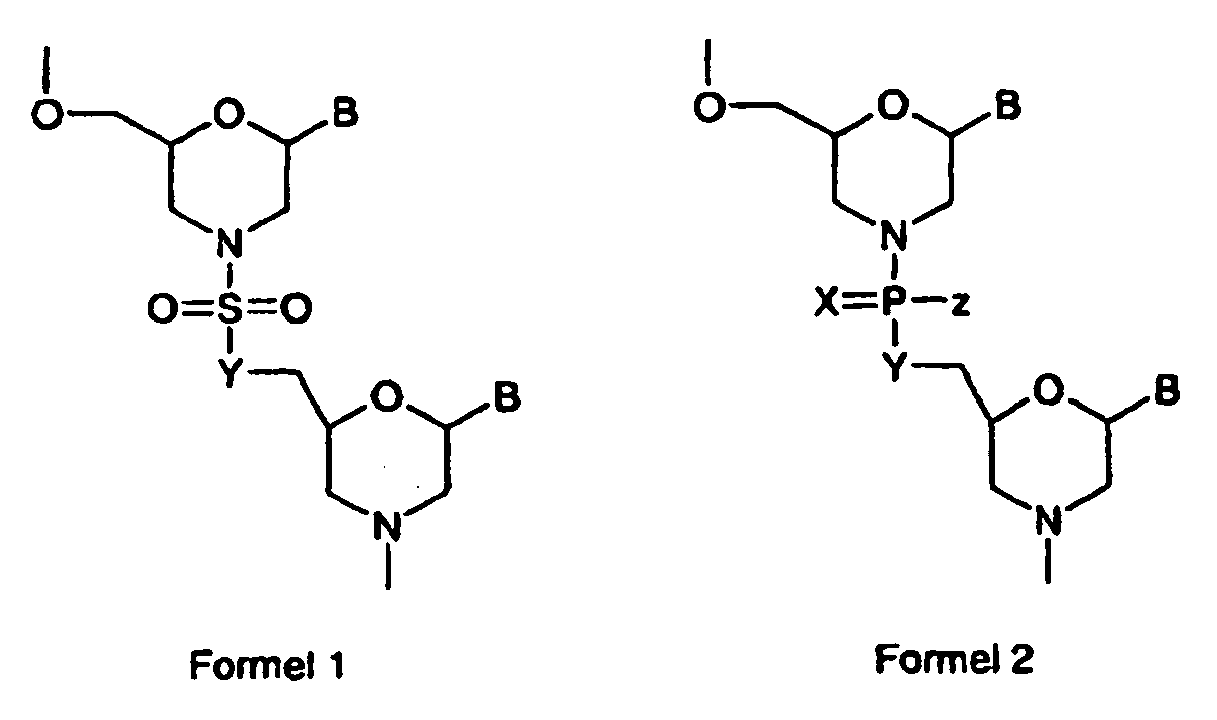
- Besonders bevorzugt sind Morpholin-Oligoribonukleotide bei denen die Morpholinreste über Sulfonyl- oder vorzugsweise Phosphorylgruppen miteinander verbunden sind, wie in Formel 1 oder 2 zu sehen ist:
- B steht für eine modifizierte oder nicht modifizierte Purin- oder Pyrimidinbase, vorzugsweise für Adenin, Cytosin, Guanin, oder Uracil,
- X steht für O oder S, vorzugsweise O,
- Y steht für O oder N-CH3, vorzugsweise O,
- Z steht für Alkyl, O-Alkyl, S-Alkyl, NH2, NH(Alkyl), NH(O-Alkyl), N(Alkyl)2, N(Alkyl)(O-Alkyl), vorzugsweise N(Alkyl) 2, wobei Alkyl für lineare oder verzweigte Alkylgruppen mit 1 bis 6 vorzugsweise 1 bis 3 und besonders bevorzugt 1 oder 2 Kohlenstoffatomen steht.
- Die Formeln 1 und 2 stellen jeweils nur einen Ausschnitt aus einer Oligoribonukleotidkette dar.
- Ganz besonders bevorzugt sind Morpholin-Oligoribonukleotide bei denen die Morpholinreste über Phosphorylgruppen miteinander verbunden sind, wie in Formel 2 gezeigt ist, bei denen X für O, Y für O und Z für N(CH3) 2 steht.
- Weiterhin können die Ribosereste durch Amino-, wie NH2, Fluor, Alkyl oder O-Alkylreste, wie OCH3, modifiziert werden, wobei 2'-modifizierte Oligoribonukleotide besonders bevorzugt sind. Beispielhafte Modifikationen sind 2'-Fluoro-, 2'-Alkyl-, 2'-O-Alkyl-, 2'-O-Methoxyethyl-Modifikationen, 5'-Palmitat-Derivate und 2'-O-Methylribonukleotide.
- Die Modifizierung der Nukleotide von dsRNA wirkt in der Zelle einer Aktivierung der Proteinkinase PKR entgegen, die von doppelsträngiger RNA abhängig ist. Hierdurch wird eine unspezifische Inhibition der Translation vermieden. Zu diesem Zweck eignet sich insbesondere die Substitution mindestens einer 2'-Hydroxylgruppe der Nukleotide der dsRNA durch eine 2'-Amino- oder eine 2'-Methylgruppe. Weiterhin kann mindestens ein Nukleotid in mindestens einem Strang der dsRNA durch ein sogenanntes "locked nucleotide" ersetzt sein, das einen chemisch modifizierten Zuckerring enthält. Eine bevorzugte Modifikation des Zuckerrings ist eine 2'-O, 4'-C-Methylenbrücke. dsRNA, die mehrere "locked nucleotides" enthält, ist bevorzugt.
- Wenn nicht anders angegeben, steht Alkyl hierin vorzugsweise für lineare, verzweigte oder cyclische Alkylgruppen mit 1 bis 30, vorzugsweise 1 bis 20, besonders bevorzugt 1 bis 10 und ganz besonders bevorzugt 1 bis 6 Kohlenstoffatomen. Verzweigte und cyclische Reste weisen naturgemäß mindestens 3 Kohlenstoffatome auf, wobei cyclische Reste mit mindestens 5 und insbesondere mindestens 6 Kohlenstoffatomen bevorzugt sind.
- Ebenso können Oligoribonukleotide verwendet werden, die α-Nukleoside enthalten.
- Geeignete Basenmodifikationen werden z.B. in der
US 6,187 578 und derWO 99/53101 - Die Synthese modifizierter und nicht modifizierter Oligoribonukleotide sowie weitere geeignete Modifikationsmöglichkeiten sind in der Literatur beschrieben. Zudem wird die Herstellung modifizierter und nichtmodifizierter Oligoribonukleotide inzwischen auch von zahlreichen Firmen als Dienstleitung angeboten, beispielsweise von den Firmen Dharmacon, 1376 Miners Drive#101, Lafayette, CO 80026, USA, Xeragon Inc., Genset Oligos und Ambion. Die Herstellung von Oligoribonukleotiden wird darüber hinaus auch in der
US 5,986,084 beschrieben. - Zur Erhöhung der Stabilität und/oder der Penetration können die Oligoribonukleotide auch in verkapselter Form verwendet werden, beispielsweise verkapselt in Liposomen. Außerdem können sie durch die Zugabe von Cyclodextrinen stabilisiert werden.
- Cyclodextrine werden auch als Cycloamylosen und Cycloglucane bezeichnet. Es handelt sich bei den Cyclodextrinen um zyklische Oligosaccharide bestehend aus α-1,4 verknüpften Glucosebausteinen. In der Regel sind sechs bis acht Glucosebausteine (α-,β, bzw. γ-Cyclodextrin) miteinander verbunden. Cyclodextrine werden bei Einwirkung von Bacillus macerans auf Stärke erhalten. Sie besitzen einen hydrophoben Innenraum und eine hydrophile Außenseite. Erfindungsgemäß sind sowohl die Cyclodextrine selbst, insbesondere α-Cyclodextrin, β-Cyclodextrin und γ-Cyclodextrin, als auch Derivate davon geeignet.
- Erfindungsgemäß werden das oder die Cyclodextrine in kosmetischen und dermatologischen Zusammensetzungen vorzugsweise in einer Konzentration von 0.0005 bis 20.0 Gew.-%, insbesondere 0,01 bis 10 Gew.- % und besonders bevorzugt in einer Konzentration von 0.1 bis 5.0 Gew.-% eingesetzt.
- Es ist erfindungsgemäß vorteilhaft native, polar- und/oder unpolar- substituierte Cyclodextrine einzusetzen. Hierzu gehören vorzugsweise aber nicht ausschließlich Methyl-, insbesondere random-Methyl-β-Cyclodextrin, Ethylsowie Hydroxypropyl-Cyclodextrine, beispielsweise Hydroxypropyl-β-Cyclodextrin und Hydroxypropyl-β-cyclodextrin.
Die erfindungsgemäß besonders bevorzugten Cyclodextrinspezies sind γ-Cyclodextrin und Hydroxypropyl-β-Cylcodextrin. - Liposomen lassen sich auf an sich bekannte Weise unter Verwendung natürlicher Phospholipide, wie z.B. Phosphatidylcholin aus Eiern, Sojabohnen etc., oder synthetischer Phospholipide herstellen (vgl. G. Betageri (Herausgeber), "Liposome Drug Delivery Systems", Lancaster Techonomic Publishing Company 1993; Gregoriadis (Herausgeber), "Liposome Technology", CRC Press). Bevorzugte Verfahren und Materialien zur Herstellung von Liposomen werden in der
WO 99/24018 - Doppelsträngige Oligoribonukleotide können zudem modifiziert werden, um einer Dissoziation in die Einzelstränge entgegenzuwirken, beispielsweise durch eine oder mehrere kovalente, koordinative oder ionische Bindungen. Oligoribonukleotide ohne derartige Modifikationen sind jedoch bevorzugt.
- Die Nukleotide in den RNA Molekülen können weiterhin auch "non-standard" Nukleotide, wie z.B. nicht natürlich vorkommende Nukleotide oder Desoxyribonukleotide umfassen.
- Erfindungsgemäß sind solche Oligoribonukleotide bevorzugt, die die Expression des jeweiligen Zielgens im Verglich zu unbehandelten Zellen um mindestens 40 %, vorzugsweise um mindestens 60 %, besonders bevorzugt um mindestens 80 % und ganz besonders bevorzugt um mindestens 85 % inhibieren. Falls erforderlich, wird zur Messung der Inhibierung die Expression des Zielgens in den Zellen zunächst auf geeignete Weise induziert. Zur Bestimmung der Wirksamkeit der erfindungsgemäßen Oligoribonukleotide werden vorzugsweise tumorale Zellen der Linie HeLaS3 verwendet. Die Oligoribonukleotide werden in die Zellen eingebracht und anschließend, ggf. nach Induktion der Expression des Zielgens, die Expressionsrate des Zielgens in diesen Zellen gemessen und mit derjenigen verglichen,
die in Zellen gefunden wird, die nicht mit dem jeweiligen Oligoribonukleotid transfiziert wurden. Die genauen Bedingungen zur Messung der Inhibition finden sich in Beispiel 1. - Die erfindungsgemäßen Oligoribonukleotide und deren Salze eignen sich besonders als wirksamer Bestandteil von pharmazeutischen und kosmetischen Zusammensetzungen, insbesondere solchen zur topischen Anwendung.
- Es hat sich überraschenderweise herausgestellt, dass die Oligoribonukleotide nach dem Aufbringen der Zusammensetzungen auf die Kopfhaut oder Haut die Expression der Gene inhibieren, die für die Inhibition der Wachstumsphase des Haarfollikels verantwortlich sind, und so den Haarwuchs nebenwirkungsfrei steigern oder vermindern und auf diese Weise eine wirksame Behandlung und Prophylaxe des verminderten (Haarausfall, Haarminiaturisierung) wachstums von Haaren der Kopfhaut oder des Körpers ermöglichen, ohne die Nachteile des Standes der Technik zu zeigen. Es wird angenommen, dass diese Wirkung darauf zurückzuführen ist, dass die erfindungsgemäßen Oligoribonukleotide von den Zellen des Haarfollikels aufgenommen werden und intrazellulär den Abbau der mRNAs der genannten Gene durch RNAi induzieren, wobei Einzelheiten des Mechanismus dieser Reaktionskaskade noch nicht bekannt sind. Die Oligoribonukleotide eignen sich daher besonders zur Initiierung des Abbaus von mRNA von Haarwuchs inhibierenden Proteinen oder Enzymen und zur Inhibierung der Expression der Haarwuchs inhibierenden Proteine oder Enzyme in der Kopfhaut oder Haut und insbesondere in Haarfollikelzellen.
- Die erfindungsgemäßen Zusammensetzungen können zusätzlich ein oder mehrere Oligoribonukleotide enthalten, die die Expression der Proteinkinase PKR inhibiert und so einer unspezifischen Inhibition der Translation entgegenwirken.
- Die erfindungsgemäßen pharmazeutischen oder kosmetischen Zusammensetzungen enthalten vorzugsweise 0,00001 bis 10 Gew.-%, besonders bevorzugt 0,0003 bis 3 Gew.-% und ganz besonders bevorzugt 0,01 bis 1,0 des oder der erfindungsgemäßen Oligoribonukleotide, bezogen auf das Gesamtgewicht der Zusammensetzung. Bei der Verwendung von Oligorbinonukleotiden, die in Vektoren integriert sind, bezieht sich die obige Mengenangabe auf die Masse der in den Vektor integrierten Oligoribonukleotide, die Masse des Vektors selbst wird nicht berücksichtigt.
- Erfindungsgemäß sind solche Zusammensetzungen bevorzugt, die ausschließlich solche Oligoribonukleotide enthalten, die die Expression eines oder mehrerer der oben genannten Gene, d.h. von den Haarzyklus inhibierenden Genen und ggf. der Proteinase PKR, und insbesondere der genannten bevorzugten Gene inhibieren. Die erfindungsgemäßen Zusammensetzungen können ein oder vorzugsweise mehrere Oligoribonukleotide enthalten. Hierbei kann es sich um Oligoribonukleotide handeln, die die Expression mehrerer unterschiedlicher Haarzyklus inhibierender Proteine oder Enzyme inhibieren, es können aber auch Gemische von Oligoribonukleotiden eingesetzt werden, die verschiedene Sequenzbereiche ein und desselben Gens oder derselben mRNA eines Haarzyklus inhibierenden Proteins oder Enzyms zum Ziel haben. Bevorzugt sind Zusammensetzungen, die 1 bis 5 und insbesondere 1 bis 3 verschiedene Oligoribonukleotide enthalten. Mischungen von Oligoribonukleotiden, die neben den genannten Haarzyklus inhibierenden Proteinen oder Enzymen und ggf. der Proteinase PKR unspezifisch die Aktivität einer Vielzahl von anderen Haut- bzw. Haarproteinen inhibieren sind unerwünscht, da praktisch keine Kontrolle von Nebenwirkungen möglich ist. Unter Haut- bzw. Haarproteinen werden solche Proteine verstanden, die in der Haut bzw. im Haarfollikel exprimiert werden. Ganz besonders bevorzugt sind Zusammensetzungen, die ein oder mehrere Oligoribonukleotide enthalten, die die Expression eines oder mehrerer TGFbeta-Faktoren inhibieren.
- Die Oligoribonukleotide und Zusammensetzungen eignen sich zur Behandlung und Prophylaxe alters- und umweltbedingter degenerativer und defizitärer Erscheinungen der Haarfollikel, der Haut und von Hautanhanggebilden, wie Drüsen, insbesondere der oben beschriebenen Symptome. Sie eignen sich zur kosmetischen und therapeutischen Behandlung degenerativer Zustände des Haarfollikels, die durch endogene und exogene Faktoren, wie Durchblutungsstörungen, verringerte Energieversorgung der Haarwurzel und insbesondere hormonelle Einflüsse hervorgerufen werden. Die erfindungsgemäßen Zusammensetzungen können Schäden des Haarfollikels vorbeugen und vorhandene Schäden dauerhaft und ohne das Risiko von Nebenwirkungen beheben. Zur Bestimmung der Wirksamkeit der erfindungsgemäßen Oligoribonukleotide kann beispielsweise das in der
WO02/053773 - Die Oligoribonukleotide und Zusammensetzungen eignen sich zur Prophylaxe und Behandlung von Haarausfall, Haarfollikelminiaturisierung, dünner werdendem Haar, Depigmentierungserscheinungen des Haares, dystrophischen Veränderungen der Haarwurzel
- Auf Grund ihrer prophylaktischen Wirkung eignen sich die erfindungsgemäßen Oligoribonukleotide und Zusammensetzungen auch hervorragend zur Haar-, Kopfhaut- und Hautpflege.
- Weiter eignen sich die erfindungsgemäßen Zusammensetzungen zur Behandlung der durch verminderte Nährstoff- und/ oder Sauerstoffversorgung, z.B. aufgrund altersbedingter Reduktion der perifollikulären Kapillargefäße und der Kapillarschlinge in der follikulären Papille, hervorgerufenen Defizite des Haarfollikels.
- Der erfindungsgemäßen Zusammensetzungen eignen sich zur kosmetischen und therapeutischen, d.h. insbesondere dermatologischen Anwendung.
- Unter kosmetischer Hautpflege ist in erster Linie zu verstehen, dass die natürliche Funktion der Haut bzw. Kopfhaut als Barriere gegen Umwelteinflüsse (z. B. Schmutz, Chemikalien, Mikroorganismen) und gegen den Verlust von körpereigenen Stoffen (z. B. Wasser, natürliche Fette, Elektrolyte) gestärkt oder wiederhergestellt wird. Wird diese Funktion gestört, kann es zu verstärkter Resorption toxischer oder allergener Stoffe oder zum Befall von Mikroorganismen und als Folge zu toxischen oder allergischen Hautreaktionen kommen. Ziel der Hautpflege ist es ferner, den durch tägliches Waschen verursachten Fett- und Wasserverlust der Haut auszugleichen. Dies ist gerade dann wichtig, wenn das natürliche Regenerationsvermögen nicht ausreicht. Außerdem sollen Hautpflegeprodukte vor Umwelteinflüssen, insbesondere vor Sonne und Wind, schützen.
- Zur kosmetischen Anwendung enthalten die erfindungsgemäßen Zusammensetzungen daher vorzugsweise solche Komponenten, die für die genannten Zwecke geeignet sind. Solche Substanzen sind dem Fachmann an sich bekannt. Beispielsweise können ein oder mehrere Oligoribonukleotide in übliche kosmetische und dermatologische Zubereitungen eingearbeitet werden, welche in verschiedenen Formen vorliegen können.
- Zur Anwendung werden die erfindungsgemäßen Zubereitungen vorzugsweise direkt auf die Kopfhaut oder Körperhaut aufgebracht, und zwar in der für solche Mittel bekannten Weise, beispielsweise zweimal täglich.
- Geeignet sind z.B. Lösungen, Gele, Salben, Suspensionen oder Emulsionen wie Cremes oder Lotionen mit einem Gehalt an den erfindungsgemäßen Wirkstoffen.
- Gemäß einer besonders bevorzugten Ausführungsform liegen die erfindungsgemäßen Zusammensetzungen zur kosmetischen Anwendung als Haarbehandlungsmittel vor, insbesondere als solche, die im Haar verbleiben oder mit längerer Einwirkzeit verwendet werden. Auf diese Weise gelangen die Wirkstoffe in oder auf die Kopfhaut oder in den Bereich der Haarwurzeln. Haarbehandlungsmittel, die nur kurze Zeit mit der Haut oder den Haaren in Berührung kommen, z.B. Shampoos, können beispielsweise höhere Wirkstoffanteile haben.
- Haarbehandlungsmittel sind beispielsweise Haarwaschmittel, Haarpflegemittel wie Haarwässer, Frisierhilfsmittel, Haarspülungen, Haarkuren, Kurpackungen, Haarfestiger wie Schaumfestiger, Haarspray, Haarlack, Haarverformungsmittel und Haarfärbemittel.
- Es ist weiter besonders bevorzugt, die beschriebenen Oligoribonukleotide in Zubereitungen einzusetzen, die nicht in erster Linie zur Behandlung des Haares vorgesehen sind. Das können alle denkbaren kosmetischen und/oder dermatologischen Zubereitungen sein
- Analoges gilt für Hautpflegezubereitungen, die zur Anwendung im Gesicht oder auf den Beinen oder auf sonstigen Körperteilen, auf denen Haarwuchs als störend angesehen wird, eignen. Hierbei liegen, gemäß einer besonders bevorzugten Ausführungsform, die erfindungsgemäßen Zusammensetzungen zur kosmetischen Anwendung als Emulsion vor, z.B. in Form einer Creme, einer Lotion, einer kosmetischen Milch. Diese enthalten neben den genannten Oligoribonukleotiden weitere Komponenten wie z.B. Fette, Öle, Wachse und/oder andere Fettkörper, sowie Wasser und einen oder mehrere Emulgatoren, wie sie üblicherweise für einen solchen Typ der Formulierung verwendet werden.
- Emulsionen enthalten in der Regel eine Lipid- oder Ölphase eine wäßrige Phase und vorzugsweise auch einen oder mehrere Emulgatoren. Besonders bevorzugt sind Zusammensetzungen, die darüber hinaus auch ein oder mehrere Hydrocolloide enthalten.
- Die erfindungsgemäßen Zusammensetzungen enthalten vorzugsweise 0,001 bis 35 Gew.-%, besonders bevorzugt 2 bis 15 Gew.-% Emulgator, 0,001 bis 45 Gew.-%, besonders bevorzugt 10 bis 25 Gew.-% Lipid und 10 bis 95 Gew.-%, besonders bevorzugt 60 bis 90 Gew.-% Wasser.
- Das Weglassen eines einzelnen Bestandteile beeinträchtigt die einzigartigen Eigenschaften der Gesamtzusammensetzung. Daher sind alle angegebenen Bestandteile der erfindungsgemäßen Zubereitungen zwangsläufig erforderlich, um die Erfindung auszuführen.
- Die kosmetischen Zubereitungen gemäß der Erfindung können kosmetische Hilfsstoffe enthalten, wie sie üblicherweise in solchen Zubereitungen verwendet werden, z.B. Konservierungsmittel, Bakterizide, desodorierend wirkende Substanzen, Antitranspirantien, Insektenrepellentien, Vitamine, Mittel zum Verhindern des Schäumens, Farbstoffe. Pigmente mit färbender Wirkung, Verdickungsmittel, weich machende Substanzen, anfeuchtende und/oder feuchthaltende Substanzen, Fette, Öle, Wachse oder andere übliche Bestandteile einer kosmetischen Formulierung wie Alkohole, Polyole, Polymere, Schaumstabilisatoren, Elektrolyte, organische Lösungsmittel oder Silikonderivate, Antioxidantien und insbesondere UV-Absorber.
- Vorteilhaft können Zubereitungen gemäß der Erfindung außerdem Substanzen enthalten, die UV-Strahlung im UVB-Bereich absorbieren, wobei die Gesamtmenge der Filtersubstanzen z.B. 0,1 Gew.-% bis 30 Gew.-%, vorzugsweise 0,5 bis 10 Gew.-%, insbesondere 1,0 bis 6,0 Gew.-% beträgt, bezogen auf das Gesamtgewicht der Zubereitungen, um kosmetische Zubereitungen zur Verfügung zu stellen, die das Haar bzw. die Haut vor dem gesamten Bereich der ultravioletten Strahlung schützen. Sie können auch als Sonnenschutzmittel fürs Haar dienen.
- Vorteilhafte UV-A-Filtersubstanzen im Sinne der vorliegenden Erfindung sind Dibenzoylmethanderivate, insbesondere das 4-(tert.-Butyl)-4'-methoxydibenzoylmethan (CAS-Nr. 70356-09-1), welches von Givaudan unter der Marke Parsol® 1789 und von Merck unter der Handelsbezeichnung Eusolex® 9020 verkauft wird.
- Die Zubereitungen gemäß der Erfindung enthalten vorteilhaft Substanzen, die UV-Strahlung im UV-A- und/ oder UV-B-Bereich absorbieren, wobei die Gesamtmenge der Filtersubstanzen z. B. 0,1 Gew.-% bis 30 Gew.-%, vorzugsweise 0,5 bis 20 Gew.-%, insbesondere 1,0 bis 15,0 Gew.-% beträgt, bezogen auf das Gesamtgewicht der Zubereitungen, um kosmetische Zubereitungen zur Verfügung zu stellen, die das Haar bzw. die Haut vor dem gesamten Bereich der ultravioletten Strahlung schützen. Sie können auch als Sonnenschutzmittel fürs Haar oder die Haut dienen.
- Weitere vorteilhafte UV-A-Filtersubstanzen sind die Phenylen-1,4-bis-(2-benzimidazyl)-3,3'-5,5'-tetrasulfon-säure


- Ferner vorteilhaft sind das 1,4-di(2-oxo-10-Sulfo-3-bomylidenmelhyl)-Benzol und dessen Salze (besonders die entsprechenden 10-Sulfato-verbindungen, insbesondere das entsprechende Natrium-, Kalium- oderTriethanolammonium-Salz), das auch als Benzol-1,4-di(2-oxo-3-bornylidenmethyl-10-sulfonsäure) bezeichnet wird und sich durch die folgende Struktur auszeichnet:
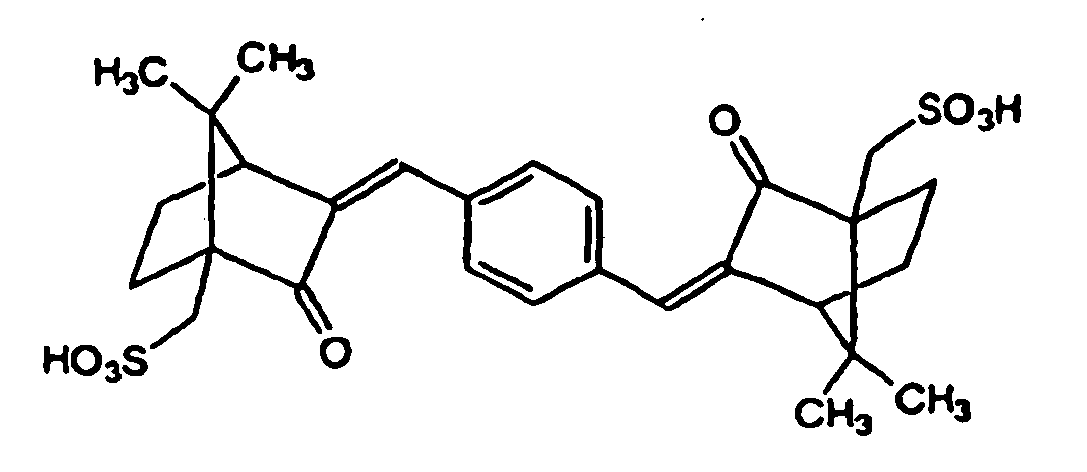
- Vorteilhafte UV-Filtersubstanzen im Sinne der vorliegenden Erfindung sind ferner sogenannte Breitbandfilter, d.h. Filtersubstanzen, die sowohl UV-A- als auch UV-B-Strahlung absorbieren.
- Vorteilhafte Breitbandfilter oder UV-B-Filtersubstanzen sind beispielsweise Bis-Resorcinyltriazinderivate mit der folgenden Struktur:

- Auch andere UV-Filtersubstanzen, welche das Strukturmotiv

EP 570 838 A1 
- R
- einen verzweigten oder unverzweigten C1-C18-Alkylrest, einen C5-C12-Cycloalkyl-rest, gegebenenfalls substi- tuiert mit einer oder mehreren C1-C4- Alkylgruppen, darstellt,
- X
- ein Sauerstoffatom oder eine NH-Gruppe darstellt,
- R1
- einen verzweigten oder unverzweigten C1-C18-Alkylrest, einen C5-C12-Cycloalkylrest, gegebenenfalls substitu- iert mit einer oder mehreren C1-C4- Alkylgruppen, oder ein Wasserstoffatom, ein Alkalimetallatom, eine Ammo- niumgruppe oder eine Gruppe der Formel

A einen verzweigten oder unverzweigten C1-C18-Alkylrest, einen C5-C12-Cyclaalkyl- oder Arylrest darstellt, gegebenenfalls substituiert mit einer oder mehreren C1-C4- Alkylgruppen,
R3 ein Wasserstoffatom oder eine Methylgruppe darstellt,
n eine Zahl von 1 bis 10 darstellt, - R2
- einen verzweigten oder unverzweigten C1-C18-Alkylrest, einen C5-C12-Cycloalkylrest, gegebenenfalls substitu- iert mit einer oder mehreren C1-C4- Alkylgruppen, darstellt, wenn X die NH-Gruppe darstellt, und einen verzweigten oder unverzweigten C1-C18-Alkylrest, einen C5-C12-Cycloalkylrest, gegebenenfalls substitu- iert mit einer oder mehreren C1-C4- Alkylgruppen, oder ein Wasserstoffatom, ein Alkalimetallatom, eine Ammo- niumgruppe oder eine Gruppe der Formel
- A
- einen verzweigten oder unverzweigten C1-C18-Alkylrest, einen C5-C12-Cyclo-alkyl- oder Arylrest darstellt, gegebenenfalls substituiert mit einer oder mehreren C1-C4- Alkylgruppen,
- R3
- ein Wasserstoffatom oder eine Methylgruppe darstellt,
- n
- eine Zahl von 1 bis 10 darstellt,
wenn X ein Sauerstoffatom darstellt. - Eine besonders vorteilhafte UV-Filtersubstanz im Sinne der vorliegenden Erfindung ist ferner ein unsymmetrisch substituiertes s-Triazin, dessen chemische Struktur durch die Formel
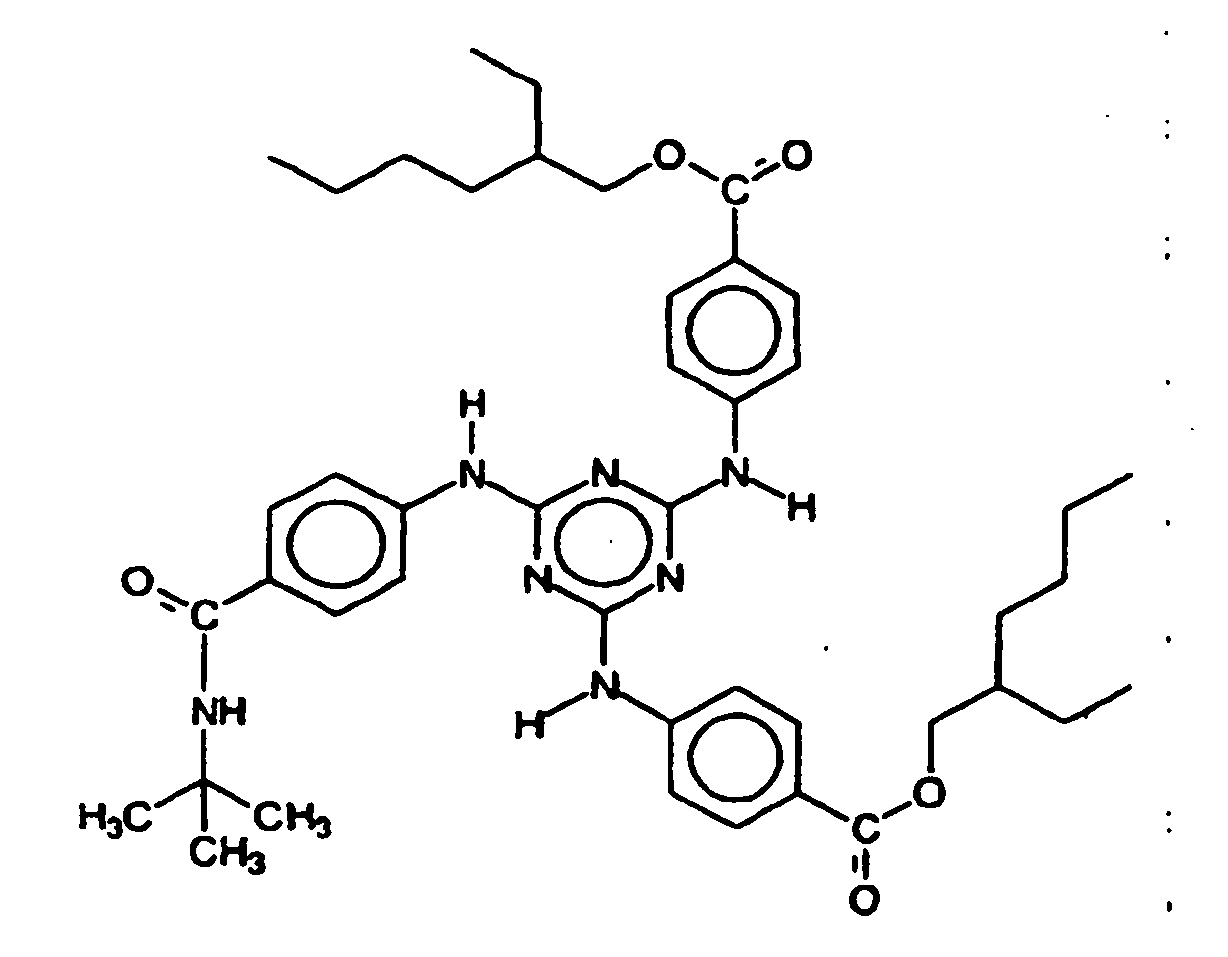
- Auch in der Europäischen Offenlegungsschrift
EP 775 698 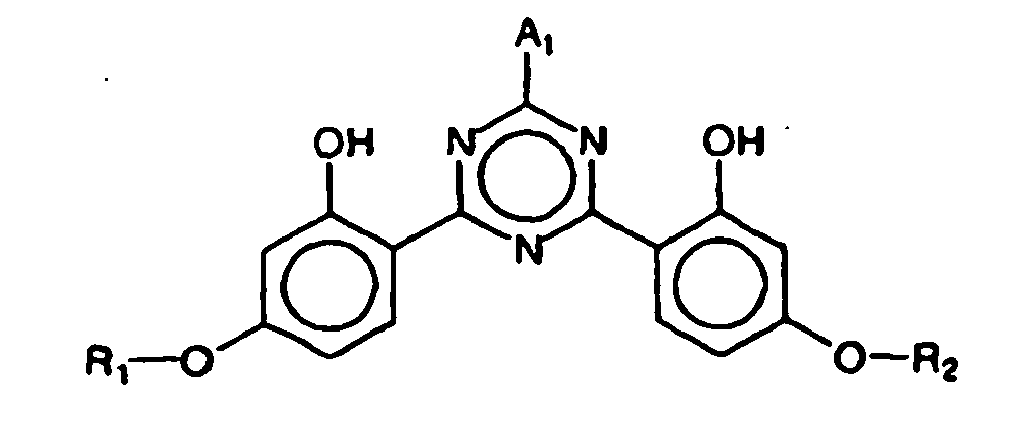
- Vorteilhaft im Sinne der vorliegenden Erfindung sind ferner das 2,4-Bis-{[4-(3-sulfonato)-2-hydroxy-propyloxy)-2-hydroxy]-phenyl}-6-(4-methoxyphenyl)-1,3,5-triazin Natriumsalz, das 2,4-Bis-{[4-(3-(2-Propytoxy)-2-hydroxy-propyloxy)-2-hydroxy]-pheny}-6-(4-methoxypheny)-1,3,5-triazin, das 2,4-Bis-{[4-(2-ethyl-hexyloxy)-2-hydroxy]-phenyl}-6-[4-(2-methoxyethyl-carboxyl)-phenylamino]-1,3,5-triazin, das 2,4-Bis-{[4-(3-(2-propyloxy)-2-hydroxy-propyloxy)-2-hydroxy]-phenyl}-6-[4-(2-ethyl-carboxyl)-phenylamino]-1,3,5-triazin, das 2,4-Bis-{[4-(2-ethyl-hexyloxy)-2-hydroxy]-phenyl}-6-(1-methyl-pyrrol-2-yl)-1,3,5-triazin, das 2,4-Bis-{[4-tris(trimethyisiloxy-silylpropyloxy)-2-hydroxy]-phenyl}-6-(4-methoxyphenyl)-1,3,5-triazin, das 2,4-Bis-{[4-(2"-methytpropenyloxyl)-2-hydroxy]-phenyl}-6-(4-methoxyphenyl)-1,3,5-triazin und das 2,4-Bis-{[4-(1',1',1',3',5',5',5'-Heptamethylsiloxy-2"-methyl-propyloxy)-2-hydroxy]-phenyl-6-(4-methoxyphenyl)-1,3,5-triazin.
- Ein vorteilhafter Breitbandfilter im Sinne der vorliegenden Erfindung ist das 2,2'-Methylen-bis-(6-(2H-benzotriazol-2-yl)-4-(1,1,3,3-tetramethylbutyl)-phenol) [INCI: Bisoctyltriazol], welches durch die chemische Strukturformel

- Vorteilhafter Breitbandfilter im Sinne der vorliegenden Erfindung ist ferner das 2-(2H-benzotriazo-2-yl)-4-methyl-6-[2-methyl-3-[1,3,3 ,3-tetramethyl-1-[(trimethylsilyl)oxy]disiloxanyl]propyl]-phenol (CAS-Nr.: 155633-54-8) mit der INCI-Bezeichnung Drometrizole Trisiloxane, welches durch die chemische Strukturformel

- Die UV-B-Filter können öllöslich oder wasserlöslich sein. Vorteilhafte öllösliche UV-B-Filtersubstanzen sind z. B.: 3-Benzylidencampher-Derivate, vorzugsweise 3-(4-Methylbenzyliden)campher, 3-Benzylidencampher; 4-Aminobenzoesäure-Derivate, vorzugsweise 4-(Dimethylamino)-benzoesäure(2-ethylhexyl)ester, 4-(Dimethylamino)ben-zoesäureamylester; 2,4,6-Trianilino-(p-carbo-2''-ethyl-1'-hexyloxy)-1,3,5-triazin; Ester der Benzalmalonsäure, vorzugsweise 4-Methoxybenzalmalonsäuredi(2-ethylhexyl)ester; Ester der Zimtsäure, vorzugsweise 4-Methoxyzimtsäure (2-ethylhexyl)ester, 4-Methoxyzimtsäureisopentylester; Derivate des Benzophenons, vorzugsweise 2-Hydroxy-4-methoxybenzophenon, 2-Hydroxy-4-methoxy-4'-methylbenzophenon, 2,2'-Dihydroxy-4-methoxybenzophenon sowie an Polymere gebundene UV-Filter.
- Vorteilhafte wasserlösliche UV-B-Filtersubstanzen sind z. B. Salze der 2-Phenylbenzimidazol-5-sulfonsäure, wie ihr Natrium-, Kalium- oder ihr Triethanolammonium-Salz, sowie die Sulfonsäure selbst; Sulfonsäure-Derivate des 3-Benzylidencamphers, wie z. B. 4-(2-Oxo-3-bomylidenmethyl)benzolsulfonsäure, 2-Methyl-5-(2-oxo-3-bomyliden-methyl)sulfonsäure und deren Salze.
- Eine weiterere erfindungsgemäß vorteilhaft zu verwendende Lichtschutzfiltersubstanz ist das Ethythexyl-2-cyano-3,3-diphenylacrylat (Octocrylen), welches von BASF unter der Bezeichnung Uvinul® N 539 erhältlich ist und sich durch folgende Struktur auszeichnet:

- Es kann auch von erheblichem Vorteil sein, polymergebundene oder polymere UV-Filtersubstanzen in Zubereitungen gemäß der vorliegenden Erfindung zu verwenden, insbesondere solche, wie sie in der
WO-A-92/20690 - Ferner kann es gegebenenfalls von Vorteil sein, erfindungsgemäß weitere UV-A-und/oder UV-B-Filter in kosmetische oder dermatologische Zubereitungen einzuarbeiten, beispielsweise bestimmte Salicylsäurederivate wie 4-Isopropylbenzylsalicylat, 2-Ethylhexylsalicylat (= Octylsalicylat), Homomenthylsalicylat.
- Die Liste der genannten UV-Filter, die im Sinne der vorliegenden Erfindung eingesetzt werden können, soll selbstverständlich nicht limitierend sein.
- Weiterhin können die erfindungsgemäßen Zusammensetzungen Antioxidantien zum Schutz der kosmetischen Zubereitung selbst bzw. zum Schutz der Bestandteile der kosmetischen Zubereitungen vor schädlichen Oxidationsprozessen enthalten.
- Vorteilhaft werden die Antioxidantien gewählt aus der Gruppe bestehend aus Aminosäuren (z.B. Glycin, Histidin, Tyrosin, Tryptophan) und deren Derivate, Imidazole (z.B. Urocaninsäure) und deren Derivate, Peptide wie D, L-Camosin, D-Camosin, L-Camosin und deren Derivate (z.B. Anserin), Carotinoide, Carotine (z.B. α-Carotin, β-Carotin, Lycopin) und deren Derivate, Aurothioglucose, Propylthiouracil und andere Thiole (z.B. Thioredoxin, Glutathion, Cystein, Cystin, Cystamin und deren Glycosyl-, N-Acetyl-, Methyl-, Ethyl-, Propyl-, Amyl-, Butyl- und Lauryl-, Palmitoyl-, Oleyl-, γ-Linoleyl-, Cholesteryl-und Glycerylester) sowie deren Salze, Dilaurylthiodipropionat, Distearylthiodipropionat, Thiodipropionsäure und deren Derivate (Ester, Ether, Peptide, Lipide, Nukleotide, Nukleoside und Salze) sowie Sulfoximinverbindungen (z.B. Buthioninsulfoximine, Homocysteinsulfoximin, Buthioninsulfone, Penta-, Hexa-, Heptathioninsulfoximin) in sehr geringen verträglichen Dosierungen (z.B. pmol bis µmol/kg), ferner (Metall)-Chelatoren (z. B. α-Hydroxyfettsäuren, Palmitinsäure, Phytinsäure, Lactoferrin), α-Hydroxysäuren (z.B. Citronensäure, Milchsäure, Apfelsäure), Huminsäure, Gallensäure, Gallenextrakte, Bilirubin, Biliverdin, EDTA, EGTA und deren Derivate, ungesättigte Fettsäuren und deren Derivate (z.B. γ-Linolensäure, Linolsäure, Ölsäure), Folsäure und deren Derivate, Alanindiessigsäure, Flavonoide, Polyphenole, Catechine, Vitamin C und Derivate (z.B. Ascorbylpalmitat, Mg-Ascorbylphosphat, Ascorbylacetat), Tocopherole und Derivate (z.B. Vitamin-E-acetat), sowie Koniferylbenzoat des Benzoëharzes, Rutinsäure und deren Derivate, Ferulasäure und deren Derivate, Butylhydroxytoluol, Butylhydroxyanisol, Nordihydroguajakharzsäure, Nordihydroguajaretsäure, Trihydroxybutyrophenon, Harnsäure und deren Derivate, Mannose und deren Derivate, Zink und dessen Derivate (z.B. ZnO, ZnSO4) Selen und dessen Derivate (z.B. Selenmethionin), Stilbene und deren Derivate (z.B. Stilbenoxid, Trans-Stilbenoxid) und die erfindungsgemäß geeigneten Derivate (Salze. Ester, Ether, Zucker, Nukleotide, Nukleoside, Peptide und Lipide) dieser genannten Wirkstoffe.
- Die Menge der Antioxidantien (eine oder mehrere Verbindungen) in den Zubereitungen beträgt vorzugsweise 0,001 bis 30 Gew.-%, besonders bevorzugt 0,05 - 20 Gew.-%, insbesondere 1 - 10 Gew.-%, bezogen auf das Gesamtgewicht der Zubereitung.
- Sofern Vitamin A bzw. Vitamin-A-Derivate, bzw. Carotine bzw. deren Derivate das oder die Antioxidantien darstellen, ist vorteilhaft, deren jeweilige Konzentrationen aus dem Bereich von 0,001 bis 10 Gew.-%, bezogen auf das Gesamtgewicht der Formulierung, zu wählen.
- Sofern Vitamin E und/oder dessen Derivate das oder die Antioxidantien darstellen, ist vorteilhaft, deren jeweilige Konzentrationen aus dem Bereich von 0,001 bis 10 Gew.-%, bezogen auf das Gesamtgewicht der Formulierung, zu wählen.
- Erfindungsgemäß enthalten kosmetische und dermatologische Zubereitungen vorteilhaft außerdem anorganische Pigmente auf Basis von Metalloxiden und/oder anderen in Wasser schwerlöslichen oder unlöslichen Metallverbindungen, insbesondere der Oxide des Titans (TiO2).Zinks (ZnO), Eisens (z.B. Fe2O3). Zirkoniums (ZrO2), Siliciums (SiO2), Mangans (z.B. MnO), Aluminiums (Al2O3), Cers (z.B. Ce2C3), Mischoxiden der entsprechenden Metalle sowie Abmischungen aus solchen Oxiden. Besonders bevorzugt handelt es sich um Pigmente auf der Basis von TiO2.
- Es ist besonders vorteilhaft im Sinne der vorliegenden Erfindung, wenngleich nicht zwingend, wenn die anorganischen Pigmente in hydrophober Form vorliegen, d.h., dass sie oberflächlich Wasser abweisend behandelt sind. Diese Oberflächenbehandlung kann darin bestehen, dass die Pigmente nach an sich bekannten Verfahren mit einer dünnen hydrophoben Schicht versehen werden.
- Eines solcher Verfahren besteht beispielsweise darin, dass die hydrophobe Oberflächenschicht nach einer Rektion gemäß
n TiO2+ m (RO)3 Si-R' -> n TiO2 (oberfl.)
erzeugt wird. n und m sind dabei nach Belieben einzusetzende stöchiometrische Parameter, R und R' die gewünschten organischen Reste. Beispielsweise in Analogie zuDE-OS 33 14 742 - Vorteilhafte TiO2-Pigmente sind beispielsweise unter den Handelsbezeichnungen MT 100 T von der Firma TAYCA, ferner M 160 von der Firma Kemira sowie T 805 von der Firma Degussa erhältlich.
- Weitere vorteilhafte Wirkstoffe im Sinne der vorliegenden Erfindung sind natürliche Wirkstoffe und/oder deren Derivate, wie z. B. alpha-Liponsäure, Phytoen, D-Biotin, Coenzym Q10, alpha-Glucosylrutin, Carnitin, Camosin, natürliche und/oder synthetische Isoflavonoide, Kreatin, Taurin und/oder β-Alanin.
- Zubereitungen gemäß der Erfindung können, zumal wenn kristalline oder mikrokristalline Festkörper, beispielsweise anorganische Mikropigmente in die erfindungsgemäßen Zubereitungen eingearbeitet werden sollen, auch anionische, nichtionische und/oder amphotere Tenside enthalten. Tenside sind amphiphile Stoffe, die organische, unpolare Substanzen in Wasser lösen können.
- Bei den hydrophilen Anteilen eines Tensidmoleküls handelt es sich meist um polare funktionelle Gruppen, beispielsweise -COO-, -OSO3 2-, -SO3 -, während die hydrophoben Teile in der Regel unpolare Kohlenwasserstoffreste darstellen. Tenside werden im allgemeinen nach Art und Ladung des hydrophilen Molekülteils klassifiziert. Hierbei können vier Gruppen unterschieden werden:
- Anionische Tenside weisen als funktionelle Gruppen in der Regel Carboxylat-, Sulfat- oder Sulfonatgruppen auf. In wäßriger Lösung bilden sie im sauren oder neutralen Milieu negativ geladene organische Ionen. Kationische Tenside sind beinahe ausschließlich durch das Vorhandensein einer quaternären Ammoniumgruppe gekennzeichnet. In wäßriger Lösung bilden sie im sauren oder neutralen Milieu positiv geladene organische Ionen. Amphotere Tenside enthalten sowohl anionische als auch kationische Gruppen und verhalten sich demnach in wäßriger Lösung je nach pH-Wert wie anionische oder kationische Tenside. Im stark sauren Milieu besitzen sie eine positive und im alkalischen Milieu eine negative Ladung. Im neutralen pH-Bereich hingegen sind sie zwitterionisch, wie das folgende Beispiel verdeutlichen soll:
pH=2 RNH2+CH2CH2COOH ×-
(X- = beliebiges Anion, z.B. Cl-)
pH=7 RNH2 +H2CH2COO-
pH=12 RNHCH2CH2COO- B+
(B+ = beliebiges Kation, z.B. Na+) - Typisch für nicht-ionische Tenside sind Polyether-Ketten. Nicht-ionische Tenside bilden in wäßrigem Medium keine Ionen.
- Vorteilhaft zu verwendende anionische Tenside sind:
- Acylaminosäuren (und deren Salze), wie (1) Acylglutamate, beispielsweise Natriumacylglutamat, Di-TEApalmitoylaspartat und Natrium Caprylicl Capric Glutamat; (2) Acylpeptide, beispielsweise Palmitoyl-hydrolysiertes Milchprotein, Natrium Cocoyl-hydrolysiertes Soja Protein und Natrium-/ Kalium Cocoyl-hydrolysiertes Kollagen; (3) Sarcosinate, beispielsweise Myristoyl Sarcosin, TEA-lauroyl Sarcosinat, Natriumlauroylsarcosinat und Natriumcocoylsarkosinat; (4) Taurate, beispielsweise Natriumlauroyltaurat und Natriummethylcocoyltaurat; (5) Acyllactylate, wie Lauroyllactylat und Caproyllactylat; (6) Alaninate;
- Carbonsäuren und Derivate, wie beispielsweise Laurinsäure, Aluminiumstearat, Magnesiumalkanolat und Zinkundecylenat; Ester-Carbonsäuren, beispielsweise Calciumstearoyllactylat, Laureth-6 Citrat und Natrium PEG-4 Lauramidcarboxylat; Ether-Carbonsäuren, beispielsweise Natriumlaureth-13 Carboxylat und Natrium PEG-6 Cocamide Carboxylat;
- Carbonsäuren, Ester-Carbonsäuren und Ether-Carbonsäuren enthalten vorzugsweise 1 bis 50 und insbesondere 2 bis 30 Kohlenstoffatome.
- Phosphorsäureester und Salze, wie beispielsweise DEA-Oleth-10-Phosphat und Dilaureth-4 Phosphat;
- Sulfonsäuren und Salze, wie (1) Acylisethionate, z.B. Natrium-/ Ammoniumcocoylisethionat; (2) Alkylarylsulfonate; (3) Alkylsulfonate, beispielsweise Natriumcocosmonoglyceridsulfat, Natrium C12-14 Olefin-sulfonat, Natriumlaurylsulfoacetat und Magnesium PEG-3 Cocamidsulfat; (4) Sulfosuccinate, beispielsweise Dioctylnatriumsulfosuccinat, Dinatriumlaurethsulfosuccinat, Dinatriumlaurylsulfosuccinat und Dinatriumundecylenamido MEA-Sulfosuccinat;
- Schwefelsäureester, wie (1) Alkylethersulfat, beispielsweise Natrium-, Ammonium-, Magnesium-, MIPA-, TIPA- Laurethsulfat, Natriummyrethsulfat und Natrium C12-13 Parethsulfat; (2) Alkylsulfate, beispielsweise Natrium-, Ammonium- und TEA- Laurylsulfat.
- Vorteilhaft zu verwendende kationische Tenside sind Alkylamine, Alkylimidazole, Ethoxylierte Amine und Quaternäre Tenside sowie Esterquats.
- Quaternäre Tenside enthalten mindestens ein N-Atom, das mit 4 Alkyl- oder Arylgruppen kovalent verbunden ist. Dies führt, unabhängig vom pH Wert, zu einer positiven Ladung.
- Vorteilhaft sind, Alkylbetain, Alkylamidopropylbetain und Alkyl-amidopropylhydroxysulfain. Die erfindungsgemäß verwendeten kationischen Tenside können ferner bevorzugt gewählt werden aus der Gruppe der quaternären Ammoniumverbindungen, insbesondere Benzyltrialkylammoniumchloride oder -bromide, wie beispielsweise Benzyldimethylstearylammoniumchlorid, ferner Alkyltrialkylammoniumsalze, beispielsweise Cetyltrimethylammoniumchlorid oder -bromid, Alkyldimethylhydroxyethylammoniumchloride oder -bromide, Dialkyldimethylammoniumchloride oder -bromide, Alkylamidethyltrimethylammoniumethersulfate, Alkylpyridiniumsalze, beispielsweise Lauryl- oder Cetylpyrimidiniumchlorid, Imidazolinderivate und Verbindungen mit kationischem Charakter wie Aminoxide, beispielsweise Alkyldimethylaminoxide oder Alkylaminoethyldimethylaminoxide. Vorteilhaft sind insbesondere Cetyltrimethylammoniumsalze zu verwenden.
- Vorteilhaft zu verwendende amphotere Tenside sind (1 )Acyl-/dialkylethylendiamin, beispielsweise Natriumacylamphoacetat, Dinatriumacylamphodipropionat, Dinatriumalkylamphodiacetat, Natriumacylamphohydroxypropylsulfonat, Dinatriumacylamphodiacetat und Natriumacylamphopropionat; (2) N-Alkylaminosäuren, beispielsweise Aminopropylalkylglutamid, Alkylaminopropionsäure, Natriumalkylimidodipropionat und Lauroamphocarboxyglycinat.
- Vorteilhaft zu verwendende nicht-ionische Tenside sind (1) Alkohole; (2) Alkanolamide, wie Cocamide MEA/ DEN MIPA; (3) Aminoxide, wie Cocoamidopropylaminoxid; (4) Ester, die durch Veresterung von Carbonsäuren mit Ethylenoxid, Glycerin, Sorbitan oder anderen Alkoholen entstehen; (5) Ether, beispielsweise ethoxyliertelpropoxylierte Alkohole, ethoxylierte/ propoxylierte Ester, ethoxylierte/ propoxylierte Glycerinester, ethoxylierte/ propoxylierte Cholesterine, ethoxylierte/ propoxylierte Triglyceridester, ethoxyliertes propoxyliertes Lanolin, ethoxylierte/ propoxylierte Polysitoxane, propoxylierte POE-Ether und Alkylpolyglycoside wie Laurylglucosid, Decylglycosid und Cocoglycosid; (6) Sucroseester, -ether; (7) Polyglycerinester, Diglycerinester, Monoglycerinester; (8) Methylglucosester, Ester von Hydroxysäuren.
- Vorteilhaft ist ferner die Verwendung einer Kombination von anionischen und/oder amphoteren Tensiden mit einem oder mehreren nicht-ionischen Tensiden.
- Die oberflächenaktive Substanz kann in einer Konzentration zwischen 1 und 95 Gew.-% in den erfindungsgemäßen Zubereitungen vorliegen, bezogen auf das Gesamtgewicht der Zubereitungen.
- Die Lipidphase der erfindungsgemäßen kosmetischen oder dermatologischen Emulsionen kann vorteilhaft gewählt werden aus folgender Substanzgruppe:
- Mineralöle, Mineralwachse
- Öle, wie Triglyceride der Caprin- oder der Caprylsäure, ferner natürliche Öle wie z.B. Rizinusöl;
- Fette, Wachse und andere natürliche und synthetische Fettkörper, vorzugsweise Ester von Fettsäuren mit Alkoholen niedriger C-Zahl, z.B. mit Isopropanol, Propylenglykol oder Glycerin, oder Ester von Fettalkoholen mit Alkansäuren niedriger C-Zahl oder mit Fettsäuren;
- Alkylbenzoate;
- Silikonöle wie Dimethylpolysiloxane, Diethylpolysiloxane, Diphenylpolysiloxane sowie Mischformen daraus.
- Die Ölphase der Emulsionen gemäß der vorliegenden Erfindung wird vorteilhaft gewählt aus der Gruppe der Ester aus gesättigten und/oder ungesättigten, verzweigten und/oder unverzweigten Alkancarbonsäuren einer Kettenlänge von 3 bis 30 C-Atomen und gesättigten und/oder ungesättigten, verzweigten und/oder unverzweigten Alkoholen einer Kettenlänge von 3 bis 30 C-Atomen, aus der Gruppe der Ester aus aromatischen Carbonsäuren und gesättigten und/oder ungesättigten, verzweigten und/oder unverzweigten Alkoholen einer Kettenlänge von 3 bis 30 C-Atomen. Solche Esteröle können dann vorteilhaft gewählt werden aus der Gruppe Isopropylmyristat, Isopropylpalmitat, Isopropylstearat, Isopropyloleat, n-Butylstearat, n-Hexyllaurat, n-Decyloleat, Isooctylstearat, Isononylstearat, Isononylisononanoat, 2-Ethylhexylpalmitat, 2-Ethylhexyllaurat, 2-Hexyldecylstearat, 2-Octyldodecylpalmitat, Oleyloleat, Oleylerucat, Erucyloleat, Erucylerucat sowie synthetische, halbsynthetische und natürliche Gemische solcher Ester, z.B. Jojobaöl.
- Ferner kann die Ölphase vorteilhaft gewählt werden aus der Gruppe der verzweigten und unverzweigten Kohlenwasserstoffe und -wachse, der Silkonöle, der Dialkylether, der Gruppe der gesättigten oder ungesättigten, verzweigten oder unverzweigten Alkohole, sowie der Fettsäuretriglyceride, namentlich der Triglycerinester gesättigter und/oder ungesättigter, verzweigter und/oder unverzweigter Alkancarbonsäuren einer Kettenlänge von 8 bis 24, insbesondere 12 - 18 C-Atomen. Die Fettsäuretriglyceride können beispielsweise vorteilhaft gewählt werden aus der Gruppe der synthetischen, halbsynthetischen und natürlichen Öle, z.B. Olivenöl, Sonnenblumenöl, Sojaöl, Erdnussöl, Rapsöl, Mandelöl, Palmöl, Kokosöl, Palmkernöl und dergleichen mehr.
- Auch beliebige Abmischungen solcher Öl- und Wachskomponenten sind vorteilhaft im Sinne der vorliegenden Erfindung einzusetzen. Es kann auch gegebenenfalls vorteilhaft sein, Wachse, beispielsweise Cetylpalmitat, als alteinige Lipidkomponente der Ölphase einzusetzen.
- Vorteilhaft wird die Ölphase gewählt aus der Gruppe 2-Ethylhexylisostearat, Octyldodecanol, Isotridecylisononanoat, Isoeicosan, 2-Ethylhexylcocoat, C12-15-Alkylbenzoat, Capryl-Caprinsäure-triglycerid, Dicaprylylether.
- Besonders vorteilhaft sind Mischungen aus C12-15-Alkylbenzoat und 2-Ethylhexylisostearat, Mischungen aus C12-15-Alkylbenzoat und Isotridecylisononanoat sowie Mischungen aus C2-15-Alkylbenzoat. 2-Ethylhexylisostearat und Isotridecylisononanoat.
- Von den Kohlenwasserstoffen sind Paraffinöl, Squalan und Squalen vorteilhaft im Sinne der vorliegenden Erfindung zu verwenden.
- Vorteilhaft kann die Ölphase ferner einen Gehalt an zyklischen oder linearen Silikonölen aufweisen oder vollständig aus solchen Ölen bestehen, wobei allerdings bevorzugt wird, außer dem Silikonöl oder den Silikonölen einen zusätzlichen Gehalt an anderen Ölphasenkomponenten zu verwenden. Solche Silicone oder Siliconöle können als Monomere vorliegen, welche in der Regel durch Strukturelemente charakterisiert sind, wie folgt:

- Als erfindungsgemäß vorteilhaft einzusetzenden linearen Silicone mit mehreren Siloxyleinheiten werden im allgemeinen durch Strukturelemente charakterisiert wie folgt:
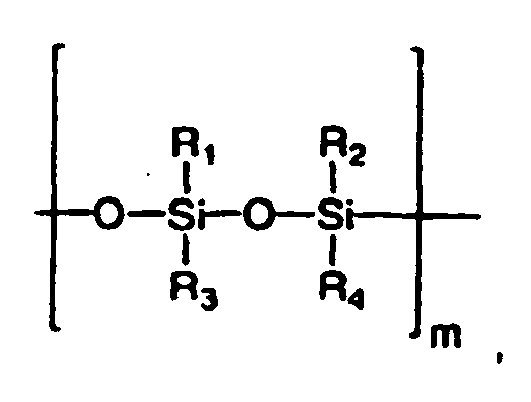
- Erfindungsgemäß vorteilhaft einzusetzende zyklische Silicone werden im allgemeinen durch Strukturelemente charakterisiert, wie folgt

- Vorteilhaft wird Cyclomethicon (z.B. Decamethylcyclopentasiloxan) als erfindungsgemäß zu verwendendes Silikonöl eingesetzt. Aber auch andere Silikonöle sind vorteilhaft im Sinne der vorliegenden Erfindung zu verwenden, beispielsweise Undecamethylcyclotrisiloxan, Polydimethylsiloxan, Poly(methylphenylsiloxan), Cetyldimethicon, Behenoxydimethicon.
- Vorteilhaft sind ferner Mischungen aus Cyclomethicon und Isotridecylisononanoat, sowie solche aus Cyclomethicon und 2-Ethylhexylisostearat.
- Es ist aber auch vorteilhaft, Silikonöle ähnlicher Konstitution wie der vorstehend bezeichneten Verbindungen zu wählen, deren organische Seitenketten derivatisiert, beispielsweise polyethoxyliert und/oder polypropoxyliert sind. Dazu zählen beispielsweise Polysiloxan-polyalkyl-polyether-copolymere wie das Cetyl-Dimethicon-Copolyol, das (Cetyl-Dimethicon-Copolyol (und) Polyglyceryl-4-Isostearat (und) Hexyllaurat)
- Besonders vorteilhaft sind ferner Mischungen aus Cyclomethicon und Isotridecylisononanoat, aus Cyclomethicon und 2-Ethylhexylisostearat.
- Die wässrige Phase der Zubereitungen gemäß der Erfindung enthält gegebenenfalls vorteilhaft Alkohole, Diole oder Polyole niedriger C-Zahl, sowie deren Ether, vorzugsweise Ethanol, Isopropanol, Propylenglykol, Glycerin, Ethylenglykol, Ethylenglykolmonoethyl- oder -monobutylether, Propylenglykolmonomethyl, -monoethyl- oder -monobutylether, Diethylenglykolmonomethyl- oder -monoethylether und analoge Produkte, ferner Alkohole niedriger C-Zahl, z.B. Ethanol, Isopropanol, 1,2-Propandiol, Glycerin sowie insbesondere ein oder mehrere Verdickungsmittel, welches oder welche vorteilhaft gewählt werden können aus der Gruppe Siliciumdioxid, Aluminiumsilikate.
- Erfindungsgemäß enthalten als Emulsionen vorliegenden Zubereitungen insbesondere vorteilhaft ein oder mehrere Hydrocolloide. Diese Hydrocolloide können vorteilhaft gewählt werden aus der Gruppe der Gummen, Polysaccharide, Cellulosederivate, Schichtsilikate, Polyacrylate und/oder anderen Polymeren.
- Erfindungsgemäß enthalten als Hydrogele vorliegenden Zubereitungen ein oder mehrere Hydrocolloide. Diese Hydrocolloide können vorteilhaft aus der vorgenannten Gruppe gewählt werden.
- Zu den Gummen zählt man Pflanzen- oder Baumsäfte, die an der Luft erhärten und
- Harze bilden oder Extrakte aus Wasserpflanzen. Aus dieser Gruppe können vorteilhaft im Sinne der vortiegenden Erfindung gewählt werden beispielsweise Gummi Arabicum, Johannisbrotmehl, Tragacanth, Karaya, Guar Gummi, Pektin, Gellan Gummi, Carrageen, Agar, Algine, Chondrus, Xanthan Gummi.
- Weiterhin vorteilhaft ist die Verwendung von derivatisierten Gummen wie z.B. Hydroxypropyl Guar (Jaguar® HP 8).
- Unter den Polysacchariden und -derivaten befinden sich z.B. Hyaluronsäure, Chitin und Chitosan, Chondroitinsulfate, Stärke und Stärkederivate.
- Unter den Cellulosederivaten befinden sich z.B. Methylcellulose, Carboxymethylcellulose, Hydroxyethylcellulose, Hydroxypropylmethylcellulose.
- Unter den Schichtsilikaten befinden sich natürlich vorkommende und synthetische Tonerden wie z.B. Montmorillonit, Bentonit, Hektorit, Laponit, Magnesiumaluminiumsilikate wie Veegum®. Diese können als solche oder in modifizierter Form verwendet werden wie z.B. Stearylalkonium Hektorite.
- Weiterhin können vorteilhaft auch Kieselsäuregele verwendet werden.
- Unter den Polyacrylaten befinden sich z.B. Carbopol Typen der Firma Goodrich (Carbopol 980, 981, 1382, 5984, 2984, EDT 2001 oder Pemulen TR2).
- Unter den Polymeren befinden sich z.B. Polyacrylamide (Seppigel 305), Polyvinylalkohole, PVP, PVP / VA Copolymere, Polyglycole.
- Gemäß einer weiteren bevorzugten Ausführungsform werden die erfindungsgemäß verwendeten Oligoribonukleotide in wäßrige Systeme bzw. Tensidzubereitungen zur Reinigung der Haut und der Haare eingefügt.
- Als Moisturizer werden Stoffe oder Stoffgemische bezeichnet, welche kosmetischen oder dermatologischen Zubereitungen die Eigenschaft verleihen, nach dem Auftragen bzw. Verteilen auf der Hautoberfläche die Feuchtigkeitsabgabe der Homschicht (auch trans-epidermal water loss (TEWL) genannt) zu reduzieren und/oder die Hydratation der Hornschicht positiv zu beeinflussen. Vorteilhafte Moisturizer im Sinne der vorliegenden Erfindung sind beispielsweise Glycerin, Milchsäure, Pyrrolidoncarbonsäure und Harnstoff. Ferner ist es insbesondere von Vorteil, polymere Moisturizer aus der Gruppe der wasserlöslichen und/oder in Wasser quellbaren und/oder mit Hilfe von Wasser gelierbaren Polysaccharide zu verwenden. Insbesondere vorteilhaft sind beispielsweise Hyaluronsäure und/oder ein fucosereiches Polysaccharid, welches in den Chemical Abstracts unter der Registratumummer 178463-23-5 abgelegt und z. B. unter der Bezeichnung Fucogel□ 1000 von der Gesellschaft SOLABIA S.A. erhältlich ist.
- Glycerin wird bei der Verwendung als Moisturizer vorzugsweise in einer Menge von 0,05-30 Gew.%, besonders bevorzugt sind 1-10%, eingesetzt.
- Erfindungsgemäß enthalten als Emulsionen vorliegenden Zubereitungen einen oder mehrere Emulgatoren. Diese Emulgatoren können vorteilhaft gewählt werden aus der Gruppe der nichtionischen, anionischen, kationischen oder amphoteren Emulgatoren.
- Unter den nichtionischen Emulgatoren befinden sich
- a) Partialfettsäureester und Fettsäureester mehrwertiger Alkohole und deren ethoxylierte Derivate (z. B. Glycerylmonostearate, Sorbitanstearate, Glycerylstearylcitrate, Sucrosestearate)
- b) ethoxylierte Fettalkohole und Fettsäuren
- c) ethoxylierte Fettamine, Fettsäureamide, Fettsäurealkanolamide
- d) Alkylphenolpolyglycolether (z.B. Triton X)
- Unter den anionischen Emulgatoren befinden sich
- a) Seifen (z. B. Natriumstearat)
- b) Fettalkoholsulfate
- c) Mono-, Di- und Trialkylphosphosäureester und deren Ethoxylate
- Unter den kationischen Emulgatoren befinden sich
- a) quaternäre Ammoniumverbindungen mit einem langkettigen aliphatischen Rest z.B. Distearyldimonium Chloride
- Unter den amphoteren Emulgatoren befinden sich
- a) Alkylamininoalkancarbonsäuren
- b) Betaine, Sulfobetaine
- c) Imidazolinderivate
- Weiterhin gibt es natürlich vorkommende Emulgatoren, zu denen Bienenwachs, Wollwachs, Lecithin und Sterole gehören.
- O/W-Emulgatoren können beispielsweise vorteilhaft gewählt werden aus der Gruppe der polyethoxylierten bzw. polypropoxylierten bzw. polyethoxylierten und polypropoxylierten Produkte, z.B.:
- der Fettalkoholethoxylate
- der ethoxylierten Wollwachsalkohole,
- der Polyethylenglycolether der allgemeinen Formel R-O-(-CH2-CH2-O-)n-R'.
- der Fettsäureethoxylate der allgemeinen Formel
R-COO-(-CH2-CH2-O-)n-H.
- der veretherten Fettsäureethoxylate der allgemeinen Formel
R-COO-(-CH2-CH2-O-)n-R',
- der veresterten Fettsäureethoxylate der allgemeinen Formel
R-COO-(-CH2-CH2-O-)n-C(O)-R',
- der Polyethylenglycolglycerinfettsäureester
- der ethoxylierten Sorbitanester
- der Cholesterinethoxylate
- der ethoxylierten Triglyceride
- der Alkylethercarbonsäuren der allgemeinen Formel R-O-(-CH2-CH2-O-)n-CH2-COOH nd n eine Zahl von 5 bis 30 darstellen,
- der Polyoxyethylensorbitolfettsäureester,
- der Alkylethersulfate der allgemeinen Formel R-O-(-CH2-CH2-O-)n-SO3-H
- der Fettalkoholpropoxylate der allgemeinen Formel
R-O-(-CH2-CH(CH3)-O-)n-H,
- der Polypropylenglycolether der allgemeinen Formel
R-O-(-CH2-CH(CH3)-O-)nR',
- der propoxylierten Wollwachsalkohole,
- der veretherten Fettsäurepropoxylate
R-COO-(-CH2-CH(CH3)-O-)n-R',
- der veresterten Fettsäurepropoxylate der allgemeinen Formel
R-COO-(-CH2-CH(CH3)-O-)n-C(O)-R',
- der Fettsäurepropoxylate der allgemeinen Formel
R-COO-(-CH2-CH(CH3)-O-)n-H,
- der Polypropylenglycolglycerinfettsäureester
- der propoxylierten Sorbitanester
- der Cholesterinpropoxylate
- der propoxylierten Triglyceride
- der Alkylethercarbonsäuren der allgemeinen Formel
R-O-(-CH2-CH(CH3)-O-)n-CH2-COOH
- der Alkylethersulfate bzw. die diesen Sulfaten zugrunde liegenden Säuren der allgemeinen Formel R-O-(-CH2-CH
(CH3)-O-)n-SO3-H - der Fettalkoholethoxylate/propoxylate der allgemeinen Formel
R-O-Xn-Ym-H,
- der Polypropylenglycolether der allgemeinen Formel
R-0-Xn-YM-R',
- der veretherten Fettsäurepropoxylate der allgemeinen Formel
R-COO-Xn-Ym-R',
- der Fettsäureethoxylate/propoxylate der allgemeinen Formel
R-CCO-Xn-Ym-H,.
- Erfindungsgemäß besonders vorteilhaft werden die eingesetzten polyethoxylierten bzw. polypropoxylierten bzw. polyethoxylierten und polypropoxylierten O/W-Emulgatoren gewählt aus der Gruppe derSubstanzen mit HLB-Werten von 11 - 18, ganz besonders vorteilhaft mit mit HLB-Werten von 14,5 - 15,5, sofern die O/W-Emulgatoren gesättigte Reste R und R' aufweisen. Weisen die O/W-Emulgatoren ungesättigte Reste R und/oder R' auf, oder liegen Isoalkylderivate vor, so kann der bevorzugte HLB-Wert solcher Emulgatoren auch niedriger oder darüber liegen.
- Es ist von Vorteil, die Fettalkoholethoxylate aus der Gruppe der ethoxylierten Stearylalkohole, Cetylalkohole, Cetylstearylalkohole (Cetearylalkohole) zu wählen. Insbesondere bevorzugt sind:
- Polyethylenglycol(13)stearylether (Steareth-13), Polyethylenglycol(14)stearylether (Steareth-14), Polyethylenglycol(15)stearylether (Steareth-15). Polyethylenglycol(16)stea-rylether (Steareth-16). Polyethylenglycol(17) stearylether (Steareth-17), Polyethylenglycol-(18)stearylether (Steareth-18), Polyethylenglycol(19)stearylether (Steareth-19), Polyethylenglycol(20)stearylether (Steareth-20),
- Polyethylenglycol(12)isostearylether (Isosteareth-12). Polyethylenglycol(13)isostearylether (Isosteareth-13). Polyethylenglycol(14)isostearylether (Isosteareth-14), Polyethylenglycol(15)isostearylether (Isosteareth-15), Polyethylenglycol(16)isostearylether (Isosteareth-16), Polyethylenglycol(17)isostearylether (Isosteareth-17), Polyethylenglycol(18)isostearylether (Isosteareth-18), Polyethylenglycol(19)isostearylether (Isosteareth-19), Polyethylenglycol (20)isostearylether (Isosteareth-20),
- Polyethylenglycol(13)cetylether (Ceteth-13), Polyethylenglycol(14)cetylether (Ceteth-14), Polyethylenglycol (15)cetylether (Ceteth-15), Polyethylenglycol(16)cetylether (Ceteth-16), Polyethylenglycol(17)cetylether (Ceteth-17), Polyethylenglycol(18)cetylether (Ceteth-18), Polyethylenglycol(19)cetylether (Ceteth-19), Polyethylenglycol(20)cetylether (Ceteth-20).
- Polyethylenglycol(13)isocetylether (Isoceteth-13). Polyethylenglycol(14)isocetylether (Isoceteth-14), Polyethylenglycol(15)isocetylether(Isoceteth-15), Polyethylenglycol(16)-isocetylether (Isoceteth-16), Polyethylenglycol(17) isocetylether (Isoceteth-17), Polyethylenglycol(18)isocetylether (Isoceteth-18), Polyethylenglycol(19)isocetylether (Isoceteth-19), Polyethylenglycol(20)isocetylether (Isoceteth-20).
- Polyethylenglycol(12)oleylether (Oteth-12), Polyethylenglycol(13)oleylether (Oleth-13), Polyethylenglycol (14)oleylether (Oleth-14), Polyethylenglycol(15)oleylether (Oleth-15),
- Polyethylenglycol(12)laurylether (Laureth-12), Polyethylenglycol(12)isolaurylether (Isolaureth-12).
- Polyethylenglycol(13)cetylstearylether (Ceteareth-13), Polyethylenglycol(14)cetylstearylether (Ceteareth-14), Polyethylenglycol(15)cetylstearylether (Ceteareth-15), Polyethylenglycol(16)cetylstearylether (Ceteareth-16), Polyethylengtycol(17)cetylstearylether (Ceteareth-17), Polyethylenglycol(18)cetylstearylether (Ceteareth-18), Polyethylenglycol-(19)cetylstearylether (Ceteareth-19), Polyethylenglycol(20)cetylstearylether (Ceteareth-20),
- Es ist ferner von Vorteil, die Fettsäureethoxylate aus folgender Gruppe zu wählen:
- Polyethylenglycol(20)stearat, Polyethylenglycol(21)stearat, Polyethylenglycol(22)stearat, Polyethylenglycol (23)stearat, Polyethylenglycol(24)stearat, Polyethylenglycol(25)stearat,
- Polyethylenglycol(12)isostearat, Polyethylenglycol(13)isostearat, Polyethylenglycol(14)-isostearat, Polyethylenglycol(15)isostearat, Polyethylenglycol(16)isostearat, Polyethylenglycol(17)isostearat, Polyethylenglycol(18) isostearat, Polyethylenglycol(19)isostearat, Polyethylenglycol(20)isostearat, Polyethylenglycol(21)isostearat, Polyethylenglycol(22)isostearat, Polyethylenglycol(23)isostearat, Polyethylenglycol(24)isostearat, Polyethylenglycol(25) isostearat,
- Polyethylenglycol(12)oleat, Polyethylenglycol(13)oleat, Polyethylenglycol(14)oleat, Polyethylenglycol(15) oleat, Polyethylenglycol(16)oleat, Polyethylenglycol(17)oleat, Polyethylenglycol(18)oleat, Polyethylenglycol(19)oleat, Polyethylenglycol(20)oleat
- Als ethoxylierte Alkylethercarbonsäure bzw. deren Salz kann vorteilhaft das Natriumlaureth-11-carboxylat verwendet werden.
- Als Alkylethersulfat kann Natrium Laureth 1-4 sulfat vorteilhaft verwendet werden.
- Als ethoxyliertes Cholesterinderivat kann vorteilhaft Polyethylenglycol(30)Cholesterylether verwendet werden. Auch Polyethylenglycol(25)Sojasterol hat sich bewährt.
- Als ethoxylierte Triglyceride können vorteilhaft die Polyethylenglycol(60) Evening Primrose Glycerides verwendet werden (Evening Primrose = Nachtkerze)
- Weiterhin ist von Vorteil, die Polyethylenglycolglycerinfettsäureester aus der Gruppe Polyethylenglycol(20) glyceryllaurat, Polyethylenglycol(21)glyceryllaurat, Polyethylenglycol-(22)glyceryllaurat, Polyethylenglycol(23)glyceryllaurat, Polyethylenglycol(6)glycerylcaprat/caprinat, Polyethylenglycol(20)glyceryloleat, Polyethylenglycol(20)glycerylisostearat, Polyethylenglycol(18)glyceryloleat/cocoat zu wählen.
- Es ist ebenfalls günstig, die Sorbitanester aus der Gruppe Polyethylenglycol(20)sorbitanmonolaurat, Polyethylenglycol(20)sorbitanmonostearat, Polyethylenglycol(20)sorbitanmonoisostearat, Polyethylenglycol(20)sorbitan-monopalmitat, Polyethylenglycol(20)-sorbitanmonooleat zu wählen.
- Als vorteilhafte W/O-Emulgatoren können eingesetzt werden: Fettalkohole mit 8 bis 30 Kohlenstoffatomen, Monoglycerinester gesättigter und/oder ungesättigter, verzweigter und/oder unverzweigter Alkancarbonsäuren einer Kettenlänge von 8 bis 24, insbesondere 12 - 18 C-Atomen, Diglycerinester gesättigter und/oder ungesättigter, verzweigter und/oder unverzweigter Alkancarbonsäuren einer Kettenlänge von 8 bis 24, insbesondere 12 - 18 C-Atomen, Monoglycerinether gesättigter und/oder ungesättigter, verzweigter und/oder unverzweigter Alkohole einer Kettenlänge von 8 bis 24, insbesondere 12 - 18 C-Atomen, Diglycerinether gesättigter und/oder ungesättigter, verzweigter und/ oder unverzweigter Alkohole einer Kettenlänge von 8 bis 24, insbesondere 12 - 18 C-Atomen, Propylenglycolester gesättigter und/oder ungesättigter, verzweigter und/oder unverzweigter Alkancarbonsäuren einer Kettenlänge von 8 bis 24, insbesondere 12 - 18 C-Atomen sowie Sorbitanester gesättigter und/oder ungesättigter, verzweigter und/oder unverzweigter Alkancarbonsäuren einer Kettenlänge von 8 bis 24, insbesondere 12 - 18 C-Atomen.
- Insbesondere vorteilhafte W/O-Emulgatoren sind Glycerylmonostearat, Glycerylmonoisostearat, Glycerylmonomyristat, Glycerylmonooleat, Diglycerylmonostearat, Diglycerylmonoisostearat, Propylenglycolmonostearat, Propylenglycolmonoisostearat, Propylenglycolmonocaprylat, Propylenglycolmonolaurat, Sorbitanmonoisostearat, Sorbitanmonolaurat, Sorbitanmonocaprylat, Sorbitanmonoisooleat, Saccharosedistearat, Cetylalkohol, Stearylalkohol, Arachidylalkohol, Behenylalkohol, Isobehenylalkohol, Selachylalkohol, Chimylalkohol, Polyethylenglycol(2)stearylether (Steareth-2), Glycerylmonolaurat, Glycerylmonocaprinat, Glycerylmonocaprylat.
- Als übliche kosmetische Trägerstoffe zur Herstellung der desodorierenden Zubereitungen gemäß der erfindungsgemäßen Verwendung können neben Wasser, Ethanol und Isopropanol, Glycerin und Propylenglykol hautpflegende Fett- oder fettähnliche Stoffe, wie Ölsäuredecylester, Cetylalkohol, Cetylstearylalkohol und 2-Octyldodecanol, in den für solche Präparate üblichen Mengenverhältnissen eingesetzt werden sowie schleimbildende Stoffe und Verdickungsmittel, z.B. Hydroxyethyl- oder Hydroxypropylcellulose, Polyacrylsäure, Polyvinylpyrrolidon, daneben aber auch in kleinen Mengen cyclische Silikonöle (Polydimethylsiloxane) sowie flüssige Polymethylphenylsiloxane niedriger Viskosiät.
- Es ist von Vorteil, wenn die erfindungsgemäßen Zubereitungen neben der Wirkstoffkombination zusätzlich Adstringetntien bzw. Antitranspirantien, Silikonöle und/oder Puderstoffen enthalten.
- Antitranspirantien kommen z. B. Aluminiumchlorhydate in Frage. Hierbei handelt es sich um farblose, hygroskopische Kristalle, die an der Luft leicht zerfließen und beim Eindampfen wäßriger Aluminiumchloridlösungen anfallen. Aluminiumchlorhydrat wird zur Herstellung von schweißhemmenden und desodorierenden Zubereitungen eingesetzt und wirkt wahrscheinlich über den partiellen Verschluß der Schweißdrüsen durch Eiweiß- und/oder Polysaccharidfällung. Neben den Chlorhydraten können auch Aluminiumhydroxylactate sowie saure Aluminium/Zirkoniumsalze eingesetzt werden.
- Aluminium-Salze (der empirischen Summenformel [Al2(OH)mCln], wobei m+n=6):
- Aluminium-Salze wie Aluminiumchlorid AlCl3, Aluminiumsulfat Al2(SO4)3
- Aluminiumchlorhydrat [Al2(OH)5Cl] × H2O
- Standard Al-Komplexe: Locron L (Clariant), Chlorhydrol (Reheis), ACH-303 (Summit), Aloxicoll L (Giulini).
- Aktivierte Al-Komplexe: Reach 501 (Reheis), AACH-324 (Summit)
- Aluminiumsesquichlorhydrat [Al2(OH)4,5Cl1,5 ] × H2O
- Standard Al-Komplexe: Aluminum Sesquichlorohydrate (Reheis), ACH-308 (Summit), Aloxicoll 31 L (Giulini)
- Aktivierte Al-Komplexe: Reach 301 (Reheis)
- Aluminiumdichlorhydrat [Al2(OH)4Cl2] × H2O
- Aluminium-Zirkonium-Salze:
- Aluminium/Zirkonium Trichlorhydrex Glycin [Al4Zr(OH)13Cl3] × H2O × Gly
- Standard Al/Zr-Komplexe: Rezal 33GP (Reheis), AZG-7164 (Summit), Zirkonal P3G (Giulini)
- Aktivierte AU/Zr-Komplexe: Reach AZZ 902 (Reheis), AAZG-7160 (Summit), Zirkonal AP3G (Giulini)
- Aluminium/Zirkonium Tetrachlorhydrex Glycin [Al4Zr(OH)12Cl4] × H2O × Gly
- Standard Al/Zr-Komplexe: Rezal 36G (Reheis), AZG-368 (Summit), Zirkonal L435G (Giulini)
- Aktivierte Al/Zr-Komplexe: Reach AZP 855 (Reheis), AAZG-6313-15 (Summit), Zirkonal AP4G (Giulini)
- Aluminium/Zirkonium Pentachlorhydrex Glycin [Al8Zr(OH)23Cl5] × H2O × Gly
- Standard Al/Zr-Komplexe: Rezal 67 (Reheis), Zirkonal L540 (Giulini)
- Aktivierte Al/Zr-Komplexe: Reach AZN 885 (Reheis)
- Aluminium/Zirkonium Octachlorhydrex Glycin [Al8Zr(OH)20Cl8] × H2O × Gly
- Ebenso von Vorteil können aber auch Glycin-freie Aluminium/Zirkonium-Salze sein.
- Dabei soll die Verwendung der Antitranspirant-Wirker aus den Rohstoffklassen Aluminium- und Aluminium/ Zirkonium-Salzen nicht auf die handelsüblichen zumeist wäßrigen Lösungen, wie z.B. Locron L (Clariant), beschränkt sein, sondern es kann auch von Vorteil sein, die ebenfalls handelsüblichen wasserfreien Pulver derselbigen Rohstoffe durch Einbringung in die beanspruchten Formulierungen zum Einsatz zu bringen, wie z.B. Locron P (Clariant).
- Vorteilhaft könnte auch die Verwendung von sog. AT-Salz Suspensionen sein, bei denen pulverförmig vorliegende Aluminium- und Aluminium/Zirkonium-Salze in diversen Ölen dispergiert angeboten werden.
- Desweiteren kann es aber auch von Vorteil sein, spezielle Aluminium- und Aluminium/Zirkonium-Salze zum Einsatz zu bringen, die zur Löslichkeitsverbesserung als Glykol-Komplexe angeboten werden.
- Weitere vorteilhafte Antitranspirant-Wirker basieren anstelle von Aluminium bzw. Zirkonium auf anderen Metallen, wie z.B. Beryllium, Titan, Hafnium.
- Dabei soll die Liste der verwendbaren Antitranspirant-Wirker aber nicht auf metallhaltige Rohstoffe begrenzt sein, sondern von Vorteil sind auch Verbindungen, die Nichtmetalle wie Bor enthalten sowie solche, die dem Bereich der organischen Chemie zuzurechnen sind, wie z.B. Anticholinergika.
- Vorteilhaft sind in diesem Sinne auch Polymere, die sowohl metallhaltig als auch metallfrei sein können.
- Als Treibmittel für erfindungsgemäße, aus Aerosolbehältern versprühbare dermatologische Zubereitungen sind die üblichen bekannten leichtflüchtigen, verflüssigten Treibmittel, beispielsweise Kohlenwasserstoffe (Propan, Butan, Isobutan) geeignet, die allein oder in Mischung miteinander eingesetzt werden können. Auch Druckluft ist vorteilhaft zu verwenden.
- Natürlich weiß der Fachmann, daß es an sich nichttoxische Treibgase gibt, die grundsätzlich für die vortiegende Erfindung geeignet wären, auf die aber dennoch wegen bedenklicher Wirkung auf die Umwelt oder sonstiger Begleitumstände verzichtet werden sollte, insbesondere Fluorchlorkohlenwasserstoffe (FCKW).
- Zusätzlich enthalten sprühbare Zubereitungen bestimmte Olkomponenten und Alkohole Ethanol und Isopropanol, Glycerin und Propylenglykol hautpflegende Fett- oder fettähnliche Stoffe, wie Ölsäuredecylester, Cetylalkohol, Cetylstearylalkohol und 2-Octyldodecanol, in den für solche Präparate üblichen Mengenverhältnissen eingesetzt werden sowie schleimbildende Stoffe und Verdickungsmittel, z.B. Hydroxyethyl- oder Hydroxypropylcellulose, Polyacrylsäure, Polyvinylpyrrolidon, daneben aber auch in kleinen Mengen cyclische Silikonöle (Polydimethylsiloxane) sowie flüssige Polymethylphenylsiloxane niedriger Viskosiät.
- Es ist bei all diesem im Einzelfalle möglich, dass die vorgenannten Konzentrationsangaben leicht über- oder unterschritten werden und dennoch erfindungsgemäße Zubereitungen erhalten werden. Dies kommt angesichts der breit streuenden Vielfalt an geeigneten Komponenten derartiger Zubereitungen für den Fachmann nicht unerwartet, so dass er weiß, dass bei solchen Über- oder Unterschreitungen der Boden der vorliegenden Erfindung nicht verlassen wird.
- Die nachfolgenden Beispiele sollen die vorliegende Erfindung verdeutlichen, ohne sie einzuschränken. Die Zahlenwerte in den Beispielen bedeuten Gewichtsprozente, bezogen auf das Gesamtgewicht der jeweiligen Zubereitungen.
- Zur Ermittlung der Wirksamkeit erfindungsgemäßer Oligoribonukleotide wurden humane dermale Fibroblasten (HDF-Zellen) verwendet. Die Expression des Wachstumsfaktors TGFbeta-1 erfolgt von den Zellen endogen.
- Hierzu wurden die Zellen (in DMEM mit 10 % foetalem Kälber Serum) am Tag vor der Induktion in einer Dichte von 7x10⁵ Zellen pro 10cm-Schale ausgesät und für 24 Std. im Vollmedium (DMEM + 10% FCS + 1% Glutamax + 1% Pen/Strep) kultiviert. Die Transfektion wurde unter Verwendung eines Gemischs aus kationischen Lipiden (Oligofektamin Reagenz, Invitrogen) durchgeführt. Für den Transfektionsansatz wurden 90 µl der verschiedenen anti-TGFbeta-1 dsRNAs (dsRNAs, die durch Hybridisieren der Sequenzen SEQ ID NOs 15 und 16, der SEQ ID NOs 18 und 19 bzw. der SEQ ID NOs 6 und 7 erhalten wurden, die dsRNAs weisen 3'-ständig jeweils zwei überstehende dT-Reste auf, s.
Figur 2 ) in 1,5 ml Medium gelöst. In einem zweiten Ansatz wurde 36 µl Oligofektamin in 240 µl Medium gelöst und für 5-10 min inkubiert. Nach dieser Inkubationszeit wurden die beiden Ansätze zusammengegeben und für weitere 15-20 min inkubiert. In der Zwischenzeit wurde das Vollmedium von den Zellen entfernt und durch 7 ml Medium ohne Zugabe von Antibiotika oder Serum ersetzt. Der Transfektionsansatz wurde nun auf die Zellen gegeben. Anschließend wurde dieser Transfektionsansatz für 24 Std. auf den primären Fibroblasten belassen. Als Vergleich dienten Proben, die nicht mit dsRNA oder solche, die mit einer nicht das TGFbeta-1 bindenden dsRNA (anti-LaminA/C-Kontroll-Oligoribonukleotide der Firma MWG) transfiziert wurden. - Nach der mikroskopischen Untersuchung der Zellen wurde die Gesamt RNA isoliert. Dazu wurde der Mediumüberstand entfernt und die Zellen einmal mit PBS gespült. Die Zellen wurden mit 200gm PBS und 400µl Lyse-Puffer überdeckt, abgeschabt und in Eppendorf Gefäße überführt. Die RNA-Isolation erfolgte anhand des High Pure RNA Isolation Kits (Roche Diagnostics Corp.) nach den Angaben des Herstellers. Die hierbei wurde an eine Säule gebundene isolierte RNA wurde mit 50 - 100µl Wasser eluiert.
- Aus der isolierten RNA wurde der Gehalt an TGFbeta-1 mRNA mit Hilfe der quantitativen TaqMan-Analyse (TaqMan Assays-on-Demand™ Applied Biosystems) ermittelt.
- Hierzu wurde in einem 2-Schritt-Verfahren erst die Gesamt-RNA in cDNA umgeschrieben. Die Reverse Transkription wurde mit Hilfe des High Capacity cDNA Archive Kits (Applied Biosystems) nach Angaben des Herstellers durchgeführt.
- Bei der quantitativen PCR wurden 1 µl der cDNA-Reaktion (entspricht 10 ng Gesamt-RNA) mit 10,25 µl Wasser, 12,5 µl TaqMan Universal Master Mix (mit AmptiTaq-Gotd-Potymerase) und 1,25 µl Target Mix (spezifische Primer und Fluoreszenz-markierte Probe) für 18S-RNA als Kontrolle bzw. TGF-β1 gemischt. Im ABI PRISM 7700 wurden die Proben erst 2 min bei 50°C zur Aktivierung der Uracil-N-Glycolase inkubiert, woran sich eine 10minütige Inaktivierung bei 95°C anschloss. Die PCR erfolgte über 40 Zyklen bei 95°C (15 s) (Denaturierung) und 60 °C (1 min) (Annealing).
Die Fluoreszenzänderung wird vom ABI PRISM 7700 während der PCR detektiert. - Die Quantifizierung der Genexpression erfolgte über den C1-Wert (threshold cycle). Die Relativierung erfolgte über die endogene Kontrolle der 18s RNA.
- Aus den Dreifachbestimmungen von Ziel-Gen (TGFbeta-1) und endogener Kontrolle (18sRNA) pro Probe wurden die Mittelwerte gebildet und diese dann dividiert (ng Probe/ng Kontrolle). Auf diese Weise wurden normalisierte, einheitslose Werte der relativen quantitativen Expression des Ziel-Gens erhalten.
- Die Ergebnisse sind in
Figur 6 graphisch dargestellt. Hier ist die über den 18S rRNA-Gehalt normierte relative mRNA-Konzentration des Wachstumsfaktors TGFbeta-1 im prozentualen Verhältnis zu Kontrolle zu sehen. Die Transfektion der Zellen mit der Transfektionsreagenz allein ("ohne siRNA") sowie mit den Oligoribonukleotiden gegen Lamin A/C ("Kontrolle") bewirkt keine Änderung des TGFbeta-1 mRNA-Gehaltes. Die Transfektion mit den drei unterschiedlichen Oligoribonukleotidpaaren gegen TGFbeta-1 führt hingegen jeweils zu einer Abnahme der TGFbeta-1-Konzentration ("SEQ ID NOs "15+16", "18+19" bzw. "6+7"). Die Inhibition beträgt ca. 80-90 % im Vergleich zu der Kontrolle und zu den nicht mit siRNA transfizierten Zellen. - In
Figur 1 ist die codierende Sequenz von TGFbeta-1 dargestellt (SEO ID NO 1). Hervorgehoben darin sind die verwendeten Oligoribonukleotide, die dadurch gekennzeichnet sind, dass sie zu einem solchen Abschnitt des Zielgens und insbesondere der entsprechenden doppelsträngigen cDNA homolog sind, dessen sense-Strang 5'-seitig durch zwei Adenosinreste (AA) und mit einem Abstand von 19 Basen 3'-seitig durch zwei Thymidinreste (tt), einen Guanosin- und einen Cytosinrest (gc) oder einen Thymidin- und einen Cytidinrest (tc) begrenzt wird. -
Tabelle 10: Natriumlaurethsulfat 9,00 Cocoamidopropylbetain 2,50 anti-TGFbeta-1-dsRNA (dsRNA aus SEQ ID NOs 6 und 7, s. Figur 2 )0,10 Konservierungsmittel, Parfüm, Verdicker, pH-Einstellung und Lösungsvermittler q.s. Wasser ad 100,0 Der pH-Wert wird auf 5,5 eingestellt. - Durch Mischen der in der Tabelle angegebenen Komponenten wurden Haarkuren hergestellt. Als Oligoribonukleotid wurde dsRNA verwendet, die durch Hybridisieren der SEQ ID No 6 und der SEQ ID No 7 erhalten wurde Die dsRNA inhibiert die Expression des Wachstumsfaktors TGFbeta-1 durch RNA-Interferenz und wird als anti-TGFbeta-1-dsRNA bezeichnet (s.
Figur 2 ). Die beiden Stränge der dsRNA wiesen 3'-ständig jeweils zwei 2'-Desoxythymidinreste auf.Tabelle 11: 1 2 3 Hydroxypropylmethylcellulose 0,5% 0.5% 0,5% Cetrimoniumbromid 1,0 - 0,8 Behentrimoniumchlorid - 0,7 0,3 Glycerin 3,0 3,0 3,0 Cetearylalkohol 2,5 2,5 2,5 Glycerylstearat 2,0 2,0 2,0 Polyquaternium-10 0,1 - - Guar Hydroxypropyl Trimonium Chlorid - 0,2 - anti-TGFbeta-1-dsRNA (dsRNA aus SEQ ID NOs 6 und 7, s. Figur 2 )0,1 0,1 0,1 Konservierungsmittel, Parfüm, pH-Einstellung und Lösungsvermittler q.s. q.s. q.s. Wasser ad 100 ad 100 ad 100 -
Tabelle 12: 1 2 3 Cetrimoniumchlorid 1,0 0,5 0,5 Behentrimoniumchlorid - 0,2% 0,3 Glycerin 3,0 3,0 3,0 Hydroxyethylcellulose 0,2 0,2 0,2 Polyquaternium-10 0,1 - - Guar Hydroxypropyl Trimonium Chlorid - 0,2 - anti-TGFbeta-1-dsRNA (dsRNA aus SEC ID NOs 6 und 7, s. Figur 2 )0,1 0,1 0,1 Konservierungsmittel, Parfüm, pH-Einstellung und Lösungsvermittler q.s. q.s. q.s. Wasser ad 100 ad 100 ad 100 -
Tabelle 13: 1 2 3 4 Cetylalcohol 1,5 1,8 2,0 - Cetrimoniumchtorid 0,3 0,1 0,5 0,5 Behentrimoniumchlorid - 0,2 - - Benzophenone- 0,05 0,03 - 0,1 4 PVPNA Copolymer 0,4 - - Polyquatemium-37 - - - 1,0 Polyquatemium-4 - - - 0,2 Polyquatemium-10 - - 0,5 - Panthenol 0,1 - 0,2 0,1 Hydroxyethylcellulose - - - 0,3 Acrylates/C10-30 Alkyl Acrylates Crosspolymer 0,5 0,3 0,2 - C12-13 Alkyl Lactate 2,0 1,0 1,5 1,0 Laureth-4 - - - 0,5 Aluminium Starch Octenylsuccinate - - - 1,0 Dicaprylyl Carbonate - - - 1,0 anti-TGFbeta-1-dsRNA (dsRNA aus SEG ID NOs 6 und 7, s. Figur 2 )0,1 0,1 0,1 0,1 Konservierungsmittel, Parfüm, pH-Einstellung und Lösungsvermittler q.s. q.s. q.s. q.s. Wasser ad 100 ad 100 ad 100 ad 100 -
Tabelle 14: 1 2 3 4 Cetrimoniumchlorid 0,2 0,1 0,8 0,5 Behentrimoniumchtorid - 0,2 0,3 - Benzophenone-4 0,05 0,03 - - PVPNA Copolymer - 0,7 - - Polyquatemium-10 0,1 - - - Polyquatemium-4 0,2 - - - Propylene Glycol - - - 3,0 Polyquatemium-11 - - 0,2 - Panthenol 0,1 - 0,2 0,1 Glyceryl Isostearate - - - 0,4 Isoceteth-20 - - - 0,8 Dicaprylyl Carbonate - - - 0,5 anti-TGFbeta-1-dsRNA (dsRNA aus SEQ ID NOs 6 und 7, s. Figur 2 )0,1 0,1 0,1 0,1 Konservierungsmittel, Parfüm, pH-Einstellung und Lösungsvermittler q.s. q.s. q.s. q.s. Wasser ad 100 ad 100 ad 100 ad 100 -
Tabelle 15: 1 2 3 4 Ethanol 30,0 50,0 - - Isopropanol - - 40,0 30,0 Panthenol 0,2 0,1 0,2 0,2 Menthol 0,1 - 0,05 0,05 Tocopheryl Acetate 0,2 0,2 - 0,1 C12-13 Alkyl Lactate 0,2 0,1 0,2 - anti-TGFbeta-1-dsRNA (dsRNA aus SEQ ID NOs 6 und 7, s. Figur 2 )0,1 0,1 0,1 0,1 Parfüm, pH-Einstellung und Lösungsvermittler q.s. q.s. q.s. q.s. Wasser ad 100 ad 100 ad 100 ad 100 - <110> Beiersdorf AG
- <120> oligoribonukleotide zur Beeinflussung des Haarwachstums
- <130> Prtpl-02073
- <160> 46
- <170> Patentin version 3.1
- <210> 1
<211> 19
<212> DNA
<213> Homo sapiens - <400> 1
cagcacccgc gaccgggtg 19 - <210> 2
<211> 19
<212> DNA
<213> Homo sapiens - <400> 2
cacatcagag ctccgagaa 19 - <210> 3
<211> 19
<212> DNA
<213> Homo sapiens - <400> 3
aagtggagca gcacgtgga 19 - <210> 4
<211> 19
<212> DNA
<213> Homo sapiens - <400> 4
attgagggct ttcgcctta 19 - <210> 5
<211> 19
<212> DNA
<213> Homo sapiens - <400> 5
ccagcataac ccgggcgcc 19 - <210> 6
<211> 19
<212> DNA
<213> Homo sapiens - <400> 6
gcccaaggtg gagcagctg 19 - <210> 7
<211> 19
<212> DNA
<213> Homo sapiens - <400> 7
cagcacccgc gaccgggtg 19 - <210> 8
<211> 19
<212> DNA
<213> Homo sapiens - <400> 8
cacatcagag ctccgagaa 19 - <210> 9
<211> 19
<212> DNA
<213> Homo sapiens - <400> 9
aagtggagca gcacgtgga 19 - <210> 10
<211> 19
<212> DNA
<213> Homo sapiens - <400> 10
attgagggct ttcgcctta 19 - <210> 11
<211> 19
<212> DNA
<213> Homo sapiens - <400> 11
ccagcataac ccgggcgcc 19 - <210> 12
<211> 19
<212> DNA
<213> Homo sapiens - <400> 12
gcccaaggtg gagcagctg 19 - <210> 13
<211> 19
<212> DNA
<213> Homo sapiens - <400> 13
gcagtttatc cccaatgtg 19 - <210> 14
<211> 19
<212> ONA
<213> Homo sapiens - <400> 14
ggatgaagaa aacaccgga 19 - <210> 15
<211> 4
<212> DNA
<213> Homo sapiens - <400> 15
ggac 4 - <210> 16
<211> 19
<212> DNA
<213> Homo sapiens - <400> 16
gttgaacgct ttggccatc 19 - <210> 17
<211> 19
<212> DNA
<213> Homo sapiens - <400> 17
agcagagaac tcggtggcg 19 - <210> 18
<211> 4
<212> DNA
<213> Homo sapiens - <400> 18
cgcc 4 - <210> 19
<211> 19
<212> DNA
<213> Homo sapiens - <400> 19
ggagttgtgt aaggcagtg 19 - <210> 20
<211> 19
<212> DNA
<213> Homo sapiens - <400> 20
ggttctctgc tagacgaca 19 - <210> 21
<211> 19
<212> DNA
<213> Homo sapiens - <400> 21
ctgccgtcta ccctgtctc 19 - <210> 22
<211> 19
<212> DNA
<213> Homo sapiens - <400> 22
gtccggagca ctggacgag 19 - <210> 23
<211> 19
<212> DNA
<213> Homo sapiens - <400> 23
cccgctggac tacggcagc 19 - <210> 24
<211> 19
<212> DNA
<213> Homo sapiens - <400> 24
atgggcccct ggatggata 19 - <210> 25
<211> 19
<212> DNA
<213> Homo sapiens - <400> 25
ggtcttcttc aaaagagcc 19 - <210> 26
<211> 4
<212> DNA
<213> Homo sapiens - <400> 26
ggga 4 - <210> 27
<211> 19
<212> DNA
<213> Homo sapiens - <400> 27
cagaagtacc tgtgcgcca 19 - <210> 28
<211> 19
<212> DNA
<213> Homo sapiens - <400> 28
tgattgcact attgataaa 19 - <210> 29
<211> 3
<212> DNA
<213> Homo sapiens - <400> 29
gga 3 - <210> 30
<211> 19
<212> DNA
<213> Homo sapiens - <400> 30
aattgtccat cttgtcgtc 19 - <210> 31
<211> 19
<212> DNA
<213> Homo sapiens - <400> 31
actacaggag gaaggagag 19 - <210> 32
<211> 19
<212> DNA
<213> Homo sapiens - <400> 32
ggctatgaat gtcagccca 19 - <210> 33
<211> 19
<212> DNA
<213> Homo sapiens - <400> 33
ccagcccgac tcctttgca 19 - <210> 34
<211> 19
<212> DNA
<213> Homo sapiens - <400> 34
ctccaggatg ctctacttc 19 - <210> 35
<211> 19
<212> DNA
<213> Homo sapiens - <400> 35
tgagtaccgc atgcacaag 19 - <210> 36
<211> 19
<212> DNA
<213> Homo sapiens - <400> 36
gagtttggat ggctccaaa 19 - <210> 37
<211> 19
<212> DNA
<213> Homo sapiens - <400> 37
gcactgctac tcttcagca 19 - <210> 38
<211> 2
<212> DNA
<213> Homo sapiens - <400> 38
99 2 - <210> 39
<211> 19
<212> DMA
<113> Homo sapiens - <400> 39
ctcgatcgta tcattgcat 19 - <210> 40
<211> 19
<212> DNA
<213> Homo sapiens - <400> 40
agaaaaaatc ccacatcct 19 <210> 41
<211> 19
<212> DNA
<213> Homo sapiens - <400> 41
gtgctgcttt tgtgatttc 19 - <210> 42
<211> 4
<212> DNA
<213> Homo sapiens - <400> 42
ggtg 4 - <210> 43
<211> 19
<212> DNA
<213> Homo sapiens - <400> 43
gatgcacacc atgtcctcc 19 - <210> 44
<211> 19
<212> DNA
<213> Homo sapiens - <400> 44
gcctgccaag tcagctcgc 19 - <210> 45
<211> 7
<212> DNA
<213> Homo sapiens - <400> 45
gacccag 7 - <210> 46
<211> 19
<212> DNA
<213> Homo sapiens - <400> 46
ggaagtacat ttgaagaac 19

Claims (11)
- Oligoribonukleotide, die den Abbau der mRNA von Strukturen induzieren, die in stimulierender Art und Weise auf den Haarzyklus Einfluss nehmen, wobei die Strukturen den Transfoming Growth Faktor beta-Superfamilie (TGFbeta) darstellen und die Oligonukleotide gewählt werden unter SEQ ID 6, 7, 15, 16, 18 oder 19.
- Oligoribonukleotide nach dem vorangehenden Patentanspruch dadurch gekennzeichnet, dass es sich um doppelsträngige Oligoribonukleotide handelt, die am 3'-Ende von jedem Strang einen Überhang von 1 bis 6, vorzugsweise 1 oder 2 Nukleotiden aufweisen.
- Oligoribonukleotide nach einem der vorangehenden Patentansprüche dadurch gekennzeichnet, dass sie in Expressionsvektoren integriert werden, Insbesondere solchen, die eine Expression der Ollgoribonukleotide in Säugerzellen bewirken.
- Oligoribonukleotide nach einem der vorangehenden Patentansprüche dadurch gekennzeichnet, dass sie auf der Ebene der Zuckerreste, der Nukleobasen, der Phosphatgruppen und/oder des dazwischen befindlichen Skeletts chemisch modifiziert sind.
- Oligoribonukleotide nach einem der vorangehenden Patentansprüche dadurch gekennzeichnet, dass eine oder mehrere Phosphatgruppen durch Phosphothioat-, Methylphosphonat- und/oder Phosphoramidatgruppen ausgetauscht sind.
- Oligoribonukleotide nach einem der vorangehenden Patentansprüche gekennzeichnet durch den Austausch einer oder mehrerer Ribosereste des Oligoribonukleotids durch Morpholinringe (Morpholin-Oligoribonukleotide) oder durch Aminosäuren (Peptid-Oligoribonukleotide).
- Oligoribonukleotide nach einem der vorangehenden Patentansprüche dadurch gekennzeichnet, dass deren Ribosereste durch Amino-, wie NH2, Fluor, Alkyl oder O-Alkylreste, wie OCH3, modifiziert sind.
- Oligoribonukleotide nach einem der vorangehenden Patentansprüche dadurch gekennzeichnet, dass sie α-Nukleoside enthalten.
- Oligoribonukleotide nach einem der vorangehenden Patentansprüche dadurch gekennzeichnet, dass sie in verkapselter Form, beispielsweise verkapselt in Liposomen oder durch die Zugabe von Cyclodextrinen stabilisiert verwendet werden.
- Nicht-therapeutische Verwendung von Oligoribonukleiotiden nach einem der vorangehenden Ansprüche in Zubereitungen zur Behandlung und Prophylaxe alters- und umweltbedingter
degenerativer und defizitärer Erscheinungen der Haarfollikel, der Haut und von Hautanhanggebilden, wie Drüsen. - Nicht-therapeutische Verwendung von Zubereitungen nach einem der vorangehenden Ansprüche zum Schutz vor Haarausfall, Haarfollikelminiaturisierung, dünner werdendem Haar, Depigmentierungserscheinungen des Haares, dystrophischen Veränderungen der Haarwurzel insbesondere der Haare auf dem Kopf.
Applications Claiming Priority (2)
| Application Number | Priority Date | Filing Date | Title |
|---|---|---|---|
| DE102004025881A DE102004025881A1 (de) | 2004-05-19 | 2004-05-19 | Oligoribonukleotide zur Beeinflussung des Haarwachstums |
| DE102004025881 | 2004-05-19 |
Publications (3)
| Publication Number | Publication Date |
|---|---|
| EP1598421A2 EP1598421A2 (de) | 2005-11-23 |
| EP1598421A3 EP1598421A3 (de) | 2008-05-07 |
| EP1598421B1 true EP1598421B1 (de) | 2011-01-26 |
Family
ID=34939669
Family Applications (1)
| Application Number | Title | Priority Date | Filing Date |
|---|---|---|---|
| EP05103692A Expired - Lifetime EP1598421B1 (de) | 2004-05-19 | 2005-05-03 | Oligoribonukleotide zur Beeinflussung des Haarwachstums |
Country Status (4)
| Country | Link |
|---|---|
| EP (1) | EP1598421B1 (de) |
| AT (1) | ATE497000T1 (de) |
| DE (2) | DE102004025881A1 (de) |
| ES (1) | ES2358518T3 (de) |
Cited By (1)
| Publication number | Priority date | Publication date | Assignee | Title |
|---|---|---|---|---|
| US9175291B2 (en) | 2012-10-11 | 2015-11-03 | Isis Pharmaceuticals Inc. | Modulation of androgen receptor expression |
Families Citing this family (6)
| Publication number | Priority date | Publication date | Assignee | Title |
|---|---|---|---|---|
| WO2007109097A2 (en) * | 2006-03-16 | 2007-09-27 | Alnylam Pharmaceuticals, Inc. | RNAi MODULATION OF TGF-BETA AND THERAPEUTIC USES THEREOF |
| US20080119433A1 (en) * | 2006-07-06 | 2008-05-22 | Aaron Thomas Tabor | Compositions and Methods for Genetic Modification of Cells Having Cosmetic Function to Enhance Cosmetic Appearance |
| MX2020006150A (es) | 2017-12-15 | 2020-11-11 | Flagship Pioneering Innovations Vi Llc | Composiciones que comprenden polirribonucleotidos circulares y usos de las mismas. |
| MA55082A (fr) * | 2019-03-01 | 2022-01-05 | Flagship Pioneering Innovations Vi Llc | Compositions, procédés, et kits pour l'administration de polyribonucléotides |
| KR102901623B1 (ko) * | 2019-03-01 | 2025-12-18 | 플래그쉽 파이어니어링 이노베이션스 브이아이, 엘엘씨 | 폴리리보뉴클레오티드 및 이의 미용적 용도 |
| JP7618577B2 (ja) | 2019-03-25 | 2025-01-21 | フラッグシップ パイオニアリング イノベーションズ シックス,エルエルシー | 修飾環状ポリリボヌクレオチドを含む組成物及びその使用 |
Family Cites Families (23)
| Publication number | Priority date | Publication date | Assignee | Title |
|---|---|---|---|---|
| DE3314742C2 (de) | 1983-04-23 | 1987-04-02 | Degussa Ag, 6000 Frankfurt | Verfahren zur Herstellung von an der Oberfläche modifizierten natürlichen, oxidischen oder silikatischen Füllstoffen und deren Verwendung |
| GB9106678D0 (en) * | 1991-03-28 | 1991-05-15 | Ferguson Mark W J | Wound healing |
| GB9110123D0 (en) | 1991-05-10 | 1991-07-03 | Dow Corning | Organosilicon compounds their preparation and use |
| US5877160A (en) | 1991-05-31 | 1999-03-02 | Genta Incorporated | Compositions and methods of treatment of androgen-associated baldness using antisense oligomers |
| IT1255729B (it) | 1992-05-19 | 1995-11-15 | Giuseppe Raspanti | Derivati di s-triazina come agenti fotostabilizzanti |
| CA2156512C (en) | 1993-02-19 | 2002-11-19 | Mary Ellen Harper | Treatment of androgen-associated baldness using antisense oligomers |
| DE69429617T2 (de) * | 1993-04-30 | 2002-08-22 | Biognostik Gesellschaft Fuer Biomolekulare Diagnostik Mbh | Antisense-oligonukleotide zur behandlung des immunsuppressiven effektes des transformierenden wachstumsfaktor-beta1(tgf-beta1) |
| US5691179A (en) * | 1993-08-26 | 1997-11-25 | Washington University | Cell death regulators |
| US5556956A (en) | 1993-11-04 | 1996-09-17 | Board Of Regents, The University Of Texas System | Methods and compositions relating to the androgen receptor gene and uses thereof |
| DE19542404A1 (de) * | 1995-11-14 | 1997-05-15 | Ribonetics Gmbh | Chimäre Oligomere mit RNA-Spaltungsaktivität |
| DE19543730A1 (de) | 1995-11-23 | 1997-05-28 | Ciba Geigy Ag | Bis-Resorcinyl-Triazine |
| AU2666797A (en) | 1996-04-15 | 1997-11-07 | Dyad Pharmaceutical Corporation | Combination therapy for androgenic alopecia with antisense oligonucleotides and minoxidil |
| US6639051B2 (en) * | 1997-10-20 | 2003-10-28 | Curis, Inc. | Regulation of epithelial tissue by hedgehog-like polypeptides, and formulations and uses related thereto |
| DE19956568A1 (de) | 1999-01-30 | 2000-08-17 | Roland Kreutzer | Verfahren und Medikament zur Hemmung der Expression eines vorgegebenen Gens |
| EP1235842A4 (de) | 1999-10-15 | 2003-04-23 | Univ Massachusetts | Gene des rns-interferenzweges als hilfsmittel der gezielten gentischen interferenz |
| JP2003526367A (ja) | 2000-03-16 | 2003-09-09 | ジェネティカ インコーポレイテッド | Rna干渉の方法とrna干渉組成物 |
| KR20080023768A (ko) | 2000-03-30 | 2008-03-14 | 화이트헤드 인스티튜트 포 바이오메디칼 리서치 | Rna 간섭의 rna 서열 특이적인 매개체 |
| DE10100121A1 (de) | 2001-01-03 | 2002-08-01 | Henkel Kgaa | Verfahren zur Bestimmung des Hautstreß oder der Hautalterung in vitro |
| JP2005510204A (ja) * | 2001-04-13 | 2005-04-21 | ザ・トラスティーズ・オブ・コランビア・ユニバーシティー・イン・ザ・シティー・オブ・ニューヨーク | ヘアレス蛋白質発現を阻害するための核酸及びその使用方法 |
| WO2003070197A2 (en) | 2002-02-20 | 2003-08-28 | Sirna Therapeutics, Inc. | RNA INTERFERENCE MEDIATED INHIBITION OF TGF-BETA AND TGF-BETA RECEPTOR GENE EXPRESSION USING SHORT INTERFERING NUCLEIC ACID (siNA) |
| AU2002364722A1 (en) | 2001-12-07 | 2003-06-23 | Wella Ag | Methods and compositions for diagnosing and treating hypotrichosis simplex |
| EP1432724A4 (de) | 2002-02-20 | 2006-02-01 | Sirna Therapeutics Inc | Durch rna-interferenz vermittelte inhibierung von map-kinase-genen |
| WO2003101376A2 (fr) | 2002-06-03 | 2003-12-11 | L'oreal | Utilisation par voie topique d'au moins un oligonucleotide d'arn double brin (ds rna) |
-
2004
- 2004-05-19 DE DE102004025881A patent/DE102004025881A1/de not_active Withdrawn
-
2005
- 2005-05-03 EP EP05103692A patent/EP1598421B1/de not_active Expired - Lifetime
- 2005-05-03 AT AT05103692T patent/ATE497000T1/de active
- 2005-05-03 DE DE502005010901T patent/DE502005010901D1/de not_active Expired - Lifetime
- 2005-05-03 ES ES05103692T patent/ES2358518T3/es not_active Expired - Lifetime
Cited By (1)
| Publication number | Priority date | Publication date | Assignee | Title |
|---|---|---|---|---|
| US9175291B2 (en) | 2012-10-11 | 2015-11-03 | Isis Pharmaceuticals Inc. | Modulation of androgen receptor expression |
Also Published As
| Publication number | Publication date |
|---|---|
| EP1598421A3 (de) | 2008-05-07 |
| DE502005010901D1 (de) | 2011-03-10 |
| ATE497000T1 (de) | 2011-02-15 |
| DE102004025881A1 (de) | 2006-01-05 |
| EP1598421A2 (de) | 2005-11-23 |
| ES2358518T3 (es) | 2011-05-11 |
Similar Documents
| Publication | Publication Date | Title |
|---|---|---|
| EP1531903A1 (de) | Verwendung von antisense-oligonucleotiden zur behandlung von degenerativen hauterscheinungen | |
| DE10254214A1 (de) | Oligoribonukleotide zur Behandlung von degenerativen Hauterscheinungen durch RNA-Interferenz | |
| EP1959915B1 (de) | Gemische mit anthranilsäureamiden und anti-schuppen-mittel als kosmetische und pharmazeutische zusammensetzungen zur linderung von juckreiz | |
| CN113543766A (zh) | 多核糖核苷酸及其美容用途 | |
| DE102004010547A1 (de) | Oligoribonukleotide zur Behandlung von irritativen und/oder entzündlichen Hauterscheinungen durch RNA-Interferenz | |
| EP1598421A2 (de) | Oligoribonukleotide zur Beeinflussung des Haarwachstums | |
| EP1367987A2 (de) | Verwendung von alpha-liponsäuren in kosmetischen oder dermatologischen zubereitungen | |
| DE10218476A1 (de) | Zubereitungen mit Lignanen | |
| DE10124475A1 (de) | Kosmetische oder dermatologische Zubereitungen mit einem Gehalt an einer oder mehreren Kethohexosen | |
| WO2003015766A1 (de) | Verwendung von wogonin zur herstellung kosmetischer oder dermatologischer zubereitungen zur prophylaxe und behandlung von entzündlichen hautzuständen und/oder zum hautschutz bei empfindlich determinierter und trockener haut | |
| DE10111046A1 (de) | Verwendung von Wirkstoffkombinationen aus alpha-Liponsäure und dermatologisch verträglichen Substanzen, die Lichtabsorption im UV-A-Bereich und/oder UV-B-Bereich zeigen,zur Herstellung von kosmetischen oder dermatologischen Zubereitungen zur Behandlung und/oder Prophylaxe unerwünschter Hautpigmentierung | |
| WO2003015737A1 (de) | Verwendung von oroxylin a zur herstellung kosmetischer oder dermatologischer zubereitungen zur prophylaxe und behandlung von entzündlichen hautzuständen und/oder zum hautschutz bei empfindlich determinierter und trockener haut | |
| DE10351149A1 (de) | Oligoribonukleotide zur Behandlung von unerwünschter Pigmentierung der Haut und der Haare durch RNA-Interferenz | |
| DE102005001784A1 (de) | Oligoribonukleotide zur Reduktion der Schweißbildung durch RNA-Interferenz | |
| DE102004007032A1 (de) | Antisense-Oligonukleotide zur Behandlung von unerwünschter Pigmentierung der Haut und der Haare | |
| WO2002069910A2 (de) | Verwendung von substanzen, die verhindern, dass die no-synthase des warmblütigen organismus ihre wirkung entfaltet, zur herstellung von kosmetischen oder dermatologischen zubereitungen zur behandlung und/oder prophylaxe unerwünschter hautpigmentierung | |
| DE10126396A1 (de) | Verwendung von Glucosamin zur Herstellung von kosmetischen oder dermatologischen Zubereitungen zur Prophylaxe und Behandlung von entzündlichen Hautzuständen und/oder zum Hautschutz bei empfindlich determinierter und trockener Haut | |
| DE10148266A1 (de) | Verwendung von Mevalonsäure und/oder Mevalonsäurelacton zur Herstellung von kosmetischen oder dermatologischen Zubereitungen zur Behandlung und/oder Prophylaxe der Symptome der intrinsischen und/oder extrinsischen Hautalterung sowie zur Behandlung und Prophylaxe der schädlichen Auswirkungen ultravioletter Strahlung auf die Haut | |
| DE10111047A1 (de) | Verwendung von Wirkstoffkombinationen aus alpha-Liponsäure und Dermatologisch verträglichen Substanzen, die Lichtabsorption im UV-A-Bereich und/oder UV-B-Bereich zeigen, zur Herstellung von kosmetischen oder dermatologischen Zubereitungen zur Stärkung der Barrierefunktion der Haut | |
| WO2003101407A1 (de) | Verwendung von jelängerjelieber blütenextraktzur herstellung kosmeticher oder dermatologischer zubereitungen zur prophylaxe und behandlung von entzündlichen hautzuständen und/oder zum hautschutz bei empfindlich determinierter haut | |
| DE10252772A1 (de) | Verwendung von einem oder mehreren Diethyldithiocarbamaten zur Herstellung von kosmetischen oder dermatologischen Zubereitungen zur Prophylaxe und Behandlung von entzündlichen Hautzuständen und/oder zum Hautschutz bei empfindlich determinierter und trockener Haut | |
| DE10224459A1 (de) | Verwendung von Wiesenknopfkrautextrakt zur Herstellung kosmetischer oder dermatologischer Zubereitungen zur Prophylaxe und Behandlung von entzündlichen Hautzuständen und/oder Hautschutz bei empfindlich determinierter Haut | |
| DE10111051A1 (de) | Verwendung von Wirkstoffkombinationen aus alpha-Liponsäure und dermatologisch verträglichen Substanzen, die Lichtabsorption im UV-A-Bereich und/oder UV-B-Bereich zeigen, zur Herstellung von kosmetischen oder dermatologischen Zubereitungen zur Steigerung der Ceramidbiosynthese | |
| WO2003015767A2 (de) | Verwendung von tectorigenin zur herstellung kosmetischer oder dermatologischer zubereitungen zur prophylaxe und behandlung von entzündlichen hautzustäden und/oder zum hautschutz bei empfindlich determinierter und trockener haut | |
| DE10213419A1 (de) | Verwendung von alkylierten Glucosaminen zur Herstellung von kosmetischen oder dermatologischen Zubereitungen zur Behandlung und/oder Prophylaxe der Symptome der intrinsischen und/oder extrinsischen Hautalterung sowie zur Behandlung und Prophylaxe der schädlichen Auswirkungen ultravioletter Strahlung auf die Haut |
Legal Events
| Date | Code | Title | Description |
|---|---|---|---|
| PUAI | Public reference made under article 153(3) epc to a published international application that has entered the european phase |
Free format text: ORIGINAL CODE: 0009012 |
|
| AK | Designated contracting states |
Kind code of ref document: A2 Designated state(s): AT BE BG CH CY CZ DE DK EE ES FI FR GB GR HU IE IS IT LI LT LU MC NL PL PT RO SE SI SK TR |
|
| AX | Request for extension of the european patent |
Extension state: AL BA HR LV MK YU |
|
| RTI1 | Title (correction) |
Free format text: OLIGORIBUNCLOETIDES FOR INFLUENCING HAIR GROWTH |
|
| PUAL | Search report despatched |
Free format text: ORIGINAL CODE: 0009013 |
|
| AK | Designated contracting states |
Kind code of ref document: A3 Designated state(s): AT BE BG CH CY CZ DE DK EE ES FI FR GB GR HU IE IS IT LI LT LU MC NL PL PT RO SE SI SK TR |
|
| AX | Request for extension of the european patent |
Extension state: AL BA HR LV MK YU |
|
| 17P | Request for examination filed |
Effective date: 20081107 |
|
| 17Q | First examination report despatched |
Effective date: 20081201 |
|
| AKX | Designation fees paid |
Designated state(s): AT BE BG CH CY CZ DE DK EE ES FI FR GB GR HU IE IS IT LI LT LU MC NL PL PT RO SE SI SK TR |
|
| GRAP | Despatch of communication of intention to grant a patent |
Free format text: ORIGINAL CODE: EPIDOSNIGR1 |
|
| RTI1 | Title (correction) |
Free format text: OLIGORIBONUCLEOTIDES FOR INFLUENCING HAIR GROWTH |
|
| GRAS | Grant fee paid |
Free format text: ORIGINAL CODE: EPIDOSNIGR3 |
|
| GRAA | (expected) grant |
Free format text: ORIGINAL CODE: 0009210 |
|
| AK | Designated contracting states |
Kind code of ref document: B1 Designated state(s): AT BE BG CH CY CZ DE DK EE ES FI FR GB GR HU IE IS IT LI LT LU MC NL PL PT RO SE SI SK TR |
|
| REG | Reference to a national code |
Ref country code: GB Ref legal event code: FG4D Free format text: NOT ENGLISH |
|
| REG | Reference to a national code |
Ref country code: CH Ref legal event code: EP |
|
| REG | Reference to a national code |
Ref country code: CH Ref legal event code: NV Representative=s name: E. BLUM & CO. AG PATENT- UND MARKENANWAELTE VSP |
|
| REG | Reference to a national code |
Ref country code: IE Ref legal event code: FG4D Free format text: LANGUAGE OF EP DOCUMENT: GERMAN |
|
| REF | Corresponds to: |
Ref document number: 502005010901 Country of ref document: DE Date of ref document: 20110310 Kind code of ref document: P |
|
| REG | Reference to a national code |
Ref country code: DE Ref legal event code: R096 Ref document number: 502005010901 Country of ref document: DE Effective date: 20110310 |
|
| REG | Reference to a national code |
Ref country code: ES Ref legal event code: FG2A Ref document number: 2358518 Country of ref document: ES Kind code of ref document: T3 Effective date: 20110428 |
|
| REG | Reference to a national code |
Ref country code: NL Ref legal event code: VDEP Effective date: 20110126 |
|
| LTIE | Lt: invalidation of european patent or patent extension |
Effective date: 20110126 |
|
| PG25 | Lapsed in a contracting state [announced via postgrant information from national office to epo] |
Ref country code: GR Free format text: LAPSE BECAUSE OF FAILURE TO SUBMIT A TRANSLATION OF THE DESCRIPTION OR TO PAY THE FEE WITHIN THE PRESCRIBED TIME-LIMIT Effective date: 20110427 Ref country code: LT Free format text: LAPSE BECAUSE OF FAILURE TO SUBMIT A TRANSLATION OF THE DESCRIPTION OR TO PAY THE FEE WITHIN THE PRESCRIBED TIME-LIMIT Effective date: 20110126 Ref country code: IS Free format text: LAPSE BECAUSE OF FAILURE TO SUBMIT A TRANSLATION OF THE DESCRIPTION OR TO PAY THE FEE WITHIN THE PRESCRIBED TIME-LIMIT Effective date: 20110526 Ref country code: SE Free format text: LAPSE BECAUSE OF FAILURE TO SUBMIT A TRANSLATION OF THE DESCRIPTION OR TO PAY THE FEE WITHIN THE PRESCRIBED TIME-LIMIT Effective date: 20110126 Ref country code: PT Free format text: LAPSE BECAUSE OF FAILURE TO SUBMIT A TRANSLATION OF THE DESCRIPTION OR TO PAY THE FEE WITHIN THE PRESCRIBED TIME-LIMIT Effective date: 20110526 |
|
| REG | Reference to a national code |
Ref country code: IE Ref legal event code: FD4D |
|
| PG25 | Lapsed in a contracting state [announced via postgrant information from national office to epo] |
Ref country code: SI Free format text: LAPSE BECAUSE OF FAILURE TO SUBMIT A TRANSLATION OF THE DESCRIPTION OR TO PAY THE FEE WITHIN THE PRESCRIBED TIME-LIMIT Effective date: 20110126 Ref country code: PL Free format text: LAPSE BECAUSE OF FAILURE TO SUBMIT A TRANSLATION OF THE DESCRIPTION OR TO PAY THE FEE WITHIN THE PRESCRIBED TIME-LIMIT Effective date: 20110126 Ref country code: NL Free format text: LAPSE BECAUSE OF FAILURE TO SUBMIT A TRANSLATION OF THE DESCRIPTION OR TO PAY THE FEE WITHIN THE PRESCRIBED TIME-LIMIT Effective date: 20110126 Ref country code: FI Free format text: LAPSE BECAUSE OF FAILURE TO SUBMIT A TRANSLATION OF THE DESCRIPTION OR TO PAY THE FEE WITHIN THE PRESCRIBED TIME-LIMIT Effective date: 20110126 Ref country code: BG Free format text: LAPSE BECAUSE OF FAILURE TO SUBMIT A TRANSLATION OF THE DESCRIPTION OR TO PAY THE FEE WITHIN THE PRESCRIBED TIME-LIMIT Effective date: 20110426 Ref country code: CY Free format text: LAPSE BECAUSE OF FAILURE TO SUBMIT A TRANSLATION OF THE DESCRIPTION OR TO PAY THE FEE WITHIN THE PRESCRIBED TIME-LIMIT Effective date: 20110126 |
|
| PG25 | Lapsed in a contracting state [announced via postgrant information from national office to epo] |
Ref country code: DK Free format text: LAPSE BECAUSE OF FAILURE TO SUBMIT A TRANSLATION OF THE DESCRIPTION OR TO PAY THE FEE WITHIN THE PRESCRIBED TIME-LIMIT Effective date: 20110126 Ref country code: IE Free format text: LAPSE BECAUSE OF FAILURE TO SUBMIT A TRANSLATION OF THE DESCRIPTION OR TO PAY THE FEE WITHIN THE PRESCRIBED TIME-LIMIT Effective date: 20110126 Ref country code: EE Free format text: LAPSE BECAUSE OF FAILURE TO SUBMIT A TRANSLATION OF THE DESCRIPTION OR TO PAY THE FEE WITHIN THE PRESCRIBED TIME-LIMIT Effective date: 20110126 |
|
| BERE | Be: lapsed |
Owner name: BEIERSDORF A.G. Effective date: 20110531 |
|
| PG25 | Lapsed in a contracting state [announced via postgrant information from national office to epo] |
Ref country code: SK Free format text: LAPSE BECAUSE OF FAILURE TO SUBMIT A TRANSLATION OF THE DESCRIPTION OR TO PAY THE FEE WITHIN THE PRESCRIBED TIME-LIMIT Effective date: 20110126 Ref country code: CZ Free format text: LAPSE BECAUSE OF FAILURE TO SUBMIT A TRANSLATION OF THE DESCRIPTION OR TO PAY THE FEE WITHIN THE PRESCRIBED TIME-LIMIT Effective date: 20110126 Ref country code: RO Free format text: LAPSE BECAUSE OF FAILURE TO SUBMIT A TRANSLATION OF THE DESCRIPTION OR TO PAY THE FEE WITHIN THE PRESCRIBED TIME-LIMIT Effective date: 20110126 |
|
| PLBE | No opposition filed within time limit |
Free format text: ORIGINAL CODE: 0009261 |
|
| STAA | Information on the status of an ep patent application or granted ep patent |
Free format text: STATUS: NO OPPOSITION FILED WITHIN TIME LIMIT |
|
| PG25 | Lapsed in a contracting state [announced via postgrant information from national office to epo] |
Ref country code: MC Free format text: LAPSE BECAUSE OF NON-PAYMENT OF DUE FEES Effective date: 20110531 |
|
| 26N | No opposition filed |
Effective date: 20111027 |
|
| REG | Reference to a national code |
Ref country code: DE Ref legal event code: R097 Ref document number: 502005010901 Country of ref document: DE Effective date: 20111027 |
|
| PG25 | Lapsed in a contracting state [announced via postgrant information from national office to epo] |
Ref country code: BE Free format text: LAPSE BECAUSE OF NON-PAYMENT OF DUE FEES Effective date: 20110531 |
|
| PG25 | Lapsed in a contracting state [announced via postgrant information from national office to epo] |
Ref country code: IT Free format text: LAPSE BECAUSE OF FAILURE TO SUBMIT A TRANSLATION OF THE DESCRIPTION OR TO PAY THE FEE WITHIN THE PRESCRIBED TIME-LIMIT Effective date: 20110126 |
|
| REG | Reference to a national code |
Ref country code: AT Ref legal event code: MM01 Ref document number: 497000 Country of ref document: AT Kind code of ref document: T Effective date: 20110503 |
|
| PGFP | Annual fee paid to national office [announced via postgrant information from national office to epo] |
Ref country code: ES Payment date: 20120525 Year of fee payment: 8 |
|
| PG25 | Lapsed in a contracting state [announced via postgrant information from national office to epo] |
Ref country code: AT Free format text: LAPSE BECAUSE OF NON-PAYMENT OF DUE FEES Effective date: 20110503 |
|
| PG25 | Lapsed in a contracting state [announced via postgrant information from national office to epo] |
Ref country code: LU Free format text: LAPSE BECAUSE OF NON-PAYMENT OF DUE FEES Effective date: 20110503 |
|
| PGFP | Annual fee paid to national office [announced via postgrant information from national office to epo] |
Ref country code: CH Payment date: 20130523 Year of fee payment: 9 Ref country code: DE Payment date: 20130531 Year of fee payment: 9 Ref country code: GB Payment date: 20130521 Year of fee payment: 9 |
|
| PGFP | Annual fee paid to national office [announced via postgrant information from national office to epo] |
Ref country code: FR Payment date: 20130603 Year of fee payment: 9 |
|
| PG25 | Lapsed in a contracting state [announced via postgrant information from national office to epo] |
Ref country code: TR Free format text: LAPSE BECAUSE OF FAILURE TO SUBMIT A TRANSLATION OF THE DESCRIPTION OR TO PAY THE FEE WITHIN THE PRESCRIBED TIME-LIMIT Effective date: 20110126 |
|
| PG25 | Lapsed in a contracting state [announced via postgrant information from national office to epo] |
Ref country code: HU Free format text: LAPSE BECAUSE OF FAILURE TO SUBMIT A TRANSLATION OF THE DESCRIPTION OR TO PAY THE FEE WITHIN THE PRESCRIBED TIME-LIMIT Effective date: 20110126 |
|
| REG | Reference to a national code |
Ref country code: DE Ref legal event code: R119 Ref document number: 502005010901 Country of ref document: DE |
|
| REG | Reference to a national code |
Ref country code: CH Ref legal event code: PL |
|
| GBPC | Gb: european patent ceased through non-payment of renewal fee |
Effective date: 20140503 |
|
| PG25 | Lapsed in a contracting state [announced via postgrant information from national office to epo] |
Ref country code: CH Free format text: LAPSE BECAUSE OF NON-PAYMENT OF DUE FEES Effective date: 20140531 Ref country code: LI Free format text: LAPSE BECAUSE OF NON-PAYMENT OF DUE FEES Effective date: 20140531 |
|
| REG | Reference to a national code |
Ref country code: DE Ref legal event code: R119 Ref document number: 502005010901 Country of ref document: DE Effective date: 20141202 |
|
| REG | Reference to a national code |
Ref country code: FR Ref legal event code: ST Effective date: 20150130 |
|
| PG25 | Lapsed in a contracting state [announced via postgrant information from national office to epo] |
Ref country code: DE Free format text: LAPSE BECAUSE OF NON-PAYMENT OF DUE FEES Effective date: 20141202 |
|
| PG25 | Lapsed in a contracting state [announced via postgrant information from national office to epo] |
Ref country code: GB Free format text: LAPSE BECAUSE OF NON-PAYMENT OF DUE FEES Effective date: 20140503 Ref country code: FR Free format text: LAPSE BECAUSE OF NON-PAYMENT OF DUE FEES Effective date: 20140602 |
|
| REG | Reference to a national code |
Ref country code: ES Ref legal event code: FD2A Effective date: 20150629 |
|
| PG25 | Lapsed in a contracting state [announced via postgrant information from national office to epo] |
Ref country code: ES Free format text: LAPSE BECAUSE OF NON-PAYMENT OF DUE FEES Effective date: 20140504 |