EP1596572B1 - Reduzierung von Artefakten in Halbtonrastern - Google Patents
Reduzierung von Artefakten in Halbtonrastern Download PDFInfo
- Publication number
- EP1596572B1 EP1596572B1 EP05252935.1A EP05252935A EP1596572B1 EP 1596572 B1 EP1596572 B1 EP 1596572B1 EP 05252935 A EP05252935 A EP 05252935A EP 1596572 B1 EP1596572 B1 EP 1596572B1
- Authority
- EP
- European Patent Office
- Prior art keywords
- screen
- artifacts
- halftone
- screens
- threshold
- Prior art date
- Legal status (The legal status is an assumption and is not a legal conclusion. Google has not performed a legal analysis and makes no representation as to the accuracy of the status listed.)
- Ceased
Links
- 230000009467 reduction Effects 0.000 title description 2
- 238000000034 method Methods 0.000 claims description 30
- 238000000926 separation method Methods 0.000 claims description 13
- 230000000694 effects Effects 0.000 claims description 2
- 230000006870 function Effects 0.000 description 21
- 239000011159 matrix material Substances 0.000 description 13
- 230000000007 visual effect Effects 0.000 description 9
- 239000000758 substrate Substances 0.000 description 6
- 230000008901 benefit Effects 0.000 description 4
- 230000002452 interceptive effect Effects 0.000 description 4
- 238000013461 design Methods 0.000 description 3
- 238000007429 general method Methods 0.000 description 3
- 230000001154 acute effect Effects 0.000 description 2
- 230000035559 beat frequency Effects 0.000 description 2
- 230000001788 irregular Effects 0.000 description 2
- 230000004048 modification Effects 0.000 description 2
- 238000012986 modification Methods 0.000 description 2
- 238000005457 optimization Methods 0.000 description 2
- 230000001174 ascending effect Effects 0.000 description 1
- 230000008859 change Effects 0.000 description 1
- 239000003086 colorant Substances 0.000 description 1
- 230000003292 diminished effect Effects 0.000 description 1
- 239000000284 extract Substances 0.000 description 1
- 238000002955 isolation Methods 0.000 description 1
- 230000003287 optical effect Effects 0.000 description 1
- 230000008569 process Effects 0.000 description 1
- 230000010076 replication Effects 0.000 description 1
- 238000001228 spectrum Methods 0.000 description 1
Images
Classifications
-
- H—ELECTRICITY
- H04—ELECTRIC COMMUNICATION TECHNIQUE
- H04N—PICTORIAL COMMUNICATION, e.g. TELEVISION
- H04N1/00—Scanning, transmission or reproduction of documents or the like, e.g. facsimile transmission; Details thereof
- H04N1/40—Picture signal circuits
- H04N1/405—Halftoning, i.e. converting the picture signal of a continuous-tone original into a corresponding signal showing only two levels
- H04N1/4055—Halftoning, i.e. converting the picture signal of a continuous-tone original into a corresponding signal showing only two levels producing a clustered dots or a size modulated halftone pattern
-
- H—ELECTRICITY
- H04—ELECTRIC COMMUNICATION TECHNIQUE
- H04N—PICTORIAL COMMUNICATION, e.g. TELEVISION
- H04N1/00—Scanning, transmission or reproduction of documents or the like, e.g. facsimile transmission; Details thereof
- H04N1/40—Picture signal circuits
- H04N1/405—Halftoning, i.e. converting the picture signal of a continuous-tone original into a corresponding signal showing only two levels
Definitions
- Halftoning is performed to render continuous tone (contone) digital grayscale and color images into patterns of pixels that can be displayed on bi-level devices such as printers.
- the rendered images are commonly referred to as halftone images.
- the pixels of a halftone image are arranged in patterns such that the halftone image is perceived as having continuous tones when viewed through the human visual system (HVS).
- HVS human visual system
- a halftone screen includes a two-dimensional array of thresholds. Each threshold is a number having a value v ranging from one to M-1, where M represents the total number of gray levels within the gray scale range being used. If the gray scale range has 256 gray levels, the value v is between one and 255. That is, 1 ⁇ v ⁇ 255.
- CMYK color space for instance, a first screen is used for cyan (C), a second screen for magenta (M), a third screen for yellow (Y), and a fourth screen for black (K).
- C cyan
- M magenta
- Y yellow
- K black
- Each monochrome screen is applied to a color separation independently of the other screens.
- pixel values in the contone image are compared to thresholds in the halftone screen. If the pixel value in the contone gray scale image pixel has a value larger than or equal to the corresponding threshold, a dot is formed in the corresponding position of the halftone image (assuming an ascending gray level numbering convention is employed, i.e., where higher gray level numbers correspond to darker gray levels). Decisions to place dots are made on a pixel-by-pixel basis.
- the halftone images may contain halftone patterns composed of isolated pixels. However, isolated pixels are not reliably reproduced by laser printers, digital printing presses, and other electro-photographic systems.
- the halftone images may contain clusters of pixels.
- the pattern power spectra of the clustered pixels exhibits a strong mid-frequency component, as opposed to the strong high frequency component exhibited by the isolated pixel halftone patterns.
- Cluster dot screens produce dot clusters, which can be reliably reproduced by electro-photographic devices.
- the halftone images can contain harmonic artifacts that appear as parallel lines that are equally spaced apart.
- the parallel lines might be rotated at an angle. These artifacts can degrade image quality.
- EP1267564 describes a method of determining a threshold array for generating gradation image.
- EP1267564 further teaches to generate halftone image data according to a threshold array in which thresholds T up to a given gradation have been determined, and candidate pixels to be blackened are then determined.
- EP1267564 further describes a low-frequency component extractor that extracts low frequency component data.
- EP1267564 further describes that the extracted (particular) frequency components are converted into frequency components in actual space by an inverse fast Fourier transformer (IFFT).
- IFFT inverse fast Fourier transformer
- the IFFT converts the data D2 containing low-frequency components extracted in the frequency space into low-frequency component data L which is image data in the position space. Further, intensities of the particular frequency components (basic frequency components) at the respective blackening candidate pixel positions are calculated. Blackening candidate pixels whose extracted frequency components are weak in intensity are excluded.
- a halftone screen is modified as set forth in claim 1.
- Figure 1 is an illustration of an exemplary halftone screen.
- Figure 2 is an illustration of a general method of modifying a halftone screen in accordance with an embodiment of the present invention.
- Figure 3 is an illustration of a more specific method of modifying a halftone screen in accordance with an embodiment of the present invention.
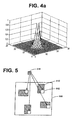
- Figure 4 is an illustration of weights for one color separation with respect to another color separation.
- Figure 4a is an illustration of influence function decay according to an embodiment of the present invention.
- Figure 5 is an illustration of intercell threshold swapping.
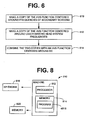
- Figure 6 is an illustration of a method of modifying an influence function in accordance with an embodiment of the present invention.
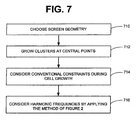
- Figure 7 is an illustration of a general method of designing a halftone screen in accordance with an embodiment of the present invention.
- Figure 8 is an illustration of a system in accordance with an embodiment of the present invention.
- the present invention is embodied in methods of reducing harmonic artifacts in halftone images produced by one or more halftone screens.
- the screens which are considered sources of harmonic artifacts, are modified to reduce the harmonic artifacts.
- a method according to the present invention is not limited to any particular type of halftone screen. However, the method is especially useful for irregular dot cluster screens.
- a method according to the present invention is not limited to any particular type of print engine. However, the method is especially useful for print engines that have harmonic interference sources (e.g., digital print engines with multiple laser beams).
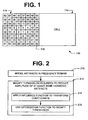
- FIG. 1 illustrates an exemplary cluster halftone screen 110.
- the halftone screen 110 includes a two-dimensional array of thresholds 112.
- Each threshold 112 is a number having a value v ranging from one to M-1, where M represents the total number of gray levels within the gray scale range being used. For example, if the range has 256 gray levels, the value v is 1 ⁇ v ⁇ 255.
- the thresholds are arranged in cells 114. Each cell 114 determines how its cluster is grown.
- the halftone screen 110 is used to generate a halftone image from a contone image. Since the halftone screen 110 is typically smaller than the contone image, the halftone screen 110 may be tiled or replicated across a color plane of the contone color image.
- the halftone screen illustrated Figure 1 is considered a "regular" screen.
- This regular screen will be used to describe the methods according to the present invention.
- the methods according to the present invention are not limited to regular cluster halftone screens.
- the methods according to the present invention can be used to modify irregular cluster halftone screens.
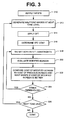
- FIG. 2 illustrates a general method of modifying a halftone screen.
- Artifacts from the screen are modeled in a frequency domain (210).
- the artifacts may be modeled by applying the screen to different contone input images, and performing a Discrete Fourier Transform (DFT) on the resulting halftone images.
- DFT Discrete Fourier Transform
- DCT Discrete Cosine Transform
- DST Discrete Sine Transform
- Each halftone image is transformed into an image having transform coefficients.
- the transform provides an indication of artifacts that are expected to appear in an image rendered at a given tone level.
- the DFT identifies the artifact magnitude for each frequency. Higher amplitudes correlate to more significant artifacts.
- the screen may be modified with respect to screens for other color separations.
- the other screens in combination with the primary screen, can cause harmonic artifacts at "beat frequencies."
- a black screen may be modified with respect to cyan and magenta screens.
- the method can reduce harmonics due to beat frequencies.
- harmonic artifacts can arise from a laser write head system of the press.
- the threshold values in the screen are modified to reduce amplitude of at least some of the modeled artifacts (212).
- the threshold values of the screen 110 may be modified to migrate harmonic content from perceptible frequencies to imperceptible or less perceptible frequencies.
- Modification of the thresholds may include applying an influence function to coefficients of the transform (214).
- the influence function which corresponds to the human visual system, determines which frequencies are more perceptible. To a very rough approximation as a linear spatially-invariant system, the human visual system is lowpass. With respect to noise in still images, the human visual system is in general less sensitive to uncorrelated high-frequency noise than uncorrelated low-frequency noise. Frequencies closer to the DC (zero frequency) have a greater impact on the human visual system. In addition, artifacts closer to 0 and 90 degrees have greater impact on the human visual system then artifacts on a diagonal. All the different frequencies in a given screen per each tone level are weighted. The influence function has a larger weight for transform coefficients around DC than for transform coefficients around other screen harmonics.
- An optimization function may be used to modify the threshold values (216).
- a goal of the optimization function is to shift the amplitude from perceptible artifacts to non-perceptible artifacts. Thus, perceptible artifacts are diminished, and imperceptible artifacts are enhanced.
- halftone screens may be modified off-line.
- Another advantage of the method is that halftone screens need be modified only once.
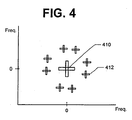
- FIG. 3 illustrates a specific method of modifying a halftone screen.
- the inputs include screens for different color separations, an HVS weight matrix, geometrical constraints on the shape of a single cluster, and contone input images having tone levels in the range [a, b].
- One of the screens will be referred to as the primary screen.
- the other screens will be referred to as secondary screens.
- the primary screen will be evaluated with respect to one or more of the secondary screens.
- the HVS weight matrix may have the same size as the primary screen, with weights for every possible frequency.
- the geometrical constraints prevent the dot cluster growth from being modified in certain ways. For example, the geometrical constraints might prevent isolation of dots or an otherwise reduction in connectivity, or cells that are too acute, or holes within dot clusters.
- the computer generates a set of halftone images at a first tone level (312).
- the primary screen is applied to the input image having the first tone level.
- VFC cost of the primary screen i.e., a scalar which corresponds to visual artifacts level
- the condition s>c compares elements of the threshold matrix (s) with the scalar (c) to produce a binary matrix with '1' were the condition is met, and '0' elsewhere;
- abs- is the absolute operator (amplitudes of the DFT corresponds to strength for a specific frequency);
- ⁇ is a cost function of the VFC.
- a cost function such as an L2 norm (i.e., the sum of squared weighted transform amplitudes, excluding the DC) may be applied to the weighted transform coefficients.
- an L_infinity norm i.e., the largest weighted transform amplitude, excluding the DC may be used.
- the effect of the secondary screens on the pattern may be modeled by performing a convolution of the primary screen and the secondary screens.
- the convolution results in an extremely large number of frequencies. Even for two screens, assuming there are T tones per screen, there are T 2 convolution combinations.
- Convolution is performed as the sum of all the multiplications of individual frequencies (one from each of the two screens). However, instead of performing convolution and focusing on all frequencies, focus can be placed on (1) frequency pairs which sum up to a low frequency (relative to the HVS weight); and (2) frequency pairs which are dominant (multiplied amplitudes).
- multi-separation artifacts may be modeled as follows:
- the DFT is multiplied with an HVS centered at the DC (for single-separation artifacts), and other HVS weight functions centered on interfering frequencies (cell frequencies of the other separations).
- HVS functions centered on a central (DC) frequency 410 and eight surrounding frequencies 412 are illustrated schematically. The horizontal and vertical axes are the spatial frequencies, the DC (410) is the (0,0) frequency.
- the surrounding frequencies may be considered as two overlapping grids, one at about a 20 degree angle, and the other at abut an 85 degree angle.
- the grids represent the harmonics caused by the secondary screens.
- the influence function gives higher weights (and therefore, greater visual impact) to the DC frequency region than the region corresponding to interfering frequencies.
- a 3:1 ratio in favor of the DC influence function may be used.
- the influence function may decay slower around the DC than around the interfering frequencies. Exemplary decay around the DC frequency is illustrated in Figure 4a .
- the screen is modified by performing threshold swapping (318).
- a threshold of the current tone is swapped with a larger threshold.
- Different types of threshold swapping include Intracell threshold swapping and Intercell threshold swapping.
- the threshold swapping modifies the way in which dot clusters are grown.
- a swap is disallowed if a constraint is not satisfied.
- a swap might be disallowed if it causes dots to be isolated or otherwise reduces connectivity, or makes the cells too acute, or creates holes within dot clusters.
- the modified screen is evaluated (320).
- the modified screen may be evaluated by performing steps 314 and 316 on the modified screen.
- the VFC of the modified screen is compared to the VFC of the previous screen (322). If the swaps reduce the VFC of the original screen, the swaps are kept, in which case the new (lower) VFC is kept as a reference for the VFC of the original screen. Otherwise the swaps are rejected and the original threshold location is restored.
- Steps 318-322 may be performed on each possible threshold.
- Steps 312-324 are repeated for additional tone levels (326), except the modified screen is used to generate the halftone images at 312 and is further modified as steps 314-324. These steps are performed until all tone levels have been processed for each screen. Algorithm re-iteration is likely due to the nature of the implementation, which may not find the global minimum at first iteration.
- steps 310-326 will now be provided for the screen of Figure 1 and a tone level of 4.
- Applying the screen of Figure 1 to an image having a tone level of 4 provides the matrix in Table 1.
- the matrix positions corresponding to thresholds 0, 1, 2, 3 and 4 are "lit up.” TABLE 1 0 0 0 0 0 0 0 0 0 0 0 0 0 0 0 0 0 0 0 0 0 0 0 0 0 0 0 0 0 0 0 0 0 0 0 1 1 1 0 0 0 0 0 0 0 0 0 0 0 0 0 0 0 0 0 0 0 0 0 0 0 0 0 0 0 0 0 0 0 0 0 0 0 0 0 0 0 0 0 0 0 0 0 0 0 0 0 0 0 0 0 0 0
- a DFT is performed on this matrix to get a complex matrix (same dimensions) where the absolute value of each coefficient is the amplitude of the corresponding frequency (and thus its possible appearance strength on the print as an artifact).
- the absolute DFT matrix is multiplied with a weighting matrix (the HVS) element by element.
- the HVS is the same size as the DFT, and it weights each frequency by an amount that models how this frequency will appear in the human system.
- Resulting is a matrix having the same size as the original screen, where every cell has a number corresponding to the amplitude (strength) in which the human system will view the artifact (according to the HVS model).
- the L2 norm is the sum of squared elements of this matrix. Resulting is a scalar measure for artifacts appearance.
- Intracell swapping involves swapping of at least one of the thresholds with a larger threshold. For example, a threshold is swapped with one of the n next bigger thresholds. As a result, all clusters remain with the same pixel area for tone level c. Also, for all tones before a, the input and output screens should be identical.
- Intercell swapping may be used instead of Intracell swapping.
- a screen that holds many small cells, where each cell holds only a subset of the thresholds (e.g., 16 out of the 256 or 700 possible threshold values), and the thresholds in the subsets are non-overlapping (i.e., thresholds in one subset are different than the thresholds in another subset).
- the thresholds in the subsets are non-overlapping (i.e., thresholds in one subset are different than the thresholds in another subset).
- one may work in a threshold interval in which there is only one threshold location per cell. In this interval, thresholds between cells can be swapped without changing the geometry of any celt. If two threshold values in the same interval but in different cells are swapped, neither of the cells assumes a new shape. The original cell shapes are simply applied in a different tone for the different cells.
- FIG. 5 illustrates swaps between clusters 510 in a screen 508.
- clusters 510 are illustrated, with their next "candidate pixels 512 to be lit” represented by white-filled.boxes (a lit pixel may be regarded as a darkened or colored pixel, or a pixel upon which ink is deposited).
- Each cell (not shown) of the screen 508 contains a single cluster 510.
- the next threshold 514 that should be allocated is represented by a cross-hatched box.
- Cluster pixels that were previously lit are also represented by cross-hatching.
- An Intercell algorithm allocates the threshold 514 to one of the candidate pixels 512 (which then becomes lit). All pixels within the interval are taken as a bulk.
- the following Intercell algorithm may be used to determine the best order for this to happen. If a screen contains k thresholds of each of the tone values in the interval [t, t+1], then k out of the 2k locations will be allocated to threshold t, such that the new pattern (at threshold t) has minimal artifact level (VFC). The other k locations are allocated to threshold t+1. As long as Intracell swap intervals do not occur, the new lit pixels simply appear in a different order, and the clusters do not change.
- One advantage of this Intercell algorithm is that thresholds outside the interval are not modified.
- a screen may be modified by using Intracell swapping in combination with Intercell swapping.
- Intercell swaps may be used for non-overlapping intervals between minima of the artifact model. This works well as long as the minima are close enough so that there is no more than a single threshold per cell in the tone range. For mid-tones, two or three thresholds per cell per interval may be used.
- Intracell swaps may be used in small intervals to create minima between the Intercell swaps may be applied. Tone intervals are allowed to overlap and the resulting cell shapes are restricted. The resulting cell shapes may be restricted by the same geometric rules that are used for Intracell swaps.
- the halftone screen is not limited to any particular color planes.
- the illusion of continuous shades of color is produced by superimposing the halftones of the individual colorants used, e.g., cyan, magenta, yellow and black (CYMK).
- All screens may be modified.
- only the black screen may be modified with respect to cyan and magenta.
- Modification of the screens is not limited to swapping.
- Intercell swapping for instance, is performed to set the number of pixels of a specific threshold to be different from the original screen, so long as the total number of pixels in the threshold interval is the same as in the original. For example, suppose an original screen has a total number of pixels within the working interval of 1000. Suppose also that the number of thresholds within the interval is ten, and that each threshold contains 100 pixels. It is now possible to set the number pixel per threshold to be different, for example, by setting the first five thresholds of the modified screen to contain 150 pixels, and the last five thresholds to contain fifty pixels. The total number of pixels within the threshold interval in the modified screen remains 1000, as in the original screen.
- the halftone screen is not always the only source of harmonic artifacts. Harmonic artifacts can also come from the print engine that uses the screen.
- the digital printing press includes a laser writing head system.
- the writing head contains multiple laser beams. Because of possible inconsistence of the laser beams, harmonics might be generated (e.g., the basic period is twelve for a writing head having twelve laser beams).
- the laser harmonies may interact with the screen harmonies to produce artifacts. Specifically, if a sum of two frequencies, one from the primary screen and another from the writing head is a low frequency, the multiplication of the two frequency content values in the corresponding frequency spaces should be very small or zero. If the frequency characteristic of writing head inconsistence cannot be controlled, the corresponding screen frequencies should be low or zero. A writing head with only a single beam, in contrast, would not generate harmonic artifacts.
- the writing head harmonics may be added to the screen model by modifying the influence function. For example, a copy (replication) of the HVS function centered around frequencies of secondary screens is made (610), and a similar copy of the HVS function centered around writing head frequencies is made (612). These two copies are summed or otherwise combined with the HVS function centered about DC (614).
- harmonic artifacts can come from printing substrates used in certain types of printing processes.
- a special substrate is used to create the illusion of 3D images or to view different images on the same substrate.
- the substrate includes parallel lenses.
- the lenses have a viewing angle that encapsulate several pixels, even though an observer views only one pixel at a time.
- the parallel lenses can generate harmonic artifacts when they interact with the screens.
- the number of pixels within the viewing angle of a single lens determines the frequency of the interference.
- the direction of the interference in this example is perpendicular to the laser writing head interference. It has been found that the first few harmonics of the substrate should be accounted for (e.g., nine harmonics), and not just the first harmonic.
- a screen geometry is chosen (710).
- a screen is chosen with a certain orientation and a specific cell size. This gives a grid with multiple central points.
- a cluster is grown at each central point (712).
- Conventional constraints are considered (714). The constraints might include shape of the cluster.
- Harmonic frequency is also considered as a constraint (716).
- the harmonic frequency may be considered by applying the method of Figure 2 .
- the interval includes all thresholds.
- the method of Figure 2 indicates where to place the next threshold.
- FIG. 8 illustrates a machine 810 for modifying a halftone screen.
- the machine 810 includes a processor 812 and memory 814.
- the memory 814 may include a program 816 for causing the processor to modify the halftone screen according to the present invention.
- the modified halftone screen may be distributed in a variety of ways. Once a modified screen is generated, it may be loaded into a digital printing press 818 as part of its software. In other types of electrophotographic print engines 818, the modified screen may be part of a print driver.
- the print driver or other software can be distributed via a removable medium 820 such as an optical disc (e.g., DVD) or transmitted (e.g., over the Internet) from memory of one machine to another, etc.
Landscapes
- Engineering & Computer Science (AREA)
- Multimedia (AREA)
- Signal Processing (AREA)
- Image Processing (AREA)
- Color, Gradation (AREA)
- Facsimile Image Signal Circuits (AREA)
- Preparing Plates And Mask In Photomechanical Process (AREA)
Claims (6)
- Verfahren zur Modifizierung eines Punktcluster-Halbtonrasters, wobei das Verfahren Folgendes umfasst:Modellierung von Artefakten in einer Frequenzdomäne, wobei die Artefakte vom Raster (210) modelliert werden; undModifizierung von Schwellenwerten im Raster, um die Amplitude von mindestens einigen der modellierten Artefakte (212) zu reduzieren, dadurch gekennzeichnet, dass dieModellierung von Artefakten von Rastern für zusätzliche Farbtrennungen hervorgerufen wird, wobei das Raster ein primäres Raster ist, das modifiziert wird, um die Amplitude der modellierten Artefakte zu reduzieren, hervorgerufen durch sekundäre Raster für die zusätzlichen Farbtrennungen (212),wobei die Modifizierung der Schwellenwerte die Anwendung einer Einflussfunktion auf die modellierten Artefakte umfasst; und wobei die Einflussfunktion die Harmonischen von den zusätzlichen Farbtrennungen (212) erklärt.
- Verfahren nach Anspruch 1, wobei die Modifizierung der Schwellenwerte die Anwendung einer Einflussfunktion auf die modellierten Artefakte (214) umfasst; wobei die Einflussfunktion ein größeres Gewicht für Transformationskoeffizienten um DC aufweist als für Transformationskoeffizienten um andere Harmonische.
- Verfahren nach Anspruch 2, wobei die anderen Harmonischen andere Harmonische vom primären Raster umfassen
- Verfahren nach Anspruch 1, weiter umfassend Modellierung von Artefakten aufgrund von Harmonischen von einem Laserschreibkopfsystem; wobei das Raster auch modifiziert wird, um die Amplitude von mindestens einigen der Laserschreibkopfsystem-Harmonischen (212) zu reduzieren.
- Verfahren nach Anspruch 1, wobei die Modifizierung der Schwellen den Austausch von Schwellen (318) umfasst.
- Verfahren nach Anspruch 5, weiter umfassend die Bewertung der Wirkung von Austauschvorgängen; und die Aufgabe derjenigen Austauschvorgänge, die die Amplitude von mindestens einem der modellierten Artefakte (320 - 322) reduzieren.
Applications Claiming Priority (2)
| Application Number | Priority Date | Filing Date | Title |
|---|---|---|---|
| US844993 | 2004-05-13 | ||
| US10/844,993 US8345311B2 (en) | 2004-05-13 | 2004-05-13 | Reduction of harmonic artifacts in halftone screens |
Publications (3)
| Publication Number | Publication Date |
|---|---|
| EP1596572A2 EP1596572A2 (de) | 2005-11-16 |
| EP1596572A3 EP1596572A3 (de) | 2007-03-14 |
| EP1596572B1 true EP1596572B1 (de) | 2013-04-10 |
Family
ID=34941279
Family Applications (1)
| Application Number | Title | Priority Date | Filing Date |
|---|---|---|---|
| EP05252935.1A Ceased EP1596572B1 (de) | 2004-05-13 | 2005-05-12 | Reduzierung von Artefakten in Halbtonrastern |
Country Status (3)
| Country | Link |
|---|---|
| US (1) | US8345311B2 (de) |
| EP (1) | EP1596572B1 (de) |
| JP (2) | JP2005328546A (de) |
Families Citing this family (8)
| Publication number | Priority date | Publication date | Assignee | Title |
|---|---|---|---|---|
| JP4604940B2 (ja) * | 2005-06-10 | 2011-01-05 | セイコーエプソン株式会社 | 双方向印刷を行うための画像処理装置および印刷装置 |
| US20080117464A1 (en) * | 2006-11-20 | 2008-05-22 | Monotype Imaging, Inc. | Method and system for reducing auto-moire artifacts in periodic halftone screening |
| US8610962B2 (en) * | 2008-05-09 | 2013-12-17 | Hewlett-Packard Development Company, L.P. | Screen design for process variation artifact reduction |
| JP5562163B2 (ja) * | 2010-07-27 | 2014-07-30 | キヤノン株式会社 | 画像処理装置、画像処理方法およびプログラム |
| JP5856593B2 (ja) * | 2013-08-30 | 2016-02-10 | 富士フイルム株式会社 | 色分解装置、色分解方法および色分解プログラム |
| JP5856594B2 (ja) * | 2013-08-30 | 2016-02-10 | 富士フイルム株式会社 | 色分解装置、色分解方法および色分解プログラム |
| US9019561B1 (en) | 2014-06-09 | 2015-04-28 | Xerox Corporation | Profiling data spacing for different halftone states using a single tone reproduction curve |
| JP7031701B2 (ja) * | 2020-07-22 | 2022-03-08 | 凸版印刷株式会社 | モアレ発生予測装置、モアレ発生予測システム及びモアレ発生予測方法 |
Family Cites Families (12)
| Publication number | Priority date | Publication date | Assignee | Title |
|---|---|---|---|---|
| US5341228A (en) * | 1990-12-04 | 1994-08-23 | Research Corporation Technologies | Method and apparatus for halftone rendering of a gray scale image using a blue noise mask |
| US5673121A (en) * | 1996-06-17 | 1997-09-30 | Xerox Corporation | Stochastic halftoning screening method |
| US6522425B2 (en) * | 1997-02-04 | 2003-02-18 | Fuji Photo Film Co., Ltd. | Method of predicting and processing image fine structures |
| JP3400316B2 (ja) | 1997-10-03 | 2003-04-28 | 富士写真フイルム株式会社 | 網点画像データの修正方法およびその装置、網点閾値データの修正方法 |
| US6563957B1 (en) | 1999-05-07 | 2003-05-13 | Hewlett-Packard Company | Tone dependent error diffusion |
| US6474766B1 (en) * | 2000-09-08 | 2002-11-05 | Sony Corporation | System and method for color dither matrix creation using human-vision-system gray matrix with cluster radii |
| JP4124580B2 (ja) * | 2001-06-12 | 2008-07-23 | 富士フイルム株式会社 | 階調画像作成用閾値配列決定方法 |
| US6888558B2 (en) | 2001-12-19 | 2005-05-03 | Kodak Polychrome Graphics, Llc | Laser-induced thermal imaging with masking |
| JP2003296731A (ja) * | 2002-04-01 | 2003-10-17 | Seiko Epson Corp | 画像評価方法、画像評価装置、画像評価プログラム、当該画像評価プログラムを記録した記録媒体およびスクリーン配置 |
| JP2003298860A (ja) * | 2002-04-01 | 2003-10-17 | Seiko Epson Corp | スクリーン配置および画像処理方法、装置、プログラム、記録媒体 |
| JP2003298861A (ja) * | 2002-04-02 | 2003-10-17 | Seiko Epson Corp | 画像評価方法、画像評価装置、画像評価プログラム、記録媒体、スクリーン配置および画像処理方法、装置、プログラム、記録媒体 |
| JP2005286999A (ja) | 2004-03-05 | 2005-10-13 | Fuji Photo Film Co Ltd | 閾値マトリクスの割当方法 |
-
2004
- 2004-05-13 US US10/844,993 patent/US8345311B2/en active Active
-
2005
- 2005-05-12 EP EP05252935.1A patent/EP1596572B1/de not_active Ceased
- 2005-05-13 JP JP2005141500A patent/JP2005328546A/ja active Pending
-
2008
- 2008-09-12 JP JP2008234818A patent/JP2009038813A/ja active Pending
Also Published As
| Publication number | Publication date |
|---|---|
| EP1596572A2 (de) | 2005-11-16 |
| US8345311B2 (en) | 2013-01-01 |
| US20050254096A1 (en) | 2005-11-17 |
| JP2009038813A (ja) | 2009-02-19 |
| JP2005328546A (ja) | 2005-11-24 |
| EP1596572A3 (de) | 2007-03-14 |
Similar Documents
| Publication | Publication Date | Title |
|---|---|---|
| EP0818106B1 (de) | Digitale rasterung mit spreizspektrum | |
| EP1168820B1 (de) | System zur Erzeugung stochastischer Schwellenmatrizen und Verfahren zur Erzeugung einer Fehlertabelle für die Bilderstellung | |
| JPH03503712A (ja) | 誤差拡散によるディジタル中間調調色 | |
| EP0814431A2 (de) | Anti-Alias-Unterpixel-Zeichenpositionierung mit Grauwertmaskierungstechniken | |
| US7158264B2 (en) | Method of determining threshold array for generating gradation image | |
| US5515456A (en) | Process for providing digital halftone image with random error diffusion, color correction and enlargement | |
| US6760126B1 (en) | Adaptive halftoning method and apparatus | |
| JP2000333010A (ja) | 階調依存型誤差拡散ハーフトーン化方法 | |
| EP0629079A1 (de) | Halbtongerasterte Bilder mittels Modellierung der gedruckten Symbole | |
| JP2009038813A (ja) | ドットクラスタ・ハーフトーン・スクリーンの変更方法 | |
| Goyal et al. | Clustered-dot halftoning with direct binary search | |
| DE69520703T2 (de) | Erzeugung von Mehrfachtonbildern | |
| US8610962B2 (en) | Screen design for process variation artifact reduction | |
| US7262879B2 (en) | Method for screening of halftone images | |
| Goertzel et al. | Digital halftoning on the IBM 4250 printer | |
| EP4427212A1 (de) | Auf multiprimärer anzeigemaske basierendes dithering mit geringer blooming-empfindlichkeit | |
| EP0670653B1 (de) | Erzeugung von Mehrfachtonbildern | |
| JP3698541B2 (ja) | 擬似階調画像処理装置 | |
| US8139267B2 (en) | Method, apparatus and program for creating a threshold value matrix | |
| Yu et al. | Stochastic screen halftoning for electronic imaging devices | |
| US8289577B2 (en) | Method for halftone image transformation, printing and halftone mask generation | |
| Abedini | 2D and 3D Halftoning for Appearance Reproduction | |
| Wu et al. | Supercell dither masks with constrained blue noise interpolation | |
| US5764810A (en) | Screenless conversion of continuous tone images with alterable dot spacing patterns | |
| US5446561A (en) | Method and apparatus for digital scale halftoning with variable screen structure for electrophotographic printing devices |
Legal Events
| Date | Code | Title | Description |
|---|---|---|---|
| PUAI | Public reference made under article 153(3) epc to a published international application that has entered the european phase |
Free format text: ORIGINAL CODE: 0009012 |
|
| AK | Designated contracting states |
Kind code of ref document: A2 Designated state(s): AT BE BG CH CY CZ DE DK EE ES FI FR GB GR HU IE IS IT LI LT LU MC NL PL PT RO SE SI SK TR |
|
| AX | Request for extension of the european patent |
Extension state: AL BA HR LV MK YU |
|
| PUAL | Search report despatched |
Free format text: ORIGINAL CODE: 0009013 |
|
| AK | Designated contracting states |
Kind code of ref document: A3 Designated state(s): AT BE BG CH CY CZ DE DK EE ES FI FR GB GR HU IE IS IT LI LT LU MC NL PL PT RO SE SI SK TR |
|
| AX | Request for extension of the european patent |
Extension state: AL BA HR LV MK YU |
|
| 17P | Request for examination filed |
Effective date: 20070514 |
|
| 17Q | First examination report despatched |
Effective date: 20070611 |
|
| AKX | Designation fees paid |
Designated state(s): DE FR GB |
|
| GRAP | Despatch of communication of intention to grant a patent |
Free format text: ORIGINAL CODE: EPIDOSNIGR1 |
|
| GRAS | Grant fee paid |
Free format text: ORIGINAL CODE: EPIDOSNIGR3 |
|
| GRAA | (expected) grant |
Free format text: ORIGINAL CODE: 0009210 |
|
| AK | Designated contracting states |
Kind code of ref document: B1 Designated state(s): DE FR GB |
|
| REG | Reference to a national code |
Ref country code: GB Ref legal event code: FG4D |
|
| REG | Reference to a national code |
Ref country code: DE Ref legal event code: R096 Ref document number: 602005038977 Country of ref document: DE Effective date: 20130606 |
|
| PLBE | No opposition filed within time limit |
Free format text: ORIGINAL CODE: 0009261 |
|
| STAA | Information on the status of an ep patent application or granted ep patent |
Free format text: STATUS: NO OPPOSITION FILED WITHIN TIME LIMIT |
|
| 26N | No opposition filed |
Effective date: 20140113 |
|
| REG | Reference to a national code |
Ref country code: DE Ref legal event code: R097 Ref document number: 602005038977 Country of ref document: DE Effective date: 20140113 |
|
| REG | Reference to a national code |
Ref country code: FR Ref legal event code: PLFP Year of fee payment: 12 |
|
| REG | Reference to a national code |
Ref country code: FR Ref legal event code: PLFP Year of fee payment: 13 |
|
| REG | Reference to a national code |
Ref country code: FR Ref legal event code: PLFP Year of fee payment: 14 |
|
| PGFP | Annual fee paid to national office [announced via postgrant information from national office to epo] |
Ref country code: FR Payment date: 20201214 Year of fee payment: 17 |
|
| PGFP | Annual fee paid to national office [announced via postgrant information from national office to epo] |
Ref country code: DE Payment date: 20201214 Year of fee payment: 17 |
|
| PGFP | Annual fee paid to national office [announced via postgrant information from national office to epo] |
Ref country code: GB Payment date: 20210422 Year of fee payment: 17 |
|
| REG | Reference to a national code |
Ref country code: DE Ref legal event code: R119 Ref document number: 602005038977 Country of ref document: DE |
|
| GBPC | Gb: european patent ceased through non-payment of renewal fee |
Effective date: 20220512 |
|
| PG25 | Lapsed in a contracting state [announced via postgrant information from national office to epo] |
Ref country code: FR Free format text: LAPSE BECAUSE OF NON-PAYMENT OF DUE FEES Effective date: 20220531 |
|
| PG25 | Lapsed in a contracting state [announced via postgrant information from national office to epo] |
Ref country code: GB Free format text: LAPSE BECAUSE OF NON-PAYMENT OF DUE FEES Effective date: 20220512 Ref country code: DE Free format text: LAPSE BECAUSE OF NON-PAYMENT OF DUE FEES Effective date: 20221201 |