EP1592241B1 - Récepteur de radiodiffusion numérique pour satellite de télécommunications - Google Patents
Récepteur de radiodiffusion numérique pour satellite de télécommunications Download PDFInfo
- Publication number
- EP1592241B1 EP1592241B1 EP05252638A EP05252638A EP1592241B1 EP 1592241 B1 EP1592241 B1 EP 1592241B1 EP 05252638 A EP05252638 A EP 05252638A EP 05252638 A EP05252638 A EP 05252638A EP 1592241 B1 EP1592241 B1 EP 1592241B1
- Authority
- EP
- European Patent Office
- Prior art keywords
- recording
- digital broadcast
- broadcast receiver
- tuner
- video signals
- Prior art date
- Legal status (The legal status is an assumption and is not a legal conclusion. Google has not performed a legal analysis and makes no representation as to the accuracy of the status listed.)
- Expired - Lifetime
Links
Images



Classifications
-
- H—ELECTRICITY
- H04—ELECTRIC COMMUNICATION TECHNIQUE
- H04N—PICTORIAL COMMUNICATION, e.g. TELEVISION
- H04N5/00—Details of television systems
- H04N5/76—Television signal recording
- H04N5/78—Television signal recording using magnetic recording
- H04N5/782—Television signal recording using magnetic recording on tape
-
- H—ELECTRICITY
- H04—ELECTRIC COMMUNICATION TECHNIQUE
- H04N—PICTORIAL COMMUNICATION, e.g. TELEVISION
- H04N5/00—Details of television systems
- H04N5/76—Television signal recording
- H04N5/765—Interface circuits between an apparatus for recording and another apparatus
- H04N5/775—Interface circuits between an apparatus for recording and another apparatus between a recording apparatus and a television receiver
-
- H—ELECTRICITY
- H04—ELECTRIC COMMUNICATION TECHNIQUE
- H04N—PICTORIAL COMMUNICATION, e.g. TELEVISION
- H04N5/00—Details of television systems
- H04N5/76—Television signal recording
- H04N5/78—Television signal recording using magnetic recording
- H04N5/781—Television signal recording using magnetic recording on disks or drums
Definitions
- the present invention relates to a CS (Communication Satellite) digital broadcast receiver (Set Top Box) for receiving BS and CS broadcasts, and relates in particular to a CS digital broadcast receiver (Set Top Box) provided with a programming function to record on the recording means for programmed recording wherein the recording does not start in the standby mode for programmed recording.
- CS Communication Satellite
- CS digital broadcast receivers Set Top Boxes
- a recording means such as an analog video recorder, a digital video recorder, and a hard disk, can be used to record video and audio signals output from a CS digital broadcast receiver.
- an external input terminal of the recording means is used to record externally input audio/video signals.
- both the CS digital broadcast receiver and the recording means must have their timers set, requiring a cumbersome operation.
- Patent Document 1 proposes a CS digital broadcast receiver in which recording starts when the digital broadcast receiver is turned ON and ends when the digital broadcast receiver is turned OFF.
- the CS digital broadcast receiver disclosed in Patent Document 1 operates in a so-called simple recording mode, in which recording starts when the CS digital broadcast receiver is turned ON.
- the recording means starts recording in association with turning on the power of the CS digital broadcast receiver, provided that the CS digital broadcast receiver having the timer set for recording is also turned ON.
- the recording also starts when the CS digital broadcast receiver is turned ON by the viewer to watch in the standby mode for programmed recording, resulting in the recording of undesired programs.
- the present invention is proposed in view of the above problem and has the objective of providing a CS digital broadcast receiver in which an audio/video recording device does not start recording when the CS digital broadcast receiver is turned ON by the user, thereby preventing accidental recording.
- the CS digital broadcast receiver according to the present invention is set out in claim 1.
- the recording means is provided with a simple recording mode in which audio/video signals supplied from the tuner are recorded in association with turning ON the power of the CS digital broadcast receiver, the CS digital broadcast receiver being provided with means to select whether or not to correspond with a simple recording mode.
- audio/video signals of programs received by the tuner are not supplied to the recording means in "the programmed mode". Therefore, programs received by the tuner are not recorded by the recording means even if the CS digital broadcast receiver is turned ON. Audio/video signals of programs from the tuner are supplied to the external output terminal connected to the monitor in the standby mode. Therefore, programs received by the tuner can be viewed and channels and broadcasts can be switched over.
- the recording means is provided with the simple recording mode
- the CS digital broadcast receiver is provided with a function to select whether or not it corresponds with the simple recording mode. For example, when weekly or daily recordings are programmed and no selection is made corresponding to the "simple recording mode", current audio/video signals are supplied to the external output terminal connected to the recording means, and current audio/video signals are easily recorded without canceling the programmed recording.
- selection is made corresponding to the "simple recording mode” nothing is supplied to the external terminal even if the power is turned ON for other programming after the programmed recording is complete. Thus, recording can be easily programmed without canceling the simple programming of the recording means.
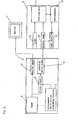
- FIG.1 is a block diagram showing the internal configuration of the CS digital broadcast receiver of the present invention
- Fig.2 is a block diagram showing the connection of external devices.
- a CS digital broadcast receiver 1 comprises a microcomputer or a control means 2, a tuner 3, multiple external output terminals 4 and 5, and a mute circuit 6. External output terminals 4 and 5 are connected to a monitor 7 and a recording means 8, such as an analog video recorder, a digital video recorder, and a hard disk, respectively.
- the recording means 8 comprises a tuner 9 for receiving ground-based broadcasts, an external input terminal 10 for connecting to the CS digital broadcast receiver 1, and a recorder 11 for recording video signals supplied from the tuner 3 of the CS digital broadcast receiver 1 via the tuner 9 and external input terminal 10.
- the external input terminal 10 comprises a signal detector 12 for detecting video signals of the CS digital broadcast receiver 1 supplied to the external input terminal 10 and a microcomputer 13 for controlling the recorder 11 based on signals from the signal detector 12.
- Microcomputer 13 activates the recorder 11 in association with turning ON the power of the CS digital broadcast receiver 1 in "the simple recording mode.”
- a menu screen can be used to pre-select an external output terminal for connecting the recording means 8.
- the external output terminal 5 is selected to connect the recording means 8.
- the CS digital broadcast receiver 1 is provided with a function to program a recording with the start time specified by the user through the microcomputer 2 based on program information obtained from, for example, an electronic program guide and a function to turn ON and OFF this function.
- the CS digital broadcast receiver 1 is further provided with a function to select whether or not it corresponds to the simple recording mode.
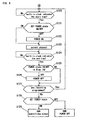
- any program is selected on a program list data displayed on a monitor screen and the start time, end time, and the selected channel is specified in Step S1. Then, selection is made as to whether or not the recording starts based on the "simple recording mode" of the recording means 8.
- audio/video signals from the tuner 3 are supplied to the recording means 8 in association with turning ON the power of the CS digital broadcast receiver 1, whereby a program selected by the tuner 3 is recorded by the recording means 8.
- Step S1 a determination is made as to whether or not an external output terminal to connect the recording means 8 (the terminal 5 in this embodiment) had been selected by the user in Step S1.
- the external output terminal 5 When the external output terminal 5 is selected, audio/video signals of a program selected by the tuner 3 are supplied, and a determination is made as to whether or not timer recording has been programmed (Step S2) . If so, the CS digital broadcast receiver 1 is monitored for turning ON the power or turning OFF the power until timer recording has been accomplished (Step S3).
- Step S4 In the standby mode for programmed recording, no audio/video signals are supplied from the tuner 3 to the external output terminal 5 connected to the recording means 8 (Step S4), and audio/video signals from the tuner 3 are supplied to the external output terminal 7 connected to the monitor 7.
- No audio/video signals of a program received by the tuner 3 are supplied to the recording means 8 in "the programmed mode". Therefore, programs received by the tuner 3 are not recorded by the recording means 8 even if the CS digital broadcast receiver 1 is turned ON. Audio/video signals from the tuner 3 are supplied to the external output terminal 4 connected to the monitor 4 even in the standby mode. Therefore, programs received by the tuner 3 can be viewed and channels and broadcasts can be switched over.
- Step S5 When timer recording is performed (Step S5), the audio/video signals of a program received by the tuner 3 are supplied to the recording means (Step S6), and audio/video signals of a program received by the tuner 3 are recorded by the recording means 8.
- Step S7 audio/video signals of a program received by the tuner 3 are obviously not supplied to the recording means 8 (Step S7).
- Step S9 audio/video signals of programs received by the tuner 3 are supplied to the recording means 8 in association with turning ON the power of the CS digital receiver 1, by which audio/video signals of programs received by the tuner 3 are recorded by the recording means 8 in the simple recording mode (Step S10). There is no external output when the CS digital broadcast receiver 1 is turned OFF (Step S11).
- Step S12 a determination is made as to whether or not timer recording is programmed (Step S12). If it is, the CS digital broadcast receiver 1 is monitored with regard to turning ON the power or turning OFF the power until the timer recording has been performed (Step S13). Audio/video signals from the tuner 3 are not supplied to the external output terminal 5 connected to the recording means 8 in the standby mode for programmed recording (Step S14) . Audio/video signals from the tuner 3 are supplied to the external output terminal 4 connected to the monitor 7.
- the audio/video signals of programs received by the tuner 3 are not supplied to the recording means 8 in "the programmed mode.” Accordingly, programs received by the tuner 3 are not recorded by the recording means 8 even if the CS digital broadcast receiver 1 is turned ON. Audio/video signals of programs received by the tuner 3 are supplied to the external output terminal 4 connected to the monitor 7 even in the standby mode. Hence, programs received by the tuner 3 can be viewed and channels and broadcasts can be switched over.
- Step S15 the audio/video signals of a program received by the tuner 3 are supplied to the recording means 8 (Step S16), and the audio/video signals of a program received by the tuner 3 can be recorded by the recording means 8.
- Step S17 When the timer is turned OFF (Step S17), the audio/video signals of a program received by the tuner 3 are obviously not supplied to the recording means 8 (Step S18) .
- Step S19 When there is no programmed timer recording (Step S19), audio/video signals of programs received by the tuner 3 are supplied to the recording means 8 in association with turning ON the power of the CS digital broadcast receiver 1, and audio/video signals of programs received by the tuner 3 are recorded by the recording means 8 in the simple recording mode (Step S20).
- Step S21 There is no external output when the CS digital broadcast receiver 1 is turned OFF (Step S21).
- the mute circuit 6 does not mute and the monitor displays pictures even if a recording is erroneously programmed by the user. It is relatively easy to program a recording based on an electronic program guide. However, erroneous recording of a program is prevented by the recording means 8 even if a recording is mistakenly programmed by the user.
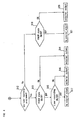
- the present invention is provided with a function to select correspondence or non-correspondence in relation to "simple programming," the operation of which is described hereafter, with reference to Figs. 5 and 6.
- the recording starts when the timer recording is programmed by the user (Step S101) .
- a determination is made as to whether or not there is correspondence with "simple programming” i.e. whether or not the recording is activated in association with turning the power of the CS digital broadcast receiver 1 ON or OFF (Steps S101 and S102).
- the mute circuit 6 mutes the audio/video signals (Step S103) , initiating the standby mode for programmed recording until the recording start time.
- Step S104 the recording start time is reached (Step S104)
- the CS digital broadcast receiver 1 is turned ON and the channel programmed by the user is selected (Steps S104, S105, S106, and S107). Mute cancels the supply of audio/video signals (Step S108) for performing programmed recording.
- the mute circuit 6 mutes the audio/video signals (Step S110).
- Step S111 and S112 the CS digital broadcast receiver 1 is turned OFF in Step 102 (Steps S111 and S112), and a determination is made as to whether or not a recording has been programmed by the user. If so, the operation starting in Step S104 is repeated for recording.
- the mute circuit 6 blocks the output to the external output terminal 5 (S115) even if the power is turned ON for new programming, and a recording is simply programmed without canceling the simple programming of the recording means 8.
- Step S102 When there is no selection of "simple programming" by the user in Step S102, the CS digital broadcast receiver 1 is turned ON at the start time of a recording programmed by the user, the programmed channel is selected, and programmed recording is performed until the end time is reached (Steps S120 to S124). After the completion of the programmed recording, the CS digital broadcast receiver 1 is turned OFF in Step 102 (Steps S125 and S126), and a determination is made as to whether or not a recording has been programmed by the user (Step S127). If it has, the operation starting at Step 120 is repeated.
- a function to pre-select the external output terminal 5 to connect the recording means 8 is provided, and audio/video signals from the tuner 9 are not supplied to the external output terminal 5 to the recording means in the standby mode for programmed recording. However, they are supplied to the external output terminal 4 connected to monitor 7.
- audio/video signals from the tuner 9 are supplied to the external output terminal 5 connected to the recording means 8 at the start time of the programmed recording. Audio/video signals of programs received by the tuner 3 are not supplied to the recording means 8 in the "programmed mode". Therefore, programs received by the tuner 3 are not recorded by the recording means 8, even if the CS digital broadcast receiver 1 is turned ON. Audio/video signals from the tuner 3 are supplied to the external output terminals 4 connected to the monitor 7 even in the standby mode. Therefore, programs received by the tuner 3 can be viewed and channels and broadcasts can be switched over.
- Recording is selectively started either based on "the programmed mode” or based on "the simple recording mode” of the recording means 8. For example, when weekly/daily recordings are programmed and no "simple recording mode" is selected, current audio/video signals are supplied to the external output terminals 5 connected to the recording means 8, and current audio/video signals can be recorded by the recording means 8 without canceling the programmed recordings.
- the simple recording mode When "the simple recording mode” is selected, a recording can be simply programmed without canceling the simple programming of the recording means 8 because there is no output to the external output terminal 5 once the programmed recording is complete and the power is turned ON for new programming.
Landscapes
- Engineering & Computer Science (AREA)
- Multimedia (AREA)
- Signal Processing (AREA)
- Television Signal Processing For Recording (AREA)
- Two-Way Televisions, Distribution Of Moving Picture Or The Like (AREA)
Claims (2)
- Récepteur de radiodiffusion numérique pour satellite de télécommunications comprenant un syntoniseur pour recevoir des signaux de radiodiffusion, des terminaux de sortie externes multiples pour transmettre des signaux audio/vidéo du syntoniseur au moins à un moniteur et moyen d'enregistrement externes, et un moyen de programmation pour spécifier le temps de départ et pour enregistrer les signaux audio/vidéo reçus par le syntoniseur, caractérisé en ce qu'il est pourvu de moyens pour sélectionner un terminal de sortie externe pour la préconnexion du moyen d'enregistrement et étant constitué d'un moyen de commande pour transmettre les signaux audio/vidéo du syntoniseur, non pas au terminal de sortie externe pour le moyen d'enregistrement, mais plutôt seulement au terminal de sortie externe pour le moniteur en mode d'attente d'un enregistrement programmé et pour transmettre les signaux audio/vidéo du syntoniseur au terminal de sortie externe pour le moyen d'enregistrement à l'instant de départ de l'enregistrement programmé.
- Récepteur de radiodiffusion numérique pour satellite de télécommunications selon la revendication 1, caractérisé par le fait que le moyen d'enregistrement présente un mode d'enregistrement simple dans lequel des signaux audio/vidéo fournis par le syntoniseur sont enregistrés en association avec la mise en service de la puissance du récepteur de radiodiffusion numérique pour satellite de télécommunications, le récepteur de radiodiffusion numérique pour satellite de télécommunications présentant un moyen pour sélectionner si oui ou non il correspond à un mode d'enregistrement simple.
Applications Claiming Priority (2)
| Application Number | Priority Date | Filing Date | Title |
|---|---|---|---|
| JP2004134102 | 2004-04-28 | ||
| JP2004134102A JP2005318289A (ja) | 2004-04-28 | 2004-04-28 | Csデジタル放送受信機 |
Publications (2)
| Publication Number | Publication Date |
|---|---|
| EP1592241A1 EP1592241A1 (fr) | 2005-11-02 |
| EP1592241B1 true EP1592241B1 (fr) | 2007-02-21 |
Family
ID=34941074
Family Applications (1)
| Application Number | Title | Priority Date | Filing Date |
|---|---|---|---|
| EP05252638A Expired - Lifetime EP1592241B1 (fr) | 2004-04-28 | 2005-04-27 | Récepteur de radiodiffusion numérique pour satellite de télécommunications |
Country Status (4)
| Country | Link |
|---|---|
| US (1) | US20050244132A1 (fr) |
| EP (1) | EP1592241B1 (fr) |
| JP (1) | JP2005318289A (fr) |
| DE (1) | DE602005000576T2 (fr) |
Families Citing this family (2)
| Publication number | Priority date | Publication date | Assignee | Title |
|---|---|---|---|---|
| JP4974840B2 (ja) * | 2007-10-19 | 2012-07-11 | キヤノン株式会社 | 映像表示装置及びその制御方法 |
| KR102277668B1 (ko) * | 2014-11-05 | 2021-07-15 | 삼성전자 주식회사 | 방송수신장치, 이를 포함하는 시스템 및 그 제어방법 |
Family Cites Families (7)
| Publication number | Priority date | Publication date | Assignee | Title |
|---|---|---|---|---|
| KR0141217B1 (ko) * | 1993-11-30 | 1998-06-15 | 김광호 | 대기상태의 소비전력 절감회로 |
| JPH0845255A (ja) * | 1994-08-03 | 1996-02-16 | Sony Corp | オーディオビデオシステムの制御方法 |
| CN1157946C (zh) * | 1998-06-17 | 2004-07-14 | 皇家菲利浦电子有限公司 | 由设备和外部设备构成的系统 |
| JP3293779B2 (ja) * | 1998-08-25 | 2002-06-17 | キヤノン株式会社 | 信号処理装置およびその制御方法 |
| US6169879B1 (en) * | 1998-09-16 | 2001-01-02 | Webtv Networks, Inc. | System and method of interconnecting and using components of home entertainment system |
| AU4185800A (en) * | 1999-03-30 | 2000-10-16 | Tivo, Inc. | Multimedia program bookmarking system |
| JP2003179836A (ja) * | 2001-12-07 | 2003-06-27 | Sony Corp | サーバ装置、端末装置、番組記録制御システム及び番組記録制御方法 |
-
2004
- 2004-04-28 JP JP2004134102A patent/JP2005318289A/ja not_active Withdrawn
-
2005
- 2005-04-27 US US11/115,310 patent/US20050244132A1/en not_active Abandoned
- 2005-04-27 EP EP05252638A patent/EP1592241B1/fr not_active Expired - Lifetime
- 2005-04-27 DE DE602005000576T patent/DE602005000576T2/de not_active Expired - Fee Related
Also Published As
| Publication number | Publication date |
|---|---|
| EP1592241A1 (fr) | 2005-11-02 |
| DE602005000576T2 (de) | 2007-11-08 |
| US20050244132A1 (en) | 2005-11-03 |
| JP2005318289A (ja) | 2005-11-10 |
| DE602005000576D1 (de) | 2007-04-05 |
Similar Documents
| Publication | Publication Date | Title |
|---|---|---|
| JP2741278B2 (ja) | テレビジョン受像機用信号スイッチング構成 | |
| US5585865A (en) | Television broadcast receiver which selects programs by genre and past viewing habits | |
| JP4276969B2 (ja) | 視聴予約機能を備えた放送受信装置 | |
| US6208800B1 (en) | Recording apparatus, recording system, and recording method | |
| EP1592241B1 (fr) | Récepteur de radiodiffusion numérique pour satellite de télécommunications | |
| EP1765009A2 (fr) | Récepteur de télévision | |
| JP2004350316A (ja) | 放送受信装置および高頻度受信番組自動記録方法 | |
| JP3520010B2 (ja) | 録画装置 | |
| US20020104100A1 (en) | Broadcast data receiver | |
| JP3709900B2 (ja) | タイマー装置、タイマー機能付電子機器および遠隔操作装置 | |
| US20060088290A1 (en) | Controller device connected via IEEE 1394 serial bus to device having tuner function and digital recording device | |
| JP2001245264A (ja) | 放送信号受信記録システム | |
| JP2000333091A (ja) | 複数ネットワークのサービス情報取得方法 | |
| JPH0833061A (ja) | リモートコントロール装置 | |
| JP2000195243A (ja) | 自動録画システム、自動録画システムに対応した映像音声記録装置及び映像音響機器 | |
| JP3490764B2 (ja) | ケーブル放送受信機の制御装置 | |
| KR20000040035A (ko) | 예약녹화 모드에 따른 티브이 제어방법 | |
| JP3728170B2 (ja) | デジタル放送受信機 | |
| KR20060029438A (ko) | 텔레비전 장치 | |
| KR100638941B1 (ko) | 저장기능을 갖는 영상표시기기 및 그 제어방법 | |
| KR100284200B1 (ko) | 브이시알시스템의예약녹화제어방법 | |
| KR19990041369A (ko) | 티브이의 모드 자동 전환 방법 | |
| KR100198340B1 (ko) | 카날 플러스 방송 자동선택 방법 | |
| JP3670778B2 (ja) | 録画装置 | |
| KR100219668B1 (ko) | 예약 녹화에서 텔레비젼 방송 방식 자동 변환장치 및 방법 |
Legal Events
| Date | Code | Title | Description |
|---|---|---|---|
| PUAI | Public reference made under article 153(3) epc to a published international application that has entered the european phase |
Free format text: ORIGINAL CODE: 0009012 |
|
| AK | Designated contracting states |
Kind code of ref document: A1 Designated state(s): AT BE BG CH CY CZ DE DK EE ES FI FR GB GR HU IE IS IT LI LT LU MC NL PL PT RO SE SI SK TR |
|
| AX | Request for extension of the european patent |
Extension state: AL BA HR LV MK YU |
|
| 17P | Request for examination filed |
Effective date: 20060113 |
|
| GRAP | Despatch of communication of intention to grant a patent |
Free format text: ORIGINAL CODE: EPIDOSNIGR1 |
|
| AKX | Designation fees paid |
Designated state(s): DE FR GB |
|
| GRAS | Grant fee paid |
Free format text: ORIGINAL CODE: EPIDOSNIGR3 |
|
| GRAA | (expected) grant |
Free format text: ORIGINAL CODE: 0009210 |
|
| AK | Designated contracting states |
Kind code of ref document: B1 Designated state(s): DE FR GB |
|
| REG | Reference to a national code |
Ref country code: GB Ref legal event code: FG4D |
|
| REF | Corresponds to: |
Ref document number: 602005000576 Country of ref document: DE Date of ref document: 20070405 Kind code of ref document: P |
|
| ET | Fr: translation filed | ||
| PLBE | No opposition filed within time limit |
Free format text: ORIGINAL CODE: 0009261 |
|
| STAA | Information on the status of an ep patent application or granted ep patent |
Free format text: STATUS: NO OPPOSITION FILED WITHIN TIME LIMIT |
|
| 26N | No opposition filed |
Effective date: 20071122 |
|
| PGFP | Annual fee paid to national office [announced via postgrant information from national office to epo] |
Ref country code: FR Payment date: 20080425 Year of fee payment: 4 |
|
| PGFP | Annual fee paid to national office [announced via postgrant information from national office to epo] |
Ref country code: DE Payment date: 20090427 Year of fee payment: 5 |
|
| PGFP | Annual fee paid to national office [announced via postgrant information from national office to epo] |
Ref country code: GB Payment date: 20090417 Year of fee payment: 5 |
|
| REG | Reference to a national code |
Ref country code: FR Ref legal event code: ST Effective date: 20091231 |
|
| PG25 | Lapsed in a contracting state [announced via postgrant information from national office to epo] |
Ref country code: FR Free format text: LAPSE BECAUSE OF NON-PAYMENT OF DUE FEES Effective date: 20091222 |
|
| GBPC | Gb: european patent ceased through non-payment of renewal fee |
Effective date: 20100427 |
|
| PG25 | Lapsed in a contracting state [announced via postgrant information from national office to epo] |
Ref country code: DE Free format text: LAPSE BECAUSE OF NON-PAYMENT OF DUE FEES Effective date: 20101103 |
|
| PG25 | Lapsed in a contracting state [announced via postgrant information from national office to epo] |
Ref country code: GB Free format text: LAPSE BECAUSE OF NON-PAYMENT OF DUE FEES Effective date: 20100427 |