EP1589794A1 - Flexible printed circuit board - Google Patents
Flexible printed circuit board Download PDFInfo
- Publication number
- EP1589794A1 EP1589794A1 EP05252480A EP05252480A EP1589794A1 EP 1589794 A1 EP1589794 A1 EP 1589794A1 EP 05252480 A EP05252480 A EP 05252480A EP 05252480 A EP05252480 A EP 05252480A EP 1589794 A1 EP1589794 A1 EP 1589794A1
- Authority
- EP
- European Patent Office
- Prior art keywords
- printed circuit
- circuit board
- flexible printed
- bent parts
- opposite edges
- Prior art date
- Legal status (The legal status is an assumption and is not a legal conclusion. Google has not performed a legal analysis and makes no representation as to the accuracy of the status listed.)
- Withdrawn
Links
Images




Classifications
-
- H—ELECTRICITY
- H05—ELECTRIC TECHNIQUES NOT OTHERWISE PROVIDED FOR
- H05K—PRINTED CIRCUITS; CASINGS OR CONSTRUCTIONAL DETAILS OF ELECTRIC APPARATUS; MANUFACTURE OF ASSEMBLAGES OF ELECTRICAL COMPONENTS
- H05K1/00—Printed circuits
- H05K1/02—Details
- H05K1/0277—Bendability or stretchability details
- H05K1/028—Bending or folding regions of flexible printed circuits
-
- B—PERFORMING OPERATIONS; TRANSPORTING
- B62—LAND VEHICLES FOR TRAVELLING OTHERWISE THAN ON RAILS
- B62D—MOTOR VEHICLES; TRAILERS
- B62D33/00—Superstructures for load-carrying vehicles
- B62D33/04—Enclosed load compartments ; Frameworks for movable panels, tarpaulins or side curtains
-
- H—ELECTRICITY
- H01—ELECTRIC ELEMENTS
- H01R—ELECTRICALLY-CONDUCTIVE CONNECTIONS; STRUCTURAL ASSOCIATIONS OF A PLURALITY OF MUTUALLY-INSULATED ELECTRICAL CONNECTING ELEMENTS; COUPLING DEVICES; CURRENT COLLECTORS
- H01R35/00—Flexible or turnable line connectors, i.e. the rotation angle being limited
- H01R35/02—Flexible line connectors without frictional contact members
-
- B—PERFORMING OPERATIONS; TRANSPORTING
- B60—VEHICLES IN GENERAL
- B60Y—INDEXING SCHEME RELATING TO ASPECTS CROSS-CUTTING VEHICLE TECHNOLOGY
- B60Y2304/00—Optimising design; Manufacturing; Testing
- B60Y2304/07—Facilitating assembling or mounting
-
- B—PERFORMING OPERATIONS; TRANSPORTING
- B60—VEHICLES IN GENERAL
- B60Y—INDEXING SCHEME RELATING TO ASPECTS CROSS-CUTTING VEHICLE TECHNOLOGY
- B60Y2410/00—Constructional features of vehicle sub-units
- B60Y2410/12—Production or manufacturing of vehicle parts
- B60Y2410/124—Welded parts
-
- H—ELECTRICITY
- H01—ELECTRIC ELEMENTS
- H01R—ELECTRICALLY-CONDUCTIVE CONNECTIONS; STRUCTURAL ASSOCIATIONS OF A PLURALITY OF MUTUALLY-INSULATED ELECTRICAL CONNECTING ELEMENTS; COUPLING DEVICES; CURRENT COLLECTORS
- H01R2201/00—Connectors or connections adapted for particular applications
- H01R2201/16—Connectors or connections adapted for particular applications for telephony
-
- H—ELECTRICITY
- H05—ELECTRIC TECHNIQUES NOT OTHERWISE PROVIDED FOR
- H05K—PRINTED CIRCUITS; CASINGS OR CONSTRUCTIONAL DETAILS OF ELECTRIC APPARATUS; MANUFACTURE OF ASSEMBLAGES OF ELECTRICAL COMPONENTS
- H05K2201/00—Indexing scheme relating to printed circuits covered by H05K1/00
- H05K2201/09—Shape and layout
- H05K2201/09009—Substrate related
- H05K2201/091—Locally and permanently deformed areas including dielectric material
Definitions
- the present invention relates to a flexible printed circuit board for an electronic, or electrical device such as a mobile phone or a lap top computer, for transmitting and receiving an electric signal between a main body and a second body such as a display which is pivotable to the main body.
- a flexible printed circuit board is a micro circuit printed on a flexible plastic material sheet, and is developed in response to the recent trend for small-sized, lightweight, and complicated electronic or electrical apparatuses.
- the flexible printed circuit board can be distributed by high density and three dimensional wire, is highly durable against repeated bending, has no wire distribution error, and can be easily assembled. Therefore, the flexible printed circuit board is widely used for various areas such as a camera, a computer, a peripheral device, a cellular phone, video and audio devices, a camcorder, a printer, a DVD device, a TFT LCD, satellite equipment, military equipment and medical equipment.
- FIG. 1 is a view of an example of a cellular phone to which a general flexible printed circuit board is applied.
- a main body 2 and a folder 3 are foldably jointed by a hinge 4.
- a flexible printed circuit board 10 connects a main board 5 housed in the main body 2 and a sub board 6 housed in the folder 3 for operating an LCD to transmit and receive an electric signal.
- the flexible printed circuit board 10 comprises a first end part 11 connected with the main board 5 and a second end part 12 connected with the sub-board 6, and at least one horizontal part 13 exists in the hinge 4 between the first end part 11 and the second end part 12.
- the first end part 11 and the second end part 12 are approximately perpendicular with the horizontal part 13.
- the folder 3 can be pivotably closed and opened to the cellular phone main body 2 by the flexible printed circuit board 10 such that an electric signal can be efficiently received and transmitted between the main board 5 and the sub board 6.
- the flexible printed circuit board 10 When the folder is pivotably closed and opened to the cellular phone main body 2 as described above, repeated bending and twisting simultaneously occurs in the flexible printed circuit board 10. In specific, the bending occurs at the perpendicular part of the flexible printed circuit board 10, and the twisting occurs at the horizontal part 13. Generally, the flexible printed circuit board 10 is robust to the bending but susceptible to the twisting.
- the horizontal part 13 of the flexible printed circuit board 10 was extended longer than required in view of the twisting such that the tensile deformation may be minimized. If this method is used, however, the elongated horizontal part 13 of the flexible printed circuit board 10 sags such that the horizontal part 13 is frictionized with the inside of the hinge 4 and abraded.
- a flexible printed circuit board comprising a minute circuit printed on a flexible insulated material sheet, and in which opposite edges are longer in length than a middle part.
- the length of opposite edge parts are set in view of tensile-deformed length when the flexible printed circuit board is twisted.
- the length of opposite edge parts may be variously set depending on the width and torsion angles of the flexible printed circuit board.
- a flexible printed circuit board comprises a minute circuit printed on a flexible insulated material sheet, and has bent parts on opposite edges, which bent parts are straightened out during twisting.
- the bent parts may be wave forms in a symmetrical structure.
- the opposite edges are longer in length than a middle part such that tensile deformation at the opposite edges, during twisting, does not occur or is minimized. Therefore, the fatigue failure by the tensile stress can be prevented.
- the tensile deformation of the opposite edges can be minimized.
- the portion housed in the hinge of cellular phone does not need to be extended more than necessary.
- the friction between the flexible printed circuit board and the inside of hinge does not occur so that the flexible printed circuit board can be easily assembled.
- the present invention thus provides a flexible printed circuit board which does not require the length to be extended longer than necessary, and which results in higher reliability during twisting by reducing or preventing tensile deformation from occurring at the edge thereof.
- the flexible printed circuit board 20 consistent with an exemplary embodiment of the present invention has bent parts 21, 21' configured at the opposite edge parts, the bent parts 21, 21' being straightened out during twisting.
- the bent parts 21, 21' at opposite edges may be symmetrical in structure and in wavelike forms.
- bent parts 21, 21' are only an exemplary embodiment for setting the opposite edges to be longer in length than the middle part of the flexible printed circuit board 20, and therefore, this should not be considered as limiting.
- Various structures are possible, if the opposite edge parts can be longer in length than the middle part of the flexible printed circuit board 20.
- bent parts 21, 21' are straightened out during the twisting, preventing the opposite edges of the flexible printed circuit board 20 from tensile deformation.
- the bent parts 21, 21' are suitable for the purpose of the present invention which does not require the length of the edges to be extended longer than necessary and minimizes the tensile deformation during twisting.
- the flexible printed circuit board is highly reliable to bending, and therefore, if the board can be also robust to twisting, the lifetime may be prolonged much longer.
- the length of opposite edge parts may be set in view of a tensile-deformed length when the flexible printed circuit board 20 is twisted. However, since the length varies according to the width and torsion angle of the flexible printed circuit board 20, the length may be applied by calculating from experiments and/or mathematical formulas in view of the width and torsion angle.
- the flexible printed circuit board 20 consists of a minute circuit printed on a flexible insulated material sheet such as plastic, and the minute circuit is for transmitting an electrical signal.
- the opposite edge parts are set longer than the middle part and bent parts 21, 21' are configured at the opposite edge parts for preventing tensile deformation during twisting.
- the bent parts 21, 21' may be configured simultaneously with a hot press by forming shapes of prominences and depressions corresponding to the bent parts 21, 21' in a mould during the hot press, which is one of the production processes of the flexible printed circuit board 20. That is, the bent parts are easily configured by changing the structure of a mould for a hot press, without adding a separate process, in the manufacturing line of the conventional flexible printed circuit board.
- FIG. 5 is a view of a flexible printed circuit board 20 for a cellular phone consistent with an exemplary embodiment of the present invention.
- the flexible printed circuit board for a cellular phone consistent with an exemplary embodiment of the present invention will be explained as below.
- a main body 2 and a folder 3 are foldably jointed by a hinge 4.
- a main board 5 is housed in the main body 2, and a sub board 6 for operating an LCD is housed in the folder 3.
- the horizontal part 13 has bent parts 21, 21' at the opposite edges, and the bent parts 21, 21' are straightened out when twisting by a pivotal opening and closing of the folder 3 which occurs at the opposite edges.
- the bent parts 21, 21' have the structure and are operated as same as the aforementioned bent parts, and therefore, the detailed description thereof will be omitted for conciseness.
- the bent parts 21 and 21' are explained as being configured at the horizontal part 13 of the flexible printed circuit board 20.
- the flexible printed circuit board 20 is applied to a cellular phone having a camera such that the folder can be rotated to other directions including an open and close direction with respect to the main body, it is natural that the flexible printed circuit board 20 may also have the aforementioned bent parts at the perpendicular part to prevent repeated tensile deformation.
- FIG. 6A is a view of a simulation result of a conventional flexible printed circuit board
- FIG. 6B is a view of simulation result of a flexible printed circuit board consistent with an exemplary embodiment of the present invention.
- analysis software called as LSDyna is used, and principle stress generated at the edge part is measured when one side is fixed and the other side is revolved by 180 degrees.
- the value of principle stress according to a conventional art is 155Mpa, whereas the value of principle stress consistent with an exemplary embodiment of the present invention is 90Mpa.
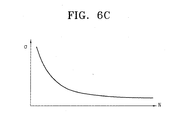
- FIG. 6C is a representative graph of correlations between the principle stress ⁇ and the repeated torsion number N.
- the principle stress ⁇ of vertical axis is higher, the repeated torsion number N of horizontal axis is remarkably lower, and as the principle stress ⁇ is lower, the repeated torsion number N is remarkably higher.
- the present invention having the principle stress of 90Mpa can increase the number N of repeated twisting more than the conventional art having the principle stress of 155Mpa.
- the repeated twisting number N means the number of opening and closing of the folder with respect to the cellular phone main body.
- a flexible printed circuit board consistent with an exemplary embodiment of the present invention can decrease stress of the edge parts such that the lifetime of the flexible printed circuit board may be longer, and an electrical and electronic apparatus using the flexible printed circuit board may have increased quality and reliability.
- the stress by torsion of the opposite edge parts can be reduced.
- the flexible printed circuit board in the hinge of cellular phone does not need be extended more than necessary. As a result, quality degradation such as abrasion by friction of the flexible printed circuit board is prevented.
Landscapes
- Engineering & Computer Science (AREA)
- Microelectronics & Electronic Packaging (AREA)
- Chemical & Material Sciences (AREA)
- Combustion & Propulsion (AREA)
- Transportation (AREA)
- Mechanical Engineering (AREA)
- Structure Of Printed Boards (AREA)
- Telephone Set Structure (AREA)
Abstract
A flexible printed circuit board (20) is robust to a repeated twisting and consists of a
minute circuit printed on a flexible insulated material sheet, and has the bent parts (21,21') of the
opposite edges symmetrical in structure. The bent parts (21,21') are straightened out when
twisting occurs. In the flexible printed circuit board (20), the opposite edges are longer in
length than the middle part such that the tensile deformation at the opposite edges at the
time of twisting does not occur or is minimized.
Description
- The present invention relates to a flexible printed circuit board for an electronic, or electrical device such as a mobile phone or a lap top computer, for transmitting and receiving an electric signal between a main body and a second body such as a display which is pivotable to the main body.
- A flexible printed circuit board is a micro circuit printed on a flexible plastic material sheet, and is developed in response to the recent trend for small-sized, lightweight, and complicated electronic or electrical apparatuses. The flexible printed circuit board can be distributed by high density and three dimensional wire, is highly durable against repeated bending, has no wire distribution error, and can be easily assembled. Therefore, the flexible printed circuit board is widely used for various areas such as a camera, a computer, a peripheral device, a cellular phone, video and audio devices, a camcorder, a printer, a DVD device, a TFT LCD, satellite equipment, military equipment and medical equipment.
- FIG. 1 is a view of an example of a cellular phone to which a general flexible printed circuit board is applied. As shown, in the
cellular phone 1, amain body 2 and a folder 3 are foldably jointed by a hinge 4. A flexible printedcircuit board 10 connects amain board 5 housed in themain body 2 and a sub board 6 housed in the folder 3 for operating an LCD to transmit and receive an electric signal. - Referring to FIG. 2, the flexible printed
circuit board 10 comprises afirst end part 11 connected with themain board 5 and asecond end part 12 connected with the sub-board 6, and at least onehorizontal part 13 exists in the hinge 4 between thefirst end part 11 and thesecond end part 12. Thefirst end part 11 and thesecond end part 12 are approximately perpendicular with thehorizontal part 13. - The folder 3 can be pivotably closed and opened to the cellular phone
main body 2 by the flexible printedcircuit board 10 such that an electric signal can be efficiently received and transmitted between themain board 5 and the sub board 6. - When the folder is pivotably closed and opened to the cellular phone
main body 2 as described above, repeated bending and twisting simultaneously occurs in the flexible printedcircuit board 10. In specific, the bending occurs at the perpendicular part of the flexible printedcircuit board 10, and the twisting occurs at thehorizontal part 13. Generally, the flexible printedcircuit board 10 is robust to the bending but susceptible to the twisting. - When the twisting occurs at the
horizontal part 13 as shown in FIG. 2, a stress is generated responsive to the tensile deformation as the edge is extended longer than the actual length. The tensile stress causes fatigue failure such that a minute circuit of the flexible printedcircuit board 10 is disconnected and damaged. - To prevent the disconnection and damage of the minute circuit of the flexible printed
circuit board 10 by the tensile stress, conventionally, thehorizontal part 13 of the flexible printedcircuit board 10 was extended longer than required in view of the twisting such that the tensile deformation may be minimized. If this method is used, however, the elongatedhorizontal part 13 of the flexible printedcircuit board 10 sags such that thehorizontal part 13 is frictionized with the inside of the hinge 4 and abraded. - According to an aspect of the present invention, there is provided a flexible printed circuit board comprising a minute circuit printed on a flexible insulated material sheet, and in which opposite edges are longer in length than a middle part.
- Preferably, the length of opposite edge parts are set in view of tensile-deformed length when the flexible printed circuit board is twisted. The length of opposite edge parts may be variously set depending on the width and torsion angles of the flexible printed circuit board.
- According to another aspect of the present invention, a flexible printed circuit board comprises a minute circuit printed on a flexible insulated material sheet, and has bent parts on opposite edges, which bent parts are straightened out during twisting. The bent parts may be wave forms in a symmetrical structure.
- Preferably, the opposite edges are longer in length than a middle part such that tensile deformation at the opposite edges, during twisting, does not occur or is minimized. Therefore, the fatigue failure by the tensile stress can be prevented.
- Further, consistent with the flexible printed circuit board of the present invention, the tensile deformation of the opposite edges can be minimized. For example, the portion housed in the hinge of cellular phone does not need to be extended more than necessary. As such, the friction between the flexible printed circuit board and the inside of hinge does not occur so that the flexible printed circuit board can be easily assembled.
- The present invention thus provides a flexible printed circuit board which does not require the length to be extended longer than necessary, and which results in higher reliability during twisting by reducing or preventing tensile deformation from occurring at the edge thereof.
- The above and other aspects, features and advantages of the present invention will be more apparent from the following detailed description taken with reference to the accompanying drawings, in which:
- FIG. 1 is a view of a cellular phone to which a general flexible printed circuit board is applied;
- FIG. 2 is a view illustrating a twisting which occurs at the flexible printed circuit board when the cellular phone of FIG. 1 is used;
- FIG. 3 is an enlarged view of a part of the flexible printed circuit board consistent with an exemplary embodiment of the present invention;
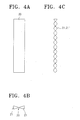
- FIGs. 4A, 4B and 4C are a plan view, elevation view and side view, respectively, of FIG. 3;
- FIG. 5 is a view illustrating a buffering operation against a twisting in the flexible printed circuit board for a cellular phone consistent with an exemplary embodiment of the present invention; and
- FIGs. 6A, 6B and 6C are views for comparison of the result and effect of simulation of a flexible printed circuit board consistent with an exemplary embodiment of the present invention and a flexible printed circuit board according to a conventional art.
-
- Exemplary embodiments of the present invention will be described in greater detail with reference to the accompanying drawings.
- In the following description, same drawing reference numerals are used for the same elements even in different drawings. The matters defined in the description such as a detailed construction and elements are provided to assist in a comprehensive understanding of the invention. Thus, it is apparent that the present invention can be carried out without those defined matters. Also, well-known functions or constructions are not described in detail since they would obscure the invention in unnecessary detail.
- As shown in FIG. 3, FIGs. 4A, 4B and 4C, the flexible printed
circuit board 20 consistent with an exemplary embodiment of the present invention hasbent parts 21, 21' configured at the opposite edge parts, thebent parts 21, 21' being straightened out during twisting. Thebent parts 21, 21' at opposite edges may be symmetrical in structure and in wavelike forms. - One will understand that the
bent parts 21, 21' are only an exemplary embodiment for setting the opposite edges to be longer in length than the middle part of the flexible printedcircuit board 20, and therefore, this should not be considered as limiting. Various structures are possible, if the opposite edge parts can be longer in length than the middle part of the flexible printedcircuit board 20. - The
bent parts 21, 21' are straightened out during the twisting, preventing the opposite edges of the flexible printedcircuit board 20 from tensile deformation. As such, thebent parts 21, 21' are suitable for the purpose of the present invention which does not require the length of the edges to be extended longer than necessary and minimizes the tensile deformation during twisting. - As described above, by bending the opposite edge parts, longer than middle part, of the flexible printed
circuit board 20, the opposite edges are not forcibly extended but straightened out such that no tensile deformation occurs on the opposite edge of the flexible printedcircuit board 20 except for a little bending deformation. As aforementioned, the flexible printed circuit board is highly reliable to bending, and therefore, if the board can be also robust to twisting, the lifetime may be prolonged much longer. - The length of opposite edge parts may be set in view of a tensile-deformed length when the flexible printed
circuit board 20 is twisted. However, since the length varies according to the width and torsion angle of the flexibleprinted circuit board 20, the length may be applied by calculating from experiments and/or mathematical formulas in view of the width and torsion angle. - Although it is not described in detail, the flexible printed
circuit board 20 consists of a minute circuit printed on a flexible insulated material sheet such as plastic, and the minute circuit is for transmitting an electrical signal. However, in the flexible printedcircuit board 20 consistent with an exemplary embodiment of the present invention, the opposite edge parts are set longer than the middle part andbent parts 21, 21' are configured at the opposite edge parts for preventing tensile deformation during twisting. - The
bent parts 21, 21' may be configured simultaneously with a hot press by forming shapes of prominences and depressions corresponding to thebent parts 21, 21' in a mould during the hot press, which is one of the production processes of the flexible printedcircuit board 20. That is, the bent parts are easily configured by changing the structure of a mould for a hot press, without adding a separate process, in the manufacturing line of the conventional flexible printed circuit board. - FIG. 5 is a view of a flexible printed
circuit board 20 for a cellular phone consistent with an exemplary embodiment of the present invention. Referring to the figures, the flexible printed circuit board for a cellular phone consistent with an exemplary embodiment of the present invention will be explained as below. - Referring to FIG. 1, in the
cellular phone 1, amain body 2 and a folder 3 are foldably jointed by a hinge 4. Amain board 5 is housed in themain body 2, and a sub board 6 for operating an LCD is housed in the folder 3. - Referring to FIG. 5, the flexible printed
circuit board 20 consistent with an exemplary embodiment of the present invention comprises afirst end part 11 connected with themain board 5 and asecond end part 12 connected with the sub board 6. At least onehorizontal part 13 housed in the hinge 4 is formed between thefirst end part 11 and thesecond end part 12. Thefirst end part 11 and thesecond end part 12 are substantially perpendicular with respect to thehorizontal part 13. - The
horizontal part 13 hasbent parts 21, 21' at the opposite edges, and thebent parts 21, 21' are straightened out when twisting by a pivotal opening and closing of the folder 3 which occurs at the opposite edges. Thebent parts 21, 21' have the structure and are operated as same as the aforementioned bent parts, and therefore, the detailed description thereof will be omitted for conciseness. - Meanwhile, since a folder type cellular phone is used in the exemplary embodiments, the
bent parts 21 and 21' are explained as being configured at thehorizontal part 13 of the flexible printedcircuit board 20. However, if the flexible printedcircuit board 20 is applied to a cellular phone having a camera such that the folder can be rotated to other directions including an open and close direction with respect to the main body, it is natural that the flexible printedcircuit board 20 may also have the aforementioned bent parts at the perpendicular part to prevent repeated tensile deformation. - FIG. 6A is a view of a simulation result of a conventional flexible printed circuit board, and FIG. 6B is a view of simulation result of a flexible printed circuit board consistent with an exemplary embodiment of the present invention. For both simulations, analysis software called as LSDyna is used, and principle stress generated at the edge part is measured when one side is fixed and the other side is revolved by 180 degrees. The value of principle stress according to a conventional art is 155Mpa, whereas the value of principle stress consistent with an exemplary embodiment of the present invention is 90Mpa.
- FIG. 6C is a representative graph of correlations between the principle stress σ and the repeated torsion number N. Referring to the graph, as the principle stress σ of vertical axis is higher, the repeated torsion number N of horizontal axis is remarkably lower, and as the principle stress σ is lower, the repeated torsion number N is remarkably higher. Accordingly, the present invention having the principle stress of 90Mpa can increase the number N of repeated twisting more than the conventional art having the principle stress of 155Mpa. In the case of a cellular phone, the repeated twisting number N means the number of opening and closing of the folder with respect to the cellular phone main body.
- A flexible printed circuit board consistent with an exemplary embodiment of the present invention can decrease stress of the edge parts such that the lifetime of the flexible printed circuit board may be longer, and an electrical and electronic apparatus using the flexible printed circuit board may have increased quality and reliability.
- Also, in accordance with the flexible printed circuit board consistent with an exemplary embodiment of the present invention, the stress by torsion of the opposite edge parts can be reduced. For example, the flexible printed circuit board in the hinge of cellular phone does not need be extended more than necessary. As a result, quality degradation such as abrasion by friction of the flexible printed circuit board is prevented.
- The foregoing embodiments and advantages are merely exemplary and are not to be construed as limiting the present invention. The present teaching can be readily applied to other types of apparatuses. Also, the description of the exemplary embodiments of the present invention is intended to be illustrative, and not to limit the scope of the claims, and many alternatives, modifications, and variations will be apparent to those skilled in the art.
Claims (9)
- A flexible printed circuit board for an electronic or electric apparatus, the apparatus having a first member and a second member capable of moving with respect to the first member, the flexible printed circuit board being operable to connect the first member and the second member for receiving and transmitting an electrical signal therebetween, the flexible printed circuit board comprising:wherein opposite edges of at least a portion of the flexible printed circuit board are longer in length than a middle part.a flexible insulated material sheet; anda circuit printed on the flexible insulated material sheet,
- The flexible printed circuit board according to claim 1, wherein the length of the opposite edges is set depending on a width and an intended torsion angle of the flexible printed circuit board.
- The flexible printed circuit board according to claim 1 or 2, wherein bent parts are configured at the opposite edges, the bent parts being arranged to straighten out during twisting.
- The flexible printed circuit board according to claim 3, wherein the bent parts are wavelike in form.
- The flexible printed circuit board according to claim 3 or 4, wherein the bent parts have symmetrical structures.
- A cellular phone comprising:a main body housing a main board;a folder housing a sub board for operating an LCD;a hinge foldably jointing the main body and the folder such that the folder may be opened and closed; andthe flexible printed circuit board according to any preceding claim, the first member being the main board and the second member being the sub board.
- The cellular phone according to claim 6, wherein the flexible printed circuit board comprises:wherein the intermediate portion has bent parts configured at opposite edges, and wherein the bent parts are arranged to straighten out when the intermediate portion is twisted by opening and closing the folder.a first end portion connected to the main board;a second end portion connected to the sub board; anda intermediate portion configured between the first end portion and the second end portion and housed in the hinge, the intermediate portion running substantially parallel to the hinge axis,
- The cellular phone according to claim 7, wherein, when the bent parts are straightened out, the opposite edges are longer in length than the middle part.
- A flexible printed circuit board for an electronic or electric apparatus, the apparatus having a first member and a second member capable of moving with respect to the first member, the flexible printed circuit board being operable to connect the first member and the second member for receiving and transmitting an electrical signal therebetween, the flexible printed circuit board comprising:wherein bent parts are configured at the opposite edges of at least a portion of the flexible printed circuit board, the bent parts being arranged to straighten out during twisting.a flexible insulated material sheet; anda circuit printed on the flexible insulated material sheet,
Applications Claiming Priority (2)
| Application Number | Priority Date | Filing Date | Title |
|---|---|---|---|
| KR2004027344 | 2004-04-21 | ||
| KR1020040027344A KR100541958B1 (en) | 2004-04-21 | 2004-04-21 | Flexible Printed Circuit Board |
Publications (1)
| Publication Number | Publication Date |
|---|---|
| EP1589794A1 true EP1589794A1 (en) | 2005-10-26 |
Family
ID=34940949
Family Applications (1)
| Application Number | Title | Priority Date | Filing Date |
|---|---|---|---|
| EP05252480A Withdrawn EP1589794A1 (en) | 2004-04-21 | 2005-04-20 | Flexible printed circuit board |
Country Status (4)
| Country | Link |
|---|---|
| US (1) | US7660126B2 (en) |
| EP (1) | EP1589794A1 (en) |
| JP (1) | JP4072169B2 (en) |
| KR (1) | KR100541958B1 (en) |
Cited By (4)
| Publication number | Priority date | Publication date | Assignee | Title |
|---|---|---|---|---|
| CN103491705A (en) * | 2013-09-27 | 2014-01-01 | 深圳莱宝高科技股份有限公司 | Flexible circuit board |
| CN103582290A (en) * | 2012-07-26 | 2014-02-12 | 隆达电子股份有限公司 | Flexible substrate and lighting device including the same |
| US10014138B2 (en) | 2015-02-25 | 2018-07-03 | Kabushiki Kaisha Tokai Rika Denki Seisakusho | Switch device |
| EP3901042A1 (en) * | 2020-04-22 | 2021-10-27 | Goodrich Aerospace Services Private Limited | Flexible circuit card assembly with preformed undulations for surveillance system hinge assembly |
Families Citing this family (60)
| Publication number | Priority date | Publication date | Assignee | Title |
|---|---|---|---|---|
| US7529100B2 (en) * | 2003-12-16 | 2009-05-05 | Tpo Displays Corp. | Flexible printed circuit board (FPC) for liquid crystal display (LCD) module |
| KR100716828B1 (en) * | 2005-03-26 | 2007-05-09 | 삼성전기주식회사 | Flexible board for electronic devices with excess bends |
| US20070242150A1 (en) * | 2006-04-13 | 2007-10-18 | Hiroshi Terada | Display apparatus and imaging device |
| US8080736B2 (en) * | 2009-02-18 | 2011-12-20 | Teledyne Scientific & Imaging, Llc | Non-planar microcircuit structure and method of fabricating same |
| KR101670258B1 (en) * | 2009-07-06 | 2016-10-31 | 삼성전자 주식회사 | Mobile device having flexible printed circuit board |
| USD669046S1 (en) * | 2010-05-19 | 2012-10-16 | Nippon Mektron, Ltd | Flexible printed circuit board |
| USD656111S1 (en) * | 2010-05-19 | 2012-03-20 | Nippon Mektron, Ltd. | Flexible printed circuit board |
| USD656112S1 (en) * | 2010-05-19 | 2012-03-20 | Nippon Mektron, Ltd. | Flexible printed circuit board |
| USD669045S1 (en) * | 2010-05-19 | 2012-10-16 | Nippon Mektron, Ltd. | Flexible printed circuit board |
| USD687397S1 (en) * | 2010-05-19 | 2013-08-06 | Nippon Mektron, Ltd. | Flexible printed circuit board |
| USD661265S1 (en) * | 2010-05-19 | 2012-06-05 | Nippon Mektron, Ltd. | Flexible printed circuit board |
| US9018532B2 (en) * | 2011-06-09 | 2015-04-28 | Multi-Fineline Electronix, Inc. | Stretchable circuit assemblies |
| US10528135B2 (en) | 2013-01-14 | 2020-01-07 | Ctrl-Labs Corporation | Wearable muscle interface systems, devices and methods that interact with content displayed on an electronic display |
| WO2014186370A1 (en) | 2013-05-13 | 2014-11-20 | Thalmic Labs Inc. | Systems, articles and methods for wearable electronic devices that accommodate different user forms |
| US11426123B2 (en) | 2013-08-16 | 2022-08-30 | Meta Platforms Technologies, Llc | Systems, articles and methods for signal routing in wearable electronic devices that detect muscle activity of a user using a set of discrete and separately enclosed pod structures |
| US10042422B2 (en) | 2013-11-12 | 2018-08-07 | Thalmic Labs Inc. | Systems, articles, and methods for capacitive electromyography sensors |
| US12504816B2 (en) | 2013-08-16 | 2025-12-23 | Meta Platforms Technologies, Llc | Wearable devices and associated band structures for sensing neuromuscular signals using sensor pairs in respective pods with communicative pathways to a common processor |
| US11921471B2 (en) | 2013-08-16 | 2024-03-05 | Meta Platforms Technologies, Llc | Systems, articles, and methods for wearable devices having secondary power sources in links of a band for providing secondary power in addition to a primary power source |
| US20150124566A1 (en) | 2013-10-04 | 2015-05-07 | Thalmic Labs Inc. | Systems, articles and methods for wearable electronic devices employing contact sensors |
| US10231333B1 (en) | 2013-08-27 | 2019-03-12 | Flextronics Ap, Llc. | Copper interconnect for PTH components assembly |
| US9788789B2 (en) * | 2013-08-30 | 2017-10-17 | Thalmic Labs Inc. | Systems, articles, and methods for stretchable printed circuit boards |
| JP5924456B2 (en) | 2013-09-06 | 2016-05-25 | 株式会社村田製作所 | Multilayer board |
| WO2015081113A1 (en) | 2013-11-27 | 2015-06-04 | Cezar Morun | Systems, articles, and methods for electromyography sensors |
| KR102133452B1 (en) | 2013-12-11 | 2020-07-14 | 삼성디스플레이 주식회사 | Display device |
| CN106102504A (en) | 2014-02-14 | 2016-11-09 | 赛尔米克实验室公司 | For the elastic system of power cable, goods and method and the wearable electronic installation using elastic power cable |
| US10199008B2 (en) | 2014-03-27 | 2019-02-05 | North Inc. | Systems, devices, and methods for wearable electronic devices as state machines |
| JP6306410B2 (en) * | 2014-04-17 | 2018-04-04 | 日本メクトロン株式会社 | Flexible printed board manufacturing method, board manufacturing jig, and board manufacturing apparatus |
| US9723713B1 (en) * | 2014-05-16 | 2017-08-01 | Multek Technologies, Ltd. | Flexible printed circuit board hinge |
| USD784936S1 (en) | 2014-05-28 | 2017-04-25 | Sumitomo Electric Industries, Ltd. | Flexible printed wiring board with device |
| USD785575S1 (en) | 2014-05-28 | 2017-05-02 | Sumitomo Electric Industries, Ltd. | Flexible printed wiring board |
| US9880632B2 (en) | 2014-06-19 | 2018-01-30 | Thalmic Labs Inc. | Systems, devices, and methods for gesture identification |
| EP3167695A4 (en) * | 2014-07-08 | 2018-06-06 | David Markus | Elastic circuit |
| US9807221B2 (en) | 2014-11-28 | 2017-10-31 | Thalmic Labs Inc. | Systems, devices, and methods effected in response to establishing and/or terminating a physical communications link |
| US10078435B2 (en) | 2015-04-24 | 2018-09-18 | Thalmic Labs Inc. | Systems, methods, and computer program products for interacting with electronically displayed presentation materials |
| US11216069B2 (en) | 2018-05-08 | 2022-01-04 | Facebook Technologies, Llc | Systems and methods for improved speech recognition using neuromuscular information |
| US12554325B2 (en) | 2016-07-25 | 2026-02-17 | Meta Platforms Technologies, Llc | Methods and apparatuses for low latency body state prediction based on neuromuscular data |
| WO2018022602A1 (en) | 2016-07-25 | 2018-02-01 | Ctrl-Labs Corporation | Methods and apparatus for predicting musculo-skeletal position information using wearable autonomous sensors |
| USD877099S1 (en) * | 2017-03-15 | 2020-03-03 | Sumitomo Electric Industries, Ltd. | Flexible printed wiring board for a module |
| KR102349743B1 (en) | 2017-03-20 | 2022-01-11 | 삼성전자주식회사 | accessary apparatus including printed circuit board of bended structure |
| KR102045403B1 (en) * | 2017-04-13 | 2019-11-15 | 한국단자공업 주식회사 | Flexible printed circuit board having folding means |
| CN112040858B (en) | 2017-10-19 | 2024-06-07 | 元平台技术有限公司 | Systems and methods for identifying biological structures associated with neuromuscular source signals |
| KR102087698B1 (en) | 2017-12-29 | 2020-03-11 | 주식회사 유라코퍼레이션 | Circuit board and manufacturing method thereof |
| US11907423B2 (en) | 2019-11-25 | 2024-02-20 | Meta Platforms Technologies, Llc | Systems and methods for contextualized interactions with an environment |
| US11150730B1 (en) | 2019-04-30 | 2021-10-19 | Facebook Technologies, Llc | Devices, systems, and methods for controlling computing devices via neuromuscular signals of users |
| US11493993B2 (en) | 2019-09-04 | 2022-11-08 | Meta Platforms Technologies, Llc | Systems, methods, and interfaces for performing inputs based on neuromuscular control |
| US11481030B2 (en) | 2019-03-29 | 2022-10-25 | Meta Platforms Technologies, Llc | Methods and apparatus for gesture detection and classification |
| US12579768B2 (en) | 2018-01-25 | 2026-03-17 | Meta Platforms Technologies, Llc | Wearable electronic devices, extended reality systems including neuromuscular sensors, and methods for generating text from speech input and modifying the generated text based on neuromuscular data |
| US10937414B2 (en) | 2018-05-08 | 2021-03-02 | Facebook Technologies, Llc | Systems and methods for text input using neuromuscular information |
| US11961494B1 (en) | 2019-03-29 | 2024-04-16 | Meta Platforms Technologies, Llc | Electromagnetic interference reduction in extended reality environments |
| US10592001B2 (en) | 2018-05-08 | 2020-03-17 | Facebook Technologies, Llc | Systems and methods for improved speech recognition using neuromuscular information |
| US10905350B2 (en) | 2018-08-31 | 2021-02-02 | Facebook Technologies, Llc | Camera-guided interpretation of neuromuscular signals |
| EP3853698A4 (en) | 2018-09-20 | 2021-11-17 | Facebook Technologies, LLC | NEUROMUSCULAR TEXT, WRITING AND DRAWING ENTRY IN AUGMENTED REALITY SYSTEMS |
| EP3886693A4 (en) | 2018-11-27 | 2022-06-08 | Facebook Technologies, LLC. | METHODS AND APPARATUS FOR SELF-CALIBRATION OF A WEAR ELECTRODE SENSOR SYSTEM |
| KR102151193B1 (en) | 2018-12-04 | 2020-09-02 | 주식회사 유라코퍼레이션 | Printed circuit board and method of producing the same |
| KR102834211B1 (en) | 2019-10-25 | 2025-07-15 | 삼성디스플레이 주식회사 | Display device |
| KR102280052B1 (en) * | 2020-02-06 | 2021-07-21 | (주)파트론 | Signal transmission module and camera apparatus |
| KR102187081B1 (en) | 2020-06-26 | 2020-12-04 | 주식회사 유라코퍼레이션 | Printed circuit board |
| KR102368540B1 (en) * | 2020-09-03 | 2022-02-28 | 한국기계연구원 | Stretchable substrate and method of controlling gap of device using the same |
| US11868531B1 (en) | 2021-04-08 | 2024-01-09 | Meta Platforms Technologies, Llc | Wearable device providing for thumb-to-finger-based input gestures detected based on neuromuscular signals, and systems and methods of use thereof |
| CN113242643B (en) * | 2021-05-17 | 2024-01-16 | 京东方科技集团股份有限公司 | Circuit boards and display devices |
Citations (6)
| Publication number | Priority date | Publication date | Assignee | Title |
|---|---|---|---|---|
| GB1529280A (en) * | 1976-05-18 | 1978-10-18 | Bosch Siemens Hausgeraete | Tape cable |
| JPS62199057A (en) * | 1986-02-27 | 1987-09-02 | Machida Seisakusho:Kk | Endoscope having built-in solid-state image pickup element |
| JPH04273495A (en) * | 1991-02-28 | 1992-09-29 | Sekisui Chem Co Ltd | Flexible printed wiring board |
| JPH0548218A (en) * | 1991-08-16 | 1993-02-26 | Ricoh Co Ltd | Flexible printed circuit |
| JPH08125299A (en) * | 1994-10-19 | 1996-05-17 | Sharp Corp | Flexible printed circuit board and electronic device using the same |
| US6447314B1 (en) * | 1998-12-10 | 2002-09-10 | Japan Aviation Electronics Industry, Limited | Hinge connector extensible to a longitudinal direction |
Family Cites Families (7)
| Publication number | Priority date | Publication date | Assignee | Title |
|---|---|---|---|---|
| JPS6083268A (en) | 1983-10-14 | 1985-05-11 | Fuji Photo Film Co Ltd | Video reproducing device for rotating magnetic recording body |
| US4845315A (en) * | 1984-05-02 | 1989-07-04 | Mosaic Systems | Cable system |
| US5681176A (en) * | 1994-12-05 | 1997-10-28 | Nec Corporation | Hinge connector suitable for use in a hinge portion included in an electronic device |
| JP2926212B2 (en) | 1995-09-08 | 1999-07-28 | 日本航空電子工業株式会社 | Hinge connector |
| JP3269977B2 (en) | 1996-11-13 | 2002-04-02 | アルプス電気株式会社 | Flat cable connection structure, and rotary connector using this flat cable connection structure |
| US6439905B2 (en) * | 1998-05-29 | 2002-08-27 | Nokia Mobile Phones Limited | Electrical connector with a loop and helical turn |
| KR100498328B1 (en) * | 2002-08-01 | 2005-07-01 | 엘지전자 주식회사 | Rotatable fpcb connector structure for folder type mobile-phone |
-
2004
- 2004-04-21 KR KR1020040027344A patent/KR100541958B1/en not_active Expired - Fee Related
-
2005
- 2005-04-18 US US11/107,979 patent/US7660126B2/en not_active Expired - Fee Related
- 2005-04-20 EP EP05252480A patent/EP1589794A1/en not_active Withdrawn
- 2005-04-21 JP JP2005123380A patent/JP4072169B2/en not_active Expired - Fee Related
Patent Citations (6)
| Publication number | Priority date | Publication date | Assignee | Title |
|---|---|---|---|---|
| GB1529280A (en) * | 1976-05-18 | 1978-10-18 | Bosch Siemens Hausgeraete | Tape cable |
| JPS62199057A (en) * | 1986-02-27 | 1987-09-02 | Machida Seisakusho:Kk | Endoscope having built-in solid-state image pickup element |
| JPH04273495A (en) * | 1991-02-28 | 1992-09-29 | Sekisui Chem Co Ltd | Flexible printed wiring board |
| JPH0548218A (en) * | 1991-08-16 | 1993-02-26 | Ricoh Co Ltd | Flexible printed circuit |
| JPH08125299A (en) * | 1994-10-19 | 1996-05-17 | Sharp Corp | Flexible printed circuit board and electronic device using the same |
| US6447314B1 (en) * | 1998-12-10 | 2002-09-10 | Japan Aviation Electronics Industry, Limited | Hinge connector extensible to a longitudinal direction |
Non-Patent Citations (4)
| Title |
|---|
| PATENT ABSTRACTS OF JAPAN vol. 012, no. 054 (E - 583) 18 February 1988 (1988-02-18) * |
| PATENT ABSTRACTS OF JAPAN vol. 017, no. 069 (E - 1318) 10 February 1993 (1993-02-10) * |
| PATENT ABSTRACTS OF JAPAN vol. 017, no. 344 (E - 1390) 29 June 1993 (1993-06-29) * |
| PATENT ABSTRACTS OF JAPAN vol. 1996, no. 09 30 September 1996 (1996-09-30) * |
Cited By (7)
| Publication number | Priority date | Publication date | Assignee | Title |
|---|---|---|---|---|
| CN103582290A (en) * | 2012-07-26 | 2014-02-12 | 隆达电子股份有限公司 | Flexible substrate and lighting device including the same |
| CN103582290B (en) * | 2012-07-26 | 2017-04-12 | 隆达电子股份有限公司 | Flexible substrate and lighting device including the same |
| CN103491705A (en) * | 2013-09-27 | 2014-01-01 | 深圳莱宝高科技股份有限公司 | Flexible circuit board |
| CN103491705B (en) * | 2013-09-27 | 2017-04-05 | 深圳莱宝高科技股份有限公司 | A kind of flexible circuit board |
| US10014138B2 (en) | 2015-02-25 | 2018-07-03 | Kabushiki Kaisha Tokai Rika Denki Seisakusho | Switch device |
| EP3901042A1 (en) * | 2020-04-22 | 2021-10-27 | Goodrich Aerospace Services Private Limited | Flexible circuit card assembly with preformed undulations for surveillance system hinge assembly |
| US11425814B2 (en) | 2020-04-22 | 2022-08-23 | Rosemount Aerospace Inc. | Flexible circuit card assembly with preformed undulations for surveillance system hinge assembly |
Also Published As
| Publication number | Publication date |
|---|---|
| US20050237725A1 (en) | 2005-10-27 |
| JP4072169B2 (en) | 2008-04-09 |
| KR20050102191A (en) | 2005-10-26 |
| US7660126B2 (en) | 2010-02-09 |
| KR100541958B1 (en) | 2006-01-10 |
| JP2005311376A (en) | 2005-11-04 |
Similar Documents
| Publication | Publication Date | Title |
|---|---|---|
| EP1589794A1 (en) | Flexible printed circuit board | |
| KR101449220B1 (en) | Printed circuit board | |
| EP2141895B1 (en) | Folding portable device and connecting mechanism | |
| CN110288908B (en) | Flexible display device with bending mechanism | |
| EP4250693B1 (en) | Electronic device comprising hinge module | |
| EP1416781A1 (en) | Portable apparatus | |
| US8305514B2 (en) | Flexible display apparatus | |
| US7401383B2 (en) | Hinge connector for folding-type electronic apparatus | |
| US7094084B2 (en) | Electrical connector assembly for mobile terminal | |
| KR102880879B1 (en) | Hinge assembly and electronic device comprising the same | |
| JP2006344950A5 (en) | ||
| US8153896B2 (en) | Electrical-wire support apparatus | |
| JP2006344950A (en) | FPCB of electronic equipment | |
| CN209345209U (en) | Electronic equipment | |
| US20260075733A1 (en) | Hinge apparatus and electronic device including same | |
| CN101854407A (en) | Information terminal device | |
| CN109076121B (en) | Sliding closure formula terminal | |
| JP3881954B2 (en) | Hinge connector and device hinge structure | |
| US7101205B2 (en) | Electronic apparatus | |
| CN106899719B (en) | Terminal | |
| KR100672601B1 (en) | Mobile communication terminal | |
| TWI837025B (en) | Assembled structure and electronic device | |
| CN203590592U (en) | Flexible printed circuit (FPC) board structure and terminal with same | |
| KR20250169947A (en) | Electronic device comprising center-bar structure | |
| KR102059870B1 (en) | Contactor for testing camera module |
Legal Events
| Date | Code | Title | Description |
|---|---|---|---|
| PUAI | Public reference made under article 153(3) epc to a published international application that has entered the european phase |
Free format text: ORIGINAL CODE: 0009012 |
|
| AK | Designated contracting states |
Kind code of ref document: A1 Designated state(s): AT BE BG CH CY CZ DE DK EE ES FI FR GB GR HU IE IS IT LI LT LU MC NL PL PT RO SE SI SK TR |
|
| AX | Request for extension of the european patent |
Extension state: AL BA HR LV MK YU |
|
| 17P | Request for examination filed |
Effective date: 20060118 |
|
| AKX | Designation fees paid |
Designated state(s): DE FI FR GB SE |
|
| STAA | Information on the status of an ep patent application or granted ep patent |
Free format text: STATUS: THE APPLICATION HAS BEEN WITHDRAWN |
|
| 18W | Application withdrawn |
Effective date: 20090402 |