EP1587488B1 - Zusammensetzung zum permanenten färben von keratinfasern - Google Patents
Zusammensetzung zum permanenten färben von keratinfasern Download PDFInfo
- Publication number
- EP1587488B1 EP1587488B1 EP04701986A EP04701986A EP1587488B1 EP 1587488 B1 EP1587488 B1 EP 1587488B1 EP 04701986 A EP04701986 A EP 04701986A EP 04701986 A EP04701986 A EP 04701986A EP 1587488 B1 EP1587488 B1 EP 1587488B1
- Authority
- EP
- European Patent Office
- Prior art keywords
- composition according
- weight
- composition
- alkyl
- acrylic acid
- Prior art date
- Legal status (The legal status is an assumption and is not a legal conclusion. Google has not performed a legal analysis and makes no representation as to the accuracy of the status listed.)
- Expired - Lifetime
Links
- 239000000203 mixture Substances 0.000 title claims abstract description 135
- 238000004043 dyeing Methods 0.000 title claims abstract description 15
- 239000000835 fiber Substances 0.000 title abstract description 21
- 230000001590 oxidative effect Effects 0.000 claims abstract description 26
- 150000001875 compounds Chemical class 0.000 claims abstract description 24
- 239000002243 precursor Substances 0.000 claims abstract description 21
- 239000003795 chemical substances by application Substances 0.000 claims abstract description 20
- 239000003531 protein hydrolysate Substances 0.000 claims abstract description 19
- 239000006071 cream Substances 0.000 claims abstract description 10
- BVKZGUZCCUSVTD-UHFFFAOYSA-L Carbonate Chemical compound [O-]C([O-])=O BVKZGUZCCUSVTD-UHFFFAOYSA-L 0.000 claims abstract description 4
- GSEJCLTVZPLZKY-UHFFFAOYSA-N Triethanolamine Chemical compound OCCN(CCO)CCO GSEJCLTVZPLZKY-UHFFFAOYSA-N 0.000 claims abstract description 4
- 238000002156 mixing Methods 0.000 claims abstract description 4
- 238000001035 drying Methods 0.000 claims abstract description 3
- QGZKDVFQNNGYKY-UHFFFAOYSA-N Ammonia Chemical compound N QGZKDVFQNNGYKY-UHFFFAOYSA-N 0.000 claims description 24
- NIXOWILDQLNWCW-UHFFFAOYSA-N 2-Propenoic acid Natural products OC(=O)C=C NIXOWILDQLNWCW-UHFFFAOYSA-N 0.000 claims description 22
- MHAJPDPJQMAIIY-UHFFFAOYSA-N Hydrogen peroxide Chemical compound OO MHAJPDPJQMAIIY-UHFFFAOYSA-N 0.000 claims description 22
- 210000004209 hair Anatomy 0.000 claims description 22
- PLIKAWJENQZMHA-UHFFFAOYSA-N 4-aminophenol Chemical compound NC1=CC=C(O)C=C1 PLIKAWJENQZMHA-UHFFFAOYSA-N 0.000 claims description 20
- 229920001577 copolymer Polymers 0.000 claims description 20
- 238000004040 coloring Methods 0.000 claims description 19
- QGZKDVFQNNGYKY-UHFFFAOYSA-O Ammonium Chemical compound [NH4+] QGZKDVFQNNGYKY-UHFFFAOYSA-O 0.000 claims description 18
- SMZOUWXMTYCWNB-UHFFFAOYSA-N 2-(2-methoxy-5-methylphenyl)ethanamine Chemical compound COC1=CC=C(C)C=C1CCN SMZOUWXMTYCWNB-UHFFFAOYSA-N 0.000 claims description 17
- GHMLBKRAJCXXBS-UHFFFAOYSA-N resorcinol Chemical compound OC1=CC=CC(O)=C1 GHMLBKRAJCXXBS-UHFFFAOYSA-N 0.000 claims description 16
- 108010013296 Sericins Proteins 0.000 claims description 15
- -1 dimethylallyl ammonium Chemical compound 0.000 claims description 13
- 229910021529 ammonia Inorganic materials 0.000 claims description 12
- 238000000034 method Methods 0.000 claims description 12
- WZCQRUWWHSTZEM-UHFFFAOYSA-N 1,3-phenylenediamine Chemical compound NC1=CC=CC(N)=C1 WZCQRUWWHSTZEM-UHFFFAOYSA-N 0.000 claims description 11
- CBCKQZAAMUWICA-UHFFFAOYSA-N 1,4-phenylenediamine Chemical compound NC1=CC=C(N)C=C1 CBCKQZAAMUWICA-UHFFFAOYSA-N 0.000 claims description 11
- 229920000289 Polyquaternium Polymers 0.000 claims description 10
- CDAWCLOXVUBKRW-UHFFFAOYSA-N 2-aminophenol Chemical class NC1=CC=CC=C1O CDAWCLOXVUBKRW-UHFFFAOYSA-N 0.000 claims description 8
- CWLKGDAVCFYWJK-UHFFFAOYSA-N 3-aminophenol Chemical compound NC1=CC=CC(O)=C1 CWLKGDAVCFYWJK-UHFFFAOYSA-N 0.000 claims description 8
- 125000003342 alkenyl group Chemical group 0.000 claims description 6
- 125000000217 alkyl group Chemical group 0.000 claims description 6
- 125000003438 dodecyl group Chemical group [H]C([H])([H])C([H])([H])C([H])([H])C([H])([H])C([H])([H])C([H])([H])C([H])([H])C([H])([H])C([H])([H])C([H])([H])C([H])([H])C([H])([H])* 0.000 claims description 5
- KJCVRFUGPWSIIH-UHFFFAOYSA-N 1-naphthol Chemical compound C1=CC=C2C(O)=CC=CC2=C1 KJCVRFUGPWSIIH-UHFFFAOYSA-N 0.000 claims description 4
- OBCSAIDCZQSFQH-UHFFFAOYSA-N 2-methyl-1,4-phenylenediamine Chemical compound CC1=CC(N)=CC=C1N OBCSAIDCZQSFQH-UHFFFAOYSA-N 0.000 claims description 4
- ZFIQGRISGKSVAG-UHFFFAOYSA-N 4-methylaminophenol Chemical compound CNC1=CC=C(O)C=C1 ZFIQGRISGKSVAG-UHFFFAOYSA-N 0.000 claims description 4
- 239000002671 adjuvant Substances 0.000 claims description 4
- 125000004097 arachidonyl group Chemical group [H]C([*])([H])C([H])([H])C([H])([H])C([H])([H])/C([H])=C([H])\C([H])([H])/C([H])=C([H])\C([H])([H])/C([H])=C([H])\C([H])([H])/C([H])=C([H])\C([H])([H])C([H])([H])C([H])([H])C([H])([H])C([H])([H])[H] 0.000 claims description 4
- 125000001204 arachidyl group Chemical group [H]C([*])([H])C([H])([H])C([H])([H])C([H])([H])C([H])([H])C([H])([H])C([H])([H])C([H])([H])C([H])([H])C([H])([H])C([H])([H])C([H])([H])C([H])([H])C([H])([H])C([H])([H])C([H])([H])C([H])([H])C([H])([H])C([H])([H])C([H])([H])[H] 0.000 claims description 4
- 125000002511 behenyl group Chemical group [H]C([*])([H])C([H])([H])C([H])([H])C([H])([H])C([H])([H])C([H])([H])C([H])([H])C([H])([H])C([H])([H])C([H])([H])C([H])([H])C([H])([H])C([H])([H])C([H])([H])C([H])([H])C([H])([H])C([H])([H])C([H])([H])C([H])([H])C([H])([H])C([H])([H])C([H])([H])[H] 0.000 claims description 4
- 235000014113 dietary fatty acids Nutrition 0.000 claims description 4
- 239000000194 fatty acid Substances 0.000 claims description 4
- 229930195729 fatty acid Natural products 0.000 claims description 4
- 150000004665 fatty acids Chemical class 0.000 claims description 4
- 150000002191 fatty alcohols Chemical class 0.000 claims description 4
- 125000005644 linolenyl group Chemical group 0.000 claims description 4
- 125000005645 linoleyl group Chemical group 0.000 claims description 4
- 125000001421 myristyl group Chemical group [H]C([*])([H])C([H])([H])C([H])([H])C([H])([H])C([H])([H])C([H])([H])C([H])([H])C([H])([H])C([H])([H])C([H])([H])C([H])([H])C([H])([H])C([H])([H])C([H])([H])[H] 0.000 claims description 4
- 125000001117 oleyl group Chemical group [H]C([*])([H])C([H])([H])C([H])([H])C([H])([H])C([H])([H])C([H])([H])C([H])([H])C([H])([H])/C([H])=C([H])\C([H])([H])C([H])([H])C([H])([H])C([H])([H])C([H])([H])C([H])([H])C([H])([H])C([H])([H])[H] 0.000 claims description 4
- 125000000913 palmityl group Chemical group [H]C([*])([H])C([H])([H])C([H])([H])C([H])([H])C([H])([H])C([H])([H])C([H])([H])C([H])([H])C([H])([H])C([H])([H])C([H])([H])C([H])([H])C([H])([H])C([H])([H])C([H])([H])C([H])([H])[H] 0.000 claims description 4
- 125000004079 stearyl group Chemical group [H]C([*])([H])C([H])([H])C([H])([H])C([H])([H])C([H])([H])C([H])([H])C([H])([H])C([H])([H])C([H])([H])C([H])([H])C([H])([H])C([H])([H])C([H])([H])C([H])([H])C([H])([H])C([H])([H])C([H])([H])C([H])([H])[H] 0.000 claims description 4
- HZAXFHJVJLSVMW-UHFFFAOYSA-N 2-Aminoethan-1-ol Chemical compound NCCO HZAXFHJVJLSVMW-UHFFFAOYSA-N 0.000 claims description 2
- LDWJKFVBMNCBRI-UHFFFAOYSA-N 2-[bis(2-hydroxyethyl)amino]propan-1-ol methyl hydrogen sulfate Chemical compound S(=O)(=O)(OC)O.CC(N(CCO)CCO)CO LDWJKFVBMNCBRI-UHFFFAOYSA-N 0.000 claims description 2
- CBTVGIZVANVGBH-UHFFFAOYSA-N aminomethyl propanol Chemical compound CC(C)(N)CO CBTVGIZVANVGBH-UHFFFAOYSA-N 0.000 claims description 2
- 150000004984 aromatic diamines Chemical class 0.000 claims description 2
- ZBCBWPMODOFKDW-UHFFFAOYSA-N diethanolamine Chemical compound OCCNCCO ZBCBWPMODOFKDW-UHFFFAOYSA-N 0.000 claims description 2
- 150000002148 esters Chemical class 0.000 claims description 2
- 229910052500 inorganic mineral Inorganic materials 0.000 claims description 2
- 239000002480 mineral oil Substances 0.000 claims description 2
- QWVGKYWNOKOFNN-UHFFFAOYSA-N o-methyl phenol Natural products CC1=CC=CC=C1O QWVGKYWNOKOFNN-UHFFFAOYSA-N 0.000 claims description 2
- 125000002801 octanoyl group Chemical group C(CCCCCCC)(=O)* 0.000 claims description 2
- 150000002989 phenols Chemical class 0.000 claims description 2
- 239000003352 sequestering agent Substances 0.000 claims description 2
- 235000015112 vegetable and seed oil Nutrition 0.000 claims description 2
- 239000008158 vegetable oil Substances 0.000 claims description 2
- FRASJONUBLZVQX-UHFFFAOYSA-N 1,4-dioxonaphthalene Natural products C1=CC=C2C(=O)C=CC(=O)C2=C1 FRASJONUBLZVQX-UHFFFAOYSA-N 0.000 claims 1
- BOKGTLAJQHTOKE-UHFFFAOYSA-N 1,5-dihydroxynaphthalene Chemical compound C1=CC=C2C(O)=CC=CC2=C1O BOKGTLAJQHTOKE-UHFFFAOYSA-N 0.000 claims 1
- 230000003064 anti-oxidating effect Effects 0.000 claims 1
- 239000003205 fragrance Substances 0.000 claims 1
- JZMJDSHXVKJFKW-UHFFFAOYSA-M methyl sulfate(1-) Chemical compound COS([O-])(=O)=O JZMJDSHXVKJFKW-UHFFFAOYSA-M 0.000 abstract description 8
- GQOKIYDTHHZSCJ-UHFFFAOYSA-M dimethyl-bis(prop-2-enyl)azanium;chloride Chemical compound [Cl-].C=CC[N+](C)(C)CC=C GQOKIYDTHHZSCJ-UHFFFAOYSA-M 0.000 abstract description 6
- 239000007800 oxidant agent Substances 0.000 abstract description 4
- 229920002126 Acrylic acid copolymer Polymers 0.000 abstract 2
- 150000005690 diesters Chemical class 0.000 abstract 2
- 239000002585 base Substances 0.000 description 21
- 239000000975 dye Substances 0.000 description 19
- QELUYTUMUWHWMC-UHFFFAOYSA-N edaravone Chemical compound O=C1CC(C)=NN1C1=CC=CC=C1 QELUYTUMUWHWMC-UHFFFAOYSA-N 0.000 description 9
- 239000002304 perfume Substances 0.000 description 9
- 239000002453 shampoo Substances 0.000 description 9
- GLDOVTGHNKAZLK-UHFFFAOYSA-N octadecan-1-ol Chemical compound CCCCCCCCCCCCCCCCCCO GLDOVTGHNKAZLK-UHFFFAOYSA-N 0.000 description 8
- 239000003921 oil Substances 0.000 description 7
- 235000019198 oils Nutrition 0.000 description 7
- HRZFUMHJMZEROT-UHFFFAOYSA-L sodium disulfite Chemical compound [Na+].[Na+].[O-]S(=O)S([O-])(=O)=O HRZFUMHJMZEROT-UHFFFAOYSA-L 0.000 description 7
- 229940001584 sodium metabisulfite Drugs 0.000 description 7
- 235000010262 sodium metabisulphite Nutrition 0.000 description 7
- WRIDQFICGBMAFQ-UHFFFAOYSA-N (E)-8-Octadecenoic acid Natural products CCCCCCCCCC=CCCCCCCC(O)=O WRIDQFICGBMAFQ-UHFFFAOYSA-N 0.000 description 6
- LQJBNNIYVWPHFW-UHFFFAOYSA-N 20:1omega9c fatty acid Natural products CCCCCCCCCCC=CCCCCCCCC(O)=O LQJBNNIYVWPHFW-UHFFFAOYSA-N 0.000 description 6
- QSBYPNXLFMSGKH-UHFFFAOYSA-N 9-Heptadecensaeure Natural products CCCCCCCC=CCCCCCCCC(O)=O QSBYPNXLFMSGKH-UHFFFAOYSA-N 0.000 description 6
- 235000013162 Cocos nucifera Nutrition 0.000 description 6
- 244000060011 Cocos nucifera Species 0.000 description 6
- QPCDCPDFJACHGM-UHFFFAOYSA-N N,N-bis{2-[bis(carboxymethyl)amino]ethyl}glycine Chemical compound OC(=O)CN(CC(O)=O)CCN(CC(=O)O)CCN(CC(O)=O)CC(O)=O QPCDCPDFJACHGM-UHFFFAOYSA-N 0.000 description 6
- ZQPPMHVWECSIRJ-UHFFFAOYSA-N Oleic acid Natural products CCCCCCCCC=CCCCCCCCC(O)=O ZQPPMHVWECSIRJ-UHFFFAOYSA-N 0.000 description 6
- 239000005642 Oleic acid Substances 0.000 description 6
- 229940081733 cetearyl alcohol Drugs 0.000 description 6
- QXJSBBXBKPUZAA-UHFFFAOYSA-N isooleic acid Natural products CCCCCCCC=CCCCCCCCCC(O)=O QXJSBBXBKPUZAA-UHFFFAOYSA-N 0.000 description 6
- RZKVHIPRDKHSAJ-UHFFFAOYSA-N octyl hydrogen carbonate Chemical compound CCCCCCCCOC(O)=O RZKVHIPRDKHSAJ-UHFFFAOYSA-N 0.000 description 6
- ZQPPMHVWECSIRJ-KTKRTIGZSA-N oleic acid Chemical compound CCCCCCCC\C=C/CCCCCCCC(O)=O ZQPPMHVWECSIRJ-KTKRTIGZSA-N 0.000 description 6
- 229960003330 pentetic acid Drugs 0.000 description 6
- 159000000000 sodium salts Chemical class 0.000 description 6
- OULAJFUGPPVRBK-UHFFFAOYSA-N tetratriacontan-1-ol Chemical compound CCCCCCCCCCCCCCCCCCCCCCCCCCCCCCCCCCO OULAJFUGPPVRBK-UHFFFAOYSA-N 0.000 description 6
- XLYOFNOQVPJJNP-UHFFFAOYSA-N water Substances O XLYOFNOQVPJJNP-UHFFFAOYSA-N 0.000 description 6
- 230000003647 oxidation Effects 0.000 description 5
- 238000007254 oxidation reaction Methods 0.000 description 5
- 230000008569 process Effects 0.000 description 5
- 238000010186 staining Methods 0.000 description 5
- 229920006243 acrylic copolymer Polymers 0.000 description 4
- 239000000470 constituent Substances 0.000 description 4
- 230000001681 protective effect Effects 0.000 description 4
- 102000011782 Keratins Human genes 0.000 description 3
- 108010076876 Keratins Proteins 0.000 description 3
- 230000009471 action Effects 0.000 description 3
- 239000003086 colorant Substances 0.000 description 3
- 150000004985 diamines Chemical class 0.000 description 3
- 238000009472 formulation Methods 0.000 description 3
- 238000005259 measurement Methods 0.000 description 3
- 230000005855 radiation Effects 0.000 description 3
- VHUUQVKOLVNVRT-UHFFFAOYSA-N Ammonium hydroxide Chemical compound [NH4+].[OH-] VHUUQVKOLVNVRT-UHFFFAOYSA-N 0.000 description 2
- ROSDSFDQCJNGOL-UHFFFAOYSA-N Dimethylamine Chemical compound CNC ROSDSFDQCJNGOL-UHFFFAOYSA-N 0.000 description 2
- DGAQECJNVWCQMB-PUAWFVPOSA-M Ilexoside XXIX Chemical compound C[C@@H]1CC[C@@]2(CC[C@@]3(C(=CC[C@H]4[C@]3(CC[C@@H]5[C@@]4(CC[C@@H](C5(C)C)OS(=O)(=O)[O-])C)C)[C@@H]2[C@]1(C)O)C)C(=O)O[C@H]6[C@@H]([C@H]([C@@H]([C@H](O6)CO)O)O)O.[Na+] DGAQECJNVWCQMB-PUAWFVPOSA-M 0.000 description 2
- 239000003963 antioxidant agent Substances 0.000 description 2
- 238000006243 chemical reaction Methods 0.000 description 2
- 235000019864 coconut oil Nutrition 0.000 description 2
- 239000003240 coconut oil Substances 0.000 description 2
- 239000002537 cosmetic Substances 0.000 description 2
- 230000007423 decrease Effects 0.000 description 2
- 230000000694 effects Effects 0.000 description 2
- 230000008030 elimination Effects 0.000 description 2
- 238000003379 elimination reaction Methods 0.000 description 2
- 239000004744 fabric Substances 0.000 description 2
- BXWNKGSJHAJOGX-UHFFFAOYSA-N hexadecan-1-ol Chemical compound CCCCCCCCCCCCCCCCO BXWNKGSJHAJOGX-UHFFFAOYSA-N 0.000 description 2
- 125000002887 hydroxy group Chemical group [H]O* 0.000 description 2
- 230000006872 improvement Effects 0.000 description 2
- 238000004519 manufacturing process Methods 0.000 description 2
- 230000035515 penetration Effects 0.000 description 2
- 239000000049 pigment Substances 0.000 description 2
- 238000002360 preparation method Methods 0.000 description 2
- 108090000765 processed proteins & peptides Proteins 0.000 description 2
- 239000011734 sodium Substances 0.000 description 2
- 229910052708 sodium Inorganic materials 0.000 description 2
- HLZKNKRTKFSKGZ-UHFFFAOYSA-N tetradecan-1-ol Chemical compound CCCCCCCCCCCCCCO HLZKNKRTKFSKGZ-UHFFFAOYSA-N 0.000 description 2
- MTCFGRXMJLQNBG-REOHCLBHSA-N (2S)-2-Amino-3-hydroxypropansäure Chemical compound OC[C@H](N)C(O)=O MTCFGRXMJLQNBG-REOHCLBHSA-N 0.000 description 1
- ALSTYHKOOCGGFT-KTKRTIGZSA-N (9Z)-octadecen-1-ol Chemical compound CCCCCCCC\C=C/CCCCCCCCO ALSTYHKOOCGGFT-KTKRTIGZSA-N 0.000 description 1
- PCAXITAPTVOLGL-UHFFFAOYSA-N 2,3-diaminophenol Chemical class NC1=CC=CC(O)=C1N PCAXITAPTVOLGL-UHFFFAOYSA-N 0.000 description 1
- 241001070941 Castanea Species 0.000 description 1
- 235000014036 Castanea Nutrition 0.000 description 1
- CKLJMWTZIZZHCS-REOHCLBHSA-N L-aspartic acid Chemical compound OC(=O)[C@@H](N)CC(O)=O CKLJMWTZIZZHCS-REOHCLBHSA-N 0.000 description 1
- 108010009736 Protein Hydrolysates Proteins 0.000 description 1
- MTCFGRXMJLQNBG-UHFFFAOYSA-N Serine Natural products OCC(N)C(O)=O MTCFGRXMJLQNBG-UHFFFAOYSA-N 0.000 description 1
- 206010040830 Skin discomfort Diseases 0.000 description 1
- 239000013543 active substance Substances 0.000 description 1
- 239000000654 additive Substances 0.000 description 1
- 239000003513 alkali Substances 0.000 description 1
- 235000001014 amino acid Nutrition 0.000 description 1
- 150000001413 amino acids Chemical class 0.000 description 1
- 125000003277 amino group Chemical group 0.000 description 1
- 230000003078 antioxidant effect Effects 0.000 description 1
- 150000004982 aromatic amines Chemical class 0.000 description 1
- 150000001491 aromatic compounds Chemical class 0.000 description 1
- 235000003704 aspartic acid Nutrition 0.000 description 1
- QVGXLLKOCUKJST-UHFFFAOYSA-N atomic oxygen Chemical compound [O] QVGXLLKOCUKJST-UHFFFAOYSA-N 0.000 description 1
- 230000008901 benefit Effects 0.000 description 1
- OQFSQFPPLPISGP-UHFFFAOYSA-N beta-carboxyaspartic acid Natural products OC(=O)C(N)C(C(O)=O)C(O)=O OQFSQFPPLPISGP-UHFFFAOYSA-N 0.000 description 1
- 238000004061 bleaching Methods 0.000 description 1
- 125000004432 carbon atom Chemical group C* 0.000 description 1
- 125000003178 carboxy group Chemical group [H]OC(*)=O 0.000 description 1
- 125000002091 cationic group Chemical group 0.000 description 1
- 229960000541 cetyl alcohol Drugs 0.000 description 1
- 230000008859 change Effects 0.000 description 1
- 238000002144 chemical decomposition reaction Methods 0.000 description 1
- 238000001311 chemical methods and process Methods 0.000 description 1
- ALSTYHKOOCGGFT-UHFFFAOYSA-N cis-oleyl alcohol Natural products CCCCCCCCC=CCCCCCCCCO ALSTYHKOOCGGFT-UHFFFAOYSA-N 0.000 description 1
- 238000009833 condensation Methods 0.000 description 1
- 230000005494 condensation Effects 0.000 description 1
- 230000002939 deleterious effect Effects 0.000 description 1
- 238000002845 discoloration Methods 0.000 description 1
- 238000004090 dissolution Methods 0.000 description 1
- 238000009826 distribution Methods 0.000 description 1
- LQZZUXJYWNFBMV-UHFFFAOYSA-N dodecan-1-ol Chemical compound CCCCCCCCCCCCO LQZZUXJYWNFBMV-UHFFFAOYSA-N 0.000 description 1
- 230000037308 hair color Effects 0.000 description 1
- 230000001771 impaired effect Effects 0.000 description 1
- 230000001939 inductive effect Effects 0.000 description 1
- 239000000543 intermediate Substances 0.000 description 1
- 230000000116 mitigating effect Effects 0.000 description 1
- 239000003607 modifier Substances 0.000 description 1
- 230000003020 moisturizing effect Effects 0.000 description 1
- GOQYKNQRPGWPLP-UHFFFAOYSA-N n-heptadecyl alcohol Natural products CCCCCCCCCCCCCCCCCO GOQYKNQRPGWPLP-UHFFFAOYSA-N 0.000 description 1
- 150000004780 naphthols Chemical class 0.000 description 1
- 239000001301 oxygen Substances 0.000 description 1
- 229910052760 oxygen Inorganic materials 0.000 description 1
- 230000021962 pH elevation Effects 0.000 description 1
- 230000019612 pigmentation Effects 0.000 description 1
- 150000008442 polyphenolic compounds Chemical class 0.000 description 1
- 235000013824 polyphenols Nutrition 0.000 description 1
- 102000004196 processed proteins & peptides Human genes 0.000 description 1
- 235000018102 proteins Nutrition 0.000 description 1
- 108090000623 proteins and genes Proteins 0.000 description 1
- 102000004169 proteins and genes Human genes 0.000 description 1
- 239000012048 reactive intermediate Substances 0.000 description 1
- 230000008961 swelling Effects 0.000 description 1
- 238000005406 washing Methods 0.000 description 1
- 210000002268 wool Anatomy 0.000 description 1
Classifications
-
- A—HUMAN NECESSITIES
- A61—MEDICAL OR VETERINARY SCIENCE; HYGIENE
- A61K—PREPARATIONS FOR MEDICAL, DENTAL OR TOILETRY PURPOSES
- A61K8/00—Cosmetics or similar toiletry preparations
- A61K8/18—Cosmetics or similar toiletry preparations characterised by the composition
- A61K8/30—Cosmetics or similar toiletry preparations characterised by the composition containing organic compounds
- A61K8/33—Cosmetics or similar toiletry preparations characterised by the composition containing organic compounds containing oxygen
- A61K8/37—Esters of carboxylic acids
-
- A—HUMAN NECESSITIES
- A61—MEDICAL OR VETERINARY SCIENCE; HYGIENE
- A61K—PREPARATIONS FOR MEDICAL, DENTAL OR TOILETRY PURPOSES
- A61K8/00—Cosmetics or similar toiletry preparations
- A61K8/18—Cosmetics or similar toiletry preparations characterised by the composition
- A61K8/30—Cosmetics or similar toiletry preparations characterised by the composition containing organic compounds
- A61K8/33—Cosmetics or similar toiletry preparations characterised by the composition containing organic compounds containing oxygen
-
- A—HUMAN NECESSITIES
- A61—MEDICAL OR VETERINARY SCIENCE; HYGIENE
- A61K—PREPARATIONS FOR MEDICAL, DENTAL OR TOILETRY PURPOSES
- A61K8/00—Cosmetics or similar toiletry preparations
- A61K8/18—Cosmetics or similar toiletry preparations characterised by the composition
- A61K8/30—Cosmetics or similar toiletry preparations characterised by the composition containing organic compounds
- A61K8/40—Cosmetics or similar toiletry preparations characterised by the composition containing organic compounds containing nitrogen
- A61K8/41—Amines
- A61K8/416—Quaternary ammonium compounds
-
- A—HUMAN NECESSITIES
- A61—MEDICAL OR VETERINARY SCIENCE; HYGIENE
- A61K—PREPARATIONS FOR MEDICAL, DENTAL OR TOILETRY PURPOSES
- A61K8/00—Cosmetics or similar toiletry preparations
- A61K8/18—Cosmetics or similar toiletry preparations characterised by the composition
- A61K8/30—Cosmetics or similar toiletry preparations characterised by the composition containing organic compounds
- A61K8/64—Proteins; Peptides; Derivatives or degradation products thereof
-
- A—HUMAN NECESSITIES
- A61—MEDICAL OR VETERINARY SCIENCE; HYGIENE
- A61K—PREPARATIONS FOR MEDICAL, DENTAL OR TOILETRY PURPOSES
- A61K8/00—Cosmetics or similar toiletry preparations
- A61K8/18—Cosmetics or similar toiletry preparations characterised by the composition
- A61K8/72—Cosmetics or similar toiletry preparations characterised by the composition containing organic macromolecular compounds
- A61K8/81—Cosmetics or similar toiletry preparations characterised by the composition containing organic macromolecular compounds obtained by reactions involving only carbon-to-carbon unsaturated bonds
- A61K8/817—Compositions of homopolymers or copolymers of compounds having one or more unsaturated aliphatic radicals, each having only one carbon-to-carbon double bond, and at least one being terminated by a single or double bond to nitrogen or by a heterocyclic ring containing nitrogen; Compositions or derivatives of such polymers, e.g. vinylimidazol, vinylcaprolactame, allylamines (Polyquaternium 6)
-
- A—HUMAN NECESSITIES
- A61—MEDICAL OR VETERINARY SCIENCE; HYGIENE
- A61Q—SPECIFIC USE OF COSMETICS OR SIMILAR TOILETRY PREPARATIONS
- A61Q5/00—Preparations for care of the hair
- A61Q5/10—Preparations for permanently dyeing the hair
-
- A—HUMAN NECESSITIES
- A61—MEDICAL OR VETERINARY SCIENCE; HYGIENE
- A61K—PREPARATIONS FOR MEDICAL, DENTAL OR TOILETRY PURPOSES
- A61K2800/00—Properties of cosmetic compositions or active ingredients thereof or formulation aids used therein and process related aspects
- A61K2800/40—Chemical, physico-chemical or functional or structural properties of particular ingredients
- A61K2800/59—Mixtures
- A61K2800/594—Mixtures of polymers
Definitions
- the subject of the present invention is a cosmetic composition for the permanent dyeing of keratin fibers, and in particular of hair fibers.
- This composition has the property of mitigating the deleterious effects of the chemical process involved in the permanent coloring of the hair fibers, and to preserve, during the coloration, the natural properties of the hair.
- the only hair dyeing processes capable of perfectly and durably covering the hair are the oxidation dyeing processes which result in so-called permanent dyes.
- the alkaline base preferably ammonia, facilitates the dissolution of the dyes and, by alkalinization of the medium, promotes the bleaching action of hydrogen peroxide by participating in the release of the active oxygen.
- Ammonia also acts on the swelling of the fiber causing the opening of the scales. It thus facilitates the penetration of dye precursors and ensures a homogeneous distribution of the pigments to the core of the fiber.
- the oxidizing agent usually hydrogen peroxide, has two functions: to discolor the pigments in place in order to avoid dyeing variations resulting from the initial color of the hair, and to trigger the oxidative process of the dye precursors.
- these precursors are transformed into highly reactive intermediates which couple together to form, in a second step of oxidative condensation, colored copolymers that can be fixed firmly in the keratinous fiber.
- WO-A-0197757 discloses compositions for permanent hair coloring comprising or precursor, an alkaline agent, an oxidant, protein hydrolysates and copolymers of acrylic acid and dimethylammonium.
- the protein hydrolyzate, the quaternized copolymer, the N-methyl triethanolamine methylsulfate di-alkyl ester and the di-alkyl carbonate form a quaternary associative complex within the composition.
- the protein hydrolyzate is a sericin hydrolyzate, a silk protein.
- the sericin hydrolyzate is a mixture, concentrated and purified, of peptides of molecular size less than or equal to 20 kDa. It is characterized by a high content of serine and aspartic acid. Ideally, it may consist of 18 amino acids, most of which have strongly polar side groups such as hydroxyl, carboxyl and amino groups.
- the protein hydrolyzate is preferably from 0.1 to 10%, more preferably from 1 to 5%, by weight of the total weight of the composition.
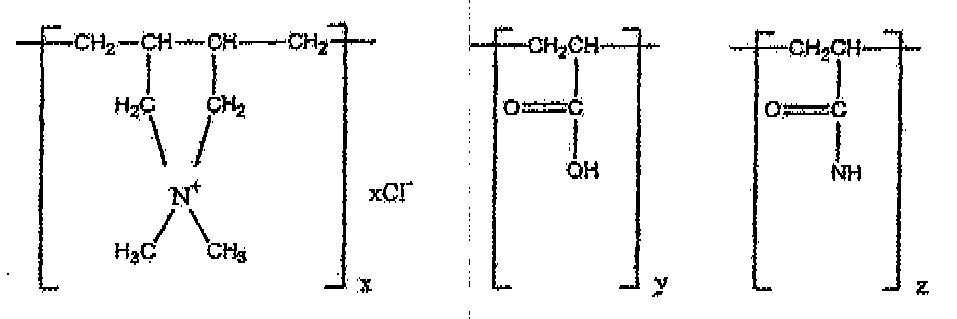
- the quaternized copolymer of di-methylallyl ammonium and of acrylic acid included in the composition according to the invention generally corresponds to the following formula I: in which x is between 1 and 1000, preferably between 1 and 100, and y and z are independently between 0 and 1000, preferably between 0 and 100.
- the quaternized copolymer is a polyquaternium, for example a polyquaternium 22 (CTFA name).
- the quaternized copolymer of di-methylallyl ammonium and acrylic acid is preferably from 0.1 to 1.5%, more preferably from 0.5 to 1%, by weight of the total weight of the composition.
- N-methyl triethanolamine methylsulfate di-alkyl ester in the composition according to the invention generally corresponds to the following formula II: in which R 1 and R 2 are C n alkyl or alkenyl groups, where n is between 1 and 100, preferably between 6 and 20.
- the alkyl groups which may be used for R 1 and R 2 may be caproyl, caprylyl, capryl, lauryl, myristyl, cetyl, stearyl, arachidyl or behenyl chains.
- the alkenyl groups which may be used for R 1 and R 2 may be caproleyl, lauroleyl, myristoleyl, palmitoleyl, oleyl, linoleyl, linolenyl, arachidonyl or erucyl chains.
- the groups R 1 and R 2 represent an alkyl group derived from coconut oil, in particular a lauryl chain.
- the di-alkyl ester preferably used is a dicocoyl ester of N methyl triethanolamine methylsulfate.
- the N-methyl triethanolamine methylsulfate di-alkyl ester is preferably from 0.1 to 5%, more preferably from 0.5 to 2%, by weight of the total weight of the composition.
- the di-alkyl carbonate included in the composition according to the invention generally corresponds to the following formula III: in which R 1 'and R 2 ' are linear or branched C 1 -alkyl or alkenyl groups, where n is between 1 and 100, preferably between 6 and 20.
- alkyl groups which can be used for R ' 1 and R' 2 can be caproyl, caprilyl, capryl, lauryl, myristyl, cetyl, stearyl, arachidyl or behenyl chains.
- Alkenyl groups usable for R ' 1 and R' 2 may be caproleyl, lauroleyl, myristoleyl, palmitoleyl, oleyl, linoleyl, linolenyl, arachidonyl or erucyl chains.
- the groups R 1 'and R 2 ' represent a caprilyl chain, the di-alkyl carbonate used being thus di-caprilyl carbonate.
- the di-alkyl carbonate is preferably from 0.02 to 2.5%, more preferably from 0.1 to 1%, by weight of the total weight of the composition.
- composition according to the invention may contain from 0.32 to 19% by weight, and preferably from 2.1 to 9% by weight of the quaternary associative complex formed by the four compounds identified above.
- composition according to the invention comprises at least one alkaline agent, at least one dye precursor and at least one oxidizing compound.
- the alkaline agent (s) present in the composition according to the invention may be chosen from aminomethylpropanol, ammonia, monoethanolamine, diethanolamine, triethanolamine and their mixtures.
- the alkali agent (s) preferably represent from 1 to 30%, better still from 1 to 4%, by weight of the total weight of the composition.
- the composition according to the invention advantageously comprises between 1 and 4% by weight of ammonia.
- the precursor (s) of oxidation dyes present in the composition according to the invention are generally aromatic compounds such as aromatic diamines, aminophenols or phenols. They can be chosen from bases and couplers.
- the bases or primary intermediates may be aromatic amines, diaminophenols or aminophenols in which the NH 2 and OH groups are in the ortho or para position relative to one another.
- para-phenylenediamine pPD
- ortho-aminophenol oAP
- para-methylamino phenol pMAP
- para-amino phenol pAP
- para-tolylenediamine pTD
- NpPD N phenyl paraphenylene diamine
- the couplers or modifiers can be meta-diamines, meta-aminophenols, polyphenols or naphthols.
- meta-aminophenol mPD
- resorcinol R
- 1-naphthol 1-naphthol
- mPD meta-phenylene diamine
- pAOC para-amino ortho-cresol
- the dye precursor (s) preferably represent from 0.5 to 10%, better still from 1 to 2.5%, by weight of the weight of the composition.
- composition according to the invention finally comprises at least one oxidizing compound.
- a particularly preferred oxidizing compound is hydrogen peroxide.
- the oxidizing compound (s) are introduced into the composition according to the invention in the form of a solution, at a content preferably of between 1.5 and 12%, better still between 6 and 9%, by weight of the weight of the solution.
- the solution preferably represents 50% by weight of the total weight of the composition.
- the content of oxidizing compounds in the composition according to the invention is preferably between 0.75 and 6%, better still between 3 and 4.5%, by weight of the total weight of the composition.
- the pH of the composition is preferably between 7 and 11, more preferably between 8.5 and 10.5.
- composition according to the invention may also contain various customary additives for oxidation dyeings.
- These adjuvants may be fatty acids, natural or synthetic fatty alcohols, natural or synthetic, oxyethylenated or polyglycerolated, mineral or vegetable oils, antioxidants, sequestering agents and perfumes.
- the fatty acids that can be used as adjuvants in the composition according to the invention generally comprise from 10 to 18 carbon atoms, and preferably represent from 1 to 20%, better still from 5 to 15%, by weight of the total weight of the composition.
- the fatty alcohols that may be used as adjuvants in the composition according to the invention may be chosen from oleic alcohol, lauric alcohol, myristic alcohol, cetyl alcohol, stearyl alcohol, ceteareth 33 and mixtures thereof. They preferably represent from 1 to 25%, better still from 5 to 20%, by weight of the total weight of the composition.
- coconut oil As an oil that can be used as an adjunct in the composition according to the invention, mention may be made of coconut oil.
- antioxidant used as an adjunct in the composition according to the invention, mention may be made of sodium metabisulfite and 1-phenyl-3-methyl-5-pyrazolone.
- composition according to the invention is generally in the form of a cream or a gel, preferably in the form of a cream.
- composition object of the present invention can be manufactured by mixing, in a manner known to those skilled in the art, the various constituents that it comprises.
- the invention also relates to a solution for the manufacture of a composition as defined above, which comprises at least one oxidizing compound, preferably hydrogen peroxide.
- the oxidizing compound (s) are present in the solution, at a content preferably of between 1.5 and 12%, better still between 6 and 9%, by weight of the weight of the solution.
- the subject of the invention is also a method for revealing the coloration of a base as defined above, which comprises the step of mixing the base defined above with the solution defined above, preferably in a 1/1 ratio by weight. .
- composition according to the invention makes it possible to color the hair with a coverage and a strength greater than those of the compositions commonly used. Stainings perfectly and uniformly cover the hair, without overloading the sensitized areas, and show a significantly improved shampoo stability. The shades retain their brightness and the reflections, more intense on the day of the coloring, do not lose their brightness as shampoos.
- the complex formed improves the penetration and fixation of the dyes in the fiber.
- the compounds included in the composition according to the invention have a strong affinity for keratin and form on the surface of the fiber a film that would have a protective and repairing role during the oxidative reaction.
- the hair keeps after the coloring a soft and silky touch. They retain the suppleness, strength, elasticity and shine of a healthy and natural hair.
- the moisturizing and soothing properties of the peptide fractions of the complex also have the advantage of significantly limiting the diversity and intensity of skin discomfort reactions which generally accompany the application of the oxidation dye products.
- a dye composition according to the invention is formulated from a base and a solution comprising an oxidizing compound.
- this base is diluted with 100 g of hydrogen peroxide at 20 volumes (that is to say 6% by weight of hydrogen peroxide), to give a dye composition according to the invention, which is then applied for 30 minutes on the hair.
- this base is diluted with 100 g of hydrogen peroxide to 20 volumes, to give a dye composition according to the invention, which is then applied for 30 minutes on the hair.
- Each composition is formulated from a coloring base and a solution comprising an oxidizing compound.
- the formulations of the 4 coloring bases used are as follows:
- each of these coloring bases is diluted with 100 g of hydrogen peroxide to 20 volumes, to give a coloring composition, which is then applied for 30 minutes on the woolen coupons.
- the measurements, in L * a * b * color space, are carried out using a MINOLTA CR 210 colorimeter.
- ⁇ E * ab [( ⁇ L *) 2 + ( ⁇ a *) + ( ⁇ b *) 2] 1 ⁇ 2 .
- the decrease of the value ⁇ E is proportional to the improvement of the color behavior.
- the woolen fabrics stained with the composition which do not contain the quaternary associative complex have a color variation of 12.81 compared to only 5.61 for the fabrics stained with the composition according to the invention containing the complex.
- the presence of the quaternary associative complex thus improves the resistance of the coloration to washing.
- the binary association of the constituents of the quaternary associative complex improves the resistance of the color to the shampoo elimination, but in a much less marked way than in the case of the quaternary complex.
- the measurements, in L * a * b * color space, are carried out using a MINOLTA CR 210 colorimeter.
- the irradiation is carried out using a SUNTEST apparatus, the woolen coupons being exposed to intense light radiation for 40 hours.
- the presence of the quaternary associative complex makes it possible to significantly improve the stability of the color under ultraviolet irradiation.
- the measurements are made using a DYNAMOMETER LLOYD LRY connected to a computer.
- the modulus of elasticity of a wick is obtained by measuring the slope of the force / elongation curve (in Newton /% elongation). The ratio of the two modules measured in the presence and absence of the complex makes it possible to evaluate the effect of said complex on the mechanical properties of the hair. The results are shown in Table 3. ⁇ u> TABLE 3 ⁇ / u> Composition Modulus of elasticity (Newton / 5% elongation) % improvement Without complex associative quaternary 3.41 7 With complex associative quaternary 3.19
- Module values are significantly different at 5% risk.
- the quaternary complex makes it possible to improve by 7% the elastic properties of the hair after staining with the composition according to the invention, which shows the protective properties of the quaternary associative complex according to the invention.
Landscapes
- Health & Medical Sciences (AREA)
- Life Sciences & Earth Sciences (AREA)
- Animal Behavior & Ethology (AREA)
- General Health & Medical Sciences (AREA)
- Public Health (AREA)
- Veterinary Medicine (AREA)
- Birds (AREA)
- Epidemiology (AREA)
- Emergency Medicine (AREA)
- Cosmetics (AREA)
Claims (35)
- Zusammensetzung zur dauerhaften Färbung von Keratinfasern, umfassend mindestens eine Färbemittel-Vorstufe, mindestens ein alkalisches Mittel und mindestens eine oxidierende Verbindung, dadurch gekennzeichnet, dass sie außerdem Folgendes umfasst.- ein Proteinhydrolysat,- ein quaternisiertes Copolymer von Dimethylallylammonium und Acrylsäure,- einen Dialkylester von N-Methyltriethanolaminmethylsulfat und- ein Dialkylcarbonat.
- Zusammensetzung nach Anspruch 1, dadurch gekennzeichnet, dass das Proteinhydrolysat, das quaternisierte Copolymer von Dimethylallytammonium und Acrylsäure, der Dialkylester von N-Methyltriethanolaminmethylsulfat und das Dialkylcarbonat einen assoziativen quaternären Komplex in der Zusammensetzung bilden.
- Zusammensetzung nach einem der Ansprüche 1 und 2, dadurch gekennzeichnet, dass das Proteinhydrolysat ein Sericinhydrolysat ist.
- Zusammensetzung nach einem der vorhergehenden Ansprüche, dadurch gekennzeichnet, dass das quaternisierte Copolymer von Dimethylallylammonium und Acrylsäure der folgenden Formel I entspricht:
- Zusammensetzung nach einem der Ansprüche 1 bis 4, dadurch gekennzeichnet, dass das quaternisierte Copolymer von Dimethylallylammonium und Acrylsäure ein Polyquaternium, vorzugsweise ein Polyquaternium 22 ist.
- Zusammensetzung nach einem der vorhergehenden Ansprüche, dadurch gekennzeichnet, dass der Dialkylester von N-Methyltriethanolaminmethylsulfat der folgenden Formel II entspricht:

- Zusammensetzung nach Anspruch 6, dadurch gekennzeichnet, dass die Gruppen R1 und R2 aus der Caproyl-, Caprylyl-, Caryl-, Lauryl-, Myristyl-, Cetyl-, Stearyl-, Arachidyl-, Behenyl-, Caproleyl-, Lauroleyl-, Myristoleyl-, Palmitoleyl-, Oleyl-, Linoleyl-, Linolenyl-, Arachindonyl- und Erucylgruppe ausgewählt sind.
- Zusammensetzung nach einem der Ansprüche 1 bis 7, dadurch gekennzeichnet, dass der Dialkylester von N-Methyltriethanolaminmethylsulfat ein Dicocoylester von N-Methyltriethanolaminmethylsulfat ist.
- Zusammensetzung nach einem der vorhergehenden Ansprüche, dadurch gekennzeichnet, dass das Dialkylcarbonat der folgenden Formel III entspricht:

- Zusammensetzung nach Anspruch 9, dadurch gekennzeichnet, dass die Gruppen R'1 und R'2 aus der Caproyl-, Caprylyl-, Caryl-, Lauryl-, Myristyl-, Cetyl-, Stearyl-, Arachidyl-, Behenyl-, Caproleyl-, Lauroleyl-, Myristoleyl-, Palmitoleyl-, Oleyl-, Linoleyl-, Liriolenyl-, Arachindonyl- und Erucylgruppe ausgewählt sind.
- Zusammensetzung nach Anspruch 10, dadurch gekennzeichnet, dass das Dialkylcarbonat Dicaprilylcarbonat ist.
- Zusammensetzung nach einem der Ansprüche 1 bis 11, dadurch gekennzeichnet, dass die oxidierende Verbindung Wasserstoffperoxid ist.
- Zusammensetzung nach einem der Ansprüche 1 bis 12, dadurch gekennzeichnet, dass das alkalische Mittel oder die alkalischen Mittel aus Aminomethylpropanol, Monoethanolamin, Diethanolamin, Triethanolamin, Ammoniak und Mischungen davon ausgewählt ist bzw. sind.
- Zusammensetzung nach einem der vorhergehenden Ansprüche, dadurch gekennzeichnet, dass die Färbemittel-Vorstufe oder die Färbemittel-Vorstufen aus aromatischen Diaminen, Aminophenolen und Phenolen ausgewählt ist bzw. sind.
- Zusammensetzung nach Anspruch 14, dadurch gekennzeichnet, dass die Färbemittel-Vorstufe(n) aus para-Phenylendiamin (pPD), ortho-Aminophenol (oAP), para-Methylaminophenol (pMAP, para-Aminophenol (pAP), para-Toluylendiamin (pTD) N-Phenylparaphenylendiamin (NpPD), meta-Aminophenol (mPD), Resorcin (R), 1-Naphthol (1-N), meta-Phenylendiamin (mPD), para-Amino-ortho-kresol (pAOC), 1,5-Dihydroxynaphthalin (1-5 DHN) und/oder 2,7-Dihydroxynaphthalin (2-7 DHN) ausgewählt Ist (sind).
- Zusammensetzung nach einem der vorhergehenden Ansprüche, dadurch gekennzeichnet, dass ihr pH-Wert zwischen 7 und 11, vorzugsweise zwischen 8,5 und 10,5 liegt.
- Zusammensetzung nach einem der vorhergehenden Ansprüche, dadurch gekennzeichnet, dass das Proteinhydrolysat von 0,1 bis 10 Gew.-%, vorzugsweise von 1 bis 5 Gew.-%, bezogen auf das Gesamtgewicht der Zusammensetzung, darstellt.
- Zusammensetzung nach einem der vorhergehenden Ansprüche, dadurch gekennzeichnet, dass das quaternisierte Copolymer von DImethylallylammonium und Acrylsäure von 0,1 bis 1,5 Gew.-%, vorzugsweise von 0,5 bis 1 Gew.-%, bezogen auf das Gesamtgewicht der Zusammensetzung, darstellt.
- Zusammensetzung nach einem der vorhergehenden Ansprüche, dadurch gekennzeichnet, dass der Dialkylester von N-Methyltriethanolaminmethylsulfat von 0,1 bis 5 Gew.-%, vorzugsweise von 0,5 bis 2 Gew.-%, bezogen auf das Gesamtgewicht der Zusammensetzung, darstellt.
- Zusammensetzung nach einem der vorhergehenden Ansprüche, dadurch gekennzeichnet, dass das Dialkylcarbonat von 0,02 bis 2,5 Gew.-%, vorzugsweise von 0,1 bis 1 Gew.-%, bezogen auf das Gesamtgewicht der Zusammensetzung, darstellt.
- Zusammensetzung nach einem der vorhergehenden Ansprüche, dadurch gekennzeichnet, dass die oxidierende Verbindung oder die oxidierenden Verbindungen 0,75 bis 6 Gew.-%, vorzugsweise 3 bis 4,5 Gew.-%, bezogen auf das Gesamtgewicht der Zusammensetzung, darstellt bzw. darstellen.
- Zusammensetzung nach einem der vorhergehenden Ansprüche, dadurch gekennzeichnet, dass das alkalische Mittel oder die alkalischen Mittel von 1 bis 30 Gew.-%, vorzugsweise von 1 bis 4 Gew.-%, bezogen auf das Gesamtgewicht der Zusammensetzung, darstellt bzw. darstellen.
- Zusammensetzung nach einem der vorhergehenden Ansprüche, dadurch gekennzeichnet, dass die Färbemittelvorstufe oder die Färbemittelvorstufen von 0,5 bis 10 Gew.-%, vorzugsweise von 1 bis 2,5 Gew.-%, bezogen auf das Gesamtgewicht der Zusammensetzung, darstellt bzw. darstellen.
- Zusammensetzung nach einem der vorhergehenden Ansprüche, dadurch gekennzeichnet, dass sie Folgendes umfasst:- zwischen 0,1 und 10 Gew.-% Proteinhydrolysat, vorzugsweise Sericinhydrolysat,- zwischen 0,1 und 1,5 Gew.-% quaternisiertes Copolymer von Dimethylallylammonium und Acrylsäure,- zwischen 0,1 und 5 Gew.-% Dialkylester von N-Methyltriethanolaminmethylsulfat,- zwischen 0,02 und 2,5 Gew.-% Dialkylcarbonat,- zwischen 0,75 und 6 Gew,-% mindestens einer oxydierenden Verbindung,- zwischen 0,5 und 10 Gew.-% mindestens einer Färbemittel-Vorstufe und- eine Menge mindestens eines alkalischen Mittels, die ausreichend ist, um einen pH-Wert zwischen 7 und 11, vorzugsweise zwischen 8,5 und 10,5 zu erreichen.
- Zusammensetzung nach einem der vorhergehenden Ansprüche, dadurch gekennzeichnet, dass sie Folgendes umfasst:- zwischen 1 und 5 Gew.-% Proteinhydrolysat, vorzugsweise Sericinhydrolysat,- zwischen 0,5 und 1 Gew.-% quaternisiertes Copolymer von Dimethylallylammonium und Acrylsäure,- zwischen 0,5 und 2 Gew.-% Dialkylester von N-Methyltriethanolaminmethylsulfat,- zwischen 0,1 und 1 Gew.-% Dialkylcarbonat,- zwischen 3 und 4,5 Gew.-% mindestens einer oxydierenden Verbindung,- zwischen 1 und 2,5 Gew.-% mindestens einer Färbemittel-Vorstufe und- eine Menge mindestens eines alkalischen Mittels, die ausreichend ist, um einen pH-Wert zwischen 7 und 11, vorzugsweise zwischen 8,5 und 10,5 zu erreichen.
- Zusammensetzung nach einem der vorhergehenden Ansprüche, dadurch gekennzeichnet, dass sie Hilfsmittel umfasst, die aus natürlichen oder synthetischen Fettsäuren, natürlichen oder synthetischen Fettalkoholen, Oxyethylenen oder Polyglycerinen, mineralischen oder pflanzlichen Ölen, Antioxidantien, Komplexbildnern und Duftstoffen ausgewählt sind.
- Zusammensetzung nach Anspruch 26, dadurch gekennzeichnet, dass die Fettsäuren von 1 bis 20 Gew.-%, vorzugsweise von 5 bis 15 Gew.-%, bezogen auf das Gesamtgewicht der Zusammensetzung, darstellen.
- Zusammensetzung nach Anspruch 26, dadurch gekennzeichnet, dass die Fettalkohole von 1 bis 25 Gew.-%, vorzugsweise von 5 bis. 20 Gew.-%, bezogen auf das Gesamtgewicht der Zusammensetzung, darstellen.
- Zusammensetzung nach einem der vorhergehenden Ansprüche, dadurch gekennzeichnet, dass sie in Form einer Creme oder eines Gels, vorzugsweise In Form einer Creme vorliegt.
- Assoziativer quaternärer Komplex zur Färbung von Keratinfasern, dadurch gekennzeichnet, dass er Folgendes umfasst:- ein Proteinhydrolysat, vorzugsweise ein Sericinhydrolysat,- ein quaternisiertes Copolymer von Dimethylallylammonium und Acrylsäure,- einen Dialkylester von N-Methyltriethanolaminmethylsulfat und- ein Dialkylcarbonat.
- Grundstoff, der In Form eines Gels oder einer Creme vorliegt, zur Herstellung einer Zusammensetzung nach einem der Ansprüche 1 bis 29, dadurch gekennzeichnet, dass er Folgendes umfasst:- ein Proteinhydrolysat, vorzugsweise ein Sericinhydrolysat,- ein quaternisiertes Copolymer von Dimethylallylammonium und Acrylsäure,- einen Dialkylester von N-Methyltriethanolaminmethylsulfat,- ein Dialkylcarbonat,- mindestens eine Färbemittel-Vorstufe und- mindestens ein alkalisches Mittel.
- Verfahren zur Entwicklung der Färbung einer Zusammensetzung nach einem der Ansprüche 1 bis 29, dadurch gekennzeichnet, dass es den Schritt des Mischens des in Anspruch 31 definierten Grundstoffs mit einer Lösung, die mindestens eine oxidierende Verbindung, vorzugsweise Wasserstoffperoxid, umfasst, umfasst.
- Verfahren nach Anspruch 32, dadurch gekennzeichnet, dass die oxidierende Verbindung oder die oxidierenden Verbindungen 1,5 bis 12 Gew.-%, vorzugsweise 6 bis 9 Gew.-%, bezogen auf das Gewicht der Lösung, darstellen.
- Verfahren nach Anspruch 32 oder 33, dadurch gekennzeichnet, dass der Grundstoff und die Lösungen in einem Verhältnis von 1/1, bezogen auf das Gewicht, vermischt sind.
- Verfahren zur Färbung von Keratinfasern, vorzugsweise von Haaren, umfassend die folgenden Schritte:- Auftragen einer Zusammensetzung nach einem der Ansprüche 1 bis 29 auf die Fasern für eine Dauer, die den Erhalt einer gewünschten Färbung ermöglicht, vorzugsweise für 10 bis 45 min, noch mehr bevorzugt in der Größenordnung von 30 min,- Spülen und Trocknen der Fasern.
Applications Claiming Priority (3)
| Application Number | Priority Date | Filing Date | Title |
|---|---|---|---|
| FR0300409A FR2849774B1 (fr) | 2003-01-15 | 2003-01-15 | Composition pur la coloration permanente de fibres keratiniques. |
| FR0300409 | 2003-01-15 | ||
| PCT/FR2004/050015 WO2004064794A1 (fr) | 2003-01-15 | 2004-01-14 | Composition pour la coloration permanente de fibres keratiniques |
Publications (2)
| Publication Number | Publication Date |
|---|---|
| EP1587488A1 EP1587488A1 (de) | 2005-10-26 |
| EP1587488B1 true EP1587488B1 (de) | 2006-09-13 |
Family
ID=32524938
Family Applications (1)
| Application Number | Title | Priority Date | Filing Date |
|---|---|---|---|
| EP04701986A Expired - Lifetime EP1587488B1 (de) | 2003-01-15 | 2004-01-14 | Zusammensetzung zum permanenten färben von keratinfasern |
Country Status (13)
| Country | Link |
|---|---|
| US (1) | US20060254000A1 (de) |
| EP (1) | EP1587488B1 (de) |
| AT (1) | ATE339182T1 (de) |
| AU (1) | AU2004206759A1 (de) |
| CA (1) | CA2513160A1 (de) |
| DE (1) | DE602004002380T2 (de) |
| ES (1) | ES2271836T3 (de) |
| FR (1) | FR2849774B1 (de) |
| IL (1) | IL169686A0 (de) |
| PL (1) | PL377881A1 (de) |
| PT (1) | PT1587488E (de) |
| RU (1) | RU2005125718A (de) |
| WO (1) | WO2004064794A1 (de) |
Families Citing this family (9)
| Publication number | Priority date | Publication date | Assignee | Title |
|---|---|---|---|---|
| DE102004020501A1 (de) * | 2004-04-26 | 2005-11-10 | Henkel Kgaa | Verwendung von Organosilikon-Copolymeren in Haarfärbemitteln |
| ATE512698T1 (de) * | 2005-10-26 | 2011-07-15 | Kpss Kao Gmbh | Verfahren zur vorbereitung einer wässrigen zusammensetzung |
| US20070207106A1 (en) | 2006-03-06 | 2007-09-06 | Sabelko Jobiah J | Low molecular weight ampholytic polymers for personal care applications |
| PT103484B (pt) * | 2006-05-19 | 2008-03-31 | Univ Do Minho | Formulação com domínios de ligação hidrófobos e domínios de ligação a hidratos de carbono para aplicações cosméticas nomeadamente para tratamento de fibras queratinosas como o cabelo. |
| FR2902327B1 (fr) * | 2006-06-20 | 2008-08-08 | Oreal | Composition de coloration des fibres keratiniques comprenant la 2,3-diamino-6,7-dihydro-1h,5h-pyrazolo 1,2-a pyrazol-1- one, la para-phenylenediamine ou la para-toluenediamine et un meta-aminophenol substitue |
| EP2018845A1 (de) * | 2007-07-27 | 2009-01-28 | KPSS-Kao Professional Salon Services GmbH | Verfahren zur Färbung von Keratinfasern |
| DE102009044920A1 (de) * | 2009-09-23 | 2011-04-07 | Henkel Ag & Co. Kgaa | Verwendung bestimmter Aminosäuren in Färbemitteln keratinischer Fasern zur Farbintensivierung |
| DE102011083021A1 (de) | 2011-09-20 | 2013-03-21 | Henkel Ag & Co. Kgaa | Pflegende Färbemittel für keratinische Fasern |
| WO2020142521A1 (en) * | 2018-12-31 | 2020-07-09 | L'oreal | Hair coloring compositions and methods of use |
Family Cites Families (6)
| Publication number | Priority date | Publication date | Assignee | Title |
|---|---|---|---|---|
| LU86899A1 (fr) * | 1987-05-25 | 1989-01-19 | Oreal | Procede de teinture des fibres keratiniques avec des colorants d'oxydation associes a un iodure et composition tinctoriale mise en oeuvre |
| DE19631035C1 (de) * | 1996-08-01 | 1998-02-12 | Wella Ag | Mittel zum Färben und Tönen von Haaren |
| DE50014807D1 (de) * | 1999-12-20 | 2008-01-03 | Henkel Kgaa | Festförmiges färbemittel für keratinfasern |
| DE19962877A1 (de) * | 1999-12-24 | 2001-06-28 | Henkel Kgaa | Haut- und Haarpflegemittel |
| DE20007650U1 (de) * | 2000-04-27 | 2001-09-06 | Goldwell Gmbh | Haarfärbemittel |
| DE50111809D1 (de) * | 2000-06-20 | 2007-02-15 | Henkel Kgaa | Mittel zum färben bzw. tönen und gleichzeitigem pflegen von haaren |
-
2003
- 2003-01-15 FR FR0300409A patent/FR2849774B1/fr not_active Expired - Fee Related
-
2004
- 2004-01-14 PL PL377881A patent/PL377881A1/pl not_active Application Discontinuation
- 2004-01-14 EP EP04701986A patent/EP1587488B1/de not_active Expired - Lifetime
- 2004-01-14 AU AU2004206759A patent/AU2004206759A1/en not_active Abandoned
- 2004-01-14 DE DE602004002380T patent/DE602004002380T2/de not_active Expired - Fee Related
- 2004-01-14 ES ES04701986T patent/ES2271836T3/es not_active Expired - Lifetime
- 2004-01-14 PT PT04701986T patent/PT1587488E/pt unknown
- 2004-01-14 WO PCT/FR2004/050015 patent/WO2004064794A1/fr not_active Ceased
- 2004-01-14 US US10/542,273 patent/US20060254000A1/en not_active Abandoned
- 2004-01-14 RU RU2005125718/15A patent/RU2005125718A/ru not_active Application Discontinuation
- 2004-01-14 CA CA002513160A patent/CA2513160A1/fr not_active Abandoned
- 2004-01-14 AT AT04701986T patent/ATE339182T1/de not_active IP Right Cessation
-
2005
- 2005-07-14 IL IL169686A patent/IL169686A0/en unknown
Also Published As
| Publication number | Publication date |
|---|---|
| WO2004064794A1 (fr) | 2004-08-05 |
| FR2849774A1 (fr) | 2004-07-16 |
| CA2513160A1 (fr) | 2004-08-05 |
| PL377881A1 (pl) | 2006-02-20 |
| RU2005125718A (ru) | 2006-01-27 |
| US20060254000A1 (en) | 2006-11-16 |
| ES2271836T3 (es) | 2007-04-16 |
| FR2849774B1 (fr) | 2007-01-19 |
| ATE339182T1 (de) | 2006-10-15 |
| DE602004002380T2 (de) | 2007-09-06 |
| AU2004206759A1 (en) | 2004-08-05 |
| DE602004002380D1 (de) | 2006-10-26 |
| PT1587488E (pt) | 2007-01-31 |
| IL169686A0 (en) | 2007-07-04 |
| EP1587488A1 (de) | 2005-10-26 |
Similar Documents
| Publication | Publication Date | Title |
|---|---|---|
| CA1123550A (fr) | Compositions cosmetiques a base de polymeres polyammonium quaternaires | |
| CN1201718C (zh) | 染发组合物 | |
| EP0943320B1 (de) | Verfahren zum oxidativen Färben und Zusammensetzung zum oxidativen Färben von keratinfasern, die ein kationisches amphiphiles Polymer enthält | |
| EP1149575A1 (de) | Mittel zum oxidativen Färben von Keratinfasern enthaltend 1-(4-Aminophenyl)pyrrolidin und einen direktziehenden bestimmten Farbstoff | |
| FR2773992A1 (fr) | Composition pour la coloration de fibres keratiniques, depourvue d'ammoniaque | |
| CA2288998A1 (fr) | Polymeres silicies de polyammonium quaternaire heterocyclique et leur utilisation dans les compositions cosmetiques | |
| CA2411104A1 (fr) | Composition oxydante pour le traitement des fibres keratiniques comprenant une silicone aminee particuliere | |
| EP0855896A1 (de) | Verfahren zur oxydativen färbung der haare und bei der durchführung des verfahrens verwendete zusammensetzung | |
| RU2493814C1 (ru) | Состав для окрашивания волос | |
| FR2459042A1 (fr) | Nouvelles compositions tinctoriales pour cheveux contenant, comme coupleur le diamino-2,4 butoxybenzene et/ou ses sels | |
| FR2849774A1 (fr) | Composition pur la coloration permanente de fibres keratiniques. | |
| CA1028956A (fr) | Coupleurs halogeno-3 acetylamino (ou ureido)-6 phenols | |
| AU2026201409A1 (en) | Hair treatment compositions with amine derivatives | |
| CA1177410A (fr) | Compositions tinctoriales pour cheveux a base de colorants directs nitres et procede de teinture utilisant lesdites compositions | |
| EP1149577A1 (de) | Mittel zum oxidativen Färben von Keratinfasern enthaltend 1-Aminophenylpyrrolidin und ein kationisches Polymer | |
| JP7664651B2 (ja) | 毛髪化粧料組成物 | |
| CA1170274A (fr) | Compositions tinctoriales contenant des derives d'amino-3 nitro-4 anisole, leur utilisation en teinture des fibres keratiniques et composes nouveaux utilises ainsi que leur procede de preparation | |
| US10406095B2 (en) | Compositions and methods for protecting bleached hair and enhanced oxidative hair coloring | |
| JP2005239627A (ja) | 染毛剤組成物 | |
| US20050204484A1 (en) | Hair colorants | |
| KR101305493B1 (ko) | 거품형 염모제 | |
| JPH07145025A (ja) | 染毛用組成物 | |
| FR3083103A1 (fr) | Procede de traitement des fibres keratiniques comprenant l'application d'au moins un aldehyde et d'une amine aliphatique, composition et utilisations | |
| FR2741529A1 (fr) | Composition cosmetique pour permanenter et colorer les cheveux | |
| KR20040035235A (ko) | 염모제 조성물 |
Legal Events
| Date | Code | Title | Description |
|---|---|---|---|
| PUAI | Public reference made under article 153(3) epc to a published international application that has entered the european phase |
Free format text: ORIGINAL CODE: 0009012 |
|
| 17P | Request for examination filed |
Effective date: 20050816 |
|
| AK | Designated contracting states |
Kind code of ref document: A1 Designated state(s): AT BE BG CH CY CZ DE DK EE ES FI FR GB GR HU IE IT LI LU MC NL PT RO SE SI SK TR |
|
| AX | Request for extension of the european patent |
Extension state: AL LT LV MK |
|
| GRAP | Despatch of communication of intention to grant a patent |
Free format text: ORIGINAL CODE: EPIDOSNIGR1 |
|
| RIC1 | Information provided on ipc code assigned before grant |
Ipc: A61Q 5/10 20060101ALI20060302BHEP Ipc: A61K 8/44 20060101ALI20060302BHEP Ipc: A61K 8/64 20060101AFI20060302BHEP Ipc: A61K 8/33 20060101ALI20060302BHEP Ipc: A61K 8/81 20060101ALI20060302BHEP |
|
| RAX | Requested extension states of the european patent have changed |
Extension state: MK Payment date: 20050816 |
|
| GRAS | Grant fee paid |
Free format text: ORIGINAL CODE: EPIDOSNIGR3 |
|
| GRAA | (expected) grant |
Free format text: ORIGINAL CODE: 0009210 |
|
| AK | Designated contracting states |
Kind code of ref document: B1 Designated state(s): AT BE BG CH CY CZ DE DK EE ES FI FR GB GR HU IE IT LI LU MC NL PT RO SE SI SK TR |
|
| AX | Request for extension of the european patent |
Extension state: MK |
|
| PG25 | Lapsed in a contracting state [announced via postgrant information from national office to epo] |
Ref country code: AT Free format text: LAPSE BECAUSE OF FAILURE TO SUBMIT A TRANSLATION OF THE DESCRIPTION OR TO PAY THE FEE WITHIN THE PRESCRIBED TIME-LIMIT Effective date: 20060913 Ref country code: IE Free format text: LAPSE BECAUSE OF FAILURE TO SUBMIT A TRANSLATION OF THE DESCRIPTION OR TO PAY THE FEE WITHIN THE PRESCRIBED TIME-LIMIT Effective date: 20060913 Ref country code: RO Free format text: LAPSE BECAUSE OF FAILURE TO SUBMIT A TRANSLATION OF THE DESCRIPTION OR TO PAY THE FEE WITHIN THE PRESCRIBED TIME-LIMIT Effective date: 20060913 Ref country code: SI Free format text: LAPSE BECAUSE OF FAILURE TO SUBMIT A TRANSLATION OF THE DESCRIPTION OR TO PAY THE FEE WITHIN THE PRESCRIBED TIME-LIMIT Effective date: 20060913 Ref country code: SK Free format text: LAPSE BECAUSE OF FAILURE TO SUBMIT A TRANSLATION OF THE DESCRIPTION OR TO PAY THE FEE WITHIN THE PRESCRIBED TIME-LIMIT Effective date: 20060913 |
|
| REG | Reference to a national code |
Ref country code: GB Ref legal event code: FG4D Free format text: NOT ENGLISH |
|
| REG | Reference to a national code |
Ref country code: CH Ref legal event code: EP |
|
| REG | Reference to a national code |
Ref country code: IE Ref legal event code: FG4D Free format text: LANGUAGE OF EP DOCUMENT: FRENCH |
|
| REF | Corresponds to: |
Ref document number: 602004002380 Country of ref document: DE Date of ref document: 20061026 Kind code of ref document: P |
|
| REG | Reference to a national code |
Ref country code: CH Ref legal event code: NV Representative=s name: KIRKER & CIE SA |
|
| GBT | Gb: translation of ep patent filed (gb section 77(6)(a)/1977) |
Effective date: 20061101 |
|
| PG25 | Lapsed in a contracting state [announced via postgrant information from national office to epo] |
Ref country code: DK Free format text: LAPSE BECAUSE OF FAILURE TO SUBMIT A TRANSLATION OF THE DESCRIPTION OR TO PAY THE FEE WITHIN THE PRESCRIBED TIME-LIMIT Effective date: 20061213 |
|
| REG | Reference to a national code |
Ref country code: GR Ref legal event code: EP Ref document number: 20060404084 Country of ref document: GR |
|
| REG | Reference to a national code |
Ref country code: SE Ref legal event code: TRGR |
|
| PG25 | Lapsed in a contracting state [announced via postgrant information from national office to epo] |
Ref country code: FI Free format text: LAPSE BECAUSE OF NON-PAYMENT OF DUE FEES Effective date: 20070114 |
|
| PG25 | Lapsed in a contracting state [announced via postgrant information from national office to epo] |
Ref country code: SE Free format text: LAPSE BECAUSE OF NON-PAYMENT OF DUE FEES Effective date: 20070115 |
|
| PG25 | Lapsed in a contracting state [announced via postgrant information from national office to epo] |
Ref country code: MC Free format text: LAPSE BECAUSE OF NON-PAYMENT OF DUE FEES Effective date: 20070131 |
|
| REG | Reference to a national code |
Ref country code: PT Ref legal event code: SC4A Free format text: AVAILABILITY OF NATIONAL TRANSLATION Effective date: 20061128 |
|
| REG | Reference to a national code |
Ref country code: ES Ref legal event code: FG2A Ref document number: 2271836 Country of ref document: ES Kind code of ref document: T3 |
|
| REG | Reference to a national code |
Ref country code: IE Ref legal event code: FD4D |
|
| PLBE | No opposition filed within time limit |
Free format text: ORIGINAL CODE: 0009261 |
|
| STAA | Information on the status of an ep patent application or granted ep patent |
Free format text: STATUS: NO OPPOSITION FILED WITHIN TIME LIMIT |
|
| PG25 | Lapsed in a contracting state [announced via postgrant information from national office to epo] |
Ref country code: BG Free format text: LAPSE BECAUSE OF FAILURE TO SUBMIT A TRANSLATION OF THE DESCRIPTION OR TO PAY THE FEE WITHIN THE PRESCRIBED TIME-LIMIT Effective date: 20070801 Ref country code: DE Free format text: LAPSE BECAUSE OF NON-PAYMENT OF DUE FEES Effective date: 20070801 |
|
| 26N | No opposition filed |
Effective date: 20070614 |
|
| EUG | Se: european patent has lapsed | ||
| REG | Reference to a national code |
Ref country code: PT Ref legal event code: MM4A Free format text: LAPSE DUE TO NON-PAYMENT OF FEES Effective date: 20071016 |
|
| REG | Reference to a national code |
Ref country code: FR Ref legal event code: ST Effective date: 20070930 |
|
| PGFP | Annual fee paid to national office [announced via postgrant information from national office to epo] |
Ref country code: CY Payment date: 20061124 Year of fee payment: 4 |
|
| BERE | Be: lapsed |
Owner name: EUGENE *PERMA FRANCE Effective date: 20070131 |
|
| PG25 | Lapsed in a contracting state [announced via postgrant information from national office to epo] |
Ref country code: CZ Free format text: LAPSE BECAUSE OF NON-PAYMENT OF DUE FEES Effective date: 20070114 Ref country code: BE Free format text: LAPSE BECAUSE OF NON-PAYMENT OF DUE FEES Effective date: 20070131 |
|
| PG25 | Lapsed in a contracting state [announced via postgrant information from national office to epo] |
Ref country code: PT Free format text: LAPSE BECAUSE OF NON-PAYMENT OF DUE FEES Effective date: 20071016 |
|
| REG | Reference to a national code |
Ref country code: ES Ref legal event code: FD2A Effective date: 20070115 |
|
| PG25 | Lapsed in a contracting state [announced via postgrant information from national office to epo] |
Ref country code: FR Free format text: LAPSE BECAUSE OF NON-PAYMENT OF DUE FEES Effective date: 20070131 |
|
| PG25 | Lapsed in a contracting state [announced via postgrant information from national office to epo] |
Ref country code: EE Free format text: LAPSE BECAUSE OF FAILURE TO SUBMIT A TRANSLATION OF THE DESCRIPTION OR TO PAY THE FEE WITHIN THE PRESCRIBED TIME-LIMIT Effective date: 20060913 Ref country code: ES Free format text: LAPSE BECAUSE OF NON-PAYMENT OF DUE FEES Effective date: 20070115 |
|
| REG | Reference to a national code |
Ref country code: CH Ref legal event code: PL |
|
| GBPC | Gb: european patent ceased through non-payment of renewal fee |
Effective date: 20080114 |
|
| NLV4 | Nl: lapsed or anulled due to non-payment of the annual fee |
Effective date: 20080801 |
|
| PG25 | Lapsed in a contracting state [announced via postgrant information from national office to epo] |
Ref country code: GR Free format text: LAPSE BECAUSE OF NON-PAYMENT OF DUE FEES Effective date: 20061214 Ref country code: CH Free format text: LAPSE BECAUSE OF NON-PAYMENT OF DUE FEES Effective date: 20080131 Ref country code: LI Free format text: LAPSE BECAUSE OF NON-PAYMENT OF DUE FEES Effective date: 20080131 Ref country code: NL Free format text: LAPSE BECAUSE OF NON-PAYMENT OF DUE FEES Effective date: 20080801 |
|
| PG25 | Lapsed in a contracting state [announced via postgrant information from national office to epo] |
Ref country code: CY Free format text: LAPSE BECAUSE OF NON-PAYMENT OF DUE FEES Effective date: 20080114 |
|
| PG25 | Lapsed in a contracting state [announced via postgrant information from national office to epo] |
Ref country code: GB Free format text: LAPSE BECAUSE OF NON-PAYMENT OF DUE FEES Effective date: 20080114 |
|
| PG25 | Lapsed in a contracting state [announced via postgrant information from national office to epo] |
Ref country code: LU Free format text: LAPSE BECAUSE OF NON-PAYMENT OF DUE FEES Effective date: 20070114 |
|
| PG25 | Lapsed in a contracting state [announced via postgrant information from national office to epo] |
Ref country code: HU Free format text: LAPSE BECAUSE OF FAILURE TO SUBMIT A TRANSLATION OF THE DESCRIPTION OR TO PAY THE FEE WITHIN THE PRESCRIBED TIME-LIMIT Effective date: 20070314 Ref country code: TR Free format text: LAPSE BECAUSE OF FAILURE TO SUBMIT A TRANSLATION OF THE DESCRIPTION OR TO PAY THE FEE WITHIN THE PRESCRIBED TIME-LIMIT Effective date: 20060913 |
|
| PG25 | Lapsed in a contracting state [announced via postgrant information from national office to epo] |
Ref country code: IT Free format text: LAPSE BECAUSE OF NON-PAYMENT OF DUE FEES Effective date: 20080114 |
|
| PGFP | Annual fee paid to national office [announced via postgrant information from national office to epo] |
Ref country code: IT Payment date: 20070131 Year of fee payment: 4 |