EP1584675A1 - Coenzyme-binding glucose dehydrogenase - Google Patents
Coenzyme-binding glucose dehydrogenase Download PDFInfo
- Publication number
- EP1584675A1 EP1584675A1 EP03789625A EP03789625A EP1584675A1 EP 1584675 A1 EP1584675 A1 EP 1584675A1 EP 03789625 A EP03789625 A EP 03789625A EP 03789625 A EP03789625 A EP 03789625A EP 1584675 A1 EP1584675 A1 EP 1584675A1
- Authority
- EP
- European Patent Office
- Prior art keywords
- genus
- coenzyme
- glucose dehydrogenase
- binding glucose
- binding
- Prior art date
- Legal status (The legal status is an assumption and is not a legal conclusion. Google has not performed a legal analysis and makes no representation as to the accuracy of the status listed.)
- Granted
Links
Images



Classifications
-
- C—CHEMISTRY; METALLURGY
- C12—BIOCHEMISTRY; BEER; SPIRITS; WINE; VINEGAR; MICROBIOLOGY; ENZYMOLOGY; MUTATION OR GENETIC ENGINEERING
- C12N—MICROORGANISMS OR ENZYMES; COMPOSITIONS THEREOF; PROPAGATING, PRESERVING, OR MAINTAINING MICROORGANISMS; MUTATION OR GENETIC ENGINEERING; CULTURE MEDIA
- C12N9/00—Enzymes; Proenzymes; Compositions thereof; Processes for preparing, activating, inhibiting, separating or purifying enzymes
- C12N9/0004—Oxidoreductases (1.)
-
- C—CHEMISTRY; METALLURGY
- C12—BIOCHEMISTRY; BEER; SPIRITS; WINE; VINEGAR; MICROBIOLOGY; ENZYMOLOGY; MUTATION OR GENETIC ENGINEERING
- C12Q—MEASURING OR TESTING PROCESSES INVOLVING ENZYMES, NUCLEIC ACIDS OR MICROORGANISMS; COMPOSITIONS OR TEST PAPERS THEREFOR; PROCESSES OF PREPARING SUCH COMPOSITIONS; CONDITION-RESPONSIVE CONTROL IN MICROBIOLOGICAL OR ENZYMOLOGICAL PROCESSES
- C12Q1/00—Measuring or testing processes involving enzymes, nucleic acids or microorganisms; Compositions therefor; Processes of preparing such compositions
- C12Q1/26—Measuring or testing processes involving enzymes, nucleic acids or microorganisms; Compositions therefor; Processes of preparing such compositions involving oxidoreductase
- C12Q1/32—Measuring or testing processes involving enzymes, nucleic acids or microorganisms; Compositions therefor; Processes of preparing such compositions involving oxidoreductase involving dehydrogenase
-
- C—CHEMISTRY; METALLURGY
- C12—BIOCHEMISTRY; BEER; SPIRITS; WINE; VINEGAR; MICROBIOLOGY; ENZYMOLOGY; MUTATION OR GENETIC ENGINEERING
- C12Q—MEASURING OR TESTING PROCESSES INVOLVING ENZYMES, NUCLEIC ACIDS OR MICROORGANISMS; COMPOSITIONS OR TEST PAPERS THEREFOR; PROCESSES OF PREPARING SUCH COMPOSITIONS; CONDITION-RESPONSIVE CONTROL IN MICROBIOLOGICAL OR ENZYMOLOGICAL PROCESSES
- C12Q1/00—Measuring or testing processes involving enzymes, nucleic acids or microorganisms; Compositions therefor; Processes of preparing such compositions
- C12Q1/54—Measuring or testing processes involving enzymes, nucleic acids or microorganisms; Compositions therefor; Processes of preparing such compositions involving glucose or galactose
Definitions
- the present invention relates to a novel soluble coenzyme-binding glucose dehydrogenase, a method for producing the coenzyme-binding glucose dehydrogenase, and a microorganism having an ability of producing the coenzyme-binding glucose dehydrogenase.
- the invention also relates to a method for measuring glucose in a sample employing the coenzyme-binding glucose dehydrogenase, and a reagent and a reagent composition containing the coenzyme-binding glucose dehydrogenase. Moreover, the invention relates to utilization in producing and analyzing a material such as a starting material, including a method for producing an organic compound.
- the invention further relates to a biosensor capable of rapidly and conveniently quantifying a particular component in a sample at a high accuracy.
- the invention relates to a glucose sensor employing the coenzyme-binding glucose dehydrogenase.
- Glucose is present in blood and utilized as an important marker for diabetes.
- a method for measuring a glucose has conventionally been a chemical method or an enzymatic method, and an enzymatic method is regarded generally to be excellent in view of the specificity and the safety.
- Such an enzymatic method is, for example, be a measurement using a glucose oxidase, glucose-6-phosphate dehydrogenase or an NAD(P)-dependent glucose dehydrogenase.
- the methods employing the glucose oxidase and the glucose-6-phosphate dehydrogenase are not convenient reaction systems since they employ a plural of enzymes.
- the methods employing the glucose-6-phosphate dehydrogenase and the NAD(P)-dependent glucose dehydrogenase pose a complication due to the requirement of adding a coenzyme NAD(P) to the reaction systems.
- biosensors were proposed as modes for quantifying a particular component in a sample conveniently without diluting or stirring a sample solution.
- a biosensor was proposed in which an electrode system consisting of an action electrode, a counter electrode and a reference electrode was formed by a screen printing on an insulating board. This electrode system and the like was in contact with an enzymatic reaction layer formed thereon containing a hydrophilic polymer, a redox enzyme and an electron acceptor.
- the number of diabetes patient is increasing year by year, and a method for measuring a blood sugar and a means for controlling the blood sugar level are desired which can be utilized not only in a hospital but also at home and which is convenient. While a simple glucose sensor is employed currently for measuring the blood sugar, it frequently employs a glucose oxidase which is highly suspected to give a measured value involving an error due to a level of the residual oxygen.
- a biosensor employing a glucose dehydrogenase which is dependent on a nicotinamide-based coenzyme exhibits a high background noise and involves a complicated reaction system due to the requirement of adding a coenzyme or an auxiliary enzyme separately, and it also suffers from a disadvantage due to the requirement of an expensive optical system upon measuring a chromogenic system.
- a glucose dehydrogenase whose coenzyme is pyrroloquinolinequinone is known, but the pyrroloquinolinequinone problematically tends to dissociate from the enzyme.
- a glucose dehydrogenase whose coenzyme is pyrroloquinolinequinone disclosed in JP-A-2000-350588 and JP-A-2001-197888 has a disadvantageously low selectivity for glucose.
- a glucose dehydrogenase whose coenzyme is the pyrroloquinolinequinone derived from Escherichia coli JP-A-10-243786
- a glucose dehydrogenase whose coenzyme is the pyrroloquinolinequinone derived from Pseudomonas sp. Agric. Biol. Chem. (1980) 44:1505-1512
- a glucose dehydrogenase whose coenzyme is the pyrroloquinolinequinone derived from Gluconobacter suboxydans (Agric. Biol. Chem.
- an objective of the invention is to provide a novel glucose dehydrogenase which exhibits an excellent substrate-recognizing ability toward glucose and which has low activity on maltose, and also to provide a method for producing the same and a microorganism having an ability of producing the same.
- Another objective of the invention is to provide excellent glucose measuring method, measuring reagent and biosensor which employ the novel glucose dehydrogenase and which are capable of quantifying glucose rapidly and conveniently at a high accuracy, as well as a glucose-eliminating reagent.
- the invention is accomplished for solving the problems mentioned above, and the inventors made an effort in various ways and then focused on a novel soluble coenzyme-binding glucose dehydrogenase.
- the coenzyme-binding glucose dehydrogenase catalyzes a glucose-oxidizing reaction in the presence of an electron acceptor, and is classified for example as EC (Enzyme Code) 1.1.99.
- the inventors also made an effort in characterizing various microorganisms producing the coenzyme-binding glucose dehydrogenase, and finally discovered a coenzyme-binding glucose dehydrogenase-producing microorganism and a coenzyme-binding glucose dehydrogenase.
- the invention provides a glucose dehydrogenase to which a coenzyme is bound continuously upon a catalytic reaction.
- the coenzyme-binding glucose dehydrogenase has a physicochemical ability of catalyzing a reaction for oxidizing glucose, especially a hydroxyl group in the 1st-position of glucose, in the presence of an electron acceptor.
- the coenzyme-binding glucose dehydrogenase has 5% or less activity to maltose, preferably 3% or less; thus it has a poor activity on the maltose.
- the coenzyme-binding glucose dehydrogenase allows its enzymatic activity to be inhibited characteristically by 50% or more at 5mM of 1,10-phenanthroline, preferably by 50% or more at 2mM as a final concentration of 1,10-phenanthroline, more preferably by 50% or more at 1mM of 1,10-phenanthroline.
- the coenzyme-binding glucose dehydrogenase preserves its residual enzymatic activity at a level as high as 85% or more even after a heat treatment for 15 minutes at 50°C in the presence of 50mM sodium citrate buffer solution (pH5.5).
- the coenzyme which is bound to the inventive glucose dehydrogenase may for example be a flavin compound, including a coenzyme such as flavin adenine dinucleotide.
- the invention also includes, with respect to a protein having the characteristics of those of the coenzyme-binding glucose dehydrogenase and/or characteristics equivalent substantially thereto as well as its salt, a protein which has an amino acid sequence encoding the protein or an amino acid sequence containing a mutation resulting from a deletion, substitution or addition of one or more amino acid residues in the sequence and which is biologically active and stable.
- the inventive coenzyme-binding glucose dehydrogenase is a microorganism-derived coenzyme-binding glucose dehydrogenase, preferably a eukaryotic microorganism-derived coenzyme-binding glucose dehydrogenase, more preferably the deposited strain FERM BP-08578-derived coenzyme-binding glucose dehydrogenase.
- the coenzyme-binding glucose dehydrogenase discovered in this invention is characterized by its higher stability when compared with that of the known Aspergillus oryzae-derived coenzyme-binding glucose dehydrogenase, and also by a favorably convenient handling for quenching because of its ability of being inhibited by a trace amount of 1,10-phenanthroline in addition to a heavy metal ion.
- the invention provides a method for producing the novel soluble coenzyme-binding glucose dehydrogenase.
- the invention provides a microorganism having an ability of producing the novel soluble coenzyme-binding glucose dehydrogenase.
- the microorganism is preferably a eukaryotic microorganism, more preferably, genus Aspergillus, further preferably, Aspergillus terreus, and most preferably, the deposited strain FERM BP-08578.
- the invention provides a method using the novel soluble coenzyme-binding glucose dehydrogenase.
- a method for measuring glucose using the coenzyme-binding glucose dehydrogenase is provided for measuring glucose in a sample.
- a method for eliminating glucose using the coenzyme-binding glucose dehydrogenase and a method for producing an organic compound are also provided.
- the invention provides a reagent containing the novel soluble coenzyme-binding glucose dehydrogenase.
- the reagent is preferably a glucose-measuring reagent containing the coenzyme-binding glucose dehydrogenase employed for measuring the glucose in a sample, and a glucose-eliminating reagent containing the coenzyme-binding glucose dehydrogenase as well as an organic compound-producing reagent.
- the invention provides a reagent composition containing the novel soluble coenzyme-binding glucose dehydrogenase.
- the composition is preferably a glucose-measuring composition containing the coenzyme-binding glucose dehydrogenase employed for measuring glucose in a sample, and a glucose-eliminating composition containing the coenzyme-binding glucose dehydrogenase as well as an organic compound-producing composition.
- the invention provides a biosensor employing the novel soluble coenzyme-binding glucose dehydrogenase and a biosensor capable of quantifying and/or qualifying a particular component in a sample.
- a biosensor is preferably a glucose sensor employing the coenzyme-binding glucose dehydrogenase.
- One preferred embodiment of these inventive measurement methods, measurement reagents, measurement compounds and biosensors is characterized by the use of potassium ferricyanide (potassium hexacyanoferrate (III)) at a final concentration of 2mM to 500mM.
- potassium ferricyanide potassium hexacyanoferrate (III)
- a value of percentage (%) represents “substrate specificity".
- a value of percentage (%) represents “substrate specificity”.
- An inventive coenzyme-binding glucose dehydrogenase may for example be an enzyme classified as EC 1.1.99, preferably EC 1.1.99.10, EC 1.1.99.13 or EC 1.1.99.17, and is a coenzyme-binding enzyme, preferably a soluble coenzyme-binding enzyme. That is, it is an enzyme capable of being obtained in the state of an aqueous solution without using any surfactant in a step of extraction/purification of the enzyme.
- a coenzyme may be any flavin compound, such as flavin adenine dinucleotide, flavin mononucleotide and the like.
- the inventive coenzyme-binding glucose dehydrogenase may be a glucose dehydrogenase to which a coenzyme is bound always over the period of the catalytic reaction.
- the coenzyme-binding glucose dehydrogenase has at least the following characteristics; that is a physicochemical property for catalyzing a reaction for oxidizing glucose in the presence of an electron acceptor, especially for catalyzing a reaction for oxidizing a hydroxyl group in the 1st-position of the glucose.
- the coenzyme-binding glucose dehydrogenase has a low activity on maltose, which is at a level for example of 5% or below, preferably 3% or below.
- the enzymatic activity of the coenzyme-binding glucose dehydrogenase is inhibited by 50% or more at 5mM of 1,10-phenanthroline, preferably by 50% or more at 2mM as a final concentration of 1,10-phenanthroline, more preferably by 50% or more at 1mM of 1,10-phenanthroline, especially by 60% or more at 1mM of 1,10-phenanthroline.
- the coenzyme-binding glucose dehydrogenase preserves its residual enzymatic activity at a level as high as 85% or more even after a heat treatment for 15 minutes at 50°C in the presence of 50mM sodium citrate buffer solution (pH5.5).
- the invention relates to coenzyme-binding glucose dehydrogenase having the physicochemical characteristics described above; or an amino acid sequence encoding the physicochemical characteristics, wherein the amino acid sequence is a protein or a salt as follows: the amino acid sequence encoding the protein or the salt contains a mutation resulting from a deletion, substitution or addition of one or more amino acid residues in the sequence, and such the resultant protein and the salt are biologically active and stable, with respect to the protein or its salt having the activity substantially equivalent to that of the coenzyme-binding glucose dehydrogenase.
- the protein or its salt, which are the inventive coenzyme-binding glucose dehydrogenase is preferably one derived from a microorganism having the physicochemical characteristics described above.
- a microorganism from which the inventive coenzyme-binding glucose dehydrogenase is derived and a microorganism having an ability of producing the inventive coenzyme-binding glucose dehydrogenase may for example be those classified into prokaryotic microorganisms such as genus Archangium, genus Arcaeoglobus, genus Arsenophonus, genus Ahrensia, genus Aureobacterium, genus Aerococcus, genus Aeropyrum, genus Aeromicrobium, genus Aeromonas, genus Aquifex, genus Aquaspirillum, genus Aquabacter, genus Aquabacterium, genus Aquamicrobium, genus Actinolloteichus, genus Actinok
- eukaryotic microorganisms such as genus Issatchenkia, Candida, genus Cryptococcus, genus Kluyverintces, genus Kloeckera, genus Saccharomycodes, genus Saccharomyces, genus Zygosaccharomyces, genus Shizosaccharomyces, genus Sirobasidium, genus Strigmatomyces, genus Sporidobolus, genus Sporobolomyces, genus Dekkera, genus Debaryomyces, genus Trichosporon, genus Trigonopsis, genus Torulaspora, genus Tremella, genus Nadsonia, genus Nematospora, genus Hanseniaspora, genus Pichia, genus Fibulobasidium, genus Filobasidium, genus Filobasidiella, genus
- a microorganism listed above which has an ability of producing an inventive coenzyme-binding glucose dehydrogenase has been deposited under its accession number to IFO, ATCC and the like, and can be obtained from known distributors and corporations.
- Such a microorganism may for example be a eukaryotic microorganism, more preferably mycotic microorganism. It is also possible to use the microorganism which is designated as "97508" and was deposited under FERM BP-08578 to International Patent Organism Depositary of National Institute of Advanced Industrial Science and Technology.
- a microorganism having an ability of producing the inventive coenzyme-binding glucose dehydrogenase is cultured in a nutrition medium, in which the coenzyme-binding glucose dehydrogenase is allowed to be produced and accumulated, and then recovered to yield a protein which is the coenzyme-binding glucose dehydrogenase and its salt.
- the deposited inventive strain FERM BP-08578, a coenzyme-binding glucose dehydrogenase derived therefrom, and a method for obtaining the enzyme are described below.
- amino acid sequence of the coenzyme-binding glucose dehydrogenase and the base sequence of a gene encoding it are also encompassed by the invention.
- a microorganism for producing the coenzyme-binding glucose dehydrogenase may be any microorganism as far as it can produce the inventive coenzyme-binding glucose dehydrogenase, and the enzyme can efficiently be produced by using a microorganism, preferably a eukaryotic microorganism, more preferably a mycotic microorganism. It is especially preferred to use the microorganism which is designated as "97508" and was deposited under FERM BP-08578 to International Patent Organism Depositary of National Institute of Advanced Industrial Science and Technology. The deposited strain was isolated from a soil by Applicants, and has the mycological characteristics as described below. In the invention, any variant of the strain mentioned above may also be employed. Such a variant can be obtained for example by the irradiation with an ultraviolet light or X-ray or the treatment with a chemical modifier (NTG and the like).
- the deposited strain "97508" was characterized with referring to Ainsworth & Bisby's Dictionary of the Fungi, 7th edition (Ed. by Hawksworth, Sutton, Ainsworth). As a result of this characterization, the deposited strain was revealed to be a microorganism classified into the genus Aspergillus. Then its genome sequence was subjected to BLAST homology search. An 18S rDNA fragment was amplified using a genome DNA as a template by PCR method, and then sequence of the purified PCR product was analyzed.
- GenBank GenBank/EMBL/DDBJ international DNA sequence database
- BLAST Altschul et al., 1997) homology search was conducted, and revealed that this deposited strain "97508" is Aspergillus terreus.
- the microorganism described above is cultured to allow the coenzyme-binding glucose dehydrogenase to be expressed or produced by the microorganism in internal and/or external of its fungus body.
- any ordinary culture medium for microorganism may be used.
- Such medium may include a synthetic or natural medium, as long as it contains suitable amounts of carbon sources, nitrogen sources, inorganic substances and other trace elements required by the microorganism.
- the carbon sources may be glucose, sucrose, dextrin, starch, glycerin, syrup and the like.
- the nitrogen sources may be inorganic salts such as ammonium chloride, ammonium nitrate, ammonium sulfate and ammonium phosphate, amino acids such as DL-alanine and L-glutamic acid, as well as nitrogen-containing natural materials such as peptone, meat extract, yeast extract, malt extract, corn steep liquor and the like.
- the inorganic materials may for example be monosodium phosphate, disodium phosphate, monopottasium phosphate, dipotassium phosphate, magnesium sulfate, ferric chloride and the like.
- the culture in order to obtain the inventive coenzyme-binding glucose dehydrogenase is conducted preferably in an aerobic condition for example by a shaking or aerating culture at a temperature of 25°C to 60°C at a pH of 5 to 8.
- the culture period ranges preferably from 2 days to 4 days.
- the coenzyme-binding glucose dehydrogenase can be produced and accumulated in the culture, especially in a culture fluid.
- the coenzyme-binding glucose dehydrogenase can be produced by the microorganism and accumulated also internal fungus body.
- the coenzyme-binding glucose dehydrogenase can be recovered from the culture by means of an ordinary protein purification method.
- a method may be a method comprising incubating the microorganism followed by removing the microorganism for example by a centrifugation to obtain a supernatant, or a method comprising incubating the microorganism, recovering the cultured microorganism from the culture fluid by a centrifugation, crushing the cultured microorganism by a suitable method, and then isolating a supernatant for example by a centrifugation from the pelletized microorganism fluid.
- the coenzyme-binding glucose dehydrogenase contained in such a supernatant can be purified by a combination of suitable purification procedures such as salting out, solvent sedimentation, dialysis, ion exchange chromatography, hydrophobic adsorption chromatography, gel filtration, affinity chromatography, electrophoresis and the like.
- a solid medium can be also used.
- the method for such a culture is not limited particularly, and may for example be a static culture, or a dynamic culture involving a continuous agitation of the culture, such as a rotational culture or fluidized bed culture, with a static culture being preferred due to a less expensive investment in equipment.
- an ordinary protein purification method can be adopted as a method of obtaining the coenzyme-binding glucose dehydrogenase from the culture. That is, the culture is combined with water or other extraction medium and shaken, made free of any solid components such as bran by means of a centrifugation or filtration, thereby yielding an extract.
- the coenzyme-binding glucose dehydrogenase accumulated in the fungus bodies can be recovered by grinding the culture residue after obtaining the extract described above together with a an abrasive compound such as a sea sand, followed by adding water to extract the coenzyme-binding glucose dehydrogenase released from the fungus bodies.
- abrasive compound such as a sea sand
- the entire culture is ground with an abrasive compound such as a sea sand, followed by adding water to extract both of the coenzyme-binding glucose dehydrogenase released from the fungus bodies and the coenzyme-binding glucose dehydrogenase secreted into the culture all at once.
- the coenzyme-binding glucose dehydrogenase contained in such a supernatant can be purified by a combination of suitable purification procedures such as salting out, solvent sedimentation, dialysis, ion-exchange chromatography, hydrophobic adsorption chromatography, gel filtration, affinity chromatography, electrophoresis and the like.
- the inventive coenzyme-binding glucose dehydrogenase may also be a synthetic coenzyme-binding glucose dehydrogenase or a recombinant coenzyme-binding glucose dehydrogenase obtained by a gene engineering technology.
- Those skilled in the art can obtain the coenzyme-binding glucose dehydrogenase readily based on the disclosure of the protein or its salt derived from the physicochemical characteristics of the inventive coenzyme-binding glucose dehydrogenase.
- the coenzyme-binding glucose dehydrogenase can be extracted from a microorganism including a fungi or a naturally occurring material such as an animal or plant, or can be obtained synthetically with referring to the amino acid sequence or the base sequence of the gene encoding it.
- coenzyme-binding glucose dehydrogenase industrially using a gene engineering method in which a gene segment of the coenzyme-binding glucose dehydrogenase gene is inserted into a known expression vector such as a commercial expression vector and then the resultant plasmid is used to transform a host such as Escherichia coli to obtain a transformant which is then cultured to obtain a target coenzyme-binding glucose dehydrogenase.
- the enzyme is diluted appropriately to a final concentration of 0.1 to 1 unit/ml.
- the enzymatic activity unit of the enzyme is the enzymatic activity enabling the oxidation of 1 ⁇ mol glucose per minute.
- the enzymatic activity of the inventive coenzyme-binding glucose dehydrogenase can be measured by the method shown below.
- the invention relates to a material production and an analytical application employing an inventive coenzyme-binding glucose dehydrogenase, and also relates to the use in the modification of pharmaceutical or food product materials.
- the use is made in a method for eliminating glucose in a sample containing a biological material using the coenzyme-binding glucose dehydrogenase as a reagent, a measurement method as well as in such a reagent or a reagent composition.
- the use is made also in a method for producing an organic compound using the inventive coenzyme-binding glucose dehydrogenase as well as in a basic ingredient therefor.
- the inventive coenzyme-binding glucose dehydrogenase is the enzyme that catalyzes a reaction for oxidizing glucose in the presence of an electron acceptor.
- the reaction mentioned above employs the inventive coenzyme-binding glucose dehydrogenase.
- a coenzyme-binding glucose dehydrogenase is not limited particularly, and is preferably a coenzyme-binding glucose dehydrogenase derived from a eukaryotic microorganism producing the coenzyme-binding glucose dehydrogenase, with a coenzyme-binding glucose dehydrogenase derived from a mycotic microorganism being preferred especially.
- the coenzyme-binding glucose dehydrogenase is the enzyme that catalyzes a reaction for oxidizing glucose in the presence of an electron acceptor, any application in which the change resulting from such a reaction can be utilized can be mentioned.
- the coenzyme-binding glucose dehydrogenase can be used in a reagent for measuring or eliminating glucose in a sample containing a biological material. It is also possible to use in medical and clinical fields, and also in the material production and analysis employing the coenzyme-binding glucose dehydrogenase.
- the inventive biosensor may be any sensor having a reaction layer containing the inventive coenzyme-binding glucose dehydrogenase as an enzyme.
- the biosensor can be produced in a method wherein an enzymatic reaction layer formed thereon containing a hydrophilic polymer, a redox enzyme and an electron acceptor is brought into contact with an electrode system consisting of an action electrode, a counter electrode and a reference electrode is formed for example by a screen printing on an insulating board.
- an electrode system consisting of an action electrode, a counter electrode and a reference electrode is formed for example by a screen printing on an insulating board.
- the biosensor After completion of the enzymatic reaction, the reduced electron acceptor is oxidized electrochemically, whereupon the biosensor can measure the concentration of the substrate in the sample based on the resultant oxidation current value. Otherwise, a biosensor can be constructed so that the chromogenic intensity or pH change is detected.
- any of various materials can be measured by selecting the enzyme whose substrate is the target substance. For example, when the inventive coenzyme-binding glucose dehydrogenase is selected as an enzyme, a glucose sensor enabling the measurement of the concentration of glucose in a sample solution can be produced.
- a chemical substance having an excellent ability of transferring an electron can be employed as the electron acceptor in the biosensor.
- Such a chemical substance having an excellent ability of transferring an electron is generally a substance referred to as "electron carrier", “mediator” or “oxidation/reduction(redox)-mediating agent”, such as the electron transfer and the redox-mediating agent listed in JP-W-2002-526759.
- an inexpensive potassium ferricyanide (potassium hexacyanoferrate (III)) is generally employed as an electron acceptor, and usually used at a final concentration of 1mM or less.
- the inventive coenzyme-binding glucose dehydrogenase enables a more sensitive measurement of D-glucose when using potassium ferricyanide at a concentration as high as 2 to 500mM, more preferably 30 to 100mM.
- a preferred embodiment of the inventive measurement method, measurement reagent, measurement compound, biosensor and the like is characterized by the use of potassium ferricyanide in its relevant measurement system at a final concentration of 2 to 500mM.
- Example 1 160 L of the culture supernatant of Example 1 was concentrated through an ultrafiltration membrane "Pellicon 2 Module” (Millipore), and transferred into a 20mM potassium phosphate buffer (pH7.5) to obtain a crude enzyme solution.
- Pellicon 2 Module Micropore
- the abovementioned crude enzyme solution was prepared in 65%-saturated ammonium sulfate (pH7.5), and centrifuged to obtain a supernatant.
- This treated crude enzyme solution was loaded onto a Butyl-TOYOPEARL 650M column (diameter: 4.7 cm, height: 7.7 cm) which had previously been equilibrated with a 20mM potassium phosphate buffer (pH7.5) containing 65% ammonium sulfate; and thereby allowing the enzyme is absorbed therein.
- This column was washed with the same buffer solution, and then the enzyme was allowed to be eluted with 20mM potassium phosphate buffer (pH7.5) containing 30% ammonium sulfate to collect an active fraction.
- the enzyme was further eluted by a gradient elution starting from the same buffer to 20mM potassium phosphate buffer (pH7.5), and pooled with the former active fraction.
- the abovementioned active fraction was concentrated through an ultrafiltration membrane "Pellicon 2 Module", desalted, and equilibrated with a 15mM Tris-HCl buffer (pH8.5). This fraction was loaded onto a DEAE-CELLULOFINE A-500 column (diameter: 4.7 cm, height: 5.2 cm) which had previously been equilibrated with the same buffer solution, and the eluate was collected.
- the abovementioned eluate was prepared in 65%-saturated ammonium sulfate (pH7.5), and centrifuged to obtain a supernatant.
- This supernatant was loaded onto a Butyl-TOYOPEARL 650M column (diameter: 4.7 cm, height: 3.6 cm) which had previously been equilibrated with a 20mM potassium phosphate buffer (pH7.5) containing 65% ammonium sulfate; thereby allowing the enzyme is absorbed.
- This column was washed with the same buffer solution, and then the enzyme was allowed to be eluted with 20mM potassium phosphate buffer (pH7.5) containing 30% ammonium sulfate to collect an active fraction.
- the abovementioned active fraction was concentrated through a pencil type membrane concentration module "ACP-0013" (ASAHI KASEI), desalted, and equilibrated with 50mM potassium phosphate buffer (pH5.5) containing 0.2M sodium chloride. This fraction was loaded onto a TSKgel G3000SW (diameter: 2.15 cm, height: 60 cm) which had previously been equilibrated with the buffer described above, and the enzyme was eluted with the same buffer to obtain an active fraction.
- the active fraction was concentrated through a centriplus 10 (Amicon), desalted, and transferred into a 50mM citric acid-sodium phosphate buffer (pH5.5).
- the resultant enzyme approximately had a specific activity of 1,100 unit/mg, and a purification degree of about 170 times greater than that of the crude enzyme solution.
- Example 2 The coenzyme-binding glucose dehydrogenase isolated in Example 2 described above was examined for its effect, optimum pH, pH for stability, optimum temperature, thermal stability, substrate specificity, molecular weight, inhibitor and coenzyme.
- the coenzyme-binding glucose dehydrogenase was reacted with 500mM D-glucose in the presence of 8.66 mM DCIP, and the reaction product was quantified using D-gluconic acid/D-glucono- ⁇ -lactone measurement kit. As a result, the production of D-gluconic acid was identified, and it was revealed that the inventive coenzyme-binding glucose dehydrogenase is the enzyme that catalyzes a reaction for oxidizing a hydroxyl group in the 1-position of D-glucose.
- the buffer solution according to the Enzymatic activity measurement method 2 was replaced with the citric acid-sodium phosphate buffer (pH4.0 to 5.5), potassium phosphate buffer (pH6.5 to 7.5), Tris-HCl buffer (pH8.0 to 9.0) or glycine-sodium hydroxide buffer (pH9.5 to 10.0) (each 17mM as a final concentration), and the enzymatic activity of the purified enzyme was measured at various pH ranges similarly to Enzymatic activity measurement method 2 (Fig. 1). As a result, the optimum pH of the coenzyme-binding glucose dehydrogenase was 7.0 to 9.0.
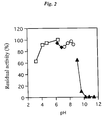
- the coenzyme-binding glucose dehydrogenase was dissolved in each 50mM buffer, i.e., citric acid-sodium phosphate buffer (pH3.2 to 6.4), potassium phosphate buffer (pH6.3 to 6.9), Tris-HCl buffer (pH7.3 to 8.6) or glycine-sodium hydroxide buffer (pH9.1 to 11.4) and kept at 40°C for 60 minutes, and then the enzymatic activity was examined by the method according to the activity measurement method 1, and a ratio of residual enzymatic activity was analyzed (Fig. 2). As a result, the pH for the stability of the coenzyme-binding glucose dehydrogenase was pH4.5 to 8.5.
- the coenzyme-binding glucose dehydrogenase was dissolved in 50mM citric acid-sodium phosphate buffer (pH5.5) and examined for the enzymatic activity over the range from 30°C to 62°C by the Enzymatic activity measurement method 1 described above (Fig. 3). As a result, the optimum temperature of the coenzyme-binding glucose dehydrogenase was about 55°C.
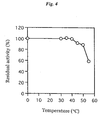
- the coenzyme-binding glucose dehydrogenase was dissolved in 50mM citric acid-sodium phosphate buffer (pH5.5), kept at several points of the temperature ranging from 0°C to 55°C for 15 minutes, and then examined for the enzymatic activity by the Enzymatic activity measurement method 1, and the ratio (%) of residual enzymatic activity was analyzed (Fig. 4). The ratio (%) of residual enzymatic activity was calculated with regarding the enzymatic activity after keeping at 0°C for 15 minutes as 100%. As a result, the coenzyme-binding glucose dehydrogenase kept its enzymatic activity at a level as high as 89% even at 50°C, showing the stability at about 50°C or below.
- the enzymatic activity of this enzyme was measured by the Enzymatic activity measurement method 1.
- the activity on each substrate is represented as a relative value to the activity of this enzyme on D-glucose being regarded as 100%, and shown in Table 1.
- the coenzyme-binding glucose dehydrogenase acts potently on D-glucose, and weakly on D-mannose, 1,5-anhydro-D-glucitol, D-cellobiose, D-trehalose, maltose, D-galactose, D-glucose-6-phosphate and D-fructose.
- This enzyme exhibited almost no effect on L-arabinose, lactose, D-sorbitol, gluconic acid, sucrose, D-mannitol, L-sorbose, D-ribose, L-rhamnose, D-glucose-1-phosphate, D-raffinose, ethanol or glycerol.
- the coenzyme-binding glucose dehydrogenase was dissolved in a 50mM potassium phosphate buffer (pH7.5) containing 0.2M NaCl, and analyzed on a TSKgel-G3000SW (diameter: 0.75 cm, length: 60 cm, TOSOH) using the same buffer solution as a mobile phase.
- a molecular weight marker Oriental Yeast
- the molecular weight of the coenzyme-binding glucose dehydrogenase was revealed to be about 130kDa.
- the inventive coenzyme-binding glucose dehydrogenase was subjected to an SDS-polyacrylamide gel electrophoresis (SDS-PAGE) according to the method by Laemmli et al (Nature, (1970) 227:680-685). After the running, the gel was stained with Coomassie brilliant blue, and the mobility was compared with that of the molecular weight marker (Amersham Pharmacia Biotech), which revealed that the subunit molecular weight of the inventive coenzyme-binding glucose dehydrogenase was about 85kDa.
- SDS-PAGE SDS-polyacrylamide gel electrophoresis
- Each of the various additives shown in Table 3 was added as an inhibitor at 1mM as a final concentration to the reaction system of the Enzymatic activity measurement method 1, and the activity of the coenzyme-binding glucose dehydrogenase was measured by the Enzymatic activity measurement method 1.
- the procedure similar to that of Enzymatic activity measurement method 1 was conducted except for adding no additives shown in Table 3.
- the activity in the presence of each additive was calculated as a relative activity, the difference of which from the control group activity was regarded as a % inhibitory effect.
- the inhibitory effect shown in Table 3 was observed.
- 1,10-phenanthroline was as high as 62.0% at 1mM, 76% at 5mM, 85% at 10mM, 91% at 25mM and 95% at 50mM as final concentrations of 1,10-phenanthroline.
- the inhibitory effect on the inventive coenzyme-binding glucose dehydrogenase varied depending on the type of the additive, and was the highest in the presence of heavy metal ion (such as Ag + , Cu 2+ and Hg 2+ ), and was 60% or more in the presence of 1,10-phenanthroline, proflavin and Mn 2+ .
- heavy metal ion such as Ag + , Cu 2+ and Hg 2+
- the inventive coenzyme-binding glucose dehydrogenase solution was supplemented with D-glucose and subjected to the absorption analysis, which indicated the disappearance of the maximum absorptions observed at 385 nm and 465 nm in response to the supplement, revealing that the coenzyme was flavin adenine dinucleotide. These maximum absorptions are specific to FAD, and it was not observed in a control group reaction system constructed by excluding FAD only.
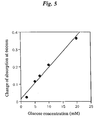
- the coenzyme-binding glucose dehydrogenase derived from the deposited strain 97508 purified in Example 2 described above was employed, and the absorption reduction rate was measured using D-glucose at the concentration ranging from 0.333 to 33mM instead of 333mM D-glucose in the Enzymatic activity measurement method 1.
- the transition in the absorption was measured at each D-glucose concentration of 0.333mM, 0.5mM, 1mM, 2mM, 5mM, 6.67mM, 10mM, 20mM and 33mM.
- the results of the measurement are shown in Fig. 5.
- the coenzyme-binding glucose dehydrogenase derived from the deposited strain 97508 purified in Example 2 described above was employed to measure D-glucose by an enzyme-immobilizing electrode.
- a glassy carbon (GC) electrode on which 3.4U of this enzyme was immobilized was employed to measure the response current to the glucose concentration.
- GC glassy carbon
- 2.7 ml of 100mM sodium phosphate buffer (pH7.0) and 0.3 ml of 1M aqueous solution of potassium hexacyanoferrate (III) (potassium ferricyanide) were added.
- the GC electrode was connected to the potentiostat BAS100B/W (BAS), and the solution was stirred at 40°C in each condition of argon saturation, oxygen saturation and air saturation while applying +500 mV to the silver-silver chloride reference electrode.
- 30 ⁇ l of a 1M D-glucose solution was added to these systems, and the current value in the stationary phase was measured.
- the same amount of the 1M D-glucose solution was further added, and the current value was measured, these procedure being repeated each three times.
- the resultant current values vs the known glucose concentrations (about 10, 20, 30 and 40 mM) were plotted to obtain a calibration curve (Fig. 6).
- the concentration of glucose in a serum was measured by the enzyme-immobilizing electrode using the control serum I WAKO B (WAKO PURE CHEMICAL).
- control serum I WAKO B WAKO PURE CHEMICAL
- 2.4 ml of 100mM sodium phosphate buffer (pH7.0) and 0.3 ml of 1M aqueous solution of potassium hexacyanoferrate (III) (potassium ferricyanide) were added, and the serum was added when the current value became stationary and the current value was measured.
- the D-glucose solutions of known concentrations were measured to obtain a calibration curve.
- the glucose concentration in the serum was identified by the calibration curve method to be 4.5mM, which was in agreement with the concentration of the glucose identified by the hexokinase-glucose-6-phosphate dehydrogenase method. Accordingly, it was revealed that the quantification of D-glucose in serum by the enzyme-immobilizing electrode employing the coenzyme-binding glucose dehydrogenase employed in the invention is possible.
- a soluble coenzyme-binding glucose dehydrogenase whose activity on altose is 5% or less and which is inhibited by 1,10-phenanthroline. Furthermore, a method for producing the coenzyme-binding glucose dehydrogenase suitable to an industrial production and a microorganism producing therefor are also provided. As a result, it becomes possible to apply the coenzyme-binding glucose dehydrogenase to an industrial application, and more particularly, it becomes possible to measure the blood sugar level even in a diabetes patient receiving an infusion containing maltose.
- a trace amount of the glucose can be measured even with a glucose sensor, thus enabling the utility. It also becomes possible to use in a material production or analysis including a method for measuring or eliminating glucose in a sample using the coenzyme-binding glucose dehydrogenase as well as a method for producing an organic compound, thereby providing a highly utilizable enzyme, which enables use for modifying a material in the fields of pharmaceuticals, clinical studies and food products.
Landscapes
- Chemical & Material Sciences (AREA)
- Life Sciences & Earth Sciences (AREA)
- Organic Chemistry (AREA)
- Health & Medical Sciences (AREA)
- Zoology (AREA)
- Engineering & Computer Science (AREA)
- Wood Science & Technology (AREA)
- Bioinformatics & Cheminformatics (AREA)
- Genetics & Genomics (AREA)
- Proteomics, Peptides & Aminoacids (AREA)
- Biochemistry (AREA)
- Biotechnology (AREA)
- General Engineering & Computer Science (AREA)
- Microbiology (AREA)
- Molecular Biology (AREA)
- General Health & Medical Sciences (AREA)
- Immunology (AREA)
- Analytical Chemistry (AREA)
- Physics & Mathematics (AREA)
- Biophysics (AREA)
- Medicinal Chemistry (AREA)
- Biomedical Technology (AREA)
- Emergency Medicine (AREA)
- Measuring Or Testing Involving Enzymes Or Micro-Organisms (AREA)
- Enzymes And Modification Thereof (AREA)
- Micro-Organisms Or Cultivation Processes Thereof (AREA)
Abstract
Description
acceptor
| Substrate | Relative activity (%) |
| D- | 100 |
| 2-Deoxy-D-glucose | 48 |
| D-Xylose | 9.1 |
| D-Mannose | 2.8 |
| 1,5-Anhydro-D-glucitol | 2 |
| D-Cellobiose | 2 |
| D-Trehalose | 1.7 |
| Maltose | 1.4 |
| D-Galactose | 1.2 |
| D-Glucose-6-phosphate | 1.1 |
| D-Fructose | 0.86 |
| L-Arabinose | 0.1> |
| Lactose | 0.1> |
| D-Sorbitol | 0.1> |
| Gluconic acid | 0.1> |
| Sucrose | 0.1> |
| D-Mannitol | 0.1> |
| L-Sorbose | 0.1> |
| D-Ribose | 0.1> |
| L-Rhamnose | 0.1> |
| D-Glucose-1-phosphate | 0.1> |
| D-Raffinose | 0.1> |
| Ethanol | 0.1> |
| Glycerol | 0.1> |
| Substrate | Final Conc.(mM) | Relative activity (%) |
| D-Glucose | 550 | 100 |
| Maltose | 550 | 2.8 |
| D- | 100 | 100 |
| | 100 | 0.5 |
| Additive | Inhibition (%) | Additive | Inhibition (%) |
| | 0 | Quinacrine | 5.0 |
| | 0 | TritonX-100 | 6.2 |
| | 0 | CoCl2 | 7.0 |
| | 0 | Malic acid | 8.1 |
| Benzoic acid | 0 | D-Tartaric acid | 8.5 |
| EDTA | 0.4 | Iodoacetic acid | 9.5 |
| CdCl2 | 0.8 | Cysteamine | 9.8 |
| LiCl | 0.9 | 2,2'-Bipyridine | 10.8 |
| Aminoguanidine sulfate | 1.1 | 8-Quinolinol | 13.9 |
| H2O2 | 1.7 | KCN | 14.5 |
| N-Ethylmaleimide | 1.8 | NiCl2 | 16.5 |
| Urea | 1.9 | FeCl3 | 25.0 |
| NaCl | 2.5 | Maleic acid | 26.2 |
| Tirone | 2.5 | Acrinol | 29.0 |
| BaCl2 | 2.6 | 2-Nitrobenzoic acid | 44.3 |
| PbCl2 | 2.7 | SnCl2 | 45.5 |
| MgCl2 | 2.8 | Acriflavine | 49.0 |
| Fumaric acid | 3.4 | 1,10-Phenanthroline | 62.0 |
| Cycloserine | 3.6 | Proflavin | 62.0 |
| DL-Penicillamine | 4.3 | MnCl2 | 75.5 |
| Meso-tartaric acid | 5.6 | AgNO3 | 99.4 |
| Citric acid | 5.6 | | 100 |
| CaCl2 | 5.7 | | 100 |
| Final concentration of 1,10-phenanthroline (mM) | Inhibit (%) |
| 0 | 0 |
| 50 | 95 |
| 25 | 91 |
| 10 | 85 |
| 5 | 76 |
Claims (21)
- A soluble coenzyme-binding glucose dehydrogenase, which catalyzes a reaction for oxidizing glucose in the presence of an electron acceptor and has a low activity to maltose.
- The coenzyme-binding glucose dehydrogenase of claim 1, which catalyzes a reaction for oxidizing glucose in the presence of an electron acceptor, has a 5% or less specific activity to maltose, and is inhibited by 1,10-phenanthroline.
- The coenzyme-binding glucose dehydrogenase of claim 1 or 2, wherein its activity is 50% or more inhibited at 1mM of 1,10-phenanthroline as a final concentration.
- The coenzyme-binding glucose dehydrogenase of any one of claims 1 to 3, wherein the coenzyme is a flavin compound.
- The coenzyme-binding glucose dehydrogenase of any one of claims 1 to 4, which oxidizes hydroxyl group in the 1st-position of glucose.
- The coenzyme-binding glucose dehydrogenase of any one of claims 1 to 5, which is derived from a microorganism.
- The coenzyme-binding glucose dehydrogenase of claim 6, which is derived from a eukaryotic microorganism.
- The coenzyme-binding glucose dehydrogenase of claim 7, which is derived from an Aspergillus terreus.
- The coenzyme-binding glucose dehydrogenase of claim 8, which is derived from the Aspergillus terreus under the accession number FERM BP-08578.
- A coenzyme-binding glucose dehydrogenase, which is a protein having characteristics of the coenzyme-binding glucose dehydrogenase of any one of claims 1 to 5 or having substantially equivalent characteristics thereto, which has an amino acid sequence encoding the protein or an amino acid sequence containing a mutation resulting from a deletion, substitution or addition of one or more amino acid residues in the sequence , wherein the protein is biologically active and stable.
- A microorganism having an ability of producing the coenzyme-binding glucose dehydrogenase of any one of claims 1 to 5.
- The microorganism of claim 11, which is a eukaryotic microorganism.
- The microorganism of claim 12, which is an Aspergillus terreus.
- The microorganism of claim 13, which is the Aspergillus terreus under the accession number FERM BP-08578.
- A method for producing the coenzyme-binding glucose dehydrogenase of any one of claims 1 to 5, which comprises culturing the microorganism of any one of claims 11 to 14 and producing and recovering the coenzyme-binding glucose dehydrogenase in the culture.
- A method for measuring glucose, which comprises using the coenzyme-binding glucose dehydrogenase of any one of claims 1 to 10.
- The method according to claim 16, wherein the method is carried out with ferricyanide at a final concentration of 2mM to 500mM.
- A reagent composition for measuring glucose comprising the coenzyme-binding glucose dehydrogenase of any one of claims 1 to 10.
- The reagent composition of claim 18, wherein ferricyanide is employed at a final concentration of 2mM to 500mM.
- A biosensor for measuring glucose using the coenzyme-binding glucose dehydrogenase of any one of claims 1 to 10.
- The biosensor of claim 20, wherein ferricyanide is employed at a final concentration of 2mM to 500mM.
Applications Claiming Priority (3)
| Application Number | Priority Date | Filing Date | Title |
|---|---|---|---|
| JP2002373297 | 2002-12-24 | ||
| JP2002373297 | 2002-12-24 | ||
| PCT/JP2003/016603 WO2004058958A1 (en) | 2002-12-24 | 2003-12-24 | Coenzyme-binding glucose dehydrogenase |
Publications (3)
| Publication Number | Publication Date |
|---|---|
| EP1584675A1 true EP1584675A1 (en) | 2005-10-12 |
| EP1584675A4 EP1584675A4 (en) | 2006-05-24 |
| EP1584675B1 EP1584675B1 (en) | 2010-02-24 |
Family
ID=32677255
Family Applications (1)
| Application Number | Title | Priority Date | Filing Date |
|---|---|---|---|
| EP03789625A Expired - Lifetime EP1584675B1 (en) | 2002-12-24 | 2003-12-24 | Coenzyme-binding glucose dehydrogenase |
Country Status (8)
| Country | Link |
|---|---|
| US (7) | US7514250B2 (en) |
| EP (1) | EP1584675B1 (en) |
| JP (1) | JP4494978B2 (en) |
| CN (1) | CN100415877C (en) |
| AU (1) | AU2003296186A1 (en) |
| CA (1) | CA2511656A1 (en) |
| DE (1) | DE60331477D1 (en) |
| WO (1) | WO2004058958A1 (en) |
Cited By (12)
| Publication number | Priority date | Publication date | Assignee | Title |
|---|---|---|---|---|
| EP1739169A1 (en) * | 2005-06-29 | 2007-01-03 | Sysmex Corporation | Clinical diagnostic reagent comprising glucose 6-phosphate dehydrogenase (G6PDH), method for stabilizing G6PDH, and use of a stabilizer for G6PDH |
| EP1783213A1 (en) * | 2005-11-07 | 2007-05-09 | Toyo Boseki Kabushiki Kaisha | Novel glucose dehydrogenase |
| EP1785483A1 (en) | 2005-11-10 | 2007-05-16 | Toyo Boseki Kabushiki Kaisha | Method for improving the heat stability of a composition containing glucose dehydrogenase (GDH) |
| EP1862543A4 (en) * | 2005-03-25 | 2009-01-21 | Ikeda Food Res Co Ltd | CO-ENZYME-RELATED GLUCOSE DEHYDROGENASE AND POLYNUCLEOTIDE ENCODING THE SAME |
| US7655130B2 (en) | 2006-03-31 | 2010-02-02 | Toyo Boseki Kabushiki Kaisha | Glucose dehydrogenase from Aspergillus oryzae |
| US7741100B2 (en) | 2006-03-31 | 2010-06-22 | Toyo Boseki Kabushiki Kaisha | Method for highly expressing recombinant glucose dehydrogenase derived from filamentous fungi |
| US7871805B2 (en) | 2006-03-31 | 2011-01-18 | Toyo Boseki Kabushiki Kaisha | Glucose dehydrogenase |
| EP2241621A4 (en) * | 2007-12-28 | 2011-02-02 | Ikeda Food Res Co Ltd | Modified glucose dehydrogenase gene |
| EP2017608A4 (en) * | 2006-04-19 | 2012-12-12 | Panasonic Corp | BIOSENSOR |
| US8882978B2 (en) | 2006-06-29 | 2014-11-11 | Ikeda Food Research Co., Ltd. | FAD-conjugated glucose dehydrogenase gene |
| US10988738B2 (en) | 2002-12-24 | 2021-04-27 | Ikeda Food Research Co., Ltd. | Coenzyme-binding glucose dehydrogenase |
| CN118006586A (en) * | 2024-03-11 | 2024-05-10 | 陕西巨子生物技术有限公司 | A method for preparing ginsenoside Rh2 by bioenzyme conversion |
Families Citing this family (53)
| Publication number | Priority date | Publication date | Assignee | Title |
|---|---|---|---|---|
| US20070105174A1 (en) * | 2005-11-07 | 2007-05-10 | Toyo Boseki Kabushiki Kaisha | Novel glucose dehydrogenase |
| US20080003628A1 (en) * | 2006-03-31 | 2008-01-03 | Toyo Boseki Kabushiki Kaisha | Method for enhancing stability of a composition comprising soluble glucose dehydrogenase (gdh) |
| US20080090278A1 (en) * | 2006-03-31 | 2008-04-17 | Toyo Boseki Kabushiki Kaisha | Method for enhancing stability of a composition comprising soluble glucose dehydrogenase (gdh) |
| JP2008154572A (en) * | 2006-03-31 | 2008-07-10 | Toyobo Co Ltd | Method for producing filamentous fungus-derived glucose dehydrogenase |
| JP4179384B2 (en) * | 2006-03-31 | 2008-11-12 | 東洋紡績株式会社 | Process for producing glucose dehydrogenase from Aspergillus oryzae |
| JP2008154573A (en) * | 2006-03-31 | 2008-07-10 | Toyobo Co Ltd | Method for enhancing stability of composition comprising soluble glucose dehydrogenase (gdh) |
| ATE555198T1 (en) * | 2006-03-31 | 2012-05-15 | Toyo Boseki | GLUCOSE DEHYDROGENASE |
| EP2348308B1 (en) * | 2006-04-19 | 2014-06-04 | Panasonic Healthcare Co., Ltd. | Biosensor |
| EP2022850B1 (en) * | 2006-05-29 | 2011-08-31 | Amano Enzyme Inc. | Flavin adenine dinucleotide-binding glucose dehydrogenase |
| WO2008059777A1 (en) | 2006-11-14 | 2008-05-22 | Toyo Boseki Kabushiki Kaisha | Modified flavine-adenine-dinucleotide-dependent glucose dehydrogenase |
| DE602007012130D1 (en) * | 2006-11-14 | 2011-03-03 | Toyo Boseki | MODIFIED FLAVIN-ADENINE-DINUCLEOTIDE-DEPENDENT GLUCOSE-DEHYDROGENASE |
| JPWO2008102639A1 (en) * | 2007-02-20 | 2010-05-27 | 東洋紡績株式会社 | Method for electrochemical determination of glucose, glucose dehydrogenase composition, and electrochemical sensor for glucose measurement |
| WO2009069381A1 (en) | 2007-11-28 | 2009-06-04 | Amano Enzyme Inc. | Transformant transfected with flavin adenine dinucleotide-binding glucose dehydrogenase gene and method for producing flavin adenine dinucleotide-binding glucose dehydrogenase using the same |
| JP5380888B2 (en) * | 2008-04-08 | 2014-01-08 | 東洋紡株式会社 | Method for quantitative determination of glucose and quantitative composition |
| JP4770911B2 (en) * | 2008-11-05 | 2011-09-14 | 東洋紡績株式会社 | Method for improving the thermal stability of a composition comprising soluble coenzyme linked glucose dehydrogenase (GDH) |
| EP2426200A4 (en) | 2009-04-30 | 2012-11-14 | Ikeda Food Res Co Ltd | ELECTRONIC MEDIATOR OF PROTEIN TYPE |
| US8445246B2 (en) | 2009-06-04 | 2013-05-21 | Kikkoman Corporation | Flavin-binding glucose dehydrogenases |
| WO2011004654A1 (en) * | 2009-07-10 | 2011-01-13 | 天野エンザイム株式会社 | Glucose dehydrogenase derived from mucor microorganism |
| WO2011034108A1 (en) | 2009-09-16 | 2011-03-24 | 東洋紡績株式会社 | Modified flavine-adenine-dinucleotide-dependent glucose dehydrogenase |
| JP5846687B2 (en) | 2009-12-05 | 2016-01-20 | 天野エンザイム株式会社 | Mutant enzyme and its use |
| JP5899616B2 (en) * | 2009-12-28 | 2016-04-06 | 東洋紡株式会社 | A method to improve the temperature dependence of flavin adenine dinucleotide-dependent glucose dehydrogenase |
| EP2589655A4 (en) | 2010-06-29 | 2013-12-04 | Ultizyme Int Ltd | Glucose dehydrogenase |
| WO2012073987A1 (en) * | 2010-12-01 | 2012-06-07 | キッコーマン株式会社 | E. coli transformant, production method for flavin-bound glucose dehydrogenase using same, and mutant flavin-bound glucose dehydrogenase |
| US9469844B2 (en) | 2010-12-02 | 2016-10-18 | Kikkoman Corporation | Flavin-bound glucose dehydrogenases, a method for producing a flavin-bound glucose dehydrogenase, and yeast transformant used for the same |
| WO2012169512A1 (en) * | 2011-06-07 | 2012-12-13 | キッコーマン株式会社 | Flavin-binding glucose dehydrogenase, method for manufacturing flavin-binding glucose dehydrogenase, and glucose measurement method using same |
| JP6079038B2 (en) | 2011-08-11 | 2017-02-15 | 東洋紡株式会社 | Novel glucose dehydrogenase |
| JP6128560B2 (en) | 2011-08-26 | 2017-05-24 | 池田食研株式会社 | Flavin-binding glucose dehydrogenase |
| JP5896375B2 (en) | 2011-09-09 | 2016-03-30 | 池田食研株式会社 | Modified glucose dehydrogenase gene |
| JP5584740B2 (en) | 2011-09-26 | 2014-09-03 | アークレイ株式会社 | Glucose sensor |
| JP2013081399A (en) * | 2011-10-06 | 2013-05-09 | Toyobo Co Ltd | New glucose dehydrogenase |
| WO2013065623A1 (en) | 2011-10-31 | 2013-05-10 | 東洋紡株式会社 | Novel glucose dehydrogenase |
| WO2013065770A1 (en) | 2011-11-02 | 2013-05-10 | キッコーマン株式会社 | Flavin-bound glucose dehydrogenase having improved substrate specificity |
| WO2013099294A1 (en) | 2011-12-28 | 2013-07-04 | 有限会社アルティザイム・インターナショナル | Glucose dehydrogenase |
| JP6207167B2 (en) | 2012-02-09 | 2017-10-04 | 東洋紡株式会社 | Novel glucose dehydrogenase |
| US9212358B2 (en) | 2012-06-15 | 2015-12-15 | Microvi Biotech, Inc. | Biocatalyst compositions and processes for their use |
| WO2014002973A1 (en) | 2012-06-29 | 2014-01-03 | 東洋紡株式会社 | Novel glucose dehydrogenase |
| WO2014038660A1 (en) * | 2012-09-10 | 2014-03-13 | 東洋紡株式会社 | Novel glucose dehydrogenase |
| WO2015060150A1 (en) * | 2013-10-21 | 2015-04-30 | 東洋紡株式会社 | Novel glucose dehydrogenase |
| WO2015141761A1 (en) | 2014-03-21 | 2015-09-24 | 池田食研株式会社 | Flavin-binding glucose dehydrogenase |
| JP6826315B2 (en) | 2015-01-16 | 2021-02-03 | 東洋紡株式会社 | FAD-dependent glucose dehydrogenase |
| JP7397568B2 (en) | 2015-04-09 | 2023-12-13 | 東洋紡株式会社 | Enzyme preparation for glucose measurement |
| CN108350438B (en) | 2015-11-06 | 2022-06-24 | 天野酶株式会社 | Novel glucose dehydrogenase |
| JP6940149B2 (en) | 2016-01-14 | 2021-09-22 | 池田食研株式会社 | Flavin-bound glucose dehydrogenase |
| EP3456823A4 (en) | 2016-05-09 | 2019-11-13 | Kikkoman Corporation | FLAVIN BINDING GLUCOSE DEHYDROGENASE VARIANT |
| WO2018062103A1 (en) * | 2016-09-28 | 2018-04-05 | 天野エンザイム株式会社 | Glucose dehydrogenase |
| JP6453385B2 (en) | 2017-06-14 | 2019-01-16 | 池田食研株式会社 | Modified glucose dehydrogenase |
| WO2019208308A1 (en) | 2018-04-23 | 2019-10-31 | 池田食研株式会社 | Flavin-binding glucose dehydrogenase |
| CN110607248B (en) * | 2018-06-16 | 2021-01-01 | 华中农业大学 | Fogerella strain A6 for repairing soil cadmium pollution and application |
| CN109596750A (en) * | 2019-01-09 | 2019-04-09 | 新疆医科大学 | A method of allinase is measured based on SEC-HPLC |
| CN110195030A (en) * | 2019-05-10 | 2019-09-03 | 中国农业科学院饲料研究所 | HIF1 α albumen is screening the application in the safe feeding additive of liver lipid lowering as biomarker |
| US12558008B2 (en) | 2019-09-30 | 2026-02-24 | Phc Holdings Corporation | High molecular weight redox polymer and biosensor using same |
| CN114085795B (en) * | 2021-11-25 | 2023-07-07 | 浙江理工大学 | Bacteria strain and process for improving humus soil in landfill to green planting soil |
| CN119060857B (en) * | 2024-09-12 | 2025-10-28 | 中国水产科学研究院长江水产研究所 | Epicoccus nigrum Z01 and application thereof |
Family Cites Families (75)
| Publication number | Priority date | Publication date | Assignee | Title |
|---|---|---|---|---|
| US2006001A (en) * | 1934-09-10 | 1935-06-25 | Standard Oil Co California | Apparatus for annealing |
| EP0094161A1 (en) | 1982-05-07 | 1983-11-16 | Imperial Chemical Industries Plc | Method for determining glucose content of fluid |
| US4767785A (en) * | 1984-01-18 | 1988-08-30 | Michael Georgieff | Hypocaloric preparation and intravenous method for hypocaloric treatment of patients |
| US5364770A (en) * | 1985-08-29 | 1994-11-15 | Genencor International Inc. | Heterologous polypeptides expressed in aspergillus |
| JPH0758272B2 (en) | 1986-12-01 | 1995-06-21 | 松下電器産業株式会社 | Glucose sensor |
| JPS63139243A (en) | 1986-12-01 | 1988-06-11 | Matsushita Electric Ind Co Ltd | glucose sensor |
| JPS63317757A (en) | 1987-06-19 | 1988-12-26 | Matsushita Electric Ind Co Ltd | glucose sensor |
| WO1989009397A1 (en) * | 1988-03-31 | 1989-10-05 | Matsushita Electric Industrial Co., Ltd. | Biosensor and process for its production |
| US5286362A (en) * | 1990-02-03 | 1994-02-15 | Boehringer Mannheim Gmbh | Method and sensor electrode system for the electrochemical determination of an analyte or an oxidoreductase as well as the use of suitable compounds therefor |
| JPH04215055A (en) | 1990-10-11 | 1992-08-05 | Nok Corp | Glucose biosensor |
| US5593852A (en) | 1993-12-02 | 1997-01-14 | Heller; Adam | Subcutaneous glucose electrode |
| JP2959221B2 (en) | 1991-08-21 | 1999-10-06 | 松下電器産業株式会社 | Manufacturing method of glucose sensor |
| JP3084877B2 (en) | 1992-01-21 | 2000-09-04 | 松下電器産業株式会社 | Manufacturing method of glucose sensor |
| DE4301904A1 (en) | 1992-08-07 | 1994-02-10 | Boehringer Mannheim Gmbh | Hypoglycosylated recombinant glucose oxidase |
| US5413690A (en) * | 1993-07-23 | 1995-05-09 | Boehringer Mannheim Corporation | Potentiometric biosensor and the method of its use |
| US5762770A (en) * | 1994-02-21 | 1998-06-09 | Boehringer Mannheim Corporation | Electrochemical biosensor test strip |
| EP1605050A3 (en) * | 1996-01-19 | 2006-03-22 | Novozymes Biotech, Inc. | Morphological mutants of filamentous fungi |
| US5879921A (en) | 1996-11-07 | 1999-03-09 | Novo Nordisk A/S | Recombinant expression of a glucose oxidase from a cladosporium strain |
| JPH10239273A (en) | 1997-02-26 | 1998-09-11 | Akebono Brake Res & Dev Center Ltd | Glucose sensor |
| JPH10243786A (en) * | 1997-03-03 | 1998-09-14 | Koji Hayade | Modified glucose dehydrogenase |
| US6059946A (en) * | 1997-04-14 | 2000-05-09 | Matsushita Electric Industrial Co., Ltd. | Biosensor |
| US6071391A (en) * | 1997-09-12 | 2000-06-06 | Nok Corporation | Enzyme electrode structure |
| US6656702B1 (en) * | 1998-07-03 | 2003-12-02 | Matsushita Electric Industrial Co., Ltd. | Biosensor containing glucose dehydrogenase |
| JP3694424B2 (en) | 1998-09-29 | 2005-09-14 | 松下電器産業株式会社 | Glucose sensor |
| US6338790B1 (en) * | 1998-10-08 | 2002-01-15 | Therasense, Inc. | Small volume in vitro analyte sensor with diffusible or non-leachable redox mediator |
| US6100037A (en) | 1999-01-07 | 2000-08-08 | Incyte Pharmaceuticals, Inc. | Human cyclic nucleotide PDEs |
| JP2000262281A (en) | 1999-03-18 | 2000-09-26 | Koji Hayade | Crosslinked glucose dehydrogenase |
| JP2000350588A (en) | 1999-04-08 | 2000-12-19 | Koji Hayade | Glucose dehydrogenase |
| JP2001197888A (en) | 2000-01-18 | 2001-07-24 | Koji Hayade | Glucose dehydrogenase having excellent substrate specificity |
| JP2000312588A (en) * | 1999-04-30 | 2000-11-14 | Koji Hayade | Glucose dehydrogenase |
| TWI224136B (en) | 1999-04-30 | 2004-11-21 | Koji Sode | Glucose dehydrogenase |
| JP4526638B2 (en) | 1999-06-01 | 2010-08-18 | 月桂冠株式会社 | High protein expression system |
| JP2001037483A (en) | 1999-07-30 | 2001-02-13 | Koji Hayade | Linked glucose dehydrogenase |
| US7276146B2 (en) * | 2001-11-16 | 2007-10-02 | Roche Diagnostics Operations, Inc. | Electrodes, methods, apparatuses comprising micro-electrode arrays |
| DE60024965T2 (en) * | 1999-10-05 | 2006-07-13 | Matsushita Electric Industrial Co., Ltd., Kadoma | GLUCOSE SENSOR |
| US6616819B1 (en) | 1999-11-04 | 2003-09-09 | Therasense, Inc. | Small volume in vitro analyte sensor and methods |
| KR100445489B1 (en) | 1999-11-15 | 2004-08-21 | 마츠시타 덴끼 산교 가부시키가이샤 | Biosensor, method of forming thin-film electrode, and method and apparatus for quantitative determination |
| JP2000354495A (en) | 2000-01-01 | 2000-12-26 | Koji Hayade | Production of glucose dehydrogenase |
| JP2001346587A (en) | 2000-06-08 | 2001-12-18 | Koji Hayade | Glucose dehydrogenase excellent in substrate specificity |
| EP1332216B1 (en) * | 2000-10-27 | 2011-08-17 | Roche Diagnostics GmbH | Variants of soluble pyrroloquinoline quinone-dependent glucose dehydrogenase |
| AU2002210991B2 (en) | 2000-10-31 | 2006-08-10 | Koji Sode | Novel glucose dehydrogenase and process for producing the dehydrogenase |
| JP2002223772A (en) | 2001-02-01 | 2002-08-13 | Gekkeikan Sake Co Ltd | Catalase A gene |
| EP1369485A4 (en) | 2001-03-13 | 2004-05-12 | Koji Sode | Glucose dehydrogenase |
| US7235170B2 (en) | 2001-05-15 | 2007-06-26 | Matsushita Electric Industrial Co., Ltd. | Biosensor |
| AU2002319764A1 (en) | 2001-08-03 | 2003-02-17 | Elitra Pharmaceuticals, Inc. | Nucleic acids of aspergillus fumigatus encoding industrial enzymes and methods of use |
| JP2004344145A (en) | 2002-05-27 | 2004-12-09 | Toyobo Co Ltd | Pyrroloquinoline quinone (pqq) dependent modified glucosedehydrogenase substance excellent in substrate specificity and stability |
| CA2403025A1 (en) * | 2002-10-08 | 2004-04-08 | Cognis Deutschland Gmbh & Co. Kg | Enzymes with lipase/acyltransferase activity |
| JP2004173538A (en) | 2002-11-25 | 2004-06-24 | Amano Enzyme Inc | Pyrroloquinolinequinone dependent glucose dehydrogenase |
| CA2511656A1 (en) | 2002-12-24 | 2004-07-15 | Ikeda Food Research Co., Ltd. | Coenzyme-binding glucose dehydrogenase |
| JP4029346B2 (en) | 2003-03-24 | 2008-01-09 | 東洋紡績株式会社 | Modified pyrroloquinoline quinone (PQQ) -dependent glucose dehydrogenase excellent in substrate specificity or stability |
| JP4332794B2 (en) | 2003-03-24 | 2009-09-16 | 東洋紡績株式会社 | Modified pyrroloquinoline quinone (PQQ) -dependent glucose dehydrogenase excellent in substrate specificity or stability |
| JP5105691B2 (en) | 2003-05-09 | 2012-12-26 | 月桂冠株式会社 | Cyclic nucleotide derived from Aspergillus filamentous fungi, method for producing Aspergillus filamentous fungus self-cloning strain, and self-cloning strain |
| BRPI0413492A (en) | 2003-08-11 | 2006-10-17 | Codexis Inc | polypeptide, polynucleotide, isolated nucleic acid sequence, expression vector, host cell, method of making a gdh polypeptide, and, composition |
| WO2005026340A1 (en) | 2003-09-08 | 2005-03-24 | Toyo Boseki Kabushiki Kaisha | Pyrroloquinoline quinone (pqq)-dependent glucose dehydrogenase modification having excellent substrate specificity |
| JP2005089884A (en) | 2003-09-12 | 2005-04-07 | Mitsubishi Rayon Co Ltd | Method for producing carbon fiber precursor acrylic fiber bundle |
| JP4374464B2 (en) | 2004-03-10 | 2009-12-02 | 独立行政法人産業技術総合研究所 | Biosensor |
| DE602005025104D1 (en) | 2004-04-23 | 2011-01-13 | Arkray Inc | MUTATED GLUCOSE DEHYDROGENASE |
| JP5020070B2 (en) | 2005-03-25 | 2012-09-05 | 池田食研株式会社 | Polynucleotide encoding coenzyme-linked glucose dehydrogenase |
| ATE520771T1 (en) * | 2005-06-20 | 2011-09-15 | Arkray Inc | MUTATED GLUCOSE DEHYDROGENASE |
| US7741100B2 (en) | 2006-03-31 | 2010-06-22 | Toyo Boseki Kabushiki Kaisha | Method for highly expressing recombinant glucose dehydrogenase derived from filamentous fungi |
| US7553649B2 (en) * | 2006-03-31 | 2009-06-30 | Toyo Boseki Kabushiki Kaisha | Method for producing glucose dehydrogenase from Aspergillus oryzae |
| JP2007289148A (en) | 2006-03-31 | 2007-11-08 | Toyobo Co Ltd | Method for producing glucose dehydrogenase derived from aspergillus oryzae |
| JP4179384B2 (en) | 2006-03-31 | 2008-11-12 | 東洋紡績株式会社 | Process for producing glucose dehydrogenase from Aspergillus oryzae |
| ATE555198T1 (en) | 2006-03-31 | 2012-05-15 | Toyo Boseki | GLUCOSE DEHYDROGENASE |
| JP2008154572A (en) | 2006-03-31 | 2008-07-10 | Toyobo Co Ltd | Method for producing filamentous fungus-derived glucose dehydrogenase |
| US20130332133A1 (en) * | 2006-05-11 | 2013-12-12 | Ramot At Tel Aviv University Ltd. | Classification of Protein Sequences and Uses of Classified Proteins |
| EP2022850B1 (en) | 2006-05-29 | 2011-08-31 | Amano Enzyme Inc. | Flavin adenine dinucleotide-binding glucose dehydrogenase |
| WO2008001903A1 (en) | 2006-06-29 | 2008-01-03 | Ikeda Food Research Co., Ltd. | Fad-conjugated glucose dehydrogenase gene |
| WO2008063768A2 (en) * | 2006-10-12 | 2008-05-29 | Case Western Reserve University | Compositions and methods for treating metabolic diseases |
| JPWO2008102639A1 (en) * | 2007-02-20 | 2010-05-27 | 東洋紡績株式会社 | Method for electrochemical determination of glucose, glucose dehydrogenase composition, and electrochemical sensor for glucose measurement |
| JP2008206433A (en) | 2007-02-26 | 2008-09-11 | Toyobo Co Ltd | Dna encoding glucose dehydrogenase |
| WO2009084616A1 (en) | 2007-12-28 | 2009-07-09 | Ikeda Food Research Co., Ltd. | Modified glucose dehydrogenase gene |
| EP2426200A4 (en) | 2009-04-30 | 2012-11-14 | Ikeda Food Res Co Ltd | ELECTRONIC MEDIATOR OF PROTEIN TYPE |
| WO2015060150A1 (en) | 2013-10-21 | 2015-04-30 | 東洋紡株式会社 | Novel glucose dehydrogenase |
| US20170136102A1 (en) | 2014-03-27 | 2017-05-18 | Umender Kumar SHARMA | Phage-derived compositions for improved mycobacterial therapy |
-
2003
- 2003-12-24 CA CA002511656A patent/CA2511656A1/en not_active Abandoned
- 2003-12-24 AU AU2003296186A patent/AU2003296186A1/en not_active Abandoned
- 2003-12-24 DE DE60331477T patent/DE60331477D1/en not_active Expired - Lifetime
- 2003-12-24 JP JP2004562920A patent/JP4494978B2/en not_active Expired - Lifetime
- 2003-12-24 CN CNB2003801056894A patent/CN100415877C/en not_active Expired - Lifetime
- 2003-12-24 US US10/540,025 patent/US7514250B2/en not_active Expired - Lifetime
- 2003-12-24 EP EP03789625A patent/EP1584675B1/en not_active Expired - Lifetime
- 2003-12-24 WO PCT/JP2003/016603 patent/WO2004058958A1/en not_active Ceased
-
2009
- 2009-03-03 US US12/396,724 patent/US20090176262A1/en not_active Abandoned
-
2010
- 2010-08-06 US US12/851,668 patent/US20100297743A1/en not_active Abandoned
-
2019
- 2019-02-15 US US16/278,025 patent/US11345897B2/en not_active Expired - Lifetime
- 2019-02-15 US US16/278,030 patent/US11155789B2/en not_active Expired - Fee Related
- 2019-02-15 US US16/278,008 patent/US10988738B2/en not_active Expired - Fee Related
- 2019-02-15 US US16/278,019 patent/US11225645B2/en not_active Expired - Fee Related
Cited By (39)
| Publication number | Priority date | Publication date | Assignee | Title |
|---|---|---|---|---|
| US10988738B2 (en) | 2002-12-24 | 2021-04-27 | Ikeda Food Research Co., Ltd. | Coenzyme-binding glucose dehydrogenase |
| US11345897B2 (en) | 2002-12-24 | 2022-05-31 | Ikeda Food Research Co., Ltd. | Coenzyme-binding glucose dehydrogenase |
| US11225645B2 (en) | 2002-12-24 | 2022-01-18 | Ikeda Food Research Co., Ltd. | Coenzyme-binding glucose dehydrogenase |
| US11155789B2 (en) | 2002-12-24 | 2021-10-26 | Ikeda Food Research Co., Ltd. | Coenzyme-binding glucose dehydrogenase |
| US10648011B2 (en) | 2005-03-25 | 2020-05-12 | Ikeda Food Research Co., Ltd. | Coenzyme-linked glucose dehydrogenase and polynucleotide encoding the same |
| US10738341B2 (en) | 2005-03-25 | 2020-08-11 | Ikeda Food Research Co., Ltd. | Coenzyme-linked glucose dehydrogenase and polynucleotide encoding the same |
| EP1862543A4 (en) * | 2005-03-25 | 2009-01-21 | Ikeda Food Res Co Ltd | CO-ENZYME-RELATED GLUCOSE DEHYDROGENASE AND POLYNUCLEOTIDE ENCODING THE SAME |
| US10883133B2 (en) | 2005-03-25 | 2021-01-05 | Ikeda Food Research Co., Ltd. | Coenzyme-linked glucose dehydrogenase and polynucleotide encoding the same |
| US10851398B2 (en) | 2005-03-25 | 2020-12-01 | Ikeda Food Research Co., Ltd. | Coenzyme-linked glucose dehydrogenase and polynucleotide encoding the same |
| US10815515B2 (en) | 2005-03-25 | 2020-10-27 | Ikeda Food Research Co., Ltd. | Coenzyme-linked glucose dehydrogenase and polynucleotide encoding the same |
| EP2365074A1 (en) * | 2005-03-25 | 2011-09-14 | Ikeda Food Research Co. Ltd. | Coenzyme-linked glucose dehydrogenase and polynucleotide encoding the same |
| EP2365073A1 (en) * | 2005-03-25 | 2011-09-14 | Ikeda Food Research Co. Ltd. | Coenzyme-linked glucose dehydrogenase and polynucleotide encoding the same |
| EP2368987A1 (en) * | 2005-03-25 | 2011-09-28 | Ikeda Food Research Co. Ltd. | Coenzyme-linked glucose dehydrogenase and polynucleotide encoding the same |
| EP2380981A1 (en) * | 2005-03-25 | 2011-10-26 | Ikeda Food Research Co. Ltd. | Coenzyme-linked glucose dehydrogenase and polynucleotide encoding the same |
| EP2380980A1 (en) * | 2005-03-25 | 2011-10-26 | Ikeda Food Research Co. Ltd. | Coenzyme-linked glucose dehydrogenase and polynucleotide encoding the same |
| US10808274B2 (en) | 2005-03-25 | 2020-10-20 | Ikeda Food Research Co., Ltd. | Coenzyme-linked glucose dehydrogenase and polynucleotide encoding the same |
| US10669565B2 (en) | 2005-03-25 | 2020-06-02 | Ikeda Food Research Co., Ltd. | Coenzyme-linked glucose dehydrogenase and polynucleotide encoding the same |
| US10626433B2 (en) | 2005-03-25 | 2020-04-21 | Ikeda Food Research Co., Ltd. | Coenzyme-linked glucose dehydrogenase and polynucleotide encoding the same |
| US8691547B2 (en) | 2005-03-25 | 2014-04-08 | Ikeda Food Research Co., Ltd. | Coenzyme-linked glucose dehydrogenase and polynucleotide encoding the same |
| US10626434B2 (en) | 2005-03-25 | 2020-04-21 | Ikeda Food Research Co., Ltd. | Coenzyme-linked glucose dehydrogenase and polynucleotide encoding the same |
| US9328372B2 (en) | 2005-03-25 | 2016-05-03 | Ikeda Food Research Co., Ltd | Coenzyme-linked glucose dehydrogenase and polynucleotide encoding the same |
| US9957543B2 (en) | 2005-03-25 | 2018-05-01 | Ikeda Food Research Co., Ltd. | Coenzyme-linked glucose dehydrogenase and polynucleotide encoding the same |
| EP1739169A1 (en) * | 2005-06-29 | 2007-01-03 | Sysmex Corporation | Clinical diagnostic reagent comprising glucose 6-phosphate dehydrogenase (G6PDH), method for stabilizing G6PDH, and use of a stabilizer for G6PDH |
| EP1783213A1 (en) * | 2005-11-07 | 2007-05-09 | Toyo Boseki Kabushiki Kaisha | Novel glucose dehydrogenase |
| US7611859B2 (en) | 2005-11-10 | 2009-11-03 | Toyo Boseki Kabushiki Kaisha | Method for improving heat stability of composition containing water-soluble coenzyme-bound glucose dehydrogenase (GDH) |
| EP1785483A1 (en) | 2005-11-10 | 2007-05-16 | Toyo Boseki Kabushiki Kaisha | Method for improving the heat stability of a composition containing glucose dehydrogenase (GDH) |
| US8569004B2 (en) | 2005-11-10 | 2013-10-29 | Toyo Boseki Kabushiki Kaisha | Method for improving heat stability of composition containing water-soluble coenzyme-bound glucose dehydrogenase (GDH) |
| EP2210938A1 (en) * | 2005-11-10 | 2010-07-28 | Toyo Boseki Kabushiki Kaisha | Method for improving the heat stability of a composition containing glucose dehydrogenase (GDH) |
| US7655130B2 (en) | 2006-03-31 | 2010-02-02 | Toyo Boseki Kabushiki Kaisha | Glucose dehydrogenase from Aspergillus oryzae |
| US7871805B2 (en) | 2006-03-31 | 2011-01-18 | Toyo Boseki Kabushiki Kaisha | Glucose dehydrogenase |
| US7741100B2 (en) | 2006-03-31 | 2010-06-22 | Toyo Boseki Kabushiki Kaisha | Method for highly expressing recombinant glucose dehydrogenase derived from filamentous fungi |
| EP2017608A4 (en) * | 2006-04-19 | 2012-12-12 | Panasonic Corp | BIOSENSOR |
| US9976125B2 (en) | 2006-06-29 | 2018-05-22 | Ikeda Food Research Co., Ltd. | FAD-conjugated glucose dehydrogenase gene |
| US8882978B2 (en) | 2006-06-29 | 2014-11-11 | Ikeda Food Research Co., Ltd. | FAD-conjugated glucose dehydrogenase gene |
| US9340816B2 (en) | 2006-06-29 | 2016-05-17 | Ikeda Food Research Co., Ltd. | FAD-conjugated glucose dehydrogenase gene |
| US9663811B2 (en) | 2006-06-29 | 2017-05-30 | Ikeda Food Research Co., Ltd. | Biosensor comprising glucose dehydrogenase |
| US8445221B2 (en) | 2007-12-28 | 2013-05-21 | Ikeda Food Research Co., Ltd. | Modified glucose dehydrogenase gene |
| EP2241621A4 (en) * | 2007-12-28 | 2011-02-02 | Ikeda Food Res Co Ltd | Modified glucose dehydrogenase gene |
| CN118006586A (en) * | 2024-03-11 | 2024-05-10 | 陕西巨子生物技术有限公司 | A method for preparing ginsenoside Rh2 by bioenzyme conversion |
Also Published As
| Publication number | Publication date |
|---|---|
| US11345897B2 (en) | 2022-05-31 |
| US20190177698A1 (en) | 2019-06-13 |
| US11155789B2 (en) | 2021-10-26 |
| EP1584675A4 (en) | 2006-05-24 |
| US20190177701A1 (en) | 2019-06-13 |
| EP1584675B1 (en) | 2010-02-24 |
| US7514250B2 (en) | 2009-04-07 |
| WO2004058958A1 (en) | 2004-07-15 |
| JPWO2004058958A1 (en) | 2006-04-27 |
| CN1726277A (en) | 2006-01-25 |
| CN100415877C (en) | 2008-09-03 |
| US20090176262A1 (en) | 2009-07-09 |
| US20190177699A1 (en) | 2019-06-13 |
| JP4494978B2 (en) | 2010-06-30 |
| CA2511656A1 (en) | 2004-07-15 |
| US11225645B2 (en) | 2022-01-18 |
| DE60331477D1 (en) | 2010-04-08 |
| US20100297743A1 (en) | 2010-11-25 |
| US20190177700A1 (en) | 2019-06-13 |
| US10988738B2 (en) | 2021-04-27 |
| US20060063217A1 (en) | 2006-03-23 |
| AU2003296186A1 (en) | 2004-07-22 |
Similar Documents
| Publication | Publication Date | Title |
|---|---|---|
| US11345897B2 (en) | Coenzyme-binding glucose dehydrogenase | |
| Hiner et al. | A comparative study of the purity, enzyme activity, and inactivation by hydrogen peroxide of commercially available horseradish peroxidase isoenzymes A and C | |
| Suylen et al. | Methyl mercaptan oxidase, a key enzyme in the metabolism of methylated sulphur compounds by Hyphomicrobium EG | |
| Lee et al. | Adaptive response of Schizosaccharomyces pombe to hydrogen peroxide and menadione | |
| Nazari et al. | Peroxidative phenol removal from aqueous solutions using activated peroxidase biocatalyst | |
| Prosser et al. | Soil oxidoreductases and FDA hydrolysis | |
| STIRLING et al. | Purification and properties of an NAD (P)+-linked formaldehyde dehydrogenase from Methylococcus capsulatus (Bath) | |
| EP1370680B1 (en) | Method for the detection and measurement of biomass | |
| US8785147B2 (en) | L-threonine analysis method and L-threonine dehydrogenase | |
| Lu et al. | Cellular location and partial purification of the ‘thiosulphate-oxidizing enzyme’and ‘trithionate hydrolyase’from Thiobacillus tepidarius | |
| Yang et al. | Characterization of an exceedingly active NADH oxidase from the anaerobic hyperthermophilic bacterium Thermotoga maritima | |
| Sadana et al. | The purification and properties of cellobiose dehydrogenase from Sclerotium rolfsii and its role in cellulolysis | |
| Sakuraba et al. | Purification, characterization, and application of a novel dye-linked L-proline dehydrogenase from a hyperthermophilic archaeon, Thermococcus profundus | |
| Neujahr | Biosensors for environmental control | |
| Lei et al. | Whole cell–enzyme hybrid amperometric biosensor for direct determination of organophosphorous nerve agents with p‐nitrophenyl substituent | |
| Sorokin et al. | Aerobic carboxydotrophy under extremely haloalkaline conditions in Alkalispirillum/Alkalilimnicola strains isolated from soda lakes | |
| Yang et al. | Purification and characterization of an NADH oxidase from extremely thermophilic anaerobic bacterium Thermotoga hypogea | |
| Sibirny et al. | Formaldehyde oxidizing enzymes and genetically modified yeast Hansenula polymorpha cells in monitoring and removal of formaldehyde | |
| Adams et al. | The metabolism of aromatic ring fission products by Bacillus stearothermophilus strain IC3 | |
| Ibrahim et al. | Determination of mercury and nickel by amperometric biosensor prepared with thermostable lactate dehydrogenase | |
| Boontim et al. | Purification and characterization of D-glucose dehydrogenase from Bacillus thuringiensis M15 | |
| Ravani Ananda et al. | Rapid and selective spectrophotometric assay for micromolar level determination of hydrogen peroxide based on biocatalysis of horseradish peroxidase | |
| Yang | Investigation of Flavoproteins Involved in the Metabolism of Anaerobic Hyperthermophilic Microorganisms | |
| Boontim et al. | Cloning of D-glucose dehydrogenase with a narrow substrate specificity from Bacillus thuringiensis M15 | |
| Savić et al. | A “GREEN” APPROACH FOR PHENOL REMOVAL FROM SYNTHETIC WATER, BY PEROXIDASE EXTRACTED FROM CABBAGE LEAF WASTE |
Legal Events
| Date | Code | Title | Description |
|---|---|---|---|
| PUAI | Public reference made under article 153(3) epc to a published international application that has entered the european phase |
Free format text: ORIGINAL CODE: 0009012 |
|
| 17P | Request for examination filed |
Effective date: 20050720 |
|
| AK | Designated contracting states |
Kind code of ref document: A1 Designated state(s): AT BE BG CH CY CZ DE DK EE ES FI FR GB GR HU IE IT LI LU MC NL PT RO SE SI SK TR |
|
| AX | Request for extension of the european patent |
Extension state: AL LT LV MK |
|
| DAX | Request for extension of the european patent (deleted) | ||
| RBV | Designated contracting states (corrected) |
Designated state(s): DE FR GB IT |
|
| A4 | Supplementary search report drawn up and despatched |
Effective date: 20060411 |
|
| 17Q | First examination report despatched |
Effective date: 20060801 |
|
| 17Q | First examination report despatched |
Effective date: 20060801 |
|
| GRAP | Despatch of communication of intention to grant a patent |
Free format text: ORIGINAL CODE: EPIDOSNIGR1 |
|
| GRAS | Grant fee paid |
Free format text: ORIGINAL CODE: EPIDOSNIGR3 |
|
| GRAA | (expected) grant |
Free format text: ORIGINAL CODE: 0009210 |
|
| AK | Designated contracting states |
Kind code of ref document: B1 Designated state(s): DE FR GB IT |
|
| REG | Reference to a national code |
Ref country code: GB Ref legal event code: FG4D |
|
| REF | Corresponds to: |
Ref document number: 60331477 Country of ref document: DE Date of ref document: 20100408 Kind code of ref document: P |
|
| PLBE | No opposition filed within time limit |
Free format text: ORIGINAL CODE: 0009261 |
|
| STAA | Information on the status of an ep patent application or granted ep patent |
Free format text: STATUS: NO OPPOSITION FILED WITHIN TIME LIMIT |
|
| 26N | No opposition filed |
Effective date: 20101125 |
|
| REG | Reference to a national code |
Ref country code: FR Ref legal event code: PLFP Year of fee payment: 13 |
|
| REG | Reference to a national code |
Ref country code: FR Ref legal event code: PLFP Year of fee payment: 14 |
|
| REG | Reference to a national code |
Ref country code: FR Ref legal event code: PLFP Year of fee payment: 15 |
|
| REG | Reference to a national code |
Ref country code: DE Ref legal event code: R082 Ref document number: 60331477 Country of ref document: DE Representative=s name: HOFFMANN - EITLE PATENT- UND RECHTSANWAELTE PA, DE Ref country code: DE Ref legal event code: R081 Ref document number: 60331477 Country of ref document: DE Owner name: PHC CORP., TOON-SHI, JP Free format text: FORMER OWNER: IKEDA FOOD RESEARCH CO. LTD., FUKUYAMA, HIROSHIMA, JP Ref country code: DE Ref legal event code: R081 Ref document number: 60331477 Country of ref document: DE Owner name: IKEDA FOOD RESEARCH CO. LTD., FUKUYAMA, JP Free format text: FORMER OWNER: IKEDA FOOD RESEARCH CO. LTD., FUKUYAMA, HIROSHIMA, JP |
|
| REG | Reference to a national code |
Ref country code: GB Ref legal event code: 732E Free format text: REGISTERED BETWEEN 20180517 AND 20180523 |
|
| REG | Reference to a national code |
Ref country code: FR Ref legal event code: TQ Owner name: PHC CORPORATION, JP Effective date: 20180910 Ref country code: FR Ref legal event code: TQ Owner name: IKEDA FOOD RESEARCH CO. LTD., JP Effective date: 20180910 |
|
| PGFP | Annual fee paid to national office [announced via postgrant information from national office to epo] |
Ref country code: IT Payment date: 20221111 Year of fee payment: 20 Ref country code: GB Payment date: 20221103 Year of fee payment: 20 Ref country code: FR Payment date: 20221110 Year of fee payment: 20 Ref country code: DE Payment date: 20221102 Year of fee payment: 20 |
|
| REG | Reference to a national code |
Ref country code: DE Ref legal event code: R071 Ref document number: 60331477 Country of ref document: DE |
|
| REG | Reference to a national code |
Ref country code: GB Ref legal event code: PE20 Expiry date: 20231223 |
|
| PG25 | Lapsed in a contracting state [announced via postgrant information from national office to epo] |
Ref country code: GB Free format text: LAPSE BECAUSE OF EXPIRATION OF PROTECTION Effective date: 20231223 |
|
| PG25 | Lapsed in a contracting state [announced via postgrant information from national office to epo] |
Ref country code: GB Free format text: LAPSE BECAUSE OF EXPIRATION OF PROTECTION Effective date: 20231223 |