EP1584249B1 - Vorrichtung zum Wenden von paspelierten Öffnungen in Taschen - Google Patents
Vorrichtung zum Wenden von paspelierten Öffnungen in Taschen Download PDFInfo
- Publication number
- EP1584249B1 EP1584249B1 EP05425089A EP05425089A EP1584249B1 EP 1584249 B1 EP1584249 B1 EP 1584249B1 EP 05425089 A EP05425089 A EP 05425089A EP 05425089 A EP05425089 A EP 05425089A EP 1584249 B1 EP1584249 B1 EP 1584249B1
- Authority
- EP
- European Patent Office
- Prior art keywords
- worktop
- reversal
- slot
- station
- jaws
- Prior art date
- Legal status (The legal status is an assumption and is not a legal conclusion. Google has not performed a legal analysis and makes no representation as to the accuracy of the status listed.)
- Expired - Lifetime
Links
- 239000004744 fabric Substances 0.000 claims abstract description 37
- 239000011265 semifinished product Substances 0.000 claims description 28
- 230000002787 reinforcement Effects 0.000 claims description 19
- 238000010409 ironing Methods 0.000 claims description 16
- 239000000872 buffer Substances 0.000 claims description 6
- 239000002184 metal Substances 0.000 claims description 4
- 210000000078 claw Anatomy 0.000 claims description 2
- 230000000717 retained effect Effects 0.000 description 1
- 238000005070 sampling Methods 0.000 description 1
- 238000009958 sewing Methods 0.000 description 1
- 238000011144 upstream manufacturing Methods 0.000 description 1
Images




Classifications
-
- A—HUMAN NECESSITIES
- A41—WEARING APPAREL
- A41D—OUTERWEAR; PROTECTIVE GARMENTS; ACCESSORIES
- A41D27/00—Details of garments or of their making
- A41D27/20—Pockets; Making or setting-in pockets
- A41D27/204—Making or setting-in pockets
-
- A—HUMAN NECESSITIES
- A41—WEARING APPAREL
- A41H—APPLIANCES OR METHODS FOR MAKING CLOTHES, e.g. FOR DRESS-MAKING OR FOR TAILORING, NOT OTHERWISE PROVIDED FOR
- A41H33/00—Machines or appliances for folding the edges of collars, cuffs or the like while manufacturing
Definitions
- the present patent application refers to a manipulator used to reverse the edges of slash pockets obtained from a special sewing machine, which automatically cuts the pocket and sews the edges, consisting in two pieces of fabric folded so that they internally hold and coat one of the two edges of the pocket cut.
- the manipulator of the invention is an absolute authentic novelty.
- the manipulator of the invention is used on a semi-finished product composed of the fabric where the pocket is to be cut, of the edges with relative reinforcements and of a piece of lining used to cover the pocket opening from the inside.
- the fabric (T) is placed over the worktop (P) with the external side (LE) upwards.
- An automatic machine is used to fold the edge (F) and the reinforcement (R) so that they are given a reversed-T shape, and apply a third piece of fabric, hereinafter defined as facing (M), folded in L-shape and placed at one side of the edge (F), which has been previously given a reversed-T shape, as shown in Fig. 2 , precisely on the upper side of the pocket cut (TT).
- facing hereinafter defined as facing (M)
- the same automatic machine is used to make the central cut on the fabric (T), on the reinforcement (R) and on the edge (F), as shown in Fig. 3 , which coincides with the pocket cut (TT), and simultaneously make a parallel pair of seams (C1 and C2) with parallel equidistant direction with respect to the pocket cut (TT), ending on both sides with a V-element, hereinafter defined as (BV), as shown in Fig. 4 .
- the upper part (PS) of the pocket cut (TT) is the part that will be located above the pocket opening and the lower part (PI) is the part that will be located below the pocket cut (TT).
- Fig. 5 diagrammatically illustrates the pocket of a pair of trousers, showing the pocket cut (TT), the edges (F) of the pocket cut (TT), the upper part (PS) and the lower part (PI) of the pocket cut (TT).
- (T1) indicates the reinforcements (R) and the edges (F) extending between the pocket cut (TT) and the seams (C1 and C2); (T2) indicates the reinforcements (R) and the edges (F) folded and sewn on the opposite side of the sections (T1) with respect to the seams (C1 and C2).
- the manipulator of the invention is used to fold downwards the facing (M), the edge (F) and the reinforcement (R) so that they are brought below the fabric (T), that is to say on the internal side (LI), after going through the pocket cut (TT), so that the pocket cut (TT) is visible on the external side (LE) of the fabric (T) and perfectly finished by two parts that coincide with the folded sections (T2), while the facing (M) simply falls onto the internal part of the pocket cut (TT), as shown in Fig. 6 .
- the manipulator of the invention comprises a first track (B1) with a sliding extendable blade (1) that travels between the two stop limits identifying the pick-up station (SP) and the reverse station (SR), respectively.
- the manipulator comprises a fork (1a) located below the blade (1), which co-operates with the blade (1) to fasten the fabric (T) above the worktop (P) and transfer it from the pick-up station (SP) to the reverse station (SR).
- the fork (1a) descends to fasten the fabric (T) in two points near the pocket; then the blade (1) extends to hold the fabric (T) in a very exact point near the section (T2) on the lower part (PI), facing towards the blade (1).
- the blade (1) and the fork (1a) are operated by pneumatic actuators and travel along the track (B1) to transfer the semi-finished product (SE) to the second station (SR), where the extendable blade (1) and the fork (1a) retract not to interfere with the reverse means (MR) that operate in this station.
- the reverse station (SR) the semi-finished product (SE) is positioned so that the pocket cut (TT) is perfectly centered with respect to a slot (2) on the worktop (P), under which the reverse means (MR) are located.
- a frame (3) is located over the slot (2) and supports a pair of legs (4) ending with two large circular feet (4a) used to fasten the fabric (T) over the worktop (P) during the reversal operation.
- the frame (3) supports an opposite pair of vertical jaws (5) located inside the pair of legs 84), at such a distance that allows the base feet (4a) to fasten the fabric (T) in two external points with respect to the V-elements (BV).
- the jaws (5) are coupled to the frame (3) so that they can make simultaneous opposite alternate horizontal travels and the frame (3) can make alternate vertical travels.
- the reversal operation comprises an ordered sequence of 5 steps ( Figs. 8 to 11 ) that are described hereinafter in detail.
- the frame (3) is lowered to bring the feet (4a) of the legs (4) in contact with the fabric (T), fastening it to the worktop (P); the jaws (5) are dimensioned in such a way that, when the frame (3) is lowered, the base touches the fabric (T) without pressing it.
- two bridges (H) are moved forward under the worktop (P) and touch the lower side of the slot (2) to transversally cover the slot (2) in order to determine the continuity of the worktop (P) on the contact points of the feet (4a), thus ensuring the perfect fastening of the semi-finished product (SE) between the feet (4a) and the worktop (P) during the next step when the edges of the pocket are reversed.
- the reverse means (MR) comprise a pair of rods (6) at a distance lower than the distance of the jaws (5), which rest in idle position under the worktop (P) on the slot (2); each rod (6) has a square truncated base (6a) with sides larger than the distance between the two seams (C1 and C2).
- the truncated base (6a) is joined with the rod (6) by means of a step (6b); a metal rod (7) is helicoidally wound around the rod (6), with the first turn (7a) raised with respect to the connection step (6b) so that a short section (6c) of the rod between the step (6b) and the first turn (7a) and the top section (6d) of the rod (6) over the last turn (7b) of the metal rod (7) remain uncovered.
- a vertical comb (8) is placed on the internal side of each rod (6), with horizontal teeth (8a) laying on a plane passing through the pocket cut (TT).
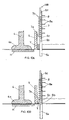
- the jaws (5) close and slide on the fabric (T) to intercept and partially reverse upwards the transversal sections (Y) of the edge (F), of the reinforcement (R) and of the sampling (M) located in external position with respect to the V-elements (BV) of the pocket cut (TT), as shown in Fig. 9 and Fig. 10A .
- the third step (III) can be divided in five phases (IIIA, IIIB, IIIC, IIID, IIIE), which are hereinafter described in detail with reference to Figs. 10A to 10E , in which for easier reference only one rod (6) with respective jaw (5) is diagrammatically indicated.
- the rods (6) cooperate with the jaws (5) to completely reverse the edge (F), the reinforcement (R) and the facing (M) under the pocket cut (TT).
- the second phase (IIIB) ( Fig. 10B ) starts when the truncated base (6a) is placed under the pocket cut (TT), while the rods (6) continue to descend.
- the third phase (IIIC) ( Fig. 10C ) starts with the interception of the sections (Y) by the helical rod (7) that engages and drags them downwards because of friction, thus bringing them in reverse position under the worktop (P) as desired.
- the jaws (5) cease pushing when the first turn (7a) is brought under the worktop (P).
- the fourth phase (IIID) ends near the top turn (7b) of the helical rod (7), when the jaws (5) cease pushing inwards, and the rods (6) remain in diverged position until the end of their travel.
- the fifth and last phase (IIIE) starts when the turns of the helical rod (7) move beyond the pocket cut (TT), being brought under the worktop (P), with the jaws (5) in close position, without pushing.
- the facing (M) is reversed by the teeth (8a) of the comb(8).
- the fourth step (IV) ( Fig. 11 ) starts when the third descending step (III) is completed and a shutter (9) is lowered to ensure the reversal of the facing (M).
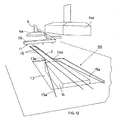
- a bracket (10) with claws (11) (see Fig. 12 ) is lowered to block the fabric (T) and transfer it to the ironing station (SS), while the shutter (9) and the leg-holder frame (3) are raised.
- a tubular blade (12) extends and moves astride the pocket cut, where it remains until the fabric (T) is brought from the overturning station (SR) to the ironing station (SS) in order to maintain the folding obtained in the reversal station (SR).
- bracket (10) and the tubular blade (12) are guided and supported by a track (B2) during their alternate travels.
- the transfer to the ironing station (SS) is carried out by translating the fabric (T) along the axis (X-X) of the pocket cut (TT).
- the edges (F), the reinforcement (R) and the facing (M) slide inside the slot (2) that extends from the reversal station (SR) to the ironing station (SS).
- the slot (2) ends in a rectangular window (13) at the ironing station (SS) (see Figs. 7 and 12 ), which receives the fabric (T) to allow the ironing means (14, 14a) located under and over the worktop (P) in the window (13) to perform their function correctly.
- the first pair of threads (15) is engaged under the fabric (T) (see Fig. 6 ) so that during the translation from the reversal station (SR) and the ironing station (SS) the reversed position of the edges (F), of the reinforcements (R) and of the facing (M) is perfectly maintained.
- the second pair of threads (15a) that is to say the threads located in the window (13), ensures the correct position during ironing, since the threads (15a) cooperate to support the fabric and extend the edges (F), the reinforcements (R) and the facing (M), thus avoiding the creation of folds that may impair ironing.
- the ironing means (14, 14a) comprise a first fixed buffer (14) located immediately under the worktop (P) in the window (13) and a second buffer (14a) located over the first buffer (14) and provided with vertical alternate motion in order to adhere to the first fixed buffer (14).
Landscapes
- Engineering & Computer Science (AREA)
- Textile Engineering (AREA)
- Manufacturing & Machinery (AREA)
- Sewing Machines And Sewing (AREA)
- Manufacture Of Motors, Generators (AREA)
- Manipulator (AREA)
- Details Of Garments (AREA)
- Iron Core Of Rotating Electric Machines (AREA)
- Treatment Of Fiber Materials (AREA)
Claims (8)
- Manipulator zum Verstürzen der Kanten von Schlitztaschen, der dazu bestimmt ist, bei Halbfertigteilen (SE) in Funktion zu treten, die aus einem Stück Stoff (T) bestehen, das auf einer Arbeitsfläche (P) liegt mit den Nähten (C1 und C2) zur Befestigung der Kante (F), der Verstärkung (R) und der Blende (M) - allesamt in Form eines umgedrehten "T" vorgefalzt - wobei der Taschenschnitt (TT) parallel und zentral zu den Nähten (C1 und C2) angeordnet ist, dadurch gekennzeichnet, dass er Folgendes umfasst:- eine Verstürzungsstation (SR) mit einem bis auf die Arbeitsfläche (P) durchgehenden Schlitz (2);- Mittel zur Entnahme (1, 1 a, B1) des Halbfertigteils (SE) aus einer Entnahmestation (SP), die auf der Arbeitsfläche (P) herausgearbeitet ist, um es zur Verstürzungsstation (SR) zu transportieren;- Arretierungsmittel (4, 4a) zur Befestigung des Halbfertigteils (SE) an der Verstürzungsstation (SR);- Verstürzungsmittel (MR), die in der Verstürzungsstation (SR) arbeiten, um die Kanten (F), die Verstärkungen (R) und die Blenden (M) unter die Arbeitsfläche (P) zu verstürzen;- ein Paar gegenüberliegende Backen (5), die oberhalb der Arbeitsfläche an dem Schlitz (2) in Funktion treten und dazu dienen, mit den Verstürzungsmitteln (MR) zusammenzuarbeiten, um ein korrektes Verstürzen der Kanten (F), der Verstärkungen (R) und der Blenden (M) unterhalb der Arbeitsfläche (P) zu gewährleisten;- ein Schieber (9), der am Schlitz (2) in Funktion tritt, um für ein korrektes Verstürzen der Kanten (F), der Verstärkungen (R) und der Blenden (M) unterhalb der Arbeitsfläche (P) zu gewährleisten;- Betätigungsglieder für die Bewegung der Entnahmemittel (1, 1a, B1), der Arretierungsmittel (4, 4a), der Verstürzungsmittel (MR), des gegenüberliegenden Backenpaares (5) und des Schiebers (9);- ein elektronisches Steuergehäuse, das für das Anlaufen und das Anhalten der Betätigungsglieder auf der Grundlage der Signale sorgt, die von entsprechenden Sensoren oder Näherungsschaltern empfangen werden, die mit den beweglichen Bauteilen des Manipulators verbunden sind.
- Manipulator gemäß Anspruch 1 dadurch gekennzeichnet, dass die Entnahmemittel (1, 1 a, B1) aus einer Schiene (B1) bestehen, auf der eine ausziehbare Klinge (1) mit einer Gabel (1 a) angebracht ist, die unabhängig voneinander abgesenkt werden können, um auf den Stoff (T) zu drücken.
- Manipulator gemäß einem der vorstehenden Ansprüche, dadurch gekennzeichnet, dass die Arretierungsmittel (4, 4a) Füßchen (4a) umfassen, die an der Basis von jeweiligen Beinen (4) angebracht werden, die von einem Trägergestell (3) getragen werden, das vertikale Wechselhübe ausführen kann und außerdem die Backen (5) trägt, die in der Weise mit dem Gestell (3) verbunden sind, dass sie gleichzeitig entgegengesetzte horizontale Wechselhübe ausführen können.
- Manipulator gemäß einem der vorstehenden Ansprüche, dadurch gekennzeichnet, dass die Verstürzungsmittel (MR) Folgendes umfassen:- ein Paar Trägerstangen (6), deren Achsabstand geringer als der Achsabstand der Backen (5) ist und die in der Ruhephase unterhalb der Arbeitsfläche (P) auf dem Schlitz (2) abgestellt werden, wobei vorgesehen ist, dass jede Trägerstange (6) einen rechteckigen Stumpf (6a) besitzt, dessen Seiten länger als der Achsabstand zwischen den beiden Nähten (C1 und C2) ist und dass jeder Stumpf (6a) mittels einer Stufe (6b) mit der darüberliegenden Stange (6) verbunden ist, um die sich schraubenförmig ein Metalldraht (7) windet, dessen erste Windung (7a) gegenüber der Verbindungsstufe (6b) angehoben ist, so dass zwischen der Stufe (6b) und der ersten Windung (7a) ein kurzer Stangenabschnitt (6c) sowie der Endabschnitt (6d) der Stange (6) frei bleiben, der sich oberhalb der obersten Windung (7b) des Metalldrahts (7) befindet.- einen vertikalen Stift (8), der sich im Innern eines jeden Stabes (6) befindet und dessen horizontale Zähne (8a) auf einer vertikalen, durch die Längssymmetrieachse (X-X) des Schlitzes (2) hindurchgehenden Ebene liegen.
- Manipulator gemäß einem der vorstehenden Ansprüche, dadurch gekennzeichnet, dass das elektronische Steuergehäuse die folgenden Operationen zur Ausführung eines Arbeitszyklus in der genannten Reihenfolge aktiviert:- Absenken der Gabel (1a) in der Entnahmestation (SP), um den Stoff in zwei Punkten in der Nähe des Taschenschlitzes (TT) befestigen;- Absenken der Klinge (1), die ausgezogen wird, um den Stoff (T) in Position zu halten;- Gleiten der Gabel (1a) und der Klinge (1) auf der Schiene (B1), um das Halbfertigteil (SE) in der Mitte der Verstürzungsstation (SR) oberhalb des Schlitzes (2) zu positionieren;- Absenken des Gestells (3) und dadurch bewirktes Festhalten des Stoffes durch die Füßchen (4a) der Beine (4);- Anheben der Klinge (1 a);- Anheben der Verstürzungsmittel (MR), die unter der Arbeitsfläche (P) durch den Schlitz (2) und den Tascheneinschnitt (TT) hindurch hochkommen;- Annäherung der Backen (5) und Spreizung der Stangen (6), bis die Stümpfe (6a) an die Backen anstoßen;- Absenken der Verstürzungsmittel (MR) mit Unterbrechung des Spreizschubs auf die Stäbe (6), wenn der Stumpf (6a) sich unterhalb des Schlitzes (2) befindet und Unterbrechung des Annäherungsschubs auf die Backen (5), wenn die erst Windung (7a) sich unterhalb des Schlitzes (2) befindet;- Spreizung der Stäbe (6), wenn die Verstürzungsmittel (MR) ihren Abwärtshub beendet haben;- Herunterfahren des Schiebers (9), wenn die Verstürzungsmittel (MR) ihren Abwärtshub beendet haben;- erneutes Hochfahren des Schiebers;- Spreizung der Backen (5);- Anheben des Gestells (3);- Absenken eines Bügels (10) mit Klauen (11), der in der Verstürzungsstation (SR) angebracht ist und dazu dient, das Halbfertigteil (SE) mit verstürzten Kanten zu entnehmen;- Gleiten der Gabel (1a) und der Klinge (1) auf der Schiene (B1), um zur Entnahmestation (SP) zurückzukehren.
- Manipulator gemäß einem der vorstehenden Ansprüche, dadurch gekennzeichnet, dass er zwei Brücken (H) umfasst, die unterhalb der Arbeitsfläche (P) angebracht sind und unmittelbar vor dem Absenken des Gestells (3) den Schlitz (2) in zwei Bereichen bedecken, die den Kontaktpunkten der darüber befindlichen Füßchen (4a) auf der Fläche (P) entsprechen, und beim Anheben des Gestells (3) anschließend wieder in ihre Ruheposition zurückgebracht werden.
- Manipulator gemäß einem der vorstehenden Ansprüche, dadurch gekennzeichnet, dass er eine Halterungs- und Führungsschiene (B2) zum Gleiten des Bügels (10) sowie eine zweite rohrförmige Klinge (12) umfasst, die dazu dient, das Halbfertigteil (SE) am Ausgang aus der Verstürzungsstation (SR) bis zu einer Bügelstation (SS) zu transportieren und zu begleiten, die der Verstürzungsstation (SR) nachgelagert angeordnet ist und ein großes Fenster (13) umfasst, das auf der Arbeitsfläche (P) herausgearbeitet ist, oberhalb und unterhalb derer zwei Bügelpuffer (14, 14a) angebracht sind, wobei vorgesehen ist, dass die Schiene (B2) parallel zur Längssymmetrieachse (X-X) des Schlitzes (2) angebracht ist, der bis zum Fenster (13) hin verlängert ist und dort endet.
- Manipulator gemäß Anspruch 8, dadurch gekennzeichnet, dass er zwei Fadenpaare (15,15a) umfasst, die sich über die Arbeitsfläche (P) erstrecken, wobei das erste Paar (15) innerhalb des Schlitzes (2) und des Fensters (13), parallel an den Kanten des Schlitzes (2) entlang verläuft, während die Fäden des zweiten Paares (15a) durch das Fenster (13) hindurch, ausgehend vom Verbindungsscheitelpunkt (13a) zwischen dem Schlitz (2) und dem Fenster (13), in divergierende Richtungen verlaufen.
Priority Applications (1)
| Application Number | Priority Date | Filing Date | Title |
|---|---|---|---|
| PL05425089T PL1584249T3 (pl) | 2004-04-08 | 2005-02-21 | Manipulator przeznaczony do odwracania krawędzi rozcinanych kieszeni |
Applications Claiming Priority (2)
| Application Number | Priority Date | Filing Date | Title |
|---|---|---|---|
| ITMC20040056 | 2004-04-08 | ||
| IT000056A ITMC20040056A1 (it) | 2004-04-08 | 2004-04-08 | Manipolatore per il rovesciamento dei filetti delle tasche. |
Publications (2)
| Publication Number | Publication Date |
|---|---|
| EP1584249A1 EP1584249A1 (de) | 2005-10-12 |
| EP1584249B1 true EP1584249B1 (de) | 2008-05-28 |
Family
ID=34897775
Family Applications (1)
| Application Number | Title | Priority Date | Filing Date |
|---|---|---|---|
| EP05425089A Expired - Lifetime EP1584249B1 (de) | 2004-04-08 | 2005-02-21 | Vorrichtung zum Wenden von paspelierten Öffnungen in Taschen |
Country Status (8)
| Country | Link |
|---|---|
| EP (1) | EP1584249B1 (de) |
| CN (1) | CN1680655A (de) |
| AT (1) | ATE396626T1 (de) |
| DE (1) | DE602005007089D1 (de) |
| ES (1) | ES2314605T3 (de) |
| IT (1) | ITMC20040056A1 (de) |
| PL (1) | PL1584249T3 (de) |
| PT (1) | PT1584249E (de) |
Family Cites Families (4)
| Publication number | Priority date | Publication date | Assignee | Title |
|---|---|---|---|---|
| US2529072A (en) * | 1948-05-21 | 1950-11-07 | Reece Corp | Buttonhole sewing machine |
| GB750764A (en) * | 1954-07-07 | 1956-06-20 | Wallace Cranston Fairweather | Device for turning piped garment openings |
| US3335682A (en) * | 1964-08-13 | 1967-08-15 | Anthony G Tucci | Pocket machine |
| JPH07133583A (ja) * | 1993-06-23 | 1995-05-23 | Duerkopp Adler Ag | 生地にパイピングを付けた開口を裁断しかつ裏返しするための装置 |
-
2004
- 2004-04-08 IT IT000056A patent/ITMC20040056A1/it unknown
-
2005
- 2005-02-21 EP EP05425089A patent/EP1584249B1/de not_active Expired - Lifetime
- 2005-02-21 PL PL05425089T patent/PL1584249T3/pl unknown
- 2005-02-21 DE DE602005007089T patent/DE602005007089D1/de not_active Expired - Fee Related
- 2005-02-21 AT AT05425089T patent/ATE396626T1/de not_active IP Right Cessation
- 2005-02-21 PT PT05425089T patent/PT1584249E/pt unknown
- 2005-02-21 ES ES05425089T patent/ES2314605T3/es not_active Expired - Lifetime
- 2005-04-07 CN CNA2005100632680A patent/CN1680655A/zh active Pending
Also Published As
| Publication number | Publication date |
|---|---|
| ES2314605T3 (es) | 2009-03-16 |
| EP1584249A1 (de) | 2005-10-12 |
| ATE396626T1 (de) | 2008-06-15 |
| PL1584249T3 (pl) | 2008-10-31 |
| DE602005007089D1 (de) | 2008-07-10 |
| CN1680655A (zh) | 2005-10-12 |
| ITMC20040056A1 (it) | 2004-07-08 |
| PT1584249E (pt) | 2008-09-05 |
Similar Documents
| Publication | Publication Date | Title |
|---|---|---|
| CN104233637B (zh) | 自动缝纫装置及方法 | |
| CN109629215A (zh) | 一种全自动衣服折叠方法及装置 | |
| GB2248544A (en) | Workpiece folding device | |
| KR0185221B1 (ko) | 소매부분 자동봉제장치 | |
| US7174840B2 (en) | Manipulator used to reverse the edges of slash pockets | |
| CN106012328A (zh) | 服装袖侧折叠车缝机构及服装袖侧折叠车缝方法 | |
| EP1584249B1 (de) | Vorrichtung zum Wenden von paspelierten Öffnungen in Taschen | |
| JPH0334756B2 (de) | ||
| WO1981003504A1 (en) | Sheet production system with hem expander | |
| US6192816B1 (en) | Method and apparatus for forming and joining hems particularly on tubular trouser legs | |
| KR950032802A (ko) | 웰트형성장치, 그의 제어방법 및 직물가이드 | |
| US3963548A (en) | Apparatus and method of forming hemmed curtains and the like | |
| US3066563A (en) | Apparatus for folding sheet material | |
| CN205848893U (zh) | 全自动折叠拉链机 | |
| CN117845440A (zh) | 翻面装置、缝纫流水线和缝制品的翻面方法 | |
| AU600335B2 (en) | Improvements in or relating to the handling of limp fabric | |
| CN110891463B (zh) | 用于制造张紧床单的方法和设备 | |
| TWI913800B (zh) | 布料摺邊形成機 | |
| US7146755B2 (en) | Process and equipment used to iron the edges of slash pockets | |
| ITTO980299A1 (it) | Macchina da cucire automatica per cucire una patta ad un capo da cuci- re. | |
| JPS6182789A (ja) | タオルヘムの三つ折り方法及びその装置 | |
| CN214422855U (zh) | 三层制衣模板 | |
| EP0215855B1 (de) | VORRICHTUNG FüR DIE BEHANDLUNG GESCHMEIDIGER GEWEBE | |
| EP1358378A1 (de) | Automatisierte nähmaschine und verfahren zur fütterung von hosenbunden | |
| TW202603247A (zh) | 布料摺邊形成機 |
Legal Events
| Date | Code | Title | Description |
|---|---|---|---|
| PUAI | Public reference made under article 153(3) epc to a published international application that has entered the european phase |
Free format text: ORIGINAL CODE: 0009012 |
|
| AK | Designated contracting states |
Kind code of ref document: A1 Designated state(s): AT BE BG CH CY CZ DE DK EE ES FI FR GB GR HU IE IS IT LI LT LU MC NL PL PT RO SE SI SK TR |
|
| AX | Request for extension of the european patent |
Extension state: AL BA HR LV MK YU |
|
| 17P | Request for examination filed |
Effective date: 20060404 |
|
| AKX | Designation fees paid |
Designated state(s): AT BE BG CH CY CZ DE DK EE ES FI FR GB GR HU IE IS IT LI LT LU MC NL PL PT RO SE SI SK TR |
|
| GRAP | Despatch of communication of intention to grant a patent |
Free format text: ORIGINAL CODE: EPIDOSNIGR1 |
|
| GRAS | Grant fee paid |
Free format text: ORIGINAL CODE: EPIDOSNIGR3 |
|
| GRAA | (expected) grant |
Free format text: ORIGINAL CODE: 0009210 |
|
| AK | Designated contracting states |
Kind code of ref document: B1 Designated state(s): AT BE BG CH CY CZ DE DK EE ES FI FR GB GR HU IE IS IT LI LT LU MC NL PL PT RO SE SI SK TR |
|
| REG | Reference to a national code |
Ref country code: GB Ref legal event code: FG4D |
|
| REG | Reference to a national code |
Ref country code: CH Ref legal event code: EP |
|
| REF | Corresponds to: |
Ref document number: 602005007089 Country of ref document: DE Date of ref document: 20080710 Kind code of ref document: P |
|
| REG | Reference to a national code |
Ref country code: IE Ref legal event code: FG4D |
|
| REG | Reference to a national code |
Ref country code: RO Ref legal event code: EPE |
|
| REG | Reference to a national code |
Ref country code: PT Ref legal event code: SC4A Free format text: AVAILABILITY OF NATIONAL TRANSLATION Effective date: 20080826 |
|
| PG25 | Lapsed in a contracting state [announced via postgrant information from national office to epo] |
Ref country code: SI Free format text: LAPSE BECAUSE OF FAILURE TO SUBMIT A TRANSLATION OF THE DESCRIPTION OR TO PAY THE FEE WITHIN THE PRESCRIBED TIME-LIMIT Effective date: 20080528 |
|
| PG25 | Lapsed in a contracting state [announced via postgrant information from national office to epo] |
Ref country code: FI Free format text: LAPSE BECAUSE OF FAILURE TO SUBMIT A TRANSLATION OF THE DESCRIPTION OR TO PAY THE FEE WITHIN THE PRESCRIBED TIME-LIMIT Effective date: 20080528 |
|
| REG | Reference to a national code |
Ref country code: PL Ref legal event code: T3 |
|
| PG25 | Lapsed in a contracting state [announced via postgrant information from national office to epo] |
Ref country code: AT Free format text: LAPSE BECAUSE OF FAILURE TO SUBMIT A TRANSLATION OF THE DESCRIPTION OR TO PAY THE FEE WITHIN THE PRESCRIBED TIME-LIMIT Effective date: 20080528 Ref country code: NL Free format text: LAPSE BECAUSE OF FAILURE TO SUBMIT A TRANSLATION OF THE DESCRIPTION OR TO PAY THE FEE WITHIN THE PRESCRIBED TIME-LIMIT Effective date: 20080528 |
|
| NLV1 | Nl: lapsed or annulled due to failure to fulfill the requirements of art. 29p and 29m of the patents act | ||
| PG25 | Lapsed in a contracting state [announced via postgrant information from national office to epo] |
Ref country code: IS Free format text: LAPSE BECAUSE OF FAILURE TO SUBMIT A TRANSLATION OF THE DESCRIPTION OR TO PAY THE FEE WITHIN THE PRESCRIBED TIME-LIMIT Effective date: 20080928 |
|
| PG25 | Lapsed in a contracting state [announced via postgrant information from national office to epo] |
Ref country code: SE Free format text: LAPSE BECAUSE OF FAILURE TO SUBMIT A TRANSLATION OF THE DESCRIPTION OR TO PAY THE FEE WITHIN THE PRESCRIBED TIME-LIMIT Effective date: 20080828 Ref country code: DK Free format text: LAPSE BECAUSE OF FAILURE TO SUBMIT A TRANSLATION OF THE DESCRIPTION OR TO PAY THE FEE WITHIN THE PRESCRIBED TIME-LIMIT Effective date: 20080528 Ref country code: LT Free format text: LAPSE BECAUSE OF FAILURE TO SUBMIT A TRANSLATION OF THE DESCRIPTION OR TO PAY THE FEE WITHIN THE PRESCRIBED TIME-LIMIT Effective date: 20080528 Ref country code: CZ Free format text: LAPSE BECAUSE OF FAILURE TO SUBMIT A TRANSLATION OF THE DESCRIPTION OR TO PAY THE FEE WITHIN THE PRESCRIBED TIME-LIMIT Effective date: 20080528 |
|
| PG25 | Lapsed in a contracting state [announced via postgrant information from national office to epo] |
Ref country code: SK Free format text: LAPSE BECAUSE OF FAILURE TO SUBMIT A TRANSLATION OF THE DESCRIPTION OR TO PAY THE FEE WITHIN THE PRESCRIBED TIME-LIMIT Effective date: 20080528 Ref country code: BE Free format text: LAPSE BECAUSE OF FAILURE TO SUBMIT A TRANSLATION OF THE DESCRIPTION OR TO PAY THE FEE WITHIN THE PRESCRIBED TIME-LIMIT Effective date: 20080528 |
|
| REG | Reference to a national code |
Ref country code: ES Ref legal event code: FG2A Ref document number: 2314605 Country of ref document: ES Kind code of ref document: T3 |
|
| PLBE | No opposition filed within time limit |
Free format text: ORIGINAL CODE: 0009261 |
|
| STAA | Information on the status of an ep patent application or granted ep patent |
Free format text: STATUS: NO OPPOSITION FILED WITHIN TIME LIMIT |
|
| PG25 | Lapsed in a contracting state [announced via postgrant information from national office to epo] |
Ref country code: BG Free format text: LAPSE BECAUSE OF FAILURE TO SUBMIT A TRANSLATION OF THE DESCRIPTION OR TO PAY THE FEE WITHIN THE PRESCRIBED TIME-LIMIT Effective date: 20080828 Ref country code: EE Free format text: LAPSE BECAUSE OF FAILURE TO SUBMIT A TRANSLATION OF THE DESCRIPTION OR TO PAY THE FEE WITHIN THE PRESCRIBED TIME-LIMIT Effective date: 20080528 |
|
| 26N | No opposition filed |
Effective date: 20090303 |
|
| PG25 | Lapsed in a contracting state [announced via postgrant information from national office to epo] |
Ref country code: MC Free format text: LAPSE BECAUSE OF NON-PAYMENT OF DUE FEES Effective date: 20090228 |
|
| REG | Reference to a national code |
Ref country code: CH Ref legal event code: PL |
|
| GBPC | Gb: european patent ceased through non-payment of renewal fee |
Effective date: 20090221 |
|
| PG25 | Lapsed in a contracting state [announced via postgrant information from national office to epo] |
Ref country code: LI Free format text: LAPSE BECAUSE OF NON-PAYMENT OF DUE FEES Effective date: 20090228 Ref country code: CH Free format text: LAPSE BECAUSE OF NON-PAYMENT OF DUE FEES Effective date: 20090228 |
|
| REG | Reference to a national code |
Ref country code: IE Ref legal event code: MM4A |
|
| REG | Reference to a national code |
Ref country code: FR Ref legal event code: ST Effective date: 20091030 |
|
| PGFP | Annual fee paid to national office [announced via postgrant information from national office to epo] |
Ref country code: DE Payment date: 20090827 Year of fee payment: 5 |
|
| REG | Reference to a national code |
Ref country code: PT Ref legal event code: MM4A Free format text: LAPSE DUE TO NON-PAYMENT OF FEES Effective date: 20091123 |
|
| PG25 | Lapsed in a contracting state [announced via postgrant information from national office to epo] |
Ref country code: IE Free format text: LAPSE BECAUSE OF NON-PAYMENT OF DUE FEES Effective date: 20090221 |
|
| PG25 | Lapsed in a contracting state [announced via postgrant information from national office to epo] |
Ref country code: PT Free format text: LAPSE BECAUSE OF NON-PAYMENT OF DUE FEES Effective date: 20091123 |
|
| REG | Reference to a national code |
Ref country code: ES Ref legal event code: FD2A Effective date: 20090223 |
|
| PG25 | Lapsed in a contracting state [announced via postgrant information from national office to epo] |
Ref country code: GB Free format text: LAPSE BECAUSE OF NON-PAYMENT OF DUE FEES Effective date: 20090221 Ref country code: FR Free format text: LAPSE BECAUSE OF NON-PAYMENT OF DUE FEES Effective date: 20090302 Ref country code: RO Free format text: LAPSE BECAUSE OF NON-PAYMENT OF DUE FEES Effective date: 20080528 |
|
| PG25 | Lapsed in a contracting state [announced via postgrant information from national office to epo] |
Ref country code: ES Free format text: LAPSE BECAUSE OF NON-PAYMENT OF DUE FEES Effective date: 20090223 |
|
| REG | Reference to a national code |
Ref country code: PL Ref legal event code: LAPE |
|
| PG25 | Lapsed in a contracting state [announced via postgrant information from national office to epo] |
Ref country code: PL Free format text: LAPSE BECAUSE OF NON-PAYMENT OF DUE FEES Effective date: 20090221 |
|
| PG25 | Lapsed in a contracting state [announced via postgrant information from national office to epo] |
Ref country code: GR Free format text: LAPSE BECAUSE OF FAILURE TO SUBMIT A TRANSLATION OF THE DESCRIPTION OR TO PAY THE FEE WITHIN THE PRESCRIBED TIME-LIMIT Effective date: 20080829 |
|
| PGFP | Annual fee paid to national office [announced via postgrant information from national office to epo] |
Ref country code: IT Payment date: 20100816 Year of fee payment: 6 |
|
| PG25 | Lapsed in a contracting state [announced via postgrant information from national office to epo] |
Ref country code: DE Free format text: LAPSE BECAUSE OF NON-PAYMENT OF DUE FEES Effective date: 20100901 |
|
| PG25 | Lapsed in a contracting state [announced via postgrant information from national office to epo] |
Ref country code: LU Free format text: LAPSE BECAUSE OF NON-PAYMENT OF DUE FEES Effective date: 20090221 |
|
| PG25 | Lapsed in a contracting state [announced via postgrant information from national office to epo] |
Ref country code: HU Free format text: LAPSE BECAUSE OF FAILURE TO SUBMIT A TRANSLATION OF THE DESCRIPTION OR TO PAY THE FEE WITHIN THE PRESCRIBED TIME-LIMIT Effective date: 20081129 |
|
| PG25 | Lapsed in a contracting state [announced via postgrant information from national office to epo] |
Ref country code: CY Free format text: LAPSE BECAUSE OF FAILURE TO SUBMIT A TRANSLATION OF THE DESCRIPTION OR TO PAY THE FEE WITHIN THE PRESCRIBED TIME-LIMIT Effective date: 20080528 |
|
| PG25 | Lapsed in a contracting state [announced via postgrant information from national office to epo] |
Ref country code: IT Free format text: LAPSE BECAUSE OF NON-PAYMENT OF DUE FEES Effective date: 20110221 |
|
| PG25 | Lapsed in a contracting state [announced via postgrant information from national office to epo] |
Ref country code: TR Free format text: LAPSE BECAUSE OF FAILURE TO SUBMIT A TRANSLATION OF THE DESCRIPTION OR TO PAY THE FEE WITHIN THE PRESCRIBED TIME-LIMIT Effective date: 20080528 |