EP1580281A2 - Verfahren zum Nachweis von mikrobieller Resistenz gegen Antibiotika - Google Patents
Verfahren zum Nachweis von mikrobieller Resistenz gegen Antibiotika Download PDFInfo
- Publication number
- EP1580281A2 EP1580281A2 EP04019288A EP04019288A EP1580281A2 EP 1580281 A2 EP1580281 A2 EP 1580281A2 EP 04019288 A EP04019288 A EP 04019288A EP 04019288 A EP04019288 A EP 04019288A EP 1580281 A2 EP1580281 A2 EP 1580281A2
- Authority
- EP
- European Patent Office
- Prior art keywords
- beta
- lactamase
- hybridization
- sequence
- array
- Prior art date
- Legal status (The legal status is an assumption and is not a legal conclusion. Google has not performed a legal analysis and makes no representation as to the accuracy of the status listed.)
- Ceased
Links
Images
Classifications
-
- C—CHEMISTRY; METALLURGY
- C12—BIOCHEMISTRY; BEER; SPIRITS; WINE; VINEGAR; MICROBIOLOGY; ENZYMOLOGY; MUTATION OR GENETIC ENGINEERING
- C12Q—MEASURING OR TESTING PROCESSES INVOLVING ENZYMES, NUCLEIC ACIDS OR MICROORGANISMS; COMPOSITIONS OR TEST PAPERS THEREFOR; PROCESSES OF PREPARING SUCH COMPOSITIONS; CONDITION-RESPONSIVE CONTROL IN MICROBIOLOGICAL OR ENZYMOLOGICAL PROCESSES
- C12Q1/00—Measuring or testing processes involving enzymes, nucleic acids or microorganisms; Compositions therefor; Processes of preparing such compositions
- C12Q1/68—Measuring or testing processes involving enzymes, nucleic acids or microorganisms; Compositions therefor; Processes of preparing such compositions involving nucleic acids
- C12Q1/6876—Nucleic acid products used in the analysis of nucleic acids, e.g. primers or probes
- C12Q1/6888—Nucleic acid products used in the analysis of nucleic acids, e.g. primers or probes for detection or identification of organisms
- C12Q1/689—Nucleic acid products used in the analysis of nucleic acids, e.g. primers or probes for detection or identification of organisms for bacteria
-
- C—CHEMISTRY; METALLURGY
- C12—BIOCHEMISTRY; BEER; SPIRITS; WINE; VINEGAR; MICROBIOLOGY; ENZYMOLOGY; MUTATION OR GENETIC ENGINEERING
- C12Q—MEASURING OR TESTING PROCESSES INVOLVING ENZYMES, NUCLEIC ACIDS OR MICROORGANISMS; COMPOSITIONS OR TEST PAPERS THEREFOR; PROCESSES OF PREPARING SUCH COMPOSITIONS; CONDITION-RESPONSIVE CONTROL IN MICROBIOLOGICAL OR ENZYMOLOGICAL PROCESSES
- C12Q1/00—Measuring or testing processes involving enzymes, nucleic acids or microorganisms; Compositions therefor; Processes of preparing such compositions
- C12Q1/68—Measuring or testing processes involving enzymes, nucleic acids or microorganisms; Compositions therefor; Processes of preparing such compositions involving nucleic acids
- C12Q1/6813—Hybridisation assays
- C12Q1/6834—Enzymatic or biochemical coupling of nucleic acids to a solid phase
- C12Q1/6837—Enzymatic or biochemical coupling of nucleic acids to a solid phase using probe arrays or probe chips
-
- C—CHEMISTRY; METALLURGY
- C12—BIOCHEMISTRY; BEER; SPIRITS; WINE; VINEGAR; MICROBIOLOGY; ENZYMOLOGY; MUTATION OR GENETIC ENGINEERING
- C12Q—MEASURING OR TESTING PROCESSES INVOLVING ENZYMES, NUCLEIC ACIDS OR MICROORGANISMS; COMPOSITIONS OR TEST PAPERS THEREFOR; PROCESSES OF PREPARING SUCH COMPOSITIONS; CONDITION-RESPONSIVE CONTROL IN MICROBIOLOGICAL OR ENZYMOLOGICAL PROCESSES
- C12Q1/00—Measuring or testing processes involving enzymes, nucleic acids or microorganisms; Compositions therefor; Processes of preparing such compositions
- C12Q1/68—Measuring or testing processes involving enzymes, nucleic acids or microorganisms; Compositions therefor; Processes of preparing such compositions involving nucleic acids
- C12Q1/6876—Nucleic acid products used in the analysis of nucleic acids, e.g. primers or probes
-
- C—CHEMISTRY; METALLURGY
- C12—BIOCHEMISTRY; BEER; SPIRITS; WINE; VINEGAR; MICROBIOLOGY; ENZYMOLOGY; MUTATION OR GENETIC ENGINEERING
- C12Q—MEASURING OR TESTING PROCESSES INVOLVING ENZYMES, NUCLEIC ACIDS OR MICROORGANISMS; COMPOSITIONS OR TEST PAPERS THEREFOR; PROCESSES OF PREPARING SUCH COMPOSITIONS; CONDITION-RESPONSIVE CONTROL IN MICROBIOLOGICAL OR ENZYMOLOGICAL PROCESSES
- C12Q2600/00—Oligonucleotides characterized by their use
- C12Q2600/156—Polymorphic or mutational markers
Definitions
- the present invention pertains to a method for a rapid detection of microbial resistance towards antibiotics and simultaneous determining the genotype of the resistance gene using a micro-array and/or to a kit for use in this method.
- antibiotics especially in the clinical environment has increased the selective pressure for bacteria eventually leading to the development of a number of microbes exhibiting resistance towards the agents utilized.
- a major class of antibiotics rely on a beta-lactam-ring system against which microbes developed enzymes, the so called, beta-lactamases, which are capable of degrading the agent and have spread ubiquitously in different microbial species.
- TEM beta-lactamases are one group of serine beta-lactamases (i.e. OXA, SHV), and are found in many different species of the family Enterobacteiacae, Pseudomonas Aeruginosa, Haemophilus influenzae, and Neisseria. gonorrhoe.
- the first TEM enzyme (TEM-1) was isolated in 1965 from, E . coli and confers resistance to narrow spectrum cephalosporins, cefamandole, and cefoperazone and all the anti-gram-negative-bacterium penicillins except temocillin.
- This problem has been solved by providing a method for detecting the presence or absence of a micro-organism in a biological sample exhibiting resistance to a beta-lactam antibiotic and simultaneously determining the genotype of the beta-lactam resistance, which method comprises the following steps: (i) obtaining a biological sample; (ii) optionally isolating DNA contained in the sample; (iii) contacting the DNA of the sample with a micro-array, harboring on predetermined locations thereon different sets of capture probes, under conditions allowing hybridization of complementary strands.
- Each representative of a set of capture probes comprises the sequence R 1 -(X)-R 2 , which sequence represents a selected part of the sequence of a beta-lactamase gene, wherein X represents a nucleotide triplet and its permutations, and wherein R 1 and R 2 each have a length of from about 5 to 20 nucleotides, wherein the different sets of capture probes are selected such that an adjacent set starts at a given position 3n of nucleotides down-stream from the first set of capture probes, wherein n is an integer of 1 to 10, so that the nucleotide sequence of the beta-lactamase gene is covered over a desired range.
- the method furthermore comprises the step (iv) determining whether and hybridization occurs and at which position on the array, wherein the occurrence and location of a hybridization is indicative of the presence of a beta-lactam resistant micro-organism and also indicative of its specific resistance.
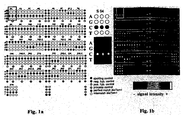
- Figure 1a shows a SNP capture probe layout of a TEM micro-array. All SNP capture probes are spotted in triplicates. The SNP position is named after the position in the encoded amino acid sequence and is indicated above each triplicate. SNP capture probe set 04 is highlighted and shown enlarged on the right side. The varying, essentially centrally located base in the probe sequence is indicated on the left side. Blue spots indicate perfect match positions for blaTEM-1 beta-lactamase gene. Controls included on the array: a probe labeled with Cy5 (cyanine5) at the 5' end as a spotting control, a positive hybridization control and a negative hybridization control. All three control sequences are unrelated to bacterial species. The process control consists of a conserved sequence within the blaTEM gene family.
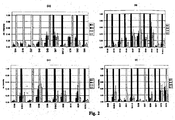
- Figures 2a, 3b, 2c, and -2d show the relative signal intensities of SNP positions S04-S90, S102-S162.2, S163-S235.2, and S236-S276; respectively.
- the relative intensity is given as the ratio of signal intensity/perfect match signal intensity [(MM or PM)/PM].
- the mutated amino acid positions in comparison to blaTEM-1 are: S37 (CAG to AAG, Q to K) in blaTEM-3 , -7 , -8 ; S102 (GAG to AAG, E to K) in blaTEM-3 , -8 ; S162 (CGT to ACT, R to S) in blaTEM-7,-8, S236 (GGT to AGT, G to S) in blaTEM-3, - 8 .
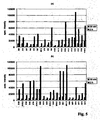
- Figures 5a, 5b show specific intensities of SNP positions S04-S162.2, and S163-S276, respectively.
- the specific intensities at 30 min incubation time are up to 10 x weaker, but still all perfect match positions can be identified.
- micro-array and “array of oligonucleotides'' may be used interchangeably in the present invention and refer to a multiplicity of different nucleotide sequences attached (preferably through a single terminal covalent bond) to one or more solid supports where, when there is a multiplicity of supports, each support bears a multiplicity of nucleotide sequences. Both terms can refer to the entire collection of oligonucleotides on the support(s) or to a subset thereof.
- the support is generally composed of a solid surface which may be selected from the group consisting of glasses, electronic devices, silicon supports, silica, metal or mixtures thereof prepared in format selected from the group of slides, discs, gel layers and/or beads.
- an oligonucleotide probe is defined as an oligonucleotide capable of binding to a target nucleic acid of complementary sequence through one or more types of chemical bonds, usually through complementary base pairing, usually through hydrogen bond formation.
- an oligonucleotide probe may include natural (i.e. A, G, C, or T) or modified bases (7-deazaguariosine, inosine, etc.).
- the bases in oligonucleotide probe may be joined by a linkage other than a phosphodiester bond, such as e.g. peptide bonds, so long as it does not interfere with hybridization.
- target nucleic acid refers to a nucleic acid, to which the oligonucleotide probe specifically hybridizes.
- capture probes in the sense of the present invention shall designate parts of the beta-lactamase gene of different length, e.g. between about 10 and 43 nucleotides, which are either chemically synthesized in situ on the surface of the support or laid down thereon.
- perfect match probe refers to a probe that has a sequence that is perfectly complementary to a particular target sequence.
- beta-lactamase comprises all currently known classes of beta-lactamases, such as e.g. serin- or a zink- beta-lactamases, and e.g. comprises in particular TEM beta-lactamases which form a subgroup of plasmid mediated serine beta-lactamases (such as e.g: OXA, SHV).
- nucleotide sequence refers to nucleotides present in nucleic acids compared with the bases of said nucleic acid, and includes nucleotides comprising usual or modified bases as above described.
- references to nucleotide(s), oligonucleotide(s), polynucleotide(s) and the like include analogous species wherein the sugar-phosphate backbone is modified and/or replaced, provided that its hybridization properties are not destroyed.
- hybridizing specifically to refers to the binding, duplexing or hybridizing of a molecule substantially to or only to a particular nucleotide sequence or sequences under stringent conditions when that sequence is present in a complex mixture of DNA or fragments thereof.
- essentially simultaneous detection on a micro-array indicates that one or more target sequences may be screened for on a micro-array, the presence or absence thereof being determined essentially simultaneously depending on the specifically applied preparation and reading methods, etc..
- the micro-array put to use in the present method contains on predetermined locations thereon a plurality of sets of nucleotide sequences of the general formula R 1 -(X)-R 2 .
- a set of nucleotide sequence contains three main components, R 1 , X and R 2 .
- R 1 and R 2 are nucleotide sequences having a length of from about 3 to about 25 nucleotides and are derived from a particular sequence of interest of a beta-lactamase gene of a micro-organism. These sequences R 1 and R 2 are separated by a triplet in the original beta lactamase gene, which is designated with "X".
- X the specific location
- the triplet is varied and may cover all 64 permutations for the amino acids.
- the variation of "X” is selected such, to account for a potential change in an amino acid in the gene sequence
- the triplets GCC, GCG and GCA may in principle be disregarded, since such mutations would not result in a change of the primary structure of the resulting polypeptide, which eventually will account for the development of a resistance towards a particular drug. Therefore, a set of nucleotides covers a specific position of interest in the beta-lactamase gene.
- the micro-array provides a number of sets of nucleotides, wherein adjacent to a given set of nucleotide - sequence R 1 -X-R 2 (wherein e.g. R 1 is ATG encoding the start methionine, X is the second triplet in a beta-lactamase gene, and R 2 is a nucleotide sequence downstream of the said 2 nd triplet), the next nucleotide sequence R 1 -X-R 2 is shifted downstream by three nucleotides (e.g.
- R is ATG plus the next three original nucleotides
- X is the triplet spaced by three nucleotides from the start codon ATG
- R 2 is a nucleotide sequence shifted by three nucleotides downstream).
- Such a micro-array allows the determination, whether or not a micro-organism, that contains a beta-lactamase gene, is present in the biological sample.
- a micro-organism that contains a beta-lactamase gene
- the position of the mutation in the beta-lactamase gene has been determined simultaneously, it is also possible to determine, in case the mutation is known and has been linked with a specific resistance already, to which antibiotic the micro-organism is resistant. The attending physician may, therefore, immediately take the necessary steps and administer an agent, known to be effective.
- the present invention also provides information about mutations having occurred in the beta-lactamase gene not yet known.
- the attending physician does not know prima facie, whether ornot the mutation has led to the development of a new resistance towards a particular agent.
- the present invention provides the opportunity to essentially prevent the spread of micro-organisms, having developed new resistances, since the resistance may be detected/determined at an early stage and treated accordingly.
- a biological material is used as a starting material that may contain one or more (different) micro-organisms deemed to exhibit resistances.
- samples are blood samples, tissue samples, body secrets, such as sputum, etc. or culture media samples comprising microorganisms.
- it may be appropriate to transfer the biological sample to a medium suitable for the growth of micro-organisms, e.g. on plates (for example Müller-Hinton agar plates).
- the biological sample may be utilized as such or DNA may be isolated therefrom according to a method of the state of the art, such as an extraction according to the QIAprep® Spin Miniprep Kit protocol (Qiagen, Hilden, Germany).
- a method of the state of the art such as an extraction according to the QIAprep® Spin Miniprep Kit protocol (Qiagen, Hilden, Germany).
- Alternative appropriate methods for obtaining DNA may be chosen, depending on the specific starting material on the basis of the knowledge of a skilled person in the art.
- Such an isolation step assists in preventing the development of extensive background signals during the hybridization step, in case no other selection step is applied.
- the DNA contained in the biological sample or isolated may be amplified via a polymerase chain reaction (PCR) using one or more primers, which provides the advantage of augmenting the specific material to be investigated only and also to incorporate a selection step.
- PCR polymerase chain reaction
- the complementary strand of the DNA of interest will be synthesized.
- at least two primers are utilized, allowing an exponential amplification of the material to be investigated.
- a nested PCR is carried out, wherein 2 pair of primers are used. The first set of primers is designed to amplify a sequence around the target sequence. Then the second pair of primers are used to amplify a sequence lying within the amplified sequence.
- the PCR product may be purified if desired.
- the DNA When using an amplification step; the DNA may at the same time be labeled, e.g. by including in the amplification process nucleotides harboring an appropriate label.
- a label may be attached to the nucleic acid, including, for example, nick translation or end-labeling by attachment of a nucleic acid linker joining the sample nucleic acid to a label.
- Detectable labels suitable for use in the present invention include any composition detectable by spectroscopic, photochemical, biochemical, immunochemical, electrical, optical or chemical means.
- Useful labels in the present invention include biotin for staining with labeled streptavidin conjugate, magnetic beads (e.g., Dynabeads TM ), fluorescent dyes (e.g., cyanine dyes, such as Cy5, fluorescein, texas red, rhodamine, green fluorescent protein, and the like), radiolabels (e.g., 3 H, 125 I, 35 S, 14 C, or 32 P), enzymes (e.g., horse radish peroxidase, alkaline phosphatase and others commonly used in an ELISA), and colorimetric labels such as colloidal gold or colored glass or plastic (e.g., polystyrene, polypropylene, latex, etc.) beads.
- Patents teaching the use of such labels include U.S. Patent Nos. 3,817
- the target- or probe-DNA should not be too long, since otherwise renaturation in solution, or base-pairing with a capture probe allowing mismatches may occur.
- the desired length of such a probe DNA should be of from about 10 to 50 nucleotides, preferably 15 to 40, more preferably 15 -30, even more preferred 15- 25 nucleotides and may be obtained by either selecting the primers during the amplification step accordingly, or by fragmenting the DNA put to use after an amplification step.
- the target-/probe-DNA thus obtained is the contacted with the capture probes on the micro-array under conditions allowing hybridization of complementary strands only.
- the capture probe associated with the micro-arrays, may be derived from any of the beta-lactamase genes known so far, such as e.g. from the beta-lactamase gene of Enterobacteiacae, e.g. E.coli, Enterobacter spp., Morganella morganii, Proteus spp., Providencia spp. Salmonella spp., Klebsiella spp., Citrobacter spp., Shigella dysenteriae, Serratia marcescens, and non fermenting bacteria, i.e. Pseudomonas spp., Burkholderia cepacia, and other gram negative species of pathogenic relevance, e.g.
- Haemophilus spp. Neisseria spp. (Bradford, Clinical Microbiology Reviews; Oct.2001, p933-951; Thomson, Emerging Infectious Diseases, March-April 2001, p333-336).
- the references for the published sequences of the different genes are in public domain may be derived from http://www.lahey.org/, which documents are incorporated herein by way of reference.
- the capture probes are selected, so that the triplet to be permutated covers known locations of mutations in a beta-lactamase gene, for example TEM beta-lactamase, SHV beta-lactamase, OXA beta-lactamase, K1 beta-lactamase in particulat mutations correlated with an Extended Spectrum (ESBL) phenotype or an Inhibitor Resistant TEM (IRT) phenotype.
- ESBL Extended Spectrum
- IRT Inhibitor Resistant TEM
- the capture probes on the array are selected such that they cover known locations of SNP's (Single Nucleotide Polymorphisms) in beta-lactamase genes. Table I lists a number of polymorphism sites and the corresponding TEM mutants.
- the method according to the present invention on the basis of genotyping processes permits to monitor the spread of different resistance genes throughout the clinical setting, and may thereby provide valuable information for the development of strategies preventing this propagation.
- the hybridization step may be performed under a cover glass in hybridization chambers or in a hybridization oven which essentially represent a diffusion limited process.
- the reaction may be carried out with agitation, which decrease the required hybridization time.
- the hybridization time may be reduced to a period of 60 minutes or less, preferably to 30 minutes or less.
- the total assay can be performed in less than 4, more preferably 3.5 hours. This is in particular of high interest, as it permits to obtain the results on the same day a patient arrives at a hospital or contacts a physician.
- the capture probes present on the array may contain a label at their 3'-end. After binding of the target DNA, the DNA/DNA hybrids are then cleaved with a particular enzyme thus releasing the label from those capture probes, where the target DNA had bound. Therefore, in this embodiment, the decrease in signal is representative of the presence of a beta-lactamase gene in the sample.
- means of detecting labeled target nucleic acids hybridized to probes are known to those of skilled in the art.
- a colorimetric label is used, simple visualization of the label is sufficient.
- a radioactive labeled probe is used, detection of the radiation, e.g. with photographic film or a solid state detector is sufficient.
- the target nucleic acids are labeled with a fluorescent label and the localization of the label on the probe array may be accomplished e.g. with fluorescent microscopy.
- the hybridized array is excited with a light source at the excitation wavelength of the particular fluorescent label and the resulting fluorescence at the emission wavelength is detected.
- the excitation light source is a laser appropriate for the excitation of the fluorescent label.
- the imaging system may be automated with a computer-controlled stage to automatically scan the entire high density array.
- the microscope may be equipped with a phototransducer (e.g., a photomultiplier, a solid state array, a CCD camera, etc.) attached to an automated data acquisition system to automatically record the fluorescence signal produced by hybridization to each oligonucleotide probe on the array.
- a phototransducer e.g., a photomultiplier, a solid state array, a CCD camera, etc.
- the present method puts to use an oligonucleotide micro-array for identifying single nucleotide polymorphisms (SNP's) of 119 until today described TEM beta-lactamases (http://www.lahey.org/Studies).
- This micro-array contains for 41 SNP (single nucleotide polymorphism) positions (ESBL, IRT, or both) oligonucleotide probes with variable length (17-27 bases) (cf. table 2).
- probes cover most of the amino acid substitution positions published up to date (www.lahey.org/studies/web.htm) except the end-standing positions of amino acids number 2, 3 and 285 of TEM beta-lactamase.
- the probes were designed with the SNP at the central base within the probe sequence for maximum perfect match/mismatch discrimination during hybridization.
- a probe set of 4 probes is designed with identical sequence except the central base, which is either A,T, G or C.
- the SNP probes are named after the position of the amino acid substitution within the TEM sequence, that means S161 means the polymorphism at position 161 in the TEM amino acid sequence.
- spotting control which is a probe with a Cy5 label at the 5' end
- positive hybridization control complementary to a labeled oligonucleotide target, which is spiked in during hybridization
- negative hybridization control All these controls consist of sequences unrelated to bacterial species.
- the process control corresponds to a conserved sequence within the blaTEM gene family.
- Each SNP probe may be spotted in triplicate.
- the controls may be spotted multiple times and distributed over the array surface.
- the array layout is shown in figure 1a, a fluorescence image of a TEM array hybridized with blaTEM-1 target DNA in 1b.
- the isolated plasmid DNA from clinical samples is amplified and labeled during PCR with primers flanking the blaTem gene, yielding a 861 bp fragment.
- the incorporation ratio of the label (number of nucleotides incorporated) is determined.
- the target DNA is fragmented with DNase1 to fragment sizes of about 15 to 150 bp in order to increase the efficiency of hybridization.
- the array is then hybridized with the target DNA and the hybridization signals are acquired with an appropriate device, e.g. a scanner (figure 1b).
- the overall assay time with 2 hours for amplification, 30 min for purification and labeling, 3 hours for hybridization and 30 minutes for wash, is 6 hours. Since for the application of this array in the clinical setting the assay should be as fast as possible, the present method allows a hybridization time to as low as 30 min. The corresponding data is shown in figure 5. Even though the specific intensities at 30 minutes incubation time are weaker as expected, all perfect match positions could still be identified unequivocally.
- the hybridization step may be carried out under a cover glass, so the hybridization in this case is a diffusion limited process. Also, hybridization may also be performed under agitation of the hybridization solution which yields higher intensities, so that the hybridization can be reduced to less than 30 minutes even providing acceptable intensities. To this end the total assay time may be reduced to less than 3,5 hours.
- the present method allows for a reproducible and sensitive identification of various genes of ESBL type beta lactamase. With an assay time of less than 3 to 4 hours, this method is a very fast detection method for ESBL and/or IRT TEM beta-lactamase and is a valuable tool to monitor the spread of these resistance genes e.g. within the clinical setting.
- the micro-array comprises at least one of a spotting control, a positive hybridization control, a negative hybridization control, and/or a process control.
- An additional advantage of the present invention is that it permits even to detect two polymorphisms present in one triplet, as in this case two sets of SNP probes may be designed and will be present on the micro-array.
- the present invention also provides a kit for detecting the presence or absence of a plurality of beta-lactamase encoding nucleotide sequences and/or for determining the presence or absence of a plurality of beta-lactam resistances / mutations in the nucleotide sequences in one or more microorganisms, said kit comprising: a micro-array as described above and optionally buffers and reagents suitable for carrying out the present method.
- Both the method and the kit according to the present invention may be used for designing a pharmaceutical composition for treating a patient in need of a treatment with antibiotics.
- a pharmaceutical composition could be designed comprising a specific antibiotic, in particular one or more beta-lactam(s) and if necessary, one or more additional beta-lactamase inhibitor(s) or choosing an antibiotic of different mode of action.
- the present invention thus permits to provide to a patient a specifically tailored antibiotic treatment with a minimum delay, for example in less than one working day, e.g. in particular in about 3.5 hours.
- a more effective treatment on basis of the provision of a more effective pharmaceutical composition
- the method and the kit of the present invention may be used in automated or partially automated devices, so that the working costs may be kept essentially low.
- the present invention provides thus also a method and a kit permitting a rapid microbial antibiotic resistance detection which may be performed at large scale (if desired) and at essentially low costs.
- Oligonucleotide arrays were constructed with 168 oligonucleotide capture probes with varying length from 17-27 bases.
- the capture and control probe sequences are given in Table 2 (supra) , probes equipped with a 15 thymidine spacer are marked with a star.
- the array layout is shown in Figure 1.
- oligonucleotide micro-array was developed for genotyping TEM beta lactamases.
- SNP single nucleotide polymorphism
- IRT single nucleotide polymorphism
- oligonucleotide probes were designed with variable length (17-27 bases) (cf. Table 2). These probes cover most of the amino acid substitution positions currently known in the art except the end-standing positions of amino acids number 2, 3 and 285 ofTEM beta-lactamase.
- the probes were designed with the SNP at the essentially centrally located base within the probe sequence for maximum perfect match/mismatch discrimination during hybridization.
- a probe set of 4 probes was designed with identical sequence except the essentially centrally located base, which is either A,T, G or C.
- the SNP probes are named after the position of the amino acid substitution within the TEM sequence, that means S161 indicates the polymorphism at position 161 in the TEM amino acid sequence. For some amino acid substitution positions there are two polymorphisms within one triplet, for these two SNP probe sets (2 x 4 probes) were designed (e. g. S162, 162.2).
- a spotting control which is a probe with a Cy5 label at the 5' end
- a positive hybridization control complementary to a labeled oligonucleotide target which is spiked in during hybridization
- a negative hybridization control Several controls are also included on the array: a spotting control, which is a probe with a Cy5 label at the 5' end, a positive hybridization control complementary to a labeled oligonucleotide target, which is spiked in during hybridization and a negative hybridization control. All these controls consist of sequences unrelated to bacterial species.
- the process control corresponds to a conserved sequence within the blaTEM gene family.
- Each SNP probe is spotted in triplicate.
- the controls are spotted multiple times and are distributed over the array surface.
- the array layout is shown in Fig. 1a, a fluorescence image of a TEM array hybridized with blaTEM-1 target DNA in Fig. 1b.
- the probes were dissolved in S1 spotting buffer (Eppendorf AG, Hamburg, Germany) at 20 ⁇ M concentration and spotted. with the Microgrid II (BioRobotics, UK) on CreativChip® Oligo-Slides (Eppendotf AG, Hamburg, Germany): The spots size was about 150 ⁇ m and the spot to spot distance 230 ⁇ m. For permanent immobilization the oligonucleotide array was incubated at 120°C. The blocking followed according to the CreativChip® protocol.
- the bacterial strains were inoculated on Müller-Hinton agar plates at 37°C over night.
- One loop of bacterial cells was dissolved in 250 ⁇ l buffer P1 and the plasmid DNA was extracted according to the QIAprep® Spin Miniprep Kit protocol (Qiagen, Hilden, Germany).
- Target DNA was synthesized by PCR.
- the amplification primers for the blaTEM genes were temforw (5'-atgagtattcaacatttccg-3') and temrew (5'-ttaatcagtgaggcacctat-3').
- PCR-buffer 2.5 mM Mg(OAc) 2 , SO mM KCl, 10 mM Tris-HCl pH 8.3 containing 50 ⁇ M dATP, dGTP, dTTP, 30 ⁇ M dCTP, 20 ⁇ M Cy5-dCTP; Amersham Biosciences, Little Chalfont, UK) and 10 U Taq DNA Polymerase (Eppendorf AG, Hamburg, Germany). Amplification was performed in a Mastercycler Gradient (Eppendorf AG, Hamburg, Germany). An initial denaturation step (94°C for 1 min) was followed by 30 cycles (94°C for 30 s, 55°C for 30 s, 72°C for 1 min) and a final extension step at 72°C for 4 min.
- the PCR product was purified with the Qiaquick® Spin PCR Purification Kit (Qiagen, Hilden, Germany) according to the manufactor's protocol.
- the DNA. was eluted in 30 ⁇ l double distilled H 2 O.
- the amplified and labeled target DNA was fragmented in a concentration of 30 ng/ ⁇ l with 0.0115 U/ ⁇ l of Dnase I (Promega, Madison, USA) at room temperature for 5 min in reaction buffer (40mM Tris-HCl, pH 8, 10 mM MgSO 4 , 1 mM CaCl 2 ): The reaction was stopped by the addition of 3 mM EGTA and incubation at 65°C for 10 min.
- the target DNA is fragmented by the DNase1 to fragment sizes of about 15 to 150 bp, whereby the efficiency of hybridization is increased.
- Hybridization was also carried out with the hybridization station HS 4800- (Tecan, Crailsheim, Germany) with an initial wash step at 45°C with 6 x SSPE for 30 s, followed by the probe injection (400ng target DNA, 0.05 pmol control DNA in 65 ⁇ l 6 x SSPE) and hybridization under medium agitation intensity for 3 hours at. 45°C.
- the slides were then washed at room temperature for 2 times 2 min in 2 x SSC 0.1 % SDS and for 1.5 min in 0.2 x SSC. The slides were dried with N 2 for 2 min.
- Figure 1b shows as an example an array after hybridization with target DNA, the hybridization signals being acquired with a fluorescence scanner.
- Hybridization signals were acquired with a GMS 418 Array Scanner (Affymetrix, Santa Clara, USA) and the signal intensities were quantified by ImageneTM, Version 3.0 (Biodiscovery Inc:, Los Angeles, USA).
- the signal intensities were acquired and the subtraction of the local background yielded the net signal intensities. These were used for calculating the mean net intensity of the triplicates on one array.
- the mean net intensities of the same probes on different arrays hybridized with different target DNA samples could vary with a factor bigger than three, due to the differences in the incorporation ratio or efficiency of fragmentation. Since it should be determined, if the ratio of mismatch to perfect match signal intensity remains reproducible, the relative intensity was calculated. This corresponds to the ratio of mismatch or perfect match signal intensity/perfect match intensity [(MM or PM)/PM] within one SNP probe set. Accordingly all the perfect match rel. intensities correspond to 1, the mismatch relative intensities should be ⁇ 1.
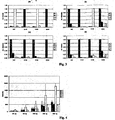
- blaTEM-1,-3,-7,-8,-116 The results of the identification of blaTEM-1,-3,-7,-8, are given in Figure 3 as the relative intensity values. Only the SNP positions, which varied in comparison to bla-TEM-1 are displayed. The mutated amino acid positions in comparison to blaTEM-1 are: S37 (CAG to AAG, Q to K) in blaTEM -3,-7,-8; S102 (GAG to AAG, E to K) in blaTEM - 3, - 8; S162.
- the next step was to determine the detection limit of the target DNA on the array.
- the displayed net signal intensities in Figure 4 correspond to SNP 235, which showed the weakest signal intensity after hybridization from all detected SNP positions in this experiment.
- the perfect match position for blaTEM - 116 at position S235 is C, mismatch positions are A, G and T.
- the ratio of perfect match/mismatch is still > 2, but the net signal intensity is quite low ( ⁇ 200). Since the discrimination of the probe signal from the background signal is more difficult with low signal intensities the perfect match identification becomes more unreliable.
- Hybridization variant III permits to reduce the hybridization time from 3 hours to 30 min.
- the corresponding data is shown in Figure 5.
- the results are shown as specific intensities, which corresponds to the difference between the net perfect match intensity and the mean of the net mismatch intensities [PM-(MM 1 +MM 2 +MM 3 )/3].
- As expected are the specific intensities at 30 minutes incubation time up to 10 x weaker, but all perfect match positions can still be identified unequivocally.
- This test was carried out under a cover glass, so the hybridization was in this case a diffusion limited process.
- the same test done under agitation of the hybridization solution as during hybridization in a hybridization station yields higher intensities, so that the hybridization can be reduced to less than 30 minutes. This reduces the total assay time to ⁇ 3,5 hours.
- the array for genotyping of TEM beta lactamase as lined out above has shown a reproducible and sensitive identification of various genes of ESBL type beta lactamase. With an assay time of less than 3.5 hours this method is a very fast detection method for ESBL and/or IRT TEM beta lactamase and should be a valuable tool to monitor the spread of these resistance genes within the clinical setting.
Landscapes
- Chemical & Material Sciences (AREA)
- Life Sciences & Earth Sciences (AREA)
- Organic Chemistry (AREA)
- Proteomics, Peptides & Aminoacids (AREA)
- Analytical Chemistry (AREA)
- Zoology (AREA)
- Health & Medical Sciences (AREA)
- Engineering & Computer Science (AREA)
- Wood Science & Technology (AREA)
- Microbiology (AREA)
- Physics & Mathematics (AREA)
- Molecular Biology (AREA)
- Immunology (AREA)
- Biotechnology (AREA)
- Biophysics (AREA)
- Biochemistry (AREA)
- Bioinformatics & Cheminformatics (AREA)
- General Engineering & Computer Science (AREA)
- General Health & Medical Sciences (AREA)
- Genetics & Genomics (AREA)
- Measuring Or Testing Involving Enzymes Or Micro-Organisms (AREA)
Applications Claiming Priority (2)
| Application Number | Priority Date | Filing Date | Title |
|---|---|---|---|
| US673038 | 1996-07-01 | ||
| US10/673,038 US20050069901A1 (en) | 2003-09-29 | 2003-09-29 | Method for detecting microbial antibiotic resistance |
Publications (2)
| Publication Number | Publication Date |
|---|---|
| EP1580281A2 true EP1580281A2 (de) | 2005-09-28 |
| EP1580281A3 EP1580281A3 (de) | 2006-09-13 |
Family
ID=34376532
Family Applications (1)
| Application Number | Title | Priority Date | Filing Date |
|---|---|---|---|
| EP04019288A Ceased EP1580281A3 (de) | 2003-09-29 | 2004-08-13 | Verfahren zum Nachweis von mikrobieller Resistenz gegen Antibiotika |
Country Status (4)
| Country | Link |
|---|---|
| US (1) | US20050069901A1 (de) |
| EP (1) | EP1580281A3 (de) |
| CN (1) | CN1644710B (de) |
| AU (1) | AU2004205201B2 (de) |
Cited By (3)
| Publication number | Priority date | Publication date | Assignee | Title |
|---|---|---|---|---|
| WO2006097234A3 (en) * | 2005-03-18 | 2007-03-15 | Eppendorf Ag | Microarray and method for genotyping shv beta lactamases |
| RU2415932C1 (ru) * | 2009-10-23 | 2011-04-10 | Закрытое акционерное общество "Научно-производственное предприятие ИММУНОТЕХ" (ЗАО "НПП ИММУНОТЕХ") | Способ идентификации генов бета-лактамаз расширенного спектра действия класса а |
| RU2415937C1 (ru) * | 2009-10-23 | 2011-04-10 | Закрытое акционерное общество "Научно-производственное предприятие ИММУНОТЕХ" (ЗАО "НПП ИММУНОТЕХ") | Днк-микрочип для идентификации генов бета-лактамаз расширенного спектра действия класса а |
Families Citing this family (9)
| Publication number | Priority date | Publication date | Assignee | Title |
|---|---|---|---|---|
| CN1928119B (zh) * | 2006-09-08 | 2012-05-16 | 上海生物芯片有限公司 | β-内酰胺酶SHV基因变异检测芯片及其应用 |
| CN101545003B (zh) * | 2009-05-07 | 2011-10-05 | 河南省兽药监察所 | 生鲜奶及奶制品中β-内酰胺酶的检测试剂盒及检测方法 |
| WO2011019874A1 (en) * | 2009-08-12 | 2011-02-17 | President And Fellows Of Harvard College | Biodetection methods and compositions |
| US20170283862A1 (en) * | 2014-09-25 | 2017-10-05 | Curetis Gmbh | Genetic testing for predicting resistance of klebsiella species against antimicrobial agents |
| FR3034523B1 (fr) * | 2015-04-03 | 2020-01-17 | Universite De Bourgogne | Nouvelle methode pour detecter la presence de bacteries productrices de beta-lactamases. |
| WO2017012653A1 (en) * | 2015-07-21 | 2017-01-26 | Curetis Gmbh | Genetic testing for predicting resistance of gram-negative proteus against antimicrobial agents |
| WO2017012660A1 (en) * | 2015-07-22 | 2017-01-26 | Curetis Gmbh | Genetic testing for predicting resistance of serratia species against antimicrobial agents |
| WO2017012659A1 (en) * | 2015-07-22 | 2017-01-26 | Curetis Gmbh | Genetic testing for predicting resistance of salmonella species against antimicrobial agents |
| KR102784871B1 (ko) * | 2021-12-30 | 2025-03-25 | 대한민국 (식품의약품안전처장) | Esbl 주요 내성 균주 확인을 위한 다중진단 pcr 키트 |
Family Cites Families (4)
| Publication number | Priority date | Publication date | Assignee | Title |
|---|---|---|---|---|
| US6153400A (en) * | 1999-03-12 | 2000-11-28 | Akzo Nobel N.V. | Device and method for microbial antibiotic susceptibility testing |
| KR100451108B1 (ko) * | 2000-05-30 | 2004-10-06 | 주식회사 바이오메드랩 | 마이코박테리아 균동정 및 약제내성 탐지를 위한 유전자진단키트 및 그 키트의 제조방법 |
| WO2002086153A1 (en) * | 2001-04-24 | 2002-10-31 | Diatech Pty Ltd | DETERMINING RESISTANCE TO A $G(b)-LACTAM-CONTAINING ANTIBIOTIC BY COMPARING THE RATIO OF TWO $G(b)-LACTAMASE GENES |
| KR100454585B1 (ko) * | 2001-10-09 | 2004-11-02 | 주식회사 에스제이하이테크 | 마이코박테리아의 균주 감별, 결핵균의 스트레인 감별과항생제 내성을 검출하기 위한 프로브를 포함하는마이크로어레이와 이를 이용한 검출 방법 및 진단 키트 |
-
2003
- 2003-09-29 US US10/673,038 patent/US20050069901A1/en not_active Abandoned
-
2004
- 2004-08-13 EP EP04019288A patent/EP1580281A3/de not_active Ceased
- 2004-08-24 AU AU2004205201A patent/AU2004205201B2/en not_active Ceased
- 2004-09-29 CN CN2004100806300A patent/CN1644710B/zh not_active Expired - Fee Related
Cited By (3)
| Publication number | Priority date | Publication date | Assignee | Title |
|---|---|---|---|---|
| WO2006097234A3 (en) * | 2005-03-18 | 2007-03-15 | Eppendorf Ag | Microarray and method for genotyping shv beta lactamases |
| RU2415932C1 (ru) * | 2009-10-23 | 2011-04-10 | Закрытое акционерное общество "Научно-производственное предприятие ИММУНОТЕХ" (ЗАО "НПП ИММУНОТЕХ") | Способ идентификации генов бета-лактамаз расширенного спектра действия класса а |
| RU2415937C1 (ru) * | 2009-10-23 | 2011-04-10 | Закрытое акционерное общество "Научно-производственное предприятие ИММУНОТЕХ" (ЗАО "НПП ИММУНОТЕХ") | Днк-микрочип для идентификации генов бета-лактамаз расширенного спектра действия класса а |
Also Published As
| Publication number | Publication date |
|---|---|
| EP1580281A3 (de) | 2006-09-13 |
| AU2004205201B2 (en) | 2009-07-23 |
| CN1644710A (zh) | 2005-07-27 |
| CN1644710B (zh) | 2010-09-15 |
| AU2004205201A1 (en) | 2005-04-14 |
| US20050069901A1 (en) | 2005-03-31 |
Similar Documents
| Publication | Publication Date | Title |
|---|---|---|
| US7205104B2 (en) | Identification of biological (micro) organisms by detection of their homologous nucleotide sequences on arrays | |
| EP0674650B1 (de) | Nukleinsäuresonde zum nachweis von lactobacillus | |
| US9109261B2 (en) | Method and kit for identifying antibiotic-resistant microorganisms | |
| AU2004205201B2 (en) | Method for Microbial Antibiotic Resistance Detection | |
| JP5156726B2 (ja) | ハイブリダイゼーションアッセイを使用する真正細菌群の検出、同定および区別 | |
| AU2018236838A1 (en) | Compositions and methods for detecting gastrointestinal pathogen nucleic acid | |
| US6355435B1 (en) | Methods for detecting and enumerating Campylobacter jejuni in environmental samples and for identifying antibiotic-resistant strains | |
| JP2004520838A (ja) | 核酸分子の検出方法 | |
| WO2006097233A2 (en) | Determination of antibiotic resistance in staphylococcus aureus | |
| AU3132997A (en) | Compositions and methods for the detection of mycobacterium kansasii | |
| US20080096203A1 (en) | Method and device for detecting quinolone-resistant escherichia coli | |
| US20080145845A1 (en) | Method and Kit for the Identification and/or Detection and/or Quantification of Large Number of Genes Related to Antibiotic Resistance in (Micro) Organisms | |
| US20060211002A1 (en) | Antibiotic susceptibility and virulence factor detection in Pseudomonas aeruginosa | |
| JP2006006323A (ja) | アレイによる相同ヌクレオチド配列の検出および/または定量のための方法およびキット | |
| JP4766878B2 (ja) | ハイブリダイゼーションアッセイを使用する真正細菌群の検出、同定および識別 | |
| US20060210999A1 (en) | Microarray and method for genotyping SHV beta lactamases | |
| WO2001018017A1 (en) | Methods for detecting and enumerating campylobacter jejuni in environmental samples and for identifying antibiotic-resistant strains | |
| JP2023136535A (ja) | 多剤耐性細菌検出方法及びプライマーキット | |
| US20070059714A1 (en) | Detection of presence and antibiotic susceptibility of enterococci | |
| CN115427567A (zh) | 判断属于脓肿分枝杆菌复合群的抗酸菌的erm(41)基因的单碱基突变的方法、该方法所使用的引物组及探针 | |
| JP2004147550A (ja) | 核酸断片、微生物の検出方法及び微生物検出用キット | |
| WO2007114517A1 (en) | Probe, probe set, probe-immobilized carrier, and genetic testing method |
Legal Events
| Date | Code | Title | Description |
|---|---|---|---|
| PUAI | Public reference made under article 153(3) epc to a published international application that has entered the european phase |
Free format text: ORIGINAL CODE: 0009012 |
|
| AK | Designated contracting states |
Kind code of ref document: A2 Designated state(s): AT BE BG CH CY CZ DE DK EE ES FI FR GB GR HU IE IT LI LU MC NL PL PT RO SE SI SK TR |
|
| AX | Request for extension of the european patent |
Extension state: AL HR LT LV MK |
|
| PUAL | Search report despatched |
Free format text: ORIGINAL CODE: 0009013 |
|
| AK | Designated contracting states |
Kind code of ref document: A3 Designated state(s): AT BE BG CH CY CZ DE DK EE ES FI FR GB GR HU IE IT LI LU MC NL PL PT RO SE SI SK TR |
|
| AX | Request for extension of the european patent |
Extension state: AL HR LT LV MK |
|
| 17P | Request for examination filed |
Effective date: 20070313 |
|
| AKX | Designation fees paid |
Designated state(s): AT BE BG CH CY CZ DE DK EE ES FI FR GB GR HU IE IT LI LU MC NL PL PT RO SE SI SK TR |
|
| 17Q | First examination report despatched |
Effective date: 20080606 |
|
| STAA | Information on the status of an ep patent application or granted ep patent |
Free format text: STATUS: THE APPLICATION HAS BEEN REFUSED |
|
| 18R | Application refused |
Effective date: 20110707 |