EP1579058B1 - Method for manufacturing resin-impregnated endless belt for papermaking machines and similar industrial applications - Google Patents
Method for manufacturing resin-impregnated endless belt for papermaking machines and similar industrial applications Download PDFInfo
- Publication number
- EP1579058B1 EP1579058B1 EP03783499A EP03783499A EP1579058B1 EP 1579058 B1 EP1579058 B1 EP 1579058B1 EP 03783499 A EP03783499 A EP 03783499A EP 03783499 A EP03783499 A EP 03783499A EP 1579058 B1 EP1579058 B1 EP 1579058B1
- Authority
- EP
- European Patent Office
- Prior art keywords
- base substrate
- polymeric resin
- resin material
- functional polymeric
- deposited
- Prior art date
- Legal status (The legal status is an assumption and is not a legal conclusion. Google has not performed a legal analysis and makes no representation as to the accuracy of the status listed.)
- Expired - Lifetime
Links
- 238000000034 method Methods 0.000 title claims abstract description 76
- 238000004519 manufacturing process Methods 0.000 title claims abstract description 18
- 239000000463 material Substances 0.000 claims abstract description 202
- 239000000758 substrate Substances 0.000 claims abstract description 154
- 239000002952 polymeric resin Substances 0.000 claims abstract description 109
- 229920003002 synthetic resin Polymers 0.000 claims abstract description 109
- 238000012545 processing Methods 0.000 claims abstract description 7
- 239000000203 mixture Substances 0.000 claims abstract description 6
- 238000000151 deposition Methods 0.000 claims description 36
- 239000011248 coating agent Substances 0.000 claims description 25
- 238000000576 coating method Methods 0.000 claims description 25
- 239000004744 fabric Substances 0.000 claims description 25
- 229920005989 resin Polymers 0.000 claims description 17
- 239000011347 resin Substances 0.000 claims description 17
- 238000003384 imaging method Methods 0.000 claims description 12
- 229920002635 polyurethane Polymers 0.000 claims description 6
- 239000004814 polyurethane Substances 0.000 claims description 6
- 239000012943 hotmelt Substances 0.000 claims description 5
- 230000002209 hydrophobic effect Effects 0.000 claims description 5
- 239000002904 solvent Substances 0.000 claims description 5
- 238000005507 spraying Methods 0.000 claims description 4
- 150000003673 urethanes Chemical class 0.000 claims description 4
- 230000009471 action Effects 0.000 claims description 3
- 239000006185 dispersion Substances 0.000 claims description 3
- 238000010438 heat treatment Methods 0.000 claims description 3
- 229920000728 polyester Polymers 0.000 claims description 3
- 238000009877 rendering Methods 0.000 claims description 3
- 239000004593 Epoxy Substances 0.000 claims description 2
- 229920006397 acrylic thermoplastic Polymers 0.000 claims description 2
- 125000003700 epoxy group Chemical group 0.000 claims description 2
- 238000009472 formulation Methods 0.000 claims description 2
- 239000000178 monomer Substances 0.000 claims description 2
- 239000002245 particle Substances 0.000 claims description 2
- 229920003229 poly(methyl methacrylate) Polymers 0.000 claims description 2
- 229920000647 polyepoxide Polymers 0.000 claims description 2
- 229920000570 polyether Polymers 0.000 claims description 2
- 229920001296 polysiloxane Polymers 0.000 claims description 2
- ISXSCDLOGDJUNJ-UHFFFAOYSA-N tert-butyl prop-2-enoate Chemical compound CC(C)(C)OC(=O)C=C ISXSCDLOGDJUNJ-UHFFFAOYSA-N 0.000 claims description 2
- 230000005855 radiation Effects 0.000 claims 2
- 230000008021 deposition Effects 0.000 description 24
- XLYOFNOQVPJJNP-UHFFFAOYSA-N water Substances O XLYOFNOQVPJJNP-UHFFFAOYSA-N 0.000 description 15
- 229920000642 polymer Polymers 0.000 description 13
- 230000008439 repair process Effects 0.000 description 10
- 238000000227 grinding Methods 0.000 description 7
- 239000000835 fiber Substances 0.000 description 6
- 238000001723 curing Methods 0.000 description 5
- 230000008569 process Effects 0.000 description 4
- 239000011800 void material Substances 0.000 description 4
- 238000001816 cooling Methods 0.000 description 3
- 230000003252 repetitive effect Effects 0.000 description 3
- 238000012360 testing method Methods 0.000 description 3
- 238000012546 transfer Methods 0.000 description 3
- 239000000919 ceramic Substances 0.000 description 2
- 239000013078 crystal Substances 0.000 description 2
- 238000005520 cutting process Methods 0.000 description 2
- 230000001066 destructive effect Effects 0.000 description 2
- 238000005553 drilling Methods 0.000 description 2
- 238000001035 drying Methods 0.000 description 2
- 238000001704 evaporation Methods 0.000 description 2
- 230000008020 evaporation Effects 0.000 description 2
- 239000012530 fluid Substances 0.000 description 2
- 239000011344 liquid material Substances 0.000 description 2
- 239000003921 oil Substances 0.000 description 2
- 239000002002 slurry Substances 0.000 description 2
- 239000007787 solid Substances 0.000 description 2
- 238000003860 storage Methods 0.000 description 2
- 239000000126 substance Substances 0.000 description 2
- 239000004952 Polyamide Substances 0.000 description 1
- 239000002202 Polyethylene glycol Substances 0.000 description 1
- 239000004372 Polyvinyl alcohol Substances 0.000 description 1
- 238000005299 abrasion Methods 0.000 description 1
- 229920003235 aromatic polyamide Polymers 0.000 description 1
- 238000005452 bending Methods 0.000 description 1
- 230000015572 biosynthetic process Effects 0.000 description 1
- 238000003490 calendering Methods 0.000 description 1
- 238000004132 cross linking Methods 0.000 description 1
- 230000003247 decreasing effect Effects 0.000 description 1
- 238000013461 design Methods 0.000 description 1
- 238000009826 distribution Methods 0.000 description 1
- 238000005516 engineering process Methods 0.000 description 1
- 238000001125 extrusion Methods 0.000 description 1
- 238000011049 filling Methods 0.000 description 1
- 238000007654 immersion Methods 0.000 description 1
- 238000005470 impregnation Methods 0.000 description 1
- 238000009434 installation Methods 0.000 description 1
- 239000007788 liquid Substances 0.000 description 1
- 230000001050 lubricating effect Effects 0.000 description 1
- 239000010687 lubricating oil Substances 0.000 description 1
- 238000005461 lubrication Methods 0.000 description 1
- 230000000873 masking effect Effects 0.000 description 1
- 230000007246 mechanism Effects 0.000 description 1
- 239000000155 melt Substances 0.000 description 1
- 230000007935 neutral effect Effects 0.000 description 1
- 230000003647 oxidation Effects 0.000 description 1
- 238000007254 oxidation reaction Methods 0.000 description 1
- 230000000149 penetrating effect Effects 0.000 description 1
- 229920002647 polyamide Polymers 0.000 description 1
- 229920001223 polyethylene glycol Polymers 0.000 description 1
- 229920000098 polyolefin Polymers 0.000 description 1
- 229920002451 polyvinyl alcohol Polymers 0.000 description 1
- 238000003908 quality control method Methods 0.000 description 1
- 230000035484 reaction time Effects 0.000 description 1
- 230000004044 response Effects 0.000 description 1
- 230000000630 rising effect Effects 0.000 description 1
- 238000007665 sagging Methods 0.000 description 1
- 239000011343 solid material Substances 0.000 description 1
- 239000004753 textile Substances 0.000 description 1
- 238000013519 translation Methods 0.000 description 1
- 238000004804 winding Methods 0.000 description 1
Images



Classifications
-
- B—PERFORMING OPERATIONS; TRANSPORTING
- B29—WORKING OF PLASTICS; WORKING OF SUBSTANCES IN A PLASTIC STATE IN GENERAL
- B29C—SHAPING OR JOINING OF PLASTICS; SHAPING OF MATERIAL IN A PLASTIC STATE, NOT OTHERWISE PROVIDED FOR; AFTER-TREATMENT OF THE SHAPED PRODUCTS, e.g. REPAIRING
- B29C39/00—Shaping by casting, i.e. introducing the moulding material into a mould or between confining surfaces without significant moulding pressure; Apparatus therefor
- B29C39/14—Shaping by casting, i.e. introducing the moulding material into a mould or between confining surfaces without significant moulding pressure; Apparatus therefor for making articles of indefinite length
- B29C39/18—Shaping by casting, i.e. introducing the moulding material into a mould or between confining surfaces without significant moulding pressure; Apparatus therefor for making articles of indefinite length incorporating preformed parts or layers, e.g. casting around inserts or for coating articles
-
- D—TEXTILES; PAPER
- D21—PAPER-MAKING; PRODUCTION OF CELLULOSE
- D21F—PAPER-MAKING MACHINES; METHODS OF PRODUCING PAPER THEREON
- D21F1/00—Wet end of machines for making continuous webs of paper
-
- D—TEXTILES; PAPER
- D21—PAPER-MAKING; PRODUCTION OF CELLULOSE
- D21F—PAPER-MAKING MACHINES; METHODS OF PRODUCING PAPER THEREON
- D21F3/00—Press section of machines for making continuous webs of paper
- D21F3/02—Wet presses
-
- D—TEXTILES; PAPER
- D21—PAPER-MAKING; PRODUCTION OF CELLULOSE
- D21F—PAPER-MAKING MACHINES; METHODS OF PRODUCING PAPER THEREON
- D21F3/00—Press section of machines for making continuous webs of paper
- D21F3/02—Wet presses
- D21F3/0209—Wet presses with extended press nip
- D21F3/0218—Shoe presses
- D21F3/0227—Belts or sleeves therefor
-
- D—TEXTILES; PAPER
- D21—PAPER-MAKING; PRODUCTION OF CELLULOSE
- D21F—PAPER-MAKING MACHINES; METHODS OF PRODUCING PAPER THEREON
- D21F3/00—Press section of machines for making continuous webs of paper
- D21F3/02—Wet presses
- D21F3/029—Wet presses using special water-receiving belts
-
- D—TEXTILES; PAPER
- D21—PAPER-MAKING; PRODUCTION OF CELLULOSE
- D21F—PAPER-MAKING MACHINES; METHODS OF PRODUCING PAPER THEREON
- D21F7/00—Other details of machines for making continuous webs of paper
- D21F7/08—Felts
-
- Y—GENERAL TAGGING OF NEW TECHNOLOGICAL DEVELOPMENTS; GENERAL TAGGING OF CROSS-SECTIONAL TECHNOLOGIES SPANNING OVER SEVERAL SECTIONS OF THE IPC; TECHNICAL SUBJECTS COVERED BY FORMER USPC CROSS-REFERENCE ART COLLECTIONS [XRACs] AND DIGESTS
- Y10—TECHNICAL SUBJECTS COVERED BY FORMER USPC
- Y10S—TECHNICAL SUBJECTS COVERED BY FORMER USPC CROSS-REFERENCE ART COLLECTIONS [XRACs] AND DIGESTS
- Y10S162/00—Paper making and fiber liberation
- Y10S162/901—Impermeable belts for extended nip press
-
- Y—GENERAL TAGGING OF NEW TECHNOLOGICAL DEVELOPMENTS; GENERAL TAGGING OF CROSS-SECTIONAL TECHNOLOGIES SPANNING OVER SEVERAL SECTIONS OF THE IPC; TECHNICAL SUBJECTS COVERED BY FORMER USPC CROSS-REFERENCE ART COLLECTIONS [XRACs] AND DIGESTS
- Y10—TECHNICAL SUBJECTS COVERED BY FORMER USPC
- Y10T—TECHNICAL SUBJECTS COVERED BY FORMER US CLASSIFICATION
- Y10T428/00—Stock material or miscellaneous articles
- Y10T428/24—Structurally defined web or sheet [e.g., overall dimension, etc.]
- Y10T428/24802—Discontinuous or differential coating, impregnation or bond [e.g., artwork, printing, retouched photograph, etc.]
-
- Y—GENERAL TAGGING OF NEW TECHNOLOGICAL DEVELOPMENTS; GENERAL TAGGING OF CROSS-SECTIONAL TECHNOLOGIES SPANNING OVER SEVERAL SECTIONS OF THE IPC; TECHNICAL SUBJECTS COVERED BY FORMER USPC CROSS-REFERENCE ART COLLECTIONS [XRACs] AND DIGESTS
- Y10—TECHNICAL SUBJECTS COVERED BY FORMER USPC
- Y10T—TECHNICAL SUBJECTS COVERED BY FORMER US CLASSIFICATION
- Y10T428/00—Stock material or miscellaneous articles
- Y10T428/24—Structurally defined web or sheet [e.g., overall dimension, etc.]
- Y10T428/24802—Discontinuous or differential coating, impregnation or bond [e.g., artwork, printing, retouched photograph, etc.]
- Y10T428/2481—Discontinuous or differential coating, impregnation or bond [e.g., artwork, printing, retouched photograph, etc.] including layer of mechanically interengaged strands, strand-portions or strand-like strips
-
- Y—GENERAL TAGGING OF NEW TECHNOLOGICAL DEVELOPMENTS; GENERAL TAGGING OF CROSS-SECTIONAL TECHNOLOGIES SPANNING OVER SEVERAL SECTIONS OF THE IPC; TECHNICAL SUBJECTS COVERED BY FORMER USPC CROSS-REFERENCE ART COLLECTIONS [XRACs] AND DIGESTS
- Y10—TECHNICAL SUBJECTS COVERED BY FORMER USPC
- Y10T—TECHNICAL SUBJECTS COVERED BY FORMER US CLASSIFICATION
- Y10T428/00—Stock material or miscellaneous articles
- Y10T428/249921—Web or sheet containing structurally defined element or component
- Y10T428/249953—Composite having voids in a component [e.g., porous, cellular, etc.]
- Y10T428/249955—Void-containing component partially impregnated with adjacent component
- Y10T428/249958—Void-containing component is synthetic resin or natural rubbers
-
- Y—GENERAL TAGGING OF NEW TECHNOLOGICAL DEVELOPMENTS; GENERAL TAGGING OF CROSS-SECTIONAL TECHNOLOGIES SPANNING OVER SEVERAL SECTIONS OF THE IPC; TECHNICAL SUBJECTS COVERED BY FORMER USPC CROSS-REFERENCE ART COLLECTIONS [XRACs] AND DIGESTS
- Y10—TECHNICAL SUBJECTS COVERED BY FORMER USPC
- Y10T—TECHNICAL SUBJECTS COVERED BY FORMER US CLASSIFICATION
- Y10T428/00—Stock material or miscellaneous articles
- Y10T428/249921—Web or sheet containing structurally defined element or component
- Y10T428/249953—Composite having voids in a component [e.g., porous, cellular, etc.]
- Y10T428/249975—Void shape specified [e.g., crushed, flat, round, etc.]
-
- Y—GENERAL TAGGING OF NEW TECHNOLOGICAL DEVELOPMENTS; GENERAL TAGGING OF CROSS-SECTIONAL TECHNOLOGIES SPANNING OVER SEVERAL SECTIONS OF THE IPC; TECHNICAL SUBJECTS COVERED BY FORMER USPC CROSS-REFERENCE ART COLLECTIONS [XRACs] AND DIGESTS
- Y10—TECHNICAL SUBJECTS COVERED BY FORMER USPC
- Y10T—TECHNICAL SUBJECTS COVERED BY FORMER US CLASSIFICATION
- Y10T442/00—Fabric [woven, knitted, or nonwoven textile or cloth, etc.]
- Y10T442/20—Coated or impregnated woven, knit, or nonwoven fabric which is not [a] associated with another preformed layer or fiber layer or, [b] with respect to woven and knit, characterized, respectively, by a particular or differential weave or knit, wherein the coating or impregnation is neither a foamed material nor a free metal or alloy layer
Definitions
- the present invention relates, in part, to mechanisms for extracting water from a web of material, and, more particularly, from a fibrous web being processed into a paper product on a papermaking machine.
- the present invention is a method for manufacturing resin-impregnated endless belt structures designed for use on a long nip press of the shoe type on a papermaking machine, and for other papermaking and paper-processing applications.
- a fibrous web of cellulosic fibers is formed on a forming fabric by depositing a fibrous slurry thereon in the forming section of a paper machine.
- a large amount of water is drained from the slurry in the forming section, after which the newly formed web is conducted to a press section.
- the press section includes a series of press nips, in which the fibrous web is subjected to compressive forces applied to remove water therefrom.
- the web finally is conducted to a drying section which includes heated dryer drums around which the web is directed. The heated dryer drums reduce the water content of the web to a desirable level through evaporation to yield a paper product.
- press sections have included a series of nips formed by pairs of adjacent cylindrical press rolls.
- the use of long press nips of the shoe type has been found to be more advantageous than the use of nips formed by pairs of adjacent press rolls. This is because the longer the time a web can be subjected to pressure in the nip, the more water can be removed there, and, consequently, the less water will remain behind in the web for removal through evaporation in the dryer section.
- the present invention relates, in part, to long nip presses of the shoe type.
- the nip is formed between a cylindrical press roll and an arcuate pressure shoe.
- the latter has a cylindrically concave surface having a radius of curvature close to that of the cylindrical press roll.
- the so-called dwell time during which the fibrous web is under pressure in the long nip, may be correspondingly longer than it would be in a two-roll press.
- the result is a dramatic increase in the dewatering of the fibrous web in the long nip relative to that obtained using conventional nips on paper machines.
- a long nip press of the shoe type requires a especial belt, such as that shown in U.S. Patent No. 5, 238, 537 to Dutt (Albany International Corp.).
- the belt is designed to protect the press fabric, which supports, carries and dewaters the fibrous web, from the accelerated wear that would result from direct, sliding contact over the stationary pressure shoe.
- Such a belt must be provided with a smooth, impervious surface that rides, or slides, over the stationary shoe on a lubricating film of oil. The belt moves through the nip at roughly the same speed as the press fabric, thereby subjecting the press fabric to minimal amounts of rubbing against the surface of the belt.
- Belts of the variety shown in U.S. Patent No. 5,238,537 are made by impregnating a woven base fabric, which takes the form of an endless loop, with a synthetic polymeric resin.
- the resin forms a coating of some predetermined thickness on at least the inner surface of the belt, so that the yarns from which the base fabric is woven may be protected from direct contact with the arcuate pressure shoe component of the long nip press. It is specifically this coating which must have a smooth, impervious surface to slide readily over the lubricated shoe and to prevent any of the lubricating oil from penetrating the structure of the belt to contaminate the press fabric, or fabrics, and fibrous - web.
- 5, 238, 537 may be woven from monofilament yarns in a single or multilayer weave, and is woven so as to be sufficiently open to allow the impregnating material to totally impregnate the weave. This eliminates the possibility of any voids forming in the final belt. Such voids may allow the lubrication used between the belt and shoe to pass through the belt and contaminate the press fabric or fabrics and fibrous web.
- the base fabric may be flat-woven, and subsequently seamed into endless form, or woven endless in tubular form.
- the impregnating material When the impregnating material is cured to a solid condition, it is primarily bound to the base fabric by a mechanical interlock, wherein the cured impregnating material surrounds the yarns of the base fabric. In addition, there may be some chemical bonding or adhesion between the cured impregnating material and the material of the yarns of the base fabric.
- Long nip press belts such as that shown in U. S. Patent No. 5,238,537 , depending on the size requirements of the long nip presses on which they are installed, have lengths from roughly 10 to 35 feet (approximately 3 to 11 meters), measured longitudinally around their endless-loop forms, and widths from roughly 6 to 35 feet (approximately 2 to 11 meters), measured transversely across those forms.
- the manufacture of such belts is complicated by the requirement that the base fabric be endless prior to its impregnation with a synthetic polymeric resin.
- the belt It is often desirable to provide the belt with a resin coating of some predetermined thickness on its outer surface as well as on its inner surface.
- its woven base fabric By coating both sides of the belt, its woven base fabric will be closer to, if not coincident with, the neutral axis of bending of the belt. In such a circumstance, internal stresses which arise when the belt is flexed on passing around a roll or the like on the paper machine will be less likely to cause the coating to delaminate from either side of the belt.
- the outer surface of the belt has a resin coating of some predetermined thickness, it permits grooves, blind-drilled holes or other cavities to be formed on that surface without exposing any part of the woven base fabric.
- the present invention provides a solution to this particular problem, that is, the necessity for a separate manufacturing step or steps, which characterizes prior-art methods for manufacturing resin-impregnated endless belt structures having void volume in the form of grooves blind-drilled holes and the like on their outer surfaces. Moreover, the present invention provides an alternate method for manufacturing resin-impregnated endless belt structure used in other papermaking and paper-processing applications, such as calender and transfer belts.
- WO 92/00415 A1 describes a method for manufacturing a resin-impregnated endless belt for use on a papermaking machine comprising coating a substrate with a photosensitive resin, masking the resin according to a predetermined pattern, crosslinking the resin and removing the resin which is not crosslinked, thereby producing on the coated surface a multiplicity of cavities according to a predetermined pattern.
- the present invention is a method for manufacturing resin-impregnated endless belt structures designed for use on a long nip press on a paper-making machine and for other papermaking and paper-processing applications as disclosed in claim 1.
- the method comprises a first step of providing a base substrate for the belt.
- the base substrate may be one which has previously been impregnated with a polymeric resin material which forms a layer on its inner or outer surface.
- the base substrate may be rendered impermeable by depositing a polymeric resin material onto the base substrate to coat its entire surface during the practice of the present invention.
- Sacrificial material is then deposited onto the base substrate in a precise predetermined pattern, which predetermined pattern is to characterize the surface of the belt being manufactured.
- the sacrificial material forms a layer of desired thickness over the base substrate to provide a mold there.
- the sacrificial material is deposited in droplets having an average diameter of 10 ⁇ (10 microns) or more.
- At least one piezojet may be used to deposit the sacrificial material onto the base substrate, although other means for depositing droplets of that size may be known to those of ordinary skill in the art or may be developed in the future and used instead of a piezojet.
- a functional polymeric resin material is deposited onto the base substrate to cover areas thereof not previously covered by the sacrificial material with a layer of desired thickness, that is, to fill the mold defined by the sacrificial material.
- the polymeric resin material is then set or fixed by appropriate means.
- the sacrificial material is removed from the belt newly manufactured from the resin-coated substrate.
- the sacrificial material is removed through the application of an appropriate solvent or heat.
- the deposited polymeric resin material may optionally be abraded to provide it with a uniform thickness and a smooth, macroscopically monoplanar surface, when desired, or to expose any sacrificial material that may have been covered by the polymeric resin material for subsequent removal.
- a second functional polymeric resin material is deposited onto the belt newly manufactured from the base substrate to fill the regions formerly occupied by the sacrificial material to render the belt impermeable, if it is not already so, and to provide the belt with surface regions having different properties.
- the method for fabricating a belt in accordance with the present invention begins with the provision of a base substrate.
- the base structure or substrate is a fabric woven from monofilament yarns. More broadly, however, the base substrate may be a woven, nonwoven or knitted fabric comprising yarns of any of the varieties used in the production of paper machine clothing or of belts used to manufacture nonwoven articles and fabrics, such as monofilament, plied monofilament, multifilament and plied multifilament yarns. These yarns may be obtained by extrusion from any of the polymeric resin materials used for this purpose by those of ordinary skill in the art. Accordingly, resins from the families of polyamide, polyester, polyurethane, polyaramid, polyolefin and other resins may be used.
- the base substrate may be composed of mesh fabrics, such as those shown in commonly assigned U.S. Patent No. 4,427,734 to Johnson .
- the base substrate may further be a spiral-link belt of the variety shown in many U.S. patents, such as U.S. Patent No. 4,567,077 to Gauthier .
- the base substrate may be produced by spirally winding a strip of woven, nonwoven, knitted or mesh fabric in accordance with the methods shown in commonly assigned U.S. Patent No. 5, 360, 656 to Rexfelt et al.
- the base substrate may accordingly comprise a spirally wound strip, wherein each spiral turn is joined to the next by a continuous seam making the base substrate endless in a longitudinal direction.
- base substrate Any of the varieties of base substrate used by those of ordinary skill in the paper machine clothing and related arts may alternatively be used.
- one or more layers of staple fiber batt may optionally be attached to one or both of its two sides by methods well known to those of ordinary skill in the art. Perhaps the best known and most commonly used method is that of needling, wherein the individual staple fibers in the batt are driven into the base structure by a plurality of reciprocating barbed needles. Alternatively, the individual staple fibers may be attached to the base substrate by hydroentangling, wherein fine high-pressure jets of water perform the same function as the above mentioned reciprocating barbed needles.
- the base substrate may be a structure which has been rendered impermeable to fluids, such as air and water, with a coating of a polymeric resin material, which at least partially impregnates the structure and which may form a layer of a desired thickness on one of its two sides.
- a polymeric resin material which at least partially impregnates the structure and which may form a layer of a desired thickness on one of its two sides.
- the belts manufactured in accordance with the present invention may be used as long nip press belts for long nip presses of the shoe type, and for other papermaking and paper-processing applications, such as calendering and sheet transfer.
- the base substrate With or without the addition of staple fiber batt material, and with or without a layer of polymeric resin material of desired thickness on one of its two sides, has been provided, it is mounted on the apparatus 10 shown schematically in Figure 1 .
- the base substrate may be either endless or seamable into endless form during installation on a paper machine.
- the base substrate 12 shown in Figure 1 should be understood to be a relatively short portion of the entire length of the base substrate 12.
- the base substrate 12 is endless, it would most practically be mounted about a pair of rolls, not illustrated in the figure but most familiar to those of ordinary skill in the paper machine clothing arts. In such a situation, apparatus 10 would be disposed on one of the two runs, most conveniently the top run, of the base substrate 12 between the two rolls. Whether endless or not, however, the base substrate 12 is preferably placed under an appropriate degree of tension during the process. Moreover, to prevent sagging, the base substrate 12 may be supported from below by a horizontal support member as it moves through apparatus 10.
- apparatus 10 comprises a sequence of several stations through which the base substrate 12 may pass incrementally as a belt is being manufactured therefrom.
- the stations are identified as follows:
- the base substrate has not already been rendered impermeable to fluids, such as air and water, with a coating of a polymeric resin material which at least partially impregnates the base substrate, to coat the entire surface of the base substrate to render the base substrate impermeable.
- a coating of a polymeric resin material which at least partially impregnates the base substrate, to coat the entire surface of the base substrate to render the base substrate impermeable. This may be accomplished by using polymer deposition station 36 of apparatus 10 or by other means suitable for the purpose.
- transverse rails 38,40 support a metering device, such as a bulk-jet array 42, which is translatable thereon in a direction transverse to that of the motion of the base substrate 12 through the apparatus 10, as well as therebetween in a direction parallel to that of the motion of the base substrate 12, while the latter is at rest.
- the bulk-jet array 42 may be used to deposit a functional polymeric resin material onto or within the base substrate 12 to render it impermeable and, optionally, to form a layer of desired thickness thereover.
- One or more passes over the base substrate 12 may be made by the bulk-jet array 42 to deposit the desired amount of polymeric resin material.
- the mold element deposition station 14 a piezojet array 16 mounted on transverse rails 18,20 and translatable thereon in a direction transverse to that of the motion of the base substrate 12 through the apparatus 10, as well as therebetween in a direction parallel to that of the motion of the base substrate 12, is used to deposit in repeated steps to build up the desired amount of sacrificial material onto the base substrate 12 in a predetermined pattern.
- a piezojet array 16 mounted on transverse rails 18,20 and translatable thereon in a direction transverse to that of the motion of the base substrate 12 through the apparatus 10, as well as therebetween in a direction parallel to that of the motion of the base substrate 12
- deposit in the sacrificial material need not only be traversing the movement of the base substrate but can be parallel to such movement, spiral to such movement or in any other manner suitable for the purpose.
- the sacrificial material may penetrate into the base substrate, if the latter does not already have a layer of functional polymeric resin material covering and rendering it impermeable, and, when desired, forms a layer of desired thickness thereover in the predetermined pattern.
- That pattern may be an array of discrete locations which are to be the ultimate locations of a corresponding array of discrete holes providing void volume on the surface of the belt.
- the sacrificial material which is removed later in the belt manufacturing process, and which is not present in a completed belt, is deposited in the discrete locations, where it becomes attached, and may rise to a predetermined height and/or shape above the surface of the base substrate 12.
- the discrete locations having the sacrificial material comprise a mold which is subsequently to be filled by a functional polymeric resin material, so called because it is a functional part of the belt when manufacture has been completed.
- the sacrificial material may be deposited in a semicontinuous network, for example, a semicontinuous pattern extending substantially throughout the base substrate 12 in an essentially linear fashion, such that the sacrificial material becomes attached to the base substrate 12 or to the polymeric resin material previously applied to render the base substrate impermeable, along lines which are generally parallel and equally spaced from one another.
- Such lines may be either curved, straight or zigzag.
- a semicontinuous network comprise straight or curved lines, or lines having both straight and curved segments, which are spaced apart from One another and do not cross one another.
- the semicontinuous network provides the surface of the completed belt with a plurality of grooves, which may provide void volume for the temporary storage of water pressed from a wet paper sheet.
- the sacrificial material may be deposited in a continuous network extending substantially throughout both dimensions of the surface of the base substrate 12 and defining a plurality of discrete open areas in a predetermined array. These discrete open areas are ultimately to be filled by a polymeric resin material and become the ultimate locations of discrete areas, filled by the polymeric resin material, on the surface of the belt.
- the continuous network may, for example, provide the surface of the completed belt with a plurality of crisscrossing grooves. Note that heretofore grooves were typically cut into the belt. Accordingly they were generally straight or substantially straight due to the cutting actions. Also blind drilled holes were generally circular, again due to the drilling or cutting action.
- the present invention avoids such limitations in that the voids can be created in any shape desired due to the freedom to deposit the sacrificial material in any pattern to ultimately create the voids.
- the piezojet array 16 comprises at least one but preferably a plurality of individual computer-controlled piezojets, each functioning as a pump whose active component is a piezoelectric element.
- the active component is a crystal or ceramic which is physically deformed by an applied electric signal. This deformation enables the crystal or ceramic to function as a pump, which physically ejects a drop of a liquid material each time an appropriate electric signal is received.
- this method of using piezojets to supply drops of a desired material repeatedly so as to build up the desired amount of material in the desired shape in response to computer-controlled electric signals is commonly referred to as a "drop-on-demand " method.
- the degree of precision of the jet in depositing the material will depend upon the dimensions and shape of the structure being formed. The type of jet used and the viscosity of the material being applied will also impact of the precision of the jet selected.
- the piezojet array 16 starting from an edge of the base substrate 12, or, preferably, from a reference thread extending lengthwise therein, translates lengthwise and widthwise across the base substrate 12, while the base substrate 12 is at rest, deposits the sacrificial material in the form of extremely small droplets having a nominal diameter of 10 ⁇ (10 microns) or more such as 50 ⁇ (50 microns) or 100 ⁇ (100 microns), in one of the above-described pattern.
- the translation of the piezojet array 16 lengthwise and widthwise relative to the base substrate 12, and the deposition of droplets of the sacrificial material from each piezojet in the,array 16, are controlled by computer in a controlled manner to produce the predetermined pattern of the sacrificial material in a controlled geometry in three planes, length, width and depth or height (x, y, z dimensions or directions) on the base structure 12.
- One or more passes over the base substrate 12 may be made by the piezojet array 16 to deposit the desired amount of sacrificial material.
- the height or z-direction of the sacrificial material on the base substrate 12 is controlled and may be uniform, varied or otherwise adjusted as desired.
- One or more passes over the base substrate 12 may be made by piezojet array 16 to deposit the desired amount of material and to create the desired shape.
- the deposits can take any number of shapes as illustrated generally in Figure 9 .
- the shapes can be square, round conical, rectangular, oval, trapezoidal etc. with a thicker base tapering upward.
- the amount of material deposited can be layered in decreasing fashion as the jet repeatedly passes over the deposit area.
- the base substrate 12 is advanced lengthwise an amount equal to the width of the band, and the procedure described above is repeated to produce the predetermined pattern in a new band adjacent to that previously completed. In this repetitive manner, the entire base substrate 12 can be provided with the predetermined pattern.
- the piezojet array 16 again starting from an edge of the base substrate 12, or, preferably, from a reference thread extending lengthwise therein, is kept in a fixed position relative to the transverse rails 18,20, while the base substrate 12 moves beneath it, to deposit the sacrificial material in the desired pattern in a lengthwise strip around the base substrate 12.
- the piezojet array 16 is moved widthwise on transverse rails 18,20 an amount equal to the width of the lengthwise strip, and the procedure described above is repeated to produce the predetermined pattern in a new lengthwise strip adjacent to that previously completed. In this repetitive manner, the entire base substrate 12 can be provided with the predetermined pattern.
- a jet check station 22 is provided for testing the flow of sacrificial material from each piezojet. There, the jets can be purged and cleaned to restore operation automatically to any malfunctioning jet unit.
- the sacrificial material is a solid material which melts quickly upon heating, and sets to bond firmly with the base substrate 12 upon cooling.
- the sacrificial material may be supplied from a heated reservoir, where it is maintained in a liquid state, and pumped through a feed line to the piezojet or piezojets.
- the viscosity of the sacrificial material at the point of delivery is important in defining the size and shape of the droplets formed on the base substrate (or the preapplied polymeric resin material) and in time the resolution of the pattern ultimately achieved.
- the pattern can be random, a repeating random pattern on a base substrate or such patterns that are repeatable from belt to belt for quality control.
- the sacrificial material may be a non-aqueous, solvent-removable wax, or a water-soluble wax, such as water-soluble polyethylene glycol or polyvinyl alcohol. More generally, the sacrificial material may be any material which is deliverable though a piezojet in extremely small droplets in the size range given above, and which may ultimately be removed from the base substrate 12 by means not destructive to the base substrate 12 and any functional Polymeric resin material thereon. In addition to these requirements, the sacrificial material has to be capable of being fixed or set on the base substrate 12 as quickly as possible following deposition thereon, in order to control its distribution on or in the base substrate 12.
- transverse rails 26,28 support a digital imaging camera 30, which is translatable across the width of base substrate 12, and a repair-jet array 32, which is translatable both across the width of the base substrate 12 and lengthwise relative thereto between transverse rails 26,28, while the base substrate 12 is at rest.
- the digital imaging camera 30 views the deposited sacrificial material to locate any faulty or missing discrete mold elements, or similar irregularities in a semicontinuous or continuous pattern produced thereby on the base substrate 12. Comparisons between the actual and desired patterns are made by a fast pattern recognizer (FPR) processor operating in conjunction with the digital imaging camera 30.
- the FPR processor signals the repair-jet array 32 to deposit additional sacrificial material onto the mold elements detected to be faulty or missing.
- a repair-jet check station 34 is provided for testing the flow of material from each repair jet. There, each repair jet can be purged and cleaned to restore operation automatically to any malfunctioning repair-jet unit.
- transverse rails 38,40 support a metering device, such as a bulk-jet array 42, which is translatable thereon in a direction transverse to that of the motion of the base substrate 12 through the apparatus 10, as well as therebetween in a direction parallel to that of the motion of the base substrate 12, while the latter is at rest.
- the bulk-jet array 42 is used to deposit the functional polymeric resin material onto the base substrate 12, except in regions having the sacrificial material, to fill the mold formed by the sacrificial material on the base substrate 12 to form a layer of desired thickness thereover.
- the latter may be a polyurethane or photosensitive resin, as well as others from the classes to be identified below as being capable of deposition by piezojet array.
- the bulk-jet array 42 leaves a uniformly thick layer of the functional polymeric resin material, preferably no thicker than the regions of removable material, on the base substrate 12. One or more passes over the base substrate 12 may be made by the bulk jet array 42 to deposit the desired amount of polymeric resin material.
- a setting device 44 if required to set or fix the polymeric resin material being used, may also be mounted on the transverse rails 38, 40, and follows the bulk-jet array 42 across the base substrate 12 to set or fix the material deposited thereby.
- the setting device 44 may be a heat source, for example, an infrared, hot air, microwave or laser source; cold air; or.an ultraviolet or visible light source, the choice being governed by the requirements of the polymeric resin material being used.
- the functional polymeric resin material also needs to be fixed on the base substrate 12 following its deposition thereon.
- the means by which the functional polymeric resin material is set or fixed depends on its own physical and/or chemical requirements. Photopolymers are cured with light, whereas hot-melt materials are set by cooling. Aqueous-based latexes and dispersions are dried and then cured with heat, and reactive systems are cured by heat. Accordingly, the functional polymeric resin materials may be set by curing, cooling, drying, or any combination thereof.
- a bulk-jet check station 46 is provided for testing the flow of material from each bulk jet. There, each bulk jet can be purged and cleaned to restore operation automatically to any malfunctioning bulk-jet unit.
- the polymeric resin material may be deposited onto or within the base substrate 12 (or preapplied polymeric material as aforenoted) by spraying, blade coating, single-pass-spiral (SPS) coating, multiple-thin-pass (MTP) coating, or any other methods known in the art to apply a liquid material to a textile substrate.
- spraying blade coating, single-pass-spiral (SPS) coating, multiple-thin-pass (MTP) coating, or any other methods known in the art to apply a liquid material to a textile substrate.
- SPS single-pass-spiral
- MTP multiple-thin-pass
- the fourth station is the mold element removal station.
- the sacrificial material originally deposited in the mold element deposition station 14, is removed by appropriate means.
- the mold removal station may include a heat source of appropriate temperature to melt the wax and enable it to flow from the base substrate 12.
- the sacrificial material is a solvent-removable material
- the mold element removal stations would provide a treatment, such as by spraying or immersion, with an appropriate solvent, such as water.
- the base substrate 12 may be directed in a serpentine path in and out of a solvent bath to allow it to be showered for more efficient removal of the sacrificial material.
- the serpentine path may be entirely within an agitated solvent bath. By increasing the temperature of the bath, the removal of the sacrificial material may proceed even more efficiently.
- the removal of the sacrificial material is carried out by a means not destructive to the base substrate 12 and the functional polymeric resin material thereon, and leaves the base substrate 12 with the functional resin in the pattern desired.
- the functional polymeric resin material used first is a hydrophilic material
- Such a belt may subsequently be used as a sheet-transfer belt.
- Polymer deposition station 36 may be used to apply the second functional polymeric resin material in the regions formerly occupied by the sacrificial material.
- the optional fifth and last station is grinding station, where an appropriate abrasive is used to provide the polymeric resin material with a uniform thickness and a smooth, macroscopically monoplanar surface.
- the grinding station may alternatively be disposed before the mold element removal station to expose any sacrificial material that may be covered by the polymeric resin material.
- the optional grinding station may comprise a roll having an abrasive surface, and another roll or backing surface on the other side of the base substrate 12 to ensure that the grinding will result in a uniform thickness and a smooth, macroscopically monoplanar surface.
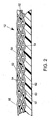
- FIG 2 is a cross-sectional view of a base substrate 12 having a layer of polymeric resin material on its inner surface.
- a base substrate 12 is used where a long nip press belt is to be manufactured.
- the base substrate 12 is woven from lengthwise yarns 52 and crosswise yarns 54 in a multilayer weave. Knuckles 56 appearing on the surface of the base substrate 12 where lengthwise yarns 52 weave over crosswise yarns 54 may be visible on the outer surface 58 of the base substrate 12.
- the inner surface 60 of the base substrate 12 is formed by a polymeric resin coating 62.
- the polymeric resin coating 62 protects the base substrate 12 from sliding contact and the wear by abrasion that would result when the inner surface 60 slides across a lubricated arcuate pressure shoe of a long nip press.
- the polymeric resin also impregnates the base substrate 12 rendering it impermeable to oil and water.
- the polymeric resin coating 62 may be of polyurethane, and is preferably a 100% solids composition thereof to avoid the formation of bubbles during the curing process through which the polymeric resin proceeds following its application onto the base substrate 12. After curing, the polymeric resin coating 62 can be ground and buffed to provide it with a smooth surface and a uniform thickness.
- Figure 3 is a plan view of the base substrate 12 as it would appear upon exit from imaging/repair station 24.
- the outer surface 58 of the base substrate 12 includes a plurality of mold elements 64 of sacrificial material set forth in a predetermined pattern taking the form of an array of discrete locations which are to be the ultimate locations of a corresponding array of discrete holes providing void volume on the surface of the belt being manufactured.
- Figure 4 is a plan view of base substrate 12 as it would appear upon exit from polymer deposition station 36.
- the base substrate 12 may properly be referred to as an intermediate belt product 66, implying that the belt is depicted at an intermediate stage in its manufacture.
- Polymeric resin material 68 covers the base substrate 12 except for the locations occupied by the mold elements 64 of sacrificial material.
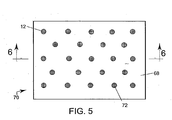
- Figure 5 is a plan view of a completed belt 70 as it would appear upon exit from mold elements removal station and grinding stations.
- the belt 70 includes functional polymeric resin material 68 except at those locations formerly occupied by mold elements 64 of sacrificial material, whose removal leaves the polymeric resin material 68 with a plurality of discrete holes 72 in a predetermined pattern.
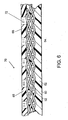
- Figure 6 is a cross-sectional view of a completed belt 70 taken as indicated in Figure 5 .
- polymeric resin material 68 forms a layer of desired thickness over the base substrate 12, except for the areas represented by the discrete holes 72.
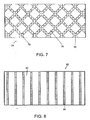
- Figure 7 is a plan view of a belt 74 whose base substrate 12 has a plurality of discrete areas 76 of polymeric resin material in a predetermined array on its outer surface providing the surface of the belt 74 with a plurality of crisscrossing grooves 78.
- Figure 8 is a plan view of a belt 80 having a semicontinuous network of polymeric resin material on its surface.
- the semicontinuous network extends substantially throughout the belt 80 in an essentially linear fashion.
- Each portion 82 of the semicontinuous network extends in a substantially straight line parallel to others making up the network.
- Each portion 82 is of polymeric resin material, and is a land area which with portions 82 adjacent thereto define grooves 84 therebetween.
- the land areas may also have nonparallel walls and avarying cross-section therethrough such as trapezoidal.
- the mold element deposition station 14, the imaging/repair station 24, and the polymer deposition station 36 may be adapted to produce a belt from the base substrate 12 in a spiral technique, rather than by indexing in the cross-machine direction as described above.
- the mold element deposition station 14, the imaging/repair station 24, and the polymer deposition station 36 start at one edge of the base substrate 12, for example, the left-hand edge in, Figure 1 , and are gradually moved across the base substrate 12, was the base substrate 12 moves in the direction indicated in Figure 1 .
- the rates at which the stations 14,24,36 and the base substrate 12 are moved are set so that the pattern desired in the finished belt is spiraled onto the base substrate 12 in a continuous manner.
- the Polymeric resin material deposited by the polymer deposition station 36 may be partially set or fixed as each spiral passes beneath the setting device 44, and completely set when the entire base substrate 12 has been processed through apparatus 10.
- the imaging/repair station 24 and the polymer deposition station 36 may also be kept in a fixed position aligned with the piezojet array 16, while the base substrate 12 moves beneath them, so that the pattern desired in the finished belt is applied to a lengthwise strip around the base substrate 12.
- the piezojet array 16, the imaging/repair station 24. and the polymer deposition station 36 are moved widthwise in an amount equal to the width of the lengthwise strip, and the procedure is repeated for a new lengthwise strip adjacent to that previously completed. In this repetitive manner, the entire base substrate 12 can be completely processed into a belt.
- the entire apparatus can remain in a fixed position with the material processed.
- the material need not be a full width belt but can be a strip of material such as that disclosed in U.S. Patent No. 5,360,656 to Rexfelt subsequently formed into a full width belt.
- the strip can be unwound and wound up on a set of rolls after fully processing. These rolls of belting materials can be stored and can then be used to form an endless full width structure using, for example, the teachings of the immediately aforementioned patent.
- the polymer deposition station 36 comprises a second piezojet array, instead of a bulk-jet array 42.
- a piezojet array is used to deposit polymeric resin onto or within the base substrate 12, except in regions filled with sacrificial material, the choice of polymeric resin material is limited by the requirement that its viscosity be 100 cps (100 centipoise) or less at the time of delivery, that is, when the polymeric resin material is in the nozzle of a piezojet ready for deposition, so that the individual piezojets can provide the polymeric resin material at a constant drop delivery rate.
- Polymeric resin materials which may be applied either by piezojet array or by bulk-jet array include those in the following four classes:
- a piezojet array is capable of supplying the polymeric resin material in the form of extremely small droplets having an average diameter of 10 ⁇ (10 microns) or more, so long as its viscosity is less than 100 cps (100 centipoise) at the time of delivery.
- the piezojet array can deposit the polymeric resin material with great precision one layer at a time, making it unnecessary to grind the surface of the coating formed thereby to achieve a uniform thickness, and enables one of ordinary skill in the art to control the z-direction geometry of the coating.
- the piezojet array can deposit the polymeric resin material with such precision that the surface will be monoplanar without having to be ground or, alternatively, that the surface will have some predetermined three-dimensional structure.
- some of the individual piezojets in the piezojet array may be used to deposit one polymeric resin material, such as a hydrophilic polymeric resin material, while others may be used to deposit a different polymeric resin material, such as a hydrophobic polymeric resin material, to produce a surface having microregions of more than one type of polymeric resin material.
- piezojets are disclosed above as being used to deposit the sacrificial material, and possibly the functional polymeric resin material, in preselected locations on the base substrate, other means for depositing droplets thereof in the size range desired may be known to those of ordinary skill in the art or may be developed in the future, and such other means may be used in the practice of the present invention.
- a relatively large, even a single resin deposition nozzle can comprise the entire jet array.
Applications Claiming Priority (3)
| Application Number | Priority Date | Filing Date | Title |
|---|---|---|---|
| US334210 | 2002-12-31 | ||
| US10/334,210 US7169265B1 (en) | 2002-12-31 | 2002-12-31 | Method for manufacturing resin-impregnated endless belt and a belt for papermaking machines and similar industrial applications |
| PCT/US2003/036473 WO2004061205A1 (en) | 2002-12-31 | 2003-11-13 | Method for manufacturing resin-impregnated endless belt and a belt for papermaking machines and similar industrial applications |
Publications (2)
| Publication Number | Publication Date |
|---|---|
| EP1579058A1 EP1579058A1 (en) | 2005-09-28 |
| EP1579058B1 true EP1579058B1 (en) | 2011-05-25 |
Family
ID=32710868
Family Applications (1)
| Application Number | Title | Priority Date | Filing Date |
|---|---|---|---|
| EP03783499A Expired - Lifetime EP1579058B1 (en) | 2002-12-31 | 2003-11-13 | Method for manufacturing resin-impregnated endless belt for papermaking machines and similar industrial applications |
Country Status (17)
| Country | Link |
|---|---|
| US (1) | US7169265B1 (enExample) |
| EP (1) | EP1579058B1 (enExample) |
| JP (1) | JP4768269B2 (enExample) |
| KR (1) | KR101085515B1 (enExample) |
| CN (1) | CN100532707C (enExample) |
| AT (1) | ATE510958T1 (enExample) |
| AU (1) | AU2003290915C1 (enExample) |
| BR (1) | BRPI0317859B1 (enExample) |
| CA (2) | CA2510601C (enExample) |
| ES (1) | ES2366086T3 (enExample) |
| MX (1) | MXPA05007187A (enExample) |
| NO (1) | NO20053697L (enExample) |
| NZ (1) | NZ540786A (enExample) |
| RU (1) | RU2322541C2 (enExample) |
| TW (1) | TWI309268B (enExample) |
| WO (1) | WO2004061205A1 (enExample) |
| ZA (1) | ZA200504942B (enExample) |
Families Citing this family (18)
| Publication number | Priority date | Publication date | Assignee | Title |
|---|---|---|---|---|
| US7919173B2 (en) * | 2002-12-31 | 2011-04-05 | Albany International Corp. | Method for controlling a functional property of an industrial fabric and industrial fabric |
| US7014735B2 (en) * | 2002-12-31 | 2006-03-21 | Albany International Corp. | Method of fabricating a belt and a belt used to make bulk tissue and towel, and nonwoven articles and fabrics |
| US20060046593A1 (en) * | 2004-08-27 | 2006-03-02 | Jean Senellart | Antistatic transfer belt for nonwovens process |
| DE102006003705A1 (de) * | 2006-01-26 | 2007-08-02 | Voith Patent Gmbh | Transportband |
| CA2751352C (en) | 2008-09-11 | 2017-01-31 | Albany International Corp. | Permeable belt for the manufacture of tissue towel and nonwovens |
| ES2564182T3 (es) | 2008-09-11 | 2016-03-18 | Albany International Corp. | Tela industrial, y método para fabricar la misma |
| US8764943B2 (en) | 2008-12-12 | 2014-07-01 | Albany International Corp. | Industrial fabric including spirally wound material strips with reinforcement |
| US8728280B2 (en) | 2008-12-12 | 2014-05-20 | Albany International Corp. | Industrial fabric including spirally wound material strips with reinforcement |
| MX2011006227A (es) * | 2008-12-12 | 2011-11-29 | Albany Int Corp | Tela industrial que incluye tiras de material enrolladas en espiral. |
| CN102439211B (zh) * | 2009-01-28 | 2016-04-13 | 阿尔巴尼国际公司 | 用于生产非织造布的工业织物及其制造方法 |
| EP2712736B1 (en) | 2012-09-27 | 2016-05-18 | Hewlett-Packard Industrial Printing Ltd. | Method and system for modifying a surface topography |
| CN105939843B (zh) * | 2014-01-30 | 2018-11-16 | 萨克米伊莫拉机械合作社合作公司 | 用于具有结构化表面的陶瓷板的连续压带及带的制造和使用方法 |
| MX381133B (es) | 2014-12-05 | 2025-03-12 | Structured I Llc | Proceso de fabricación de bandas de fabricar papel por el uso de tecnología de impresión 3d. |
| EP3162577B1 (en) * | 2015-10-27 | 2020-08-12 | Agfa Nv | Inkjet printing method for heat sensitive substrates |
| CN113146464A (zh) * | 2016-01-19 | 2021-07-23 | 应用材料公司 | 多孔化学机械抛光垫 |
| MX2020012258A (es) * | 2018-05-15 | 2021-01-29 | Proceso de fabricación de papel de correas sin fin utilizando tecnología de impresión 3d. | |
| DE102018114748A1 (de) | 2018-06-20 | 2019-12-24 | Voith Patent Gmbh | Laminierte Papiermaschinenbespannung |
| FI4223927T3 (fi) | 2022-02-04 | 2024-09-13 | Valmet Technologies Oy | Hihna |
Family Cites Families (94)
| Publication number | Priority date | Publication date | Assignee | Title |
|---|---|---|---|---|
| GB1053282A (enExample) | ||||
| GB885952A (enExample) | 1960-02-23 | |||
| US3149003A (en) | 1960-04-18 | 1964-09-15 | Huyck Corp | Apparatus for treating endless fabrics |
| US3175792A (en) | 1961-09-13 | 1965-03-30 | Smallian Robert James | Wear resistant wire screen |
| GB1008703A (en) | 1963-07-29 | 1965-11-03 | Crompton & Bros James R | Improvements in or relating to a method of manufacturing a fibrous web |
| GB1110793A (en) | 1964-05-29 | 1968-04-24 | Anthony Bramley | Netting and the production thereof |
| GB1136099A (en) * | 1966-01-27 | 1968-12-11 | Ncr Co | Liquid-containing pressure- or heat-sensitive dry sheet material |
| US3549742A (en) | 1967-09-29 | 1970-12-22 | Scott Paper Co | Method of making a foraminous drainage member |
| BE755432A (fr) | 1969-08-29 | 1971-03-01 | Freudenberg Carl Fa | Toiles ou tissus metalliques imprimes |
| US3613258A (en) | 1969-09-15 | 1971-10-19 | Draper Brothers Co | Felt for papermaking machine |
| US3673023A (en) | 1970-06-24 | 1972-06-27 | Grace W R & Co | Process of producing reinforced laminate |
| GB1517712A (en) | 1974-08-20 | 1978-07-12 | Bramley A | Manufacture of netting |
| US4300982A (en) | 1976-01-02 | 1981-11-17 | Albany International Corp. | Wet press felt |
| US4109543A (en) | 1976-05-10 | 1978-08-29 | The Goodyear Tire & Rubber Company | Flexible composite laminate of woven fabric and thermoplastic material and method of making said laminate |
| US4111634A (en) | 1976-09-16 | 1978-09-05 | H. Waterbury & Sons Company | Apparatus for producing papermaker's felt |
| US4187618A (en) | 1978-04-21 | 1980-02-12 | The Orr Felt Company | Papermakers' felt |
| US4251928A (en) | 1978-05-30 | 1981-02-24 | Asten Group Inc. | Metal impregnated dryer fabric |
| FR2448979B1 (fr) | 1979-02-16 | 1986-05-23 | Havas Machines | Dispositif destine a deposer sur un support des gouttes d'encre |
| US4239065A (en) | 1979-03-09 | 1980-12-16 | The Procter & Gamble Company | Papermachine clothing having a surface comprising a bilaterally staggered array of wicker-basket-like cavities |
| US4191609A (en) | 1979-03-09 | 1980-03-04 | The Procter & Gamble Company | Soft absorbent imprinted paper sheet and method of manufacture thereof |
| US4383495A (en) | 1980-06-02 | 1983-05-17 | Western Electric Company, Inc. | Apparatus for coating surfaces of a substrate |
| FR2494318B1 (fr) | 1980-11-14 | 1986-10-10 | Feutres Papeteries Tissus Indl | Bande constituee de spirales |
| US5238537A (en) | 1981-09-15 | 1993-08-24 | Dutt William H | Extended nip press belt having an interwoven base fabric and an impervious impregnant |
| FI75620C (fi) | 1982-04-01 | 1988-07-11 | Tampella Oy Ab | Laongzonspress foer en pappersmaskin. |
| US4427734A (en) | 1982-04-19 | 1984-01-24 | Albany International Corp. | Wet press felt for papermaking machines |
| US4382987A (en) | 1982-07-30 | 1983-05-10 | Huyck Corporation | Papermaker's grooved back felt |
| US4529480A (en) | 1983-08-23 | 1985-07-16 | The Procter & Gamble Company | Tissue paper |
| US4528239A (en) | 1983-08-23 | 1985-07-09 | The Procter & Gamble Company | Deflection member |
| US4637859A (en) | 1983-08-23 | 1987-01-20 | The Procter & Gamble Company | Tissue paper |
| US4514345A (en) * | 1983-08-23 | 1985-04-30 | The Procter & Gamble Company | Method of making a foraminous member |
| US4571798A (en) | 1983-09-19 | 1986-02-25 | Beloit Corporation | Urethane covered paper machine roll |
| US5066532A (en) | 1985-08-05 | 1991-11-19 | Hermann Wangner Gmbh & Co. | Woven multilayer papermaking fabric having increased stability and permeability and method |
| US4752519A (en) | 1986-12-10 | 1988-06-21 | Albany International Corp. | Papermakers felt with a resin matrix surface |
| US5277761A (en) | 1991-06-28 | 1994-01-11 | The Procter & Gamble Company | Cellulosic fibrous structures having at least three regions distinguished by intensive properties |
| US5804036A (en) | 1987-07-10 | 1998-09-08 | The Procter & Gamble Company | Paper structures having at least three regions including decorative indicia comprising low basis weight regions |
| US5240531A (en) | 1988-10-26 | 1993-08-31 | Ricoh Company, Ltd. | Endless belt |
| FI80489C (fi) | 1988-12-08 | 1990-06-11 | Tamfelt Oy Ab | Pappersmaskinduk. |
| DE3909534A1 (de) | 1989-03-22 | 1990-09-27 | Oberdorfer Fa F | Formiersieb fuer die nasspartie einer papiermaschine |
| US4981745A (en) | 1989-05-26 | 1991-01-01 | Lefkowitz Leonard R | Forming fabric for papermaking |
| US5121329A (en) | 1989-10-30 | 1992-06-09 | Stratasys, Inc. | Apparatus and method for creating three-dimensional objects |
| US5136515A (en) | 1989-11-07 | 1992-08-04 | Richard Helinski | Method and means for constructing three-dimensional articles by particle deposition |
| US5059283A (en) * | 1990-04-12 | 1991-10-22 | The Procter & Gamble Company | Process for solvent delivery of chemical compounds to papermaking belts |
| US5679222A (en) | 1990-06-29 | 1997-10-21 | The Procter & Gamble Company | Paper having improved pinhole characteristics and papermaking belt for making the same |
| ES2061261T3 (es) | 1990-06-29 | 1994-12-01 | Procter & Gamble | Cinta transportadora para la fabricacion de papel y metodo para la construccion de la misma usando tecnicas de transmision de luz diferenciales. |
| US5397438A (en) | 1990-07-06 | 1995-03-14 | Valmet Paper Machinery, Inc. | Method and device for reduction and equalization of transverse shrinkage of paper in single-wire draw in a drying section |
| FI92419C (fi) | 1990-11-19 | 1994-11-10 | Valmet Paper Machinery Inc | Menetelmä telan pinnoittamiseksi ja telapinnoite |
| SE468602B (sv) | 1990-12-17 | 1993-02-15 | Albany Int Corp | Pressfilt samt saett att framstaella densamma |
| DE4041403A1 (de) * | 1990-12-21 | 1992-06-25 | Wangner Gmbh Co Kg Hermann | Papiermaschinenbespannung mit randverstaerkung und verfahren zum aufbringen der randverstaerkung |
| US5740051A (en) | 1991-01-25 | 1998-04-14 | Sanders Prototypes, Inc. | 3-D model making |
| US5506607A (en) | 1991-01-25 | 1996-04-09 | Sanders Prototypes Inc. | 3-D model maker |
| US5245025A (en) | 1991-06-28 | 1993-09-14 | The Procter & Gamble Company | Method and apparatus for making cellulosic fibrous structures by selectively obturated drainage and cellulosic fibrous structures produced thereby |
| FI90098C (fi) | 1992-04-14 | 1993-12-27 | Valmet Paper Machinery Inc | Foerfarande vid belaeggningen av en mittvals i pressen av en pappersmaskin och mittvals foer en press i en pappersmaskin |
| US5298124A (en) | 1992-06-11 | 1994-03-29 | Albany International Corp. | Transfer belt in a press nip closed draw transfer |
| HU218422B (hu) * | 1992-08-26 | 2000-08-28 | The Procter & Gamble Co. | Berendezés cellulózalapú rostos szerkezet előállítására és a berendezéssel előállított cellulózalapú rostos szerkezet |
| US5292438A (en) | 1992-08-28 | 1994-03-08 | Cer-Wat, Inc. | Filtration medium including uniformly porous planar substrate and uniformly spaced apart thermoplastic resin |
| FI92734C (fi) | 1993-02-11 | 1994-12-27 | Valmet Paper Machinery Inc | Menetelmä paperikoneen telan pinnoituksessa ja pinnoitettu paperikoneen tela |
| US5422166A (en) | 1993-02-12 | 1995-06-06 | Wangner Systems Corporation | Abrasion resisting edge for a forming fabric |
| US5731059A (en) | 1993-04-07 | 1998-03-24 | Wangner Systems Corporation | Dryer fabric having an abrasion resistant edge |
| US5462642A (en) | 1993-09-16 | 1995-10-31 | Kajander; Richard E. | Method of forming a fibrous mat |
| US5518680A (en) | 1993-10-18 | 1996-05-21 | Massachusetts Institute Of Technology | Tissue regeneration matrices by solid free form fabrication techniques |
| GB9401902D0 (en) | 1994-02-01 | 1994-03-30 | Scape Group Plc | Industrial fabric |
| CA2134594A1 (en) | 1994-04-12 | 1995-10-13 | Kimberly-Clark Worldwide, Inc. | Method for making soft tissue products |
| CA2142805C (en) | 1994-04-12 | 1999-06-01 | Greg Arthur Wendt | Method of making soft tissue products |
| US5556509A (en) | 1994-06-29 | 1996-09-17 | The Procter & Gamble Company | Paper structures having at least three regions including a transition region interconnecting relatively thinner regions disposed at different elevations, and apparatus and process for making the same |
| US5515779A (en) | 1994-10-13 | 1996-05-14 | Huyck Licensco, Inc. | Method for producing and printing on a piece of paper |
| JPH10513104A (ja) | 1995-02-02 | 1998-12-15 | ミネソタ・マイニング・アンド・マニュファクチャリング・カンパニー | 薄膜液状コーティング縞を適用するための方法および装置 |
| US5629052A (en) | 1995-02-15 | 1997-05-13 | The Procter & Gamble Company | Method of applying a curable resin to a substrate for use in papermaking |
| US6203663B1 (en) | 1995-05-05 | 2001-03-20 | Kimberly-Clark Worldwide, Inc. | Decorative formation of tissue |
| SE504975C2 (sv) | 1995-09-08 | 1997-06-02 | Albany Int Corp | Torkvira |
| GB9521299D0 (en) | 1995-10-18 | 1995-12-20 | Scapa Group Plc | Papermakers dryer fabric |
| SE509731C2 (sv) | 1996-05-14 | 1999-03-01 | Labwell Ab | Metod för palladium-katalyserade organiska reaktioner innefattande ett uppvärmningssteg utfört med mikrovågsenergi |
| US5817374A (en) | 1996-05-31 | 1998-10-06 | Electrox Corporation | Process for patterning powders into thick layers |
| AU3670797A (en) | 1996-09-06 | 1998-03-26 | Kimberly-Clark Worldwide, Inc. | Process for producing high-bulk tissue webs using nonwoven substrates |
| DE19651557A1 (de) | 1996-12-11 | 1998-06-18 | Voith Sulzer Papiermasch Gmbh | Preßmantel |
| US5713399A (en) | 1997-02-07 | 1998-02-03 | Albany International Corp. | Ultrasonic seaming of abutting strips for paper machine clothing |
| WO1998042289A1 (en) | 1997-03-21 | 1998-10-01 | Kimberly-Clark Worldwide, Inc. | Dual-zoned absorbent webs |
| US5787602A (en) | 1997-03-31 | 1998-08-04 | Wangner Systems Corporation | Dryer fabric with adhesive tacky surface for web |
| US5936861A (en) | 1997-08-15 | 1999-08-10 | Nanotek Instruments, Inc. | Apparatus and process for producing fiber reinforced composite objects |
| FI103209B2 (fi) | 1998-01-02 | 2005-04-04 | Valmet Corp | Menetelmä puristus- tai siirtohihnan pinnoittamiseksi ja vastaava pinnoitettu hihna |
| SE511736C2 (sv) | 1998-03-20 | 1999-11-15 | Nordiskafilt Ab Albany | Präglingsband för en pappersmaskin |
| US6419795B1 (en) | 1998-04-22 | 2002-07-16 | Albany International Corp. | Resin-impregnated belt having a texturized outer surface for application on papermaking machines |
| US6149849A (en) | 1998-08-14 | 2000-11-21 | The Procter & Gamble Copmany | Process and apparatus for making papermaking belt |
| US6099781A (en) * | 1998-08-14 | 2000-08-08 | The Procter & Gamble Company | Papermaking belt and process and apparatus for making same |
| US6251331B1 (en) | 1998-09-09 | 2001-06-26 | The Procter & Gamble Company | Process and apparatus for making papermaking belt using fluid pressure differential |
| US6136151A (en) | 1998-12-18 | 2000-10-24 | Albany International Corp. | Press belt and press roll cover for papermaking |
| US6344241B1 (en) * | 1999-06-07 | 2002-02-05 | The Procter & Gamble Company | Process and apparatus for making papermaking belt using extrusion |
| US6358594B1 (en) | 1999-06-07 | 2002-03-19 | The Procter & Gamble Company | Papermaking belt |
| US6350336B1 (en) | 1999-06-22 | 2002-02-26 | Albany International Corp. | Method of manufacturing a press fabric by spirally attaching a top laminate layer with a heat-activated adhesive |
| US6117270A (en) | 1999-07-01 | 2000-09-12 | The Procter & Gamble Company | Papermaking belts having a patterned framework with synclines therein and paper made therewith |
| AU776321B2 (en) | 1999-12-29 | 2004-09-02 | Kimberly-Clark Worldwide, Inc. | Decorative wet molding fabric for tissue making |
| US6576090B1 (en) * | 2000-10-24 | 2003-06-10 | The Procter & Gamble Company | Deflection member having suspended portions and process for making same |
| DE60222251T2 (de) | 2001-05-01 | 2008-06-26 | Glatfelter - UK Ltd., Lydney | Verfahren zur herstellung von gemustertem papier |
| JP2003239192A (ja) * | 2002-02-15 | 2003-08-27 | Shizuoka Prefecture | 透き入れ模様付き抄紙網の作製方法、同抄紙網及び同抄紙網の作製装置 |
| GB0227185D0 (en) | 2002-11-21 | 2002-12-24 | Voith Fabrics Heidenheim Gmbh | Nonwoven fabric |
-
2002
- 2002-12-31 US US10/334,210 patent/US7169265B1/en not_active Expired - Lifetime
-
2003
- 2003-11-13 AU AU2003290915A patent/AU2003290915C1/en not_active Ceased
- 2003-11-13 CN CNB200380107847XA patent/CN100532707C/zh not_active Expired - Lifetime
- 2003-11-13 RU RU2005124305A patent/RU2322541C2/ru active
- 2003-11-13 JP JP2004564996A patent/JP4768269B2/ja not_active Expired - Lifetime
- 2003-11-13 ZA ZA200504942A patent/ZA200504942B/en unknown
- 2003-11-13 EP EP03783499A patent/EP1579058B1/en not_active Expired - Lifetime
- 2003-11-13 ES ES03783499T patent/ES2366086T3/es not_active Expired - Lifetime
- 2003-11-13 WO PCT/US2003/036473 patent/WO2004061205A1/en not_active Ceased
- 2003-11-13 MX MXPA05007187A patent/MXPA05007187A/es active IP Right Grant
- 2003-11-13 AT AT03783499T patent/ATE510958T1/de active
- 2003-11-13 CA CA2510601A patent/CA2510601C/en not_active Expired - Lifetime
- 2003-11-13 KR KR1020057012397A patent/KR101085515B1/ko not_active Expired - Fee Related
- 2003-11-13 BR BRPI0317859-5A patent/BRPI0317859B1/pt not_active IP Right Cessation
- 2003-11-13 NZ NZ540786A patent/NZ540786A/en unknown
- 2003-11-13 CA CA2931724A patent/CA2931724A1/en not_active Abandoned
- 2003-11-24 TW TW92132903A patent/TWI309268B/zh not_active IP Right Cessation
-
2005
- 2005-07-29 NO NO20053697A patent/NO20053697L/no not_active Application Discontinuation
Also Published As
| Publication number | Publication date |
|---|---|
| AU2003290915C1 (en) | 2009-05-28 |
| BRPI0317859B1 (pt) | 2015-07-28 |
| US7169265B1 (en) | 2007-01-30 |
| CA2510601A1 (en) | 2004-07-22 |
| EP1579058A1 (en) | 2005-09-28 |
| BR0317859A (pt) | 2005-12-06 |
| ES2366086T3 (es) | 2011-10-17 |
| TWI309268B (en) | 2009-05-01 |
| CA2931724A1 (en) | 2004-07-22 |
| WO2004061205A1 (en) | 2004-07-22 |
| ZA200504942B (en) | 2006-08-30 |
| JP4768269B2 (ja) | 2011-09-07 |
| RU2322541C2 (ru) | 2008-04-20 |
| RU2005124305A (ru) | 2006-01-20 |
| TW200422482A (en) | 2004-11-01 |
| AU2003290915B2 (en) | 2008-11-20 |
| ATE510958T1 (de) | 2011-06-15 |
| MXPA05007187A (es) | 2005-09-12 |
| KR101085515B1 (ko) | 2011-11-23 |
| AU2003290915A1 (en) | 2004-07-29 |
| NZ540786A (en) | 2006-11-30 |
| CN1732304A (zh) | 2006-02-08 |
| NO20053697D0 (no) | 2005-07-29 |
| CN100532707C (zh) | 2009-08-26 |
| NO20053697L (no) | 2005-09-28 |
| CA2510601C (en) | 2016-09-13 |
| JP2006512499A (ja) | 2006-04-13 |
| KR20050091043A (ko) | 2005-09-14 |
Similar Documents
| Publication | Publication Date | Title |
|---|---|---|
| EP1583868B1 (en) | Method for manufacturing resin-impregnated endless belt structures for papermaking and paperprocessing applications | |
| EP1579059B1 (en) | Method of fabrication of a papermaker's fabric | |
| EP1579058B1 (en) | Method for manufacturing resin-impregnated endless belt for papermaking machines and similar industrial applications | |
| EP1633926B1 (en) | Grooved surface belt and method of fabrication |
Legal Events
| Date | Code | Title | Description |
|---|---|---|---|
| PUAI | Public reference made under article 153(3) epc to a published international application that has entered the european phase |
Free format text: ORIGINAL CODE: 0009012 |
|
| 17P | Request for examination filed |
Effective date: 20050718 |
|
| AK | Designated contracting states |
Kind code of ref document: A1 Designated state(s): AT BE BG CH CY CZ DE DK EE ES FI FR GB GR HU IE IT LI LU MC NL PT RO SE SI SK TR |
|
| AX | Request for extension of the european patent |
Extension state: AL LT LV MK |
|
| DAX | Request for extension of the european patent (deleted) | ||
| GRAP | Despatch of communication of intention to grant a patent |
Free format text: ORIGINAL CODE: EPIDOSNIGR1 |
|
| RIC1 | Information provided on ipc code assigned before grant |
Ipc: D21F 1/00 20060101AFI20101124BHEP Ipc: D21F 3/02 20060101ALI20101124BHEP Ipc: B29C 39/18 20060101ALI20101124BHEP |
|
| RTI1 | Title (correction) |
Free format text: METHOD FOR MANUFACTURING RESIN-IMPREGNATED ENDLESS BELT FOR PAPERMAKING MACHINES AND SIMILAR INDUSTRIAL APPLICATIONS |
|
| GRAS | Grant fee paid |
Free format text: ORIGINAL CODE: EPIDOSNIGR3 |
|
| GRAA | (expected) grant |
Free format text: ORIGINAL CODE: 0009210 |
|
| AK | Designated contracting states |
Kind code of ref document: B1 Designated state(s): AT BE BG CH CY CZ DE DK EE ES FI FR GB GR HU IE IT LI LU MC NL PT RO SE SI SK TR |
|
| REG | Reference to a national code |
Ref country code: GB Ref legal event code: FG4D |
|
| REG | Reference to a national code |
Ref country code: CH Ref legal event code: EP |
|
| REG | Reference to a national code |
Ref country code: CH Ref legal event code: NV Representative=s name: BUGNION S.A. |
|
| REG | Reference to a national code |
Ref country code: IE Ref legal event code: FG4D |
|
| REG | Reference to a national code |
Ref country code: DE Ref legal event code: R096 Ref document number: 60337256 Country of ref document: DE Effective date: 20110707 |
|
| REG | Reference to a national code |
Ref country code: NL Ref legal event code: T3 |
|
| REG | Reference to a national code |
Ref country code: SE Ref legal event code: TRGR |
|
| REG | Reference to a national code |
Ref country code: ES Ref legal event code: FG2A Ref document number: 2366086 Country of ref document: ES Kind code of ref document: T3 Effective date: 20111017 |
|
| PG25 | Lapsed in a contracting state [announced via postgrant information from national office to epo] |
Ref country code: PT Free format text: LAPSE BECAUSE OF FAILURE TO SUBMIT A TRANSLATION OF THE DESCRIPTION OR TO PAY THE FEE WITHIN THE PRESCRIBED TIME-LIMIT Effective date: 20110926 |
|
| REG | Reference to a national code |
Ref country code: HU Ref legal event code: AG4A Ref document number: E011623 Country of ref document: HU |
|
| PG25 | Lapsed in a contracting state [announced via postgrant information from national office to epo] |
Ref country code: SI Free format text: LAPSE BECAUSE OF FAILURE TO SUBMIT A TRANSLATION OF THE DESCRIPTION OR TO PAY THE FEE WITHIN THE PRESCRIBED TIME-LIMIT Effective date: 20110525 Ref country code: CY Free format text: LAPSE BECAUSE OF FAILURE TO SUBMIT A TRANSLATION OF THE DESCRIPTION OR TO PAY THE FEE WITHIN THE PRESCRIBED TIME-LIMIT Effective date: 20110525 Ref country code: GR Free format text: LAPSE BECAUSE OF FAILURE TO SUBMIT A TRANSLATION OF THE DESCRIPTION OR TO PAY THE FEE WITHIN THE PRESCRIBED TIME-LIMIT Effective date: 20110826 |
|
| PG25 | Lapsed in a contracting state [announced via postgrant information from national office to epo] |
Ref country code: EE Free format text: LAPSE BECAUSE OF FAILURE TO SUBMIT A TRANSLATION OF THE DESCRIPTION OR TO PAY THE FEE WITHIN THE PRESCRIBED TIME-LIMIT Effective date: 20110525 |
|
| PGFP | Annual fee paid to national office [announced via postgrant information from national office to epo] |
Ref country code: NL Payment date: 20111129 Year of fee payment: 9 |
|
| PG25 | Lapsed in a contracting state [announced via postgrant information from national office to epo] |
Ref country code: RO Free format text: LAPSE BECAUSE OF FAILURE TO SUBMIT A TRANSLATION OF THE DESCRIPTION OR TO PAY THE FEE WITHIN THE PRESCRIBED TIME-LIMIT Effective date: 20110525 Ref country code: DK Free format text: LAPSE BECAUSE OF FAILURE TO SUBMIT A TRANSLATION OF THE DESCRIPTION OR TO PAY THE FEE WITHIN THE PRESCRIBED TIME-LIMIT Effective date: 20110525 Ref country code: SK Free format text: LAPSE BECAUSE OF FAILURE TO SUBMIT A TRANSLATION OF THE DESCRIPTION OR TO PAY THE FEE WITHIN THE PRESCRIBED TIME-LIMIT Effective date: 20110525 |
|
| PLBE | No opposition filed within time limit |
Free format text: ORIGINAL CODE: 0009261 |
|
| STAA | Information on the status of an ep patent application or granted ep patent |
Free format text: STATUS: NO OPPOSITION FILED WITHIN TIME LIMIT |
|
| 26N | No opposition filed |
Effective date: 20120228 |
|
| REG | Reference to a national code |
Ref country code: DE Ref legal event code: R097 Ref document number: 60337256 Country of ref document: DE Effective date: 20120228 |
|
| PG25 | Lapsed in a contracting state [announced via postgrant information from national office to epo] |
Ref country code: MC Free format text: LAPSE BECAUSE OF NON-PAYMENT OF DUE FEES Effective date: 20111130 |
|
| REG | Reference to a national code |
Ref country code: IE Ref legal event code: MM4A |
|
| PG25 | Lapsed in a contracting state [announced via postgrant information from national office to epo] |
Ref country code: IE Free format text: LAPSE BECAUSE OF NON-PAYMENT OF DUE FEES Effective date: 20111113 |
|
| PG25 | Lapsed in a contracting state [announced via postgrant information from national office to epo] |
Ref country code: LU Free format text: LAPSE BECAUSE OF NON-PAYMENT OF DUE FEES Effective date: 20111113 |
|
| REG | Reference to a national code |
Ref country code: NL Ref legal event code: V1 Effective date: 20130601 |
|
| PG25 | Lapsed in a contracting state [announced via postgrant information from national office to epo] |
Ref country code: BG Free format text: LAPSE BECAUSE OF FAILURE TO SUBMIT A TRANSLATION OF THE DESCRIPTION OR TO PAY THE FEE WITHIN THE PRESCRIBED TIME-LIMIT Effective date: 20110825 |
|
| GBPC | Gb: european patent ceased through non-payment of renewal fee |
Effective date: 20121113 |
|
| PG25 | Lapsed in a contracting state [announced via postgrant information from national office to epo] |
Ref country code: NL Free format text: LAPSE BECAUSE OF NON-PAYMENT OF DUE FEES Effective date: 20130601 |
|
| PG25 | Lapsed in a contracting state [announced via postgrant information from national office to epo] |
Ref country code: TR Free format text: LAPSE BECAUSE OF FAILURE TO SUBMIT A TRANSLATION OF THE DESCRIPTION OR TO PAY THE FEE WITHIN THE PRESCRIBED TIME-LIMIT Effective date: 20110525 |
|
| PG25 | Lapsed in a contracting state [announced via postgrant information from national office to epo] |
Ref country code: GB Free format text: LAPSE BECAUSE OF NON-PAYMENT OF DUE FEES Effective date: 20121113 |
|
| PGFP | Annual fee paid to national office [announced via postgrant information from national office to epo] |
Ref country code: CH Payment date: 20131127 Year of fee payment: 11 |
|
| PGFP | Annual fee paid to national office [announced via postgrant information from national office to epo] |
Ref country code: SE Payment date: 20141128 Year of fee payment: 12 Ref country code: ES Payment date: 20141126 Year of fee payment: 12 |
|
| REG | Reference to a national code |
Ref country code: CH Ref legal event code: PL |
|
| PG25 | Lapsed in a contracting state [announced via postgrant information from national office to epo] |
Ref country code: LI Free format text: LAPSE BECAUSE OF NON-PAYMENT OF DUE FEES Effective date: 20141130 Ref country code: CH Free format text: LAPSE BECAUSE OF NON-PAYMENT OF DUE FEES Effective date: 20141130 |
|
| REG | Reference to a national code |
Ref country code: FR Ref legal event code: PLFP Year of fee payment: 13 |
|
| PGFP | Annual fee paid to national office [announced via postgrant information from national office to epo] |
Ref country code: HU Payment date: 20151028 Year of fee payment: 13 Ref country code: CZ Payment date: 20151023 Year of fee payment: 13 |
|
| PG25 | Lapsed in a contracting state [announced via postgrant information from national office to epo] |
Ref country code: SE Free format text: LAPSE BECAUSE OF NON-PAYMENT OF DUE FEES Effective date: 20151114 |
|
| REG | Reference to a national code |
Ref country code: FR Ref legal event code: PLFP Year of fee payment: 14 |
|
| REG | Reference to a national code |
Ref country code: ES Ref legal event code: FD2A Effective date: 20161227 |
|
| PG25 | Lapsed in a contracting state [announced via postgrant information from national office to epo] |
Ref country code: ES Free format text: LAPSE BECAUSE OF NON-PAYMENT OF DUE FEES Effective date: 20151114 |
|
| PG25 | Lapsed in a contracting state [announced via postgrant information from national office to epo] |
Ref country code: CZ Free format text: LAPSE BECAUSE OF NON-PAYMENT OF DUE FEES Effective date: 20161113 |
|
| PG25 | Lapsed in a contracting state [announced via postgrant information from national office to epo] |
Ref country code: HU Free format text: LAPSE BECAUSE OF NON-PAYMENT OF DUE FEES Effective date: 20161114 |
|
| REG | Reference to a national code |
Ref country code: FR Ref legal event code: PLFP Year of fee payment: 15 |
|
| REG | Reference to a national code |
Ref country code: AT Ref legal event code: MM01 Ref document number: 510958 Country of ref document: AT Kind code of ref document: T Effective date: 20191113 |
|
| REG | Reference to a national code |
Ref country code: BE Ref legal event code: MM Effective date: 20191130 |
|
| PG25 | Lapsed in a contracting state [announced via postgrant information from national office to epo] |
Ref country code: AT Free format text: LAPSE BECAUSE OF NON-PAYMENT OF DUE FEES Effective date: 20191113 Ref country code: BE Free format text: LAPSE BECAUSE OF NON-PAYMENT OF DUE FEES Effective date: 20191130 |
|
| PGFP | Annual fee paid to national office [announced via postgrant information from national office to epo] |
Ref country code: DE Payment date: 20211126 Year of fee payment: 19 |
|
| PGFP | Annual fee paid to national office [announced via postgrant information from national office to epo] |
Ref country code: IT Payment date: 20221123 Year of fee payment: 20 Ref country code: FR Payment date: 20221123 Year of fee payment: 20 Ref country code: FI Payment date: 20221125 Year of fee payment: 20 |
|
| REG | Reference to a national code |
Ref country code: DE Ref legal event code: R119 Ref document number: 60337256 Country of ref document: DE |
|
| PG25 | Lapsed in a contracting state [announced via postgrant information from national office to epo] |
Ref country code: DE Free format text: LAPSE BECAUSE OF NON-PAYMENT OF DUE FEES Effective date: 20230601 |