EP1567485B1 - Sels de perfluoroalkyle sulfonamides comme agents complexants - Google Patents
Sels de perfluoroalkyle sulfonamides comme agents complexants Download PDFInfo
- Publication number
- EP1567485B1 EP1567485B1 EP03782554A EP03782554A EP1567485B1 EP 1567485 B1 EP1567485 B1 EP 1567485B1 EP 03782554 A EP03782554 A EP 03782554A EP 03782554 A EP03782554 A EP 03782554A EP 1567485 B1 EP1567485 B1 EP 1567485B1
- Authority
- EP
- European Patent Office
- Prior art keywords
- cation
- compound
- process according
- cations
- recovery
- Prior art date
- Legal status (The legal status is an assumption and is not a legal conclusion. Google has not performed a legal analysis and makes no representation as to the accuracy of the status listed.)
- Expired - Lifetime
Links
- 239000008139 complexing agent Substances 0.000 title claims description 22
- 150000003456 sulfonamides Chemical class 0.000 title abstract description 6
- 150000001768 cations Chemical class 0.000 claims abstract description 67
- 150000001875 compounds Chemical class 0.000 claims abstract description 35
- 238000000034 method Methods 0.000 claims abstract description 29
- 239000007864 aqueous solution Substances 0.000 claims abstract description 12
- 239000002253 acid Substances 0.000 claims abstract description 10
- 238000011084 recovery Methods 0.000 claims description 17
- 239000002585 base Substances 0.000 claims description 11
- 238000000926 separation method Methods 0.000 claims description 10
- 238000001914 filtration Methods 0.000 claims description 8
- 239000002904 solvent Substances 0.000 claims description 8
- VEXZGXHMUGYJMC-UHFFFAOYSA-N Hydrochloric acid Chemical group Cl VEXZGXHMUGYJMC-UHFFFAOYSA-N 0.000 claims description 7
- 238000000605 extraction Methods 0.000 claims description 7
- XLYOFNOQVPJJNP-UHFFFAOYSA-N water Substances O XLYOFNOQVPJJNP-UHFFFAOYSA-N 0.000 claims description 7
- 229910006074 SO2NH2 Inorganic materials 0.000 claims description 6
- 229910052793 cadmium Inorganic materials 0.000 claims description 6
- 229910052804 chromium Inorganic materials 0.000 claims description 6
- 239000011651 chromium Substances 0.000 claims description 6
- VYZAMTAEIAYCRO-UHFFFAOYSA-N Chromium Chemical compound [Cr] VYZAMTAEIAYCRO-UHFFFAOYSA-N 0.000 claims description 5
- BDOSMKKIYDKNTQ-UHFFFAOYSA-N cadmium atom Chemical compound [Cd] BDOSMKKIYDKNTQ-UHFFFAOYSA-N 0.000 claims description 5
- 229910001385 heavy metal Inorganic materials 0.000 claims description 5
- QGZKDVFQNNGYKY-UHFFFAOYSA-O Ammonium Chemical compound [NH4+] QGZKDVFQNNGYKY-UHFFFAOYSA-O 0.000 claims description 4
- RYGMFSIKBFXOCR-UHFFFAOYSA-N Copper Chemical compound [Cu] RYGMFSIKBFXOCR-UHFFFAOYSA-N 0.000 claims description 4
- 229910052783 alkali metal Inorganic materials 0.000 claims description 4
- -1 alkali metal cation Chemical class 0.000 claims description 4
- 125000004432 carbon atom Chemical group C* 0.000 claims description 4
- 229910052802 copper Inorganic materials 0.000 claims description 4
- 239000010949 copper Substances 0.000 claims description 4
- 238000010494 dissociation reaction Methods 0.000 claims description 4
- 230000005593 dissociations Effects 0.000 claims description 4
- 238000005119 centrifugation Methods 0.000 claims description 3
- 229910052751 metal Inorganic materials 0.000 claims description 3
- 239000002184 metal Substances 0.000 claims description 3
- 229910052723 transition metal Inorganic materials 0.000 claims description 3
- 150000003624 transition metals Chemical class 0.000 claims description 3
- 150000001298 alcohols Chemical group 0.000 claims description 2
- 125000001931 aliphatic group Chemical group 0.000 claims description 2
- 150000002170 ethers Chemical class 0.000 claims description 2
- 230000008929 regeneration Effects 0.000 claims description 2
- 238000011069 regeneration method Methods 0.000 claims description 2
- 150000001767 cationic compounds Chemical class 0.000 claims 1
- 229910001411 inorganic cation Inorganic materials 0.000 claims 1
- 125000005010 perfluoroalkyl group Chemical group 0.000 abstract description 9
- 150000003839 salts Chemical class 0.000 abstract description 6
- 229940124530 sulfonamide Drugs 0.000 abstract description 3
- 150000001450 anions Chemical class 0.000 abstract 1
- 239000000243 solution Substances 0.000 description 13
- KQNKJJBFUFKYFX-UHFFFAOYSA-N acetic acid;trihydrate Chemical compound O.O.O.CC(O)=O KQNKJJBFUFKYFX-UHFFFAOYSA-N 0.000 description 12
- 150000002500 ions Chemical class 0.000 description 7
- XEKOWRVHYACXOJ-UHFFFAOYSA-N Ethyl acetate Chemical compound CCOC(C)=O XEKOWRVHYACXOJ-UHFFFAOYSA-N 0.000 description 6
- OKKJLVBELUTLKV-UHFFFAOYSA-N Methanol Chemical compound OC OKKJLVBELUTLKV-UHFFFAOYSA-N 0.000 description 6
- 125000002091 cationic group Chemical group 0.000 description 6
- 238000010668 complexation reaction Methods 0.000 description 6
- 239000002609 medium Substances 0.000 description 6
- 230000000536 complexating effect Effects 0.000 description 5
- RTZKZFJDLAIYFH-UHFFFAOYSA-N Diethyl ether Chemical compound CCOCC RTZKZFJDLAIYFH-UHFFFAOYSA-N 0.000 description 4
- 239000002244 precipitate Substances 0.000 description 4
- 238000001556 precipitation Methods 0.000 description 4
- LFQSCWFLJHTTHZ-UHFFFAOYSA-N Ethanol Chemical compound CCO LFQSCWFLJHTTHZ-UHFFFAOYSA-N 0.000 description 3
- NLTSCOZQKALPGZ-UHFFFAOYSA-N acetic acid;dihydrate Chemical compound O.O.CC(O)=O NLTSCOZQKALPGZ-UHFFFAOYSA-N 0.000 description 3
- 230000015572 biosynthetic process Effects 0.000 description 3
- 238000010790 dilution Methods 0.000 description 3
- 239000012895 dilution Substances 0.000 description 3
- 238000000909 electrodialysis Methods 0.000 description 3
- 239000012528 membrane Substances 0.000 description 3
- 230000007935 neutral effect Effects 0.000 description 3
- 238000003786 synthesis reaction Methods 0.000 description 3
- QGZKDVFQNNGYKY-UHFFFAOYSA-N Ammonia Chemical compound N QGZKDVFQNNGYKY-UHFFFAOYSA-N 0.000 description 2
- 241000894006 Bacteria Species 0.000 description 2
- HEDRZPFGACZZDS-UHFFFAOYSA-N Chloroform Chemical compound ClC(Cl)Cl HEDRZPFGACZZDS-UHFFFAOYSA-N 0.000 description 2
- KDLHZDBZIXYQEI-UHFFFAOYSA-N Palladium Chemical compound [Pd] KDLHZDBZIXYQEI-UHFFFAOYSA-N 0.000 description 2
- QAOWNCQODCNURD-UHFFFAOYSA-N Sulfuric acid Chemical compound OS(O)(=O)=O QAOWNCQODCNURD-UHFFFAOYSA-N 0.000 description 2
- 238000010306 acid treatment Methods 0.000 description 2
- 238000004220 aggregation Methods 0.000 description 2
- 230000002776 aggregation Effects 0.000 description 2
- VTJUKNSKBAOEHE-UHFFFAOYSA-N calixarene Chemical class COC(=O)COC1=C(CC=2C(=C(CC=3C(=C(C4)C=C(C=3)C(C)(C)C)OCC(=O)OC)C=C(C=2)C(C)(C)C)OCC(=O)OC)C=C(C(C)(C)C)C=C1CC1=C(OCC(=O)OC)C4=CC(C(C)(C)C)=C1 VTJUKNSKBAOEHE-UHFFFAOYSA-N 0.000 description 2
- 238000006243 chemical reaction Methods 0.000 description 2
- 239000000706 filtrate Substances 0.000 description 2
- 239000002245 particle Substances 0.000 description 2
- 239000007787 solid Substances 0.000 description 2
- 239000002699 waste material Substances 0.000 description 2
- 239000004677 Nylon Substances 0.000 description 1
- CASAYEMPFVFUQM-UHFFFAOYSA-N O.O.O.O.O.O.Br Chemical compound O.O.O.O.O.O.Br CASAYEMPFVFUQM-UHFFFAOYSA-N 0.000 description 1
- KWYUFKZDYYNOTN-UHFFFAOYSA-M Potassium hydroxide Chemical compound [OH-].[K+] KWYUFKZDYYNOTN-UHFFFAOYSA-M 0.000 description 1
- 150000001340 alkali metals Chemical class 0.000 description 1
- 229910021529 ammonia Inorganic materials 0.000 description 1
- 239000012736 aqueous medium Substances 0.000 description 1
- 239000008346 aqueous phase Substances 0.000 description 1
- 239000002738 chelating agent Substances 0.000 description 1
- 239000003795 chemical substances by application Substances 0.000 description 1
- 229910017052 cobalt Inorganic materials 0.000 description 1
- 239000010941 cobalt Substances 0.000 description 1
- GUTLYIVDDKVIGB-UHFFFAOYSA-N cobalt atom Chemical compound [Co] GUTLYIVDDKVIGB-UHFFFAOYSA-N 0.000 description 1
- 150000003983 crown ethers Chemical class 0.000 description 1
- 239000013078 crystal Substances 0.000 description 1
- 125000004122 cyclic group Chemical group 0.000 description 1
- 230000009089 cytolysis Effects 0.000 description 1
- 230000007423 decrease Effects 0.000 description 1
- 238000000502 dialysis Methods 0.000 description 1
- 239000012153 distilled water Substances 0.000 description 1
- 230000000694 effects Effects 0.000 description 1
- 239000010793 electronic waste Substances 0.000 description 1
- VOAPTKOANCCNFV-UHFFFAOYSA-N hexahydrate;hydrochloride Chemical compound O.O.O.O.O.O.Cl VOAPTKOANCCNFV-UHFFFAOYSA-N 0.000 description 1
- 230000002209 hydrophobic effect Effects 0.000 description 1
- 125000002887 hydroxy group Chemical group [H]O* 0.000 description 1
- 230000001939 inductive effect Effects 0.000 description 1
- 238000001095 inductively coupled plasma mass spectrometry Methods 0.000 description 1
- 229910052500 inorganic mineral Inorganic materials 0.000 description 1
- 230000010354 integration Effects 0.000 description 1
- 230000003993 interaction Effects 0.000 description 1
- 229910052745 lead Inorganic materials 0.000 description 1
- 229910052744 lithium Inorganic materials 0.000 description 1
- 150000002678 macrocyclic compounds Chemical class 0.000 description 1
- 238000004519 manufacturing process Methods 0.000 description 1
- 229910021645 metal ion Inorganic materials 0.000 description 1
- 239000011707 mineral Substances 0.000 description 1
- 235000010755 mineral Nutrition 0.000 description 1
- 239000000203 mixture Substances 0.000 description 1
- 229920001778 nylon Polymers 0.000 description 1
- 238000005457 optimization Methods 0.000 description 1
- 239000012074 organic phase Substances 0.000 description 1
- 239000003960 organic solvent Substances 0.000 description 1
- 229910052763 palladium Inorganic materials 0.000 description 1
- 238000005373 pervaporation Methods 0.000 description 1
- 239000012071 phase Substances 0.000 description 1
- 239000002798 polar solvent Substances 0.000 description 1
- 229940072033 potash Drugs 0.000 description 1
- 229910052700 potassium Inorganic materials 0.000 description 1
- BWHMMNNQKKPAPP-UHFFFAOYSA-L potassium carbonate Substances [K+].[K+].[O-]C([O-])=O BWHMMNNQKKPAPP-UHFFFAOYSA-L 0.000 description 1
- 235000015320 potassium carbonate Nutrition 0.000 description 1
- 238000002360 preparation method Methods 0.000 description 1
- 239000000047 product Substances 0.000 description 1
- 238000000746 purification Methods 0.000 description 1
- 239000012465 retentate Substances 0.000 description 1
- 238000001223 reverse osmosis Methods 0.000 description 1
- 229910052703 rhodium Inorganic materials 0.000 description 1
- 239000010948 rhodium Substances 0.000 description 1
- MHOVAHRLVXNVSD-UHFFFAOYSA-N rhodium atom Chemical compound [Rh] MHOVAHRLVXNVSD-UHFFFAOYSA-N 0.000 description 1
- 238000005204 segregation Methods 0.000 description 1
- 229910052708 sodium Inorganic materials 0.000 description 1
- 238000003756 stirring Methods 0.000 description 1
- 239000000126 substance Substances 0.000 description 1
- 125000000565 sulfonamide group Chemical group 0.000 description 1
- 238000001308 synthesis method Methods 0.000 description 1
- 239000003643 water by type Substances 0.000 description 1
Images
Classifications
-
- C—CHEMISTRY; METALLURGY
- C07—ORGANIC CHEMISTRY
- C07C—ACYCLIC OR CARBOCYCLIC COMPOUNDS
- C07C311/00—Amides of sulfonic acids, i.e. compounds having singly-bound oxygen atoms of sulfo groups replaced by nitrogen atoms, not being part of nitro or nitroso groups
- C07C311/01—Sulfonamides having sulfur atoms of sulfonamide groups bound to acyclic carbon atoms
- C07C311/02—Sulfonamides having sulfur atoms of sulfonamide groups bound to acyclic carbon atoms of an acyclic saturated carbon skeleton
- C07C311/09—Sulfonamides having sulfur atoms of sulfonamide groups bound to acyclic carbon atoms of an acyclic saturated carbon skeleton the carbon skeleton being further substituted by at least two halogen atoms
-
- C—CHEMISTRY; METALLURGY
- C02—TREATMENT OF WATER, WASTE WATER, SEWAGE, OR SLUDGE
- C02F—TREATMENT OF WATER, WASTE WATER, SEWAGE, OR SLUDGE
- C02F1/00—Treatment of water, waste water, or sewage
- C02F1/68—Treatment of water, waste water, or sewage by addition of specified substances, e.g. trace elements, for ameliorating potable water
- C02F1/683—Treatment of water, waste water, or sewage by addition of specified substances, e.g. trace elements, for ameliorating potable water by addition of complex-forming compounds
-
- C—CHEMISTRY; METALLURGY
- C02—TREATMENT OF WATER, WASTE WATER, SEWAGE, OR SLUDGE
- C02F—TREATMENT OF WATER, WASTE WATER, SEWAGE, OR SLUDGE
- C02F1/00—Treatment of water, waste water, or sewage
- C02F1/42—Treatment of water, waste water, or sewage by ion-exchange
- C02F2001/425—Treatment of water, waste water, or sewage by ion-exchange using cation exchangers
-
- C—CHEMISTRY; METALLURGY
- C02—TREATMENT OF WATER, WASTE WATER, SEWAGE, OR SLUDGE
- C02F—TREATMENT OF WATER, WASTE WATER, SEWAGE, OR SLUDGE
- C02F2101/00—Nature of the contaminant
- C02F2101/10—Inorganic compounds
- C02F2101/20—Heavy metals or heavy metal compounds
-
- C—CHEMISTRY; METALLURGY
- C02—TREATMENT OF WATER, WASTE WATER, SEWAGE, OR SLUDGE
- C02F—TREATMENT OF WATER, WASTE WATER, SEWAGE, OR SLUDGE
- C02F2303/00—Specific treatment goals
- C02F2303/16—Regeneration of sorbents, filters
Definitions
- the present invention relates to compounds of formula R f SO 2 NH - Y + wherein R f is a C 7 -C 9 perfluoroalkyl group and Y + a cation, process for their preparation and their use as complexing agents, and a process for recovering polyvalent cations using these complexing agents.
- the cationic separation can be carried out "physically" using membranes or by electrodialysis, membrane electrodialysis, bipolar membrane electrodialysis, ionic dialysis, reverse osmosis, pervaporation, gas permeation.
- electrodialysis membrane electrodialysis
- bipolar membrane electrodialysis ionic dialysis
- reverse osmosis pervaporation
- gas permeation gas permeation
- the cationic separation can also be carried out "chemically" by precipitation of the cations as insoluble salts. This method, of great simplicity of implementation and a relatively high specificity, however, has limited performance by the solubility products of the resulting precipitates.
- Other methods of chemical cationic separation use molecular or resin-supported complexing or chelating agents which allow extraction of cations by extraction with suitable solvents. Illustrative of such complexing molecules, there may be mentioned crown ethers, cryptants, podants, calixarenes. For more information concerning these compounds, we can notably refer to the following works: B. Dietrich, P. Viout, JM.
- the cationic separation can also be carried out by "biological route" as it has been described in particular in the publication T. Sakaguchi, Mr. Iwatsuki, AJINOMOTO. C. O , INC-JP, FR 2639652, 1989 .
- the cations can be consumed selectively by bacteria, the recovery of the cations being carried out after separation of the bacteria from the medium and the lysis thereof.
- this type of process is expensive, relatively difficult to implement and requires specific technical skills in biochemistry.
- these compounds of formula R f SO 2 NH - Y + allow the recovery of a large variety of cations of valence> 1 in aqueous solution, this thanks to a flexible complexation, as opposed to rigid complexations carried out in particular with rigid structures of crown or calixarene ether type. They can thus be assimilated to "polyvalent cation sponges".
- the compounds of formula R f SO 2 NH - Y + form particularly hydrophobic complexes in the presence of polyvalent cations, thanks to the original contribution of the hydrophobicity of the fluorinated groups, thus ensuring good precipitation.
- the compounds of formula R f SO 2 NH - Y + are characterized by a good density (generally close to 2) and hence the complex, which can allow centrifugation.
- the compounds of formula R f SO 2 NH - Y + have a relatively low cost compared to conventional complexing agents, in general 120 € per kg for the complexing agent which is moreover recyclable.
- the present invention therefore aims to provide new high performance complexing agents.
- These compounds are particularly useful for the treatment of water and effluents, and particularly for the extraction of heavy metals such as lead, cadmium, chromium.
- the invention also aims to provide a cationic separation process that is efficient, easy to implement, inexpensive, and generalizable to most polyvalent cations.
- perfluoroalkyl groups comprising less than 7 carbon atoms are soluble in aqueous medium, but do not form an insoluble complex with a polyvalent cation, M n + .
- Perfluoroalkyl groups comprising more than 9 carbon atoms are however insoluble in water.
- any perfluorinated or perhalogenated ⁇ group of the sulphonamide function capable of inducing such properties, namely solubility and stability in neutral aqueous solution on the one hand, complexation of a polyvalent cation in the form of an insoluble complex of on the other hand, is also included in the invention.
- R f represents a linear C 7 -C 9 perfluoroalkyl group.
- Particularly preferred is a group R f comprising 8 carbon atoms.
- the Y + cation is a monovalent cation, preferably inorganic. It is particularly selected from alkali metal cations such as Na + , Li + , K + , and NH 4 + ammonium.
- the compounds according to the invention may advantageously be prepared from sulphonamide compounds of formula R f SO 2 NH 2 , where R f is as defined above.
- the solvent used in this process is chosen from polar solvents, and preferably from alcohols such as methanol or ethanol, ethers and aliphatic esters.
- the base BY is a base whose pKa is greater than 6, more preferably greater than 10.
- the sulphonamide compounds of formula R f SO 2 NH 2 in which R f represents a C 7 -C 9 perfluoroalkyl chain may be prepared according to a synthesis method analogous to that described in the publication Li-Quing Hu and Darryl D. DesMarteau, Inorg. Chem. (1993) 32, 5007-5010 .
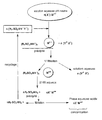
- the attached figure shows schematically and illustratively the general principle of this process.
- a suitable pH for the purposes of the present specification means a pH between pKa of the conjugate acid-base pair R f SO 2 N H 2 / R f SO 2 NH - and the pKb of the torque M n + / MM (OH) n preferably between 6.5 and 7.5, more preferably between 6.8 and 7.2.
- a sufficient amount of compound R f SO 2 NH - + Y means an amount for complexing the desired amount of M n + ions, preferably at least equal to n molar equivalents of polyvalent cations M n + , where n is an integer> 2, preferably in low excess, better still close to 1.5 n equivalents.
- the aqueous solution containing said cations, M n + is not too diluted, the complexation of the ions M n + by the compounds R f SO 2 NH - Y + being more effective than the M ions n + are concentrated.
- the dilution of the solution is not less than 25 ppm, more preferably 50 ppm.
- the insoluble complex is recovered in step (ii) by filtration or centrifugation.
- the dissociation of the insoluble complex of step (iii) is carried out by treatment with an HX acid having a pKa ⁇ 3, more preferably a pKa ⁇ 2.
- the acid used is chosen in particular from hydrochloric acid and sulfuric acid.
- step (iii) The compound R f SO 2 NH 2 obtained after acid treatment at the end of step (iii) being insoluble in water, precipitates and can be advantageously separated from the aqueous solution containing the M n + cations by filtration, in the following manner: step (iv).
- the Cations are recovered in the filtrate in the form n (X - ) M n + and are optionally concentrated.
- the M n + ions are recovered with excellent yields generally greater than 99%, or even 99.9% under optimized conditions.
- the complexing agent R f SO 2 NH - + Y can then be regenerated from R f SO 2 NH 2 thus isolated, according to a subsequent step (v), under the conditions of the process for preparing the compound R f SO 2 NH - + Y supra.
- the complexing agent R f SO 2 NH - + Y can be reused.
- the subject of the invention is the compounds of formula (R f SO 2 NH - ) n M n + , where M + , n and R f are as defined above, and
- M represents a metal selected from lead, cadmium, chromium, copper, rare earths and transition metals.
- the invention also relates to the use of the compounds of formula R f SO 2 NH - + Y as complexing agent of polyvalent cations M n + with n> 1.
- the compounds of formula R f SO 2 NH - Y + may be used in immobilized form on a solid support.
- These compounds are particularly useful for the recovery of polyvalent cations in natural, mineral or thermal waters, in industrial and household effluents, in (neutralized) solutions resulting from waste treatment (recovery of copper or rare earths from electrical waste). or electronic), water purification and effluents (extraction of heavy metals such as Pb, Cd, Cr ).
- 0.1 mol of C 8 H 17 SO 2 NH 2 in solution in 20 ml of methanol or anhydrous ethanol is contacted at 25 ° C. with 0.1 mol of one of the following bases (CH 3 O - + Na, CO 3 - (Na + , Li + , K + , NH 4 + ...), (Na + , Li + , K + ) - OH, NaNH 2 ).
- the solution is then filtered using a 0.4 micron nylon filter, the filtrate is then analyzed by ICPMS (Plasma Source Quadrupole Mass Spectrometer), the results obtained are summarized in the table below.
- the retentate (complex composed of n complexing agent molecules and the metal M n + ) is taken up by an aqueous solution of HCl, which allows the release of the cation in chloride form and the precipitation of the agent in C 8 form. F 17 SO 2 NH 2 .
- the complexing agent can be reused.
- This process makes it possible to efficiently recover the studied cations present in an aqueous solution with a pH of between 6.8 and 7.2.
- this method makes it possible to recover from 80% to 99% of the cations in solution.
Landscapes
- Chemical & Material Sciences (AREA)
- Organic Chemistry (AREA)
- Health & Medical Sciences (AREA)
- Medicinal Chemistry (AREA)
- Life Sciences & Earth Sciences (AREA)
- Hydrology & Water Resources (AREA)
- Engineering & Computer Science (AREA)
- Environmental & Geological Engineering (AREA)
- Water Supply & Treatment (AREA)
- Organic Low-Molecular-Weight Compounds And Preparation Thereof (AREA)
- Pharmaceuticals Containing Other Organic And Inorganic Compounds (AREA)
- Removal Of Specific Substances (AREA)
Description
- La présente invention concerne des composés de formule RfSO2NH-Y+ où Rf représente un groupement perfluoroalkyle en C7-C9 et Y+ un cation, leur procédé de préparation et leur utilisation à titre d'agents complexants ainsi qu'un procédé de récupération de cations polyvalents mettant en oeuvre ces agents complexants.
- Différentes méthodes permettant de réaliser une séparation cationique sont connues à ce jour.
- Ainsi, la séparation cationique peut être réalisée par voie « physique » en utilisant des membranes ou en procédant à une électrodialyse, une électrodialyse avec membrane, une électrodialyse à membrane bipolaire, une dialyse ionique, une osmose inverse, une pervaporation, une perméation gazeuse. Cependant, ces procédés s'appliquent à des cations particuliers et s'avèrent généralement onéreux.
- La séparation cationique peut également être effectuée par «voie chimique », par précipitation des cations sous forme de sels insolubles. Cette méthode, d'une grande simplicité de mise en oeuvre et d'une spécificité relativement élevée, présente, cependant, des performances limitées par les produits de solubilité des précipités qui en résultent. D'autres méthodes de séparation cationique par voie chimique utilisent des complexants ou chélatants moléculaires ou supportés sur résine qui permettent la récupération de cations par extraction avec des solvants adaptés. A titre illustratif de telles molécules complexantes, on peut notamment citer les éthers couronnes, les cryptants, les podants, les calixarènes. Pour plus d'informations concernant ces composés, on pourra notamment se référer aux ouvrages suivants : B. Dietrich, P. Viout, J-M. Lehn, « Aspects de la chimie des composés macrocycliques », Inter Edition du CNRS, Paris, Meudon, 1991, 90-92 . ; P.S. Vankar, V. Tiwari, (FEAT), Indian Institute of Technology, Journal of Analytical Science, 2001 ref 2001-BA006 . Ces complexants spécifiques d'un cation ou d'un type de cation donné sont cependant d'un coût très élevé.
- La séparation cationique peut également être réalisée par « voie biologique » comme il l'a été décrit notamment dans la publication T. Sakaguchi, M. Iwatsuki, AJINOMOTO. C. O, INC-JP,
FR 2639652, 1989 - De façon inattendue, il a été démontré que certains composés de formule RfSO2NH-Y+ où Rf représente un groupement perfluoroalkyle en C7-C9 sont solubles et stables en phase aqueuse neutre et ont la particularité de complexer les cations de type Mn+ (où n est un entier >1 représentant la valence du cation) en solution aqueuse neutre sous forme d'un complexe insoluble, celui-ci résultant de l'agrégation de plusieurs particules de complexes insolubles centrées sur les cations Mn+.
- Ceci permet, avantageusement, la récupération physique des cations après précipitation du complexe insoluble, filtration et traitement acide du solide récupéré, ainsi que leur éventuelle valorisation.
- De façon avantageuse, ces composés de formule RfSO2NH-Y+ permettent la récupération d'une grande variété de cations de valence > 1 en solution aqueuse, ceci grâce à une complexation souple, par opposition aux complexations rigides réalisées notamment avec des structures rigides de type éther couronne ou calixarène. Ils peuvent être ainsi assimilés à des « éponges à cations polyvalents ».
- De plus, les composés de formule RfSO2NH-Y+ forment des complexes particulièrement hydrophobes en présence de cations polyvalents, grâce à l'apport original de l'hydrophobie des groupements fluorés, assurant ainsi une bonne précipitation.
- Avantageusement, les composés de formule RfSO2NH-Y+ se caractérisent par une bonne densité (généralement voisine de 2) et par là, du complexe, pouvant permettre une centrifugation.
- De façon particulièrement avantageuse, on observe une bonne agrégation des particules de complexe, résultant d'interactions par ségrégation de phase et forces faibles des groupements fluorés, permettant la filtration.
- Enfin, les composés de formule RfSO2NH-Y+ ont un coût relativement faible par rapport aux complexants classiques, en général 120 € par kg pour l'agent complexant qui est de plus recyclable.
- La présente invention a donc pour but de proposer de nouveaux agents complexants très performants.
- Ces composés sont notamment utiles pour le traitement des eaux et des effluents, et particulièrement pour l'extraction de métaux lourds comme par exemple le plomb, le cadmium, le chrome.
- L'invention a également pour but de proposer un procédé de séparation cationique performant, facile à mettre en oeuvre, peu coûteux, et généralisable à la plupart des cations polyvalents.
- Ces buts et d'autres peuvent être atteints par la présente invention qui concerne un composé de formule RfSO2NH-+Y, dans laquelle Rf représente un groupement perfluoroalkyle en C7-C9.
- En effet, les groupements perfluoroalkyles comprenant moins de 7 atomes de carbone sont solubles en milieu aqueux, mais ne forment pas de complexe insoluble avec un cation polyvalent, Mn+. Les groupements perfluoroalkyles comprenant plus de 9 atomes de carbone sont en revanche insolubles dans l'eau.
- Bien entendu, tout groupement perfluoré ou perhalogéné en α de la fonction sulfamide susceptible d'induire de telles propriétés, à savoir solubilité et stabilité en solution aqueuse neutre d'une part, complexation d'un cation polyvalent sous forme d'un complexe insoluble d'autre part, est également compris dans l'invention.
- Le terme "perfluoroalkyle en C7-C9" au sens de la présente description désigne un groupement répondant à la formule CnF2n+1 avec n = 7, 8 ou 9, pouvant être linéaire ou ramifié, ou bien cyclique de formule CnF2n-1 avec n = 7, 8 ou 9.
- Plus préférentiellement, Rf représente un groupement perfluoroalkyle en C7-C9 linéaire.
- On préfère tout particulièrement un groupement Rf comprenant 8 atomes de carbones.
- Le cation Y+ est un cation monovalent, de préférence inorganique. Il est particulièrement choisi parmi les cations de métaux alcalins tels que Na+, Li+, K+, et l'ammonium NH4 +.
- Les composés selon l'invention peuvent être avantageusement préparés à partir de composés sulfamides de formule RfSO2NH2, où Rf est tel que défini précédemment.
- Ce procédé comprend les étapes de :
- a1) mise en contact d'un composé RfSO2NH2 avec une base BY dans un solvant ;
- b1) récupération du composé RfSO2NH-+Y.
- Le solvant mis en oeuvre dans ce procédé est choisi parmi les solvants polaires, et préférentiellement parmi les alcools tels que le méthanol ou l'éthanol, les éthers, les esters aliphatiques.
- De préférence, la base BY est une base dont le pKa est supérieur à 6, plus préférentiellement supérieur à 10. A titre illustratif, on peut citer notamment les bases CH3OY, CO3Y2, YOH où Y peut représenter un cation de métal alcalin ou un ammonium.
- Les composés sulfamides de formule RfSO2NH2 où Rf représente une chaîne perfluoro alkyle en C7-C9 peuvent être préparés selon un procédé de synthèse analogue à celui décrit dans la publication Li-Quing Hu and Darryl D. DesMarteau, Inorg. Chem. (1993) 32, 5007-5010.
- L'invention a également pour objet, selon un autre aspect, un procédé de séparation de cations polyvalents Mn+ (n>1) comprenant les étapes de :
- (i) mise en contact d'une solution aqueuse de pH approprié contenant lesdits cations avec une quantité suffisante de composé RfSO2NH-+Y ;
- (ii) récupération du complexe (RfSO2NH-)nMn+, formé en solution aqueuse ;
- (iii) dissociation du complexe par traitement avec un acide HX ;
- (iv) séparation du composé RfSO2NH2 et récupération du cation n(X)Mn+.
- La figure jointe en annexe représente de façon schématique et illustrative le principe général de ce procédé.
- Un pH approprié, au sens de la présente description, signifie un pH compris entre le pKa du couple acide-base conjugué RfSO2NH2 / RfSO2NH- et le pKb du couple Mn+/ MM(OH)n, de préférence entre 6,5 et 7,5, mieux encore entre 6,8 et 7,2.
- En effet, en milieu acide, soit à un pH<pKa, le composé RfSO2NH-Y+ est instable par rapport à sa forme acide conjuguée RfSO2NH2.
- En milieu basique, soit à un pH >pKb, le cation Mn+ est instable comparativement à sa forme hydroxylée M(OH)n: Mn+ + OH- ⇄ M(OH)n.
- Une « quantité suffisante de composé RfSO2NH-+Y » désigne une quantité permettant de complexer la quantité souhaitée d'ions Mn+, de préférence au moins égale à n équivalents molaires de cations polyvalents Mn+, n étant un entier >2, préférentiellement en faible excès, mieux encore proche de 1,5 n équivalents. Selon un mode de réalisation privilégié, la solution aqueuse contenant lesdits cations, Mn+ n'est pas trop diluée, la complexation des ions Mn+ par les composés RfSO2NH-Y+ étant d'autant plus efficace que les ions Mn+ sont concentrés. Avantageusement, la dilution de la solution est non inférieure à 25 ppm, mieux encore à 50 ppm.
- Bien entendu, il est des compétences de l'homme du métier d'ajuster la quantité de composé RfSO2NH-Y+ en fonction de la nature du cation Mn+ à complexer et de la dilution de la solution contenant lesdits cations, de manière à obtenir des conditions de complexation optimales.
- Avantageusement, le complexe insoluble est récupéré dans l'étape (ii) par filtration ou centrifugation.
- De préférence, la dissociation du complexe insoluble de l'étape (iii) est réalisée par traitement avec un acide HX possédant un pKa < 3, plus préférentiellement un pKa < 2.
- L'acide mis en oeuvre est choisi notamment parmi l'acide chlorhydrique et l'acide sulfurique.
- Le composé RfSO2NH2 obtenu après traitement acide à l'issue de l'étape (iii) étant insoluble dans l'eau, précipite et peut être avantageusement séparé de la solution aqueuse contenant les cations Mn+ par filtration, dans l'étape (iv). Les cations sont récupérés dans le filtrat sous la forme n(X-)Mn+ et sont éventuellement concentrés.
- Avantageusement, les ions Mn+ sont récupérés avec d'excellents rendements généralement supérieurs à 99%, voire 99,9% dans des conditions optimisées.
- Avantageusement, le complexant RfSO2NH-+Y peut être ensuite régénéré à partir de RfSO2NH2 ainsi isolé, selon une étape (v) subséquente, dans les conditions du procédé de préparation du composé RfSO2NH-+Y précité.
- De façon particulièrement avantageuse, le complexant RfSO2NH-+Y peut être réutilisé.
- A titre d'exemples de cations polyvalents susceptibles d'être récupérés selon ce procédé, ont peut notamment citer les métaux lourds comme le plomb, le cadmium, le chrome, les cations provenant de déchets électriques ou électroniques comme le cuivre ou les terres rares, des ions métalliques à activité catalytiques comme les métaux de transition tels que le cobalt, le rhodium, le palladium.
- Selon un autre aspect, l'invention a pour objet les composés de formule (RfSO2NH-)n Mn+, où M+, n et Rf ont les définitions précitées, et où
- M représente un métal choisi parmi le plomb, le cadmium, le chrome, le cuivre, les terres rares et les métaux de transition.
- L'invention vise également l'utilisation des composés de formule RfSO2NH-+Y à titre d'agent complexant de cations polyvalents Mn+ avec n>1.
- Entre également dans l'esprit de l'invention l'utilisation de mélanges de composés de formule RfSO2NH-Y+.
- Selon une variante de l'invention, les composés de formule RfSO2NH-Y+ peuvent être utilisés sous forme immobilisée sur un support solide.
- Ces composés sont notamment utiles pour la récupération de cations polyvalents dans les eaux naturelles, minérales ou thermales, dans les effluents industriels et ménagers, dans les solutions (neutralisées) résultant de traitement des déchets (récupération du cuivre ou des terres rares provenant de déchets électriques ou électroniques), épuration des eaux et effluents (extraction des métaux lourds comme le Pb, Cd, Cr ...).
- 0,1 mole de C8F17SO2F (50,1 g) en solution dans un solvant anhydre (acétate d'éthyle, chloroforme, éther....) est soumise à une température de 15-20°C à un courant d'ammoniac préalablement séché sur potasse. L'avancement réactionnel est suivi en RMN 19F par intégration des signaux caractéristiques des CF2 fonctionnels ; CF2SO2F et CF2SO2NH2.
- A la fin de la réaction, le solvant organique est évaporé sous pression réduite, les cristaux obtenus en solution dans 50 mL d'acétate d'éthyle sont lavés par 50 mL d'HCl 10 %. Le solvant de la phase organique qui contient le sulfamide est ensuite évaporé. On récupère 47 g de C8F17SO2NH2 (rendement : 95 %).
- 0,1 mole de C8 H17 SO2 NH2 en solution dans 20 mL de méthanol ou d'éthanol anhydre est mise en contact à 25°C avec 0,1 mole d'une des bases suivantes (CH3O-+Na, CO3 - (Na+,Li+, K+, NH4 +...), (Na+,Li+, K+)-OH, NaNH2).
- Le sel C8 H17 SO2 NH-Y+ de la base correspondante précipite dans le milieu et est récupéré par filtration (rendement quantitatif).
- Les solutions contenant différentes concentrations de sels, indiquées dans le tableau 1, dissous dans de l'eau distillée sont préparées.
- A chacune de ces solutions, on ajoute différentes concentrations de l'agent complexant (C8F17SO2NH-+Na) qui au départ est soluble dans l'eau. Après agitation (environ une minute), on observe un précipité résultant de la complexation du cation présent dans la solution.
- La solution est ensuite filtrée à l'aide d'un filtre nylon de 0,4 micron, le filtrat est ensuite analysé par ICPMS (Spectromètre de masse quadripolaire à source plasma), les résultats obtenus sont résumés dans le tableau ci-dessous. Le rétentat (complexe composé de n molécules d'agent complexant et du métal Mn+) est repris par une solution aqueuse d'HCl, ce qui permet le relargage du cation sous forme de chlorure et la précipitation de l'agent sous forme C8F17SO2NH2. Après filtration l'agent complexant peut être réutilisé.
Tableau 1 de résultats : concentrations en PPM des différents cations avant et après traitement par le complexant. Ref Cation Mn+ Forme du cation RfSO2NH-Y+ / Cation Mn+ Concentration du cation (PPM) Concentration du cation après traitement PPM A UO2++ Acétate dihydrate 3,8 560 22 B Cu++ Acétate dihydrate 2,16 209 0,175 C Cu++ 2,5 195 0,043 D Co++ Bromure hexahydrate 2,6 1160 7,3 E Pb++ Acétate trihydrate 2,3 220 28 F Cd++ Acétate dihydrate 2,2 213 18 G Sr++ Chlorure hexahydrate 2,17 200 28 - Ce procédé permet de récupérer de façon efficace, les cations étudiés présents en solution aqueuse de pH compris entre 6,8 et 7,2.
- Avantageusement, cette méthode permet de récupérer de 80% à 99% des cations en solution.
- Une étude visant à optimiser la quantité de plomb récupérée selon le procédé de l'invention a été réalisée.
Tableau 2 de résultats : concentrations en PPM des cations avant et après traitement par le complexant en fonction du rapport R = concentration en complexant/concentration en cation. Ref Cation Mn+ Forme du cation RfSO2NH - Y +/ Cation Pb2 + Concentration du cation PPM Concentration du cation après traitement PPM 1 Pb++ Acétate trihydrate 1 500 481 2 Pb++ Acétate trihydrate 2 500 187 4 Pb++ Acétate trihydrate 3 500 0,54 5 Pb++ Acétate trihydrate 4 500 2,2 - Ces résultats montrent que le rendement de récupération varie en fonction du rapport de la concentration molaire de l'agent complexant RfSO2NH-Y+ avec celle du cation Pb2+. Ainsi, une quantité sensiblement supérieure à la stoechiométrie, par exemple 1,5 n (réf. 4) ou 2 n (réf. 5), permet la récupération de plus de 99,5% des ions Pb2+ en solution, 1,5 n représentant la quantité de complexant permettant d'atteindre un rendement de récupération optimal de 99,9%.
Tableau 3 de résultats : concentrations en PPM avant et après traitement par le complexant en fonction de la concentration en Pb de départ. Ref Cation Mn+ Forme du cation RfSO2 NH - Y + / Cafion Pb 2+ Concentration du cation PPM Concentration du cation après traitement PPM 4 Pb++ Acétate trihydrate 3 500 0,54 6 Pb++ Acétate trihydrate 3 300 0,19 7 Pb++ Acétate trihydrate 3 200 0,3 8 Pb++ Acétate trihydrate 3 100 0,6 9 Pb++ Acétate trihydrate 3 75 0,28 10 Pb++ Acétate trihydrate 3 50 0,56 11 Pb++ Acétate trihydrate 3 25 3,1 - Les résultats reportés dans le tableau 3 montrent que, pour un rapport [RfSO2NH-Y+ / Pb2+] fixé, le rendement de récupération des ions Pb2+ diminue sensiblement avec la dilution du milieu entre 99,9% et 98,9% pour une concentration variant entre 500 et 50 ppm. Cet effet devient notable pour les concentrations inférieures à 50 ppm, même si à 25 ppm le rendement de 87,5% reste très satisfaisant.
- La récupération des ions Pb2+ selon le procédé de l'invention est donc d'autant plus efficace que le milieu est concentré.
Claims (18)
- Utilisation d'un composé de formule RfSO2NH-+Y, dans laquelle Rf représente un groupement perfluoroalkyle en C7-C9, et Y+ représente un cation inorganique, à titre d'agent complexant de cations polyvalents Mn+ avec n>1.
- Utilisation selon la revendication 1, dans laquelle Rf représente un groupe linéaire.
- Utilisation selon l'une quelconque des revendications 1 ou 2, dans laquelle le groupement Rf comprend 8 atomes de carbone.
- Utilisation selon l'une quelconque des revendications 1 à 3, dans laquelle Y+ représente un cation de métal alcalin ou un ammonium.
- Utilisation selon l'une quelconque des revendications 1 à 4, pour le traitement des eaux et des effluents.
- Utilisation selon l'une quelconque des revendications 1 à 5, caractérisée en ce que les cations polyvalents Mn+ sont choisis parmi les métaux lourds.
- Utilisation selon la revendication 6, dans laquelle les métaux lourds sont le plomb, le cadmium ou le chrome.
- Procédé de récupération de cations polyvalents Mn+ (n>1) comprenant les étapes de :i) mise en contact d'une solution aqueuse de pH approprié contenant lesdits cations avec une quantité suffisante de composé RfSO2NH-+Y tel que défini dans les revendications 1 à 4 ;ii) récupération du complexe (RfSO2NH-)nMn+ formé en solution aqueuse ;iii) dissociation du complexe par traitement avec un acide HX ;iv) séparation du composé RfSO2NH2 et récupération du cation n(X-)Mn+.
- Procédé selon la revendication 8, dans lequel l'étape ii) est une filtration ou une centrifugation.
- Procédé selon l'une quelconque des revendications 8 ou 9, dans lequel l'acide HX possède un pKa < 3.
- Procédé selon la revendication 10, dans lequel l'acide HX est l'acide chlorhydrique.
- Procédé selon l'une quelconque des revendications 8 à 11, dans lequel l'étape iv) consiste en une séparation du composé RfSO2NH2 par filtration ou extraction.
- Procédé selon l'une quelconque des revendications 8 à 12, comprenant une étape v) subséquente de régénération du composé RfSO2NH-+Y à partir de RfSO2NH2 selon le procédé comprenant :a1) la mise en contact d'un composé RfSO2NH2 avec une base BY dans un solvant ;a2) la récupération du composé RfSO2NH2.
- Procédé selon la revendication 13, dans lequel le solvant est polaire.
- Procédé selon la revendication 14, dans lequel le solvant est choisi parmi les alcools, les éthers, les esters aliphatiques.
- Procédé selon l'une quelconque des revendications 13 à 15, dans lequel la base BY possède un pKa supérieur à 6.
- Procédé selon la revendication 16, dans lequel la base BY est choisie parmi CH3OY, CO3Y2, YOH, NH2Y, où Y+ représente un cation de métal alcalin ou un ammonium.
- Composé de formule (RfSO2NH-)n, Mn+,où M+ représente un cation de valence n, n étant un entier supérieur à 1, et Rf est tel que défini dans les revendications 1 à 4, dans lequel M représente un métal choisi parmi le plomb, le cadmium, le chrome, le cuivre, les terres rares et les métaux de transition.
Applications Claiming Priority (3)
| Application Number | Priority Date | Filing Date | Title |
|---|---|---|---|
| FR0214334 | 2002-11-15 | ||
| FR0214334A FR2847252B1 (fr) | 2002-11-15 | 2002-11-15 | Nouveaux agents complexants |
| PCT/FR2003/003368 WO2004046093A1 (fr) | 2002-11-15 | 2003-11-13 | Nouveaux agents complexants |
Publications (2)
| Publication Number | Publication Date |
|---|---|
| EP1567485A1 EP1567485A1 (fr) | 2005-08-31 |
| EP1567485B1 true EP1567485B1 (fr) | 2011-01-19 |
Family
ID=32187646
Family Applications (1)
| Application Number | Title | Priority Date | Filing Date |
|---|---|---|---|
| EP03782554A Expired - Lifetime EP1567485B1 (fr) | 2002-11-15 | 2003-11-13 | Sels de perfluoroalkyle sulfonamides comme agents complexants |
Country Status (6)
| Country | Link |
|---|---|
| EP (1) | EP1567485B1 (fr) |
| AT (1) | ATE496023T1 (fr) |
| AU (1) | AU2003290191A1 (fr) |
| DE (1) | DE60335823D1 (fr) |
| FR (1) | FR2847252B1 (fr) |
| WO (1) | WO2004046093A1 (fr) |
Family Cites Families (2)
| Publication number | Priority date | Publication date | Assignee | Title |
|---|---|---|---|---|
| DE2921142A1 (de) * | 1979-05-25 | 1980-12-11 | Bayer Ag | Verwendung von perfluoralkansulfonamid- salzen als tenside |
| FR2628107B1 (fr) * | 1988-03-02 | 1990-08-17 | Centre Nat Rech Scient | Ethers couronnes fonctionnalises, leur preparation ainsi que leur application en tant qu'agents de complexation d'ions |
-
2002
- 2002-11-15 FR FR0214334A patent/FR2847252B1/fr not_active Expired - Fee Related
-
2003
- 2003-11-13 DE DE60335823T patent/DE60335823D1/de not_active Expired - Lifetime
- 2003-11-13 WO PCT/FR2003/003368 patent/WO2004046093A1/fr not_active Ceased
- 2003-11-13 AT AT03782554T patent/ATE496023T1/de not_active IP Right Cessation
- 2003-11-13 EP EP03782554A patent/EP1567485B1/fr not_active Expired - Lifetime
- 2003-11-13 AU AU2003290191A patent/AU2003290191A1/en not_active Abandoned
Also Published As
| Publication number | Publication date |
|---|---|
| ATE496023T1 (de) | 2011-02-15 |
| AU2003290191A1 (en) | 2004-06-15 |
| AU2003290191A8 (en) | 2004-06-15 |
| DE60335823D1 (de) | 2011-03-03 |
| FR2847252B1 (fr) | 2007-05-11 |
| EP1567485A1 (fr) | 2005-08-31 |
| WO2004046093A1 (fr) | 2004-06-03 |
| FR2847252A1 (fr) | 2004-05-21 |
Similar Documents
| Publication | Publication Date | Title |
|---|---|---|
| Nitta | Enantioselective hydrogenation of (E)-α-phenylcinnamic acid with cinchonidine-modified Pd/TiO2: influence of solvents and additives | |
| FR2538394A1 (fr) | Procede pour la purification de glycosides anthracyclinoniques par adsorption selective sur des resines | |
| CA2870066A1 (fr) | Procede de purification d'acide phosphorique par nanofiltration | |
| EP0759022B1 (fr) | Procede de preparation d'acides carboxyliques ou des esters correspondants en presence d'un catalyseur a base d'iridium et d'iodures sous forme soluble | |
| CN104822652B (zh) | 纯化1,4‑二氨基丁烷的方法、由所述方法纯化的1,4‑二氨基丁烷和由其制备的聚酰胺 | |
| EP1072586B1 (fr) | Purification d'acides alcanesulfoniques | |
| CA2394259A1 (fr) | Procede de preparation de melanges alcools/cetones | |
| CA2726269C (fr) | N-ethylmethylamine de haute purete et son procede de preparation | |
| JP2009102258A (ja) | L−カルニチンの精製方法 | |
| US4731165A (en) | Method of decoloration of triethylenetetramine using sulfonic acid ion exchange resins | |
| Tang et al. | Facile synthesis of positively charged monosubstituted α-and γ-cyclodextrins for chiral resolution of anionic racemates | |
| EP1567485A1 (fr) | Sels de perfluoroalkyle sulfonamides comme agents complexants | |
| FR2543977A1 (fr) | Procede de separation selective et de concentration du gallium ou de l'indium ou des deux, de solutions en contenant a de faibles taux mais contenant des taux eleves d'ions d'autres metaux | |
| CN101679464B (zh) | 从n-(膦酰基甲基)甘氨酸中选择性地除去水和杂质的方法 | |
| JPH0466858B2 (fr) | ||
| JPH05501800A (ja) | グリコール酸の酵素酸化によるグリオキシル酸の製造法 | |
| JP4548756B2 (ja) | アミノ酸アミドの精製法 | |
| EP3996832B1 (fr) | Procede de purification de coenzymes a base adenosine de haut poids moleculaire par dia-filtration tangentielle | |
| CA2036559A1 (fr) | Nouveaux aminophosphine-phosphinites, leur procede de fabrication et leur application a des reactions enantioselectives | |
| JPH11322635A (ja) | 光学活性化合物及び光学分割剤からなる分子化合物の生成方法 | |
| JP3791554B2 (ja) | イミダゾピロロキノリンの製造法 | |
| FR2760016A1 (fr) | Procede de fabrication industrielle de diosmine a partir de l'hesperidine | |
| JPS6365053B2 (fr) | ||
| FR2687143A1 (fr) | Procede d'obtention de l'acide orthohydroxymandelique et de ses sels. | |
| JP3312453B2 (ja) | 光学活性トランス−1,2−ジアミノシクロヘキサン製造法 |
Legal Events
| Date | Code | Title | Description |
|---|---|---|---|
| PUAI | Public reference made under article 153(3) epc to a published international application that has entered the european phase |
Free format text: ORIGINAL CODE: 0009012 |
|
| 17P | Request for examination filed |
Effective date: 20050606 |
|
| AK | Designated contracting states |
Kind code of ref document: A1 Designated state(s): AT BE BG CH CY CZ DE DK EE ES FI FR GB GR HU IE IT LI LU MC NL PT RO SE SI SK TR |
|
| AX | Request for extension of the european patent |
Extension state: AL LT LV MK |
|
| DAX | Request for extension of the european patent (deleted) | ||
| 17Q | First examination report despatched |
Effective date: 20100209 |
|
| GRAP | Despatch of communication of intention to grant a patent |
Free format text: ORIGINAL CODE: EPIDOSNIGR1 |
|
| GRAS | Grant fee paid |
Free format text: ORIGINAL CODE: EPIDOSNIGR3 |
|
| GRAA | (expected) grant |
Free format text: ORIGINAL CODE: 0009210 |
|
| AK | Designated contracting states |
Kind code of ref document: B1 Designated state(s): AT BE BG CH CY CZ DE DK EE ES FI FR GB GR HU IE IT LI LU MC NL PT RO SE SI SK TR |
|
| REG | Reference to a national code |
Ref country code: GB Ref legal event code: FG4D Free format text: NOT ENGLISH |
|
| REG | Reference to a national code |
Ref country code: CH Ref legal event code: EP |
|
| REG | Reference to a national code |
Ref country code: IE Ref legal event code: FG4D Free format text: LANGUAGE OF EP DOCUMENT: FRENCH |
|
| REF | Corresponds to: |
Ref document number: 60335823 Country of ref document: DE Date of ref document: 20110303 Kind code of ref document: P |
|
| REG | Reference to a national code |
Ref country code: DE Ref legal event code: R096 Ref document number: 60335823 Country of ref document: DE Effective date: 20110303 |
|
| REG | Reference to a national code |
Ref country code: NL Ref legal event code: VDEP Effective date: 20110119 |
|
| PG25 | Lapsed in a contracting state [announced via postgrant information from national office to epo] |
Ref country code: ES Free format text: LAPSE BECAUSE OF FAILURE TO SUBMIT A TRANSLATION OF THE DESCRIPTION OR TO PAY THE FEE WITHIN THE PRESCRIBED TIME-LIMIT Effective date: 20110430 Ref country code: SE Free format text: LAPSE BECAUSE OF FAILURE TO SUBMIT A TRANSLATION OF THE DESCRIPTION OR TO PAY THE FEE WITHIN THE PRESCRIBED TIME-LIMIT Effective date: 20110119 Ref country code: PT Free format text: LAPSE BECAUSE OF FAILURE TO SUBMIT A TRANSLATION OF THE DESCRIPTION OR TO PAY THE FEE WITHIN THE PRESCRIBED TIME-LIMIT Effective date: 20110519 Ref country code: GR Free format text: LAPSE BECAUSE OF FAILURE TO SUBMIT A TRANSLATION OF THE DESCRIPTION OR TO PAY THE FEE WITHIN THE PRESCRIBED TIME-LIMIT Effective date: 20110420 |
|
| REG | Reference to a national code |
Ref country code: IE Ref legal event code: FD4D |
|
| PG25 | Lapsed in a contracting state [announced via postgrant information from national office to epo] |
Ref country code: BG Free format text: LAPSE BECAUSE OF FAILURE TO SUBMIT A TRANSLATION OF THE DESCRIPTION OR TO PAY THE FEE WITHIN THE PRESCRIBED TIME-LIMIT Effective date: 20110419 Ref country code: NL Free format text: LAPSE BECAUSE OF FAILURE TO SUBMIT A TRANSLATION OF THE DESCRIPTION OR TO PAY THE FEE WITHIN THE PRESCRIBED TIME-LIMIT Effective date: 20110119 Ref country code: AT Free format text: LAPSE BECAUSE OF FAILURE TO SUBMIT A TRANSLATION OF THE DESCRIPTION OR TO PAY THE FEE WITHIN THE PRESCRIBED TIME-LIMIT Effective date: 20110119 Ref country code: SI Free format text: LAPSE BECAUSE OF FAILURE TO SUBMIT A TRANSLATION OF THE DESCRIPTION OR TO PAY THE FEE WITHIN THE PRESCRIBED TIME-LIMIT Effective date: 20110119 Ref country code: FI Free format text: LAPSE BECAUSE OF FAILURE TO SUBMIT A TRANSLATION OF THE DESCRIPTION OR TO PAY THE FEE WITHIN THE PRESCRIBED TIME-LIMIT Effective date: 20110119 Ref country code: CY Free format text: LAPSE BECAUSE OF FAILURE TO SUBMIT A TRANSLATION OF THE DESCRIPTION OR TO PAY THE FEE WITHIN THE PRESCRIBED TIME-LIMIT Effective date: 20110119 |
|
| PG25 | Lapsed in a contracting state [announced via postgrant information from national office to epo] |
Ref country code: EE Free format text: LAPSE BECAUSE OF FAILURE TO SUBMIT A TRANSLATION OF THE DESCRIPTION OR TO PAY THE FEE WITHIN THE PRESCRIBED TIME-LIMIT Effective date: 20110119 Ref country code: IE Free format text: LAPSE BECAUSE OF FAILURE TO SUBMIT A TRANSLATION OF THE DESCRIPTION OR TO PAY THE FEE WITHIN THE PRESCRIBED TIME-LIMIT Effective date: 20110119 Ref country code: DK Free format text: LAPSE BECAUSE OF FAILURE TO SUBMIT A TRANSLATION OF THE DESCRIPTION OR TO PAY THE FEE WITHIN THE PRESCRIBED TIME-LIMIT Effective date: 20110119 |
|
| PLBE | No opposition filed within time limit |
Free format text: ORIGINAL CODE: 0009261 |
|
| STAA | Information on the status of an ep patent application or granted ep patent |
Free format text: STATUS: NO OPPOSITION FILED WITHIN TIME LIMIT |
|
| PG25 | Lapsed in a contracting state [announced via postgrant information from national office to epo] |
Ref country code: RO Free format text: LAPSE BECAUSE OF FAILURE TO SUBMIT A TRANSLATION OF THE DESCRIPTION OR TO PAY THE FEE WITHIN THE PRESCRIBED TIME-LIMIT Effective date: 20110119 Ref country code: SK Free format text: LAPSE BECAUSE OF FAILURE TO SUBMIT A TRANSLATION OF THE DESCRIPTION OR TO PAY THE FEE WITHIN THE PRESCRIBED TIME-LIMIT Effective date: 20110119 Ref country code: CZ Free format text: LAPSE BECAUSE OF FAILURE TO SUBMIT A TRANSLATION OF THE DESCRIPTION OR TO PAY THE FEE WITHIN THE PRESCRIBED TIME-LIMIT Effective date: 20110119 |
|
| 26N | No opposition filed |
Effective date: 20111020 |
|
| PG25 | Lapsed in a contracting state [announced via postgrant information from national office to epo] |
Ref country code: IT Free format text: LAPSE BECAUSE OF FAILURE TO SUBMIT A TRANSLATION OF THE DESCRIPTION OR TO PAY THE FEE WITHIN THE PRESCRIBED TIME-LIMIT Effective date: 20110119 |
|
| REG | Reference to a national code |
Ref country code: DE Ref legal event code: R097 Ref document number: 60335823 Country of ref document: DE Effective date: 20111020 |
|
| PG25 | Lapsed in a contracting state [announced via postgrant information from national office to epo] |
Ref country code: MC Free format text: LAPSE BECAUSE OF NON-PAYMENT OF DUE FEES Effective date: 20111130 |
|
| REG | Reference to a national code |
Ref country code: CH Ref legal event code: PL |
|
| PG25 | Lapsed in a contracting state [announced via postgrant information from national office to epo] |
Ref country code: CH Free format text: LAPSE BECAUSE OF NON-PAYMENT OF DUE FEES Effective date: 20111130 Ref country code: LI Free format text: LAPSE BECAUSE OF NON-PAYMENT OF DUE FEES Effective date: 20111130 |
|
| REG | Reference to a national code |
Ref country code: AT Ref legal event code: MK05 Ref document number: 496023 Country of ref document: AT Kind code of ref document: T Effective date: 20110119 |
|
| PG25 | Lapsed in a contracting state [announced via postgrant information from national office to epo] |
Ref country code: LU Free format text: LAPSE BECAUSE OF NON-PAYMENT OF DUE FEES Effective date: 20111113 |
|
| PG25 | Lapsed in a contracting state [announced via postgrant information from national office to epo] |
Ref country code: TR Free format text: LAPSE BECAUSE OF FAILURE TO SUBMIT A TRANSLATION OF THE DESCRIPTION OR TO PAY THE FEE WITHIN THE PRESCRIBED TIME-LIMIT Effective date: 20110119 |
|
| PG25 | Lapsed in a contracting state [announced via postgrant information from national office to epo] |
Ref country code: HU Free format text: LAPSE BECAUSE OF FAILURE TO SUBMIT A TRANSLATION OF THE DESCRIPTION OR TO PAY THE FEE WITHIN THE PRESCRIBED TIME-LIMIT Effective date: 20110119 |
|
| REG | Reference to a national code |
Ref country code: FR Ref legal event code: PLFP Year of fee payment: 13 |
|
| REG | Reference to a national code |
Ref country code: FR Ref legal event code: PLFP Year of fee payment: 14 |
|
| REG | Reference to a national code |
Ref country code: FR Ref legal event code: PLFP Year of fee payment: 15 |
|
| PGFP | Annual fee paid to national office [announced via postgrant information from national office to epo] |
Ref country code: DE Payment date: 20181112 Year of fee payment: 16 |
|
| PGFP | Annual fee paid to national office [announced via postgrant information from national office to epo] |
Ref country code: FR Payment date: 20181129 Year of fee payment: 16 Ref country code: GB Payment date: 20181116 Year of fee payment: 16 Ref country code: BE Payment date: 20181126 Year of fee payment: 16 |
|
| REG | Reference to a national code |
Ref country code: DE Ref legal event code: R119 Ref document number: 60335823 Country of ref document: DE |
|
| REG | Reference to a national code |
Ref country code: BE Ref legal event code: MM Effective date: 20191130 |
|
| GBPC | Gb: european patent ceased through non-payment of renewal fee |
Effective date: 20191113 |
|
| PG25 | Lapsed in a contracting state [announced via postgrant information from national office to epo] |
Ref country code: DE Free format text: LAPSE BECAUSE OF NON-PAYMENT OF DUE FEES Effective date: 20200603 Ref country code: GB Free format text: LAPSE BECAUSE OF NON-PAYMENT OF DUE FEES Effective date: 20191113 Ref country code: FR Free format text: LAPSE BECAUSE OF NON-PAYMENT OF DUE FEES Effective date: 20191130 |
|
| PG25 | Lapsed in a contracting state [announced via postgrant information from national office to epo] |
Ref country code: BE Free format text: LAPSE BECAUSE OF NON-PAYMENT OF DUE FEES Effective date: 20191130 |