EP1567455B1 - Biologischer abbau von oxyanionen-wie perchlorat an ionenaustauscherharzen - Google Patents
Biologischer abbau von oxyanionen-wie perchlorat an ionenaustauscherharzen Download PDFInfo
- Publication number
- EP1567455B1 EP1567455B1 EP04777538A EP04777538A EP1567455B1 EP 1567455 B1 EP1567455 B1 EP 1567455B1 EP 04777538 A EP04777538 A EP 04777538A EP 04777538 A EP04777538 A EP 04777538A EP 1567455 B1 EP1567455 B1 EP 1567455B1
- Authority
- EP
- European Patent Office
- Prior art keywords
- perchlorate
- exchange resin
- ion exchange
- loaded
- resin
- Prior art date
- Legal status (The legal status is an assumption and is not a legal conclusion. Google has not performed a legal analysis and makes no representation as to the accuracy of the status listed.)
- Expired - Lifetime
Links
- VLTRZXGMWDSKGL-UHFFFAOYSA-M perchlorate Inorganic materials [O-]Cl(=O)(=O)=O VLTRZXGMWDSKGL-UHFFFAOYSA-M 0.000 title claims abstract description 302
- VLTRZXGMWDSKGL-UHFFFAOYSA-N perchloric acid Chemical compound OCl(=O)(=O)=O VLTRZXGMWDSKGL-UHFFFAOYSA-N 0.000 title claims abstract description 294
- 239000003456 ion exchange resin Substances 0.000 title claims abstract description 97
- 229920003303 ion-exchange polymer Polymers 0.000 title claims abstract description 97
- 238000006065 biodegradation reaction Methods 0.000 title 1
- 239000011347 resin Substances 0.000 claims abstract description 166
- 229920005989 resin Polymers 0.000 claims abstract description 166
- 244000005700 microbiome Species 0.000 claims abstract description 118
- 238000000034 method Methods 0.000 claims abstract description 69
- 239000000047 product Substances 0.000 claims abstract description 68
- 239000003957 anion exchange resin Substances 0.000 claims abstract description 45
- XLYOFNOQVPJJNP-UHFFFAOYSA-N water Substances O XLYOFNOQVPJJNP-UHFFFAOYSA-N 0.000 claims description 91
- 229910001868 water Inorganic materials 0.000 claims description 91
- NWUYHJFMYQTDRP-UHFFFAOYSA-N 1,2-bis(ethenyl)benzene;1-ethenyl-2-ethylbenzene;styrene Chemical compound C=CC1=CC=CC=C1.CCC1=CC=CC=C1C=C.C=CC1=CC=CC=C1C=C NWUYHJFMYQTDRP-UHFFFAOYSA-N 0.000 claims description 89
- 229910002651 NO3 Inorganic materials 0.000 claims description 64
- NHNBFGGVMKEFGY-UHFFFAOYSA-N Nitrate Chemical compound [O-][N+]([O-])=O NHNBFGGVMKEFGY-UHFFFAOYSA-N 0.000 claims description 62
- QAOWNCQODCNURD-UHFFFAOYSA-L Sulfate Chemical compound [O-]S([O-])(=O)=O QAOWNCQODCNURD-UHFFFAOYSA-L 0.000 claims description 58
- 239000012267 brine Substances 0.000 claims description 55
- HPALAKNZSZLMCH-UHFFFAOYSA-M sodium;chloride;hydrate Chemical compound O.[Na+].[Cl-] HPALAKNZSZLMCH-UHFFFAOYSA-M 0.000 claims description 55
- 238000006243 chemical reaction Methods 0.000 claims description 51
- 230000002829 reductive effect Effects 0.000 claims description 49
- 239000012530 fluid Substances 0.000 claims description 44
- 239000000725 suspension Substances 0.000 claims description 20
- 239000007795 chemical reaction product Substances 0.000 claims description 17
- 239000010802 sludge Substances 0.000 claims description 15
- 235000015097 nutrients Nutrition 0.000 claims description 14
- VEXZGXHMUGYJMC-UHFFFAOYSA-M Chloride anion Chemical compound [Cl-] VEXZGXHMUGYJMC-UHFFFAOYSA-M 0.000 claims description 12
- WQYVRQLZKVEZGA-UHFFFAOYSA-N hypochlorite Chemical compound Cl[O-] WQYVRQLZKVEZGA-UHFFFAOYSA-N 0.000 claims description 12
- LFQSCWFLJHTTHZ-UHFFFAOYSA-N Ethanol Chemical compound CCO LFQSCWFLJHTTHZ-UHFFFAOYSA-N 0.000 claims description 11
- 239000007788 liquid Substances 0.000 claims description 10
- 150000003839 salts Chemical class 0.000 claims description 9
- 239000007787 solid Substances 0.000 claims description 9
- 239000000758 substrate Substances 0.000 claims description 8
- 230000001580 bacterial effect Effects 0.000 claims description 7
- 239000012736 aqueous medium Substances 0.000 claims description 6
- 229910001919 chlorite Inorganic materials 0.000 claims description 6
- 229910052619 chlorite group Inorganic materials 0.000 claims description 6
- QBWCMBCROVPCKQ-UHFFFAOYSA-N chlorous acid Chemical compound OCl=O QBWCMBCROVPCKQ-UHFFFAOYSA-N 0.000 claims description 6
- OKTJSMMVPCPJKN-UHFFFAOYSA-N Carbon Chemical compound [C] OKTJSMMVPCPJKN-UHFFFAOYSA-N 0.000 claims description 5
- 238000011109 contamination Methods 0.000 claims description 5
- XTEGARKTQYYJKE-UHFFFAOYSA-M Chlorate Chemical compound [O-]Cl(=O)=O XTEGARKTQYYJKE-UHFFFAOYSA-M 0.000 claims description 4
- QVGXLLKOCUKJST-UHFFFAOYSA-N atomic oxygen Chemical compound [O] QVGXLLKOCUKJST-UHFFFAOYSA-N 0.000 claims description 4
- 239000000356 contaminant Substances 0.000 claims description 4
- 239000001301 oxygen Substances 0.000 claims description 4
- 229910052760 oxygen Inorganic materials 0.000 claims description 4
- 229920000642 polymer Polymers 0.000 claims description 4
- 235000000346 sugar Nutrition 0.000 claims description 4
- 239000002699 waste material Substances 0.000 claims description 4
- 229910052799 carbon Inorganic materials 0.000 claims description 3
- 241001509283 Ideonella Species 0.000 claims description 2
- 230000001172 regenerating effect Effects 0.000 claims description 2
- 239000012228 culture supernatant Substances 0.000 claims 3
- 238000004064 recycling Methods 0.000 claims 3
- 230000001954 sterilising effect Effects 0.000 claims 2
- 241000607598 Vibrio Species 0.000 claims 1
- 238000005349 anion exchange Methods 0.000 claims 1
- AALSLNDNKLOORP-UHFFFAOYSA-N perchloric acid sulfuric acid Chemical compound OS(O)(=O)=O.OCl(=O)(=O)=O AALSLNDNKLOORP-UHFFFAOYSA-N 0.000 claims 1
- 239000012263 liquid product Substances 0.000 abstract description 7
- 239000011248 coating agent Substances 0.000 abstract 1
- 238000000576 coating method Methods 0.000 abstract 1
- 238000012258 culturing Methods 0.000 abstract 1
- 230000008569 process Effects 0.000 description 22
- 238000011069 regeneration method Methods 0.000 description 17
- FAPWRFPIFSIZLT-UHFFFAOYSA-M Sodium chloride Chemical compound [Na+].[Cl-] FAPWRFPIFSIZLT-UHFFFAOYSA-M 0.000 description 16
- 150000002500 ions Chemical class 0.000 description 15
- 238000005342 ion exchange Methods 0.000 description 14
- 239000002245 particle Substances 0.000 description 12
- 230000008929 regeneration Effects 0.000 description 10
- OKKJLVBELUTLKV-UHFFFAOYSA-N Methanol Chemical compound OC OKKJLVBELUTLKV-UHFFFAOYSA-N 0.000 description 9
- 239000011780 sodium chloride Substances 0.000 description 8
- 239000006228 supernatant Substances 0.000 description 8
- 241000894006 Bacteria Species 0.000 description 6
- 239000002028 Biomass Substances 0.000 description 6
- 239000003651 drinking water Substances 0.000 description 6
- 150000001450 anions Chemical group 0.000 description 5
- 235000020188 drinking water Nutrition 0.000 description 5
- 239000000463 material Substances 0.000 description 5
- -1 nitrate anions Chemical class 0.000 description 5
- 238000001179 sorption measurement Methods 0.000 description 5
- IJGRMHOSHXDMSA-UHFFFAOYSA-N Atomic nitrogen Chemical compound N#N IJGRMHOSHXDMSA-UHFFFAOYSA-N 0.000 description 4
- 229920001429 chelating resin Polymers 0.000 description 4
- 230000000694 effects Effects 0.000 description 4
- 239000003673 groundwater Substances 0.000 description 4
- 229920001467 poly(styrenesulfonates) Polymers 0.000 description 4
- 238000000746 purification Methods 0.000 description 4
- MKWYFZFMAMBPQK-UHFFFAOYSA-J sodium feredetate Chemical compound [Na+].[Fe+3].[O-]C(=O)CN(CC([O-])=O)CCN(CC([O-])=O)CC([O-])=O MKWYFZFMAMBPQK-UHFFFAOYSA-J 0.000 description 4
- 239000000243 solution Substances 0.000 description 4
- 241000894007 species Species 0.000 description 4
- 238000012360 testing method Methods 0.000 description 4
- 239000004793 Polystyrene Substances 0.000 description 3
- 238000007792 addition Methods 0.000 description 3
- 230000014759 maintenance of location Effects 0.000 description 3
- 230000000813 microbial effect Effects 0.000 description 3
- 239000000203 mixture Substances 0.000 description 3
- 229920002223 polystyrene Polymers 0.000 description 3
- 230000001737 promoting effect Effects 0.000 description 3
- 229920006395 saturated elastomer Polymers 0.000 description 3
- 238000004062 sedimentation Methods 0.000 description 3
- 230000003068 static effect Effects 0.000 description 3
- GDDNTTHUKVNJRA-UHFFFAOYSA-N 3-bromo-3,3-difluoroprop-1-ene Chemical compound FC(F)(Br)C=C GDDNTTHUKVNJRA-UHFFFAOYSA-N 0.000 description 2
- 229920000178 Acrylic resin Polymers 0.000 description 2
- 239000004925 Acrylic resin Substances 0.000 description 2
- KFZMGEQAYNKOFK-UHFFFAOYSA-N Isopropanol Chemical compound CC(C)O KFZMGEQAYNKOFK-UHFFFAOYSA-N 0.000 description 2
- 239000002253 acid Substances 0.000 description 2
- 238000013019 agitation Methods 0.000 description 2
- 150000001412 amines Chemical group 0.000 description 2
- 125000003277 amino group Chemical group 0.000 description 2
- 238000011021 bench scale process Methods 0.000 description 2
- 230000006378 damage Effects 0.000 description 2
- 230000003203 everyday effect Effects 0.000 description 2
- 238000001914 filtration Methods 0.000 description 2
- 238000011065 in-situ storage Methods 0.000 description 2
- 238000011534 incubation Methods 0.000 description 2
- YWXYYJSYQOXTPL-SLPGGIOYSA-N isosorbide mononitrate Chemical compound [O-][N+](=O)O[C@@H]1CO[C@@H]2[C@@H](O)CO[C@@H]21 YWXYYJSYQOXTPL-SLPGGIOYSA-N 0.000 description 2
- 239000007791 liquid phase Substances 0.000 description 2
- 238000011068 loading method Methods 0.000 description 2
- 238000005259 measurement Methods 0.000 description 2
- 229910052757 nitrogen Inorganic materials 0.000 description 2
- 239000012492 regenerant Substances 0.000 description 2
- 239000010801 sewage sludge Substances 0.000 description 2
- 239000010409 thin film Substances 0.000 description 2
- ZCYVEMRRCGMTRW-UHFFFAOYSA-N 7553-56-2 Chemical compound [I] ZCYVEMRRCGMTRW-UHFFFAOYSA-N 0.000 description 1
- DJHGAFSJWGLOIV-UHFFFAOYSA-K Arsenate3- Chemical compound [O-][As]([O-])([O-])=O DJHGAFSJWGLOIV-UHFFFAOYSA-K 0.000 description 1
- 239000004971 Cross linker Substances 0.000 description 1
- 206010016275 Fear Diseases 0.000 description 1
- 235000015842 Hesperis Nutrition 0.000 description 1
- 102100039384 Huntingtin-associated protein 1 Human genes 0.000 description 1
- 101710140977 Huntingtin-associated protein 1 Proteins 0.000 description 1
- 235000012633 Iberis amara Nutrition 0.000 description 1
- OKIZCWYLBDKLSU-UHFFFAOYSA-M N,N,N-Trimethylmethanaminium chloride Chemical compound [Cl-].C[N+](C)(C)C OKIZCWYLBDKLSU-UHFFFAOYSA-M 0.000 description 1
- 229920002125 Sokalan® Polymers 0.000 description 1
- 150000001298 alcohols Chemical class 0.000 description 1
- 238000013459 approach Methods 0.000 description 1
- 239000007864 aqueous solution Substances 0.000 description 1
- 229940000489 arsenate Drugs 0.000 description 1
- 238000011001 backwashing Methods 0.000 description 1
- 239000012620 biological material Substances 0.000 description 1
- 230000015572 biosynthetic process Effects 0.000 description 1
- 235000012206 bottled water Nutrition 0.000 description 1
- 125000000484 butyl group Chemical group [H]C([*])([H])C([H])([H])C([H])([H])C([H])([H])[H] 0.000 description 1
- 239000006227 byproduct Substances 0.000 description 1
- 238000004364 calculation method Methods 0.000 description 1
- 150000001721 carbon Chemical class 0.000 description 1
- 230000015556 catabolic process Effects 0.000 description 1
- 230000003197 catalytic effect Effects 0.000 description 1
- 238000005119 centrifugation Methods 0.000 description 1
- 239000003795 chemical substances by application Substances 0.000 description 1
- 229910001914 chlorine tetroxide Inorganic materials 0.000 description 1
- 238000010908 decantation Methods 0.000 description 1
- 230000003247 decreasing effect Effects 0.000 description 1
- 238000006731 degradation reaction Methods 0.000 description 1
- 230000000593 degrading effect Effects 0.000 description 1
- 238000001514 detection method Methods 0.000 description 1
- 230000029087 digestion Effects 0.000 description 1
- 238000006073 displacement reaction Methods 0.000 description 1
- 238000005516 engineering process Methods 0.000 description 1
- 239000002360 explosive Substances 0.000 description 1
- 239000010408 film Substances 0.000 description 1
- 239000000446 fuel Substances 0.000 description 1
- 239000007789 gas Substances 0.000 description 1
- 238000007429 general method Methods 0.000 description 1
- 230000008570 general process Effects 0.000 description 1
- 229910001385 heavy metal Inorganic materials 0.000 description 1
- 229910052740 iodine Inorganic materials 0.000 description 1
- 239000011630 iodine Substances 0.000 description 1
- 238000002156 mixing Methods 0.000 description 1
- TVBSSDNEJWXWFP-UHFFFAOYSA-N nitric acid perchloric acid Chemical compound O[N+]([O-])=O.OCl(=O)(=O)=O TVBSSDNEJWXWFP-UHFFFAOYSA-N 0.000 description 1
- NXFQHRVNIOXGAQ-YCRREMRBSA-N nitrofurantoin Chemical compound O1C([N+](=O)[O-])=CC=C1\C=N\N1C(=O)NC(=O)C1 NXFQHRVNIOXGAQ-YCRREMRBSA-N 0.000 description 1
- 235000008935 nutritious Nutrition 0.000 description 1
- 235000019645 odor Nutrition 0.000 description 1
- 239000007800 oxidant agent Substances 0.000 description 1
- 229920002717 polyvinylpyridine Polymers 0.000 description 1
- 230000002035 prolonged effect Effects 0.000 description 1
- 125000001436 propyl group Chemical group [H]C([*])([H])C([H])([H])C([H])([H])[H] 0.000 description 1
- 230000001681 protective effect Effects 0.000 description 1
- 125000001453 quaternary ammonium group Chemical group 0.000 description 1
- 230000001105 regulatory effect Effects 0.000 description 1
- 238000005067 remediation Methods 0.000 description 1
- 238000001223 reverse osmosis Methods 0.000 description 1
- 238000005070 sampling Methods 0.000 description 1
- 238000012216 screening Methods 0.000 description 1
- 239000010865 sewage Substances 0.000 description 1
- 239000002002 slurry Substances 0.000 description 1
- 239000004449 solid propellant Substances 0.000 description 1
- 238000010025 steaming Methods 0.000 description 1
- 238000013517 stratification Methods 0.000 description 1
- 239000000126 substance Substances 0.000 description 1
- 150000008163 sugars Chemical class 0.000 description 1
- 239000002352 surface water Substances 0.000 description 1
- 210000001685 thyroid gland Anatomy 0.000 description 1
- 230000035899 viability Effects 0.000 description 1
- 238000005406 washing Methods 0.000 description 1
- 238000004065 wastewater treatment Methods 0.000 description 1
Images


Classifications
-
- C—CHEMISTRY; METALLURGY
- C02—TREATMENT OF WATER, WASTE WATER, SEWAGE, OR SLUDGE
- C02F—TREATMENT OF WATER, WASTE WATER, SEWAGE, OR SLUDGE
- C02F1/00—Treatment of water, waste water, or sewage
- C02F1/42—Treatment of water, waste water, or sewage by ion-exchange
-
- B—PERFORMING OPERATIONS; TRANSPORTING
- B01—PHYSICAL OR CHEMICAL PROCESSES OR APPARATUS IN GENERAL
- B01J—CHEMICAL OR PHYSICAL PROCESSES, e.g. CATALYSIS OR COLLOID CHEMISTRY; THEIR RELEVANT APPARATUS
- B01J41/00—Anion exchange; Use of material as anion exchangers; Treatment of material for improving the anion exchange properties
- B01J41/04—Processes using organic exchangers
- B01J41/05—Processes using organic exchangers in the strongly basic form
-
- B—PERFORMING OPERATIONS; TRANSPORTING
- B01—PHYSICAL OR CHEMICAL PROCESSES OR APPARATUS IN GENERAL
- B01J—CHEMICAL OR PHYSICAL PROCESSES, e.g. CATALYSIS OR COLLOID CHEMISTRY; THEIR RELEVANT APPARATUS
- B01J49/00—Regeneration or reactivation of ion-exchangers; Apparatus therefor
- B01J49/05—Regeneration or reactivation of ion-exchangers; Apparatus therefor of fixed beds
- B01J49/07—Regeneration or reactivation of ion-exchangers; Apparatus therefor of fixed beds containing anionic exchangers
-
- B—PERFORMING OPERATIONS; TRANSPORTING
- B01—PHYSICAL OR CHEMICAL PROCESSES OR APPARATUS IN GENERAL
- B01J—CHEMICAL OR PHYSICAL PROCESSES, e.g. CATALYSIS OR COLLOID CHEMISTRY; THEIR RELEVANT APPARATUS
- B01J49/00—Regeneration or reactivation of ion-exchangers; Apparatus therefor
- B01J49/50—Regeneration or reactivation of ion-exchangers; Apparatus therefor characterised by the regeneration reagents
- B01J49/57—Regeneration or reactivation of ion-exchangers; Apparatus therefor characterised by the regeneration reagents for anionic exchangers
-
- B—PERFORMING OPERATIONS; TRANSPORTING
- B01—PHYSICAL OR CHEMICAL PROCESSES OR APPARATUS IN GENERAL
- B01J—CHEMICAL OR PHYSICAL PROCESSES, e.g. CATALYSIS OR COLLOID CHEMISTRY; THEIR RELEVANT APPARATUS
- B01J49/00—Regeneration or reactivation of ion-exchangers; Apparatus therefor
- B01J49/60—Cleaning or rinsing ion-exchange beds
-
- C—CHEMISTRY; METALLURGY
- C02—TREATMENT OF WATER, WASTE WATER, SEWAGE, OR SLUDGE
- C02F—TREATMENT OF WATER, WASTE WATER, SEWAGE, OR SLUDGE
- C02F3/00—Biological treatment of water, waste water, or sewage
- C02F3/28—Anaerobic digestion processes
- C02F3/2806—Anaerobic processes using solid supports for microorganisms
-
- C—CHEMISTRY; METALLURGY
- C02—TREATMENT OF WATER, WASTE WATER, SEWAGE, OR SLUDGE
- C02F—TREATMENT OF WATER, WASTE WATER, SEWAGE, OR SLUDGE
- C02F3/00—Biological treatment of water, waste water, or sewage
- C02F3/34—Biological treatment of water, waste water, or sewage characterised by the microorganisms used
- C02F3/348—Biological treatment of water, waste water, or sewage characterised by the microorganisms used characterised by the way or the form in which the microorganisms are added or dosed
-
- C—CHEMISTRY; METALLURGY
- C02—TREATMENT OF WATER, WASTE WATER, SEWAGE, OR SLUDGE
- C02F—TREATMENT OF WATER, WASTE WATER, SEWAGE, OR SLUDGE
- C02F1/00—Treatment of water, waste water, or sewage
- C02F1/28—Treatment of water, waste water, or sewage by sorption
- C02F1/288—Treatment of water, waste water, or sewage by sorption using composite sorbents, e.g. coated, impregnated, multi-layered
-
- C—CHEMISTRY; METALLURGY
- C02—TREATMENT OF WATER, WASTE WATER, SEWAGE, OR SLUDGE
- C02F—TREATMENT OF WATER, WASTE WATER, SEWAGE, OR SLUDGE
- C02F1/00—Treatment of water, waste water, or sewage
- C02F1/42—Treatment of water, waste water, or sewage by ion-exchange
- C02F2001/422—Treatment of water, waste water, or sewage by ion-exchange using anionic exchangers
-
- C—CHEMISTRY; METALLURGY
- C02—TREATMENT OF WATER, WASTE WATER, SEWAGE, OR SLUDGE
- C02F—TREATMENT OF WATER, WASTE WATER, SEWAGE, OR SLUDGE
- C02F3/00—Biological treatment of water, waste water, or sewage
- C02F2003/001—Biological treatment of water, waste water, or sewage using granular carriers or supports for the microorganisms
-
- C—CHEMISTRY; METALLURGY
- C02—TREATMENT OF WATER, WASTE WATER, SEWAGE, OR SLUDGE
- C02F—TREATMENT OF WATER, WASTE WATER, SEWAGE, OR SLUDGE
- C02F2101/00—Nature of the contaminant
- C02F2101/10—Inorganic compounds
- C02F2101/12—Halogens or halogen-containing compounds
-
- C—CHEMISTRY; METALLURGY
- C02—TREATMENT OF WATER, WASTE WATER, SEWAGE, OR SLUDGE
- C02F—TREATMENT OF WATER, WASTE WATER, SEWAGE, OR SLUDGE
- C02F2101/00—Nature of the contaminant
- C02F2101/30—Organic compounds
- C02F2101/36—Organic compounds containing halogen
-
- C—CHEMISTRY; METALLURGY
- C02—TREATMENT OF WATER, WASTE WATER, SEWAGE, OR SLUDGE
- C02F—TREATMENT OF WATER, WASTE WATER, SEWAGE, OR SLUDGE
- C02F2303/00—Specific treatment goals
- C02F2303/16—Regeneration of sorbents, filters
Definitions
- This invention pertains to the field of water treatment and to the use of ion (anion) exchange resins to remove contaminants such as perchlorate ions from aqueous feed stocks ranging from domestic, industrial and agricultural water supplies such as drinking water to brines and other aqueous streams. More particularly, this invention relates to the removal of perchlorate load from perchlorate-loaded resins loaded by use in water treatment so as to permit reuse or safe disposal of the resin.
- Ammonium perchlorate has been used for the past 50 years as an oxidizer component in solid explosives and solid propellants for rockets, missiles and fireworks. It is estimated that well over 90% of the ammonium perchlorate produced in the United States is used in these applications. Casual handling of perchlorates and perchlorate-laden effluents by manufacturers, and the build up of poorly-contained stockpiles of outdated missile and rocket fuels have resulted in perchlorate contamination of surface water and ground water supplies. Perchlorate contamination is a growing problem in at least 14 Western states in the United States and has been reported in Europe as well.
- perchlorate 18 ug/l. This is based upon the potential for perchlorate to inhibit the uptake of iodine by the thyroid gland. Perchlorate levels of up to several hundred ug/l have been found in ground water in California and other states.
- Ion exchange is attractive because perchlorate has a very high affinity for common polystyrene-based strong base anion exchange resins.
- state of the art practice does not provide a practical and convenient method for regeneration of the resin. This is due at least in part to perchlorate's affinity for the common resins being so strong that very large quantities of concentrated sodium chloride brine are required to displace the perchlorate during regeneration.
- Several hundred pounds of sodium chloride regenerant per cubic foot of resin at salt concentrations of from 6% to saturation are typically used.
- the resins can be used once for perchlorate adsorption and then thrown away instead of being regenerated. In both cases, a difficult-to-deal-with perchlorate-loaded end product is formed.
- the loaded resin can not be safely discarded in ordinary land fills and the like because of fears of its perchlorate content reentering the environment. Attempts to bacterially break down the perchlorate content of the concentrated sodium chloride brine have been unsuccessful because the bacteria are generally inactivated by the high salt levels. For example, Tina M. Gingras and Jacimaria R. Batista reported in J. Environ. Monit. (2002), 4 , 96-101, that as little as 0.5% sodium chloride present in a bioremediation environment lowered perchlorate degradation activity by 30% while 1.0% sodium chloride reduced activity by 60%.
- US-A-6066257 discloses a process for the removal of perchlorate and nitrate anions from feed water to provide treated water comprising:
- This invention provides, is a process for removing perchlorate from perchlorate-loaded ion exchange resins without generating large quantities of intractable regeneration products.
- This invention also provides a new form of ion exchange resin which is capable of removing perchlorate ions from solution and directly breaking the perchlorate down to nonperchlorate species in situ.
- This perchlorate-destroying microorganism fluid product can be a suspension of cultured perchlorate-destroying microorganism. It also can be a supernatant obtained from such a suspension.
- this invention provides a method for reducing the level of perchlorate load on perchlorate-loaded ion exchange resin.
- This general method includes the steps of obtaining perchlorate-loaded ion exchange resin, and directly contacting the perchlorate-loaded ion exchange resin with a perchlorate-destroying microorganism fluid product under conditions leading to conversion of the perchlorate load on the resin to nonperchlorate reaction products. These conditions are most commonly referred to as anaerobic conditions.
- the nonperchlorate reaction products include one or more of chlorate, chlorite, hypochlorite and chloride. This gives rise to a treated ion exchange resin having reduced perchlorate load relative to the perchlorate-loaded ion exchange resin.
- This advantageous process can be used in a variety of settings including not only settings in which the treated ion exchange resin is recovered and recycled for reuse but also settings in which the treated ion exchange resin is more safely disposed of by reason of its reduced perchlorate load.
- this invention can be embodied as a method for regenerating perchlorate-loaded ion exchange resin.
- This method involves first obtaining perchlorate-loaded ion exchange resin from a water treatment zone. This is a zone in which the resin is used to remove perchlorate from a perchlorate-contaminated water stream and thus to reduce the perchlorate level in that water stream.
- This perchlorate-loaded resin is then directly contacted with a perchlorate-destroying microorganism fluid product under conditions leading to conversion of perchlorate load on the resin to nonperchlorate reaction products and generation of a treated ion exchange resin having reduced perchlorate load relative to the perchlorate-loaded ion exchange resin. These conditions and reaction products were described earlier.
- the treated resin is recovered and typically, after rinsing and other suitable steps, is recycled to a water treatment zone for further use removing perchlorate from a perchlorate-contaminated water stream.
- this invention can be embodied as a method for safely disposing of perchlorate-loaded ion exchange resin
- This embodiment involves obtaining perchlorate-loaded ion exchange resin, and, prior to disposal, directly contacting the perchlorate-loaded ion exchange resin with a perchlorate-destroying microorganism fluid product under conditions leading to conversion of perchlorate load on the resin to nonperchlorate reaction products and generation of treated ion exchange resin having reduced perchlorate load relative to the perchlorate-loaded ion exchange resin. After the perchlorate level in the resin as been reduced to a safe level, the treated ion exchange resin is disposed of.
- This invention can also be embodied as part of overall processes for treating perchlorate-contaminated water.
- perchlorate-contaminated feed water is obtained and then contacted with an anion exchange resin having an affinity for perchlorate thereby forming a reduced perchlorate content product water and perchlorate-loaded ion exchange resin.
- the perchlorate-loaded ion exchange resin and the reduced perchlorate content product water are separated and the product water is put to use as a water source for domestic, industrial or agricultural applications including use as drinking water.
- the perchlorate-loaded ion exchange resin is then contacted with a perchlorate-destroying microorganism fluid product under conditions leading to conversion of perchlorate load on the resin to nonperchlorate reaction products and generation of treated ion exchange resin having reduced perchlorate load relative to the perchlorate-loaded ion exchange resin.
- the treated ion exchange resin can then be safely disposed of or can be rinsed and returned to use treating perchlorate-contaminated feed water.
- This invention can also provide a process to reduce perchlorate levels in brines.
- the feed water is contacted with a first anion exchange resin having an affinity for perchlorate, nitrate and sulfate thereby removing perchlorate, nitrate and sulfate from the feed water and forming a reduced perchlorate, nitrate and sulfate content product water and a perchlorate, nitrate and sulfate-loaded first ion exchange resin.
- the product water is separated from the perchlorate, nitrate and sulfate-loaded first ion exchange resin.
- the perchlorate, nitrate and sulfate-loaded first ion exchange resin is contacted with brine, under conditions leading to the displacement of the perchlorate, nitrate and sulfate ions off of the resin into the brine.
- the perchlorate, nitrate and sulfate-contaminated spent brine and the regenerated first resin are separated and the resin can be rinsed and reused, if desired.
- the separated spent brine is then contacted with a second anion exchange resin having an affinity and selectivity for perchlorate.
- a second anion exchange resin having an affinity and selectivity for perchlorate. This leads to removal of the perchlorate from the spent brine and formation of a reduced perchlorate content treated spent brine and a perchlorate-loaded second ion exchange resin.
- This reduced perchlorate-content spent brine typically has a low enough perchlorate content to be suitably discharged into a disposal well or brine line.
- the perchlorate-loaded second ion exchange resin is then directly contacted with a perchlorate-destroying microorganism fluid product under conditions leading to conversion of perchlorate load on the resin to nonperchlorate reaction products and generation of treated ion exchange resin having reduced perchlorate load relative to the perchlorate loaded ion exchange resin.
- This second resin can be reused in the manner just described.
- this invention provides equipment and systems for carrying out these methods and processes.
- the invention can be embodied as a system for treating a perchlorate-loaded ion exchange resin to reduce its perchlorate load to the point that it can be recycled and reused or to a point that it can be safely disposed of.
- a system includes a first reaction zone containing a culture comprising a perchlorate-destroying microorganism strain, an aqueous medium, and nutrient for the microorganism strain. This first reaction zone is maintained at conditions promoting the growth of the perchlorate-destroying microorganism strain.
- the system also includes a second reaction zone containing perchlorate-loaded anion exchange resin, means for recovering a perchlorate-destroying microorganism fluid product from the culture in the first reaction zone and means for feeding the recovered perchlorate-destroying microorganism fluid product to the second reaction zone into contact with the perchlorate-loaded anion exchange resin.
- This second reaction zone is operated at conditions under which the perchlorate-destroying microorganism fluid product reacts with the perchlorate load present on the perchlorate-loaded anion exchange resin and converts perchlorate to non perchlorate reaction products thereby producing a reduced perchlorate-load anion exchange resin.
- This system will also include either means for discarding the reduced perchlorate-load resin or means for rinsing and recovering the reduced perchlorate load resin for recycle and reuse.
- the invention can be embodied as a system for reducing the perchlorate content of perchlorate-contaminated water.
- This system includes a first reaction zone containing a culture comprising a perchlorate-destroying microorganism (bacteria) strain, an aqueous substrate and nutrient for the bacterial strain.
- the first reaction zone is maintained at conditions promoting the growth of the perchlorate-destroying microorganism strain and includes a separator or other means for recovering a perchlorate-destroying microorganism fluid product from the culture in the first reaction zone.
- This system also includes a second reaction zone.
- This second zone or vessel contains an anion exchange resin having an affinity for perchlorate present in the perchlorate-contaminated water supply and is equipped with means for feeding the perchlorate-contaminated water to the second reaction zone into contact with the anion exchange resin under conditions permitting the resin to remove perchlorate from the perchlorate-contaminated water.
- a suitable solid/liquid separator is provided to separate the reduced perchlorate content product water from the perchlorate-loaded ion exchange resin. Once the ion exchange resin is loaded with perchlorate it is removed from service.
- the perchlorate-destroying microorganism fluid product recovered from the first reaction zone is conducted into contact with the loaded resin in the second zone at conditions under which the perchlorate-destroying microorganism fluid product reacts with the perchlorate-load present on the perchlorate-loaded anion exchange resin converting perchlorate to nonperchlorate reaction products thereby producing a reduced perchlorate-load anion exchange resin.
- This system additionally includes means for rinsing and otherwise recovering the reduced perchlorate load anion exchange resin for reuse or disposal.
- the invention can also be embodied as a system for purifying water and generating a safely disposable reduced perchlorate-level salt brine side product.
- a first reaction zone containing a culture comprising a perchlorate-destroying microorganism strain, an aqueous substrate, nutrient for the bacterial strain, said first reaction zone maintained at conditions promoting the growth of the perchlorate-destroying microorganism strain.
- the system includes means for recovering a perchlorate-destroying microorganism fluid product from the culture in the first reaction zone.
- Means are provided to feeding the contaminated water to the second reaction zone into contact with the first anion exchange resin under conditions permitting the resin to remove perchlorate, nitrate and sulfate from the contaminated water thereby forming a reduced perchlorate, nitrate and sulfate content product water and perchlorate nitrate and sulfate-loaded ion exchange resin.
- a separator separates the reduced perchlorate, nitrate and sulfate content product water from the perchlorate, nitrate and sulfate-loaded first ion exchange resin.
- the system also includes a third reaction zone containing a second anion exchange resin having enhanced affinity for perchlorate over nitrate and sulfate and means for feeding the perchlorate, nitrate and sulfate-loaded spent brine to said third reaction zone into contact with the second anion exchange resin under conditions permitting the resin to preferentially remove perchlorate from the contaminated spent brine thereby forming a reduced perchlorate content spent brine which can be safely passed to disposal and perchlorate-loaded second ion exchange resin.
- the perchlorate-loaded second resin is isolated and contacted with the perchlorate-destroying microorganism fluid product recovered from the first reaction zone.
- This contacting is at conditions under which the perchlorate-destroying microorganism fluid product reacts with the perchlorate-load present on the perchlorate-loaded anion exchange resin converting perchlorate to nonperchlorate species and thereby producing a reduced perchlorate-load anion exchange resin.
- This resin may be discarded or preferably recovered and reused.
- this invention provides a new form of ion exchange resin particularly designed to remove perchlorate contaminant.
- This resin product comprises a solid, particulate, porous polymer structure carrying chemical moieties capable of associating with an anion such as chloride and capable of exchanging that anion for perchlorate.
- the particulate porous structure additionally has a film of perchlorate-destroying microorganisms adsorbed onto its surface.
- the present invention relates to the use of microorganisms to break down perchlorate load on anion exchange resins.
- the invention is depicted in a number of different process settings with a variety of feedstocks. Accordingly, this description of preferred embodiments will be broken down into the following sections:
- the ion exchange resins which are loaded with perchlorate and treated in accord with the invention are generally classed as strong base resins.
- resins are based on various polymer structures such as polystyrene with cross-linkers and with appropriate active groups such as quaternary ammoniums attached.
- Representative resins include:
- ion exchange resins which are applicable to the invention are strong acid or weak base type resins such as:
- the strong base type I resins particularly those based on polystyrene backbones, give good overall results removing perchlorate and are preferred.
- Sybron SR6 resin This is a resin having quaternary amine functionalities and three butyl groups in these quaternary amine groups.
- Sybron SR7 resin gives similarly excellent results.
- This is a similar quaternary amine-based resin but with three propyl groups in its quaternary amine groups.
- the SR7 resin has been observed to have a particularly high selectivity for perchlorate ions.
- This invention employs a perchlorate-reducing microorganism or, more typically, a mixture of two or more such organisms.
- Representative microorganism-containing compositions include the mixed bacterial cultures present in classic municipal sludge (see USP 3,755,156 (1973)); in activated sludge (see GR-1 in Rikken, G.B, et al. Appl. Microbial. Biotechnol. (1996) 45:420); and the BAU culture taken from Clark County, Nevada waste water treatment plants (see Gingras, T.M, et al. J. Environ. Monit.
- microorganism sources include pathogen-free sludge, brewery sludge, mixed cultures and the like. In general any microorganism that can break down perchlorate can be suitable for use in this process.
- microorganisms are suitably cultured (grown out) in an aqueous medium in the presence of suitable nutrients such as sugars, lower alcohols, (e.g. methanol, ethanol, isopropanol, carbon sources and the like.
- suitable nutrients such as sugars, lower alcohols, (e.g. methanol, ethanol, isopropanol, carbon sources and the like.
- the culture can be in the form of a suspension of microorganisms in the aqueous medium.
- the actual material that contacts the loaded resin particles is most commonly a fluid product which is defined herein to be either a suspension of the organisms in the aqueous medium or a relatively microorganism-free liquid phase separated from the suspension such as be decantation, centrifugation, filtration, screening, or the like. This latter fluid product is referred to herein as a microorganism culture "supernatant".
- This invention provides a new resin product useful in the removal of perchlorate from aqueous feedstocks. It is a combination of ion exchange resin and biological materials. The material is prepared in the following steps:
- the product consists of ion exchange resin particles with a thin film of perchlorate-destroying microorganisms fixed to the surface of the ion exchange particles.
- This new form of resin can be used to remove perchlorate from perchlorate-containing aqueous feedstreams in a single step in which the perchlorate present in the feedstream is adsorbed onto the exchange sites on the resin particles. Once there the perchlorate is converted to nonperchlorate species by the microorganisms affixed to the surface of the resin particles.
- the resins that are treated with the perchlorate-destroying microorganism are resins which have become partially or relatively completely loaded with perchlorate ion relative to their perchlorate-adsorbing capacity. In most settings, it is desirable to remove perchlorate quite completely. Often as a resin becomes partially exhausted on an absolute scale its performance drops off slightly. This can be signal to consider to consider it "exhausted” and to remove it from service. This can occur when as few as 30 or 40% of the total available capacity has been used up. This phenomenon will be seen in the present examples where resins were deemed suitable for regeneration when about 40-45% of their total capacity was exhausted. These resins can become loaded in service in an ion exchange-based water purification unit.
- water purification is used in a broad sense to include the purification of not only ground water, surface run off, water found in bodies of water, streams, rivers and the like drinking water source but also to include commercial, industrial and agricultural water sources such as plant effluents, agrarian run offs, sewage and the like.
- the water being purified must contain an unacceptably high level of perchlorate ion. That is a level of perchlorate ion greater than a few parts per billion.
- This feed water can contain up to as many as many part per million of perchlorate and in some industrial settings can contain tens or even up to 100 parts per million of perchlorate. It will be appreciated that the invention would work with resins loaded by treating water with even higher perchlorate contents. In all of these settings, it is very likely, if not the rule, that there will be other anions which will be picked up by the ion exchange resin.
- ions such as sulfate and nitrate, while not as troublesome as perchlorate, are not particularly desirable in drinking water so their exchange onto the resin is generally welcomed.
- These ions are typically present at levels considerably higher, often by factors of a thousand or more, than perchlorate.
- a representative feed water of this type could contain from about 10 to 250 ppb of perchlorate, and 1 to 100 ppm of nitrate and/or sulfate.
- ions such as heavy metal-based anions for example arsenate are also regularly removed from the feed water when it is contacted with the resin.
- a loaded resin bed may be substantially loaded with perchlorate ions in some cases and in others may have secondary ions as its predominant load.
- the feedstock streams subjected to purification by contact with the resin are themselves formed in an ion exchange process and are, for example, the rinse water and the contaminated aqueous brines generated during regeneration of ion exchange resins.
- perchlorate is one of the most readily adsorbed ions and can displace other species such as nitrate and sulfate
- the ion exchange resin is commonly sent to regeneration or disposal once it is loaded with perchlorate and other ions exchanged out of the feed stream.
- Fig. 1 shows a representative apparatus for contacting the resin with the microorganisms.
- Perchlorate-loaded resin 8 is charged to vessel 10 or is formed in vessel 10 by initially charging fresh resin to the vessel and loading it with perchlorate by passing perchlorate-laden untreated water over it via line 4.
- the resin will adsorb the perchlorate in exchange for a nonperchlorate ion (usually chloride) and yield perchlorate-free treated water which can be removed via line 6.
- This loading is exactly what happens when the resin is in service purifying water.
- a suspension of microorganisms; methanol, ethanol or other nutrients; suitable microorganism-growth salts and an aqueous substrate are charged to vessel 12 via line 14 and agitated to assist gas release and to prevent stratification.
- the biomixture is fed through line 16 to vessel 10 where it reacts with the perchlorate present in resin 8.
- the two reactors are maintained under anaerobic conditions by use of nitrogen caps or the like.
- biomass is generated that is carried off from vessel 10 via line 18 back to vessel 12 or to waste via line 22. This biomass in vessel 12 forms a sludge which is removed via line 20.
- the resin can be washed, cocurrent or countercurrent, with water supplied, for example, via line 24.
- the biomass and microorganisms can be removed with the used wash water via line 26-26' or recycled via line 28. This washing generally removes microorganisms from the resin. Additional clean-up steps such as steaming, acid rinsing, hot water treatment and the like can be applied to the treated resin, either in place (in vessel 10) or in other process equipment not shown.
- Fig. 2 shows a variation on the general process depicted in Fig 1. The same numbers will be applied to the same equipment, when applicable.
- Fig 2 depicts system 200 in which the perchlorate-destroying microorganisms are cultured in a two stage reactor/separator. A suspension of one or more microorganisms, methanol or other lower alcohol or sugar microorganism nutrient, suitable microorganism-growth salts and an aqueous substrate are again added via line 14 to vessel 12, equipped with agitator 30.
- a suspension of microorganisms is passed via line 32 to separator/settler 34 which is equipped with agitator 36 to assist in the settling of the solids and achievement of a substantially solids-free supernatant microorganism culture liquid product.
- This solids-free liquid is drawn off and transferred via line 16 to vessel 10 which contains a bed 8 of perchlorate-loaded ion exchange resin.
- System 200 provides line 18, through which the solids-free liquid can be returned to settler/separator 34 after passing over the resin bed.
- Overflow line 26/28 provides a route by which wash water can be taken off of the resin bed and passed to vessel 34.
- Sludge and other biomass can be removed from settler 34 via line 20 and optionally recycled to bioreactor 12 via line 40. Usually, at least a portion of the biomass and sludge is removed vi line 20.
- Supernatant, separated in settler 34 can also be recycled to bioreactor 12 via line 42 for refreshment.
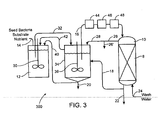
- System 300 is identical to system 200, just described, except that it includes three optional additions incorporated into line 16 to modify or treat the cultured microorganism liquid product being passed via line 16 into contact with the perchlorate-loaded resin present in bed 8. These optional additions include a filter 44.
- Filter 44 is a filter designed to retain solids present in the liquid. This is nominally a 15 micron to 100 micron particle retention filter and more typically a 20 to 50 micron particle retention filter. We have used a nominal 25 micron particle retention filter in our work and find it to provide good results. Filter 44 can be used to reduce the microorganism particles as well as any particulate sludge or biomass. This may be important if the product water is to be potable water.
- System 300 also optionally contains ion exchanger 46.
- This is an in-line ion exchanger filled with a perchlorate-selective ion exchange resin. It is generally desired to reduce the level of perchlorate on the resin in bed 8 to as low a level as possible. It is to be understood that the perchlorate ions adsorbed onto resin 8 are to a modest extent in an equilibrium with nonsorbed ions such that as liquid is flowing over the resin in bed 8, some small, but detectable, amounts of perchlorate dissociate from the resin and enter the liquid flowing past.
- This ion exchanger 46 with its perchlorate-selective resin, eliminates the chance that this desorbed perchlorate is readsorbed onto the resin in bed 8.
- System 300 can also include a bed of activated carbon in in-line filter 48 This carbon bed can remove odors and prevent their build up it also may provide a nutritious environment for any microorganisms circulating in the liquid.
- Fig. 4 shows system 400.
- System 400 resembles system 200 with one addition. It includes ion exchange vessel 50 loaded with resin bed 52.
- Resin bed 52 is a typical spent resin bed from use in perchlorate removal duty. Its resin contains a mixture of nitrate and sulfate ions adsorbed on its resin in addition to perchlorate. These ions would have been present in feed water fed over the resin via line 54. Product water, containing reduced levels of perchlorate, nitrate and sulfate ions is removed via line 56.
- a brine solution typically containing on the order of 4-8 % by weight sodium chloride, is fed via line 58 and passed over resin bed 8 where it displaces the perchlorate, nitrate and sulfate ions present on the spent resin.
- the effluent brine from vessel 50 which contains perchlorate, nitrate and sulfate ions, is transferred via line 60 to vessel 10 which contains a perchlorate-selective resin as bed 8. This resin bed adsorbs the perchlorate onto the resin in bed 8 and yields a relatively perchlorate-free but nitrate and sulfate-rich effluent out of vessel 10.
- This effluent is removed via line 22, most typically for discard/disposal into a commercial brine disposal line or well. This is advantageous in that the untreated brine stream with its substantial perchlorate concentration can not be fed into typical commercial brine disposal lines and wells.
- perchlorate was separated from nitrate and sulfate by desorbing and eluting all of the three ions simultaneously off of resin bed 52 with brine. Thereafter resin selectivity was relied upon to preferentially adsorb the perchlorate content from the brine.
- the three ions can be adsorbed onto the resin bed 8 in vessel 10 from a perchlorate, nitrate and sulfate-contaminated water source substantially as depicted in Fig. 2.
- the perchlorate can be digested, using the microorganism culture liquid product and thereafter, once the perchlorate level has been suitably reduced to a level that any residual perchlorate will not be a disposal issue, the bed of resin 8 in reactor 10 which will then still contain substantial levels of nitrate and sulfate can be treated with brine to desorb the nitrate and sulfate and minor amounts of perchlorate, remaining on the resin.
- the loaded brine, so formed will have minimal perchlorate content and can be discarded by routine channels.
- the amount of microorganism suspension should be enough to completely immerse the resin particles.
- the concentration of microorganisms in the suspension will be in part determined by the organism itself and is typically defined by the equilibrium concentration which the organism achieves as it is grown.
- Contacting is carried out for a prolonged period of time, such as at least about I or 2 days and up to 2-3 or even 4-5 weeks. The extent of conversion can be monitored and conversion of essentially all the perchlorate contamination can be achieved.
- the contacting can be conducted at any temperature at which the microorganisms retain viability, such as from about 5°C to about 50°C and especially from 15°C to about 40°C.
- the influent water should not contain large amounts of dissolved oxygen to maintain an anaerobic condition in which the microorganisms can flourish and degrade perchlorate. From time to time, backwashing will remove any excess microorganism build up from the column.
- a microorganism-coated ion exchange resin as described above can be used in water treatment to remove perchlorate from a drinking water supply.
- the coated resin material is placed in a column as in the usual column configuration used in an ion exchange process.
- the untreated water is fed into the top of the column (with a small amount of organic nutrient material such as ethanol) where it is contacted with the microorganism-coated ion exchange material.
- the perchlorate is adsorbed onto and concentrated by the resin.
- the perchlorate-degrading bacteria breaks down the perchlorate on the resin as the microorganism expands and as the perchlorate is adsorbed.
- Anaerobic digestion was demonstrated to be very efficient in degrading perchlorate that has been adsorbed onto A520E resin.
- the resin was saturated with a perchlorate solution.
- a sample of conventional sewage sludge was obtained and grown up under anaerobic conditions with added lower alcohol nutrient in an aqueous medium.
- a sample of this suspension of microorganisms was placed in a bioreactor.
- the saturated resin sample was placed in a pair of perforated holders to allow the suspension of microorganisms to contact the resin.
- the reactor was purged with nitrogen and maintained under anaerobic conditions. The suspension and the loaded resin were allowed to remain in contact for two weeks.
- the second resin sample was allowed to remain in the digester for an additional two weeks. Its capacity for perchlorate adsorption was then measured. It was found that a greater percentage of the resin capacity was restored by four weeks of treatment in the digester but that only up to about 50% regeneration was attained. Although not understood with certainty, one explanation for this limited regeneration is that at static conditions some kind of boundary layer is built up around the resin. (This is possibly a protective microfilm of some sort or ionic concentration gradient. The resin does not pick up organics). This boundary layer grew thick enough to slow down the bioreduction reaction.
- Example 1 As shown in Example 1, at zero flow rate or very low rates only about 40% of the perchlorate can be removed regardless of time (days) in the reactor. However, with agitation or with a high flow rate, such as flow system space velocities of from about 0.1 to about 10 v/(v x hrs)Vv 100% regeneration can be achieved using a suspension of microorganisms in times as short as about 3 days.
- the second column, Column B was fed anaerobic sludge. Due to the high concentration of suspended solids (SS), it was not easy to pump anaerobic sludge to Column B continuously. So, Column B flow to was operated intermittently (10 to 20 min per day) Column B could be described as a "zero" flow rate column. The averaged flow rate of Column A was 11.4 ml/min.
- Ground water containing about 20 ppb of perchlorate and part per million levels of nitrate and sulfate can be treated with an acrylic resin. Approximately 500 bed-volumes of water can be treated. The resin is regenerated by contact with a strong salt brine (6-8%w NaCl). This desorbs the perchlorate, nitrate and sulfate off of the resin. The concentration of perchlorate in the brine will be about 10 mg/L. Such a brine with this much perchlorate cannot be disposed of because of regulatory requirements.
- the brine can be treated with a perchlorate specific resin, such as A520E resin which preferentially adsorbs the perchlorate but also will typically pick up some nitrate and/or sulfate.
- A520E resin which preferentially adsorbs the perchlorate but also will typically pick up some nitrate and/or sulfate.
- the perchlorate-loaded A520E resin can then be treated in a static or flow system with a suspension of perchlorate-destroying microorganisms or a supernatant from such a microorganism culture to remove the perchlorate as is described above.
- This resin can then be recycled to treat more brine with the sodium chloride in the brine displacing any excess nitrate or sulfate and preventing the resin from becoming saturated with sulfate and nitrate which primarily remain in the brine for disposal.
Landscapes
- Chemical & Material Sciences (AREA)
- Organic Chemistry (AREA)
- Life Sciences & Earth Sciences (AREA)
- Chemical Kinetics & Catalysis (AREA)
- Microbiology (AREA)
- Environmental & Geological Engineering (AREA)
- Engineering & Computer Science (AREA)
- Water Supply & Treatment (AREA)
- Hydrology & Water Resources (AREA)
- Biodiversity & Conservation Biology (AREA)
- Treatment Of Water By Ion Exchange (AREA)
- Purification Treatments By Anaerobic Or Anaerobic And Aerobic Bacteria Or Animals (AREA)
- Micro-Organisms Or Cultivation Processes Thereof (AREA)
- Pharmaceuticals Containing Other Organic And Inorganic Compounds (AREA)
- Treatments Of Macromolecular Shaped Articles (AREA)
Claims (34)
- Verfahren zur Verringerung der Menge einer Perchlorat-Beladung auf Perchlorat-beladenem Ionenaustauscherharz, umfassend die Schritte:a. Erhalten eines Perchlorat-beladenen Ionenaustauscherharzes undb. direktes In-Kontakt-Bringen des Perchlorat-beladenen Ionenaustauscherharzes mit einem Perchlorat zerstörenden Mikroorganismus-Fluidprodukt, wodurch die Perchlorat-Beladung auf dem Harz in Nicht-Perchlorat-Reaktionsprodukte überführt und ein behandeltes Ionenaustauscherharz mit einer verringerten Perchlorat-Beladung relativ zu dem Perchlorat-beladenen Ionenaustauscherharz erzeugt wird.
- Verfahren nach Anspruch 1, in dem das Perchlorat zerstörende Mikroorganismus-Fluidprodukt eine flüssige Suspension ist, die kultivierte Perchlorat-zerstörende Mikroorganismen umfasst.
- Verfahren nach Anspruch 1, in dem das Perchlorat zerstörende Mikroorganismus-Fluidprodukt eine Überstandsflüssigkeit einer Kultur eines Perchlorat zerstörenden Mikroorganismus ist.
- Verfahren nach Anspruch 1, in dem die Nicht-Perchlorat-Reaktionsprodukte Sauerstoff und mindestens ein Element der Gruppe umfassen, die aus Chlorid, Chlorit, Hypochlorit und Chlorat besteht.
- Verfahren nach Anspruch 1, zusätzlich umfassend den Schritt:c. Gewinnen des behandelten Ionenaustauscherharzes.
- Verfahren nach Anspruch 5, in dem das Verfahren ein Verfahren zur sicheren Entsorgung von Perchlorat-beladenem Ionenaustauscherharz ist, wobei das Verfahren zusätzlich den Schritt umfasst:d. Entsorgen des gewonnenen behandelten Harzes.
- Verfahren nach Anspruch 5, in dem das Verfahren ein Verfahren zur Regenerierung von Perchlorat-beladenem Ionenaustauscherharz ist, wobei das Verfahren zusätzlich den Schritt umfasst:e. Rückführen des gewonnenen behandelten Ionenaustauscherharzes in eine Wasserbehandlungszone.
- Verfahren nach Anspruch 1, 6 oder 7, in dem das In-Kontakt-Bringen in Schritt b. unter anaeroben Bedingungen durchgeführt wird.
- Verfahren nach Anspruch 8, in dem der Perchlorat zerstörende Mikroorganismus ausgewählt ist aus der Gruppe bestehend aus:einer gemischten Kultur, die in anaerobem Abwasserklärschlamm gefunden wird,einer gemischten Kultur, die in aktiviertem Schlamm gefunden wird,Vibrio dechloroticans Cuznesove,Stamm GR-1Wohanella succinogenesIdeonella dechloratoms undAcinebacter thermotoleranticus.
- Verfahren nach Anspruch 5, in dem die Gewinnung von Schritt c. das Spülen des behandelten Ionenaustauscherharzes umfasst.
- Verfahren nach Anspruch 5, in dem die Gewinnung von Schritt c. die Sterilisation des behandelten Ionenaustauscherharzes umfasst.
- Verfahren nach Anspruch 1, in dem die Bedingungen in Schritt b. die Anwesenheit von zugesetztem Substrat für den Perchlorat zerstörenden Mikroorganismus einschließen.
- Verfahren nach Anspruch 12, in dem das zugesetzte Substrat aus Niederalkohol, Zucker oder Abfall-aktiviertem Schlamm ausgewählt ist.
- Verfahren zur Entfernung einer Perchlorat-Verunreinigung aus einem Perchlorat enthaltenden Einspeisungswasser, umfassend:a. In-Kontakt-Bringen des Perchlorat-haltigen Einspeisungswassers mit einem Anionenaustauscherharz mit einer Affinität zu Perchlorat, wodurch Perchlorat aus dem Einspeisungswasser entfernt und ein Produktwasser mit einem verringertem Perchlorat-Gehalt und ein Perchlorat-beladenes Ionenaustauscherharz gebildet wird,b. Abtrennen des Produktwassers mit verringertem Perchlorat-Gehalt von dem Perchlorat-beladenen Ionenaustauscherharz undc. direktes In-Kontakt-Bringen des Perchlorat-beladenen Ionenaustauscherharzes mit einem Perchlorat-zerstörenden Mikroorganismus-Fluidprodukt, wodurch die Perchlorat-Beladung auf dem Harz in Nicht-Perchlorat-Reaktionsprodukte überführt und ein behandeltes Ionenaustauscherharz in verringerter Perchlorat-Beladung relativ zu dem Perchlorat-beladenen Ionenaustauscherharz erzeugt wird.
- Verfahren nach Anspruch 14, in dem das Perchlorat zerstörende Mikroorganismus-Fluidprodukt eine flüssige Suspension ist, die kultivierte Perchlorat-zerstörende Mikroorganismen umfasst.
- Verfahren nach Anspruch 14, in dem das Perchlorat zerstörende Mikroorganismus-Fluidprodukt eine Überstandsflüssigkeit einer Kultur eines Perchlorat zerstörenden Mikroorganismus ist.
- Verfahren nach Anspruch 14, in dem die Nicht-Perchlorat-Reaktionsprodukte Sauerstoff und mindestens ein Element der Gruppe umfassen, die aus Chlorid, Chlorit und Hypochlorit besteht.
- Verfahren nach Anspruch 14, zusätzlich umfassend den Schritt:d. Gewinnen des behandelten Ionenaustauscherharzes.
- Verfahren nach Anspruch 18, zusätzlich umfassend den Schritt:e. Entsorgen des gewonnenen behandelten Harzes.
- Verfahren nach Anspruch 18, zusätzlich umfassend den Schritt:f. Rückführen des gewonnenen behandelten Ionenaustauscherharzes in Schritt a. für einen Kontakt mit Perchlorat-haltigem Einspeisungswasser.
- Verfahren nach Anspruch 20, in dem die Gewinnung von Schritt d. das Spülen des behandelten Ionenaustauscherharzes umfasst.
- Verfahren nach Anspruch 20, in dem die Gewinnung von Schritt d. die Sterilisation des behandelten Ionenaustauscherharzes umfasst.
- Verfahren nach Anspruch 14, in dem die Bedingungen in Schritt c. die Anwesenheit von Nährstoff für den Perchlorat zerstörenden Mikroorganismus einschließen.
- Verfahren nach Anspruch 23, in dem der Nährstoff aus Niederalkohol, Zucker und Kohlenstoffquellen ausgewählt ist.
- Verfahren zur Entfernung von Perchlorat-Verunreinigung aus einem Perchlorat-haltigen Einspeisungswasser, das Perchlorat und Nitrat und/oder Sulfat enthält, umfassend:a. In-Kontakt-Bringen des Einspeisungswassers mit einem ersten Anionenaustauscherharz mit einer Affinität zu Perchlorat, Nitrat und Sulfat, wodurch Perchlorat, Nitrat und Sulfat aus dem Einspeisungswasser entfernt werden und ein Produktwasser mit verringertem Perchlorat-, Nitrat- und Sulfat-Gehalt und ein Perchlorat-, Nitrat- und Sulfat-beladenes erstes Ionenaustauscherharz gebildet wird,b. Abtrennen des Produktwassers mit verringertem Perchlorat-, Nitrat- und Sulfat-Gehalt von dem Perchlorat-, Nitrat- und Sulfat-beladenen ersten Ionenaustauscherharz,c. In-Kontakt-Bringen des Perchlorat-, Nitrat- und Sulfat-beladenen ersten Ionenaustauscherharzes mit Kochsalzlösung, wodurch die Perchlorat-, Nitrat- und Sulfat-Ionen aus dem Harz in die Kochsalzlösung verdrängt werden, was eine Perchlorat-, Nitrat- und Sulfat-beladene verbrauchte Kochsalzlösung liefert, und Chlorid-Ionen auf das erste Ionenaustauscherharz eingeführt werden, was ein regeneriertes erstes Harz liefert,d. Abtrennen der mit Perchlorat, Nitrat und Sulfat verunreinigten verbrauchten Kochsalzlösung von dem regenerierten ersten Harz,e. In-Kontakt-Bringen der abgetrennten verbrauchten Kochsalzlösung mit einem zweiten Anionenaustauscherharz mit einer Affinität zu Perchlorat, wodurch Perchlorat aus der verbrauchten Kochsalzlösung entfernt und eine behandelte verbrauchte Kochsalzlösung mit einem verringerten Perchlorat-Gehalt und ein Perchlorat-beladenes zweites Ionenaustauscherharz gebildet wird, undf. direktes In-Kontakt-Bringen des Perchlorat-beladenen zweiten Ionenaustauscherharzes mit einem Perchlorat zerstörenden Mikroorganismus-Fluidprodukt, wodurch die Perchlorat-Beladung auf dem Harz in Nicht-Perchlorat-Reaktionsprodukte überführt und ein behandeltes Ionenaustauscherharz mit einer verringerten Perchlorat-Beladung relativ zu dem Perchlorat-beladenen Ionenaustauscherharz erzeugt wird.
- Verfahren nach Anspruch 25, in dem das Perchlorat zerstörende Mikroorganismus-Fluidprodukt eine Flüssigkeitssuspension ist, die kultivierte Perchlorat zerstörende Mikroorganismen umfasst.
- Verfahren nach Anspruch 25, in dem das Perchlorat zerstörende Mikroorganismus-Fluidprodukt eine Überstandsflüssigkeit einer Kultur eines Perchlorat zerstörenden Mikroorganismus ist.
- Verfahren nach Anspruch 25, in dem die Nicht-Perchlorat-Reaktionsprodukte Sauerstoff und mindestens ein Element der Gruppe umfassen, die aus Chlorid, Chlorit und Hypochlorit besteht.
- Verfahren nach Anspruch 25, zusätzlich umfassend den Schritt:g. Verwerfen der behandelten verbrauchten Kochsalzlösung.
- Verfahren nach Anspruch 25, zusätzlich umfassend den Schritt:h. Rückführen des gewonnenen behandelten ersten Ionenaustauscherharzes in Schritt a. für einen Kontakt mit Perchlorat-haltigem Einspeisungswasser.
- System zur Verringerung der Perchlorat-Beladung auf einem Perchlorat-beladenen Anionenaustauscherharz, umfassend:eine erste Reaktionszone, die ein Perchlorat zerstörendes Mikroorganismus-Fluidprodukt enthält, welches einen wachsenden Perchlorat zerstörenden Mikororganismus-Stamm, ein wässriges Medium, Nährstoff für den Mikroorganismus-Stamm umfasst,eine zweite Reaktionszone, die Perchlorat-beladenes Anionenaustauscherharz enthält,Mittel zum Gewinnen eines Perchlorat zerstörenden Mikroorganismus-Fluidprodukts aus der Kultur in der ersten Reaktionszone,Mittel zum Einspeisen des gewonnenen Perchlorat zerstörenden Mikroorganismus-Fluidprodukts in die zweite Reaktionszone und In-Kontakt-Bringen des Fluidprodukts mit dem Perchlorat-beladenen Anionenaustauscherharz, wobei die zweite Reaktionszone bei Bedingungen vorliegt, unter denen das Perchlorat zerstörende Mikroorganismus-Fluidprodukt mit der Perchlorat-Beladung, die auf dem Perchlorat-beladenen Anionenaustauscherharz vorliegt, reagiert, wobei es Perchlorat in Nicht-Perchlorat-Reaktionsprodukte überführt, wodurch ein Anionenaustauscherharz mit verringerter Perchlorat-Beladung erzeugt wird, undMittel zum Gewinnen des Anionenaustauscherharzes mit verringerter Perchlorat-Beladung aus der zweiten Reaktionszone.
- System zur Verringerung des Perchlorat-Gehalts eines mit Perchlorat verunreinigten Wassers, umfassend:eine erste Reaktionszone, die ein Perchlorat zerstörendes Mikroorganismus-Fluidprodukt enthält, welches einen Perchlorat zerstörenden Mikroorganismus-Stamm, ein wässriges Substrat und Nährstoff für den Bakterienstamm umfasst,Mittel zur Gewinnung eines Perchlorat zerstörenden Mikroorganismus-Fluidprodukts aus der ersten Reaktionszone,eine zweite Reaktionszone, die ein Anionenaustauscherharz mit einer Affinität zu Perchlorat enthält, das in dem mit Perchlorat verunreinigten Wasser vorliegt,Mittel zum Einspeisen des mit Perchlorat verunreinigten Wassers in die zweite Reaktionszone in Kontakt mit dem Anionenaustauscherharz unter Bedingungen, welche ermöglichen, dass das Harz Perchlorat aus dem mit Perchlorat verunreinigten Wasser entfernt, wodurch ein Produktwasser mit verringertem Perchlorat-Gehalt und ein Perchlorat-beladenes Ionenaustauscherharz gebildet wird,Mittel zum Abtrennen des Produktwassers mit verringertem Perchlorat-Gehalt von dem Perchlorat-beladenen Ionenaustauscherharz,Mittel zum In-Kontakt-Bringen des Perchlorat-beladenen Anionenaustauscherharzes, das in der zweiten Reaktionszone gebildet wird, mit dem Perchlorat zerstörenden Mikroorganismus-Fluidprodukt, das aus der ersten Reaktionszone gewonnen wird, wodurch das Perchlorat zerstörende Mikroorganismus-Fluidprodukt mit der auf dem Perchlorat-beladenen Anionenaustauscherharz vorliegenden Perchlorat-Beladung reagiert, wobei Perchlorat in mindestens eines von Chlorid, Hypochlorit und Chlorit überführt wird, wodurch ein Anionenaustauscherharz mit verringerter Perchlorat-Beladung erzeugt wird, undMittel zur Gewinnung eines Anionenaustauscherharzes mit verringerter Perchlorat-Beladung.
- System zur Verringerung des Perchlorat-Gehalts eines mit Perchlorat verunreinigten Wassers, welches zusätzlich Sulfat und/oder Nitrat enthält, umfassend:eine erste Reaktionszone, die eine Kultur eines Perchlorat zerstörenden Mikroorganismus-Fluidprodukts enthält, welche einen Perchlorat zerstörenden Mikroorganismus-Stamm, ein wässriges Substrat, Nährstoff für den Bakterienstamm umfasst,Mittel zur Gewinnung des Perchlorat zerstörenden Mikroorganismus-Fluidprodukts aus der ersten Reaktionszone,eine zweite Reaktionszone, die ein erstes Anionenaustauscherharz mit einer Affinität zu Perchlorat, Nitrat und Sulfat aufweist, welche in der mit Perchlorat verunreinigten Wasserzufuhr vorliegen,Mittel zum Einspeisen des mit Perchlorat verunreinigten Wassers in die zweite Reaktionszone in Kontakt mit dem ersten Anionenaustauscherharz, wobei das Harz Perchlorat und jegliches Nitrat und Sulfat aus dem mit Perchlorat verunreinigten Wasser entfernt, wodurch ein Produktwasser mit verringertem Perchlorat-, Sulfat- und Nitratgehalt und Perchlorat-, Sulfat- und Nitratbeladenes Ionenaustauscherharz gebildet wird,Mittel zum Abtrennen des Produktwassers mit verringertem Perchlorat-, Sulfat- und Nitrat-Gehalt von dem Perchlorat-, Nitrat- und Sulfat-beladenen ersten Ionenaustauscherharz,Mittel zum In-Kontakt-Bringen des Perchlorat-beladenen ersten Anionenaustauscherharzes, das in der zweiten Reaktionszone gebildet wird, mit einer Kochsalzlösung, wodurch Sulfat, Nitrat und Perchlorat aus dem beladenen ersten Ionenaustauscherharz verdrängt und eine Sulfat-, Nitrat- und Perchlorat-beladene verbrauchte Kochsalzlösung und ein regeneriertes erstes Harz mit einem verringerten Sulfat-, Nitrat- und Perchlorat-Gehalt gebildet wird, undMittel zum Abtrennen der Sulfat-, Nitrat- und Perchlorat-beladenen Kochsalzlösung von dem regenerierten ersten Harz,eine dritte Reaktionszone, die ein zweites Anionenaustauscherharz mit einer erhöhten Affinität zu Perchlorat gegenüber Nitrat und Sulfat enthält,Mittel zum Einspeisen der Sulfat-, Nitrat- und Perchlorat-beladenen verbrauchten Kochsalzlösung in die dritte Reaktionszone in Kontakt mit dem zweiten Anionenaustauscherharz, wodurch mit dem zweiten Anionenaustauscherharz bevorzugt Perchlorat aus der Perchlorat-haltigen verbrauchten Kochsalzlösung entfernt und eine verbrauchte Kochsalzlösung mit verringertem Perchlorat-Gehalt und Perchlorat-beladenes zweites Ionenaustauscherharz gebildet wird,Mittel zum In-Kontakt-Bringen des Perchlorat-beladenen zweiten Ionenaustauscherharzes, das in der dritten Reaktionszone gebildet wird, mit dem Perchlorat zerstörenden Mikroorganismus-Fluidprodukt, das aus der ersten Reaktionszone gewonnen wird, wobei die Perchlorat-Beladung, die auf dem Perchlorat-beladenen zweiten Ionenaustauscherharz vorliegt, umgesetzt und Perchlorat in mindestens eines von Chlorid, Hypochlorit und Chlorit überführt wird, wodurch ein zweites Ionenaustauscherharz mit verringerter Perchlorat-Beladung erzeugt wird, undMittel zum Gewinnen des zweiten Anionenaustauscherharzes mit verringerter Perchlorat-Beladung.
- Ionenaustauscherharz zur Entfernung von Perchlorat-Verunreinigung aus mit Perchlorat verunreinigtem Wasser, umfassend eine feste, teilchenförmige, poröse Polymerstruktur mit einer Oberfläche, die eine Mehrzahl von Chloridbeladenen Anionenaustausch-Einheiten aufweist, die mit der Perchlorat-Verunreinigung reagieren können, wobei die teilchenförmige poröse Struktur einen auf ihrer Oberfläche adsorbierten Film aus Perchlorat zerstörenden Mikroorganismen aufweist.
Applications Claiming Priority (3)
| Application Number | Priority Date | Filing Date | Title |
|---|---|---|---|
| US48494903P | 2003-07-02 | 2003-07-02 | |
| US484949P | 2003-07-02 | ||
| PCT/US2004/021467 WO2005012192A1 (en) | 2003-07-02 | 2004-07-01 | Bio degradation of oxyanions such as perchlorate on ion exchange resins |
Publications (2)
| Publication Number | Publication Date |
|---|---|
| EP1567455A1 EP1567455A1 (de) | 2005-08-31 |
| EP1567455B1 true EP1567455B1 (de) | 2006-09-06 |
Family
ID=34115321
Family Applications (1)
| Application Number | Title | Priority Date | Filing Date |
|---|---|---|---|
| EP04777538A Expired - Lifetime EP1567455B1 (de) | 2003-07-02 | 2004-07-01 | Biologischer abbau von oxyanionen-wie perchlorat an ionenaustauscherharzen |
Country Status (9)
| Country | Link |
|---|---|
| US (3) | US7311843B2 (de) |
| EP (1) | EP1567455B1 (de) |
| JP (1) | JP2007527311A (de) |
| CN (1) | CN1835893A (de) |
| AT (1) | ATE338733T1 (de) |
| CA (1) | CA2531063A1 (de) |
| DE (1) | DE602004002271T2 (de) |
| RU (1) | RU2005141763A (de) |
| WO (1) | WO2005012192A1 (de) |
Families Citing this family (16)
| Publication number | Priority date | Publication date | Assignee | Title |
|---|---|---|---|---|
| US7311843B2 (en) * | 2003-07-02 | 2007-12-25 | Basin Water, Inc. | Bio degradation of oxyanions such as perchlorate on ion exchange resins |
| CN100391867C (zh) * | 2005-11-04 | 2008-06-04 | 中国地质大学(武汉) | 耐氯菌株3号的应用 |
| US7407581B2 (en) * | 2006-05-23 | 2008-08-05 | Basin Water, Inc. | Biodegradation of oxyanions such as perchlorate on ion exchange resins |
| WO2010069031A1 (en) * | 2008-12-17 | 2010-06-24 | Aker Solutions Canada Inc. | Perchlorate removal from concentrated salt solutions using amphoteric ion-exchange resins |
| CN101746927A (zh) * | 2009-12-11 | 2010-06-23 | 中国海洋大学 | 一种去除饮用水中高氯酸盐的方法及工艺 |
| JP5616694B2 (ja) * | 2010-06-18 | 2014-10-29 | オルガノ株式会社 | 過塩素酸イオン含有水の処理装置および過塩素酸イオン含有水の処理方法 |
| US20120125855A1 (en) * | 2010-11-15 | 2012-05-24 | Sumika Chemtex Company, Limited | Method for treating liquid containing perchlorate ion |
| JP5638456B2 (ja) * | 2011-05-06 | 2014-12-10 | 東邦亜鉛株式会社 | 過塩素酸イオン含有液の処理方法及び過塩素酸イオン含有液の処理装置 |
| TW201313626A (zh) | 2011-06-02 | 2013-04-01 | Gen Electric | 處理飲用水供應中之過氯酸鹽的方法及裝置 |
| KR101559480B1 (ko) | 2012-07-03 | 2015-10-13 | 한국과학기술원 | 순환 공정이 가능한 독성 음이온의 제거 방법 |
| KR101568170B1 (ko) | 2014-05-13 | 2015-11-11 | 대전대학교 산학협력단 | 이온교환컬럼의 폐색 방지를 위한 생물학적 재생 장치 |
| DE102015111413B4 (de) * | 2015-07-14 | 2022-03-31 | Grünbeck Wasseraufbereitung GmbH | Vorrichtung zur Wasserbehandlung sowie Verfahren zur Regenerierung einer Wasserbehandlungsvorrichtung |
| DE112016006253T5 (de) | 2016-01-19 | 2018-10-04 | Council Of Scientific & Industrial Research | Bakterienkonsortium zur reduktion von perchlorat und/oder nitrat und dessen prozess |
| CA3254341A1 (en) * | 2022-03-07 | 2023-09-14 | Calgon Carbon Corporation | PROCESS FOR REMOVING NITRATE AND PERCHLORATE FROM A FLUID |
| CN117247201B (zh) * | 2023-11-15 | 2024-01-30 | 江苏省计量科学研究院(江苏省能源计量数据中心) | 清洁能源驱动的高氯酸盐污染河道组合治理系统及方法 |
| CN118324244A (zh) * | 2024-04-15 | 2024-07-12 | 南京师范大学 | 一种基于可生物再生树脂高效降解高氯酸盐的方法 |
Family Cites Families (10)
| Publication number | Priority date | Publication date | Assignee | Title |
|---|---|---|---|---|
| US3755156A (en) * | 1971-05-04 | 1973-08-28 | T Karjukhina | Method for biochemical treatment of industrial waste water |
| US5302285A (en) * | 1993-09-20 | 1994-04-12 | The United States Of America As Represented By The Secretary Of The Air Force | Propellant wastewater treatment process |
| US6066257A (en) * | 1998-08-04 | 2000-05-23 | Calgon Carbon Corporation | Process for the removal and destruction of perchlorate and nitrate from aqueous streams |
| US6077432A (en) * | 1999-03-15 | 2000-06-20 | Applied Research Associates, Inc. | Bio-degradation of ammonium perchlorate, nitrate, hydrolysates and other energetic materials |
| DE19934409C2 (de) | 1999-07-22 | 2003-05-22 | Bilfinger Berger Umwelt Gmbh | Verfahren zur Entfernung von Ammonium |
| US6423533B1 (en) * | 1999-11-16 | 2002-07-23 | Robert A. Gearheart | Isolation and use of perchlorate and nitrate reducing bacteria |
| US6407143B1 (en) * | 1999-12-22 | 2002-06-18 | Sandia Corporation | Method and solvent composition for regenerating an ion exchange resin |
| US6358396B1 (en) * | 2000-05-08 | 2002-03-19 | U. T. Battelle, Llc | Regeneration of anion exchange resins by catalyzed electrochemical reduction |
| US6800203B2 (en) * | 2002-05-29 | 2004-10-05 | U.T. Battelle | Catalytic destruction of perchlorate in ferric chloride and hydrochloric acid solution with control of temperature, pressure and chemical reagents |
| US7311843B2 (en) * | 2003-07-02 | 2007-12-25 | Basin Water, Inc. | Bio degradation of oxyanions such as perchlorate on ion exchange resins |
-
2004
- 2004-02-26 US US10/789,432 patent/US7311843B2/en not_active Expired - Fee Related
- 2004-07-01 CA CA002531063A patent/CA2531063A1/en not_active Abandoned
- 2004-07-01 JP JP2006518818A patent/JP2007527311A/ja not_active Withdrawn
- 2004-07-01 RU RU2005141763/13A patent/RU2005141763A/ru not_active Application Discontinuation
- 2004-07-01 CN CNA200480023670XA patent/CN1835893A/zh active Pending
- 2004-07-01 WO PCT/US2004/021467 patent/WO2005012192A1/en not_active Ceased
- 2004-07-01 DE DE602004002271T patent/DE602004002271T2/de not_active Expired - Fee Related
- 2004-07-01 AT AT04777538T patent/ATE338733T1/de not_active IP Right Cessation
- 2004-07-01 EP EP04777538A patent/EP1567455B1/de not_active Expired - Lifetime
-
2007
- 2007-12-03 US US11/949,514 patent/US7465400B2/en not_active Expired - Fee Related
-
2008
- 2008-12-15 US US12/335,190 patent/US20090092584A1/en not_active Abandoned
Also Published As
| Publication number | Publication date |
|---|---|
| WO2005012192A1 (en) | 2005-02-10 |
| US20090092584A1 (en) | 2009-04-09 |
| EP1567455A1 (de) | 2005-08-31 |
| DE602004002271T2 (de) | 2007-04-05 |
| JP2007527311A (ja) | 2007-09-27 |
| ATE338733T1 (de) | 2006-09-15 |
| CN1835893A (zh) | 2006-09-20 |
| US7311843B2 (en) | 2007-12-25 |
| WO2005012192B1 (en) | 2005-04-07 |
| US20080073275A1 (en) | 2008-03-27 |
| RU2005141763A (ru) | 2006-06-27 |
| US7465400B2 (en) | 2008-12-16 |
| CA2531063A1 (en) | 2005-02-10 |
| DE602004002271D1 (de) | 2006-10-19 |
| US20050274927A1 (en) | 2005-12-15 |
| WO2005012192A8 (en) | 2005-09-01 |
Similar Documents
| Publication | Publication Date | Title |
|---|---|---|
| US7465400B2 (en) | System for biodegradation of oxyanions such as perchlorate on ion exchange resins | |
| US7407581B2 (en) | Biodegradation of oxyanions such as perchlorate on ion exchange resins | |
| Bae et al. | Improved brine recycling during nitrate removal using ion exchange | |
| Pal et al. | Treatment of coke wastewater: a critical review for developing sustainable management strategies | |
| Cliford et al. | Ion exchange for nitrate removal | |
| US6066257A (en) | Process for the removal and destruction of perchlorate and nitrate from aqueous streams | |
| Ezechi et al. | Boron in Produced VVater: Challenges and Improvements: A Comprehensive Review | |
| Enzminger et al. | Treatment of landfill leachates | |
| Kalló | Wastewater purification in Hungary using natural zeolites | |
| JP5616694B2 (ja) | 過塩素酸イオン含有水の処理装置および過塩素酸イオン含有水の処理方法 | |
| KR102678703B1 (ko) | 수처리 장치, 초순수 제조장치 및 수처리 방법 | |
| Foglar et al. | Continuous-flow biological denitrification with zeolite as support for bacterial growth | |
| Bae et al. | Treatment of spent brine from a nitrate exchange process using combined biological denitrification and sulfate precipitation | |
| JP3348446B2 (ja) | 硝酸イオン及び/又は亜硝酸イオンの除去方法及び除去装置 | |
| CN102107996A (zh) | 废水的处理装置和处理方法 | |
| JPH08197094A (ja) | 半導体洗浄排水の回収方法 | |
| Reed et al. | Physicochemical processes | |
| Hegger | Wastewater treatment by novel hybrid biological–ion exchange processes | |
| KR100491002B1 (ko) | 크롬 및 질산을 함유하는 폐수처리방법 | |
| HK1095313A (en) | Bio degradation of oxyanions such as perchlorate on ion exchange resins | |
| Duncan et al. | The use of immobilized yeast cells for heavy metal removal from wastewaters | |
| JP2002018486A (ja) | 水道原水中の硝酸性窒素の除去方法 | |
| Reed et al. | Physicochemical Processes | |
| Mandal | Denitration of Drinking Water and Nitrate-Containing Effluents |
Legal Events
| Date | Code | Title | Description |
|---|---|---|---|
| PUAI | Public reference made under article 153(3) epc to a published international application that has entered the european phase |
Free format text: ORIGINAL CODE: 0009012 |
|
| 17P | Request for examination filed |
Effective date: 20050525 |
|
| AK | Designated contracting states |
Kind code of ref document: A1 Designated state(s): AT BE BG CH CY CZ DE DK EE ES FI FR GB GR HU IE IT LI LU MC NL PL PT RO SE SI SK TR |
|
| AX | Request for extension of the european patent |
Extension state: AL HR LT LV MK |
|
| RIN1 | Information on inventor provided before grant (corrected) |
Inventor name: BAE, BYUNG-UK Inventor name: GUTER, GERALD, A. (DECEASED) |
|
| GRAP | Despatch of communication of intention to grant a patent |
Free format text: ORIGINAL CODE: EPIDOSNIGR1 |
|
| RAP1 | Party data changed (applicant data changed or rights of an application transferred) |
Owner name: BASIN WATER INC. |
|
| DAX | Request for extension of the european patent (deleted) | ||
| GRAS | Grant fee paid |
Free format text: ORIGINAL CODE: EPIDOSNIGR3 |
|
| GRAA | (expected) grant |
Free format text: ORIGINAL CODE: 0009210 |
|
| AK | Designated contracting states |
Kind code of ref document: B1 Designated state(s): AT BE BG CH CY CZ DE DK EE ES FI FR GB GR HU IE IT LI LU MC NL PL PT RO SE SI SK TR |
|
| PG25 | Lapsed in a contracting state [announced via postgrant information from national office to epo] |
Ref country code: CH Free format text: LAPSE BECAUSE OF FAILURE TO SUBMIT A TRANSLATION OF THE DESCRIPTION OR TO PAY THE FEE WITHIN THE PRESCRIBED TIME-LIMIT Effective date: 20060906 Ref country code: IT Free format text: LAPSE BECAUSE OF FAILURE TO SUBMIT A TRANSLATION OF THE DESCRIPTION OR TO PAY THE FEE WITHIN THE PRESCRIBED TIME-LIMIT;WARNING: LAPSES OF ITALIAN PATENTS WITH EFFECTIVE DATE BEFORE 2007 MAY HAVE OCCURRED AT ANY TIME BEFORE 2007. THE CORRECT EFFECTIVE DATE MAY BE DIFFERENT FROM THE ONE RECORDED. Effective date: 20060906 Ref country code: FI Free format text: LAPSE BECAUSE OF FAILURE TO SUBMIT A TRANSLATION OF THE DESCRIPTION OR TO PAY THE FEE WITHIN THE PRESCRIBED TIME-LIMIT Effective date: 20060906 Ref country code: RO Free format text: LAPSE BECAUSE OF FAILURE TO SUBMIT A TRANSLATION OF THE DESCRIPTION OR TO PAY THE FEE WITHIN THE PRESCRIBED TIME-LIMIT Effective date: 20060906 Ref country code: CZ Free format text: LAPSE BECAUSE OF FAILURE TO SUBMIT A TRANSLATION OF THE DESCRIPTION OR TO PAY THE FEE WITHIN THE PRESCRIBED TIME-LIMIT Effective date: 20060906 Ref country code: SI Free format text: LAPSE BECAUSE OF FAILURE TO SUBMIT A TRANSLATION OF THE DESCRIPTION OR TO PAY THE FEE WITHIN THE PRESCRIBED TIME-LIMIT Effective date: 20060906 Ref country code: LI Free format text: LAPSE BECAUSE OF FAILURE TO SUBMIT A TRANSLATION OF THE DESCRIPTION OR TO PAY THE FEE WITHIN THE PRESCRIBED TIME-LIMIT Effective date: 20060906 Ref country code: NL Free format text: LAPSE BECAUSE OF FAILURE TO SUBMIT A TRANSLATION OF THE DESCRIPTION OR TO PAY THE FEE WITHIN THE PRESCRIBED TIME-LIMIT Effective date: 20060906 Ref country code: SK Free format text: LAPSE BECAUSE OF FAILURE TO SUBMIT A TRANSLATION OF THE DESCRIPTION OR TO PAY THE FEE WITHIN THE PRESCRIBED TIME-LIMIT Effective date: 20060906 Ref country code: PL Free format text: LAPSE BECAUSE OF FAILURE TO SUBMIT A TRANSLATION OF THE DESCRIPTION OR TO PAY THE FEE WITHIN THE PRESCRIBED TIME-LIMIT Effective date: 20060906 Ref country code: AT Free format text: LAPSE BECAUSE OF FAILURE TO SUBMIT A TRANSLATION OF THE DESCRIPTION OR TO PAY THE FEE WITHIN THE PRESCRIBED TIME-LIMIT Effective date: 20060906 Ref country code: BE Free format text: LAPSE BECAUSE OF FAILURE TO SUBMIT A TRANSLATION OF THE DESCRIPTION OR TO PAY THE FEE WITHIN THE PRESCRIBED TIME-LIMIT Effective date: 20060906 |
|
| REG | Reference to a national code |
Ref country code: GB Ref legal event code: FG4D |
|
| RIN1 | Information on inventor provided before grant (corrected) |
Inventor name: GUTER, GERALD, A. (DECEASED) Inventor name: BAE, BYUNG-UK |
|
| REG | Reference to a national code |
Ref country code: CH Ref legal event code: EP |
|
| REG | Reference to a national code |
Ref country code: IE Ref legal event code: FG4D |
|
| REF | Corresponds to: |
Ref document number: 602004002271 Country of ref document: DE Date of ref document: 20061019 Kind code of ref document: P |
|
| PG25 | Lapsed in a contracting state [announced via postgrant information from national office to epo] |
Ref country code: DK Free format text: LAPSE BECAUSE OF FAILURE TO SUBMIT A TRANSLATION OF THE DESCRIPTION OR TO PAY THE FEE WITHIN THE PRESCRIBED TIME-LIMIT Effective date: 20061206 Ref country code: BG Free format text: LAPSE BECAUSE OF FAILURE TO SUBMIT A TRANSLATION OF THE DESCRIPTION OR TO PAY THE FEE WITHIN THE PRESCRIBED TIME-LIMIT Effective date: 20061206 Ref country code: SE Free format text: LAPSE BECAUSE OF FAILURE TO SUBMIT A TRANSLATION OF THE DESCRIPTION OR TO PAY THE FEE WITHIN THE PRESCRIBED TIME-LIMIT Effective date: 20061206 |
|
| PG25 | Lapsed in a contracting state [announced via postgrant information from national office to epo] |
Ref country code: ES Free format text: LAPSE BECAUSE OF FAILURE TO SUBMIT A TRANSLATION OF THE DESCRIPTION OR TO PAY THE FEE WITHIN THE PRESCRIBED TIME-LIMIT Effective date: 20061217 |
|
| PG25 | Lapsed in a contracting state [announced via postgrant information from national office to epo] |
Ref country code: PT Free format text: LAPSE BECAUSE OF FAILURE TO SUBMIT A TRANSLATION OF THE DESCRIPTION OR TO PAY THE FEE WITHIN THE PRESCRIBED TIME-LIMIT Effective date: 20070219 |
|
| NLV1 | Nl: lapsed or annulled due to failure to fulfill the requirements of art. 29p and 29m of the patents act | ||
| REG | Reference to a national code |
Ref country code: CH Ref legal event code: PL |
|
| ET | Fr: translation filed | ||
| PLBE | No opposition filed within time limit |
Free format text: ORIGINAL CODE: 0009261 |
|
| STAA | Information on the status of an ep patent application or granted ep patent |
Free format text: STATUS: NO OPPOSITION FILED WITHIN TIME LIMIT |
|
| 26N | No opposition filed |
Effective date: 20070607 |
|
| PG25 | Lapsed in a contracting state [announced via postgrant information from national office to epo] |
Ref country code: GR Free format text: LAPSE BECAUSE OF FAILURE TO SUBMIT A TRANSLATION OF THE DESCRIPTION OR TO PAY THE FEE WITHIN THE PRESCRIBED TIME-LIMIT Effective date: 20061207 Ref country code: MC Free format text: LAPSE BECAUSE OF NON-PAYMENT OF DUE FEES Effective date: 20070731 |
|
| PG25 | Lapsed in a contracting state [announced via postgrant information from national office to epo] |
Ref country code: EE Free format text: LAPSE BECAUSE OF FAILURE TO SUBMIT A TRANSLATION OF THE DESCRIPTION OR TO PAY THE FEE WITHIN THE PRESCRIBED TIME-LIMIT Effective date: 20060906 |
|
| PG25 | Lapsed in a contracting state [announced via postgrant information from national office to epo] |
Ref country code: IE Free format text: LAPSE BECAUSE OF NON-PAYMENT OF DUE FEES Effective date: 20070702 |
|
| PGRI | Patent reinstated in contracting state [announced from national office to epo] |
Ref country code: IT Effective date: 20081001 |
|
| PG25 | Lapsed in a contracting state [announced via postgrant information from national office to epo] |
Ref country code: CY Free format text: LAPSE BECAUSE OF FAILURE TO SUBMIT A TRANSLATION OF THE DESCRIPTION OR TO PAY THE FEE WITHIN THE PRESCRIBED TIME-LIMIT Effective date: 20060906 Ref country code: LU Free format text: LAPSE BECAUSE OF NON-PAYMENT OF DUE FEES Effective date: 20070701 |
|
| PGFP | Annual fee paid to national office [announced via postgrant information from national office to epo] |
Ref country code: TR Payment date: 20090625 Year of fee payment: 6 |
|
| PG25 | Lapsed in a contracting state [announced via postgrant information from national office to epo] |
Ref country code: HU Free format text: LAPSE BECAUSE OF FAILURE TO SUBMIT A TRANSLATION OF THE DESCRIPTION OR TO PAY THE FEE WITHIN THE PRESCRIBED TIME-LIMIT Effective date: 20070307 |
|
| PGFP | Annual fee paid to national office [announced via postgrant information from national office to epo] |
Ref country code: FR Payment date: 20090716 Year of fee payment: 6 |
|
| PGFP | Annual fee paid to national office [announced via postgrant information from national office to epo] |
Ref country code: DE Payment date: 20090722 Year of fee payment: 6 Ref country code: GB Payment date: 20090720 Year of fee payment: 6 |
|
| PGFP | Annual fee paid to national office [announced via postgrant information from national office to epo] |
Ref country code: IT Payment date: 20090725 Year of fee payment: 6 |
|
| GBPC | Gb: european patent ceased through non-payment of renewal fee |
Effective date: 20100701 |
|
| REG | Reference to a national code |
Ref country code: FR Ref legal event code: ST Effective date: 20110331 |
|
| PG25 | Lapsed in a contracting state [announced via postgrant information from national office to epo] |
Ref country code: DE Free format text: LAPSE BECAUSE OF NON-PAYMENT OF DUE FEES Effective date: 20110201 |
|
| REG | Reference to a national code |
Ref country code: DE Ref legal event code: R119 Ref document number: 602004002271 Country of ref document: DE Effective date: 20110201 |
|
| PG25 | Lapsed in a contracting state [announced via postgrant information from national office to epo] |
Ref country code: IT Free format text: LAPSE BECAUSE OF NON-PAYMENT OF DUE FEES Effective date: 20100701 Ref country code: FR Free format text: LAPSE BECAUSE OF NON-PAYMENT OF DUE FEES Effective date: 20100802 |
|
| PG25 | Lapsed in a contracting state [announced via postgrant information from national office to epo] |
Ref country code: GB Free format text: LAPSE BECAUSE OF NON-PAYMENT OF DUE FEES Effective date: 20100701 |
|
| PG25 | Lapsed in a contracting state [announced via postgrant information from national office to epo] |
Ref country code: TR Free format text: LAPSE BECAUSE OF NON-PAYMENT OF DUE FEES Effective date: 20100701 |