EP1566460A1 - Kaltgewalztes stahlblech fur dichtungsmaterial, herstellungsverfahren dafur und damit hergestelltes dichtungsmaterial - Google Patents
Kaltgewalztes stahlblech fur dichtungsmaterial, herstellungsverfahren dafur und damit hergestelltes dichtungsmaterial Download PDFInfo
- Publication number
- EP1566460A1 EP1566460A1 EP03751436A EP03751436A EP1566460A1 EP 1566460 A1 EP1566460 A1 EP 1566460A1 EP 03751436 A EP03751436 A EP 03751436A EP 03751436 A EP03751436 A EP 03751436A EP 1566460 A1 EP1566460 A1 EP 1566460A1
- Authority
- EP
- European Patent Office
- Prior art keywords
- gasket material
- applying
- less
- rolled steel
- cold rolled
- Prior art date
- Legal status (The legal status is an assumption and is not a legal conclusion. Google has not performed a legal analysis and makes no representation as to the accuracy of the status listed.)
- Withdrawn
Links
Images

Classifications
-
- C—CHEMISTRY; METALLURGY
- C21—METALLURGY OF IRON
- C21D—MODIFYING THE PHYSICAL STRUCTURE OF FERROUS METALS; GENERAL DEVICES FOR HEAT TREATMENT OF FERROUS OR NON-FERROUS METALS OR ALLOYS; MAKING METAL MALLEABLE, e.g. BY DECARBURISATION OR TEMPERING
- C21D8/00—Modifying the physical properties of ferrous metals or ferrous alloys by deformation combined with, or followed by, heat treatment
- C21D8/02—Modifying the physical properties of ferrous metals or ferrous alloys by deformation combined with, or followed by, heat treatment during manufacturing of plates or strips
- C21D8/0247—Modifying the physical properties of ferrous metals or ferrous alloys by deformation combined with, or followed by, heat treatment during manufacturing of plates or strips characterised by the heat treatment
- C21D8/0268—Modifying the physical properties of ferrous metals or ferrous alloys by deformation combined with, or followed by, heat treatment during manufacturing of plates or strips characterised by the heat treatment between cold rolling steps
-
- C—CHEMISTRY; METALLURGY
- C21—METALLURGY OF IRON
- C21D—MODIFYING THE PHYSICAL STRUCTURE OF FERROUS METALS; GENERAL DEVICES FOR HEAT TREATMENT OF FERROUS OR NON-FERROUS METALS OR ALLOYS; MAKING METAL MALLEABLE, e.g. BY DECARBURISATION OR TEMPERING
- C21D8/00—Modifying the physical properties of ferrous metals or ferrous alloys by deformation combined with, or followed by, heat treatment
- C21D8/02—Modifying the physical properties of ferrous metals or ferrous alloys by deformation combined with, or followed by, heat treatment during manufacturing of plates or strips
- C21D8/0221—Modifying the physical properties of ferrous metals or ferrous alloys by deformation combined with, or followed by, heat treatment during manufacturing of plates or strips characterised by the working steps
- C21D8/0236—Cold rolling
-
- C—CHEMISTRY; METALLURGY
- C22—METALLURGY; FERROUS OR NON-FERROUS ALLOYS; TREATMENT OF ALLOYS OR NON-FERROUS METALS
- C22C—ALLOYS
- C22C38/00—Ferrous alloys, e.g. steel alloys
- C22C38/02—Ferrous alloys, e.g. steel alloys containing silicon
-
- C—CHEMISTRY; METALLURGY
- C22—METALLURGY; FERROUS OR NON-FERROUS ALLOYS; TREATMENT OF ALLOYS OR NON-FERROUS METALS
- C22C—ALLOYS
- C22C38/00—Ferrous alloys, e.g. steel alloys
- C22C38/04—Ferrous alloys, e.g. steel alloys containing manganese
-
- C—CHEMISTRY; METALLURGY
- C21—METALLURGY OF IRON
- C21D—MODIFYING THE PHYSICAL STRUCTURE OF FERROUS METALS; GENERAL DEVICES FOR HEAT TREATMENT OF FERROUS OR NON-FERROUS METALS OR ALLOYS; MAKING METAL MALLEABLE, e.g. BY DECARBURISATION OR TEMPERING
- C21D8/00—Modifying the physical properties of ferrous metals or ferrous alloys by deformation combined with, or followed by, heat treatment
- C21D8/12—Modifying the physical properties of ferrous metals or ferrous alloys by deformation combined with, or followed by, heat treatment during manufacturing of articles with special electromagnetic properties
- C21D8/1244—Modifying the physical properties of ferrous metals or ferrous alloys by deformation combined with, or followed by, heat treatment during manufacturing of articles with special electromagnetic properties characterised by the heat treatment
- C21D8/1266—Modifying the physical properties of ferrous metals or ferrous alloys by deformation combined with, or followed by, heat treatment during manufacturing of articles with special electromagnetic properties characterised by the heat treatment between cold rolling steps
-
- C—CHEMISTRY; METALLURGY
- C21—METALLURGY OF IRON
- C21D—MODIFYING THE PHYSICAL STRUCTURE OF FERROUS METALS; GENERAL DEVICES FOR HEAT TREATMENT OF FERROUS OR NON-FERROUS METALS OR ALLOYS; MAKING METAL MALLEABLE, e.g. BY DECARBURISATION OR TEMPERING
- C21D8/00—Modifying the physical properties of ferrous metals or ferrous alloys by deformation combined with, or followed by, heat treatment
- C21D8/12—Modifying the physical properties of ferrous metals or ferrous alloys by deformation combined with, or followed by, heat treatment during manufacturing of articles with special electromagnetic properties
- C21D8/1277—Modifying the physical properties of ferrous metals or ferrous alloys by deformation combined with, or followed by, heat treatment during manufacturing of articles with special electromagnetic properties involving a particular surface treatment
-
- Y—GENERAL TAGGING OF NEW TECHNOLOGICAL DEVELOPMENTS; GENERAL TAGGING OF CROSS-SECTIONAL TECHNOLOGIES SPANNING OVER SEVERAL SECTIONS OF THE IPC; TECHNICAL SUBJECTS COVERED BY FORMER USPC CROSS-REFERENCE ART COLLECTIONS [XRACs] AND DIGESTS
- Y10—TECHNICAL SUBJECTS COVERED BY FORMER USPC
- Y10T—TECHNICAL SUBJECTS COVERED BY FORMER US CLASSIFICATION
- Y10T29/00—Metal working
- Y10T29/49—Method of mechanical manufacture
- Y10T29/49826—Assembling or joining
- Y10T29/49908—Joining by deforming
-
- Y—GENERAL TAGGING OF NEW TECHNOLOGICAL DEVELOPMENTS; GENERAL TAGGING OF CROSS-SECTIONAL TECHNOLOGIES SPANNING OVER SEVERAL SECTIONS OF THE IPC; TECHNICAL SUBJECTS COVERED BY FORMER USPC CROSS-REFERENCE ART COLLECTIONS [XRACs] AND DIGESTS
- Y10—TECHNICAL SUBJECTS COVERED BY FORMER USPC
- Y10T—TECHNICAL SUBJECTS COVERED BY FORMER US CLASSIFICATION
- Y10T29/00—Metal working
- Y10T29/49—Method of mechanical manufacture
- Y10T29/4998—Combined manufacture including applying or shaping of fluent material
-
- Y—GENERAL TAGGING OF NEW TECHNOLOGICAL DEVELOPMENTS; GENERAL TAGGING OF CROSS-SECTIONAL TECHNOLOGIES SPANNING OVER SEVERAL SECTIONS OF THE IPC; TECHNICAL SUBJECTS COVERED BY FORMER USPC CROSS-REFERENCE ART COLLECTIONS [XRACs] AND DIGESTS
- Y10—TECHNICAL SUBJECTS COVERED BY FORMER USPC
- Y10T—TECHNICAL SUBJECTS COVERED BY FORMER US CLASSIFICATION
- Y10T428/00—Stock material or miscellaneous articles
- Y10T428/12—All metal or with adjacent metals
- Y10T428/12493—Composite; i.e., plural, adjacent, spatially distinct metal components [e.g., layers, joint, etc.]
- Y10T428/12639—Adjacent, identical composition, components
- Y10T428/12646—Group VIII or IB metal-base
- Y10T428/12653—Fe, containing 0.01-1.7% carbon [i.e., steel]
Definitions
- the present invention concerns a cold rolled steel sheet for a gasket material used as a sealing material for each of opening portions including cylinders in internal combustion engines, a method for producing thereof and a gasket material produced by the method.
- JP-A No. Hei 9-194935 discloses a method of heating to a recrystallization temperature or higher followed by quenching. In this case, because of quenching, warps occur in the cold rolled steel sheet after quenching to result in a problem in view of the flatness.
- JP-A No. 2000-109957 discloses an example of providing a stainless steel sheet.
- the stainless steel sheet is expensive, this is not economical.
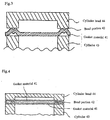
- Fig. 3 is a schematic cross sectional view showing the manner of using a gasket material in an application use for springs requiring spring property and application use of fabrication requiring fabricability.
- a gasket material 41 interposed between a cylinder 43 and a cylinder head 44 is formed with a bead portion 42 for improving the sealability.
- the characteristics as the gasket material 41 requiring the spring property include bead fabricability and the spring property.
- the bead fabricability and the spring property are properties contrary to each other in a metallurgical point of view.
- a cold rolled steel sheet for a gasket material according to claim 1 is characterized by comprising, on the weight % base, from 0.08 to 0.60% of C, from 1.0 to 3.0% of Si, from 0.5 to 3.0% of Mn, 0.06% or more of P, 0.06% or less of S, 0. 1% or less of Al, from 0.0010 to 0.0150% of N and the balance of Fe and inevitable impurities.
- the cold rolled steel sheet for a gasket material of the invention is inexpensive, and having excellent gas sealing property with good balance between the bead fabricability and the spring property. Further, the cold rolled steel sheet for a gasket material according to the invention is inexpensive and has a gas sealing property with excellent bendability capable of being bent by 180°C.
- a method of producing a cold rolled steel plate for a gasket material according to claim 2 is characterized by hot rolling a continuously cast piece comprising on the weight % base, from 0.08 to 0.60% of C, from 1.0 to 3.0% of Si, from 0.5 to 3.0% of Mn, 0.06% or more of P, 0.06% or less of S, 0.1% or less of Al, from 0.0010 to 0.0150% of N and the balance of Fe and inevitable impurities, conducting pickling, applying cold rolling at a draft of from 50 to 90%.
- a method of producing a cold rolled steel plate for a gasket material according to claim 3 is characterized by hot rolling a continuously cast piece comprising, on the weight % base, from 0.08 to 0.60% of C, from 1.0 to of 3.0% Si, from 0.5 to 3.0% of Mn, 0.06% or more of P, 0.06% or less of S, 0.1% or less of Al, from 0.0010 to 0.0150% of N and the balance of Fe and inevitable impurities, conducting pickling, applying cold rolling at a draft of from 50 to 90%, and further applying Zn or Ni plating on the surface.
- a method of producing a cold rolled steel plate for a gasket material according to claim 4 is characterized by hot rolling a continuously cast piece comprising, on the weight % base, from 0.08 to 0.60% of C, from 1.0 to 3.0% of Si, from 0.5 to 3.0% of Mn, 0.06% or more of P, 0.06% or less of S, 0.1% or less of Al, from 0.0010 to 0.0150% of N and the balance of Fe and inevitable impurities, conducting pickling, applying cold rolling at a draft of from 50 to 90%, applying annealing at 630 to 870°C or higher by continuous annealing or at 500 to 750°C or higher by batchwise annealing and, subsequently, applying secondary rolling at a draft of 30% or more.
- a method of producing a cold rolled steel plate for a gasket material according to claim 5 is characterized by hot rolling a continuously cast piece comprising, on the weight % base, from 0.08 to 0.60% of C, from 1.0 to 3.0% of Si, from 0.5 to 3.0% of Mn, 0.06% or more of P, 0.06% or less of S, 0.1% or less of Al, from 0.0010 to 0.0150% of N and the balance of Fe and inevitable impurities, conducting pickling, applying cold rolling at a draft of from 50 to 90%, applying annealing at 630 to 870°C or higher by continuous annealing or at 500 to 750°C or higher by batchwise annealing and, subsequently, applying secondary rolling at a draft of 7% or less.
- a method of producing a cold rolled steel plate for a gasket material according to claim 6 is characterized by hot rolling a continuously cast piece comprising, on the weight % base, from 0.08 to 0.60% of C, from 1.0 to 3.0% of Si, from 0.5 to 3.0% of Mn, 0.06% or more of P, 0.06% or less of S, 0.
- a method of producing a cold rolled steel plate for a gasket material according to claim 7 is characterized by hot rolling a continuously cast piece comprising, on the weight % base, from 0.08 to 0.60% of C, from 1.0 to 3.0% of Si, from 0.5 to 3.0% of Mn, 0.06% or more of P, 0.06% or less of S, 0.1% or less of Al, from 0.0010 to 0.0150% of N and the balance of Fe and inevitable impurities, conducting pickling, applying cold rolling at a draft of from 50 to 90%, applying annealing at 630 to 870°C or higher by continuous annealing or at 500 to 750°C or higher by batch annealing, subsequently, applying secondary rolling at a draft of 7% or less and, further, applying Zn or Ni plating on the surface.
- a gasket material according to claim 8 is produced by using the cold rolled steel sheet for a gasket material according to claim 1.
- a gasket material according to claim 9 is produced by using the cold rolled steel sheet for a gasket material according to any one of claim 2 to 7.
- the gasket material of the present invention is particularly preferred in view of the spring property which is necessary as the sealing performance for the cylinder opening, well conforms also to various types of openings such as the opening for cooling water, the opening for lubricant and bolt holes, and can provide sealing performance with good spring property.
- the gasket material has a strength of 1000 MPa or more, preferably, 1200 MPa or more in view of the tensile strength according to JIS No. 5 (tensile strength: hereinafter referred to as "T. S.”). Further, it is necessary that the gasket material has an elongation of 3% or more (total elongation: hereinafter referred to as "T. EL.”), more preferably, 5% or more for the fabrication of the bead portion as described above.
- the gasket material also includes a fabrication application use requiring bending fabrication as shown in Fig. 4.
- the strength is 500 MPa or more, preferably, 600 MPa or more as the T. S. according to JIS No. 5 piece and requires 15% or more and, preferably, 20% or more of T. EL.
- Fig. 1 is a schematic view showing an evaluation method for the fabricability of a gasket.
- Fig. 2 is a schematic view showing a test method for evaluation of the spring property.
- Fig. 3 is a schematic cross sectional view showing the mode of using a gasket material for spring application.
- Fig. 4 is a schematic cross sectional view showing the mode of using the gasket material applied with a vending fabrication.
- the steel ingredients in the cold rolled steel sheet for a gasket material according to the present invention comprises, on the weight % base, from 0. 008 to 0.60% of C, from 1.0 to 3.0% of Si, from 0.5 to 3.0% of Mn, 0.06% or more of P, 0.06% or less of S, 0.1% or less of Al, from 0.0010 to 0.0150% of N and the balance of Fe and inevitable impurities.
- the ingredient C is preferably 0.08% by weight or more in order to provide a high degree of fineness to a cold rolled steel sheet for a gasket material.
- the ingredient C exceeds 0.60% by weight, the precipitation amount of carbides increases to deteriorate the fabricability of the cold rolled steel sheet for the gasket material and, at the same time, causes lowering of the productivity such as increase of the load for cold rolling, deterioration of the shape, inhibition for sheet passing in a continuous annealing step, etc.
- the upper limit value for the ingredient C is defined as 0.60% by weight in the invention.
- Mn is an essential ingredient for preventing embrittlement under red heating during hot rolling due to impurity S and, at the same time, providing high fineness to the cold rolled steel sheet for the gasket material like C described above
- the Mn ingredient is defined as 0.5% by weight or more.
- the upper limit value is defined as 3.0% by weight.
- P is a crystal grain refining ingredient and also it improves the strength of the cold rolled steel sheet for the gasket, it is added at a predetermined ratio but, on the other hand, it hinders the corrosion resistance.
- P exceeds 0.06% by weight, the corrosion resistance, particularly, pit resistance is remarkably deteriorated for the application use of the invention, so that the upper limit value is defined as 0.06% by weight.
- S is an impurity ingredient causing embrittleness under red heating during hot rolling and it is desirably as less as possible.
- intrusion from iron ores, etc. can not be prevented completely and desulfurization during the step is difficult, it may inevitably remain to some extent.
- the embrittleness under red heating due to small amount of remained S can be moderated with Mn, the upper limit value for the S ingredient is defined as 0.06% by weight.
- Al is added in a steel bath as a deoxidant upon steel making. However, if it is 0.10% by weight or more, excess Al reacts with an oxidation suppressor and oxygen in a casting mold powder used as an anti-scorching agent to a casting die in the continuous casting during continuous casting to hinder the intended powder effect. Accordingly, the amount of Al is controlled to 0.10% by weight or less.
- N like C and Mn, provides a high fineness to the cold rolled steel sheet for the gasket. While this is an essential ingredient for improving the proof stress, reduction to less than 0.01% by weight results in the difficulty in view of steel making. On the other hand, addition in excess of 0.0150% by weight remarkably lowers the yield of ferro nitrides added during steel making lacks in stability and also remarkably deteriorates the anisotropy during press molding. Further, since this results in cracks at the surface of a continuous cast piece to form casting defects, the range for the N ingredient is defined in the invention as from 0.001 to 0.0150% by weight. More preferably, it is defined as from 0.0021 to 0.0150%.
- Si provides a main feature of the invention.
- Si has a significant solid solubilization strengthening performance in the steel and it is an effective element for obtaining a spring property. Accordingly, it is necessary by 1.0% by weight or more. Further, while more content is preferred in view of strengthening the material, since increase of load in the cold rolling and deterioration of the shape are caused when it exceeds 3.0% by weight, the upper limit value is defined as 3.0% by weight.
- the heating temperature for the steel piece in the hot rolling step is not specified in the present invention but it is preferably 1100°C or higher in view of positive decomposition and solid-solubilization of N and stable insurance of the hot finishing rolling temperature. Since the crystal tissue in a hot steel sheet gives a grain mixture and grain growth failing to obtain an aimed strength in a case where the hot rolling finishing temperature is below the Ar3 point, the hot rolling finishing temperature is preferably Ar3 point or higher.
- the take-up temperature is defined as 450°C to 650°C. 450°C is defined as the lower limit while considering the quality stability in the lateral direction and the longitudinal direction of the coil during hot rolling. Further, in a case where the take-up temperature exceeds 650°C, since the crystal grain size increases during hot rolling and continuous annealing thereby causing failure during fabrication of gasket beads, the take-up temperature is preferably 650°C or lower.
- the steel sheet subjected to hot rolling with the ingredient system as described above is cold rolled, and the cold draft is an important strength factor together with the ingredients in the invention and it is conducted at 50 to 90% in order to obtain an aimed strength.
- the material applied with cold rolling at 50 to 90% is degreased in a cleaning step and then applied with continuous annealing at 630 to 870°C or higher and, preferably, at 680 to 870°C.
- continuous annealing is applied at 500 to 750°C or, preferably, 600 to 750°C.
- the annealing time may be within such a range as the material is recrystallized.
- secondary cold rolling is applied at a draft of 30% or more, preferably, 60% or more to introduce strains. Subsequently, surface roughness is optionally applied by temper rolling.
- a secondary rolling at a draft of 7% or less or temper rolling is applied after annealing. Subsequently, the surface roughness is applied optionally by temper rolling.
- the cold rolled steel sheet for the gasket material according to the invention prepared as described above includes sheet-like and coil-like steel sheets, steel foils, or those formed by applying a surface treatment to the steel sheets described above.
- electrolytic chromate treated steel sheets having a two-layered structure comprising a lower layer of a metallic chromium and an upper layer of chromium hydrate oxide, or extremely thin tin-plated steel sheets, nickel plated steel sheets, zinc plated steel sheets and those formed by applying a surface treatment with chromium hydrate oxide, or a surface treatment having a two-layered structure comprising an upper layer of chromium hydrate oxide and a lower layer of a metallic chromium layer to the plated steel sheets described above are excellent in view of the corrosion resistance.
- specimens Nos. 1 to 10 as the examples can be used for the spring application of high strength and showing high spring property, while specimens Nos. 11 to 13 can be used for fabrication of excellent bendability.
- specimens Nos. 1 to 10 used for spring application are indicated by symbols “O” in the columns for the spring evaluation and bead fabrication and favorable therefor, the bendability is indicated by " ⁇ ” to which they can not be applied.
- the specimen Nos. 11 to 13 used for fabrication application are indicated by " ⁇ " in the column for the spring property and are not applicable to the spring application, they are indicated by "O” in the column for bending fabricability and show good bendability.
- specimens Nos. 14 to 31 as comparative examples do not satisfy the characteristics for the spring property for the bead fabricability and can not be applied to the spring application (symbol " ⁇ " is indicated the column for the spring property or the bead fabricability in Table 2). Further, the bendability is poor in each of the cases being indicated by " ⁇ ". Result for the Evaluation of Characteristic Specimen No. Example or Comparative Example T. S. (MPa) T.EL.
- Example 1 1,080 5.2% ⁇ ⁇ ⁇ 2
- Example 2 1,180 5.0% ⁇ ⁇ ⁇ 3
- Example 3 1,145 5.1% ⁇ ⁇ ⁇ 4
- Example 4 1,250 3.9% ⁇ ⁇ ⁇ 5
- Example 5 1,210 4.2% ⁇ ⁇ ⁇ 6
- Example 6 1,080 8.2% ⁇ ⁇ ⁇ 7
- Example 7 1,280 8.0% ⁇ ⁇ ⁇ 8
- Example 8 1,220 7.2% ⁇ ⁇ ⁇ 9
- Example 9 1,320 4.2% ⁇ ⁇ ⁇ 10
- Example 10 1,290 4.9% ⁇ ⁇ 11
- Example 11 560 25.0% ⁇ ⁇ ⁇ 12
- Example 12 595 17.0% ⁇ ⁇ ⁇ 13
- Example 13 600 20.0% ⁇ ⁇ ⁇ 14 Comp.
- Example 1 980 8.0% ⁇ ⁇ ⁇ 15 Comp.
- Example 2 990 8.2% ⁇ ⁇ ⁇ 16 Comp.
- Example 3 1,320 0.8% ⁇ ⁇ ⁇ 17 Comp.
- Example 4 1,290 0.9% ⁇ ⁇ ⁇ 18 Comp.
- Example 5 1290 0.9% ⁇ ⁇ ⁇ 19 Comp.
- Example 6 940 7.8% ⁇ ⁇ ⁇ 20 Comp.
- Example 7 1.080 0.8% ⁇ ⁇ ⁇ 21 Comp.
- Example 8 1,290 0.7% ⁇ ⁇ ⁇ 22 Comp.
- Example 9 880 12.0% ⁇ ⁇ ⁇ 23 Comp.
- Example 10 990 7.8% ⁇ ⁇ ⁇ ⁇
- Fig. 2 shows a step of a compression test as a test method for the evaluation of the spring property.
- (a) shows a state of the fabricated bead portion before compression
- (b) shows a state of applying a compressive load
- (c) shows the state of removing the compressive load.
- the bendability was evaluated by subjecting specimens to 180°C bending fabrication at 0T (sheet not interposed in the bent portion) and was evaluated depending on whether cracks occurred or not in the specimen. Those with generation of cracks were indicated as " ⁇ " and evaluated as failed. On the contrary, those with no generation of cracks were indicated as "O” and evaluated as satisfactory. Specimens showing elongation of 15% or more were favorable in view of the bendability.
- the cold rolled steel sheet for the gasket material and the production method thereof according to the present invention are constituted and function as described above, a cold rolled steel sheet for the gasket material having excellent gas sealing property while being inexpensive and with good balance between the bead fabricability and the spring property can be obtained.
- the gasket material according to the present invention has excellent gas sealing property both for the spring application with good balance between the fabricability and the spring property, and for the fabrication application being excellent in the OT bendability, by changing the production method slightly.
- the gasket material applied with the surface treatment shows excellent corrosion resistance and shows gas sealing property for a long period of time even when it is exposed to the state of high temperature.
- the gasket material according to the present invention has particularly preferred spring property required for the sealing performance for openings of the cylinder in the spring application and can be used suitably also to various kinds of openings such as the opening for cooling water, opening for lubricant and bolt holes.
- the fabrication application Although it can not be applied to the use for spring application, it can be used suitably also for various kinds of openings such as the opening for cooling water, the opening for lubricant and bolt holes.
Landscapes
- Chemical & Material Sciences (AREA)
- Engineering & Computer Science (AREA)
- Mechanical Engineering (AREA)
- Materials Engineering (AREA)
- Metallurgy (AREA)
- Organic Chemistry (AREA)
- Physics & Mathematics (AREA)
- Thermal Sciences (AREA)
- Crystallography & Structural Chemistry (AREA)
- Heat Treatment Of Sheet Steel (AREA)
- Gasket Seals (AREA)
- Electroplating Methods And Accessories (AREA)
Applications Claiming Priority (5)
| Application Number | Priority Date | Filing Date | Title |
|---|---|---|---|
| JP2002347344 | 2002-11-29 | ||
| JP2002347344 | 2002-11-29 | ||
| JP2003045421A JP2004225155A (ja) | 2002-11-29 | 2003-02-24 | ガスケット材用冷延鋼板、その製造方法およびその製造方法により製造されたガスケット材 |
| JP2003045421 | 2003-02-24 | ||
| PCT/JP2003/013001 WO2004050931A1 (ja) | 2002-11-29 | 2003-10-10 | ガスケット材用冷延鋼板、その製造方法およびその製造方法により製造されたガスケット材 |
Publications (2)
| Publication Number | Publication Date |
|---|---|
| EP1566460A1 true EP1566460A1 (de) | 2005-08-24 |
| EP1566460A4 EP1566460A4 (de) | 2006-05-10 |
Family
ID=32473652
Family Applications (1)
| Application Number | Title | Priority Date | Filing Date |
|---|---|---|---|
| EP03751436A Withdrawn EP1566460A4 (de) | 2002-11-29 | 2003-10-10 | Kaltgewalztes stahlblech fur dichtungsmaterial, herstellungsverfahren dafur und damit hergestelltes dichtungsmaterial |
Country Status (6)
| Country | Link |
|---|---|
| US (1) | US20060137167A1 (de) |
| EP (1) | EP1566460A4 (de) |
| JP (1) | JP2004225155A (de) |
| KR (1) | KR20050084045A (de) |
| AU (1) | AU2003271162A1 (de) |
| WO (1) | WO2004050931A1 (de) |
Cited By (1)
| Publication number | Priority date | Publication date | Assignee | Title |
|---|---|---|---|---|
| EP3234497A4 (de) * | 2014-12-16 | 2018-08-29 | Greer Steel Company | Stahlzusammensetzungen, verfahren zur herstellung und verwendungen bei der herstellung von randfeuerpatronen |
Families Citing this family (5)
| Publication number | Priority date | Publication date | Assignee | Title |
|---|---|---|---|---|
| JP2005036266A (ja) * | 2003-07-18 | 2005-02-10 | Toyo Kohan Co Ltd | ガスケット材用冷延鋼板、その製造法およびガスケット材 |
| US20090038718A1 (en) * | 2004-10-26 | 2009-02-12 | Hille & Müller GMBH | Process for the manufacture of a containment device and a containment device manufactured thereby |
| JP4580739B2 (ja) * | 2004-11-26 | 2010-11-17 | 東洋鋼鈑株式会社 | ばね用材料及びその製造方法 |
| DE102007061084A1 (de) * | 2007-12-19 | 2009-07-02 | Federal-Mogul Sealing Systems Gmbh | Metallische Flachdichtung und Herstellverfahren |
| CN104846260A (zh) * | 2015-04-20 | 2015-08-19 | 杭州科明电子有限公司 | 一种工具开关的扳机 |
Family Cites Families (3)
| Publication number | Priority date | Publication date | Assignee | Title |
|---|---|---|---|---|
| JP2793284B2 (ja) * | 1989-08-29 | 1998-09-03 | 株式会社神戸製鋼所 | 焼付硬化性の優れた超高強度冷延鋼板の製造方法 |
| JPH09194935A (ja) * | 1996-01-10 | 1997-07-29 | Toyo Kohan Co Ltd | ばね性に優れたガスケット材用冷延鋼板の製造法およびガスケット材 |
| JP2000319759A (ja) * | 1999-04-30 | 2000-11-21 | Nippon Steel Corp | ベンディングロール方式による加工性に優れた鋼管 |
-
2003
- 2003-02-24 JP JP2003045421A patent/JP2004225155A/ja active Pending
- 2003-10-10 US US10/536,355 patent/US20060137167A1/en not_active Abandoned
- 2003-10-10 KR KR1020057009731A patent/KR20050084045A/ko not_active Withdrawn
- 2003-10-10 EP EP03751436A patent/EP1566460A4/de not_active Withdrawn
- 2003-10-10 WO PCT/JP2003/013001 patent/WO2004050931A1/ja not_active Ceased
- 2003-10-10 AU AU2003271162A patent/AU2003271162A1/en not_active Abandoned
Cited By (3)
| Publication number | Priority date | Publication date | Assignee | Title |
|---|---|---|---|---|
| EP3234497A4 (de) * | 2014-12-16 | 2018-08-29 | Greer Steel Company | Stahlzusammensetzungen, verfahren zur herstellung und verwendungen bei der herstellung von randfeuerpatronen |
| US11905569B2 (en) | 2014-12-16 | 2024-02-20 | Greer Steel Company | Steel compositions, methods of manufacture and uses in producing rimfire cartridges |
| US12331372B2 (en) | 2014-12-16 | 2025-06-17 | Greer Steel Company | Steel compositions, methods of manufacture and uses in producing rimfire cartridges |
Also Published As
| Publication number | Publication date |
|---|---|
| US20060137167A1 (en) | 2006-06-29 |
| JP2004225155A (ja) | 2004-08-12 |
| AU2003271162A1 (en) | 2004-06-23 |
| EP1566460A4 (de) | 2006-05-10 |
| KR20050084045A (ko) | 2005-08-26 |
| WO2004050931A1 (ja) | 2004-06-17 |
Similar Documents
| Publication | Publication Date | Title |
|---|---|---|
| EP1734143B1 (de) | Blech aus ferritischem nichtrostendem stahl mit hervorragender umformbarkeit und vefahren zu seiner herstellung | |
| JP4321066B2 (ja) | 金属ガスケットとその素材およびそれらの製造方法 | |
| US9464345B2 (en) | Hot dip Al coated steel sheet excellent in heat black discoloration resistance and method of production of same | |
| JPH05117813A (ja) | 成形加工性および疲労特性に優れたメタルガスケツト用ステンレス鋼およびその製造方法 | |
| KR100356930B1 (ko) | 엔진 가스킷용 스테인레스강과 그 제조방법 | |
| JPWO2000014292A1 (ja) | エンジンガスケット用ステンレス鋼とその製造方法 | |
| CN101680064B (zh) | 金属垫圈 | |
| US6126759A (en) | Steel sheet for 2-piece battery can having excellent formability, anti secondary work embrittlement and corrosion resistance | |
| EP1566460A1 (de) | Kaltgewalztes stahlblech fur dichtungsmaterial, herstellungsverfahren dafur und damit hergestelltes dichtungsmaterial | |
| EP1801255B1 (de) | Kaltverformbarer Federstahldraht mit hervorragender Kaltschneidefähigkeit und Ermüdungseigenschaften und sein Herstellungsprozess | |
| US20090038718A1 (en) | Process for the manufacture of a containment device and a containment device manufactured thereby | |
| JPH09194935A (ja) | ばね性に優れたガスケット材用冷延鋼板の製造法およびガスケット材 | |
| EP2455499B1 (de) | Verfahren zur herstellung eines kaltgewalzten stahlblechs von hervorragender pressformbarkeit | |
| JP4138465B2 (ja) | ばね性に優れたガスケット材用冷延鋼板、その製造方法およびばね性に優れたガスケット材 | |
| JPH08134595A (ja) | 耐応力腐食割れ特性に優れた高強度ステンレス鋼板 | |
| JP2006089814A (ja) | 加工性に優れるフェライト系ステンレス鋼板およびその製造方法 | |
| JP4785171B2 (ja) | バネ用高強度極薄冷延鋼板の製造方法 | |
| JP3899018B2 (ja) | ガスケット用材料、その製造方法およびガスケット | |
| WO2010070829A1 (ja) | ガスケット用鋼板の製造方法及びガスケット | |
| JP2005036266A (ja) | ガスケット材用冷延鋼板、その製造法およびガスケット材 | |
| TW202321479A (zh) | 肥粒鐵系不鏽鋼板 | |
| EP4640914A1 (de) | Element und verfahren zur herstellung davon | |
| JP3546286B2 (ja) | 良成形性冷延鋼板用の熱延母板およびその製造方法、ならびに良成形性冷延鋼板の製造方法 | |
| CN1717504A (zh) | 衬垫材料用冷轧薄钢板、其制备方法以及采用所述方法制备的衬垫材料 | |
| JP3357415B2 (ja) | 伸びフランジ性に優れる超深絞り用冷延鋼板及びその製造方法 |
Legal Events
| Date | Code | Title | Description |
|---|---|---|---|
| PUAI | Public reference made under article 153(3) epc to a published international application that has entered the european phase |
Free format text: ORIGINAL CODE: 0009012 |
|
| 17P | Request for examination filed |
Effective date: 20050622 |
|
| AK | Designated contracting states |
Kind code of ref document: A1 Designated state(s): AT BE BG CH CY CZ DE DK EE ES FI FR GB GR HU IE IT LI LU MC NL PT RO SE SI SK TR |
|
| AX | Request for extension of the european patent |
Extension state: AL LT LV MK |
|
| DAX | Request for extension of the european patent (deleted) | ||
| RBV | Designated contracting states (corrected) |
Designated state(s): BE DE FR GB IT NL |
|
| A4 | Supplementary search report drawn up and despatched |
Effective date: 20060329 |
|
| 17Q | First examination report despatched |
Effective date: 20061130 |
|
| STAA | Information on the status of an ep patent application or granted ep patent |
Free format text: STATUS: THE APPLICATION IS DEEMED TO BE WITHDRAWN |
|
| 18D | Application deemed to be withdrawn |
Effective date: 20081007 |