EP1563304B1 - Verfahren zur fixierung eines proteins auf einem pyrrolpolymerisat, und dessen verwendung zur herstellung eines sensors - Google Patents
Verfahren zur fixierung eines proteins auf einem pyrrolpolymerisat, und dessen verwendung zur herstellung eines sensors Download PDFInfo
- Publication number
- EP1563304B1 EP1563304B1 EP03786063A EP03786063A EP1563304B1 EP 1563304 B1 EP1563304 B1 EP 1563304B1 EP 03786063 A EP03786063 A EP 03786063A EP 03786063 A EP03786063 A EP 03786063A EP 1563304 B1 EP1563304 B1 EP 1563304B1
- Authority
- EP
- European Patent Office
- Prior art keywords
- pyrrole
- protein
- solution
- polymer
- electropolymerization
- Prior art date
- Legal status (The legal status is an assumption and is not a legal conclusion. Google has not performed a legal analysis and makes no representation as to the accuracy of the status listed.)
- Expired - Lifetime
Links
- KAESVJOAVNADME-UHFFFAOYSA-N Pyrrole Chemical compound C=1C=CNC=1 KAESVJOAVNADME-UHFFFAOYSA-N 0.000 title claims abstract description 139
- 102000004169 proteins and genes Human genes 0.000 title claims abstract description 89
- 108090000623 proteins and genes Proteins 0.000 title claims abstract description 89
- 229920000642 polymer Polymers 0.000 title claims abstract description 37
- 238000000034 method Methods 0.000 title claims description 59
- 238000005859 coupling reaction Methods 0.000 claims abstract description 24
- 230000008878 coupling Effects 0.000 claims abstract description 23
- 238000010168 coupling process Methods 0.000 claims abstract description 23
- 239000000178 monomer Substances 0.000 claims abstract description 15
- 238000002156 mixing Methods 0.000 claims abstract description 4
- 238000000018 DNA microarray Methods 0.000 claims description 11
- PEEHTFAAVSWFBL-UHFFFAOYSA-N Maleimide Chemical compound O=C1NC(=O)C=C1 PEEHTFAAVSWFBL-UHFFFAOYSA-N 0.000 claims description 10
- 108090000790 Enzymes Proteins 0.000 claims description 8
- 102000004190 Enzymes Human genes 0.000 claims description 8
- 150000001875 compounds Chemical class 0.000 claims description 7
- 150000003233 pyrroles Chemical class 0.000 claims description 7
- 239000000427 antigen Substances 0.000 claims description 6
- 108091007433 antigens Proteins 0.000 claims description 6
- 102000036639 antigens Human genes 0.000 claims description 6
- 230000004913 activation Effects 0.000 claims description 5
- GVJXGCIPWAVXJP-UHFFFAOYSA-N 2,5-dioxo-1-oxoniopyrrolidine-3-sulfonate Chemical compound ON1C(=O)CC(S(O)(=O)=O)C1=O GVJXGCIPWAVXJP-UHFFFAOYSA-N 0.000 claims description 3
- 238000002360 preparation method Methods 0.000 claims description 3
- 125000000168 pyrrolyl group Chemical group 0.000 claims description 3
- 229940088597 hormone Drugs 0.000 claims description 2
- 239000005556 hormone Substances 0.000 claims description 2
- 239000000243 solution Substances 0.000 abstract description 46
- 239000011259 mixed solution Substances 0.000 abstract 1
- 235000018102 proteins Nutrition 0.000 description 78
- 108010090804 Streptavidin Proteins 0.000 description 40
- ZMXDDKWLCZADIW-UHFFFAOYSA-N N,N-Dimethylformamide Chemical compound CN(C)C=O ZMXDDKWLCZADIW-UHFFFAOYSA-N 0.000 description 30
- 238000006243 chemical reaction Methods 0.000 description 24
- 229940027941 immunoglobulin g Drugs 0.000 description 21
- 241000283973 Oryctolagus cuniculus Species 0.000 description 18
- 239000000872 buffer Substances 0.000 description 17
- -1 antibodies Proteins 0.000 description 14
- 229920000128 polypyrrole Polymers 0.000 description 14
- 238000004519 manufacturing process Methods 0.000 description 13
- 230000006870 function Effects 0.000 description 12
- 230000008569 process Effects 0.000 description 11
- KFFKYCZWESDTCA-UHFFFAOYSA-N 1h-pyrrole;pyrrole-2,5-dione Chemical compound C=1C=CNC=1.O=C1NC(=O)C=C1 KFFKYCZWESDTCA-UHFFFAOYSA-N 0.000 description 10
- 230000015572 biosynthetic process Effects 0.000 description 10
- 230000000903 blocking effect Effects 0.000 description 10
- 230000000694 effects Effects 0.000 description 10
- 239000010931 gold Substances 0.000 description 10
- 125000000020 sulfo group Chemical group O=S(=O)([*])O[H] 0.000 description 10
- OKKJLVBELUTLKV-UHFFFAOYSA-N Methanol Chemical compound OC OKKJLVBELUTLKV-UHFFFAOYSA-N 0.000 description 9
- 229920001940 conductive polymer Polymers 0.000 description 9
- PCHJSUWPFVWCPO-UHFFFAOYSA-N gold Chemical compound [Au] PCHJSUWPFVWCPO-UHFFFAOYSA-N 0.000 description 9
- 229910052737 gold Inorganic materials 0.000 description 9
- 238000006116 polymerization reaction Methods 0.000 description 9
- 238000003786 synthesis reaction Methods 0.000 description 8
- 229940088598 enzyme Drugs 0.000 description 7
- 150000002148 esters Chemical class 0.000 description 7
- 239000000047 product Substances 0.000 description 7
- YMWUJEATGCHHMB-UHFFFAOYSA-N Dichloromethane Chemical compound ClCCl YMWUJEATGCHHMB-UHFFFAOYSA-N 0.000 description 6
- IAZDPXIOMUYVGZ-UHFFFAOYSA-N Dimethylsulphoxide Chemical compound CS(C)=O IAZDPXIOMUYVGZ-UHFFFAOYSA-N 0.000 description 6
- VYPSYNLAJGMNEJ-UHFFFAOYSA-N Silicium dioxide Chemical compound O=[Si]=O VYPSYNLAJGMNEJ-UHFFFAOYSA-N 0.000 description 6
- 238000004458 analytical method Methods 0.000 description 6
- 238000001514 detection method Methods 0.000 description 6
- 239000010408 film Substances 0.000 description 6
- 239000000203 mixture Substances 0.000 description 6
- 150000003923 2,5-pyrrolediones Chemical class 0.000 description 5
- 229920002274 Nalgene Polymers 0.000 description 5
- 239000003153 chemical reaction reagent Substances 0.000 description 5
- 238000007334 copolymerization reaction Methods 0.000 description 5
- 230000003993 interaction Effects 0.000 description 5
- 238000005259 measurement Methods 0.000 description 5
- 229920000136 polysorbate Polymers 0.000 description 5
- YBJHBAHKTGYVGT-ZKWXMUAHSA-N (+)-Biotin Chemical compound N1C(=O)N[C@@H]2[C@H](CCCCC(=O)O)SC[C@@H]21 YBJHBAHKTGYVGT-ZKWXMUAHSA-N 0.000 description 4
- DHMQDGOQFOQNFH-UHFFFAOYSA-N Glycine Chemical compound NCC(O)=O DHMQDGOQFOQNFH-UHFFFAOYSA-N 0.000 description 4
- 229960002685 biotin Drugs 0.000 description 4
- 239000011616 biotin Substances 0.000 description 4
- 230000008021 deposition Effects 0.000 description 4
- 238000010828 elution Methods 0.000 description 4
- 238000001000 micrograph Methods 0.000 description 4
- 239000008363 phosphate buffer Substances 0.000 description 4
- 239000012429 reaction media Substances 0.000 description 4
- 238000002198 surface plasmon resonance spectroscopy Methods 0.000 description 4
- JWDFQMWEFLOOED-UHFFFAOYSA-N (2,5-dioxopyrrolidin-1-yl) 3-(pyridin-2-yldisulfanyl)propanoate Chemical compound O=C1CCC(=O)N1OC(=O)CCSSC1=CC=CC=N1 JWDFQMWEFLOOED-UHFFFAOYSA-N 0.000 description 3
- ADFXKUOMJKEIND-UHFFFAOYSA-N 1,3-dicyclohexylurea Chemical compound C1CCCCC1NC(=O)NC1CCCCC1 ADFXKUOMJKEIND-UHFFFAOYSA-N 0.000 description 3
- OXHNLMTVIGZXSG-UHFFFAOYSA-N 1-Methylpyrrole Chemical compound CN1C=CC=C1 OXHNLMTVIGZXSG-UHFFFAOYSA-N 0.000 description 3
- QOSSAOTZNIDXMA-UHFFFAOYSA-N Dicylcohexylcarbodiimide Chemical compound C1CCCCC1N=C=NC1CCCCC1 QOSSAOTZNIDXMA-UHFFFAOYSA-N 0.000 description 3
- VEXZGXHMUGYJMC-UHFFFAOYSA-N Hydrochloric acid Chemical compound Cl VEXZGXHMUGYJMC-UHFFFAOYSA-N 0.000 description 3
- 108060003951 Immunoglobulin Proteins 0.000 description 3
- 238000001994 activation Methods 0.000 description 3
- 230000008859 change Effects 0.000 description 3
- 238000011109 contamination Methods 0.000 description 3
- 238000010586 diagram Methods 0.000 description 3
- 238000002474 experimental method Methods 0.000 description 3
- 239000011521 glass Substances 0.000 description 3
- FUZZWVXGSFPDMH-UHFFFAOYSA-M hexanoate Chemical compound CCCCCC([O-])=O FUZZWVXGSFPDMH-UHFFFAOYSA-M 0.000 description 3
- 125000004051 hexyl group Chemical group [H]C([H])([H])C([H])([H])C([H])([H])C([H])([H])C([H])([H])C([H])([H])* 0.000 description 3
- 230000002209 hydrophobic effect Effects 0.000 description 3
- 102000018358 immunoglobulin Human genes 0.000 description 3
- 238000003760 magnetic stirring Methods 0.000 description 3
- 238000002310 reflectometry Methods 0.000 description 3
- 239000000377 silicon dioxide Substances 0.000 description 3
- 238000001179 sorption measurement Methods 0.000 description 3
- XLYOFNOQVPJJNP-UHFFFAOYSA-N water Substances O XLYOFNOQVPJJNP-UHFFFAOYSA-N 0.000 description 3
- VHJLVAABSRFDPM-UHFFFAOYSA-N 1,4-dithiothreitol Chemical compound SCC(O)C(O)CS VHJLVAABSRFDPM-UHFFFAOYSA-N 0.000 description 2
- RSHDBNMTMRQZDZ-UHFFFAOYSA-N 1h-pyrrol-2-yl undecanoate Chemical compound CCCCCCCCCCC(=O)OC1=CC=CN1 RSHDBNMTMRQZDZ-UHFFFAOYSA-N 0.000 description 2
- MXCLPOVWPYCJAA-UHFFFAOYSA-N 3-ethylpyrrole-2,5-dione;1h-pyrrole Chemical compound C=1C=CNC=1.CCC1=CC(=O)NC1=O MXCLPOVWPYCJAA-UHFFFAOYSA-N 0.000 description 2
- MXVZVCCKUVRGQC-UHFFFAOYSA-N 3-hexylpyrrole-2,5-dione Chemical compound CCCCCCC1=CC(=O)NC1=O MXVZVCCKUVRGQC-UHFFFAOYSA-N 0.000 description 2
- GYEZGCHTXDEEAZ-UHFFFAOYSA-N 3-hexylpyrrole-2,5-dione;1h-pyrrole Chemical compound C=1C=CNC=1.CCCCCCC1=CC(=O)NC1=O GYEZGCHTXDEEAZ-UHFFFAOYSA-N 0.000 description 2
- NRCLTECUGCYICQ-UHFFFAOYSA-N 4-[4-(2-carboxyethyl)-2-methyl-1h-pyrrol-3-yl]-4-oxobutanoic acid Chemical compound CC=1NC=C(CCC(O)=O)C=1C(=O)CCC(O)=O NRCLTECUGCYICQ-UHFFFAOYSA-N 0.000 description 2
- 102000011022 Chorionic Gonadotropin Human genes 0.000 description 2
- 108010062540 Chorionic Gonadotropin Proteins 0.000 description 2
- WQZGKKKJIJFFOK-GASJEMHNSA-N Glucose Natural products OC[C@H]1OC(O)[C@H](O)[C@@H](O)[C@@H]1O WQZGKKKJIJFFOK-GASJEMHNSA-N 0.000 description 2
- 108010015776 Glucose oxidase Proteins 0.000 description 2
- 239000004366 Glucose oxidase Substances 0.000 description 2
- 239000004471 Glycine Substances 0.000 description 2
- 102000008100 Human Serum Albumin Human genes 0.000 description 2
- 108091006905 Human Serum Albumin Proteins 0.000 description 2
- 229910019142 PO4 Inorganic materials 0.000 description 2
- 150000001412 amines Chemical group 0.000 description 2
- 235000020958 biotin Nutrition 0.000 description 2
- 238000005119 centrifugation Methods 0.000 description 2
- 235000018417 cysteine Nutrition 0.000 description 2
- 150000001945 cysteines Chemical class 0.000 description 2
- 230000007547 defect Effects 0.000 description 2
- 238000001704 evaporation Methods 0.000 description 2
- 230000008020 evaporation Effects 0.000 description 2
- 239000000706 filtrate Substances 0.000 description 2
- 238000007306 functionalization reaction Methods 0.000 description 2
- 239000008103 glucose Substances 0.000 description 2
- 229940116332 glucose oxidase Drugs 0.000 description 2
- 235000019420 glucose oxidase Nutrition 0.000 description 2
- 229940084986 human chorionic gonadotropin Drugs 0.000 description 2
- 150000002605 large molecules Chemical class 0.000 description 2
- 239000007788 liquid Substances 0.000 description 2
- 235000018977 lysine Nutrition 0.000 description 2
- 150000002669 lysines Chemical class 0.000 description 2
- 229920002521 macromolecule Polymers 0.000 description 2
- NBIIXXVUZAFLBC-UHFFFAOYSA-K phosphate Chemical compound [O-]P([O-])([O-])=O NBIIXXVUZAFLBC-UHFFFAOYSA-K 0.000 description 2
- 239000010452 phosphate Substances 0.000 description 2
- 238000000746 purification Methods 0.000 description 2
- 239000011541 reaction mixture Substances 0.000 description 2
- 230000009257 reactivity Effects 0.000 description 2
- 239000012064 sodium phosphate buffer Substances 0.000 description 2
- 238000003860 storage Methods 0.000 description 2
- 239000000758 substrate Substances 0.000 description 2
- 230000001629 suppression Effects 0.000 description 2
- 238000004809 thin layer chromatography Methods 0.000 description 2
- ZDPHROOEEOARMN-UHFFFAOYSA-N undecanoic acid Chemical compound CCCCCCCCCCC(O)=O ZDPHROOEEOARMN-UHFFFAOYSA-N 0.000 description 2
- VRIONZMGCKFGTC-UHFFFAOYSA-N 1-hydroxy-2,5-dioxopyrrolidine-3,3-disulfonic acid 1H-pyrrole Chemical compound c1cc[nH]c1.ON1C(=O)CC(C1=O)(S(O)(=O)=O)S(O)(=O)=O VRIONZMGCKFGTC-UHFFFAOYSA-N 0.000 description 1
- RCBJPUNFMOQCAC-UHFFFAOYSA-N 11-pyrrol-1-ylundecanoic acid Chemical compound OC(=O)CCCCCCCCCCN1C=CC=C1 RCBJPUNFMOQCAC-UHFFFAOYSA-N 0.000 description 1
- PXFBZOLANLWPMH-UHFFFAOYSA-N 16-Epiaffinine Natural products C1C(C2=CC=CC=C2N2)=C2C(=O)CC2C(=CC)CN(C)C1C2CO PXFBZOLANLWPMH-UHFFFAOYSA-N 0.000 description 1
- BWLXXDOOJZCOOM-UHFFFAOYSA-N 2-(1h-pyrrol-2-yl)undecanoic acid Chemical compound CCCCCCCCCC(C(O)=O)C1=CC=CN1 BWLXXDOOJZCOOM-UHFFFAOYSA-N 0.000 description 1
- HPDIRFBJYSOVKW-UHFFFAOYSA-N 2-pyrrol-1-ylethanamine Chemical compound NCCN1C=CC=C1 HPDIRFBJYSOVKW-UHFFFAOYSA-N 0.000 description 1
- FQDZWHZTBGZUJU-UHFFFAOYSA-N 6-pyrrol-1-ylhexan-1-amine Chemical compound NCCCCCCN1C=CC=C1 FQDZWHZTBGZUJU-UHFFFAOYSA-N 0.000 description 1
- 102100031102 C-C motif chemokine 4 Human genes 0.000 description 1
- 101100054773 Caenorhabditis elegans act-2 gene Proteins 0.000 description 1
- BWGNESOTFCXPMA-UHFFFAOYSA-N Dihydrogen disulfide Chemical compound SS BWGNESOTFCXPMA-UHFFFAOYSA-N 0.000 description 1
- UFHFLCQGNIYNRP-UHFFFAOYSA-N Hydrogen Chemical compound [H][H] UFHFLCQGNIYNRP-UHFFFAOYSA-N 0.000 description 1
- 108010058683 Immobilized Proteins Proteins 0.000 description 1
- HDFGOPSGAURCEO-UHFFFAOYSA-N N-ethylmaleimide Chemical compound CCN1C(=O)C=CC1=O HDFGOPSGAURCEO-UHFFFAOYSA-N 0.000 description 1
- 241000283977 Oryctolagus Species 0.000 description 1
- 241000282320 Panthera leo Species 0.000 description 1
- 238000010521 absorption reaction Methods 0.000 description 1
- 239000002253 acid Substances 0.000 description 1
- 239000012491 analyte Substances 0.000 description 1
- 230000000890 antigenic effect Effects 0.000 description 1
- 230000004888 barrier function Effects 0.000 description 1
- 230000008901 benefit Effects 0.000 description 1
- 230000001588 bifunctional effect Effects 0.000 description 1
- 230000027455 binding Effects 0.000 description 1
- 230000009141 biological interaction Effects 0.000 description 1
- 230000008512 biological response Effects 0.000 description 1
- 239000007853 buffer solution Substances 0.000 description 1
- 238000009933 burial Methods 0.000 description 1
- 125000003178 carboxy group Chemical group [H]OC(*)=O 0.000 description 1
- 238000012512 characterization method Methods 0.000 description 1
- 238000007385 chemical modification Methods 0.000 description 1
- 238000004587 chromatography analysis Methods 0.000 description 1
- 230000000052 comparative effect Effects 0.000 description 1
- 238000005520 cutting process Methods 0.000 description 1
- 238000009792 diffusion process Methods 0.000 description 1
- 230000005684 electric field Effects 0.000 description 1
- 238000000835 electrochemical detection Methods 0.000 description 1
- 238000005516 engineering process Methods 0.000 description 1
- 125000001495 ethyl group Chemical group [H]C([H])([H])C([H])([H])* 0.000 description 1
- 230000002349 favourable effect Effects 0.000 description 1
- 238000001917 fluorescence detection Methods 0.000 description 1
- 239000003292 glue Substances 0.000 description 1
- 229910052739 hydrogen Inorganic materials 0.000 description 1
- 239000001257 hydrogen Substances 0.000 description 1
- 230000003100 immobilizing effect Effects 0.000 description 1
- 230000001900 immune effect Effects 0.000 description 1
- 239000011159 matrix material Substances 0.000 description 1
- 230000007246 mechanism Effects 0.000 description 1
- 230000009871 nonspecific binding Effects 0.000 description 1
- 230000003287 optical effect Effects 0.000 description 1
- BASFCYQUMIYNBI-UHFFFAOYSA-N platinum Chemical compound [Pt] BASFCYQUMIYNBI-UHFFFAOYSA-N 0.000 description 1
- 230000010287 polarization Effects 0.000 description 1
- 239000000843 powder Substances 0.000 description 1
- 239000002244 precipitate Substances 0.000 description 1
- 125000002924 primary amino group Chemical group [H]N([H])* 0.000 description 1
- 238000010223 real-time analysis Methods 0.000 description 1
- 230000009467 reduction Effects 0.000 description 1
- 239000012557 regeneration buffer Substances 0.000 description 1
- 230000000717 retained effect Effects 0.000 description 1
- 238000012216 screening Methods 0.000 description 1
- 230000035945 sensitivity Effects 0.000 description 1
- 150000003384 small molecules Chemical class 0.000 description 1
- 239000007974 sodium acetate buffer Substances 0.000 description 1
- 125000006850 spacer group Chemical group 0.000 description 1
- 238000001847 surface plasmon resonance imaging Methods 0.000 description 1
- 238000012360 testing method Methods 0.000 description 1
- 239000010409 thin film Substances 0.000 description 1
- 150000003573 thiols Chemical group 0.000 description 1
Images




Classifications
-
- C—CHEMISTRY; METALLURGY
- C08—ORGANIC MACROMOLECULAR COMPOUNDS; THEIR PREPARATION OR CHEMICAL WORKING-UP; COMPOSITIONS BASED THEREON
- C08G—MACROMOLECULAR COMPOUNDS OBTAINED OTHERWISE THAN BY REACTIONS ONLY INVOLVING UNSATURATED CARBON-TO-CARBON BONDS
- C08G73/00—Macromolecular compounds obtained by reactions forming a linkage containing nitrogen with or without oxygen or carbon in the main chain of the macromolecule, not provided for in groups C08G12/00 - C08G71/00
- C08G73/06—Polycondensates having nitrogen-containing heterocyclic rings in the main chain of the macromolecule
- C08G73/0605—Polycondensates containing five-membered rings, not condensed with other rings, with nitrogen atoms as the only ring hetero atoms
- C08G73/0611—Polycondensates containing five-membered rings, not condensed with other rings, with nitrogen atoms as the only ring hetero atoms with only one nitrogen atom in the ring, e.g. polypyrroles
-
- C—CHEMISTRY; METALLURGY
- C08—ORGANIC MACROMOLECULAR COMPOUNDS; THEIR PREPARATION OR CHEMICAL WORKING-UP; COMPOSITIONS BASED THEREON
- C08G—MACROMOLECULAR COMPOUNDS OBTAINED OTHERWISE THAN BY REACTIONS ONLY INVOLVING UNSATURATED CARBON-TO-CARBON BONDS
- C08G61/00—Macromolecular compounds obtained by reactions forming a carbon-to-carbon link in the main chain of the macromolecule
- C08G61/12—Macromolecular compounds containing atoms other than carbon in the main chain of the macromolecule
- C08G61/122—Macromolecular compounds containing atoms other than carbon in the main chain of the macromolecule derived from five- or six-membered heterocyclic compounds, other than imides
- C08G61/123—Macromolecular compounds containing atoms other than carbon in the main chain of the macromolecule derived from five- or six-membered heterocyclic compounds, other than imides derived from five-membered heterocyclic compounds
- C08G61/124—Macromolecular compounds containing atoms other than carbon in the main chain of the macromolecule derived from five- or six-membered heterocyclic compounds, other than imides derived from five-membered heterocyclic compounds with a five-membered ring containing one nitrogen atom in the ring
-
- G—PHYSICS
- G01—MEASURING; TESTING
- G01N—INVESTIGATING OR ANALYSING MATERIALS BY DETERMINING THEIR CHEMICAL OR PHYSICAL PROPERTIES
- G01N33/00—Investigating or analysing materials by specific methods not covered by groups G01N1/00 - G01N31/00
- G01N33/48—Biological material, e.g. blood, urine; Haemocytometers
- G01N33/50—Chemical analysis of biological material, e.g. blood, urine; Testing involving biospecific ligand binding methods; Immunological testing
- G01N33/53—Immunoassay; Biospecific binding assay; Materials therefor
- G01N33/543—Immunoassay; Biospecific binding assay; Materials therefor with an insoluble carrier for immobilising immunochemicals
- G01N33/54353—Immunoassay; Biospecific binding assay; Materials therefor with an insoluble carrier for immobilising immunochemicals with ligand attached to the carrier via a chemical coupling agent
Definitions
- the present invention relates to a process for fixing a protein on a pyrrole-based polymer, as well as to the use of this method for the manufacture of sensors, in particular multi-sensors, for example biochips.
- proteins for example enzymes, antibodies, receptors and certain antigens
- target molecule recognition sites or sites that allow them to be recognized by other molecules. These sites are at the origin of their activity (s).
- an enzyme has a specific site for its substrate
- an antibody has a specific epitope to be recognized by its corresponding antigen
- an antigen has a specific recognition site of the epitope it targets.
- sites are generally formed by a folding of the protein on itself in space, folding which can be stabilized by disulfide, ionic, hydrogen and hydrophobic.
- these folds, and indeed the sites they form, can therefore easily be destabilized by a simple constraint applied to the protein, by a steric hindrance, by a change in ionic strength, pH or temperature of the medium.
- these sites have reactive functions such as -NH 2 , -OH, -COOH, -SH functions that are capable of reacting with the reagents or monomers used during the attachment of the protein to the conductive polymer, and can be damaged, blocked or congested.
- the methods used to bind a protein having such a site on a surface in order to exploit this site must therefore as far as possible preserve this site so that the manufactured sensor can fulfill its function by providing analysis results. sample as accurate, sensitive and reproducible as possible.
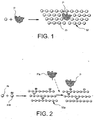
- the immobilization of proteins on a conductive polymer can use four different techniques. These four techniques are entrapment, post-functionalization, non-covalent immobilization of proteins, and covalent immobilization of proteins. These techniques are schematically represented on the Figures 1 to 4 attached. In these figures, “P” and “Pa” respectively represent the protein and the activated protein, “m” and “ma” respectively represent a monomer and an activated monomer of polymer, “Pm” represents a monomeric protein coupling compound, and “M” and “Ma” represent respectively the polymer and the activated polymer.
- the technique of post-functionalization is schematized on the figure 2 attached. It involves the grafting of activated proteins, either by activated esters, or mainly by maleimides, on supports functionalized with NH 2 or SH or, conversely, with proteins functionalized or not by the use of NH 2 lysines or SH cysteines of these proteins, on supports activated by activated esters or maleimides respectively. This method is described for example by W. Schuhman in Mikrochim. Acta 121, 1-29 (1995) ). It allows grafting on the surface which induces a surface detection.
- This grafting is unfortunately not easy to control because of the low reactivity of the functions involved. Moreover, it is adapted to the production of single-sensors, and makes it very difficult to manufacture multi-sensors. Indeed, if one seeks to make a multisensor comprising several spots, the reactivity being low in this technique, for example all the functions of the first spot have not reacted when the second protein is fixed on the second spot, so it There is contamination of the second protein on the first spot. To avoid this, it is necessary to bring the protein only on the selected deposit. This can hardly be miniaturized because if it is indeed possible to deposit microdroplets in a localized manner, their evaporation rate is very fast and the reaction is difficult to control.
- connection with the support is so weak is certainly not favorable for the storage of this electrode, let alone the manufacture of a multiple sensor.
- the fourth technique is covalent imprisonment. It is represented schematically on the figure 4 attached.
- This technique has been described in the prior art by Wolowacz SE, Yon Hin BFY and Lowe CR Anal. Chem. 1992, 64, 1541-1545 .
- the author has prepared an enzyme, glucose oxidase, so as to conjugate it with pyrrole and subjected it to copolymerization with pyrrole.
- the pyrrole grafted on the enzyme electropolymerizes and immobilizes the enzyme in a kind of polypyrrole gangue.
- this method must be usable for the manufacture of a sensor, in particular for the manufacture of a multi-sensor, so that it does not have the disadvantages, limitations, defects and disadvantages of the processes and sensors of the prior art.
- the object of the present invention is precisely to provide a method of fixing a protein on a conductive polymer, usable in particular for the manufacture of a single-sensor or a multi-sensor, which meets, inter alia, the needs indicated above .
- pyrrole monomer means a pyrrole monomer or a polymerizable derivative of pyrrole.
- the pyrrole monomers that can be used in the present invention are those known to those skilled in the art for the fabrication of biochips.
- the pyrrole derivative there may be mentioned, for example, methyl pyrrole, or substituted or unsubstituted pyrrole dimers.
- one or more proteins can be attached to a support by means of the method of the invention.
- Those skilled in the art will know, in the light of the present description, prepare the electropolymerization solution according to its needs, with one or more proteins each coupled to the selected pyrrole monomer, each deposited on one or more areas of the support.
- the area of the support also means "pad", for example a pad of a biochip support.
- the electropolymerization can be carried out simultaneously on several zones or studs of the biochip manufactured, or successively on several areas or pads of the biochip fabricated, for example with different proteins.
- the choice of the number of zones or pads will depend in particular on the resolution of the desired biosensor, and the number of simultaneous analyzes that can be performed with the desired biosensor.
- the number of zones or pads can be determined as for the biochips known to those skilled in the art.
- the conductive support within the meaning of the present invention may therefore advantageously be a biochip support with one or more pads. The method of the present invention thus makes it possible to manufacture, as desired, mono- or multi-sensors.
- the present invention surprisingly allows to preserve the activity of the fixed or immobilized protein on the polymer, for example the recognition properties of a protein vis-à-vis large molecules, for example a vis-à-vis antigen. -vis of its corresponding antibodies.
- the inventors have studied this recognition by fluorescence which enabled them to verify that the protein is immobilized at the surface since the fluorescence can be detected only outside the polypyrrole matrix. This made it possible to validate the electro-copolymerization immobilization according to the present invention as well as the recognition by another molecule which can be as cumbersome as an antibody.
- the inventors have also carried out a study using surface plasmon resonance imaging (SPR) to go further in terms of analysis by the fact that it is a real-time analysis method.
- SPR surface plasmon resonance imaging
- These kinetic studies make it possible to better evaluate the conservation of the activity by means of the process of the present invention.
- this method of analysis is well known for detecting only biological interactions taking place at a very short distance from the gold layer as described in P. GUEDON et al. Anal. Chem. (2000), 72, (24), 6003-6009 . This distance is often less than 50 nm.
- the electropolymerization is performed by limiting the amount of current delivered during the polymerization. Indeed, better results have been obtained. It is possible that the amount of current according to the present invention limits the length of polypyrrole chains. This would therefore limit the loss of activity of the protein during its immobilization. Another possibility could be that the polymerization takes place in the immediate vicinity of the electrode which would have the effect of minimizing the polymerization of the pyrrole on the part of the protein furthest from this electrode and thus of preserving its recognition activity. More likely, the inventors believe that it is a screening by the less conductive protein that the reaction medium vis-à-vis the electric field.
- the electropolymerization is carried out by means of the electrochemical electropolymerization process of the present invention, by delivering on said zone a quantity of current that can be delivered by electric polarization of said zone which allows the formation of a polymer having a thickness which can be less than 10 nm.
- this polymerization according to the invention can be carried out by means of an electric pulse, applied to said zone, of 1 V / ECS for 500 ms.
- the coupling of the protein to be fixed with pyrrole can be carried out by activation of the pyrrole followed by coupling of the activated pyrrole to the pyrrole. protein to fix.
- the activated pyrrole may for example be an activated ester of pyrrole which is reactive on the amine functions of lysines or a pyrrole maleimide which is reactive on the -SH functions of cysteines.
- the activation of the pyrrole can be carried out for example by means of N-hydroxy-sulfosuccinimide or maleimide.
- the protein-pyrrole coupling compound may advantageously be chosen from the following compounds: and
- proteins can be fixed on the polymer of the pyrrole successively and on different and determined zones of the conductive support.
- two proteins may be attached to the pyrrole polymer successively and to two different different zones of the conductive support.
- This particular embodiment of the invention consists in other words in a process for producing a multi-sensor comprising at least two different proteins, at least a part of which is at the conductive polymer interface, this multi-sensor being obtained by copolymerization of a polymerizable monomer and of proteins on which can be grafted an identical or different monomer and capable of copolymerizing.
- the method of the present invention can advantageously be used to manufacture a sensor or a multi-sensor, for example a biochip, since it makes it possible to overcome the above-mentioned drawbacks of the prior art.
- Manufactured sensors provide accurate, sensitive and reproducible sample analysis results.
- the protein may be chosen for example from the group consisting of an enzyme, an antibody, an antigen, a hormone, a receptor, etc. which gives the present invention a wide field of application.
- the reaction mixture is then filtered under vacuum.
- the precipitate of dicyclohexylurea (DCU), formed during the reaction, is removed.
- the filtrate containing the product is evaporated on a rotary evaporator.
- the product obtained is taken up in 25 ml of water. This solution is washed with three times 50 ml of dichloromethane to remove the residual DCC. The water is then removed at Speedvac (registered trademark) overnight.
- the yield of the reaction is 65%.
- the resulting mixture is filtered to remove the DCU. The filtrate is then concentrated.
- a white powder is obtained.
- the product was used as it was without further purification.
- X being a group -CH 2
- n being an integer such that 1 ⁇ n ⁇ 20.
- [X] n can be such that the maleimide pyrrole which is defined below in points i), ii) and iii).
- the product is purified by chromatography on a silica column. Elution started with pure dichloromethane is continued with increasing gradient of MeOH (product elution: 98% -2%).
- the reaction is carried out with magnetic stirring overnight after mixing in DMF (15 ml), activated maleimide ester (0.924 g, 3 mmol) and N-aminohexylpyrrole (0.498 g, 3 mmol).
- the elution on the silica column is with CH 2 Cl 2 / MeOH (97% -3%).
- NHS-pyrroles manufactured as in Example 1 above Two types are used in comparison: NHS pyrrolyl caproate, and sulfo NHS pyrrolylundecanoate.
- each sample 375 .mu.l of each sample are each deposited on different filters, and centrifuged for 15 minutes at 8000 rpm. Then each filter is rinsed three times with 200 ⁇ l of "spotting" buffer, a Centrifugation for 15 to 20 minutes is required between each wash.
- streptavidin does not have SH functions, they are created via a bifunctional reagent, N-succinimidyl-3- [2-pyridyldithio] propionate (SPDP), which reacts with the amine functions of the protein.
- SPDP N-succinimidyl-3- [2-pyridyldithio] propionate
- the SHs of this reagent are then released by dithiotreitol, hence the interest of the use of these reagents. This technique is described for example in Carlson, T., Drevin, M. and Axen, R. (1978) Biochem. J. 173, 723-727 .
- the sample obtained is then separated into three fractions of 50 .mu.l, to which are added 85 nmol of maleimide-pyrrole.
- SA-SH is mixed with a solution of maleimide-pyrrole 25 nmol / pl (3.4 ⁇ l, 85 nmol) prepared by taking 2 mg of maleimide-pyrrole in 200 ⁇ l of DMF. The reaction lasts 30 minutes.
- the reaction is carried out as above by adding SA-SH with a solution of maleimide-pyrrole at 39 nmol / ⁇ l (2.2 ⁇ l; 85 nmol) prepared by taking 1 mg of maleimide pyrrole in 50 ⁇ l of DMF. . The reaction is left for 30 minutes.
- SA-SH is mixed with a solution of maleimide-pyrrole at 57.5 nmol / ⁇ l (1.5 ⁇ l; 85 nmol) prepared by taking 3 mg of maleimide-pyrrole in 200 ⁇ l of DMF. The reaction is for half an hour.
- the various reaction mixtures as well as the control solution (Streptavidin alone, without added reagent) are centrifuged on Nalgen 30K filters and rinsed with spotting buffer. Finally, all the samples are brought to a final volume of 50 ⁇ l, by addition with spotting buffer (50 nM sodium phosphate buffer, pH 7).
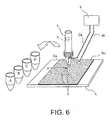
- L represents a glass slide
- Au a layer of gold deposited on this glass slide (the assembly is hereinafter called “gold plate”;”s” the electropolymerization solution; and
- the working electrode, the reference 1 indicates a pipette, the reference 3 the tip of the pipette, and the reference 7 polypyrrole spots deposited on the gold layer.
- the gold plate on which the electropolymerization is performed serves as a working electrode (W), and a platinum wire placed in the deposition cone serves as a counter electrode (Ce).
- This electrochemical system is connected to the potentiostat 5.
- the copolymerization is carried out with 20 ⁇ l of a solution containing 5 ⁇ l of the SA-maleimide-pyrrole solution, chosen from that manufactured in the preceding example, and 15 ⁇ l of the spotting solution comprising 50 mM phosphate buffer with a pH of 7, and 20 mM pyrrole.
- the film is synthesized on the gold layer following an electric pulse that lasts 500 ms and rises to 2.4 V (about 0.9 V / ECS).
- the different spots are all made in the same way, the cone being rinsed with water between each polymerization.
- Example 4 Phase of detection of grafted proteins on the spots
- Example 3 After the electrochemical synthesis of Example 3, the area where the spots are located is delimited by a hydrophobic barrier made using a glue felt. The spots are then washed twice with 1 ml of rinse buffer. Then they are blocked with 100 .mu.l of the blocking buffer, in order to prevent the non-specific binding of the proteins, deposited inside the previously defined hydrophobic zone. After a second rinse identical to the previous one, 100 ⁇ l of a 10% biotinylated R-phycoerythrin solution in PBS is deposited.
- reaction is left for 10 minutes in the dark, then a last wash identical to precedents is achieved before the detection phase under the microscope.
- the samples deposited on the gold slide are placed between slide and coverslip and observed with an epifluorescence microscope equipped with a CDD camera under green light and at a magnification x 1.2. Spot images are taken and the fluorescence intensities are measured by the Image Pro Plus software.
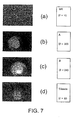
- the MR spot controls the non-specific adsorption on the surface of the polypyrrole film. According to our expectations, it has little fluorescence.
- the control spot is streptavidin which is not coupled to pyrrole. It is therefore adsorbed on polypyrrole. This spot shows a much lower fluorescence intensity than SA-pyrrole samples, A and B. This demonstrates that the presence of pyrrole favors the attachment of streptavidin on the surface of the gold plate.
- Spot A and B correspond to streptavidin coupled to polypyrrole via, respectively, NHS caproate, and sulfo NHS undecanoate.
- FIGS. 8 (a) and (b) illustrate the fluorescence intensity measurements of the different streptavidin-pyrrole conjugates.
- the spots are arranged according to the diagram of the figure 8 (b) .
- the references in this figure correspond to those indicated above.
- the axes of reflection could be, for example, the length and / or the more or less hydrophilic character of the arms; but also the efficiency of the coupling, etc.
- Ig G immunoglobulin G
- the samples are then purified using Nalgen 30K filters, at 8000 rpm for 20 minutes, and rinsed three times with 100 ⁇ l of spotting buffer, a centrifugation of 20 minutes being necessary between each rinsing.
- IgG-pyrrole are recovered in a volume of 50 .mu.l of spotting buffer.
- the samples are filtered, as before, using Nalgen filters, rinsed three times with 100 ⁇ l of spotting buffer. Two samples of anti-hCG-Pyrrole IgG are recovered in solution in spotting buffer and in a volume of 50 .mu.l.
- the copolymerization is the same for both models considered.
- the spots are rinsed twice with 1 ml of 10mM PBS buffer, 1% BSA, 0.05% Tween (w / w) between each step, and all reactions are done at room temperature.
- the spots are rinsed and then blocked with 100 ⁇ l of rinsing buffer (10 mM PBS, 1% BSA, 0.05% Tween (w / w)) for 30 minutes. After a second rinsing, 100 ⁇ l of a solution of anti-rabbit IgG or biotinylated male antibodies respectively diluted to 1/10 000 and 1/50 000, are added. The reaction is left for 30 minutes. After a new rinse, 100 ⁇ l of a solution of streptavidin R-phycoerythrin 10% in rinsing buffer are added 10 minutes in the dark. The fluorescence detection is carried out as previously in Example 4.
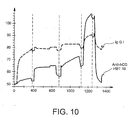
- the inventors placed themselves at fixed incidence to measure the kinetics of variation of the reflectivity as a function of time.
- FIG. 9 is a graphical representation of the plasmon buffer obtained.
- the inventors are therefore placed at 34.1 ° to be in the right flank of the absorption peak of the reflectivity curve.
- This plaque is first revealed by biotinylated anti-rabbit IgG then by hCG, rabbit anti-hCG, and finally biotinylated rabbit anti-IgG. The experience lasts 5h20 min.
- the figure 10 appended is a graphic representation of the kinetics of the deposits of the plate: 2 deposits consisting of IgG rabbit (IgG 1) and HBT 10 (anti hCG antibody).
- the rabbit IgG deposition only takes rabbit IgG anti, and no hCG.
- the HBT deposition 10 binds hCG well, demonstrating that there is no cross reaction between the two types of rabbit antibodies, i.e. rabbit IgGs attached to the plate and anti hCG from rabbits.
- An anti-rabbit IgG antibody is grafted into the polymer according to the method given in Example 6.
- the deposits are made from the same reaction medium (50 mM sodium phosphate buffer pH 7, 20 mM pyrrole IgG).
- the deposits, made in doublet for A to F and in triplet for G are made by electrospotting during variable times thus generating polymers of variable thicknesses. The synthesis charges are measured and the thickness of the polymer can thus be evaluated.
- the manufactured biochip is then treated with biotinylated rabbit anti-IgG and then recognition is detected with streptavidin-phycoerythrin (see Example 6).
- the image obtained is provided on the Figures 11 (a) and (b) annexed and the quantitative results (Fluorescence Intensities) are given in the table below.
- the Figure 11 (b) is a schematic representation of the photograph 11 (a) to highlight the deposits.
- the thickness of the polymer thus plays a key role in the fixing capacity and especially in the recognition capacity of congested proteins. It is therefore possible to compare the electropolymerization thicknesses or densities described in the literature: Wolowacz et al proposes films incorporating Glucose oxidase, the polymerization densities are of the order of 1.4 mC / mm 2 ( a film thickness of about 280 nm). In this case, the sensor works because it allows, through the porosity of the polymer, the diffusion of a small analyte, glucose.
- the thickness of the polypyrrole film used for the imprisonment of the protein is at least 350 nm, ie a polymerization charge density of 1.5 mC / mm 2 .
Landscapes
- Health & Medical Sciences (AREA)
- Chemical & Material Sciences (AREA)
- Immunology (AREA)
- Life Sciences & Earth Sciences (AREA)
- Engineering & Computer Science (AREA)
- Medicinal Chemistry (AREA)
- Polymers & Plastics (AREA)
- Chemical Kinetics & Catalysis (AREA)
- Organic Chemistry (AREA)
- Molecular Biology (AREA)
- Urology & Nephrology (AREA)
- Biomedical Technology (AREA)
- Hematology (AREA)
- Food Science & Technology (AREA)
- Biotechnology (AREA)
- Analytical Chemistry (AREA)
- Biochemistry (AREA)
- General Health & Medical Sciences (AREA)
- General Physics & Mathematics (AREA)
- Pathology (AREA)
- Physics & Mathematics (AREA)
- Cell Biology (AREA)
- Microbiology (AREA)
- Investigating, Analyzing Materials By Fluorescence Or Luminescence (AREA)
- Immobilizing And Processing Of Enzymes And Microorganisms (AREA)
- Investigating Or Analysing Biological Materials (AREA)
- Peptides Or Proteins (AREA)
- Investigating Or Analysing Materials By The Use Of Chemical Reactions (AREA)
Claims (9)
- Verfahren zur Fixierung eines Proteins auf einem leitfähigen Träger mittels eines Pyrrolpolymers, die folgenden Schritte umfassend:- Kopplung des zu fixierenden Proteins mit einem Pyrollmonomer, um eine erste Lösung einer Protein-Pyrrol-Kopplungsverbindung zu erhalten,- Herstellung einer zweiten Lösung des nicht an das Protein gekoppelten Pyrrolmonomers,- Mischung der genannten ersten Lösung mit der genannten zweiten Lösung, um eine Elektropolymerisationslösung zu erhalten,- Elektropolymerisation des Pyrrols und des an das Pyrrol gekoppelten Proteins in wenigstens einer bestimmten Zone des leitfähigen Trägers aus der genannten Elektropolyerisationslösung, wobei die genannte Elektropolymerisation realisiert wird, indem in die genannte Zone eine Strommenge geliefert wird, um ein Polymer mit einer Dicke von höchstens gleich 10 nm zu erhalten.
- Verfahren nach Anspruch 1, bei dem die wenigstens eine leitfähige Zone, in der die Elektropolymerisation realisiert wird, wenigstens eine Kontaktstelle eines Biosensorträgers ist.
- Verfahren nach Anspruch 1, bei dem die Kopplung des zu fixierenden Proteins mit Pyroll realisiert wird mittels einer Aktivierung des Pyrolls, gefolgt von einer Kopplung des aktivierten Pyrolls an das zu fixierende Protein.
- Verfahren nach Anspruch 3, bei dem die Aktivierung des Pyrrols realisiert wird mittels N-Hydroxy-Sulfosuccinimid oder Maleimid.
- Verfahren nach Anspruch 3, bei dem die Protein-Pyrrol-Kopplungsverbindung ausgewählt wird unter den folgenden Verbindungen:


- Verfahren nach Anspruch 1, bei dem zwei Proteine an dem Pyrrolpolymer fixiert werden, sukzessiv und in zwei bestimmten unterschiedlichen Zonen des leitfähigen Trägers.
- Verfahren nach Anspruch 1, bei dem das Protein ausgewählt wird aus der durch ein Enzym, einen Antikörper, ein Antigen, ein Hormon, einen Rezeptor gebildeten Gruppe.
- Anwendung eines Verfahrens nach einem der vorhergehenden Ansprüche 1 bis 7 zur Herstellung eines Monosensors oder eines Multisensors.
- Anwendung eines Verfahrens nach einem der vorhergehenden Ansprüche 1 bis 7 zur Herstellung eines Biochips.
Applications Claiming Priority (3)
| Application Number | Priority Date | Filing Date | Title |
|---|---|---|---|
| FR0214580 | 2002-11-21 | ||
| FR0214580A FR2847581B1 (fr) | 2002-11-21 | 2002-11-21 | Procede de fixation d'une proteine sur un polymere a base de pyrrole et son utilisation pour la fabrication d'un capteur |
| PCT/FR2003/050127 WO2004048972A1 (fr) | 2002-11-21 | 2003-11-20 | Procede de fixation d'une proteine sur un polymere a base de pyrrole et son utilisation pour la fabrication d'un capteur. |
Publications (2)
| Publication Number | Publication Date |
|---|---|
| EP1563304A1 EP1563304A1 (de) | 2005-08-17 |
| EP1563304B1 true EP1563304B1 (de) | 2010-09-15 |
Family
ID=32241479
Family Applications (1)
| Application Number | Title | Priority Date | Filing Date |
|---|---|---|---|
| EP03786063A Expired - Lifetime EP1563304B1 (de) | 2002-11-21 | 2003-11-20 | Verfahren zur fixierung eines proteins auf einem pyrrolpolymerisat, und dessen verwendung zur herstellung eines sensors |
Country Status (7)
| Country | Link |
|---|---|
| US (1) | US7998726B2 (de) |
| EP (1) | EP1563304B1 (de) |
| JP (1) | JP4590266B2 (de) |
| AT (1) | ATE481641T1 (de) |
| DE (1) | DE60334239D1 (de) |
| FR (1) | FR2847581B1 (de) |
| WO (1) | WO2004048972A1 (de) |
Families Citing this family (9)
| Publication number | Priority date | Publication date | Assignee | Title |
|---|---|---|---|---|
| GB9425138D0 (en) * | 1994-12-12 | 1995-02-08 | Dynal As | Isolation of nucleic acid |
| CA2473376A1 (en) | 2002-01-16 | 2003-07-31 | Invitrogen Dynal As | Method for isolating nucleic acids and protein from a single sample |
| GB0229287D0 (en) * | 2002-12-16 | 2003-01-22 | Dna Res Innovations Ltd | Polyfunctional reagents |
| US7468150B2 (en) * | 2005-09-26 | 2008-12-23 | Board Of Trustees Of Michigan State University | Synthesis of conducto-magnetic polymers as nano-transducers in biosensor design |
| DE112009005088A5 (de) * | 2009-07-21 | 2012-10-04 | Heiko Schwertner | Verfahren unter der verwendung von non impact druckmethoden zusammen mit druckflüssigkeiten, die aktive biologische moleküle enthalten, zur produktion von sensoren und komplexen analytischen systemen. |
| KR101545160B1 (ko) | 2013-11-25 | 2015-08-19 | 국립암센터 | 전도성 고분자를 포함하는 세포의 검출 및 회수용 조성물 |
| JP6714278B2 (ja) * | 2014-09-19 | 2020-06-24 | 国立大学法人 新潟大学 | 基質抗原同時検出バイオセンサ、基質抗原同時検出方法、および、プログラム |
| US12496612B2 (en) | 2021-01-08 | 2025-12-16 | Surmodics, Inc. | Coating application system and methods for coating rotatable medical devices |
| KR102774441B1 (ko) * | 2022-08-22 | 2025-03-04 | 국립금오공과대학교 산학협력단 | 신속하게 항체가 고정화된 바이오 센서 및 이의 제조방법 |
Family Cites Families (8)
| Publication number | Priority date | Publication date | Assignee | Title |
|---|---|---|---|---|
| JPH02110363A (ja) * | 1988-10-20 | 1990-04-23 | Teijin Ltd | 免疫センサ用動作電極およびその製造方法 |
| FR2750136B1 (fr) | 1996-06-25 | 1998-08-14 | Cis Bio Int | Conjugues d'un oligonucleotide/polymere conducteur electronique avec une molecule d'interet, et leurs utilisations |
| RU2161653C2 (ru) * | 1998-08-24 | 2001-01-10 | ФАРМАКОВСКИЙ Дмитрий Александрович | Способ количественного электрохимического анализа биомолекул |
| FR2787582B1 (fr) * | 1998-12-16 | 2001-01-12 | Commissariat Energie Atomique | Procede de fabrication d'une biopuce et biopuce |
| FR2789401B1 (fr) * | 1999-02-08 | 2003-04-04 | Cis Bio Int | Procede de fabrication de matrices de ligands adresses sur un support |
| US20060013850A1 (en) * | 1999-12-03 | 2006-01-19 | Domb Abraham J | Electropolymerizable monomers and polymeric coatings on implantable devices prepared therefrom |
| GB0011938D0 (en) * | 2000-05-17 | 2000-07-05 | Angeletti P Ist Richerche Bio | Improvements relating to gene delivery systems |
| FR2824143B1 (fr) * | 2001-04-27 | 2003-06-27 | Commissariat Energie Atomique | Utilisations d'un dispositif miniature de separation et d'isolement d'objets biologiques et procedes mis en oeuvre |
-
2002
- 2002-11-21 FR FR0214580A patent/FR2847581B1/fr not_active Expired - Fee Related
-
2003
- 2003-11-20 JP JP2004554623A patent/JP4590266B2/ja not_active Expired - Fee Related
- 2003-11-20 EP EP03786063A patent/EP1563304B1/de not_active Expired - Lifetime
- 2003-11-20 WO PCT/FR2003/050127 patent/WO2004048972A1/fr not_active Ceased
- 2003-11-20 US US10/533,950 patent/US7998726B2/en not_active Expired - Fee Related
- 2003-11-20 AT AT03786063T patent/ATE481641T1/de not_active IP Right Cessation
- 2003-11-20 DE DE60334239T patent/DE60334239D1/de not_active Expired - Lifetime
Also Published As
| Publication number | Publication date |
|---|---|
| ATE481641T1 (de) | 2010-10-15 |
| FR2847581B1 (fr) | 2007-03-23 |
| FR2847581A1 (fr) | 2004-05-28 |
| DE60334239D1 (de) | 2010-10-28 |
| JP4590266B2 (ja) | 2010-12-01 |
| US7998726B2 (en) | 2011-08-16 |
| JP2006507497A (ja) | 2006-03-02 |
| WO2004048972A1 (fr) | 2004-06-10 |
| US20060035208A1 (en) | 2006-02-16 |
| EP1563304A1 (de) | 2005-08-17 |
Similar Documents
| Publication | Publication Date | Title |
|---|---|---|
| JP4665762B2 (ja) | 非特異吸着を抑制した基材表面 | |
| US6498010B1 (en) | Method for making a device for the simultaneous detection of multiple analytes | |
| US20100249375A1 (en) | Immobilizing molecules on a solid support | |
| EP0874242B1 (de) | Vorrichtung und Apparat zur gleichzeitigen Detektion von mehreren Analyten | |
| JP2005180921A (ja) | ポリエチレングリコール修飾ナノ粒子を担持するバイオセンサーチップ表面 | |
| CN104597230B (zh) | 一种功能高分子薄膜、制备方法及其应用 | |
| WO2009032901A1 (en) | Biosensors and related methods | |
| KR20040105839A (ko) | 폴리에틸렌글리콜화 나노 입자를 담지하는 바이오센서 칩표면 | |
| Hu et al. | Poly (pyrrole-co-pyrrole propylic acid) film and its application in label-free surface plasmon resonance immunosensors | |
| US11442071B2 (en) | Reusable electrochemical sensors capable of cyclodextrin interactions and methods of use thereof | |
| KR100377946B1 (ko) | 덴드리머를 이용한 단분자막의 제조방법 | |
| FR2847581A1 (fr) | Procede de fixation d'une proteine sur un polymere a base de pyrrole et son utilisation pour la fabrication d'un capteur | |
| FR2928457A1 (fr) | Procede de detection et de quantification d'une molecule comprenant au moins une fonction amine sur un support solide | |
| US11899012B2 (en) | Single-chain polymer-based target receptors for use in electrochemical detection of target analytes | |
| EP3126832A1 (de) | Steuerungsmittel zur implementierung von mehereren analyseverfahren | |
| EP1280843A1 (de) | Elektroaktiver komplex, elektroaktive sonde und verfahren zur herstellung | |
| EP1974216A2 (de) | Lumineszierende metalloxidfilme | |
| EP1953555A1 (de) | Physiologisch aktives substanz-immobilisiertes Substrat | |
| US20090275721A1 (en) | Coating Surfaces | |
| EP2607888B1 (de) | Spfs-sensor mit einem reinigungsmechanismus für unspezifische adsorptionen | |
| EP1507792B1 (de) | Vorrichtung von peptid- oder proteindarstellung, verfahren zu deren herstellung und deren verwendung | |
| JP2008064465A (ja) | バイオセンサ用表面 | |
| JP2004198261A (ja) | 親水性高分子物質によって被覆されたセンサチップとそれを用いた分析方法 | |
| FR2847983A1 (fr) | Dispositif miniature de detection electrique d'interactions de type ligand-recepteur, preparation et utilisations. | |
| JP2001013142A (ja) | 検出素子、その製造方法、その検出装置、およびそれを用いた分析方法、分析装置 |
Legal Events
| Date | Code | Title | Description |
|---|---|---|---|
| PUAI | Public reference made under article 153(3) epc to a published international application that has entered the european phase |
Free format text: ORIGINAL CODE: 0009012 |
|
| 17P | Request for examination filed |
Effective date: 20050425 |
|
| AK | Designated contracting states |
Kind code of ref document: A1 Designated state(s): AT BE BG CH CY CZ DE DK EE ES FI FR GB GR HU IE IT LI LU MC NL PT RO SE SI SK TR |
|
| RAP1 | Party data changed (applicant data changed or rights of an application transferred) |
Owner name: COMMISSARIAT A L'ENERGIE ATOMIQUE |
|
| 17Q | First examination report despatched |
Effective date: 20070606 |
|
| RAP1 | Party data changed (applicant data changed or rights of an application transferred) |
Owner name: COMMISSARIAT A L'ENERGIE ATOMIQUE Owner name: CENTRE NATIONAL DE LA RECHERCHE SCIENTIFIQUE |
|
| GRAP | Despatch of communication of intention to grant a patent |
Free format text: ORIGINAL CODE: EPIDOSNIGR1 |
|
| RAP1 | Party data changed (applicant data changed or rights of an application transferred) |
Owner name: COMMISSARIAT A L'ENERGIE ATOMIQUE ET AUX ENERGIES Owner name: CENTRE NATIONAL DE LA RECHERCHE SCIENTIFIQUE |
|
| GRAS | Grant fee paid |
Free format text: ORIGINAL CODE: EPIDOSNIGR3 |
|
| GRAA | (expected) grant |
Free format text: ORIGINAL CODE: 0009210 |
|
| AK | Designated contracting states |
Kind code of ref document: B1 Designated state(s): AT BE BG CH CY CZ DE DK EE ES FI FR GB GR HU IE IT LI LU MC NL PT RO SE SI SK TR |
|
| REG | Reference to a national code |
Ref country code: GB Ref legal event code: FG4D Free format text: NOT ENGLISH Ref country code: CH Ref legal event code: EP |
|
| REG | Reference to a national code |
Ref country code: IE Ref legal event code: FG4D Free format text: LANGUAGE OF EP DOCUMENT: FRENCH |
|
| REF | Corresponds to: |
Ref document number: 60334239 Country of ref document: DE Date of ref document: 20101028 Kind code of ref document: P |
|
| REG | Reference to a national code |
Ref country code: NL Ref legal event code: VDEP Effective date: 20100915 |
|
| PG25 | Lapsed in a contracting state [announced via postgrant information from national office to epo] |
Ref country code: AT Free format text: LAPSE BECAUSE OF FAILURE TO SUBMIT A TRANSLATION OF THE DESCRIPTION OR TO PAY THE FEE WITHIN THE PRESCRIBED TIME-LIMIT Effective date: 20100915 Ref country code: FI Free format text: LAPSE BECAUSE OF FAILURE TO SUBMIT A TRANSLATION OF THE DESCRIPTION OR TO PAY THE FEE WITHIN THE PRESCRIBED TIME-LIMIT Effective date: 20100915 |
|
| PG25 | Lapsed in a contracting state [announced via postgrant information from national office to epo] |
Ref country code: CY Free format text: LAPSE BECAUSE OF FAILURE TO SUBMIT A TRANSLATION OF THE DESCRIPTION OR TO PAY THE FEE WITHIN THE PRESCRIBED TIME-LIMIT Effective date: 20100915 Ref country code: SI Free format text: LAPSE BECAUSE OF FAILURE TO SUBMIT A TRANSLATION OF THE DESCRIPTION OR TO PAY THE FEE WITHIN THE PRESCRIBED TIME-LIMIT Effective date: 20100915 |
|
| PG25 | Lapsed in a contracting state [announced via postgrant information from national office to epo] |
Ref country code: GR Free format text: LAPSE BECAUSE OF FAILURE TO SUBMIT A TRANSLATION OF THE DESCRIPTION OR TO PAY THE FEE WITHIN THE PRESCRIBED TIME-LIMIT Effective date: 20101216 Ref country code: SE Free format text: LAPSE BECAUSE OF FAILURE TO SUBMIT A TRANSLATION OF THE DESCRIPTION OR TO PAY THE FEE WITHIN THE PRESCRIBED TIME-LIMIT Effective date: 20100915 |
|
| REG | Reference to a national code |
Ref country code: IE Ref legal event code: FD4D |
|
| PG25 | Lapsed in a contracting state [announced via postgrant information from national office to epo] |
Ref country code: IE Free format text: LAPSE BECAUSE OF FAILURE TO SUBMIT A TRANSLATION OF THE DESCRIPTION OR TO PAY THE FEE WITHIN THE PRESCRIBED TIME-LIMIT Effective date: 20100915 |
|
| BERE | Be: lapsed |
Owner name: COMMISSARIAT A L'ENERGIE ATOMIQUE ET AUX ENERGIES Effective date: 20101130 Owner name: CENTRE NATIONAL DE LA RECHERCHE SCIENTIFIQUE Effective date: 20101130 |
|
| PG25 | Lapsed in a contracting state [announced via postgrant information from national office to epo] |
Ref country code: NL Free format text: LAPSE BECAUSE OF FAILURE TO SUBMIT A TRANSLATION OF THE DESCRIPTION OR TO PAY THE FEE WITHIN THE PRESCRIBED TIME-LIMIT Effective date: 20100915 Ref country code: PT Free format text: LAPSE BECAUSE OF FAILURE TO SUBMIT A TRANSLATION OF THE DESCRIPTION OR TO PAY THE FEE WITHIN THE PRESCRIBED TIME-LIMIT Effective date: 20110117 Ref country code: SK Free format text: LAPSE BECAUSE OF FAILURE TO SUBMIT A TRANSLATION OF THE DESCRIPTION OR TO PAY THE FEE WITHIN THE PRESCRIBED TIME-LIMIT Effective date: 20100915 Ref country code: EE Free format text: LAPSE BECAUSE OF FAILURE TO SUBMIT A TRANSLATION OF THE DESCRIPTION OR TO PAY THE FEE WITHIN THE PRESCRIBED TIME-LIMIT Effective date: 20100915 Ref country code: RO Free format text: LAPSE BECAUSE OF FAILURE TO SUBMIT A TRANSLATION OF THE DESCRIPTION OR TO PAY THE FEE WITHIN THE PRESCRIBED TIME-LIMIT Effective date: 20100915 Ref country code: CZ Free format text: LAPSE BECAUSE OF FAILURE TO SUBMIT A TRANSLATION OF THE DESCRIPTION OR TO PAY THE FEE WITHIN THE PRESCRIBED TIME-LIMIT Effective date: 20100915 Ref country code: IT Free format text: LAPSE BECAUSE OF FAILURE TO SUBMIT A TRANSLATION OF THE DESCRIPTION OR TO PAY THE FEE WITHIN THE PRESCRIBED TIME-LIMIT Effective date: 20100915 |
|
| PG25 | Lapsed in a contracting state [announced via postgrant information from national office to epo] |
Ref country code: MC Free format text: LAPSE BECAUSE OF NON-PAYMENT OF DUE FEES Effective date: 20101130 Ref country code: ES Free format text: LAPSE BECAUSE OF FAILURE TO SUBMIT A TRANSLATION OF THE DESCRIPTION OR TO PAY THE FEE WITHIN THE PRESCRIBED TIME-LIMIT Effective date: 20101226 |
|
| REG | Reference to a national code |
Ref country code: CH Ref legal event code: PL |
|
| PLBE | No opposition filed within time limit |
Free format text: ORIGINAL CODE: 0009261 |
|
| STAA | Information on the status of an ep patent application or granted ep patent |
Free format text: STATUS: NO OPPOSITION FILED WITHIN TIME LIMIT |
|
| PG25 | Lapsed in a contracting state [announced via postgrant information from national office to epo] |
Ref country code: LI Free format text: LAPSE BECAUSE OF NON-PAYMENT OF DUE FEES Effective date: 20101130 Ref country code: CH Free format text: LAPSE BECAUSE OF NON-PAYMENT OF DUE FEES Effective date: 20101130 |
|
| 26N | No opposition filed |
Effective date: 20110616 |
|
| PG25 | Lapsed in a contracting state [announced via postgrant information from national office to epo] |
Ref country code: BE Free format text: LAPSE BECAUSE OF NON-PAYMENT OF DUE FEES Effective date: 20101130 Ref country code: DK Free format text: LAPSE BECAUSE OF FAILURE TO SUBMIT A TRANSLATION OF THE DESCRIPTION OR TO PAY THE FEE WITHIN THE PRESCRIBED TIME-LIMIT Effective date: 20100915 |
|
| REG | Reference to a national code |
Ref country code: DE Ref legal event code: R097 Ref document number: 60334239 Country of ref document: DE Effective date: 20110616 |
|
| PG25 | Lapsed in a contracting state [announced via postgrant information from national office to epo] |
Ref country code: LU Free format text: LAPSE BECAUSE OF NON-PAYMENT OF DUE FEES Effective date: 20101120 Ref country code: HU Free format text: LAPSE BECAUSE OF FAILURE TO SUBMIT A TRANSLATION OF THE DESCRIPTION OR TO PAY THE FEE WITHIN THE PRESCRIBED TIME-LIMIT Effective date: 20110316 Ref country code: BG Free format text: LAPSE BECAUSE OF FAILURE TO SUBMIT A TRANSLATION OF THE DESCRIPTION OR TO PAY THE FEE WITHIN THE PRESCRIBED TIME-LIMIT Effective date: 20100915 |
|
| PG25 | Lapsed in a contracting state [announced via postgrant information from national office to epo] |
Ref country code: TR Free format text: LAPSE BECAUSE OF FAILURE TO SUBMIT A TRANSLATION OF THE DESCRIPTION OR TO PAY THE FEE WITHIN THE PRESCRIBED TIME-LIMIT Effective date: 20100915 |
|
| PG25 | Lapsed in a contracting state [announced via postgrant information from national office to epo] |
Ref country code: BG Free format text: LAPSE BECAUSE OF FAILURE TO SUBMIT A TRANSLATION OF THE DESCRIPTION OR TO PAY THE FEE WITHIN THE PRESCRIBED TIME-LIMIT Effective date: 20101215 |
|
| REG | Reference to a national code |
Ref country code: FR Ref legal event code: PLFP Year of fee payment: 13 |
|
| REG | Reference to a national code |
Ref country code: FR Ref legal event code: PLFP Year of fee payment: 14 |
|
| REG | Reference to a national code |
Ref country code: FR Ref legal event code: PLFP Year of fee payment: 15 |
|
| PGFP | Annual fee paid to national office [announced via postgrant information from national office to epo] |
Ref country code: DE Payment date: 20181112 Year of fee payment: 16 |
|
| PGFP | Annual fee paid to national office [announced via postgrant information from national office to epo] |
Ref country code: FR Payment date: 20181129 Year of fee payment: 16 Ref country code: GB Payment date: 20181116 Year of fee payment: 16 |
|
| REG | Reference to a national code |
Ref country code: DE Ref legal event code: R119 Ref document number: 60334239 Country of ref document: DE |
|
| GBPC | Gb: european patent ceased through non-payment of renewal fee |
Effective date: 20191120 |
|
| PG25 | Lapsed in a contracting state [announced via postgrant information from national office to epo] |
Ref country code: DE Free format text: LAPSE BECAUSE OF NON-PAYMENT OF DUE FEES Effective date: 20200603 Ref country code: GB Free format text: LAPSE BECAUSE OF NON-PAYMENT OF DUE FEES Effective date: 20191120 Ref country code: FR Free format text: LAPSE BECAUSE OF NON-PAYMENT OF DUE FEES Effective date: 20191130 |