EP1562596B1 - Pyridinalykl-aminoalkyl-1h-indol derivate mit hemmender wirkung auf die 5-ht und serotonin wiederaufnahme als antidepressiva und anxiolytika - Google Patents
Pyridinalykl-aminoalkyl-1h-indol derivate mit hemmender wirkung auf die 5-ht und serotonin wiederaufnahme als antidepressiva und anxiolytika Download PDFInfo
- Publication number
- EP1562596B1 EP1562596B1 EP03811744A EP03811744A EP1562596B1 EP 1562596 B1 EP1562596 B1 EP 1562596B1 EP 03811744 A EP03811744 A EP 03811744A EP 03811744 A EP03811744 A EP 03811744A EP 1562596 B1 EP1562596 B1 EP 1562596B1
- Authority
- EP
- European Patent Office
- Prior art keywords
- denotes
- indole
- butyl
- carbonitrile
- amino
- Prior art date
- Legal status (The legal status is an assumption and is not a legal conclusion. Google has not performed a legal analysis and makes no representation as to the accuracy of the status listed.)
- Expired - Lifetime
Links
- QZAYGJVTTNCVMB-UHFFFAOYSA-N serotonin Chemical compound C1=C(O)C=C2C(CCN)=CNC2=C1 QZAYGJVTTNCVMB-UHFFFAOYSA-N 0.000 title claims abstract description 42
- 239000000935 antidepressant agent Substances 0.000 title claims abstract description 7
- 229940005513 antidepressants Drugs 0.000 title claims abstract description 7
- 230000000949 anxiolytic effect Effects 0.000 title claims abstract description 7
- 229940076279 serotonin Drugs 0.000 title claims description 8
- 230000001430 anti-depressive effect Effects 0.000 title claims description 3
- 230000002401 inhibitory effect Effects 0.000 title description 2
- 150000001875 compounds Chemical class 0.000 claims abstract description 87
- 238000011282 treatment Methods 0.000 claims abstract description 31
- 239000002249 anxiolytic agent Substances 0.000 claims abstract description 6
- 230000004770 neurodegeneration Effects 0.000 claims abstract description 3
- 208000015122 neurodegenerative disease Diseases 0.000 claims abstract description 3
- -1 COOA' Chemical group 0.000 claims description 68
- 239000000203 mixture Substances 0.000 claims description 44
- 150000003839 salts Chemical class 0.000 claims description 44
- 239000012453 solvate Substances 0.000 claims description 43
- 239000003814 drug Substances 0.000 claims description 33
- 208000037265 diseases, disorders, signs and symptoms Diseases 0.000 claims description 21
- 125000001997 phenyl group Chemical group [H]C1=C([H])C([H])=C(*)C([H])=C1[H] 0.000 claims description 19
- 125000003917 carbamoyl group Chemical group [H]N([H])C(*)=O 0.000 claims description 15
- 238000002360 preparation method Methods 0.000 claims description 15
- 239000002253 acid Substances 0.000 claims description 14
- 229910052731 fluorine Inorganic materials 0.000 claims description 14
- 239000004480 active ingredient Substances 0.000 claims description 12
- 229910052794 bromium Inorganic materials 0.000 claims description 12
- 229910052801 chlorine Inorganic materials 0.000 claims description 12
- 208000035475 disorder Diseases 0.000 claims description 12
- 229910006074 SO2NH2 Inorganic materials 0.000 claims description 10
- ZUOUZKKEUPVFJK-UHFFFAOYSA-N diphenyl Chemical compound C1=CC=CC=C1C1=CC=CC=C1 ZUOUZKKEUPVFJK-UHFFFAOYSA-N 0.000 claims description 10
- 125000000217 alkyl group Chemical group 0.000 claims description 9
- 201000010099 disease Diseases 0.000 claims description 9
- 125000001041 indolyl group Chemical group 0.000 claims description 9
- 125000000896 monocarboxylic acid group Chemical group 0.000 claims description 9
- 125000000168 pyrrolyl group Chemical group 0.000 claims description 9
- 102000005962 receptors Human genes 0.000 claims description 9
- 108020003175 receptors Proteins 0.000 claims description 9
- 230000000694 effects Effects 0.000 claims description 8
- 125000002541 furyl group Chemical group 0.000 claims description 8
- 125000002883 imidazolyl group Chemical group 0.000 claims description 8
- 125000000842 isoxazolyl group Chemical group 0.000 claims description 8
- 238000000034 method Methods 0.000 claims description 8
- 125000004076 pyridyl group Chemical group 0.000 claims description 8
- 125000000714 pyrimidinyl group Chemical group 0.000 claims description 8
- 125000000565 sulfonamide group Chemical group 0.000 claims description 8
- 125000003831 tetrazolyl group Chemical group 0.000 claims description 8
- 125000000335 thiazolyl group Chemical group 0.000 claims description 8
- 125000001544 thienyl group Chemical group 0.000 claims description 8
- 125000001425 triazolyl group Chemical group 0.000 claims description 8
- 150000007513 acids Chemical class 0.000 claims description 7
- 125000004432 carbon atom Chemical group C* 0.000 claims description 7
- 229910052740 iodine Inorganic materials 0.000 claims description 7
- 125000005956 isoquinolyl group Chemical group 0.000 claims description 7
- 208000024827 Alzheimer disease Diseases 0.000 claims description 6
- 208000027776 Extrapyramidal disease Diseases 0.000 claims description 6
- 238000011321 prophylaxis Methods 0.000 claims description 6
- 125000005493 quinolyl group Chemical group 0.000 claims description 6
- 208000028017 Psychotic disease Diseases 0.000 claims description 5
- 239000004305 biphenyl Substances 0.000 claims description 5
- 235000010290 biphenyl Nutrition 0.000 claims description 5
- 206010008118 cerebral infarction Diseases 0.000 claims description 5
- 125000001624 naphthyl group Chemical group 0.000 claims description 5
- 208000019901 Anxiety disease Diseases 0.000 claims description 4
- 206010012289 Dementia Diseases 0.000 claims description 4
- 208000021384 Obsessive-Compulsive disease Diseases 0.000 claims description 4
- 125000001797 benzyl group Chemical group [H]C1=C([H])C([H])=C(C([H])=C1[H])C([H])([H])* 0.000 claims description 4
- 125000004435 hydrogen atom Chemical group [H]* 0.000 claims description 4
- 239000003112 inhibitor Substances 0.000 claims description 4
- 229910052757 nitrogen Inorganic materials 0.000 claims description 4
- BGRIIAVSULCHQF-UHFFFAOYSA-N 3-[4-(quinolin-2-ylmethylamino)butyl]-1h-indole-5-carbonitrile Chemical compound C1=CC=CC2=NC(CNCCCCC3=CNC4=CC=C(C=C43)C#N)=CC=C21 BGRIIAVSULCHQF-UHFFFAOYSA-N 0.000 claims description 3
- JNBNKNQFOAJGSJ-UHFFFAOYSA-N 3-[4-(quinolin-4-ylmethylamino)butyl]-1h-indole-5-carbonitrile Chemical compound C1=CC=C2C(CNCCCCC3=CNC4=CC=C(C=C43)C#N)=CC=NC2=C1 JNBNKNQFOAJGSJ-UHFFFAOYSA-N 0.000 claims description 3
- QRRXWGPDGBLVEJ-UHFFFAOYSA-N 3-[4-[(2-chloro-6-methylpyridin-4-yl)methylamino]butyl]-1h-indole-5-carbonitrile Chemical compound ClC1=NC(C)=CC(CNCCCCC=2C3=CC(=CC=C3NC=2)C#N)=C1 QRRXWGPDGBLVEJ-UHFFFAOYSA-N 0.000 claims description 3
- WOMCNGATLONWPM-UHFFFAOYSA-N 3-[4-[(5-bromopyridin-3-yl)methylamino]butyl]-1h-indole-5-carbonitrile Chemical compound BrC1=CN=CC(CNCCCCC=2C3=CC(=CC=C3NC=2)C#N)=C1 WOMCNGATLONWPM-UHFFFAOYSA-N 0.000 claims description 3
- 102000040125 5-hydroxytryptamine receptor family Human genes 0.000 claims description 3
- 108091032151 5-hydroxytryptamine receptor family Proteins 0.000 claims description 3
- CURLTUGMZLYLDI-UHFFFAOYSA-N Carbon dioxide Chemical group O=C=O CURLTUGMZLYLDI-UHFFFAOYSA-N 0.000 claims description 3
- 201000001880 Sexual dysfunction Diseases 0.000 claims description 3
- 239000000939 antiparkinson agent Substances 0.000 claims description 3
- 125000003178 carboxy group Chemical group [H]OC(*)=O 0.000 claims description 3
- 239000002858 neurotransmitter agent Substances 0.000 claims description 3
- 239000000546 pharmaceutical excipient Substances 0.000 claims description 3
- 229920006395 saturated elastomer Polymers 0.000 claims description 3
- 201000000980 schizophrenia Diseases 0.000 claims description 3
- 231100000872 sexual dysfunction Toxicity 0.000 claims description 3
- 208000024891 symptom Diseases 0.000 claims description 3
- REWFCFCTENNIAM-UHFFFAOYSA-N 3-[4-(pyridin-2-ylmethylamino)butyl]-1h-indole-5-carbonitrile Chemical compound C12=CC(C#N)=CC=C2NC=C1CCCCNCC1=CC=CC=N1 REWFCFCTENNIAM-UHFFFAOYSA-N 0.000 claims description 2
- FZNKMCPDVPCZLO-UHFFFAOYSA-N 3-[4-(pyridin-3-ylmethylamino)butyl]-1h-indole-5-carbonitrile Chemical compound C12=CC(C#N)=CC=C2NC=C1CCCCNCC1=CC=CN=C1 FZNKMCPDVPCZLO-UHFFFAOYSA-N 0.000 claims description 2
- LOBYQDGHVANCRH-UHFFFAOYSA-N 3-[4-(pyridin-4-ylmethylamino)butyl]-1h-indole-5-carbonitrile Chemical compound C12=CC(C#N)=CC=C2NC=C1CCCCNCC1=CC=NC=C1 LOBYQDGHVANCRH-UHFFFAOYSA-N 0.000 claims description 2
- LDESUJQFCUFLFA-UHFFFAOYSA-N 3-[4-(quinolin-3-ylmethylamino)butyl]-1h-indole-5-carbonitrile Chemical compound C1=CC=CC2=CC(CNCCCCC3=CNC4=CC=C(C=C43)C#N)=CN=C21 LDESUJQFCUFLFA-UHFFFAOYSA-N 0.000 claims description 2
- NYDICTLFDYPSDN-UHFFFAOYSA-N 3-[4-[(2,5-dichloropyridin-3-yl)methylamino]butyl]-1h-indole-5-carbonitrile Chemical compound ClC1=CN=C(Cl)C(CNCCCCC=2C3=CC(=CC=C3NC=2)C#N)=C1 NYDICTLFDYPSDN-UHFFFAOYSA-N 0.000 claims description 2
- HRLXIYDYCSMIGS-UHFFFAOYSA-N 3-[4-[(2,6-dichloropyridin-3-yl)methylamino]butyl]-1h-indole-5-carbonitrile Chemical compound ClC1=NC(Cl)=CC=C1CNCCCCC1=CNC2=CC=C(C#N)C=C12 HRLXIYDYCSMIGS-UHFFFAOYSA-N 0.000 claims description 2
- VQBYSFSZHAFTDI-UHFFFAOYSA-N 3-[4-[(2,6-dichloropyridin-4-yl)methylamino]butyl]-1h-indole-5-carbonitrile Chemical compound ClC1=NC(Cl)=CC(CNCCCCC=2C3=CC(=CC=C3NC=2)C#N)=C1 VQBYSFSZHAFTDI-UHFFFAOYSA-N 0.000 claims description 2
- OIFYLOQVKZWBFJ-UHFFFAOYSA-N 3-[4-[(2-chloropyridin-4-yl)methylamino]butyl]-1h-indole-5-carbonitrile Chemical compound C1=NC(Cl)=CC(CNCCCCC=2C3=CC(=CC=C3NC=2)C#N)=C1 OIFYLOQVKZWBFJ-UHFFFAOYSA-N 0.000 claims description 2
- IOTONBNHOLIKJP-UHFFFAOYSA-N 3-[4-[(2-methylpyridin-3-yl)methylamino]butyl]-1h-indole-5-carbonitrile Chemical compound CC1=NC=CC=C1CNCCCCC1=CNC2=CC=C(C#N)C=C12 IOTONBNHOLIKJP-UHFFFAOYSA-N 0.000 claims description 2
- HTJCMXAOMXUSEH-UHFFFAOYSA-N 3-[4-[(2-methylsulfanylpyridin-3-yl)methylamino]butyl]-1h-indole-5-carbonitrile Chemical compound CSC1=NC=CC=C1CNCCCCC1=CNC2=CC=C(C#N)C=C12 HTJCMXAOMXUSEH-UHFFFAOYSA-N 0.000 claims description 2
- QFPLDLPNIHXQLK-UHFFFAOYSA-N 3-[4-[(4-phenylpyridin-2-yl)methylamino]butyl]-1h-indole-5-carbonitrile Chemical compound C12=CC(C#N)=CC=C2NC=C1CCCCNCC(N=CC=1)=CC=1C1=CC=CC=C1 QFPLDLPNIHXQLK-UHFFFAOYSA-N 0.000 claims description 2
- WHRTXOZENKKJJF-UHFFFAOYSA-N 3-[4-[(4-phenylpyridin-3-yl)methylamino]butyl]-1h-indole-5-carbonitrile Chemical compound C12=CC(C#N)=CC=C2NC=C1CCCCNCC1=CN=CC=C1C1=CC=CC=C1 WHRTXOZENKKJJF-UHFFFAOYSA-N 0.000 claims description 2
- NXQCFTCJMHHHNR-UHFFFAOYSA-N 3-[4-[(5-cyano-6-methylsulfanylpyridin-2-yl)methylamino]butyl]-1h-indole-5-carbonitrile Chemical compound C1=C(C#N)C(SC)=NC(CNCCCCC=2C3=CC(=CC=C3NC=2)C#N)=C1 NXQCFTCJMHHHNR-UHFFFAOYSA-N 0.000 claims description 2
- YLXDNBFSQCUOHH-UHFFFAOYSA-N 3-[4-[(5-methylpyridin-3-yl)methylamino]butyl]-1h-indole-5-carbonitrile Chemical compound CC1=CN=CC(CNCCCCC=2C3=CC(=CC=C3NC=2)C#N)=C1 YLXDNBFSQCUOHH-UHFFFAOYSA-N 0.000 claims description 2
- AXNACVKITYMSDB-UHFFFAOYSA-N 3-[4-[(5-phenylpyridin-2-yl)methylamino]butyl]-1h-indole-5-carbonitrile Chemical compound C12=CC(C#N)=CC=C2NC=C1CCCCNCC(N=C1)=CC=C1C1=CC=CC=C1 AXNACVKITYMSDB-UHFFFAOYSA-N 0.000 claims description 2
- VZWQYYRABRMQQA-UHFFFAOYSA-N 3-[4-[(5-phenylpyridin-3-yl)methylamino]butyl]-1h-indole-5-carbonitrile Chemical compound C12=CC(C#N)=CC=C2NC=C1CCCCNCC(C=1)=CN=CC=1C1=CC=CC=C1 VZWQYYRABRMQQA-UHFFFAOYSA-N 0.000 claims description 2
- GJVVYPVKNWXXIY-UHFFFAOYSA-N 3-[4-[(6-chloropyridin-3-yl)methylamino]butyl]-1h-indole-5-carbonitrile Chemical compound C1=NC(Cl)=CC=C1CNCCCCC1=CNC2=CC=C(C#N)C=C12 GJVVYPVKNWXXIY-UHFFFAOYSA-N 0.000 claims description 2
- JSKIZQHKCXVWMU-UHFFFAOYSA-N 3-[4-[[2-(4-chlorophenoxy)pyridin-3-yl]methylamino]butyl]-1h-indole-5-carbonitrile Chemical compound C1=CC(Cl)=CC=C1OC1=NC=CC=C1CNCCCCC1=CNC2=CC=C(C#N)C=C12 JSKIZQHKCXVWMU-UHFFFAOYSA-N 0.000 claims description 2
- XYPFONIMRUGPGD-UHFFFAOYSA-N 3-[4-[[5-(4-fluorophenyl)pyridin-3-yl]methylamino]butyl]-1h-indole-5-carbonitrile Chemical compound C1=CC(F)=CC=C1C1=CN=CC(CNCCCCC=2C3=CC(=CC=C3NC=2)C#N)=C1 XYPFONIMRUGPGD-UHFFFAOYSA-N 0.000 claims description 2
- JBDCCAMFPIDMMN-UHFFFAOYSA-N 3-[4-[[6-(trifluoromethyl)pyridin-3-yl]methylamino]butyl]-1h-indole-5-carbonitrile Chemical compound C1=NC(C(F)(F)F)=CC=C1CNCCCCC1=CNC2=CC=C(C#N)C=C12 JBDCCAMFPIDMMN-UHFFFAOYSA-N 0.000 claims description 2
- NXRYMBLCWJQUMA-UHFFFAOYSA-N 3-[4-[methyl(pyridin-3-ylmethyl)amino]butyl]-1h-indole-5-carbonitrile Chemical compound C=1NC2=CC=C(C#N)C=C2C=1CCCCN(C)CC1=CC=CN=C1 NXRYMBLCWJQUMA-UHFFFAOYSA-N 0.000 claims description 2
- 208000012239 Developmental disease Diseases 0.000 claims description 2
- 208000001393 Lathyrism Diseases 0.000 claims description 2
- 208000036626 Mental retardation Diseases 0.000 claims description 2
- 206010037180 Psychiatric symptoms Diseases 0.000 claims description 2
- 239000002671 adjuvant Substances 0.000 claims description 2
- 239000000556 agonist Substances 0.000 claims description 2
- 230000003276 anti-hypertensive effect Effects 0.000 claims description 2
- 150000007514 bases Chemical class 0.000 claims description 2
- 208000013403 hyperactivity Diseases 0.000 claims description 2
- 239000003176 neuroleptic agent Substances 0.000 claims description 2
- 230000000701 neuroleptic effect Effects 0.000 claims description 2
- 125000004433 nitrogen atom Chemical group N* 0.000 claims description 2
- 125000004430 oxygen atom Chemical group O* 0.000 claims description 2
- 230000008569 process Effects 0.000 claims description 2
- 230000011273 social behavior Effects 0.000 claims description 2
- 125000004434 sulfur atom Chemical group 0.000 claims description 2
- 208000019430 Motor disease Diseases 0.000 claims 2
- LJNVMLFOHRSYIM-UHFFFAOYSA-N 3-[4-(2-pyridin-4-ylethylamino)butyl]-1h-indole-5-carbonitrile Chemical compound C12=CC(C#N)=CC=C2NC=C1CCCCNCCC1=CC=NC=C1 LJNVMLFOHRSYIM-UHFFFAOYSA-N 0.000 claims 1
- 230000000648 anti-parkinson Effects 0.000 claims 1
- 125000002619 bicyclic group Chemical group 0.000 claims 1
- 230000003930 cognitive ability Effects 0.000 claims 1
- 230000007547 defect Effects 0.000 claims 1
- 125000002950 monocyclic group Chemical group 0.000 claims 1
- 235000021231 nutrient uptake Nutrition 0.000 claims 1
- 230000001575 pathological effect Effects 0.000 claims 1
- 229940005530 anxiolytics Drugs 0.000 abstract description 4
- 230000000697 serotonin reuptake Effects 0.000 abstract description 4
- 229940054051 antipsychotic indole derivative Drugs 0.000 abstract description 3
- 150000002475 indoles Chemical class 0.000 abstract description 3
- 238000000589 high-performance liquid chromatography-mass spectrometry Methods 0.000 description 26
- OKKJLVBELUTLKV-UHFFFAOYSA-N Methanol Chemical compound OC OKKJLVBELUTLKV-UHFFFAOYSA-N 0.000 description 21
- XEKOWRVHYACXOJ-UHFFFAOYSA-N Ethyl acetate Chemical compound CCOC(C)=O XEKOWRVHYACXOJ-UHFFFAOYSA-N 0.000 description 15
- WEVYAHXRMPXWCK-UHFFFAOYSA-N Acetonitrile Chemical compound CC#N WEVYAHXRMPXWCK-UHFFFAOYSA-N 0.000 description 13
- YMWUJEATGCHHMB-UHFFFAOYSA-N Dichloromethane Chemical compound ClCCl YMWUJEATGCHHMB-UHFFFAOYSA-N 0.000 description 12
- 239000000460 chlorine Substances 0.000 description 12
- QTBSBXVTEAMEQO-UHFFFAOYSA-N Acetic acid Chemical compound CC(O)=O QTBSBXVTEAMEQO-UHFFFAOYSA-N 0.000 description 11
- YXFVVABEGXRONW-UHFFFAOYSA-N Toluene Chemical compound CC1=CC=CC=C1 YXFVVABEGXRONW-UHFFFAOYSA-N 0.000 description 11
- 238000006243 chemical reaction Methods 0.000 description 11
- 239000000243 solution Substances 0.000 description 11
- LFQSCWFLJHTTHZ-UHFFFAOYSA-N Ethanol Chemical compound CCO LFQSCWFLJHTTHZ-UHFFFAOYSA-N 0.000 description 9
- 229940079593 drug Drugs 0.000 description 9
- XLYOFNOQVPJJNP-UHFFFAOYSA-N water Substances O XLYOFNOQVPJJNP-UHFFFAOYSA-N 0.000 description 9
- WYURNTSHIVDZCO-UHFFFAOYSA-N Tetrahydrofuran Chemical compound C1CCOC1 WYURNTSHIVDZCO-UHFFFAOYSA-N 0.000 description 8
- 125000006297 carbonyl amino group Chemical group [H]N([*:2])C([*:1])=O 0.000 description 8
- 125000002914 sec-butyl group Chemical group [H]C([H])([H])C([H])([H])C([H])(*)C([H])([H])[H] 0.000 description 8
- DLFVBJFMPXGRIB-UHFFFAOYSA-N thioacetamide Natural products CC(N)=O DLFVBJFMPXGRIB-UHFFFAOYSA-N 0.000 description 8
- DKGAVHZHDRPRBM-UHFFFAOYSA-N Tert-Butanol Chemical compound CC(C)(C)O DKGAVHZHDRPRBM-UHFFFAOYSA-N 0.000 description 7
- RTZKZFJDLAIYFH-UHFFFAOYSA-N Diethyl ether Chemical compound CCOCC RTZKZFJDLAIYFH-UHFFFAOYSA-N 0.000 description 6
- ZMXDDKWLCZADIW-UHFFFAOYSA-N N,N-Dimethylformamide Chemical compound CN(C)C=O ZMXDDKWLCZADIW-UHFFFAOYSA-N 0.000 description 6
- KWYUFKZDYYNOTN-UHFFFAOYSA-M Potassium hydroxide Chemical compound [OH-].[K+] KWYUFKZDYYNOTN-UHFFFAOYSA-M 0.000 description 6
- ZMANZCXQSJIPKH-UHFFFAOYSA-N Triethylamine Chemical compound CCN(CC)CC ZMANZCXQSJIPKH-UHFFFAOYSA-N 0.000 description 6
- 239000002585 base Substances 0.000 description 6
- VLKZOEOYAKHREP-UHFFFAOYSA-N n-Hexane Chemical compound CCCCCC VLKZOEOYAKHREP-UHFFFAOYSA-N 0.000 description 6
- NLKNQRATVPKPDG-UHFFFAOYSA-M potassium iodide Chemical compound [K+].[I-] NLKNQRATVPKPDG-UHFFFAOYSA-M 0.000 description 6
- 208000018737 Parkinson disease Diseases 0.000 description 5
- HEMHJVSKTPXQMS-UHFFFAOYSA-M Sodium hydroxide Chemical compound [OH-].[Na+] HEMHJVSKTPXQMS-UHFFFAOYSA-M 0.000 description 5
- 238000007792 addition Methods 0.000 description 5
- 239000012442 inert solvent Substances 0.000 description 5
- 125000000959 isobutyl group Chemical group [H]C([H])([H])C([H])(C([H])([H])[H])C([H])([H])* 0.000 description 5
- 230000004899 motility Effects 0.000 description 5
- 239000000825 pharmaceutical preparation Substances 0.000 description 5
- 239000000126 substance Substances 0.000 description 5
- FYSNRJHAOHDILO-UHFFFAOYSA-N thionyl chloride Chemical compound ClS(Cl)=O FYSNRJHAOHDILO-UHFFFAOYSA-N 0.000 description 5
- WDVDHJLKXYCOFS-UHFFFAOYSA-N (5-bromopyridin-3-yl)methanol Chemical compound OCC1=CN=CC(Br)=C1 WDVDHJLKXYCOFS-UHFFFAOYSA-N 0.000 description 4
- SEVLXUBQTKDVRL-UHFFFAOYSA-N 3-(4-aminobutyl)-1h-indole-5-carbonitrile Chemical compound C1=C(C#N)C=C2C(CCCCN)=CNC2=C1 SEVLXUBQTKDVRL-UHFFFAOYSA-N 0.000 description 4
- NLPHAZLCNNDGPS-UHFFFAOYSA-N 3-bromo-5-(chloromethyl)pyridine Chemical compound ClCC1=CN=CC(Br)=C1 NLPHAZLCNNDGPS-UHFFFAOYSA-N 0.000 description 4
- IJGRMHOSHXDMSA-UHFFFAOYSA-N Atomic nitrogen Chemical compound N#N IJGRMHOSHXDMSA-UHFFFAOYSA-N 0.000 description 4
- IAZDPXIOMUYVGZ-UHFFFAOYSA-N Dimethylsulphoxide Chemical compound CS(C)=O IAZDPXIOMUYVGZ-UHFFFAOYSA-N 0.000 description 4
- VEXZGXHMUGYJMC-UHFFFAOYSA-N Hydrochloric acid Chemical compound Cl VEXZGXHMUGYJMC-UHFFFAOYSA-N 0.000 description 4
- KFZMGEQAYNKOFK-UHFFFAOYSA-N Isopropanol Chemical compound CC(C)O KFZMGEQAYNKOFK-UHFFFAOYSA-N 0.000 description 4
- JUJWROOIHBZHMG-UHFFFAOYSA-N Pyridine Chemical compound C1=CC=NC=C1 JUJWROOIHBZHMG-UHFFFAOYSA-N 0.000 description 4
- PMZURENOXWZQFD-UHFFFAOYSA-L Sodium Sulfate Chemical compound [Na+].[Na+].[O-]S([O-])(=O)=O PMZURENOXWZQFD-UHFFFAOYSA-L 0.000 description 4
- 229960000583 acetic acid Drugs 0.000 description 4
- 125000000484 butyl group Chemical group [H]C([*])([H])C([H])([H])C([H])([H])C([H])([H])[H] 0.000 description 4
- 210000003169 central nervous system Anatomy 0.000 description 4
- 239000003795 chemical substances by application Substances 0.000 description 4
- 239000003480 eluent Substances 0.000 description 4
- IPCSVZSSVZVIGE-UHFFFAOYSA-N hexadecanoic acid Chemical compound CCCCCCCCCCCCCCCC(O)=O IPCSVZSSVZVIGE-UHFFFAOYSA-N 0.000 description 4
- 238000002347 injection Methods 0.000 description 4
- 239000007924 injection Substances 0.000 description 4
- JVTAAEKCZFNVCJ-UHFFFAOYSA-N lactic acid Chemical compound CC(O)C(O)=O JVTAAEKCZFNVCJ-UHFFFAOYSA-N 0.000 description 4
- BDAGIHXWWSANSR-UHFFFAOYSA-N methanoic acid Natural products OC=O BDAGIHXWWSANSR-UHFFFAOYSA-N 0.000 description 4
- BWHMMNNQKKPAPP-UHFFFAOYSA-L potassium carbonate Chemical compound [K+].[K+].[O-]C([O-])=O BWHMMNNQKKPAPP-UHFFFAOYSA-L 0.000 description 4
- 238000002390 rotary evaporation Methods 0.000 description 4
- 239000007858 starting material Substances 0.000 description 4
- YLQBMQCUIZJEEH-UHFFFAOYSA-N tetrahydrofuran Natural products C=1C=COC=1 YLQBMQCUIZJEEH-UHFFFAOYSA-N 0.000 description 4
- 125000002023 trifluoromethyl group Chemical group FC(F)(F)* 0.000 description 4
- CSCPPACGZOOCGX-UHFFFAOYSA-N Acetone Chemical compound CC(C)=O CSCPPACGZOOCGX-UHFFFAOYSA-N 0.000 description 3
- UHOVQNZJYSORNB-UHFFFAOYSA-N Benzene Chemical compound C1=CC=CC=C1 UHOVQNZJYSORNB-UHFFFAOYSA-N 0.000 description 3
- WWZKQHOCKIZLMA-UHFFFAOYSA-N Caprylic acid Natural products CCCCCCCC(O)=O WWZKQHOCKIZLMA-UHFFFAOYSA-N 0.000 description 3
- 206010008120 Cerebral ischaemia Diseases 0.000 description 3
- WTDRDQBEARUVNC-LURJTMIESA-N L-DOPA Chemical compound OC(=O)[C@@H](N)CC1=CC=C(O)C(O)=C1 WTDRDQBEARUVNC-LURJTMIESA-N 0.000 description 3
- WTDRDQBEARUVNC-UHFFFAOYSA-N L-Dopa Natural products OC(=O)C(N)CC1=CC=C(O)C(O)=C1 WTDRDQBEARUVNC-UHFFFAOYSA-N 0.000 description 3
- OFOBLEOULBTSOW-UHFFFAOYSA-N Malonic acid Chemical compound OC(=O)CC(O)=O OFOBLEOULBTSOW-UHFFFAOYSA-N 0.000 description 3
- 208000019695 Migraine disease Diseases 0.000 description 3
- VYPSYNLAJGMNEJ-UHFFFAOYSA-N Silicium dioxide Chemical class O=[Si]=O VYPSYNLAJGMNEJ-UHFFFAOYSA-N 0.000 description 3
- 208000006011 Stroke Diseases 0.000 description 3
- QAOWNCQODCNURD-UHFFFAOYSA-N Sulfuric acid Chemical compound OS(O)(=O)=O QAOWNCQODCNURD-UHFFFAOYSA-N 0.000 description 3
- 235000011054 acetic acid Nutrition 0.000 description 3
- 239000008186 active pharmaceutical agent Substances 0.000 description 3
- 229910052784 alkaline earth metal Inorganic materials 0.000 description 3
- 230000036506 anxiety Effects 0.000 description 3
- 230000015572 biosynthetic process Effects 0.000 description 3
- 230000037396 body weight Effects 0.000 description 3
- KRKNYBCHXYNGOX-UHFFFAOYSA-N citric acid Chemical compound OC(=O)CC(O)(C(O)=O)CC(O)=O KRKNYBCHXYNGOX-UHFFFAOYSA-N 0.000 description 3
- 125000001495 ethyl group Chemical group [H]C([H])([H])C([H])([H])* 0.000 description 3
- 125000004051 hexyl group Chemical group [H]C([H])([H])C([H])([H])C([H])([H])C([H])([H])C([H])([H])C([H])([H])* 0.000 description 3
- 125000001449 isopropyl group Chemical group [H]C([H])([H])C([H])(*)C([H])([H])[H] 0.000 description 3
- 229960004502 levodopa Drugs 0.000 description 3
- 125000002496 methyl group Chemical group [H]C([H])([H])* 0.000 description 3
- 206010027599 migraine Diseases 0.000 description 3
- 125000001147 pentyl group Chemical group C(CCCC)* 0.000 description 3
- 125000001436 propyl group Chemical group [H]C([*])([H])C([H])([H])C([H])([H])[H] 0.000 description 3
- 239000011734 sodium Substances 0.000 description 3
- 229910052938 sodium sulfate Inorganic materials 0.000 description 3
- 235000011152 sodium sulphate Nutrition 0.000 description 3
- 239000002904 solvent Substances 0.000 description 3
- 239000007921 spray Substances 0.000 description 3
- 208000011580 syndromic disease Diseases 0.000 description 3
- 238000003786 synthesis reaction Methods 0.000 description 3
- 125000000999 tert-butyl group Chemical group [H]C([H])([H])C(*)(C([H])([H])[H])C([H])([H])[H] 0.000 description 3
- YXPVCSWOMRFRCS-UHFFFAOYSA-N (2-chloro-6-methylpyridin-4-yl)methanol Chemical compound CC1=CC(CO)=CC(Cl)=N1 YXPVCSWOMRFRCS-UHFFFAOYSA-N 0.000 description 2
- BJEPYKJPYRNKOW-REOHCLBHSA-N (S)-malic acid Chemical compound OC(=O)[C@@H](O)CC(O)=O BJEPYKJPYRNKOW-REOHCLBHSA-N 0.000 description 2
- WSLDOOZREJYCGB-UHFFFAOYSA-N 1,2-Dichloroethane Chemical compound ClCCCl WSLDOOZREJYCGB-UHFFFAOYSA-N 0.000 description 2
- ZWEHNKRNPOVVGH-UHFFFAOYSA-N 2-Butanone Chemical compound CCC(C)=O ZWEHNKRNPOVVGH-UHFFFAOYSA-N 0.000 description 2
- XNWFRZJHXBZDAG-UHFFFAOYSA-N 2-METHOXYETHANOL Chemical group COCCO XNWFRZJHXBZDAG-UHFFFAOYSA-N 0.000 description 2
- JNYFUZZTJPBDPC-UHFFFAOYSA-N 2-chloro-4-(chloromethyl)-6-methylpyridine Chemical compound CC1=CC(CCl)=CC(Cl)=N1 JNYFUZZTJPBDPC-UHFFFAOYSA-N 0.000 description 2
- OSWFIVFLDKOXQC-UHFFFAOYSA-N 4-(3-methoxyphenyl)aniline Chemical compound COC1=CC=CC(C=2C=CC(N)=CC=2)=C1 OSWFIVFLDKOXQC-UHFFFAOYSA-N 0.000 description 2
- 208000031295 Animal disease Diseases 0.000 description 2
- QGJOPFRUJISHPQ-UHFFFAOYSA-N Carbon disulfide Chemical compound S=C=S QGJOPFRUJISHPQ-UHFFFAOYSA-N 0.000 description 2
- BVKZGUZCCUSVTD-UHFFFAOYSA-L Carbonate Chemical compound [O-]C([O-])=O BVKZGUZCCUSVTD-UHFFFAOYSA-L 0.000 description 2
- 102000006378 Catechol O-methyltransferase Human genes 0.000 description 2
- 108020002739 Catechol O-methyltransferase Proteins 0.000 description 2
- HEDRZPFGACZZDS-UHFFFAOYSA-N Chloroform Chemical compound ClC(Cl)Cl HEDRZPFGACZZDS-UHFFFAOYSA-N 0.000 description 2
- RGHNJXZEOKUKBD-SQOUGZDYSA-N D-gluconic acid Chemical compound OC[C@@H](O)[C@@H](O)[C@H](O)[C@@H](O)C(O)=O RGHNJXZEOKUKBD-SQOUGZDYSA-N 0.000 description 2
- FEWJPZIEWOKRBE-JCYAYHJZSA-N Dextrotartaric acid Chemical compound OC(=O)[C@H](O)[C@@H](O)C(O)=O FEWJPZIEWOKRBE-JCYAYHJZSA-N 0.000 description 2
- XTHFKEDIFFGKHM-UHFFFAOYSA-N Dimethoxyethane Chemical compound COCCOC XTHFKEDIFFGKHM-UHFFFAOYSA-N 0.000 description 2
- VZCYOOQTPOCHFL-OWOJBTEDSA-N Fumaric acid Chemical compound OC(=O)\C=C\C(O)=O VZCYOOQTPOCHFL-OWOJBTEDSA-N 0.000 description 2
- AEMRFAOFKBGASW-UHFFFAOYSA-N Glycolic acid Chemical compound OCC(O)=O AEMRFAOFKBGASW-UHFFFAOYSA-N 0.000 description 2
- DGAQECJNVWCQMB-PUAWFVPOSA-M Ilexoside XXIX Chemical compound C[C@@H]1CC[C@@]2(CC[C@@]3(C(=CC[C@H]4[C@]3(CC[C@@H]5[C@@]4(CC[C@@H](C5(C)C)OS(=O)(=O)[O-])C)C)[C@@H]2[C@]1(C)O)C)C(=O)O[C@H]6[C@@H]([C@H]([C@@H]([C@H](O6)CO)O)O)O.[Na+] DGAQECJNVWCQMB-PUAWFVPOSA-M 0.000 description 2
- 102000010909 Monoamine Oxidase Human genes 0.000 description 2
- 108010062431 Monoamine oxidase Proteins 0.000 description 2
- LRHPLDYGYMQRHN-UHFFFAOYSA-N N-Butanol Chemical compound CCCCO LRHPLDYGYMQRHN-UHFFFAOYSA-N 0.000 description 2
- HOKKHZGPKSLGJE-GSVOUGTGSA-N N-Methyl-D-aspartic acid Chemical compound CN[C@@H](C(O)=O)CC(O)=O HOKKHZGPKSLGJE-GSVOUGTGSA-N 0.000 description 2
- UFWIBTONFRDIAS-UHFFFAOYSA-N Naphthalene Chemical compound C1=CC=CC2=CC=CC=C21 UFWIBTONFRDIAS-UHFFFAOYSA-N 0.000 description 2
- PVNIIMVLHYAWGP-UHFFFAOYSA-N Niacin Chemical compound OC(=O)C1=CC=CN=C1 PVNIIMVLHYAWGP-UHFFFAOYSA-N 0.000 description 2
- 235000021314 Palmitic acid Nutrition 0.000 description 2
- NBIIXXVUZAFLBC-UHFFFAOYSA-N Phosphoric acid Chemical compound OP(O)(O)=O NBIIXXVUZAFLBC-UHFFFAOYSA-N 0.000 description 2
- SMWDFEZZVXVKRB-UHFFFAOYSA-N Quinoline Chemical compound N1=CC=CC2=CC=CC=C21 SMWDFEZZVXVKRB-UHFFFAOYSA-N 0.000 description 2
- FAPWRFPIFSIZLT-UHFFFAOYSA-M Sodium chloride Chemical compound [Na+].[Cl-] FAPWRFPIFSIZLT-UHFFFAOYSA-M 0.000 description 2
- FEWJPZIEWOKRBE-UHFFFAOYSA-N Tartaric acid Natural products [H+].[H+].[O-]C(=O)C(O)C(O)C([O-])=O FEWJPZIEWOKRBE-UHFFFAOYSA-N 0.000 description 2
- 125000002777 acetyl group Chemical group [H]C([H])([H])C(*)=O 0.000 description 2
- 150000001298 alcohols Chemical class 0.000 description 2
- 239000003513 alkali Substances 0.000 description 2
- BJEPYKJPYRNKOW-UHFFFAOYSA-N alpha-hydroxysuccinic acid Natural products OC(=O)C(O)CC(O)=O BJEPYKJPYRNKOW-UHFFFAOYSA-N 0.000 description 2
- 150000001412 amines Chemical class 0.000 description 2
- 229940035678 anti-parkinson drug Drugs 0.000 description 2
- 229940030600 antihypertensive agent Drugs 0.000 description 2
- 239000002220 antihypertensive agent Substances 0.000 description 2
- 229960002802 bromocriptine Drugs 0.000 description 2
- OZVBMTJYIDMWIL-AYFBDAFISA-N bromocriptine Chemical compound C1=CC(C=2[C@H](N(C)C[C@@H](C=2)C(=O)N[C@]2(C(=O)N3[C@H](C(N4CCC[C@H]4[C@]3(O)O2)=O)CC(C)C)C(C)C)C2)=C3C2=C(Br)NC3=C1 OZVBMTJYIDMWIL-AYFBDAFISA-N 0.000 description 2
- 208000026106 cerebrovascular disease Diseases 0.000 description 2
- 238000004587 chromatography analysis Methods 0.000 description 2
- 238000001816 cooling Methods 0.000 description 2
- 239000012043 crude product Substances 0.000 description 2
- 125000000753 cycloalkyl group Chemical group 0.000 description 2
- XBDQKXXYIPTUBI-UHFFFAOYSA-N dimethylselenoniopropionate Natural products CCC(O)=O XBDQKXXYIPTUBI-UHFFFAOYSA-N 0.000 description 2
- 238000000132 electrospray ionisation Methods 0.000 description 2
- 238000002330 electrospray ionisation mass spectrometry Methods 0.000 description 2
- 150000002148 esters Chemical class 0.000 description 2
- 238000010265 fast atom bombardment Methods 0.000 description 2
- 235000019253 formic acid Nutrition 0.000 description 2
- HHLFWLYXYJOTON-UHFFFAOYSA-N glyoxylic acid Chemical compound OC(=O)C=O HHLFWLYXYJOTON-UHFFFAOYSA-N 0.000 description 2
- 125000000623 heterocyclic group Chemical group 0.000 description 2
- 230000005764 inhibitory process Effects 0.000 description 2
- TWBYWOBDOCUKOW-UHFFFAOYSA-N isonicotinic acid Chemical compound OC(=O)C1=CC=NC=C1 TWBYWOBDOCUKOW-UHFFFAOYSA-N 0.000 description 2
- 239000004310 lactic acid Substances 0.000 description 2
- 235000014655 lactic acid Nutrition 0.000 description 2
- 239000007788 liquid Substances 0.000 description 2
- HQKMJHAJHXVSDF-UHFFFAOYSA-L magnesium stearate Chemical compound [Mg+2].CCCCCCCCCCCCCCCCCC([O-])=O.CCCCCCCCCCCCCCCCCC([O-])=O HQKMJHAJHXVSDF-UHFFFAOYSA-L 0.000 description 2
- 239000001630 malic acid Substances 0.000 description 2
- 235000011090 malic acid Nutrition 0.000 description 2
- LQNUZADURLCDLV-UHFFFAOYSA-N nitrobenzene Chemical compound [O-][N+](=O)C1=CC=CC=C1 LQNUZADURLCDLV-UHFFFAOYSA-N 0.000 description 2
- 238000010534 nucleophilic substitution reaction Methods 0.000 description 2
- 235000011007 phosphoric acid Nutrition 0.000 description 2
- WLJVNTCWHIRURA-UHFFFAOYSA-N pimelic acid Chemical compound OC(=O)CCCCCC(O)=O WLJVNTCWHIRURA-UHFFFAOYSA-N 0.000 description 2
- 229910000027 potassium carbonate Inorganic materials 0.000 description 2
- 229920001592 potato starch Polymers 0.000 description 2
- 238000002953 preparative HPLC Methods 0.000 description 2
- BDERNNFJNOPAEC-UHFFFAOYSA-N propan-1-ol Chemical compound CCCO BDERNNFJNOPAEC-UHFFFAOYSA-N 0.000 description 2
- 125000001501 propionyl group Chemical group O=C([*])C([H])([H])C([H])([H])[H] 0.000 description 2
- 208000020016 psychiatric disease Diseases 0.000 description 2
- UMJSCPRVCHMLSP-UHFFFAOYSA-N pyridine Natural products COC1=CC=CN=C1 UMJSCPRVCHMLSP-UHFFFAOYSA-N 0.000 description 2
- 150000003254 radicals Chemical class 0.000 description 2
- 238000010992 reflux Methods 0.000 description 2
- 208000019116 sleep disease Diseases 0.000 description 2
- 229910000033 sodium borohydride Inorganic materials 0.000 description 2
- 239000012279 sodium borohydride Substances 0.000 description 2
- 239000007787 solid Substances 0.000 description 2
- 239000000829 suppository Substances 0.000 description 2
- 239000000454 talc Substances 0.000 description 2
- 229910052623 talc Inorganic materials 0.000 description 2
- 239000011975 tartaric acid Substances 0.000 description 2
- 235000002906 tartaric acid Nutrition 0.000 description 2
- LMBFAGIMSUYTBN-MPZNNTNKSA-N teixobactin Chemical compound C([C@H](C(=O)N[C@@H]([C@@H](C)CC)C(=O)N[C@@H](CO)C(=O)N[C@H](CCC(N)=O)C(=O)N[C@H]([C@@H](C)CC)C(=O)N[C@@H]([C@@H](C)CC)C(=O)N[C@@H](CO)C(=O)N[C@H]1C(N[C@@H](C)C(=O)N[C@@H](C[C@@H]2NC(=N)NC2)C(=O)N[C@H](C(=O)O[C@H]1C)[C@@H](C)CC)=O)NC)C1=CC=CC=C1 LMBFAGIMSUYTBN-MPZNNTNKSA-N 0.000 description 2
- VZGDMQKNWNREIO-UHFFFAOYSA-N tetrachloromethane Chemical compound ClC(Cl)(Cl)Cl VZGDMQKNWNREIO-UHFFFAOYSA-N 0.000 description 2
- 229940124597 therapeutic agent Drugs 0.000 description 2
- 238000002560 therapeutic procedure Methods 0.000 description 2
- JOXIMZWYDAKGHI-UHFFFAOYSA-N toluene-4-sulfonic acid Chemical compound CC1=CC=C(S(O)(=O)=O)C=C1 JOXIMZWYDAKGHI-UHFFFAOYSA-N 0.000 description 2
- VZCYOOQTPOCHFL-UHFFFAOYSA-N trans-butenedioic acid Natural products OC(=O)C=CC(O)=O VZCYOOQTPOCHFL-UHFFFAOYSA-N 0.000 description 2
- 238000010626 work up procedure Methods 0.000 description 2
- QBYIENPQHBMVBV-HFEGYEGKSA-N (2R)-2-hydroxy-2-phenylacetic acid Chemical compound O[C@@H](C(O)=O)c1ccccc1.O[C@@H](C(O)=O)c1ccccc1 QBYIENPQHBMVBV-HFEGYEGKSA-N 0.000 description 1
- DNISEZBAYYIQFB-PHDIDXHHSA-N (2r,3r)-2,3-diacetyloxybutanedioic acid Chemical compound CC(=O)O[C@@H](C(O)=O)[C@H](C(O)=O)OC(C)=O DNISEZBAYYIQFB-PHDIDXHHSA-N 0.000 description 1
- JUSWZYFYLXTMLJ-JTQLQIEISA-N (2s)-1-(benzenesulfonyl)pyrrolidine-2-carboxylic acid Chemical compound OC(=O)[C@@H]1CCCN1S(=O)(=O)C1=CC=CC=C1 JUSWZYFYLXTMLJ-JTQLQIEISA-N 0.000 description 1
- RQYKQWFHJOBBAO-JTQLQIEISA-N (2s)-1-benzoylpyrrolidine-2-carboxylic acid Chemical compound OC(=O)[C@@H]1CCCN1C(=O)C1=CC=CC=C1 RQYKQWFHJOBBAO-JTQLQIEISA-N 0.000 description 1
- ODIGIKRIUKFKHP-UHFFFAOYSA-N (n-propan-2-yloxycarbonylanilino) acetate Chemical compound CC(C)OC(=O)N(OC(C)=O)C1=CC=CC=C1 ODIGIKRIUKFKHP-UHFFFAOYSA-N 0.000 description 1
- 125000005919 1,2,2-trimethylpropyl group Chemical group 0.000 description 1
- RYHBNJHYFVUHQT-UHFFFAOYSA-N 1,4-Dioxane Chemical compound C1COCCO1 RYHBNJHYFVUHQT-UHFFFAOYSA-N 0.000 description 1
- RNHDAKUGFHSZEV-UHFFFAOYSA-N 1,4-dioxane;hydrate Chemical compound O.C1COCCO1 RNHDAKUGFHSZEV-UHFFFAOYSA-N 0.000 description 1
- 125000005940 1,4-dioxanyl group Chemical group 0.000 description 1
- GYSCBCSGKXNZRH-UHFFFAOYSA-N 1-benzothiophene-2-carboxamide Chemical compound C1=CC=C2SC(C(=O)N)=CC2=C1 GYSCBCSGKXNZRH-UHFFFAOYSA-N 0.000 description 1
- 125000006218 1-ethylbutyl group Chemical group [H]C([H])([H])C([H])([H])C([H])([H])C([H])(*)C([H])([H])C([H])([H])[H] 0.000 description 1
- 125000006219 1-ethylpentyl group Chemical group [H]C([H])([H])C([H])([H])C([H])([H])C([H])([H])C([H])(*)C([H])([H])C([H])([H])[H] 0.000 description 1
- 125000004214 1-pyrrolidinyl group Chemical group [H]C1([H])N(*)C([H])([H])C([H])([H])C1([H])[H] 0.000 description 1
- 125000001462 1-pyrrolyl group Chemical group [*]N1C([H])=C([H])C([H])=C1[H] 0.000 description 1
- HZNQSWJZTWOTKM-UHFFFAOYSA-N 2,3,4-trimethoxybenzoic acid Chemical compound COC1=CC=C(C(O)=O)C(OC)=C1OC HZNQSWJZTWOTKM-UHFFFAOYSA-N 0.000 description 1
- UZYQSNQJLWTICD-UHFFFAOYSA-N 2-(n-benzoylanilino)-2,2-dinitroacetic acid Chemical compound C=1C=CC=CC=1N(C(C(=O)O)([N+]([O-])=O)[N+]([O-])=O)C(=O)C1=CC=CC=C1 UZYQSNQJLWTICD-UHFFFAOYSA-N 0.000 description 1
- OXQGTIUCKGYOAA-UHFFFAOYSA-N 2-Ethylbutanoic acid Chemical compound CCC(CC)C(O)=O OXQGTIUCKGYOAA-UHFFFAOYSA-N 0.000 description 1
- NGNBDVOYPDDBFK-UHFFFAOYSA-N 2-[2,4-di(pentan-2-yl)phenoxy]acetyl chloride Chemical compound CCCC(C)C1=CC=C(OCC(Cl)=O)C(C(C)CCC)=C1 NGNBDVOYPDDBFK-UHFFFAOYSA-N 0.000 description 1
- KMGUEILFFWDGFV-UHFFFAOYSA-N 2-benzoyl-2-benzoyloxy-3-hydroxybutanedioic acid Chemical compound C=1C=CC=CC=1C(=O)C(C(C(O)=O)O)(C(O)=O)OC(=O)C1=CC=CC=C1 KMGUEILFFWDGFV-UHFFFAOYSA-N 0.000 description 1
- HABAPWZXRLIZDL-UHFFFAOYSA-N 2-chloro-2-phenoxyacetic acid Chemical compound OC(=O)C(Cl)OC1=CC=CC=C1 HABAPWZXRLIZDL-UHFFFAOYSA-N 0.000 description 1
- ZNQVEEAIQZEUHB-UHFFFAOYSA-N 2-ethoxyethanol Chemical compound CCOCCO ZNQVEEAIQZEUHB-UHFFFAOYSA-N 0.000 description 1
- 125000006176 2-ethylbutyl group Chemical group [H]C([H])([H])C([H])([H])C([H])(C([H])([H])*)C([H])([H])C([H])([H])[H] 0.000 description 1
- 125000002941 2-furyl group Chemical group O1C([*])=C([H])C([H])=C1[H] 0.000 description 1
- 125000004493 2-methylbut-1-yl group Chemical group CC(C*)CC 0.000 description 1
- 125000005916 2-methylpentyl group Chemical group 0.000 description 1
- 125000004105 2-pyridyl group Chemical group N1=C([*])C([H])=C([H])C([H])=C1[H] 0.000 description 1
- 125000004485 2-pyrrolidinyl group Chemical group [H]N1C([H])([H])C([H])([H])C([H])([H])C1([H])* 0.000 description 1
- 125000000389 2-pyrrolyl group Chemical group [H]N1C([*])=C([H])C([H])=C1[H] 0.000 description 1
- 125000000175 2-thienyl group Chemical group S1C([*])=C([H])C([H])=C1[H] 0.000 description 1
- BMYNFMYTOJXKLE-UHFFFAOYSA-N 3-azaniumyl-2-hydroxypropanoate Chemical compound NCC(O)C(O)=O BMYNFMYTOJXKLE-UHFFFAOYSA-N 0.000 description 1
- 125000003682 3-furyl group Chemical group O1C([H])=C([*])C([H])=C1[H] 0.000 description 1
- 125000005917 3-methylpentyl group Chemical group 0.000 description 1
- 125000003349 3-pyridyl group Chemical group N1=C([H])C([*])=C([H])C([H])=C1[H] 0.000 description 1
- 125000004575 3-pyrrolidinyl group Chemical group [H]N1C([H])([H])C([H])([H])C([H])(*)C1([H])[H] 0.000 description 1
- 125000001397 3-pyrrolyl group Chemical group [H]N1C([H])=C([*])C([H])=C1[H] 0.000 description 1
- 125000001541 3-thienyl group Chemical group S1C([H])=C([*])C([H])=C1[H] 0.000 description 1
- 125000000339 4-pyridyl group Chemical group N1=C([H])C([H])=C([*])C([H])=C1[H] 0.000 description 1
- KDDQRKBRJSGMQE-UHFFFAOYSA-N 4-thiazolyl Chemical compound [C]1=CSC=N1 KDDQRKBRJSGMQE-UHFFFAOYSA-N 0.000 description 1
- 125000004539 5-benzimidazolyl group Chemical group N1=CNC2=C1C=CC(=C2)* 0.000 description 1
- CWDWFSXUQODZGW-UHFFFAOYSA-N 5-thiazolyl Chemical group [C]1=CN=CS1 CWDWFSXUQODZGW-UHFFFAOYSA-N 0.000 description 1
- HBAQYPYDRFILMT-UHFFFAOYSA-N 8-[3-(1-cyclopropylpyrazol-4-yl)-1H-pyrazolo[4,3-d]pyrimidin-5-yl]-3-methyl-3,8-diazabicyclo[3.2.1]octan-2-one Chemical class C1(CC1)N1N=CC(=C1)C1=NNC2=C1N=C(N=C2)N1C2C(N(CC1CC2)C)=O HBAQYPYDRFILMT-UHFFFAOYSA-N 0.000 description 1
- 206010001928 Amenorrhoea Diseases 0.000 description 1
- CIWBSHSKHKDKBQ-JLAZNSOCSA-N Ascorbic acid Natural products OC[C@H](O)[C@H]1OC(=O)C(O)=C1O CIWBSHSKHKDKBQ-JLAZNSOCSA-N 0.000 description 1
- 241000416162 Astragalus gummifer Species 0.000 description 1
- 208000006096 Attention Deficit Disorder with Hyperactivity Diseases 0.000 description 1
- BVKZGUZCCUSVTD-UHFFFAOYSA-M Bicarbonate Chemical compound OC([O-])=O BVKZGUZCCUSVTD-UHFFFAOYSA-M 0.000 description 1
- 201000006474 Brain Ischemia Diseases 0.000 description 1
- WKBOTKDWSSQWDR-UHFFFAOYSA-N Bromine atom Chemical compound [Br] WKBOTKDWSSQWDR-UHFFFAOYSA-N 0.000 description 1
- 208000032841 Bulimia Diseases 0.000 description 1
- 206010006550 Bulimia nervosa Diseases 0.000 description 1
- 0 C[C@@](*)(C=C*)C=C(C)C=NCN Chemical compound C[C@@](*)(C=C*)C=C(C)C=NCN 0.000 description 1
- KORNTPPJEAJQIU-KJXAQDMKSA-N Cabaser Chemical compound C1=CC([C@H]2C[C@H](CN(CC=C)[C@@H]2C2)C(=O)N(CCCN(C)C)C(=O)NCC)=C3C2=CNC3=C1 KORNTPPJEAJQIU-KJXAQDMKSA-N 0.000 description 1
- OYPRJOBELJOOCE-UHFFFAOYSA-N Calcium Chemical compound [Ca] OYPRJOBELJOOCE-UHFFFAOYSA-N 0.000 description 1
- 229920002284 Cellulose triacetate Polymers 0.000 description 1
- 208000018152 Cerebral disease Diseases 0.000 description 1
- ZAMOUSCENKQFHK-UHFFFAOYSA-N Chlorine atom Chemical compound [Cl] ZAMOUSCENKQFHK-UHFFFAOYSA-N 0.000 description 1
- RGHNJXZEOKUKBD-UHFFFAOYSA-N D-gluconic acid Natural products OCC(O)C(O)C(O)C(O)C(O)=O RGHNJXZEOKUKBD-UHFFFAOYSA-N 0.000 description 1
- GHVNFZFCNZKVNT-UHFFFAOYSA-N Decanoic acid Natural products CCCCCCCCCC(O)=O GHVNFZFCNZKVNT-UHFFFAOYSA-N 0.000 description 1
- 206010012239 Delusion Diseases 0.000 description 1
- ZAFNJMIOTHYJRJ-UHFFFAOYSA-N Diisopropyl ether Chemical compound CC(C)OC(C)C ZAFNJMIOTHYJRJ-UHFFFAOYSA-N 0.000 description 1
- 102000015554 Dopamine receptor Human genes 0.000 description 1
- 108050004812 Dopamine receptor Proteins 0.000 description 1
- 208000030814 Eating disease Diseases 0.000 description 1
- 208000019454 Feeding and Eating disease Diseases 0.000 description 1
- PXGOKWXKJXAPGV-UHFFFAOYSA-N Fluorine Chemical compound FF PXGOKWXKJXAPGV-UHFFFAOYSA-N 0.000 description 1
- 201000004311 Gilles de la Tourette syndrome Diseases 0.000 description 1
- WHUUTDBJXJRKMK-UHFFFAOYSA-N Glutamic acid Natural products OC(=O)C(N)CCC(O)=O WHUUTDBJXJRKMK-UHFFFAOYSA-N 0.000 description 1
- 208000002972 Hepatolenticular Degeneration Diseases 0.000 description 1
- 206010020772 Hypertension Diseases 0.000 description 1
- 206010058359 Hypogonadism Diseases 0.000 description 1
- 206010061218 Inflammation Diseases 0.000 description 1
- ONIBWKKTOPOVIA-BYPYZUCNSA-N L-Proline Chemical compound OC(=O)[C@@H]1CCCN1 ONIBWKKTOPOVIA-BYPYZUCNSA-N 0.000 description 1
- CKLJMWTZIZZHCS-REOHCLBHSA-N L-aspartic acid Chemical compound OC(=O)[C@@H](N)CC(O)=O CKLJMWTZIZZHCS-REOHCLBHSA-N 0.000 description 1
- WHUUTDBJXJRKMK-VKHMYHEASA-N L-glutamic acid Chemical compound OC(=O)[C@@H](N)CCC(O)=O WHUUTDBJXJRKMK-VKHMYHEASA-N 0.000 description 1
- GUBGYTABKSRVRQ-QKKXKWKRSA-N Lactose Natural products OC[C@H]1O[C@@H](O[C@H]2[C@H](O)[C@@H](O)C(O)O[C@@H]2CO)[C@H](O)[C@@H](O)[C@H]1O GUBGYTABKSRVRQ-QKKXKWKRSA-N 0.000 description 1
- 241000975635 Lexias Species 0.000 description 1
- 208000026139 Memory disease Diseases 0.000 description 1
- CERQOIWHTDAKMF-UHFFFAOYSA-M Methacrylate Chemical compound CC(=C)C([O-])=O CERQOIWHTDAKMF-UHFFFAOYSA-M 0.000 description 1
- AFVFQIVMOAPDHO-UHFFFAOYSA-N Methanesulfonic acid Chemical compound CS(O)(=O)=O AFVFQIVMOAPDHO-UHFFFAOYSA-N 0.000 description 1
- 208000007101 Muscle Cramp Diseases 0.000 description 1
- JGFZNNIVVJXRND-UHFFFAOYSA-N N,N-Diisopropylethylamine (DIPEA) Chemical compound CCN(C(C)C)C(C)C JGFZNNIVVJXRND-UHFFFAOYSA-N 0.000 description 1
- FXHOOIRPVKKKFG-UHFFFAOYSA-N N,N-Dimethylacetamide Chemical compound CN(C)C(C)=O FXHOOIRPVKKKFG-UHFFFAOYSA-N 0.000 description 1
- JLTDJTHDQAWBAV-UHFFFAOYSA-N N,N-dimethylaniline Chemical compound CN(C)C1=CC=CC=C1 JLTDJTHDQAWBAV-UHFFFAOYSA-N 0.000 description 1
- SECXISVLQFMRJM-UHFFFAOYSA-N N-Methylpyrrolidone Chemical compound CN1CCCC1=O SECXISVLQFMRJM-UHFFFAOYSA-N 0.000 description 1
- GRYLNZFGIOXLOG-UHFFFAOYSA-N Nitric acid Chemical compound O[N+]([O-])=O GRYLNZFGIOXLOG-UHFFFAOYSA-N 0.000 description 1
- CTQNGGLPUBDAKN-UHFFFAOYSA-N O-Xylene Chemical compound CC1=CC=CC=C1C CTQNGGLPUBDAKN-UHFFFAOYSA-N 0.000 description 1
- 206010033664 Panic attack Diseases 0.000 description 1
- ZLMJMSJWJFRBEC-UHFFFAOYSA-N Potassium Chemical compound [K] ZLMJMSJWJFRBEC-UHFFFAOYSA-N 0.000 description 1
- ONIBWKKTOPOVIA-UHFFFAOYSA-N Proline Natural products OC(=O)C1CCCN1 ONIBWKKTOPOVIA-UHFFFAOYSA-N 0.000 description 1
- IWYDHOAUDWTVEP-UHFFFAOYSA-N R-2-phenyl-2-hydroxyacetic acid Natural products OC(=O)C(O)C1=CC=CC=C1 IWYDHOAUDWTVEP-UHFFFAOYSA-N 0.000 description 1
- 208000005793 Restless legs syndrome Diseases 0.000 description 1
- BKRGVLQUQGGVSM-KBXCAEBGSA-N Revanil Chemical compound C1=CC(C=2[C@H](N(C)C[C@H](C=2)NC(=O)N(CC)CC)C2)=C3C2=CNC3=C1 BKRGVLQUQGGVSM-KBXCAEBGSA-N 0.000 description 1
- 206010039966 Senile dementia Diseases 0.000 description 1
- 208000005392 Spasm Diseases 0.000 description 1
- 235000021355 Stearic acid Nutrition 0.000 description 1
- KDYFGRWQOYBRFD-UHFFFAOYSA-N Succinic acid Natural products OC(=O)CCC(O)=O KDYFGRWQOYBRFD-UHFFFAOYSA-N 0.000 description 1
- 229930006000 Sucrose Natural products 0.000 description 1
- CZMRCDWAGMRECN-UGDNZRGBSA-N Sucrose Chemical compound O[C@H]1[C@H](O)[C@@H](CO)O[C@@]1(CO)O[C@@H]1[C@H](O)[C@@H](O)[C@H](O)[C@@H](CO)O1 CZMRCDWAGMRECN-UGDNZRGBSA-N 0.000 description 1
- LSNNMFCWUKXFEE-UHFFFAOYSA-N Sulfurous acid Chemical compound OS(O)=O LSNNMFCWUKXFEE-UHFFFAOYSA-N 0.000 description 1
- 206010043118 Tardive Dyskinesia Diseases 0.000 description 1
- 208000000323 Tourette Syndrome Diseases 0.000 description 1
- 208000016620 Tourette disease Diseases 0.000 description 1
- 229920001615 Tragacanth Polymers 0.000 description 1
- 206010044565 Tremor Diseases 0.000 description 1
- XSTXAVWGXDQKEL-UHFFFAOYSA-N Trichloroethylene Chemical group ClC=C(Cl)Cl XSTXAVWGXDQKEL-UHFFFAOYSA-N 0.000 description 1
- 208000018839 Wilson disease Diseases 0.000 description 1
- NNLVGZFZQQXQNW-ADJNRHBOSA-N [(2r,3r,4s,5r,6s)-4,5-diacetyloxy-3-[(2s,3r,4s,5r,6r)-3,4,5-triacetyloxy-6-(acetyloxymethyl)oxan-2-yl]oxy-6-[(2r,3r,4s,5r,6s)-4,5,6-triacetyloxy-2-(acetyloxymethyl)oxan-3-yl]oxyoxan-2-yl]methyl acetate Chemical compound O([C@@H]1O[C@@H]([C@H]([C@H](OC(C)=O)[C@H]1OC(C)=O)O[C@H]1[C@@H]([C@@H](OC(C)=O)[C@H](OC(C)=O)[C@@H](COC(C)=O)O1)OC(C)=O)COC(=O)C)[C@@H]1[C@@H](COC(C)=O)O[C@@H](OC(C)=O)[C@H](OC(C)=O)[C@H]1OC(C)=O NNLVGZFZQQXQNW-ADJNRHBOSA-N 0.000 description 1
- 230000002159 abnormal effect Effects 0.000 description 1
- 239000013543 active substance Substances 0.000 description 1
- 230000001154 acute effect Effects 0.000 description 1
- 125000002252 acyl group Chemical group 0.000 description 1
- JIMXXGFJRDUSRO-UHFFFAOYSA-N adamantane-1-carboxylic acid Chemical compound C1C(C2)CC3CC2CC1(C(=O)O)C3 JIMXXGFJRDUSRO-UHFFFAOYSA-N 0.000 description 1
- 238000011360 adjunctive therapy Methods 0.000 description 1
- 230000001270 agonistic effect Effects 0.000 description 1
- 230000001476 alcoholic effect Effects 0.000 description 1
- 125000002723 alicyclic group Chemical group 0.000 description 1
- 125000001931 aliphatic group Chemical group 0.000 description 1
- 229910001854 alkali hydroxide Inorganic materials 0.000 description 1
- 229910052783 alkali metal Inorganic materials 0.000 description 1
- 150000001340 alkali metals Chemical class 0.000 description 1
- 229910001860 alkaline earth metal hydroxide Inorganic materials 0.000 description 1
- 150000001342 alkaline earth metals Chemical class 0.000 description 1
- 230000002152 alkylating effect Effects 0.000 description 1
- HXXFSFRBOHSIMQ-VFUOTHLCSA-N alpha-D-glucose 1-phosphate Chemical compound OC[C@H]1O[C@H](OP(O)(O)=O)[C@H](O)[C@@H](O)[C@@H]1O HXXFSFRBOHSIMQ-VFUOTHLCSA-N 0.000 description 1
- OBETXYAYXDNJHR-UHFFFAOYSA-N alpha-ethylcaproic acid Natural products CCCCC(CC)C(O)=O OBETXYAYXDNJHR-UHFFFAOYSA-N 0.000 description 1
- CJCSPKMFHVPWAR-JTQLQIEISA-N alpha-methyl-L-dopa Chemical compound OC(=O)[C@](N)(C)CC1=CC=C(O)C(O)=C1 CJCSPKMFHVPWAR-JTQLQIEISA-N 0.000 description 1
- DKNWSYNQZKUICI-UHFFFAOYSA-N amantadine Chemical compound C1C(C2)CC3CC2CC1(N)C3 DKNWSYNQZKUICI-UHFFFAOYSA-N 0.000 description 1
- 229960003805 amantadine Drugs 0.000 description 1
- 150000001408 amides Chemical class 0.000 description 1
- 229940024606 amino acid Drugs 0.000 description 1
- 235000001014 amino acid Nutrition 0.000 description 1
- 125000003277 amino group Chemical group 0.000 description 1
- 150000003863 ammonium salts Chemical class 0.000 description 1
- 206010002026 amyotrophic lateral sclerosis Diseases 0.000 description 1
- 150000008064 anhydrides Chemical class 0.000 description 1
- 208000022531 anorexia Diseases 0.000 description 1
- 230000003042 antagnostic effect Effects 0.000 description 1
- 230000008485 antagonism Effects 0.000 description 1
- 239000005557 antagonist Substances 0.000 description 1
- 239000000164 antipsychotic agent Substances 0.000 description 1
- 229940005529 antipsychotics Drugs 0.000 description 1
- 229960004046 apomorphine Drugs 0.000 description 1
- VMWNQDUVQKEIOC-CYBMUJFWSA-N apomorphine Chemical compound C([C@H]1N(C)CC2)C3=CC=C(O)C(O)=C3C3=C1C2=CC=C3 VMWNQDUVQKEIOC-CYBMUJFWSA-N 0.000 description 1
- 125000003118 aryl group Chemical group 0.000 description 1
- 235000010323 ascorbic acid Nutrition 0.000 description 1
- 239000011668 ascorbic acid Substances 0.000 description 1
- 229960005070 ascorbic acid Drugs 0.000 description 1
- 235000003704 aspartic acid Nutrition 0.000 description 1
- 230000004888 barrier function Effects 0.000 description 1
- BNQDCRGUHNALGH-UHFFFAOYSA-N benserazide Chemical compound OCC(N)C(=O)NNCC1=CC=C(O)C(O)=C1O BNQDCRGUHNALGH-UHFFFAOYSA-N 0.000 description 1
- 229960000911 benserazide Drugs 0.000 description 1
- 229960000686 benzalkonium chloride Drugs 0.000 description 1
- SRSXLGNVWSONIS-UHFFFAOYSA-N benzenesulfonic acid Chemical compound OS(=O)(=O)C1=CC=CC=C1 SRSXLGNVWSONIS-UHFFFAOYSA-N 0.000 description 1
- 229940092714 benzenesulfonic acid Drugs 0.000 description 1
- 125000003236 benzoyl group Chemical group [H]C1=C([H])C([H])=C(C([H])=C1[H])C(*)=O 0.000 description 1
- CADWTSSKOVRVJC-UHFFFAOYSA-N benzyl(dimethyl)azanium;chloride Chemical compound [Cl-].C[NH+](C)CC1=CC=CC=C1 CADWTSSKOVRVJC-UHFFFAOYSA-N 0.000 description 1
- GONOPSZTUGRENK-UHFFFAOYSA-N benzyl(trichloro)silane Chemical compound Cl[Si](Cl)(Cl)CC1=CC=CC=C1 GONOPSZTUGRENK-UHFFFAOYSA-N 0.000 description 1
- OQFSQFPPLPISGP-UHFFFAOYSA-N beta-carboxyaspartic acid Natural products OC(=O)C(N)C(C(O)=O)C(O)=O OQFSQFPPLPISGP-UHFFFAOYSA-N 0.000 description 1
- 239000011230 binding agent Substances 0.000 description 1
- 230000005540 biological transmission Effects 0.000 description 1
- 239000008280 blood Substances 0.000 description 1
- 210000004369 blood Anatomy 0.000 description 1
- 210000004556 brain Anatomy 0.000 description 1
- GDTBXPJZTBHREO-UHFFFAOYSA-N bromine Substances BrBr GDTBXPJZTBHREO-UHFFFAOYSA-N 0.000 description 1
- QIHLUZAFSSMXHQ-UHFFFAOYSA-N budipine Chemical compound C1CN(C(C)(C)C)CCC1(C=1C=CC=CC=1)C1=CC=CC=C1 QIHLUZAFSSMXHQ-UHFFFAOYSA-N 0.000 description 1
- KDYFGRWQOYBRFD-NUQCWPJISA-N butanedioic acid Chemical compound O[14C](=O)CC[14C](O)=O KDYFGRWQOYBRFD-NUQCWPJISA-N 0.000 description 1
- 125000004063 butyryl group Chemical group O=C([*])C([H])([H])C([H])([H])C([H])([H])[H] 0.000 description 1
- 229960004596 cabergoline Drugs 0.000 description 1
- 229910052792 caesium Inorganic materials 0.000 description 1
- TVFDJXOCXUVLDH-UHFFFAOYSA-N caesium atom Chemical compound [Cs] TVFDJXOCXUVLDH-UHFFFAOYSA-N 0.000 description 1
- 229910052791 calcium Inorganic materials 0.000 description 1
- 239000011575 calcium Substances 0.000 description 1
- MIOPJNTWMNEORI-UHFFFAOYSA-N camphorsulfonic acid Chemical class C1CC2(CS(O)(=O)=O)C(=O)CC1C2(C)C MIOPJNTWMNEORI-UHFFFAOYSA-N 0.000 description 1
- 239000002775 capsule Substances 0.000 description 1
- QTAOMKOIBXZKND-PPHPATTJSA-N carbidopa Chemical compound O.NN[C@@](C(O)=O)(C)CC1=CC=C(O)C(O)=C1 QTAOMKOIBXZKND-PPHPATTJSA-N 0.000 description 1
- 229960004205 carbidopa Drugs 0.000 description 1
- 235000014633 carbohydrates Nutrition 0.000 description 1
- 150000001720 carbohydrates Chemical class 0.000 description 1
- 150000001735 carboxylic acids Chemical class 0.000 description 1
- 239000007795 chemical reaction product Substances 0.000 description 1
- 150000008280 chlorinated hydrocarbons Chemical class 0.000 description 1
- 125000004230 chromenyl group Chemical group O1C(C=CC2=CC=CC=C12)* 0.000 description 1
- 235000015165 citric acid Nutrition 0.000 description 1
- 239000011248 coating agent Substances 0.000 description 1
- 238000000576 coating method Methods 0.000 description 1
- 229940110456 cocoa butter Drugs 0.000 description 1
- 235000019868 cocoa butter Nutrition 0.000 description 1
- 208000010877 cognitive disease Diseases 0.000 description 1
- 230000003931 cognitive performance Effects 0.000 description 1
- 238000002425 crystallisation Methods 0.000 description 1
- 230000008025 crystallization Effects 0.000 description 1
- 125000001995 cyclobutyl group Chemical group [H]C1([H])C([H])([H])C([H])(*)C1([H])[H] 0.000 description 1
- 125000000582 cycloheptyl group Chemical group [H]C1([H])C([H])([H])C([H])([H])C([H])([H])C([H])(*)C([H])([H])C1([H])[H] 0.000 description 1
- 125000000113 cyclohexyl group Chemical group [H]C1([H])C([H])([H])C([H])([H])C([H])(*)C([H])([H])C1([H])[H] 0.000 description 1
- 125000001511 cyclopentyl group Chemical group [H]C1([H])C([H])([H])C([H])([H])C([H])(*)C1([H])[H] 0.000 description 1
- 125000001559 cyclopropyl group Chemical group [H]C1([H])C([H])([H])C1([H])* 0.000 description 1
- 206010061428 decreased appetite Diseases 0.000 description 1
- 231100000868 delusion Toxicity 0.000 description 1
- 238000001514 detection method Methods 0.000 description 1
- SBZXBUIDTXKZTM-UHFFFAOYSA-N diglyme Chemical compound COCCOCCOC SBZXBUIDTXKZTM-UHFFFAOYSA-N 0.000 description 1
- 150000004683 dihydrates Chemical class 0.000 description 1
- BNIILDVGGAEEIG-UHFFFAOYSA-L disodium hydrogen phosphate Chemical compound [Na+].[Na+].OP([O-])([O-])=O BNIILDVGGAEEIG-UHFFFAOYSA-L 0.000 description 1
- 235000014632 disordered eating Nutrition 0.000 description 1
- RMGVZKRVHHSUIM-UHFFFAOYSA-N dithionic acid Chemical compound OS(=O)(=O)S(O)(=O)=O RMGVZKRVHHSUIM-UHFFFAOYSA-N 0.000 description 1
- MOTZDAYCYVMXPC-UHFFFAOYSA-N dodecyl hydrogen sulfate Chemical compound CCCCCCCCCCCCOS(O)(=O)=O MOTZDAYCYVMXPC-UHFFFAOYSA-N 0.000 description 1
- 229940052760 dopamine agonists Drugs 0.000 description 1
- 239000003136 dopamine receptor stimulating agent Substances 0.000 description 1
- 239000002552 dosage form Substances 0.000 description 1
- 239000012154 double-distilled water Substances 0.000 description 1
- 239000008298 dragée Substances 0.000 description 1
- 238000001035 drying Methods 0.000 description 1
- 239000000975 dye Substances 0.000 description 1
- 230000000142 dyskinetic effect Effects 0.000 description 1
- 230000000632 dystonic effect Effects 0.000 description 1
- JRURYQJSLYLRLN-BJMVGYQFSA-N entacapone Chemical compound CCN(CC)C(=O)C(\C#N)=C\C1=CC(O)=C(O)C([N+]([O-])=O)=C1 JRURYQJSLYLRLN-BJMVGYQFSA-N 0.000 description 1
- 229960003337 entacapone Drugs 0.000 description 1
- 229960003133 ergot alkaloid Drugs 0.000 description 1
- CCIVGXIOQKPBKL-UHFFFAOYSA-M ethanesulfonate Chemical compound CCS([O-])(=O)=O CCIVGXIOQKPBKL-UHFFFAOYSA-M 0.000 description 1
- 150000002170 ethers Chemical class 0.000 description 1
- 125000003754 ethoxycarbonyl group Chemical group C(=O)(OCC)* 0.000 description 1
- FPIQZBQZKBKLEI-UHFFFAOYSA-N ethyl 1-[[2-chloroethyl(nitroso)carbamoyl]amino]cyclohexane-1-carboxylate Chemical compound ClCCN(N=O)C(=O)NC1(C(=O)OCC)CCCCC1 FPIQZBQZKBKLEI-UHFFFAOYSA-N 0.000 description 1
- PCPIANOJERKFJI-UHFFFAOYSA-N ethyl 5-bromopyridine-3-carboxylate Chemical compound CCOC(=O)C1=CN=CC(Br)=C1 PCPIANOJERKFJI-UHFFFAOYSA-N 0.000 description 1
- LYCAIKOWRPUZTN-UHFFFAOYSA-N ethylene glycol Natural products OCCO LYCAIKOWRPUZTN-UHFFFAOYSA-N 0.000 description 1
- 238000001704 evaporation Methods 0.000 description 1
- 230000008020 evaporation Effects 0.000 description 1
- 239000003889 eye drop Substances 0.000 description 1
- 229940012356 eye drops Drugs 0.000 description 1
- 230000002349 favourable effect Effects 0.000 description 1
- 239000012467 final product Substances 0.000 description 1
- 238000003818 flash chromatography Methods 0.000 description 1
- 239000011737 fluorine Substances 0.000 description 1
- 230000037406 food intake Effects 0.000 description 1
- 235000012631 food intake Nutrition 0.000 description 1
- 238000009472 formulation Methods 0.000 description 1
- 239000001530 fumaric acid Substances 0.000 description 1
- 210000001035 gastrointestinal tract Anatomy 0.000 description 1
- 239000007903 gelatin capsule Substances 0.000 description 1
- 210000002816 gill Anatomy 0.000 description 1
- 239000012362 glacial acetic acid Substances 0.000 description 1
- 239000011521 glass Substances 0.000 description 1
- 239000000174 gluconic acid Substances 0.000 description 1
- 235000012208 gluconic acid Nutrition 0.000 description 1
- 229950010772 glucose-1-phosphate Drugs 0.000 description 1
- 235000013922 glutamic acid Nutrition 0.000 description 1
- 239000004220 glutamic acid Substances 0.000 description 1
- 229940093915 gynecological organic acid Drugs 0.000 description 1
- 125000003104 hexanoyl group Chemical group O=C([*])C([H])([H])C([H])([H])C([H])([H])C([H])([H])C([H])([H])[H] 0.000 description 1
- 238000004128 high performance liquid chromatography Methods 0.000 description 1
- 230000000971 hippocampal effect Effects 0.000 description 1
- 229930195733 hydrocarbon Natural products 0.000 description 1
- 150000002430 hydrocarbons Chemical class 0.000 description 1
- WGCNASOHLSPBMP-UHFFFAOYSA-N hydroxyacetaldehyde Natural products OCC=O WGCNASOHLSPBMP-UHFFFAOYSA-N 0.000 description 1
- 238000011065 in-situ storage Methods 0.000 description 1
- 230000004054 inflammatory process Effects 0.000 description 1
- 239000004615 ingredient Substances 0.000 description 1
- 208000014674 injury Diseases 0.000 description 1
- 239000000543 intermediate Substances 0.000 description 1
- 125000004491 isohexyl group Chemical group C(CCC(C)C)* 0.000 description 1
- 125000001972 isopentyl group Chemical group [H]C([H])([H])C([H])(C([H])([H])[H])C([H])([H])C([H])([H])* 0.000 description 1
- 150000002576 ketones Chemical class 0.000 description 1
- TYQCGQRIZGCHNB-JLAZNSOCSA-N l-ascorbic acid Chemical compound OC[C@H](O)[C@H]1OC(O)=C(O)C1=O TYQCGQRIZGCHNB-JLAZNSOCSA-N 0.000 description 1
- 230000006651 lactation Effects 0.000 description 1
- 239000008101 lactose Substances 0.000 description 1
- 201000003723 learning disability Diseases 0.000 description 1
- 210000004558 lewy body Anatomy 0.000 description 1
- 239000003446 ligand Substances 0.000 description 1
- 229960003587 lisuride Drugs 0.000 description 1
- 235000019359 magnesium stearate Nutrition 0.000 description 1
- VZCYOOQTPOCHFL-UPHRSURJSA-N maleic acid Chemical compound OC(=O)\C=C/C(O)=O VZCYOOQTPOCHFL-UPHRSURJSA-N 0.000 description 1
- 239000011976 maleic acid Substances 0.000 description 1
- 229960002510 mandelic acid Drugs 0.000 description 1
- 238000004519 manufacturing process Methods 0.000 description 1
- 238000004949 mass spectrometry Methods 0.000 description 1
- 230000007246 mechanism Effects 0.000 description 1
- 238000002483 medication Methods 0.000 description 1
- 210000004379 membrane Anatomy 0.000 description 1
- 239000012528 membrane Substances 0.000 description 1
- 229910052751 metal Inorganic materials 0.000 description 1
- 239000002184 metal Substances 0.000 description 1
- 150000007522 mineralic acids Chemical class 0.000 description 1
- 150000004682 monohydrates Chemical class 0.000 description 1
- 230000002969 morbid Effects 0.000 description 1
- 125000004312 morpholin-2-yl group Chemical group [H]N1C([H])([H])C([H])([H])OC([H])(*)C1([H])[H] 0.000 description 1
- 125000004572 morpholin-3-yl group Chemical group N1C(COCC1)* 0.000 description 1
- 125000004573 morpholin-4-yl group Chemical group N1(CCOCC1)* 0.000 description 1
- 210000002200 mouth mucosa Anatomy 0.000 description 1
- LNOPIUAQISRISI-UHFFFAOYSA-N n'-hydroxy-2-propan-2-ylsulfonylethanimidamide Chemical compound CC(C)S(=O)(=O)CC(N)=NO LNOPIUAQISRISI-UHFFFAOYSA-N 0.000 description 1
- WQEPLUUGTLDZJY-UHFFFAOYSA-N n-Pentadecanoic acid Natural products CCCCCCCCCCCCCCC(O)=O WQEPLUUGTLDZJY-UHFFFAOYSA-N 0.000 description 1
- FUZZWVXGSFPDMH-UHFFFAOYSA-N n-hexanoic acid Natural products CCCCCC(O)=O FUZZWVXGSFPDMH-UHFFFAOYSA-N 0.000 description 1
- 125000001971 neopentyl group Chemical group [H]C([*])([H])C(C([H])([H])[H])(C([H])([H])[H])C([H])([H])[H] 0.000 description 1
- 239000011664 nicotinic acid Substances 0.000 description 1
- 235000001968 nicotinic acid Nutrition 0.000 description 1
- 229960003512 nicotinic acid Drugs 0.000 description 1
- 229910017604 nitric acid Inorganic materials 0.000 description 1
- 150000002825 nitriles Chemical class 0.000 description 1
- 150000002828 nitro derivatives Chemical class 0.000 description 1
- 125000000449 nitro group Chemical group [O-][N+](*)=O 0.000 description 1
- LYGJENNIWJXYER-UHFFFAOYSA-N nitromethane Chemical compound C[N+]([O-])=O LYGJENNIWJXYER-UHFFFAOYSA-N 0.000 description 1
- 210000001331 nose Anatomy 0.000 description 1
- QIQXTHQIDYTFRH-UHFFFAOYSA-N octadecanoic acid Chemical compound CCCCCCCCCCCCCCCCCC(O)=O QIQXTHQIDYTFRH-UHFFFAOYSA-N 0.000 description 1
- OQCDKBAXFALNLD-UHFFFAOYSA-N octadecanoic acid Natural products CCCCCCCC(C)CCCCCCCCC(O)=O OQCDKBAXFALNLD-UHFFFAOYSA-N 0.000 description 1
- 239000002674 ointment Substances 0.000 description 1
- 230000003287 optical effect Effects 0.000 description 1
- 150000007524 organic acids Chemical class 0.000 description 1
- 235000005985 organic acids Nutrition 0.000 description 1
- 150000007530 organic bases Chemical class 0.000 description 1
- 239000012074 organic phase Substances 0.000 description 1
- BSCHIACBONPEOB-UHFFFAOYSA-N oxolane;hydrate Chemical compound O.C1CCOC1 BSCHIACBONPEOB-UHFFFAOYSA-N 0.000 description 1
- WLJNZVDCPSBLRP-UHFFFAOYSA-N pamoic acid Chemical compound C1=CC=C2C(CC=3C4=CC=CC=C4C=C(C=3O)C(=O)O)=C(O)C(C(O)=O)=CC2=C1 WLJNZVDCPSBLRP-UHFFFAOYSA-N 0.000 description 1
- 208000019906 panic disease Diseases 0.000 description 1
- WWPITPSIWMXDPE-UHFFFAOYSA-N para-chloroamphetamine Chemical compound CC(N)CC1=CC=C(Cl)C=C1 WWPITPSIWMXDPE-UHFFFAOYSA-N 0.000 description 1
- 125000006340 pentafluoro ethyl group Chemical group FC(F)(F)C(F)(F)* 0.000 description 1
- 125000003538 pentan-3-yl group Chemical group [H]C([H])([H])C([H])([H])C([H])(*)C([H])([H])C([H])([H])[H] 0.000 description 1
- 229960004851 pergolide Drugs 0.000 description 1
- YEHCICAEULNIGD-MZMPZRCHSA-N pergolide Chemical compound C1=CC([C@H]2C[C@@H](CSC)CN([C@@H]2C2)CCC)=C3C2=CNC3=C1 YEHCICAEULNIGD-MZMPZRCHSA-N 0.000 description 1
- 239000003208 petroleum Substances 0.000 description 1
- 239000008194 pharmaceutical composition Substances 0.000 description 1
- 230000000144 pharmacologic effect Effects 0.000 description 1
- 150000003016 phosphoric acids Chemical class 0.000 description 1
- OXNIZHLAWKMVMX-UHFFFAOYSA-N picric acid Chemical class OC1=C([N+]([O-])=O)C=C([N+]([O-])=O)C=C1[N+]([O-])=O OXNIZHLAWKMVMX-UHFFFAOYSA-N 0.000 description 1
- 125000004483 piperidin-3-yl group Chemical group N1CC(CCC1)* 0.000 description 1
- 125000004482 piperidin-4-yl group Chemical group N1CCC(CC1)* 0.000 description 1
- IUGYQRQAERSCNH-UHFFFAOYSA-N pivalic acid Chemical compound CC(C)(C)C(O)=O IUGYQRQAERSCNH-UHFFFAOYSA-N 0.000 description 1
- 229920000642 polymer Polymers 0.000 description 1
- 229910052700 potassium Inorganic materials 0.000 description 1
- 239000011591 potassium Substances 0.000 description 1
- 229960003089 pramipexole Drugs 0.000 description 1
- FASDKYOPVNHBLU-ZETCQYMHSA-N pramipexole Chemical compound C1[C@@H](NCCC)CCC2=C1SC(N)=N2 FASDKYOPVNHBLU-ZETCQYMHSA-N 0.000 description 1
- 239000000047 product Substances 0.000 description 1
- 235000013930 proline Nutrition 0.000 description 1
- 235000019260 propionic acid Nutrition 0.000 description 1
- 238000000159 protein binding assay Methods 0.000 description 1
- 238000000746 purification Methods 0.000 description 1
- 125000003373 pyrazinyl group Chemical group 0.000 description 1
- 125000002206 pyridazin-3-yl group Chemical group [H]C1=C([H])C([H])=C(*)N=N1 0.000 description 1
- 125000004940 pyridazin-4-yl group Chemical group N1=NC=C(C=C1)* 0.000 description 1
- 125000000246 pyrimidin-2-yl group Chemical group [H]C1=NC(*)=NC([H])=C1[H] 0.000 description 1
- 125000004527 pyrimidin-4-yl group Chemical group N1=CN=C(C=C1)* 0.000 description 1
- 125000004528 pyrimidin-5-yl group Chemical group N1=CN=CC(=C1)* 0.000 description 1
- 125000004943 pyrimidin-6-yl group Chemical group N1=CN=CC=C1* 0.000 description 1
- IUVKMZGDUIUOCP-BTNSXGMBSA-N quinbolone Chemical compound O([C@H]1CC[C@H]2[C@H]3[C@@H]([C@]4(C=CC(=O)C=C4CC3)C)CC[C@@]21C)C1=CCCC1 IUVKMZGDUIUOCP-BTNSXGMBSA-N 0.000 description 1
- RYGIHSLRMNXWCN-UHFFFAOYSA-N quinoline-3-carbaldehyde Chemical compound C1=CC=CC2=CC(C=O)=CN=C21 RYGIHSLRMNXWCN-UHFFFAOYSA-N 0.000 description 1
- 239000011541 reaction mixture Substances 0.000 description 1
- 230000035484 reaction time Effects 0.000 description 1
- 230000009467 reduction Effects 0.000 description 1
- 229960001879 ropinirole Drugs 0.000 description 1
- UHSKFQJFRQCDBE-UHFFFAOYSA-N ropinirole Chemical compound CCCN(CCC)CCC1=CC=CC2=C1CC(=O)N2 UHSKFQJFRQCDBE-UHFFFAOYSA-N 0.000 description 1
- 125000003548 sec-pentyl group Chemical group [H]C([H])([H])C([H])([H])C([H])([H])C([H])(*)C([H])([H])[H] 0.000 description 1
- MEZLKOACVSPNER-GFCCVEGCSA-N selegiline Chemical compound C#CCN(C)[C@H](C)CC1=CC=CC=C1 MEZLKOACVSPNER-GFCCVEGCSA-N 0.000 description 1
- 229960003946 selegiline Drugs 0.000 description 1
- 238000000926 separation method Methods 0.000 description 1
- 230000002295 serotoninergic effect Effects 0.000 description 1
- 239000000741 silica gel Substances 0.000 description 1
- 229910002027 silica gel Inorganic materials 0.000 description 1
- 239000000377 silicon dioxide Chemical class 0.000 description 1
- 210000003491 skin Anatomy 0.000 description 1
- 229910052708 sodium Inorganic materials 0.000 description 1
- 239000011780 sodium chloride Substances 0.000 description 1
- 239000011877 solvent mixture Substances 0.000 description 1
- 239000008347 soybean phospholipid Substances 0.000 description 1
- 210000000278 spinal cord Anatomy 0.000 description 1
- 230000004936 stimulating effect Effects 0.000 description 1
- 210000000434 stratum corneum Anatomy 0.000 description 1
- 201000009032 substance abuse Diseases 0.000 description 1
- 231100000736 substance abuse Toxicity 0.000 description 1
- 208000011117 substance-related disease Diseases 0.000 description 1
- 125000001424 substituent group Chemical group 0.000 description 1
- 125000000547 substituted alkyl group Chemical group 0.000 description 1
- 239000005720 sucrose Substances 0.000 description 1
- 150000003462 sulfoxides Chemical class 0.000 description 1
- 238000002636 symptomatic treatment Methods 0.000 description 1
- 230000009885 systemic effect Effects 0.000 description 1
- 235000012222 talc Nutrition 0.000 description 1
- 125000004213 tert-butoxy group Chemical group [H]C([H])([H])C(O*)(C([H])([H])[H])C([H])([H])[H] 0.000 description 1
- MIQPIUSUKVNLNT-UHFFFAOYSA-N tolcapone Chemical compound C1=CC(C)=CC=C1C(=O)C1=CC(O)=C(O)C([N+]([O-])=O)=C1 MIQPIUSUKVNLNT-UHFFFAOYSA-N 0.000 description 1
- 229960004603 tolcapone Drugs 0.000 description 1
- 239000000196 tragacanth Substances 0.000 description 1
- 235000010487 tragacanth Nutrition 0.000 description 1
- 229940116362 tragacanth Drugs 0.000 description 1
- 230000008733 trauma Effects 0.000 description 1
- 238000000825 ultraviolet detection Methods 0.000 description 1
- 125000003774 valeryl group Chemical group O=C([*])C([H])([H])C([H])([H])C([H])([H])C([H])([H])[H] 0.000 description 1
- 229940099259 vaseline Drugs 0.000 description 1
- 239000008096 xylene Substances 0.000 description 1
Classifications
-
- C—CHEMISTRY; METALLURGY
- C07—ORGANIC CHEMISTRY
- C07D—HETEROCYCLIC COMPOUNDS
- C07D401/00—Heterocyclic compounds containing two or more hetero rings, having nitrogen atoms as the only ring hetero atoms, at least one ring being a six-membered ring with only one nitrogen atom
- C07D401/02—Heterocyclic compounds containing two or more hetero rings, having nitrogen atoms as the only ring hetero atoms, at least one ring being a six-membered ring with only one nitrogen atom containing two hetero rings
- C07D401/12—Heterocyclic compounds containing two or more hetero rings, having nitrogen atoms as the only ring hetero atoms, at least one ring being a six-membered ring with only one nitrogen atom containing two hetero rings linked by a chain containing hetero atoms as chain links
-
- A—HUMAN NECESSITIES
- A61—MEDICAL OR VETERINARY SCIENCE; HYGIENE
- A61K—PREPARATIONS FOR MEDICAL, DENTAL OR TOILETRY PURPOSES
- A61K31/00—Medicinal preparations containing organic active ingredients
- A61K31/33—Heterocyclic compounds
- A61K31/395—Heterocyclic compounds having nitrogen as a ring hetero atom, e.g. guanethidine or rifamycins
- A61K31/435—Heterocyclic compounds having nitrogen as a ring hetero atom, e.g. guanethidine or rifamycins having six-membered rings with one nitrogen as the only ring hetero atom
- A61K31/44—Non condensed pyridines; Hydrogenated derivatives thereof
- A61K31/4427—Non condensed pyridines; Hydrogenated derivatives thereof containing further heterocyclic ring systems
- A61K31/4439—Non condensed pyridines; Hydrogenated derivatives thereof containing further heterocyclic ring systems containing a five-membered ring with nitrogen as a ring hetero atom, e.g. omeprazole
-
- A—HUMAN NECESSITIES
- A61—MEDICAL OR VETERINARY SCIENCE; HYGIENE
- A61P—SPECIFIC THERAPEUTIC ACTIVITY OF CHEMICAL COMPOUNDS OR MEDICINAL PREPARATIONS
- A61P25/00—Drugs for disorders of the nervous system
- A61P25/14—Drugs for disorders of the nervous system for treating abnormal movements, e.g. chorea, dyskinesia
-
- A—HUMAN NECESSITIES
- A61—MEDICAL OR VETERINARY SCIENCE; HYGIENE
- A61P—SPECIFIC THERAPEUTIC ACTIVITY OF CHEMICAL COMPOUNDS OR MEDICINAL PREPARATIONS
- A61P25/00—Drugs for disorders of the nervous system
- A61P25/14—Drugs for disorders of the nervous system for treating abnormal movements, e.g. chorea, dyskinesia
- A61P25/16—Anti-Parkinson drugs
-
- A—HUMAN NECESSITIES
- A61—MEDICAL OR VETERINARY SCIENCE; HYGIENE
- A61P—SPECIFIC THERAPEUTIC ACTIVITY OF CHEMICAL COMPOUNDS OR MEDICINAL PREPARATIONS
- A61P25/00—Drugs for disorders of the nervous system
- A61P25/18—Antipsychotics, i.e. neuroleptics; Drugs for mania or schizophrenia
-
- A—HUMAN NECESSITIES
- A61—MEDICAL OR VETERINARY SCIENCE; HYGIENE
- A61P—SPECIFIC THERAPEUTIC ACTIVITY OF CHEMICAL COMPOUNDS OR MEDICINAL PREPARATIONS
- A61P25/00—Drugs for disorders of the nervous system
- A61P25/20—Hypnotics; Sedatives
-
- A—HUMAN NECESSITIES
- A61—MEDICAL OR VETERINARY SCIENCE; HYGIENE
- A61P—SPECIFIC THERAPEUTIC ACTIVITY OF CHEMICAL COMPOUNDS OR MEDICINAL PREPARATIONS
- A61P25/00—Drugs for disorders of the nervous system
- A61P25/22—Anxiolytics
-
- A—HUMAN NECESSITIES
- A61—MEDICAL OR VETERINARY SCIENCE; HYGIENE
- A61P—SPECIFIC THERAPEUTIC ACTIVITY OF CHEMICAL COMPOUNDS OR MEDICINAL PREPARATIONS
- A61P25/00—Drugs for disorders of the nervous system
- A61P25/24—Antidepressants
-
- A—HUMAN NECESSITIES
- A61—MEDICAL OR VETERINARY SCIENCE; HYGIENE
- A61P—SPECIFIC THERAPEUTIC ACTIVITY OF CHEMICAL COMPOUNDS OR MEDICINAL PREPARATIONS
- A61P25/00—Drugs for disorders of the nervous system
- A61P25/28—Drugs for disorders of the nervous system for treating neurodegenerative disorders of the central nervous system, e.g. nootropic agents, cognition enhancers, drugs for treating Alzheimer's disease or other forms of dementia
-
- A—HUMAN NECESSITIES
- A61—MEDICAL OR VETERINARY SCIENCE; HYGIENE
- A61P—SPECIFIC THERAPEUTIC ACTIVITY OF CHEMICAL COMPOUNDS OR MEDICINAL PREPARATIONS
- A61P43/00—Drugs for specific purposes, not provided for in groups A61P1/00-A61P41/00
-
- A—HUMAN NECESSITIES
- A61—MEDICAL OR VETERINARY SCIENCE; HYGIENE
- A61P—SPECIFIC THERAPEUTIC ACTIVITY OF CHEMICAL COMPOUNDS OR MEDICINAL PREPARATIONS
- A61P9/00—Drugs for disorders of the cardiovascular system
- A61P9/10—Drugs for disorders of the cardiovascular system for treating ischaemic or atherosclerotic diseases, e.g. antianginal drugs, coronary vasodilators, drugs for myocardial infarction, retinopathy, cerebrovascula insufficiency, renal arteriosclerosis
-
- A—HUMAN NECESSITIES
- A61—MEDICAL OR VETERINARY SCIENCE; HYGIENE
- A61P—SPECIFIC THERAPEUTIC ACTIVITY OF CHEMICAL COMPOUNDS OR MEDICINAL PREPARATIONS
- A61P9/00—Drugs for disorders of the cardiovascular system
- A61P9/12—Antihypertensives
Definitions
- the object of the invention was to find new compounds with valuable properties, in particular those used for the production of medicaments.
- Heterocyclic aminoalkylpyridine derivatives are described in WO 01/98293.
- the present invention is to be considered as a selection invention for this purpose.
- Other indole derivatives are known from WO 94/24127, WO 90/05721 or JP 05043544.
- the compounds of the formula I according to the invention and their physiologically acceptable acid addition salts have valuable pharmacological properties with good compatibility since they have central nervous system effects, in particular 5-HTreuptake-inhibiting effects, by influencing the serotoninergic transmission. In particular, they have a strong affinity for the 5-HT 1A and, in part, for the 5-HT 1D receptors.
- the compounds are particularly useful as antidepressants and anxiolytics.
- the compounds show serotonin agonistic and antagonistic properties. They inhibit the binding of tritiated serotonin ligands to hippocampal receptors (Cossery et al., European J. Pharmacol. 140 (1987), 143-155) and inhibit synaptosomal serotonin reuptake (Sherman et al., Life Sci. 23 (1978), 1863 -1870).
- the 5-HT 1D affinity can be determined by the method described by Pauwels and Palmier in Neuropharmacology, 33, 67 (1994).
- the binding properties of the compounds of the formula I can be determined by known 5-HT 1A (serotonin) binding assays (5-HT 1A (serotonin) binding test: Matzen et al., J. Med. Chem., 43, 1149- 1157, (2000) especially page 1156 with reference to Eur. J. Pharmacol. 140, 143-155 (1987).
- the compounds of the invention may be used to treat diseases associated with the serotonin neurotransmitter system involving high affinity serotonin receptors (5-HT 1A receptors) and / or 5-HT 1D receptors.
- serotonin neurotransmitter system involving high affinity serotonin receptors (5-HT 1A receptors) and / or 5-HT 1D receptors.
- the compounds of the formula I are therefore suitable both in veterinary and in human medicine for the treatment of functional disorders of the central nervous system and inflammation. They can be used for the prophylaxis and control of the consequences of cerebral infarction (apoplexia cerebri) such as stroke and cerebral ischaemia and for the treatment of extrapyramidal motor side effects of neuroleptics and Parkinson's disease, for the acute and symptomatic treatment of Alzheimer's disease and for the treatment of amyotrophic lateral sclerosis , They are also suitable as therapeutics for the treatment of brain and spinal cord traumas.
- cerebral infarction apoplexia cerebri
- neuroleptics and Parkinson's disease for the acute and symptomatic treatment of Alzheimer's disease and for the treatment of amyotrophic lateral sclerosis
- anxiolytics such as axiolytic, antidepressants, antipsychotics, neuroleptics, antihypertensives and / or obsessive-compulsive disorder (OCD), anxiety, panic attacks, psychosis, anorexia, delusional delusions, migraine, Alzheimer's disease , Sleep disorders, tardive dyskinesias, learning disabilities, age-related memory disorders, eating disorders such as bulimia, substance abuse and / or sexual dysfunction.
- OCD obsessive-compulsive disorder
- An important indication for the administration of the compound of the general formula I are psychoses of any kind, in particular also mental diseases from the group of schizophrenia.
- the compounds can also be used to reduce cognitive dysfunction, ie to improve the ability to learn and the Memory, to be used.
- the compounds of general formula I are also suitable for controlling the symptoms of Alzheimer's disease.
- the substances of the general formula I according to the invention are suitable for the prophylaxis and control of cerebral infarctions (Apoplexia cerebri), such as stroke and cerebral ischemia.
- the substances are used to treat diseases such as morbid anxiety, overexcitation, hyperactivity and attention deficit disorders in children and adolescents, profound developmental disorders and disorders of social behavior with mental retardation, depression, OCD and more extensive (OCSD) certain sexual dysfunction, Sleep disorders and disorders in food intake, as well as such psychiatric symptoms in the context of senile dementia and dementia of the Alzheimer's type, so diseases of the central nervous system in the broadest sense, in question.
- diseases such as morbid anxiety, overexcitation, hyperactivity and attention deficit disorders in children and adolescents, profound developmental disorders and disorders of social behavior with mental retardation, depression, OCD and more extensive (OCSD) certain sexual dysfunction
- OCSD OCSD
- the compounds of the formula I are also suitable for the treatment of extrapyramidal motility disorders, for the treatment of side effects which occur in the treatment of extrapyramidal motility disorders with conventional anti-Parkinson drugs or for the treatment of extrapyramidal symptoms (EPS) induced by neuroleptics.
- EPS extrapyramidal symptoms
- Extrapyramidal motility disorders include idiopathic Parkinson's disease, Parkinson's disease, dyskinetic choreatic or dystonic syndromes, tremor, Gilles de la Torette syndrome, ballism, muscle spasm, restless legs syndrome, Wilson's disease, Lewy bodies dementia, Huntington's and Tourette syndrome.
- the compounds according to the invention are also particularly suitable for the treatment of neurodegenerative diseases, such as, for example, lathyrism, Alzheimer's, Parkinson's and Huntington's.
- the compounds of the formula I are particularly suitable for the treatment of side effects which occur in the treatment of idiopathic Parkinson's disease with conventional Parkinson's drugs. They can therefore also be used as adjunctive therapy (add-on therapy) in the treatment of Parkinson's disease.
- Well-known Parkinson's drugs are drugs such as L-Dopa (levodopa) and L-Dopa combined with benserazide or carbidopa, dopamine agonists such as bromocriptine, apomorphine, cabergoline, pramipexole, ropinirole, pergolide, dihydro- ⁇ -ergocriptine or lisuride and all medications that stimulating the dopamine receptor, inhibitors of catechol-O-methyl transferase (COMT) such as entacapone or tolcapone, monoamine oxidase (MAO) inhibitors such as selegiline and antagonists of N-methyl-D-aspartate (NMDA) receptors such as amantadine or
- the compounds of the general formula I and their compatible salts and solvates can thus be used as active ingredients for medicaments such as anxiolytics, antidepressants, neuroleptics and / or antihypertensives.
- One measure of the uptake of a drug into an organism is its bioavailability. If the active pharmaceutical ingredient is added intravenously to the organism in the form of a solution for injection, its absolute bioavailability, ie the proportion of the drug which remains unchanged in the systemic blood, ie in the large circulation, is 100%.
- the active agent is usually present as a solid in the formulation and must therefore first dissolve to prevent the entry barriers, such as the gastrointestinal tract, the oral mucosa, nasal membranes or the skin, especially the stratum corneum, can overcome or be absorbed by the body.
- Pharmacokinetic data, ie bioavailability can be obtained analogously to the method of J. Shaffer et al, J. Pharm. Sciences, 1999, 88, 313-318.
- Another measure of the absorbability of a therapeutic agent is the logD value, because this value is a measure of the lipophilicity of a molecule.
- the formula I comprises both each isolated optical antipode and the corresponding optionally racemic mixtures in any conceivable composition.
- Solvates of the compounds of the formula I mean additions of inert solvent molecules to the compounds of the formula I, which are formed on the basis of their mutual attraction. Solvates are e.g. Mono or dihydrate or addition compounds with alcohols, e.g. with methanol or ethanol.
- the invention also provides mixtures of the compounds of the formula 1 according to the invention, for example mixtures of two diastereomers, for example in a ratio of 1: 1, 1: 2, 1: 3, 1: 4, 1: 5, 1:10, 1: 100 or 1: 1000th These are particularly preferably mixtures of stereoisomeric compounds.
- A is alkyl, is unbranched (linear) or branched, and has 1, 2, 3, 4, 5, 6, 7, 8, 9 or 10 C atoms.
- A is preferably methyl, furthermore ethyl, propyl, isopropyl, butyl, isobutyl, sec-butyl or tert-butyl, furthermore also pentyl, 1-, 2- or 3-methylbutyl, 1,1-, 1,2- or 2,2-dimethylpropyl, 1-ethylpropyl, hexyl, 1-, 2-, 3- or 4-methylpentyl, 1,1-, 1,2-, 1,3-, 2,2-, 2,3- or 3,3-dimethylbutyl, 1- or 2-ethylbutyl, 1-ethyl-1-methylpropyl, 1-ethyl-2-methylpropyl, 1,1,2- or 1,2,2-trimethylpropyl, more preferably, for example, trifluoromethyl.
- a ' is preferably alkyl having 1, 2, 3, 4, 5 or 6 C atoms, preferably methyl, ethyl, propyl, isopropyl, butyl, isobutyl, sec-butyl, tert-butyl, pentyl, hexyl, trifluoromethyl or benzyl.
- -COA or -COA '(acyl) is preferably acetyl, propionyl, and also butyryl, pentanoyl, hexanoyl or benzoyl, for example.
- Hal is preferably F, Cl or Br, but also 1.
- OA preferably means e.g. Methoxy, ethoxy, propoxy, isopropoxy, butoxy or tert-butoxy.
- R 1 is CN or F, most preferably CN.
- m is preferably 4.
- n is preferably 1 or 2.
- R 2 is preferably H, Hal, A, SA, CN, CONH 2 , COOA ', -O- [C (R 4 R 4' )] p Ar, [C (R 4 R 4 ' )] p Ar or [ C (R 4 R 4 ' )] p Het, wherein Het is preferably unsubstituted or mono or COOA' substituted chromen-2-one-yl, thienyl, pyridinyl, pyrimidinyl, indolyl, furyl, pyrrolyl, isoxazolyl, imidazolyl, thiazolyl, triazolyl , Tetrazolyl, quinolyl or isoquinolyl, and Ar is preferably phenyl.
- R 3 is preferably H, A, Hal or CN.
- R 4 and R 4 ' are preferably H.
- Ar is, for example, unsubstituted phenyl, naphthyl or biphenyl, furthermore preferably, for example, by A, fluorine, chlorine, bromine, iodine, hydroxyl, methoxy, ethoxy, propoxy, butoxy, pentyloxy, hexyloxy, nitro, cyano, formyl, acetyl, propionyl, trifluoromethyl, Amino, methylamino, ethylamino, dimethylamino, diethylamino, benzyloxy, sulfonamido, methylsulfonamido, ethylsulfonamido, propylsulfonamido, butylsulfonamido, dimethylsulfonamido, phenylsulfonamido, carboxy, methoxycarbonyl, ethoxycarbonyl, aminocarbonyl mono-, di-
- Ar is very particularly preferably phenyl. Het means, apart from the possible substituents, for example 2- or 3-furyl, 2- or 3-thienyl, 1-, 2- or 3-pyrrolyl, 1-, 2, 4- or 5-imidazolyl, 1-, 3 -, 4- or 5-pyrazolyl, 2-, 4- or 5-oxazolyl, 3-, 4- or 5-isoxazolyl, 2-, 4- or 5-thiazolyl, 3-, 4- or 5-isothiazolyl, 2 -, 3- or 4-pyridyl, 2-, 4-, 5- or 6-pyrimidinyl, furthermore preferably 1,2,3-triazole-1, -4- or -5-yl, 1,2,4- Triazole-1, -3 or 5-yl, 1- or 5-tetrazolyl, 1,2,3-oxadiazol-4 or 5-yl, 1,2,4-oxadiazol-3 or -5- yl, 1,3,4-thiadiazol-2 or -5-yl, 1,2,4-thiadiazol-3 or -5-
- B. also mean 2,3-dihydro-2-, -3-, -4- or -5-furyl, 2,5-dihydro-2-, -3-, -4- or 5-furyl, tetrahydro-2 - or -3-furyl, 1,3-dioxolan-4-yl, tetrahydro-2- or -3-thienyl, 2,3-dihydro-1, -2, -3, -4 or -5 pyrrolyl, 2,5-dihydro-1-, 2-, -3-, -4- or -5-pyrrolyl, 1-, 2- or 3-pyrrolidinyl, tetrahydro-1-, -2- or -4 -imidazolyl, 2,3-dihydro-1-, 2-, -3-, -4- or -5-pyrazolyl, tetrahydro-1-, -3- or -4-pyrazolyl, 1,4-dihydro-1 -
- the starting materials can also be formed in situ, so that they are not isolated from the reaction mixture, but immediately further reacted to the compounds of formula I according to claim 1.
- the reaction is usually carried out in an inert solvent, in the presence of an acid-binding agent, preferably an alkali or alkaline earth metal hydroxide, carbonate or bicarbonate or another salt of a weak acid of the alkali or alkaline earth metals, preferably of potassium, sodium, calcium or cesium.
- an acid-binding agent preferably an alkali or alkaline earth metal hydroxide, carbonate or bicarbonate or another salt of a weak acid of the alkali or alkaline earth metals, preferably of potassium, sodium, calcium or cesium.
- an organic base such as ethyldiisopropylamine, triethylamine, dimethylaniline, pyridine or quinoline or an excess of the component of the formula II or of the alkylating derivative of the formula III may also be favorable.
- the reaction time is between a few minutes and 14 days, depending on the conditions used, and the reaction temperature is between about 0 ° and 150 °, normally between 20 ° and 130
- Suitable inert solvents are, for example, hydrocarbons such as hexane, petroleum ether, benzene, toluene or xylene; chlorinated hydrocarbons such as trichlorethylene, 1,2-dichloroethane, carbon tetrachloride, chloroform or dichloromethane; Alcohols such as methanol, ethanol, isopropanol, n-propanol, n-butanol or tert-butanol; Ethers, such as diethyl ether, diisopropyl ether, tetrahydrofuran (THF) or dioxane; Glycol ethers such as ethylene glycol monomethyl or monoethyl ether (methyl glycol or ethyl glycol), ethylene glycol dimethyl ether (diglyme); Ketones such as acetone or butanone; Amides such as acetamide, N-methylpyrrolidone, dimethylacetamide
- Compounds of the formula I can furthermore be obtained by reacting compounds of the formula IV with compounds of the formula V.
- the starting compounds of formula IV and V are known in the rule. If they are new, they can be produced by methods known per se.
- the reaction conditions are analogous to those of the reaction between compounds of the formula II and compounds of the formula III.
- Esters can e.g. be saponified with acetic acid or with NaOH or KOH in water, water-THF or water-dioxane at temperatures between 0 and 100 °.
- one can acylate free amino groups in the usual manner with an acid chloride or anhydride or alkylate with an unsubstituted or substituted alkyl halide, or react with CH 3 -C ( NH) -OEt, suitably in an inert solvent such as dichloromethane or THF and / or in the presence of a base such as triethylamine or pyridine at temperatures between -60 and + 30 °.
- an inert solvent such as dichloromethane or THF
- a base such as triethylamine or pyridine at temperatures between -60 and + 30 °.
- a base of the formula I can be converted with an acid into the associated acid addition salt, for example by reaction of equivalent amounts of the base and the acid in an inert solvent such as ethanol and subsequent evaporation.
- Particularly suitable acids for this reaction are those which yield physiologically acceptable salts.
- inorganic acids can be used, for example sulfuric acid, sulfurous acid, dithionic acid, nitric acid, hydrohalic acids such as hydrochloric acid or hydrobromic acid, phosphoric acids such as orthophosphoric acid, sulfamic acid, furthermore organic acids, especially aliphatic, alicyclic, araliphatic, aromatic or heterocyclic monobasic or polybasic carboxylic, sulphonic or sulfuric acids, eg formic acid, acetic acid, propionic acid, hexanoic acid, octanoic acid, decanoic acid, hexadecanoic acid, octadecanoic acid, pivalic acid, diethylacetic acid, malonic acid, succinic acid, pimelic acid, fumaric acid, maleic acid, Lactic acid, tartaric acid, malic acid, citric acid, gluconic acid, ascorbic acid, nicotinic acid, isonicotinic acid, me
- Salts with physiologically unacceptable acids can be used to isolate and / or purify the compounds of formula I.
- compounds of the formula I can be converted with bases (for example sodium or potassium hydroxide or carbonate) into the corresponding metal salts, in particular alkali metal or alkaline earth metal salts, or into the corresponding ammonium salts.
- the invention also relates to the compounds of the formula I according to claim 1 and their physiologically acceptable salts or solvates as active pharmaceutical ingredients.
- the invention furthermore relates to compounds of the formula I and their physiologically acceptable salts or solvates as 5HT 1A and / or 5HT 1D agonists and as inhibitors of 5-HT reuptake.
- the invention also relates to the compounds of the formula I according to claim 1 and their physiologically acceptable salts or solvates for use in the control of diseases.
- Compounds of the formula I according to the invention may be chiral due to their molecular structure and may accordingly occur in different enantiomeric forms. They may therefore be in racemic or optically active form.
- the pharmaceutical activity of the racemates or stereoisomers of the compounds of the invention may differ, it may be desirable to use the enantiomers.
- the end product or else the intermediates may already be separated into enantiomeric compounds, chemical or physical measures known to those skilled in the art, or already be used as such in the synthesis.
- Suitable release agents are e.g. optically active acids such as the R and S forms of tartaric acid, diacetyltartaric acid, dibenzoyltartaric acid, mandelic acid, malic acid, lactic acid, suitable N-protected amino acids (e.g., N-benzoylproline or N-benzenesulfonylproline) or the various optically active camphorsulfonic acids.
- optically active acids such as the R and S forms of tartaric acid, diacetyltartaric acid, dibenzoyltartaric acid, mandelic acid, malic acid, lactic acid, suitable N-protected amino acids (e.g., N-benzoylproline or N-benzenesulfonylproline) or the various optically active camphorsulfonic acids.
- chromatographic enantiomer separation using an optically active resolving agent e.g., dinitrobenzoylphenylglycine, cellulose triacetate or other derivatives of carbohydrates or silica gel-fixed chirally derivatized methacrylate polymers.
- optically active resolving agent e.g., dinitrobenzoylphenylglycine, cellulose triacetate or other derivatives of carbohydrates or silica gel-fixed chirally derivatized methacrylate polymers.
- Suitable eluents for this purpose are aqueous or alcoholic solvent mixtures such. Hexane / isopropanol / acetonitrile e.g. in the ratio 82: 15: 3.
- the invention furthermore relates to the use of the compounds of the formula I and / or their physiologically acceptable salts for the preparation of a medicament (pharmaceutical preparation), in particular by a non-chemical route.
- a medicament pharmaceutical preparation
- they can together with at least one solid, liquid and / or semi-liquid carrier or excipient and optionally in combination with one or more other active ingredients in a suitable dosage form.
- the invention furthermore relates to medicaments comprising at least one compound of the formula I and / or pharmaceutically usable salts, solvates and stereoisomers thereof, including mixtures thereof in all ratios, and optionally excipients and / or adjuvants.
- Another object of the invention is the use of a compound of general formula I and / or their pharmaceutically acceptable salts, solvates and stereoisomers, including mixtures thereof in all proportions for the preparation of a medicament, which is used for the treatment of human or animal diseases, especially diseases the central nervous system such as abnormal states of tension, depression and / or psychosis, for the reduction of side effects in the treatment of hypertension (eg with a-methyldopa), for the treatment of endoclinological and / or gynecological diseases, eg for the treatment of agromegaly, hypogonadism, secondary amenorrhoea , the postmenstrual syndrome and unwanted lactation during puberty and for the prophylaxis and treatment of cerebral diseases (eg migraine), especially in geriatric patients, in a manner similar to certain ergot alkaloids and for the control and prophylaxis of cerebral infarction (Apop lexia cerebri), such as stroke and cerebral ischaemia, for the treatment of extra
- Such medicaments are suitable for the treatment of mental disorders of the type of schizophrenia and for combating psychotic anxiety.
- treatment in the context of the invention includes prophylaxis and therapy of human or animal diseases.
- the invention further provides the use of compounds of formula I and / or their pharmaceutically acceptable salts, solvates and stereoisomers, including mixtures thereof in all proportions, for the preparation of a medicament for combating diseases associated with the serotonin neurotransmitter system and in high-affinity serotonin receptors (5-HT 1A receptors) and / or 5-HT 1D receptors are involved.
- the invention furthermore relates to the use of compounds of the formula I and / or their pharmaceutically acceptable salts, solvates and stereoisomers, including mixtures thereof in all ratios, for the preparation of a medicament as anxiolytic, antidepressant, neuroleptic and / or antihypertensive.
- the substances of the general formula I are normally administered analogously to known, commercially available pharmaceutical preparations (for example of bromocriptine and dihydroergocornin), preferably in doses of between 0.2 and 500 mg, in particular between 0.2 and 15 mg per dosage unit.
- the daily dosage unit is between 0.001 and 10 mg per kg of body weight.
- Low doses (of between 0.2 and 1 mg per unit dose, 0.001 to 0.005 mg per kg of body weight) are particularly suitable for pharmaceutical preparations for the treatment of migraine.
- a dose between 10 and 50 mg per unit dose is preferred for other indications.
- the dose to be administered will depend on a variety of factors, such as the efficacy of the component, age, body weight, and general condition of the patient.
- the invention furthermore relates to medicaments comprising at least one compound of the formula I and / or pharmaceutically usable salts, solvates and stereoisomers thereof, including mixtures thereof in all ratios, and at least one further active pharmaceutical ingredient.
- the kit contains suitable containers, such as boxes or boxes, individual bottles, bags or ampoules.
- suitable containers such as boxes or boxes, individual bottles, bags or ampoules.
- the kit may contain separate ampoules each containing an effective amount of a compound of formula I and / or its pharmaceutically acceptable salts, solvates and stereoisomers, including mixtures thereof in all proportions, and an effective amount of another drug ingredient is dissolved or in lyophilized form.
- “usual workup” means adding water if necessary, adjusting to pH values between 2 and 10, if necessary, depending on the constitution of the final product, extracting with ethyl acetate or dichloromethane, separating, drying organic phase over sodium sulfate, evaporated and purified by chromatography on silica gel, by preparative HPLC and / or by crystallization. The purified compounds are optionally freeze-dried.
- MS Mass spectrometry
- Example A Injection glasses
- a solution of 100 g of an active compound of the formula I and 5 g of disodium hydrogen phosphate is adjusted to pH 6.5 in 3 l of bidistilled water with 2N hydrochloric acid, filtered sterile, filled into injection jars, lyophilized under sterile conditions and sealed sterile. Each injection jar contains 5 mg of active ingredient.
- a mixture of 20 g of an active compound of the formula I is melted with 100 g of soya lecithin and 1400 g of cocoa butter, poured into molds and allowed to cool. Each suppository contains 20 mg of active ingredient.
- a solution of 1 g of an active ingredient is prepared of the formula I, 9.38 g of NaH 2 PO 4 ⁇ 2 H 2 O, 28.48 g Na 2 HPO 4 ⁇ 12 H 2 O and 0.1 g of benzalkonium chloride in 940 ml of double- distilled water. Adjust to pH 6.8, make up to 1 liter and sterilize by irradiation. This solution can be used in the form of eye drops.
- 500 mg of an active compound of the formula I are mixed with 99.5 g of Vaseline under aseptic conditions.
- a mixture of 1 kg of active ingredient of the formula I, 4 kg of lactose, 1.2 kg of potato starch, 0.2 kg of talc and 0.1 kg of magnesium stearate is compressed in the usual way into tablets, such that each tablet contains 10 mg of active ingredient.
- Tablets are pressed analogously to Example E, which are then coated in the usual way with a coating of sucrose, potato starch, talc, tragacanth and dye.
- a solution of 1 kg of active compound of formula 1 in 60 l of bidistilled water is sterile filtered, filled into ampoules, lyophilized under sterile conditions and sealed sterile. Each vial contains 10 mg of active ingredient.
- the solution can be sprayed in the mouth or nose.
- One spray (about 0.1 ml) corresponds to a dose of about 0.14 mg.
Landscapes
- Health & Medical Sciences (AREA)
- Chemical & Material Sciences (AREA)
- Organic Chemistry (AREA)
- Engineering & Computer Science (AREA)
- Bioinformatics & Cheminformatics (AREA)
- Life Sciences & Earth Sciences (AREA)
- Veterinary Medicine (AREA)
- Public Health (AREA)
- General Health & Medical Sciences (AREA)
- Animal Behavior & Ethology (AREA)
- Medicinal Chemistry (AREA)
- Pharmacology & Pharmacy (AREA)
- Nuclear Medicine, Radiotherapy & Molecular Imaging (AREA)
- General Chemical & Material Sciences (AREA)
- Chemical Kinetics & Catalysis (AREA)
- Biomedical Technology (AREA)
- Neurology (AREA)
- Neurosurgery (AREA)
- Psychiatry (AREA)
- Heart & Thoracic Surgery (AREA)
- Cardiology (AREA)
- Psychology (AREA)
- Vascular Medicine (AREA)
- Urology & Nephrology (AREA)
- Anesthesiology (AREA)
- Pain & Pain Management (AREA)
- Hospice & Palliative Care (AREA)
- Epidemiology (AREA)
- Pharmaceuticals Containing Other Organic And Inorganic Compounds (AREA)
- Plural Heterocyclic Compounds (AREA)
- Indole Compounds (AREA)
Description
- Die Erfindung betrifft Indolderivate der Formel I

- X
-

- Y
- H oder A',
- R1
- CN oder F
- R2
- H, A, Hal, OH, OA, SA, COOH, COOA', CHO, COA', SO2A', NH2, NHA, NA2, CH2NA2, NHCOA, NHCOAr, NHCOOA, NHSO2A, NHSO2Ar, CH2NHSO2A, NHCONH2, NHCONHA, NHCONA2, NHCONHAr, CONH2, CONHA, CONA2, SO2NH2, SO2NHA, SO2NA2, CH2SO2NH2, CH2SO2NHA, CH2SO2NA2, [C(R4R4')]pCN, [C(R4R4')]pCF3, [C(R4R4')]pCOR4, [C(R4R4)]pAr, -O-[C(R4R4')]pAr oder [C(R4R4')]pHet,
- R3
- H, A, [C(R4R4')]pAr oder [C(R4R4')]pHet,
- R2 und R3
- zusammen auch -CH=CH-CH=CH-, -CH=CH-CH2-CH2- oder -CH2-CH2-CH=CH- worin 1 oder 2 CH- und/oder CH2-Einheiten durch N ersetzt sein können und/oder 1, 2, 3 oder 4 H-Atome durch Hal, A, OH, OA, NH2, NO2, CN, COOH, COOA, CONH2, NHCOA, NHCONH2, NHSO2A, CHO, COA, SO2NH2 oder S(O)oA substituiert sein können,
-O-CH2-O- oder -O-CH2-CH2-O-, - R4, R4'
- jeweils unabhängig voneinander H, A, OH, OA, NH2, NHA, NA2 oder NHCOOA',
- Ar
- unsubstituiertes oder ein-, zwei- oder dreifach durch Hal, A, OH, OA, NH2, NO2, CN, COOH, COOA, CONH2, NHCOA, NHCONH2, NHSO2A, CHO, COA, SO2NH2 oder S(O)oA, substituiertes Phenyl, Naphthyl oder Biphenyl,
- Het
- einen ein- oder zweikernigen gesättigten, ungesättigten oder aromatischen Heterocyclus mit 1 bis 4 N-, O- und/oder S-Atomen, der unsubstituiert oder ein-, zwei- oder dreifach durch Carbonylsauerstoff, =S, =NH, Hal, A, -(CH2)o-Ar, -(CH2)o-Cycloalkyl, -(CH2)o-OH, -(CH2)o-NH2, NO2, CN, -(CH2)o-COOH, -(CH2)o-COOA, -(CH2)o-CONH2, -(CH2)o-NHCOA, NHCONH2, -(CH2)o-NHSO2A, CHO, COA', SO2NH2 und/oder S(O)oA substituiert sein kann,
- A
- unverzweigtes oder verzweigtes Alkyl mit 1-10 C-Atomen, worin eine oder zwei CH2-Gruppen durch -CH=CH-Gruppen und/oder auch 1-7 H-Atome durch F und/oder Cl ersetzt sein können,
- A'
- Alkyl mit 1 bis 6 C-Atomen oder Benzyl,
- Hal
- F, Cl, Br oder 1 und
- m
- 2, 3, 4, 5 oder 6
- n
- 1, 2, 3 oder 4,
- o
- 0, 1 oder 2,
- p
- 0, 1, 2, 3, 4, 5 oder 6,
- Der Erfindung lag die Aufgabe zugrunde, neue Verbindungen mit wertvollen Eigenschaften aufzufinden, insbesondere solche, die zur Herstellung von Arzneimitteln verwendet werden.
- Heterocyclische Aminoalkylpyridinderivate sind in der WO 01/98293 beschrieben. Die vorliegende Erfindung ist hierzu als Auswahlerfindung zu betrachten.
Andere Indolderivate kennt man aus WO 94/24127, WO 90/05721 oder aus JP 05043544. - Es wurde gefunden, dass die erfindungsgemäßen Verbindungen der Formel I und ihre physiologisch unbedenklichen Säureadditionssalze bei guter Verträglichkeit wertvolle pharmakologische Eigenschaften besitzen, da sie Wirkungen auf das Zentralnervensystem, insbesondere 5-HTreuptake hemmende Wirkungen, aufweisen, indem sie die serotoninerge Transmission beeinflussen. Insbesondere weisen sie eine starke Affinität zu den 5-HT1A- und teilweise zu den 5-HT1D- Rezeptoren auf.
- Da die Verbindungen auch die Serotonin-Wiederaufnahme hemmen, eignen sie sich insbesondere als Antidepressiva und Anxiolytika. Die Verbindungen zeigen serotonin-agonistische und -antagonistische Eigenschaften. Sie hemmen die Bindung von tritiierten Serotoninliganden an hippocampale Rezeptoren (Cossery et al., European J. Pharmacol. 140 (1987), 143-155) und hemmen die synaptosomale Serotoninwiederaufnahme (Sherman et al., Life Sci. 23 (1978), 1863-1870).
Zum ex-vivo Nachweis der Serotoninwiederaufnahmehemmung wird die synaptosomale Aufnahmehemmung (Wong et al., Neuropsychopharmacol. 8 (1993), 23-33) und der p-Chloramphetaminantagonismus (Fuller et al., J. Pharmacol. Exp.Ther. 212 (1980), 115-119) herangezogen. Die 5-HT1D-Affinität kann beispielweise bestimmt werden nach der von Pauwels und Palmier in Neuropharmacology, 33, 67 (1994) beschriebenen Methode. - Die Bindungseigenschaften der Verbindungen der Formel I lassen sich durch bekannte 5-HT1A-(Serotonin)-Bindungstests bestimmen (5-HT1A-(Serotonin)-Bindungstest: Matzen et al., J. Med. Chem., 43, 1149-1157, (2000) insbesondere Seite 1156 mit Verweis auf Eur. J. Pharmacol.: 140, 143-155 (1987).
- Die erfindungsgemäßen Verbindungen können zur Behandlung von Krankheiten eingesetzt werden, die mit dem Serotonin- Neurotransmittersystem verbunden sind und bei denen hochaffine Serotoninrezeptoren (5-HT1A-Rezeptoren) und/oder 5-HT1D-Rezeptoren beteiligt sind.
- Die Verbindungen der Formel I eignen sich daher sowohl in der Veterinärals auch in der Humanmedizin zur Behandlung von Funktionsstörungen des Zentralnervensystems sowie von Entzündungen. Sie können zur Prophylaxe und zur Bekämpfung der Folgen cerebraler Infarktgeschehen (apoplexia cerebri) wie Schlaganfall und cerebraler lschämien sowie zur Behandlung extrapyramidal-motorischer Nebenwirkungen von Neuroleptika sowie des Morbus Parkinson, zur akuten und symptomatischen Therapie der Alzheimer Krankheit sowie zur Behandlung der amyotrophen Lateralsklerose verwendet werden. Ebenso eignen sie sich als Therapeutika zur Behandlung von Hirn- und Rückenmarkstraumata. Insbesondere sind sie jedoch geeignet als Arzneimittelwirkstoffe für Anxiolytika, Antidepressiva, Antipsychotika, Neuroleptika, Antihypertonika und/oder zur positiven Beeinflussung von Zwangsverhalten (obsessive-compulsive disorder, OCD), Angstzuständen, Panikattacken, Psychosen, Anorexie, wahnhaften Zwangsvorstellungen, Migräne, der Alzheimer Krankheit, Schlafstörungen, tardiver Dyskinesien, Lernstörungen, altersabhängiger Erinnerungsstörungen, Essstörungen wie Bulimie, Drogenmissbrauch und/oder Sexualfunktionsstörungen.
- Eine wichtige Indikation für die Verabreichung der Verbindung der allgemeinen Formel I sind Psychosen jeder Art, insbesondere auch Geisteskrankheiten aus dem Formenkreis der Schizophrenie. Darüber hinaus können die Verbindungen auch zur Verminderung von kognitiven Leistungsstörungen, also zur Verbesserung der Lernfähigkeit und des Gedächtnisses, eingesetzt werden. Auch zur Bekämpfung der Symptome von Morbus-Alzheimer sind die Verbindungen der allgemeinen Formel I geeignet. Darüber hinaus eignen sich die erfindungsgemäßen Substanzen der allgemeinen Formel I zur Prophylaxe und Kontrolle von Hirninfarkten (Apoplexia cerebri), wie Hirnschlag und zerebrale Ischemie. Ferner kommen die Substanzen zur Behandlung von Krankheiten wie krankhafte Angstzustände, Übererregung, Hyperaktivität und Ausmerksamkeitsstörungen bei Kindern und Jugendlichen, tiefgreifende Entwicklungsstörungen und Störungen des Sozialverhaltens mit geistiger Retardierung, Depression, Zwangserkrankungen im engeren (OCD) und weiteren Sinne (OCSD) bestimmte sexuelle Funktionsstörungen, Schlafstörungen und Störungen in der Nahrungsaufnahme, sowie solcher Psychiatrischer Symptome in Rahmen der Altersdemenz und der Demenz vom Alzheimer-Typ, also Kranheiten des zentralen Nervensystems im weitesten Sinn, in Frage.
- Die Verbindungen der Formel I eignen sich ebenfalls zur Behandlung von extrapyramidalen Bewegungserkrankungen, zur Behandlung von Nebenwirkungen, die bei der Behandlung von extrapyramidalen Bewegungserkrankungen mit konventionellen Anti-Parkinson-Medikamenten auftreten oder zur Behandlung von extrapyramidalen Symptomen (EPS), die durch Neuroleptika induziert werden.
- Extrapyramidale Bewegungserkrankungen sind beispielsweise idiopathische Parkinson'sche Krankheit, Parkinson-Syndrom, dyskinetische choreatische oder dystonische Syndrome, Tremor, Gilles de la Torette Syndrom, Ballismus, Muskelkrampf, Restless Legs Syndrom, Wilsons-Krankheit, Lewy bodies Dementia, Huntington und Tourette Syndrom.
- Die erfindungsgemäßen Verbindungen eignen sich insbesondere auch zur Behandlung von neurodegenerativen Erkrankungen, wie z.B. Lathyrismus, Alzheimer, Parkinson, und Huntington.
- Die Verbindungen der Formel I eignen sich insbesondere zur Behandlung von Nebenwirkungen, die bei der Behandlung der idiopathischen Parkinson-Krankheit mit konventionellen Parkinson-Medikamenten auftreten. Sie können deshalb auch als Zusatztherapie (add-on therapy) bei der Behandlung der Parkinson-Krankheit verwendet werden. Bekannte Parkinson-Medikamente sind Arzneimittel wie L-Dopa (Levodopa) und L-Dopa kombiniert mit Benserazid oder Carbidopa, Dopamin Agonisten wie Bromocriptin, Apomorphin, Cabergolin, Pramipexol, Ropinirol, Pergolid, Dihydro-α-ergocriptin oder Lisurid und alle Medikamente, die eine Stimulierung des Dopamin-Rezeptors bewirken, Inhibitoren der Catechol-O-methyl-Transferase (COMT) wie Entacapon oder Tolcapon, Inhibitoren der Monoamin Oxidase (MAO) wie Selegilin und Antagonisten von N-Methyl-D-aspartat (NMDA) Rezeptoren wie Amantadin oder Budipin.
- Die Verbindungen der allgemeinen Formel I und ihre verträglichen Salze und Solvate können somit als aktive Inhaltsstoffe für Arzneimittel wie Anxiolytika, Antidepressiva, Neuroleptika und/oder Antihypertensiva eingesetzt werden.
- Ein Maß für die Aufnahme eines Arzneimittelwirkstoffs in einen Organismus ist seine Bioverfügbarkeit.
Wird der Arzneimittelwirkstoff in Form einer Injektionslösung dem Organismus intravenös zugefügt, so liegt seine absolute Bioverfügbarkeit, d.h. der Anteil des Pharmakons, der unverändert im systemischen Blut, d.h. in den großen Kreislauf gelangt, bei 100%.
Bei oraler Vergabe eines therapeutischen Wirkstoffs liegt der Wirkstoff in der Regel als Feststoff in der Formulierung vor und muß sich daher zuerst auflösen, damit er die Eintrittsbarrieren, beispielsweise den Gastrointestinaltrakt, die Mundschleimhaut, nasale Membranen oder die Haut, insbesondere das Stratum corneum, überwinden kann bzw. vom Körper resorbiert werden kann. Daten zur Pharmakokinetik, d.h. zur Bioverfügbarkeit können analog zu der Methode von J. Shaffer et al, J. Pharm. Sciences, 1999, 88, 313-318 erhalten werden.
Ein weiteres Maß für die Resorbierbarkeit eines therapeutischen Wirkstoffes ist der logD-Wert, denn dieser Wert ist ein Maß für die Lipophilie eines Moleküls. - Soweit die Verbindungen der allgemeinen Formel I optisch aktiv sind, umfaßt die Formel I sowohl jede isolierte optische Antipode als auch die entsprechenden gegebenenfalls racemischen Gemische in jeder denkbaren Zusammensetzung.
- Unter Solvaten der Verbindungen der Formel I werden Anlagerungen von inerten Lösungsmittelmolekülen an die Verbindungen der Formel I verstanden, die sich aufgrund ihrer gegenseitigen Anziehungskraft ausbilden. Solvate sind z.B. Mono- oder Dihydrate oder Additionsverbindungen mit Alkoholen, wie z.B. mit Methanol oder Ethanol.
- Gegenstand der Erfindung sind die Verbindungen der Formel I und ihre Salze und Solvate nach Anspruch 1 sowie ein Verfahren zur Herstellung von Verbindungen der Formel I sowie ihrer Salze und Solvate, dadurch gekennzeichnet, daß man
- a) eine Verbindung der Formel II

X, Y und n die in Anspruch 1 angegebenen Bedeutungen haben,
mit einer Verbindung der Formel (II
- L
- Cl, Br oder I bedeutet und R1 und m die in Anspruch 1 angegebenen Bedeutungen haben,
oder - b) eine Verbindung der Formel IV
X-(CH2)n-L IV
worin- L
- Cl, Br oder I bedeutet und X und n die in Anspruch 1 angegebenen Bedeutungen haben,

R1, Y und m die in Anspruch 1 angegebenen Bedeutungen haben,
umsetzt,
und/oder
eine basische oder saure Verbindung der Formel I durch Behandeln mit einer Säure oder Base in eines ihrer Salze oder Solvate umwandelt. - Gegenstand der Erfindung sind auch Mischungen der erfindungsgemäßen Verbindungen der Formel 1, z.B. Gemische zweier Diastereomerer z.B. im Verhältnis 1:1, 1:2, 1:3, 1:4, 1:5, 1:10, 1:100 oder 1:1000.
Besonders bevorzugt handelt es sich dabei um Mischungen stereoisomerer Verbindungen. - A bedeutet Alkyl, ist unverzweigt (linear) oder verzweigt, und hat 1, 2, 3, 4, 5, 6, 7, 8, 9 oder 10 C-Atome. A bedeutet vorzugsweise Methyl, weiterhin Ethyl, Propyl, Isopropyl, Butyl, Isobutyl, sek.-Butyl oder tert.-Butyl, ferner auch Pentyl, 1-, 2- oder 3-Methylbutyl, 1,1-, 1,2- oder 2,2-Dimethylpropyl, 1-Ethylpropyl, Hexyl, 1-, 2-, 3- oder 4-Methylpentyl, 1,1-, 1,2-, 1,3-, 2,2-, 2,3- oder 3,3-Dimethylbutyl, 1- oder 2-Ethylbutyl, 1-Ethyl-1-methylpropyl, 1-Ethyl-2-methylpropyl, 1,1,2- oder 1,2,2-Trimethylpropyl, weiter bevorzugt z.B. Trifluormethyl.
A bedeutet ganz besonders bevorzugt Alkyl mit 1, 2, 3, 4, 5 oder 6 C-Atomen, vorzugsweise Methyl, Ethyl, Propyl, Isopropyl, Butyl, Isobutyl, sek.-Butyl, tert.-Butyl, Pentyl, Hexyl, Trifluormethyl, Pentafluorethyl oder 1,1,1-Trifluorethyl.
A bedeutet auch Cycloalkyl.
Cycloalkyl bedeutet vorzugsweise Cyclopropyl, Cyclobutyl, Cylopentyl, Cyclohexyl oder Cycloheptyl. - A' bedeutet bevorzugt Alkyl mit 1, 2, 3, 4, 5 oder 6 C-Atomen, vorzugsweise Methyl, Ethyl, Propyl, Isopropyl, Butyl, Isobutyl, sek.-Butyl, tert.-Butyl, Pentyl, Hexyl, Trifluormethyl oder Benzyl.
- -COA bzw. -COA'(Acyl) bedeutet vorzugsweise Acetyl, Propionyl, ferner auch Butyryl, Pentanoyl, Hexanoyl oder z.B. Benzoyl.
Hal bedeutet vorzugsweise F, Cl oder Br, aber auch 1. - OA bedeutet vorzugsweise z.B. Methoxy, Ethoxy, Propoxy, Isopropoxy, Butoxy oder tert.-Butoxy.
- R1 bedeutet CN oder F, ganz besonders bevorzugt CN.
m bedeutet vorzugsweise 4.
n bedeutet vorzugsweise 1 oder 2. - R2 bedeutet vorzugsweise H, Hal, A, SA, CN, CONH2, COOA', -O-[C(R4R4')]pAr, [C(R4R4')]pAr oder [C(R4R4')]pHet, wobei Het vorzugsweise unsubstituiertes oder einfach durch Hal oder COOA' substituiertes Chromen-2-on-yl, Thienyl, Pyridinyl, Pyrimidinyl, Indolyl, Furyl, Pyrrolyl, Isoxazolyl Imidazolyl, Thiazolyl, Triazolyl, Tetrazolyl, Chinolyl oder Isochinolyl bedeutet und Ar vorzugsweise Phenyl bedeutet.
- R3 bedeutet vorzugsweise H, A, Hal oder CN.
R2 und R3 bedeuten vorzugsweise zusammen auch -CH=CH-CH=CH-. - R4 und R4' bedeuten vorzugsweise H.
- Ar bedeutet z.B. unsubstituiertes Phenyl, Naphthyl oder Biphenyl, weiterhin vorzugsweise z.B. durch A, Fluor, Chlor, Brom, lod, Hydroxy, Methoxy, Ethoxy, Propoxy, Butoxy, Pentyloxy, Hexyloxy, Nitro, Cyan, Formyl, Acetyl, Propionyl, Trifluormethyl, Amino, Methylamino, Ethylamino, Dimethylamino, Diethylamino, Benzyloxy, Sulfonamido, Methylsulfonamido, Ethylsulfonamido, Propylsulfonamido, Butylsulfonamido, Dimethylsulfonamido, Phenylsulfonamido, Carboxy, Methoxycarbonyl, Ethoxycarbonyl, Aminocarbonyl mono-, di- oder trisubstituiertes Phenyl, Naphthyl oder Biphenyl.
Ar bedeutet ganz besonders bevorzugt Phenyl.
Het bedeutet, von den möglichen Substituenten abgesehen, z.B. 2- oder 3-Furyl, 2- oder 3-Thienyl, 1-, 2- oder 3-Pyrrolyl, 1-, 2, 4- oder 5-Imidazolyl, 1-, 3-, 4- oder 5-Pyrazolyl, 2-, 4- oder 5-Oxazolyl, 3-, 4- oder 5-Isoxazolyl, 2-, 4- oder 5-Thiazolyl, 3-, 4- oder 5-Isothiazolyl, 2-, 3- oder 4-Pyridyl, 2-, 4-, 5- oder 6-Pyrimidinyl, weiterhin bevorzugt 1,2,3-Triazol-1-, -4- oder -5-yl, 1,2,4-Triazol-1-, -3- oder 5-yl, 1- oder 5-Tetrazolyl, 1,2,3-Oxadiazol-4- oder -5-yl, 1,2,4-Oxadiazol-3- oder -5-yl, 1,3,4-Thiadiazol-2- oder -5-yl, 1,2,4-Thiadiazol-3- oder -5-yl, 1,2,3-Thiadiazol-4- oder -5-yl, 3- oder 4-Pyridazinyl, Pyrazinyl, 1-, 2-, 3-, 4-, 5-, 6- oder 7-Indolyl, 4- oder 5-Isoindolyl, 1-, 2-, 4- oder 5-Benzimidazolyl, 1-, 3-, 4-, 5-, 6- oder 7-Benzopyrazolyl, 2-, 4-, 5-, 6- oder 7-Benzoxazolyl, 3-, 4-, 5-, 6- oder 7-Benzisoxazolyl, 2-, 4-, 5-, 6- oder 7-Benzothiazolyl, 2-,4-,5-, 6- oder 7-Benzisothiazolyl, 4-, 5-, 6- oder 7-Benz-2,1,3-oxadiazolyl, 2-, 3-, 4-, 5-, 6-, 7- oder 8-Chinolyl, 1-, 3-, 4-, 5-, 6-, 7- oder 8-lsochinolyl, 3-,4-,5-, 6-, 7- oder 8-Cinnolinyl, 2-, 4-, 5-, 6-, 7- oder 8-Chinazolinyl, 5- oder 6-Chinoxalinyl, 2-, 3-, 5-, 6-, 7- oder 8-2H-Benzo[1,4]oxazinyl, weiter bevorzugt 1,3-Benzodioxol-5-yl, 1,4-Benzodioxan-6-yl, 2,1,3-Benzothiadiazol-4- oder -5-yl, 2,1,3-Benzoxadiazol-5-yl oder Chromenyl.
Die heterocyclischen Reste können auch teilweise oder vollständig hydriert sein. - Het kann also z. B. auch bedeuten 2,3-Dihydro-2-, -3-, -4- oder -5-furyl, 2,5-Dihydro-2-, -3-, -4- oder 5-furyl, Tetrahydro-2- oder -3-furyl, 1,3-Dioxolan-4-yl, Tetrahydro-2- oder -3-thienyl, 2,3-Dihydro-1-, -2-, -3-, -4- oder -5-pyrrolyl, 2,5-Dihydro-1-, -2-, -3-, -4- oder -5-pyrrolyl, 1-, 2- oder 3-Pyrrolidinyl, Tetrahydro-1-, -2- oder -4-imidazolyl, 2,3-Dihydro-1-, -2-, -3-, -4- oder -5-pyrazolyl, Tetrahydro-1-, -3- oder -4-pyrazolyl, 1,4-Dihydro-1-, -2-, -3- oder -4-pyridyl, 1,2,3,4-Tetrahydro-1-, -2-, -3-, -4-, -5- oder -6-pyridyl, 1-, 2-, 3- oder 4-Piperidinyl, 2-, 3- oder 4-Morpholinyl, Tetrahydro-2-, -3- oder - 4-pyranyl, 1,4-Dioxanyl, 1,3-Dioxan-2-, -4- oder -5-yl, Hexahydro-1-, -3- oder -4-pyridazinyl, Hexahydro-1-, -2-, -4- oder -5-pyrimidinyl, 1-, 2- oder 3-Piperazinyl, 1,2,3,4-Tetrahydro-1-, -2-, -3-, -4-, -5-, -6-, -7- oder -8-chinolyl, 1,2,3,4-Tetrahydro-1-,-2-,-3-, -4-, -5-, -6-, -7- oder -8-isochinolyl, 2-, 3-, 5-, 6-, 7- oder 8- 3,4-Dihydro-2H-benzo[1,4]oxazinyl, weiter bevorzugt 2,3-Methylendioxyphenyl, 3,4-Methylendioxyphenyl, 2,3-Ethylendioxyphenyl, 3,4-Ethylendioxyphenyl, 3,4-(Difluormethylendioxy)phenyl, 2,3-Dihydrobenzofuran-5- oder 6-yl, 2,3-(2-Oxo-methylendioxy)-phenyl oder auch 3,4-Dihydro-2H-1,5-benzodioxepin-6- oder -7-yl, ferner bevorzugt 2,3-Dihydrobenzofuranyl oder 2,3-Dihydro-2-oxo-furanyl.
- Het bedeutet besonders bevorzugt unsubstituiertes oder einfach durch Hal oder COOA' substituiertes Chromen-2-on-yl, Thienyl, Pyridinyl, Pyrimidinyl, Indolyl, Furyl, Pyrrolyl, Isoxazolyl Imidazolyl, Thiazolyl, Triazolyl, Tetrazolyl, Chinolyl oder Isochinolyl.
- Dementsprechend sind Gegenstand der Erfindung insbesondere diejenigen Verbindungen der Formel I, in denen mindestens einer der genannten Reste eine der vorstehend angegebenen bevorzugten Bedeutungen hat. Einige bevorzugte Gruppen von Verbindungen können durch die folgenden Teilformeln la bis lh ausgedrückt werden, die der Formel I entsprechen und worin die nicht näher bezeichneten Reste die bei der Formel I angegebene Bedeutung haben, worin jedoch
- in Ia
-
R1 CN oder F, bedeuten; - in Ib
-
R4, R4' H bedeuten; - in Ic
-
R2 H, Hal, A, SA, CN, CONH2, COOA', -O-[C(R4R4')]pAr, [C(R4R4')]pAr oder [C(R4R4')]pHet,
R3 H, A, Hal oder CN,
R2 und R3 zusammen auch -CH=CH-CH=CH-, bedeuten; - in Id
-
Het unsubstituiertes oder einfach durch Hal oder COOA' substituiertes Chromen-2-on-yl, Thienyl, Pyridinyl, Pyrimidinyl, Indolyl, Furyl, Pyrrolyl, Isoxazolyl, Imidazolyl, Thiazolyl, Triazolyl, Tetrazolyl, Chinolyl oder Isochinolyl bedeutet; - in Ie
-
Ar unsubstituiertes oder ein-, zwei- oder dreifach durch Hal substituiertes Phenyl bedeutet; - in If
-
X
R1 CN oder F,
R2 H, Hal, A, SA, CN, CONH2, COOA', -O-[C(R4R4')]pAr, [C(R4R4')]pAr oder [C(R4R4')]pHet,
R3 H, A, Hal oder CN,
R2 und R3 zusammen auch -CH=CH-CH=CH-,
Het unsubstituiertes oder einfach durch Hal oder COOA' substituiertes Chromen-2-on-yl, Thienyl, Pyridinyl, Pyrimidinyl, Indolyl, Furyl, Pyrrolyl, Isoxazolyl, Imidazolyl, Thiazolyl, Triazolyl, Tetrazolyl, Chinolyl oder Isochinolyl,
Ar unsubstituiertes oder ein-, zwei- oder dreifach durch Hal substituiertes Phenyl,
p 0 oder 1, bedeuten; - in Ig
-
X
R1 CN oder F,
R2 H, Hal, A, SA, CN, CONH2, COOA', -O-[C(R4R4')]pAr, [C(R4R4')]pAr oder [C(R4R4')]pHet,
R3 H, A, Hal oder CN,
R2 und R3 zusammen auch -CH=CH-CH=CH-,
Ar Phenyl,
p 0 oder 1, bedeuten; - in Ih
-
X
R1 CN oder F,
R2 H, Hal, A, SA, CN, CONH2, COOA', -O-[C(R4R4')]pAr, [C(R4R4')]pAr,
R3 H, A, Hal oder CN,
R2 und R3 zusammen auch -CH=CH-CH=CH-,
R4, R4' H,
Ar Phenyl,
p 0 oder 1, bedeuten; - Die Verbindungen der Formel I nach Anspruch 1 und auch die Ausgangsstoffe zu ihrer Herstellung werden im übrigen nach an sich bekannten Methoden hergestellt, wie sie in der Literatur (z.B. in den Standardwerken wie Houben-Weyl, Methoden der organischen Chemie, Georg-Thieme-Verlag, Stuttgart) beschrieben sind, und zwar unter Reaktionsbedingungen, die für die genannten Umsetzungen bekannt und geeignet sind. Dabei kann man auch von an sich bekannten, hier nicht näher erwähnten Varianten Gebrauch machen.
- Die Ausgangsstoffe können, falls erwünscht, auch in situ gebildet werden, so daß man sie aus dem Reaktionsgemisch nicht isoliert, sondern sofort weiter zu den Verbindungen der Formel I nach Anspruch 1 umsetzt.
- Die Ausgangsverbindungen der Formel II und III sind in der Regel bekannt. Sind sie neu, so können sie aber nach an sich bekannten Methoden hergestellt werden.
- Verbindungen der Formel I können durch nucleophile Substitution der Abgangsgruppe L der Verbindungen der Formel III, wobei L Cl, Br oder I bedeutet, durch den Amin-Stickstoff der Verbindung der Formel II unter Standardbedingungen hergestellt werden.
- Die Reaktionsbedingungen für nucleophile Substitutionen, wie zuvor beschrieben, sind dem Fachmann hinreichend bekannt, siehe auch Organikum, 17. Auflage, Deutscher Verlag für Wissenschaften, Berlin 1988.
- Die Umsetzung erfolgt in der Regel in einem inerten Lösungsmittel, in Gegenwart eines säurebindenden Mittels vorzugsweise eines Alkali- oder Erdalkalimetall-hydroxids, -carbonats oder -bicarbonats oder eines anderen Salzes einer schwachen Säure der Alkali- oder Erdalkalimetalle, vorzugsweise des Kaliums, Natriums, Calciums oder Cäsiums. Auch der Zusatz einer organischen Base wie Ethyldiisopropylamin, Triethylamin, Dimethylanilin, Pyridin oder Chinolin oder eines Überschusses der Komponente der Formel II bzw. des Alkylierungsderivates der Formel III kann günstig sein. Die Reaktionszeit liegt je nach den angewendeten Bedingungen zwischen einigen Minuten und 14 Tagen, die Reaktionstemperatur zwischen etwa 0° und 150°, normalerweise zwischen 20° und 130°.
- Als inerte Lösungsmittel eignen sich z.B. Kohlenwasserstoffe wie Hexan, Petrolether, Benzol, Toluol oder Xylol; chlorierte Kohlenwasserstoffe wie Trichlorethylen, 1,2-Dichlorethan,Tetrachlorkohlenstoff, Chloroform oder Dichlormethan; Alkohole wie Methanol, Ethanol, Isopropanol, n-Propanol, n-Butanol oder tert.-Butanol; Ether wie Diethylether, Diisopropylether, Tetrahydrofuran (THF) oder Dioxan; Glykolether wie Ethylenglykolmonomethyl- oder -monoethylether (Methylglykol oder Ethylglykol), Ethylenglykoldimethylether (Diglyme); Ketone wie Aceton oder Butanon; Amide wie Acetamid, N-Methylpyrrolidon, Dimethylacetamid oder Dimethylformamid (DMF); Nitrile wie Acetonitril; Sulfoxide wie Dimethylsulfoxid (DMSO); Schwefelkohlenstoff; Carbonsäuren wie Ameisensäure oder Essigsäure; Nitroverbindungen wie Nitromethan oder Nitrobenzol; Ester wie Ethylacetat oder Gemische der genannten Lösungsmittel.
- Verbindungen der Formel I können ferner erhalten werden, indem man Verbindungen der Formel IV mit Verbindungen der Formel V umsetzt. Die Ausgangsverbindungen der Formel IV und V sind in der Regel bekannt. Sind sie neu, so können sie aber nach an sich bekannten Methoden hergestellt werden.
Die Reaktionsbedingungen sind analog denen der Umsetzung zwischen Verbindungen der Formel II und Verbindungen der Formel III. - Ester können z.B. mit Essigsäure oder mit NaOH oder KOH in Wasser, Wasser-THF oder Wasser-Dioxan bei Temperaturen zwischen 0 und 100° verseift werden.
- Ferner kann man freie Aminogruppen in üblicher Weise mit einem Säurechlorid oder -anhydrid acylieren oder mit einem unsubstituierten oder substituierten Alkylhalogenid alkylieren, oder mit CH3-C(=NH)-OEt umsetzen, zweckmäßig in einem inerten Lösungsmittel wie Dichlormethan oder THF und /oder in Gegenwart einer Base wie Triethylamin oder Pyridin bei Temperaturen zwischen -60 und +30°.
- Eine Base der Formel I kann mit einer Säure in das zugehörige Säureadditionssalz überführt werden, beispielsweise durch Umsetzung äquivalenter Mengen der Base und der Säure in einem inerten Lösungsmittel wie Ethanol und anschließendes Eindampfen. Für diese Umsetzung kommen insbesondere Säuren in Frage, die physiologisch unbedenkliche Salze liefern. So können anorganische Säuren verwendet werden, z.B. Schwefelsäure, schweflige Säure, Dithionsäure, Salpetersäure, Halogenwasserstoffsäuren wie Chlorwasserstoffsäure oder Bromwasserstoffsäure, Phosphorsäuren wie z.B. Orthophosphorsäure, Sulfaminsäure, ferner organische Säuren, insbesondere aliphatische, alicyclische, araliphatische, aromatische oder heterocyclische ein- oder mehrbasige Carbon-, Sulfon- oder Schwefelsäuren, z.B. Ameisensäure, Essigsäure, Propionsäure, Hexansäure, Octansäure, Decansäure, Hexadecansäure, Octadecansäure, Pivalinsäure, Diethylessigsäure, Malonsäure, Bernsteinsäure, Pimelinsäure, Fumarsäure, Maleinsäure, Milchsäure, Weinsäure, Äpfelsäure, Citronensäure, Gluconsäure, Ascorbinsäure, Nicotinsäure, Isonicotinsäure, Methan- oder Ethansulfonsäure, Benzolsulfonsäure, Trimethoxybenzoesäure, Adamantancarbonsäure, p-Toluolsulfonsäure, Glycolsäure, Embonsäure, Chlorphenoxyessigsäure, Asparaginsäure, Glutaminsäure, Prolin, Glyoxylsäure, Palmitinsäure, Parachlorphenoxyisobuttersäure, Cyclohexancarbonsäure, Glucose-1-phosphat, Naphthalin-mono- und disulfonsäuren oder Laurylschwefelsäure. Salze mit physiologisch nicht unbedenklichen Säuren, z.B. Pikrate, können zur Isolierung und/oder Aufreinigung der Verbindungen der Formel I verwendet werden.
Andererseits können Verbindungen der Formel I mit Basen (z.B. Natrium- oder Kaliumhydroxid oder -carbonat) in die entsprechenden Metall-, insbesondere Alkalimetall- oder Erdalkalimetall- oder in die entsprechenden Ammoniumsalze umgewandelt werden. - Gegenstand der Erfindung sind auch die Verbindungen der Formel I nach Anspruch 1 und ihre physiologisch unbedenklichen Salze oder Solvate als Arzneimittelwirkstoffe.
- Weiterhin sind Gegenstand der Erfindung Verbindungen der Formel I und ihre physiologisch unbedenklichen Salze oder Solvate als 5HT1A- und/oder 5HT1D- Agonisten und als Inhibitoren der 5-HT-Wiederaufnahme.
- Gegenstand der Erfindung sind auch die Verbindungen der Formel I nach Anspruch 1 und ihre physiologisch unbedenklichen Salze oder Solvate zur Anwendung bei der Bekämpfung von Krankheiten.
- Erfindungsgemäße Verbindungen der Formel I können aufgrund ihrer Molekülstruktur chiral sein und können dementsprechend in verschiedenen enantiomeren Formen auftreten. Sie können daher in racemischer oder in optisch aktiver Form vorliegen.
- Da sich die pharmazeutische Wirksamkeit der Racemate bzw. der Stereoisomeren der erfindungsgemäßen Verbindungen unterscheiden kann, kann es wünschenswert sein, die Enantiomere zu verwenden. In diesen Fällen kann das Endprodukt oder aber bereits die Zwischenprodukte in enantiomere Verbindungen, durch dem Fachmann bekannte chemische oder physikalische Maßnahmen, aufgetrennt oder bereits als solche bei der Synthese eingesetzt werden.
- Im Falle racemischer Amine werden aus dem Gemisch durch Umsetzung mit einem optisch aktiven Trennmittel Diastereomere gebildet. Als Trennmittel eignen sich z.B. optisch aktiven Säuren, wie die R- und S-Formen von Weinsäure, Diacetylweinsäure, Dibenzoylweinsäure, Mandelsäure, Äpfelsäure, Milchsäure, geeignet N-geschützte Aminosäuren (z.B. N-Benzoylprolin oder N-Benzolsulfonylprolin) oder die verschiedenen optisch aktiven Camphersulfonsäuren. Vorteilhaft ist auch eine chromatographische Enantiomerentrennung mit Hilfe eines optisch aktiven Trennmittels (z.B. Dinitrobenzoylphenylglycin, Cellulosetriacetat oder andere Derivate von Kohlenhydraten oder auf Kieselgel fixierte chiral derivatisierte Methacrylatpolymere). Als Laufmittel eignen sich hierfür wäßrige oder alkoholische Lösungsmittelgemische wie z.B. Hexan/Isopropanol/Acetonitril z.B. im Verhältnis 82:15:3.
- Gegenstand der Erfindung ist ferner die Verwendung der Verbindungen der Formel I und/oder ihrer physiologisch unbedenklichen Salze zur Herstellung eines Arzneimittels (pharmazeutische Zubereitung), insbesondere auf nicht-chemischem Wege. Hierbei können sie zusammen mit mindestens einem festen, flüssigen und/oder halbflüssigen Träger- oder Hilfsstoff und gegebenenfalls in Kombination mit einem oder mehreren weiteren Wirkstoffen in eine geeignete Dosierungsform gebracht werden.
- Gegenstand der Erfindung sind ferner Arzneimittel, enthaltend mindestens eine Verbindung der Formel I und/oder ihre pharmazeutisch verwendbaren Salze, Solvate und Stereoisomere, einschließlich deren Mischungen in allen Verhältnissen, sowie gegebenenfalls Träger- und/oder Hilfsstoffe.
- Ein weiterer Gegenstand der Erfindung ist die Verwendung einer Verbindung der allgemeinen Formel I und/oder ihre pharmazeutisch verwendbaren Salze, Solvate und Stereoisomere, einschließlich deren Mischungen in allen Verhältnissen zur Herstellung eines Arzneimittels, welches sich zur Behandlung von menschlichen oder tierischen Krankheiten, insbesondere von Krankheiten des zentralen Nervensystems wie krankhafte Spannungszustände, Depression und/oder Psychosen, zur Verminderung von Nebenwirkungen bei der Behandlung von Bluthochdruck (z.B. mit a-Methyldopa), zur Behandlung von endoklinologischen und/oder gynäkologischen Krankheiten, z.B. zur Behandlung von Agromegalie, Hypogonadismus, sekundärer Amenorrhoe, dem postmenstruellen Syndrom und unerwünschter Laktation in der Pubertät und zur Prophylaxe und Therapie von zerebralen Krankheiten (z.B. von Migräne) insbesondere in der Gereatrie in ähnlicher Weise wie bestimmte Ergot-Alkaloide und zur Kontrolle und Prophylaxe von Hirninfarkt (Apoplexia cerebri) wie Hirnschlag und zerebraler Ischaemie, zur Behandlung von extrapyramidalen Bewegungserkrankungen, zur Behandlung von Nebenwirkungen, die bei der Behandlung von extrapyramidalen Bewegungserkrankungen mit konventionellen Anti-Parkinson-Medikamenten auftreten oder zur Behandlung von extrapyramidalen Symptomen (EPS), die durch Neuroleptika induziert werden, eignet. Darüber hinaus sind die pharmazeutischen Zubereitungen und Arzneimittel, die eine Verbindung der allgemeinen Formel I enthalten, zur Verbesserung des kognitiven Leistungsvermögens und zur Behandlung von Morbus-Alzheimer-Symptomen geeignet.
- Insbesondere eigngen sich solche Arzneimittel zur Behandlung von Geisteskrankheiten aus dem Formenkreis der Schizophrenie und zur Bekämpfung von psychotischen Angstzuständen. Der Begriff Behandlung schließt im Rahmen der Erfindung Prophylaxe und Therapie menschlicher oder tierischer Krakheiten ein.
Gegenstand der Erfindung ist weiterhin die Verwendung von Verbindungen der Formel I und/oder ihrer pharmazeutisch verwendbaren Salze, Solvate und Stereoisomere, einschließlich deren Mischungen in allen Verhältnissen, zur Herstellung eines Arzneimittels zur Bekämpfung von Krankheiten, die mit dem Serotonin-Neurotransmittersystem verbunden sind und bei denen hochaffine Serotoninrezeptoren (5-HT1A-Rezeptoren) und/oder 5-HT1D -Rezeptoren beteiligt sind. - Gegenstand der Erfindung ist weiterhin die Verwendung von Verbindungen der Formel I und/oder ihrer pharmazeutisch verwendbaren Salze, Solvate und Stereoisomere, einschließlich deren Mischungen in allen Verhältnissen, zur Herstellung eines Arzneimittels als Anxiolytikum, Antidepressivum, Neuroleptikum und/oder Antihypertensivum.
- Die Substanzen der allgemeinen Formel I werden normalerweise analog zu bekannten, kommerziell erhältlichen pharmazeutischen Zubereitungen (z.B. von Bromocriptin und Dihydroergocornin), vorzugsweise in Dosen von zwischen 0,2 und 500 mg, insbesondere von zwischen 0,2 und 15 mg pro Dosiseinheit verabreicht. Die tägliche Dosiseinheit ist zwischen 0,001 und 10 mg pro kg Körpergewicht. Geringe Dosen (von zwischen 0,2 und 1 mg pro Dosiseinheit, 0,001 bis 0,005 mg pro kg Körpergewicht) sind besonders geeignet für pharmazeutische Zubereitungen zur Behandlung von Migräne. Eine Dosis zwischen 10 und 50 mg pro Dosiseinheit wird für andere Indikationen bevorzugt. Allerdings hängt die zu verabreichende Dosis von einer Vielzahl von Faktoren ab, z.B. von der Wirksamkeit der entsprechenden Komponente, dem Alter, dem Körpergewicht und der allgemeinen Verfassung des Patienten.
- Gegenstand der Erfindung sind ferner Arzneimittel enthaltend mindestens eine Verbindung der Formel I und/oder ihre pharmazeutisch verwendbaren Salze, Solvate und Stereoisomere, einschließlich deren Mischungen in allen Verhältnissen, und mindestens einen weiteren Arzneimittelwirkstoff.
- Gegenstand der Erfindung ist auch ein Set (Kit), bestehend aus getrennten Packungen von
- (a) einer wirksamen Menge an einer Verbindung der Formel I und/oder ihrer pharmazeutisch verwendbaren Salze, Solvate und Stereoisomere, einschließlich deren Mischungen in allen Verhältnissen, und
- (b) einer wirksamen Menge eines weiteren Arzneimittelwirkstoffs.
- Das Set enthält geeignete Behälter, wie Schachteln oder Kartons, individuelle Flaschen, Beutel oder Ampullen. Das Set kann z.B. separate Ampullen enthalten, in denen jeweils eine wirksame Menge an einer Verbindung der Formel I und/oder ihrer pharmazeutisch verwendbaren Salze, Solvate und Stereoisomere, einschließlich deren Mischungen in allen Verhältnissen,
und einer wirksamen Menge eines weiteren Arzneimittelwirkstoffs gelöst oder in lyophylisierter Form vorliegt. - Vor- und nachstehend sind alle Temperaturen in °C angegeben. In den nachfolgenden Beispielen bedeutet "übliche Aufarbeitung": Man gibt, falls erforderlich, Wasser hinzu, stellt, falls erforderlich, je nach Konstitution des Endprodukts auf pH-Werte zwischen 2 und 10 ein, extrahiert mit Ethylacetat oder Dichlormethan, trennt ab, trocknet die organische Phase über Natriumsulfat, dampft ein und reinigt duch Chromatographie an Kieselgel, durch präparative HPLC und/oder durch Kristallisation. Die gereinigten Verbindungen werden gegebenenfalls gefriergetrocknet.
Massenspektrometrie (MS): EI (Elektronenstoß-Ionisation) M+ FAB (Fast Atom Bombardment) (M+H)+ ESI (Electrospray lonization) (M+H)+ (wenn nichts anderes angegeben) - Die Synthese des Indolbausteins erfolgt analog nachstehendem Schema:

- Die Synthese von 3-{4-[(5-Brom-pyridin-3-ylmethyl)-amino]-butyl}-1H-indol-5-carbonitril erfolgt analog nachstehendem Schema:
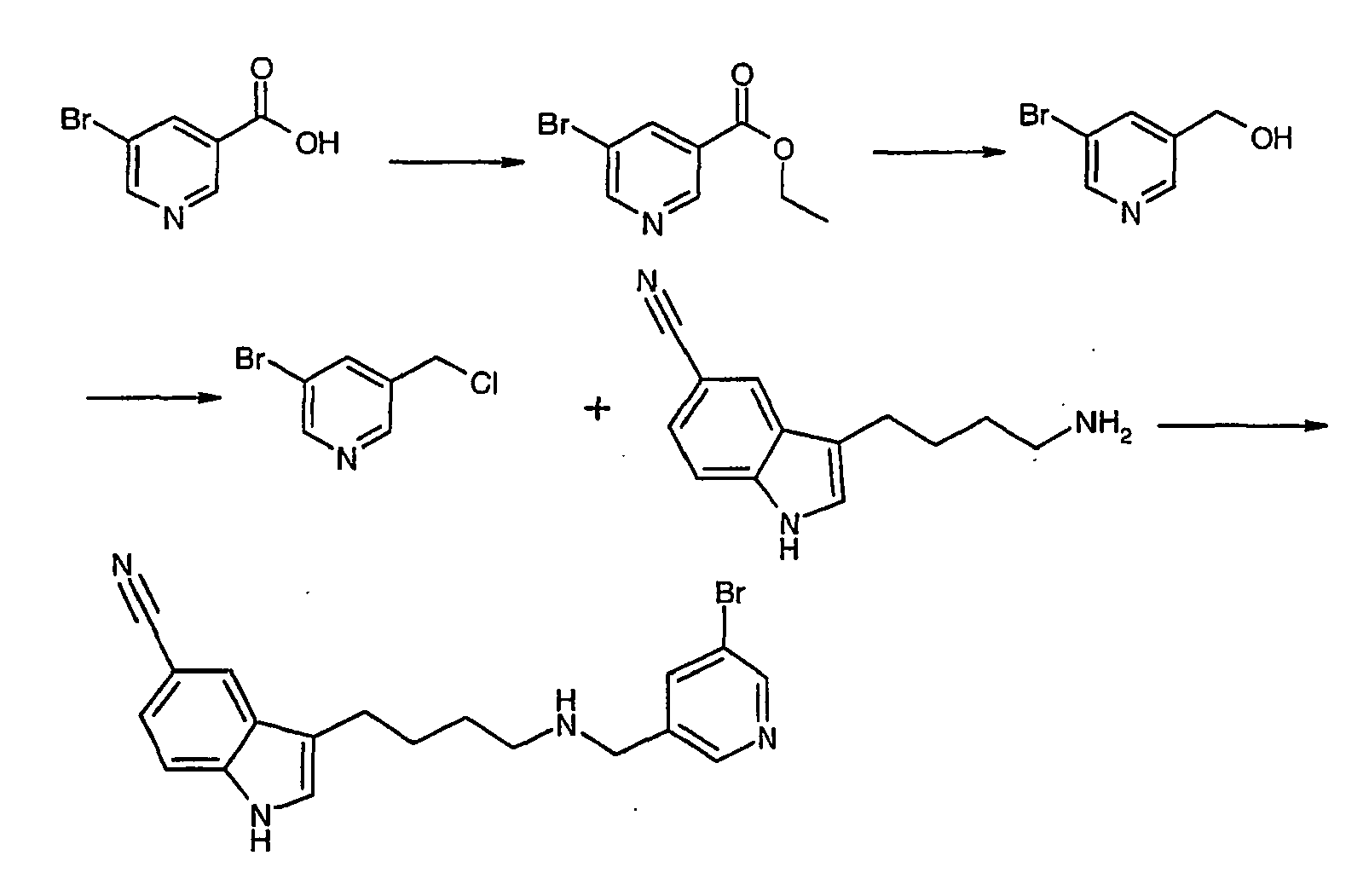
- 1.1 1,3 g 5-Brom-nicotinsäureethylester werden in 40 ml tert.-Butanol vorgelegt und 427 mg Natriumborhydrid zugegeben. Das Ganze wird eine Stunde unter Rückfluß (100° C) und unter N2 erhitzt. Dann werden 6 ml Methanol zugegeben. Das Gemisch wird über Nacht gerührt. Zur Reaktionslösung wird 10 ml Wasser hinzugegeben. Danach wird mit Dichlomethan extrahiert, mit Natriumsulfat getrocknet und einrotiert. Man erhält 300 mg (5-Brom-pyridin-3-yl)-methanol.
- 1.2 300 mg des zuvor gewonnen Rohproduktes (5-Brom-pyridin-3-yl)-methanol werden in 20 Toluol gelöst. Es werden 0,2 ml Thionylchlorid zugegeben und eine Stunde bei 100° C gerührt. Danach wird einrotiert. Der ölige Rückstand enthält 3-Brom-5-chlormethyl-pyridin (315 mg).
- 1.3 300 mg 3-Brom-5-chlormethyl-pyridin und 331 mg 3-(4-Aminobutyl)-1H-indol-5-carbonitril werden in Acetonitril zusammengegeben.
- Danach werden 415 mg Kaliumcarbonat und eine Spatelspitze Kaliumjodid zugegeben. Es wird über Nacht unter Rückfluß gekocht. Das Gemisch wird einrotiert und mit Wasser versetzt. Es wird zweimal mit Essigester extrahiert, mit Natriumsulfat getrocknet, filtriert und einrotiert.
390 mg des Rohproduktes werden mit Hilfe der präparativen HPLC gereinigt:HPLC-Säule: RP 18 (15 mm) Lichrosorb Fließmittel: A 98 H2O, 2 CH3CN, 0,1 % TFA B 10 H2O, 90 CH3CN, 0,1% TFA UV-Detektion: 225 NM; 1 range Fluß: 10 ml
Ausbeute: 143 mg
HPLC-ESI-MS (M+H)+ 383. -
- 2.1 1,94 g 2-Chlor-6-methyl-isonicotinsäureethylester werden in 36 ml tert.-Butanol vorgelegt, 0,93 g Natriumborhydrid zugegeben und unter Stickstoff zum Rückfluss erhitzt (Badtemperatur ca. 120C). Nach 1h werden 9 ml Methanol langsam zugegeben, über Nacht am Rückfluss gekocht. Man arbeitet wie üblich auf und erhält 1,15 g (2-Chlor-6-methyl-pyridin-4-yl)-methanol.
- 2.2 1,14 g (2-Chlor-6-methyl-pyridin-4-yl)-methanol werden in 50 ml Toluol vorgelegt und unter Eiskühlung werden langsam 1,05 ml Thionylchlorid zugetropft. Es wird über Nacht unter Rückfluss gekocht. Nach Abkühlen wird das Lösungsmittel entfernt. Man erhält 2-Chlor-4-chlormethyl-6-methyl-pyridin als braunes Öl (1,1 g).
- 2.3 213 mg 2-Chlor-4-chlormethyl-6-methyl-pyridin und 250 mg 3-(4-Amino-butyl)-1H-indol-5-carbonitril werden in Acetonitril zusammengegeben. Dazu werden 276 mg Kaliumcarbonat und ca. 3 mg Kaliumjodid gegeben. Das Gemisch wird über Nacht am Rückfluss gekocht. Es wird abgekühlt und danach das Lösungsmittel entfernt. Danach wird mit 20ml Wasser und 20ml Ethylacetat versetzt.
Man arbeitet wie üblich auf und erhält einen braunen Rückstand (0,4 g). Die Reinigung erfolgt durch Flash-Chromatographie (Fließmittel:
CH2Cl2/MeOH 97:3). Man erhält 150 mg 3-{4-[(2-Chlor-6-methyl-pyridin-4-ylmethyl)-amino]-butyl}-1H-indol-5-carbonitril, HPLC-ESI-MS (M+H)+ 353. - 126 mg Chinolin-3-carboxaldehyd und 200 mg 3-(4-Amino-butyl)-1H-indol-5-carbonitril werden in einer Mischung von 5 ml 1,2-Dichlorethan und 2,5 ml THF zusammengegeben. Es werden 55 mg Eisessig zugesetzt und 3 Stunden bei Raumtemperatur gerührt. Nun gibt man 380 mg NaB(OAc)3 zu und rührt 2 Tage bei RT weiter.
Der Ansatz wird mit gesättigter NaHCO3-Lösung versetzt, 2mal mit Essigester extrahiert, über Na2SO4 getrocknet, filtriert und einrotiert. Chromatographie am Flash-Master mit EE/MeOH als Eluent ergeben 73 mg des gewünschten Produktes, HPLC-MS (M+H)+ 355. - Analog erhält man die nachstehenden Verbindungen
- 3-{4-[(Chinolin-2-ylmethyl)-amino]-butyl}-1H-indol-5-carbonitril, HPLC-MS (M+H)+ 355;
- 3-{4-[(Chinolin-4-ylmethyl)-amino]-butyl}-1H-indol-5-carbonitril, HPLC-MS (M+H)+ 355.
-
- 3-{4-[(Pyridin-3-ylmethyl)-amino]-butyl}-1H-indol-5-carbonitril, Dihydrochlorid, HPLC-MS (M+H)+ 305;
- 3-{4-[(Pyridin-2-ylmethyl)-amino]-butyl}-1H-indol-5-carbonitril, Dihydrochlorid, HPLC-MS (M+H)+ 305;
- 3-{4-[(Pyridin-4-ylmethyl)-amino]-butyl}-1H indol-5-carbonitril, Dihydrochlorid, HPLC-MS (M+H)+ 305;
- 3-(4-{[5-(4-Fluorphenyl)-pyridin-3-ylmethyl]-amino}-butyl)-1H-indol-5-carbonitril, HPLC-MS (M+H)+ 399;
- 3-[4-(2-Pyridin-4-yl-ethylamino]-butyl]-1H-indol-5-carbonitril, HPLC-MS (M+H)+ 319;
- 3-{4-[(2,6-Dichlor-pyridin-4-ylmethyl)-amino]-butyl}-1H-indol-5-carbonitril, HPLC-MS (M+H)+ 373;
- 3-{4-[(2-Chlor-pyridin-4-ylmethyl)-amino]-butyl}-1H-indol-5-carbonitril, HPLC-MS (M+H)+ 339;
- 3-{4-[(2-Methyl-pyridin-3-ylmethyl)-amino]-butyl}-1H-indol-5-carbonitril, HPLC-MS (M+H)+ 318;
- 3-{4-[(6-Chlor-pyridin-3-ylmethyl)-amino]-butyl}-1H-indol-5-carbonitril, bis-TFA-Salz, HPLC-MS (M+H)+ 339;
- 3-(4-{[2-(4-Chlor-phenoxy)-pyridin-3-ylmethyl]-amino}-butyl)-1H-indol-5-carbonitril, TFA-Salz, HPLC-MS (M+H)+ 431;
- 3-{4-[(2-Methylsulfanyl-pyridin-3-ylmethyl)-amino]-butyl}-1H-indol-5-carbonitril, TFA-Salz, HPLC-MS (M+H)+ 351;
- 3-{4-[(2,5-Dichlor-pyridin-3-ylmethyl)-amino]-butyl}-1H-indol-5-carbonitril, bis-TFA-Salz, HPLC-MS (M+H)+ 374;
- 3-{4-[(2,6-Dichlor-pyridin-3-ylmethyl)-amino]-butyl}-1H-indol-5-carbonitril, bis-TFA-Salz, HPLC-MS (M+H)+ 374;
- 3-{4-[(5-Methyl-pyridin-3-ylmethyl)-amino]-butyl}-1H-indol-5-carbonitril, bis-TFA-Salz, HPLC-MS (M+H)+ 318;
- 3-{4-[(6-Trifluormethyl-pyridin-3-ylmethyl)-amino]-butyl}-1H-indol-5-carbonitril, HPLC-MS (M+H)+ 373;
- 3-{4-[(4-Phenyl-pyridin-2-ylmethyl)-amino]-butyl}-1H-indol-5-carbonitril, HPLC-MS (M+H)+ 381;
- 3-{4-[(4-Phenyl-pyridin-3-ylmethyl)-amino]-butyl)-1H-indol-5-carbonitril, HPLC-MS (M+H)+ 381;
- 3-{4-[(5-Cyan-6-methylsulfanyl-pyridin-2-ylmethyl)-amino]-butyl}-1H indol-5-carbonitril, HPLC-MS (M+H)+ 376;
- 3-{4-[(5-Phenyl-pyridin-3-ylmethyl)-amino]-butyl}-1H-indol-5-carbonitril, HPLC-MS (M+H)+ 381;
- 3-{4-[(5-Phenyl-pyridin-2-ylmethyl)-amino]-butyl}-1H indol-5-carbonitril, HPLC-MS (M+H)+ 381;
- 3-[4-(Methyl-pyridin-3-ylmethyl-amino)-butyl]-1H-indol-5-carbonitril, HPLC-MS (M+H)+ 319.
- Die nachfolgenden Beispiele betreffen pharmazeutische Zubereitungen:
- Eine Lösung von 100 g eines Wirkstoffes der Formel I und 5 g Dinatriumhydrogenphosphat wird in 3 l zweifach destilliertem Wasser mit 2 n Salzsäure auf pH 6,5 eingestellt, steril filtriert, in Injektionsgläser abgefüllt, unter sterilen Bedingungen lyophilisiert und steril verschlossen. Jedes Injektionsglas enthält 5 mg Wirkstoff.
- Man schmilzt ein Gemisch von 20 g eines Wirkstoffes der Formel I mit 100 g Sojalecithin und 1400 g Kakaobutter, gießt in Formen und läßt erkalten. Jedes Suppositorium enthält 20 mg Wirkstoff.
- Man bereitet eine Lösung aus 1 g eines Wirkstoffes der Formel I, 9,38 g NaH2PO4 · 2 H2O, 28,48 g Na2HPO4 · 12 H2O und 0,1 g Benzalkoniumchlorid in 940 ml zweifach destilliertem Wasser. Man stellt auf pH 6,8 ein, füllt auf 1 l auf und sterilisiert durch Bestrahlung. Diese Lösung kann in Form von Augentropfen verwendet werden.
- Man mischt 500 mg eines Wirkstoffes der Formel I mit 99,5 g Vaseline unter aseptischen Bedingungen.
- Ein Gemisch von 1 kg Wirkstoff der Formel I, 4 kg Lactose, 1,2 kg Kartoffelstärke, 0,2 kg Talk und 0,1 kg Magnesiumstearat wird in üblicher Weise zu Tabletten verpreßt, derart, daß jede Tablette 10 mg Wirkstoff enthält.
- Analog Beispiel E werden Tabletten gepreßt, die anschließend in üblicher Weise mit einem Überzug aus Saccharose, Kartoffelstärke, Talk, Tragant und Farbstoff überzogen werden.
- 2 kg Wirkstoff der Formel I werden in üblicher Weise in Hartgelatinekapseln gefüllt, so daß jede Kapsel 20 mg des Wirkstoffs enthält.
- Eine Lösung von 1 kg Wirkstoff der Formel 1 in 60 l zweifach destilliertem Wasser wird steril filtriert, in Ampullen abgefüllt, unter sterilen Bedingungen lyophilisiert und steril verschlossen. Jede Ampulle enthält 10 mg Wirkstoff.
- Man löst 14 g Wirkstoff der Formel I in 10 l isotonischer Nacl-Lösung und füllt die Lösung in handelsübliche Sprühgefäße mit Pump-Mechanismus. Die Lösung kann in Mund oder Nase gesprüht werden. Ein Sprühstoß (etwa 0,1 ml) entspricht einer Dosis von etwa 0,14 mg.
sowie ihre pharmazeutisch verwendbaren Salze, Solvate und Stereoisomere, einschließlich deren Mischungen in allen Verhältnissen.
Claims (21)
- Verbindungen der Formel I
 X
X Y H oder A',R1 CN oder F,R2 H, A, Hal, OH, OA, SA, COOH, COOA', CHO, COA', SO2A', NH2, NHA, NA2, CH2NA2, NHCOA, NHCOAr, NHCOOA, NHSO2A, NHSO2Ar, CH2NHSO2A, NHCONH2, NHCONHA, NHCONA2, NHCONHAr, CONH2, CONHA, CONA2, SO2NH2, SO2NHA, SO2NA2, CH2SO2NH2, CH2SO2NHA, CH2SO2NA2, [C(R4R4')]pCN, [C(R4R4')]pCF3, [C(R4R4')]pCOR4, [C(R4R4')]pAr, -O-[C(R4R4')]pAr oder [C(R4R4')]pHet,R3 H, A, [C(R4R4')]pAr oder [C(R4R4')]pHet,R2 und R3 zusammen auch -CH=CH-CH=CH-, -CH=CH-CH2-CH2- oder -CH2-CH2-CH=CH- worin 1 oder 2 CH- und/oder CH2-Einheiten durch N ersetzt sein können und/oder 1, 2, 3 oder 4 H-Atome durch Hal, A, OH, OA, NH2, NO2, CN, COOH, COOA, CONH2, NHCOA, NHCONH2, NHSO2A, CHO, COA, SO2NH2 oder S(O)oA substituiert sein können,
-O-CH2-O- oder -O-CH2-CH2-O-,R4, R4' jeweils unabhängig voneinander H, A, OH, OA, NH2, NHA, NA2 oder NHCOOA',Ar unsubstituiertes oder ein-, zwei- oder dreifach durch Hal, A, OH, OA, NH2, NO2, CN, COOH, COOA, CONH2, NHCOA, NHCONH2, NHSO2A, CHO, COA, SO2NH2 oder S(O)oA, substituiertes Phenyl, Naphthyl oder Biphenyl,Het einen ein- oder zweikernigen gesättigten, ungesättigten oder aromatischen Heterocyclus mit 1 bis 4 N-, O- und/oder S- Atomen, der unsubstituiert oder ein-, zwei- oder dreifach durch Carbonylsauerstoff, =S, =NH, Hal, A, -(CH2)o-Ar, -(CH2)o-Cycloalkyl, -(CH2)o-OH, -(CH2)o-NH2, NO2, CN, -(CH2)o-COOH, -(CH2)o-COOA, -(CH2)o-CONH2, -(CH2)o-NHCOA, NHCONH2, -(CH2)o-NHSO2A, CHO, COA', SO2NH2 und/oder S(O)oA substituiert sein kann,A unverzweigtes oder verzweigtes Alkyl mit 1-10 C-Atomen, worin eine oder zwei CH2-Gruppen durch -CH=CH-Gruppen und/oder auch 1-7 H-Atome durch F und/oder Cl ersetzt sein können,A' Alkyl mit 1 bis 6 C-Atomen oder Benzyl,Hal F, Cl, Br oder I undm 2, 3, 4, 5 oder 6n 1, 2, 3 oder 4,o 0, 1 oder 2,p 0, 1, 2, 3, 4, 5 oder 6,bedeuten,
sowie ihre pharmazeutisch verwendbaren Salze, Solvate und Stereoisomere, einschließlich deren Mischungen in allen Verhältnissen. - Verbindungen nach Anspruch 1, worinR4, R4' H bedeuten,sowie ihre pharmazeutisch verwendbaren Salze, Solvate und Stereoisomere, einschließlich deren Mischungen in allen Verhältnissen.
- Verbindungen gemäß Anspruch 1 oder 2, worinR2 H, Hal, A, SA, CN, CONH2, COOA', -O-[C(R4R4')]pAr, [C(R4R4')]pAr oder [C(R4R4')]pHet,R3 H, A, Hal oder CN,R2 und R3 zusammen auch -CH=CH-CH=CH-,bedeuten,
sowie ihre pharmazeutisch verwendbaren Salze, Solvate und Stereoisomere, einschließlich deren Mischungen in allen Verhältnissen. - Verbindungen gemäß einem oder.mehreren der Ansprüche 1-3, worinHet unsubstituiertes oder einfach durch Hal oder COOA' substituiertes Chromen-2-on-yl, Thienyl, Pyridinyl, Pyrimidinyl, Indolyl, Furyl, Pyrrolyl, Isoxazolyl, Imidazolyl, Thiazolyl, Triazolyl, Tetrazolyl, Chinolyl oder Isochinolylbedeutet,
sowie ihre pharmazeutisch verwendbaren Salze, Solvate und Stereoisomere, einschließlich deren Mischungen in allen Verhältnissen. - Verbindungen gemäß einem oder mehreren der Ansprüche 1-4, worinAr unsubstituiertes oder ein-, zwei- oder dreifach durch Hal substituiertes Phenylbedeutet,
sowie ihre pharmazeutisch verwendbaren Salze, Solvate und Stereoisomere, einschließlich deren Mischungen in allen Verhältnissen. - Verbindungen gemäß einem oder mehreren der Ansprüche 1-5, worinX
 R1 CN oder F,R2 H, Hai, A, SA, CN, CONH2, COOA', -O-[C(R4R4')]pAr, [C(R4R4')]pAr oder [C(R4R4')]pHet,R3 H, A, Hal oder CN,R2 und R3 zusammen auch -CH=CH-CH=CH-,Het unsubstituiertes oder einfach durch Hal oder COOA' substituiertes Chromen-2-on-yl, Thienyl, Pyridinyl, Pyrimidinyl, Indolyl, Furyl, Pyrrolyl, Isoxazolyl, Imidazolyl, Thiazolyl, Triazolyl, Tetrazolyl, Chinolyl oder Isochinolyl,Ar unsubstituiertes oder ein-, zwei- oder dreifach durch Hal substituiertes Phenyl,p 0 oder 1,bedeuten,
sowie ihre pharmazeutisch verwendbaren Salze, Solvate und Stereoisomere, einschließlich deren Mischungen in allen Verhältnissen. - Verbindungen gemäß einem oder mehreren der Ansprüche 1-6, worinX
 R1 CN oder F,R2 H, Hal, A, SA, CN, CONH2, COOA', -O-[C(R4R4')]pAr, [C(R4R4')]pAr oder [C(R4R4')]pHet,R3 H, A, Hal oder CN,R2 und R3 zusammen auch -CH=CH-CH=CH-,Ar Phenyl,p 0 oder 1,bedeuten,
sowie ihre pharmazeutisch verwendbaren Salze, Solvate und Stereoisomere, einschließlich deren Mischungen in allen Verhältnissen. - Verbindungen gemäß einem oder mehreren der Ansprüche 1-7, worinX
 R1 CN oder F,R2 H, Hal, A, SA, CN, CONH2, COOA', -O-[C(R4R4')]pAr, [C(R4R4')]pAr,R3 H, A, Hal oder CN,R2 und R3 zusammen auch -CH=CH-CH=CH-,R4, R4' H,Ar Phenyl,p 0 oder 1,bedeuten,
sowie ihre pharmazeutisch verwendbaren Salze, Solvate und Stereoisomere, einschließlich deren Mischungen in allen Verhältnissen. - Verbindungen nach Anspruch 13-{4-[(5-Brom-pyridin-3-ylmethyl)-amino]-butyl}-1H-indol-5-carbonitril,3-{4-[(Pyridin-3-ylmethyl)-amino]-butyl}-1H-indol-5-carbonitril,3-{4-[(Pyridin-2-ylmethyl)-amino]-butyl}-1H-indol-5-carbonitril,3-{4-[(Pyridin-4-ylmethyl)-amino]-butyl}-1H-indol-5-carbonitril,3-{4-{[5-{4-Fluorphenyl)-pyridin-3-ylmethyl]-amino}-butyl)-1H-indol-5-carbonitril,3-{4-[(Chinolin-3-ylmethyl)-amino]-butyl}-1H-indol-5-carbonitril,3-[4-(2-Pyridin-4-yl-ethylamino]-butyl]-1H-indol-5-carbonitril,3-{4-[(2,6-Dichlor-pyridin-4-ylmethyl)-amino]-butyl}-1H-indol-5-carbonitril,3-{4-[(2-Chlor-6-methyl-pyridin-4-ylmethyl)-amino]-butyl}-1H-indol-5-carbonitril,3-{4-[(2-Chlor-pyridin-4-ylmethyl)-amino]-butyl}-1H-indol-5-carbonitril,3-{4-[(2-Methyl-pyridin-3-ylmethyl)-amino]-butyl}-1H-indol-5-carbonitril,3-{4-[(6-Chlor-pyridin-3-ylmethyl)-amino]-butyl}-1H-indol-5-carbonitril,3-(4-{[2-(4-Chlor-phenoxy)-pyridin-3-ylmethyl]-amino}-butyl)-1H-indol-5-carbonitril,3-{4-[(2-Methylsulfanyl-pyridin-3-ylmethyl)-amino]-butyl}-1H-indol-5-carbonitril,3-{4-[(2,5-Dichlor-pyridin-3-ylmethyl)-amino]-butyl}-1H-indol-5-carbonitril,3-{4-[(2,6-Dichlor-pyridin-3-ylmethyl)-amino]-butyl}-1H-indol-5-carbonitril,3-{4-[(5-Methyl-pyridin-3-ylmethyl)-amino]-butyl}-1H-indol-5-carbonitril,3-{4-[(6-Trifluormethyl-pyridin-3-ylmethyl)-amino]-butyl}-1H-indol-5-carbonitril,3-{4-[(Chinolin-2-ylmethyl)-amino]-butyl}-1H-indol-5-carbonitril,3-{4-[(4-Phenyl-pyridin-2-ylmethyl)-amino]-butyl}-1H-indol-5-carbonitril,3-{4-[(Chinolin-4-ylmethyl)-amino]-butyl}-1H-indol-5-carbonitril,3-{4-[(4-Phenyl-pyridin-3-ylmethyl)-amino]-butyl}-1H-indol-5-carbonitril,3-{4-[(5-Cyan-6-methylsulfanyl-pyridin-2-ylmethyl)-amino]-butyl}-1H-indol-5-carbonitril,3-{4-[(5-Phenyl-pyridin-3-ylmethyl)-amino]-butyl}-1H-indol-5-carbonitril,3-{4-[(5-Phenyl-pyridin-2-ylmethyl)-amino]-butyl}-1H-indol-5-carbonitril,3-[4-(Methyl-pyridin-3-ylmethyl-amino)-butyl]-1H-indol-5-carbonitril,sowie ihre pharmazeutisch verwendbaren Salze, Solvate und Stereoisomere, einschließlich deren Mischungen in allen Verhältnissen.
- Verfahren zur Herstellung von Verbindungen der Formel I nach den Ansprüchen 1-9 sowie ihrer pharmazeutisch verwendbaren Salze, Solvate und Stereoisomere, dadurch gekennzeichnet, daß mana) eine Verbindung der Formel II

X, Y und n die in Anspruch 1 angegebenen Bedeutungen haben, mit einer Verbindung der Formel III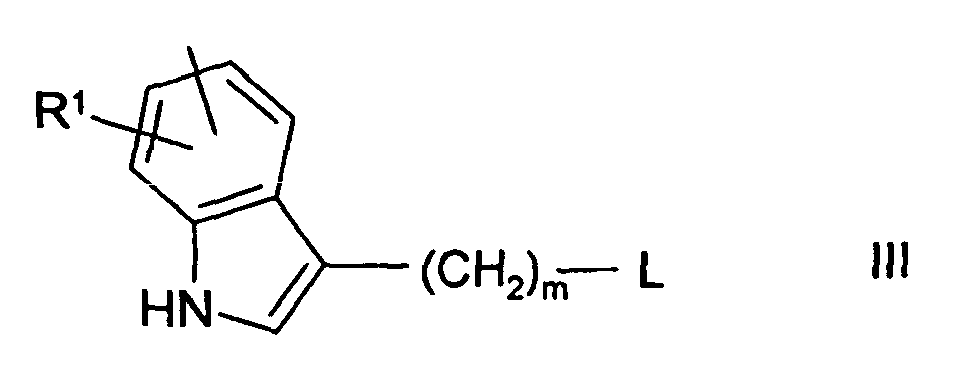 L Cl, Br oder I bedeutet und R1, R1' und m die in Anspruch 1 angegebenen Bedeutungen haben,umsetzt,
oderb) eine Verbindung der Formel IV
X-(CH2)n-L IV
worinL Cl, Br oder I bedeutet und X und n die in Anspruch 1 angegebenen Bedeutungen haben,mit einer Verbindung der Formel V
R1, Y und m die in Anspruch 1 angegebenen Bedeutungen haben,
umsetzt,
und/oder
eine basische oder saure Verbindung der Formel I durch Behandeln mit einer Säure oder Base in eines ihrer Salze und/oder Solvate umwandelt. - Verbindungen der Formel I nach einem oder mehreren der Ansprüche 1 bis 9 und ihre physiologisch unbedenklichen Salze oder Solvate als 5HT1A- und/oder 5HT1D- Agonisten und als Inhibitoren der 5-HT-Wiederaufnahme.
- Arzneimittel, enthaltend mindestens eine Verbindung der Formel I nach einem oder mehreren der Ansprüche 1 bis 9 und/oder ihre pharmazeutisch verwendbaren Salze, Solvate und Stereoisomere, einschließlich deren Mischungen in allen Verhältnissen, sowie gegebenenfalls Träger- und/oder Hilfsstoffe.
- Arzneimittel enthaltend mindestens eine Verbindung der Formel I gemäß einem oder mehreren der Ansprüche 1 bis 9 und/oder ihre pharmazeutisch verwendbaren Salze, Solvate und Stereoisomere, einschließlich deren Mischungen in allen Verhältnissen, und mindestens einen weiteren Arzneimittelwirkstoff.
- Verwendung von Verbindungen der Formel I nach einem oder mehreren der Ansprüche 1 bis 9 und/oder ihrer pharmazeutisch verwendbaren Salze, Solvate und Stereoisomere, einschließlich deren Mischungen in allen Verhältnissen, zur Herstellung eines Arzneimittels.
- Verwendung von Verbindungen der Formel I nach einem oder mehreren der Ansprüche 1 bis 9 und/oder ihrer pharmazeutisch verwendbaren Salze, Solvate und Stereoisomere, einschließlich deren Mischungen in allen Verhältnissen, zur Herstellung eines Arzneimittels zur Bekämpfung von Krankheiten, die mit dem Serotonin-Neurotransmittersystem verbunden sind und bei denen hochaffine Serotoninrezeptoren (5-HT1A-Rezeptoren) und/oder 5-HT1D -Rezeptoren beteiligt sind.
- Verwendung von Verbindungen der Formel I nach einem oder mehreren der Ansprüche 1 bis 9 und/oder ihrer pharmazeutisch verwendbaren Salze, Solvate und Stereoisomere, einschließlich deren Mischungen in allen Verhältnissen, zur Herstellung eines Arzneimittels als Anxiolytikum, Antidepressivum, Neuroleptikum und/oder Antihypertensivum.
- Verwendung von Verbindungen der Formel I nach einem oder mehreren der Ansprüche 1 bis 9 und/oder ihrer pharmazeutisch verwendbaren Salze, Solvate und Stereoisomere, einschließlich deren Mischungen in allen Verhältnissen, zur Herstellung eines Arzneimittels zur Bekämpfung von Psychosen, der Symptome von Morbus-Alzheimer, krankhaften Angstzuständen, Übererregung, Hyperaktivität, Ausmerksamkeitsstörungen bei Kindern und Jugendlichen, tiefgreifende Entwicklungstörungen und Störungen des Sozialverhaltens mit geistiger Retardierung, Depression, Zwangserkrankungen im engeren (OCD) und weiteren Sinne (OCSD), sexuelle Funktionsstörungen, Schlafstörungen, Störungen in der Nahrungsaufnahme, sowie solcher Psychiatrischer Symptome in Rahmen der Altersdemenz und der Demenz vom Alzheimer-Typ, zur Verminderung von kognitiven Leistungsstörungen oder zur Prophylaxe und Kontrolle von Hirninfarkten (Apoplexia cerebri), zur Behandlung von extrapyramidalen Bewegungserkrankungen, zur Behandlung von Nebenwirkungen, die bei der Behandlung von extrapyramidalen Bewegungserkrankungen mit konventionellen Anti-Parkinson-Medikamenten auftreten oder zur Behandlung von extrapyramidalen Symptomen (EPS), die durch Neuroleptika induziert werden.
- Verwendung von Verbindungen der Formel I nach einem oder mehreren der Ansprüche 1 bis 9 und/oder ihrer pharmazeutisch verwendbaren Salze, Solvate und Stereoisomere, einschließlich deren Mischungen in allen Verhältnissen, zur Herstellung eines Arzneimittels zur Bekämpfung von Schizophrenie.
- Verwendung von Verbindungen der Formel I nach einem oder mehreren der Ansprüche 1 bis 9 und/oder ihrer pharmazeutisch verwendbaren Salze, Solvate und Stereoisomere, einschließlich deren Mischungen in allen Verhältnissen, zur Herstellung eines Arzneimittels zur Bekämpfung von neurodegenerativen Erkrankungen.
- Verwendung nach Anspruch 19, wobei es sich bei den Erkrankungen um Lathyrismus, Alzheimer, Parkinson, und Huntington handelt.
- Set (Kit), bestehend aus getrennten Packungen von(a) einer wirksamen Menge an einer Verbindung der Formel 1 gemäß einem oder mehreren der Ansprüche 1 bis 9 und/oder ihrer pharmazeutisch verwendbaren Salze, Solvate und Stereoisomere, einschließlich deren Mischungen in allen Verhältnissen,
und(b) einer wirksamen Menge eines weiteren Arzneimittelswirkstoffs.
Applications Claiming Priority (3)
| Application Number | Priority Date | Filing Date | Title |
|---|---|---|---|
| DE10254596 | 2002-11-22 | ||
| DE10254596A DE10254596A1 (de) | 2002-11-22 | 2002-11-22 | Indolderivate |
| PCT/EP2003/012081 WO2004047840A1 (de) | 2002-11-22 | 2003-10-30 | Pyridinalykl-aminoalkyl-1h-indol derivate mit hemmender wirkung auf die 5-ht und serotonin wiederaufnahme als antidepressiva und anxiolytika |
Publications (2)
| Publication Number | Publication Date |
|---|---|
| EP1562596A1 EP1562596A1 (de) | 2005-08-17 |
| EP1562596B1 true EP1562596B1 (de) | 2006-08-30 |
Family
ID=32240308
Family Applications (1)
| Application Number | Title | Priority Date | Filing Date |
|---|---|---|---|
| EP03811744A Expired - Lifetime EP1562596B1 (de) | 2002-11-22 | 2003-10-30 | Pyridinalykl-aminoalkyl-1h-indol derivate mit hemmender wirkung auf die 5-ht und serotonin wiederaufnahme als antidepressiva und anxiolytika |
Country Status (15)
| Country | Link |
|---|---|
| US (1) | US7432282B2 (de) |
| EP (1) | EP1562596B1 (de) |
| JP (1) | JP4523416B2 (de) |
| KR (1) | KR20050085038A (de) |
| CN (1) | CN1708303A (de) |
| AT (1) | ATE337781T1 (de) |
| AU (1) | AU2003302361B2 (de) |
| BR (1) | BR0316721A (de) |
| CA (1) | CA2506960C (de) |
| DE (2) | DE10254596A1 (de) |
| ES (1) | ES2271697T3 (de) |
| MX (1) | MXPA05005278A (de) |
| PL (1) | PL375259A1 (de) |
| WO (1) | WO2004047840A1 (de) |
| ZA (1) | ZA200505037B (de) |
Families Citing this family (10)
| Publication number | Priority date | Publication date | Assignee | Title |
|---|---|---|---|---|
| US7994331B2 (en) * | 2005-07-13 | 2011-08-09 | Msd K.K. | Heterocycle-substituted benzimidazole derivative |
| US9278947B2 (en) | 2006-06-22 | 2016-03-08 | Ramot At Tel-Aviv University Ltd. | Serotonin reuptake inhibitors as drugs having peripheral-system-restricted activity |
| JP2009545522A (ja) | 2006-06-22 | 2009-12-24 | ラモット アット テル アビブ ユニバーシティ, リミテッド | 末梢系限定的活性を有する薬としての新規なセロトニン再取り込み阻害剤 |
| EP3083589B1 (de) * | 2013-12-20 | 2019-12-18 | Sunshine Lake Pharma Co., Ltd. | Substituierte piperazinverbindungen und verfahren zur verwendung davon |
| CN106243088B (zh) | 2015-06-03 | 2019-01-04 | 广东东阳光药业有限公司 | 取代的哌嗪化合物及其使用方法和用途 |
| TWI903299B (zh) | 2018-03-08 | 2025-11-01 | 美商英塞特公司 | 作為PI3K-γ抑制劑之胺基吡嗪二醇化合物 |
| WO2020010003A1 (en) | 2018-07-02 | 2020-01-09 | Incyte Corporation | AMINOPYRAZINE DERIVATIVES AS PI3K-γ INHIBITORS |
| WO2020183011A1 (en) | 2019-03-14 | 2020-09-17 | Institut Curie | Htr1d inhibitors and uses thereof in the treatment of cancer |
| CN111689944B (zh) * | 2020-06-10 | 2021-11-16 | 中山大学 | 喹啉色胺杂联体及其在制备治疗阿尔茨海默病的药物中的应用 |
| WO2025252183A1 (zh) * | 2024-06-07 | 2025-12-11 | 上海汇伦医药股份有限公司 | 含吲哚多环化合物、含其的组合物及其应用 |
Family Cites Families (7)
| Publication number | Priority date | Publication date | Assignee | Title |
|---|---|---|---|---|
| US4748182A (en) * | 1986-03-05 | 1988-05-31 | Merrell Dow Pharmaceuticals Inc. | Aromatic 2-aminoalkyl-1,2-benzoisothiazol-3(2H)one-1,1-dioxide derivatives and their use as anti-hypertensive and anxiolytic agents |
| FR2614022B1 (fr) * | 1987-04-15 | 1989-12-01 | Roussel Uclaf | Nouveaux derives 17-aza de 20,21-dinoreburnamenine, leur procede de preparation et les nouveaux intermediaires ainsi obtenus, leur application comme medicaments et ces compositions les renfermant |
| DE3901814A1 (de) * | 1988-07-28 | 1990-02-01 | Bayer Ag | Substituierte aminomethylzetraline sowie ihre heterocyclischen analoga |
| AU4355296A (en) | 1994-12-28 | 1996-07-19 | Sankyo Company Limited | Indole derivatives |
| JPH11513666A (ja) * | 1995-10-10 | 1999-11-24 | イーライ・リリー・アンド・カンパニー | N−[2−置換−3−(2−アミノエチル)−1h−インドール−5−イル]−アミド:新規5−ht▲下1f▼作動剤 |
| CA2207137A1 (en) * | 1996-06-14 | 1997-12-14 | James Erwin Fritz | Scavenger assisted combinatorial process for preparing libraries of secondary amine compounds |
| DE10029371A1 (de) * | 2000-06-20 | 2002-01-03 | Merck Patent Gmbh | Heterocyclische Aminoalkylpyridinderivate als Psychopharmaka |
-
2002
- 2002-11-22 DE DE10254596A patent/DE10254596A1/de not_active Withdrawn
-
2003
- 2003-10-30 AT AT03811744T patent/ATE337781T1/de not_active IP Right Cessation
- 2003-10-30 CA CA2506960A patent/CA2506960C/en not_active Expired - Fee Related
- 2003-10-30 ES ES03811744T patent/ES2271697T3/es not_active Expired - Lifetime
- 2003-10-30 PL PL03375259A patent/PL375259A1/xx not_active Application Discontinuation
- 2003-10-30 BR BR0316721-6A patent/BR0316721A/pt not_active Application Discontinuation
- 2003-10-30 EP EP03811744A patent/EP1562596B1/de not_active Expired - Lifetime
- 2003-10-30 US US10/535,916 patent/US7432282B2/en not_active Expired - Fee Related
- 2003-10-30 DE DE50304892T patent/DE50304892D1/de not_active Expired - Lifetime
- 2003-10-30 MX MXPA05005278A patent/MXPA05005278A/es unknown
- 2003-10-30 CN CNA2003801023956A patent/CN1708303A/zh active Pending
- 2003-10-30 JP JP2004554301A patent/JP4523416B2/ja not_active Expired - Fee Related
- 2003-10-30 KR KR1020057008921A patent/KR20050085038A/ko not_active Withdrawn
- 2003-10-30 WO PCT/EP2003/012081 patent/WO2004047840A1/de not_active Ceased
- 2003-10-30 AU AU2003302361A patent/AU2003302361B2/en not_active Ceased
-
2005
- 2005-06-21 ZA ZA200505037A patent/ZA200505037B/en unknown
Also Published As
| Publication number | Publication date |
|---|---|
| US7432282B2 (en) | 2008-10-07 |
| AU2003302361A1 (en) | 2004-06-18 |
| JP2006508991A (ja) | 2006-03-16 |
| ES2271697T3 (es) | 2007-04-16 |
| JP4523416B2 (ja) | 2010-08-11 |
| BR0316721A (pt) | 2005-10-18 |
| AU2003302361B2 (en) | 2009-06-18 |
| ZA200505037B (en) | 2006-11-29 |
| DE10254596A1 (de) | 2004-06-03 |
| PL375259A1 (en) | 2005-11-28 |
| DE50304892D1 (de) | 2006-10-12 |
| KR20050085038A (ko) | 2005-08-29 |
| CA2506960A1 (en) | 2004-06-10 |
| MXPA05005278A (es) | 2005-07-25 |
| CA2506960C (en) | 2012-04-10 |
| US20060063811A1 (en) | 2006-03-23 |
| CN1708303A (zh) | 2005-12-14 |
| WO2004047840A1 (de) | 2004-06-10 |
| ATE337781T1 (de) | 2006-09-15 |
| EP1562596A1 (de) | 2005-08-17 |
Similar Documents
| Publication | Publication Date | Title |
|---|---|---|
| DE69524528T2 (de) | ZNS wirksames (R)-(-)-2-[5-(4-Fluorophenyl)-3-pyridylmethylaminomethyl]chroman | |
| EP0648767B1 (de) | Piperidine und Piperazine, die Wirkungen auf das z.n.s. Zeigen | |
| DE10315572A1 (de) | Substituierte Pyrazole | |
| EP0998474A1 (de) | Piperazin-derivate | |
| EP1140898B1 (de) | Amid- und harnstoffderivate als 5-ht reuptakeinhibitoren und als 5-ht1b/1d liganden | |
| EP1562596B1 (de) | Pyridinalykl-aminoalkyl-1h-indol derivate mit hemmender wirkung auf die 5-ht und serotonin wiederaufnahme als antidepressiva und anxiolytika | |
| DE10252102A1 (de) | Indolderivate | |
| EP1594864B1 (de) | Benzofuranoxyethylamine als antidepressiva und anxiolytika | |
| WO2004089888A1 (de) | Pyrazolverbindungen | |
| DE10326939A1 (de) | Indol-Derivate | |
| KR20050036882A (ko) | 향정신제로서의 피라졸 유도체 | |
| EP0993458B1 (de) | 3-benzylpiperidine | |
| EP1633742A1 (de) | Indol-derivate als serotonin-wiederaufnahme-inhibitoren | |
| EP1592687B1 (de) | Benzofuranderivate und ihre verwendung als antidepressiva und anxiolytika | |
| DE10353657A1 (de) | Indolderivate | |
| DE60311000T2 (de) | Indolderivate und deren verwendung als 5-ht liganden | |
| EP1963299B1 (de) | Oxaphenanthren-derivate | |
| DE10360151A1 (de) | Azoverbindungen |
Legal Events
| Date | Code | Title | Description |
|---|---|---|---|
| PUAI | Public reference made under article 153(3) epc to a published international application that has entered the european phase |
Free format text: ORIGINAL CODE: 0009012 |
|
| 17P | Request for examination filed |
Effective date: 20050324 |
|
| AK | Designated contracting states |
Kind code of ref document: A1 Designated state(s): AT BE BG CH CY CZ DE DK EE ES FI FR GB GR HU IE IT LI LU MC NL PT RO SE SI SK TR |
|
| AX | Request for extension of the european patent |
Extension state: AL LT LV MK |
|
| DAX | Request for extension of the european patent (deleted) | ||
| GRAP | Despatch of communication of intention to grant a patent |
Free format text: ORIGINAL CODE: EPIDOSNIGR1 |
|
| GRAS | Grant fee paid |
Free format text: ORIGINAL CODE: EPIDOSNIGR3 |
|
| GRAA | (expected) grant |
Free format text: ORIGINAL CODE: 0009210 |
|
| AK | Designated contracting states |
Kind code of ref document: B1 Designated state(s): AT BE BG CH CY CZ DE DK EE ES FI FR GB GR HU IE IT LI LU MC NL PT RO SE SI SK TR |
|
| PG25 | Lapsed in a contracting state [announced via postgrant information from national office to epo] |
Ref country code: IT Free format text: LAPSE BECAUSE OF FAILURE TO SUBMIT A TRANSLATION OF THE DESCRIPTION OR TO PAY THE FEE WITHIN THE PRESCRIBED TIME-LIMIT;WARNING: LAPSES OF ITALIAN PATENTS WITH EFFECTIVE DATE BEFORE 2007 MAY HAVE OCCURRED AT ANY TIME BEFORE 2007. THE CORRECT EFFECTIVE DATE MAY BE DIFFERENT FROM THE ONE RECORDED. Effective date: 20060830 Ref country code: RO Free format text: LAPSE BECAUSE OF FAILURE TO SUBMIT A TRANSLATION OF THE DESCRIPTION OR TO PAY THE FEE WITHIN THE PRESCRIBED TIME-LIMIT Effective date: 20060830 Ref country code: NL Free format text: LAPSE BECAUSE OF FAILURE TO SUBMIT A TRANSLATION OF THE DESCRIPTION OR TO PAY THE FEE WITHIN THE PRESCRIBED TIME-LIMIT Effective date: 20060830 Ref country code: IE Free format text: LAPSE BECAUSE OF FAILURE TO SUBMIT A TRANSLATION OF THE DESCRIPTION OR TO PAY THE FEE WITHIN THE PRESCRIBED TIME-LIMIT Effective date: 20060830 Ref country code: SI Free format text: LAPSE BECAUSE OF FAILURE TO SUBMIT A TRANSLATION OF THE DESCRIPTION OR TO PAY THE FEE WITHIN THE PRESCRIBED TIME-LIMIT Effective date: 20060830 Ref country code: SK Free format text: LAPSE BECAUSE OF FAILURE TO SUBMIT A TRANSLATION OF THE DESCRIPTION OR TO PAY THE FEE WITHIN THE PRESCRIBED TIME-LIMIT Effective date: 20060830 Ref country code: CZ Free format text: LAPSE BECAUSE OF FAILURE TO SUBMIT A TRANSLATION OF THE DESCRIPTION OR TO PAY THE FEE WITHIN THE PRESCRIBED TIME-LIMIT Effective date: 20060830 Ref country code: FI Free format text: LAPSE BECAUSE OF FAILURE TO SUBMIT A TRANSLATION OF THE DESCRIPTION OR TO PAY THE FEE WITHIN THE PRESCRIBED TIME-LIMIT Effective date: 20060830 |
|
| REG | Reference to a national code |
Ref country code: GB Ref legal event code: FG4D Free format text: NOT ENGLISH |
|
| REG | Reference to a national code |
Ref country code: CH Ref legal event code: EP |
|
| REG | Reference to a national code |
Ref country code: IE Ref legal event code: FG4D Free format text: LANGUAGE OF EP DOCUMENT: GERMAN |
|
| REF | Corresponds to: |
Ref document number: 50304892 Country of ref document: DE Date of ref document: 20061012 Kind code of ref document: P |
|
| PG25 | Lapsed in a contracting state [announced via postgrant information from national office to epo] |
Ref country code: MC Free format text: LAPSE BECAUSE OF NON-PAYMENT OF DUE FEES Effective date: 20061031 |
|
| PG25 | Lapsed in a contracting state [announced via postgrant information from national office to epo] |
Ref country code: DK Free format text: LAPSE BECAUSE OF FAILURE TO SUBMIT A TRANSLATION OF THE DESCRIPTION OR TO PAY THE FEE WITHIN THE PRESCRIBED TIME-LIMIT Effective date: 20061130 Ref country code: SE Free format text: LAPSE BECAUSE OF FAILURE TO SUBMIT A TRANSLATION OF THE DESCRIPTION OR TO PAY THE FEE WITHIN THE PRESCRIBED TIME-LIMIT Effective date: 20061130 Ref country code: BG Free format text: LAPSE BECAUSE OF FAILURE TO SUBMIT A TRANSLATION OF THE DESCRIPTION OR TO PAY THE FEE WITHIN THE PRESCRIBED TIME-LIMIT Effective date: 20061130 |
|
| PG25 | Lapsed in a contracting state [announced via postgrant information from national office to epo] |
Ref country code: PT Free format text: LAPSE BECAUSE OF FAILURE TO SUBMIT A TRANSLATION OF THE DESCRIPTION OR TO PAY THE FEE WITHIN THE PRESCRIBED TIME-LIMIT Effective date: 20070206 |
|
| NLV1 | Nl: lapsed or annulled due to failure to fulfill the requirements of art. 29p and 29m of the patents act | ||
| ET | Fr: translation filed | ||
| REG | Reference to a national code |
Ref country code: ES Ref legal event code: FG2A Ref document number: 2271697 Country of ref document: ES Kind code of ref document: T3 |
|
| REG | Reference to a national code |
Ref country code: IE Ref legal event code: FD4D |
|
| PLBE | No opposition filed within time limit |
Free format text: ORIGINAL CODE: 0009261 |
|
| STAA | Information on the status of an ep patent application or granted ep patent |
Free format text: STATUS: NO OPPOSITION FILED WITHIN TIME LIMIT |
|
| 26N | No opposition filed |
Effective date: 20070531 |
|
| BERE | Be: lapsed |
Owner name: MERCK PATENT G.M.B.H. Effective date: 20061031 |
|
| PG25 | Lapsed in a contracting state [announced via postgrant information from national office to epo] |
Ref country code: AT Free format text: LAPSE BECAUSE OF NON-PAYMENT OF DUE FEES Effective date: 20061030 |
|
| PG25 | Lapsed in a contracting state [announced via postgrant information from national office to epo] |
Ref country code: GR Free format text: LAPSE BECAUSE OF FAILURE TO SUBMIT A TRANSLATION OF THE DESCRIPTION OR TO PAY THE FEE WITHIN THE PRESCRIBED TIME-LIMIT Effective date: 20061201 |
|
| REG | Reference to a national code |
Ref country code: CH Ref legal event code: PL |
|
| PG25 | Lapsed in a contracting state [announced via postgrant information from national office to epo] |
Ref country code: EE Free format text: LAPSE BECAUSE OF FAILURE TO SUBMIT A TRANSLATION OF THE DESCRIPTION OR TO PAY THE FEE WITHIN THE PRESCRIBED TIME-LIMIT Effective date: 20060830 |
|
| PG25 | Lapsed in a contracting state [announced via postgrant information from national office to epo] |
Ref country code: TR Free format text: LAPSE BECAUSE OF FAILURE TO SUBMIT A TRANSLATION OF THE DESCRIPTION OR TO PAY THE FEE WITHIN THE PRESCRIBED TIME-LIMIT Effective date: 20060830 Ref country code: LI Free format text: LAPSE BECAUSE OF NON-PAYMENT OF DUE FEES Effective date: 20071031 Ref country code: LU Free format text: LAPSE BECAUSE OF NON-PAYMENT OF DUE FEES Effective date: 20061030 Ref country code: HU Free format text: LAPSE BECAUSE OF FAILURE TO SUBMIT A TRANSLATION OF THE DESCRIPTION OR TO PAY THE FEE WITHIN THE PRESCRIBED TIME-LIMIT Effective date: 20070301 Ref country code: CH Free format text: LAPSE BECAUSE OF NON-PAYMENT OF DUE FEES Effective date: 20071031 |
|
| PG25 | Lapsed in a contracting state [announced via postgrant information from national office to epo] |
Ref country code: CY Free format text: LAPSE BECAUSE OF FAILURE TO SUBMIT A TRANSLATION OF THE DESCRIPTION OR TO PAY THE FEE WITHIN THE PRESCRIBED TIME-LIMIT Effective date: 20060830 |
|
| PG25 | Lapsed in a contracting state [announced via postgrant information from national office to epo] |
Ref country code: BE Free format text: LAPSE BECAUSE OF FAILURE TO SUBMIT A TRANSLATION OF THE DESCRIPTION OR TO PAY THE FEE WITHIN THE PRESCRIBED TIME-LIMIT Effective date: 20061031 |
|
| PGFP | Annual fee paid to national office [announced via postgrant information from national office to epo] |
Ref country code: ES Payment date: 20140911 Year of fee payment: 12 |
|
| PGFP | Annual fee paid to national office [announced via postgrant information from national office to epo] |
Ref country code: FR Payment date: 20141008 Year of fee payment: 12 Ref country code: GB Payment date: 20141029 Year of fee payment: 12 Ref country code: DE Payment date: 20141023 Year of fee payment: 12 |
|
| PGFP | Annual fee paid to national office [announced via postgrant information from national office to epo] |
Ref country code: IT Payment date: 20140908 Year of fee payment: 12 |
|
| REG | Reference to a national code |
Ref country code: DE Ref legal event code: R119 Ref document number: 50304892 Country of ref document: DE |
|
| GBPC | Gb: european patent ceased through non-payment of renewal fee |
Effective date: 20151030 |
|
| PG25 | Lapsed in a contracting state [announced via postgrant information from national office to epo] |
Ref country code: GB Free format text: LAPSE BECAUSE OF NON-PAYMENT OF DUE FEES Effective date: 20151030 Ref country code: IT Free format text: LAPSE BECAUSE OF NON-PAYMENT OF DUE FEES Effective date: 20151030 Ref country code: DE Free format text: LAPSE BECAUSE OF NON-PAYMENT OF DUE FEES Effective date: 20160503 |
|
| REG | Reference to a national code |
Ref country code: FR Ref legal event code: ST Effective date: 20160630 |
|
| PG25 | Lapsed in a contracting state [announced via postgrant information from national office to epo] |
Ref country code: FR Free format text: LAPSE BECAUSE OF NON-PAYMENT OF DUE FEES Effective date: 20151102 |
|
| PG25 | Lapsed in a contracting state [announced via postgrant information from national office to epo] |
Ref country code: ES Free format text: LAPSE BECAUSE OF NON-PAYMENT OF DUE FEES Effective date: 20151031 |