EP1561506B1 - Verfahren und Anordnung zur Reinigung von Faulgas - Google Patents
Verfahren und Anordnung zur Reinigung von Faulgas Download PDFInfo
- Publication number
- EP1561506B1 EP1561506B1 EP05002208A EP05002208A EP1561506B1 EP 1561506 B1 EP1561506 B1 EP 1561506B1 EP 05002208 A EP05002208 A EP 05002208A EP 05002208 A EP05002208 A EP 05002208A EP 1561506 B1 EP1561506 B1 EP 1561506B1
- Authority
- EP
- European Patent Office
- Prior art keywords
- stream
- biogas
- filter
- gas
- arrangement
- Prior art date
- Legal status (The legal status is an assumption and is not a legal conclusion. Google has not performed a legal analysis and makes no representation as to the accuracy of the status listed.)
- Expired - Lifetime
Links
Images
Classifications
-
- B—PERFORMING OPERATIONS; TRANSPORTING
- B01—PHYSICAL OR CHEMICAL PROCESSES OR APPARATUS IN GENERAL
- B01D—SEPARATION
- B01D53/00—Separation of gases or vapours; Recovering vapours of volatile solvents from gases; Chemical or biological purification of waste gases, e.g. engine exhaust gases, smoke, fumes, flue gases, aerosols
- B01D53/02—Separation of gases or vapours; Recovering vapours of volatile solvents from gases; Chemical or biological purification of waste gases, e.g. engine exhaust gases, smoke, fumes, flue gases, aerosols by adsorption, e.g. preparative gas chromatography
- B01D53/04—Separation of gases or vapours; Recovering vapours of volatile solvents from gases; Chemical or biological purification of waste gases, e.g. engine exhaust gases, smoke, fumes, flue gases, aerosols by adsorption, e.g. preparative gas chromatography with stationary adsorbents
- B01D53/0407—Constructional details of adsorbing systems
- B01D53/0415—Beds in cartridges
-
- B—PERFORMING OPERATIONS; TRANSPORTING
- B01—PHYSICAL OR CHEMICAL PROCESSES OR APPARATUS IN GENERAL
- B01D—SEPARATION
- B01D53/00—Separation of gases or vapours; Recovering vapours of volatile solvents from gases; Chemical or biological purification of waste gases, e.g. engine exhaust gases, smoke, fumes, flue gases, aerosols
- B01D53/02—Separation of gases or vapours; Recovering vapours of volatile solvents from gases; Chemical or biological purification of waste gases, e.g. engine exhaust gases, smoke, fumes, flue gases, aerosols by adsorption, e.g. preparative gas chromatography
- B01D53/04—Separation of gases or vapours; Recovering vapours of volatile solvents from gases; Chemical or biological purification of waste gases, e.g. engine exhaust gases, smoke, fumes, flue gases, aerosols by adsorption, e.g. preparative gas chromatography with stationary adsorbents
- B01D53/047—Pressure swing adsorption
-
- C—CHEMISTRY; METALLURGY
- C10—PETROLEUM, GAS OR COKE INDUSTRIES; TECHNICAL GASES CONTAINING CARBON MONOXIDE; FUELS; LUBRICANTS; PEAT
- C10L—FUELS NOT OTHERWISE PROVIDED FOR; NATURAL GAS; SYNTHETIC NATURAL GAS OBTAINED BY PROCESSES NOT COVERED BY SUBCLASSES C10G OR C10K; LIQUIFIED PETROLEUM GAS; USE OF ADDITIVES TO FUELS OR FIRES; FIRE-LIGHTERS
- C10L3/00—Gaseous fuels; Natural gas; Synthetic natural gas obtained by processes not covered by subclass C10G, C10K; Liquefied petroleum gas
- C10L3/06—Natural gas; Synthetic natural gas obtained by processes not covered by C10G, C10K3/02 or C10K3/04
- C10L3/10—Working-up natural gas or synthetic natural gas
- C10L3/101—Removal of contaminants
-
- B—PERFORMING OPERATIONS; TRANSPORTING
- B01—PHYSICAL OR CHEMICAL PROCESSES OR APPARATUS IN GENERAL
- B01D—SEPARATION
- B01D2253/00—Adsorbents used in seperation treatment of gases and vapours
- B01D2253/10—Inorganic adsorbents
- B01D2253/102—Carbon
-
- B—PERFORMING OPERATIONS; TRANSPORTING
- B01—PHYSICAL OR CHEMICAL PROCESSES OR APPARATUS IN GENERAL
- B01D—SEPARATION
- B01D2256/00—Main component in the product gas stream after treatment
- B01D2256/24—Hydrocarbons
- B01D2256/245—Methane
-
- B—PERFORMING OPERATIONS; TRANSPORTING
- B01—PHYSICAL OR CHEMICAL PROCESSES OR APPARATUS IN GENERAL
- B01D—SEPARATION
- B01D2257/00—Components to be removed
- B01D2257/50—Carbon oxides
- B01D2257/504—Carbon dioxide
-
- B—PERFORMING OPERATIONS; TRANSPORTING
- B01—PHYSICAL OR CHEMICAL PROCESSES OR APPARATUS IN GENERAL
- B01D—SEPARATION
- B01D2257/00—Components to be removed
- B01D2257/55—Compounds of silicon, phosphorus, germanium or arsenic
- B01D2257/556—Organic compounds
-
- B—PERFORMING OPERATIONS; TRANSPORTING
- B01—PHYSICAL OR CHEMICAL PROCESSES OR APPARATUS IN GENERAL
- B01D—SEPARATION
- B01D2257/00—Components to be removed
- B01D2257/80—Water
-
- B—PERFORMING OPERATIONS; TRANSPORTING
- B01—PHYSICAL OR CHEMICAL PROCESSES OR APPARATUS IN GENERAL
- B01D—SEPARATION
- B01D2258/00—Sources of waste gases
- B01D2258/02—Other waste gases
- B01D2258/0283—Flue gases
- B01D2258/0291—Flue gases from waste incineration plants
-
- B—PERFORMING OPERATIONS; TRANSPORTING
- B01—PHYSICAL OR CHEMICAL PROCESSES OR APPARATUS IN GENERAL
- B01D—SEPARATION
- B01D2258/00—Sources of waste gases
- B01D2258/05—Biogas
-
- B—PERFORMING OPERATIONS; TRANSPORTING
- B01—PHYSICAL OR CHEMICAL PROCESSES OR APPARATUS IN GENERAL
- B01D—SEPARATION
- B01D2259/00—Type of treatment
- B01D2259/40—Further details for adsorption processes and devices
- B01D2259/40007—Controlling pressure or temperature swing adsorption
- B01D2259/40009—Controlling pressure or temperature swing adsorption using sensors or gas analysers
-
- B—PERFORMING OPERATIONS; TRANSPORTING
- B01—PHYSICAL OR CHEMICAL PROCESSES OR APPARATUS IN GENERAL
- B01D—SEPARATION
- B01D53/00—Separation of gases or vapours; Recovering vapours of volatile solvents from gases; Chemical or biological purification of waste gases, e.g. engine exhaust gases, smoke, fumes, flue gases, aerosols
- B01D53/30—Controlling by gas-analysis apparatus
-
- C—CHEMISTRY; METALLURGY
- C10—PETROLEUM, GAS OR COKE INDUSTRIES; TECHNICAL GASES CONTAINING CARBON MONOXIDE; FUELS; LUBRICANTS; PEAT
- C10L—FUELS NOT OTHERWISE PROVIDED FOR; NATURAL GAS; SYNTHETIC NATURAL GAS OBTAINED BY PROCESSES NOT COVERED BY SUBCLASSES C10G OR C10K; LIQUIFIED PETROLEUM GAS; USE OF ADDITIVES TO FUELS OR FIRES; FIRE-LIGHTERS
- C10L2290/00—Fuel preparation or upgrading, processes or apparatus therefore, comprising specific process steps or apparatus units
- C10L2290/06—Heat exchange, direct or indirect
-
- C—CHEMISTRY; METALLURGY
- C10—PETROLEUM, GAS OR COKE INDUSTRIES; TECHNICAL GASES CONTAINING CARBON MONOXIDE; FUELS; LUBRICANTS; PEAT
- C10L—FUELS NOT OTHERWISE PROVIDED FOR; NATURAL GAS; SYNTHETIC NATURAL GAS OBTAINED BY PROCESSES NOT COVERED BY SUBCLASSES C10G OR C10K; LIQUIFIED PETROLEUM GAS; USE OF ADDITIVES TO FUELS OR FIRES; FIRE-LIGHTERS
- C10L2290/00—Fuel preparation or upgrading, processes or apparatus therefore, comprising specific process steps or apparatus units
- C10L2290/12—Regeneration of a solvent, catalyst, adsorbent or any other component used to treat or prepare a fuel
-
- C—CHEMISTRY; METALLURGY
- C10—PETROLEUM, GAS OR COKE INDUSTRIES; TECHNICAL GASES CONTAINING CARBON MONOXIDE; FUELS; LUBRICANTS; PEAT
- C10L—FUELS NOT OTHERWISE PROVIDED FOR; NATURAL GAS; SYNTHETIC NATURAL GAS OBTAINED BY PROCESSES NOT COVERED BY SUBCLASSES C10G OR C10K; LIQUIFIED PETROLEUM GAS; USE OF ADDITIVES TO FUELS OR FIRES; FIRE-LIGHTERS
- C10L2290/00—Fuel preparation or upgrading, processes or apparatus therefore, comprising specific process steps or apparatus units
- C10L2290/26—Composting, fermenting or anaerobic digestion fuel components or materials from which fuels are prepared
-
- C—CHEMISTRY; METALLURGY
- C10—PETROLEUM, GAS OR COKE INDUSTRIES; TECHNICAL GASES CONTAINING CARBON MONOXIDE; FUELS; LUBRICANTS; PEAT
- C10L—FUELS NOT OTHERWISE PROVIDED FOR; NATURAL GAS; SYNTHETIC NATURAL GAS OBTAINED BY PROCESSES NOT COVERED BY SUBCLASSES C10G OR C10K; LIQUIFIED PETROLEUM GAS; USE OF ADDITIVES TO FUELS OR FIRES; FIRE-LIGHTERS
- C10L2290/00—Fuel preparation or upgrading, processes or apparatus therefore, comprising specific process steps or apparatus units
- C10L2290/46—Compressors or pumps
-
- C—CHEMISTRY; METALLURGY
- C10—PETROLEUM, GAS OR COKE INDUSTRIES; TECHNICAL GASES CONTAINING CARBON MONOXIDE; FUELS; LUBRICANTS; PEAT
- C10L—FUELS NOT OTHERWISE PROVIDED FOR; NATURAL GAS; SYNTHETIC NATURAL GAS OBTAINED BY PROCESSES NOT COVERED BY SUBCLASSES C10G OR C10K; LIQUIFIED PETROLEUM GAS; USE OF ADDITIVES TO FUELS OR FIRES; FIRE-LIGHTERS
- C10L2290/00—Fuel preparation or upgrading, processes or apparatus therefore, comprising specific process steps or apparatus units
- C10L2290/54—Specific separation steps for separating fractions, components or impurities during preparation or upgrading of a fuel
- C10L2290/542—Adsorption of impurities during preparation or upgrading of a fuel
-
- C—CHEMISTRY; METALLURGY
- C10—PETROLEUM, GAS OR COKE INDUSTRIES; TECHNICAL GASES CONTAINING CARBON MONOXIDE; FUELS; LUBRICANTS; PEAT
- C10L—FUELS NOT OTHERWISE PROVIDED FOR; NATURAL GAS; SYNTHETIC NATURAL GAS OBTAINED BY PROCESSES NOT COVERED BY SUBCLASSES C10G OR C10K; LIQUIFIED PETROLEUM GAS; USE OF ADDITIVES TO FUELS OR FIRES; FIRE-LIGHTERS
- C10L2290/00—Fuel preparation or upgrading, processes or apparatus therefore, comprising specific process steps or apparatus units
- C10L2290/54—Specific separation steps for separating fractions, components or impurities during preparation or upgrading of a fuel
- C10L2290/545—Washing, scrubbing, stripping, scavenging for separating fractions, components or impurities during preparation or upgrading of a fuel
-
- C—CHEMISTRY; METALLURGY
- C12—BIOCHEMISTRY; BEER; SPIRITS; WINE; VINEGAR; MICROBIOLOGY; ENZYMOLOGY; MUTATION OR GENETIC ENGINEERING
- C12M—APPARATUS FOR ENZYMOLOGY OR MICROBIOLOGY; APPARATUS FOR CULTURING MICROORGANISMS FOR PRODUCING BIOMASS, FOR GROWING CELLS OR FOR OBTAINING FERMENTATION OR METABOLIC PRODUCTS, i.e. BIOREACTORS OR FERMENTERS
- C12M47/00—Means for after-treatment of the produced biomass or of the fermentation or metabolic products, e.g. storage of biomass
- C12M47/18—Gas cleaning, e.g. scrubbers; Separation of different gases
-
- Y—GENERAL TAGGING OF NEW TECHNOLOGICAL DEVELOPMENTS; GENERAL TAGGING OF CROSS-SECTIONAL TECHNOLOGIES SPANNING OVER SEVERAL SECTIONS OF THE IPC; TECHNICAL SUBJECTS COVERED BY FORMER USPC CROSS-REFERENCE ART COLLECTIONS [XRACs] AND DIGESTS
- Y02—TECHNOLOGIES OR APPLICATIONS FOR MITIGATION OR ADAPTATION AGAINST CLIMATE CHANGE
- Y02A—TECHNOLOGIES FOR ADAPTATION TO CLIMATE CHANGE
- Y02A50/00—TECHNOLOGIES FOR ADAPTATION TO CLIMATE CHANGE in human health protection, e.g. against extreme weather
- Y02A50/20—Air quality improvement or preservation, e.g. vehicle emission control or emission reduction by using catalytic converters
Definitions
- the present invention relates to a method for purifying digester gas according to the preamble of claim 1 and to an arrangement for purifying and burning digester gas according to the preamble of claim 10.
- Digester gases in the sense of the present invention are produced, for example, in sewage treatment plants, biogas plants and landfills by anaerobic conversion of organic waste.
- methane, nitrogen and carbon dioxide as main constituents, they usually also contain appreciable amounts of halogenated and non-halogenated hydrocarbon compounds and various silicon compounds of different chain lengths, in particular higher and low molecular weight siloxanes.
- Digester gases from sewage treatment plants contain predominantly higher molecular weight, nonpolar silicon compounds, while landfill gas also comprises low molecular weight degradation products, including dimethylsilanediol and trimethylsilanol, which are more apolar in nature.
- Digester gases are also usually saturated with water vapor.
- digester gas has been used for the operation of gas engines, in particular in combined heat and power plants.
- this use of digester gas causes problems with the increasing proportion of siloxanes in the digester gas in recent years, since these silicon compounds cause severe wear, high costs and damage to the gas engines.
- the siloxanes lead to the formation of mineral silicon compounds in the combustion process. These can act as dusts in the cylinder chamber and in the lubricating oil like an abrasive and accumulate in the combustion chamber as a glassy layers that occasionally flake off and can cause great damage in the engine.
- the purification of digester gas for the removal of silicon compounds, in particular siloxanes therefore plays an essential role in the utilization of digester gas.
- the present invention has for its object to provide a method for purifying digester gas and an arrangement for the purification and combustion of biogas, a particularly economical cleaning, in particular a minimization of the required or exchangeable amount of adsorbents, such as activated carbon, in a simple manner becomes.
- One idea of the present invention is to at least partially desorb adsorbed contaminants by means of negative pressure from the adsorbent of a filter, in particular a prefilter.
- a filter in particular a prefilter.
- the sub-filter desorbable by pre-filter is followed by a main filter.
- siloxanes or other silicon-containing compounds are then deposited in the downstream main filter.
- the competing gas components can now - in contrast to siloxanes - be desorbed again with relatively high desorption rate by negative pressure. Accordingly, the at least partial desorption of contaminants of the prefilter by negative pressure leads to a simple, rapid and cost-effective pre-cleaning, the downstream main filter is at least largely spared by the said competing gas components and thereby at least substantially only for the adsorption of siloxanes and other silicon compounds with high loading capacity can be used. Accordingly, the adsorbent or the activated carbon of the main filter is less common to replace than in the prior art, thereby reducing the cost and maintenance intervals.
- Another aspect of the present invention is that, in particular, if necessary, only a partial flow of digester gas through filters with an adsorbent, such as activated carbon, passed and then mixed with the residual flow of the digester gas to a mixed stream to reduce the degree of contamination of the mixed stream in a sufficient manner to be able to comply in particular with limits for impurities, in particular of silicon compounds such as siloxanes, for a downstream gas engine.
- an adsorbent such as activated carbon
- the ratio of partial flow to residual flow is adjusted or varied depending on the degree of contamination, in particular with siloxanes or other silicon compounds.
- a measurement of relevant impurities proceeds continuously in the mixed stream in order to maintain a corresponding limit value for impurities and thereby to be able to operate a downstream gas engine without disruption, wherein at the same time cleaning can only take place to the extent necessary.
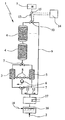
- the proposed arrangement 1 for the purification and combustion of biogas 2 includes filters 3, 4, the adsorption in the illustrated embodiment, optionally also different adsorbents, preferably activated carbon, for purifying the biogas 2 included.
- two filters 3 are provided, which are connected in parallel and form pre-filters.
- the filters 3, at least one filter 4 is arranged downstream as the main filter.
- two filters 4 are provided, which are connected in series and thus form different filter stages.
- the proposed arrangement 1 further comprises a gas engine 5, the purified biogas 2 can be supplied for combustion.
- the gas engine 5 is preferably a conventional internal combustion engine. However, in a broader sense, this may also be a gas turbine, a gas-fired cogeneration plant, in particular a combined heat and power plant, another heating device or the like.
- the two prefilters 3 is associated with a vacuum pump 6.
- each prefilter 3 can be alternately sealed off and placed under negative pressure by means of the vacuum pump 6 to at least partially desorb adsorbed contaminants, in particular water vapor and hydrocarbons from the activated carbon, while to be purified digester gas 1 by the other Prefilter 3 is passed. This enables continuous pre-cleaning.
- the arrangement 1 With appropriate coordination of the desorption frequency, the loading volume and the deposition performance on each other, it is possible to operate the arrangement 1 such that the prefilter 3 are loaded substantially only with competing siloxane competing gas components that are relatively easily or efficiently desorbable by vacuum again , while the main filter 4 are loaded substantially only with siloxanes and possibly other silicon compounds. This allows a much better utilization of the loading capacity of the adsorbent or activated carbon with silicon compounds in the main filters 4 than in the prior art.
- the adsorbent volume of the main filter 4 compared to the prefilters 3 is substantially larger, in particular at least by a factor of 2, preferably 5 and more preferably at least 10. This allows a very efficient use of the adsorbent or the activated carbon, so that at a relatively low cost a very good cleaning performance, in particular a very effective separation of siloxanes and other silicon compounds, is made possible.
- a partial flow 11 of the digester gas 2 is passed through said filter stage or the filters 3, 4 and a residual current 12 passed through the bypass line 9 to the filter stage or the filter 3, 4 around.
- the streams 11, 12 are in particular combined with the valve 10 to form a mixed stream 13 and then fed to the gas engine 5 as purified biogas.
- the degree of contamination of the mixed stream 13 is thus reduced as a function of the ratio of the partial flow 11 to the residual flow 12.
- the valve 10 is formed in the illustrated embodiment as a three-way valve and in particular by means of an associated control device 14 so adjustable, that the ratio of partial flow 11 to residual flow 12 can be varied, in particular steplessly or in stages between 0 and 1.
- a fixed ratio of partial flow 11 to residual flow 12 of, for example, 0.5 can be set or determined by appropriate design of the lines, throttles and / or the valve 10.
- adjustable pressure reducers, throttles, volume flow meters or the like may be used to control or regulate the ratio of partial flow 11 to residual flow 12.
- the degree of contamination in particular the proportion of siloxanes and / or other silicon compounds, in the digester gas 2 to be purified, in the partial stream 11, in the residual stream 12 and / or very particularly preferably in the mixed stream 13 is preferably measured.
- the arrangement 1 for this purpose has a corresponding measuring device 15 is preferably carried out a continuous measurement or monitoring of the degree of contamination, in particular in the supply line to the gas engine 5, as shown.
- the measuring device 15 is connected to the control device 14, so that an automated control or regulation of the ratio of partial flow 11 to residual flow 12 or opening or switching off of the bypass line 9 can take place, for example, as a function of measured values and / or when a limit is reached.
- the measuring device 15 can be used to control and / or display a change of the adsorbents of the filters 3 and 4 respectively.
- the proposed arrangement 1 additionally has a gas scrubber 16.
- the gas scrubber 16 preferably operates with a polar solvent, especially water.
- Very particularly preferably landfill leachate 18 can be used, which is already polluted anyway and requires aftertreatment.
- the scrubbing gas 2 which has been washed and subsequently reduced in its relative humidity, is then fed to the said adsorptive cleaning or the bypass line 9 for direct transfer to the gas engine 5.
- the proposed arrangement 1 and the proposed method thus allow an adapted to the particular case optimum cleaning in terms of compliance with a limit for the contamination with silicon compounds, in particular siloxanes, for the gas engine 5, with optimum utilization of the loading capacity of the adsorbent, in particular the Activated carbon, with silicon compounds or minimizing the required amount of adsorbent, in particular activated carbon, based on the total flow of digester gas 2 is or will be possible.
Landscapes
- Chemical & Material Sciences (AREA)
- Oil, Petroleum & Natural Gas (AREA)
- Engineering & Computer Science (AREA)
- Chemical Kinetics & Catalysis (AREA)
- General Chemical & Material Sciences (AREA)
- Analytical Chemistry (AREA)
- Organic Chemistry (AREA)
- Treating Waste Gases (AREA)
- Separation Of Gases By Adsorption (AREA)
- Solid-Sorbent Or Filter-Aiding Compositions (AREA)
Description
- Die vorliegende Erfindung betrifft ein Verfahren zur Reinigung von Faulgas gemäß dem Oberbegriff des Anspruchs 1 sowie eine Anordnung zur Reinigung und Verbrennung von Faulgas gemäß dem Oberbegriff des Anspruchs 10.
- Faulgase im Sinne der vorliegenden Erfindung entstehen beispielsweise in Kläranlagen, Biogasanlagen und Deponien durch anaerobe Umsetzung organischer Abfallstoffe. Sie enthalten neben Methan, Stickstoff und Kohlendioxid als Hauptbestandteile meist auch nennenswerte Anteile an halogenierten und nicht halogenierten Kohlenwasserstoffverbindungen sowie verschiedene Siliciumverbindungen unterschiedlicher Kettenlängen, insbesondere höher- und niedermolekulare Siloxane. Faulgase aus Kläranlagen enthalten hierbei überwiegend höhermolekulare, unpolare Siliciumverbindungen, während Deponiegas auch niedermolekulare Abbauprodukte, unter anderem Dimethylsilandiol und Tremethylsilanol, aufweist, die eher apolaren Charakter besitzen. Faulgase sind außerdem üblicherweise mit Wasserdampf gesättigt.
- Seit langem wird Faulgas zum Betrieb von Gasmotoren, insbesondere in Kraft-Wärme-Kopplungsanlagen, eingesetzt. Diese Nutzung von Faulgas bereitet jedoch mit dem in den letzen Jahren zunehmenden Anteil an Siloxanen im Faulgas Probleme, da diese Siliciumverbindungen starken Verschleiß, hohen Aufwand sowie Schäden an den Gasmotoren verursachen. Die Siloxane führen im Verbrennungsprozeß zur Bildung von mineralischen Siliciumverbindungen. Diese können als Stäube im Zylinderraum sowie im Schmieröl wie ein Schleifmittel wirken und sich im Verbrennungsraum als glasartige Schichten anlagern, die gelegentlich abplatzen und große Schäden im Motor verursachen können. Die Reinigung von Faulgas zur Entfernung von Siliciumverbindungen, insbesondere Siloxanen, spielt daher für die Nutzung von Faulgas eine wesentliche Rolle.
- Aus der DE 101 58 804 C1, die den Ausgangspunkt der vorliegenden Erfindung bildet, ist es bekannt, höhermolekulare Siliciumverbindungen katalytisch in niedermolekulare Siliciumverbindungen umzuwandeln und das Faulgas einer Gaswäsche zu unterziehen. Anschließend wird das Faulgas in einem Wärmetauscher erwärmt, um die relative Feuchte zu vermindern, und dann einem ggf, mehrstufigen Aktivkohlefilter zugeführt.
- In der Praxis hat sich gezeigt, daß die Menge an erforderlicher Aktivkohle zur Abscheidung bzw. Adsorption von Verunreinigungen aus dem Faulgas oftmals beträchtlich ist. Dementsprechend sind mit der Bereitstellung der Aktivkohle, dem Austausch der Aktivkohle und der Entsorgung der beladenen Aktivkohle verhältnismäßig hohe Kosten verbunden.
- Der vorliegenden Erfindung liegt die Aufgabe zugrunde, ein Verfahren zur Reinigung von Faulgas und eine Anordnung zur Reinigung und Verbrennung von Faulgas anzugeben, wobei eine besonders wirtschaftliche Reinigung, insbesondere eine Minimierung der erforderlichen bzw. auszutauschenden Menge an Adsorbentien, wie Aktivkohle, auf einfache Weise ermöglicht wird.
- Die obige Aufgabe wird durch ein Verfahren gemäß Anspruch 1 oder eine Anordnung gemäß Anspruch 10 gelöst. Vorteilhafte Weiterbildungen sind Gegenstand der Unteransprüche.
- Eine Idee der vorliegenden Erfindung liegt darin, adsorbierte Verunreinigungen mittels Unterdruck vom Adsorbens eines Filters, insbesondere eines Vorfilters, zumindest teilweise zu desorbieren. Insbesondere ist dem durch Unterdruck desorbierbaren Vorfilter ein Hauptfilter nachgeordnet. So kann wiederum eine wesentlich kostengünstigere Reinigung von Faulgas erreicht werden, da die Menge an erforderlichem bzw. auszutauschendem Adsorbens verringert werden kann.
- Durch Adsorption lassen sich prinzipiell Siloxane aus dem Faulgas entfernen. Jedoch wird in der Praxis nur ein Bruchteil der theoretisch erzielbaren Beladungskapazität der Adsorbentien erreicht. Ursache hierfür sind die weiteren konkurrierenden Gasbestandteile des Faulgases, wie Wasserdampf und Kohlenwasserstoffe, die die Adsorbierbarkeit der Siloxane in den Adsorbentien drastisch einschränken. Bei voller Beladung des Vorfilters haben die konkurrierenden Gasbestandteile die Siloxane praktisch verdrängt. Die Siloxane bzw. sonstigen siliciumhaltigen Verbindungen werden dann im nachgeordneten Hauptfilter abgeschieden.
- Die konkurrierenden Gasbestandteile können nun - im Gegensatz zu Siloxanen - mit verhältnismäßig hoher Desorptionsrate durch Unterdruck wieder desorbiert werden. Dementsprechend führt die zumindest teilweise Desorption von Verunreinigungen des Vorfilters durch Unterdruck zu einer einfachen, schnellen und kostengünstigen Vorreinigung, wobei der nachgeordnete Hauptfilter zumindest weitgehend von den genannten konkurrierenden Gasbestandteilen verschont bleibt und dadurch zumindest im wesentlichen lediglich zur Adsorption von Siloxanen und sonstigen Siliciumverbindungen mit hoher Beladungskapazität benutzt werden kann. Entsprechend ist das Adsorbens bzw. die Aktivkohle des Hauptfilters seltener als beim Stand der Technik auszutauschen, wodurch sich die Kosten und Wartungsintervalle reduzieren.
- Ein weiterer Aspekt der vorliegenden Erfindung liegt darin, daß insbesondere bedarfsweise nur ein Teilstrom des Faulgases durch Filter mit einem Adsorbens, wie Aktivkohle, geleitet und anschließend mit dem Reststrom des Faulgases wieder zu einem Mischstrom gemischt wird, um den Verunreinigungsgrad des Mischstroms in ausreichender Weise reduzieren zu können, insbesondere um Grenzwerte für Verunreinigungen, insbesondere von Siliciumverbindungen, wie Siloxanen, für einen nachgeordneten Gasmotor einhalten zu können. Dies ermöglicht je nach Verunreinigungsgrad des ungereinigten Faulgases bzw. der eingesetzten Reinigungsstufen eine deutliche Verringerung der Menge an zu adsorbierenden Verunreinigungen und damit der erforderlichen bzw. auszutauschenden Menge an Adsorbentien. So werden eine verlängerte Standzeit der Adsorbentien, insbesondere der Aktivkohle, ein weniger häufiger Wechsel der Adsorbentien und eine geringere Menge an auszutauschenden und zu entsorgenden Adsorbentien mit dementsprechend geringeren Kosten ermöglicht.
- Vorzugsweise wird das Verhältnis von Teilstrom zu Reststrom in Abhängigkeit vom Grad der Verunreinigung, insbesondere mit Siloxanen bzw. sonstigen Siliciumverbindungen, eingestellt bzw. variiert.
- Besonders bevorzugt verläuft fortlaufend eine Messung von relevanten Verunreinigungen, wie Siliciumverbindungen, insbesondere Siloxanen, im Mischstrom, um einen entsprechenden Grenzwert für Verunreinigungen einhalten und dadurch einen nachgeordneten Gasmotor störungsfrei betreiben zu können, wobei gleichzeitig eine Reinigung nur insoweit wie erforderlich erfolgen kann.
- Weitere Vorteile, Merkmale, Eigenschaften und Aspekte der vorliegenden Erfindung ergeben sich aus der folgenden Beschreibung einer bevorzugten Ausführungsform anhand der Zeichnung. Die einzige Figur zeigt
eine schematische Darstellung einer vorschlagsgemäßen Anordnung zur Reinigung und Verbrennung von Faulgas. - Die vorschlagsgemäße Anordnung 1 zur Reinigung und Verbrennung von Faulgas 2 umfaßt Filter 3, 4, die beim Darstellungsbeispiel ein Adsorbens, ggf. auch unterschiedliche Adsorbentien, vorzugsweise Aktivkohle, zur Reinigung des Faulgases 2 enthalten.
- Beim Darstellungsbeispiel sind zwei Filter 3 vorgesehen, die parallel geschaltet sind und Vorfilter bilden. Den Filtern 3 ist mindestens ein Filter 4 als Hauptfilter nachgeordnet. Beim Darstellungsbeispiel sind zwei Filter 4 vorgesehen, die in Reihe geschaltet sind und so verschiedene Filterstufen bilden.
- Die vorschlagsgemäße Anordnung 1 weist weiter einen Gasmotor 5 auf, dem gereinigtes Faulgas 2 zur Verbrennung zuführbar ist. Bei dem Gasmotor 5 handelt es sich vorzugsweise um einen herkömmlichen bzw. angepaßten Innenverbrennungsmotor. Jedoch kann es sich hierbei in einem weiteren Sinne auch um eine Gasturbine, ein gasbetriebenes Heizkraftwerk, insbesondere ein Blockheizkraftwerk, eine sonstige Heizeinrichtung oder dgl. handeln.
- Den beiden Vorfiltern 3 ist eine Unterdruckpumpe 6 zugeordnet. Durch entsprechende Umschaltventile 7 und Sperrventile 8 kann jeder Vorfilter 3 abwechselnd abgeschottet und mittels der Unterdruckpumpe 6 unter Unterdruck gesetzt werden, um adsorbierte Verunreinigungen, insbesondere Wasserdampf und Kohlenwasserstoffe, zumindest teilweise wieder von der Aktivkohle zu desorbieren, während zu reinigendes Faulgas 1 durch den jeweils anderen Vorfilter 3 geleitet wird. So wird eine kontinuierliche Vorreinigung ermöglicht.
- Insbesondere bei entsprechender Abstimmung der Desorptionshäufigkeit, des Beladungsvolumens und der Abscheidungsleistung aufeinander ist es möglich, die Anordnung 1 derart zu betreiben, daß die Vorfilter 3 im wesentlichen nur mit zu Siloxanen konkurrierenden Gasbestandteilen beladen werden, die verhältnismäßig leicht bzw. effizient durch Unterdruck wieder desorbierbar sind, während die Hauptfilter 4 im wesentlichen nur mit Siloxanen und ggf. sonstigen Siliciumverbindungen beladen werden. Dies ermöglicht eine wesentlich bessere Ausnutzung der Beladungskapazität des Adsorbens bzw. der Aktivkohle mit Siliciumverbindungen in den Hauptfiltern 4 als beim Stand der Technik.
- Vorzugsweise ist das Adsorbensvolumen der Hauptfilter 4 gegenüber den Vorfiltern 3 wesentlich größer, insbesondere mindestens um den Faktor 2, vorzugsweise 5 und ganz bevorzugt mindestens 10. Dies ermöglicht einen sehr effizienten Einsatz des Adsorbens bzw. der Aktivkohle, so daß bei verhältnismäßig geringen Kosten eine sehr gute Reinigungsleistung, insbesondere eine sehr effektive Abscheidung von Siloxanen und sonstigen Siliciumverbindungen, ermöglicht wird.
- Gemäß einem weiteren Aspekt der vorliegenden Erfindung weist die vorschlagsgemäße Anordnung 1 eine Bypassleitung 9 und ein zugeordnetes Ventil 10 oder ein sonstiges Stellglied auf, um die die Filter 3, 4 umfassende Filterstufe bzw. die adsorbierende Reinigung bedarfsweise umgehen zu können. So wird ein Teilstrom 11 des Faulgases 2 durch die genannte Filterstufe bzw. die Filter 3, 4 geleitet und ein Reststrom 12 durch die Bypassleitung 9 um die Filterstufe bzw. die Filter 3, 4 herum geleitet. Die Ströme 11, 12 werden insbesondere mit dem Ventil 10 zu einem Mischstrom 13 zusammengeführt und dann dem Gasmotor 5 als gereinigtes Faulgas zugeleitet. Der Verunreinigungsgrad des Mischstroms 13 wird also in Abhängigkeit vom Verhältnis des Teilstroms 11 zum Reststrom 12 reduziert.
- Das Ventil 10 ist beim Darstellungsbeispiel als Dreiwegeventil ausgebildet und insbesondere mittels einer zugeordneten Steuereinrichtung 14 derart einstellbar, daß das Verhältnis von Teilstrom 11 zu Reststrom 12 variierbar ist, insbesondere stufenlos oder in Stufen zwischen 0 und 1.
- Bedarfsweise kann durch entsprechende Auslegung der Leitungen, Drosseln und/oder des Ventils 10 auch ein festes Verhältnis von Teilstrom 11 zu Reststrom 12 von beispielsweise 0,5 eingestellt bzw. festgelegt sein.
- Zusätzlich oder alternativ zum angedeuteten Ventil 10 sind jedoch auch sonstige konstruktive Lösungen möglich. Insbesondere können ggf. einstellbare Druckminderer, Drosseln, Volumenstrommesser oder dgl. zur Steuerung bzw. Regelung des Verhältnisses von Teilstrom 11 zu Reststrom 12 eingesetzt werden.
- Vorzugsweise wird der Verunreinigungsgrad, insbesondere der Anteil an Siloxanen und/oder sonstigen Siliciumverbindungen, im zu reinigenden Faulgas 2, im Teilstrom 11, im Reststrom 12 und/oder ganz besonders bevorzugt im Mischstrom 13 gemessen. Insbesondere weist die Anordnung 1 hierzu eine entsprechende Meßeinrichtung 15 auf Vorzugsweise erfolgt eine fortlaufende Messung bzw. Überwachung des Verunreinigungsgrads, insbesondere in der Zuleitung zum Gasmotor 5, wie dargestellt.
- Gemäß einer besonders bevorzugten Variante ist die Meßeinrichtung 15 an die Steuereinrichtung 14 angeschlossen, so daß eine automatisierte Steuerung bzw. Regelung des Verhältnisses von Teilstrom 11 zu Reststrom 12 bzw. ein Öffnen bzw. Abschalten der Bypassleitung 9 erfolgen kann, beispielsweise in Abhängigkeit von Meßwerten und/oder bei Erreichen eines Grenzwerts.
- Zusätzlich kann die Meßeinrichtung 15 zur Steuerung und/oder Anzeige eines Wechsels der Adsorbentien der Filter 3 bzw. 4 genutzt werden.
- Beim Darstellungsbeispiel weist die vorschlagsgemäße Anordnung 1 zusätzlich eine Gaswäsche 16 auf. Die Gaswäsche 16 arbeitet vorzugsweise mit einem polaren Lösungsmittel, insbesondere Wasser. Ganz besonders bevorzugt ist Deponiesickerwasser 18 einsetzbar, das ohnehin bereits schadstoffbelastet ist und einer Nachbehandlung bedarf.
- Weiter weist die Anordnung 1 eine der Gaswäsche 16 nachgeordnete Einrichtung zur Verringerung der relativen Feuchte des Faulgases 2, insbesondere einen Wärmetauscher 17, auf.
- Das gewaschene und anschließend in seiner relativen Feuchte verminderte Faulgas 2 wird dann der genannten adsorbierenden Reinigung bzw. der Bypassleitung 9 zur direkten Weiterleitung an den Gasmotor 5 zugeführt.
- Mit der vorschlagsgemäßen Anordnung 1 kann beispielsweise ausgehend von Faulgas 2 mit einem Gehalt an Siloxanen von 30 mg/m3 durch die Gaswäsche 16 zunächst eine Verringerung des Siloxangehalts auf etwa 15 mg/m3 erreicht werden. Wenn anschließend die Hälfte dieses Gasstroms als Teilstrom 11 durch die Filter 3, 4 geleitet wird, erfolgt aufgrund der quasi vollständigen Abscheidung der Siloxane im Teilstrom 11 eine weitere Halbierung des Siloxangehalts im Mischstrom 13 auf etwa 7,5 mg/m3. Damit kann der übliche Grenzwert von 10 mg/m3 an Siloxanen bzw. Siliciumverbindungen, die dem Gasmotor 5 zuführbar sind, ausreichend und mit einem vertretbaren gegenüber dem Stand der Technik wesentlich verringerten Aufwand an Adsorbens bzw. Aktivkohle unterschritten werden.
- Die vorschlagsgemäße Anordnung 1 und das vorschlagsgemäße Verfahren gestatten also eine an den jeweiligen Einzelfall angepaßte optimale Reinigung im Hinblick auf die Einhaltung eines Grenzwerts für die Verunreinigung mit Siliciumverbindungen, insbesondere Siloxanen, für den Gasmotor 5, wobei eine optimale Ausnutzung der Beladungskapazität des Adsorbens, insbesondere der Aktivkohle, mit Siliciumverbindungen bzw. eine Minimierung der erforderlichen Menge an Adsorbens, insbesondere Aktivkohle, bezogen auf den Gesamtstrom an Faulgas 2 ermöglicht wird bzw. werden.
Claims (18)
- Verfahren zur Reinigung von Siliciumverbindungen enthaltendem Faulgas (2) mittels eines Vorfilters (3) mit einem Adsorbens, vorzugsweise Aktivkohle, und eines nachgeschalteten Hauptfilters (4),
dadurch gekennzeichnet,
daß adsorbierte Siliciumverbindungen mittels Unterdruck vom Adsorbens zumindest teilweise desorbiert werden. - Verfahren nach Anspruch 1, dadurch gekennzeichnet, daß zwei Vorfilter (3) abwechselnd, vorzugsweise mittels der selben Unterdruckpumpe (6), unter Unterdruck gesetzt werden, während das Faulgas (2) durch den jeweils anderen Vorfilter (3) geleitet wird.
- Verfahren nach einem der voranstehenden Ansprüche, dadurch gekennzeichnet, daß ein Teilstrom (11) des Faulgases (2) durch den bzw. die Filter (3, 4) geleitet und danach mit dem Reststrom (12) des nicht durch den bzw. die Filter (3, 4) geleiteten Faulgases (2) wieder zu einem Mischstrom (13) gemischt wird, um den Verunreinigungsgrad an Siliciumverbindungen im Mischstrom (13) in Abhängigkeit vom Verhältnis von Teilstrom (11) zu Reststrom (12) zu reduzieren.
- Verfahren nach Anspruch 3, dadurch gekennzeichnet, daß der Grad der Verunreinigung mit Siliciumverbindungen im ungereinigten Faulgas (2), Teilstrom (11) und/oder Mischstrom (13), vorzugsweise fortlaufend gemessen wird.
- Verfahren nach Anspruch 3 oder 4, dadurch gekennzeichnet, daß das Verhältnis von Teilstrom (11) zu Reststrom (12) fest eingestellt oder vorzugsweise in Abhängigkeit vom Grad der Verunreinigung des Mischstroms (13) mit Siliciumverbindungen variiert wird.
- Verfahren nach einem der Ansprüche 3 bis 5, dadurch gekennzeichnet, daß das Verhältnis von Teilstrom (11) zu Reststrom (12) zwischen 0 und 1 stufenlos oder in Stufen variierbar ist.
- Verfahren nach einem der voranstehenden Ansprüche, dadurch gekennzeichnet, daß das Faulgas (2) vor der adsorbierenden Reinigung einer Gaswäsche (16), insbesondere mit einem polaren Lösungsmittel, vorzugsweise Wasser, ganz bevorzugt Deponiesickerwasser (18), unterzogen wird.
- Verfahren nach einem der voranstehenden Ansprüche, dadurch gekennzeichnet, daß die zumindest die relative Feuchte des Faulgases (2) vor der adsorbierenden Reinigung und insbesondere nach einer Gaswäsche (16) reduziert wird, vorzugsweise durch Erwärmen, insbesondere mittels eines Wärmetauschers (17).
- Verfahren nach einem der voranstehenden Ansprüche, dadurch gekennzeichnet, daß der Mischstrom (13) einen verringerten Grad an Verunreinigungen mit Siliciumverbindungen aufweist und einem Gasmotor (5) zur Verbrennung zugeführt wird.
- Anordnung (1) zur Reinigung von Siliciumverbindungen enthaltendem Faulgas (2) und anschließender Verbrennung, wobei die Anordnung (1) mindestens einen Filter (3, 4) mit einem Adsorbens, vorzugsweise Aktivkohle, und einen nachgeordneten Gasmotor (5) zur Verbrennung des gereinigten Faulgases (1) aufweist,
dadurch gekennzeichnet,
daß die Anordnung (1) eine Unterdruckpumpe (6) zur zumindest teilweisen Desorption von Siliciumverbindungen vom Adsorbens mindestens eines Filters (3) aufweist. - Anordnung nach Anspruch 10, dadurch gekennzeichnet, daß die Anordnung (1) eine Bypassleitung (9) und ein zugeordnetes Ventil (10) aufweist, so daß ein Teilstrom (11) des Faulgases (2) durch den bzw. die Filter (3, 4) leitbar und danach mit dem Reststrom (12) des nicht durch den bzw. die Filter (3, 4) geleiteten Faulgases (2) wieder zu einem Mischstrom (13) mischbar ist, um den Verunreinigungsgrad an Siliciumverbindungen im Mischstrom (13) in Abhängigkeit vom Verhältnis von Teilstrom (11) zu Reststrom (12) zu reduzieren, insbesondere wobei die Anordnung (1) eine Meßeinrichtung (15) aufweist, um den Grad der Verunreinigung mit Siliciumverbindungen im ungereinigten Faulgas (2), Teilstrom (11), Reststrom (12) und/oder Mischstrom (13) vorzugsweise fortlaufend zu messen.
- Anordnung nach Anspruch 11, dadurch gekennzeichnet, daß das Verhältnis von Teilstrom (11) zu Reststrom (12) fest eingestellt oder vorzugsweise in Abhängigkeit vom Grad der Verunreinigung des Mischstroms (13) mit Siliciumverbindungen variierbar ist.
- Anordnung nach Anspruch 11 oder 12, dadurch gekennzeichnet, daß das Verhältnis von Teilstrom (11) zu Reststrom (12) zwischen 0 und 1 stufenlos oder in Stufen variierbar ist.
- Anordnung nach einem der Ansprüche 10 bis 13, dadurch gekennzeichnet, daß die Anordnung (1) zwei Vorfilter (3) aufweist, die abwechselnd mittels der Unterdruckpumpe (6) unter Unterdruck setzbar sind, während das Faulgas (2) durch den jeweils anderen Vorfilter (3) leitbar ist.
- Anordnung nach Anspruch 14, dadurch gekennzeichnet, daß den Vorfiltern (3) mindestens ein Hauptfilter (4) nachgeordnet ist.
- Anordnung nach Anspruch 15, dadurch gekennzeichnet, daß das Adsorbensvolumen des Hauptfilters (4) größer als das Adsorbensvolumen jedes Vorfilters (3) ist, insbesondere mindestens um den Faktor 2, vorzugsweise 5, insbesondere 10.
- Anordnung nach einem der Ansprüche 10 bis 14, dadurch gekennzeichnet, daß die Anordnung (1) eine insbesondere mit Wasser, vorzugsweise Deponiesickerwasser (18), arbeitende Gaswäsche (16) aufweist.
- Anordnung nach einem der Ansprüche 10 bis 15, dadurch gekennzeichnet, daß die Anordnung (1) eine Einrichtung, insbesondere einen Wärmetauscher (17), zur Reduzierung der relativen Feuchte des Faulgases (2) vor der adsorbierenden Reinigung und insbesondere nach einer Gaswäsche (16) aufweist.
Priority Applications (1)
| Application Number | Priority Date | Filing Date | Title |
|---|---|---|---|
| DE200520003058 DE202005003058U1 (de) | 2004-02-04 | 2005-02-03 | Anordnung zur Reinigung und Verbrennung von Faulgas |
Applications Claiming Priority (2)
| Application Number | Priority Date | Filing Date | Title |
|---|---|---|---|
| DE102004005626 | 2004-02-04 | ||
| DE102004005626A DE102004005626A1 (de) | 2004-02-04 | 2004-02-04 | Verfahren zur Reinigung von Faulgas und Anordnung zur Reinigung und Verbrennung von Faulgas |
Publications (2)
| Publication Number | Publication Date |
|---|---|
| EP1561506A1 EP1561506A1 (de) | 2005-08-10 |
| EP1561506B1 true EP1561506B1 (de) | 2007-05-23 |
Family
ID=34673162
Family Applications (1)
| Application Number | Title | Priority Date | Filing Date |
|---|---|---|---|
| EP05002208A Expired - Lifetime EP1561506B1 (de) | 2004-02-04 | 2005-02-03 | Verfahren und Anordnung zur Reinigung von Faulgas |
Country Status (3)
| Country | Link |
|---|---|
| EP (1) | EP1561506B1 (de) |
| AT (1) | ATE362801T1 (de) |
| DE (2) | DE102004005626A1 (de) |
Cited By (2)
| Publication number | Priority date | Publication date | Assignee | Title |
|---|---|---|---|---|
| US9803598B2 (en) | 2015-12-21 | 2017-10-31 | Caterpillar Inc. | Air intake system for engine |
| EP4552724A1 (de) * | 2023-11-08 | 2025-05-14 | L'air Liquide, Societe Anonyme Pour L'etude Et L'exploitation Des Procedes Georges Claude | System zur entfernung von lösungsmittelrückständen in acetylengas |
Families Citing this family (7)
| Publication number | Priority date | Publication date | Assignee | Title |
|---|---|---|---|---|
| ES2368004T3 (es) * | 2006-05-29 | 2011-11-11 | Wolfgang Dipl.-Ing. Doczyck | Procedimiento y disposición para depurar gas de fermentación. |
| WO2008024329A1 (en) * | 2006-08-22 | 2008-02-28 | Donaldson Company, Inc. | Biogas purification with siloxane removal |
| AT504325B8 (de) * | 2006-10-03 | 2008-09-15 | Profactor Produktionsforschung | Verfahren zur abtrennung einer komponente aus einem gasgemisch |
| CN101912719A (zh) * | 2010-08-20 | 2010-12-15 | 广东联塑科技实业有限公司 | 用于hdpe塑料管道生产线的异味气体处理设备及处理方法 |
| US9023755B2 (en) | 2012-12-18 | 2015-05-05 | Cabot Corporation | Siloxane removal from gases using lignite-enhanced activated carbons and adsorbent media used therefor |
| FR3037506B1 (fr) * | 2015-06-17 | 2019-09-27 | Clauger | Procede de lavage d'un effluent gazeux |
| CN119607824B (zh) * | 2024-12-27 | 2025-09-09 | 北京市科学技术研究院城市安全与环境科学研究所 | 一种垃圾处理场臭气污染监测与分级控制装置及方法 |
Family Cites Families (6)
| Publication number | Priority date | Publication date | Assignee | Title |
|---|---|---|---|---|
| DE4133869C2 (de) * | 1991-10-12 | 1995-12-14 | Nitsche Manfred | Verfahren zur Reinigung eines mit Kohlenwasserstoffdämpfen beladenen Rohgas- und/oder Abgasstromes unter Rückgewinnung der Kohlenwasserstoffe |
| US5899187A (en) * | 1996-07-11 | 1999-05-04 | Jenbacher Energiesysteme Aktiengesellschaft | Engine arrangement |
| DE29824595U1 (de) * | 1998-03-13 | 2001-09-13 | Doczyck, Wolfgang, Dipl.-Ing., 46047 Oberhausen | Vorrichtung zum Abscheiden von Siloxanen aus Biogasen |
| DE19920258A1 (de) * | 1999-05-03 | 2000-11-09 | Faulstich Martin | Naß-Reinigung von Biogas |
| DE10158804C1 (de) * | 2001-11-30 | 2003-07-31 | Fraunhofer Ges Forschung | Verfahren und Vorrichtung zur Reinigung von Faulgasen |
| DE10226417A1 (de) * | 2002-06-13 | 2003-12-24 | Menerga Appbau Gmbh | Vorrichtung zum Trocknen von Luft in Gebäuden insbesondere in Schwimmhallen |
-
2004
- 2004-02-04 DE DE102004005626A patent/DE102004005626A1/de not_active Withdrawn
-
2005
- 2005-02-03 DE DE502005000737T patent/DE502005000737D1/de not_active Expired - Lifetime
- 2005-02-03 EP EP05002208A patent/EP1561506B1/de not_active Expired - Lifetime
- 2005-02-03 AT AT05002208T patent/ATE362801T1/de not_active IP Right Cessation
Cited By (2)
| Publication number | Priority date | Publication date | Assignee | Title |
|---|---|---|---|---|
| US9803598B2 (en) | 2015-12-21 | 2017-10-31 | Caterpillar Inc. | Air intake system for engine |
| EP4552724A1 (de) * | 2023-11-08 | 2025-05-14 | L'air Liquide, Societe Anonyme Pour L'etude Et L'exploitation Des Procedes Georges Claude | System zur entfernung von lösungsmittelrückständen in acetylengas |
Also Published As
| Publication number | Publication date |
|---|---|
| DE502005000737D1 (de) | 2007-07-05 |
| DE102004005626A1 (de) | 2006-01-12 |
| EP1561506A1 (de) | 2005-08-10 |
| ATE362801T1 (de) | 2007-06-15 |
Similar Documents
| Publication | Publication Date | Title |
|---|---|---|
| DE2257329A1 (de) | Verfahren und vorrichtung zum vermindern der giftigen bestandteile in den abgasen von brennkraftanlagen | |
| EP1561506B1 (de) | Verfahren und Anordnung zur Reinigung von Faulgas | |
| DE102005048298B3 (de) | Verfahren und Anlage zur Reinigung von mit organischen Schadstoffen beladener Abluft | |
| DE102009024003A1 (de) | Filtervorrichtung zum Reinigen von mit Feststoffpartikeln und/oder gelösten Schadstoffen belastetem Wasser | |
| DE102004022737A1 (de) | Verfahren und Vorrichtung zur Reinigung von aerosol- und staubbelasteten Abgasströmen | |
| DE10152671A1 (de) | Granulat und Verfahren sowie Anlage zum Reinigen von verschmutztem Regenwasser | |
| DE10158804C1 (de) | Verfahren und Vorrichtung zur Reinigung von Faulgasen | |
| DE3227375A1 (de) | Verfahren zur reinigung von biologisch abbaubare verunreinigungen enthaltende abluft | |
| EP1862212B1 (de) | Verfahren und Anordnung zur Reinigung von Faulgas | |
| DE202005003058U1 (de) | Anordnung zur Reinigung und Verbrennung von Faulgas | |
| DE1794140C3 (de) | Kontinuierliches Verfahren zur Trennung eines Gasgemisches mit Hilfe von Adsorbent | |
| EP3260185A1 (de) | Vorrichtung zur temperaturwechsel-adsorption und verfahren zur temperaturwechsel-adsorption für die reinigung von gasen | |
| DE102009059147A1 (de) | Kraftstoffzufuhrsystem | |
| DE102008007557A1 (de) | Verfahren und Vorrichtung zur Reinigung und Speicherung von Wasserstoff | |
| DE2134275B2 (de) | Entlüftungsanordnung für einen Benzintank von Kraftfahrzeugen | |
| EP1246779B1 (de) | Verfahren und vorrichtung zum reinigen von rohwasser | |
| DE3627875C2 (de) | ||
| DE202006008585U1 (de) | Anordnung zur Reinigung von Faulgas | |
| DE4136344C2 (de) | Verfahren zur Aufbereitung eines kohlenwasserstoffhaltigen Deponiegas-Gasstromes | |
| EP1934135A1 (de) | Reformersystem sowie verfahren zur reformierung | |
| DE102004033588A1 (de) | Verfahren und Vorrichtung zur sorptiven Rückgewinnung halogenierter Kohlenwasserstoffe, vor allem für halogenierte Inhalationsanästhetika | |
| DE4130929A1 (de) | Verfahren zur reinigung eines mit dampf und/oder gasfoermigen schadstoffen, insbes. kohlenwasserstoffen, beladenen abgasstromes | |
| DE19755213A1 (de) | Verfahren zur Reinigung von Kohlensäure, die aus geeigneten Industrieverfahren, wie beispielsweise Gärungsprozessen, gewonnen wurde und angewendete Reinigungseinrichtungen | |
| DE19723564C2 (de) | Vorrichtung zur Gewinnung von Sauerstoff oder Stickstoff | |
| DE4203634A1 (de) | Verfahren zur trennung von organischen bestandteilen aus gasgemischen |
Legal Events
| Date | Code | Title | Description |
|---|---|---|---|
| PUAI | Public reference made under article 153(3) epc to a published international application that has entered the european phase |
Free format text: ORIGINAL CODE: 0009012 |
|
| AK | Designated contracting states |
Kind code of ref document: A1 Designated state(s): AT BE BG CH CY CZ DE DK EE ES FI FR GB GR HU IE IS IT LI LT LU MC NL PL PT RO SE SI SK TR |
|
| AX | Request for extension of the european patent |
Extension state: AL BA HR LV MK YU |
|
| 17P | Request for examination filed |
Effective date: 20060210 |
|
| AKX | Designation fees paid |
Designated state(s): AT BE BG CH CY CZ DE DK EE ES FI FR GB GR HU IE IS IT LI LT LU MC NL PL PT RO SE SI SK TR |
|
| GRAP | Despatch of communication of intention to grant a patent |
Free format text: ORIGINAL CODE: EPIDOSNIGR1 |
|
| GRAS | Grant fee paid |
Free format text: ORIGINAL CODE: EPIDOSNIGR3 |
|
| GRAA | (expected) grant |
Free format text: ORIGINAL CODE: 0009210 |
|
| AK | Designated contracting states |
Kind code of ref document: B1 Designated state(s): AT BE BG CH CY CZ DE DK EE ES FI FR GB GR HU IE IS IT LI LT LU MC NL PL PT RO SE SI SK TR |
|
| PG25 | Lapsed in a contracting state [announced via postgrant information from national office to epo] |
Ref country code: FI Free format text: LAPSE BECAUSE OF FAILURE TO SUBMIT A TRANSLATION OF THE DESCRIPTION OR TO PAY THE FEE WITHIN THE PRESCRIBED TIME-LIMIT Effective date: 20070523 |
|
| REG | Reference to a national code |
Ref country code: GB Ref legal event code: FG4D Free format text: NOT ENGLISH |
|
| REG | Reference to a national code |
Ref country code: CH Ref legal event code: EP |
|
| REG | Reference to a national code |
Ref country code: IE Ref legal event code: FG4D Free format text: LANGUAGE OF EP DOCUMENT: GERMAN |
|
| REF | Corresponds to: |
Ref document number: 502005000737 Country of ref document: DE Date of ref document: 20070705 Kind code of ref document: P |
|
| PG25 | Lapsed in a contracting state [announced via postgrant information from national office to epo] |
Ref country code: SE Free format text: LAPSE BECAUSE OF FAILURE TO SUBMIT A TRANSLATION OF THE DESCRIPTION OR TO PAY THE FEE WITHIN THE PRESCRIBED TIME-LIMIT Effective date: 20070823 |
|
| PG25 | Lapsed in a contracting state [announced via postgrant information from national office to epo] |
Ref country code: ES Free format text: LAPSE BECAUSE OF FAILURE TO SUBMIT A TRANSLATION OF THE DESCRIPTION OR TO PAY THE FEE WITHIN THE PRESCRIBED TIME-LIMIT Effective date: 20070903 |
|
| PG25 | Lapsed in a contracting state [announced via postgrant information from national office to epo] |
Ref country code: IS Free format text: LAPSE BECAUSE OF FAILURE TO SUBMIT A TRANSLATION OF THE DESCRIPTION OR TO PAY THE FEE WITHIN THE PRESCRIBED TIME-LIMIT Effective date: 20070923 |
|
| NLV1 | Nl: lapsed or annulled due to failure to fulfill the requirements of art. 29p and 29m of the patents act | ||
| PG25 | Lapsed in a contracting state [announced via postgrant information from national office to epo] |
Ref country code: PL Free format text: LAPSE BECAUSE OF FAILURE TO SUBMIT A TRANSLATION OF THE DESCRIPTION OR TO PAY THE FEE WITHIN THE PRESCRIBED TIME-LIMIT Effective date: 20070523 |
|
| GBV | Gb: ep patent (uk) treated as always having been void in accordance with gb section 77(7)/1977 [no translation filed] |
Effective date: 20070523 |
|
| REG | Reference to a national code |
Ref country code: IE Ref legal event code: FD4D |
|
| EN | Fr: translation not filed | ||
| PG25 | Lapsed in a contracting state [announced via postgrant information from national office to epo] |
Ref country code: CZ Free format text: LAPSE BECAUSE OF FAILURE TO SUBMIT A TRANSLATION OF THE DESCRIPTION OR TO PAY THE FEE WITHIN THE PRESCRIBED TIME-LIMIT Effective date: 20070523 Ref country code: IE Free format text: LAPSE BECAUSE OF FAILURE TO SUBMIT A TRANSLATION OF THE DESCRIPTION OR TO PAY THE FEE WITHIN THE PRESCRIBED TIME-LIMIT Effective date: 20070523 Ref country code: PT Free format text: LAPSE BECAUSE OF FAILURE TO SUBMIT A TRANSLATION OF THE DESCRIPTION OR TO PAY THE FEE WITHIN THE PRESCRIBED TIME-LIMIT Effective date: 20071023 Ref country code: DK Free format text: LAPSE BECAUSE OF FAILURE TO SUBMIT A TRANSLATION OF THE DESCRIPTION OR TO PAY THE FEE WITHIN THE PRESCRIBED TIME-LIMIT Effective date: 20070523 Ref country code: NL Free format text: LAPSE BECAUSE OF FAILURE TO SUBMIT A TRANSLATION OF THE DESCRIPTION OR TO PAY THE FEE WITHIN THE PRESCRIBED TIME-LIMIT Effective date: 20070523 Ref country code: SI Free format text: LAPSE BECAUSE OF FAILURE TO SUBMIT A TRANSLATION OF THE DESCRIPTION OR TO PAY THE FEE WITHIN THE PRESCRIBED TIME-LIMIT Effective date: 20070523 Ref country code: BG Free format text: LAPSE BECAUSE OF FAILURE TO SUBMIT A TRANSLATION OF THE DESCRIPTION OR TO PAY THE FEE WITHIN THE PRESCRIBED TIME-LIMIT Effective date: 20070823 |
|
| PG25 | Lapsed in a contracting state [announced via postgrant information from national office to epo] |
Ref country code: SK Free format text: LAPSE BECAUSE OF FAILURE TO SUBMIT A TRANSLATION OF THE DESCRIPTION OR TO PAY THE FEE WITHIN THE PRESCRIBED TIME-LIMIT Effective date: 20070523 Ref country code: LT Free format text: LAPSE BECAUSE OF FAILURE TO SUBMIT A TRANSLATION OF THE DESCRIPTION OR TO PAY THE FEE WITHIN THE PRESCRIBED TIME-LIMIT Effective date: 20070523 |
|
| PLBE | No opposition filed within time limit |
Free format text: ORIGINAL CODE: 0009261 |
|
| STAA | Information on the status of an ep patent application or granted ep patent |
Free format text: STATUS: NO OPPOSITION FILED WITHIN TIME LIMIT |
|
| 26N | No opposition filed |
Effective date: 20080226 |
|
| PG25 | Lapsed in a contracting state [announced via postgrant information from national office to epo] |
Ref country code: GB Free format text: LAPSE BECAUSE OF FAILURE TO SUBMIT A TRANSLATION OF THE DESCRIPTION OR TO PAY THE FEE WITHIN THE PRESCRIBED TIME-LIMIT Effective date: 20070523 Ref country code: GR Free format text: LAPSE BECAUSE OF FAILURE TO SUBMIT A TRANSLATION OF THE DESCRIPTION OR TO PAY THE FEE WITHIN THE PRESCRIBED TIME-LIMIT Effective date: 20070824 Ref country code: IT Free format text: LAPSE BECAUSE OF FAILURE TO SUBMIT A TRANSLATION OF THE DESCRIPTION OR TO PAY THE FEE WITHIN THE PRESCRIBED TIME-LIMIT Effective date: 20070523 |
|
| PG25 | Lapsed in a contracting state [announced via postgrant information from national office to epo] |
Ref country code: RO Free format text: LAPSE BECAUSE OF FAILURE TO SUBMIT A TRANSLATION OF THE DESCRIPTION OR TO PAY THE FEE WITHIN THE PRESCRIBED TIME-LIMIT Effective date: 20070523 |
|
| PG25 | Lapsed in a contracting state [announced via postgrant information from national office to epo] |
Ref country code: FR Free format text: LAPSE BECAUSE OF FAILURE TO SUBMIT A TRANSLATION OF THE DESCRIPTION OR TO PAY THE FEE WITHIN THE PRESCRIBED TIME-LIMIT Effective date: 20080118 |
|
| BERE | Be: lapsed |
Owner name: DOCZYCK, WOLFGANG, DIPL.-ING. Effective date: 20080228 |
|
| PG25 | Lapsed in a contracting state [announced via postgrant information from national office to epo] |
Ref country code: MC Free format text: LAPSE BECAUSE OF NON-PAYMENT OF DUE FEES Effective date: 20080228 |
|
| PG25 | Lapsed in a contracting state [announced via postgrant information from national office to epo] |
Ref country code: EE Free format text: LAPSE BECAUSE OF FAILURE TO SUBMIT A TRANSLATION OF THE DESCRIPTION OR TO PAY THE FEE WITHIN THE PRESCRIBED TIME-LIMIT Effective date: 20070523 |
|
| PG25 | Lapsed in a contracting state [announced via postgrant information from national office to epo] |
Ref country code: BE Free format text: LAPSE BECAUSE OF NON-PAYMENT OF DUE FEES Effective date: 20080228 |
|
| PG25 | Lapsed in a contracting state [announced via postgrant information from national office to epo] |
Ref country code: AT Free format text: LAPSE BECAUSE OF NON-PAYMENT OF DUE FEES Effective date: 20080203 |
|
| PG25 | Lapsed in a contracting state [announced via postgrant information from national office to epo] |
Ref country code: CY Free format text: LAPSE BECAUSE OF FAILURE TO SUBMIT A TRANSLATION OF THE DESCRIPTION OR TO PAY THE FEE WITHIN THE PRESCRIBED TIME-LIMIT Effective date: 20070523 |
|
| REG | Reference to a national code |
Ref country code: CH Ref legal event code: PL |
|
| PG25 | Lapsed in a contracting state [announced via postgrant information from national office to epo] |
Ref country code: LI Free format text: LAPSE BECAUSE OF NON-PAYMENT OF DUE FEES Effective date: 20090228 Ref country code: CH Free format text: LAPSE BECAUSE OF NON-PAYMENT OF DUE FEES Effective date: 20090228 |
|
| PG25 | Lapsed in a contracting state [announced via postgrant information from national office to epo] |
Ref country code: LU Free format text: LAPSE BECAUSE OF NON-PAYMENT OF DUE FEES Effective date: 20080203 Ref country code: HU Free format text: LAPSE BECAUSE OF FAILURE TO SUBMIT A TRANSLATION OF THE DESCRIPTION OR TO PAY THE FEE WITHIN THE PRESCRIBED TIME-LIMIT Effective date: 20071124 |
|
| PG25 | Lapsed in a contracting state [announced via postgrant information from national office to epo] |
Ref country code: TR Free format text: LAPSE BECAUSE OF FAILURE TO SUBMIT A TRANSLATION OF THE DESCRIPTION OR TO PAY THE FEE WITHIN THE PRESCRIBED TIME-LIMIT Effective date: 20070523 |
|
| REG | Reference to a national code |
Ref country code: DE Ref legal event code: R082 Ref document number: 502005000737 Country of ref document: DE Representative=s name: VON ROHR PATENTANWAELTE PARTNERSCHAFT MBB, DE |
|
| PGFP | Annual fee paid to national office [announced via postgrant information from national office to epo] |
Ref country code: DE Payment date: 20150223 Year of fee payment: 11 |
|
| REG | Reference to a national code |
Ref country code: DE Ref legal event code: R119 Ref document number: 502005000737 Country of ref document: DE |
|
| PG25 | Lapsed in a contracting state [announced via postgrant information from national office to epo] |
Ref country code: DE Free format text: LAPSE BECAUSE OF NON-PAYMENT OF DUE FEES Effective date: 20160901 |