EP1560921B1 - Uv-aktive bindemittel - Google Patents
Uv-aktive bindemittel Download PDFInfo
- Publication number
- EP1560921B1 EP1560921B1 EP03810436A EP03810436A EP1560921B1 EP 1560921 B1 EP1560921 B1 EP 1560921B1 EP 03810436 A EP03810436 A EP 03810436A EP 03810436 A EP03810436 A EP 03810436A EP 1560921 B1 EP1560921 B1 EP 1560921B1
- Authority
- EP
- European Patent Office
- Prior art keywords
- meth
- acrylate
- poly
- component
- acrylates
- Prior art date
- Legal status (The legal status is an assumption and is not a legal conclusion. Google has not performed a legal analysis and makes no representation as to the accuracy of the status listed.)
- Expired - Lifetime
Links
- 239000011230 binding agent Substances 0.000 title description 5
- 229920000193 polymethacrylate Polymers 0.000 claims abstract description 64
- 238000000034 method Methods 0.000 claims abstract description 35
- -1 acryl- Chemical group 0.000 claims abstract description 33
- NIXOWILDQLNWCW-UHFFFAOYSA-M Acrylate Chemical compound [O-]C(=O)C=C NIXOWILDQLNWCW-UHFFFAOYSA-M 0.000 claims abstract description 30
- 230000008569 process Effects 0.000 claims abstract description 26
- 238000002360 preparation method Methods 0.000 claims abstract description 22
- CERQOIWHTDAKMF-UHFFFAOYSA-N Methacrylic acid Chemical compound CC(=C)C(O)=O CERQOIWHTDAKMF-UHFFFAOYSA-N 0.000 claims abstract description 21
- 230000005855 radiation Effects 0.000 claims abstract description 18
- 230000032050 esterification Effects 0.000 claims abstract description 16
- 238000005886 esterification reaction Methods 0.000 claims abstract description 16
- 108090000790 Enzymes Proteins 0.000 claims abstract description 12
- 102000004190 Enzymes Human genes 0.000 claims abstract description 12
- 238000000576 coating method Methods 0.000 claims abstract description 12
- 239000000178 monomer Substances 0.000 claims abstract description 9
- 239000000654 additive Substances 0.000 claims abstract description 8
- 239000000945 filler Substances 0.000 claims abstract description 8
- 150000001252 acrylic acid derivatives Chemical class 0.000 claims abstract description 7
- 125000002768 hydroxyalkyl group Chemical group 0.000 claims abstract description 7
- 239000000049 pigment Substances 0.000 claims abstract description 7
- CBOIHMRHGLHBPB-UHFFFAOYSA-N hydroxymethyl Chemical compound O[CH2] CBOIHMRHGLHBPB-UHFFFAOYSA-N 0.000 claims abstract description 5
- 125000003700 epoxy group Chemical group 0.000 claims abstract description 3
- 125000000542 sulfonic acid group Chemical group 0.000 claims abstract description 3
- NIXOWILDQLNWCW-UHFFFAOYSA-N acrylic acid group Chemical group C(C=C)(=O)O NIXOWILDQLNWCW-UHFFFAOYSA-N 0.000 claims description 14
- 125000002496 methyl group Chemical group [H]C([H])([H])* 0.000 claims description 12
- 238000005809 transesterification reaction Methods 0.000 claims description 11
- 239000008199 coating composition Substances 0.000 claims description 8
- 125000000484 butyl group Chemical group [H]C([*])([H])C([H])([H])C([H])([H])C([H])([H])[H] 0.000 claims description 5
- 239000000463 material Substances 0.000 claims description 5
- RTZKZFJDLAIYFH-UHFFFAOYSA-N Diethyl ether Chemical group CCOCC RTZKZFJDLAIYFH-UHFFFAOYSA-N 0.000 claims description 4
- 108090001060 Lipase Proteins 0.000 claims description 4
- 239000004367 Lipase Substances 0.000 claims description 4
- 102000004882 Lipase Human genes 0.000 claims description 4
- 125000001495 ethyl group Chemical group [H]C([H])([H])C([H])([H])* 0.000 claims description 4
- 125000000524 functional group Chemical group 0.000 claims description 4
- 235000019421 lipase Nutrition 0.000 claims description 4
- 125000000954 2-hydroxyethyl group Chemical group [H]C([*])([H])C([H])([H])O[H] 0.000 claims description 3
- 108090000604 Hydrolases Proteins 0.000 claims description 3
- 102000004157 Hydrolases Human genes 0.000 claims description 3
- 239000006185 dispersion Substances 0.000 claims description 3
- 229910052736 halogen Inorganic materials 0.000 claims description 3
- 150000002367 halogens Chemical group 0.000 claims description 3
- 238000004519 manufacturing process Methods 0.000 claims description 3
- 239000004593 Epoxy Chemical group 0.000 claims description 2
- 108090000371 Esterases Proteins 0.000 claims description 2
- 108091005804 Peptidases Proteins 0.000 claims description 2
- 102000035195 Peptidases Human genes 0.000 claims description 2
- 239000004365 Protease Substances 0.000 claims description 2
- 125000002924 primary amino group Chemical group [H]N([H])* 0.000 claims description 2
- 230000000379 polymerizing effect Effects 0.000 claims 1
- 238000006116 polymerization reaction Methods 0.000 abstract description 14
- 239000011248 coating agent Substances 0.000 abstract description 8
- 239000000203 mixture Substances 0.000 abstract description 8
- 150000002148 esters Chemical class 0.000 abstract description 6
- 239000003973 paint Substances 0.000 abstract description 6
- 238000009472 formulation Methods 0.000 abstract description 5
- 125000000217 alkyl group Chemical group 0.000 abstract description 2
- 125000001033 ether group Chemical group 0.000 abstract description 2
- 238000002156 mixing Methods 0.000 abstract description 2
- 239000002671 adjuvant Substances 0.000 abstract 3
- JPBHXVRMWGWSMX-UHFFFAOYSA-N 1,4-dimethylidenecyclohexane Chemical compound C=C1CCC(=C)CC1 JPBHXVRMWGWSMX-UHFFFAOYSA-N 0.000 abstract 1
- 125000000539 amino acid group Chemical group 0.000 abstract 1
- 230000009977 dual effect Effects 0.000 abstract 1
- 125000005843 halogen group Chemical group 0.000 abstract 1
- 238000006243 chemical reaction Methods 0.000 description 24
- 229920000642 polymer Polymers 0.000 description 13
- 239000003999 initiator Substances 0.000 description 11
- BAPJBEWLBFYGME-UHFFFAOYSA-N Methyl acrylate Chemical compound COC(=O)C=C BAPJBEWLBFYGME-UHFFFAOYSA-N 0.000 description 10
- 239000003995 emulsifying agent Substances 0.000 description 10
- 239000002904 solvent Substances 0.000 description 10
- NTIZESTWPVYFNL-UHFFFAOYSA-N Methyl isobutyl ketone Chemical compound CC(C)CC(C)=O NTIZESTWPVYFNL-UHFFFAOYSA-N 0.000 description 9
- UIHCLUNTQKBZGK-UHFFFAOYSA-N Methyl isobutyl ketone Natural products CCC(C)C(C)=O UIHCLUNTQKBZGK-UHFFFAOYSA-N 0.000 description 9
- PPBRXRYQALVLMV-UHFFFAOYSA-N Styrene Chemical compound C=CC1=CC=CC=C1 PPBRXRYQALVLMV-UHFFFAOYSA-N 0.000 description 9
- 239000000243 solution Substances 0.000 description 8
- NDWUBGAGUCISDV-UHFFFAOYSA-N 4-hydroxybutyl prop-2-enoate Chemical compound OCCCCOC(=O)C=C NDWUBGAGUCISDV-UHFFFAOYSA-N 0.000 description 6
- WOBHKFSMXKNTIM-UHFFFAOYSA-N Hydroxyethyl methacrylate Chemical compound CC(=C)C(=O)OCCO WOBHKFSMXKNTIM-UHFFFAOYSA-N 0.000 description 6
- 239000003381 stabilizer Substances 0.000 description 6
- SMZOUWXMTYCWNB-UHFFFAOYSA-N 2-(2-methoxy-5-methylphenyl)ethanamine Chemical compound COC1=CC=C(C)C=C1CCN SMZOUWXMTYCWNB-UHFFFAOYSA-N 0.000 description 5
- GOXQRTZXKQZDDN-UHFFFAOYSA-N 2-Ethylhexyl acrylate Chemical compound CCCCC(CC)COC(=O)C=C GOXQRTZXKQZDDN-UHFFFAOYSA-N 0.000 description 5
- QIGBRXMKCJKVMJ-UHFFFAOYSA-N Hydroquinone Chemical compound OC1=CC=C(O)C=C1 QIGBRXMKCJKVMJ-UHFFFAOYSA-N 0.000 description 5
- 239000002253 acid Substances 0.000 description 5
- 239000003054 catalyst Substances 0.000 description 5
- 238000007720 emulsion polymerization reaction Methods 0.000 description 5
- 238000010528 free radical solution polymerization reaction Methods 0.000 description 5
- 238000005227 gel permeation chromatography Methods 0.000 description 5
- 239000002808 molecular sieve Substances 0.000 description 5
- IWDCLRJOBJJRNH-UHFFFAOYSA-N p-cresol Chemical compound CC1=CC=C(O)C=C1 IWDCLRJOBJJRNH-UHFFFAOYSA-N 0.000 description 5
- 230000035484 reaction time Effects 0.000 description 5
- URGAHOPLAPQHLN-UHFFFAOYSA-N sodium aluminosilicate Chemical compound [Na+].[Al+3].[O-][Si]([O-])=O.[O-][Si]([O-])=O URGAHOPLAPQHLN-UHFFFAOYSA-N 0.000 description 5
- 238000005516 engineering process Methods 0.000 description 4
- 125000002887 hydroxy group Chemical group [H]O* 0.000 description 4
- 229920000058 polyacrylate Polymers 0.000 description 4
- 239000000047 product Substances 0.000 description 4
- XLYOFNOQVPJJNP-UHFFFAOYSA-N water Substances O XLYOFNOQVPJJNP-UHFFFAOYSA-N 0.000 description 4
- 229920002818 (Hydroxyethyl)methacrylate Polymers 0.000 description 3
- ZWEHNKRNPOVVGH-UHFFFAOYSA-N 2-Butanone Chemical compound CCC(C)=O ZWEHNKRNPOVVGH-UHFFFAOYSA-N 0.000 description 3
- KAKZBPTYRLMSJV-UHFFFAOYSA-N Butadiene Chemical compound C=CC=C KAKZBPTYRLMSJV-UHFFFAOYSA-N 0.000 description 3
- 102100026735 Coagulation factor VIII Human genes 0.000 description 3
- VZCYOOQTPOCHFL-OWOJBTEDSA-N Fumaric acid Chemical compound OC(=O)\C=C\C(O)=O VZCYOOQTPOCHFL-OWOJBTEDSA-N 0.000 description 3
- 101000911390 Homo sapiens Coagulation factor VIII Proteins 0.000 description 3
- MHAJPDPJQMAIIY-UHFFFAOYSA-N Hydrogen peroxide Chemical compound OO MHAJPDPJQMAIIY-UHFFFAOYSA-N 0.000 description 3
- XTXRWKRVRITETP-UHFFFAOYSA-N Vinyl acetate Chemical compound CC(=O)OC=C XTXRWKRVRITETP-UHFFFAOYSA-N 0.000 description 3
- 125000000129 anionic group Chemical group 0.000 description 3
- 239000003795 chemical substances by application Substances 0.000 description 3
- 150000001875 compounds Chemical class 0.000 description 3
- 238000001914 filtration Methods 0.000 description 3
- 229910052751 metal Inorganic materials 0.000 description 3
- 239000002184 metal Substances 0.000 description 3
- 238000010526 radical polymerization reaction Methods 0.000 description 3
- 239000007858 starting material Substances 0.000 description 3
- 238000003860 storage Methods 0.000 description 3
- 239000000758 substrate Substances 0.000 description 3
- OHBQPCCCRFSCAX-UHFFFAOYSA-N 1,4-Dimethoxybenzene Chemical compound COC1=CC=C(OC)C=C1 OHBQPCCCRFSCAX-UHFFFAOYSA-N 0.000 description 2
- SKDGWNHUETZZCS-UHFFFAOYSA-N 2,3-ditert-butylphenol Chemical compound CC(C)(C)C1=CC=CC(O)=C1C(C)(C)C SKDGWNHUETZZCS-UHFFFAOYSA-N 0.000 description 2
- PZPVXSMCRLNVRD-UHFFFAOYSA-N 2,6-dibutylphenol Chemical class CCCCC1=CC=CC(CCCC)=C1O PZPVXSMCRLNVRD-UHFFFAOYSA-N 0.000 description 2
- OMIGHNLMNHATMP-UHFFFAOYSA-N 2-hydroxyethyl prop-2-enoate Chemical compound OCCOC(=O)C=C OMIGHNLMNHATMP-UHFFFAOYSA-N 0.000 description 2
- CSCPPACGZOOCGX-UHFFFAOYSA-N Acetone Chemical compound CC(C)=O CSCPPACGZOOCGX-UHFFFAOYSA-N 0.000 description 2
- NLHHRLWOUZZQLW-UHFFFAOYSA-N Acrylonitrile Chemical compound C=CC#N NLHHRLWOUZZQLW-UHFFFAOYSA-N 0.000 description 2
- 101100518161 Arabidopsis thaliana DIN4 gene Proteins 0.000 description 2
- IJGRMHOSHXDMSA-UHFFFAOYSA-N Atomic nitrogen Chemical compound N#N IJGRMHOSHXDMSA-UHFFFAOYSA-N 0.000 description 2
- RWSOTUBLDIXVET-UHFFFAOYSA-N Dihydrogen sulfide Chemical class S RWSOTUBLDIXVET-UHFFFAOYSA-N 0.000 description 2
- LFQSCWFLJHTTHZ-UHFFFAOYSA-N Ethanol Chemical compound CCO LFQSCWFLJHTTHZ-UHFFFAOYSA-N 0.000 description 2
- CERQOIWHTDAKMF-UHFFFAOYSA-M Methacrylate Chemical compound CC(=C)C([O-])=O CERQOIWHTDAKMF-UHFFFAOYSA-M 0.000 description 2
- 244000028419 Styrax benzoin Species 0.000 description 2
- 235000000126 Styrax benzoin Nutrition 0.000 description 2
- 235000008411 Sumatra benzointree Nutrition 0.000 description 2
- 238000003848 UV Light-Curing Methods 0.000 description 2
- BZHJMEDXRYGGRV-UHFFFAOYSA-N Vinyl chloride Chemical compound ClC=C BZHJMEDXRYGGRV-UHFFFAOYSA-N 0.000 description 2
- 150000007513 acids Chemical class 0.000 description 2
- 239000003513 alkali Substances 0.000 description 2
- TZCXTZWJZNENPQ-UHFFFAOYSA-L barium sulfate Chemical compound [Ba+2].[O-]S([O-])(=O)=O TZCXTZWJZNENPQ-UHFFFAOYSA-L 0.000 description 2
- WGQKYBSKWIADBV-UHFFFAOYSA-N benzylamine Chemical compound NCC1=CC=CC=C1 WGQKYBSKWIADBV-UHFFFAOYSA-N 0.000 description 2
- 125000002091 cationic group Chemical group 0.000 description 2
- 238000003776 cleavage reaction Methods 0.000 description 2
- 238000001723 curing Methods 0.000 description 2
- BXJGUBZTZWCMEX-UHFFFAOYSA-N dimethylhydroquinone Natural products CC1=C(C)C(O)=CC=C1O BXJGUBZTZWCMEX-UHFFFAOYSA-N 0.000 description 2
- 238000001035 drying Methods 0.000 description 2
- 239000000839 emulsion Substances 0.000 description 2
- 230000002255 enzymatic effect Effects 0.000 description 2
- 238000006911 enzymatic reaction Methods 0.000 description 2
- UIWXSTHGICQLQT-UHFFFAOYSA-N ethenyl propanoate Chemical compound CCC(=O)OC=C UIWXSTHGICQLQT-UHFFFAOYSA-N 0.000 description 2
- VOZRXNHHFUQHIL-UHFFFAOYSA-N glycidyl methacrylate Chemical compound CC(=C)C(=O)OCC1CO1 VOZRXNHHFUQHIL-UHFFFAOYSA-N 0.000 description 2
- 235000019382 gum benzoic Nutrition 0.000 description 2
- XNLICIUVMPYHGG-UHFFFAOYSA-N pentan-2-one Chemical compound CCCC(C)=O XNLICIUVMPYHGG-UHFFFAOYSA-N 0.000 description 2
- 150000002978 peroxides Chemical class 0.000 description 2
- 150000002990 phenothiazines Chemical class 0.000 description 2
- OJMIONKXNSYLSR-UHFFFAOYSA-N phosphorous acid Chemical class OP(O)O OJMIONKXNSYLSR-UHFFFAOYSA-N 0.000 description 2
- 239000004848 polyfunctional curative Substances 0.000 description 2
- 150000003254 radicals Chemical class 0.000 description 2
- 239000011541 reaction mixture Substances 0.000 description 2
- 150000003839 salts Chemical class 0.000 description 2
- 230000007017 scission Effects 0.000 description 2
- WYKYCHHWIJXDAO-UHFFFAOYSA-N tert-butyl 2-ethylhexaneperoxoate Chemical compound CCCCC(CC)C(=O)OOC(C)(C)C WYKYCHHWIJXDAO-UHFFFAOYSA-N 0.000 description 2
- 125000000999 tert-butyl group Chemical group [H]C([H])([H])C(*)(C([H])([H])[H])C([H])([H])[H] 0.000 description 2
- HJUGFYREWKUQJT-UHFFFAOYSA-N tetrabromomethane Chemical compound BrC(Br)(Br)Br HJUGFYREWKUQJT-UHFFFAOYSA-N 0.000 description 2
- VZGDMQKNWNREIO-UHFFFAOYSA-N tetrachloromethane Chemical compound ClC(Cl)(Cl)Cl VZGDMQKNWNREIO-UHFFFAOYSA-N 0.000 description 2
- 238000002076 thermal analysis method Methods 0.000 description 2
- VZCYOOQTPOCHFL-UHFFFAOYSA-N trans-butenedioic acid Natural products OC(=O)C=CC(O)=O VZCYOOQTPOCHFL-UHFFFAOYSA-N 0.000 description 2
- 238000005406 washing Methods 0.000 description 2
- DTGKSKDOIYIVQL-WEDXCCLWSA-N (+)-borneol Chemical group C1C[C@@]2(C)[C@@H](O)C[C@@H]1C2(C)C DTGKSKDOIYIVQL-WEDXCCLWSA-N 0.000 description 1
- KDGNCLDCOVTOCS-UHFFFAOYSA-N (2-methylpropan-2-yl)oxy propan-2-yl carbonate Chemical compound CC(C)OC(=O)OOC(C)(C)C KDGNCLDCOVTOCS-UHFFFAOYSA-N 0.000 description 1
- ZNOREXRHKZXVPC-UHFFFAOYSA-N (4-fluorophenyl) acetate Chemical compound CC(=O)OC1=CC=C(F)C=C1 ZNOREXRHKZXVPC-UHFFFAOYSA-N 0.000 description 1
- LGXVIGDEPROXKC-UHFFFAOYSA-N 1,1-dichloroethene Chemical compound ClC(Cl)=C LGXVIGDEPROXKC-UHFFFAOYSA-N 0.000 description 1
- VRJFWLMNHQLCAW-UHFFFAOYSA-N 1,7-dihydroxyhepta-1,6-diene-3,4,5-trione Chemical class OC=CC(=O)C(=O)C(=O)C=CO VRJFWLMNHQLCAW-UHFFFAOYSA-N 0.000 description 1
- AVTLBBWTUPQRAY-UHFFFAOYSA-N 2-(2-cyanobutan-2-yldiazenyl)-2-methylbutanenitrile Chemical compound CCC(C)(C#N)N=NC(C)(CC)C#N AVTLBBWTUPQRAY-UHFFFAOYSA-N 0.000 description 1
- OZAIFHULBGXAKX-UHFFFAOYSA-N 2-(2-cyanopropan-2-yldiazenyl)-2-methylpropanenitrile Chemical compound N#CC(C)(C)N=NC(C)(C)C#N OZAIFHULBGXAKX-UHFFFAOYSA-N 0.000 description 1
- JAHNSTQSQJOJLO-UHFFFAOYSA-N 2-(3-fluorophenyl)-1h-imidazole Chemical compound FC1=CC=CC(C=2NC=CN=2)=C1 JAHNSTQSQJOJLO-UHFFFAOYSA-N 0.000 description 1
- OEPOKWHJYJXUGD-UHFFFAOYSA-N 2-(3-phenylmethoxyphenyl)-1,3-thiazole-4-carbaldehyde Chemical compound O=CC1=CSC(C=2C=C(OCC=3C=CC=CC=3)C=CC=2)=N1 OEPOKWHJYJXUGD-UHFFFAOYSA-N 0.000 description 1
- WYGWHHGCAGTUCH-UHFFFAOYSA-N 2-[(2-cyano-4-methylpentan-2-yl)diazenyl]-2,4-dimethylpentanenitrile Chemical compound CC(C)CC(C)(C#N)N=NC(C)(C#N)CC(C)C WYGWHHGCAGTUCH-UHFFFAOYSA-N 0.000 description 1
- DNYWXJPIRSNXIP-UHFFFAOYSA-N 2-bromo-1,1,1-trichloroethane Chemical compound ClC(Cl)(Cl)CBr DNYWXJPIRSNXIP-UHFFFAOYSA-N 0.000 description 1
- 229940095095 2-hydroxyethyl acrylate Drugs 0.000 description 1
- JJRDRFZYKKFYMO-UHFFFAOYSA-N 2-methyl-2-(2-methylbutan-2-ylperoxy)butane Chemical compound CCC(C)(C)OOC(C)(C)CC JJRDRFZYKKFYMO-UHFFFAOYSA-N 0.000 description 1
- IFXDUNDBQDXPQZ-UHFFFAOYSA-N 2-methylbutan-2-yl 2-ethylhexaneperoxoate Chemical compound CCCCC(CC)C(=O)OOC(C)(C)CC IFXDUNDBQDXPQZ-UHFFFAOYSA-N 0.000 description 1
- OPPHXULEHGYZRW-UHFFFAOYSA-N 4-methoxy-2,4-dimethyl-2-phenyldiazenylpentanenitrile Chemical compound COC(C)(C)CC(C)(C#N)N=NC1=CC=CC=C1 OPPHXULEHGYZRW-UHFFFAOYSA-N 0.000 description 1
- QGZKDVFQNNGYKY-UHFFFAOYSA-O Ammonium Chemical compound [NH4+] QGZKDVFQNNGYKY-UHFFFAOYSA-O 0.000 description 1
- CIWBSHSKHKDKBQ-JLAZNSOCSA-N Ascorbic acid Natural products OC[C@H](O)[C@H]1OC(=O)C(O)=C1O CIWBSHSKHKDKBQ-JLAZNSOCSA-N 0.000 description 1
- 239000004342 Benzoyl peroxide Substances 0.000 description 1
- OMPJBNCRMGITSC-UHFFFAOYSA-N Benzoylperoxide Chemical compound C=1C=CC=CC=1C(=O)OOC(=O)C1=CC=CC=C1 OMPJBNCRMGITSC-UHFFFAOYSA-N 0.000 description 1
- WKBOTKDWSSQWDR-UHFFFAOYSA-N Bromine atom Chemical compound [Br] WKBOTKDWSSQWDR-UHFFFAOYSA-N 0.000 description 1
- DKPFZGUDAPQIHT-UHFFFAOYSA-N Butyl acetate Natural products CCCCOC(C)=O DKPFZGUDAPQIHT-UHFFFAOYSA-N 0.000 description 1
- UUPWEGAONCOIFJ-UHFFFAOYSA-N CCCCC(CC)COC(=O)OOC(O)=O Chemical compound CCCCC(CC)COC(=O)OOC(O)=O UUPWEGAONCOIFJ-UHFFFAOYSA-N 0.000 description 1
- IAYPIBMASNFSPL-UHFFFAOYSA-N Ethylene oxide Chemical group C1CO1 IAYPIBMASNFSPL-UHFFFAOYSA-N 0.000 description 1
- VTLYFUHAOXGGBS-UHFFFAOYSA-N Fe3+ Chemical compound [Fe+3] VTLYFUHAOXGGBS-UHFFFAOYSA-N 0.000 description 1
- 239000005057 Hexamethylene diisocyanate Substances 0.000 description 1
- DGAQECJNVWCQMB-PUAWFVPOSA-M Ilexoside XXIX Chemical compound C[C@@H]1CC[C@@]2(CC[C@@]3(C(=CC[C@H]4[C@]3(CC[C@@H]5[C@@]4(CC[C@@H](C5(C)C)OS(=O)(=O)[O-])C)C)[C@@H]2[C@]1(C)O)C)C(=O)O[C@H]6[C@@H]([C@H]([C@@H]([C@H](O6)CO)O)O)O.[Na+] DGAQECJNVWCQMB-PUAWFVPOSA-M 0.000 description 1
- OWYWGLHRNBIFJP-UHFFFAOYSA-N Ipazine Chemical compound CCN(CC)C1=NC(Cl)=NC(NC(C)C)=N1 OWYWGLHRNBIFJP-UHFFFAOYSA-N 0.000 description 1
- YIVJZNGAASQVEM-UHFFFAOYSA-N Lauroyl peroxide Chemical compound CCCCCCCCCCCC(=O)OOC(=O)CCCCCCCCCCC YIVJZNGAASQVEM-UHFFFAOYSA-N 0.000 description 1
- 241001661345 Moesziomyces antarcticus Species 0.000 description 1
- SECXISVLQFMRJM-UHFFFAOYSA-N N-Methylpyrrolidone Chemical compound CN1CCCC1=O SECXISVLQFMRJM-UHFFFAOYSA-N 0.000 description 1
- CTQNGGLPUBDAKN-UHFFFAOYSA-N O-Xylene Chemical compound CC1=CC=CC=C1C CTQNGGLPUBDAKN-UHFFFAOYSA-N 0.000 description 1
- 239000004793 Polystyrene Substances 0.000 description 1
- ZLMJMSJWJFRBEC-UHFFFAOYSA-N Potassium Chemical compound [K] ZLMJMSJWJFRBEC-UHFFFAOYSA-N 0.000 description 1
- OFOBLEOULBTSOW-UHFFFAOYSA-N Propanedioic acid Natural products OC(=O)CC(O)=O OFOBLEOULBTSOW-UHFFFAOYSA-N 0.000 description 1
- 229910004298 SiO 2 Inorganic materials 0.000 description 1
- KYIKRXIYLAGAKQ-UHFFFAOYSA-N abcn Chemical compound C1CCCCC1(C#N)N=NC1(C#N)CCCCC1 KYIKRXIYLAGAKQ-UHFFFAOYSA-N 0.000 description 1
- 239000006096 absorbing agent Substances 0.000 description 1
- 238000010521 absorption reaction Methods 0.000 description 1
- IPBVNPXQWQGGJP-UHFFFAOYSA-N acetic acid phenyl ester Natural products CC(=O)OC1=CC=CC=C1 IPBVNPXQWQGGJP-UHFFFAOYSA-N 0.000 description 1
- 238000007171 acid catalysis Methods 0.000 description 1
- 125000002252 acyl group Chemical group 0.000 description 1
- 230000010933 acylation Effects 0.000 description 1
- 238000005917 acylation reaction Methods 0.000 description 1
- 150000007933 aliphatic carboxylic acids Chemical class 0.000 description 1
- 150000001338 aliphatic hydrocarbons Chemical group 0.000 description 1
- 150000008051 alkyl sulfates Chemical class 0.000 description 1
- 150000001408 amides Chemical class 0.000 description 1
- ROOXNKNUYICQNP-UHFFFAOYSA-N ammonium peroxydisulfate Substances [NH4+].[NH4+].[O-]S(=O)(=O)OOS([O-])(=O)=O ROOXNKNUYICQNP-UHFFFAOYSA-N 0.000 description 1
- VAZSKTXWXKYQJF-UHFFFAOYSA-N ammonium persulfate Chemical compound [NH4+].[NH4+].[O-]S(=O)OOS([O-])=O VAZSKTXWXKYQJF-UHFFFAOYSA-N 0.000 description 1
- 229910001870 ammonium persulfate Inorganic materials 0.000 description 1
- 150000003863 ammonium salts Chemical class 0.000 description 1
- 238000004458 analytical method Methods 0.000 description 1
- 238000000149 argon plasma sintering Methods 0.000 description 1
- 229960005070 ascorbic acid Drugs 0.000 description 1
- 235000010323 ascorbic acid Nutrition 0.000 description 1
- 239000011668 ascorbic acid Substances 0.000 description 1
- QVGXLLKOCUKJST-UHFFFAOYSA-N atomic oxygen Chemical compound [O] QVGXLLKOCUKJST-UHFFFAOYSA-N 0.000 description 1
- 238000010923 batch production Methods 0.000 description 1
- 229960002130 benzoin Drugs 0.000 description 1
- 239000012965 benzophenone Substances 0.000 description 1
- 150000008366 benzophenones Chemical class 0.000 description 1
- 150000001565 benzotriazoles Chemical class 0.000 description 1
- 235000019400 benzoyl peroxide Nutrition 0.000 description 1
- AGEZXYOZHKGVCM-UHFFFAOYSA-N benzyl bromide Chemical compound BrCC1=CC=CC=C1 AGEZXYOZHKGVCM-UHFFFAOYSA-N 0.000 description 1
- 230000015572 biosynthetic process Effects 0.000 description 1
- WPKWPKDNOPEODE-UHFFFAOYSA-N bis(2,4,4-trimethylpentan-2-yl)diazene Chemical compound CC(C)(C)CC(C)(C)N=NC(C)(C)CC(C)(C)C WPKWPKDNOPEODE-UHFFFAOYSA-N 0.000 description 1
- GDTBXPJZTBHREO-UHFFFAOYSA-N bromine Substances BrBr GDTBXPJZTBHREO-UHFFFAOYSA-N 0.000 description 1
- 229910052794 bromium Inorganic materials 0.000 description 1
- 238000012662 bulk polymerization Methods 0.000 description 1
- 239000006227 byproduct Substances 0.000 description 1
- 238000005266 casting Methods 0.000 description 1
- 239000001913 cellulose Substances 0.000 description 1
- 229920002678 cellulose Polymers 0.000 description 1
- 239000003638 chemical reducing agent Substances 0.000 description 1
- 238000007334 copolymerization reaction Methods 0.000 description 1
- LDHQCZJRKDOVOX-NSCUHMNNSA-N crotonic acid Chemical compound C\C=C\C(O)=O LDHQCZJRKDOVOX-NSCUHMNNSA-N 0.000 description 1
- 125000000113 cyclohexyl group Chemical group [H]C1([H])C([H])([H])C([H])([H])C([H])(*)C([H])([H])C1([H])[H] 0.000 description 1
- 230000009849 deactivation Effects 0.000 description 1
- XJOBOFWTZOKMOH-UHFFFAOYSA-N decanoyl decaneperoxoate Chemical compound CCCCCCCCCC(=O)OOC(=O)CCCCCCCCC XJOBOFWTZOKMOH-UHFFFAOYSA-N 0.000 description 1
- 238000010908 decantation Methods 0.000 description 1
- ISAOCJYIOMOJEB-UHFFFAOYSA-N desyl alcohol Natural products C=1C=CC=CC=1C(O)C(=O)C1=CC=CC=C1 ISAOCJYIOMOJEB-UHFFFAOYSA-N 0.000 description 1
- 230000006866 deterioration Effects 0.000 description 1
- LSXWFXONGKSEMY-UHFFFAOYSA-N di-tert-butyl peroxide Chemical compound CC(C)(C)OOC(C)(C)C LSXWFXONGKSEMY-UHFFFAOYSA-N 0.000 description 1
- 239000012933 diacyl peroxide Substances 0.000 description 1
- 238000004821 distillation Methods 0.000 description 1
- WBZKQQHYRPRKNJ-UHFFFAOYSA-L disulfite Chemical compound [O-]S(=O)S([O-])(=O)=O WBZKQQHYRPRKNJ-UHFFFAOYSA-L 0.000 description 1
- WNAHIZMDSQCWRP-UHFFFAOYSA-N dodecane-1-thiol Chemical compound CCCCCCCCCCCCS WNAHIZMDSQCWRP-UHFFFAOYSA-N 0.000 description 1
- 230000000694 effects Effects 0.000 description 1
- 230000005670 electromagnetic radiation Effects 0.000 description 1
- 238000001227 electron beam curing Methods 0.000 description 1
- 125000004185 ester group Chemical group 0.000 description 1
- OYQYHJRSHHYEIG-UHFFFAOYSA-N ethyl carbamate;urea Chemical class NC(N)=O.CCOC(N)=O OYQYHJRSHHYEIG-UHFFFAOYSA-N 0.000 description 1
- 150000002191 fatty alcohols Chemical class 0.000 description 1
- 239000001530 fumaric acid Substances 0.000 description 1
- 238000007306 functionalization reaction Methods 0.000 description 1
- 238000004817 gas chromatography Methods 0.000 description 1
- 230000009477 glass transition Effects 0.000 description 1
- LHGVFZTZFXWLCP-UHFFFAOYSA-N guaiacol Chemical compound COC1=CC=CC=C1O LHGVFZTZFXWLCP-UHFFFAOYSA-N 0.000 description 1
- CATSNJVOTSVZJV-UHFFFAOYSA-N heptan-2-one Chemical compound CCCCCC(C)=O CATSNJVOTSVZJV-UHFFFAOYSA-N 0.000 description 1
- RRAMGCGOFNQTLD-UHFFFAOYSA-N hexamethylene diisocyanate Chemical compound O=C=NCCCCCCN=C=O RRAMGCGOFNQTLD-UHFFFAOYSA-N 0.000 description 1
- FUZZWVXGSFPDMH-UHFFFAOYSA-N hexanoic acid Chemical compound CCCCCC(O)=O FUZZWVXGSFPDMH-UHFFFAOYSA-N 0.000 description 1
- 230000002209 hydrophobic effect Effects 0.000 description 1
- 239000003112 inhibitor Substances 0.000 description 1
- 238000001746 injection moulding Methods 0.000 description 1
- 239000000976 ink Substances 0.000 description 1
- 125000000959 isobutyl group Chemical group [H]C([H])([H])C([H])(C([H])([H])[H])C([H])([H])* 0.000 description 1
- 238000002955 isolation Methods 0.000 description 1
- NIMLQBUJDJZYEJ-UHFFFAOYSA-N isophorone diisocyanate Chemical class CC1(C)CC(N=C=O)CC(C)(CN=C=O)C1 NIMLQBUJDJZYEJ-UHFFFAOYSA-N 0.000 description 1
- 125000001449 isopropyl group Chemical group [H]C([H])([H])C([H])(*)C([H])([H])[H] 0.000 description 1
- TYQCGQRIZGCHNB-JLAZNSOCSA-N l-ascorbic acid Chemical compound OC[C@H](O)[C@H]1OC(O)=C(O)C1=O TYQCGQRIZGCHNB-JLAZNSOCSA-N 0.000 description 1
- 239000004611 light stabiliser Substances 0.000 description 1
- VZCYOOQTPOCHFL-UPHRSURJSA-N maleic acid Chemical compound OC(=O)\C=C/C(O)=O VZCYOOQTPOCHFL-UPHRSURJSA-N 0.000 description 1
- 239000011976 maleic acid Substances 0.000 description 1
- 239000006224 matting agent Substances 0.000 description 1
- 238000005259 measurement Methods 0.000 description 1
- 238000000691 measurement method Methods 0.000 description 1
- 229910044991 metal oxide Inorganic materials 0.000 description 1
- 150000004706 metal oxides Chemical class 0.000 description 1
- LVHBHZANLOWSRM-UHFFFAOYSA-N methylenebutanedioic acid Natural products OC(=O)CC(=C)C(O)=O LVHBHZANLOWSRM-UHFFFAOYSA-N 0.000 description 1
- FTWUXYZHDFCGSV-UHFFFAOYSA-N n,n'-diphenyloxamide Chemical compound C=1C=CC=CC=1NC(=O)C(=O)NC1=CC=CC=C1 FTWUXYZHDFCGSV-UHFFFAOYSA-N 0.000 description 1
- 125000004108 n-butyl group Chemical group [H]C([H])([H])C([H])([H])C([H])([H])C([H])([H])* 0.000 description 1
- 125000004123 n-propyl group Chemical group [H]C([H])([H])C([H])([H])C([H])([H])* 0.000 description 1
- 229910052757 nitrogen Inorganic materials 0.000 description 1
- KUZUWYWVINGZKL-UHFFFAOYSA-N octan-2-yl 2-methylprop-2-enoate Chemical compound CCCCCCC(C)OC(=O)C(C)=C KUZUWYWVINGZKL-UHFFFAOYSA-N 0.000 description 1
- 238000005580 one pot reaction Methods 0.000 description 1
- 238000005457 optimization Methods 0.000 description 1
- MPQXHAGKBWFSNV-UHFFFAOYSA-N oxidophosphanium Chemical class [PH3]=O MPQXHAGKBWFSNV-UHFFFAOYSA-N 0.000 description 1
- 239000001301 oxygen Substances 0.000 description 1
- 229910052760 oxygen Inorganic materials 0.000 description 1
- 239000002245 particle Substances 0.000 description 1
- 238000005373 pervaporation Methods 0.000 description 1
- NUMNZKICGJJSHN-UHFFFAOYSA-N phenyl octadecanoate Chemical compound CCCCCCCCCCCCCCCCCC(=O)OC1=CC=CC=C1 NUMNZKICGJJSHN-UHFFFAOYSA-N 0.000 description 1
- WLJVXDMOQOGPHL-UHFFFAOYSA-M phenylacetate Chemical compound [O-]C(=O)CC1=CC=CC=C1 WLJVXDMOQOGPHL-UHFFFAOYSA-M 0.000 description 1
- 229940049953 phenylacetate Drugs 0.000 description 1
- XYFCBTPGUUZFHI-UHFFFAOYSA-O phosphonium Chemical compound [PH4+] XYFCBTPGUUZFHI-UHFFFAOYSA-O 0.000 description 1
- 239000004033 plastic Substances 0.000 description 1
- 229920003023 plastic Polymers 0.000 description 1
- 229920002223 polystyrene Polymers 0.000 description 1
- 229910052700 potassium Inorganic materials 0.000 description 1
- 239000011591 potassium Substances 0.000 description 1
- 238000007639 printing Methods 0.000 description 1
- 238000003847 radiation curing Methods 0.000 description 1
- 238000005510 radiation hardening Methods 0.000 description 1
- 239000002516 radical scavenger Substances 0.000 description 1
- 239000011347 resin Substances 0.000 description 1
- 229920005989 resin Polymers 0.000 description 1
- 238000000518 rheometry Methods 0.000 description 1
- XWGJFPHUCFXLBL-UHFFFAOYSA-M rongalite Chemical compound [Na+].OCS([O-])=O XWGJFPHUCFXLBL-UHFFFAOYSA-M 0.000 description 1
- 238000007086 side reaction Methods 0.000 description 1
- 229910052708 sodium Inorganic materials 0.000 description 1
- 239000011734 sodium Substances 0.000 description 1
- 239000007787 solid Substances 0.000 description 1
- 239000007921 spray Substances 0.000 description 1
- 239000000126 substance Substances 0.000 description 1
- 150000003460 sulfonic acids Chemical class 0.000 description 1
- LDHQCZJRKDOVOX-UHFFFAOYSA-N trans-crotonic acid Natural products CC=CC(O)=O LDHQCZJRKDOVOX-UHFFFAOYSA-N 0.000 description 1
- 150000003672 ureas Chemical class 0.000 description 1
- 239000003039 volatile agent Substances 0.000 description 1
- 239000001993 wax Substances 0.000 description 1
- 239000008096 xylene Substances 0.000 description 1
Classifications
-
- C—CHEMISTRY; METALLURGY
- C12—BIOCHEMISTRY; BEER; SPIRITS; WINE; VINEGAR; MICROBIOLOGY; ENZYMOLOGY; MUTATION OR GENETIC ENGINEERING
- C12P—FERMENTATION OR ENZYME-USING PROCESSES TO SYNTHESISE A DESIRED CHEMICAL COMPOUND OR COMPOSITION OR TO SEPARATE OPTICAL ISOMERS FROM A RACEMIC MIXTURE
- C12P7/00—Preparation of oxygen-containing organic compounds
- C12P7/62—Carboxylic acid esters
- C12P7/625—Polyesters of hydroxy carboxylic acids
-
- C—CHEMISTRY; METALLURGY
- C08—ORGANIC MACROMOLECULAR COMPOUNDS; THEIR PREPARATION OR CHEMICAL WORKING-UP; COMPOSITIONS BASED THEREON
- C08F—MACROMOLECULAR COMPOUNDS OBTAINED BY REACTIONS ONLY INVOLVING CARBON-TO-CARBON UNSATURATED BONDS
- C08F8/00—Chemical modification by after-treatment
-
- C—CHEMISTRY; METALLURGY
- C09—DYES; PAINTS; POLISHES; NATURAL RESINS; ADHESIVES; COMPOSITIONS NOT OTHERWISE PROVIDED FOR; APPLICATIONS OF MATERIALS NOT OTHERWISE PROVIDED FOR
- C09D—COATING COMPOSITIONS, e.g. PAINTS, VARNISHES OR LACQUERS; FILLING PASTES; CHEMICAL PAINT OR INK REMOVERS; INKS; CORRECTING FLUIDS; WOODSTAINS; PASTES OR SOLIDS FOR COLOURING OR PRINTING; USE OF MATERIALS THEREFOR
- C09D133/00—Coating compositions based on homopolymers or copolymers of compounds having one or more unsaturated aliphatic radicals, each having only one carbon-to-carbon double bond, and at least one being terminated by only one carboxyl radical, or of salts, anhydrides, esters, amides, imides, or nitriles thereof; Coating compositions based on derivatives of such polymers
- C09D133/04—Homopolymers or copolymers of esters
-
- C—CHEMISTRY; METALLURGY
- C09—DYES; PAINTS; POLISHES; NATURAL RESINS; ADHESIVES; COMPOSITIONS NOT OTHERWISE PROVIDED FOR; APPLICATIONS OF MATERIALS NOT OTHERWISE PROVIDED FOR
- C09D—COATING COMPOSITIONS, e.g. PAINTS, VARNISHES OR LACQUERS; FILLING PASTES; CHEMICAL PAINT OR INK REMOVERS; INKS; CORRECTING FLUIDS; WOODSTAINS; PASTES OR SOLIDS FOR COLOURING OR PRINTING; USE OF MATERIALS THEREFOR
- C09D133/00—Coating compositions based on homopolymers or copolymers of compounds having one or more unsaturated aliphatic radicals, each having only one carbon-to-carbon double bond, and at least one being terminated by only one carboxyl radical, or of salts, anhydrides, esters, amides, imides, or nitriles thereof; Coating compositions based on derivatives of such polymers
- C09D133/04—Homopolymers or copolymers of esters
- C09D133/14—Homopolymers or copolymers of esters of esters containing halogen, nitrogen, sulfur or oxygen atoms in addition to the carboxy oxygen
-
- C—CHEMISTRY; METALLURGY
- C12—BIOCHEMISTRY; BEER; SPIRITS; WINE; VINEGAR; MICROBIOLOGY; ENZYMOLOGY; MUTATION OR GENETIC ENGINEERING
- C12P—FERMENTATION OR ENZYME-USING PROCESSES TO SYNTHESISE A DESIRED CHEMICAL COMPOUND OR COMPOSITION OR TO SEPARATE OPTICAL ISOMERS FROM A RACEMIC MIXTURE
- C12P7/00—Preparation of oxygen-containing organic compounds
- C12P7/62—Carboxylic acid esters
-
- Y—GENERAL TAGGING OF NEW TECHNOLOGICAL DEVELOPMENTS; GENERAL TAGGING OF CROSS-SECTIONAL TECHNOLOGIES SPANNING OVER SEVERAL SECTIONS OF THE IPC; TECHNICAL SUBJECTS COVERED BY FORMER USPC CROSS-REFERENCE ART COLLECTIONS [XRACs] AND DIGESTS
- Y10—TECHNICAL SUBJECTS COVERED BY FORMER USPC
- Y10S—TECHNICAL SUBJECTS COVERED BY FORMER USPC CROSS-REFERENCE ART COLLECTIONS [XRACs] AND DIGESTS
- Y10S522/00—Synthetic resins or natural rubbers -- part of the class 520 series
- Y10S522/911—Specified treatment involving megarad or less
- Y10S522/912—Polymer derived from ethylenic monomers only
Definitions
- the invention relates to a process for preparing radiation-curable and / or dual-cure poly (meth) acrylates, the poly (meth) acrylates themselves, their use as a component in the preparation of dispersions or as a component in paint formulations, paint formulations containing the poly invention (meth) acrylates and a process for the preparation of the coating formulations and their use.
- UV- and dual-cure poly (meth) acrylates are of particular interest for use in topcoats.
- Poly (meth) acrylates generally have excellent outdoor weathering stabilities.
- additional advantages can be achieved. For example, the scratch resistance of the coating can be significantly increased and thus the coating performance can be improved.
- improvements in the application in particular a very fast drying of the coating materials. This property is crucial for fast processing techniques.
- UV-curable polyacrylates are converted by copolymerization of glycidyl methacrylate and subsequent thermal reaction with acrylic acid in the presence of a catalyst (DE-A 2 436 186, EP-A 0 650 978).
- a catalyst DE-A 2 436 186, EP-A 0 650 978.
- Disadvantages of this prior art preparation method are the side reactions and color deterioration that occur. Due to the reaction conditions, in particular the high temperatures at which the reaction is carried out, the use of stabilizers to prevent the radical polymerization of the acrylic acid used is absolutely necessary.
- a conventional acid esterification of hydroxyl-functional side-chain poly (meth) acrylates with acrylic acid is not possible because it cleaves the ester bonds of the poly (meth) acrylate.
- the prior art discloses the functionalization of polymeric compounds with (meth) acrylic acid and / or (meth) acrylic acid esters.
- EP-A 0 999 230 and EP-A 0 999 229 relate to processes for the preparation of (meth) acrylic esters of hydroxy-functional siloxanes and / or polyalkylene-modified siloxanes ('230) and of polyoxyalkylenes (' 229) by esterification or transesterification of the siloxanes or the polyoxyalkylenes with (meth) acrylic acid and / or (meth) acrylic esters in the presence of an enzyme.
- EP-A 0 999 230 and EP-A 0 999 229 only the specified special polymers are reacted with (meth) acrylic acid and / or (meth) acrylic acid esters. A reaction of poly (meth) acrylates is not mentioned.
- H. Ritter et al. Makromol. Chem. 193, 323-328 (1992) relates to the enzymatically catalyzed acylation of OH-containing comb-like methacrylic acid polymers with active esters such as vinyl acetate, phenyl acetate, 4-fluorophenyl acetate and phenyl stearate. Esterification of the polymers with acrylates is not mentioned.
- the reaction times of the reaction according to Ritter et al. are very long (2, 4 and 6 days).
- the object of the present invention is to provide a gentle and selective process for the preparation of poly (meth) acrylates functionalized with (meth) acrylic acid or (meth) acrylates, which starting from glycidyl methacrylate can start from less expensive starting materials than the known preparation process and is more variable and enables a more gentle preparation, so that novel with (meth) acrylic groups substituted poly (meth) acrylates are accessible.
- the poly (meth) acrylates having hydroxy-functional side chains used according to the invention can be prepared by various processes known to the person skilled in the art. The preparation by free-radical polymerization is preferred.
- the polymerization is generally carried out by emulsion, solution or bulk polymerization, with emulsion polymerization or solution polymerization being preferred.
- the hydroxy-functional side-chain poly (meth) acrylates are prepared by emulsion polymerization.
- the components A, B and optionally C and optionally D in the presence of water, emulsifiers, initiators and optionally regulators are reacted together.
- anionic, nonionic, cationic or amphoteric emulsifiers are generally used, with anionic or nonionic emulsifiers being preferred.
- Suitable anionic emulsifiers are sodium, potassium or ammonium salts of long-chain aliphatic carboxylic acids and sulfonic acids, alkali C 12-16 alkyl sulfates, ethoxylated and sulfated or sulfonated long-chain aliphatic alcohols or alkylphenols and sulfodicarboxylic acid esters.
- Suitable nonionic emulsifiers are ethoxylated fatty alcohols and alkylphenols, wherein the ethylene oxide units can be between 2 and 50 mol / mol.
- Suitable cationic emulsifiers are ammonium, phosphonium and sulfonium compounds which contain at least one long aliphatic hydrocarbon chain as the hydrophobic moiety. It is also possible to use a combination of different emulsifiers, for example of ionic and nonionic emulsifiers.
- the water used is preferably distilled or desalted, since salts can impair the emulsion stability.
- the polymerization process is carried out under nitrogen, since oxygen inhibits the polymerization.
- the molecular weight of the hydroxy-functional side-chain poly (meth) acrylates can be lowered by adding regulators.
- Suitable regulators are, for example, halogen-containing compounds such as carbon tetrachloride, carbon tetrabromide, bromine, benzyl bromide and trichlorobromoethane or mercaptans such as butyl-linearcaptan or dodecylmercaptan or Rongalit® C.
- Initiators generally suitable are all initiators known to the person skilled in the art for the polymerization of (meth) acrylates.
- water-soluble peroxo compounds such as alkali or ammonium persulfate, hydrogen peroxide or tert-butyl peroxy-ethylhexanoate are used.
- redox systems such as H 2 O 2 -scorbic acid, H 2 O 2 Fe (II) / Fe (III), H 2 O 2 -Ce (IV), persulfite Fe, metabisulfite Fe or hydroperoxide metal salts suitable.
- the initiators are generally used in an amount of 0.05 to 8 wt .-%, preferably 0.2 to 2 wt .-%, based on the amount of monomers used.
- still existing initiator can be deactivated after the polymerization in order to avoid a possible polymerization of the poly (meth) acrylates prepared in step b) according to the invention.
- Deactivation is generally accomplished by addition of a reducing agent, e.g. Ascorbic acid.
- the polymerization is generally carried out in a temperature range from 30 to 120 ° C, preferably 40 to 110 ° C, particularly preferably 50 to 90 ° C.
- the polymerization is generally carried out at a pressure of 1 to 20, preferably 1 to 15 bar, more preferably 1 to 5 bar.
- the emulsifiers are generally in an amount of 0.5 to 15 wt .-%, preferably from 0.5 to 10 wt .-%, particularly preferably 0.5 to 5 wt .-%, based on the amount of the components used A, B, optionally C and optionally D used.
- the particle diameter of the poly (meth) acrylates having hydroxy-functional side chains obtained after polymerization is generally from 20 to 1000 nm, preferably from 20 to 500 nm, particularly preferably from 50 to 400 nm, determined by means of light scattering.
- the pH in the emulsion polymerization is generally between 1 and 6, preferably between 2 and 6.
- the hydroxyl numbers are generally at least 20 to 180, preferably at least 40 to 120.
- the Fetsstoffgehalt of the dispersions is generally 10 to 50, preferably 20 to 40 and the glass transition temperature of the polymers obtained is generally between -40 and + 80 ° C.
- the resulting hydroxy-functional side chains having poly (meth) acrylates generally have an average molecular weight of 1000 to 2,000,000, preferably 1000 to 1000,000, more preferably 50,000 to 500,000.
- the average molecular weight was determined by gel permeation chromatography (GPC). It is the number average molecular weight.
- the preparation of the hydroxy-functional side chains have poly (meth) acrylates is possible by means of a one-pot or batch process, feed process and continuous procedures.
- the implementation of the said modes of operation is known to the person skilled in the art.
- the hydroxy-functional side-chain-containing poly (meth) acrylate obtained in step a) can be isolated by methods known to those skilled in the art.
- One embodiment is described, for example, in EP-A 0 029 637, but in the process according to the present application, hydroxyl-free solvents are used, or in a second step a hydroxyl-containing solvent is replaced by a hydroxyl-free solvent.
- the hydroxy-functional side chain-containing poly (meth) acrylate is used after isolation in anhydrous form.
- the hydroxy-functional side chains containing poly (meth) acrylates are prepared by solution polymerization.
- the components A, B and optionally C and optionally D in the presence of solvent, initiator and optionally regulators are reacted together.
- Initiators suitable for solution polymerization are peroxides, such as dialkyl peroxides, e.g. Di-tert-butyl peroxide and di-tert-amyl peroxide, peroxyesters such as tert-butyl peroxy-2-ethylhexanoate and tert-amyl peroxy-2-ethylhexanoate, diacyl peroxides such as benzoyl peroxide, lauroyl peroxide and decanoyl peroxide, percarbonates such as tert-butyl peroxyisopropyl carbonate, di 2-ethylhexyl peroxydicarbonate, perketals and ketone peroxides, and azo initiators such as 2,2'-azobis (2,4-dimethyl-pentanenitrile), 2,2'-azobis (2-methylpropanonitrile), 2,2'-azobis ( 2-methylbutanonitrile), 1,1'-azobis (cycl
- solvents which are not troublesome for an enzymatic reaction according to step b) so that removal of the solvent prior to the execution of step b) is not necessary.
- solvents selected from methyl isobutyl ketone, acetone, xylene, N-methylpyrrolidone, methyl ethyl ketone, methyl propyl ketone, methyl amyl ketone and solvent naphtha.
- step b) the transesterification or esterification of the hydroxyl-functional side-chain poly (meth) acrylate with at least one (meth) acrylate or (meth) acrylic acid or a stabilizer takes place in the presence of an enzyme catalyzing the transesterification or esterification.
- a transesterification with methyl, ethyl, 2-ethylhexyl or butyl (meth) acrylate is carried out.
- the enzymatic transesterification or esterification with a (meth) acrylate or (meth) acrylic acid is generally carried out at low temperatures, preferably 10 to 100 ° C., particularly preferably 20 to 80 ° C.
- the reaction conditions in the enzymatic transesterification or esterification are mild. Due to the low temperatures and other mild conditions the formation of by-products in step b) is avoided, which may otherwise be derived, for example, from chemical catalysts or by unwanted radical polymerization of the (meth) acrylate or (meth) acrylic acid used, which otherwise can only be prevented by adding stabilizers.
- the product from step a) can generally be used without further pretreatment. If necessary, the product may be freed of volatiles (eg, solvents) or additional materials (e.g., solvents) may be added. Specifically, it should be as free of radical starters as possible or low in radical starters.
- volatiles eg, solvents
- additional materials e.g., solvents
- Hydrolases are preferably used as enzymes, in particular hydrolases selected from the group consisting of lipases, esterases and proteases.
- the enzymes may be used in free or immobilized form on a support on which they are chemically or physically bound.
- the amount of the enzyme catalyst is preferably 0.1 to 20 wt .-%, particularly preferably 1 to 10 wt .-%, based on the hydroxy-functional side chains containing poly (meth) acrylate.
- the reaction time depends inter alia on the amount used and the activity of the enzyme catalyst and the desired degree of conversion and on the hydroxy-functional side chain of the poly (meth) acrylate.
- the (meth) acrylate used for the transesterification or the (meth) acrylic acid used for the esterification is generally used in equimolar amounts or in excess in relation to the number of hydroxy-functional side chains in the poly (meth) acrylate. Preference is given to using a molar ratio of (meth) acrylate or (meth) acrylic acid to hydroxyl groups in the side chains of the poly (meth) acrylate of from 1: 1 to 10: 2. Higher surpluses are not disturbing.
- step b) 20-100%, preferably 40-100%, particularly preferably 60-100% of all hydroxyfunctional side chains originally present in the poly (meth) acrylate are reacted with a (meth) acrylate or (meth) acrylic acid.
- suitable stabilizers are selected from the group consisting of 2,6-dibutylphenols such as di-tert-butylphenol, p-cresol, hydroquinone, dimethylhydroquinone, Phenothiazines and phosphorous acid esters.
- 2,6-dibutylphenols such as di-tert-butylphenol, p-cresol, hydroquinone, dimethylhydroquinone, Phenothiazines and phosphorous acid esters.
- step b) without the use of stabilizers.
- the reaction can be carried out in all reactors suitable for such a reaction. Such reactors are known to the person skilled in the art.
- the reaction preferably takes place in a stirred tank reactor, a fixed bed reactor or a Taylor reactor.
- the water of reaction or the alcohol formed during the transesterification or esterification can be removed by methods known to those skilled in the art, for example by absorption (for example with molecular sieves), distillation or pervaporation.
- the reaction is carried out until the desired conversion, generally from 5 to 100%, is reached.
- desired conversion generally from 5 to 100%.
- higher conversions can be achieved in shorter reaction times due to the shift in the reaction equilibrium.
- the enzyme catalyst can be separated off after the reaction by means of suitable measures, for example filtration or decantation, and optionally used several times.
- Another object of the present application are UV and / or dual-cure poly (meth) acrylates prepared by the novel process. Due to the mild reaction conditions in the process according to the invention novel with (meth) acrylic-functional poly (meth) acrylates are accessible without the risk of cleavage of the ester bonds in the poly (meth) acrylates by acid catalysis or high temperatures occurs.
- (meth) acryl-functional poly (meth) acrylates according to the invention are suitable as binders in radiation or dual-cure coating compositions, for example in topcoats, such as transparent clearcoats, but also in basecoats, primers and fillers.
- the (meth) acrylic-functional poly (meth) acrylates have excellent weathering stabilities.
- a hardening technology radiation hardening or dual-cure curing
- further advantages for example an increase of the scratch resistance of a coating, can be achieved.
- a further subject of the present application is therefore the use of the (meth) acryl-functional poly (meth) acrylates according to the invention or prepared by the process according to the invention as binders in radiation or dual-cure coating compositions, preferably in topcoats, more preferably in transparent clearcoats.
- dual-cure is meant that the materials are curable thermally and with actinic radiation.
- actinic radiation means electromagnetic radiation such as visible light, UV radiation or X-radiation, in particular UV radiation, and corpuscular radiation such as electron radiation.
- Radiation-curable binders are those which are curable by means of actinic radiation as defined above, in particular by means of UV radiation.
- a further subject of the present application are coating formulations comprising the (meth) acrylic-functional poly (meth) acrylates according to the invention or preparable by the process according to the invention.
- the (meth) acrylic-functional poly (meth) acrylates or the stabilized functionalized poly (meth) acrylates can be used both in basecoats and in topcoats. Due to their special properties such as increasing the scratch resistance combined with high UV stability of a coating, their use in topcoats is preferred.
- the composition of the top coating is so selected that the cured topcoat in the rubber-elastic region has a storage modulus E 'of at least 10 7.6 Pa, preferably of at least 10 8' 0 Pa, more preferably of at least 10 8.3 Pa, and a Dissipation factor at 20 ° C of a maximum of 1.10, preferably a maximum of 0.06, wherein the storage modulus E 'and the loss factor tan ⁇ have been measured with the dynamic mechanical thermal analysis of homogeneous free films with a layer thickness of 40 ⁇ 10 microns.
- the loss factor tan ⁇ is defined as the quotient of the loss modulus E "and the storage modulus E '.
- Dynamic Mechanical Thermal Analysis is a general measurement method for determining the viscoelastic properties of coatings and is described, for example, in Murayama T., Dynamic Mechanical Analysis of Polymeric Material, Elsevier, New York, 1978, and Loren W. Hill, Journal of Coatings Technology, Vol. 64, no. 808, May 1992, pp. 31 to 33.
- the measurements can be carried out, for example, using the instruments II, MKBI or MKIV from Rheometrics Scientific.
- the radiation- or dual-cure-curable topcoats have a viscosity at 23 ° C. of ⁇ 100 s flow time in the DIN4 cup, more preferably ⁇ 80 s flow time in the DIN4 cup.
- the viscosity may also be higher.
- the topcoats according to the invention contain, in addition to the (meth) acryl-functional poly (meth) acrylates according to the invention, optionally one or more photoinitiators and optionally conventional auxiliaries and additives.
- Suitable photoinitiators are customary photoinitiators used in radiation- or dual-cure-curable coating compositions, for example benzophenones, benzoins or benzoin ethers, preferably hydroxyacryl ketones and bis (acyl) phosphine oxides.
- Irgacure® 184 Irgacure® 1800 and Irgacure® 500 from Ciba Geigy, Genocure® MBF from Rahn and Lucirin® TPO from BASF AG.
- auxiliaries and additives examples include light stabilizers (for example HALS compounds, benzotriazoles, oxalanilide and others), slip additives, polymerization inhibitors, matting agents, defoamers, leveling agents and film-forming auxiliaries, for example cellulose derivatives and others.
- rheology control components can be used, such as organic urea compounds, urethane urea compounds and / or SiO 2 .
- topcoats according to the invention are used in particular as clearcoats, so that they usually contain no or only transparent fillers and no opaque pigments. But it is also the use in the form of pigmented topcoats possible. In this case, the topcoats additionally contain pigments. Further, the topcoats in this case may contain one or more fillers.
- the preparation of the topcoats according to the invention is carried out by mixing the individual components according to methods known to the person skilled in the art in devices known to the person skilled in the art.
- Another object of the present application is therefore a process for the preparation of the topcoat according to the invention, wherein the (meth) acrylic-functional poly (meth) acrylate, the photoinitiator, optionally other auxiliaries and additives and optionally fillers and pigments are mixed together.
- topcoats of the present invention are generally applied to substrates coated with a basecoat. They can be applied by so-called coil coating or by injection molding on the substrates.
- substrates are, for example, metal sheets or metal strips and plastics of any kind, for example automobile bodies and motorcycle parts.
- the OH number was determined by a method known in the art (DIN 53240, Part 2).
- UV polyacrylate according to the invention 32.5 Sartomer® 399 30.6 Thix resin® SCA 11.5 (Based on benzylamine / hexamethylene diisocyanate) Irgacure® 184 0.8 (Photoinitiator) Lucirin® TPO 0.4 (Photoinitiator) Byk® 358 0.2 (Leveling agents) Tinuvin® 292 1.0 (Scavenger) Tinuvin®400 1.0 (UV absorber) butyl 22.0
- the components were mixed with a dissolver.
- the polymer solutions were prepared by the method according to Example 1. 10 g of polymer solution, 10 g of methyl acrylate, 5 g of molecular sieve (5 ⁇ ) and 1 g of immobilized lipase (Novozym ⁇ 435) were shaken at 40 ° C for 72 hours. After filtration and concentration, the conversion was determined by the OH number.
- reaction conditions could be optimized by varying the reaction time, the added amount of methyl acrylate and molecular sieve.
- the polymer solutions shown in the table under Example 5 were reacted under the following optimized reaction conditions.
Landscapes
- Chemical & Material Sciences (AREA)
- Organic Chemistry (AREA)
- Wood Science & Technology (AREA)
- Engineering & Computer Science (AREA)
- Life Sciences & Earth Sciences (AREA)
- Zoology (AREA)
- Health & Medical Sciences (AREA)
- General Chemical & Material Sciences (AREA)
- Chemical Kinetics & Catalysis (AREA)
- Bioinformatics & Cheminformatics (AREA)
- General Health & Medical Sciences (AREA)
- Biotechnology (AREA)
- Materials Engineering (AREA)
- Biochemistry (AREA)
- Genetics & Genomics (AREA)
- General Engineering & Computer Science (AREA)
- Microbiology (AREA)
- Polymers & Plastics (AREA)
- Medicinal Chemistry (AREA)
- Addition Polymer Or Copolymer, Post-Treatments, Or Chemical Modifications (AREA)
- Macromonomer-Based Addition Polymer (AREA)
- Nitrogen And Oxygen Or Sulfur-Condensed Heterocyclic Ring Systems (AREA)
- Paints Or Removers (AREA)
- Macromolecular Compounds Obtained By Forming Nitrogen-Containing Linkages In General (AREA)
Description
- Die Erfindung betrifft ein Verfahren zur Herstellung strahlenhärtbarer und/oder Dual-Cure-härtbarer Poly(meth)acrylate, die Poly(meth)acrylate selbst, deren Verwendung als Komponente bei der Herstellung von Dispersionen oder als Komponente in Lackformulierungen, Lackformulierungen enthaltend die erfindungsgemäßen Poly(meth)acrylate sowie ein Verfahren zur Herstellung der Lackformulierungen und deren Verwendung.
- UV- und Dual-Cure-härtbare Poly(meth)acrylate sind für den Einsatz in Deckbeschichtungen von besonderem Interesse. Poly(meth)acrylate weisen im Allgemeinen ausgezeichnete Witterungsstabilitäten im Außenbereich auf. In Verbindung mit einer UV-Härtungstechnologie lassen sich zusätzliche Vorteile erzielen. So kann zum Beispiel die Kratzfestigkeit der Beschichtung signifikant erhöht und damit die Beschichtungsperformance verbessert werden. Besonders wesentlich sind jedoch Verbesserungen in der Anwendung, insbesondere eine sehr schnelle Trocknung der Beschichtungsmaterialien. Diese Eigenschaft ist maßgeblich für schnelle Verarbeitungstechniken.
- Gemäß dem Stand der Technik werden UV-härtbare Polyacrylate durch Copolymerisation von Glycidylmethacrylat und anschließender thermischer Umsetzung mit Acrylsäure in Anwesenheit eines Katalysators umgesetzt (DE-A 2 436 186, EP-A 0 650 978). Nachteilig sind bei dieser Herstellungsweise des Standes der Technik die dabei auftretenden Nebenreaktionen und Farbverschlechterungen. Aufgrund der Reaktionsbedingungen, insbesondere der hohen Temperaturen, bei denen die Umsetzung durchgeführt wird, ist der Einsatz von Stabilisatoren zur Verhinderung der radikalischen Polymerisation der eingesetzten Acrylsäure zwingend erforderlich.
- Eine herkömmliche saure Veresterung von hydroxyfunktionelle Seitenketten aufweisenden Poly(meth)acrylaten mit Acrylsäue ist nicht möglich, weil dabei die Esterbindungen des Poly(meth)acrylats gespalten werden.
- Aus dem Stand der Technik ist die Funktionalisierung von polymeren Verbindungen mit (Meth)acrylsäure und/oder (Meth)acrylsäureestern bekannt.
- EP-A 0 999 230 und EP-A 0 999 229 betreffen Verfahren zur Herstellung von (Meth)acrylsäureestern von hydroxyfunktionellen Siloxanen und/oder polyalkylenmodifizierten Siloxanen ('230) sowie von Polyoxyalkylenen ('229) durch Ver- oder Umesterung der Siloxane bzw. der Polyoxyalkylene mit (Meth)acrylsäure und/oder (Meth)acrylsäureestern in Anwesenheit eines Enzyms. Gemäß EP-A 0 999 230 und EP-A 0 999 229 werden jedoch lediglich die genannten speziellen Polymere mit (Meth)acrylsäure und/oder (Meth)acrylsäureestern umgesetzt. Eine Umsetzung von Poly(meth)acrylaten ist nicht erwähnt.
- E. Marechal et al., Polymer Bulletin 26, 55 bis 62 (1991) betrifft die Umesterung von Oligo(methacrylaten), die Ester-Endgruppen aufweisen, mit Allylalkohol in Anwesenheit von Lipase. Es erfolgt lediglich eine Umesterung an den Endgruppen.
- H. Ritter et al., Polymer Bulletin 21, 535 bis 540 (1989) betrifft die Lipase-katalysierte Acetylierung von Methacrylsäurepolymeren, die OH-Gruppen enthalten. Die Acetylierung erfolgt in Anwesenheit von Vinylacetat. Durch Umsetzung mit Vinylacetat wird eine sehr gute Abgangsgruppe erhalten, wobei der entstehende Aldehyd leicht aus dem Reaktionsgemisch zu entfernen ist. Dennoch beträgt die Reaktionsdauer 2 bis 15 Tage.
- H. Ritter et al., Makromol. Chem. 193, 323 bis 328 (1992) betrifft die enzymatisch katalysierte Acylierung von OH-Gruppen enthaltenden kammartigen Methacrylsäurepolymeren mit aktiven Estern, wie Vinylacetat, Phenylacetat, 4-Fluorophenylacetat und Phenylstearat. Eine Veresterung der Polymere mit Acrylaten ist nicht erwähnt. Die Reaktionszeiten der Umsetzung gemäß Ritter et al. sind sehr lang (2, 4 und 6 Tage).
- Die Aufgabe der vorliegenden Erfindung ist die Bereitstellung eines schonenden und selektiven Verfahrens zur Herstellung von mit (Meth)acrylsäure bzw. (Meth)acrylaten funktionalisierten Poly(meth)acrylaten, das gegenüber dem bekannten Herstellungsverfahren ausgehend von Glycidylmethacrylat von preiswerteren Ausgangssubstanzen ausgehen kann und variabler ist und eine schonendere Herstellung ermöglicht, so dass neuartige mit (Meth)acrylgruppen substituierte Poly(meth)acrylate zugänglich sind.
- Die Aufgabe wird durch ein Verfahren zur Herstellung UV- und/oder Dual-Cure-härtbarer Poly(meth)acrylate gelöst, umfassend die folgenden Schritte
- a) Herstellung eines hydroxyfunktionelle Seitenketten aufweisenden Poly(meth)acrylats durch Polymerisation von
- aa) mindestens einem (Meth)acrylat der allgemeinen Formel (1), als Komponente A

- R1
- H, CH3 oder CH2OH bedeutet, und
- R2
- ein Alkyl- oder Cycloalkylrest ist, der gegebenenfalls mit funktionellen Gruppen wie Acryl-, Ether-, Amino-, Epoxy-, Halogen- oder Sulfonsäuregruppen substituiert ist, bevorzugt ein C1- bis C18-Alkylrest, besonders bevorzugt ein C1- bis C8-Alkylrest, ganz besonders bevorzugt ein nicht mit funktionellen Gruppen substituierter C1- bis C8-Alkylrest, insbesondere ein Methl-, Ethyl-, n-Propyl-, Iso-Propyl-, n-Butyl-, Iso-Butyl-, 2-Ethylhexyl-, tert.-Butyl-, Cyclohexyl-, tert.-Butylcyclohexyl-, Isobornyl- oder Trimethylcyclohexylrest; und
- ab) mindestens einem Hydroxyalkyl(meth)acrylat der allgemeinen Formel (II), als Komponente B
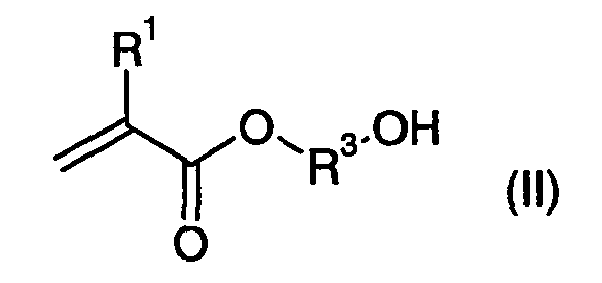
- R1
- H, CH3 oder CH2OH bedeutet, und
- R3
- -(CH2)n-, -CH2-CH(CH3)-CH2- oder -CH2CH(CH3)- oder -CH(CH3)CH2- oder

- n
- mindestens 2, bevorzugt 2 bis 8, besonders bevorzugt 2 bis 6, ganz besonders bevorzugt 2 bis 4 bedeutet,
- ac) gegebenenfalls weiteren Comonomeren, die mit den (Meth)acrylaten der allgemeinen Formeln (I) und (II) copolymerisierbar sind, als Komponente C, bevorzugt ausgewählt aus der Gruppe bestehend aus Styrol, Acrylnitril, Vinylacetat, Vinylpropionat, Vinylchlorid, Vinylidenchlorid, Butadien und Additionsprodukten aus Versaticsäureglycidresten und ungesättigten Säuren, insbesondere (Meth)acrylsäure, und
- ad) gegebenenfalls Hilfsmonomeren als Komponente D bevorzugt ausgewählt aus der Gruppe bestehend aus (Meth)acrylsäure, Itaconsäure, Maleinsäure, Fumarsäure, Crotonsäure und den Amiden der genannten Säuren;
- aa) mindestens einem (Meth)acrylat der allgemeinen Formel (1), als Komponente A
- b) Um- oder Veresterung des hydroxyfunktionelle Seitenketten aufweisenden Poly(meth)acrylats mit einem (Meth)acrylat oder (Meth)acrylsäure, bevorzugt mit Methyl-, Ethyl-, 2-Ethylhexyl- oder Butyl(meth)acrylat, gegebenenfalls in Gegenwart von Stabilisatoren ausgewählt aus der Gruppe bestehend aus 2,6-Dibutylphenolen wie Di-tert.-butylphenol, p-Kresol, Hydrochinon, Dimethylhydrochinon, Phenothiazinen und Phosphorigsäureestern, in Anwesenheit eines die Um-oder Veresterung katalysierenden Enzyms.
- Als Abkürzung für "Methacrylsäure oder Acrylsäure" wird "(Meth)acrylsäure" verwendet, entsprechend wird als Abkürzung für "Methacrylat oder Acrylat" "(Meth)acrylat" verwendet.
- Mit Hilfe des erfindungsgemäßen Verfahrens ist die Einführung von funktionellen Gruppen, insbesondere von (Meth)acrylgruppen in Poly(meth)acrylate auf schonende Weise möglich, ohne dass mit einer Spaltung der Estergruppen des Poly(meth)acrylats zu rechnen ist. Des weiteren ist die Herstellung der funktionalisierten Polymere ausgehend von hydroxyfunktionelle Seitenketten aufweisenden Poly(meth)acrylaten möglich, die wesentlich preiswerter sind, als bisher im Stand der Technik eingesetzte mit Glycidylgruppen funktionalisierte Poly(meth)acrylate.
- In einer bevorzugten Ausführungsform des erfindungsgemäßen Verfahrens werden in Schritt a)
- 10 bis 80 Gew.-%, bevorzugt 20 bis 80 Gew.-%, besonders bevorzugt 30 bis 70 Gew.-% der Komponente A, und
- 10 bis 80 Gew.-%, bevorzugt 20 bis 70 Gew.-%, besonders bevorzugt 20 bis 60 Gew.-% der Komponente B, und
- 0 bis 50 Gew.-%, bevorzugt 0 bis 40 Gew.-%, besonders bevorzugt 5 bis 25 Gew.-% der Komponente C, und
- 0 bis 15 Gew.-%, bevorzugt 0 bis 10 Gew.-%, besonders bevorzugt 0,5 bis 5 Gew.-% der Komponente D eingesetzt.
- Die erfindungsgemäß eingesetzten hydroxyfunktionelle Seitenketten aufweisenden Poly(meth)acrylate können nach verschiedenen, dem Fachmann bekannten Verfahren hergestellt werden. Dabei ist die Herstellung durch radikalische Polymerisation bevorzugt.
- Die Polymerisation erfolgt im Allgemeinen durch Emulsions-, Lösungs- oder Substanzpolymerisation, wobei die Emulsionspolymerisation oder die Lösungspolymerisation bevorzugt ist.
- In einer Ausführungsform werden die hydroxyfunktionelle Seitenketten aufweisenden Poly(meth)acrylate durch Emulsionspolymerisation hergestellt. Bei der Emulsionspolymerisation werden die Komponenten A, B sowie gegebenenfalls C und gegebenenfalls D in Anwesenheit von Wasser, Emulgatoren, Initiatoren und gegebenenfalls Reglern miteinander umgesetzt.
- Als Emulgatoren werden im Allgemeinen anionische, nichtionische, kationische oder amphotere Emulgatoren eingesetzt, wobei anionische oder nichtionische Emulgatoren bevorzugt sind. Geeignete anionische Emulgatoren sind Natrium-, Kalium- oder Ammoniumsalze langkettiger aliphatischer Carbonsäuren und Sulfonsäuren, Alkali-C12-16-Alkylsulfate, oxethylierte und sulfatierte oder sulfonierte langkettige aliphatische Alkohole oder Alkylphenole und Sulfodicarbonsäureester. Geeignete nichtionische Emulgatoren sind oxethylierte Fettalkohole und Alkylphenole, wobei die Ethylenoxideinheiten zwischen 2 und 50 mol/mol betragen können. Geeignete kationische Emulgatoren sind Ammonium-, Phosphonium- und Sulfoniumverbindungen, die als hydrophoben Molekülteil mindestens eine lange aliphatische Kohlenwasserstoftlcette enthalten. Es ist auch möglich, eine Kombination von verschiedenen Emulgatoren, zum Beispiel von ionischen und nichtionischen Emulgatoren, einzusetzen.
- Das eingesetzte Wasser ist bevorzugt destilliert oder entsalzt, da Salze die Emulsionsstabilität beeinträchtigen können. Im Allgemeinen wird das Polymerisationsverfahren unter Stickstoff durchgeführt, da Sauerstoff die Polymerisation inhibiert.
- Das Molekulargewicht der hydroxyfunktionelle Seitenketten aufweisenden Poly(meth)acrylate kann durch Zugabe von Reglern erniedrigt werden. Geeignete Regler sind zum Beispiel halogenhaltige Verbindungen wie Tetrachlorkohlenstoff, Tetrabromkohlenstoff, Bromal, Benzylbromid und Trichlorbrommethan oder Mercaptane wie Butylinercaptan oder Dodecylmercaptan oder Rongalit ® C.
- Als Initiatoren sind im Allgemeinen alle dem Fachmann bekannten Initiatoren zur Polymerisation von (Meth)acrylaten geeignet. Im Allgemeinen werden wasserlösliche Peroxoverbindungen wie Alkali- oder Ammoniumpersulfat, Wasserstoffperoxid oder tert.Butyl-Peroxy-Ethylhexanoat eingesetzt. Des weiteren sind Redox-Systeme wie H2O2-Ascorbinsäure, H2O2-Fe(II)/Fe(III), H2O2-Ce(IV), Persulfite-Fe, Metabisulfite-Fe oder Hydroperoxide-Metallsalze geeignet. Die Initiatoren werden im Allgemeinen in einer Menge von 0,05 bis 8 Gew.-%, bevorzugt 0,2 bis 2 Gew.-%, bezogen auf Menge der eingesetzten Monomere, eingesetzt.
- Gegebenenfalls nach der Polymerisation noch vorhandener Initiator kann nach der Polymerisation deaktiviert werden, um eine mögliche Polymerisation der in Schritt b) erfindungsgemäß hergestellten Poly(meth)acrylate zu vermeiden. Die Deaktivierung erfolgt im Allgemeinen durch Zugabe eines Reduktionsmittels, z.B. Ascorbinsäure.
- Die Polymerisation wird im Allgemeinen in einem Temperaturbereich von 30 bis 120°C, bevorzugt 40 bis 110°C, besonders bevorzugt 50 bis 90°C durchgeführt. Die Polymerisation wird im Allgemeinen bei einem Druck von 1 bis 20, bevorzugt 1 bis 15 bar, besonders bevorzugt 1 bis 5 bar durchgeführt.
- Die Emulgatoren werden im Allgemeinen in einer Menge von 0,5 bis 15 Gew.-%, bevorzugt von 0,5 bis 10 Gew.-%, besonders bevorzugt 0,5 bis 5 Gew.-%, bezogen auf die Menge der eingesetzten Komponenten A, B, gegebenenfalls C und gegebenenfalls D, eingesetzt.
- Der Teilchendurchmesser der nach Polymerisation erhaltenen hydroxyfunktionelle Seitenketten aufweisenden Poly(meth)acrylate beträgt im Allgemeinen 20 bis 1000 nm, bevorzugt 20 bis 500 nm, besonders bevorzugt 50 bis 400 nm, ermittelt mittels Lichtstreuung.
- Der pH-Wert beträgt bei der Emulsionspolymerisation im Allgemeinen zwischen 1 und 6, bevorzugt zwischen 2 und 6. Die Hydroxylzahlen betragen im Allgemeinen mindestens 20 bis 180, bevorzugt mindestens 40 bis 120. Der Fetsstoffgehalt der Dispersionen beträgt im Allgemeinen 10 bis 50, bevorzugt 20 bis 40 und die Glasübergangstemperatur der erhaltenen Polymere beträgt im Allgemeinen zwischen -40 und +80°C.
- Die erhaltenen hydroxyfunktionelle Seitenketten aufweisenden Poly(meth)acrylate weisen im Allgemeinen ein mittleres Molekulargewicht von 1000 bis 2 000 000, bevorzugt 1000 bis 1000 000, besonders bevorzugt 50 000 bis 500 000 auf. Das mittlere Molekulargewicht wurde mittels Gelpermeationschromatographie (GPC) ermittelt. Es handelt sich hierbei um das zahlenmittlere Molekulargewicht.
- Die Herstellung der hydroxyfunktionelle Seitenketten aufweisenen Poly(meth)acrylate ist mittels Eintopf- oder Batchfahrweise, Zulaufverfahren und kontinuierlichen Fahrweisen möglich. Die Durchführung der genannten Fahrweisen ist dem Fachmann bekannt.
- Das in Schritt a) erhaltene hydroxyfunktionelle Seitenketten aufweisende Poly(meth)acrylat kann nach dem Fachmann bekannten Methoden isoliert werden. Eine Ausführungsweise ist z.B. in EP-A 0 029 637 beschrieben, wobei jedoch in dem Verfahren gemäß der vorliegenden Anmeldung hydroxylgruppenfreie Lösungsmittel eingesetzt werden, beziehungsweise in einem zweiten Schritt ein hydroxylgruppenhaltiges Lösungsmittel durch ein hydroxylgruppenfreies Lösungsmittel ersetzt wird. Für den Einsatz in Schritt b) des erfindungsgemäßen Verfahrens wird das hydroxyfunktionelle Seitenketten aufweisende Poly(meth)acrylat nach Isolierung in wasserfreier Form eingesetzt.
- In einer weiteren bevorzugten Ausführungsform werden die hydroxyfunktionelle Seitenketten aufweisenden Poly(meth)acrylate durch Lösungspolymerisation hergestellt. Bei der Lösungspolymerisation werden die Komponenten A, B sowie gegebenenfalls C und gegebenenfalls D in Anwesenheit von Lösungsmittel, Initiator und gegebenenfalls Reglern miteinander umgesetzt.
- Für die Lösungspolymerisation geeignete Initiatoren sind Peroxide wie Dialkylperoxide, z.B. Di-tert.-Butylperoxid und Di-tert.-Amylperoxid, Peroxiester wie tert.-Butylperoxy-2-ethylhexanoat und tert.-Amylperoxy-2-ethylhexanoat, Diacylperoxide wie Benzoylperoxid, Lauroylperoxid und Decanoylperoxid, Percarbonate wie tert.-Butylperoxyisopropylcarbonat, Di-2-ethylhexylperoxidicarbonat, Perketale und Ketonperoxide, sowie Azoinitiatoren wie 2,2'-Azobis-(2,4-Dimethyl-pentannitril), 2,2'-Azobis-(2-Methylpropanonitril), 2,2'-Azobis-(2-Methylbutanonitril), 1,1'-Azobis-(Cyclohexancarbonitril), 2,2'-Azobis-(2,4,4-trimethylpentan) und 2-Phenylazo-2,4-dimethyl-4-methoxyvaleronitril.
- Bevorzugt sind Lösungsmittel, die für eine enzymatische Umsetzung gemäß Schritt b) nicht störend sind, so dass eine Entfernung des Lösungsmittels vor der Ausführung von Schritt b) nicht erforderlich ist. Besonders bevorzugt werden Lösungsmittel ausgewählt aus Methylisobutylketon, Aceton, Xylol, N-Methylpyrrolidon, Methylethylketon, Methylpropylketon, Methylamylketon und Solventnaphtha, eingesetzt.
- In Schritt b) erfolgt die Um- oder Veresterung des hydroxyfunktionelle Seitenketten aufweisenden Poly(meth)acrylats mit mindestens einem (Meth)acrylat oder (Meth)acrylsäure oder einem Stabilisator in Anwesenheit eines die Um- oder Veresterung katalysierenden Enzyms. Bevorzugt wird eine Umesterung mit Methyl-, Ethyl-, 2-Ethylhexyl- oder Butyl(meth)acrylat durchgeführt.
- Die enzymatische Um- oder Veresterung mit einem (Meth)acrylat oder (Meth)acrylsäure erfolgt im Allgemeinen bei niedrigen Temperaturen, bevorzugt 10 bis 100°C, besonders bevorzugt 20 bis 80°C. Die Reaktionsbedingungen bei der enzymatischen Um- oder Veresterung sind mild. Aufgrund der niedrigen Temperaturen und sonstigen milden Bedingungen wird die Bildung von Nebenprodukten in Schritt b) vermieden, die andernfalls zum Beispiel von chemischen Katalysatoren stammen können oder durch unerwünschte radikalische Polymerisation des eingesetzten (Meth)acrylats oder der eingesetzten (Meth)acrylsäure, die sonst nur durch Zugabe von Stabilisatoren verhindert werden kann.
- Zur enzymatischen Umsetzung (Schritt b)) kann das Produkt aus Schritt a) im Allgemeinen ohne weitere Vorbehandlung eingesetzt werden. Bei Bedarf kann das Produkt von flüchtigen Stoffen (z. B. Lösungsmittel) befreit werden oder es können zusätzliche Stoffe (z.B. Lösungsmittel) zugesetzt werden. Speziell sollte es möglichst frei von Radikalstartern sein oder arm an Radikalstartern sein.
- Bevorzugt werden als Enzyme Hydrolasen eingesetzt, insbesondere Hydrolasen ausgewählt aus der Gruppe bestehend aus Lipasen, Esterasen und Proteasen. Die Enzyme können in freier Form oder in immobilisierter Form auf einem Träger, auf dem sie chemisch oder physikalisch gebunden sind eingesetzt werden. Die Menge des Enzymkatalysators beträgt bevorzugt 0,1 bis 20 Gew.-%, besonders bevorzugt 1 bis 10 Gew.-%, bezogen auf das eingesetzte hydroxyfunktionelle Seitenketten aufweisende Poly(meth)acrylat.
- Die Reaktionszeit hängt unter anderem von der verwendeten Menge und der Aktivität des Enzymkatalysators und dem gewünschten Umsatzgrad ab sowie von der hydroxyfunktionellen Seitenkette des Poly(meth)acrylats.
- Das zur Umesterung eingesetzte (Meth)acrylat bzw. die zur Veresterung eingesetzte (Meth)acrylsäure wird im Allgemeinen in äquimolaren Mengen oder einem Überschuss im Verhältnis zur Anzahl der hydroxyfunktionellen Seitenketten im Poly(meth)acrylat eingesetzt. Bevorzugt wird ein Molverhältnis (Meth)acrylat bzw. (Meth)acrylsäure zu Hydroxygruppen in den Seitenketten des Poly(meth)acrylats von 1 : 1 bis 10 : 2 eingesetzt. Höhere Überschüsse sind nicht störend.
- Im Allgemeinen werden in Schritt b) 20 - 100 %, bevorzugt 40 bis 100 %, besonders bevorzugt 60 bis 100 % aller ursprünglich im Poly(meth)acrylat enthaltenden hydroxyfunktionellen Seitenketten mit einem (Meth)acrylat oder (Meth)acrylsäure umgesetzt.
- Gegebenenfalls eingesetzte geeignete Stabilisatoren sind ausgewählt aus der Gruppe bestehend aus 2,6-Dibutylphenolen wie Di-tert.-butylphenol, p-Kresol, Hydrochinon, Dimethylhydrochinon, Phenothiazinen und Phosphorigsäureestern. Es ist jedoch auch möglich, Schritt b) ohne Einsatz von Stabilisatoren durchzuführen.
- Die Umsetzung kann in allen für eine solche Umsetzung geeigneten Reaktoren durchgeführt werden. Solche Reaktoren sind dem Fachmann bekannt. Bevorzugt erfolgt die Umsetzung in einem Rührkesselreaktor, einem Festbettreaktor oder einem Taylorreaktor.
- Das während der Um- oder Veresterung entstehende Reaktionswasser bzw. der entstehende Alkohol kann nach dem Fachmann bekannten Methoden, zum Beispiel durch Absorption (zum Beispiel mit Molekularsieb), Destillation oder Pervaporation entfernt werden.
- Die Reaktion wird solange durchgeführt, bis der gewünschte Umsatz, von im Allgemeinen 5 bis 100 % erreicht ist. Dabei lassen sich bei einer Reaktionsführung mit gleichzeitiger Entfernung des während der Umsetzung entstehenden Alkohols bzw. Wassers höhere Umsätze in kürzeren Reaktionszeiten aufgrund der Verschiebung des Reaktionsgleichgewichts erreichen.
- Der Enzymkatalysator kann im Anschluss an die Umsetzung durch geeignete Maßnahmen, zum Beispiel Filtrieren oder Dekantieren abgetrennt werden und gegebenenfalls mehrfach eingesetzt werden.
- Ein weiterer Gegenstand der vorliegenden Anmeldung sind UV- und/oder Dual-Cure-härtbare Poly(meth)acrylate herstellbar nach dem erfindungsgemäßen Verfahren. Aufgrund der milden Reaktionsbedingungen in dem erfindungsgemäßen Verfahren sind neuartige mit (Meth)acryl-funktionelle Poly(meth)acrylate zugänglich, ohne dass die Gefahr einer Spaltung der Esterbindungen in den Poly(meth)acrylaten durch Säurekatalyse oder hohe Temperaturen auftritt.
- Diese erfindungsgemäßen (Meth)acryl-funktionellen Poly(meth)acrylate sind als Bindemittel in Strahlen- oder Dual-Cure-härtbaren Beschichtungsmitteln, zum Beispiel in Deckbeschichtungen wie transparenten Klarlacken, aber auch in Grundlacken, Grundierungen und Füllern, geeignet. Die (Meth)acryl-funktionellen Poly(meth)acrylate weisen ausgezeichnete Bewitterungsstabilitäten auf. In Verbindung mit einer Härtungstechnologie (Strahlenhärtung oder Dual-Cure-Härtung) lassen sich weitere Vorteile, zum Beispiel eine Erhöhung der Kratzfestigkeit einer Beschichtung, erzielen. Besonders entscheidend ist jedoch die Verbesserung in der Anwendung durch Einsatz der erfindungsgemäßen (Meth)acrylfunktionellen Poly(meth)acrylate, da sie eine schnelle Trocknung ermöglichen.
- Ein weiterer Gegenstand der vorliegenden Anmeldung ist daher die Verwendung der erfindungsgemäßen oder nach dem erfindungsgemäßen Verfahren hergestellten (Meth)acrylfunktionellen Poly(meth)acrylate als Bindemittel in Strahlen oder Dual-Cure-härtbaren Beschichtungsmitteln, bevorzugt in Deckbeschichtungen, besonders bevorzugt in transparenten Klarlacken.
- Unter "Dual-Cure" ist zu verstehen, dass die Materialien thermisch und mit aktinischer Strahlung härtbar sind. Im Rahmen der vorliegenden Erfindung ist unter aktinischer Strahlung elektromagnetische Strahlung wie sichtbares Licht, UV-Strahlung oder Röntgenstrahlung, insbesondere UV-Strahlung, und Korpuscularstrahlung wie Elektronenstrahlung zu verstehen.
- Strahlenhärtbare Bindemittel sind solche, die mittels aktinischer Strahlung wie vorstehend definiert, insbesondere mittels UV-Strahlung härtbar sind.
- Ein weiterer Gegenstand der vorliegenden Anmeldung sind Lackformulierungen, enthaltend die erfindungsgemäßen oder nach dem erfindungsgemäßen Verfahren herstellbaren (Meth)acryl-funktionellen Poly(meth)acrylate. Dabei können die (Meth)acryl-funktionellen Poly(meth)acrylate oder die mit Stabilisatoren funktionalisierten Poly(meth)acrylate sowohl in Basislacken als auch in Decklacken eingesetzt werden. Aufgrund ihrer besonderen Eigenschaften wie der Erhöhung der Kratzfestigkeit verbunden mit hoher UV-Stabilität einer Beschichtung, ist ihr Einsatz in Deckbeschichtungen bevorzugt.
- Im Allgemeinen wird die Zusammensetzung der Deckbeschichtung so ausgewählt, dass der ausgehärtete Decklack im gummielastischen Bereich ein Speichermodul E' von mindestens 107,6 Pa, bevorzugt von mindestens 108'0 Pa, besonders bevorzugt von mindestens 108,3 Pa, und einen Verlustfaktor bei 20°C von maximal 1,10, bevorzugt maximal 0,06, aufweist, wobei das Speichermodul E' und der Verlustfaktor tanδ mit der dynamischmechanischen Thermo-Analyse an homogenen freien Filmen mit einer Schichtdicke von 40 ± 10 µm gemessen worden sind. Der Verlustfaktor tanδ ist dabei definiert als der Quotient aus dem Verlustmodul E" und dem Speichermodul E'.
- Die dynamisch-mechanische Thermo-Analyse ist eine allgemeine Messmethode zur Bestimmung der viskoelastischen Eigenschaften von Beschichtungen und beispielsweise beschrieben in Murayama T., Dynamic Mechanical Analyse of Polymeric Material, Elsevier, New York, 1978 und Loren W. Hill, Journal of Coatings Technology, Vol. 64, No. 808, May 1992, S. 31 bis 33. Die Durchführung der Messungen kann beispielsweise mit den Geräten II, MKBI, oder MKIV der Firma Rheometrics Scientific erfolgen.
- Bevorzugt weisen die Strahlen- oder Dual-Cure-härtbaren Deckbeschichtungen eine Viskosität bei 23°C von < als 100 s Auslaufzeit im DIN4-Becher, besonders bevorzugt < 80 s Auslaufzeit im DIN4-Becher auf. Für Gieß- und Walzenapplikation kann die Viskosität auch darüber liegen.
- Die erfindungsgemäßen Deckbeschichtungen enthalten neben den erfindungsgemäßen (Meth)acryl-fnnktionellen Poly(meth)acrylaten gegebenenfalls einen oder mehrere Photoinitiatoren sowie gegebenenfalls übliche Hilfs- und Zusatzstoffe. Geeignete Photoinitiatoren sind übliche, in Strahlen- oder Dual-Cure-härtbaren Beschichtungsmitteln eingesetzte Photoinitiatoren, beispielsweise Benzophenone, Benzoine oder Benzoinether, bevorzugt Hydroxyacrylketone und Bis(acyl)phosphinoxide. Es können auch beispielsweise die im Handel unter den Namen Irgacure® 184, Irgacure® 1800 und Irgacure® 500 der Firma Ciba Geigy, Genocure® MBF der Firma Rahn und Lucirin® TPO der Firma BASF AG eingesetzt werden.
- Als weitere Hilfs- und Zusatzstoffe sind beispielsweise Lichtschutzmittel (zum Beispiel HALS-Verbindungen, Benztriazole, Oxalanilid und andere), Slipadditive, Polymerisationsinhibitoren, Mattierungsmittel, Entschäumer, Verlaufsmittel und filmbildende Hilfsmittel, zum Beispiel Zellulose-Derivate und andere, geeignet. Außerdem können rheologiesteuernde Komponenten eingesetzt werden, wie organische Harnstoffverbindungen, Urethanharnstoffverbindungen und/oder SiO2.
- Die erfindungsgemäßen Deckbeschichtungen kommen insbesondere als Klarlacke zum Einsatz, so dass sie üblicherweise keine oder nur transparente Füllstoffe und keine deckenden Pigmente enthalten. Es ist aber auch der Einsatz in Form von pigmentierten Deckbeschichtungen möglich. In diesem Fall enthalten die Deckbeschichtungen zusätzlich Pigmente. Ferner können die Deckbeschichtungen in diesem Fall einen oder mehrere Füllstoffe enthalten.
- Ein weiterer Gegenstand der vorliegenden Anmeldung sind somit Deckbeschichtungen, enthaltend
- 5 bis 80 Gew.-%, bevorzugt 10 bis 60 Gew.-%, besonders bevorzugt 20 bis 50 Gew.-% mindestens eines erfindungsgemäßen oder nach dem erfindungsgemäßen Verfahren hergestellten (Meth)acryl-funktionellen Poly(meth)acrylats,
- 0,5 bis 15 Gew.-%, bevorzugt 1 bis 10 Gew.-%, besonders bevorzugt 1 bis 5 Gew.-% mindestens eines Photoinitiators,
- 0,5 bis 8 Gew.-%, bevorzugt 1 bis 6 Gew.-%, besonders bevorzugt 1 bis 4 Gew.-% weiterer Hilfs- und Zusatzstoffe,
- 0 bis 40 Gew.-%, bevorzugt 0 bis 30 Gew.-%, besonders bevorzugt 0 bis 25 Gew.-% Pigmente,
- und 0 bis 40 Gew.-%, bevorzugt 0 bis 30 Gew.-%, besonders bevorzugt 0 bis 25 Gew.-% mindestens eines Füllstoffs, wie transparente Metalloxide, BaSO4 und Wachse.
- Bevorzugte (Meth)acryl-funktionelle Poly(meth)acrylate, Photoinitiatoren, Hilfs- und Zusatzstoffe und Füllstoffe und Pigmente sind bereits vorstehend genannt.
- Die Herstellung der erfindungsgemäßen Deckbeschichtungen erfolgt durch Mischen der einzelnen Komponenten gemäß dem Fachmann bekannten Verfahren in dem Fachmann bekannten Vorrichtungen.
- Ein weiterer Gegenstand der vorliegenden Anmeldung ist daher ein Verfahren zur Herstellung der erfindungsgemäßen Deckbeschichtung, worin das (Meth)acryl-funktionelle Poly(meth)acrylat, der Photoinitiator, ggf. weitere Hilfs- und Zusatzstoffe und ggf. Füllstoffe und Pigmente miteinander gemischt werden.
- Die erfindungsgemäßen Deckbeschichtungen werden im Allgemeinen auf mit einem Basislack beschichtete Substrate aufgetragen. Sie können durch sogenanntes coil coating oder durch Spritzguß auf die Substrate aufgebracht werden. Solche Substrate sind beispielsweise Metallbleche, bzw. Metallbänder und Kunststoffe jeder Art, z.B. Automobilkarosserien und Motorradteile..
- Nach Auftragen der Deckbeschichtung wird diese einer Strahlen- oder Dual-Cure-Härtung unterworfen. Die Anlagen und Bedingungen für diese Härtungsmethoden sind aus der Literatur bekannt und bedürfen keiner weiteren Beschreibung (für Strahlungshärtung siehe zum Beispiel R. Holmers, UV and E. B. Curing Formulations for Printing Inks, Coatings and Paints, SITA Technology, Academic Press, London, United Kingdom 1984).
- Die nachfolgenden Beispiele erläutern die Erfindung zusätzlich.
-
Vorlage Methylisobutylketon 540,0 g Monomere Styrol 10,00 Gew.-% 1) 123,6 g EHA (2-Ethylhexylacrylat) 46,50 Gew.-% 1) 574,4 g HEMA (Hexylethylmethacrylat) 27,00 Gew.-% 1) 336,6 g HBA (Hydroxybutylacrylat) 15,00 Gew.-% 1) 185,2 g AS (Acrylsäure) 1,50 Gew.-% 1) 18,6 g spülen Methylisobutylketon 5,0 g Initiator tert.-Butyl-peroxy-2-Ethylhexanoat 8 Gew.-% 2) 98,8 g Methylisobutylketon 74,2 g spülen Methylisobutylketon 46,6 g End 2.000,0 g 1) bezogen auf die Summe der Komponenten Styrol, EHA, HEMA, HBA, AS
2) bezogen auf die Summe der Komponenten Styrol, EHA, HEMA, HBA, AS - Vorlage einwiegen und auf 110°C aufheizen. Bei konstanter Temperatur Monomere und Initiator gleichmäßig in den Reaktor zudosieren. Nach 4 Stunden ist der Monomerenzulauf beendet. Nach 4,5 Stunden ist der Initiatorzulauf beendet. Nach dem Ende der Initiatordosierung wird 1 Stunde nachpolymerisiert und anschließend abgekühlt und die erhaltene Reaktionsmischung abgelassen.
*Endwerte: Festkörper (1h, 130°C): 66,3 % OH-Zahl (theor.) gesamt: 174,8 mg/g (ermittelt nach DIN 43402) OH-Zahl (praktisch): 165 mg/g (ermittelt nach DIN 53246) GC (Restgehalt Monomere)3): EHA 0,3 %; AS < 0,3 % alle anderen < 0,1 % GPC4) Mn5) 5829 Mw 6) 20722 Mw/Mn 7) 3,55 3) GC = Gaschromatographie
4) GPC = Gelpermeationschromatographie (mit Polystyrostandard)
5) Mn = zahlenmittleres Molekulargewicht
6) Mw = gewichtsmittleres Molekulargewicht
7) Mw/Mn= Polydispersität -
Ansatz: 300 ml Polymerlösung in Methylisobutylketon aus Beispiel 1 300 g Methylacrylat (MA) 150 mg Methoxyphenol 150 g Molsieb 5 Å 30 g Novozym® 435 (immobilisierte Lipase aus Candida antarctica der Firma Novozymes) - Die genannten Komponenten werden 72 Stunden bei 40°C gerührt. Anschließend wird die Reaktionsmischung filtriert und das erhaltene Polyacrylat mit Methylisobutylketon (MIK) nachgewaschen. Der Überschuss MA und MIK wird bei 60°C bis 70°C am Rotationsverdampfer im Vakuum entfernt. Man erhielt 227 g Wertprodukt. Der Anteil der acrylierten Hydroxygruppen wurde mittels OH-Zahl zu etwa 34 % bestimmt.
- Die Ermittlung der OH-Zahl erfolgte nach einer im Stand der Technik bekannten Methode (DIN 53240, Teil 2).
-
erfindungsgemäßes UV-Polyacrylat 32,5 Sartomer® 399 30,6 Thixharz® SCA 11,5 (Basis: Benzylamin/Hexamethylendiisocyanat) Irgacure® 184 0,8 (Photoinitiator) Lucirin® TPO 0,4 (Photoinitiator) Byk® 358 0,2 (Verlaufshilfsmittel) Tinuvin® 292 1,0 (Radikalfänger) Tinuvin®400 1,0 (UV-Absorber) Butylacetat 22,0 - Es wird eine Härtermischung aus 72,7 Teilen Roskydal® UA VP LS 2337 (ungesättigtes Isophorondiisocyanat), 18,2 Teilen Roskydal® UA VP FWO 3003 77 und 9,1 Teilen Butylacetat zugegeben (bei den Teilen handelt es sich um Gewichtsteile).
- Die Komponenten wurden mit einem Dissolver gemischt.
- Wie folgende Beispiele zeigen, können verschiedene hydroxyfunktionelle Einheiten eingesetzt werden. Die erwähnten Beispiele sollen aber keine Beschränkung sein. Die Polymerlösungen wurden nach Verfahren entsprechend Beispiel 1 hergestellt. 10 g Polymerlösung, 10 g Methylacrylat, 5 g Molsieb (5 Å) und 1 g immobilisierte Lipase (Novozym→ 435) wurden 72 Stunden bei 40°C geschüttelt. Nach Filtration und Einengen wurde der Umsatz über die OH-Zahl bestimmt.
Polymerlösung veresterte Einheit Umsatz [%] 2 Hydroxyethyl-acrylat 34 3 Hydroxyethyl-acrylat 41 4 Hydroxyethyl-methacrylat 12 5 Hydroxyethyl-methacrylat 22 6 Hydroxyethyl-methacrylat 47 7 Hydroxybutyl-acrylat 67 8 Hydroxybutyl-acrylat 80 - Die Reaktionsbedingungen konnten optimiert werden durch Variation der Reaktionszeit, der zugegebenen Menge Methylacrylat und Molsieb. Die in der Tabelle unter Beispiel 5 gezeigten Polymerlösungen wurden unter folgenden optimierten Reaktionsbedingungen umgesetzt.
- 10 g Polymerlösung, 2 g Methacrylat, 2 g Molsieb und 1 g Novozym® 435 wurden 24 Stunden bei 40°C geschüttelt. Nach Filtration und Einengen wurde der Umsatz über die OH-Zahl bestimmt.
Polymerlösung Umsatz [%] 2 23 3 39 5 6 6 17 7 40 8 46
Claims (12)
- Verfahren zur Herstellung von mit aktinischer Strahlung und/oder Dual-Cure-härtbarer Poly(meth)acrylate umfassend die folgenden Schrittea) Herstellung eines hydroxyfunktionelle Seitenketten aufweisenden Poly(meth)acrylats durch Polymerisation vonaa) mindestens einem (Meth)acrylat der allgemeinen Formel (1), als Komponente A
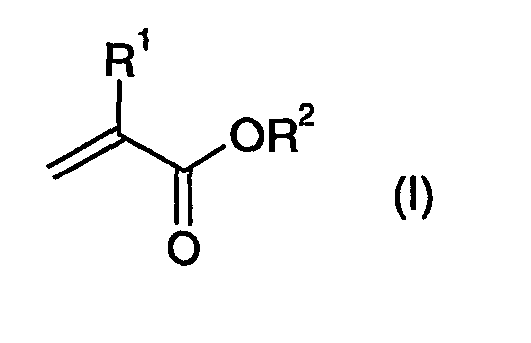 R1 H, CH3 oder CH2OH bedeutet, undR2 ein Alkylrest ist, der gegebenenfalls mit funktionellen Gruppen wie Acryl-, Ether-, Amino-, Epoxy-, Halogen- oder Sulfonsäuregruppen substituiert ist, undab) mindestens einem Hydroxyalkyl(meth)acrylat der allgemeinen Formel (II), als Komponente B
 R1 H, CH3 oder CH2OH bedeutet, undR3 -(CH2)n-, -CH2-CH(CH3)-CH2- oder -CH2CH(CH3)- oder -CH(CH3)CH2- oder
 n mindestens 2 bedeutet, undac) gegebenenfalls weiteren Comonomeren, die mit den (Meth)acrylaten der allgemeinen Formeln (I) und (II) copolymerisierbar sind, als Komponente C, undad) gegebenenfalls Hilfsmonomeren, als Komponente D;undb) Um- oder Veresterung des hydroxyfunktionelle Seitenketten aufweisenden Poly(meth)acrylats mit einem (Meth)acrylat oder (Meth)acrylsäure in Anwesenheit eines die Um- oder Veresterung katalysierenden Enzyms.
 - Verfahren nach Anspruch 1, dadurch gekennzeichnet, dass in Schritt a)- 10 bis 80 Gew.-% der Komponente A,- 10 bis 80 Gew.-% der Komponente B,- 0 bis 50 Gew.-% der Komponente C und- 0 bis 15 Gew.-% der Komponente D
eingesetzt werden. - Verfahren nach Anspruch 1 oder 2, dadurch gekennzeichnet, dass in Schritt b) als Enzyme Hydrolasen ausgewählt aus der Gruppe bestehend aus Lipasen, Esterasen und Proteasen eingesetzt werden.
- Verfahren nach einem der Ansprüche 1 bis 3, dadurch gekennzeichnet, dass in Schritt b) Methyl-, Ethyl-, 2-Ethylhexyl- oder Butyl(meth)acrylat eingesetzt wird.
- Verfahren nach einem der Ansprüche 1 bis 4, dadurch gekennzeichnet, dass Schritt b) bei einer Temperatur von 20 bis 100°C, bevorzugt 20 bis 80°C durchgeführt wird.
- Verfahren nach einem der Ansprüche 1 bis 5, dadurch gekennzeichnet, dass die Komponente B ausgewählt ist aus der Gruppe bestehend aus 2-Hydroxyethyl(meth)acrylat, 2-Hydroxypropyl(meth)acrylat und Hydroxybutyl(meth)acrylat.
- Verfahren nach einem der Ansprüche 1 bis 6, dadurch gekennzeichnet dass 5 bis 100 % der Seitenketten des gemäß Schritt a) hergestellten Poly(meth)acrylats (meth)acryliert sind.
- Mit aktinischer Strahlung und/oder Dual-Cure-härtbare Poly(meth)acrylate herstellbar nach einem Verfahren gemäß einem der Ansprüche 1 bis 7.
- Verwendung von mit aktinischer Strahlung und/oder Dual-Cure-härtbaren Poly(meth)acrylaten nach Anspruch 8 oder hergestellt nach einem Verfahren gemäß einem der Ansprüche 1 bis 7 als Komponente bei der Herstellung von Dispersionen oder als Komponente in Lackformulierungen, bevorzugt in mit aktinischer Strahlung und/oder Dual-Cure härtbaren Beschichtungen oder Deckbeschichtungen, besonders bevorzugt in transparenten Klarlacken.
- Deckbeschichtung enthaltend- 5 bis 80 Gew.-% mindestens eines mit aktinischer Strahlung und/oder Dual-Cure-härtbaren Poly(meth)acrylats gemäß Anspruch 8 oder hergestellt nach einem der Ansprüche 1 bis 7,- 0,5 bis 15 Gew.-% mindestens eines Photoinitiators,
0,5 bis 8 Gew.-% weiterer Hilfs- und Zusatzstoffe,
0 bis 40 Gew.-% Pigmente, und
0 bis 40 Gew.-% mindestens eines Füllstoffs. - Verfahren zur Herstellung einer Deckbeschichtung gemäß Anspruch 10, worin die einzelnen Komponenten miteinander gemischt werden.
- Verwendung einer Lackformulierung gemäß Anspruch 10 als Deckbeschichtung.
Applications Claiming Priority (3)
| Application Number | Priority Date | Filing Date | Title |
|---|---|---|---|
| DE10251729 | 2002-11-05 | ||
| DE10251729A DE10251729A1 (de) | 2002-11-05 | 2002-11-05 | UV-aktive Bindemittel |
| PCT/EP2003/012322 WO2004042069A1 (de) | 2002-11-05 | 2003-11-05 | Uv-aktive bindemittel |
Publications (2)
| Publication Number | Publication Date |
|---|---|
| EP1560921A1 EP1560921A1 (de) | 2005-08-10 |
| EP1560921B1 true EP1560921B1 (de) | 2007-03-28 |
Family
ID=32103381
Family Applications (1)
| Application Number | Title | Priority Date | Filing Date |
|---|---|---|---|
| EP03810436A Expired - Lifetime EP1560921B1 (de) | 2002-11-05 | 2003-11-05 | Uv-aktive bindemittel |
Country Status (7)
| Country | Link |
|---|---|
| US (1) | US7601765B2 (de) |
| EP (1) | EP1560921B1 (de) |
| AT (1) | ATE358184T1 (de) |
| AU (1) | AU2003276253A1 (de) |
| DE (2) | DE10251729A1 (de) |
| ES (1) | ES2285263T3 (de) |
| WO (1) | WO2004042069A1 (de) |
Families Citing this family (10)
| Publication number | Priority date | Publication date | Assignee | Title |
|---|---|---|---|---|
| DE10113884B4 (de) * | 2001-03-21 | 2005-06-02 | Basf Coatings Ag | Verfahren zum Beschichten mikroporöser Oberflächen und Verwendung des Verfahrens |
| US20060030634A1 (en) * | 2004-08-04 | 2006-02-09 | Dean Roy E | Radiation curable, sprayable coating compositions |
| DE102005010109A1 (de) * | 2005-03-02 | 2006-09-07 | Basf Ag | Modifizierte Polyolefinwachse |
| EP1940984B1 (de) * | 2005-10-18 | 2013-07-03 | Perstorp Specialty Chemicals AB | Dualhärtbare zusammensetzung |
| JP5145240B2 (ja) * | 2005-11-29 | 2013-02-13 | ビーエーエスエフ ソシエタス・ヨーロピア | ポリマー中の側鎖をエステル交換またはエステル化する方法 |
| US7489440B2 (en) | 2006-10-19 | 2009-02-10 | International Business Machines Corporation | Optical spectral filtering and dispersion compensation using semiconductor optical amplifiers |
| WO2008049814A1 (de) * | 2006-10-26 | 2008-05-02 | Basf Se | Verfahren zur herstellung von epoxygruppen enthaltenden (meth) acrylsäureestern unter verwendung von lipasen |
| DE102008001231A1 (de) * | 2008-04-17 | 2009-10-22 | Evonik Röhm Gmbh | Flammfeste PMMA-Formmasse |
| KR101134383B1 (ko) * | 2009-11-27 | 2012-04-09 | 현대자동차주식회사 | 빛 반사 억제 효과가 우수한 폴리메틸메타크릴레이트 패널 나노임프린팅용 코팅제 |
| EP2735365A1 (de) | 2012-11-21 | 2014-05-28 | Allnex Belgium, S.A. | Herstellungsverfahren für kolloidale Polymerpartikel |
Family Cites Families (4)
| Publication number | Priority date | Publication date | Assignee | Title |
|---|---|---|---|---|
| DE19850507C1 (de) * | 1998-11-03 | 2000-05-04 | Goldschmidt Ag Th | Verfahren zur Herstellung von Acrylsäureestern und/oder Methacrylsäureestern von hydroxyfunktionellen Siloxanen und/oder polyoxyalkylenmodifizierten Siloxanen und deren Verwendung |
| DE19850541C1 (de) | 1998-11-03 | 2000-06-15 | Goldschmidt Ag Th | Verfahren zur Herstellung von Acrysäureestern und/oder Methacrylsäureestern von Polyoxyalkylenen und deren Verwendung |
| DE19961402A1 (de) | 1999-12-20 | 2001-07-05 | Basf Coatings Ag | Verfahren zur Herstellung von Beschichtungen aus thermisch und mit aktinischer Strahlung härtbaren Beschichtungstoffen |
| DE10305076B4 (de) * | 2003-02-07 | 2007-05-16 | Basf Ag | Ester von alpha, omega-Poly(meth)acrylatdiolen mit Carbonsäuren, enthaltend mit aktinischer Strahlung aktivierbare Gruppen, Verfahren zu ihrer Herstellung und ihre Verwendung |
-
2002
- 2002-11-05 DE DE10251729A patent/DE10251729A1/de not_active Withdrawn
-
2003
- 2003-11-05 AT AT03810436T patent/ATE358184T1/de not_active IP Right Cessation
- 2003-11-05 EP EP03810436A patent/EP1560921B1/de not_active Expired - Lifetime
- 2003-11-05 WO PCT/EP2003/012322 patent/WO2004042069A1/de not_active Ceased
- 2003-11-05 AU AU2003276253A patent/AU2003276253A1/en not_active Abandoned
- 2003-11-05 DE DE50306928T patent/DE50306928D1/de not_active Expired - Lifetime
- 2003-11-05 US US10/532,575 patent/US7601765B2/en not_active Expired - Fee Related
- 2003-11-05 ES ES03810436T patent/ES2285263T3/es not_active Expired - Lifetime
Also Published As
| Publication number | Publication date |
|---|---|
| DE10251729A1 (de) | 2004-05-13 |
| ES2285263T3 (es) | 2007-11-16 |
| WO2004042069A1 (de) | 2004-05-21 |
| US7601765B2 (en) | 2009-10-13 |
| DE50306928D1 (de) | 2007-05-10 |
| US20060148975A1 (en) | 2006-07-06 |
| ATE358184T1 (de) | 2007-04-15 |
| AU2003276253A1 (en) | 2004-06-07 |
| EP1560921A1 (de) | 2005-08-10 |
Similar Documents
| Publication | Publication Date | Title |
|---|---|---|
| EP1560921B1 (de) | Uv-aktive bindemittel | |
| EP0856533B1 (de) | Überzugsmittel enthaltend hydroxylgruppenhaltige Copolymerisate | |
| EP1769079A1 (de) | Enzymatische herstellung von (meth)acryls[ureestern | |
| EP0674672B2 (de) | Wässrige polymerdispersionen für klarlacke | |
| DE69307723T2 (de) | Methode zum Herstellen eines Lackfilms und Beschichtung, erhalten durch dieseMethode | |
| EP0730011B1 (de) | UV-härtbare Kratzfestlacke mit einpolymerisierendem Verdicker | |
| DE4326656A1 (de) | Hydroxylgruppen enthaltende Copolymerisate, ihre Herstellung und ihre Verwendung in festkörperreichen Beschichtungsmitteln | |
| EP1957550B1 (de) | Verfahren zur um- oder veresterung von seitenketten in polymeren | |
| EP1856166B1 (de) | Modifizierte polyolefinwachse | |
| EP1511817B1 (de) | Strahlungshärtbare wässrige dispersionen | |
| EP0332011B1 (de) | Herstellung von wässrigen Polyalkylmethacrylat-Dispersionen durch Emulsionspolymerisation in zwei Stufen und deren Verwendung in Holzlacken | |
| EP0575931A2 (de) | In Zweistufenfahrweise hergestellte Vinylpolymerisate und ihre Verwendung als Lackbindemittel | |
| EP3237630B1 (de) | Verfahren zur herstellung von (meth)acrylsäureestern von furfurylalkoholen unter verwendung einer lipase | |
| EP1478671B1 (de) | Uv-vernetzbare copolymerisate | |
| DE102005037430A1 (de) | Enzymatische Herstellung von (Meth)acrylsäureestern | |
| DE4426323A1 (de) | Polyacrylatharzlösungen mit verbesserter Farbzahl sowie deren Verwendung in Überzugsmitteln | |
| EP2414413A1 (de) | Multifunktionales (meth)acryl-polymer, beschichtungszusammensetzung, verfahren zur herstellung einer beschichtung und beschichteter gegenstand | |
| EP0714915A2 (de) | Niedermolekulare funktionelle Copolymerisate, Verfahren zu ihrer Herstellung und ihre Verwendung | |
| EP0869998B1 (de) | Strahlungshärtbare lacke | |
| DE112022002618T5 (de) | Anstrich- oder Lack-Schutzbeschichtungsmaterial und Beschichtungszusammensetzung | |
| DE102018204661A1 (de) | Methacrylatoligomere für Haftklebmassen | |
| JPH04318014A (ja) | 常温硬化性樹脂組成物 | |
| EP1343828B1 (de) | Verfahren zur herstellung einer härtbaren wässrigen polymerdispersion | |
| WO2010112288A1 (de) | Beschichtungsmittel, verfahren zur herstellung einer beschichtung und beschichteter gegenstand | |
| EP1992647A1 (de) | Silanlacke aus Aminosilanen und epoxyfunktionellen Polyacrylaten |
Legal Events
| Date | Code | Title | Description |
|---|---|---|---|
| PUAI | Public reference made under article 153(3) epc to a published international application that has entered the european phase |
Free format text: ORIGINAL CODE: 0009012 |
|
| 17P | Request for examination filed |
Effective date: 20050518 |
|
| AK | Designated contracting states |
Kind code of ref document: A1 Designated state(s): AT BE BG CH CY CZ DE DK EE ES FI FR GB GR HU IE IT LI LU MC NL PT RO SE SI SK TR |
|
| AX | Request for extension of the european patent |
Extension state: AL LT LV MK |
|
| DAX | Request for extension of the european patent (deleted) | ||
| GRAP | Despatch of communication of intention to grant a patent |
Free format text: ORIGINAL CODE: EPIDOSNIGR1 |
|
| GRAS | Grant fee paid |
Free format text: ORIGINAL CODE: EPIDOSNIGR3 |
|
| GRAA | (expected) grant |
Free format text: ORIGINAL CODE: 0009210 |
|
| AK | Designated contracting states |
Kind code of ref document: B1 Designated state(s): AT BE BG CH CY CZ DE DK EE ES FI FR GB GR HU IE IT LI LU MC NL PT RO SE SI SK TR |
|
| PG25 | Lapsed in a contracting state [announced via postgrant information from national office to epo] |
Ref country code: SI Free format text: LAPSE BECAUSE OF FAILURE TO SUBMIT A TRANSLATION OF THE DESCRIPTION OR TO PAY THE FEE WITHIN THE PRESCRIBED TIME-LIMIT Effective date: 20070328 Ref country code: NL Free format text: LAPSE BECAUSE OF FAILURE TO SUBMIT A TRANSLATION OF THE DESCRIPTION OR TO PAY THE FEE WITHIN THE PRESCRIBED TIME-LIMIT Effective date: 20070328 Ref country code: FI Free format text: LAPSE BECAUSE OF FAILURE TO SUBMIT A TRANSLATION OF THE DESCRIPTION OR TO PAY THE FEE WITHIN THE PRESCRIBED TIME-LIMIT Effective date: 20070328 |
|
| REG | Reference to a national code |
Ref country code: GB Ref legal event code: FG4D Free format text: NOT ENGLISH |
|
| REG | Reference to a national code |
Ref country code: CH Ref legal event code: EP |
|
| REF | Corresponds to: |
Ref document number: 50306928 Country of ref document: DE Date of ref document: 20070510 Kind code of ref document: P |
|
| REG | Reference to a national code |
Ref country code: IE Ref legal event code: FG4D Free format text: LANGUAGE OF EP DOCUMENT: GERMAN |
|
| PG25 | Lapsed in a contracting state [announced via postgrant information from national office to epo] |
Ref country code: SE Free format text: LAPSE BECAUSE OF FAILURE TO SUBMIT A TRANSLATION OF THE DESCRIPTION OR TO PAY THE FEE WITHIN THE PRESCRIBED TIME-LIMIT Effective date: 20070628 |
|
| ET | Fr: translation filed | ||
| PG25 | Lapsed in a contracting state [announced via postgrant information from national office to epo] |
Ref country code: PT Free format text: LAPSE BECAUSE OF FAILURE TO SUBMIT A TRANSLATION OF THE DESCRIPTION OR TO PAY THE FEE WITHIN THE PRESCRIBED TIME-LIMIT Effective date: 20070828 |
|
| NLV1 | Nl: lapsed or annulled due to failure to fulfill the requirements of art. 29p and 29m of the patents act | ||
| GBV | Gb: ep patent (uk) treated as always having been void in accordance with gb section 77(7)/1977 [no translation filed] |
Effective date: 20070328 |
|
| REG | Reference to a national code |
Ref country code: ES Ref legal event code: FG2A Ref document number: 2285263 Country of ref document: ES Kind code of ref document: T3 |
|
| PG25 | Lapsed in a contracting state [announced via postgrant information from national office to epo] |
Ref country code: SK Free format text: LAPSE BECAUSE OF FAILURE TO SUBMIT A TRANSLATION OF THE DESCRIPTION OR TO PAY THE FEE WITHIN THE PRESCRIBED TIME-LIMIT Effective date: 20070328 |
|
| REG | Reference to a national code |
Ref country code: IE Ref legal event code: FD4D |
|
| PG25 | Lapsed in a contracting state [announced via postgrant information from national office to epo] |
Ref country code: RO Free format text: LAPSE BECAUSE OF FAILURE TO SUBMIT A TRANSLATION OF THE DESCRIPTION OR TO PAY THE FEE WITHIN THE PRESCRIBED TIME-LIMIT Effective date: 20070328 Ref country code: CZ Free format text: LAPSE BECAUSE OF FAILURE TO SUBMIT A TRANSLATION OF THE DESCRIPTION OR TO PAY THE FEE WITHIN THE PRESCRIBED TIME-LIMIT Effective date: 20070328 |
|
| PG25 | Lapsed in a contracting state [announced via postgrant information from national office to epo] |
Ref country code: DK Free format text: LAPSE BECAUSE OF FAILURE TO SUBMIT A TRANSLATION OF THE DESCRIPTION OR TO PAY THE FEE WITHIN THE PRESCRIBED TIME-LIMIT Effective date: 20070328 Ref country code: IE Free format text: LAPSE BECAUSE OF FAILURE TO SUBMIT A TRANSLATION OF THE DESCRIPTION OR TO PAY THE FEE WITHIN THE PRESCRIBED TIME-LIMIT Effective date: 20070328 |
|
| PLBE | No opposition filed within time limit |
Free format text: ORIGINAL CODE: 0009261 |
|
| STAA | Information on the status of an ep patent application or granted ep patent |
Free format text: STATUS: NO OPPOSITION FILED WITHIN TIME LIMIT |
|
| 26N | No opposition filed |
Effective date: 20080102 |
|
| PG25 | Lapsed in a contracting state [announced via postgrant information from national office to epo] |
Ref country code: GR Free format text: LAPSE BECAUSE OF FAILURE TO SUBMIT A TRANSLATION OF THE DESCRIPTION OR TO PAY THE FEE WITHIN THE PRESCRIBED TIME-LIMIT Effective date: 20070629 Ref country code: IT Free format text: LAPSE BECAUSE OF FAILURE TO SUBMIT A TRANSLATION OF THE DESCRIPTION OR TO PAY THE FEE WITHIN THE PRESCRIBED TIME-LIMIT Effective date: 20070328 Ref country code: GB Free format text: LAPSE BECAUSE OF FAILURE TO SUBMIT A TRANSLATION OF THE DESCRIPTION OR TO PAY THE FEE WITHIN THE PRESCRIBED TIME-LIMIT Effective date: 20070328 |
|
| BERE | Be: lapsed |
Owner name: BASF COATINGS A.G. Effective date: 20071130 |
|
| PG25 | Lapsed in a contracting state [announced via postgrant information from national office to epo] |
Ref country code: MC Free format text: LAPSE BECAUSE OF NON-PAYMENT OF DUE FEES Effective date: 20071130 |
|
| PG25 | Lapsed in a contracting state [announced via postgrant information from national office to epo] |
Ref country code: LI Free format text: LAPSE BECAUSE OF NON-PAYMENT OF DUE FEES Effective date: 20071130 Ref country code: CH Free format text: LAPSE BECAUSE OF NON-PAYMENT OF DUE FEES Effective date: 20071130 |
|
| REG | Reference to a national code |
Ref country code: CH Ref legal event code: PL |
|
| PG25 | Lapsed in a contracting state [announced via postgrant information from national office to epo] |
Ref country code: BE Free format text: LAPSE BECAUSE OF NON-PAYMENT OF DUE FEES Effective date: 20071130 |
|
| PG25 | Lapsed in a contracting state [announced via postgrant information from national office to epo] |
Ref country code: EE Free format text: LAPSE BECAUSE OF FAILURE TO SUBMIT A TRANSLATION OF THE DESCRIPTION OR TO PAY THE FEE WITHIN THE PRESCRIBED TIME-LIMIT Effective date: 20070328 |
|
| PG25 | Lapsed in a contracting state [announced via postgrant information from national office to epo] |
Ref country code: AT Free format text: LAPSE BECAUSE OF NON-PAYMENT OF DUE FEES Effective date: 20071105 |
|
| PG25 | Lapsed in a contracting state [announced via postgrant information from national office to epo] |
Ref country code: CY Free format text: LAPSE BECAUSE OF FAILURE TO SUBMIT A TRANSLATION OF THE DESCRIPTION OR TO PAY THE FEE WITHIN THE PRESCRIBED TIME-LIMIT Effective date: 20070328 |
|
| PG25 | Lapsed in a contracting state [announced via postgrant information from national office to epo] |
Ref country code: LU Free format text: LAPSE BECAUSE OF NON-PAYMENT OF DUE FEES Effective date: 20071105 Ref country code: BG Free format text: LAPSE BECAUSE OF FAILURE TO SUBMIT A TRANSLATION OF THE DESCRIPTION OR TO PAY THE FEE WITHIN THE PRESCRIBED TIME-LIMIT Effective date: 20070628 |
|
| PG25 | Lapsed in a contracting state [announced via postgrant information from national office to epo] |
Ref country code: HU Free format text: LAPSE BECAUSE OF FAILURE TO SUBMIT A TRANSLATION OF THE DESCRIPTION OR TO PAY THE FEE WITHIN THE PRESCRIBED TIME-LIMIT Effective date: 20070929 Ref country code: TR Free format text: LAPSE BECAUSE OF FAILURE TO SUBMIT A TRANSLATION OF THE DESCRIPTION OR TO PAY THE FEE WITHIN THE PRESCRIBED TIME-LIMIT Effective date: 20070328 |
|
| PGFP | Annual fee paid to national office [announced via postgrant information from national office to epo] |
Ref country code: ES Payment date: 20121217 Year of fee payment: 10 |
|
| PGFP | Annual fee paid to national office [announced via postgrant information from national office to epo] |
Ref country code: FR Payment date: 20121218 Year of fee payment: 10 |
|
| PGFP | Annual fee paid to national office [announced via postgrant information from national office to epo] |
Ref country code: DE Payment date: 20130131 Year of fee payment: 10 |
|
| REG | Reference to a national code |
Ref country code: FR Ref legal event code: ST Effective date: 20140731 |
|
| PG25 | Lapsed in a contracting state [announced via postgrant information from national office to epo] |
Ref country code: DE Free format text: LAPSE BECAUSE OF NON-PAYMENT OF DUE FEES Effective date: 20140603 |
|
| REG | Reference to a national code |
Ref country code: DE Ref legal event code: R119 Ref document number: 50306928 Country of ref document: DE Effective date: 20140603 |
|
| PG25 | Lapsed in a contracting state [announced via postgrant information from national office to epo] |
Ref country code: FR Free format text: LAPSE BECAUSE OF NON-PAYMENT OF DUE FEES Effective date: 20131202 |
|
| REG | Reference to a national code |
Ref country code: ES Ref legal event code: FD2A Effective date: 20150709 |
|
| PG25 | Lapsed in a contracting state [announced via postgrant information from national office to epo] |
Ref country code: ES Free format text: LAPSE BECAUSE OF NON-PAYMENT OF DUE FEES Effective date: 20131106 |