EP1559712A1 - Verfahren zur Herstellung von optisch aktiven Cumarin-Aminosäure-Salzen und die so erhaltenen Cumarin-Aminosäure-Salze - Google Patents
Verfahren zur Herstellung von optisch aktiven Cumarin-Aminosäure-Salzen und die so erhaltenen Cumarin-Aminosäure-Salze Download PDFInfo
- Publication number
- EP1559712A1 EP1559712A1 EP04300052A EP04300052A EP1559712A1 EP 1559712 A1 EP1559712 A1 EP 1559712A1 EP 04300052 A EP04300052 A EP 04300052A EP 04300052 A EP04300052 A EP 04300052A EP 1559712 A1 EP1559712 A1 EP 1559712A1
- Authority
- EP
- European Patent Office
- Prior art keywords
- formula
- amino acid
- compound
- oxo
- chromen
- Prior art date
- Legal status (The legal status is an assumption and is not a legal conclusion. Google has not performed a legal analysis and makes no representation as to the accuracy of the status listed.)
- Withdrawn
Links
- 0 CCOC(CC(*C(C(O*)=O)N*)=O)=O Chemical compound CCOC(CC(*C(C(O*)=O)N*)=O)=O 0.000 description 4
- IRXKUJHLGMPADV-JTQLQIEISA-N COc1ccc(C(C[C@@H](C(O)=O)NI)=CC(O2)=O)c2c1 Chemical compound COc1ccc(C(C[C@@H](C(O)=O)NI)=CC(O2)=O)c2c1 IRXKUJHLGMPADV-JTQLQIEISA-N 0.000 description 1
- UMTJSVFQWCDZCB-XMMPIXPASA-N COc1ccc(C(C[C@H](C(O)=O)NC(OCC2c3ccccc3-c3c2cccc3)=O)=CC(O2)=O)c2c1 Chemical compound COc1ccc(C(C[C@H](C(O)=O)NC(OCC2c3ccccc3-c3c2cccc3)=O)=CC(O2)=O)c2c1 UMTJSVFQWCDZCB-XMMPIXPASA-N 0.000 description 1
Images
Classifications
-
- G—PHYSICS
- G01—MEASURING; TESTING
- G01N—INVESTIGATING OR ANALYSING MATERIALS BY DETERMINING THEIR CHEMICAL OR PHYSICAL PROPERTIES
- G01N33/00—Investigating or analysing materials by specific methods not covered by groups G01N1/00 - G01N31/00
- G01N33/48—Biological material, e.g. blood, urine; Haemocytometers
- G01N33/50—Chemical analysis of biological material, e.g. blood, urine; Testing involving biospecific ligand binding methods; Immunological testing
- G01N33/53—Immunoassay; Biospecific binding assay; Materials therefor
- G01N33/531—Production of immunochemical test materials
- G01N33/532—Production of labelled immunochemicals
- G01N33/533—Production of labelled immunochemicals with fluorescent label
-
- C—CHEMISTRY; METALLURGY
- C07—ORGANIC CHEMISTRY
- C07D—HETEROCYCLIC COMPOUNDS
- C07D311/00—Heterocyclic compounds containing six-membered rings having one oxygen atom as the only hetero atom, condensed with other rings
- C07D311/02—Heterocyclic compounds containing six-membered rings having one oxygen atom as the only hetero atom, condensed with other rings ortho- or peri-condensed with carbocyclic rings or ring systems
- C07D311/04—Benzo[b]pyrans, not hydrogenated in the carbocyclic ring
- C07D311/06—Benzo[b]pyrans, not hydrogenated in the carbocyclic ring with oxygen or sulfur atoms directly attached in position 2
- C07D311/08—Benzo[b]pyrans, not hydrogenated in the carbocyclic ring with oxygen or sulfur atoms directly attached in position 2 not hydrogenated in the hetero ring
- C07D311/16—Benzo[b]pyrans, not hydrogenated in the carbocyclic ring with oxygen or sulfur atoms directly attached in position 2 not hydrogenated in the hetero ring substituted in position 7
-
- C—CHEMISTRY; METALLURGY
- C07—ORGANIC CHEMISTRY
- C07K—PEPTIDES
- C07K14/00—Peptides having more than 20 amino acids; Gastrins; Somatostatins; Melanotropins; Derivatives thereof
- C07K14/435—Peptides having more than 20 amino acids; Gastrins; Somatostatins; Melanotropins; Derivatives thereof from animals; from humans
- C07K14/43504—Peptides having more than 20 amino acids; Gastrins; Somatostatins; Melanotropins; Derivatives thereof from animals; from humans from invertebrates
- C07K14/43563—Peptides having more than 20 amino acids; Gastrins; Somatostatins; Melanotropins; Derivatives thereof from animals; from humans from invertebrates from insects
- C07K14/43577—Peptides having more than 20 amino acids; Gastrins; Somatostatins; Melanotropins; Derivatives thereof from animals; from humans from invertebrates from insects from flies
- C07K14/43581—Peptides having more than 20 amino acids; Gastrins; Somatostatins; Melanotropins; Derivatives thereof from animals; from humans from invertebrates from insects from flies from Drosophila
Definitions
- the present invention relates to the field of the synthesis of optically active amino acids, mainly for the purpose of manufacturing optically active polypeptides that are useful as labelled detection tools.
- fluorescent derivatives of biologically active peptides represent useful experimental tools for probing biological structure, function and interaction and for visualising intracellular processes or molecular interactions, specifically at the level of single cells.
- Fluorescence detection is inherently very selective because of the use of excitation and emission wavelengths which discriminate against fluorescence from non-proteic species. Fluorescence detection also offers the advantage of increased sensitivity, typically more than one order of magnitude, as compared to detection by UV spectroscopy.
- these peptide-based reporters combine fluorescence detection sensitivity with a high specificity as regards the identity of the polypeptides which are detected, since the choice of both the excitation and the emission wavelength specifically targets the fluorescently labelled amino acid which is sought.
- fluorescently-labelled ligands have proven to be of value in the detection and localisation of receptors in tissues as well as for the studies of enzyme activities or interactions with binding domain.
- the peptide to be detected or monitored must either include a fluorescent natural amino acid, such as tryptophan or tyrosine, or else it must be labelled using extrinsic or intrinsic fluorescent probes. Labelling polypeptides by non-natural fluorophores characterised by specific excitation and/or emission wavelengths, which are distinct from those of the natural amino acids, avoids the concomitant fluorescence detection of Trp or Tyr.
- Extrinsic fluorescent dyes are usually introduced into peptides by covalent coupling with the amino, carboxyl or thiol group present in their sequences.
- fluorophores are known.
- fluorescein, rhodamine, NBD chloride (4-chloro-7-nitrobenzofuran), LYA (lucifer yellow anhydride or 4-amino-3,6-disulfo-1,8-naphtalic anhydride), dansyl derivatives or o-aminobenzoyl group are conventionally used.
- incorporating a fluorescent amino acid into a peptide offers at least two advantages : (i) first, such peptides can be synthesized by SPPS (Solid Phase Peptide Synthesis) and (ii) second, as both ends of these peptides are available for chemical reactions, other residues can be attached to one or both ends of the amino acid chain, notably for the purpose of increasing its solubility or its bio availability.
- SPPS Solid Phase Peptide Synthesis
- fluorescent amino acid residues were also disclosed in the art, such as -anthraniloyl-L- , -diaminopropionic acid (atn Dap) and its derivatives, 3-[2-(phenyl)benzoxazol-5-yl]alanine derivatives (Box Ala), 4-ethoxymethylene-2-[1]naphtyl-5(4H)oxazolone derivatives and coumaryl amino acids such as (6,7-dimethoxy-4-coumaryl)alanine (Dmca) or (6-methoxy-4-coumaryl)alanine (Mca).
- Dmca (6,7-dimethoxy-4-coumaryl)alanine
- Mca 6-methoxy-4-coumaryl
- Coumarins have been extensively used to label amines, thiols and carboxyl groups. Although coumarin itself is not fluorescent, the addition of various electron donating groups ⁇ particularly at the 6 and 7 positions ⁇ results in a red shift and increased fluorescence intensity. For these reasons, the use of fluorescent coumarin derivatives is very widespread in biological and medical research, providing a useful tool in the search for new biologically-active compounds and in the development of new diagnosis methods.
- Coumarins are interesting fluorescent brightening agents and dyes owing to their good quantum yields, low bleaching, reasonable stability and relative ease of synthesis. The most commonly-encountered fluorescent coumarins either absorb in the UV region and emit blue light or are yellow dyes emitting a green fluorescence. Although several derivatives which both absorb and emit at longer wavelengths are known, there remains some interest in the molecular design and synthesis of new coumarin derivatives which would extend the available range of long-wavelength emitting fluorescent materials.
- the Von Pechmann reaction is one of the most simple and straightforward methods for the preparation of coumarins per se.
- the method consists of the condensation of phenols with - ketoesters in the presence of a variety of Lewis or Brönsted acids. These include, for instance, sulfuric acid, aluminium chloride, trifluoroacetic acid and methanesulfonic acid. More recently, mild reaction conditions have been described, which use indium(III) chloride or ZnI 2 as a Lewis acid catalyst, these conditions being compatible with the presence of basic amino-groups.
- the shortest method of this kind known from the inventors allows the synthesis coumaryl- alanine or ethylglycine in two or three steps from suitably protected aspartic acid and glutamic acid, respectively.
- Such prior art methods of synthesis of substituted coumaryl alanine residues through an alkylation step is represented hereunder.
- the method step of diastereoselective alkylation of the coumarin derivative can only be performed by using a chirally pure auxilliary alkylating agent, such as disclosed in Scheme 1 above; the synthesis of which under a chirally pure form is uneasy and compulsorily includes steps of enantiomeric purification prior its use in the synthesis method.
- a first object of the invention consists of a method for manufacturing an optically active coumaryl amino acid salt having the following formula (I) : wherein :
- the present invention also relates to the novel compounds of formula (I) which are obtained by the method of synthesis above, as well as to the intermediate compounds which are useful for performing said method.
- the invention also relates to protected coumaryl amino acid derivatives, which are obtained by using the compounds of formula (I) as starting material, and wherein said protected coumaryl amino acid derivatives are useful for the synthesis of the final optically active polypeptides.
- kits comprising a compound of formula (I), or a protected derivative thereof, as the starting material for the synthesis of an optically active polypeptide containing one or more coumaryl amino acid derivatives within their amino acid chain.
- the invention also pertains to the optically active polypeptides synthesised using the coumaryl amino acid derivatives described therein as well as to detection kits containing those optically active polypeptides.
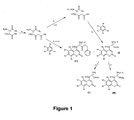
- Step (a) consists of the synthesis of the -ketoester amino acid derivative which is used as the starting material of the general method.
- step (b) there is a simultaneous deprotection of the ester moiety of the -ketoester amino acid prepared according to step (a) and a condensation reaction of the deprotected activated resulting compound with a substituted phenol compound, whereby the coumaryl amino acid of formula (I) is obtained.
- protected coumaryl amino acid derivatives may be obtained, respectively a derivative comprising a protected amino group through performing step (c) and a derivative comprising a protected carboxy group through performing step (d).
- coumaryl amino acid derivatives and specifically coumaryl aspartic acid or coumaryl glutamic acid derivatives, could be obtained with a good yield and with a high purity, by using a chirally pure -ketoester amino acid derivative as the starting material and then by condensing said - ketoester amino acid derivative with a substituted phenol, through performing a one-step or a two-step method.
- optically pure chiral - ketoester amino acid derivatives are obtained in a one-step method when using, as the starting material, the corresponding chiral amino acids, specifically aspartic acid and glutamic acid, which are easily commercially available.
- the combined features of the method according to the invention has allowed the inventors to design a method of synthesis of coumaryl amino acid derivatives, which method can be easily performed, is rapid to perform and is inexpensive due to the availability, at a low cost, of the chirally pure starting amino acids.
- a first object of the invention consists of a method for manufacturing an optically active coumaryl amino acid salt having the following formula (I) : wherein :
- the fluorescent amino acids of formula (I) which are obtained according to the method of synthesis above are intended to prepare fluorescent polypeptides, through their incorporation within the polypeptide amino acid chain in place of a tyrosine residue.
- a fluorescent amino acid of formula (I) exhibits only a slight hindrance and possesses an emission wavelength higher than the emission wavelength of tyrosine and tryptophan residues, thus allowing the one skilled in the art to easily discriminate the fluorescent amino acids of the invention from the natural amino acids on the basis of their respective fluorescent properties.
- the coumarin moiety is introduced according to the invention by condensation of a substituted phenol with the amino acid side chain of the corresponding starting amino acid, specifically the corresponding aspartic acid or glutamic acid residue.
- the method of the invention there occurs a transformation of the side-chain of Asp or Glu into a functional group suitable for cyclization with benzenic rings, specifically a Asp or Glu - ketoester suitable for cyclization with a substituted phenol, and then a condensation of the amino acid derived -ketoester thus obtained with one substituted phenol choosen among a large family of usable substituted phenols.
- the same -ketoester amino acid intermediate is used for the synthesis of numerous distinct coumaryl amino acid derivative compounds.
- step (d) protected amino acid derived -ketoesters obtained in step (b) were subjected to condensation with substituted phenols bearing R 1 , R 2 , R 3 and R 4 groups as defined above in formula (I) in the presence of methanesulfonic acid, leading to the synthesis of the chirally pure coumaryl amino acid derivative of formula (I).
- the compound of formula (I) is found in a mixture with a second compound, wherein said second compound consists of a derivative of the compound of formula (I) but wherein the carboxy group is protected, said second compound having the formula (I-A) hereunder: wherein R 1 , R 2 , R 3 and R 4 have the same meanings as for the compound of formula (I).
- the mixture of compounds (I) and (III), which is obtained at the end of step (b), is mainly comprised of compound (I) .
- the ratio compound (I): compound (III), which is found at the end of step (b) of the method is 62:38.
- step (b) the content of compound (III) within the mixture of compounds cans be easily further lowered by performing step (b) with larger amounts of acid and substituted phenol, respectively.
- a final mixture containing almost exclusively compound (III) can be obtained by using, as a large amount of acid, methanesulfonic acid at a concentration of at least 25 acid equivalents, and preferably at a concentration from 40 to 50 acid equivalents.
- acid equivalent it is intended herein the number of equivalents, in moles, of methanesulfonic acid for carrying out the chemical reaction, which definition is well known from the one skilled in the art.
- compound (I) is easily purified from the mixture of compounds (I) and (III), for example by performing a single step of purification on a chromatography column of silica gel, as it is disclosed in the examples.
- n, "*", X, R 1 , R 2 , R 3 , R 4 have the same meaning as defined for the compound of formula (I).
- n is an integer ranging from 1 to 2.
- step (b) of the method above when the compound of formula (I) has the integer "n" meaning 1, said step may comprise two sub-steps that are successively performed, namely (i) in step (b1) the deprotection of the -ketoester amino acid derivative and then (ii) in step (b2) the condensation of the resulting activated product with the selected substituted phenol.
- n means 1
- step (d) comprises the following steps :
- step (b1) the protected amino acid derived -ketoester, which is used as the starting material, is subjected to hydrogenolysis over catalytic palladium on charcoal in order to achieve the deprotection of the amino and carboxyl functions, thus leading to deprotected amino acid Asp bearing a -ketoester moiety on its side chain, also named compound (2) throughout the present specification.
- preferred examples of the compound (2) include (1 S)-1-carboxy-4-ethoxycarbonyl-3-oxo-butyl ammonium chloride and (1R)-1-carboxy-4-ethoxycarbonyl-3-oxo-butyl ammonium chloride.
- step (b2) the deprotected amino acid derived -ketoester obtained in step (d1) is subjected to condensation with a substituted phenol of formula (11) bearing R 1 , R 2 , R 3 and R 4 groups as defined above in formula (I), in the presence of methanesulfonic acid, leading to compound of formula (I).
- n is an integer ranging from 1 to 2 ;
- X- represents Cl - , Br - , I - , CH 3 SO 3 - , CF 3 CO 2 - , CF 3 SO 3 - ;
- R 1 represents H, halogen, alkyl, acyl, nitrile, sulfonate, aminosulfonyl, carbonyl and carbamoyl, OH, O- or N- substituted by alkyl or acyl group ;
- R 2 represents H, halogen, alkyl, acyl, nitrile, sulfonate, aminosulfonyl, carbonyl and carbamoyl, OH, O- or N- substituted by alkyl or acyl group ;
- R 3 represents H, halogen, alkyl, acyl, nitrile, sulfonate, aminosulfonyl, carbonyl and carbamoyl, OH, O-
- examples of the compound (I) include (1S)-1-carboxy-2-(7-hydroxy-2-oxo-2H-chromen-4-yl)-ethyl ammonium trifluoroacetate (C1), (1S)-1-carboxy-2-(7-methoxy-2-oxo-2H-chromen-4-yl)-ethyl ammonium methanesulfonate (C2), (1R)-1-carboxy-2-(7-methoxy-2-oxo-2H-chromen-4-yl)-ethyl ammonium trifluoroacetate (C3), (1 S)-1-carboxy-2-(6-chloro, 7-hydroxy-2-oxo-2H-chromen-4-yl)-ethyl ammonium trifluoroacetate (C4), (1S)-1-carboxy-2-(7-ethoxy-2-oxo-2H-chromen-4-yl)-ethyl ammonium trifluoroacetate (
- step (b2) the condensation is carried out in the presence of an Brönsted acid i.e. any acid that acts as a proton donor in the chemical reaction.
- the acid is not particularly restricted. Examples thereof include concentrated hydrochloric acid, trifluoroacetic acid, triflic acid, methanesulfonic acid. Among all, best yields were and shortest reaction times were obtained with triflic or methanesulfonic acid.
- the amount of acid used is generally 25 equivalents.
- steps (b) and (b2) are performed are the same, excepted for the amount of acid which is used for performing step (b) which is 10 equivalents.
- the reaction mixture can be diluted with a solvent.
- a solvent examples thereof include dichloromethane (DCM), dimethylsulfoxide (DMSO) or dimethylether (DME) but it is preferably to carry the reaction with the acid as solvent.
- the reaction temperature is generally room temperature, excepted for the addition of methanesulfonic acid which is completed at 0°C.
- the reaction can be completed within one to five hours depending on the reactivity of the substituted phenol and the amount of acid used.
- the compounds obtained by this method were generally pure enough, otherwise they can be purified by semi-preparative HPLC, for example by using a gradient H 2 O + TFA (0.1%)/H 2 O: ACN (30:70) + TFA (0.09%).
- the trifluoroacetate salts were obtained instead of the methanesulfonate.
- the -ketoester amino acid derivative which is used as the starting product in step (b) of the method is prepared by branching the -ketoester moiety on the side chain of a chirally pure corresponding amino acid having its carboxy- and amino- groups protected, specifically the protected chirally pure Asp or Glu residue, using the method of Brooks et al. (1979). Then, the resulting -ketoester amino acid derivative is deprotected on its carboxy- and amino- groups, for obtaining the desired compound (1).
- amino acid-derived -ketoesters are synthesized, according to the efficient method described by Brooks and al. (1979).
- the side-chain free carboxylic acid chain is activated by treatment with carbonyldiimidazole.
- This activated ester is subsequently subjected to condensation with the magnesium salt of monoethyl malonic acid.
- the magnesium salt of monoethyl malonic acid is preferably prepared from commercial potassium monoethyl manolate, through acidification at low temperature and treatment with magnesium ethoxide.
- Pure -ketoesters, also named compound (1) throughout the present specification, are obtained with good yields after column chromatography on silica-gel.
- examples of the compound (1) include (2S)-2-Benzyloxycarbonylamino-4-oxo-hexanedioic acid 1-benzyl ester 6-ethyl ester, (2R)-2-tert-Butoxycarbonylamino-4-oxo-hexanedioic acid 1-benzyl ester 6-ethyl ester and (2S)-2-Benzyloxycarbonyl-amino-5-oxo-heptanedioic acid 1-benzyl ester 7-ethyl ester.
- coumaryl amino acid derivatives for preparing fluorescent polypeptides containing, in their amino acid chain, one or more fluorescent coumaryl amino acid derivatives according to the invention, notably when performing solid phase peptide synthesis, it is desirable that said coumaryl amino acid derivatives are protected on their amino- or carboxy- reactive groups before using them in the solid phase synthesis chemical reactions. Consequently, in a preferred embodiment of the method according to the invention, the coumaryl amino acid derivatives of formula (I) are further protected on their amino- or carboxy- reactive groups by carrying out further steps following step (b) or (b2) of the method.
- the present invention also pertains to a method for manufacturing an optically pure coumaryl amino acid that is protected on its amino group, wherein said method comprises the steps of :
- the protective group R 5 is selected from the group consisting of Fmoc (9-fluorenylmethylcarbonyl), Cbz (benzyloxycarbonyl), Boc (tert-butyloxycarbonyl), Troc (trichloroethylcarbonyl), Phth (phtalimide), Ac (acetyl), Trifluoroacetyl, Benzoyl, For (formyl), For (formyl), iBut (isobutyryl), Pam (palmytoyl), Trt (trityl), Phenyl, Methyl.
- coumaryl amino acids obtained in step (c) are protected on their amino function using classically used protecting groups such as Fmoc, Cbz or Boc.
- Protected coumarin-bearing amino acids described in the formula (II), also called compound (4), were obtained in good yield after purification by flash chromatography on silica gel or semi-preparative HPLC, for example by using a gradient H 2 O + TFA2 (0.1%)/H 2 O: CAN (30:70) + TFA (0.09%).
- n and * are as defined in formula (II) ; R 1 , R 2 , R 3 , R 4 and R 5 have the same meaning as defined in formula (II).
- examples of the compound (4) include (2S)-2-Fmoc-amino-3-(7-methoxy-2-oxo-2H-chromen-4-yl)propionic acid, (2S)-2-Cbz-amino-3-(7-methoxy-2-oxo-2H-chromen-4-yl)propionic acid, (2S)-2-Boc-amino-3-(7-methoxy-2-oxo-2H-chromen-4-yl)propionic acid and (2R)-2-Fmoc-amino-3-(7-methoxy-2-oxo-2H-chromen-4-yl)propionic acid.
- the present invention also relates to a method for manufacturing an optically pure coumaryl amino acid that is protected on its carboxyl group, wherein said method comprises the steps of :
- coumaryl amino acids obtained in step (d) are protected on their carboxyl function using classically used protecting groups such as methyl-, ethyl-, tert -butyl-, cyclohexyl-, benzyl-or allyl-ester.
- Protected coumaryl amino acids described in the formula (III), also called compound (5) were obtained in good yields after purification by flash chromatography on silica gel or semi-preparative HPLC, for example by using a gradient H 2 O + TFA (0.1%)/H 2 O: ACN (30:70) + TFA (0.09%).
- n and * are as defined in formula (II) ;
- X, R 1 , R 2 , R 3 , R 4 and R 5 have the same meaning as defined in formula (III).
- examples of the compound (5) include (1S)-1-benzyloxycarbonyl-3-(7-methoxy-2-oxo-2H-chromen-4-yl)-propyl ammonium trifluoro-acetate.
- the protected compounds of formula (II) and (III) above can be readily used in peptide synthesis methods for the purpose of incorporating one or more coumaryl amino acid derivative(s) of the invention within the amino acid chain which is synthesised, at the desired amino acid position(s).
- a further object of the invention consists of an optically active coumaryl amino acid salt having the following formula (I) : wherein :
- Preferred optically active coumaryl amino acid salt as defined above are those which are selected from the group consisting of:
- groups R1, R2, R3 and R4 are as defined for the compound of formula (I) and group R5 consists of a protective group convention ally used in the art for protecting an amino group.
- the protective group R5 is selected from the group consisting of :
- the present invention also relates to a compound of formula (II) as defined above, which is selected from the group consisting of :
- n In a preferred embodiment of a compound of formula (III), "n”, “*”, X, R1, R2, R3 and R4 have the same meaning as for the compound of formula (I) and R5 is selected from the group consisting of methyl, ethyl, tert -butyl, cyclohexyl, benzyl or allyl.
- the present invention also pertains to a compound of formula (III) as defined above, which consists of (1S)-1-benzyloxycarbonyl-3-(7-methoxy-2-oxo-2H-chromen-4-yl)-propyl ammonium trifluoro-acetate.
- a further object of the invention consists of an intermediate compound of formula (1) as defined above, which is useful for the synthesis of a compound of formula (I), wherein said compound of formula (1) is selected from the group consisting of:
- the invention also pertains to an intermediate compound of formula (2) as defined above, useful for the synthesis of a compound of formula (I), wherein said compound of formula (2) is selected from the group consisting of:
- the present invention also deals with a kit for manufacturing a fluorescent polypeptide, wherein said kit comprises one coumaryl amino acid derivative selected from the compounds of formula I, II and III as defined in the present specification.
- such a kit comprises a glass vial containing a coumaryl amino acid derivative of the invention in the form of a powder or alternatively under the form of a liquid solution, for example a liquid conventional buffer solution, wherein said amino acid derivative is dissolved or suspended.
- Another object of the invention consists of a method for the synthesis of an optically active polypeptide wherein said method comprises at least one step of incorporating an optically active coumaryl amino acid of formula (I) within the amino acid chain.
- a further object of the invention consists of an optically active polypeptide which contains in its amino acid chain at least one optically active coumaryl amino acid of formula (I).
- optically active polypeptide may contain more than one coumaryl amino acid derivative in its amino acid chain for example from 2 to 10 of such derivatives, depending on the amino acid length of said optically active polypeptide.
- this invention also relates to an in vitro assay kit comprising an optically active polypeptide which contains in its amino acid chain an optically active coumaryl amino acid of formula (I).
- Examples 1 to 5 are intermediate compounds useful for the synthesis of the novel fluorescent amino acids of the invention.
- example (2) (1.609 g, 4.1 mmol, 66%) was obtained as a pure white solid.
- example (3) (6.187 g, 14 mmol, 52%) was obtained as a pure white solid.
- example (7) (1.9 g, 5.3 mmol, 71%) was obtained as a pure white powder.
- example (8) (728 mg, 2.03 mmol, 70%) was obtained as a pale yellow solid after purification by semi-preparative HPLC.
- example (9) (426 mg, 1.04 mmol, 45 %) was obtained as a pure pale yellow solid.
- example (10) (50 mg, 0.13 mmol, 16%) was obtained as a pure white solid.
- example (11) (341 mg, 0.9 mmol, 39%) was obtained as a pure white solid.
- example (12) [compound (10)] (300 mg, 0.8 mmol, 36%) and example 13 [compound (6)] (120 mg, 0.4 mmol, 18%) were obtained in a 2 : 1 proportion as pure pale yellow solids after separation by semi-preparative HPLC.
- example (14) (316 mg, 0.78 mmol, 34 %) was obtained as a pure a pure white solid.
- example 15 (420.2 mg, 1.1 mmol, 48%) was obtained as a pure pale yellow powder.
- example (16) (98 mg, 0.26 mmol, 37%) and example (17) (76 mg, 0.16 mmol, 23%) were obtained in 62 : 38 proportion as a pure orange solid and a pure white solid respectively after separation by semi-preparative HPLC.
- example (21) was obtained, after purification by semi-preparative HPLC and lyophilization, as a pure white powder (556 mg, 1.23 mmol, 70%).
- the final peptidyl resin was dried and cleaved with a mixture of TFA/TIPS/H 2 O (9.5/0.25/0.25 in volume) for 4 h at room temperature. After partial evaporation, the filtrate from the cleavage reaction was precipitated with cold ether, and the precipitate was collected by centrifugation.
- the crude peptide was purified by semipreparative HPLC on a Nucleosil C 18 column (Vydac, 5 ⁇ m, 10 x 250 mm), and the fractions were analysed by analytical HPLC on a nucleosil C 18 column (Vydac, 5 ⁇ m, 4,6 x 250 mm).
Landscapes
- Health & Medical Sciences (AREA)
- Life Sciences & Earth Sciences (AREA)
- Chemical & Material Sciences (AREA)
- Organic Chemistry (AREA)
- Immunology (AREA)
- Molecular Biology (AREA)
- Insects & Arthropods (AREA)
- Engineering & Computer Science (AREA)
- Hematology (AREA)
- Biomedical Technology (AREA)
- Urology & Nephrology (AREA)
- General Health & Medical Sciences (AREA)
- Zoology (AREA)
- Medicinal Chemistry (AREA)
- Biochemistry (AREA)
- Biotechnology (AREA)
- Microbiology (AREA)
- Tropical Medicine & Parasitology (AREA)
- Proteomics, Peptides & Aminoacids (AREA)
- Gastroenterology & Hepatology (AREA)
- Cell Biology (AREA)
- Genetics & Genomics (AREA)
- Toxicology (AREA)
- Biophysics (AREA)
- Food Science & Technology (AREA)
- Physics & Mathematics (AREA)
- Analytical Chemistry (AREA)
- General Physics & Mathematics (AREA)
- Pathology (AREA)
- Organic Low-Molecular-Weight Compounds And Preparation Thereof (AREA)
- Plural Heterocyclic Compounds (AREA)
Priority Applications (4)
| Application Number | Priority Date | Filing Date | Title |
|---|---|---|---|
| EP04300052A EP1559712A1 (de) | 2004-01-28 | 2004-01-28 | Verfahren zur Herstellung von optisch aktiven Cumarin-Aminosäure-Salzen und die so erhaltenen Cumarin-Aminosäure-Salze |
| EP05701284A EP1711483A2 (de) | 2004-01-28 | 2005-01-28 | Verfahren zur herstellung von optisch reinen coumarylaminosäuresalzen und die auf diese weise erhaltenen coumarylaminosäuresalze |
| US10/586,964 US20070161807A1 (en) | 2004-01-28 | 2005-01-28 | Method for manufacturing optically pure coumaryl amino acids and the novel coumaryl aminoacids thus obtained |
| PCT/EP2005/000950 WO2005075448A2 (en) | 2004-01-28 | 2005-01-28 | A method for manufacturing optically pure coumaryl amino acids salts and the coumaryl amino acid salts thus obtained |
Applications Claiming Priority (1)
| Application Number | Priority Date | Filing Date | Title |
|---|---|---|---|
| EP04300052A EP1559712A1 (de) | 2004-01-28 | 2004-01-28 | Verfahren zur Herstellung von optisch aktiven Cumarin-Aminosäure-Salzen und die so erhaltenen Cumarin-Aminosäure-Salze |
Publications (1)
| Publication Number | Publication Date |
|---|---|
| EP1559712A1 true EP1559712A1 (de) | 2005-08-03 |
Family
ID=34639494
Family Applications (2)
| Application Number | Title | Priority Date | Filing Date |
|---|---|---|---|
| EP04300052A Withdrawn EP1559712A1 (de) | 2004-01-28 | 2004-01-28 | Verfahren zur Herstellung von optisch aktiven Cumarin-Aminosäure-Salzen und die so erhaltenen Cumarin-Aminosäure-Salze |
| EP05701284A Withdrawn EP1711483A2 (de) | 2004-01-28 | 2005-01-28 | Verfahren zur herstellung von optisch reinen coumarylaminosäuresalzen und die auf diese weise erhaltenen coumarylaminosäuresalze |
Family Applications After (1)
| Application Number | Title | Priority Date | Filing Date |
|---|---|---|---|
| EP05701284A Withdrawn EP1711483A2 (de) | 2004-01-28 | 2005-01-28 | Verfahren zur herstellung von optisch reinen coumarylaminosäuresalzen und die auf diese weise erhaltenen coumarylaminosäuresalze |
Country Status (3)
| Country | Link |
|---|---|
| US (1) | US20070161807A1 (de) |
| EP (2) | EP1559712A1 (de) |
| WO (1) | WO2005075448A2 (de) |
Families Citing this family (3)
| Publication number | Priority date | Publication date | Assignee | Title |
|---|---|---|---|---|
| TWI483902B (zh) * | 2013-04-03 | 2015-05-11 | 國立臺灣大學 | 製作參雜金屬離子之硫化鋅奈米粒子的方法以及應用其進行光致發暖白光的方法 |
| JP2016141665A (ja) * | 2015-02-04 | 2016-08-08 | オルテック インコーポレイテッド | アフラトキシン鋳型、分子インプリントポリマー、ならびにその作製法および使用法 |
| US20160221983A1 (en) | 2015-02-04 | 2016-08-04 | Alltech, Inc. | Aflatoxin templates, molecularly imprinted polymers, and methods of making and using the same |
-
2004
- 2004-01-28 EP EP04300052A patent/EP1559712A1/de not_active Withdrawn
-
2005
- 2005-01-28 US US10/586,964 patent/US20070161807A1/en not_active Abandoned
- 2005-01-28 EP EP05701284A patent/EP1711483A2/de not_active Withdrawn
- 2005-01-28 WO PCT/EP2005/000950 patent/WO2005075448A2/en not_active Ceased
Non-Patent Citations (3)
| Title |
|---|
| BENNETT F A ET AL: "L-(6,7-dimethoxy-4-coumaryl) alanine: an Intrinsic Probe for the Labelling of Peptides", TETRAHEDRON LETTERS, ELSEVIER SCIENCE PUBLISHERS, AMSTERDAM, NL, vol. 38, no. 42, 20 October 1997 (1997-10-20), pages 7449 - 7452, XP004111237, ISSN: 0040-4039 * |
| KELE, P. ET AL.: "Highly enantionselective synthesis of a fluorscent amino acid", TETRAHEDRON, ASYMMETRY, vol. 11, 2000, pages 4959 - 4963, XP002297041 * |
| KNIGHT C G: "A QUENCHED FLUORESCENT SUBSTRATE FOR THIMET PEPTIDASE CONTAINING A NEW FLUORESCENT AMINO ACID, DL-2-AMINO-3-(7-METHOXY-4-COUMARYL)PROPIONIC ACID", BIOCHEMICAL JOURNAL, PORTLAND PRESS, LONDON, GB, vol. 274, no. 1, 15 February 1991 (1991-02-15), pages 45 - 48, XP000196075, ISSN: 0264-6021 * |
Also Published As
| Publication number | Publication date |
|---|---|
| WO2005075448A2 (en) | 2005-08-18 |
| US20070161807A1 (en) | 2007-07-12 |
| EP1711483A2 (de) | 2006-10-18 |
| WO2005075448A3 (en) | 2005-12-08 |
Similar Documents
| Publication | Publication Date | Title |
|---|---|---|
| Viault et al. | The first “ready-to-use” benzene-based heterotrifunctional cross-linker for multiple bioconjugation | |
| JP5588962B2 (ja) | プロテアーゼ測定用蛍光プローブ | |
| JP2000504755A (ja) | ベンゾフェノキサジン染料 | |
| JP4362106B2 (ja) | 標識化アミノアシルtRNA | |
| Koopmans et al. | A concise preparation of the fluorescent amino acid l-(7-hydroxycoumarin-4-yl) ethylglycine and extension of its utility in solid phase peptide synthesis | |
| EP1176987A2 (de) | Kurzkettige peptid-farbstoffkonjugate als kontrastmittel für die optische diagnostik | |
| Lapeyre et al. | Aryldithioethyloxycarbonyl (Ardec): a new family of amine protecting groups removable under mild reducing conditions and their applications to peptide synthesis | |
| US20140051109A1 (en) | Novel compounds with photoluminescence properties and applications thereof | |
| EP3168288A1 (de) | Fluoreszierende sonde zum nachweis von dipeptidylpeptidase iv | |
| Vidal et al. | Solid‐phase synthesis and cellular localization of a C‐and/or N‐terminal labelled peptide | |
| Cserép et al. | Fluorogenic tagging of peptides via Cys residues using thiol-specific vinyl sulfone affinity tags | |
| US20070161807A1 (en) | Method for manufacturing optically pure coumaryl amino acids and the novel coumaryl aminoacids thus obtained | |
| US7964702B2 (en) | Phalloidin derivatives and methods for their synthesis | |
| US7897787B2 (en) | Maleimide derivative | |
| JPWO2018159841A1 (ja) | 新規化合物、当該新規化合物を含む蛍光誘導体化用試薬、並びに当該新規化合物を用いたアミノ酸の光学異性体を光学分割する方法及び蛍光誘導体化されたアミノ酸 | |
| JP4392502B2 (ja) | 蛍光性アミノ酸誘導体 | |
| Romieu et al. | N-Fmoc-α-sulfo-β-alanine: a versatile building block for the water solubilisation of chromophores and fluorophores by solid-phase strategy | |
| KR20000057503A (ko) | 펩티드, 사람 펩시노오겐 i 또는 사람 펩신 i의 측정 방법,및 측정용 키트 | |
| JP4860352B2 (ja) | 診断薬及びそれを用いた測定方法 | |
| US20090118471A1 (en) | Novel coumarin derivatives | |
| JP4320404B2 (ja) | 新規な蛍光化合物及び蛍光標識剤 | |
| WO2020235567A1 (ja) | 脳腫瘍の検出用蛍光プローブ | |
| Chersi et al. | Selective ‘in synthesis’ labeling of peptides with biotin and rhodamine | |
| JP7525161B2 (ja) | カルボキシペプチダーゼ活性検出用蛍光プローブ | |
| JP2005534739A (ja) | シアニン染料リポーターを用いたタンパク質の部位特異的標識 |
Legal Events
| Date | Code | Title | Description |
|---|---|---|---|
| PUAI | Public reference made under article 153(3) epc to a published international application that has entered the european phase |
Free format text: ORIGINAL CODE: 0009012 |
|
| AK | Designated contracting states |
Kind code of ref document: A1 Designated state(s): AT BE BG CH CY CZ DE DK EE ES FI FR GB GR HU IE IT LI LU MC NL PT RO SE SI SK TR |
|
| AX | Request for extension of the european patent |
Extension state: AL LT LV MK |
|
| AKX | Designation fees paid | ||
| REG | Reference to a national code |
Ref country code: DE Ref legal event code: 8566 |
|
| STAA | Information on the status of an ep patent application or granted ep patent |
Free format text: STATUS: THE APPLICATION IS DEEMED TO BE WITHDRAWN |
|
| 18D | Application deemed to be withdrawn |
Effective date: 20060204 |