EP1559376A2 - Vorrichtung zum Einspannen von Knochenersatzmitteln - Google Patents
Vorrichtung zum Einspannen von Knochenersatzmitteln Download PDFInfo
- Publication number
- EP1559376A2 EP1559376A2 EP04030803A EP04030803A EP1559376A2 EP 1559376 A2 EP1559376 A2 EP 1559376A2 EP 04030803 A EP04030803 A EP 04030803A EP 04030803 A EP04030803 A EP 04030803A EP 1559376 A2 EP1559376 A2 EP 1559376A2
- Authority
- EP
- European Patent Office
- Prior art keywords
- clamping
- clamping body
- hollow body
- cavity wall
- kirschner wires
- Prior art date
- Legal status (The legal status is an assumption and is not a legal conclusion. Google has not performed a legal analysis and makes no representation as to the accuracy of the status listed.)
- Granted
Links
Images


Classifications
-
- A—HUMAN NECESSITIES
- A61—MEDICAL OR VETERINARY SCIENCE; HYGIENE
- A61B—DIAGNOSIS; SURGERY; IDENTIFICATION
- A61B17/00—Surgical instruments, devices or methods
- A61B17/56—Surgical instruments or methods for treatment of bones or joints; Devices specially adapted therefor
- A61B17/58—Surgical instruments or methods for treatment of bones or joints; Devices specially adapted therefor for osteosynthesis, e.g. bone plates, screws or setting implements
- A61B17/60—Surgical instruments or methods for treatment of bones or joints; Devices specially adapted therefor for osteosynthesis, e.g. bone plates, screws or setting implements for external osteosynthesis, e.g. distractors, contractors
- A61B17/66—Alignment, compression or distraction mechanisms
-
- A—HUMAN NECESSITIES
- A61—MEDICAL OR VETERINARY SCIENCE; HYGIENE
- A61B—DIAGNOSIS; SURGERY; IDENTIFICATION
- A61B17/00—Surgical instruments, devices or methods
- A61B17/56—Surgical instruments or methods for treatment of bones or joints; Devices specially adapted therefor
- A61B17/58—Surgical instruments or methods for treatment of bones or joints; Devices specially adapted therefor for osteosynthesis, e.g. bone plates, screws or setting implements
- A61B17/88—Osteosynthesis instruments; Methods or means for implanting or extracting internal or external fixation devices
- A61B17/8861—Apparatus for manipulating flexible wires or straps
-
- A—HUMAN NECESSITIES
- A61—MEDICAL OR VETERINARY SCIENCE; HYGIENE
- A61B—DIAGNOSIS; SURGERY; IDENTIFICATION
- A61B17/00—Surgical instruments, devices or methods
- A61B17/56—Surgical instruments or methods for treatment of bones or joints; Devices specially adapted therefor
- A61B17/58—Surgical instruments or methods for treatment of bones or joints; Devices specially adapted therefor for osteosynthesis, e.g. bone plates, screws or setting implements
- A61B17/88—Osteosynthesis instruments; Methods or means for implanting or extracting internal or external fixation devices
- A61B17/8866—Osteosynthesis instruments; Methods or means for implanting or extracting internal or external fixation devices for gripping or pushing bones, e.g. approximators
-
- A—HUMAN NECESSITIES
- A61—MEDICAL OR VETERINARY SCIENCE; HYGIENE
- A61B—DIAGNOSIS; SURGERY; IDENTIFICATION
- A61B17/00—Surgical instruments, devices or methods
- A61B17/16—Instruments for performing osteoclasis; Drills or chisels for bones; Trepans
- A61B17/1697—Instruments for performing osteoclasis; Drills or chisels for bones; Trepans specially adapted for wire insertion
-
- A—HUMAN NECESSITIES
- A61—MEDICAL OR VETERINARY SCIENCE; HYGIENE
- A61B—DIAGNOSIS; SURGERY; IDENTIFICATION
- A61B17/00—Surgical instruments, devices or methods
- A61B17/56—Surgical instruments or methods for treatment of bones or joints; Devices specially adapted therefor
- A61B17/58—Surgical instruments or methods for treatment of bones or joints; Devices specially adapted therefor for osteosynthesis, e.g. bone plates, screws or setting implements
- A61B17/60—Surgical instruments or methods for treatment of bones or joints; Devices specially adapted therefor for osteosynthesis, e.g. bone plates, screws or setting implements for external osteosynthesis, e.g. distractors, contractors
- A61B17/64—Devices extending alongside the bones to be positioned
- A61B17/6466—Devices extending alongside the bones to be positioned with pin-clamps movable along a solid connecting rod
-
- A—HUMAN NECESSITIES
- A61—MEDICAL OR VETERINARY SCIENCE; HYGIENE
- A61B—DIAGNOSIS; SURGERY; IDENTIFICATION
- A61B17/00—Surgical instruments, devices or methods
- A61B17/56—Surgical instruments or methods for treatment of bones or joints; Devices specially adapted therefor
- A61B17/58—Surgical instruments or methods for treatment of bones or joints; Devices specially adapted therefor for osteosynthesis, e.g. bone plates, screws or setting implements
- A61B17/68—Internal fixation devices, including fasteners and spinal fixators, even if a part thereof projects from the skin
- A61B17/84—Fasteners therefor or fasteners being internal fixation devices
- A61B17/846—Nails or pins, i.e. anchors without movable parts, holding by friction only, with or without structured surface
- A61B17/848—Kirschner wires, i.e. thin, long nails
-
- A—HUMAN NECESSITIES
- A61—MEDICAL OR VETERINARY SCIENCE; HYGIENE
- A61B—DIAGNOSIS; SURGERY; IDENTIFICATION
- A61B17/00—Surgical instruments, devices or methods
- A61B17/56—Surgical instruments or methods for treatment of bones or joints; Devices specially adapted therefor
- A61B17/58—Surgical instruments or methods for treatment of bones or joints; Devices specially adapted therefor for osteosynthesis, e.g. bone plates, screws or setting implements
- A61B17/68—Internal fixation devices, including fasteners and spinal fixators, even if a part thereof projects from the skin
- A61B2017/681—Alignment, compression, or distraction mechanisms
Definitions
- the invention relates to a device for clamping of Bone fixation agents, in particular Kirschner wires according to the preamble of Patent claim 1.
- WO 02/096294 GREEN discloses a device for aligning Tube bones known.
- This known device comprises a rod with a order a tubular bone passable, arcuate segment and a Clamping element which is arranged displaceably parallel to the rod and against the proximal surface of the long bone can be pressed.
- a disadvantage of this known Device is that the arcuate segment of the device around the Tube bones must be led around and thereby a replacement of the surrounding soft tissue is necessary.
- the invention aims to remedy this situation.
- the invention is based on the object Device to create, which on the body of the patient only an insertion of requires few Kirschner wires, so that only small incisions are required and no replacement of the soft tissue surrounding the bone is necessary.
- the invention solves the problem with a device for clamping of Bone fixation agents, in particular Kirschner wires, which have the features of Claim 1 has.
- the clamping means comprise a coaxial arranged screw for axial displacement of the clamp body relative to the hollow body.
- This provides the advantage that a larger axial Displacement between clamping body and hollow body is possible.
- It can Kirschner wires with different diameters, for example within one Diameter range between 1.0 mm and 3.5 mm are used.
- the clamping body is slidably connected transversely to the longitudinal axis with the rod, so that the clamping body with the simultaneous clamping of Kirschner wires with different diameter can center and the Kirschner wires evenly tightly clamped.
- the tensioning means additionally or instead the screw connection an eccentric mechanism, whereby a simple Operation of the device is guaranteed and high clamping forces on the Kirschner wires to be clamped can be applied.
- the serves Exzentermechanismus as a backup so that no accidental release of the Clamping is possible.
- the clamping means a screw and a Exzentermechanismus include, the eccentric mechanism is independent of Diameter of the Kirschner wires to be clamped. The clamping body can through the Screw so far moved axially until its outer wall the Kirschner wires touched and this brings to the cavity wall to the plant.
- the clamping body is at least partially designed as a convex body.
- the clamping body running on meridians Grooves on.
- the clamping body has a against the rear end of the hollow body directed, rear section and axially opposite a front portion, wherein the front portion and the rear Rejuvenate section opposite.
- the rear section spherically convex and the front portion of the clamp body is conical.
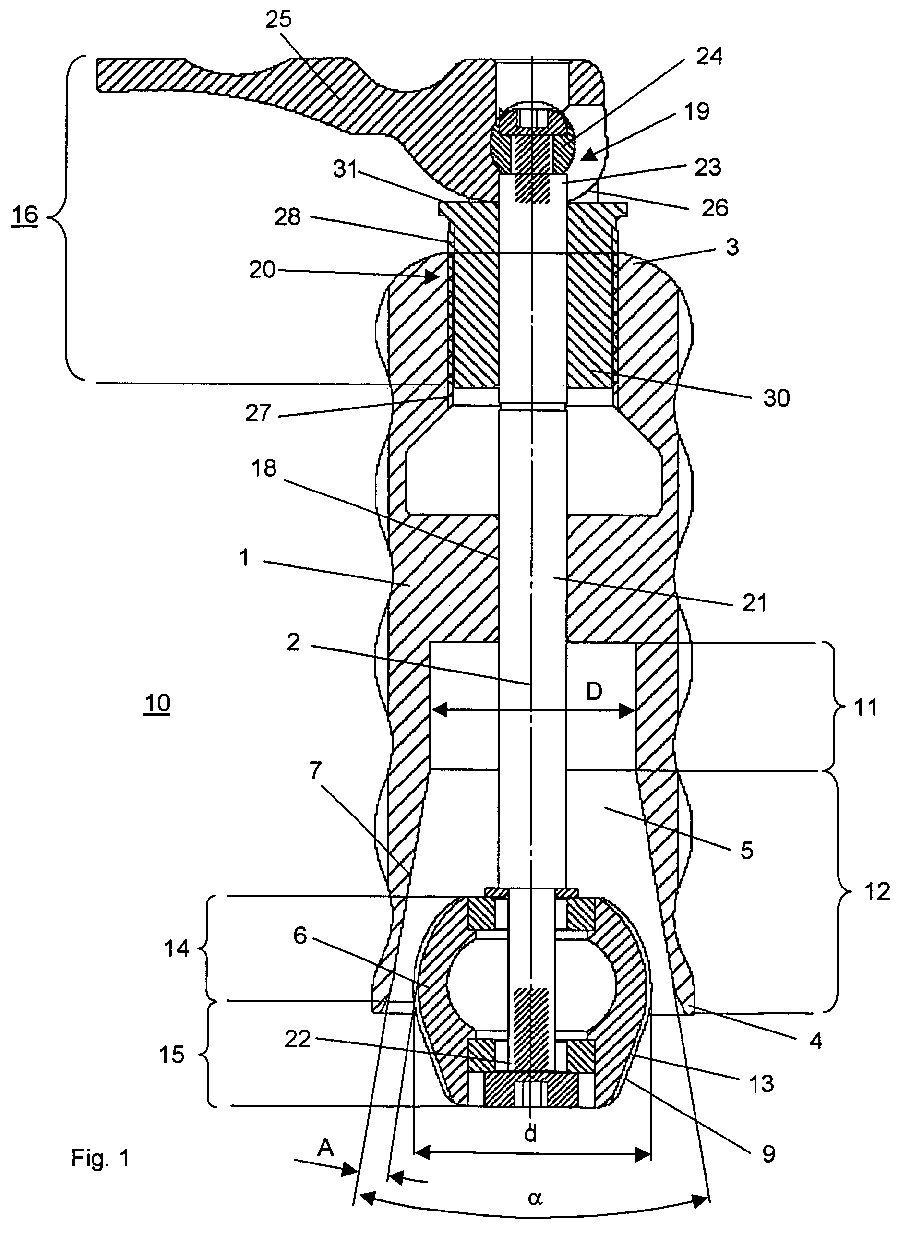
- FIG. 1 an embodiment of the device 10 is shown, which in essentially a longitudinal axis 2 having a hollow body 1, one in the cavity 5 of the hollow body 1 axially displaceable and lockable clamping body 6 and on first end 3 of the hollow body 1 arranged clamping means 16 includes.
- I'm not blocked state of the device 10 (FIG. 1) is the space between the Clamping body 6 and the cavity wall 7 enlarged so far that from the front end 4 of the hollow body 1 Kirschner wires 8 on the clamp body 6 over into the cavity. 5 can be introduced.
- the cavity 5 has a coaxial hollow cylindrical Segment 11 and at the front end 4 of the hollow body 1 is also a coaxial, conical segment 12, wherein the conical segment 12 against the front Extended end 4 of the hollow body 1.
- the minimum inner diameter D of the conical Segment 12 corresponds to the inner diameter of the hollow cylindrical segment eleventh
- the clamping body 6 is convex and has a maximum Outside diameter d, which is greater than the inner diameter D of hollow cylindrical segment 11 is.
- the outer wall 9 of the clamping body 6 has uniformly distributed on the circumference, Groves 13 extending on meridians, so that the Kirschner wires 8 parallel to Longitudinal axis 2 are positively caught in these grooves 13.
- the clamping body 6 on a against the rear end 3 of the hollow body 1 directed axial portion 14 spherical and on a directed against the front end 4 of the hollow body 1 axial portion 15th conical.
- the clamping body 6 is relative to the hollow body 1 by means of the clamping means 16 shifted and fixed axially when clamping the Kirschner wires 8. This is the Clamping 6 held at the front end 22 of a rod 21, which in a the Hollow body 1 coaxially penetrating central bore 18 is guided. Of the Clamping body 6 is displaceable in a certain measure transversely to the longitudinal axis connected to the rod 21, so that the clamping body 6 at the same time Center clamping of Kirschner wires 8 with different diameters can.
- the rod 21 is both by means of the eccentric mechanism 19 at the rear end 23 of the rod 21 and with the screw 20 at the rear end 3 of the Hollow body 1 axially movable.
- the eccentric mechanism includes one around the to Longitudinal axis 2 orthogonal axis of rotation 24 pivotally attached to the rod 21 Tensioning lever 25 with an axis of rotation 24 eccentric cylindrical contact surface 26.
- the axially adjustable screw 20 is formed so that the Central bore 18 at the rear end 3 of the hollow body 1 is extended and a Internal thread 27 has, in which a complementary external thread 28th having sleeve 30 is screwed.
- the rod 21 is axially through the sleeve 30th carried out and is dimensioned in its length such that the contact surface 26 of the Clamping lever 25 rests on the axially outer end face 31 of the sleeve 30.
- the surgeon uses at least two optimally three or four Kirschner wires 8 drilled in the bone 17. Subsequently, the eccentric mechanism 19 is released and the sleeve 30 in the Screwed internal thread 27 until the clamp body 6 is in a forward position, which is a simple insertion of the rear segments of the Kirschner wires 8 in the Gap between terminal body 6 and cavity wall 7 allowed. After inserting the Rear segments of the Kirschner wires 8 in the cavity 5, the sleeve 30th Turned back until the Kirschner wires 8 slightly between the clamp body 6 and the Cavity wall 7 are wedged. When tensioning the clamping lever 25 is the Clamping body 6 by the eccentric mechanism 19 against the Kirschner wires 8 pressed so that these firmly in the gap between the clamping body 6 and cavity wall. 7 be fixed.
Landscapes
- Health & Medical Sciences (AREA)
- Orthopedic Medicine & Surgery (AREA)
- Life Sciences & Earth Sciences (AREA)
- Surgery (AREA)
- Medical Informatics (AREA)
- General Health & Medical Sciences (AREA)
- Biomedical Technology (AREA)
- Heart & Thoracic Surgery (AREA)
- Nuclear Medicine, Radiotherapy & Molecular Imaging (AREA)
- Molecular Biology (AREA)
- Animal Behavior & Ethology (AREA)
- Engineering & Computer Science (AREA)
- Public Health (AREA)
- Veterinary Medicine (AREA)
- Surgical Instruments (AREA)
- Prostheses (AREA)
- Gripping Jigs, Holding Jigs, And Positioning Jigs (AREA)
- Apparatus For Radiation Diagnosis (AREA)
Abstract
Description
- nur kleine Inzisionen am Körper des Patienten erforderlich sind und keine Ablösung der den Knochen umgebenden Weichteile notwendig ist;
- die Kirschnerdrähte derart am Knochen befestigt werden können, dass sie nicht in den Markraum ragen oder diesen durchdringen, so dass ohne Entfernung der Vorrichtung ein Marknagel in den Markraum des zu behandelnden Knochens eingeführt werden kann; und
- die Kirschnerdrähte so am Knochen angeordnet werden können, dass ohne Entfernen der Vorrichtung eine Knochenplatte auf der Oberfläche des zu behandelnden Knochens plaziert werden kann.
- Konuswinkel α der konischen Hohlraumwand zwischen 5° und 35°;
- Abstand a zwischen 1,0 und 3,0 mm;
- Abstand A zwischen 3,0 und 6,0 mm; wobei
- das Verhältnis a : A der Abstände zwischen dem Klemmkörper und der konischen Hohlraumwand vorzugsweise zwischen 0,1 und 0,9 beträgt. Weitere vorteilhafte Ausgestaltungen der Erfindung sind in den abhängigen Ansprüchen gekennzeichnet.
Claims (10)
- Vorrichtung (10) zum Einspannen von an einem Knochen (17) befestigbaren Knochenfixationsmitteln, insbesondere Kirschnerdrähten (8), gekennzeichnet durchA) einen longitudinalen Hohlkörper (1) mit einer Längsachse (2), einem hinteren und einem vorderen die Längsachse (2) schneidenden Ende (3;4) und einem koaxialen, am vorderen Ende (4) des Hohlkörpers (1) offenen, sich gegen das hintere Ende (3) des Hohlkörpers (1) verjüngenden Hohlraum (5) mit einer mindestens auf einem Längenabschnitt X des Hohlraumes (5) konischen Hohlraumwand (7);B) einen koaxial verschiebbaren, in den Hohlraum (5) einführbaren Klemmkörper (6), welcher sich gegen das hintere Ende (3) des Hohlkörpers (1) verjüngt; undC) mit dem Klemmkörper (6) und dem hinteren Ende (3) des Hohlkörpers (1) verbundene Spannmittel (16), mittels welcher der Klemmkörper (6) relativ zum Hohlkörper (1) koaxial verschiebbar und in eine vordere Position und in eine hintere Position bringbar ist, wobeiD) in der vorderen Position zwischen dem Klemmkörper (6) und der konischen Hohlraumwand (7) ein Abstand A besteht, welcher zum Einführen von Kirschnerdrähten (8) in den Hohlraum (5) geeignet ist; undE) in der hinteren Position zwischen dem Klemmkörper (6) und der konischen Hohlraumwand (7) ein Abstand a < A besteht, welcher zum Verklemmen von Kirschnerdrähten (8) zwischen dem Klemmkörper (6) und der konischen Hohlraumwand (7) geeignet ist.
- Vorrichtung (10) nach Anspruch 1, dadurch gekennzeichnet, dass die Spannmittel (16) eine koaxial angeordnete Schraubverbindung (20) zur axialen Verschiebung des Klemmkörpers (6) umfassen.
- Vorrichtung (10) nach Anspruch 1 oder 2, dadurch gekennzeichnet, dass die Spannmittel (16) einen Exzentermechanismus (19) umfassen.
- Vorrichtung (10) nach einem der Ansprüche 1 bis 3, dadurch gekennzeichnet, dass der Klemmkörper (6) mindestens teilweise als konvexer Körper ausgebildet ist.
- Vorrichtung (10) nach Anspruch 4, dadurch gekennzeichnet, dass der Klemmkörper (6) auf Meridianen verlaufende Rillen (13) aufweist.
- Vorrichtung (10) nach einem der Ansprüche 1 bis 5, dadurch gekennzeichnet, dass der Klemmkörper (6) einen gegen das hintere Ende (3) des Hohlkörpers (1) gerichteten, hinteren Abschnitt (14) und axial entgegengesetzt einen vorderen Abschnitt (15) aufweist, wobei sich der vordere Abschnitt (15) und der hintere Abschnitt (14) entgegengesetzt verjüngen.
- Vorrichtung (10) nach Anspruch 6, dadurch gekennzeichnet, dass der hintere Abschnitt (14) des Klemmkörpers (6) sphärisch konvex ausgebildet ist.
- Vorrichtung (10) nach Anspruch 6 oder 7, dadurch gekennzeichnet, dass der vordere Abschnitt (15) des Klemmkörpers (6) konisch ausgebildet ist.
- Vorrichtung (10) nach einem der Ansprüche 1 bis 8, dadurch gekennzeichnet, dass der Konuswinkel α der konischen Hohlraumwand (7) zwischen 5° und 35° beträgt.
- Vorrichtung (10) nach einem der Ansprüche 1 bis 9, dadurch gekennzeichnet, dass das Verhältnis a : A der Abstände zwischen dem Klemmkörper (6) und der konischen Hohlraumwand (7) zwischen 0,1 und 0,9 beträgt.
Priority Applications (1)
| Application Number | Priority Date | Filing Date | Title |
|---|---|---|---|
| PL04030803T PL1559376T3 (pl) | 2004-02-02 | 2004-12-27 | Urządzenie do mocowania elementów ustalających położenie kości |
Applications Claiming Priority (2)
| Application Number | Priority Date | Filing Date | Title |
|---|---|---|---|
| DE202004001504U DE202004001504U1 (de) | 2004-02-02 | 2004-02-02 | Vorrichtung zum Einspannen von Knochenfixationsmitteln |
| DE202004001504U | 2004-02-02 |
Publications (3)
| Publication Number | Publication Date |
|---|---|
| EP1559376A2 true EP1559376A2 (de) | 2005-08-03 |
| EP1559376A3 EP1559376A3 (de) | 2005-10-26 |
| EP1559376B1 EP1559376B1 (de) | 2007-08-22 |
Family
ID=34638913
Family Applications (1)
| Application Number | Title | Priority Date | Filing Date |
|---|---|---|---|
| EP04030803A Expired - Lifetime EP1559376B1 (de) | 2004-02-02 | 2004-12-27 | Vorrichtung zum Einspannen von Knochenfixationsmitteln |
Country Status (7)
| Country | Link |
|---|---|
| US (2) | US7833224B2 (de) |
| EP (1) | EP1559376B1 (de) |
| AT (1) | ATE370704T1 (de) |
| CA (1) | CA2495963C (de) |
| DE (2) | DE202004001504U1 (de) |
| ES (1) | ES2291804T3 (de) |
| PL (1) | PL1559376T3 (de) |
Cited By (1)
| Publication number | Priority date | Publication date | Assignee | Title |
|---|---|---|---|---|
| DE102007014730A1 (de) * | 2007-03-24 | 2008-09-25 | Hörmansdörfer, Gerd | Manipulator für Rundmaterial, insbesondere für einen Kirschnerdraht |
Families Citing this family (8)
| Publication number | Priority date | Publication date | Assignee | Title |
|---|---|---|---|---|
| US8241285B2 (en) * | 2007-09-27 | 2012-08-14 | Extraortho, Inc. | Method and clamping apparatus for external fixation and stabilization |
| IT1396145B1 (it) * | 2009-11-05 | 2012-11-16 | Citieffe Srl | Fissatore esterno polivalente. |
| US8998807B2 (en) * | 2011-10-24 | 2015-04-07 | Warsaw Orthopedic, Inc. | Retractor extensions and methods of use |
| US11819255B2 (en) * | 2019-10-07 | 2023-11-21 | Ortho Development Corporation | Tether tensioning instrumentation and related methods |
| CN113069199B (zh) * | 2021-03-29 | 2022-04-29 | 温州医科大学附属第二医院(温州医科大学附属育英儿童医院) | 用于克氏针的夹持装置 |
| CN113349910A (zh) * | 2021-06-02 | 2021-09-07 | 常州好利医疗科技有限公司 | 克氏针拉张器 |
| CN116115317B (zh) * | 2023-04-04 | 2023-06-06 | 北京爱康宜诚医疗器材有限公司 | 折弯骨圆针夹持装置 |
| US12226135B1 (en) | 2024-02-13 | 2025-02-18 | Surgeon Design Center LLC. | Surgical guide wire engagement device |
Citations (1)
| Publication number | Priority date | Publication date | Assignee | Title |
|---|---|---|---|---|
| WO2002096294A2 (en) | 2001-05-29 | 2002-12-05 | Synthes (U.S.A.) | Bone alignment lever |
Family Cites Families (13)
| Publication number | Priority date | Publication date | Assignee | Title |
|---|---|---|---|---|
| US1997466A (en) * | 1934-04-23 | 1935-04-09 | Harry Herschel Leiter | Surgical appliance |
| US4263903A (en) * | 1979-01-08 | 1981-04-28 | Richards Manufacturing Co., Inc. | Medical staple means |
| US4911154A (en) * | 1986-07-04 | 1990-03-27 | Vickers David W | Surgical pin driver |
| US4968316A (en) * | 1988-12-12 | 1990-11-06 | Hergenroeder Patrick T | Arthroscopic ankle joint distraction method |
| DE4114311A1 (de) * | 1991-05-02 | 1992-11-12 | Harald Heidmueller | Extraktor |
| US5487744A (en) * | 1993-04-08 | 1996-01-30 | Advanced Spine Fixation Systems, Inc. | Closed connector for spinal fixation systems |
| US5649931A (en) * | 1996-01-16 | 1997-07-22 | Zimmer, Inc. | Orthopaedic apparatus for driving and/or removing a bone screw |
| DE19747591C2 (de) * | 1996-10-28 | 2003-02-20 | Maxtech | Rutschsicheres Befestigungselement-Antriebswerkzeug |
| DE29619711U1 (de) * | 1996-11-13 | 1998-03-12 | Synthes AG Chur, Chur, Graubünden | Vorrichtung zum Reponieren von Knochenfrakturfragmenten |
| DE19859135B4 (de) * | 1998-12-21 | 2006-07-13 | Ferton Holding S.A. | Vorrichtung zum Eintreiben eines Drahtstifts, insbesondere eines Kirschnerdrahts, in Knochenmaterial |
| DE10039690A1 (de) * | 2000-08-14 | 2002-02-28 | Merete Medical Gmbh | Vorrichtung zum Implantieren von Fixationsdrähten |
| US6673078B1 (en) * | 2002-07-24 | 2004-01-06 | Robert H. Muncie | Surgical wire and pin extractor |
| ATE361707T1 (de) * | 2003-03-21 | 2007-06-15 | Synthes Gmbh | Schneide- und umformvorrichtung |
-
2004
- 2004-02-02 DE DE202004001504U patent/DE202004001504U1/de not_active Expired - Lifetime
- 2004-12-27 PL PL04030803T patent/PL1559376T3/pl unknown
- 2004-12-27 DE DE502004004717T patent/DE502004004717D1/de not_active Expired - Lifetime
- 2004-12-27 EP EP04030803A patent/EP1559376B1/de not_active Expired - Lifetime
- 2004-12-27 AT AT04030803T patent/ATE370704T1/de not_active IP Right Cessation
- 2004-12-27 ES ES04030803T patent/ES2291804T3/es not_active Expired - Lifetime
-
2005
- 2005-02-01 US US11/048,233 patent/US7833224B2/en not_active Expired - Fee Related
- 2005-02-02 CA CA2495963A patent/CA2495963C/en not_active Expired - Fee Related
-
2010
- 2010-10-13 US US12/903,725 patent/US8758350B2/en not_active Expired - Fee Related
Patent Citations (1)
| Publication number | Priority date | Publication date | Assignee | Title |
|---|---|---|---|---|
| WO2002096294A2 (en) | 2001-05-29 | 2002-12-05 | Synthes (U.S.A.) | Bone alignment lever |
Cited By (1)
| Publication number | Priority date | Publication date | Assignee | Title |
|---|---|---|---|---|
| DE102007014730A1 (de) * | 2007-03-24 | 2008-09-25 | Hörmansdörfer, Gerd | Manipulator für Rundmaterial, insbesondere für einen Kirschnerdraht |
Also Published As
| Publication number | Publication date |
|---|---|
| ES2291804T3 (es) | 2008-03-01 |
| ATE370704T1 (de) | 2007-09-15 |
| DE202004001504U1 (de) | 2005-06-09 |
| US8758350B2 (en) | 2014-06-24 |
| CA2495963A1 (en) | 2005-08-02 |
| US20050234471A1 (en) | 2005-10-20 |
| CA2495963C (en) | 2013-08-13 |
| US7833224B2 (en) | 2010-11-16 |
| EP1559376A3 (de) | 2005-10-26 |
| DE502004004717D1 (de) | 2007-10-04 |
| PL1559376T3 (pl) | 2008-01-31 |
| EP1559376B1 (de) | 2007-08-22 |
| US20110034960A1 (en) | 2011-02-10 |
Similar Documents
| Publication | Publication Date | Title |
|---|---|---|
| EP1272116B1 (de) | Osteosynthetisches verankerungselement | |
| DE102004027881B4 (de) | Knochenschraube und Osteosynthesevorrichtung | |
| DE3541597C2 (de) | ||
| DE69925169T2 (de) | Radial aufweitbarer marknagel | |
| EP1460952B1 (de) | Vorrichtung zur kugelgelenkartigen verbindung zweier teile | |
| DE102005009282A1 (de) | Implantatsystem und Befestigungselement für ein Implantatsystem | |
| EP0736286A2 (de) | Osteosynthese-Hilfsmittel zur Versorgung subtrochanterer, pertrochanterer und Schenkelhalsfrakturen | |
| WO2005030067A1 (de) | Dämpfungselement | |
| DE8815516U1 (de) | In den Knochenmarkskanal des Oberschenkels implantierbare Vorrichtung | |
| WO2002015806A1 (de) | Vorrichtung zur verbindung eines knochenfixationselementes mit einem längsstab | |
| EP1681024A1 (de) | Knochenverankerungselement | |
| DE29710979U1 (de) | Implantat zur Fixierung von Knochenteilen und Werkzeug für dieses Implantat | |
| CH685851A5 (de) | Chirurgisches Instrument zum Positionieren von osteosynthetischen Befestigungselementen | |
| DE9115200U1 (de) | Verriegelungsnagel für die Versorgung von Frakturen der Röhrenknochen | |
| WO2002054965A1 (de) | Verbindungselement für knochen- oder wirbelstäbe | |
| EP1725177B1 (de) | Repositionswerkzeug | |
| EP1211991B1 (de) | Repositionsvorrichtung für knochenfragmente | |
| EP1559376B1 (de) | Vorrichtung zum Einspannen von Knochenfixationsmitteln | |
| DE2260839B1 (de) | Vorrichtung zur Behandlung von getrennten Röhrenknochen mittels Druckosteosynthese | |
| DE20113345U1 (de) | Femurfrakturnagel | |
| EP0779795B1 (de) | Vorrichtung zur externen fixierung von frakturen | |
| EP0146872A2 (de) | Vorrichtung zum Einrichten von Knochenabschnitten und/oder Knochenfragmenten | |
| WO1993022975A1 (de) | Zielgerät für das setzen von pedikelschrauben in einem wirbelkörper | |
| DE20019026U1 (de) | Vorrichtung zur Fixierung eines Implantates | |
| EP1643917A1 (de) | Zielvorrichtung |
Legal Events
| Date | Code | Title | Description |
|---|---|---|---|
| PUAI | Public reference made under article 153(3) epc to a published international application that has entered the european phase |
Free format text: ORIGINAL CODE: 0009012 |
|
| 17P | Request for examination filed |
Effective date: 20041227 |
|
| AK | Designated contracting states |
Kind code of ref document: A2 Designated state(s): AT BE BG CH CY CZ DE DK EE ES FI FR GB GR HU IE IS IT LI LT LU MC NL PL PT RO SE SI SK TR |
|
| AX | Request for extension of the european patent |
Extension state: AL BA HR LV MK YU |
|
| PUAL | Search report despatched |
Free format text: ORIGINAL CODE: 0009013 |
|
| AK | Designated contracting states |
Kind code of ref document: A3 Designated state(s): AT BE BG CH CY CZ DE DK EE ES FI FR GB GR HU IE IS IT LI LT LU MC NL PL PT RO SE SI SK TR |
|
| AX | Request for extension of the european patent |
Extension state: AL BA HR LV MK YU |
|
| RIC1 | Information provided on ipc code assigned before grant |
Ipc: 7A 61B 17/56 A Ipc: 7A 61B 17/88 B |
|
| AKX | Designation fees paid |
Designated state(s): AT BE BG CH CY CZ DE DK EE ES FI FR GB GR HU IE IS IT LI LT LU MC NL PL PT RO SE SI SK TR |
|
| GRAP | Despatch of communication of intention to grant a patent |
Free format text: ORIGINAL CODE: EPIDOSNIGR1 |
|
| RAP1 | Party data changed (applicant data changed or rights of an application transferred) |
Owner name: SYNTHES GMBH |
|
| GRAS | Grant fee paid |
Free format text: ORIGINAL CODE: EPIDOSNIGR3 |
|
| GRAA | (expected) grant |
Free format text: ORIGINAL CODE: 0009210 |
|
| AK | Designated contracting states |
Kind code of ref document: B1 Designated state(s): AT BE BG CH CY CZ DE DK EE ES FI FR GB GR HU IE IS IT LI LT LU MC NL PL PT RO SE SI SK TR |
|
| REG | Reference to a national code |
Ref country code: GB Ref legal event code: FG4D Free format text: NOT ENGLISH |
|
| RTI1 | Title (correction) |
Free format text: DEVICE FOR CLAMPING BONE FIXATION MEANS |
|
| REG | Reference to a national code |
Ref country code: CH Ref legal event code: EP |
|
| REG | Reference to a national code |
Ref country code: IE Ref legal event code: FG4D Free format text: LANGUAGE OF EP DOCUMENT: GERMAN |
|
| REF | Corresponds to: |
Ref document number: 502004004717 Country of ref document: DE Date of ref document: 20071004 Kind code of ref document: P |
|
| REG | Reference to a national code |
Ref country code: CH Ref legal event code: NV Representative=s name: DR. LUSUARDI AG |
|
| GBT | Gb: translation of ep patent filed (gb section 77(6)(a)/1977) |
Effective date: 20071004 |
|
| REG | Reference to a national code |
Ref country code: SE Ref legal event code: TRGR |
|
| ET | Fr: translation filed | ||
| PG25 | Lapsed in a contracting state [announced via postgrant information from national office to epo] |
Ref country code: IS Free format text: LAPSE BECAUSE OF FAILURE TO SUBMIT A TRANSLATION OF THE DESCRIPTION OR TO PAY THE FEE WITHIN THE PRESCRIBED TIME-LIMIT Effective date: 20071222 Ref country code: LT Free format text: LAPSE BECAUSE OF FAILURE TO SUBMIT A TRANSLATION OF THE DESCRIPTION OR TO PAY THE FEE WITHIN THE PRESCRIBED TIME-LIMIT Effective date: 20070822 Ref country code: FI Free format text: LAPSE BECAUSE OF FAILURE TO SUBMIT A TRANSLATION OF THE DESCRIPTION OR TO PAY THE FEE WITHIN THE PRESCRIBED TIME-LIMIT Effective date: 20070822 Ref country code: BG Free format text: LAPSE BECAUSE OF FAILURE TO SUBMIT A TRANSLATION OF THE DESCRIPTION OR TO PAY THE FEE WITHIN THE PRESCRIBED TIME-LIMIT Effective date: 20071122 Ref country code: NL Free format text: LAPSE BECAUSE OF FAILURE TO SUBMIT A TRANSLATION OF THE DESCRIPTION OR TO PAY THE FEE WITHIN THE PRESCRIBED TIME-LIMIT Effective date: 20070822 |
|
| REG | Reference to a national code |
Ref country code: PL Ref legal event code: T3 |
|
| NLV1 | Nl: lapsed or annulled due to failure to fulfill the requirements of art. 29p and 29m of the patents act | ||
| REG | Reference to a national code |
Ref country code: ES Ref legal event code: FG2A Ref document number: 2291804 Country of ref document: ES Kind code of ref document: T3 |
|
| REG | Reference to a national code |
Ref country code: IE Ref legal event code: FD4D |
|
| PG25 | Lapsed in a contracting state [announced via postgrant information from national office to epo] |
Ref country code: DK Free format text: LAPSE BECAUSE OF FAILURE TO SUBMIT A TRANSLATION OF THE DESCRIPTION OR TO PAY THE FEE WITHIN THE PRESCRIBED TIME-LIMIT Effective date: 20070822 Ref country code: GR Free format text: LAPSE BECAUSE OF FAILURE TO SUBMIT A TRANSLATION OF THE DESCRIPTION OR TO PAY THE FEE WITHIN THE PRESCRIBED TIME-LIMIT Effective date: 20071123 |
|
| PG25 | Lapsed in a contracting state [announced via postgrant information from national office to epo] |
Ref country code: IE Free format text: LAPSE BECAUSE OF FAILURE TO SUBMIT A TRANSLATION OF THE DESCRIPTION OR TO PAY THE FEE WITHIN THE PRESCRIBED TIME-LIMIT Effective date: 20070822 Ref country code: SK Free format text: LAPSE BECAUSE OF FAILURE TO SUBMIT A TRANSLATION OF THE DESCRIPTION OR TO PAY THE FEE WITHIN THE PRESCRIBED TIME-LIMIT Effective date: 20070822 Ref country code: PT Free format text: LAPSE BECAUSE OF FAILURE TO SUBMIT A TRANSLATION OF THE DESCRIPTION OR TO PAY THE FEE WITHIN THE PRESCRIBED TIME-LIMIT Effective date: 20080122 Ref country code: CZ Free format text: LAPSE BECAUSE OF FAILURE TO SUBMIT A TRANSLATION OF THE DESCRIPTION OR TO PAY THE FEE WITHIN THE PRESCRIBED TIME-LIMIT Effective date: 20070822 |
|
| PLBE | No opposition filed within time limit |
Free format text: ORIGINAL CODE: 0009261 |
|
| STAA | Information on the status of an ep patent application or granted ep patent |
Free format text: STATUS: NO OPPOSITION FILED WITHIN TIME LIMIT |
|
| BERE | Be: lapsed |
Owner name: YNTHES GMBH Effective date: 20071231 |
|
| PG25 | Lapsed in a contracting state [announced via postgrant information from national office to epo] |
Ref country code: RO Free format text: LAPSE BECAUSE OF FAILURE TO SUBMIT A TRANSLATION OF THE DESCRIPTION OR TO PAY THE FEE WITHIN THE PRESCRIBED TIME-LIMIT Effective date: 20070822 |
|
| REG | Reference to a national code |
Ref country code: HU Ref legal event code: AG4A Ref document number: E002844 Country of ref document: HU |
|
| 26N | No opposition filed |
Effective date: 20080526 |
|
| PG25 | Lapsed in a contracting state [announced via postgrant information from national office to epo] |
Ref country code: MC Free format text: LAPSE BECAUSE OF NON-PAYMENT OF DUE FEES Effective date: 20071231 |
|
| PG25 | Lapsed in a contracting state [announced via postgrant information from national office to epo] |
Ref country code: BE Free format text: LAPSE BECAUSE OF NON-PAYMENT OF DUE FEES Effective date: 20071231 |
|
| PG25 | Lapsed in a contracting state [announced via postgrant information from national office to epo] |
Ref country code: EE Free format text: LAPSE BECAUSE OF FAILURE TO SUBMIT A TRANSLATION OF THE DESCRIPTION OR TO PAY THE FEE WITHIN THE PRESCRIBED TIME-LIMIT Effective date: 20070822 |
|
| PG25 | Lapsed in a contracting state [announced via postgrant information from national office to epo] |
Ref country code: SI Free format text: LAPSE BECAUSE OF FAILURE TO SUBMIT A TRANSLATION OF THE DESCRIPTION OR TO PAY THE FEE WITHIN THE PRESCRIBED TIME-LIMIT Effective date: 20070822 |
|
| PG25 | Lapsed in a contracting state [announced via postgrant information from national office to epo] |
Ref country code: CY Free format text: LAPSE BECAUSE OF FAILURE TO SUBMIT A TRANSLATION OF THE DESCRIPTION OR TO PAY THE FEE WITHIN THE PRESCRIBED TIME-LIMIT Effective date: 20070822 |
|
| PG25 | Lapsed in a contracting state [announced via postgrant information from national office to epo] |
Ref country code: LU Free format text: LAPSE BECAUSE OF NON-PAYMENT OF DUE FEES Effective date: 20071227 |
|
| PG25 | Lapsed in a contracting state [announced via postgrant information from national office to epo] |
Ref country code: TR Free format text: LAPSE BECAUSE OF FAILURE TO SUBMIT A TRANSLATION OF THE DESCRIPTION OR TO PAY THE FEE WITHIN THE PRESCRIBED TIME-LIMIT Effective date: 20070822 |
|
| PGFP | Annual fee paid to national office [announced via postgrant information from national office to epo] |
Ref country code: AT Payment date: 20091211 Year of fee payment: 6 Ref country code: HU Payment date: 20091215 Year of fee payment: 6 Ref country code: SE Payment date: 20091207 Year of fee payment: 6 |
|
| PGFP | Annual fee paid to national office [announced via postgrant information from national office to epo] |
Ref country code: PL Payment date: 20091103 Year of fee payment: 6 |
|
| PGFP | Annual fee paid to national office [announced via postgrant information from national office to epo] |
Ref country code: ES Payment date: 20100113 Year of fee payment: 6 |
|
| PG25 | Lapsed in a contracting state [announced via postgrant information from national office to epo] |
Ref country code: AT Free format text: LAPSE BECAUSE OF NON-PAYMENT OF DUE FEES Effective date: 20101227 |
|
| REG | Reference to a national code |
Ref country code: SE Ref legal event code: EUG |
|
| PG25 | Lapsed in a contracting state [announced via postgrant information from national office to epo] |
Ref country code: SE Free format text: LAPSE BECAUSE OF NON-PAYMENT OF DUE FEES Effective date: 20101228 |
|
| PG25 | Lapsed in a contracting state [announced via postgrant information from national office to epo] |
Ref country code: HU Free format text: LAPSE BECAUSE OF NON-PAYMENT OF DUE FEES Effective date: 20101228 |
|
| REG | Reference to a national code |
Ref country code: ES Ref legal event code: FD2A Effective date: 20120206 |
|
| PG25 | Lapsed in a contracting state [announced via postgrant information from national office to epo] |
Ref country code: ES Free format text: LAPSE BECAUSE OF NON-PAYMENT OF DUE FEES Effective date: 20101228 |
|
| REG | Reference to a national code |
Ref country code: PL Ref legal event code: LAPE |
|
| PG25 | Lapsed in a contracting state [announced via postgrant information from national office to epo] |
Ref country code: PL Free format text: LAPSE BECAUSE OF NON-PAYMENT OF DUE FEES Effective date: 20101227 |
|
| PGFP | Annual fee paid to national office [announced via postgrant information from national office to epo] |
Ref country code: GB Payment date: 20131227 Year of fee payment: 10 Ref country code: DE Payment date: 20131224 Year of fee payment: 10 Ref country code: CH Payment date: 20131212 Year of fee payment: 10 |
|
| PGFP | Annual fee paid to national office [announced via postgrant information from national office to epo] |
Ref country code: IT Payment date: 20131219 Year of fee payment: 10 Ref country code: FR Payment date: 20131209 Year of fee payment: 10 |
|
| REG | Reference to a national code |
Ref country code: DE Ref legal event code: R119 Ref document number: 502004004717 Country of ref document: DE |
|
| REG | Reference to a national code |
Ref country code: CH Ref legal event code: PL |
|
| GBPC | Gb: european patent ceased through non-payment of renewal fee |
Effective date: 20141227 |
|
| REG | Reference to a national code |
Ref country code: FR Ref legal event code: ST Effective date: 20150831 |
|
| PG25 | Lapsed in a contracting state [announced via postgrant information from national office to epo] |
Ref country code: GB Free format text: LAPSE BECAUSE OF NON-PAYMENT OF DUE FEES Effective date: 20141227 Ref country code: LI Free format text: LAPSE BECAUSE OF NON-PAYMENT OF DUE FEES Effective date: 20141231 Ref country code: CH Free format text: LAPSE BECAUSE OF NON-PAYMENT OF DUE FEES Effective date: 20141231 Ref country code: DE Free format text: LAPSE BECAUSE OF NON-PAYMENT OF DUE FEES Effective date: 20150701 |
|
| PG25 | Lapsed in a contracting state [announced via postgrant information from national office to epo] |
Ref country code: FR Free format text: LAPSE BECAUSE OF NON-PAYMENT OF DUE FEES Effective date: 20141231 |
|
| PG25 | Lapsed in a contracting state [announced via postgrant information from national office to epo] |
Ref country code: IT Free format text: LAPSE BECAUSE OF NON-PAYMENT OF DUE FEES Effective date: 20141227 |