EP1558905B1 - Verfahren zur auswertung einer optischen faser durch reflexionsmessung polarisierter optischer wellen im zeitbereich - Google Patents
Verfahren zur auswertung einer optischen faser durch reflexionsmessung polarisierter optischer wellen im zeitbereich Download PDFInfo
- Publication number
- EP1558905B1 EP1558905B1 EP03778001.2A EP03778001A EP1558905B1 EP 1558905 B1 EP1558905 B1 EP 1558905B1 EP 03778001 A EP03778001 A EP 03778001A EP 1558905 B1 EP1558905 B1 EP 1558905B1
- Authority
- EP
- European Patent Office
- Prior art keywords
- fiber
- pmd
- variation
- fibers
- pulse
- Prior art date
- Legal status (The legal status is an assumption and is not a legal conclusion. Google has not performed a legal analysis and makes no representation as to the accuracy of the status listed.)
- Expired - Lifetime
Links
- 239000000835 fiber Substances 0.000 title claims description 241
- 238000000034 method Methods 0.000 title claims description 46
- 238000000181 polarisation optical time-domain reflectometry Methods 0.000 title description 5
- 230000010287 polarization Effects 0.000 claims description 40
- 239000013307 optical fiber Substances 0.000 claims description 27
- 230000003287 optical effect Effects 0.000 claims description 23
- 230000005855 radiation Effects 0.000 claims description 21
- 238000012216 screening Methods 0.000 claims description 14
- 239000006185 dispersion Substances 0.000 claims description 11
- 238000000253 optical time-domain reflectometry Methods 0.000 claims description 10
- 238000005259 measurement Methods 0.000 description 19
- 238000012360 testing method Methods 0.000 description 18
- 238000010168 coupling process Methods 0.000 description 13
- 238000005859 coupling reaction Methods 0.000 description 13
- 230000000694 effects Effects 0.000 description 10
- 230000008878 coupling Effects 0.000 description 8
- 230000000737 periodic effect Effects 0.000 description 7
- 238000009987 spinning Methods 0.000 description 7
- 230000007547 defect Effects 0.000 description 6
- 230000008569 process Effects 0.000 description 6
- 238000012935 Averaging Methods 0.000 description 4
- 230000005540 biological transmission Effects 0.000 description 4
- 230000008859 change Effects 0.000 description 4
- 230000002950 deficient Effects 0.000 description 4
- 239000011159 matrix material Substances 0.000 description 4
- 229920002994 synthetic fiber Polymers 0.000 description 4
- 238000004519 manufacturing process Methods 0.000 description 3
- 230000001902 propagating effect Effects 0.000 description 3
- 238000004804 winding Methods 0.000 description 3
- 238000004458 analytical method Methods 0.000 description 2
- 230000006399 behavior Effects 0.000 description 2
- 238000005452 bending Methods 0.000 description 2
- 230000005684 electric field Effects 0.000 description 2
- 238000005516 engineering process Methods 0.000 description 2
- 238000012417 linear regression Methods 0.000 description 2
- 230000009467 reduction Effects 0.000 description 2
- 230000007480 spreading Effects 0.000 description 2
- 238000003892 spreading Methods 0.000 description 2
- 238000004891 communication Methods 0.000 description 1
- 230000002596 correlated effect Effects 0.000 description 1
- 230000003247 decreasing effect Effects 0.000 description 1
- 230000001419 dependent effect Effects 0.000 description 1
- 238000013461 design Methods 0.000 description 1
- 238000003780 insertion Methods 0.000 description 1
- 230000037431 insertion Effects 0.000 description 1
- 230000010354 integration Effects 0.000 description 1
- 238000013507 mapping Methods 0.000 description 1
- 238000000691 measurement method Methods 0.000 description 1
- 238000012545 processing Methods 0.000 description 1
- 238000003908 quality control method Methods 0.000 description 1
- 238000005070 sampling Methods 0.000 description 1
- 230000000007 visual effect Effects 0.000 description 1
Images



Classifications
-
- G—PHYSICS
- G01—MEASURING; TESTING
- G01J—MEASUREMENT OF INTENSITY, VELOCITY, SPECTRAL CONTENT, POLARISATION, PHASE OR PULSE CHARACTERISTICS OF INFRARED, VISIBLE OR ULTRAVIOLET LIGHT; COLORIMETRY; RADIATION PYROMETRY
- G01J3/00—Spectrometry; Spectrophotometry; Monochromators; Measuring colours
- G01J3/28—Investigating the spectrum
- G01J3/447—Polarisation spectrometry
-
- G—PHYSICS
- G01—MEASURING; TESTING
- G01M—TESTING STATIC OR DYNAMIC BALANCE OF MACHINES OR STRUCTURES; TESTING OF STRUCTURES OR APPARATUS, NOT OTHERWISE PROVIDED FOR
- G01M11/00—Testing of optical apparatus; Testing structures by optical methods not otherwise provided for
- G01M11/30—Testing of optical devices, constituted by fibre optics or optical waveguides
- G01M11/31—Testing of optical devices, constituted by fibre optics or optical waveguides with a light emitter and a light receiver being disposed at the same side of a fibre or waveguide end-face, e.g. reflectometers
- G01M11/3181—Reflectometers dealing with polarisation
Definitions
- the present invention relates generally to optical fibers, and particularly to a method for identifying optical fibers which exhibit elevated levels of polarization mode dispersion (PMD).
- PMD polarization mode dispersion
- PMD is an important factor in the design of state-of-art fiber optic transmission systems.
- the effect of PMD in fiber systems is evident when, after propagating a sufficient distance in the network, one digital pulse may spread in the time domain and become indistinguishable from a nearby pulse.
- the pulse spreading from PMD can introduce errors into the data transmission, effectively limiting the transmission rate of the pulses or the maximum distance of the concatenated fiber medium.
- PMD originates from fiber geometric deformation and stress asymmetry. Without external perturbations, the PMD grows linearly at the rate which corresponds to the level of intrinsic fiber birefringence as the fiber length increases. However, fibers are subject to random external perturbations that induce mode coupling between different polarization modes.
- the external mode coupling is typically characterized by the frequency of its occurrence 1/ h , where h is called mode-coupling length.
- fiber PMD For spun fibers, in addition to its dependence on fiber birefringence and random mode coupling, fiber PMD also depends on fiber spinning parameters. For most of the cases when fiber spinning is not operated under optimal condition (e.g. when maximum PMD reduction is achieved), fiber PMD still depends on fiber birefringence or fiber beatlength (before the fiber is spun) and mode-coupling length. However, as explained in “ Scaling properties of polarization mode dispersion of spun fibers in the presence of random mode coupling", OPTICS LETTERS, Vol. 27, No.
- fiber spinning introduces an additional factor
- Fiber manufacturers are interested in providing fibers with uniformly low PMD, particularly for products targeted for high data rate, long-haul transmission systems. Unfortunately, screening fiber PMD on an entire length of fiber directly is a difficult and expensive processing step.
- the overall DGD follows statistical behaviors such as those shown in Eq.(1), for an individual fiber, because of mode coupling, DGD values can be partially canceled from one segment of fiber to another segment of fiber, and the overall fiber could demonstrate a low DGD value.
- a low value in the total DGD of the fiber under test does not necessarily imply that the fiber has uniformly low PMD values.
- PMD measurement in fiber manufacturing facilities often involves measuring a small percentage of fibers, with the frequency of sampling based on process capability.
- fiber samples having a length of about 1km are wound on a large diameter measurement spool with low tension. This configuration ensures that the induced birefringence and PMD due to bending and winding tension is minimal.
- this type of measurement yields accurate results for the particular segment of fiber under test, it is difficult using this method of screening to deterministically filter out all fibers having unacceptable level of PMD values, due to the distributed nature of PMD.
- this form of screening is expensive, as the sampled fibers can not be reused. Therefore, there is a need for more robust screening method that can take the distributed nature of fiber PMD into account.
- the present invention relates to a method for measuring polarization mode dispersion in an optical fiber according to claim 1.
- Radiation is emitted into a length of optical fiber.
- the radiation is preferably a pulsed radiation, such as from a laser source. Radiation which is backscattered or reflected back through the fiber from the emitted radiation is then measured and analyzed to obtain information about the variation in intensity of the backscattered radiation along the length of the fiber. The variation in intensity can then be related to the level of polarization mode dispersion in the optical fiber to identify regions in the length of the fiber which exhibit unacceptable levels of PMD. Such measurements can be employed to determine whether the PMD of the fiber is above a predetermined threshold at some point along the length of the fiber without having to destroy it.
- a source for both emitting the pulse radiation and measuring the radiation which is backscattered or reflected back through the fiber is an optical time domain reflectometer (OTDR). While OTDRs have been used to measure a variety of properties of optical fibers, they are most commonly employed to measure fiber attenuation and to identify locations where breaks or discontinuities occur in the fiber.
- OTDR as used herein, we mean a device which is capable of sending a light down an optical waveguide fiber and observing the small fraction of light that is scattered back towards the detector. Typical OTDRs can resolve the intensity of radiation backscattered along the length of the fiber. Most of the OTDRs achieve this by sending pulsed radiation into the fiber under test and measuring the backscattered radiation at a given timing.
- the present invention employs pulse-widths which range from 0.5 meters (5 nanoseconds) to 2000 meters (20 microseconds), the present invention preferably employs pulse widths of between about 5 and 200 ns, more preferably between about 30 and 150 ns, and most preferably between about 50 and 100 ns.
- the OTDR is a polarization OTDR, which is basically an OTDR capable of emitting polarized radiation and analyzing the polarized radiation from backscattered light.
- the method in accordance with the present invention involves identifying regions of lower or higher variability, relative to other regions along the length of the fiber, to thereby identify areas of higher or lower polarization mode dispersion along the length of the fiber. This is accomplished by analyzing a sliding window of data within which a standard deviation (preferably in log scale) is calculated over said window, and moving said window of data lengthwise along the length of the fiber to produce information related to the local variation along the length of the fiber.
- a standard deviation preferably in log scale
- VOS variation of signals
- the predetermined threshold can be selected by mapping the variation of signals against actual measured polarization mode dispersion levels for a number of fibers of the same type. In this way, the level of variation of signals may be selected above or below which the optical fiber passes or fails for a given level of PMD.
- the methods and apparatus of the present invention result in a number of advantages over previous methods for measuring PMD.
- PMD measurements may be conducted non-destructively and in a distributed manner along the length of the fiber. Consequently, these methods can be used to test both newly manufactured fiber as well as fiber that is already installed in a telecommunications system.
- the methods described herein have proven to be useful and valid both for spun and unspun fiber products over a large set of testing data. High spatial resolution OTDRs are not needed, beyond what are already available in existing commercial OTDRs.
- the PMD of a fiber can be measured along the length of the fiber without destroying it. Using the methods disclosed herein, fibers greater than 15 km long and even greater than 25 km long have been successfully analyzed for PMD. In fact, using the method disclosed herein, we have successfully evaluated PMD on fiber lengths greater than 50 km.
- Figure 1 illustrates an arrangement suitable for use in practicing the method of the present invention.
- a conventional OTDR 10 apparatus is provided which is capable of sending a pulse of laser light down an optical waveguide fiber.
- the OTDR is capable of injecting a series of optical pulses into an optical fiber under test.
- the OTDR can also extract, from the same end of the fiber, light that is scattered back.
- the intensity of the return pulses is measured and integrated as a function of time, and is plotted as a function of fiber length.
- OTDR 10 launches a pulsed radiation into the optical fiber 12 which is to be tested for PMD.
- two optical circulators 14 and 16 and two polarizers 18 and 19 are provided.
- the optical circulators 14 and 16 are configured to loop the initial pulse of light emitted from the OTDR 10 to the fiber under test. As a result of rayleigh backscattering, some light is back reflected through the fiber back towards the OTDR. In a preferred embodiment, these backscattered pulses are diverted back to the OTDR through a different path. For example, in the embodiment illustrated in Figure 1 , the backscattered pulse is directed through polarization analyzer 18 (which is essentially a polarizer) before the backscattered light reaches the detector inside the OTDR. Note that in the optical circulators 14 and 16 which are illustrated, only port 2 allows the light to come in and out. The traveling of light in all other ports is unidirectional.
- the light is allowed to travel from port 1 to port 2, and from port 2 to port 3 unidirectionally.
- the arrangement illustrated in Figure 1 allows more light to return to the OTDR 10 if the optical pulses emitted by the OTDR are already polarized, which is the case for some commercial OTDRs.
- the polarizer 19 between port 3 of optical circulator 14 and port 1 of optical circulator 16 is not needed, thus one source of loss is eliminated, which can help to gain longer dynamic range for the POTDR.
- FIG. 2 illustrates a simpler and lower cost version of an POTDR capable of being utilized in accordance with the present invention, as this embodiment avoids the use of the optical circulators which were employed in the embodiment illustrated in Figure 1 .
- OTDR 10 launches the pulse light through a polarization controller 20, which is employed to maximize the amount of light launched into the fiber under test.
- polarization controller 20 There are a variety of polarization controllers known in the art. The polarization controller's purpose is to align the state of polarization in the fiber to be incident on the polarizer 18.
- Some simple polarization controllers consist of one or more levers attached at different locations along the length of and on the outer periphery of the fiber so that the lever can be moved to thereby twist the segment of fiber so that the state of polarization in the fiber can be properly directed on the outgoing end to maximize the amount of light that goes through the polarizer. After the pulse light travels through the polarization controller 20, it is then directed through the inline fiber polarizer 18 and then into the fiber to be tested 12.
- inline fiber polarizer 18 and 19 employed in the apparatus disclosed in Figures 1 and 2 serves two main purposes.
- inline fiber polarizer 19 in Figure 1 and 18 in Figure 2 assure that light going into the fiber under test 12 is polarized, although this could also be achieved without the inline fiber polarizer (e.g. by using an OTDR that already emits polarized light).
- inline fiber polarizers 18 in Figure 1 and 18 in Figure 2 serve as an analyzer for light which is backscattered back from the fiber under test to the OTDR, which light provides information on the state of polarization of the optical fiber under test 12. Without the polarizer in place to analyze the backscattered light from the fiber 12, the OTDR would only detect total intensity of the light pulse.
- the fiber polarizer 18 information related to the state of polarization along the fiber can also be obtained. This is because, due to geometric asymmetry and strain, optical waveguide fibers carry birefringence. As a result, the state of polarization of a light pulse traveling in the fiber evolves continuously in both the forward propagating direction and backward propagating direction when the light has been backreflected.
- the insertion of the polarizer 18, which serves as a polarization analyzer before the OTDR detector 10, ensures that the polarization information from different locations of the fiber is captured.
- Figure 3 illustrates a raw POTDR trace taken using the setup in Figure 2 , with signals expressed in log scale in dB units versus distance along the fiber in kilometers. Similar results can also be obtained from the device illustrated in Figure 1 . Due to fiber attenuation, the POTDR trace shows a downward trend with distance, as is typical of standard OTDR traces.
- the data may be centered around zero.
- a best fit of the whole set of the data may be found through a linear regression analysis, yielding a straight line with a slope which correlates to the attenuation of the fiber. Then we subtract the linear line from the original signals, so that the processed data only carries the information related to polarization.
- Figures 4 and 5 illustrate the processed data as a result of this procedure. In the trace illustrated in Figure 4 , we have corrected the overall drop of signals due to attenuation in the fiber, and centered the data around zero.
- Figure 5 displays a processed POTDR trace (same data as Figures 3 and 4 ) in a smaller spatial scale, showing a clear periodic modulation in spatial signals.
- the periodic nature of the trace in Figure 5 results from the linear birefringence of the fiber. Since a polarization analyzer (polarizer) is used, the OTDR signals carry the information of state of polarization of the optical pulses backscattered from the fiber under test. As the fiber is primarily linear birefringent, the state of polarization evolves along the fiber periodically. The spacing from peak to peak is half of the fiber beatlength. Fiber beatlength is the length of fiber along which two different modes of polarization accumulate one optical wavelength of delay. The optical pulse passes the same portion of fiber twice in the standard OTDR configuration. Only half of the beatlength is needed to accumulate one optical wavelength of delay.
- T z cos ⁇ ⁇ 0 ⁇ z 2 + i sin ⁇ ⁇ 0 ⁇ z 2 ⁇ cos 2 ⁇ ⁇ i sin ⁇ ⁇ 0 ⁇ z 2 ⁇ sin 2 ⁇ ⁇ i sin ⁇ ⁇ 0 ⁇ z 2 ⁇ sin 2 ⁇ ⁇ cos ⁇ ⁇ 0 ⁇ z 2 - i sin ⁇ ⁇ 0 ⁇ z 2 ⁇ cos 2 ⁇ ⁇
- ⁇ is the angular optical frequency
- ⁇ 0 is the differential group delay in unit length
- ⁇ is the orientation of the fast axis
- z is the position of the fiber.
- P S is the intensity of the backscattered light going to the detector in a standard OTDR
- ⁇ s is the scattering coefficient
- ⁇ is the total attenuation coefficient
- P 0 is the peak power of the OTDR pulse
- D is the physical width of the optical pulse in fibers.
- fiber beatlength is clearly correlated with fiber PMD, and is a gauge of fiber PMD level. From this equation, it follows that fiber beatlength measurement can be used to screen fiber PMD. However, most fibers exhibit different levels of nonuniformity in birefringence. Consequently, a fiber having a varying beatlength may exhibit acceptable PMD even though it may not exhibit a clear periodic POTDR trace. It is also possible that the fiber beatlength could fall below the resolution of the POTDR, in which case no judgment or the wrong judgment may be made based on fiber beatlength. This suggests that direct fiber beatlength measurement is not robust enough for fiber PMD screening. By looking at variability of the POTDR signals in time domain, we overcome the strict requirement of spatial resolution in a direct fiber beatlength measurement.
- the method of the present invention is based on the observation that the variation (e.g. magnitude of signals in log scale) of the POTDR trace illustrated in Figures 4 and 5 is directly related to the fiber PMD level.
- a data window size for example, of 500 meters, for the data illustrated in Figures 3 and 4 , and calculate the standard deviation of the processed POTDR data within that window. While the standard deviation may be calculated in linear scale, preferably it is calculated in log scale.
- the preferred size for the sliding data window is 500 to 1000 meters.
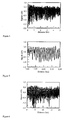
- Figures 6-11 show POTDR traces made in accordance with the present invention, for a single mode unspun (linear birefringent) fiber which has been embedded with fibers having different levels of PMD.
- the defective fibers had PMD values of 0.09 ps/sqrt (km) in Figure 6 , 0.22 ps/sqrt (km) in Figure 7 , and 0.49 ps/sqrt (km) in Figure 8 .
- Figures 9-11 show the VOS based on 500m sliding data windows.
- the fibers used to produce the data in Figures 6-8 are the same fibers used to produce the data in Figures 9-11 .
- the defective fibers are located from around 10km to 14km. All of the data illustrated in Figures 6-11 have had the effect of the attenuation removed, as discussed above. The measurements were conducted using a HP8147 OTDR (manufactured by Agilent Technologies located in California, USA) based POTDR with a 50ns pulse width and 25km fiber lengths. As can be clearly seen in Figures 6-8 , as the defect PMD level increases, the range of variation in signal drops, and the defect portion is clearly seen against the normal hosting fibers. This visual observation is perhaps better gauged by generating VOS as shown in Figures 9-11 . The VOS drops when the PMD of the defective fiber goes up.
- the fibers used in Figures 6-11 above employ spliced-in fiber sections having known PMD defects.
- the data were obtained with 100ns OTDR pulse width.
- the processed POTDR data for this fiber shown in Figure 12 , illustrates that the PMD quality of this fiber is highly non-uniform. This is confirmed by the VOS plot in Figure 13 , which plots both the VOS data and actual measured PMD data.
- the threshold can be found by setting a VOS threshold level below which the fibers have failing values, and above which fibers have passing values.
- the threshold for VOS might be set to be 0.15, which in the case of this particular fiber, corresponds to a PMD threshold of about 0.15ps/sqrt(km). In other words, below the VOS threshold of 0.15dB, the fiber PMD will be higher than 0.15 ps/sqrt(km).
- Eq.(12) provides us with insight to several important features.
- the first term in the right hand side of Eq.(12) (5log(P SO )) is related to the OTDR launching power and fiber type. When the measurement is conducted in one type of fiber, this term does not have position dependence. Thus, it only provides an overall offset to the POTDR signals. In addition, we also find that when the launching power is changed from one measurement to another measurement, the only effect is an offset of the overall signals. The variation of the POTDR signals does not scale with the launching power. This feature simplifies the whole measurement procedures because no special care is needed when the launching power is changed from one measurement to another.
- the second term 10 ln 10 ⁇ ⁇ z describes the fiber attenuation.
- the total POTDR signals in log scale is a straight line of negative slope with the polarization information embedded in the local fluctuation of the POTDR signals.
- the procedure described above to remove the straight line with the help of linear regression essentially remove this second term in Eq.(12) which is due to attenuation effects.
- the third term (5log(P n (z)) carries the polarization information and is position dependent. Thus when processed POTDR signals are obtained as shown in Figure 4 , they are essentially due to the third term in Eq. (12), which only describes the polarization effect.
- An OTDR pulse has a finite pulse width.
- the smallest pulse width available in commercial OTDRs is in the order of 5ns, or roughly 1m physical length D within the fiber.
- Different portions of the optical pulse exhibit different states of polarization in the fiber.
- the detector sees light returning from location L and L-D/2.
- the detector actually sees averaged polarization information over the length of D/2. More averaging happens when fiber has larger birefringence or PMD as more state of polarization variations occur within one optical pulse. This results in reduced variation of POTDR signals as illustrated in the VOS obtained in Figures 10 or 11 for the portion of fiber which exhibit elevated PMD.
- the detector signals with such averaging can be mathematically described.
- ROV range of variation
- ROV is similar to VOS in that they both gauge the degree of variations in POTDR signals.
- the choice of ROV here is for the convenience of obtaining a simple analytical equation.
- ROV and VOS should only be different by a constant factor.
- Figure 14 we show the ROV as a function of fiber beatlength for a fixed OTDR pulse width (50ns or 10m physical pulse width). It can be seen that when fiber beatlength increases and the fiber has decreased PMD, the ROV and thus VOS have increased values, which agrees with the experimental data obtained.
- the method and procedures established above are particularly effective to screen fibers having PMD values above 0.05 ps/sqrt (km).
- most of the fiber manufacturers specify a maximum allowable fiber PMD value, which is in the range of 0.1 to 0.3 ps/sqrt (km).
- the process in accordance with the invention is very useful for screening the PMD quality of manufactured fibers.
- Fiber winding conditions can have an effect on the PMD screening techniques described herein.
- the fibers used for the screening are typically wound on shipping reels having radius as small as 10cm or less. Even for fibers with zero PMD in its straight condition, the bending and tension induced PMD can be at around 0.04ps/sqrt (km) or above. Thus the screening threshold can not be arbitrarily lowered for such a winding condition. It is only possible when fibers are wound in spools with larger diameters.
- pulse widths which range from 5 nanoseconds to 20 microseconds for the PMD screening process established in the invention
- preferred pulse widths range from about 5ns to 200ns, more preferably from about 30ns to 150ns, and most preferably from about 50ns to 100ns. Excessively large pulse widths can become less effective for PMD screening due to significant polarization averaging within one optical pulse.
- the method of the present invention not only has utility for measuring PMD on linear birefringent (unspun) fibers, but also spun fibers as well.
- spun fibers the evolution of the state of polarization is more complicated than in the case of unspun fibers, as the change of state of polarization spatially has been modulated by the intentionally introduced periodic spinning.
- Spinning is used in the fiber making process to effectively reduce the PMD in fibers with controlled mode coupling.
- the VOS remains a key gauge of the local birefringence and thus PMD in fibers. More averaging occurs for a fixed OTDR pulse width if the birefringence of spun fiber in certain region is higher than another region.
- FIG 15 a POTDR trace (100ns pulse width) was obtained from a sample of a conventionally manufactured fiber which was spun to reduce PMD. A short piece of fibers with elevated PMD value (0.13ps/sqrt (km) was embedded in the middle of longer host fiber having the typical low PMD value (0.02ps/sqrt (km)).
- Figure 16 illustrates a VOS POTDR trace on the same data illustrated in Figure 15 . The reduction of variation of signals is clearly seen in Figure 15 and Figure 16. Similar testing has been conducted in a much larger set of fiber samples with defect fiber at different level of PMD, and data are consistent with the observation in Figure 15 and Figure 16.
Landscapes
- Physics & Mathematics (AREA)
- General Physics & Mathematics (AREA)
- Spectroscopy & Molecular Physics (AREA)
- Optics & Photonics (AREA)
- Chemical & Material Sciences (AREA)
- Analytical Chemistry (AREA)
- Testing Of Optical Devices Or Fibers (AREA)
- Investigating Or Analysing Materials By Optical Means (AREA)
Claims (9)
- Verfahren zum Messen der Polarisationsmodendispersion in einem Lichtwellenleiter, umfassend:Senden eines Strahlungsimpulses unter Verwendung eines Geräts zum Messen der optischen Zeitbereichsreflektometrie, eines ODTR-Geräts (10), in einen Lichtwellenleiter (12), wobei die Strahlung polarisiert ist, wobei der Impuls eine Impulsbreite zwischen 5 Nanosekunden und 20 Mikrosekunden aufweist;Messen mit dem OTDR-Gerät (10) der Strahlung, die von dem Impuls durch den Lichtwellenleiter (12) zurückgestreut wird, wobei die zurückgestreute Strahlung durch eine Polarisationsanalysekomponente (18) geführt wird, bevor die zurückgestreute Strahlung das OTDR-Gerät (10) erreicht;Analysieren der Variation des Intensitätswerts der gemessenen zurückgestreuten Strahlung unter Verwendung eines Datenzeitfensters, in dem eine Standardabweichung als Messgröße für die Variation des Intensitätswerts über das Fenster berechnet wird, und Bewegen des Datenfensters der Länge nach entlang der Länge des Lichtwellenleiters (12), um eine Datenmenge zu erzeugen, die als Signalvariation (VOS) bezeichnet wird, im Verhältnis zu der lokalen Standardabweichung entlang der Länge des Lichtwellenleiters (12); undBestimmen des Werts der lokalen Polarisationsmodendispersion in dem Lichtwellenleiter (12) entlang dessen Länge auf der Basis der Signalvariation (VOS).
- Verfahren nach Anspruch 1, wobei die Variation des Intensitätswerts verwendet wird, um zu bestimmen, ob eine Region entlang der Länge des Lichtwellenleiters (12) PMD aufweist, die oberhalb eines vorbestimmten PMD-Schwellenwerts liegt.
- Verfahren nach Anspruch 1, wobei der Schritt des Analysierens das Kompilieren der Signalvariation (VOS) für eine Mehrzahl von Lichtwellenleitern mit unterschiedlichen PMD-Werten umfasst, und wobei die Signalvariation abgebildet wird im Vergleich zu den Polarisationsmodendispersionswerten für die Lichtwellenleiter;
und wobei ein Signalvariationswert ausgewählt wird, unter oder über dem der Lichtwellenleiter verläuft oder einen Fehler aufweist. - Verfahren nach Anspruch 1, wobei die Impulsstrahlung in dem Schritt des Emittierens eine Impulsbreite zwischen etwa 5 und 200 ns umfasst.
- Verfahren nach Anspruch 1, ferner umfassend Screening-Fasern, die auf Shippling-Spulen mit einem Radius von 10 cm oder weniger gewickelt sind, um einen höchstzulässigen Faser-PMD-Wert von nicht mehr als 0,2 ps/√km zu gewährleisten.
- Verfahren nach Anspruch 1, ferner umfassend Screening-Fasern, die auf Shippling-Spulen mit einem Radius von 10 cm oder weniger gewickelt sind, um einen höchstzulässigen Faser-PMD-Wert von nicht mehr als 0,1 ps/√km zu gewährleisten.
- Verfahren nach Anspruch 1, wobei das Datenzeitfenster zwischen 500 und 1000 Metern beträgt.
- Verfahren nach Anspruch 1, wobei die Standardabweichung im logarithmischen Maßstab berechnet wird.
- Verfahren nach einem der vorstehenden Ansprüche, wobei jede Faser eine Spinnfaser ist.
Applications Claiming Priority (3)
| Application Number | Priority Date | Filing Date | Title |
|---|---|---|---|
| US287995 | 1994-08-09 | ||
| US10/287,995 US6946646B2 (en) | 2002-11-05 | 2002-11-05 | Method of evaluating fiber PMD using polarization optical time domain reflectometry |
| PCT/US2003/034479 WO2004045113A2 (en) | 2002-11-05 | 2003-10-28 | Method of evaluating fiber pmd using polarization optical time domain reflectometry |
Publications (2)
| Publication Number | Publication Date |
|---|---|
| EP1558905A2 EP1558905A2 (de) | 2005-08-03 |
| EP1558905B1 true EP1558905B1 (de) | 2015-07-15 |
Family
ID=32175805
Family Applications (1)
| Application Number | Title | Priority Date | Filing Date |
|---|---|---|---|
| EP03778001.2A Expired - Lifetime EP1558905B1 (de) | 2002-11-05 | 2003-10-28 | Verfahren zur auswertung einer optischen faser durch reflexionsmessung polarisierter optischer wellen im zeitbereich |
Country Status (6)
| Country | Link |
|---|---|
| US (1) | US6946646B2 (de) |
| EP (1) | EP1558905B1 (de) |
| JP (1) | JP2006505791A (de) |
| KR (1) | KR20050084946A (de) |
| AU (1) | AU2003286788A1 (de) |
| WO (1) | WO2004045113A2 (de) |
Families Citing this family (22)
| Publication number | Priority date | Publication date | Assignee | Title |
|---|---|---|---|---|
| ES2394497T3 (es) * | 2003-09-19 | 2013-02-01 | Prysmian S.P.A. | Procedimiento y aparato mejorados para la evaluación de la dispersión del modo de polarización en fibras ópticas |
| US7292322B2 (en) * | 2003-12-29 | 2007-11-06 | At&T Corp. | Method for increasing accuracy of measurement of mean polarization mode dispersion |
| US7440087B2 (en) * | 2004-02-24 | 2008-10-21 | Luna Innovations Incorporated | Identifying optical fiber segments and determining characteristics of an optical device under test based on fiber segment scatter pattern data |
| JP4791010B2 (ja) * | 2004-06-30 | 2011-10-12 | 株式会社フジクラ | 光ケーブル化後の光ファイバの偏波モード分散の測定方法 |
| US7772541B2 (en) * | 2004-07-16 | 2010-08-10 | Luna Innnovations Incorporated | Fiber optic position and/or shape sensing based on rayleigh scatter |
| US7781724B2 (en) * | 2004-07-16 | 2010-08-24 | Luna Innovations Incorporated | Fiber optic position and shape sensing device and method relating thereto |
| US7142737B1 (en) * | 2005-01-12 | 2006-11-28 | Network Integrity Systems Inc. | Intrusion detection system for use on single mode optical fiber using a storage register for data |
| JP4781746B2 (ja) * | 2005-04-14 | 2011-09-28 | 株式会社フジクラ | 光ファイバの複屈折測定方法及び測定装置及び光ファイバの偏波モード分散測定方法 |
| US7164469B1 (en) * | 2005-06-30 | 2007-01-16 | Corning Incorporated | Method of evaluating fiber PMD using composite POTDR trace |
| US7190442B1 (en) * | 2005-08-31 | 2007-03-13 | Corning Incorporated | Method of evaluating fiber PMD using POTDR trace |
| US20100073667A1 (en) * | 2007-03-28 | 2010-03-25 | Normand Cyr | Method and Apparatus for Determining Differential Group Delay and Polarization Mode Dispersion |
| US9829429B2 (en) | 2005-09-29 | 2017-11-28 | Exfo Inc | Determining a polarization-related characteristic of an optical link |
| CA2619719A1 (en) * | 2005-09-29 | 2007-04-05 | Exfo Electro-Optical Engineering Inc. | Polarization optical time domain reflectometer and method of determining pmd |
| US20080100828A1 (en) * | 2005-09-29 | 2008-05-01 | Normand Cyr | Polarization-sensitive optical time domain reflectometer and method for determining PMD |
| US7424194B2 (en) * | 2006-01-13 | 2008-09-09 | Corning Incorporated | Single polarization fiber and method of evaluating fiber cutoff wavelengths using optical time domain reflectometry |
| EP2035792B1 (de) * | 2006-06-16 | 2018-05-23 | Intuitive Surgical Operations, Inc. | Verteilte spannungs- und temperaturdiskrimination in polarisationserhaltender faser |
| JP4950613B2 (ja) * | 2006-10-06 | 2012-06-13 | アンリツ株式会社 | 光ファイバの偏波モード分散測定装置および測定方法 |
| US7999930B2 (en) * | 2008-10-07 | 2011-08-16 | Corning Incorporated | Detection system and optical fiber for use in such system |
| US8233760B2 (en) * | 2008-10-07 | 2012-07-31 | Corning Incorporated | Ultra low PMD fibers and method of making |
| JP5514503B2 (ja) * | 2009-10-16 | 2014-06-04 | 日本電信電話株式会社 | 偏光強度測定装置及び偏光強度測定方法 |
| CN113654764A (zh) * | 2021-07-05 | 2021-11-16 | 上海大学 | 一种保偏光纤拍长测量装置和测量方法 |
| CN118624182B (zh) * | 2024-08-09 | 2024-10-22 | 国网江西省电力有限公司信息通信分公司 | 空芯反谐振光纤检测方法及系统 |
Family Cites Families (10)
| Publication number | Priority date | Publication date | Assignee | Title |
|---|---|---|---|---|
| US5384635A (en) * | 1993-08-10 | 1995-01-24 | At&T Corp. | Remote sensing in optical fiber networks by synchronously detecting backscattered optical signals |
| US5479251A (en) | 1993-12-30 | 1995-12-26 | Corning Incorporated | Methods for determining optical properties of optical waveguide fibers using an optical time domain reflectometer |
| IT1291413B1 (it) * | 1997-02-13 | 1999-01-11 | Andrea Galtarossa | Strumento riflettometrico per la misura di birifrangenza distribuita in fibre ottiche monomodali |
| US5966207A (en) | 1997-08-18 | 1999-10-12 | Corning Incorporated | Methods for identifying optical fibers which exhibit elevated levels of polarization mode dispersion |
| DE19830729A1 (de) * | 1998-07-09 | 2000-01-20 | Deutsche Telekom Ag | Verfahren und Anordnung zur Durchführung von Kontroll- und Überwachungsmessungen an optischen Übertragungsstrecken |
| JP2000329651A (ja) * | 1999-05-19 | 2000-11-30 | Advantest Corp | 偏波モード分散測定装置 |
| JP2002048680A (ja) * | 2000-08-01 | 2002-02-15 | Anritsu Corp | 光ファイバの偏波モード分散分布測定方法及び装置 |
| US6724469B2 (en) * | 2002-03-15 | 2004-04-20 | Exfo Electro-Optical Engineering Inc. | Polarization-OTDR for measuring characteristics of optical fibers |
| WO2004010098A1 (ja) | 2002-07-19 | 2004-01-29 | Fujikura Ltd. | 光ファイバの偏波モード分散の測定方法及びその測定装置 |
| FR2844354B1 (fr) | 2002-09-05 | 2005-09-30 | Cit Alcatel | Procede de reflectometrie a onde optique polarisee (potdr) |
-
2002
- 2002-11-05 US US10/287,995 patent/US6946646B2/en not_active Expired - Lifetime
-
2003
- 2003-10-28 EP EP03778001.2A patent/EP1558905B1/de not_active Expired - Lifetime
- 2003-10-28 JP JP2004551628A patent/JP2006505791A/ja active Pending
- 2003-10-28 AU AU2003286788A patent/AU2003286788A1/en not_active Abandoned
- 2003-10-28 WO PCT/US2003/034479 patent/WO2004045113A2/en not_active Ceased
- 2003-10-28 KR KR1020057008005A patent/KR20050084946A/ko not_active Withdrawn
Also Published As
| Publication number | Publication date |
|---|---|
| US20040084611A1 (en) | 2004-05-06 |
| WO2004045113A2 (en) | 2004-05-27 |
| AU2003286788A1 (en) | 2004-06-03 |
| AU2003286788A8 (en) | 2004-06-03 |
| US6946646B2 (en) | 2005-09-20 |
| WO2004045113A3 (en) | 2004-07-08 |
| EP1558905A2 (de) | 2005-08-03 |
| JP2006505791A (ja) | 2006-02-16 |
| KR20050084946A (ko) | 2005-08-29 |
Similar Documents
| Publication | Publication Date | Title |
|---|---|---|
| US6946646B2 (en) | Method of evaluating fiber PMD using polarization optical time domain reflectometry | |
| Soller et al. | Polarization resolved measurement of Rayleigh backscatter in fiber-optic components | |
| JP4350380B2 (ja) | 光ファイバの後方散乱偏光分析 | |
| US9709460B2 (en) | Method and system for measuring an optical loss value of an optical fiber link | |
| US7190442B1 (en) | Method of evaluating fiber PMD using POTDR trace | |
| CA2107454A1 (en) | Optical time domain reflectometry measurements on a multi-branch optical network | |
| WO2023152468A1 (en) | Optical time domain reflectometry for hollow core optical fibres | |
| US7164469B1 (en) | Method of evaluating fiber PMD using composite POTDR trace | |
| Laferriere et al. | Reference guide to fiber optic testing | |
| Bogachkov et al. | Detection of sections with slightly changed optical characteristics in fiber optical communication lines | |
| JP2012505410A (ja) | 検出システム及びそのようなシステムに用いるための光ファイバ | |
| US12224794B2 (en) | Optical time-domain reflectometer (OTDR) event detection and light power level measurement-based fiber optic link certification | |
| EP1005637B1 (de) | Verfahren zum identifizieren von optischen fasern,die eine erhöhte polarisationsmoden-dispersion aufweisen | |
| US6930768B2 (en) | Detection of discontinuities in a multimode optical fiber | |
| US20060256319A1 (en) | Determination of an optical property of a DUT by OTDR measurement | |
| Sarma et al. | Accuracy Limits of Crosstalk Measurement Techniques for Weakly Coupled Multi-core Fibers | |
| JP2723661B2 (ja) | 光ファイバの破断予測方法 | |
| Gagnon | The Fundamentals of an OTDR | |
| Paschotta | Optical Time-domain Reflectometers | |
| Gawade et al. | Testing and Loss Measurement Techniques in Optical FIBER for Healthy Optical FIBER Communication | |
| Hmael | Bidirectional OTDR Testing: Multimode Vs Single mode fibers | |
| DRAGOMIR et al. | Field measurements on in-service optical fiber |
Legal Events
| Date | Code | Title | Description |
|---|---|---|---|
| PUAI | Public reference made under article 153(3) epc to a published international application that has entered the european phase |
Free format text: ORIGINAL CODE: 0009012 |
|
| 17P | Request for examination filed |
Effective date: 20050506 |
|
| AK | Designated contracting states |
Kind code of ref document: A2 Designated state(s): AT BE BG CH CY CZ DE DK EE ES FI FR GB GR HU IE IT LI LU MC NL PT RO SE SI SK TR |
|
| AX | Request for extension of the european patent |
Extension state: AL LT LV MK |
|
| DAX | Request for extension of the european patent (deleted) | ||
| RBV | Designated contracting states (corrected) |
Designated state(s): DE FR GB IT NL |
|
| RIN1 | Information on inventor provided before grant (corrected) |
Inventor name: HUNT, TIMOTHY, L Inventor name: CHEN, XIN Inventor name: STAINER, DARREN, A Inventor name: MOZDY, ERIC, J Inventor name: HERON, NICOL, A |
|
| RIN1 | Information on inventor provided before grant (corrected) |
Inventor name: MOZDY, ERIC, J Inventor name: CHEN, XIN Inventor name: HERON, NICOL, A Inventor name: HUNT, TIMOTHY, L Inventor name: STAINER, DARREN, A |
|
| 17Q | First examination report despatched |
Effective date: 20080728 |
|
| GRAP | Despatch of communication of intention to grant a patent |
Free format text: ORIGINAL CODE: EPIDOSNIGR1 |
|
| INTG | Intention to grant announced |
Effective date: 20150415 |
|
| GRAS | Grant fee paid |
Free format text: ORIGINAL CODE: EPIDOSNIGR3 |
|
| GRAA | (expected) grant |
Free format text: ORIGINAL CODE: 0009210 |
|
| AK | Designated contracting states |
Kind code of ref document: B1 Designated state(s): DE FR GB IT NL |
|
| REG | Reference to a national code |
Ref country code: GB Ref legal event code: FG4D |
|
| REG | Reference to a national code |
Ref country code: NL Ref legal event code: T3 |
|
| REG | Reference to a national code |
Ref country code: DE Ref legal event code: R096 Ref document number: 60347826 Country of ref document: DE |
|
| REG | Reference to a national code |
Ref country code: FR Ref legal event code: PLFP Year of fee payment: 13 |
|
| PGFP | Annual fee paid to national office [announced via postgrant information from national office to epo] |
Ref country code: IT Payment date: 20151026 Year of fee payment: 13 Ref country code: GB Payment date: 20151027 Year of fee payment: 13 |
|
| PGFP | Annual fee paid to national office [announced via postgrant information from national office to epo] |
Ref country code: FR Payment date: 20151019 Year of fee payment: 13 Ref country code: NL Payment date: 20151026 Year of fee payment: 13 |
|
| REG | Reference to a national code |
Ref country code: DE Ref legal event code: R097 Ref document number: 60347826 Country of ref document: DE |
|
| REG | Reference to a national code |
Ref country code: DE Ref legal event code: R119 Ref document number: 60347826 Country of ref document: DE |
|
| PLBE | No opposition filed within time limit |
Free format text: ORIGINAL CODE: 0009261 |
|
| STAA | Information on the status of an ep patent application or granted ep patent |
Free format text: STATUS: NO OPPOSITION FILED WITHIN TIME LIMIT |
|
| 26N | No opposition filed |
Effective date: 20160418 |
|
| PG25 | Lapsed in a contracting state [announced via postgrant information from national office to epo] |
Ref country code: DE Free format text: LAPSE BECAUSE OF NON-PAYMENT OF DUE FEES Effective date: 20160503 |
|
| REG | Reference to a national code |
Ref country code: NL Ref legal event code: MM Effective date: 20161101 |
|
| GBPC | Gb: european patent ceased through non-payment of renewal fee |
Effective date: 20161028 |
|
| REG | Reference to a national code |
Ref country code: FR Ref legal event code: ST Effective date: 20170630 |
|
| PG25 | Lapsed in a contracting state [announced via postgrant information from national office to epo] |
Ref country code: GB Free format text: LAPSE BECAUSE OF NON-PAYMENT OF DUE FEES Effective date: 20161028 Ref country code: FR Free format text: LAPSE BECAUSE OF NON-PAYMENT OF DUE FEES Effective date: 20161102 |
|
| PG25 | Lapsed in a contracting state [announced via postgrant information from national office to epo] |
Ref country code: NL Free format text: LAPSE BECAUSE OF NON-PAYMENT OF DUE FEES Effective date: 20161101 |
|
| PG25 | Lapsed in a contracting state [announced via postgrant information from national office to epo] |
Ref country code: IT Free format text: LAPSE BECAUSE OF NON-PAYMENT OF DUE FEES Effective date: 20161028 |