EP1558547B1 - Beschichtete karbonbremsscheibenmaterialien - Google Patents
Beschichtete karbonbremsscheibenmaterialien Download PDFInfo
- Publication number
- EP1558547B1 EP1558547B1 EP03772020A EP03772020A EP1558547B1 EP 1558547 B1 EP1558547 B1 EP 1558547B1 EP 03772020 A EP03772020 A EP 03772020A EP 03772020 A EP03772020 A EP 03772020A EP 1558547 B1 EP1558547 B1 EP 1558547B1
- Authority
- EP
- European Patent Office
- Prior art keywords
- brake disc
- carbon
- antioxidant
- brake
- carbon composite
- Prior art date
- Legal status (The legal status is an assumption and is not a legal conclusion. Google has not performed a legal analysis and makes no representation as to the accuracy of the status listed.)
- Expired - Lifetime
Links
- OKTJSMMVPCPJKN-UHFFFAOYSA-N Carbon Chemical compound [C] OKTJSMMVPCPJKN-UHFFFAOYSA-N 0.000 title claims abstract description 33
- 229910052799 carbon Inorganic materials 0.000 title claims abstract description 33
- 239000000463 material Substances 0.000 title description 9
- 239000002131 composite material Substances 0.000 claims abstract description 39
- 239000003963 antioxidant agent Substances 0.000 claims abstract description 32
- 230000003078 antioxidant effect Effects 0.000 claims abstract description 32
- 238000000576 coating method Methods 0.000 claims abstract description 19
- 229910000165 zinc phosphate Inorganic materials 0.000 claims abstract description 9
- 239000007836 KH2PO4 Substances 0.000 claims abstract description 7
- 239000008199 coating composition Substances 0.000 claims abstract description 7
- 229910000402 monopotassium phosphate Inorganic materials 0.000 claims abstract description 7
- GNSKLFRGEWLPPA-UHFFFAOYSA-M potassium dihydrogen phosphate Chemical compound [K+].OP(O)([O-])=O GNSKLFRGEWLPPA-UHFFFAOYSA-M 0.000 claims abstract description 7
- CPSYWNLKRDURMG-UHFFFAOYSA-L hydron;manganese(2+);phosphate Chemical compound [Mn+2].OP([O-])([O-])=O CPSYWNLKRDURMG-UHFFFAOYSA-L 0.000 claims abstract description 5
- 238000000034 method Methods 0.000 claims description 17
- 239000011248 coating agent Substances 0.000 claims description 12
- NBIIXXVUZAFLBC-UHFFFAOYSA-N Phosphoric acid Chemical compound OP(O)(O)=O NBIIXXVUZAFLBC-UHFFFAOYSA-N 0.000 claims description 9
- GWEVSGVZZGPLCZ-UHFFFAOYSA-N Titan oxide Chemical compound O=[Ti]=O GWEVSGVZZGPLCZ-UHFFFAOYSA-N 0.000 claims description 9
- 230000004580 weight loss Effects 0.000 claims description 8
- KGBXLFKZBHKPEV-UHFFFAOYSA-N boric acid Chemical compound OB(O)O KGBXLFKZBHKPEV-UHFFFAOYSA-N 0.000 claims description 7
- 239000010952 cobalt-chrome Substances 0.000 claims description 6
- 230000001590 oxidative effect Effects 0.000 claims description 4
- RGPUVZXXZFNFBF-UHFFFAOYSA-K diphosphonooxyalumanyl dihydrogen phosphate Chemical compound [Al+3].OP(O)([O-])=O.OP(O)([O-])=O.OP(O)([O-])=O RGPUVZXXZFNFBF-UHFFFAOYSA-K 0.000 claims description 2
- 229910000314 transition metal oxide Inorganic materials 0.000 claims 4
- 229910019142 PO4 Inorganic materials 0.000 abstract description 8
- 238000004519 manufacturing process Methods 0.000 abstract description 7
- JKWMSGQKBLHBQQ-UHFFFAOYSA-N diboron trioxide Chemical compound O=BOB=O JKWMSGQKBLHBQQ-UHFFFAOYSA-N 0.000 abstract description 5
- 239000011159 matrix material Substances 0.000 abstract description 4
- 239000004135 Bone phosphate Substances 0.000 abstract description 2
- 229910052783 alkali metal Inorganic materials 0.000 abstract description 2
- 150000001340 alkali metals Chemical class 0.000 abstract description 2
- 229910052810 boron oxide Inorganic materials 0.000 abstract description 2
- 230000003247 decreasing effect Effects 0.000 abstract description 2
- NBIIXXVUZAFLBC-UHFFFAOYSA-K phosphate Chemical compound [O-]P([O-])([O-])=O NBIIXXVUZAFLBC-UHFFFAOYSA-K 0.000 abstract description 2
- 239000010452 phosphate Substances 0.000 abstract description 2
- 235000019796 monopotassium phosphate Nutrition 0.000 abstract 1
- 229910052723 transition metal Inorganic materials 0.000 abstract 1
- 150000003624 transition metals Chemical class 0.000 abstract 1
- 239000000203 mixture Substances 0.000 description 19
- IUHFWCGCSVTMPG-UHFFFAOYSA-N [C].[C] Chemical class [C].[C] IUHFWCGCSVTMPG-UHFFFAOYSA-N 0.000 description 10
- 230000003647 oxidation Effects 0.000 description 10
- 238000007254 oxidation reaction Methods 0.000 description 10
- 239000011521 glass Substances 0.000 description 9
- XLYOFNOQVPJJNP-ZSJDYOACSA-N heavy water Substances [2H]O[2H] XLYOFNOQVPJJNP-ZSJDYOACSA-N 0.000 description 8
- 229920000049 Carbon (fiber) Polymers 0.000 description 6
- 239000004917 carbon fiber Substances 0.000 description 6
- VNWKTOKETHGBQD-UHFFFAOYSA-N methane Chemical compound C VNWKTOKETHGBQD-UHFFFAOYSA-N 0.000 description 6
- ZOXJGFHDIHLPTG-UHFFFAOYSA-N Boron Chemical compound [B] ZOXJGFHDIHLPTG-UHFFFAOYSA-N 0.000 description 5
- 229910052796 boron Inorganic materials 0.000 description 5
- CREMABGTGYGIQB-UHFFFAOYSA-N carbon carbon Chemical compound C.C CREMABGTGYGIQB-UHFFFAOYSA-N 0.000 description 5
- 239000011203 carbon fibre reinforced carbon Substances 0.000 description 5
- 238000009472 formulation Methods 0.000 description 5
- VYPSYNLAJGMNEJ-UHFFFAOYSA-N Silicium dioxide Chemical compound O=[Si]=O VYPSYNLAJGMNEJ-UHFFFAOYSA-N 0.000 description 4
- 229910000158 manganese(II) phosphate Inorganic materials 0.000 description 4
- 239000000049 pigment Substances 0.000 description 4
- 239000011148 porous material Substances 0.000 description 4
- 229920005989 resin Polymers 0.000 description 4
- 239000011347 resin Substances 0.000 description 4
- PXHVJJICTQNCMI-UHFFFAOYSA-N Nickel Chemical compound [Ni] PXHVJJICTQNCMI-UHFFFAOYSA-N 0.000 description 3
- KWYUFKZDYYNOTN-UHFFFAOYSA-M Potassium hydroxide Chemical compound [OH-].[K+] KWYUFKZDYYNOTN-UHFFFAOYSA-M 0.000 description 3
- 239000005385 borate glass Substances 0.000 description 3
- 150000001721 carbon Chemical class 0.000 description 3
- 239000000835 fiber Substances 0.000 description 3
- XPFVYQJUAUNWIW-UHFFFAOYSA-N furfuryl alcohol Chemical compound OCC1=CC=CO1 XPFVYQJUAUNWIW-UHFFFAOYSA-N 0.000 description 3
- 230000008595 infiltration Effects 0.000 description 3
- 238000001764 infiltration Methods 0.000 description 3
- 229910052760 oxygen Inorganic materials 0.000 description 3
- 239000002243 precursor Substances 0.000 description 3
- MCMNRKCIXSYSNV-UHFFFAOYSA-N Zirconium dioxide Chemical compound O=[Zr]=O MCMNRKCIXSYSNV-UHFFFAOYSA-N 0.000 description 2
- 229910052782 aluminium Inorganic materials 0.000 description 2
- QVGXLLKOCUKJST-UHFFFAOYSA-N atomic oxygen Chemical compound [O] QVGXLLKOCUKJST-UHFFFAOYSA-N 0.000 description 2
- 239000000919 ceramic Substances 0.000 description 2
- 239000003610 charcoal Substances 0.000 description 2
- 229910052681 coesite Inorganic materials 0.000 description 2
- 229910052906 cristobalite Inorganic materials 0.000 description 2
- 230000006866 deterioration Effects 0.000 description 2
- 229910052759 nickel Inorganic materials 0.000 description 2
- 239000001301 oxygen Substances 0.000 description 2
- 235000021317 phosphate Nutrition 0.000 description 2
- 229920002239 polyacrylonitrile Polymers 0.000 description 2
- 239000012266 salt solution Substances 0.000 description 2
- HBMJWWWQQXIZIP-UHFFFAOYSA-N silicon carbide Chemical compound [Si+]#[C-] HBMJWWWQQXIZIP-UHFFFAOYSA-N 0.000 description 2
- 229910010271 silicon carbide Inorganic materials 0.000 description 2
- 239000000377 silicon dioxide Substances 0.000 description 2
- 229910052682 stishovite Inorganic materials 0.000 description 2
- 239000000126 substance Substances 0.000 description 2
- 238000012360 testing method Methods 0.000 description 2
- 229910052905 tridymite Inorganic materials 0.000 description 2
- KXGFMDJXCMQABM-UHFFFAOYSA-N 2-methoxy-6-methylphenol Chemical compound [CH]OC1=CC=CC([CH])=C1O KXGFMDJXCMQABM-UHFFFAOYSA-N 0.000 description 1
- 229910052582 BN Inorganic materials 0.000 description 1
- PZNSFCLAULLKQX-UHFFFAOYSA-N Boron nitride Chemical compound N#B PZNSFCLAULLKQX-UHFFFAOYSA-N 0.000 description 1
- OYPRJOBELJOOCE-UHFFFAOYSA-N Calcium Chemical compound [Ca] OYPRJOBELJOOCE-UHFFFAOYSA-N 0.000 description 1
- 229910019114 CoAl2O4 Inorganic materials 0.000 description 1
- 239000004593 Epoxy Substances 0.000 description 1
- DGAQECJNVWCQMB-PUAWFVPOSA-M Ilexoside XXIX Chemical compound C[C@@H]1CC[C@@]2(CC[C@@]3(C(=CC[C@H]4[C@]3(CC[C@@H]5[C@@]4(CC[C@@H](C5(C)C)OS(=O)(=O)[O-])C)C)[C@@H]2[C@]1(C)O)C)C(=O)O[C@H]6[C@@H]([C@H]([C@@H]([C@H](O6)CO)O)O)O.[Na+] DGAQECJNVWCQMB-PUAWFVPOSA-M 0.000 description 1
- FUJCRWPEOMXPAD-UHFFFAOYSA-N Li2O Inorganic materials [Li+].[Li+].[O-2] FUJCRWPEOMXPAD-UHFFFAOYSA-N 0.000 description 1
- WHXSMMKQMYFTQS-UHFFFAOYSA-N Lithium Chemical compound [Li] WHXSMMKQMYFTQS-UHFFFAOYSA-N 0.000 description 1
- FYYHWMGAXLPEAU-UHFFFAOYSA-N Magnesium Chemical compound [Mg] FYYHWMGAXLPEAU-UHFFFAOYSA-N 0.000 description 1
- ZLMJMSJWJFRBEC-UHFFFAOYSA-N Potassium Chemical compound [K] ZLMJMSJWJFRBEC-UHFFFAOYSA-N 0.000 description 1
- 229910000831 Steel Inorganic materials 0.000 description 1
- HCHKCACWOHOZIP-UHFFFAOYSA-N Zinc Chemical compound [Zn] HCHKCACWOHOZIP-UHFFFAOYSA-N 0.000 description 1
- QCWXUUIWCKQGHC-UHFFFAOYSA-N Zirconium Chemical compound [Zr] QCWXUUIWCKQGHC-UHFFFAOYSA-N 0.000 description 1
- 239000000654 additive Substances 0.000 description 1
- 229910052784 alkaline earth metal Inorganic materials 0.000 description 1
- 150000001342 alkaline earth metals Chemical class 0.000 description 1
- XAGFODPZIPBFFR-UHFFFAOYSA-N aluminium Chemical compound [Al] XAGFODPZIPBFFR-UHFFFAOYSA-N 0.000 description 1
- 229910000147 aluminium phosphate Inorganic materials 0.000 description 1
- 238000000137 annealing Methods 0.000 description 1
- 239000002585 base Substances 0.000 description 1
- 150000001639 boron compounds Chemical class 0.000 description 1
- 239000011575 calcium Substances 0.000 description 1
- 229910052791 calcium Inorganic materials 0.000 description 1
- 238000010000 carbonizing Methods 0.000 description 1
- 230000003197 catalytic effect Effects 0.000 description 1
- 229910010293 ceramic material Inorganic materials 0.000 description 1
- 238000006243 chemical reaction Methods 0.000 description 1
- 238000001816 cooling Methods 0.000 description 1
- 238000000280 densification Methods 0.000 description 1
- XUCJHNOBJLKZNU-UHFFFAOYSA-M dilithium;hydroxide Chemical compound [Li+].[Li+].[OH-] XUCJHNOBJLKZNU-UHFFFAOYSA-M 0.000 description 1
- 239000002783 friction material Substances 0.000 description 1
- 238000007496 glass forming Methods 0.000 description 1
- 238000005087 graphitization Methods 0.000 description 1
- 238000010438 heat treatment Methods 0.000 description 1
- 238000005470 impregnation Methods 0.000 description 1
- 238000010348 incorporation Methods 0.000 description 1
- 239000011261 inert gas Substances 0.000 description 1
- 229910052500 inorganic mineral Inorganic materials 0.000 description 1
- 150000002500 ions Chemical class 0.000 description 1
- 229910000464 lead oxide Inorganic materials 0.000 description 1
- 230000000670 limiting effect Effects 0.000 description 1
- 239000007788 liquid Substances 0.000 description 1
- 239000012705 liquid precursor Substances 0.000 description 1
- 229910052744 lithium Inorganic materials 0.000 description 1
- 239000011777 magnesium Substances 0.000 description 1
- 229910052749 magnesium Inorganic materials 0.000 description 1
- WPBNNNQJVZRUHP-UHFFFAOYSA-L manganese(2+);methyl n-[[2-(methoxycarbonylcarbamothioylamino)phenyl]carbamothioyl]carbamate;n-[2-(sulfidocarbothioylamino)ethyl]carbamodithioate Chemical compound [Mn+2].[S-]C(=S)NCCNC([S-])=S.COC(=O)NC(=S)NC1=CC=CC=C1NC(=S)NC(=O)OC WPBNNNQJVZRUHP-UHFFFAOYSA-L 0.000 description 1
- 229910044991 metal oxide Inorganic materials 0.000 description 1
- 150000004706 metal oxides Chemical class 0.000 description 1
- 239000011707 mineral Substances 0.000 description 1
- 238000000465 moulding Methods 0.000 description 1
- 229920003986 novolac Polymers 0.000 description 1
- 239000007800 oxidant agent Substances 0.000 description 1
- MOWNZPNSYMGTMD-UHFFFAOYSA-N oxidoboron Chemical class O=[B] MOWNZPNSYMGTMD-UHFFFAOYSA-N 0.000 description 1
- 229920001568 phenolic resin Polymers 0.000 description 1
- 239000005011 phenolic resin Substances 0.000 description 1
- 239000005365 phosphate glass Substances 0.000 description 1
- 150000003013 phosphoric acid derivatives Chemical class 0.000 description 1
- 229910001392 phosphorus oxide Inorganic materials 0.000 description 1
- LFGREXWGYUGZLY-UHFFFAOYSA-N phosphoryl Chemical class [P]=O LFGREXWGYUGZLY-UHFFFAOYSA-N 0.000 description 1
- 229910052700 potassium Inorganic materials 0.000 description 1
- 239000011591 potassium Substances 0.000 description 1
- 238000002360 preparation method Methods 0.000 description 1
- 239000011253 protective coating Substances 0.000 description 1
- 239000011819 refractory material Substances 0.000 description 1
- 230000000717 retained effect Effects 0.000 description 1
- 229910052701 rubidium Inorganic materials 0.000 description 1
- IGLNJRXAVVLDKE-UHFFFAOYSA-N rubidium atom Chemical compound [Rb] IGLNJRXAVVLDKE-UHFFFAOYSA-N 0.000 description 1
- 239000005368 silicate glass Substances 0.000 description 1
- LIVNPJMFVYWSIS-UHFFFAOYSA-N silicon monoxide Chemical class [Si-]#[O+] LIVNPJMFVYWSIS-UHFFFAOYSA-N 0.000 description 1
- 229910052814 silicon oxide Inorganic materials 0.000 description 1
- 229910052708 sodium Inorganic materials 0.000 description 1
- 239000011734 sodium Substances 0.000 description 1
- 239000010959 steel Substances 0.000 description 1
- 239000004753 textile Substances 0.000 description 1
- 229910052720 vanadium Inorganic materials 0.000 description 1
- LEONUFNNVUYDNQ-UHFFFAOYSA-N vanadium atom Chemical compound [V] LEONUFNNVUYDNQ-UHFFFAOYSA-N 0.000 description 1
- 230000000007 visual effect Effects 0.000 description 1
- XLYOFNOQVPJJNP-UHFFFAOYSA-N water Substances O XLYOFNOQVPJJNP-UHFFFAOYSA-N 0.000 description 1
- 230000003313 weakening effect Effects 0.000 description 1
- 239000002759 woven fabric Substances 0.000 description 1
- 229910052725 zinc Inorganic materials 0.000 description 1
- 239000011701 zinc Substances 0.000 description 1
- 229910052726 zirconium Inorganic materials 0.000 description 1
Images
Classifications
-
- C—CHEMISTRY; METALLURGY
- C04—CEMENTS; CONCRETE; ARTIFICIAL STONE; CERAMICS; REFRACTORIES
- C04B—LIME, MAGNESIA; SLAG; CEMENTS; COMPOSITIONS THEREOF, e.g. MORTARS, CONCRETE OR LIKE BUILDING MATERIALS; ARTIFICIAL STONE; CERAMICS; REFRACTORIES; TREATMENT OF NATURAL STONE
- C04B41/00—After-treatment of mortars, concrete, artificial stone or ceramics; Treatment of natural stone
- C04B41/009—After-treatment of mortars, concrete, artificial stone or ceramics; Treatment of natural stone characterised by the material treated
-
- C—CHEMISTRY; METALLURGY
- C04—CEMENTS; CONCRETE; ARTIFICIAL STONE; CERAMICS; REFRACTORIES
- C04B—LIME, MAGNESIA; SLAG; CEMENTS; COMPOSITIONS THEREOF, e.g. MORTARS, CONCRETE OR LIKE BUILDING MATERIALS; ARTIFICIAL STONE; CERAMICS; REFRACTORIES; TREATMENT OF NATURAL STONE
- C04B41/00—After-treatment of mortars, concrete, artificial stone or ceramics; Treatment of natural stone
- C04B41/45—Coating or impregnating, e.g. injection in masonry, partial coating of green or fired ceramics, organic coating compositions for adhering together two concrete elements
- C04B41/50—Coating or impregnating, e.g. injection in masonry, partial coating of green or fired ceramics, organic coating compositions for adhering together two concrete elements with inorganic materials
- C04B41/5076—Coating or impregnating, e.g. injection in masonry, partial coating of green or fired ceramics, organic coating compositions for adhering together two concrete elements with inorganic materials with masses bonded by inorganic cements
- C04B41/5092—Phosphate cements
-
- C—CHEMISTRY; METALLURGY
- C04—CEMENTS; CONCRETE; ARTIFICIAL STONE; CERAMICS; REFRACTORIES
- C04B—LIME, MAGNESIA; SLAG; CEMENTS; COMPOSITIONS THEREOF, e.g. MORTARS, CONCRETE OR LIKE BUILDING MATERIALS; ARTIFICIAL STONE; CERAMICS; REFRACTORIES; TREATMENT OF NATURAL STONE
- C04B41/00—After-treatment of mortars, concrete, artificial stone or ceramics; Treatment of natural stone
- C04B41/80—After-treatment of mortars, concrete, artificial stone or ceramics; Treatment of natural stone of only ceramics
- C04B41/81—Coating or impregnation
- C04B41/85—Coating or impregnation with inorganic materials
-
- F—MECHANICAL ENGINEERING; LIGHTING; HEATING; WEAPONS; BLASTING
- F16—ENGINEERING ELEMENTS AND UNITS; GENERAL MEASURES FOR PRODUCING AND MAINTAINING EFFECTIVE FUNCTIONING OF MACHINES OR INSTALLATIONS; THERMAL INSULATION IN GENERAL
- F16D—COUPLINGS FOR TRANSMITTING ROTATION; CLUTCHES; BRAKES
- F16D69/00—Friction linings; Attachment thereof; Selection of coacting friction substances or surfaces
- F16D69/02—Composition of linings ; Methods of manufacturing
-
- F—MECHANICAL ENGINEERING; LIGHTING; HEATING; WEAPONS; BLASTING
- F16—ENGINEERING ELEMENTS AND UNITS; GENERAL MEASURES FOR PRODUCING AND MAINTAINING EFFECTIVE FUNCTIONING OF MACHINES OR INSTALLATIONS; THERMAL INSULATION IN GENERAL
- F16D—COUPLINGS FOR TRANSMITTING ROTATION; CLUTCHES; BRAKES
- F16D69/00—Friction linings; Attachment thereof; Selection of coacting friction substances or surfaces
- F16D69/02—Composition of linings ; Methods of manufacturing
- F16D69/023—Composite materials containing carbon and carbon fibres or fibres made of carbonizable material
-
- C—CHEMISTRY; METALLURGY
- C04—CEMENTS; CONCRETE; ARTIFICIAL STONE; CERAMICS; REFRACTORIES
- C04B—LIME, MAGNESIA; SLAG; CEMENTS; COMPOSITIONS THEREOF, e.g. MORTARS, CONCRETE OR LIKE BUILDING MATERIALS; ARTIFICIAL STONE; CERAMICS; REFRACTORIES; TREATMENT OF NATURAL STONE
- C04B2111/00—Mortars, concrete or artificial stone or mixtures to prepare them, characterised by specific function, property or use
- C04B2111/00241—Physical properties of the materials not provided for elsewhere in C04B2111/00
- C04B2111/00362—Friction materials, e.g. used as brake linings, anti-skid materials
-
- F—MECHANICAL ENGINEERING; LIGHTING; HEATING; WEAPONS; BLASTING
- F16—ENGINEERING ELEMENTS AND UNITS; GENERAL MEASURES FOR PRODUCING AND MAINTAINING EFFECTIVE FUNCTIONING OF MACHINES OR INSTALLATIONS; THERMAL INSULATION IN GENERAL
- F16D—COUPLINGS FOR TRANSMITTING ROTATION; CLUTCHES; BRAKES
- F16D2250/00—Manufacturing; Assembly
- F16D2250/0038—Surface treatment
-
- Y—GENERAL TAGGING OF NEW TECHNOLOGICAL DEVELOPMENTS; GENERAL TAGGING OF CROSS-SECTIONAL TECHNOLOGIES SPANNING OVER SEVERAL SECTIONS OF THE IPC; TECHNICAL SUBJECTS COVERED BY FORMER USPC CROSS-REFERENCE ART COLLECTIONS [XRACs] AND DIGESTS
- Y10—TECHNICAL SUBJECTS COVERED BY FORMER USPC
- Y10T—TECHNICAL SUBJECTS COVERED BY FORMER US CLASSIFICATION
- Y10T428/00—Stock material or miscellaneous articles
- Y10T428/24—Structurally defined web or sheet [e.g., overall dimension, etc.]
- Y10T428/24942—Structurally defined web or sheet [e.g., overall dimension, etc.] including components having same physical characteristic in differing degree
- Y10T428/24992—Density or compression of components
Definitions
- This invention relates to the manufacture of carbon-carbon brake discs. More particularly, this invention relates to brake discs which are coated with antioxidant compositions during the course of their preparation for use in braking systems.
- Carbon-carbon brake discs are widely used on commercial and military aircraft. Wide-bodied commercial jets required improved brake materials because traditional steel brake systems simply could not absorb all of the thermal energy created during stops associated with landings. Carbon-based composites were developed which provide heat capacity, thermal conductivity, and thermal strength able to meet the demanding conditions involved in landing big jets. On the military side, the lower weights as well as the thermal and strength properties of the carbon composites has helped to ensure their acceptance in brake applications.
- carbon-carbon composite materials including brake friction materials
- One commonly used production method comprises molding a carbon fiber composite with a carbonizable resin, e.g. a phenolic resin, carbonizing the composite "preform", and then densifying the resulting porous material using chemical vapor infiltration (CVI) and/or resin impregnation processes.
- Another method comprises building up a fiber preform with textile materials and subsequently densifying the preform using a CVI process.
- Different structural types of carbon (graphitic, glassy, and pyrolytic) comprise the brake disc, which is somewhat porous. Further densification can be accomplished with, e.g., furfuryl alcohol infiltration or through incorporation into the carbon matrix of ceramic additives via infiltration with colloidal ceramics and their subsequent conversion to refractory materials.
- Carbon-carbon brake disc friction performance is dictated by the carbon microstructure which arises from the manner in which the brake disc is manufactured.
- the amount of graphitization, for instance, can dramatically affect frictional and wear properties.
- Overall brake performance is particularly affected by the individual components, including fibers and types of matrix materials, at the friction surface.
- Exterior surfaces of carbon-carbon composites are therefore sometimes coated with a ceramic material such as silicon carbide to prevent entry of oxidizing agents such, as molecular or ionic oxygen from the atmosphere, into the carbon-carbon composites.
- Silicon carbide and other antioxidant coatings are described in detail in US 4,837,073 .
- the exterior surfaces of carbon-carbon composites may be, alternatively, coated with a glass-forming seal coat such as a boron or boron/zirconium substance. Borate glasses have also been used from the protection of carbon-carbon composites against oxidation.
- US 5,208,099 describes antioxidant coatings that are formed from a SiO 2 -B 2 O 3 gel and/or sol having a SiO 2 :B 2 O 3 molar composition of 60-85:40-15.
- Borate glass antioxidant compositions are moisture-resistant and oxidation-resistant coatings composed of 40-80 weight-% B 2 O 3 , 5-30 weight-% SiO 2 , 7-20 weight-% Li 2 O, and 7-10 weight-% ZrO 2 are described in detail in US 5,298,31 1 .
- WO 00/51950 relates to carbon fiber or C-C composites that are useful in a variety of applications. Golecki teaches methods of protecting such composites against oxidation by coating them with fluidized-glass type mixtures.
- the fluidized-glass mixtures are maintained as liquid precursors and are applied to components formed of carbon fiber or C-C composites. Once coated with the precursors, the coated C-C components are heat-treated or annealed for one or more cycles through a series of gradual heating and cooling steps. This creates glass coatings having thicknesses of about 1-10 mils. The thicknesses of the glass coatings may be varied by varying the composition of the fluidized glass precursor mixtures, the number of application cycles, and/or the annealing parameters.
- the fluidized glass materials may comprise such materials as borate glasses (boron oxides), phosphate glasses (phosphorus oxides), silicate glasses (silicon oxides), and plumbate glasses (lead oxides).
- These glasses may include phosphates of manganese, nickel, vanadium, aluminum, and zinc, and/or alkaline and alkaline earth metals such as lithium, sodium, potassium, rubidium, magnesium, and calcium and their oxides, and elemental boron and/or boron compounds such as BN, B 4 C, B 2 O 3 , and H 3 BO 3 .
- Golecki discloses a boron-containing liquid fluidized glass precursor mixture that includes 29 weight-% phosphoric acid, 2 weight-% manganese phosphate, 3 weight-% potassium hydroxide, 1 weight-% boron nitride, 10 weight-% boron, and 55 weight-% water.
- WO 01/60763 (Walker and Booker ) likewise relates to carbon-carbon composites and graphitic materials.
- the Walker and Booker application has as objectives the protection of carbon-carbon composites or graphites at elevated temperatures up to and exceeding 850°C (1 562°F) and the reduction of catalytic oxidation at normal operating temperatures. Walker and Booker achieve these objectives by employing a penetrant salt solution which contains ions formed from 10-80 wt% H 2 O, 20-70 wt% H 3 PO 4 , 0.1-25 wt% alkali metal mono-, di-, or tri-basic phosphate, and up to 2 wt% B 2 O 3 .
- Their penetrant salt solutions also include at least one of MnHPO 4 ⁇ 1.6H 2 O, Al(H 2 PO 4 ) 3 , and Zn 3 (PO 4 ) 2 , in weight-percentages up to 25 wt%, 30 wt%, and 10 wt%, respectively.
- the present invention provides, in one embodiment, a brake disc comprising a carbon composite body, wherein the surface of the brake disc is at least partially covered by a layer of an antioxidant composition that is readily visible even after charring.
- the brake disc of the present invention may be processed, before being incorporated into a brake system, to remove antioxidant composition that covers the working surface of the disc.
- Another embodiment of the present invention is an antioxidant coating composition that is made up of from 20-25 wt% H 2 O, 40-45 wt% H 3 PO 4 , 10-15 wt% aluminum dihydrogen phosphate, 1-2 wt% H 3 BO 3 , 8-12 wt% KH 2 PO 4 , 2-5 wt% hydrated manganese phosphate, 2-5 wt% Zn 3 (PO 4 ) 2 , and 4-7 wt% of either TiO 2 or CoCr 2 O 4 , with the latter being especially preferred.
- This invention also provides a brake disc comprising a carbon composite article, the surface of the article is treated with the antioxidant coating composition.
- This invention provides, in another of its aspects, methods for protecting carbon composite friction articles against oxidative weight loss by treating the surface of the article with the antioxidant coating composition. These methods of the invention may include preliminary steps of configuring carbon composite friction articles as a brake discs, and subsequent steps of removing antioxidant coating from working surfaces of the brake discs.
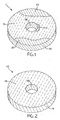
- Figure 1 illustrates a brake disc in accordance with the present invention.
- Figure 2 illustrates a brake disc that has been manufactured from a brake disc of the present invention.
- the present invention provides a brake disc comprising a carbon composite body.
- Methods of manufacturing carbon-carbon composites configured as brake discs are well known in industry, as discussed hereinbelow.
- the surface of carbon composite body in accordance with this invention has been treated with a coating that protects the carbon composite against oxidative weight loss, that does not abrogate friction properties of the composite, and that remains visible after charring.
- the feature "protection against oxidative weight loss” does not indicate absolute protection against any weight loss, but instead indicates reduction in weight loss as compared to an otherwise identical carbon composite that is not coated. For instance, after oxidation for 24 hours at 649°C (1200°F), weigh losses of up to 5% would be acceptable, with weight losses of not more than approximately 1.5% being preferred. Likewise, after oxidation for 6 hours at 871°C (1600°F), weigh losses of up to 20% would be acceptable, with weight losses of not more than approximately 15% being preferred.
- no abrogation of friction properties does not indicate absolute protection against any deterioration in friction properties due to the presence of a coating on the carbon composite body, but instead indicates no substantial deterioration of friction properties as compared to comparable coated carbon composite bodies. For instance, where a dynamometer test shows a brake efficiency for uncoated samples of approximately 0.3, samples coated with an un-enhanced antioxidant composition (that is, not in accordance with this invention) have a brake efficiency of approximately 0.2 and samples coated with an enhanced antioxidant composition in accordance with this invention likewise have a brake efficiency of approximately 0.2.
- visible after charring indicates that the coatings in accordance with the present invention are readily discernable by the naked eye of a (non-color blind) human observer. Visibility of a coating after charring is a function both of the difference in color between the charred coating and uncoated portions of the (normally charcoal gray) carbon composite body and of the spatial density of the charred colored mineral that remains on the coated surfaces. It generally cannot be predicted in advance what metal oxides will provide visual enhancement of coated carbon composites in accordance with the present invention.
- the working surface of the brake disc may be partially covered by a layer of antioxidant composition containing a visible pigment.
- the terminology "working surface of the brake disc” refers to that portion of the brake disc that frictionally engages with a brake pad during a braking operation.
- the "working surface" of the brake disc should present the maximum possible frictional properties to the brake pad. Accordingly, the present invention contemplates processing the brake disc, before incorporating it into a brake system, to remove the layer of antioxidant composition from the working surface of the disc. This antioxidant layer removal step, for example utilizing a sanding procedure, is facilitated by the presence of visible pigments in the antioxidant layer.
- This antioxidant layer removal step for example utilizing a sanding procedure, is facilitated by the presence of visible pigments in the antioxidant layer.
- visible pigments due to the high temperature and friction demands of brake disc applications, especially jet aircraft brake disc applications, only certain visible pigments will be suitable in this context. The present application describes how such pigments can be selected.
- Carbon-carbon composites are generally prepared from carbon preforms.
- Carbon preforms are made of carbon fibers, formed for instance of pre-oxidized polyacrylonitrile (PAN) resins. These fibers can be layered together to form shapes, such as friction brake discs, which shapes are then heated and infiltrated with methane or another pyrolyzable carbon source to form the C-C composite preforms.
- PAN polyacrylonitrile
- Carbon-carbon composites useful in accordance with the present invention typically have densities in the range of from about 1.6 g/cm 3 through 1.9 g/cm 3 .
- Methods of manufacturing C-C composites are generally well known to those skilled in the art. A good reference in this area is: Buckley et al ., Carbon-Carbon Materials and Composites , Noyes Publications, 1993.
- the C-C composite component 10 may be fabricated from woven fabric panes of pitch-based Amoco P3OX carbon fiber tows in a harness satin weave or from a pitch-based Nippon XNC25 in a plain weave.
- the tows are rigidized with a few weight-% carbon-containing resin, such as epoxy Novolac.
- the material is then carbonized at a temperature in the range of 800-1000°C (1472-1832°F) and densified by carbon CVD.
- the resulting materials is then annealed in an inert gas at a temperature in the range of 1600-2600°C (2912-4712°F).
- This process creates a C-C composite component that is adaptable for use in high temperature environments when it is properly protected against oxidation. It is understood that the oxidation protective coating system of the present invention is applicable to C-C composite components regardless of how the C-C composite components are fabricated.
- each of the coated blocks was charred for 24 hours at 649°C (1200°F). Then the visibility, including coverage and consistency, of the charred coated blocks was evaluated visually.
- the "blue” antioxidant coating formulation took on a dull dark coloration that was not easily differentiated from the charcoal gray carbon composite body.
- the “green” formulation retained full color coverage over the area where it had been applied and was easily distinguished from the composite body even after charring.
- the "yellow” formulation was visible and where visible readily detectable after charring. However, most of the yellow coloration had disappeared from the coated portions of the carbon composite bodies.
- the "white” formulation was easily visible after charring and still had roughly 50% of its original coverage density throughout the coated portions of the carbon composite bodies. It was thus determined that the green and the white formulations shown above produced a coating which met the visibility criterion of the present invention.
- Figure 1 illustrates a brake disc 11 in accordance with the present invention
- carbon matrix 15 is covered on its outer and inner edges with antioxidant layers 19. Portions of the working surface of brake disc 11 are also covered with antioxidant layers 13, decreasing the fitness of the brake disc for service.
- Figure 2 illustrates a brake disc 12 that has been manufactured from brake disc 11 of the present invention by the removal from its working surface, for example by sanding, of antioxidant layers 13.
Landscapes
- Chemical & Material Sciences (AREA)
- Engineering & Computer Science (AREA)
- Ceramic Engineering (AREA)
- Materials Engineering (AREA)
- General Engineering & Computer Science (AREA)
- Structural Engineering (AREA)
- Organic Chemistry (AREA)
- Mechanical Engineering (AREA)
- Inorganic Chemistry (AREA)
- Composite Materials (AREA)
- Braking Arrangements (AREA)
Claims (8)
- Oxidationsschutzbeschichtungszusammensetzung, enthaltend 20-25 Gew.-% H2O, 40-45 Gew.-% H3PO4, 10-15 Gew.-% Aluminiumdihydrogenphosphat, 1-2 Gew.-% H3BO3, 8-12 Gew.-% KH2PO4, 2-5 Gew.-% Manganphosphathydrat, 2-5 Gew.-% Zn3(PO4)2 und 4-7 Gew.-% eines Übergangsmetalloxids aus der Gruppe bestehend aus TiO2 und CoCr2O4.
- Oxidationsschutzbeschichtungszusammensetzung nach Anspruch 1, in der es sich bei dem Übergangsmetalloxid um CoCr2O4 handelt.
- Bremsscheibe (11, 12), umfassend einen Kohlenstoffverbundgegenstand (15), dessen Oberfläche mit einer Oxidationsschutzbeschichtung (19) gemäß Anpruch 1 behandelt worden ist.
- Bremsscheibe (11, 12) nach Anspruch 3, bei der es sich bei dem Übergangsmetalloxid um CoCr2O4 handelt.
- Verfahren zum Schützen eines Kohlenstoffverbundreibungsgegenstands (15) gegen oxidativen Gewichtsverlust, bei dem man eine Oberfläche des Verbundgegenstands (15) mit einer Oxidationsschutzbeschichtung (13, 19) gemäß Anspruch 1 behandelt.
- Verfahren nach Anspruch 5, bei dem man vorher den Kohlenstoffverbundreibungsgegenstand (15) als Bremsscheibe (11, 12) konfiguriert.
- Verfahren nach Anspruch 6, bei dem man nachher die Oxidationsschutzbeschichtung (13) von einer Arbeitsoberfläche der Bremsscheibe (11, 12) entfernt.
- Verfahren nach Anspruch 5, bei dem es sich bei dem Übergangsmetalloxid um CoCr2O4 handelt.
Applications Claiming Priority (3)
| Application Number | Priority Date | Filing Date | Title |
|---|---|---|---|
| US10/210,420 US6726753B2 (en) | 2002-07-30 | 2002-07-30 | Coated carbon brake disc materials |
| US210420 | 2002-07-30 | ||
| PCT/US2003/023653 WO2004011392A1 (en) | 2002-07-30 | 2003-07-23 | Coated carbon brake disc materials |
Publications (2)
| Publication Number | Publication Date |
|---|---|
| EP1558547A1 EP1558547A1 (de) | 2005-08-03 |
| EP1558547B1 true EP1558547B1 (de) | 2008-10-01 |
Family
ID=31187319
Family Applications (1)
| Application Number | Title | Priority Date | Filing Date |
|---|---|---|---|
| EP03772020A Expired - Lifetime EP1558547B1 (de) | 2002-07-30 | 2003-07-23 | Beschichtete karbonbremsscheibenmaterialien |
Country Status (7)
| Country | Link |
|---|---|
| US (2) | US6726753B2 (de) |
| EP (1) | EP1558547B1 (de) |
| JP (1) | JP2005534598A (de) |
| AU (1) | AU2003259279A1 (de) |
| DE (1) | DE60323856D1 (de) |
| ES (1) | ES2312826T3 (de) |
| WO (1) | WO2004011392A1 (de) |
Families Citing this family (31)
| Publication number | Priority date | Publication date | Assignee | Title |
|---|---|---|---|---|
| US6913821B2 (en) * | 1999-03-04 | 2005-07-05 | Honeywell International Inc. | Fluidizing oxidation protection systems |
| US6726753B2 (en) * | 2002-07-30 | 2004-04-27 | Honeywell International Inc. | Coated carbon brake disc materials |
| US6884467B2 (en) * | 2002-08-20 | 2005-04-26 | Honeywell International Inc. | Method for simultaneously protecting carbon-containing components against catalytic oxidation and high temperature non-catalytic oxidation |
| US20050271876A1 (en) * | 2004-06-04 | 2005-12-08 | Walker Terrence B | Method for producing carbon-carbon brake material with improved initial friction coefficient or 'bite' |
| EP1632465A1 (de) * | 2004-09-07 | 2006-03-08 | Sgl Carbon Ag | Durch Nanopartikel modifizierte Carbon-Keramik-Bremsscheiben |
| US7241476B2 (en) * | 2004-09-16 | 2007-07-10 | Honeywell International Inc. | Airflow masking of carbon-carbon composites for application of antioxidants |
| US20060054758A1 (en) * | 2004-09-16 | 2006-03-16 | Simpson Allen H | Fixture for holding a preform during a heating process |
| GB2426756A (en) * | 2005-06-03 | 2006-12-06 | Huntercombe Consultancy Ltd | Porous body containing within its pores a chemically bonded phosphate ceramic |
| FR2893939B1 (fr) * | 2005-11-29 | 2008-02-22 | Snecma Propulsion Solide Sa | Protection contre l'oxydation de materiaux composites contenant du carbone |
| US7501181B2 (en) * | 2006-03-17 | 2009-03-10 | Honeywell International Inc. | Bi-or tri-layer anti-oxidation system for carbon composite brakes |
| US20070262200A1 (en) * | 2006-05-15 | 2007-11-15 | Honeywell International Inc. | Extra long life carbon-carbon friction material |
| US20100084075A1 (en) * | 2006-10-13 | 2010-04-08 | Honeywell International Inc. | Strength enhancement of carbon-carbon composite brake pads using fiber pre-stressing |
| US20080135359A1 (en) * | 2006-12-11 | 2008-06-12 | Basirico John T | Brake rotor with ceramic matrix composite friction surface plates |
| KR100970319B1 (ko) * | 2007-07-24 | 2010-07-15 | 신에쓰 가가꾸 고교 가부시끼가이샤 | 유리 모재 또는 광섬유 제조용 가열로 |
| DE102008019495B4 (de) | 2008-04-17 | 2010-05-12 | Eads Deutschland Gmbh | Verfahren zur Verbesserung der Oxidationsbeständigkeit eines porösen, kohlenstoffhaltigen Substrats, Verfahren zur Herstellung eines Infiltrationsmaterials und oxidationsbeständiges Substrat |
| US20100072008A1 (en) * | 2008-09-24 | 2010-03-25 | Koucouthakis Manuel G | Method and process for application and detection of antioxidant paints/penetrants for carbon-carbon brake discs |
| DE102008042818A1 (de) * | 2008-10-14 | 2010-04-15 | Robert Bosch Gmbh | Bremsscheibe |
| US20110020553A1 (en) * | 2009-07-21 | 2011-01-27 | Honeywell International Inc. | Anti-oxidant coating for carbon composite disks |
| CN103396160B (zh) * | 2013-07-25 | 2014-12-10 | 深圳振华富电子有限公司 | 陶瓷体表面处理剂、其制备方法、陶瓷体表面处理方法、陶瓷体及其应用 |
| GB2518031B (en) * | 2014-06-13 | 2016-01-06 | Meggitt Aerospace Ltd | A carbon article having an improved primer coating and an improved anti-oxidant coating |
| US10302163B2 (en) | 2015-05-13 | 2019-05-28 | Honeywell International Inc. | Carbon-carbon composite component with antioxidant coating |
| US10131113B2 (en) | 2015-05-13 | 2018-11-20 | Honeywell International Inc. | Multilayered carbon-carbon composite |
| US9944526B2 (en) | 2015-05-13 | 2018-04-17 | Honeywell International Inc. | Carbon fiber preforms |
| US10035305B2 (en) | 2015-06-30 | 2018-07-31 | Honeywell International Inc. | Method of making carbon fiber preforms |
| US10022890B2 (en) | 2015-09-15 | 2018-07-17 | Honeywell International Inc. | In situ carbonization of a resin to form a carbon-carbon composite |
| US10300631B2 (en) | 2015-11-30 | 2019-05-28 | Honeywell International Inc. | Carbon fiber preforms |
| US10119585B2 (en) | 2016-01-07 | 2018-11-06 | Honeywell International Inc. | Carbon-carbon composite including hydrophobic coating |
| CN110778629B (zh) * | 2019-10-31 | 2021-06-04 | 上海壬丰新材料科技有限公司 | 一种含卤化物的制动材料及其制备方法与应用 |
| GB2598269A (en) * | 2019-12-13 | 2022-03-02 | Mat I P Ltd | Composite material and method for making the same |
| KR102798980B1 (ko) | 2020-01-17 | 2025-04-23 | 코오롱인더스트리 주식회사 | 브레이크 바디 및 제동장치 |
| US20250277516A1 (en) * | 2024-03-04 | 2025-09-04 | Honeywell International Inc. | Antioxidant coatings for carbon components |
Family Cites Families (24)
| Publication number | Priority date | Publication date | Assignee | Title |
|---|---|---|---|---|
| US2450327A (en) | 1948-09-28 | Heat-rebistant coating composition | ||
| DE1196561B (de) | 1961-03-07 | 1965-07-08 | Norton Co | Korrosionsbestaendige feuerfeste Gegenstaende aus Graphit |
| US3939028A (en) | 1972-03-22 | 1976-02-17 | Foseco International Limited | Protection of carbon articles |
| JPS5616575A (en) * | 1979-07-18 | 1981-02-17 | Toho Rayon Co Ltd | Friction material and its preparation |
| JPS58224281A (ja) | 1982-06-23 | 1983-12-26 | 松下電器産業株式会社 | ケミカルヒ−トポンプ式冷暖房給湯装置 |
| US4487804A (en) | 1982-08-02 | 1984-12-11 | Nalco Chemical Company | Coating to prevent the oxidation of electrodes during electric furnace steel making |
| JPH0657876B2 (ja) | 1984-10-15 | 1994-08-03 | 日本カ−ボン株式会社 | 電気炉用黒鉛電極の製造方法 |
| US4661369A (en) | 1985-09-05 | 1987-04-28 | The United States Of America As Represented By The Secretary Of The Air Force | Non-destructive evaluation method for coated carbon-carbon composites |
| US4837073A (en) | 1987-03-30 | 1989-06-06 | Allied-Signal Inc. | Barrier coating and penetrant providing oxidation protection for carbon-carbon materials |
| JPH01268898A (ja) | 1987-12-23 | 1989-10-26 | Kansai Paint Co Ltd | 自動車車体及びその部品の防食方法 |
| FR2655397B1 (fr) | 1989-12-01 | 1992-01-10 | Carbone Ind | Frein a disque notamment pour vehicule automobile. |
| US5298311A (en) | 1989-12-13 | 1994-03-29 | The B. F. Goodrich Company | Moisture and oxidation resistant carbon/carbon composites |
| JP3172547B2 (ja) | 1991-08-09 | 2001-06-04 | 黒崎播磨株式会社 | 黒鉛含有耐火物の酸化防止剤 |
| DE4129600C2 (de) | 1991-09-06 | 1993-11-04 | Daimler Benz Ag | Verfahren zum impraegnieren von poroesen kohlenstoffkoerpern zum schutz gegen oxidation und verwendung dieser kohlenstoffkoerper |
| US5389152A (en) | 1992-10-09 | 1995-02-14 | Avco Corporation | Apparatus for densification of porous billets |
| JPH08303506A (ja) | 1995-05-08 | 1996-11-19 | Mitsubishi Heavy Ind Ltd | カーボンブレーキディスク |
| US5966763A (en) * | 1996-08-02 | 1999-10-19 | Hill-Rom, Inc. | Surface pad system for a surgical table |
| US5936574A (en) | 1997-01-20 | 1999-08-10 | Klaschka; Ruediger | Device for monitoring the distance between two objects |
| JP3064947B2 (ja) | 1997-03-26 | 2000-07-12 | 日本電気株式会社 | 音声・楽音符号化及び復号化装置 |
| US5871844A (en) * | 1997-04-02 | 1999-02-16 | Fiberite, Inc. | Carbon--carbon parts having filamentized composite fiber substrates and methods of producing the same |
| US5962135A (en) * | 1997-04-09 | 1999-10-05 | Alliedsignal Inc. | Carbon/carbon friction material |
| US6455159B1 (en) | 2000-02-18 | 2002-09-24 | Honeywell International Inc. | Oxidation protection for carbon/carbon composites and graphites |
| US6555173B1 (en) * | 2000-11-08 | 2003-04-29 | Honeywell International Inc. | Carbon barrier controlled metal infiltration layer for enhanced oxidation protection |
| US6726753B2 (en) * | 2002-07-30 | 2004-04-27 | Honeywell International Inc. | Coated carbon brake disc materials |
-
2002
- 2002-07-30 US US10/210,420 patent/US6726753B2/en not_active Expired - Fee Related
-
2003
- 2003-07-23 JP JP2004524997A patent/JP2005534598A/ja not_active Withdrawn
- 2003-07-23 ES ES03772020T patent/ES2312826T3/es not_active Expired - Lifetime
- 2003-07-23 AU AU2003259279A patent/AU2003259279A1/en not_active Abandoned
- 2003-07-23 EP EP03772020A patent/EP1558547B1/de not_active Expired - Lifetime
- 2003-07-23 WO PCT/US2003/023653 patent/WO2004011392A1/en not_active Ceased
- 2003-07-23 DE DE60323856T patent/DE60323856D1/de not_active Expired - Fee Related
- 2003-12-18 US US10/740,660 patent/US6886668B2/en not_active Expired - Fee Related
Also Published As
| Publication number | Publication date |
|---|---|
| EP1558547A1 (de) | 2005-08-03 |
| ES2312826T3 (es) | 2009-03-01 |
| US6886668B2 (en) | 2005-05-03 |
| US20040020728A1 (en) | 2004-02-05 |
| WO2004011392A1 (en) | 2004-02-05 |
| US6726753B2 (en) | 2004-04-27 |
| DE60323856D1 (de) | 2008-11-13 |
| US20040129510A1 (en) | 2004-07-08 |
| AU2003259279A1 (en) | 2004-02-16 |
| JP2005534598A (ja) | 2005-11-17 |
Similar Documents
| Publication | Publication Date | Title |
|---|---|---|
| US6726753B2 (en) | Coated carbon brake disc materials | |
| US6884467B2 (en) | Method for simultaneously protecting carbon-containing components against catalytic oxidation and high temperature non-catalytic oxidation | |
| EP1768939B1 (de) | Antioxidationssystem für kohlenstoff-kohlenstoff-bremsmaterialien mit erhöhter beständigkeit gegen feuchtigkeitsaussetzung | |
| EP1345870B1 (de) | Verbesserte oxidationsbeständigkeit für reibmaterialien aus kohlenstoff/kohlen-stoff-verbundwerkstoffen und graphit | |
| US7011888B2 (en) | Process for protecting fiber-reinforced carbon-containing composites against oxidation | |
| EP1255713B1 (de) | Verbesserter oxidationsschutz fur kohlenstoff-kohlenstoff verbundwerkstoffe und graphit | |
| US9709109B2 (en) | Preventing carbon AO migration by limiting surface porosity | |
| US6555173B1 (en) | Carbon barrier controlled metal infiltration layer for enhanced oxidation protection | |
| EP3800170A1 (de) | Hochtemperaturoxidationsschutz für verbundstoffe | |
| US6913821B2 (en) | Fluidizing oxidation protection systems | |
| KR20080038144A (ko) | 탄소 함유 복합 재료로 제조된 부품의 항-산화 보호 | |
| KR20060052933A (ko) | 탄소함유 복합재 부품의 항산화 보호 및 이와 같이 보호된부품 | |
| US20100072008A1 (en) | Method and process for application and detection of antioxidant paints/penetrants for carbon-carbon brake discs | |
| US20250101234A1 (en) | Barrier coating | |
| US20250100011A1 (en) | Barrier coating | |
| EP4527820A1 (de) | Sperrschicht | |
| US20250101235A1 (en) | Barrier coating | |
| KR20070019794A (ko) | 습기 노출에 대한 강화된 저항성을 가진 카본-카본브레이크 물질들에 관한 항산화 시스템 |
Legal Events
| Date | Code | Title | Description |
|---|---|---|---|
| PUAI | Public reference made under article 153(3) epc to a published international application that has entered the european phase |
Free format text: ORIGINAL CODE: 0009012 |
|
| 17P | Request for examination filed |
Effective date: 20050131 |
|
| AK | Designated contracting states |
Kind code of ref document: A1 Designated state(s): AT BE BG CH CY CZ DE DK EE ES FI FR GB GR HU IE IT LI LU MC NL PT RO SE SI SK TR |
|
| AX | Request for extension of the european patent |
Extension state: AL LT LV MK |
|
| DAX | Request for extension of the european patent (deleted) | ||
| RBV | Designated contracting states (corrected) |
Designated state(s): DE ES FR GB IT |
|
| 17Q | First examination report despatched |
Effective date: 20070807 |
|
| GRAP | Despatch of communication of intention to grant a patent |
Free format text: ORIGINAL CODE: EPIDOSNIGR1 |
|
| GRAS | Grant fee paid |
Free format text: ORIGINAL CODE: EPIDOSNIGR3 |
|
| GRAA | (expected) grant |
Free format text: ORIGINAL CODE: 0009210 |
|
| AK | Designated contracting states |
Kind code of ref document: B1 Designated state(s): DE ES FR GB IT |
|
| REG | Reference to a national code |
Ref country code: GB Ref legal event code: FG4D |
|
| REF | Corresponds to: |
Ref document number: 60323856 Country of ref document: DE Date of ref document: 20081113 Kind code of ref document: P |
|
| REG | Reference to a national code |
Ref country code: ES Ref legal event code: FG2A Ref document number: 2312826 Country of ref document: ES Kind code of ref document: T3 |
|
| PLBE | No opposition filed within time limit |
Free format text: ORIGINAL CODE: 0009261 |
|
| STAA | Information on the status of an ep patent application or granted ep patent |
Free format text: STATUS: NO OPPOSITION FILED WITHIN TIME LIMIT |
|
| 26N | No opposition filed |
Effective date: 20090702 |
|
| PGFP | Annual fee paid to national office [announced via postgrant information from national office to epo] |
Ref country code: ES Payment date: 20090713 Year of fee payment: 7 |
|
| PGFP | Annual fee paid to national office [announced via postgrant information from national office to epo] |
Ref country code: DE Payment date: 20090730 Year of fee payment: 7 |
|
| PG25 | Lapsed in a contracting state [announced via postgrant information from national office to epo] |
Ref country code: DE Free format text: LAPSE BECAUSE OF NON-PAYMENT OF DUE FEES Effective date: 20110201 |
|
| REG | Reference to a national code |
Ref country code: DE Ref legal event code: R119 Ref document number: 60323856 Country of ref document: DE Effective date: 20110201 |
|
| REG | Reference to a national code |
Ref country code: ES Ref legal event code: FD2A Effective date: 20110818 |
|
| PGFP | Annual fee paid to national office [announced via postgrant information from national office to epo] |
Ref country code: GB Payment date: 20110622 Year of fee payment: 9 |
|
| PGFP | Annual fee paid to national office [announced via postgrant information from national office to epo] |
Ref country code: FR Payment date: 20110727 Year of fee payment: 9 |
|
| PG25 | Lapsed in a contracting state [announced via postgrant information from national office to epo] |
Ref country code: ES Free format text: LAPSE BECAUSE OF NON-PAYMENT OF DUE FEES Effective date: 20100724 |
|
| PGFP | Annual fee paid to national office [announced via postgrant information from national office to epo] |
Ref country code: IT Payment date: 20110715 Year of fee payment: 9 |
|
| GBPC | Gb: european patent ceased through non-payment of renewal fee |
Effective date: 20120723 |
|
| REG | Reference to a national code |
Ref country code: FR Ref legal event code: ST Effective date: 20130329 |
|
| PG25 | Lapsed in a contracting state [announced via postgrant information from national office to epo] |
Ref country code: FR Free format text: LAPSE BECAUSE OF NON-PAYMENT OF DUE FEES Effective date: 20120731 Ref country code: GB Free format text: LAPSE BECAUSE OF NON-PAYMENT OF DUE FEES Effective date: 20120723 |
|
| PG25 | Lapsed in a contracting state [announced via postgrant information from national office to epo] |
Ref country code: IT Free format text: LAPSE BECAUSE OF NON-PAYMENT OF DUE FEES Effective date: 20120723 |
|
| P01 | Opt-out of the competence of the unified patent court (upc) registered |
Effective date: 20230525 |