EP1556002B1 - Structure implantable pour la liberation prolongee et controlee d'un principe actif - Google Patents
Structure implantable pour la liberation prolongee et controlee d'un principe actif Download PDFInfo
- Publication number
- EP1556002B1 EP1556002B1 EP03780245A EP03780245A EP1556002B1 EP 1556002 B1 EP1556002 B1 EP 1556002B1 EP 03780245 A EP03780245 A EP 03780245A EP 03780245 A EP03780245 A EP 03780245A EP 1556002 B1 EP1556002 B1 EP 1556002B1
- Authority
- EP
- European Patent Office
- Prior art keywords
- active principle
- mixture
- lactic acid
- copolymer
- weight
- Prior art date
- Legal status (The legal status is an assumption and is not a legal conclusion. Google has not performed a legal analysis and makes no representation as to the accuracy of the status listed.)
- Expired - Lifetime
Links
- 238000013270 controlled release Methods 0.000 title claims abstract description 9
- 230000002035 prolonged effect Effects 0.000 title abstract 2
- 238000000034 method Methods 0.000 claims abstract description 24
- 230000009477 glass transition Effects 0.000 claims abstract description 12
- JVTAAEKCZFNVCJ-UHFFFAOYSA-N lactic acid Chemical compound CC(O)C(O)=O JVTAAEKCZFNVCJ-UHFFFAOYSA-N 0.000 claims description 60
- 239000000203 mixture Substances 0.000 claims description 32
- 235000014655 lactic acid Nutrition 0.000 claims description 29
- 239000004310 lactic acid Substances 0.000 claims description 29
- 239000003589 local anesthetic agent Substances 0.000 claims description 23
- 229920001577 copolymer Polymers 0.000 claims description 22
- AEMRFAOFKBGASW-UHFFFAOYSA-N Glycolic acid Natural products OCC(O)=O AEMRFAOFKBGASW-UHFFFAOYSA-N 0.000 claims description 20
- 239000004014 plasticizer Substances 0.000 claims description 14
- 238000002844 melting Methods 0.000 claims description 13
- 230000008018 melting Effects 0.000 claims description 13
- BQJCRHHNABKAKU-KBQPJGBKSA-N morphine Chemical compound O([C@H]1[C@H](C=C[C@H]23)O)C4=C5[C@@]12CCN(C)[C@@H]3CC5=CC=C4O BQJCRHHNABKAKU-KBQPJGBKSA-N 0.000 claims description 12
- 230000008569 process Effects 0.000 claims description 12
- 238000012546 transfer Methods 0.000 claims description 10
- 229960005015 local anesthetics Drugs 0.000 claims description 9
- 238000004519 manufacturing process Methods 0.000 claims description 9
- 238000002347 injection Methods 0.000 claims description 8
- 239000007924 injection Substances 0.000 claims description 8
- 238000001721 transfer moulding Methods 0.000 claims description 8
- 238000007493 shaping process Methods 0.000 claims description 7
- 229960005181 morphine Drugs 0.000 claims description 6
- 239000002131 composite material Substances 0.000 claims description 5
- 150000001875 compounds Chemical class 0.000 claims description 5
- 229940035676 analgesics Drugs 0.000 claims description 4
- 239000000730 antalgic agent Substances 0.000 claims description 4
- 229940121363 anti-inflammatory agent Drugs 0.000 claims description 4
- 239000002260 anti-inflammatory agent Substances 0.000 claims description 4
- 230000002927 anti-mitotic effect Effects 0.000 claims description 4
- 239000003080 antimitotic agent Substances 0.000 claims description 4
- 238000001125 extrusion Methods 0.000 claims description 4
- 230000035876 healing Effects 0.000 claims description 4
- -1 healing factors Substances 0.000 claims description 4
- 239000002245 particle Substances 0.000 claims description 4
- 239000003242 anti bacterial agent Substances 0.000 claims description 3
- 230000003110 anti-inflammatory effect Effects 0.000 claims description 3
- 229940088710 antibiotic agent Drugs 0.000 claims description 3
- 229940121375 antifungal agent Drugs 0.000 claims description 3
- 230000001427 coherent effect Effects 0.000 claims description 3
- 239000003102 growth factor Substances 0.000 claims description 3
- 238000010438 heat treatment Methods 0.000 claims description 3
- 239000005556 hormone Substances 0.000 claims description 3
- 229940088597 hormone Drugs 0.000 claims description 3
- 238000013268 sustained release Methods 0.000 claims description 3
- 239000004745 nonwoven fabric Substances 0.000 claims description 2
- 238000009987 spinning Methods 0.000 claims description 2
- 239000002759 woven fabric Substances 0.000 claims description 2
- 230000002459 sustained effect Effects 0.000 claims 2
- 230000006835 compression Effects 0.000 claims 1
- 238000007906 compression Methods 0.000 claims 1
- 239000007943 implant Substances 0.000 abstract description 36
- 229920003232 aliphatic polyester Polymers 0.000 abstract description 9
- 239000013543 active substance Substances 0.000 abstract description 2
- 239000004480 active ingredient Substances 0.000 description 43
- 239000000463 material Substances 0.000 description 23
- LEBVLXFERQHONN-UHFFFAOYSA-N 1-butyl-N-(2,6-dimethylphenyl)piperidine-2-carboxamide Chemical compound CCCCN1CCCCC1C(=O)NC1=C(C)C=CC=C1C LEBVLXFERQHONN-UHFFFAOYSA-N 0.000 description 16
- 229960003150 bupivacaine Drugs 0.000 description 16
- 208000004550 Postoperative Pain Diseases 0.000 description 10
- 238000007654 immersion Methods 0.000 description 10
- 239000007788 liquid Substances 0.000 description 10
- 239000012071 phase Substances 0.000 description 9
- 208000002193 Pain Diseases 0.000 description 8
- 208000027418 Wounds and injury Diseases 0.000 description 8
- 230000036407 pain Effects 0.000 description 8
- 238000001356 surgical procedure Methods 0.000 description 8
- 206010052428 Wound Diseases 0.000 description 7
- 230000008859 change Effects 0.000 description 7
- 230000000694 effects Effects 0.000 description 7
- 238000004090 dissolution Methods 0.000 description 6
- 210000005036 nerve Anatomy 0.000 description 6
- 229920000642 polymer Polymers 0.000 description 6
- 239000007787 solid Substances 0.000 description 6
- 230000001225 therapeutic effect Effects 0.000 description 6
- NNJVILVZKWQKPM-UHFFFAOYSA-N Lidocaine Chemical compound CCN(CC)CC(=O)NC1=C(C)C=CC=C1C NNJVILVZKWQKPM-UHFFFAOYSA-N 0.000 description 5
- 230000004927 fusion Effects 0.000 description 5
- 238000000338 in vitro Methods 0.000 description 5
- 229960004194 lidocaine Drugs 0.000 description 5
- 230000006870 function Effects 0.000 description 4
- 239000000126 substance Substances 0.000 description 4
- 230000007704 transition Effects 0.000 description 4
- IJGRMHOSHXDMSA-UHFFFAOYSA-N Atomic nitrogen Chemical compound N#N IJGRMHOSHXDMSA-UHFFFAOYSA-N 0.000 description 3
- JVTAAEKCZFNVCJ-REOHCLBHSA-N L-lactic acid Chemical compound C[C@H](O)C(O)=O JVTAAEKCZFNVCJ-REOHCLBHSA-N 0.000 description 3
- 208000002847 Surgical Wound Diseases 0.000 description 3
- 230000008595 infiltration Effects 0.000 description 3
- 238000001764 infiltration Methods 0.000 description 3
- 238000003760 magnetic stirring Methods 0.000 description 3
- 230000002980 postoperative effect Effects 0.000 description 3
- 230000008439 repair process Effects 0.000 description 3
- 230000007928 solubilization Effects 0.000 description 3
- 238000005063 solubilization Methods 0.000 description 3
- 210000001519 tissue Anatomy 0.000 description 3
- ZKMNUMMKYBVTFN-HNNXBMFYSA-N (S)-ropivacaine Chemical compound CCCN1CCCC[C@H]1C(=O)NC1=C(C)C=CC=C1C ZKMNUMMKYBVTFN-HNNXBMFYSA-N 0.000 description 2
- 206010002091 Anaesthesia Diseases 0.000 description 2
- 208000029836 Inguinal Hernia Diseases 0.000 description 2
- 239000004809 Teflon Substances 0.000 description 2
- 229920006362 Teflon® Polymers 0.000 description 2
- 239000002253 acid Substances 0.000 description 2
- 230000009471 action Effects 0.000 description 2
- 230000037005 anaesthesia Effects 0.000 description 2
- 230000003444 anaesthetic effect Effects 0.000 description 2
- 230000036592 analgesia Effects 0.000 description 2
- 230000008901 benefit Effects 0.000 description 2
- ISAOCJYIOMOJEB-UHFFFAOYSA-N benzoin Chemical compound C=1C=CC=CC=1C(O)C(=O)C1=CC=CC=C1 ISAOCJYIOMOJEB-UHFFFAOYSA-N 0.000 description 2
- 239000003246 corticosteroid Substances 0.000 description 2
- 230000001186 cumulative effect Effects 0.000 description 2
- 230000003247 decreasing effect Effects 0.000 description 2
- 238000013265 extended release Methods 0.000 description 2
- 210000003195 fascia Anatomy 0.000 description 2
- 239000012530 fluid Substances 0.000 description 2
- 238000009472 formulation Methods 0.000 description 2
- 238000002443 herniorraphy Methods 0.000 description 2
- 208000014674 injury Diseases 0.000 description 2
- 238000002350 laparotomy Methods 0.000 description 2
- INWLQCZOYSRPNW-UHFFFAOYSA-N mepivacaine Chemical compound CN1CCCCC1C(=O)NC1=C(C)C=CC=C1C INWLQCZOYSRPNW-UHFFFAOYSA-N 0.000 description 2
- 229960002409 mepivacaine Drugs 0.000 description 2
- 210000001640 nerve ending Anatomy 0.000 description 2
- 230000010412 perfusion Effects 0.000 description 2
- 239000004033 plastic Substances 0.000 description 2
- 229920003023 plastic Polymers 0.000 description 2
- 229920000728 polyester Polymers 0.000 description 2
- 238000002360 preparation method Methods 0.000 description 2
- 229960001549 ropivacaine Drugs 0.000 description 2
- 239000000243 solution Substances 0.000 description 2
- 230000000638 stimulation Effects 0.000 description 2
- 238000000859 sublimation Methods 0.000 description 2
- 230000008022 sublimation Effects 0.000 description 2
- 239000003826 tablet Substances 0.000 description 2
- 230000002123 temporal effect Effects 0.000 description 2
- 238000012360 testing method Methods 0.000 description 2
- OCKGFTQIICXDQW-ZEQRLZLVSA-N 5-[(1r)-1-hydroxy-2-[4-[(2r)-2-hydroxy-2-(4-methyl-1-oxo-3h-2-benzofuran-5-yl)ethyl]piperazin-1-yl]ethyl]-4-methyl-3h-2-benzofuran-1-one Chemical compound C1=C2C(=O)OCC2=C(C)C([C@@H](O)CN2CCN(CC2)C[C@H](O)C2=CC=C3C(=O)OCC3=C2C)=C1 OCKGFTQIICXDQW-ZEQRLZLVSA-N 0.000 description 1
- 241001535291 Analges Species 0.000 description 1
- GJSURZIOUXUGAL-UHFFFAOYSA-N Clonidine Chemical compound ClC1=CC=CC(Cl)=C1NC1=NCCN1 GJSURZIOUXUGAL-UHFFFAOYSA-N 0.000 description 1
- 206010020751 Hypersensitivity Diseases 0.000 description 1
- 206010027476 Metastases Diseases 0.000 description 1
- 206010028980 Neoplasm Diseases 0.000 description 1
- 244000028419 Styrax benzoin Species 0.000 description 1
- 235000000126 Styrax benzoin Nutrition 0.000 description 1
- 235000008411 Sumatra benzointree Nutrition 0.000 description 1
- 206010046996 Varicose vein Diseases 0.000 description 1
- 230000003187 abdominal effect Effects 0.000 description 1
- 230000004913 activation Effects 0.000 description 1
- 239000000654 additive Substances 0.000 description 1
- 230000000996 additive effect Effects 0.000 description 1
- 230000002411 adverse Effects 0.000 description 1
- 230000001618 algogenic effect Effects 0.000 description 1
- 208000030961 allergic reaction Diseases 0.000 description 1
- 238000002266 amputation Methods 0.000 description 1
- 238000001949 anaesthesia Methods 0.000 description 1
- 238000004458 analytical method Methods 0.000 description 1
- 230000000843 anti-fungal effect Effects 0.000 description 1
- 229940124599 anti-inflammatory drug Drugs 0.000 description 1
- 230000002421 anti-septic effect Effects 0.000 description 1
- 229940037157 anticorticosteroids Drugs 0.000 description 1
- 238000013459 approach Methods 0.000 description 1
- 238000003556 assay Methods 0.000 description 1
- 229960002130 benzoin Drugs 0.000 description 1
- 230000005540 biological transmission Effects 0.000 description 1
- 230000015572 biosynthetic process Effects 0.000 description 1
- 210000000481 breast Anatomy 0.000 description 1
- 210000004027 cell Anatomy 0.000 description 1
- 210000000038 chest Anatomy 0.000 description 1
- 230000001684 chronic effect Effects 0.000 description 1
- 229960002896 clonidine Drugs 0.000 description 1
- 230000000295 complement effect Effects 0.000 description 1
- 238000000748 compression moulding Methods 0.000 description 1
- 238000001816 cooling Methods 0.000 description 1
- 229960001334 corticosteroids Drugs 0.000 description 1
- 230000006378 damage Effects 0.000 description 1
- 230000003111 delayed effect Effects 0.000 description 1
- 230000001627 detrimental effect Effects 0.000 description 1
- 239000006185 dispersion Substances 0.000 description 1
- 229940079593 drug Drugs 0.000 description 1
- 239000003814 drug Substances 0.000 description 1
- 238000005516 engineering process Methods 0.000 description 1
- 238000002474 experimental method Methods 0.000 description 1
- PJMPHNIQZUBGLI-UHFFFAOYSA-N fentanyl Chemical compound C=1C=CC=CC=1N(C(=O)CC)C(CC1)CCN1CCC1=CC=CC=C1 PJMPHNIQZUBGLI-UHFFFAOYSA-N 0.000 description 1
- 229960002428 fentanyl Drugs 0.000 description 1
- 108091008708 free nerve endings Proteins 0.000 description 1
- 238000007710 freezing Methods 0.000 description 1
- 210000004392 genitalia Anatomy 0.000 description 1
- PCHJSUWPFVWCPO-UHFFFAOYSA-N gold Chemical compound [Au] PCHJSUWPFVWCPO-UHFFFAOYSA-N 0.000 description 1
- 239000010931 gold Substances 0.000 description 1
- 229910052737 gold Inorganic materials 0.000 description 1
- 238000000227 grinding Methods 0.000 description 1
- 235000019382 gum benzoic Nutrition 0.000 description 1
- 230000008105 immune reaction Effects 0.000 description 1
- 238000002513 implantation Methods 0.000 description 1
- 238000000099 in vitro assay Methods 0.000 description 1
- 238000011065 in-situ storage Methods 0.000 description 1
- 238000001802 infusion Methods 0.000 description 1
- 238000003780 insertion Methods 0.000 description 1
- 230000037431 insertion Effects 0.000 description 1
- 230000002262 irrigation Effects 0.000 description 1
- 238000003973 irrigation Methods 0.000 description 1
- 230000007794 irritation Effects 0.000 description 1
- 238000003475 lamination Methods 0.000 description 1
- 230000003902 lesion Effects 0.000 description 1
- 239000007791 liquid phase Substances 0.000 description 1
- 238000002690 local anesthesia Methods 0.000 description 1
- 239000011159 matrix material Substances 0.000 description 1
- 230000007246 mechanism Effects 0.000 description 1
- 239000004005 microsphere Substances 0.000 description 1
- 238000000465 moulding Methods 0.000 description 1
- 210000003205 muscle Anatomy 0.000 description 1
- 230000003387 muscular Effects 0.000 description 1
- 210000004126 nerve fiber Anatomy 0.000 description 1
- 229910052757 nitrogen Inorganic materials 0.000 description 1
- 230000003040 nociceptive effect Effects 0.000 description 1
- 238000005457 optimization Methods 0.000 description 1
- 239000003960 organic solvent Substances 0.000 description 1
- 230000008447 perception Effects 0.000 description 1
- 230000002093 peripheral effect Effects 0.000 description 1
- 210000004303 peritoneum Anatomy 0.000 description 1
- 239000000902 placebo Substances 0.000 description 1
- 229940068196 placebo Drugs 0.000 description 1
- BASFCYQUMIYNBI-UHFFFAOYSA-N platinum Chemical compound [Pt] BASFCYQUMIYNBI-UHFFFAOYSA-N 0.000 description 1
- 239000011148 porous material Substances 0.000 description 1
- 108020003175 receptors Proteins 0.000 description 1
- 230000009467 reduction Effects 0.000 description 1
- 239000003507 refrigerant Substances 0.000 description 1
- 230000003252 repetitive effect Effects 0.000 description 1
- 235000019592 roughness Nutrition 0.000 description 1
- 238000004626 scanning electron microscopy Methods 0.000 description 1
- 238000004904 shortening Methods 0.000 description 1
- 231100000444 skin lesion Toxicity 0.000 description 1
- 206010040882 skin lesion Diseases 0.000 description 1
- 239000007779 soft material Substances 0.000 description 1
- 239000002904 solvent Substances 0.000 description 1
- 210000004267 spermatic cord Anatomy 0.000 description 1
- 239000007858 starting material Substances 0.000 description 1
- 230000001954 sterilising effect Effects 0.000 description 1
- 238000004659 sterilization and disinfection Methods 0.000 description 1
- 230000004936 stimulating effect Effects 0.000 description 1
- 238000003860 storage Methods 0.000 description 1
- 239000012730 sustained-release form Substances 0.000 description 1
- 238000002636 symptomatic treatment Methods 0.000 description 1
- 231100000057 systemic toxicity Toxicity 0.000 description 1
- GKCBAIGFKIBETG-UHFFFAOYSA-N tetracaine Chemical compound CCCCNC1=CC=C(C(=O)OCCN(C)C)C=C1 GKCBAIGFKIBETG-UHFFFAOYSA-N 0.000 description 1
- 229960002372 tetracaine Drugs 0.000 description 1
- 238000007669 thermal treatment Methods 0.000 description 1
- 230000000930 thermomechanical effect Effects 0.000 description 1
- 229920001169 thermoplastic Polymers 0.000 description 1
- 239000004416 thermosoftening plastic Substances 0.000 description 1
- 230000009424 thromboembolic effect Effects 0.000 description 1
- 238000012876 topography Methods 0.000 description 1
- 230000008733 trauma Effects 0.000 description 1
- 238000000870 ultraviolet spectroscopy Methods 0.000 description 1
- 208000027185 varicose disease Diseases 0.000 description 1
- XLYOFNOQVPJJNP-UHFFFAOYSA-N water Substances O XLYOFNOQVPJJNP-UHFFFAOYSA-N 0.000 description 1
Images





Classifications
-
- A—HUMAN NECESSITIES
- A61—MEDICAL OR VETERINARY SCIENCE; HYGIENE
- A61K—PREPARATIONS FOR MEDICAL, DENTAL OR TOILETRY PURPOSES
- A61K9/00—Medicinal preparations characterised by special physical form
- A61K9/0012—Galenical forms characterised by the site of application
- A61K9/0019—Injectable compositions; Intramuscular, intravenous, arterial, subcutaneous administration; Compositions to be administered through the skin in an invasive manner
- A61K9/0024—Solid, semi-solid or solidifying implants, which are implanted or injected in body tissue
-
- A—HUMAN NECESSITIES
- A61—MEDICAL OR VETERINARY SCIENCE; HYGIENE
- A61P—SPECIFIC THERAPEUTIC ACTIVITY OF CHEMICAL COMPOUNDS OR MEDICINAL PREPARATIONS
- A61P23/00—Anaesthetics
- A61P23/02—Local anaesthetics
-
- A—HUMAN NECESSITIES
- A61—MEDICAL OR VETERINARY SCIENCE; HYGIENE
- A61P—SPECIFIC THERAPEUTIC ACTIVITY OF CHEMICAL COMPOUNDS OR MEDICINAL PREPARATIONS
- A61P25/00—Drugs for disorders of the nervous system
- A61P25/04—Centrally acting analgesics, e.g. opioids
-
- A—HUMAN NECESSITIES
- A61—MEDICAL OR VETERINARY SCIENCE; HYGIENE
- A61P—SPECIFIC THERAPEUTIC ACTIVITY OF CHEMICAL COMPOUNDS OR MEDICINAL PREPARATIONS
- A61P29/00—Non-central analgesic, antipyretic or antiinflammatory agents, e.g. antirheumatic agents; Non-steroidal antiinflammatory drugs [NSAID]
-
- A—HUMAN NECESSITIES
- A61—MEDICAL OR VETERINARY SCIENCE; HYGIENE
- A61P—SPECIFIC THERAPEUTIC ACTIVITY OF CHEMICAL COMPOUNDS OR MEDICINAL PREPARATIONS
- A61P31/00—Antiinfectives, i.e. antibiotics, antiseptics, chemotherapeutics
- A61P31/04—Antibacterial agents
-
- A—HUMAN NECESSITIES
- A61—MEDICAL OR VETERINARY SCIENCE; HYGIENE
- A61P—SPECIFIC THERAPEUTIC ACTIVITY OF CHEMICAL COMPOUNDS OR MEDICINAL PREPARATIONS
- A61P31/00—Antiinfectives, i.e. antibiotics, antiseptics, chemotherapeutics
- A61P31/10—Antimycotics
Definitions
- the present invention relates to a bioabsorbable implantable structure for the controlled release of an active ingredient at the level of an intracorporeal injury, including a surgical incision, and a method of manufacturing such a structure.
- the invention finds application in the medical and surgical field.
- the postoperative pain is due to the direct stimulation, by surgical trauma, of free nerve endings, present in all tissues and the release by traumatized tissues of algogenic substances, which maintain the pain by direct stimulation of the nerve endings and by lowering the activation threshold of the nociceptive receptors.
- the treatment of postoperative pain by analgesics is only a symptomatic treatment, which alleviates the perception of pain in the nerve centers, without acting at the source.
- Local anesthetics have a direct action on the nerve endings, they completely interrupt the transmission of pain by nerve fibers. Their effectiveness is such that we can incise and operate at the level of an area infiltrated by local anesthesia.
- End-stage wound infiltration with local anesthetic has been shown to effectively suppress postoperative pain, but the effect ceases with resorption after a few hours (1-5).
- the patent US 6,432,438 discloses a biodegradable system comprising at least one polymer, which may be a copolymer of lactic acid and glycolic acid and at least one plasticizer. This system is in semi-liquid or viscous form at which an active ingredient can be incorporated just before use. Such a system that is not homogeneous can only have a limited effect over time.
- the document WO 00/24374 describes a semi-liquid composition
- a thermoplastic copolymer comprising a thermoplastic copolymer, a pharmaceutically acceptable organic solvent, an active ingredient and an additive for controlling the release of the active principle necessarily comprising a PEG.
- WO 02/058670 relates to formulations for the controlled release of a local anesthetic, especially bupivacaine. These formulations are essentially in the form of microspheres that can be administered by implantation or injection.
- the patent US 6,063,405 relates to the preparation of a sustained release delivery system of an active ingredient, such as an anesthetic, formed of a polymer matrix suspended or dissolved in water, and intended to be injected.
- an active ingredient such as an anesthetic
- the invention aims to overcome these disadvantages, and to provide a structure that allows the gradual and controlled release of an active ingredient at the level of an intracorporeal incision.
- Such a structure must be able to be set up quickly and easily during the repair time, for example after a surgical incision. It must also be absorbed as quickly as possible.
- the invention relates to a flexible implantable structure for the extended and controlled release of an active ingredient, consisting of a bioabsorbable carrier and an active ingredient intimately linked to said support, and which has a cohesion between the active ingredient and the bioresorbable wilt-induced carrier of one of the components of the structure, and wherein the bioabsorbable carrier is formed of a mixture of amorphous copolymer of lactic acid and glycolic acid having a mass ratio between the units of lactic acid and glycolic acid in the range of 80/20 to 20/80, preferably in the range of 70/30 to 30/70, and more preferably equal to 50/50 and 0.5 at 20% in mass, preferably from 5 to 15% by weight relative to the weight of the support, a biocompatible plasticizer chosen from lactic acid, a lactic acid oligomer, or a mixture of these compounds, said mixture of copolymer and of plasticizer having a Tg of less than or equal to 15 ° C.
- the basis of the present invention therefore lies in the fact that the implantable structure has a soft consistency and has a cohesion (nesting) between the active ingredient and the material of the bioresorbable support induced by wettability of one of the components of the structure.
- the bioabsorbable carrier comprises as main component an aliphatic polyester of therapeutic interest, that is to say which is biocompatible, bioabsorbable, well tolerated and which does not cause adverse effects as irritation local, allergic reaction, immunological reaction, systemic toxicity.
- polyesters are copolymers of lactic acid and glycolic acid (designated in the form PLA x GA y , x and y respectively indicating the percentages of lactic and glycolic acid units) with an amorphous structure and preferably with a low molecular weight. Student.
- a DL PLA-GA copolymer is used in which the mass ratio between the lactic acid and glycolic acid units is in the range of 80/20 to 20/80, preferably 70/30 to 30/70.
- a most preferred copolymer is that comprising equal proportions of lactic and glycolic acids.
- the implantable structure according to the invention has good flexibility.
- flexibility is meant in the sense of the present invention that the Tg (glass transition temperature) of the support material is less than or equal to 15 ° C and can therefore be handled easily and without presenting a detrimental break in the placement in the operative wound.
- This flexibility is a characteristic of polymeric materials with so-called viscoelastic properties. It translates, for the same material brought to temperatures T, the transition as a function of T between so-called “rigid-elastic” structures for temperatures below the glass transition temperature (T ⁇ Tg) and so-called “elastic-rubbery” structures. "for temperatures above the glass transition temperature (T> Tg).
- T glass transition temperature
- Tg glass transition temperature
- the flexibility of the support material is adjusted in a manner well known to those skilled in the art.
- this plasticizer is chosen from lactic acid, commonly noted lactic acid oligomers (OLA), and mixtures of these compounds.
- OVA lactic acid oligomers
- the plasticizer is generally added in an amount in the range of 0.5% to 20% by weight, preferably 5 to 15% by weight, based on the weight of the carrier.
- the active ingredient is a local anesthetic such as, for example, lidocaine, bupivacaine, benzoin, tetracaine, mepivacaine, ropivacaine.
- a substance capable of prolonging its action, such as clonidine or fentanyl, may be added to the local anesthetic.
- the amount of active principle (s) does not generally exceed 60% of the mass of the support and varies depending on the nature of the active ingredient and the desired therapeutic purpose.
- the biodegradable structure in accordance with the invention may be implanted at the level of the incised tissue suture planes, and allows an in situ injection of active ingredient at a defined concentration, for a duration specific to the desired therapeutic purpose.
- This structure is resistant to sterilization and storage under different climatic conditions.
- the implantable structure according to the invention makes it possible to eliminate or minimize the pain, and particularly the post-operative pain, with all the advantages that result from it: ideal comfort for the patient. patient, minimizing postoperative care, reducing thromboembolic risk by early resumption of walking, shortening the length of hospital stay and therefore costs. It also promotes the practice of outpatient surgery and rapid resumption of activity of the patient.
- the implantable structure according to the invention is manufactured by means of a thermo-mechanical shaping process, which makes it possible to obtain cohesion (imbrication) between the active ingredient and the material of the bioresorbable support induced by the wettability of one of the components of the structure.
- the active ingredient When the active ingredient is subjected to a passage through a liquid phase, which induces this wettability, during the rise in temperature above its melting point imposed by one of the steps of the manufacturing process, the desired cohesion is implicit.
- the active ingredient When the active ingredient retains its solid form throughout the manufacturing process, it is the material of the support which must be subjected to passage through a liquid or even viscous phase during the manufacturing process.
- Both the active ingredient and the support material can undergo this phase change concomitantly if the melting temperature of the active ingredient and the glass transition temperature or melting of the support material are similar.
- phase change to obtain the desired nesting, is generally performed in a so-called "transfer chamber” chamber.
- step a) the products initially in the solid state are advantageously subjected beforehand to a desiccation treatment.
- the shaped products are demolded, preferably on refrigerated sole.
- the phase change of step b) is advantageously effected at a temperature between the Tf of the active ingredient and the Tg or Tf of the aliphatic polyester, preferably at a temperature close to the Tf of the active ingredient.
- the phase change of step b) is advantageously effected. at a temperature greater than both the Tf of the active ingredient and the Tf or Tg of the aliphatic polyester.
- the method according to the invention makes it possible to obtain a homogeneous composite structure with coherent interfaces (that is to say without interfacial decohesion), which moreover has a melting point or low glass transition (lower than that of the aliphatic polyester).
- the particle size of the mixture of starting materials is controlled in the range between 5 and 150 ⁇ m, preferably between 10 and 50 ⁇ m.
- the use of mechanical grinders or air jet mills is recommended.
- Injection - transfer molding proceeds from the same experimental process. Extrusion - transfer is also a known technology.
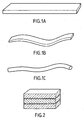
- the morphology of the implantable structures can be varied and lead to the manufacture of threads, films, rushes, ribbons (in particular square-shaped or rectangle-shaped parallelepiped shape), locks, woven or non-woven fabrics, plates, catheters or tablets or tablets.
- Another form may be conceived, for example a film that could be applied in breast surgery or anal surgery as well as the treatment of burns and other skin lesions. It is also possible to envisage a structure where the active principle (s) will be incorporated into a suture.
- composite composite structures comprising the implantable structure according to the invention may be developed in order to obtain several complementary release kinetics, for example a significant release kinetics in the first hours following the surgical procedure, followed delayed release kinetics afterwards.
- the resulting specific morphology is conventionally carried out via the realization of sandwich structures such as that shown in FIG. figure 2 .
- the exchange surface of the bioresorbable product with the interstitial liquid can be increased to accelerate its biodegradability and thus promote fluid and active agent permeation, for example by producing structures with a defined geometrical shape (cylinder, parallelepiped) with a superficial topography having surface corrugations or roughnesses formed of repetitive or random geometric patterns for the purpose of increasing the surface area of the implantable structures.
- a defined geometrical shape cylinder, parallelepiped
- a superficial topography having surface corrugations or roughnesses formed of repetitive or random geometric patterns
- the implant will usually be placed in contact with muscle or fascial sutures.
- the amount of active ingredient released depends on the mass of bioabsorbable carrier and the initial concentration of this active ingredient in the carrier.
- the amount of lidocaine-type local anesthetic is about 3 g in order to continuously release at most about 600 mg per twenty four hours of this drug. produced over five days.
- This amount may be decreased depending on the greater activity recognized by some local anesthetics, such as bupivacaine, mepivacaine, ropivacaine.
- Table 1 below groups together the glass transition (Tg) and melting (Tf) temperatures of two polymers that can be used as bioresorbable support in the context of the invention, of the PLA 50 GA 50 type , which is an intrinsically biodegradable amorphous material.
- Tg values found on PLA 50 GA 50 are related to their nominal composition and in particular to their molecular mass (75000 g / mol for the copolymer marketed by the company PURAC, 65000 g / mol for the copolymer marketed by the company). MEDISORB Company).
- the purpose of this example is the manufacture of a ribbon parallelepiped shape to theoretically release in a controlled manner an amount of active ingredient of 500 mg / day for 3 days, a total of 1500 mg.
- the particle size of the local anesthetics having a dispersion in size generally in the range 10-500 ⁇ m, it is necessary to proceed before the grinding of these powdery products followed by a passage in the oven (one hour at 40 ° C. for example), to obtain a final particle size in the range 10-50 microns.
- EXAMPLE 3 In vitro kinetics of release of lidocaine from an implant based on PLA 50 GA 50
- the in vitro assay method of the anesthetic released from the implantable structure is UV spectrometry (PERKIN ELMER Lambda 20).
- the characteristic line is located at the wavelength equal to 263 nm.
- the dosage is performed in continuous or batch mode by changing the immersion bath every 24 hours. ⁇ b> Table 4 ⁇ / b> Composition mg / 24 h mg / 48 h mg / 72 h mg / 96 h PLA 50 GA 50 / lactic acid 85/15 600 900 1200 1500 90/10 500 900 1200 1500 95/5 450 800 1100 1400
- Prior thermal treatment of the implant at 40 ° C. for 2 hours shows a more homogeneous behavior of the release kinetics per 24-hour period of the order of 350 mg / 24 h.
- EXAMPLE 4 In vitro kinetics of release of Bupivacaine from an implant based on PLA 50 GA 50
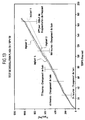
- the release curve over a period of 6 days is shown on the figure 13 with, in addition, a graph specifying the quantity released per 24-hour period (cf. figure 14 ).
- the release is greater on the first day and remains of substantially constant value on the other days of the trial.
- EXAMPLE 5 In vitro kinetics of release of a mixture of local anesthetics from an implant based on PLA 50 GA 50
- EXAMPLE 6 In vitro kinetics of release of local anesthetics from a PLA 50 GA 50 implant of sandwich structure
- the peripheral structure (the envelope) is formed of two 1.5 g ribbons having as a support material a 95/5 (mass) mixture of PLA 50 GA 50 and lactic acid and containing in relative proportions 25% by weight of lidocaine.
- the internal structure (the soul) is elaborated with the same support material but contains in relative proportions 50% in mass of bupivacaine.
- the amount of bupivacaine was kept constant and equal to 1.5 g for an implant with a total mass of 3 g.
- Table 10 ⁇ / b> 2 days 4 days 15 days 85/15 / BPV material becoming soft material decreasing in volume total solubilization 90/10 / BPV " " " 95/5 / BPV " " solubilization from 10 days of immersion
Landscapes
- Health & Medical Sciences (AREA)
- Pharmacology & Pharmacy (AREA)
- Veterinary Medicine (AREA)
- Public Health (AREA)
- Chemical & Material Sciences (AREA)
- General Health & Medical Sciences (AREA)
- Animal Behavior & Ethology (AREA)
- Medicinal Chemistry (AREA)
- Life Sciences & Earth Sciences (AREA)
- Nuclear Medicine, Radiotherapy & Molecular Imaging (AREA)
- General Chemical & Material Sciences (AREA)
- Chemical Kinetics & Catalysis (AREA)
- Organic Chemistry (AREA)
- Engineering & Computer Science (AREA)
- Neurosurgery (AREA)
- Biomedical Technology (AREA)
- Anesthesiology (AREA)
- Pain & Pain Management (AREA)
- Communicable Diseases (AREA)
- Oncology (AREA)
- Dermatology (AREA)
- Epidemiology (AREA)
- Rheumatology (AREA)
- Bioinformatics & Cheminformatics (AREA)
- Neurology (AREA)
- Medicinal Preparation (AREA)
- Materials For Medical Uses (AREA)
- Pharmaceuticals Containing Other Organic And Inorganic Compounds (AREA)
Description
- La présente invention concerne une structure implantable biorésorbable permettant la libération contrôlée d'un principe actif au niveau d'une lésion intracorporelle, notamment d'une incision chirurgicale, ainsi qu'un procédé de fabrication d'une telle structure.
- L'invention trouve application dans le domaine médical et chirurgical.
- Le traitement de la douleur, notamment en milieu hospitalier et en particulier après une intervention chirurgicale, est actuellement de plus en plus au coeur des préoccupations du personnel médical.
- La douleur post-opératoire est due à la stimulation directe, par le traumatisme chirurgical, des terminaisons nerveuses libres, présentes dans tous les tissus et à la libération par les tissus traumatisés de substances algogènes, qui entretiennent la douleur par stimulation directe des terminaisons nerveuses et par abaissement du seuil d'activation des récepteurs nociceptifs.
- Le traitement de la douleur post-opératoire par les antalgiques n'est qu'un traitement symptomatique, qui atténue la perception de la douleur au niveau des centres nerveux, sans agir à la source.
- Les anesthésiques locaux ont une action directe au niveau des terminaisons nerveuses, ils interrompent totalement la transmission de la douleur par les fibres nerveuses. Leur efficacité est telle que l'on peut inciser et opérer au niveau d'une zone infiltrée par l'anesthésie locale.
- Il a été démontré que l'infiltration de la plaie en fin d'intervention par un anesthésique local supprime efficacement la douleur post-opératoire, mais l'effet cesse avec la résorption du produit au bout de quelques heures (1-5).
- D'autres études (6-10) ont confirmé l'intérêt de la méthode d'irrigation continue de la plaie par un anesthésique local au moyen d'un cathéter.
- Cette méthode, si elle est efficace, présente toutefois l'inconvénient de comporter un appareillage encombrant qui limite l'activité et annule donc l'avantage de la réduction de douleur.
- Le brevet
US 6 432 438 décrit un système biodégradable comprenant au moins un polymère, qui peut être un copolymère d'acide lactique et d'acide glycolique et au moins un plastifiant. Ce système se présente sous forme semi-liquide ou visqueuse à laquelle un principe actif peut être incorporé juste avant l'utilisation. Un tel système qui n'est pas homogène ne peut qu'avoir un effet limité dans le temps. - Le document
WO 00/24374 - Le document
WO 02/058670 - Le brevet
US 6,063,405 concerne la préparation d'un système de délivrance à libération prolongée d'un principe actif, tel qu'un anesthésique, formé d'une matrice de polymère en suspension ou en solution dans l'eau, et destiné à être injecté. - On connaît par ailleurs d'après la demande de brevet
WO 00 50004 - Ce système et cette composition n'ont toutefois qu'un effet limité dans le temps.
- L'invention vise à remédier à ces inconvénients, et à mettre à disposition une structure qui permette la libération progressive et contrôlée d'un principe actif au niveau d'une incision intracorporelle.
- Une telle structure doit pouvoir être mise en place rapidement et facilement lors du temps de réparation, par exemple après une incision chirurgicale. Elle doit également se résorber le plus rapidement possible.
- Ainsi, selon un premier aspect, l'invention concerne une structure implantable souple pour la libération prolongée et contrôlée d'un principe actif, constituée d'un support biorésorbable et d'un principe actif intimement lié audit support, et qui présente une cohésion entre le principe actif et le support biorésorbable induite par mouillabilité d'un des composants de la structure, et dans laquelle le support biorésorbable est formé d'un mélange de copolymère amorphe d'acide lactique et d'acide glycolique possédant un rapport massique entre les unités d'acide lactique et d'acide glycolique compris dans la gamme de 80/20 à 20/80, de préférence dans la gamme de 70/30 à 30/70, et de préférence encore égal à 50/50 et de 0,5 à 20 % en masse, de préférence de 5 à 15 % en masse par rapport à la masse du support, d'un plastifiant biocompatible choisi parmi l'acide lactique, un oligomère d'acide lactique, ou un mélange de ces composés, ledit mélange de copolymère et de plastifiant ayant une Tg inférieure ou égale à 15°C.
- Le fondement de la présente invention réside donc dans le fait que la structure implantable possède une consistance souple et présente une cohésion (imbrication) entre le principe actif et le matériau du support biorésorbable induite par mouillabilité d'un des composants de la structure.
- Conformément à l'invention, le support biorésorbable comprend à titre de composant principal un polyester aliphatique d'intérêt thérapeutique, c'est-à-dire qui est biocompatible, biorésorbable, bien toléré et qui n'entraîne pas d'effets adverses comme irritation locale, réaction allergique, réaction immunologique, toxicité systémique. Ces polyesters sont des copolymères d'acide lactique et d'acide glycolique (désignés sous la forme PLAxGAy ; x et y précisant respectivement les pourcentages des unités d'acides lactique et glycolique) à structure amorphe et de préférence à poids moléculaire peu élevé.
- Avantageusement, on utilise un copolymère DL PLA-GA dans lequel le rapport massique entre les unités d'acides lactique et glycolique est compris dans la gamme de 80/20 à 20/80, de préférence 70/30 à 30/70. Un copolymère tout particulièrement préféré est celui comprenant des proportions égales en acides lactique et glycolique.
- La structure implantable selon l'invention présente une bonne souplesse. Par « souplesse », on entend au sens de la présente invention que la Tg (température de transition vitreuse) du matériau support est inférieure ou égale à 15°C et peut de ce fait être manipulée aisément et sans présenter de rupture préjudiciable lors de la mise en place dans la plaie opératoire.
- Cette souplesse est une caractéristique des matériaux polymères à propriétés dites viscoélastiques. Elle traduit, pour un même matériau porté à des températures T la transition en fonction de T entre des structures dites "rigides - élastiques" pour des températures inférieures à la température de transition vitreuse (T < Tg) et des structures dites "élastiques - caoutchoutiques" pour des températures supérieures à la température de transition vitreuse (T > Tg). Cette propriété est couramment étudiée à l'aide de viscoélasticimètres où la transition citée est définie par la variation caractéristique, en fonction de la température, d'un module élastique de type module d'Young ou module de cisaillement.
- Lorsque le polyester aliphatique d'intérêt thérapeutique est un copolymère d'acide lactique et d'acide glycolique, pour lequel la Tg est proche de la température ambiante, la souplesse du matériau support est ajustée de manière bien connue de l'homme du métier par l'adjonction d'un plastifiant biocompatible. Selon l'invention, ce plastifiant est choisi parmi l'acide lactique, les oligomères d'acide lactique notés couramment (OLA), et les mélanges de ces composés. Le plastifiant est généralement ajouté en une quantité comprise dans la gamme de 0,5 % à 20 % en masse, de préférence de 5 à 15 % en masse, par rapport à la masse du support.
- Le principe actif qui peut être utilisé dans le cadre de l'invention n'est pas limité à un principe actif particulier, et peut être avantageusement choisi parmi les anesthésiques locaux, les antalgiques morphiniques ou non morphiniques, les facteurs de cicatrisation, les anti-inflammatoires, les antibiotiques, les anti-fongiques, les corticoïdes, les hormones, les antimitotiques, les facteurs de croissance. Un mélange de principes actifs est de plus possible afin de :
- moduler l'efficacité temporelle des principes actifs,
- assurer différentes fonctions thérapeutiques cumulatives.
- On peut ainsi concevoir l'apport d'anti-inflammatoires ou de corticoïdes au niveau ou au voisinage d'une articulation, de substances antiseptiques et/ou cicatrisantes au niveau d'une plaie chronique, d'antimitotiques au niveau d'une tumeur inextirpable ou de métastases, ou de substances stimulantes au niveau d'une structure nerveuse.
- De manière particulièrement préférée, le principe actif est un anesthésique local comme par exemple la lidocaïne, la bupivacaïne, la benzoïne, la tétracaïne, la mepivacaïne, la ropivacaïne. On peut ajouter à l'anesthésique local une substance capable de prolonger son action, comme la clonidine ou le fentanyl.
- La quantité de principe(s) actif(s) ne dépasse généralement pas 60 % de la masse du support et varie en fonction de la nature même du principe actif et du but thérapeutique recherché.
- La structure biodégradable conforme à l'invention peut être implantée au niveau des plans de suture de tissus incisés, et permet un apport in situ de principe actif à une concentration définie, pendant une durée spécifique au but thérapeutique recherché.
- Cette structure résiste à la stérilisation et au stockage sous différentes conditions climatiques.
- Dans le cas où le principe actif est un anesthésique local, la structure implantable selon l'invention permet de supprimer ou réduire au minimum la douleur, et tout particulièrement la douleur post-opératoire, avec tous les avantages qui en découlent : confort idéal pour le patient, réduction au minimum des soins post-opératoires, réduction du risque thrombo-embolique par la reprise précoce de la marche, raccourcissement de la durée d'hospitalisation et donc des coûts. Elle favorise également la pratique de la chirurgie ambulatoire et une reprise d'activité rapide du patient.
- La structure implantable selon l'invention est fabriquée au moyen d'un procédé thermo-mécanique de mise en forme, qui permet d'obtenir une cohésion (imbrication) entre le principe actif et le matériau du support biorésorbable induite par mouillabilité d'un des composants de la structure.
- Lorsque le principe actif est soumis à un passage par une phase liquide, qui induit cette mouillabilité, lors de l'élévation de température au dessus de son point de fusion imposé par une des étapes du procédé de fabrication, la cohésion recherchée est implicite.
- Lorsque le principe actif conserve sa forme solide tout au long du procédé de fabrication, c'est le matériau du support qui doit être soumis à un passage par une phase liquide voire visqueuse lors du procédé de fabrication.
- Le principe actif et le matériau du support peuvent tous deux subir concomitamment ce changement de phases si la température de fusion du principe actif et la température de transition vitreuse ou de fusion du matériau support, sont voisines.
- Ledit changement de phases, pour obtenir l'imbrication recherchée, est généralement réalisé dans une chambre dite "chambre de transfert".
- Ainsi, selon un second aspect, l'invention concerne un procédé de fabrication d'une structure implantable souple pour la libération prolongée et contrôlée d'un principe actif, constituée d'une structure composite homogène avec des interfaces cohérentes, et dans laquelle le support biorésorbable est formé d'un mélange de copolymère amorphe d'acide lactique et d'acide glycolique possédant un rapport massique entre les unités d'acide lactique et d'acide glycolique compris dans la gamme de 80/20 à 20/80, de préférence dans la gamme de 70/30 à 30/70, et de préférence encore égal à 50/50 et de 0,5 à 20 % en masse, de préférence de 5 à 15 % en masse, par rapport à la masse du support, d'un plastifiant biocompatible choisi parmi l'acide lactique, un oligomère d'acide lactique, ou un mélange de ces composés, ledit mélange de copolymère et de plastifiant ayant une Tg inférieure ou égale à 15°C, qui comprend les étapes suivantes :
- a) un mélange des produits composant la structure,
- b) un passage avec ou sans pression appliquée, dans une chambre de transfert, soit b1) à une température comprise entre la température de fusion du principe actif et la température de transition vitreuse ou de fusion du copolymère, soit b2) à température supérieure à la fois à la température de fusion du principe actif et à la température de transition vitreuse du copolymère, et
- c) une mise en forme de la structure implantable sous pression à partir de cet état intermédiaire.
- Ces différentes étapes peuvent être complétées si nécessaire par un traitement thermique final.
- A l'étape a), les produits initialement à l'état solide sont avantageusement soumis au préalable à un traitement de dessiccation.
- Le changement de phases est réalisé à l'étape b). Ce changement de phases est de type :
- ■ solide - liquide dans le cas où il est induit préférentiellement par le principe actif seul ou le matériau support seul,
- ■ solide - visqueux ou solide - visqueux - liquide dans le cas où il est induit préférentiellement par un matériau polyester aliphatique amorphe ou, respectivement, semi-cristallin,
- ■ liquide - liquide lorsqu'il est induit par la fusion concomitante du principe actif et du matériau support.
- A l'issue du procédé, les produits mis en forme sont démoulés, de préférence sur sole réfrigérée.
- On comprend donc que le procédé de l'invention ne fait pas intervenir de solvant dans les différentes étapes indiquées ci-dessus.
- Lorsque la différence entre la température de fusion (Tf) du principe actif et la température de transition vitreuse ou de fusion du polyester aliphatique (suivant sa nature amorphe ou semi-cristalline) est importante, le changement de phases de l'étape b) s'opère avantageusement à une température comprise entre la Tf du principe actif et la Tg ou Tf du polyester aliphatique, de préférence à une température proche de la Tf du principe actif.
- Lorsque la différence entre la Tf du principe actif et la Tg ou la Tf du polyester aliphatique est faible (environ de l'ordre de 10 à 15°C au plus), le changement de phases de l'étape b) s'opère avantageusement à une température supérieure à la fois à la Tf du principe actif et à la Tf ou la Tg du polyester aliphatique.
- Le procédé conforme à l'invention permet d'obtenir une structure composite homogène avec des interfaces cohérentes (c'est-à-dire sans décohésion interfaciale), qui présente de plus un point de fusion ou de transition vitreux bas (inférieur à celui du polyester aliphatique).
- A titre d'exemple de procédé conforme à l'invention, on peut citer ceux décrits notamment dans « La mise en forme des matières plastiques : J.F. AGASSANT, P. AVENAS, J.Ph. SERGENT, Ed. Lavoisier, 1989 » ou dans « Matières plastiques : J.P. TROTIGNON, J. VERDU, A. DOBRACZYNSKI, M. PIPERAUD, Ed. Nathan 1996 », en particulier les procédés de type :
- moulage par compression-transfert,
- moulage par injection-transfert,
- extrusion ou filage avec étape préliminaire de transfert.
- De préférence, on utilise le procédé du type moulage par compression - transfert, qui est un procédé consistant à introduire sous pression un matériau dans un état de fluidité donné à l'intérieur de la cavité d'un moule et qui se décompose classiquement en quatre étapes :
- la plastification : la matière, introduite préalablement dans un creuset, est amenée partiellement ou totalement par chauffage à un état fluide et homogène (changement de phases),
- l'injection : un piston permet l'introduction de cette matière fluidisée dans le moule,
- la conformation : la matière peut alors être conformée dans le moule avec une cinétique de durcissement rapide,
- le démoulage final.
- Avantageusement, la granulométrie du mélange des produits de départ est contrôlée dans la gamme comprise entre 5 et 150 µm, de préférence entre 10 et 50 µm. En règle générale, l'utilisation de broyeurs mécaniques ou de broyeurs à jet d'air est conseillée. De plus, il est recommandé de travailler dans des domaines de températures de mise en forme où le principe actif conserve son intégrité structurale et ses propriétés thérapeutiques.
- Le moulage par injection - transfert procède de la même démarche expérimentale. L'extrusion - transfert est par ailleurs une technologie connue.
- La morphologie des structures implantables peut être variée et conduire à la fabrication de fils, de films, de joncs, de rubans (notamment de forme parallélépipédique base carrée ou rectangle), de mèches, de tissus tissés ou non-tissés, de plaques, de cathéters ou de comprimés voire de tablettes. On peut concevoir une autre forme, par exemple un film qui pourrait être appliqué dans les chirurgies mammaires ou la chirurgie anale ainsi que le traitement des brûlures et autres lésions cutanées. On peut également envisager une structure où le(s) principe(s) actif(s) serai(en)t incorporé(s) dans un fil de suture.
- Différentes structures selon l'invention sont représentées sur les
figures 1A (ruban), 1B (ruban ondulé) et 1C (jonc). - De plus, des structures composites mixtes comprenant la structure implantable selon l'invention, peuvent être élaborées dans le but d'obtenir plusieurs cinétiques de libération complémentaires, par exemple une cinétique de libération importante dans les premières heures qui suivent l'acte chirurgical, suivie d'une cinétique de libération retardée ensuite.
- La morphologie spécifique en résultant est classiquement effectuée via la réalisation de structures sandwich telle que celle représentée sur la
figure 2 . - Avantageusement, la surface d'échange du produit biorésorbable avec le liquide interstitiel peut être augmentée pour accélérer sa biodégradabilité et favoriser ainsi la perméation aux fluides et au principe actif, en réalisant par exemple des structures à forme géométrique définie (cylindre, parallélépipède) avec une topographie superficielle présentant des ondulations ou des rugosités de surface formées de dessins géométriques répétitifs ou aléatoires dans le but d'augmenter la surface spécifique des structures implantables.
- Le site d'insertion de la structure implantable est fonction du type de lésion ou d'incision :
- Les
figures 3 et 4 représentent schématiquement une laparotomie médiane : la structure implantable (1) est placée longitudinalement, dans le sens de l'incision, entre le plan de suture du péritoine (2) et celui de l'aponévrose (3), dans l'espace pré-péritonéal. - La
figure 5 représente schématiquement une laparotomie transversale : la structure implantable (1) est placée dans la loge musculaire, à la face profonde du plan de suture aponévrotique (2). - La
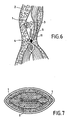
figure 6 représente schématiquement une herniorraphie : un morceau de l'implant (1) est placé à la face profonde de l'aponévrose du grand oblique (2) et un autre (11) au bord inférieur du cordon spermatique (3), au contact du plan de suture profond (4) et du rameau génital du nerf génito-crural (5). Lafigure 7 est une coupe antéro-postérieure de la représentation de lafigure 6 . - Pour d'autres types d'incisions, au niveau des membres ou du thorax, l'implant sera généralement placé au contact des sutures musculaires ou aponévrotiques.
- Pour les strippings de varices, il peut être attiré par le stripper dans le trajet du stripping où il sera laissé en place.
- D'autres formes adaptées à différents types de chirurgie peuvent être conçues ultérieurement, notamment sous forme de film pour de grands décollements cellulaires.
- L'homme de métier comprendra aisément à la lecture de la présente description que les dimensions de la structure implantable ainsi que la quantité de principe actif à incorporer à cette structure dépendront de la nature de l'application envisagée.
- La quantité de principe actif libéré dépend de la masse de support biorésorbable et de la concentration initiale de ce principe actif dans le support.
- A titre indicatif, pour le traitement de la douleur post-opératoire, la quantité d'anesthésique local de type lidocaïne est d'environ 3 g dans le but de libérer d'une manière continue au maximum environ 600 mg par vingt quatre heures de ce produit sur cinq jours.
- Cette quantité peut être diminuée en fonction de la plus grande activité reconnue de certains anesthésiques locaux, comme la bupivacaïne, la mepivacaïne, la ropivacaïne.
- A titre indicatif, les implants conformes à l'invention ont généralement une longueur comprise entre 3 et 25 cm et de préférence voisine de 7 cm, grandeur qui convient pour beaucoup d'incisions courantes. Si, pour des interventions plus importantes, nécessitant des incisions de 15 à 20 cm, on souhaite libérer la même dose quotidienne d'anesthésique local pendant la même durée et que la composition de l'implant est la même, il faut évidemment réduire ses deux autres dimensions :
- ■ pour un implant de 14 cm de longueur et 0,22 cm d'épaisseur, à masse et à volume égaux, la largeur doit être de 0,75 cm. On peut également utiliser deux implants de 7 x 0,22 x 0,75 cm.
- ■ pour un implant de 21 cm de longueur et 0,22 cm d'épaisseur, la largeur doit être de 0,5 cm. On peut également utiliser trois implants de 7 x 0,22 x 0,5 cm.
- On peut également augmenter la longueur de l'implant, ce qui offre la possibilité d'un volume plus grand pour une épaisseur et une largeur du même ordre que dans l'exemple de base, pour libérer plus de produit actif. Dans ce cas, on modifie bien évidemment la composition de l'implant en conséquence.
- L'invention sera décrite plus en détail à l'aide des exemples ci-après, donnés à titre purement illustratif.
- Le Tableau 1 ci-après regroupe les températures de transition vitreuse (Tg) et de fusion (Tf) de deux polymères utilisables comme support biorésorbable dans le cadre de l'invention de type PLA50GA50, matériau amorphe intrinsèquement biodégradable.
- Les différences de valeurs de Tg relevées sur les PLA50GA50 sont liées à leur composition nominale et en particulier à leur masse moléculaire (75000 g/mol pour le copolymère commercialisé par la Société PURAC, 65000 g/mol pour le copolymère commercialisé par la Société MEDISORB).
- En règle générale pour chaque lot de PLAGA, la valeur de la Tg est systématiquement évaluée.
Tableau 1 Matériau Tg (°C) Tf (°C) PLA50GA50 (MEDISORB) 31 PLA50GA50 (PURAC) 45 Tableau 2 % d'acide PLA50GA50 PLA50GA50 lactique (MEDISORB) (PURAC) 0 31 45 5 20 41 10 15 20 15 3 16 - Les résultats des Tableaux 1 et 2 montrent qu'il est possible de contrôler la « souplesse » du PLA50GA50 à température ambiante par addition d'un plastifiant.
- Le but de cet exemple est la fabrication d'un ruban de forme parallélépipédique permettant de libérer théoriquement d'une manière contrôlée une quantité de principe actif de 500 mg/j pendant 3 jours soit au total 1500 mg.
- Il a été vérifié en préalable qu'il était possible d'incorporer dans la structure implantable, quel que soit le procédé de mise en forme retenu, environ 50% de principe actif dans 50% du matériau de support en conservant la souplesse recherchée.
- Le poids total de l'implant est, dans ces conditions, de 3 g. Pour une densité moyenne de l'implant estimée à 1,3, le volume de l'implant sera de 2,31 cm3. Ce volume correspond par exemple à un parallélépipède de dimension :
- longueur imposée : 7 cm
- largeur imposée : 1,5 cm
- épaisseur : 0,22 cm (2,2 mm)
- La granulométrie des anesthésiques locaux présentant une dispersion en taille généralement comprise dans l'intervalle 10-500 µm, il est nécessaire de procéder au préalable au broyage de ces produits pulvérulents suivi d'un passage à l'étuve (une heure à 40°C par exemple), pour obtenir une granulométrie finale dans l'intervalle 10-50 µm.
- Les conditions opératoires générales suivantes ont été retenues pour le copolymère PLA50GA50 pour obtenir cette morphologie particulière par moulage par compression - transfert :
- ■ température de plastification : 80°C-90°C,
- ■ pression d'injection dans le moule : 60 bars-100 bars,
- Ces cinétiques ont été réalisées sur une masse de 3 g de ruban préparé selon les conditions opératoires de l'exemple 2A/, pouvant libérer une quantité de 1500 mg de lidocaïne (fabrication par moulage par compression - transfert). Ce ruban est immergé sous agitation magnétique dans 500 ml de tampon PBS à pH=7,4, à la température de 37°C, le milieu d'immersion étant changé toutes les 24 h pour éviter une saturation de ce dernier en produit libéré.
- Des compositions contenant respectivement en pourcentage en masse :
- 85% de PLA50GA50 et 15% d'acide lactique (85/15) ou
- 90% de PLA50GA50 et 10% d'acide lactique (90/10) ou
- 95% de PLA50GA50 et 5% d'acide lactique (95/5)
- Les valeurs des pentes des courbes de libération sont regroupées dans le tableau 4.
- La méthode de dosage in vitro de l'anesthésique libéré de la structure implantable est la spectrométrie UV (PERKIN ELMER Lambda 20). La raie caractéristique est située à la longueur d'onde égale à 263 nm. Le dosage est réalisé en mode continu ou discontinu en changeant le bain d'immersion toutes les 24 h.
Tableau 4 Composition mg / 24 h mg / 48 h mg / 72 h mg / 96 h PLA50GA50 / acide lactique 85/15 600 900 1200 1500 90/10 500 900 1200 1500 95/5 450 800 1100 1400 - Un traitement thermique préalable de l'implant à 40°C pendant 2 heures montre un comportement plus homogène de la cinétique de libération par période de 24 h de l'ordre de 350 mg/24 h.
- A partir d'un lot de quatre implants identiques de forme parallélépipédique base carrée de dimention 70 x 5 x 5 mm, de masse égale à 2,7 g contenant 50 % de Bupivacaïne; il a été procédé à des tests complémentaires de libération de cet anesthésique local. Ces tests ont été conduits par immersion de l'implant dans 500 cm3 de tampon PBS (pH = 7,4) à la température de 37°C cette fois-ci en l'absence d'agitation magnétique. L'agitation magnétique n'étant réalisée qu'au moment des dosages pour uniformiser le milieu liquide avant prélèvement d'une quote-part de celui-ci pour analyse.
- La courbe de libération sur une période de 6 jours est montrée sur la
figure 13 avec en complément un graphe précisant la quantité libérée par période de 24 heures (cf.figure 14 ). - Comme attendu, la libération est plus importante le premier jour et reste sensiblement de valeur constante les autres jours de l'essai.
- Il a été constaté en complément qu'après une période d'immersion de 6 jours, les implants étaient complètement destructurés.
- La même expérimentation que celle décrite dans l'exemple 4 a été conduite à partir d'un implant constitué au niveau de la concentration en anesthésiques locaux de :
- ■ 5 % de Lidocaïne,
- ■ 45 % de Bupivacaïne,
- ■ 50 % de PLA50GA50.
- Le graphe précisant la quantité libérée par période de 24 heures est montré
figure 15 . Il est noté une cinétique de libération moins conséquente que celle constatée dans l'exemple 4. - A l'aide de la technique de moulage-transfert il a été procédé à la réalisation d'un implant de structure "sandwich" identique à celle présentée
figure 2 . La structure périphérique (l'enveloppe) est formée de deux rubans de 1,5 g présentant comme matériau support un mélange 95/5 (massique) de PLA50GA50 et d'acide lactique et contenant en proportions relatives 25% en masse de lidocaïne. La structure interne (l'âme) est élaborée avec le même matériau support mais contient en proportions relatives 50% en masse de bupivacaïne. - Pour chaque structure de forme parallélépipédique (longueur 7 cm, largeur 1 cm, épaisseur 1 mm) le temps dans la chambre de transfert portée à 85°C est de 15 min. La pression de moulage sur plaque revêtue de téflon est de 65 bars. Le tableau 9 précise les données obtenues.
Tableau 9 mg/24 h mg/48 h mg/72 h 550 490 510 - Une cinétique de libération quasi linéaire est constatée.
- Le tableau 10 précise en final les cinétiques de déstructuration, dans du milieu PBS (pH=7,4) porté à 37°C, d'un implant élaboré par les techniques de moulage par compression - transfert de copolymère PLA50GA50 / acide lactique / bupivacaïne (BPV). La quantité de bupivacaïne a été conservée constante et égale à 1,5 g pour un implant de masse totale égale à 3 g.
Tableau 10 2 jours 4 jours 15 jours 85 / 15 / BPV matériau devenant de consistance molle matériau diminuant de volume solubilisation totale 90 / 10 / BPV " " " 95 / 5 / BPV " " solubilisation dès 10 jours d'immersion - Les mécanismes associés à cette cinétique de déstructuration ont été appréhendés via l'observation par microscopie électronique à balayage de coupes de rubans réalisées par cryofracture.
- Le microscope utilisé est un microscope électronique à balayage à émission de champ (JEOL - 6400F) équipé d'une platine pour préparation de l'échantillon par cryofracture (OXFORD CT 1500 HF). Le protocole opératoire est le suivant :
- ■ dans une chambre de congélation indépendante du microscope l'échantillon est immergé dans l'azote liquide et mis sous vide primaire (10-3 torr),
- ■ cet échantillon est ensuite transféré dans une chambre où règne un vide secondaire (10-6 torr),
- ■ il subit une fracture à l'aide d'un système contondant,
- ■ une sublimation de la glace pouvant se trouver sur l'échantillon est réalisée,
- ■ un dépôt d'or (100 Å) est effectué sur l'échantillon fracturé,
- ■ le transfert sur la platine du microscope est réalisé en final sans remise à l'air.
- Les données expérimentales suivantes ont ainsi été obtenues :
- ■ en préalable, il a été vérifié que la densité du principe actif solide, (bupivacaïne dans l'exemple illustré) était homogène en surface et à coeur de l'échantillon, et que les interfaces entre le principe actif et le support polymère apparaissaient parfaitement cohérentes (
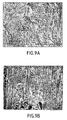
figures 8A et 8B ), - ■ après un temps d'immersion de quelques heures (2 à 5 heures) dans le milieu PBS (pH = 7,4, T = 37°C), la présence de microporosités locales associables à la dissolution totale du principe actif positionné à la surface de l'implant est visualisée (
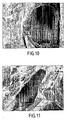
figures 9A et 9B ), - ■ après un temps d'immersion de 9 heures, il est relevé une dissolution totale du principe actif positionné à la surface de l'implant (
figure 10 ), - ■ après un temps d'immersion de 12 heures la dissolution du principe actif se poursuit pour atteindre progressivement le coeur du matériau (
figure 11 ), - ■ concomitamment, le nombre de microporosités et de nanoporosités dans le polymère s'accroît (
figure 12 ). - Il apparaît ainsi que c'est la déstructuration locale du polymère par formation de porosités ouvertes qui favorise la solubilisation du principe actif et donc sa libération temporelle sous forme dissoute.
-
- 1. Nehra et al.. Pain relief after inguinal hernia repair : a randomized double-blind study. Br J Surg 1995 ; 82 : 1275-7.
- 2. Ding et al.. Post-herniorraphy pain in outpatients after pre-incision ilioinguinal-hypogastric nerve block during monitored anaesthesia care. Can J Anaesth 1995 ; 42 : 12-15.
- 3. Reid et al. Day-case hemiotomy in children. A comparison of ilio-inguinal nerve block and wound infiltration for postoperative analgesia. Anaesthesia 1987; 42 : 658-61.
- 4. Lafferty et al. A comparison of postoperative pain relief techniques in orchidopexy. Ann R Coll Surg Engl 1990; 72 : 7-8.
- 5. Wright. Controlled trial of wound infiltration with Bupivacaine for postoperative pain relief after appendicectomy in children. Br J Surg 1993; 80 : 110-11.
- 6. Thomas et al. The direct perfusion of surgical wounds with local anaesthetic solution : an approach to postoperative pain ? Ann R Coll Surg Engl 1983; 65 : 226-9.
- 7. Levack et al. Abdominal wound perfusion for the relief of postoperative pain. Br J Anaesth 1986; 58 : 615-19.
- 8. Oakley et coll. Randomized placebo-controlled trial of local anaesthetic infusion in day-case inguinal hernia repair. Br J Surg 1998; 85 : 797-9.
- 9. Griffith et coll. Prospective randomized study of a new method of providing postoperative pain relief following femoropopliteal bypass. Br J Surg 1996; 83 : 1735-8.
- 10. Fisher et Meller. Continuous postoperative regional analgesia by nerve sheath block for amputation surgery. A pilot study. Anaest Analg 1991; 72 : 300-3.
Claims (11)
- Structure implantable souple pour la libération prolongée et contrôlée d'un principe actif, constituée d'un support biorésorbable et d'un principe actif intimement lié audit support, et qui présente une cohésion entre le principe actif et le support biorésorbable induite par mouillabilité d'un des composants de la structure, et dans laquelle le support biorésorbable est formé d'un mélange de copolymère amorphe d'acide lactique et d'acide glycolique possédant un rapport massique entre les unités d'acide lactique et d'acide glycolique compris dans la gamme de 80/20 à 20/80, de préférence dans la gamme de 70/30 à 30/70, et de préférence encore égal à 50/50 et de 0,5 à 20 % en masse, de préférence de 5 à 15 % en masse par rapport à la masse du support, d'un plastifiant biocompatible choisi parmi l'acide lactique, un oligomère d'acide lactique, ou un mélange de ces composés, ledit mélange de copolymère et de plastifiant ayant une Tg inférieure ou égale à 15°C.
- Structure implantable selon la revendication 1, dans laquelle le principe actif est choisi parmi les anesthésiques locaux, les antalgiques morphiniques ou non morphiniques, les facteurs de cicatrisation, les anti-inflammatoires, les antibiotiques, les anti-fongiques, les corticoïdes, les hormones, les antimitotiques, les facteurs de croissance, ou un mélange de ces principes actifs.
- Structure implantable selon la revendication 2, dans laquelle le principe actif est un anesthésique local.
- Structure implantable selon l'une des revendications 1 à 3, qui se présente sous la forme de fil, de film, de jonc, de ruban de forme parallélépipédique de base carrée ou rectangle, de mèche, de tissu tissé ou non-tissé, de plaque, de cathéter ou de comprimé voire de tablette ou encore de fil de suture.
- Structure implantable selon l'une des revendications 1 à 4, qui se présente sous la forme d'une structure sandwich.
- Procédé de fabrication d'une structure implantable souple pour la libération prolongée et contrôlée d'un principe actif, constituée d'une structure composite homogène avec des interfaces cohérentes, et dans laquelle le support biorésorbable est formé d'un mélange de copolymère amorphe d'acide lactique et d'acide glycolique possédant un rapport massique entre les unités d'acide lactique et d'acide glycolique compris dans la gamme de 80/20 à 20/80, de préférence dans la gamme de 70/30 à 30/70, et de préférence encore égal à 50/50 et de 0,5 à 20 % en masse, de préférence de 5 à 15 % en masse, par rapport à la masse du support, d'un plastifiant biocompatible choisi parmi l'acide lactique, un oligomère d'acide lactique, ou un mélange de ces composés, ledit mélange de copolymère et de plastifiant ayant une Tg inférieure ou égale à 15°C, qui comprend les étapes suivantes :a) un mélange des produits composant la structure,b) un passage avec ou sans pression appliquée, dans une chambre de transfert, soit b1) à une température comprise entre la température de fusion du principe actif et la température de transition vitreuse ou de fusion du copolymère, soit b2) à température supérieure à la fois à la température de fusion du principe actif et à la température de transition vitreuse du copolymère, etc) une mise en forme de la structure implantable sous pression à partir de cet état intermédiaire.
- Procédé selon la revendication 6, qui comprend en outre d) une étape de traitement thermique.
- Procédé selon la revendication 6 ou 7, qui est un procédé de moulage par compression-transfert, de moulage par injection transfert, d'extrusion ou de filage avec étape préliminaire de transfert.
- Procédé selon l'une des revendications 6 à 8, dans lequel le mélange des produits obtenu à l'étape a) est broyé jusqu'à obtenir une granulométrie comprise dans la gamme de 5 à 150 µm, de préférence de 10 à 50 µm.
- Procédé selon l'une des revendications 6 à 9, dans lequel le principe actif est choisi parmi les anesthésiques locaux, les antalgiques morphiniques ou non morphiniques, les facteurs de cicatrisation, les anti-inflammatoires, les antibiotiques, les anti-fongiques, les corticoïdes, les hormones, les antimitotiques, les facteurs de croissance, ou un mélange de ces principes actifs.
- Procédé selon la revendication 10, dans lequel le principe actif est un anesthésique local.
Applications Claiming Priority (3)
| Application Number | Priority Date | Filing Date | Title |
|---|---|---|---|
| FR0213623 | 2002-10-30 | ||
| FR0213623A FR2846557B1 (fr) | 2002-10-30 | 2002-10-30 | Structure implantable pour la liberation prolongee et controlee d'un principe actif |
| PCT/FR2003/003221 WO2004041241A2 (fr) | 2002-10-30 | 2003-10-29 | Structure implantable pour la liberation prolongee et controlee d'un principe actif |
Publications (2)
| Publication Number | Publication Date |
|---|---|
| EP1556002A2 EP1556002A2 (fr) | 2005-07-27 |
| EP1556002B1 true EP1556002B1 (fr) | 2008-10-22 |
Family
ID=32104333
Family Applications (1)
| Application Number | Title | Priority Date | Filing Date |
|---|---|---|---|
| EP03780245A Expired - Lifetime EP1556002B1 (fr) | 2002-10-30 | 2003-10-29 | Structure implantable pour la liberation prolongee et controlee d'un principe actif |
Country Status (10)
| Country | Link |
|---|---|
| US (1) | US20060034887A1 (fr) |
| EP (1) | EP1556002B1 (fr) |
| JP (1) | JP2006512312A (fr) |
| AT (1) | ATE411795T1 (fr) |
| AU (1) | AU2003288340A1 (fr) |
| CA (1) | CA2504479A1 (fr) |
| DE (1) | DE60324306D1 (fr) |
| ES (1) | ES2315545T3 (fr) |
| FR (1) | FR2846557B1 (fr) |
| WO (1) | WO2004041241A2 (fr) |
Families Citing this family (29)
| Publication number | Priority date | Publication date | Assignee | Title |
|---|---|---|---|---|
| US8025899B2 (en) | 2003-08-28 | 2011-09-27 | Abbott Laboratories | Solid pharmaceutical dosage form |
| US8377952B2 (en) * | 2003-08-28 | 2013-02-19 | Abbott Laboratories | Solid pharmaceutical dosage formulation |
| US9248219B2 (en) * | 2007-09-14 | 2016-02-02 | Boston Scientific Scimed, Inc. | Medical devices having bioerodable layers for the release of therapeutic agents |
| US8956642B2 (en) * | 2008-04-18 | 2015-02-17 | Medtronic, Inc. | Bupivacaine formulation in a polyorthoester carrier |
| US9211175B2 (en) | 2010-07-08 | 2015-12-15 | Covidien Lp | Self-detachable medical devices |
| US20120009240A1 (en) * | 2010-07-08 | 2012-01-12 | Joshua Stopek | Films for Delivery of a Therapeutic Agent |
| FR2962646B1 (fr) | 2010-07-16 | 2012-06-22 | Sofradim Production | Prothese avec element radio-opaque |
| US9572907B2 (en) | 2010-10-01 | 2017-02-21 | Covidien Lp | Implantable polymeric films |
| US9861590B2 (en) | 2010-10-19 | 2018-01-09 | Covidien Lp | Self-supporting films for delivery of therapeutic agents |
| US8632839B2 (en) | 2010-10-19 | 2014-01-21 | Covidien Lp | Methods of forming self-supporting films for delivery of therapeutic agents |
| US8920867B2 (en) * | 2010-10-19 | 2014-12-30 | Covidien Lp | Methods of forming self-supporting films for delivery of therapeutic agents |
| US20130310491A1 (en) * | 2010-12-15 | 2013-11-21 | 3M 9Nnovative Properties Company | Degradable fibers |
| US9144634B2 (en) | 2011-01-14 | 2015-09-29 | Covidien Lp | Medical device with intrapore films |
| CN103402496B (zh) * | 2011-03-07 | 2016-01-20 | 3M创新有限公司 | 微针装置及方法 |
| FR2977790B1 (fr) | 2011-07-13 | 2013-07-19 | Sofradim Production | Prothese pour hernie ombilicale |
| US8579924B2 (en) | 2011-07-26 | 2013-11-12 | Covidien Lp | Implantable devices including a mesh and a pivotable film |
| US9782957B2 (en) | 2011-08-24 | 2017-10-10 | Covidien Lp | Medical device films |
| US9005308B2 (en) | 2011-10-25 | 2015-04-14 | Covidien Lp | Implantable film/mesh composite for passage of tissue therebetween |
| US8932621B2 (en) | 2011-10-25 | 2015-01-13 | Covidien Lp | Implantable film/mesh composite |
| US9179994B2 (en) | 2011-10-25 | 2015-11-10 | Covidien Lp | Implantable film/mesh composite |
| US10206769B2 (en) | 2012-03-30 | 2019-02-19 | Covidien Lp | Implantable devices including a film providing folding characteristics |
| FR2992662B1 (fr) | 2012-06-28 | 2014-08-08 | Sofradim Production | Tricot avec picots |
| FR2992547B1 (fr) | 2012-06-29 | 2015-04-24 | Sofradim Production | Prothese pour hernie |
| GB201505527D0 (en) | 2015-03-31 | 2015-05-13 | Jmedtech Pte Ltd | Composition |
| WO2019071245A1 (fr) * | 2017-10-06 | 2019-04-11 | Foundry Therapeutics, Inc. | Dépôts implantables pour la libération régulée d'analgésiques pour traiter une douleur postopératoire associée à une chirurgie orthopédique, et dispositifs, systèmes et procédés associés |
| WO2019136490A1 (fr) | 2018-01-08 | 2019-07-11 | Foundry Therapeutics, Inc. | Dispositifs, systèmes et méthodes de traitement intraluminal du cancer par administration contrôlée d'agents thérapeutiques |
| EP3793536A1 (fr) | 2018-05-12 | 2021-03-24 | Foundry Therapeutics, Inc. | Dépôts implantabes pour la libération contrôlée d'agents thérapeutiques |
| US12303619B2 (en) | 2018-08-28 | 2025-05-20 | Foundry Therapeutics, Inc. | Polymer implants |
| JP2021115226A (ja) * | 2020-01-24 | 2021-08-10 | 京セラ株式会社 | インプラント |
Family Cites Families (10)
| Publication number | Priority date | Publication date | Assignee | Title |
|---|---|---|---|---|
| US5252642A (en) * | 1989-03-01 | 1993-10-12 | Biopak Technology, Ltd. | Degradable impact modified polyactic acid |
| US5620700A (en) * | 1990-10-30 | 1997-04-15 | Alza Corporation | Injectable drug delivery system and method |
| AU3941493A (en) * | 1992-03-30 | 1993-11-08 | Alza Corporation | Viscous suspensions of controlled-release drug particles |
| MX9301817A (es) * | 1992-03-30 | 1994-01-31 | Alza Corp | Sistema polimerico que contiene un compuesto parcialmente soluble. |
| US5922340A (en) * | 1992-09-10 | 1999-07-13 | Children's Medical Center Corporation | High load formulations and methods for providing prolonged local anesthesia |
| US6193991B1 (en) * | 1997-10-29 | 2001-02-27 | Atul J. Shukla | Biodegradable delivery systems of biologically active substances |
| US6143314A (en) * | 1998-10-28 | 2000-11-07 | Atrix Laboratories, Inc. | Controlled release liquid delivery compositions with low initial drug burst |
| US20040052992A1 (en) * | 2000-03-16 | 2004-03-18 | Adele Boone | Biodegradeable shrink wrap |
| US20030152637A1 (en) * | 2001-01-25 | 2003-08-14 | Mark Chasin | Local anesthetic, and method of use |
| KR20050084599A (ko) * | 2002-09-26 | 2005-08-26 | 안지오테크 인터내셔날 아게 | 혈관주위 랩 |
-
2002
- 2002-10-30 FR FR0213623A patent/FR2846557B1/fr not_active Expired - Fee Related
-
2003
- 2003-10-29 AU AU2003288340A patent/AU2003288340A1/en not_active Withdrawn
- 2003-10-29 JP JP2004549266A patent/JP2006512312A/ja active Pending
- 2003-10-29 WO PCT/FR2003/003221 patent/WO2004041241A2/fr not_active Ceased
- 2003-10-29 US US10/532,535 patent/US20060034887A1/en not_active Abandoned
- 2003-10-29 AT AT03780245T patent/ATE411795T1/de not_active IP Right Cessation
- 2003-10-29 ES ES03780245T patent/ES2315545T3/es not_active Expired - Lifetime
- 2003-10-29 EP EP03780245A patent/EP1556002B1/fr not_active Expired - Lifetime
- 2003-10-29 CA CA002504479A patent/CA2504479A1/fr not_active Abandoned
- 2003-10-29 DE DE60324306T patent/DE60324306D1/de not_active Expired - Lifetime
Also Published As
| Publication number | Publication date |
|---|---|
| ES2315545T3 (es) | 2009-04-01 |
| FR2846557B1 (fr) | 2007-06-08 |
| EP1556002A2 (fr) | 2005-07-27 |
| AU2003288340A1 (en) | 2004-06-07 |
| CA2504479A1 (fr) | 2004-05-21 |
| WO2004041241A2 (fr) | 2004-05-21 |
| ATE411795T1 (de) | 2008-11-15 |
| JP2006512312A (ja) | 2006-04-13 |
| WO2004041241A3 (fr) | 2004-07-01 |
| FR2846557A1 (fr) | 2004-05-07 |
| DE60324306D1 (de) | 2008-12-04 |
| US20060034887A1 (en) | 2006-02-16 |
Similar Documents
| Publication | Publication Date | Title |
|---|---|---|
| EP1556002B1 (fr) | Structure implantable pour la liberation prolongee et controlee d'un principe actif | |
| CA2271750C (fr) | Anesthesie a effet prolonge injectee dans les interlignes articulaires et corporelles | |
| JP4599498B2 (ja) | 非ポリマー持続性解離供給システム | |
| CA2195119C (fr) | Procedes et compositions d'anesthesie locale prolongee | |
| US9445901B2 (en) | Prosthesis with sustained release analgesic | |
| DE60116052T2 (de) | Polymermischungen als bioabbaubare matrizen zur herstellung von biokompositen | |
| EP1147781B1 (fr) | Précurseur d'implant biodégradable | |
| US8691278B2 (en) | Self solidifying bioerodible barrier implant | |
| US6488952B1 (en) | Semisolid therapeutic delivery system and combination semisolid, multiparticulate, therapeutic delivery system | |
| JP2003514006A (ja) | 生物分解性ポリマー組成物 | |
| EP3967297A1 (fr) | Implant à base de latanoprost à libération soutenue | |
| JP2013500334A (ja) | 痛みおよび/または炎症の処置のための可逆的相転移物質を有する埋め込み式薬物デポー | |
| TW200812642A (en) | Compositions and methods for treating conditions of the nail unit | |
| KR20130118742A (ko) | 항정신병약물 주사 가능한 데포 조성물 | |
| JP2002511075A (ja) | 薬学的活性成分の制御放出のためのインプラント及びその製造方法 | |
| KR20190040251A (ko) | 항생제를 포함하는 약물의 지속적 국소 전달 | |
| FR2748205A1 (fr) | Compositions pharmaceutiques pour la liberation controlee de principes actifs insolubles | |
| HK40009844A (en) | Sustained release latanoprost implant | |
| JP2021123559A (ja) | 薬剤徐放性組成物 | |
| HK1004475A (en) | Biodegradable implant precursor |
Legal Events
| Date | Code | Title | Description |
|---|---|---|---|
| PUAI | Public reference made under article 153(3) epc to a published international application that has entered the european phase |
Free format text: ORIGINAL CODE: 0009012 |
|
| 17P | Request for examination filed |
Effective date: 20050415 |
|
| AK | Designated contracting states |
Kind code of ref document: A2 Designated state(s): AT BE BG CH CY CZ DE DK EE ES FI FR GB GR HU IE IT LI LU MC NL PT RO SE SI SK TR |
|
| AX | Request for extension of the european patent |
Extension state: AL LT LV MK |
|
| DAX | Request for extension of the european patent (deleted) | ||
| 17Q | First examination report despatched |
Effective date: 20061103 |
|
| GRAP | Despatch of communication of intention to grant a patent |
Free format text: ORIGINAL CODE: EPIDOSNIGR1 |
|
| GRAS | Grant fee paid |
Free format text: ORIGINAL CODE: EPIDOSNIGR3 |
|
| GRAA | (expected) grant |
Free format text: ORIGINAL CODE: 0009210 |
|
| AK | Designated contracting states |
Kind code of ref document: B1 Designated state(s): AT BE BG CH CY CZ DE DK EE ES FI FR GB GR HU IE IT LI LU MC NL PT RO SE SI SK TR |
|
| REG | Reference to a national code |
Ref country code: GB Ref legal event code: FG4D Free format text: NOT ENGLISH |
|
| REG | Reference to a national code |
Ref country code: CH Ref legal event code: EP |
|
| REG | Reference to a national code |
Ref country code: IE Ref legal event code: FG4D Free format text: LANGUAGE OF EP DOCUMENT: FRENCH |
|
| REG | Reference to a national code |
Ref country code: CH Ref legal event code: NV Representative=s name: BOVARD AG PATENTANWAELTE |
|
| REF | Corresponds to: |
Ref document number: 60324306 Country of ref document: DE Date of ref document: 20081204 Kind code of ref document: P |
|
| PGFP | Annual fee paid to national office [announced via postgrant information from national office to epo] |
Ref country code: IE Payment date: 20081230 Year of fee payment: 6 |
|
| NLV1 | Nl: lapsed or annulled due to failure to fulfill the requirements of art. 29p and 29m of the patents act | ||
| REG | Reference to a national code |
Ref country code: ES Ref legal event code: FG2A Ref document number: 2315545 Country of ref document: ES Kind code of ref document: T3 |
|
| BERE | Be: lapsed |
Owner name: STATICE SANTE Effective date: 20081031 Owner name: PELISSIER, EDOUARD Effective date: 20081031 |
|
| PG25 | Lapsed in a contracting state [announced via postgrant information from national office to epo] |
Ref country code: BG Free format text: LAPSE BECAUSE OF FAILURE TO SUBMIT A TRANSLATION OF THE DESCRIPTION OR TO PAY THE FEE WITHIN THE PRESCRIBED TIME-LIMIT Effective date: 20090122 Ref country code: AT Free format text: LAPSE BECAUSE OF FAILURE TO SUBMIT A TRANSLATION OF THE DESCRIPTION OR TO PAY THE FEE WITHIN THE PRESCRIBED TIME-LIMIT Effective date: 20081022 |
|
| PG25 | Lapsed in a contracting state [announced via postgrant information from national office to epo] |
Ref country code: PT Free format text: LAPSE BECAUSE OF FAILURE TO SUBMIT A TRANSLATION OF THE DESCRIPTION OR TO PAY THE FEE WITHIN THE PRESCRIBED TIME-LIMIT Effective date: 20090323 Ref country code: FI Free format text: LAPSE BECAUSE OF FAILURE TO SUBMIT A TRANSLATION OF THE DESCRIPTION OR TO PAY THE FEE WITHIN THE PRESCRIBED TIME-LIMIT Effective date: 20081022 Ref country code: NL Free format text: LAPSE BECAUSE OF FAILURE TO SUBMIT A TRANSLATION OF THE DESCRIPTION OR TO PAY THE FEE WITHIN THE PRESCRIBED TIME-LIMIT Effective date: 20081022 Ref country code: SI Free format text: LAPSE BECAUSE OF FAILURE TO SUBMIT A TRANSLATION OF THE DESCRIPTION OR TO PAY THE FEE WITHIN THE PRESCRIBED TIME-LIMIT Effective date: 20081022 |
|
| REG | Reference to a national code |
Ref country code: IE Ref legal event code: FD4D |
|
| PG25 | Lapsed in a contracting state [announced via postgrant information from national office to epo] |
Ref country code: RO Free format text: LAPSE BECAUSE OF FAILURE TO SUBMIT A TRANSLATION OF THE DESCRIPTION OR TO PAY THE FEE WITHIN THE PRESCRIBED TIME-LIMIT Effective date: 20081022 Ref country code: DK Free format text: LAPSE BECAUSE OF FAILURE TO SUBMIT A TRANSLATION OF THE DESCRIPTION OR TO PAY THE FEE WITHIN THE PRESCRIBED TIME-LIMIT Effective date: 20081022 Ref country code: IE Free format text: LAPSE BECAUSE OF FAILURE TO SUBMIT A TRANSLATION OF THE DESCRIPTION OR TO PAY THE FEE WITHIN THE PRESCRIBED TIME-LIMIT Effective date: 20081022 Ref country code: EE Free format text: LAPSE BECAUSE OF FAILURE TO SUBMIT A TRANSLATION OF THE DESCRIPTION OR TO PAY THE FEE WITHIN THE PRESCRIBED TIME-LIMIT Effective date: 20081022 |
|
| PLBE | No opposition filed within time limit |
Free format text: ORIGINAL CODE: 0009261 |
|
| STAA | Information on the status of an ep patent application or granted ep patent |
Free format text: STATUS: NO OPPOSITION FILED WITHIN TIME LIMIT |
|
| PG25 | Lapsed in a contracting state [announced via postgrant information from national office to epo] |
Ref country code: CZ Free format text: LAPSE BECAUSE OF FAILURE TO SUBMIT A TRANSLATION OF THE DESCRIPTION OR TO PAY THE FEE WITHIN THE PRESCRIBED TIME-LIMIT Effective date: 20081022 Ref country code: SE Free format text: LAPSE BECAUSE OF FAILURE TO SUBMIT A TRANSLATION OF THE DESCRIPTION OR TO PAY THE FEE WITHIN THE PRESCRIBED TIME-LIMIT Effective date: 20090122 |
|
| 26N | No opposition filed |
Effective date: 20090723 |
|
| PG25 | Lapsed in a contracting state [announced via postgrant information from national office to epo] |
Ref country code: BE Free format text: LAPSE BECAUSE OF NON-PAYMENT OF DUE FEES Effective date: 20081031 Ref country code: SK Free format text: LAPSE BECAUSE OF FAILURE TO SUBMIT A TRANSLATION OF THE DESCRIPTION OR TO PAY THE FEE WITHIN THE PRESCRIBED TIME-LIMIT Effective date: 20081022 |
|
| PG25 | Lapsed in a contracting state [announced via postgrant information from national office to epo] |
Ref country code: CY Free format text: LAPSE BECAUSE OF FAILURE TO SUBMIT A TRANSLATION OF THE DESCRIPTION OR TO PAY THE FEE WITHIN THE PRESCRIBED TIME-LIMIT Effective date: 20081022 Ref country code: HU Free format text: LAPSE BECAUSE OF FAILURE TO SUBMIT A TRANSLATION OF THE DESCRIPTION OR TO PAY THE FEE WITHIN THE PRESCRIBED TIME-LIMIT Effective date: 20090423 |
|
| PG25 | Lapsed in a contracting state [announced via postgrant information from national office to epo] |
Ref country code: TR Free format text: LAPSE BECAUSE OF FAILURE TO SUBMIT A TRANSLATION OF THE DESCRIPTION OR TO PAY THE FEE WITHIN THE PRESCRIBED TIME-LIMIT Effective date: 20081022 |
|
| PG25 | Lapsed in a contracting state [announced via postgrant information from national office to epo] |
Ref country code: GR Free format text: LAPSE BECAUSE OF FAILURE TO SUBMIT A TRANSLATION OF THE DESCRIPTION OR TO PAY THE FEE WITHIN THE PRESCRIBED TIME-LIMIT Effective date: 20090123 |
|
| REG | Reference to a national code |
Ref country code: CH Ref legal event code: PFA Owner name: STATICE SANTE Free format text: STATICE SANTE#9 RUE EDISON#25000 BESANCON (FR) $ PELISSIER, EDOUARD#DOMAINE DU CHATEAU#25870 DEVECEY (FR) -TRANSFER TO- STATICE SANTE#9 RUE EDISON#25000 BESANCON (FR) $ PELISSIER, EDOUARD#DOMAINE DU CHATEAU#25870 DEVECEY (FR) |
|
| REG | Reference to a national code |
Ref country code: FR Ref legal event code: PLFP Year of fee payment: 14 |
|
| REG | Reference to a national code |
Ref country code: FR Ref legal event code: PLFP Year of fee payment: 15 |
|
| PGFP | Annual fee paid to national office [announced via postgrant information from national office to epo] |
Ref country code: MC Payment date: 20170921 Year of fee payment: 15 Ref country code: FR Payment date: 20170913 Year of fee payment: 15 |
|
| PGFP | Annual fee paid to national office [announced via postgrant information from national office to epo] |
Ref country code: LU Payment date: 20170919 Year of fee payment: 15 |
|
| PGFP | Annual fee paid to national office [announced via postgrant information from national office to epo] |
Ref country code: DE Payment date: 20171010 Year of fee payment: 15 |
|
| PGFP | Annual fee paid to national office [announced via postgrant information from national office to epo] |
Ref country code: GB Payment date: 20171016 Year of fee payment: 15 Ref country code: CH Payment date: 20171018 Year of fee payment: 15 Ref country code: ES Payment date: 20171121 Year of fee payment: 15 Ref country code: IT Payment date: 20171011 Year of fee payment: 15 |
|
| REG | Reference to a national code |
Ref country code: DE Ref legal event code: R119 Ref document number: 60324306 Country of ref document: DE |
|
| REG | Reference to a national code |
Ref country code: CH Ref legal event code: PL |
|
| GBPC | Gb: european patent ceased through non-payment of renewal fee |
Effective date: 20181029 |
|
| PG25 | Lapsed in a contracting state [announced via postgrant information from national office to epo] |
Ref country code: LU Free format text: LAPSE BECAUSE OF NON-PAYMENT OF DUE FEES Effective date: 20181029 Ref country code: MC Free format text: LAPSE BECAUSE OF NON-PAYMENT OF DUE FEES Effective date: 20181031 |
|
| PG25 | Lapsed in a contracting state [announced via postgrant information from national office to epo] |
Ref country code: DE Free format text: LAPSE BECAUSE OF NON-PAYMENT OF DUE FEES Effective date: 20190501 |
|
| PG25 | Lapsed in a contracting state [announced via postgrant information from national office to epo] |
Ref country code: CH Free format text: LAPSE BECAUSE OF NON-PAYMENT OF DUE FEES Effective date: 20181031 Ref country code: FR Free format text: LAPSE BECAUSE OF NON-PAYMENT OF DUE FEES Effective date: 20181031 Ref country code: LI Free format text: LAPSE BECAUSE OF NON-PAYMENT OF DUE FEES Effective date: 20181031 |
|
| PG25 | Lapsed in a contracting state [announced via postgrant information from national office to epo] |
Ref country code: IT Free format text: LAPSE BECAUSE OF NON-PAYMENT OF DUE FEES Effective date: 20181029 Ref country code: GB Free format text: LAPSE BECAUSE OF NON-PAYMENT OF DUE FEES Effective date: 20181029 |
|
| REG | Reference to a national code |
Ref country code: ES Ref legal event code: FD2A Effective date: 20191203 |
|
| PG25 | Lapsed in a contracting state [announced via postgrant information from national office to epo] |
Ref country code: ES Free format text: LAPSE BECAUSE OF NON-PAYMENT OF DUE FEES Effective date: 20181030 |