EP1553127A1 - Verwendung blockweise aufgebauter Polyethersiloxane als Stabilisatoren in Polyurethanschäumen - Google Patents
Verwendung blockweise aufgebauter Polyethersiloxane als Stabilisatoren in Polyurethanschäumen Download PDFInfo
- Publication number
- EP1553127A1 EP1553127A1 EP04030758A EP04030758A EP1553127A1 EP 1553127 A1 EP1553127 A1 EP 1553127A1 EP 04030758 A EP04030758 A EP 04030758A EP 04030758 A EP04030758 A EP 04030758A EP 1553127 A1 EP1553127 A1 EP 1553127A1
- Authority
- EP
- European Patent Office
- Prior art keywords
- integer
- atoms
- siloxane
- alkylaryl
- radicals
- Prior art date
- Legal status (The legal status is an assumption and is not a legal conclusion. Google has not performed a legal analysis and makes no representation as to the accuracy of the status listed.)
- Withdrawn
Links
- 238000004519 manufacturing process Methods 0.000 title claims abstract description 14
- 229920005830 Polyurethane Foam Polymers 0.000 title claims abstract description 12
- 239000011496 polyurethane foam Substances 0.000 title claims abstract description 12
- 229920001400 block copolymer Polymers 0.000 title description 13
- 239000004872 foam stabilizing agent Substances 0.000 title 1
- 125000004432 carbon atom Chemical group C* 0.000 claims abstract description 24
- 125000000217 alkyl group Chemical group 0.000 claims abstract description 23
- 125000003118 aryl group Chemical group 0.000 claims abstract description 22
- 125000002877 alkyl aryl group Chemical group 0.000 claims abstract description 15
- 229920006395 saturated elastomer Polymers 0.000 claims abstract description 12
- 125000001188 haloalkyl group Chemical group 0.000 claims abstract description 11
- 150000001875 compounds Chemical class 0.000 claims abstract description 9
- 125000004469 siloxy group Chemical group [SiH3]O* 0.000 claims abstract description 7
- 239000003381 stabilizer Substances 0.000 claims abstract description 7
- 125000004122 cyclic group Chemical group 0.000 claims abstract description 4
- 125000005842 heteroatom Chemical group 0.000 claims abstract description 3
- UFHFLCQGNIYNRP-UHFFFAOYSA-N Hydrogen Chemical compound [H][H] UFHFLCQGNIYNRP-UHFFFAOYSA-N 0.000 claims description 12
- 229910052739 hydrogen Inorganic materials 0.000 claims description 10
- 239000001257 hydrogen Substances 0.000 claims description 10
- 125000002496 methyl group Chemical group [H]C([H])([H])* 0.000 claims description 5
- 125000000484 butyl group Chemical group [H]C([*])([H])C([H])([H])C([H])([H])C([H])([H])[H] 0.000 claims description 2
- TUCNEACPLKLKNU-UHFFFAOYSA-N acetyl Chemical compound C[C]=O TUCNEACPLKLKNU-UHFFFAOYSA-N 0.000 claims 1
- 125000004429 atom Chemical group 0.000 claims 1
- -1 Siloxanes Chemical class 0.000 description 43
- KPUWHANPEXNPJT-UHFFFAOYSA-N disiloxane Chemical class [SiH3]O[SiH3] KPUWHANPEXNPJT-UHFFFAOYSA-N 0.000 description 37
- 239000000203 mixture Substances 0.000 description 14
- 239000006260 foam Substances 0.000 description 11
- 238000007306 functionalization reaction Methods 0.000 description 10
- 238000000034 method Methods 0.000 description 10
- 229920001296 polysiloxane Polymers 0.000 description 10
- 238000011067 equilibration Methods 0.000 description 9
- 238000009826 distribution Methods 0.000 description 6
- 238000006459 hydrosilylation reaction Methods 0.000 description 6
- 229920000570 polyether Polymers 0.000 description 6
- 239000004721 Polyphenylene oxide Substances 0.000 description 5
- FFUAGWLWBBFQJT-UHFFFAOYSA-N hexamethyldisilazane Chemical compound C[Si](C)(C)N[Si](C)(C)C FFUAGWLWBBFQJT-UHFFFAOYSA-N 0.000 description 5
- 239000002994 raw material Substances 0.000 description 5
- KFZMGEQAYNKOFK-UHFFFAOYSA-N Isopropanol Chemical compound CC(C)O KFZMGEQAYNKOFK-UHFFFAOYSA-N 0.000 description 4
- 238000009833 condensation Methods 0.000 description 4
- 230000005494 condensation Effects 0.000 description 4
- 238000006482 condensation reaction Methods 0.000 description 4
- 229910052736 halogen Inorganic materials 0.000 description 4
- 150000002367 halogens Chemical class 0.000 description 4
- 125000004435 hydrogen atom Chemical group [H]* 0.000 description 4
- 238000002360 preparation method Methods 0.000 description 4
- PEDCQBHIVMGVHV-UHFFFAOYSA-N Glycerine Chemical compound OCC(O)CO PEDCQBHIVMGVHV-UHFFFAOYSA-N 0.000 description 3
- UQEAIHBTYFGYIE-UHFFFAOYSA-N hexamethyldisiloxane Chemical compound C[Si](C)(C)O[Si](C)(C)C UQEAIHBTYFGYIE-UHFFFAOYSA-N 0.000 description 3
- 150000002431 hydrogen Chemical class 0.000 description 3
- 125000002887 hydroxy group Chemical group [H]O* 0.000 description 3
- 238000010561 standard procedure Methods 0.000 description 3
- 238000003756 stirring Methods 0.000 description 3
- 125000001424 substituent group Chemical group 0.000 description 3
- 238000005303 weighing Methods 0.000 description 3
- RGSFGYAAUTVSQA-UHFFFAOYSA-N Cyclopentane Chemical compound C1CCCC1 RGSFGYAAUTVSQA-UHFFFAOYSA-N 0.000 description 2
- JGFZNNIVVJXRND-UHFFFAOYSA-N N,N-Diisopropylethylamine (DIPEA) Chemical compound CCN(C(C)C)C(C)C JGFZNNIVVJXRND-UHFFFAOYSA-N 0.000 description 2
- 239000000654 additive Substances 0.000 description 2
- 125000003545 alkoxy group Chemical group 0.000 description 2
- XXROGKLTLUQVRX-UHFFFAOYSA-N allyl alcohol Chemical compound OCC=C XXROGKLTLUQVRX-UHFFFAOYSA-N 0.000 description 2
- 238000013459 approach Methods 0.000 description 2
- 238000006243 chemical reaction Methods 0.000 description 2
- IJOOHPMOJXWVHK-UHFFFAOYSA-N chlorotrimethylsilane Chemical compound C[Si](C)(C)Cl IJOOHPMOJXWVHK-UHFFFAOYSA-N 0.000 description 2
- 229920001577 copolymer Polymers 0.000 description 2
- 230000000694 effects Effects 0.000 description 2
- 238000009472 formulation Methods 0.000 description 2
- 238000005259 measurement Methods 0.000 description 2
- 238000012986 modification Methods 0.000 description 2
- 230000004048 modification Effects 0.000 description 2
- HMMGMWAXVFQUOA-UHFFFAOYSA-N octamethylcyclotetrasiloxane Chemical compound C[Si]1(C)O[Si](C)(C)O[Si](C)(C)O[Si](C)(C)O1 HMMGMWAXVFQUOA-UHFFFAOYSA-N 0.000 description 2
- 150000007524 organic acids Chemical group 0.000 description 2
- BASFCYQUMIYNBI-UHFFFAOYSA-N platinum Substances [Pt] BASFCYQUMIYNBI-UHFFFAOYSA-N 0.000 description 2
- 229920000642 polymer Polymers 0.000 description 2
- 229920002635 polyurethane Polymers 0.000 description 2
- 239000004814 polyurethane Substances 0.000 description 2
- 239000000047 product Substances 0.000 description 2
- 239000011541 reaction mixture Substances 0.000 description 2
- 230000009257 reactivity Effects 0.000 description 2
- 230000006641 stabilisation Effects 0.000 description 2
- 238000011105 stabilization Methods 0.000 description 2
- 239000000126 substance Substances 0.000 description 2
- 125000000542 sulfonic acid group Chemical group 0.000 description 2
- ITMCEJHCFYSIIV-UHFFFAOYSA-N triflic acid Chemical compound OS(=O)(=O)C(F)(F)F ITMCEJHCFYSIIV-UHFFFAOYSA-N 0.000 description 2
- XLYOFNOQVPJJNP-UHFFFAOYSA-N water Substances O XLYOFNOQVPJJNP-UHFFFAOYSA-N 0.000 description 2
- UPMLOUAZCHDJJD-UHFFFAOYSA-N 4,4'-Diphenylmethane Diisocyanate Chemical compound C1=CC(N=C=O)=CC=C1CC1=CC=C(N=C=O)C=C1 UPMLOUAZCHDJJD-UHFFFAOYSA-N 0.000 description 1
- FBPFZTCFMRRESA-FSIIMWSLSA-N D-Glucitol Natural products OC[C@H](O)[C@H](O)[C@@H](O)[C@H](O)CO FBPFZTCFMRRESA-FSIIMWSLSA-N 0.000 description 1
- XMSXQFUHVRWGNA-UHFFFAOYSA-N Decamethylcyclopentasiloxane Chemical compound C[Si]1(C)O[Si](C)(C)O[Si](C)(C)O[Si](C)(C)O[Si](C)(C)O1 XMSXQFUHVRWGNA-UHFFFAOYSA-N 0.000 description 1
- IAYPIBMASNFSPL-UHFFFAOYSA-N Ethylene oxide Chemical compound C1CO1 IAYPIBMASNFSPL-UHFFFAOYSA-N 0.000 description 1
- SVYKKECYCPFKGB-UHFFFAOYSA-N N,N-dimethylcyclohexylamine Chemical compound CN(C)C1CCCCC1 SVYKKECYCPFKGB-UHFFFAOYSA-N 0.000 description 1
- GOOHAUXETOMSMM-UHFFFAOYSA-N Propylene oxide Chemical compound CC1CO1 GOOHAUXETOMSMM-UHFFFAOYSA-N 0.000 description 1
- XUIMIQQOPSSXEZ-UHFFFAOYSA-N Silicon Chemical group [Si] XUIMIQQOPSSXEZ-UHFFFAOYSA-N 0.000 description 1
- 230000002378 acidificating effect Effects 0.000 description 1
- 230000000996 additive effect Effects 0.000 description 1
- 150000001336 alkenes Chemical class 0.000 description 1
- 230000015572 biosynthetic process Effects 0.000 description 1
- 238000006555 catalytic reaction Methods 0.000 description 1
- 239000007795 chemical reaction product Substances 0.000 description 1
- 239000012230 colorless oil Substances 0.000 description 1
- 239000000470 constituent Substances 0.000 description 1
- 238000010276 construction Methods 0.000 description 1
- 238000001816 cooling Methods 0.000 description 1
- 238000004132 cross linking Methods 0.000 description 1
- 230000007547 defect Effects 0.000 description 1
- 230000000368 destabilizing effect Effects 0.000 description 1
- 230000008030 elimination Effects 0.000 description 1
- 238000003379 elimination reaction Methods 0.000 description 1
- 239000012467 final product Substances 0.000 description 1
- 238000005187 foaming Methods 0.000 description 1
- 125000000524 functional group Chemical group 0.000 description 1
- 238000005227 gel permeation chromatography Methods 0.000 description 1
- DMEGYFMYUHOHGS-UHFFFAOYSA-N heptamethylene Natural products C1CCCCCC1 DMEGYFMYUHOHGS-UHFFFAOYSA-N 0.000 description 1
- 230000007062 hydrolysis Effects 0.000 description 1
- 238000006460 hydrolysis reaction Methods 0.000 description 1
- 239000012948 isocyanate Substances 0.000 description 1
- 150000002513 isocyanates Chemical class 0.000 description 1
- 239000007788 liquid Substances 0.000 description 1
- 230000003472 neutralizing effect Effects 0.000 description 1
- 238000005457 optimization Methods 0.000 description 1
- 125000000962 organic group Chemical group 0.000 description 1
- 125000001997 phenyl group Chemical group [H]C1=C([H])C([H])=C(*)C([H])=C1[H] 0.000 description 1
- 229910052697 platinum Inorganic materials 0.000 description 1
- 229920002959 polymer blend Polymers 0.000 description 1
- 229920005862 polyol Polymers 0.000 description 1
- 150000003077 polyols Chemical class 0.000 description 1
- 239000011148 porous material Substances 0.000 description 1
- 239000000376 reactant Substances 0.000 description 1
- 238000010992 reflux Methods 0.000 description 1
- 150000003839 salts Chemical class 0.000 description 1
- 238000007086 side reaction Methods 0.000 description 1
- 229910052710 silicon Inorganic materials 0.000 description 1
- 229920002545 silicone oil Polymers 0.000 description 1
- 125000005373 siloxane group Chemical group [SiH2](O*)* 0.000 description 1
- 239000002904 solvent Substances 0.000 description 1
- 239000000600 sorbitol Substances 0.000 description 1
- 238000003860 storage Methods 0.000 description 1
- 239000004094 surface-active agent Substances 0.000 description 1
- 229920001187 thermosetting polymer Polymers 0.000 description 1
- 239000005051 trimethylchlorosilane Substances 0.000 description 1
- AAPLIUHOKVUFCC-UHFFFAOYSA-N trimethylsilanol Chemical compound C[Si](C)(C)O AAPLIUHOKVUFCC-UHFFFAOYSA-N 0.000 description 1
- 125000000026 trimethylsilyl group Chemical group [H]C([H])([H])[Si]([*])(C([H])([H])[H])C([H])([H])[H] 0.000 description 1
- 230000000007 visual effect Effects 0.000 description 1
Classifications
-
- C—CHEMISTRY; METALLURGY
- C08—ORGANIC MACROMOLECULAR COMPOUNDS; THEIR PREPARATION OR CHEMICAL WORKING-UP; COMPOSITIONS BASED THEREON
- C08J—WORKING-UP; GENERAL PROCESSES OF COMPOUNDING; AFTER-TREATMENT NOT COVERED BY SUBCLASSES C08B, C08C, C08F, C08G or C08H
- C08J9/00—Working-up of macromolecular substances to porous or cellular articles or materials; After-treatment thereof
- C08J9/0061—Working-up of macromolecular substances to porous or cellular articles or materials; After-treatment thereof characterized by the use of several polymeric components
-
- C—CHEMISTRY; METALLURGY
- C08—ORGANIC MACROMOLECULAR COMPOUNDS; THEIR PREPARATION OR CHEMICAL WORKING-UP; COMPOSITIONS BASED THEREON
- C08G—MACROMOLECULAR COMPOUNDS OBTAINED OTHERWISE THAN BY REACTIONS ONLY INVOLVING UNSATURATED CARBON-TO-CARBON BONDS
- C08G77/00—Macromolecular compounds obtained by reactions forming a linkage containing silicon with or without sulfur, nitrogen, oxygen or carbon in the main chain of the macromolecule
- C08G77/04—Polysiloxanes
- C08G77/12—Polysiloxanes containing silicon bound to hydrogen
-
- C—CHEMISTRY; METALLURGY
- C08—ORGANIC MACROMOLECULAR COMPOUNDS; THEIR PREPARATION OR CHEMICAL WORKING-UP; COMPOSITIONS BASED THEREON
- C08G—MACROMOLECULAR COMPOUNDS OBTAINED OTHERWISE THAN BY REACTIONS ONLY INVOLVING UNSATURATED CARBON-TO-CARBON BONDS
- C08G77/00—Macromolecular compounds obtained by reactions forming a linkage containing silicon with or without sulfur, nitrogen, oxygen or carbon in the main chain of the macromolecule
- C08G77/42—Block-or graft-polymers containing polysiloxane sequences
- C08G77/44—Block-or graft-polymers containing polysiloxane sequences containing only polysiloxane sequences
-
- C—CHEMISTRY; METALLURGY
- C08—ORGANIC MACROMOLECULAR COMPOUNDS; THEIR PREPARATION OR CHEMICAL WORKING-UP; COMPOSITIONS BASED THEREON
- C08G—MACROMOLECULAR COMPOUNDS OBTAINED OTHERWISE THAN BY REACTIONS ONLY INVOLVING UNSATURATED CARBON-TO-CARBON BONDS
- C08G77/00—Macromolecular compounds obtained by reactions forming a linkage containing silicon with or without sulfur, nitrogen, oxygen or carbon in the main chain of the macromolecule
- C08G77/42—Block-or graft-polymers containing polysiloxane sequences
- C08G77/46—Block-or graft-polymers containing polysiloxane sequences containing polyether sequences
-
- C—CHEMISTRY; METALLURGY
- C08—ORGANIC MACROMOLECULAR COMPOUNDS; THEIR PREPARATION OR CHEMICAL WORKING-UP; COMPOSITIONS BASED THEREON
- C08J—WORKING-UP; GENERAL PROCESSES OF COMPOUNDING; AFTER-TREATMENT NOT COVERED BY SUBCLASSES C08B, C08C, C08F, C08G or C08H
- C08J2375/00—Characterised by the use of polyureas or polyurethanes; Derivatives of such polymers
- C08J2375/04—Polyurethanes
-
- C—CHEMISTRY; METALLURGY
- C08—ORGANIC MACROMOLECULAR COMPOUNDS; THEIR PREPARATION OR CHEMICAL WORKING-UP; COMPOSITIONS BASED THEREON
- C08J—WORKING-UP; GENERAL PROCESSES OF COMPOUNDING; AFTER-TREATMENT NOT COVERED BY SUBCLASSES C08B, C08C, C08F, C08G or C08H
- C08J2483/00—Characterised by the use of macromolecular compounds obtained by reactions forming in the main chain of the macromolecule a linkage containing silicon with or without sulfur, nitrogen, oxygen, or carbon only; Derivatives of such polymers
Definitions
- the invention is the use of blocks built up polyethersiloxanes as stabilizers in the Production of polyurethane foams.
- Siloxanes are due to their unique properties such as water repellency, interfacial activity, temperature stability etc. in numerous technical applications used. These include stabilization of polyurethane foams.
- Polyurethane foams are usually polyoxyalkylene-polysiloxane block copolymers as stabilizers used. They emulsify the raw materials used, stabilize the foam during the manufacturing process and allow the formation of a uniform Pore structure with the desired cell fineness and open cell.
- coordinated silicone surfactants So can foam properties and manufacturing processes optimize.
- polysiloxane block copolymers in polyurethane foam applications by an equilibrium of the polysiloxane blocks to be adjusted and the polyoxyalkylene blocks determined.
- the possibilities of variation the polyoxyalkylene blocks become u. a. in the EP-A-0 867 464.
- the polyoxyalkylene blocks can via a hydrolysis-stable SiC bond or a limited hydrolysis-stable Si-OC bond with the polysiloxane be linked.
- the polysiloxane can with respect to the Number of siloxane units, branches and Number of possible connections with the polyoxyalkylene to be changed.
- a standard method for preparing SiC-linked polyoxyalkylene-polysiloxane block copolymers is the hydrosilylation.
- a SiH-containing siloxane with implemented organic groups having a terminal double bond contain.
- SiH functionalities statistically along the siloxane chain distributed.
- the required compatibility of the Ensures siloxane with the polyurethane raw materials determined the average length of the unmodified Areas in the siloxane chains as a quotient of total chain length and number of SiH functionalities, i. the achievable length of unmodified siloxane is limited by the given functionalization density.
- polyoxyalkylene-polysiloxane block copolymers as polyurethane foam stabilizer consists in the partial lifting of the statistical Distribution of functionalization by siloxanes with block-wise structure, the decoupling of functionalization density and maximum length of the unmodified Areas allowed and shares unwanted functionalized siloxanes avoids.
- this Technique it is possible in principle, the strong surface activity of "pure" siloxane and the organic modification without having to combine disadvantages with the Formulation of well tolerated siloxanes at the same time Presence of long unmodified siloxane chains realized can be. In this way, high surface tension lowering Stabilizers with adequate Polymer compatibility can be adjusted.
- US-5,475,076 describes compounds which Contain blocks of unmodified and modified siloxane.
- these compounds always contain at least one crosslinkable group (T unit), via which a network built up between the individual siloxane chains becomes. Due to this crosslinking, there are no siloxane chains more, but rather forms a kind of thermoset.
- DE-A-31 26 343 describes a Process in which ⁇ , ⁇ -hydroxy-functional siloxanes, the from monoorganohydrogensiloxane units and optionally Diorganosiloxane units composed with ⁇ , ⁇ -hydroxy-functional siloxanes, exclusively are built up from diorganosiloxane units implemented become.
- the reaction takes place under acidic conditions, so not just the condensation of the Hydroxyl groups is catalyzed, but simultaneously also an equilibration takes place, which is a redistribution the SiH functionalities along the chain to the Episode has.
- no block-wise structure is realized; Rather, it only comes to a chain extension of the siloxane with the SiH functionalities.
- EP-A-0 786 488 describes Process for the preparation of siloxanes consisting of blocks that carry SiH functionalities and blocks, that are free of functional groups.
- blocks in these siloxanes exist exclusively from siloxane groups in which on each silicon atom one Alkyl group and a hydrogen atom are bonded.
- SiH often remains in the final product, above all, when hydrosilylation with sterically demanding Olefins is performed. Remains of SiH functionalities can become uncontrolled during storage Undergo reactions (e.g., elimination of hydrogen), which can lead to significant problems.
- the source of the SiH groups is EP-0 786 488 D 4 H (1,2,3,4-tetramethylcyclotetrasiloxane) which, because of its extremely high reactivity (autoignition), is a chemical which is difficult to handle for industrial standards.
- the process described for the preparation provides the block-built siloxanes not the Possibility of functionalization of the SiH-containing Block targeted and defined set.
- a method, a block-built siloxane from easy-to-use raw materials to synthesize that from unmodified siloxane blocks and modified ones Siloxane blocks composed, wherein the functionalization density of the SiH-containing block targeted can be, is that equilibration and condensation be carried out separately from each other.
- the average chain length (D) of the dialkylsiloxane (I) m D is between 5 and 300, preferably between 5 and 100; and the average chain length of the siloxane (II) (n + o) D is independent of m D 7 to 400, preferably 7 to 100.
- the condensation reaction is carried out in such a way that the reactivity of the end groups X and Y matched and suitable for condensation.
- siloxane copolymers according to the prior art are represented by the formula (VI): wherein R 1 , R 2 and R 3 have the meaning described above and n and o are integer variables.
- these formulas do not say anything about the distribution of the individual components along the chain, the indices n and o merely indicate the relationship between the individual components of the polymer.
- the distribution of the individual components along the chain is usually statistical as a result of the production process (equilibration).
- the siloxanes used according to the invention have a block-like structure, as set forth in the general formula (V).
- Block B in which the individual building blocks statistically are distributed.
- Block A consists exclusively of siloxane units, which contain no hydrogen substituents (Index m). The entire polysiloxane settles out a repetition of the blocks A and B together (index p).
- the siloxanes prepared according to the method set out above are composed of blocks B according to formula (V), which in turn are composed according to formula (II), in where n and o have the meaning described above and Blocks A according to formula (V), which in turn are composed are according to formula (I), in which m is the one described above Meaning has.
- the index p can be between 2 and 50, preferably between 2 and 20.
- R 1 , R 2 , R 3 , R 4 and R 5 in formula (V) may be identical or different and have the meaning described above. Preference is given to methyl and phenyl groups.
- the prepolymer (III) can be prepared by standard methods such as Hydrolysis of dichlorodiorgano- or dialkoxydiorganosilanes or by the equilibration of appropriate cyclic oligomers, thereby producing a polysiloxane obtained exclusively from diorganosiloxane units consists.
- the end groups of the siloxane, the exclusively from monoorganohydrogensiloxane units exist are such that they are in one Condensation reaction can not react (e.g. Trimethylsilyl). Since they are during the equilibration of the ⁇ , ⁇ -functional siloxane incorporated into the siloxane have a certain proportion of these Polymer mixture (IVb, IVc) via unreactive end groups.
- polysiloxane-polyoxyalkylene block copolymers allows the preparation of rigid polyurethane foams with optimized property profile.
- siloxane chain lengths ⁇ 50 SiR 2 O units are generally advantageous in the production of rigid foams, in contrast to flexible foam applications.
- rigid foams do not show any significant loss of properties which were produced with block copolymers having siloxane chain lengths clearly> 50 SiR 2 O units described in the present invention. Rather, the block copolymers used as additives are characterized by a high stabilization potential and can increase the cell fineness of the foams and improve insulating properties.
- Example 3 (Table 1) was subsequently hydrosilylated without solvent with an unsaturated Polyether reacted under Pt catalysis.
- rigid foams were produced in a 145 cm ⁇ 14 cm ⁇ 3.5 cm, temperature-controlled, lockable metallic mold by manual foaming of a polyurethane formulation with the following constituents: 100.00 pphp Sorbitol / glycerol based polyether polyol (460 mg KOH / g) 2.60 pphp water 1.50 pphp dimethylcyclohexylamine 1.70 pphp Polysiloxane-polyoxyalkylene copolymers 15.00 pphp cyclopentane 198.50 pphp Diphenylmethane diisocyanate, isomers and the like Homologs (isocyanate content: 31.5%)
- the obtained rigid foams were used in a visual assessment of the surface condition, Internal disorders and cell fines examined. Farther was the mean thermal conductivity (K-factor) by thermal conductivity measurements on 4 samples each Foam body by means of a heat flow measurement in one Temperature gradient (36 ° C / 10 ° C) determined.
- Example 6 With the polysiloxane-polyoxyalkylene block copolymers Example 6 hard foams were obtained, the compared to commercial products by one less disturbance picture, a fine cell structure and improved Distinguish thermal conductivities.
Landscapes
- Chemical & Material Sciences (AREA)
- Health & Medical Sciences (AREA)
- Chemical Kinetics & Catalysis (AREA)
- Medicinal Chemistry (AREA)
- Polymers & Plastics (AREA)
- Organic Chemistry (AREA)
- Engineering & Computer Science (AREA)
- Materials Engineering (AREA)
- Silicon Polymers (AREA)
Abstract
Description
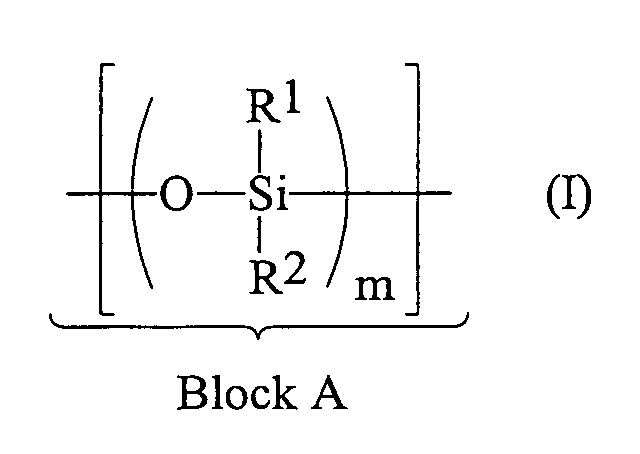
- R1 und R2
- gleiche oder verschiedene Reste, ausgewählt aus linearen oder verzweigten, gesättigten, ein- oder mehrfach ungesättigten Alkyl-, Aryl-, Alkylaryl- oder Arylalkylresten mit 1 bis 20, insbesondere 1 bis 10 C-Atomen, Halogenalkylgruppen mit 1 bis 20 C-Atomen, Siloxygruppen und Triorganosiloxygruppen darstellen; und
- m
- eine ganze Zahl von 5 bis 300, vorzugsweise von 5 bis 100 ist und dessen

- R3, R4 und R5
- gleiche oder verschiedene Reste, ausgewählt aus linearen oder verzweigten, gesättigten, ein- oder mehrfach ungesättigten Alkyl-, Aryl-, Alkylaryl- oder Arylalkylresten mit 1 bis 20, insbesondere 1 bis 10 C-Atomen, Halogenalkylgruppen mit 1 bis 20 C-Atomen, Siloxygruppen und Triorganosiloxygruppen darstellen;
- n
- eine ganze Zahl zwischen 5 und 300, vorzugsweise zwischen 5 und 50;
- o
- eine ganze Zahl zwischen 2 und 300, vorzugsweise zwischen 2 und 50 ist,

- R1 und R2
- gleiche oder verschiedene Reste, ausgewählt aus linearen oder verzweigten, gesättigten, ein- oder mehrfach ungesättigten Alkyl-, Aryl-, Alkylaryl- oder Arylalkylresten mit 1 bis 20, insbesondere 1 bis 10 C-Atomen, Halogenalkylgruppen mit 1 bis 20 C-Atomen, Siloxygruppen und Triorganosiloxygruppen darstellen;
- X
- ein Halogen, eine Hydroxygruppe, eine Alkoxygruppe, eine organische Säuregruppe oder eine Sulfonsäuregruppe ist;
- m
- eine ganze Zahl zwischen 5 und 300, vorzugsweise zwischen 5 und 100, die durchschnittliche Anzahl von Siloxaneinheiten in der Kette darstellt,
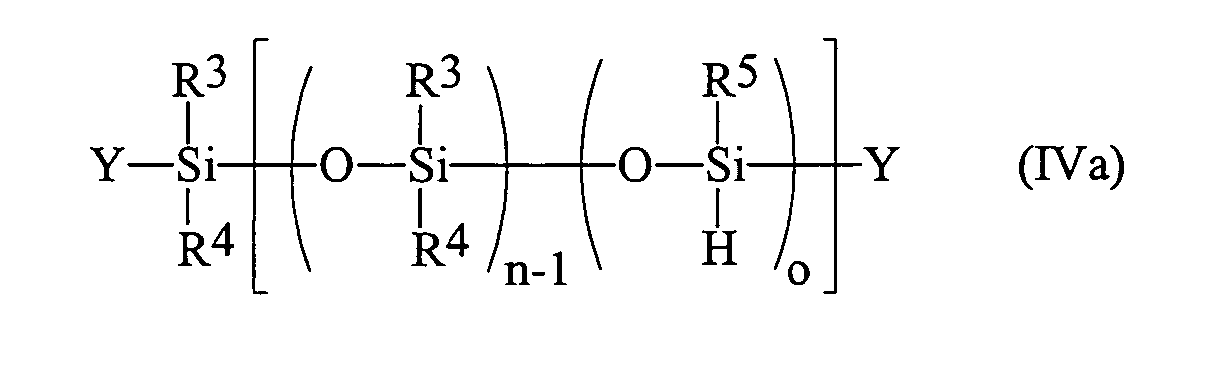


- R3, R4 und R5
- gleiche oder verschiedene Reste, ausgewählt aus linearen oder verzweigten, gesättigten, ein- oder mehrfach ungesättigten Alkyl-, Aryl-, Alkylaryl- oder Arylalkylresten mit 1 bis 20, insbesondere 1 bis 10 C-Atomen, Halogenalkylgruppen mit 1 bis 20 C-Atomen, Siloxygruppen und Triorganosiloxygruppen darstellen;
- n
- eine ganze Zahl zwischen 5 und 300, vorzugsweise zwischen 5 und 50;
- o
- eine ganze Zahl zwischen 2 und 300, vorzugsweise
zwischen 2 und 50 ist;
wobei die Summe (n + o) ≤ 400, bevorzugt ≤ 100 ist; - Y
- ein Halogen, eine Hydroxygruppe, eine Alkoxygruppe, eine organische Säuregruppe oder eine Sulfonsäuregruppe ist;
- Z
- einen Triorganosilylrest darstellt,
in einer üblichen Kondensationsreaktion zu dem Blockcopolymeren der allgemeinen Formel (V)
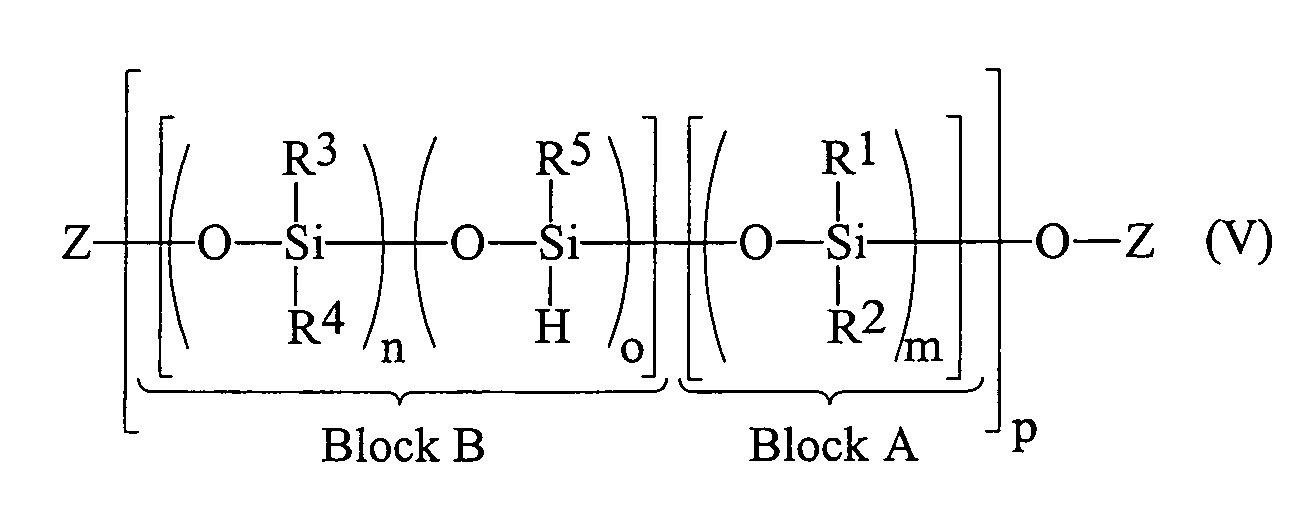
R1, R2, R3, R4, R5, Z, m, n und o die obige Bedeutung haben und p zwischen 2 und 50, bevorzugt zwischen 2 und 20 liegt, umsetzt.
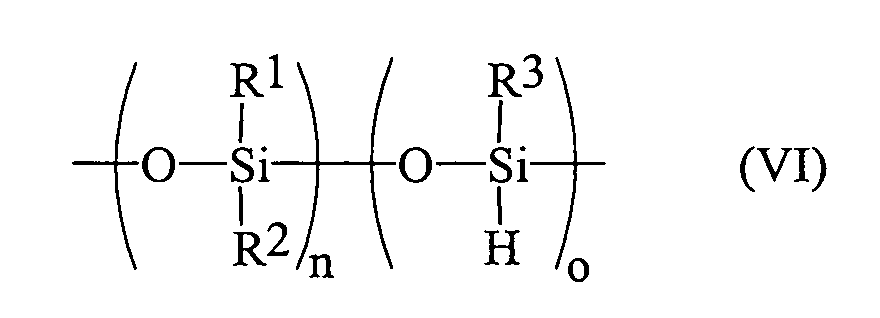
Im Unterschied dazu sind die erfindungsgemäß mitverwendeten Siloxane blockartig aufgebaut, wie gemäß der allgemeinen Formel (V) dargelegt.

- R1, R2, R3, R4, R5
- gleiche oder verschiedene Reste, ausgewählt aus linearen oder verzweigten, gesättigten, ein- oder mehrfach ungesättigten Alkyl-, Aryl-, Alkylaryl- oder Arylalkylresten mit 1 bis 20, insbesondere 1 bis 10 C-Atomen, Halogenalkylgruppen mit 1 bis 20 C-Atomen, Siloxygruppen und Triorganosiloxygruppen darstellen;
- R6
- mindestens einen Rest ausgesucht aus der Gruppe
CH2-CH2-(CH2)a-A oder CH=CH-(CH2)a-A darstellt, wobei
- a
- eine ganze Zahl zwischen 0 und 10 ist; und
- A
- einen Rest darstellt, der ausgewählt ist aus Polyoxyalkylenresten oder linearen, verzweigten oder cyclischen, gesättigten, ein- oder mehrfach ungesättigten Alkyl-, Aryl-, Alkylaryl- oder Arylalkylresten mit 1 bis 100, insbesondere 1 bis 50 C-Atomen, die gegebenenfalls Heteroatome enthalten;
- Z
- einen Triorganosilylrest darstellt;
- m
- eine ganze Zahl zwischen 5 und 300;
- n
- eine ganze Zahl zwischen 5 und 300;
- o
- eine ganze Zahl zwischen 2 und 300 ist;
wobei die Summe (n + o) ≤ 400 ist; - p
- eine ganze Zahl zwischen 2 und 50 ist,

- a
- eine ganze Zahl zwischen 0 und 10;
- R7, R8, R9, R10
- gleiche oder verschiedene Reste, ausgewählt aus Wasserstoff oder linearen oder verzweigten, gesättigten, ein- oder mehrfach ungesättigten Alkyl-, Aryl-, Alkylaryl- oder Arylalkylresten mit 1 bis 20, insbesondere 1 bis 10 C-Atomen und Halogen-alkylgruppen mit 1 bis 20 C-Atomen darstellen, wobei Wasserstoff, Methyl-, Butyl- und Phenylreste bevorzugt sind;
- s, t, u, v
- unabhängig voneinander ganze Zahlen von 0 bis 100, bevorzugt von 0 bis 50 sind, wobei die Summe (s + t + u + v) ≥ 2 ist;
- R11
- Wasserstoff oder einen Alkylrest, ausgewählt aus linearen oder verzweigten Alkyl-, Aryl-, Alkylaryl - oder Arylalkylresten mit 1 bis 20, insbesondere 1 bis 10 C-Atomen, Halogenalkylgruppen mit 1 bis 20 C-Atomen oder einen Acylrest darstellt, wobei Wasserstoff, Methyl- und Acetylreste bevorzugt sind.
- PTF1:
- Monomethylhydrogenpolysiloxan, MW ∼ 2.500 g/mol,
- α,ω-C1-Siloxan:
- α,ω-Dichlordimethylpolysiloxan, MW ∼ 600 g/mol,
- D4/D5:
- Mischung aus Octamethylcyclotetrasiloxan/Decamethylcyclopentasiloxan
- HMDS:
- Hexamethyldisiloxan
- PDM-Siloxan (I):
- α, ω-Dihydroxydimethylpolysiloxan, MW ∼ 3.000 g/mol.
- PDM-Siloxan (II):
- α,ω-Dihydroxydimethylpolysiloxan, MW ~ 540 g/mol.
Nach Zugabe des PDM-Siloxans wurde im Vakuum für 5 h gerührt, so dass die entstehende HCl aus dem Reaktionsgemisch entfernt wurde. Anschließend erfolgte die Zugabe der zur Neutralisation des Restgehalts an HCl notwendigen Menge an Ethyldiisopropylamin. Nach 2 h Rühren wurde die Mischung mit 10 Massen-% Isopropanol versetzt. Nachdem das Isopropanol im Vakuum entfernt und das ausgefallene Salz abfiltriert worden war, fiel das blockweise aufgebaute Siloxan als farbloses Öl an.
| Beispiel | Einwaage PTF1 [g] | Einwaage C1-Siloxan [g] | Einwaage D4/D5 [g] | Einwaage HMDS [g] | Einwaage PDM-Siloxan (I) [g] | Einwaage PDM-Siloxan (II) [g] | Viskosität [mPas] | Mw [g/mol] |
| 1 | 47,7 | 131,7 | - | - | 747,7 | - | 4.600 | 62.600 |
| 2 | 47,7 | 92,2 | - | 11,4 | 428,1 | - | 240 | 19.100 |
| 3 | 323,0 | 492,1 | 681,5 | - | - | 472,1 | 300 | 24.000 |
| 4 | 438,9 | 685,3 | 421,3 | - | 3.822,0 | - | 5.600 | 76.200 |
| 5 | 414,6 | 483,8 | 1.020,3 | - | 879,2 | - | 520 | 29.700 |
| 100,00 pphp | Sorbitol/Glycerol basierendes Polyetherpolyol (460 mg KOH/g) |
| 2,60 pphp | Wasser |
| 1,50 pphp | Dimethylcyclohexylamin |
| 1,70 pphp | Polysiloxan-Polyoxyalkylen-Copolymere |
| 15,00 pphp | Cyclopentan |
| 198,50 pphp | Diphenylmethandiisocyanat, Isomere u. Homologe (Isocyanatgehalt: 31,5 %) |
| Additiv | Siloxan-Kettenlänge | Oberfächenstörungen | Innenstörungen | Zellfeinheit | Wärmeleitfähigkeit [mW/mK] |
| TEGOSTAB® B 8404 | < 40 | stark | stark | fein | 23,8 |
| Beispiel 6 | > 100 | mittel | stark | sehr fein | 23,5 |
Claims (4)
- Verwendung von Verbindungen der allgemeinen Formel (VII)worin
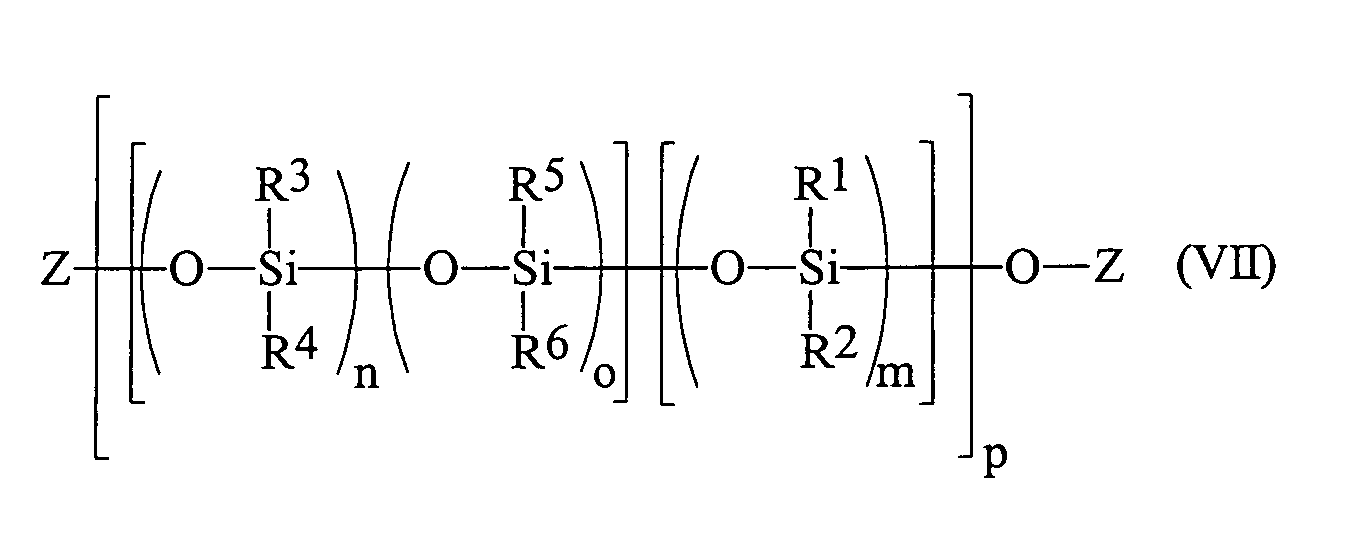
- R1, R2, R3, R4, R5
- gleiche oder verschiedene Reste, ausgewählt aus linearen oder verzweigten, gesättigten, ein- oder mehrfach ungesättigten Alkyl-, Aryl-, Alkylaryl- oder Arylalkylresten mit 1 bis 20, insbesondere 1 bis 10 C-Atomen, Halogenalkylgruppen mit 1 bis 20 C-Atomen, Siloxygruppen und Triorganosiloxygruppen darstellen;
- R6
- mindestens einen Rest ausgesucht aus der Gruppe
CH2-CH2-(CH2)a-A oder CH=CH-(CH2)a-A darstellt,
wobei- a
- eine ganze Zahl zwischen 0 und 10 ist; und
- A
- einen Rest darstellt, der ausgewählt ist aus Polyoxyalkylenresten oder linearen, verzweigten oder cyclischen, gesättigten, ein- oder mehrfach ungesättigten Alkyl-, Aryl-, Alkyl-aryl- oder Arylalkylresten mit 1 bis 100, insbesondere 1 bis 50 C-Atomen, die gegebenenfalls Heteroatome enthalten;
- Z
- einen Triorganosilylrest darstellt;
- m
- eine ganze Zahl zwischen 5 und 300;
- n
- eine ganze Zahl zwischen 5 und 300;
- o
- eine ganze Zahl zwischen 2 und 300 ist;
wobei die Summe (n + o) ≤ 400 ist; - p
- eine ganze Zahl zwischen 2 und 50 ist,
- Verwendung von Verbindungen der allgemeinen Formel (VII) gemäß Anspruch 1, dadurch gekennzeichnet, dass R6 der allgemeinen Formel (VIII) entspricht:worin

- a
- eine ganze Zahl zwischen 0 und 10;
- R7, R8, R9, R10
- gleiche oder verschiedene Reste, ausgewählt aus Wasserstoff oder linearen oder verzweigten, gesättigten, ein- oder mehrfach ungesättigten Alkyl-, Aryl-, Alkylaryl- oder Arylalkylresten mit 1 bis 20, insbesondere 1 bis 10 C-Atomen und Halogenalkylgruppen mit 1 bis 20 C-Atomen darstellen;
- s, t, u, v
- unabhängig voneinander ganze Zahlen von 0 bis 100, bevorzugt von 0 bis 50 sind, wobei die Summe (s + t + u + v) ≥ 2 ist;
- R11
- Wasserstoff oder einen Alkylrest, ausgewählt aus linearen oder verzweigten Alkyl-, Aryl-, Alkylaryl- oder Arylalkylresten mit 1 bis 20, insbesondere 1 bis 10 C-Atomen, Halogenalkylgruppen mit 1 bis 20 C-Atomen oder einen Acylrest darstellt.
- Verwendung von Verbindungen der allgemeinen Formel (VII) gemäß den Ansprüchen 1 und 2, dadurch gekennzeichnet, dass a zwischen 0 und 4 liegt, dass es sich bei R7, R8, R9 und/oder R10 um Wasserstoff oder Methyl-, Butyl- und/oder Phenylreste und bei R11 um einen Methyl- oder Acetylrest handelt.
- Stabilisierte Polyurethanschaumstoffe, enthaltend mindestens eine der Verbindungen der Ansprüche 1 bis 3.
Applications Claiming Priority (2)
| Application Number | Priority Date | Filing Date | Title |
|---|---|---|---|
| DE102004001408A DE102004001408A1 (de) | 2004-01-09 | 2004-01-09 | Verwendung blockweise aufgebauter Polyethersiloxane als Stabilisatoren in Polyurethanschäumen |
| DE102004001408 | 2004-01-09 |
Publications (1)
| Publication Number | Publication Date |
|---|---|
| EP1553127A1 true EP1553127A1 (de) | 2005-07-13 |
Family
ID=34585369
Family Applications (1)
| Application Number | Title | Priority Date | Filing Date |
|---|---|---|---|
| EP04030758A Withdrawn EP1553127A1 (de) | 2004-01-09 | 2004-12-24 | Verwendung blockweise aufgebauter Polyethersiloxane als Stabilisatoren in Polyurethanschäumen |
Country Status (3)
| Country | Link |
|---|---|
| US (1) | US7671103B2 (de) |
| EP (1) | EP1553127A1 (de) |
| DE (1) | DE102004001408A1 (de) |
Cited By (1)
| Publication number | Priority date | Publication date | Assignee | Title |
|---|---|---|---|---|
| WO2022263273A1 (en) | 2021-06-17 | 2022-12-22 | Evonik Operations Gmbh | Shaped flexible pu foam articles |
Families Citing this family (47)
| Publication number | Priority date | Publication date | Assignee | Title |
|---|---|---|---|---|
| DE102008000243A1 (de) | 2008-02-06 | 2009-08-13 | Evonik Goldschmidt Gmbh | Neuartige Kompatibilisierungsmittel zur Verbesserung der Lagerstabilität von Polyolmischungen |
| DE102008000255A1 (de) | 2008-02-08 | 2009-08-20 | Evonik Goldschmidt Gmbh | Siloxanzusammensetzungen |
| DE102009001595A1 (de) | 2009-03-17 | 2010-09-23 | Evonik Goldschmidt Gmbh | Kompatibilisierungsmittel zur Verbesserung der Lagerstabilität von Polyolmischungen |
| DE102009003274A1 (de) * | 2009-05-20 | 2010-11-25 | Evonik Goldschmidt Gmbh | Zusammensetzungen enthaltend Polyether-Polysiloxan-Copolymere |
| DE102009028061A1 (de) | 2009-07-29 | 2011-02-10 | Evonik Goldschmidt Gmbh | Verfahren zur Herstellung von Polyurethanschaum |
| DE102011007479A1 (de) | 2011-04-15 | 2012-10-18 | Evonik Goldschmidt Gmbh | Zusammensetzung, enthaltend spezielle Amide und organomodifizierte Siloxane, geeignet zur Herstellung von Polyurethanschäumen |
| DE102011007468A1 (de) | 2011-04-15 | 2012-10-18 | Evonik Goldschmidt Gmbh | Zusammensetzung, enthaltend spezielle Carbamat-artige Verbindungen, geeignet zur Herstellung von Polyurethanschäumen |
| DE102011109547A1 (de) | 2011-08-03 | 2013-02-07 | Evonik Goldschmidt Gmbh | Polysiloxanpolyether-Copolymere mit Carbonatgruppenhaltigen (Polyether-)Resten und deren Verwendung als Stabilisatorne zur Herstellung von Polyurethanschäumen |
| DE102011083017A1 (de) | 2011-09-20 | 2013-03-21 | Evonik Industries Ag | Verbundwerkstoffe umfassend eine offenzellige Polymermatrix und darin eingebettete Granulate |
| DE102013201829A1 (de) | 2013-02-05 | 2014-08-07 | Evonik Industries Ag | Amine, geeignet zur Verwendung bei der Herstellung von Polyurethanen |
| DE102013207117A1 (de) | 2013-04-19 | 2014-10-23 | Evonik Industries Ag | PUR-Schaum mit vergröberter Zellstruktur |
| DE102013223441B4 (de) | 2013-11-18 | 2015-06-03 | Evonik Industries Ag | Verwendung von Pentaethylenhexamin bei der Herstellung von Polyurethansystemen |
| DE102013223444B4 (de) | 2013-11-18 | 2015-06-03 | Evonik Industries Ag | Verwendung von Guanidinumsetzungsprodukten bei der Herstellung von Polyurethansystemen |
| EP2886591A1 (de) | 2013-12-19 | 2015-06-24 | Evonik Industries AG | Zusammensetzung, geeignet zur Herstellung von Polyurethanschäumen, enthaltend mindestens ein Nukleierungsmittel |
| DE102013226575B4 (de) | 2013-12-19 | 2021-06-24 | Evonik Operations Gmbh | Zusammensetzung, geeignet zur Herstellung von Polyurethanschäumen, enthaltend mindestens einen ungesättigten Fluorkohlenwasserstoff oder ungesättigten Fluorkohlenwasserstoff als Treibmittel, Polyurethanschäume, Verfahren zu deren Herstellung und deren Verwendung |
| DE102014213290A1 (de) | 2014-07-09 | 2016-01-14 | Evonik Degussa Gmbh | Geruchsarme Polyurethansysteme |
| DE102014215382A1 (de) | 2014-08-05 | 2016-02-11 | Evonik Degussa Gmbh | Stickstoffhaltige Verbindungen, geeignet zur Verwendung bei der Herstellung von Polyurethanen |
| DE102014215380B4 (de) | 2014-08-05 | 2022-04-28 | Evonik Operations Gmbh | Stickstoffhaltige Verbindungen, geeignet zur Verwendung bei der Herstellung von Polyurethanen |
| DE102014215387B4 (de) | 2014-08-05 | 2020-06-10 | Evonik Operations Gmbh | Stickstoffhaltige Verbindungen, geeignet zur Verwendung bei der Herstellung von Polyurethanen |
| DE102014215388A1 (de) | 2014-08-05 | 2016-02-11 | Evonik Degussa Gmbh | Stickstoffhaltige Verbindungen, geeignet zur Verwendung bei der Herstellung von Polyurethanen |
| DE102014215383B4 (de) | 2014-08-05 | 2020-06-10 | Evonik Operations Gmbh | Stickstoffhaltige Verbindungen, geeignet zur Verwendung bei der Herstellung von Polyurethanen |
| DE102014215381B4 (de) | 2014-08-05 | 2020-06-10 | Evonik Operations Gmbh | Stickstoffhaltige Verbindungen, geeignet zur Verwendung bei der Herstellung von Polyurethanen |
| DE102014215384A1 (de) | 2014-08-05 | 2016-02-11 | Evonik Degussa Gmbh | Stickstoffhaltige Verbindungen, geeignet zur Verwendung bei der Herstellung von Polyurethanen |
| PL2987598T3 (pl) | 2014-08-19 | 2019-09-30 | Evonik Degussa Gmbh | Dyspersja hybrydowa i jej zastosowanie |
| EP3078696A1 (de) | 2015-04-08 | 2016-10-12 | Evonik Degussa GmbH | Herstellung emissionsarmer polyurethane |
| EP3176206A1 (de) | 2015-12-01 | 2017-06-07 | Evonik Degussa GmbH | Verfahren zur herstellung feinzelliger schaumstoffe unter verwendung eines zellalterungshemmers |
| EP3205678A1 (de) | 2016-02-10 | 2017-08-16 | Evonik Degussa GmbH | Alterungsbeständige und emissionsarme matratzen und/oder kissen |
| WO2018015260A1 (de) | 2016-07-19 | 2018-01-25 | Evonik Degussa Gmbh | Verwendung von polyolestern zur herstellung poröser kunststoffbeschichtungen |
| JP7241487B2 (ja) | 2017-09-25 | 2023-03-17 | エボニック オペレーションズ ゲーエムベーハー | ポリウレタン系の製造 |
| EP3744745A1 (de) | 2019-05-28 | 2020-12-02 | Evonik Operations GmbH | Herstellung von pu-schaumstoffen |
| US12458150B2 (en) | 2019-07-19 | 2025-11-04 | Evonik Operations Gmbh | Shaped PU foam articles |
| EP4004079B1 (de) | 2019-07-24 | 2025-06-25 | Evonik Operations GmbH | Herstellung von polyurethanschäumen |
| DK3819323T3 (da) | 2019-11-07 | 2025-12-01 | Evonik Operations Gmbh | Deformationsrest |
| EP3865527A1 (de) | 2020-02-14 | 2021-08-18 | Evonik Operations GmbH | Herstellung von pu-schaumstoffen |
| US20220106432A1 (en) | 2020-10-07 | 2022-04-07 | Evonik Operations Gmbh | Shaped flexible pu foam articles |
| EP4363478A1 (de) | 2021-07-02 | 2024-05-08 | Evonik Operations GmbH | Herstellung von pu-schaumstoffen unter einsatz von recycling-polyolen |
| MX2023014999A (es) | 2021-07-02 | 2024-02-16 | Evonik Operations Gmbh | Recuperacion de di- y/o poliisocianatos de los procedimientos de despolimerizacion de pu. |
| WO2023275031A1 (de) | 2021-07-02 | 2023-01-05 | Evonik Operations Gmbh | Herstellung von pu-schaumstoffen unter einsatz von recycling-polyolen |
| MX2023015001A (es) | 2021-07-02 | 2024-02-15 | Evonik Operations Gmbh | Produccion de espumas de pu. |
| US20240368331A1 (en) | 2021-07-02 | 2024-11-07 | Evonik Operations Gmbh | Production of pu foams using recycled polyols |
| US20240309207A1 (en) | 2021-07-02 | 2024-09-19 | Evonik Operations Gmbh | Production of pu foams using recycled polyols |
| MX2024010160A (es) | 2022-02-22 | 2024-08-26 | Evonik Operations Gmbh | Uso de poliol reciclado a partir de un procedimiento de hidrolisis a base de amina para producir espuma de pu. |
| EP4257323A1 (de) | 2022-04-08 | 2023-10-11 | Evonik Operations GmbH | System und verfahren zur bestimmung von parametern für die schaumerzeugung |
| EP4257327A1 (de) | 2022-04-08 | 2023-10-11 | Evonik Operations GmbH | Optische bestimmung eines steuersignals für die herstellung von polyurethanblockschaum |
| EP4257325A1 (de) | 2022-04-08 | 2023-10-11 | Evonik Operations GmbH | Optische vorhersage von polyurethanschaumparametern |
| EP4257324A1 (de) | 2022-04-08 | 2023-10-11 | Evonik Operations GmbH | System und verfahren zum automatischen einstellen von parametern für die schaumproduktion |
| EP4257326A1 (de) | 2022-04-08 | 2023-10-11 | Evonik Operations GmbH | Optische bestimmung eines steuersignals als reaktion auf den nachweis von makroskopischen polyurethanschaumdefekten |
Citations (4)
| Publication number | Priority date | Publication date | Assignee | Title |
|---|---|---|---|---|
| EP0867464A1 (de) * | 1997-03-26 | 1998-09-30 | Th. Goldschmidt AG | Verwendung von organofunktionell modifizierten Polysiloxanen bei der Herstellung von Polyurethanschaum |
| EP0867462A1 (de) * | 1997-03-29 | 1998-09-30 | Th. Goldschmidt AG | Neuartige Siloxanblockcopolymere mit verknüpften Siloxanblöcken |
| US20020099137A1 (en) * | 2000-11-29 | 2002-07-25 | Austin Paul E. | Continuous manufacture of silicone copolymers via static mixing plug flow reactors |
| EP1439200A1 (de) * | 2003-01-16 | 2004-07-21 | Goldschmidt AG | Äquilibrierung von Siloxanen |
Family Cites Families (10)
| Publication number | Priority date | Publication date | Assignee | Title |
|---|---|---|---|---|
| FR2467220A1 (fr) * | 1979-10-11 | 1981-04-17 | Rhone Poulenc Ind | Procede de fabrication de mousses souples de polyurethanne a l'aide de polypentaerythritols triorganosilyles |
| DE3126343A1 (de) | 1981-07-03 | 1983-01-20 | Wacker-Chemie GmbH, 8000 München | Verfahren zur herstellung von mischpolymeren organosiloxanen mit si-gebundenem wasserstoff |
| US4692476A (en) * | 1983-12-09 | 1987-09-08 | Rogers Corporation | Complex block multipolymer surfactants |
| DE3508292C1 (de) * | 1985-03-08 | 1986-06-19 | Th. Goldschmidt Ag, 4300 Essen | Verfahren zur Herstellung von Polyurethanweichschaeumen |
| US4814409A (en) * | 1986-12-31 | 1989-03-21 | Union Carbide Corporation | Polysiloxane-polyoxyalkylene terpolymers for polyurethane foam manufacture |
| US4855329A (en) * | 1987-08-31 | 1989-08-08 | Union Carbide Corporation | Polysiloxane-polyoxyalkylene terpolymers for polyurethane foam manufacture |
| DE4118598A1 (de) | 1991-06-06 | 1992-12-10 | Wacker Chemie Gmbh | Unter abspaltung von alkoholen zu elastomeren vernetzbare organo(poly)siloxanmassen |
| DE4229402A1 (de) * | 1992-09-03 | 1994-03-10 | Goldschmidt Ag Th | Polysiloxan-Polyoxyalkylen-Blockmischpolymerisat mit unterschiedlichen Polyoxyalkylenblöcken im durchschnittlichen Molekül |
| JP3408370B2 (ja) | 1996-01-29 | 2003-05-19 | 花王株式会社 | ブロック状ハイドロジェン変性シリコーン及びその製造法 |
| DE19808581C1 (de) * | 1998-02-28 | 1999-08-12 | Goldschmidt Ag Th | Verwendung von Siliconpolyether-Copolymeren bei der Herstellung von Polyurethan-Kaltschäumen |
-
2004
- 2004-01-09 DE DE102004001408A patent/DE102004001408A1/de not_active Withdrawn
- 2004-12-24 EP EP04030758A patent/EP1553127A1/de not_active Withdrawn
-
2005
- 2005-01-07 US US11/030,940 patent/US7671103B2/en not_active Expired - Fee Related
Patent Citations (4)
| Publication number | Priority date | Publication date | Assignee | Title |
|---|---|---|---|---|
| EP0867464A1 (de) * | 1997-03-26 | 1998-09-30 | Th. Goldschmidt AG | Verwendung von organofunktionell modifizierten Polysiloxanen bei der Herstellung von Polyurethanschaum |
| EP0867462A1 (de) * | 1997-03-29 | 1998-09-30 | Th. Goldschmidt AG | Neuartige Siloxanblockcopolymere mit verknüpften Siloxanblöcken |
| US20020099137A1 (en) * | 2000-11-29 | 2002-07-25 | Austin Paul E. | Continuous manufacture of silicone copolymers via static mixing plug flow reactors |
| EP1439200A1 (de) * | 2003-01-16 | 2004-07-21 | Goldschmidt AG | Äquilibrierung von Siloxanen |
Cited By (1)
| Publication number | Priority date | Publication date | Assignee | Title |
|---|---|---|---|---|
| WO2022263273A1 (en) | 2021-06-17 | 2022-12-22 | Evonik Operations Gmbh | Shaped flexible pu foam articles |
Also Published As
| Publication number | Publication date |
|---|---|
| US7671103B2 (en) | 2010-03-02 |
| DE102004001408A1 (de) | 2005-07-28 |
| US20050176837A1 (en) | 2005-08-11 |
Similar Documents
| Publication | Publication Date | Title |
|---|---|---|
| EP1553127A1 (de) | Verwendung blockweise aufgebauter Polyethersiloxane als Stabilisatoren in Polyurethanschäumen | |
| EP1935923B1 (de) | Verfahren zur Herstellung von SiOC-verknüpften, linearen Polydimethylsiloxan-Polyoxyalkylen-Blockcopolymeren und ihre Verwendung | |
| EP2042542B1 (de) | Verwendung linearer Siloxane und Verfahren zu deren Herstellung | |
| DE69704412T2 (de) | Polyurethane foam manufactured in the presence of high boiling natural vegetable oils | |
| DE2210934C3 (de) | Hochmolekulare lineare hydrolysierbare bzw. nichthydrolysierbare (AB)↓n↓-Siloxan-Polyoxyalkylen-Blockmischpolymere und deren Anwendung | |
| EP2028213B1 (de) | Verfahren zur Herstellung von verzweigten Polyorganosiloxanen | |
| EP3536735B1 (de) | Vernetzte polyether-siloxan block-copolymere sowie deren verwendung zur herstellung von polyurethanschaumstoffen | |
| EP3611214A1 (de) | Sioc-verknüpfte, lineare polydimethylsiloxan-polyoxyalkylen-blockcopolymere | |
| EP2676986A1 (de) | Siliconpolyether und Verfahren zu deren Herstellung aus Methylidengruppen tragenden Polyethern | |
| DE102007020568A1 (de) | Verfahren zur kontinuierlichen Herstellung von Aminoalkylgruppen aufweisenden Organopolysiloxanen | |
| EP0106101B1 (de) | Verfahren zur Herstellung hochelastischer kalthärtender Polyurethanschaumstoffe | |
| DE69119249T2 (de) | Schnell vulkanisierbare extrudierbare Organosiloxanmassen | |
| EP2563846A2 (de) | Hydrophile polyorganosiloxane | |
| DE3787306T2 (de) | Oberflächenaktives Mittel auf der Basis von Polysiloxanen und dessen Verwendung bei der Herstellung von Polyurethanschaum. | |
| WO2003008485A1 (de) | Über alkoxygruppen vernetzende rtv-1-siliconkautschuk-mischungen | |
| EP1852455B1 (de) | Verfahren zur Herstellung von Urethangruppen aufweisenden Organosiliciumverbindungen | |
| DE2348929A1 (de) | Organosiliciumpolymere und deren verwendung zur herstellung flexibler polyurethan-schaumstoffe | |
| CH455295A (de) | Verfahren zur Herstellung von Blockmischpolymerisaten, von Polysiloxanen und Polyalkylenoxyden und Verwendung derselben zur Herstellung von Polyurethanschäumen | |
| EP1104779A2 (de) | Verwendung von Siliconpolyether-Copolymeren bei der Herstellung von Polyurethan-Kaltschäumen | |
| DE2514384C3 (de) | Flüssige cyanalkylsubstituierte Siloxanpolyoxyalkylen-Block-copolymere und deren Verwendung | |
| DE2555053C3 (de) | Verfahren zur Herstellung von Organopolysiloxan-Polyoxyalkylen-Blockmischpolymerisaten | |
| DE2125841A1 (de) | Organopolysiloxan-Copolymere | |
| DE69809730T2 (de) | Verfahren zur herstellung von fluorsiliconverbindungen mit hydrolysierbaren gruppen | |
| DE69313181T2 (de) | Acyloxyendgruppen enthaltende Polyether mit hoher Hydrolysebeständigkeit | |
| DE2558138B2 (de) | Cyangruppenhaltige Organopolysil· oxan-Polyoxyalkylen-Mischpolymere und deren Verwendung |
Legal Events
| Date | Code | Title | Description |
|---|---|---|---|
| PUAI | Public reference made under article 153(3) epc to a published international application that has entered the european phase |
Free format text: ORIGINAL CODE: 0009012 |
|
| 17P | Request for examination filed |
Effective date: 20041231 |
|
| AK | Designated contracting states |
Kind code of ref document: A1 Designated state(s): AT BE BG CH CY CZ DE DK EE ES FI FR GB GR HU IE IS IT LI LT LU MC NL PL PT RO SE SI SK TR |
|
| AX | Request for extension of the european patent |
Extension state: AL BA HR LV MK YU |
|
| AKX | Designation fees paid |
Designated state(s): DE ES FR GB IT NL |
|
| RAP1 | Party data changed (applicant data changed or rights of an application transferred) |
Owner name: EVONIK GOLDSCHMIDT GMBH |
|
| 17Q | First examination report despatched |
Effective date: 20100224 |
|
| STAA | Information on the status of an ep patent application or granted ep patent |
Free format text: STATUS: THE APPLICATION IS DEEMED TO BE WITHDRAWN |
|
| 18D | Application deemed to be withdrawn |
Effective date: 20100707 |