EP1550857B1 - Fluoreszenzmesseinrichtung - Google Patents
Fluoreszenzmesseinrichtung Download PDFInfo
- Publication number
- EP1550857B1 EP1550857B1 EP03748660A EP03748660A EP1550857B1 EP 1550857 B1 EP1550857 B1 EP 1550857B1 EP 03748660 A EP03748660 A EP 03748660A EP 03748660 A EP03748660 A EP 03748660A EP 1550857 B1 EP1550857 B1 EP 1550857B1
- Authority
- EP
- European Patent Office
- Prior art keywords
- charge
- signal
- outputs
- storage element
- charge storage
- Prior art date
- Legal status (The legal status is an assumption and is not a legal conclusion. Google has not performed a legal analysis and makes no representation as to the accuracy of the status listed.)
- Expired - Lifetime
Links
- 230000005284 excitation Effects 0.000 claims abstract description 36
- 238000006243 chemical reaction Methods 0.000 claims abstract description 18
- 238000005259 measurement Methods 0.000 claims abstract description 16
- 238000010408 sweeping Methods 0.000 claims abstract description 4
- 238000005070 sampling Methods 0.000 description 3
- 230000000694 effects Effects 0.000 description 1
- 238000000034 method Methods 0.000 description 1
- 238000012986 modification Methods 0.000 description 1
- 230000004048 modification Effects 0.000 description 1
- 230000003287 optical effect Effects 0.000 description 1
- 230000001105 regulatory effect Effects 0.000 description 1
- 239000007787 solid Substances 0.000 description 1
- 238000001228 spectrum Methods 0.000 description 1
- 239000000758 substrate Substances 0.000 description 1
Images


Classifications
-
- G—PHYSICS
- G01—MEASURING; TESTING
- G01J—MEASUREMENT OF INTENSITY, VELOCITY, SPECTRAL CONTENT, POLARISATION, PHASE OR PULSE CHARACTERISTICS OF INFRARED, VISIBLE OR ULTRAVIOLET LIGHT; COLORIMETRY; RADIATION PYROMETRY
- G01J3/00—Spectrometry; Spectrophotometry; Monochromators; Measuring colours
- G01J3/28—Investigating the spectrum
- G01J3/44—Raman spectrometry; Scattering spectrometry ; Fluorescence spectrometry
- G01J3/4406—Fluorescence spectrometry
-
- G—PHYSICS
- G01—MEASURING; TESTING
- G01J—MEASUREMENT OF INTENSITY, VELOCITY, SPECTRAL CONTENT, POLARISATION, PHASE OR PULSE CHARACTERISTICS OF INFRARED, VISIBLE OR ULTRAVIOLET LIGHT; COLORIMETRY; RADIATION PYROMETRY
- G01J3/00—Spectrometry; Spectrophotometry; Monochromators; Measuring colours
- G01J3/28—Investigating the spectrum
- G01J3/2889—Rapid scan spectrometers; Time resolved spectrometry
-
- G—PHYSICS
- G01—MEASURING; TESTING
- G01N—INVESTIGATING OR ANALYSING MATERIALS BY DETERMINING THEIR CHEMICAL OR PHYSICAL PROPERTIES
- G01N21/00—Investigating or analysing materials by the use of optical means, i.e. using sub-millimetre waves, infrared, visible or ultraviolet light
- G01N21/62—Systems in which the material investigated is excited whereby it emits light or causes a change in wavelength of the incident light
- G01N21/63—Systems in which the material investigated is excited whereby it emits light or causes a change in wavelength of the incident light optically excited
- G01N21/64—Fluorescence; Phosphorescence
-
- H—ELECTRICITY
- H04—ELECTRIC COMMUNICATION TECHNIQUE
- H04N—PICTORIAL COMMUNICATION, e.g. TELEVISION
- H04N5/00—Details of television systems
- H04N5/30—Transforming light or analogous information into electric information
- H04N5/32—Transforming X-rays
- H04N5/321—Transforming X-rays with video transmission of fluoroscopic images
Definitions
- the present invention relates to a fluorescence measuring apparatus for projecting a plurality of excitation pulse components at regular intervals to a specimen and for measuring fluorescent components emitted from the specimen corresponding to these excitation pulse components.
- a fluorescence measuring apparatus is an apparatus that projects a plurality of excitation pulse components generated at regular intervals, to a specimen and that measures fluorescent components emitted from the specimen corresponding to these excitation pulse components.
- the fluorescence measuring apparatus described in Japanese Patent Application Laid-Open No. 59-104519 includes a streak camera, a sampling means for sampling a streak image on a fluorescent screen of a streak tube, and an image intensifier for intensifying the sampled streak image through photoelectric conversion.
- US-A-4,471,228 describes a solid state image sensor having an electronic shutter which controls an exposure time of image sensor cells.
- GB-A-2,323,237 discloses a flourescence measuring apparatus having those features set out in the precharacterizing portion of claim 1.
- the conventional fluorescence measuring apparatus uses the image intensifier to intensify output signals obtained from fluorescent components generated at regular intervals.
- the reason is that when each fluorescent component is weak, single measurement thereof will not readily allow accurate measurement and that it is thus necessary to expand the dynamic range of output signals.
- the conventional fluorescence measuring apparatus uses the streak camera and the sampling means in order to meet the fact that the waveform of each fluorescent component is nonlinear. For this reason, there were desires heretofore for achievement of easier fluorescence measurement using a CCD (Charge Coupled Device), without use of the streak camera.
- CCD Charge Coupled Device
- the present invention has been accomplished in order to solve the problem as described above, and an object of the invention is to provide a fluorescence measuring apparatus having a configuration for using the CCD to measure fluorescent components emitted from a specimen in accordance with excitation pulse components projected at regular intervals.
- the Inventors conducted various studies about the possibility of measurement with the CCD (Charge Coupled Device) by projecting a plurality of excitation pulse components in the period of 1-2 msec to a specimen and measuring fluorescent components emitted from the specimen corresponding to the excitation pulse components, with the CCD.
- Figs. 1A-1I are timing charts for explaining an example of those studies.
- the CCD is a device that effects photoelectric conversion of received fluorescent components by photoelectric converters such as photodiodes (PDs) and that transfers charges obtained by charge storage elements such as vertical transfer elements and horizontal transfer elements.
- the period of the photoelectric conversion by the photoelectric converters and the transfer of charges stored in the charge storage elements needs to be 1-2 msec.
- Fig. 1A is a timing chart of excitation pulse components, Fig. 1B that of fluorescent components, Fig. 1C that of electronic shutter signals, Fig1D that of readout signals, Fig. 1E that of charge amounts of photodiodes (PDs), Fig. 1F that of stored charge amounts of vertical elements, Fig. 1G that of transfer signals of horizontal elements, Fig. 1H that of transfer signals of vertical elements, and Fig. 1I that of readout of entire data.
- the period T indicates a period in which output of each signal is repeated at regular intervals.
- a fluorescence measuring apparatus is defined in claim 1.
- Embodiments of the invention provide for a fluorescence measuring apparatus for measuring fluorescent components emitted from a specimen corresponding to respective excitation pulse components projected toward the specimen, which comprises a photoelectric converter, a charge storage element, and a controller.
- the photoelectric converter implements photoelectric conversion of the fluorescent components emitted from the specimen corresponding to the respective excitation pulse components.
- the charge storage element stores a charge resulting from the photoelectric conversion by the photoelectric converter and transfers the stored charge.
- the controller outputs an electronic shutter signal for sweeping away the charge resulting from the photoelectric conversion by the photoelectric converter, a readout signal for reading the charge resulting from the photoelectric conversion, into the charge storage element, and a transfer signal for sequentially transferring the read charge.
- the controller outputs an electronic shutter signal corresponding to generation of a pulse component included in excitation light, outputs a readout signal corresponding to output of the electronic shutter signal, and outputs a transfer signal per at least two readout signals outputted.
- the controller outputs the electronic shutter signal per generation of an excitation pulse component and outputs the readout signal corresponding to output of this electronic shutter signal. For this reason, it becomes feasible to implement measurement of a fluorescent component corresponding to each excitation pulse component.
- the controller since the controller outputs the transfer signal per at least two readout signals outputted, a plurality of fluorescent components can be measured in a lump.
- the excitation pulse components and the fluorescent components each are preferably of a substantially identical waveform and identical period.
- the reason is that when the fluorescent components are of the substantially identical period, the number of fluorescence generations per predetermined time can be readily specified and it is easy to achieve synchronization with the electronic shutter signal.
- the fluorescent components are of the substantially identical waveform, it becomes easy to measure the same waveform part of each fluorescent component.
- the controller preferably outputs the electronic shutter signal and the readout signal so as to enable measurement of the same waveform part of each of the fluorescent components.
- the controller preferably outputs the electronic shutter signal and the readout signal so as to enable measurement of the same waveform part of each of the fluorescent components.
- the controller outputs the electronic shutter signal and the transfer signal consecutively during a period before emission of a fluorescent component.
- the reason is that when the electronic shutter signal and the transfer signal are outputted before emission of a fluorescent component, i.e., before a start of measurement, it is feasible to prevent an unwanted charge from being stored in the photoelectric converter and in the charge storage element.
- the charge storage element may comprise a first charge storage element for directly receiving the charge from the photoelectric converter, and a second charge storage element for receiving the charge from the first charge storage element.
- the controller preferably outputs the transfer signal to the first charge storage element per predetermined number of readout signals outputted, and outputs the transfer signal consecutively to the second charge storage element. The reason is that when the transfer signal is consecutively outputted to the second charge storage element, storage of an unwanted charge in the second charge storage element can be effectively reduced.
- Figs. 1A-1I are timing charts for explaining a process of studies toward the present invention
- Fig. 2 is an illustration showing a configuration of a measuring system including a fluorescence measuring apparatus according to the present invention
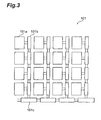
- Fig. 3 is an illustration showing a configuration of the CCD shown in Fig. 2 ;
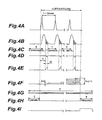
- Figs. 4A-4I are timing charts for explaining the operation in the fluorescence measuring apparatus according to the present invention.
- Fig. 2 is an illustration showing a configuration of a measuring system including a fluorescence measuring apparatus according to the present invention.
- the measuring system shown in this Fig. 2 is composed of a CCD camera 10 corresponding to the fluorescence measuring apparatus according to the present invention, a laser source 30, and a trigger generator 20.
- the CCD camera 10 includes a CCD 101, a CCD driving circuit 102, and a microcomputer 103.
- the CCD driving circuit 102 and the microcomputer 103 constitute a controller 100 of the fluorescence measuring apparatus.
- the CCD 101 is an interline transfer type CCD that measures a fluorescent component 60 emitted from a specimen 40, based on a command signal from the CCD driving circuit 102.
- the CCD 101 includes photodiodes (photoelectric converters) 101a, vertical transfer elements (first charge storage elements) 101b, and horizontal transfer elements (second charge storage elements) 101 c.
- Each photodiode 101a is a portion for storing a charge according to an amount of received light, and a plurality of photodiodes 101 a are arrayed on a substrate so as to form a desired light acceptance surface. Each photodiode 101 a sweeps away a stored charge with input of an electronic shutter signal from the CCD driving circuit 102, and moves a stored charge to a vertical transfer element 101b with input of a readout signal from the CCD driving circuit 102.
- the vertical transfer elements 101b being the first charge storage elements are provided corresponding to the respective photodiodes 101a.
- Each vertical transfer element 101b stores a charge moved from an associated photodiode 101a and transfers the charge to an adjacent vertical transfer element 101b according to need. More specifically, each vertical transfer element 101b sequentially transfers a charge stored therein, to a vertical transfer element 101b adjacent on the horizontal transfer element 101 c side with input of a transfer signal from the CCD driving circuit 102.
- the vertical transfer element 101b adjacent to the horizontal transfer element 101c transfers the charge thus transferred, to the horizontal transfer element 101 c.
- Each horizontal transfer element 101c is provided corresponding to a group of vertical transfer elements 101b in a column for transfer of charge from one to another.
- Each horizontal transfer element 101c stores a charge transferred from an associated column of vertical transfer elements 101b, and transfers the charge to an adjacent horizontal transfer element 101c.
- a horizontal transfer element 101c at the end finally stores the charge and, by reading the charge from the horizontal transfer element 101c at the end, the entire data resulting from photoelectric conversion by the photodiodes 101a can be read out.
- the CCD driving circuit 102 outputs the aforementioned electronic shutter signal, readout signal, and transfer signal, based on a command signal from the microcomputer 103.
- the microcomputer 103 outputs to the CCD driving circuit 102 command signals for output of the aforementioned electronic shutter signal, readout signal, and transfer signal, based on a trigger signal from the trigger generator 20. More specifically, the microcomputer 103 calculates timings of output of the electronic shutter signal, readout signal, and transfer signal, based on a trigger signal and an exposure delay operation of designating an exposure delay time of the CCD 101 relative to the trigger signal, and outputs them at the respective timings to the CCD driving circuit 102.
- These CCD driving circuit 102 and microcomputer 103 constitute the controller 100.
- the trigger generator 20 outputs a trigger signal to the laser source 30 and to the microcomputer 103.
- the laser source 30 emits an excitation pulse component 50 based on this trigger signal, toward a specimen 40.
- the specimen 40 emits fluorescent components 60 corresponding to respective excitation pulse components 50 and the CCD camera 10 measures these fluorescent components 60.
- Fig. 4A is a timing chart of excitation pulse components
- Fig. 4B that of fluorescent components
- Fig. 4C that of electronic shutter signals
- Fig. 4D that of readout signals
- Fig. 4E that of amounts of charges in the photodiodes (PDs)
- Fig. 4F that of amounts of charges stored in the vertical elements
- Fig. 4G that of transfer signals for the horizontal elements
- Fig. 4H that of transfer signals for the vertical elements
- Fig. 4I that of readout of entire data.
- the period T indicates a period in which output of each signal is repeated at regular intervals.
- the laser source 30 of Fig. 2 emits excitation pulse components 50 according to trigger signals from the trigger generator 20, toward the specimen 40 (see Fig. 4A ).
- the trigger signals are so regulated that intervals of the excitation pulse components 50 become 1-2 msec.
- the specimen 40 releases fluorescent components 60 according to the excitation pulse components 50 thus emitted (see Fig. 4B ).
- These fluorescent components 60 are optical components emitted according to properties of the specimen 40 and are generally of a nonlinear waveform as shown in Fig. 4B .
- An output delay time D of the electronic shutter signal relative to the trigger signal and the delay time W from the output of the electronic shutter signal to output of the readout signal are designated by the exposure delay operation fed to the microcomputer 103.
- the output delay time D and delay time W can be optionally set between 10 ⁇ sec and 400 ⁇ sec in consideration of a delay of fluorescent component 60 relative to excitation pulse component 50. Namely, when the output delay time D and the delay time W are optionally set, an exposed part (hatched portion in Fig. 4B ) in the waveform of each fluorescent component 60 is optionally set and a spectrum of each fluorescent component 60 is made.
- the electronic shutter signals are outputted at regular intervals except for exposure periods from the CCD driving circuit 102 to the CCD 101, as shown in Fig. 4C . Namely, the electronic shutter signals are repeatedly outputted at regular intervals in each period T in Fig. 4C . Since the electronic shutter signal is a signal for sweeping away charges stored in the photodiodes 101 a of CCD 101, it is feasible to reduce storage of unwanted charges in the photodiodes 101a (see Fig. 4E ).
- a stored charge ⁇ q resulting from photoelectric conversion in each photodiode 101a during an output delay time W is transferred to the associated vertical transfer element 101b with output of a readout signal (see Fig. 4C ).
- the generation of excitation pulse component 50 is carried out t times, and the charge ⁇ q resulting from photoelectric conversion in each photodiode 101a is transferred t times to the vertical transfer element 101b.
- a transfer signal is fed to the vertical transfer elements 101b, and each vertical transfer element 101b successively transfers the stored charge ( ⁇ q ⁇ t) to an adjacent vertical transfer element 101b (see Fig. 4F ).
- the charge thus transferred is then transferred to a horizontal transfer element 101c and is further transferred to an adjacent horizontal transfer element 101c to be read out.
- the charge thus read out is the charge ⁇ q stored t times, and, by dividing it by the number of operations t, it is feasible to obtain the charge ⁇ q corresponding to a fluorescent component 60 corresponding to one excitation pulse component 50.
- the transfer signals to the horizontal transfer elements 101c are always outputted at regular intervals from the CCD driving circuit 102. Namely, the transfer signals are outputted at regular intervals in the period T in Fig. 4G . Since this transfer signal is a signal for transferring the charge stored in each horizontal transfer element 101c, it is feasible to reduce storage of an unwanted charge in each horizontal transfer element 101c.
- the transfer signals to the vertical transfer elements 101b are outputted at regular intervals from the CCD driving circuit 102 before input of a trigger signal. Namely, the transfer signals are outputted at regular intervals in each period T in Fig. 4H . Since this transfer signal is a signal for transferring the charge stored in each vertical transfer element 101b, it is feasible to reduce storage of an unwanted charge in each vertical transfer element 101b.
- the microcomputer 103 and the CCD driving circuit 102 in the controller 100 output an electronic shutter signal per generation of an excitation pulse component 50 and output a readout signal corresponding to output of this electronic shutter signal. For this reason, it becomes feasible to perform measurement of a fluorescent component 60 corresponding to each excitation pulse component 50. Since the microcomputer 103 and the CCD driving circuit 102 output a transfer signal per predetermined number of readout signals outputted, it is feasible to measure the predetermined number of fluorescent components in a lump.
- the excitation pulse components 50 are generated so that fluorescent components 60 are of a substantially identical waveform and period. Since the fluorescent components 60 are of the substantially identical period, the number of fluorescences generated per predetermined time can be readily specified. Since the fluorescent components 60 are of the substantially identical waveform, it becomes easy to measure the identical waveform part which is equivalent among fluorescent components.
- the microcomputer 103 and the CCD driving circuit 102 as controller 100 calculate the output delay time D and the delay time W relative to the trigger signal so as to enable measurement of the same waveform part in each waveform of fluorescent component 60, and outputs the electronic shutter signals and the readout signals based thereon. Therefore, it is easy to measure the same waveform parts of respective fluorescent components emitted multiple times (t) and, by dividing the sum of the measurement results ( ⁇ q ⁇ t) by the predetermined number of times (t), the charge ⁇ q corresponding to the waveform part to be measured can be calculated.
- the fluorescence measuring apparatus according to the present invention can be modified in various ways, without having to be limited to the above-described embodiment.
- the present invention adopts the configuration wherein the controller outputs the electronic shutter signals corresponding to the respective excitation pulse component emitted toward the specimen and outputs the readout signals corresponding to the output of the electronic shutter signals, the invention enables the measurement of the fluorescent component corresponding to each excitation pulse component. Since the controller outputs the transfer signal per predetermined number of readout signals outputted, the predetermined number of fluorescent components can be measured in a lump. Therefore, we obtained the fluorescence measuring apparatus capable of measuring the fluorescent components emitted from the specimen corresponding to excitation pulse components, by use of the CCD.
Landscapes
- Physics & Mathematics (AREA)
- Spectroscopy & Molecular Physics (AREA)
- General Physics & Mathematics (AREA)
- Health & Medical Sciences (AREA)
- Chemical & Material Sciences (AREA)
- Nuclear Medicine, Radiotherapy & Molecular Imaging (AREA)
- Biochemistry (AREA)
- General Health & Medical Sciences (AREA)
- Life Sciences & Earth Sciences (AREA)
- Immunology (AREA)
- Pathology (AREA)
- Analytical Chemistry (AREA)
- Engineering & Computer Science (AREA)
- Multimedia (AREA)
- Signal Processing (AREA)
- Investigating, Analyzing Materials By Fluorescence Or Luminescence (AREA)
- Transforming Light Signals Into Electric Signals (AREA)
- Photometry And Measurement Of Optical Pulse Characteristics (AREA)
Claims (4)
- Fluoreszenzmessvorrichtung (10) zum Emittieren einer Mehrzahl von Anregungsimpulskomponenten (50) in Richtung zu einer Probe (40) und zum Messen von Fluoreszenzkomponenten (60), die von der Probe (40) entsprechend den jeweiligen Anregungsimpulskomponenten (50) emittiert werden, wobei die Fluoreszenzmessvorrichtung (10) umfasst:einen photoelektrischen Wandler (101a) zum Implementieren einer photoelektrischen Wandlung einer Fluoreszenzkomponente (60), die von der Probe emittiert wird;ein Ladungsspeicherelement (101 b, 101 c) zum Speichern einer Ladung, die aus der photoelektrischen Wandlung mittels des photoelektrischen Wandlers (101 a) resultiert, und zum Übertragen der gespeicherten Ladung; undeine Steuervorrichtung (100) zum Ausgeben eines elektronischen Verschlusssignals zum Ausfegen der aus der photoelektrischen Wandlung mittels des photoelektrischen Wandlers (101 a) resultierenden Ladung, eines Auslesesignals zum Einlesen der aus der photoelektrischen Wandlung resultierenden Ladung in das Ladungsspeicherelement (101 b, 101 c), und eines Übertragungssignals zum anschließenden Übertragen der gelesenen Ladung,wobei die Steuervorrichtung (100) das elektronische Verschlusssignal entsprechend der Erzeugung einer Impulskomponente (50), die im Anregungslicht enthalten ist, ausgibt, das Auslesesignal entsprechend einer Ausgabe des elektrischen Verschlusssignals ausgibt, und das Übertragungssignal für je wenigstens zwei ausgegebene Auslesesignale ausgibt;dadurch gekennzeichnet, dass die Steuervorrichtung (100) das elektronische Verschlusssignal und das Übertragungssignal vor der Emission der Fluoreszenzkomponenten (60) nacheinander ausgibt.
- Fluoreszenzmessvorrichtung nach Anspruch 1, wobei die Anregungsimpulskomponenten (50) im Wesentlichen eine identische Wellenform und eine identische Periode aufweisen, und
wobei die Fluoreszenzkomponenten (60) im Wesentlichen eine identische Wellenform und eine identische Periode aufweisen. - Fluoreszenzmessvorrichtung (10) nach Anspruch 2, wobei die Steuervorrichtung (100) das elektronische Verschlusssignal und das Auslesesignal so ausgibt, dass eine Messung eines identischen Wellenformteils in jeder der Fluoreszenzkomponenten (60) ermöglicht wird.
- Fluoreszenzmessvorrichtung nach Anspruch 1, wobei das Ladungsspeicherelement (101 b, 101 c) ein erstes Ladungsspeicherelement (101 b) zum direkten Empfangen der Ladung vom photoelektrischen Wandler (101 a) und ein zweites Ladungsspeicherelement (101c) zum Empfangen der Ladung vom ersten Ladungsspeicherelement (101 b) umfasst, und
wobei die Steuervorrichtung (100) das Übertragungssignal für eine vorgegebene Anzahl von ausgegebenen Auslesesignalen an das erste Ladungsspeicherelement (101 b) ausgibt und anschließend das Übertragungssignal an das zweite Ladungsspeicherelement (101c) ausgibt.
Applications Claiming Priority (3)
| Application Number | Priority Date | Filing Date | Title |
|---|---|---|---|
| JP2002288848A JP4188653B2 (ja) | 2002-10-01 | 2002-10-01 | 蛍光測定装置 |
| JP2002288848 | 2002-10-01 | ||
| PCT/JP2003/012609 WO2004031748A1 (ja) | 2002-10-01 | 2003-10-01 | 蛍光測定装置 |
Publications (3)
| Publication Number | Publication Date |
|---|---|
| EP1550857A1 EP1550857A1 (de) | 2005-07-06 |
| EP1550857A4 EP1550857A4 (de) | 2006-12-20 |
| EP1550857B1 true EP1550857B1 (de) | 2010-02-24 |
Family
ID=32063695
Family Applications (1)
| Application Number | Title | Priority Date | Filing Date |
|---|---|---|---|
| EP03748660A Expired - Lifetime EP1550857B1 (de) | 2002-10-01 | 2003-10-01 | Fluoreszenzmesseinrichtung |
Country Status (7)
| Country | Link |
|---|---|
| US (1) | US20060124863A1 (de) |
| EP (1) | EP1550857B1 (de) |
| JP (1) | JP4188653B2 (de) |
| CN (1) | CN100462713C (de) |
| AU (1) | AU2003268725A1 (de) |
| DE (1) | DE60331454D1 (de) |
| WO (1) | WO2004031748A1 (de) |
Families Citing this family (6)
| Publication number | Priority date | Publication date | Assignee | Title |
|---|---|---|---|---|
| EP1925930A1 (de) * | 2003-02-13 | 2008-05-28 | Hamamatsu Photonics K.K. | Fluoreszenzkorrelationsspektroskopie-Analysegerät |
| JP4662123B2 (ja) * | 2004-09-24 | 2011-03-30 | 横河電機株式会社 | レーザ共焦点顕微鏡システム |
| CN101472076B (zh) * | 2007-12-28 | 2010-09-29 | 鸿富锦精密工业(深圳)有限公司 | 影像拍摄装置及其拍摄控制方法 |
| WO2012111093A1 (ja) * | 2011-02-15 | 2012-08-23 | 有限会社ワイ・システムズ | キャリア寿命の測定方法および測定装置 |
| KR102126694B1 (ko) * | 2018-06-01 | 2020-06-25 | 주식회사 수젠텍 | 시간분해 형광신호 분석장치 |
| EP3937780A4 (de) * | 2019-03-14 | 2022-12-07 | InSilixa, Inc. | Verfahren und systeme zur zeitgesteuerten fluoreszenzbasierten detektion |
Family Cites Families (11)
| Publication number | Priority date | Publication date | Assignee | Title |
|---|---|---|---|---|
| JPS5795771A (en) * | 1980-12-05 | 1982-06-14 | Fuji Photo Film Co Ltd | Solid-state image pickup device |
| JPS59104519A (ja) * | 1982-12-07 | 1984-06-16 | Hamamatsu Photonics Kk | 高速繰返しパルス光計測装置 |
| JP2694200B2 (ja) * | 1988-03-08 | 1997-12-24 | 日本分光株式会社 | マルチチャンネル蛍光減衰波形測定装置 |
| US5323008A (en) * | 1992-03-23 | 1994-06-21 | Diatron Corporation | Fluorometer detection system |
| JP3281755B2 (ja) * | 1995-04-05 | 2002-05-13 | 三菱重工業株式会社 | レーザ誘起蛍光法による計測装置 |
| DE19651101A1 (de) * | 1996-12-09 | 1998-06-10 | Giesecke & Devrient Gmbh | Vorrichtung und Verfahren zur Detektion von fluoreszentem und phosphoreszentem Licht |
| US5821547A (en) * | 1997-03-10 | 1998-10-13 | Talmi; Yair | Temporal filter using interline charged coupled device |
| JPH11164210A (ja) * | 1997-11-28 | 1999-06-18 | Nikon Corp | 動き検出用固体撮像装置 |
| US6037584A (en) * | 1998-05-08 | 2000-03-14 | Hewlett-Packard Company | Optical scanner including exposure control |
| JP2001339638A (ja) * | 2000-05-26 | 2001-12-07 | Hamamatsu Photonics Kk | ストリークカメラ装置 |
| BR0212668A (pt) * | 2001-09-19 | 2004-08-24 | Joule Microsystems Canada Inc | Um espectrÈmetro incorporando filtragem combinada de sinal |
-
2002
- 2002-10-01 JP JP2002288848A patent/JP4188653B2/ja not_active Expired - Fee Related
-
2003
- 2003-10-01 DE DE60331454T patent/DE60331454D1/de not_active Expired - Lifetime
- 2003-10-01 EP EP03748660A patent/EP1550857B1/de not_active Expired - Lifetime
- 2003-10-01 CN CNB2003801007671A patent/CN100462713C/zh not_active Expired - Fee Related
- 2003-10-01 US US10/529,653 patent/US20060124863A1/en not_active Abandoned
- 2003-10-01 WO PCT/JP2003/012609 patent/WO2004031748A1/ja not_active Ceased
- 2003-10-01 AU AU2003268725A patent/AU2003268725A1/en not_active Abandoned
Also Published As
| Publication number | Publication date |
|---|---|
| EP1550857A4 (de) | 2006-12-20 |
| JP4188653B2 (ja) | 2008-11-26 |
| EP1550857A1 (de) | 2005-07-06 |
| CN1695053A (zh) | 2005-11-09 |
| JP2004125556A (ja) | 2004-04-22 |
| DE60331454D1 (de) | 2010-04-08 |
| AU2003268725A1 (en) | 2004-04-23 |
| WO2004031748A1 (ja) | 2004-04-15 |
| CN100462713C (zh) | 2009-02-18 |
| US20060124863A1 (en) | 2006-06-15 |
Similar Documents
| Publication | Publication Date | Title |
|---|---|---|
| EP0051460B1 (de) | Verfahren und Vorrichtung zum Auslesen eines latenten Strahlungsbildes | |
| JP4330751B2 (ja) | 放射線画像取得方法および装置ならびにそのためのセル間隔検出方法および装置 | |
| JP2002315022A (ja) | 3次元画像検出装置 | |
| EP1550857B1 (de) | Fluoreszenzmesseinrichtung | |
| KR100961305B1 (ko) | 촬상장치 | |
| CN1452447A (zh) | 放射线摄影设备 | |
| US5448613A (en) | X-ray diagnostics installation | |
| GB2105035A (en) | Instrument for measuring light emission | |
| US6683676B1 (en) | Three-dimensional image capturing device | |
| US6822681B1 (en) | Image capturing device for capturing a shape of a measurement subject | |
| RU2089932C1 (ru) | Устройство для наблюдения объектов | |
| EP0063316B1 (de) | Verfahren und Anordnung zur Bildinformationsabtastung | |
| Sandel et al. | Effect of phosphor persistence on photometry with image intensifiers and integrating readout devices | |
| RU2269804C1 (ru) | Способ ночного и/или дневного наблюдения удаленного объекта с синхронной фазовой манипуляцией лазерными импульсами подсвета и устройство для его реализации | |
| US6778219B1 (en) | Three-dimensional image capturing device | |
| US7548268B2 (en) | Solid-state image sensing device having photoreceptive element | |
| KR910007703B1 (ko) | 고체촬상소자의 블루밍 측정방법 및 그 장치 | |
| JPH0773339B2 (ja) | 撮影装置 | |
| JPH09508480A (ja) | 画像ピックアップ装置 | |
| JP2002135657A (ja) | 複数の出力ノードを有する電荷結合素子 | |
| US6982761B1 (en) | Device for capturing three-dimensional images with independently controllable groups of photoelectric conversion elements | |
| US7683952B2 (en) | Optical image information detecting apparatus | |
| JP2016116754A (ja) | 放射線撮影装置及びその制御方法 | |
| JP2004298404A (ja) | 自家蛍光内視鏡装置 | |
| JP2729276B2 (ja) | シンチレーシヨンカメラ |
Legal Events
| Date | Code | Title | Description |
|---|---|---|---|
| PUAI | Public reference made under article 153(3) epc to a published international application that has entered the european phase |
Free format text: ORIGINAL CODE: 0009012 |
|
| 17P | Request for examination filed |
Effective date: 20050422 |
|
| AK | Designated contracting states |
Kind code of ref document: A1 Designated state(s): AT BE BG CH CY CZ DE DK EE ES FI FR GB GR HU IE IT LI LU MC NL PT RO SE SI SK TR |
|
| AX | Request for extension of the european patent |
Extension state: AL LT LV MK |
|
| DAX | Request for extension of the european patent (deleted) | ||
| RBV | Designated contracting states (corrected) |
Designated state(s): CH DE FI FR GB LI SE |
|
| RIC1 | Information provided on ipc code assigned before grant |
Ipc: H04N 5/335 20060101ALI20061106BHEP Ipc: G01N 21/64 20060101AFI20040416BHEP Ipc: G01J 1/42 20060101ALI20061106BHEP |
|
| A4 | Supplementary search report drawn up and despatched |
Effective date: 20061117 |
|
| 17Q | First examination report despatched |
Effective date: 20070426 |
|
| GRAP | Despatch of communication of intention to grant a patent |
Free format text: ORIGINAL CODE: EPIDOSNIGR1 |
|
| RIC1 | Information provided on ipc code assigned before grant |
Ipc: H04N 5/335 20060101ALI20090728BHEP Ipc: H04N 5/321 20060101ALI20090728BHEP Ipc: G01J 1/42 20060101ALI20090728BHEP Ipc: G01J 3/44 20060101ALI20090728BHEP Ipc: G01N 21/64 20060101AFI20090728BHEP Ipc: G01J 3/28 20060101ALI20090728BHEP |
|
| GRAS | Grant fee paid |
Free format text: ORIGINAL CODE: EPIDOSNIGR3 |
|
| GRAA | (expected) grant |
Free format text: ORIGINAL CODE: 0009210 |
|
| RAP1 | Party data changed (applicant data changed or rights of an application transferred) |
Owner name: HAMAMATSU PHOTONICS K.K. |
|
| AK | Designated contracting states |
Kind code of ref document: B1 Designated state(s): CH DE FI FR GB LI SE |
|
| REG | Reference to a national code |
Ref country code: GB Ref legal event code: FG4D |
|
| REG | Reference to a national code |
Ref country code: CH Ref legal event code: EP |
|
| RAP2 | Party data changed (patent owner data changed or rights of a patent transferred) |
Owner name: HAMAMATSU PHOTONICS K.K. |
|
| REF | Corresponds to: |
Ref document number: 60331454 Country of ref document: DE Date of ref document: 20100408 Kind code of ref document: P |
|
| REG | Reference to a national code |
Ref country code: CH Ref legal event code: NV Representative=s name: KIRKER & CIE S.A. |
|
| REG | Reference to a national code |
Ref country code: SE Ref legal event code: TRGR |
|
| PLBE | No opposition filed within time limit |
Free format text: ORIGINAL CODE: 0009261 |
|
| STAA | Information on the status of an ep patent application or granted ep patent |
Free format text: STATUS: NO OPPOSITION FILED WITHIN TIME LIMIT |
|
| 26N | No opposition filed |
Effective date: 20101125 |
|
| PGFP | Annual fee paid to national office [announced via postgrant information from national office to epo] |
Ref country code: GB Payment date: 20130925 Year of fee payment: 11 |
|
| PGFP | Annual fee paid to national office [announced via postgrant information from national office to epo] |
Ref country code: FR Payment date: 20131009 Year of fee payment: 11 Ref country code: SE Payment date: 20131011 Year of fee payment: 11 Ref country code: CH Payment date: 20131014 Year of fee payment: 11 Ref country code: DE Payment date: 20130925 Year of fee payment: 11 |
|
| PGFP | Annual fee paid to national office [announced via postgrant information from national office to epo] |
Ref country code: FI Payment date: 20131010 Year of fee payment: 11 |
|
| REG | Reference to a national code |
Ref country code: DE Ref legal event code: R119 Ref document number: 60331454 Country of ref document: DE |
|
| REG | Reference to a national code |
Ref country code: CH Ref legal event code: PL |
|
| REG | Reference to a national code |
Ref country code: SE Ref legal event code: EUG |
|
| GBPC | Gb: european patent ceased through non-payment of renewal fee |
Effective date: 20141001 |
|
| PG25 | Lapsed in a contracting state [announced via postgrant information from national office to epo] |
Ref country code: CH Free format text: LAPSE BECAUSE OF NON-PAYMENT OF DUE FEES Effective date: 20141031 Ref country code: GB Free format text: LAPSE BECAUSE OF NON-PAYMENT OF DUE FEES Effective date: 20141001 Ref country code: LI Free format text: LAPSE BECAUSE OF NON-PAYMENT OF DUE FEES Effective date: 20141031 Ref country code: DE Free format text: LAPSE BECAUSE OF NON-PAYMENT OF DUE FEES Effective date: 20150501 Ref country code: FI Free format text: LAPSE BECAUSE OF NON-PAYMENT OF DUE FEES Effective date: 20141001 Ref country code: SE Free format text: LAPSE BECAUSE OF NON-PAYMENT OF DUE FEES Effective date: 20141002 |
|
| REG | Reference to a national code |
Ref country code: FR Ref legal event code: ST Effective date: 20150630 |
|
| PG25 | Lapsed in a contracting state [announced via postgrant information from national office to epo] |
Ref country code: FR Free format text: LAPSE BECAUSE OF NON-PAYMENT OF DUE FEES Effective date: 20141031 |