EP1550330B1 - Intelligenter kommunikationsknotenobjekt-bakenrahmen (icbf) mit einem zeitlichenuebergangsnetzwerkprotokoll (ttnp) in einem mobil-ad-hoc-netzwerk - Google Patents
Intelligenter kommunikationsknotenobjekt-bakenrahmen (icbf) mit einem zeitlichenuebergangsnetzwerkprotokoll (ttnp) in einem mobil-ad-hoc-netzwerk Download PDFInfo
- Publication number
- EP1550330B1 EP1550330B1 EP03798718A EP03798718A EP1550330B1 EP 1550330 B1 EP1550330 B1 EP 1550330B1 EP 03798718 A EP03798718 A EP 03798718A EP 03798718 A EP03798718 A EP 03798718A EP 1550330 B1 EP1550330 B1 EP 1550330B1
- Authority
- EP
- European Patent Office
- Prior art keywords
- node
- route
- mobile
- condition information
- group
- Prior art date
- Legal status (The legal status is an assumption and is not a legal conclusion. Google has not performed a legal analysis and makes no representation as to the accuracy of the status listed.)
- Expired - Lifetime
Links
- 238000004891 communication Methods 0.000 title claims abstract description 39
- 230000007704 transition Effects 0.000 title claims abstract description 36
- 230000002123 temporal effect Effects 0.000 title description 5
- 238000000034 method Methods 0.000 claims abstract description 76
- 230000008569 process Effects 0.000 claims abstract description 41
- 238000012423 maintenance Methods 0.000 claims abstract description 9
- 230000005540 biological transmission Effects 0.000 claims description 45
- 230000036962 time dependent Effects 0.000 claims description 12
- 230000033001 locomotion Effects 0.000 description 21
- 238000013459 approach Methods 0.000 description 19
- 230000003247 decreasing effect Effects 0.000 description 12
- 238000004590 computer program Methods 0.000 description 8
- 230000006870 function Effects 0.000 description 7
- 238000012545 processing Methods 0.000 description 5
- 230000003044 adaptive effect Effects 0.000 description 4
- 230000008859 change Effects 0.000 description 4
- 238000010586 diagram Methods 0.000 description 4
- 230000002829 reductive effect Effects 0.000 description 4
- 238000003860 storage Methods 0.000 description 4
- 230000001133 acceleration Effects 0.000 description 3
- 235000008694 Humulus lupulus Nutrition 0.000 description 2
- 238000011161 development Methods 0.000 description 2
- 230000004044 response Effects 0.000 description 2
- 230000002441 reversible effect Effects 0.000 description 2
- 230000001413 cellular effect Effects 0.000 description 1
- 230000007423 decrease Effects 0.000 description 1
- 238000001514 detection method Methods 0.000 description 1
- 230000009365 direct transmission Effects 0.000 description 1
- 238000009826 distribution Methods 0.000 description 1
- 230000003203 everyday effect Effects 0.000 description 1
- 230000000670 limiting effect Effects 0.000 description 1
- 238000004519 manufacturing process Methods 0.000 description 1
- 238000005259 measurement Methods 0.000 description 1
- 230000007246 mechanism Effects 0.000 description 1
- 230000003287 optical effect Effects 0.000 description 1
- 238000005457 optimization Methods 0.000 description 1
- 239000012466 permeate Substances 0.000 description 1
- 230000003068 static effect Effects 0.000 description 1
Images


Classifications
-
- H—ELECTRICITY
- H04—ELECTRIC COMMUNICATION TECHNIQUE
- H04L—TRANSMISSION OF DIGITAL INFORMATION, e.g. TELEGRAPHIC COMMUNICATION
- H04L45/00—Routing or path finding of packets in data switching networks
- H04L45/02—Topology update or discovery
-
- H—ELECTRICITY
- H04—ELECTRIC COMMUNICATION TECHNIQUE
- H04W—WIRELESS COMMUNICATION NETWORKS
- H04W40/00—Communication routing or communication path finding
- H04W40/02—Communication route or path selection, e.g. power-based or shortest path routing
- H04W40/12—Communication route or path selection, e.g. power-based or shortest path routing based on transmission quality or channel quality
-
- H—ELECTRICITY
- H04—ELECTRIC COMMUNICATION TECHNIQUE
- H04W—WIRELESS COMMUNICATION NETWORKS
- H04W40/00—Communication routing or communication path finding
- H04W40/02—Communication route or path selection, e.g. power-based or shortest path routing
- H04W40/12—Communication route or path selection, e.g. power-based or shortest path routing based on transmission quality or channel quality
- H04W40/14—Communication route or path selection, e.g. power-based or shortest path routing based on transmission quality or channel quality based on stability
-
- H—ELECTRICITY
- H04—ELECTRIC COMMUNICATION TECHNIQUE
- H04W—WIRELESS COMMUNICATION NETWORKS
- H04W40/00—Communication routing or communication path finding
- H04W40/02—Communication route or path selection, e.g. power-based or shortest path routing
- H04W40/18—Communication route or path selection, e.g. power-based or shortest path routing based on predicted events
-
- H—ELECTRICITY
- H04—ELECTRIC COMMUNICATION TECHNIQUE
- H04W—WIRELESS COMMUNICATION NETWORKS
- H04W40/00—Communication routing or communication path finding
- H04W40/24—Connectivity information management, e.g. connectivity discovery or connectivity update
- H04W40/246—Connectivity information discovery
-
- H—ELECTRICITY
- H04—ELECTRIC COMMUNICATION TECHNIQUE
- H04W—WIRELESS COMMUNICATION NETWORKS
- H04W40/00—Communication routing or communication path finding
- H04W40/24—Connectivity information management, e.g. connectivity discovery or connectivity update
- H04W40/248—Connectivity information update
-
- H—ELECTRICITY
- H04—ELECTRIC COMMUNICATION TECHNIQUE
- H04W—WIRELESS COMMUNICATION NETWORKS
- H04W40/00—Communication routing or communication path finding
- H04W40/24—Connectivity information management, e.g. connectivity discovery or connectivity update
- H04W40/28—Connectivity information management, e.g. connectivity discovery or connectivity update for reactive routing
-
- H—ELECTRICITY
- H04—ELECTRIC COMMUNICATION TECHNIQUE
- H04W—WIRELESS COMMUNICATION NETWORKS
- H04W40/00—Communication routing or communication path finding
- H04W40/24—Connectivity information management, e.g. connectivity discovery or connectivity update
- H04W40/30—Connectivity information management, e.g. connectivity discovery or connectivity update for proactive routing
Definitions
- Wireless networks have experienced increased development in the past decade.
- One of the most rapidly developing areas is mobile ad hoc networks.
- a mobile ad hoc network includes a number of geographically-distributed, potentially mobile nodes wirelessly connected by one or more radio frequency channels.
- the most distinctive feature of mobile ad hoc networks is the lack of any fixed infrastructure.
- the network is formed of mobile nodes only, and a network is created on the fly as the nodes transmit to or receive from other nodes. The network does not in general depend on a particular node and dynamically adjusts as some nodes join or others leave the network.
- Ad hoc networks will allow people to exchange data in the field or in a class room without using any network structure except the one they create by simply turning on their computers or PDAs.
- nodes must self-organize and reconfigure as they move, join or leave the network. All nodes could potentially be functionally identical and there may not be any natural hierarchy or central controller in the network. Many network-controlling functions are distributed among the nodes. Nodes are often powered by batteries and have limited communication and computation capabilities. The bandwidth of the system is usually limited. The distance between two nodes often exceeds the radio transmission range, and a transmission has to be relayed by other nodes before reaching its destination. Consequently, a network has a multihop topology, and this topology changes as the nodes move around.
- the Mobile Ad-Hoc Networks (MANET) working group of the Internet Engineering Task Force (IETF) has been actively evaluating and standardizing routing, including multicasting, protocols. Because the network topology changes arbitrarily as the nodes move, information is subject to becoming obsolete, and different nodes often have different views of the network, both in time (information may be outdated at some nodes but current at others) and in space (a node may only know the network topology in its neighborhood usually not far away from itself).
- a routing protocol needs to adapt to frequent topology changes and with less accurate information. Because of these unique requirements, routing in these networks is very different from others. Gathering fresh information about the entire network is often costly and impractical. Many routing protocols are reactive (on-demand) protocols: they collect routing information only when necessary and to destinations they need routes to, and do not generally maintain unused routes after some period of time. This way the routing overhead is greatly reduced compared to pro-active protocols which maintain routes to all destinations at all times. It is important for a protocol to be adaptive. Ad Hoc on Demand Distance Vector (AODV), Dynamic Source Routing (DSR) and Temporally Ordered Routing Algorithm (TORA) are representative of on-demand routing protocols presented at the MANET working group.
- AODV Ad Hoc on Demand Distance Vector
- DSR Dynamic Source Routing
- TORA Temporally Ordered Routing Algorithm
- ZRP Zone Routing Protocol
- beacons Existing communication node advertisement and communication node neighbor discovery approaches including those for ad hoc networks, only use network-condition-independent mechanisms such as constant transmit rate or random transmit rate "hello" messages from nodes to announce, or advertise, their presence. These transmitted announcements are called “beacons” and under conventional approaches, these beacons are not endowed with any degree of intelligence. Other nodes may detect these beacons and either form a network from scratch or add the newly-detected node to the existing network.
- Document XP001071991 discloses a preemptive route maintenance and selection to ad hoc routing protocols by finding alternative paths when a link is in danger of breaking (but before the disconnection occurs). More specifically, when two nodes, A and B, are moving out of each other's range, source nodes of active paths that use the hop A to B are warned that a path break is likely to initiate route discovery early and switch to a more stable path potentially avoiding the path break. When a path break is not avoided, the path discovery latency is reduced.
- the signal strength is used as the preemptive trigger; other warning criteria such as location/velocity and congestion can also be used.
- Document WO 01/73959 A1 discloses a system, apparatus, and method for conserving energy in a mobile station of an ad-hoc wireless data network.
- Information concerning motion of the mobile station is obtained, and a rate of motion is used to adjust network parameters such as a beaconing rate and a link change granularity. These parameters may be adjusted to reduce network overhead transmissions, and the power usage associated therewith, at appropriate times.
- network-related transmissions such as beacon signals and link state announcements, are reduced when the mobile station is moving quickly.
- Document XP010562109 discloses a hybrid routing scheme that combines proactive route optimization to a reactive routing protocol, for reducing the average end-to-end delay in packet transmissions without exceeding the routing overhead.
- the disclosed scheme uses a pre-emptive route discovery to replace an existing route by a shorter route when the route has been used for a given interval of time.
- the optimum time for making the pre-emptive search is obtained by studying the statistical distributions of the link and route lifetimes.
- the preemptive search is restricted within a limited distance from the old route by using a query-localization method.
- Document XP010538869 discloses a routing algorithm called Adaptive Distance Vector (ADV) for mobile, ad hoc networks (MANETs).
- ADV is a distance vector routing algorithm that exhibits some on-demand characteristics by varying the frequency and the size of the routing updates in response to the network load and mobility conditions.
- Document US6304556 B1 discloses two network communication protocols, one for routing and one for mobility management suited for use with ad-hoc networks.
- the routing protocol is a proactive-reactive hybrid routing protocol that limits the scope of the proactive procedure to the node's local neighborhood. The reactive procedure is limited during route discovery to queries of only those nodes located on the periphery of routing zones.
- the mobility management protocol relies on some network nodes assuming the mobility management function.
- Each network node is "associated" with one or more mobility management nodes.
- the mobility management nodes form a virtual network which is embedded within the actual ad-hoc network.
- Each mobility management node knows the location of all nodes within its zone, and communicates this information to any other mobility management node that requests it.
- Document WO 01/92992 A2 discloses an apparatus for varying the rate at which the broadcast beacons are transmitted including at least one router.
- the router transmits beacons which contain various types of data, controls the rate at which the beacons are transmitted, and adaptively varies the rate at which the beacons are transmitted, in response to a variety of network conditions.
- Document XP010511730 discloses a distributed dynamic routing (DDR) algorithm constructing a forest from a network topology, where each tree of the constructed forest forms a zone.
- the network is partitioned into a set of non-overlapping dynamic zones.
- Each zone contains mobile nodes. Then, each node calculates its zone ID independently.
- Each zone is connected
- ICBF Intelligent Communication Node Object Beacon Framework
- the whole network can be seen as a set of connected zones.
- the size of zones increases and decreases dynamically depending on some network features such as node density, rate of network connection/disconnection, node mobility and transmission power. object of its presence along with the management and control of route discovery and associated processes via temporal transitioning processes and events in a mobile ad hoc network.
- a route is a set of wireless communication links and mobile nodes from a source to a destination.
- the method preferably includes switching back to the first one of the proactive and reactive route discovery processes when predicted route stability reaches a second transition parameter, and the first and second transition parameters preferably specify time-dependent conditions.
- Varying the beacon signal may comprise varying at least one of transmission rate, transmission frequency and transmission pattern. Also, the transmission rate of the beacon signal should not exceed a rate threshold based upon available bandwidth.
- the node/group condition may include node/group movement, and varying the beacon signal may comprise increasing the transmission rate based upon increased node/group movement and decreasing the transmission rate based upon decreased node/group movement.
- Node/group movement comprises at least one of node/group velocity, node/group acceleration and node/group movement pattern of the corresponding mobile node or group of mobile nodes.
- Node/group condition information is based upon node mobility, link failure, link creation, node/group stability and link quality, and storing node/group condition information may comprise creating and updating a time-dependent route stability profile.
- storing node/group condition information may also include creating and updating a time-dependent route segment stability profile.
- a segment is a set of links and nodes which define a reusable entity in one or more routes.
- a mobile ad hoc network includes a plurality of mobile nodes, and a plurality of wireless communication links connecting the mobile nodes together.
- Each mobile node include a communications device to wirelessly communicate with other nodes of the plurality of nodes via the wireless communication links, and a controller to route communications via the communications device.
- the controller has a condition determining unit to determine a condition of the mobile node or group of nodes, and a beacon signal generator to generate and transmit beacon signals.
- the beacon signal generator varies the beacon signals based upon the determined condition of the mobile node/group.
- Route tables define routes in the network.
- a route is a set of wireless communication links and mobile nodes from a source to a destination.
- the controller also includes a route discovery module to discover routes and update the route tables with one of a plurality of route discovery processes, a condition module to receive beacon signals and store node/group condition information, a route stability predictor to predict route stability over time based upon the node/group condition information, and a route discovery process selector to select between the plurality of route discovery processes based upon the predicted route stability.
- portions of the present invention may be embodied as a method, data processing system, or computer program product. Accordingly, these portions of the present invention may take the form of an entirely hardware embodiment, an entirely software embodiment, or an embodiment combining software and hardware aspects. Furthermore, portions of the present invention may be a computer program product on a computer-usable storage medium having computer readable program code on the medium. Any suitable computer readable medium may be utilized including, but not limited to, static and dynamic storage devices, hard disks, optical storage devices, and magnetic storage devices.
- These computer program instructions may also be stored in a computer-readable memory that can direct a computer or other programmable data processing apparatus to function in a particular manner, such that the instructions stored in the computer-readable memory result in an article of manufacture including instructions which implement the function specified in the flowchart block or blocks.
- the computer program instructions may also be loaded onto a computer or other programmable data processing apparatus to cause a series of operational steps to be performed on the computer or other programmable apparatus to produce a computer or other programmable apparatus implemented process such that the instructions which execute on the computer or other programmable apparatus provide steps for implementing the functions specified in the flowchart block or blocks.
- node presence advertisement methods supplied by proactive and reactive methods as well as standalone neighbor discovery beacons, do not transmit node movement properties, do not intelligently and in real-time adapt their transmission rates according to how the nodes in the network are moving, and do not advertise the movement and presence of groups of nodes, which could reduce the overhead traffic of such advertisements.
- the present invention makes use of the temporal transition network protocol (TTNP) in a mobile ad hoc network to efficiently make use of the management and control of route discovery and associated processes via temporal transitioning processes and events in a mobile ad hoc network, as described in US 2003-0202512 A1 filed April 29, 2002 by the same assignee .
- TTNP temporal transition network protocol
- the present invention makes use of "Intelligent Communication Node Object Beacon Framework" (ICBF), for intelligent, adaptive advertisement by any communications node object of its presence and/or the corresponding detection (neighbor discovery) by another node object or the network of those node objects transmitting such beacons as described in US 2004-042417 A1 filed September 4, 2002 by the same assignee .
- ICBF Intelligent Communication Node Object Beacon Framework
- the network 10 includes a plurality of mobile nodes 12 including the source node S and the destination node D with intermediate nodes therebetween.
- the Temporal Transition Network Protocol (TTNP) temporally combines, controls and manages both proactive and reactive approaches (and/or other route discovery approaches) in any network architecture whether it is flat or structured such as in a hierarchical network.
- TTNP provides the protocol suite and transition parameters for supporting the switching back and forth between a plurality of route discovery approaches, e.g., any proactive and reactive network route discovery approaches, during the time-ordered evolution of the network 10.
- the protocol suite supports not only the transition parameters (quantities that signal TTNP to start the transition from a proactive to a reactive approach and vice versa) defined herein, but can also support other transition parameters defined by a system designer.
- TTNP will carry the negotiations between various subsets of nodes 12 and links 14 in the network 10 and interact with Quality of Service (QoS) and traffic management (which includes Admission Control, scheduling, buffer management and flow control), power management & control, security and any other network service components either internal or external to TTNP to gather the information needed to provide this support.
- QoS Quality of Service
- traffic management which includes Admission Control, scheduling, buffer management and flow control
- power management & control security and any other network service components either internal or external to TTNP to gather the information needed to provide this support.
- the Intelligent Communication Node Object Beacon Framework defines temporary or permanent associations of nodes, potentially capable of communication with other temporary or permanent associations of nodes, as “Node Communication Object Association” (NCOA) and the corresponding beacons for this association as “NCOA beacons".
- NCOA Node Communication Object Association
- a group (NCOA) of mobile nodes 12 includes a temporary or permanent association of more than one of the plurality of mobile nodes.
- the method begins ( FIG. 2 ; block 100 ) and includes transmitting beacon signals from each mobile node determining a node or group condition at each mobile node and varying the beacon signals based upon the determined node/group condition.
- the method also includes building and updating route tables (block 108 ) at each node 12 with either a proactive or a reactive route discovery protocol/process to define routes in the network, i.e., build and maintain valid routes.
- a route is a set of links and nodes from a source to a destination.
- many routing protocols are reactive (on-demand) protocols as they collect routing information only when necessary and to destinations they need routes to, and do not maintain unused routes. This way the routing overhead is greatly reduced compared to proactive protocols which maintain routes to all destinations at all times.
- Ad Hoc on Demand Distance Vector AODV
- Dynamic Source Routing DSR
- Temporally Ordered Routing Algorithm TORA
- proactive routing protocols include Destination Sequenced Distance-Vector (DSDV) routing, Wireless Routing Protocol (WRP) and Optimal Link State Routing (OSLR).
- DSDV Destination Sequenced Distance-Vector
- WRP Wireless Routing Protocol
- OSLR Optimal Link State Routing
- the method also includes receiving the beacon signals and storing node condition information at each node (block 110 ).
- Route stability is predicted or estimated or tracked over time based upon the node condition information (block 112 ), and, at block 114 , the method switches to a second one of the proactive and reactive route discovery and their associated processes when predicted route stability reaches a first transition parameter (block 116 ).
- building and updating route tables (block 118 ), storing information at each node (block 120 ), and predicting/estimating/tracking route stability over time (block 122 ) would be then be performed under the switched-to route discovery and process.
- the method preferably includes, at block 126 , switching back to the first one of the proactive and reactive route discovery and their associated processes when predicted route stability reaches a second transition parameter (block 124 ).
- the beacon signals include information relating to a condition of the corresponding mobile node or group of nodes. Also, the beacon signals may include information relating to a condition of the mobile ad hoc network 10, such as information about the status of the links 14 between the nodes 12 of the network. Transmitting beacon signals may further include transmitting beacon signal information using a beacon properties signal to advertise a type of beacon signal being transmitted to the plurality of nodes 12 of the mobile ad hoc network 10 .
- the beacon signal is preferably made up of transmission rate, transmission frequency and transmission pattern which collectively define the beacon waveform.
- the condition preferably includes node/group movement, such as velocity, acceleration and/or movement pattern of the corresponding mobile node 12 or group of mobile nodes (NCOA)
- varying the beacon signals includes increasing the transmission rate based upon increased node movement and decreasing the transmission rate based upon decreased node movement.
- the node movement may be determined using global positioning satellites (GPS), local landmarks, triangulation, and/or by measuring inertia of the mobile node 12 .
- the condition may also or alternatively include priority of information and/or quality of service measurements (QoS), such as bit/packet error rate and/or usable available bandwidth.
- QoS quality of service measurements
- varying the beacon signals may include increasing the transmission rate and/or changing the transmission frequency or pattern based upon decreased QoS or increased priority of information.
- varying the beacon signals may include decreasing the transmission rate and/or changing the transmission frequency or pattern based upon increased QoS or decreased priority of information.
- the transmission rate of the beacon signals should not exceed a rate threshold based upon available bandwidth.
- Group beacon signals are transmitted by a subset of mobile nodes 12 of the group G of mobile nodes 12. Such a subset includes a range from one mobile node 12 to all the mobile nodes 12 of the group G. The maximum would be all the mobile nodes 12 of the group G, while the minimum would be only one node 12 of the group G transmitting the beacons.
- the first and second transition parameters preferably specify time-dependent conditions which may include thresholds, for example thresholds based upon a rate of change of source-destination subset pairs for at least one source node, as is discussed in detail below.
- a Source Destination Subset (SDS) is the allowed subset of possible destination nodes for the designated source node.
- the limiting case is the entire network.
- a notable special case is a formal subnet.
- the node or group condition information may be based upon node mobility, link failure, link creation or other quantities or qualities that could affect the time-dependent stability of a route.
- the Forward Transition Parameter is the parameter that is used to specify when to switch (transition) from using the route discovery approach category (i.e., proactive or reactive) that the full network or a formally-designated subset of nodes was initialized with, to a different route discovery category.
- the Reverse Transition Parameter is the parameter that is used to specify when to switch (transition) from using the current, but not initial, route discovery approach category that the full network or a formally-designated subset of nodes is using to that approach with which the network/subset of nodes was initialized.
- collecting and storing node or group condition information may include creating and updating a time-dependent route stability profile and/or a time-dependent route segment stability profile.
- a route segment is a set of links and nodes, with some commonality, grouped together to form a reusable entity in potentially more than one route.
- a route segment would include at least one link and one node. None in the definition requires these links to be spatially contiguous or the nodes to be adjacent to (within 1 hop of) at least one other node in the RS.
- a spacially contiguous pair of links is defined as two links separated only by a single node connecting both links in a network diagram.
- a TTNP Default Pool contains the internal default objects for capabilities such as QoS, traffic management, link decay profiles, route maintenance, etc. that TTNP will use to accomplish its switching from proactive to reactive and vice versa in the event that such a capability is required by TTNP but not supplied by some other avenue such as via the application or route discovery technique.
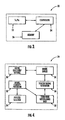
- the mobile ad hoc network 10 has a plurality of wireless mobile nodes 12, and a plurality of wireless communication links 14 connecting the nodes together.
- Each mobile node 12 includes a router 20 that has a communications device 22 to wirelessly communicate with other nodes of the plurality of nodes via the wireless communication links 14.
- the router includes a controller 24 to route communications via the communications device 22.
- a memory 26 may be included as part of the controller 24 or in connection with the controller.
- the controller 24 includes route tables 36 to define routes in the network 10. Again, a route is a set of links 14 and nodes 12 from a source to a destination.
- the controller 24 also includes a route discovery module 30 to discover routes and update the route tables 36 with either a proactive or a reactive route discovery process.
- the controller also includes a beacon signal generator 50 to generate and transmit beacon signals, and a condition determining unit 52 to determine a condition of the mobile node 12.
- the beacon signal generator 50 varies the beacon signals based upon the determined condition of the mobile node 12. Again, the beacon signals include information relating to a condition of the mobile node 12.
- the beacon signals may further include information relating to a status of a group G of mobile nodes 12 which, as discussed above, are a temporary or permanent association of at least two of the plurality of mobile nodes 12.
- condition determining unit 52 further determines a condition of the group G of mobile nodes 12, and the beacon signal generator 50 varies the beacon signals based upon the determined condition of the group G of mobile nodes 12.
- the beacon signal is made up of transmission rate, transmission frequency and transmission pattern.
- the node/group condition may include node/group movement
- the beacon signal generator 50 may vary the beacon signals by increasing the transmission rate or changing the transmission frequency or pattern based upon increased node/group movement and decreasing the transmission rate or changing the transmission frequency or pattern based upon decreased node/group movement.
- the node/group movement includes node/group velocity, node/group acceleration and/or node/group movement pattern of the corresponding mobile node 12 or group G of nodes.
- the condition determining unit 52 may comprise a global positioning satellite (GPS) device for determining the node/group movement, and/or may determine the node/group movement using local landmarks, by tracking the relative velocity using triangulation and/or by measuring inertia of the mobile node 12 or group of nodes G.
- GPS global positioning satellite
- the node/group condition may include quality of service (QoS) and/or priority of information
- the beacon signal generator 50 varies the beacon signals by increasing the transmission rate and/or changing the transmission frequency or pattern based upon decreased QoS or increased priority of information and decreasing the transmission rate or changing the transmission frequency or pattern based upon increased QoS and/or decreased priority of information.
- the beacon signal generator 50 should not increase the transmission rate of the beacon signals beyond a rate threshold based upon available bandwidth.
- the beacon signals may also include information relating to a condition of the mobile ad hoc network 10, such as information about the links 14 connecting the nodes 12 of the network. Additionally, the beacon signal generator 50 may transmit beacon signal information using a beacon properties signal to advertise a type of beacon signal being transmitted to the plurality of nodes 12 of the mobile ad hoc network 10.
- a route stability predictor 32 predicts or estimates or tracks route stability over time based upon the node or group condition information, and a route discovery process selector 34 selects between the proactive and reactive route discovery processes based upon the predicted route stability.
- the network 10 would initially use either a proactive (e.g. OLSR, basic link state, TBRPF) or a reactive (e.g.. DSR, AODV) protocol to discover and maintain routes between source S and destination D pairs in order to build the initial route table at that source node.
- a proactive e.g. OLSR, basic link state, TBRPF
- a reactive e.g.. DSR, AODV
- route tables for some or all of the nodes 12 may be initialized by predefining a set of routes for each route table knowing that those routes may change over time. As time moves forward, the network topology will generally change through node mobility and link failures/creation.
- TTNP accounts for these dynamic topological changes in one or more transition parameters such that when some subset of these parameters reached a certain transition level, a switching (transition) would occur from using proactive route discovery to using reactive route discovery or vice versa. This transition could occur over the entire network or be confined to any portion of it as defined by TTNP profiles.
- TTNP preferably automatically transitions other functionality associated with the route discovery approach such as route maintenance.
- route maintenance preferably automatically transitions other functionality associated with the route discovery approach.
- One unique capability of TTNP is that it mitigates the selection of redundant or similar supporting functionality such as route maintenance or QoS in the event of conflicts between using what is supplied by the route discovery approach (proactive or reactive) and what is supplied by some other "plug-in" from, for example, a third party or from the TTNP default pool.
- the initial network state begins using a proactive route discovery process and then upon reaching the threshold value of an applicable forward transition parameter (FXP), the network 10 transitions to using its companion on-demand/reactive route discovery process. Transition from this state of using an on-demand route discovery process back to using a proactive route discovery process occurs when a relevant reverse transition parameter (RXP) threshold has been reached.
- This RXP may or may not be the same parameter as the FXP, but even if it is, the value assigned to the RXP may not be the same as the FXP value.
- the key principal to remember for both FXP and RXP is that these parameters are either time itself or some other parameters which have some type of time-dependent relationship defined for describing the dynamics (actual, estimated or predicted) of these parameters.
- TTNP does not require any specific approach within a category (proactive or reactive) to use. For example, the application or systems designer may decide what proactive and what reactive techniques to use. TTNP does not make those decisions, but it does determine when to use the application-specified proactive and when to use the application-specified reactive approach. Neither does TTNP decide where to use proactive or where to use reactive approaches to initialize a network or a formal subset of the nodes. That again is in the hands of the applications or systems designer.
Landscapes
- Engineering & Computer Science (AREA)
- Computer Networks & Wireless Communication (AREA)
- Signal Processing (AREA)
- Mobile Radio Communication Systems (AREA)
- Small-Scale Networks (AREA)
- Data Exchanges In Wide-Area Networks (AREA)
- Radio Relay Systems (AREA)
Claims (18)
- Verfahren zum Verwalten und Steuern der Ermittlung und Instandhaltung von Routen in einem mobilen Ad-hoc-Netzwerk (10) mit mehreren mobilen Knoten (12) und mehreren die mobilen Knoten (12) miteinander verbindenden drahtlosen Kommunikationslinks (14), wobei das Verfahren umfasst:Übertragen von Bakensignalen, die eine Knotenzustandsinformation von jedem mobilen Knoten (12) enthalten;Bestimmen der Knotenzustandsinformation an jedem mobilen Knoten (12);Variieren der Bakensignale auf Basis der Knotenzustandsinformation;Aufbauen und Updaten von Routentabellen an jedem mobilen Knoten (12) mit einem ersten, entweder proaktiven oder reaktiven Routen-Ermittlungsprozess, um Routen in dem Netzwerk (10) zu definieren, wobei eine Route eine Reihe drahtloser Kommunikationslinks (14) und mobiler Knoten (12) von einer Quelle zu einem Ziel umfasst;Empfangen der Bakensignale mit der Knotenzustandsinformation und Speichern von Knotenzustandsinformation an jedem Knoten (12);Vorhersagen einer Routenstabilität im Zeitverlauf basierend auf der Knotenzustandsinformation; undUmschalten auf einen zweiten der proaktiven oder reaktiven Routen-Ermittlungsprozesse, wenn die vorhergesagte Routenstabilität einen ersten Übergangsparameter erreicht.
- Verfahren nach Anspruch 1, ferner umfassend ein Zurückschalten auf den ersten der proaktiven oder reaktiven Routen-Ermittlungsprozesse, wenn die vorhergesagte Routenstabilität einen zweiten Übergangsparameter erreicht.
- Verfahren nach Anspruch 2, wobei die ersten und zweiten Übergangsparameter zeitabhängige Bedingungen spezifizieren.
- Verfahren nach Anspruch 1, wobei ein Variieren der Bakensignale ein Variieren der Übertragungsrate und/oder der Übertragungsfrequenz und/oder der Übertragungsstruktur umfasst.
- Verfahren nach Anspruch 1, wobei die Knotenzustandsinformation basiert auf Knotenmobilität, Link-Ausfall, Link-Erstellung, Knotenstabilität und Link-Qualität.
- Verfahren nach Anspruch 1, wobei das Speichern von Knotenzustandsinformation das Erstellen und Updaten eines zeitabhängigen Routenstabilitätsprofils umfasst.
- Verfahren zum Verwalten und Steuern der Ermittlung und Instandhaltung von Routen in einem mobilen Ad-hoc-Netzwerk (10) mit mehreren drahtlosen mobilen Knoten (12) und mehreren die mobilen Knoten (12) miteinander verbindenden drahtlosen Kommunikationslinks (14), wobei eine Gruppe mobiler Knoten (12) eine temporäre oder permanente Zuordnung von mindestens zwei der mehreren mobilen Knoten (12) enthält, wobei das Verfahren umfasst:Übertragen von Gruppenzustandsinformation mit einer Gruppenzustandsinformation von mindestens einem der mobilen Knoten (12) der ein Bakensignal verwendenden Gruppe;Bestimmen der Gruppenzustandsinformation der Gruppe von mobilen Knoten (12);Variieren des Bakensignals auf Basis der Gruppenzustandsinformation;Aufbauen und Updaten von Routentabellen an jedem mobilen Knoten (12) mit einem ersten, entweder proaktiven oder reaktiven Routen-Ermittlungsprozess, um Routen in dem Netzwerk zu definieren, wobei eine Route eine Reihe von Links und mobilen Knoten (12) von einer Quelle zu einem Ziel umfasst;Empfangen von Bakensignalen mit der Gruppenzustandsinformation und Speichern der Gruppenzustandsinformation an jedem Knoten (12);Vorhersagen einer Routenstabilität im Zeitverlauf basierend auf der Gruppenzustandsinformation; undUmschalten auf einen zweiten der proaktiven oder reaktiven Routen-Ermittlungsprozesse, wenn die vorhergesagte Routenstabilität einen ersten Übergangsparameter erreicht.
- Verfahren nach Anspruch 7, ferner umfassend ein Zurückschalten auf den ersten der proaktiven oder reaktiven Routen-Ermittlungsprozesse, wenn die vorhergesagte Routenstabilität einen zweiten Übergangsparameter erreicht.
- Verfahren nach Anspruch 7, wobei ein Variieren des Bakensignals ein Variieren der Übertragungsrate und/oder der Übertragungsfrequenz und/oder der Übertragungsstruktur umfasst.
- Verfahren nach Anspruch 7, wobei die Gruppenzustandsinformation basiert auf Knotenmobilität, Link-Ausfall, Link-Erstellung, Knotenstabilität, Gruppenstabilität und Link-Qualität innerhalb der Gruppe mobiler Knoten (12).
- Verfahren nach Anspruch 7, wobei das Speichern von Gruppenzustandsinformation das Erstellen und Updaten eines zeitabhängigen Routenstabilitätsprofils umfasst.
- Mobiles Ad-hoc-Netzwerk (10) mit:mehreren mobilen Knoten (12);mehreren drahtlosen Kommunikationslinks (14), welche die mobilen Knoten (12) miteinander verbinden;wobei jeder mobile Knoten (12) eine Kommunikationsvorrichtung (22) aufweist, die über die drahtlosen Kommunikationslinks (14) mit anderen Knoten (12) der mehreren Knoten (12) drahtlos zu kommunizieren vermag, undeinem Controller (24), der Kommunikationen über die Kommunikationsvorrichtung (22) zu routen vermag, und der umfasst:eine Zustandsbestimmungseinheit (52), die eine Zustandsinformation eines mobilen Knotens zu bestimmen vermag;einen Bakensignal-Generator (50), der Bakensignale mit der Zustandsinformation des mobilen Knotens zu generieren und zu übertragen vermag, wobei der Bakensignal-Generator (50) die Bakensignale auf Basis des bestimmten Zustands des mobilen Knotens (12) zu variieren vermag,Routentabellen (36), die Routen in dem Netzwerk (10) zu definieren vermögen, wobei eine Route eine Reihe drahtloser Kommunikationslinks (14) und mobiler Knoten (12) von einer Quelle zu einem Ziel umfasst,ein Routen-Ermittlungsmodul (30), das mit einem von mehreren Routen-Ermittlungsprozessen Routen zu ermitteln und ein Update der Routentabellen (36) zu erstellen vermag, ein Zustandsmodul, um Bakensignale zu empfangen und die Zustandsinformation des mobilen Knotens zu speichern,einen Routenstabilitäts-Prädiktor (32), der Routenstabilität im Zeitverlauf basierend auf der Zustandsinformation des mobilen Knotens vorherzusagen vermag, undeinen Routen-Ermittlungsprozess-Selektor (34), der zwischen mehreren Routen-Ermittlungsprozessen basierend auf der vorhergesagten Routenstabilität auszuwählen vermag.
- Netzwerk (10) nach Anspruch 12, wobei die mehreren Routen-Ermittlungsprozesse proaktive und reaktive Routen-Ermittlungsprozesse umfassen; und wobei der Routen-Ermittlungsprozess-Selektor (34) den proaktiven Routen-Ermittlungsprozess auszuwählen vermag, wenn die vorhergesagte Routenstabilität einen ersten Übergangsparameter erreicht, und den reaktiven Routen-Ermittlungsprozess auszuwählen vermag, wenn die vorhergesagte Routenstabilität einen zweiten Übergangsparameter erreicht.
- Netzwerk (10) nach Anspruch 12, wobei die mehreren Routen-Ermittlungsprozesse proaktive und reaktive Routen-Ermittlungsprozesse umfassen; und wobei der Routen-Ermittlungsprozess-Selektor (34) den reaktiven Routen-Ermittlungsprozess auszuwählen vermag, wenn die vorhergesagte Routenstabilität einen ersten Übergangsparameter erreicht, und den proaktiven Routen-Ermittlungsprozess auszuwählen vermag, wenn die vorhergesagte Routenstabilität einen zweiten Übergangsparameter erreicht.
- Netzwerk (10) nach Anspruch 12, wobei der Bakensignal-Generator (50) das Bakensignal zu variieren vermag, durch Variieren der Übertragungsrate und/oder der Übertragungsfrequenz und/oder der Übertragungsstruktur.
- Netzwerk (10) nach Anspruch 12, wobei das Bakensignal ferner Information enthält, die sich auf einen Zustand einer Gruppe mobiler Knoten (12) bezieht, wobei die Gruppe mobiler Knoten (12) eine temporäre oder permanente Zuordnung von mindestens zwei der mehreren mobilen Knoten (12) enthält; wobei die Zustandsbestimmungseinheit ferner einen Zustand der Gruppe mobiler Knoten (12) zu bestimmen vermag; und wobei der Bakensignal-Generator (50) das Bakensignal basierend auf dem bestimmten Zustand der Gruppe mobiler Knoten (12) zu variieren vermag.
- Netzwerk (10) nach Anspruch 12, wobei die Knotenzustandsinformation basiert auf Knotenmobilität, Link-Ausfall, Link-Erstellung, Knotenstabilität und Link-Qualität.
- Netzwerk (10) nach Anspruch 12, wobei das Zustandsmodul so ausgelegt ist, dass es ein zeitabhängiges Routenstabilitätsprofil umfasst.
Applications Claiming Priority (3)
| Application Number | Priority Date | Filing Date | Title |
|---|---|---|---|
| US10/253,227 US6763014B2 (en) | 2002-09-24 | 2002-09-24 | Intelligent communication node object beacon framework (ICBF) with temporal transition network protocol (TTNP) in a mobile ad hoc network |
| US253227 | 2002-09-24 | ||
| PCT/US2003/028649 WO2004030258A2 (en) | 2002-09-24 | 2003-09-11 | Temporal transition network protocol in a mobile ad hoc network |
Publications (3)
| Publication Number | Publication Date |
|---|---|
| EP1550330A2 EP1550330A2 (de) | 2005-07-06 |
| EP1550330A4 EP1550330A4 (de) | 2011-01-26 |
| EP1550330B1 true EP1550330B1 (de) | 2012-06-06 |
Family
ID=31993131
Family Applications (1)
| Application Number | Title | Priority Date | Filing Date |
|---|---|---|---|
| EP03798718A Expired - Lifetime EP1550330B1 (de) | 2002-09-24 | 2003-09-11 | Intelligenter kommunikationsknotenobjekt-bakenrahmen (icbf) mit einem zeitlichenuebergangsnetzwerkprotokoll (ttnp) in einem mobil-ad-hoc-netzwerk |
Country Status (9)
| Country | Link |
|---|---|
| US (1) | US6763014B2 (de) |
| EP (1) | EP1550330B1 (de) |
| JP (1) | JP2006500872A (de) |
| KR (1) | KR100635488B1 (de) |
| CN (1) | CN100341271C (de) |
| AU (1) | AU2003266147A1 (de) |
| CA (1) | CA2500010C (de) |
| TW (1) | TWI248738B (de) |
| WO (1) | WO2004030258A2 (de) |
Families Citing this family (70)
| Publication number | Priority date | Publication date | Assignee | Title |
|---|---|---|---|---|
| US6975614B2 (en) * | 2002-09-04 | 2005-12-13 | Harris Corporation | Intelligent communication node object beacon framework in a mobile ad hoc network |
| ES2528360T3 (es) * | 2003-02-03 | 2015-02-09 | Sony Corporation | Sistema de radiocomunicación, dispositivo de radiocomunicación, método de radiocomunicación y programa informático |
| US7990883B2 (en) * | 2003-05-16 | 2011-08-02 | Sony Corporation | Communication system, communication method, communication apparatus, communication control method, and computer program |
| WO2004109473A2 (en) * | 2003-06-06 | 2004-12-16 | Meshnetworks, Inc. | System and method to provide fairness and service differentiation in ad-hoc networks |
| ATE529962T1 (de) * | 2003-06-06 | 2011-11-15 | Meshnetworks Inc | Verfahren zur verbesserung der gesamtleistungsfähigkeit eines drahtlosen kommunikationsnetzes |
| EP1494394A1 (de) * | 2003-06-30 | 2005-01-05 | Sony International (Europe) GmbH | Abstandsbezogener Dienstmechanismus zur Bestimmung der Verfügbarkeit von Ferndiensten in drahtlosen Personal-Area-Netzen |
| US7415019B2 (en) * | 2003-08-22 | 2008-08-19 | Samsung Electronics Co., Ltd. | Apparatus and method for collecting active route topology information in a mobile ad hoc network |
| US7672307B2 (en) * | 2003-08-22 | 2010-03-02 | Samsung Electronics Co., Ltd. | Apparatus and method for transparent layer 2 routing in a mobile ad hoc network |
| US8527457B2 (en) * | 2003-10-07 | 2013-09-03 | Cisco Technology, Inc. | Arrangement for autonomous mobile network nodes to organize a wireless mobile network based on detected physical and logical changes |
| US7652995B2 (en) * | 2003-12-19 | 2010-01-26 | International Business Machines Corporation | Autonomic reassociation of clients in a wireless local area network |
| WO2005062553A1 (en) * | 2003-12-23 | 2005-07-07 | Telefonaktiebolaget Lm Ericsson (Publ) | Method and system for routing traffic in ad hoc networks |
| ES2409334T3 (es) * | 2003-12-23 | 2013-06-26 | Telefonaktiebolaget Lm Ericsson (Publ) | Ad hoc predictivo |
| EP1698117B1 (de) * | 2003-12-23 | 2013-04-17 | TELEFONAKTIEBOLAGET LM ERICSSON (publ) | Verfahren und system zum effizienten routen in ad-hoc-netzwerken |
| FI20040149A0 (fi) * | 2004-01-30 | 2004-01-30 | Nokia Corp | Reijitystiedon hankkiminen |
| US7466681B2 (en) * | 2004-03-19 | 2008-12-16 | Nortel Networks Limited | Method and apparatus for sensor network routing |
| JP4367233B2 (ja) * | 2004-05-21 | 2009-11-18 | 株式会社日立製作所 | 位置検出方法、位置検出システムおよび位置検出サーバ装置 |
| WO2006015007A2 (en) * | 2004-07-27 | 2006-02-09 | Meshnetworks, Inc. | System and method for detecting transient links in multi-hop wireless networks |
| US7512079B2 (en) * | 2004-07-28 | 2009-03-31 | University Of South Florida | System and method to assure node connectivity in an ad hoc network |
| KR100637071B1 (ko) * | 2004-09-24 | 2006-10-23 | 삼성전자주식회사 | 통신경로를 동적으로 조절하는 무선네트워크 시스템, 및그 방법 |
| WO2006040669A1 (en) * | 2004-10-13 | 2006-04-20 | Nortel Networks Limited | Wireless transit link discovery and establishment |
| WO2006049558A1 (en) * | 2004-11-03 | 2006-05-11 | Telefonaktiebolaget Lm Ericsson (Publ) | Dynamic network managaement |
| JP4592392B2 (ja) * | 2004-11-10 | 2010-12-01 | 株式会社エヌ・ティ・ティ・ドコモ | 制御装置、移動端末及び移動通信方法 |
| CN101341672B (zh) * | 2004-12-13 | 2011-06-01 | 京瓷株式会社 | 通信终端及具备该通信终端的移动通信系统 |
| US9361311B2 (en) | 2005-01-12 | 2016-06-07 | Wandisco, Inc. | Distributed file system using consensus nodes |
| US8364633B2 (en) | 2005-01-12 | 2013-01-29 | Wandisco, Inc. | Distributed computing systems and system components thereof |
| US9495381B2 (en) | 2005-01-12 | 2016-11-15 | Wandisco, Inc. | Geographically-distributed file system using coordinated namespace replication over a wide area network |
| US9424272B2 (en) | 2005-01-12 | 2016-08-23 | Wandisco, Inc. | Distributed file system using consensus nodes |
| US9332069B2 (en) | 2012-12-28 | 2016-05-03 | Wandisco, Inc. | Methods, devices and systems for initiating, forming and joining memberships in distributed computing systems |
| US7764641B2 (en) | 2005-02-05 | 2010-07-27 | Cisco Technology, Inc. | Techniques for determining communication state using accelerometer data |
| US8315636B2 (en) | 2005-02-24 | 2012-11-20 | Cisco Technology, Inc. | Techniques for distributing data among nodes based on dynamic spatial/organizational state of a mobile node |
| JP4651419B2 (ja) * | 2005-03-11 | 2011-03-16 | 株式会社エヌ・ティ・ティ・ドコモ | 無線通信装置及び無線通信方法 |
| US20060239291A1 (en) * | 2005-04-26 | 2006-10-26 | Birchler Mark A | Method and apparatus for determining a best route within an ad-hoc communication system |
| US8711698B2 (en) * | 2005-10-17 | 2014-04-29 | The Invention Science Fund I, Llc | Signal routing dependent on a loading indicator of a mobile node |
| US7613426B2 (en) * | 2005-12-20 | 2009-11-03 | Microsoft Corporation | Proximity service discovery in wireless networks |
| US8559350B2 (en) * | 2005-12-20 | 2013-10-15 | Microsoft Corporation | Mechanism to convey discovery information in a wireless network |
| US8478300B2 (en) * | 2005-12-20 | 2013-07-02 | Microsoft Corporation | Proximity service discovery in wireless networks |
| JP2007195125A (ja) * | 2005-12-20 | 2007-08-02 | Japan Radio Co Ltd | 通信装置および通信方法 |
| WO2007129357A1 (ja) * | 2006-04-17 | 2007-11-15 | Mitsubishi Denki Kabushiki Kaisha | 移動体通信システムおよび移動体通信装置 |
| US10681151B2 (en) | 2006-05-15 | 2020-06-09 | Microsoft Technology Licensing, Llc | Notification framework for wireless networks |
| US20070264991A1 (en) * | 2006-05-15 | 2007-11-15 | Microsoft Corporation | Services near me: discovering and connecting to available wireless services utilizing proximity discovery |
| US20070271079A1 (en) * | 2006-05-17 | 2007-11-22 | Kentaro Oguchi | Simulator for Vehicle Radio Propagation Including Shadowing Effects |
| US8059578B2 (en) * | 2006-07-24 | 2011-11-15 | Harris Corporation | System and method for synchronizing TDMA mesh networks |
| US7773575B2 (en) * | 2006-07-24 | 2010-08-10 | Harris Corporation | System and method for communicating using a plurality of TDMA mesh networks having efficient bandwidth use |
| US8072902B2 (en) * | 2006-08-07 | 2011-12-06 | Cisco Technology, Inc. | Techniques for distributing data among mobile nodes based on dynamically generated data objects in a distributed object-oriented database |
| CN100493261C (zh) * | 2006-12-29 | 2009-05-27 | 华中科技大学 | 一种基于混合移动网络的成组位置管理方法 |
| US7894416B2 (en) * | 2007-01-08 | 2011-02-22 | Harris Corporation | System and method for communicating in a time division multiple access (TDMA) mesh network having minimized end-to-end latency |
| US8213409B2 (en) | 2007-02-20 | 2012-07-03 | Harris Corporation | System and method for communicating over mesh networks using waveform-enhanced, link-state routing |
| US8254350B2 (en) * | 2007-06-14 | 2012-08-28 | International Business Machines Corporation | Routing packets in an ad hoc wireless network |
| US7974574B2 (en) * | 2007-07-25 | 2011-07-05 | Microsoft Corporation | Base station initiated proximity service discovery and connection establishment |
| US8681691B2 (en) * | 2007-07-25 | 2014-03-25 | Microsoft Corporation | Base station initiated proximity service discovery and connection establishment |
| KR100913252B1 (ko) * | 2007-10-15 | 2009-08-24 | 숭실대학교산학협력단 | 애드 혹 네트워크 환경에서 이동 노드의 안정성을 고려한 안정적인 멀티캐스트 트리 생성 방법 |
| US9105031B2 (en) * | 2008-02-22 | 2015-08-11 | Microsoft Technology Licensing, Llc | Authentication mechanisms for wireless networks |
| CN101267403B (zh) * | 2008-05-13 | 2010-06-02 | 北京科技大学 | 一种无线自组织网络路由稳定性的度量系统及其方法 |
| JP5225033B2 (ja) * | 2008-11-12 | 2013-07-03 | キヤノン株式会社 | 通信機器及びその制御方法 |
| KR101066291B1 (ko) * | 2009-01-02 | 2011-09-20 | 삼성전자주식회사 | 패킷 라우팅 방법 및 장치 |
| US8693453B2 (en) | 2011-12-15 | 2014-04-08 | Microsoft Corporation | Mobile node group formation and management |
| US9030939B2 (en) * | 2012-03-23 | 2015-05-12 | Cisco Technology, Inc. | Building alternate routes in reactive routing networks |
| US9497694B2 (en) * | 2012-03-29 | 2016-11-15 | Nec Corporation | Wireless communication device, wireless communication system and wireless communication method |
| CN103581893A (zh) * | 2012-08-10 | 2014-02-12 | 北京百度网讯科技有限公司 | 分布式无线网络自组织的方法、装置及系统 |
| US9264516B2 (en) | 2012-12-28 | 2016-02-16 | Wandisco, Inc. | Methods, devices and systems enabling a secure and authorized induction of a node into a group of nodes in a distributed computing environment |
| US9009215B2 (en) | 2013-03-15 | 2015-04-14 | Wandisco, Inc. | Methods, devices and systems for dynamically managing memberships in replicated state machines within a distributed computing environment |
| EP3095229B1 (de) * | 2014-01-13 | 2021-07-21 | Telefonaktiebolaget LM Ericsson (publ) | Verfahren und knoten zur konfiguration eines kommunikationspfades für einen mediendienst |
| US9756549B2 (en) | 2014-03-14 | 2017-09-05 | goTenna Inc. | System and method for digital communication between computing devices |
| US10944669B1 (en) | 2018-02-09 | 2021-03-09 | GoTenna, Inc. | System and method for efficient network-wide broadcast in a multi-hop wireless network using packet echos |
| US10813169B2 (en) | 2018-03-22 | 2020-10-20 | GoTenna, Inc. | Mesh network deployment kit |
| CA3107919A1 (en) | 2018-07-27 | 2020-01-30 | GoTenna, Inc. | Vinetm: zero-control routing using data packet inspection for wireless mesh networks |
| WO2020185707A1 (en) | 2019-03-08 | 2020-09-17 | goTenna Inc. | Method for utilization-based traffic throttling in a wireless mesh network |
| GB201914899D0 (en) * | 2019-10-15 | 2019-11-27 | Tose Agri Tech Ltd | Network nodes |
| US11184832B2 (en) | 2020-01-30 | 2021-11-23 | Mage Networks Inc. | Routing method and device of mobile ad-hoc networks |
| AU2023212155A1 (en) * | 2022-01-31 | 2024-08-29 | Booz Allen Hamilton Inc. | Edge based routing software instance, device and method |
Family Cites Families (16)
| Publication number | Priority date | Publication date | Assignee | Title |
|---|---|---|---|---|
| US5412654A (en) | 1994-01-10 | 1995-05-02 | International Business Machines Corporation | Highly dynamic destination-sequenced destination vector routing for mobile computers |
| US5987011A (en) * | 1996-08-30 | 1999-11-16 | Chai-Keong Toh | Routing method for Ad-Hoc mobile networks |
| US6304556B1 (en) | 1998-08-24 | 2001-10-16 | Cornell Research Foundation, Inc. | Routing and mobility management protocols for ad-hoc networks |
| US6385174B1 (en) | 1999-11-12 | 2002-05-07 | Itt Manufacturing Enterprises, Inc. | Method and apparatus for transmission of node link status messages throughout a network with reduced communication protocol overhead traffic |
| US6535498B1 (en) * | 1999-12-06 | 2003-03-18 | Telefonaktiebolaget Lm Ericsson (Publ) | Route updating in ad-hoc networks |
| US6456599B1 (en) * | 2000-02-07 | 2002-09-24 | Verizon Corporate Services Group Inc. | Distribution of potential neighbor information through an ad hoc network |
| WO2001058237A2 (en) | 2000-02-12 | 2001-08-16 | Hrl Laboratories, Llc | Scalable unidirectional routing for mobile ad-hoc networks |
| US6870816B1 (en) * | 2000-03-01 | 2005-03-22 | Motorola, Inc. | Self-organizing network with decision engine and method |
| US6512935B1 (en) * | 2000-03-24 | 2003-01-28 | Gte Internetworking Incorporated | Energy conserving network protocol |
| WO2001092992A2 (en) * | 2000-06-01 | 2001-12-06 | Bbnt Solutions Llc | Method and apparatus for varying the rate at which broadcast beacons are transmitted |
| US7310335B1 (en) * | 2000-09-06 | 2007-12-18 | Nokia Networks | Multicast routing in ad-hoc networks |
| US6754250B2 (en) * | 2000-12-15 | 2004-06-22 | Telefonaktiebolaget Lm Ericsson (Publ) | Networking in uncoordinated frequency hopping piconets |
| US20030081603A1 (en) * | 2001-10-26 | 2003-05-01 | Johan Rune | Pending data announcements |
| US20030110291A1 (en) * | 2001-12-12 | 2003-06-12 | Nokia Corporation | Method and device for route searching in a bluetooth ad-hoc network |
| US7146433B2 (en) * | 2002-02-01 | 2006-12-05 | Lenovo Singapore Pte. Ltd | Extending an allowable transmission distance between a wireless device and an access point by communication with intermediate wireless devices |
| US6894985B2 (en) * | 2002-08-05 | 2005-05-17 | Harris Corporation | Monitoring link quality in a mobile ad hoc network |
-
2002
- 2002-09-24 US US10/253,227 patent/US6763014B2/en not_active Expired - Lifetime
-
2003
- 2003-09-11 EP EP03798718A patent/EP1550330B1/de not_active Expired - Lifetime
- 2003-09-11 WO PCT/US2003/028649 patent/WO2004030258A2/en not_active Ceased
- 2003-09-11 KR KR1020057005022A patent/KR100635488B1/ko not_active Expired - Fee Related
- 2003-09-11 CA CA002500010A patent/CA2500010C/en not_active Expired - Fee Related
- 2003-09-11 AU AU2003266147A patent/AU2003266147A1/en not_active Abandoned
- 2003-09-11 CN CNB038244691A patent/CN100341271C/zh not_active Expired - Fee Related
- 2003-09-11 JP JP2004540069A patent/JP2006500872A/ja not_active Ceased
- 2003-09-24 TW TW092126334A patent/TWI248738B/zh not_active IP Right Cessation
Also Published As
| Publication number | Publication date |
|---|---|
| KR20050059186A (ko) | 2005-06-17 |
| CN100341271C (zh) | 2007-10-03 |
| JP2006500872A (ja) | 2006-01-05 |
| US20040057409A1 (en) | 2004-03-25 |
| TW200408232A (en) | 2004-05-16 |
| AU2003266147A8 (en) | 2004-04-19 |
| CN1689357A (zh) | 2005-10-26 |
| CA2500010C (en) | 2008-04-15 |
| US6763014B2 (en) | 2004-07-13 |
| TWI248738B (en) | 2006-02-01 |
| WO2004030258A3 (en) | 2004-08-05 |
| AU2003266147A1 (en) | 2004-04-19 |
| WO2004030258A2 (en) | 2004-04-08 |
| EP1550330A2 (de) | 2005-07-06 |
| CA2500010A1 (en) | 2004-04-08 |
| EP1550330A4 (de) | 2011-01-26 |
| KR100635488B1 (ko) | 2006-10-18 |
Similar Documents
| Publication | Publication Date | Title |
|---|---|---|
| US6763014B2 (en) | Intelligent communication node object beacon framework (ICBF) with temporal transition network protocol (TTNP) in a mobile ad hoc network | |
| EP1543687B1 (de) | Intelligenter Kommunikationsknoten-Objektbakenrahmen | |
| EP1550318B1 (de) | Intelligenter Kommunikationsknoten der Baken in einem mobilen Ad-Hoc-Netzwerk | |
| EP1500286B1 (de) | Temporal-transitionsnetzwerkprotokoll (ttnp) in einem mobil-ad-hoc-netzwerk | |
| KR100777895B1 (ko) | 메시지 데이타의 라우팅 방법 및 모바일 애드 혹 네트워크용 모바일 노드 | |
| CA2464792A1 (en) | Predictive routing including the use of fuzzy logic | |
| CA2464798A1 (en) | Predictive routing in a mobile ad hoc network | |
| Alnabhan et al. | Performance Evaluation of Unicast Routing Protocols in MANETs-Current State and Future Prospects. | |
| KR20100042514A (ko) | 애드 혹 네트워크의 클러스터 형성 방법 | |
| Shukla et al. | A study and review on link failure prediction and detection in mobile ad hoc network | |
| Brahmi et al. | Routing in vehicular ad hoc networks: towards road-connectivity based routing | |
| Shen et al. | Location-triggered routing protocol in mobile ad hoc networks | |
| Jianwu et al. | A ranging-aided QoS routing protocol of UWB ad hoc network |
Legal Events
| Date | Code | Title | Description |
|---|---|---|---|
| PUAI | Public reference made under article 153(3) epc to a published international application that has entered the european phase |
Free format text: ORIGINAL CODE: 0009012 |
|
| 17P | Request for examination filed |
Effective date: 20050421 |
|
| AK | Designated contracting states |
Kind code of ref document: A2 Designated state(s): AT BE BG CH CY CZ DE DK EE ES FI FR GB GR HU IE IT LI LU MC NL PT RO SE SI SK TR |
|
| AX | Request for extension of the european patent |
Extension state: AL LT LV MK |
|
| DAX | Request for extension of the european patent (deleted) | ||
| RBV | Designated contracting states (corrected) |
Designated state(s): DE FI FR GB SE |
|
| A4 | Supplementary search report drawn up and despatched |
Effective date: 20101227 |
|
| RIC1 | Information provided on ipc code assigned before grant |
Ipc: H04L 12/56 20060101AFI20101220BHEP |
|
| 17Q | First examination report despatched |
Effective date: 20110504 |
|
| REG | Reference to a national code |
Ref country code: DE Ref legal event code: R079 Ref document number: 60341195 Country of ref document: DE Free format text: PREVIOUS MAIN CLASS: H04Q0007240000 Ipc: H04W0084180000 |
|
| RIC1 | Information provided on ipc code assigned before grant |
Ipc: H04W 84/18 20090101AFI20110922BHEP |
|
| GRAP | Despatch of communication of intention to grant a patent |
Free format text: ORIGINAL CODE: EPIDOSNIGR1 |
|
| GRAS | Grant fee paid |
Free format text: ORIGINAL CODE: EPIDOSNIGR3 |
|
| GRAA | (expected) grant |
Free format text: ORIGINAL CODE: 0009210 |
|
| AK | Designated contracting states |
Kind code of ref document: B1 Designated state(s): DE FI FR GB SE |
|
| REG | Reference to a national code |
Ref country code: GB Ref legal event code: FG4D |
|
| REG | Reference to a national code |
Ref country code: DE Ref legal event code: R096 Ref document number: 60341195 Country of ref document: DE Effective date: 20120802 |
|
| REG | Reference to a national code |
Ref country code: SE Ref legal event code: TRGR |
|
| PGFP | Annual fee paid to national office [announced via postgrant information from national office to epo] |
Ref country code: SE Payment date: 20120927 Year of fee payment: 10 Ref country code: FI Payment date: 20120927 Year of fee payment: 10 |
|
| PLBE | No opposition filed within time limit |
Free format text: ORIGINAL CODE: 0009261 |
|
| STAA | Information on the status of an ep patent application or granted ep patent |
Free format text: STATUS: NO OPPOSITION FILED WITHIN TIME LIMIT |
|
| 26N | No opposition filed |
Effective date: 20130307 |
|
| REG | Reference to a national code |
Ref country code: DE Ref legal event code: R097 Ref document number: 60341195 Country of ref document: DE Effective date: 20130307 |
|
| REG | Reference to a national code |
Ref country code: SE Ref legal event code: EUG |
|
| PG25 | Lapsed in a contracting state [announced via postgrant information from national office to epo] |
Ref country code: FI Free format text: LAPSE BECAUSE OF NON-PAYMENT OF DUE FEES Effective date: 20130911 Ref country code: SE Free format text: LAPSE BECAUSE OF NON-PAYMENT OF DUE FEES Effective date: 20130912 |
|
| PGFP | Annual fee paid to national office [announced via postgrant information from national office to epo] |
Ref country code: GB Payment date: 20140929 Year of fee payment: 12 |
|
| GBPC | Gb: european patent ceased through non-payment of renewal fee |
Effective date: 20150911 |
|
| PG25 | Lapsed in a contracting state [announced via postgrant information from national office to epo] |
Ref country code: GB Free format text: LAPSE BECAUSE OF NON-PAYMENT OF DUE FEES Effective date: 20150911 |
|
| REG | Reference to a national code |
Ref country code: FR Ref legal event code: PLFP Year of fee payment: 14 |
|
| REG | Reference to a national code |
Ref country code: FR Ref legal event code: PLFP Year of fee payment: 15 |
|
| REG | Reference to a national code |
Ref country code: FR Ref legal event code: PLFP Year of fee payment: 16 |
|
| REG | Reference to a national code |
Ref country code: FR Ref legal event code: PLFP Year of fee payment: 17 |
|
| PGFP | Annual fee paid to national office [announced via postgrant information from national office to epo] |
Ref country code: FR Payment date: 20190925 Year of fee payment: 17 |
|
| PGFP | Annual fee paid to national office [announced via postgrant information from national office to epo] |
Ref country code: DE Payment date: 20200921 Year of fee payment: 18 |
|
| PG25 | Lapsed in a contracting state [announced via postgrant information from national office to epo] |
Ref country code: FR Free format text: LAPSE BECAUSE OF NON-PAYMENT OF DUE FEES Effective date: 20200930 |
|
| REG | Reference to a national code |
Ref country code: DE Ref legal event code: R119 Ref document number: 60341195 Country of ref document: DE |
|
| PG25 | Lapsed in a contracting state [announced via postgrant information from national office to epo] |
Ref country code: DE Free format text: LAPSE BECAUSE OF NON-PAYMENT OF DUE FEES Effective date: 20220401 |