EP1549064B1 - Signalisation des points d'entrée valides dans un train de données vidéo - Google Patents
Signalisation des points d'entrée valides dans un train de données vidéo Download PDFInfo
- Publication number
- EP1549064B1 EP1549064B1 EP04026473.1A EP04026473A EP1549064B1 EP 1549064 B1 EP1549064 B1 EP 1549064B1 EP 04026473 A EP04026473 A EP 04026473A EP 1549064 B1 EP1549064 B1 EP 1549064B1
- Authority
- EP
- European Patent Office
- Prior art keywords
- frame
- field
- entry point
- interlaced
- header
- Prior art date
- Legal status (The legal status is an assumption and is not a legal conclusion. Google has not performed a legal analysis and makes no representation as to the accuracy of the status listed.)
- Expired - Lifetime
Links
Images




Classifications
-
- H—ELECTRICITY
- H04—ELECTRIC COMMUNICATION TECHNIQUE
- H04N—PICTORIAL COMMUNICATION, e.g. TELEVISION
- H04N21/00—Selective content distribution, e.g. interactive television or video on demand [VOD]
- H04N21/20—Servers specifically adapted for the distribution of content, e.g. VOD servers; Operations thereof
- H04N21/23—Processing of content or additional data; Elementary server operations; Server middleware
- H04N21/234—Processing of video elementary streams, e.g. splicing of video streams or manipulating encoded video stream scene graphs
-
- H—ELECTRICITY
- H04—ELECTRIC COMMUNICATION TECHNIQUE
- H04N—PICTORIAL COMMUNICATION, e.g. TELEVISION
- H04N21/00—Selective content distribution, e.g. interactive television or video on demand [VOD]
- H04N21/80—Generation or processing of content or additional data by content creator independently of the distribution process; Content per se
- H04N21/83—Generation or processing of protective or descriptive data associated with content; Content structuring
- H04N21/845—Structuring of content, e.g. decomposing content into time segments
- H04N21/8455—Structuring of content, e.g. decomposing content into time segments involving pointers to the content, e.g. pointers to the I-frames of the video stream
-
- H—ELECTRICITY
- H04—ELECTRIC COMMUNICATION TECHNIQUE
- H04N—PICTORIAL COMMUNICATION, e.g. TELEVISION
- H04N21/00—Selective content distribution, e.g. interactive television or video on demand [VOD]
- H04N21/40—Client devices specifically adapted for the reception of or interaction with content, e.g. set-top-box [STB]; Operations thereof
- H04N21/43—Processing of content or additional data, e.g. demultiplexing additional data from a digital video stream; Elementary client operations, e.g. monitoring of home network or synchronising decoder's clock; Client middleware
- H04N21/44—Processing of video elementary streams, e.g. splicing a video clip retrieved from local storage with an incoming video stream or rendering scenes according to encoded video stream scene graphs
- H04N21/44016—Processing of video elementary streams, e.g. splicing a video clip retrieved from local storage with an incoming video stream or rendering scenes according to encoded video stream scene graphs involving splicing one content stream with another content stream, e.g. for substituting a video clip
-
- H—ELECTRICITY
- H04—ELECTRIC COMMUNICATION TECHNIQUE
- H04N—PICTORIAL COMMUNICATION, e.g. TELEVISION
- H04N21/00—Selective content distribution, e.g. interactive television or video on demand [VOD]
- H04N21/20—Servers specifically adapted for the distribution of content, e.g. VOD servers; Operations thereof
- H04N21/23—Processing of content or additional data; Elementary server operations; Server middleware
- H04N21/234—Processing of video elementary streams, e.g. splicing of video streams or manipulating encoded video stream scene graphs
- H04N21/23424—Processing of video elementary streams, e.g. splicing of video streams or manipulating encoded video stream scene graphs involving splicing one content stream with another content stream, e.g. for inserting or substituting an advertisement
Definitions
- a video encoder uses described techniques and tools for defining and signaling valid entry points in a video stream.
- a typical raw digital video sequence includes 15 or 30 frames per second. Each frame can include tens or hundreds of thousands of pixels (also called pels). Each pixel represents a tiny element of the picture. In raw form, a computer commonly represents a pixel as a set of three samples totaling 24 bits. Thus, the number of bits per second, or bit rate, of a typical raw digital video sequence can be 5 million bits/second or more.
- compression also called coding or encoding
- Compression decreases the cost of storing and transmitting video by converting the video into a lower bit rate form.
- Decompression also called decoding
- a "codec” is an encoder/decoder system. Compression can be lossless, in which quality of the video does not suffer but decreases in bit rate are limited by the inherent amount of variability (sometimes called entropy) of the video data. Or, compression can be lossy, in which quality of the video suffers but achievable decreases in bit rate are more dramatic. Lossy compression is often used in conjunction with lossless compression - in a system design in which the lossy compression establishes an approximation of information and lossless compression techniques are applied to represent the approximation.
- video compression techniques include "intra-picture” compression and "inter-picture” compression, where a picture is, for example, a progressively scanned video frame.
- intra-frame compression techniques compress individual frames (typically called I-frames or key frames).
- Interframe compression techniques compress frames (typically called predicted frames, P-frames, or B-frames for bi-directional prediction) with reference to preceding and/or following frames (typically called reference or anchor frames).
- a typical interlaced video frame consists of two fields scanned starting at different times.
- an interlaced video frame includes a top field and a bottom field.
- the even-numbered lines (top field) are scanned starting at one time (e.g., time t ) and the odd-numbered lines (bottom field) are scanned starting at a different (typically later) time (e.g., time t + 1).
- This timing can create jagged tooth-like features in regions of an interlaced video frame where motion is present because the two fields are scanned starting at different times.
- interlaced video frames can be rearranged for coding according to a field structure, with the odd lines grouped together for coding as one field, and the even lines grouped together for coding as another field.
- Fields in different field-coded interlaced frames can be coded differently .
- a field in a field-coded interlaced frame can be intra-coded (e.g., an interlaced I-field) or inter-coded (e.g., an interlaced P-field or interlaced B-field).
- frame coding is often used in stationary or low-motion interlaced video frames, in which the original altemating field line arrangement is preserved.
- Different frame-coded interlaced frames also can be coded differently .
- such frames can be intra-coded (e.g., an interlaced I-frame) or inter-coded (e.g., an interlaced P-frame or interlaced B-frame).
- a typical progressive video frame consists of one frame of content with non-alternating lines. In contrast to interlaced video, progressive video does not divide video frames into separate fields, and an entire frame is scanned left to right, top to bottom starting at a single time.
- Progressive frames can be intra-coded (e.g., a progressive I-frame) or inter-coded (e.g., a progressive P-frame or progressive B-frame).
- the MPEG 2/H.262 standard describes intra-coded pictures (e.g., coded I-frames) and group-of-pictures (GOP) headers.
- intra-coded pictures are coded without reference to other pictures and provide access points to the coded sequence where decoding can begin.
- Intra-coded pictures can be used at different places in a video sequence. For example, intra-coded pictures can be inserted periodically or can be used in places such as scene changes or where motion compensation is otherwise ineffective.
- a coded I-frame is an I-frame picture or a pair of field pictures, where the first field picture is an I-picture and the second field picture is an I-picture or a P-picture.
- the MPEG 2 standard does not allow a coded I-frame in which the first field picture is a P-picture and the second field picture is an I-picture.
- a GOP header is a construct in the MPEG 2 bitstream that signals the beginning of a group of pictures. Groups of pictures are typically used to signal the boundary of a set of video frames/fields all encoded with reference to the same I-frame.
- a GOP header is an optional header that may be signaled immediately before a coded I-frame to indicate if the first consecutive B-pictures (if any) immediately following the coded I-frame in the bitstream (but typically preceding the coded I-frame in display order) can be reconstructed properly in the case of a random access.
- the GOP header thus indicates how the decoder can perform decoding from the GOP header, even if the GOP header is in the middle of a video sequence.
- the GOP header includes a start code called group_start_code.
- the GOP header start code includes a 24-bit start code prefix (23 0s followed by a 1) followed by the GOP header start code value (B8 in hexadecimal). Start codes in MPEG 2 are byte-aligned; 0s are to be inserted before the beginning of the start code prefix to ensure byte alignment. For additional information, see the H.262 standard.
- the MPEG 4 standard describes intra-coded video object planes (I-VOPs) and group of video object plane (VOP) headers.
- An I-VOP is a VOP coded using information only from itself. Non-intra-coded VOPs may be derived from progressive or interlaced frames.
- I-VOPs are coded without reference to other pictures and provide access points to the coded sequence where decoding can begin.
- a group of VOP header is an optional header that can be used immediately before a coded I-VOP to indicate to the decoder if the first consecutive B-VOPs immediately following the coded I-frame can be reconstructed properly in the case of a random access.
- a group of VOP header must be followed by a coded I-VOP.
- a group of VOPs start code includes a 24-bit start code prefix (23 0s followed by a 1) followed by the group of VOPs start code value (B3 in hexadecimal).
- Start codes in MPEG 4 are byte-aligned and the standard provides for bit-stuffing to achieve byte alignment. For example, for stuffing from one to eight bits, a 0 followed by from one to seven 1s are inserted prior to the start code, so long as the previous code was not a start code. For additional information, see the MPEG 4 standard.
- NAL network abstraction layer
- SEI supplemental enhancement information
- SEI NAL unit is a type of NAL unit.
- An SEI NAL unit contains one or more SEI messages. Each SEI message consists of SEI header and SEI payload. The type and size of the SEI payload are coded using an extensible syntax.
- the SEI payload may have a SEI payload header. For example, a payload header may indicate to which picture the particular data belongs.
- Annex C of draft JVT-d157 establishes rules for dealing with hypothetical reference decoder ("HRD") buffers. For example, at each decoder refresh point a buffering period SEI message shall follow the last NAL unit of the last picture before a decoder refresh and precede the first NAL unit of the first picture after the decoder refresh. An HRD picture SEI message must follow the last NAL unit of each picture and precede the first NAL unit of the next picture. Each of these SEI messages pertains to the picture that follows it.
- HRD hypothetical reference decoder
- Annex D of the draft JVT-d157 describes a syntax for a random access point SEI message.
- a random access point SEI message contains an indicator of a random access entry point for a decoder. The entry point is indicated as a count relative to the position of the SEI message in units of coded frame numbers prior to the frame number of the current picture.
- Annex D states that a buffering period SEI message should be transmitted at the location of the random access entry point indicated in the random access point SEI message in order to establish initialization of the HRD buffer model.
- the first coded frame after a GOP header must be a "coded I-frame" -- an intra-coded frame picture or a pair of field pictures where the first field picture is an I-picture and the second field picture is either an I-picture or a P-picture.
- GOP headers are not allowed to precede any other frame type.
- a group of VOP header must be followed by a coded I-VOP.
- splicing is one of the important functionalities of codec and JVT codec should support it.
- WANG "Signaling of Shot Changes", ITU STUDY GROUP 16 - Video Coding Experts Group - ISO/IEC MPEG & ITU-T VCEG (ISO/IEC JTC1/SC29/WG11 and ITU-T SG16 Q6), XX, XX, no. JVT-D099, 26 July 2002 relates to signaling of shot changes in the JVT bitstream. Shot changes are embodied by scene transitions in video contents. For the purposes of shot detection and error concealment, two kinds of information are needed: 1) in which frames the shot change starts and ends; 2) the type of the scene transition.
- An encoder should generate scene information SEI messages.
- the following guidelines are recommended: an encoder should create a scene information SEI message for each scene cut in gradual transition. For each scene cut picture, there should be an associated scene information SEI message that is preferably repeated later for error resilience. For each gradual scene transition, there should be a scene information SEI message associated with the first transition picture. For each gradual scene transition, there should also be a scene information SEI message associated with the first picture after the last transition picture.
- described embodiments include techniques and tools for determining and signaling entry points in video streams.
- Video compression typically relies on temporal correlation across video fields or video frames to compress video content efficiently. As a result, compression of video fields/frames introduces temporal dependence across these fields and frames.
- Techniques and tools described herein are used to embed entry point indicator information in the bitstream that receivers, editing systems or insertion systems can use to detect valid entry points in compressed video.
- the embedded information can be used, for example, in implementation of "trick" modes (e.g., fast forward, fast rewind, etc.) by allowing a video decoder to jump from one entry point or key frame to another.
- the various techniques and tools can be used in combination or independently.
- the present application relates to techniques and tools for determining and signaling valid entry points in compressed video.
- determining can mean, for example, detecting whether a video frame is a valid entry point in the bitstream once it has been compressed, or enforcing rules or policies to guarantee production of valid entry points at compression time.
- a bitstream format or syntax includes flags and other codes to incorporate the techniques.
- the bitstream format comprises different layers or levels (e.g., sequence level, frame/picture/image level, macroblock level, and/or block level).
- Described techniques and tools introduce conditions for a video frame or a video field to be a valid entry point in a bitstream. These conditions represent policies that a video encoder enforces during encoding of a video sequence to produce entry points in bitstreams (in order to enable "trick" modes, for example).
- the policies can produce entry points in the bitstream at different locations. For example, policies can direct entry points to be provided when a scene change occurs or to indicate where a commercial can be inserted to facilitate activities such as video summarization and splicing, respectively.
- the policies governing the insertion of entry points in the bitstream can also be designed such that entry points are provided at regular intervals and at specific time intervals (for example, to minimize latency upon tuning to the service). Described techniques and tools are also directed to the mechanisms by which entry points can be signaled unambiguously in an elementary stream. This can be achieved by a special start code followed by an entry header.
- FIG. 1 illustrates a generalized example of a suitable computing environment 100 in which several of the described embodiments may be implemented.
- the computing environment 100 is not intended to suggest any limitation as to scope of use or functionality, as the techniques and tools may be implemented in diverse general-purpose or special-purpose computing environments.
- the computing environment 100 includes at least one processing unit 110 and memory 120.
- the processing unit 110 executes computer-executable instructions and may be a real or a virtual processor. In a multi-processing system, multiple processing units execute computer-executable instructions to increase processing power.
- the memory 120 may be volatile memory (e.g., registers, cache, RAM), non-volatile memory (e.g., ROM, EEPROM, flash memory, etc.), or some combination of the two.
- the memory 120 stores software 180 implementing a video encoder or decoder with entry point processing.
- a computing environment may have additional features.
- the computing environment 100 includes storage 140, one or more input devices 150, one or more output devices 160, and one or more communication connections 170.
- An interconnection mechanism such as a bus, controller, or network interconnects the components of the computing environment 100.
- operating system software provides an operating environment for other software executing in the computing environment 100, and coordinates activities of the components of the computing environment 100.
- the storage 140 may be removable or non-removable, and includes magnetic disks, magnetic tapes or cassettes, CD-ROMs, DVDs, or any other medium which can be used to store information and which can be accessed within the computing environment 100.
- the storage 140 stores instructions for the software 180 implementing the video encoder or decoder.
- the input device(s) 150 may be a touch input device such as a keyboard, mouse, pen, or trackball, a voice input device, a scanning device, or another device that provides input to the computing environment 100.
- the input device(s) 150 may be a sound card, video card, TV tuner card, or similar device that accepts audio or video input in analog or digital form, or a CD-ROM or CD-RW that reads audio or video samples into the computing environment 100.
- the output device(s) 160 may be a display, printer, speaker, CD-writer, or another device that provides output from the computing environment 100.
- the communication connection(s) 170 enable communication over a communication medium to another computing entity.
- the communication medium conveys information such as computer-executable instructions, audio or video input or output, or other data in a modulated data signal.
- a modulated data signal is a signal that has one or more of its characteristics set or changed in such a manner as to encode information in the signal.
- communication media include wired or wireless techniques implemented with an electrical, optical, RF, infrared, acoustic, or other carrier.
- Computer-readable media are any available media that can be accessed within a computing environment.
- Computer-readable media include memory 120, storage 140, communication media, and combinations of any of the above.
- program modules include routines, programs, libraries, objects, classes, components, data structures, etc. that perform particular tasks or implement particular abstract data types.
- the functionality of the program modules may be combined or split between program modules as desired in various embodiments.
- Computer-executable instructions for program modules may be executed within a local or distributed computing environment.
- Figure 2 is a block diagram of a generalized video encoder 200 and Figure 3 is a block diagram of a generalized video decoder 300.
- FIG. 2 and 3 generally do not show side information indicating the encoder settings, modes, tables, etc. used for a video sequence, frame, macroblock, block, etc. Such side information is sent in the output bitstream, typically after entropy encoding of the side information.
- the format of the output bitstream can be a Windows Media Video format or another format.
- the encoder 200 and decoder 300 are block-based and use a 4:2:0 macroblock format. Alternatively, the encoder 200 and decoder 300 are object-based or use a different macroblock or block format.
- modules of the encoder or decoder can be added, omitted, split into multiple modules, combined with other modules, and/or replaced with like modules.
- encoder or decoders with different modules and/or other configurations of modules perform one or more of the described techniques.
- Figure 2 is a block diagram of a general video encoder system 200.
- the encoder system 200 receives a sequence of video frames including a current frame 205, and produces compressed video information 295 as output.
- Particular embodiments of video encoders typically use a variation or supplemented version of the generalized encoder 200.
- the encoder system 200 compresses predicted frames and key frames.
- Figure 2 shows a path for key frames through the encoder system 200 and a path for predicted frames.
- Many of the components of the encoder system 200 are used for compressing both key frames and predicted frames. The exact operations performed by those components can vary depending on the type of information being compressed.
- a predicted frame (also called P-frame, B-frame for bi-directional prediction, or inter-coded frame) is represented in terms of prediction (or difference) from one or more reference (or anchor) frames.
- a prediction residual is the difference between what was predicted and the original frame.
- a key frame also called I-frame, intra-coded frame
- Intra-coded frames include progressive I-frames, interlaced I-frames (frame interlaced mode), and I/I frames (field interlaced mode). Parts of other frames also can be compressed without reference to other frames.
- the I-fields of I/P-frames and P/I frames are compressed without reference to other frames and are described in detail below.
- the P-fields of I/P frames are compressed without reference to other frames, as described in detail below.
- a motion estimator 210 estimates motion of macroblocks or other sets of pixels of the current frame 205 with respect to a reference frame, which is the reconstructed previous frame 225 buffered in a frame store (e.g., frame store 220). If the current frame 205 is a bi-directionally-predicted frame (a B-frame), a motion estimator 210 estimates motion in the current frame 205 with respect to two reconstructed reference frames. Typically, a motion estimator estimates motion in a B-frame with respect to a temporally previous reference frame and a temporally future reference frame.
- the motion estimator 210 outputs as side information motion information 215 such as motion vectors.
- a motion compensator 230 applies the motion information 215 to the reconstructed frame(s) 225 to form a motion-compensated current frame 235.
- the prediction is rarely perfect, however, and the difference between the motion-compensated current frame 235 and the original current frame 205 is the prediction residual 245.
- a motion estimator and motion compensator apply another type of motion estimation/compensation.
- a frequency transformer 260 converts the spatial domain video information into frequency domain (i.e., spectral) data.
- a quantizer 270 then quantizes the blocks of spectral data coefficients.
- the encoder 200 can use frame dropping, adaptive filtering, or other techniques for rate control.
- an inverse quantizer 276 When a reconstructed current frame is needed for subsequent motion estimation/compensation, an inverse quantizer 276 performs inverse quantization on the quantized spectral data coefficients. An inverse frequency transformer 266 then performs the inverse of the operations of the frequency transformer 260, producing a reconstructed prediction residual (for a predicted frame) or a reconstructed key frame. If the current frame 205 was a key frame, the reconstructed key frame is taken as the reconstructed current frame (not shown). If the current frame 205 was a predicted frame, the reconstructed prediction residual is added to the motion-compensated current frame 235 to form the reconstructed current frame. A frame store (e.g., frame store 220) buffers the reconstructed current frame for use in predicting another frame.
- a frame store e.g., frame store 220 buffers the reconstructed current frame for use in predicting another frame.
- the entropy coder 280 compresses the output of the quantizer 270 as well as certain side information (e.g., motion information 215, quantization step size).
- Typical entropy coding techniques include arithmetic coding, differential coding, Huffman coding, run length coding, LZ coding, dictionary coding, and combinations of the above.
- the entropy coder 280 puts compressed video information 295 in the buffer 290.
- a buffer level indicator is fed back to bit rate adaptive modules.
- the compressed video information 295 is depleted from the buffer 290 at a constant or relatively constant bit rate and stored for subsequent streaming at that bit rate. Therefore, the level of the buffer 290 is primarily a function of the entropy of the filtered, quantized video information, which affects the efficiency of the entropy coding.
- the encoder system 200 streams compressed video information immediately following compression, and the level of the buffer 290 also depends on the rate at which information is depleted from the buffer 290 for transmission.
- the compressed video information 295 can be channel coded for transmission over the network.
- the channel coding can apply error detection and correction data to the compressed video information 295.
- Figure 3 is a block diagram of a general video decoder system 300.
- the decoder system 300 receives information 395 for a compressed sequence of video frames and produces output including a reconstructed frame 305.
- Particular embodiments of video decoders typically use a variation or supplemented version of the generalized decoder 300.
- the decoder system 300 decompresses predicted frames and key frames.
- Figure 3 shows a path for key frames through the decoder system 300 and a path for predicted frames.
- Many of the components of the decoder system 300 are used for decompressing both key frames and predicted frames. The exact operations performed by those components can vary depending on the type of information being decompressed.
- a buffer 390 receives the information 395 for the compressed video sequence and makes the received information available to the entropy decoder 380.
- the buffer 390 typically receives the information at a rate that is fairly constant over time, and includes a jitter buffer to smooth short-term variations in bandwidth or transmission.
- the buffer 390 can include a playback buffer and other buffers as well. Alternatively, the buffer 390 receives information at a varying rate.
- the compressed video information can be channel decoded and processed for error detection and correction.
- the entropy decoder 380 entropy decodes entropy-coded quantized data as well as entropy-coded side information (e.g., motion information 315, quantization step size), typically applying the inverse of the entropy encoding performed in the encoder.
- entropy-coded side information e.g., motion information 315, quantization step size
- a motion compensator 330 applies motion information 315 to one or more reference frames 325 to form a prediction 335 of the frame 305 being reconstructed.
- the motion compensator 330 uses a macroblock motion vector to find a macroblock in a reference frame 325.
- a frame buffer e.g., frame buffer 320
- B-frames have more than one reference frame (e.g., a temporally previous reference frame and a temporally future reference frame).
- the prediction by the motion compensator is rarely perfect, so the decoder 300 also reconstructs prediction residuals.
- a frame buffer (e.g., frame buffer 320) buffers the reconstructed frame for use in predicting another frame.
- An inverse quantizer 370 inverse quantizes entropy-decoded data.
- An inverse frequency transformer 360 converts the quantized, frequency domain data into spatial domain video information.
- Valid entry points in a bitstream are locations in an elementary bitstream from which a system (e.g., a receiver, a video splicer, a commercial insertion tool, a video editor, a summarization engine, etc.) can decode or process the bitstream without the need of any preceding information (bits) in the bitstream.
- a system e.g., a receiver, a video splicer, a commercial insertion tool, a video editor, a summarization engine, etc.
- Frames that can be decoded without reference to preceding frames are typically referred to as "key" frames.
- An entry point is signaled in a bitstream by an entry point indicator.
- the purpose of an entry point indicator is to signal the presence of a special location in a bitstream to begin or resume decoding (e.g., where there is no dependency on past decoded video fields or frames to decode the video frame following immediately the entry point indicator).
- Entry point indicators can be inserted at regular or irregular intervals in a bitstream. Therefore, an encoder can adopt different policies to govern the insertion of entry point indicators in a bitstream.
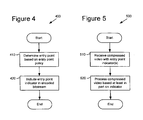
- Figure 4 is a flow chart showing a technique 400 for determining and indicating entry points in a bitstream.
- an entry point is determined in a bitstream based on an entry point policy.
- an entry point indicator is included in an encoded bitstream.
- Figure 5 is a flow chart showing a technique 500 for processing (e.g., in a video decoder) a compressed video bitstream having entry point indicators.
- compressed video with one or more entry point indicators is received (e.g., by a video decoder, video editor, splicer, etc.).
- the compressed video is processed based at least in part on the one or more entry point indicators.
- an entry point indicator can comprise an entry point start code and an entry point header.
- entry point start codes signal entry points in the bitstream.
- Entry point start codes can consist of a special 32-bit code that is not emulated anywhere else in the bitstream.
- entry point start codes can take the form of a unique sequence of 32 bits, where the first three bytes are 0x000001 and the last byte identifies the start code the entry start code.
- the entry point start code can be an abbreviated start code (e.g., one byte or a few bits) sufficient to distinguish the entry point start code from other kinds of start codes in the video stream.
- an entry point start code is located after the last of a video frame and before the beginning of the next video frame.
- Entry point start codes can be used along with other start codes in a bitstream, such as sequence start codes, frame start code, field start codes, slice start codes, and user data start codes.
- Each type of start code can be a 32-bit field.
- the various types of start codes can have different last bytes that identify the start code as a sequence start code, frame start code, field start code, slice start code, user data start code, etc.
- a start code may be preceded by an arbitrary number of "0"-valued bits, themselves preceded by a "1"-valued bit.
- the purpose of using a "10 ... 0" flushing bits sequence between the last of the previous structure and the beginning of a start code is to allow consecutive start codes to be separated by an integer number of bytes, thereby facilitating parsing of start codes by receivers.
- an entry point start code is followed immediately by an entry point header. If there is a need to insert an entry point start code and an entry point header in a position in the bitstream where there are already a sequence start code and sequence header between two consecutive video frames, the entry point start code and the entry point header follow the sequence start code and sequence header.
- an encoder can adopt different policies to govern the insertion of entry point start codes and associated headers.
- an entry point start code and associated header signal a valid entry point in the bitstream.
- the entry point start code and/or header signals the presence of a special location in a bitstream where there is no dependency on decoded video fields or frames prior to (in time order) the key frame after the entry point start code and header to decode the video frame(s) following immediately (in time order) the key frame after the entry point start code and header.
- frames that can follow entry point key frames include both frames which can themselves be entry point frames (e.g., progressive I-frames, frame interlaced I-frames, field interlaced I/I frames, field interlaced I/P frames, field interlaced P/I frames, etc.) and predicted frames, subject to certain conditions described below. The conditions for achieving this are listed in the examples below with reference to Figures 6-10 . Video frames and/or fields must satisfy certain conditions, depending on the type of picture. These conditions are only examples. Other conditions could be used.
- the type of the first frame following an entry point start code header is I if picture coding type is set to progressive or frame interlace. If the picture coding type is set to field interlace, the type of the first two fields following an entry point start code and header is I/P (I and P), P/I (P and I), or I/I (I and I).
- FIGS 6-10 reference certain bitstream constructs, definitions of which can be found in the following list:
- the reference frame for a progressive P-frame is the first I- or P-frame preceding the frame
- the reference frame(s) for a progressive B-frame may further include the first I- or P-frame following the frame.
- Similar rules apply for frame interlaced mode P-frames and B-frames.
- the reference field(s) for a P-field are, for example, one or both of the first I- or P-fields preceding the field.
- the reference field(s) for a B-field are, for example, the two temporally preceding fields and two temporally subsequent fields.
- Figure 6 illustrates how an entry point start code and header can be present before an I-frame when the picture coding type (FCM field) is set to the binary value "0" (progressive mode).
- Figure 6 also shows a sequence start code and a sequence header before the entry point start code, but this is not a requirement. An entry point start code need not always be preceded by such structures.
- the entry point applies to the I-frame that follows the entry point start code and header. It does not apply to any B-frame data or B-field data that follow that I-frame in the bitstream and for which the presentation time is earlier than the presentation time for that I-frame.
- Figure 7 illustrates how an entry point start code and header can be present before an I/P-frame when the picture coding type (FCM field) is set to the binary value "10" (field interlace mode).
- Figure 7 does not show a sequence start code and a sequence header before the entry point start code, but it may be the case that such structures precede the entry point start code.
- the entry point applies to the I/P-frame that follows the entry point start code and header but it does not apply to any B-frame data or B-field data that follow that I/P-frame in the bitstream and for which the presentation time comes earlier than the presentation time for that I/P-frame.
- Figure 8 illustrates how an entry point start code and header can be present before a P/I-frame when the picture coding type (FCM field) is set to the binary value "10" (field interlace mode).
- Figure 8 does not show a sequence start code and a sequence header before the entry point start code, but it may be the case that such structures precede the entry point start code.
- the entry point applies to the I-field that follows the entry point start code and header but it does not apply to any B-frame data that follows that I-field in the bitstream and for which the presentation time is earlier than the presentation time for that I-field. Furthermore, the entry point does not apply to the P-field data located between the entry point start code and the following I-field of the entry P/I frame.
- Figure 9 illustrates how an entry point start code and header can be present before an I/I-frame when the picture coding type (FCM field) is set to the binary value "10" (field interlace mode).
- Figure 9 does not show a sequence start code and a sequence header before the entry point start code, but it may be the case that such structures precede the entry start code.
- the entry point applies to the I/I-frame that follows the entry point start code and header, but it does not apply to any B-frame data or B-field data that follows that I/I-frame in the bitstream and for which the presentation times come earlier than the presentation time for that I/I-frame.
- Figure 10 illustrates how an entry point start code and header can be present before an I-frame when the picture coding type (FCM field) is set to the binary value "11" (frame interlace mode).
- Figure 10 also shows a sequence start code and a sequence header before the entry point start code, but it is not a requirement that an entry start code be always preceded by such structures.
- the entry point applies to the I-frame that follows the entry point start code and header, but it does not apply to any B-frame data or B-field data that follows that I-frame in the bitstream and for which the presentation times come earlier than the presentation time for that I-frame.
- the encoder and decoder may operate as follows.
- An encoder can use a policy that defines scene changes as valid entry points (and therefore ensures that the compression engine yields one of the constraints described above).
- scene changes can be detected by means of a scene change detector component that can interface (communicate) with the encoder in real time.
- Encoders can additionally use policies for generating I-frames or I-fields at particular time intervals.
- An encoder can also monitor the type and properties of the compressed video it produces and detect the points in the bitstream that verify one of the conditions such as those described in the examples for I-, I/P-, P/I- and I/I-frames stated above. Upon detecting such an event, the encoder can insert an entry point start code and an entry point header in the final bitstream.
- a video decoder could search for and render entry point frames by searching for entry point start codes.
- Entry points can be utilized by an application to produce and display a summarized version (thumbnails) of a video sequence directly from the compressed bitstream.
- Such an application can be a video editing application or a digital television electronic program guide.
- a video splicer could search for entry points to find scene changes at which splicing would be appropriate.
- the entry point header can contain information on buffer status. This information indicates buffer status that needs to be achieved to avoid buffer underflow or overflow.
- the buffer status information is stored in a field in the entry header. For example, putting buffer fullness requirement information into the entry header lets the decoder know what the minimum fullness of the buffer should be achieved before decoding can begin.
- an entry point does not apply to B-frame or B-field data that follow the entry I-frame or I-field in the bitstream and for which the presentation time is earlier than the presentation time for the I-frame or I-field.
- the entry point does apply to such B-frame or B-field data if the B-frame or B-field data is intra coded or predicted only from the entry point I-frame or I-field.
Landscapes
- Engineering & Computer Science (AREA)
- Multimedia (AREA)
- Signal Processing (AREA)
- Compression Or Coding Systems Of Tv Signals (AREA)
- Television Signal Processing For Recording (AREA)
- Two-Way Televisions, Distribution Of Moving Picture Or The Like (AREA)
Claims (51)
- Procédé comprenant :la détermination (410) d'un ou plusieurs points d'entrée pour une séquence comprenant une pluralité de trames vidéo sur base au moins en partie d'un politique de point d'entrée, dans lequel la politique de point d'entrée comprend une ou plusieurs conditions pour le positionnement d'un indicateur de point d'entrée ; etl'insertion (420) dans un train de bits d'un indicateur de point d'entrée qui indique qu'une première trame de la pluralité de trames est un desdits un ou plusieurs points d'entrée, dans lequel l'indicateur de point d'entrée comprend un en-tête de point d'entrée, et dans lequel la première trame présente un type sélectionné parmi un ensemble de types comprenant une trame P/I à champ entrelacé,caractérisé en ce quel'indicateur de point d'entrée comprend un code de début de point d'entrée, le code de début de point d'entrée étant suivi immédiatement par l'en-tête de point d'entrée, dans lequel le code de début de point d'entrée et l'en-tête de point d'entrée signalent le point d'entrée desdits un ou plusieurs points d'entrée ; etaprès l'indicateur de point d'entrée, le train de bits comprend un code de début de trame et un en-tête de trame, dans lequel le code de début de trame suit immédiatement l'en-tête de point d'entrée et l'en-tête de trame suit immédiatement le code de début de trame, et dans lequel l'en-tête de trame comprend un champ qui indique le type de la première trame.
- Procédé selon la revendication 1, dans lequel l'ensemble de types comprend en outre : une trame I à trame entrelacée, une trame I/P à champ entrelacé, une trame I/I à champ entrelacé, et une trame I progressive.
- Procédé selon la revendication 1, dans lequel lesdits un ou plusieurs points d'entrée comprennent une pluralité de points d'entrée positionnés à différents intervalles.
- Procédé selon la revendication 1, dans lequel l'en-tête de point d'entrée comprend de l'information de remplissage de tampon.
- Procédé selon la revendication 1, dans lequel le code de début de point d'entrée est un code de début abrégé suffisant pour distinguer le code de début de point d'entrée d'autres codes de début dans le train de bits.
- Procédé selon la revendication 1, dans lequel le train de bits possède une pluralité de niveaux de syntaxe, et dans lequel l'indicateur de point d'entrée est inclus à un niveau de syntaxe sous le niveau de séquence.
- Procédé selon la revendication 6, dans lequel le niveau de syntaxe sous le niveau de séquence est le niveau de point d'entrée.
- Procédé selon la revendication 1, dans lequel l'indicateur de point d'entrée suit immédiatement un en-tête de séquence dans le train de bits.
- Procédé selon la revendication 1, dans lequel l'indicateur de point d'entrée indique le point d'insertion d'une publicité pour faciliter le collage vidéo.
- Procédé selon la revendication 1, dans lequel la première trame est une trame P/I à champ entrelacé, dans lequel la trame P/I à champ entrelacé contient un champ P entrelacé suivi par un champ I entrelacé, le champ P et le champ I étant agencés dans le train de bits pour un décodage comme champs individuels, dans lequel une deuxième trame suit immédiatement la trame P/I à champ entrelacé dans le temps de présentation, dans lequel la deuxième trame est une trame prédite, dans lequel, conformément à la politique de point d'entrée, l'encodeur vidéo effectue des décisions de codage pour la deuxième trame afin d'éliminer toute dépendance de compensation de déplacement antérieure au champ I de la trame P/I à champ entrelacé, et dans lequel la politique de point d'entrée comprend les conditions suivantes :après la trame P/I à champ entrelacé, au moins une trame P/P à champ entrelacé est présente dans le train de bits avant une trame P progressive ou une trame P à trame entrelacée ;après la trame P/I à champ entrelacé, un champ P suivant dans le train de bits fait référence au champ I de la trame P/I à champ entrelacé mais pas au champ P de la trame P/I à champ entrelacé ;après la trame P/I à champ entrelacé, une trame B progressive ou une trame B à trame entrelacée dans le train de bits qui présente un temps de présentation postérieur à la trame P/I à champ entrelacé n'est pas codée en fonction de la trame P/I à champ entrelacé ; etaprès la trame P/I à champ entrelacé, un champ B suivant dans le train de bits qui présente un temps de présentation postérieur à la trame P/I à champ entrelacé n'est pas codé en fonction du champ P de la trame P/I à champ entrelacé.
- Procédé selon la revendication 1 dans lequel, conformément à la politique de point d'entrée, des indicateurs de point d'entrée sont insérés dans le train de bits à intervalles réguliers.
- Procédé selon la revendication 1 dans lequel, conformément à la politique de point d'entrée, des indicateurs de point d'entrée sont insérés dans le train de bits lors de changements de scène.
- Procédé selon la revendication 1, comprenant en outre : l'insertion d'une publicité au point d'entrée.
- Procédé selon la revendication 1, dans lequel le champ qui indique le type de la première trame indique une combinaison de types de champ pour une paire de champs vidéo entrelacés de la première trame.
- Procédé selon la revendication 1, dans lequel la première trame est une trame I à trame entrelacée, lesdites unes ou plusieurs conditions ne comprenant en outre aucune autre restriction.
- Procédé selon la revendication 1, dans lequel la première trame est une trame I progressive, lesdites unes ou plusieurs conditions ne comprenant en outre aucune autre restriction.
- Procédé selon la revendication 1, dans lequel la première trame est une trame I/I à champ entrelacé, les conditions ne comprenant en outre aucune autre restriction.
- Procédé selon la revendication 1, dans lequel la première trame est une trame I/P à champ entrelacé, dans lequel la trame I/P à champ entrelacé contient un champ I entrelacé suivi par un champ P entrelacé, lesdites unes ou plusieurs conditions comprenant en outre la condition :le champ P entrelacé est uniquement prédit à partir du champ I entrelacé.
- Procédé selon la revendication 18, dans lequel un champ numref dans un en-tête de champ pour le champ P entrelacé est réglé à 0, et dans lequel un champ reffield dans un en-tête de champ pour le champ P entrelacé est réglé à 0.
- Procédé selon la revendication 1, dans lequel la première trame est une trame P/I à champ entrelacé, et dans lequel la trame P/I à champ entrelacé contient un champ P entrelacé suivi par un champ I entrelacé, lesdites unes ou plusieurs conditions comprenant en outre la condition :un champ P d'une trame P/P à champ entrelacé qui suit la trame P/I à champ entrelacé n'est pas prédit à partir du champ P entrelacé de la trame P/I à champ entrelacé.
- Procédé selon la revendication 1, dans lequel la première trame est une trame P/I à champ entrelacé, et dans lequel la trame P/I à champ entrelacé contient un champ P entrelacé suivi par un champ I entrelacé, lesdites unes ou plusieurs conditions comprenant en outre la condition :un champ B d'une trame B/B à champ entrelacé qui suit la trame P/I à champ entrelacé n'est pas prédit à partir du champ P entrelacé de la trame P/I à champ entrelacé.
- Procédé selon la revendication 1, dans lequel la première trame est une trame P/I à champ entrelacé, et dans lequel la trame P/I à champ entrelacé contient un champ P entrelacé suivi par un champ I entrelacé, lesdites unes ou plusieurs conditions comprenant en outre la condition :une trame B à trame entrelacée qui suit la trame P/I à champ entrelacé n'est pas prédite à partir de la trame P/I à champ entrelacé.
- Procédé selon la revendication 1, dans lequel la première trame est une trame P/I à champ entrelacé, et dans lequel la trame P/I à champ entrelacé contient un champ P entrelacé suivi par un champ I entrelacé, lesdites unes ou plusieurs conditions comprenant en outre la condition :une trame P à trame entrelacée qui suit la trame P/I à champ entrelacé n'est pas prédite à partir de la trame P/I à champ entrelacé.
- Procédé selon la revendication 1, dans lequel la première trame est une trame P/I à champ entrelacé, dans lequel la trame P/I à champ entrelacé contient un champ P entrelacé suivi par un champ I entrelacé, et dans lequel une trame qui suit la trame P/I à champ entrelacé est une trame sélectionnée parmi l'ensemble comprenant : une trame I à trame entrelacée, une trame I/P à champ entrelacé, une trame I/I à champ entrelacé, une trame I progressive, et une trame P/I à champ entrelacé.
- Procédé selon la revendication 1, dans lequel le train de bits comprend en outre, après l'en-tête de trame, un premier en-tête de champ pour un premier champ vidéo entrelacé de la première trame, des premières données de champ pour le premier champ vidéo entrelacé, un code de début de champ, un deuxième en-tête de champ pour un deuxième champ vidéo entrelacé de la première trame, et des deuxièmes données de champ pour le deuxième champ vidéo entrelacé.
- Support lisible par un ordinateur, stockant des instructions exécutables par un ordinateur pour commander au système informatique de mettre en oeuvre le procédé de la revendication 1 durant un codage vidéo.
- Procédé comprenant :la réception (510) d'un train de bits pour une séquence comprenant une pluralité de trames vidéo ;la détection d'un indicateur de point d'entrée dans le train de bits, dans lequel l'indicateur de point d'entrée comprend un en-tête de point d'entrée, et dans lequel l'indicateur de point d'entrée marque une première trame de la pluralité de trames comme point d'entrée pour le décodage ; etle décodage (520) en commençant à partir du point d'entrée marqué par l'indicateur de point d'entrée,caractérisé en ce quel'indicateur de point d'entrée comprend un code de début de point d'entrée, le code de début de point d'entrée étant suivi immédiatement par l'en-tête de point d'entrée, dans lequel le code de début de point d'entrée et l'en-tête de point d'entrée signalent le point d'entrée ; etaprès l'indicateur de point d'entrée, le train de bits comprend un code de début de trame et un en-tête de trame, dans lequel le code de début de trame suit immédiatement l'en-tête de point d'entrée et l'en-tête de trame suit immédiatement le code de début de trame, et dans lequel l'en-tête de trame comprend un champ qui indique un type de codage d'image utilisé pour la première trame ou une combinaison de types de champ utilisés pour une paire de champs vidéo entrelacés de la première trame.
- Procédé selon la revendication 27, dans lequel le train de bits comprend une pluralité de niveaux de syntaxe, et dans lequel l'indicateur de point d'entrée se trouve à un niveau de syntaxe sous le niveau de séquence.
- Procédé selon la revendication 28, dans lequel le niveau de syntaxe sous le niveau de séquence est le niveau de point d'entrée.
- Procédé selon la revendication 27, comprenant en outre la production d'une version résumée de la séquence au moins en partie sur base du point d'entrée.
- Procédé selon la revendication 30, dans lequel la production d'une version résumée est mise en oeuvre via une application d'édition vidéo.
- Procédé selon la revendication 27, dans lequel le décodage est mis en oeuvre en mode d'enrichissement.
- Procédé selon la revendication 32, dans lequel le mode d'enrichissement est un mode de retour rapide.
- Procédé selon la revendication 32, dans lequel le mode d'enrichissement est un mode d'avance rapide.
- Procédé selon la revendication 27, dans lequel le point d'entrée est une trame P/I à champ entrelacé.
- Procédé selon la revendication 35, dans lequel la détection du point d'entrée comprend la détection du code de début de point d'entrée.
- Procédé selon la revendication 35, dans lequel la détection du point d'entrée comprend la détection de l'indicateur de point d'entrée qui comporte le code de début de point d'entrée et l'en-tête de point d'entrée.
- Procédé selon la revendication 27 ou 37, dans lequel l'en-tête de point d'entrée comprend de l'information de remplissage de tampon.
- Procédé selon la revendication 27, dans lequel la première trame est une trame à champ entrelacé, et dans lequel, après l'en-tête de trame, le train de bits comprend en outre un premier en-tête de champ pour un premier champ vidéo entrelacé de la première trame, des premières données de champ pour le premier champ vidéo entrelacé, un code de début de champ, un deuxième en-tête de champ pour un deuxième champ vidéo entrelacé de la première trame, et des deuxièmes données de champ pour le deuxième champ vidéo entrelacé.
- Procédé selon la revendication 38, dans lequel les premières données de champ sont pour un champ I et les deuxièmes données de champ sont pour un champ P.
- Procédé selon la revendication 38, dans lequel les premières données de champ sont pour un champ I et les deuxièmes données de champ sont pour un champ I.
- Procédé selon la revendication 38, dans lequel les premières données de champ sont pour un champ P et les deuxièmes données de champ sont pour un champ I.
- Procédé selon la revendication 27, dans lequel le point d'entrée est une trame I/P à champ entrelacé, et dans lequel le champ I de la trame I/P à champ entrelacé est signalé dans le train de bits comme étant le champ de référence unique pour le champ P de la trame I/P à champ entrelacé.
- Procédé selon la revendication 43, dans lequel la détection du point d'entrée comprend la détection du code de début de point d'entrée.
- Procédé selon la revendication 43, dans lequel la détection du point d'entrée comprend la détection de l'indicateur de point d'entrée qui comporte le code de début de point d'entrée et l'en-tête de point d'entrée.
- Procédé selon la revendication 43, dans lequel un champ numref dans un en-tête de champ pour le champ P est réglé à 0, et dans lequel un champ reffield dans l'en-tête de champ pour le champ P est réglé à 0.
- Procédé selon la revendication 27, comprenant en outre :l'insertion d'une publicité au point d'entrée.
- Procédé selon la revendication 27, comprenant en outre, intégrée dans un mode d'avance rapide ou un mode de retour rapide, la recherche de codes de début de point d'entrée.
- Support lisible par un ordinateur, stockant des instructions exécutables par un ordinateur pour commander au système informatique de mettre en oeuvre le procédé de la revendication 27 durant un décodage vidéo.
- Dispositif informatique comprenant un processeur, une mémoire, un stockage, un affichage, un haut-parleur et une connexion de communication sans fil, le dispositif informatique étant adapté pour mettre en oeuvre un procédé comprenant :la détermination (410) d'un ou plusieurs points d'entrée pour une séquence comprenant une pluralité de trames vidéo sur base au moins en partie d'un politique de point d'entrée, dans lequel la politique de point d'entrée comprend une ou plusieurs conditions pour le positionnement d'un indicateur de point d'entrée ; etl'insertion (420) dans un train de bits d'un indicateur de point d'entrée qui indique qu'une première trame de la pluralité de trames est un desdits un ou plusieurs points d'entrée, dans lequel l'indicateur de point d'entrée comprend un en-tête de point d'entrée, et dans lequel la première trame présente un type sélectionné parmi un ensemble de types comprenant une trame P/I à champ entrelacé,caractérisé en ce quel'indicateur de point d'entrée comprend un code de début de point d'entrée, le code de début de point d'entrée étant suivi immédiatement par l'en-tête de point d'entrée, dans lequel le code de début de point d'entrée et l'en-tête de point d'entrée signalent le point d'entrée desdits un ou plusieurs points d'entrée ; etaprès l'indicateur de point d'entrée, le train de bits comprend un code de début de trame et un en-tête de trame, dans lequel le code de début de trame suit immédiatement l'en-tête de point d'entrée et l'en-tête de trame suit immédiatement le code de début de trame, dans lequel l'en-tête de trame comprend un champ qui indique le type de la première trame, et dans lequel, conformément à la politique de point d'entrée, des indicateurs de point d'entrée sont insérés dans le train de bits à intervalles réguliers.
- Dispositif informatique comprenant un processeur, une mémoire, un stockage, un affichage, un haut-parleur et une connexion de communication sans fil, le dispositif informatique étant adapté pour mettre en oeuvre un procédé comprenant :la réception (510) d'un train de bits pour une séquence comprenant une pluralité de trames vidéo ;intégrée dans un mode d'avance rapide ou un mode de retour rapide, la recherche de codes de début de point d'entrée ;la détection d'un indicateur de point d'entrée dans le train de bits, l'indicateur de point d'entrée comprenant un en-tête de point d'entrée, dans lequel l'indicateur de point d'entrée marque une première trame de la pluralité de trames comme point d'entrée pour le décodage ; etle décodage (520) en commençant à partir du point d'entrée marqué par l'indicateur de point d'entrée,caractérisé en ce quel'indicateur de point d'entrée comprend un code de début de point d'entrée, le code de début de point d'entrée étant suivi immédiatement par l'en-tête de point d'entrée, dans lequel le code de début de point d'entrée et l'en-tête de point d'entrée signalent le point d'entrée ; etaprès l'indicateur de point d'entrée, le train de bits comprend un code de début de trame et un en-tête de trame, dans lequel le code de début de trame suit immédiatement l'en-tête de point d'entrée et l'en-tête de trame suit immédiatement le code de début de trame, et dans lequel l'en-tête de trame comprend un champ qui indique un type de codage d'image utilisé pour la première trame ou une combinaison de types de champ utilisés pour une paire de champs vidéo entrelacés de la première trame.
Applications Claiming Priority (4)
| Application Number | Priority Date | Filing Date | Title |
|---|---|---|---|
| US52054303P | 2003-11-13 | 2003-11-13 | |
| US520543P | 2003-11-13 | ||
| US10/882,739 US7839930B2 (en) | 2003-11-13 | 2004-06-30 | Signaling valid entry points in a video stream |
| US882739 | 2004-06-30 |
Publications (3)
| Publication Number | Publication Date |
|---|---|
| EP1549064A2 EP1549064A2 (fr) | 2005-06-29 |
| EP1549064A3 EP1549064A3 (fr) | 2011-06-08 |
| EP1549064B1 true EP1549064B1 (fr) | 2014-06-25 |
Family
ID=34556570
Family Applications (1)
| Application Number | Title | Priority Date | Filing Date |
|---|---|---|---|
| EP04026473.1A Expired - Lifetime EP1549064B1 (fr) | 2003-11-13 | 2004-11-08 | Signalisation des points d'entrée valides dans un train de données vidéo |
Country Status (5)
| Country | Link |
|---|---|
| US (1) | US7839930B2 (fr) |
| EP (1) | EP1549064B1 (fr) |
| JP (1) | JP4928726B2 (fr) |
| KR (1) | KR101122898B1 (fr) |
| CN (1) | CN100568970C (fr) |
Families Citing this family (26)
| Publication number | Priority date | Publication date | Assignee | Title |
|---|---|---|---|---|
| US7609762B2 (en) * | 2003-09-07 | 2009-10-27 | Microsoft Corporation | Signaling for entry point frames with predicted first field |
| US7924921B2 (en) * | 2003-09-07 | 2011-04-12 | Microsoft Corporation | Signaling coding and display options in entry point headers |
| US7852919B2 (en) * | 2003-09-07 | 2010-12-14 | Microsoft Corporation | Field start code for entry point frames with predicted first field |
| US8213779B2 (en) * | 2003-09-07 | 2012-07-03 | Microsoft Corporation | Trick mode elementary stream and receiver system |
| US20050169376A1 (en) * | 2004-01-30 | 2005-08-04 | Pai Ramadas L. | Motion vector address computer error detection |
| US9208824B2 (en) | 2004-05-18 | 2015-12-08 | Broadcom Corporation | Index table generation in PVR applications for AVC video streams |
| JP4762145B2 (ja) * | 2004-09-03 | 2011-08-31 | パナソニック株式会社 | 記録媒体、記録装置、プログラム、記録方法、再生装置、再生方法 |
| FR2888424A1 (fr) * | 2005-07-07 | 2007-01-12 | Thomson Licensing Sas | Dispositif et procede de codage et de decodage de donnees video et train de donnees |
| US20070014346A1 (en) * | 2005-07-13 | 2007-01-18 | Nokia Corporation | Coding dependency indication in scalable video coding |
| KR100723507B1 (ko) * | 2005-10-12 | 2007-05-30 | 삼성전자주식회사 | I-프레임 움직임 예측을 이용한 동영상 압축 장치의 적응양자화 제어기 및 적응 양자화 제어 방법 |
| JP4871598B2 (ja) * | 2006-01-19 | 2012-02-08 | キヤノン株式会社 | 画像処理装置および画像処理装置の起動方法およびプログラム |
| US8094997B2 (en) * | 2006-06-28 | 2012-01-10 | Cyberlink Corp. | Systems and method for embedding scene processing information in a multimedia source using an importance value |
| WO2008018324A1 (fr) * | 2006-08-08 | 2008-02-14 | Panasonic Corporation | Dispositif de codage d'image, son procédé et son circuit intégré |
| US20080240227A1 (en) * | 2007-03-30 | 2008-10-02 | Wan Wade K | Bitstream processing using marker codes with offset values |
| EP2137972A2 (fr) * | 2007-04-24 | 2009-12-30 | Nokia Corporation | Système et procédé d'accès rapide par des images redondantes intracodées |
| WO2010092740A1 (fr) * | 2009-02-10 | 2010-08-19 | パナソニック株式会社 | Appareil de traitement d'image, procédé, programme et circuit intégré de traitement d'image |
| KR101389127B1 (ko) | 2010-05-06 | 2014-04-28 | 니폰덴신뎅와 가부시키가이샤 | 영상 부호화 제어 방법 및 장치 |
| US9179165B2 (en) * | 2010-05-07 | 2015-11-03 | Nippon Telegraph And Telephone Corporation | Video encoding control method, video encoding apparatus and video encoding program |
| CN102870415B (zh) | 2010-05-12 | 2015-08-26 | 日本电信电话株式会社 | 活动图像编码控制方法、活动图像编码装置以及活动图像编码程序 |
| EP3554072A1 (fr) | 2011-02-09 | 2019-10-16 | LG Electronics Inc. | Procédé de codage et de décodage d'images avec un prédicteur de vecteur de mouvement temporel |
| GB2551088B (en) | 2011-10-17 | 2018-09-19 | Kt Corp | Method and apparatus for encoding/decoding image |
| KR102417101B1 (ko) * | 2011-12-29 | 2022-07-05 | 엘지전자 주식회사 | 비디오 인코딩 및 디코딩 방법과 이를 이용하는 장치 |
| WO2014007515A1 (fr) | 2012-07-02 | 2014-01-09 | 엘지전자 주식회사 | Procédé permettant de décoder une image et appareil utilisant ce procédé |
| JP5891975B2 (ja) | 2012-07-02 | 2016-03-23 | 富士通株式会社 | 動画像符号化装置、動画像復号装置、動画像符号化方法および動画像復号方法 |
| US10187680B2 (en) * | 2014-11-11 | 2019-01-22 | Cisco Technology, Inc. | Adaptive bit rate system architectures using named domain networking |
| CN104754332A (zh) * | 2015-03-24 | 2015-07-01 | 深圳第一蓝筹科技有限公司 | 一种智能穿戴设备的视频图片传输方法 |
Family Cites Families (102)
| Publication number | Priority date | Publication date | Assignee | Title |
|---|---|---|---|---|
| DE3437182A1 (de) * | 1984-10-10 | 1986-04-10 | Telefunken Fernseh Und Rundfunk Gmbh, 3000 Hannover | Verfahren zur aufzeichnung und/oder wiedergabe digital kodierter signale |
| US4847877A (en) * | 1986-11-28 | 1989-07-11 | International Business Machines Corporation | Method and apparatus for detecting a predetermined bit pattern within a serial bit stream |
| ATE131335T1 (de) * | 1988-09-16 | 1995-12-15 | Philips Electronics Nv | Hochauflösungs-fersehsystem. |
| US5023727A (en) * | 1989-10-12 | 1991-06-11 | Ian A. R. Boyd | Method and device for producing a substantially continuous composite video signal |
| EP0424026B1 (fr) | 1989-10-14 | 1997-07-23 | Sony Corporation | Système et procédé de transmission d'un signal vidéo |
| JP2969782B2 (ja) * | 1990-05-09 | 1999-11-02 | ソニー株式会社 | 符号化データ編集方法及び符号化データ編集装置 |
| CA2043670C (fr) * | 1990-06-05 | 2002-01-08 | Wiebe De Haan | Methode et support de transmission de sequences d'images video animees |
| DE69131257T2 (de) * | 1990-10-31 | 1999-09-23 | Victor Company Of Japan, Ltd. | Verfahren zur Kompression von bewegten Bildsignalen nach dem Zeilensprungverfahren |
| US5621578A (en) * | 1992-02-06 | 1997-04-15 | Matsushita Electric Industrial Co., Ltd. | Method of transmitting digital video and audio signals between bit rate reduction encoded signal recording and reproducing systems |
| US5168356A (en) * | 1991-02-27 | 1992-12-01 | General Electric Company | Apparatus for segmenting encoded video signal for transmission |
| JP3119888B2 (ja) * | 1991-04-18 | 2000-12-25 | 松下電器産業株式会社 | 信号処理方法及び記録再生装置 |
| US5212549A (en) * | 1991-04-29 | 1993-05-18 | Rca Thomson Licensing Corporation | Error concealment apparatus for a compressed video signal processing system |
| US5428396A (en) * | 1991-08-03 | 1995-06-27 | Sony Corporation | Variable length coding/decoding method for motion vectors |
| JP2803693B2 (ja) * | 1991-10-16 | 1998-09-24 | インターナショナル・ビジネス・マシーンズ・コーポレイション | アクチユエータ固定解除方法及びその装置 |
| US6188428B1 (en) * | 1992-02-11 | 2001-02-13 | Mark Koz | Transcoding video file server and methods for its use |
| US5293229A (en) * | 1992-03-27 | 1994-03-08 | Matsushita Electric Corporation Of America | Apparatus and method for processing groups of fields in a video data compression system |
| US5325126A (en) * | 1992-04-01 | 1994-06-28 | Intel Corporation | Method and apparatus for real time compression and decompression of a digital motion video signal |
| US6226327B1 (en) | 1992-06-29 | 2001-05-01 | Sony Corporation | Video coding method and apparatus which select between frame-based and field-based predictive modes |
| US5365552A (en) * | 1992-11-16 | 1994-11-15 | Intel Corporation | Buffer fullness indicator |
| JP3358835B2 (ja) * | 1992-12-14 | 2002-12-24 | ソニー株式会社 | 画像符号化方法及び装置 |
| JP3240017B2 (ja) * | 1993-01-11 | 2001-12-17 | ソニー株式会社 | Mpeg信号記録方法およびmpeg信号再生方法 |
| US5477397A (en) * | 1993-02-23 | 1995-12-19 | Matsushita Electric Corporation Of America | Digital high definition television receiver with features that facilitate trick-play modes on a digital VCR |
| KR100323785B1 (ko) * | 1993-09-21 | 2002-06-20 | 이데이 노부유끼 | 데이타전송방법및장치와데이타복호화장치 |
| DE69422960T2 (de) * | 1993-12-01 | 2000-06-15 | Matsushita Electric Industrial Co., Ltd. | Verfahren und Vorrichtung zum Editieren oder zur Mischung von komprimierten Bildern |
| US5586200A (en) * | 1994-01-07 | 1996-12-17 | Panasonic Technologies, Inc. | Segmentation based image compression system |
| US5864368A (en) * | 1995-02-28 | 1999-01-26 | Sony Corporation | Picture signal editing and encoding method and apparatus, signal recording medium and picture signal decoding method and apparatus |
| DE69603587T2 (de) * | 1995-03-20 | 2000-03-30 | Matsushita Electric Industrial Co., Ltd. | Vorrichtung und verfahren zur aufnahme bildbetreffender informationen |
| SG80607A1 (en) * | 1995-09-29 | 2001-05-22 | Matsushita Electric Industrial Co Ltd | Method and device for recording and reproducing interleaved bitstream on and from medium |
| US5933535A (en) * | 1995-10-05 | 1999-08-03 | Microsoft Corporation | Object-based video compression process employing arbitrarily-shaped features |
| US6018765A (en) * | 1996-01-23 | 2000-01-25 | Storage Concepts, Inc. | Multi-channel multimedia data server |
| US6957350B1 (en) * | 1996-01-30 | 2005-10-18 | Dolby Laboratories Licensing Corporation | Encrypted and watermarked temporal and resolution layering in advanced television |
| US5838823A (en) * | 1996-02-29 | 1998-11-17 | Electronic Arts, Inc. | Video image compression and decompression |
| AU1942797A (en) | 1996-03-18 | 1997-10-10 | Kabushiki Kaisha Toshiba | Encoder and decoder |
| US5870444A (en) * | 1996-04-23 | 1999-02-09 | Scientific-Atlanta, Inc. | Method and apparatus for performing very fast message synchronization |
| US5835636A (en) * | 1996-05-28 | 1998-11-10 | Lsi Logic Corporation | Method and apparatus for reducing the memory required for decoding bidirectionally predictive-coded frames during pull-down |
| JPH1070717A (ja) | 1996-06-19 | 1998-03-10 | Matsushita Electric Ind Co Ltd | 画像符号化装置及び画像復号化装置 |
| US5661665A (en) * | 1996-06-26 | 1997-08-26 | Microsoft Corporation | Multi-media synchronization |
| EP1343330B1 (fr) * | 1996-07-05 | 2007-08-15 | Matsushita Electric Industrial Co., Ltd. | Procédé d'affichage de l'horodatage et synchronisation de multiples plans objets videos |
| JPH1066036A (ja) * | 1996-08-15 | 1998-03-06 | Oki Electric Ind Co Ltd | Tv方式変換装置 |
| US5898897A (en) * | 1996-10-18 | 1999-04-27 | Samsung Electronics Company, Ltd. | Bit stream signal feature detection in a signal processing system |
| JP4013286B2 (ja) * | 1997-01-22 | 2007-11-28 | 松下電器産業株式会社 | 画像符号化装置と画像復号化装置 |
| US6201927B1 (en) * | 1997-02-18 | 2001-03-13 | Mary Lafuze Comer | Trick play reproduction of MPEG encoded signals |
| US6442604B2 (en) * | 1997-03-25 | 2002-08-27 | Koninklijke Philips Electronics N.V. | Incremental archiving and restoring of data in a multimedia server |
| US5955977A (en) * | 1997-03-31 | 1999-09-21 | Sharp Laboratories Of America, Inc. | System for avoiding start code emulation and long carry-over propagation |
| EP0922360A4 (fr) | 1997-04-07 | 1999-12-29 | At & T Corp | Format de fichier enregistre pour mpeg-4 |
| US6735253B1 (en) * | 1997-05-16 | 2004-05-11 | The Trustees Of Columbia University In The City Of New York | Methods and architecture for indexing and editing compressed video over the world wide web |
| US6061399A (en) * | 1997-05-28 | 2000-05-09 | Sarnoff Corporation | Method and apparatus for information stream frame synchronization |
| US6169573B1 (en) * | 1997-07-03 | 2001-01-02 | Hotv, Inc. | Hypervideo system and method with object tracking in a compressed digital video environment |
| DE69841897D1 (de) * | 1997-07-25 | 2010-10-28 | Sony Corp | Bearbeitungsanlage, bearbeitungsverfahren, spleissungsanlage, spleissungsverfahren, kodieranlage und kodierverfahren |
| JPH11110915A (ja) * | 1997-09-30 | 1999-04-23 | Sony Corp | 信号記録再生装置及び方法 |
| JP3665456B2 (ja) * | 1997-11-19 | 2005-06-29 | 株式会社東芝 | 映像情報の記録再生システム及び同システムに適用する映像編集方法 |
| US6154496A (en) * | 1997-11-25 | 2000-11-28 | Philips Electronics N.A. Corp. | Video buffer for seamless splicing of MPEG streams |
| US5973743A (en) * | 1997-12-02 | 1999-10-26 | Daewoo Electronics Co., Ltd. | Mode coding method and apparatus for use in an interlaced shape coder |
| US6301428B1 (en) * | 1997-12-09 | 2001-10-09 | Lsi Logic Corporation | Compressed video editor with transition buffer matcher |
| US6198773B1 (en) | 1997-12-18 | 2001-03-06 | Zoran Corporation | Video memory management for MPEG video decode and display system |
| US5946043A (en) * | 1997-12-31 | 1999-08-31 | Microsoft Corporation | Video coding using adaptive coding of block parameters for coded/uncoded blocks |
| US6414998B1 (en) * | 1998-01-27 | 2002-07-02 | Sony Corporation | Method and apparatus for inserting an image material |
| US6611624B1 (en) * | 1998-03-13 | 2003-08-26 | Cisco Systems, Inc. | System and method for frame accurate splicing of compressed bitstreams |
| GB9807208D0 (en) | 1998-04-03 | 1998-06-03 | Nds Ltd | Method and apparatus for detecting a sequence in a bitstream |
| WO1999056472A1 (fr) | 1998-04-24 | 1999-11-04 | Rockwell Science Center, Llc | Codeur video n bits et procede d'extension d'un codeur video mpeg 8 bits |
| RU2287907C2 (ru) * | 1998-05-08 | 2006-11-20 | Конинклейке Филипс Электроникс Н.В. | Способ сохранения сжатых цифровых аудио- и видеосигналов |
| AU3842999A (en) | 1998-06-11 | 1999-12-30 | Koninklijke Philips Electronics N.V. | Trick play signal generation for a digital video recorder |
| GB9813831D0 (en) * | 1998-06-27 | 1998-08-26 | Philips Electronics Nv | Frame-accurate editing of encoded A/V sequences |
| AU4944699A (en) * | 1998-06-29 | 2000-01-17 | Limt Technology Ab | Method and apparatus for splicing data streams |
| US6415326B1 (en) * | 1998-09-15 | 2002-07-02 | Microsoft Corporation | Timeline correlation between multiple timeline-altered media streams |
| US6912251B1 (en) * | 1998-09-25 | 2005-06-28 | Sarnoff Corporation | Frame-accurate seamless splicing of information streams |
| FR2784845B1 (fr) * | 1998-10-14 | 2001-02-23 | France Telecom | Procede de basculement de la ou des composantes video d'un premier programme audiovisuel sur la ou les composantes video d'un second programme audiovisuel numerique |
| KR100345235B1 (ko) * | 1998-11-08 | 2005-07-29 | 엘지전자 주식회사 | 디지털데이터스트림기록방법및그장치 |
| US6380991B1 (en) * | 1998-11-19 | 2002-04-30 | Tektronix, Inc. | Method for splicing MPEG-2 transport streams |
| US6434195B1 (en) * | 1998-11-20 | 2002-08-13 | General Instrument Corporaiton | Splicing of video data in progressively refreshed video streams |
| EP1018840A3 (fr) | 1998-12-08 | 2005-12-21 | Canon Kabushiki Kaisha | Récepteur digital et méthode |
| EP1069777A4 (fr) | 1999-02-05 | 2009-03-04 | Sony Corp | Systemes et methodes de codage et de decodage, systeme et methode de multiplexage et systeme et methode d'affichage |
| US6499060B1 (en) * | 1999-03-12 | 2002-12-24 | Microsoft Corporation | Media coding for loss recovery with remotely predicted data units |
| JP4292654B2 (ja) | 1999-03-19 | 2009-07-08 | ソニー株式会社 | 記録装置および方法、再生装置および方法、並びに記録媒体 |
| EP1276331A3 (fr) | 1999-04-01 | 2005-06-01 | Ravisent Technologies, Inc. | Méthode pour empêcher l'accumulation d'erreur de compensation de mouvement sous-pixelique à deux étapes pour séquences MPEG-2 à haut degré de prédiction |
| GB2353653B (en) | 1999-08-26 | 2003-12-31 | Sony Uk Ltd | Signal processor |
| GB2353655B (en) * | 1999-08-26 | 2003-07-23 | Sony Uk Ltd | Signal processor |
| AU1579401A (en) | 1999-11-10 | 2001-06-06 | Thomson Licensing S.A. | Commercial skip and chapter delineation feature on recordable media |
| US6985188B1 (en) * | 1999-11-30 | 2006-01-10 | Thomson Licensing | Video decoding and channel acquisition system |
| JP3694888B2 (ja) | 1999-12-03 | 2005-09-14 | ソニー株式会社 | 復号装置および方法、符号化装置および方法、情報処理装置および方法、並びに記録媒体 |
| GB9930788D0 (en) * | 1999-12-30 | 2000-02-16 | Koninkl Philips Electronics Nv | Method and apparatus for converting data streams |
| US7164844B1 (en) * | 2000-03-02 | 2007-01-16 | The Directv Group, Inc. | Method and apparatus for facilitating reverse playback |
| KR100698106B1 (ko) * | 2000-03-07 | 2007-03-26 | 엘지전자 주식회사 | 엠펙(mpeg)압축 비디오 환경에서 계층적 혼합형장면 변화 검출 방법 |
| GB2365647A (en) | 2000-08-04 | 2002-02-20 | Snell & Wilcox Ltd | Deriving parameters for post-processing from an encoded signal |
| US6453115B1 (en) * | 2000-08-31 | 2002-09-17 | Keen Personal Media, Inc. | Digital video recording system which generates an index data structure for displaying a video stream in trickplay mode |
| WO2002043385A2 (fr) * | 2000-10-10 | 2002-05-30 | Broadcom Corporation | Systeme et procede d'enregistrement video personnel |
| US6765963B2 (en) * | 2001-01-03 | 2004-07-20 | Nokia Corporation | Video decoder architecture and method for using same |
| US6920175B2 (en) * | 2001-01-03 | 2005-07-19 | Nokia Corporation | Video coding architecture and methods for using same |
| US7143353B2 (en) * | 2001-03-30 | 2006-11-28 | Koninklijke Philips Electronics, N.V. | Streaming video bookmarks |
| US6593392B2 (en) * | 2001-06-22 | 2003-07-15 | Corning Incorporated | Curable halogenated compositions |
| US7646816B2 (en) | 2001-09-19 | 2010-01-12 | Microsoft Corporation | Generalized reference decoder for image or video processing |
| JP2004007379A (ja) * | 2002-04-10 | 2004-01-08 | Toshiba Corp | 動画像符号化方法及び動画像復号化方法 |
| US7149247B2 (en) | 2002-01-22 | 2006-12-12 | Microsoft Corporation | Methods and systems for encoding and decoding video data to enable random access and splicing |
| US7116831B2 (en) * | 2002-04-10 | 2006-10-03 | Microsoft Corporation | Chrominance motion vector rounding |
| US7289663B2 (en) * | 2002-07-24 | 2007-10-30 | Eastman Kodak Company | Producing an extended color gamut luminance-chrominance digital image from a captured image |
| US7970056B2 (en) * | 2003-06-26 | 2011-06-28 | Lsi Corporation | Method and/or apparatus for decoding an intra-only MPEG-2 stream composed of two separate fields encoded as a special frame picture |
| US7609762B2 (en) * | 2003-09-07 | 2009-10-27 | Microsoft Corporation | Signaling for entry point frames with predicted first field |
| US8213779B2 (en) * | 2003-09-07 | 2012-07-03 | Microsoft Corporation | Trick mode elementary stream and receiver system |
| US7852919B2 (en) * | 2003-09-07 | 2010-12-14 | Microsoft Corporation | Field start code for entry point frames with predicted first field |
| US8085844B2 (en) * | 2003-09-07 | 2011-12-27 | Microsoft Corporation | Signaling reference frame distances |
| US7924921B2 (en) * | 2003-09-07 | 2011-04-12 | Microsoft Corporation | Signaling coding and display options in entry point headers |
| US8600217B2 (en) * | 2004-07-14 | 2013-12-03 | Arturo A. Rodriguez | System and method for improving quality of displayed picture during trick modes |
-
2004
- 2004-06-30 US US10/882,739 patent/US7839930B2/en active Active
- 2004-11-08 EP EP04026473.1A patent/EP1549064B1/fr not_active Expired - Lifetime
- 2004-11-12 CN CNB200410095789XA patent/CN100568970C/zh not_active Expired - Lifetime
- 2004-11-12 JP JP2004329653A patent/JP4928726B2/ja not_active Expired - Lifetime
- 2004-11-12 KR KR1020040092527A patent/KR101122898B1/ko not_active Expired - Lifetime
Non-Patent Citations (2)
| Title |
|---|
| JVT: "Text of Joint FCD for Joint Video Specification", 4. JVT MEETING; 61. MPEG MEETING; 22-07-2002 - 26-07-2002; KLAGENFURT,AT; (JOINT VIDEO TEAM OF ISO/IEC JTC1/SC29/WG11 AND ITU-T SG.16 ),, no. JVT-D157, 26 July 2002 (2002-07-26), XP030005420, ISSN: 0000-0439 * |
| SAM NARASIMHAN ET AL: "Contributions to carriage of AVC in MPEG-2", 64. MPEG MEETING; 10-03-2003 - 14-03-2003; PATTAYA; (MOTION PICTUREEXPERT GROUP OR ISO/IEC JTC1/SC29/WG11),, no. M9448, 28 February 2003 (2003-02-28), XP030038364, ISSN: 0000-0267 * |
Also Published As
| Publication number | Publication date |
|---|---|
| US7839930B2 (en) | 2010-11-23 |
| KR20050046623A (ko) | 2005-05-18 |
| CN1617593A (zh) | 2005-05-18 |
| US20050105883A1 (en) | 2005-05-19 |
| EP1549064A3 (fr) | 2011-06-08 |
| CN100568970C (zh) | 2009-12-09 |
| JP4928726B2 (ja) | 2012-05-09 |
| JP2005151570A (ja) | 2005-06-09 |
| EP1549064A2 (fr) | 2005-06-29 |
| KR101122898B1 (ko) | 2012-03-20 |
Similar Documents
| Publication | Publication Date | Title |
|---|---|---|
| EP1549064B1 (fr) | Signalisation des points d'entrée valides dans un train de données vidéo | |
| US7609762B2 (en) | Signaling for entry point frames with predicted first field | |
| US7852919B2 (en) | Field start code for entry point frames with predicted first field | |
| US7924921B2 (en) | Signaling coding and display options in entry point headers | |
| US8213779B2 (en) | Trick mode elementary stream and receiver system | |
| US7961786B2 (en) | Signaling field type information | |
| JP5007322B2 (ja) | ビデオ符号化方法 | |
| KR100991409B1 (ko) | 스케일가능성을 갖는 비디오 처리 | |
| KR100698938B1 (ko) | 비디오 코딩시 이미지 프레임들의 그루핑 | |
| KR100959573B1 (ko) | 비디오 코딩시 이미지 프레임들의 그루핑 | |
| CN101765016B (zh) | 视频译码方法 | |
| US20030067637A1 (en) | Video coding | |
| KR20150105431A (ko) | 비디오 스플라이싱을 단순화시키기 위한 버퍼링 정보에 대한 구문 및 의미 | |
| Wee et al. | Splicing MPEG video streams in the compressed domain | |
| KR101713692B1 (ko) | 동화상 예측 부호화 및 복호 장치, 방법, 그리고 프로그램 | |
| Pettersson et al. | Dependent random access point pictures in HEVC | |
| KR100967731B1 (ko) | 채널 스위치 프레임 | |
| Murugan | Multiplexing H. 264 video with AAC audio bit streams, demultiplexing and achieving lip synchronization during playback | |
| KR20040077765A (ko) | 랜덤 액세스 및 스플라이싱을 가능하게 하기 위해 비디오데이터를 인코딩 및 디코딩하는 방법 및 시스템 | |
| HK1096517B (en) | Error concealment method and indicator for improving error concealment in video coding |
Legal Events
| Date | Code | Title | Description |
|---|---|---|---|
| PUAI | Public reference made under article 153(3) epc to a published international application that has entered the european phase |
Free format text: ORIGINAL CODE: 0009012 |
|
| AK | Designated contracting states |
Kind code of ref document: A2 Designated state(s): AT BE BG CH CY CZ DE DK EE ES FI FR GB GR HU IE IS IT LI LU MC NL PL PT RO SE SI SK TR |
|
| AX | Request for extension of the european patent |
Extension state: AL HR LT LV MK YU |
|
| PUAL | Search report despatched |
Free format text: ORIGINAL CODE: 0009013 |
|
| AK | Designated contracting states |
Kind code of ref document: A3 Designated state(s): AT BE BG CH CY CZ DE DK EE ES FI FR GB GR HU IE IS IT LI LU MC NL PL PT RO SE SI SK TR |
|
| AX | Request for extension of the european patent |
Extension state: AL HR LT LV MK YU |
|
| 17P | Request for examination filed |
Effective date: 20111208 |
|
| AKX | Designation fees paid |
Designated state(s): AT BE BG CH CY CZ DE DK EE ES FI FR GB GR HU IE IS IT LI LU MC NL PL PT RO SE SI SK TR |
|
| 17Q | First examination report despatched |
Effective date: 20120328 |
|
| REG | Reference to a national code |
Ref country code: DE Ref legal event code: R079 Ref document number: 602004045328 Country of ref document: DE Free format text: PREVIOUS MAIN CLASS: H04N0007000000 Ipc: H04N0021440000 |
|
| GRAP | Despatch of communication of intention to grant a patent |
Free format text: ORIGINAL CODE: EPIDOSNIGR1 |
|
| RIC1 | Information provided on ipc code assigned before grant |
Ipc: H04N 21/845 20110101ALI20140120BHEP Ipc: H04N 21/44 20110101AFI20140120BHEP Ipc: H04N 21/234 20110101ALN20140120BHEP |
|
| INTG | Intention to grant announced |
Effective date: 20140204 |
|
| GRAS | Grant fee paid |
Free format text: ORIGINAL CODE: EPIDOSNIGR3 |
|
| GRAA | (expected) grant |
Free format text: ORIGINAL CODE: 0009210 |
|
| AK | Designated contracting states |
Kind code of ref document: B1 Designated state(s): AT BE BG CH CY CZ DE DK EE ES FI FR GB GR HU IE IS IT LI LU MC NL PL PT RO SE SI SK TR |
|
| REG | Reference to a national code |
Ref country code: GB Ref legal event code: FG4D |
|
| REG | Reference to a national code |
Ref country code: CH Ref legal event code: EP |
|
| REG | Reference to a national code |
Ref country code: AT Ref legal event code: REF Ref document number: 675302 Country of ref document: AT Kind code of ref document: T Effective date: 20140715 |
|
| REG | Reference to a national code |
Ref country code: IE Ref legal event code: FG4D |
|
| REG | Reference to a national code |
Ref country code: DE Ref legal event code: R096 Ref document number: 602004045328 Country of ref document: DE Effective date: 20140731 |
|
| PG25 | Lapsed in a contracting state [announced via postgrant information from national office to epo] |
Ref country code: FI Free format text: LAPSE BECAUSE OF FAILURE TO SUBMIT A TRANSLATION OF THE DESCRIPTION OR TO PAY THE FEE WITHIN THE PRESCRIBED TIME-LIMIT Effective date: 20140625 Ref country code: GR Free format text: LAPSE BECAUSE OF FAILURE TO SUBMIT A TRANSLATION OF THE DESCRIPTION OR TO PAY THE FEE WITHIN THE PRESCRIBED TIME-LIMIT Effective date: 20140926 Ref country code: CY Free format text: LAPSE BECAUSE OF FAILURE TO SUBMIT A TRANSLATION OF THE DESCRIPTION OR TO PAY THE FEE WITHIN THE PRESCRIBED TIME-LIMIT Effective date: 20140625 |
|
| REG | Reference to a national code |
Ref country code: AT Ref legal event code: MK05 Ref document number: 675302 Country of ref document: AT Kind code of ref document: T Effective date: 20140625 |
|
| REG | Reference to a national code |
Ref country code: NL Ref legal event code: VDEP Effective date: 20140625 |
|
| PG25 | Lapsed in a contracting state [announced via postgrant information from national office to epo] |
Ref country code: SE Free format text: LAPSE BECAUSE OF FAILURE TO SUBMIT A TRANSLATION OF THE DESCRIPTION OR TO PAY THE FEE WITHIN THE PRESCRIBED TIME-LIMIT Effective date: 20140625 |
|
| PG25 | Lapsed in a contracting state [announced via postgrant information from national office to epo] |
Ref country code: ES Free format text: LAPSE BECAUSE OF FAILURE TO SUBMIT A TRANSLATION OF THE DESCRIPTION OR TO PAY THE FEE WITHIN THE PRESCRIBED TIME-LIMIT Effective date: 20140625 Ref country code: EE Free format text: LAPSE BECAUSE OF FAILURE TO SUBMIT A TRANSLATION OF THE DESCRIPTION OR TO PAY THE FEE WITHIN THE PRESCRIBED TIME-LIMIT Effective date: 20140625 Ref country code: SK Free format text: LAPSE BECAUSE OF FAILURE TO SUBMIT A TRANSLATION OF THE DESCRIPTION OR TO PAY THE FEE WITHIN THE PRESCRIBED TIME-LIMIT Effective date: 20140625 Ref country code: CZ Free format text: LAPSE BECAUSE OF FAILURE TO SUBMIT A TRANSLATION OF THE DESCRIPTION OR TO PAY THE FEE WITHIN THE PRESCRIBED TIME-LIMIT Effective date: 20140625 Ref country code: RO Free format text: LAPSE BECAUSE OF FAILURE TO SUBMIT A TRANSLATION OF THE DESCRIPTION OR TO PAY THE FEE WITHIN THE PRESCRIBED TIME-LIMIT Effective date: 20140625 Ref country code: PT Free format text: LAPSE BECAUSE OF FAILURE TO SUBMIT A TRANSLATION OF THE DESCRIPTION OR TO PAY THE FEE WITHIN THE PRESCRIBED TIME-LIMIT Effective date: 20141027 |
|
| PG25 | Lapsed in a contracting state [announced via postgrant information from national office to epo] |
Ref country code: NL Free format text: LAPSE BECAUSE OF FAILURE TO SUBMIT A TRANSLATION OF THE DESCRIPTION OR TO PAY THE FEE WITHIN THE PRESCRIBED TIME-LIMIT Effective date: 20140625 Ref country code: IS Free format text: LAPSE BECAUSE OF FAILURE TO SUBMIT A TRANSLATION OF THE DESCRIPTION OR TO PAY THE FEE WITHIN THE PRESCRIBED TIME-LIMIT Effective date: 20141025 Ref country code: PL Free format text: LAPSE BECAUSE OF FAILURE TO SUBMIT A TRANSLATION OF THE DESCRIPTION OR TO PAY THE FEE WITHIN THE PRESCRIBED TIME-LIMIT Effective date: 20140625 Ref country code: AT Free format text: LAPSE BECAUSE OF FAILURE TO SUBMIT A TRANSLATION OF THE DESCRIPTION OR TO PAY THE FEE WITHIN THE PRESCRIBED TIME-LIMIT Effective date: 20140625 |
|
| REG | Reference to a national code |
Ref country code: DE Ref legal event code: R082 Ref document number: 602004045328 Country of ref document: DE Representative=s name: GRUENECKER PATENT- UND RECHTSANWAELTE PARTG MB, DE |
|
| REG | Reference to a national code |
Ref country code: DE Ref legal event code: R097 Ref document number: 602004045328 Country of ref document: DE |
|
| REG | Reference to a national code |
Ref country code: CH Ref legal event code: PUE Owner name: MICROSOFT TECHNOLOGY LICENSING, LLC, US Free format text: FORMER OWNER: MICROSOFT CORPORATION, US |
|
| REG | Reference to a national code |
Ref country code: GB Ref legal event code: 732E Free format text: REGISTERED BETWEEN 20150319 AND 20150325 |
|
| REG | Reference to a national code |
Ref country code: DE Ref legal event code: R082 Ref document number: 602004045328 Country of ref document: DE Representative=s name: GRUENECKER PATENT- UND RECHTSANWAELTE PARTG MB, DE Effective date: 20150310 Ref country code: DE Ref legal event code: R081 Ref document number: 602004045328 Country of ref document: DE Owner name: MICROSOFT TECHNOLOGY LICENSING, LLC, REDMOND, US Free format text: FORMER OWNER: MICROSOFT CORP., REDMOND, WASH., US Effective date: 20140625 Ref country code: DE Ref legal event code: R081 Ref document number: 602004045328 Country of ref document: DE Owner name: MICROSOFT TECHNOLOGY LICENSING, LLC, REDMOND, US Free format text: FORMER OWNER: MICROSOFT CORP., REDMOND, WASH., US Effective date: 20150310 |
|
| RAP2 | Party data changed (patent owner data changed or rights of a patent transferred) |
Owner name: MICROSOFT TECHNOLOGY LICENSING, LLC |
|
| PG25 | Lapsed in a contracting state [announced via postgrant information from national office to epo] |
Ref country code: IT Free format text: LAPSE BECAUSE OF FAILURE TO SUBMIT A TRANSLATION OF THE DESCRIPTION OR TO PAY THE FEE WITHIN THE PRESCRIBED TIME-LIMIT Effective date: 20140625 Ref country code: DK Free format text: LAPSE BECAUSE OF FAILURE TO SUBMIT A TRANSLATION OF THE DESCRIPTION OR TO PAY THE FEE WITHIN THE PRESCRIBED TIME-LIMIT Effective date: 20140625 |
|
| PLBE | No opposition filed within time limit |
Free format text: ORIGINAL CODE: 0009261 |
|
| STAA | Information on the status of an ep patent application or granted ep patent |
Free format text: STATUS: NO OPPOSITION FILED WITHIN TIME LIMIT |
|
| REG | Reference to a national code |
Ref country code: FR Ref legal event code: TP Owner name: MICROSOFT TECHNOLOGY LICENSING, LLC, US Effective date: 20150429 |
|
| 26N | No opposition filed |
Effective date: 20150326 |
|
| PG25 | Lapsed in a contracting state [announced via postgrant information from national office to epo] |
Ref country code: LU Free format text: LAPSE BECAUSE OF FAILURE TO SUBMIT A TRANSLATION OF THE DESCRIPTION OR TO PAY THE FEE WITHIN THE PRESCRIBED TIME-LIMIT Effective date: 20141108 Ref country code: MC Free format text: LAPSE BECAUSE OF FAILURE TO SUBMIT A TRANSLATION OF THE DESCRIPTION OR TO PAY THE FEE WITHIN THE PRESCRIBED TIME-LIMIT Effective date: 20140625 |
|
| REG | Reference to a national code |
Ref country code: CH Ref legal event code: PL |
|
| PG25 | Lapsed in a contracting state [announced via postgrant information from national office to epo] |
Ref country code: CH Free format text: LAPSE BECAUSE OF NON-PAYMENT OF DUE FEES Effective date: 20141130 Ref country code: LI Free format text: LAPSE BECAUSE OF NON-PAYMENT OF DUE FEES Effective date: 20141130 |
|
| REG | Reference to a national code |
Ref country code: IE Ref legal event code: MM4A |
|
| REG | Reference to a national code |
Ref country code: FR Ref legal event code: PLFP Year of fee payment: 12 |
|
| PG25 | Lapsed in a contracting state [announced via postgrant information from national office to epo] |
Ref country code: IE Free format text: LAPSE BECAUSE OF NON-PAYMENT OF DUE FEES Effective date: 20141108 |
|
| PG25 | Lapsed in a contracting state [announced via postgrant information from national office to epo] |
Ref country code: SI Free format text: LAPSE BECAUSE OF FAILURE TO SUBMIT A TRANSLATION OF THE DESCRIPTION OR TO PAY THE FEE WITHIN THE PRESCRIBED TIME-LIMIT Effective date: 20140625 |
|
| PG25 | Lapsed in a contracting state [announced via postgrant information from national office to epo] |
Ref country code: BG Free format text: LAPSE BECAUSE OF FAILURE TO SUBMIT A TRANSLATION OF THE DESCRIPTION OR TO PAY THE FEE WITHIN THE PRESCRIBED TIME-LIMIT Effective date: 20140625 |
|
| PG25 | Lapsed in a contracting state [announced via postgrant information from national office to epo] |
Ref country code: BE Free format text: LAPSE BECAUSE OF FAILURE TO SUBMIT A TRANSLATION OF THE DESCRIPTION OR TO PAY THE FEE WITHIN THE PRESCRIBED TIME-LIMIT Effective date: 20140625 Ref country code: TR Free format text: LAPSE BECAUSE OF FAILURE TO SUBMIT A TRANSLATION OF THE DESCRIPTION OR TO PAY THE FEE WITHIN THE PRESCRIBED TIME-LIMIT Effective date: 20140625 Ref country code: HU Free format text: LAPSE BECAUSE OF FAILURE TO SUBMIT A TRANSLATION OF THE DESCRIPTION OR TO PAY THE FEE WITHIN THE PRESCRIBED TIME-LIMIT; INVALID AB INITIO Effective date: 20041108 |
|
| REG | Reference to a national code |
Ref country code: FR Ref legal event code: PLFP Year of fee payment: 13 |
|
| REG | Reference to a national code |
Ref country code: FR Ref legal event code: PLFP Year of fee payment: 14 |
|
| REG | Reference to a national code |
Ref country code: FR Ref legal event code: PLFP Year of fee payment: 15 |
|
| P01 | Opt-out of the competence of the unified patent court (upc) registered |
Effective date: 20230505 |
|
| PGFP | Annual fee paid to national office [announced via postgrant information from national office to epo] |
Ref country code: GB Payment date: 20231019 Year of fee payment: 20 |
|
| PGFP | Annual fee paid to national office [announced via postgrant information from national office to epo] |
Ref country code: FR Payment date: 20231019 Year of fee payment: 20 Ref country code: DE Payment date: 20231019 Year of fee payment: 20 |
|
| REG | Reference to a national code |
Ref country code: DE Ref legal event code: R071 Ref document number: 602004045328 Country of ref document: DE |
|
| REG | Reference to a national code |
Ref country code: GB Ref legal event code: PE20 Expiry date: 20241107 |
|
| PG25 | Lapsed in a contracting state [announced via postgrant information from national office to epo] |
Ref country code: GB Free format text: LAPSE BECAUSE OF EXPIRATION OF PROTECTION Effective date: 20241107 |
|
| PG25 | Lapsed in a contracting state [announced via postgrant information from national office to epo] |
Ref country code: GB Free format text: LAPSE BECAUSE OF EXPIRATION OF PROTECTION Effective date: 20241107 |