EP1548636A1 - Chiffreinformationen enthaltendes material, verfahren zu seiner identifikation und identifikationssystem dafür - Google Patents
Chiffreinformationen enthaltendes material, verfahren zu seiner identifikation und identifikationssystem dafür Download PDFInfo
- Publication number
- EP1548636A1 EP1548636A1 EP03795226A EP03795226A EP1548636A1 EP 1548636 A1 EP1548636 A1 EP 1548636A1 EP 03795226 A EP03795226 A EP 03795226A EP 03795226 A EP03795226 A EP 03795226A EP 1548636 A1 EP1548636 A1 EP 1548636A1
- Authority
- EP
- European Patent Office
- Prior art keywords
- information
- presenting substance
- information presenting
- fluorescence
- substance
- Prior art date
- Legal status (The legal status is an assumption and is not a legal conclusion. Google has not performed a legal analysis and makes no representation as to the accuracy of the status listed.)
- Withdrawn
Links
- 0 CCN*(C)C(C)(C)C*(C)(C)* Chemical compound CCN*(C)C(C)(C)C*(C)(C)* 0.000 description 1
Images



Classifications
-
- C—CHEMISTRY; METALLURGY
- C09—DYES; PAINTS; POLISHES; NATURAL RESINS; ADHESIVES; COMPOSITIONS NOT OTHERWISE PROVIDED FOR; APPLICATIONS OF MATERIALS NOT OTHERWISE PROVIDED FOR
- C09K—MATERIALS FOR MISCELLANEOUS APPLICATIONS, NOT PROVIDED FOR ELSEWHERE
- C09K11/00—Luminescent materials, e.g. electroluminescent or chemiluminescent
- C09K11/08—Luminescent materials, e.g. electroluminescent or chemiluminescent containing inorganic luminescent materials
- C09K11/77—Luminescent materials, e.g. electroluminescent or chemiluminescent containing inorganic luminescent materials containing rare earth metals
-
- G—PHYSICS
- G06—COMPUTING OR CALCULATING; COUNTING
- G06K—GRAPHICAL DATA READING; PRESENTATION OF DATA; RECORD CARRIERS; HANDLING RECORD CARRIERS
- G06K19/00—Record carriers for use with machines and with at least a part designed to carry digital markings
- G06K19/06—Record carriers for use with machines and with at least a part designed to carry digital markings characterised by the kind of the digital marking, e.g. shape, nature, code
-
- G—PHYSICS
- G01—MEASURING; TESTING
- G01N—INVESTIGATING OR ANALYSING MATERIALS BY DETERMINING THEIR CHEMICAL OR PHYSICAL PROPERTIES
- G01N33/00—Investigating or analysing materials by specific methods not covered by groups G01N1/00 - G01N31/00
- G01N33/44—Resins; Plastics; Rubber; Leather
- G01N33/442—Resins; Plastics
Definitions
- the present invention relates to a cipher information containing material, its identifying method, and its identifying system in which a material such as plastic resin, paint, ink, fiber, paper, or metal is provided with a particulate information presenting substance to contain a specific mode of cipher information.
- industrial products and food products are attached at their production step with similar markings or labels for identifying the production site, the distributing route, and other information.
- markings or lettering are applied to industrial wastes from plants or their products for ease of recovery or sorting of their materials.
- a material is provided with a substance which comprises one or more elements or a compound of the elements while assigned with a mode of cipher information determined depending on the type and content of the substance (referred to as an information presenting substance hereinafter).
- an information presenting substance When the material is exposed to a predetermined wavelength range of electromagnetic wave, its information presenting substance emits a range of fluorescence which is then detected. The result of detection of the fluorescence emitted from the information presenting substance is examined to determine the type and content of the information presenting substance. Consequently, the cipher information can be obtained from the type and content of the information presenting substance.
- the fluorescence emitted from the information presenting substance of the material is cleverly detected by any unauthorized third party which can thus measure the type and content of the information presenting substance and reproduction the fluorescence of the information presenting substance. Accordingly, the cipher information carried in the information presenting substance will hardly be ensured in the secrecy. More particularly, upon cleverly measuring the fluorescence emitted from the information presenting substance of the material, the unauthorized third party can grasp the type and content of the information presenting substance of the material. This allows the type and content of the information presenting substance to be applied to any false material which can thus be identified as the authentic material from detecting the fluorescence. In turn, the authentic material may be changed to another material by any unauthorized third party modifying the information presenting substance in the predetermined type and content.
- the present invention has been developed in view of the above drawbacks and its object is to provide a cipher information containing material, its identifying method, and its identifying system in which the cipher information assigned to the material can be protected at higher secrecy by not allowing any unauthorized third party to reproduce the fluorescence from its information presenting substance, thus preventing forgery and false alteration of the material.
- the present invention points out that the particulate information presenting substance produces an emission of fluorescence depending on the production history and is thus featured by the information presenting substance produced by the production history which corresponds to a specified cipher information thus to be assigned with the cipher information and applied to the material, whereby the material can carry the cipher information.
- a cipher information containing material provided with a particular information presenting substance is characterized in that the information presenting substance comprises one or more elements which emit a different range of fluorescence depending on their production history when it is exposed to a predetermined wavelength range of electromagnetic wave, a compound of two or more of the elements, or a substance containing the elements or the compound, and in that the information presenting substance is assigned with a mode of cipher information since having been produced by the production history corresponding to the cipher information.
- the term “material” includes a component used for fabricating a product and a product produced from the components.
- cipher information includes a set of symbols assembled intricately and submitted to those which may concern as well as a character, a figure, a symbol, and their combination.
- production history includes methods of producing the information presenting substance and conditions in the production such as baking temperature and baking time.
- the information presenting substance may preferably be arranged to produce one or more line spectrum depending on the production history when exposed to the specified wavelength range of electromagnetic wave.
- the fluorescence from the information presenting substance can be detected at higher accuracy.
- the information presenting substance may preferably include the transition element of incomplete 3d shell and/or the transition element of incomplete 4f shell.
- the information presenting substance Since the information presenting substance exhibits a line spectrum, its fluorescence can be detected at a higher accuracy.
- the information presenting substance may preferably range from 1 nm to 1000 nm in the particle diameter.
- the cipher information carried in the material can be identified easily and assuredly.
- the information presenting substance may preferably be coated at the outer surface with another substance.
- the particle size and structure of the information presenting substance can favorably be fixed thus to improve the efficiency of the emission of fluorescence.
- the material can be closely in affinity with neighbor materials.
- a method of identifying the cipher information containing material comprising the steps of irradiating a predetermined wavelength range of electromagnetic wave to the cipher information containing material, detecting an emission of fluorescence produced by the information presenting substance in response to the irradiation, specifying from the result of measurement of the fluorescence emitted from the information presenting substance the cipher information determined by the production history of the information presenting substance, and identifying the cipher information containing material from the cipher information.
- the cipher information assigned to the information presenting substance can readily be extracted thus allowing the material to be identified with ease and certainty.
- an identifying system for identifying the cipher information containing material comprising a detecting means for irradiating a predetermined wavelength range of electromagnetic wave to the cipher information containing material and detecting an emission of fluorescence produced by the information presenting substance in response to the irradiation, a specifying means for detecting from the result of detection of the fluorescence emitted from the information presenting substance the cipher information determined by the production history of the information presenting substance, and an identifying means for identifying the cipher information containing material from the above cipher information.
- the cipher information assigned to the information presenting substance can readily be extracted thus allowing the material to be identified with ease and certainty.
- a cipher information containing material (A) is the cipher information containing material provided with the particulate information presenting substance.
- This information presenting substance comprises one or more elements, a compound of two or more elements, or a substance containing the elements or compound, which emits different fluorescence depending on the production history when is exposed to a particular wavelength range of electromagnetic waves. Since the information presenting substance is produced by a production history which is assigned with the specific cipher information, it can be identified by the cipher information.
- the material (A) is based on plastic resin, paint, ink, paper, fiber, or metal.
- the material (A) canbeusedinavarietyofproducts.
- the material (A) may be provided in the form of house-hold electric appliances, garments, ornaments, bags, shoes, accessories, watches, rings, cloths, stationery, kitchenware, interior products, paints, hanging scrolls, and any other marketable commodities.
- the material (A) may also be provided with any of natural products, which can be marketed for sale, including meat, vegetables, mountain plants, fish, beverages, processed foods, and medical products.
- the material (A) may further be used for credits, bonds, certificates, notes, coins, passports, driver licenses, health insurance cards, checks, stocks, and others which are marketed or transferred with their public or private credibility in common societies.
- the material (A) may be used with packaging materials (inner boxes, outer boxes, manuals, wrappings, carrying bags, card boards, foamed styrol, plastic resin containers) for packaging the above mentioned products or any other labels and tags.
- the information presenting substance in the material When exposed to a band of electromagnetic waves such as predetermined ultraviolet light, the information presenting substance in the material emits a range of fluorescence corresponding to the wavelength. As the ions in the information presenting substance are excited by the electromagnetic waves such as ultraviolet light, their energy can shift from the fundamental level to a higher level and then to a lower level thus emitting a range of predetermined fluorescence.
- the information presenting substance emits different ranges of fluorescence depending on the type and content.
- the present invention has been developed focusing on the fact that the emission of fluorescence is differentiated by the production history of the information presenting substance in the material.
- the information presenting substance which is uniform in the type and content can emit a specified range of fluorescence when it production history (a method or a condition of the production) is varied. More particularly, its fluorescence can be emitted in different spectrums but not the same wavelength.
- Fig. 1 illustrates two spectrum profiles of fluorescence produced by an information presenting substance made of yttrium oxide (Y 2 O 3 ) containing trivalent europium ions (Eu 3+ ); (A) when baked at 750 °C and (B) when baked at 500 °C. It is apparent from Fig. 1 that as the baking temperature is varied, the spectrum of fluorescence slightly changes at 612 nm and 628 nm. Particularly at 628 nm, the fluorescence is significantlyvaried in the intensity. It is thus proved that the emission of fluorescence changes as the baking temperature is varied.
- Y 2 O 3 yttrium oxide
- Eu 3+ trivalent europium ions
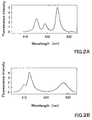
- Fig. 2 illustrates two spectrum profiles of fluorescence produced by another information presenting substance made of yttrium oxide (Y 2 O 3 ) containing europium ions (Eu 3+ ); (A) when produced by a gas solidifying method and (B) when produced by a sol/gelmethod. It is also apparent from Fig. 2 that as the producing method is varied, the spectrum of fluorescence significantly changes at 612 nm and 628 nm. It is thus proved that the emission of fluorescence changes as the producing method is varied.
- Y 2 O 3 yttrium oxide
- Eu 3+ europium ions
- Fig. 3 illustrates a spectrum profile of fluorescence produced by an information presenting substance made of yttrium oxide (Y 2 O 3 ) containing 2 mol% of europium ions (Eu 3+ ), where the intensity ratio at the peak between 628 nm and 612 nm of the fluorescence is plotted with different degrees of the baking temperature (equal in the baking time) of the information presenting substance (Y 2 O 3 : Eu 3+ ). It is then apparent from Fig. 3 that as the baking temperature (a condition in the method) is continuously varied, the spectrum of fluorescence emitted from the information presenting substance (Y 2 O 3 : Eu 3+ ) continuously changes. While the baking time remains uniform in the profile of Fig. 3, the emission of fluorescence from the information presenting substance (Y 2 O 3 : Eu 3+ ) may change with a variation in the baking time.
- Y 2 O 3 yttrium oxide
- Eu 3+ europium ions
- Fig. 4 illustrates a spectrum profile of fluorescence where the integral intensity ratio at the peak between 628 nm and 612 nm of the fluorescence is plotted with different diameters of particles of the information presenting substance (Y 2 O 3 : Eu 3+ ). It is also apparent from Fig. 4 that as the diameter of its particles is continuously varied, the integral intensity ratio of fluorescence emitted from the information presenting substance (Y 2 O 3 : Eu 3+ ) continuously changes. In addition, it is found that the smaller the diameter of the particles, the greater the integral intensity ratio of the fluorescence can increase. It is further proved that the damping constant of the intensity of the fluorescence continuously changes as the diameter of the particles is continuously varied.
- the materials (A) emit different ranges of fluorescence from their different information presenting substances which are varied in the production history and applied to their base materials, they can be assigned with different cipher information respectively.
- the material (A) when the material (A) is provided with an information presenting substance which is assigned with a cipher information depending on the type and content, its emitting fluorescence can easily be intercepted and analyzed by any unauthorized third party to determine the type and content of the information presenting substance.
- the material (A) when the material (A) is provided with the information presenting substance which is assigned with a particular cipher information depending on its production history, its emitting fluorescence can hardlybe examined by any unauthorized third party trying to find the cipher information because the production history of the information presenting substance has unlimited variations. In practice, the material (A) can rarely be produced by such an unauthorized third party and its emitting fluorescence will never be reproduced. Accordingly, the cipher information in the material (A) can be protected at higher secrecy.
- No unauthorized third party can be permitted to produce a false material provided with the information presenting substance which is identical in the type and content to that of the material (A) for emitting the same range of fluorescence as of the material (A) or to illegally modify the material (A) through providing the information presenting substance which is different in the type and/or content. Therefore, it is capable of preventing forgery and false alteration.
- the information presenting substance in the material (A) is preferably produced from one or more elements which are rarely found in commonly available products.
- the preferred element not found in common products may be selected from a series of elements at the atomic number from 31 to 88 or namely lanthanide or more particularly neodymium (Nd), samarium (Sm), europium (Eu), gadolinium (Gd), terbium (Tb), Holmium (Ho), and their combination.
- Those preferred elements are rarely found in the commonly available materials such as resin, paint, ink, paper, fiber, and metal and their spectrum can easily be measured and analyzed. Also, those elements are inexpensive, sanitary, and commercially available in the form of oxides.
- one or two elements can be used to construct the information presenting substance.
- the element or compound which emits a narrow wavelength range of fluorescence is selected from crystal provided with the transition element of incomplete 3d shell and/or the transition element of incomplete 4f shell, glass provided with the transition element of incomplete 3d shell and/or the transition element of incomplete 4f shell, and complex based on the transition element with the incomplete 3d shell and/or the transition element of incomplete 4f shell.
- the information presenting substance When exposed to a predetermined wavelength range of electromagnetic wave or preferably a range of electromagnetic wave from infrared light to ultraviolet light or more preferably a range of electromagnetic wave from visible light to far infrared light, the information presenting substance emits a narrow wavelength range (as a line) of fluorescence at a higher level of the intensity which corresponds to the range of the electromagnetic wave and can thus be detected at a higher accuracy.
- the information presenting substance may comprise a base material provided with a preferred transition element such as yttrium oxide (Y 2 O 3 ) containing the aforementioned europium ions (Eu 3+ ).
- the base material is preferably selected from, but not limited to, oxides, sulfides, nitrides, hydroxides, halides, and other non-organic crystalline material.
- the base material may be selected from organic, organic/non-organic hybrid compounds, mixture crystalline, amorphous, and glass.
- the transition element may be contained in a chemically coupling form such as chelete compound, substituted in its crystalline grating with other atoms or ions, inserted in a crystalline grating, or embedded in voids in glass.
- the information presenting substance When the information presenting substance is made of a non-organic base, it becomes highly stable and when heated to as a high temperature as 1000 °C, can hardly be fractured but remaining in the material (A). As a result, the material (A) can be detected from its emission of fluorescence even when it has been incinerated and disposed thereafter.
- the material (A) When the material (A) is made of a liquid form such as water soluble agent solution, organic solvent solution, or turbid liquid, its information presenting substance can remain chemically unchanged and emit a range of fluorescence. Accordingly, the information presenting substance may be applied to such as a liquid waste produced by an industrial plant as well as the commercially available products.
- the average diameter of particles of the information presenting substance ranges from 1 nm to 1000 nm, preferably from 1 nm to 500 nm, or more preferably from 1 nm to 100 nm.
- the particles may be provided in the form of a polymer such as dimer or trimer. As the information presenting substance is decreased in the diameter of particles, a change in its emission of fluorescence can highly be appreciable and thus detected at higher accuracy.
- the particles of the information presenting substance can be fabricated by any applicable manner such as sol/gel method, colloid method, gas solidification method, gas reactive method, intra-gas evaporating method, sputtering method, glass crystallization method, deposition method, or spraying method.
- the information presenting substance may also be coated with a surface decorative agent, such as heavy hydrogen or organic, or covered with any other material than the base material. This permits the information presenting substance to be fixed in the particle form or the structure, thus improving the efficiency of the emission of fluorescence. Also, the information presenting substance can easily be dissolved in a specific solvent and enhanced in the affinity to neighbor materials.
- a surface decorative agent such as heavy hydrogen or organic
- the information presenting substance is applied to a region at the inner or outer side of the material (A).
- the information presenting substance may be applied to the material (A) by any appropriate manner such as blowing, spraying, coating, absorption, injection, filling, attachment, impregnation, mixture, providing, or chemical coupling (polymerization, bridging, or ion bonding).
- the material (A) when the material (A) is made of a plastic resin material, it may be shaped directly after dry blended by a drum tumbler, compounded by an extruder, and compounded or shaped by an internal mixer or heating rolls. Alternatively, the process may be carried out after the material (A) is subjected to master batch processing.
- the material (A) may also be impregnated with the information presenting substance with the use of a lubricant, such as fatty amide, fatty metallic salt, or fatty ester, for ensuring uniform distribution and dispersion of the substance.
- a lubricant such as fatty amide, fatty metallic salt, or fatty ester
- the amount of the information presenting substance to be applied to the material (A) is controllably determined to such a desired level that the material (A) remains unchanged in the pertinent characteristics in order to give a minimum effect on the external appearance or physical properties.
- the desired amount of the information presenting substance for not largely affecting the pertinent characteristics of the material (A) is variable depending on the type of the material (A), it preferably ranges from 0.1 ppm to 1000 ppm (including 0.1 ppm and 1000 ppm) or more preferably from 0.5 ppm to 200 ppm (including 0.5 ppm and 200 ppm).
- the amount is not smaller than 0.1 ppm in view of the accuracy of detection which is commonly employed in the relevant field. As the amount is not greater than 1000 ppm, it can hardly affect the external appearance or physical properties of the material (A). Also, the preferable range from 0.5 ppm to 200 ppm is determined for ensuring the reliability of measurement while minimizing the cost of the production. Also, the material (A) can further be protected from declining its pertinent characteristics.
- the material (A) may be provided with two or more of the information presenting materials. This allows the material (A) to carry two or more pieces of cipher information or multiple digits of numerical data and thus be identified with a serial number. For example, when the material (A) is provided with six of the different information presenting substances, each expressing 10 grades of the intensity of fluorescence, its emitting fluorescence can be classified into 10 6 levels of the spectrum. Accordingly when the information presenting substance represents each digit of the number while the intensity of fluorescence from the information presenting substance represents the value in each digit in the number, the material (A) can carry a six-digit number in the decimal notation (000001 to 999999) of the cipher information.
- the cipher information is assigned to the information presenting substance, its variations are determined by methods and conditions of the production history. It is now assumed that two cipher information containing materials (A and B) are produced by heating the information presenting substance (Y 2 O 3 : Eu 3+ ) at two different degrees of the baking temperature (750 °C and 500 °C) respectively. When its emission of fluorescence is detected as shown in Fig. 1A, the information presenting substance can be analyzed by an analyzer that its baking temperature was 750 °C. This results in the identification of the material (A). On the other hand, when measuring the emission of fluorescence of the information presenting substance as shown in Fig. 1B, the analyzer can determine that the information presenting substance was baked at 500 °C.
- any unauthorized third party calculates the type and content of the information presenting substance from its emitting fluorescence shown in Fig. 1A or 1B, it fails to determine the production history of the information presenting substance and will thus produce the information presenting substance with no chance of success.
- the information presenting substance (Y 2 O 3 : Eu 3+ ) was baked at six different degrees of the temperature (300 °C, 400 °C, 500 °C, 600 °C, 800 °C, and 900 °C) to construct six cipher information containing materials (A, B, C, D, E, and F) and its emission of fluorescence exhibits six detections (a, b, c, d, and e) of the peak intensity ratio between 612 nm and 628 nm. Accordingly, from the profile of Fig. 3, the baking temperatures (300 °C, 400 °C, 500 °C, 600 °C, 800 °C, and 900 °C) of the information presenting substance can be determined.
- any unauthorized third party fails to find the production history of the information presenting substance while presuming more or less the type and content of the information presenting substance in each material from detection of the peak intensity ratio and will utterly be inhibited from producing the information presenting substance with the same fluorescence.
- the production history of the information presenting substance is not limited to the baking temperature and may be any other condition, such as a baking duration of time, or method of the production.
- the cipher information is not limited to a particular format but may be selected depending on the material (A).
- its cipher information may be a set of user's data including the ID number.
- its cipher information may be a set of true/false judging data including the ID number and symbols.
- its cipher information may be a set of manufacturer's data including the serial number, the manufacturer name, the production history, and the materials.
- its cipher information may be a set of manufacturer's data including the serial number, the lot number, the manufacturer name, the production history, and the materials.
- its cipher information may be a set of food related data including the production site and the production time.
- the material (A) provided with the information presenting substance remains rigid because the information presenting substance is chemically stable and very small in the particle size, thus hardly being fractured or peeled off. Also, since the information presenting substance is minimized in the amount with its particle diameter ranging from 1 nm to 1000 nm, it can be identified through physical or chemical analysis only with much difficulty. Moreover, the emission of fluorescence from the information presenting substance is varied depending on the production history including different conditions and methods of the production. This allows the information presenting substance to inhibit any unauthorized third party from identifying the production history from its emission of fluorescence. Accordingly, the material (A) can hardly be forged or modified while permitting no reproduction of the fluorescence. As its information presenting substance is selectively produced in different modes and applicable to almost every commonly available material, the material (A) can carry a desired format of the cipher information at higher secrecy with a variety of products in the multiple fields.
- the identifying system comprises, as shown in Fig. 5, a detecting apparatus 1 for detecting the emission of fluorescence from the information presenting substance applied to the material (A), a computer 2 for identifying the material (A) from the result of detection produced by the detecting apparatus 1, and a response apparatus 3 for conducting a predetermined process in response to the result of identification produced by the computer 2.
- the computer 2 may be connected by a network such as the Internet to the detecting apparatus 1 or the response apparatus 3.
- the detecting apparatus 1 is provided for irradiating a predetermined wavelength range of electromagnetic wave to the material (A) and measuring fluorescence emitted from the information presenting substance of the material (A).
- the result of detection (data of the fluorescent spectrum) from the information presenting substance is expressed in spectrum analysis profiles such as shown in Fig. 1 and 2 where the horizontal axis represents the wavelength of the fluorescence from the information presenting substance while the vertical axis represents the intensity of the fluorescence.
- the result of detection about the fluorescence is then transferred to the computer 3.
- the detecting apparatus 1 is preferably implemented by a combination of a semiconductor laser, a CCD, and a light separating system employing a time-division separation or polarizing separation technique.
- the detecting apparatus 1 comprises, as shown in Fig. 6, an exciting light source 11 such as a germicidal lamp or a semiconductor laser, a chopper 12 for switching on or off the exciting light or modulating the intensity of the exciting light, a lens 13 for shifting the exciting light to parallel light or converging the exciting light, an interference filter 14 for passing desired wavelength of the exciting light, a piezoelectric element 15 for oscillating the angle of the interference filter 14 to modify the wavelengths of the exciting light, a photo-detector 16 for producing a current or voltage corresponding to the intensity of the received light, and a circuit 17 for directing the chopper 12 to extract a desired phase or time component of the exciting light.
- the detecting apparatus 1 is not limited to the above arrangement and may be implemented by any technology which can detect the emission of fluorescence from the information presenting substance.
- the method of the detecting apparatus 1 detecting the emission of fluorescence from the information presenting substance may include steps of switching on and off the electromagnetic wave (or the exciting light) and measuring the fluorescence just after the switching off of the excitation or steps of periodically modifying the intensity of the exciting light and measuring the fluorescence at a desired phase, whereby the fluorescence emitted from the information presenting substance including the ions of the transition element can be detected at higher accuracy.
- the fluorescence emitted from the information presenting substance is narrow in the wavelengths (line spectrum in the spectrum), a change in its intensity can be detected with the wavelength of the exciting light or of the fluorescence being modified so as to obtain the spectrum at higher S/N ratios.
- the computer 2 comprises, as shown in Fig. 7, a receiver 21 for receiving from the detecting apparatus 1 the result of detection of the fluorescence emitted by the information representing substance, a reference table storage 22 for storing a reference table to examine the relationship between the information presenting substance and the cipher information, a transmitter 23 for transmitting a data to the response apparatus 3, and a controller 24 for comprehensively controlling the action of each component.
- the controller 24 may consist of a central processing unit (CPU) for carrying out data transfer actions, arithmetic operations, and temporal data saving actions.
- the controller 24 is arranged to examine the reference table saved in the reference table storage 22 in response to the result of detection received from the receiver 21 for determining the cipher information in the fluorescence emitted by the information presenting substance and identify the material (A) from the cipher information.
- the response apparatus 3 is provided for conducting a predetermined response action in response to the identification of the material (A) determined by the computer 2.
- the response apparatus 3 may be accompanied with a monitor and loudspeakers for displaying a true/false data.
- the response apparatus 3 may be a sorter for separating the product into different materials.
- the response apparatus 3 may be a door opening/closing mechanism.
- the response apparatus 3 may be an electronic cashing register.
- the response apparatus 3 may be a monitor or a printer for outputting a carte or medicine data.
- the response apparatus 3 may be a monitor or a printer for outputting a residence certificate or a stamp certificate.
- the detecting apparatus 1, the computer 2, and the response apparatus 3 are provided separately in this embodiment, they may be modified that at least two are assembled to a single unit.
- the action starts with the detecting apparatus 1 irradiating a predetermined wavelength range of electromagnetic wave to the material (A) placed on a predetermined position and measuring the emission of fluorescence from the information presenting substance (S1).
- the result of detection of the fluorescence emitted by the information presenting substance is transferred from the detecting apparatus 1 to the computer 2 (S2).
- the computer 2 receives at its receiver 21 the result of detection of the fluorescence emitted by the information presenting substance from the detecting apparatus 1 (S3).
- the computer 2 then examines at its controller 24 the result of detection of the fluorescence emitted by the information presenting substance received at the receiver 21 through referring the reference table saved in its reference table storage 22 in order to extract the cipher information (S4).
- the computer 2 identifies at the controller 24 the material (A) from the cipher information (S5).
- the computer 2 transmits the result of identification of the material (A) produced at S5 to the response apparatus 3 (S6).
- the response apparatus 3 receives and analyzes the result of identification from the computer 2 to conduct a responding action such as display of a data or sorting of materials (S8).
- Embodiments of the information presenting substance Y 2 O 3 including trivalent lanthanide ions, such as Eu 3+ , Sm 3+ , Tb 3+ , and Er 3+ were produced by a sol/gel method.
- Regents for producing were yttrium nitrate-4-hydrate Y(NO) 3 :4H 2 O, europium acetate-4-hydrate Eu(CH 3 CO) 3 :4H 2 O, samarium acetate-4-hydrate Sm(CH 3 COO) 3 :4H 2 O, terbium acetate-4-hydrate Tb(CH 3 COO) 3 :4H 2 O, erbium acetate-4-hydrate Er(CH 3 COO) 3 :4H 2 O, and sodium carbonate Na 2 CO 3 .
- the solvent was distilled water.
- Yttrium nitrate and lanthanide acetate were mixed up in a solution and then added with sodium carbonate while being stirred.
- the mixture was stirred for about 10 minutes and then spun in a centrifugal separator for removing impurities before dried out at about 80 °C for 24 hours.
- the mixture was baked at 300 to 900 °C for 1 to 30 minutes, it was turned to the particulate information presenting substance.
- the information presenting substance was examined by X-ray diffraction analysis and its average particle size measured ranging from 10 nm to 100 nm. It was also found that the lower the baking temperature or the shorter the baking time, the smaller the particle size of the information presenting substance became.
- the information presenting substance was then exposed to the exciting illumination of a xenon lamp or heavy hydrogen lamp and its emitting fluorescence was measured. It was found from the spectrum of the fluorescence and the exciting illumination that Y 2 O 3 contained ions of Eu 3+ , Sm 3+ , Tb 3+ , or Er 3+ .
- the example added with Eu3+ ions was proportionally increased in the intensity of its emitting fluorescence.
- the peak wavelength in the charge transfer band was slightly shifted from 250 nm towards the longer side, the spectrum of visible light remained unchanged.
- the wavelengths at 612 nm and 628 nm of the fluorescence were explicitly shifted as shown in Fig. 1 thus changing significantly the integral intensity ratio. More specifically, it was found that the integral intensity ratio was continuously shifted from 0.1 to 0.9 as the baking temperature was lowered and the braking time was shortened.
- test pieces were produced which were identical in the composition and varied in the integral intensity ratio at equal intervals of substantially 0.1 and then exposed to an illumination generated by a green pointer (the second harmonic of a semiconductor neodymium laser) and guided along a fiber optic.
- the fluorescence emitted from each of the eight testpieces was guided via another fiber optic into a spectroscope for measurement.
- the eight testpieces were successfully distinguished from one another at generous S/N ratios.
- a bulk form of Y2O3 crystals including europium ions was subjected to evaporation with the intensified energy of Q switch YAG/Nd laser and cooled down to deposit and solidify a particulate form on a brass bed. It was then found that the particulate form of this testpiece was identical in the composition and the average diameter size to that produced by the sol/gel method but quite different in the spectrum about 620 nm of its emitting fluorescence as well as in the peak wavelength.
- Cds information presenting substance including trivalent europium ions was produced by a colloid method.
- Regents for producing were cadmium acetate-2-hydrate Cd(CH 3 COO) 2 :2H 2 O, europium acetate-2-hydrate Eu(CH 3 COO) 3 :2H 2 O, and sodium sulfide-9-hydrate Na 2 S:9H 2 O.
- the solvents were dimethyl formamide C 3 H 7 NO and methyl alcohol CH 3 OH.
- a surface decorative agent of phenyl tio-tri-methyl silane C 6 H 5 SSi(CH 3 ) 3 was used for covering the CdS particulate form and fixing the size of its particles.
- the CdS particular form was added with 0.25 mmol of phenyl tio-tri-methyl silane to fix the CdS particulate form at a smaller diameter size.
- the mixture was then agitated for 30 minutes for stabilization and subjected to evaporation (at 50 °C) in an evaporator. As a result, the mixture was concentrated to 10 ml.
- the mixture was subjected to a centrifugal action (at 3000 rpm for 30 minutes) for removal of impurities. Then, the mixture was subjected again to evaporation (at 80 °C) in an evaporator for eliminating the solvent and concentrated to 2 ml. After dried out by vacuum drying, the particulate form was deposited on and scraped off from the inner wall of the flask bottle.
- the resultant particles of the information presenting substance were 2.2 nm in average diameter.
- the spectrum of fluorescence emitted from the information presenting substance by exciting with ultraviolet light had, as shown in Fig. 9, a small line by Eu 3+ ions at substantially 620 nm overridden on the wide band profile resulted by CdS error.
- the information presenting substance was exposed to an intensity of He-Cd laser light (at 325 nm) modified by a 750 Hz chopper and its emitting fluorescence was detected at 90 degrees out of phase from the exciting laser light.
- a narrow line spectrum by Eu 3+ ions was observed as shown in Fig. 10.
- An embodiment of the information presenting substance Y 2 O 3 including trivalent europium was produced by the same sol/gel method as of Embodiment 1 and applied to a 10000 yen note as a marking. Then, the note was cleaned down a number of times using an alcohol saturated cloth and exposed to a green light emitted from a green pointer. The resultant emission of fluorescence from the example was measured by a spectroscope with fiber optic. It was found that a narrow line by Eu 3+ ions appeared on the spectrum indicating the presence of the marking. Although the narrow line spectrum by Eu 3+ ions was observed as overridden on the full spectrum of the light, it was successfully extracted from the full spectrum and identified separately by the same manner as of Example 2.
Landscapes
- Chemical & Material Sciences (AREA)
- Engineering & Computer Science (AREA)
- Inorganic Chemistry (AREA)
- Materials Engineering (AREA)
- Organic Chemistry (AREA)
- Physics & Mathematics (AREA)
- General Physics & Mathematics (AREA)
- Theoretical Computer Science (AREA)
- Investigating, Analyzing Materials By Fluorescence Or Luminescence (AREA)
- Credit Cards Or The Like (AREA)
Applications Claiming Priority (3)
| Application Number | Priority Date | Filing Date | Title |
|---|---|---|---|
| JP2002237828 | 2002-08-19 | ||
| JP2002237828 | 2002-08-19 | ||
| PCT/JP2003/010430 WO2004025550A1 (ja) | 2002-08-19 | 2003-08-19 | 暗号情報内有材料、その識別方法およびその識別システム |
Publications (1)
| Publication Number | Publication Date |
|---|---|
| EP1548636A1 true EP1548636A1 (de) | 2005-06-29 |
Family
ID=31986201
Family Applications (1)
| Application Number | Title | Priority Date | Filing Date |
|---|---|---|---|
| EP03795226A Withdrawn EP1548636A1 (de) | 2002-08-19 | 2003-08-19 | Chiffreinformationen enthaltendes material, verfahren zu seiner identifikation und identifikationssystem dafür |
Country Status (7)
| Country | Link |
|---|---|
| US (1) | US20060106621A1 (de) |
| EP (1) | EP1548636A1 (de) |
| JP (1) | JPWO2004025550A1 (de) |
| KR (1) | KR20050058373A (de) |
| CN (1) | CN1689033A (de) |
| AU (1) | AU2003262245A1 (de) |
| WO (1) | WO2004025550A1 (de) |
Cited By (1)
| Publication number | Priority date | Publication date | Assignee | Title |
|---|---|---|---|---|
| EP1757640A4 (de) * | 2004-05-10 | 2010-09-29 | Plagenom Co Ltd | Thermoplastischer kunststoff und herstellungsverfahren dafür |
Families Citing this family (8)
| Publication number | Priority date | Publication date | Assignee | Title |
|---|---|---|---|---|
| CN104463295A (zh) * | 2005-05-10 | 2015-03-25 | 数据跟踪Dna控股公司 | 使用发光标记物的痕量结合高分辨度地跟踪工业过程材料 |
| JP4822349B2 (ja) * | 2006-12-26 | 2011-11-24 | サミー株式会社 | 遊技機の不正行為防止装置 |
| US8330122B2 (en) * | 2007-11-30 | 2012-12-11 | Honeywell International Inc | Authenticatable mark, systems for preparing and authenticating the mark |
| JP5134618B2 (ja) * | 2007-12-18 | 2013-01-30 | Idec株式会社 | 波長変換器及び発光装置 |
| DE102008060675B4 (de) * | 2008-12-08 | 2012-11-08 | Polysecure Gmbh | Verfahren zur eindeutigen Identifizierung und Authentifizierung von Produkten zum Schutz vor Plagiaten |
| EP2431732A1 (de) * | 2010-09-21 | 2012-03-21 | Dow Global Technologies LLC | Verknüpfung von Online-Analyse und Tracer-Technologie |
| CN104318441A (zh) * | 2014-09-19 | 2015-01-28 | 金发科技股份有限公司 | 一种防伪垃圾袋真伪鉴别的系统和方法 |
| JPWO2023190354A1 (de) * | 2022-03-28 | 2023-10-05 |
Family Cites Families (10)
| Publication number | Priority date | Publication date | Assignee | Title |
|---|---|---|---|---|
| US4004178A (en) * | 1974-10-03 | 1977-01-18 | Gte Laboratories Incorporated | White light source |
| FR2554122B1 (fr) * | 1983-11-02 | 1987-03-20 | Rhone Poulenc Spec Chim | Nouvelle composition destinee au marquage de documents et procede de verification de l'authenticite de ces documents |
| FR2566440B1 (fr) * | 1984-06-22 | 1988-07-22 | Jalon Michel | Fibres de securite et autres matieres rendues luminescentes par un procede de teinture, leurs procedes de realisation et leurs applications |
| ES2032787T3 (es) * | 1987-08-19 | 1993-03-01 | Gao Gesellschaft Fur Automation Und Organisation Mbh | Papel de seguridad |
| JPH03164991A (ja) * | 1989-11-24 | 1991-07-16 | Mercian Corp | 分類識別用標識 |
| US6123263A (en) * | 1998-01-29 | 2000-09-26 | Meta Holdings Corporation | Hand held dataform reader having strobing ultraviolet light illumination assembly for reading fluorescent dataforms |
| US6877032B1 (en) * | 1998-09-11 | 2005-04-05 | L.V. Partners, L.P. | Launching a web site using a portable scanner |
| US6734420B2 (en) * | 2000-04-06 | 2004-05-11 | Quantum Dot Corporation | Differentiable spectral bar code methods and systems |
| US6832729B1 (en) * | 2001-03-23 | 2004-12-21 | Zih Corp. | Portable data collection device for reading fluorescent indicia |
| US20030194578A1 (en) * | 2001-12-20 | 2003-10-16 | Honeywell International, Inc. | Security articles comprising multi-responsive physical colorants |
-
2003
- 2003-08-19 EP EP03795226A patent/EP1548636A1/de not_active Withdrawn
- 2003-08-19 WO PCT/JP2003/010430 patent/WO2004025550A1/ja not_active Ceased
- 2003-08-19 US US10/524,822 patent/US20060106621A1/en not_active Abandoned
- 2003-08-19 JP JP2004535874A patent/JPWO2004025550A1/ja active Pending
- 2003-08-19 CN CNA038244047A patent/CN1689033A/zh active Pending
- 2003-08-19 AU AU2003262245A patent/AU2003262245A1/en not_active Abandoned
- 2003-08-19 KR KR1020057002828A patent/KR20050058373A/ko not_active Withdrawn
Non-Patent Citations (1)
| Title |
|---|
| See references of WO2004025550A1 * |
Cited By (1)
| Publication number | Priority date | Publication date | Assignee | Title |
|---|---|---|---|---|
| EP1757640A4 (de) * | 2004-05-10 | 2010-09-29 | Plagenom Co Ltd | Thermoplastischer kunststoff und herstellungsverfahren dafür |
Also Published As
| Publication number | Publication date |
|---|---|
| US20060106621A1 (en) | 2006-05-18 |
| KR20050058373A (ko) | 2005-06-16 |
| WO2004025550A1 (ja) | 2004-03-25 |
| JPWO2004025550A1 (ja) | 2006-01-12 |
| AU2003262245A1 (en) | 2004-04-30 |
| CN1689033A (zh) | 2005-10-26 |
Similar Documents
| Publication | Publication Date | Title |
|---|---|---|
| Huang et al. | Tunable spinel structure phosphors: dynamic change in near‐infrared windows and their applications | |
| US20060106621A1 (en) | Cipher information-containing material, its identifying method, and its identifying system | |
| Wang et al. | Multi-emissive lanthanide-based coordination polymers for potential application as luminescent bar-codes | |
| JP4498600B2 (ja) | 無機粒子の使用、および支持体または物品を標識付け・識別するための方法 | |
| AU2001270586B2 (en) | Use of communication equipment and method for authenticating an item, unit and system for authenticating items, and authenticating device | |
| US7129506B2 (en) | Optically detectable security feature | |
| CA2454890A1 (en) | Use of isotopes to provide information to an article | |
| Knyazev et al. | Influence of Lewis bases on the mesogenic and luminescent properties of homogeneous films of europium (III) tris (β‐diketonate) adducts | |
| Kumar et al. | Synthesis of Gd2O3: Ho3+/Yb3+ upconversion nanoparticles for latent fingermark detection on difficult surfaces | |
| CN108918485A (zh) | 基于纳米金刚石的防伪方法、相应药品、防伪墨水及应用 | |
| Barry et al. | Near infrared (NIR) lanthanide emissive langmuir–blodgett monolayers formed using Nd (III) directed self-assembly synthesis of chiral amphiphilic ligands | |
| CN110446761B (zh) | 光致发光铁掺杂的锡酸钡材料、安全墨组合物及其安全特征 | |
| KR20140102221A (ko) | 발광성 보레이트, 이러한 보레이트를 혼입한 물질과 물품, 및 물품 인증에서 이들의 제조와 사용을 위한 방법과 장치 | |
| KR20140100967A (ko) | 발광성 보레이트, 이러한 보레이트를 혼입한 물질과 물품, 및 물품 인증에서 이들의 제조와 사용을 위한 방법과 장치 | |
| JP2005507330A (ja) | 文書鑑定 | |
| US20050143249A1 (en) | Security labels which are difficult to counterfeit | |
| JP4098809B2 (ja) | 真贋判定方法および同装置 | |
| EP1533749A1 (de) | Codierungsinformationen enthaltendes material, verfahren zu seiner identifikation und identifikationssystem dafür | |
| JP3742642B2 (ja) | 熱可塑性プラスチックおよびその製造方法 | |
| WO2007110588A1 (en) | Using markers to identify objects for visually-impaired people | |
| JPWO2004027738A1 (ja) | 産品情報表示体および産品真偽判別方法 | |
| RU2137197C1 (ru) | Носитель информации для защиты от подделки изделий с идентификационным контрастным изображением | |
| EP1672568A1 (de) | Fälschungssichere Sicherheitsetiketten | |
| JP2003220600A (ja) | 標識用超微粒子材料およびこれを用いた同定分別方法 | |
| TWI381162B (zh) | A authenticity determination method, an authenticity determination device, a authenticity determination system, and a detection device terminal |
Legal Events
| Date | Code | Title | Description |
|---|---|---|---|
| PUAI | Public reference made under article 153(3) epc to a published international application that has entered the european phase |
Free format text: ORIGINAL CODE: 0009012 |
|
| 17P | Request for examination filed |
Effective date: 20050224 |
|
| AK | Designated contracting states |
Kind code of ref document: A1 Designated state(s): AT BE BG CH CY CZ DE DK EE ES FI FR GB GR HU IE IT LI LU MC NL PT RO SE SI SK TR |
|
| AX | Request for extension of the european patent |
Extension state: AL LT LV MK |
|
| RAP1 | Party data changed (applicant data changed or rights of an application transferred) |
Owner name: PLAGENOM CO., LTD. |
|
| DAX | Request for extension of the european patent (deleted) | ||
| STAA | Information on the status of an ep patent application or granted ep patent |
Free format text: STATUS: THE APPLICATION IS DEEMED TO BE WITHDRAWN |
|
| 18D | Application deemed to be withdrawn |
Effective date: 20080301 |