EP1548458A2 - Vehicle-mounted radar - Google Patents
Vehicle-mounted radar Download PDFInfo
- Publication number
- EP1548458A2 EP1548458A2 EP04019181A EP04019181A EP1548458A2 EP 1548458 A2 EP1548458 A2 EP 1548458A2 EP 04019181 A EP04019181 A EP 04019181A EP 04019181 A EP04019181 A EP 04019181A EP 1548458 A2 EP1548458 A2 EP 1548458A2
- Authority
- EP
- European Patent Office
- Prior art keywords
- antenna
- reception
- vehicle
- transmission
- antennas
- Prior art date
- Legal status (The legal status is an assumption and is not a legal conclusion. Google has not performed a legal analysis and makes no representation as to the accuracy of the status listed.)
- Withdrawn
Links
- 230000005540 biological transmission Effects 0.000 claims abstract description 91
- 238000001514 detection method Methods 0.000 claims description 19
- 238000012545 processing Methods 0.000 claims description 18
- 230000005855 radiation Effects 0.000 claims description 6
- 230000008034 disappearance Effects 0.000 claims 1
- 238000000034 method Methods 0.000 description 26
- 238000010586 diagram Methods 0.000 description 15
- 230000000116 mitigating effect Effects 0.000 description 5
- 238000001228 spectrum Methods 0.000 description 5
- 238000006243 chemical reaction Methods 0.000 description 4
- 238000004891 communication Methods 0.000 description 4
- 239000006096 absorbing agent Substances 0.000 description 2
- 239000000463 material Substances 0.000 description 2
- 238000005259 measurement Methods 0.000 description 2
- 238000004092 self-diagnosis Methods 0.000 description 2
- 230000003044 adaptive effect Effects 0.000 description 1
- 230000000694 effects Effects 0.000 description 1
- 238000012986 modification Methods 0.000 description 1
- 230000004048 modification Effects 0.000 description 1
- 230000010355 oscillation Effects 0.000 description 1
- 230000010363 phase shift Effects 0.000 description 1
- 239000007787 solid Substances 0.000 description 1
- 230000003595 spectral effect Effects 0.000 description 1
- 238000010183 spectrum analysis Methods 0.000 description 1
Images





Classifications
-
- G—PHYSICS
- G01—MEASURING; TESTING
- G01S—RADIO DIRECTION-FINDING; RADIO NAVIGATION; DETERMINING DISTANCE OR VELOCITY BY USE OF RADIO WAVES; LOCATING OR PRESENCE-DETECTING BY USE OF THE REFLECTION OR RERADIATION OF RADIO WAVES; ANALOGOUS ARRANGEMENTS USING OTHER WAVES
- G01S7/00—Details of systems according to groups G01S13/00, G01S15/00, G01S17/00
- G01S7/02—Details of systems according to groups G01S13/00, G01S15/00, G01S17/00 of systems according to group G01S13/00
- G01S7/03—Details of HF subsystems specially adapted therefor, e.g. common to transmitter and receiver
-
- G—PHYSICS
- G01—MEASURING; TESTING
- G01S—RADIO DIRECTION-FINDING; RADIO NAVIGATION; DETERMINING DISTANCE OR VELOCITY BY USE OF RADIO WAVES; LOCATING OR PRESENCE-DETECTING BY USE OF THE REFLECTION OR RERADIATION OF RADIO WAVES; ANALOGOUS ARRANGEMENTS USING OTHER WAVES
- G01S13/00—Systems using the reflection or reradiation of radio waves, e.g. radar systems; Analogous systems using reflection or reradiation of waves whose nature or wavelength is irrelevant or unspecified
- G01S13/02—Systems using reflection of radio waves, e.g. primary radar systems; Analogous systems
- G01S13/06—Systems determining position data of a target
- G01S13/42—Simultaneous measurement of distance and other co-ordinates
- G01S13/44—Monopulse radar, i.e. simultaneous lobing
-
- G—PHYSICS
- G01—MEASURING; TESTING
- G01S—RADIO DIRECTION-FINDING; RADIO NAVIGATION; DETERMINING DISTANCE OR VELOCITY BY USE OF RADIO WAVES; LOCATING OR PRESENCE-DETECTING BY USE OF THE REFLECTION OR RERADIATION OF RADIO WAVES; ANALOGOUS ARRANGEMENTS USING OTHER WAVES
- G01S13/00—Systems using the reflection or reradiation of radio waves, e.g. radar systems; Analogous systems using reflection or reradiation of waves whose nature or wavelength is irrelevant or unspecified
- G01S13/88—Radar or analogous systems specially adapted for specific applications
- G01S13/93—Radar or analogous systems specially adapted for specific applications for anti-collision purposes
- G01S13/931—Radar or analogous systems specially adapted for specific applications for anti-collision purposes of land vehicles
-
- H—ELECTRICITY
- H01—ELECTRIC ELEMENTS
- H01Q—ANTENNAS, i.e. RADIO AERIALS
- H01Q1/00—Details of, or arrangements associated with, antennas
- H01Q1/27—Adaptation for use in or on movable bodies
- H01Q1/32—Adaptation for use in or on road or rail vehicles
- H01Q1/325—Adaptation for use in or on road or rail vehicles characterised by the location of the antenna on the vehicle
-
- H—ELECTRICITY
- H01—ELECTRIC ELEMENTS
- H01Q—ANTENNAS, i.e. RADIO AERIALS
- H01Q1/00—Details of, or arrangements associated with, antennas
- H01Q1/42—Housings not intimately mechanically associated with radiating elements, e.g. radome
-
- H—ELECTRICITY
- H01—ELECTRIC ELEMENTS
- H01Q—ANTENNAS, i.e. RADIO AERIALS
- H01Q21/00—Antenna arrays or systems
- H01Q21/06—Arrays of individually energised antenna units similarly polarised and spaced apart
- H01Q21/061—Two dimensional planar arrays
- H01Q21/065—Patch antenna array
-
- H—ELECTRICITY
- H01—ELECTRIC ELEMENTS
- H01Q—ANTENNAS, i.e. RADIO AERIALS
- H01Q25/00—Antennas or antenna systems providing at least two radiating patterns
- H01Q25/002—Antennas or antenna systems providing at least two radiating patterns providing at least two patterns of different beamwidth; Variable beamwidth antennas
-
- H—ELECTRICITY
- H01—ELECTRIC ELEMENTS
- H01Q—ANTENNAS, i.e. RADIO AERIALS
- H01Q25/00—Antennas or antenna systems providing at least two radiating patterns
- H01Q25/02—Antennas or antenna systems providing at least two radiating patterns providing sum and difference patterns
-
- G—PHYSICS
- G01—MEASURING; TESTING
- G01S—RADIO DIRECTION-FINDING; RADIO NAVIGATION; DETERMINING DISTANCE OR VELOCITY BY USE OF RADIO WAVES; LOCATING OR PRESENCE-DETECTING BY USE OF THE REFLECTION OR RERADIATION OF RADIO WAVES; ANALOGOUS ARRANGEMENTS USING OTHER WAVES
- G01S13/00—Systems using the reflection or reradiation of radio waves, e.g. radar systems; Analogous systems using reflection or reradiation of waves whose nature or wavelength is irrelevant or unspecified
- G01S13/02—Systems using reflection of radio waves, e.g. primary radar systems; Analogous systems
- G01S13/06—Systems determining position data of a target
- G01S13/08—Systems for measuring distance only
- G01S13/32—Systems for measuring distance only using transmission of continuous waves, whether amplitude-, frequency-, or phase-modulated, or unmodulated
- G01S13/34—Systems for measuring distance only using transmission of continuous waves, whether amplitude-, frequency-, or phase-modulated, or unmodulated using transmission of continuous, frequency-modulated waves while heterodyning the received signal, or a signal derived therefrom, with a locally-generated signal related to the contemporaneously transmitted signal
- G01S13/348—Systems for measuring distance only using transmission of continuous waves, whether amplitude-, frequency-, or phase-modulated, or unmodulated using transmission of continuous, frequency-modulated waves while heterodyning the received signal, or a signal derived therefrom, with a locally-generated signal related to the contemporaneously transmitted signal using square or rectangular modulation, e.g. diplex radar for ranging over short distances
-
- G—PHYSICS
- G01—MEASURING; TESTING
- G01S—RADIO DIRECTION-FINDING; RADIO NAVIGATION; DETERMINING DISTANCE OR VELOCITY BY USE OF RADIO WAVES; LOCATING OR PRESENCE-DETECTING BY USE OF THE REFLECTION OR RERADIATION OF RADIO WAVES; ANALOGOUS ARRANGEMENTS USING OTHER WAVES
- G01S13/00—Systems using the reflection or reradiation of radio waves, e.g. radar systems; Analogous systems using reflection or reradiation of waves whose nature or wavelength is irrelevant or unspecified
- G01S13/02—Systems using reflection of radio waves, e.g. primary radar systems; Analogous systems
- G01S13/06—Systems determining position data of a target
- G01S13/08—Systems for measuring distance only
- G01S13/32—Systems for measuring distance only using transmission of continuous waves, whether amplitude-, frequency-, or phase-modulated, or unmodulated
- G01S13/36—Systems for measuring distance only using transmission of continuous waves, whether amplitude-, frequency-, or phase-modulated, or unmodulated with phase comparison between the received signal and the contemporaneously transmitted signal
- G01S13/38—Systems for measuring distance only using transmission of continuous waves, whether amplitude-, frequency-, or phase-modulated, or unmodulated with phase comparison between the received signal and the contemporaneously transmitted signal wherein more than one modulation frequency is used
-
- G—PHYSICS
- G01—MEASURING; TESTING
- G01S—RADIO DIRECTION-FINDING; RADIO NAVIGATION; DETERMINING DISTANCE OR VELOCITY BY USE OF RADIO WAVES; LOCATING OR PRESENCE-DETECTING BY USE OF THE REFLECTION OR RERADIATION OF RADIO WAVES; ANALOGOUS ARRANGEMENTS USING OTHER WAVES
- G01S13/00—Systems using the reflection or reradiation of radio waves, e.g. radar systems; Analogous systems using reflection or reradiation of waves whose nature or wavelength is irrelevant or unspecified
- G01S13/88—Radar or analogous systems specially adapted for specific applications
- G01S13/93—Radar or analogous systems specially adapted for specific applications for anti-collision purposes
- G01S13/931—Radar or analogous systems specially adapted for specific applications for anti-collision purposes of land vehicles
- G01S2013/93185—Controlling the brakes
-
- G—PHYSICS
- G01—MEASURING; TESTING
- G01S—RADIO DIRECTION-FINDING; RADIO NAVIGATION; DETERMINING DISTANCE OR VELOCITY BY USE OF RADIO WAVES; LOCATING OR PRESENCE-DETECTING BY USE OF THE REFLECTION OR RERADIATION OF RADIO WAVES; ANALOGOUS ARRANGEMENTS USING OTHER WAVES
- G01S13/00—Systems using the reflection or reradiation of radio waves, e.g. radar systems; Analogous systems using reflection or reradiation of waves whose nature or wavelength is irrelevant or unspecified
- G01S13/88—Radar or analogous systems specially adapted for specific applications
- G01S13/93—Radar or analogous systems specially adapted for specific applications for anti-collision purposes
- G01S13/931—Radar or analogous systems specially adapted for specific applications for anti-collision purposes of land vehicles
- G01S2013/9321—Velocity regulation, e.g. cruise control
-
- G—PHYSICS
- G01—MEASURING; TESTING
- G01S—RADIO DIRECTION-FINDING; RADIO NAVIGATION; DETERMINING DISTANCE OR VELOCITY BY USE OF RADIO WAVES; LOCATING OR PRESENCE-DETECTING BY USE OF THE REFLECTION OR RERADIATION OF RADIO WAVES; ANALOGOUS ARRANGEMENTS USING OTHER WAVES
- G01S13/00—Systems using the reflection or reradiation of radio waves, e.g. radar systems; Analogous systems using reflection or reradiation of waves whose nature or wavelength is irrelevant or unspecified
- G01S13/88—Radar or analogous systems specially adapted for specific applications
- G01S13/93—Radar or analogous systems specially adapted for specific applications for anti-collision purposes
- G01S13/931—Radar or analogous systems specially adapted for specific applications for anti-collision purposes of land vehicles
- G01S2013/9325—Radar or analogous systems specially adapted for specific applications for anti-collision purposes of land vehicles for inter-vehicle distance regulation, e.g. navigating in platoons
Definitions
- the present invention relates to a vehicle-mounted radar.
- a laser radar and a millimeter wave radar are generally known as radars for adaptive cruise control (ACC).
- ACC adaptive cruise control
- the millimeter wave radar can capture a target (a reflected item obtained by a radar is also called a target in this specification) in a stable state even under a condition of rain and fog and is hence expected as an all-weather sensor.
- the millimeter wave radar sends from a transmission antenna a radio wave of the frequency band, receives a reflected wave from a target such as a vehicle, and detects a Doppler modulation characteristic of a received wave to the transmitted wave to detect distance (range) between the radar and the target and a relative speed or a rate therebetween.
- the two-frequency CW method transmits two frequencies relatively near to each other through a change-over operation to detect items such as distance (range) between the radar and the target and a rate therebetween by use of a degree of the modulation of received waves of the transmitted waves. Therefore, the method advantageously requires only two oscillation frequencies and hence the circuit configuration of circuits such as an oscillator is simplified.
- a reception antenna is disposed at a right position and a left position such that an existence angle (azimuth angle) of a forward target with respect to a radar beam is detected according to a ratio between sum power and difference power obtained from received signals (also called right and left received signals in some cases) from the right and left antennas and/or a phase difference between the right and left received signals.
- This is generally called a monopulse method.
- the target existence angle can be detected by one wide beam without necessitating any scan unit to detect a direction. Since the antenna size is inversely proportional to the beam width, many advantages are obtained, for example, the antenna can be reduced in size.
- the two-frequency CW monopulse millimeter wave radar have various advantages, the radar has been attended with problems to be improved as below when the radar is used to pre-crash safety measurements.
- three reception antennas such as first, second, and third reception antennas are disposed to receive reflected wave of a radio wave from an object and a horizontal width of the second reception antenna is less than a horizontal width of each of the first and third reception antennas.
- the radar is configured such that an overlap range of overlap between a received beam of the first reception antenna and a received beam of the second reception antenna is equal to or more than a predetermined value and an overlap range of overlap between the received beam of the second reception antenna and a received beam of the third reception antenna is equal to or more than a predetermined value.
- these targets can be detected as separate items.
- FIGS. 1 to 14 a first embodiment of the present invention will be described.
- FIG. 1 shows an embodiment of a configuration of an antenna section of a radar 1.
- the radar 1 radiates light or a radio wave to detect an object to obtain a speed, distance (range), and an angle of the object.
- the radar 1 includes a transmission antenna 2 and at least three reception antennas 3a, 3b, and 3c.
- the light or the radio wave radiated from the antenna 2 propagates through air while expanding at an angle determined mainly by a pattern of the antenna 2. Since intensity thereof attenuates almost according to distance (range) from the antenna 2, it is impossible to deliver a significant signal to a position apart from the transmission antenna 2 by more than a predetermined distance (range).
- a range in which the radio wave radiated from the antenna 2 reaches with intensity equal to or more than a predetermined value is referred to as a transmission beam hereinbelow.
- the transmission beam has a pattern and size which are determined by the pattern and power of the transmission antenna 2.
- a reception antenna also has a range in which signals can be received, the range being referred to as a reception beam.
- the reception beam has a pattern determined also by the pattern and power of the transmission antenna.
- the reception antennas 3a, 3b, and 3c of the embodiment are configured to have reception beam patterns shown in FIG. 1. That is, the reception antenna 3a has a beam pattern as indicated by a reception beam 3A and receives radio waves on the left-hand side viewed from the driver.
- the reception antenna 3b has a beam pattern as indicated by a reception beam 3B and receives radio waves in a wide range of a central zone
- the reception antenna 3c has a beam pattern as indicated by a reception beam 3C and receives radio waves on the right-hand side viewed from the driver.
- FIG. 2 shows a configuration of the radar 1.
- the radar 1 includes an antenna section 1a including a transmission antenna 2 and the reception antennas 3a, 3b, and 3c; a transmitter 4, a modulator 5, a mixer 6, an analog circuit 7, an analog-to-digital (A/D) converter 8, an FFT (Fast Fourier Transform) processing section 9, a signal processing section 10, and a hybrid circuit 11.
- A/D analog-to-digital
- FFT Fast Fourier Transform
- the transmitter 4 outputs a high-frequency signal in a millimeter wave band according to a modulated signal from the modulator 5.
- the high-frequency signal is radiated as a transmission signal from the transmission antenna 2.
- the transmission signal is reflected by an object in an area of the radiation and the reflected signal is received by the reception antennas 3a, 3b, and 3c.
- the hybrid circuit 11 first conducts an addition and a subtraction using received signals respectively of the reception antennas 3a and 3b to create a sum signal (SumAB) and a difference signal (DiffAB). Similarly, the hybrid circuit 11 conducts an addition and a subtraction using received signals respectively of the reception antennas 3b and 3c to create a sum signal (SumBC) and a difference signal (DiffBC).
- the mixer 6 conducts a frequency conversion using the sum and difference signals and the signals received by the reception antennas 3a, 3b, and 3c.
- the mixer 6 is also supplied with the transmission signal from the transmitter 4 and mixes the transmission signal with the received signal to create a low-frequency signal and outputs the signal to the analog circuit 7.
- a difference (Doppler shift) between the frequency of the transmission signal and that of the received signal due to existence of the object is reflected in the low-frequency signal.
- the analog circuit 7 amplifies the signal inputted thereto and outputs the resultant signal to the A/D converter 8.
- the converter 8 converts the input signal into a digital signal to supply the signal to the FFT processing section 9.
- the section 9 measures the frequency spectrum of the signal through a fast Fourier transform (FFT) to obtain information of amplitude and phases and sends the information to the signal processing section 10.
- the section 10 calculates distance (range) and a rate using data in the frequency zone obtained by the FFT processing section 9 and outputs a measured distance (range) value and a measured rate value.
- FFT fast Fourier transform
- the two-frequency CW method is a method in which the transmission signal has two frequencies, not a single frequency, and in which the frequencies are alternately changed at a predetermined interval of time.
- the two-frequency CW method is a method using this characteristic in which by changing the frequency of the transmission signal, the distance (range) to the object is measured using phase information of received signals for the respective frequencies.
- a modulated signal is inputted to the transmitter 4 to transmit signals by changing the frequency between f1 and f2 at an interval of time as shown in FIG. 4A.
- a vehicle 12b exists, for example, at a position shown in FIG. 3, a radio wave sent from the transmission antenna 2 is reflected by the vehicle 12b before the radar.
- the reflected signals are then received by the reception antennas 3b and 3c.
- the antenna 3a does not receive the reflected signal from the vehicle 12b.
- the mixer 6 mixes the received signals of the reception antennas 3b and 3c with a signal from the transmitter 4 to obtain a beat signal.
- fc is a transmission frequency
- R' is a rate
- c is the speed of light.
- the analog circuit section 7 separates and demodulates a received signal for each transmission frequency, and then the A/D converter 8 conducts an A/D conversion for the received signal of each transmission frequency.
- the FFT processing section 9 executes fast Fourier transform processing for digital sample data obtained through the A/D conversion to attain a frequency spectrum in the overall frequency band of the received beat signal.
- power spectra of peak signals respectively of the transmission frequencies f1 and f2 are measured as shown in FIG. 4B using the peak signal obtained as a result of the FFT processing.
- FIG. 3 shows a schematic diagram showing a state of a radar mounted on a vehicle in which the radar is viewed from an upper side of the vehicle.
- the reception antennas 3a, 3b, and 3c are arranged as below. That is, a central line of the reception beam 3A of the reception antenna 3a is installed with an offset toward the left-hand side relative to a central line of the reception beam 3B of the reception antenna 3b and a central line of the reception beam 3C of the reception antenna 3c is installed with an offset toward the right-hand side relative to the central line of the reception beam 3B of the reception antenna 3b.
- the reception beam 3A is a range to cover a left-hand front area by an angle of ⁇ 1.
- ⁇ 1 is desirably equal to or more than 50°.
- the reception beam 3C is a range to cover a right-hand front area by an angle of ⁇ 2.
- ⁇ 2 is desirably equal to or more than 50°.
- the reception beam 3B is a range to cover an area by a wide angle of ⁇ 2 more than ⁇ 1 and ⁇ 2.
- ⁇ is desirably equal to or more than 100°.
- the reception antennas 3a, 3b, and 3c are set such that the reception beam 3A overlaps with the reception beam 3B by a predetermined angle Xa and the reception beam 3B overlaps with the reception beam 3C by a predetermined angle Xb.
- Xa and Xb are desirably equal to or more than 50%.
- an azimuth angle of a target can be attained using a difference between received signals from the two reception antennas.
- the overlapped areas are separated to be on the right-hand and left-hand sides, and hence the vehicles 12a and 12b can be separately detected. That is, the vehicle 12a is detected by the reception antennas 3a and 3b, but is not detected by the reception antenna c.
- the vehicle 12b is detected by the reception antennas 3b and 3c, but is not detected by the reception antenna a. Therefore, even when the vehicles 12a and 12b have the same rate and the same distance (range) with respect to the own vehicle, the vehicles can be separately detected. This suppresses the detection of the conventional radar in which the vehicles 12a and 12b are detected as one block or in which a wrong azimuth angle is detected.
- FIG. 3 shows examples of reception beam patterns when ⁇ is about 100° and ⁇ 1 and ⁇ 2 are about 60°.
- FIG. 5 shows received power patterns respectively of the reception antennas 3a, 3b, and 3c.
- Each reception beam has a range implemented by the configuration of the antennas in which reception patterns of FIG. 5 overlap with each other by a predetermined value X1 or X2 in the angular direction.
- FIG. 5 shows an example in which X1 and X2 are set such that the azimuth angle satisfied by each of the reception patterns 3Xa and 3Xc overlaps with 50% of the reception pattern 3Xb.
- the overlap X3 is desirably small for the reception patterns 3Xa and 3Xc, and it is desirable that the reception patterns are set such that received power Y for the overlapped area X3 is, for example, 20 decibel (dB) or less.
- FIG. 6 shows patterns of the sum signal (SumBC) and the difference signal (DiffBC) of the received signals in the right-hand range of the center of the radar. Since the patterns of the sum and difference signals are fixed as shown in FIG. 6, when the target is on the right-hand side viewed from the antenna attaching position like the vehicle 12b, the sum signal (SumBC) and the difference signal (DiffBC) of the signals inputted to the reception antennas 3b and 3c are calculated to identify the azimuth angle ⁇ using a ratio in power between the received signals.
- the sum signal (SumAB) and the difference signal (DiffAB) of the signals inputted to the reception antennas 3a and 3b are calculated to identify the azimuth angle ⁇ using a ratio in power between the received signals.
- a wide range detection is possible by one radar. Not only the distance (range) and the rate of the detection object, but also the azimuth can be detected. This consequently improves object detection precision. Additionally, an object on the left-hand side and an object on the right-hand side are separately detected according to the present embodiment. Therefore, in a scene in which one vehicle is at halt on the right-hand side and another vehicle is at halt on the left-hand side before the own vehicle, the vehicles on both sides can be separately detected. Since a moving section as in the scan radar is not required according to the present embodiment, the radar can be further reduced in size.
- the driver ordinarily considers that the control of distance (range) between cars and the control for crash mitigation do not operate, and hence determines that the own vehicle can pass through the place without any trouble. Therefore, the driver does not predict that the own vehicle is braked. In consequence, if the control of distance (range) between cars or the control for crash mitigation operates, the driver have an uncomfortable feeling as well as the driver is set to a dangerous situation in some cases.
- the own vehicle can path through the space between the vehicles.
- the speed of the own vehicle is more than a predetermined speed, it is also possible to conduct control of reducing the speed to a predetermined speed to pass through the space. Therefore, by using the radar of the present invention, there can be implemented vehicle travelling control satisfying expectation of the driver.
- the radar can be favorably used as a device to detect objects for crash mitigation when another car is entering a space before the own vehicle or when the own vehicle suddenly meets another vehicle.
- the distance (range) and the rate are calculated in association with the angle detecting function in the above method.
- the distance (range) and the rate of the target are calculated.
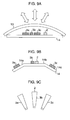
- FIG. 9 is a diagram showing a configuration of the antenna section viewed from a lateral direction with respect to the transmission and reception surfaces of the antenna.
- the radar is attached onto a vehicle such that the side shown in FIG. 9 is an upper side and the transmission and reception surfaces of the antenna face the front side of the vehicle.
- FIG. 9A shows an example in which planar antennas are adopted as transmission and reception antennas.
- One transmission antenna 2 and three reception antennas 3a, 3b, and 3c are horizontally arranged to be installed onto a holding member 14 with directivity such that reception beams of the reception antennas 3a and 3c respectively have an offset on the right and left sides with respect to a reception beam of the reception antenna 3b. Since width of each of the transmission and reception beams is almost inversely proportional to horizontal width of the associated antenna, in order to implement the reception beam pattern shown, for example, in FIG. 3, it is required that the horizontal width of each of the reception antennas 3a and 3c is larger than that of the reception antenna 3b.
- each of the reception antennas 3a, 3b, and 3c includes an array of small antennas such that received power of each small antenna is varied according to a reception beam pattern to be formed.
- each small antenna of the reception antenna 3c has, for example, the same received power as shown in FIG. 10B, a reception beam can be formed without any offset on the right and left sides.
- a reception beam can be formed without any offset on the right and left sides.
- the reception beam 3C has an offset toward the right-hand side viewed from the driver.
- the transmission antenna 2 is disposed on the right side and the reception antennas 3a, 3b, and 3c are arranged on the left side in the embodiment, it is also possible to dispose the transmission antenna 2 on the left side and the reception antennas 3a, 3b, and 3c on the right side.
- radio wave interference takes place.
- the radome 13 has a contour having a curvature and a radio wave absorber is disposed at positions at which radio wave interference possibly occurs.
- the positions are, for example, a position between the transmission antenna and the reception antenna and a position near an attaching section 14b between the radome 13 and the holding member 14.
- radio wave interference may occur at other positions, it is particularly probable that the interference takes place at the above positions. Therefore, occurrence of radio wave interference can be suppressed by disposing a radio wave absorber at these positions.
- the curvature of the radome 13 is desirably set such that the radio wave radiated from the transmission antenna 2 possibly enters a tangential plane of the radome with a right angle relative to the plane at the incident point.
- intensity of the radio wave reflected by the radome 13 can be reduced by appropriately selecting thickness and a material of the radome 13 in association with a wavelength of the radio wave.
- intensity of the reflected radio wave cannot be sufficiently reduced according to the thickness and the material of the radome 13.
- the radio wave radiated from the transmission antenna 2 can enter the radome 13 with an angle similar to a right angle, and hence the radio wave interference can be reduced.
- the curvature is shown only in the horizontal direction of the radome in FIG. 9A, the radio wave interference can be efficiently reduced in a configuration in which the radome has a curvature also in the vertical direction thereof.
- FIG. 9B shows an embodiment in which the holding member 14 includes three surfaces.
- the transmission antenna 2 and the reception antenna 3b are arranged on a central surface 14b
- the reception antenna 3a is arranged on a left surface 14a
- the reception antenna 3c is arranged on a right surface 14c to form patterns of the reception beams 3A, 3B, and 3C as shown in FIG. 3.
- FIG. 9C shows a case using horn antennas disposed to respectively face the left side, the front side, and the right side.
- the radar is simplified in the configuration and can be easily constructed.
- the radio wave interference between the respective antennas can also be easily prevented.
- FIG. 11 is a diagram showing layouts of the transmission antenna 2 and three reception antennas 3a, 3b, and 3c on the holding member 14 when the radar is mounted on the vehicle, the layouts being viewed from the front side of the vehicle.
- FIG. 11A shows an example using planar antennas as in FIG. 9A in which the transmission antenna 2 and the reception antennas 3a, 3b, and 3c are arranged in parallel to each other.
- FIG. 11B shows an example of a configuration of the antenna section as shown in FIG. 9A or 9B in which the transmission antenna 2 and the reception antennas 3a, 3b, and 3c are vertically arranged.
- the configuration since three reception antennas 3a, 3b, and 3c are arranged in parallel to each other, wiring is efficiently conducted in consideration of connection to the hybrid circuit 11.
- the central line of the transmission beam of the transmission antenna 2 is substantially aligned with that of the reception beam 3B of the central reception antenna 3b and the offset is not required to be considered, and hence processing of computation can be simplified.
- FIG. 11C shows an example in which the transmission antenna 2 and the central reception antenna 3b are arranged in parallel to each other and the reception antennas 3a and 3c are arranged on both sides.
- the transmission antenna 2 and the reception antenna 3b have a transmission beam and a reception beam with a wider angle than the angles of the reception beams of the reception antennas 3a and 3c.
- the horizontal width of the antenna is substantially inversely proportional to the angle of the beam of the antenna, the horizontal width of each of the transmission antenna 2 and the reception antenna 3b is ordinarily narrower than that of each of the reception antennas 3a and 3c. Therefore, by arranging the transmission antenna 2 and the reception antenna 3b having the narrower horizontal width side by side in the central position as shown in FIG. 11C, the overall antenna size can be reduced.
- FIG. 13 shows results of the FFT processing executed for signals received by one reception antenna.
- a peak signal is detected for each FFT signal.
- the peak signal is a signal of which the value of received power exceeds a threshold value (noise level) in FIG. 13.
- a threshold value noise level
- step 17 If the Doppler frequency of the signal received by the antenna 3a matches that of the signal received by the antenna 3b (i.e., the difference with respect to fp is substantially equal to or less than a predetermined value), control goes to step 17. In this case, since the received signal of the same target is obtained by two reception antennas (3a and 3b), the sum and difference signals are calculated in step 17 and then angle detection is conducted in step 18. The rate and the distance (range) are calculated in step 19. Similarly, if the Doppler frequency of the signal received by the reception antenna 3b matches that of the signal received by the reception antenna 3c in step 16, control goes to step 20.
- step 20 since the received signal of the same target is obtained by two reception antennas (3b and 3c), the sum and difference signals are calculated in step 20 and then angle detection is conducted in step 21.
- the rate and the distance (range) are calculated in step 22. If the peak of the received signal is obtained only by one of the reception antennas 3a, 3b, and 3c in step 16, it is indicated in this case that the target is detected in an area in which the antenna beams do not overlap with each other in FIG. 1 and hence control goes to step 23.
- step 23 the rate and the distance (range) are calculated, but the azimuth angle is not calculated. In this operation, as an output value of the azimuth angle, a predetermined value indicating impossibility of angle detection is outputted.
- the particular value indicating impossibility of angle detection in this case is, for example, 100 [deg] which is not ordinarily outputted in consideration of the installed state of the reception antennas 3a, 3b, and 3c.
- the received signal from each reception antenna is first measured, it is possible to detect that the target exists on the right-hand side or the left-hand side.
- the distance (range) and the azimuth angle in the overall detection area as in this example at least five signal lines are required.
- the radar 1 includes two communication interfaces (I/F) connected to a bus 26.
- the communication interface 24 is an interface to output information of the distance (range), the rate, and the azimuth angle as information of a target detected by the radar 1.
- the communication interface 25 is an interface to output information from the self-diagnosis function of the radar 1.
- FIG. 15 shows a configuration and patterns of transmission beams from the antenna section of the radar 1 in the embodiment.
- the antenna section includes two transmission antennas 2a and 2b and three reception antennas 3a, 3b, and 3c.
- the transmission antenna 2a has a beam pattern as indicated by a transmission beam 2A and sends radio waves in an area on the left-hand side viewed from the driver.
- the transmission antenna 2b has a beam pattern as indicated by a transmission beam 2B and sends radio waves in an area on the right-hand side viewed from the driver.
- the antenna section includes transmission antennas 2a and 2b and reception antennas 3a, 3b, and 3c.
- the transmission antennas 2a and 3b radiate high-frequency signals in a millimeter wave band sent from the transmitter 4 with a transmission frequency according to a modulated signal from a modulator 5.
- a radio wave signal reflected by an object in an area of the radiation is received by the reception antennas 3a, 3b, and 3c.
- the sum and difference signals are generated using the signals received by the reception antennas 3a and 3b and the sum and difference signals are generated using the signals received by the reception antennas 3b and 3c in a hybrid circuit 11.
- a frequency conversion is conducted for the resultant signals and the signals received by the respective reception antennas 3a, 3b, and 3c in mixers 6a and 6b.
- the mixers 6a and 6b are also supplied with signals from the transmitter 4.
- a low-frequency signal obtained by mixing the signals with the above signals is outputted to an analog circuit 7.
- the transmission beam 2A is a range to cover the left-side area with an angle ⁇ 1; concretely, ⁇ 1 is desirably equal to or more than 50°.
- the transmission beam 2B is a range to cover the right-side area with an angle ⁇ 2; concretely, ⁇ 2 is desirably equal to or more than 50°.
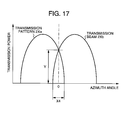
- FIG. 17 shows transmission power patterns respectively of the transmission antennas 2a and 2b.
- the transmission patterns 2Xa and 2Xb overlap with each other with a small overlapped area therebetween in FIG. 17. This can be implemented by the transmission patterns in which received power Y for an azimuth angle X4 of the overlapped area is equal to or less than 20 dB.
- FIG. 18 shows a scene in which a target such as a vehicle to be detected exists on the left-hand side and an object such as a wall which remarkably reflects radio waves exists on the right-hand side.
- a target such as a vehicle to be detected exists on the left-hand side
- an object such as a wall which remarkably reflects radio waves exists on the right-hand side.
- FIG. 18 shows a scene in which a target such as a vehicle to be detected exists on the left-hand side and an object such as a wall which remarkably reflects radio waves exists on the right-hand side.
- signal processing is executed by receiving a reflected wave from the target on the left side, it is possible to obtain a detection result of a target to be inherently detected.
- the result of the detection also indicates that an object exists on the right side, and hence there arises a problem of a multipath.
- mutually different transmission radio waves are respectively transmitted to the right-side and left-side areas as in the embodiment.
- a radar having a central frequency of, for example, 76.5 gigaherz (GHz) two kinds of transmission frequencies are transmitted such that the frequency difference between the transmission radio waves on the right and left sides is equal to or more than one gigaherz.
- the targets to be detected on the right and left sides can be detected using the respective transmission radio waves, and hence this is effective to solve the multipath problem.
Landscapes
- Engineering & Computer Science (AREA)
- Remote Sensing (AREA)
- Radar, Positioning & Navigation (AREA)
- Physics & Mathematics (AREA)
- Computer Networks & Wireless Communication (AREA)
- General Physics & Mathematics (AREA)
- Electromagnetism (AREA)
- Radar Systems Or Details Thereof (AREA)
Abstract
Description
- The present invention relates to a vehicle-mounted radar.
- Pre-crash safety measures in which a crash of a car is predicted to rewind a seat belt and to suddenly brake the car to a halt have been put to practices.
- On the other hand, among the radars to detect a car and/or a hindrance before a car using one of the radars, a laser radar and a millimeter wave radar are generally known as radars for adaptive cruise control (ACC). Particularly, the millimeter wave radar can capture a target (a reflected item obtained by a radar is also called a target in this specification) in a stable state even under a condition of rain and fog and is hence expected as an all-weather sensor.
- The millimeter wave radar sends from a transmission antenna a radio wave of the frequency band, receives a reflected wave from a target such as a vehicle, and detects a Doppler modulation characteristic of a received wave to the transmitted wave to detect distance (range) between the radar and the target and a relative speed or a rate therebetween.
- There have been proposed modulation methods for the millimeter wave radar such as a frequency modulation (FM) continuous wave (CW) method and a two-frequency CW method.
- Of these methods, the two-frequency CW method transmits two frequencies relatively near to each other through a change-over operation to detect items such as distance (range) between the radar and the target and a rate therebetween by use of a degree of the modulation of received waves of the transmitted waves. Therefore, the method advantageously requires only two oscillation frequencies and hence the circuit configuration of circuits such as an oscillator is simplified.
- Moreover, there is a method in the two-frequency CW method in which a reception antenna is disposed at a right position and a left position such that an existence angle (azimuth angle) of a forward target with respect to a radar beam is detected according to a ratio between sum power and difference power obtained from received signals (also called right and left received signals in some cases) from the right and left antennas and/or a phase difference between the right and left received signals. This is generally called a monopulse method.
- By using the monopulse method, the target existence angle can be detected by one wide beam without necessitating any scan unit to detect a direction. Since the antenna size is inversely proportional to the beam width, many advantages are obtained, for example, the antenna can be reduced in size.
- As above, although the two-frequency CW monopulse millimeter wave radar have various advantages, the radar has been attended with problems to be improved as below when the radar is used to pre-crash safety measurements.
- (1) In this method, by employing a technique to conduct a frequency spectrum analysis using a fast Fourier transform (FFT) for a received Doppler modulation signal waveform (of a reflected wave), there is obtained a spectral peak corresponding a target of each rate. Therefore, even when a plurality of targets exist before the radar, the targets can be separated from each other. However, when two or more targets respectively having rates completely equal to each other exist before the radar, the signals from these targets are recognized as one spectrum, and hence these targets cannot be separated from each other.
- (2) In principle, when two targets having completely the same speed are captured at the same time by a millimeter wave radar, the positions of the targets in the direction (lateral direction) vertical to the travelling direction of the vehicle are detected as if they are at one position (also called a reflection center-of-gravity position or a reflection central position in this specification) determined by a ratio between values of intensity (reflection intensity) of reflected power from the targets.
-
- Therefore, in a case in which, for example, vehicles at a halt laterally exist in both traffic lanes of a traffic lane (own traffic lane) of a vehicle on which the millimeter wave radar is mounted, when the radar captures the vehicles at the same time, these vehicles are possibly detected as if the vehicles are one block lying in the own traffic lane or as if one vehicle at a halt exist in the own traffic lane in some cases. Therefore, for example, also in a case in which the vehicle passes through a space between vehicles at a halt existing in the right and left traffic lanes or in which a space passable for a car exists before the vehicle and the vehicle can pass through the space by a simple driving operation in safety, there may disadvantageously occur a situation in which an emergency braking operation takes place.
- In a radar, three reception antennas such as first, second, and third reception antennas are disposed to receive reflected wave of a radio wave from an object and a horizontal width of the second reception antenna is less than a horizontal width of each of the first and third reception antennas.
- Or, the radar is configured such that an overlap range of overlap between a received beam of the first reception antenna and a received beam of the second reception antenna is equal to or more than a predetermined value and an overlap range of overlap between the received beam of the second reception antenna and a received beam of the third reception antenna is equal to or more than a predetermined value.
- When there exist a plurality of targets having substantially the same rate and the same distance (range) with respect to the own vehicle, these targets can be detected as separate items.
-
- FIG. 1 is a schematic diagram showing transmission and reception antennas and examples of reception beam patterns according to the present invention.
- FIG. 2 is a block diagram showing an example of a configuration of a radar.
- FIG. 3 is a diagram showing examples of reception beams according to the present invention.
- FIGS. 4A and 4B are graphs showing a principle of the two-frequency CW method.
- FIG. 5 is a graph showing three reception antenna patterns.
- FIG. 6 is a graph showing a principle of angle measurement in the monopulse method.
- FIGS. 7A-7C are diagrams showing effect of a radar according to the present invention.
- FIG. 8 is a diagram showing examples of reception beams according to the present invention.
- FIGS. 9A-9C are diagrams showing configuration examples of antennas.
- FIGS. 10A-10C are diagrams showing configuration examples of antennas.
- FIGS. 11A-11C are diagrams showing configuration examples of planar antennas.
- FIG. 12 is a flowchart showing signal processing to calculate distance (range), a rate, and an azimuth angle using three reception antennas.
- FIG. 13 is a graph showing an FFT waveform of received signals.
- FIG. 14 is a block diagram showing an example of a configuration of a radar including two communication interfaces.
- FIG. 15 is a diagram showing an antenna configuration including two transmission antennas and patterns of transmission beams.
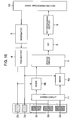
- FIG. 16 is a block diagram showing an example of a configuration of a radar including two transmission antennas and three reception antennas.
- FIG. 17 is a graph showing two transmission antenna patterns.
- FIG. 18 is a diagram showing an example of influence of a multipath.
-
- Next, description will be given of an embodiment according to the present invention.
- Referring to FIGS. 1 to 14, a first embodiment of the present invention will be described.
- FIG. 1 shows an embodiment of a configuration of an antenna section of a
radar 1. In the configuration of FIG. 1, theradar 1 radiates light or a radio wave to detect an object to obtain a speed, distance (range), and an angle of the object. Theradar 1 includes atransmission antenna 2 and at least threereception antennas - The light or the radio wave radiated from the
antenna 2 propagates through air while expanding at an angle determined mainly by a pattern of theantenna 2. Since intensity thereof attenuates almost according to distance (range) from theantenna 2, it is impossible to deliver a significant signal to a position apart from thetransmission antenna 2 by more than a predetermined distance (range). A range in which the radio wave radiated from theantenna 2 reaches with intensity equal to or more than a predetermined value is referred to as a transmission beam hereinbelow. The transmission beam has a pattern and size which are determined by the pattern and power of thetransmission antenna 2. Like thetransmission antenna 2, a reception antenna also has a range in which signals can be received, the range being referred to as a reception beam. The reception beam has a pattern determined also by the pattern and power of the transmission antenna. - The
reception antennas reception antenna 3a has a beam pattern as indicated by areception beam 3A and receives radio waves on the left-hand side viewed from the driver. Thereception antenna 3b has a beam pattern as indicated by areception beam 3B and receives radio waves in a wide range of a central zone, and thereception antenna 3c has a beam pattern as indicated by areception beam 3C and receives radio waves on the right-hand side viewed from the driver. - FIG. 2 shows a configuration of the
radar 1. Theradar 1 includes an antenna section 1a including atransmission antenna 2 and thereception antennas transmitter 4, amodulator 5, amixer 6, ananalog circuit 7, an analog-to-digital (A/D)converter 8, an FFT (Fast Fourier Transform)processing section 9, asignal processing section 10, and ahybrid circuit 11. - In the configuration, the
transmitter 4 outputs a high-frequency signal in a millimeter wave band according to a modulated signal from themodulator 5. The high-frequency signal is radiated as a transmission signal from thetransmission antenna 2. The transmission signal is reflected by an object in an area of the radiation and the reflected signal is received by thereception antennas - In this situation, the
hybrid circuit 11 first conducts an addition and a subtraction using received signals respectively of thereception antennas hybrid circuit 11 conducts an addition and a subtraction using received signals respectively of thereception antennas - Next, the
mixer 6 conducts a frequency conversion using the sum and difference signals and the signals received by thereception antennas mixer 6 is also supplied with the transmission signal from thetransmitter 4 and mixes the transmission signal with the received signal to create a low-frequency signal and outputs the signal to theanalog circuit 7. A difference (Doppler shift) between the frequency of the transmission signal and that of the received signal due to existence of the object is reflected in the low-frequency signal. Theanalog circuit 7 amplifies the signal inputted thereto and outputs the resultant signal to the A/D converter 8. Theconverter 8 converts the input signal into a digital signal to supply the signal to theFFT processing section 9. Thesection 9 measures the frequency spectrum of the signal through a fast Fourier transform (FFT) to obtain information of amplitude and phases and sends the information to thesignal processing section 10. Thesection 10 calculates distance (range) and a rate using data in the frequency zone obtained by theFFT processing section 9 and outputs a measured distance (range) value and a measured rate value. - Referring now to FIGS. 3 to 5, description will be given in detail of signal processing in an embodiment using the two-frequency continuous wave (CW) method according to the present invention. In a method of measuring a rate of an object using a frequency difference (Doppler shift) between a transmission signal and a received signal due to a rate between a detection object and a radar, the two-frequency CW method is a method in which the transmission signal has two frequencies, not a single frequency, and in which the frequencies are alternately changed at a predetermined interval of time.
- Even for objects respectively having rates substantially equal to each other, when the frequency of the transmission signal varies, there also occur a change in the phase shift according to distance (range) from the radar. The two-frequency CW method is a method using this characteristic in which by changing the frequency of the transmission signal, the distance (range) to the object is measured using phase information of received signals for the respective frequencies.
- In a radar of the two-frequency CW method, a modulated signal is inputted to the
transmitter 4 to transmit signals by changing the frequency between f1 and f2 at an interval of time as shown in FIG. 4A. when avehicle 12b exists, for example, at a position shown in FIG. 3, a radio wave sent from thetransmission antenna 2 is reflected by thevehicle 12b before the radar. The reflected signals are then received by thereception antennas vehicle 12b is outside the reception beam of thereception antenna 3a, theantenna 3a does not receive the reflected signal from thevehicle 12b. Thereafter, themixer 6 mixes the received signals of thereception antennas transmitter 4 to obtain a beat signal. In a homodyne detection to directly convert a signal into a baseband signal, the beat signal outputted from themixer 6 indicates the Doppler frequency, which is expressed as follows. - In the expression, fc is a transmission frequency, R' is a rate, and c is the speed of light. On the reception side, the
analog circuit section 7 separates and demodulates a received signal for each transmission frequency, and then the A/D converter 8 conducts an A/D conversion for the received signal of each transmission frequency. TheFFT processing section 9 executes fast Fourier transform processing for digital sample data obtained through the A/D conversion to attain a frequency spectrum in the overall frequency band of the received beat signal. According to the principle of the two-frequency CW method, power spectra of peak signals respectively of the transmission frequencies f1 and f2 are measured as shown in FIG. 4B using the peak signal obtained as a result of the FFT processing. The distance (range) is calculated from the phase difference between two power spectra using the following expression. - As above, not only the rate of the target but also the distance (range) to the target can be calculated.
- Referring next to FIG. 3, description will be given of an example of a method of measuring an azimuth angle of existence of the target in addition to the rate and the distance (range) with respect to the target.
- FIG. 3 shows a schematic diagram showing a state of a radar mounted on a vehicle in which the radar is viewed from an upper side of the vehicle. As shown in FIG. 3, the
reception antennas reception beam 3A of thereception antenna 3a is installed with an offset toward the left-hand side relative to a central line of thereception beam 3B of thereception antenna 3b and a central line of thereception beam 3C of thereception antenna 3c is installed with an offset toward the right-hand side relative to the central line of thereception beam 3B of thereception antenna 3b. - In FIG. 3, the
reception beam 3A is a range to cover a left-hand front area by an angle of 1. Concretely, 1 is desirably equal to or more than 50°. - Similarly, the
reception beam 3C is a range to cover a right-hand front area by an angle of 2. Concretely, 2 is desirably equal to or more than 50°. Thereception beam 3B is a range to cover an area by a wide angle of 2 more than 1 and 2. Concretely, is desirably equal to or more than 100°. - In this case, the
reception antennas reception beam 3A overlaps with thereception beam 3B by a predetermined angle Xa and thereception beam 3B overlaps with thereception beam 3C by a predetermined angle Xb. Concretely, Xa and Xb are desirably equal to or more than 50%. - In the range in which the reception beams of two reception antennas overlap with each other as above, an azimuth angle of a target can be attained using a difference between received signals from the two reception antennas.
- In the reception beam patterns of the present invention, the overlapped areas are separated to be on the right-hand and left-hand sides, and hence the
vehicles vehicle 12a is detected by thereception antennas vehicle 12b is detected by thereception antennas vehicles vehicles - FIG. 5 shows received power patterns respectively of the
reception antennas - FIG. 5 shows an example in which X1 and X2 are set such that the azimuth angle satisfied by each of the reception patterns 3Xa and 3Xc overlaps with 50% of the reception pattern 3Xb. In this situation, the overlap X3 is desirably small for the reception patterns 3Xa and 3Xc, and it is desirable that the reception patterns are set such that received power Y for the overlapped area X3 is, for example, 20 decibel (dB) or less.
- Referring to FIG. 6, description will be given of a method of identifying an azimuth angle of an
object 12b using the sum signal (SumAB) and the difference signal (DiffAB) of the signals received by thereception antennas reception antennas hybrid circuit 11. - FIG. 6 shows patterns of the sum signal (SumBC) and the difference signal (DiffBC) of the received signals in the right-hand range of the center of the radar. Since the patterns of the sum and difference signals are fixed as shown in FIG. 6, when the target is on the right-hand side viewed from the antenna attaching position like the
vehicle 12b, the sum signal (SumBC) and the difference signal (DiffBC) of the signals inputted to thereception antennas vehicle 12a, the sum signal (SumAB) and the difference signal (DiffAB) of the signals inputted to thereception antennas - As above, a wide range detection is possible by one radar. Not only the distance (range) and the rate of the detection object, but also the azimuth can be detected. This consequently improves object detection precision. Additionally, an object on the left-hand side and an object on the right-hand side are separately detected according to the present embodiment. Therefore, in a scene in which one vehicle is at halt on the right-hand side and another vehicle is at halt on the left-hand side before the own vehicle, the vehicles on both sides can be separately detected. Since a moving section as in the scan radar is not required according to the present embodiment, the radar can be further reduced in size.
- By using the radar described above, it is possible to improve quality in control of distance (range) between cars and control for crash mitigation.
- For example, as can be seen from FIG. 7A, when the own vehicle is travelling on a straight traffic lane before an intersection and a vehicle is at a halt on a traffic lane (right-turn lane) on the right of the straight traffic lane and another vehicle is at a halt on a traffic lane (left-turn lane) on the left of the straight traffic lane, if a conventional radar is used, the vehicles on the right-hand and left-hand sides are detected as one block as shown in FIG. 7B and hence the detection is conducted as if a hindrance exists before the own vehicle. Therefore, the vehicle speed is reduced when control of distance (range) between cars is effective and an emergency brake and a seat belt rewind unit operate when control for crash mitigation is effective. In a road state shown in FIG. 7A, the driver ordinarily considers that the control of distance (range) between cars and the control for crash mitigation do not operate, and hence determines that the own vehicle can pass through the place without any trouble. Therefore, the driver does not predict that the own vehicle is braked. In consequence, if the control of distance (range) between cars or the control for crash mitigation operates, the driver have an uncomfortable feeling as well as the driver is set to a dangerous situation in some cases.
- In contrast thereto, since the vehicles existing on the right-side traffic lane (right-turn lane) and on the left-hand traffic lane (left-turn lane) are detected as shown in FIG. 7C according to the radar of the present invention, the own vehicle can path through the space between the vehicles. In this situation, when the speed of the own vehicle is more than a predetermined speed, it is also possible to conduct control of reducing the speed to a predetermined speed to pass through the space. Therefore, by using the radar of the present invention, there can be implemented vehicle travelling control satisfying expectation of the driver.
- Although is about 100° and 1 and 2 are about 60° in FIG. 3, it is also possible to increase 1 and 2 to about 90° for = about 100° as shown in FIG. 8. This makes it possible to enlarge the area for one radar to detect objects before the vehicle on which the radar is mounted. Therefore, the radar can be favorably used as a device to detect objects for crash mitigation when another car is entering a space before the own vehicle or when the own vehicle suddenly meets another vehicle. In this case, in an area in which two reception beams overlap with each other as indicated by a shaded zone in FIG. 8, the distance (range) and the rate are calculated in association with the angle detecting function in the above method. In the other areas of the reception beams a and c, the distance (range) and the rate of the target are calculated.
- Next, description will be given of an embodiment of an antenna section and a
radome 13 according to the present invention. - FIG. 9 is a diagram showing a configuration of the antenna section viewed from a lateral direction with respect to the transmission and reception surfaces of the antenna. The radar is attached onto a vehicle such that the side shown in FIG. 9 is an upper side and the transmission and reception surfaces of the antenna face the front side of the vehicle.
- FIG. 9A shows an example in which planar antennas are adopted as transmission and reception antennas. One
transmission antenna 2 and threereception antennas member 14 with directivity such that reception beams of thereception antennas reception antenna 3b. Since width of each of the transmission and reception beams is almost inversely proportional to horizontal width of the associated antenna, in order to implement the reception beam pattern shown, for example, in FIG. 3, it is required that the horizontal width of each of thereception antennas reception antenna 3b. Also, as a unit to dispose the offset on the right and left sides of the reception beams, there may be used a configuration in which the receptionantenna holding member 14 is inclined in the right-hand and left-hand portions thereof, which will be described later. However, as shown in FIG. 10A, there may also be used a configuration in which each of thereception antennas - When each small antenna of the
reception antenna 3c has, for example, the same received power as shown in FIG. 10B, a reception beam can be formed without any offset on the right and left sides. On the other hand, as shown in FIG. 10C, when the received power of the small antennas in, for example, at least the right-most column 31a is lower than that of the other small antennas of thereception antenna 3c, thereception beam 3C has an offset toward the right-hand side viewed from the driver. - Although the
transmission antenna 2 is disposed on the right side and thereception antennas transmission antenna 2 on the left side and thereception antennas - When a radio wave sent from the
transmission antenna 2 is reflected by theradome 13 to be received by thereception antennas radome 13 has a contour having a curvature and a radio wave absorber is disposed at positions at which radio wave interference possibly occurs. The positions are, for example, a position between the transmission antenna and the reception antenna and a position near an attachingsection 14b between theradome 13 and the holdingmember 14. Although radio wave interference may occur at other positions, it is particularly probable that the interference takes place at the above positions. Therefore, occurrence of radio wave interference can be suppressed by disposing a radio wave absorber at these positions. - The curvature of the
radome 13 is desirably set such that the radio wave radiated from thetransmission antenna 2 possibly enters a tangential plane of the radome with a right angle relative to the plane at the incident point. - When the radio wave vertically enters the
radome 13, intensity of the radio wave reflected by theradome 13 can be reduced by appropriately selecting thickness and a material of theradome 13 in association with a wavelength of the radio wave. However, when the radio wave enters theradome 13 with an angle other than a right angle, intensity of the reflected radio wave cannot be sufficiently reduced according to the thickness and the material of theradome 13. - In this situation, by configuring the
radome 13 in a contour having a curvature as shown in FIG. 9A, the radio wave radiated from thetransmission antenna 2 can enter theradome 13 with an angle similar to a right angle, and hence the radio wave interference can be reduced. Although the curvature is shown only in the horizontal direction of the radome in FIG. 9A, the radio wave interference can be efficiently reduced in a configuration in which the radome has a curvature also in the vertical direction thereof. - FIG. 9B shows an embodiment in which the holding
member 14 includes three surfaces. In this case, thetransmission antenna 2 and thereception antenna 3b are arranged on acentral surface 14b, thereception antenna 3a is arranged on aleft surface 14a, and thereception antenna 3c is arranged on aright surface 14c to form patterns of the reception beams 3A, 3B, and 3C as shown in FIG. 3. - FIG. 9C shows a case using horn antennas disposed to respectively face the left side, the front side, and the right side. Using the antennas, the radar is simplified in the configuration and can be easily constructed. The radio wave interference between the respective antennas can also be easily prevented.
- FIG. 11 is a diagram showing layouts of the
transmission antenna 2 and threereception antennas member 14 when the radar is mounted on the vehicle, the layouts being viewed from the front side of the vehicle. - FIG. 11A shows an example using planar antennas as in FIG. 9A in which the
transmission antenna 2 and thereception antennas - FIG. 11B shows an example of a configuration of the antenna section as shown in FIG. 9A or 9B in which the
transmission antenna 2 and thereception antennas reception antennas hybrid circuit 11. The central line of the transmission beam of thetransmission antenna 2 is substantially aligned with that of thereception beam 3B of thecentral reception antenna 3b and the offset is not required to be considered, and hence processing of computation can be simplified. - FIG. 11C shows an example in which the
transmission antenna 2 and thecentral reception antenna 3b are arranged in parallel to each other and thereception antennas transmission antenna 2 and thereception antenna 3b have a transmission beam and a reception beam with a wider angle than the angles of the reception beams of thereception antennas transmission antenna 2 and thereception antenna 3b is ordinarily narrower than that of each of thereception antennas transmission antenna 2 and thereception antenna 3b having the narrower horizontal width side by side in the central position as shown in FIG. 11C, the overall antenna size can be reduced. - Referring next to the flowchart shown in FIG. 12 and FIG. 13, description will be given of processing of the embodiment of the radar to detect the rate, the distance (range), and the azimuth angle of a detection object. First, for each signal received by the
reception antennas step 15. FIG. 13 shows results of the FFT processing executed for signals received by one reception antenna. Instep 16, a peak signal is detected for each FFT signal. The peak signal is a signal of which the value of received power exceeds a threshold value (noise level) in FIG. 13. Between the peak signals detected from the antennas, the values of a Doppler frequency fp are compared with each other. If the Doppler frequency of the signal received by theantenna 3a matches that of the signal received by theantenna 3b (i.e., the difference with respect to fp is substantially equal to or less than a predetermined value), control goes to step 17. In this case, since the received signal of the same target is obtained by two reception antennas (3a and 3b), the sum and difference signals are calculated instep 17 and then angle detection is conducted instep 18. The rate and the distance (range) are calculated instep 19. Similarly, if the Doppler frequency of the signal received by thereception antenna 3b matches that of the signal received by thereception antenna 3c instep 16, control goes to step 20. In this case, since the received signal of the same target is obtained by two reception antennas (3b and 3c), the sum and difference signals are calculated instep 20 and then angle detection is conducted instep 21. The rate and the distance (range) are calculated in step 22. If the peak of the received signal is obtained only by one of thereception antennas step 16, it is indicated in this case that the target is detected in an area in which the antenna beams do not overlap with each other in FIG. 1 and hence control goes to step 23. Instep 23, the rate and the distance (range) are calculated, but the azimuth angle is not calculated. In this operation, as an output value of the azimuth angle, a predetermined value indicating impossibility of angle detection is outputted. It is therefore possible to notify to the controller using the output from the radar that this is resultant from the target position, not from failure or the like. The particular value indicating impossibility of angle detection in this case is, for example, 100 [deg] which is not ordinarily outputted in consideration of the installed state of thereception antennas - As above, since the received signal from each reception antenna is first measured, it is possible to detect that the target exists on the right-hand side or the left-hand side. In this situation, when the reception antennas are employed as in the above example in which = about 100° and 1 and 2 = about 60°, the target is detected by the
antenna 3b in any situation. That is, the azimuth angle can be detected in any case. To detect the distance (range) and the azimuth angle in the overall detection area as in this example, at least five signal lines are required. - Next, description will be given of a self-diagnosis function of the
radar 1 by referring to FIG. 14. To communicate with another unit in the own vehicle, theradar 1 includes two communication interfaces (I/F) connected to a bus 26. Thecommunication interface 24 is an interface to output information of the distance (range), the rate, and the azimuth angle as information of a target detected by theradar 1. Thecommunication interface 25 is an interface to output information from the self-diagnosis function of theradar 1. - Description will next be given of a method of detecting failure in the reception antennas. To execute the FFT processing for each reception antenna in
step 15 of FIG. 12, the noise level is calculated as shown in FIG. 13. - When the change in time of the noise level is not detected for the received signal of either one of the
reception antennas step 16, occurrence of failure is assumed in thereception antenna reception antennas - Referring to FIGS. 15 to 18, description will be given of a second embodiment according to the present invention.
- FIG. 15 shows a configuration and patterns of transmission beams from the antenna section of the
radar 1 in the embodiment. The antenna section includes twotransmission antennas reception antennas transmission antenna 2a has a beam pattern as indicated by atransmission beam 2A and sends radio waves in an area on the left-hand side viewed from the driver. Thetransmission antenna 2b has a beam pattern as indicated by atransmission beam 2B and sends radio waves in an area on the right-hand side viewed from the driver. - Referring now to FIG. 16, description will be given of a configuration of the
radar 1 in the embodiment. The antenna section includestransmission antennas reception antennas transmission antennas transmitter 4 with a transmission frequency according to a modulated signal from amodulator 5. A radio wave signal reflected by an object in an area of the radiation is received by thereception antennas reception antennas reception antennas hybrid circuit 11. A frequency conversion is conducted for the resultant signals and the signals received by therespective reception antennas mixers mixers transmitter 4. A low-frequency signal obtained by mixing the signals with the above signals is outputted to ananalog circuit 7. - In FIG. 15, the
transmission beam 2A is a range to cover the left-side area with an angle 1; concretely, 1 is desirably equal to or more than 50°. Similarly, thetransmission beam 2B is a range to cover the right-side area with an angle 2; concretely, 2 is desirably equal to or more than 50°. - FIG. 17 shows transmission power patterns respectively of the
transmission antennas - FIG. 18 shows a scene in which a target such as a vehicle to be detected exists on the left-hand side and an object such as a wall which remarkably reflects radio waves exists on the right-hand side. As indicated by solid straight lines in FIG. 18, when signal processing is executed by receiving a reflected wave from the target on the left side, it is possible to obtain a detection result of a target to be inherently detected. However, when a reflected wave returned through a path indicated by dotted lines is received, the result of the detection also indicates that an object exists on the right side, and hence there arises a problem of a multipath. To overcome this difficulty, mutually different transmission radio waves are respectively transmitted to the right-side and left-side areas as in the embodiment. In a radar having a central frequency of, for example, 76.5 gigaherz (GHz), two kinds of transmission frequencies are transmitted such that the frequency difference between the transmission radio waves on the right and left sides is equal to or more than one gigaherz. As a result, the targets to be detected on the right and left sides can be detected using the respective transmission radio waves, and hence this is effective to solve the multipath problem.
- By transmitting the transmission radio waves in a timeshared way, it is possible to reduce the number of mixers by one, and hence this is effective to implement a small-sized radar.
- It should be further understood by those skilled in the art that although the foregoing description has been made on embodiments of the invention, the invention is not limited thereto and various changes and modifications may be made without departing from the spirit of the invention and the scope of the appended claims.
Claims (19)
- A vehicle-mounted radar, comprising:whereina transmission antenna (2) for radiating a radio wave; andthree antennas including first, second, and third reception antennas (3a, 3b, 3c) for receiving reflected wave of the radio wave from an object,
a horizontal width of the second reception antenna is less than a horizontal width of each of the first and third reception antennas. - A vehicle-mounted radar according to claim 1,
wherein:an azimuth angle between a radio wave radiation direction of the first reception antenna and a radio wave radiation direction of the second reception antenna is equal to or more than a predetermined value; andan azimuth angle between a radio wave radiation direction of the third reception antenna and the radio wave radiation direction of the second reception antenna is equal to or more than a predetermined value. - A vehicle-mounted radar according to claims 1 or 2, further comprising three antenna installing surfaces (14a, 14b, 14c) including right, central, and left antenna installing surfaces, wherein
central antenna installing surface, and the first and third reception antennas are respectively installed on the right and left installing surfaces. - A vehicle-mounted radar according to at least one of claims 1 to 3, wherein each of the reception antennas is a horn antenna (FIG. 9C).
- A vehicle-mounted radar according to at least one of claims 1 to 4, wherein:each of at least the first and third reception antennas includes a plurality of rows of small antennas (FIG. 10A); andreceived power of a first one of the small antenna rows nearest to the second reception antenna is less than received power of a second one of the small antenna rows farthest to the second reception antenna.
- A vehicle-mounted radar according to at least one of claims 1 to 5, wherein the first, second, and third reception antennas are arranged in a horizontal direction, and the transmission antenna is arranged above or below the second reception antenna (FIG. 11B).
- A vehicle-mounted radar according to at least one of claims 1 to 6, wherein the second reception antenna and the transmission antenna are arranged between the first and third reception antennas (FIG. 9B, FIG. 11B, FIG. 11C).
- A vehicle-mounted radar according to at least one of claims 1 to 7, wherein a radome has a curvature corresponding to an azimuth angle of a radio wave transmitted therefrom (FIG. 9A).
- A vehicle-mounted radar according to at least one of claims 1 to 8, wherein the radar conducts an angle detection to detect an angle when at least two reception antennas selected from the reception antennas obtain peak signals substantially equal to each other (FIG. 12, FIG. 13).
- A vehicle-mounted radar according to at least one of claims 1 to 9, wherein when the angle detection is not conducted, a predetermined value indicating impossibility of the angle detection is set as an output value of the angle (FIG. 10).
- A vehicle-mounted radar according to at least one of claims 1 to 10, wherein:failure of each of the first, second, and the third reception antennas is detected by a change in time of a noise level and disappearance of a peak signal; andwhen failure is detected in at least one of the reception antennas, a predetermined value indicating the failure is set as an output value of the angle (FIG. 13).
- A vehicle-mounted radar, comprising:a transmission antenna (2) for radiating a radio wave; andfirst, second, and third reception antennas (3a, 3b, 3c) for receiving reflected wave of the radio wave from an object, wherein:an overlap range of overlap between a received beam of the second reception antenna is equal to or more than a predetermined value; andan overlap range of overlap between the received beam of the second reception antenna and a received beam of the third reception antenna is equal to or more than a predetermined value.
- A vehicle-mounted radar according to claim 12, wherein an overlap range of overlap between the received beam of the first reception antenna and the received beam of the third reception antenna is equal to or less than a predetermined value.
- A vehicle-mounted radar according to claim 12 or 13, wherein a radome has a curvature corresponding to an azimuth angle of a radio wave transmitted therefrom (FIG. 9A).
- A vehicle-mounted radar according to at least one of claims 12 to 14, further comprising an angle detecting function to detect an azimuth angle in the overlap range of overlap between the received beam of the first reception antenna and the received beam of the second reception antenna and the overlap range of overlap between the received beam of the second reception antenna and the received beam of the third reception antenna.
- A vehicle-mounted radar according to at least one of claims 12 to 15, wherein:the transmission antenna comprises two transmission antennas including first and second transmission antennas; andan overlap range of overlap between a transmitted beam of the first transmission antenna and a transmitted beam of the second transmission antenna is equal to or less than a predetermined value.
- A vehicle-mounted radar according to at least one of claims 12 to 16, wherein transmission processing of the first transmission antenna and transmission processing of the second transmission antenna are conducted in a time-shared fashion.
- A vehicle-mounted radar according to at least one of claims 12 to 17, wherein a difference between a transmission frequency of the first transmission antenna and a transmission frequency of the second transmission antenna is equal to or more than a predetermined value.
- A drive control apparatus for use in a vehicle in which a vehicle-mounted radar is mounted, the radar comprising a transmission antenna (2) for radiating a radio wave, first, second, and third reception antennas (3a, 3b, 3c) for receiving reflected wave of the radio wave from an object, and a horizontal width of the second reception antenna is less than a horizontal width of each of the first and third reception antennas, wherein
a speed of the vehicle is reduced to a predetermined speed when a hindrance is detected in traffic lanes on both sides of a traffic lane of the vehicle on which the radar is installed and any hindrance is not detected in the traffic lane of the vehicle (FIG. 12).
Applications Claiming Priority (2)
| Application Number | Priority Date | Filing Date | Title |
|---|---|---|---|
| JP2003394872A JP2005156337A (en) | 2003-11-26 | 2003-11-26 | Automotive radar equipment |
| JP2003394872 | 2003-11-26 |
Publications (2)
| Publication Number | Publication Date |
|---|---|
| EP1548458A2 true EP1548458A2 (en) | 2005-06-29 |
| EP1548458A3 EP1548458A3 (en) | 2007-01-10 |
Family
ID=34544851
Family Applications (1)
| Application Number | Title | Priority Date | Filing Date |
|---|---|---|---|
| EP04019181A Withdrawn EP1548458A3 (en) | 2003-11-26 | 2004-08-12 | Vehicle-mounted radar |
Country Status (3)
| Country | Link |
|---|---|
| US (1) | US20050110673A1 (en) |
| EP (1) | EP1548458A3 (en) |
| JP (1) | JP2005156337A (en) |
Cited By (11)
| Publication number | Priority date | Publication date | Assignee | Title |
|---|---|---|---|---|
| EP1837679A1 (en) * | 2006-03-23 | 2007-09-26 | Omron Corporation | Radar device and radar method |
| WO2007147533A1 (en) * | 2006-06-21 | 2007-12-27 | Valeo Schalter Und Sensoren Gmbh | Motor vehicle radar system, and method for determining speeds and distances of objects |
| EP1956389A1 (en) * | 2007-02-02 | 2008-08-13 | Omron Corporation | Dual frequency CW radar |
| EP2040336A1 (en) * | 2007-08-03 | 2009-03-25 | InnoSenT GmbH | Radar sensor |
| EP2068172A2 (en) | 2007-12-04 | 2009-06-10 | Robert Bosch GmbH | Adaptive nulling in monopulse difference antenna diagram to improve the angular resolution at object locations |
| WO2010000251A3 (en) * | 2008-07-02 | 2010-02-25 | Adc Automotive Distance Control Systems Gmbh | Radar system comprising overlapping transmitter and receiver antennae |
| WO2012113366A1 (en) * | 2011-02-23 | 2012-08-30 | S.M.S. Smart Microwave Sensors Gmbh | Method and radar sensor arrangement for detecting the location and speed of objects relative to a measurement location, particularly a vehicle |
| EP2944977A1 (en) * | 2014-05-15 | 2015-11-18 | Delphi Technologies, Inc. | Radar system with improved multi-target discrimination |
| WO2016177495A1 (en) * | 2015-05-01 | 2016-11-10 | Robert Bosch Gmbh | Detection system for mounting on a corner of a vehicle |
| US10823836B2 (en) | 2015-11-19 | 2020-11-03 | Conti Temic Microelectronic Gmbh | Radar system having interleaved serial transmitting and parallel receiving |
| US20230030172A1 (en) * | 2021-07-30 | 2023-02-02 | Argo AI, LLC | Method, System, and Computer Program Product for Resolving Level Ambiguity for Radar Systems of Autonomous Vehicles |
Families Citing this family (23)
| Publication number | Priority date | Publication date | Assignee | Title |
|---|---|---|---|---|
| US7136753B2 (en) * | 2002-12-05 | 2006-11-14 | Denso Corporation | Object recognition apparatus for vehicle, inter-vehicle control apparatus, and distance measurement apparatus |
| WO2006009122A1 (en) * | 2004-07-16 | 2006-01-26 | Fujitsu Ten Limited | Mono pulse radar device and antenna selector switch |
| EP1729146A1 (en) * | 2005-06-01 | 2006-12-06 | BAE SYSTEMS (Defence Systems) Limited | Direction finder antenna receiver system |
| JP4337887B2 (en) * | 2007-02-21 | 2009-09-30 | 株式会社デンソー | In-vehicle millimeter wave radar system |
| JP4766402B2 (en) * | 2008-10-21 | 2011-09-07 | トヨタ自動車株式会社 | Radar equipment |
| DE112010001529A5 (en) | 2009-04-06 | 2012-10-25 | Conti Temic Microelectronic Gmbh | RADAR SYSTEM WITH ARRANGEMENTS AND METHOD FOR DECOUPLING TRANSMISSION AND RECEPTION SIGNALS AND SUPPRESSING NOISE EMISSIONS |
| EP2461179B1 (en) * | 2009-07-31 | 2016-12-07 | Honda Motor Co., Ltd. | Object detection device for vehicle and object detection method for vehicle |
| US8577550B2 (en) * | 2009-10-05 | 2013-11-05 | Ford Global Technologies, Llc | System for vehicle control to mitigate intersection collisions and method of using the same |
| KR101172240B1 (en) * | 2010-05-18 | 2012-08-07 | 주식회사 만도 | Sensor and alignment adjusting method |
| US8736484B2 (en) * | 2010-08-11 | 2014-05-27 | Lockheed Martin Corporation | Enhanced-resolution phased array radar |
| US9618615B2 (en) * | 2011-04-19 | 2017-04-11 | Mazda Motor Corporation | Obstacle detection device for vehicle |
| KR20130065005A (en) * | 2011-12-09 | 2013-06-19 | 주식회사 만도 | Radar apparatus and antenna apparatus |
| DE102011122346A1 (en) * | 2011-12-23 | 2013-06-27 | Valeo Schalter Und Sensoren Gmbh | Radar device for a motor vehicle, holder for a radar device and method for producing an absorption element for a radar device |
| CA2893194C (en) * | 2014-07-30 | 2018-06-19 | Shigeru OHSUGI | Transporter vehicle and transporter vehicle control method |
| JP6415386B2 (en) * | 2015-05-28 | 2018-10-31 | 三菱電機株式会社 | Angle measuring device, radar device, and angle measuring method |
| JP6266188B1 (en) * | 2016-05-20 | 2018-01-24 | 三菱電機株式会社 | Weather radar equipment |
| KR102314336B1 (en) * | 2017-09-14 | 2021-10-19 | 주식회사 만도모빌리티솔루션즈 | Radar apparatus for vehicle and method for estimating angle using the same |
| JP6844525B2 (en) * | 2017-12-26 | 2021-03-17 | 株式会社デンソー | Antenna device |
| KR102132774B1 (en) * | 2018-01-10 | 2020-07-21 | 주식회사 만도 | Method for controlling radar and Apparatus thereof |
| WO2020157924A1 (en) * | 2019-01-31 | 2020-08-06 | 三菱電機株式会社 | Angle measuring device, angle measuring method, and vehicle-mounted device |
| US11226397B2 (en) * | 2019-08-06 | 2022-01-18 | Waymo Llc | Slanted radomes |
| US11385325B2 (en) * | 2019-08-07 | 2022-07-12 | Waymo Llc | Corrugated radomes |
| US12362470B1 (en) | 2021-11-18 | 2025-07-15 | Waymo Llc | Systems, methods, and apparatus for determining characteristics of a radome |
Citations (1)
| Publication number | Priority date | Publication date | Assignee | Title |
|---|---|---|---|---|
| EP0805360A2 (en) * | 1996-05-02 | 1997-11-05 | Honda Giken Kogyo Kabushiki Kaisha | Multibeam radar system |
Family Cites Families (45)
| Publication number | Priority date | Publication date | Assignee | Title |
|---|---|---|---|---|
| DE2553302A1 (en) * | 1975-11-27 | 1977-06-02 | Standard Elektrik Lorenz Ag | RETURN RADIATION DETECTOR, IN PARTICULAR FOR MOTOR VEHICLES |
| JPS6045377B2 (en) * | 1976-08-03 | 1985-10-09 | 日産自動車株式会社 | Collision prevention device |
| US4308536A (en) * | 1979-02-26 | 1981-12-29 | Collision Avoidance Systems | Anti-collision vehicular radar system |
| IT1222297B (en) * | 1988-01-18 | 1990-09-05 | Paolo Alberto Paoletti | FOG RADAR FOR VEHICLES |
| GB9102585D0 (en) * | 1991-02-06 | 1991-03-27 | Marconi Gec Ltd | Radar system |
| JP2567332B2 (en) * | 1993-02-17 | 1996-12-25 | 本田技研工業株式会社 | Time division radar system |
| US5402129A (en) * | 1993-08-04 | 1995-03-28 | Vorad Safety Systems, Inc. | Monopulse azimuth radar system for automotive vehicle tracking |
| JP2768439B2 (en) * | 1994-11-08 | 1998-06-25 | 本田技研工業株式会社 | FM-CW type multi-beam radar device |
| US5767793A (en) * | 1995-04-21 | 1998-06-16 | Trw Inc. | Compact vehicle based rear and side obstacle detection system including multiple antennae |
| JP4082725B2 (en) * | 1995-07-01 | 2008-04-30 | ローベルト ボツシユ ゲゼルシヤフト ミツト ベシユレンクテル ハフツング | Monostatic FMCW radar sensor |
| JP3656290B2 (en) * | 1995-09-01 | 2005-06-08 | 株式会社デンソー | Monopulse radar device |
| JPH09191213A (en) * | 1995-11-07 | 1997-07-22 | Denso Corp | Opening surface antenna |
| JP3663702B2 (en) * | 1995-12-05 | 2005-06-22 | 株式会社デンソー | Planar array antenna and phase monopulse radar apparatus |
| EP0809811B1 (en) * | 1995-12-19 | 2001-07-11 | Siemens Schweiz AG | Process and amplitude or phase-single pulse radar device for locating flying objects |
| WO1997040400A1 (en) * | 1996-04-22 | 1997-10-30 | The Furukawa Electric Co., Ltd. | Radar |
| JP3012805B2 (en) * | 1996-05-09 | 2000-02-28 | 本田技研工業株式会社 | FM radar equipment |
| US5781157A (en) * | 1996-08-05 | 1998-07-14 | Mcdonnell Douglas Corporation | Multiple beam radar system with enhanced sidelobe supression |
| DE19648203C2 (en) * | 1996-11-21 | 1999-06-10 | Bosch Gmbh Robert | Multi-beam automotive radar system |
| JP3799724B2 (en) * | 1997-03-27 | 2006-07-19 | 株式会社デンソー | Aperture antenna and radar device |
| JPH1116099A (en) * | 1997-06-27 | 1999-01-22 | Hitachi Ltd | Car driving support device |
| US5929802A (en) * | 1997-11-21 | 1999-07-27 | Raytheon Company | Automotive forward looking sensor application |
| EP0965859A4 (en) * | 1997-12-25 | 2001-03-14 | Toyoda Chuo Kenkyusho Kk | RADAR |
| JP3942722B2 (en) * | 1998-02-16 | 2007-07-11 | 本田技研工業株式会社 | In-vehicle radar system |
| JPH11271430A (en) * | 1998-03-25 | 1999-10-08 | Toyota Central Res & Dev Lab Inc | Automotive radar equipment |
| DE19829762A1 (en) * | 1998-07-03 | 2000-01-13 | Adc Automotive Dist Control | Radar system operating method, e.g. for motor vehicle separation distance or speed detection |
| JP2000028704A (en) * | 1998-07-07 | 2000-01-28 | Nec Corp | Radar device |
| JP3622565B2 (en) * | 1999-03-31 | 2005-02-23 | 株式会社デンソー | Radar equipment |
| JP4258941B2 (en) * | 1999-06-03 | 2009-04-30 | 株式会社デンソー | Radar equipment |
| JP3393204B2 (en) * | 1999-10-06 | 2003-04-07 | 株式会社ホンダエレシス | Multi-beam radar device |
| JP3411866B2 (en) * | 1999-10-25 | 2003-06-03 | 株式会社日立製作所 | Millimeter wave radar device |
| JP3746235B2 (en) * | 2000-01-28 | 2006-02-15 | 株式会社日立製作所 | Distance measuring device |
| JP2001296352A (en) * | 2000-04-12 | 2001-10-26 | Omron Corp | Object detection device |
| JP2002131425A (en) * | 2000-10-26 | 2002-05-09 | Matsushita Electric Works Ltd | Radar device, on-board radar device, and collision preventing system |
| JP4088583B2 (en) * | 2001-05-30 | 2008-05-21 | 株式会社日立製作所 | Radar equipment |
| JP2003066139A (en) * | 2001-08-27 | 2003-03-05 | Hitachi Ltd | Radar equipment |
| US6750810B2 (en) * | 2001-12-18 | 2004-06-15 | Hitachi, Ltd. | Monopulse radar system |
| EP1321776B1 (en) * | 2001-12-18 | 2005-08-24 | Hitachi, Ltd. | Monopulse radar system with adjustment of beam width |
| US6664918B2 (en) * | 2002-01-09 | 2003-12-16 | Mia-Com, Inc. | Method and apparatus for identifying complex objects based on range readings from multiple sensors |
| US7295154B2 (en) * | 2002-01-17 | 2007-11-13 | The Ohio State University | Vehicle obstacle warning radar |
| JP2003248054A (en) * | 2002-02-27 | 2003-09-05 | Hitachi Ltd | Monopulse radar device |
| JP3688255B2 (en) * | 2002-09-20 | 2005-08-24 | 株式会社日立製作所 | In-vehicle radio radar apparatus and signal processing method thereof |
| DE10261027A1 (en) * | 2002-12-24 | 2004-07-08 | Robert Bosch Gmbh | Angle-resolving antenna system |
| JP4093109B2 (en) * | 2003-05-15 | 2008-06-04 | 株式会社デンソー | Radar equipment for vehicles |
| US20070008210A1 (en) * | 2003-09-11 | 2007-01-11 | Noriko Kibayashi | Radar device |
| US7586436B2 (en) * | 2003-09-11 | 2009-09-08 | Mitsubishi Denki Kabushiki Kaisha | Radar device |
-
2003
- 2003-11-26 JP JP2003394872A patent/JP2005156337A/en active Pending
-
2004
- 2004-08-12 EP EP04019181A patent/EP1548458A3/en not_active Withdrawn
- 2004-08-19 US US10/921,176 patent/US20050110673A1/en not_active Abandoned
Patent Citations (1)
| Publication number | Priority date | Publication date | Assignee | Title |
|---|---|---|---|---|
| EP0805360A2 (en) * | 1996-05-02 | 1997-11-05 | Honda Giken Kogyo Kabushiki Kaisha | Multibeam radar system |
Cited By (24)
| Publication number | Priority date | Publication date | Assignee | Title |
|---|---|---|---|---|
| EP1837679A1 (en) * | 2006-03-23 | 2007-09-26 | Omron Corporation | Radar device and radar method |
| US7548182B2 (en) | 2006-03-23 | 2009-06-16 | Omron Corporation | Radar device and radar method |
| CN101042435B (en) * | 2006-03-23 | 2011-03-23 | 欧姆龙汽车电子株式会社 | Single pulse radar device |
| WO2007147533A1 (en) * | 2006-06-21 | 2007-12-27 | Valeo Schalter Und Sensoren Gmbh | Motor vehicle radar system, and method for determining speeds and distances of objects |
| US8704704B2 (en) | 2006-06-21 | 2014-04-22 | Valeo Schalter Und Sensoren Gmbh | Motor vehicle radar system, and method for determining speeds and distances of objects |
| EP1956389A1 (en) * | 2007-02-02 | 2008-08-13 | Omron Corporation | Dual frequency CW radar |
| EP2040336A1 (en) * | 2007-08-03 | 2009-03-25 | InnoSenT GmbH | Radar sensor |
| EP2068172A2 (en) | 2007-12-04 | 2009-06-10 | Robert Bosch GmbH | Adaptive nulling in monopulse difference antenna diagram to improve the angular resolution at object locations |
| EP2068172A3 (en) * | 2007-12-04 | 2010-03-24 | Robert Bosch GmbH | Adaptive nulling in monopulse difference antenna diagram to improve the angular resolution at object locations |
| US8035548B2 (en) | 2007-12-04 | 2011-10-11 | Robert Bosch Gmbh | Evaluation method, particularly for a driver assistance system of a motor vehicle, for object detection using a radar sensor |
| US8436763B2 (en) | 2008-07-02 | 2013-05-07 | Adc Automotive Distance Control Systems Gmbh | Radar system comprising overlapping transmitter and receiver antennas |
| US8390507B2 (en) | 2008-07-02 | 2013-03-05 | Adc Automotive Distance Control Systems Gmbh | Radar system with elevation measuring capability |
| US8593333B2 (en) | 2008-07-02 | 2013-11-26 | Adc Automotive Distance Control Systems Gmbh | Radar sensor with frontal and lateral emission |
| US8665137B2 (en) | 2008-07-02 | 2014-03-04 | Adc Automotive Distance Control Systems Gmbh | Radar system with improved angle formation |
| WO2010000251A3 (en) * | 2008-07-02 | 2010-02-25 | Adc Automotive Distance Control Systems Gmbh | Radar system comprising overlapping transmitter and receiver antennae |
| WO2012113366A1 (en) * | 2011-02-23 | 2012-08-30 | S.M.S. Smart Microwave Sensors Gmbh | Method and radar sensor arrangement for detecting the location and speed of objects relative to a measurement location, particularly a vehicle |
| CN105093213A (en) * | 2014-05-15 | 2015-11-25 | 德尔福技术有限公司 | Radar system with improved multi-target discrimination |
| EP2944977A1 (en) * | 2014-05-15 | 2015-11-18 | Delphi Technologies, Inc. | Radar system with improved multi-target discrimination |
| US9310468B2 (en) | 2014-05-15 | 2016-04-12 | Delphi Technologies, Inc. | Radar system with improved multi-target discrimination |
| CN105093213B (en) * | 2014-05-15 | 2019-07-02 | 安波福技术有限公司 | Radar system with improved multi-target discrimination |
| WO2016177495A1 (en) * | 2015-05-01 | 2016-11-10 | Robert Bosch Gmbh | Detection system for mounting on a corner of a vehicle |
| US10823836B2 (en) | 2015-11-19 | 2020-11-03 | Conti Temic Microelectronic Gmbh | Radar system having interleaved serial transmitting and parallel receiving |
| US20230030172A1 (en) * | 2021-07-30 | 2023-02-02 | Argo AI, LLC | Method, System, and Computer Program Product for Resolving Level Ambiguity for Radar Systems of Autonomous Vehicles |
| US11807271B2 (en) * | 2021-07-30 | 2023-11-07 | Ford Global Technologies, Llc | Method, system, and computer program product for resolving level ambiguity for radar systems of autonomous vehicles |
Also Published As
| Publication number | Publication date |
|---|---|
| US20050110673A1 (en) | 2005-05-26 |
| EP1548458A3 (en) | 2007-01-10 |
| JP2005156337A (en) | 2005-06-16 |
Similar Documents
| Publication | Publication Date | Title |
|---|---|---|
| EP1548458A2 (en) | Vehicle-mounted radar | |
| JP4045041B2 (en) | Radar apparatus and radar apparatus abnormality detection method | |
| JP4115638B2 (en) | Object recognition device | |
| JP4007498B2 (en) | Automotive radar equipment | |
| CN112654888A (en) | Electronic device, control method for electronic device, and control program for electronic device | |
| US20110084872A1 (en) | Signal processing apparatus and radar apparatus | |
| US20080258964A1 (en) | Radar System | |
| US20100075618A1 (en) | Signal processing apparatus and radar apparatus | |
| JP4088583B2 (en) | Radar equipment | |
| US11709261B2 (en) | Radar device for vehicle, controlling method of radar device and radar system for vehicle | |
| JP2021165758A (en) | Electronic apparatus, control method for electronic apparatus, and control program for electronic apparatus | |
| WO2021019934A1 (en) | Electronic device, electronic device control method, and program | |
| US7091900B2 (en) | Radar | |
| WO2005066656A1 (en) | Vehicle mounted radar system and its signal processing method | |
| CN116529627A (en) | Electronic device, control method for electronic device, and program | |
| JP2020012702A (en) | Radar device for vehicles | |
| CN117616306A (en) | Electronic equipment, control methods and procedures for electronic equipment | |
| JP2000206234A (en) | FM-CW radar device | |
| JP3577237B2 (en) | Radar equipment for vehicles | |
| JP3723804B2 (en) | Automotive radar equipment | |
| WO2020241235A1 (en) | Electronic device, electronic device control method, and program | |
| JPH11110685A (en) | Traffic control support system | |
| JP3496606B2 (en) | Radar equipment | |
| WO2023032620A1 (en) | Electronic device, method for controlling electronic device, and program | |
| CN117063083A (en) | Electronic equipment |
Legal Events
| Date | Code | Title | Description |
|---|---|---|---|
| PUAI | Public reference made under article 153(3) epc to a published international application that has entered the european phase |
Free format text: ORIGINAL CODE: 0009012 |
|
| AK | Designated contracting states |
Kind code of ref document: A2 Designated state(s): AT BE BG CH CY CZ DE DK EE ES FI FR GB GR HU IE IT LI LU MC NL PL PT RO SE SI SK TR |
|
| AX | Request for extension of the european patent |
Extension state: AL HR LT LV MK |
|
| PUAL | Search report despatched |
Free format text: ORIGINAL CODE: 0009013 |
|
| AK | Designated contracting states |
Kind code of ref document: A3 Designated state(s): AT BE BG CH CY CZ DE DK EE ES FI FR GB GR HU IE IT LI LU MC NL PL PT RO SE SI SK TR |
|
| AX | Request for extension of the european patent |
Extension state: AL HR LT LV MK |
|
| 17P | Request for examination filed |
Effective date: 20070710 |
|
| AKX | Designation fees paid |
Designated state(s): DE FR |
|
| 17Q | First examination report despatched |
Effective date: 20070816 |
|
| STAA | Information on the status of an ep patent application or granted ep patent |
Free format text: STATUS: THE APPLICATION IS DEEMED TO BE WITHDRAWN |
|
| 18D | Application deemed to be withdrawn |
Effective date: 20110301 |