EP1546284B1 - Reaktive dendrimere - Google Patents
Reaktive dendrimere Download PDFInfo
- Publication number
- EP1546284B1 EP1546284B1 EP03791026.2A EP03791026A EP1546284B1 EP 1546284 B1 EP1546284 B1 EP 1546284B1 EP 03791026 A EP03791026 A EP 03791026A EP 1546284 B1 EP1546284 B1 EP 1546284B1
- Authority
- EP
- European Patent Office
- Prior art keywords
- group
- dendrimer
- dendrite
- groups
- phenyl
- Prior art date
- Legal status (The legal status is an assumption and is not a legal conclusion. Google has not performed a legal analysis and makes no representation as to the accuracy of the status listed.)
- Expired - Lifetime
Links
- RZZLQFXXYLBVSM-OWOJBTEDSA-N Oc(cc1)ccc1-c1cc(/C=C/c2ccc(-c(ccc(F)c3)c3F)nc2)cc(-c(cc2)ccc2[RnH])c1 Chemical compound Oc(cc1)ccc1-c1cc(/C=C/c2ccc(-c(ccc(F)c3)c3F)nc2)cc(-c(cc2)ccc2[RnH])c1 RZZLQFXXYLBVSM-OWOJBTEDSA-N 0.000 description 1
Images



Classifications
-
- C—CHEMISTRY; METALLURGY
- C07—ORGANIC CHEMISTRY
- C07F—ACYCLIC, CARBOCYCLIC OR HETEROCYCLIC COMPOUNDS CONTAINING ELEMENTS OTHER THAN CARBON, HYDROGEN, HALOGEN, OXYGEN, NITROGEN, SULFUR, SELENIUM OR TELLURIUM
- C07F15/00—Compounds containing elements of Groups 8, 9, 10 or 18 of the Periodic Table
- C07F15/0006—Compounds containing elements of Groups 8, 9, 10 or 18 of the Periodic Table compounds of the platinum group
- C07F15/0033—Iridium compounds
-
- C—CHEMISTRY; METALLURGY
- C08—ORGANIC MACROMOLECULAR COMPOUNDS; THEIR PREPARATION OR CHEMICAL WORKING-UP; COMPOSITIONS BASED THEREON
- C08G—MACROMOLECULAR COMPOUNDS OBTAINED OTHERWISE THAN BY REACTIONS ONLY INVOLVING UNSATURATED CARBON-TO-CARBON BONDS
- C08G83/00—Macromolecular compounds not provided for in groups C08G2/00 - C08G81/00
- C08G83/002—Dendritic macromolecules
- C08G83/003—Dendrimers
-
- C—CHEMISTRY; METALLURGY
- C09—DYES; PAINTS; POLISHES; NATURAL RESINS; ADHESIVES; COMPOSITIONS NOT OTHERWISE PROVIDED FOR; APPLICATIONS OF MATERIALS NOT OTHERWISE PROVIDED FOR
- C09K—MATERIALS FOR MISCELLANEOUS APPLICATIONS, NOT PROVIDED FOR ELSEWHERE
- C09K11/00—Luminescent materials, e.g. electroluminescent or chemiluminescent
- C09K11/06—Luminescent materials, e.g. electroluminescent or chemiluminescent containing organic luminescent materials
-
- H—ELECTRICITY
- H10—SEMICONDUCTOR DEVICES; ELECTRIC SOLID-STATE DEVICES NOT OTHERWISE PROVIDED FOR
- H10K—ORGANIC ELECTRIC SOLID-STATE DEVICES
- H10K85/00—Organic materials used in the body or electrodes of devices covered by this subclass
- H10K85/30—Coordination compounds
- H10K85/341—Transition metal complexes, e.g. Ru(II)polypyridine complexes
-
- H—ELECTRICITY
- H10—SEMICONDUCTOR DEVICES; ELECTRIC SOLID-STATE DEVICES NOT OTHERWISE PROVIDED FOR
- H10K—ORGANIC ELECTRIC SOLID-STATE DEVICES
- H10K85/00—Organic materials used in the body or electrodes of devices covered by this subclass
- H10K85/30—Coordination compounds
- H10K85/341—Transition metal complexes, e.g. Ru(II)polypyridine complexes
- H10K85/342—Transition metal complexes, e.g. Ru(II)polypyridine complexes comprising iridium
-
- H—ELECTRICITY
- H10—SEMICONDUCTOR DEVICES; ELECTRIC SOLID-STATE DEVICES NOT OTHERWISE PROVIDED FOR
- H10K—ORGANIC ELECTRIC SOLID-STATE DEVICES
- H10K85/00—Organic materials used in the body or electrodes of devices covered by this subclass
- H10K85/30—Coordination compounds
- H10K85/341—Transition metal complexes, e.g. Ru(II)polypyridine complexes
- H10K85/346—Transition metal complexes, e.g. Ru(II)polypyridine complexes comprising platinum
-
- H—ELECTRICITY
- H10—SEMICONDUCTOR DEVICES; ELECTRIC SOLID-STATE DEVICES NOT OTHERWISE PROVIDED FOR
- H10K—ORGANIC ELECTRIC SOLID-STATE DEVICES
- H10K85/00—Organic materials used in the body or electrodes of devices covered by this subclass
- H10K85/60—Organic compounds having low molecular weight
- H10K85/649—Aromatic compounds comprising a hetero atom
- H10K85/654—Aromatic compounds comprising a hetero atom comprising only nitrogen as heteroatom
-
- H—ELECTRICITY
- H10—SEMICONDUCTOR DEVICES; ELECTRIC SOLID-STATE DEVICES NOT OTHERWISE PROVIDED FOR
- H10K—ORGANIC ELECTRIC SOLID-STATE DEVICES
- H10K85/00—Organic materials used in the body or electrodes of devices covered by this subclass
- H10K85/791—Starburst compounds
-
- C—CHEMISTRY; METALLURGY
- C09—DYES; PAINTS; POLISHES; NATURAL RESINS; ADHESIVES; COMPOSITIONS NOT OTHERWISE PROVIDED FOR; APPLICATIONS OF MATERIALS NOT OTHERWISE PROVIDED FOR
- C09K—MATERIALS FOR MISCELLANEOUS APPLICATIONS, NOT PROVIDED FOR ELSEWHERE
- C09K2211/00—Chemical nature of organic luminescent or tenebrescent compounds
- C09K2211/10—Non-macromolecular compounds
- C09K2211/1003—Carbocyclic compounds
-
- C—CHEMISTRY; METALLURGY
- C09—DYES; PAINTS; POLISHES; NATURAL RESINS; ADHESIVES; COMPOSITIONS NOT OTHERWISE PROVIDED FOR; APPLICATIONS OF MATERIALS NOT OTHERWISE PROVIDED FOR
- C09K—MATERIALS FOR MISCELLANEOUS APPLICATIONS, NOT PROVIDED FOR ELSEWHERE
- C09K2211/00—Chemical nature of organic luminescent or tenebrescent compounds
- C09K2211/10—Non-macromolecular compounds
- C09K2211/1003—Carbocyclic compounds
- C09K2211/1007—Non-condensed systems
-
- C—CHEMISTRY; METALLURGY
- C09—DYES; PAINTS; POLISHES; NATURAL RESINS; ADHESIVES; COMPOSITIONS NOT OTHERWISE PROVIDED FOR; APPLICATIONS OF MATERIALS NOT OTHERWISE PROVIDED FOR
- C09K—MATERIALS FOR MISCELLANEOUS APPLICATIONS, NOT PROVIDED FOR ELSEWHERE
- C09K2211/00—Chemical nature of organic luminescent or tenebrescent compounds
- C09K2211/10—Non-macromolecular compounds
- C09K2211/1003—Carbocyclic compounds
- C09K2211/1011—Condensed systems
-
- C—CHEMISTRY; METALLURGY
- C09—DYES; PAINTS; POLISHES; NATURAL RESINS; ADHESIVES; COMPOSITIONS NOT OTHERWISE PROVIDED FOR; APPLICATIONS OF MATERIALS NOT OTHERWISE PROVIDED FOR
- C09K—MATERIALS FOR MISCELLANEOUS APPLICATIONS, NOT PROVIDED FOR ELSEWHERE
- C09K2211/00—Chemical nature of organic luminescent or tenebrescent compounds
- C09K2211/10—Non-macromolecular compounds
- C09K2211/1018—Heterocyclic compounds
- C09K2211/1025—Heterocyclic compounds characterised by ligands
- C09K2211/1029—Heterocyclic compounds characterised by ligands containing one nitrogen atom as the heteroatom
-
- C—CHEMISTRY; METALLURGY
- C09—DYES; PAINTS; POLISHES; NATURAL RESINS; ADHESIVES; COMPOSITIONS NOT OTHERWISE PROVIDED FOR; APPLICATIONS OF MATERIALS NOT OTHERWISE PROVIDED FOR
- C09K—MATERIALS FOR MISCELLANEOUS APPLICATIONS, NOT PROVIDED FOR ELSEWHERE
- C09K2211/00—Chemical nature of organic luminescent or tenebrescent compounds
- C09K2211/10—Non-macromolecular compounds
- C09K2211/1018—Heterocyclic compounds
- C09K2211/1025—Heterocyclic compounds characterised by ligands
- C09K2211/1044—Heterocyclic compounds characterised by ligands containing two nitrogen atoms as heteroatoms
-
- C—CHEMISTRY; METALLURGY
- C09—DYES; PAINTS; POLISHES; NATURAL RESINS; ADHESIVES; COMPOSITIONS NOT OTHERWISE PROVIDED FOR; APPLICATIONS OF MATERIALS NOT OTHERWISE PROVIDED FOR
- C09K—MATERIALS FOR MISCELLANEOUS APPLICATIONS, NOT PROVIDED FOR ELSEWHERE
- C09K2211/00—Chemical nature of organic luminescent or tenebrescent compounds
- C09K2211/18—Metal complexes
- C09K2211/185—Metal complexes of the platinum group, i.e. Os, Ir, Pt, Ru, Rh or Pd
-
- H—ELECTRICITY
- H10—SEMICONDUCTOR DEVICES; ELECTRIC SOLID-STATE DEVICES NOT OTHERWISE PROVIDED FOR
- H10K—ORGANIC ELECTRIC SOLID-STATE DEVICES
- H10K30/00—Organic devices sensitive to infrared radiation, light, electromagnetic radiation of shorter wavelength or corpuscular radiation
-
- H—ELECTRICITY
- H10—SEMICONDUCTOR DEVICES; ELECTRIC SOLID-STATE DEVICES NOT OTHERWISE PROVIDED FOR
- H10K—ORGANIC ELECTRIC SOLID-STATE DEVICES
- H10K30/00—Organic devices sensitive to infrared radiation, light, electromagnetic radiation of shorter wavelength or corpuscular radiation
- H10K30/50—Photovoltaic [PV] devices
-
- H—ELECTRICITY
- H10—SEMICONDUCTOR DEVICES; ELECTRIC SOLID-STATE DEVICES NOT OTHERWISE PROVIDED FOR
- H10K—ORGANIC ELECTRIC SOLID-STATE DEVICES
- H10K50/00—Organic light-emitting devices
-
- H—ELECTRICITY
- H10—SEMICONDUCTOR DEVICES; ELECTRIC SOLID-STATE DEVICES NOT OTHERWISE PROVIDED FOR
- H10K—ORGANIC ELECTRIC SOLID-STATE DEVICES
- H10K50/00—Organic light-emitting devices
- H10K50/10—OLEDs or polymer light-emitting diodes [PLED]
- H10K50/11—OLEDs or polymer light-emitting diodes [PLED] characterised by the electroluminescent [EL] layers
-
- H—ELECTRICITY
- H10—SEMICONDUCTOR DEVICES; ELECTRIC SOLID-STATE DEVICES NOT OTHERWISE PROVIDED FOR
- H10K—ORGANIC ELECTRIC SOLID-STATE DEVICES
- H10K85/00—Organic materials used in the body or electrodes of devices covered by this subclass
- H10K85/60—Organic compounds having low molecular weight
- H10K85/631—Amine compounds having at least two aryl rest on at least one amine-nitrogen atom, e.g. triphenylamine
-
- H—ELECTRICITY
- H10—SEMICONDUCTOR DEVICES; ELECTRIC SOLID-STATE DEVICES NOT OTHERWISE PROVIDED FOR
- H10K—ORGANIC ELECTRIC SOLID-STATE DEVICES
- H10K85/00—Organic materials used in the body or electrodes of devices covered by this subclass
- H10K85/60—Organic compounds having low molecular weight
- H10K85/649—Aromatic compounds comprising a hetero atom
- H10K85/656—Aromatic compounds comprising a hetero atom comprising two or more different heteroatoms per ring
-
- Y—GENERAL TAGGING OF NEW TECHNOLOGICAL DEVELOPMENTS; GENERAL TAGGING OF CROSS-SECTIONAL TECHNOLOGIES SPANNING OVER SEVERAL SECTIONS OF THE IPC; TECHNICAL SUBJECTS COVERED BY FORMER USPC CROSS-REFERENCE ART COLLECTIONS [XRACs] AND DIGESTS
- Y02—TECHNOLOGIES OR APPLICATIONS FOR MITIGATION OR ADAPTATION AGAINST CLIMATE CHANGE
- Y02E—REDUCTION OF GREENHOUSE GAS [GHG] EMISSIONS, RELATED TO ENERGY GENERATION, TRANSMISSION OR DISTRIBUTION
- Y02E10/00—Energy generation through renewable energy sources
- Y02E10/50—Photovoltaic [PV] energy
- Y02E10/549—Organic PV cells
-
- Y—GENERAL TAGGING OF NEW TECHNOLOGICAL DEVELOPMENTS; GENERAL TAGGING OF CROSS-SECTIONAL TECHNOLOGIES SPANNING OVER SEVERAL SECTIONS OF THE IPC; TECHNICAL SUBJECTS COVERED BY FORMER USPC CROSS-REFERENCE ART COLLECTIONS [XRACs] AND DIGESTS
- Y10—TECHNICAL SUBJECTS COVERED BY FORMER USPC
- Y10S—TECHNICAL SUBJECTS COVERED BY FORMER USPC CROSS-REFERENCE ART COLLECTIONS [XRACs] AND DIGESTS
- Y10S428/00—Stock material or miscellaneous articles
- Y10S428/917—Electroluminescent
Definitions
- This invention relates to a process for forming dendrons and dendrimers and their use in opto-electric devices.
- Dendrimers are branched macromolecules with a core and attached dendrons, also known as dendrites.
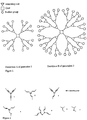
- Dendrons are branched structures comprising branching units and optionally linking units. The generation of a dendron is defined by the number of sets of branching groups; see Figure 1 .
- Dendrons with the same structure (architecture) but a higher generation, or order, are composed of the same structural units (branching and linking units) but have an additional level of branching. There can be surface groups on the periphery or distal units of the dendrons.
- Dendrimers of different generations can have different types of branching points and linking units.
- Dendrimers are generally synthesised by convergent or divergent routes. Convergent routes require a functional group at the dendron foci which can either be reacted directly to give a higher generation dendron or dendrimer or activated before the reaction to form a higher generation dendron or dendrimer. For divergent routes the distal functional groups are used, either after activation or directly, to form the next higher generation dendrimer. Once the dendrimer is formed it has been demonstrated that the surface groups can be modified, e.g. t-butylcarbonates can be removed to leave hydroxyl moieties.
- the linking, branching, and core units of a dendrimer can either be made up of saturated or unsaturated units.
- the presence of unsaturated units within a dendron or dendrimer gives rise to the possibility of modifying the structure to form a final dendrimer that has beneficial properties and which could not be formed easily by another method.
- this invention pertains to a chemical conversion of one or more unsaturated units within a dendron or dendrimer to give bonds which are more saturated between the atoms within the unit.
- the process is different from other reported reactions of unsaturated units. For example it has previously been shown that when disubstituted vinylene units are present within a dendrimer they can be isomerised (see J.N.G.
- di-dendroned substituted 4,4'-diphenylacetylene dendrons have been cyclised to form larger benzene centered dendrimers ( M.D. Watson et al, Chem. Rev., 2001, 101, 1267 ).
- the starting material in Figure B is a dendron where the acetylene unit is the focus with two dendrons attached. The foci of three of these dendrons react to form the central benzene unit of the dendrimer and the other components of the dendrons are unchanged.
- Recently dendrimers that have unsaturated units have been shown to be useful as the light emitting-layer in organic light-emitting diodes.
- OLEDs organic light-emitting diodes
- EL organic electroluminescent
- an OLED comprises a thin organic layer or stack of organic layers sandwiched between two electrodes, such that when a voltage is applied visible or other light is emitted. At least one of the electrodes must be transparent to light. For display applications the light must of course be visible to the eye, and therefore at least one of the electrodes must be transparent to visible light.
- Light-emitting dendrimers typically have a luminescent core and in many cases an inherently at least partially conjugated dendrons.
- an inherently at least partially conjugated dendritic structure is one in which there is conjugation between the groups making up the dendritic structure, but the pi-system is not necessarily fully delocalised. The delocalisation of the pi-system is dependent on the regiochemistry of the attachment of the different groups.
- Such dendrons can also be conjugated dendrons.
- Further examples of light-emitting dendrimers include those found in P. W. Wang, et al Adv. Mater., 1996, 8, 237 ; M. Halim, et al Adv. Mater., 1999, 11, 371 ; A. W.
- Light-emitting dendrimers have the advantage over light-emitting polymers that the light-emitting properties and the processing properties can be independently optimised as the nature of the core, dendrons and surface groups can be independently altered. For example with dendrimers that contain light-emitting cores the emission colour of the dendrimer can be changed by simply changing the core. Although dendrimers with a light-emitting core are preferred, when the core is not luminescent the chromophores in the dendron can be light-emitting.
- Organometallic dendrimers have previously been used in OLED applications as a single component in a film (i.e. a neat film) or in a blend with a molecular material or in a blend of more than one dendrimer of different type (i.e. different cores), e.g. J.M. Lupton et al. Adv. Funct. Mater., 2001, 11, 287 and J. P. J., Markham, et al Appl. Phys. Lett., 2002, 80, 2645 .
- the main structure of the final dendrimer is defined by the dendron branching groups and linking units used in the synthesis.
- the surface groups, branching groups and linking units, where present, and foci in the case of dendrons, and core in the case of dendrimers to be modified. It is known that surface groups of dendrimers and dendrons and the foci of dendrons can be modified. However, as many dendrimers contain saturated linking units and branching groups the modification of these units can be difficult.
- dendrons or dendrimers containing unsaturated units within the linking units and branching groups of the dendrons and the core offer an unexpected advantage for modifying the dendron and dendrimer structures. This is different from the reactions used in the divergent or convergent route where a surface or focal group that contains unsaturation is converted into a surface group for further generation building. For example, in a divergent route the surface groups of the lower generation are typically activated to make them reactive to the species added in the next stage. This is illustrated in the synthesis of poly(iminopropane -1,3-diyl) (PPI) dendrimers which are formed by the Michael addition of acrylonitrile to 1,4-diaminobutane.
- PPI poly(iminopropane -1,3-diyl)
- the resultant terminal nitrile groups are reduced to form the primary amine terminated first generation dendrimer, which can then be reacted with more equivalents of acrylonitrile.
- the reduction is repeated to form the next generation dendrimer (Topics in Current Chemistry, Dendrimers III, p86, Springer-Verlag, Berlin Heidelberg, 2001).
- This approach is different from that of the current invention, in which the entire dendron or dendrimer structure is built such that it contains unsaturated units within the branching groups and/or linking units and/or core, and then the dendron or dendrimer is modified by reaction of some or all of said units.
- the present invention is thus directed at overcoming limitations in the synthetic procedures for the formation of dendrons and dendrimers with saturated units in the dendrons and/or core, and their use in opto-electronic devices, in particular OLEDs.
- a process for modifying at least one dendron intended to form part of a dendrimer said dendron having the formula: FO(dendrite-Q a ) y (I) wherein FO is a functional group attached, either directly or via a linking group which can contain one or more reactable unsaturated units, to the first branching atom or group of the dendrite, each "dendrite" which may be the same or different is a dendrite which contains branching groups and optionally linking groups, the branching groups being selected from aryl, heteroaryl and fused (hetero)aryl, the first branching group having, in addition to FO, 2 or more groups attached, and in which the distal group of each arm of the dendrite is an aryl or heteroaryl group, at least one of said dendrite or, if present, the linking group to FO containing one or more vinylene or acetylenyl groups, y is 1 or more, Q is a surface group and a is
- a is 0 there are no surface groups but preferably a is an integer, generally from 1 to 16.
- the present invention also provides a process for modifying a dendrimer of the formula: CORE-[dendrite-Q a ] x wherein Q and a are as defined above, x is one or 2 or more such that when x is more than one each dendrite-Q a can be the same or different and CORE represents an atom or group and CORE terminates at the single bond to the first branching group in the or each dendrite, each "dendrite” which may be the same or different is a dendrite which contains branching groups and optionally linking groups, the branching groups being selected from aryl, heteroaryl and fused (hetero)aryl, at least one of CORE and "dendrite” comprising at least one vinylene or acetylenyl group, provided that the distal group of each arm of the or each dendrite is an aryl or heteroaryl group, which comprises reacting at least one vinylene or acetylenyl group to form a less unsaturated group in
- the present invention also provides a process for making a dendrimer which involves reacting at least one dendron with a dendrimer precursor wherein the dendron is one which has been modified by a process of this invention.
- a process can be carried out in conventional manner whereby the functional group, FO, of the dendron reacts with the dendrimer precursor.
- FO functional group
- functional group as used herein is meant a group which is capable of reacting, either directly or after activation, with one or more other molecules, such that optionally after attachment of one or more further dendrons, a dendrimer is formed via a convergent route.
- FO and Q should be such that they can be reacted independently; they will therefore not be the same.
- the functional group of the dendron, FO can, in the resulting dendrimer, form part of the core.
- the functional group, FO can be one of two types. In one case it is a simple functional group such as an alcohol, halide, aldehyde or boronic acid group which can react with other moieties to form a dendrimer. In these cases the functional group may no longer be present in the final dendrimer.
- aldehyde-focused dendrons react with pyrrole to form a porphyrin core with dendrons attached.
- the aldehyde itself is no longer present, but the carbon atom of the aldehyde forms part of the porphyrin core.
- the functional group can be a more complex group consisting of a number of components e.g. one or more (hetero)aryl rings.
- the core is organometallic
- the functional group can be a ligand which is reacted with a metal cation to form the dendrimer.
- the functional group becomes part of the core but is still readily identifiable as the starting moiety.
- dendrons linked to a 2-phenylpyridine functional group react with an iridium cation to form iridium based dendritic complexes with 2-phenylpyridine as part of the core.
- the functional group may require activation, e.g.
- y can be more than one; for example with a bicyclic ligand such as phenyl-pyridyl a dendrite can be attached to each ring.
- the present invention also provides a dendrimer whenever obtained by a process of the invention as defined above, wherein the at least one vinylene or acetylenyl group becomes fully saturated and the dendrimer is:
- the invention also provides an organic light emitting device comprising, in sequence, layers of a substrate, an electrode, a first optional charge-transporting layer, a light emissive layer, a second optional charge-transporting layer and a counter electrode, wherein at least one of the emissive layer, first optional charge-transporting layer and second optional charge-transporting layer is a film of a dendrimer as defined above, i.e. is a film of
- the invention also provides a photovoltaic device that comprises at least one dendrimer as defined above, i.e.
- the present invention is directed towards modifying unsaturated groups including vinylene or acetylenyl units within a dendrite or CORE either before reaction to form a dendrimer or as part of a dendrimer, the dendrimers that have been made by this process and the subsequent use of these dendrimers in opto-electronic devices and in particular OLEDs.
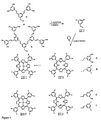
- dendrons or dendrimers that can be considered for modification but all must contain at least one unsaturated group (the reactable group) within the dendron or dendrimer, which are not surface groups, and that can be further reacted ( Figure 2 ).
- These reactable groups which can form a branching point as in the case of 6 and 7 (see Figure 2 ), are groups that are capable of undergoing reactions to form more saturated and preferably fully saturated bonds between the atoms. For example, an acetylene bond could be reduced under Lindlar's conditions to a vinylene or using hydrogen and palladium on charcoal to form an ethylene.
- a chemoselective reaction is one in which only the reactable unsaturated groups in the molecule undergo the reaction and the other groups in the molecule, including FO (if present) and all Q, are unchanged by the reaction.
- the branching points of the dendrite are an aryl or heteroaryl where aryl and heteroaryl can also form part of a fused ring system. More preferably the branching unit is a 1,3,5 substituted benzene or 3,6,N-substituted carbazolyl group.
- the reactive group is vinylene or acetylene and in a dendrimer either forms the links between all branching groups of the dendrite or forms the part of the core directly bonded to the first branching point of the dendrite or is a link between the last branching group of the dendrite and the distal, aryl, group of the dendrite.
- the, or each, dendrite in the dendron contains at least one reactable unsaturated group.
- the dendrite contains the only reactive unsaturated group.
- the, or each, linking group between FO and the first branching point of the dendrite contains the only reactable unsaturated groups in the dendron.
- the CORE contains the only reactable unsaturated groups in the dendrimer.
- the links between the branching points can all be of one type, e.g. acetylenyl as in 1 in Figure 2 , vinyl as in 2, or a mixture as in 3. It is preferred that only non-aryl groups are reacted.
- one or more of the unsaturated links can be converted, depending on the number of equivalents of reagents, according to the process of this invention into a saturated link; this may give rise to a mixture of dendrons or dendrimers. It is preferred that all the equivalent unsaturated groups are reacted. For example, if vinylene units are present then they are all reacted.
- the branching moiety has two vinylene and one methylenoxy linking unit; the two alkene groups can be converted.
- An alternative asymmetric dendrimer type is one having a mixture of alkenyl, acetylenyl and aryl-aryl bonds in the dendrons.
- 5 illustrates an example of the alkenyl and aryl case. It is preferred that in this case only the alkenyl and acetylenyl groups react.
- One of the branching points can also be considered to be the unsaturated carbon atom as in the case of the vinylene 6 and imine 7 units. Preferably in the case that all the links between the branch points are reactive they are comprised of vinyl or acetylenyl or a combination of the two.
- the backbone of the linking group(s) is only comprised of sp and/or sp 2 hybridised atoms.
- the combination of vinyl and acetylene with aryl and heteroaryl branches and aryl-aryl links of which 5 is an example is also preferred.
- Preferred units include phenyl-vinyl-phenyl and phenyl-acetylenyl-phenyl.
- the branching group is (hetero)aryl which remains unchanged when unsaturated groups are reacted e.g. hydrogenated. It will be appreciated that there can be different numbers and combinations of conjugated units between branching points.
- the reaction of vinyl, acetylenyl or iminyl groups to give saturated units removes the conjugation and potentially introduces new functionality.
- the unsaturated group becomes fully saturated.
- the new functionality can be further reacted, e.g. in cross-linking reactions.
- addition of hydrogen bromide to a vinylene unit between two phenyl groups in the dendron would give rise to a benzylic bromide which could be substituted by a range nucleophiles such as alcohols.
- a diol two dendrons or dendrimers could be covalently linked together.
- a linking unit may have more than one unsaturated unit capable of reaction. For example, there may be a divinylbenzene link between two phenyl branch points.
- the dendrons and dendrimers formed after modification contain chromophores suitable for opto-electronic applications and, in particular, light-emitting diodes
- the process of this invention can be used to prepare dendrimers suitable for other applications including dendrimers that have dendrons and/or cores comprised of the basic repeating units of linear polymers but in a branched form.
- dendrimers that have dendrons and/or cores comprised of the basic repeating units of linear polymers but in a branched form.
- a dendrimer containing phenyl branching points and vinylene linking units as described in WO99/21935 would, once all vinylene units are saturated according to a process of this invention, give a dendritic version of poly(phenyleneethylene).
- dendrimers that contain luminescent cores and/or dendrons, and can be used in OLEDs, are preferred.
- the cores of the dendrimers can be fluorescent or phosphorescent.
- fluorescent cores that are only comprised of organic units, i.e. no metal cations, aryl and heteroaryl and fused aryl and heteroaryl and directly linked aryl and heteroaryl systems are preferred. That is the core should not contain unsaturated units that are not aromatic (since otherwise they may react when the non-aromatic unsaturated groups in the dendron are reacted). Examples include phenyl, fluorenyl, thiophenyl, pyridyl and substituted derivatives thereof.
- Preferred metal cations that are part of the core are iridium, which is most preferred, rhenium, rhodium, and platinum with the dendrons attached to aryl and nitrogen heteroaryl containing ligands including, for example ligands containing two aromatic groups selected from pyridine, phenyl, benzothiophene, pyrimidinyl, pyrazinyl pyridazinyl, imidazolyl, quinolinyl, isoquinolinyl, naphthyl, anthryl, phenanthryl, benzamidoazolyl, carbazolyl, fluorenyl, pyrazolinyl, oxazolinyl, oxadiazolinyl, triazolyl, triazinyl, thiadiazolyl, benzimidazolyl, benzoxazolyl, furyl, and in particular phenyl
- the surface groups of the dendrimers are generally selected so that the dendrimer is soluble in solvents suitable for solution processing, e.g. THF, toluene, chloroform, chlorobenzene, xylenes and alcoholic solvents such as methanol. Suitable groups include those disclosed in WO99/21935 .
- the surface groups can also be chosen such that the dendrimer can be patterned. For example, a cross-linkable group can be chosen, which can be crosslinked upon irradiation or by chemical reaction, as a surface group. Alternatively, the surface groups can comprise protecting groups that can be removed to leave crosslinkable groups.
- the distal groups of the dendrite, to which the surface groups are attached are aryl or heteroaryl groups. Where t -butyl groups are the surface groups attached to phenyl rings it is preferable that more than one is attached to each of the distal phenyl units.
- the initial dendrimer is an organometallic dendrimer with a metal cation as part of its core and with at least one dendron which comprises at least one nitrogen atom which forms part of an aromatic ring system or is directly bonded to at least two aromatic groups of the type described in our GB application No. 0206356.8 where the dendron is connected via a vinylene or acetylenyl group of the core. The vinylene or acetylenyl group is then converted into an ethylene group.
- the dendrimer is not of the formula: generally having been obtained by hydrogenating a dendron of the formula.
- OR is 2-ethythexyloxy.
- R 1 represents an optionally substituted benzene radical
- R 2 represents an optionally substituted alkyl or aryl group.
- the nitrogen-containing rings are either oxadiazoles or imidazoles or triazoles.
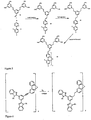
- the reaction is typically as shown in Figure 6 .
- R 1 is typically substituted by one or more surface groups, e.g. 3,5-di-tertiary butyl.
- R 2 is phenyl, which is preferred, or alkyl, for example of 1 to 15 carbon atoms such as methyl or ethyl; these can be substituted, for example when R 2 is phenyl then it can be substituted with, for example, one or more alkyl, alkoxy or halo substituents.
- Vinylenes and acetylenes can also be reacted to give difluoro and tetrafluoro ethylenes.
- Reaction of vinylenes with diborane (hydroboration) followed by an oxidative work-up can lead to alcohols.
- the reaction of vinylenes with HSiCl 3 in the presence of H 2 PtCl 6 can give trichloroalkyl silanes (hydrosilylation) which can be further reacted.
- Vinylenes may also undergo electrophilic addition reactions with hydrogen halides (hydrohalogenation) (HX, e.g.
- H Cl or Br
- dihalogens (halogenation)(X 2 ) giving monohaloethylenes and dihaloethylenes respectively
- acetylenes will give dihaloethylenes and tetrahaloethylenes.
- Unsaturated units such as acetylene and vinylene can also undergo cycloaddition reactions although these are less preferred.
- Diels-Alder reactions and 1,3-dipolar cycloadditions can be used providing that the unsaturated group that has been reacted has less unsaturation between the atoms involved in the original bond than it did before the reaction. All these reactions are well known and those skilled in the art will be well aware of the reaction conditions to employ, in particular if it is desired to be chemoselective.
- Another advantage of this invention is that not all surface groups which are suitable for synthesis and initial processing are compatible with the chemistry to form the dendrons and/or dendrimers and still be available for cross-linking and patterning processes.
- unsaturated units in the dendron then, after dendron or dendrimer formation, these units can be converted to reactive groups which can be used in patterning or crosslinking processes.
- the unsaturated unit to be reacted is near the distal end of the dendron or dendrimer, as shown in Figure 7 .
- a preferred dendron has either an acetylenyl or vinyl unit at its foci which can be reacted with, or will become part of the component of, the core. This unsaturated bond is then reacted to form a saturated link hence disconnecting electronically the core chromophore from unsaturated units in the dendron, as shown in Figures 3 and 6 . This can give enhanced control of the colour purity of core emission and can enable the formation of dendrimers which could not be easily synthesised otherwise, - see e.g. Figure 6 .
- dendrimers can be dissolved in a solvent, the solution deposited onto a substrate, the solvent removed to leave a solid film.
- Conventional solution-processing techniques can be used, for example spin-coating, printing (e.g. ink-jet printing) and dip-coating.
- the resulting solid film is preferably formed on one side of a substrate; the thickness of the solid film is preferably no greater than 2 microns.
- an OLED incorporating a solid film comprising one or more of the dendrimers obtained by the process of this invention.
- an organic light-emitting or electroluminescent device can be formed from a light-emitting layer sandwiched between two electrodes, at least one of which is transparent to the emitted light. More commonly there is one or more hole-transporting layers between the anode and the light-emitting layer and/or one or more electron-transporting layers between the light-emitting layer and the cathode.
- the present invention provides an OLED comprising layers, in sequence of a substrate, an electrode, a first optional charge-transporting layer, a light emissive layer, a second optional charge-transporting layer and a counter electrode, wherein at least one of the emissive layer or the first or second charge-transporting layers, if present, especially the emissive layer, is a film of a dendrimer which is:
- a device according to the invention contains one or more additional species, such as light-emitting dopants, charge-transporting species and/or additional molecular, dendritic and/or polymeric materials.
- additional species such as light-emitting dopants, charge-transporting species and/or additional molecular, dendritic and/or polymeric materials.
- the film comprising the dendrimer forms the light-emitting layer in the OLED. It is particularly preferred that the dendrimers are the light-emitting species in this light-emitting layer. In an alternative embodiment the film comprising the dendrimer forms a charge-transporting layer in the OLED.
- Such a device can have a conventional arrangement comprising a transparent substrate layer, e.g. a glass or PET layer, a transparent electrode layer, a light-emitting layer and a second electrode.
- the anode which is generally transparent, is preferably made from indium tin oxide (ITO) although other similar materials including indium oxide/tin oxide, tin oxide/antimony, zinc oxide/aluminium, gold and platinum can also be used, as can conducting polymers such as PANI (polyaniline) or PEDOT/PSS.
- the cathode is normally made of a low work function metal or alloy such as Al, Ca, Mg, Li or MgAl or optionally with an additional layer of LiF.
- the substrate may be made of an opaque material such as silicon and light is emitted through the opposing electrode.
- the OLED devices may be actively or passively addressed.
- a solution of the dendrimer can be applied over a transparent electrode layer, the solvent evaporated and then subsequent charge-transporting layers can be applied.
- the thickness of the dendrimer layer in the OLED is typically 10nm to 1000nm, preferably no more than 200nm, more preferably 30nm to 120nm.
- An OLED device incorporating an emissive layer comprising the dendrimer may optionally have an adjacent first and/or second charge-transporting layer.
- it has been found that it is particularly beneficial to have at least one hole-blocking/electron-transporting layer between the light-emitting dendrimer layer and the cathode.
- Suitable materials for such a hole-blocking/electron-transporting layer include 2,9-dimethyl-4,7-diphenyl-1,10-phenanthroline (BCP), 1,3,5-tris[2-N-phenylbenzimidazolyl)benzene (TPBI), and 2-biphenyl-5(4'- t -butylphenyl)oxadiazole (PBD) aluminium tris (8-hydroxyquinolate) (Alq) and aluminium bis (2-methyl-8-quinolato)-4-phenylphenolate (BAlq).
- BCP 2,9-dimethyl-4,7-diphenyl-1,10-phenanthroline
- TPBI 1,3,5-tris[2-N-phenylbenzimidazolyl)benzene
- PBD 2-biphenyl-5(4'- t -butylphenyl)oxadiazole
- Alq (8-hydroxyquinolate)
- BAlq aluminium bis (2-methyl-8-quino
- additional emissive (fluorescent or phosphorescent) or charge-transporting species may optionally be added to the layer of the dendrimers to improve device characteristics, e.g. efficiency and lifetime. It may further be of benefit to include one or more other molecular and/or dendrimeric and/or polymeric species in the dendrimers to give improved performance. It is preferred that the molecular, dendritic or polymeric species can transport charge in its own right, for example a conjugated polymer or conjugated dendrimer. In one embodiment such additional components form a part of the total blend from 95 to 5 mol%.
- additional charge-transporting components for use with the light-emitting dendrimers are TPBI, PBD, BCP, 4,4'- bis -(N-carbazolebiphenyl (CBP), 4,4',4"-tris(N-carbazolyl)triphenylamine (TCTA), and tris-4-(N-3-methylphenyl-N-phenyl) phenylamine (MTDATA).
- TPBI 4,4'- bis -(N-carbazolebiphenyl
- TCTA 4,4',4"-tris(N-carbazolyl)triphenylamine
- MTDATA tris-4-(N-3-methylphenyl-N-phenyl) phenylamine
- dendrimers can also be used in other device applications such as photovoltaic cells which can contain one or more layers. When used in photovoltaic cells the dendrimer must be capable of absorbing light and/or transporting charge. The dendrimer may be used as a homogeneous layer in a photovoltaic device or blended with other molecular and/or dendritic and/or polymeric materials. Dendrimers may be used in one or more layers of the photovoltaic device. In photovoltaic applications the organometallic dendrimers need not necessarily be charge-neutral.
- Example 1 describes the process of modification of stilbene containing dendrons by hydrogenation to form ethylene links between the branching phenyl rings and their subsequent transformation to luminescent dendrimers containing porphyrin cores.
- Example 1 also illustrates the benefit of carrying out the transformation by comparing the photoluminescent quantum yields (PLQY) of dendrimers with porphyrin cores with stilbene and diphenylethane based dendrons (see Table 1).
- PLQY photoluminescent quantum yields
- Luminescence efficiency was generally enhanced upon hydrogenation of the stilbenes.
- the film PLQY was less than 20% of the solution PLQY.
- the film PLQY was improved to 44% of the solution PLQY.
- the solution PLQY was low and decreased with increasing generation.
- the platinum porphyrin dendrimers 17a and 18a with ethylene links in the dendrons the solution PLQY were higher and did not decrease with increasing generation.
- the film PLQY for 17a and 18a was also three times higher than that for 22a and 23a showing the improvement in PLQY on removing the unsaturation in the dendrons.
Landscapes
- Chemical & Material Sciences (AREA)
- Engineering & Computer Science (AREA)
- Materials Engineering (AREA)
- Organic Chemistry (AREA)
- Crystallography & Structural Chemistry (AREA)
- Inorganic Chemistry (AREA)
- Health & Medical Sciences (AREA)
- Polymers & Plastics (AREA)
- Medicinal Chemistry (AREA)
- Chemical Kinetics & Catalysis (AREA)
- Physics & Mathematics (AREA)
- Spectroscopy & Molecular Physics (AREA)
- Organic Low-Molecular-Weight Compounds And Preparation Thereof (AREA)
- Macromolecular Compounds Obtained By Forming Nitrogen-Containing Linkages In General (AREA)
- Nitrogen Condensed Heterocyclic Rings (AREA)
- Pyridine Compounds (AREA)
- Electroluminescent Light Sources (AREA)
Claims (23)
- Verfahren zum Modifizieren mindestens eines Dendrons, das dazu bestimmt ist, einen Teil eines Dendrimers zu bilden, wobei das Dendron die folgende Formel hat:
FO(Dendrit-Qa)y
wobei:- jeder "Dendrit", der gleich oder anders sein kann, ein Dendrit ist, der verzweigte Gruppen und optional Bindungsgruppen enthält, wobei die verzweigten Gruppen aus Aryl, Heteroaryl und kondensiertem (Hetero)aryl ausgewählt sind, wobei die erste verzweigte Gruppe zusätzlich zu FO 2 oder mehr gebundene Gruppen hat und bei dem die distale Gruppe von jedem Arm des Dendriten eine Aryl- oder Heteroarylgruppe ist.- FO eine funktionelle Gruppe ist, die entweder direkt oder über eine Bindungsgruppe, die eine oder mehrere reaktive ungesättigte Einheiten enthalten kann, an das erste verzweigte Atom oder die Gruppe des Dendriten gebunden ist.- mindestens einer von dem Dendriten oder, wenn vorhanden, der Bindungsgruppe an FO eine oder mehr Vinylen- oder Acetylenylgruppen enthält.- y 1 oder mehr ist,- Q eine Oberflächengruppe ist und- a 0 oder eine Ganzzahl ist,das ein Reagieren mindestens einer Vinylen- oder Acetylengruppe auf eine chemoselektive Art umfasst, um eine weniger ungesättigte Gruppe zu bilden, unter der Bedingung, dass das Verfahren kein Hydrieren eines Dendrons der folgenden Formel umfasst:
- Verfahren zum Modifizieren eines Dendrimers der folgenden Formel:
CORE-[Dendrit-Qa]x
wobei:- jeder "Dendrit", der gleich oder anders sein kann, ein Dendrit ist, der verzweigte Gruppen und optional Bindungsgruppen enthält, wobei die verzweigten Gruppen aus Aryl, Heteroaryl und kondensiertem (Hetero)aryl ausgewählt sind, und bei dem die distale Gruppe von jedem Arm von dem oder jedem Dendriten eine Aryl- oder Heteroarylgruppe ist.- CORE ein Atom oder eine Gruppe darstellt und CORE an der Einzelbindung an die erste verzweigte Gruppe in dem oder jedem "Dendriten" endet,- mindestens eines von CORE und Dendrit mindestens eine Vinylen- oder Actylenylgruppe umfasst,- x eins oder mehr ist, sodass, wenn x mehr als eins ist, jeder Dendrit-Qa gleich oder anders sein kann,- Q eine Oberflächengruppe ist und- a 0 oder eine Ganzzahl ist,das ein Reagieren mindestens einer Vinylen- oder Acetylenylgruppe umfasst, um eine weniger ungesättigte Gruppe auf eine chemoselektive Art zu bilden. - Verfahren nach Anspruch 1 oder 2, wobei eine Acetylenylgruppe auf eine chemoselektive Art reagiert wird und vollständig gesättigt wird.
- Verfahren nach einem der Ansprüche 1 bis 3, wobei nur Bindungsgruppen reagiert werden.
- Verfahren nach einem der vorstehenden Ansprüche, wobei die erste Verzweigungsstelle in dem Dendriten eine 1,3,5-substituierte Phenylgruppe oder eine 3,6,N-substituierte Carbazolgruppe ist.
- Verfahren nach einem der Ansprüche 2 bis 5, wobei die mindestens eine Vinylen- oder Acetylenylgruppe Teil des Kerns ist und direkt an die erste verzweigte Gruppe eines Dendriten gebunden ist.
- Verfahren nach einem der Ansprüche 2 bis 6, wobei das Dendrimer asymmetrisch ist.
- Verfahren nach einem der Ansprüche 2 bis 7, wobei das Dendrimer ein metallorganisches Dendrimer ist.
- Verfahren nach einem der vorstehenden Ansprüche, wobei die Gruppe, die durch eine chemoselektive Reaktion reagiert worden ist, nachfolgend weiter reagiert wird.
- Verfahren nach einem der vorstehenden Ansprüche, wobei die chemoselektive Reaktion eine Additionsreaktion ist.
- Verfahren nach einem der vorstehenden Ansprüche, wobei die chemoselektive Reaktion eine Hydrierung ist.
- Verfahren nach einem der Ansprüche 1 bis 10, wobei die chemoselektive Reaktion Hydrohalogenierung, Halogenierung, Hydrosilylierung oder Hydroborierung gefolgt von Oxidierung beinhaltet.
- Verfahren nach einem der vorstehenden Ansprüche, wobei die chemoselektive Reaktion eine Cycloaddition ist.
- Verfahren nach einem der Ansprüche 2 bis 13, wobei die mindestens eine Vinylen- oder Acetylenylgruppe Teil eines Dendrimers ist, das einen mindestens inhärent teilweise konjugierten Dendriten hat.
- Verfahren nach einem der Ansprüche 2 bis 8, wobei die mindestens eine Vinylen- oder Acetylenylgruppe Teil eines Dendrimers ist, das mehr als einen mindestens inhärent konjugierten Dendriten umfasst, und die Dendriten an mindestens zwei Liganden im Komplex mit dem Metallkation gebunden sind, das einen Teil des Kerns bildet, und die chemoselektive Reaktion in dem Kern stattfindet.
- Verfahren nach einem der Ansprüche 2 bis 15, wobei das Dendrimer eine oder mehrere Oberflächengruppen hat, was eine Strukturierung ermöglicht.
- Verfahren nach Anspruch 16, wobei das Dendrimer zu einer festen Folie gemacht wird und wobei die Folie in der Lage ist, sichtbares Licht zu emittieren.
- Verfahren zum Herstellen eines Dendrimers, das ein Reagieren mindestens eines Dendrons mit einer Dendrimervorstufe beinhaltet, wobei das Dendron eines ist, das durch ein Verfahren nach einem der Ansprüche 1 und 3 bis 17 modifiziert worden ist.
- Dendrimer, das durch ein Verfahren nach einem der vorstehenden Ansprüche erhalten wurde, wobei die mindestens eine Vinylen- oder Acetylenylgruppe vollständig gesättigt wird und das Dendrimer Folgendes ist:5,10,15,20-Tetrakis{3,5-bis[2-(3,5-di-tert-butylphenyl)ethyl)phenyl}porphyrin;5,10,15,20-Tetrakis[3,5-bis(2-{3,5-bis[2-3,5-di-tert-butylphenyl)ethyl]phenyl}ethyl)-phenyl]porphyrin;5,10,15,20-Tetrakis{3,5-bis[2-(3,5-di-tert-butylphenyl)ethyl)phenyl}porphinato-Platin (II); oder5,10,15,20-Tetrakis[3,5-bis(2-{3,5-bis[2-(3,5-di-tert-butylphenyl)ethyl]phenyl} ethyl)phenyl]porphyrinato-Platin (II).
- Organische Lichtemissionsvorrichtung, umfassend nacheinander Schichten eines Substrats, eine Elektrode, eine erste optionale ladungstransportierende Schicht, eine lichtemittierende Schicht, eine zweite optionale ladungstransportierende Schicht und eine Gegenelektrode, wobei mindestens eine von der emittierenden Schicht, ersten optionalen ladungstransportierenden Schicht und zweiten optionalen ladungstransportierenden Schichten eine Folie eines Dendrimers nach Anspruch 19 ist.
- Vorrichtung nach Anspruch 20, wobei die emittierende Schicht eine Folie eines Dendrimers nach Anspruch 19 ist.
- Vorrichtung nach Anspruch 21, die mindestens eine ladungstransportierende Schicht umfasst.
- Photovoltaische Vorrichtung, die mindestens ein Dendrimer nach Anspruch 19 umfasst.
Applications Claiming Priority (3)
| Application Number | Priority Date | Filing Date | Title |
|---|---|---|---|
| GBGB0220092.1A GB0220092D0 (en) | 2002-08-29 | 2002-08-29 | Reactive dendrimers |
| GB0220092 | 2002-08-29 | ||
| PCT/GB2003/003713 WO2004020547A1 (en) | 2002-08-29 | 2003-08-27 | Reactive dendrimers |
Publications (2)
| Publication Number | Publication Date |
|---|---|
| EP1546284A1 EP1546284A1 (de) | 2005-06-29 |
| EP1546284B1 true EP1546284B1 (de) | 2018-04-04 |
Family
ID=9943162
Family Applications (1)
| Application Number | Title | Priority Date | Filing Date |
|---|---|---|---|
| EP03791026.2A Expired - Lifetime EP1546284B1 (de) | 2002-08-29 | 2003-08-27 | Reaktive dendrimere |
Country Status (6)
| Country | Link |
|---|---|
| US (2) | US7740954B2 (de) |
| EP (1) | EP1546284B1 (de) |
| JP (2) | JP5142456B2 (de) |
| AU (1) | AU2003259367A1 (de) |
| GB (1) | GB0220092D0 (de) |
| WO (1) | WO2004020547A1 (de) |
Families Citing this family (15)
| Publication number | Priority date | Publication date | Assignee | Title |
|---|---|---|---|---|
| GB0104176D0 (en) * | 2001-02-20 | 2001-04-11 | Isis Innovation | Asymmetric dendrimers |
| GB0104177D0 (en) | 2001-02-20 | 2001-04-11 | Isis Innovation | Aryl-aryl dendrimers |
| KR100582797B1 (ko) * | 2001-02-20 | 2006-05-23 | 아이시스 이노베이션 리미티드 | 금속 함유 덴드리머 |
| TWI385193B (zh) * | 2004-12-07 | 2013-02-11 | Sumitomo Chemical Co | 高分子材料及使用該高分子材料之元件 |
| JP5723083B2 (ja) * | 2005-03-15 | 2015-05-27 | イシス イノベイション リミテッド | 多分岐デンドリマー |
| WO2007004113A2 (en) * | 2005-06-30 | 2007-01-11 | Koninklijke Philips Electronics N.V. | Electro luminescent metal complexes |
| KR101073232B1 (ko) * | 2006-11-07 | 2011-10-12 | 쇼와 덴코 가부시키가이샤 | 이리듐 착체 화합물, 그것을 이용하여 얻어진 유기 전계발광 소자 및 상기 소자의 용도 |
| KR101249117B1 (ko) * | 2006-11-13 | 2013-03-29 | 삼성전자주식회사 | 메탈로센 덴드리머, 이를 이용한 유기 메모리 소자 및 그의제조방법 |
| JP5186757B2 (ja) * | 2006-11-27 | 2013-04-24 | コニカミノルタホールディングス株式会社 | 有機エレクトロルミネッセンス素子の製造方法、有機エレクトロルミネッセンス素子、表示装置及び照明装置 |
| US7723722B2 (en) | 2007-03-23 | 2010-05-25 | Semiconductor Energy Laboratory Co., Ltd. | Organic compound, anthracene derivative, and light-emitting element, light-emitting device, and electronic device using anthracene derivative |
| US9142782B2 (en) * | 2010-06-25 | 2015-09-22 | Cambridge Display Technology, Ltd. | Organic light-emitting material, device and method |
| DE102010054525A1 (de) * | 2010-12-15 | 2012-04-26 | Merck Patent Gmbh | Organische Elektrolumineszenzvorrichtung |
| US9029558B2 (en) | 2011-08-18 | 2015-05-12 | Semiconductor Energy Laboratory Co., Ltd. | Carbazole compound, light-emitting element, light-emitting device, electronic device, and lighting device |
| JP5459447B2 (ja) * | 2012-01-13 | 2014-04-02 | 三菱化学株式会社 | イリジウム錯体化合物並びに該化合物を含む溶液組成物、有機電界発光素子、表示装置及び照明装置 |
| CN112029094B (zh) * | 2020-08-24 | 2023-05-05 | 哈尔滨工程大学 | 离子型芴基三聚氰胺超支化共轭聚合物及其制备方法和应用 |
Family Cites Families (14)
| Publication number | Priority date | Publication date | Assignee | Title |
|---|---|---|---|---|
| NL9102112A (nl) | 1991-12-18 | 1993-07-16 | Dsm Nv | Werkwijze voor het bereiden van een aminonitril door het partieel hydrogeneren van een nitrilverbinding met twee of meer nitrilgroepen. |
| BE1007260A3 (nl) | 1993-07-08 | 1995-05-02 | Dsm Nv | Werkwijze voor het bereiden van een dendritisch macromolekuul. |
| NL1001977C2 (nl) | 1995-12-22 | 1997-06-24 | Dsm Nv | Werkwijze voor de bereiding van een macromolekuul. |
| JP4963754B2 (ja) * | 1997-10-23 | 2012-06-27 | イシス イノベイション リミテッド | 光放射デンドリマー及び光放射装置 |
| DE19812881A1 (de) | 1998-03-24 | 1999-10-07 | Bayer Ag | Neue dendrimere Verbindungen, ein Verfahren zu deren Herstellung sowie deren Verwendung als Katalysatoren |
| JP2000219707A (ja) | 1998-09-03 | 2000-08-08 | Tatsuhiko Yagi | 化学修飾側鎖を有する高分子材料、および高機能化された高分子材料 |
| GB0002936D0 (en) * | 2000-02-09 | 2000-03-29 | Isis Innovation | Improved dendrimers |
| KR100582797B1 (ko) | 2001-02-20 | 2006-05-23 | 아이시스 이노베이션 리미티드 | 금속 함유 덴드리머 |
| GB0104176D0 (en) | 2001-02-20 | 2001-04-11 | Isis Innovation | Asymmetric dendrimers |
| GB0104177D0 (en) | 2001-02-20 | 2001-04-11 | Isis Innovation | Aryl-aryl dendrimers |
| JP4220767B2 (ja) * | 2001-12-04 | 2009-02-04 | 日本放送協会 | 有機化合物、有機el素子およびディスプレイ |
| AU2003214421A1 (en) | 2002-03-18 | 2003-09-29 | Isis Innovation Limited | Phosphorescent dendrimers for use in light-emitting devices |
| GB0219987D0 (en) * | 2002-08-28 | 2002-10-09 | Isis Innovation | Intramolecular interactions in organometallics |
| GB0220080D0 (en) * | 2002-08-29 | 2002-10-09 | Isis Innovation | Blended dendrimers |
-
2002
- 2002-08-29 GB GBGB0220092.1A patent/GB0220092D0/en not_active Ceased
-
2003
- 2003-08-27 EP EP03791026.2A patent/EP1546284B1/de not_active Expired - Lifetime
- 2003-08-27 WO PCT/GB2003/003713 patent/WO2004020547A1/en not_active Ceased
- 2003-08-27 AU AU2003259367A patent/AU2003259367A1/en not_active Abandoned
- 2003-08-27 US US10/485,799 patent/US7740954B2/en not_active Expired - Fee Related
- 2003-08-27 JP JP2004532291A patent/JP5142456B2/ja not_active Expired - Fee Related
-
2010
- 2010-02-18 US US12/707,701 patent/US8025988B2/en not_active Expired - Fee Related
- 2010-06-21 JP JP2010140164A patent/JP2010229155A/ja active Pending
Also Published As
| Publication number | Publication date |
|---|---|
| GB0220092D0 (en) | 2002-10-09 |
| US8025988B2 (en) | 2011-09-27 |
| AU2003259367A1 (en) | 2004-03-19 |
| JP2010229155A (ja) | 2010-10-14 |
| US7740954B2 (en) | 2010-06-22 |
| EP1546284A1 (de) | 2005-06-29 |
| WO2004020547A1 (en) | 2004-03-11 |
| AU2003259367A8 (en) | 2004-03-19 |
| JP2005537320A (ja) | 2005-12-08 |
| US20050164029A1 (en) | 2005-07-28 |
| US20100228022A1 (en) | 2010-09-09 |
| JP5142456B2 (ja) | 2013-02-13 |
Similar Documents
| Publication | Publication Date | Title |
|---|---|---|
| US8025988B2 (en) | Reactive organometallic dendrimers | |
| Hsu et al. | Phosphine-oxide-containing bipolar host material for blue electrophosphorescent devices | |
| Li et al. | A high Tg carbazole-based hole-transporting material for organic light-emitting devices | |
| JP4424996B2 (ja) | リン光デンドリマー | |
| Pei et al. | Efficient energy transfer to achieve narrow bandwidth red emission from Eu3+-grafting conjugated polymers | |
| EP1532158B1 (de) | Neutrale metall-dendrimer-komplexe | |
| JP5307978B2 (ja) | 有機燐光材料および有機オプトエレクトロニクス素子 | |
| Ho et al. | Carbazole-based coplanar molecule (CmInF) as a universal host for multi-color electrophosphorescent devices | |
| Subeesh et al. | Phenanthroimidazole derivative as an easily accessible emitter for non-doped light-emitting electrochemical cells | |
| Zhang et al. | New phosphorescent platinum (II) Schiff base complexes for PHOLED applications | |
| Neogi et al. | Amorphous host materials based on Troger’s base scaffold for application in phosphorescent organic light-emitting diodes | |
| CN102344465B (zh) | 环金属化过渡金属络合物及使用其的有机电致发光器件 | |
| Xu et al. | A novel deep blue-emitting znii complex based on carbazole-modified 2-(2-hydroxyphenyl) benzimidazole: Synthesis, bright electroluminescence, and substitution effect on photoluminescent, thermal, and electrochemical properties | |
| US20080211391A1 (en) | Highly Branched Dendrimers | |
| WO2009046266A1 (en) | Complexes with tridentate ligands | |
| TW201036937A (en) | Organic electroluminescent element | |
| CN108290837A (zh) | 咔唑衍生物和使用其的有机发光器件 | |
| KR101573952B1 (ko) | 광전 소자용 발광성 중합체성 물질 | |
| CN113853381A (zh) | 铱配位化合物、含有该化合物和溶剂的组合物、含有该化合物的有机电致发光元件、显示装置和照明装置 | |
| CN107868035B (zh) | 用于有机光电装置的化合物、用于有机光电装置的组合物及有机光电装置及显示装置 | |
| US20080091021A1 (en) | Diarylaminofluorene-based organometallic phosphors and organic light-emitting devices made with such compounds | |
| TWI839438B (zh) | 銥錯合物化合物 | |
| Yu et al. | Synthesis, photo-and electro-luminescence of novel red phosphorescent Ir (III) complexes with a silsesquioxane core | |
| CN116023418A (zh) | 有机金属化合物、包括其的有机发光器件和包括所述有机发光器件的电子设备 | |
| Karakaya | Synthesis and application of the iridium semiconductor complexes for organic light emitting diodes |
Legal Events
| Date | Code | Title | Description |
|---|---|---|---|
| PUAI | Public reference made under article 153(3) epc to a published international application that has entered the european phase |
Free format text: ORIGINAL CODE: 0009012 |
|
| 17P | Request for examination filed |
Effective date: 20050304 |
|
| AK | Designated contracting states |
Kind code of ref document: A1 Designated state(s): AT BE BG CH CY CZ DE DK EE ES FI FR GB GR HU IE IT LI LU MC NL PT RO SE SI SK TR |
|
| AX | Request for extension of the european patent |
Extension state: AL LT LV MK |
|
| DAX | Request for extension of the european patent (deleted) | ||
| RAP1 | Party data changed (applicant data changed or rights of an application transferred) |
Owner name: THE UNIVERSITY COURT OF THE UNIVERSITY OF ST. ANDR Owner name: OXFORD UNIVERSITY INNOVATION LIMITED |
|
| RAP1 | Party data changed (applicant data changed or rights of an application transferred) |
Owner name: OXFORD UNIVERSITY INNOVATION LIMITED Owner name: THE UNIVERSITY COURT OF THE UNIVERSITY OF ST. ANDR |
|
| GRAP | Despatch of communication of intention to grant a patent |
Free format text: ORIGINAL CODE: EPIDOSNIGR1 |
|
| STAA | Information on the status of an ep patent application or granted ep patent |
Free format text: STATUS: GRANT OF PATENT IS INTENDED |
|
| RIC1 | Information provided on ipc code assigned before grant |
Ipc: H01L 51/50 20060101ALI20171004BHEP Ipc: H05B 33/14 20060101ALI20171004BHEP Ipc: H01L 51/30 20060101ALI20171004BHEP Ipc: C09K 11/06 20060101AFI20171004BHEP Ipc: C08G 83/00 20060101ALI20171004BHEP |
|
| INTG | Intention to grant announced |
Effective date: 20171103 |
|
| GRAS | Grant fee paid |
Free format text: ORIGINAL CODE: EPIDOSNIGR3 |
|
| GRAA | (expected) grant |
Free format text: ORIGINAL CODE: 0009210 |
|
| STAA | Information on the status of an ep patent application or granted ep patent |
Free format text: STATUS: THE PATENT HAS BEEN GRANTED |
|
| REG | Reference to a national code |
Ref country code: DE Ref legal event code: R081 Ref document number: 60351098 Country of ref document: DE Owner name: CAMBRIDGE DISPLAY TECHNOLOGY LTD., GODMANCHEST, GB Free format text: FORMER OWNERS: ISIS INNOVATION LTD., SUMMERTOWN, OXFORD, GB; THE UNIVERSITY COURT OF THE UNIVERSITY OF ST. ANDREWS, ST. ANDREWS, GB |
|
| AK | Designated contracting states |
Kind code of ref document: B1 Designated state(s): AT BE BG CH CY CZ DE DK EE ES FI FR GB GR HU IE IT LI LU MC NL PT RO SE SI SK TR |
|
| REG | Reference to a national code |
Ref country code: GB Ref legal event code: FG4D |
|
| REG | Reference to a national code |
Ref country code: CH Ref legal event code: EP |
|
| REG | Reference to a national code |
Ref country code: AT Ref legal event code: REF Ref document number: 985584 Country of ref document: AT Kind code of ref document: T Effective date: 20180415 |
|
| REG | Reference to a national code |
Ref country code: IE Ref legal event code: FG4D |
|
| REG | Reference to a national code |
Ref country code: DE Ref legal event code: R096 Ref document number: 60351098 Country of ref document: DE |
|
| REG | Reference to a national code |
Ref country code: NL Ref legal event code: MP Effective date: 20180404 |
|
| PG25 | Lapsed in a contracting state [announced via postgrant information from national office to epo] |
Ref country code: NL Free format text: LAPSE BECAUSE OF FAILURE TO SUBMIT A TRANSLATION OF THE DESCRIPTION OR TO PAY THE FEE WITHIN THE PRESCRIBED TIME-LIMIT Effective date: 20180404 |
|
| PG25 | Lapsed in a contracting state [announced via postgrant information from national office to epo] |
Ref country code: ES Free format text: LAPSE BECAUSE OF FAILURE TO SUBMIT A TRANSLATION OF THE DESCRIPTION OR TO PAY THE FEE WITHIN THE PRESCRIBED TIME-LIMIT Effective date: 20180404 Ref country code: FI Free format text: LAPSE BECAUSE OF FAILURE TO SUBMIT A TRANSLATION OF THE DESCRIPTION OR TO PAY THE FEE WITHIN THE PRESCRIBED TIME-LIMIT Effective date: 20180404 Ref country code: BG Free format text: LAPSE BECAUSE OF FAILURE TO SUBMIT A TRANSLATION OF THE DESCRIPTION OR TO PAY THE FEE WITHIN THE PRESCRIBED TIME-LIMIT Effective date: 20180704 Ref country code: SE Free format text: LAPSE BECAUSE OF FAILURE TO SUBMIT A TRANSLATION OF THE DESCRIPTION OR TO PAY THE FEE WITHIN THE PRESCRIBED TIME-LIMIT Effective date: 20180404 |
|
| PG25 | Lapsed in a contracting state [announced via postgrant information from national office to epo] |
Ref country code: GR Free format text: LAPSE BECAUSE OF FAILURE TO SUBMIT A TRANSLATION OF THE DESCRIPTION OR TO PAY THE FEE WITHIN THE PRESCRIBED TIME-LIMIT Effective date: 20180705 |
|
| REG | Reference to a national code |
Ref country code: AT Ref legal event code: MK05 Ref document number: 985584 Country of ref document: AT Kind code of ref document: T Effective date: 20180404 |
|
| PG25 | Lapsed in a contracting state [announced via postgrant information from national office to epo] |
Ref country code: PT Free format text: LAPSE BECAUSE OF FAILURE TO SUBMIT A TRANSLATION OF THE DESCRIPTION OR TO PAY THE FEE WITHIN THE PRESCRIBED TIME-LIMIT Effective date: 20180806 |
|
| REG | Reference to a national code |
Ref country code: DE Ref legal event code: R097 Ref document number: 60351098 Country of ref document: DE |
|
| PG25 | Lapsed in a contracting state [announced via postgrant information from national office to epo] |
Ref country code: SK Free format text: LAPSE BECAUSE OF FAILURE TO SUBMIT A TRANSLATION OF THE DESCRIPTION OR TO PAY THE FEE WITHIN THE PRESCRIBED TIME-LIMIT Effective date: 20180404 Ref country code: RO Free format text: LAPSE BECAUSE OF FAILURE TO SUBMIT A TRANSLATION OF THE DESCRIPTION OR TO PAY THE FEE WITHIN THE PRESCRIBED TIME-LIMIT Effective date: 20180404 Ref country code: CZ Free format text: LAPSE BECAUSE OF FAILURE TO SUBMIT A TRANSLATION OF THE DESCRIPTION OR TO PAY THE FEE WITHIN THE PRESCRIBED TIME-LIMIT Effective date: 20180404 Ref country code: EE Free format text: LAPSE BECAUSE OF FAILURE TO SUBMIT A TRANSLATION OF THE DESCRIPTION OR TO PAY THE FEE WITHIN THE PRESCRIBED TIME-LIMIT Effective date: 20180404 Ref country code: DK Free format text: LAPSE BECAUSE OF FAILURE TO SUBMIT A TRANSLATION OF THE DESCRIPTION OR TO PAY THE FEE WITHIN THE PRESCRIBED TIME-LIMIT Effective date: 20180404 Ref country code: AT Free format text: LAPSE BECAUSE OF FAILURE TO SUBMIT A TRANSLATION OF THE DESCRIPTION OR TO PAY THE FEE WITHIN THE PRESCRIBED TIME-LIMIT Effective date: 20180404 |
|
| PLBE | No opposition filed within time limit |
Free format text: ORIGINAL CODE: 0009261 |
|
| STAA | Information on the status of an ep patent application or granted ep patent |
Free format text: STATUS: NO OPPOSITION FILED WITHIN TIME LIMIT |
|
| PG25 | Lapsed in a contracting state [announced via postgrant information from national office to epo] |
Ref country code: IT Free format text: LAPSE BECAUSE OF FAILURE TO SUBMIT A TRANSLATION OF THE DESCRIPTION OR TO PAY THE FEE WITHIN THE PRESCRIBED TIME-LIMIT Effective date: 20180404 |
|
| 26N | No opposition filed |
Effective date: 20190107 |
|
| PG25 | Lapsed in a contracting state [announced via postgrant information from national office to epo] |
Ref country code: MC Free format text: LAPSE BECAUSE OF FAILURE TO SUBMIT A TRANSLATION OF THE DESCRIPTION OR TO PAY THE FEE WITHIN THE PRESCRIBED TIME-LIMIT Effective date: 20180404 |
|
| REG | Reference to a national code |
Ref country code: CH Ref legal event code: PL |
|
| GBPC | Gb: european patent ceased through non-payment of renewal fee |
Effective date: 20180827 |
|
| PG25 | Lapsed in a contracting state [announced via postgrant information from national office to epo] |
Ref country code: LU Free format text: LAPSE BECAUSE OF NON-PAYMENT OF DUE FEES Effective date: 20180827 Ref country code: CH Free format text: LAPSE BECAUSE OF NON-PAYMENT OF DUE FEES Effective date: 20180831 Ref country code: LI Free format text: LAPSE BECAUSE OF NON-PAYMENT OF DUE FEES Effective date: 20180831 |
|
| REG | Reference to a national code |
Ref country code: DE Ref legal event code: R082 Ref document number: 60351098 Country of ref document: DE Representative=s name: GRUENECKER PATENT- UND RECHTSANWAELTE PARTG MB, DE Ref country code: DE Ref legal event code: R081 Ref document number: 60351098 Country of ref document: DE Owner name: CAMBRIDGE DISPLAY TECHNOLOGY LTD., GODMANCHEST, GB Free format text: FORMER OWNERS: OXFORD UNIVERSITY INNOVATION LIMITED, OXFORD, OXFORDSHIRE, GB; THE UNIVERSITY COURT OF THE UNIVERSITY OF ST. ANDREWS, ST. ANDREWS, GB Ref country code: DE Ref legal event code: R081 Ref document number: 60351098 Country of ref document: DE Owner name: CAMBRIDGE DISPLAY TECHNOLOGY LTD., GODMANCHEST, GB Free format text: FORMER OWNERS: OXFORD UNIVERSITY INNOVATION LIMITED, OXFORD, GB; THE UNIVERSITY COURT OF THE UNIVERSITY OF ST. ANDREWS, ST. ANDREWS, GB |
|
| REG | Reference to a national code |
Ref country code: BE Ref legal event code: MM Effective date: 20180831 |
|
| PG25 | Lapsed in a contracting state [announced via postgrant information from national office to epo] |
Ref country code: SI Free format text: LAPSE BECAUSE OF FAILURE TO SUBMIT A TRANSLATION OF THE DESCRIPTION OR TO PAY THE FEE WITHIN THE PRESCRIBED TIME-LIMIT Effective date: 20180404 |
|
| PG25 | Lapsed in a contracting state [announced via postgrant information from national office to epo] |
Ref country code: FR Free format text: LAPSE BECAUSE OF NON-PAYMENT OF DUE FEES Effective date: 20180831 Ref country code: BE Free format text: LAPSE BECAUSE OF NON-PAYMENT OF DUE FEES Effective date: 20180831 |
|
| PG25 | Lapsed in a contracting state [announced via postgrant information from national office to epo] |
Ref country code: GB Free format text: LAPSE BECAUSE OF NON-PAYMENT OF DUE FEES Effective date: 20180827 |
|
| PG25 | Lapsed in a contracting state [announced via postgrant information from national office to epo] |
Ref country code: TR Free format text: LAPSE BECAUSE OF FAILURE TO SUBMIT A TRANSLATION OF THE DESCRIPTION OR TO PAY THE FEE WITHIN THE PRESCRIBED TIME-LIMIT Effective date: 20180404 |
|
| PG25 | Lapsed in a contracting state [announced via postgrant information from national office to epo] |
Ref country code: HU Free format text: LAPSE BECAUSE OF FAILURE TO SUBMIT A TRANSLATION OF THE DESCRIPTION OR TO PAY THE FEE WITHIN THE PRESCRIBED TIME-LIMIT; INVALID AB INITIO Effective date: 20030827 |
|
| PG25 | Lapsed in a contracting state [announced via postgrant information from national office to epo] |
Ref country code: IE Free format text: LAPSE BECAUSE OF NON-PAYMENT OF DUE FEES Effective date: 20180827 Ref country code: CY Free format text: LAPSE BECAUSE OF FAILURE TO SUBMIT A TRANSLATION OF THE DESCRIPTION OR TO PAY THE FEE WITHIN THE PRESCRIBED TIME-LIMIT Effective date: 20180404 |
|
| PGFP | Annual fee paid to national office [announced via postgrant information from national office to epo] |
Ref country code: DE Payment date: 20210713 Year of fee payment: 19 |
|
| REG | Reference to a national code |
Ref country code: DE Ref legal event code: R119 Ref document number: 60351098 Country of ref document: DE |
|
| PG25 | Lapsed in a contracting state [announced via postgrant information from national office to epo] |
Ref country code: DE Free format text: LAPSE BECAUSE OF NON-PAYMENT OF DUE FEES Effective date: 20230301 |